I Am Extremely Fortunate

Last Monday, the first day of the second half of rapidly disappearing 2025, found me at the medical office building where I’ve volunteered for 13 years, manning its information desk. The part-time gig keeps me on my toes. Many patients arrive without knowing which suite their doctor works in, for instance. It’s my job to point them in the right direction. And sometimes I come to peoples’ “rescue,” such as when I aid those who, their medical appointments completed, can’t remember where in the nearby parking garage they deposited their cars. Off I go with them to that multi-level structure to solve the problem.

I like the job, which occupies me for four hours each week. Without it, I’d have a relative paucity of human interactions, seeing that I spend a hefty percentage of my time resting my aged, bony ass upon the living room sofa. Plus, helping people out boosts my spirits. Basically, I need to feel as though I’ve still got something to offer society.

Last Monday was a typical day at work. I answered questions from, and helped unravel somewhat-knotty situations for, approximately 50 individuals. However, during my shift something struck me more than it usually does: I clearly realized that a whole lot of visitors to the building were using and relying on canes, walkers and wheelchairs. And nowhere near all of those folks were senior citizens. This was a sobering observation. It brought to the surface a piece of self-knowledge that normally resides in the bottom reaches of my subconscious. Namely, I am extremely fortunate. Here I am, pushing age 80, and I get around on my legs just fine. I can walk for five or more miles, no problem. And though it would be foolhardy of me to attempt an all-out sprint, trotting remains within my powers. Yeah, anything might yet happen, but I’ve retained more than decent mobility.

And my good fortune extends way beyond my legs. My health in general, according to medical tests and my physicians, is solid. I’ve had one very dangerous health situation in my life. Thanks to modern medicine and just plain positive luck, it appears to be permanently confined to the rearview mirror. Of course, nobody knows that for certain, but the odds are in my favor.

What’s more, I have plenty to eat, and my country (the USA), though in the hands of a freedoms-suppressing megalomaniac, is not a war zone. I almost feel guilty about my good fortune, considering how difficult so many people have it in the States and all around the world. Poor health, poor healthcare availability, and inadequate food intake are some of the injustices plaguing hundreds of millions of individuals. And armed conflicts make life a living hell, or close to it, for so, so many. Not just in Ukraine and Gaza, but in violence-beset nations that don’t receive much media attention. Haiti and Sudan, to name two, and Myanmar and Yemen, to name two more.

Yes, the human condition, in certain respects, is horrible. Always has been. Always will be.

Considerate guy that I occasionally am, I’ll leave you on a sunny note: My good fortune expanded at the tail end of last year when I discovered Abigail Lapell. She’s a fine Canadian singer-songwriter who isn’t too well known outside her home country. Her latest album, Anniversary, came out 16 months ago. I’m in love with one of its songs, Flowers In My Hair, which is the first song in many a moon that I can’t (and don’t want to) get out of my head.  A meditation on going with the flow while letting love reign over you, it is dominated by angelic vocals and by mesmerizing percussion provided via handclaps and foot stomps. Flowers In My Hair, to me, is sweet as a peach and free as a bird. Give it a listen.

It’s A Wonderful Life . . . Or Is It?

My better half and I jointly watch an hour or more of television fare five or six evenings each week. Mostly we dial up series, with the occasional movie thrown into the mix. During the second half of December, however, we went movie-crazy, by our standards, what with five flicks passing before our eyes. In chronological order, they were: A Thousand And One; A Million Miles Away; Maestro; Rustin; It’s A Wonderful Life. All came out last year, excepting It’s A Wonderful Life, which, since its release in 1946, has ascended to an exalted status reached by few films. I’m now going to devote a few words to it and to A Thousand And One, as they, unlike the others on the list, seem to be in no hurry to fade from my mind. They made a strong impression on me and got me thinking.

I’d seen It’s A Wonderful Life once or twice before, but not in ages. Not blessed with the world’s finest memory, I might as well have been viewing it for the first time last month, so few of the scenes did I recall. Well, all I can say is, “Wow!” IAWL deserves its immense popularity and the high esteem millions of folks hold it in. This is a great movie, one that pulls at your heartstrings and does its darnedest to make you believe in the basic goodness of humankind. Hats off to that.

Frank Capra, also of Mr. Smith Goes To Washington and It Happened One Night fame, directed It’s A Wonderful Life. For those of you who haven’t seen the film, be aware that spoilers lie ahead. I’m confident they won’t lessen your enjoyment should you choose to view it.

IAWL tells the tale of George Bailey (played flawlessly by James Stewart), a generous, caring individual who discovers that his company, through no fault of his own, suddenly is on the verge of bankruptcy. Distraught, and finding no way to right the sinking ship, he decides to put an end to his earthly existence. The money his wife Mary (the superb Donna Reed) then would collect from his life insurance policy would keep her and their children sheltered and fed for a long while.

Moments before George is about to carry out his plan, a heavenly force — Clarence, a low-level guardian angel trying to earn his wings — intervenes. Clarence’s efforts, and those of Mary, save the day. George learns that his importance to his family and community is immeasurable, and that his many friends truly love him. Anyone whose heart is not encased in granite will find themselves tearing up at It’s A Wonderful Life’s happy ending, an ending that implies that never again will George allow despair to conquer him. George will be okay.

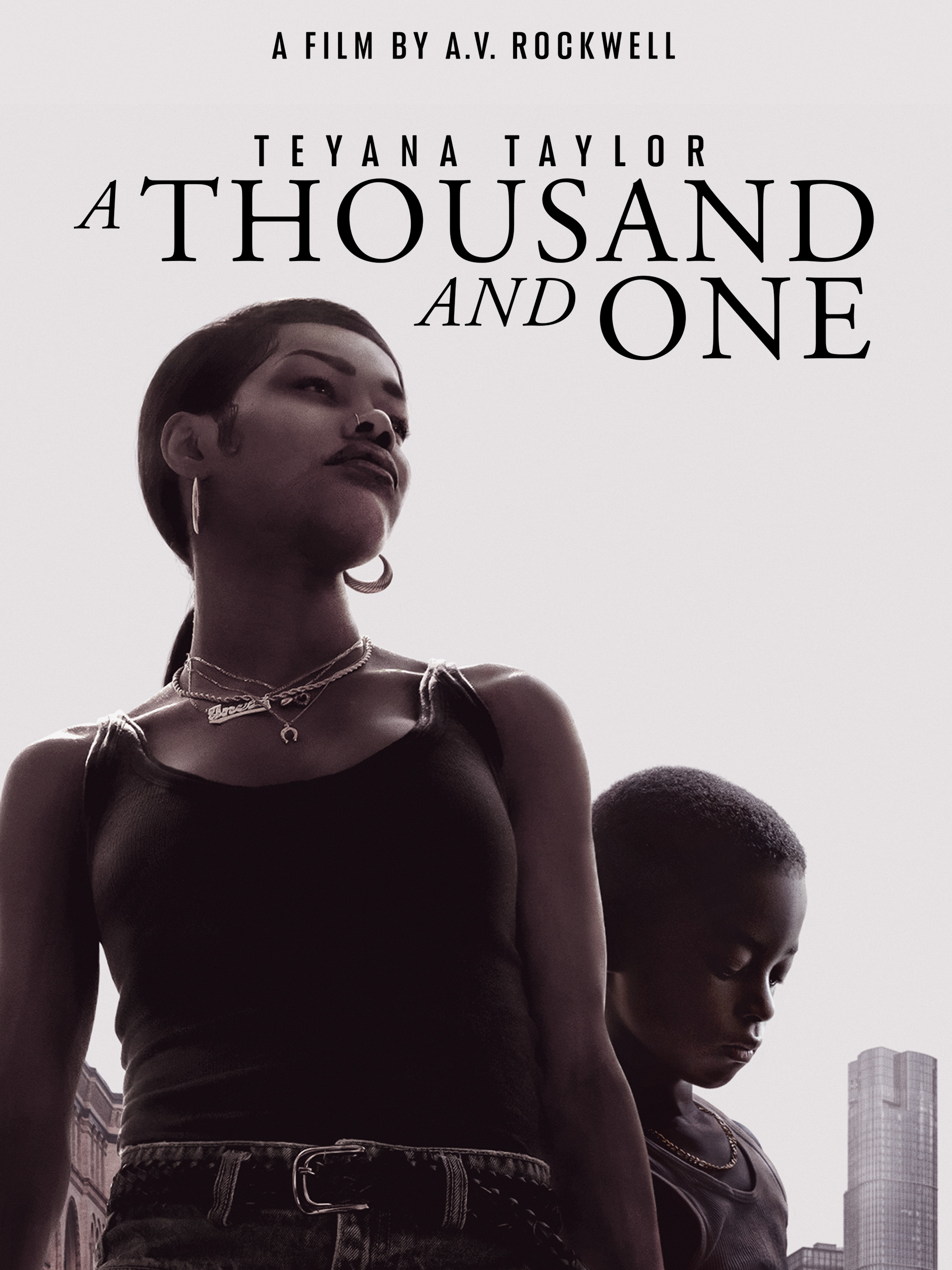
But will Terry, a main character in A Thousand And One, be okay? That’s a worrisome unknown in the powerhouse drama written and directed by A.V. Rockwell.

We first meet Terry (played by three actors, one for each time period the movie covers) in the mid-1990s. He’s six years old at that time, a foster-care child lonely for his absent mother Inez. Portrayed with swagger by Teyana Taylor, Inez is armed with eyes that don’t miss a thing.  She is barely into her twenties and always has lived on society’s edges. Inez re-enters Terry’s life after being released from prison, soon taking him, illegally, from his foster parents. For the next eleven years she tries as best she can to raise him. Ultimately, however, circumstances catch up with them big-time.

A Thousand And One pulls no punches. Set mostly in New York City’s Harlem section, it often is as gritty as a sandstorm. I’ve given away much of the ending of It’s A Wonderful Life. I won’t do the same with A Thousand And One, whose concluding scenes I didn’t see coming. Those scenes left me concerned, not for street-savvy Inez’s prospects, but for those of shy and gentle Terry. For the most part, I’ve led a stable and comfortable life. A Thousand And One has me counting my lucky stars.

What a world we live in. So much poverty and inequality. So much violence and emotional trauma. So much intolerance, indifference and deception. That’s the way things always have been. And, I believe, always will be. There also is beauty in our world, of course. And love and joy and kindness. It can’t be denied, though, that life is a very rocky road for multitudes of people. Too many Terrys, and other unfortunates, are out there. If only it were otherwise.