Another weekend has come and gone. It was a good one. The locale: Jim Thorpe, PA. The main reason for being there: Willy Porter, a terrifically talented singer-songwriter and guitarist.
As with Kim Richey, whom I wrote about recently, I’ve known of Willy Porter for years but actually knew almost nothing about him. I’d never seen him perform, couldn’t have named a single song by him. One thing I did know, though, is that he would be at the Mauch Chunk Opera House in Jim Thorpe, Pennsylvania on April 25. The idea of visiting Jim Thorpe had been spinning quietly in my head for a couple of years, ever since some good friends of mine told about the fine time they’d had there. My wife and I recently were thinking about nabbing a weekend getaway, and at seventy miles Jim Thorpe isn’t too far from where we live. But our visit would need an anchor, a strong reason for going. To wit, Willy Porter. Something told me he’d put on a good show, and I was right.
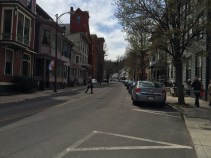
Jim Thorpe is a cute town nestled in the foothills of the Pocono Mountains. From the early 1800s until 1930 or so it was a prosperous place, a cog for coal mining and railroad industries. Its name then was Mauch Chunk, derived from a Native American language. Over time, there came to be not only Mauch Chunk, but also the adjacent town of East Mauch Chunk. As coal mining in the area dwindled in the 1900s, both Chunks’ fortunes headed south. People and money left. Town leaders had a plan, though a very odd plan, to try and reverse the decline. It revolved around Jim Thorpe, the celebrated Native American athlete who died in 1953.
Jim Thorpe lived in California at the time of his death, but was a native Oklahoman. His burial was to be in Oklahoma. It seems, though, that Oklahoma had trouble raising money for a Thorpe memorial, something that his family wanted. His widow Patricia somehow had heard that the two Chunks were looking for an economic boost. So, she and the towns’ officials made a deal. Mauch Chunk and East Mauch Chunk merged and became Jim Thorpe. Town leaders hoped that the new name would prove a draw for businesses and tourists, a pretty wifty notion if you ask me. Jim’s remains were transported to the newly-christened community, which built a memorial to him. Possibly Patricia was paid for all of this. The details are quite cloudy.
I doubt if the name change helped business grow at all, but during the last 20 or more years Jim Thorpe has become one of those places that people like to visit. With its old fashioned look as key, it has evolved into an artsy, craftsy and happily hippyish town. Bed and breakfast establishments have blossomed. The historic district is small but well-preserved, with strings of nice neat 19th century structures on twisting and narrow streets. Jim Thorpe is close to beautiful areas where you can hike, bike and water raft. But if you aren’t overly jazzed by those activities, then a one night stay, or even a day trip, is all you need. We arrived on April 25 and left the next day.
The highlight of our excursion was indeed Willy Porter. We also enjoyed walking around town checking out the architectural details and the town’s surrounding mountains, though that becomes old pretty fast as a steady pace will bring you from one end of the historic district to the other in eight minutes. But the addition of an excellent restaurant dinner, a bit of shopping, and a tour of the Asa Packer Mansion made the weekend worthwhile, as did The Parsonage, the comfy B&B where we landed.

If you are a fan of good singer-songwriters, then Willy Porter is your man. His subjects often are love and personal freedom, and he peers at them intelligently from a spectrum of angles. One of many tunes that had me head-bopping was the Caribbean-flavored Elouise, a gentle love song that put me in mind of artists such as James Taylor, Jack Johnson and Martin Sexton.
If you are a fan of singer-songwriters who do more with their guitars than simple strumming, then Willy is totally your man. His abilities on amplified acoustic guitar made my jaw drop. He can play pretty much any which way he wants, and often had several harmonious interweaving lines going at the same time. Think Leo Kottke or Michael Hedges.
Willy was on stage for over two hours. Carmen Nickerson, his vocal accompanist, added depth and deft atmospherics to the mix. The funky Mauch Chunk Opera House, occupying its site in town since 1882, was another plus. Porter, a nationally-touring musician, has played there many times, becoming a Poconos fixture.
Food? Don’t miss Moya, a stylish and casual restaurant on Race Street. Before the Porter concert, my wife and I both ordered crab cakes, which came with a wonderful cilantro sauce. Delicious. Dessert, a shared crème brulee, was rich and vanilla loaded, and was served at the correct temperature, warm instead of piping hot. I’m always in search of beers I haven’t had before, and I found a great one at Moya, the Fort Collins Brewery’s very hoppy and dry Rocky Mountain IPA.
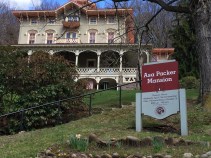
Well-presented history? Take the tour of the Asa Packer Mansion. Asa Packer’s name has been substantially lost in the mists of time, but he was a rich and powerful man in the 1800s, a railroad magnate and founder of Lehigh University. He lived in the mansion with his wife and several children from 1861 until his passing in 1879, and it continued to be the Packer home until 1912, the year in which his last surviving child, Mary, died at age 73. Mary left the house and its contents to Mauch Chunk. Everything there today is pretty much intact from that date.
Now, house tours can be kind of a snooze, but this one wasn’t. The home is full of lovely objects, and the tour guides are lively and make Packer history interesting. I especially liked the gorgeous but modest stained glass windows in the dining room and second floor landing. They stood out in a house dominated by various shades of brown.
 Yeah, Another Blogger