A week and a half ago, Philadelphia Museum Of Art opened its arms nice and wide when my wife Sandy and I entered the building. Then, with feeling, it embraced us. “Yeah,” I thought to myself, “this is going to be a good visit.” And it was. How could it not have been? I mean, over the years I’d roamed through PMA’s galleries more than 100 times, coming away invigorated each trip. The museum rocks.
Arriving with no advance plans as to what to see, we took a look at the museum’s website after showing our PMA-membership cards at the admissions counter. Any number of special exhibits listed on the site, ranging from small to large, piqued our interest. An hour and 45 minutes later, we’d toured them all, plus other gallery spaces. Whew! Had we covered too much ground a bit too quickly? Probably, but little matter. In any event, the museum was readying to close at that point, so off we went to retrieve our car in the museum’s parking garage. The visit, though, didn’t fade from my mind.

Faces! I’m still thinking about some of the face-centric artworks I saw at the museum, more so than the landscapes, seascapes, town scenes and city scenes, and abstractions. Maybe that’s because Sandy and I began our trek at a mini exhibit whose centerpiece was a privately owned, seldom-shown-in-public sketch by my favorite artist, Vincent van Gogh. The drawing, from 1885, is a rendition of The Potato Eaters, an oil painting Van Gogh was working on at the time in the Netherlands, the country of his birth. That painting is now generally considered to be one of his most important pieces.
The five folks in the sketch are Dutch farmers, a hard-working family that never had, and undoubtedly never would have, more than the minimum necessities needed to get by. Van Gogh didn’t try to portray them in exacting detail. He wasn’t a precisionist. His intent was to get to the heart and soul of these people. Hell, getting to the heart and soul was his intent in every one of his works, no matter what the subject matter. And he almost always pulled it off. His enormous popularity developed largely for this reason, I think. Posthumously, needless to say, as the general public was unaware of Van Gogh during his lifetime. (Van Gogh moved from the Netherlands to France in 1886, and died there, by his own hand, in 1890.)

On the opposite side of the museum’s ground floor, hundreds of feet away from the Van Gogh sketch, Sandy and I admired a portrait of James Baldwin, the American writer, social activist and deep thinker. Painted by Beauford Delaney, a devoted artist whom success mostly eluded, the work, painted in 1945, depicts Baldwin in his early twenties. It captures him brilliantly, with bold strokes and an expert disregard for photographic-like realism. As a result, Baldwin comes alive on the canvas. Van Gogh would have approved.
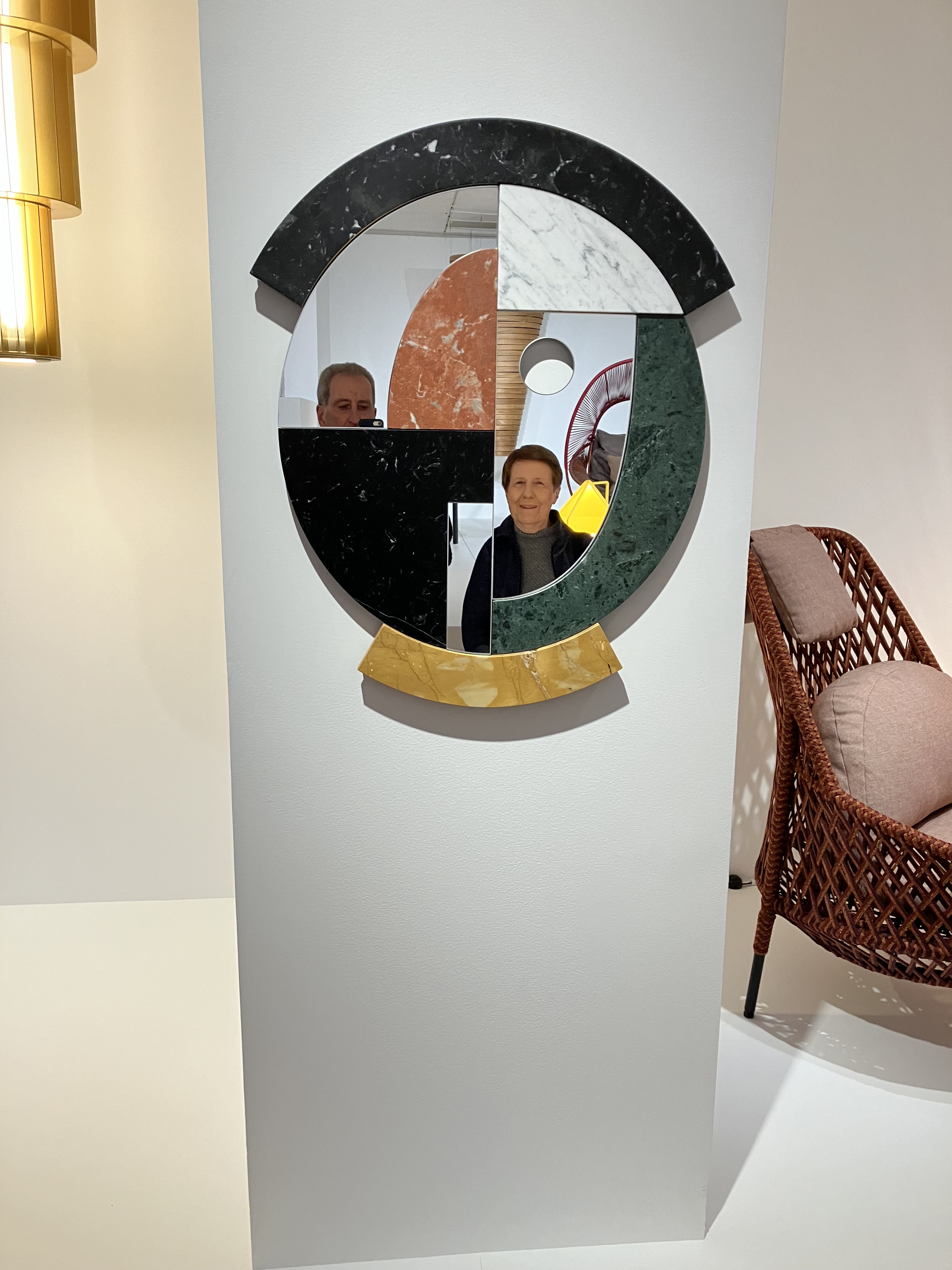
Many other faces greeted us from PMA’s gallery walls that day. I’ll comment on only two of them. They are the visages, as some of you will recognize, of myself and my better half. Man, there was no way I was going to let pass the opportunity to snap a photo when I noticed our reflections in a mirror designed by Stephen Burks. The mirror was part of a dazzling exhibit of Burks’ modern interior-design items.
Somewhat amazingly, it is the only picture I took in the museum that day (the other two pix in this story are from the PMA website). That’s because, while at PMA, I had no intention of writing about Sandy’s and my visit and illustrating the story with photos captured by my phone’s camera. I just wasn’t in a reporter-on-the-scene mood. And yet, this essay emerged anyway. Well, all I can say is, “You never frigging know.” Ain’t that the truth!
 Yeah, Another Blogger