On a recent weekend my wife Sandy and I added to one of the biggest lists we maintain. Namely, the list of movies that we have seen. We watch far more movies at theaters than at home, and the two I’m about to talk about were viewed from comfortable chairs in suburban Philadelphia cinemas. We went on a Friday with our excellent friends Barbara and Fred to see Burnt. The following night, unaccompanied, we took in Room.
I hadn’t thought of Burnt as a must-see, but I was more than happy to give it a go when Sandy informed me that she and Barbara had decided upon it. I like Bradley Cooper and I like food, and Burnt not only stars Cooper but is set in the world of high cuisine and celebrated chefs. Leaving the theater I was fine with Burnt. Then the next day I started to think about it a bit more, a dangerous thing to do, and downgraded my opinion. It’s an enjoyable movie, but nothing beyond standard. It’s pretty good at best.
Now, Room was another story. I had been under the impression that it is highly disturbing, with tough-to-watch violent scenes. I was reluctant to see it because of this. Sandy, however, told me that, from what she had read, I was wrong. Right she was. I didn’t have to close my eyes at all during the movie, as nothing bloodily horrific occurred. What did take place unfurled seamlessly, a heartwrenching and heartwarming tale that felt authentic. Room is a great movie, one of the very best that I’ve seen so far in the year 2015.
Seems to me that most movies, in one way or another, are about the human condition. Well, uh, duh. And the human condition, needless to say, is complicated, far too variable and malleable for an amateur observer like me ever to understand particularly well. I came away from Burnt and Room, though, with the idea that, vastly different as they are, they address some of the same questions: What does it take for a person to become well-oiled and smoothly-functioning and goodhearted? To fit in the world healthily?
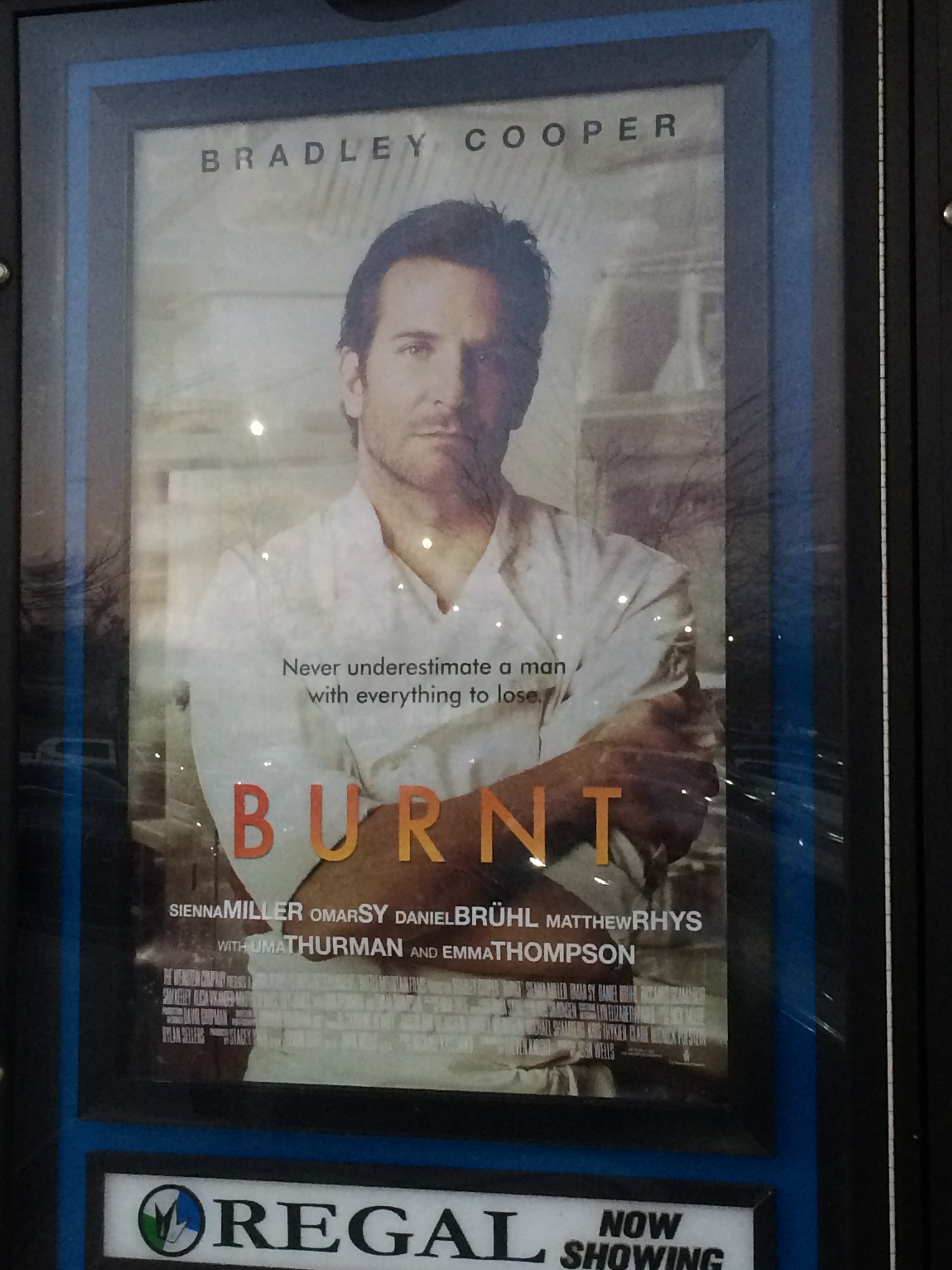
In Burnt, Bradley Cooper plays Adam Jones, once a top-of-the-line restaurant chef who imploded and burned his bridges several years before the movie’s opening moments. Anger, unhappiness and the subsequent drugs and drink did him in. Early in the action we find him doing self-imposed penance as an oyster shucker in a New Orleans restaurant. He has been clean and sober for a couple of years and has decided that he will take his place as an elite chef once again, but only after he has shucked one million oysters. That milestone reached, off he heads to London, where associates from his past are in the culinary game.
Aggressive, fast-talking and manipulative, Jones magically in no time is at the helm of a fancy fancy eatery in a fancy fancy hotel. You go, bro! Though recognized as a maestro in the kitchen, Jones for some reason feels obligated to treat his boss and kitchen staff in a bullying and disrespectful manner. And he gets away with it. Apparently the stoppage of substance abuse didn’t stop Jones from being an asshole. How come? — go ask the screenwriter. But what really got me was that so many people, despite Jones’ obnoxious ways, have an underlying deep affection for him. Made no sense to me. Go ask the screenwriter.
But Adam Jones is not all bad. Hints of decency peek through. And he owns a degree of self-awareness. If he is to morph into the person whom others, remarkably, are rooting for him to become, he will need to drop his defenses and allow their good feelings to reach him, and allow his blood to warm. We’re talking here about love, the key to life.
Yup, high-speed and breezy Burnt is a flawed production about a flawed human being. But there are two good reasons to see it, Bradley Cooper for one. He is a fine actor. Adam Jones is a complex guy, and Cooper draws a complete picture.
And then there’s the food. I’m a sucker for beautifully filmed looks at the preparation and downing of gorgeous and delicious meals. A good one-sixth of Burnt has the camera focused on this tasty stuff. Thinking about it now is making me hungry.

Speaking of flaws, stay away from Room if you’re looking for them. It is one of those movies that gets everything right. The screenplay, cinematography, pacing, acting. Brie Larson and child actor Jacob Tremblay perform astonishingly in the lead roles. The rest of the small cast also is outstanding. I see a bushel of Oscar nominations in Room’s future.
Room’s examination of how best to grow in the world, unlike Burnt’s, is profound, multidimensional and moving. What, though, is the world? When Room commences, it is a one-room shed for 24-year-old Joy Newsome (Larson) and her five-year-old son Jack (Tremblay). They have been held prisoner there by perverted Old Nick, a middle-aged loser. Old Nick never has allowed Jack to leave the shed. Joy, kidnapped by Old Nick when she was seventeen, hasn’t been outside the room since then. Old Nick began using Joy for sex right from the start. He is Jack’s biological father.
The shed is habitable and sits behind Old Nick’s home in Akron, Ohio. It has running water, electricity, heat, a tiny kitchen and bathroom, a bed, a television and a few books. It has no wall windows, only a skylight. Its one door is thick and equipped with a passcode-protected lock for which only Old Nick knows the numbers. Old Nick visits the shed to deliver food and to have sex. Escape? Little chance — Old Nick is crafty and scary. This is a bleak set-up, one in which only the strong-willed and resilient, such as Joy, would survive.
Jack knows of no existence beyond his prison. To Jack, the room and his mother have been reality, nothing much else. He doesn’t realize that the people and other images that he sees on television have a connection to realms beyond the screen. Yet he is a happy and playful child. Joy has done miraculous work nurturing Jack under cruelly limiting conditions. Raising him with love is all that matters to Joy. And shielding him from Old Nick.
I’m not spoiling the plot by saying that Joy begins to explain their plight to Jack when he turns five, and that light bulbs slowly brighten in his mind. I won’t say more about the directions the story takes. Giving away too much about such a quality movie wouldn’t be fair.
But I will say this. Room examines the human plight fastidiously. Burnt doesn’t, which is sort of OK because it never meant to. But Burnt would have been a better movie if it had tried a little harder. Somewhere in the middle of Burnt one of the characters throws out a line or two about Adam Jones having had a very rough upbringing. Nothing more is made of this in Burnt, but probably it’s the root cause of chef Jones’ discontent.
I’ll say it again. Love, the key to life.
(Photos by Sandra Cherrey Scheinin. If you click on a photo, a larger image will open)
(If you enjoyed this article, then please don’t be shy about sharing it)

 Yeah, Another Blogger