Willy Porter Anchors A Visit To Jim Thorpe, PA

Another weekend has come and gone. It was a good one. The locale: Jim Thorpe, PA. The main reason for being there: Willy Porter, a terrifically talented singer-songwriter and guitarist.

As with Kim Richey, whom I wrote about recently, I’ve known of Willy Porter for years but actually knew almost nothing about him. I’d never seen him perform, couldn’t have named a single song by him. One thing I did know, though, is that he would be at the Mauch Chunk Opera House in Jim Thorpe, Pennsylvania on April 25. The idea of visiting Jim Thorpe had been spinning quietly in my head for a couple of years, ever since some good friends of mine told about the fine time they’d had there. My wife and I recently were thinking about nabbing a weekend getaway, and at seventy miles Jim Thorpe isn’t too far from where we live. But our visit would need an anchor, a strong reason for going. To wit, Willy Porter. Something told me he’d put on a good show, and I was right.
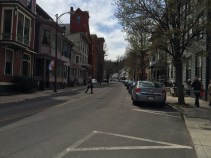
Jim Thorpe, Pennsylvania

Jim Thorpe is a cute town nestled in the foothills of the Pocono Mountains. From the early 1800s until 1930 or so it was a prosperous place, a cog for coal mining and railroad industries. Its name then was Mauch Chunk, derived from a Native American language. Over time, there came to be not only Mauch Chunk, but also the adjacent town of East Mauch Chunk. As coal mining in the area dwindled in the 1900s, both Chunks’ fortunes headed south. People and money left. Town leaders had a plan, though a very odd plan, to try and reverse the decline. It revolved around Jim Thorpe, the celebrated Native American athlete who died in 1953.

Jim Thorpe lived in California at the time of his death, but was a native Oklahoman. His burial was to be in Oklahoma. It seems, though, that Oklahoma had trouble raising money for a Thorpe memorial, something that his family wanted. His widow Patricia somehow had heard that the two Chunks were looking for an economic boost. So, she and the towns’ officials made a deal. Mauch Chunk and East Mauch Chunk merged and became Jim Thorpe. Town leaders hoped that the new name would prove a draw for businesses and tourists, a pretty wifty notion if you ask me.  Jim’s remains were transported to the newly-christened community, which built a memorial to him. Possibly Patricia was paid for all of this. The details are quite cloudy.

I doubt if the name change helped business grow at all, but during the last 20 or more years Jim Thorpe has become one of those places that people like to visit. With its old fashioned look as key, it has evolved into an artsy, craftsy and happily hippyish town. Bed and breakfast establishments have blossomed. The historic district is small but well-preserved, with strings of nice neat 19th century structures on twisting and narrow streets. Jim Thorpe is close to beautiful areas where you can hike, bike and water raft. But if you aren’t overly jazzed by those activities, then a one night stay, or even a day trip, is all you need. We arrived on April 25 and left the next day.

The highlight of our excursion was indeed Willy Porter. We also enjoyed walking around town checking out the architectural details and the town’s surrounding mountains, though that becomes old pretty fast as a steady pace will bring you from one end of the historic district to the other in eight minutes. But the addition of an excellent restaurant dinner, a bit of shopping,  and a tour of the Asa Packer Mansion made the weekend worthwhile, as did The Parsonage, the comfy B&B where we landed.
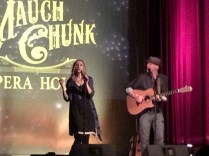
Willy Porter and Carmen Nickerson at Mauch Chunk Opera House

If you are a fan of good singer-songwriters, then Willy Porter is your man. His subjects often are love and personal freedom, and he peers at them intelligently from a spectrum of angles. One of many tunes that had me head-bopping was the Caribbean-flavored Elouise, a gentle love song that put me in mind of artists such as James Taylor, Jack Johnson and Martin Sexton.

If you are a fan of singer-songwriters who do more with their guitars than simple strumming, then Willy is totally your man. His abilities on amplified acoustic guitar made my jaw drop. He can play pretty much any which way he wants, and often had several harmonious interweaving lines going at the same time. Think Leo Kottke or Michael Hedges.

Willy was on stage for over two hours. Carmen Nickerson, his vocal accompanist, added depth and deft atmospherics to the mix. The funky Mauch Chunk Opera House, occupying its site in town since 1882, was another plus. Porter, a nationally-touring musician, has played there many times, becoming a Poconos fixture.

Food? Don’t miss Moya, a stylish and casual restaurant on Race Street. Before the Porter concert, my wife and I both ordered crab cakes, which came with a wonderful cilantro sauce. Delicious. Dessert, a shared crème brulee, was rich and vanilla loaded, and was served at the correct temperature, warm instead of piping hot. I’m always in search of beers I haven’t had before, and I found a great one at Moya, the Fort Collins Brewery’s very hoppy and dry Rocky Mountain IPA.
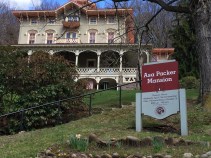
Asa Packer Mansion
Asa Packer Mansion

Well-presented history? Take the tour of the Asa Packer Mansion. Asa Packer’s name has been substantially lost in the mists of time, but he was a rich and powerful man in the 1800s, a railroad magnate and founder of Lehigh University. He lived in the mansion with his wife and several children from 1861 until his passing in 1879, and it continued to be the Packer home until 1912, the year in which his last surviving child, Mary, died at age 73. Mary left the house and its contents to Mauch Chunk. Everything there today is pretty much intact from that date.

Now, house tours can be kind of a snooze, but this one wasn’t. The home is full of lovely objects, and the tour guides are lively and make Packer history interesting. I especially liked the gorgeous but modest stained glass windows in the dining room and second floor landing. They stood out in a house dominated by various shades of brown.
The Wonderful Kim Richey In New Hope

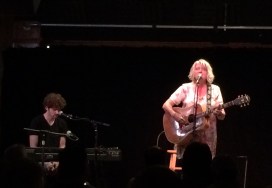
Kim Richey, with Dan Mitchell, at The New Hope Winery

Ah, the world is ripe for discovery. So many places to see, and not nearly enough time to make a big dent in the to-visit list. And I’m not even talking about locales such as Barcelona, Copenhagen, the Amazonian jungle or the Hindu Kush mountains. Let’s leave them for another day and look instead at what’s not far from our front doors.

Last June my wife and I did just that, journeying all of 17 miles from our home to a music venue a short distance from the artsy heart of New Hope, Pennsylvania. That venue, The New Hope Winery, had been at the lower areas of my radar screen for several years. The stars finally aligned correctly and led us there, where we saw Griffin House, a good singer-songwriter. We enjoyed the Winery experience so much, we returned three more times before year’s end.

The New Hope Winery actually is several buildings. One is a wine and gift shop. The music hall is another. A large rectangle, the hall is wood-paneled and filled with cocktail tables draped with red tablecloths. It is a comfortable place, but nothing fancy, and seats around 200. Many musicians who pass through the Winery make their living touring this and other countries. People such as Raul Malo, Chris Hillman (an original Byrd), Dar Williams and Judy Collins. Yet, the Winery isn’t as well known as other Philadelphia-area venues, Sellersville Theater and World Café Live for instance, that present these same or similar artists. In other words, The New Hope Winery could use more visibility.

We took in our first Winery concert of 2015 last Friday when we went to see Nashville-based Kim Richey, who was accompanied by her longtime musical mate Dan Mitchell. Kim sang lead and strummed an acoustic guitar, and Dan handled vocal harmonies, keyboards and, most unexpectedly, an occasional trumpet or fluegelhorn interlude. Kim wrote or co-wrote all of the 17 songs that she performed in her 90 minutes set. She was absolutely wonderful.

Kim inhabits the sweet spot where country, folk and singer-songwriter sensibilities come together. Her voice is steady and lovely, her songs tuneful and literate. Fans of Mary Chapin Carpenter or Patty Griffin probably already love, or would love, Kim Richey. I’ve known of her for years, but never knew much about her or her music. Turns out she was a latecomer to the music game, grabbing her first record contract at age 37 (she’s 58 now). She has released seven studio albums since 1995. The most recent is 2013’s Thorn In My Heart.

At the Winery, Richey and Mitchell worked together pretty seamlessly. Mitchell did a good job on keyboards and on the horns, but what I liked best were the effortless vocal harmonies that he partnered with Richey’s calm but warm voice. Their singing brought a hush to the room.

About half of Richey’s set came from Thorn In My Heart. She sang her chosen songs unhurriedly, and most looked at love and relationships, but from differing angles. On one hand there was Every River , the song’s narrator so in love with her guy that she declares “When the day comes that I don’t love you/Every star will fall out of the sky.” She doesn’t expect to lose love, but for sure her world will become calamitous if she does.

Alas, in the sad sad sad Those Words We Said, calamity has arrived. A traumatic breakup has struck a gal hard. She hits the highway to try and assuage her problems, but she can’t stop thinking about “Those words that wounded like an arrow to the heart,/And keep me drivin’, drivin’.” In New Hope, I totally believed the heartbreak.

Kim Richey is a high-level talent. And she might have a demographics problem. Based on The New Hope Winery audience, I’d think so. The 150 or so folks in the room were middle-aged or older, with the emphasis definitely on older. They were a great audience, clapping long and loudly after each song. But seeing a few youthful faces in the crowd I’m sure would have made Kim’s night even better. If Kim doesn’t have many younger fans, why is beyond me.  The millenials who turn out in droves to see smart youngish songwriters like Norah Jones and Conor Oberst would like Kim Richey too. Yes, I’m pretty certain that Kim could use a broader fan base. She certainly deserves one, but she’s not alone in that. The music business is not only tough, it’s tough to figure out.

Blast Furnace Blues

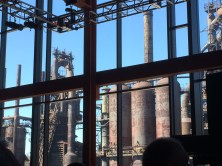
Long-idled blast furnaces
Long-idled blast furnaces, the backdrop to Blast Furnace Blues festival in Bethlehem, Pennsylvania

Ah, my first post.  The “About” page notes that the blog will focus on the interests that I’ve loved all of my adult life: Music, movies, food and beverage, art, traveling, theater. That list isn’t exclusive. There is room to expand. For my first post, though, I’ll stick to the list and review a recent musical day in Bethlehem, Pennsylvania.

I’ve been to quite a few places over the years, and there are many more I’d like to visit. On the other hand, there are places I’ve given little thought to, and have no plans to visit. I’ll scratch one of those no-plans places off my list now, though, because not long ago I was in Bethlehem, PA with my wife. Turns out that this small city is a mere 40 miles from where I live. Who knew?

It was a web-surfing spree a few weeks ago that brought Bethlehem from darkness into light. During that spree, Cape Cod lover that I am, I looked over the website of the Cape’s Payomet Performing Arts Center. On it I saw that a musician named Carolyn Wonderland was on the schedule. What a name! No way I’d not check out her website. And there I noticed that Wonderland, a blues/rock troubadour from Texas, would be at Blast Furnace Blues, a three day music festival in Bethlehem. The lineup on the Blast Furnace website looked excellent for the final festival day, March 29. It included Wonderland and Shemekia Copeland, one of the greatest blues singers alive. March 29 arrived, off we went, and we are very glad that we did.

Bethlehem’s main claim to fame was, and likely still is, the Bethlehem Steel Corporation. That company, now defunct, had nationwide facilities. The heart of its operation was in Bethlehem itself, where steel production ended 20 years ago. Parts of the former Bethlehem site are well on their way to looking like Roman ruins. But much of the grounds have been reclaimed. By Sands Casino Resort, for one. And by ArtsQuest Center, a large and spiffy year-round home to concerts, films and such, and to special events like Blast Furnace Blues. Blast Furnace’s organizers gave the festival the correct name. Rusting monolithic blast furnaces that once produced thousands of tons of iron daily are the backdrop to the musicians in the center’s third floor music room. The furnaces are fully visible through huge glass windows.

No acoustic country blues on the Blast Furnace menu. Loud and driving electric blues and rock instead, exactly what the crowd came out to hear. Music roared in two rooms, on separate floors, but my wife and I stuck to the third floor. The schedule there was hard to beat. We took in a lot of music, four acts spread out over six hours. The crowd grew as the afternoon and evening deepened. When Shemekia Copeland hit the stage around 6:30, 400 or more blues-crazed and partying folks filled the room. Now, all four bands were hot, but Shemekia and her mates were the best, as I figured they would be. The only performer on the bill whom I had seen before, I knew her to be fabulous, and once again she was. What a voice.  Pretty incomparable, really. And the four guys backing her up were ferocious, Stones-y as can be at times, deeper than deep in the blues at others. Got to name these gentlemen: Arthur Neilson and Ken Scandlyn on guitars; Kevin Jenkins on bass; the amazing Robin Gould on drums. If you’ve never seen Shemekia and company, do yourself a favor.

Lots of good things to say about the other acts. I’m sometimes not a big fan of white boys singing the blues, but Chris O’Leary, of his namesake band, was authentic. A strong, clean vocal delivery, no cringe-worthy Muddy Waters-like imitations, except his occasional blues growl. I’ll forgive him for that. What’s the blues without some growling, right? O’Leary’s rich mouth harp storytelling, and Pete Kanaris’s searing guitar lines, led the band’s instrumental charge through raw Chicago-style blues, talking blues, and New Orleans syncopations. O’Leary is a veteran of the late Levon Helm’s Barn Burners. Somehow he was new to me. Praise to Blast Furnace Blues for bringing him in.

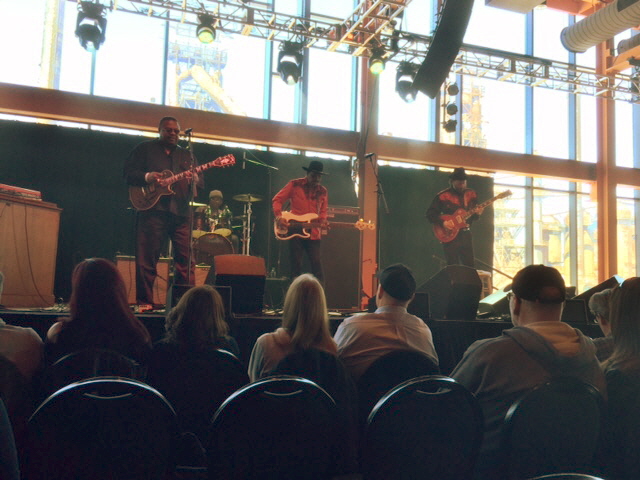
The Freddie King Reunion Band in action

Freddie King, a blues giant on electric guitar and vocally, passed away in 1976. Benny Turner, King’s younger brother, played electric bass guitar with King for many years. All these decades later, Turner decided to celebrate his brother by bringing together other King band alumni, and one red-hot guitarist, Texas Slim, who loves King’s music but never played with him. The Freddie King Reunion Band thus was born a couple of months ago, and Blast Furnace was only its third or fourth appearance. Like Turner said from the bandstand, musically it was as though the guys hadn’t been apart at all in the 39 years since King’s passing. With Benny on bass and most of the lead vocals, these fellas played with power, smoking a repertoire of the down and dirty as if in a bygone and sweaty Chicago blues club.

And what about Carolyn Wonderland, who led me to Bethlehem in the first place? She owns good pipes (like those of a more rugged Bonnie Raitt), writes good songs, and is right at home playing blues, country-tinged rock, and gospel tunes. And she slings a tough guitar. Even in 2015, it’s not common seeing a lady tear into the strings. At Blast Furnace, she and her band gripped the music hard and didn’t let go. The girl’s got it.