A Friday Frolic In Philly

My wife Sandy and I lived in Philadelphia for many years, both before we met and subsequently. The year 2005 was a momentous one for us, because that’s when we made the leap from the city to the nearby northern burbs. In some ways I prefer living where I now do, in other ways I wonder if leaving the city was a brilliant idea. Our house is nicer than the one we used to occupy, the current neighborhood is cuter than its predecessor. On the other hand, automobile traffic around here is as blood pressure-elevating as in Philadelphia. And there aren’t enough fun things for us to do, which is why we head south a few times each month to check out the offerings in various sections of the City Of Brotherly Love.

My overall opinion of Philadelphia is a good one. Yes, the city has plenty of problems, like too much crime and a pitiful public school system. And yet it has so much going for it. Loads of history that we all know or should know about. Great parks big and small. Fabulous buildings from the late 1600s onward. More restaurants, music venues, theaters and such than anyone could wish for. I’m sounding like someone from Philadelphia’s official tourism bureau, but my feelings are legitimate. For physical beauty, culture and food, Philadelphia is world-class.

Which brings us to Friday, July 3. Sandy and I were itching to get out of the house. Not much that we knew about was going on in the burbs. Philadelphia it would be. Where in the city though? Sandy had noticed in the paper that July 3 was First Friday in Philadelphia’s Old City section. We hadn’t been to a First Friday in a year or two, and we decided to go.
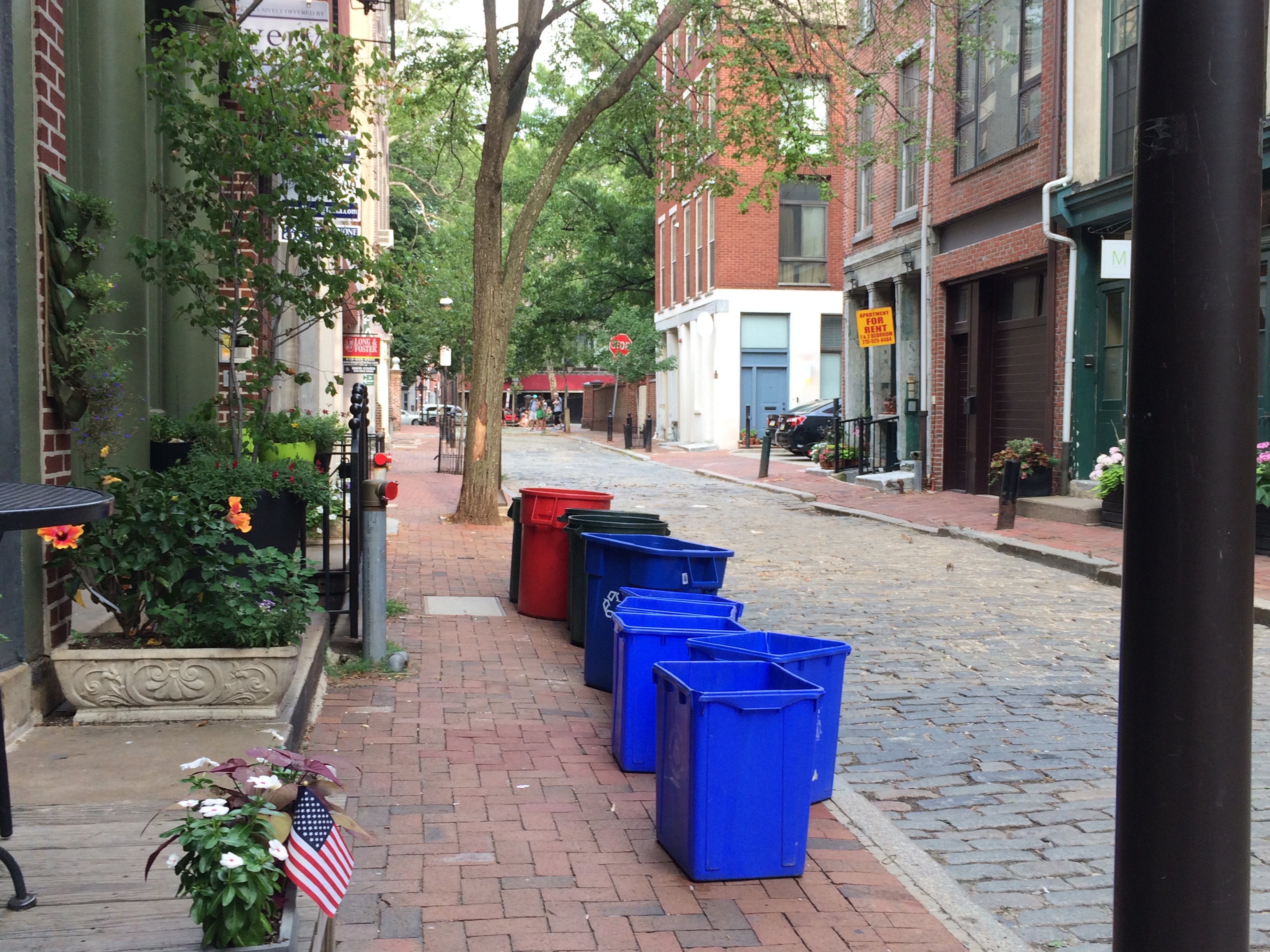
Old City's Church Street is paved with grey bricks.
Old City’s Church Street is paved with grey bricks. They contrast nicely with plastic recycling bins.

Old City is a part of town that was full of homes, businesses and people in Colonial days. It still is, and many of those 1700s structures are with us today. The area is quaint and often lively, and plenty of streets retain their ancient paving bricks and stones. There are quite a few art galleries in Old City. In 1991, attempting to lure customers and imbue Old City with needed panache, some gallery owners began keeping their doors open in the evening on the first Friday of each month. They spread the word and a monthly mini-festival, a kind of happening, was born. All over the world, events similar to First Friday are taking place. They can be good.

You never know what you’ll come across on Old City First Fridays. Painters and crafts people and assorted vendors set up tables for their wares on the sidewalks and in alleyways, which are also where musicians set up their instruments and wail. And many art galleries, the original driving force, are open. Sandy and I strolled around Old City without a plan. Not having done advance research, we ended up missing a few blocks with galleries we’d have liked. Next time. Most of the action that we caught was on a two block stretch of 2nd Street between Market and Arch Streets, and on Arch between 2nd and 3rd. A small chunk of territory, actually, but enough.
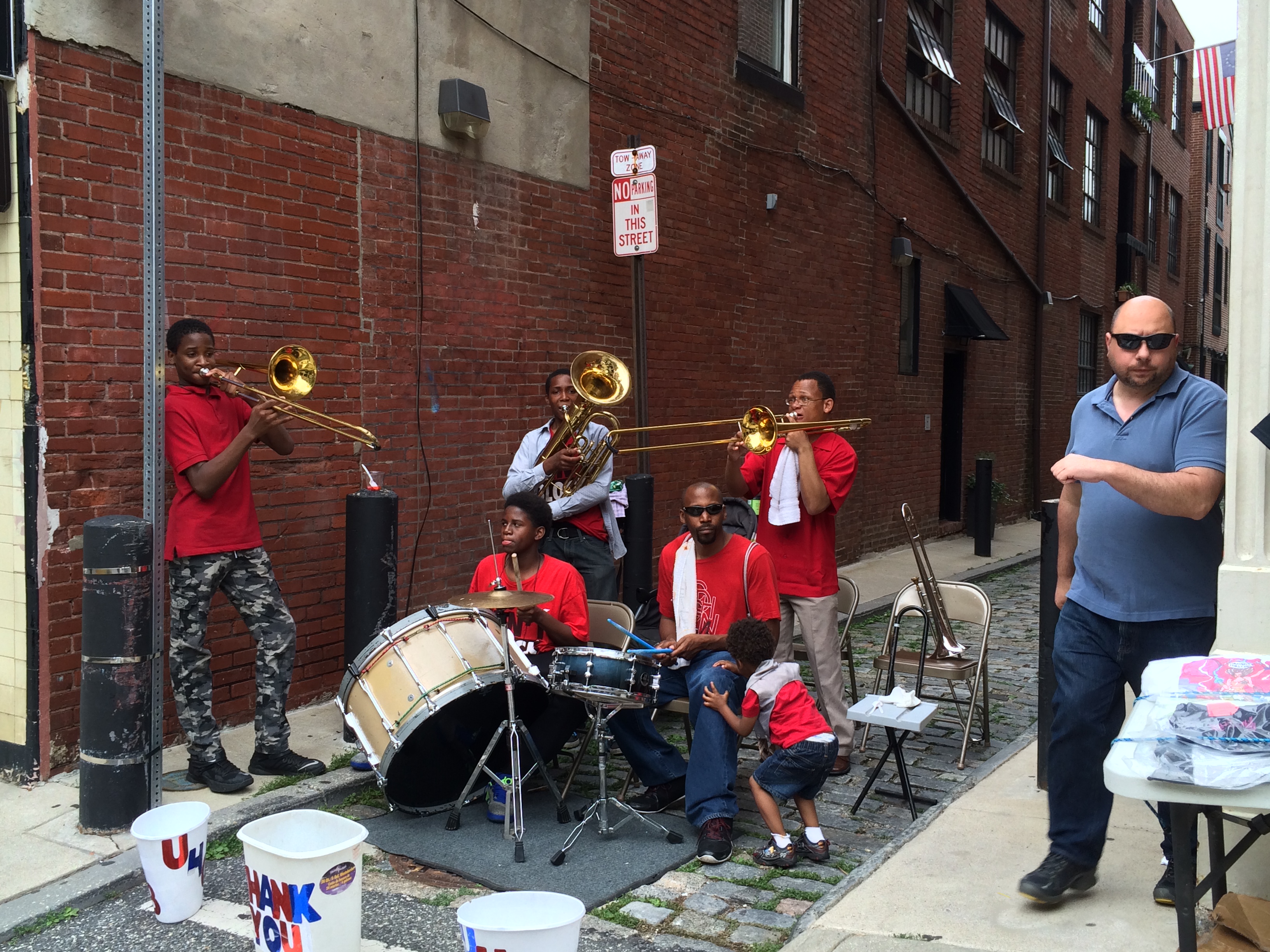
Brass band wailing away in Old City.
The human caterpillar.


Our eyes were open for human creations and human activities. Who wouldn’t have loved the brash New Orleans-style brass band occupying a niche where Cuthbert and 2nd Streets meet. Or the long-haired White dude who, catching some zzzs, was draped like a caterpillar over one of those large and ubiquitous green utility company sidewalk boxes. He was Mr. Flexibility personified.
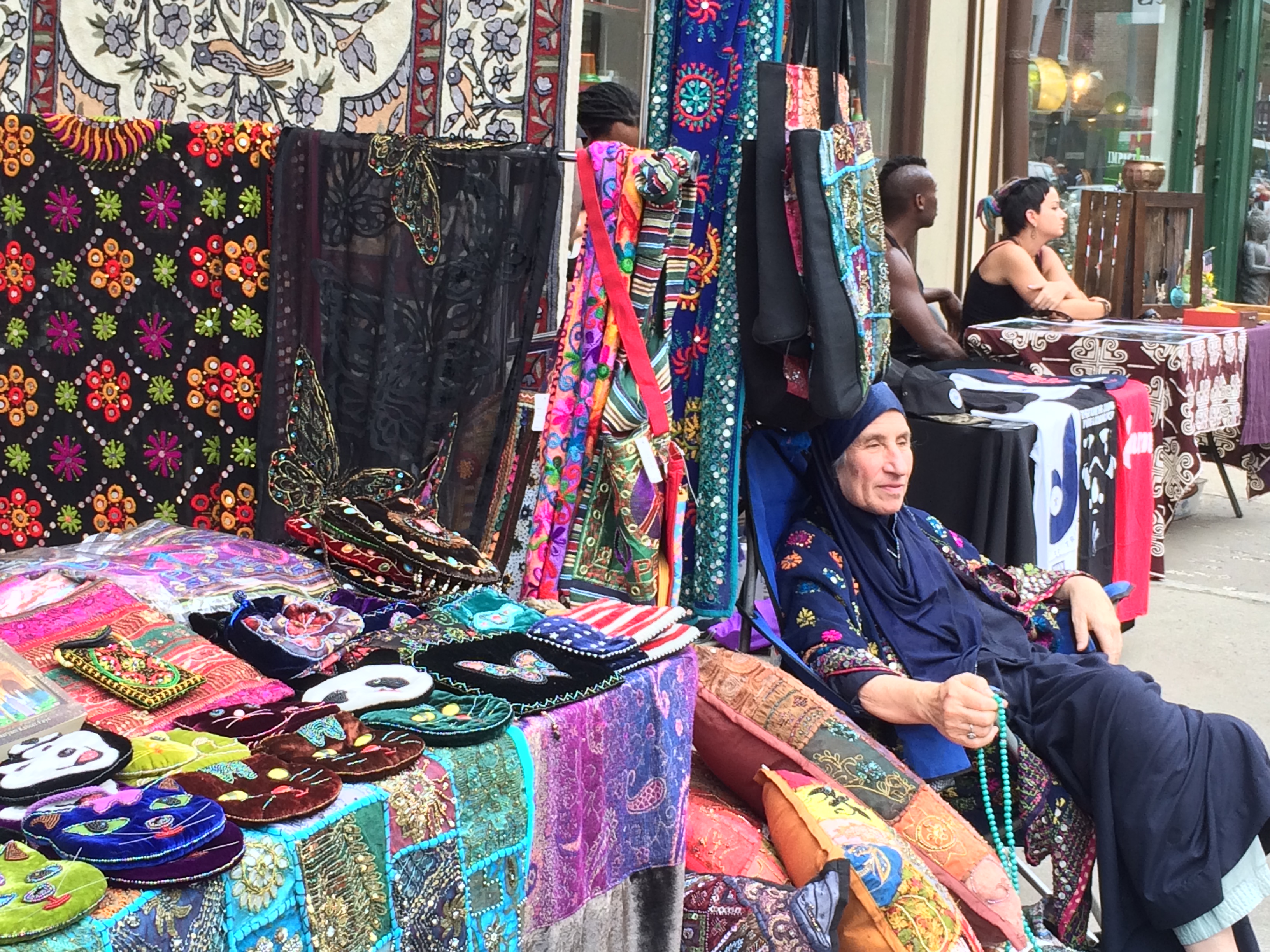
Lady in blue with her colorful wares.

Or the head-scarved lady in blue on 2nd Street whose tables and racks held as eye-popping a collection of pillows, fabric trivets, shoulder bags and cloth drapings as one would ever see in a 30 square foot parcel of sidewalk. Middle-Eastern and Asian patterns and color combinations burst from her goods, clashing outrageously, looking great together nonetheless. Henri Matisse, who threw wild design combos into so many paintings and never met a color he didn’t like, would have loved this lady’s display.

Artworks by Keith Sharp at 3rd Street Gallery.
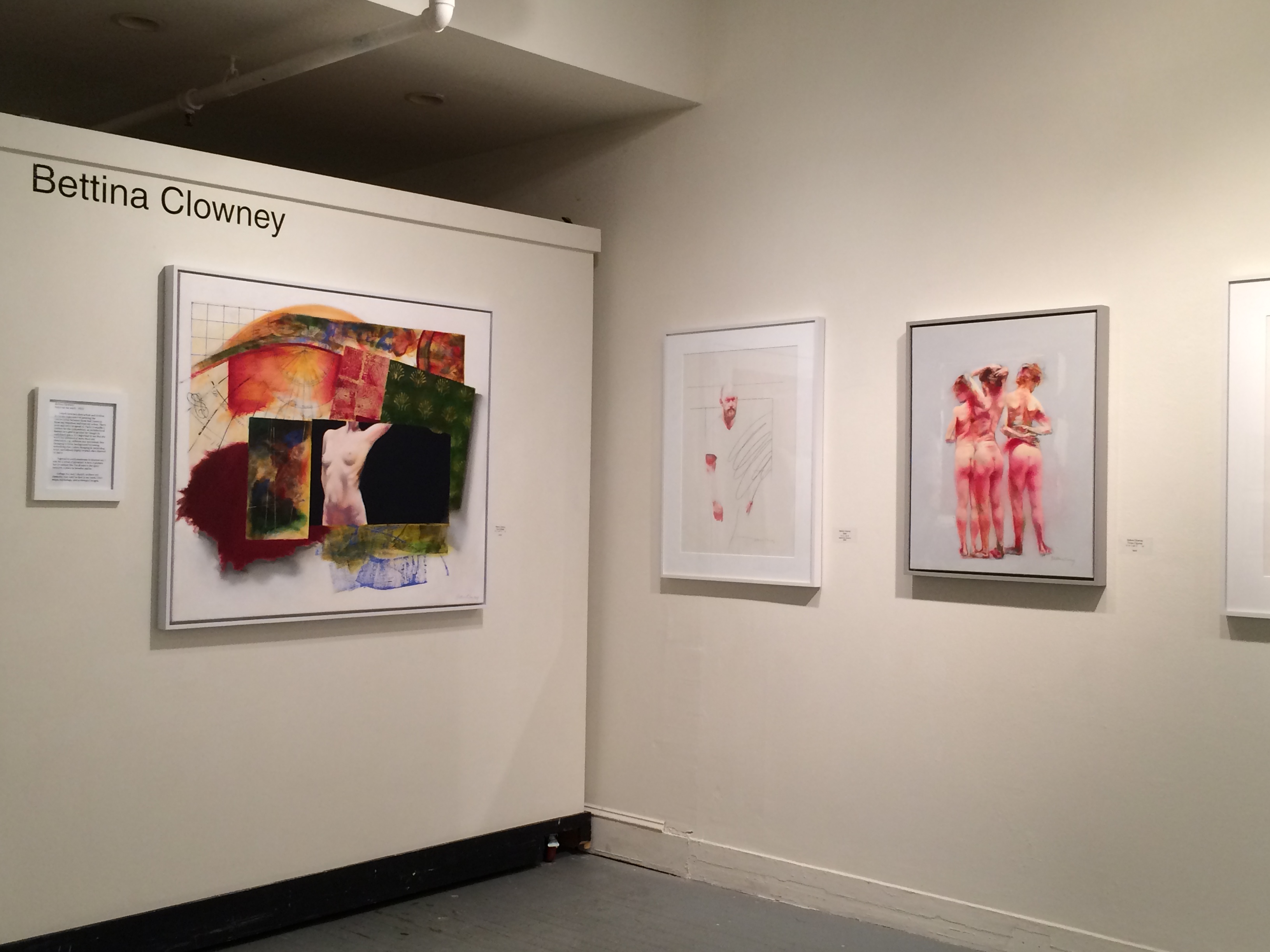
Artworks by Bettina Clowney at 3rd Street Gallery.

There were beautiful paintings, sculptures and crafts to be seen in the galleries. I’ll mention a few places. We liked just about everything we saw at 3rd Street Gallery. Two artists were showing there. Keith Sharp’s dark and dramatic photographic manipulations were intriguing, some a bit ominous. They were very different from Bettina Clowney’s spare paintings. Clowney uses a lot of whites in her depictions of fruits, of people, and in non-representational designs. Gazing at each other from opposite walls, the Sharp and Clowney artworks made a good marriage.
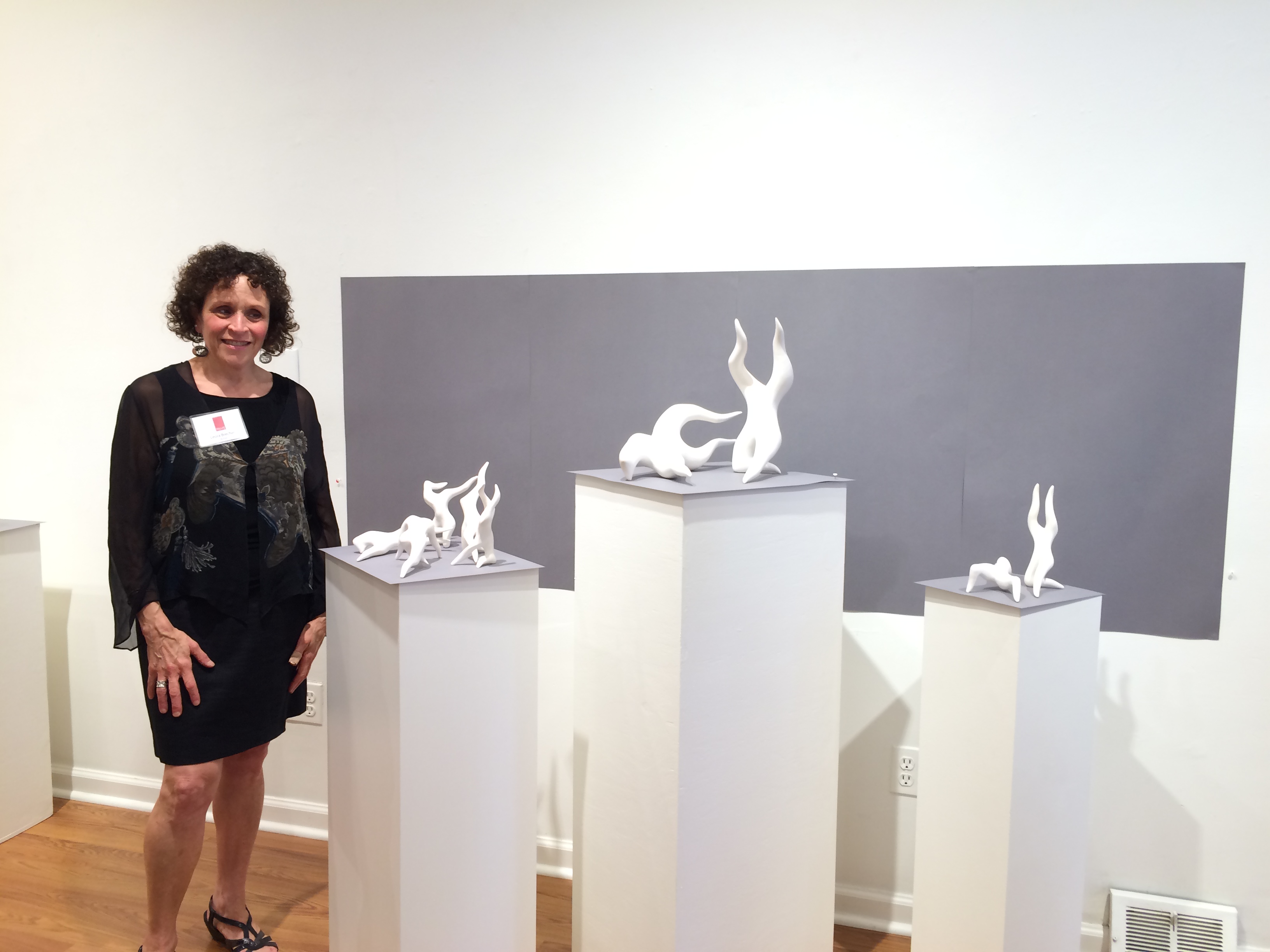
Leora Brecher with some of her sculptures at MUSE Gallery.
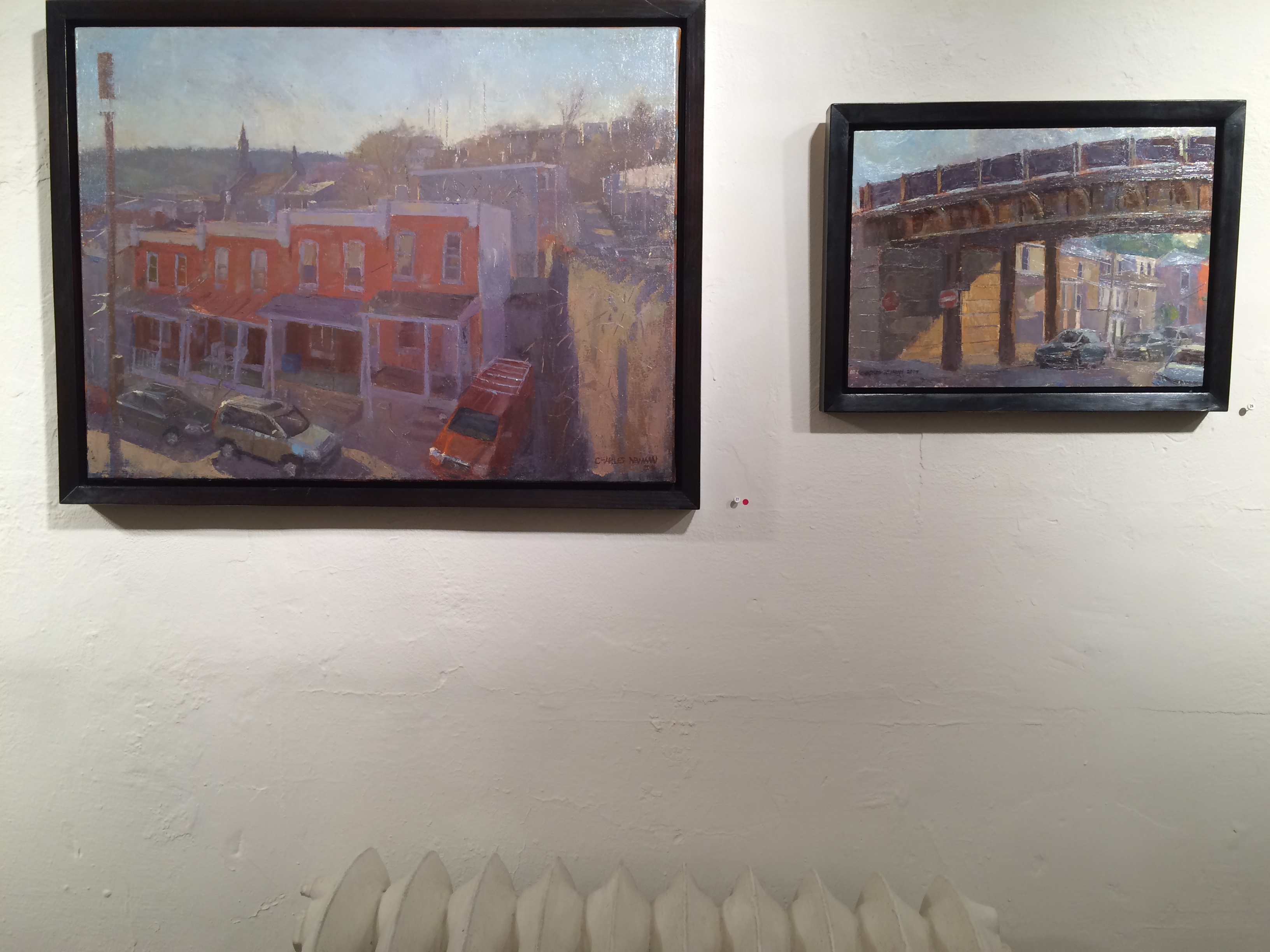
Paintings by Charles Newman at F.A.N. Gallery.

MUSE Gallery was filled with Leora Brecher’s small fired clay sculptures, all in white. Many were abstract suggestions of human movement, open and flowing. Very lovely.

F.A.N. Gallery on Arch Street is one Sandy and I visit occasionally. I wasn’t knocked out by its smorgasbord of works by gallery artists on this First Friday visit. We both liked the oils by one artist though, Charles Newman. He paints Philadelphia street scenes, focusing on old buildings, very well. The perspectives from which he views his brick and stone subjects are off-angle, giving the pictures a quiet tension, and his earthy subdued color choices are just right.
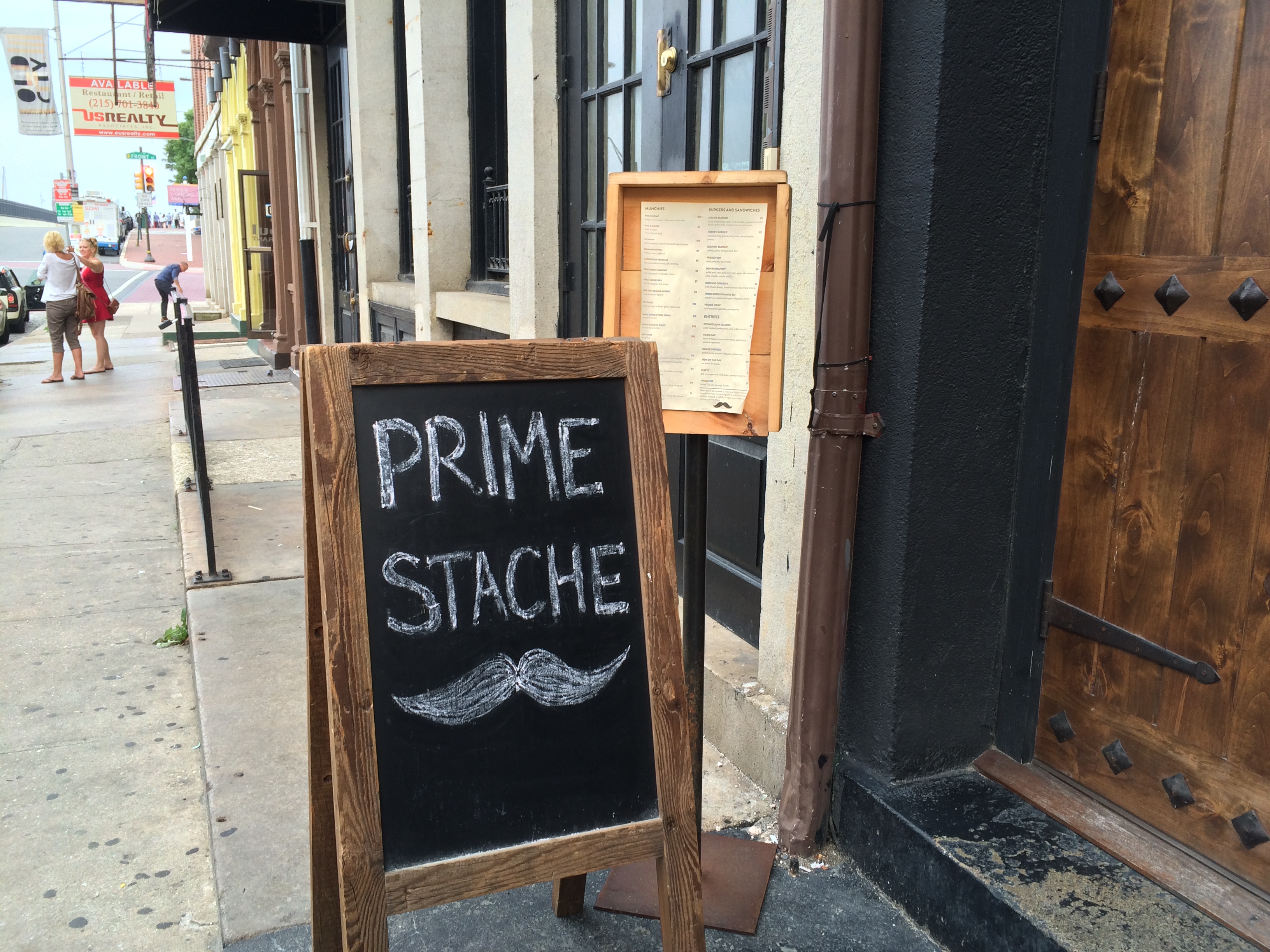
Prime Stache, where we had dinner.

Dinner time. Off to Prime Stache, a few blocks from First Friday, on Chestnut Street. Atmospherically, it’s for lovers of exposed brick and stone walls, which Sandy and I are. A pubby place short on wines but decently long on beers, its food is good. Prime Stache has some fancy offerings, but we weren’t in a fancy mood. We both enjoyed our simple burgers, Sandy’s of the salmon ilk, mine of the turkey.
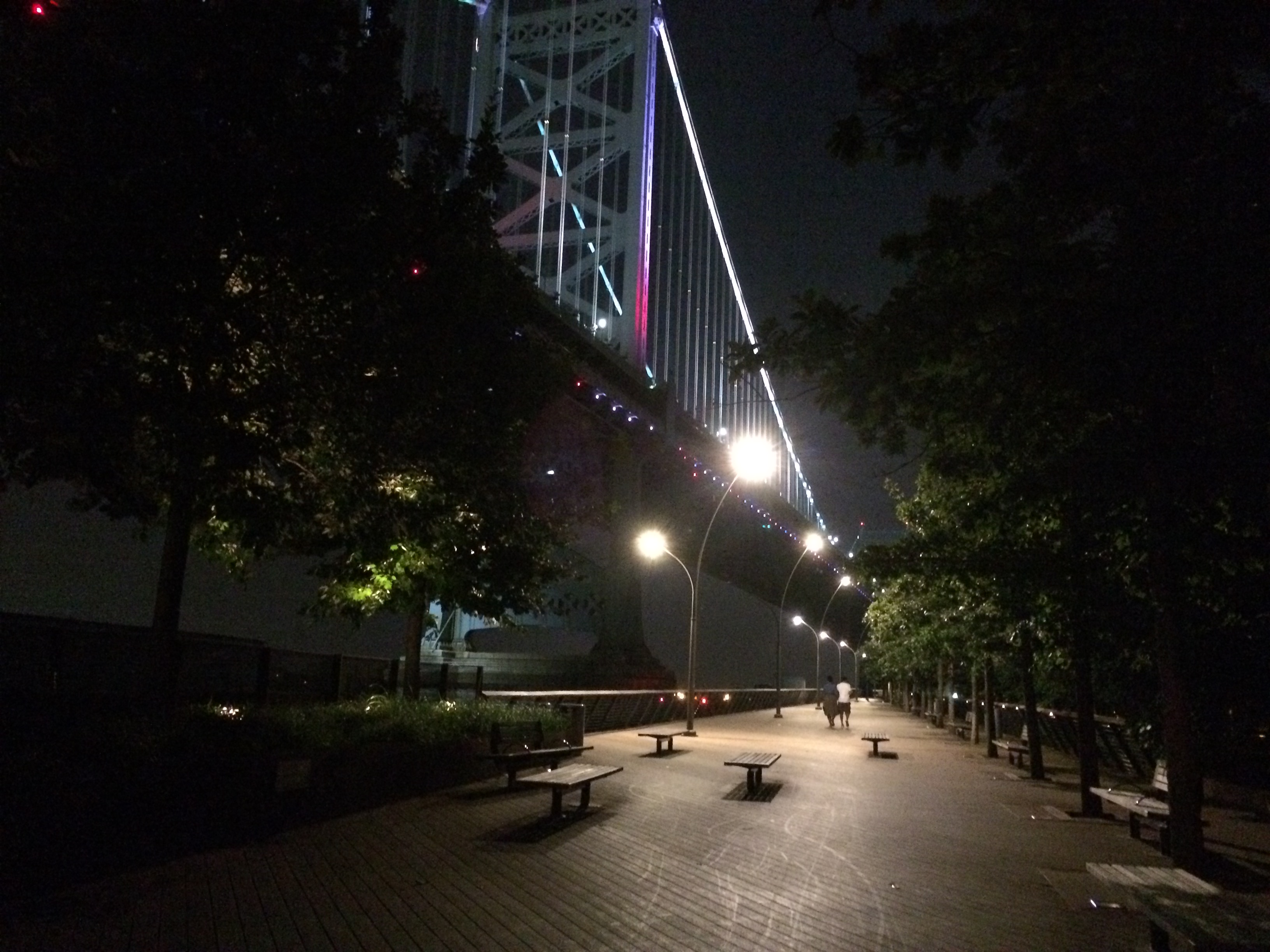
Race Street Pier and Benjamin Franklin Bridge.

The best part of the evening lay ahead. We strolled northward from Prime Stache to Race Street Pier, one of my favorite spots in Philadelphia. I’ve been there in daylight and late at night, and late night is better. The pier lies near the Benjamin Franklin Bridge, and in darkened hours the illuminated bridge overhead is breathtaking.

Jutting into the Delaware River, Race Street Pier once was a commercial municipal pier. It has been converted into a serene and intimate two level public park with long walking paths, a lawn and oak trees. Much of the Philadelphia region’s population has yet to discover this park. It opened four years ago, the first and still the only of its kind in Philadelphia. At the tail end of our First Friday evening, Race Street Pier bewitched Sandy and me. We walked romantically. We were inspired by views of the Delaware. We shook our heads marveling at the beauty of the massive Franklin bridge. And then it was time to head home.

(All of the photographs in this article were taken by Sandra Cherrey Scheinin. If you click on any photo, a larger image will open)

The Day My Father Went Eye To Eye With Van Gogh

My father came to live with me and my wife Sandy in Philadelphia soon after his 90th birthday, in 1999. He had been living alone on Long Island, but health issues necessitated his relocation. Good doctoring in the Philadelphia suburbs improved his physical condition quickly, but there was no cure for the declining state of his kidneys. He became a dialysis patient one year after he moved in with us, and he remained on dialysis till his death in 2005 at age 96.

My father was in pretty good shape until the final nine or so months of his life. He loved getting out of the house and joining Sandy and me and others at restaurants, concerts, museums, you name it. On this Father’s Day I’ll relate one incident that I look back on fondly. It was the day that he and I and my brother had a private viewing of a rarely-seen Van Gogh oil painting at the Philadelphia Museum Of Art.

There are several purported photographs of Vincent van Gogh. None are totally authenticated. This is believed to be from about 1886.
There are several known photographs of Vincent van Gogh, though they are not fully authenticated. This photo is believed to be from about 1886.

Vincent van Gogh is one of my two favorite artists. The other is Paul Cézanne. I never can decide which of the two I like best. For wordsmanship, however, I go with Vincent. In spring 2001 I read all 800+ of his mesmerizing letters, in their English translation. My father got a kick from this. He told people that I was becoming a Van Gogh expert, which was hardly the case. But my semi-obsession with Van Gogh was rock solid, and it is here that the story really begins.

One day in January 2002 I poked around some Van Gogh websites and discovered that the Philadelphia Museum Of Art, which Sandy and my father and I frequented, owned five Van Gogh oils. Yet, I had never seen more than four of them on display there. The painting that I wasn’t familiar with was Still Life With A Bouquet Of Daisies. Most experts believe that Vincent painted it in summer 1886, a few months after he moved to Paris to live with his brother Theo and to contemplate the new techniques and perspectives, most notably those of Impressionism, that had been invigorating the French art scene. Why wasn’t the painting on display? I needed to know.

A few days later, from my desk at work, I dialed the museum and got connected to an assistant curator. I asked about the mystery painting. She told me that the museum did occasionally bring it from storage to the public galleries, but that it had been a long time since that had happened. We chatted a little and then I said thanks and was about to hang up. But before I could the curator asked “Would you like to see it?” Huh? Huh? I couldn’t believe my ears. Yes ma’am, I would.

My father was about to turn 93, on January 19, 2002. A few days before that, to help our dad celebrate his birthday, my brother Richard planned to fly to Philadelphia from his California home. I explained this to the curator and asked her if my brother and father could come along with me (Sandy, chained to her job, wasn’t free to get mid-day time off from work). Sure, she said. Fairly stunned, I set the date for Friday January 18, a non-dialysis day. I knew that something special had just occurred.

The momentous day arrived. We drove to the museum and were met in the west wing by the curator. She was a lively and lovely person and probably was getting as big a charge out of the situation as anyone. Down an elevator we all went to one level of the museum’s cavernous underbelly. We followed our hostess along a long corridor, walking past many locked rooms. At our consecrated storage area she unlocked the door and we entered. Perpendicular to one of the room’s sides were very large moveable display panels. All of them were in their retracted positions. The curator pulled out one of the panels, both sides of which were covered with paintings, maybe 20 per side. I noticed a Chagall on the side facing us. Can’t recall what else. Except of course for a work near the left edge on the top row. The Van Gogh.

Still Life With A Bouquet Of Daisies. Philadelphia Museum Of Art
Still Life With A Bouquet Of Daisies.
Copyright Philadelphia Museum Of Art

It was show time. The curator wheeled over a tall moveable step ladder. Richie and I went up first. What did I make of Vincent’s oil? Well, Still Life With A Bouquet Of Daisies doesn’t have the brilliant color schemes that Vincent was developing in Paris. It is dark, with lots of deepened greens. Maybe that’s why the museum doesn’t bring it out of storage too often. But they should. With Vincent, there’s always something to admire. I took in his trademark broad brush strokes, the intense tangles of flower stems. The greens upon greens.

Richie and I and our benefactor were excited and happy for my father when his turn came. My dad was excited and happy too, a muted gleeful smile on his face, his eyes on alert. I’m sure he knew how lucky he was to do what he was about to do. Holding the ladder rails carefully, up he climbed. Admirable mobility for a guy one day away from the big 93. He gazed at the painting for a good long spell, longer I think than my brother or I had. He spouted words of admiration. He was having a ball. Finally he came back down. Thank you, thank you, thank you we said to the wonderful curator.

Over the following years, my father and brother and I talked about our museum visit many times among ourselves and with friends and relatives. Always with a grin. Always feeling a tingle. And so, I dedicate this Father’s Day essay to Hyman Scheinin, he whom I’m sure is the only nonagenarian ever to climb a step ladder to go eye to eye with Van Gogh.

Outdoors At Last, At Morris Arboretum

Ocean, beach and sand cliffs on Cape Cod.

Cape Cod has become a favorite locale for me and my wife. It was love at first sight when we first ventured there for a vacation in 1998. We like pretty much everything about Cape Cod, but the one aspect above all others is its expansive areas of startling beauty. The Cape’s Atlantic Ocean beach, for one example, is breathtaking, about 30 miles of it uninterrupted and basically undeveloped. In the off-season you can walk there as far as you like, gazing at the waters and the tall sand cliffs backing the beach, and there’s a good chance you’ll cross paths with nary another human. Not many places where such a scenario can be duplicated. And at Cape Cod’s outer reaches is one of the more astonishing vistas I’ve ever seen, a five mile long lunar-like expanse of enormous sand dunes and valleys. Most unusual, most unexpected.

Cape Cod’s natural world draws me outdoors. When Capeside my wife and I spend hours in the fresh air daily. Home in the burbs, though, it’s another story. Here I’m out when mowing the lawn or shoveling snow or shooting hoops at my neighborhood playground. Other than that I’m indoors most of the time, and I think this is because there’s a dearth of beautiful suburban places to get lost in.

Luckily for me, Philadelphia is at hand. It’s an old city and a new one, with great architecture and sights. Walking its streets and parks is an outdoors activity that I do a fair amount of.  On Memorial Day weekend’s Sunday, my wife had an inspired Philadelphia idea. Let’s visit Morris Arboretum, she suggested. We hadn’t been there in years. This would be a fine chance to spend time in a lovely green spot not far from home. Okay, I said. We drove to Philadelphia’s Chestnut Hill section, where the Morris takes up a lot of space (167 acres). We spent three hours there. It was good to be outside for an extended period.

Morris Arboretum originally was an estate named Compton, home to siblings John Morris and Lydia Morris. They were wealthy, worldly and civic-minded folks. Their mansion is no longer with us, but Compton’s grounds and some secondary buildings remain. Established in 1887, Compton stayed in Morris hands till 1932, the year of Lydia’s passing (John had died in 1915). Lydia bequeathed Compton to the University of Pennsylvania as a botanical garden and research facility. The U of P has maintained and developed the property ever since.

Morris Arboretum has gotten a whole lot better since our previous visit. Back then a parent might have said to his or her five year old Amy or Andy, “Hey, look at that pine tree. Isn’t it beautiful?” and Amy or Andy would have responded “I’m bored, let’s go home.” The arboretum managers, obviously smart people, saw the need to build kid-magnet structures. Up went the Garden Railway in the late 1990s, and in 2009 Out On A Limb opened.

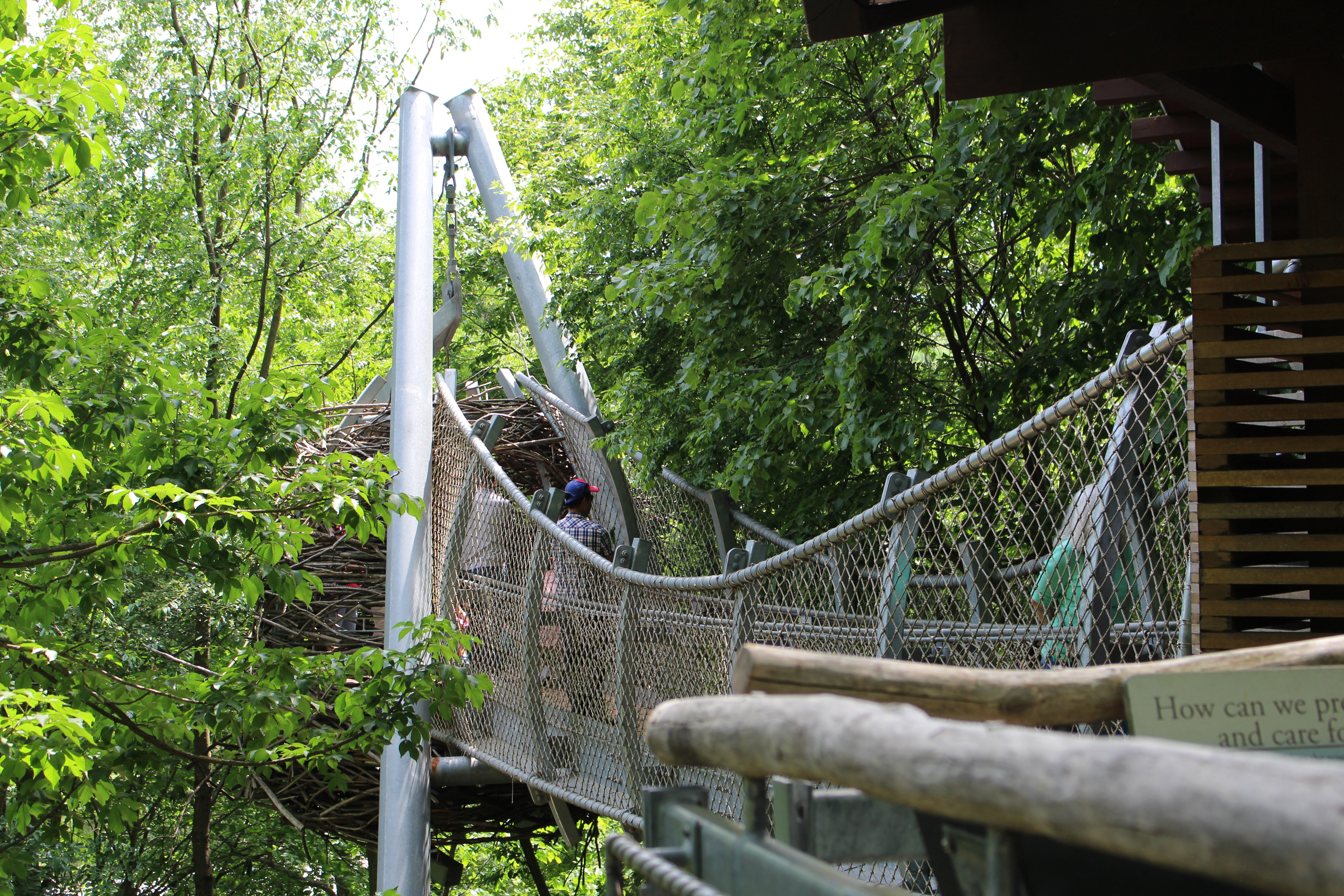
Morris Arboretum's Out On A Limb.
Morris Arboretum’s Out On A Limb.
Out On A Limb's play area.
Out On A Limb’s play area.

Out On A Limb is very cool. It’s an elevated twisting boardwalk, supported by steel columns and threaded between trees on a hilly part of the arboretum’s grounds. You enter at ground level and in a few seconds, because the earth slopes away quickly,  you’re looking down 40 or more feet at the forest floor. Walking alongside the mid and upper reaches of trees is a gas. Best yet is the play area at the walkway’s far end, where giant rope hammocks are suspended off to the side. Kids abound there. No wonder that attendance at Morris Arboretum has grown steadily since Out On A Limb came on the scene.

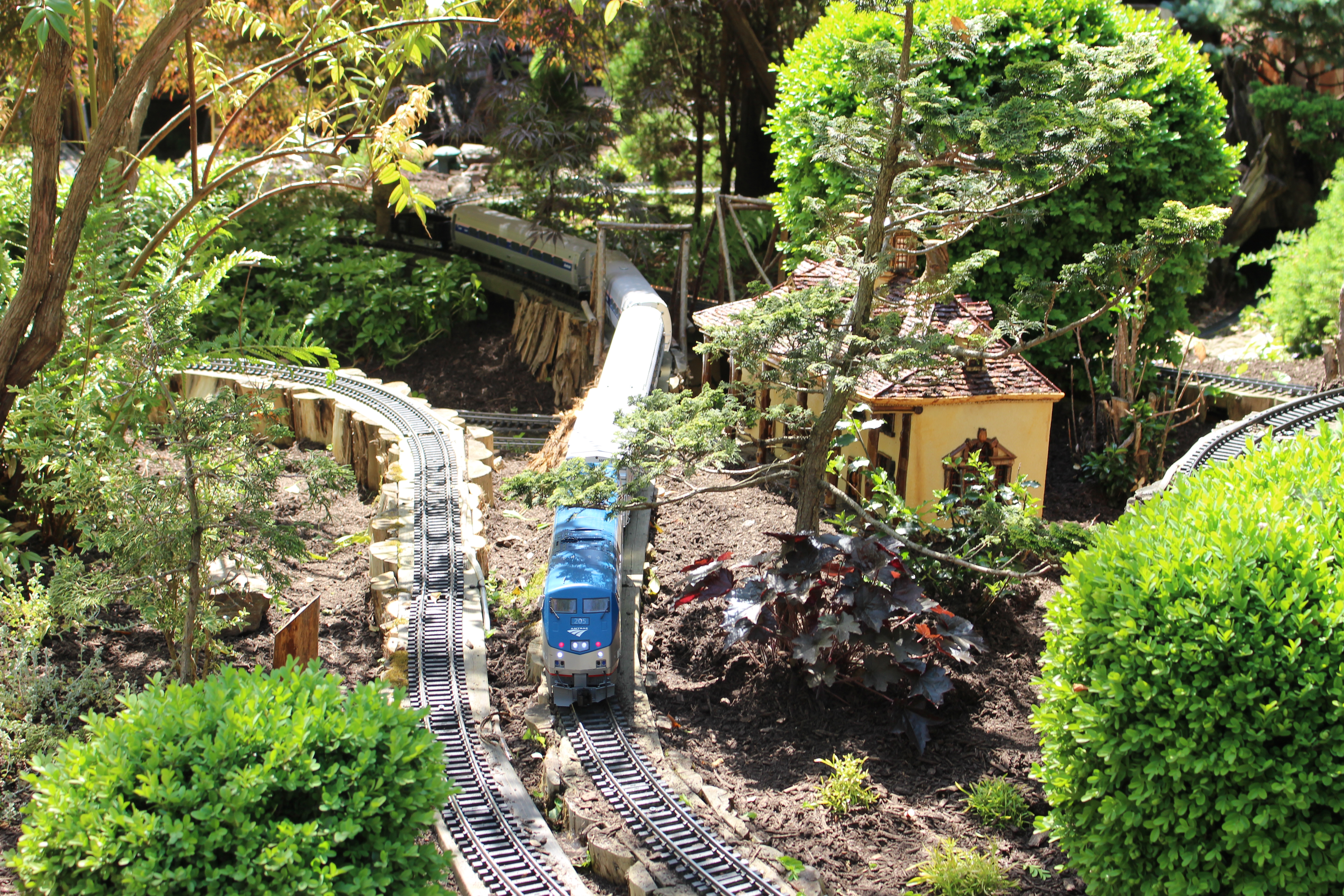
Morris Arboretum's Garden Railway.
Morris Arboretum’s Garden Railway.

Almost as invigorating is the Garden Railway. Nestled among trees and shrubbery near the Morris’s Rose Garden, it is a cleverly designed toy train layout. Passenger trains, freight trains, cable cars, tunnels, bridges . . . all are there in three large separate areas. So are natural-material replicas of famous structures, such as the Eiffel Tower and Philadelphia’s City Hall. The trains wind their way over, around and through, disappearing from view, eventually reemerging. My wife and I were intrigued by the whole set-up. It’s something.

The amazing Blue Atlas Cedar at Morris Arboretum.

It’s not a bad idea to stroll the arboretum’s grounds with no particular plan. That is to say, you won’t go wrong by not referring too often to the map you’re given at the information center. Morris Arboretum is a work of art, sculpted to display its trees, flower gardens, fern groves, swan pond and shrubs. Poking around them randomly works. Plenty of things, often green ones, will catch your eye. One tree in particular caught mine, a Blue Atlas Cedar. One of this massive being’s long lower limbs shoots out perpendicularly to the trunk, resting on the earth. The limb I think grows that way naturally. It doesn’t appear to have been forced into its strange position by windstorms or magic.

Sculptures by George Sugarman.
African Queen, a stone sculpture at Morris Arboretum.

Manmade sculpture is another big part of the arboretum experience. Many such objects are placed on the grounds, continuing a tradition that John and Lydia began. The most colorful are the large playful and organically-shaped painted aluminum creations by the late George Sugarman. They’ve been on site since 1981. The most alluring sculpture to me is African Queen, a stone carving from Zimbabwe, artist unknown. How old is it? 50 years? 500 years? If the arboretum custodians have the answer, they’re not saying. Regardless, it’s a charmer. Pablo Picasso, who was greatly influenced by African art, would have loved it. The armless queen is asleep, her sweet face lost in dreams. The artist chose to depict her headdress as broad and undefined, focusing attention to the face below. A visit to Morris Arboretum, in my opinion, is incomplete without making time for this superb piece.