Great Blue, Good Blue, Bad Blue: Thoughts About A Joni Mitchell Song

My well-worn copy of Blue the album.

Probably it was inevitable that Joni Mitchell’s album Blue would find its way into one of my essays. That’s because it is one of my all-time favorite records. And I hardly stand alone. Blue, after all, appears high on the “greatest albums ever” lists of music critics galore. With good reason. It’s an awfully brilliant work. Joni’s naked emotions, from high to low, saturate Blue’s songs, all of which she wrote. By no means am I an expert on the Mitchell canon, but from what I hear when I listen to Blue, and from what I’ve read, Joni’s openness was at its acme during the writing and recording of Blue, which came out in 1971. As self-revealing as many other of her albums are, Blue walks away with the “Here’s What I’m All About” prize. If you aren’t familiar with Blue, you will add some wows to your day by tracking it down and giving it a whirl.

But you know what? I’m not going to write any further about Blue the album on this virtual sheet of paper. That’s just like me . . . erratic. I won’t stray too far off course, however, as I now turn my gaze to Blue the sad song. It is the final track on side one of Blue the album’s vinyl incarnation. Although I’ve heard this song more than 100 times, I’d guess, over the years, it wasn’t till last week that I paid devoted attention to its lyrics. That’s just like me, too, a guy who has had trouble figuring out the meaning of 99% of the tunes he’s listened to during his life, including Happy Birthday To You and My Ding-A-Ling (it was a Chuck Berry hit). As an aside I’ll mention that my poor levels of lyrical insight and understanding are predictable. Back in my freshman year at college I stunned my Introduction To English Literature professor with my denseness. He had to create a new grade for me. An F wasn’t low enough, so he gave me a G, which stood for Gawdawful. Miraculously, my interpretative powers have inched upward a bit since those days.

Blue the song is track five on side one.

When I heard Blue the song last week, it struck some heavy chords with me, as it always does, and I began trying to figure out a way to work it into a story. I was all set to compare it to a couple of other sad tunes with blue in their titles. Such as Dinah Washington’s 1955 version of Blue Gardenia and Willie Nelson’s 1975 take on Blue Eyes Crying In The Rain. But before I could do that I needed to examine Blue’s lyrics and attempt to decipher them. I looked at them and came away, I think, with a reasonable understanding. And that’s when an interesting thought entered my brain. Lyrically, Blue is so Joni-personal, and musically so shape-shifting, I wondered if anyone ever covered it. Nah, that’s pretty doubtful I decided. But oh so wrong I was, as some Googling revealed. Amazingly to me, lots of people have taken a crack at it, some more successfully than others. Wham! “There’s a story in there,” I said to myself. Probably many. However, we’ll save many for future days and keep the remainder of this analysis on the modest side.

There’s no better place to continue than with Blue’s words, which are relatively few. Here they are:

Blue, songs are like tattoos.
You know I’ve been to sea before.
Crown and anchor me
Or let me sail away.

Hey Blue, there is a song for you.
Ink on a pin
Underneath the skin,
An empty space to fill in.

Well there’s so many sinking now,
You’ve got to keep thinking
You can make it thru these waves.
Acid, booze, and ass.
Needles, guns, and grass.
Lots of laughs, lots of laughs.

Everybody’s saying that hell’s the hippest way to go.
Well I don’t think so
But I’m gonna take a look around it though.
Blue, I love you.

Blue, here is a shell for you.
Inside you’ll hear a sigh,
A foggy lullaby.
There is your song from me.

Those lyrics startle me. They rock, they roll, they roil. Delicately. They paint a picture of fragile love. And until last week I hadn’t realized that they are addressed to a specific person (James Taylor, Joni’s boyfriend during parts of 1970 and ’71, is many observers’ guess) whose identity she isn’t revealing but, for the song’s sake, she has nicknamed Blue. Joni loves Mr. Blue, but can’t quite reach him. There are more than a few degrees of disconnect. A head-over-heels-in-love song for him wouldn’t fit the nature of their relationship. The best she can do is to pen a foggy lullaby to help fill in an empty space. Ouch. Love hurts.

Joni Mitchell sings Blue fervently, her voice sometimes quivering, accompanied only by the piano whose keys she hits good and hard (click here to hear the song). Her vocal is forthright and drips with pain and uncertainty. She didn’t want additional instruments or voices to distract from her message. She aimed for simplicity in her rendition.

Joni’s Blue is pretty perfect, don’t you think? The world would be just fine with no version of the song but hers. I can understand, though, why others would approach it. For some artists, Blue might cut so deeply they are uncontrollably compelled to record it. For others, putting a different spin on singular Blue seemingly becomes a challenge they can’t resist undertaking.

Roughly 100 cover versions of Blue have been recorded. And I gave a listen to a dozen of them before I said to myself: “Yo, anal dude! Enough already.” But the 12 I visited comprised an ear-opening experience. And speaking of yo . . . Yo, Kevin Sandbloom! What the fu*k were you thinking? Kevin — your jumpy Blue is wrong, man, wrong. Haven’t you ever heard of subtlety? And what’s with your vocal undulations? They send the song on a nasty roller coaster ride. Joni should sue you, man. Driver, let me off! (Click here to listen)

On the other hand . . . Yo, Dubistry! I shuddered at first listening. But your version grew on me. Who’d have thunk that a reggae-clothed Blue would work? Those crashing drums and cymbals send shock waves. But, in the end, your Blue can handle them because you didn’t allow the spirit of Joni’s Blue to disappear. (Click here to listen)

Yeah, the spirit of Joni’s Blue. I guess that’s what I was looking for all along. And I found it in the Blues lofted to us by Cat Power and Sarah McLachlan. Picking one over the other is tough, but I’m going to go with Sarah’s, which you can listen to by clicking here. Sarah does Blue proud. She sings the song slowly, buoyed by quiet and well-placed electric bass notes, by shimmering electric keyboards, and dramatically by a multi-tracked heavenly female choir. Sarah’s Blue sounds better and better to me the more I return to it. It is ethereal, majestic. A week ago I’d never have believed I might say this, but the McLaughlin Blue equals and possibly outdoes Joni’s.

(Don’t be shy about adding your comments, or about sharing this article with others)

Me And My Muse: A Cry For Help (Hers, Not Mine)

Planet Earth contains over seven billion humans who are pushing hard to raise that number to eight billion. Of that multitude I’d estimate that 20 or 25 persons might recall my story from a few months ago about Erratica, one of the Greek goddesses and, more to the point, my wondrous muse (clicking here will make the tale appear). Clearly, my readership’s growth curve has almost limitless room to expand. That’s a positive, isn’t it? Go get ’em, cowboy! Yeah, you can do it!

Oh, Erratica, Erratica. She has helped me immeasurably since I took up blogging last year. Nearly every week she has materialized in my home to guide me, to prod me into getting my thoughts in order. Without her this blog would be nothing. Come to think of it, though, it’s kind of nothing anyway. Aww, shit.

Erratica
Erratica

Yes, like clockwork for the most part, Erratica has appeared on Thursdays. Except during my vacations, that is. She and I have an agreement that she won’t pop in on me when my wife Sandy and I are away, as we were for part of last month. But after we returned home, Erratica missed her next scheduled appointment. I didn’t give that much thought, figuring she had gotten my vacation dates wrong. But I began to worry the following Thursday when again she was a no-show. What was going on? Had Erratica abandoned me? If she had, I was staring the end of my blogging career in the face.

This past Thursday evening, as usual, I sat in my suburban Philadelphia home’s library. Decked out in hot pink cargo pants and my favorite bright blue t-shirt emblazoned with Wazzup, Dawgie? in neon green letters, I dazzled. Worn out from worrying about Erratica, sleep began to overtake me.

“Oh, Neil. I’m so glad to see you. I’ve missed you. It seems like weeks since last we met,” an unsteady voice said, quickly awakening me. Erratica was in the house.

“My goddess, where have you been? I’m overjoyed that you are here. The last two weeks without you turned me into a nervous wreck. Miraculously I was able to write articles, but it was a struggle.”

I stood up and looked Erratica in the eyes. Something was very wrong. A handful of tears slowly made their way down her cheeks. I had never seen her like this. She needed a seat. I brought a chair from the dining room and placed it next to mine. She took it and opened up her heart.

“Neil, I’m so lost. I don’t know what to do. You know my dad? Zeus?” she half-sobbed.

“Well, I’ve never had the pleasure. But I know of him,” I said. “Is he ill or something?”

Ill?” she cried. “He’s fitter than a fiddle, that old guy. He’s indestructible! But something has come between us. He can’t tolerate the way I’ve been performing my job . . . my bad attendance record, my lack of patience with my charges, the sarcastic barbs that I throw at them. Neil, I’m supposed to help unpolished writers like you, and for millennia that’s exactly what I did. But I’ve been failing them of late, including you. So, my dad has done the unthinkable . . . he has put me on probation. ‘Daughter, you better get it together fast, or you’re out!’ he said to me this morning. Neil, you are the first pseudo-scribe I’ve visited since he uttered those words. I need your help!”

It took me more than a few moments to process what I had heard. Then I took a deep breath, not knowing what words would tumble from my mouth.

“Erratica, somehow you have it all wrong. You have been a lifesaver to me these past many months. Sure, you can be crabby and mean, but so what? The bottom line is that your kicks to my ass have been productive. Because of you I’ve turned out a load of stories. Without you, I’d spend my writing sessions with fingers frozen to my computer’s keyboard.”

“But I need to become more reliable and customer-friendly, Neil, like I used to be. Somehow I got worn down by all the griping and whining that you and your amateur tribe are famous for.”

“Erratica,” I said, gently placing a hand on her left shoulder. “The world, on a human level, is a tough place, filled with negatives that make griping and whining seem like pablum. And I think that all of those real problems have gotten to you, even though you’re not human. If I tell you about a few good things that have been going on, might that help?”

“It might,” Erratica said quietly. “It might.”

“Okay,” I said. “Here goes. As you know, Sandy and I went to Paris and Amsterdam last month. We had a superb time. They are such great places. We did a lot and were with a couple of our friends for most of the trip. It was primo fun. For instance . . . ”

She cut me off. “I’m familiar with the details. Believe it or not, I read your stories about the vacation. I’m one of the few who did.”

“And you liked them?” I asked, wary of the forthcoming answer.

“Uh, they were okay. You’re not exactly Bill Bryson or Paul Theroux, though, are you?”

“Be nice, Erratica.” I said. “I’m your friend.”

“Forgive me, Neil. It won’t happen again,” she said. And for some reason I believed her.

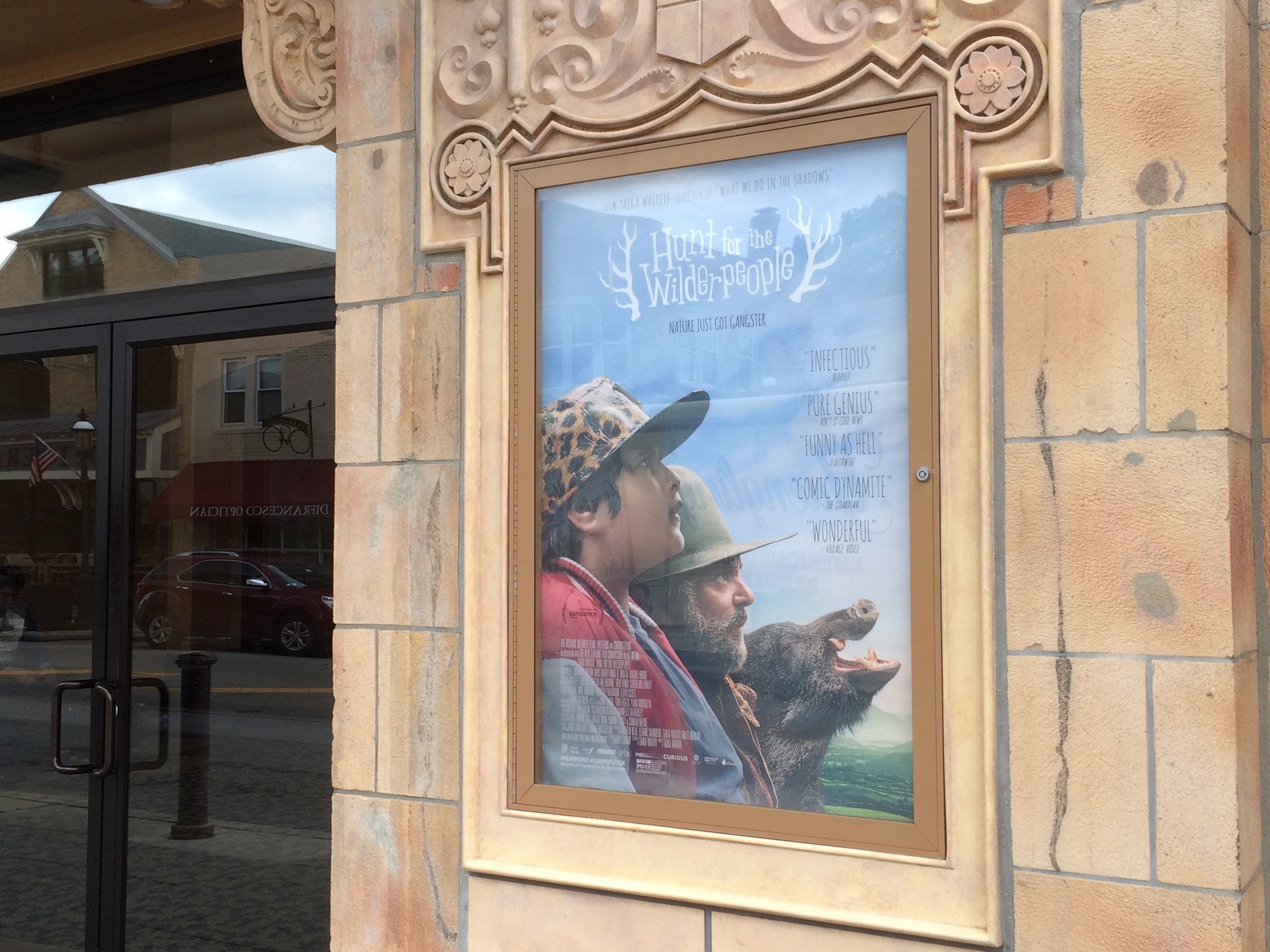
IMG_0793 (2)“And very recently we went to the movies to see Hunt For The Wilderpeople. It’s delightful. Taika Waititi, who I never heard of before, wrote and directed it. The flick takes place in New Zealand. It’s about a 13 year old who has spent his whole life in the child welfare system being passed around from one foster care family to another. At the start of the movie he looks and acts like a sullen bag of trouble. Doesn’t talk to people, dresses like a gangsta-in-training, which he fancies himself to be. Then he gets placed with a back-to-nature couple living in bush country, and his world changes. His sweetness and innocence begin to emerge, don’t ask me why considering everything he’s been through. Probably he barely knew himself that they were there. It’s a wonderful thing to watch the transformation. And he’s not the only person who changes for the better. I don’t want to spoil the movie for you, so I’m not going to tell you anything else. Erratica, do yourself a favor and buy a ticket to see Hunt For The Wilderpeople. We all need a healthy dose of healthy emotions these days, and this movie will give that to you.”

The sofa that Erratica eyed.

Erratica’s face brightened. She looked at me and smiled. “Thanks for the boost,” she said. “Sounds like a good movie. And sounds like you’ll be banging out a story about it for your blog.” She paused for a second. “Neil, I’ve been in a bad way for a long time now. But I’m going to try hard to get back on track. My father’s a no-nonsense sort and means what he says. If he kicks me off of Mount Helicon I’ll have nowhere to go.” She walked into my living room to take a peek. I followed her there. “Could I crash on this sofa if it comes to that?” she asked. “It looks comfy. Oh my, how the time flies. There’s a nitwit in Vermont who I have to visit now. For kicks he gets a colonoscopy every week and writes narratives about them for his blog. The blog’s called Checking Up On My Innards. And it’s actually pretty interesting, a lot better than you’d expect. Somehow he doesn’t run out of things to say. Neil, I’ll see you in a week.”

And in a poof she was gone.

(Don’t be shy about adding your comments, or about sharing this article with others)
Amsterdam, When Lights Were Low

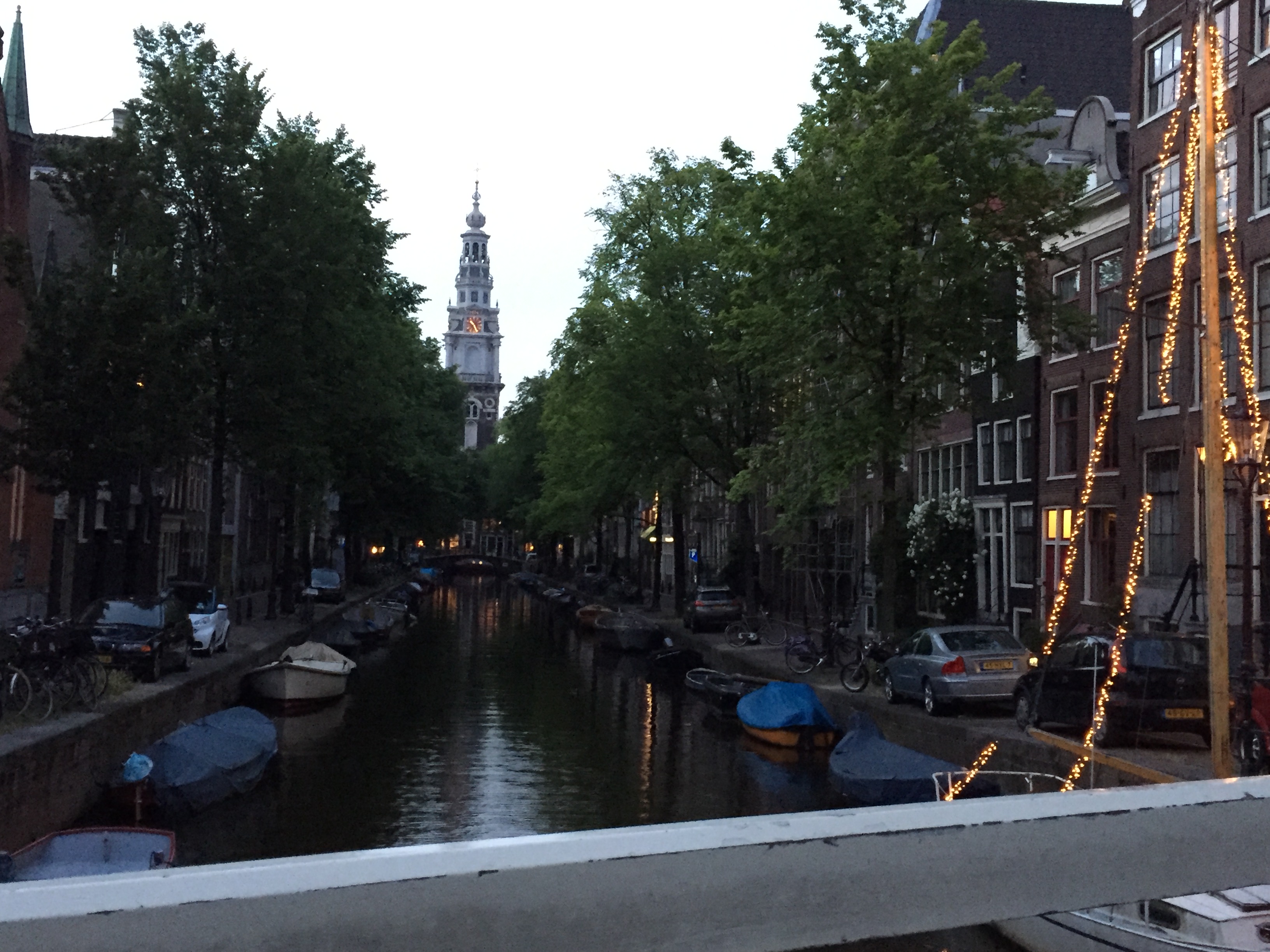
This time of year in suburban Philadelphia USA, where I reside, the Sun sets around 8:30 PM and the sky begins to grow meaningfully dark half an hour later. A few weeks ago, though, during my wife Sandy’s and my trip to Paris and Amsterdam, the lighting was different. (If you click right here and right here, the previous two articles about our trip will appear). There, sunset happened circa 10:00 PM and darkness started its descent about thirty minutes after that. It wasn’t till 10:45 or so that you’d say nighttime truly had arrived. These were phenomena that took Sandy and me a little by surprise. We sure weren’t used to them. But we liked them.

Now, Amsterdam is a beautiful place in daylight, as is Paris, natch. Those canals; those old, quaint brick houses; those cute houseboats parked here and there on the waters; those many streets no wider than alleys. Man, investigating and gawking at all of this in full light was the best. But — and I’m not exactly issuing a news flash here — things looked different when the effects of our friend the Sun started to fade. Different isn’t always better, yet often it is equally good. And that was the case with Amsterdam during late evening hours.

Maybe we were under the spell of the delayed darkness, I don’t know, but in Amsterdam we found ourselves starting the evening repasts much later than at home. Most evenings we didn’t begin to eat until 8:30 or later. By the time we concluded restaurant business and moseyed out onto the streets, sunlight was approaching the low end of its dial or was gone. And that’s when our evening entertainment, nighttime walks, began. It also was when the canals put on their more formal clothes.

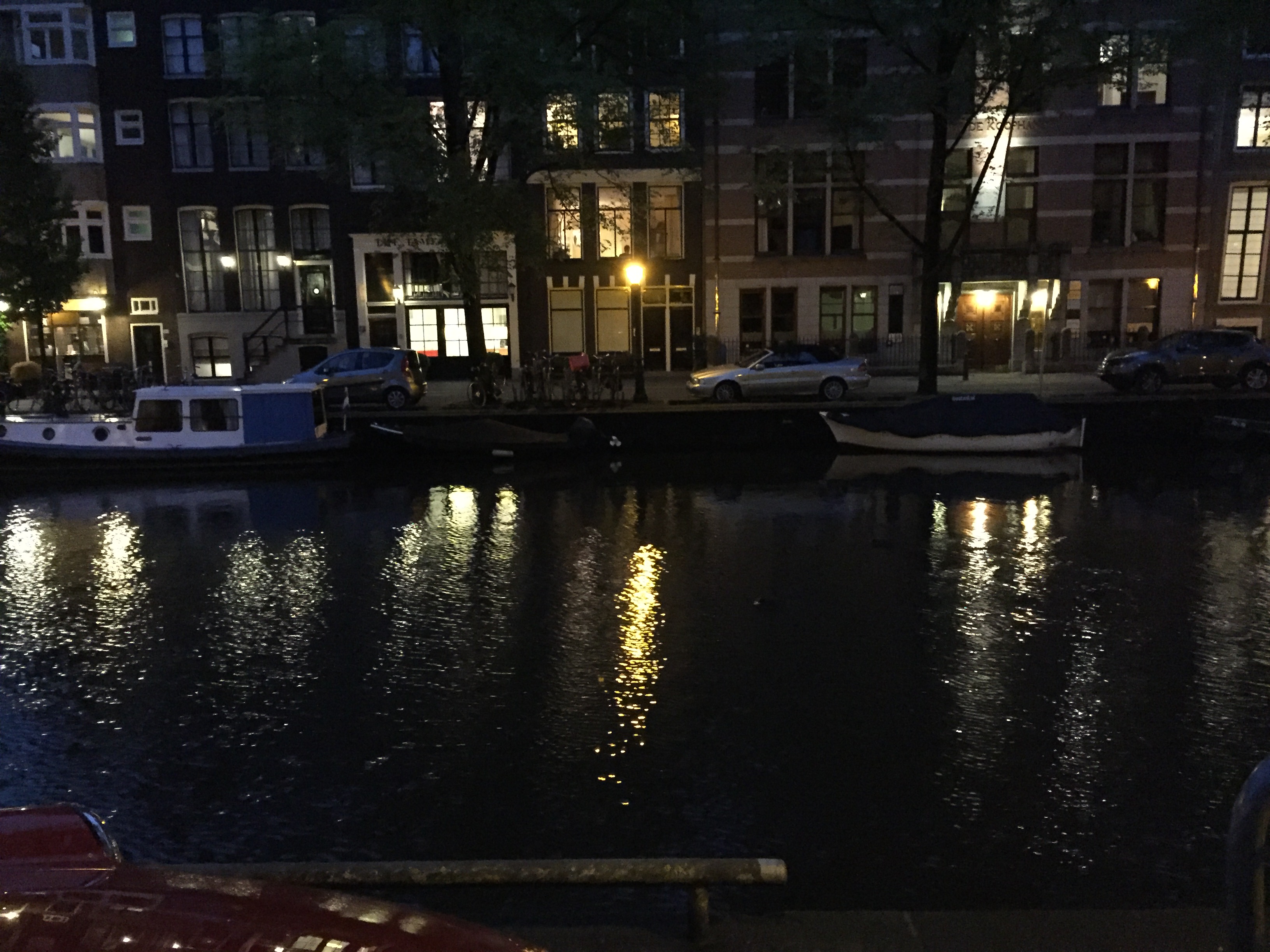
IMG_1465IMG_1466One night, after a dinner in the western part of town that ended at 10:15, we wandered for ten minutes in search of the still-existing house (now the Rembrandt House Museum) where Rembrandt van Rijn lived during much of the 1600s. Eventually we found it. The famed artist lived near the Zwanenburgwaal, a handsome canal. I imagine that the area looks pretty much as it did in Rembrandt’s time. And, no question, it startles at night. There was a fair but quickly fading amount of light in the skies as we strolled around Zwanenbuegwaal and other nearby waterways. The canal waters glimmered, the electric lights from within houses glowed mightily. And we were amazed by a scene that was almost too good to be true, the Moon early in its rise above an assemblage of rooftops and gables. I don’t know if Rembrandt ever painted a waterscape like that, but if he didn’t he should have.

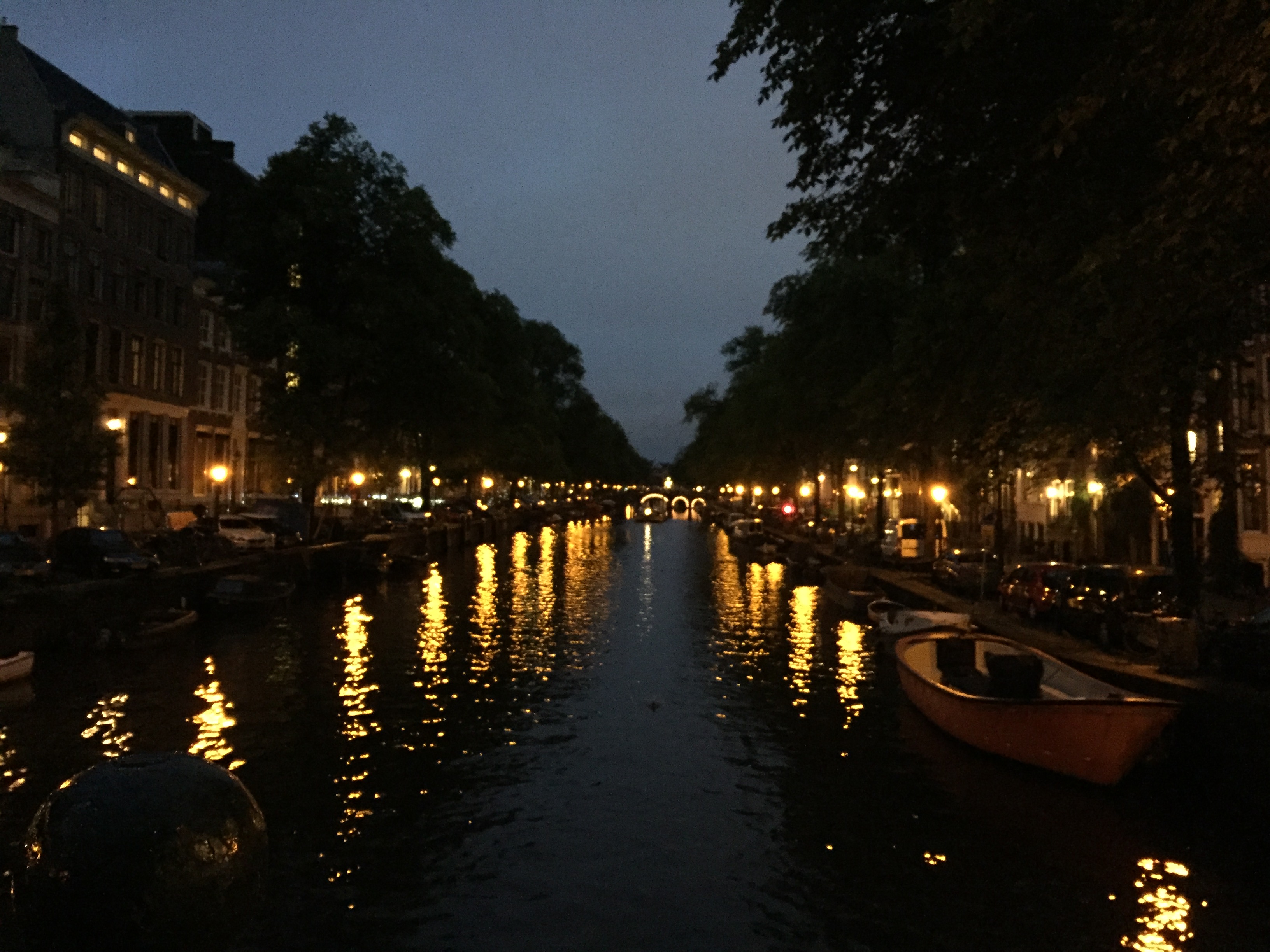
IMG_1478IMG_1480Another post-dinner trek, along a couple of canals not far from our hotel in central Amsterdam, also was gold. This time our walk started under skies that were fully dark. Not too many people were around. And it was quiet. These were conditions that collectively, in a major city, you don’t often run into. I tell you, the vistas were something else. Reflections from house lights in the canal waters looked like cascades of glitter. And the small bridges crossing the canals were lit along their sides like yuletide shrubbery. I’ve said it before and I’ll say it again: Amsterdam is a place where I’d be happy and content as a clam to live.


IMG_1388IMG_1389

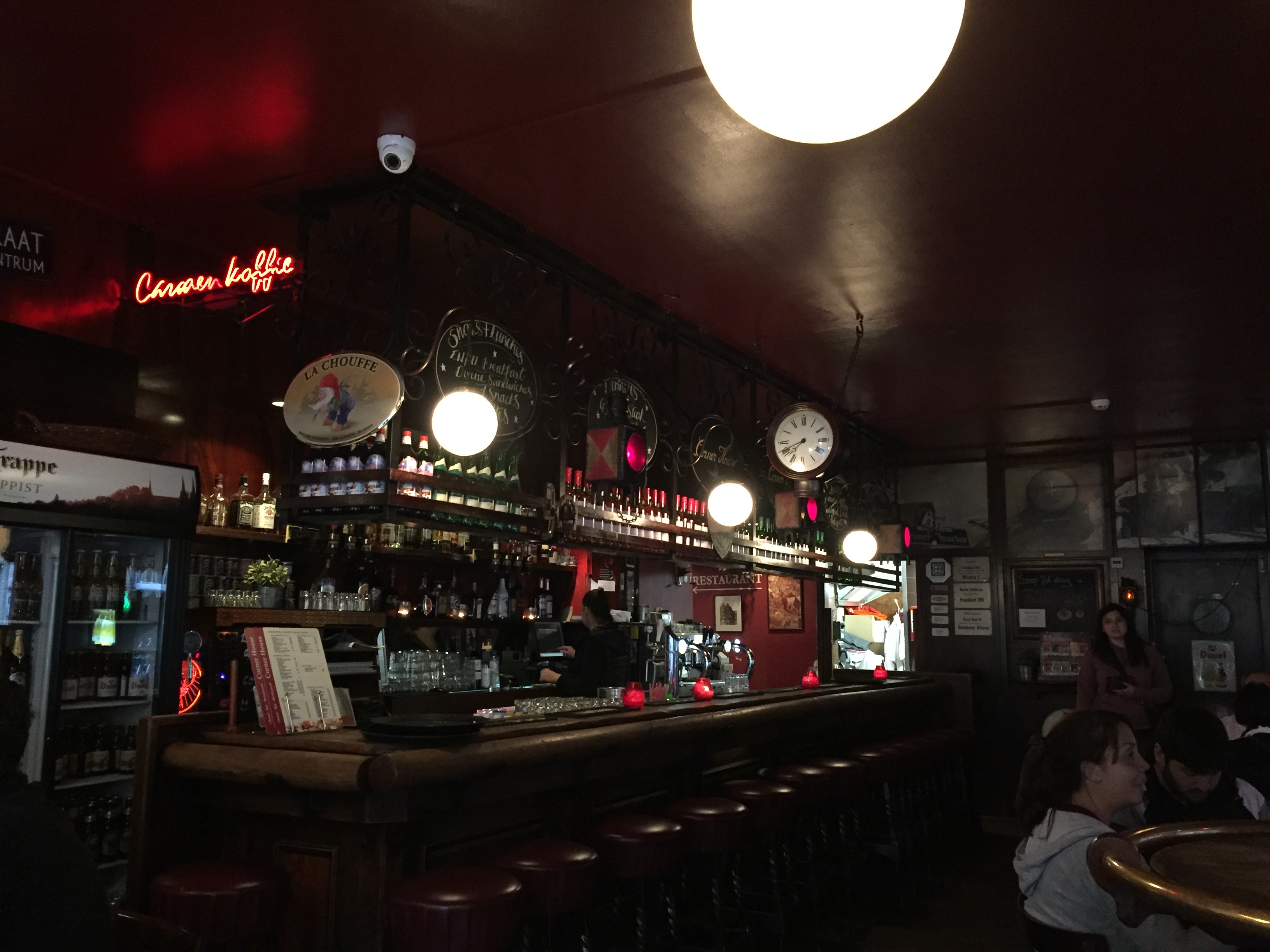
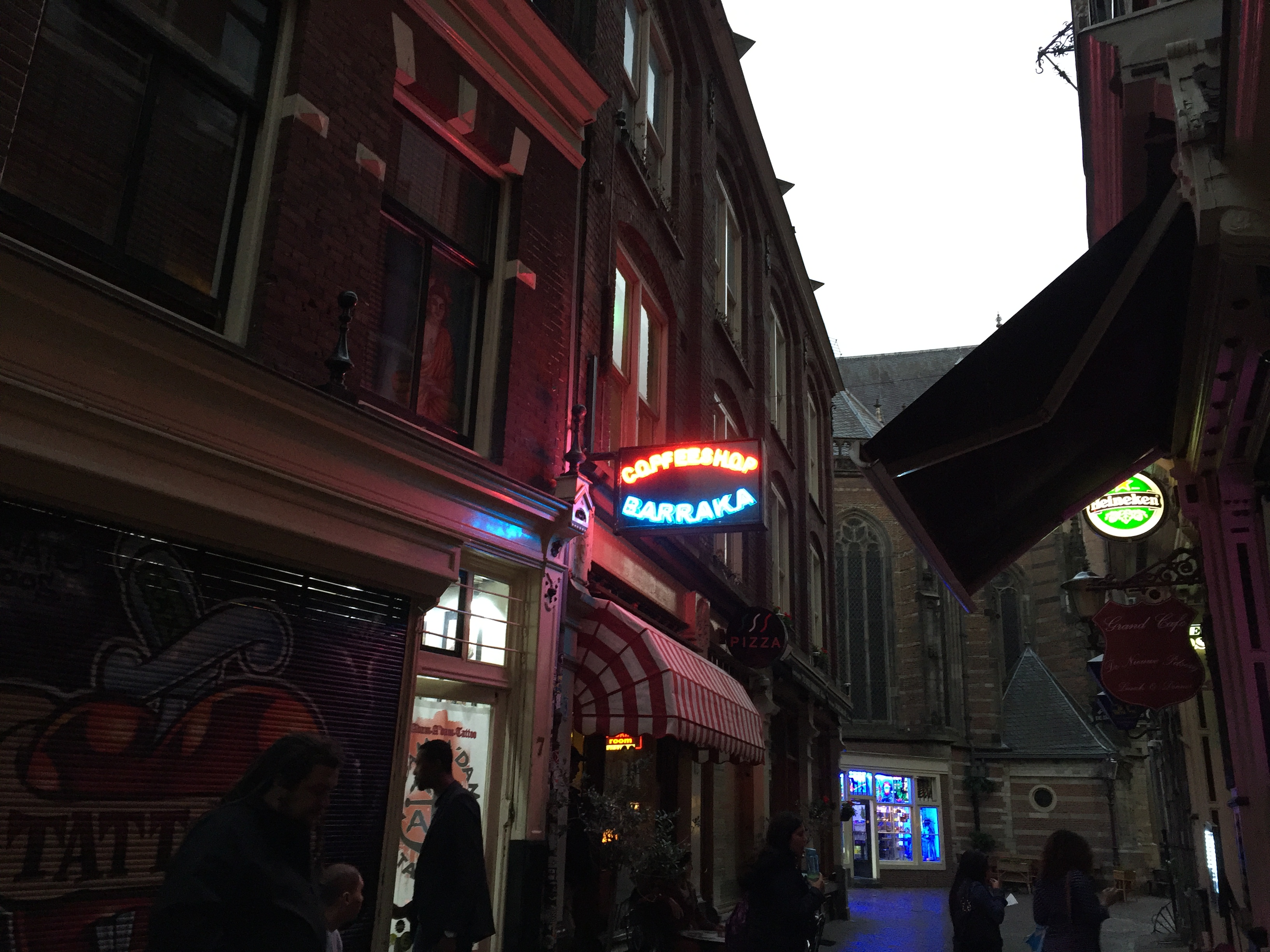
But it wasn’t only late night outdoors views in Amsterdam that nabbed my attention. Things sometimes got awfully atmospheric indoors too during advanced hours. Usually in restaurants. Our first night in the city, for instance, we had dinner in the middle of town at the cozy Corner House, which serves up some traditional Dutch fare. We had arrived in Amsterdam from Paris with our friends Martine and Alan, and they were at the eatery with us. We all settled in comfortably on that rainy night, soaking up Corner House’s low wattage vibes. The subdued lighting gave the place a charm and magnetism that probably it didn’t have at lunchtime. And after dinner we stepped outside into streets hundreds of years old where, electric lights illuminating the dimness only gingerly, mystery and intrigue cast bigtime spells.

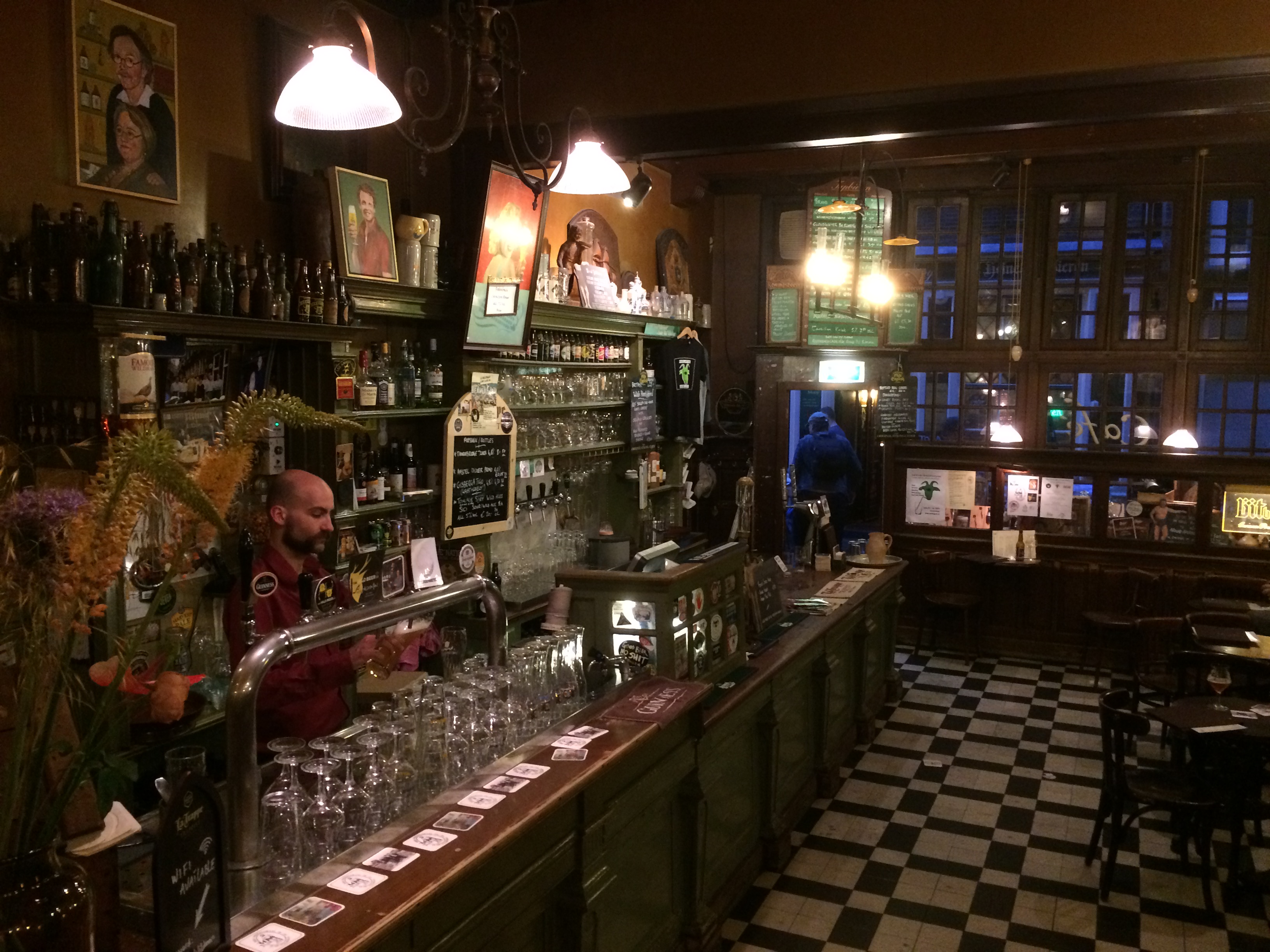
IMG_0787And talking about vibes . . . they don’t come much better than those you get, as midnight approaches, within In De Wildeman. It’s a tavern in a semi-ancient building, and prides itself on its wide selection of beers. A craft beer geek, I went there several times to drink suds from Dutch breweries not named Heineken and Amstel. There are a decent number of them, though most Amsterdam establishments don’t carry them. More’s the pity. In any event, Sandy and I popped into evocatively-lit In De Wildeman, down the block from our hotel, very late on a Wednesday night. The next morning we would fly home, and I wanted to down one last Dutch microbrew before bidding the Netherlands adieu. I did. Sort of. It was a pale ale brewed exclusively for In De Wildeman by The Wild Beer Company. It was delicious. Turns out, though, that Wild Beer’s brewery is located in England, not the Netherlands. Oh well, close enough.

(Don’t be shy about adding your comments, or about sharing this article with others)

(Photos by Sandra Cherrey Scheinin. If you click on any photo, a larger image will open)

Monet The Great

Well, I’ve made it to this, the beginning of Part Two of my planned three-part examination of the trip that my wife Sandy and I took to Paris and Amsterdam last month. So far, so good. For those interested, the first installment may be read by clicking right here.

And now it’s time to move past Part Two’s beginning . . . uhhhhhh, we have a problem here, Houston. You mean I need to come up with something to say? Now? What’s that all about? I tell you, this writing business ain’t all it’s cracked up to be.

(The author, frustrated and close to tears, is moments away from removing his fingers from his computer’s keyboard. Shortly he will be guzzling several shots of Jack Daniels. Straight.)

Macarons are in the middle of photo.
Where's the driver?
Where’s the driver?

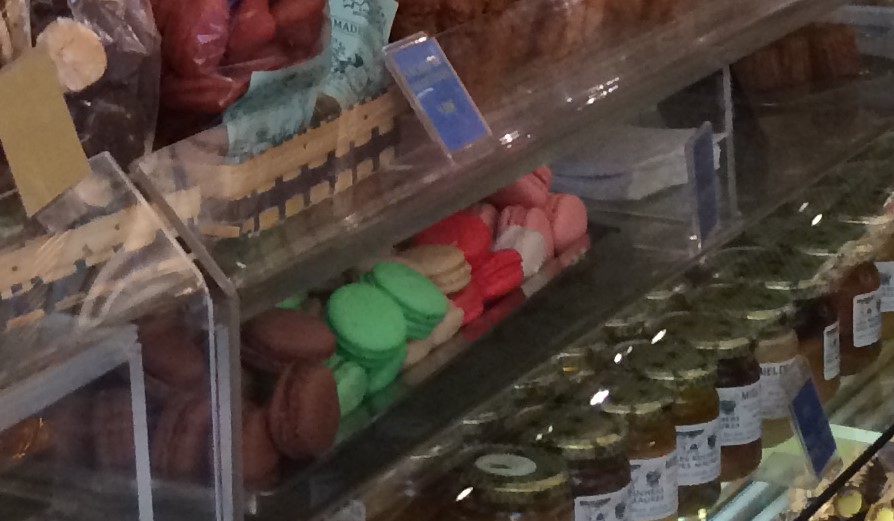
OK, I’m back and feeling better. I’m not gonna throw in the towel just yet. A jolt of inspiration whacked me a few minutes ago, and it was more than helpful. “Dummy, what’s the one thing you did in Paris that you liked more than anything else? That’s what you should write about next,” the jolt said to me. Wow, that was an enlightening question and an on-target statement. I put down my shot glass and thought about some possibilities. Seeing that I like being part of the In Crowd, I had to admit that eating macarons, colorful and tasty meringue-filled cookies that are all the rage in Paris, was a nifty experience. So was sitting at the front of one of the driverless Metro trains as it sped down the tracks, wondering how the f**k anybody figured out how to make that concept work.

But neither of them was number one. Nope, number one took place in a museum. And were it not for a blog that I stumbled upon a month or so ago I wouldn’t have been there.

I became a blog surfer at some point last year. Meaning, I get a kick checking out, sort of randomly, the near-infinity of blogs in cyberspace. And what I’ve discovered is that there are an astonishing number of blogs that range in quality from good to superb. Who’d ever have thought that so many perceptive/talented/creative people exist? Hey, it gives me hope. Anyway, I don’t remember the name of the website that I just mentioned stumbling upon, but stumble upon it I did while researching my Paris-Amsterdam expedition. And one of its articles made an impression on me. In it, the writer mentioned once being in Paris and absolutely loving the large canvases of water lilies, painted by Claude Monet, that hang in Musée de l’Orangerie (The Orangerie Museum). I was familiar with various of Monet’s water lily paintings — he churned out more than 200 of them over the years while living at Giverny, a country village about 50 miles from Paris, getting his inspiration from the water lilies that floated in the large pond on his property. But I knew nothing about l’Orangerie or its contents till skimming that article.

And thus when Martine and Alan, our Parisian friends with whom we were staying, asked Sandy and me what we might like to do while in Paris, I said I didn’t have a lot of specifics in mind but maybe l’Orangerie wouldn’t be a bad idea if we happened to be in the area.

Good call, Neil. In fact, a perfect call.

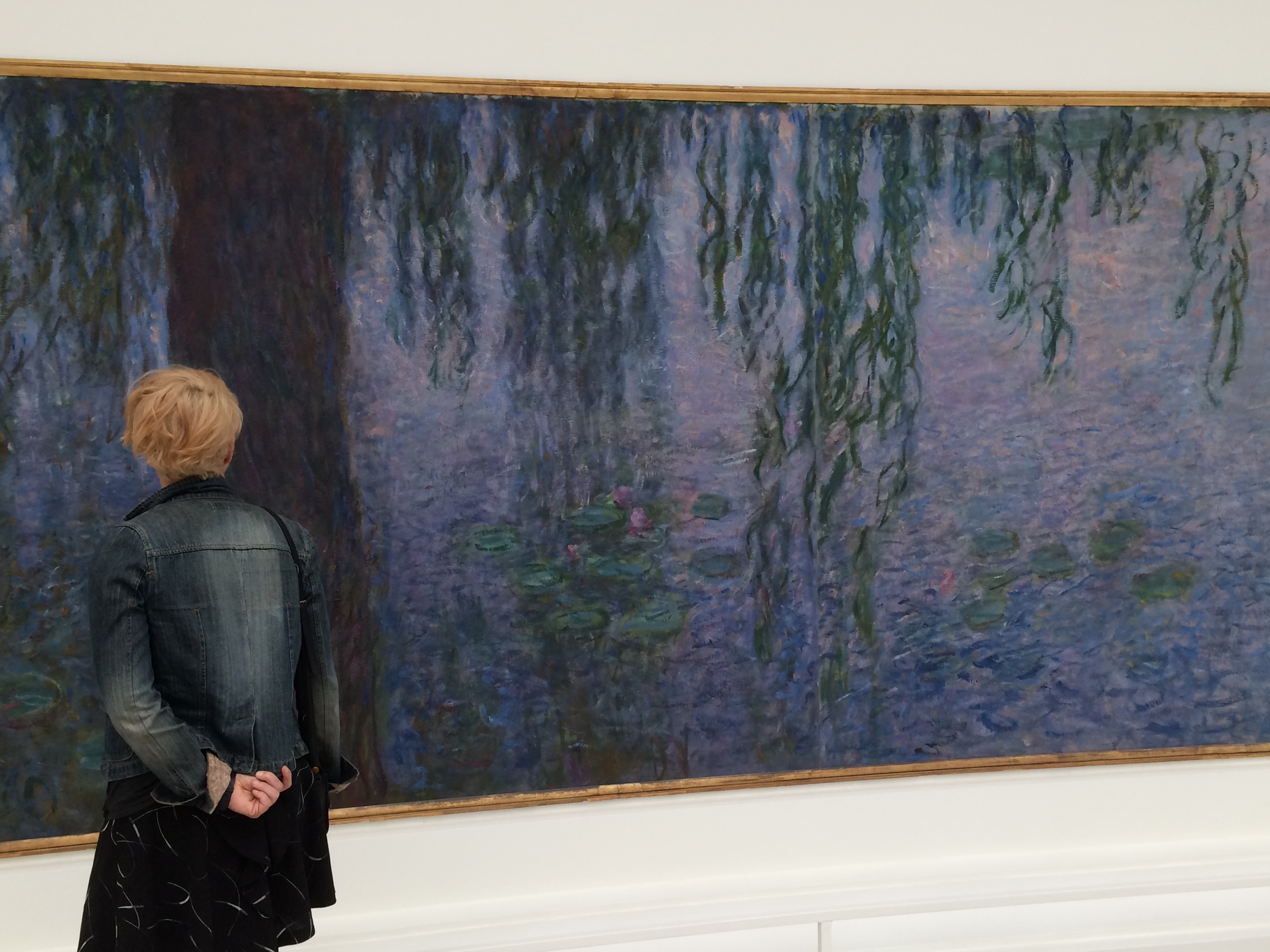
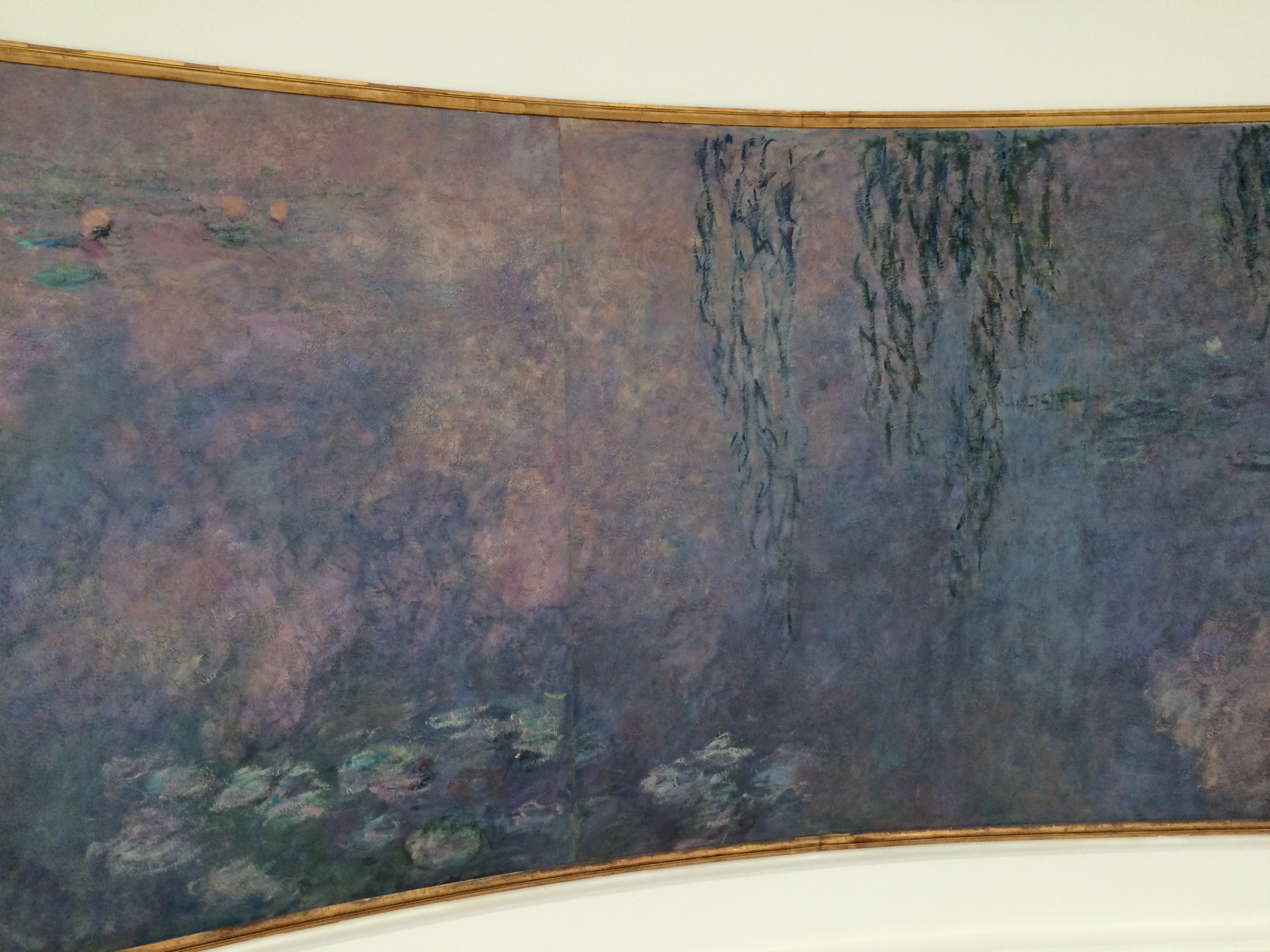
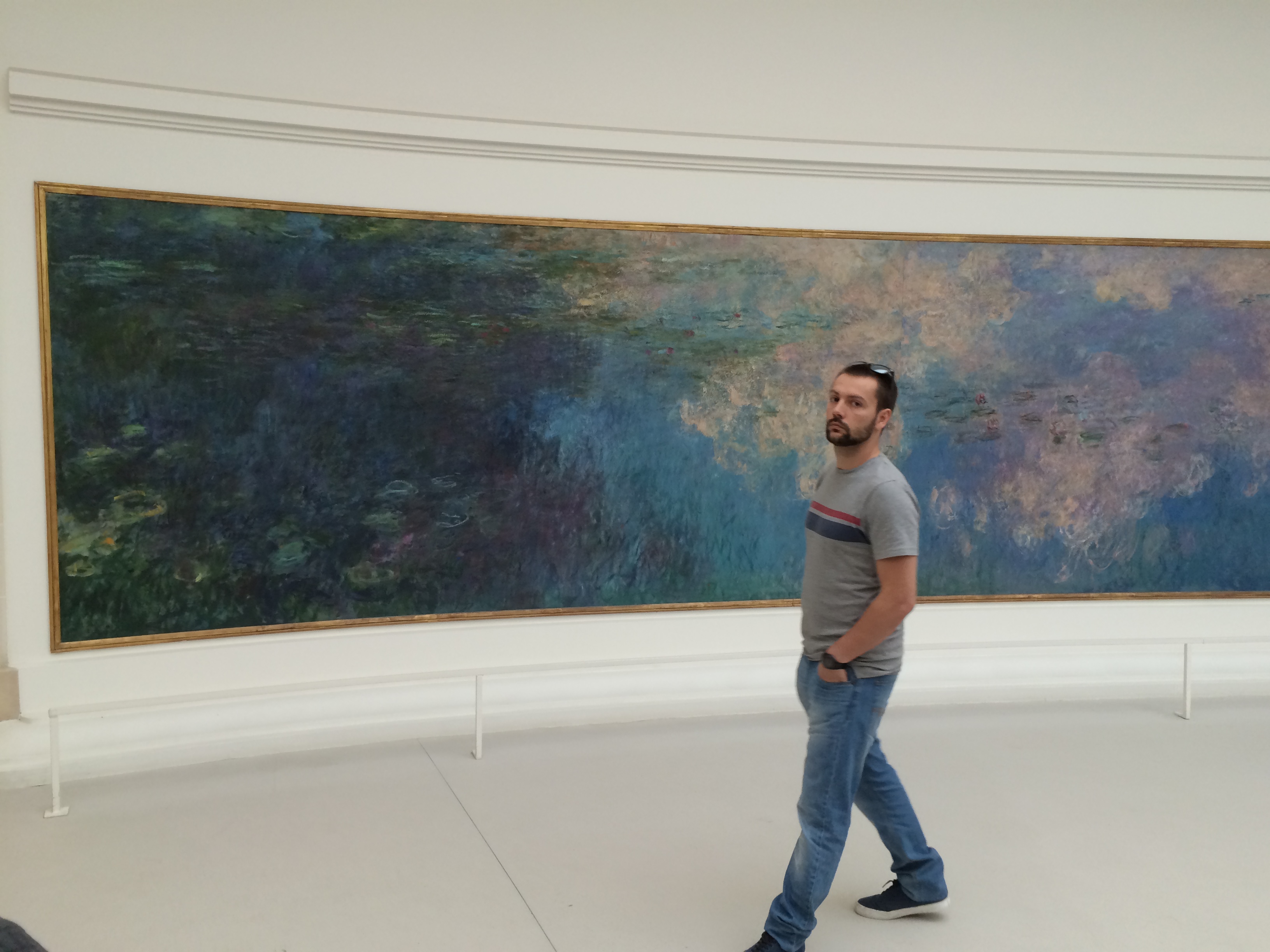
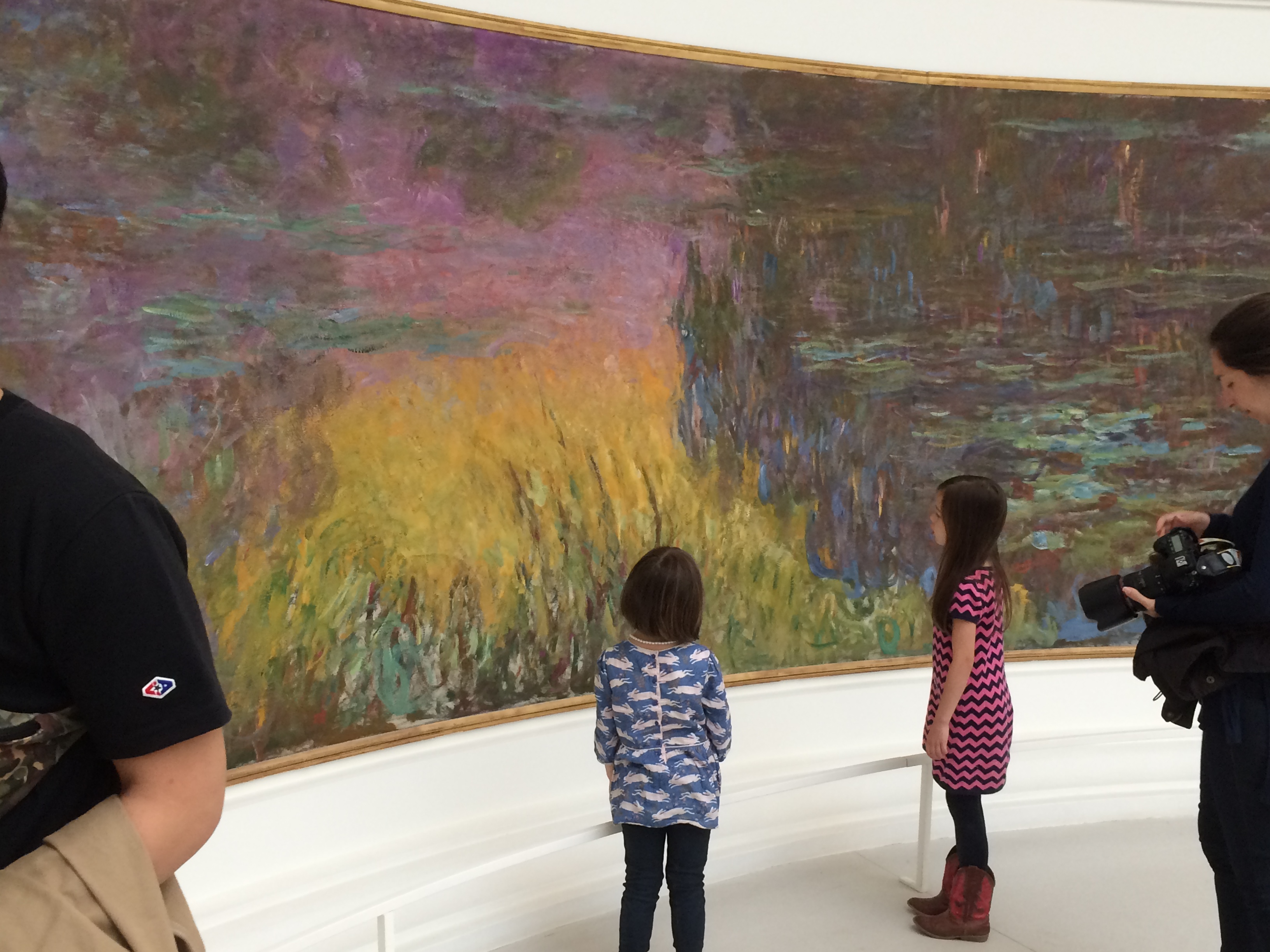
IMG_0548IMG_1335You know, I feel fanboy-ish and unstudied in saying this, but the eight enormous water lily canvases at the Orangerie are among the greatest paintings I ever have seen. Complex, inspiring, bedazzling, calming, mind-expanding, yes they are all of that. And their powers play off one another. Which is why their cumulative force is off the charts, in a contemplative sort of way. Right, right, I’m getting carried away here, but what can I do? I’ll try to calm down.

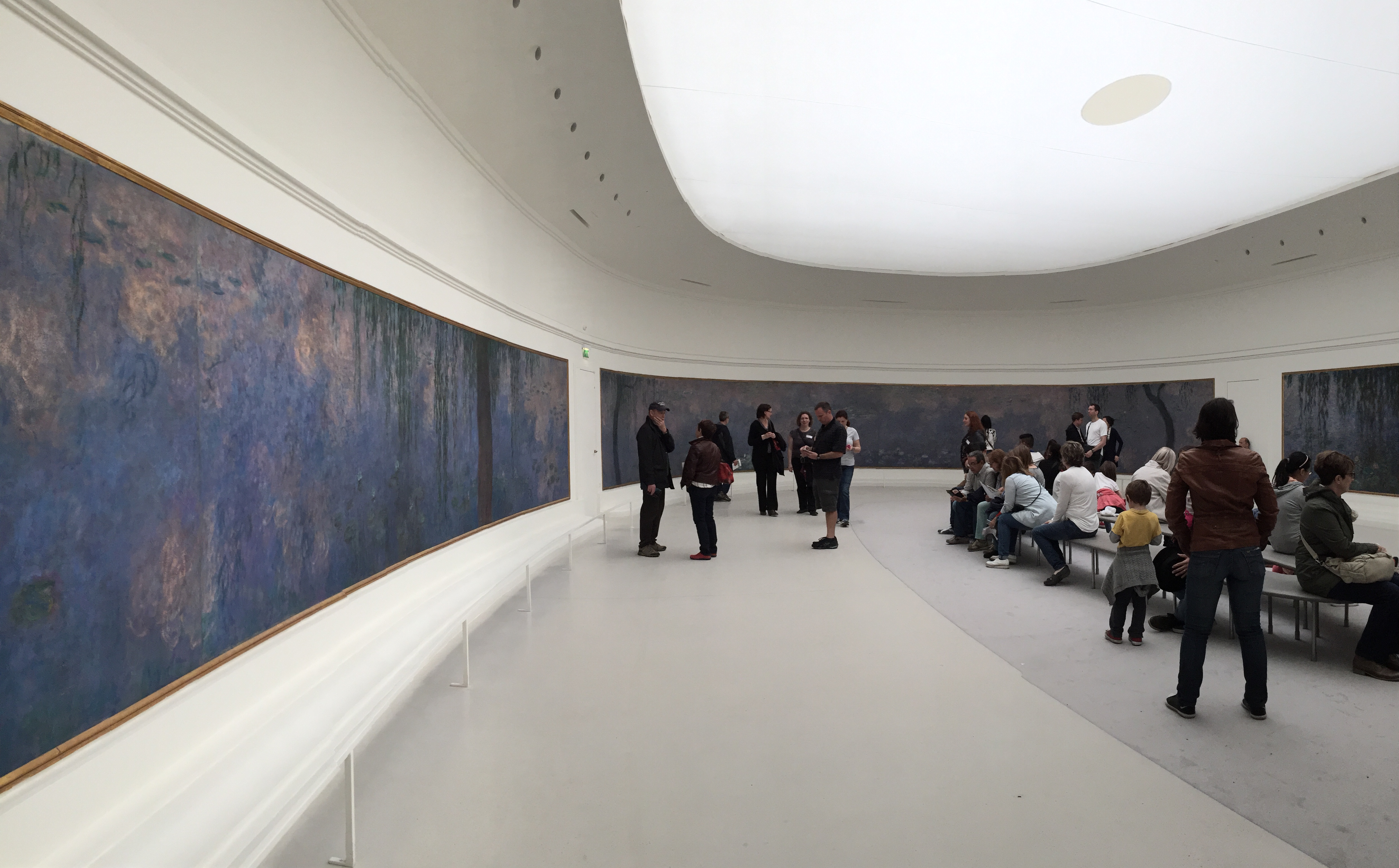
Monet worked on these paintings for 12 or so years, nearly up to the time of his death, at age 86, in 1926. He donated them to France, wanting them to represent peace and tranquility to a world that needed macro doses of same, as it does today. And he negotiated with the French government for the canvases to be housed in special chambers. Two curved rooms with natural lighting, quiet and elegantly simple, would fit the bill he decided. And he felt that the Orangerie would be a fine spot in which to build those rooms, whose design and construction he oversaw. But he didn’t witness the installation of his giants, which took place the year after he left this world.

IMG_0560IMG_0559Earmarking eight monumental canvases (they are six and a half feet high and average 37 feet in width) for France’s citizens, to be displayed in custom-made quarters, was a grand gesture on Monet’s part, possibly the grandest of his life. When I walked into the two rooms that the works occupy, four per room, I felt as though I were in a sanctuary, a shrine. And I was. Sandy, Alan, Martine and I spent an hour there. These are paintings you can get lost in. I know that I did, and I think the others in my party did too. The canvases are dreamy, amorphous, color-rich yet for the most part muted. Water lilies are depicted on each canvas, but they are only part of the story. Other small vegetation appears. And wispy visions of willow trees float on the four paintings, done in somber shades of violet and purple, that are housed together in one of the rooms.  Still, more than anything the works are dominated by water, sky reflections and, depending on the canvas, bright or nuanced light. All of those components, material and ethereal, are in their glory in the Orangerie’s Monet spaces.

IMG_0547IMG_0550And the paintings verge on abstraction. These are a whole other ballgame from the gorgeous hillside and seaside scenes that Monet, a founder of Impressionism in the 1860s, once painted. Monet’s sense of color, and his feel, are totally recognizable on the large canvases, but the idea of place largely is gone. Purposely. I think that what he was trying harder than ever to do was to distill the natural world, to get to its essences. An incredible endeavor for someone who began the project in his very advanced years. Monet The Great, no doubt.

Not unusual for me, I was late to the party. Obviously. I mean, millions of people know about the Monets at the Orangerie Museum. And swoon over them. A few days ago, for example, my brother mentioned to me that they are his favorite works of art in all of Paris. Ah, what can I say?

Okay, I’ll say this: The Orangerie is brimming with tremendous art besides Monet’s. The many oils there by Chaim Soutine and Maurice Utrillo, two guys you don’t ordinarily see too much by, knocked me out. But Monet is the museum’s heart. A couple of day’s ago, Sandy reminded me of something that popped out of Alan’s mouth after we left l’Orangerie. “I guess we got our Monet’s worth,” he sagely cracked. Truer words were never spoken.

(Don’t be shy about adding your comments, or about sharing this article with others)
(If you click on any photo, a larger image will open)