The Pretty Good And The Great: A Look At Burnt And Room

On a recent weekend my wife Sandy and I added to one of the biggest lists we maintain. Namely, the list of movies that we have seen. We watch far more movies at theaters than at home, and the two I’m about to talk about were viewed from comfortable chairs in suburban Philadelphia cinemas. We went on a Friday with our excellent friends Barbara and Fred to see Burnt. The following night, unaccompanied, we took in Room.

I hadn’t thought of Burnt as a must-see, but I was more than happy to give it a go when Sandy informed me that she and Barbara had decided upon it. I like Bradley Cooper and I like food, and Burnt not only stars Cooper but is set in the world of high cuisine and celebrated chefs. Leaving the theater I was fine with Burnt. Then the next day I started to think about it a bit more, a dangerous thing to do, and downgraded my opinion. It’s an enjoyable movie, but nothing beyond standard. It’s pretty good at best.

Now, Room was another story. I had been under the impression that it is highly disturbing, with tough-to-watch violent scenes. I was reluctant to see it because of this. Sandy, however, told me that, from what she had read, I was wrong. Right she was. I didn’t have to close my eyes at all during the movie, as nothing bloodily horrific occurred. What did take place unfurled seamlessly, a heartwrenching and heartwarming tale that felt authentic. Room is a great movie, one of the very best that I’ve seen so far in the year 2015.

Seems to me that most movies, in one way or another, are about the human condition. Well, uh, duh. And the human condition, needless to say, is complicated, far too variable and malleable for an amateur observer like me ever to understand particularly well. I came away from Burnt and Room, though, with the idea that, vastly different as they are, they address some of the same questions: What does it take for a person to become well-oiled and smoothly-functioning and goodhearted? To fit in the world healthily?
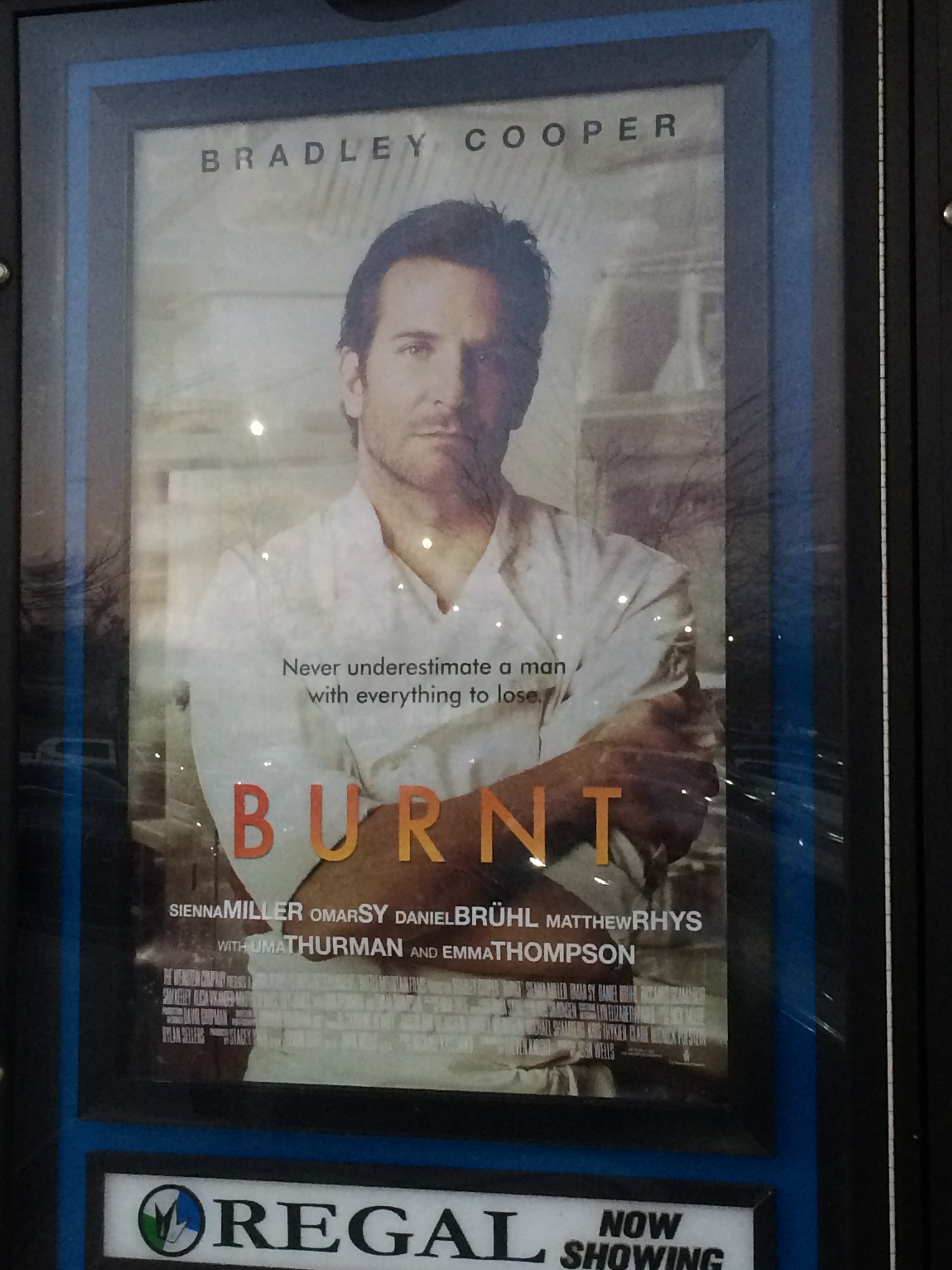
We saw Burnt in Warrington, PA.

In Burnt, Bradley Cooper plays Adam Jones, once a top-of-the-line restaurant chef who imploded and burned his bridges several years before the movie’s opening moments. Anger, unhappiness and the subsequent drugs and drink did him in. Early in the action we find him doing self-imposed penance as an oyster shucker in a New Orleans restaurant. He has been clean and sober for a couple of years and has decided that he will take his place as an elite chef once again, but only after he has shucked one million oysters. That milestone reached, off he heads to London, where associates from his past are in the culinary game.

Aggressive, fast-talking and manipulative, Jones magically in no time is at the helm of a fancy fancy eatery in a fancy fancy hotel. You go, bro! Though recognized as a maestro in the kitchen, Jones for some reason feels obligated to treat his boss and kitchen staff in a bullying and disrespectful manner. And he gets away with it. Apparently the stoppage of substance abuse didn’t stop Jones from being an asshole. How come? — go ask the screenwriter. But what really got me was that so many people, despite Jones’ obnoxious ways, have an underlying deep affection for him. Made no sense to me. Go ask the screenwriter.

But Adam Jones is not all bad. Hints of decency peek through. And he owns a degree of self-awareness. If he is to morph into the person whom others, remarkably, are rooting for him to become, he will need to drop his defenses and allow their good feelings to reach him, and allow his blood to warm. We’re talking here about love, the key to life.

Yup, high-speed and breezy Burnt is a flawed production about a flawed human being. But there are two good reasons to see it, Bradley Cooper for one. He is a fine actor. Adam Jones is a complex guy, and Cooper draws a complete picture.

And then there’s the food. I’m a sucker for beautifully filmed looks at the preparation and downing of gorgeous and delicious meals. A good one-sixth of Burnt has the camera focused on this tasty stuff. Thinking about it now is making me hungry.

We saw Room in Ambler, PA.

Speaking of flaws, stay away from Room if you’re looking for them. It is one of those movies that gets everything right. The screenplay, cinematography, pacing, acting. Brie Larson and child actor Jacob Tremblay perform astonishingly in the lead roles. The rest of the small cast also is outstanding. I see a bushel of Oscar nominations in Room’s future.

Room’s examination of how best to grow in the world, unlike Burnt’s, is profound, multidimensional and moving. What, though, is the world? When Room commences, it is a one-room shed for 24-year-old Joy Newsome (Larson) and her five-year-old son Jack (Tremblay). They have been held prisoner there by perverted Old Nick, a middle-aged loser. Old Nick never has allowed Jack to leave the shed. Joy, kidnapped by Old Nick when she was seventeen, hasn’t been outside the room since then. Old Nick began using Joy for sex right from the start. He is Jack’s biological father.

The shed is habitable and sits behind Old Nick’s home in Akron, Ohio. It has running water, electricity, heat, a tiny kitchen and bathroom, a bed, a television and a few books. It has no wall windows, only a skylight. Its one door is thick and equipped with a passcode-protected lock for which only Old Nick knows the numbers. Old Nick visits the shed to deliver food and to have sex. Escape? Little chance — Old Nick is crafty and scary. This is a bleak set-up, one in which only the strong-willed and resilient, such as Joy, would survive.

Jack knows of no existence beyond his prison. To Jack, the room and his mother have been reality, nothing much else. He doesn’t realize that the people and other images that he sees on television have a connection to realms beyond the screen. Yet he is a happy and playful child. Joy has done miraculous work nurturing Jack under cruelly limiting conditions. Raising him with love is all that matters to Joy. And shielding him from Old Nick.

I’m not spoiling the plot by saying that Joy begins to explain their plight to Jack when he turns five, and that light bulbs slowly brighten in his mind. I won’t say more about the directions the story takes. Giving away too much about such a quality movie wouldn’t be fair.

But I will say this. Room examines the human plight fastidiously. Burnt doesn’t, which is sort of OK because it never meant to. But Burnt would have been a better movie if it had tried a little harder. Somewhere in the middle of Burnt one of the characters throws out a line or two about Adam Jones having had a very rough upbringing. Nothing more is made of this in Burnt, but probably it’s the root cause of chef Jones’ discontent.

I’ll say it again. Love, the key to life.

(Photos by Sandra Cherrey Scheinin. If you click on a photo, a larger image will open)

(If you enjoyed this article, then please don’t be shy about sharing it)

You Gotta Like These People: A Review Of Meet The Patels

A few nights ago my wife Sandy and I went for the umpteenth time to the Ambler Theater, an art house cinema in the Philadelphia suburbs that I’ve praised often on this website. We were accompanied by our excellent pals, Cindy and Gene. They are Philadelphians understandably loathe to drive to the burbs, or anywhere, for fear of the nightmare that sometimes awaits them hours later when they return to their congested neighborhood and attempt to find a parking space. I hope they are not still circling their surrounding blocks these several days later. If they are . . . well, that’ll learn ’em.

We saw Meet The Patels at the Ambler Theater.

The movie we went to see was Meet The Patels. It is a delightful concoction, a documentary so breezy and cheerily assembled that I urge all of good spirit to take it in. For those not of good spirit, watching it maybe will help them find a better path in life.


Nonetheless, I left the Ambler Theater not at all sure if I would comment online about Meet The Patels. Sure, I enjoyed the documentary very much. Sure, it’s worth writing about. But: 1) Hundreds of reviews of this movie already have been penned. 2) I didn’t seem to have any wondrous insights to disseminate. 3) Etc.

On the other hand, my blog is a voracious master, compelling me to keep it fed.

Words of wisdom attached to a wall at Randazzo's Pizzeria.
Words of wisdom attached to a wall at Randazzo’s Pizzeria.

Fresh out of ideas and inspiration, I sauntered into Randazzo’s Pizzeria the day after watching Meet The Patels. It’s a decent joint a mile or two from my abode. As I waited for my pizza slices to heat in the oven I took a look at one of the walls. It was covered with knick-knacks and photographs. One of the knick-knacks caught my attention and got me thinking. It was a depiction of an Italian chef standing next to a chalkboard on which were written very sage and pithy statements: “A pinch of patience; a dash of kindness; a spoonful of laughter; and a heap of love.”

Those are words not to be taken lightly. They truly are meaningful. They are a good recipe for life. And they illuminate what, to me, Meet The Patels is all about.

And thus a pizzeria inspired me to sit down and type this report. Meet The Patels concerns a family of four, the Patels. Natch. Husband and wife, India-born Vasant and Champa, moved to the States decades ago for better opportunities than they saw available at home. They became accustomed to the American Way, but hung on strongly to their native customs and values. Stateside they produced two children, Geeta and then Ravi. Now young adults, the siblings are highly Americanized, yet cognizant and appreciative of the Asian culture that undeniably runs through their veins.

All four Patels, as best I could tell, reside in California. Mr. and Mrs. P occupy a roomy home. Geeta and Ravi, touchingly, share a comfortable apartment. How many adult siblings live together? Few, by my experience. In this documentary, Geeta and Ravi seem to pull it off easily.

On to the plot. Meet The Patels spins the tale of Ravi’s search for a wife. Having recently broken up, after a two year romance, with a white girl named Audrey, 29-year-old Ravi somewhat reluctantly agrees to allow his parents to try and find a suitable match for him. Only thing is that Mom and Dad never knew about Audrey. Ravi was too embarrassed ever to tell them that he had dated a female of the non-Indian-American persuasion. Mom and Dad, successful products of an arranged marriage — arranged being the norm in India — were under the impression that their 29-year-old son was kind of a relationship tyro. And that his unstated goal was to settle down with someone who shared his ethnic background. Coolly they convince Ravi to allow them to employ slightly updated versions of traditional Indian matchmaking methods to identify and locate a mate for him. Said mate is to come from the large pool of well-educated and fine-tempered Indian-American and Indian females that Ravi’s parents are confident exists. Let the games begin.

Meet The Patels is a movie that originally wasn’t meant to be a movie. As a lark, Geeta began filming Ravi’s wife-seeking adventures. After a while she and Ravi realized that fun and wisdom were to be found in the raw footage. Light bulbs went off in their heads and a project was born. They are credited as Meet the Patels’ directors, and along with two others as the writers. The movie doesn’t mention this, but it turns out that the story and filming took place about seven years ago, after which various snags held things up big time. Last year, finally, the movie was completed and became a darling of the film festival circuit. It’s playing now in a modest number of theaters. Ravi was an actor landing a handful of movie and TV roles while Meet The Patels was filming. These days he is a pretty big presence on the small screen. He’s currently in two series, Grandfathered and Master Of None

Meet The Patels moves fast and furious, Geeta handling most of the camerawork in an engagingly amateurish home movie mode (she claims she never learned how to operate her camera, or frame scenes, properly). The film intersperses animated sequences, scripted and nimble, to explain and give oomph to the plot. The plot doesn’t require more elucidation from me. No spoiler alerts here. What really matters are the lessons about human behavior and relationships to be gained from the flick (and from the Italian chef’s chalkboard). To wit, the four principles in Meet the Patels are endearing, warm and loving. They respect each other and get along famously. They are open (excepting Ravi’s concealment from Mom and Dad of Audrey’s place in his life, but we’ll forgive him that) and open to change. They smile a lot, laugh a lot. These are folks you’d want to be friends with.

Sandy, Cindy, Gene and I all left the theater feeling good. Amen.

(Photos by Sandra Cherrey Scheinin. If you click on a photo, a larger image will open)

(If you enjoyed this article, then please don’t be shy about sharing it)

The End Of My Long Affair (With Turner Classic Movies)

When I moved to Philadelphia in 1974 I became a film buff of sorts. It all happened very naturally and wasn’t anything I thought about. There were fewer options for movie lovers back then in Philadelphia than there are today, but there were enough. In addition to first-run theaters, Philadelphia had various venues that specialized in lesser-known flicks — some were foreign, some not. I had never before seen many foreign or cult movies and found myself liking them. My cinematic diet, consisting of the mainstream, the obscure, the subtitled, has remained consistent ever since.

My wife Sandy, whom I met in 1990, is a big movie fan too. Each year she and I leave the house 40 or more times to take in movies. Chez us, together we catch an additional 25 or so flicks on the tube. We like doing things together. For a span of eight years in my married life though, I also viewed hundreds of films on my own. I watched them on the Turner Classic Movies cable channel. I became addicted to TCM, but I’m not anymore. Here’s the story:

In 2006 my thoughts and activities were less-focused than they should have been. My father had died the previous year and I think my restlessness was partly connected to his passing. He had lived with Sandy and me, and we spent a lot of time caring for him. With him gone I had trouble finding ways to fill up my days fully.

I began watching TCM movies on this TV in 2006. This is a recent photo of the TV.

Sandy had been suggesting I might do well to add some prime time television viewing to my regimen as one way to get my mind off of things. But I couldn’t decide what to watch, didn’t think I’d  be happy devoting a bunch of hours to the small screen. Somehow though, I heard the call of TCM. Our meeting must have been preordained. And so a few months into 2006 I began descending the stairs on many evenings from our kitchen to finished basement, a place I hadn’t visited all that much since moving into our house the year before. In the basement’s den area sat an old bulky TV that had traveled from our previous home.

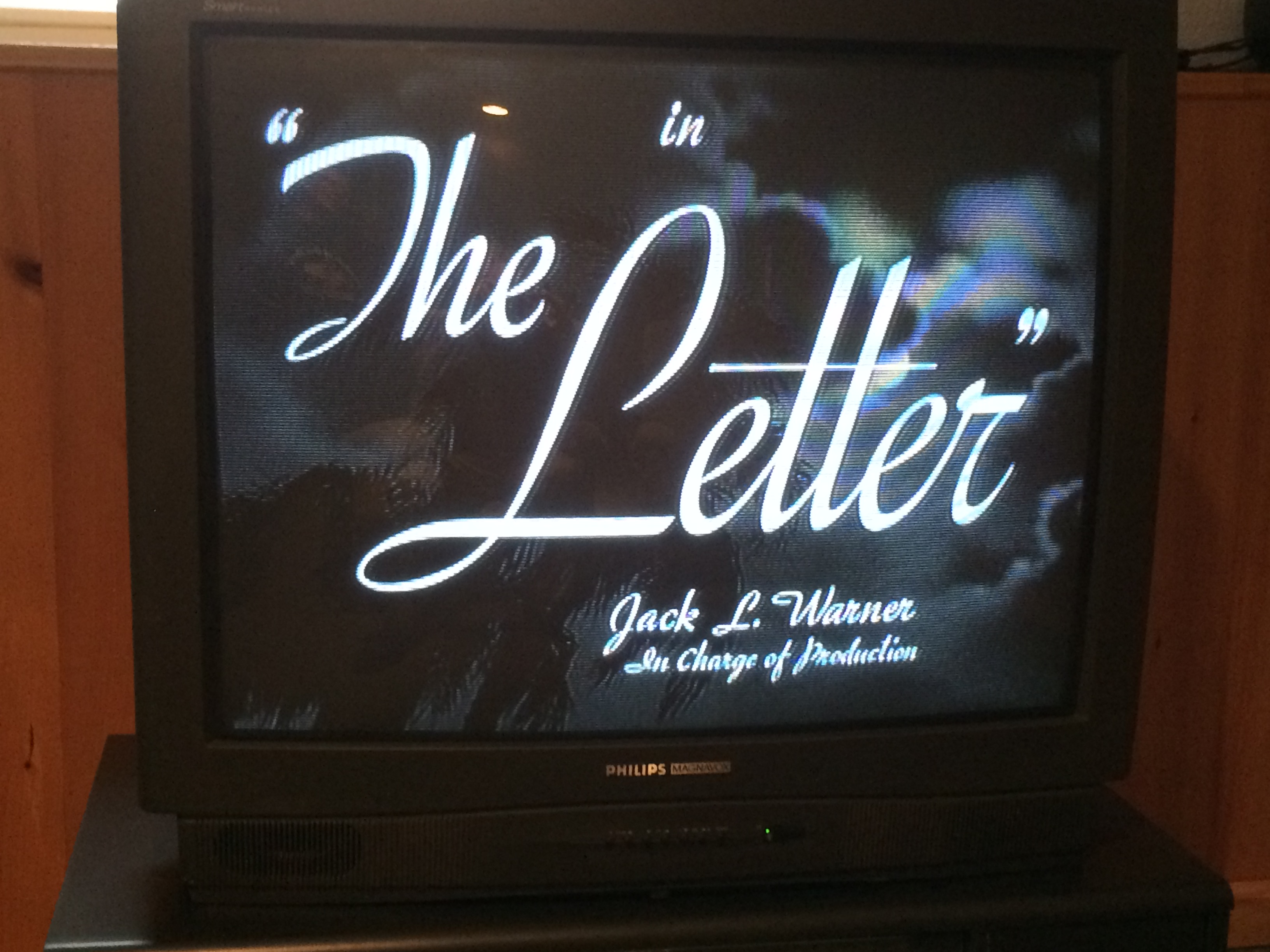
The Letter was the first movie I watched on TCM in 2006. I took this photo recently.
The Letter was the first movie I watched on TCM in 2006. This is a recent photo.

I began the affair gingerly. The first TCM movie I watched in 2006 was The Letter, a Bette Davis melodrama. It was pretty good. “OK, let’s try another,” I thought, and not too many days later Tender Mercies passed before my eyes. I had seen it when it came out in 1983 but didn’t recall it too clearly. I gave it two thumbs up in 2006.

Turner Classic Movies is quite the amazing broadcaster. Movies in their unedited versions 24 hours a day with no commercial interruptions. TCM’s core is English-speaking productions from the 1930s through 70s. Once in awhile the station throws in a foreign movie or a silent or a post-1970s film such as Tender Mercies. Despite the station’s name, however, hardly every TCM movie is a classic. There are plenty of clunkers. On many occasions I turned off a movie within its first 30 minutes and made the long climb upstairs.

And yet, duds or not, I became very comfortable sitting in a recliner in front of the basement TV. By 2006’s end I had watched 61 movies on TCM. The next year’s number was 103, and the year after that I reached the 87 mark,  my two highest totals. Since then the counts have descended, from 64 in 2009 to seven in 2014. I’ve managed merely one movie so far in 2015, The Great Santini, a good one that seemed a tad better to me when it made its initial rounds in 1983.

Why the dramatic falloff? Well, after cutting a slew of notches into my movie-watching belt I discovered that my TCM motor was running out of gas. Eventually, many of the movies I contemplated watching didn’t seem, upon investigation, good enough to spend time with. And the slim pickings of films from 1980 onward began to bother me a little.

But I tip my hat to Turner Classic Movies without hesitation. You see, to Sandy’s amazement somehow I’d made it into my late 50s and early 60s without having witnessed On The Waterfront, West Side Story, Singin’ In The Rain, From Here To Eternity and others that the general populace would deem to be true classic films. TCM rectified that situation. Contrarian that I sometimes am though, Singin’ was the only one of those that I felt was completely worthy of wearing a crown. And, besides Singin’, at least 15 more offerings that I first caught on TCM are now on my list of elite movies: In A Lonely Place, Odd Man Out, The Misfits, Darling, Sweet Smell Of Success, Hud . . .

Hey TCM. you’re a great station and I thank you for all the entertaining hours that you bestowed on me. Add some movies from the current century and maybe once again you and I will become pals.

(Photos by Sandra Cherrey Scheinin. If you click on a photo, a larger image will open)

(If you enjoyed this article, then please don’t be shy about sharing it)

Screwball Begone! (A Review Of Mistress America)

I wasn’t as fond as I thought I would be of the movie that my wife Sandy and I went to see recently. Sandy told me that various critics have heaped praises upon said flick, Mistress America, some calling it a screwball comedy in the grand old Hollywood tradition of Howard Hawkes and Preston Sturges. I saw the movie differently. I found it to be as much a drama as a comedy, as bittersweet as it is funny. And as for screwball, which can be great . . . well, Mistress America’s try at the madcap art form encompasses not the entire movie at all, settling instead for one long and uncomfortable segment in the second half. I didn’t have much fun with that interlude. A collection of intersections involving most of the movie’s cast, it felt flat and strained to me, out of place with the decidedly tilted but more realistic antics and people-play that populated the rest of the film. In other words, Mistress America overextended its ambitions. It would have been a better movie if its creators, Noah Baumbach and Greta Gerwig, had kept their eyes on the  wry and poignant, and left the supposedly wild and crazy alone. My rating? Two, maybe two and a half out of four stars.

We saw Mistress America at the Regal multiplex in Warrington, PA.

Mistress America revolves around a small parade of characters led by Brooke Cardinas (Gerwig) and Tracy Fishko (Lola Kirke). Brooke is a 30ish lady on the go, an at-times free spirit who cobbles together a living in New York City by leading exercise classes, doing interior decorating, whatever it takes. Her dream is to open a restaurant slash hair salon slash hangout in Lower Manhattan called Mom’s, a place where customers will settle in and feel really comfortable. A wifty notion possibly, but who knows? Brooke already has signed a lease for the empty space she plans to transform, and is in the process of assembling financial backing. She’s committed, and several steps ahead of herself.

Into Brooke’s life enters Tracy, a Barnard College freshman not connecting very well to the college scene in Manhattan’s Upper West Side. At Mistress America’s outset, Tracy and Brooke have never met. Tracy learns of Brooke’s existence from her mother, who has plans to tie the knot with Brooke’s father. Following her mom’s suggestion, Tracy gives her stepsister-to-be a call. They meet, they bond, and the slings and arrows and goofy twists of fortune begin to fly.

Excising the unwieldy aforementioned portion of Mistress America, what we’re left with is an observant study of two women looking for some answers. Tracy is young, an introvert, and beginning what appears will be a very long process of self-discovery. I’m not placing heavy bets on her ever finding peace and contentment. She can be nasty and guileful, sides of her personality she might not have known were alive till the forceful Brooke’s influence poked them to the surface.

Brooke on the other hand is a longtime gung-ho trooper. Disappointments have peppered her life, but on she goes, pushing aside her doubts and sadnesses as she seeks the next opportunity or person that might set her on the true path. Late in the movie Brooke offhandedly takes a deep look inside and throws out some comments that almost are on target. To Tracy she says something to the effect of  “I know everything about myself. That’s why I can’t do therapy.” Actually, she knows so much that, I think, she scares herself. And keeps on running.

Baumbach and Gerwig, a real life couple, have been feeling their collaborative artistic juices the last few years. They cowrote Mistress America, and Baumbach directed. Ditto for 2013’s Frances Ha, which resembles Mistress America in that it centers upon a young woman who stumbles a lot in life. Frances, though, is several notches below Brooke on the got-it-together scale. Gerwig starred in Frances Ha, and I wasn’t sure if she would have the acting chops to differentiate her leading roles. I am glad to report that she does. Her Brooke is a complicated soul, usually energized and with a gleam in her eyes, but down enough times that my good wishes went out to her. Mistress America, despite its big ol’ flaw, offers plenty to chew on.

(Photo by Sandra Cherrey Scheinin. If you click on it, a larger image will open)

(If you enjoyed this article, then please don’t be shy about sharing it)
Infinitely The End (Thoughts About Two Movies)

Existence can be perplexing. If you’re like me, there are countless aspects of the organic and inorganic and intangible realms that are hard or impossible to figure out. Now, some of these subjects are of high importance, such as global warming or one’s relationships with one’s fellow species members. Others aren’t worth devoting too much brain power to. Naturally, those are the ones I gravitate towards. A few days ago, for example, I decided to look into the degrees of success that a couple of movies that I’ve recently seen in theaters have had at the domestic box office. Our planet’s fate did not hang in the balance as I did my research. I’m talking about Infinitely Polar Bear and The End Of The Tour, smart and perceptive movies aimed at the art house market. Infinitely seemed to me to be far more of a potential crowd pleaser than The End. Yet it has been attracting far fewer dollars in the USA than The End. Here’s why this surprised me:

My wife Sandy and I saw Infinitely Polar Bear at the Hiway Theater in Jenkintown, PA.

Infinitely Polar Bear is a boisterous movie, a full-of-life, family-oriented comedic drama and to a large extent a feel-gooder. What’s more, it centers around a wild and bigger-than-life character, beautifully played by Mark Ruffalo. The End Of The Tour is and has none of that. It is slow-moving and understated and wry. And cerebral too. Its main character is charismatic, but in a geeky and repressed sort of way. Infinitely has flash. The End doesn’t.

As we see, I’m no Kreskin when it comes to predicting people’s tastes in movies. What else is new? Still, though I enjoyed both, in a way I’m glad that The End Of The Tour is outdoing Infinitely Polar Bear financially, because I think that The End is better. I’d give it at least three and a half out of four stars. To Infinitely I’d grant maybe three. There were aspects of Infinitely that rang a bit false to me. I had no such problems with The End Of The Tour.

We saw The End Of The Tour in Montgomeryville, PA.
Guess what time the movie started.

One big thing that Infinitely and The End have in common is their aim to portray real life people and events. Another similarity is that the main figure in each is weighted with psychological problems. The End Of The Tour’s core takes place in 1996, when a Rolling Stone magazine writer, David Lipsky (a medium octane turn by laser-eyed Jesse Eisenberg) tagged along with David Foster Wallace during the tail end of the promotional tour for Wallace’s recently-published and massive (1,000+ pages) novel, Infinite Jest. Lipsky’s assignment was to profile Wallace for Rolling Stone, and he filled many cassette tapes with Wallace interviews. The End is drawn from the interviews and from Although Of Course You End Up Becoming Yourself, which was Lipsky’s 2010 book about his Wallace adventures.

No supernova explosions took place during Wallace’s and Lipsky’s five days together, but in a subdued and riveting way their conversations soared. I’m pretty certain that The End mirrors reality in this and most respects. The wary Wallace opened up more to Lipsky than he might have wanted, partly due to some slings and probes that got under his skin. Wallace talked about the love-hate feelings he was developing about the fame that Infinite Jest was thrusting upon him. He talked about the dehumanizing effects of technology on modern man, about the place of the creative person in the world. He touched upon many other topics, including his struggles with mental depression (sadly, he lost this battle in 2008, when he committed suicide). I found The End’s depiction of all of this very moving and kind of exhilarating. I was totally smitten by Jason Segel’s portrait of Wallace as a shaggy dog, a pretty brilliant and mostly nice guy. If Segel isn’t nominated for an Oscar he’ll deserve to say “I wuz robbed.”

Infinitely Polar Bear is Maya Forbes’ baby. Forbes has been a writer for the big and small screens (Monsters Vs. Aliens and episodes of The Larry Sanders Show). For Infinitely, she wrote the screenplay and took her first stance ever behind the camera. The movie tells the story of part of her life, zeroing in on the late 1970s when preteen Maya and her younger sister were raised in semi-poverty in Cambridge, Massachusetts by their bipolar father. The two girls had been living with Maya’s underemployed mother Peggy. Peggy, though, came to decide that the only way to lift the family from its lowly monetary straits was to obtain a marketable postgraduate degree, a Master of Business Administration. This pursuit resulted in her relocation to New York City, Columbia University being the only school that approved her application. Peggy hesitantly deposited the girls with her husband, the girls’ father, Donald Cameron (“Cam”) Forbes, and visited them on as many weekends as she could.

Infinitely Polar Bear is bursting with energy. Ruffalo’s Cam captures the screen, especially during his manic phases, which seem to be far more frequent than his self-absorbed and down moods. Maya Forbes’ screenplay paints Cam as an admirable father, flawed and unpredictable and psychologically challenged, for certain, but there for his girls. Ruffalo and Zoe Saldana (Peggy) make a believable, though separated, couple. Imogene Wolodarsky (Maya’s real life daughter) and Ashley Aufderheide are so feisty and delightful as the young sisters, I was convinced that they gave Ruffalo his wings.

So what about the movie slightly rubbed me the wrong way? For one, it felt a few tads too glossy, too Hollywoodized. And I’d have liked to know what the family arrangements were as the years went on. For instance, did Maya’s parents ever again join as one? Forbes didn’t say, not even in a few written sentences on the screen before the credits rolled. And what’s with changing the family’s names? In Infinitely Polar Bear they all are surname Stuart, not Forbes. Some first names were altered too. In interviews surrounding her movie, Maya Forbes has said that she wanted to present a true portrait of her family. I wish she had started by assigning the screen characters their correct appellations.

(Photos by Sandra Cherrey Scheinin. If you click on a photo, a larger image will open)

(If you enjoyed this article, then please consider sharing it)

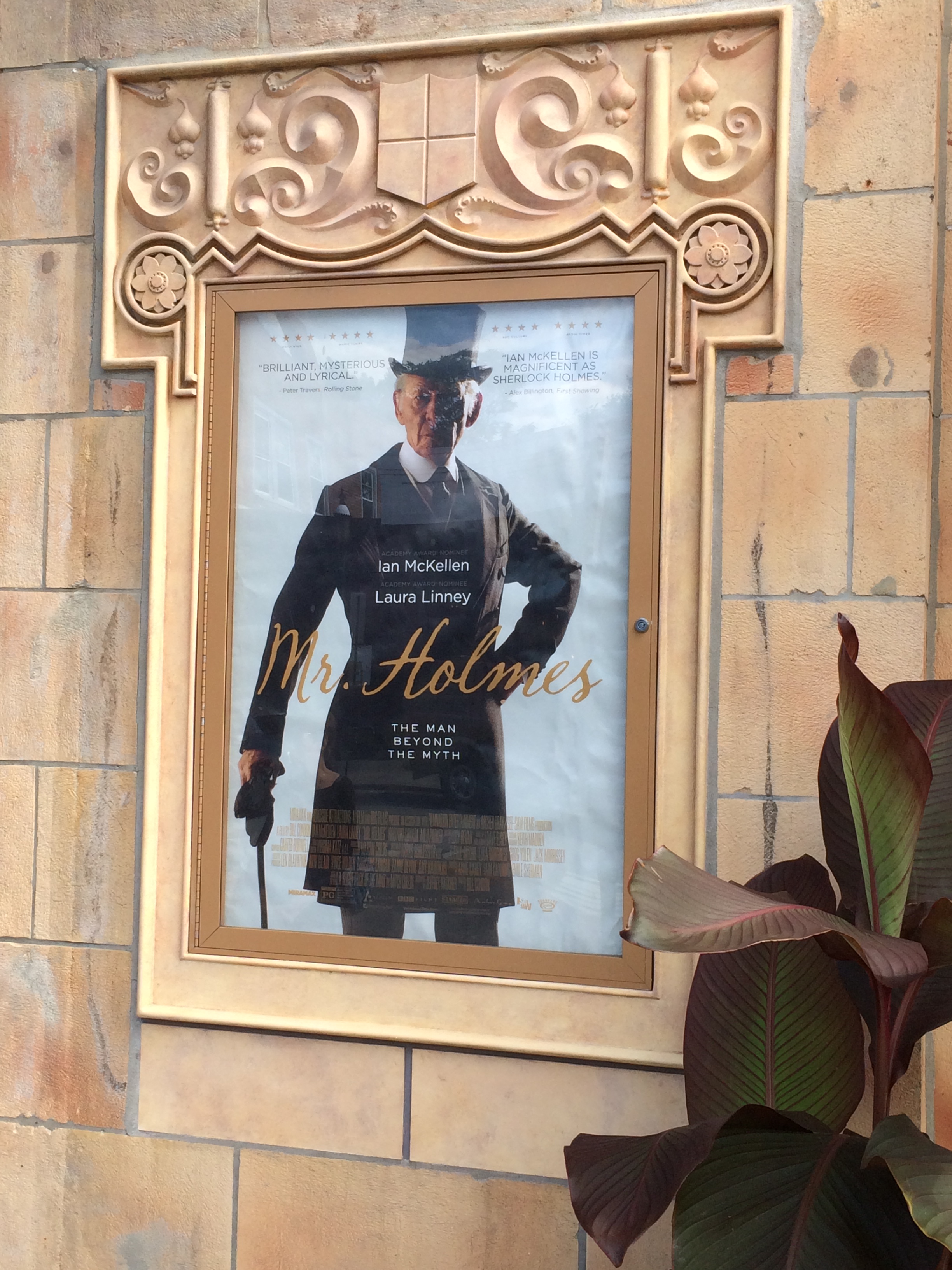
Putting Up The Good Fight: A Review Of Mr. Holmes

Arthur Conan Doyle published his final Sherlock Holmes opus in 1927. Copyright laws in Great Britain and the USA allowed him and subsequently his heirs to collect gazillions of pounds and dollars in royalties and fees since then, but the flow of those monies has become a trickle. Wikipedia tells us that the last of the copyrights expired in Britain in 2000. In the States, a handful of the final Holmes stories still are under copyright, but all the rest have fallen into the public domain. And a 2014 federal appeals court ruling stated that the creators of books and movies and television shows inspired by Sherlock no longer are obligated to pay licensing fees to the Conan Doyle estate, whose members must be grinding their teeth. I mean, is there a more enduring fictional figure than Holmes, the masterful detective? He’s hard to miss. Robert Downey Jr. starred as Holmes in two big screen productions from the 2000s, and a third undoubtedly will be heading our way in the near future. And two Holmes series currently are alive and well on the small screen: In the aptly named Sherlock, Benedict Cumberbatch portrays a modern day version of the great man in London for BBC television. Also set in the present day is Elementary, a New York City-based Sherlockian study, this one on CBS.

Books too have kept alive the Sherlock character. Dozens and dozens of them. For example, 2005’s A Slight Trick Of The Mind. Mitch Cullin wrote Slight Trick, and it is the basis for Mr. Holmes, the movie now gracing art houses and multiplexes worldwide. My wife Sandy and I recently watched it, and liked it, at the friendly and classy Ambler Theater in beautiful downtown Ambler, PA.

We saw Mr. Holmes at the Ambler Theater in Ambler, PA.

I’ve given some thought to Mr. Holmes, not an easy feat for me to undertake or accomplish. And I’ve come away with the opinion that the flick needn’t be looked at as part of the Sherlock Holmes continuum. It certainly is about Holmes, in fact a 93-year-old version of himself trying to stare down his failing mind and the end of his earthly existence. But the movie would stand just as handsomely if a few plot strands were reworked to undo the Holmes references, and if the lead figure were given another name. The movie I’d say is less about Holmes and more about understanding oneself, coming to grips with one’s shortcomings, trying to become a better person even as the end of the line draws near.

It is 1947 in the county of Sussex, England. By choice, Sherlock Holmes lives there in semi-obscurity on a small farm near the English Channel. He has been retired from the investigator game for about 30 years, having decided to hang up his detective tools because, because, because . . . Sherlock cannot remember why. His brain power, and body for that matter, are pretty strong, but some memories have begun to fade away. Holmes knows that his powers are slipping. An avid bee cultivator, he has doused himself for some time with his colonies’ royal jelly, a presumed mental strength rejuvenator. As the movie begins, he returns to Sussex from Japan, laden with that country’s prickly ash, a herbaceous product likewise touted for its restorative powers. Sherlock Holmes is not one to settle back and accept a drowsy and inevitable descent into a muddled mind.

At home, Sherlock and his property are tended to by Mrs. Munro, a widow with a bright as can be 12-year-old son, Roger. And it is here, in the mixings of these three lives, that the story finds its epicenter. Holmes, who has aged gracefully, is no longer the flinty and brusque superman of his younger days. He is fairly gentle with fellow humans and tolerant of their ways. Yet deep love is not, never was, an emotion he feels at home with. Spoiler alert: By movie’s end he will have opened his heart wider than ever.

A good chunk of the movie concerns a mystery from the past, from the years of the First World War. And that mystery, which involved Sherlock and a troubled woman, led to Sherlock Holmes’ abandonment of his Baker Street digs in London and his retirement to the English countryside. Throughout the film he strains to remember the why of his resettlement. But put aside this artistically designed and developed aspect of the movie and you still are left with a lovely character study. Ian McKellan, face creased like an accordion’s bellows, handles the elderly Holmes character with nuance and charm. His Holmes is quite yet smart as a whip, and not ashamed of the emotional vulnerabilities he has begun to develop in his golden years. His is the most complicated character on screen, the most multifaceted and the one with the most growing to do. Laura Linney (Mrs. Munro), the great American actress who to my ears has her English accent down pat, and Milo Parker (Roger Munro) at varying times coexist, bond and brawl with McKellan’s Holmes marvelously.

Bill Condon sure-handedly directed Mr. Holmes. The movie’s languid pacing feels right, and I’d bet that much of the credit for the actors’ strong performances belongs to him. Mr. Holmes is not a tearjerker. Oh, maybe one Kleenex will be of use. What we have here is a mostly cliché-free look at the tail end of the life of a proud man determined, maybe destined, to be a mensch.

(Photo by Sandra Cherrey Scheinin. If you click on the photo a larger image will open)

(If you enjoyed this article, then please consider sharing it. Thanks.)

Amy Schumer, Take A Bow!

For decades I was a devoted television viewer, faithfully devouring series galore. That pattern largely began to fade away in the early 2000s when Sex And The City waved goodbye to its audience, followed by NYPD Blue. Since the final Blue episode in 2005 I’ve had trouble following series religiously. Instead I’ve watched some movies and sports and have done tons of channel surfing, of which I’ve become a master.

Amy Schumer and Bill Hader star in Trainwreck.

As a dial-flipper, how could I not know about Amy Schumer? I’ve caught fragments of her Comedy Central series and a few minutes of a standup special. I thought she was funny. But I had no idea just how funny and talented she is till recently when my wife Sandy and I headed north to the Regal multiplex in Doylestown, PA to take in the Schumer-penned and Schumer-starring Trainwreck. If you are a fan of robustly foul-mouthed and sex-obsessed comedic vehicles loaded with did-he/she-really-say-that repartee, then Trainwreck is for you.

The setup: Schumer plays Amy Townsend, sexually active to the max and commitment-phobic. Amy T’s not looking for Mr Right. She’s just looking for the next one night stand, and has no trouble finding him after him after him. She’s a boozer, a pot smoker and looks at life with a most wary eye. Yet she also maintains a strong career as a magazine writer, turning out outlandish copy aimed at men for the slick and glossy no-conscience publication S’Nuff. In one scene Amy T and a few other writers are in a meeting with their Julie Christie look-alike editor-in-chief, portrayed by an unrecognizable Tilda Swinton. Townsend and her peers are pitching story ideas. Schumer’s crazily crude and politically-incorrect script shines here. How about “Where Are They Now? A Look At The Boys Michael Jackson Paid Settlements To” one of Townsend’s coworkers posits. “You’re Not Gay, She’s Boring” lobs another. Yup, I was slapping my knees during this sequence. Schumer had the funny stuff coming pretty consistently all movie long.

This is a movie where the plot almost doesn’t matter, but of course there is a plot and it’s fun. Bill Hader co-stars as a sports medicine titan, Aaron Conners, a physician who has revolutionized the arts of knee and hip and who knows what other surgeries, allowing professional athletes and working stiffs to return quickly and productively to their careers. One of his best friends is LeBron James. He also is pals with the lesser-known b-baller Amar’e Stoudamire. Amy T is assigned to write a story about Aaron for S’Nuff. She interviews him at his office, and her goofily charming side peeks through. Aaron is smitten. He invites her to lunch and, her defenses starting to melt, they begin to see one another a bit. Will Amy T put aside her wayward ways and join forces fully with the good doctor? Well, I’m not telling. No spoiler alerts here.

Judd Apatow, he of The 40 Year-Old Virgin and Knocked Up fame, directed Trainwreck. A few reviewers have noted that Apatow’s movies tend to go on too long. Probably that’s true. Trainwreck might have benefited if it went under Aaron Conners’ knife to eliminate 10 or 15 minutes of cinematic flab. Truth be told, though, Trainwreck’s length (two hours and five minutes) didn’t bother me at all. I’m granting three out of four stars to the Schumer-Apatow farce.

A few notes of amazement: Who’d have thunk that professional athletes would bring so much brio and presence to Trainwreck? They do. Turns out that LeBron James has a mighty gift for comedic acting. He receives plenty of screen time and stands toe to toe with everybody in his scenes. He’s got the pacing, the vocal inflections, the confidence. I’ll say the same and more for John Cena, a famous pro wrestler about whom I know almost nothing. He is absolutely hilarious as one of Amy’s suitors, a complicated and sensitive and sexually uncertain muscle guy whom Amy is toying with. Except for Schumer, he gives maybe the best show of anyone in the cast.

And a few mild gripes: LeBron James, a member of the Cleveland Cavaliers in real life and in Trainwreck, is never in Cleveland in this Manhattan-set flick. How come? The movie takes place during basketball season as far as I could tell. And one might think that Aaron Conners, a celebrated doctor for not only his work with athletes but also his donated time to countless Doctors Without Borders projects, would have an ungodly busy work schedule. In Trainwreck he’s kind of a slacker. Cafes and restaurants, gymnasiums, Amy’s apartment . . . Aaron spends far more time elsewhere than on the job.

In the end, little matter. Go with the flow, with the laughs, with the human insights that also are a large part of Trainwreck’s fabric. Amy Schumer deserves to be proud of what she has achieved here as an actor and a screenwriter.

(Photo by Sandra Cherrey Scheinin. If you click on the photo a larger image will open)

(If you enjoyed this article, then please consider sharing it. Thanks.)

Footing: It’s At The Center Of Two Recent Movies

“Footing” is not a word you see or hear a lot. For some reason it jumped into my mind recently when I started to think about two movies I’ve watched in theaters of late. I hadn’t planned on writing about either of them, but wondering about “footing” — when strong, a balanced outlook and approach that allows a rewarding life — has nudged me to confront my PC’s keyboard.

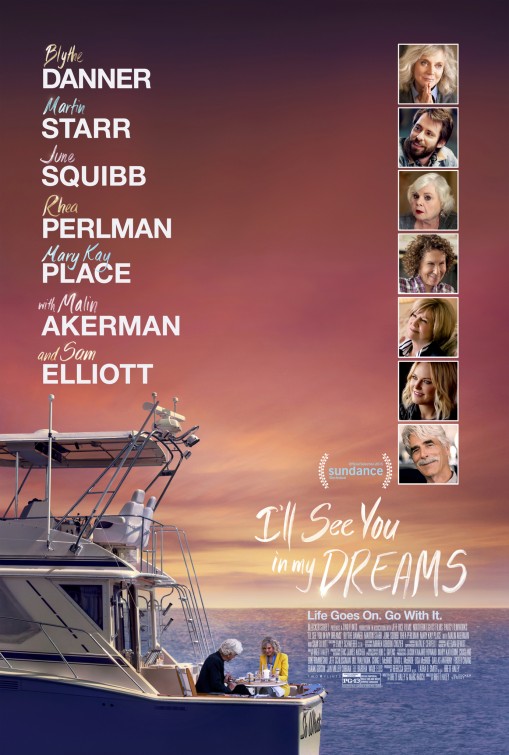
I didn’t comment on these movies till now not because they aren’t worthy. Rather, time-wasting little ol’ me simply didn’t find the time. In fact, these are fine movies. I’ll See You In My Dreams, and Me And Earl And The Dying Girl premiered in January at the 2015 Sundance Film Festival. Both went into theatrical release this spring. The movies are serious, with a light touch that keeps things friendly and personable. I’ll See You earns a three (out of four) star rating from me. I’ll bestow four stars on Me And Earl.

For much of the world’s masses, just staying alive is more than enough of a challenge. Footing is among the least of their worries. But for billions of others, middle class Americans for example, the pastures are open and the possibilities for a good life are real. Still, gaining one’s footing isn’t necessarily easy even for them. Nor is maintaining what has been gained. The slings, the arrows . . . who knows what’s coming around the bend? Most of us, luckily, eventually find our footing. And if we stumble somewhere along the line, we’re apt to get it back.

I’ll See You In my Dreams and Me And Earl And The Dying Girl are about a lot of things, including death, but footing I think is quite key. I’ll See You looks at the life of one Carol Petersen, a 70-ish California lady whose traction is pretty good at the movie’s beginning but definitely is in need of adjustment. Me And Earl’s primary character and narrator, Greg Gaines, is, as the movie opens, a high school senior in Pittsburgh whose feet have yet to be planted firmly on life’s terrain. Despite their age gap, Carol and Greg aren’t all that different. If their movies could cross-populate, they’d probably become pals, observing the potentially fixable weak spots in each other’s psyche.

My wife Sandy and I saw this movie with friends in Philadelphia. We all liked it very much.

Blythe Danner plays Carol, and does so very well. It’s a role that Danner, deep into her career, never saw coming. I watched Danner interviewed on television not long ago and she bowed down to the screenwriters and producers who brought the script her way.

A widow for 20 or more years, Carol is comfortable with her life. Money isn’t a problem. She spends time with a few close friends, sunbathes beside her pool behind her modern pad, and adores maybe more than anything her dog. But Carol drinks too much and doesn’t have all that great a relationship with her adult daughter. Something is missing. Her footing is somewhat tenuous. She’s a little dead inside.

To the rescue come two new entries into her social stream, one much younger than she, one maybe a little older. Both become her good friends. The young guy, Lloyd, (nicely portrayed by Martin Starr) and the cool, calm and charismatic older gent, Bill, (a beautiful turn by Sam Elliott) in their own ways widen Carol’s eyes to life’s possibilities. Love, needless to say, falls into that category. Carol’s footing, before the credits roll, is looking better.

My wife Sandy and I saw Me And Earl And The Dying Girl in Warrington, Pennsylvania.

I found Me And Earl And The Dying Girl irresistible. It is colorful, witty and perceptive. And very human. The plot, dialog, camerawork, editing — ooh la la. Ditto for the acting and the balance at the movie’s heart between comic exaggeration and sadness. Thomas Mann portrays Greg, a young man of extremely bright mind who is badly in need of self-confidence. There are people who love him — his parents, at least one school teacher, at least one peer (Earl Jackson, marvelously acted by RJ Cyler) — but Greg barely realizes or believes that he is loveable. Quick-thinking and creative as the dickens, self-doubting Greg thinks little of the amateur careers that he and Earl have as clandestine film makers. For a few years the two have retitled classic movies and then filmed zero budget versions whose plots idiotically and hysterically fit the new titles. The Third Man becomes The Turd Man. Midnight Cowboy becomes 2:48 PM Cowboy. You get the idea.

Greg does his best to get along with the various cliques in his high school, working hard to have only peripheral relations with all. His degree of self-worth doesn’t allow him to commit to more than that. One day, though, his world is shaken. His mother comes to him with the news that a classmate whom he barely knows, Rachel Kushner, has been diagnosed with leukemia. Greg’s mother and Rachel’s mother are friends, and Greg’s mom wants him to visit Rachel (the excellent Olivia Cooke), to reach out to her. Greg isn’t big on reaching out, doesn’t really know how. Reluctantly and awkwardly he tries, and over time there is a payoff. The payoff is love, which flows between the two teens obliquely and in spurts, just as with many folks at any age. Rachel, the wiser one, helps Greg to start pointing his compass northward. Greg’s footing begins to take hold. I left the theater feeling certain that, years later, Greg would be doing just fine in life.

Me And Earl And The Dying Girl, I’d say, is a pretty perfect movie. Not quite the case for I’ll See You In My Dreams. One thing that struck me wrong about I’ll See You is the drinking. Carol seems to have a wine glass grafted to her right hand, even when her world expands for the better. The movie never questions her desire to self-numb. And one or two scenes in I’ll See You drift too lazily. Other than that the movie rings true. The characters are real and full, and the script’s magnifying glass brings out the details of a life moving out of neutral.

Yeah, Another Beach Boys Article

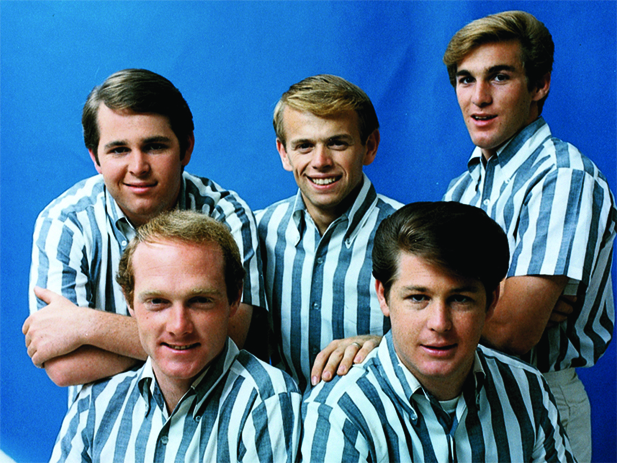
The Beach Boys early in their career. Photo: Capitol Records Photo Archives
The Beach Boys early in their career.
Photo: Capitol Records Photo Archives

Since The Beach Boys broke big on the charts in late 1962, media coverage devoted to them, collectively and individually, has been enormous. And now with the theatrical release of Love And Mercy, a biopic not so much about The Beach Boys as about their once-brightest star, Brian Wilson, the attention has been renewed. At first I was reluctant to add my puny thoughts to all these decades’ worth of Beach Boys coverage. But I’ve maintained a very warm place in my heart for the Boys, and viewing Love And Mercy has inspired me to set my fingers on a keyboard.

The Beach Boys’ history is immensely complicated and convoluted. I’ll summarize what I know fairly briefly: Three of the five original Beach Boys were siblings. From oldest to youngest they were Brian, Carl and Dennis Wilson. Add one cousin, Mike Love, and one pal, Al Jardine, and the recipe is complete. Brian, the band’s leader and creative pulse, was a gifted composer and orchestrator whose talents burgeoned, though for only a few years, as the 1960s progressed.

Teen and twenty-something idols, the Boys knocked out hit after hit right from the start (Surfin’ Safari, Surfin’ USA) through 1966 (Wouldn’t It Be Nice, Good Vibrations). But Brian was a victim of mental and emotional demons that caused him to begin losing his grip in 1967 during sessions for the high concept album Smile. Brian guided the band, and many studio musicians, part of the way through Smile, which was meant to be a celebration of earthly and universal creation. But his troubles brought the work to a sputtering end. Unfinished, the album was shelved. At that point, age 24, Brian’s best musical days were behind him. Though he remained a Beach Boy, his songwriting and studio session contributions to the band soon grew fewer, and his appearances with them on stage over the next several decades were sporadic. The Beach Boys soldiered on nonetheless, churning out many albums and nabbing a few more hit singles. And they toured the world (usually sans Brian) over and over.

As started to become public knowledge in the mid 1960s, Brian’s problems hardly were the only painful situations within The Beach Boys. Their story, beyond the music, is a messy one of endless internal conflicts and legal disputes, drug abuse and, ultimately, death. Very sadly, two Beach Boys passed at youngish ages. Dennis Wilson drowned in 1983 soon after his 39th birthday.  Carl was taken by lung cancer in 1998 when he was 51. Carl many years before had become the band’s chief, taking over from the no-longer-able-to-lead Brian. The band fell apart after Carl’s death.

Hey wait, you say, The Beach Boys are on the road every year, just as always. Well, Mike Love and Bruce Johnston (who had joined the group in 1965) have continued to tour as The Beach Boys. But without any of the Wilson brothers the Love-Johnston unit is hardly the real thing. In 2012, though, Brian (and Al) joined Mike and Bruce for a 50th year reunion tour that went well, only to conclude on a sour note.  Love refused to add additional concerts beyond the tail end of the original schedule and in effect booted out Wilson and Jardine. As usual, fun fun fun might have been the image The Beach Boys wished to project, but reality was a whole different ballgame.

Love And Mercy, playing at the Ambler Theater.

Who, then, in 2015 would have expected the release of Love And Mercy? Not me. At first I didn’t want to see the movie. I’ve read more than enough about The Beach Boys over the years, spent many hundreds of hours listening to their music. No offense to the Boys or their legacy, but my limit, or so I thought, had been reached. Until a friend told me that the movie is really really good. And thus my wife Sandy and I found ourselves on a recent Saturday at our favorite suburban art house, the Ambler Theater. There I learned that my friend was correct. Love And Mercy is really really good. Three and a half out of four stars.

Love And Mercy has the feel of truth. And from what I’ve read, its portrayal of events actually is quite true. The acting by the leads is nuanced and impressive. The script is tight, the direction too. There are a few cardboardy plot and dialog lines here and there. The rest, however, is gold. One need not be a Beach Boys freak to enjoy this movie. Sandy isn’t. She doesn’t know much about their musical history or their problems. She found the movie to be what in fact it is, a powerful drama. She agrees with my rating.

As I’ve mentioned, the movie is only partly a full examination of the Beach Boys. Dennis, Carl and Mike are portrayed a good bit, but they aren’t central to the story, and the actor playing Al Jardine is barely on camera. Love And Mercy largely is the tale of Brian Wilson and Melinda Ledbetter, the lady who loved Brian and brought him back from agony’s door and the clutches of manic psychotherapist Eugene Landy (potently depicted by Paul Giamatti) in the 1980s. The main action takes place in two time periods, 1965 through 1967, and 1985 through 1989 or so. The movie jumps back and forth between those eras. Paul Dano portrays the younger Wilson, John Cusack the older. Both are wonderful, as is Elizabeth Banks as Melinda.

A good number of the movie’s sequences with Dano realistically and clearly show Brian’s studio wizardry. The Cusack sections often touchingly shine a light on the developing romance between Wilson and Melinda, whom Brian met in 1985. I think that to tell any more about Love And Mercy wouldn’t be fair. Putting the movie aside, what to me is quite astonishing is that Brian Wilson is above ground and going strong. He has dealt with abusive forces that no decent person deserves to encounter, and has rebounded from low-as-you-can-go points to a most active musical career. He’s on tour right now. With a lot of courage and strength, and with a lot of help, he has survived.

Two Movies Talkin’ About Freedom

This year started a bit sluggishly for me moviewise, but I’ve been picking up the pace. The final weekend in May was a busy one. Two movies in two states. The movies couldn’t have been more different, one a somber sci-fi thriller, the other an anarchistic romp. But at their cores was a common theme that has been part of the human experience for millennia. The Rascals summed it up very nicely oh so many years ago when they sang, “All the world over, so easy to see/People everywhere just wanna be free.”

Ex Machina, one of five movies listed on the Ambler Theater's marquee.
Ex Machina, one of five movies listed on the Ambler Theater’s marquee.

That Saturday evening in Ambler, Pennsylvania, my wife and I caught the very well-wrought sci-fier, Ex Machina, at the Ambler Theater, an art house cinema. This movie has broken into the multiplexes a bit, and I think it might grow there yet. Its edginess, as I see it, makes it a match for adults young to old. For now, though, it mostly is confined to theaters like the Ambler, where the under 30 crowd doesn’t tend to congregate. We grabbed two seats in the first row, no better seats available. For the next two hours, our heads craned back, we risked developing stiff necks. Our necks survived just fine. The movie too was fine. It’s an unsettling creation.

Ex Machina’s Nathan Bateman (played by Oscar Isaac) is a techno genius who has made billions from the world’s most popular Web search engine, Bluebook. Nathan is pretty much a recluse, hidden away in an almost inaccessible mountain retreat which serves as his ultramodern home-cum-laboratory. For years there, Nathan has devoted himself to developing the perfect Artificial Intelligence robot, one so humanlike that, well, it would pass for human. And possibly surpass the average Joe or Jane. He has dubbed his newest robotic pride and joy Ava (Alicia Vikander). Ava’s mental abilities are exemplary, her personality coy and inquisitive. Brilliant as he is, though, Nathan wants confirmation of Ava’s wondrousness. Ergo, he flies in one of his Bluebook employees, Caleb Smith (Domhnall Gleeson), to vet the robot’s capacities. Nathan, Caleb and Ava, for the next week, engage one another in mind games and seductions. Honesty sometimes comes to the fore. More often, deceptions dominate.

The three leads couldn’t be better. Isaac’s Nathan is a most unlikeable fellow, his nasty and vain streaks miles wide. Nathan doesn’t get along well with fellow humans. Or robots. Odd then that his life’s passion is to build human replicas? I think that the challenge is too much for him to resist. Baby-faced Gleeson finds the right balance for Caleb’s young guy innocence and bright guy brains. And Vikander is a stunner. Her Ava is dewy eyed and flirtatious and, as noted, smart as a whip. She knows that there’s a big world out there beyond Nathan’s claustrophobic digs, a world she has never seen. For Ava, a high IQ laboratory rat, freedom chez Nathan is not much more than a concept. But it is also a goal, though its attainment might be nothing more than a pipe dream.

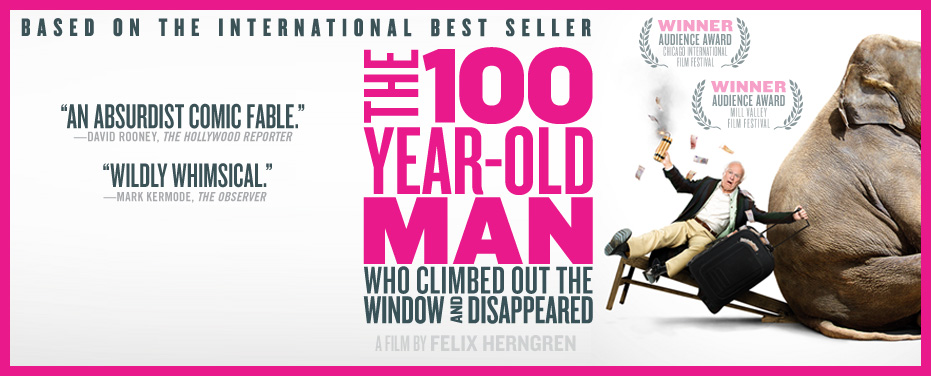
The 100 Year Old Man's official poster.
The 100 Year Old Man’s official poster.

Freedom, something easy to take for granted. And something I should ponder more frequently. One day after seeing Ex Machina I drove to New Jersey, near Princeton, and met up with a long-time friend. We went to Montgomery Cinemas to watch a movie with one of the longest titles of all time. Namely, The 100-Year-Old Man Who Climbed Out The Window And Disappeared, an absurdist black comedy that treats both life and death with a bouncy attitude. I thought it was a hoot, and looking hard for meaning in its looniness I realized that, as with Ex Machina, the quest for freedom is part of its inner workings.

A globetrotting and subtitled film embracing numerous languages, including English, The 100 Year Old Man follows Allan Karlsson (the excellent Robert Gustafsson) from birth to his 100th year. Born in Sweden, Allan at film’s end is still going strong, contentedly savoring life with a gang of recently-made Swedish pals, and an elephant to boot, on a beach in Bali. How did he get there? Let’s just say that Allan is one of the blessed beings. Serendipity has smiled upon him at most junctures of his life.

An explosives enthusiast since early childhood, at age 99 Allan lives alone in the Swedish countryside with his best friend, a cat. One day a fox kills the feline, so outraging Allan that he lures the killer to a lunch of dynamite-encased food treats. The ensuing boom boom boom that promptly dispatches the fox doesn’t go over well with Swedish authorities, who relocate Allan to a heavily supervised retirement home. A life of incredible adventures behind him, Allan follows his gut instincts on the afternoon of his 100th birthday. Out the window of his retirement home bedroom he goes, and fairly nimbly too. Wild and crazy events ensue, quickly multiplying in consequences. Unfazed through it all, Allan more than survives. He goes for the gusto like few centenarians are able. He loves the freedom that allows him to motor on.

Freedom can be stifled, people can be subjugated. But the desire and need for freedom are built into mankind’s genetic code. For many of us in the world, fortunately, freedom allows life to blossom. Allan Karlsson, on the road and at the beach at age 100, seems almost to skip through his days with joy. Ex Machina’s Ava isn’t remotely in Allan’s circumstances. She is a freedom neophyte. But Nathan Bateman has programmed her in a fully human way. Ava feels freedom’s call. Watch out.