The Sweet Spot (Musically Speaking)

It was a typical Sunday evening in the Scheinin home. There we were, my wife Sandy and I, sitting on the living room couch, twiddling our thumbs in unison and waiting for the tea kettle to come to a boil. I know that this picture sounds bland, but you’d be surprised how strongly it, and many similar moments in my life and Sandy’s life, resonate with a group of media honchos who for now will go unnamed. Let me just say that Sandy and I have been tabbed to star in a reality TV series projected to air beginning in early 2017. It’s tentative title is Action Is Overrated: Flying Low With The Scheinins. Stay tuned to this website for updates.

Earlier in the day, though, I had gone against grain and been an energetic person. In the aftermath of January’s Blizzard Jonas, which had dumped two feet of snow in my suburban Philadelphia region the previous day, I had spent three hours shoveling. Incredibly, my back hadn’t stiffened like a log. In fact it felt pretty good as, the kettle finally having tooted,  Sandy and I settled back with our cuppas and I started paying attention to the tunes emanating from the radio. On most Sunday nights we flip between three stations which, at those hours, keep things on the non-bombastic side. We didn’t feel the need to scramble our brains with punk rock or heavy funk or avant garde jazz. Not that I would have minded, to tell you the truth, but I wasn’t in the mood to provoke divorce proceedings.
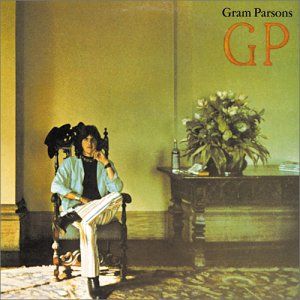
Gram Parsons
Gram Parsons

And at around 8 PM something wonderful happened. WPRB, Princeton University’s eclectic-minded station, played a song that changed my tunings. The song not only caught my attention, it caused me to melt and then to float. I liked that. “Oh wow,” I said to myself. “I wouldn’t mind a joint right now.” But those really high days are so far behind me I’d need Daniel Boone to help me find the trail leading back to them. Instead, I settled for present-day reality. Closing my eyes I began to vibrate in a most splendid way. I followed the music as it traveled, gently swirling in and around the sounds. Gram Parsons’ countrified version of The Streets Of Baltimore (click here to listen) had gone straight to my sweet spot.

Sweet spot? I’m definitely at a loss to say exactly what this is. In nearly 60 years as a music imbiber I hadn’t given it much thought till Gram came on the radio the other night, although I’d been its beneficiary thousands of times before. I suppose that my sweet spot is a magical kind of place whose gatekeepers, when awakened by just-right combinations of tones and rhythms, send me on a calm yet mysteriously exciting journey. It’s all very cool.

But you know, music can bypass my sweet spot and still make me feel great. For instance, there’s nothing better than straight-ahead Stonesy rock when pumping up my internal volume is a priority. And Sinatra singing I’m A Fool To Want You or some other such brooding song is my ticket to a deep and contemplative experience. At times though, such as on the post-Jonas night, I realize that I want nothing more than allowing my sweet spot to be opened. Stringed instruments often, yet hardly always, hold the key.

The Waterboys
The Waterboys

Soon after WPRB’s disc jockey spun The Streets Of Baltimore he threw another transporter at me, and it got to me even more than the Parsons number. It was Fisherman’s Blues (click here to listen), a Celtic-rocker by The Waterboys. The Streets Of Baltimore’s gorgeous pedal steel guitar and fiddle lines, trancelike clip-clop beat and Gram’s quietly potent singing had sent me to the upper atmosphere. Fisherman’s mandolin and fiddle work took me even higher. Man, those two instruments intertwined like perfect friends, hard and steady drumming allowing them to soar. And Mike Scott’s gruff vocals and exuberant whoops?  Spine-tingling.
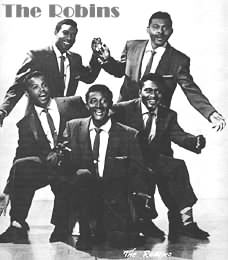
The Robins
The Robins

After Fisherman’s Blues ended I wanted another sweet ride. Turning thumbs-down on the next few songs that WPRB aired, I flipped over to University of Pennsylvania’s WXPN, but came up empty there too. Another channel switch brought me to the low wattage operation based a few miles from where I live, the all-volunteer WRDV. I’m crazy about this station. Five or so years ago it reignited my love for R&B, soul and doo wop. And minutes after I tuned in on that recent Sunday night they played a song that took me away: My Heart’s The Biggest Fool, recorded and released in early 1953 by The Robins, a pretty popular R&B vocal group during that era. I tip my hat to WRDV for knowing about this obscurity. I’d never heard of the song before (click here to listen). As it played I went with the flow and swam for the third time that evening through the ethers. Simple instrumentation, vocals that swell and bubble majestically, understated electric guitar work that subtly pushes things along. Magnificent.

Sweet spots. We’re lucky we have ’em.

(If you enjoyed this article, don’t be shy about sharing it. Sharing buttons are below)
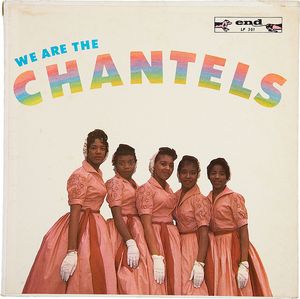
Maybe

The other day on the car radio I heard an oldie, from 1957, that I’ve always loved: Maybe, by The Chantels. I hadn’t heard it in so long, though, that I’d almost forgotten about it. Despite all of that elapsed time I immediately was hooked and cooked when Arlene Smith, the group’s lead singer, belted out the three descending notes that frame the song’s first word. “May-ay-be,” she cried.

Chantels R-2663898-1328955247_jpeg
Maybe is a direct and uncomplicated affair, driven by Smith’s heaven-and-earth-moving singing and by soulful piano chords. And its lyrics tell its tale very well, a tale that is fully revealed when, as you are meant to, you read between the lines. A girl knows that she and her boyfriend have reached the end. That there isn’t a whisker of a chance that they’ll get back together. That the day will come when she accepts her fate and moves on. But till then, to ease the pain, wishing and hoping can’t hurt.

Maybe if I pray every night/You’ll come back to me/And maybe if I cry every day/You’ll come back to stay/Oh maybe

Man, what a song. Sing it, Arlene, sing it.

The Chantels’ greatest hit stayed in my head for awhile, triggering a handful of brain cells to fire in a meandering pattern. And consequently I began thinking about how I might turn Maybe into an article for my blog. I mean, there have been worse ideas, haven’t there? And I’m always kind of desperate for subject matter, aren’t I? Well, maybe desperate is too strong a term. On the other hand, maybe it isn’t. Oh wow, there’s that word again. Twice.

Onward I marched to Google, where I poked around to see if there were other songs titled Maybe. Expecting none, I came across 23, and undoubtedly there are any number that I didn’t discover. Kelly Clarkson, K D Lang, Ingrid Michaelson and Split Enz, for instance, each recorded a Maybe that, like The Chantels’ Maybe, is about affairs of the heart. Deciding to pursue that avenue I examined the lyrics of those tunes and shrugged. They were OK but lacked the elemental power of the words to the Maybe that I know and adore. The Chantels’ Maybe, by the way, has a seemingly impossible-to-discover authorship. It is credited to the late Richard Barrett, a musician and music producer who helped The Chantels land a recording contract, but some scribes in cyberland claim it fully or at least partly was penned by Arlene Smith.

The march continued. Surely there was at least one more relationship-oriented Maybe of grand worth. Hey, how about the Maybe from 1926 by composer George Gershwin and his lyricist brother Ira? Those guys are in just about everyone’s pantheon. I began reading Ira’s lyrics to the song and halfway down came upon this couplet:

You will hear — “You hoo”/You’ll be near — “you hoo” . . .

Wait! Stop the lyrics! “You hoo”? Are you kidding me? Tyga, a rapper supreme, could do better, I figured. He too wrote a Maybe. Dig the first four lines:

B – – ch, I’m the sh – t/ B – – ch, I’m the sh – t/Repeat it to yo b – – ch/Tell yo b – – ch I’m the sh – t

Wow, Tyga’s the next Shakespeare, don’t you think? But I’d never be able to untangle Tyga’s complex treatment of male-female dynamics. And so I’d have thrown up my hands in frustration and ended this article right here were it not for the efforts of Allan Flynn and Frank Madden. They wrote a Maybe in 1935, and five years later it was recorded by various talents, most famously by The Ink Spots, who had a big hit with their kinda eerie spin on the tune. I let out a hurrah when I read the lyrics to the Flynn/Madden Maybe. They are good. The story, checking between the lines, shows a heartbroken soul who realizes that his/her relationship with a once-significant other has gone forever kaput. But, as with my favorite Maybe, wishing and hoping can’t hurt.

Maybe you’ll think of me when you are all alone/Maybe the one who is waiting for you will prove untrue/Then what will you do?

Here, then, are YouTube videos of The Chantels’ and The Ink Spots’ recordings of, respectively, Maybe and Maybe. But one final note: Perhaps you’ve enjoyed this article. And if so, possibly you’ll decide to share it (sharing buttons are below the videos).

Missing David Bowie

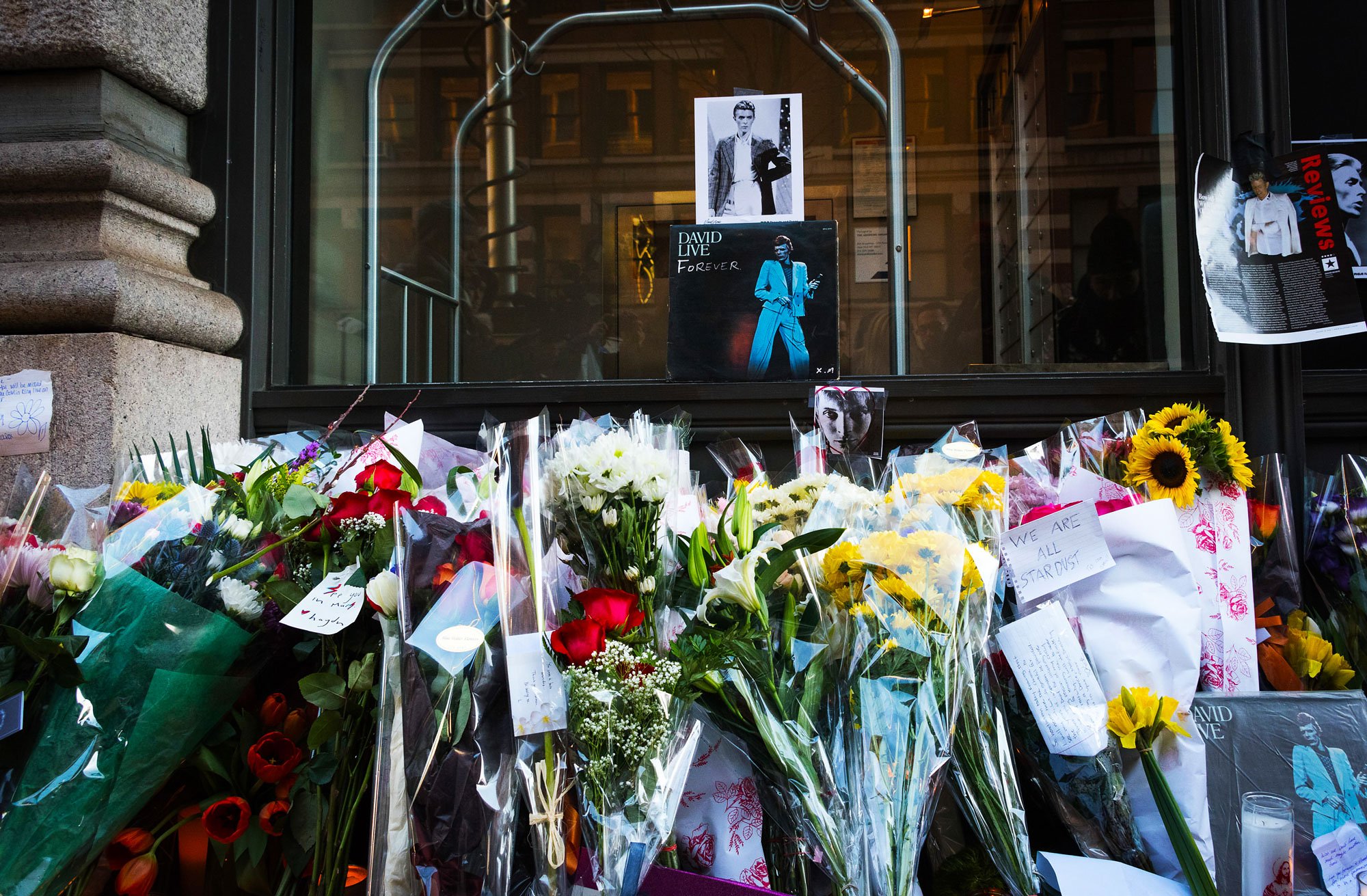
On January 11, a Monday, I heard about David Bowie’s passing. He had shuffled off this mortal coil the prior day. I was shocked by the news, though I’d hardly have described myself as a devout Bowie fan. As that Monday morning segued into afternoon, I couldn’t get Bowie out of my mind. Neither could my wife Sandy, who is far less of a Bowie devotee than I am. We were drawn, as if by an invisible force, to WXPN, the Philadelphia area’s most astute music radio station. In tribute to the great man they were playing Bowie music exclusively for much of the day. We listened for two or three hours, and when XPN turned to other programming at 7 PM Sandy and I put on WPRB, the Princeton University station, to see if Bowie reigned there. He did, and we listened to his songs for several hours more. I can’t think of many artists who, following their deaths, would receive radio homages of this sort. And of course the Bowie outpourings weren’t limited to radio. Media coverage of his life and death has been enormous and heartfelt worldwide.

David Bowie fans left tributes to him outside his New York City apartment building. (Photo: Getty Images)

Naively I suppose, I’ve been amazed by the degree of attention that Bowie, in death, has attracted. I’ve been very glad to learn that countless journalists and media commentators held him in really high esteem, not to mention legions of fans. On January 11 Bowie was a top global story, probably the top story, in newspapers, on television and throughout cyberspace.

And I’m struck by the extent that Bowie’s death has touched me. My reaction took me by surprise, wasn’t something I’d have predicted. I don’t know the last time a celebrity’s demise hit me so strongly. Maybe it was in 1980, when John Lennon left us. Lennon was one of my heroes. Though Bowie wasn’t, I admired the heck out of him during a swath of the 1970s and always have considered him to be a cultural giant. That accounts for part of my sadness, but not for all. So, what else was it about Bowie’s death that got to me? I’ve thought about this for awhile and have come up with two main reasons.

David Bowie recorded 26 studio albums. His final work, Blackstar, entered the marketplace on his 69th birthday, two days before he died. I own six of his albums. All of them are from the 1970s except for 2002’s Heathen. I love my six from the 70s. Each I believe is great, and the greatest to me is 1976’s head-spinning and majestic Station To Station. I don’t know why I stopped buying Bowie’s releases after Station To Station. I read about them, heard some tunes on the radio, but didn’t lay down any dollars again till 26 years later. Nothing new, I was just plain stupid. Here was a guy with a brilliant track record, whose albums I once had spun over and over, and nonchalantly I had abandoned his singular musical journey. It wasn’t till a few nights ago that I realized what I had missed. WXPN and WPRB played tracks from Low, Lodger, The Next Day and other albums I barely, if at all, was familiar with. The music, as I might have guessed, was fantastic. And I played Heathen on my CD player. I hadn’t listened to it in so long I didn’t recall a single number. David, I only partly knew ya’. I should have kept up. Mea culpa.

Still, missing out on a lot of David Bowie’s music isn’t the end of the world. But it’s an example of not paying attention to life, of letting life pass on by without proper appreciation. And that’s a big deal. I try fairly hard to savor the moment and to do the right thing, but there’s mucho room for improvement. Bowie’s death somehow made me look at myself and my underachieving approach. Ouch. Ouch. Ouch.

And Bowie’s passing did more than that. In the recesses of my mind I discovered some connective tissues that bonded me with him. You see, David Bowie was only a smattering of months older than I, and because of that I subconsciously had felt a kinship with him. And so when he died an internal link to my younger self broke and I started to contemplate the big picture even more deeply. I mulled over the kinds of thoughts that aren’t reassuring. Such as: Even if I make it for another 25 years I’m a whole lot closer to the end than to the beginning. Man, that’s a bummer. My excellent friend Jeff recently asked me if I believe that human life goes on in a spirit mode after the flesh fails. He’s a believer. I’m not. My take is that each person’s trip is confined to Planet Earth and that the trip is one-and-done.

That said, on with the party. I plan to buy a bunch of David Bowie albums soon, to catch up with someone, now-departed, whom I miss.

(If you enjoyed this article, don’t be shy about sharing it. Sharing buttons are below)
The First Time I Saw Springsteen

Before today I hadn’t mentioned the words Bruce or Springsteen anywhere on this blog. But you know, this article about The Boss probably won’t be my last. That’s because I’m a big fan of Bruce’s. I’m not one of his fanatical followers, not one of the myriad folks who own every recording he has ever issued and have attended Springsteen concerts in the dozens and above. But big enough. I consider Springsteen to be a huge talent. For decades he has been a superb singer, songwriter and guitarist, and an in-concert performer blessed with off-the-charts charisma and energy. On January 16, he and The E Street Band will be hitting the road for the umpteenth time. When I read recently about their upcoming tour, my mind wandered back to the first time I saw Bruce on stage.

Springsteen got his start in the late 1960s. By 1973 he had developed a fairly big fan base in a few locales, such as the New Jersey Shore communities and the greater Philadelphia area. Part of this was due to his relentless gigging around the USA. Back then if you toured enough you were bound to catch on somewhere, especially if some radio stations played your tunes. But overall he and his E Street Band still were little known. For the most part he played in small venues until finally breaking through nationally in 1975. Global superstardom would follow some years later.

I moved to Philadelphia in February 1974 and soon started hearing Bruce on WMMR, the city’s premier rock station at that time. They played tracks from his first two albums, both of which came out in 1973: Greetings From Asbury Park followed by The Wild, The Innocent & The E Street Shuffle. It didn’t take me long to become a Bruce devotee. I bought both albums and especially liked what was on The Wild. Who wouldn’t have? The songs, every one Bruce-penned, are fabulous. They are literate and intriguing stories put to wonderful melodies. Rosalita (Come Out Tonight), Incident On 57th Street, Kittie’s Back . . . man, the seven songs on the record sound as good today as they did all those years ago. There was no question in my mind that Springsteen carried the goods. I wanted to see him in person.

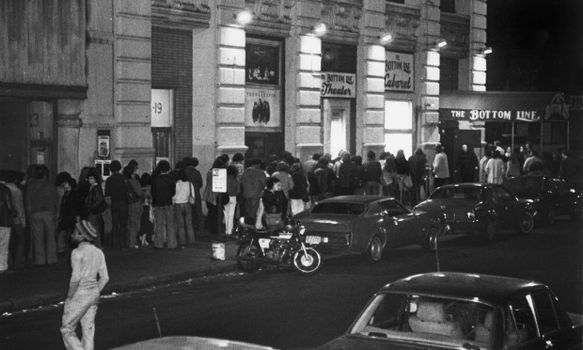
The Bottom Line (photo by Peter Cunningham)
The Bottom Line (Photo by Peter Cunningham)

In July 1974, Bruce and The E Street Band played six shows in Manhattan at The Bottom Line. Three nights of music, two shows per night. Long gone, The Bottom Line was a magnificent small club in Greenwich Village, magnificent not because of its décor but because of its wide-ranging musical menu. I was there with my brother Richard at one of the early shows. Richie wasn’t as ardent a rock lover as I was, but somehow I had convinced him to come along. I suppose I’d known about Bruce’s Bottom Line gigs via announcements on WMMR. I can’t imagine how else I’d have heard.

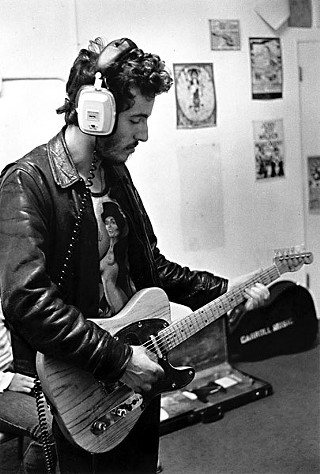
Springsteen a few months before I saw him (Photo by Burton Wilson)

How much of the show do I remember? Well, to put things in perspective, I’m probably exaggerating on the high side when I say that I recall about 0.0001% of my adult life. Pathetic and depressing, but true. And yet I  do have some memories of that summer evening nearly 42 years ago. I can picture Richie and me seated at a table. We were 20 or 30 feet from the stage. I remember the start of the show. The house and stage lights went dark, and then one spotlight illuminated a small section of stage. Springsteen stood in that focused light, a big floppy hat tilted on his head. And he began to sing Incident On 57th Street. Quietly.

Spanish Johnny drove in from the underworld last night/With bruised arms and broken rhythm and a beat up old Buick, but dressed just like dynamite/He tried sellin’ his heart to the hard girls over on Easy Street/But they said “Johnny, it falls apart so easily, and you know hearts these days are cheap.”

The E Street Band whispered behind Bruce. And as the vocals gradually intensified, the band followed Bruce’s lead nimbly and powerfully. For this song, The Bottom Line, just like that, was transformed into a tough part of town where sorrow and longing prevailed. The reports that I’d heard in Philadelphia were true — that Springsteen, on stage, enveloped a song like few others, tapped into a cache of emotions that were invisible to most vocalists, and that The E Street Band was scarily good. I knew that I was at what would be the best concert I’d ever attended.

Bruce and the boys danced through maybe 10 or 11 more songs before leaving the stage, and they never let go of the audience’s gut. The concert was an exhilarating and spellbinding ride, a trip to rock and roll heaven. The only other tune that I specifically recall being played is Rosalita. It was rollicking and wild. Delirious. Amazing. There was nothing that Bruce, Clarence Clemons, David Sancious, Garry Tallent and the other E Streeters couldn’t do.

Richie was as stunned as I was. I don’t think he’d had any idea what the night held in store for him. To this day I rank Bruce and band at The Bottom Line as one of the ultimate shots of live music in my life. It gave me shivers. It made me shake my head in disbelief. It sent me out into the streets with a buzz that still echoes.

(If you enjoyed this article, then don’t be shy about sharing it. Sharing buttons are below)
The Night I Made A Cocktail Table Go “Boom”

You should count your lucky stars when you act like a nitwit and are forgiven for your sins. That is what happened to me about ten years ago at a jazz concert. It was the night when talentless me accidentally became part of the show.

I hadn’t thought about that infamous evening in a long time, but for some reason was reminded of it recently when my wife Sandy and I took in a Friday night concert at the Philadelphia Museum Of Art (PMA), which had been the scene of my crime. The museum calls its Friday night concert series Art After 5, and it’s a good one. Art After 5 began in 2001 with a jazz-only format, but has morphed over the years to include a wide range of genres. Sandy and I have been to a crazy number of music shows at PMA since we discovered the series in 2002.

Picture this: It is February 2006. Sandy and I are seated in the first of several rows of tables ringing the performance area in PMA’s Great Stair Hall. The hall is enormous, maybe 80 feet high, and is dominated by, yes, a great stairway that connects two levels of the museum. The Great Stair is 20 feet behind us and stares regally at the performance area. Many concertgoers are seated on its marble slabs . . . uncomfortably. Sandy and I prefer comfort. So we made it a point to arrive way before showtime in the hopes of nabbing one of the cocktail tables, which are squeezed together pretty closely. Compared to marble stairs, the chairs at the tables are a blessing for butts. At our table we don’t have much to do except twiddle our thumbs. We order soft drinks and sip at them. We are waiting for jazz vocalist Carmen Lundy and her band to start their show.

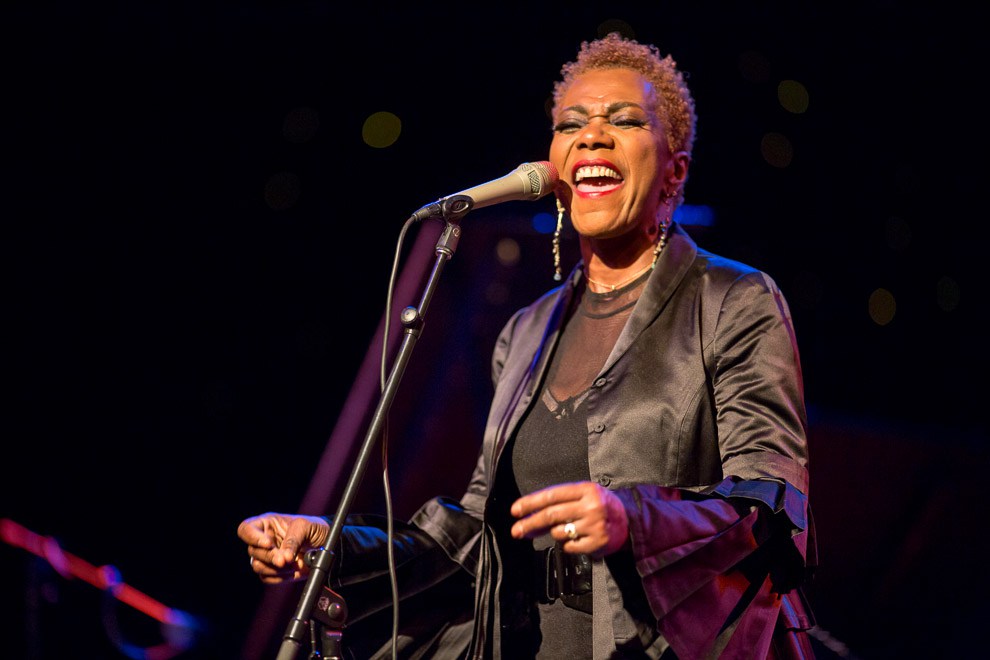
Carmen Lundy in performance six years after my cocktail table went "boom." (Photo by Daniel Sheehan)
Carmen Lundy in performance eight years after my cocktail table went “boom.” (Photo by Daniel Sheehan)

At 5:45 PM Carmen and the guys are introduced by Art After 5’s curator. Minutes later they begin to play. They are very fine, and only eight feet in front of our excellent seats. Carmen Lundy, a justly acclaimed performer, is singing with a lot of flair and swagger. Sandy and I are enjoying the show. But halfway through the set something begins to bother me. I feel as though my space is being impinged upon. Someone at a table behind me has inched up a tad too much and is putting pressure on the rear of my chair. I have the solution, of course. All I need to do is slide my cocktail table forward ever so little, after which I’ll be able to move my chair forward too. I push the table very very gently, maneuvering it carefully. But alas, this is a plan not destined to work out. The frigging table loses its balance and topples heavily, its edge creating an enormous sound when it smashes onto the floor. The noise echoes throughout the Great Stair Hall. And everything that was on the table flies off and finds a new home inches from the performers’ feet.

I felt like a schmuck. I was a schmuck. Oy vey, was there anywhere to hide? No way. All I could do was sit there as a couple of servers scampered over, set the table upright, and on their hands and knees quickly swept up ice cubes and pieces of broken glass. They mopped up the soft drink liquids from the floor and retrieved my eyeglasses, which once had been on the table but now were beneath the piano bench. Yet, all the while the band played on as if nothing had happened. Carmen Lundy continued to deliver her song with full emotion. Harold O’Neal’s fingers were flying on the keyboard. Jason Brown’s drums went rat-a-tat-tat and wham-bam-thank-you-ma’am, and Curtis Lundy, Carmen’s brother, plucked fervent notes on his upright bass.

The set finally ended. Was anyone in the audience staring at me? Probably. But I was too embarrassed to look around and find out. I knew one thing I had to do though. Apologize. Carmen Lundy was standing near the sound board, 20 feet to the right of the performance area. I stood up and made my way to her.

“Ms. Lundy,” I said. “I’m the idiot who knocked over the table. I’m very sorry. I feel like a fool.”

Carmen Lundy gave me a good hard look for a few moments and then did the darndest thing. She put a hand on one of my shoulders, looking me straight in the eyes, and said “Don’t worry about it, honey. It didn’t bother us. In fact it gave us energy to play even harder.”

Man, I didn’t know what to say in response to such a stellar attitude. I mumbled my thanks and probably a few other words and shuffled to my seat.

Looking back on all of this the other day I realized once again that I had been in the presence of classiness and graciousness. If our places had been reversed I doubt if dopey me would have been so wonderful. Carmen Lundy, in my book you’re very much okay.

(If you enjoyed this article, then don’t be shy about sharing it. Sharing buttons are below)
Q: How Cool Is The Philadelphia Museum Of Art? A: Very

The Philadelphia Museum Of Art, PMA to its friends, is one of our fair nation’s best museums. My wife Sandy and I visit pretty often. Its holdings are fantastic. What’s more, for years the museum has presented concerts on Friday nights, and we’ve been to a crazy number of them. During our Fridays at PMA we look at art for awhile and then hear music in the majestic Great Stair Hall. For artsy nerds like me, that’s usually a winning combination.

As we headed museumward on a recent Friday, we found ourselves in traffic hell. Our car windows were fogging up from steam coming out of our ears, but we wound up having a heck of a good time once we arrived. No pain, no gain, or something like that. Late-ish as it was though, we didn’t have barrels of time to check out art if we were to snare seats at a ringside cocktail table for the evening concert. Those seats ordinarily are claimed 45 minutes or more before concerts begin. When the preferred seating is taken, your option is to place your rear end upon the Great Stair Hall’s grand marble steps. And YOW, that’s a numbing backside experience.

And so we navigated to a modestly-sized and time-friendly exhibit, works by the not particularly well-known Dave Heath. To me and Sandy, he wasn’t even that, as we’d never heard of him. This show (it closes on February 21, 2016) is entitled Multitude, Solitude: The Photographs Of Dave Heath, and comprises numerous 35 mm photos, all in black and white, that Heath took from 1949 to 1969. Also on display is Heath’s multimedia slide show from 1969. This is the first major presentation of his early and midlife creations, and one of the few museum exhibitions that he ever has had. It was organized by The Nelson-Atkins Museum Of Art in Kansas City, Missouri, with plenty of PMA input.

Sandy and I had the same reaction after looking at Heath’s photos for the first few minutes: “This guy is great,” we agreed. And I’m convinced that he is, or in any case was in the 1950s and 60s. The photographs are very beautiful and very dark, shades of black heavily predominating over those of white. I’ve always felt that this approach allows photographs to breathe emotionally, gives them depth and resonance.

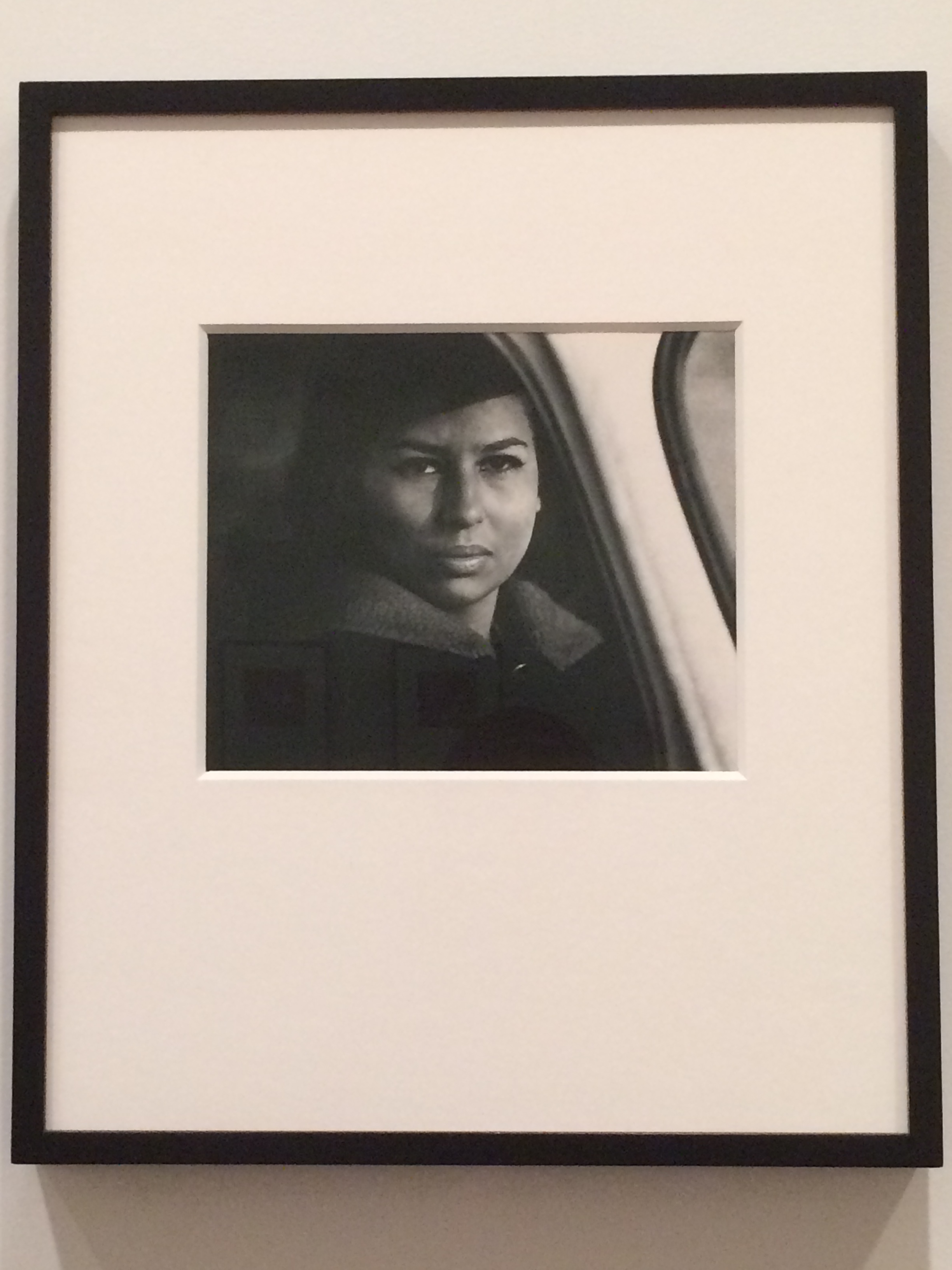
New York City (1964), by Dave Heath. Nelson-Atkins Museum Of Art, Kansas City, MO; Gift of Hall Family Foundation
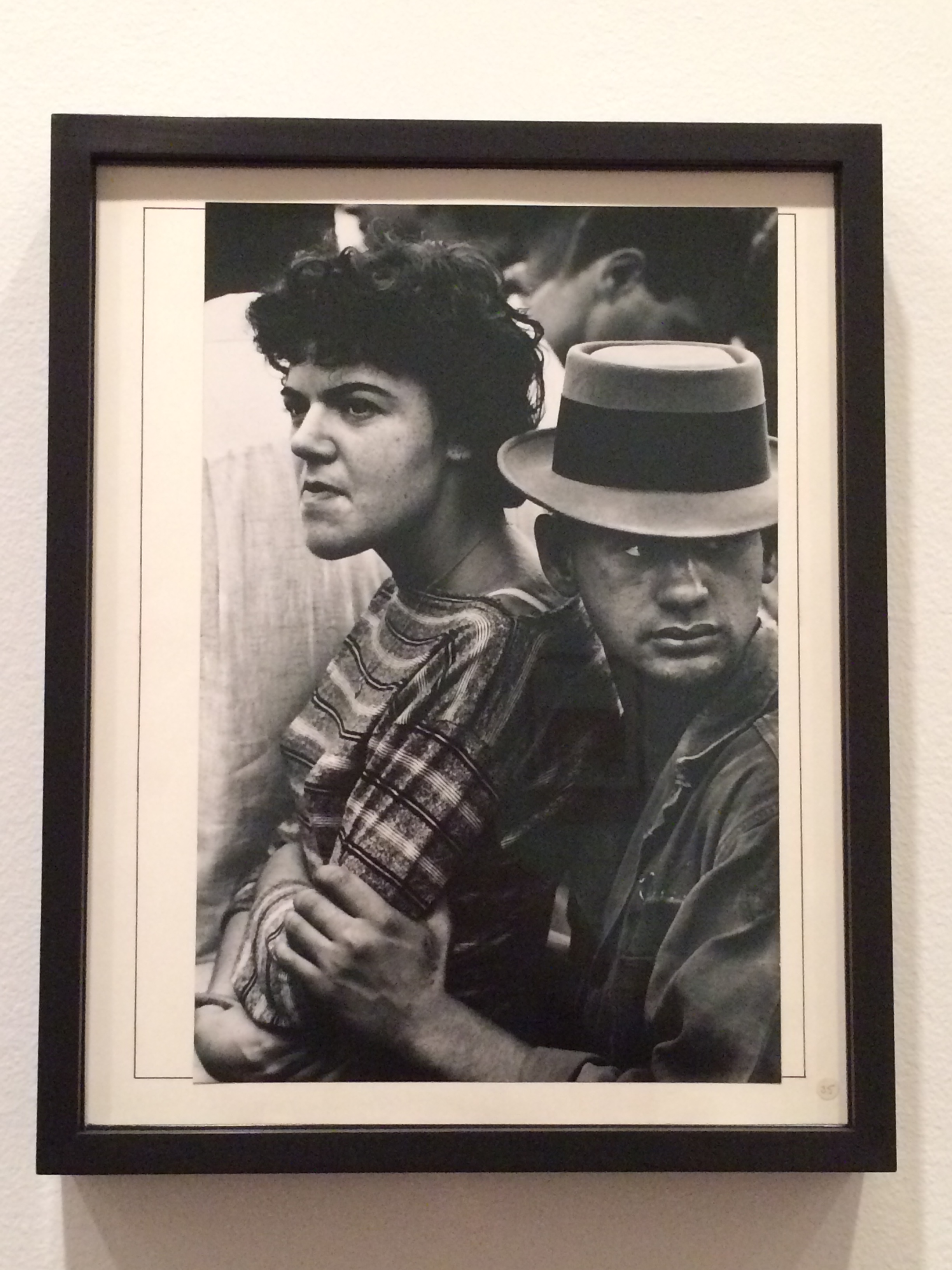
Washington Square, New York City (1960), by Dave Heath. Nelson-Atkins Museum Of Art, Kansas City, MO; Gift of Hall Family Foundation

Heath isn’t a chronicler of the natural world. He’s a people observer, usually in urban settings. And he is a lover of the close-up, often capturing folks deep in thought or in seeming isolation. His childhood was dreadful, and his work frequently reflects the hurt that probably never went away. But not all is aloneness or sadness in the Heathscape. Joyful images are here and there in the exhibit.

Dave Heath lives in Canada and is 84 years old. There’s not a lot of info about him in cyberspace. He was born in Philadelphia, grew up in foster homes and an orphanage, took up the camera in his late teens, and has had a full career as a photographer and photography teacher. His greatest fame and acclaim occurred in the 1960s, the decade in which he won two Guggenheim Fellowships and created the book for which he is best-known, A Dialogue With Solitude. The final pre-production copy of Dialogue is at PMA. Its 100 or so pages, mostly photographs, ring several gallery walls. Dialogue is divided into ten sections, among them Fate, Fragility And Diversity; Youth; Childhood; Ends And Beginnings. Dialogue is a deep photographic rumination on many aspects of the human plight.

Sandy and I ended up spending much more time with Heath’s images than we had anticipated. They are powerful. By the late 1960s though, Heath apparently felt that he had said all he could in black and white. He turned to color Polaroid picture-taking and later to digital photography. None of this is on PMA’s walls, and from what I gather isn’t well-known by the arts community. It’s a fine thing, though, that someone (the good folks at Nelson-Atkins and at PMA) has championed black and white Dave and decided to let the spotlight shine on him.

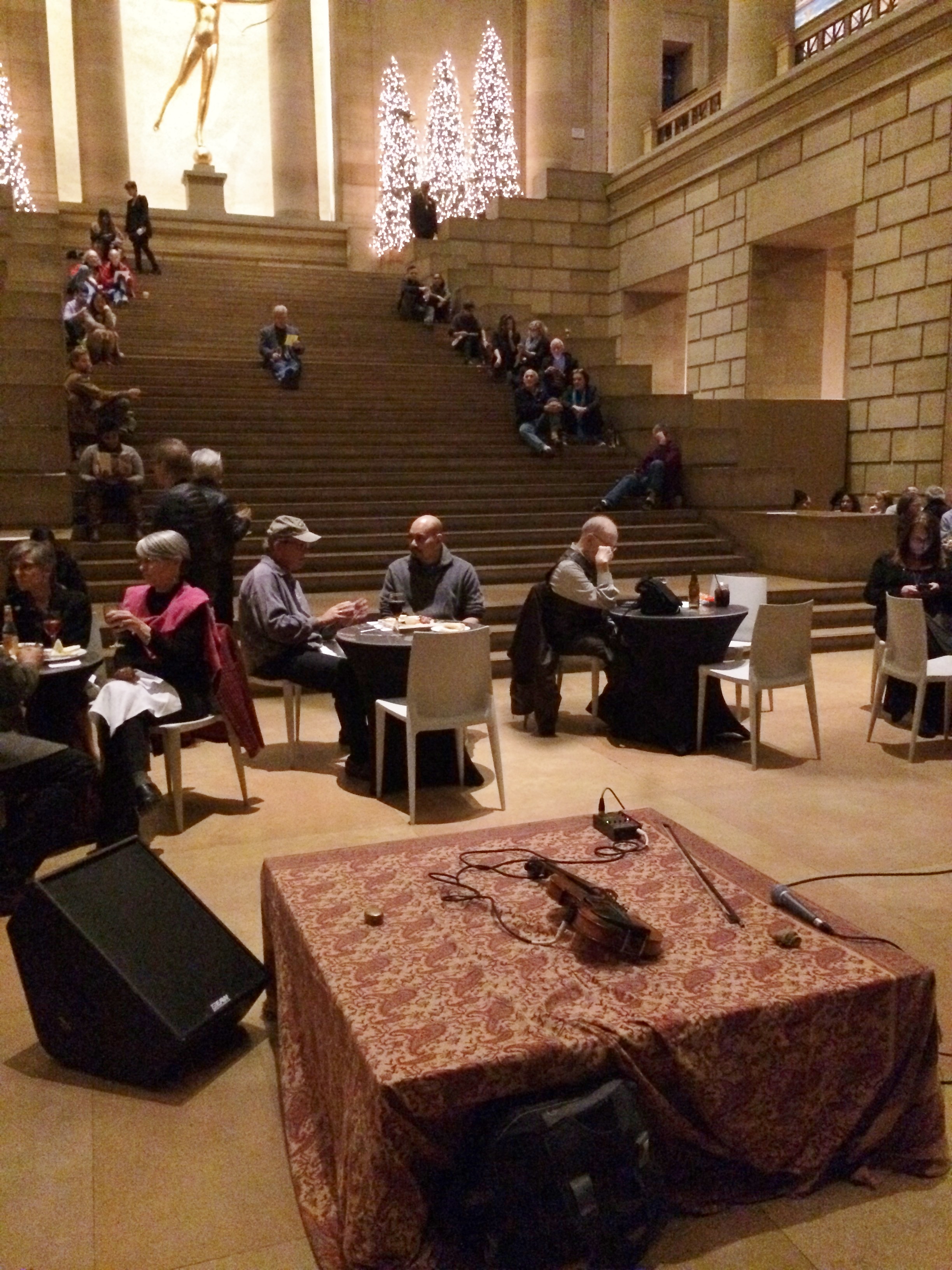
Before the concert in the Great Stair Hall. Photo by Sandra Cherrey Scheinin
Pre- concert in the Great Stair Hall. Photo by Sandra Cherrey Scheinin

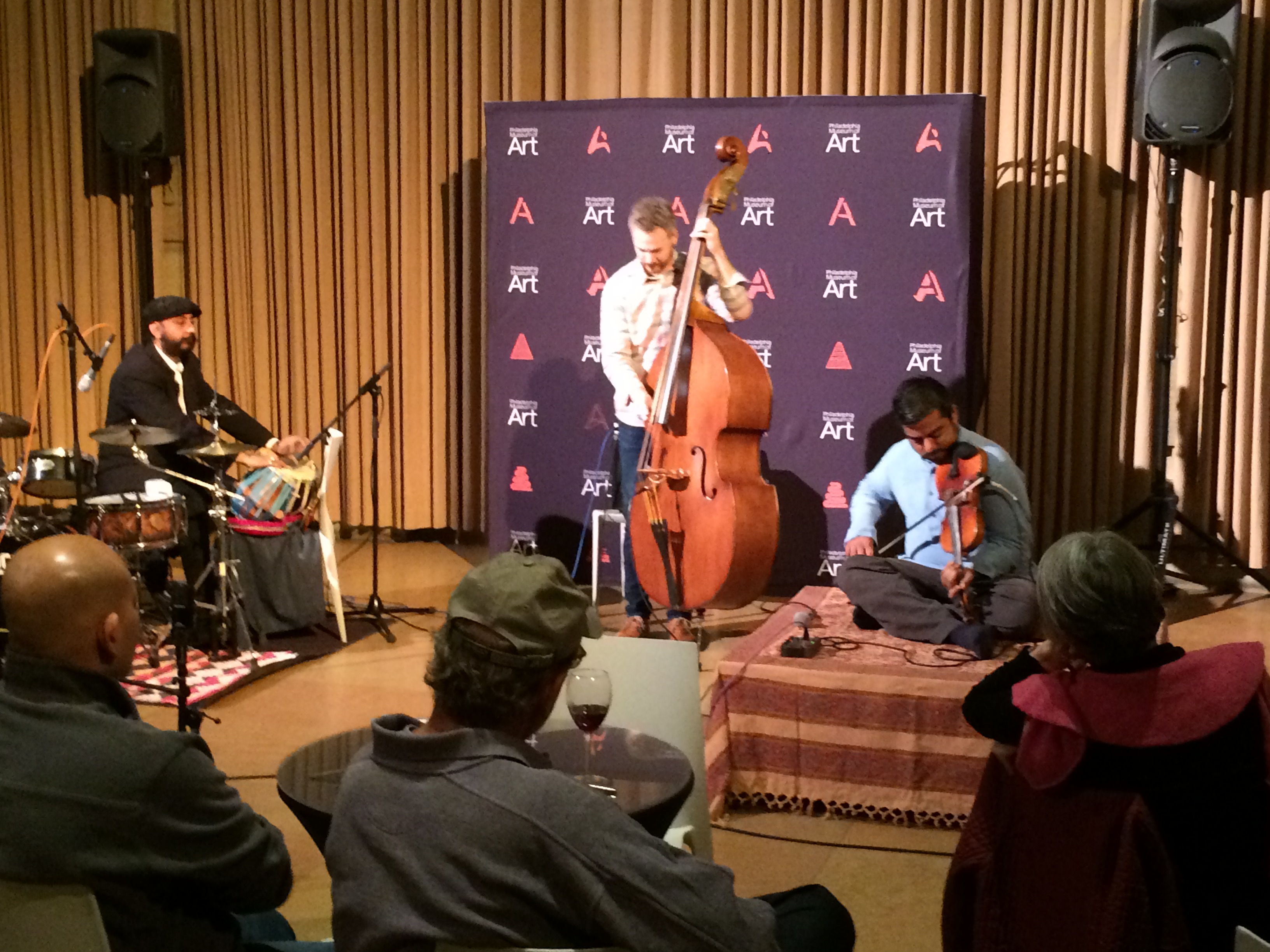
Show time was approaching. Sandy and I lucked out after Heath, grabbing two empty seats at a stage left cocktail table in the Great Stair Hall, a mere six feet from where Arun Ramamurthy soon would be bowing his violin. Arun Ramamurthy? Sandy and I knew as much about him as we had about Dave Heath an hour earlier. Brooklyn-based Ramamurthy, though, is a growing name to be reckoned with in classical Indian music and in musical cross-pollinations. At PMA he brought along Perry Wortman, on upright bass, and drummer/tabla player Deep Singh. The Arun Ramamurthy Trio began its first set at 5:45 PM.  They played a hybrid of South Indian classical music and jazz.

When it comes to music, I’m an appreciator, not a scientist. I understand little about any musical genre’s technical side. Scales, chords, the inter-relationships of notes and how they shape harmonies . . . forget it, I’m at sea. But the big picture I understand, as did the 200 others listening to the Ramamurthy group. We all clapped madly after each piece. Sure, Arun’s melodies and voicings on violin would be pretty unfamiliar to most American ears, but they were beautiful.

In the Great Stair Hall, Arun sat on a platform, chairless and shoeless. He held his violin vertically, bowing with his right hand, working the strings with the fingers of his left. The trio played five songs in the first set, three of them originals, all drawn from or reflecting traditional South Indian classical ragas, melodies and motifs. The music was elastic, minor-keyed and highly improvised, improvisation being a major component of both classical Indian music and jazz.

Arun began song number one unaccompanied, coaxing mournful sounds from his instrument for three minutes. Wortman’s bass then entered — low, gripping notes played slowly, repeatedly — and Singh’s drums too. Singh played carefully, tantalizingly, creating a steady and simmering beat. One drumstick tapped a drum’s rim. The high hat and cymbals shimmered just so. All the while Arun stroked melancholy lines. This was Ramamurthy’s original song, Conception. I was reminded of All Blues, and other numbers, from Miles Davis’ Kind Of Blue album.

The Arun Ramamurthy Trio. Photo by Sandra Cherrey Scheinin

The fifth song, an Arun original whose title I missed, found Deep Singh on tabla. The tune was energetic, Arun going pretty wild on violin, Wortman choosing notes eloquently and perceptively, as he did on each tune. Another thing I noticed was that Arun and Deep barely could keep their eyes off each other. They were in a strong musical relationship. And Singh’s fingers were absolutely flying, maybe wearing grooves in his tabla’s skins.

There was a sixth song, but it was not a full trio number. It was a classical raga played by two humans, Arun and tablaist Deep. They were joined not by Wortman but by a droning electronic accompaniment provided via an app on Arun’s smart phone. Amazing.

Dave Heath and The Arun Ramamurthy Trio. Another several hours well-spent at the Philadelphia Museum Of Art.

(If you enjoyed this article, then please don’t be shy about sharing it)

(If you click on any photo, a larger image will open)

Tony Bennett Is A Wonder

I’m not an expert on the subject. However, if someone asked me to name the 20th century’s best singers of the so-called Great American Songbook, I’d reel off names such as Frank Sinatra, Nat Cole, Ella Fitzgerald, Billie Holiday, Sarah Vaughan, Tony Bennett, Peggy Lee, Louis Armstrong and Fred Astaire. My list is hardly complete or definitive. But it contains excellent talent without a doubt.

All the entertainers on my list were contemporaries, their careers overlapping one another’s during various decades. A sad note is that only one member of the list is still with us, Tony Bennett, whose professional musical life took hold in 1949 (1949!). Sixty-six years later he continues to go strong. The man is 89 years old now and in good voice. He records regularly and likewise tours the world. He, to me, is a phenomenon. A wonder.

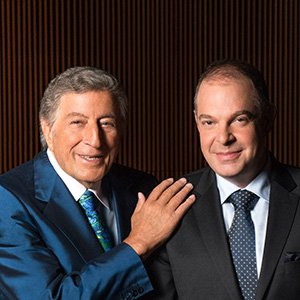
Tony Bennett (left) and Bill Charlap. (Photo by RPM/Columbia Records)

A few weeks ago I caught a track on the radio from one of his albums. It was a melancholy song, beautifully sung. His accompaniment was only one instrument, a piano. I thought that the selection probably came from The Tony Bennett/Bill Evans Album, a 1975 release pairing Bennett with the esteemed jazz pianist. That album has achieved iconic status over the years. But I was wrong. The song — and I can’t remember which one I heard — was a brand new recording from the lovely album by Tony Bennett and Bill Charlap titled The Silver Lining: The Songs Of Jerome Kern.

Recently I listened twice to The Silver Lining in its entirety. And I listened to a few cuts from the Bennett/Evans duet album too. These albums are separated by 40 years. And you know what? Tony’s voice is nearly as good now as it was then. It has lost a little power, strains a bit occasionally. But it remains quite great. I find this most incredible. Has there ever been another gifted vocalist whose pipes have held up so well in his or her very advanced years? I can’t think of anyone. Please let me know if you can.

Jerome Kern was a top composer during the first half of the 1900s. He wrote with a host of smart and classy lyricists, Oscar Hammerstein II, Dorothy Fields and Ira Gershwin among them. The Silver Lining presents some of Kern’s best-known, and best, compositions. For example, The Last Time I Saw Paris, All The Things You Are, I Won’t Dance.  There are 14 tracks on the record. Bennett sings on all of them. Bill Charlap, a refined and tasteful jazz piano player, is Tony’s sole partner on three. Charlap’s jazz pianist wife, Renee Rosnes, adds a second piano on four songs. On the remaining tracks, Charlap is joined by his longtime collaborators, Peter Washington on bass and Kenny Washington (no relation) on drums.

Overall I find this album to be sublime. The instrumentation is understated. Bennett’s vocalizing is poignant and incisive. He plumbs the depths of the tunes’ lyrics and adds some explosive high notes at the conclusions of a few songs to show that he still has it. If you’re a Tony fan, you should own The Silver Lining.

So, what’s the deal with Tony Bennett? How has he managed not only to survive, but to thrive? Well, genetics more than anything probably accounts for Tony’s long life. As for thriving, we all might learn from his outlook on and approach to life. Tony Bennett always has seemed to me to be a down-to-earth and nice guy, and also in possession of wisdom. There is a fine article about him in the December 2015 issue of DOWNBEAT magazine (the article is not online, so I can’t provide a link). Two quotes from the piece are very telling.  In one he says: “I can’t believe that I’m 89. I stay in shape. I take good care of myself. I got rid of all bad habits. When I was younger, I was pretty wild, doing a lot of foolish stuff. I stopped all of that and I got back to how to sing properly.” And in another he says: “I think life is a magnificent gift. We should all enjoy the fact that we’re living on an unbelievable planet that’s loaded with education and love and beauty.”

It’s not coincidental that the song Look For The Silver Lining concludes the Bennett/Charlap album. George “Buddy” DeSylva’s lyrics are fully in tune with Tony Bennett’s take on the human situation. Give a listen:

(If you enjoyed this article, then please don’t be shy about sharing it)

I Never Met Thelonious Monk, But . . .

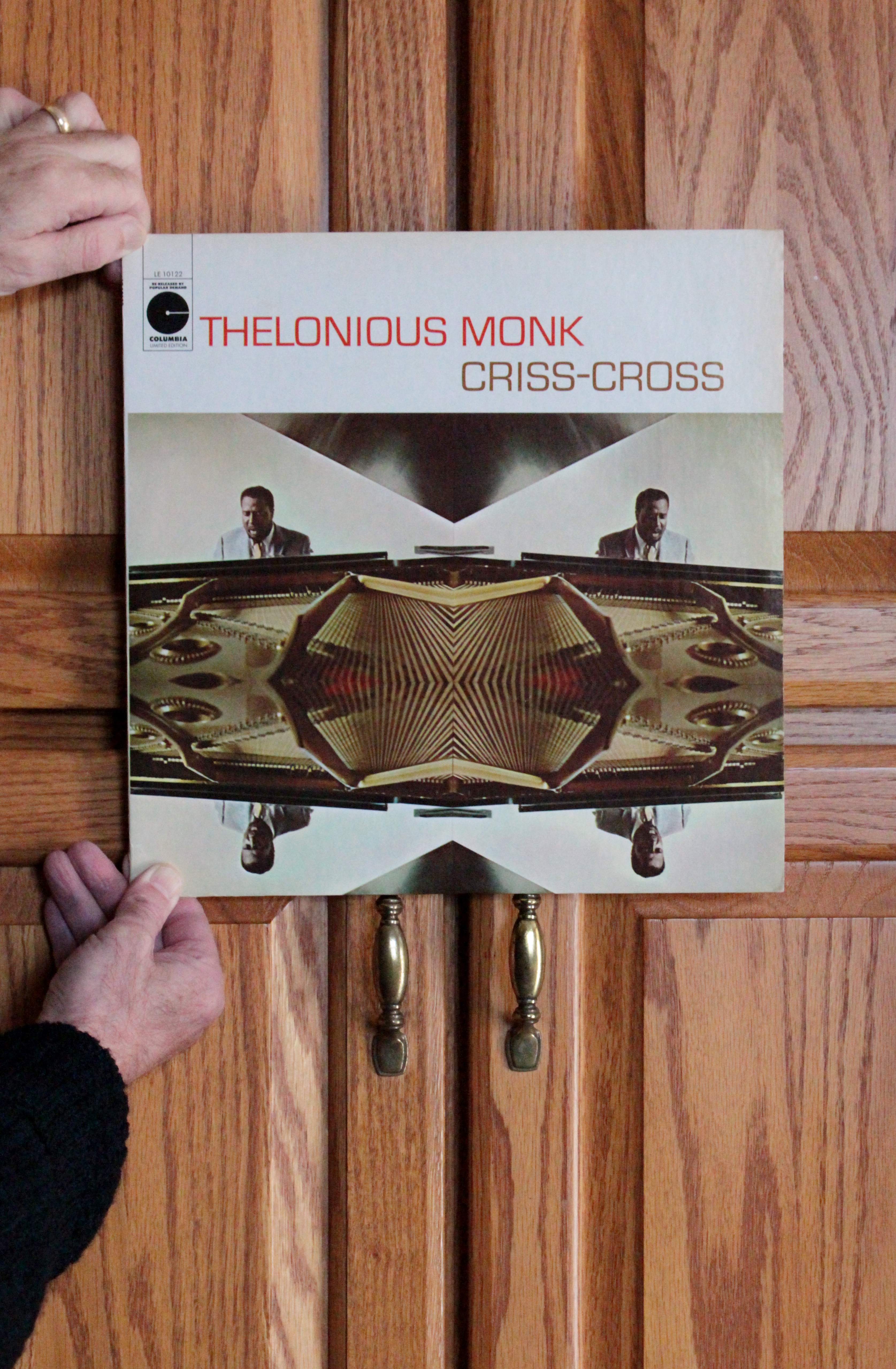
The front cover of the author's copy of Criss-Cross.
The front cover of the author’s copy of Criss-Cross.

I loved Thelonious Monk’s music from the first time I heard it, and I’m sure I’m not alone in that. The year was 1964, maybe ’65. I was a high school senior entranced by rock and roll, R & B, some folk music, and by standards singers such as Sinatra and Bennett. But not by jazz, which was foreign territory to me at that time. My high school buddy Dave had just obtained his New York State driver’s license and one day informed me that he was going to take a ride to a local Sam Goody’s, a popular record store chain that sadly is no longer with us. For whatever reason, I didn’t accompany him. Dave asked me if I wanted anything from Goody’s. I must have been feeling adventurous because I requested a jazz album. Any jazz album would do, since I didn’t know one from another. The record that Dave a day or two later placed in my hands was Criss-Cross, Monk’s 1963 release. I doubt if I had ever heard of Monk before, though he was one of the most famous jazz pianists in the world. And I doubt if Dave knew much about him either. How, then, had Dave come to select this album, which to this day I consider to be magnificent? I don’t know. Dave possessed powerful intuitive talents, still does, and it seems that choosing great music from out of the blue was one of them. On the other hand, maybe he just liked the album’s cover. It is très cool.

I listened to jazz in small amounts over the next few years and in 1969 began to become the jazzhead that I am when I started heavily to inhale the outpourings of Miles Davis, John Coltrane, Eric Dolphy, Ornette Coleman and an ocean of others. And Thelonious Monk too, of course. Monk is one of my all-time favorites.

There’s something peaceful about Monk’s playing, even on the upbeat numbers. Something mesmerizing. Something irresistible in the way he’d offer the unexpected note, the tantalizing trill. Monk had an instantly recognizable sound on the piano, an intriguingly off-center approach. He didn’t play overly fast, just fast enough, and he put his heart and soul on display. He didn’t compose a lot of tunes (73 is the official count), but the unadorned and undeniable beauty of many of his compositions have connected with millions of listeners and with his peers. During the 1980s and ’90s it seemed that every month brought forth a new Monk tribute album. Even now, many jazz albums include one or two Monk works. Great compositions such as ‘Round Midnight, In Walked Bud, Ruby My Dear, Hackensack. Monk died in 1982, and remains a giant.

Thelonious Monk was someone I wish I had met and talked to, though I gather he wasn’t a man of many words, at least at times. I suspect that his song titles indicate this. Fifty of the 73 are either one or two words in length. Still, how fine would it have been to ask Thelonious Monk some questions: Have your piano practice habits changed over the years? Which of your songs mean the most to you? Do you ever listen to Top 40 radio? As a New Yorker, whom do you like best, the Yankees or the Mets?

But I never met Monk. In the 1960s and ’70s, however, three people I knew had up-close Monk experiences, which as a Monk fan I always have looked upon fondly. And in a sense have made my own. The earliest involved one of my high school friends, a young lady. We had graduated in 1965, and soon after that she and her family moved from Long Island to an apartment building in Manhattan near Lincoln Center. Amazingly, this was the building in which Thelonious Monk and his family resided, and had for years. More amazingly, my friend and her family occupied an apartment either directly above or below the Monk pad, I’m not sure which. I recall my classmate telling me, not long after our high school careers ended, that she often would hear Monk playing the piano, which, to say the least, was incredible to me. And enviable.

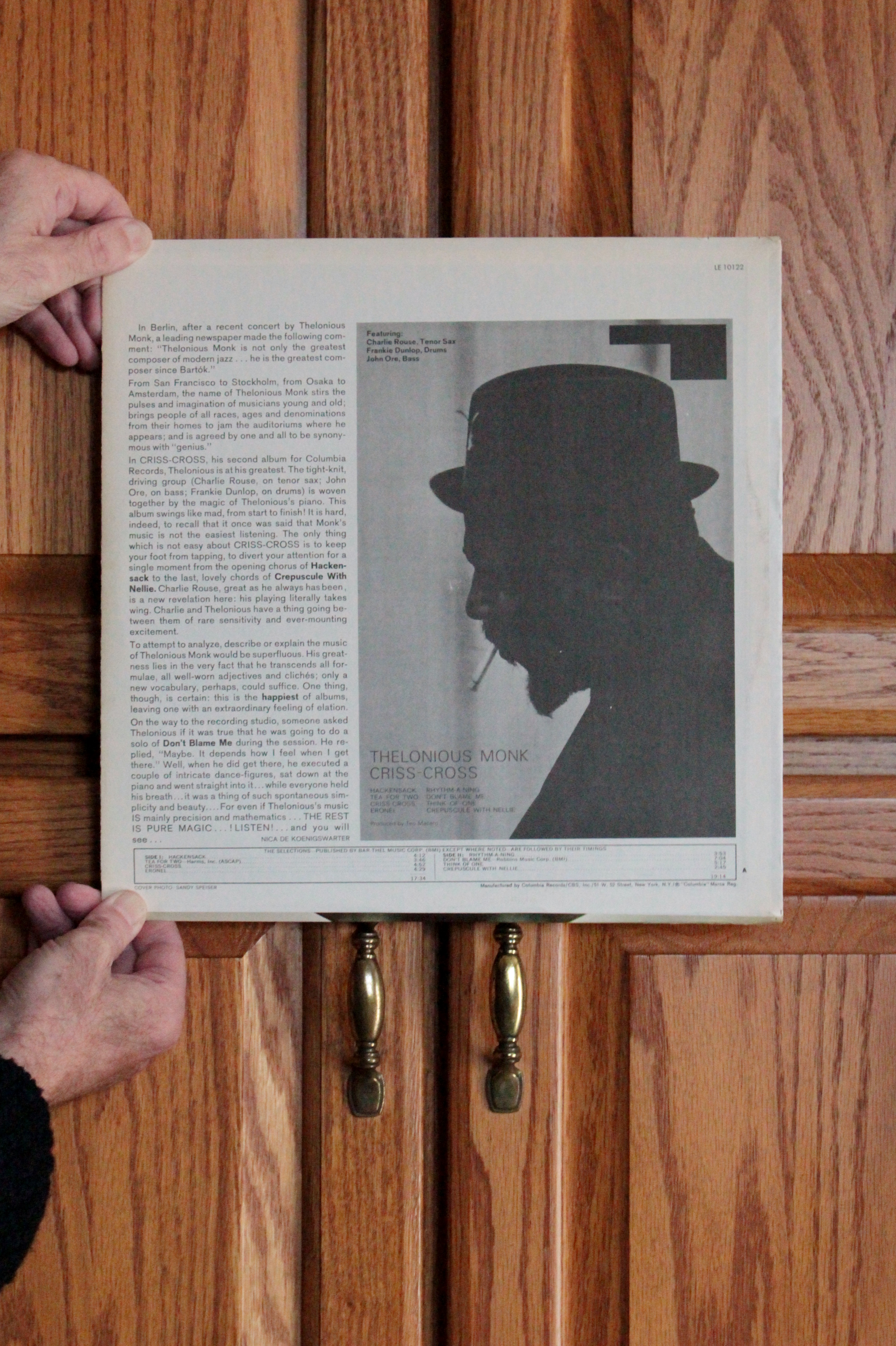
Back cover of the author's copy of Criss-Cross.
The back cover of the author’s copy of Criss-Cross.

The second occasion involved my friend Dave, who got my Monk ball rolling, with Criss-Cross, in the first place. He once had a brief encounter with the man. Dave thinks the meeting took place in 1966 or ’67. The location was a New York City subway car on which Dave spotted somebody who looked awfully familiar. This somebody was clothed in what Dave described to me as pajamas. Pajamas? Sure, why not? Intrepid soul that Dave was and is, he walked over and asked “Are you Thelonious Monk?” “Yeah, I’m the Monk,” came the reply. End of conversation.

The third Monk event was the topper. My mother was part of it, and I was there when it happened. The month was March, the year was 1976. WKCR, Columbia University’s radio station that programmed jazz in its classic and far-out varieties, was holding a Thelonious Monk marathon, playing his recordings nonstop over a multiday period. I imagine that the station’s intense tribute was timed to coincide with a concert by Monk and his band that same month at Carnegie Hall. My mother was a devoted jazz fan and WKCR listener because her son (my brother) Richard was in attendance at Columbia and was a WKCR jazz DJ. As such, he was on the air for portions of the Monk fest. But not on the evening in question, during which I sat with my mother in the kitchen of her Long Island home as the Monk celebration emanated from a small radio on a counter between the sink and the stove. Concerned about others as she always was, she said something like “I wonder if Thelonious Monk knows what KCR is doing.”

She went to the telephone and dialed 411, the number for directory assistance. Did Monk have a listed number? Somewhat surprisingly, he did. My mother called. Someone on the other end picked up. “Is this Mr. Monk?” she asked. “Yes,” was the reply. “Hello,” my mother said. “I wanted to ask if you know that WKCR is playing all of your music. It’s a wonderful tribute.” “Yes, thank you,” replied Thelonious Monk. My mother probably then complimented Monk on his talents, and Monk probably said “thank you” again. And that was that. I sat there semi-stunned. My mother, to my recollection, had never done anything like this before. She keenly followed the world of celebrities, but always from afar. Of all the stars that she admired, from Mary Tyler Moore to Lena Horne to Paul Newman, I never would have guessed that her one personal contact would be with a jazz pianist.

I was a mere bystander to my mother’s bold move. I, however, had one engaging and in-person Monk experience of my own. This occurred on March 26, 1976 from a balcony seat  at Thelonious’ aforementioned concert at Carnegie Hall. Sitting next to me were my brother Richie and his wife-to-be, Sara. I can’t recall if the performance took place just before or after my mother’s conversation with Monk. Likely, after. Monk didn’t play often in public those days, so the Carnegie gig was a highly anticipated event. In fact, two appearances in July of that year would be his last ever. He was on stage with four musicians, including his son T.S. Monk on drums. Thelonious said little, maybe nothing, to the audience. What mattered was his playing, and he was in superb form. Strong, poignant, totally on the money. His fingers did the talking.

(Photos by Sandra Cherrey Scheinin. If you click on a photo, a larger image will open)

(If you enjoyed this article, then please don’t be shy about sharing it)

One More Stop On The Road For Donna The Buffalo

My wife Sandy and I recently saw in concert an electric and eclectic band from upstate New York amusingly named Donna The Buffalo, and afterward I wanted to write about the show. Before sitting down to compose my magnum opus though, I mulled over my approach to the subject matter. The main question I posed to yours truly was: What should the subject matter comprise? Naturally, Donna The Buffalo needed to be a big part of the focus. But you know what? I knew little about DTB pre-gig, and possess only a cursory knowledge about the band now. We went to see them on little more than a whim. I’d heard of them, knew that their history was lengthy, and decided that taking a chance on them would be fun. When my mulling concluded, I was of the opinion that the path that brought me to this show also should be part of the story.

I think of myself as a music lover. I listen to a wide variety of genres and have been to well over 1,000 concerts during my earthly tenure. Yet, these days I feel like a tyro when I listen to radio stations or read music-related websites, magazines and newspapers. I mean, more often than not, I am unfamiliar with the musicians. To me, it is just incredible how many solo performers and bands are out there playing the game. In the USA alone, there must be 50,000 professional musical acts, maybe more. In my younger days I thought that I had a handle on a fair percentage of music makers. No longer, not now in the Internet Age when anybody and everybody can make his or her presence felt.

And so, ten or more years ago I largely gave up on trying to keep up with the avalanches of musicians plying their trade. It was just too much work, too exhausting. Better, I think, to stay in tune to a lesser extent, and also to take gambles and hope for the best. As with Donna The Buffalo.

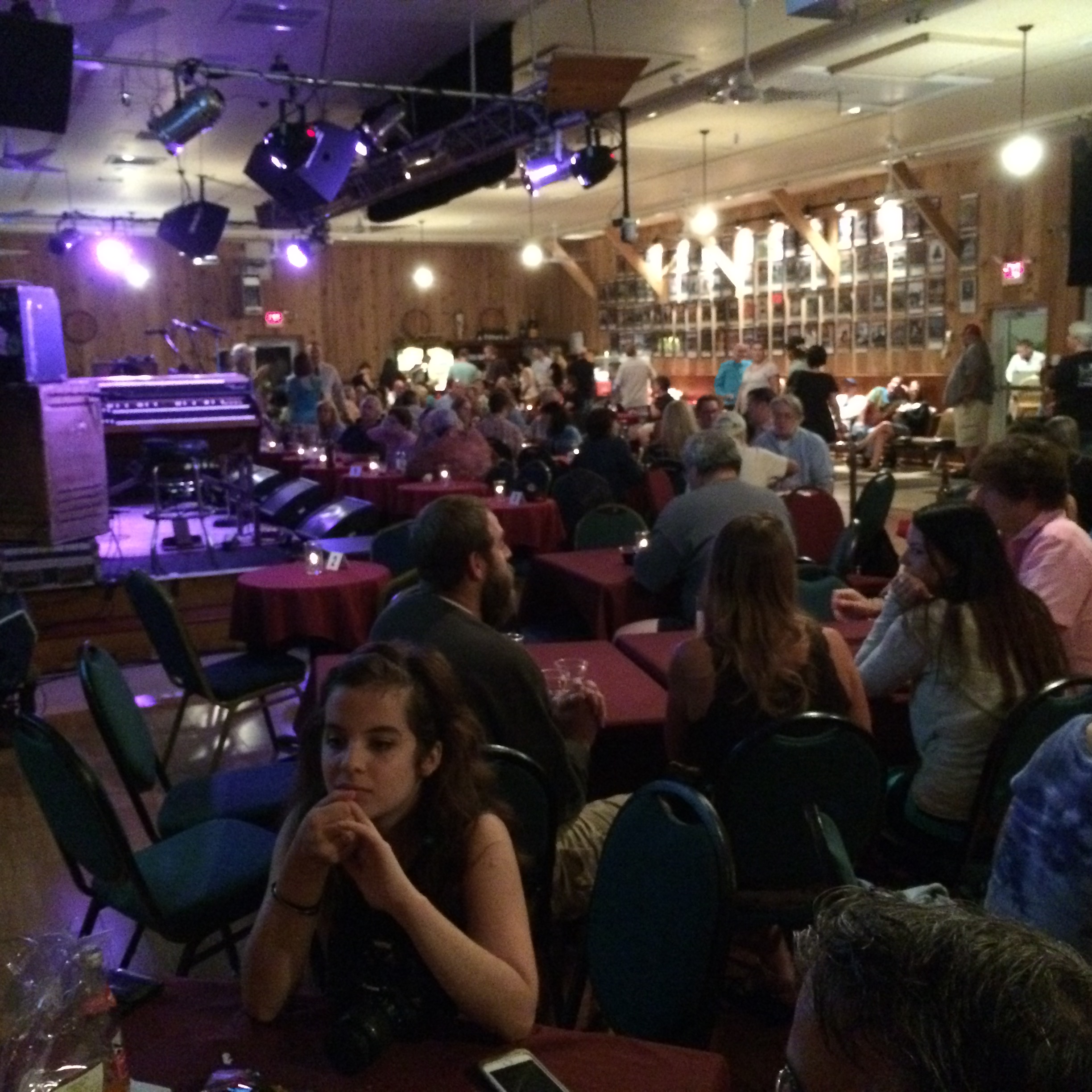
New Hope Winery, one half hour before showtime.

Donna The Buffalo appeared at New Hope Winery, a venue in the Philadelphia suburbs that Sandy and I discovered last year and have become very fond of. The joint was packed with 200 or more souls when DTB took the stage. A front-and-center area, where tables normally would be placed, had been cleared to create space for dancers. I looked over the crowd. At some previous visits to the Winery I’d seen demographics heavily tilted to the 50 and above bracket. Not this night. DTB had tipped the age scales downward substantially. Twentysomethings and thirtysomethings abounded. There even were a few very young children in the room.

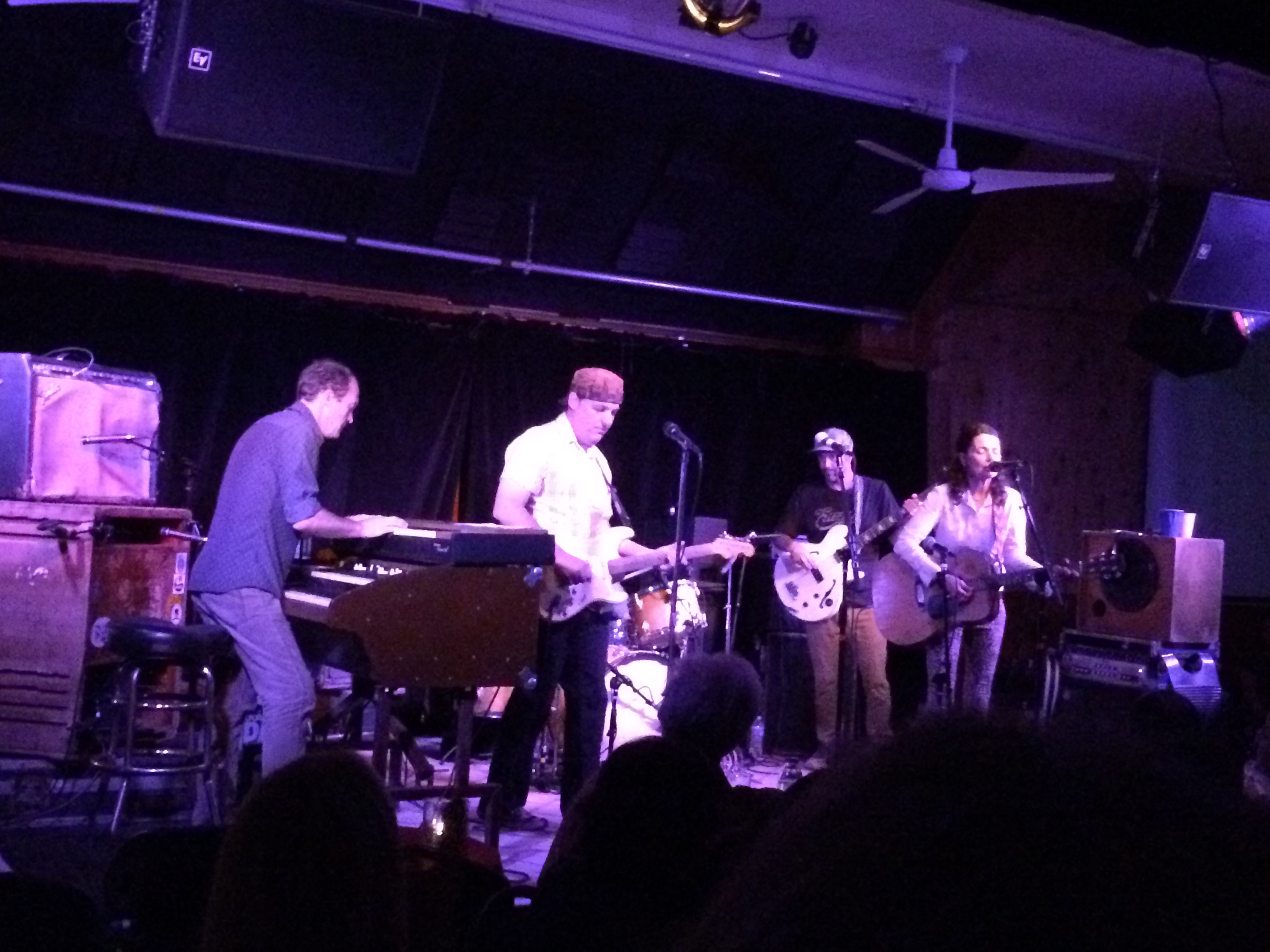
Donna The Buffalo in action at New Hope Winery.

What a band. Not having known what to expect, song number one told me that I had chosen wisely by attending this concert. A quintet, DTB was tremendously tight and intuitive all night long, and possessed a large catalog of songs to choose from. They held the stage for two hours and 10 minutes, filling their long set with 22 songs and little between-tune chatter. I was standing just behind the dance section, which was crowded with bobbers and weavers. After two or three songs, I too began to go with the flow. And kept going. But I was bouncing alone — Sandy stayed at the extremely stage right table to which we had been assigned. Her view of the musicians from there was lousy, but in the dance area she wouldn’t have had a chance seeing over anyone’s head. Mea culpa.

DTB has blended a bunch of musical styles into their sound: rock, country, zydeco, reggae. Rock being the dominant force. On some songs (What Money Cannot Buy; Love and Gasoline) the power was relentless, Stonesy, irresistible. On others (The Ones You Love; Conscious Evolution) the groove expanded, contracted, widened once again, giving no mercy to the audience. All you had to do on those expansive numbers, Grateful Dead-ish and Allmans-ish as they were, was close your eyes to be transported to a higher and mind-opening plane. Yes, Donna The Buffalo was that good.

DTB began its journey in the late 1980s, picking up steam in the mid 90s, and in the current century has become a decently successful and popular unit. They tour like crazy and have amassed a loyal national fan base known as The Herd, a mini version of the Deadheads. Two original band members (Tara Nevins and Jeb Puryear) remain. Tara and Jeb compose most of the group’s songs, usually individually. At the Winery, each took the lead vocal spotlight on his or her compositions. Jeb opted for the laidback Jerry Garcia approach to singing and handled electric guitar sizzlingly. He’s a guitar hero unknown to 99% of Americans. Tara’s sweet and gentle mountain drawl pleased me much. And she was the band’s multi-instrumentalist. Fiddle, acoustic guitar, accordion, tambourine and scrubboard (for the zydeco numbers) were her arsenal.

A bunch of musicians have played alongside Tara and Jeb since DTB’s inception. The three current guys have been around for several years. Mark Raudabaugh killed on the drums. Kyle Sparks was all over his electric bass’ strings, drawing out lines that percolated and sang. And organist David McCracken was immense. So many times in so many bands, especially the poppier or atmospheric ones, the keyboard player is on the lame side, somehow fooling the audience with pretty chords and simplistic runs. Not McCracken. He can play. He jabbed, moved fast, reached for the skies, whatever it took.

So, how many acts that I’ve never heard of or barely heard of, and that I’d find to be great, are on the circuit? The question is a puzzle, the answer unknowable. Which makes music and, similarly, much else of life, delightful.

(Photos by Sandra Cherrey Scheinin. If you click on a photo, a larger image will open)

(If you enjoyed this article, then please don’t be shy about sharing it)

Puck’s The Place (A Venue And Concert Review)

I’ve written several times on this blog about Doylestown, PA. In the extensive suburbs of Philadelphia, Doylestown is perhaps the prettiest, the most charming, the most interesting village. I’m referring not to Doylestown’s generic housing developments, but to its quite large historic district. This section is worth a visit, and for many people, such as my wife Sandy and me, multiple and regular hellos.

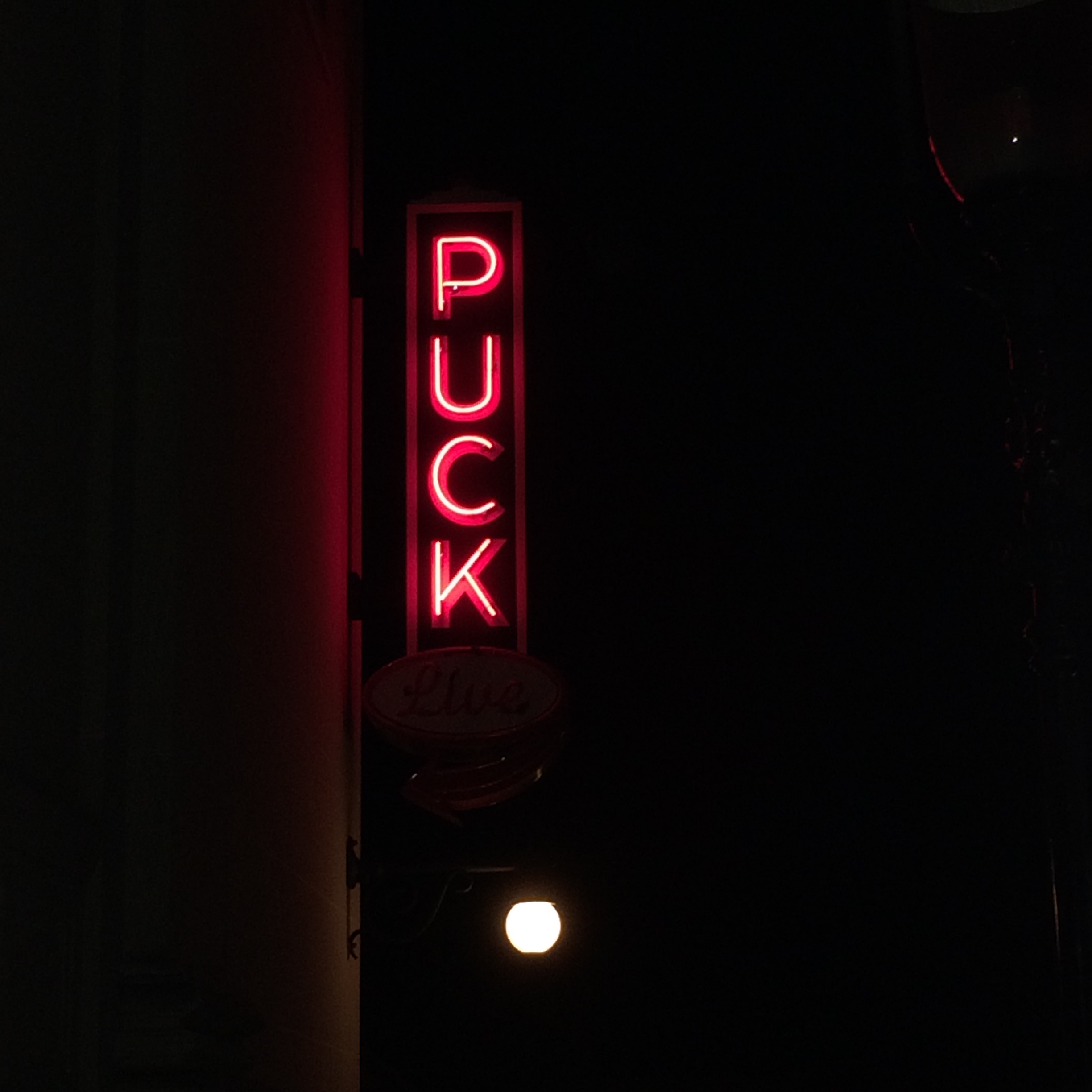
Puck's outstanding neon sign.
Puck’s outstanding neon sign.

You like art? Go to Doylestown’s high-quality Michener Museum. You like non-blockbuster movies? Try the County Theater. You like artifacts from America’s pre-Industrial Revolution past? The astonishing Mercer Museum was built for you. And if you are a popular music buff, the place to frequent in Doylestown is Puck, a spot with chic indoor and outdoor eating areas and, incongruously, a grungy cellar where singer-songwriters and rock and country and funk bands take the stage a few times each week.

I’ve been to Puck’s music room 15 or more times over the years. Puck’s management brings in a wide array of musicians, a few of whom are touring artists with decent-sized national followings. But generally the players at Puck are little-knowns from Greater Philadelphia. I once had a small career as a music presenter for a summer music series in Philadelphia’s Chestnut Hill neighborhood (see my article The Music Biz And I). It was at Puck that I found several local acts (Cheers Elephant; Toy Soldiers; The John Byrne Band) who knocked my socks off and whom I ended up booking for the series.

What I like about Puck’s music room is its casual and boho vibes. Aside from the handsome bar, the space has been inspired by Frat House Finished Basement Magazine. The mottled floor could be mistaken for a Jackson Pollock painting. There are pillars that obstruct views of the stage. My kind of place.

As for the music, I tend to approach Puck with an open mind, with few expectations, and usually everything works out just fine. Many times I find the music to be good but nothing special. And sometimes, as with Cheers Elephant et al., I’m wowed. On a recent Saturday night, Sandy and I both were floored by Grady Hoss And The Sidewinders, the opening act of a double bill. I’d never heard of them, had little idea how they would be. What they were was tight and exciting, a country band in the classic mode, with some latter day tweakings. Anyone who favors Waylon Jennings, Gram Parsons and Dwight Yoakum would find good fun with Grady Hoss And The Sidewinders. For me, their 45-minute set was 45 minutes too short.

Grady Hoss And The Sidewinders, as I’ve learned from post-concert research, is a Philadelphia area band just starting out. They are working on a maybe-soon-to-be-released EP. Their Puck engagement, much to my amazement, was their public debut. Lance Davis, the leader, apparently had a fairly long career as an engineer and producer and rock musician, but for various reasons put all of that on an extended hiatus a number of years ago. In 2014 he emerged from his musical hibernation with country tunes on his mind. As the band came together, Lance decided that each member needed a colorful stage name reminiscent of the kinds of names (Ernest Tubb, Buck Owens) that once populated the country charts. Voilà, Lance adopted Grady Hoss as his moniker. The others in the group were dubbed Bucky Vennerson (in real life, Vince Federici), Dusty Reigns (Dan O’Neil) and Earl Smokesman (Charlie Heim).

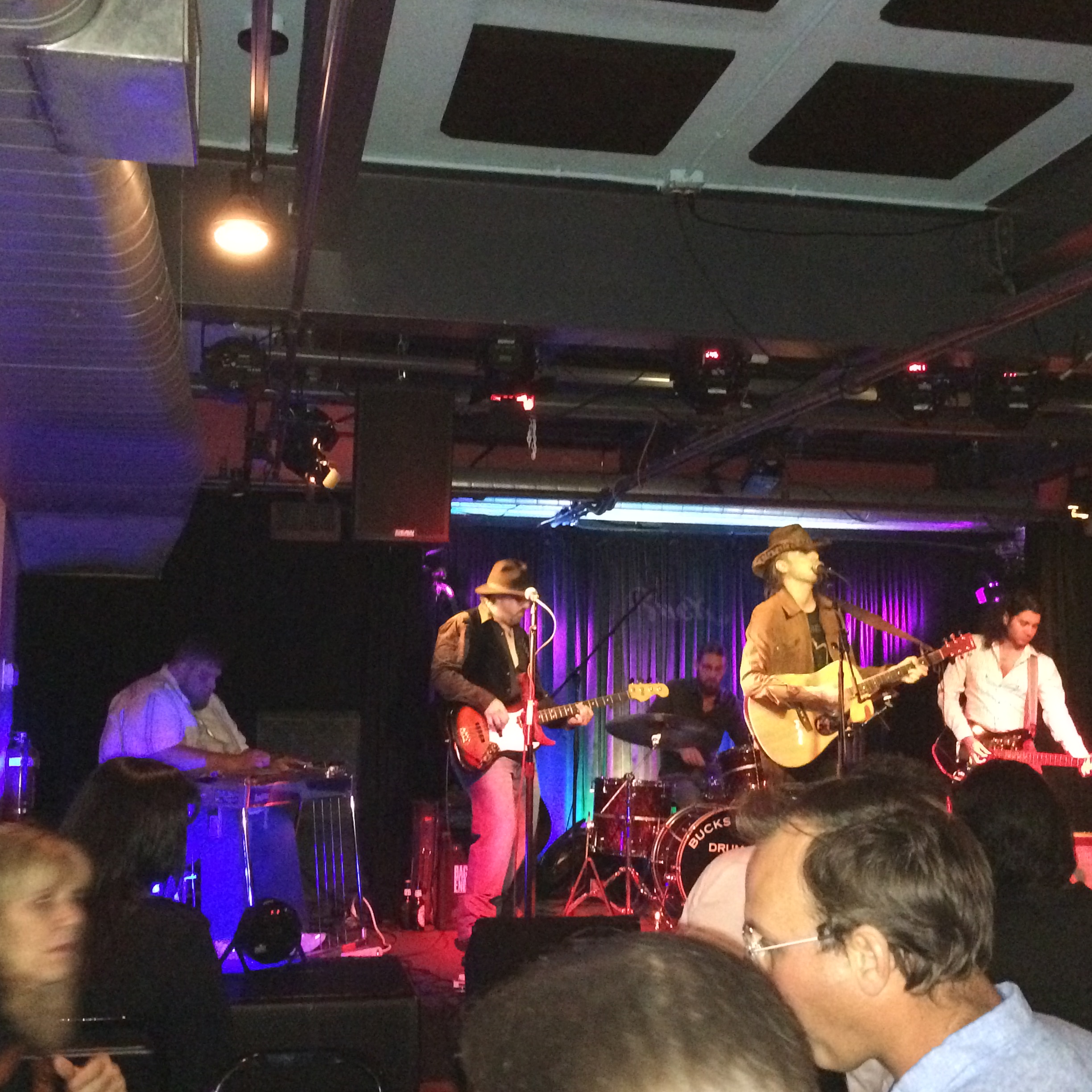
Grady Hoss And The Sidewinders on stage at Puck.

Lance and pals played nine songs at Puck, eight of them originals. The songs were good. Lance’s vocals were heartfelt, his high notes reverberating with longing or regret, as they should in tales drawn from country music’s traditional wellspring. Lance strummed an acoustic guitar all evening, his face half-hidden beneath a big Stetson hat, and The Sidewinders created a rich palette of sounds around him. I knew I was in for an evening of treats right from the opening moments of the opening song, Rivertown. The chuga-chuga Johnny Cash-like beats from Heim’s drums and O’Neil’s electric bass built a strong template. Federici’s guitar licks ignited and pushed. And guest pedal steel guitarist Dave Van Allen’s poignant statements were as Nashville as you can get.

Two head-nodding honky tonk numbers followed Rivertown. I didn’t catch their titles, but their themes were classic country: lost souls and drinking. “Lord, I don’t know where I’m going/But I just want to get there” came from the first, and “I’m going back to the bottle/Back out in the rain/Back to the girls I need to see” from its successor.

So, how were these guys able to sound so good in their first-ever club performance? I imagine it’s because they’ve practiced a whole lot, and because they have heaps of talent. I can see this band going places. They without doubt have the chops, the look and the laidback attitude. What they will need to make it, if indeed making it is part of their game plan, is a bunch more original songs. As I discovered at home a few days later, two of the eight originals that I heard at Puck predate GHATS. They come from a rock album, The Hovercraft Diaries, that Lance released nine years ago. Maybe Lance possesses much new countrified material that he didn’t reveal at Puck. If not, I hope that composing sessions are on his agenda. Grady Hoss And The Sidewinders are a band about which I’d be happy to say one day, “I saw them when . . .”

(Photos by Sandra Cherrey Scheinin. If you click on a photo, a larger image will open)

(If you enjoyed this article, then please consider sharing it)