A Kite, The Moon, Sandy And I

Few if any ideas are unique. But many ideas are good ones. Last year, for instance, I came upon a good idea while perusing a bunch of websites pertaining to Cape Cod, where my wife Sandy and I would be vacationing a few weeks later. We’ve been hitting the Cape for many years, and we always try to amass a long list of potential activities before our vacations begin. One website was crammed with suggestions about fun things to do on Cape Cod. One of the author’s notions connected with my sweet spot. Go fly a kite, the writer said.

Our kite soared above Cape Cod beaches many times last year.

Sandy and I did just that. A few days into the vacation we bought a cute and colorful kite in a toy store and headed straight for a section of Atlantic Ocean beach to test it out. I hadn’t flown a kite in at least 50 years. Sandy, surprisingly, never had. We took to the kite as if it were a long lost pal. Over the course of our sojourn the kite, when not aloft, lived on the back seat of our car, always on hand and ready for action. We flew it on beaches all over Cape Cod and in an inland park or two. During the trip, we spent at least ten hours holding the reel of the kite tightly, watching our yellow, purple and blue amigo ride the air currents far overhead. To fly a kite was a very good idea.

Another good idea visited me recently. And it morphed fairly quickly into a better one. Plopped as usual on my living room sofa one day, half listening to WRDV, a low wattage suburban Philadelphia radio station, I heard a song that I’ve always liked. Dancing In The Moonlight, by King Harvest. This happy tune from 1972 got me thinking, as I had been looking for a story idea for my blog. “Ah yes,” I said to myself. “Let’s write something about the Moon.” I hoped that I’d soon hear other Moon-related songs, and then be able to put them into a bit of context. A few days later, example number two arrived when WRDV played a most obscure tune, a sultry and quiet jazzy bonbon from 1939, Dancing On The Beach. It was written by Bulee “Slim” Gaillard and performed by Slim and his then-partner Slam Stewart. The dancing described in the song’s lyrics, admirably delivered nonchalantly by Slim, occurs at night, under moonlight.

I felt that I needed to hear at least one more moony song to increase the meatiness of whatever I might end up writing. But the next one that I caught, Yellow Moon, by The Neville Brothers, was a bad fit for my thesis-to-be. It concerns a guy who, uncertain about his girl’s degree of devotion to him, asks the Moon to tell him what it knows about the lady’s love life. I put Yellow Moon in the discard bin.

A couple of days later though, out on a drive, I turned on Sirius radio and was taken aback by the first tune that emanated. It was Van Morrison’s iconic Moondance. There, the pieces had emerged. Three songs about letting go, about moving freely with someone you love, in partnership with the mysterious energies and powers of Earth’s nearest neighbor. It was time to analyze the songs, compare their calibrations and then start typing.

I studied the songs’ lyrics. In their essences they didn’t diverge very much. In each, under the moon’s spell, folks are grooving and open to the possibilities. “Dancing in the moonlight/Everybody’s feeling warm and bright.” “Dancing on the beach ‘neath the moon above/ Dancing on the beach with the one you love.” “Well, it’s a marvelous night for a Moondance/With the stars up above in your eyes/A fantabulous night to make romance/’Neath the cover of October skies.”

But I saw at least one difference among the tunes. Each, it seemed to me, inhabited a distinguishing milieu. Where else but in a meadow, one undoubtedly full of blissful and merrymaking hippies, could Dancing In The Moonlight be taking place? As for Dancing On The Beach, well, duh. And Moondance, to my reading, finds its home in none other than Van The Man’s grassy backyard.
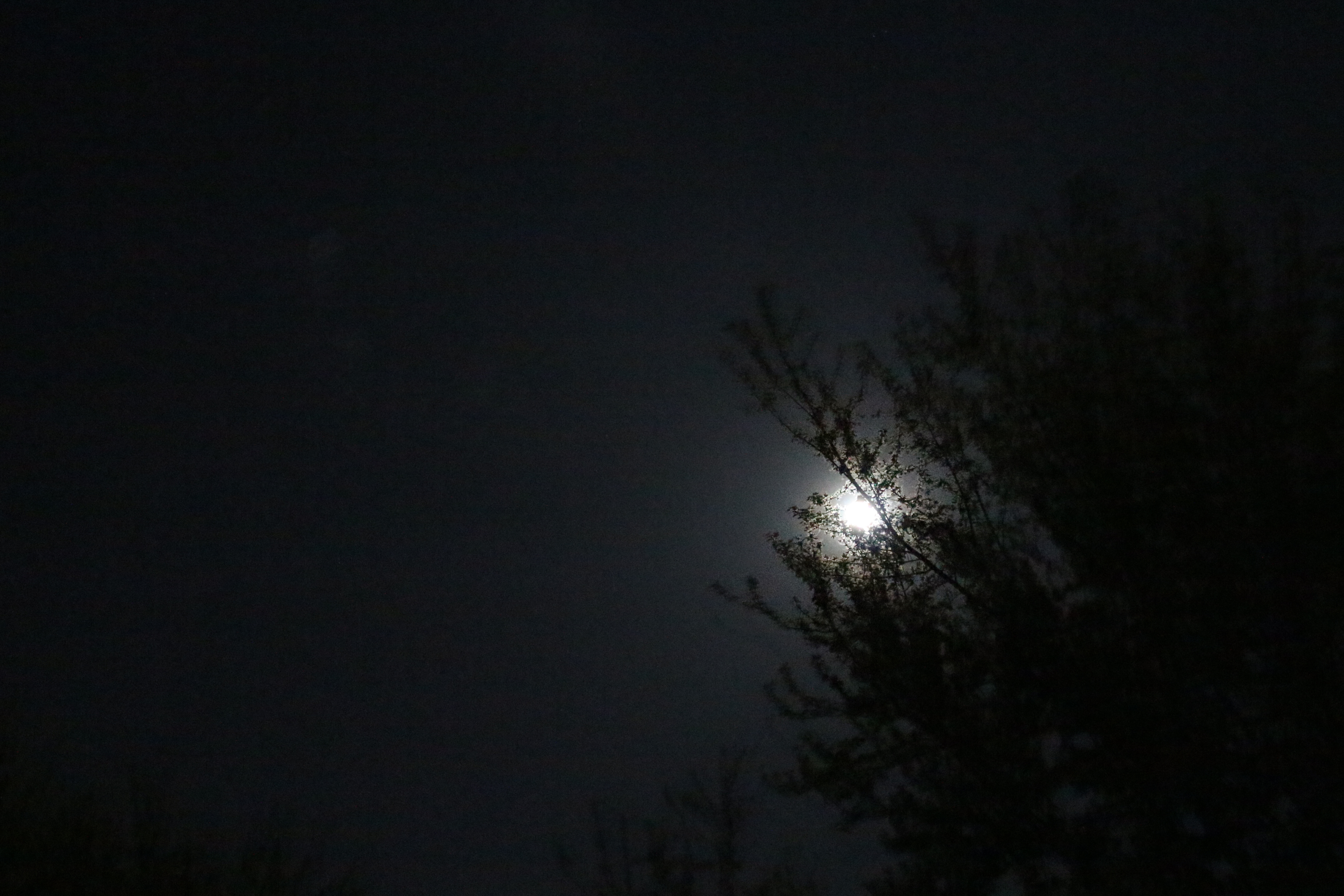
The Moon illuminating the Scheinin backyard.

With those and other thoughts in mind, I began to write. But my intent soon took a sharp change in direction when it dawned on me that the end game was not to turn out an essay about the intriguing aura that monnlit dancing casts upon the human psyche. Instead, I came to believe that the musical gods had held a meeting and decided to send a message my way. Sure, they had experienced brain freeze when they allowed me to hear Yellow Moon, but they quickly had regrouped and set things straight by showering me with Moondance. Their message was a simple one: Dance in the moonlight, fella! It’ll be fun. It’ll be good for you.

In my adulthood I’ve been a reluctant dancer. I give it a try at weddings and bar mitzvahs and other celebrations, but other than that, no. But this moonlight idea is intriguing. It might take awhile before my first dance occurs, but I’m going to coax myself. I can see it now  —  Sandy and I in our compact backyard, soft moonbeams filtering through the trees, the two of us flowing as one to the tune playing on the iPhone. Which of course is Moondance. And after that, before year’s end, we dazzle a lunar-lit stretch of sand and sea somewhere as Dancing On The Beach accompanies us. And then a meadow, where Dancing In The Moonlight shapes our movements.

(Photos by Sandra Cherrey Scheinin. If you click on a photo, a larger image will open)

(If you enjoyed this article, then please consider sharing it)
Sunday In The Park With Duane (Jazz Concert Review)

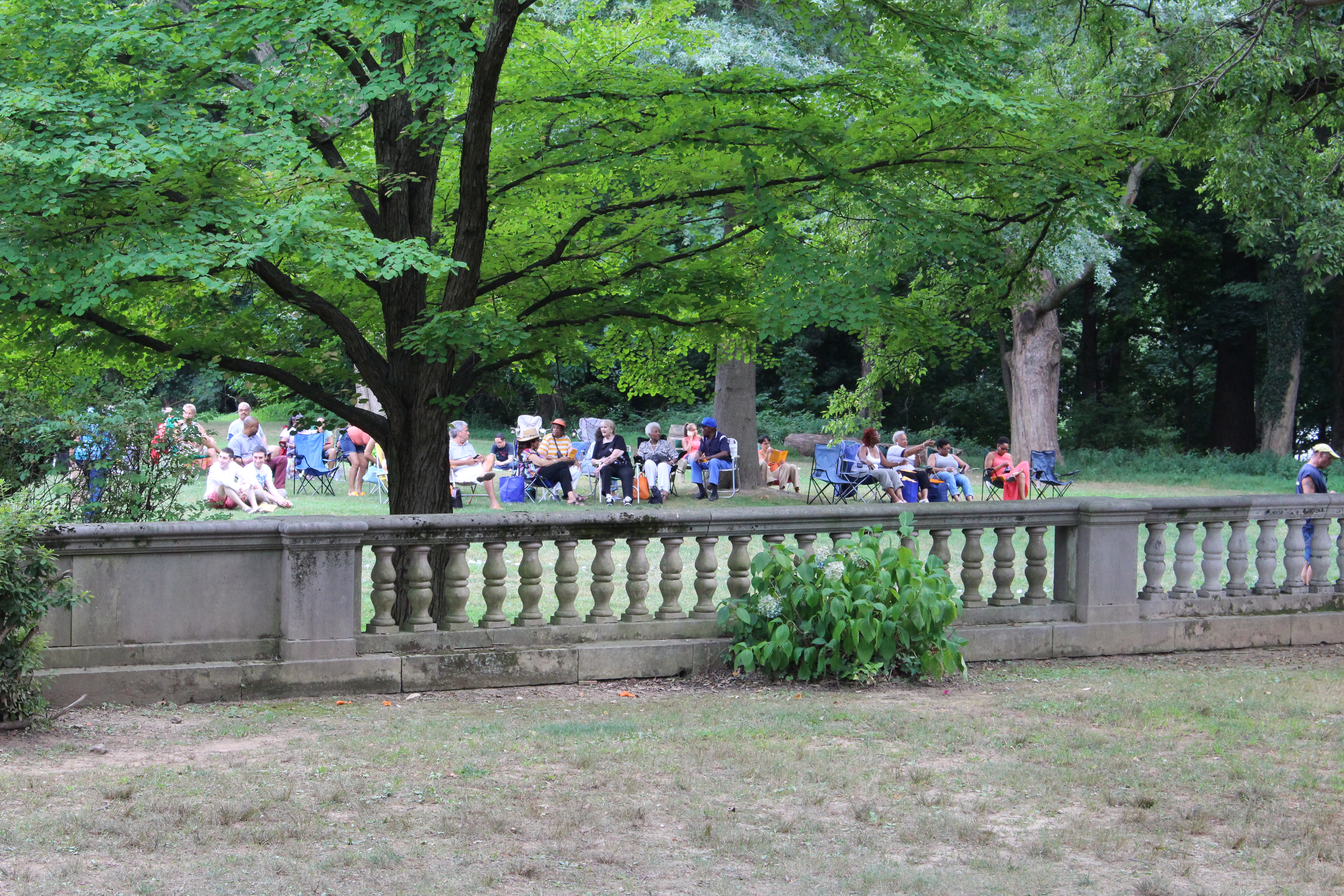
Some outdoor summer music series are better than others, but not everyone would agree on which are the good ones. Personally, I most like those that have an eclectic mix of musical genres and that also avoid tribute bands. Luckily for me and my tastes there are a number of summer series in the Philadelphia region that hire the kinds of acts that I’m a sucker for. One of those is Cheltenham Township’s Concerts In The Park, whose shows are staged in the sprawling and meticulously maintained Curtis Arboretum. There, a mile or two from Philadelphia, musicians mount a modest stage at 5 PM on five summer Sundays. They and their audiences are surrounded by, and are under, many large trees.

I’ve been impressed for years by some of the Cheltenham bookings. In 2014 my wife Sandy and I, accompanied by two of our friends, went to the Curtis Arboretum to see and hear Geoff Muldaur, who has been crisscrossing the USA and other countries as a musician for decades. Geoff began to make his name in 1963 as a member of the Jim Kweskin Jug Band. And there he was, so many years later, performing his folky-bluesy-jazzy repertoire on acoustic guitar at the arboretum.

The pre-show crowd at Curtis Arboretum.

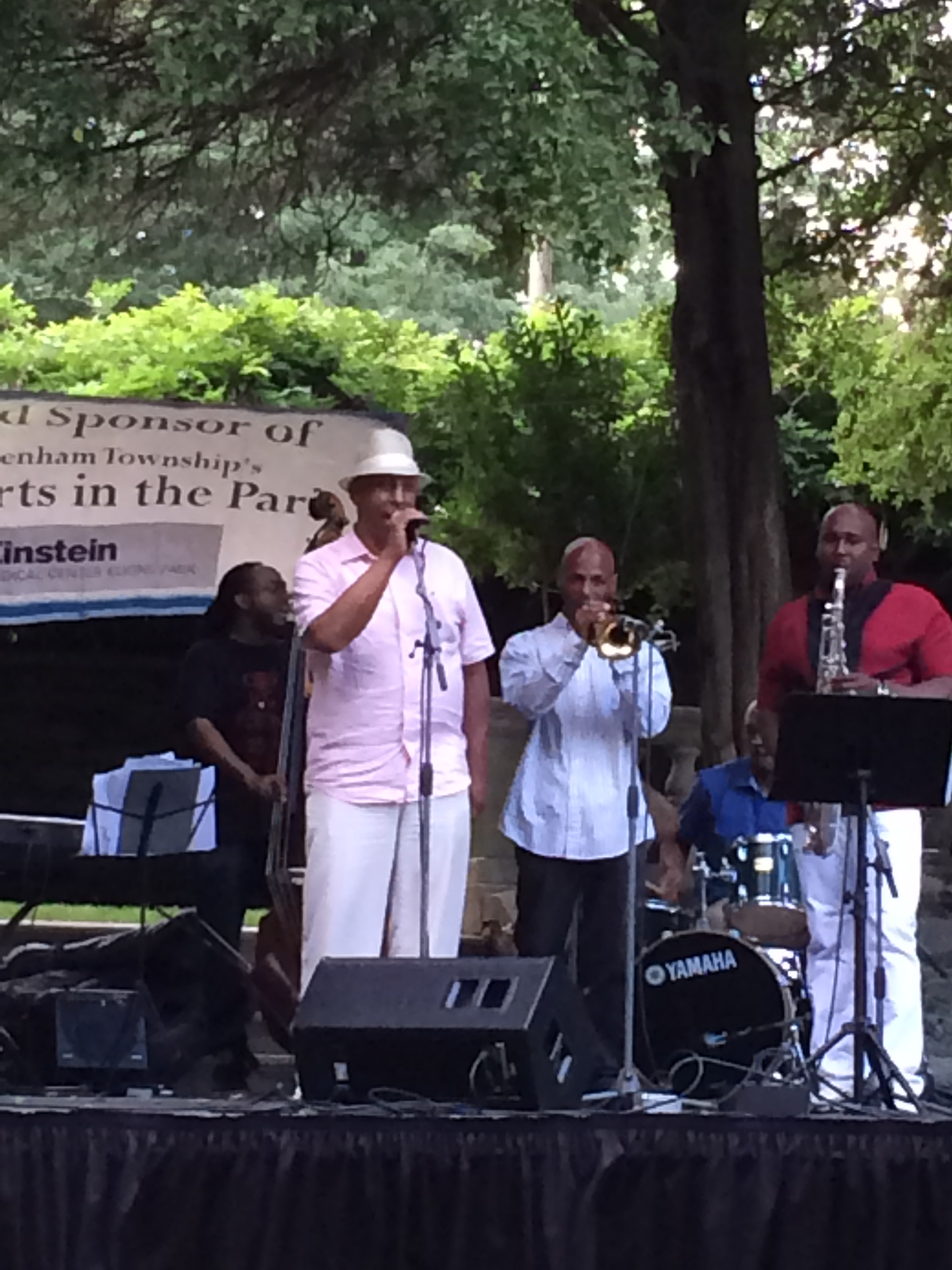
On a recent Sunday, Sandy and I, with the same two friends, sat beneath some leafy limbs at Curtis to take in another example of thinking-outside-the-box scheduling, the Duane Eubanks Quintet. This jazz outfit is more commonly witnessed in clubs. Somehow I didn’t hear Duane say from the stage that he wasn’t used to playing at settings such as Curtis, but my friend assured me that he did. Eubanks, a suburban New York City-based trumpeter with a first-rate résumé, brought along with him four fine and established members of the jazz world.

Duane Eubanks comes from a very musical family. He grew up in Philadelphia’s Mt. Airy section, so his Curtis gig wasn’t far from his childhood home. His pianist mother, who gave lessons to prominent jazz players, helped spark a musical flame in some of her children. Look at the results: Duane’s oldest brother, Robin, is a well-regarded jazz trombonist. Duane’s second-oldest brother, guitarist Kevin, became famous as the band leader for The Tonight Show With Jay Leno. Of the four male Eubanks offspring, only Shane, Duane’s twin, is not motoring on the professional musician highway.

Duane plays trumpet really well. Throughout the Curtis show I gave a mental thumbs-up to his imagination and clean lines. He wasn’t flashy, didn’t spend inordinate amounts of time swirling around in his instrument’s nosebleed zone. What he did was this: He spun worthy tales with his horn, filling his solos with strong ideas, and balanced that with terrific technique. I don’t think I had ever seen him in concert before. I was impressed.

Duane Eubanks Quintet at Curtis Arboretum.

Eubanks and company primarily stayed in the hard bop bag, with two excursions, which I wasn’t crazy about, into the borders of smooth jazz territory. The tough and driving stuff and the one unadulterated ballad, though, were terrific and had my head swaying. On board with Duane was tenor saxophonist Abraham Burton. Burton’s robustness and energy owed debts to John Coltrane, his more meditative moments to Dexter Gordon. David Bryant was a whiz on electric keyboard, an attentive musician filling spaces deftly when Duane or Abraham soloed, his fingers flying fast and furious when he himself took the lead. Corcoran Holt, on upright bass, helped power the band with notes that sometimes boomed, sometimes cooed. I thought that he was great. And the in-demand drummer, Eric McPherson, was all over his kit, rat-a-tat-tatting on his snare drum, whacking à propos accents on his cymbals. I didn’t particularly enjoy his work on the two aforementioned smoothed-out numbers, but let’s put them aside. I already have.

The tune I maybe liked the best was the first set’s opener, a Eubanks original titled Slew Footed. It went on for 20 minutes. Slew Footed was a hard romp, a controlled yet convulsive affair. Each musician took long propulsive solos. Each listened carefully to what the others were saying. The onstage musical conversations were animated and keen.

Guest vocalist TC III with Duane Eubanks' group.
Guest vocalist TC III with Duane Eubanks’ group.

Halfway through the second set Eubanks brought to the stage a guest vocalist, TC III. I used to see him perform at venues all over Philadelphia, but hadn’t in 20 or more years. He sang on two songs. TC III took hold of the first tune, Moanin’, from its opening notes. I had forgotten just how fine a singer he is, bluesy and direct. Think Eddie Jefferson. Think Joe Williams. Moanin’, a gutsy marriage of the blues and gospel, was a staple of Art Blakey And The Jazz Messengers. I loved the way that TC III and the Eubanks group belted it out.

I’m a stickler for good audio projection. Too often at concerts, in venues small to enormous, the sound quality doesn’t cut the mustard. At Curtis the sound guy got it right. Every instrument, and TC III’s vocals, came through loud and clear. There was no muddiness in the mix. All of this added to my enjoyment of the show. As did the weather. For much of the late afternoon and early evening, dark clouds massed and inched along far overhead. I was certain that a downpour was in the works, especially after a dozen or so raindrops plunked me around 6:30 PM. Amazingly though, not another drop fell after that.

(Photographs by Sandra Cherrey Scheinin. If you click on a photo, a larger image will open)

(If you enjoyed this article, then please consider sharing it. Thanks.)

The Music Biz And I

A typical concert scene at beautiful Pastorius Park.

On a recent morning, the day’s threatening skies put me in mind of the music business mini-career that I enjoyed till not long ago. It was with the Pastorius Park Free Summer Concerts Series, in Philadelphia’s lovely and small townish Chestnut Hill neighborhood. For seven summers, the first two as a general helper and the following five as a co-organizer, I was part of a fine endeavor. My run ended in July 2014 with that summer’s final concert. Bad weather, or the prediction thereof, were among the reasons that I decided to step down. With rain a possibility for many concert evenings, I and another co-organizer often would find ourselves phoning back and forth hours before showtime, agonizing over whether or not to move the music indoors to our rain location, a school auditorium a mile from the park. It usually was a tricky matter. Sometimes we opted for inside and the rains never came. At least twice we stayed at bucolic Pastorius Park and downpours cancelled or prematurely ended the night’s entertainment. My constitution wasn’t strong enough to laugh along with the rain gods. Weather aside, though, the Pastorius Park segment of my life was terrific overall.

In 2008, knowing that I was approaching the end of my 30+ year tenure on the payroll of Pennsylvania government, I was looking around for a part-time activity that involved my main interest. Music. For 40 years I had been quite the music junkie, listening to albums and radio at home for hours on end, taking in shows at a wide variety of venues in the Philadelphia area and beyond. It had recently dawned on me that the next phase of my life might be pretty awesome if I could become more than an audience member by getting inside the music scene  But how would it be possible to find entry? I knew nobody in the biz and had never worked in music in any capacity whatsoever. Plus, I was not too far away from Medicare age. I figured that my chances weren’t overly bright. And then, to my delight and astonishment, a door opened.

Now, the music venture I became involved with wasn’t exactly Columbia Records or Live Nation Entertainment. The Pastorius Park series is low key and homey, which was fine with me. It runs under the gentle aegis of Chestnut Hill Community Association, an agency that aims for its community’s betterment. Volunteers are central to the series because the modest Pastorius budget has room for payments to musicians and audio crew, but not much more. As first a helper and later an organizer, I fell into the unpaid pool. That was fine with me too. I was more than happy just to be part of the process.

I went to my first Pastorius Park concert in summer 2007. On stage was Scythian, a rocking Celtic group that drove the crowd wild. This was before the notion of working in the music biz had crossed my mind. The next year, though, trying to figure out where my musical dreams possibly might come partially true, I dialed Chestnut Hill Community Association and was put in touch with one of the Pastorius Park organizers, Janine. She welcomed my offer to help. Next thing I knew I was at a planning meeting for 2008’s season. And a few months after that I was at the concerts themselves, setting up tables and chairs, helping to unload and load audio equipment, collecting concert donations from the audiences during intermissions. My energy seemed to swell on concert dates. I was having a wonderful time. The door had opened.

The door opened even more in early 2010 when one of the organizers, the fellow who scheduled and booked the acts, no longer had the time to continue his duties. He and Janine asked me to replace him. Me? Book acts? Negotiate contracts? Those for me were uncharted waters. Gulp, gulp. I said OK, I’ll do my best. And I was on my way. It didn’t take long for me to realize that my new position was close to being my dream job. There I was, a music lover given the keys from out of the blue to curate a small but well-regarded music series.

I had fun working with my organizing partners, Janine for the first two years and Julie for the next three, and with the other volunteers. I enjoyed chatting with the musicians before and after the shows. And I had a major blast scheduling each summer’s string of seven Wednesday evening concerts. In 2010 I reached past the Philadelphia area to hire two acts from afar, including, incredibly, Graham Parker. His solo show packed the park maybe tighter than ever before or since. But for the next four years I decided to stick entirely with artists from the Philadelphia region’s highly fertile musical ground. I liked the idea of supporting its progeny.

If I hadn’t known it before, one thing became very apparent to me during my days as an organizer. To wit, there are an astonishing number of excellent musical acts based in the Greater Philadelphia area, and many of the little-known local performers are as good or better than many who make big noise in the mass marketplace. Success is a matter of luck, timing, backing, perseverance, who knows what. A few of the Philadelphia region’s performers whom I booked for Pastorius Park had found some degree of national and worldwide acclaim, folks such as singer-songwriters Jeffrey Gaines and Mutlu, and Celtic music greats RUNA. But the rest were talented bands on the lower rungs of success’s ladder. Some of them put on performances as enchanting as you’d ever hope to see.

Cheers Elephant and some young fans at Pastorius Park in July 2011. Photo by Kevin Kennedy
Cheers Elephant and some young fans at Pastorius Park in July 2011.
Photo by Kevin Kennedy

For instance: I’ve never been to a show like the one in 2011 involving Cheers Elephant, a pop psychedelic rock outfit with loud guitars and a free-as-a-bird and charismatic lead singer, Derek Krzywicki. Cheers Elephant’s music was magic to the ears of many youngsters who had come to the park with their parents. During the band’s second set, played under darkening skies, many kids aged five to 15 left the grassy seating areas and, seemingly magnetized by Elephant’s electric energy, made their way to, indeed onto the stage, which sat beneath a grove of tall trees. Bouncing and shimmying to the band’s powerful and catchy beats, they covered the stage, pushed the musicians onward and upward, in fact had the musicians mesmerized. The scene was surreal and transfixing.

Venissa Santi and her band at Pastorius Park in July 2014.

And in 2014, Venissa Santi brought her Cuban-flavored jazz esthetic to the park. I’d hired Venissa once before for Pastorius Park, and had also seen her perform at another concert series. Last year, though, she and her band rose to a level I hadn’t known was in their command. Early in Santi’s first set my mind was captured. The music was complex yet malleable, expanding and contracting like strong bands of rubber. Venissa’s intimate and pitch-perfect vocals intertwined with the chordal onrushes of Tom Lawton’s piano, the now-I’m-here-now-I’m-there notes from Madison Rast’s bass, and the melodic assymetrical patterns of Francois Zayas’s drums. This, I thought, was music parallel to that of Miles Davis’s famed 1960s quintet. Was I imagining things? I don’t think so. Did others in the audience hear the music as I did? I can’t say for certain. But judging from their tremendous applause I’d guess yes.

(If you enjoyed this article, then please consider sharing it. Thanks)

Ashes: Lindi Ortega’s Great Song Heard In The Great Outdoors

This is a story about life’s little surprises, about how one thing leads to another. In this gentle instance an unexpected impulse to relocate my duff from indoors to outside resulted in my hearing a song that I can’t get out of my head.

There’s something naturally relaxing about sitting outdoors when the weather is pleasant. Some people sit in parks, some on beaches, some a few feet from doors to their homes. One of my pals lives in Philadelphia in an old comfortable house, a sprawling place with a front porch. On evenings when the Philadelphia Phillies are taking the field, my friend positions himself in a porch chair, balances a small radio on a table beside him and turns on the Phillies station. He remains there till the game is over. This routine helps him stay calm.

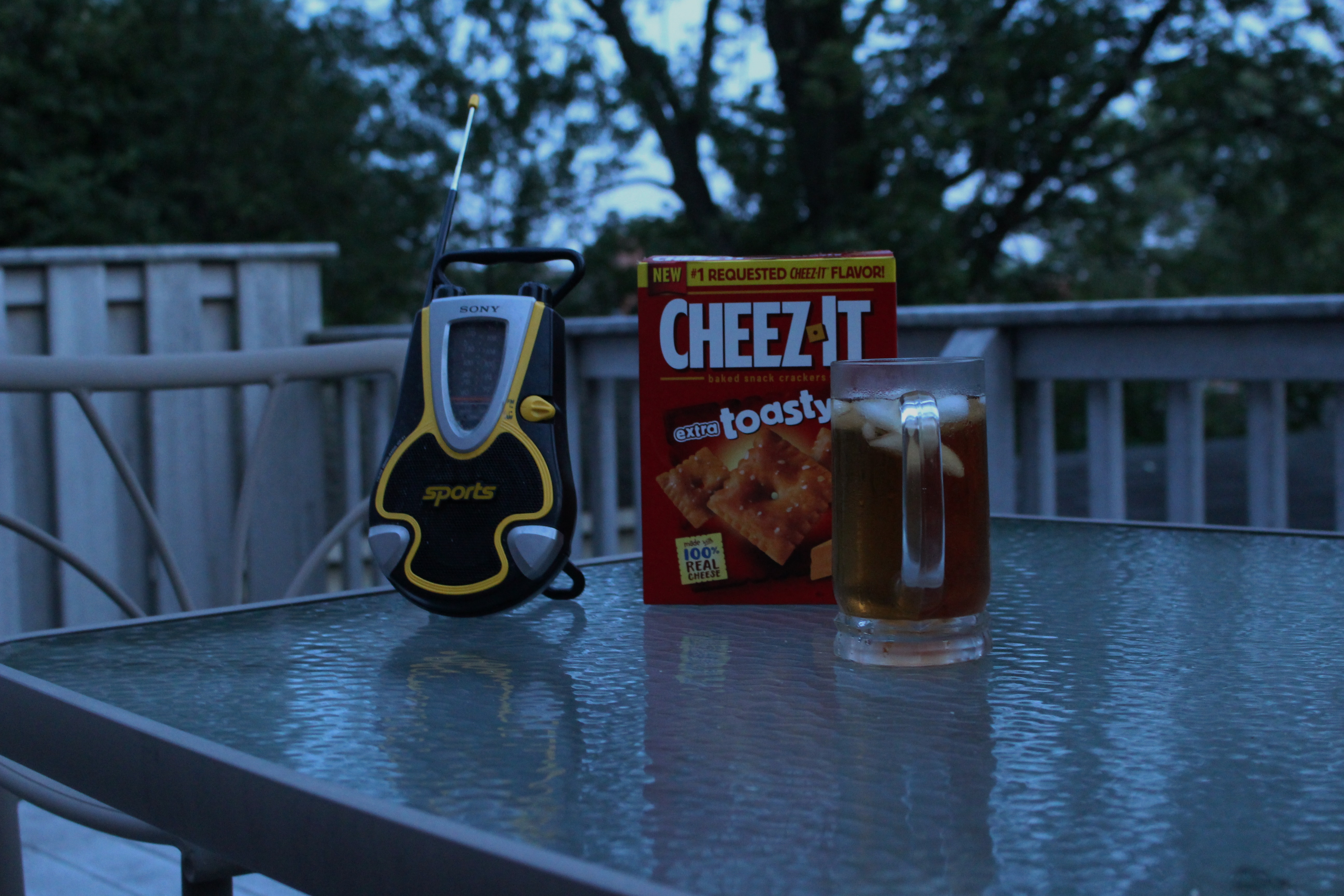
A scene at dusk: Cheez-Its, iced tea and portable radio on the deck table behind my house. Photograph by Sandra Cherrey Scheinin
A scene at dusk: Cheez-Its, iced tea and portable radio on the deck table behind my house.
Photograph by Sandra Cherrey Scheinin

I should emulate my friend’s fresh air example more often. I used to sit outside frequently, mostly on the deck behind my house, but haven’t much in the last few years. Most of my sitting and downtime in that stretch has taken place on the sofa in my living room. On a recent Monday night, however, a powerful urge to visit the great outdoors came out of nowhere, and so I stepped onto the deck as dusk was settling in, and sat at the deck table. The temperature was ideal, the evening peaceful. At least ten houses are within 100 feet of the deck, but they became less and less visible through the trees as blackness approached. These were conditions that agreed with my inner yearnings. That is, I felt isolated, away from it all. And three things made the scenario even better: Food, beverage and music. Munching on Cheez-Its,  sipping iced tea and, most important to this story, listening to my portable radio, I was as relaxed as I’m capable of becoming. The radio was tuned to WXPN.

In the Philadelphia region WXPN is the go-to station for rock, folk, blues and nearly any other non-Ariana Grande musical genre you can name. XPN plays everything from The Beatles to Mavis Staples to Caetano Veloso to Laura Marling. And the station makes it a mission to keep up with the continual avalanche of recorded music from established and never-heard-of-them-before musicians. Airing on XPN as I sat beneath the stars and amidst pulsating fireflies was a program showcasing nothing but new songs. And the tune that issued from my radio at about 9:00 PM swept me from my state of relaxation to a much higher plane.

There are certain songs over the years that infatuated me from the moment I first heard them. In 1968 it was Jumpin’ Jack Flash, by the Stones. To this day it stirs me up every time I hear it. California Stars, by Billy Bragg and Wilco (and lyrics by Woody Guthrie), brought me to my knees in 1998. I’ve added another number to the list of instant infatuations, all praise to WXPN’s new music show. The song is Ashes. Its singer and writer is Lindi Ortega. Ashes overwhelmed me on my deck. I think that the calm within and without me had unlocked fully the doorways to my emotions and ushered Ashes in. From its opening notes, Ashes in a good way made me shiver and melt. It went straight to my truest spaces.

I had come across Lindi Ortega’s name in print in the past but wasn’t familiar with her music. As I’ve learned, she’s a Canadian now living in Nashville and plays and composes smart country-hued material à la Emmylou Harris and Patty Griffin. With Ashes she and her production team have created a wonder, a stirring song about the need for love, the pain of loss. The heartbeat bass lines, the steady tension-inducing drumming, Lindi’s pleading and impassioned vocals that grow as the song develops, the soul-gripping guitar solo at the song’s three minute mark . . . Ashes to me is perfection. “Darling, this is madness, why don’t you come back to me?/Don’t leave me in the ashes of your memory.” Indeed. Indeed. When Lindi next appears in or around Philadelphia I’ll be at the show. For now, I’ll listen to Ashes on YouTube, where Lindi has gifted it to the world in advance of its release next month on her album Faded Gloryville. I recommend that you do the same. Here is Ashes:

(If you enjoyed this article, then please consider sharing it. Thanks.)

Yeah, Another Beach Boys Article

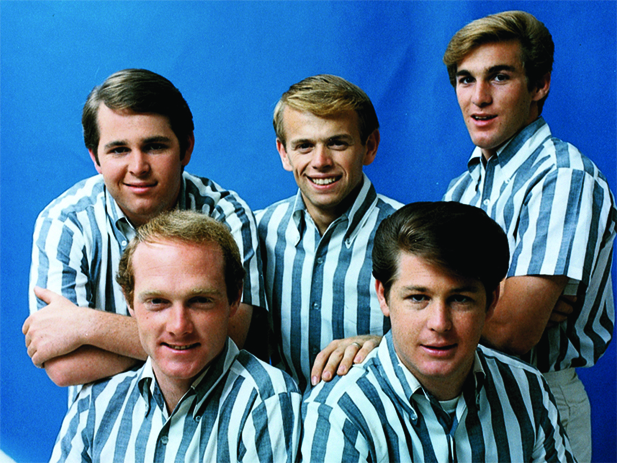
The Beach Boys early in their career. Photo: Capitol Records Photo Archives
The Beach Boys early in their career.
Photo: Capitol Records Photo Archives

Since The Beach Boys broke big on the charts in late 1962, media coverage devoted to them, collectively and individually, has been enormous. And now with the theatrical release of Love And Mercy, a biopic not so much about The Beach Boys as about their once-brightest star, Brian Wilson, the attention has been renewed. At first I was reluctant to add my puny thoughts to all these decades’ worth of Beach Boys coverage. But I’ve maintained a very warm place in my heart for the Boys, and viewing Love And Mercy has inspired me to set my fingers on a keyboard.

The Beach Boys’ history is immensely complicated and convoluted. I’ll summarize what I know fairly briefly: Three of the five original Beach Boys were siblings. From oldest to youngest they were Brian, Carl and Dennis Wilson. Add one cousin, Mike Love, and one pal, Al Jardine, and the recipe is complete. Brian, the band’s leader and creative pulse, was a gifted composer and orchestrator whose talents burgeoned, though for only a few years, as the 1960s progressed.

Teen and twenty-something idols, the Boys knocked out hit after hit right from the start (Surfin’ Safari, Surfin’ USA) through 1966 (Wouldn’t It Be Nice, Good Vibrations). But Brian was a victim of mental and emotional demons that caused him to begin losing his grip in 1967 during sessions for the high concept album Smile. Brian guided the band, and many studio musicians, part of the way through Smile, which was meant to be a celebration of earthly and universal creation. But his troubles brought the work to a sputtering end. Unfinished, the album was shelved. At that point, age 24, Brian’s best musical days were behind him. Though he remained a Beach Boy, his songwriting and studio session contributions to the band soon grew fewer, and his appearances with them on stage over the next several decades were sporadic. The Beach Boys soldiered on nonetheless, churning out many albums and nabbing a few more hit singles. And they toured the world (usually sans Brian) over and over.

As started to become public knowledge in the mid 1960s, Brian’s problems hardly were the only painful situations within The Beach Boys. Their story, beyond the music, is a messy one of endless internal conflicts and legal disputes, drug abuse and, ultimately, death. Very sadly, two Beach Boys passed at youngish ages. Dennis Wilson drowned in 1983 soon after his 39th birthday.  Carl was taken by lung cancer in 1998 when he was 51. Carl many years before had become the band’s chief, taking over from the no-longer-able-to-lead Brian. The band fell apart after Carl’s death.

Hey wait, you say, The Beach Boys are on the road every year, just as always. Well, Mike Love and Bruce Johnston (who had joined the group in 1965) have continued to tour as The Beach Boys. But without any of the Wilson brothers the Love-Johnston unit is hardly the real thing. In 2012, though, Brian (and Al) joined Mike and Bruce for a 50th year reunion tour that went well, only to conclude on a sour note.  Love refused to add additional concerts beyond the tail end of the original schedule and in effect booted out Wilson and Jardine. As usual, fun fun fun might have been the image The Beach Boys wished to project, but reality was a whole different ballgame.

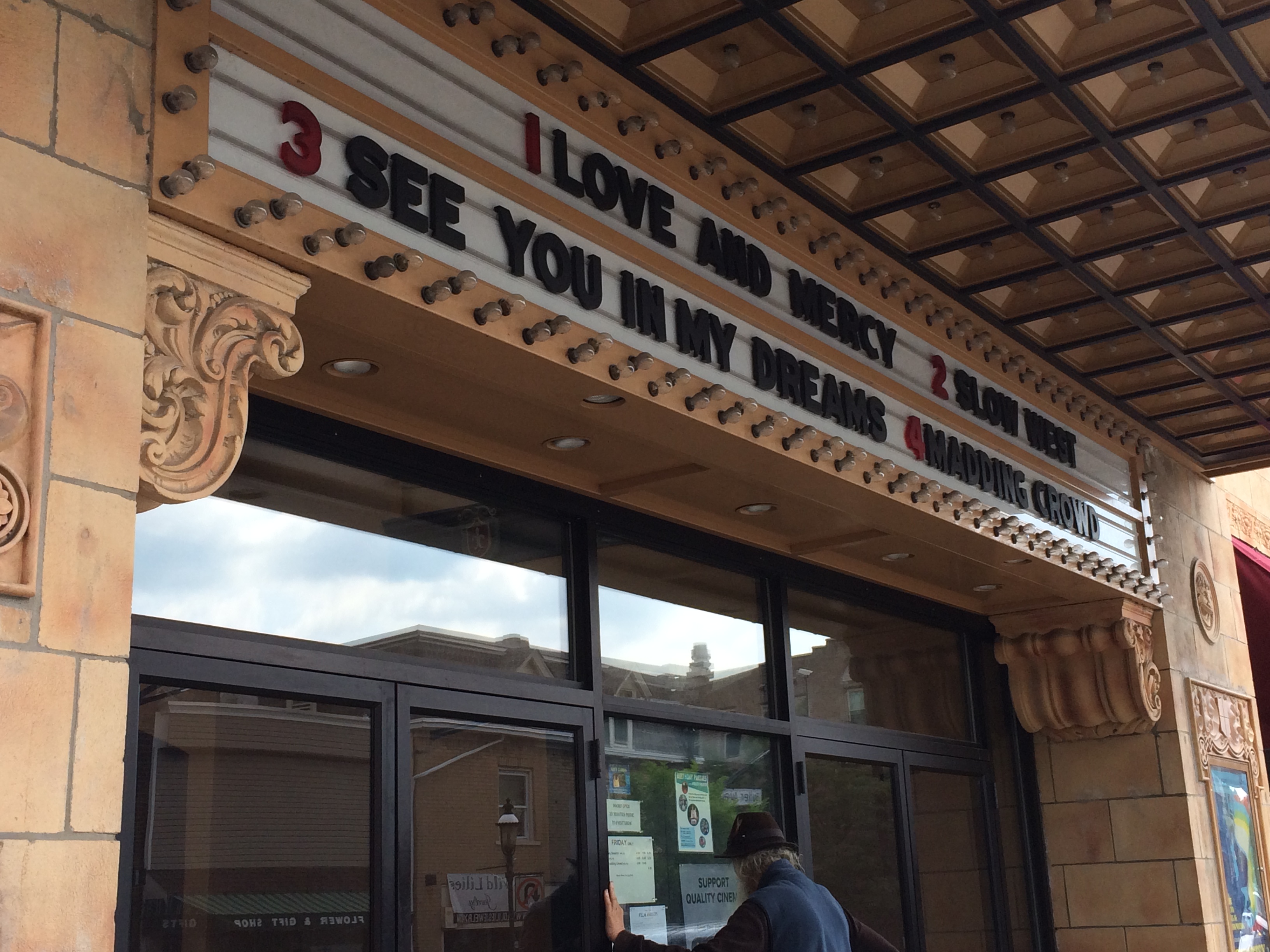
Love And Mercy, playing at the Ambler Theater.

Who, then, in 2015 would have expected the release of Love And Mercy? Not me. At first I didn’t want to see the movie. I’ve read more than enough about The Beach Boys over the years, spent many hundreds of hours listening to their music. No offense to the Boys or their legacy, but my limit, or so I thought, had been reached. Until a friend told me that the movie is really really good. And thus my wife Sandy and I found ourselves on a recent Saturday at our favorite suburban art house, the Ambler Theater. There I learned that my friend was correct. Love And Mercy is really really good. Three and a half out of four stars.

Love And Mercy has the feel of truth. And from what I’ve read, its portrayal of events actually is quite true. The acting by the leads is nuanced and impressive. The script is tight, the direction too. There are a few cardboardy plot and dialog lines here and there. The rest, however, is gold. One need not be a Beach Boys freak to enjoy this movie. Sandy isn’t. She doesn’t know much about their musical history or their problems. She found the movie to be what in fact it is, a powerful drama. She agrees with my rating.

As I’ve mentioned, the movie is only partly a full examination of the Beach Boys. Dennis, Carl and Mike are portrayed a good bit, but they aren’t central to the story, and the actor playing Al Jardine is barely on camera. Love And Mercy largely is the tale of Brian Wilson and Melinda Ledbetter, the lady who loved Brian and brought him back from agony’s door and the clutches of manic psychotherapist Eugene Landy (potently depicted by Paul Giamatti) in the 1980s. The main action takes place in two time periods, 1965 through 1967, and 1985 through 1989 or so. The movie jumps back and forth between those eras. Paul Dano portrays the younger Wilson, John Cusack the older. Both are wonderful, as is Elizabeth Banks as Melinda.

A good number of the movie’s sequences with Dano realistically and clearly show Brian’s studio wizardry. The Cusack sections often touchingly shine a light on the developing romance between Wilson and Melinda, whom Brian met in 1985. I think that to tell any more about Love And Mercy wouldn’t be fair. Putting the movie aside, what to me is quite astonishing is that Brian Wilson is above ground and going strong. He has dealt with abusive forces that no decent person deserves to encounter, and has rebounded from low-as-you-can-go points to a most active musical career. He’s on tour right now. With a lot of courage and strength, and with a lot of help, he has survived.

Raul Malo Alone On Stage

New Hope Winery. The concert took place inside the Event Center.

I don’t much enjoy the artsy and touristy central section of New Hope, Pennsylvania. Haven’t been there in several years. The crowds, the traffic, the bad news parking situation. Who needs it?  But I have been to New Hope’s fringes a bunch of times last year and this year, as I mentioned in my article about Kim Richey. The New Hope Winery lies a couple of miles south of the “I’m not going there” zone, and that’s where my wife Sandy and I have become semi-regulars.

Pre-showtime.
Before showtime.

Behind the winery’s gift shop is a roomy building dubbed the Event Center. On its small stage the winery presents a nice variety of musicians year-round. On Thursday evening, June 18, Raul Malo, lead singer of The Mavericks, stepped into the spotlight. Malo is on tour with The Mavericks but took a short solo side trip to New Hope, where he had played the previous evening too. The next day he’d be back rocking and rolling with his band in Rochester, New York. But in New Hope the audience got a full dose of his contemplative side. He picked up his acoustic guitar at 8:10 PM, and for the next 100 minutes had the audience, me and Sandy included, in the palms of his hands.

Raul Malo has been a pretty big name for the last 25 years. His voice is the reason why. It’s a rich tenor, wide-ranging, and moves nimbly in upper registers where others may fear to tread. In New Hope Malo brought the volume and assured passion at appropriate times, but largely kept things reined in. The point is that he has wonderful vocal taste and great control. His singing is a thing of beauty.

Raul Malo in action.

I’d seen Raul on television, heard him perform on the radio, but New Hope was my first live visitation with him. He sang 17 songs, ten of which he wrote or co-wrote. I was smitten from the git go, but in a million years wouldn’t have guessed his choice for show opener. Picking his guitar slowly and easily, he quietly sang not one of his own numbers, but Summer Wind, the tune made famous by Frank Sinatra in 1966. Raul did the song proud.

Summer Wind is a lament about lost love. All 16 songs that followed, self-penned and not, also were about love in one way or another. Love in bloom, love desired, love remembered. Raul covered all bases. I never thought I’d hear a version of Harvest Moon, a gorgeous and pure love song, to rival that of its author, Neil Young. But Raul came close, singing with restrained emotion, hitting the high notes with clarity. He did excellent work on his own Born To Be Blue, and Lucky One, the Roy Orbison-like operatic qualities of his voice emerging on those two numbers.

The most stunning moments arrived late in the show. (Call Me) When You Get To Heaven gave me goose bumps. Raul wrote this song for The Mavericks’ In Time album. From my seat 15 feet from stage left, I took it as a song about a breakup, a relationship not meant to succeed on planet Earth but destined to flower in a better place, maybe one of the mind. Raul sang slowly, mournfully. He drew out the song for many minutes. When introducing the tune, he had asked the audience to join in towards the end. They did. And that’s where the goose bumps came in. Though surely some males were part of the choir, somehow I heard only female tones. As Raul fingered the refrain’s chords over and over, angelic sweet voices rose throughout the room. Call me when you get to heaven . . . Call me when you get to heaven. It was just so beautiful.

Raul Malo from a different angle.

During that number I realized who Raul reminds me of. José Feliciano. Like Feliciano, Malo possesses both fervor and quiet strength, and the ability to be in-the-moment. None of this was lost on the near-capacity crowd seated at the room’s red tablecloth-covered cocktail tables. They went wild with claps and yells between songs. But when Raul sang, they were seriously silent and attentive. Raul loved them back. Happy, laughing and joking around during the interludes, he especially made the night for a lady celebrating her birthday at the show. She was a super fan, it turns out, saying that this was the 80th time she had seen Raul perform. To honor her, he sang Can’t Help Falling In Love, the Elvis hit from 1961. And then he threw out two of his best and funniest lines of the evening. I hadn’t planned to use any profanity in this blog, though I curse aplenty in my non-blogging life. But I’m going to repeat verbatim what Raul Malo said after the final guitar strums of Can’t Help faded away. “That ought to buy me some karma points. Now I can go back to being a shit.”

A worthy side note about choice. The night that Sandy and I were in Malo pastures, two other splendid musical events were available not far away in the Philadelphia suburbs: The Richard Thompson Electric Trio and Graham Parker And The Rumour, great bands that must have brought down their respective houses. For discriminating music fans of any age, June 18 presented one of those uncommon convergences when deciding where to pay one’s money was a tough call.

John Gorka Brings Love To The Philly Burbs

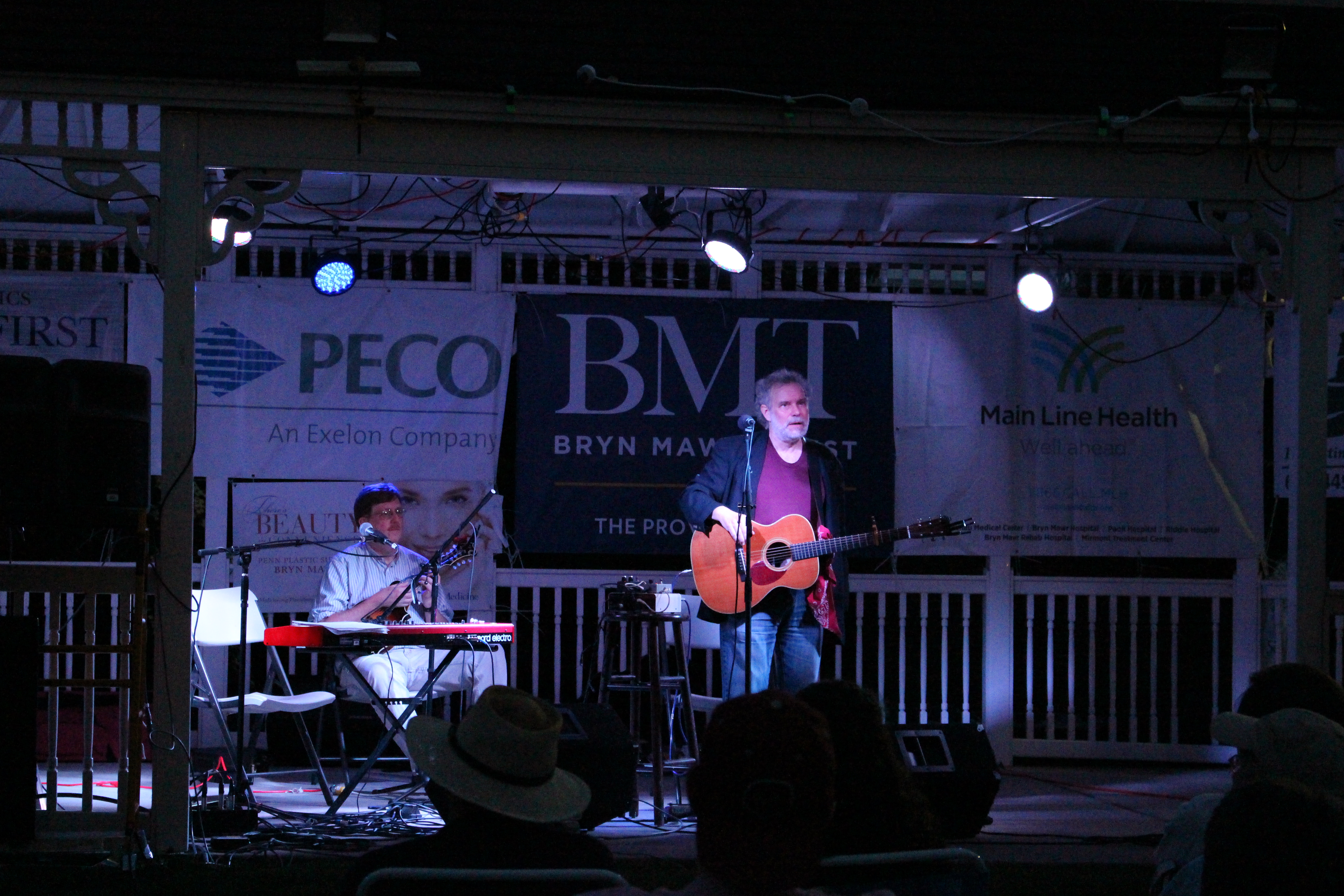
The audience, before twilight set in, at Bryn Mawr Twilight Concerts.

I’m always on the lookout for live music. My musical tastes are wide, so my antenna is open for jazz, rock, Celtic, classical  . . . the list keeps going. One series I keep tabs on is Bryn Mawr Twilight Concerts, held on mid-year Saturday evenings at a park in the center of Bryn Mawr, Pennsylvania, a handful of miles west of Philadelphia. This series brings in some rock and R&B bands, but primarily sticks to acoustic folkie singer-songwriter types, most of the latter well known in that genre’s circles. The musicians set up shop in the park’s large gazebo. I had noticed a few weeks ago that the series opener on June 6 would be John Gorka, a singer-songwriter road warrior with over 30 years’ worth of original material to draw from. On Gorka Day, I checked the Bryn Mawr weather forecast. It emphasized a zero chance of rain. Bryn Mawr here we come. As the sun began approaching the horizon, my wife Sandy and I plunked ourselves down in our folding chairs, joining about 200 others at the park, and settled in for what we expected would be a night of good music. The skies were filled with friendly clouds, the air cool and dry. Hardly a better place to be.

I’ve been familiar with John Gorka for many years, but had seen him in person only once. That was about six years ago at the Philadelphia Folk Festival, where he was part of a round-robin song swap with other musicians on a small stage. I knew his backstory a bit, how he had honed his craft at the legendary Godfrey Daniels folk music club in Bethlehem, PA, and how his career began to take off around the time his first album, I Know, came out in 1987. Since then, he has logged too many miles to count in North America and overseas. The Bryn Mawr show probably was somewhere around the 3,000th concert performance of his career. During that career, Gorka has tended to take the solo route — Have Guitar, Will Travel — but on this refreshing Bryn Mawr night he brought along a friend.

Music critics often note the fine quality of Gorka’s baritone. That’s true. His voice is deep and burnished, but he doesn’t go for extra volume. Soothing and comforting are words I’d use to describe his singing.  He’s like a lower register version of James Taylor. Between songs he is funny and somewhat jittery, slyly putting himself down and reminding me a bit of Woody Allen. The Bryn Mawr audience loved his on-stage personality, which might very well be his real life personality too.

John Gorka with guitar, backed up by Russ Rentler with mandolin.

From within the gazebo he sang only self-penned songs, 20 in all. Four came from I Know, and five from his latest release, 2014’s Bright Side Of Down. The newer material was as smart and flavorful as the songs from his young man days. His pool of inspiration hasn’t dried up. For the ninth song of his 100 minute set he brought to the stage Russ Rentler, his mandolin-playing pal since the late 1970s. I figured that Russ would garnish a couple of tunes and then depart. Better, he remained till the concert’s end. The mandolin’s tight and high tones, the swirling notes from Russ’s fingers, added a lot of energy and contrast to the music. Gorka’s vocal and guitar work through the first eight songs were just fine, but Russ took the performance upward.

John Gorka’s makeup leads him to produce songs that unfold mostly at slow or medium paces. Which is fine with me. He examines love and relationships regularly, as do nearly all songwriters. And he also writes about people’s day to day struggles. I connected with nearly all of the songs he sang. I’ll mention some lines that made my ears bend stageward.

Love Is Our Cross To Bear is a gentle song about falling in love. It comes from I Know. As the air began to chill with descending twilight, and I realized how wise Sandy had been to tell me to bring along a light jacket, Gorka sang, “I didn’t know that I would find a way to find you in the morning/But love can pull you out of yesterday as it takes you without warning.” Beautifully put, John. And five tunes later he reached into Bright Side Of Down and gave us Outnumbered, a love song for his wife. Gorka’s voice, steady and strong, was something you could believe in. He sang, “Suddenly you were there behind a smile, behind a name/After that summer day I’d never be the same.”

John Gorka is a romantic. And he put on a good show.

Listening To The Beatles’ White Album With Fresh Ears

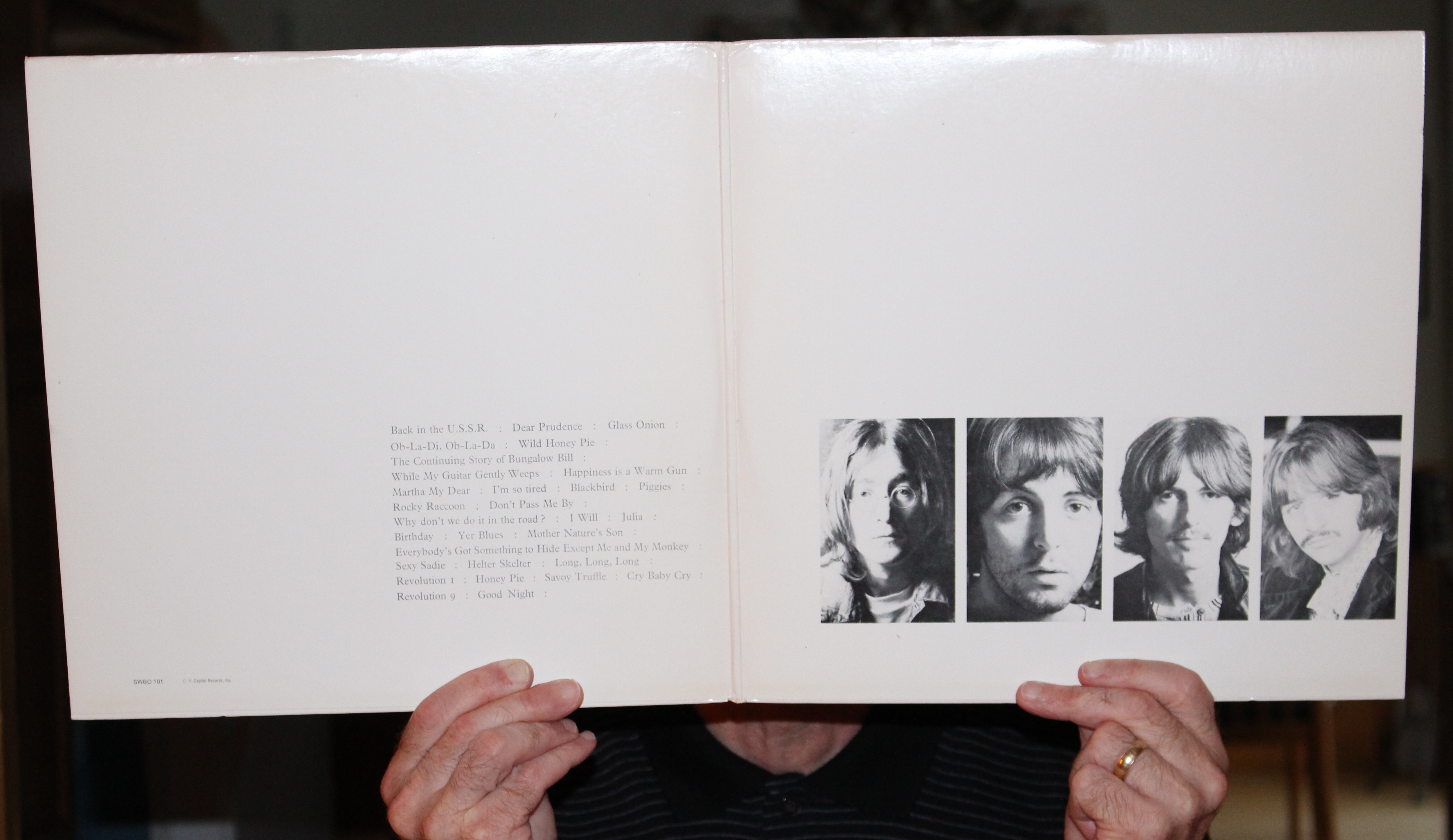
The author with his well worn vinyl edition of The White Album.

One year ago, for no particular reason, I decided to compile a list of my 30 favorite records of all time, limiting myself to only one album per artist. I excluded classical music and non-vocal jazz from the list. In other words I stuck to recordings that fall within the amorphous definition of vocal popular music. The Kinks (Muswell Hillbillies) made the list, as did Skip James (Today), Steve Earle (Transcendental Blues), Billy Bragg and Wilco (Mermaid Avenue), and Ella Fitzgerald (The Cole Porter Songbook). I came of age in the 1960s and, like hundreds of millions worldwide, I used to be a Beatles fanatic. So, needless to say, a Beatles album is on the list. It was hard making that selection, but I settled on their namesake creation, The Beatles, which is popularly known to one and all as The White Album.

Last week I remembered my list of 30 albums. One idea leading to another, I started wondering about which pop music album is the best of all time. Some of us would pick a Kanye West oeuvre, or something by The Cure or Stevie Wonder. Yet, there’s no doubt that a Beatles record would be top choice for countless folks. Maybe Sgt. Pepper’s Lonely Hearts Club Band. Maybe Abbey Road. Maybe The White Album. Picking one album from the millions that have been recorded is of course a somewhat foolish exercise. Most listeners have heard a meaninglessly small percentage of all there are to hear. Still, it’s an interesting proposition. I’m hardly the first to think about this. Oh well, late to another party.

The Web is full of lists ranking the best albums ever.  Rolling Stone magazine polled musicians and music industry folks in 2012 to compile a list of the all-time 500. The Beatles took four of the top 10 spots, Pepper coming in at number one, The White Album at number 10. Pitchfork magazine says that Kanye West’s My Beautiful Twisted Fantasy is the greatest of the 500 greatest. The first Beatles album on the Pitchfork list is number 71, Abbey Road. The White Album missed the Pitchfork cut altogether. Entertainment Weekly rated 100 records, and The Beatles proved to be EW royalty. Revolver ranked number one, and White took the twelfth position.

It’s time for another list, a very short list, and I’m going to keep my poll simple. I’ll poll only one person. Me. Though “favorite album” and “best album” aren’t necessarily one and the same, in my case I’ve concluded that they are. Hear ye, hear ye! The best pop album ever, of those that I know about (and I have heard a lot of albums over the years), is The White Album.

I’ve spun this recording on vinyl and CD a thousand times, but until last week hadn’t in at least a year. I listened twice and was taken aback, though I shouldn’t have been. I mean, The White Album is amazing, an aural kaleidoscope. It is modern, dazzling and delightfully tuneful. Some songs are heart-tugging. Others are witty, endearingly whimsical or downright wacky. Many rock like crazy, though a surprising number are tender ballads or spacey contemplations and not really rock at all. Regardless, The White Album hits with great song after great song, except for Revolution 9 (the less said about it the better) and maybe Martha My Dear, which is awfully treacly but which I like anyway. With each listening now and those many years before, White has revealed textures, accents, wonderful backing vocals and sound manipulations that I hadn’t noticed before. It’s that kind of album.

Part of The White Album’s brilliance is its sheer size. On vinyl and CD it is a double disk holding 30 tracks. It is maybe a sort of miracle that the record turned out so well, as The Beatles were starting to unravel during its making. Before the recording sessions began, though, things were pretty copacetic in Beatlesville. In spring 1968, John, Paul, George and Ringo spent time learning Transcendental Meditation in India at an ashram run by Maharishi Mahesh Yogi. It was a productive musical period for the boys, as most were. They wrote many songs while there, though apparently John and Paul composed largely individually, collaborating very little. About two-thirds of The White Album comprises songs from the India adventure, including Ringo’s first compositional effort, Don’t Pass Me By.

Recording sessions for The White Album began on May 30, 1968, and lasted for four and a half months. The sessions were often bumpy. The Beatles had previously made albums basically as a fenced-off unit with their producer George Martin and various engineers. Not true for White, as Lennon frequently brought Yoko Ono to the studios. John and Yoko had become a couple earlier that year. Yoko’s presence changed the working dynamics that McCartney, Harrison and Starr were used to. Inevitably, verbal squabbles punctuated some sessions. Tensions rose. In June, one of the chief engineers couldn’t stand the atmosphere anymore and quit. Worse yet, halfway through the sessions Ringo fell victim to feelings of self-doubt and frustration and left the group. His bandmates begged him to return, and 12 days later he did.

All of this proves that, for bands, greatness doesn’t necessarily depend on internal harmony. Struggle and discord might still result in a magnificent end product. It’s true that a few of The White Album’s tracks were recorded by only one Beatle (just John on Julia; just Paul on Blackbird), but the Fab Four stuck it out as best they could and played together on most songs. And what they created sounds as fresh as if recorded yesterday.

Listening to The White Album last week, various songs jumped out at me. Hellter Skelter is a grinding heavy workout, a wonder. Long Long Long, a Harrison composition in waltz time, is beautiful and airy, brought to a close by Ringo’s perfectly placed snare drum whack. Dear Prudence grips the heart, framed by chiming repeating guitar chords and lifted by angelic vocal choruses.

Speaking of Ringo, to me he is a star throughout The White Album, not only on drums but as a singer. He doesn’t appear on Dear Prudence or the album’s opening cut, Back In The USSR. They were recorded during his absence from the band. But elsewhere his drum work is nimble and creative, right on the money. And the album comes to a majestic close with Ringo’s gorgeous vocal work on Good Night, a lullaby credited to Lennon-McCartney but written fully by John. Ringo is the sole Beatle on Good Night. He sings so well, so tenderly, backed by a large orchestra and vocal choir. Who’d have thunk he could sing like this? It is the finest vocal performance of his career.

Michelle Lordi, Jazz Singer

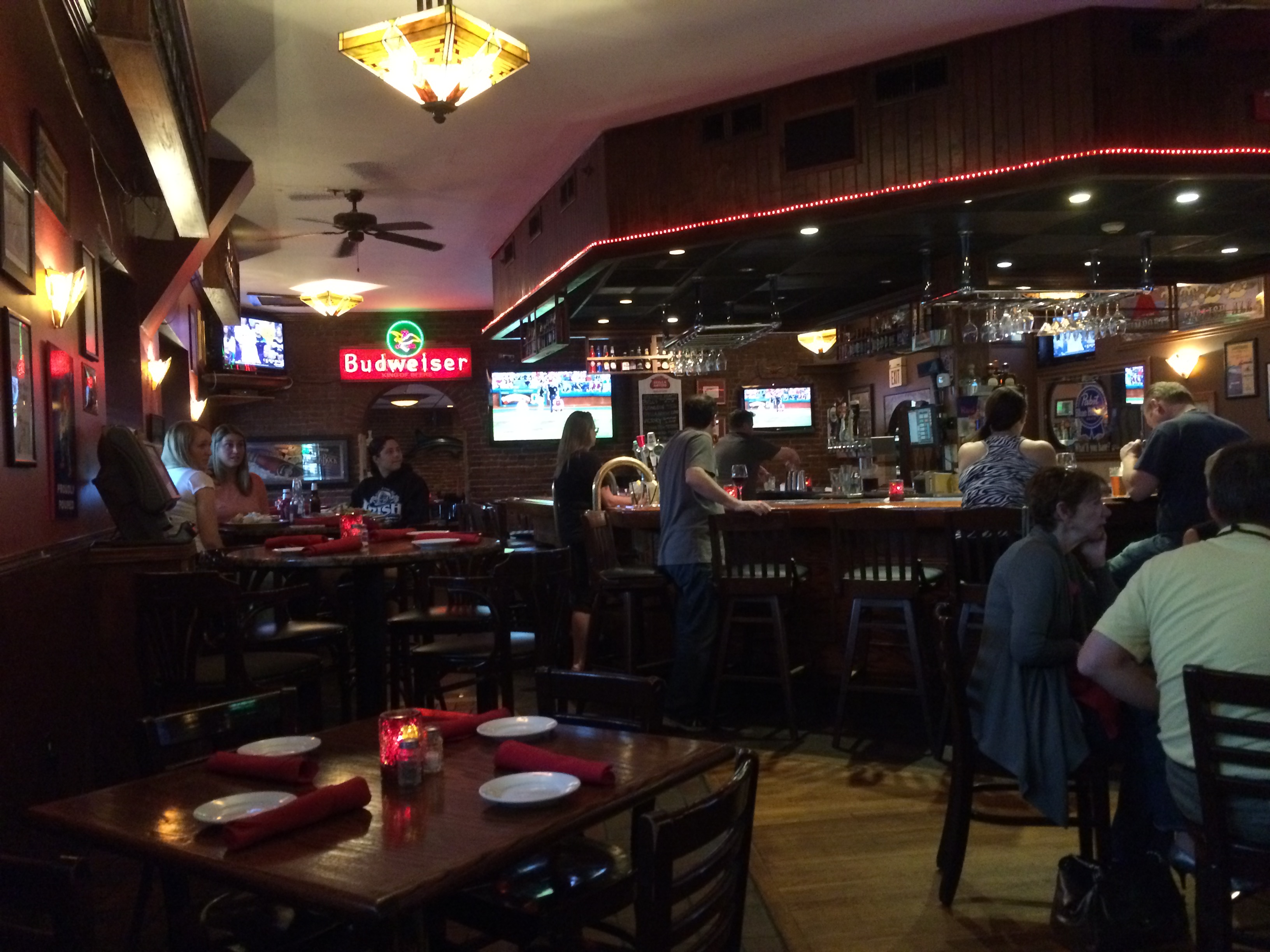
The main room at Vintage Bar And Grill, 10 minutes before the music began.

Vintage Bar And Grill in Abington, Pennsylvania is a good place. It’s a sports bar that serves up thoughtful food. There are plenty of televisions (seven in the main room), knick knacks all over the walls and a not bad selection of beers. And, duh, the place can get noisy, very noisy. So when my wife and I go there for dinner a couple of Fridays or Saturdays each year we are ready and willing to deal with mega decibels. Never had been there mid-week till a handful of days ago though, when on Tuesday we went not only for dinner but to hear some jazz. Most unlikely, Vintage is given over on Tuesday evenings to jazz vocalist Michelle Lordi and her musical partners.

The Philadelphia area, where I live, is home to lots of very good musicians in most musical genres, including jazz. The music biz being what it is, though, only a handful of musicians break through to decent-sized audiences. The rest, like Lordi, do what they can, sometimes maybe plying their craft at small unexpected spots like Vintage.

I’d known about Lordi’s Vintage gigs for a long time. I’d seen her name on a weekly email jazz-near-you schedule that I subscribe to, but I hadn’t given her much thought. Last week, though, the notion to see her bubbled up. Being musically in the dark about Michelle, I first checked her out on YouTube, and she sounded excellent. How was she in person? YouTube didn’t lie. She was great.

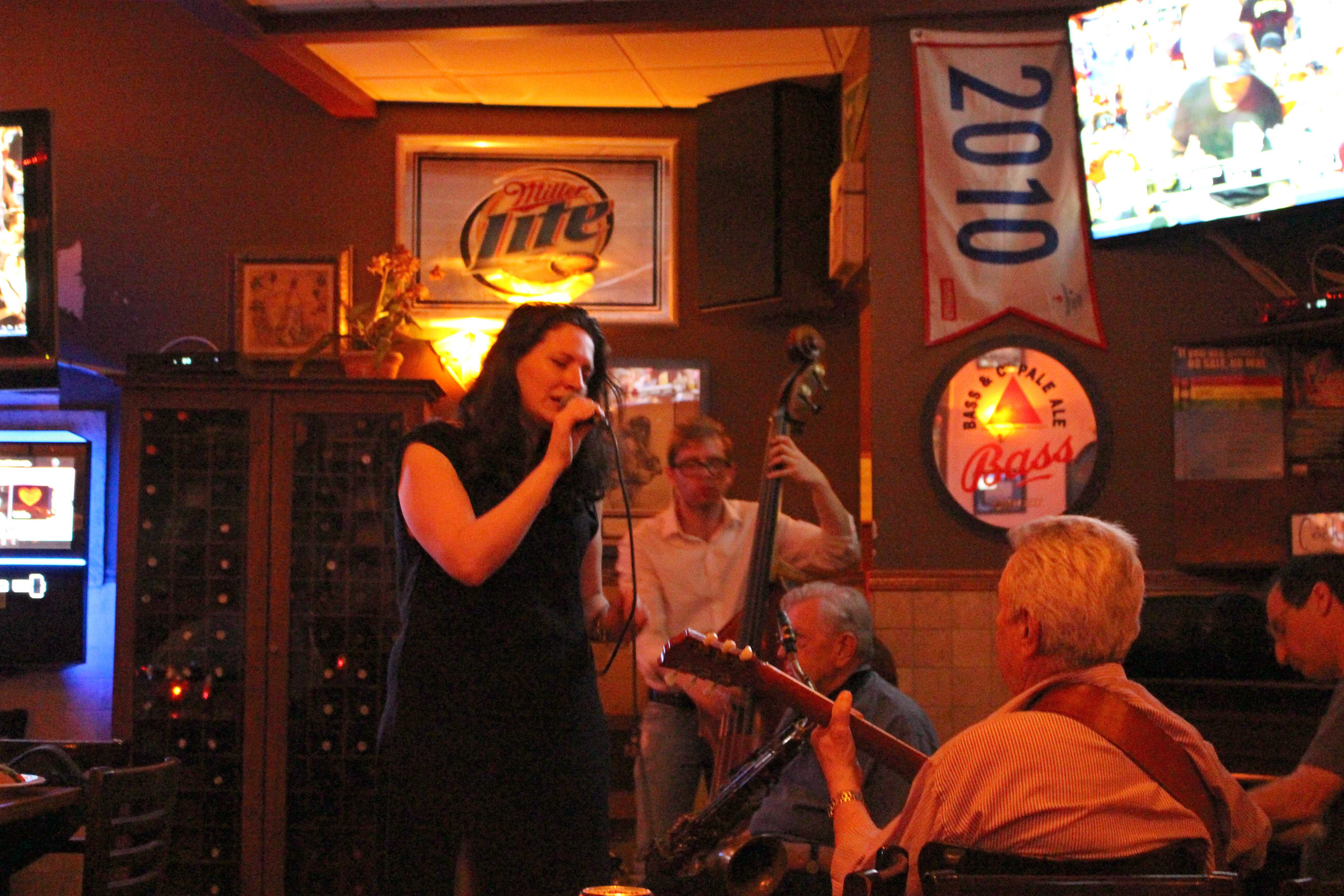
Lordi had with her four musicians she works with quite often. Two of them, tenor saxophonist Larry McKenna and electric guitarist Sonny Troy, are grizzled musical veterans, superb players with long and impressive resumes.  Neither I suppose is on the road much anymore, if at all. It says a lot about Michelle that they choose to play with her. The other two are young guys, Sam Harris on upright bass and Mike Frank on electric piano. They did a fine job at Vintage.

Michelle and her band set up shop in a tight Vintage corner near the main entrance. A hi-def TV, on mute, showed the Phillies baseball game above them. Maybe 30 customers were in the room for the first set, at best half of them listening to the music. Five feet from Michelle and one foot from Sonny Troy was a table of six. As the music played, these folks blithely chitchatted about their vacations and the goings-on of various relatives, groundbreaking news all of it. I tip my hat to musicians who learn to become immune to this kind of stuff.

Michelle Lordi is from the understated school of jazz singing. I’d bet that she has taken cues from Doris Day and June Christy, calm singers from the 1940s and 50s. Diana Krall is maybe today’s biggest jazz name who isn’t interested in vocal gymnastics or in bursting a vein reaching for a high note. I like this style of singing a lot. You hear it consistently with Brazilian bossa nova singers.

Michelle Lordi and her band at Vintage Bar And Grill.

During the one hour first set at Vintage, Lordi sang nine songs, standards from the American and Brazilian songbooks. She chose medium to slow tempos and sang efficiently and clearly in a firm and pretty voice. Lyrics came alive because she gave them room to breathe. Over Sonny Troy’s moody accompaniment, she slowed and elongated the words to Irving Berlin’s “They Say It’s Wonderful.” After a wise and moving Larry McKenna solo on Rodgers and Hart’s “I Didn’t Know What Time It Was,” Lordi sang unaffectedly, cleanly hitting the higher notes without strain or an excess of volume. The song  resonated.

Michelle Lordi performs pretty regularly at other venues in the Philadelphia area, such as Chestnut Hill’s Paris Bistro And Jazz Café. And she has done some recording too. But overall she is not exactly a household name. Unless I missed something, the set I took in at Vintage would have gone over just swell at the high-profile Village Vanguard or Café Carlyle in Manhattan or, closer to home, at Philadelphia’s Annenberg Center For The Performing Arts. Beautiful singing, assured and sympathetic instrumental work. Maybe one day I’ll be able to say “I saw her when . . . “

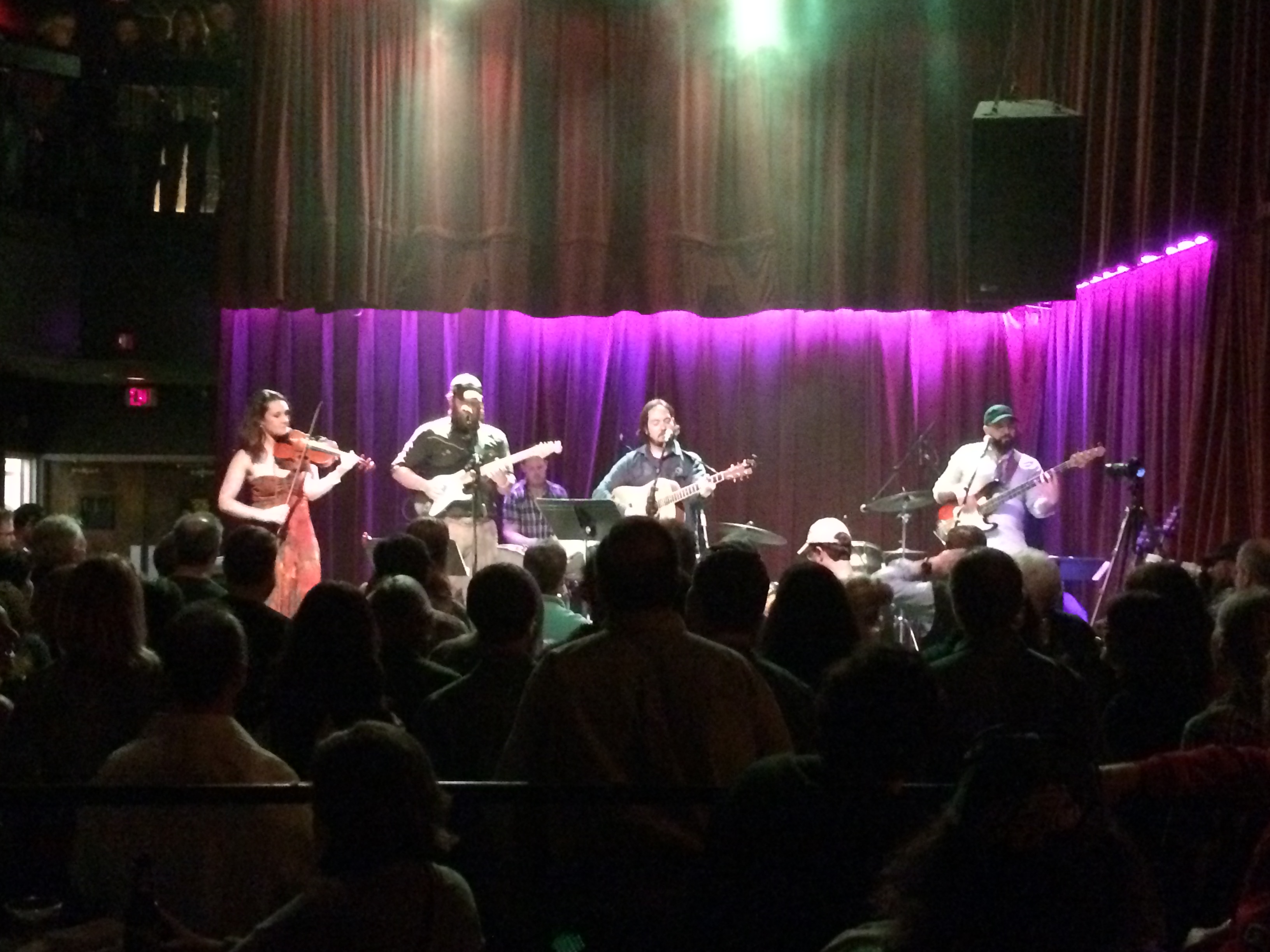
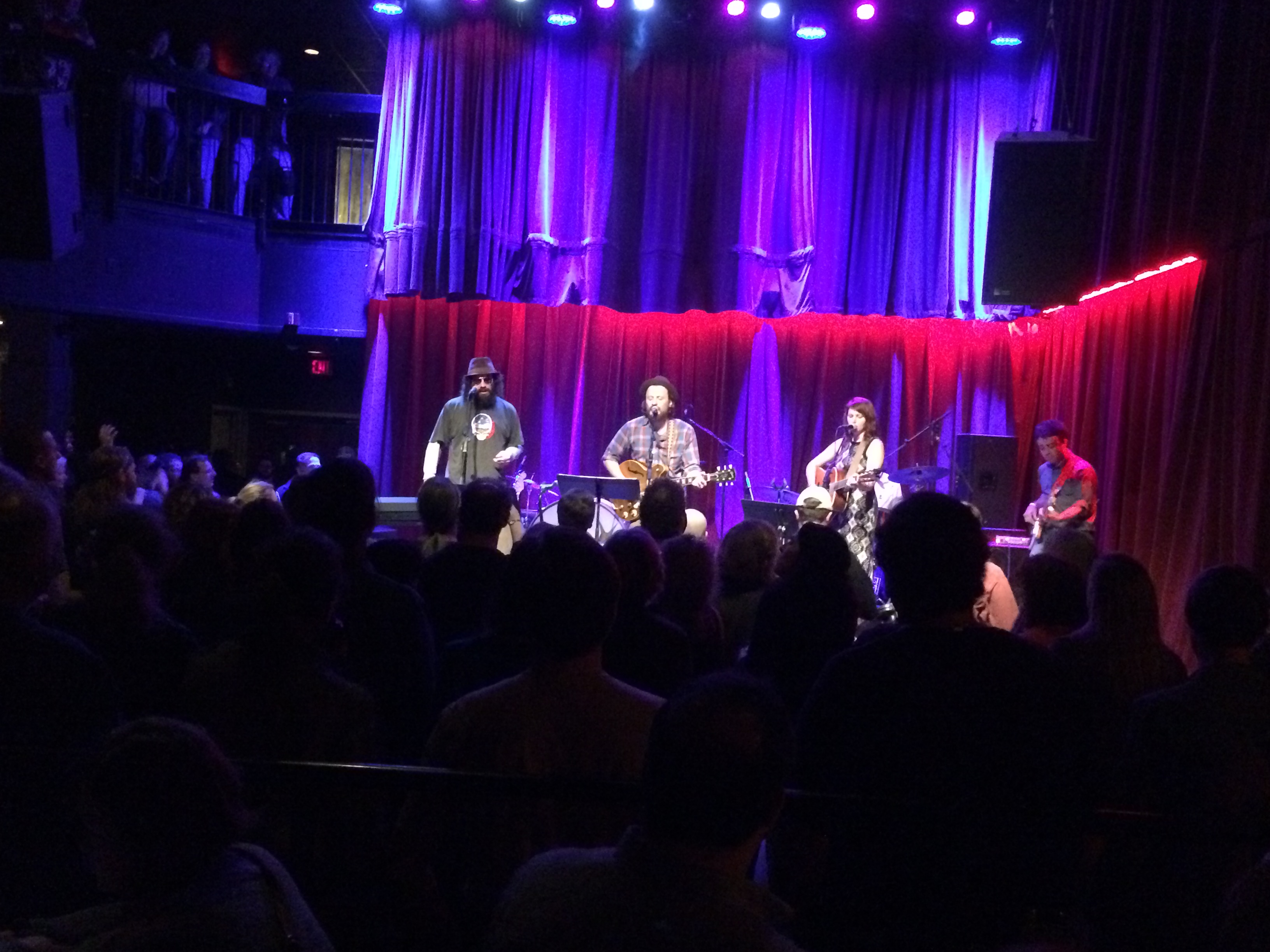
Mason Porter And The Chris Kasper Band Take On The Grateful Dead

1970 was a very good year for the Grateful Dead and a fairly good one for me. I was one year out of college, no long-term success plans in place, working here and there to earn a few dollars. But I was happy enough, I’m pretty sure. Unlike me, The Dead mined gold in 1970, recording and releasing that year what many agree are their two best studio albums: Workingman’s Dead and American Beauty. These albums were a big change from Aoxomoxoa, their pretty darn trippy effort from the previous year. The 1970 albums presented tightly arranged songs, many of them quiet and lovely ballads, straight out of the folk, blues and mountain music traditions. The 18 songs on these records shine with a timeless aura and are nothing but grand. The quality of the material probably took the Dead, and most everyone else, by surprise.

During a vagabond-like tour of the USA in summer 1970 I found myself in San Francisco for two or three weeks. I knew about the Dead (who didn’t?), but I don’t think I had any of their albums in my collection at that time. I wasn’t yet a fan. But in San Francisco, the Dead’s home base and where they had become emblematic of hippie culture,  I was smart enough to realize that I should go and see them if I had the chance. The chance arose, as they were booked for three nights in mid-August at the Fillmore West. I went to one of those shows. Workingman’s Dead had come out two months earlier, and the guys were already hard at work on American Beauty. It was a rich period. Sadly, for me the concert has almost disappeared into the fog. Well, I do recall a few things, such as standing in the middle of the Fillmore’s crowded open auditorium gazing at the stage. I also vaguely still can hear the band playing Casey Jones, the tune that brings Workingman’s Dead to its end. And I remember thinking that the concert was good but not great, an opinion that would have left Deadheads shaking their noggins in bewilderment. But memories about the show other than those  . . .  man, I could fill fifty books with all the things I’ve forgotten in my life, if the details magically could be jolted back into place.

Which brings us to April 29, 2015 at the Ardmore Music Hall in suburban Philadelphia. That evening I went with friends to watch two locally-based bands, musicians who had had the superb idea to play the Dead’s 1970 albums in their entirety, track by track. I’m writing this not long after seeing the concert, so my brain hasn’t had a chance yet to get fuzzy about the experience. And the experience was great. I enjoyed the concert in Ardmore more than I did the one in San Francisco 45 years ago.

The Ardmore Music Hall is in the midst of presenting five shows that celebrate the 50th anniversary of the Grateful Dead’s founding. The centerpiece show for me easily is the one I attended. Handling Workingman’s Dead was Mason Porter, which is a band not a person. The American Beauty duties fell to The Chris Kasper Band, a quintet that grew bigger on some songs with guest musicians. Both units lovingly approached the landmark albums, but didn’t try to duplicate the Dead’s sound. Each was pure rockier than the Dead, and each possessed something the Dead didn’t: a fiddler.  Three hundred or more folks packed the Ardmore, ages 20 to 70 all heavily represented and swaying and hippie-dancing to the tantalizing beats.

Mason Porter at Ardmore Music Hall

The five-person Mason Porter had me going from note number one of song number one, Uncle John’s Band. The group built the tune in stages, reaching heady heights with lead guitarist Paul Wilkinson’s soaring Eight Miles High-ish solo. And they nailed the seven songs that followed. Lead singer Joe D’Amico had an easy and calm delivery, very much in the Jerry Garcia vein. Sarah Larsen’s Appalachian fiddling infused the band with a whole lot of grit. The crowd erupted in applause after her long solo on Dire Wolf. She was overwhelmed by this outpouring and smiled the biggest smile I’ve ever seen on a musician’s face. It stretched out of the hall and halfway to the next town.

The Chris Kasper Band at Ardmore Music Hall (CK is second from left)

For some reason I was delayed getting into The Chris Kasper Band. But they hooked me with Candyman five songs into the set and didn’t let go after that. Keyboardist David Streim brought strong and broad chordal waves to Candyman and the song took flight with Chris’s electric guitar work and fiddler Kiley Ryan’s sweet solo turn. Quite a night for female fiddlers, and not usual to find two at the same concert. On some songs Ryan exchanged the fiddle for an acoustic guitar.

Chris Kasper’s lead vocals were crisp and mellow all set. Like Joe D’Amico and many others, he’s partly from the Garcia school of singing. He alternated between acoustic and electric guitar and used the latter to drive Till The Morning Comes, snapping off white hot riffs like Keith Richards. Matt Muir’s firecracker drumming bounced that song outrageously, pop pop pop. Tremendous.

Truckin’ brought the band’s American Beauty homage to a close. But the night wasn’t over. Mason Porter and a few guests joined the Kasper outfit on stage and a four song Grateful Dead encore ensued. The energy in the Ardmore Music Hall grew to dangerous levels as the huge ensemble ripped through Goin Down The Road Feeling Bad, Bertha, Franklin’s Tower and Mr. Charlie. The music was ferocious, the audience insatiable. At 11:30 PM the last notes rang out.