Mason Porter And The Chris Kasper Band Take On The Grateful Dead

1970 was a very good year for the Grateful Dead and a fairly good one for me. I was one year out of college, no long-term success plans in place, working here and there to earn a few dollars. But I was happy enough, I’m pretty sure. Unlike me, The Dead mined gold in 1970, recording and releasing that year what many agree are their two best studio albums: Workingman’s Dead and American Beauty. These albums were a big change from Aoxomoxoa, their pretty darn trippy effort from the previous year. The 1970 albums presented tightly arranged songs, many of them quiet and lovely ballads, straight out of the folk, blues and mountain music traditions. The 18 songs on these records shine with a timeless aura and are nothing but grand. The quality of the material probably took the Dead, and most everyone else, by surprise.

During a vagabond-like tour of the USA in summer 1970 I found myself in San Francisco for two or three weeks. I knew about the Dead (who didn’t?), but I don’t think I had any of their albums in my collection at that time. I wasn’t yet a fan. But in San Francisco, the Dead’s home base and where they had become emblematic of hippie culture,  I was smart enough to realize that I should go and see them if I had the chance. The chance arose, as they were booked for three nights in mid-August at the Fillmore West. I went to one of those shows. Workingman’s Dead had come out two months earlier, and the guys were already hard at work on American Beauty. It was a rich period. Sadly, for me the concert has almost disappeared into the fog. Well, I do recall a few things, such as standing in the middle of the Fillmore’s crowded open auditorium gazing at the stage. I also vaguely still can hear the band playing Casey Jones, the tune that brings Workingman’s Dead to its end. And I remember thinking that the concert was good but not great, an opinion that would have left Deadheads shaking their noggins in bewilderment. But memories about the show other than those  . . .  man, I could fill fifty books with all the things I’ve forgotten in my life, if the details magically could be jolted back into place.

Which brings us to April 29, 2015 at the Ardmore Music Hall in suburban Philadelphia. That evening I went with friends to watch two locally-based bands, musicians who had had the superb idea to play the Dead’s 1970 albums in their entirety, track by track. I’m writing this not long after seeing the concert, so my brain hasn’t had a chance yet to get fuzzy about the experience. And the experience was great. I enjoyed the concert in Ardmore more than I did the one in San Francisco 45 years ago.

The Ardmore Music Hall is in the midst of presenting five shows that celebrate the 50th anniversary of the Grateful Dead’s founding. The centerpiece show for me easily is the one I attended. Handling Workingman’s Dead was Mason Porter, which is a band not a person. The American Beauty duties fell to The Chris Kasper Band, a quintet that grew bigger on some songs with guest musicians. Both units lovingly approached the landmark albums, but didn’t try to duplicate the Dead’s sound. Each was pure rockier than the Dead, and each possessed something the Dead didn’t: a fiddler.  Three hundred or more folks packed the Ardmore, ages 20 to 70 all heavily represented and swaying and hippie-dancing to the tantalizing beats.

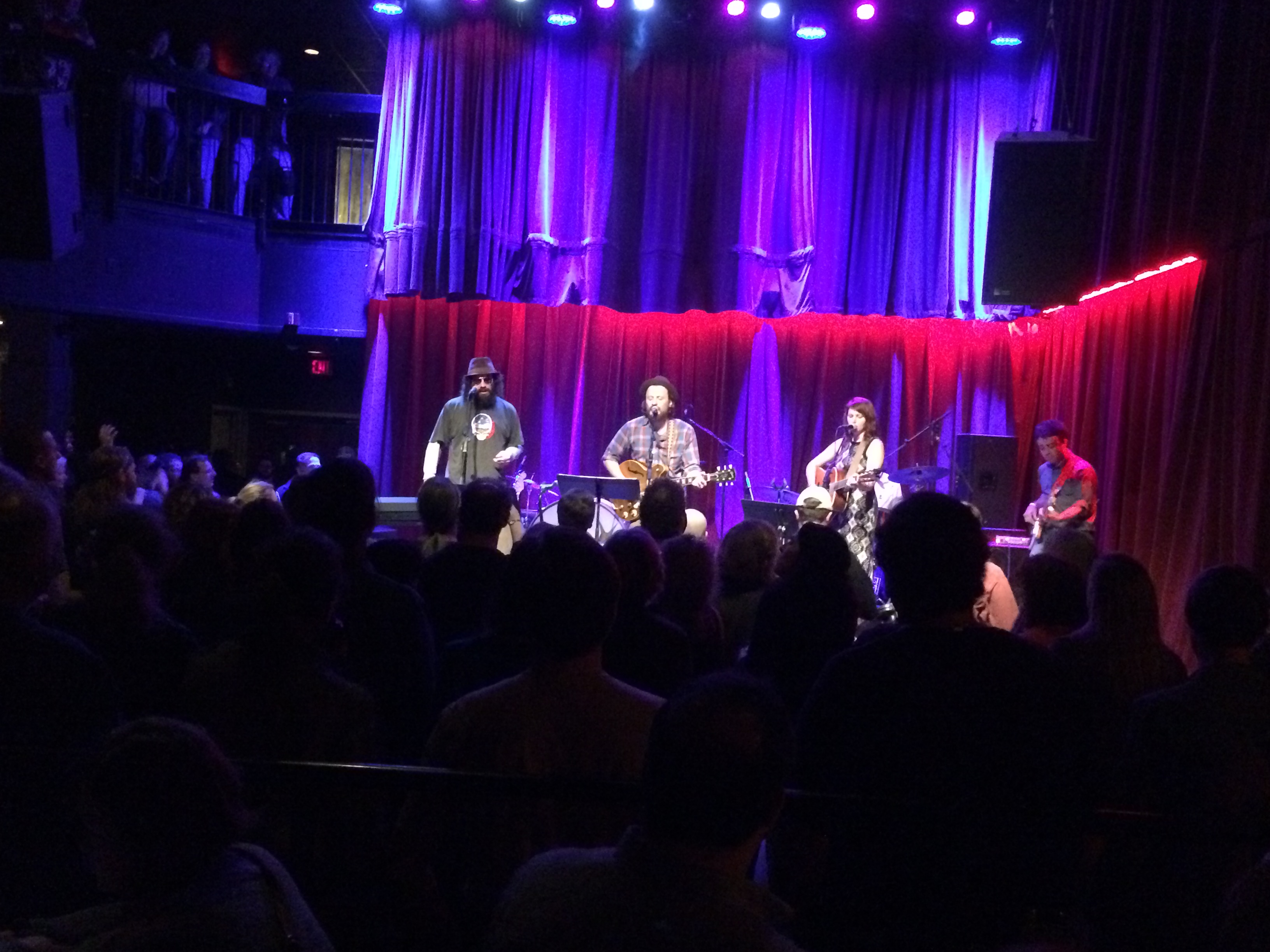
Mason Porter at Ardmore Music Hall

The five-person Mason Porter had me going from note number one of song number one, Uncle John’s Band. The group built the tune in stages, reaching heady heights with lead guitarist Paul Wilkinson’s soaring Eight Miles High-ish solo. And they nailed the seven songs that followed. Lead singer Joe D’Amico had an easy and calm delivery, very much in the Jerry Garcia vein. Sarah Larsen’s Appalachian fiddling infused the band with a whole lot of grit. The crowd erupted in applause after her long solo on Dire Wolf. She was overwhelmed by this outpouring and smiled the biggest smile I’ve ever seen on a musician’s face. It stretched out of the hall and halfway to the next town.

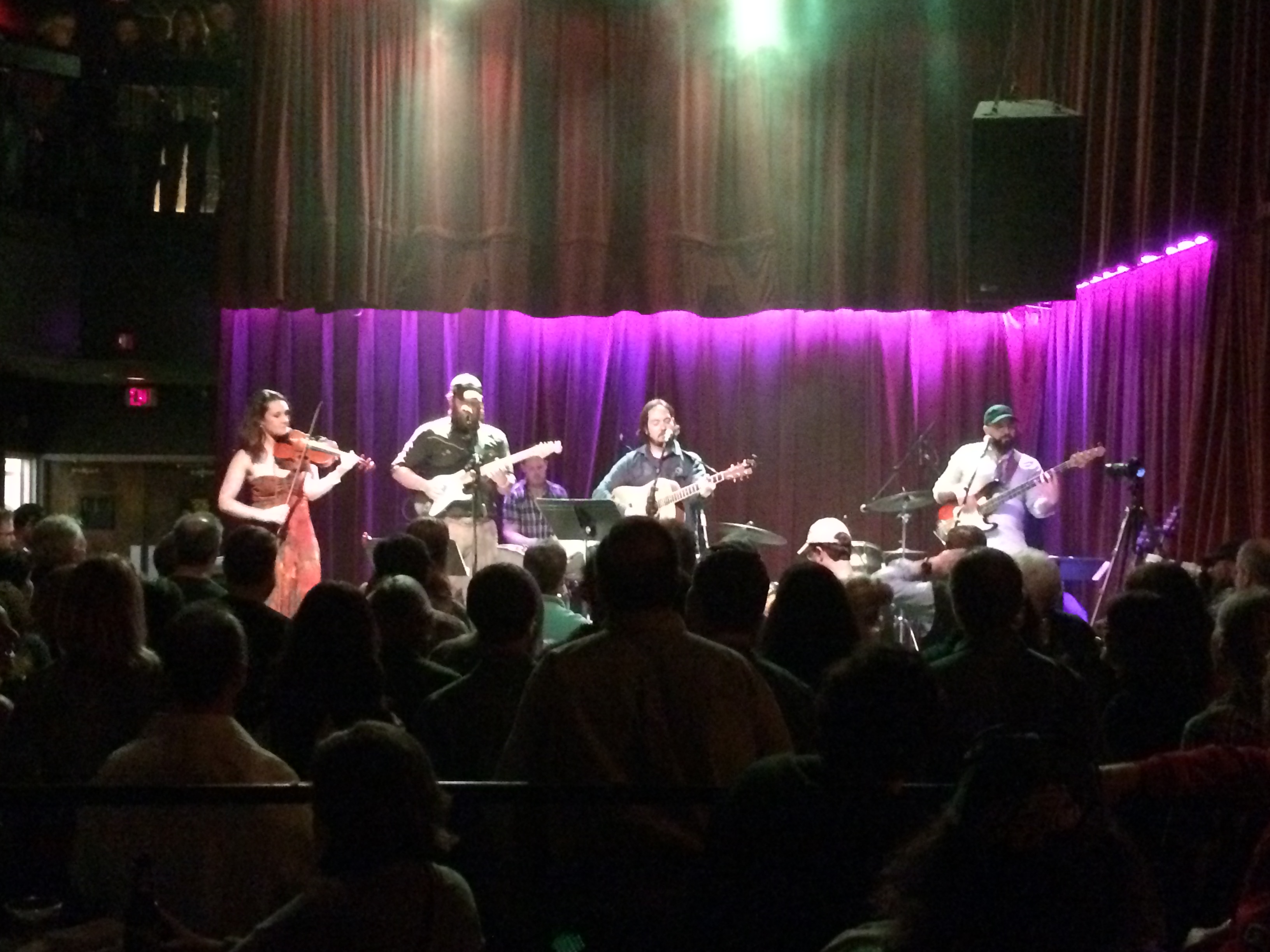
The Chris Kasper Band at Ardmore Music Hall (CK is second from left)

For some reason I was delayed getting into The Chris Kasper Band. But they hooked me with Candyman five songs into the set and didn’t let go after that. Keyboardist David Streim brought strong and broad chordal waves to Candyman and the song took flight with Chris’s electric guitar work and fiddler Kiley Ryan’s sweet solo turn. Quite a night for female fiddlers, and not usual to find two at the same concert. On some songs Ryan exchanged the fiddle for an acoustic guitar.

Chris Kasper’s lead vocals were crisp and mellow all set. Like Joe D’Amico and many others, he’s partly from the Garcia school of singing. He alternated between acoustic and electric guitar and used the latter to drive Till The Morning Comes, snapping off white hot riffs like Keith Richards. Matt Muir’s firecracker drumming bounced that song outrageously, pop pop pop. Tremendous.

Truckin’ brought the band’s American Beauty homage to a close. But the night wasn’t over. Mason Porter and a few guests joined the Kasper outfit on stage and a four song Grateful Dead encore ensued. The energy in the Ardmore Music Hall grew to dangerous levels as the huge ensemble ripped through Goin Down The Road Feeling Bad, Bertha, Franklin’s Tower and Mr. Charlie. The music was ferocious, the audience insatiable. At 11:30 PM the last notes rang out.

My Coca-Cola Relapse

How much cola have I consumed in my life? Thousands of gallons I’d guess. Not to mention the huge quantities of other soda varieties that have passed through my body. But cola always was my favorite. Coca-Cola, Pepsi, RC Cola, store brands – I proudly and happily drank them all. Over time, Coke became my top cola choice.

My cola habit was strong in my teens and went up some notches in my early 20s. But it ended in my mid-40s when I gave up cola and other sodas. All of that sugar for so many years, combined with sad dental hygiene, had made a mess of my teeth and gums. I needed to stop drinking the stuff, and it’s a good thing that my willpower was strong enough to follow through. I didn’t switch to diet sodas because I’ve never liked the taste of artificial sweeteners.

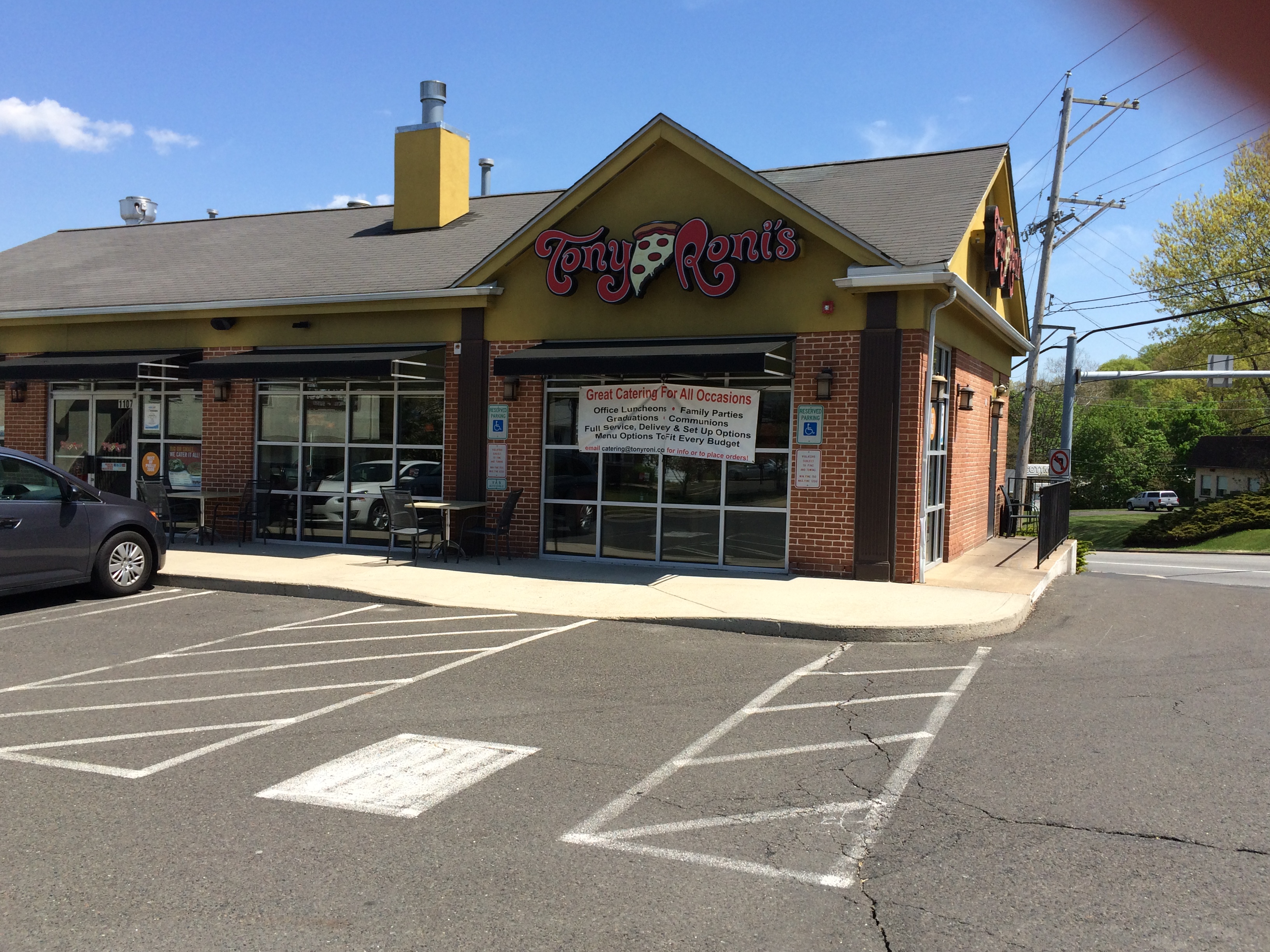
The scene of my relapse

But cola is back in my life. Coca-Cola, to be precise. Its return began not long ago at a pizza place I’ve been going to for a couple of years, Tony Roni’s. Roni’s resides at a remarkably congested and dangerous road intersection in Willow Grove, PA, not far from Philadelphia. Customers might somewhat put their lives in jeopardy to visit Roni’s, but that doesn’t keep them away. And that includes me.

I love pizza, especially the more traditional and unadulterated types, but I can’t find many by-the-slice places that make it the way I prefer: crisp charred crust, sweet tomato sauce, good quality cheese and not an overload of it nor of oil. Tony Roni’s traditional pies seem to vary in quality from visit to visit. They are not too bad overall, but in a better world they consistently would be less floppy and oily. So, a bit frustrated, last year I started ordering slices of Roni’s tomato pie instead. It’s a pizza variety I had rarely had before. They do a nice job with tomato pie, its underside heat-darkened, the crushed tomatoes ripe with good flavor, very little oil, a dusting of cheese. The crust could be better, but what the heck.

Initially I drove to Tony Roni’s once every two or three weeks and, for various reasons, most frequently on Wednesdays. Wednesday is the one day when they offer a free fountain soda to anyone who buys two pizza slices. For a long time I rejected the free drink. After much cavity filling and periodontal work, my teeth and gums have been pretty good for quite awhile now, so why press my luck? But the lure of Tony Roni’s free soda must have been nibbling at my subconscious. Earlier this year my resistence grew thin. Paying for two slices on a January Wednesday I said “oh well” to myself and accepted the cashier’s proferred paper soda cup. Off I went to the soda dispenser and allowed six or so ounces of Coca-Cola to descend. I took a seat, took a sip, and was in heaven. Coke is heaven. I knew that all along.

Since then, my trips to Tony Roni’s have been almost weekly, and exclusive to Wednesdays. Each time I buy two slices of pie, usually tomato pie, and savor about six ounces of free Coke. I try very hard not to drink more Coke than that. So far I’ve been successful. And when I get home from my pizza and soda outings I brush my teeth. Coke is delicious. Dental work isn’t.

The Wonderful Kim Richey In New Hope

Kim Richey, with Dan Mitchell, at The New Hope Winery

Ah, the world is ripe for discovery. So many places to see, and not nearly enough time to make a big dent in the to-visit list. And I’m not even talking about locales such as Barcelona, Copenhagen, the Amazonian jungle or the Hindu Kush mountains. Let’s leave them for another day and look instead at what’s not far from our front doors.

Last June my wife and I did just that, journeying all of 17 miles from our home to a music venue a short distance from the artsy heart of New Hope, Pennsylvania. That venue, The New Hope Winery, had been at the lower areas of my radar screen for several years. The stars finally aligned correctly and led us there, where we saw Griffin House, a good singer-songwriter. We enjoyed the Winery experience so much, we returned three more times before year’s end.

The New Hope Winery actually is several buildings. One is a wine and gift shop. The music hall is another. A large rectangle, the hall is wood-paneled and filled with cocktail tables draped with red tablecloths. It is a comfortable place, but nothing fancy, and seats around 200. Many musicians who pass through the Winery make their living touring this and other countries. People such as Raul Malo, Chris Hillman (an original Byrd), Dar Williams and Judy Collins. Yet, the Winery isn’t as well known as other Philadelphia-area venues, Sellersville Theater and World Café Live for instance, that present these same or similar artists. In other words, The New Hope Winery could use more visibility.

We took in our first Winery concert of 2015 last Friday when we went to see Nashville-based Kim Richey, who was accompanied by her longtime musical mate Dan Mitchell. Kim sang lead and strummed an acoustic guitar, and Dan handled vocal harmonies, keyboards and, most unexpectedly, an occasional trumpet or fluegelhorn interlude. Kim wrote or co-wrote all of the 17 songs that she performed in her 90 minutes set. She was absolutely wonderful.

Kim inhabits the sweet spot where country, folk and singer-songwriter sensibilities come together. Her voice is steady and lovely, her songs tuneful and literate. Fans of Mary Chapin Carpenter or Patty Griffin probably already love, or would love, Kim Richey. I’ve known of her for years, but never knew much about her or her music. Turns out she was a latecomer to the music game, grabbing her first record contract at age 37 (she’s 58 now). She has released seven studio albums since 1995. The most recent is 2013’s Thorn In My Heart.

At the Winery, Richey and Mitchell worked together pretty seamlessly. Mitchell did a good job on keyboards and on the horns, but what I liked best were the effortless vocal harmonies that he partnered with Richey’s calm but warm voice. Their singing brought a hush to the room.

About half of Richey’s set came from Thorn In My Heart. She sang her chosen songs unhurriedly, and most looked at love and relationships, but from differing angles. On one hand there was Every River , the song’s narrator so in love with her guy that she declares “When the day comes that I don’t love you/Every star will fall out of the sky.” She doesn’t expect to lose love, but for sure her world will become calamitous if she does.

Alas, in the sad sad sad Those Words We Said, calamity has arrived. A traumatic breakup has struck a gal hard. She hits the highway to try and assuage her problems, but she can’t stop thinking about “Those words that wounded like an arrow to the heart,/And keep me drivin’, drivin’.” In New Hope, I totally believed the heartbreak.

Kim Richey is a high-level talent. And she might have a demographics problem. Based on The New Hope Winery audience, I’d think so. The 150 or so folks in the room were middle-aged or older, with the emphasis definitely on older. They were a great audience, clapping long and loudly after each song. But seeing a few youthful faces in the crowd I’m sure would have made Kim’s night even better. If Kim doesn’t have many younger fans, why is beyond me.  The millenials who turn out in droves to see smart youngish songwriters like Norah Jones and Conor Oberst would like Kim Richey too. Yes, I’m pretty certain that Kim could use a broader fan base. She certainly deserves one, but she’s not alone in that. The music business is not only tough, it’s tough to figure out.

Rocked By Rockwell Kent

On a fine and sunny recent weekday afternoon, my wife and I headed north to what has become a suburban oddity, a genuinely good-looking and thriving town, one not marred by poor design and too many nail salons and tattoo parlors. I speak of Doylestown, in somewhat bucolic Bucks County, Pennsylvania. Our mission was to survey the three new exhibits at the James A. Michener Art Museum. The Michener is a splendid place. Modern and comfortable and spacious, it holds a diverse permanent collection anchored by works of 19th and 20th century Pennsylvania Impressionist landscape painters. Best of all, the Michener itself curates, or brings in from other museums, many special exhibitions each year. To me, a lot of them are fascinating and well-done. I’m not hard to please. Sometimes.

The three Michener shows on our agenda were: Rodin: The Human Experience — Selections from the Iris & B. Gerald Cantor Collections; Kate Breakey: Small Deaths; and The Artist in the Garden. The Rodin and Breakey exhibits are a-ok. Auguste Rodin was famous in his lifetime, which ended about 100 years ago, and is no less so today, for good reason. His bronze statues and modelings are something else, often wildly undulating. The Michener is loaded with them right now. The Breakey display is of her large, in-your-face photographs of birds and flowers. The birds are newly-deceased (not by Breakey’s hand), and the flowers are decaying. Breakey, whom I’d never heard of before, hand colors the photographs, creating powerful images and giving new life to her subjects.

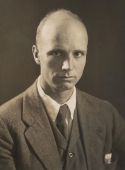
Rockwell Kent in his late 30s

But forget Rodin and Breakey. The visit to the Michener would have been worth it to me for one art work alone, the first one that caught my eye as I made my way into the exhibition halls. It is “Winter Sunrise, Whiteface Mountain,” an oil painting from 1952 by a favorite of mine, the should-be-more-famous Rockwell Kent. He painted the picture near his home in upstate New York’s Adirondack Mountains. This oil, part of The Artist in the Garden exhibit, is broadly angled and limited in its mostly-muted color choices. Half-bare trees run along the bottom of the canvas, sun-brightened mountain ridges dominate the middle, and a murky green sky looks down at everything below. The painting somehow captures nature in an elemental way, which is what many great paintings do. I stared at the Kent for quite a while. The information card next to the painting said that Rockwell thought of nature as one unending garden, or something or other like that, and that’s why the curators included this most non-garden-like painting of trees and mountains in the “Garden” show. Well, they’ve probably stretched the point really wide, but that’s fine with me. Otherwise I’d never have seen this work.

Rockwell Kent died in 1971 at age 88. He had been a fine art painter, a book and magazine illustrator, a political thinker and activist, a wilderness adventurer, a chronicler of his life and travels, a farmer. Yup, an all-around cool guy. In 1927 he designed the logo used to this day by Random House book publishers. He gained a lot of fame for his pen and ink drawings of a 1930 edition of Moby Dick.

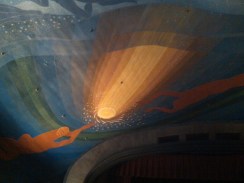
A view of the ceiling at Cape Cinema, on Cape Cod (Photo by J. Kaufman)

In a small way, he has been a part of my life for almost 20 years, dating back to when I first set foot in the Cape Cinema, on Cape Cod. Cape Cinema is an art movie house, whose vaulted ceilings and walls, most incredibly, are dynamically covered by a mural portraying the heavens and its mythological residents. Rockwell designed the mural in 1930. He climbed scaffolding and painted some of the square footage himself, but he was smart (or otherwise occupied) and left most of that heavy lifting to his collaborator Jo Mielziner. Their labors resulted in gorgeous swaths of yellows, oranges, purples and blues. I’ve been to Cape Cinema many times, because my wife and I are Cape Cod lovers and also cinephiles. With each visit there, my connection to Kent, as it is, seems to renew. Is there another movie theater like this in the world? I doubt it.