Happy Birthday, Sandy!

Seeing that a person’s birthday comes but once a year, celebrating it in a substantial way is a damn good idea. Even though my wife Sandy and I don’t always follow that philosophy, a couple of weeks ago we did. Having booked a hotel room in Philadelphia, Pennsylvania, USA for Sandy’s birthday (the big day itself, plus the two days bookending it), we dipped into The City Of Brotherly Love’s many offerings and, as is almost always the case when we’re there, had a fine time.
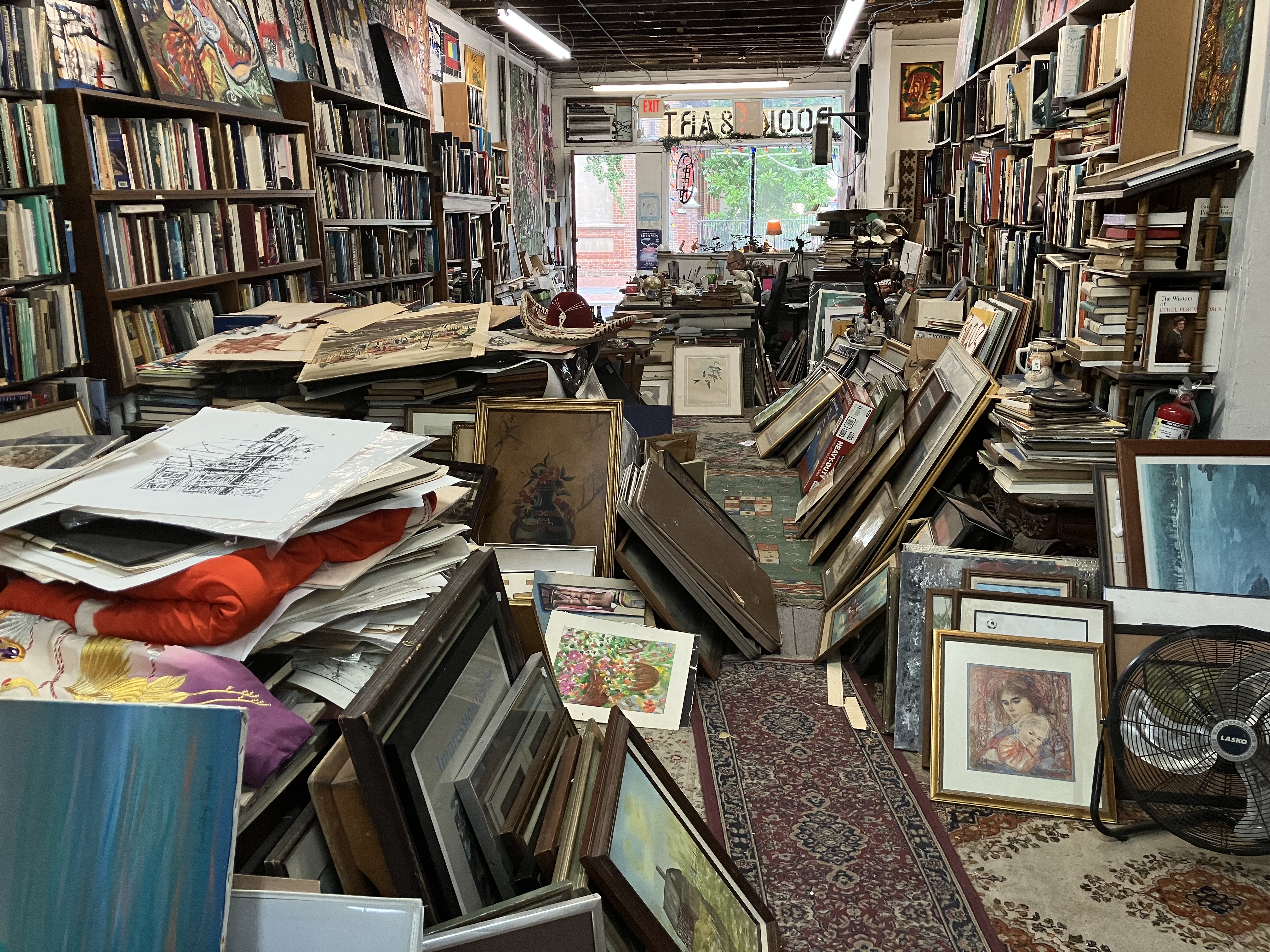
Jules Goldman Books And Art, an eye-popping store.
Empty building that once housed the Painted Bride Art Center. Isaiah Zagar’s mosaic mural covers the building.
A portion of the mosaic mural at the rear of the building.

What did we do? We had two great restaurant dinners, for one thing, meals that we won’t soon forget. We took in a movie (Barbie, which Sandy, unlike me, liked a lot). We wandered into Jules Goldman Books And Art, one of the most mind-blowingly jumbled stores I’ve ever seen. And we gazed in wonder at the mosaic mural (by Isaiah Zagar) covering all sides of the long-vacant building that once housed the Painted Bride Art Center. Sandy and I saw loads of terrific music and dance performances at the Bride, and truly miss it. (The Painted Bride Art Center still exits. It’s at a different location now, and is but the merest shadow, arts-wise, of its former world-class self.) The building’s and the mosaic mural’s fates, tied up in litigation for a number of years, are uncertain. Demolition is a real possibility. If that comes to pass, Philadelphia will lose a treasure.
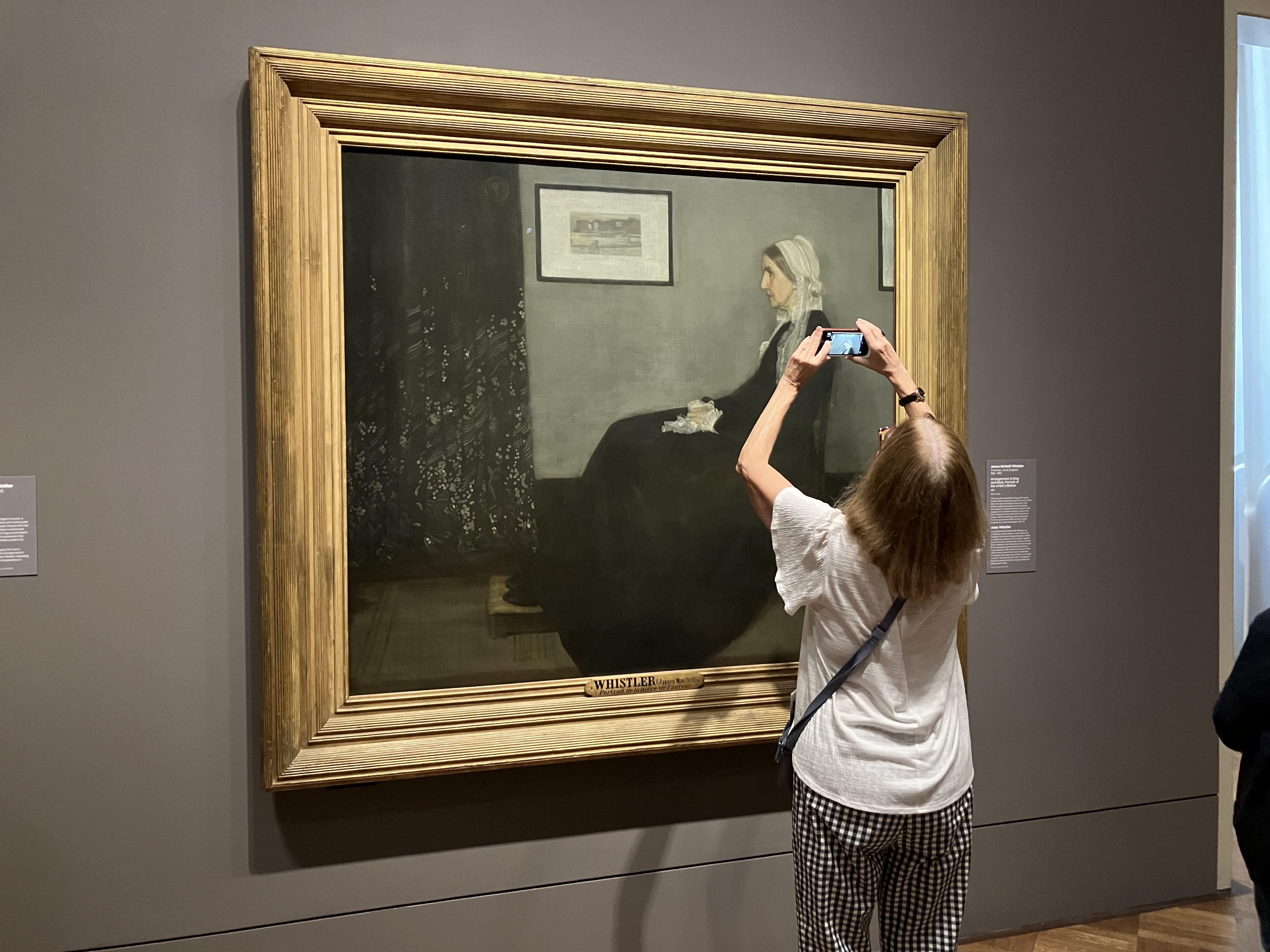
The painting popularly known as Whistler’s Mother.

The birthday girl and I also went to the Philadelphia Museum Of Art. In that enormous institution we viewed hundreds of artworks, including the world-famous painting popularly known as Whistler’s Mother, on loan from a museum in Paris. I was expecting to poo-poo the picture, but the more I looked at it, the more I liked it. It’s a well-designed creation, quite riveting, whose true title (Arrangement In Grey And Black No. 1) is a good description of what the artist James Whistler was going after, and accomplished, when his mother Anna posed for him in 1871.
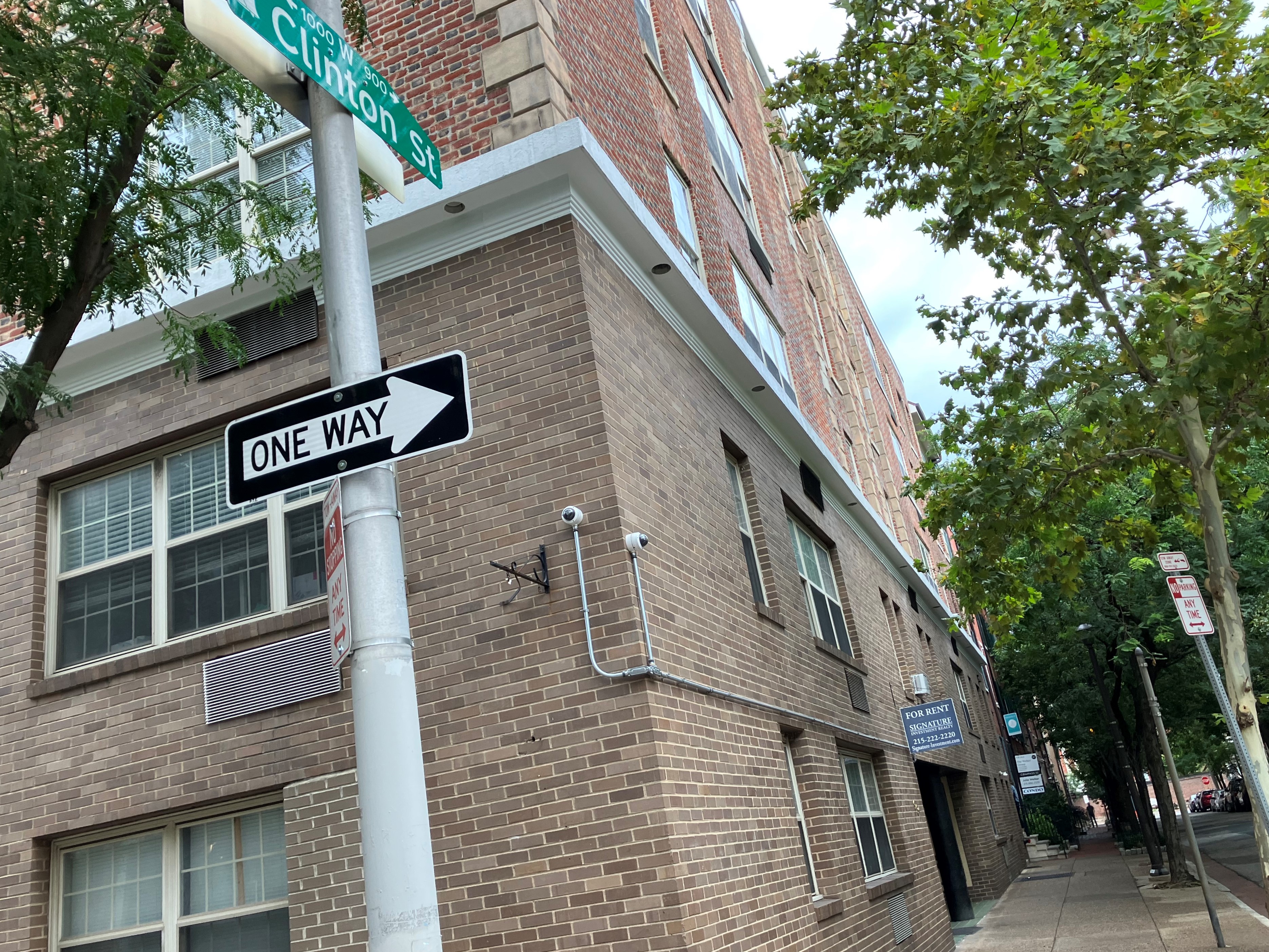
The building in which I once lived (Clinton Street, Philadelphia).

I could mention plenty more activities, but I’ll limit myself to one. A very personal one. Namely, our visit to a central Philadelphia neighborhood we both were familiar with, and within which we very likely crossed paths many years before we formally met in 1990.

I moved to Philadelphia in 1974, taking up residence on Clinton Street, a leafy block with any number of fine old houses. I lived there for 14 months in an apartment building, the one nondescript structure on Clinton, during which time Sandy worked two blocks away. Did we pass one another, maybe more than once, on the street? Did we chow down in a neighborhood eatery at the same time? We’ll never know, but I’m guessing yes. On the day before her birthday, we reminisced about those long-ago days as we strolled along a bunch of blocks in the Clinton Street area.

To continue: As noted above, our paths crossed in 1990. Meaningfully too. This occurred at a singles event near Philadelphia’s Delaware River waterfront. Sandy and I, each of us far removed from our Clinton-Street-neighborhood days, clicked right from the start and have been together ever since. I don’t believe in fate or anything like that. But it’s cool that, unbeknownst to us, we were part of the same picture all those years before, in a sense just waiting for our stories to entwine.

Now, this being a piece about a special occasion, I’ll conclude the proceedings with blasts of good cheer and high energy. And I’ll turn to The Beatles to handle the honors. Their hard-rocking song Birthday appears on what has come to be known as The White Album. John Lennon and Paul McCartney wrote Birthday quickly in the recording studio in September 1968. A few hours later, the band, McCartney handling lead vocals, put it on tape. Man, in no time at all a classic was birthed.

It’s inarguable that Paul McCartney calling Sandy and singing Birthday over the phone to her would be better than my presenting her with The Beatles’ recorded version. Maybe one day, in an alternate universe, that will happen. But for now, the original, in all its glory, will suffice beautifully. And so, once again . . . happy birthday, Sandy!


The Short And The Long Of It: Scattered Thoughts About Music

Tomaz oYou know, when earlier this summer I showered cyberspace with a three-part recap of my wife Sandy’s and my recent European frolics, I thought I was done with that subject. Next thing I knew, though, I was typing out a story that had its genesis during that same trip, in Amsterdam. In said story (which is viewable by clicking here) I wrote about the owner of a bistro we had dinner in. The restaurant’s name is Tomaz, and possibly the owner’s name is that too. But seeing that I don’t know for sure, I referred to him in the piece as Maybe It’s Tomaz. Man, I can’t believe it, but I’m about to talk about MIT again. Obviously it’s a good thing I met the guy, because he has become fodder for your frequently-devoid-of-story-ideas narrator. MIT, if by some fine miracle you ever read this post or the previous one in which you star, please know that I’m in your debt. Figuratively, not financially. Anyway, I’m certain you’d feel fully compensated by basking in the limelight that my epic tales place you within. Well, maybe limelight is too strong a word, considering that this blog is among the least-read publications on Planet Earth. Nevertheless, write I must. Or must I? I’ll have to think about that.

MIT became part of this article’s thought process the other day while I was listening to WXPN, a sharp radio station based in Philadelphia. They play so much music from so many genres, and know so much about music, it’s amazing. And the station always is trying to come up with cool ways of packaging its product. For example, during the other day that I mentioned, they hit upon a great idea. For hours on end they played only short songs. Short meaning under three minutes.

Now, I’m no music historian or researcher. My brain capacity, not to mention my patience, isn’t sufficient to take on either of those roles. However, I’m pretty sure that, before the hippie era bloomed in 1967, the bulk of recorded songs were under five minutes, and oodles of those — the truly short ones — topped out beneath three. This partly was due to the limited storage capacity of vinyl singles and albums. And there also were commercial considerations. Namely, if songs were short, then pop/Top 40 radio stations would be able to play a sizeable number of them per hour and still have plenty of time left over for ads. Things loosened up in many ways in and after the late 1960s, including the length of songs. To this day though, some still don’t surpass the three-minute mark.

3MinuteLogo riattrezzare-macchina-in-3-minutiOK, as with much of life, all of that is neither here nor there. Or is it? I’ll have to think about that one too. Getting back to WXPN, I listened on and off the other day for a total of an hour or so and was pleasantly blown away by all the great tunes that they spun. I’ll name a few (if you click on each title you’ll hear the songs). The Lovin’ Spoonful’s Do You Believe In Magic?. Paul McCartney’s Man We Was Lonely. The Box Tops’ The Letter. Patsy Cline’s I Fall To Pieces. Remember (Walking In The Sand) by The Shangri-Las. Each song has a wonderful melody, an alluring arrangement and is packed with feeling. And each satisfied my soul completely and then . . . bam! . . . was over just like that. They are perfect.

Would MIT have loved the XPN playlist as much as I? Let’s see. As Sandy and I ate in his restaurant, MIT and I gabbed away about music. Like me, MIT is a music nut. MIT piped sweet stuff through the restaurant’s speakers by Harry Manx, Jonathan Wilson and Israel Nash, artists I wasn’t familiar with (examples of their work are embedded in the aforementioned article in which MIT appears). The songs were on the long side (six minutes and up I think), transporting and satisfyingly spacey. And were, said MIT, typical of what he mostly listens to nowadays. He made a point to say that a song’s length, not just its style, was part of his selection method — he was into music that took its time telling a story. I liked the Manx, Wilson and Nash numbers. A lot. If I hadn’t been involved with swigging beers and downing a steak dinner, I might have laid my head on the table and gone on a magic carpet ride. Yes, I imagine that MIT would have said “yeah, terrific” about WXPN’s focus on the short the other day, but would have turned off the station after a bit and gone to Spotify or wherever to get his massive daily requirements of the long.

What’s my point, then? Good question. I’m likely to nab the trophy awarded to “The Person Who In 2016 Made The Most Obvious And Lame Observation” for the upcoming sentence, but here goes anyway: Music, as everyone knows, can be a joy and an inspiration and a release. (Oy. Let’s continue). The need for music is somehow built into the human genome. And my guess is that the need’s long form is the dominant gene. Really, not much is better than closing your eyes during a worthy, lengthy number, letting the sounds wash over you and take you on a journey. That’s true whether you’re listening to recorded music at home or on the go or grooving at a concert. On the other hand, there’s no denying the rush that just might overtake you from good songs that are oh so brief and tight. Me, I’ll keep listening to both the short and the long. And to whatever’s in between too.

Amen.

(Don’t be shy about adding your thoughts, or about sharing this article with others)