Well, I’ve made it to this, the beginning of Part Two of my planned three-part examination of the trip that my wife Sandy and I took to Paris and Amsterdam last month. So far, so good. For those interested, the first installment may be read by clicking right here.
And now it’s time to move past Part Two’s beginning . . . uhhhhhh, we have a problem here, Houston. You mean I need to come up with something to say? Now? What’s that all about? I tell you, this writing business ain’t all it’s cracked up to be.
(The author, frustrated and close to tears, is moments away from removing his fingers from his computer’s keyboard. Shortly he will be guzzling several shots of Jack Daniels. Straight.)
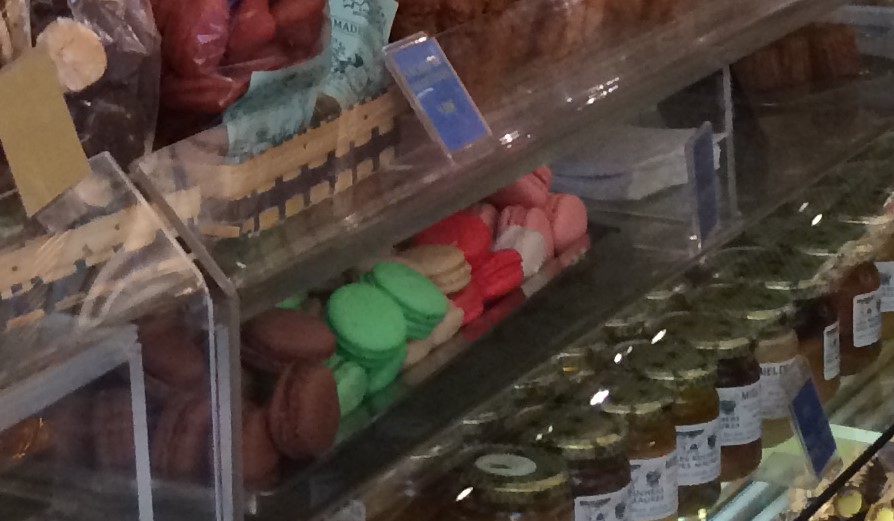
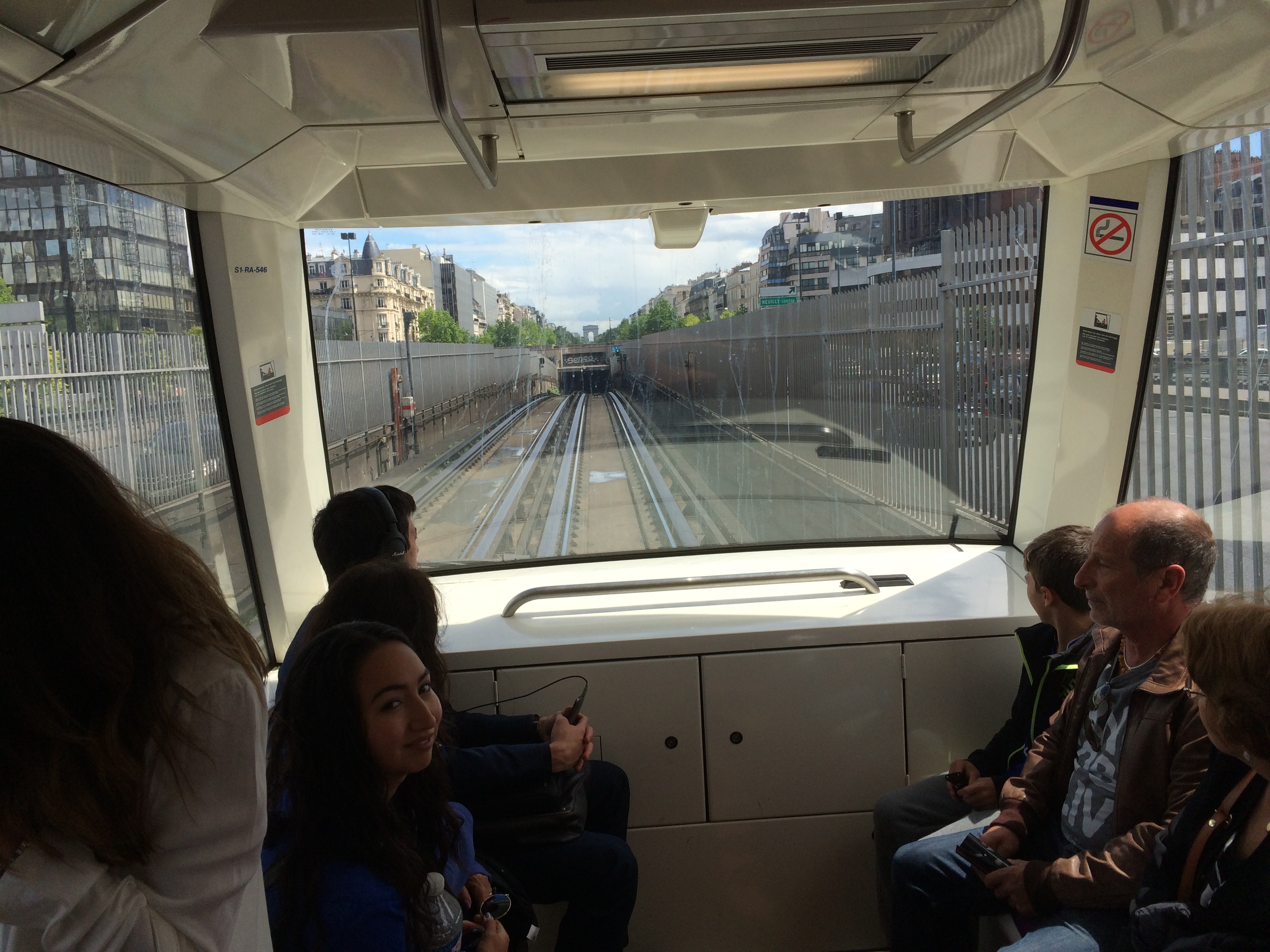
OK, I’m back and feeling better. I’m not gonna throw in the towel just yet. A jolt of inspiration whacked me a few minutes ago, and it was more than helpful. “Dummy, what’s the one thing you did in Paris that you liked more than anything else? That’s what you should write about next,” the jolt said to me. Wow, that was an enlightening question and an on-target statement. I put down my shot glass and thought about some possibilities. Seeing that I like being part of the In Crowd, I had to admit that eating macarons, colorful and tasty meringue-filled cookies that are all the rage in Paris, was a nifty experience. So was sitting at the front of one of the driverless Metro trains as it sped down the tracks, wondering how the f**k anybody figured out how to make that concept work.
But neither of them was number one. Nope, number one took place in a museum. And were it not for a blog that I stumbled upon a month or so ago I wouldn’t have been there.
I became a blog surfer at some point last year. Meaning, I get a kick checking out, sort of randomly, the near-infinity of blogs in cyberspace. And what I’ve discovered is that there are an astonishing number of blogs that range in quality from good to superb. Who’d ever have thought that so many perceptive/talented/creative people exist? Hey, it gives me hope. Anyway, I don’t remember the name of the website that I just mentioned stumbling upon, but stumble upon it I did while researching my Paris-Amsterdam expedition. And one of its articles made an impression on me. In it, the writer mentioned once being in Paris and absolutely loving the large canvases of water lilies, painted by Claude Monet, that hang in Musée de l’Orangerie (The Orangerie Museum). I was familiar with various of Monet’s water lily paintings — he churned out more than 200 of them over the years while living at Giverny, a country village about 50 miles from Paris, getting his inspiration from the water lilies that floated in the large pond on his property. But I knew nothing about l’Orangerie or its contents till skimming that article.
And thus when Martine and Alan, our Parisian friends with whom we were staying, asked Sandy and me what we might like to do while in Paris, I said I didn’t have a lot of specifics in mind but maybe l’Orangerie wouldn’t be a bad idea if we happened to be in the area.
Good call, Neil. In fact, a perfect call.

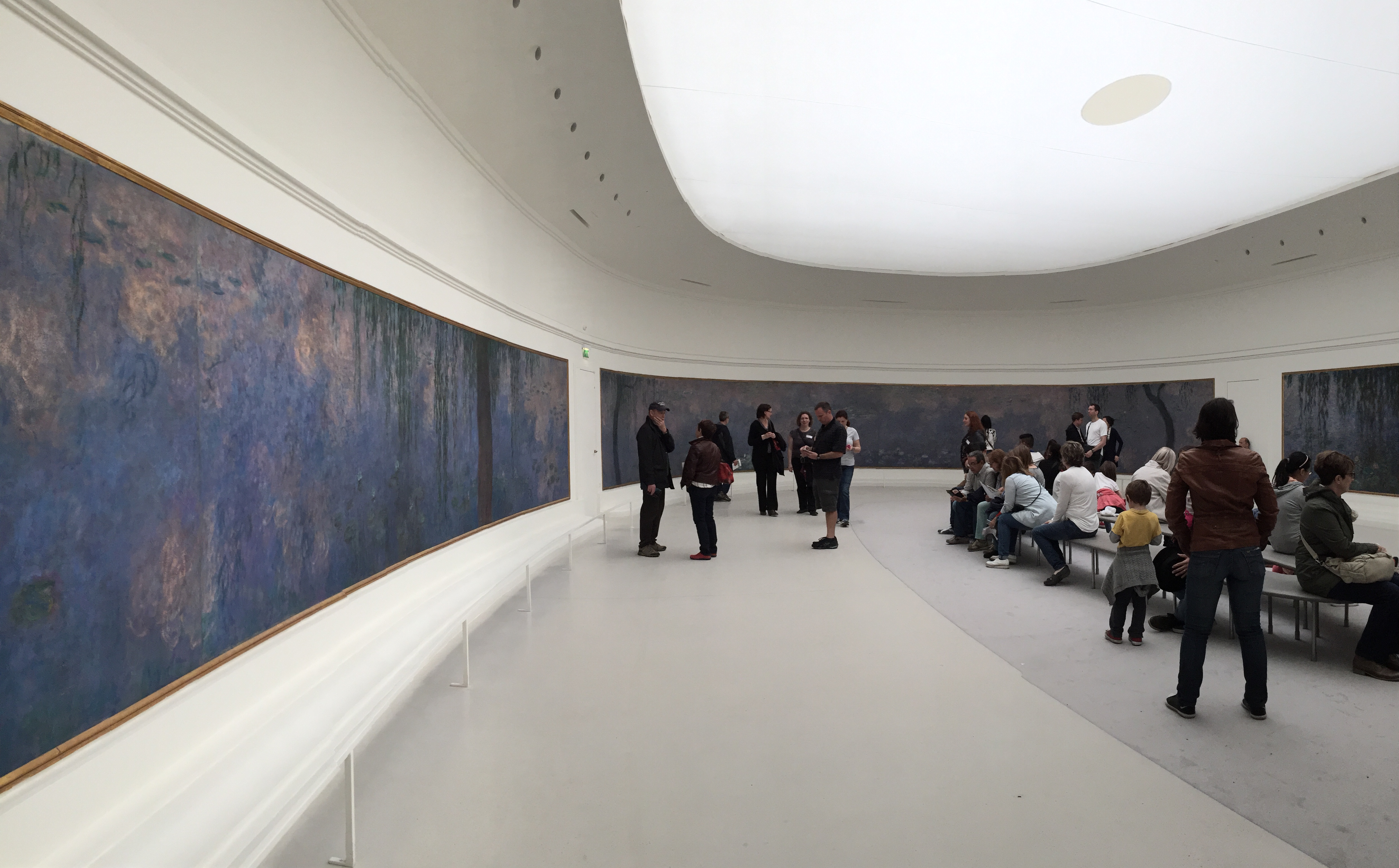 You know, I feel fanboy-ish and unstudied in saying this, but the eight enormous water lily canvases at the Orangerie are among the greatest paintings I ever have seen. Complex, inspiring, bedazzling, calming, mind-expanding, yes they are all of that. And their powers play off one another. Which is why their cumulative force is off the charts, in a contemplative sort of way. Right, right, I’m getting carried away here, but what can I do? I’ll try to calm down.
Monet worked on these paintings for 12 or so years, nearly up to the time of his death, at age 86, in 1926. He donated them to France, wanting them to represent peace and tranquility to a world that needed macro doses of same, as it does today. And he negotiated with the French government for the canvases to be housed in special chambers. Two curved rooms with natural lighting, quiet and elegantly simple, would fit the bill he decided. And he felt that the Orangerie would be a fine spot in which to build those rooms, whose design and construction he oversaw. But he didn’t witness the installation of his giants, which took place the year after he left this world.
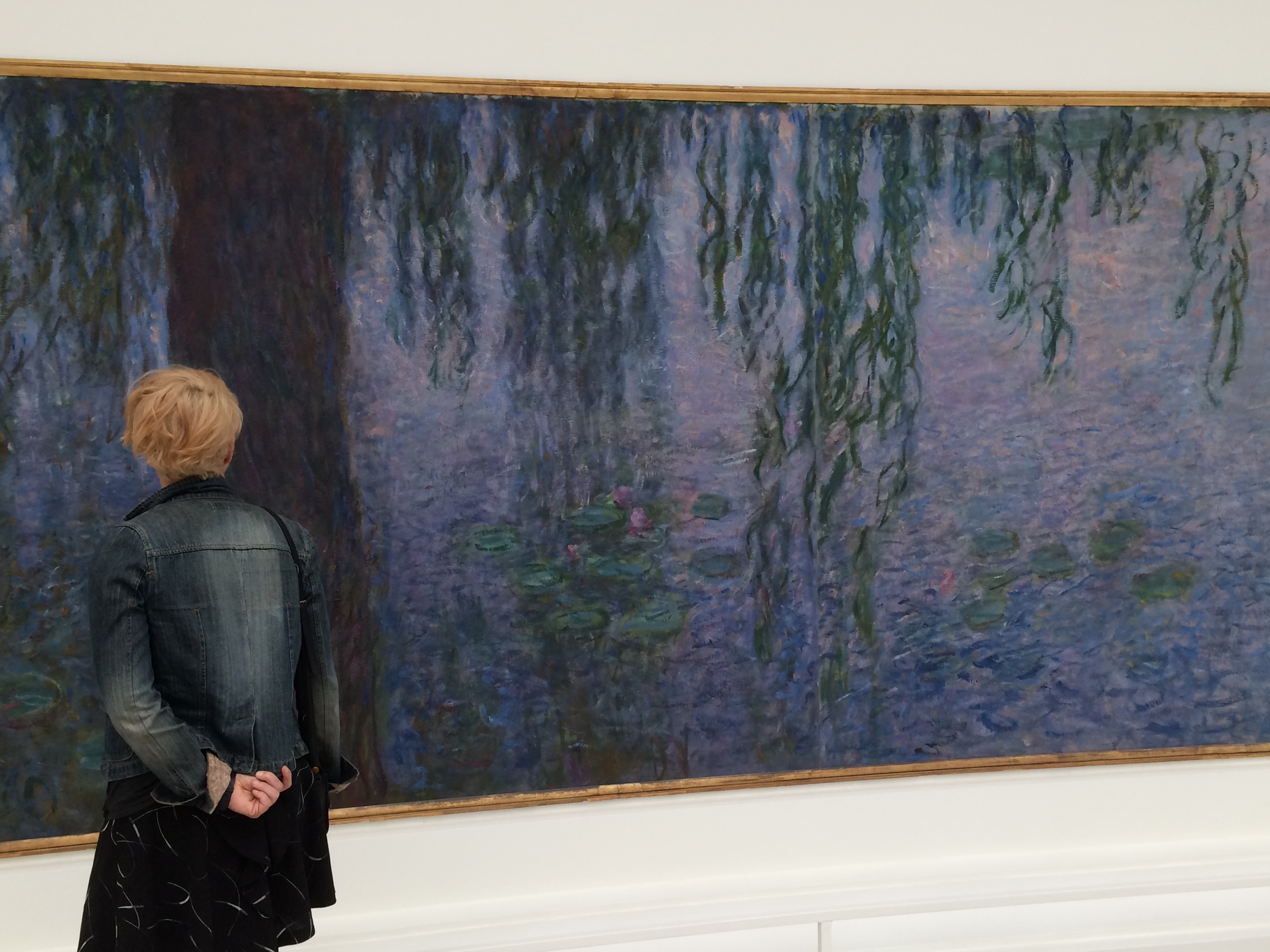
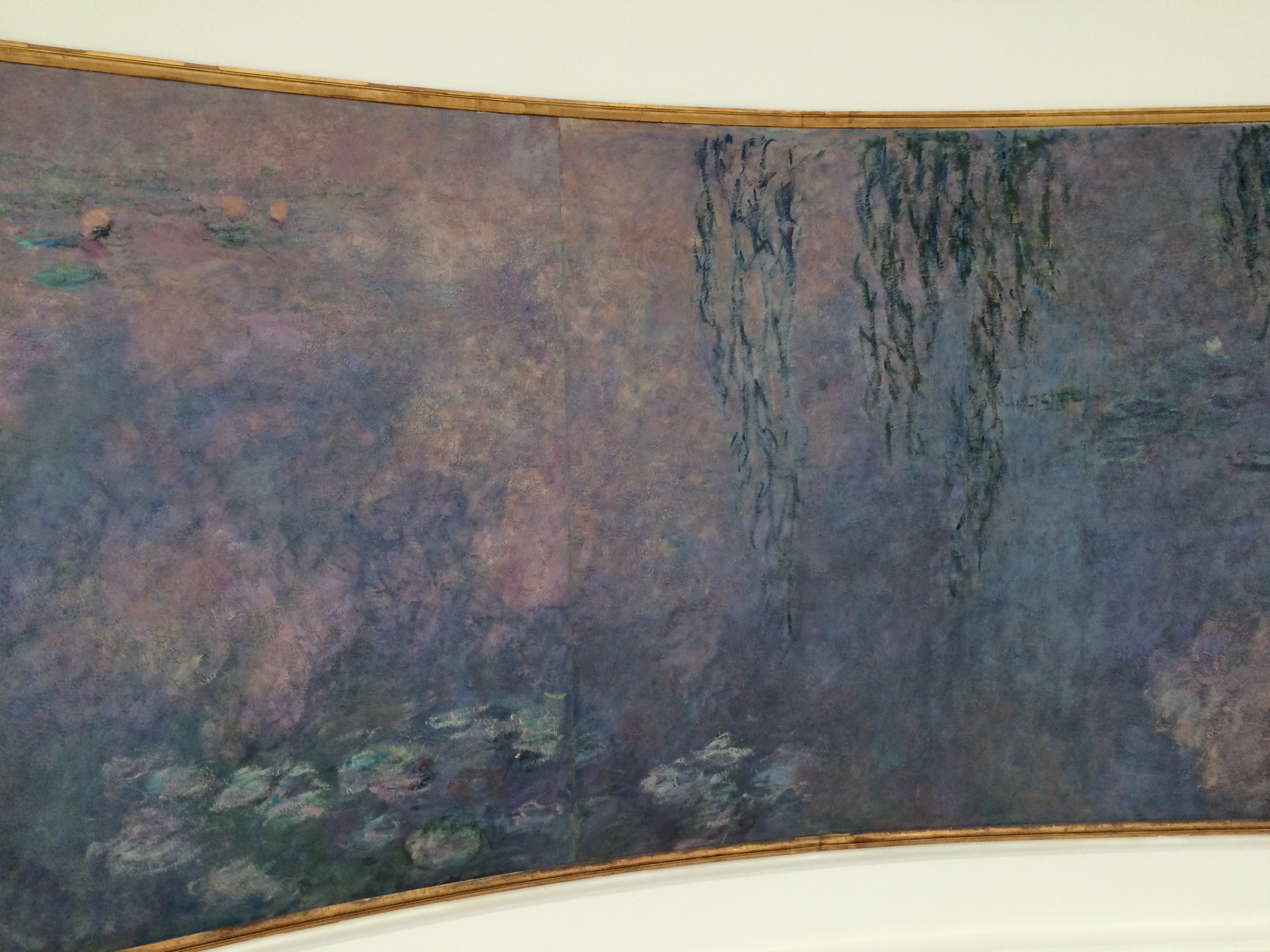 Earmarking eight monumental canvases (they are six and a half feet high and average 37 feet in width) for France’s citizens, to be displayed in custom-made quarters, was a grand gesture on Monet’s part, possibly the grandest of his life. When I walked into the two rooms that the works occupy, four per room, I felt as though I were in a sanctuary, a shrine. And I was. Sandy, Alan, Martine and I spent an hour there. These are paintings you can get lost in. I know that I did, and I think the others in my party did too. The canvases are dreamy, amorphous, color-rich yet for the most part muted. Water lilies are depicted on each canvas, but they are only part of the story. Other small vegetation appears. And wispy visions of willow trees float on the four paintings, done in somber shades of violet and purple, that are housed together in one of the rooms. Still, more than anything the works are dominated by water, sky reflections and, depending on the canvas, bright or nuanced light. All of those components, material and ethereal, are in their glory in the Orangerie’s Monet spaces.
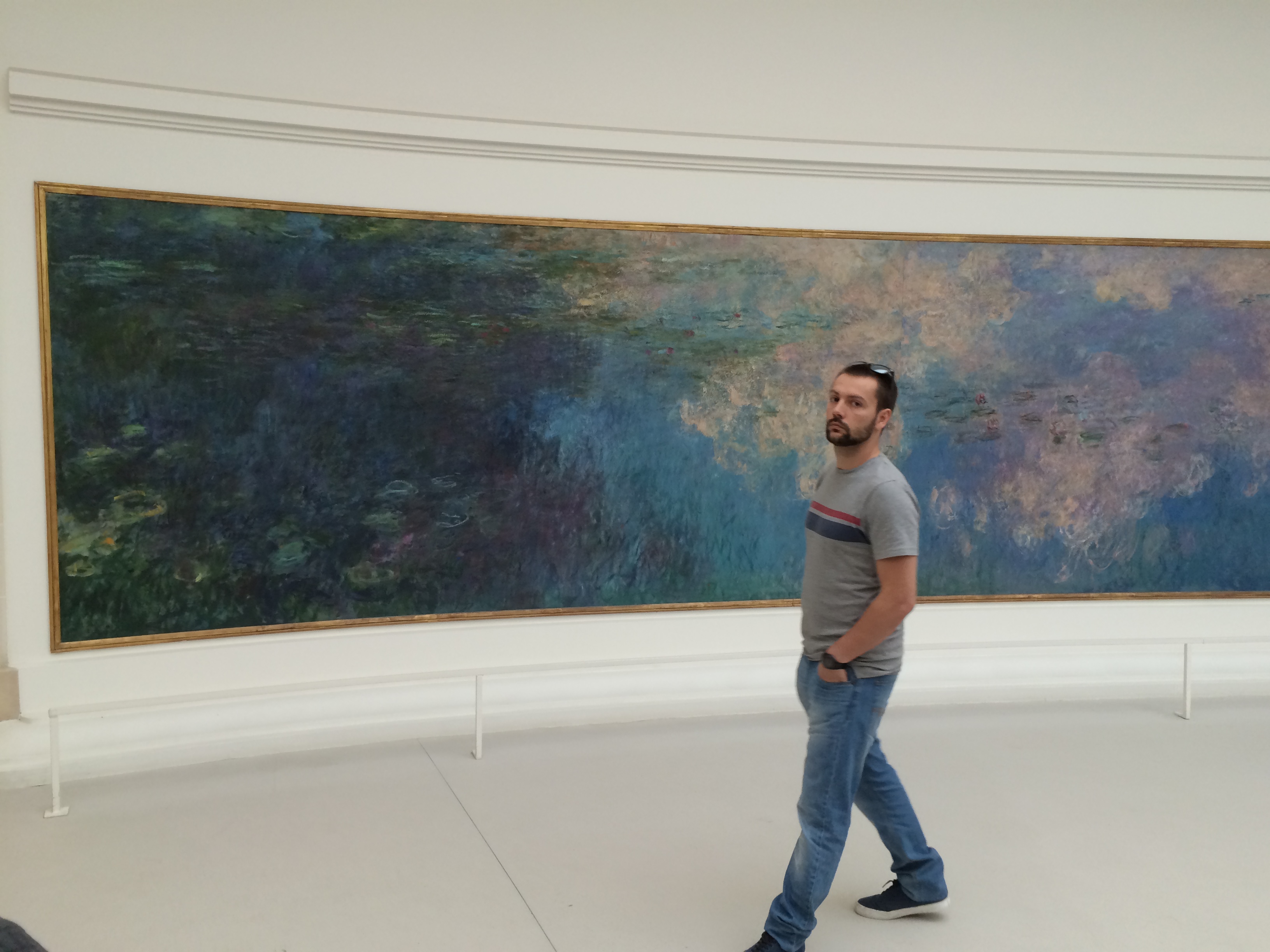
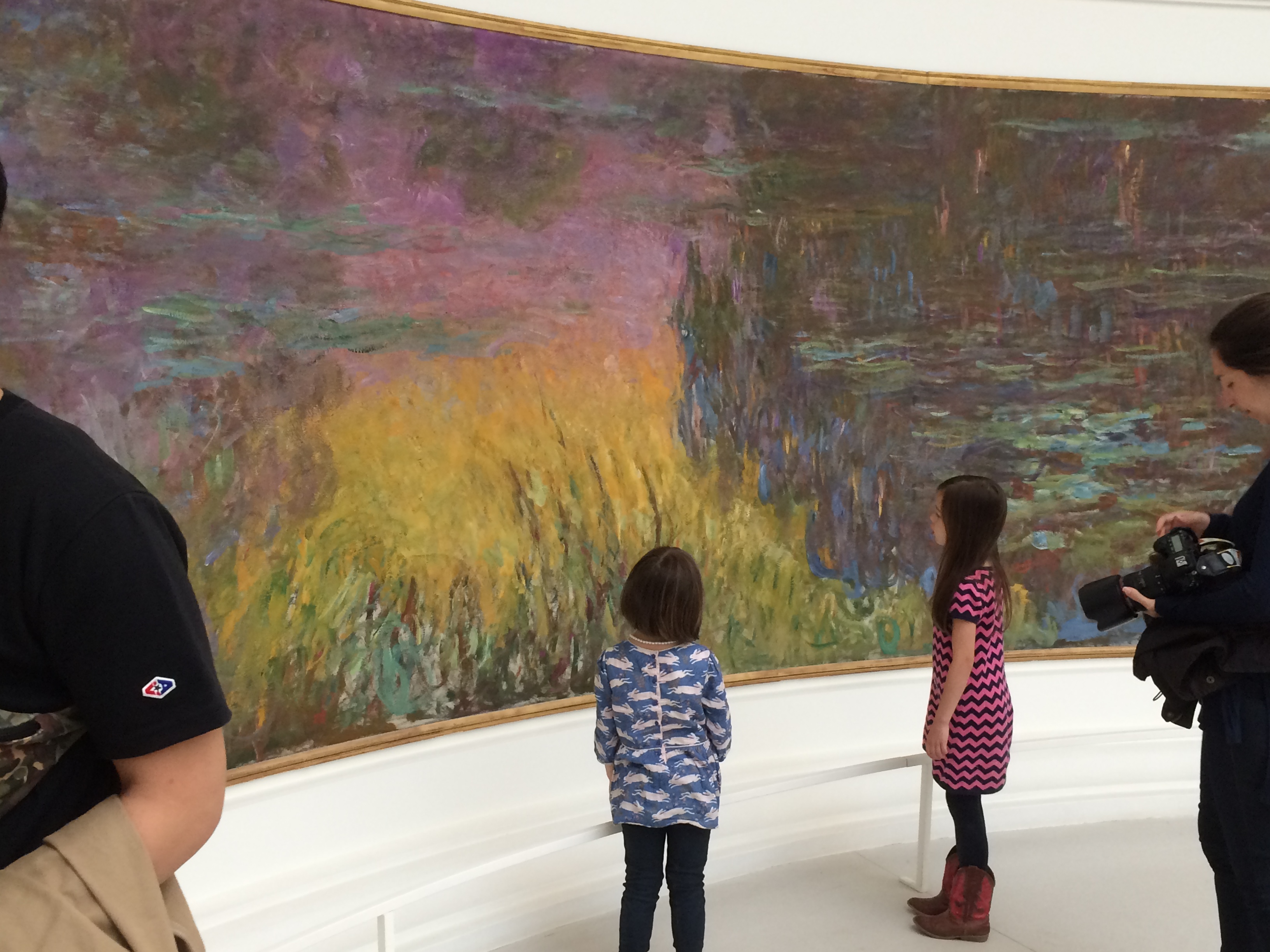 And the paintings verge on abstraction. These are a whole other ballgame from the gorgeous hillside and seaside scenes that Monet, a founder of Impressionism in the 1860s, once painted. Monet’s sense of color, and his feel, are totally recognizable on the large canvases, but the idea of place largely is gone. Purposely. I think that what he was trying harder than ever to do was to distill the natural world, to get to its essences. An incredible endeavor for someone who began the project in his very advanced years. Monet The Great, no doubt.
Not unusual for me, I was late to the party. Obviously. I mean, millions of people know about the Monets at the Orangerie Museum. And swoon over them. A few days ago, for example, my brother mentioned to me that they are his favorite works of art in all of Paris. Ah, what can I say?
Okay, I’ll say this: The Orangerie is brimming with tremendous art besides Monet’s. The many oils there by Chaim Soutine and Maurice Utrillo, two guys you don’t ordinarily see too much by, knocked me out. But Monet is the museum’s heart. A couple of day’s ago, Sandy reminded me of something that popped out of Alan’s mouth after we left l’Orangerie. “I guess we got our Monet’s worth,” he sagely cracked. Truer words were never spoken.
(Don’t be shy about adding your comments, or about sharing this article with others)
(If you click on any photo, a larger image will open)

 Yeah, Another Blogger