Dinner Was Better Than The Movie

When my wife Sandy and I go to movie theaters, which is often, we usually go to a restaurant for dinner too. Movie times dictate when we eat. Seems to me that when we both were gainfully employed we’d dine around 7 pm and catch a flick about two hours later. That meant we’d arrive back home at 11:30 or so. I can’t recall exactly why or when that pattern changed a bit, but getting home late at night, and to bed even later, must have set us thinking about schedule alternatives. A sign of aging? Nah, not a chance. In any event, these days we seem to watch maybe one third of our movies in late afternoon, which allows us to dine at a pleasant hour and arrive back at the ranch before 9 pm.
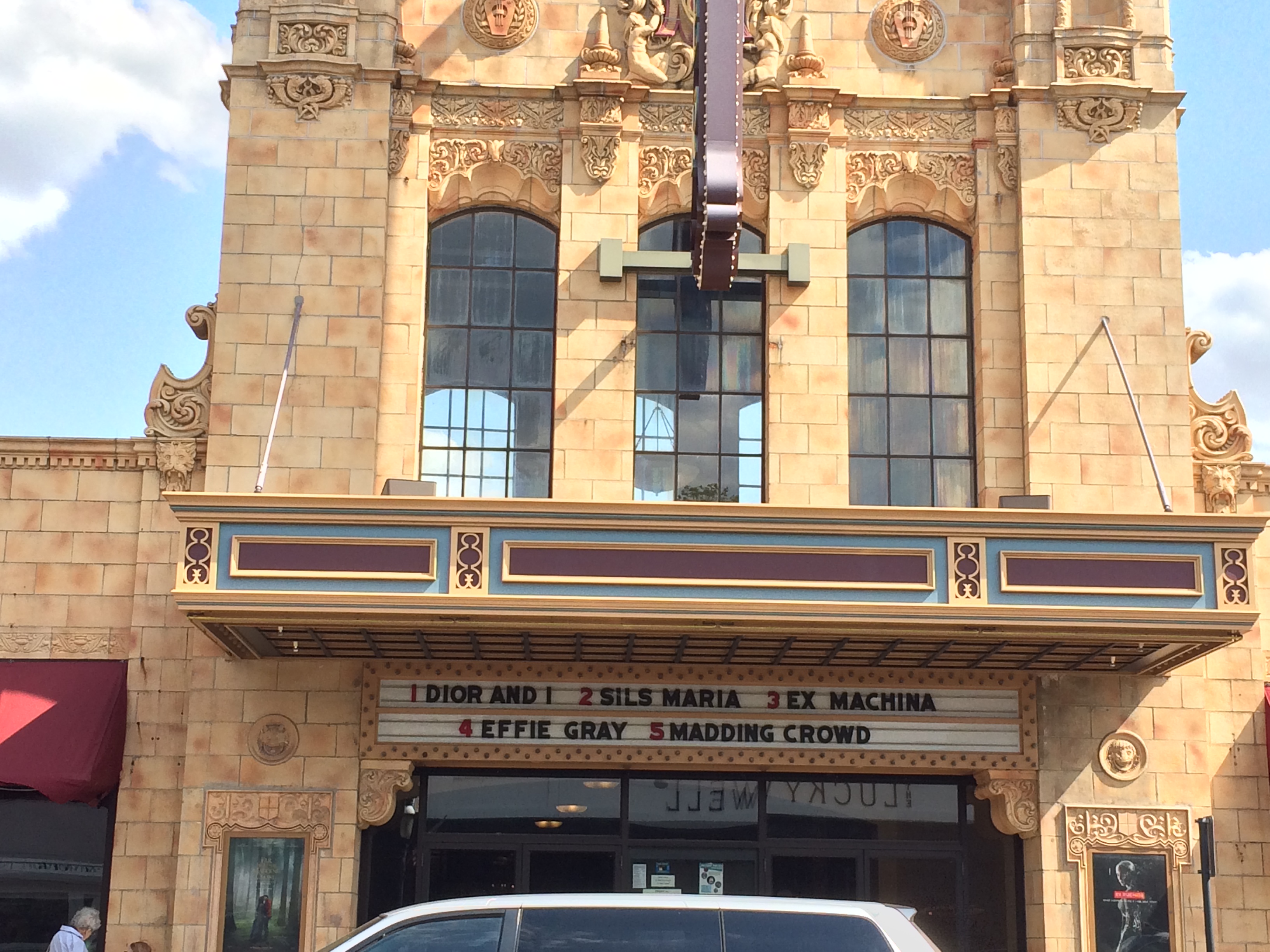
The Ambler Theater, cornerstone of beautiful downtown Ambler PA

Such was the case this past Friday at the Ambler Theater in downtown Ambler, Pennsylvania. There we settled into our seats for the 4 pm showing of Far From The Madding Crowd, the fourth film adaptation of Thomas Hardy’s apparently still-beloved novel, first published in 1874. As far as I can recall, I never read the book nor saw the previous cinematic versions. I’m not a completist, so after watching the latest incarnation of Far I have no plans to visit any of the previous efforts.

Far From The Madding Crowd is by no means a bad movie. I’ll hand it, generously, two out of four stars. But it certainly didn’t floor me. It’s kind of slow, which didn’t put me off. It is also a soap opera, which didn’t rub me too wrong either. Soap operas can be fun. What I think I mainly didn’t enjoy were the lines of dialog that seemed to fall flat, or were poorly captured by the boom operator so that I couldn’t make them out (this English-speaking movie cried out for subtitles now and then). And the transition from scene to scene sometimes needed oiling. Other than that . . .

Set in rural England in the early 1870s, Far From The Madding Crowd concerns one Bathsheba Everdene, a young lady aged 18 or so whose innate charms knock men off their feet. Smart and independent, she is not seeking a husband, however. She does not wish to be stifled by the opposite sex. Politely rejecting two decent suitors, she eventually falls for and ends up marrying nogoodnik Frank Troy, an army sergeant who looks so fine in his uniform that Bathsheba’s latent sexual yearnings are forced to the surface. The movie has many plot twists from start to finish. Wait, this is a spoiler alert: Suffice it to say that in the end all is well, or mostly. Frank Troy exits, and steady and sturdy Gabriel Oak, a shepherd and Bathsheba’s first pursuer, finally captures her heart.

One moment at the very beginning of the film didn’t compute, and I’m still wondering how it got past the screenwriter. In voiceover, Bathsheba says that her parents died when she was young and, as there was no one thereafter to ask, she never knew why they gifted her with her uncommon given name. No one? How about asking her aunt, on whose farm Bathsheba is working as the movie opens. Or how about asking the relative from whom, several scenes later, she inherits a farm.

Oh well, that’s a mere quibble. Let me say that I enjoyed the acting of three of the four leads. That trio is Carey Mulligan (Bathsheba), Matthias Schoenaerts (Gabriel), and Michael Sheen (Mr. Boldwood, a rejected suitor). I didn’t clap for Tom Sturridge’s portrayal of Frank Troy, though. Tom’s pencil-thin mustache and darting eyes brought back images of too many silent movie era villains.

The beer I fell in love with at the Broad Axe Tavern.

Time to eat. I’ll give three stars to the meal that followed Far, and much of that because of the lovely beer that I discovered. The repast took place in Ambler’s outer limits at the Broad Axe Tavern, where Sandy and I have dined at least 20 times. It’s a gastropub, meaning the food choices extend beyond hamburgers and hot roast beef sandwiches. And, like so many establishments in the Philadelphia region, it carries an incredible number of beers from around the world. That, more than anything, is the draw for me. After studying the beer menu for five minutes, at last I opted for one I’d never before tasted, Franziskaner Weissbier. It is a wheat beer from a German brewery that claims to trace its roots to a Franciscan monastery in 1363. Two thumbs up. Smooth, multi-spicy (pepper, coriander, who knows what else), a tad citrusy. And dig that satisfied monk on the label. Gotta love it.
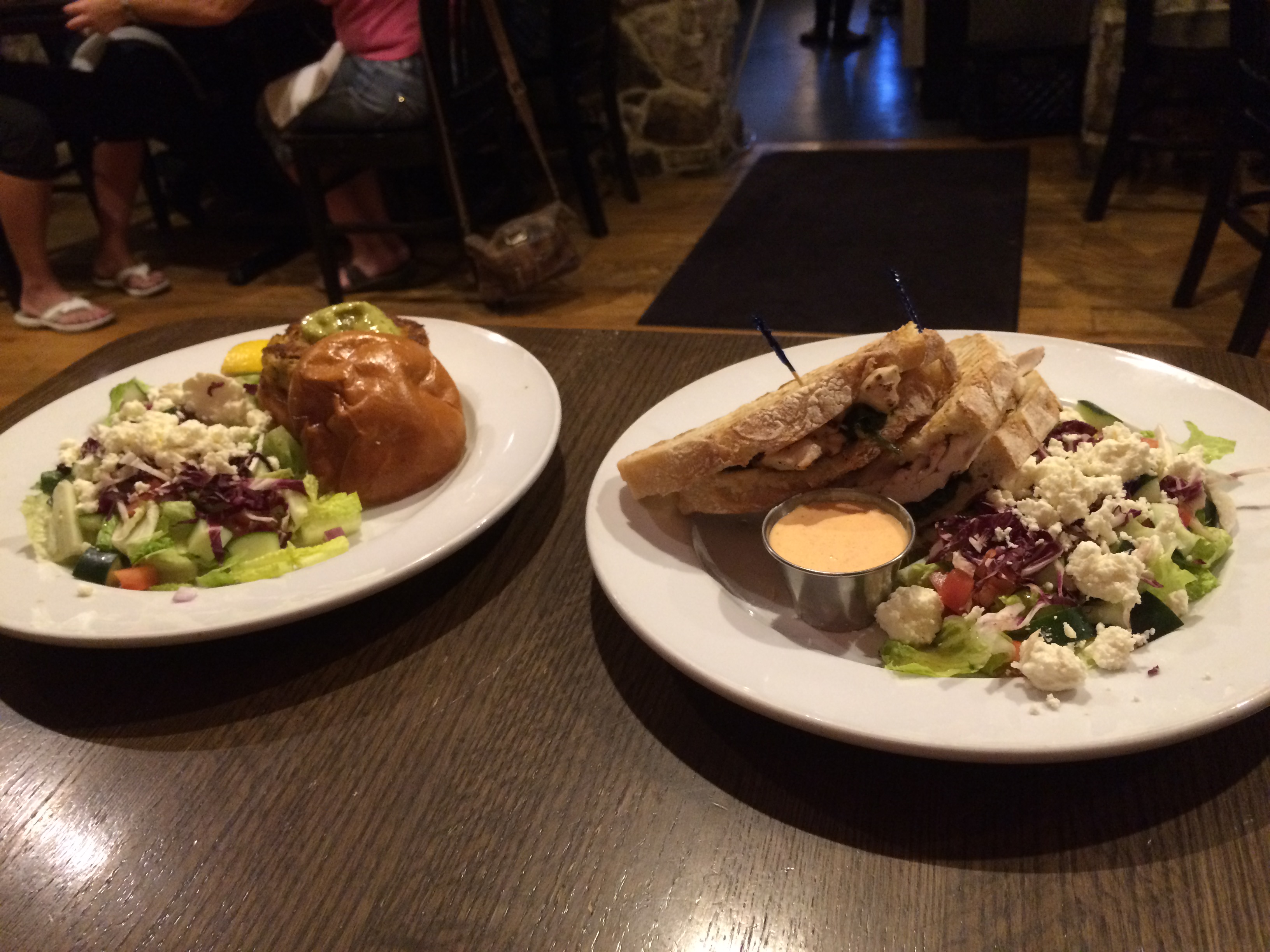
Crab cake sandwich on left. To its right is grilled chicken panini.

Broad Axe’s food is good. I went with the crab cake sandwich and my wife ordered the grilled chicken panini. The former was light on filler, heavy on excellent meat, and pan-sautéed. The latter was large and flavorful, its thick slices of rustic Italian bread delicious. Like countless places these days, Broad Axe, not giving a hoot about contributing to America’s collective expanding waistline, accompanies its burgers and sandwiches with fries. But we weren’t in a fries mood, so for an extra two dollars we each substituted a side salad. On the surface there was nothing unusual about this salad, but it was strikingly fresh and crisp, which is not always the case. The bouncy red wine vinaigrette dressing was an ideal host for romaine lettuce, cucumber, red cabbage and feta cheese. Simple ingredients, top-notch outcome.

We had no room for dessert, though. Around 8 pm, our Ambler evening concluded, home we headed.
A Winning Dinner And A Fashionable Movie

Figuring out last minute Saturday night plans at home in the burbs recently, my wife and I were surprised to find dinnertime slots available on OpenTable for Capofitto, a hot newish Italian restaurant in Philadelphia’s wonderful Old City section. This is a place we’d read about when it opened last autumn. It sounded good and also intriguing, as it contains a ten ton pizza oven that was built by three Italian masons on site from bricks and other materials boated over from Italy. Clearly this is an establishment that takes its pizza seriously, which makes me smile. Quickly we made an OpenTable reservation, shot off to a suburban train station, and rode the rails into Philadelphia. After dinner we planned to catch a movie, Dior And I, at the Ritz Bourse art house cinema, one block from Capofitto. We silently congratulated ourselves for developing such an efficient plan for the evening.

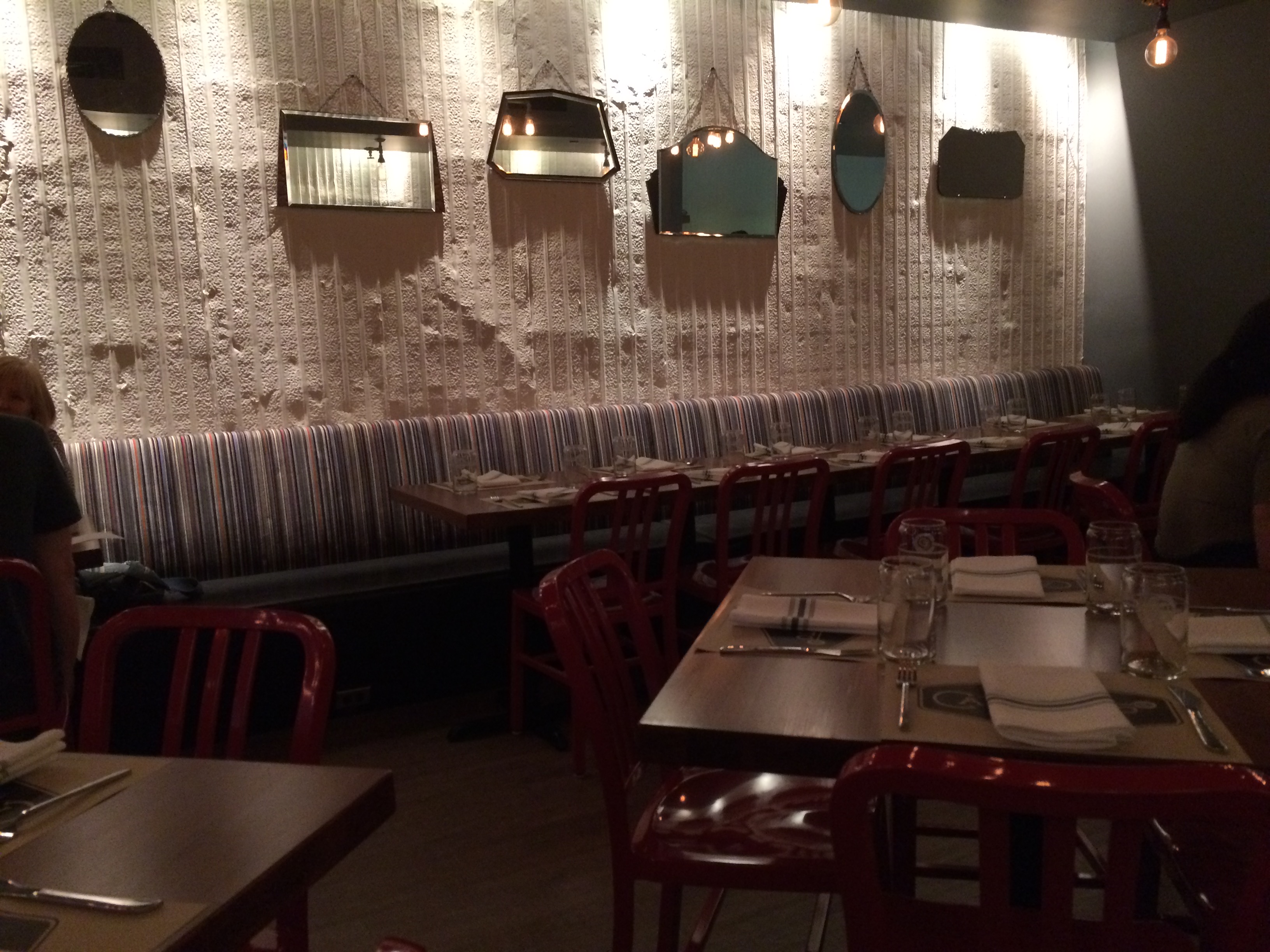
Capofitto's dining room.
Capofitto’s dining room.

Capofitto (233 Chestnut Street) is a good looking place, fairly wide and very long, comfortable but not too fancy. Housed in a building about 115 years old, its modern décor somehow gives off the vibes of a traditionally-decorated Italian eatery. The restaurant is owned by Stephanie and John Reitano, who have placed a geletaria in the front room. This is understandable, as the Reitanos blessed Philadelphia earlier this century with a scattering of mucho popular gelato cafés. Capofitto expands the culinary parameters of the Reitano empire.

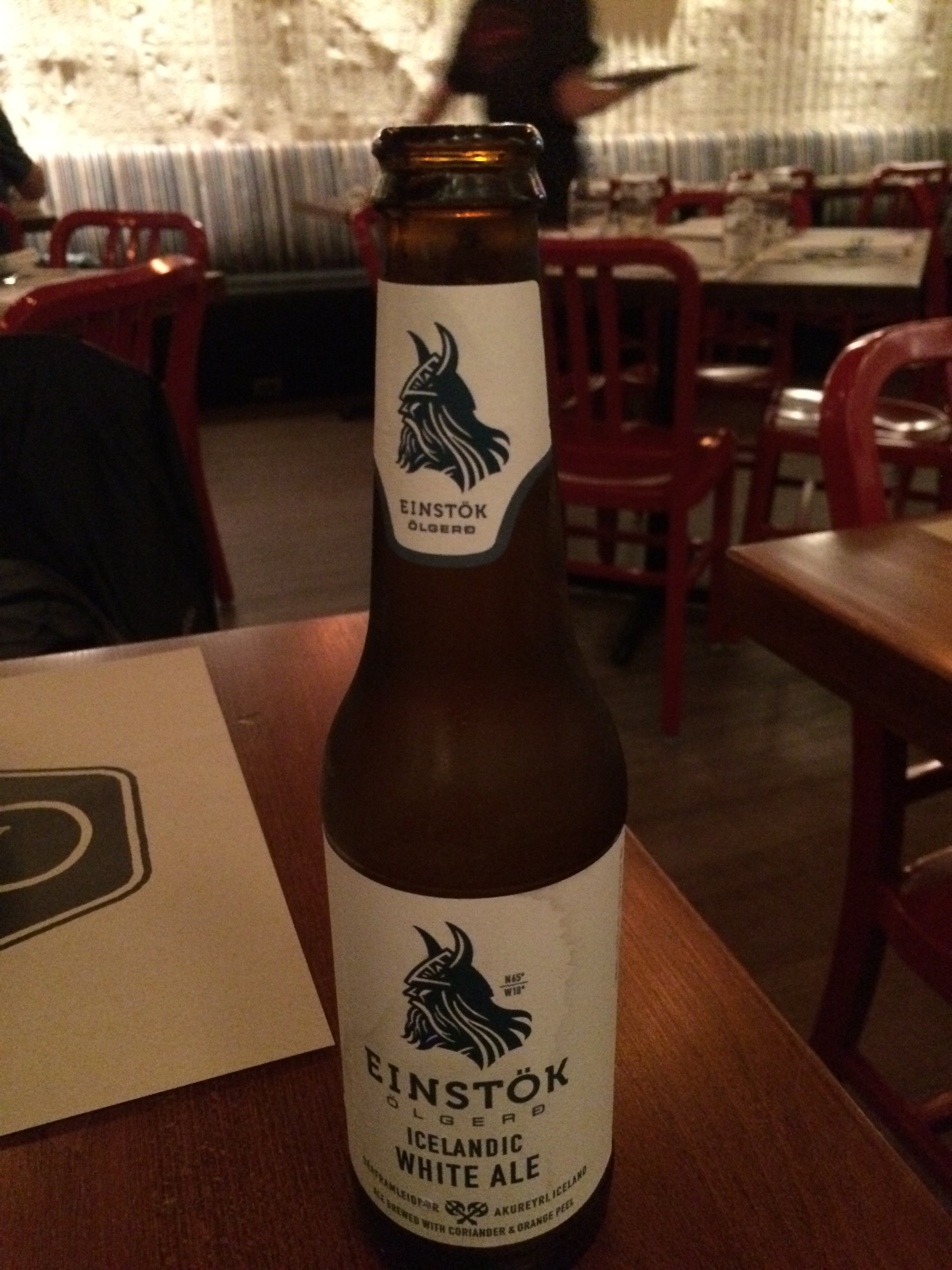
Icelandic White Ale
Icelandic White Ale

The first important question is: What beer did I order?  An Italian one would have been appropriate, but for the fact that Capofitto’s beer menu listed a brand I’d never heard of before, from a country I’d never given any thought to as a beer producer. Iceland of all places. Next time at this sweet restaurant I’ll drink Italian, but this night it had to be Einstök brewery’s Icelandic White Ale. This is a wheat beer whose label implies that the brewers toss orange peels and coriander into the vat. I noticed those flavors, but unexpectedly I also found a substantial hint of celery wafting up to my nostrils. Must have been the hops, weird dudes that can impart all manner of tastes and aromas to beer. Regardless, the ale had bite and was refreshingly bubbly and I liked it a lot.

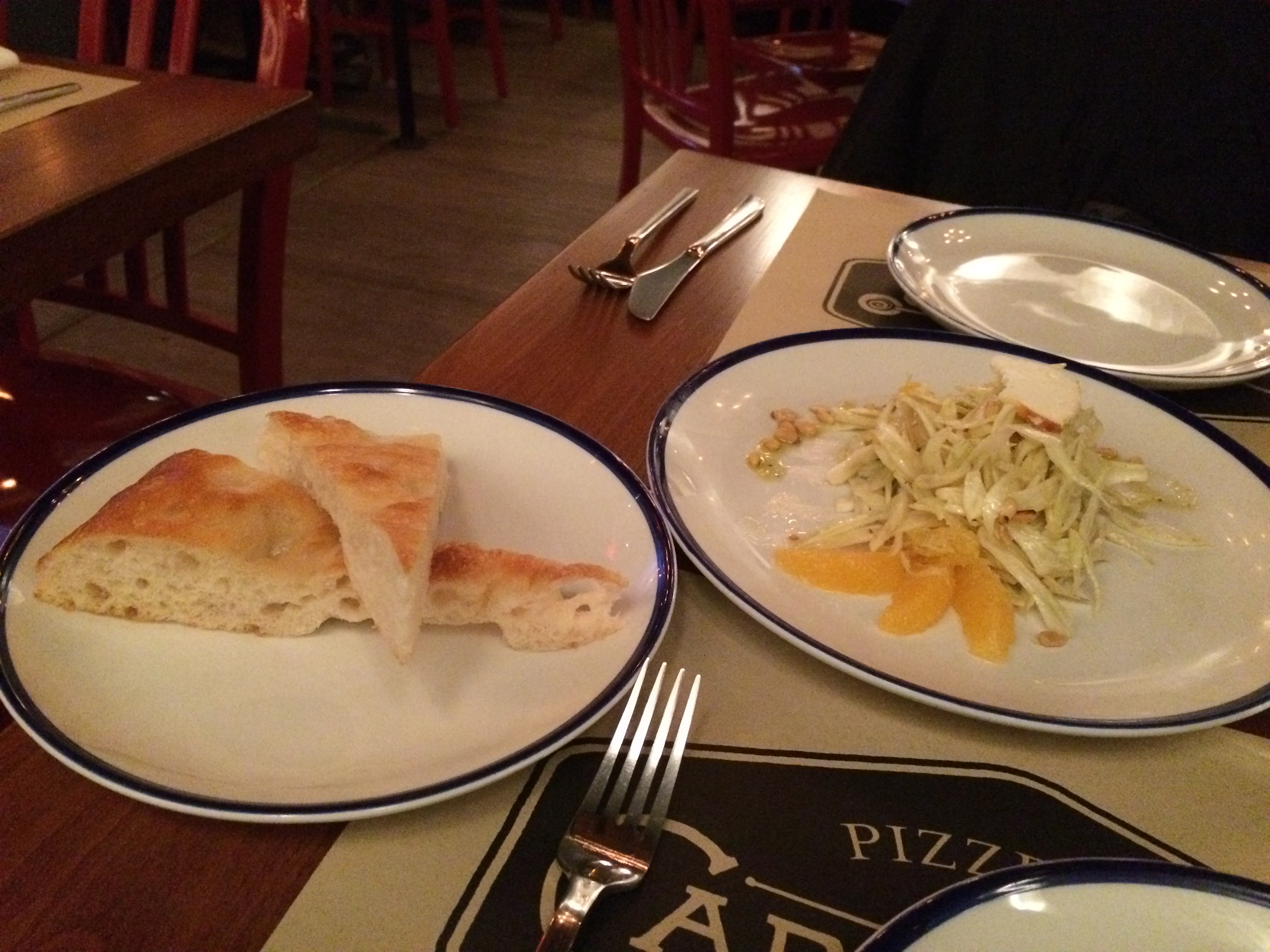
Capofitto's pinoli salad and focaccia bread.
Capofitto’s pinoli salad and focaccia bread.

What then did we have for dinner? Pizza of course, preceded by a pinoli salad. Pinoli? That’s pine nuts to you and me. My wife and I shared both the salad and pizza. The salad was misnamed, being composed largely of shredded fennel and orange slices, and brought to life with a fine milky dressing and ricotta cheese. And with some toasted pinoli too. We thought much of the salad, though a lot more pinoli wouldn’t have hurt. With the salad came focaccia bread, very good indeed.

Our gorgeous pizza.
Our gorgeous pizza.

Our pie, a margherita to which we added salty black olives, was fabulous. The pie crust’s body was thin and crisp, its puffy rim chewy in a satisfying way. The entire crust was heat darkened and blistered here and there, the good quality wheat’s earthy flavor shining through. It’s not every pizza whose wheat catches your attention. My wife and I sighed contentedly as we munched away. This was one of the best pizzas I’ve had in recent years.

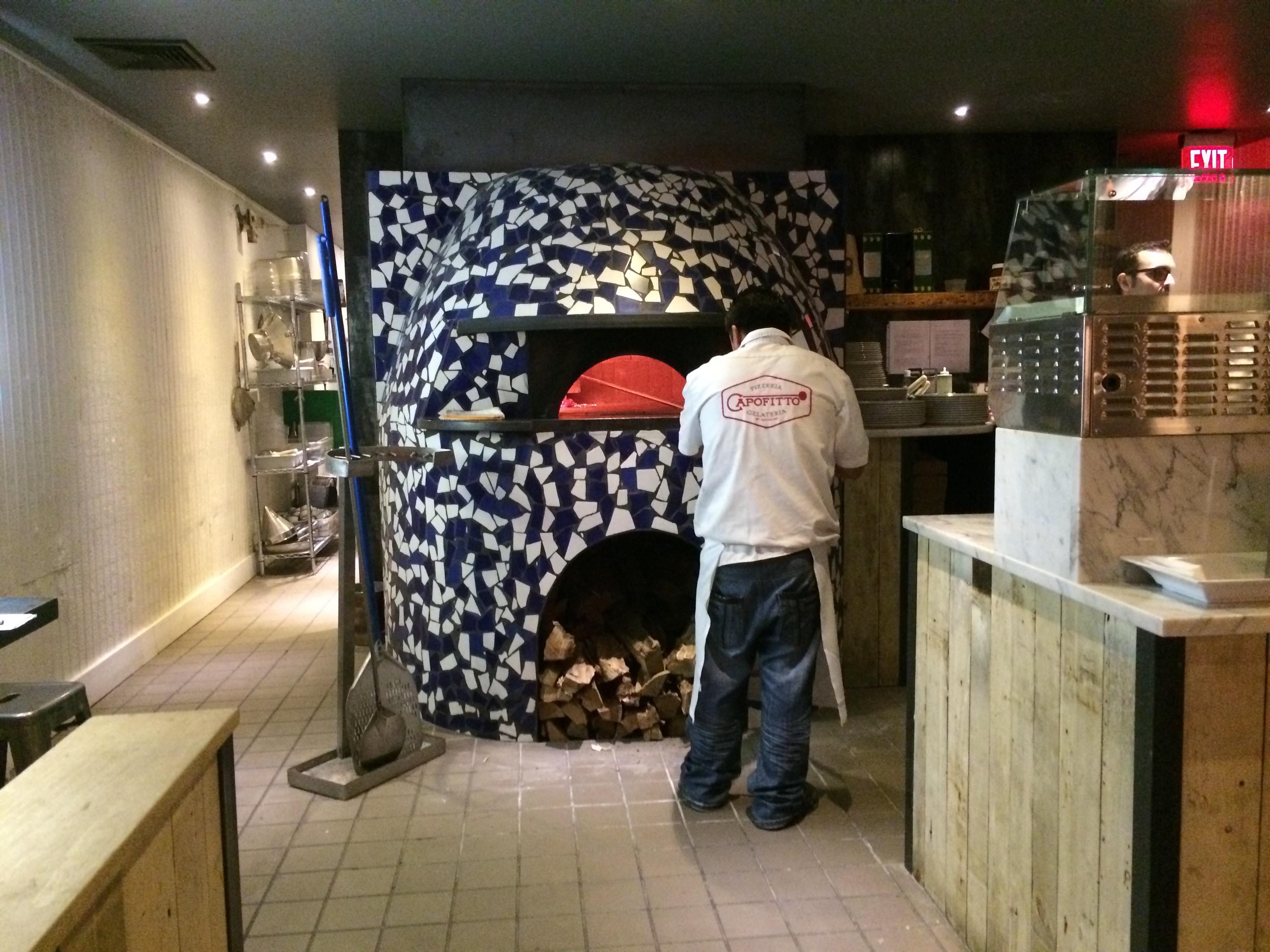
Capofitto's oak-burning pizza oven.
Capofitto’s oak-burning pizza oven.

The pizza oven, by the way, is a beauty. I looked it over for a few minutes. Capofitto feeds it wood, oak to be more precise, and it reaches very high temperatures, 900 degrees Fahreinheit or higher. Miraculously it bakes a pie in about 90 seconds.

Now, Capofitto has a large menu. Pizzas, salads, cold meats, cheeses, a few pasta dishes. I’d be surprised if most everything on it isn’t good to excellent. But after the pizza we were stuffed enough and didn’t eat anything more, not even the gelatos that brought the Reitanos their initial fame. We will return to Capofitto, at which time we’ll explore sections of the menu we didn’t get to. For now, on to the movie.

The poster for Dior And I outside the Ritz Bourse.

No one, most notably my wife, would describe me as a fashionisto. I am aware of trend-setting looks and high fashion, but the road sort of ends there. But like most anything, the world of high fashion, if explained and presented properly, will jump to life even for the mildly interested. At the Ritz Bourse my wife and I, as planned, watched Dior And I. Well-paced and well-developed, it is a documentary about the cloistered world of haute couture. It is very good, worth seeking out. Three out of four stars, I’d say.

Dior And I, directed by up and comer Frédéric Tcheng, follows the travails and successes of Raf Simons during the initial phase of his new job in 2012. For in April of that year, Simons, who had made his name in men’s fashion design, was hired by Paris’s world famous House of Dior as creative director for its women’s lines. Lucky Raf’s first big project began immediately. He had all of eight weeks to design and present Dior’s 2012 fall-winter haute couture collection. A snap, right?

The documentary begins with Raf’s first day at work, when he is introduced to the seamstresses and other staff now under his direction. Throughout the film Simons appears shy, which makes me wonder how he managed to rise to so high a creative and managerial position. Turns out that the House’s founder, Christian Dior, possessed traits similar to Simons’s. The private Dior was a reticent man, uncomfortable with the public demands of his occupation. Simons is aware of the founder’s bearings. On camera he says that he once began reading Dior’s memoir, only to put it down forever after a short while because he recognized too much of himself in Dior’s personality.

Wait, this is a spoiler alert: At the end Simons triumphs, a survivor of the strained nerves and pained expressions that accompanied him during his test by fire. The haute couture show, held on July 2, 2012 in a majestically flowered Parisian mansion, is a hit. There the movie ends. Today, almost three years later, Simons is still on the job. He undoubtedly has grown more comfortable in it.

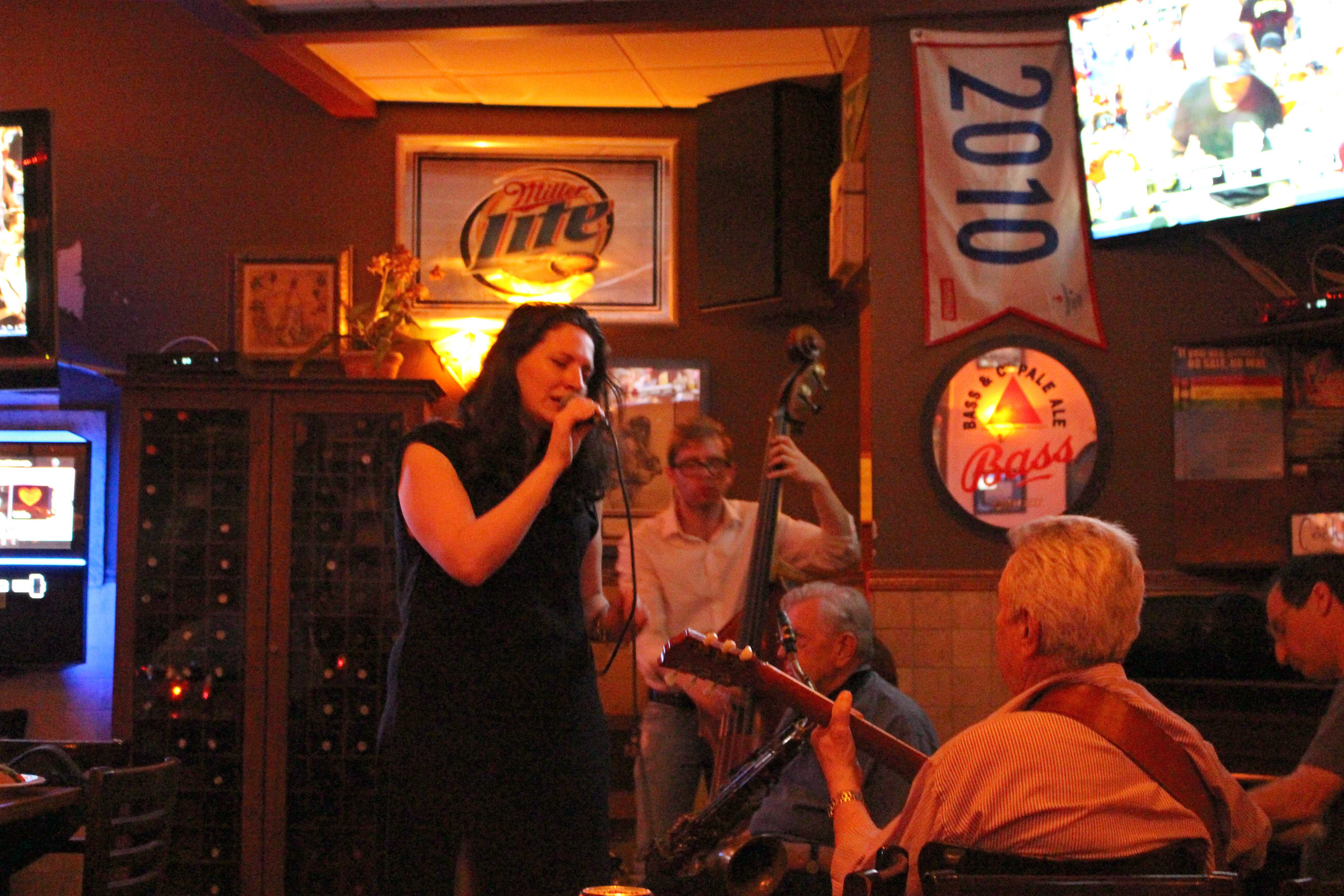
Michelle Lordi, Jazz Singer

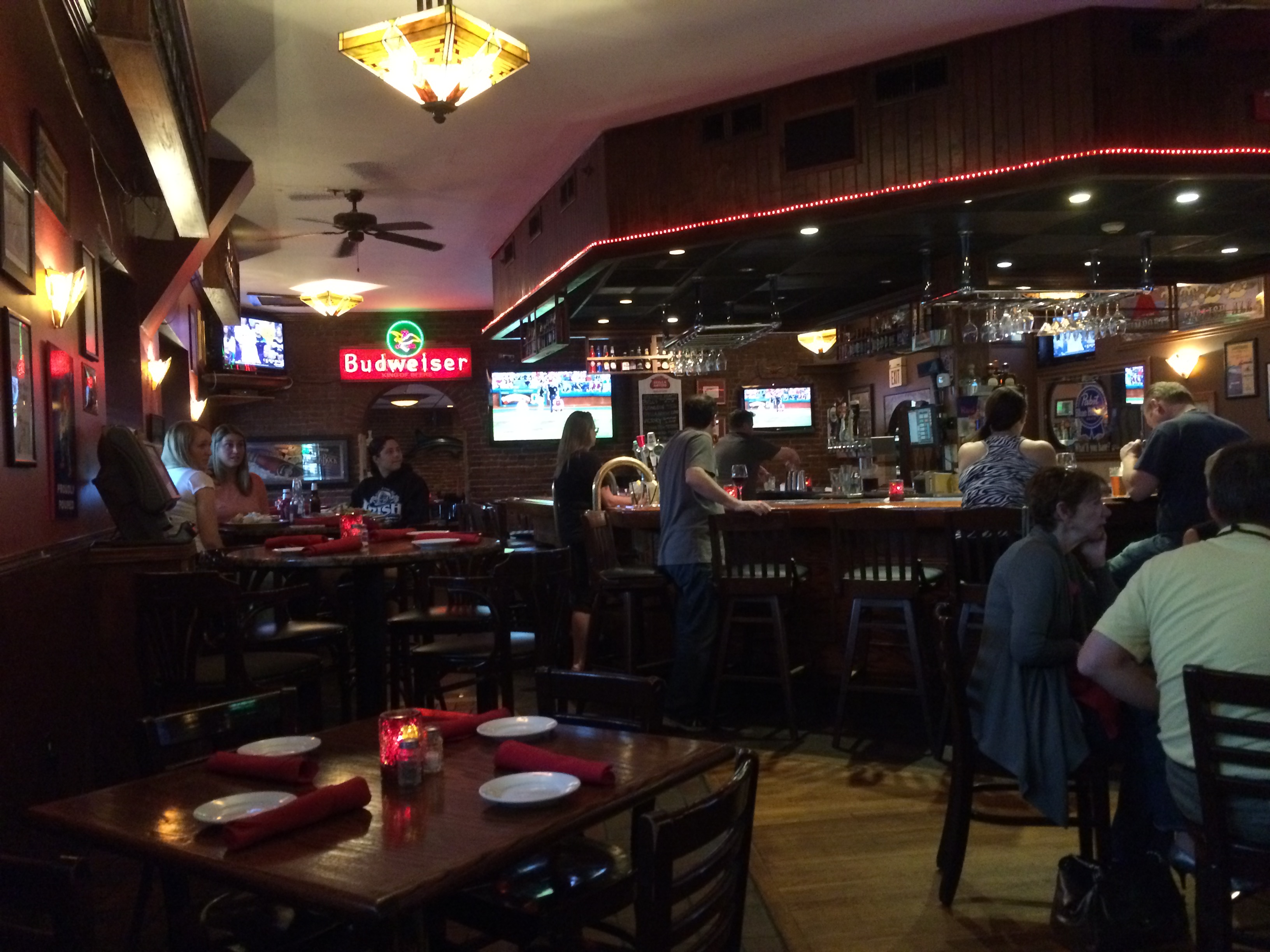
The main room at Vintage Bar And Grill, 10 minutes before the music began.

Vintage Bar And Grill in Abington, Pennsylvania is a good place. It’s a sports bar that serves up thoughtful food. There are plenty of televisions (seven in the main room), knick knacks all over the walls and a not bad selection of beers. And, duh, the place can get noisy, very noisy. So when my wife and I go there for dinner a couple of Fridays or Saturdays each year we are ready and willing to deal with mega decibels. Never had been there mid-week till a handful of days ago though, when on Tuesday we went not only for dinner but to hear some jazz. Most unlikely, Vintage is given over on Tuesday evenings to jazz vocalist Michelle Lordi and her musical partners.

The Philadelphia area, where I live, is home to lots of very good musicians in most musical genres, including jazz. The music biz being what it is, though, only a handful of musicians break through to decent-sized audiences. The rest, like Lordi, do what they can, sometimes maybe plying their craft at small unexpected spots like Vintage.

I’d known about Lordi’s Vintage gigs for a long time. I’d seen her name on a weekly email jazz-near-you schedule that I subscribe to, but I hadn’t given her much thought. Last week, though, the notion to see her bubbled up. Being musically in the dark about Michelle, I first checked her out on YouTube, and she sounded excellent. How was she in person? YouTube didn’t lie. She was great.

Lordi had with her four musicians she works with quite often. Two of them, tenor saxophonist Larry McKenna and electric guitarist Sonny Troy, are grizzled musical veterans, superb players with long and impressive resumes.  Neither I suppose is on the road much anymore, if at all. It says a lot about Michelle that they choose to play with her. The other two are young guys, Sam Harris on upright bass and Mike Frank on electric piano. They did a fine job at Vintage.

Michelle and her band set up shop in a tight Vintage corner near the main entrance. A hi-def TV, on mute, showed the Phillies baseball game above them. Maybe 30 customers were in the room for the first set, at best half of them listening to the music. Five feet from Michelle and one foot from Sonny Troy was a table of six. As the music played, these folks blithely chitchatted about their vacations and the goings-on of various relatives, groundbreaking news all of it. I tip my hat to musicians who learn to become immune to this kind of stuff.

Michelle Lordi is from the understated school of jazz singing. I’d bet that she has taken cues from Doris Day and June Christy, calm singers from the 1940s and 50s. Diana Krall is maybe today’s biggest jazz name who isn’t interested in vocal gymnastics or in bursting a vein reaching for a high note. I like this style of singing a lot. You hear it consistently with Brazilian bossa nova singers.

Michelle Lordi and her band at Vintage Bar And Grill.

During the one hour first set at Vintage, Lordi sang nine songs, standards from the American and Brazilian songbooks. She chose medium to slow tempos and sang efficiently and clearly in a firm and pretty voice. Lyrics came alive because she gave them room to breathe. Over Sonny Troy’s moody accompaniment, she slowed and elongated the words to Irving Berlin’s “They Say It’s Wonderful.” After a wise and moving Larry McKenna solo on Rodgers and Hart’s “I Didn’t Know What Time It Was,” Lordi sang unaffectedly, cleanly hitting the higher notes without strain or an excess of volume. The song  resonated.

Michelle Lordi performs pretty regularly at other venues in the Philadelphia area, such as Chestnut Hill’s Paris Bistro And Jazz Café. And she has done some recording too. But overall she is not exactly a household name. Unless I missed something, the set I took in at Vintage would have gone over just swell at the high-profile Village Vanguard or Café Carlyle in Manhattan or, closer to home, at Philadelphia’s Annenberg Center For The Performing Arts. Beautiful singing, assured and sympathetic instrumental work. Maybe one day I’ll be able to say “I saw her when . . . “

I Apologize For This Movie Review

There are quite a few reasons to visit the old village section of Doylestown, Pennsylvania. Art (Michener Museum), music (Puck), historic curiosities (Mercer Museum), restaurants (too many to mention) all make Doylestown a worthy destination. And movies too, which are to be found at the County Theater.

Recently my wife and I drove with friends to Doylestown for dinner and a movie. Dinner took place at Chambers 19 Bistro & Bar. The four of us enjoyed our meals. It’s a good spot in the center of the old village. After dinner, around the corner we went to the County, which has been on site since 1938. The present theater is a reinvention of the earlier County, a  mainstream theater whose fortunes began to decline in the 1970s. Since the early ’90s the County has been a  two-screen art movie house, and has helped secure Doylestown’s status as a fine place.

Binoche and Stewart among the clouds

The movie that we watched is Clouds Of Sils Maria, a hyper-wordy character-driven drama set mostly in Switzerland. Now, some people have a gift for understanding nearly every movie that they see. Film critics for sure, or so it would seem, and some laity too. I don’t have that gift. How many times has a movie (at theaters or on television) caused me to scratch my head intermittently? Oodles, thank you. Clouds is a challenge and makes me appreciate what professional critics do for a living. Dialogue and plot details fly by quickly in Clouds. If you aren’t in Sherlock Holmes’s league, plenty of both will elude you. Despite all of that, I think I came away with some understandings, in a broad sense if nothing else. And I wasn’t the only semi-lost soul. My wife and our friends weren’t certain about what they’d seen either. Each of us  recalled scenes differently, or maybe didn’t recall them at all. I believe that the writer and director, Olivier Assayas, would have beamed at our struggles, as I don’t doubt that he had in mind to create an open-sided movie elusive to pinning down.

Clouds Of Sils Maria revolves around the morphing relationships between a famous actress in mid-career, played by Juliette Binoche, and two far younger ladies. One is her personal assistant (played by Kristen Stewart) and the other is her co-star (played by Chloë Grace Moretz) in a play, a revival, being readied for the London stage. The play headed for revival is Maloja Snake, in which Binoche’s character, Maria Enders, had starred about 25 years earlier as a young woman involved professionally and apparently romantically with a much older lady. In the revival Enders has graduated to the older person’s role and fantasy/action movie star Jo-Ann Ellis (Moretz) takes on the young lady. Enders’s personal assistant Valentine (Stewart) helps Enders prepare for the play, reading and discussing the script with her. But all is not easy or simple in Maloja Snakeland. For our three protagonists, real life and the stage play uncannily and surreally seem to intertwine. Where does reality lie? Art, after all, reflects life. Binoche, Stewart and Moretz do fine work in this dizzying stew, playing off one another with panache and believability.

Well, like one of my friends said after the movie, this one is not for everybody. Plot offshoots overstretch its length by at least 20 minutes. And getting back to those pesky details . . . This morning I read the New York Times review of the movie, which is where I learned that the younger woman in the play has a sexual thing going with the older. Was this actually mentioned in Clouds? I sure don’t remember hearing about it. Maybe the Times reviewer had been given a crib sheet by the film’s producers before he saw the movie. Maybe I’m just slow. Probably both. I could mention many other such puzzlers. But that’s enough.

Yet, you know, I liked Clouds Of Sils Maria. It made me think, usually a good thing. My ultimate take on the movie is that the Binoche and Stewart characters were emotionally close but not quite right for each other, and needed separation in order to move on with their lives. Separate they did, though the circumstances and motivations involved are ripe for long discussions. I’m betting that as years went on, Enders and Valentine ended up just fine. Not so sure about the quality of Ellis’s fate down the road, though.

If you are wowed by nuanced acting, beautiful scenery and swirling dialogue, I recommend Clouds Of Sils Maria to you. I also recommend that you read at least two reviews, other than my mediocre effort, before you head off to view it. I should have done some advance reading myself. The Times review will be helpful. The New Yorker’s too. Like me, Anthony Lane, The New Yorker critic, seems to be more than a bit unsure about what the heck was going on. Which makes me feel better about my own perceptual shortcomings.

Mason Porter And The Chris Kasper Band Take On The Grateful Dead

1970 was a very good year for the Grateful Dead and a fairly good one for me. I was one year out of college, no long-term success plans in place, working here and there to earn a few dollars. But I was happy enough, I’m pretty sure. Unlike me, The Dead mined gold in 1970, recording and releasing that year what many agree are their two best studio albums: Workingman’s Dead and American Beauty. These albums were a big change from Aoxomoxoa, their pretty darn trippy effort from the previous year. The 1970 albums presented tightly arranged songs, many of them quiet and lovely ballads, straight out of the folk, blues and mountain music traditions. The 18 songs on these records shine with a timeless aura and are nothing but grand. The quality of the material probably took the Dead, and most everyone else, by surprise.

During a vagabond-like tour of the USA in summer 1970 I found myself in San Francisco for two or three weeks. I knew about the Dead (who didn’t?), but I don’t think I had any of their albums in my collection at that time. I wasn’t yet a fan. But in San Francisco, the Dead’s home base and where they had become emblematic of hippie culture,  I was smart enough to realize that I should go and see them if I had the chance. The chance arose, as they were booked for three nights in mid-August at the Fillmore West. I went to one of those shows. Workingman’s Dead had come out two months earlier, and the guys were already hard at work on American Beauty. It was a rich period. Sadly, for me the concert has almost disappeared into the fog. Well, I do recall a few things, such as standing in the middle of the Fillmore’s crowded open auditorium gazing at the stage. I also vaguely still can hear the band playing Casey Jones, the tune that brings Workingman’s Dead to its end. And I remember thinking that the concert was good but not great, an opinion that would have left Deadheads shaking their noggins in bewilderment. But memories about the show other than those  . . .  man, I could fill fifty books with all the things I’ve forgotten in my life, if the details magically could be jolted back into place.

Which brings us to April 29, 2015 at the Ardmore Music Hall in suburban Philadelphia. That evening I went with friends to watch two locally-based bands, musicians who had had the superb idea to play the Dead’s 1970 albums in their entirety, track by track. I’m writing this not long after seeing the concert, so my brain hasn’t had a chance yet to get fuzzy about the experience. And the experience was great. I enjoyed the concert in Ardmore more than I did the one in San Francisco 45 years ago.

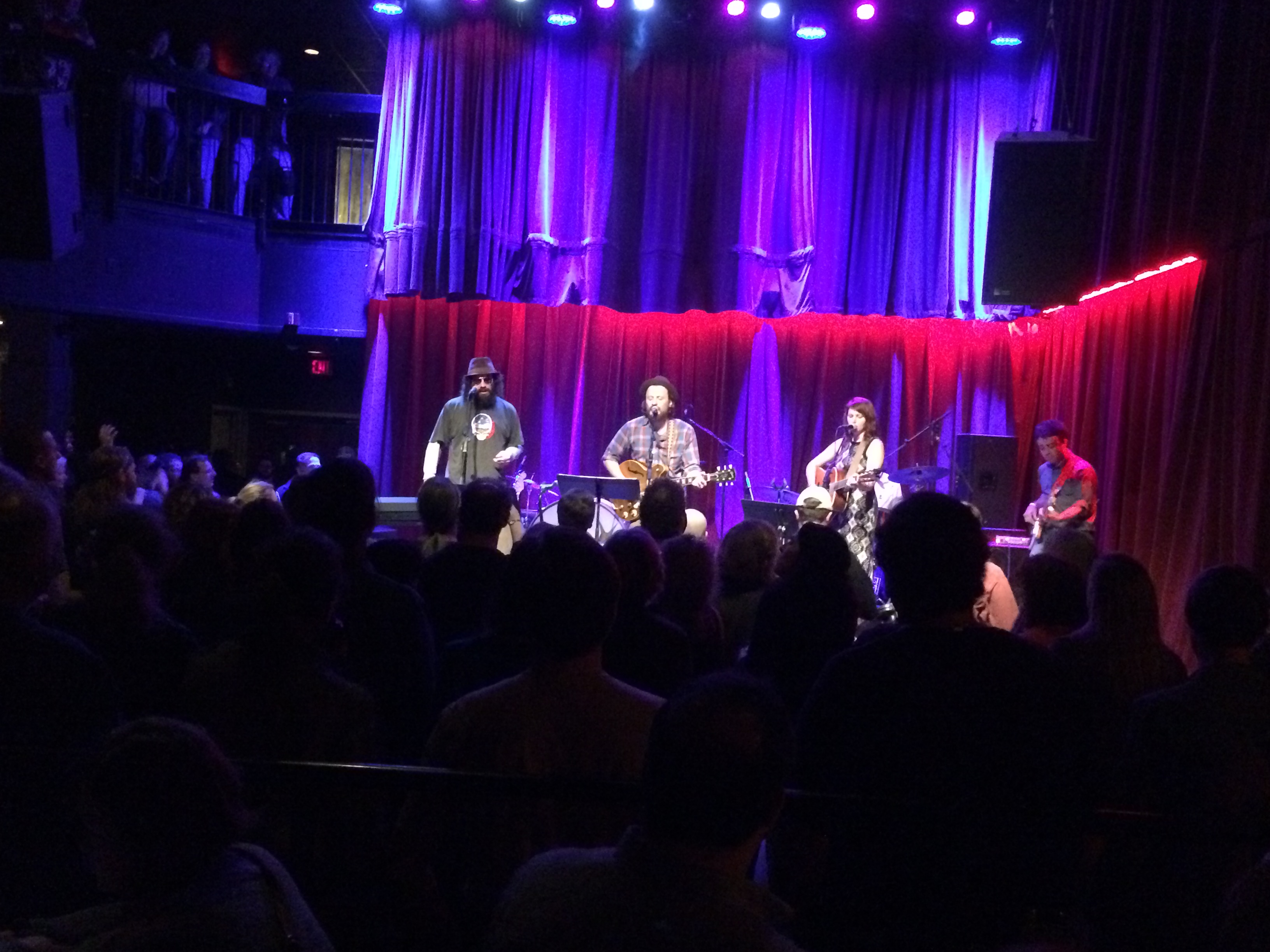
The Ardmore Music Hall is in the midst of presenting five shows that celebrate the 50th anniversary of the Grateful Dead’s founding. The centerpiece show for me easily is the one I attended. Handling Workingman’s Dead was Mason Porter, which is a band not a person. The American Beauty duties fell to The Chris Kasper Band, a quintet that grew bigger on some songs with guest musicians. Both units lovingly approached the landmark albums, but didn’t try to duplicate the Dead’s sound. Each was pure rockier than the Dead, and each possessed something the Dead didn’t: a fiddler.  Three hundred or more folks packed the Ardmore, ages 20 to 70 all heavily represented and swaying and hippie-dancing to the tantalizing beats.

Mason Porter at Ardmore Music Hall

The five-person Mason Porter had me going from note number one of song number one, Uncle John’s Band. The group built the tune in stages, reaching heady heights with lead guitarist Paul Wilkinson’s soaring Eight Miles High-ish solo. And they nailed the seven songs that followed. Lead singer Joe D’Amico had an easy and calm delivery, very much in the Jerry Garcia vein. Sarah Larsen’s Appalachian fiddling infused the band with a whole lot of grit. The crowd erupted in applause after her long solo on Dire Wolf. She was overwhelmed by this outpouring and smiled the biggest smile I’ve ever seen on a musician’s face. It stretched out of the hall and halfway to the next town.

The Chris Kasper Band at Ardmore Music Hall (CK is second from left)

For some reason I was delayed getting into The Chris Kasper Band. But they hooked me with Candyman five songs into the set and didn’t let go after that. Keyboardist David Streim brought strong and broad chordal waves to Candyman and the song took flight with Chris’s electric guitar work and fiddler Kiley Ryan’s sweet solo turn. Quite a night for female fiddlers, and not usual to find two at the same concert. On some songs Ryan exchanged the fiddle for an acoustic guitar.

Chris Kasper’s lead vocals were crisp and mellow all set. Like Joe D’Amico and many others, he’s partly from the Garcia school of singing. He alternated between acoustic and electric guitar and used the latter to drive Till The Morning Comes, snapping off white hot riffs like Keith Richards. Matt Muir’s firecracker drumming bounced that song outrageously, pop pop pop. Tremendous.

Truckin’ brought the band’s American Beauty homage to a close. But the night wasn’t over. Mason Porter and a few guests joined the Kasper outfit on stage and a four song Grateful Dead encore ensued. The energy in the Ardmore Music Hall grew to dangerous levels as the huge ensemble ripped through Goin Down The Road Feeling Bad, Bertha, Franklin’s Tower and Mr. Charlie. The music was ferocious, the audience insatiable. At 11:30 PM the last notes rang out.

My Coca-Cola Relapse

How much cola have I consumed in my life? Thousands of gallons I’d guess. Not to mention the huge quantities of other soda varieties that have passed through my body. But cola always was my favorite. Coca-Cola, Pepsi, RC Cola, store brands – I proudly and happily drank them all. Over time, Coke became my top cola choice.

My cola habit was strong in my teens and went up some notches in my early 20s. But it ended in my mid-40s when I gave up cola and other sodas. All of that sugar for so many years, combined with sad dental hygiene, had made a mess of my teeth and gums. I needed to stop drinking the stuff, and it’s a good thing that my willpower was strong enough to follow through. I didn’t switch to diet sodas because I’ve never liked the taste of artificial sweeteners.

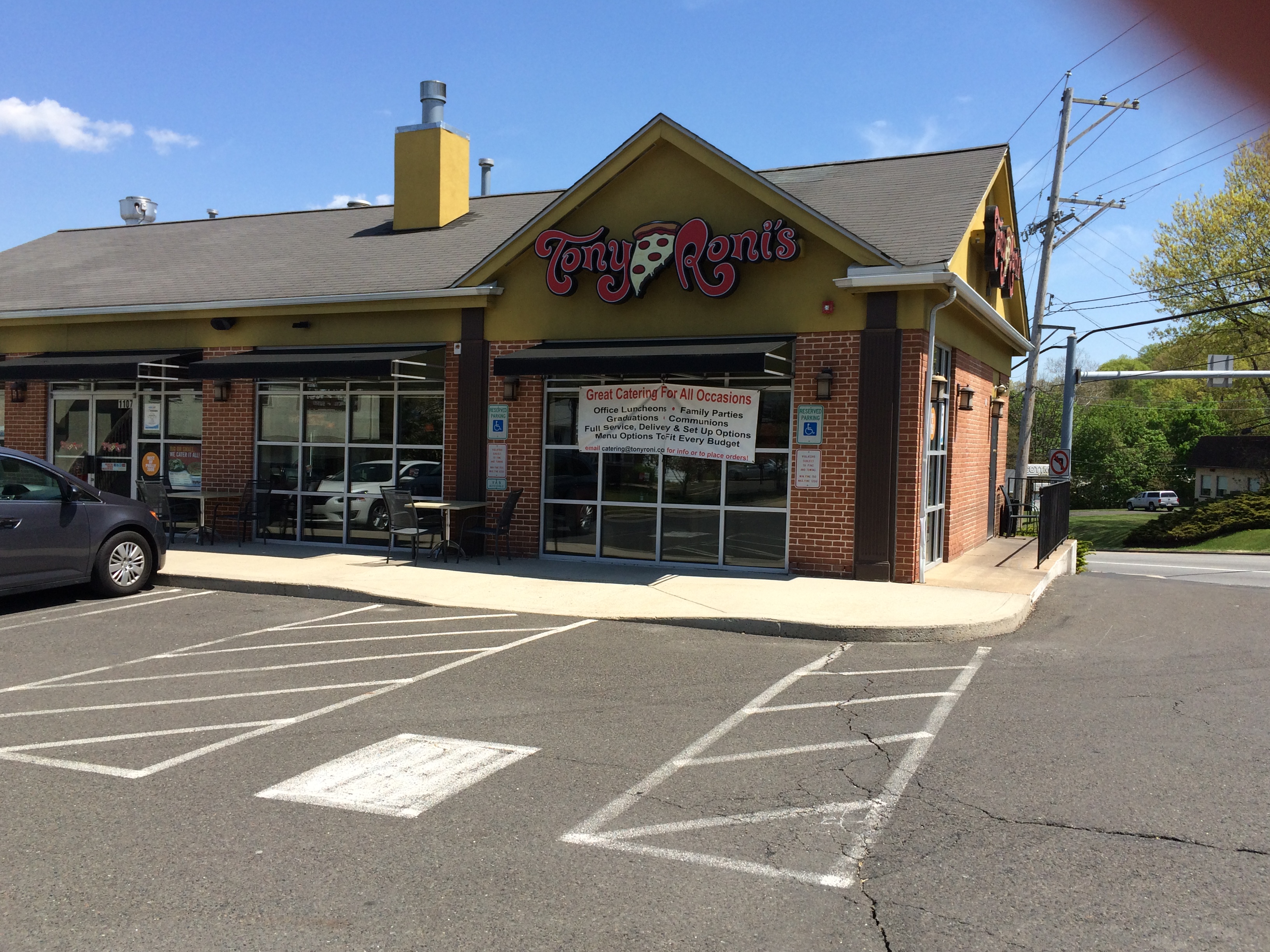
The scene of my relapse

But cola is back in my life. Coca-Cola, to be precise. Its return began not long ago at a pizza place I’ve been going to for a couple of years, Tony Roni’s. Roni’s resides at a remarkably congested and dangerous road intersection in Willow Grove, PA, not far from Philadelphia. Customers might somewhat put their lives in jeopardy to visit Roni’s, but that doesn’t keep them away. And that includes me.

I love pizza, especially the more traditional and unadulterated types, but I can’t find many by-the-slice places that make it the way I prefer: crisp charred crust, sweet tomato sauce, good quality cheese and not an overload of it nor of oil. Tony Roni’s traditional pies seem to vary in quality from visit to visit. They are not too bad overall, but in a better world they consistently would be less floppy and oily. So, a bit frustrated, last year I started ordering slices of Roni’s tomato pie instead. It’s a pizza variety I had rarely had before. They do a nice job with tomato pie, its underside heat-darkened, the crushed tomatoes ripe with good flavor, very little oil, a dusting of cheese. The crust could be better, but what the heck.

Initially I drove to Tony Roni’s once every two or three weeks and, for various reasons, most frequently on Wednesdays. Wednesday is the one day when they offer a free fountain soda to anyone who buys two pizza slices. For a long time I rejected the free drink. After much cavity filling and periodontal work, my teeth and gums have been pretty good for quite awhile now, so why press my luck? But the lure of Tony Roni’s free soda must have been nibbling at my subconscious. Earlier this year my resistence grew thin. Paying for two slices on a January Wednesday I said “oh well” to myself and accepted the cashier’s proferred paper soda cup. Off I went to the soda dispenser and allowed six or so ounces of Coca-Cola to descend. I took a seat, took a sip, and was in heaven. Coke is heaven. I knew that all along.

Since then, my trips to Tony Roni’s have been almost weekly, and exclusive to Wednesdays. Each time I buy two slices of pie, usually tomato pie, and savor about six ounces of free Coke. I try very hard not to drink more Coke than that. So far I’ve been successful. And when I get home from my pizza and soda outings I brush my teeth. Coke is delicious. Dental work isn’t.