Running Free

I don’t know about you, but it seems to me that driving in any inhabited area these days is a sure fire way to add kilos of stress to the body, to send the diastolic and systolic numbers moonward. For me, driving even on my typical suburban block can be a true pain. One recent morning, for instance, I stepped into my ancient Honda, which was parked directly in front of my home, and saw a young couple 100 feet in front of me. They were putzing around with their SUV, also parked on the street. Their rear driver’s side door was wide open, making passage past their car difficult. Worse, the female member of the twosome was standing in the middle of the street, la-dee-dahingly removing boxes from the back seat. “OK, no problem. I’ll simply make a K turn and head in the opposite direction,” I said to myself. As I gracefully maneuvered the Honda to my left and then backwards, needless to say another SUV headed towards me from the direction in which I now was planning to drive, putting pressure on me to complete the K pronto. Bottom line: Nearly everywhere you go there are just too many people and too many motor vehicles. “Hey, that’s modern life,” some would say. “Get with it.”

Oh yeah?  Arrgh . . . Let me outta here! I need to run free! At least some of the time.

I don’t like congestion, dig? But what’s a person to do? I’ve written a few times online about the sweet spot that Cape Cod occupies in at least two hearts, mine and my wife Sandy’s. Cape Cod is where we head when we want to get away from it all. Not that Cape Cod is free from congestion. Hardly. But if you know where on the Cape to go, and when, you’ll be far far far from the madding crowd and its cars and trucks. And you’ll have fun too.

Cape Cod is famed for the throngs that descend upon it between Memorial Day and Labor Day weekends. People and cars up the wazoo. That’s why Sandy and I never go there during that period. We were on the Cape last month though, when things were back to normal. We spent plenty of time among others of our species. But we also made sure on most days to bathe our souls in places where the human and vehicular factors would be minimal.

Parabolic sand dunes territory. Truro, Cape Cod.

“You know,” I said to Sandy on this most recent trip as we stood atop a humungous sand dune. “If you plopped most people down here and asked them where they were, they’d never guess it’s Cape Cod.”  That was true. When the majority of folks think Cape Cod they envision seaside-ey villages and seafood-ey restaurants. But we were miles away from any of that. We were in parabolic sand dunes country, inland just a bit from the Atlantic Ocean in Truro. Truro is a sprawling area of the Outer Cape, and probably the most rural and desolate section that Cape Cod has to offer. The parabolic dunes are by far the Cape’s biggest, undulating 80-feet-and-taller monsters that extend for several miles, covering part of Truro and of Provincetown too. We’d been in this locale a bunch of times before, and as always were knocked out by the vistas. Several parallel chains of dunes ran long into the distance. Between each chain were deep valleys that, surprisingly to me, a low level naturalist, were loaded with small trees and shrubbery and all manner of other plants that I couldn’t give names to. This is a mind-blowing environment, a vegetated lunar-like landscape that, I’m sure, many Cape Cod residents and vacationers barely know about. It is open and wild. I feel alive there. And that’s why I like it.

Over the years I’ve spent a lot of hours scampering up, down and around the parabolic dunes, and even more among the slightly smaller and less dramatic dunes that take over in Provincetown when the parabolic big boys eventually peter out. At this point in my life I’m not going to be climbing any mountains in the Alps or bungee jumping into canyons in the American West. For me, the Outer Cape’s dunesville does just fine as a spot where I can indulge my sense of adventure and feel as though I’m pushing my puny limits. There’s no congestion out there. You might cross paths with a few other trekkers, but that’s okay. They are kindred spirits.

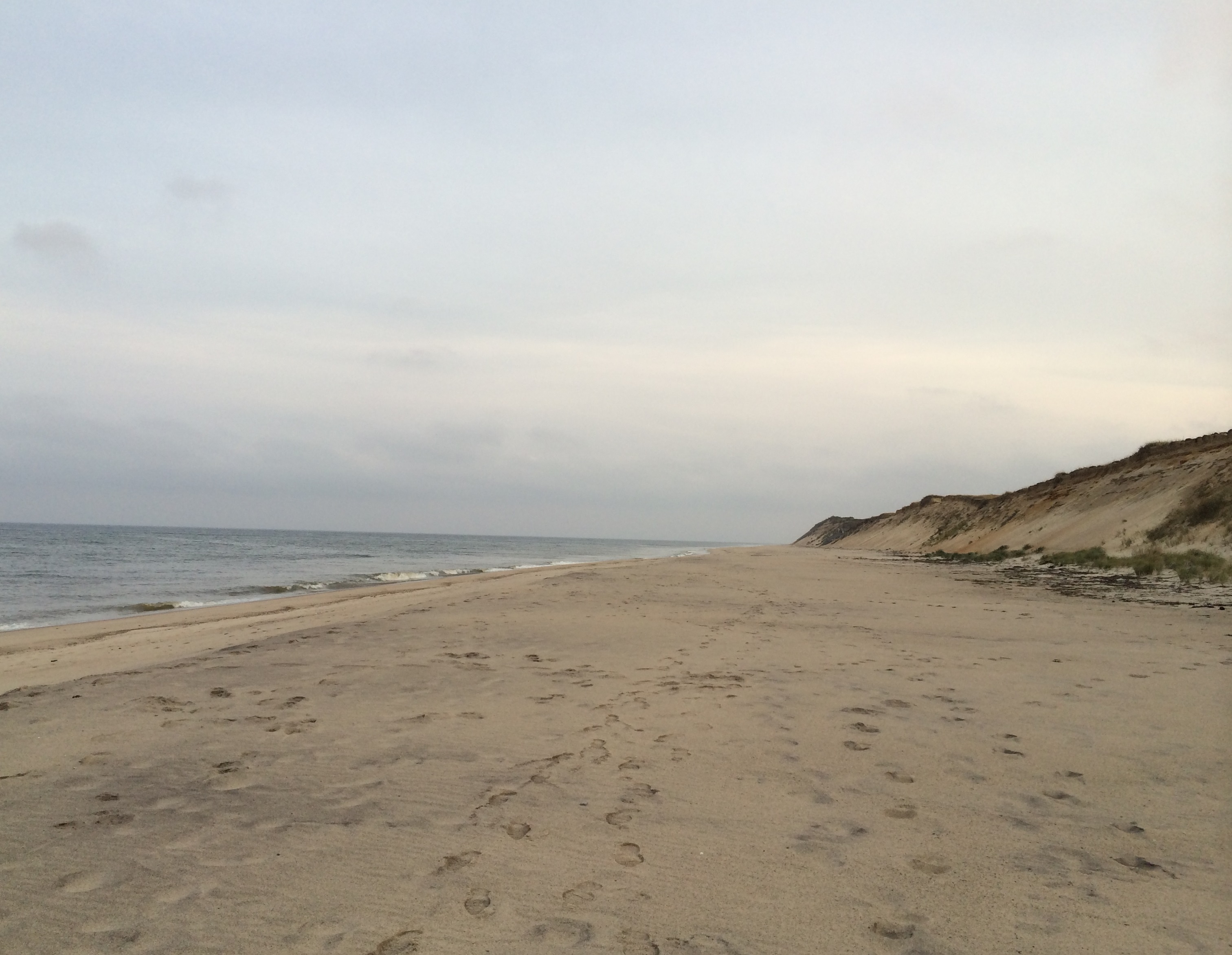
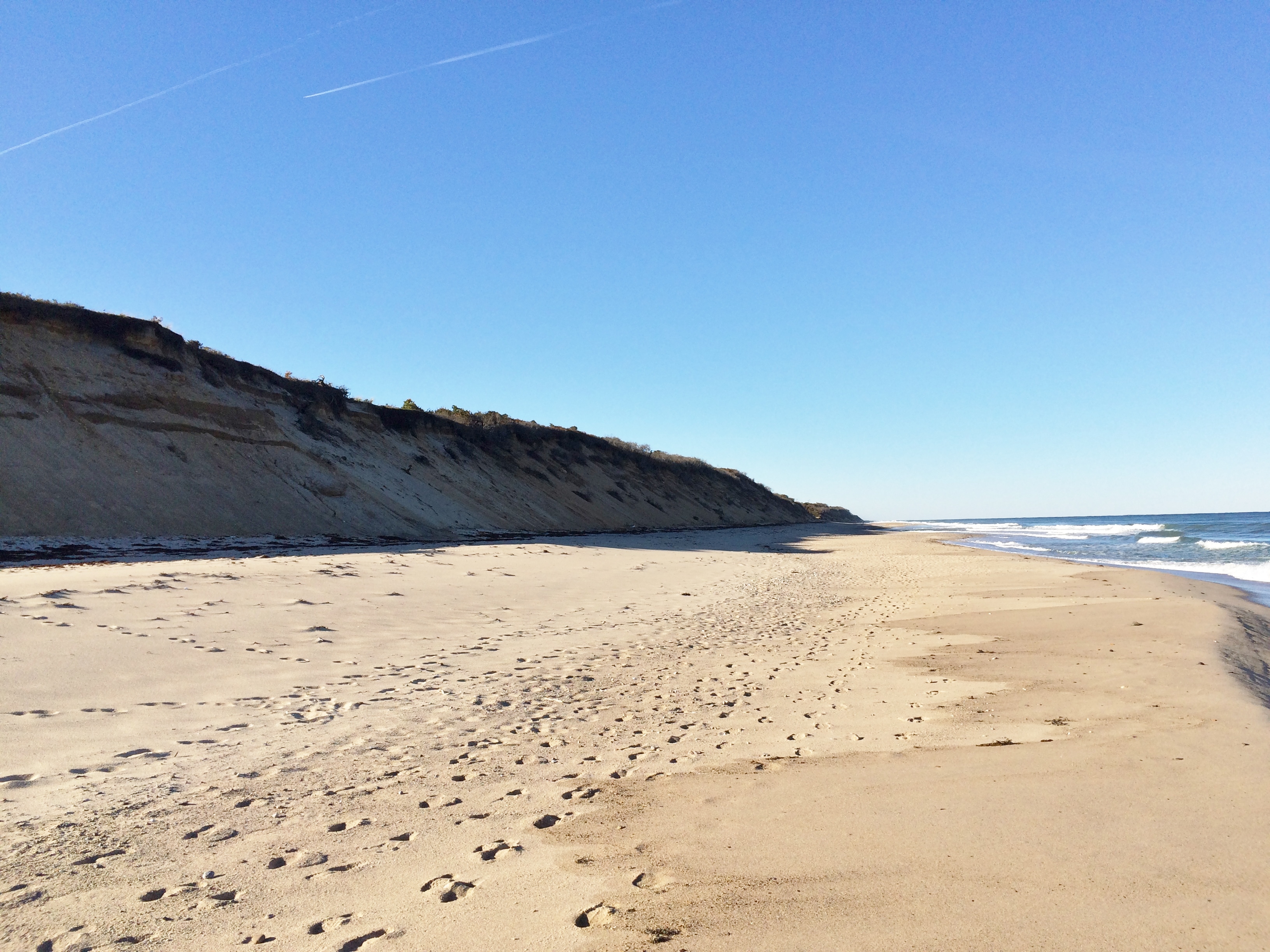
Dunesville is great. But what I like even better on Cape Cod is the Atlantic Ocean shoreline. Most of it is under government protection, meaning that mankind won’t be messing it up any time soon. It’s pure, it’s long — 40 or more miles — and it’s beautiful. What’s not to like? Sky, ocean,  and sand-cliff-backed endless beach.

Its presence of water is why I would choose, if I had to choose, this shoreline over the Outer Cape’s dunes territory. Though Sandy and I aren’t swimmers, we’re big time water admirers. We have hiked hundreds of miles over the years on the Cape’s ocean shore. There’s just something about being there. The power of the water, its changing face from day to day. The rigid coolness of those sand cliffs. The real low numbers of humankind in the off-season. And then there’s our kite, which enhances this scenario. Last year we bought the kite and flew it on beaches many times. We launched it frequently during our recent stay too.

Atlantic Ocean shoreline at Marconi Beach, Cape Cod.
Our kite at Marconi Beach, Cape Cod.

One day last month, on the ocean shoreline named Marconi Beach, the conditions for flight were perfect. A strong but not overpowering steady wind meant the kite would stay aloft sans problem. What we discovered at Marconi was that the kite was insatiable. It kept pulling on the string, begging us to let out more and more length. This hadn’t happened to us before. And so we did. The kite went higher and higher. The amount of string on the reel grew less and less. I hardly could believe it when there was no more string to release. The kite was way up there. How far away I didn’t know.

After an hour or so we decided it was time to move on, to say goodbye to Marconi Beach for the day. It took a long time to reel in the kite. Later I checked out the kite manufacturer’s website where I learned that our polyester friend came equipped with 300 feet of string. I was impressed. At Marconi Beach we had overseen a long-distance journey.

Congestion . . . bad. Running free . . . good. End of story.

(Photos by Sandra Cherrey Scheinin. If you click on a photo, a larger image will open)

(If you enjoyed this article, then please don’t be shy about sharing it)

The Pretty Good And The Great: A Look At Burnt And Room

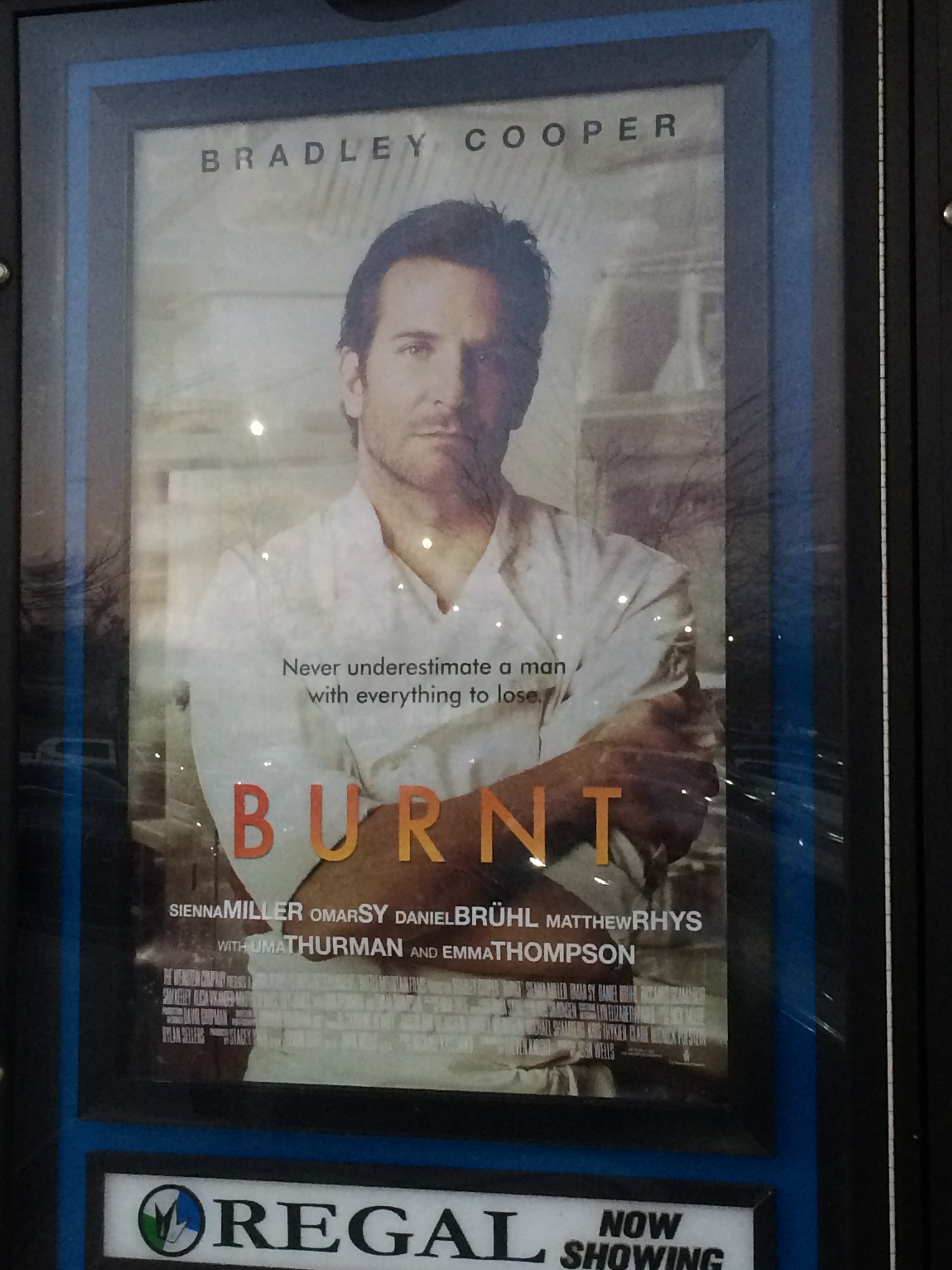
On a recent weekend my wife Sandy and I added to one of the biggest lists we maintain. Namely, the list of movies that we have seen. We watch far more movies at theaters than at home, and the two I’m about to talk about were viewed from comfortable chairs in suburban Philadelphia cinemas. We went on a Friday with our excellent friends Barbara and Fred to see Burnt. The following night, unaccompanied, we took in Room.

I hadn’t thought of Burnt as a must-see, but I was more than happy to give it a go when Sandy informed me that she and Barbara had decided upon it. I like Bradley Cooper and I like food, and Burnt not only stars Cooper but is set in the world of high cuisine and celebrated chefs. Leaving the theater I was fine with Burnt. Then the next day I started to think about it a bit more, a dangerous thing to do, and downgraded my opinion. It’s an enjoyable movie, but nothing beyond standard. It’s pretty good at best.

Now, Room was another story. I had been under the impression that it is highly disturbing, with tough-to-watch violent scenes. I was reluctant to see it because of this. Sandy, however, told me that, from what she had read, I was wrong. Right she was. I didn’t have to close my eyes at all during the movie, as nothing bloodily horrific occurred. What did take place unfurled seamlessly, a heartwrenching and heartwarming tale that felt authentic. Room is a great movie, one of the very best that I’ve seen so far in the year 2015.

Seems to me that most movies, in one way or another, are about the human condition. Well, uh, duh. And the human condition, needless to say, is complicated, far too variable and malleable for an amateur observer like me ever to understand particularly well. I came away from Burnt and Room, though, with the idea that, vastly different as they are, they address some of the same questions: What does it take for a person to become well-oiled and smoothly-functioning and goodhearted? To fit in the world healthily?

We saw Burnt in Warrington, PA.

In Burnt, Bradley Cooper plays Adam Jones, once a top-of-the-line restaurant chef who imploded and burned his bridges several years before the movie’s opening moments. Anger, unhappiness and the subsequent drugs and drink did him in. Early in the action we find him doing self-imposed penance as an oyster shucker in a New Orleans restaurant. He has been clean and sober for a couple of years and has decided that he will take his place as an elite chef once again, but only after he has shucked one million oysters. That milestone reached, off he heads to London, where associates from his past are in the culinary game.

Aggressive, fast-talking and manipulative, Jones magically in no time is at the helm of a fancy fancy eatery in a fancy fancy hotel. You go, bro! Though recognized as a maestro in the kitchen, Jones for some reason feels obligated to treat his boss and kitchen staff in a bullying and disrespectful manner. And he gets away with it. Apparently the stoppage of substance abuse didn’t stop Jones from being an asshole. How come? — go ask the screenwriter. But what really got me was that so many people, despite Jones’ obnoxious ways, have an underlying deep affection for him. Made no sense to me. Go ask the screenwriter.

But Adam Jones is not all bad. Hints of decency peek through. And he owns a degree of self-awareness. If he is to morph into the person whom others, remarkably, are rooting for him to become, he will need to drop his defenses and allow their good feelings to reach him, and allow his blood to warm. We’re talking here about love, the key to life.

Yup, high-speed and breezy Burnt is a flawed production about a flawed human being. But there are two good reasons to see it, Bradley Cooper for one. He is a fine actor. Adam Jones is a complex guy, and Cooper draws a complete picture.

And then there’s the food. I’m a sucker for beautifully filmed looks at the preparation and downing of gorgeous and delicious meals. A good one-sixth of Burnt has the camera focused on this tasty stuff. Thinking about it now is making me hungry.

We saw Room in Ambler, PA.

Speaking of flaws, stay away from Room if you’re looking for them. It is one of those movies that gets everything right. The screenplay, cinematography, pacing, acting. Brie Larson and child actor Jacob Tremblay perform astonishingly in the lead roles. The rest of the small cast also is outstanding. I see a bushel of Oscar nominations in Room’s future.

Room’s examination of how best to grow in the world, unlike Burnt’s, is profound, multidimensional and moving. What, though, is the world? When Room commences, it is a one-room shed for 24-year-old Joy Newsome (Larson) and her five-year-old son Jack (Tremblay). They have been held prisoner there by perverted Old Nick, a middle-aged loser. Old Nick never has allowed Jack to leave the shed. Joy, kidnapped by Old Nick when she was seventeen, hasn’t been outside the room since then. Old Nick began using Joy for sex right from the start. He is Jack’s biological father.

The shed is habitable and sits behind Old Nick’s home in Akron, Ohio. It has running water, electricity, heat, a tiny kitchen and bathroom, a bed, a television and a few books. It has no wall windows, only a skylight. Its one door is thick and equipped with a passcode-protected lock for which only Old Nick knows the numbers. Old Nick visits the shed to deliver food and to have sex. Escape? Little chance — Old Nick is crafty and scary. This is a bleak set-up, one in which only the strong-willed and resilient, such as Joy, would survive.

Jack knows of no existence beyond his prison. To Jack, the room and his mother have been reality, nothing much else. He doesn’t realize that the people and other images that he sees on television have a connection to realms beyond the screen. Yet he is a happy and playful child. Joy has done miraculous work nurturing Jack under cruelly limiting conditions. Raising him with love is all that matters to Joy. And shielding him from Old Nick.

I’m not spoiling the plot by saying that Joy begins to explain their plight to Jack when he turns five, and that light bulbs slowly brighten in his mind. I won’t say more about the directions the story takes. Giving away too much about such a quality movie wouldn’t be fair.

But I will say this. Room examines the human plight fastidiously. Burnt doesn’t, which is sort of OK because it never meant to. But Burnt would have been a better movie if it had tried a little harder. Somewhere in the middle of Burnt one of the characters throws out a line or two about Adam Jones having had a very rough upbringing. Nothing more is made of this in Burnt, but probably it’s the root cause of chef Jones’ discontent.

I’ll say it again. Love, the key to life.

(Photos by Sandra Cherrey Scheinin. If you click on a photo, a larger image will open)

(If you enjoyed this article, then please don’t be shy about sharing it)

Tony Bennett Is A Wonder

I’m not an expert on the subject. However, if someone asked me to name the 20th century’s best singers of the so-called Great American Songbook, I’d reel off names such as Frank Sinatra, Nat Cole, Ella Fitzgerald, Billie Holiday, Sarah Vaughan, Tony Bennett, Peggy Lee, Louis Armstrong and Fred Astaire. My list is hardly complete or definitive. But it contains excellent talent without a doubt.

All the entertainers on my list were contemporaries, their careers overlapping one another’s during various decades. A sad note is that only one member of the list is still with us, Tony Bennett, whose professional musical life took hold in 1949 (1949!). Sixty-six years later he continues to go strong. The man is 89 years old now and in good voice. He records regularly and likewise tours the world. He, to me, is a phenomenon. A wonder.

Tony Bennett (left) and Bill Charlap. (Photo by RPM/Columbia Records)

A few weeks ago I caught a track on the radio from one of his albums. It was a melancholy song, beautifully sung. His accompaniment was only one instrument, a piano. I thought that the selection probably came from The Tony Bennett/Bill Evans Album, a 1975 release pairing Bennett with the esteemed jazz pianist. That album has achieved iconic status over the years. But I was wrong. The song — and I can’t remember which one I heard — was a brand new recording from the lovely album by Tony Bennett and Bill Charlap titled The Silver Lining: The Songs Of Jerome Kern.

Recently I listened twice to The Silver Lining in its entirety. And I listened to a few cuts from the Bennett/Evans duet album too. These albums are separated by 40 years. And you know what? Tony’s voice is nearly as good now as it was then. It has lost a little power, strains a bit occasionally. But it remains quite great. I find this most incredible. Has there ever been another gifted vocalist whose pipes have held up so well in his or her very advanced years? I can’t think of anyone. Please let me know if you can.

Jerome Kern was a top composer during the first half of the 1900s. He wrote with a host of smart and classy lyricists, Oscar Hammerstein II, Dorothy Fields and Ira Gershwin among them. The Silver Lining presents some of Kern’s best-known, and best, compositions. For example, The Last Time I Saw Paris, All The Things You Are, I Won’t Dance.  There are 14 tracks on the record. Bennett sings on all of them. Bill Charlap, a refined and tasteful jazz piano player, is Tony’s sole partner on three. Charlap’s jazz pianist wife, Renee Rosnes, adds a second piano on four songs. On the remaining tracks, Charlap is joined by his longtime collaborators, Peter Washington on bass and Kenny Washington (no relation) on drums.

Overall I find this album to be sublime. The instrumentation is understated. Bennett’s vocalizing is poignant and incisive. He plumbs the depths of the tunes’ lyrics and adds some explosive high notes at the conclusions of a few songs to show that he still has it. If you’re a Tony fan, you should own The Silver Lining.

So, what’s the deal with Tony Bennett? How has he managed not only to survive, but to thrive? Well, genetics more than anything probably accounts for Tony’s long life. As for thriving, we all might learn from his outlook on and approach to life. Tony Bennett always has seemed to me to be a down-to-earth and nice guy, and also in possession of wisdom. There is a fine article about him in the December 2015 issue of DOWNBEAT magazine (the article is not online, so I can’t provide a link). Two quotes from the piece are very telling.  In one he says: “I can’t believe that I’m 89. I stay in shape. I take good care of myself. I got rid of all bad habits. When I was younger, I was pretty wild, doing a lot of foolish stuff. I stopped all of that and I got back to how to sing properly.” And in another he says: “I think life is a magnificent gift. We should all enjoy the fact that we’re living on an unbelievable planet that’s loaded with education and love and beauty.”

It’s not coincidental that the song Look For The Silver Lining concludes the Bennett/Charlap album. George “Buddy” DeSylva’s lyrics are fully in tune with Tony Bennett’s take on the human situation. Give a listen:

(If you enjoyed this article, then please don’t be shy about sharing it)

I Never Met Thelonious Monk, But . . .

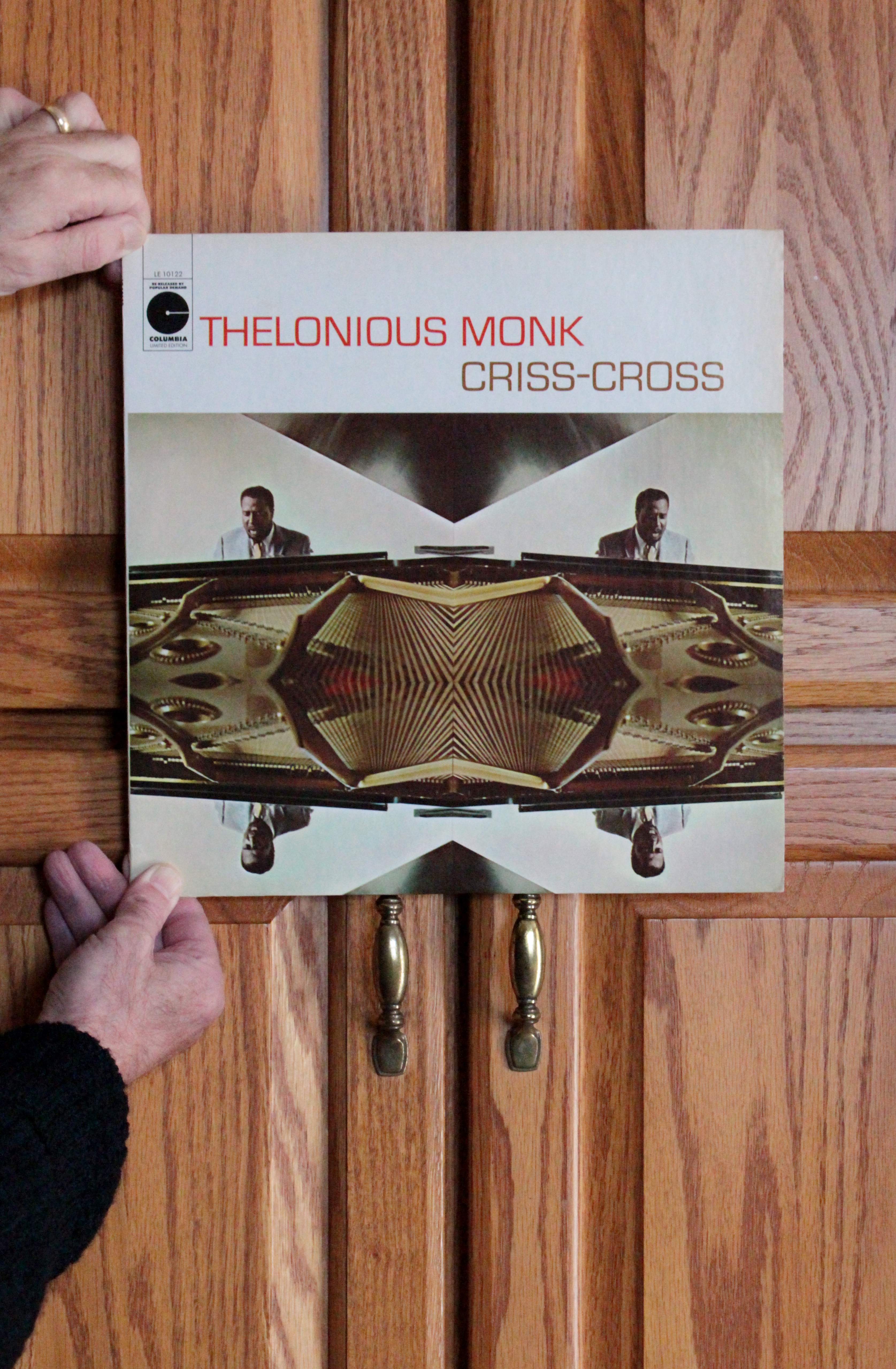
The front cover of the author's copy of Criss-Cross.
The front cover of the author’s copy of Criss-Cross.

I loved Thelonious Monk’s music from the first time I heard it, and I’m sure I’m not alone in that. The year was 1964, maybe ’65. I was a high school senior entranced by rock and roll, R & B, some folk music, and by standards singers such as Sinatra and Bennett. But not by jazz, which was foreign territory to me at that time. My high school buddy Dave had just obtained his New York State driver’s license and one day informed me that he was going to take a ride to a local Sam Goody’s, a popular record store chain that sadly is no longer with us. For whatever reason, I didn’t accompany him. Dave asked me if I wanted anything from Goody’s. I must have been feeling adventurous because I requested a jazz album. Any jazz album would do, since I didn’t know one from another. The record that Dave a day or two later placed in my hands was Criss-Cross, Monk’s 1963 release. I doubt if I had ever heard of Monk before, though he was one of the most famous jazz pianists in the world. And I doubt if Dave knew much about him either. How, then, had Dave come to select this album, which to this day I consider to be magnificent? I don’t know. Dave possessed powerful intuitive talents, still does, and it seems that choosing great music from out of the blue was one of them. On the other hand, maybe he just liked the album’s cover. It is très cool.

I listened to jazz in small amounts over the next few years and in 1969 began to become the jazzhead that I am when I started heavily to inhale the outpourings of Miles Davis, John Coltrane, Eric Dolphy, Ornette Coleman and an ocean of others. And Thelonious Monk too, of course. Monk is one of my all-time favorites.

There’s something peaceful about Monk’s playing, even on the upbeat numbers. Something mesmerizing. Something irresistible in the way he’d offer the unexpected note, the tantalizing trill. Monk had an instantly recognizable sound on the piano, an intriguingly off-center approach. He didn’t play overly fast, just fast enough, and he put his heart and soul on display. He didn’t compose a lot of tunes (73 is the official count), but the unadorned and undeniable beauty of many of his compositions have connected with millions of listeners and with his peers. During the 1980s and ’90s it seemed that every month brought forth a new Monk tribute album. Even now, many jazz albums include one or two Monk works. Great compositions such as ‘Round Midnight, In Walked Bud, Ruby My Dear, Hackensack. Monk died in 1982, and remains a giant.

Thelonious Monk was someone I wish I had met and talked to, though I gather he wasn’t a man of many words, at least at times. I suspect that his song titles indicate this. Fifty of the 73 are either one or two words in length. Still, how fine would it have been to ask Thelonious Monk some questions: Have your piano practice habits changed over the years? Which of your songs mean the most to you? Do you ever listen to Top 40 radio? As a New Yorker, whom do you like best, the Yankees or the Mets?

But I never met Monk. In the 1960s and ’70s, however, three people I knew had up-close Monk experiences, which as a Monk fan I always have looked upon fondly. And in a sense have made my own. The earliest involved one of my high school friends, a young lady. We had graduated in 1965, and soon after that she and her family moved from Long Island to an apartment building in Manhattan near Lincoln Center. Amazingly, this was the building in which Thelonious Monk and his family resided, and had for years. More amazingly, my friend and her family occupied an apartment either directly above or below the Monk pad, I’m not sure which. I recall my classmate telling me, not long after our high school careers ended, that she often would hear Monk playing the piano, which, to say the least, was incredible to me. And enviable.

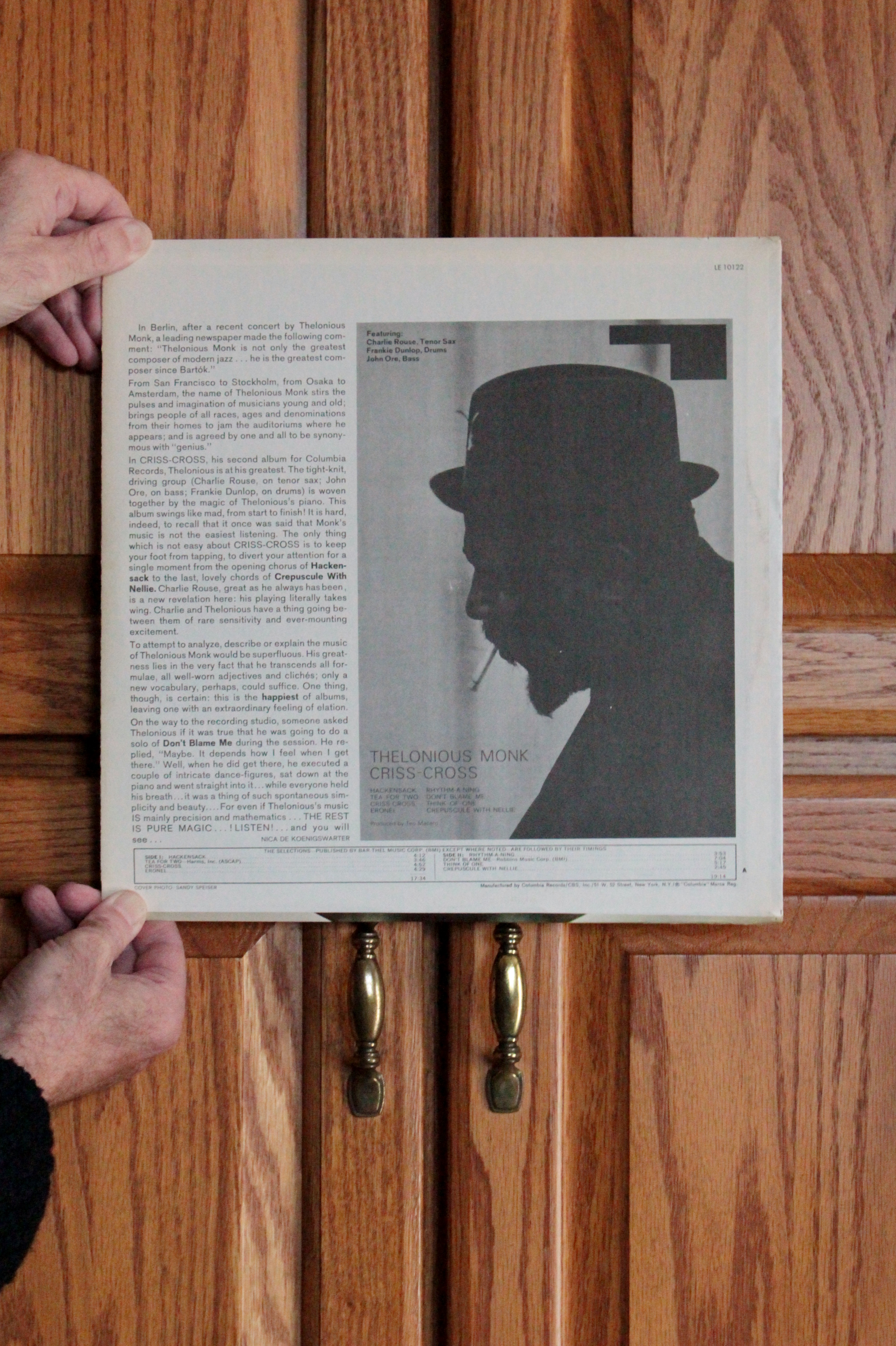
Back cover of the author's copy of Criss-Cross.
The back cover of the author’s copy of Criss-Cross.

The second occasion involved my friend Dave, who got my Monk ball rolling, with Criss-Cross, in the first place. He once had a brief encounter with the man. Dave thinks the meeting took place in 1966 or ’67. The location was a New York City subway car on which Dave spotted somebody who looked awfully familiar. This somebody was clothed in what Dave described to me as pajamas. Pajamas? Sure, why not? Intrepid soul that Dave was and is, he walked over and asked “Are you Thelonious Monk?” “Yeah, I’m the Monk,” came the reply. End of conversation.

The third Monk event was the topper. My mother was part of it, and I was there when it happened. The month was March, the year was 1976. WKCR, Columbia University’s radio station that programmed jazz in its classic and far-out varieties, was holding a Thelonious Monk marathon, playing his recordings nonstop over a multiday period. I imagine that the station’s intense tribute was timed to coincide with a concert by Monk and his band that same month at Carnegie Hall. My mother was a devoted jazz fan and WKCR listener because her son (my brother) Richard was in attendance at Columbia and was a WKCR jazz DJ. As such, he was on the air for portions of the Monk fest. But not on the evening in question, during which I sat with my mother in the kitchen of her Long Island home as the Monk celebration emanated from a small radio on a counter between the sink and the stove. Concerned about others as she always was, she said something like “I wonder if Thelonious Monk knows what KCR is doing.”

She went to the telephone and dialed 411, the number for directory assistance. Did Monk have a listed number? Somewhat surprisingly, he did. My mother called. Someone on the other end picked up. “Is this Mr. Monk?” she asked. “Yes,” was the reply. “Hello,” my mother said. “I wanted to ask if you know that WKCR is playing all of your music. It’s a wonderful tribute.” “Yes, thank you,” replied Thelonious Monk. My mother probably then complimented Monk on his talents, and Monk probably said “thank you” again. And that was that. I sat there semi-stunned. My mother, to my recollection, had never done anything like this before. She keenly followed the world of celebrities, but always from afar. Of all the stars that she admired, from Mary Tyler Moore to Lena Horne to Paul Newman, I never would have guessed that her one personal contact would be with a jazz pianist.

I was a mere bystander to my mother’s bold move. I, however, had one engaging and in-person Monk experience of my own. This occurred on March 26, 1976 from a balcony seat  at Thelonious’ aforementioned concert at Carnegie Hall. Sitting next to me were my brother Richie and his wife-to-be, Sara. I can’t recall if the performance took place just before or after my mother’s conversation with Monk. Likely, after. Monk didn’t play often in public those days, so the Carnegie gig was a highly anticipated event. In fact, two appearances in July of that year would be his last ever. He was on stage with four musicians, including his son T.S. Monk on drums. Thelonious said little, maybe nothing, to the audience. What mattered was his playing, and he was in superb form. Strong, poignant, totally on the money. His fingers did the talking.

(Photos by Sandra Cherrey Scheinin. If you click on a photo, a larger image will open)

(If you enjoyed this article, then please don’t be shy about sharing it)

You Gotta Like These People: A Review Of Meet The Patels

A few nights ago my wife Sandy and I went for the umpteenth time to the Ambler Theater, an art house cinema in the Philadelphia suburbs that I’ve praised often on this website. We were accompanied by our excellent pals, Cindy and Gene. They are Philadelphians understandably loathe to drive to the burbs, or anywhere, for fear of the nightmare that sometimes awaits them hours later when they return to their congested neighborhood and attempt to find a parking space. I hope they are not still circling their surrounding blocks these several days later. If they are . . . well, that’ll learn ’em.

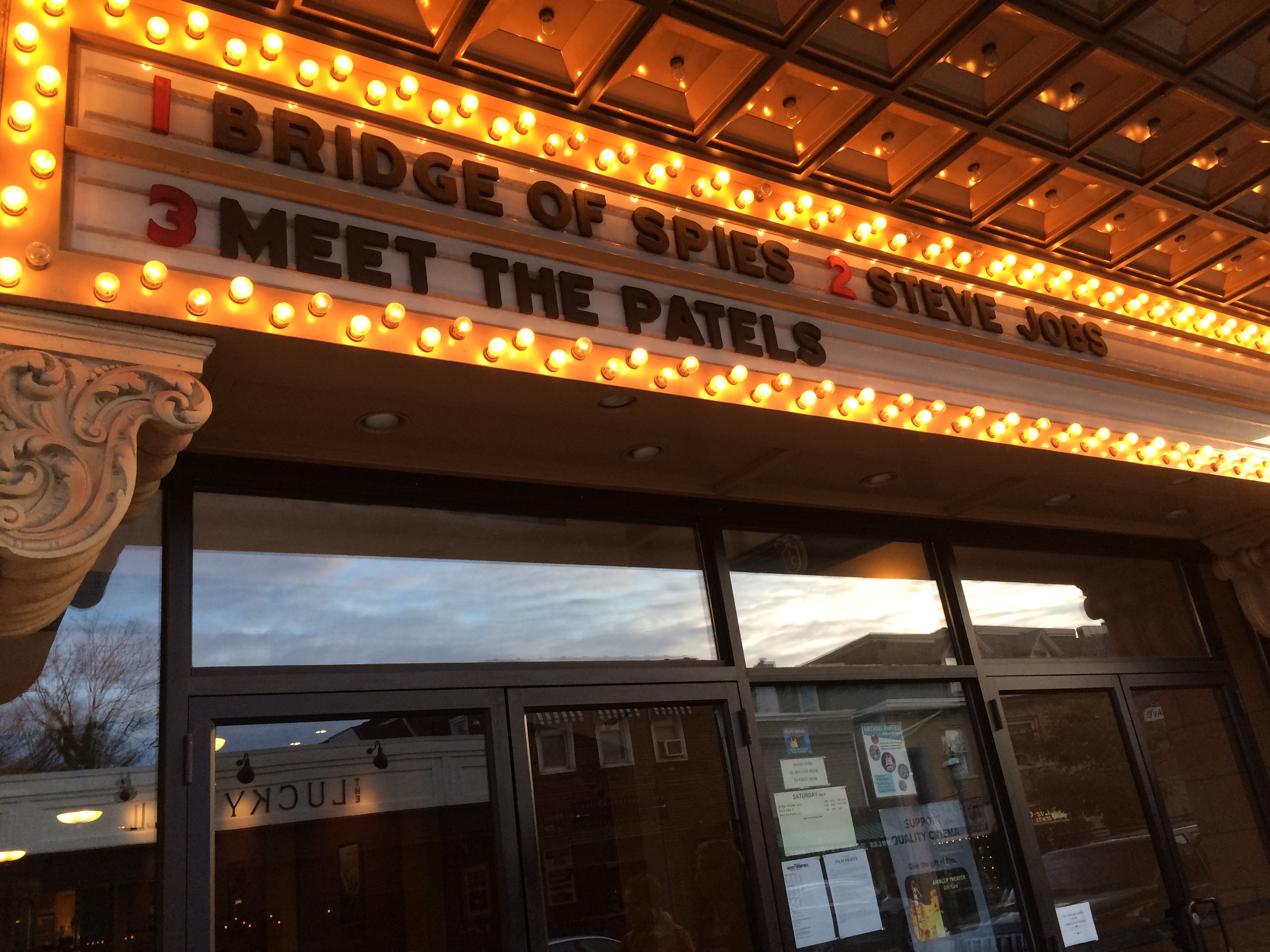
We saw Meet The Patels at the Ambler Theater.

The movie we went to see was Meet The Patels. It is a delightful concoction, a documentary so breezy and cheerily assembled that I urge all of good spirit to take it in. For those not of good spirit, watching it maybe will help them find a better path in life.


Nonetheless, I left the Ambler Theater not at all sure if I would comment online about Meet The Patels. Sure, I enjoyed the documentary very much. Sure, it’s worth writing about. But: 1) Hundreds of reviews of this movie already have been penned. 2) I didn’t seem to have any wondrous insights to disseminate. 3) Etc.

On the other hand, my blog is a voracious master, compelling me to keep it fed.

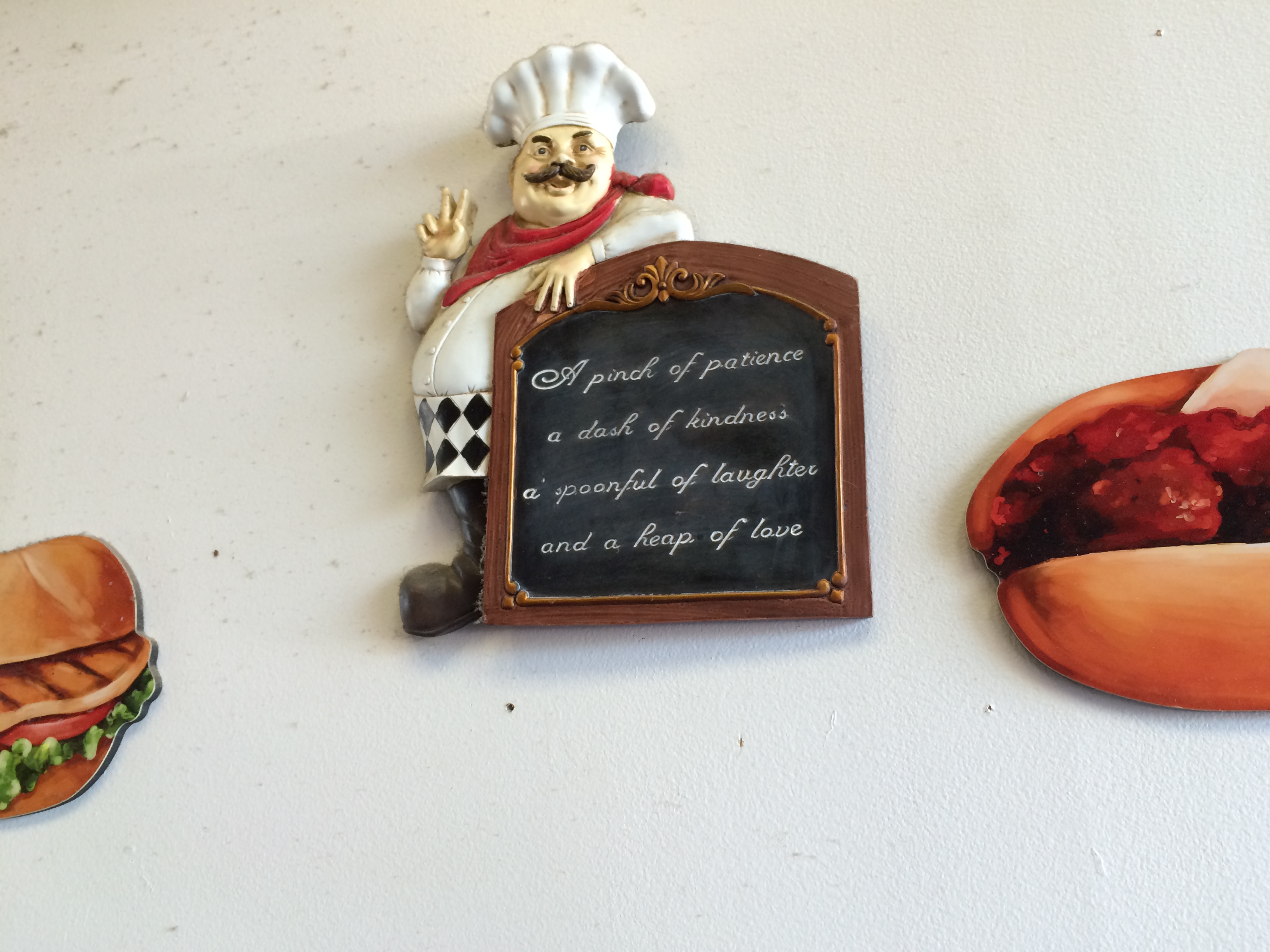
Words of wisdom attached to a wall at Randazzo's Pizzeria.
Words of wisdom attached to a wall at Randazzo’s Pizzeria.

Fresh out of ideas and inspiration, I sauntered into Randazzo’s Pizzeria the day after watching Meet The Patels. It’s a decent joint a mile or two from my abode. As I waited for my pizza slices to heat in the oven I took a look at one of the walls. It was covered with knick-knacks and photographs. One of the knick-knacks caught my attention and got me thinking. It was a depiction of an Italian chef standing next to a chalkboard on which were written very sage and pithy statements: “A pinch of patience; a dash of kindness; a spoonful of laughter; and a heap of love.”

Those are words not to be taken lightly. They truly are meaningful. They are a good recipe for life. And they illuminate what, to me, Meet The Patels is all about.

And thus a pizzeria inspired me to sit down and type this report. Meet The Patels concerns a family of four, the Patels. Natch. Husband and wife, India-born Vasant and Champa, moved to the States decades ago for better opportunities than they saw available at home. They became accustomed to the American Way, but hung on strongly to their native customs and values. Stateside they produced two children, Geeta and then Ravi. Now young adults, the siblings are highly Americanized, yet cognizant and appreciative of the Asian culture that undeniably runs through their veins.

All four Patels, as best I could tell, reside in California. Mr. and Mrs. P occupy a roomy home. Geeta and Ravi, touchingly, share a comfortable apartment. How many adult siblings live together? Few, by my experience. In this documentary, Geeta and Ravi seem to pull it off easily.

On to the plot. Meet The Patels spins the tale of Ravi’s search for a wife. Having recently broken up, after a two year romance, with a white girl named Audrey, 29-year-old Ravi somewhat reluctantly agrees to allow his parents to try and find a suitable match for him. Only thing is that Mom and Dad never knew about Audrey. Ravi was too embarrassed ever to tell them that he had dated a female of the non-Indian-American persuasion. Mom and Dad, successful products of an arranged marriage — arranged being the norm in India — were under the impression that their 29-year-old son was kind of a relationship tyro. And that his unstated goal was to settle down with someone who shared his ethnic background. Coolly they convince Ravi to allow them to employ slightly updated versions of traditional Indian matchmaking methods to identify and locate a mate for him. Said mate is to come from the large pool of well-educated and fine-tempered Indian-American and Indian females that Ravi’s parents are confident exists. Let the games begin.

Meet The Patels is a movie that originally wasn’t meant to be a movie. As a lark, Geeta began filming Ravi’s wife-seeking adventures. After a while she and Ravi realized that fun and wisdom were to be found in the raw footage. Light bulbs went off in their heads and a project was born. They are credited as Meet the Patels’ directors, and along with two others as the writers. The movie doesn’t mention this, but it turns out that the story and filming took place about seven years ago, after which various snags held things up big time. Last year, finally, the movie was completed and became a darling of the film festival circuit. It’s playing now in a modest number of theaters. Ravi was an actor landing a handful of movie and TV roles while Meet The Patels was filming. These days he is a pretty big presence on the small screen. He’s currently in two series, Grandfathered and Master Of None

Meet The Patels moves fast and furious, Geeta handling most of the camerawork in an engagingly amateurish home movie mode (she claims she never learned how to operate her camera, or frame scenes, properly). The film intersperses animated sequences, scripted and nimble, to explain and give oomph to the plot. The plot doesn’t require more elucidation from me. No spoiler alerts here. What really matters are the lessons about human behavior and relationships to be gained from the flick (and from the Italian chef’s chalkboard). To wit, the four principles in Meet the Patels are endearing, warm and loving. They respect each other and get along famously. They are open (excepting Ravi’s concealment from Mom and Dad of Audrey’s place in his life, but we’ll forgive him that) and open to change. They smile a lot, laugh a lot. These are folks you’d want to be friends with.

Sandy, Cindy, Gene and I all left the theater feeling good. Amen.

(Photos by Sandra Cherrey Scheinin. If you click on a photo, a larger image will open)

(If you enjoyed this article, then please don’t be shy about sharing it)

The End Of My Long Affair (With Turner Classic Movies)

When I moved to Philadelphia in 1974 I became a film buff of sorts. It all happened very naturally and wasn’t anything I thought about. There were fewer options for movie lovers back then in Philadelphia than there are today, but there were enough. In addition to first-run theaters, Philadelphia had various venues that specialized in lesser-known flicks — some were foreign, some not. I had never before seen many foreign or cult movies and found myself liking them. My cinematic diet, consisting of the mainstream, the obscure, the subtitled, has remained consistent ever since.

My wife Sandy, whom I met in 1990, is a big movie fan too. Each year she and I leave the house 40 or more times to take in movies. Chez us, together we catch an additional 25 or so flicks on the tube. We like doing things together. For a span of eight years in my married life though, I also viewed hundreds of films on my own. I watched them on the Turner Classic Movies cable channel. I became addicted to TCM, but I’m not anymore. Here’s the story:

In 2006 my thoughts and activities were less-focused than they should have been. My father had died the previous year and I think my restlessness was partly connected to his passing. He had lived with Sandy and me, and we spent a lot of time caring for him. With him gone I had trouble finding ways to fill up my days fully.

I began watching TCM movies on this TV in 2006. This is a recent photo of the TV.

Sandy had been suggesting I might do well to add some prime time television viewing to my regimen as one way to get my mind off of things. But I couldn’t decide what to watch, didn’t think I’d  be happy devoting a bunch of hours to the small screen. Somehow though, I heard the call of TCM. Our meeting must have been preordained. And so a few months into 2006 I began descending the stairs on many evenings from our kitchen to finished basement, a place I hadn’t visited all that much since moving into our house the year before. In the basement’s den area sat an old bulky TV that had traveled from our previous home.

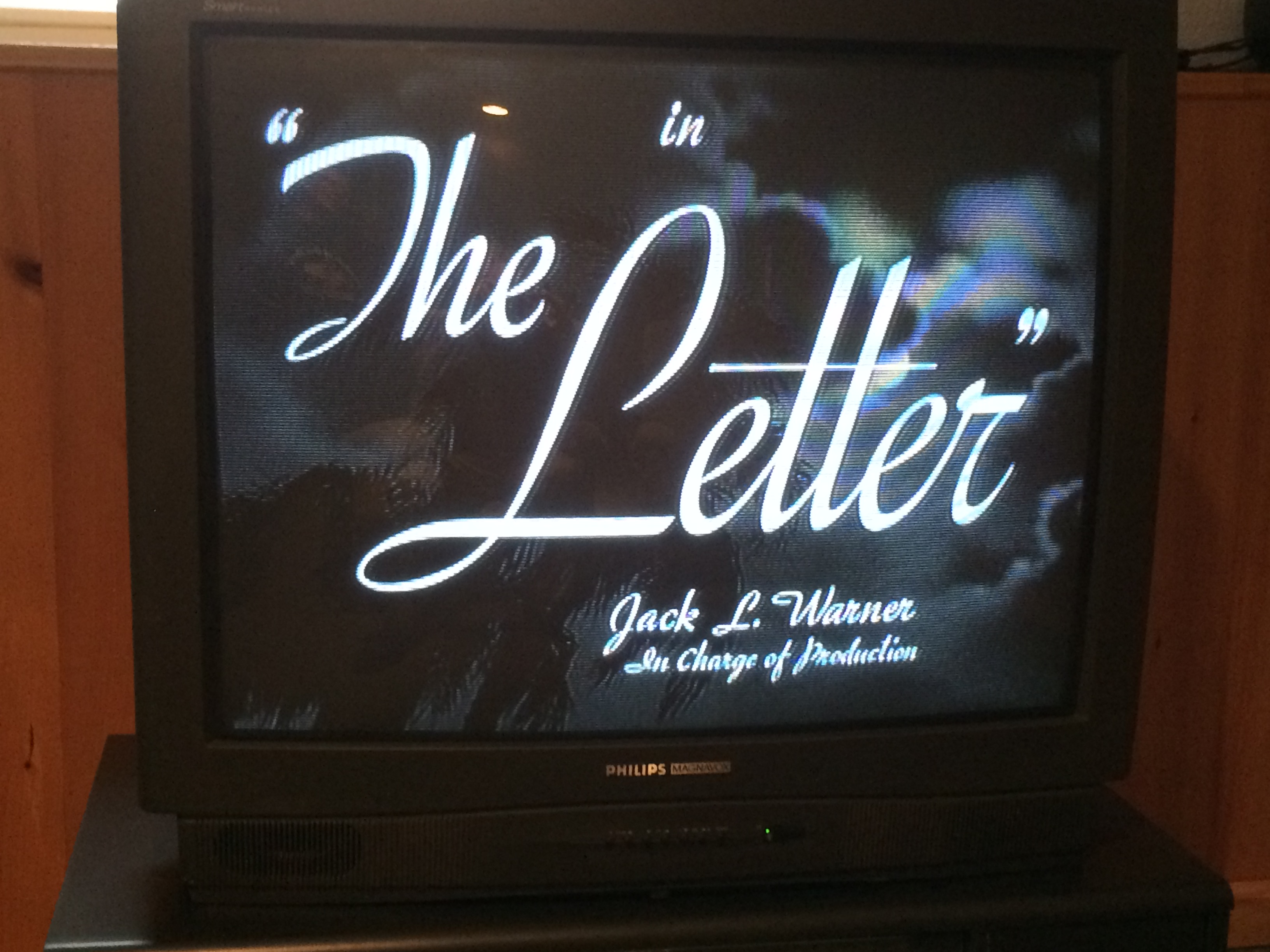
The Letter was the first movie I watched on TCM in 2006. I took this photo recently.
The Letter was the first movie I watched on TCM in 2006. This is a recent photo.

I began the affair gingerly. The first TCM movie I watched in 2006 was The Letter, a Bette Davis melodrama. It was pretty good. “OK, let’s try another,” I thought, and not too many days later Tender Mercies passed before my eyes. I had seen it when it came out in 1983 but didn’t recall it too clearly. I gave it two thumbs up in 2006.

Turner Classic Movies is quite the amazing broadcaster. Movies in their unedited versions 24 hours a day with no commercial interruptions. TCM’s core is English-speaking productions from the 1930s through 70s. Once in awhile the station throws in a foreign movie or a silent or a post-1970s film such as Tender Mercies. Despite the station’s name, however, hardly every TCM movie is a classic. There are plenty of clunkers. On many occasions I turned off a movie within its first 30 minutes and made the long climb upstairs.

And yet, duds or not, I became very comfortable sitting in a recliner in front of the basement TV. By 2006’s end I had watched 61 movies on TCM. The next year’s number was 103, and the year after that I reached the 87 mark,  my two highest totals. Since then the counts have descended, from 64 in 2009 to seven in 2014. I’ve managed merely one movie so far in 2015, The Great Santini, a good one that seemed a tad better to me when it made its initial rounds in 1983.

Why the dramatic falloff? Well, after cutting a slew of notches into my movie-watching belt I discovered that my TCM motor was running out of gas. Eventually, many of the movies I contemplated watching didn’t seem, upon investigation, good enough to spend time with. And the slim pickings of films from 1980 onward began to bother me a little.

But I tip my hat to Turner Classic Movies without hesitation. You see, to Sandy’s amazement somehow I’d made it into my late 50s and early 60s without having witnessed On The Waterfront, West Side Story, Singin’ In The Rain, From Here To Eternity and others that the general populace would deem to be true classic films. TCM rectified that situation. Contrarian that I sometimes am though, Singin’ was the only one of those that I felt was completely worthy of wearing a crown. And, besides Singin’, at least 15 more offerings that I first caught on TCM are now on my list of elite movies: In A Lonely Place, Odd Man Out, The Misfits, Darling, Sweet Smell Of Success, Hud . . .

Hey TCM. you’re a great station and I thank you for all the entertaining hours that you bestowed on me. Add some movies from the current century and maybe once again you and I will become pals.

(Photos by Sandra Cherrey Scheinin. If you click on a photo, a larger image will open)

(If you enjoyed this article, then please don’t be shy about sharing it)

A Cape Cod Sunset Story

My wife Sandy and I have a love affair going with Cape Cod, which is where we are vacationing as I type this missive. We live in suburban Philadelphia, but in most ways prefer the Cape. Boo hoo . . . we’ll be back home tomorrow.

In 1998 we visited the Cape for the first time, expecting it to be a locale we’d enjoy. Well, we did. And decided to come back the next year for some more good times. I think it was on that second trip that I realized I liked Cape Cod much more than I ever thought I would, that it really suited my soul, that I was starting to become smitten. Sandy and I have returned every year since then, excepting one. Before Cape Cod entered the picture, in my adult life it had never occurred to me that there might be an Eden of sorts waiting for me, someplace beautiful and in which I truly felt at home. A favorite place.

Sandy and I have had only great vacations on Cape Cod. We’ve been there in all seasons except summer, which is the one time of year when the Cape is overrun. With humans. We fill our days with a variety of activities: nature walks on sand or through forests; poking around in country-imbued villages; art gallery and museum hopping; attending movies, plays and concerts; lots of tasty eating in restaurants humble and above; the list continues. No doubt, this is the good life. I feel almost guilty that such fine fortune has come my way. But I’ll take it.

Atlantic Ocean shoreline. Eastham, Cape Cod.

If I had to select one reason above all that puts Cape Cod at the top of my list, I’d point to the expansive areas of natural beauty. Such as the 40 or more mile-long Atlantic Ocean shoreline, much of it government-protected and thus little disturbed or altered by the hands of man. The vistas there are pretty elemental and always knock my socks off. Ocean, sky and beaches backed by dunes-topped sand cliffs. My psychological and emotional makeups, whatever the heck they might be, vibrate in a calm, contented and awestruck manner when I’m in the midst of such.

And there are other reasons. To name one: When vacationing on Cape Cod sometimes an unexpected present drops into your lap, just as with life in general. One day last week an example came my and Sandy’s way. I’m talking about a sunset. Right, right, I know that over the centuries untold thousands of scribes have oohed and aahed in print about sunsets. And millions of sunset photos have been published, more in the last 15 or so years than ever before thanks to the Web. But hey, I’m not embarrassed to add a few hundred sunset words, and a handful of photographs, to the Everest-high piles already out there. Don’t bail out on me. Keep reading.

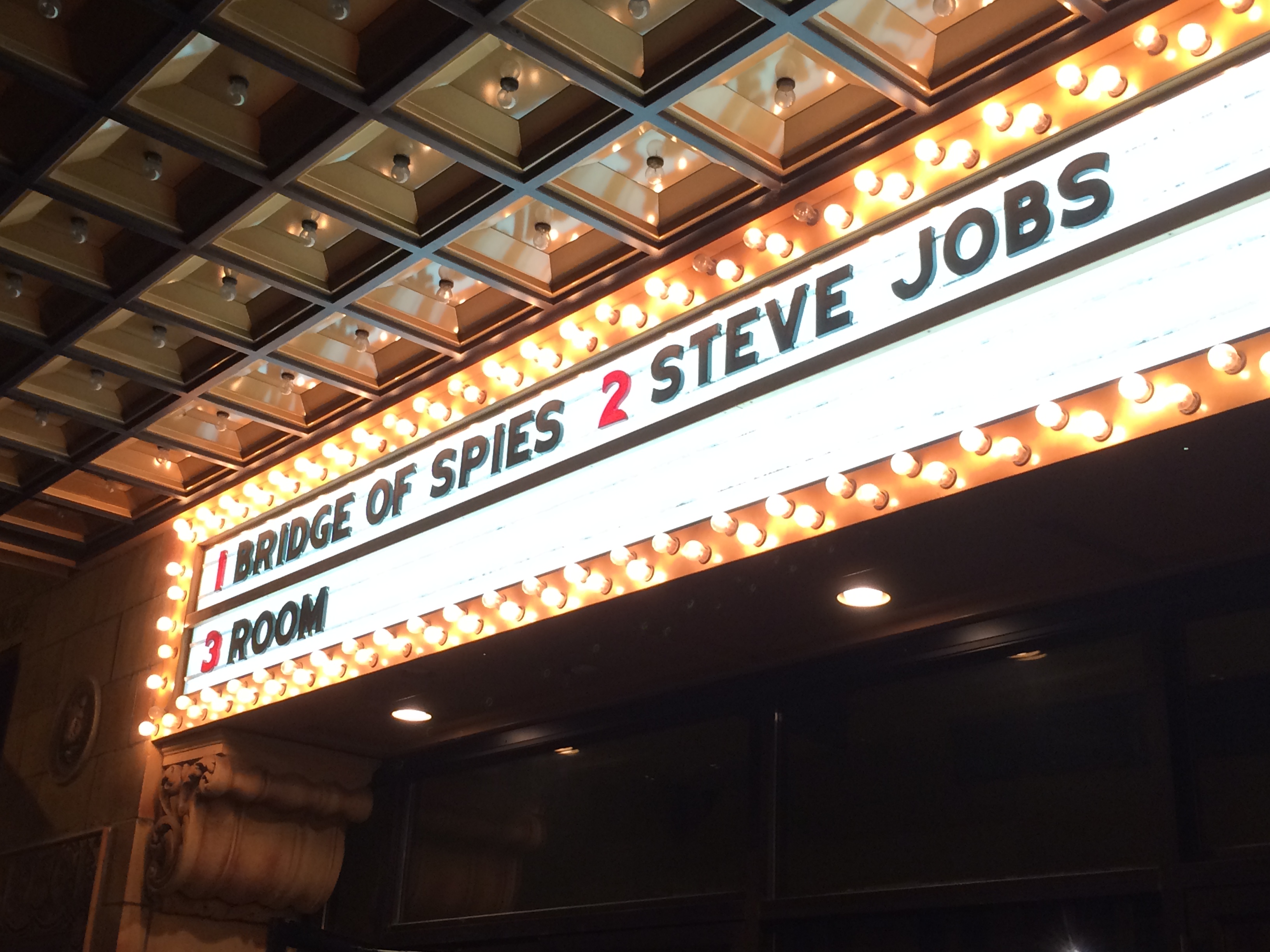
And so on the aforementioned day at 5:15 PM, Sandy and I were in Chatham, a needless-to-say charming Cape Cod town. We had just watched Steven Spielberg’s latest oeuvre, Bridge Of Spies, in the Chatham Orpheum Theater. Our next planned destination was 20 miles away, Harvest Gallery Wine Bar. There we meant to dine and listen to a tough as nails rock trio, The Catbirds. But there was no need to arrive before 7 PM. We had time to kill. We scratched our heads, coming up empty. Then “sunset” popped into my mind. Sandy checked with her phone, which is much smarter than me, and learned that the Sun would dip below the horizon at 5:57. I steered our car westward and then turned south onto a road I’d never heard of, hoping that we eventually would find our way to a Chatham beach on Nantucket Sound. The sand gods must have been with us, for Hardings Beach Road soon materialized. And moments later Hardings Beach itself emerged.

We parked. The spot was gorgeous. Lovely sands, magnificent Nantucket Sound waters gently rippling beneath a sky puffy here and there with clouds. The clouds made my heart leap, or something like that, because a scattering of clouds, as I’ve come to realize from years of sunset-gazing on the Cape, is key to a good sunset. Their water droplets and other particles refract light beams and reflect colors. Their movements and changing forms turn sunsets into active canvases. And that’s what happened as Sandy and I watched our fiery faraway friend say goodnight.

Sunset at Hardings Beach. 5:56 PM.
Sunset at Hardings Beach. 6:05 PM.
Sunset with the Moon at Hardings Beach. 6:07 PM.
Sunset. The Moon. Hardings Beach. 6:07 PM.


A lot of people claim to dislike colorful abstract art, certain paintings by, say, Vasily Kandinsky or Jackson Pollock. I don’t get that, because everybody loves sunsets, which to me can be among the ultimate in eye-popping abstractions. I’ve never read that sunsets inspired any brush wielders to go wild and free in their approach or vision, but it wouldn’t surprise me if in fact this were the case. Sandy and I watched the sky for 20 minutes. The pinks and oranges darkened as the big event rolled on. The clouds worked their wonders. And in a little while Sandy pointed up and said, “There’s the Moon.” It was a graceful sliver of white balancing above swashes of pastel hues.

On Cape Cod I’ve been a lucky son of a gun many times. That evening on Hardings Beach was one of them.

(Photos by Sandra Cherrey Scheinin. If you click on any photo, a larger image will open)

(If you enjoyed this article, then please don’t be shy about sharing it)

Stuff And More Stuff (Part Two)

So here I am, about to attempt a Part Two rumination on the time that my wife Sandy and I spent recently with our friends from France, Alan and Martine (click here to read the first installment). Part Two? Man, it’s hard enough for me to write about any topic, let alone something that requires follow-up thought and analysis. In the future I’m going to stick strictly to Part Ones.

As I’ve previously mentioned, the weather was ungodly hot while Alan and Martine stayed with us in the Philly burbs. We all decided to take outdoor activities off the table. On the first full day of the visit, we beat the Sun by looking at 150-year-old American artifacts inside the Mercer Museum, in Doylestown, PA. Where to on the second full day? Hey, we’d had enough history and culture at the Mercer. Why not aim lower and head to a locale whose charms are undeniable and, for some, irresistible? Namely, Willow Grove Park Mall, a gigantic and enclosed shopping mecca a mere half mile from Sandy’s and my abode. Alan and Martine, non-fussy sorts, readily agreed.

At the mall, we split up into pairs, females banding together, ditto for the lesser gender. Alan and I said goodbye to our wives within Macy’s, the establishment we all first had entered from the parking lot. “Call us when you’re done,” he and I said, and off we went. As Alan and I made our way past Macy’s cosmetics counters, heading towards an exit that would bring many of the rest of the mall’s retailers into view, I mentioned something I’ve thought about over the years. “This place,” I said, referring to Macy’s, “is like a museum.” The same could be said for the mall in toto.

Partial view of the Mercer Museum's central court.
Partial view of the Mercer Museum’s central court.
Partial view of the Willow Grove Mall's central court.
Partial view of the Willow Grove Mall’s central court.

The Mercer Museum displays 30,000 or more everyday implements and goods from America’s olden days. It’s a fascinating place. The Willow Grove Mall is no less fascinating, when you think about it. You want artifacts? The mall has 1,500,000 of them, I bet, putting the Mercer’s count to shame. Not only are the Mercer and the mall both repositories, they’re laid out kind of the same too, with large open courts (really large at the mall) ringed by several levels of rooms. At the Mercer the rooms (i.e. galleries) are small, each displaying tools and wares from a specific occupation or other category. At the mall the rooms (i.e. shops) may be bigger, but, excepting the department stores, each is narrow in its focus, just like at the Mercer. Shoe stores display only shoes. Electronics stores display only electronics. See, what’d I tell you? . . .  The Mercer Museum and the Willow Grove Mall are pretty similar. Except, of course, that the stuff inside the Mercer Museum ain’t going anywhere. At the mall, a museum in constant flux, the faster the stuff makes its way out the doors, the better the store owners and managers like it.

Hats at the Mercer Museum.
Lids, a hat store in the Willow Grove Mall.

Department stores aside, the variety of items at the Mercer is, I think, a lot greater than at the mall. But there is definitely some overlap. No, you won’t find smart phones at the Mercer, or a whaling boat at the mall. But how about hats, for one example? Mercer has a room devoted to them and their manufacture. And Willow Grove Mall contains Lids, a sharp little shop stocked from floor to ceiling with caps, mostly of the baseball type.

While Sandy and Martine (as Alan and I later learned) happily wandered through Macy’s, Bloomingdale’s, Uniqlo and other wondrous spots, Alan and I strolled around the second and third level walkways overlooking the great court. We passed one emporium after another, but entered not a one. Neither of us were in need of any new duds (I mean, we’re talking here about two of the already-sharpest-dressed guys on the planet!), nor of much anything else. And thus to the food court we finally headed, where we sat and chatted about this and that, coming close to solving a couple of the world’s problems, though not quite close enough.

Eventually, Sandy and Martine rang us up. And came to join us at the food area. They’d had a grand time. So had Alan and I, in our own way. Sandy and Martine had made a few small purchases. And, before heading back to the Scheinin hacienda, Martine dropped a few dollars more, taking away some old timey candies and roasted nuts from a colorful and alluring sweets stand at the food court. These were gifts for relatives whom she and Alan would be visiting in Massachusetts in a couple of days.

Thank you, Willow Grove Mall, provider of fun, enlightenment and relief from the Sun’s punishing rays. I bow in praise.

(Photos by Sandra Cherrey Scheinin. If you click on any photo, a larger image will open)

(If you enjoyed this article, then please don’t be shy about sharing it)

Stuff And More Stuff (A Visit To The Mercer Museum)

One of my closest friends, Alan, lives in Paris, France, so we don’t get to see each other too often. My wife Sandy and I are crazy about him and his wife Martine. Wonderful people. Smart, gracious and, if the conditions are right, up for pretty much anything. Alan and I have been buddies for 50 years. We met at college in Vermont lo those many years ago. He and Martine were in the USA for a couple of weeks recently for family gatherings and to tour New England a bit, and they also visited Sandy and me for a few days. We all had a terrific time together.

The weather was hot while they were with us. By 10 AM each day the sun was kicking ass. Sandy and I had hoped to show Alan and Martine some beautiful outdoor sights in Philadelphia or its environs. Maybe Morris Arboretum. Maybe Longwood Gardens. Maybe Philly’s Old City section and its nearby Penn’s Landing waterfront. But we scratched all of those ideas off our list. None of us felt like dealing with the heat. Where to, then?

Doylestown's Mercer Museum.
Doylestown’s Mercer Museum.

I’ve written a number of times about Doylestown, PA, a fine village in Bucks County about 20 miles from Philadelphia. Doylestown was the home of Henry Chapman Mercer, a talented and brilliant chap with eclectic interests who lived from 1856 to 1930. He designed and constructed three large and unusual buildings in Doylestown, one of which, the Mercer Museum, fit the bill as an indoor destination for Sandy, me and our friends. On the first full day of Alan’s and Martine’s visit, that’s where we headed.

Henry Mercer was a traveler, an archaeologist, an outside-the-box thinker and a collector of myriad objects. He also was well-heeled, a circumstance that allowed him to indulge his passions and to live pretty much as he chose. The collecting bug bit him early in life and took hold very strongly in the 1890s when he saw the effects that industrialization was having on the American way. Before they would be entirely phased out and disappear, he decided to amass examples of the handmade objects that once were, and in some cases still were used in typical homes, in everyday trades, on farms and in workshops. The tools and household and recreational goods, in other words, that defined how folks lived in the 1700s through roughly 1850.

Mercer spent much time at junk dealers, auctions and country sales, and often for little money purchased an astonishing array of items, thousand and thousands of them. But where would he keep all of this stuff? No problem. The amazing Mercer designed a sprawling idiosyncratic castle of sorts to house his Americana collection. A small team of workers built the structure in just a few years. The Mercer Museum opened in 1916, and Henry immediately donated it and the stuff to the Bucks County Historical Society, which to this day owns and runs the operation.

I was pretty certain that Alan and Martine would like the Mercer Museum. It’s not well-known, why I don’t understand. But it is fascinating and maybe one of a kind. The building alone is worthy of examination, a concrete behemoth awash with windows and topped with a dizzying display of towers and chimneys and who-knows-whats. Mercer selected concrete as his primary construction material because he desired a fireproof enclosure for his collection, and it certainly seems as though he made the correct choice. To date, no flames.

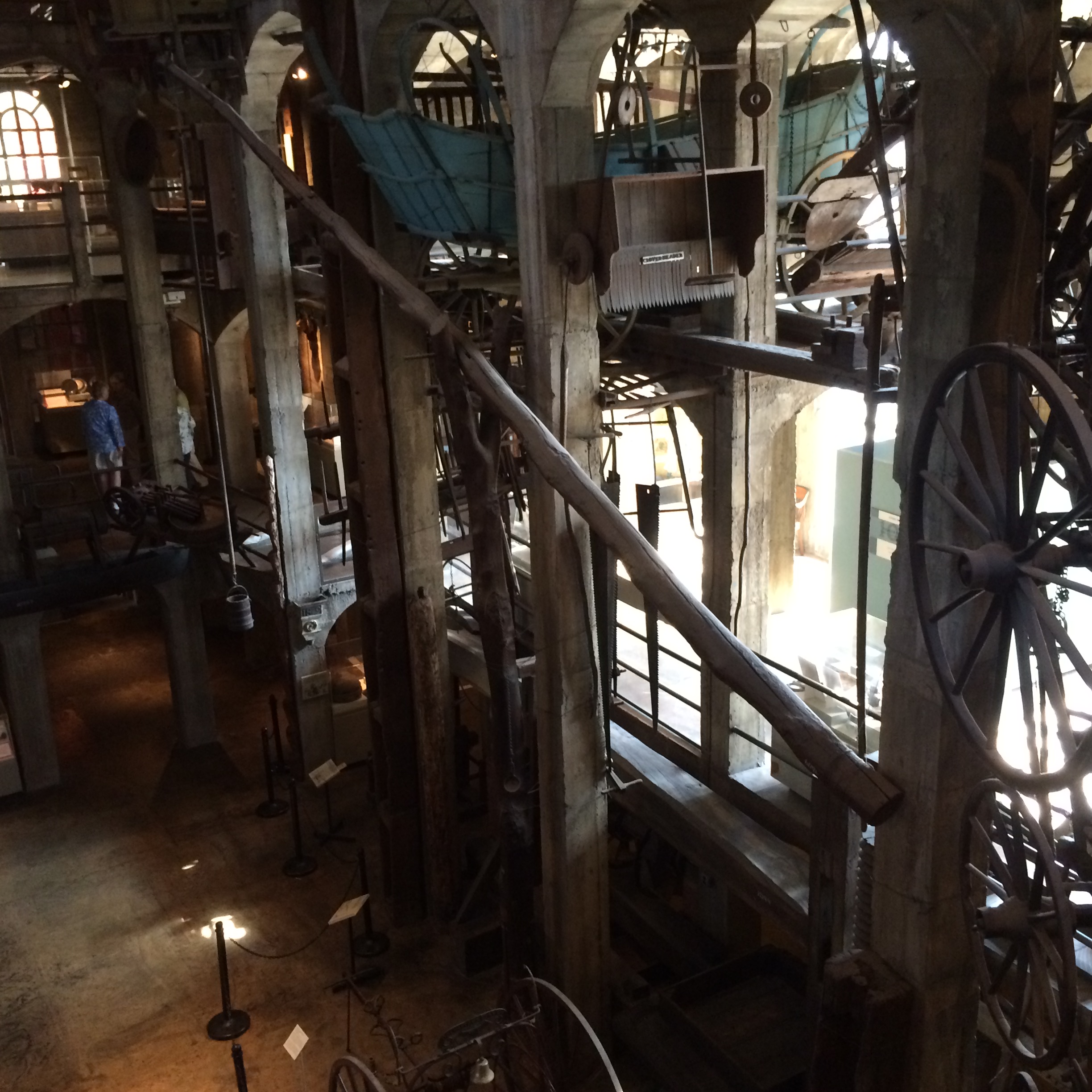
A dory, a sleigh and much else, all suspended from the ceiling and arches in the atrium.

And the collection? “Incredible” is an understatement. Thirty thousand or more things to eyeball, many of which you’re not likely to encounter elsewhere. A well sweep (it drew water from wells in pre-pump days), a stagecoach, a hay rake with 24-inch-long teeth, components of a water power saw mill . . . not to mention smaller items such as tools used in hat making, tinsmithing, coopering, the healing arts, you get the idea. Mercer suspended some of the big boys (a dory and a whaleboat, for instance) and also some of the little guys from the ceiling and arches of the museum’s large central atrium, where the effect is hallucinatory. It takes long looks to figure out just what it is you’re looking at, despite the quite good signage. And Mercer apparently had a real sense of the whimsical, as chairs, chests, baby cribs and other artifacts I couldn’t easily identify dangle from the ceiling, often upside down.

The Hat Making room.
High Wheeler bicycles "floating" above a stagecoach.
High Wheeler bicycles “floating” above a stagecoach.

Most of the tools and results of America’s myriad trades, thankfully I suppose, are much more neatly displayed. They are divided up, by occupational use or other categories, in rooms, alcoves and niches that surround the atrium on six different floor levels.

Brown is the color of the day at the Mercer Museum, since so many of the objects on display, especially the hefty ones, are made of wood. Alan and Martine and Sandy and I took our time in the Mercer forest, but after two hours started to run out of gas. Alan said the museum is one of the best he has ever been in, and I concur. This trip to Mercer was my third or fourth. A fellow visitor, whom I chatted up slightly while we both gazed at eight-foot-tall High Wheeler bicycles hanging from the ceiling above a western Concord stagecoach, got it right when she said that “[Henry Mercer] makes hoarders look good.”

A few suggestions to the interested. Go, definitely go to the Mercer Museum. But make the voyage on a sunny day, as there is a paucity of artificial light there. And skip the dead of winter. The museum is unheated.

As mentioned hundreds of words above, the day following the Mercer experience featured temperatures just as disagreeable as its predecessor’s. Once again, an indoor attraction it would have to be. Where? (To be continued)

(Photos by Sandra Cherrey Scheinin. If you click on a photo, a larger image will open)

(If you enjoyed this article, then please don’t be shy about sharing it)

The Michener Museum Shines Yet Again

James A. Michener Art Museum.

One of the things I like about art shows is that they can surprise you (in a good way). It’s a gas when a museum or gallery curator comes up with a new slant or assembles a themed exhibition that makes you say “great idea!”  That’s part of the fun of going to places such as the James A. Michener Art Museum in Doylestown, PA. Not always, but often you can expect the unexpected there. Five years ago the Michener mounted a fascinating display of costumes worn by movie stars in famous movies. Arnold Schwarzenegger’s black leather jacket from The Terminator was in the house. So was Elizabeth Taylor’s gown from A Place In The Sun. That show caught me off guard by its coolness and inventiveness. Its idea seemed obvious, but only after the fact.

A similar sense of forward thinking surrounds a current Michener exhibition, the long-titled Iron And Coal, Petroleum And Steel: Industrial Art From The Steidle Collection. The works on view have been borrowed from their permanent home in State College, PA. There they reside within Penn State University’s Earth And Mineral Sciences Museum And Art Gallery, another mouthful. Hats off to the Michener for knowing of the off-the-beaten-track Steidle collection’s existence and for smartly organizing the paintings and their messages.

Edward Steidle (1887-1977) was a mover and shaker for many years in the worlds of mineral and petroleum extraction and use. An engineer, teacher and college administrator, he was dean from 1928 to 1953 of Penn State’s College Of Earth And Mineral Sciences. He also collected art, much of which he commissioned, that depicted the earth industries in action. The students at Penn State’s earth and minerals school were surrounded by examples of ores and extraction implements in the school buildings. Steidle, to my mind somewhat of a visionary in this respect, wanted artistic representations of the same also to be on view at the university.

Bituminous Coal Tipple, painted by Louise Pershing in 1936.

Louise Pershing’s Bituminous Coal Tipple, from 1936, was the first work I grabbed onto at the Michener after quickly scanning the collection.  I loved its muted tones, the hulking mass of the tipple and of the hill in the foreground, the clouds of smoke issuing from all over the canvas, the lonely patch of green grass. Pershing mapped out her painting precisely and filled it with feeling.


Pershing’s oil painting represented a pretty good number of the ah-hah moments that I had in the Steidle galleries. What struck me first when I walked into the exhibit were the colors on the canvases. As with Pershing’s work, largely they were subdued or somber, the hues of earth and coal, of heavy equipment. As I walked around the galleries I noticed some other things. For one, nearly all the paintings were strongly designed and observant. Steidle had a good eye for art. Also, I was completely unfamiliar with the 40 or so artists in the show, excepting one or two. Post-Michener research confirmed that most of them had nice modest careers in their day but didn’t make it to the ladder of fame — only a few have garnered Wikipedia biographies. And I saw that a good number of the paintings were by women, not always the case on museum walls.

Miners In A Lift, painted by Henry Poor in 1947.

The Michener’s Steidle exhibition is a winner because it includes a boatload of works equal to Pershing’s Bituminous Coal Tipple, some maybe even better. Henry Poor’s Miners In A Lift, for example, which he painted in 1947. Five (or is it six?) coal miners are within the tight wooden cage, about to step outside the mine entrance, their shift over. Emerging from near-darkness into light, their eyes are hugely distended. The painting tells life stories, as the workers’ uneasiness about their dangerous occupation is on their faces. The confined framework of the painting brings power and immediacy to this work. It probably was my favorite at the Michener show.

The Steidle collection is said to be one of the best collections of industrial art in the USA. When these works were created, coal and steel were massively important industries in Pennsylvania and nationally. A few decades later they pretty much collapsed. The paintings are in that sense a time capsule of what once was. The historical aspect of the Michener show was presented clearly and didn’t make my eyes glaze over, the museum avoiding ponderous explanations on its informational placards. But, half-baked art aficionado that I am, I was more interested in the painterly aspects of the Steidle exhibit than in straight history.

Forging The Shaft: Hydraulic Forging Press, painted by Rose Ann McGary in 1936.

Take, for instance, Rose Ann McGary’s Forging The Shaft: Hydraulic Forging Press. She painted this canvas in 1936. It shows workmen shaping red hot steel, and would have earned a thumbs up from the artist Fernand Léger and his fellow Cubism descendants. A carefully assembled construction of planes, cylinders and boxlike shapes, Forging The Shaft takes Cubism’s original color scheme of grays and browns and adds, just off-center, an explosion of pink. It is both a contained and dynamic painting.

The Steidle show closes on October 25. There’s still time to see it.

(If you click on any photo, a larger image will open)

(If you enjoyed this article, then please don’t be shy about sharing it)