One More Stop On The Road For Donna The Buffalo

My wife Sandy and I recently saw in concert an electric and eclectic band from upstate New York amusingly named Donna The Buffalo, and afterward I wanted to write about the show. Before sitting down to compose my magnum opus though, I mulled over my approach to the subject matter. The main question I posed to yours truly was: What should the subject matter comprise? Naturally, Donna The Buffalo needed to be a big part of the focus. But you know what? I knew little about DTB pre-gig, and possess only a cursory knowledge about the band now. We went to see them on little more than a whim. I’d heard of them, knew that their history was lengthy, and decided that taking a chance on them would be fun. When my mulling concluded, I was of the opinion that the path that brought me to this show also should be part of the story.

I think of myself as a music lover. I listen to a wide variety of genres and have been to well over 1,000 concerts during my earthly tenure. Yet, these days I feel like a tyro when I listen to radio stations or read music-related websites, magazines and newspapers. I mean, more often than not, I am unfamiliar with the musicians. To me, it is just incredible how many solo performers and bands are out there playing the game. In the USA alone, there must be 50,000 professional musical acts, maybe more. In my younger days I thought that I had a handle on a fair percentage of music makers. No longer, not now in the Internet Age when anybody and everybody can make his or her presence felt.

And so, ten or more years ago I largely gave up on trying to keep up with the avalanches of musicians plying their trade. It was just too much work, too exhausting. Better, I think, to stay in tune to a lesser extent, and also to take gambles and hope for the best. As with Donna The Buffalo.

New Hope Winery, one half hour before showtime.

Donna The Buffalo appeared at New Hope Winery, a venue in the Philadelphia suburbs that Sandy and I discovered last year and have become very fond of. The joint was packed with 200 or more souls when DTB took the stage. A front-and-center area, where tables normally would be placed, had been cleared to create space for dancers. I looked over the crowd. At some previous visits to the Winery I’d seen demographics heavily tilted to the 50 and above bracket. Not this night. DTB had tipped the age scales downward substantially. Twentysomethings and thirtysomethings abounded. There even were a few very young children in the room.

Donna The Buffalo in action at New Hope Winery.

What a band. Not having known what to expect, song number one told me that I had chosen wisely by attending this concert. A quintet, DTB was tremendously tight and intuitive all night long, and possessed a large catalog of songs to choose from. They held the stage for two hours and 10 minutes, filling their long set with 22 songs and little between-tune chatter. I was standing just behind the dance section, which was crowded with bobbers and weavers. After two or three songs, I too began to go with the flow. And kept going. But I was bouncing alone — Sandy stayed at the extremely stage right table to which we had been assigned. Her view of the musicians from there was lousy, but in the dance area she wouldn’t have had a chance seeing over anyone’s head. Mea culpa.

DTB has blended a bunch of musical styles into their sound: rock, country, zydeco, reggae. Rock being the dominant force. On some songs (What Money Cannot Buy; Love and Gasoline) the power was relentless, Stonesy, irresistible. On others (The Ones You Love; Conscious Evolution) the groove expanded, contracted, widened once again, giving no mercy to the audience. All you had to do on those expansive numbers, Grateful Dead-ish and Allmans-ish as they were, was close your eyes to be transported to a higher and mind-opening plane. Yes, Donna The Buffalo was that good.

DTB began its journey in the late 1980s, picking up steam in the mid 90s, and in the current century has become a decently successful and popular unit. They tour like crazy and have amassed a loyal national fan base known as The Herd, a mini version of the Deadheads. Two original band members (Tara Nevins and Jeb Puryear) remain. Tara and Jeb compose most of the group’s songs, usually individually. At the Winery, each took the lead vocal spotlight on his or her compositions. Jeb opted for the laidback Jerry Garcia approach to singing and handled electric guitar sizzlingly. He’s a guitar hero unknown to 99% of Americans. Tara’s sweet and gentle mountain drawl pleased me much. And she was the band’s multi-instrumentalist. Fiddle, acoustic guitar, accordion, tambourine and scrubboard (for the zydeco numbers) were her arsenal.

A bunch of musicians have played alongside Tara and Jeb since DTB’s inception. The three current guys have been around for several years. Mark Raudabaugh killed on the drums. Kyle Sparks was all over his electric bass’ strings, drawing out lines that percolated and sang. And organist David McCracken was immense. So many times in so many bands, especially the poppier or atmospheric ones, the keyboard player is on the lame side, somehow fooling the audience with pretty chords and simplistic runs. Not McCracken. He can play. He jabbed, moved fast, reached for the skies, whatever it took.

So, how many acts that I’ve never heard of or barely heard of, and that I’d find to be great, are on the circuit? The question is a puzzle, the answer unknowable. Which makes music and, similarly, much else of life, delightful.

(Photos by Sandra Cherrey Scheinin. If you click on a photo, a larger image will open)

(If you enjoyed this article, then please don’t be shy about sharing it)
Screwball Begone! (A Review Of Mistress America)

I wasn’t as fond as I thought I would be of the movie that my wife Sandy and I went to see recently. Sandy told me that various critics have heaped praises upon said flick, Mistress America, some calling it a screwball comedy in the grand old Hollywood tradition of Howard Hawkes and Preston Sturges. I saw the movie differently. I found it to be as much a drama as a comedy, as bittersweet as it is funny. And as for screwball, which can be great . . . well, Mistress America’s try at the madcap art form encompasses not the entire movie at all, settling instead for one long and uncomfortable segment in the second half. I didn’t have much fun with that interlude. A collection of intersections involving most of the movie’s cast, it felt flat and strained to me, out of place with the decidedly tilted but more realistic antics and people-play that populated the rest of the film. In other words, Mistress America overextended its ambitions. It would have been a better movie if its creators, Noah Baumbach and Greta Gerwig, had kept their eyes on the  wry and poignant, and left the supposedly wild and crazy alone. My rating? Two, maybe two and a half out of four stars.

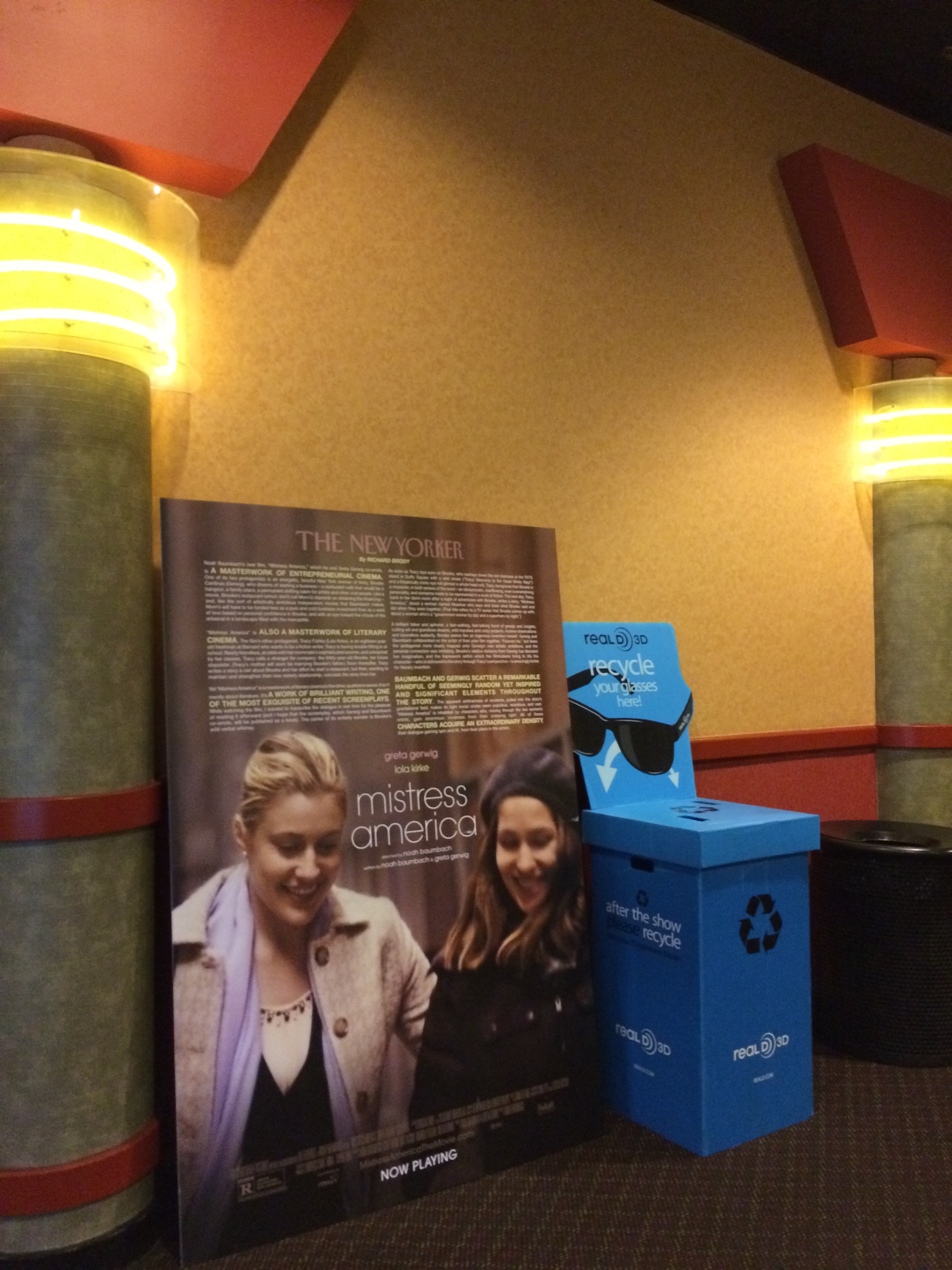
We saw Mistress America at the Regal multiplex in Warrington, PA.

Mistress America revolves around a small parade of characters led by Brooke Cardinas (Gerwig) and Tracy Fishko (Lola Kirke). Brooke is a 30ish lady on the go, an at-times free spirit who cobbles together a living in New York City by leading exercise classes, doing interior decorating, whatever it takes. Her dream is to open a restaurant slash hair salon slash hangout in Lower Manhattan called Mom’s, a place where customers will settle in and feel really comfortable. A wifty notion possibly, but who knows? Brooke already has signed a lease for the empty space she plans to transform, and is in the process of assembling financial backing. She’s committed, and several steps ahead of herself.

Into Brooke’s life enters Tracy, a Barnard College freshman not connecting very well to the college scene in Manhattan’s Upper West Side. At Mistress America’s outset, Tracy and Brooke have never met. Tracy learns of Brooke’s existence from her mother, who has plans to tie the knot with Brooke’s father. Following her mom’s suggestion, Tracy gives her stepsister-to-be a call. They meet, they bond, and the slings and arrows and goofy twists of fortune begin to fly.

Excising the unwieldy aforementioned portion of Mistress America, what we’re left with is an observant study of two women looking for some answers. Tracy is young, an introvert, and beginning what appears will be a very long process of self-discovery. I’m not placing heavy bets on her ever finding peace and contentment. She can be nasty and guileful, sides of her personality she might not have known were alive till the forceful Brooke’s influence poked them to the surface.

Brooke on the other hand is a longtime gung-ho trooper. Disappointments have peppered her life, but on she goes, pushing aside her doubts and sadnesses as she seeks the next opportunity or person that might set her on the true path. Late in the movie Brooke offhandedly takes a deep look inside and throws out some comments that almost are on target. To Tracy she says something to the effect of  “I know everything about myself. That’s why I can’t do therapy.” Actually, she knows so much that, I think, she scares herself. And keeps on running.

Baumbach and Gerwig, a real life couple, have been feeling their collaborative artistic juices the last few years. They cowrote Mistress America, and Baumbach directed. Ditto for 2013’s Frances Ha, which resembles Mistress America in that it centers upon a young woman who stumbles a lot in life. Frances, though, is several notches below Brooke on the got-it-together scale. Gerwig starred in Frances Ha, and I wasn’t sure if she would have the acting chops to differentiate her leading roles. I am glad to report that she does. Her Brooke is a complicated soul, usually energized and with a gleam in her eyes, but down enough times that my good wishes went out to her. Mistress America, despite its big ol’ flaw, offers plenty to chew on.

(Photo by Sandra Cherrey Scheinin. If you click on it, a larger image will open)

(If you enjoyed this article, then please don’t be shy about sharing it)

Puck’s The Place (A Venue And Concert Review)

I’ve written several times on this blog about Doylestown, PA. In the extensive suburbs of Philadelphia, Doylestown is perhaps the prettiest, the most charming, the most interesting village. I’m referring not to Doylestown’s generic housing developments, but to its quite large historic district. This section is worth a visit, and for many people, such as my wife Sandy and me, multiple and regular hellos.

Puck's outstanding neon sign.
Puck’s outstanding neon sign.

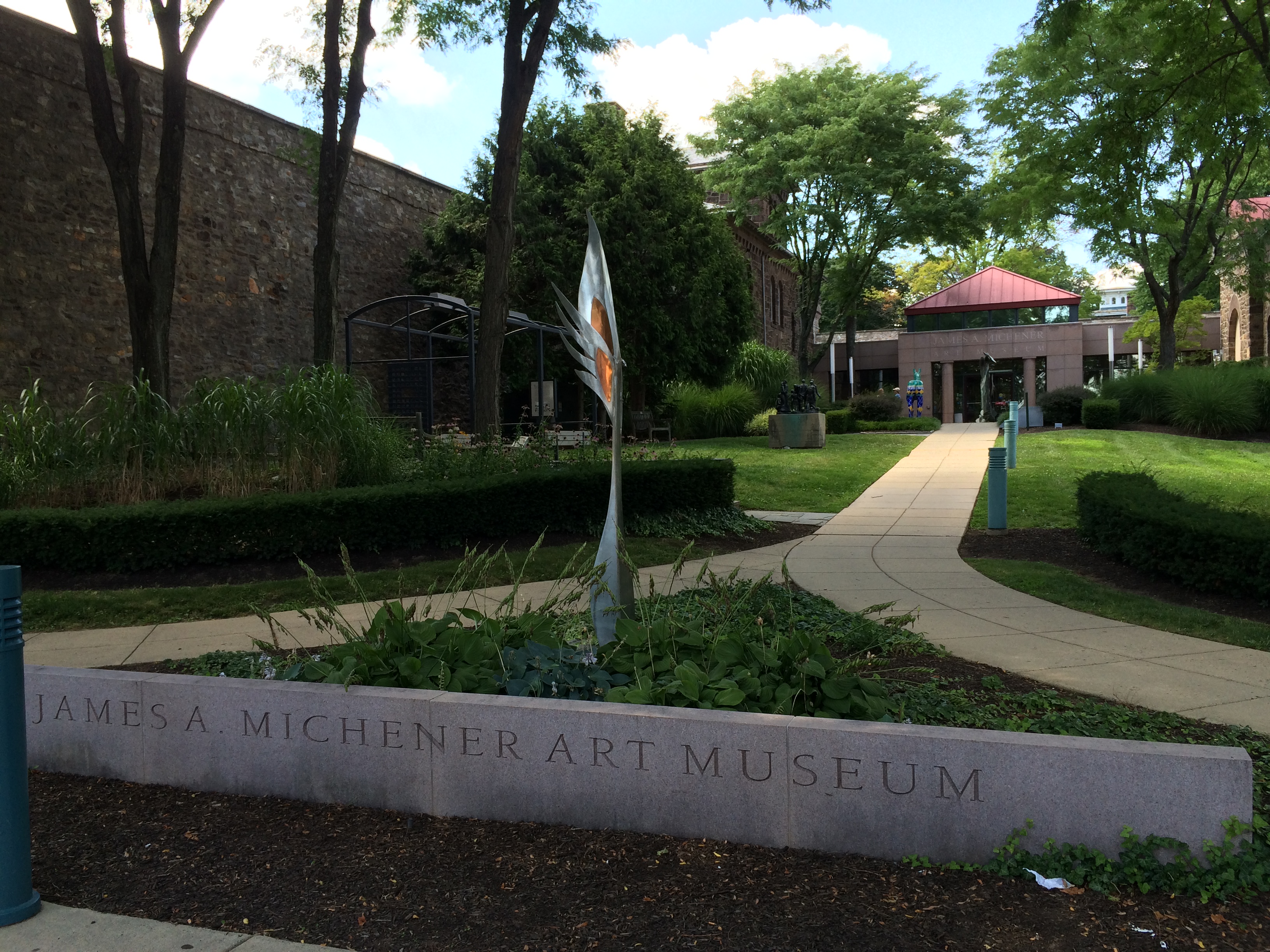
You like art? Go to Doylestown’s high-quality Michener Museum. You like non-blockbuster movies? Try the County Theater. You like artifacts from America’s pre-Industrial Revolution past? The astonishing Mercer Museum was built for you. And if you are a popular music buff, the place to frequent in Doylestown is Puck, a spot with chic indoor and outdoor eating areas and, incongruously, a grungy cellar where singer-songwriters and rock and country and funk bands take the stage a few times each week.

I’ve been to Puck’s music room 15 or more times over the years. Puck’s management brings in a wide array of musicians, a few of whom are touring artists with decent-sized national followings. But generally the players at Puck are little-knowns from Greater Philadelphia. I once had a small career as a music presenter for a summer music series in Philadelphia’s Chestnut Hill neighborhood (see my article The Music Biz And I). It was at Puck that I found several local acts (Cheers Elephant; Toy Soldiers; The John Byrne Band) who knocked my socks off and whom I ended up booking for the series.

What I like about Puck’s music room is its casual and boho vibes. Aside from the handsome bar, the space has been inspired by Frat House Finished Basement Magazine. The mottled floor could be mistaken for a Jackson Pollock painting. There are pillars that obstruct views of the stage. My kind of place.

As for the music, I tend to approach Puck with an open mind, with few expectations, and usually everything works out just fine. Many times I find the music to be good but nothing special. And sometimes, as with Cheers Elephant et al., I’m wowed. On a recent Saturday night, Sandy and I both were floored by Grady Hoss And The Sidewinders, the opening act of a double bill. I’d never heard of them, had little idea how they would be. What they were was tight and exciting, a country band in the classic mode, with some latter day tweakings. Anyone who favors Waylon Jennings, Gram Parsons and Dwight Yoakum would find good fun with Grady Hoss And The Sidewinders. For me, their 45-minute set was 45 minutes too short.

Grady Hoss And The Sidewinders, as I’ve learned from post-concert research, is a Philadelphia area band just starting out. They are working on a maybe-soon-to-be-released EP. Their Puck engagement, much to my amazement, was their public debut. Lance Davis, the leader, apparently had a fairly long career as an engineer and producer and rock musician, but for various reasons put all of that on an extended hiatus a number of years ago. In 2014 he emerged from his musical hibernation with country tunes on his mind. As the band came together, Lance decided that each member needed a colorful stage name reminiscent of the kinds of names (Ernest Tubb, Buck Owens) that once populated the country charts. Voilà, Lance adopted Grady Hoss as his moniker. The others in the group were dubbed Bucky Vennerson (in real life, Vince Federici), Dusty Reigns (Dan O’Neil) and Earl Smokesman (Charlie Heim).

Grady Hoss And The Sidewinders on stage at Puck.

Lance and pals played nine songs at Puck, eight of them originals. The songs were good. Lance’s vocals were heartfelt, his high notes reverberating with longing or regret, as they should in tales drawn from country music’s traditional wellspring. Lance strummed an acoustic guitar all evening, his face half-hidden beneath a big Stetson hat, and The Sidewinders created a rich palette of sounds around him. I knew I was in for an evening of treats right from the opening moments of the opening song, Rivertown. The chuga-chuga Johnny Cash-like beats from Heim’s drums and O’Neil’s electric bass built a strong template. Federici’s guitar licks ignited and pushed. And guest pedal steel guitarist Dave Van Allen’s poignant statements were as Nashville as you can get.

Two head-nodding honky tonk numbers followed Rivertown. I didn’t catch their titles, but their themes were classic country: lost souls and drinking. “Lord, I don’t know where I’m going/But I just want to get there” came from the first, and “I’m going back to the bottle/Back out in the rain/Back to the girls I need to see” from its successor.

So, how were these guys able to sound so good in their first-ever club performance? I imagine it’s because they’ve practiced a whole lot, and because they have heaps of talent. I can see this band going places. They without doubt have the chops, the look and the laidback attitude. What they will need to make it, if indeed making it is part of their game plan, is a bunch more original songs. As I discovered at home a few days later, two of the eight originals that I heard at Puck predate GHATS. They come from a rock album, The Hovercraft Diaries, that Lance released nine years ago. Maybe Lance possesses much new countrified material that he didn’t reveal at Puck. If not, I hope that composing sessions are on his agenda. Grady Hoss And The Sidewinders are a band about which I’d be happy to say one day, “I saw them when . . .”

(Photos by Sandra Cherrey Scheinin. If you click on a photo, a larger image will open)

(If you enjoyed this article, then please consider sharing it)

A Kite, The Moon, Sandy And I

Few if any ideas are unique. But many ideas are good ones. Last year, for instance, I came upon a good idea while perusing a bunch of websites pertaining to Cape Cod, where my wife Sandy and I would be vacationing a few weeks later. We’ve been hitting the Cape for many years, and we always try to amass a long list of potential activities before our vacations begin. One website was crammed with suggestions about fun things to do on Cape Cod. One of the author’s notions connected with my sweet spot. Go fly a kite, the writer said.

Our kite soared above Cape Cod beaches many times last year.

Sandy and I did just that. A few days into the vacation we bought a cute and colorful kite in a toy store and headed straight for a section of Atlantic Ocean beach to test it out. I hadn’t flown a kite in at least 50 years. Sandy, surprisingly, never had. We took to the kite as if it were a long lost pal. Over the course of our sojourn the kite, when not aloft, lived on the back seat of our car, always on hand and ready for action. We flew it on beaches all over Cape Cod and in an inland park or two. During the trip, we spent at least ten hours holding the reel of the kite tightly, watching our yellow, purple and blue amigo ride the air currents far overhead. To fly a kite was a very good idea.

Another good idea visited me recently. And it morphed fairly quickly into a better one. Plopped as usual on my living room sofa one day, half listening to WRDV, a low wattage suburban Philadelphia radio station, I heard a song that I’ve always liked. Dancing In The Moonlight, by King Harvest. This happy tune from 1972 got me thinking, as I had been looking for a story idea for my blog. “Ah yes,” I said to myself. “Let’s write something about the Moon.” I hoped that I’d soon hear other Moon-related songs, and then be able to put them into a bit of context. A few days later, example number two arrived when WRDV played a most obscure tune, a sultry and quiet jazzy bonbon from 1939, Dancing On The Beach. It was written by Bulee “Slim” Gaillard and performed by Slim and his then-partner Slam Stewart. The dancing described in the song’s lyrics, admirably delivered nonchalantly by Slim, occurs at night, under moonlight.

I felt that I needed to hear at least one more moony song to increase the meatiness of whatever I might end up writing. But the next one that I caught, Yellow Moon, by The Neville Brothers, was a bad fit for my thesis-to-be. It concerns a guy who, uncertain about his girl’s degree of devotion to him, asks the Moon to tell him what it knows about the lady’s love life. I put Yellow Moon in the discard bin.

A couple of days later though, out on a drive, I turned on Sirius radio and was taken aback by the first tune that emanated. It was Van Morrison’s iconic Moondance. There, the pieces had emerged. Three songs about letting go, about moving freely with someone you love, in partnership with the mysterious energies and powers of Earth’s nearest neighbor. It was time to analyze the songs, compare their calibrations and then start typing.

I studied the songs’ lyrics. In their essences they didn’t diverge very much. In each, under the moon’s spell, folks are grooving and open to the possibilities. “Dancing in the moonlight/Everybody’s feeling warm and bright.” “Dancing on the beach ‘neath the moon above/ Dancing on the beach with the one you love.” “Well, it’s a marvelous night for a Moondance/With the stars up above in your eyes/A fantabulous night to make romance/’Neath the cover of October skies.”

But I saw at least one difference among the tunes. Each, it seemed to me, inhabited a distinguishing milieu. Where else but in a meadow, one undoubtedly full of blissful and merrymaking hippies, could Dancing In The Moonlight be taking place? As for Dancing On The Beach, well, duh. And Moondance, to my reading, finds its home in none other than Van The Man’s grassy backyard.

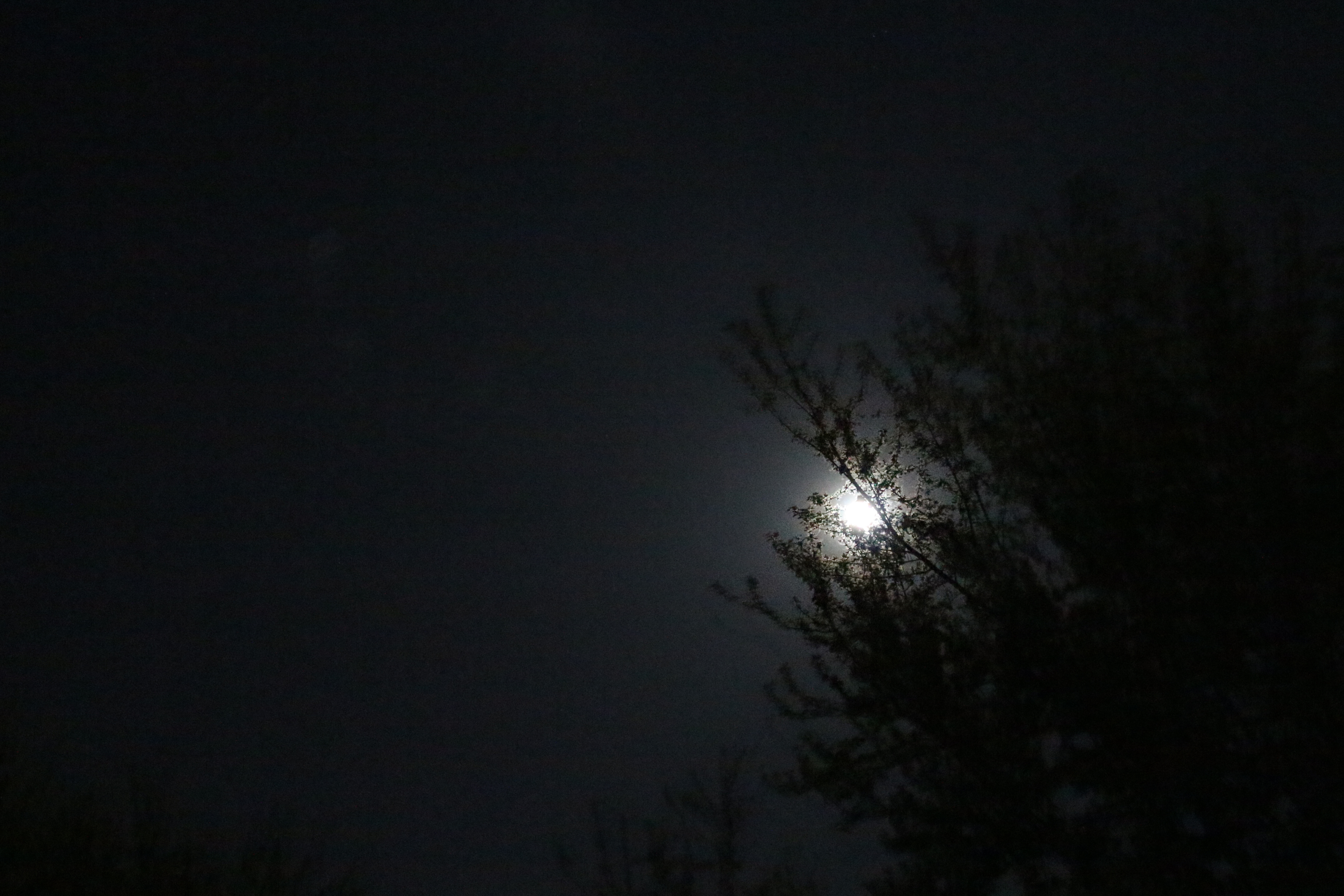
The Moon illuminating the Scheinin backyard.

With those and other thoughts in mind, I began to write. But my intent soon took a sharp change in direction when it dawned on me that the end game was not to turn out an essay about the intriguing aura that monnlit dancing casts upon the human psyche. Instead, I came to believe that the musical gods had held a meeting and decided to send a message my way. Sure, they had experienced brain freeze when they allowed me to hear Yellow Moon, but they quickly had regrouped and set things straight by showering me with Moondance. Their message was a simple one: Dance in the moonlight, fella! It’ll be fun. It’ll be good for you.

In my adulthood I’ve been a reluctant dancer. I give it a try at weddings and bar mitzvahs and other celebrations, but other than that, no. But this moonlight idea is intriguing. It might take awhile before my first dance occurs, but I’m going to coax myself. I can see it now  —  Sandy and I in our compact backyard, soft moonbeams filtering through the trees, the two of us flowing as one to the tune playing on the iPhone. Which of course is Moondance. And after that, before year’s end, we dazzle a lunar-lit stretch of sand and sea somewhere as Dancing On The Beach accompanies us. And then a meadow, where Dancing In The Moonlight shapes our movements.

(Photos by Sandra Cherrey Scheinin. If you click on a photo, a larger image will open)

(If you enjoyed this article, then please consider sharing it)

Infinitely The End (Thoughts About Two Movies)

Existence can be perplexing. If you’re like me, there are countless aspects of the organic and inorganic and intangible realms that are hard or impossible to figure out. Now, some of these subjects are of high importance, such as global warming or one’s relationships with one’s fellow species members. Others aren’t worth devoting too much brain power to. Naturally, those are the ones I gravitate towards. A few days ago, for example, I decided to look into the degrees of success that a couple of movies that I’ve recently seen in theaters have had at the domestic box office. Our planet’s fate did not hang in the balance as I did my research. I’m talking about Infinitely Polar Bear and The End Of The Tour, smart and perceptive movies aimed at the art house market. Infinitely seemed to me to be far more of a potential crowd pleaser than The End. Yet it has been attracting far fewer dollars in the USA than The End. Here’s why this surprised me:

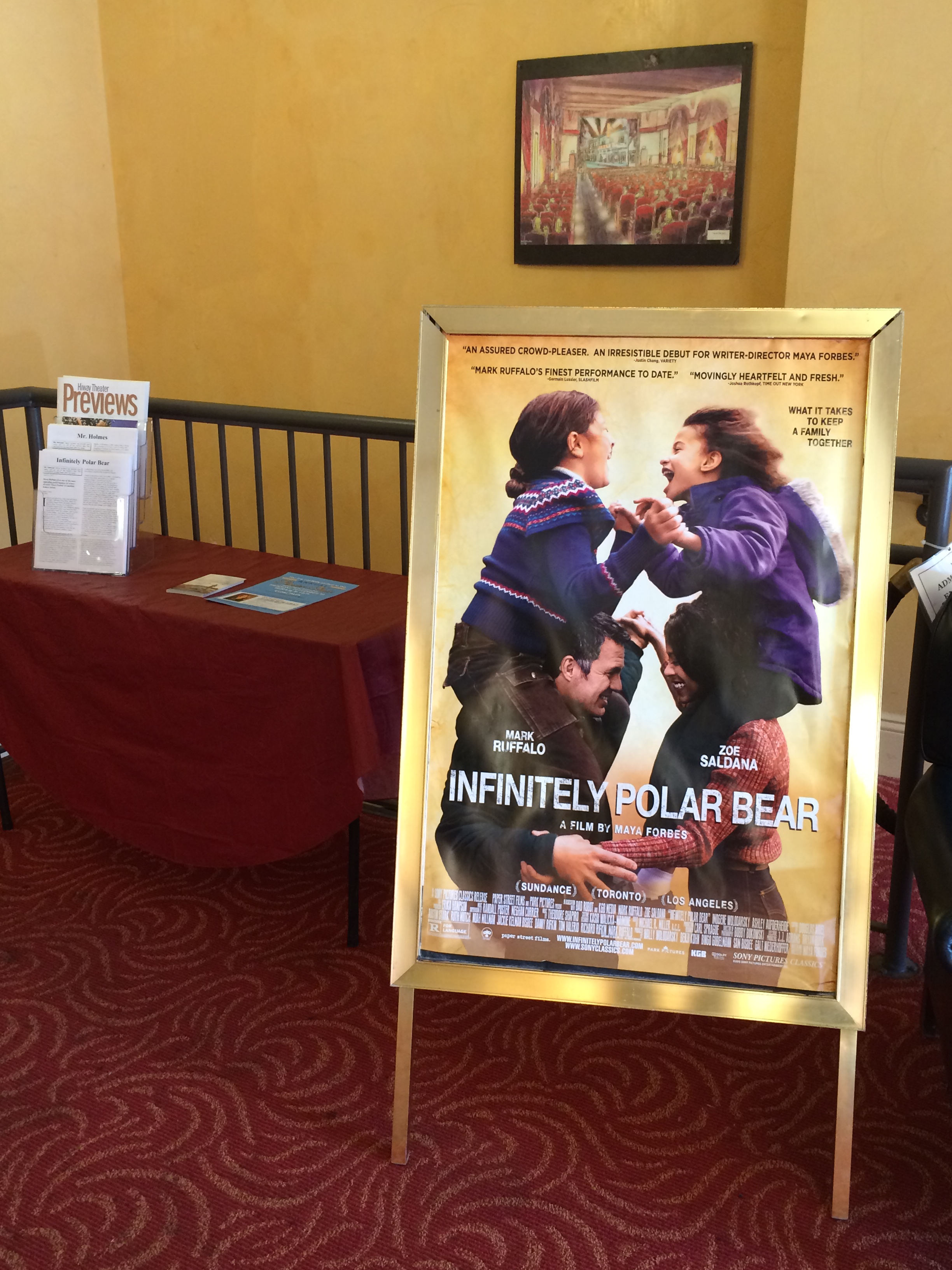
My wife Sandy and I saw Infinitely Polar Bear at the Hiway Theater in Jenkintown, PA.

Infinitely Polar Bear is a boisterous movie, a full-of-life, family-oriented comedic drama and to a large extent a feel-gooder. What’s more, it centers around a wild and bigger-than-life character, beautifully played by Mark Ruffalo. The End Of The Tour is and has none of that. It is slow-moving and understated and wry. And cerebral too. Its main character is charismatic, but in a geeky and repressed sort of way. Infinitely has flash. The End doesn’t.

As we see, I’m no Kreskin when it comes to predicting people’s tastes in movies. What else is new? Still, though I enjoyed both, in a way I’m glad that The End Of The Tour is outdoing Infinitely Polar Bear financially, because I think that The End is better. I’d give it at least three and a half out of four stars. To Infinitely I’d grant maybe three. There were aspects of Infinitely that rang a bit false to me. I had no such problems with The End Of The Tour.

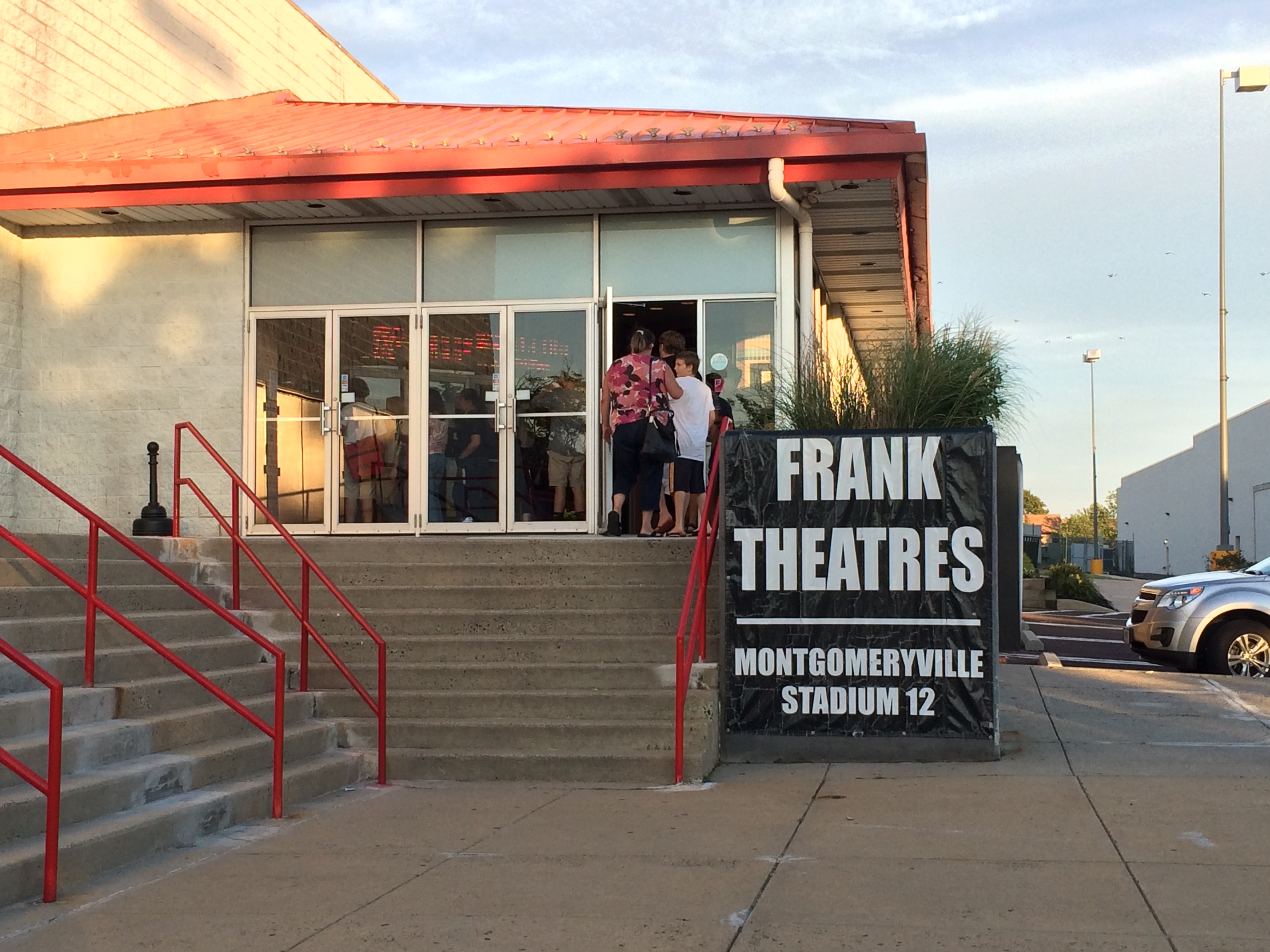
We saw The End Of The Tour in Montgomeryville, PA.
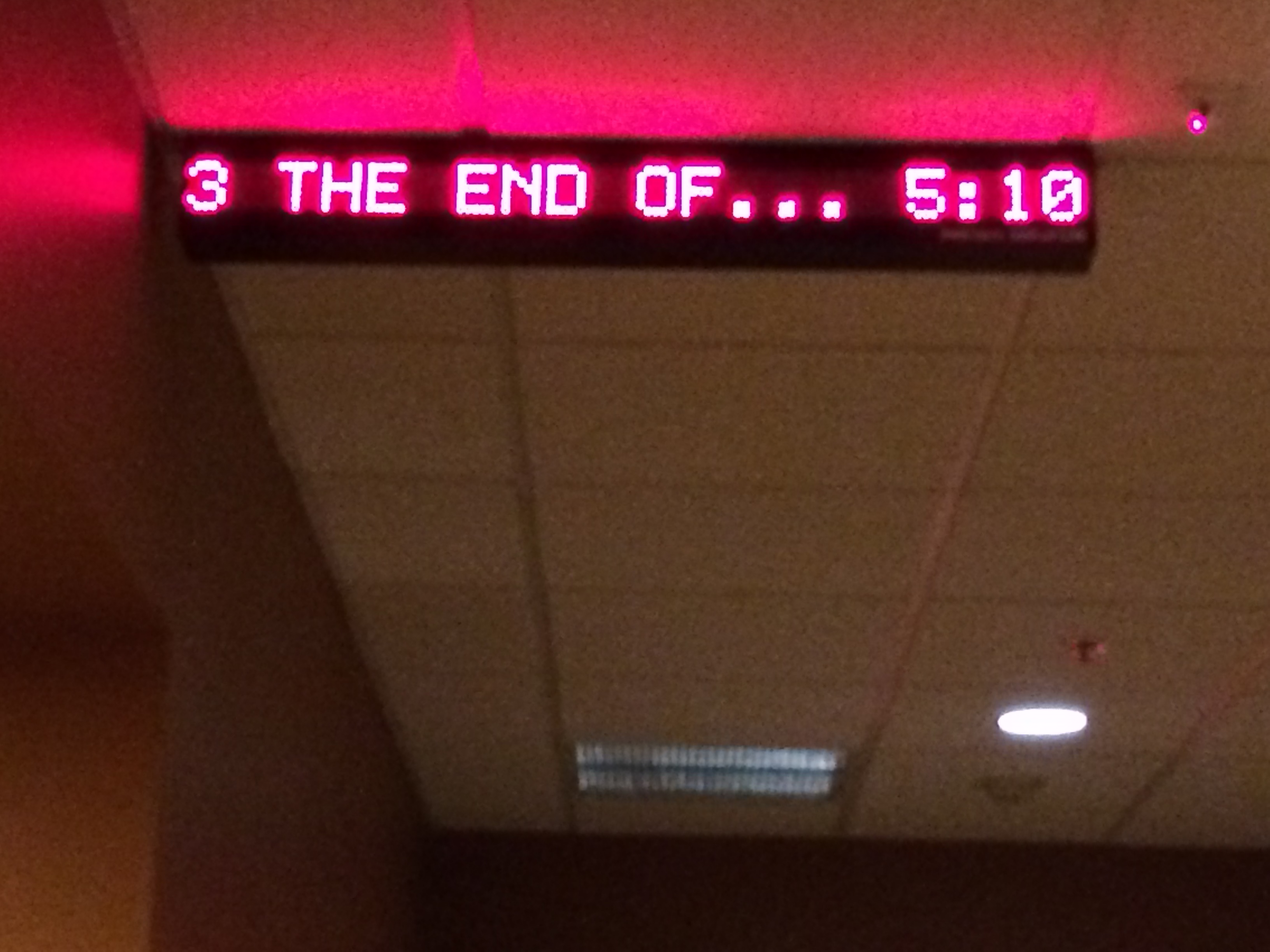
Guess what time the movie started.

One big thing that Infinitely and The End have in common is their aim to portray real life people and events. Another similarity is that the main figure in each is weighted with psychological problems. The End Of The Tour’s core takes place in 1996, when a Rolling Stone magazine writer, David Lipsky (a medium octane turn by laser-eyed Jesse Eisenberg) tagged along with David Foster Wallace during the tail end of the promotional tour for Wallace’s recently-published and massive (1,000+ pages) novel, Infinite Jest. Lipsky’s assignment was to profile Wallace for Rolling Stone, and he filled many cassette tapes with Wallace interviews. The End is drawn from the interviews and from Although Of Course You End Up Becoming Yourself, which was Lipsky’s 2010 book about his Wallace adventures.

No supernova explosions took place during Wallace’s and Lipsky’s five days together, but in a subdued and riveting way their conversations soared. I’m pretty certain that The End mirrors reality in this and most respects. The wary Wallace opened up more to Lipsky than he might have wanted, partly due to some slings and probes that got under his skin. Wallace talked about the love-hate feelings he was developing about the fame that Infinite Jest was thrusting upon him. He talked about the dehumanizing effects of technology on modern man, about the place of the creative person in the world. He touched upon many other topics, including his struggles with mental depression (sadly, he lost this battle in 2008, when he committed suicide). I found The End’s depiction of all of this very moving and kind of exhilarating. I was totally smitten by Jason Segel’s portrait of Wallace as a shaggy dog, a pretty brilliant and mostly nice guy. If Segel isn’t nominated for an Oscar he’ll deserve to say “I wuz robbed.”

Infinitely Polar Bear is Maya Forbes’ baby. Forbes has been a writer for the big and small screens (Monsters Vs. Aliens and episodes of The Larry Sanders Show). For Infinitely, she wrote the screenplay and took her first stance ever behind the camera. The movie tells the story of part of her life, zeroing in on the late 1970s when preteen Maya and her younger sister were raised in semi-poverty in Cambridge, Massachusetts by their bipolar father. The two girls had been living with Maya’s underemployed mother Peggy. Peggy, though, came to decide that the only way to lift the family from its lowly monetary straits was to obtain a marketable postgraduate degree, a Master of Business Administration. This pursuit resulted in her relocation to New York City, Columbia University being the only school that approved her application. Peggy hesitantly deposited the girls with her husband, the girls’ father, Donald Cameron (“Cam”) Forbes, and visited them on as many weekends as she could.

Infinitely Polar Bear is bursting with energy. Ruffalo’s Cam captures the screen, especially during his manic phases, which seem to be far more frequent than his self-absorbed and down moods. Maya Forbes’ screenplay paints Cam as an admirable father, flawed and unpredictable and psychologically challenged, for certain, but there for his girls. Ruffalo and Zoe Saldana (Peggy) make a believable, though separated, couple. Imogene Wolodarsky (Maya’s real life daughter) and Ashley Aufderheide are so feisty and delightful as the young sisters, I was convinced that they gave Ruffalo his wings.

So what about the movie slightly rubbed me the wrong way? For one, it felt a few tads too glossy, too Hollywoodized. And I’d have liked to know what the family arrangements were as the years went on. For instance, did Maya’s parents ever again join as one? Forbes didn’t say, not even in a few written sentences on the screen before the credits rolled. And what’s with changing the family’s names? In Infinitely Polar Bear they all are surname Stuart, not Forbes. Some first names were altered too. In interviews surrounding her movie, Maya Forbes has said that she wanted to present a true portrait of her family. I wish she had started by assigning the screen characters their correct appellations.

(Photos by Sandra Cherrey Scheinin. If you click on a photo, a larger image will open)

(If you enjoyed this article, then please consider sharing it)

A Meditation On Pizza

Pizza, pizza, pizza. For how long have you been a part of my life? Why do I adore you so? Have my feelings about you changed over the years? And most importantly, where the heck can I find really good examples of you? These are questions I am about to answer. They also are questions to which I will return in future articles on this blog.

Some people write about politics or religion or nanomechanics. I have yet to address those and other heady subjects, and probably never will. I don’t have the smarts for that. I’m not too sure I have the wattage to say anything dynamic about pizza either, for that matter. I’m a preschooler compared to the Einsteins out there whose knowledge of and insights into the world of pies are dazzling. But I’m not embarrassed to lay out some thoughts and observations. Take it away, Neil.

Pizza is my favorite food and has been for 40 or so years. I grew up on Long Island, and it was there in the early 1960s that my pizza habit began. The habit grew, and somewhere in the early 1970s became pretty well an obsession. I was living on Long Island for part of that decade, and in Manhattan and Philadelphia at other times. In all of those locales the pizza was similar. I, and I’m sure most people, didn’t spend a lot of time discussing pizza in those days. Basically, you ate it and you liked it. There were only two varieties back then, regular (a round pie that I suppose now would be referred to as New York style) and Sicilian (a square pie whose crust was thicker and chewier than the regular pie’s). You could get mushrooms or pepperoni with the former if that was your wont.

By the late 20th century though, pizza became a complicated subject with a nomenclature that I can’t keep straight. New York style, Chicago style, Neapolitan, Margherita, thin crust . . . on and on it goes. And then there’s the whole matter of toppings. We live in an age when figs, pineapple, you name it, are fair game to bake atop a pie. For ease of discussion I’m going to keep this essay focused on the type of pizza I like best, the humble round darling composed of crust, cheese and tomato sauce. No toppings.

In the 1970s regular pizza seemed a-ok to me. It was chewy and floppy, often heavily laden with cheese and tomato sauce and usually dripping with oil. That variety is alive and well to this day. Its top makers, such as Di Fara (in Brooklyn) are truly famed. I’ve never had a Di Fara slice, but I gather that that establishment has taken the regular (aka New York style) pie to a new level, probably by using higher quality ingredients than those I grew up with. I wish that Di Fara would open a branch near me. While I wait two or three millennia for that to happen, I’ll instead continue to visit a couple of places in the Philly burbs that make New York style pizza similar to what I devoured years ago. The quality varies from visit to visit at these parlors, but I can’t complain too much. I like their wares fairly well overall, though I now have better alternatives.

There’s something about pizza that strikes a chord with my elemental self. It’s not a fussy or complicated product. The three main components seemingly were created to join blissfully together to make taste buds swoon. But as I’ve learned over the last 20 years, a great gastronomic marriage can become even greater. In other words, pizzas better than those I knew in my youth and middle age exist in this world. Di Fara’s baby is an example. In the USA, pizzas have reached rarified heights of deliciousness.

I’m not talking about all pizzas by any means. Most American pies still are very ordinary, maybe way too heavy on the cheese or cursed with a cardboard crust or hampered by an indifferent tomato sauce. However, new pizza orientations have taken hold in many establishments, and the one I’m especially all for is this: Thinner and charred crust. High quality cheeses and tomato sauce in balanced proportions. Oil in moderation, not cascading from each slice like a waterfall. This is not New York style pizza, though I’m a bit uncertain as to the name(s) it has been given by the pizza intelligentsia.

The above paragraphs are a long lead-in to my recent visit to Anthony’s Coal Fired Pizza, a chain with a branch in Horsham, PA, not far from my home. My wife Sandy and I dropped in on a hot August Saturday night. We’d been there before, each previous visit knocking our socks off. I know of a few places in Philadelphia with pizzas that match my updated criteria for excellence. In the burbs, Anthony’s is the one and only that I’ve discovered.

Our lovely salad at Anthony's Coal Fired Pizza.
Our lovely Italian salad at Anthony’s Coal Fired Pizza.

Anthony’s has a small menu. I’d guess that pretty much everything on it is swell. Sandy and I, though, have had only the Italian salad and what Anthony’s calls its traditional pizza. Both are so good we order them again and again. The other night the salad was fine as usual. Crisp lettuce, chick peas, tomato and hard boiled egg wedges, all glazed with a tart light vinaigrette dressing. Simple and satisfying.

Our majestic pizza pie at Anthony's.
Our majestic pizza pie at Anthony’s.

The pizza came on a flat wood throne. Visually the pie was beautiful — you have to love those darkened areas, the basic color palette. Tastewise, beautiful too. The cheeses, mozzarella and romano, were earthy, the plum tomato sauce bright and lively. And the crust’s charcoal bite brought me joy. I’m an easy guy to please, given the right circumstances. At Anthony’s I was a happy eater. Good salad and superb pizza. And a hoppy brew to wash them both down, Arcadia Brewing Company’s Cheap Date Pale Ale. There was nothing more I needed or desired.

I’ve previously written about Capofitto, a fine joint in Philadelphia serving up blackened soul-satisfying pies. I know that pizza greatness extends far beyond Capofitto and Anthony’s. Fussy me will continue to search for pizzas way above the pedestrian, and will report back now and then as I discover them.

(Photos by Sandra Cherrey Scheinin. If you click on a photo, a larger image will open)

(If you enjoyed this article, then please consider sharing it. Thanks.)

Sunday In The Park With Duane (Jazz Concert Review)

Some outdoor summer music series are better than others, but not everyone would agree on which are the good ones. Personally, I most like those that have an eclectic mix of musical genres and that also avoid tribute bands. Luckily for me and my tastes there are a number of summer series in the Philadelphia region that hire the kinds of acts that I’m a sucker for. One of those is Cheltenham Township’s Concerts In The Park, whose shows are staged in the sprawling and meticulously maintained Curtis Arboretum. There, a mile or two from Philadelphia, musicians mount a modest stage at 5 PM on five summer Sundays. They and their audiences are surrounded by, and are under, many large trees.

I’ve been impressed for years by some of the Cheltenham bookings. In 2014 my wife Sandy and I, accompanied by two of our friends, went to the Curtis Arboretum to see and hear Geoff Muldaur, who has been crisscrossing the USA and other countries as a musician for decades. Geoff began to make his name in 1963 as a member of the Jim Kweskin Jug Band. And there he was, so many years later, performing his folky-bluesy-jazzy repertoire on acoustic guitar at the arboretum.

The pre-show crowd at Curtis Arboretum.

On a recent Sunday, Sandy and I, with the same two friends, sat beneath some leafy limbs at Curtis to take in another example of thinking-outside-the-box scheduling, the Duane Eubanks Quintet. This jazz outfit is more commonly witnessed in clubs. Somehow I didn’t hear Duane say from the stage that he wasn’t used to playing at settings such as Curtis, but my friend assured me that he did. Eubanks, a suburban New York City-based trumpeter with a first-rate résumé, brought along with him four fine and established members of the jazz world.

Duane Eubanks comes from a very musical family. He grew up in Philadelphia’s Mt. Airy section, so his Curtis gig wasn’t far from his childhood home. His pianist mother, who gave lessons to prominent jazz players, helped spark a musical flame in some of her children. Look at the results: Duane’s oldest brother, Robin, is a well-regarded jazz trombonist. Duane’s second-oldest brother, guitarist Kevin, became famous as the band leader for The Tonight Show With Jay Leno. Of the four male Eubanks offspring, only Shane, Duane’s twin, is not motoring on the professional musician highway.

Duane plays trumpet really well. Throughout the Curtis show I gave a mental thumbs-up to his imagination and clean lines. He wasn’t flashy, didn’t spend inordinate amounts of time swirling around in his instrument’s nosebleed zone. What he did was this: He spun worthy tales with his horn, filling his solos with strong ideas, and balanced that with terrific technique. I don’t think I had ever seen him in concert before. I was impressed.

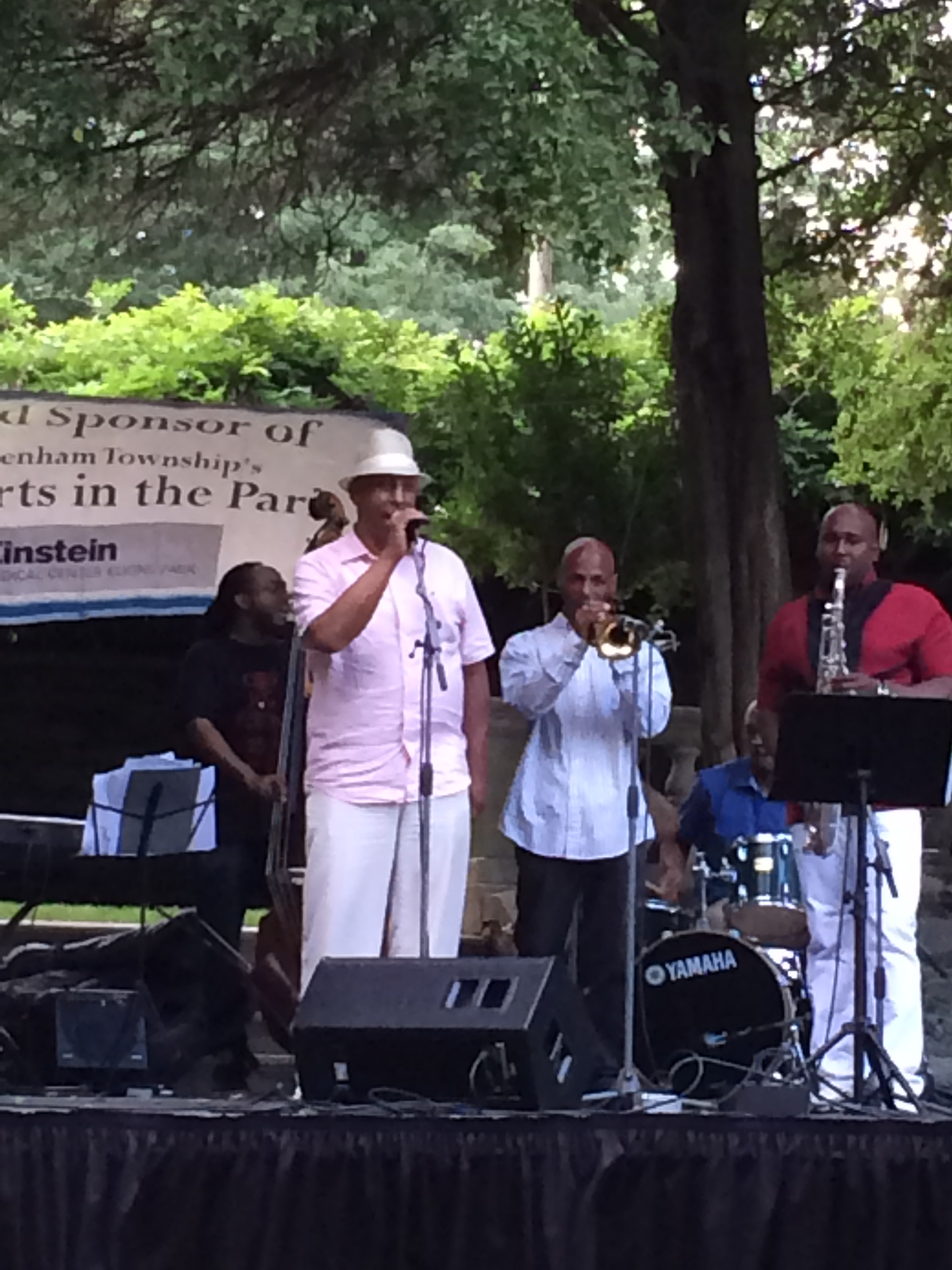
Duane Eubanks Quintet at Curtis Arboretum.

Eubanks and company primarily stayed in the hard bop bag, with two excursions, which I wasn’t crazy about, into the borders of smooth jazz territory. The tough and driving stuff and the one unadulterated ballad, though, were terrific and had my head swaying. On board with Duane was tenor saxophonist Abraham Burton. Burton’s robustness and energy owed debts to John Coltrane, his more meditative moments to Dexter Gordon. David Bryant was a whiz on electric keyboard, an attentive musician filling spaces deftly when Duane or Abraham soloed, his fingers flying fast and furious when he himself took the lead. Corcoran Holt, on upright bass, helped power the band with notes that sometimes boomed, sometimes cooed. I thought that he was great. And the in-demand drummer, Eric McPherson, was all over his kit, rat-a-tat-tatting on his snare drum, whacking à propos accents on his cymbals. I didn’t particularly enjoy his work on the two aforementioned smoothed-out numbers, but let’s put them aside. I already have.

The tune I maybe liked the best was the first set’s opener, a Eubanks original titled Slew Footed. It went on for 20 minutes. Slew Footed was a hard romp, a controlled yet convulsive affair. Each musician took long propulsive solos. Each listened carefully to what the others were saying. The onstage musical conversations were animated and keen.

Guest vocalist TC III with Duane Eubanks' group.
Guest vocalist TC III with Duane Eubanks’ group.

Halfway through the second set Eubanks brought to the stage a guest vocalist, TC III. I used to see him perform at venues all over Philadelphia, but hadn’t in 20 or more years. He sang on two songs. TC III took hold of the first tune, Moanin’, from its opening notes. I had forgotten just how fine a singer he is, bluesy and direct. Think Eddie Jefferson. Think Joe Williams. Moanin’, a gutsy marriage of the blues and gospel, was a staple of Art Blakey And The Jazz Messengers. I loved the way that TC III and the Eubanks group belted it out.

I’m a stickler for good audio projection. Too often at concerts, in venues small to enormous, the sound quality doesn’t cut the mustard. At Curtis the sound guy got it right. Every instrument, and TC III’s vocals, came through loud and clear. There was no muddiness in the mix. All of this added to my enjoyment of the show. As did the weather. For much of the late afternoon and early evening, dark clouds massed and inched along far overhead. I was certain that a downpour was in the works, especially after a dozen or so raindrops plunked me around 6:30 PM. Amazingly though, not another drop fell after that.

(Photographs by Sandra Cherrey Scheinin. If you click on a photo, a larger image will open)

(If you enjoyed this article, then please consider sharing it. Thanks.)

Putting Up The Good Fight: A Review Of Mr. Holmes

Arthur Conan Doyle published his final Sherlock Holmes opus in 1927. Copyright laws in Great Britain and the USA allowed him and subsequently his heirs to collect gazillions of pounds and dollars in royalties and fees since then, but the flow of those monies has become a trickle. Wikipedia tells us that the last of the copyrights expired in Britain in 2000. In the States, a handful of the final Holmes stories still are under copyright, but all the rest have fallen into the public domain. And a 2014 federal appeals court ruling stated that the creators of books and movies and television shows inspired by Sherlock no longer are obligated to pay licensing fees to the Conan Doyle estate, whose members must be grinding their teeth. I mean, is there a more enduring fictional figure than Holmes, the masterful detective? He’s hard to miss. Robert Downey Jr. starred as Holmes in two big screen productions from the 2000s, and a third undoubtedly will be heading our way in the near future. And two Holmes series currently are alive and well on the small screen: In the aptly named Sherlock, Benedict Cumberbatch portrays a modern day version of the great man in London for BBC television. Also set in the present day is Elementary, a New York City-based Sherlockian study, this one on CBS.

Books too have kept alive the Sherlock character. Dozens and dozens of them. For example, 2005’s A Slight Trick Of The Mind. Mitch Cullin wrote Slight Trick, and it is the basis for Mr. Holmes, the movie now gracing art houses and multiplexes worldwide. My wife Sandy and I recently watched it, and liked it, at the friendly and classy Ambler Theater in beautiful downtown Ambler, PA.

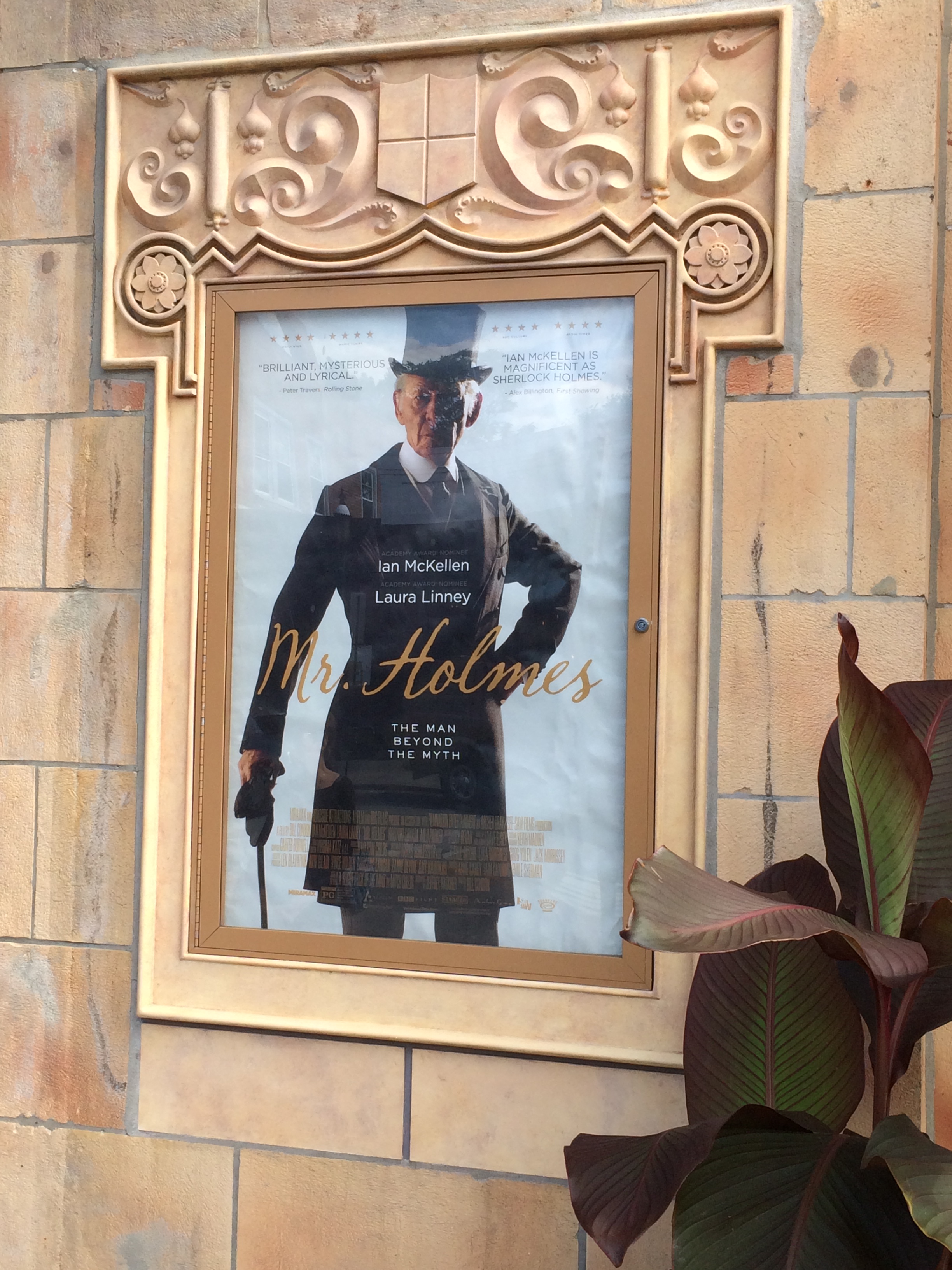
We saw Mr. Holmes at the Ambler Theater in Ambler, PA.

I’ve given some thought to Mr. Holmes, not an easy feat for me to undertake or accomplish. And I’ve come away with the opinion that the flick needn’t be looked at as part of the Sherlock Holmes continuum. It certainly is about Holmes, in fact a 93-year-old version of himself trying to stare down his failing mind and the end of his earthly existence. But the movie would stand just as handsomely if a few plot strands were reworked to undo the Holmes references, and if the lead figure were given another name. The movie I’d say is less about Holmes and more about understanding oneself, coming to grips with one’s shortcomings, trying to become a better person even as the end of the line draws near.

It is 1947 in the county of Sussex, England. By choice, Sherlock Holmes lives there in semi-obscurity on a small farm near the English Channel. He has been retired from the investigator game for about 30 years, having decided to hang up his detective tools because, because, because . . . Sherlock cannot remember why. His brain power, and body for that matter, are pretty strong, but some memories have begun to fade away. Holmes knows that his powers are slipping. An avid bee cultivator, he has doused himself for some time with his colonies’ royal jelly, a presumed mental strength rejuvenator. As the movie begins, he returns to Sussex from Japan, laden with that country’s prickly ash, a herbaceous product likewise touted for its restorative powers. Sherlock Holmes is not one to settle back and accept a drowsy and inevitable descent into a muddled mind.

At home, Sherlock and his property are tended to by Mrs. Munro, a widow with a bright as can be 12-year-old son, Roger. And it is here, in the mixings of these three lives, that the story finds its epicenter. Holmes, who has aged gracefully, is no longer the flinty and brusque superman of his younger days. He is fairly gentle with fellow humans and tolerant of their ways. Yet deep love is not, never was, an emotion he feels at home with. Spoiler alert: By movie’s end he will have opened his heart wider than ever.

A good chunk of the movie concerns a mystery from the past, from the years of the First World War. And that mystery, which involved Sherlock and a troubled woman, led to Sherlock Holmes’ abandonment of his Baker Street digs in London and his retirement to the English countryside. Throughout the film he strains to remember the why of his resettlement. But put aside this artistically designed and developed aspect of the movie and you still are left with a lovely character study. Ian McKellan, face creased like an accordion’s bellows, handles the elderly Holmes character with nuance and charm. His Holmes is quite yet smart as a whip, and not ashamed of the emotional vulnerabilities he has begun to develop in his golden years. His is the most complicated character on screen, the most multifaceted and the one with the most growing to do. Laura Linney (Mrs. Munro), the great American actress who to my ears has her English accent down pat, and Milo Parker (Roger Munro) at varying times coexist, bond and brawl with McKellan’s Holmes marvelously.

Bill Condon sure-handedly directed Mr. Holmes. The movie’s languid pacing feels right, and I’d bet that much of the credit for the actors’ strong performances belongs to him. Mr. Holmes is not a tearjerker. Oh, maybe one Kleenex will be of use. What we have here is a mostly cliché-free look at the tail end of the life of a proud man determined, maybe destined, to be a mensch.

(Photo by Sandra Cherrey Scheinin. If you click on the photo a larger image will open)

(If you enjoyed this article, then please consider sharing it. Thanks.)

A Pretty Park Can Be Pretty Hard To Find

Back in 1981 the Philadelphia Museum Of Art mounted an exhibition of photographs by Robert Adams. Adams took the photos in the 1970s. They were images of western American states, the desolate areas, primarily deserts and mountains. I remember the show fairly well. No matter how remote the locale, nearly every photograph bore evidence of man’s hand: A telephone pole, tire ruts in the sand, roads winding like barber pole stripes around magnificent mountains. One of Adams’s points was that pure wilderness is long gone, so we better get used to it and be glad for the great though adulterated spaces that exist. I imagine that even if you found yourself in the middle of Antarctica’s biggest ice shelf, and I don’t wish that fate on too many of us, you wouldn’t have to wait impossibly long before an airplane passed overhead. Man is everywhere. Yikes.

Now, a half-baked embryonic distillation of those thoughts was in my head recently when my wife Sandy suggested that we walk around the grounds of Abington Art Center, a few miles south of our home in the Philadelphia suburbs. “Sure,” I said, “good idea.” But what I didn’t say is that I’d prefer to stroll some expansive Adams-like terrain. In my dreams. Around here in the burbs, man for the last 75 years has been relentlessly busy cutting down trees and pouring cement. Around here, you have to count your lucky stars that any good-looking patches of territory of any sort still exist.

Manor house and lawn at Abington Art Center.

Abington Art Center is one of those patches. The center contains the manor house and some of the grounds of a former estate. The house is used for art classes and gallery exhibits and the like. The grounds mostly are a huge lawn that slopes away from the rear of the house and 10 or 15 acres of woods. It’s a lovely place. And it is more than manor, grass and trees. Scattered here and there on the great lawn and on side lawns and in the woods are all manner of sculptures, about 50 all told. Sandy and I had a good time at the center. For two hours we looked at trees and artworks and burned off a few calories while walking a couple of miles.

The play of light in the woods at Abington Art Center.

I like the outdoors. But I’m hardly a naturalist. My knowledge of flora and fauna has more holes than you can count. And so at Abington Art Center I found myself admiring a specific leafy tree species, of which many examples exist in the center’s tiny forest, having no clue what I was looking at. They weren’t maples or oaks. Those I can identify. Whatever the trees were, they were  the tallest at the center. They measured well over 100 feet from bottom to top and didn’t wander leftward or rightward on their way towards the heavens. Their mothers must have told them from an early age to stand up straight. What also fascinated me was the play of light within the woods, how one tree’s upper reaches might be caught by the day’s intense sun, while others only a few feet away were out of the sun’s direct path. Contrasts of this sort always have appealed to me.

Mazzaroth is Alison Stigora's construction of burnt tree branches.
Mazzaroth is Alison Stigora’s construction of burnt tree branches.

The sculpture I thought the most of in the woods was Alison Stigora’s Mazzaroth. It’s an assemblage of burnt tree branches fitted together tightly to portray . . . what? A serpent? The movement of time? As the years go on, Mazzaroth will crumble and become one with the forest floor, as will the trees surrounding it.

You’re not going to confuse many of the sculptures at Abington Art Center with creations by David Smith, Louise Nevelson or other deservedly famed artists. Few if any are on that level. Some though, like Mazzaroth, had me looking them over from different angles because I liked them a lot. Take two on the great lawn, for instance. They are placed near each other and are as different as they can be.

Cabin Van Gogh at Abington Art Center.
Partial view of bed and table inside Cabin Van Gogh.

What is a lopsided small wooden cabin doing on the grass at Abington? Well, it’s a whimsical piece of art and is right at home there. Weather-beaten, cute and loveable, it contains within, of all things, a bed, chair and table lifted straight out of Vincent van Gogh’s paintings of his bedroom in Arles, France. This work is Knox Cummin’s Habitation Suite: Cabin Van Gogh. Vincent I believe would have been charmed  by Cummin’s idea to build such an unlikely homage, and also by the view of foliage from the cabin’s open back side.

David Schafer's orange sculpture at Abington Art Center.
David Schafer’s orange sculpture at Abington Art Center.

Uphill from the cabin stands what looks a bit like a lifeguard tower painted in bright orange, some of its support slats atilt. David Schafer, the creator, named his piece Untitled Expression: How to Look at Sculpture. I suspect that the notions behind the giddy orange tower are partly conceptual. Sculptures, like just about anything, are multifaceted. No need to try and pin down a precise meaning. Observe, surmise and enjoy. One of my takes, subject to change, is that the sculpture is alive yet indecisive, that it is shaking out its stiff bones and readying to inch forward but hasn’t gotten into gear quite yet. And what’s going on with that public address system speaker? I remembered later that it had a practical purpose once, as a recorded message played from it for months after the sculpture was first installed about six years ago. Sandy and I were at Abington Art Center at that time and heard the message. If we were put into a deep hypnotic state, maybe we’d recall what the message was. Gone silent, to me the speaker now just looks cool.

(All photos by Sandra Cherrey Scheinin. If you click on any photo, a larger image will open)

(If you enjoyed this article, then please consider sharing it. Thanks.)

Amy Schumer, Take A Bow!

For decades I was a devoted television viewer, faithfully devouring series galore. That pattern largely began to fade away in the early 2000s when Sex And The City waved goodbye to its audience, followed by NYPD Blue. Since the final Blue episode in 2005 I’ve had trouble following series religiously. Instead I’ve watched some movies and sports and have done tons of channel surfing, of which I’ve become a master.

Amy Schumer and Bill Hader star in Trainwreck.

As a dial-flipper, how could I not know about Amy Schumer? I’ve caught fragments of her Comedy Central series and a few minutes of a standup special. I thought she was funny. But I had no idea just how funny and talented she is till recently when my wife Sandy and I headed north to the Regal multiplex in Doylestown, PA to take in the Schumer-penned and Schumer-starring Trainwreck. If you are a fan of robustly foul-mouthed and sex-obsessed comedic vehicles loaded with did-he/she-really-say-that repartee, then Trainwreck is for you.

The setup: Schumer plays Amy Townsend, sexually active to the max and commitment-phobic. Amy T’s not looking for Mr Right. She’s just looking for the next one night stand, and has no trouble finding him after him after him. She’s a boozer, a pot smoker and looks at life with a most wary eye. Yet she also maintains a strong career as a magazine writer, turning out outlandish copy aimed at men for the slick and glossy no-conscience publication S’Nuff. In one scene Amy T and a few other writers are in a meeting with their Julie Christie look-alike editor-in-chief, portrayed by an unrecognizable Tilda Swinton. Townsend and her peers are pitching story ideas. Schumer’s crazily crude and politically-incorrect script shines here. How about “Where Are They Now? A Look At The Boys Michael Jackson Paid Settlements To” one of Townsend’s coworkers posits. “You’re Not Gay, She’s Boring” lobs another. Yup, I was slapping my knees during this sequence. Schumer had the funny stuff coming pretty consistently all movie long.

This is a movie where the plot almost doesn’t matter, but of course there is a plot and it’s fun. Bill Hader co-stars as a sports medicine titan, Aaron Conners, a physician who has revolutionized the arts of knee and hip and who knows what other surgeries, allowing professional athletes and working stiffs to return quickly and productively to their careers. One of his best friends is LeBron James. He also is pals with the lesser-known b-baller Amar’e Stoudamire. Amy T is assigned to write a story about Aaron for S’Nuff. She interviews him at his office, and her goofily charming side peeks through. Aaron is smitten. He invites her to lunch and, her defenses starting to melt, they begin to see one another a bit. Will Amy T put aside her wayward ways and join forces fully with the good doctor? Well, I’m not telling. No spoiler alerts here.

Judd Apatow, he of The 40 Year-Old Virgin and Knocked Up fame, directed Trainwreck. A few reviewers have noted that Apatow’s movies tend to go on too long. Probably that’s true. Trainwreck might have benefited if it went under Aaron Conners’ knife to eliminate 10 or 15 minutes of cinematic flab. Truth be told, though, Trainwreck’s length (two hours and five minutes) didn’t bother me at all. I’m granting three out of four stars to the Schumer-Apatow farce.

A few notes of amazement: Who’d have thunk that professional athletes would bring so much brio and presence to Trainwreck? They do. Turns out that LeBron James has a mighty gift for comedic acting. He receives plenty of screen time and stands toe to toe with everybody in his scenes. He’s got the pacing, the vocal inflections, the confidence. I’ll say the same and more for John Cena, a famous pro wrestler about whom I know almost nothing. He is absolutely hilarious as one of Amy’s suitors, a complicated and sensitive and sexually uncertain muscle guy whom Amy is toying with. Except for Schumer, he gives maybe the best show of anyone in the cast.

And a few mild gripes: LeBron James, a member of the Cleveland Cavaliers in real life and in Trainwreck, is never in Cleveland in this Manhattan-set flick. How come? The movie takes place during basketball season as far as I could tell. And one might think that Aaron Conners, a celebrated doctor for not only his work with athletes but also his donated time to countless Doctors Without Borders projects, would have an ungodly busy work schedule. In Trainwreck he’s kind of a slacker. Cafes and restaurants, gymnasiums, Amy’s apartment . . . Aaron spends far more time elsewhere than on the job.

In the end, little matter. Go with the flow, with the laughs, with the human insights that also are a large part of Trainwreck’s fabric. Amy Schumer deserves to be proud of what she has achieved here as an actor and a screenwriter.

(Photo by Sandra Cherrey Scheinin. If you click on the photo a larger image will open)

(If you enjoyed this article, then please consider sharing it. Thanks.)