Q: How Cool Is The Philadelphia Museum Of Art? A: Very

The Philadelphia Museum Of Art, PMA to its friends, is one of our fair nation’s best museums. My wife Sandy and I visit pretty often. Its holdings are fantastic. What’s more, for years the museum has presented concerts on Friday nights, and we’ve been to a crazy number of them. During our Fridays at PMA we look at art for awhile and then hear music in the majestic Great Stair Hall. For artsy nerds like me, that’s usually a winning combination.

As we headed museumward on a recent Friday, we found ourselves in traffic hell. Our car windows were fogging up from steam coming out of our ears, but we wound up having a heck of a good time once we arrived. No pain, no gain, or something like that. Late-ish as it was though, we didn’t have barrels of time to check out art if we were to snare seats at a ringside cocktail table for the evening concert. Those seats ordinarily are claimed 45 minutes or more before concerts begin. When the preferred seating is taken, your option is to place your rear end upon the Great Stair Hall’s grand marble steps. And YOW, that’s a numbing backside experience.

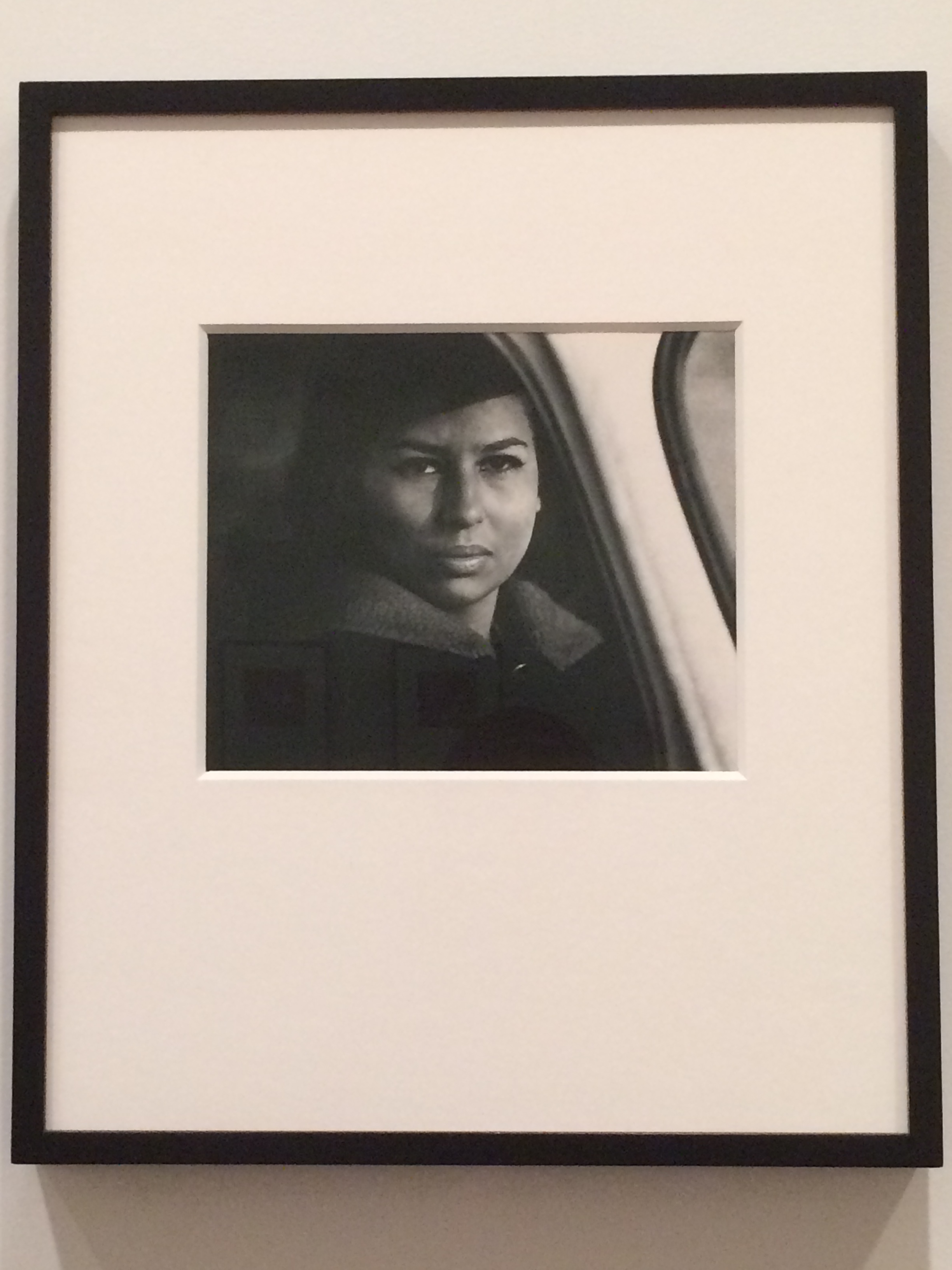
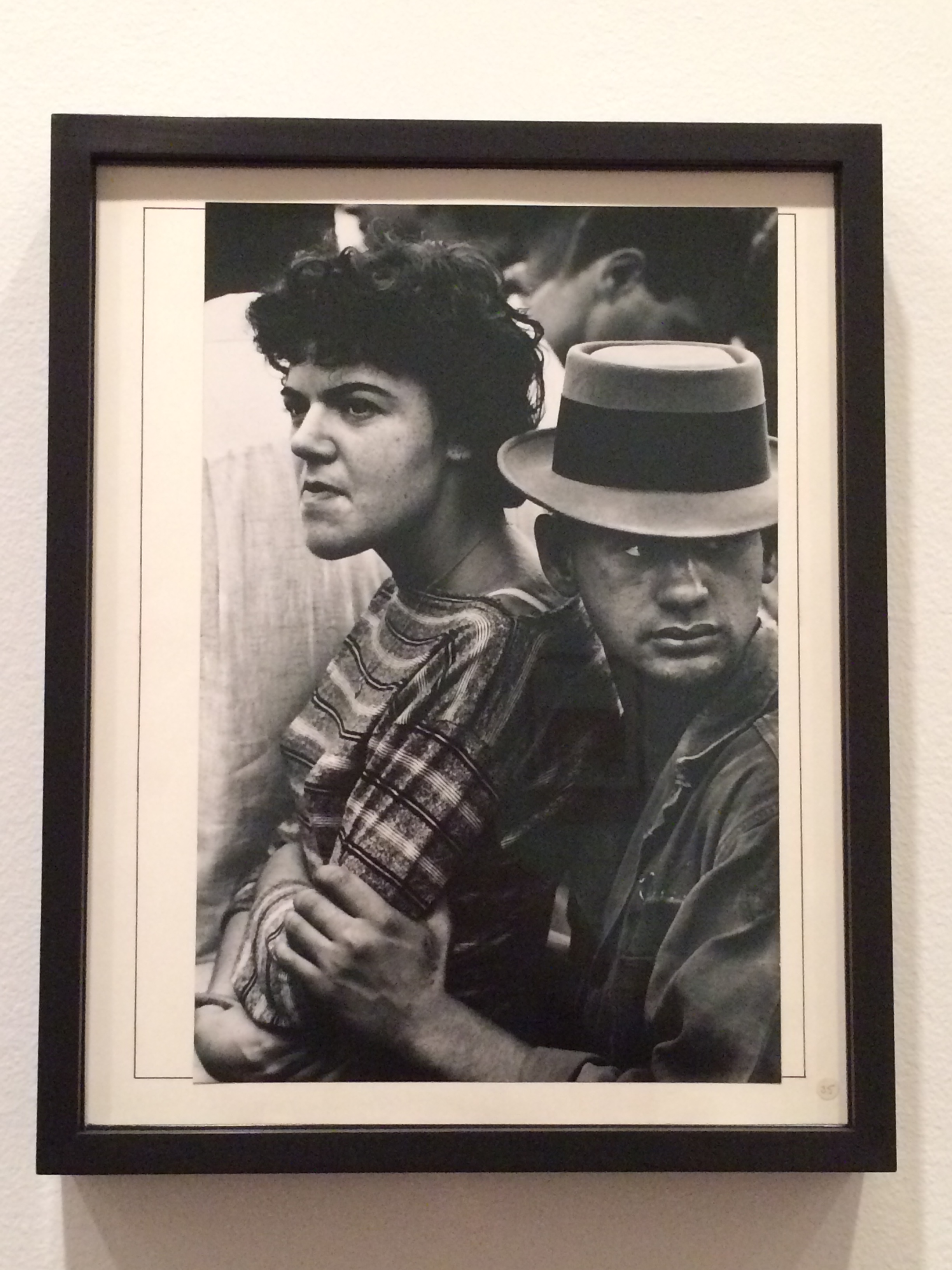
And so we navigated to a modestly-sized and time-friendly exhibit, works by the not particularly well-known Dave Heath. To me and Sandy, he wasn’t even that, as we’d never heard of him. This show (it closes on February 21, 2016) is entitled Multitude, Solitude: The Photographs Of Dave Heath, and comprises numerous 35 mm photos, all in black and white, that Heath took from 1949 to 1969. Also on display is Heath’s multimedia slide show from 1969. This is the first major presentation of his early and midlife creations, and one of the few museum exhibitions that he ever has had. It was organized by The Nelson-Atkins Museum Of Art in Kansas City, Missouri, with plenty of PMA input.

Sandy and I had the same reaction after looking at Heath’s photos for the first few minutes: “This guy is great,” we agreed. And I’m convinced that he is, or in any case was in the 1950s and 60s. The photographs are very beautiful and very dark, shades of black heavily predominating over those of white. I’ve always felt that this approach allows photographs to breathe emotionally, gives them depth and resonance.

New York City (1964), by Dave Heath. Nelson-Atkins Museum Of Art, Kansas City, MO; Gift of Hall Family Foundation
Washington Square, New York City (1960), by Dave Heath. Nelson-Atkins Museum Of Art, Kansas City, MO; Gift of Hall Family Foundation

Heath isn’t a chronicler of the natural world. He’s a people observer, usually in urban settings. And he is a lover of the close-up, often capturing folks deep in thought or in seeming isolation. His childhood was dreadful, and his work frequently reflects the hurt that probably never went away. But not all is aloneness or sadness in the Heathscape. Joyful images are here and there in the exhibit.

Dave Heath lives in Canada and is 84 years old. There’s not a lot of info about him in cyberspace. He was born in Philadelphia, grew up in foster homes and an orphanage, took up the camera in his late teens, and has had a full career as a photographer and photography teacher. His greatest fame and acclaim occurred in the 1960s, the decade in which he won two Guggenheim Fellowships and created the book for which he is best-known, A Dialogue With Solitude. The final pre-production copy of Dialogue is at PMA. Its 100 or so pages, mostly photographs, ring several gallery walls. Dialogue is divided into ten sections, among them Fate, Fragility And Diversity; Youth; Childhood; Ends And Beginnings. Dialogue is a deep photographic rumination on many aspects of the human plight.

Sandy and I ended up spending much more time with Heath’s images than we had anticipated. They are powerful. By the late 1960s though, Heath apparently felt that he had said all he could in black and white. He turned to color Polaroid picture-taking and later to digital photography. None of this is on PMA’s walls, and from what I gather isn’t well-known by the arts community. It’s a fine thing, though, that someone (the good folks at Nelson-Atkins and at PMA) has championed black and white Dave and decided to let the spotlight shine on him.

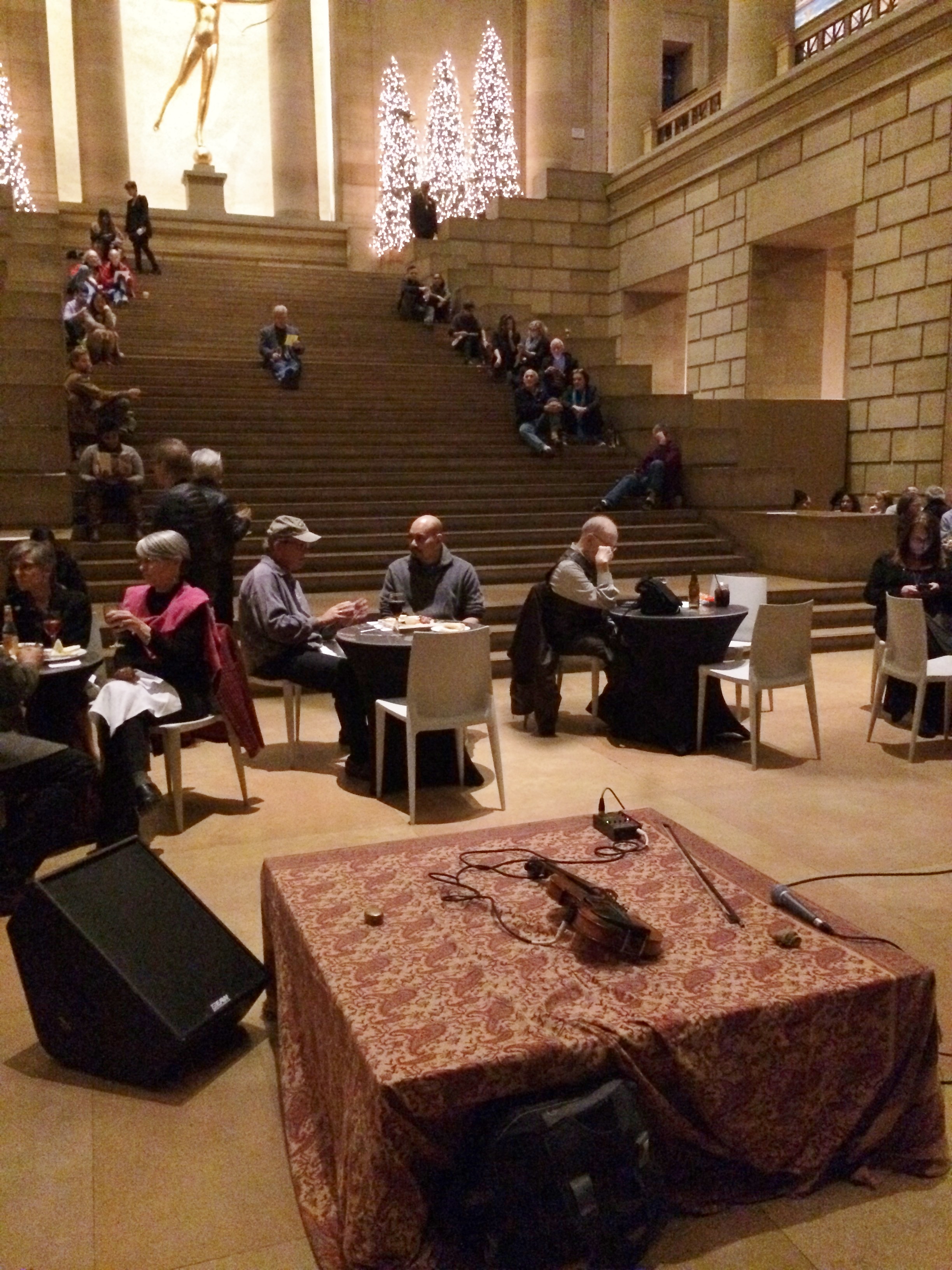
Before the concert in the Great Stair Hall. Photo by Sandra Cherrey Scheinin
Pre- concert in the Great Stair Hall. Photo by Sandra Cherrey Scheinin

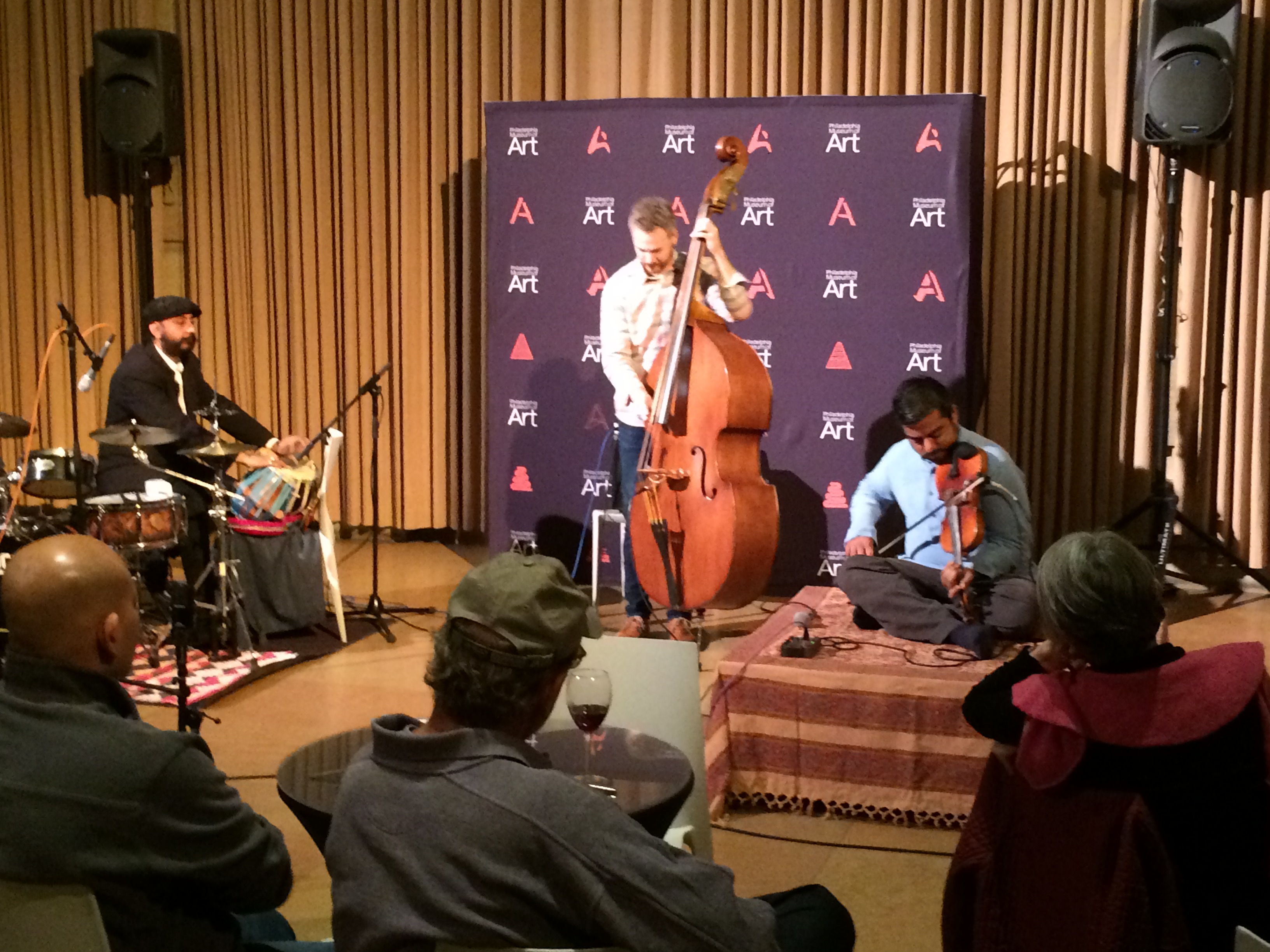
Show time was approaching. Sandy and I lucked out after Heath, grabbing two empty seats at a stage left cocktail table in the Great Stair Hall, a mere six feet from where Arun Ramamurthy soon would be bowing his violin. Arun Ramamurthy? Sandy and I knew as much about him as we had about Dave Heath an hour earlier. Brooklyn-based Ramamurthy, though, is a growing name to be reckoned with in classical Indian music and in musical cross-pollinations. At PMA he brought along Perry Wortman, on upright bass, and drummer/tabla player Deep Singh. The Arun Ramamurthy Trio began its first set at 5:45 PM.  They played a hybrid of South Indian classical music and jazz.

When it comes to music, I’m an appreciator, not a scientist. I understand little about any musical genre’s technical side. Scales, chords, the inter-relationships of notes and how they shape harmonies . . . forget it, I’m at sea. But the big picture I understand, as did the 200 others listening to the Ramamurthy group. We all clapped madly after each piece. Sure, Arun’s melodies and voicings on violin would be pretty unfamiliar to most American ears, but they were beautiful.

In the Great Stair Hall, Arun sat on a platform, chairless and shoeless. He held his violin vertically, bowing with his right hand, working the strings with the fingers of his left. The trio played five songs in the first set, three of them originals, all drawn from or reflecting traditional South Indian classical ragas, melodies and motifs. The music was elastic, minor-keyed and highly improvised, improvisation being a major component of both classical Indian music and jazz.

Arun began song number one unaccompanied, coaxing mournful sounds from his instrument for three minutes. Wortman’s bass then entered — low, gripping notes played slowly, repeatedly — and Singh’s drums too. Singh played carefully, tantalizingly, creating a steady and simmering beat. One drumstick tapped a drum’s rim. The high hat and cymbals shimmered just so. All the while Arun stroked melancholy lines. This was Ramamurthy’s original song, Conception. I was reminded of All Blues, and other numbers, from Miles Davis’ Kind Of Blue album.

The Arun Ramamurthy Trio. Photo by Sandra Cherrey Scheinin

The fifth song, an Arun original whose title I missed, found Deep Singh on tabla. The tune was energetic, Arun going pretty wild on violin, Wortman choosing notes eloquently and perceptively, as he did on each tune. Another thing I noticed was that Arun and Deep barely could keep their eyes off each other. They were in a strong musical relationship. And Singh’s fingers were absolutely flying, maybe wearing grooves in his tabla’s skins.

There was a sixth song, but it was not a full trio number. It was a classical raga played by two humans, Arun and tablaist Deep. They were joined not by Wortman but by a droning electronic accompaniment provided via an app on Arun’s smart phone. Amazing.

Dave Heath and The Arun Ramamurthy Trio. Another several hours well-spent at the Philadelphia Museum Of Art.

(If you enjoyed this article, then please don’t be shy about sharing it)

(If you click on any photo, a larger image will open)

A Cape Cod Sunset Story

My wife Sandy and I have a love affair going with Cape Cod, which is where we are vacationing as I type this missive. We live in suburban Philadelphia, but in most ways prefer the Cape. Boo hoo . . . we’ll be back home tomorrow.

In 1998 we visited the Cape for the first time, expecting it to be a locale we’d enjoy. Well, we did. And decided to come back the next year for some more good times. I think it was on that second trip that I realized I liked Cape Cod much more than I ever thought I would, that it really suited my soul, that I was starting to become smitten. Sandy and I have returned every year since then, excepting one. Before Cape Cod entered the picture, in my adult life it had never occurred to me that there might be an Eden of sorts waiting for me, someplace beautiful and in which I truly felt at home. A favorite place.

Sandy and I have had only great vacations on Cape Cod. We’ve been there in all seasons except summer, which is the one time of year when the Cape is overrun. With humans. We fill our days with a variety of activities: nature walks on sand or through forests; poking around in country-imbued villages; art gallery and museum hopping; attending movies, plays and concerts; lots of tasty eating in restaurants humble and above; the list continues. No doubt, this is the good life. I feel almost guilty that such fine fortune has come my way. But I’ll take it.

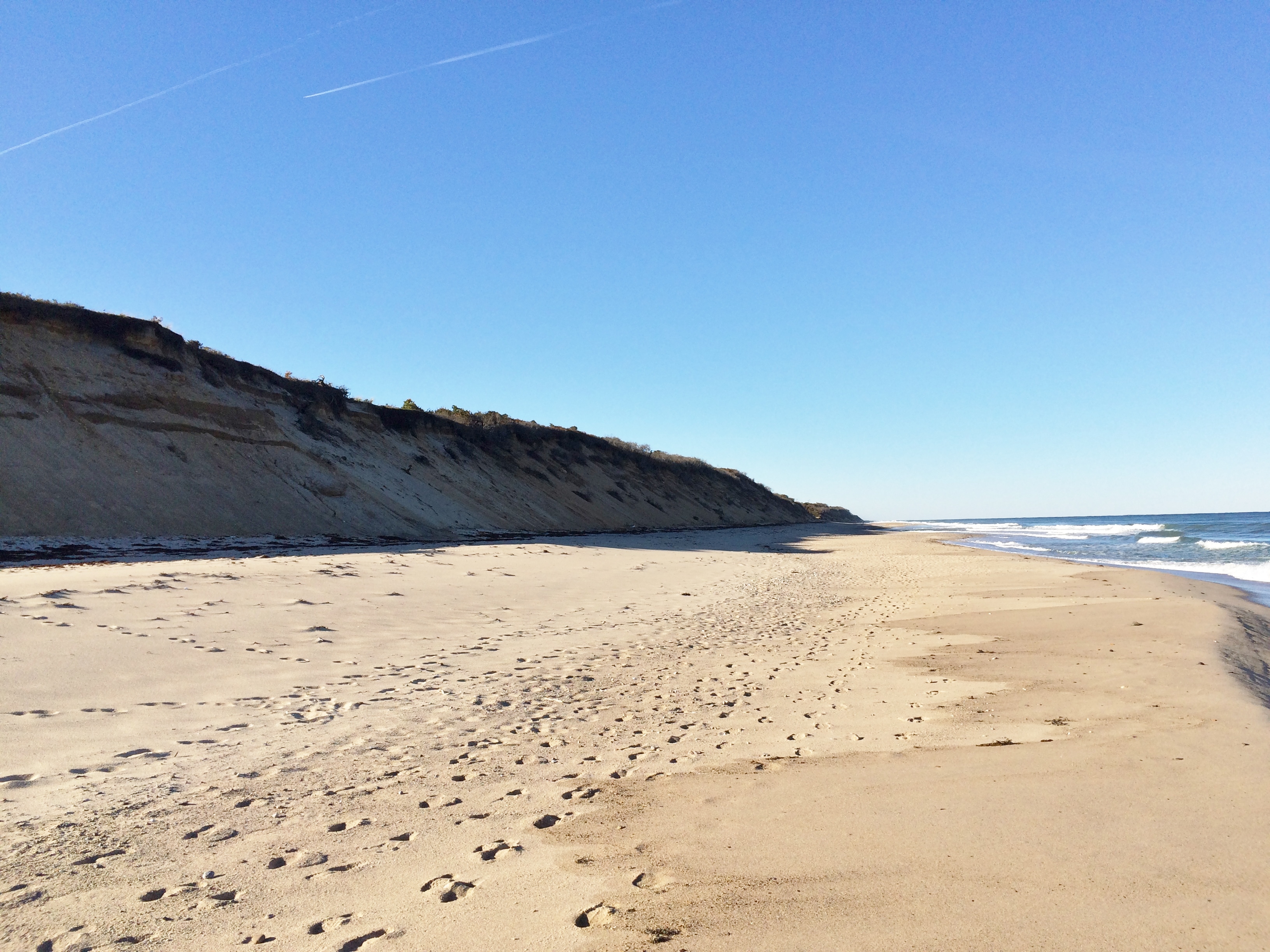
Atlantic Ocean shoreline. Eastham, Cape Cod.

If I had to select one reason above all that puts Cape Cod at the top of my list, I’d point to the expansive areas of natural beauty. Such as the 40 or more mile-long Atlantic Ocean shoreline, much of it government-protected and thus little disturbed or altered by the hands of man. The vistas there are pretty elemental and always knock my socks off. Ocean, sky and beaches backed by dunes-topped sand cliffs. My psychological and emotional makeups, whatever the heck they might be, vibrate in a calm, contented and awestruck manner when I’m in the midst of such.

And there are other reasons. To name one: When vacationing on Cape Cod sometimes an unexpected present drops into your lap, just as with life in general. One day last week an example came my and Sandy’s way. I’m talking about a sunset. Right, right, I know that over the centuries untold thousands of scribes have oohed and aahed in print about sunsets. And millions of sunset photos have been published, more in the last 15 or so years than ever before thanks to the Web. But hey, I’m not embarrassed to add a few hundred sunset words, and a handful of photographs, to the Everest-high piles already out there. Don’t bail out on me. Keep reading.

And so on the aforementioned day at 5:15 PM, Sandy and I were in Chatham, a needless-to-say charming Cape Cod town. We had just watched Steven Spielberg’s latest oeuvre, Bridge Of Spies, in the Chatham Orpheum Theater. Our next planned destination was 20 miles away, Harvest Gallery Wine Bar. There we meant to dine and listen to a tough as nails rock trio, The Catbirds. But there was no need to arrive before 7 PM. We had time to kill. We scratched our heads, coming up empty. Then “sunset” popped into my mind. Sandy checked with her phone, which is much smarter than me, and learned that the Sun would dip below the horizon at 5:57. I steered our car westward and then turned south onto a road I’d never heard of, hoping that we eventually would find our way to a Chatham beach on Nantucket Sound. The sand gods must have been with us, for Hardings Beach Road soon materialized. And moments later Hardings Beach itself emerged.

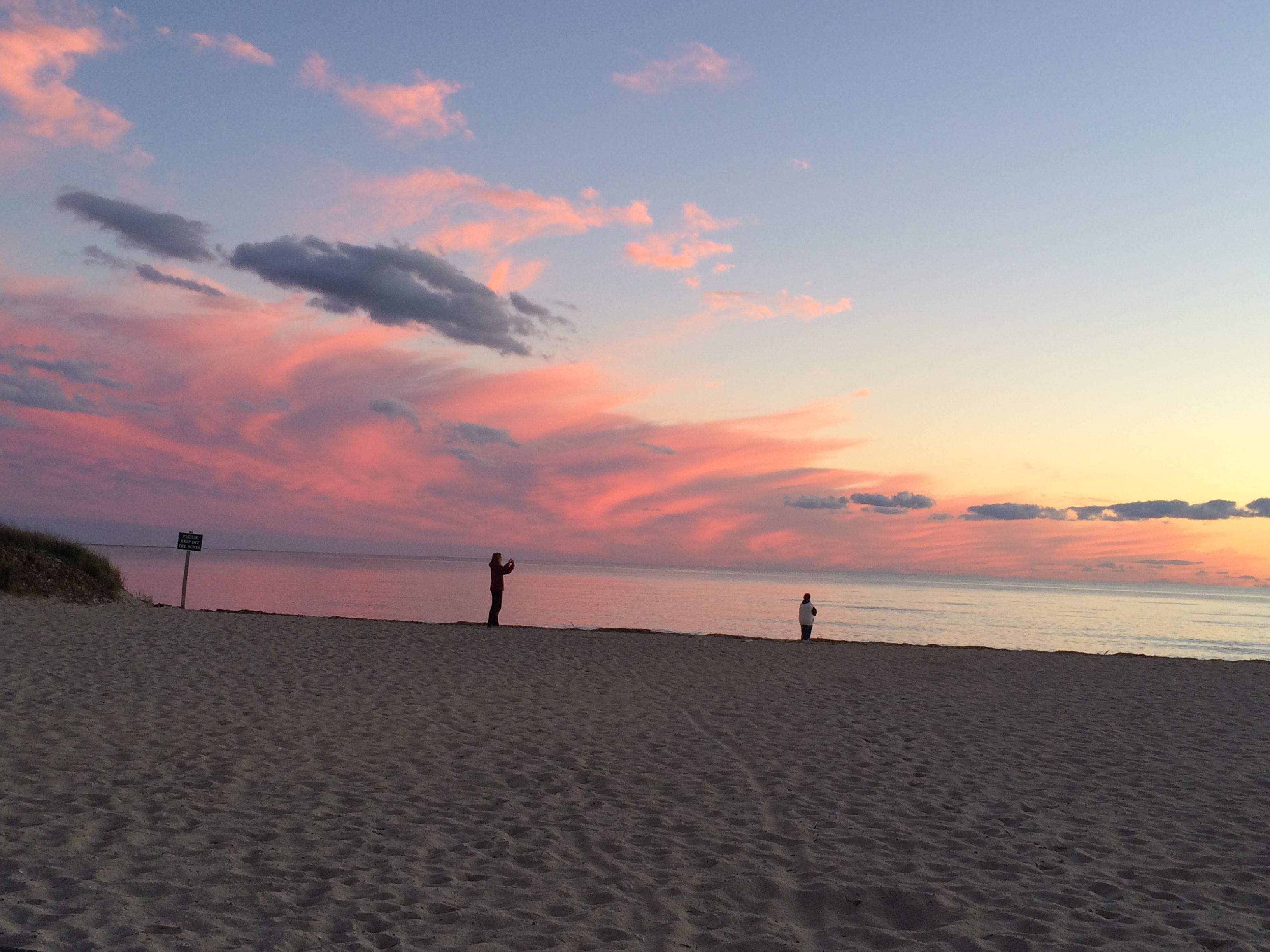
We parked. The spot was gorgeous. Lovely sands, magnificent Nantucket Sound waters gently rippling beneath a sky puffy here and there with clouds. The clouds made my heart leap, or something like that, because a scattering of clouds, as I’ve come to realize from years of sunset-gazing on the Cape, is key to a good sunset. Their water droplets and other particles refract light beams and reflect colors. Their movements and changing forms turn sunsets into active canvases. And that’s what happened as Sandy and I watched our fiery faraway friend say goodnight.

Sunset at Hardings Beach. 5:56 PM.
Sunset at Hardings Beach. 6:05 PM.
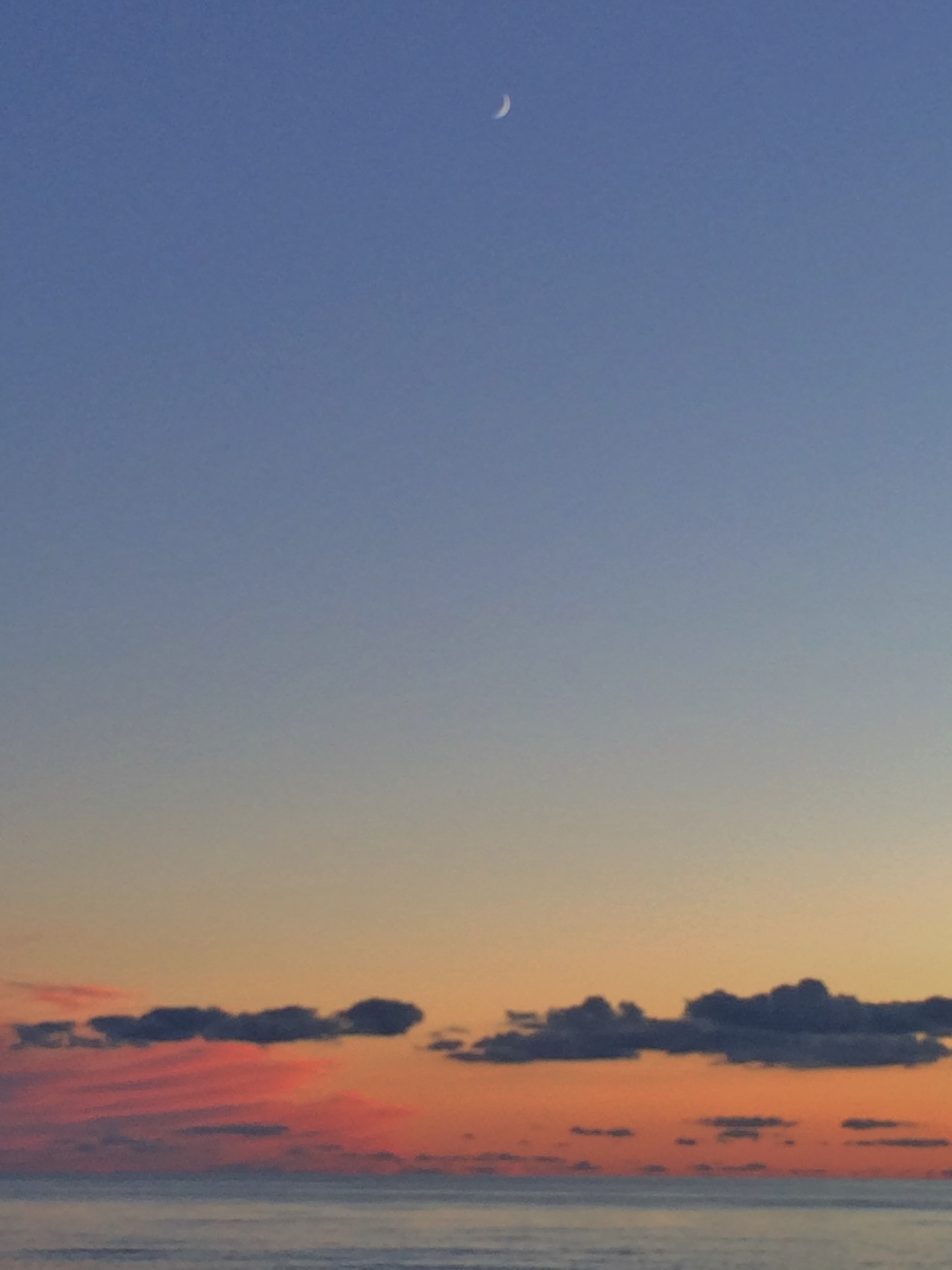
Sunset with the Moon at Hardings Beach. 6:07 PM.
Sunset. The Moon. Hardings Beach. 6:07 PM.


A lot of people claim to dislike colorful abstract art, certain paintings by, say, Vasily Kandinsky or Jackson Pollock. I don’t get that, because everybody loves sunsets, which to me can be among the ultimate in eye-popping abstractions. I’ve never read that sunsets inspired any brush wielders to go wild and free in their approach or vision, but it wouldn’t surprise me if in fact this were the case. Sandy and I watched the sky for 20 minutes. The pinks and oranges darkened as the big event rolled on. The clouds worked their wonders. And in a little while Sandy pointed up and said, “There’s the Moon.” It was a graceful sliver of white balancing above swashes of pastel hues.

On Cape Cod I’ve been a lucky son of a gun many times. That evening on Hardings Beach was one of them.

(Photos by Sandra Cherrey Scheinin. If you click on any photo, a larger image will open)

(If you enjoyed this article, then please don’t be shy about sharing it)

The Michener Museum Shines Yet Again

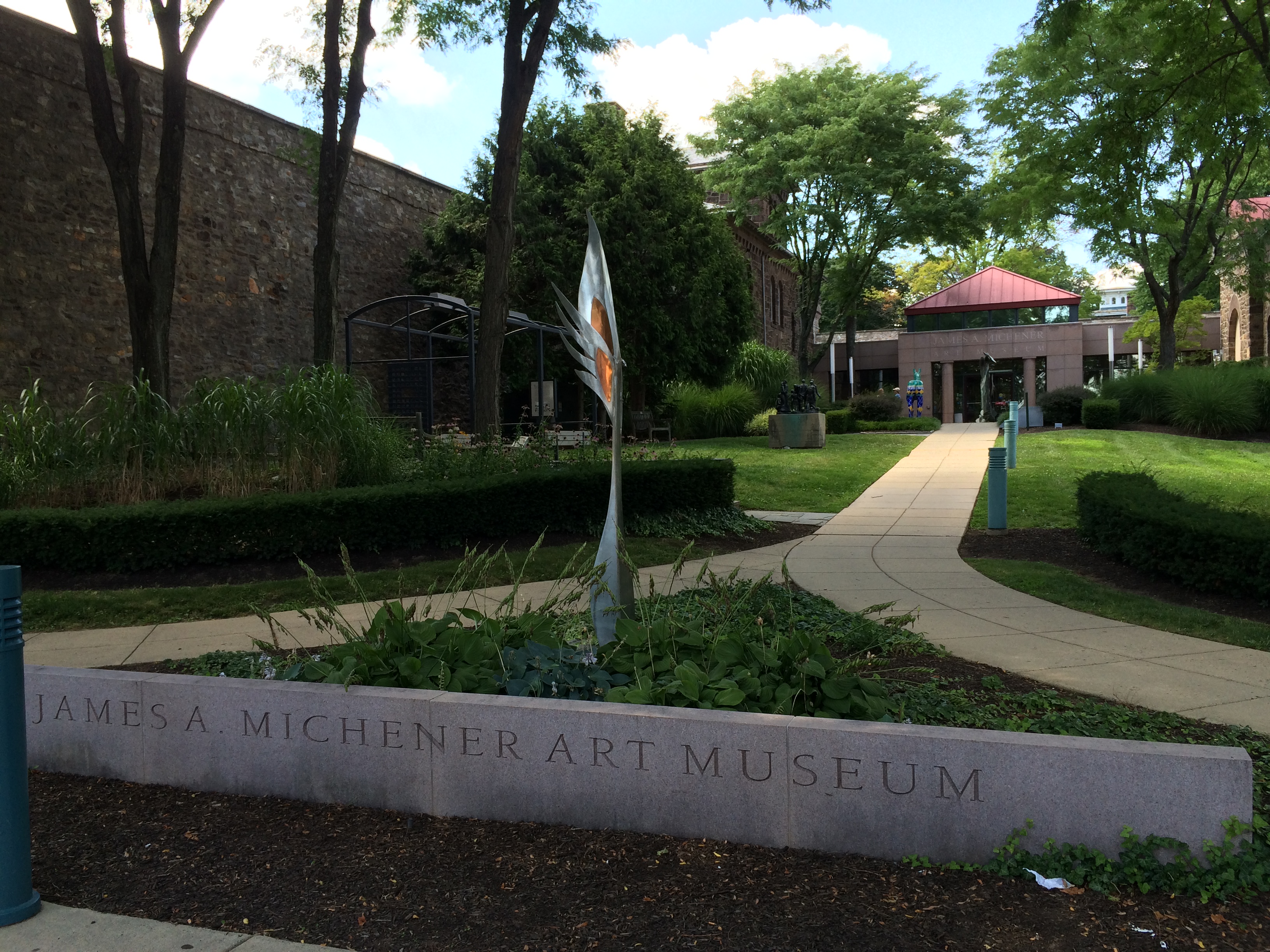
James A. Michener Art Museum.

One of the things I like about art shows is that they can surprise you (in a good way). It’s a gas when a museum or gallery curator comes up with a new slant or assembles a themed exhibition that makes you say “great idea!”  That’s part of the fun of going to places such as the James A. Michener Art Museum in Doylestown, PA. Not always, but often you can expect the unexpected there. Five years ago the Michener mounted a fascinating display of costumes worn by movie stars in famous movies. Arnold Schwarzenegger’s black leather jacket from The Terminator was in the house. So was Elizabeth Taylor’s gown from A Place In The Sun. That show caught me off guard by its coolness and inventiveness. Its idea seemed obvious, but only after the fact.

A similar sense of forward thinking surrounds a current Michener exhibition, the long-titled Iron And Coal, Petroleum And Steel: Industrial Art From The Steidle Collection. The works on view have been borrowed from their permanent home in State College, PA. There they reside within Penn State University’s Earth And Mineral Sciences Museum And Art Gallery, another mouthful. Hats off to the Michener for knowing of the off-the-beaten-track Steidle collection’s existence and for smartly organizing the paintings and their messages.

Edward Steidle (1887-1977) was a mover and shaker for many years in the worlds of mineral and petroleum extraction and use. An engineer, teacher and college administrator, he was dean from 1928 to 1953 of Penn State’s College Of Earth And Mineral Sciences. He also collected art, much of which he commissioned, that depicted the earth industries in action. The students at Penn State’s earth and minerals school were surrounded by examples of ores and extraction implements in the school buildings. Steidle, to my mind somewhat of a visionary in this respect, wanted artistic representations of the same also to be on view at the university.

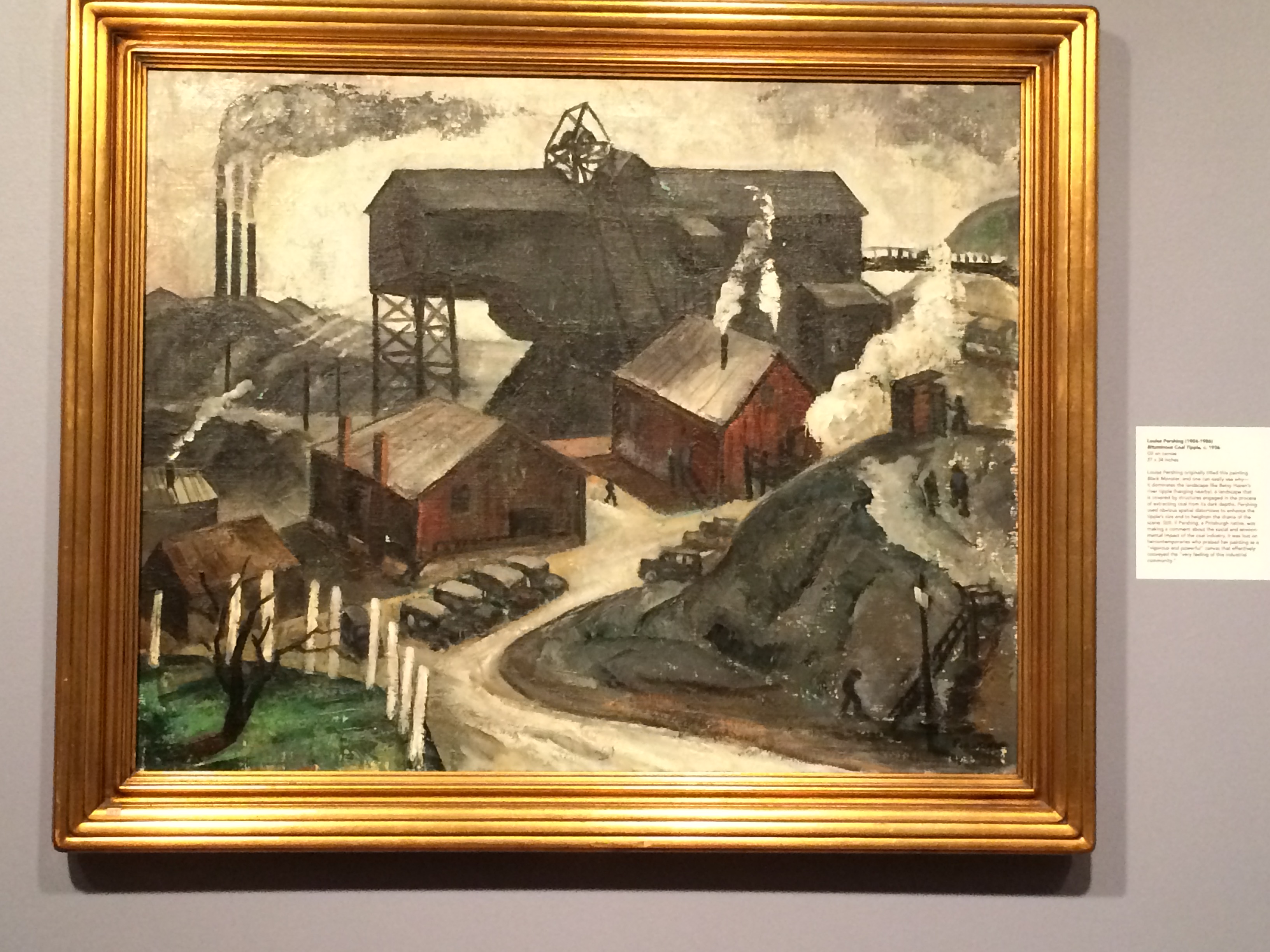
Bituminous Coal Tipple, painted by Louise Pershing in 1936.

Louise Pershing’s Bituminous Coal Tipple, from 1936, was the first work I grabbed onto at the Michener after quickly scanning the collection.  I loved its muted tones, the hulking mass of the tipple and of the hill in the foreground, the clouds of smoke issuing from all over the canvas, the lonely patch of green grass. Pershing mapped out her painting precisely and filled it with feeling.


Pershing’s oil painting represented a pretty good number of the ah-hah moments that I had in the Steidle galleries. What struck me first when I walked into the exhibit were the colors on the canvases. As with Pershing’s work, largely they were subdued or somber, the hues of earth and coal, of heavy equipment. As I walked around the galleries I noticed some other things. For one, nearly all the paintings were strongly designed and observant. Steidle had a good eye for art. Also, I was completely unfamiliar with the 40 or so artists in the show, excepting one or two. Post-Michener research confirmed that most of them had nice modest careers in their day but didn’t make it to the ladder of fame — only a few have garnered Wikipedia biographies. And I saw that a good number of the paintings were by women, not always the case on museum walls.

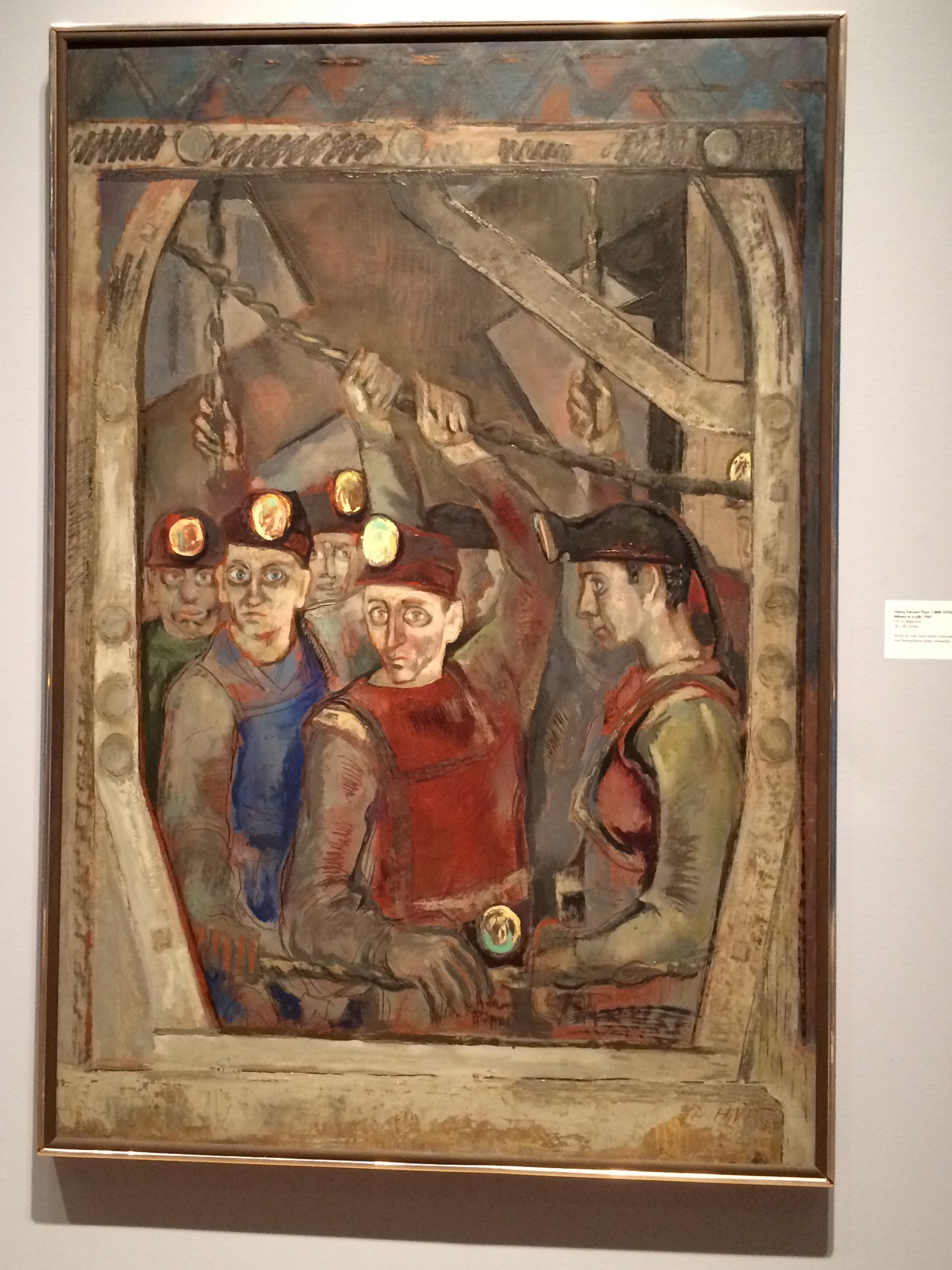
Miners In A Lift, painted by Henry Poor in 1947.

The Michener’s Steidle exhibition is a winner because it includes a boatload of works equal to Pershing’s Bituminous Coal Tipple, some maybe even better. Henry Poor’s Miners In A Lift, for example, which he painted in 1947. Five (or is it six?) coal miners are within the tight wooden cage, about to step outside the mine entrance, their shift over. Emerging from near-darkness into light, their eyes are hugely distended. The painting tells life stories, as the workers’ uneasiness about their dangerous occupation is on their faces. The confined framework of the painting brings power and immediacy to this work. It probably was my favorite at the Michener show.

The Steidle collection is said to be one of the best collections of industrial art in the USA. When these works were created, coal and steel were massively important industries in Pennsylvania and nationally. A few decades later they pretty much collapsed. The paintings are in that sense a time capsule of what once was. The historical aspect of the Michener show was presented clearly and didn’t make my eyes glaze over, the museum avoiding ponderous explanations on its informational placards. But, half-baked art aficionado that I am, I was more interested in the painterly aspects of the Steidle exhibit than in straight history.

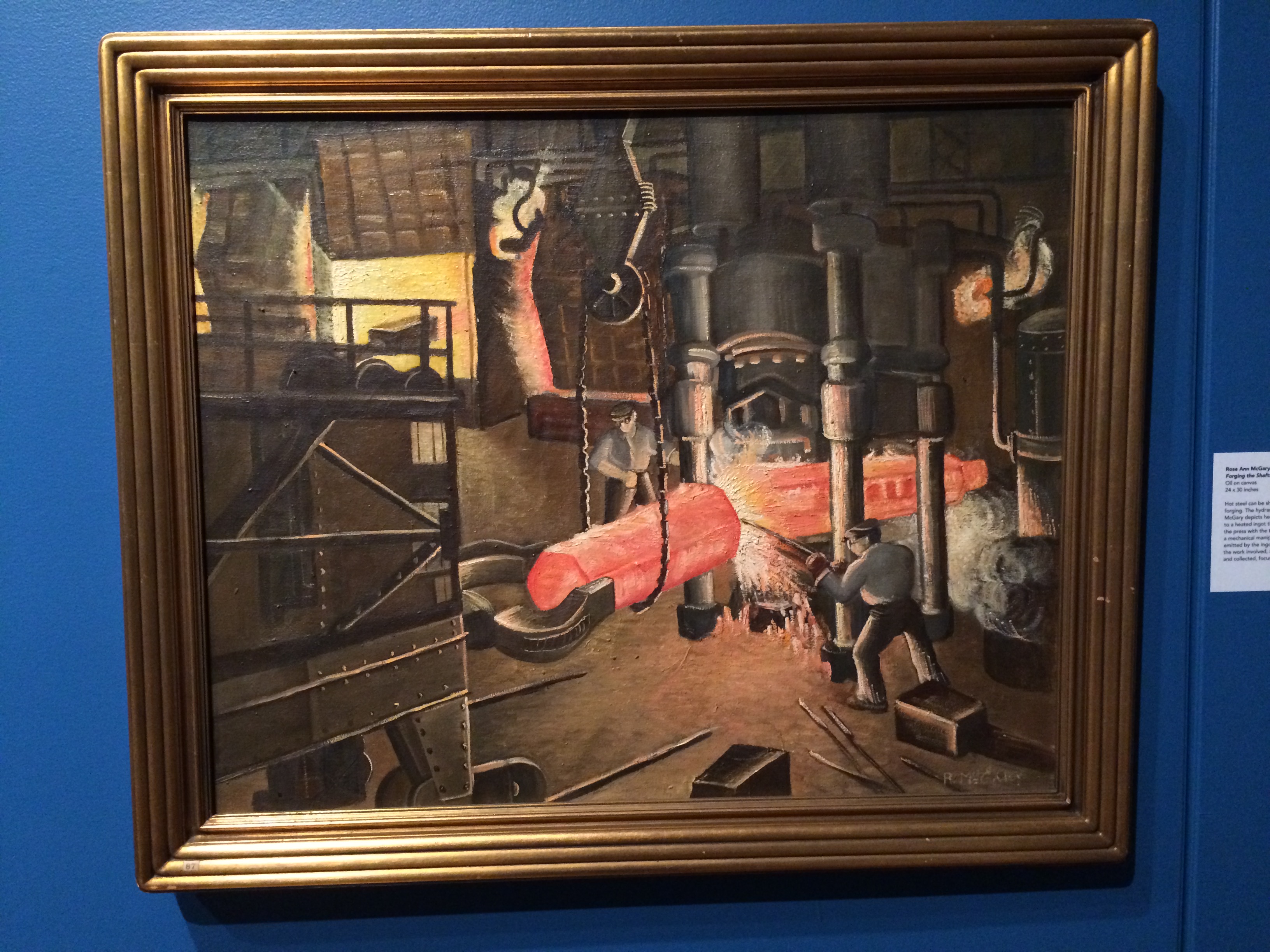
Forging The Shaft: Hydraulic Forging Press, painted by Rose Ann McGary in 1936.

Take, for instance, Rose Ann McGary’s Forging The Shaft: Hydraulic Forging Press. She painted this canvas in 1936. It shows workmen shaping red hot steel, and would have earned a thumbs up from the artist Fernand Léger and his fellow Cubism descendants. A carefully assembled construction of planes, cylinders and boxlike shapes, Forging The Shaft takes Cubism’s original color scheme of grays and browns and adds, just off-center, an explosion of pink. It is both a contained and dynamic painting.

The Steidle show closes on October 25. There’s still time to see it.

(If you click on any photo, a larger image will open)

(If you enjoyed this article, then please don’t be shy about sharing it)

A Pretty Park Can Be Pretty Hard To Find

Back in 1981 the Philadelphia Museum Of Art mounted an exhibition of photographs by Robert Adams. Adams took the photos in the 1970s. They were images of western American states, the desolate areas, primarily deserts and mountains. I remember the show fairly well. No matter how remote the locale, nearly every photograph bore evidence of man’s hand: A telephone pole, tire ruts in the sand, roads winding like barber pole stripes around magnificent mountains. One of Adams’s points was that pure wilderness is long gone, so we better get used to it and be glad for the great though adulterated spaces that exist. I imagine that even if you found yourself in the middle of Antarctica’s biggest ice shelf, and I don’t wish that fate on too many of us, you wouldn’t have to wait impossibly long before an airplane passed overhead. Man is everywhere. Yikes.

Now, a half-baked embryonic distillation of those thoughts was in my head recently when my wife Sandy suggested that we walk around the grounds of Abington Art Center, a few miles south of our home in the Philadelphia suburbs. “Sure,” I said, “good idea.” But what I didn’t say is that I’d prefer to stroll some expansive Adams-like terrain. In my dreams. Around here in the burbs, man for the last 75 years has been relentlessly busy cutting down trees and pouring cement. Around here, you have to count your lucky stars that any good-looking patches of territory of any sort still exist.

Manor house and lawn at Abington Art Center.

Abington Art Center is one of those patches. The center contains the manor house and some of the grounds of a former estate. The house is used for art classes and gallery exhibits and the like. The grounds mostly are a huge lawn that slopes away from the rear of the house and 10 or 15 acres of woods. It’s a lovely place. And it is more than manor, grass and trees. Scattered here and there on the great lawn and on side lawns and in the woods are all manner of sculptures, about 50 all told. Sandy and I had a good time at the center. For two hours we looked at trees and artworks and burned off a few calories while walking a couple of miles.

The play of light in the woods at Abington Art Center.

I like the outdoors. But I’m hardly a naturalist. My knowledge of flora and fauna has more holes than you can count. And so at Abington Art Center I found myself admiring a specific leafy tree species, of which many examples exist in the center’s tiny forest, having no clue what I was looking at. They weren’t maples or oaks. Those I can identify. Whatever the trees were, they were  the tallest at the center. They measured well over 100 feet from bottom to top and didn’t wander leftward or rightward on their way towards the heavens. Their mothers must have told them from an early age to stand up straight. What also fascinated me was the play of light within the woods, how one tree’s upper reaches might be caught by the day’s intense sun, while others only a few feet away were out of the sun’s direct path. Contrasts of this sort always have appealed to me.

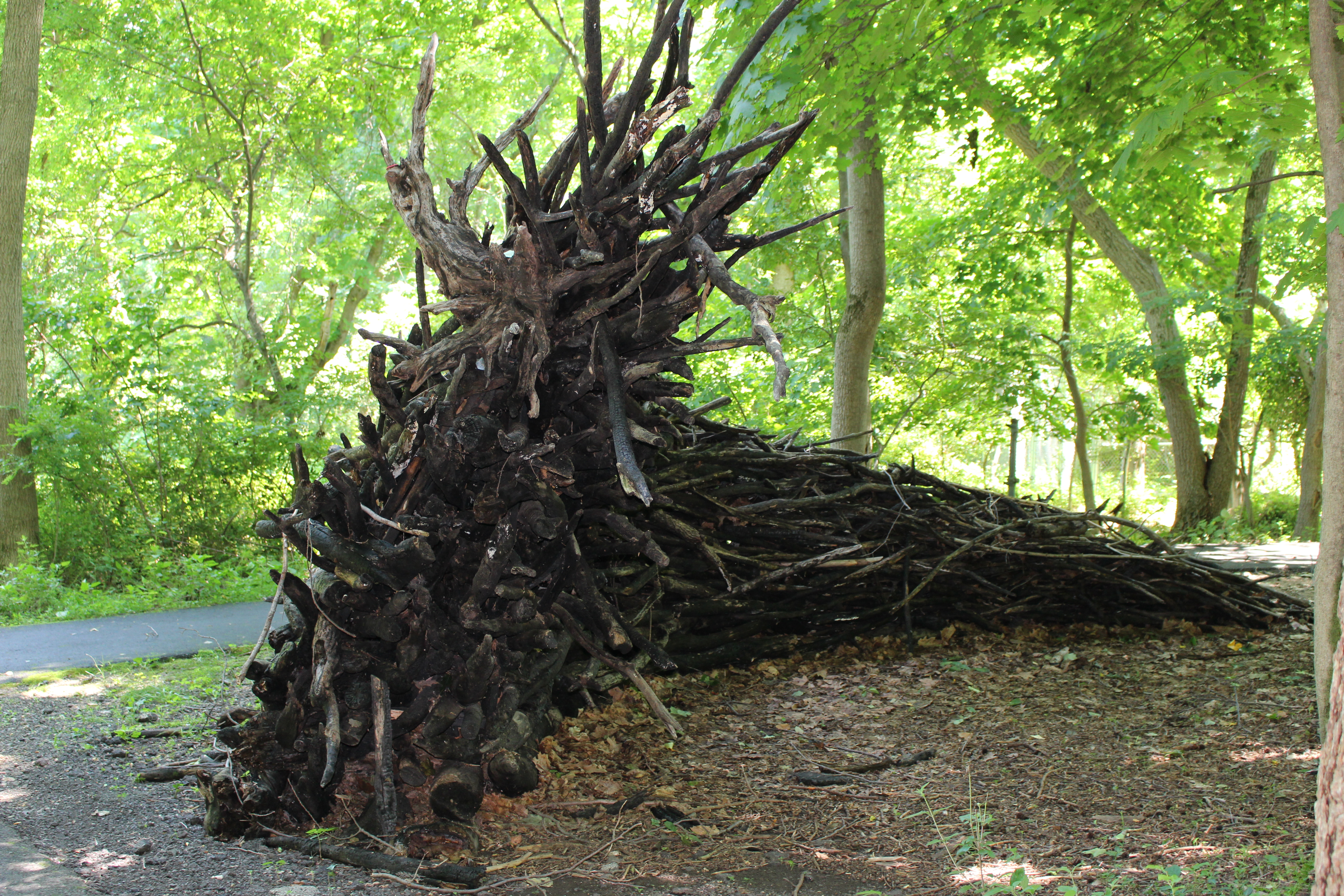
Mazzaroth is Alison Stigora's construction of burnt tree branches.
Mazzaroth is Alison Stigora’s construction of burnt tree branches.

The sculpture I thought the most of in the woods was Alison Stigora’s Mazzaroth. It’s an assemblage of burnt tree branches fitted together tightly to portray . . . what? A serpent? The movement of time? As the years go on, Mazzaroth will crumble and become one with the forest floor, as will the trees surrounding it.

You’re not going to confuse many of the sculptures at Abington Art Center with creations by David Smith, Louise Nevelson or other deservedly famed artists. Few if any are on that level. Some though, like Mazzaroth, had me looking them over from different angles because I liked them a lot. Take two on the great lawn, for instance. They are placed near each other and are as different as they can be.

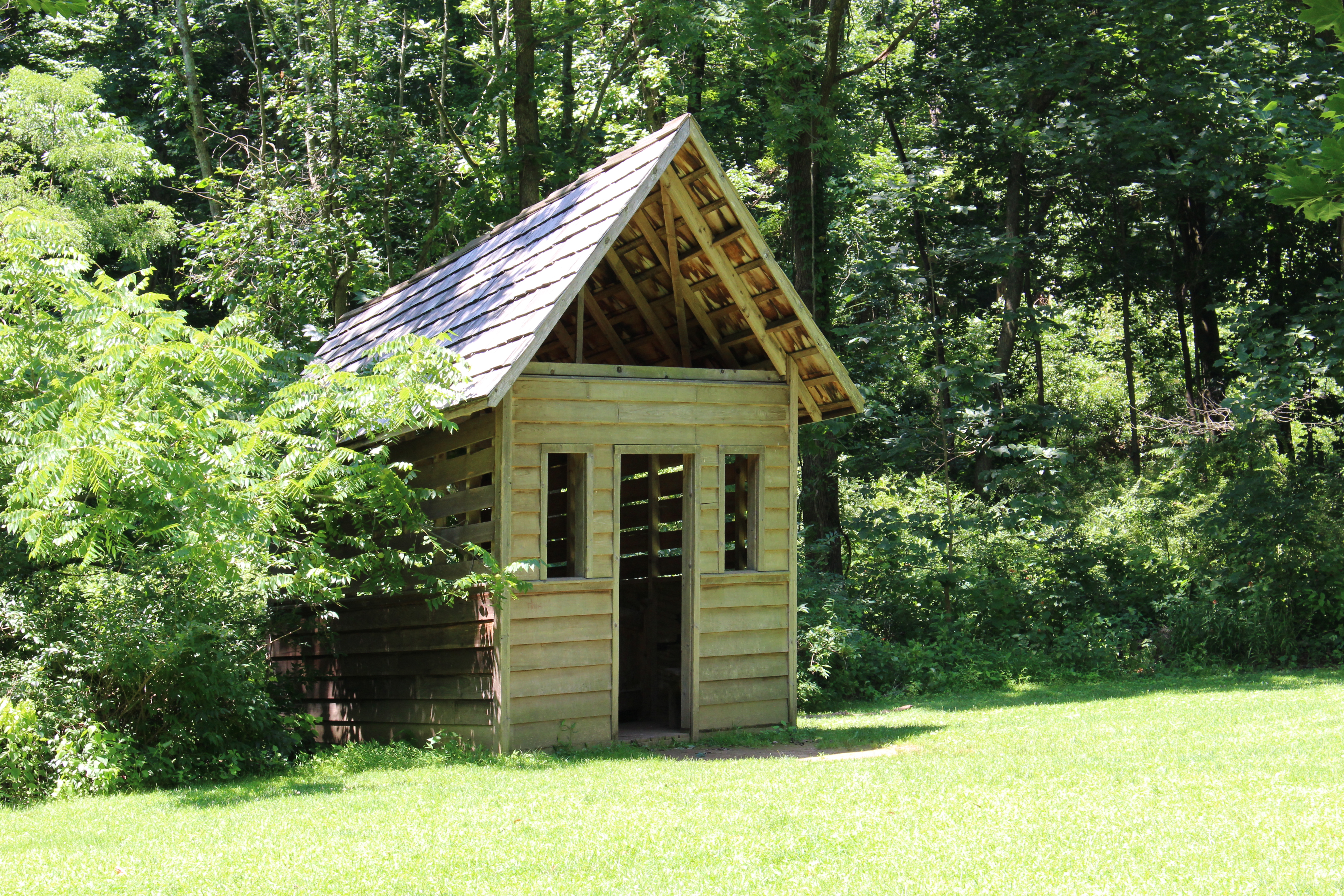
Cabin Van Gogh at Abington Art Center.
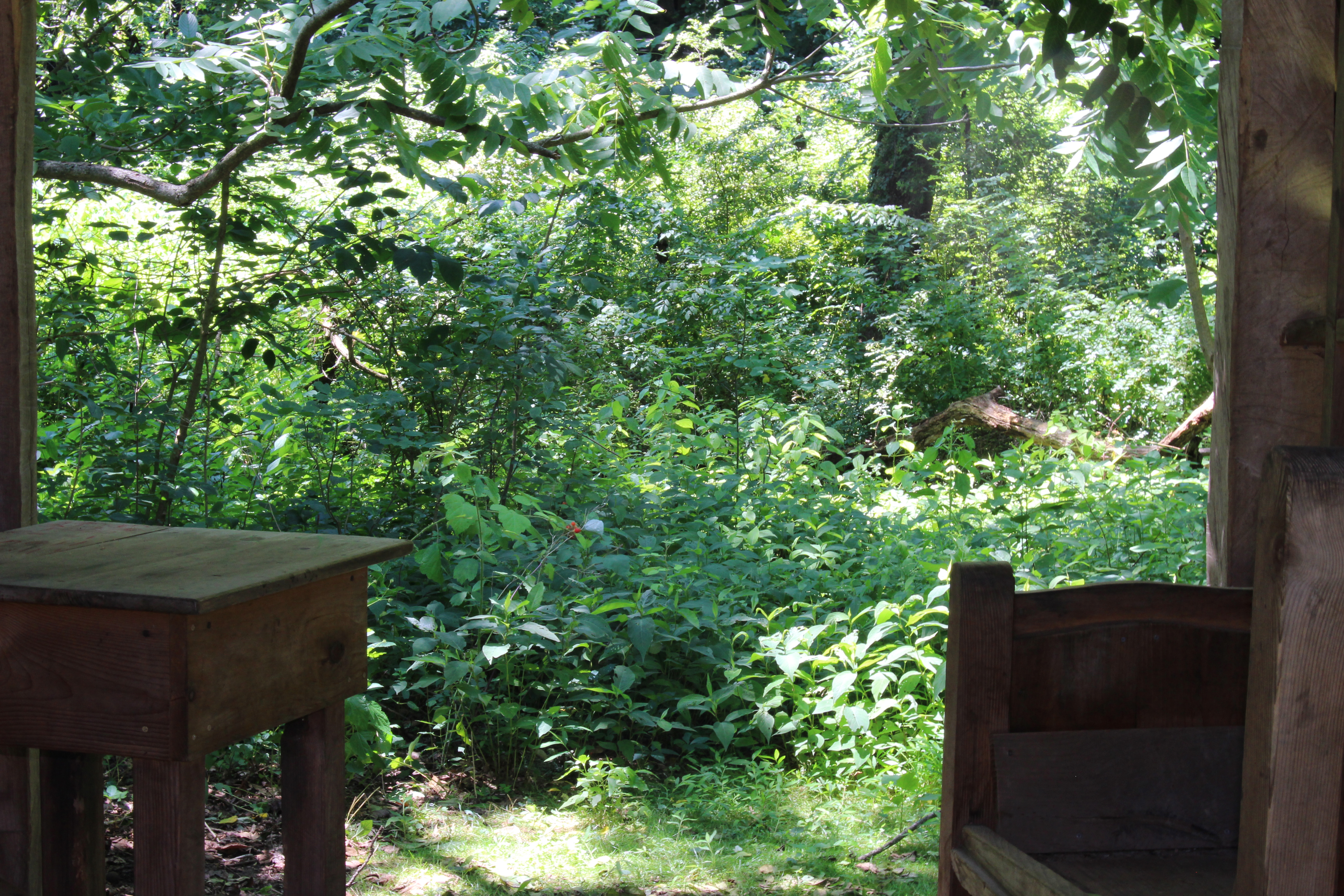
Partial view of bed and table inside Cabin Van Gogh.

What is a lopsided small wooden cabin doing on the grass at Abington? Well, it’s a whimsical piece of art and is right at home there. Weather-beaten, cute and loveable, it contains within, of all things, a bed, chair and table lifted straight out of Vincent van Gogh’s paintings of his bedroom in Arles, France. This work is Knox Cummin’s Habitation Suite: Cabin Van Gogh. Vincent I believe would have been charmed  by Cummin’s idea to build such an unlikely homage, and also by the view of foliage from the cabin’s open back side.

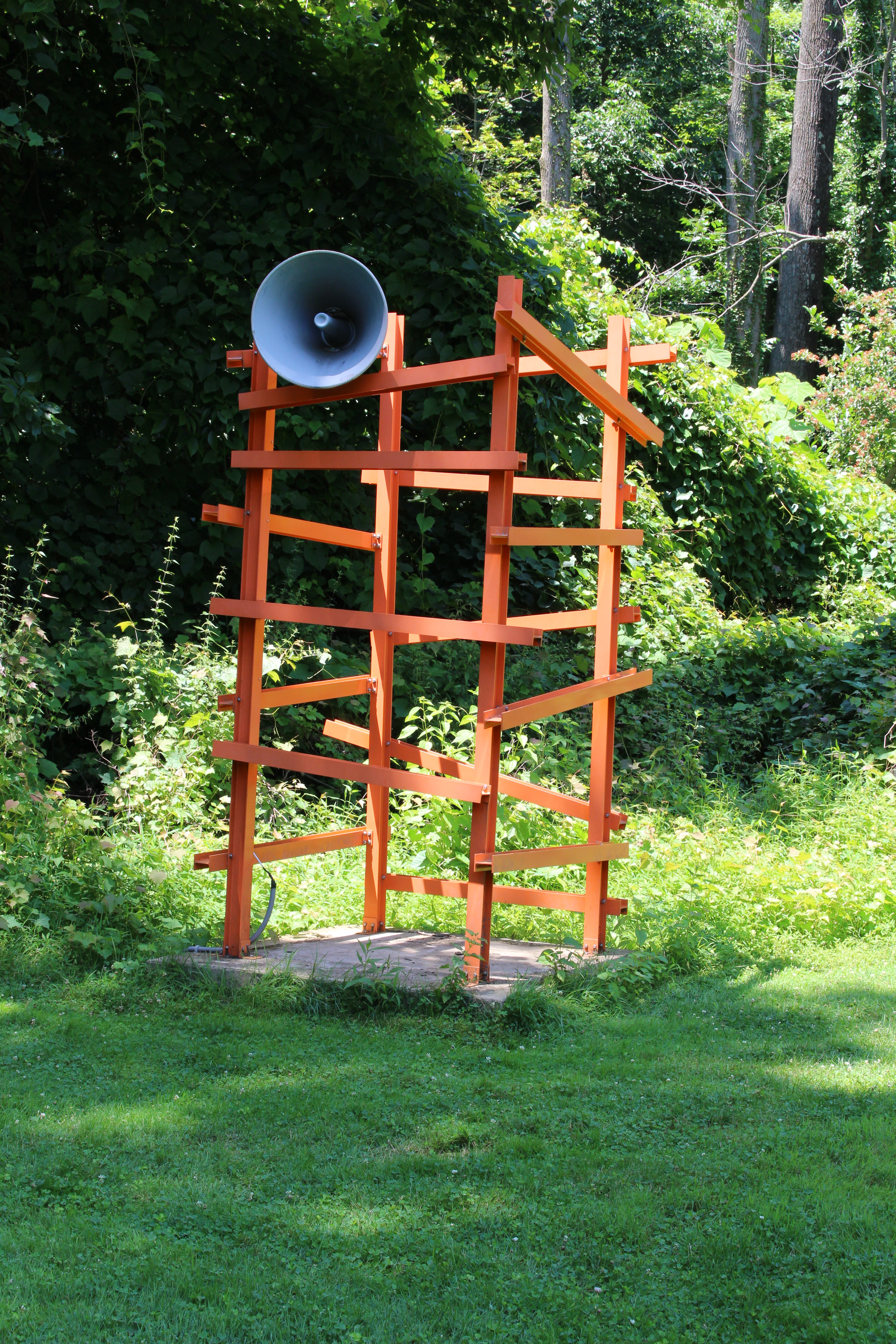
David Schafer's orange sculpture at Abington Art Center.
David Schafer’s orange sculpture at Abington Art Center.

Uphill from the cabin stands what looks a bit like a lifeguard tower painted in bright orange, some of its support slats atilt. David Schafer, the creator, named his piece Untitled Expression: How to Look at Sculpture. I suspect that the notions behind the giddy orange tower are partly conceptual. Sculptures, like just about anything, are multifaceted. No need to try and pin down a precise meaning. Observe, surmise and enjoy. One of my takes, subject to change, is that the sculpture is alive yet indecisive, that it is shaking out its stiff bones and readying to inch forward but hasn’t gotten into gear quite yet. And what’s going on with that public address system speaker? I remembered later that it had a practical purpose once, as a recorded message played from it for months after the sculpture was first installed about six years ago. Sandy and I were at Abington Art Center at that time and heard the message. If we were put into a deep hypnotic state, maybe we’d recall what the message was. Gone silent, to me the speaker now just looks cool.

(All photos by Sandra Cherrey Scheinin. If you click on any photo, a larger image will open)

(If you enjoyed this article, then please consider sharing it. Thanks.)

“Upward” Was The Theme Of The Day

My wife Sandy and I spent seven fun-filled hours on a recent Friday in Philadelphia’s Art Museum neighborhood. The first two of those hours we strolled around the grounds of the Philadelphia Museum Of Art and its surrounding trails and parks. The skies were sunny, the humidity pretty low and the temperature not too unkindly hot. There was no getting away from the sun’s power though, and we sweated mightily, a small price to pay for helping the body build up Vitamin D reserves.

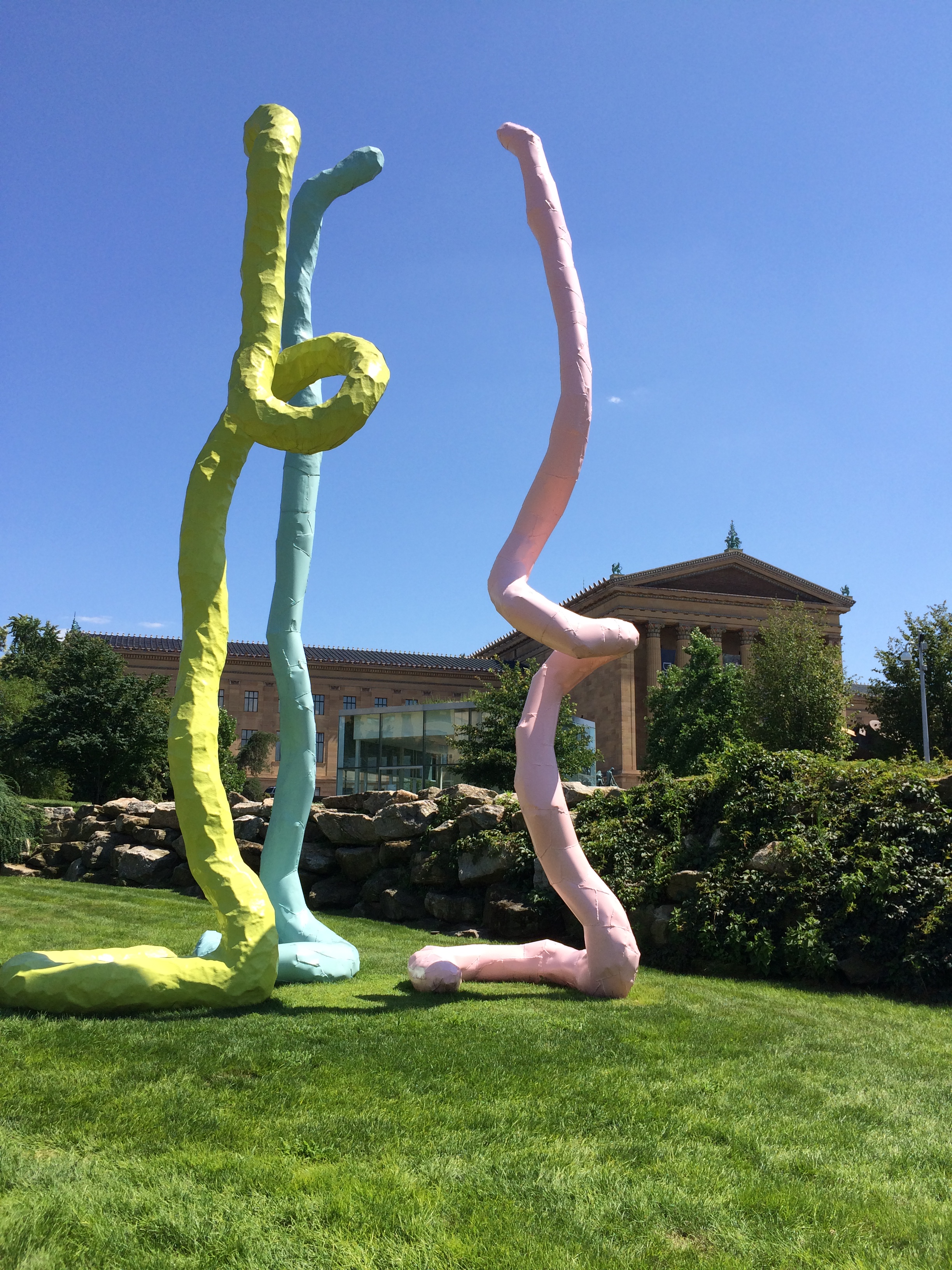
During the seven hours we found a fascinating park that was new to us, looked at lots of art within and without the museum, took in a Cuban music concert (“Havana Night”) at the museum and finished with a tasty dinner at a nearby restaurant, Rembrandt’s. But I’ve decided to skip many of the details about all of that. Instead I’m going to concentrate on a theme that, to my impressionable mind, seemed to unite a portion of what we saw. There’s a good chance that I’m stretching reality to find a connection, but what the hay, that wouldn’t be my first time. Besides, reality is flexible. The theme involves optimism, more specifically our species’ seeming desire and need to stay positive, to grow, to look upward. The notion began to bubble a bit in my sun-dappled head near the start of our Friday adventure when, poking around the museum’s outdoor sculpture garden, we were very happy to find Franz West’s colorful sculpture Lips towering before us.

Franz West's Lips in the Philadelphia Museum Of Art's sculpture garden.
Franz West’s Lips in the Philadelphia Museum Of Art’s sculpture garden.
Steps and Pyramid, two sculptures by Sol LeWitt.


Lips is way terrific. Three giant tendrils, (or are they giant worms?), pointing heavenward in pastel shades of blue, pink and lime. Taking a good look at the squirmy designs, I couldn’t help but think that West was putting his mind and emotions on display, that Lips represented his vision of looking on the bright side, of reaching for the stars. I wondered, what else around here might have had the same inspirations? Well, not far uphill from Lips on the sculpture garden grounds, Sandy and I found two modest and monochromatic sculptures by Sol LeWitt. They were sitting within their personal and unassuming open-walled pavilion. LeWitt named the larger piece Pyramid and the smaller one Steps. Pyramid and Steps were fashioned in 2010, two years before Lips, and are made of concrete blocks. Tiny compared to Lips, they nevertheless are objects that to me suggested that we keep our minds open and on the ascending path. Pyramids point skyward, duh. And although stairs go down as well as up, LeWitt I’m sure placed Steps next to his pyramid to reinforce the “up” reference.

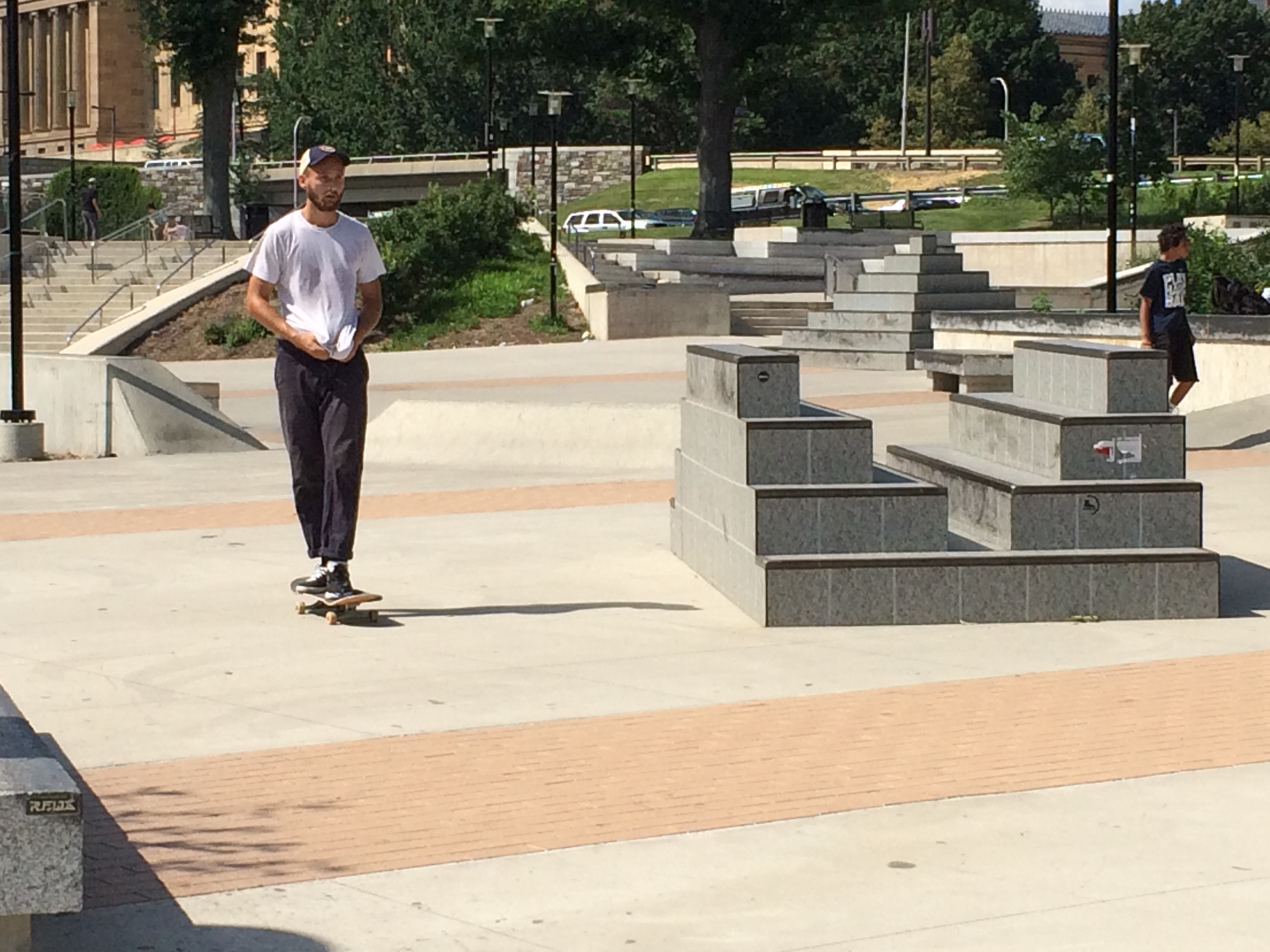
So, I appeared to be on a roll. What else might I fit into my Upward container? One reason that Sandy and I had decamped at the museum area was to check out some of the newish stretches of the Schuylkill River Trail, a river-bounded pathway for pedestrians and cyclists that planners hope one day will extend 140 miles from the bottom of Philadelphia to Schuylkill County, Pennsylvania. We walked a short distance southward on the River Trail and lo and behold came to a park we never knew about. It’s a haven that Philadelphia created for skateboarders. Paine’s Park is its name, probably because pain and skateboarding go hand in hand. Anyway, 30 or so guys and gals in their teens and 20s were gliding around the park, flipping off contoured walls and doing whatever else it is that skateboarders do. I was amazed by the park’s existence. Skateboarders had once made their home in Love Park, near Philadelphia’s City Hall, and garnered the wrath of city officials and ordinary folk in the process. Rather than continuing to scare the daylights out of tourists and office workers trying to lunch and lounge in Love Park, skateboarders needed their own officially-sanctioned facility. Now they have one. Paine’s Park opened two years ago.

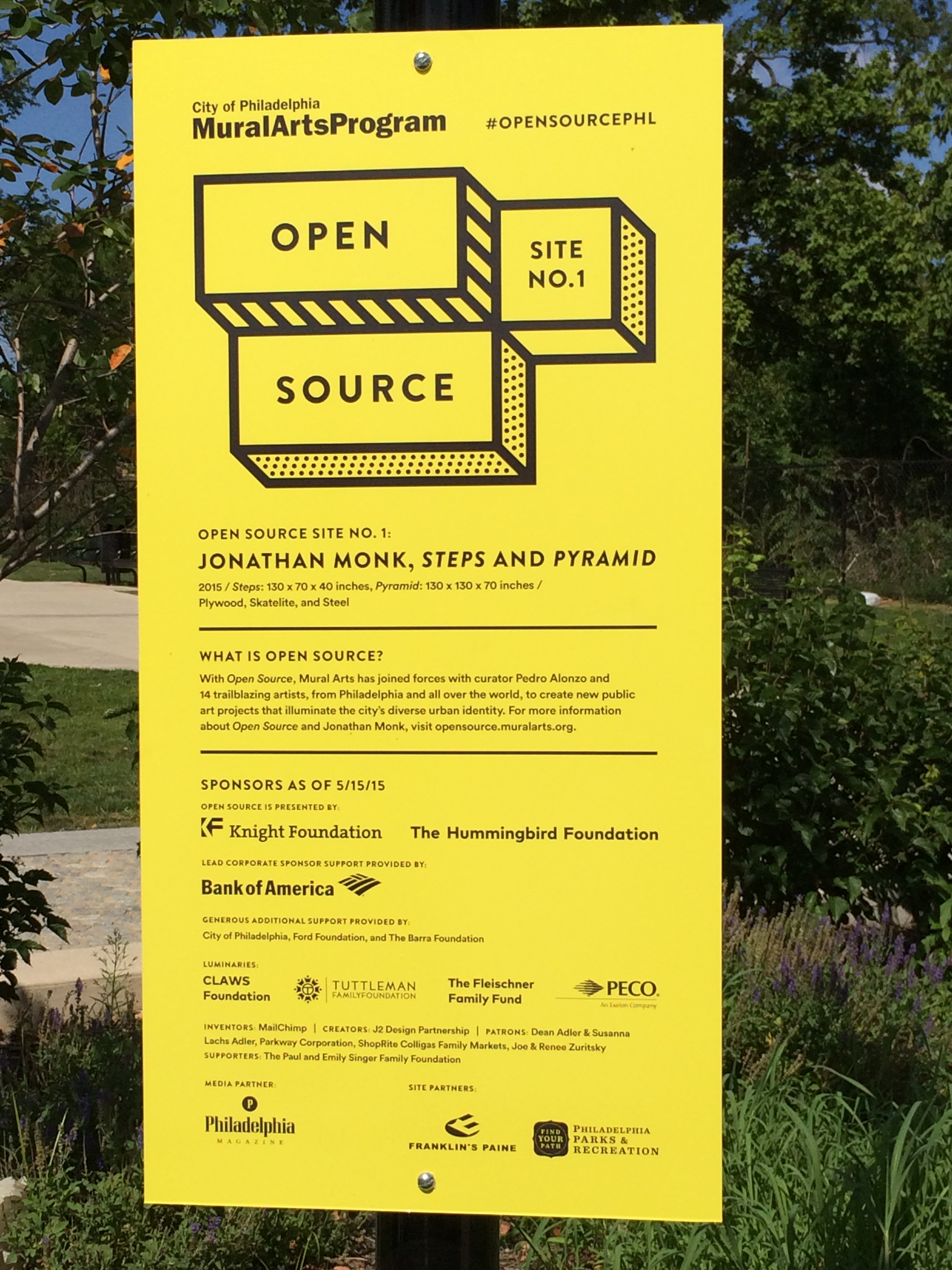
Sign for Steps and Pyramid IMG_0816

Jonathan Monk's two sturdy sculptures, Steps and Pyramid, in Paine's Park.
Jonathan Monk’s two sturdy sculptures, Steps and Pyramid, in Paine’s Park.


But did my eyes deceive me? There in Paine’s were two creations that looked suspiciously like Sol LeWitt’s Steps and Pyramid. Sure enough, they were near-replicas. Their artist, Jonathan Monk, liked LeWitt’s sculpture garden pieces so much that he paid homage by creating cousins. And he even gave them the same names. But whereas do-not-touch signs are planted near LeWitt’s pieces, the Monk sculptures, fashioned from really tough materials, are meant to take whatever abuse skateboarders can dish out. Sandy and I didn’t see any of the gliders take on the challenge of Steps’ and Pyramid’s narrowly and sharply angled spaces, but I have it on good authority that it happens regularly. Monk’s works not only continue LeWitt’s figurative idea of staying on the upside, they provide the surfaces to allow someone actually to soar.

Skyscrapers in Center City Philadelphia.
The Philadelphia Zoo's ZooBalloon.
The Philadelphia Zoo’s ZooBalloon.
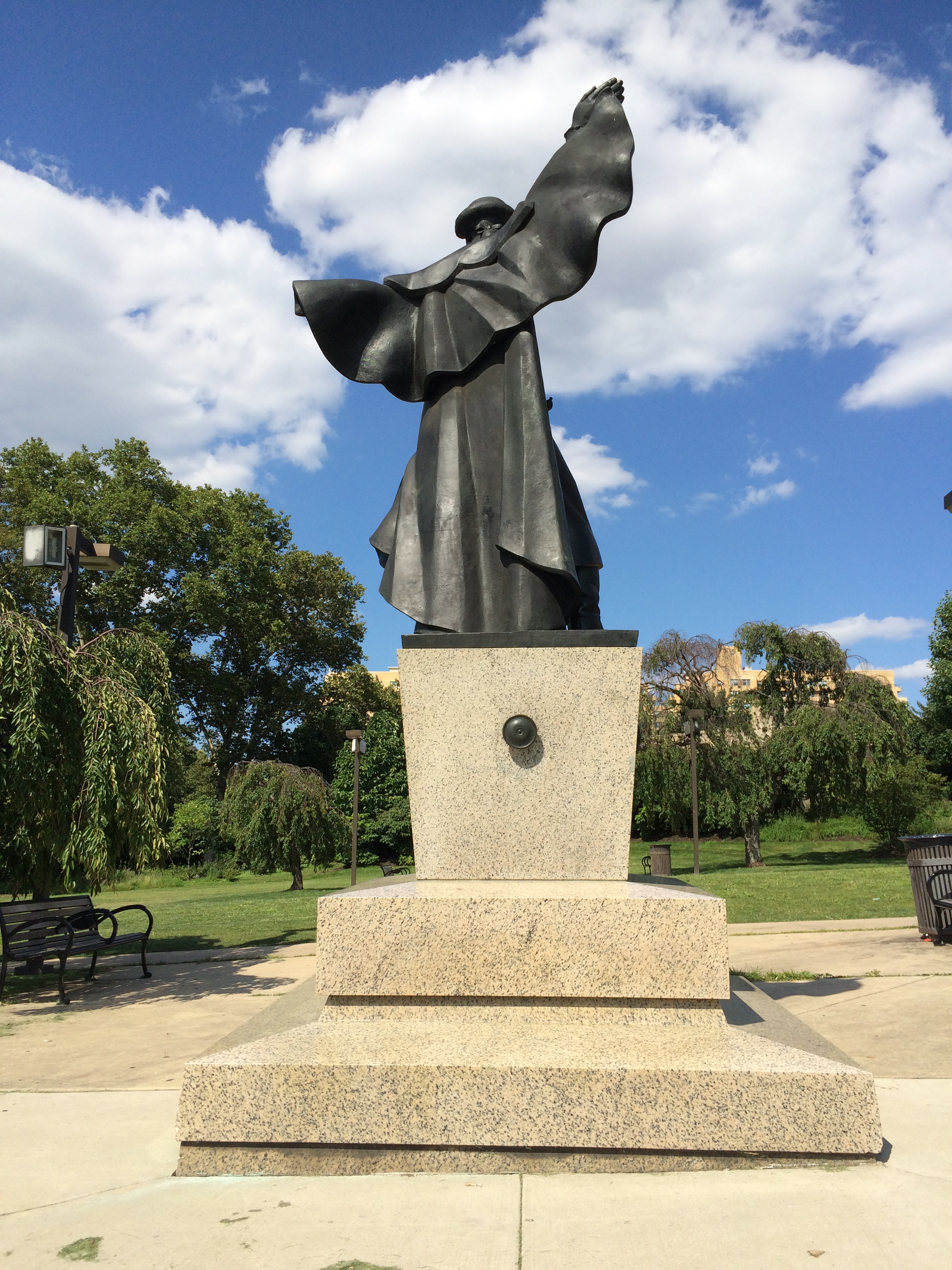
Marquis de Lafayette.

Yes, I smugly said to myself, there really is something to this idea I have. I looked around. In one direction were skyscrapers in Center City Philadelphia, testaments to man’s hopefulness. And in another was the Philadelphia Zoo’s gigantic and somewhat iconic ZooBalloon. Its daily flights, weather permitting, allow zoo visitors to come close to getting their heads near the clouds. And as Sandy and I made our way back to the museum grounds we passed Raoul Josset’s massive bronze statue of Marquis de Lafayette, his cape-enshrouded right arm pointing to the heavens. “Onwards and upwards, citizens,” the Marquis seemed to be saying.

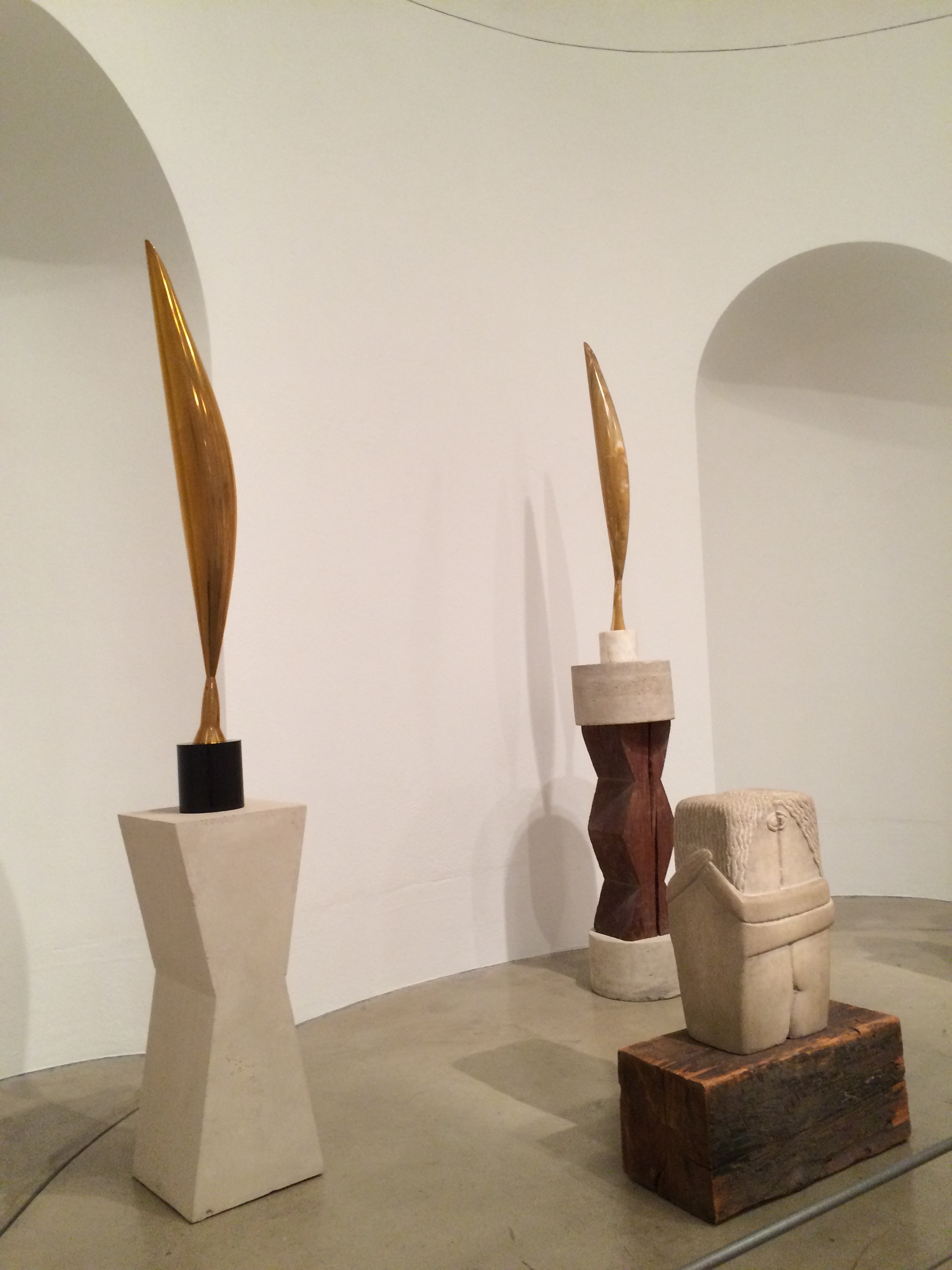
The two tall works are Brancusi's Bird sculptures.
The two tall works are Brancusi’s Bird sculptures.

Sandy and I entered the museum. She headed toward a photography exhibition. I told her I’d meet her there in a bit after I continued my search for further examples to bolster my theme of the day. The museum holds a superb collection of sculptures by the great modernist Constantin Brancusi, and has devoted an entire room to his works. In it I stood before two related sculptures, Bird In Space and Bird In Space (Yellow Bird), the former made from bronze, the latter from marble. Both are sleek and very beautiful. Brancusi must have felt his spirit soaring as he designed and shaped them in the early 1920s, and post-creation too. Going up!

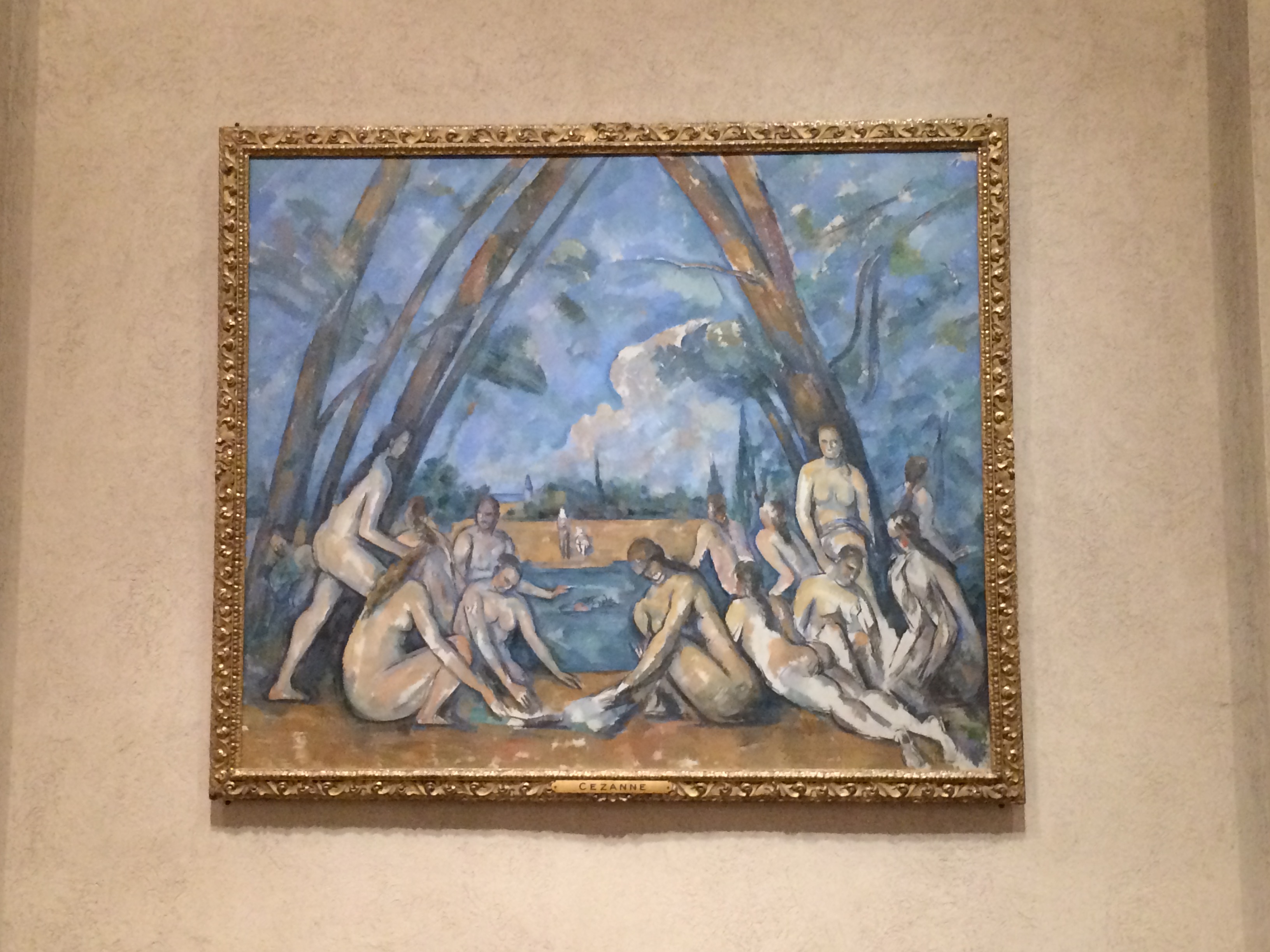
Paul Cezanne's The Large Bathers.
Paul Cezanne’s The Large Bathers.

I was tiring. One more stop, and then my quest to try and make a point would end. On many levels, Paul Cézanne is hard to beat. For maybe the 100th time I let wash over me one of his many masterworks, The Large Bathers. It was one of his final paintings, completed shortly before his passing in 1906.  This time I focused on the trees providing cover for the tribe of naked folks at ground level. The upper reaches of the trees are not shown, by design. I could imagine the trees going on almost forever. I believe that in them Cézanne symbolically infused man’s basic nature to ascend and achieve. To move upward.

(All photos by Sandra Cherrey Scheinin. If you click on any photo, a larger image will open)

(If you enjoyed this article, then please consider sharing it. Thanks.)

A Friday Frolic In Philly

My wife Sandy and I lived in Philadelphia for many years, both before we met and subsequently. The year 2005 was a momentous one for us, because that’s when we made the leap from the city to the nearby northern burbs. In some ways I prefer living where I now do, in other ways I wonder if leaving the city was a brilliant idea. Our house is nicer than the one we used to occupy, the current neighborhood is cuter than its predecessor. On the other hand, automobile traffic around here is as blood pressure-elevating as in Philadelphia. And there aren’t enough fun things for us to do, which is why we head south a few times each month to check out the offerings in various sections of the City Of Brotherly Love.

My overall opinion of Philadelphia is a good one. Yes, the city has plenty of problems, like too much crime and a pitiful public school system. And yet it has so much going for it. Loads of history that we all know or should know about. Great parks big and small. Fabulous buildings from the late 1600s onward. More restaurants, music venues, theaters and such than anyone could wish for. I’m sounding like someone from Philadelphia’s official tourism bureau, but my feelings are legitimate. For physical beauty, culture and food, Philadelphia is world-class.

Which brings us to Friday, July 3. Sandy and I were itching to get out of the house. Not much that we knew about was going on in the burbs. Philadelphia it would be. Where in the city though? Sandy had noticed in the paper that July 3 was First Friday in Philadelphia’s Old City section. We hadn’t been to a First Friday in a year or two, and we decided to go.

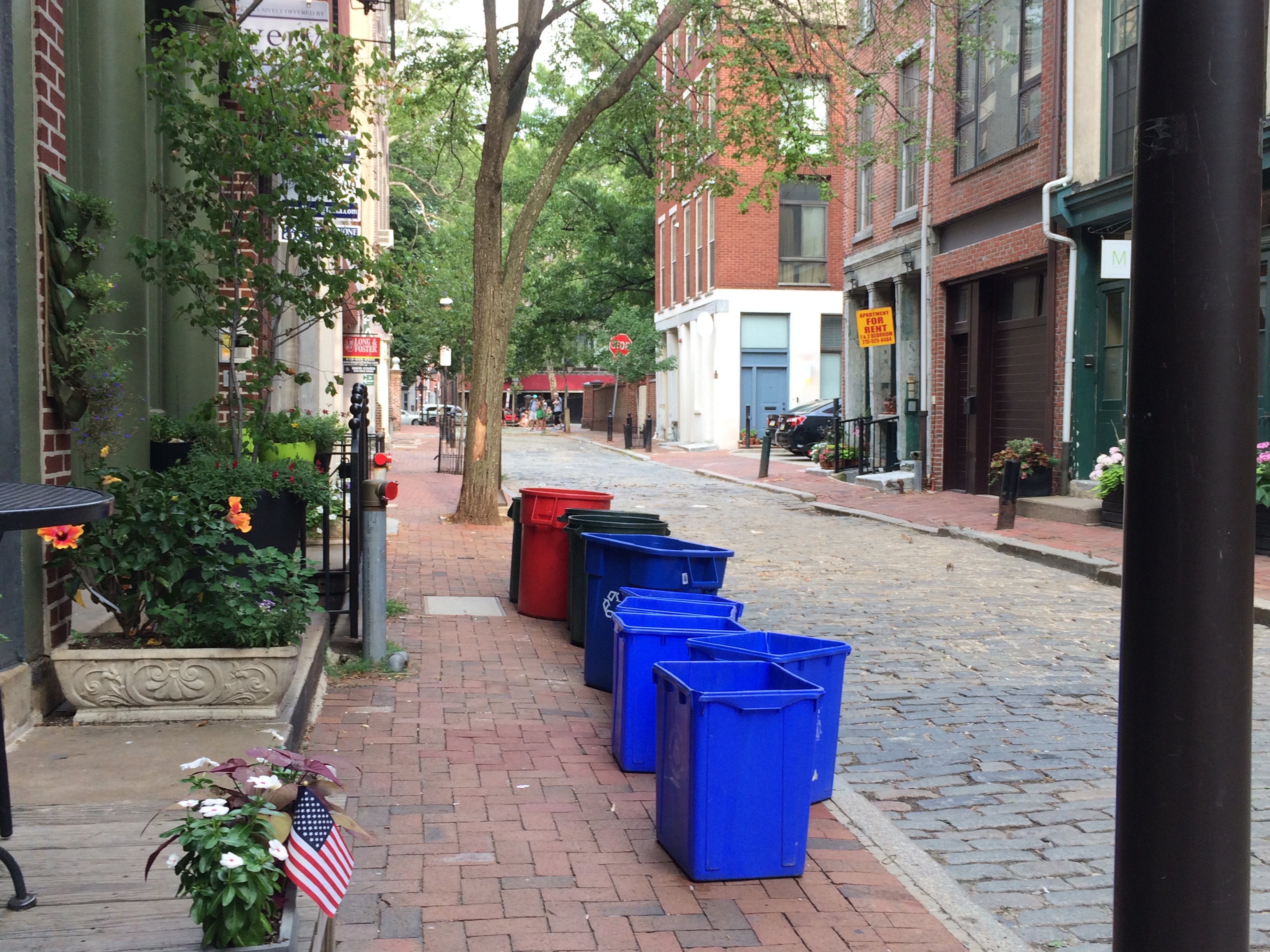
Old City's Church Street is paved with grey bricks.
Old City’s Church Street is paved with grey bricks. They contrast nicely with plastic recycling bins.

Old City is a part of town that was full of homes, businesses and people in Colonial days. It still is, and many of those 1700s structures are with us today. The area is quaint and often lively, and plenty of streets retain their ancient paving bricks and stones. There are quite a few art galleries in Old City. In 1991, attempting to lure customers and imbue Old City with needed panache, some gallery owners began keeping their doors open in the evening on the first Friday of each month. They spread the word and a monthly mini-festival, a kind of happening, was born. All over the world, events similar to First Friday are taking place. They can be good.

You never know what you’ll come across on Old City First Fridays. Painters and crafts people and assorted vendors set up tables for their wares on the sidewalks and in alleyways, which are also where musicians set up their instruments and wail. And many art galleries, the original driving force, are open. Sandy and I strolled around Old City without a plan. Not having done advance research, we ended up missing a few blocks with galleries we’d have liked. Next time. Most of the action that we caught was on a two block stretch of 2nd Street between Market and Arch Streets, and on Arch between 2nd and 3rd. A small chunk of territory, actually, but enough.

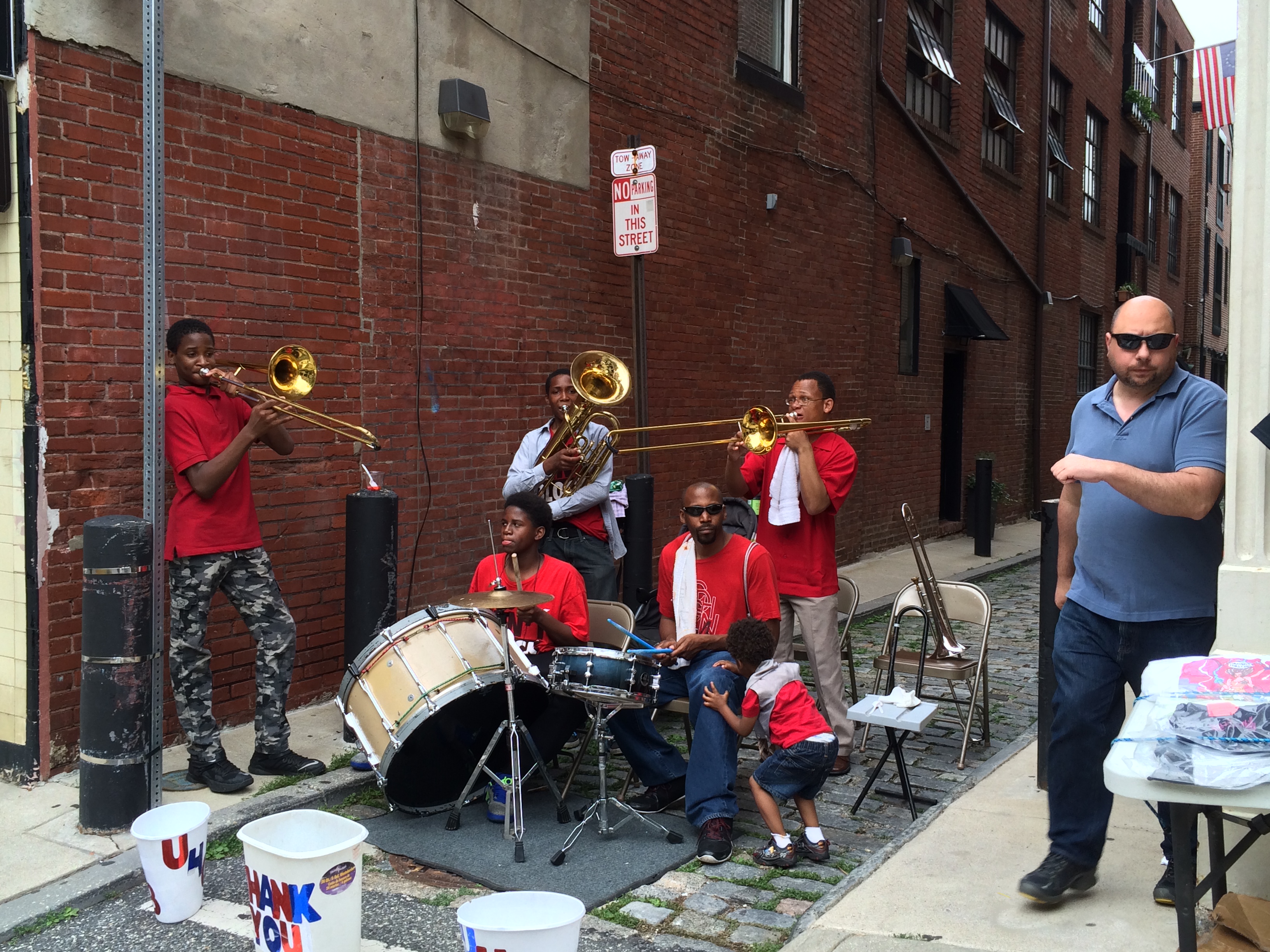
Brass band wailing away in Old City.
The human caterpillar.


Our eyes were open for human creations and human activities. Who wouldn’t have loved the brash New Orleans-style brass band occupying a niche where Cuthbert and 2nd Streets meet. Or the long-haired White dude who, catching some zzzs, was draped like a caterpillar over one of those large and ubiquitous green utility company sidewalk boxes. He was Mr. Flexibility personified.

Lady in blue with her colorful wares.

Or the head-scarved lady in blue on 2nd Street whose tables and racks held as eye-popping a collection of pillows, fabric trivets, shoulder bags and cloth drapings as one would ever see in a 30 square foot parcel of sidewalk. Middle-Eastern and Asian patterns and color combinations burst from her goods, clashing outrageously, looking great together nonetheless. Henri Matisse, who threw wild design combos into so many paintings and never met a color he didn’t like, would have loved this lady’s display.

Artworks by Keith Sharp at 3rd Street Gallery.
Artworks by Bettina Clowney at 3rd Street Gallery.

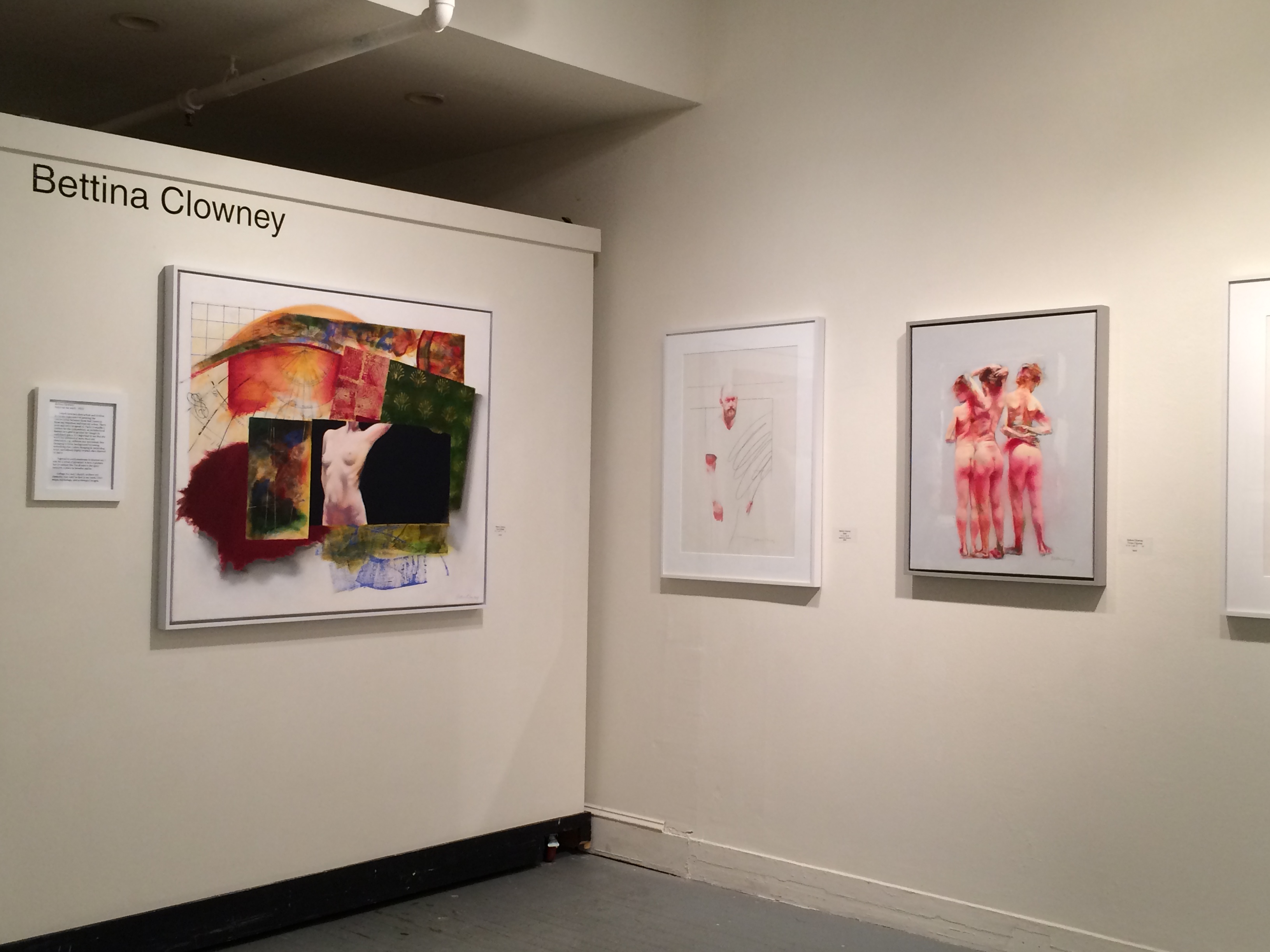
There were beautiful paintings, sculptures and crafts to be seen in the galleries. I’ll mention a few places. We liked just about everything we saw at 3rd Street Gallery. Two artists were showing there. Keith Sharp’s dark and dramatic photographic manipulations were intriguing, some a bit ominous. They were very different from Bettina Clowney’s spare paintings. Clowney uses a lot of whites in her depictions of fruits, of people, and in non-representational designs. Gazing at each other from opposite walls, the Sharp and Clowney artworks made a good marriage.

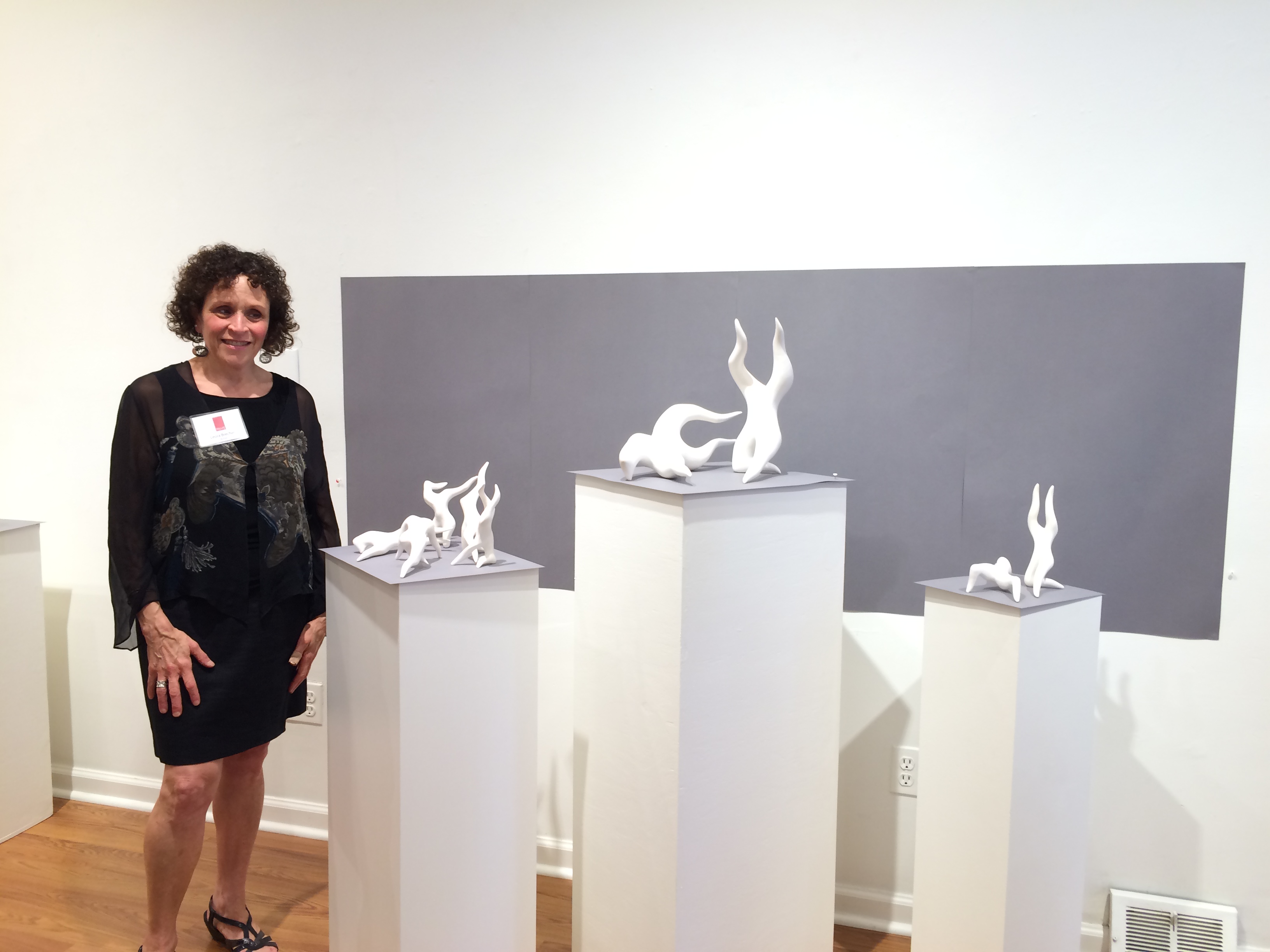
Leora Brecher with some of her sculptures at MUSE Gallery.
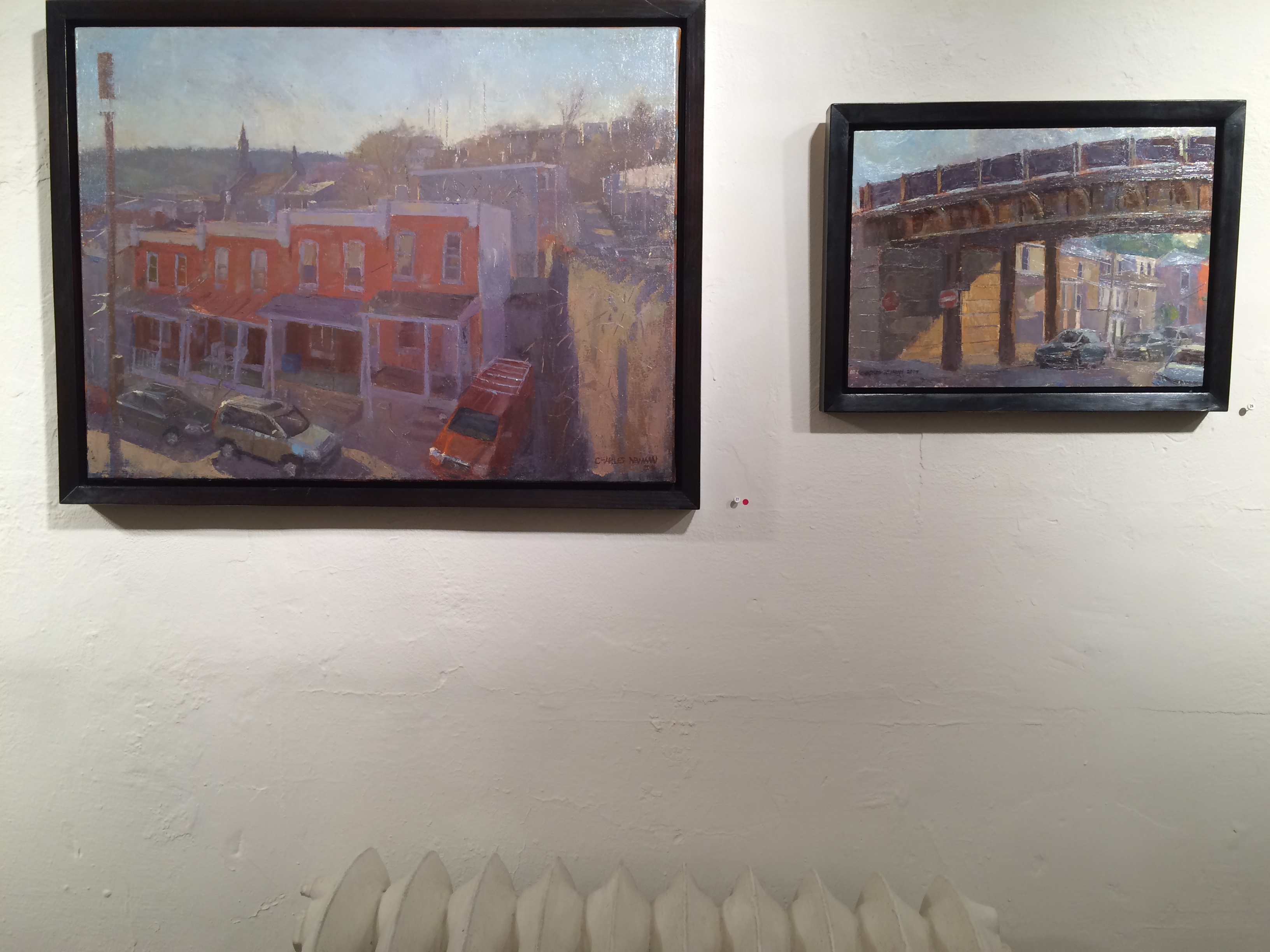
Paintings by Charles Newman at F.A.N. Gallery.

MUSE Gallery was filled with Leora Brecher’s small fired clay sculptures, all in white. Many were abstract suggestions of human movement, open and flowing. Very lovely.

F.A.N. Gallery on Arch Street is one Sandy and I visit occasionally. I wasn’t knocked out by its smorgasbord of works by gallery artists on this First Friday visit. We both liked the oils by one artist though, Charles Newman. He paints Philadelphia street scenes, focusing on old buildings, very well. The perspectives from which he views his brick and stone subjects are off-angle, giving the pictures a quiet tension, and his earthy subdued color choices are just right.

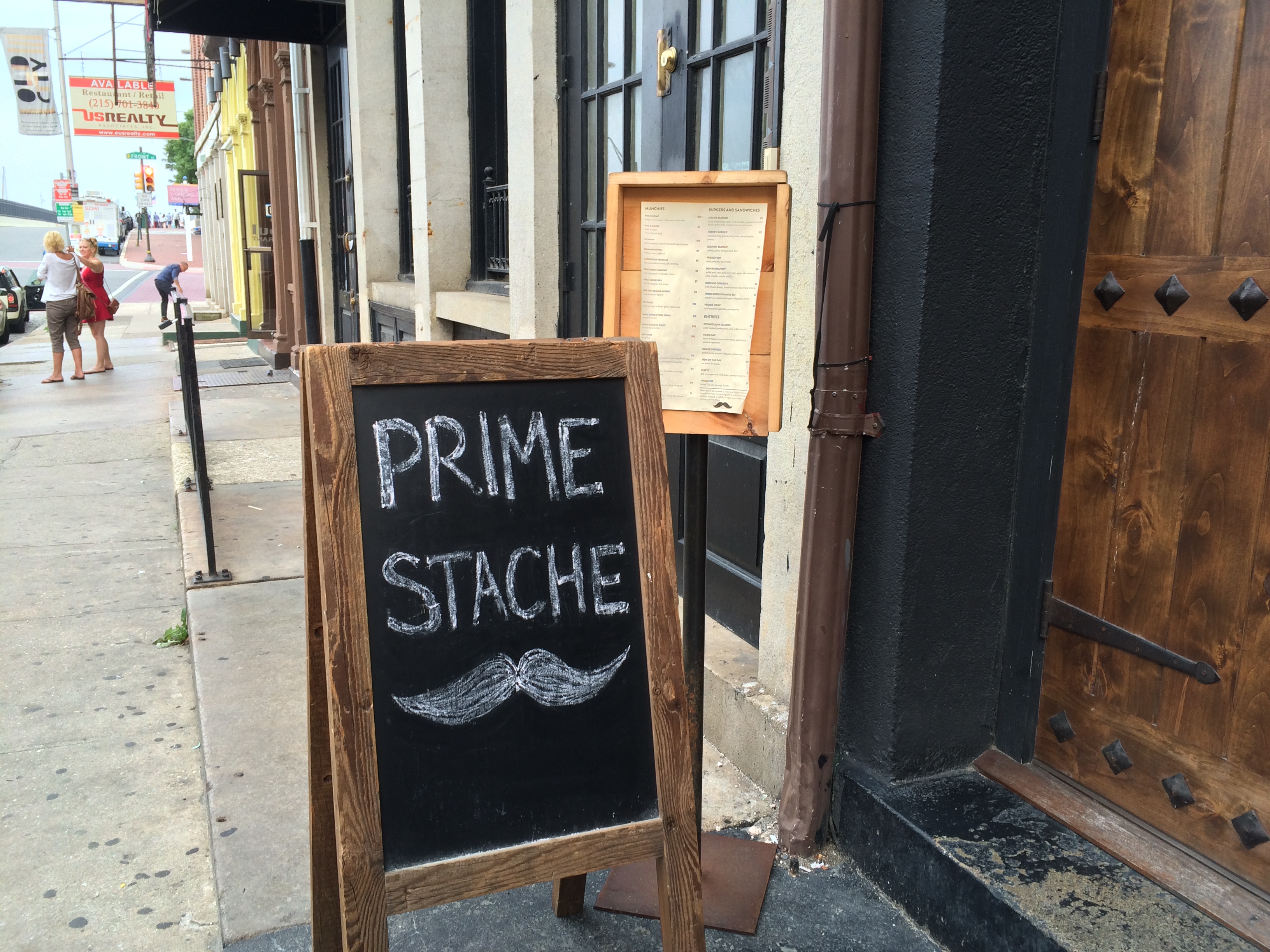
Prime Stache, where we had dinner.

Dinner time. Off to Prime Stache, a few blocks from First Friday, on Chestnut Street. Atmospherically, it’s for lovers of exposed brick and stone walls, which Sandy and I are. A pubby place short on wines but decently long on beers, its food is good. Prime Stache has some fancy offerings, but we weren’t in a fancy mood. We both enjoyed our simple burgers, Sandy’s of the salmon ilk, mine of the turkey.

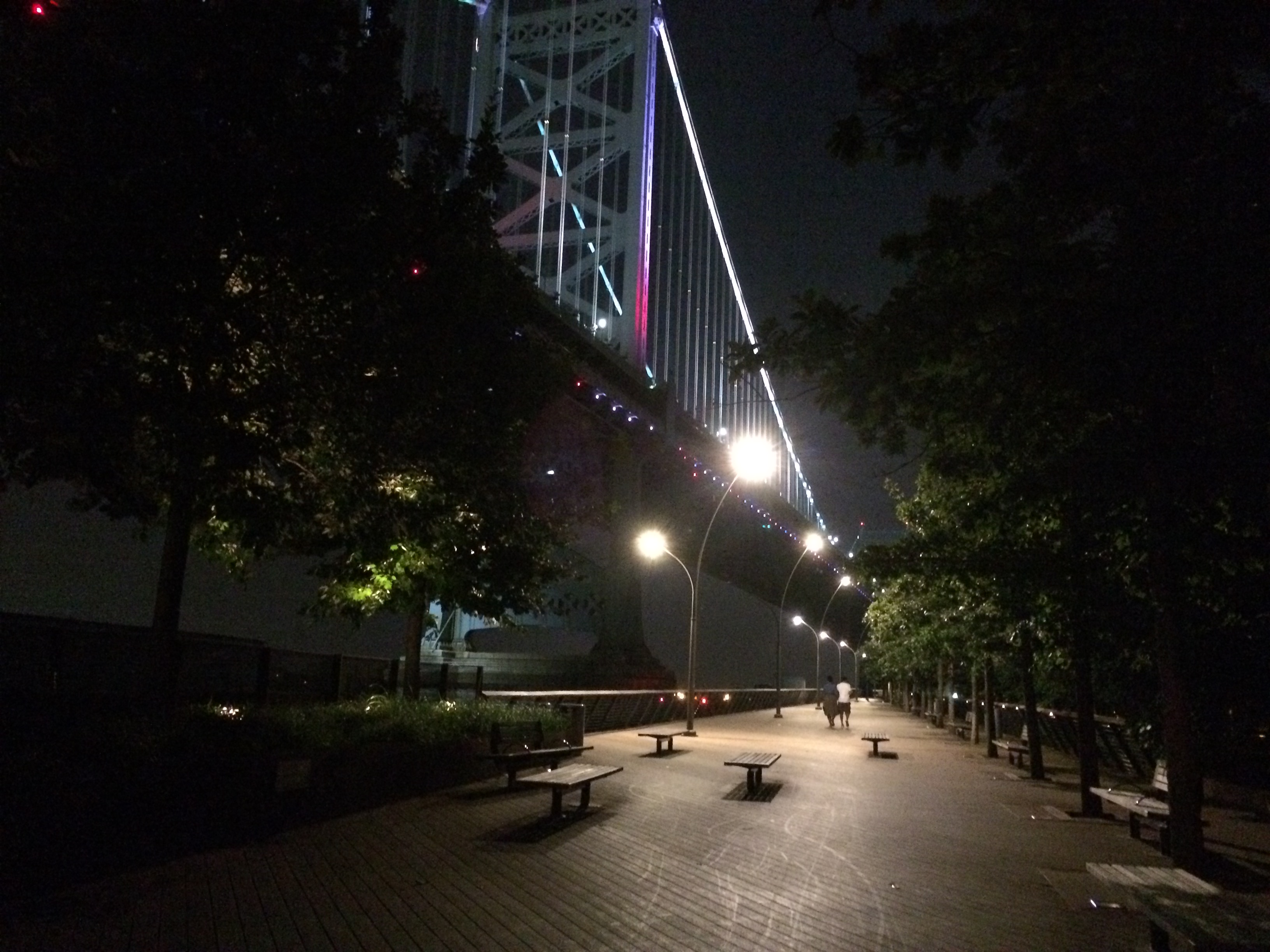
Race Street Pier and Benjamin Franklin Bridge.

The best part of the evening lay ahead. We strolled northward from Prime Stache to Race Street Pier, one of my favorite spots in Philadelphia. I’ve been there in daylight and late at night, and late night is better. The pier lies near the Benjamin Franklin Bridge, and in darkened hours the illuminated bridge overhead is breathtaking.

Jutting into the Delaware River, Race Street Pier once was a commercial municipal pier. It has been converted into a serene and intimate two level public park with long walking paths, a lawn and oak trees. Much of the Philadelphia region’s population has yet to discover this park. It opened four years ago, the first and still the only of its kind in Philadelphia. At the tail end of our First Friday evening, Race Street Pier bewitched Sandy and me. We walked romantically. We were inspired by views of the Delaware. We shook our heads marveling at the beauty of the massive Franklin bridge. And then it was time to head home.

(All of the photographs in this article were taken by Sandra Cherrey Scheinin. If you click on any photo, a larger image will open)

The Day My Father Went Eye To Eye With Van Gogh

My father came to live with me and my wife Sandy in Philadelphia soon after his 90th birthday, in 1999. He had been living alone on Long Island, but health issues necessitated his relocation. Good doctoring in the Philadelphia suburbs improved his physical condition quickly, but there was no cure for the declining state of his kidneys. He became a dialysis patient one year after he moved in with us, and he remained on dialysis till his death in 2005 at age 96.

My father was in pretty good shape until the final nine or so months of his life. He loved getting out of the house and joining Sandy and me and others at restaurants, concerts, museums, you name it. On this Father’s Day I’ll relate one incident that I look back on fondly. It was the day that he and I and my brother had a private viewing of a rarely-seen Van Gogh oil painting at the Philadelphia Museum Of Art.

There are several purported photographs of Vincent van Gogh. None are totally authenticated. This is believed to be from about 1886.
There are several known photographs of Vincent van Gogh, though they are not fully authenticated. This photo is believed to be from about 1886.

Vincent van Gogh is one of my two favorite artists. The other is Paul Cézanne. I never can decide which of the two I like best. For wordsmanship, however, I go with Vincent. In spring 2001 I read all 800+ of his mesmerizing letters, in their English translation. My father got a kick from this. He told people that I was becoming a Van Gogh expert, which was hardly the case. But my semi-obsession with Van Gogh was rock solid, and it is here that the story really begins.

One day in January 2002 I poked around some Van Gogh websites and discovered that the Philadelphia Museum Of Art, which Sandy and my father and I frequented, owned five Van Gogh oils. Yet, I had never seen more than four of them on display there. The painting that I wasn’t familiar with was Still Life With A Bouquet Of Daisies. Most experts believe that Vincent painted it in summer 1886, a few months after he moved to Paris to live with his brother Theo and to contemplate the new techniques and perspectives, most notably those of Impressionism, that had been invigorating the French art scene. Why wasn’t the painting on display? I needed to know.

A few days later, from my desk at work, I dialed the museum and got connected to an assistant curator. I asked about the mystery painting. She told me that the museum did occasionally bring it from storage to the public galleries, but that it had been a long time since that had happened. We chatted a little and then I said thanks and was about to hang up. But before I could the curator asked “Would you like to see it?” Huh? Huh? I couldn’t believe my ears. Yes ma’am, I would.

My father was about to turn 93, on January 19, 2002. A few days before that, to help our dad celebrate his birthday, my brother Richard planned to fly to Philadelphia from his California home. I explained this to the curator and asked her if my brother and father could come along with me (Sandy, chained to her job, wasn’t free to get mid-day time off from work). Sure, she said. Fairly stunned, I set the date for Friday January 18, a non-dialysis day. I knew that something special had just occurred.

The momentous day arrived. We drove to the museum and were met in the west wing by the curator. She was a lively and lovely person and probably was getting as big a charge out of the situation as anyone. Down an elevator we all went to one level of the museum’s cavernous underbelly. We followed our hostess along a long corridor, walking past many locked rooms. At our consecrated storage area she unlocked the door and we entered. Perpendicular to one of the room’s sides were very large moveable display panels. All of them were in their retracted positions. The curator pulled out one of the panels, both sides of which were covered with paintings, maybe 20 per side. I noticed a Chagall on the side facing us. Can’t recall what else. Except of course for a work near the left edge on the top row. The Van Gogh.

Still Life With A Bouquet Of Daisies. Philadelphia Museum Of Art
Still Life With A Bouquet Of Daisies.
Copyright Philadelphia Museum Of Art

It was show time. The curator wheeled over a tall moveable step ladder. Richie and I went up first. What did I make of Vincent’s oil? Well, Still Life With A Bouquet Of Daisies doesn’t have the brilliant color schemes that Vincent was developing in Paris. It is dark, with lots of deepened greens. Maybe that’s why the museum doesn’t bring it out of storage too often. But they should. With Vincent, there’s always something to admire. I took in his trademark broad brush strokes, the intense tangles of flower stems. The greens upon greens.

Richie and I and our benefactor were excited and happy for my father when his turn came. My dad was excited and happy too, a muted gleeful smile on his face, his eyes on alert. I’m sure he knew how lucky he was to do what he was about to do. Holding the ladder rails carefully, up he climbed. Admirable mobility for a guy one day away from the big 93. He gazed at the painting for a good long spell, longer I think than my brother or I had. He spouted words of admiration. He was having a ball. Finally he came back down. Thank you, thank you, thank you we said to the wonderful curator.

Over the following years, my father and brother and I talked about our museum visit many times among ourselves and with friends and relatives. Always with a grin. Always feeling a tingle. And so, I dedicate this Father’s Day essay to Hyman Scheinin, he whom I’m sure is the only nonagenarian ever to climb a step ladder to go eye to eye with Van Gogh.

Outdoors At Last, At Morris Arboretum

Ocean, beach and sand cliffs on Cape Cod.

Cape Cod has become a favorite locale for me and my wife. It was love at first sight when we first ventured there for a vacation in 1998. We like pretty much everything about Cape Cod, but the one aspect above all others is its expansive areas of startling beauty. The Cape’s Atlantic Ocean beach, for one example, is breathtaking, about 30 miles of it uninterrupted and basically undeveloped. In the off-season you can walk there as far as you like, gazing at the waters and the tall sand cliffs backing the beach, and there’s a good chance you’ll cross paths with nary another human. Not many places where such a scenario can be duplicated. And at Cape Cod’s outer reaches is one of the more astonishing vistas I’ve ever seen, a five mile long lunar-like expanse of enormous sand dunes and valleys. Most unusual, most unexpected.

Cape Cod’s natural world draws me outdoors. When Capeside my wife and I spend hours in the fresh air daily. Home in the burbs, though, it’s another story. Here I’m out when mowing the lawn or shoveling snow or shooting hoops at my neighborhood playground. Other than that I’m indoors most of the time, and I think this is because there’s a dearth of beautiful suburban places to get lost in.

Luckily for me, Philadelphia is at hand. It’s an old city and a new one, with great architecture and sights. Walking its streets and parks is an outdoors activity that I do a fair amount of.  On Memorial Day weekend’s Sunday, my wife had an inspired Philadelphia idea. Let’s visit Morris Arboretum, she suggested. We hadn’t been there in years. This would be a fine chance to spend time in a lovely green spot not far from home. Okay, I said. We drove to Philadelphia’s Chestnut Hill section, where the Morris takes up a lot of space (167 acres). We spent three hours there. It was good to be outside for an extended period.

Morris Arboretum originally was an estate named Compton, home to siblings John Morris and Lydia Morris. They were wealthy, worldly and civic-minded folks. Their mansion is no longer with us, but Compton’s grounds and some secondary buildings remain. Established in 1887, Compton stayed in Morris hands till 1932, the year of Lydia’s passing (John had died in 1915). Lydia bequeathed Compton to the University of Pennsylvania as a botanical garden and research facility. The U of P has maintained and developed the property ever since.

Morris Arboretum has gotten a whole lot better since our previous visit. Back then a parent might have said to his or her five year old Amy or Andy, “Hey, look at that pine tree. Isn’t it beautiful?” and Amy or Andy would have responded “I’m bored, let’s go home.” The arboretum managers, obviously smart people, saw the need to build kid-magnet structures. Up went the Garden Railway in the late 1990s, and in 2009 Out On A Limb opened.

Morris Arboretum's Out On A Limb.
Morris Arboretum’s Out On A Limb.
Out On A Limb's play area.
Out On A Limb’s play area.

Out On A Limb is very cool. It’s an elevated twisting boardwalk, supported by steel columns and threaded between trees on a hilly part of the arboretum’s grounds. You enter at ground level and in a few seconds, because the earth slopes away quickly,  you’re looking down 40 or more feet at the forest floor. Walking alongside the mid and upper reaches of trees is a gas. Best yet is the play area at the walkway’s far end, where giant rope hammocks are suspended off to the side. Kids abound there. No wonder that attendance at Morris Arboretum has grown steadily since Out On A Limb came on the scene.

Morris Arboretum's Garden Railway.
Morris Arboretum’s Garden Railway.

Almost as invigorating is the Garden Railway. Nestled among trees and shrubbery near the Morris’s Rose Garden, it is a cleverly designed toy train layout. Passenger trains, freight trains, cable cars, tunnels, bridges . . . all are there in three large separate areas. So are natural-material replicas of famous structures, such as the Eiffel Tower and Philadelphia’s City Hall. The trains wind their way over, around and through, disappearing from view, eventually reemerging. My wife and I were intrigued by the whole set-up. It’s something.

The amazing Blue Atlas Cedar at Morris Arboretum.

It’s not a bad idea to stroll the arboretum’s grounds with no particular plan. That is to say, you won’t go wrong by not referring too often to the map you’re given at the information center. Morris Arboretum is a work of art, sculpted to display its trees, flower gardens, fern groves, swan pond and shrubs. Poking around them randomly works. Plenty of things, often green ones, will catch your eye. One tree in particular caught mine, a Blue Atlas Cedar. One of this massive being’s long lower limbs shoots out perpendicularly to the trunk, resting on the earth. The limb I think grows that way naturally. It doesn’t appear to have been forced into its strange position by windstorms or magic.

Sculptures by George Sugarman.
African Queen, a stone sculpture at Morris Arboretum.

Manmade sculpture is another big part of the arboretum experience. Many such objects are placed on the grounds, continuing a tradition that John and Lydia began. The most colorful are the large playful and organically-shaped painted aluminum creations by the late George Sugarman. They’ve been on site since 1981. The most alluring sculpture to me is African Queen, a stone carving from Zimbabwe, artist unknown. How old is it? 50 years? 500 years? If the arboretum custodians have the answer, they’re not saying. Regardless, it’s a charmer. Pablo Picasso, who was greatly influenced by African art, would have loved it. The armless queen is asleep, her sweet face lost in dreams. The artist chose to depict her headdress as broad and undefined, focusing attention to the face below. A visit to Morris Arboretum, in my opinion, is incomplete without making time for this superb piece.

Rocked By Rockwell Kent

On a fine and sunny recent weekday afternoon, my wife and I headed north to what has become a suburban oddity, a genuinely good-looking and thriving town, one not marred by poor design and too many nail salons and tattoo parlors. I speak of Doylestown, in somewhat bucolic Bucks County, Pennsylvania. Our mission was to survey the three new exhibits at the James A. Michener Art Museum. The Michener is a splendid place. Modern and comfortable and spacious, it holds a diverse permanent collection anchored by works of 19th and 20th century Pennsylvania Impressionist landscape painters. Best of all, the Michener itself curates, or brings in from other museums, many special exhibitions each year. To me, a lot of them are fascinating and well-done. I’m not hard to please. Sometimes.

The three Michener shows on our agenda were: Rodin: The Human Experience — Selections from the Iris & B. Gerald Cantor Collections; Kate Breakey: Small Deaths; and The Artist in the Garden. The Rodin and Breakey exhibits are a-ok. Auguste Rodin was famous in his lifetime, which ended about 100 years ago, and is no less so today, for good reason. His bronze statues and modelings are something else, often wildly undulating. The Michener is loaded with them right now. The Breakey display is of her large, in-your-face photographs of birds and flowers. The birds are newly-deceased (not by Breakey’s hand), and the flowers are decaying. Breakey, whom I’d never heard of before, hand colors the photographs, creating powerful images and giving new life to her subjects.

Rockwell Kent in his late 30s

But forget Rodin and Breakey. The visit to the Michener would have been worth it to me for one art work alone, the first one that caught my eye as I made my way into the exhibition halls. It is “Winter Sunrise, Whiteface Mountain,” an oil painting from 1952 by a favorite of mine, the should-be-more-famous Rockwell Kent. He painted the picture near his home in upstate New York’s Adirondack Mountains. This oil, part of The Artist in the Garden exhibit, is broadly angled and limited in its mostly-muted color choices. Half-bare trees run along the bottom of the canvas, sun-brightened mountain ridges dominate the middle, and a murky green sky looks down at everything below. The painting somehow captures nature in an elemental way, which is what many great paintings do. I stared at the Kent for quite a while. The information card next to the painting said that Rockwell thought of nature as one unending garden, or something or other like that, and that’s why the curators included this most non-garden-like painting of trees and mountains in the “Garden” show. Well, they’ve probably stretched the point really wide, but that’s fine with me. Otherwise I’d never have seen this work.

Rockwell Kent died in 1971 at age 88. He had been a fine art painter, a book and magazine illustrator, a political thinker and activist, a wilderness adventurer, a chronicler of his life and travels, a farmer. Yup, an all-around cool guy. In 1927 he designed the logo used to this day by Random House book publishers. He gained a lot of fame for his pen and ink drawings of a 1930 edition of Moby Dick.

A view of the ceiling at Cape Cinema, on Cape Cod (Photo by J. Kaufman)

In a small way, he has been a part of my life for almost 20 years, dating back to when I first set foot in the Cape Cinema, on Cape Cod. Cape Cinema is an art movie house, whose vaulted ceilings and walls, most incredibly, are dynamically covered by a mural portraying the heavens and its mythological residents. Rockwell designed the mural in 1930. He climbed scaffolding and painted some of the square footage himself, but he was smart (or otherwise occupied) and left most of that heavy lifting to his collaborator Jo Mielziner. Their labors resulted in gorgeous swaths of yellows, oranges, purples and blues. I’ve been to Cape Cinema many times, because my wife and I are Cape Cod lovers and also cinephiles. With each visit there, my connection to Kent, as it is, seems to renew. Is there another movie theater like this in the world? I doubt it.