A Cape Cod Sunset Story

My wife Sandy and I have a love affair going with Cape Cod, which is where we are vacationing as I type this missive. We live in suburban Philadelphia, but in most ways prefer the Cape. Boo hoo . . . we’ll be back home tomorrow.

In 1998 we visited the Cape for the first time, expecting it to be a locale we’d enjoy. Well, we did. And decided to come back the next year for some more good times. I think it was on that second trip that I realized I liked Cape Cod much more than I ever thought I would, that it really suited my soul, that I was starting to become smitten. Sandy and I have returned every year since then, excepting one. Before Cape Cod entered the picture, in my adult life it had never occurred to me that there might be an Eden of sorts waiting for me, someplace beautiful and in which I truly felt at home. A favorite place.

Sandy and I have had only great vacations on Cape Cod. We’ve been there in all seasons except summer, which is the one time of year when the Cape is overrun. With humans. We fill our days with a variety of activities: nature walks on sand or through forests; poking around in country-imbued villages; art gallery and museum hopping; attending movies, plays and concerts; lots of tasty eating in restaurants humble and above; the list continues. No doubt, this is the good life. I feel almost guilty that such fine fortune has come my way. But I’ll take it.

Atlantic Ocean shoreline. Eastham, Cape Cod.

If I had to select one reason above all that puts Cape Cod at the top of my list, I’d point to the expansive areas of natural beauty. Such as the 40 or more mile-long Atlantic Ocean shoreline, much of it government-protected and thus little disturbed or altered by the hands of man. The vistas there are pretty elemental and always knock my socks off. Ocean, sky and beaches backed by dunes-topped sand cliffs. My psychological and emotional makeups, whatever the heck they might be, vibrate in a calm, contented and awestruck manner when I’m in the midst of such.

And there are other reasons. To name one: When vacationing on Cape Cod sometimes an unexpected present drops into your lap, just as with life in general. One day last week an example came my and Sandy’s way. I’m talking about a sunset. Right, right, I know that over the centuries untold thousands of scribes have oohed and aahed in print about sunsets. And millions of sunset photos have been published, more in the last 15 or so years than ever before thanks to the Web. But hey, I’m not embarrassed to add a few hundred sunset words, and a handful of photographs, to the Everest-high piles already out there. Don’t bail out on me. Keep reading.

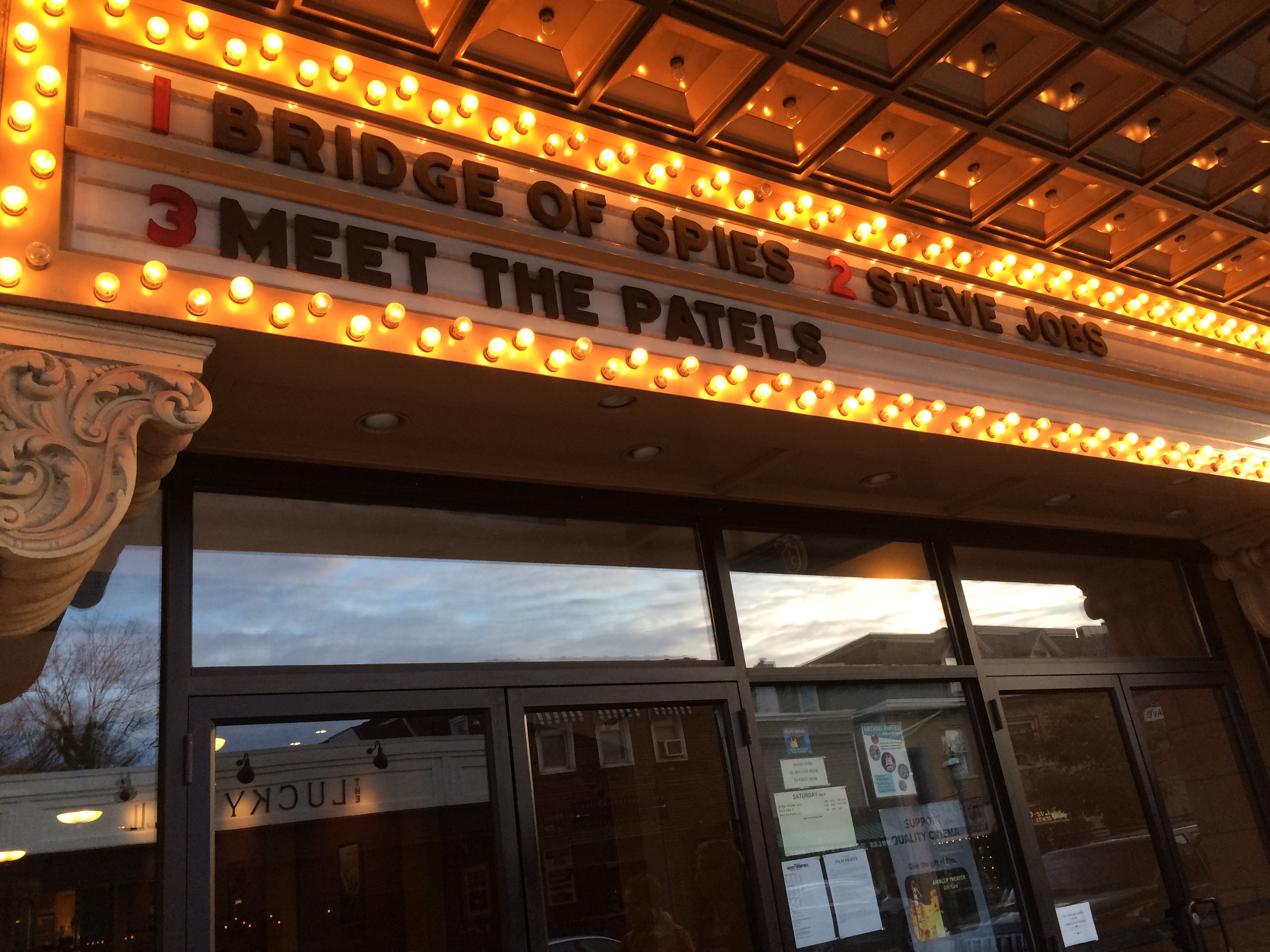
And so on the aforementioned day at 5:15 PM, Sandy and I were in Chatham, a needless-to-say charming Cape Cod town. We had just watched Steven Spielberg’s latest oeuvre, Bridge Of Spies, in the Chatham Orpheum Theater. Our next planned destination was 20 miles away, Harvest Gallery Wine Bar. There we meant to dine and listen to a tough as nails rock trio, The Catbirds. But there was no need to arrive before 7 PM. We had time to kill. We scratched our heads, coming up empty. Then “sunset” popped into my mind. Sandy checked with her phone, which is much smarter than me, and learned that the Sun would dip below the horizon at 5:57. I steered our car westward and then turned south onto a road I’d never heard of, hoping that we eventually would find our way to a Chatham beach on Nantucket Sound. The sand gods must have been with us, for Hardings Beach Road soon materialized. And moments later Hardings Beach itself emerged.

We parked. The spot was gorgeous. Lovely sands, magnificent Nantucket Sound waters gently rippling beneath a sky puffy here and there with clouds. The clouds made my heart leap, or something like that, because a scattering of clouds, as I’ve come to realize from years of sunset-gazing on the Cape, is key to a good sunset. Their water droplets and other particles refract light beams and reflect colors. Their movements and changing forms turn sunsets into active canvases. And that’s what happened as Sandy and I watched our fiery faraway friend say goodnight.

Sunset at Hardings Beach. 5:56 PM.
Sunset at Hardings Beach. 6:05 PM.
Sunset with the Moon at Hardings Beach. 6:07 PM.
Sunset. The Moon. Hardings Beach. 6:07 PM.


A lot of people claim to dislike colorful abstract art, certain paintings by, say, Vasily Kandinsky or Jackson Pollock. I don’t get that, because everybody loves sunsets, which to me can be among the ultimate in eye-popping abstractions. I’ve never read that sunsets inspired any brush wielders to go wild and free in their approach or vision, but it wouldn’t surprise me if in fact this were the case. Sandy and I watched the sky for 20 minutes. The pinks and oranges darkened as the big event rolled on. The clouds worked their wonders. And in a little while Sandy pointed up and said, “There’s the Moon.” It was a graceful sliver of white balancing above swashes of pastel hues.

On Cape Cod I’ve been a lucky son of a gun many times. That evening on Hardings Beach was one of them.

(Photos by Sandra Cherrey Scheinin. If you click on any photo, a larger image will open)

(If you enjoyed this article, then please don’t be shy about sharing it)
Stuff And More Stuff (Part Two)

So here I am, about to attempt a Part Two rumination on the time that my wife Sandy and I spent recently with our friends from France, Alan and Martine (click here to read the first installment). Part Two? Man, it’s hard enough for me to write about any topic, let alone something that requires follow-up thought and analysis. In the future I’m going to stick strictly to Part Ones.

As I’ve previously mentioned, the weather was ungodly hot while Alan and Martine stayed with us in the Philly burbs. We all decided to take outdoor activities off the table. On the first full day of the visit, we beat the Sun by looking at 150-year-old American artifacts inside the Mercer Museum, in Doylestown, PA. Where to on the second full day? Hey, we’d had enough history and culture at the Mercer. Why not aim lower and head to a locale whose charms are undeniable and, for some, irresistible? Namely, Willow Grove Park Mall, a gigantic and enclosed shopping mecca a mere half mile from Sandy’s and my abode. Alan and Martine, non-fussy sorts, readily agreed.

At the mall, we split up into pairs, females banding together, ditto for the lesser gender. Alan and I said goodbye to our wives within Macy’s, the establishment we all first had entered from the parking lot. “Call us when you’re done,” he and I said, and off we went. As Alan and I made our way past Macy’s cosmetics counters, heading towards an exit that would bring many of the rest of the mall’s retailers into view, I mentioned something I’ve thought about over the years. “This place,” I said, referring to Macy’s, “is like a museum.” The same could be said for the mall in toto.

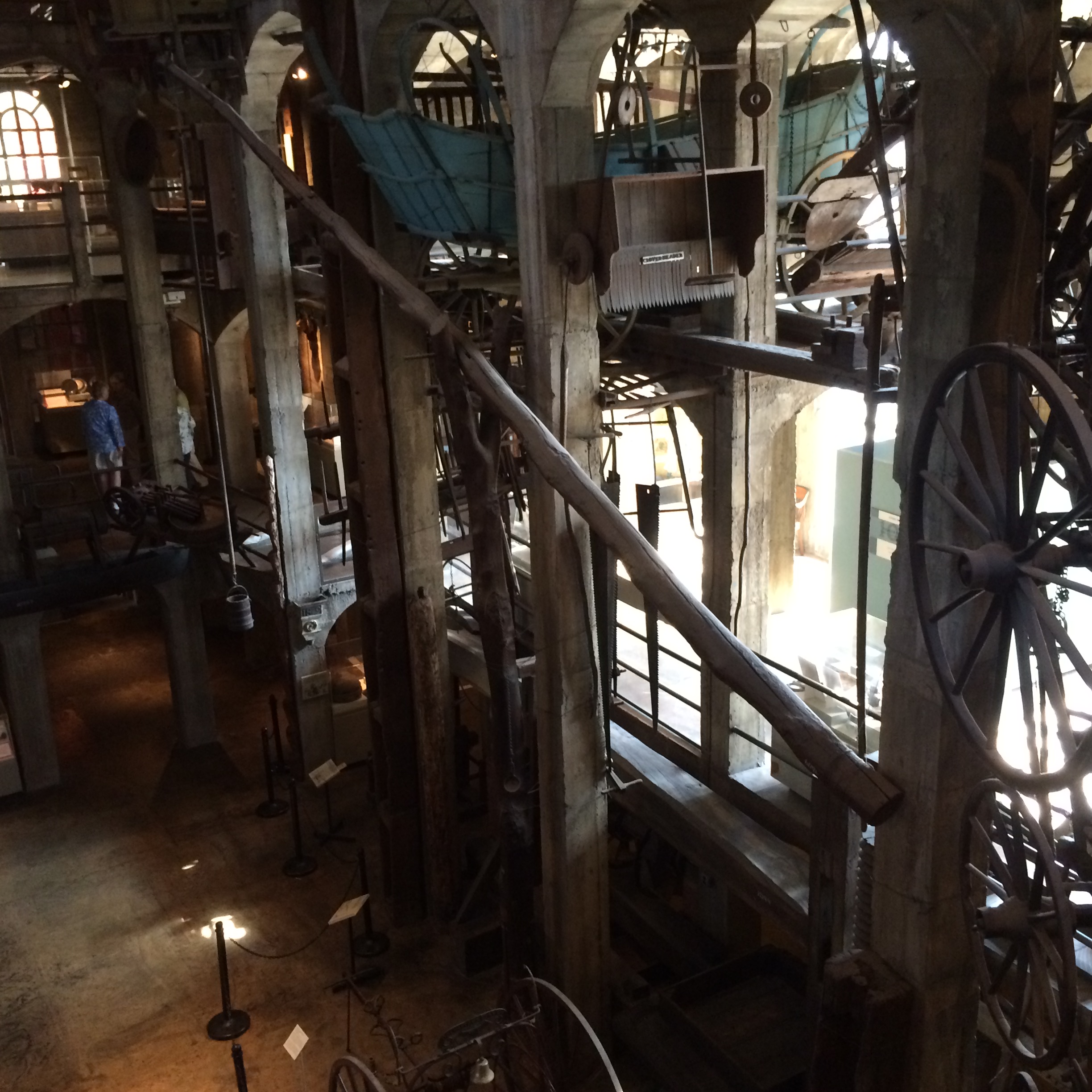
Partial view of the Mercer Museum's central court.
Partial view of the Mercer Museum’s central court.
Partial view of the Willow Grove Mall's central court.
Partial view of the Willow Grove Mall’s central court.

The Mercer Museum displays 30,000 or more everyday implements and goods from America’s olden days. It’s a fascinating place. The Willow Grove Mall is no less fascinating, when you think about it. You want artifacts? The mall has 1,500,000 of them, I bet, putting the Mercer’s count to shame. Not only are the Mercer and the mall both repositories, they’re laid out kind of the same too, with large open courts (really large at the mall) ringed by several levels of rooms. At the Mercer the rooms (i.e. galleries) are small, each displaying tools and wares from a specific occupation or other category. At the mall the rooms (i.e. shops) may be bigger, but, excepting the department stores, each is narrow in its focus, just like at the Mercer. Shoe stores display only shoes. Electronics stores display only electronics. See, what’d I tell you? . . .  The Mercer Museum and the Willow Grove Mall are pretty similar. Except, of course, that the stuff inside the Mercer Museum ain’t going anywhere. At the mall, a museum in constant flux, the faster the stuff makes its way out the doors, the better the store owners and managers like it.

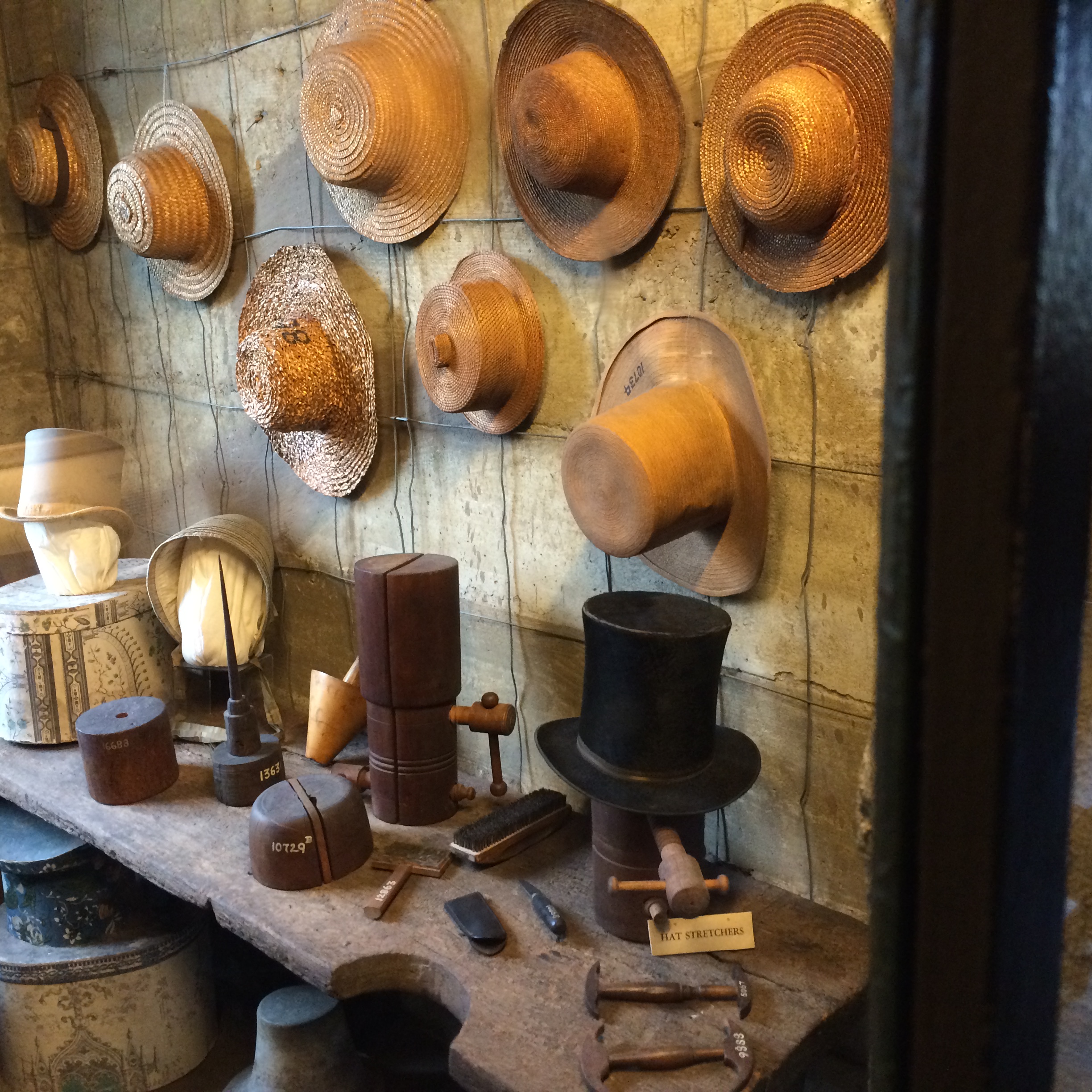
Hats at the Mercer Museum.
Lids, a hat store in the Willow Grove Mall.

Department stores aside, the variety of items at the Mercer is, I think, a lot greater than at the mall. But there is definitely some overlap. No, you won’t find smart phones at the Mercer, or a whaling boat at the mall. But how about hats, for one example? Mercer has a room devoted to them and their manufacture. And Willow Grove Mall contains Lids, a sharp little shop stocked from floor to ceiling with caps, mostly of the baseball type.

While Sandy and Martine (as Alan and I later learned) happily wandered through Macy’s, Bloomingdale’s, Uniqlo and other wondrous spots, Alan and I strolled around the second and third level walkways overlooking the great court. We passed one emporium after another, but entered not a one. Neither of us were in need of any new duds (I mean, we’re talking here about two of the already-sharpest-dressed guys on the planet!), nor of much anything else. And thus to the food court we finally headed, where we sat and chatted about this and that, coming close to solving a couple of the world’s problems, though not quite close enough.

Eventually, Sandy and Martine rang us up. And came to join us at the food area. They’d had a grand time. So had Alan and I, in our own way. Sandy and Martine had made a few small purchases. And, before heading back to the Scheinin hacienda, Martine dropped a few dollars more, taking away some old timey candies and roasted nuts from a colorful and alluring sweets stand at the food court. These were gifts for relatives whom she and Alan would be visiting in Massachusetts in a couple of days.

Thank you, Willow Grove Mall, provider of fun, enlightenment and relief from the Sun’s punishing rays. I bow in praise.

(Photos by Sandra Cherrey Scheinin. If you click on any photo, a larger image will open)

(If you enjoyed this article, then please don’t be shy about sharing it)
Stuff And More Stuff (A Visit To The Mercer Museum)

One of my closest friends, Alan, lives in Paris, France, so we don’t get to see each other too often. My wife Sandy and I are crazy about him and his wife Martine. Wonderful people. Smart, gracious and, if the conditions are right, up for pretty much anything. Alan and I have been buddies for 50 years. We met at college in Vermont lo those many years ago. He and Martine were in the USA for a couple of weeks recently for family gatherings and to tour New England a bit, and they also visited Sandy and me for a few days. We all had a terrific time together.

The weather was hot while they were with us. By 10 AM each day the sun was kicking ass. Sandy and I had hoped to show Alan and Martine some beautiful outdoor sights in Philadelphia or its environs. Maybe Morris Arboretum. Maybe Longwood Gardens. Maybe Philly’s Old City section and its nearby Penn’s Landing waterfront. But we scratched all of those ideas off our list. None of us felt like dealing with the heat. Where to, then?

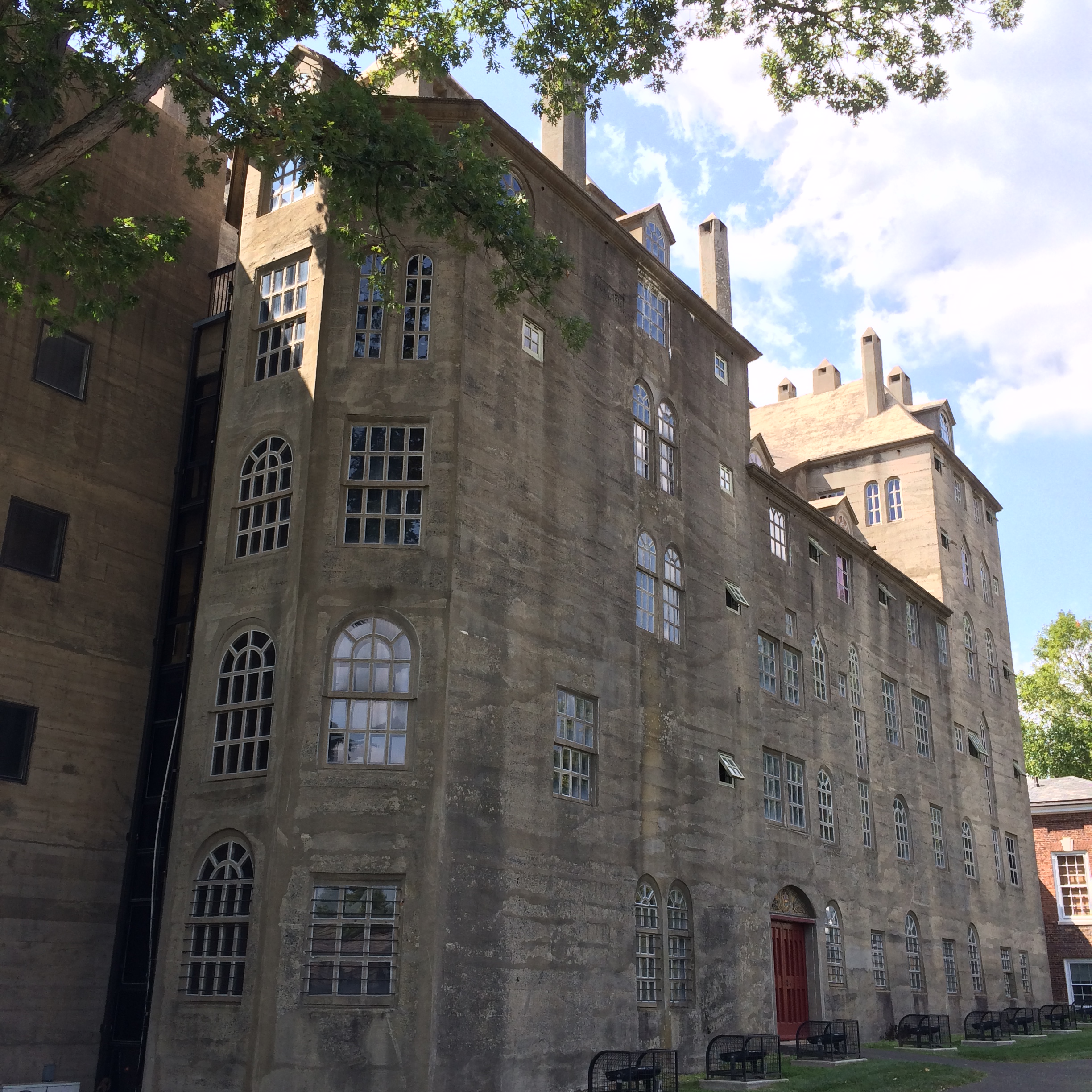
Doylestown's Mercer Museum.
Doylestown’s Mercer Museum.

I’ve written a number of times about Doylestown, PA, a fine village in Bucks County about 20 miles from Philadelphia. Doylestown was the home of Henry Chapman Mercer, a talented and brilliant chap with eclectic interests who lived from 1856 to 1930. He designed and constructed three large and unusual buildings in Doylestown, one of which, the Mercer Museum, fit the bill as an indoor destination for Sandy, me and our friends. On the first full day of Alan’s and Martine’s visit, that’s where we headed.

Henry Mercer was a traveler, an archaeologist, an outside-the-box thinker and a collector of myriad objects. He also was well-heeled, a circumstance that allowed him to indulge his passions and to live pretty much as he chose. The collecting bug bit him early in life and took hold very strongly in the 1890s when he saw the effects that industrialization was having on the American way. Before they would be entirely phased out and disappear, he decided to amass examples of the handmade objects that once were, and in some cases still were used in typical homes, in everyday trades, on farms and in workshops. The tools and household and recreational goods, in other words, that defined how folks lived in the 1700s through roughly 1850.

Mercer spent much time at junk dealers, auctions and country sales, and often for little money purchased an astonishing array of items, thousand and thousands of them. But where would he keep all of this stuff? No problem. The amazing Mercer designed a sprawling idiosyncratic castle of sorts to house his Americana collection. A small team of workers built the structure in just a few years. The Mercer Museum opened in 1916, and Henry immediately donated it and the stuff to the Bucks County Historical Society, which to this day owns and runs the operation.

I was pretty certain that Alan and Martine would like the Mercer Museum. It’s not well-known, why I don’t understand. But it is fascinating and maybe one of a kind. The building alone is worthy of examination, a concrete behemoth awash with windows and topped with a dizzying display of towers and chimneys and who-knows-whats. Mercer selected concrete as his primary construction material because he desired a fireproof enclosure for his collection, and it certainly seems as though he made the correct choice. To date, no flames.

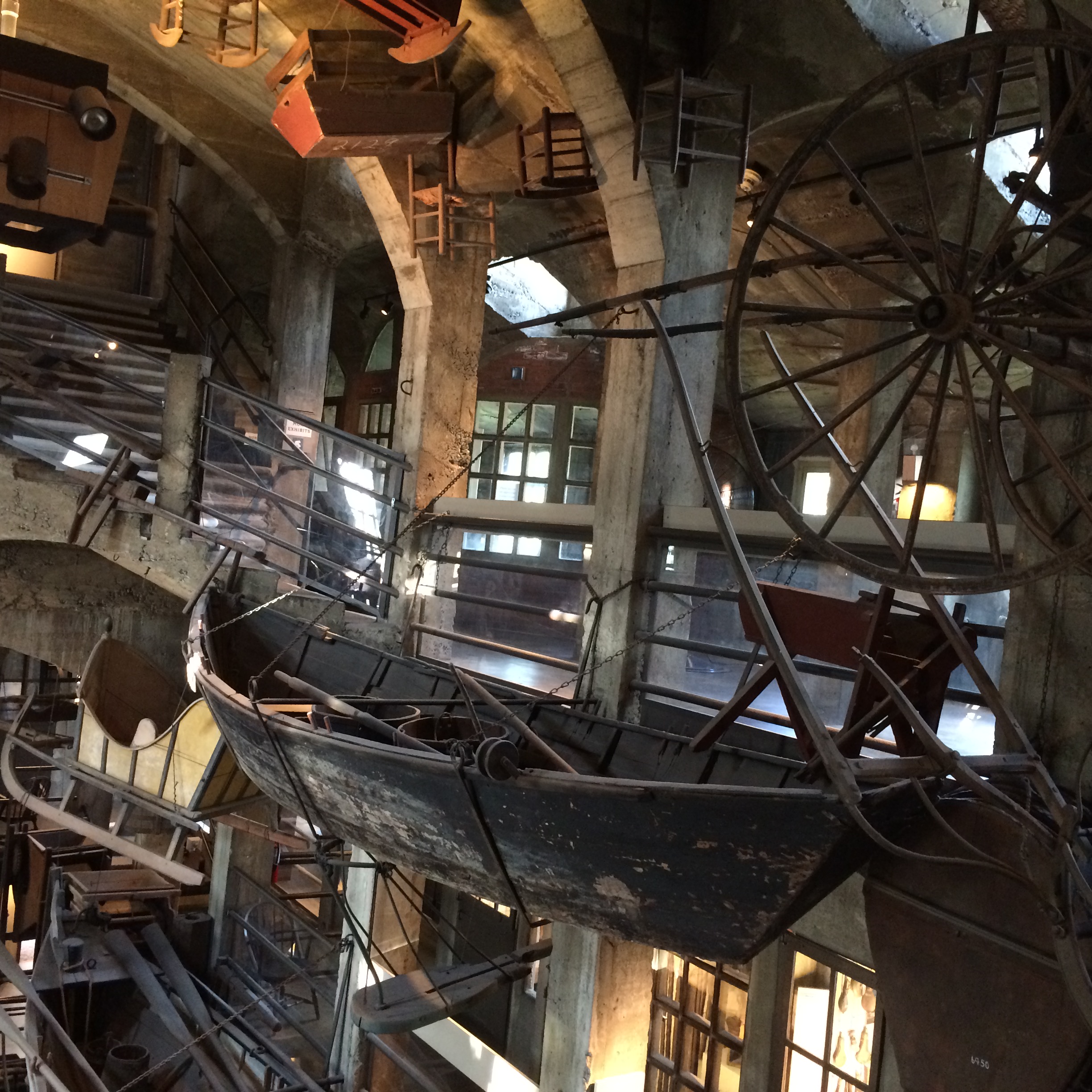
A dory, a sleigh and much else, all suspended from the ceiling and arches in the atrium.

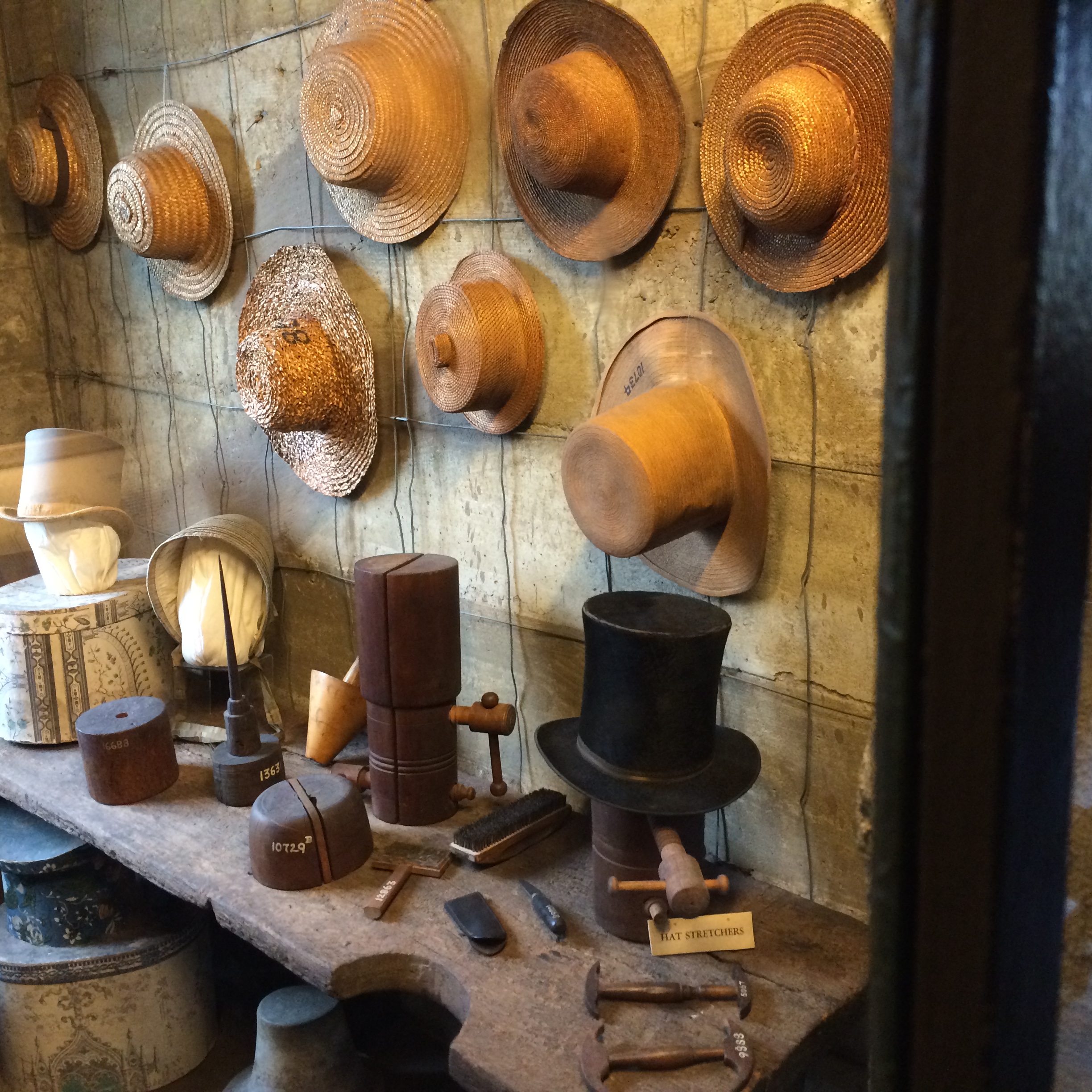
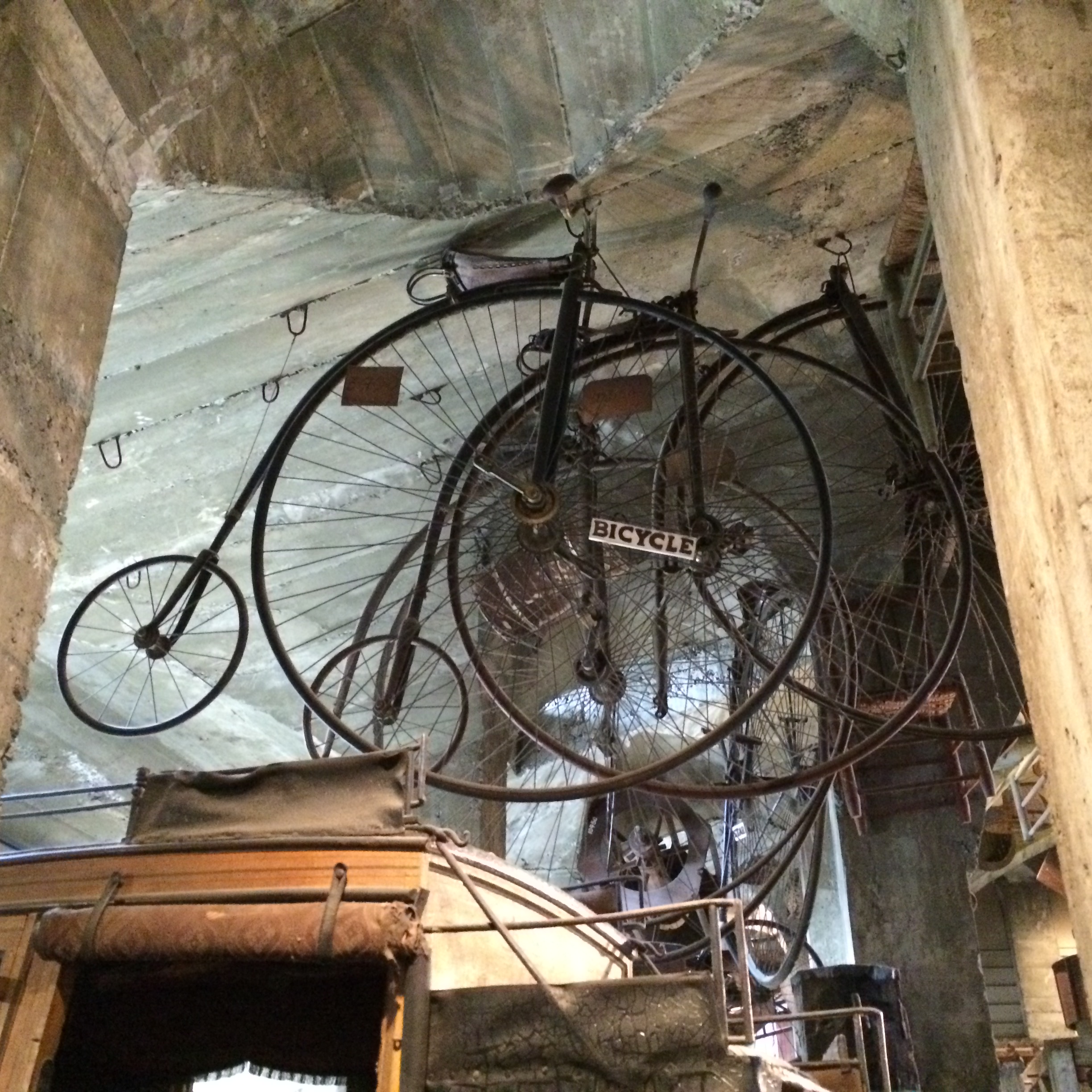
And the collection? “Incredible” is an understatement. Thirty thousand or more things to eyeball, many of which you’re not likely to encounter elsewhere. A well sweep (it drew water from wells in pre-pump days), a stagecoach, a hay rake with 24-inch-long teeth, components of a water power saw mill . . . not to mention smaller items such as tools used in hat making, tinsmithing, coopering, the healing arts, you get the idea. Mercer suspended some of the big boys (a dory and a whaleboat, for instance) and also some of the little guys from the ceiling and arches of the museum’s large central atrium, where the effect is hallucinatory. It takes long looks to figure out just what it is you’re looking at, despite the quite good signage. And Mercer apparently had a real sense of the whimsical, as chairs, chests, baby cribs and other artifacts I couldn’t easily identify dangle from the ceiling, often upside down.

The Hat Making room.
High Wheeler bicycles "floating" above a stagecoach.
High Wheeler bicycles “floating” above a stagecoach.

Most of the tools and results of America’s myriad trades, thankfully I suppose, are much more neatly displayed. They are divided up, by occupational use or other categories, in rooms, alcoves and niches that surround the atrium on six different floor levels.

Brown is the color of the day at the Mercer Museum, since so many of the objects on display, especially the hefty ones, are made of wood. Alan and Martine and Sandy and I took our time in the Mercer forest, but after two hours started to run out of gas. Alan said the museum is one of the best he has ever been in, and I concur. This trip to Mercer was my third or fourth. A fellow visitor, whom I chatted up slightly while we both gazed at eight-foot-tall High Wheeler bicycles hanging from the ceiling above a western Concord stagecoach, got it right when she said that “[Henry Mercer] makes hoarders look good.”

A few suggestions to the interested. Go, definitely go to the Mercer Museum. But make the voyage on a sunny day, as there is a paucity of artificial light there. And skip the dead of winter. The museum is unheated.

As mentioned hundreds of words above, the day following the Mercer experience featured temperatures just as disagreeable as its predecessor’s. Once again, an indoor attraction it would have to be. Where? (To be continued)

(Photos by Sandra Cherrey Scheinin. If you click on a photo, a larger image will open)

(If you enjoyed this article, then please don’t be shy about sharing it)
The Michener Museum Shines Yet Again

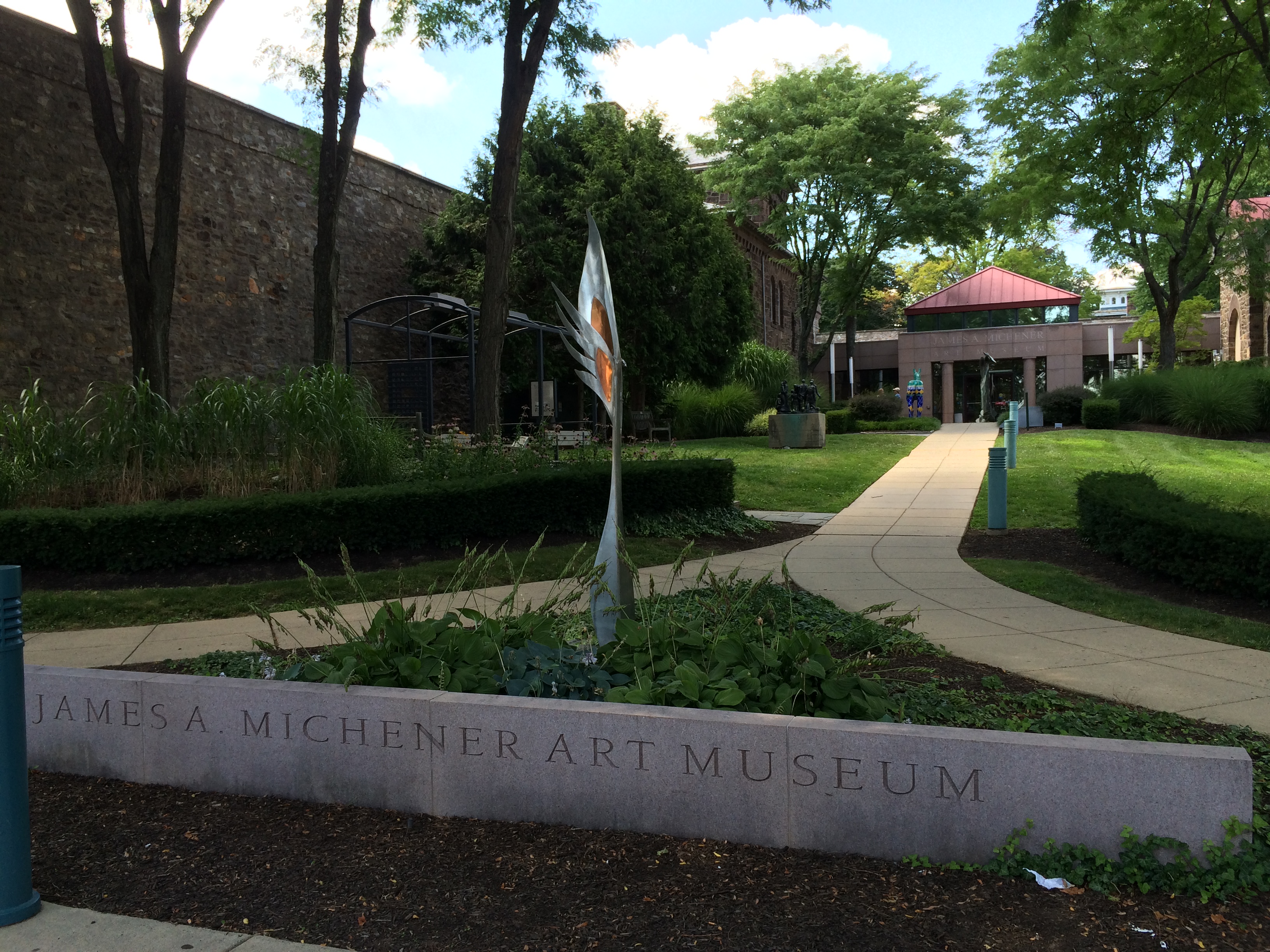
James A. Michener Art Museum.

One of the things I like about art shows is that they can surprise you (in a good way). It’s a gas when a museum or gallery curator comes up with a new slant or assembles a themed exhibition that makes you say “great idea!”  That’s part of the fun of going to places such as the James A. Michener Art Museum in Doylestown, PA. Not always, but often you can expect the unexpected there. Five years ago the Michener mounted a fascinating display of costumes worn by movie stars in famous movies. Arnold Schwarzenegger’s black leather jacket from The Terminator was in the house. So was Elizabeth Taylor’s gown from A Place In The Sun. That show caught me off guard by its coolness and inventiveness. Its idea seemed obvious, but only after the fact.

A similar sense of forward thinking surrounds a current Michener exhibition, the long-titled Iron And Coal, Petroleum And Steel: Industrial Art From The Steidle Collection. The works on view have been borrowed from their permanent home in State College, PA. There they reside within Penn State University’s Earth And Mineral Sciences Museum And Art Gallery, another mouthful. Hats off to the Michener for knowing of the off-the-beaten-track Steidle collection’s existence and for smartly organizing the paintings and their messages.

Edward Steidle (1887-1977) was a mover and shaker for many years in the worlds of mineral and petroleum extraction and use. An engineer, teacher and college administrator, he was dean from 1928 to 1953 of Penn State’s College Of Earth And Mineral Sciences. He also collected art, much of which he commissioned, that depicted the earth industries in action. The students at Penn State’s earth and minerals school were surrounded by examples of ores and extraction implements in the school buildings. Steidle, to my mind somewhat of a visionary in this respect, wanted artistic representations of the same also to be on view at the university.

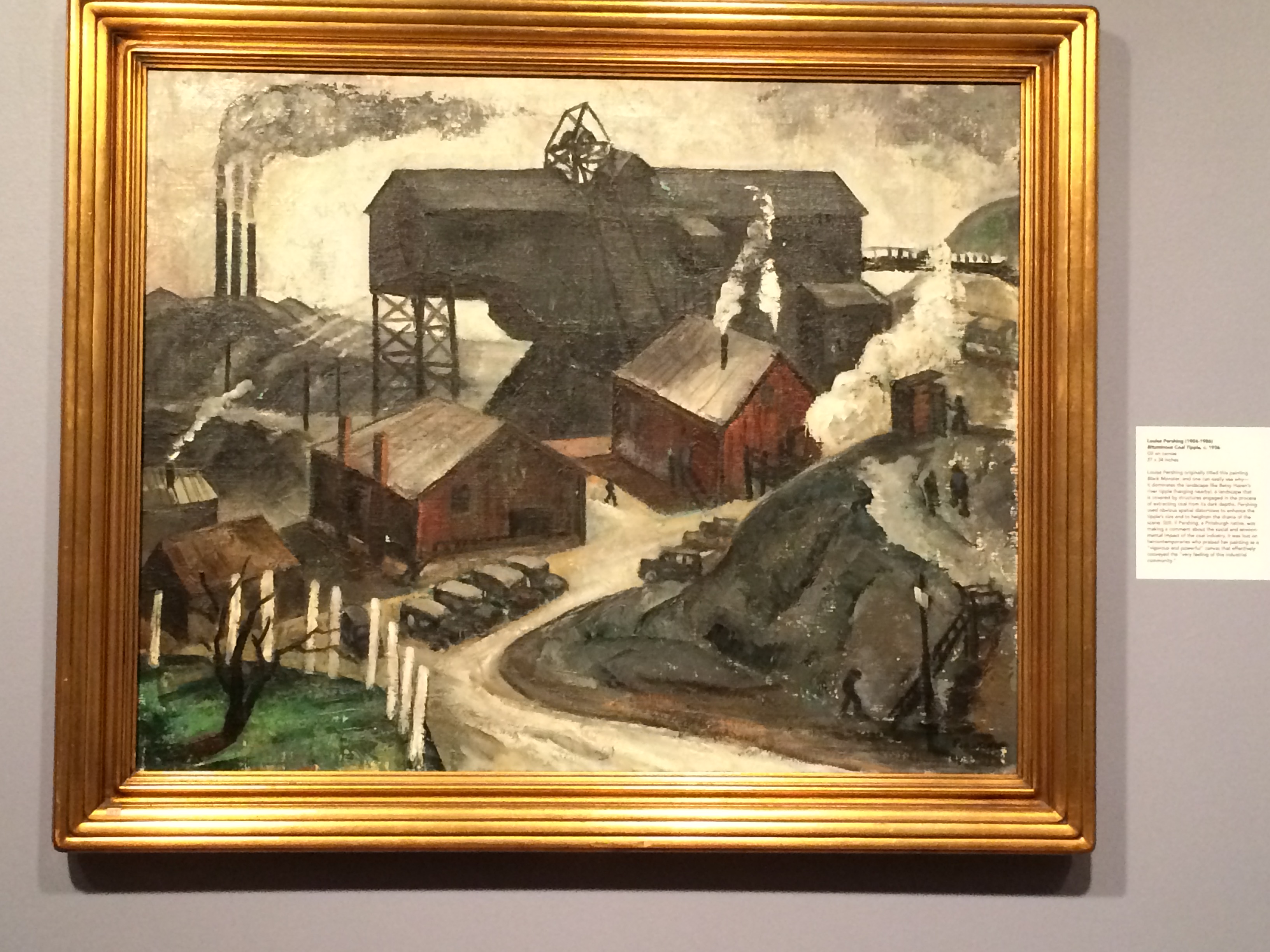
Bituminous Coal Tipple, painted by Louise Pershing in 1936.

Louise Pershing’s Bituminous Coal Tipple, from 1936, was the first work I grabbed onto at the Michener after quickly scanning the collection.  I loved its muted tones, the hulking mass of the tipple and of the hill in the foreground, the clouds of smoke issuing from all over the canvas, the lonely patch of green grass. Pershing mapped out her painting precisely and filled it with feeling.


Pershing’s oil painting represented a pretty good number of the ah-hah moments that I had in the Steidle galleries. What struck me first when I walked into the exhibit were the colors on the canvases. As with Pershing’s work, largely they were subdued or somber, the hues of earth and coal, of heavy equipment. As I walked around the galleries I noticed some other things. For one, nearly all the paintings were strongly designed and observant. Steidle had a good eye for art. Also, I was completely unfamiliar with the 40 or so artists in the show, excepting one or two. Post-Michener research confirmed that most of them had nice modest careers in their day but didn’t make it to the ladder of fame — only a few have garnered Wikipedia biographies. And I saw that a good number of the paintings were by women, not always the case on museum walls.

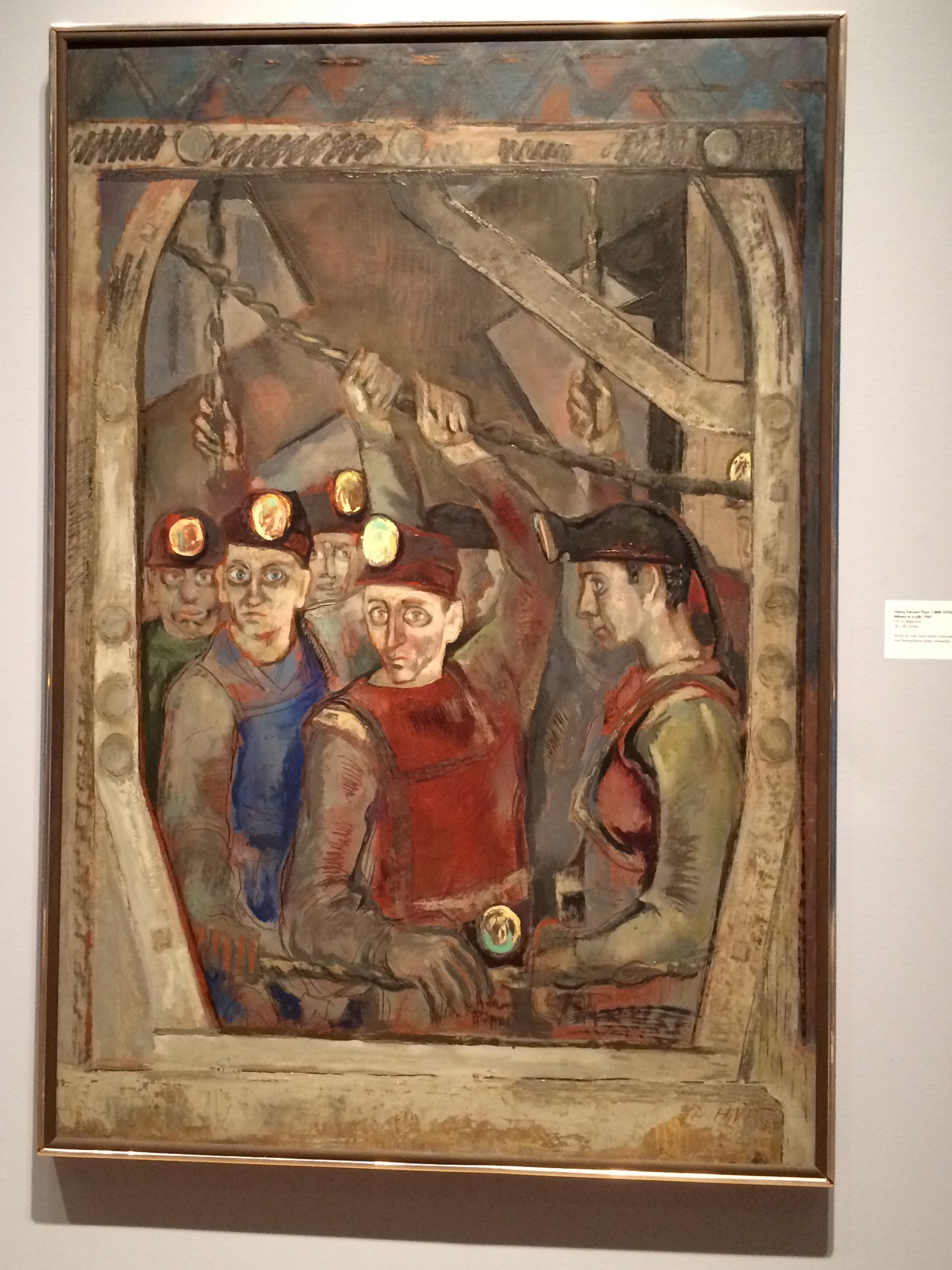
Miners In A Lift, painted by Henry Poor in 1947.

The Michener’s Steidle exhibition is a winner because it includes a boatload of works equal to Pershing’s Bituminous Coal Tipple, some maybe even better. Henry Poor’s Miners In A Lift, for example, which he painted in 1947. Five (or is it six?) coal miners are within the tight wooden cage, about to step outside the mine entrance, their shift over. Emerging from near-darkness into light, their eyes are hugely distended. The painting tells life stories, as the workers’ uneasiness about their dangerous occupation is on their faces. The confined framework of the painting brings power and immediacy to this work. It probably was my favorite at the Michener show.

The Steidle collection is said to be one of the best collections of industrial art in the USA. When these works were created, coal and steel were massively important industries in Pennsylvania and nationally. A few decades later they pretty much collapsed. The paintings are in that sense a time capsule of what once was. The historical aspect of the Michener show was presented clearly and didn’t make my eyes glaze over, the museum avoiding ponderous explanations on its informational placards. But, half-baked art aficionado that I am, I was more interested in the painterly aspects of the Steidle exhibit than in straight history.

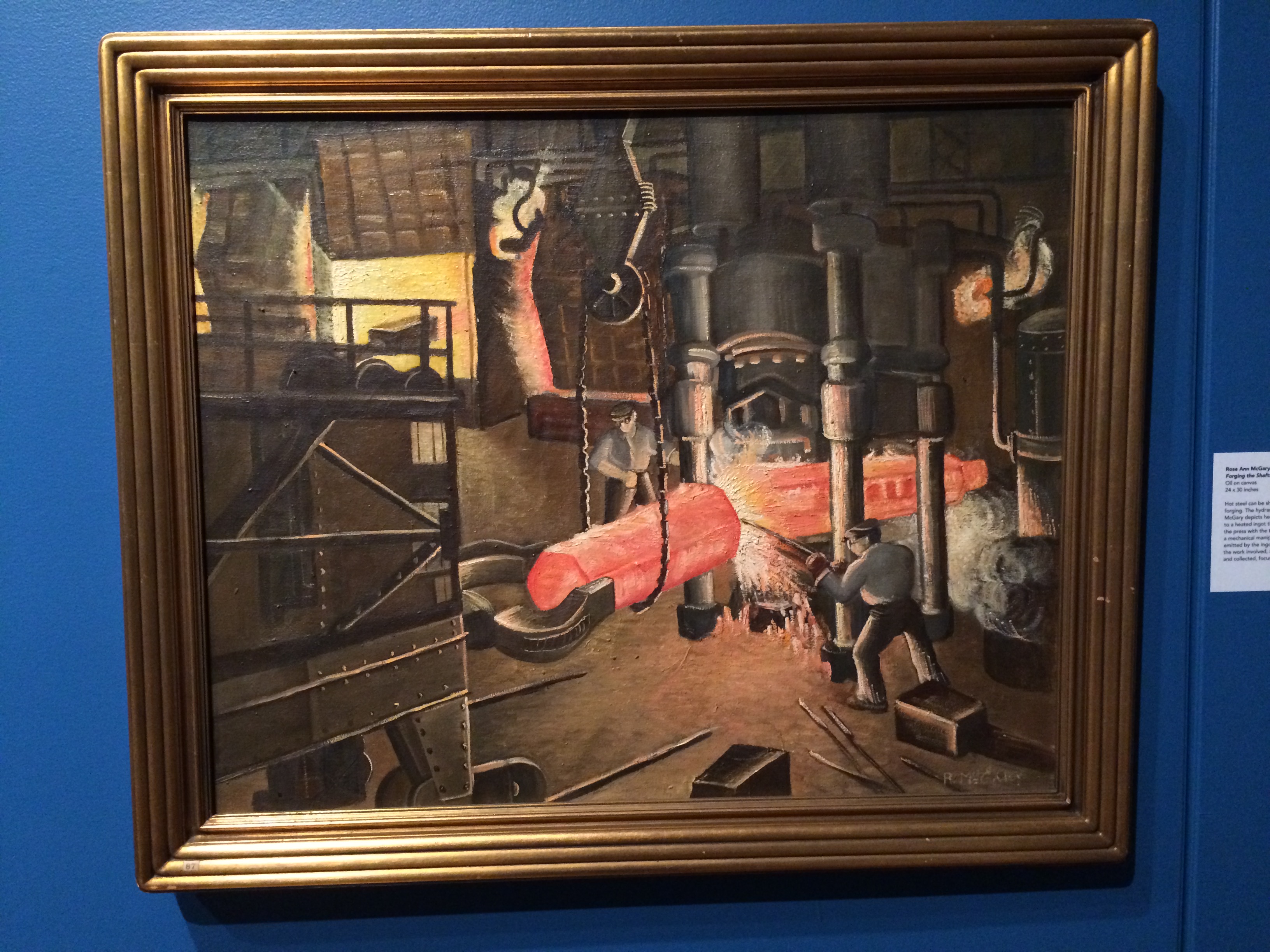
Forging The Shaft: Hydraulic Forging Press, painted by Rose Ann McGary in 1936.

Take, for instance, Rose Ann McGary’s Forging The Shaft: Hydraulic Forging Press. She painted this canvas in 1936. It shows workmen shaping red hot steel, and would have earned a thumbs up from the artist Fernand Léger and his fellow Cubism descendants. A carefully assembled construction of planes, cylinders and boxlike shapes, Forging The Shaft takes Cubism’s original color scheme of grays and browns and adds, just off-center, an explosion of pink. It is both a contained and dynamic painting.

The Steidle show closes on October 25. There’s still time to see it.

(If you click on any photo, a larger image will open)

(If you enjoyed this article, then please don’t be shy about sharing it)
One More Stop On The Road For Donna The Buffalo

My wife Sandy and I recently saw in concert an electric and eclectic band from upstate New York amusingly named Donna The Buffalo, and afterward I wanted to write about the show. Before sitting down to compose my magnum opus though, I mulled over my approach to the subject matter. The main question I posed to yours truly was: What should the subject matter comprise? Naturally, Donna The Buffalo needed to be a big part of the focus. But you know what? I knew little about DTB pre-gig, and possess only a cursory knowledge about the band now. We went to see them on little more than a whim. I’d heard of them, knew that their history was lengthy, and decided that taking a chance on them would be fun. When my mulling concluded, I was of the opinion that the path that brought me to this show also should be part of the story.

I think of myself as a music lover. I listen to a wide variety of genres and have been to well over 1,000 concerts during my earthly tenure. Yet, these days I feel like a tyro when I listen to radio stations or read music-related websites, magazines and newspapers. I mean, more often than not, I am unfamiliar with the musicians. To me, it is just incredible how many solo performers and bands are out there playing the game. In the USA alone, there must be 50,000 professional musical acts, maybe more. In my younger days I thought that I had a handle on a fair percentage of music makers. No longer, not now in the Internet Age when anybody and everybody can make his or her presence felt.

And so, ten or more years ago I largely gave up on trying to keep up with the avalanches of musicians plying their trade. It was just too much work, too exhausting. Better, I think, to stay in tune to a lesser extent, and also to take gambles and hope for the best. As with Donna The Buffalo.

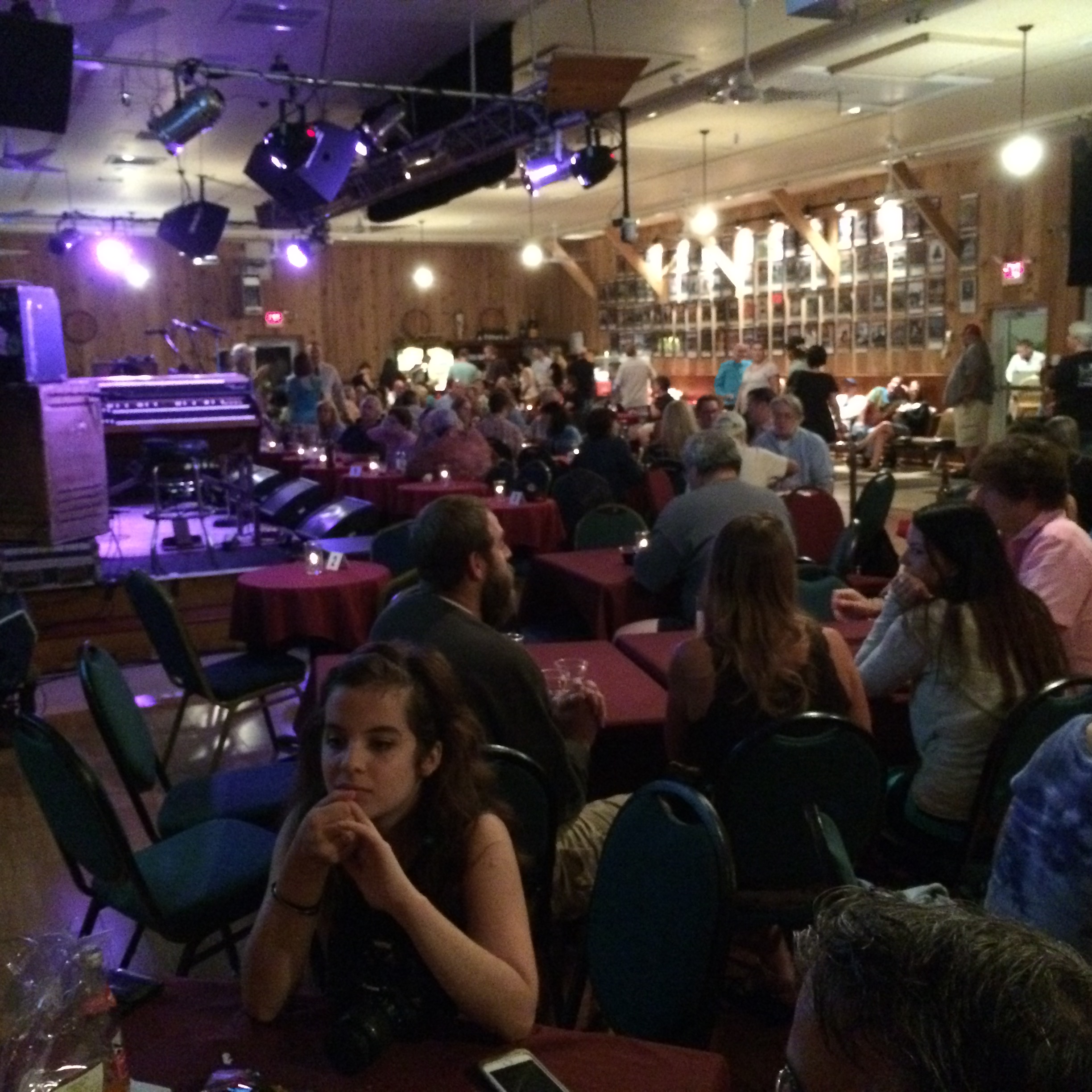
New Hope Winery, one half hour before showtime.

Donna The Buffalo appeared at New Hope Winery, a venue in the Philadelphia suburbs that Sandy and I discovered last year and have become very fond of. The joint was packed with 200 or more souls when DTB took the stage. A front-and-center area, where tables normally would be placed, had been cleared to create space for dancers. I looked over the crowd. At some previous visits to the Winery I’d seen demographics heavily tilted to the 50 and above bracket. Not this night. DTB had tipped the age scales downward substantially. Twentysomethings and thirtysomethings abounded. There even were a few very young children in the room.

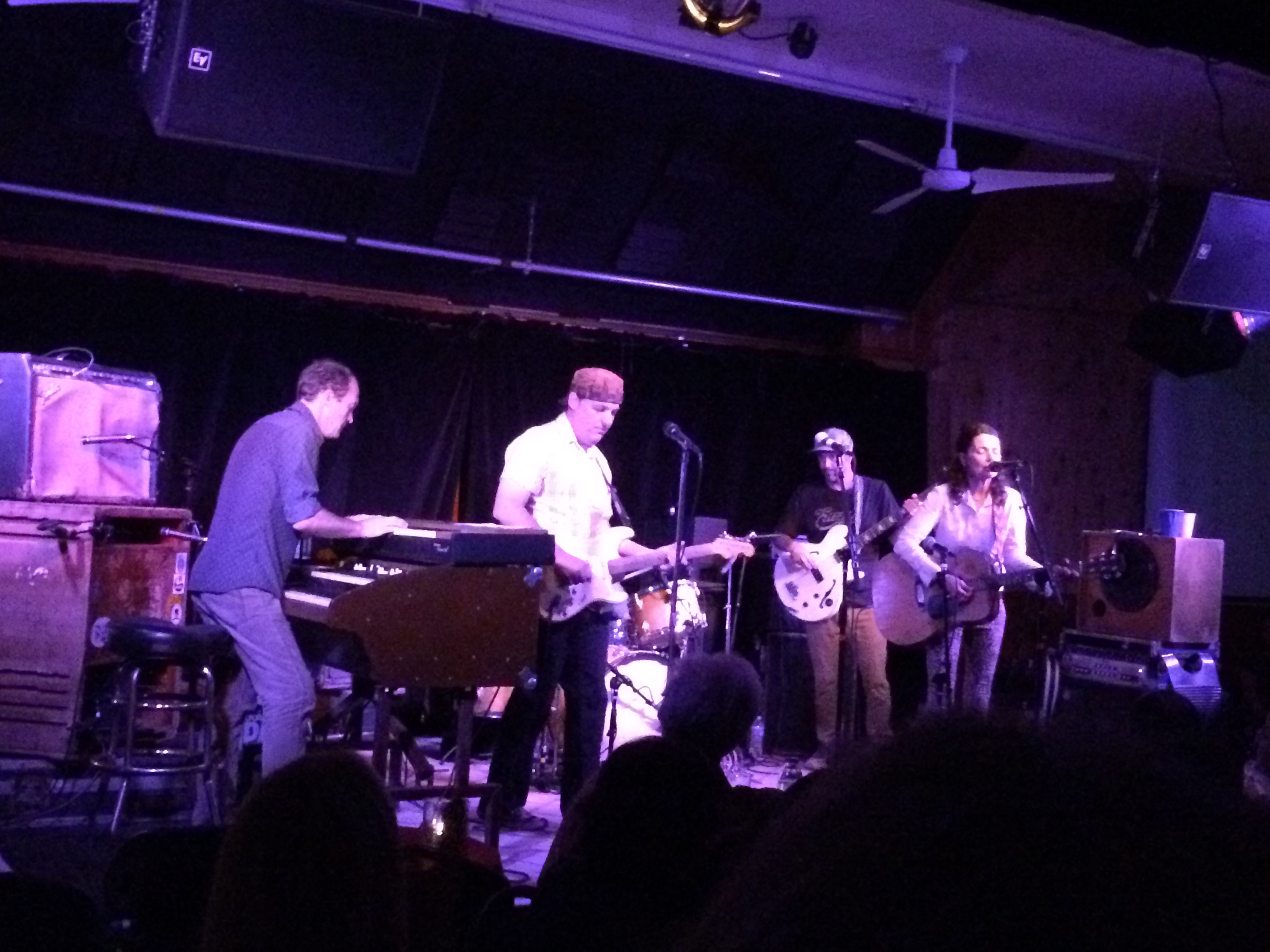
Donna The Buffalo in action at New Hope Winery.

What a band. Not having known what to expect, song number one told me that I had chosen wisely by attending this concert. A quintet, DTB was tremendously tight and intuitive all night long, and possessed a large catalog of songs to choose from. They held the stage for two hours and 10 minutes, filling their long set with 22 songs and little between-tune chatter. I was standing just behind the dance section, which was crowded with bobbers and weavers. After two or three songs, I too began to go with the flow. And kept going. But I was bouncing alone — Sandy stayed at the extremely stage right table to which we had been assigned. Her view of the musicians from there was lousy, but in the dance area she wouldn’t have had a chance seeing over anyone’s head. Mea culpa.

DTB has blended a bunch of musical styles into their sound: rock, country, zydeco, reggae. Rock being the dominant force. On some songs (What Money Cannot Buy; Love and Gasoline) the power was relentless, Stonesy, irresistible. On others (The Ones You Love; Conscious Evolution) the groove expanded, contracted, widened once again, giving no mercy to the audience. All you had to do on those expansive numbers, Grateful Dead-ish and Allmans-ish as they were, was close your eyes to be transported to a higher and mind-opening plane. Yes, Donna The Buffalo was that good.

DTB began its journey in the late 1980s, picking up steam in the mid 90s, and in the current century has become a decently successful and popular unit. They tour like crazy and have amassed a loyal national fan base known as The Herd, a mini version of the Deadheads. Two original band members (Tara Nevins and Jeb Puryear) remain. Tara and Jeb compose most of the group’s songs, usually individually. At the Winery, each took the lead vocal spotlight on his or her compositions. Jeb opted for the laidback Jerry Garcia approach to singing and handled electric guitar sizzlingly. He’s a guitar hero unknown to 99% of Americans. Tara’s sweet and gentle mountain drawl pleased me much. And she was the band’s multi-instrumentalist. Fiddle, acoustic guitar, accordion, tambourine and scrubboard (for the zydeco numbers) were her arsenal.

A bunch of musicians have played alongside Tara and Jeb since DTB’s inception. The three current guys have been around for several years. Mark Raudabaugh killed on the drums. Kyle Sparks was all over his electric bass’ strings, drawing out lines that percolated and sang. And organist David McCracken was immense. So many times in so many bands, especially the poppier or atmospheric ones, the keyboard player is on the lame side, somehow fooling the audience with pretty chords and simplistic runs. Not McCracken. He can play. He jabbed, moved fast, reached for the skies, whatever it took.

So, how many acts that I’ve never heard of or barely heard of, and that I’d find to be great, are on the circuit? The question is a puzzle, the answer unknowable. Which makes music and, similarly, much else of life, delightful.

(Photos by Sandra Cherrey Scheinin. If you click on a photo, a larger image will open)

(If you enjoyed this article, then please don’t be shy about sharing it)

Screwball Begone! (A Review Of Mistress America)

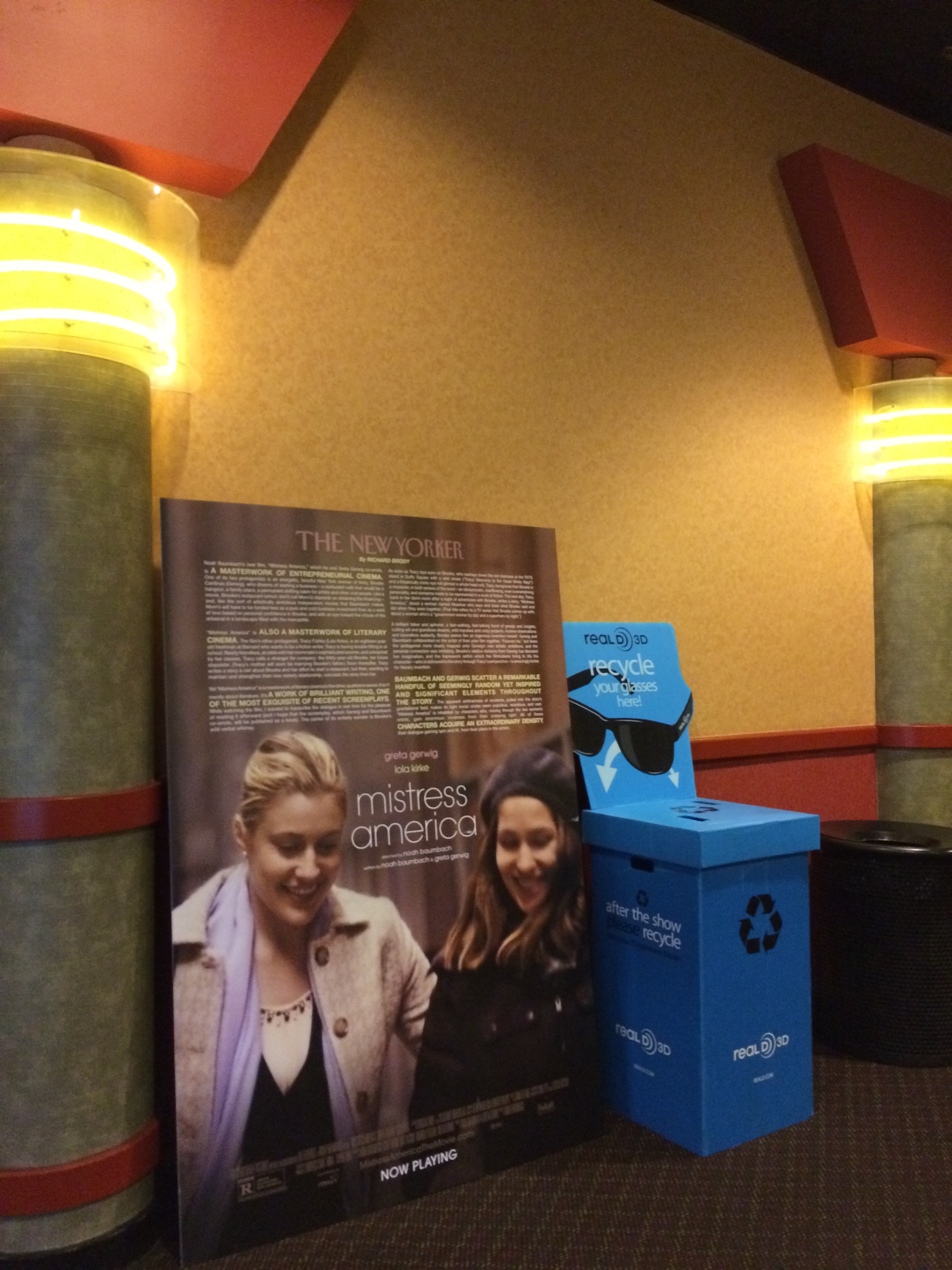
I wasn’t as fond as I thought I would be of the movie that my wife Sandy and I went to see recently. Sandy told me that various critics have heaped praises upon said flick, Mistress America, some calling it a screwball comedy in the grand old Hollywood tradition of Howard Hawkes and Preston Sturges. I saw the movie differently. I found it to be as much a drama as a comedy, as bittersweet as it is funny. And as for screwball, which can be great . . . well, Mistress America’s try at the madcap art form encompasses not the entire movie at all, settling instead for one long and uncomfortable segment in the second half. I didn’t have much fun with that interlude. A collection of intersections involving most of the movie’s cast, it felt flat and strained to me, out of place with the decidedly tilted but more realistic antics and people-play that populated the rest of the film. In other words, Mistress America overextended its ambitions. It would have been a better movie if its creators, Noah Baumbach and Greta Gerwig, had kept their eyes on the  wry and poignant, and left the supposedly wild and crazy alone. My rating? Two, maybe two and a half out of four stars.

We saw Mistress America at the Regal multiplex in Warrington, PA.

Mistress America revolves around a small parade of characters led by Brooke Cardinas (Gerwig) and Tracy Fishko (Lola Kirke). Brooke is a 30ish lady on the go, an at-times free spirit who cobbles together a living in New York City by leading exercise classes, doing interior decorating, whatever it takes. Her dream is to open a restaurant slash hair salon slash hangout in Lower Manhattan called Mom’s, a place where customers will settle in and feel really comfortable. A wifty notion possibly, but who knows? Brooke already has signed a lease for the empty space she plans to transform, and is in the process of assembling financial backing. She’s committed, and several steps ahead of herself.

Into Brooke’s life enters Tracy, a Barnard College freshman not connecting very well to the college scene in Manhattan’s Upper West Side. At Mistress America’s outset, Tracy and Brooke have never met. Tracy learns of Brooke’s existence from her mother, who has plans to tie the knot with Brooke’s father. Following her mom’s suggestion, Tracy gives her stepsister-to-be a call. They meet, they bond, and the slings and arrows and goofy twists of fortune begin to fly.

Excising the unwieldy aforementioned portion of Mistress America, what we’re left with is an observant study of two women looking for some answers. Tracy is young, an introvert, and beginning what appears will be a very long process of self-discovery. I’m not placing heavy bets on her ever finding peace and contentment. She can be nasty and guileful, sides of her personality she might not have known were alive till the forceful Brooke’s influence poked them to the surface.

Brooke on the other hand is a longtime gung-ho trooper. Disappointments have peppered her life, but on she goes, pushing aside her doubts and sadnesses as she seeks the next opportunity or person that might set her on the true path. Late in the movie Brooke offhandedly takes a deep look inside and throws out some comments that almost are on target. To Tracy she says something to the effect of  “I know everything about myself. That’s why I can’t do therapy.” Actually, she knows so much that, I think, she scares herself. And keeps on running.

Baumbach and Gerwig, a real life couple, have been feeling their collaborative artistic juices the last few years. They cowrote Mistress America, and Baumbach directed. Ditto for 2013’s Frances Ha, which resembles Mistress America in that it centers upon a young woman who stumbles a lot in life. Frances, though, is several notches below Brooke on the got-it-together scale. Gerwig starred in Frances Ha, and I wasn’t sure if she would have the acting chops to differentiate her leading roles. I am glad to report that she does. Her Brooke is a complicated soul, usually energized and with a gleam in her eyes, but down enough times that my good wishes went out to her. Mistress America, despite its big ol’ flaw, offers plenty to chew on.

(Photo by Sandra Cherrey Scheinin. If you click on it, a larger image will open)

(If you enjoyed this article, then please don’t be shy about sharing it)
Puck’s The Place (A Venue And Concert Review)

I’ve written several times on this blog about Doylestown, PA. In the extensive suburbs of Philadelphia, Doylestown is perhaps the prettiest, the most charming, the most interesting village. I’m referring not to Doylestown’s generic housing developments, but to its quite large historic district. This section is worth a visit, and for many people, such as my wife Sandy and me, multiple and regular hellos.

Puck's outstanding neon sign.
Puck’s outstanding neon sign.

You like art? Go to Doylestown’s high-quality Michener Museum. You like non-blockbuster movies? Try the County Theater. You like artifacts from America’s pre-Industrial Revolution past? The astonishing Mercer Museum was built for you. And if you are a popular music buff, the place to frequent in Doylestown is Puck, a spot with chic indoor and outdoor eating areas and, incongruously, a grungy cellar where singer-songwriters and rock and country and funk bands take the stage a few times each week.

I’ve been to Puck’s music room 15 or more times over the years. Puck’s management brings in a wide array of musicians, a few of whom are touring artists with decent-sized national followings. But generally the players at Puck are little-knowns from Greater Philadelphia. I once had a small career as a music presenter for a summer music series in Philadelphia’s Chestnut Hill neighborhood (see my article The Music Biz And I). It was at Puck that I found several local acts (Cheers Elephant; Toy Soldiers; The John Byrne Band) who knocked my socks off and whom I ended up booking for the series.

What I like about Puck’s music room is its casual and boho vibes. Aside from the handsome bar, the space has been inspired by Frat House Finished Basement Magazine. The mottled floor could be mistaken for a Jackson Pollock painting. There are pillars that obstruct views of the stage. My kind of place.

As for the music, I tend to approach Puck with an open mind, with few expectations, and usually everything works out just fine. Many times I find the music to be good but nothing special. And sometimes, as with Cheers Elephant et al., I’m wowed. On a recent Saturday night, Sandy and I both were floored by Grady Hoss And The Sidewinders, the opening act of a double bill. I’d never heard of them, had little idea how they would be. What they were was tight and exciting, a country band in the classic mode, with some latter day tweakings. Anyone who favors Waylon Jennings, Gram Parsons and Dwight Yoakum would find good fun with Grady Hoss And The Sidewinders. For me, their 45-minute set was 45 minutes too short.

Grady Hoss And The Sidewinders, as I’ve learned from post-concert research, is a Philadelphia area band just starting out. They are working on a maybe-soon-to-be-released EP. Their Puck engagement, much to my amazement, was their public debut. Lance Davis, the leader, apparently had a fairly long career as an engineer and producer and rock musician, but for various reasons put all of that on an extended hiatus a number of years ago. In 2014 he emerged from his musical hibernation with country tunes on his mind. As the band came together, Lance decided that each member needed a colorful stage name reminiscent of the kinds of names (Ernest Tubb, Buck Owens) that once populated the country charts. Voilà, Lance adopted Grady Hoss as his moniker. The others in the group were dubbed Bucky Vennerson (in real life, Vince Federici), Dusty Reigns (Dan O’Neil) and Earl Smokesman (Charlie Heim).

Grady Hoss And The Sidewinders on stage at Puck.

Lance and pals played nine songs at Puck, eight of them originals. The songs were good. Lance’s vocals were heartfelt, his high notes reverberating with longing or regret, as they should in tales drawn from country music’s traditional wellspring. Lance strummed an acoustic guitar all evening, his face half-hidden beneath a big Stetson hat, and The Sidewinders created a rich palette of sounds around him. I knew I was in for an evening of treats right from the opening moments of the opening song, Rivertown. The chuga-chuga Johnny Cash-like beats from Heim’s drums and O’Neil’s electric bass built a strong template. Federici’s guitar licks ignited and pushed. And guest pedal steel guitarist Dave Van Allen’s poignant statements were as Nashville as you can get.

Two head-nodding honky tonk numbers followed Rivertown. I didn’t catch their titles, but their themes were classic country: lost souls and drinking. “Lord, I don’t know where I’m going/But I just want to get there” came from the first, and “I’m going back to the bottle/Back out in the rain/Back to the girls I need to see” from its successor.

So, how were these guys able to sound so good in their first-ever club performance? I imagine it’s because they’ve practiced a whole lot, and because they have heaps of talent. I can see this band going places. They without doubt have the chops, the look and the laidback attitude. What they will need to make it, if indeed making it is part of their game plan, is a bunch more original songs. As I discovered at home a few days later, two of the eight originals that I heard at Puck predate GHATS. They come from a rock album, The Hovercraft Diaries, that Lance released nine years ago. Maybe Lance possesses much new countrified material that he didn’t reveal at Puck. If not, I hope that composing sessions are on his agenda. Grady Hoss And The Sidewinders are a band about which I’d be happy to say one day, “I saw them when . . .”

(Photos by Sandra Cherrey Scheinin. If you click on a photo, a larger image will open)

(If you enjoyed this article, then please consider sharing it)

A Kite, The Moon, Sandy And I

Few if any ideas are unique. But many ideas are good ones. Last year, for instance, I came upon a good idea while perusing a bunch of websites pertaining to Cape Cod, where my wife Sandy and I would be vacationing a few weeks later. We’ve been hitting the Cape for many years, and we always try to amass a long list of potential activities before our vacations begin. One website was crammed with suggestions about fun things to do on Cape Cod. One of the author’s notions connected with my sweet spot. Go fly a kite, the writer said.

Our kite soared above Cape Cod beaches many times last year.

Sandy and I did just that. A few days into the vacation we bought a cute and colorful kite in a toy store and headed straight for a section of Atlantic Ocean beach to test it out. I hadn’t flown a kite in at least 50 years. Sandy, surprisingly, never had. We took to the kite as if it were a long lost pal. Over the course of our sojourn the kite, when not aloft, lived on the back seat of our car, always on hand and ready for action. We flew it on beaches all over Cape Cod and in an inland park or two. During the trip, we spent at least ten hours holding the reel of the kite tightly, watching our yellow, purple and blue amigo ride the air currents far overhead. To fly a kite was a very good idea.

Another good idea visited me recently. And it morphed fairly quickly into a better one. Plopped as usual on my living room sofa one day, half listening to WRDV, a low wattage suburban Philadelphia radio station, I heard a song that I’ve always liked. Dancing In The Moonlight, by King Harvest. This happy tune from 1972 got me thinking, as I had been looking for a story idea for my blog. “Ah yes,” I said to myself. “Let’s write something about the Moon.” I hoped that I’d soon hear other Moon-related songs, and then be able to put them into a bit of context. A few days later, example number two arrived when WRDV played a most obscure tune, a sultry and quiet jazzy bonbon from 1939, Dancing On The Beach. It was written by Bulee “Slim” Gaillard and performed by Slim and his then-partner Slam Stewart. The dancing described in the song’s lyrics, admirably delivered nonchalantly by Slim, occurs at night, under moonlight.

I felt that I needed to hear at least one more moony song to increase the meatiness of whatever I might end up writing. But the next one that I caught, Yellow Moon, by The Neville Brothers, was a bad fit for my thesis-to-be. It concerns a guy who, uncertain about his girl’s degree of devotion to him, asks the Moon to tell him what it knows about the lady’s love life. I put Yellow Moon in the discard bin.

A couple of days later though, out on a drive, I turned on Sirius radio and was taken aback by the first tune that emanated. It was Van Morrison’s iconic Moondance. There, the pieces had emerged. Three songs about letting go, about moving freely with someone you love, in partnership with the mysterious energies and powers of Earth’s nearest neighbor. It was time to analyze the songs, compare their calibrations and then start typing.

I studied the songs’ lyrics. In their essences they didn’t diverge very much. In each, under the moon’s spell, folks are grooving and open to the possibilities. “Dancing in the moonlight/Everybody’s feeling warm and bright.” “Dancing on the beach ‘neath the moon above/ Dancing on the beach with the one you love.” “Well, it’s a marvelous night for a Moondance/With the stars up above in your eyes/A fantabulous night to make romance/’Neath the cover of October skies.”

But I saw at least one difference among the tunes. Each, it seemed to me, inhabited a distinguishing milieu. Where else but in a meadow, one undoubtedly full of blissful and merrymaking hippies, could Dancing In The Moonlight be taking place? As for Dancing On The Beach, well, duh. And Moondance, to my reading, finds its home in none other than Van The Man’s grassy backyard.

The Moon illuminating the Scheinin backyard.

With those and other thoughts in mind, I began to write. But my intent soon took a sharp change in direction when it dawned on me that the end game was not to turn out an essay about the intriguing aura that monnlit dancing casts upon the human psyche. Instead, I came to believe that the musical gods had held a meeting and decided to send a message my way. Sure, they had experienced brain freeze when they allowed me to hear Yellow Moon, but they quickly had regrouped and set things straight by showering me with Moondance. Their message was a simple one: Dance in the moonlight, fella! It’ll be fun. It’ll be good for you.

In my adulthood I’ve been a reluctant dancer. I give it a try at weddings and bar mitzvahs and other celebrations, but other than that, no. But this moonlight idea is intriguing. It might take awhile before my first dance occurs, but I’m going to coax myself. I can see it now  —  Sandy and I in our compact backyard, soft moonbeams filtering through the trees, the two of us flowing as one to the tune playing on the iPhone. Which of course is Moondance. And after that, before year’s end, we dazzle a lunar-lit stretch of sand and sea somewhere as Dancing On The Beach accompanies us. And then a meadow, where Dancing In The Moonlight shapes our movements.

(Photos by Sandra Cherrey Scheinin. If you click on a photo, a larger image will open)

(If you enjoyed this article, then please consider sharing it)

Infinitely The End (Thoughts About Two Movies)

Existence can be perplexing. If you’re like me, there are countless aspects of the organic and inorganic and intangible realms that are hard or impossible to figure out. Now, some of these subjects are of high importance, such as global warming or one’s relationships with one’s fellow species members. Others aren’t worth devoting too much brain power to. Naturally, those are the ones I gravitate towards. A few days ago, for example, I decided to look into the degrees of success that a couple of movies that I’ve recently seen in theaters have had at the domestic box office. Our planet’s fate did not hang in the balance as I did my research. I’m talking about Infinitely Polar Bear and The End Of The Tour, smart and perceptive movies aimed at the art house market. Infinitely seemed to me to be far more of a potential crowd pleaser than The End. Yet it has been attracting far fewer dollars in the USA than The End. Here’s why this surprised me:

My wife Sandy and I saw Infinitely Polar Bear at the Hiway Theater in Jenkintown, PA.

Infinitely Polar Bear is a boisterous movie, a full-of-life, family-oriented comedic drama and to a large extent a feel-gooder. What’s more, it centers around a wild and bigger-than-life character, beautifully played by Mark Ruffalo. The End Of The Tour is and has none of that. It is slow-moving and understated and wry. And cerebral too. Its main character is charismatic, but in a geeky and repressed sort of way. Infinitely has flash. The End doesn’t.

As we see, I’m no Kreskin when it comes to predicting people’s tastes in movies. What else is new? Still, though I enjoyed both, in a way I’m glad that The End Of The Tour is outdoing Infinitely Polar Bear financially, because I think that The End is better. I’d give it at least three and a half out of four stars. To Infinitely I’d grant maybe three. There were aspects of Infinitely that rang a bit false to me. I had no such problems with The End Of The Tour.

We saw The End Of The Tour in Montgomeryville, PA.
Guess what time the movie started.

One big thing that Infinitely and The End have in common is their aim to portray real life people and events. Another similarity is that the main figure in each is weighted with psychological problems. The End Of The Tour’s core takes place in 1996, when a Rolling Stone magazine writer, David Lipsky (a medium octane turn by laser-eyed Jesse Eisenberg) tagged along with David Foster Wallace during the tail end of the promotional tour for Wallace’s recently-published and massive (1,000+ pages) novel, Infinite Jest. Lipsky’s assignment was to profile Wallace for Rolling Stone, and he filled many cassette tapes with Wallace interviews. The End is drawn from the interviews and from Although Of Course You End Up Becoming Yourself, which was Lipsky’s 2010 book about his Wallace adventures.

No supernova explosions took place during Wallace’s and Lipsky’s five days together, but in a subdued and riveting way their conversations soared. I’m pretty certain that The End mirrors reality in this and most respects. The wary Wallace opened up more to Lipsky than he might have wanted, partly due to some slings and probes that got under his skin. Wallace talked about the love-hate feelings he was developing about the fame that Infinite Jest was thrusting upon him. He talked about the dehumanizing effects of technology on modern man, about the place of the creative person in the world. He touched upon many other topics, including his struggles with mental depression (sadly, he lost this battle in 2008, when he committed suicide). I found The End’s depiction of all of this very moving and kind of exhilarating. I was totally smitten by Jason Segel’s portrait of Wallace as a shaggy dog, a pretty brilliant and mostly nice guy. If Segel isn’t nominated for an Oscar he’ll deserve to say “I wuz robbed.”

Infinitely Polar Bear is Maya Forbes’ baby. Forbes has been a writer for the big and small screens (Monsters Vs. Aliens and episodes of The Larry Sanders Show). For Infinitely, she wrote the screenplay and took her first stance ever behind the camera. The movie tells the story of part of her life, zeroing in on the late 1970s when preteen Maya and her younger sister were raised in semi-poverty in Cambridge, Massachusetts by their bipolar father. The two girls had been living with Maya’s underemployed mother Peggy. Peggy, though, came to decide that the only way to lift the family from its lowly monetary straits was to obtain a marketable postgraduate degree, a Master of Business Administration. This pursuit resulted in her relocation to New York City, Columbia University being the only school that approved her application. Peggy hesitantly deposited the girls with her husband, the girls’ father, Donald Cameron (“Cam”) Forbes, and visited them on as many weekends as she could.

Infinitely Polar Bear is bursting with energy. Ruffalo’s Cam captures the screen, especially during his manic phases, which seem to be far more frequent than his self-absorbed and down moods. Maya Forbes’ screenplay paints Cam as an admirable father, flawed and unpredictable and psychologically challenged, for certain, but there for his girls. Ruffalo and Zoe Saldana (Peggy) make a believable, though separated, couple. Imogene Wolodarsky (Maya’s real life daughter) and Ashley Aufderheide are so feisty and delightful as the young sisters, I was convinced that they gave Ruffalo his wings.

So what about the movie slightly rubbed me the wrong way? For one, it felt a few tads too glossy, too Hollywoodized. And I’d have liked to know what the family arrangements were as the years went on. For instance, did Maya’s parents ever again join as one? Forbes didn’t say, not even in a few written sentences on the screen before the credits rolled. And what’s with changing the family’s names? In Infinitely Polar Bear they all are surname Stuart, not Forbes. Some first names were altered too. In interviews surrounding her movie, Maya Forbes has said that she wanted to present a true portrait of her family. I wish she had started by assigning the screen characters their correct appellations.

(Photos by Sandra Cherrey Scheinin. If you click on a photo, a larger image will open)

(If you enjoyed this article, then please consider sharing it)

A Meditation On Pizza

Pizza, pizza, pizza. For how long have you been a part of my life? Why do I adore you so? Have my feelings about you changed over the years? And most importantly, where the heck can I find really good examples of you? These are questions I am about to answer. They also are questions to which I will return in future articles on this blog.

Some people write about politics or religion or nanomechanics. I have yet to address those and other heady subjects, and probably never will. I don’t have the smarts for that. I’m not too sure I have the wattage to say anything dynamic about pizza either, for that matter. I’m a preschooler compared to the Einsteins out there whose knowledge of and insights into the world of pies are dazzling. But I’m not embarrassed to lay out some thoughts and observations. Take it away, Neil.

Pizza is my favorite food and has been for 40 or so years. I grew up on Long Island, and it was there in the early 1960s that my pizza habit began. The habit grew, and somewhere in the early 1970s became pretty well an obsession. I was living on Long Island for part of that decade, and in Manhattan and Philadelphia at other times. In all of those locales the pizza was similar. I, and I’m sure most people, didn’t spend a lot of time discussing pizza in those days. Basically, you ate it and you liked it. There were only two varieties back then, regular (a round pie that I suppose now would be referred to as New York style) and Sicilian (a square pie whose crust was thicker and chewier than the regular pie’s). You could get mushrooms or pepperoni with the former if that was your wont.

By the late 20th century though, pizza became a complicated subject with a nomenclature that I can’t keep straight. New York style, Chicago style, Neapolitan, Margherita, thin crust . . . on and on it goes. And then there’s the whole matter of toppings. We live in an age when figs, pineapple, you name it, are fair game to bake atop a pie. For ease of discussion I’m going to keep this essay focused on the type of pizza I like best, the humble round darling composed of crust, cheese and tomato sauce. No toppings.

In the 1970s regular pizza seemed a-ok to me. It was chewy and floppy, often heavily laden with cheese and tomato sauce and usually dripping with oil. That variety is alive and well to this day. Its top makers, such as Di Fara (in Brooklyn) are truly famed. I’ve never had a Di Fara slice, but I gather that that establishment has taken the regular (aka New York style) pie to a new level, probably by using higher quality ingredients than those I grew up with. I wish that Di Fara would open a branch near me. While I wait two or three millennia for that to happen, I’ll instead continue to visit a couple of places in the Philly burbs that make New York style pizza similar to what I devoured years ago. The quality varies from visit to visit at these parlors, but I can’t complain too much. I like their wares fairly well overall, though I now have better alternatives.

There’s something about pizza that strikes a chord with my elemental self. It’s not a fussy or complicated product. The three main components seemingly were created to join blissfully together to make taste buds swoon. But as I’ve learned over the last 20 years, a great gastronomic marriage can become even greater. In other words, pizzas better than those I knew in my youth and middle age exist in this world. Di Fara’s baby is an example. In the USA, pizzas have reached rarified heights of deliciousness.

I’m not talking about all pizzas by any means. Most American pies still are very ordinary, maybe way too heavy on the cheese or cursed with a cardboard crust or hampered by an indifferent tomato sauce. However, new pizza orientations have taken hold in many establishments, and the one I’m especially all for is this: Thinner and charred crust. High quality cheeses and tomato sauce in balanced proportions. Oil in moderation, not cascading from each slice like a waterfall. This is not New York style pizza, though I’m a bit uncertain as to the name(s) it has been given by the pizza intelligentsia.

The above paragraphs are a long lead-in to my recent visit to Anthony’s Coal Fired Pizza, a chain with a branch in Horsham, PA, not far from my home. My wife Sandy and I dropped in on a hot August Saturday night. We’d been there before, each previous visit knocking our socks off. I know of a few places in Philadelphia with pizzas that match my updated criteria for excellence. In the burbs, Anthony’s is the one and only that I’ve discovered.

Our lovely salad at Anthony's Coal Fired Pizza.
Our lovely Italian salad at Anthony’s Coal Fired Pizza.

Anthony’s has a small menu. I’d guess that pretty much everything on it is swell. Sandy and I, though, have had only the Italian salad and what Anthony’s calls its traditional pizza. Both are so good we order them again and again. The other night the salad was fine as usual. Crisp lettuce, chick peas, tomato and hard boiled egg wedges, all glazed with a tart light vinaigrette dressing. Simple and satisfying.

Our majestic pizza pie at Anthony's.
Our majestic pizza pie at Anthony’s.

The pizza came on a flat wood throne. Visually the pie was beautiful — you have to love those darkened areas, the basic color palette. Tastewise, beautiful too. The cheeses, mozzarella and romano, were earthy, the plum tomato sauce bright and lively. And the crust’s charcoal bite brought me joy. I’m an easy guy to please, given the right circumstances. At Anthony’s I was a happy eater. Good salad and superb pizza. And a hoppy brew to wash them both down, Arcadia Brewing Company’s Cheap Date Pale Ale. There was nothing more I needed or desired.

I’ve previously written about Capofitto, a fine joint in Philadelphia serving up blackened soul-satisfying pies. I know that pizza greatness extends far beyond Capofitto and Anthony’s. Fussy me will continue to search for pizzas way above the pedestrian, and will report back now and then as I discover them.

(Photos by Sandra Cherrey Scheinin. If you click on a photo, a larger image will open)

(If you enjoyed this article, then please consider sharing it. Thanks.)