Rocked By Rockwell Kent

On a fine and sunny recent weekday afternoon, my wife and I headed north to what has become a suburban oddity, a genuinely good-looking and thriving town, one not marred by poor design and too many nail salons and tattoo parlors. I speak of Doylestown, in somewhat bucolic Bucks County, Pennsylvania. Our mission was to survey the three new exhibits at the James A. Michener Art Museum. The Michener is a splendid place. Modern and comfortable and spacious, it holds a diverse permanent collection anchored by works of 19th and 20th century Pennsylvania Impressionist landscape painters. Best of all, the Michener itself curates, or brings in from other museums, many special exhibitions each year. To me, a lot of them are fascinating and well-done. I’m not hard to please. Sometimes.

The three Michener shows on our agenda were: Rodin: The Human Experience — Selections from the Iris & B. Gerald Cantor Collections; Kate Breakey: Small Deaths; and The Artist in the Garden. The Rodin and Breakey exhibits are a-ok. Auguste Rodin was famous in his lifetime, which ended about 100 years ago, and is no less so today, for good reason. His bronze statues and modelings are something else, often wildly undulating. The Michener is loaded with them right now. The Breakey display is of her large, in-your-face photographs of birds and flowers. The birds are newly-deceased (not by Breakey’s hand), and the flowers are decaying. Breakey, whom I’d never heard of before, hand colors the photographs, creating powerful images and giving new life to her subjects.

Rockwell Kent in his late 30s

But forget Rodin and Breakey. The visit to the Michener would have been worth it to me for one art work alone, the first one that caught my eye as I made my way into the exhibition halls. It is “Winter Sunrise, Whiteface Mountain,” an oil painting from 1952 by a favorite of mine, the should-be-more-famous Rockwell Kent. He painted the picture near his home in upstate New York’s Adirondack Mountains. This oil, part of The Artist in the Garden exhibit, is broadly angled and limited in its mostly-muted color choices. Half-bare trees run along the bottom of the canvas, sun-brightened mountain ridges dominate the middle, and a murky green sky looks down at everything below. The painting somehow captures nature in an elemental way, which is what many great paintings do. I stared at the Kent for quite a while. The information card next to the painting said that Rockwell thought of nature as one unending garden, or something or other like that, and that’s why the curators included this most non-garden-like painting of trees and mountains in the “Garden” show. Well, they’ve probably stretched the point really wide, but that’s fine with me. Otherwise I’d never have seen this work.

Rockwell Kent died in 1971 at age 88. He had been a fine art painter, a book and magazine illustrator, a political thinker and activist, a wilderness adventurer, a chronicler of his life and travels, a farmer. Yup, an all-around cool guy. In 1927 he designed the logo used to this day by Random House book publishers. He gained a lot of fame for his pen and ink drawings of a 1930 edition of Moby Dick.
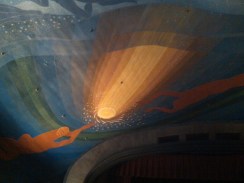
A view of the ceiling at Cape Cinema, on Cape Cod (Photo by J. Kaufman)

In a small way, he has been a part of my life for almost 20 years, dating back to when I first set foot in the Cape Cinema, on Cape Cod. Cape Cinema is an art movie house, whose vaulted ceilings and walls, most incredibly, are dynamically covered by a mural portraying the heavens and its mythological residents. Rockwell designed the mural in 1930. He climbed scaffolding and painted some of the square footage himself, but he was smart (or otherwise occupied) and left most of that heavy lifting to his collaborator Jo Mielziner. Their labors resulted in gorgeous swaths of yellows, oranges, purples and blues. I’ve been to Cape Cinema many times, because my wife and I are Cape Cod lovers and also cinephiles. With each visit there, my connection to Kent, as it is, seems to renew. Is there another movie theater like this in the world? I doubt it.
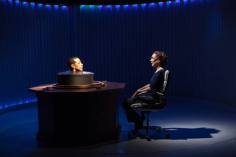
Uncanny Valley, A New Play Performed In A Small Theater (I Like Small Theaters)

An early moment in Uncanny Valley (photo by InterAct Theatre Company)

This past weekend my wife and I went with friends to see a new play, Uncanny Valley, at Philadelphia’s Adrienne Theatre. The Adrienne contains four small performance spaces within its floors. I felt right at home in the ground floor theater where Uncanny Valley was staged, because I like small theaters.

Thomas Gibbons wrote Uncanny Valley. He is playwright-in-residence for InterAct Theatre Company, one of the groups using the Adrienne’s rooms. Gibbons is a talented writer. Some of his plays, such as Permanent Collection and Bee-luther-hatchee, have examined America’s race relations in sharply-focused scenarios. Uncanny Valley finds Gibbons exploring what for him is new subject matter. The play revolves around the high tech lab creation, in the not-too-distant future, of an Artificial Intelligence humanoid who, through training and electronic wizardry, comes to appear, emote and think like actual flesh and blood.

I have a talent for missing points and for not fully grasping situations. I’ve no doubt that this might be true for my understanding of Uncanny Valley. Rightly or wrongly, what I mainly came away with by the end of the play are two notions. First, that devising an AI creature is risky, as unexpected consequences may occur down the line. And second, that some humans don’t want to analyze their emotional shortcomings. I can’t say that any of this broke new ground for me.

Still, I enjoyed Uncanny Valley quite a lot. The actors in this two character play, Frank X as the AI gent and Sally Mercer as an AI programmer, work their roles well. The story unfolds intriguingly and at a well-controlled pace. Gibbons’ dialogue is crisp and usually rings true.

I doubt, though, if I’d have had as good an experience if I had seen the play in a larger theater. InterAct’s theater at the Adrienne seats around 100. Its intimacy can’t but help allow the audience to be drawn in. At the start of the play, Frank X’s character, Julian, seems to be nothing more than a head poking out of a table. Julian’s other body parts haven’t been attached yet. Facing him sits Claire, the programmer. Claire is teaching rudimentary facial movements to Julian, whose training at this point obviously is in its infancy. I sat a mere 20 feet from the stage, a fascinated witness to these early proceedings. From 75 or more feet away, I wouldn’t have felt as involved.

Is a smaller theater always better than a bigger? Generally I’d say yes, especially for dramas and comedies. No question that I tend to opt for the small, where I almost always have a decent or better-than-decent time, despite any deficiencies in acting or script. Being close to the action makes up a good bit for those drawbacks.

At larger places, the experience, at least for me, is more hit or miss. A few years ago I loved the musical Monty Python’s Spamalot at Philadelphia’s very roomy Academy of Music. It seats 2,900. I was at least 100 feet from the actors. So much was happening on stage with a dizzying parade of characters, though, that distance from the stage allowed visual perspective. Plus, the theater crew had the sound balanced well, always a good thing.

Not the case, unfortunately, for In The Heights, a musical my wife and I took in a year or two ago. We saw it at Philadelphia’s Walnut Street Theatre, which claims the title of America’s oldest theater (it began in 1809). The Walnut seats 1,000. We were in the mezzanine, hardly a mile from the stage, but not close enough. That wouldn’t have mattered as much if the sound quality had been good. It wasn’t. The dialogue was hard to make out, despite the actors being mic-ed. The musical numbers were a sonic mess, lyrics usually lost in a high decibel onslaught of instruments. This wasn’t a case of a boomer’s bad hearing. A few people seated near us, and a good bit younger than us, grumbled about the audio too.

Are We Just Boring As We Get Older? Jackson Browne, And I, Say It Ain’t Necessarily So

Jackson Browne       (photo by Craig ONeal)
Jackson Browne (photo by Craig ONeal)

The internet blows my mind. Twenty years ago who’d have believed that almost anything you wanted to know, listen to, or view was only a click or two away? Good thing that’s the case, because otherwise I wouldn’t have revisited David Dye’s recent World Café conversation with Jackson Browne.

I used to listen often to WXPN’s afternoon broadcast of the Café, when I was desk-bound at work in the outskirts of Center City Philadelphia. Great radio show with pretty long tentacles, showcasing music and musicians from hardly the whole world, but a fairly sizeable chunk of the planet. Since leaving that desk and my career in 2009, though, World Café hasn’t been on my radar screen too often. Running errands recently I luckily caught the tail end of the Browne segment on my car radio, and the next day listened to the full episode online. Jackson Browne is one impressive person. Beyond the fact that he’s a wonderful singer and songwriter, and on my list of all-time favorite musicians, he is really smart and perceptive. Clearly, here’s a guy who has given plenty of thought to his life and his place in the world. And musically he is not stuck in the past, a prisoner of the songs he wrote in his younger days. For proof, give a listen to his 2014 album Standing InThe Breach, a top-notch record.

The Browne interview, interspersed with excellent full-band Browne performances recorded last year in Philadelphia, is for all to hear on NPR’s website. In the final minutes of the conversation, David Dye, who is in his 60s, as is Browne, grows wistful and asks Jackson “are we just boring as we get older?” Jackson lets out some handsome chuckles, and then answers point-on. To beat back the ravages of time, he prescribes music, as do I. “As you age,” he says, “you look for ways in which to sustain yourself . . . Music is restorative, the act of doing it, the act of listening to it. Man, it’s good for you. It can really make the difference in how the rest of your life goes, and especially how you feel physically.” To add a few more notes to these ideas, I think that music likewise is good for you at pretty much any stage of your life, from age five or so onward, let’s say. The emotional release that music can produce, the way it unlocks inner doors and allows the sunshine in, are good for just about everyone.

“If you want a good cup of coffee, stay home.”

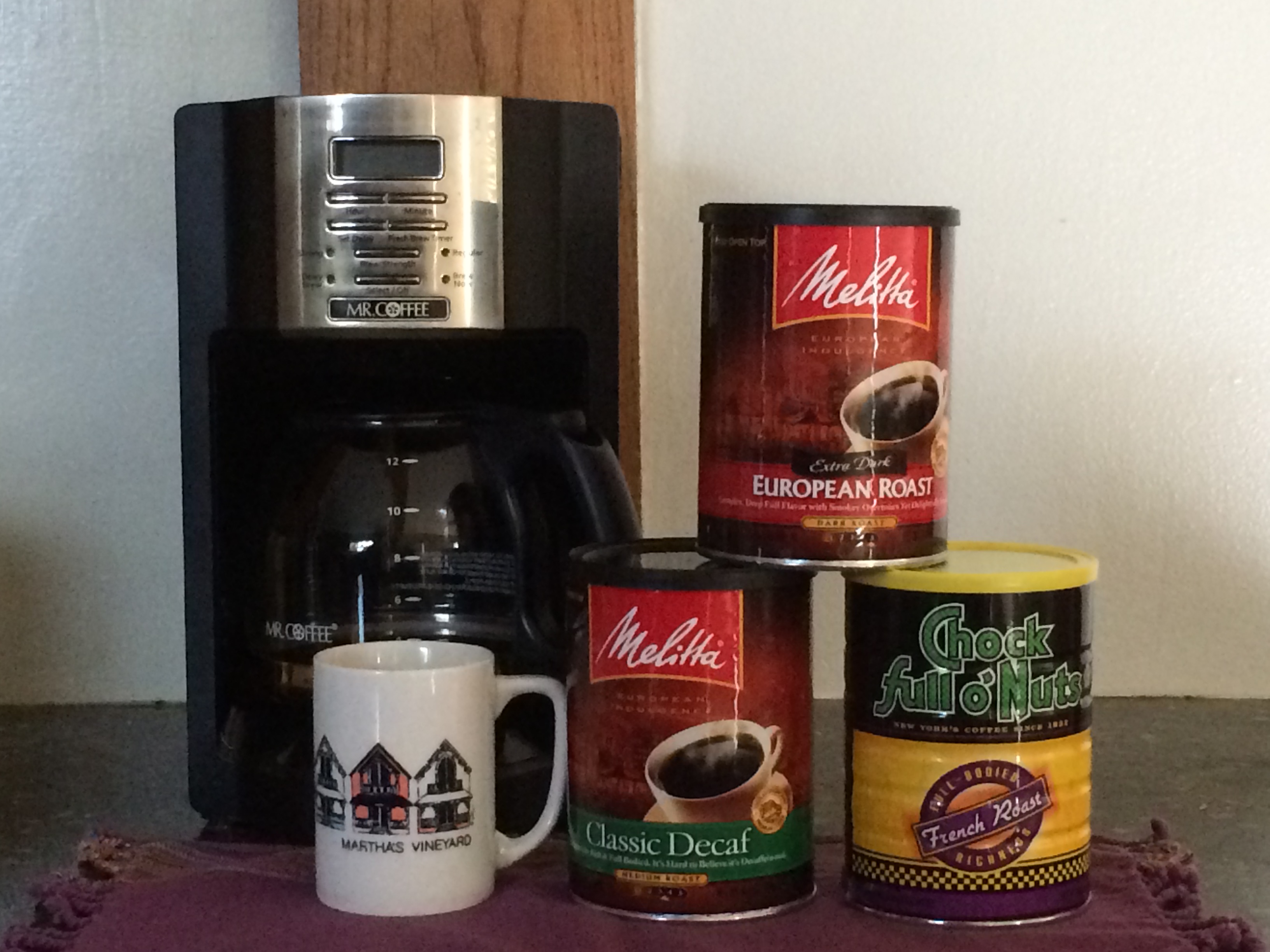
Each morning I combine these three ground coffees.  I don't use an excess of water.  The result is a very good brew.
Each morning I combine these three ground coffees. I don’t use an excess of water. The result is a very good brew.

Returning home from a restaurant where my wife, as expected, had consumed a disappointing cup of coffee to end our dinner, I uttered those words to her for the first time, about eight years ago. Myself, I had eschewed restaurant coffee some years before, having learned that most restaurants serve a timid brew. My wife, though, remained the always hopeful coffee seeker, and still is. I added, not particularly facetiously, that the above quote would be an appropriate inscription, as good as any, on my tombstone. It would give viewers of my grave something to think about, probably along the lines of “Huh? What was that guy all about?”

Coffee is a constant in the lives of half the planet’s population. Mine included. But I became a coffee person only when I reached my early 30s. Growing up, my parents didn’t offer coffee to me, even as I entered my teens, and I didn’t naturally gravitate to the dark brew. It’s not that coffee was absent from our house; my father drank it fairly regularly. My mother stuck to tea. I liked coffee, though, on the one occasion I can recall having it during my youth. That was in 1965 or ’66 in a Brazilian food pavilion at the New York World’s Fair. I was 17 or 18 at the time. I must have felt adventurous ordering a cup there, and I recall thinking that it was delicious. Yet, that fine cup didn’t jumpstart my desire or need for coffee. The habit began years later, when I started ordering a morning java from a food truck that parked outside the office building where I worked, in Philadelphia’s Germantown section.

Fast forward a couple of decades. My wife and I are vacationing in Paris in 1995. Our small hotel serves a modest but pretty perfect breakfast. Good rolls, pastries and fruit, and coffee that stuns us with its vitality. We’d never had coffee like this before. We realized that the coffee we drank in the States, both in and outside our house, was a very poor cousin of this French version. The American coffee revolution, with Starbucks leading the charge, had begun by this time but was in its early stages, and my wife and I were unaware of it. But, soon after returning to the USA, we began brewing strong coffee at home. Since then, we like it no other way.

These days, needless to say, rich coffee is easily found in much of our country. Starbucks outlets are almost everywhere, and independent coffee cafes are aplenty too. But regular restaurants leave me shaking my head, and that’s why I uttered the words that might decorate my tombstone. For accuracy’s sake, though, what I really should have said was: “If you want a good cup of coffee, go to Starbucks or the like, or stay home and brew it yourself. Forget about ordering joe in restaurants.”

But why do so few restaurants, from diners to pricey joints, choose to serve up a robust cup? Why has the coffee revolution bypassed most of them? Wish I knew. Brewing flavorful coffee isn’t too hard. The problem, I’ve come to realize, is simply that not enough ground coffee is used in proportion to water. The result is a weakish drink, even with the finest of beans. Duh, indeed. Hey, restaurateurs — up the bean count!

Dislikers of strong coffee should pay no attention to what I’ve written.

Blast Furnace Blues

Long-idled blast furnaces
Long-idled blast furnaces, the backdrop to Blast Furnace Blues festival in Bethlehem, Pennsylvania

Ah, my first post.  The “About” page notes that the blog will focus on the interests that I’ve loved all of my adult life: Music, movies, food and beverage, art, traveling, theater. That list isn’t exclusive. There is room to expand. For my first post, though, I’ll stick to the list and review a recent musical day in Bethlehem, Pennsylvania.

I’ve been to quite a few places over the years, and there are many more I’d like to visit. On the other hand, there are places I’ve given little thought to, and have no plans to visit. I’ll scratch one of those no-plans places off my list now, though, because not long ago I was in Bethlehem, PA with my wife. Turns out that this small city is a mere 40 miles from where I live. Who knew?

It was a web-surfing spree a few weeks ago that brought Bethlehem from darkness into light. During that spree, Cape Cod lover that I am, I looked over the website of the Cape’s Payomet Performing Arts Center. On it I saw that a musician named Carolyn Wonderland was on the schedule. What a name! No way I’d not check out her website. And there I noticed that Wonderland, a blues/rock troubadour from Texas, would be at Blast Furnace Blues, a three day music festival in Bethlehem. The lineup on the Blast Furnace website looked excellent for the final festival day, March 29. It included Wonderland and Shemekia Copeland, one of the greatest blues singers alive. March 29 arrived, off we went, and we are very glad that we did.

Bethlehem’s main claim to fame was, and likely still is, the Bethlehem Steel Corporation. That company, now defunct, had nationwide facilities. The heart of its operation was in Bethlehem itself, where steel production ended 20 years ago. Parts of the former Bethlehem site are well on their way to looking like Roman ruins. But much of the grounds have been reclaimed. By Sands Casino Resort, for one. And by ArtsQuest Center, a large and spiffy year-round home to concerts, films and such, and to special events like Blast Furnace Blues. Blast Furnace’s organizers gave the festival the correct name. Rusting monolithic blast furnaces that once produced thousands of tons of iron daily are the backdrop to the musicians in the center’s third floor music room. The furnaces are fully visible through huge glass windows.

No acoustic country blues on the Blast Furnace menu. Loud and driving electric blues and rock instead, exactly what the crowd came out to hear. Music roared in two rooms, on separate floors, but my wife and I stuck to the third floor. The schedule there was hard to beat. We took in a lot of music, four acts spread out over six hours. The crowd grew as the afternoon and evening deepened. When Shemekia Copeland hit the stage around 6:30, 400 or more blues-crazed and partying folks filled the room. Now, all four bands were hot, but Shemekia and her mates were the best, as I figured they would be. The only performer on the bill whom I had seen before, I knew her to be fabulous, and once again she was. What a voice.  Pretty incomparable, really. And the four guys backing her up were ferocious, Stones-y as can be at times, deeper than deep in the blues at others. Got to name these gentlemen: Arthur Neilson and Ken Scandlyn on guitars; Kevin Jenkins on bass; the amazing Robin Gould on drums. If you’ve never seen Shemekia and company, do yourself a favor.

Lots of good things to say about the other acts. I’m sometimes not a big fan of white boys singing the blues, but Chris O’Leary, of his namesake band, was authentic. A strong, clean vocal delivery, no cringe-worthy Muddy Waters-like imitations, except his occasional blues growl. I’ll forgive him for that. What’s the blues without some growling, right? O’Leary’s rich mouth harp storytelling, and Pete Kanaris’s searing guitar lines, led the band’s instrumental charge through raw Chicago-style blues, talking blues, and New Orleans syncopations. O’Leary is a veteran of the late Levon Helm’s Barn Burners. Somehow he was new to me. Praise to Blast Furnace Blues for bringing him in.

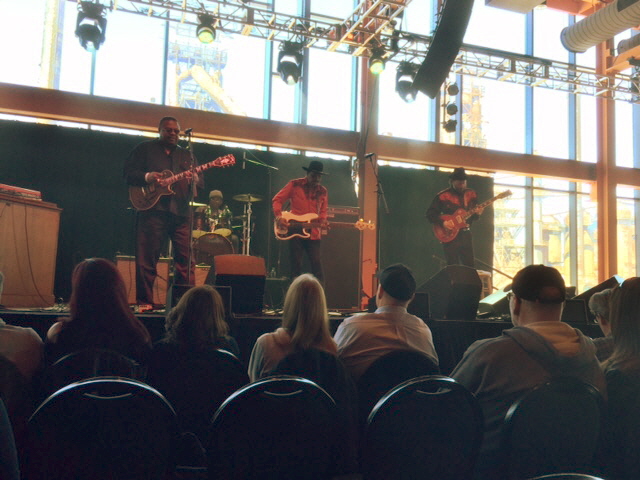
The Freddie King Reunion Band in action

Freddie King, a blues giant on electric guitar and vocally, passed away in 1976. Benny Turner, King’s younger brother, played electric bass guitar with King for many years. All these decades later, Turner decided to celebrate his brother by bringing together other King band alumni, and one red-hot guitarist, Texas Slim, who loves King’s music but never played with him. The Freddie King Reunion Band thus was born a couple of months ago, and Blast Furnace was only its third or fourth appearance. Like Turner said from the bandstand, musically it was as though the guys hadn’t been apart at all in the 39 years since King’s passing. With Benny on bass and most of the lead vocals, these fellas played with power, smoking a repertoire of the down and dirty as if in a bygone and sweaty Chicago blues club.

And what about Carolyn Wonderland, who led me to Bethlehem in the first place? She owns good pipes (like those of a more rugged Bonnie Raitt), writes good songs, and is right at home playing blues, country-tinged rock, and gospel tunes. And she slings a tough guitar. Even in 2015, it’s not common seeing a lady tear into the strings. At Blast Furnace, she and her band gripped the music hard and didn’t let go. The girl’s got it.