A Story And A Song For My Father

As many of us know, Sly Stone left this mortal coil early this month, and two days later Brian Wilson joined him in the Great Rock Band In The Sky. Two superb musical minds, and revered figures, gone, just like that. At least they made it into their 80s. Their passings would have been harder to take had they left us while in their primes.

As the masterminds, respectively, of Sly And The Family Stone and The Beach Boys, Sly and Brian helped turn the 1960s into a music wonderland. During that decade, music was vibrantly alive with love and hope and power and innovation. No decade before or since, to my way of thinking, was or has been as sonically diverse and dynamic. I came of age during the 1960s, becoming, among other things, a music junkie, a description that still fits me, though not to the extent it did back then. Those were the days.

I could go on and on about Sly Stone and Brian Wilson, but I don’t mean to focus on them. The idea to meld them into this story, though, came to me on Sunday, June 19, which was Father’s Day in my nation, the USA. They, and their music, were on my mind, as had been the case for a number of days. My father, of course, was on my mind too. Very much so. Many memories about him played in my head, including music-related ones. I’m sure the latter would not have surfaced had I not been thinking about Sly and Brian.

My dad, Hyman Scheinin, lived to the ripe old age of 96, breathing his last on September 1, 2005. He spent the final six and a half years of his life with me and my wife Sandy, and became a dialysis patient about one year after moving in with us. Dialysis is a hard road for anybody to travel, let alone someone in their 90s. But my father bore the burden pretty well, emotionally and physically. Over time, however, his body began to wear out from the strain of three-times-per-week dialysis sessions, and from infections. He died in a hospital bed, with my wife, my brother Richard and myself beside him. It was a sad day, one I thought about a lot on Father’s Day.

Sandy and I did our best to care for my father, and to try and keep his spirits up. Everyone deserves to experience positive things in life, it goes without saying, so we made it a point to get him out of the house for more than his dialysis sessions and his numerous other medical appointments. He went with us to restaurants and art shows, to name two activities. And I would take him on casual drives, just to see what we would see. He almost always had a good time.

And then there were the Friday night jazz concerts at the Philadelphia Museum Of Art, a series populated by established and up-and-coming musicians from the States and elsewhere. The series ran for about 15 years and ended maybe 10 years ago. Being a jazz head, I miss it. My father attended 19 of those shows with us (Sandy and I also went to shows at the museum without him), and felt completely in his element there, probably to his surprise and certainly to ours. We’d arrive early, so as to be able to grab one of the cocktail tables close to the stage area. Out on the town and in a magnificent setting (the museum’s Great Hall), my father was happy as a clam from the moment he sat down.

Growing up, I didn’t think of my father as a music appreciator. He didn’t listen to songs on the radio, didn’t play albums on the family phonograph. And I had little reason to change my viewpoint until those many decades later. I think, now, that the thrill of just being at the museum concerts opened up my father’s ears, made him hungry to truly experience music. And truly experience it he did. His involvement reached a peak in January 2003 at a performance by the quartet led by the then-new-on-the-scene alto saxophonist Miguel Zenón. Zenón is a wonderful musician, adept at various approaches to jazz. He can play softly and melodically, for instance. And, while soloing, he can be ferocious.

In the middle of the show, following a lengthy and intense Zenón solo, the damndest thing happened. Sandy and I couldn’t believe our eyes when my father leaped from his chair, clapping madly in appreciation of Zenón’s mighty efforts. Normally a mild-mannered sort, he was revealing just how deeply into music he could dive. I was duly impressed. No one at the show was enjoying themselves more than the nonagenarian a few feet away from me and Sandy.

It’s fitting for me to conclude this musical story with the title song from Miguel Zenón’s first album, Looking Forward, because the album came out a mere smattering of months before his appearance at the art museum. Undoubtedly, then, he played tunes from it at the concert. Perhaps this song is the one that made my father applaud like there was no tomorrow. Whether it is or not, I tip my hat to Zenón for having brought joy to my father, and to Sly Stone and Brian Wilson for nudging me to write the words on this page.
A Friends-Centric Story

I’d been vaguely kicking around friends-centric story ideas for a few days when, on Monday of last week, none other than David Schwimmer popped up on my TV screen. He was a guest on The Late Show With Stephen Colbert. Schwimmer, as many people know, was one of the stars of Friends, an immensely popular American sitcom that ran from 1994 to 2004 and whose episodes have been rebroadcast on traditional television channels, and have been available on various streaming services, for years.

Even though I’m almost completely ignorant about Friends, having seen a grand total of maybe six minutes of the show, I took Schwimmer’s appearance to be a forceful cue from the WordPress gods. Who wouldn’t have?  I was not about to give those deities, famed for being short on patience, any opportunities to wreak vengeance upon me. Hence, the following day I lowered my bony ass onto the chair beside my computer and began to peck away in earnest. What follows, then, is all about friends.

Man, if there’s anything I’m sure of, it’s this:  You can’t have too many friends, good ones especially. We’re social creatures, after all. Just about everyone, anyway. We want to feel loved and appreciated. And we need to laugh and shoot the shit and, when necessary, to be comforted and helped. The more close friends we have, the more regularly and satisfactorily those requirements will be met, and the more at ease and comfortable in the world we will be. Of course, having but one good friend absolutely will suffice. The game of life, though, becomes merrier and richer when multiple individuals who meet the good friend description are within our orbits.

I’m fortunate to be able to say I have a pretty nice number of good friends. I can depend on them and they can depend on me. I’m talking about my wife and some other relatives, and a bunch of pals to whom I’m not related but with whom I share mutual love and similar wavelengths. I have nothing whatsoever to complain about.

Still, I worry a bit about my situation. That’s because it has been many, many a moon since I formed any friendships that have gone beyond the casual stage. Much to my amazement, I made several good friends while in my early 60s. Since then, however, not a one. I’m now well past the halfway point of my 70s, and wouldn’t at all mind having at least a couple more people to hang out with, folks whose vibes and interests mesh with mine. But how the hell might I meet them? By striking up conversations with strangers? By enrolling in adult ed classes whose subjects wow me? I suppose so. I sure can’t think of a lot of other ways. The odds, though, are that my circle of friends will not expand. Seeing that we reside in an ever-expanding universe, however, everyone’s circle of friends automatically would follow suit if it were up to me.

Many songs have been written about friends and friendships. I’d like to conclude this contemplation with two of them. You’ve Got A Friend, composed by Carole King, would be an obvious choice. But I’m going to go with others I prefer to the King opus.

In 1968, a very low point in their career, The Beach Boys released Friends, an album as beautiful and calming as a forest pond. It barely made a dent in the record industry’s sales charts. One of the relative few who bought it back then, I quickly fell under its spell. From it, naturally, I’ve chosen to present the title song, a sweet thing in waltz time written by four members of the band (Brian Wilson; Carl Wilson; Dennis Wilson; Al Jardine).

We’re Going To Be Friends (written by Jack White) is my second pick. The tune appears on White Blood Cells, an album thrust into the world in 2001 by The White Stripes, a now-disbanded duo composed of Jack and his then-wife Meg White. Best known as thrashing rockers, The White Stripes had a gentle side too, as We’re Going To Be Friends demonstrates.

For your listening pleasure, here are those two celebrations of human connectivity:

Yeah, Another Beach Boys Article

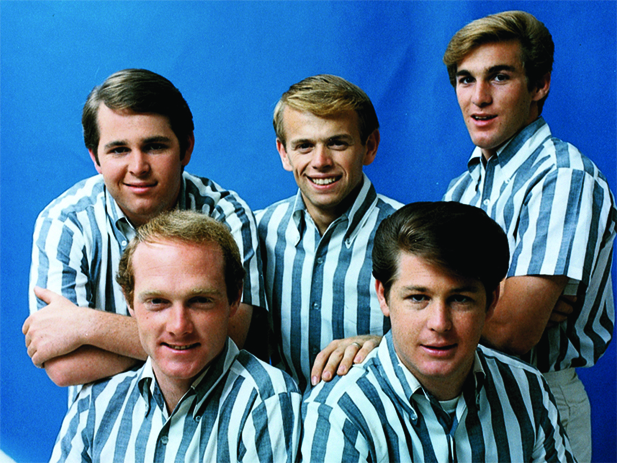
The Beach Boys early in their career. Photo: Capitol Records Photo Archives
The Beach Boys early in their career.
Photo: Capitol Records Photo Archives

Since The Beach Boys broke big on the charts in late 1962, media coverage devoted to them, collectively and individually, has been enormous. And now with the theatrical release of Love And Mercy, a biopic not so much about The Beach Boys as about their once-brightest star, Brian Wilson, the attention has been renewed. At first I was reluctant to add my puny thoughts to all these decades’ worth of Beach Boys coverage. But I’ve maintained a very warm place in my heart for the Boys, and viewing Love And Mercy has inspired me to set my fingers on a keyboard.

The Beach Boys’ history is immensely complicated and convoluted. I’ll summarize what I know fairly briefly: Three of the five original Beach Boys were siblings. From oldest to youngest they were Brian, Carl and Dennis Wilson. Add one cousin, Mike Love, and one pal, Al Jardine, and the recipe is complete. Brian, the band’s leader and creative pulse, was a gifted composer and orchestrator whose talents burgeoned, though for only a few years, as the 1960s progressed.

Teen and twenty-something idols, the Boys knocked out hit after hit right from the start (Surfin’ Safari, Surfin’ USA) through 1966 (Wouldn’t It Be Nice, Good Vibrations). But Brian was a victim of mental and emotional demons that caused him to begin losing his grip in 1967 during sessions for the high concept album Smile. Brian guided the band, and many studio musicians, part of the way through Smile, which was meant to be a celebration of earthly and universal creation. But his troubles brought the work to a sputtering end. Unfinished, the album was shelved. At that point, age 24, Brian’s best musical days were behind him. Though he remained a Beach Boy, his songwriting and studio session contributions to the band soon grew fewer, and his appearances with them on stage over the next several decades were sporadic. The Beach Boys soldiered on nonetheless, churning out many albums and nabbing a few more hit singles. And they toured the world (usually sans Brian) over and over.

As started to become public knowledge in the mid 1960s, Brian’s problems hardly were the only painful situations within The Beach Boys. Their story, beyond the music, is a messy one of endless internal conflicts and legal disputes, drug abuse and, ultimately, death. Very sadly, two Beach Boys passed at youngish ages. Dennis Wilson drowned in 1983 soon after his 39th birthday.  Carl was taken by lung cancer in 1998 when he was 51. Carl many years before had become the band’s chief, taking over from the no-longer-able-to-lead Brian. The band fell apart after Carl’s death.

Hey wait, you say, The Beach Boys are on the road every year, just as always. Well, Mike Love and Bruce Johnston (who had joined the group in 1965) have continued to tour as The Beach Boys. But without any of the Wilson brothers the Love-Johnston unit is hardly the real thing. In 2012, though, Brian (and Al) joined Mike and Bruce for a 50th year reunion tour that went well, only to conclude on a sour note.  Love refused to add additional concerts beyond the tail end of the original schedule and in effect booted out Wilson and Jardine. As usual, fun fun fun might have been the image The Beach Boys wished to project, but reality was a whole different ballgame.

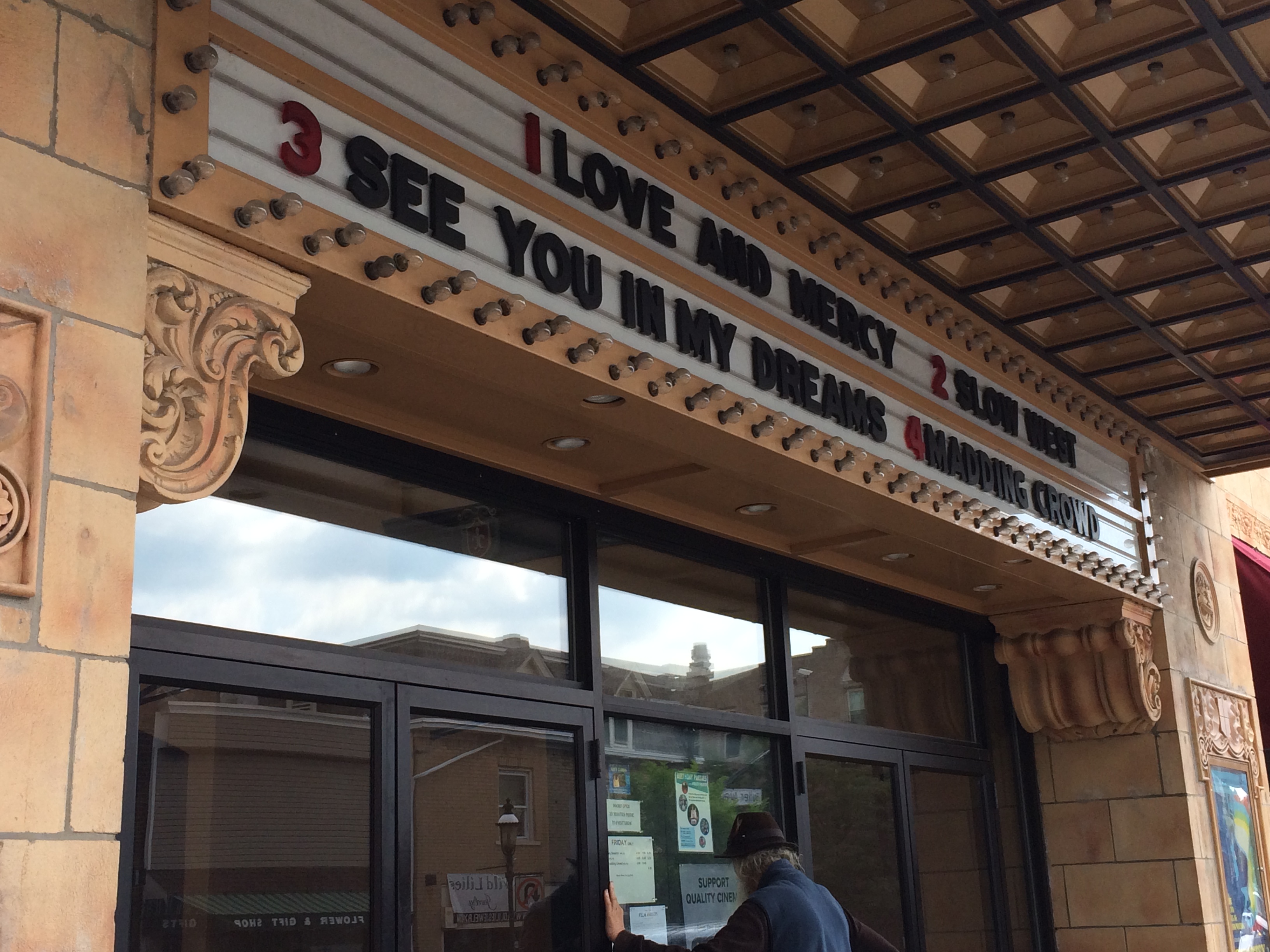
Love And Mercy, playing at the Ambler Theater.

Who, then, in 2015 would have expected the release of Love And Mercy? Not me. At first I didn’t want to see the movie. I’ve read more than enough about The Beach Boys over the years, spent many hundreds of hours listening to their music. No offense to the Boys or their legacy, but my limit, or so I thought, had been reached. Until a friend told me that the movie is really really good. And thus my wife Sandy and I found ourselves on a recent Saturday at our favorite suburban art house, the Ambler Theater. There I learned that my friend was correct. Love And Mercy is really really good. Three and a half out of four stars.

Love And Mercy has the feel of truth. And from what I’ve read, its portrayal of events actually is quite true. The acting by the leads is nuanced and impressive. The script is tight, the direction too. There are a few cardboardy plot and dialog lines here and there. The rest, however, is gold. One need not be a Beach Boys freak to enjoy this movie. Sandy isn’t. She doesn’t know much about their musical history or their problems. She found the movie to be what in fact it is, a powerful drama. She agrees with my rating.

As I’ve mentioned, the movie is only partly a full examination of the Beach Boys. Dennis, Carl and Mike are portrayed a good bit, but they aren’t central to the story, and the actor playing Al Jardine is barely on camera. Love And Mercy largely is the tale of Brian Wilson and Melinda Ledbetter, the lady who loved Brian and brought him back from agony’s door and the clutches of manic psychotherapist Eugene Landy (potently depicted by Paul Giamatti) in the 1980s. The main action takes place in two time periods, 1965 through 1967, and 1985 through 1989 or so. The movie jumps back and forth between those eras. Paul Dano portrays the younger Wilson, John Cusack the older. Both are wonderful, as is Elizabeth Banks as Melinda.

A good number of the movie’s sequences with Dano realistically and clearly show Brian’s studio wizardry. The Cusack sections often touchingly shine a light on the developing romance between Wilson and Melinda, whom Brian met in 1985. I think that to tell any more about Love And Mercy wouldn’t be fair. Putting the movie aside, what to me is quite astonishing is that Brian Wilson is above ground and going strong. He has dealt with abusive forces that no decent person deserves to encounter, and has rebounded from low-as-you-can-go points to a most active musical career. He’s on tour right now. With a lot of courage and strength, and with a lot of help, he has survived.