Which Of These Do You Like Best? (Art On Wheels, Part Sixteen)

In my late 20s, I moved to Philadelphia, Pennsylvania, USA for employment reasons. I knew little about the city when I deposited myself there, but almost immediately developed a fondness for my new home. I liked the very old buildings that heavily populated, and still populate, many neighborhoods. And I liked the city’s parks, museums, music venues, record stores, and movie theaters. Hell, there wasn’t much about Philadelphia I didn’t like. And now, approximately 50 years later, my admiration for The City Of Brotherly Love is on an even higher plane than it was during my newbie days. That’s because, to cite a few factors, its restaurant scene has become world-class, its cultural offerings have expanded, and various parts of town have changed for the better.

I lived in Philadelphia for the first 30 of those 50 years. But then, for reasons we maybe didn’t think through properly, my wife Sandy and I made the “leap” to the burbs.  The burbs are okay, but I sure as shit ain’t in love with them. It’s a good thing that Philadelphia isn’t far away, for I can’t resist its call. I pay the city a visit two to five times each month, chowing down and drinking in taverns and restaurants, taking long walks, attending concerts, going to museums, etc., etc. There’s absolutely no doubt I’ll be a Philly aficionado till the day I no longer qualify for inclusion in the Among The Living category.
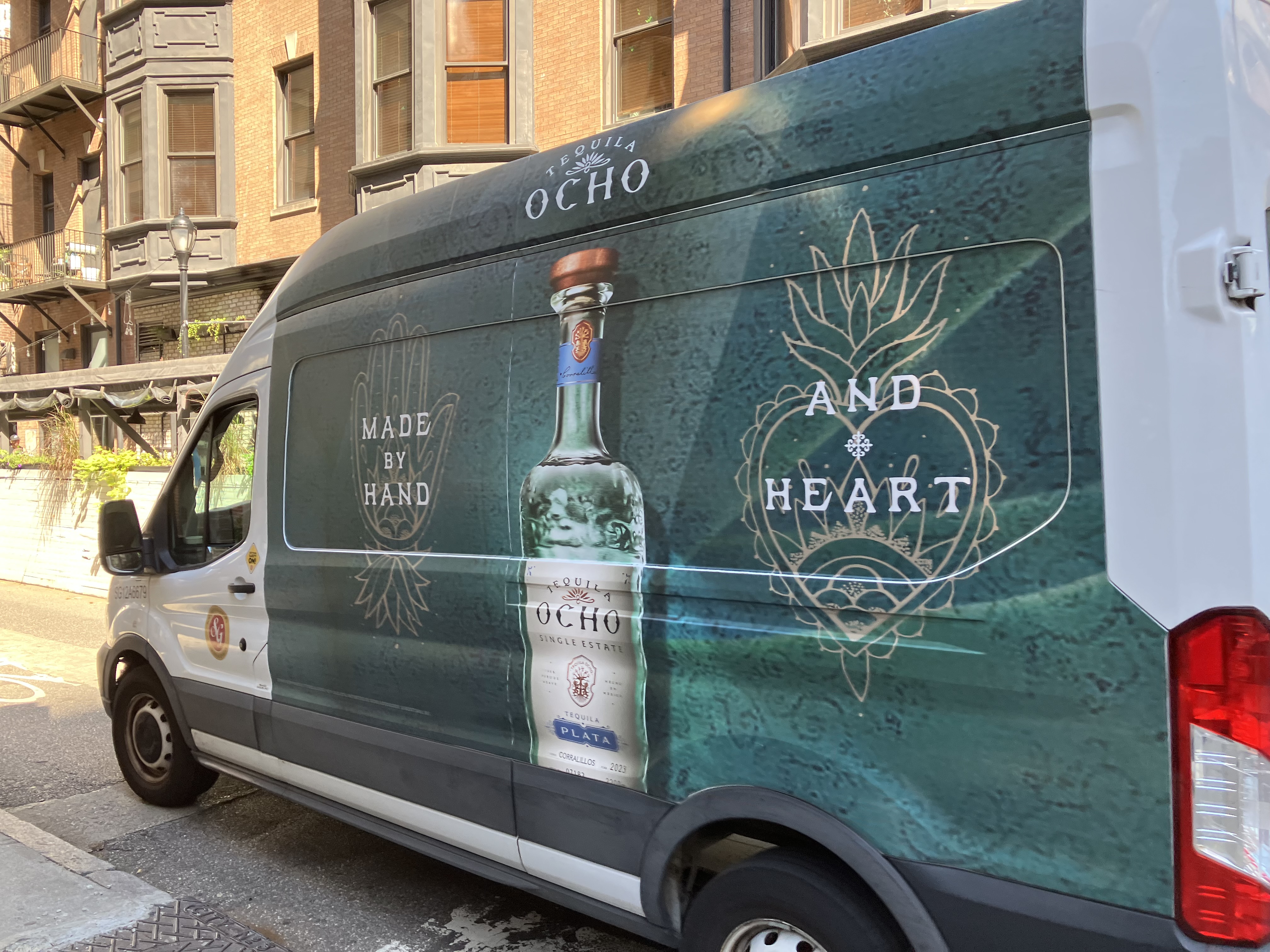
All of the above is a longwinded lead-up to a recounting of one of my recent adventures in the city I know better than any other. That activity took place two Fridays ago, a day that boasted clear skies and reasonable temperatures. I arrived in downtown Philadelphia in late morning, via the train I’d boarded in my little town. I was in the city to search for and photograph excellently decorated trucks, vans, buses, and other objects mounted on wheels. (“Huh? You were there to do what? Neil, you truly are a f*cking oddball,” I just heard one of this publication’s readers mutter. Oh yeah? Well, I’ll let that possibly inaccurate remark slide.) And so, after emerging from the train station I spent two and a half hours pounding the pavement in central and near-to-central sections of the city. And I met with good success, the result of which is the story you’re now reading. Namely, the sixteenth installment of Art On Wheels, a series I began eight years ago.

On the day in question, I snapped portraits of 18 wheeled objects, which very well might be my personal high. Following post-trek examinations of the photographs, I’ve selected six specimens that ring my bell loudly. I’d have included a certain Philadelphia tour bus and a certain food-supply truck among the six were it not for the fact that, as I later discovered, their images appear in previous editions of Art On Wheels. My half dozen choices are displayed on this page.

Which of them do you like best? My two favorites are the halal food cart and the Windstar bus. The food cart is an eye-popper, no? So many colors. Such vibrancy. I spotted it at the corner of 9th and Chestnut Streets, three blocks west of Philadelphia’s famed and historic Independence Hall. If I’d had any sense, I would have placed an order at the cart. I’m sure its offerings are delicious.

As I snapped its picture, the Windstar bus (Windstar is a charter bus company) was turning from Chestnut Street, where a few seconds earlier it had glided past Independence Hall, onto Fifth Street. I liked its artwork but wasn’t knocked out by it. However, when examining the Windstar photo on subsequent days, I found myself increasingly admiring the simplicity of the vehicle’s painted design and the way the undulating red and blue lines seem to imply that fun-filled, free-flowing times lie ahead. Windstar, I now am under your spell. I award you my top vote.

Well, folks, that’s a wrap. Thanks for reading this opus. Let me remind you to mind your Ps and Qs. And please don’t let the bed bugs bite. Till next time!
A Trip To Fallingwater

I’ve done a fair amount of traveling during the 69 years I’ve taken up space on Planet Earth. Been to Asia (Nepal). And to the Middle East (Israel). And to North Africa (Egypt). And to various countries in Europe any number of times. And I’ve been here and there in the States and Canada. How about Pennsylvania, then, the state I’ve lived in since my late 20s? Well, I’m nicely familiar with its greater Philadelphia region, which is my home territory, but outside of that orb I haven’t ventured all too much. And in the last couple of years I’ve been thinking about what I may have been missing. A trip to Ohio via the Pennsylvania Turnpike that my wife Sandy and I made a few weeks ago drove the point home pretty decisively. “Wow, look at all these mountains and farms. Who knew?” I said to Sandy more than once during that westward journey. “It’s time to explore Pennsylvania. Let’s do plenty of that before the sands of time run out on us.” Those weren’t my exact words, but they are close enough.

Smartly, we had already planned a day and a half of discovery in the Keystone State. On the way back from Ohio (you can read about the Ohio visit by clicking here) we drove to Uniontown, a less-than-flourishing community nestled in southwestern Pennsylvania, where we had booked a hotel room. The following day, Monday, would be our visit to Fallingwater, a Frank Lloyd Wright-designed home that has become a tourist destination. Neither Sandy nor I had ever been in southwestern Pennsylvania before.

To be honest, I feel a little guilty writing about Fallingwater. It’s not as if the world needs any more mentions of the place, as the 2,400,000+ Google results for Fallingwater obviously prove. But what’s a blogger to do? I considered typing an opus about what I ate for breakfast this morning (strong coffee, and Wheaties with blueberries), but opted instead for Wright’s creation. Nobody wants to read about my breakfast, not even me, no matter how delicious it was. Fallingwater it is.

To summarize Fallingwater’s history: Edgar Kaufmann, a department store magnate who lived in Pittsburgh with his wife Lillian and son Edgar Jr., commissioned the famed architect Frank Lloyd Wright to build a weekend/vacation home for the family. The house was to be set within the enormous, heavily-forested swath of land that the Kaufmanns owned in the Allegheny Mountains. That plot was (and is) about 50 miles from Pittsburgh. Wright completed his design in 1935. Two years later the house was in place, and two years after that a guest house, uphill from the main residence and connected to it by a short cement span, went up. In 1963, some years after the death of his parents, Junior donated Fallingwater and the family’s mountain acreage to the Western Pennsylvania Conservancy, a land and water protection organization. The Conservancy opened the buildings and grounds to the public in 1964, and before long Fallingwater caught on. Really caught on. To date, upwards of 5,000,000 visitors have toured the facilities. For a place that some might describe as being in the middle of nowhere, that’s genuinely impressive.

Photo by Sandra Cherrey Scheinin

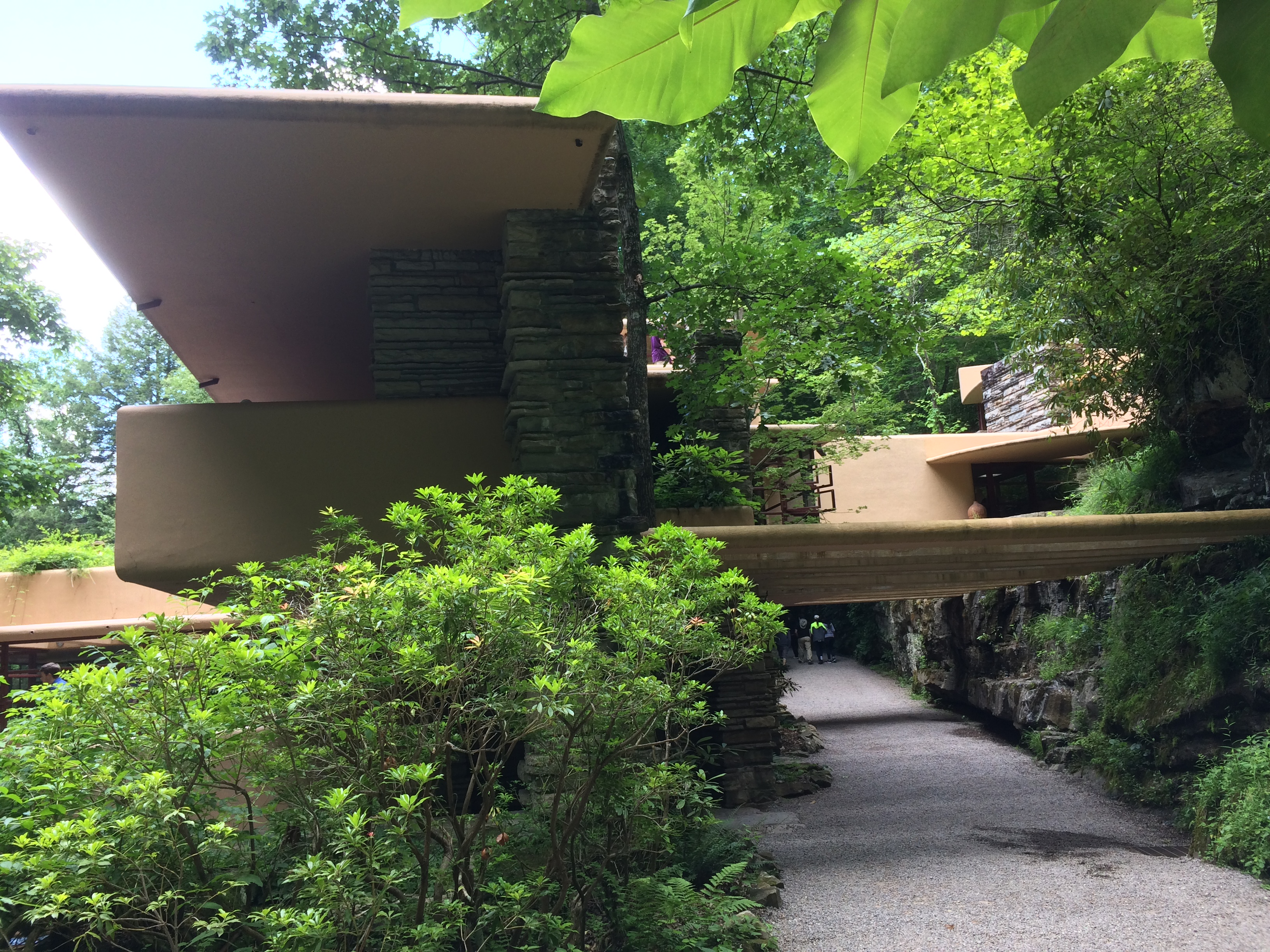
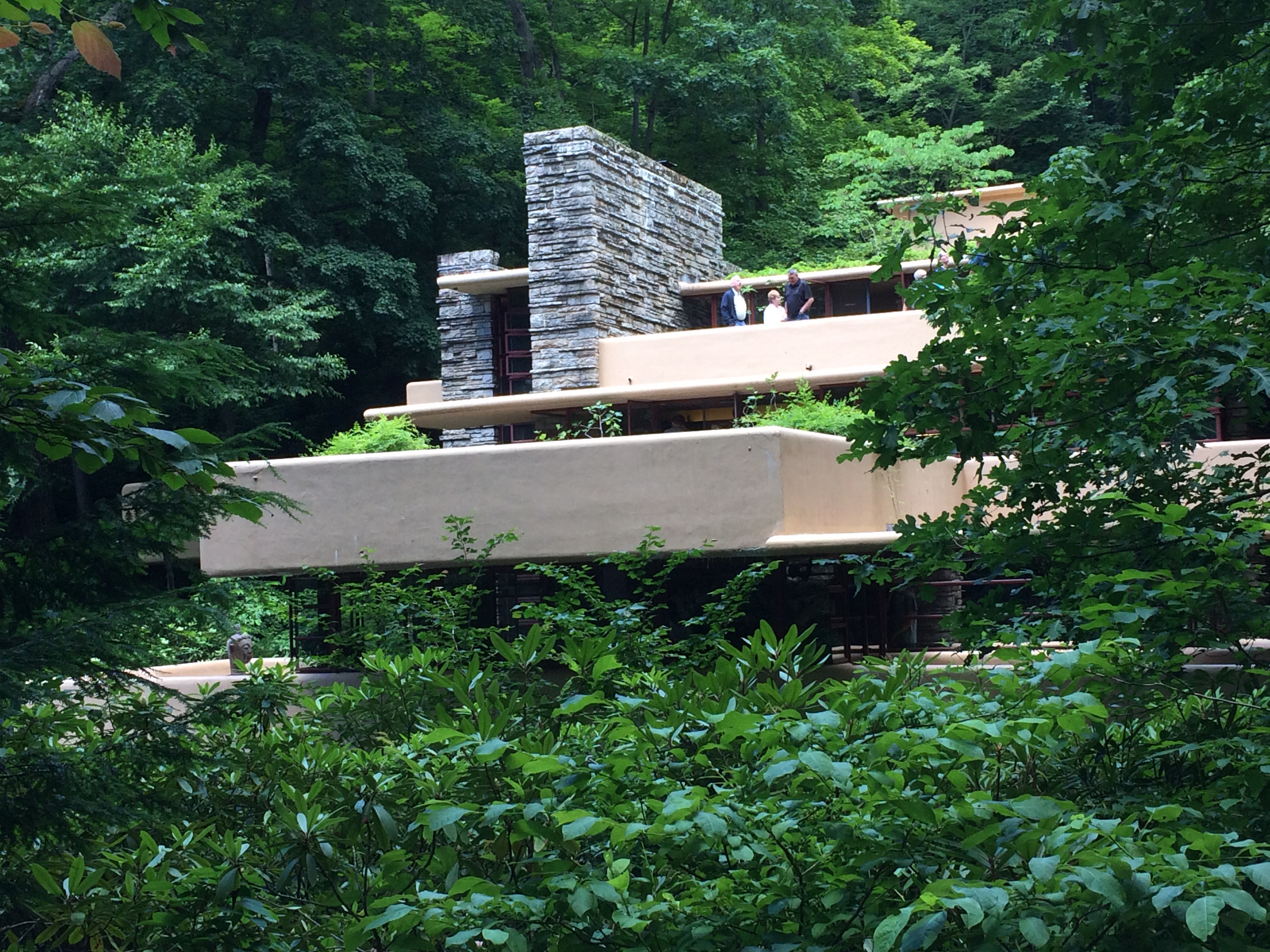
And here’s why they keep on coming: Fallingwater’s exterior looks better than just about any house that you’ll ever see. It is sleek, lovingly tiered, rustically handsome and highly imaginatively laid out. And the house’s placement is, as they say, unparalleled. It is built atop and alongside boulders, a few of which poke out into the living spaces. And, rather incredibly, it is perched above a descending stream at the point where the waters – you guessed it – fall over rocks. A waterfall! A modest waterall, to be sure, but beautiful nonetheless. Fallingwater, a looker in an admirable, peaceful way, communes righteously with the natural environment that surrounds it. Harmony definitely prevails.

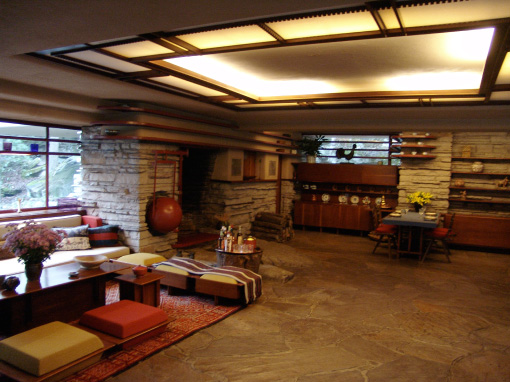
After breakfast on Monday, Sandy and I jumped into our car and drove the 25 miles, half of them along winding country roads, that separate Uniontown from Fallingwater. Our tour, scheduled for 11:00 AM, began on time. Twenty or so folks were in our tour group. The guide, alas, informed us that photography wouldn’t be allowed within the house. Nor would touching of the objects. Bummer. The interior shots I’ve included in this humble essay, therefore, are photos that I’ve snatched off the Internet. By the way, Fallingwater’s room arrangements and furnishings have been left pretty much as they were when Junior turned over the keys to the Western Pennsylvania Conservancy.

Photo by Jeffrey Neal

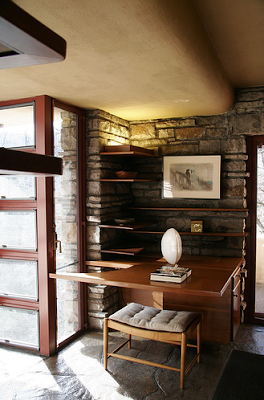
Most of the tour took place inside, as opposed to outside, Fallingwater. My memory being duller than a butter knife, let me pass on a few recollections before they fade into oblivion. First, I dug Wright’s color scheme. Earth tones predominate. They make for a calming, comforting experience, which without doubt was his intention. And I was surprised to learn that Wright designed not only Fallingwater’s structure, but many of its objects – desks, cabinets, chairs and tables. And they are beautiful. The guy was something else. Was there anything he couldn’t do? Well, he couldn’t walk on the waters of the stream flowing beneath the house, right? Or maybe he could.

Photo by Brad Ford

I noticed a couple of broad wooden desks, wedged into corners, that have portions of their tops neatly cut away so as to allow windows to swing open. Brilliant idea! And I spent some time in Junior’s bedroom looking over the smallish but swell collection of books on his shelves. They reflect an open and bright mind. Among them are the 10-volume set of The World’s Best Essays, a long-forgotten collection published in 1900. I’d have loved to pull out one or two of the volumes to take a look at the wisdom contained therein. But that wouldn’t have been a wise move, as the tour guide might have dragged me off the premises by the few strands of hair remaining on my head had I attempted to satisfy my innocent desire.

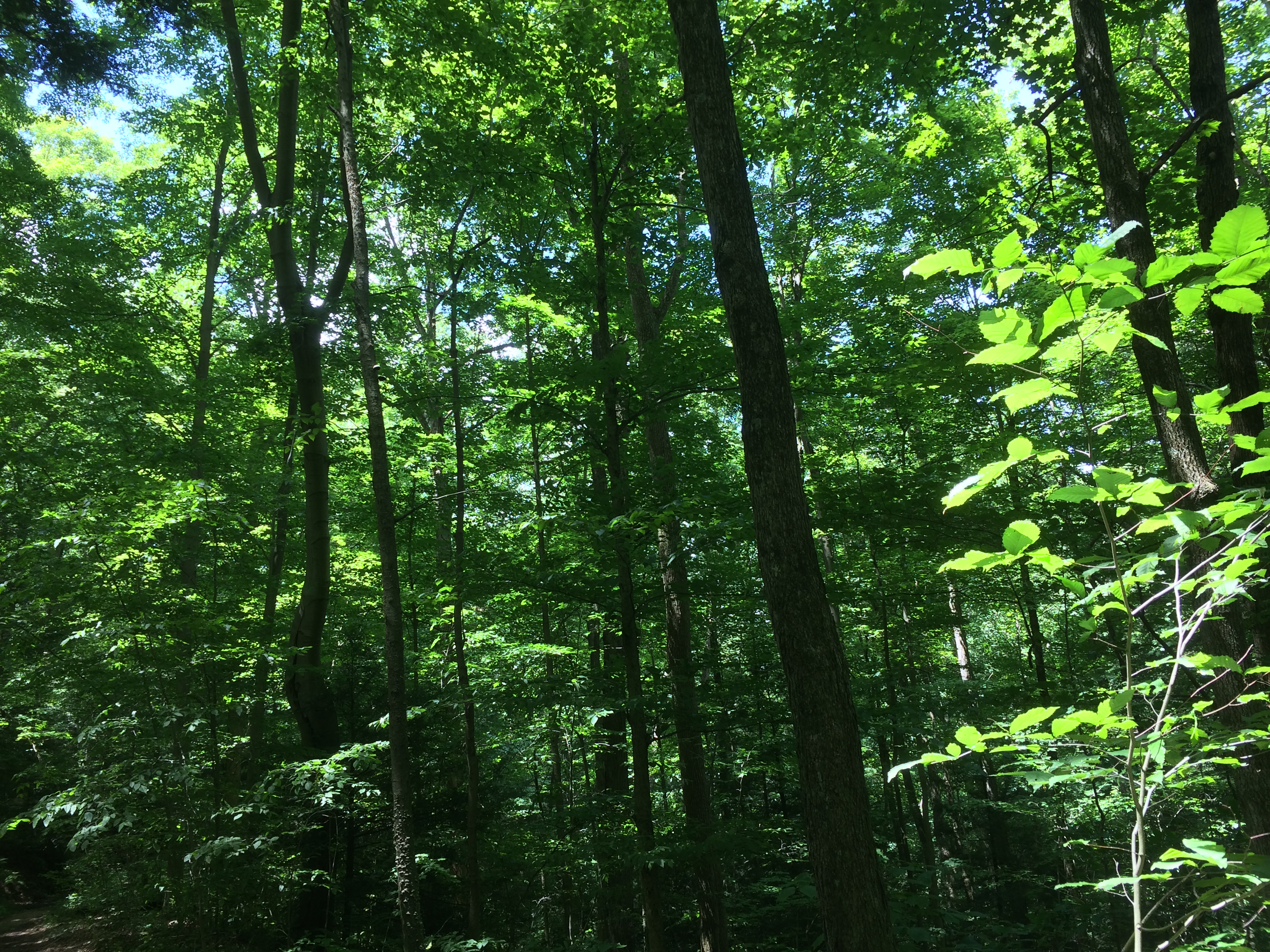
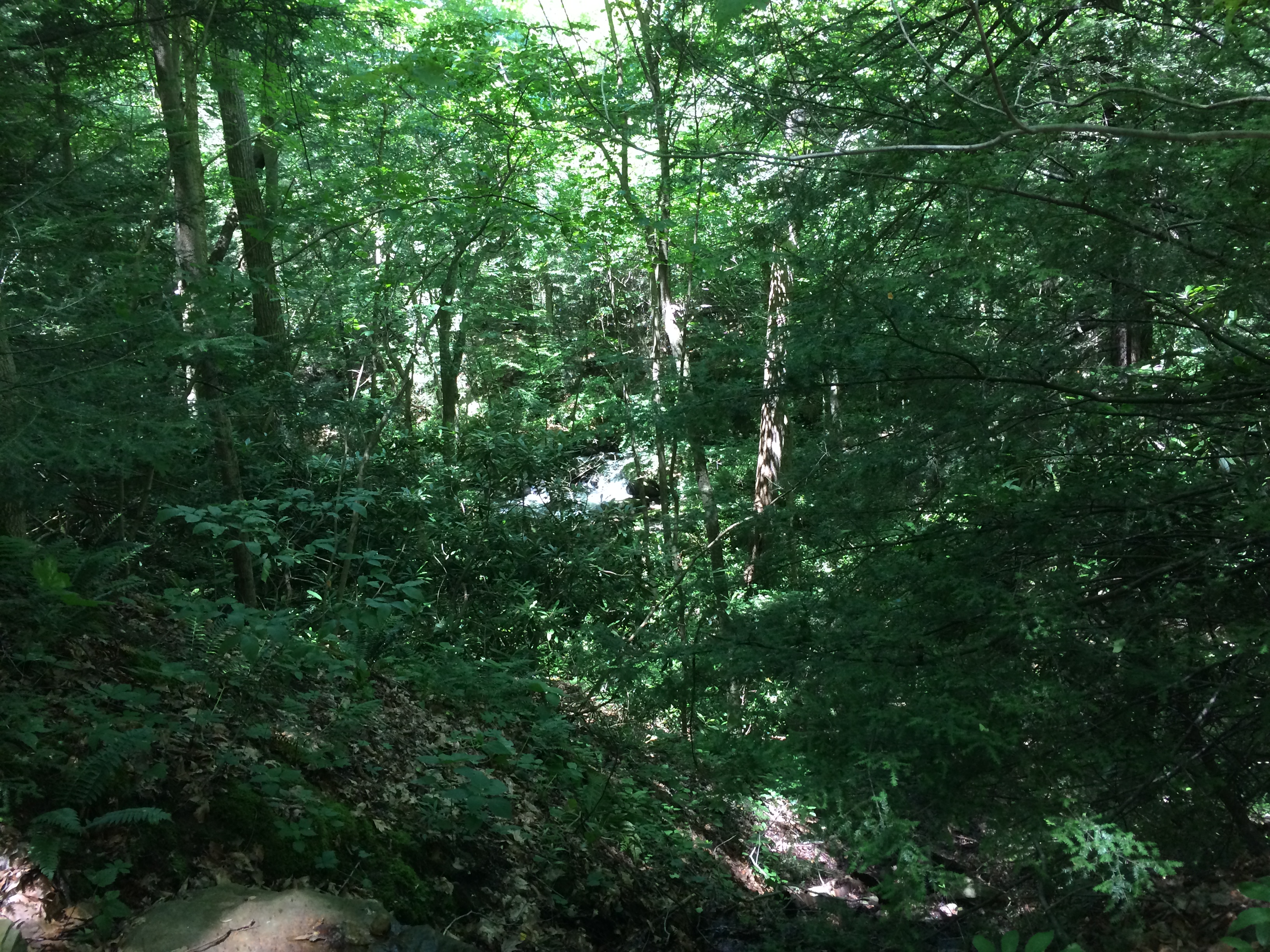
The one-hour tour over, Sandy and I headed down a trail that paralleled the stream and led into deep forest country. Rhododendron bushes grew in numbers you’re unlikely to see elsewhere. Oak and maple trees flourished, as did a variety of evergreens. It felt good to get lost, metaphorically, in the woods for a while. Take more forest walks is something I’ve added to my to-do-soon list. Forests don’t exist in my paved-over home area, but a few are within reasonable driving distance.

The next morning we drove home, southwestern Pennsylvania before long disappearing from our rear view mirror. Now, I’m not going to say that this rural region of Pennsylvania is a must-see destination. For those who groove on mountain hiking or fishing or rafting, it’s absolutely A-OK. For those not of that persuasion but who are passing through the area or taking in the sights in Pittsburgh, here’s the thing: You could do a lot worse than make the drive to Fallingwater. Sandy and I agree that Fallingwater made our trip worthwhile. The place is a beaut.

(Don’t be shy about adding your comments or about sharing this article on social media)

(If you click on any photo, a larger image will open in a separate window)