Beer Here!

I’m not much of a shopper these days. I don’t spend a lot of time in most stores. A huge indoor mall is near my home, but I rarely go. My visit there recently, a fruitless search for a pair of humble bedroom slippers, was my first in several months. Supermarkets, though, are another story. They are where I head to  indulge what’s left of my urge to buy. I look forward to visiting them, not only to purchase the items that my wife and I inscribe on our refrigerator notepad, but also to check out the remarkable amounts and varieties of just about anything you can name that Americans are able to choose from. There are two supermarkets not far from my house that I especially like to visit, though not to buy food. I go to these stores, Wegman’s and Weis, to ogle (and buy) beers.

In my pre-beer days as a kid in Brooklyn and then Long Island years ago, I wasn’t too big on shopping either. But I did like to spend plenty of time in candy stores. Candy stores were modest establishments that sold a wide variety of items, and usually included a soda fountain and lunch counter. Adults might pop in for cigarettes or greeting cards or a grilled cheese sandwich. The younger set primarily was interested in candy bars and other important stuff like comic books and yo-yos. At candy stores I used to gaze at the colorful rows and rows of teeth-destroyers before making a pick. PayDay, Mr. Goodbar, Chunky, Milky Way, Chuckles and on and on. What a choice. What a decision. What a pleasure. Candy stores linger fondly in my memory bank, but probably all are long gone. I haven’t seen any in decades.

For the last three or so years great pleasure has been mine at Wegman’s and Weis, whose beer aisles are my adult candy store. Wegman’s and Weis are among the few supermarkets in my area near Philadelphia that sell beer. I guess I’m lucky to have them, because it’s not easy for Pennsylvania supermarkets to sell suds. Only a few years ago, Pennsylvania’s State Liquor Control Board, the alcohol overlord, opened the door a crack to supermarkets willing to jump through hoops to obtain a license. So far not many supermarkets have chosen to deal with the process. Pennsylvania has gained fame for its archaic and labyrinthine rules governing the sale of alcohol. Possibly a Talmudic scholar would be able to understand them.

A beer rack at my local Weis supermarket. What's not to love?
A beer rack at my local Weis supermarket. What’s not to love?

In any case, my eyes widen and my heart flutters when I enter the beer section at my local Wegman’s or Weis. Loyal supporters of the microbrew revolution, these stores specialize in the types of beers that I swoon over. Hoppy ones and dark ones and spicy ones, for example. I love nearly all of them, as long as they are loaded with flavor. To me, the craft beer explosion in our fair country is one of the greatest and most positive developments of the past 20 years.

The thrills that rock me in the beer aisles are not very different from my younger self’s thrills in candy stores. Basically, eagerness to ingest the products and giddiness from staring at terrific looking packaging. Yes, not only do most microbrews taste really good, as with candy bars they also are well-dressed. In fact, beer labels are way cooler than candy wrappers ever were.

The six beers that I brought home from Weis.

My aim during my visit to Weis last week was to assemble a create-your-own six pack mostly of beers that I hadn’t had before, and I know that in a few instances my right hand was stealthily guided towards bottles whose labels were too pretty or funky to ignore. I headed home with winners, taste-wise and label-wise, such as Victory Brewing’s Summer Ale and  Left Hand Brewing’s Sawtooth Ale. The photo to the left shows all six purchases (click on the photo to get a bigger image). Dig those crazy labels (excepting the one on Flying Fish’s offering).

More about beer as this blog progresses. Till then, drink in moderation and drive safely.

Raul Malo Alone On Stage

New Hope Winery. The concert took place inside the Event Center.

I don’t much enjoy the artsy and touristy central section of New Hope, Pennsylvania. Haven’t been there in several years. The crowds, the traffic, the bad news parking situation. Who needs it?  But I have been to New Hope’s fringes a bunch of times last year and this year, as I mentioned in my article about Kim Richey. The New Hope Winery lies a couple of miles south of the “I’m not going there” zone, and that’s where my wife Sandy and I have become semi-regulars.

Pre-showtime.
Before showtime.

Behind the winery’s gift shop is a roomy building dubbed the Event Center. On its small stage the winery presents a nice variety of musicians year-round. On Thursday evening, June 18, Raul Malo, lead singer of The Mavericks, stepped into the spotlight. Malo is on tour with The Mavericks but took a short solo side trip to New Hope, where he had played the previous evening too. The next day he’d be back rocking and rolling with his band in Rochester, New York. But in New Hope the audience got a full dose of his contemplative side. He picked up his acoustic guitar at 8:10 PM, and for the next 100 minutes had the audience, me and Sandy included, in the palms of his hands.

Raul Malo has been a pretty big name for the last 25 years. His voice is the reason why. It’s a rich tenor, wide-ranging, and moves nimbly in upper registers where others may fear to tread. In New Hope Malo brought the volume and assured passion at appropriate times, but largely kept things reined in. The point is that he has wonderful vocal taste and great control. His singing is a thing of beauty.

Raul Malo in action.

I’d seen Raul on television, heard him perform on the radio, but New Hope was my first live visitation with him. He sang 17 songs, ten of which he wrote or co-wrote. I was smitten from the git go, but in a million years wouldn’t have guessed his choice for show opener. Picking his guitar slowly and easily, he quietly sang not one of his own numbers, but Summer Wind, the tune made famous by Frank Sinatra in 1966. Raul did the song proud.

Summer Wind is a lament about lost love. All 16 songs that followed, self-penned and not, also were about love in one way or another. Love in bloom, love desired, love remembered. Raul covered all bases. I never thought I’d hear a version of Harvest Moon, a gorgeous and pure love song, to rival that of its author, Neil Young. But Raul came close, singing with restrained emotion, hitting the high notes with clarity. He did excellent work on his own Born To Be Blue, and Lucky One, the Roy Orbison-like operatic qualities of his voice emerging on those two numbers.

The most stunning moments arrived late in the show. (Call Me) When You Get To Heaven gave me goose bumps. Raul wrote this song for The Mavericks’ In Time album. From my seat 15 feet from stage left, I took it as a song about a breakup, a relationship not meant to succeed on planet Earth but destined to flower in a better place, maybe one of the mind. Raul sang slowly, mournfully. He drew out the song for many minutes. When introducing the tune, he had asked the audience to join in towards the end. They did. And that’s where the goose bumps came in. Though surely some males were part of the choir, somehow I heard only female tones. As Raul fingered the refrain’s chords over and over, angelic sweet voices rose throughout the room. Call me when you get to heaven . . . Call me when you get to heaven. It was just so beautiful.

Raul Malo from a different angle.

During that number I realized who Raul reminds me of. José Feliciano. Like Feliciano, Malo possesses both fervor and quiet strength, and the ability to be in-the-moment. None of this was lost on the near-capacity crowd seated at the room’s red tablecloth-covered cocktail tables. They went wild with claps and yells between songs. But when Raul sang, they were seriously silent and attentive. Raul loved them back. Happy, laughing and joking around during the interludes, he especially made the night for a lady celebrating her birthday at the show. She was a super fan, it turns out, saying that this was the 80th time she had seen Raul perform. To honor her, he sang Can’t Help Falling In Love, the Elvis hit from 1961. And then he threw out two of his best and funniest lines of the evening. I hadn’t planned to use any profanity in this blog, though I curse aplenty in my non-blogging life. But I’m going to repeat verbatim what Raul Malo said after the final guitar strums of Can’t Help faded away. “That ought to buy me some karma points. Now I can go back to being a shit.”

A worthy side note about choice. The night that Sandy and I were in Malo pastures, two other splendid musical events were available not far away in the Philadelphia suburbs: The Richard Thompson Electric Trio and Graham Parker And The Rumour, great bands that must have brought down their respective houses. For discriminating music fans of any age, June 18 presented one of those uncommon convergences when deciding where to pay one’s money was a tough call.

The Day My Father Went Eye To Eye With Van Gogh

My father came to live with me and my wife Sandy in Philadelphia soon after his 90th birthday, in 1999. He had been living alone on Long Island, but health issues necessitated his relocation. Good doctoring in the Philadelphia suburbs improved his physical condition quickly, but there was no cure for the declining state of his kidneys. He became a dialysis patient one year after he moved in with us, and he remained on dialysis till his death in 2005 at age 96.

My father was in pretty good shape until the final nine or so months of his life. He loved getting out of the house and joining Sandy and me and others at restaurants, concerts, museums, you name it. On this Father’s Day I’ll relate one incident that I look back on fondly. It was the day that he and I and my brother had a private viewing of a rarely-seen Van Gogh oil painting at the Philadelphia Museum Of Art.

There are several purported photographs of Vincent van Gogh. None are totally authenticated. This is believed to be from about 1886.
There are several known photographs of Vincent van Gogh, though they are not fully authenticated. This photo is believed to be from about 1886.

Vincent van Gogh is one of my two favorite artists. The other is Paul Cézanne. I never can decide which of the two I like best. For wordsmanship, however, I go with Vincent. In spring 2001 I read all 800+ of his mesmerizing letters, in their English translation. My father got a kick from this. He told people that I was becoming a Van Gogh expert, which was hardly the case. But my semi-obsession with Van Gogh was rock solid, and it is here that the story really begins.

One day in January 2002 I poked around some Van Gogh websites and discovered that the Philadelphia Museum Of Art, which Sandy and my father and I frequented, owned five Van Gogh oils. Yet, I had never seen more than four of them on display there. The painting that I wasn’t familiar with was Still Life With A Bouquet Of Daisies. Most experts believe that Vincent painted it in summer 1886, a few months after he moved to Paris to live with his brother Theo and to contemplate the new techniques and perspectives, most notably those of Impressionism, that had been invigorating the French art scene. Why wasn’t the painting on display? I needed to know.

A few days later, from my desk at work, I dialed the museum and got connected to an assistant curator. I asked about the mystery painting. She told me that the museum did occasionally bring it from storage to the public galleries, but that it had been a long time since that had happened. We chatted a little and then I said thanks and was about to hang up. But before I could the curator asked “Would you like to see it?” Huh? Huh? I couldn’t believe my ears. Yes ma’am, I would.

My father was about to turn 93, on January 19, 2002. A few days before that, to help our dad celebrate his birthday, my brother Richard planned to fly to Philadelphia from his California home. I explained this to the curator and asked her if my brother and father could come along with me (Sandy, chained to her job, wasn’t free to get mid-day time off from work). Sure, she said. Fairly stunned, I set the date for Friday January 18, a non-dialysis day. I knew that something special had just occurred.

The momentous day arrived. We drove to the museum and were met in the west wing by the curator. She was a lively and lovely person and probably was getting as big a charge out of the situation as anyone. Down an elevator we all went to one level of the museum’s cavernous underbelly. We followed our hostess along a long corridor, walking past many locked rooms. At our consecrated storage area she unlocked the door and we entered. Perpendicular to one of the room’s sides were very large moveable display panels. All of them were in their retracted positions. The curator pulled out one of the panels, both sides of which were covered with paintings, maybe 20 per side. I noticed a Chagall on the side facing us. Can’t recall what else. Except of course for a work near the left edge on the top row. The Van Gogh.

Still Life With A Bouquet Of Daisies. Philadelphia Museum Of Art
Still Life With A Bouquet Of Daisies.
Copyright Philadelphia Museum Of Art

It was show time. The curator wheeled over a tall moveable step ladder. Richie and I went up first. What did I make of Vincent’s oil? Well, Still Life With A Bouquet Of Daisies doesn’t have the brilliant color schemes that Vincent was developing in Paris. It is dark, with lots of deepened greens. Maybe that’s why the museum doesn’t bring it out of storage too often. But they should. With Vincent, there’s always something to admire. I took in his trademark broad brush strokes, the intense tangles of flower stems. The greens upon greens.

Richie and I and our benefactor were excited and happy for my father when his turn came. My dad was excited and happy too, a muted gleeful smile on his face, his eyes on alert. I’m sure he knew how lucky he was to do what he was about to do. Holding the ladder rails carefully, up he climbed. Admirable mobility for a guy one day away from the big 93. He gazed at the painting for a good long spell, longer I think than my brother or I had. He spouted words of admiration. He was having a ball. Finally he came back down. Thank you, thank you, thank you we said to the wonderful curator.

Over the following years, my father and brother and I talked about our museum visit many times among ourselves and with friends and relatives. Always with a grin. Always feeling a tingle. And so, I dedicate this Father’s Day essay to Hyman Scheinin, he whom I’m sure is the only nonagenarian ever to climb a step ladder to go eye to eye with Van Gogh.

John Gorka Brings Love To The Philly Burbs

The audience, before twilight set in, at Bryn Mawr Twilight Concerts.

I’m always on the lookout for live music. My musical tastes are wide, so my antenna is open for jazz, rock, Celtic, classical  . . . the list keeps going. One series I keep tabs on is Bryn Mawr Twilight Concerts, held on mid-year Saturday evenings at a park in the center of Bryn Mawr, Pennsylvania, a handful of miles west of Philadelphia. This series brings in some rock and R&B bands, but primarily sticks to acoustic folkie singer-songwriter types, most of the latter well known in that genre’s circles. The musicians set up shop in the park’s large gazebo. I had noticed a few weeks ago that the series opener on June 6 would be John Gorka, a singer-songwriter road warrior with over 30 years’ worth of original material to draw from. On Gorka Day, I checked the Bryn Mawr weather forecast. It emphasized a zero chance of rain. Bryn Mawr here we come. As the sun began approaching the horizon, my wife Sandy and I plunked ourselves down in our folding chairs, joining about 200 others at the park, and settled in for what we expected would be a night of good music. The skies were filled with friendly clouds, the air cool and dry. Hardly a better place to be.

I’ve been familiar with John Gorka for many years, but had seen him in person only once. That was about six years ago at the Philadelphia Folk Festival, where he was part of a round-robin song swap with other musicians on a small stage. I knew his backstory a bit, how he had honed his craft at the legendary Godfrey Daniels folk music club in Bethlehem, PA, and how his career began to take off around the time his first album, I Know, came out in 1987. Since then, he has logged too many miles to count in North America and overseas. The Bryn Mawr show probably was somewhere around the 3,000th concert performance of his career. During that career, Gorka has tended to take the solo route — Have Guitar, Will Travel — but on this refreshing Bryn Mawr night he brought along a friend.

Music critics often note the fine quality of Gorka’s baritone. That’s true. His voice is deep and burnished, but he doesn’t go for extra volume. Soothing and comforting are words I’d use to describe his singing.  He’s like a lower register version of James Taylor. Between songs he is funny and somewhat jittery, slyly putting himself down and reminding me a bit of Woody Allen. The Bryn Mawr audience loved his on-stage personality, which might very well be his real life personality too.

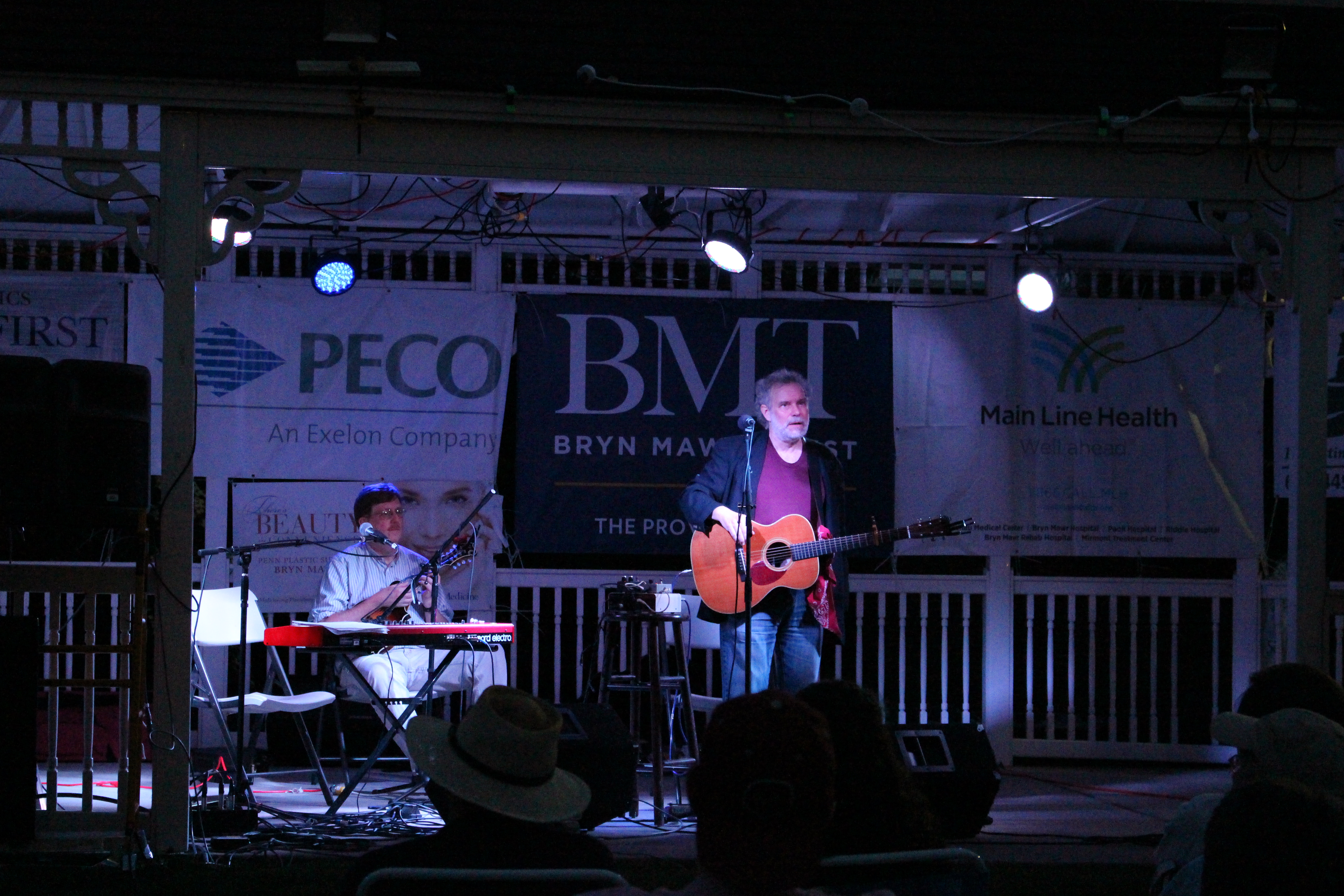
John Gorka with guitar, backed up by Russ Rentler with mandolin.

From within the gazebo he sang only self-penned songs, 20 in all. Four came from I Know, and five from his latest release, 2014’s Bright Side Of Down. The newer material was as smart and flavorful as the songs from his young man days. His pool of inspiration hasn’t dried up. For the ninth song of his 100 minute set he brought to the stage Russ Rentler, his mandolin-playing pal since the late 1970s. I figured that Russ would garnish a couple of tunes and then depart. Better, he remained till the concert’s end. The mandolin’s tight and high tones, the swirling notes from Russ’s fingers, added a lot of energy and contrast to the music. Gorka’s vocal and guitar work through the first eight songs were just fine, but Russ took the performance upward.

John Gorka’s makeup leads him to produce songs that unfold mostly at slow or medium paces. Which is fine with me. He examines love and relationships regularly, as do nearly all songwriters. And he also writes about people’s day to day struggles. I connected with nearly all of the songs he sang. I’ll mention some lines that made my ears bend stageward.

Love Is Our Cross To Bear is a gentle song about falling in love. It comes from I Know. As the air began to chill with descending twilight, and I realized how wise Sandy had been to tell me to bring along a light jacket, Gorka sang, “I didn’t know that I would find a way to find you in the morning/But love can pull you out of yesterday as it takes you without warning.” Beautifully put, John. And five tunes later he reached into Bright Side Of Down and gave us Outnumbered, a love song for his wife. Gorka’s voice, steady and strong, was something you could believe in. He sang, “Suddenly you were there behind a smile, behind a name/After that summer day I’d never be the same.”

John Gorka is a romantic. And he put on a good show.

Two Movies Talkin’ About Freedom

This year started a bit sluggishly for me moviewise, but I’ve been picking up the pace. The final weekend in May was a busy one. Two movies in two states. The movies couldn’t have been more different, one a somber sci-fi thriller, the other an anarchistic romp. But at their cores was a common theme that has been part of the human experience for millennia. The Rascals summed it up very nicely oh so many years ago when they sang, “All the world over, so easy to see/People everywhere just wanna be free.”

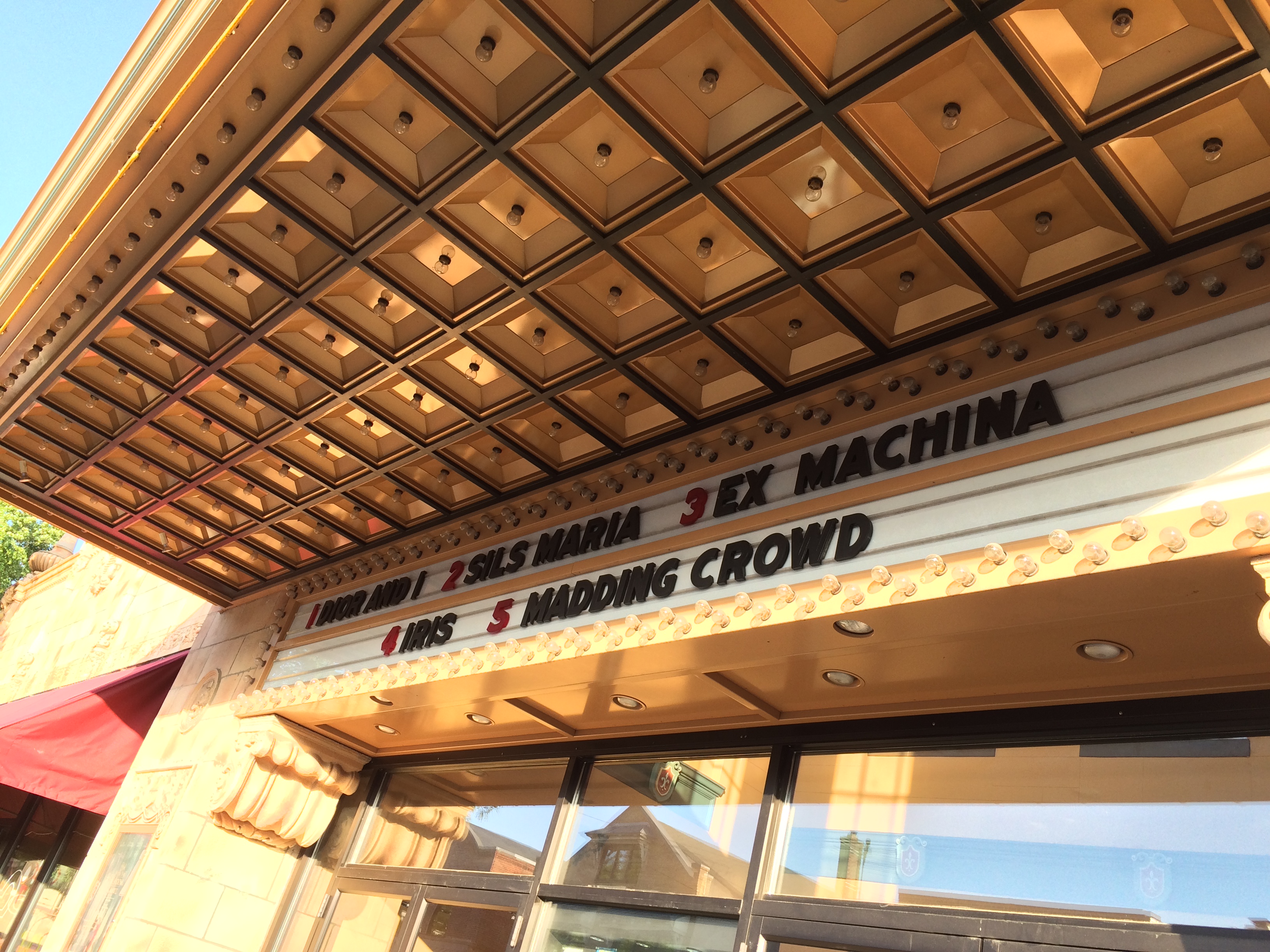
Ex Machina, one of five movies listed on the Ambler Theater's marquee.
Ex Machina, one of five movies listed on the Ambler Theater’s marquee.

That Saturday evening in Ambler, Pennsylvania, my wife and I caught the very well-wrought sci-fier, Ex Machina, at the Ambler Theater, an art house cinema. This movie has broken into the multiplexes a bit, and I think it might grow there yet. Its edginess, as I see it, makes it a match for adults young to old. For now, though, it mostly is confined to theaters like the Ambler, where the under 30 crowd doesn’t tend to congregate. We grabbed two seats in the first row, no better seats available. For the next two hours, our heads craned back, we risked developing stiff necks. Our necks survived just fine. The movie too was fine. It’s an unsettling creation.

Ex Machina’s Nathan Bateman (played by Oscar Isaac) is a techno genius who has made billions from the world’s most popular Web search engine, Bluebook. Nathan is pretty much a recluse, hidden away in an almost inaccessible mountain retreat which serves as his ultramodern home-cum-laboratory. For years there, Nathan has devoted himself to developing the perfect Artificial Intelligence robot, one so humanlike that, well, it would pass for human. And possibly surpass the average Joe or Jane. He has dubbed his newest robotic pride and joy Ava (Alicia Vikander). Ava’s mental abilities are exemplary, her personality coy and inquisitive. Brilliant as he is, though, Nathan wants confirmation of Ava’s wondrousness. Ergo, he flies in one of his Bluebook employees, Caleb Smith (Domhnall Gleeson), to vet the robot’s capacities. Nathan, Caleb and Ava, for the next week, engage one another in mind games and seductions. Honesty sometimes comes to the fore. More often, deceptions dominate.

The three leads couldn’t be better. Isaac’s Nathan is a most unlikeable fellow, his nasty and vain streaks miles wide. Nathan doesn’t get along well with fellow humans. Or robots. Odd then that his life’s passion is to build human replicas? I think that the challenge is too much for him to resist. Baby-faced Gleeson finds the right balance for Caleb’s young guy innocence and bright guy brains. And Vikander is a stunner. Her Ava is dewy eyed and flirtatious and, as noted, smart as a whip. She knows that there’s a big world out there beyond Nathan’s claustrophobic digs, a world she has never seen. For Ava, a high IQ laboratory rat, freedom chez Nathan is not much more than a concept. But it is also a goal, though its attainment might be nothing more than a pipe dream.

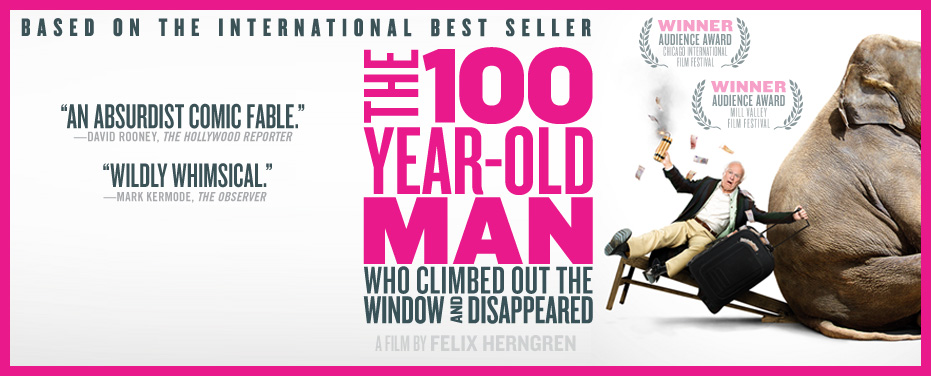
The 100 Year Old Man's official poster.
The 100 Year Old Man’s official poster.

Freedom, something easy to take for granted. And something I should ponder more frequently. One day after seeing Ex Machina I drove to New Jersey, near Princeton, and met up with a long-time friend. We went to Montgomery Cinemas to watch a movie with one of the longest titles of all time. Namely, The 100-Year-Old Man Who Climbed Out The Window And Disappeared, an absurdist black comedy that treats both life and death with a bouncy attitude. I thought it was a hoot, and looking hard for meaning in its looniness I realized that, as with Ex Machina, the quest for freedom is part of its inner workings.

A globetrotting and subtitled film embracing numerous languages, including English, The 100 Year Old Man follows Allan Karlsson (the excellent Robert Gustafsson) from birth to his 100th year. Born in Sweden, Allan at film’s end is still going strong, contentedly savoring life with a gang of recently-made Swedish pals, and an elephant to boot, on a beach in Bali. How did he get there? Let’s just say that Allan is one of the blessed beings. Serendipity has smiled upon him at most junctures of his life.

An explosives enthusiast since early childhood, at age 99 Allan lives alone in the Swedish countryside with his best friend, a cat. One day a fox kills the feline, so outraging Allan that he lures the killer to a lunch of dynamite-encased food treats. The ensuing boom boom boom that promptly dispatches the fox doesn’t go over well with Swedish authorities, who relocate Allan to a heavily supervised retirement home. A life of incredible adventures behind him, Allan follows his gut instincts on the afternoon of his 100th birthday. Out the window of his retirement home bedroom he goes, and fairly nimbly too. Wild and crazy events ensue, quickly multiplying in consequences. Unfazed through it all, Allan more than survives. He goes for the gusto like few centenarians are able. He loves the freedom that allows him to motor on.

Freedom can be stifled, people can be subjugated. But the desire and need for freedom are built into mankind’s genetic code. For many of us in the world, fortunately, freedom allows life to blossom. Allan Karlsson, on the road and at the beach at age 100, seems almost to skip through his days with joy. Ex Machina’s Ava isn’t remotely in Allan’s circumstances. She is a freedom neophyte. But Nathan Bateman has programmed her in a fully human way. Ava feels freedom’s call. Watch out.

Listening To The Beatles’ White Album With Fresh Ears

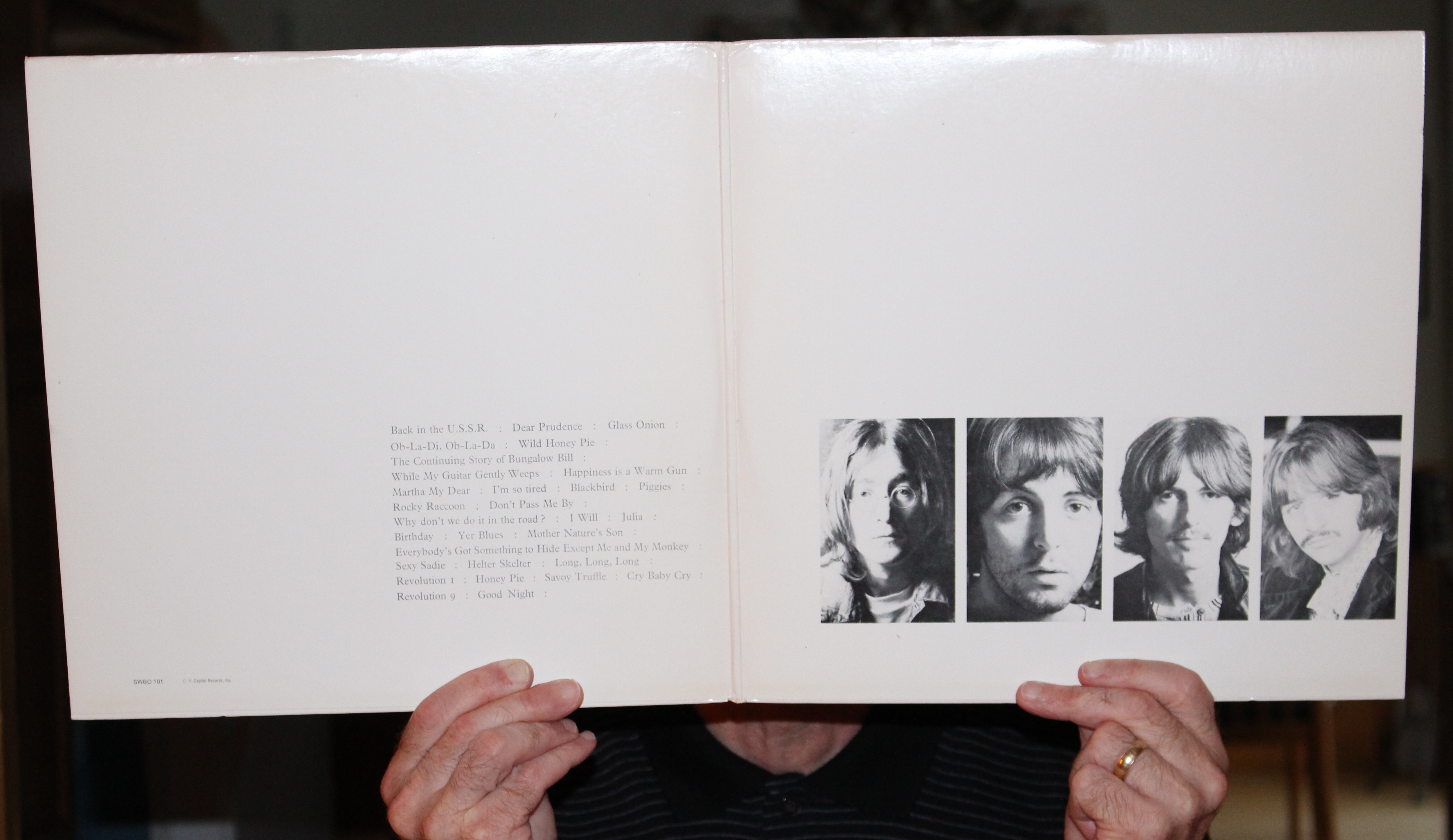
The author with his well worn vinyl edition of The White Album.

One year ago, for no particular reason, I decided to compile a list of my 30 favorite records of all time, limiting myself to only one album per artist. I excluded classical music and non-vocal jazz from the list. In other words I stuck to recordings that fall within the amorphous definition of vocal popular music. The Kinks (Muswell Hillbillies) made the list, as did Skip James (Today), Steve Earle (Transcendental Blues), Billy Bragg and Wilco (Mermaid Avenue), and Ella Fitzgerald (The Cole Porter Songbook). I came of age in the 1960s and, like hundreds of millions worldwide, I used to be a Beatles fanatic. So, needless to say, a Beatles album is on the list. It was hard making that selection, but I settled on their namesake creation, The Beatles, which is popularly known to one and all as The White Album.

Last week I remembered my list of 30 albums. One idea leading to another, I started wondering about which pop music album is the best of all time. Some of us would pick a Kanye West oeuvre, or something by The Cure or Stevie Wonder. Yet, there’s no doubt that a Beatles record would be top choice for countless folks. Maybe Sgt. Pepper’s Lonely Hearts Club Band. Maybe Abbey Road. Maybe The White Album. Picking one album from the millions that have been recorded is of course a somewhat foolish exercise. Most listeners have heard a meaninglessly small percentage of all there are to hear. Still, it’s an interesting proposition. I’m hardly the first to think about this. Oh well, late to another party.

The Web is full of lists ranking the best albums ever.  Rolling Stone magazine polled musicians and music industry folks in 2012 to compile a list of the all-time 500. The Beatles took four of the top 10 spots, Pepper coming in at number one, The White Album at number 10. Pitchfork magazine says that Kanye West’s My Beautiful Twisted Fantasy is the greatest of the 500 greatest. The first Beatles album on the Pitchfork list is number 71, Abbey Road. The White Album missed the Pitchfork cut altogether. Entertainment Weekly rated 100 records, and The Beatles proved to be EW royalty. Revolver ranked number one, and White took the twelfth position.

It’s time for another list, a very short list, and I’m going to keep my poll simple. I’ll poll only one person. Me. Though “favorite album” and “best album” aren’t necessarily one and the same, in my case I’ve concluded that they are. Hear ye, hear ye! The best pop album ever, of those that I know about (and I have heard a lot of albums over the years), is The White Album.

I’ve spun this recording on vinyl and CD a thousand times, but until last week hadn’t in at least a year. I listened twice and was taken aback, though I shouldn’t have been. I mean, The White Album is amazing, an aural kaleidoscope. It is modern, dazzling and delightfully tuneful. Some songs are heart-tugging. Others are witty, endearingly whimsical or downright wacky. Many rock like crazy, though a surprising number are tender ballads or spacey contemplations and not really rock at all. Regardless, The White Album hits with great song after great song, except for Revolution 9 (the less said about it the better) and maybe Martha My Dear, which is awfully treacly but which I like anyway. With each listening now and those many years before, White has revealed textures, accents, wonderful backing vocals and sound manipulations that I hadn’t noticed before. It’s that kind of album.

Part of The White Album’s brilliance is its sheer size. On vinyl and CD it is a double disk holding 30 tracks. It is maybe a sort of miracle that the record turned out so well, as The Beatles were starting to unravel during its making. Before the recording sessions began, though, things were pretty copacetic in Beatlesville. In spring 1968, John, Paul, George and Ringo spent time learning Transcendental Meditation in India at an ashram run by Maharishi Mahesh Yogi. It was a productive musical period for the boys, as most were. They wrote many songs while there, though apparently John and Paul composed largely individually, collaborating very little. About two-thirds of The White Album comprises songs from the India adventure, including Ringo’s first compositional effort, Don’t Pass Me By.

Recording sessions for The White Album began on May 30, 1968, and lasted for four and a half months. The sessions were often bumpy. The Beatles had previously made albums basically as a fenced-off unit with their producer George Martin and various engineers. Not true for White, as Lennon frequently brought Yoko Ono to the studios. John and Yoko had become a couple earlier that year. Yoko’s presence changed the working dynamics that McCartney, Harrison and Starr were used to. Inevitably, verbal squabbles punctuated some sessions. Tensions rose. In June, one of the chief engineers couldn’t stand the atmosphere anymore and quit. Worse yet, halfway through the sessions Ringo fell victim to feelings of self-doubt and frustration and left the group. His bandmates begged him to return, and 12 days later he did.

All of this proves that, for bands, greatness doesn’t necessarily depend on internal harmony. Struggle and discord might still result in a magnificent end product. It’s true that a few of The White Album’s tracks were recorded by only one Beatle (just John on Julia; just Paul on Blackbird), but the Fab Four stuck it out as best they could and played together on most songs. And what they created sounds as fresh as if recorded yesterday.

Listening to The White Album last week, various songs jumped out at me. Hellter Skelter is a grinding heavy workout, a wonder. Long Long Long, a Harrison composition in waltz time, is beautiful and airy, brought to a close by Ringo’s perfectly placed snare drum whack. Dear Prudence grips the heart, framed by chiming repeating guitar chords and lifted by angelic vocal choruses.

Speaking of Ringo, to me he is a star throughout The White Album, not only on drums but as a singer. He doesn’t appear on Dear Prudence or the album’s opening cut, Back In The USSR. They were recorded during his absence from the band. But elsewhere his drum work is nimble and creative, right on the money. And the album comes to a majestic close with Ringo’s gorgeous vocal work on Good Night, a lullaby credited to Lennon-McCartney but written fully by John. Ringo is the sole Beatle on Good Night. He sings so well, so tenderly, backed by a large orchestra and vocal choir. Who’d have thunk he could sing like this? It is the finest vocal performance of his career.

Outdoors At Last, At Morris Arboretum

Ocean, beach and sand cliffs on Cape Cod.

Cape Cod has become a favorite locale for me and my wife. It was love at first sight when we first ventured there for a vacation in 1998. We like pretty much everything about Cape Cod, but the one aspect above all others is its expansive areas of startling beauty. The Cape’s Atlantic Ocean beach, for one example, is breathtaking, about 30 miles of it uninterrupted and basically undeveloped. In the off-season you can walk there as far as you like, gazing at the waters and the tall sand cliffs backing the beach, and there’s a good chance you’ll cross paths with nary another human. Not many places where such a scenario can be duplicated. And at Cape Cod’s outer reaches is one of the more astonishing vistas I’ve ever seen, a five mile long lunar-like expanse of enormous sand dunes and valleys. Most unusual, most unexpected.

Cape Cod’s natural world draws me outdoors. When Capeside my wife and I spend hours in the fresh air daily. Home in the burbs, though, it’s another story. Here I’m out when mowing the lawn or shoveling snow or shooting hoops at my neighborhood playground. Other than that I’m indoors most of the time, and I think this is because there’s a dearth of beautiful suburban places to get lost in.

Luckily for me, Philadelphia is at hand. It’s an old city and a new one, with great architecture and sights. Walking its streets and parks is an outdoors activity that I do a fair amount of.  On Memorial Day weekend’s Sunday, my wife had an inspired Philadelphia idea. Let’s visit Morris Arboretum, she suggested. We hadn’t been there in years. This would be a fine chance to spend time in a lovely green spot not far from home. Okay, I said. We drove to Philadelphia’s Chestnut Hill section, where the Morris takes up a lot of space (167 acres). We spent three hours there. It was good to be outside for an extended period.

Morris Arboretum originally was an estate named Compton, home to siblings John Morris and Lydia Morris. They were wealthy, worldly and civic-minded folks. Their mansion is no longer with us, but Compton’s grounds and some secondary buildings remain. Established in 1887, Compton stayed in Morris hands till 1932, the year of Lydia’s passing (John had died in 1915). Lydia bequeathed Compton to the University of Pennsylvania as a botanical garden and research facility. The U of P has maintained and developed the property ever since.

Morris Arboretum has gotten a whole lot better since our previous visit. Back then a parent might have said to his or her five year old Amy or Andy, “Hey, look at that pine tree. Isn’t it beautiful?” and Amy or Andy would have responded “I’m bored, let’s go home.” The arboretum managers, obviously smart people, saw the need to build kid-magnet structures. Up went the Garden Railway in the late 1990s, and in 2009 Out On A Limb opened.

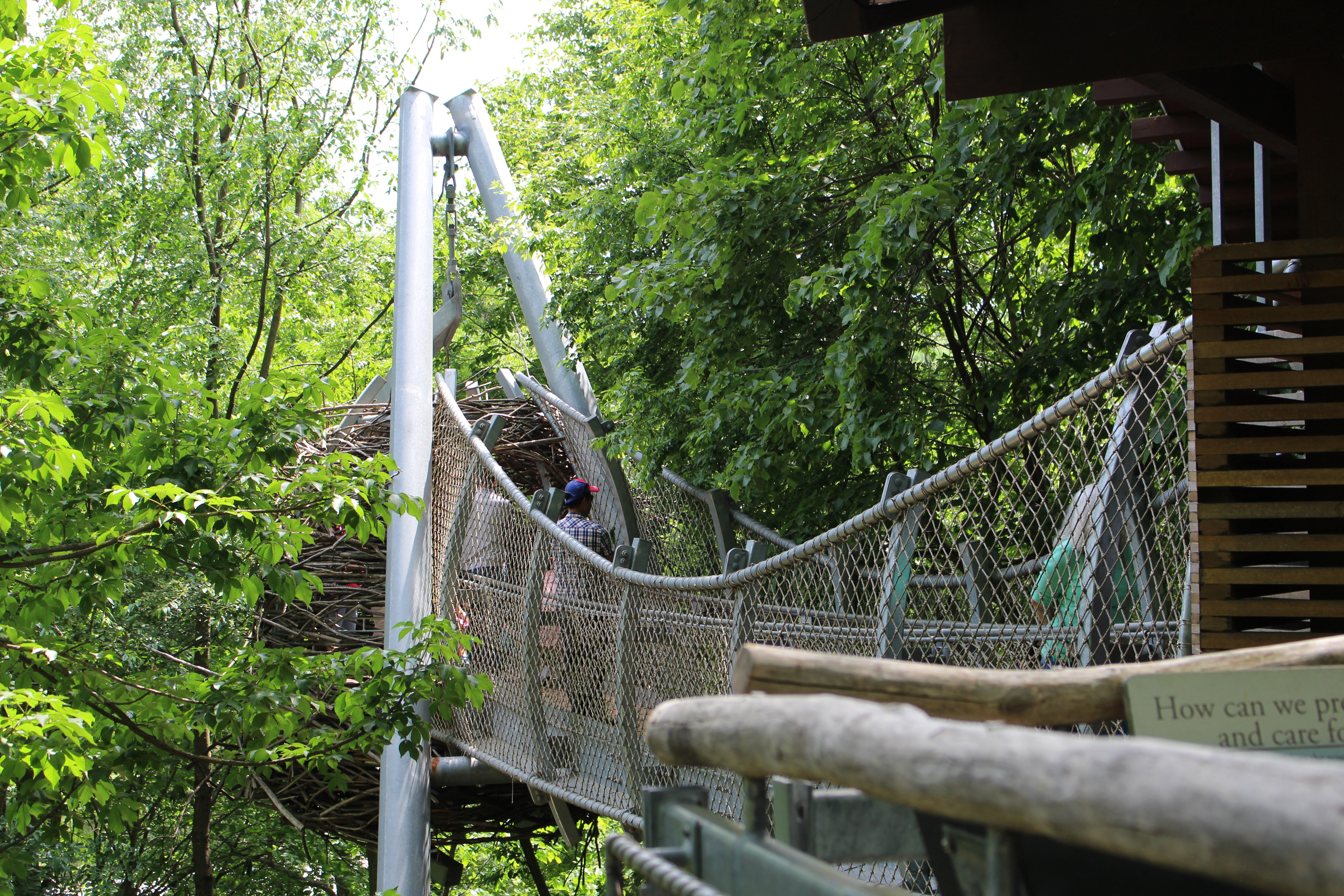
Morris Arboretum's Out On A Limb.
Morris Arboretum’s Out On A Limb.
Out On A Limb's play area.
Out On A Limb’s play area.

Out On A Limb is very cool. It’s an elevated twisting boardwalk, supported by steel columns and threaded between trees on a hilly part of the arboretum’s grounds. You enter at ground level and in a few seconds, because the earth slopes away quickly,  you’re looking down 40 or more feet at the forest floor. Walking alongside the mid and upper reaches of trees is a gas. Best yet is the play area at the walkway’s far end, where giant rope hammocks are suspended off to the side. Kids abound there. No wonder that attendance at Morris Arboretum has grown steadily since Out On A Limb came on the scene.

Morris Arboretum's Garden Railway.
Morris Arboretum’s Garden Railway.

Almost as invigorating is the Garden Railway. Nestled among trees and shrubbery near the Morris’s Rose Garden, it is a cleverly designed toy train layout. Passenger trains, freight trains, cable cars, tunnels, bridges . . . all are there in three large separate areas. So are natural-material replicas of famous structures, such as the Eiffel Tower and Philadelphia’s City Hall. The trains wind their way over, around and through, disappearing from view, eventually reemerging. My wife and I were intrigued by the whole set-up. It’s something.

The amazing Blue Atlas Cedar at Morris Arboretum.

It’s not a bad idea to stroll the arboretum’s grounds with no particular plan. That is to say, you won’t go wrong by not referring too often to the map you’re given at the information center. Morris Arboretum is a work of art, sculpted to display its trees, flower gardens, fern groves, swan pond and shrubs. Poking around them randomly works. Plenty of things, often green ones, will catch your eye. One tree in particular caught mine, a Blue Atlas Cedar. One of this massive being’s long lower limbs shoots out perpendicularly to the trunk, resting on the earth. The limb I think grows that way naturally. It doesn’t appear to have been forced into its strange position by windstorms or magic.

Sculptures by George Sugarman.
African Queen, a stone sculpture at Morris Arboretum.

Manmade sculpture is another big part of the arboretum experience. Many such objects are placed on the grounds, continuing a tradition that John and Lydia began. The most colorful are the large playful and organically-shaped painted aluminum creations by the late George Sugarman. They’ve been on site since 1981. The most alluring sculpture to me is African Queen, a stone carving from Zimbabwe, artist unknown. How old is it? 50 years? 500 years? If the arboretum custodians have the answer, they’re not saying. Regardless, it’s a charmer. Pablo Picasso, who was greatly influenced by African art, would have loved it. The armless queen is asleep, her sweet face lost in dreams. The artist chose to depict her headdress as broad and undefined, focusing attention to the face below. A visit to Morris Arboretum, in my opinion, is incomplete without making time for this superb piece.