Eggplant Parmigiana And Good Advice

It’s not every day that a visit to a shopping mall inspires someone to write about eggplant parmigiana and good advice. This is one of those days. Off we go.

I can’t begin to explain how or why, for many years, I stopped eating eggplant parmigiana, somehow forgetting that it is one of my favorite dishes. I hadn’t overindulged on eggplant parm, thus getting tired of it. And I hadn’t turned away from Italian cooking in general. God forbid! No, sometimes life takes weird, head-scratch-inducing turns, and my losing awareness of eggplant parm’s existence was one of them. This southern Italian mélange of fried eggplant, tomato sauce and melted cheeses, which had gone down my gullet numerous dozens of times during the 1960s through 1990s, became a stranger to me in the current century. Until September 15 that is, about 10 weeks ago, when eggplant parm vivaciously reentered my life. Hallelujah!

That night my wife Sandy and I were at a good restaurant a few miles from our suburban Philadelphia home. Marco Polo is its name and Italian cooking is part of its game. We have thrown business Marco Polo’s way for around 25 years. Scanning the menu I was awakened from my eggplant parmigiana amnesia, for it was as if a Roman god or goddess slapped me upside my head and then trained my eyes on one and only one listing on the menu. My mouth began to water almost uncontrollably. I became a sputtering, emotional mess. “I must have it! I must! I shall!” I nearly screamed.
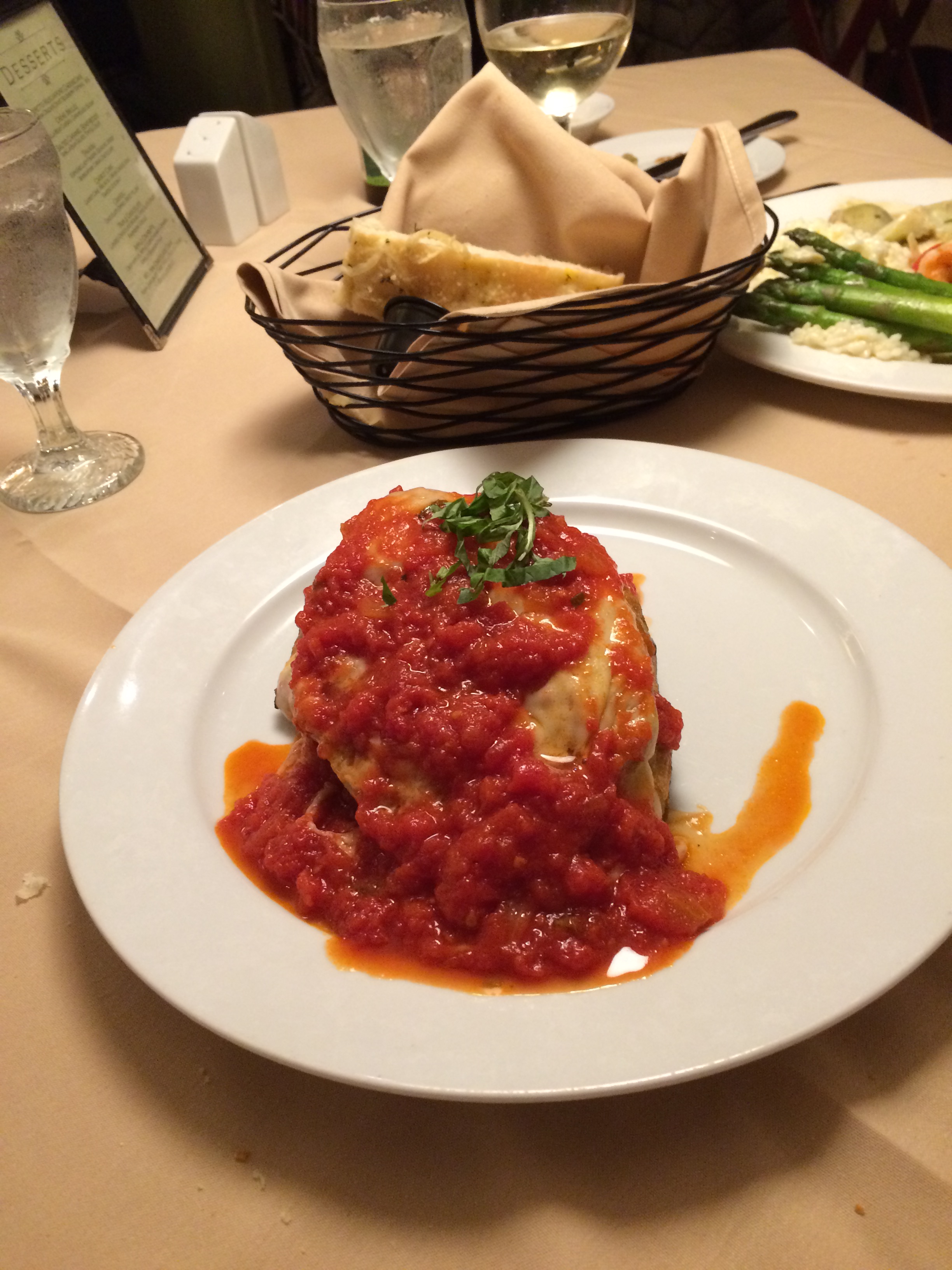
Eggplant parmigiana at Marco Polo

And so I had it. And, man, was it superb. The eggplant was moist and tender, the tomato sauce as sweet as a sunny springtime day, and the cheeses very fine and, importantly, not overwhelming in amount.

Since that joyous occasion I’ve eaten eggplant parmigiana six more times, most recently on Saturday past (November 24), when Sandy and I once again dined at Marco Polo. I’m hooked on the stuff! For the remainder of my earthly stay I plan to keep it that way, in moderation. I could do a lot worse.

Okay, then. That’s the eggplant parm part of this story. Now it’s time for some good advice, and also for a valiant attempt to connect those two themes.

Once in a blue moon I head to the wondrous, three-level, enclosed shopping mall near my home. Usually, like most people, I go there to shop. But two or three times I’ve gone to try and find something or other to write about for this publication (click here to read one example). On November 24, seven hours before dining at Marco Polo, the latter was my intention. There was a pretty good chance, I figured, that the visit might prove to be journalistically fruitful.
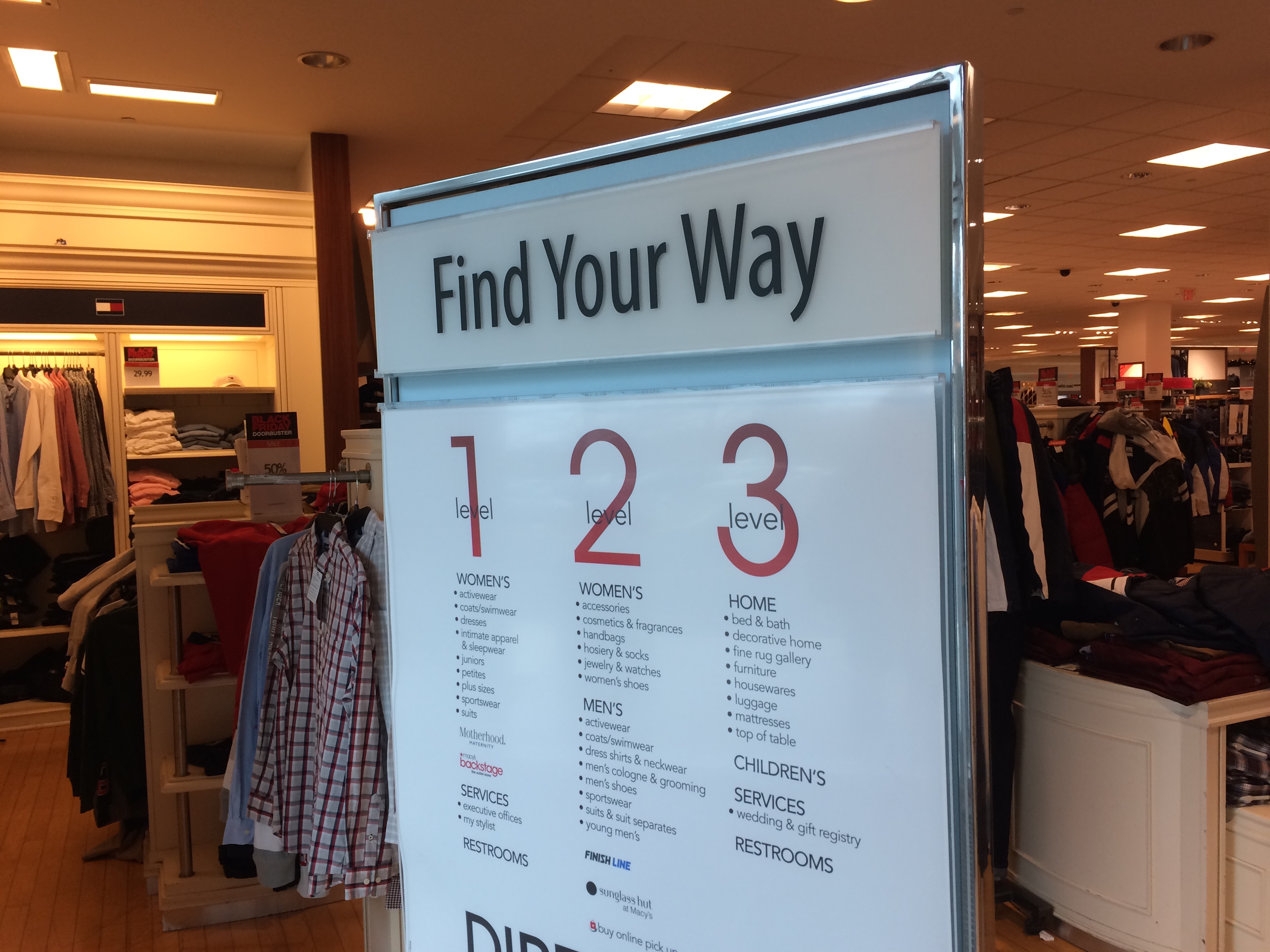
Maybe an essay about frenzied shoppers and kiddies sitting on Santa’s lap should have been the result of my time at the mall. But, you know, that just ain’t me. Instead, my attention was drawn to a sign in Macy’s department store, the first place I investigated within the mall. The sign, a store directory, said “Find Your Way” in big letters across its top. “Holy shit!” I thought to myself. “That’s powerful advice. It’s important for people to find their way, their true path in life. Fulfillment will result if they do.”

Whoa, what had come over me? I’m not the philosophical sort. I’m in the middle section of the deep-thinking pool, at best. And it wasn’t ganja that brought out that unlikely response from me, seeing that I haven’t smoked weed in 30 years.
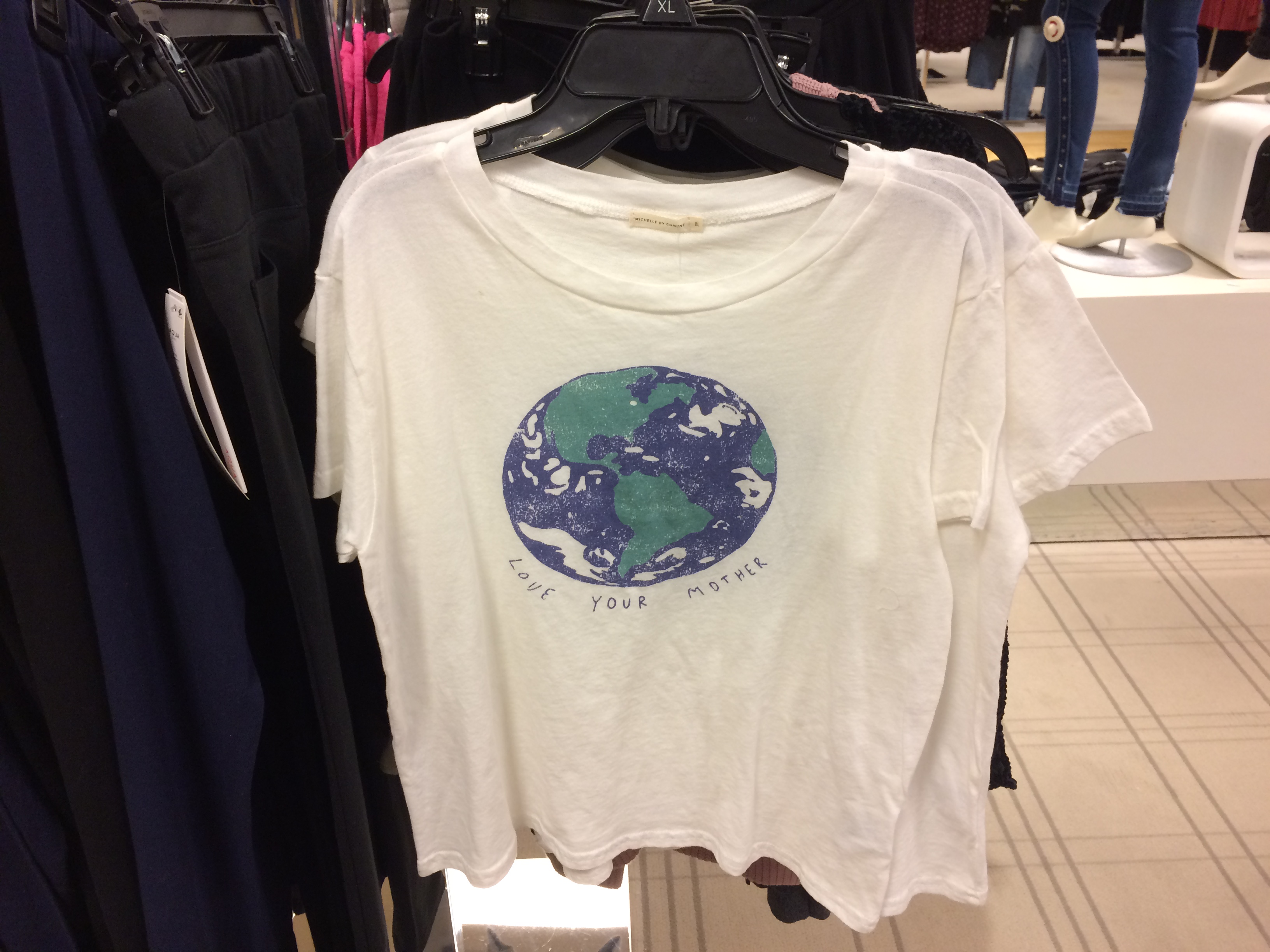
Whatever the reason, I then went on a quest to locate other examples of good advice in the mall. And indeed I found some. “Believe In The Wonder Of Giving” commanded another Macy’s sign. “Love Your Mother” (meaning both your female parent and Mother Nature) proclaimed a tee shirt in Bloomingdale’s department store.  “It’s Never Too Late To Have A Happy Childhood” smiled down upon the customers at Build-A-Bear Workshop. And the finest advice of all came from a poster at Sephora. “Be Kind. Be Open. Be Gracious” it urged. Needless to say, the poster also should have said “Be Helpful.”

Damn straight, I was on a roll!

The final emporium in which I met words of wisdom was a Hallmark store. A small box, meant to be hung on a wall or placed on a table or shelf, contained a message that I paused over: “Do More Of What Makes You Happy.” A pleasure-seeker to a sizeable degree, I could relate, because I took it to mean that we might as well boost our fun a lot while we can, seeing that the number of spins we make around the Sun are, shall we say, on the limited side.
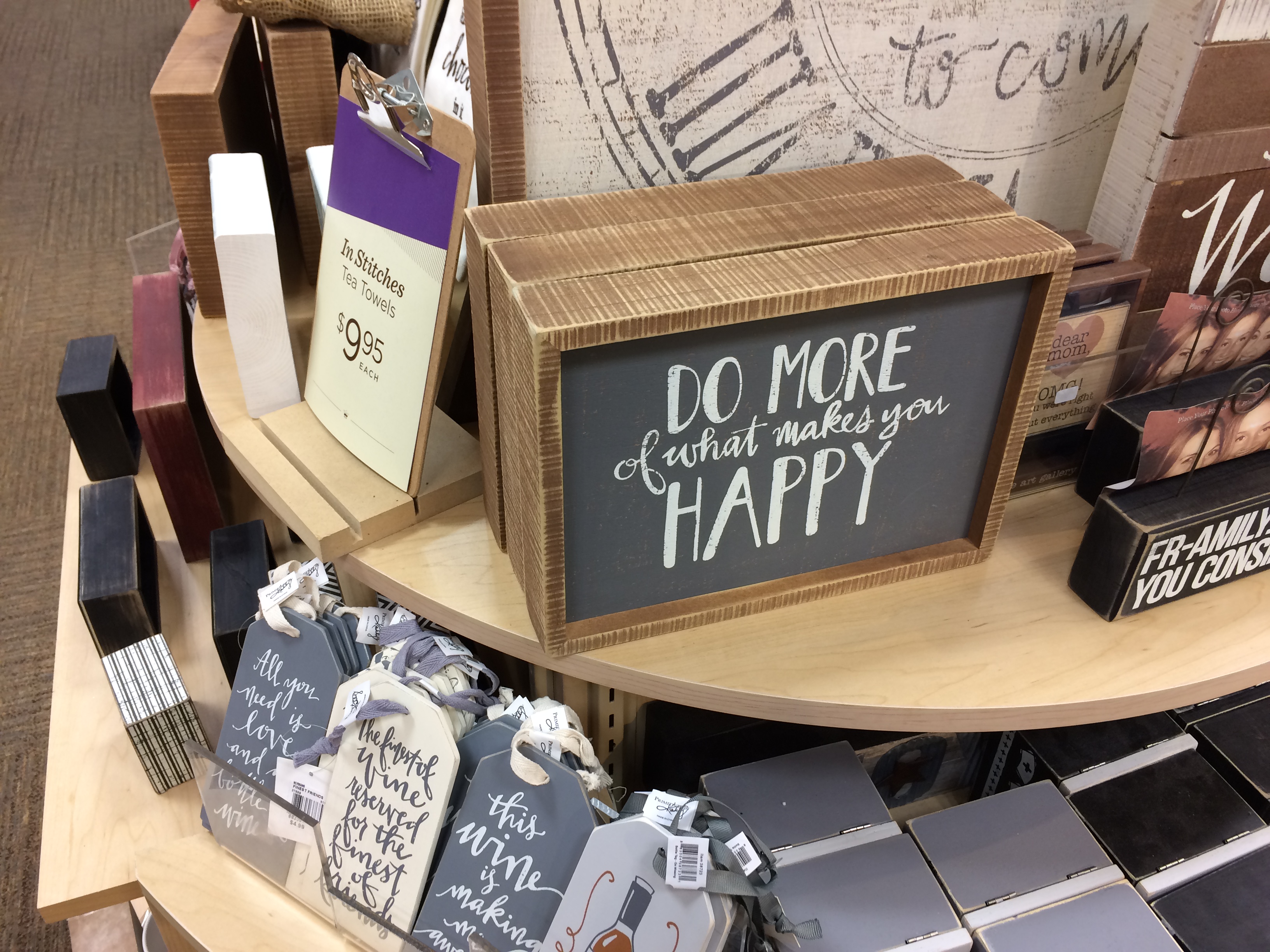
But there’s a more expansive way to look at the message, as I decided the following day when it rose to the surface of my mind. There it joined with memories of my most recent Marco Polo meal and got me thinking. Eating eggplant parm is a fairly trivial endeavor, but it sure enough makes me happy. And when I’m happy, my frame of mind improves, increasing the volume of positive energy that I deliver to the world. In other words, increasing the frequency of my being kind, open, gracious and helpful to others. The uptick is on the minor side, no doubt. But considering the state of affairs on our planet, every little bit counts.

This isn’t just about me, me, me, though. If hundreds of millions of us followed the Hallmark store’s advice, the upticks might add up to something special. Hey, maybe the world would significantly change for the better. You never know. After all, those four adjectives  — kind, open, gracious, helpful — are where it’s at.

(Don’t be shy about adding your comments or about sharing this article. Many thanks.)

(If you click on any photo, a larger image will open in a separate window.)

Gutsy People: Thoughts About A Movie, A Book, And The Wider World

When I comment about movies on these pages, I try to be a good guy by not revealing all, especially endings. I mean, for anyone with an itch to see a certain flick, that itch might damn near disappear if they become privy to too much telling information.

But a spoiler alert ain’t needed for Free Solo, a documentary profiling the great rock climber Alex Honnold that was released in September and is still in some theaters. That’s because the beans already have been spilled in every review and article that has been written about this movie. In other words, hell yeah, he made it to the top! To the top of El Capitan, that is, the monster, vertical wall of granite in California’s Yosemite National Park. And he reached the top, about 3,000 feet above ground, by climbing El Cap without ropes, a harness or safety equipment of any sort. And without a climbing partner or partners. That’s what free solo means. The only item, other than clothing, that Honnold wore while becoming the first (and, so far, only) person to accomplish this superhuman feat on El Cap was a small bag on his back that contained chalk, a substance he’d periodically coat his hands with, the better to grip the rock. (Others had scaled El Cap over the years, but always with ropes and additional equipment.)

What any rock climber does seems pretty well off the charts to me. Shit, I would make it about two feet off the ground on El Capitan’s face, maybe three. Which isn’t bad actually. Only 2,998 or 2,997 feet to go. But what Honnold did on June 3, 2017 was so far off the charts as to be laughable, in a magnificent way, and nearly inconceivable. The film crew that captured his exploits agree. Skilled rock climbers themselves, they are shown in the documentary, nervous as can be and totally awed by what was taking place in front of their eyes.

For anyone who has a taste for danger and suspense, this is a movie not to be missed. If possible, watch it in a theater rather than at home. Whatever the venue, the bigger the screen the better. My wife, brother and I went to see Free Solo in early November. We sat in the sixth or seventh row of a cinema, nice and close to the action. We were captivated. You will be too.

By the way, when I mentioned for anyone who has a taste for danger and suspense a few sentences ago, I meant to include and an appreciation of guts. As modest and unflappable as Alex appears in Free Solo’s interview segments, there’s no denying that he is in possession of an oceanic amount of guts, and I for one find his courage to be very inspiring, And although not too many people are going to try and scale giant rocks, it’s of course true that in less dramatic ways many or most of us display courage throughout parts or all of our lives. And that’s inspiring too. Hell, for much of humanity, simply getting out of bed and facing the day is a brave act, considering the nasty, even horrific, realities facing them.

I read the late novelist Kent Haruf’s final book, Our Souls At Night (it was published in 2015, the year after Haruf died), a few days after watching Alex climb. There are a variety of ways in which to look at Our Souls At Night, as there are with Free Solo. It’s about love and the lack thereof. It’s about emotional pains that do not fully heal. And it’s also about the guts shown by a man and a woman, each around 70 years old, who throw aside their normal inhibitions and begin a relationship with one another.

Addie Moore and Louis Waters, both widowed, are longtime neighbors who are acquainted only slightly. They live in Holt, Colorado, the fictional town that is the setting for all six of Haruf’s novels. But, as becomes apparent, Addie has had Louis on her mind for some time. One day she pays Louis a visit. Here’s some of what Haruf writes on Our Souls At Night’s second and third pages:

You probably wonder what I’m doing here, she said.
Well, I didn’t think you came over to tell me my house looks nice.
No, I want to suggest something to you.
Oh?
Yes. A kind of proposal.
Okay.
Not marriage, she said.
I didn’t think that either.
But it’s kind of a marriage-like question. But I don’t know if I can now. I’m getting cold feet. She laughed a little. That’s sort of like marriage, isn’t it.
What is?
Cold feet.
It can be.
Yes. Well, I’m just going to say it.
I’m listening, Louis said.
I wonder if you would consider coming to my house sometimes to sleep with me.
What? How do you mean?
I mean we’re both alone. We’ve been by ourselves for too long. For years. I’m lonely. I think you might be too. I wonder if you would come and sleep in the night with me. And talk.

Wow! Addie has guts. An abundance of it. Don’t know how many folks in her age bracket would do what she does. Couldn’t be a lot. In any event, Louis accepts Addie’s offer. They begin their affair — a platonic one at the start — cautiously. And, finding that they are getting along just fine, take it to higher levels. They become a strong and true couple, telling each other their life stories, opening up more than they did to their deceased spouses.

Addie and Louis do not go unnoticed in Holt. Snide and angry comments and actions come their way from the small-minded, which includes Addie’s adult son Gene. How do Addie and Louis end up? Hey, unlike with Free Solo, I’m not revealing the conclusion, a conclusion that I found to be wanting in relation to what had preceeded it. Still, I give Our Souls At Night a thumbs-up. Haruf, as is clear from his words above, writes beautifully. His style is direct and unflowery, and the book’s characters feel real.

Alex Honnold doesn’t boast about courage in Free Solo. Neither do Addie Moore or Louis Waters in Our Souls At Night. In fact, the three barely talk about it. But they each own courage and use it for their personal betterment, and in manners that bring no harm to others or to the natural world.

(As always, comments are welcomed. Thanks.)

Teeth And Gums And Music

“Yo, schmuck! Are you kidding me? You haven’t published a story in quite a while and the best idea that you can come up with now is a piece about dental health? Neil, you test my patience like no other of my writers. If you weren’t overpaying me for attending to your flimsy articles, I’d bounce you from my client list and send you into the deepest reaches of cyberspace, from which you’d never be heard from again!”

Those were the words that my editor, Edgar Reewright, flung at me over the phone three days ago when I told him about the essay I was planning to compose. Shit, I didn’t exactly appreciate his uncivil response. But what could I do? Fire him? No way. I mean, without his expert eye and guidance, my flimsy articles would be even worse: conceptually flawed, grammatically messy, stiff and awkward, etc., etc.

I need Edgar.

You know what though? I’m not going to let him critique this piece. I’ll mail him his weekly check, sure. But if he’s not interested in reading about a topic as important as dental health, he can shove his unreasonableness up his ever-widening ass. That’ll teach him!

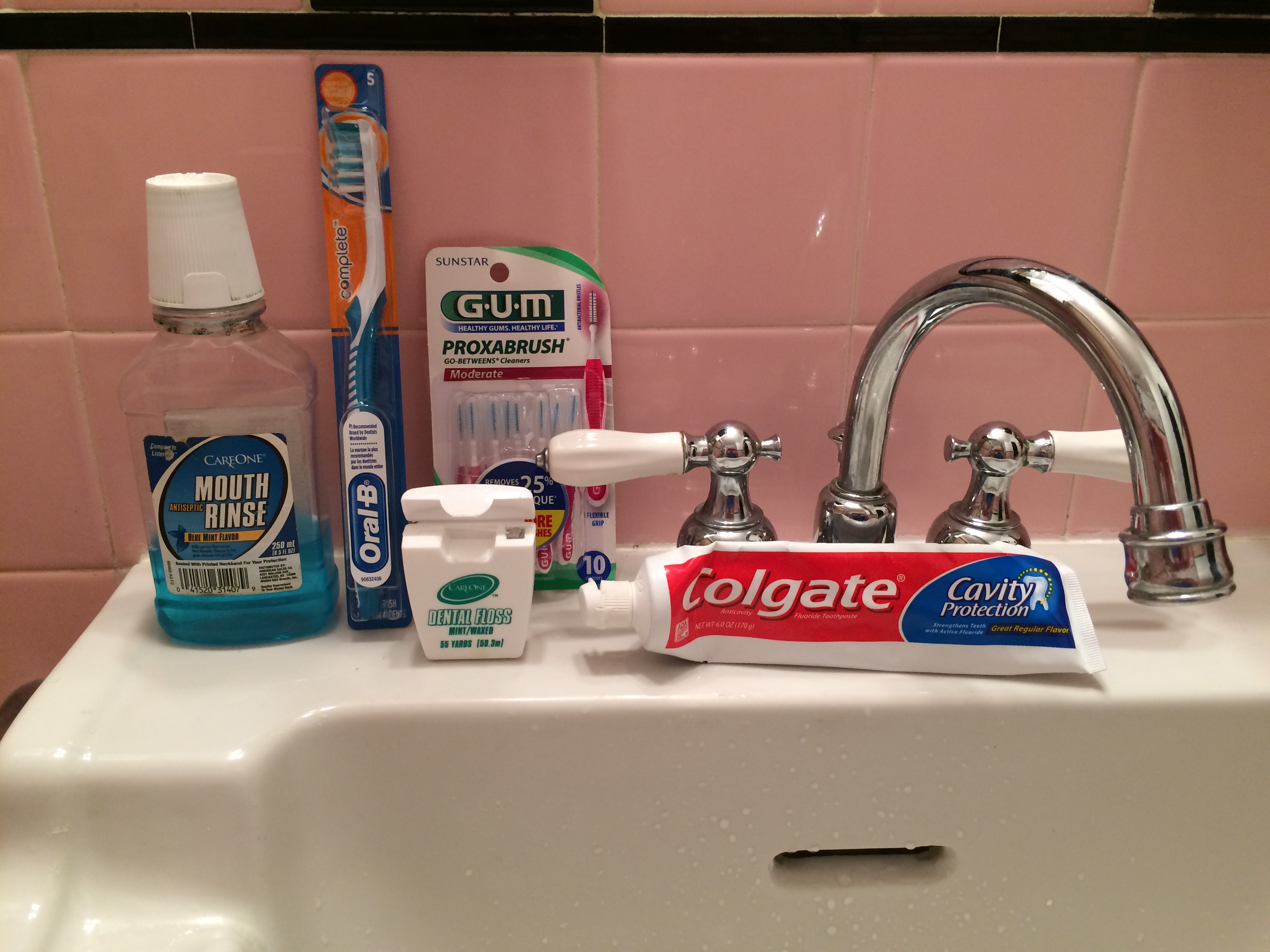
My dental implements.

Dental health. For at least six months I’ve been tossing around the notion of writing a story about it. But I couldn’t quite figure out what angle to take, what points to make. Anyway, late night on October 30 I began to see the journalistic light while brushing and flossing, which are parts of the nightly ritual that I maintain to try and keep periodontal disease (which can lead to tooth loss and possibly worse, such as heart disease) and cavities away.

And I received the kick in the butt that I needed to set the story in motion when, on November 6, I read a real good essay about canine dental health (click here) by Cristina Crawford, a fellow blogger. “Hey!” I said to myself. “It’s not coincidental that Cristina’s article came on the heels of the light you saw last week. Sure, she wrote about her dog’s dental situations. But so what? Dental health is dental health, no matter what species is involved. The time is now, fella! Write your story!”

Okay, I shall.

My dental history was unremarkable until the mid-1990s. I’d been to various dentists somewhat regularly over the previous 40+ years and had had numerous cavities filled, but nobody ever had raised anything resembling a red flag. Circa 1995 though, my dentist-at-the-time (she is still my dentist) did. What she told me, basically, was that my gums and teeth were infected to an extent that she was unable to treat, that the gums had regressed significantly, that I’d had bone loss in the middle and lower sections of my teeth, and that I therefore needed the services — pronto! — of a periodontist. My conditions, I surmised, were the results of poor dental hygiene, because for many years I’d definitely not been the poster boy for proper oral care.

To a periodontist I went, and what resulted wasn’t a pretty scene. Osseous surgery sessions — scraping away of infected bone and gum tissue areas, and repositioning of my gums on tooth surfaces — took place over a number of months. The procedures hurt, and they made my mouth look like a bloody, sloppy mess. But everything in time healed. And the procedures worked, putting a halt to periodontal disease, which is fueled by bacterial buildups. Ever since then I’ve very diligently done my best to keep my gums and teeth clean: Brushing after meals with a regular toothbrush; inserting a small brush (a Proxabrush) between the teeth to push out food particles; flossing; and rinsing with mouthwash. I do all of this, in various permutations, several times each day.

There’s nothing unusual about my regimen. Pretty much everyone reading this article, I imagine, is more or less taking the same measures. In any case, I’ve been fortunate, because periodontal disease, knock on wood, has not returned.

So, how does the late night of October 30 figure into this story? Well, dental routines ain’t exactly emotionally or spiritually invigorating, right? To help while away the boredom as I work inside my mouth, I listen to music on an old portable radio.

I’m not the music geek that once I was, but a seeker of fine tunes I remain. In between brush strokes or floss movements I flip the radio’s dial, hoping to connect with one station or another’s offerings. Often I connect pleasantly, sometimes fabulously. On October 30 the latter took place, for three songs that I’m compelled to mention came at me during the first quarter of the eleven o’clock hour. As they played I couldn’t help but bust out my sad attempts at bopping and boogying, being careful of course not to trip and stab myself with my toothbrush as I shuffled around the bathroom.

In the order in which I heard them, the recordings were as follows: The Memphis Train, by Rufus Thomas. St. James Infirmary, by Cab Calloway and his orchestra. Pass The Gin, by The Meadowlarks. The tunes hit the market, respectively, in 1968, 1930 and 1954. Rufus and Cab were big stars in their lifetimes, I should note, and retain plenty of fame to this day. The Meadowlarks, though, were pretty obscure, and are beyond obscure in 2018. But little matter. Millions of top-notch recordings have faded away in music history’s scrapbook. I’m glad that Pass The Gin was resurrected while I had the radio on.

I totally dig The Memphis Train’s pounding drums, funky and kinky electric guitar, and Rufus’s wild whoops. Ditto for Cab’s dramatic singing in St. James Infirmary, and for the horn players who, with twinkles in their eyes, send out cascades of sashaying and strutting notes. As for Pass The Gin, how cool and tight are the vocals, and how nifty is the guitar solo halfway through the song? Very. Very. Very.

With that, the current proceedings are coming to a close. Sleep well tonight, readers. Treat your teeth and gums well, if you’re not already doing so. And, as Sly And The Family Stone advised, dance to the music!

(Don’t be shy about adding your comments. Gracias.)