“Upward” Was The Theme Of The Day

My wife Sandy and I spent seven fun-filled hours on a recent Friday in Philadelphia’s Art Museum neighborhood. The first two of those hours we strolled around the grounds of the Philadelphia Museum Of Art and its surrounding trails and parks. The skies were sunny, the humidity pretty low and the temperature not too unkindly hot. There was no getting away from the sun’s power though, and we sweated mightily, a small price to pay for helping the body build up Vitamin D reserves.

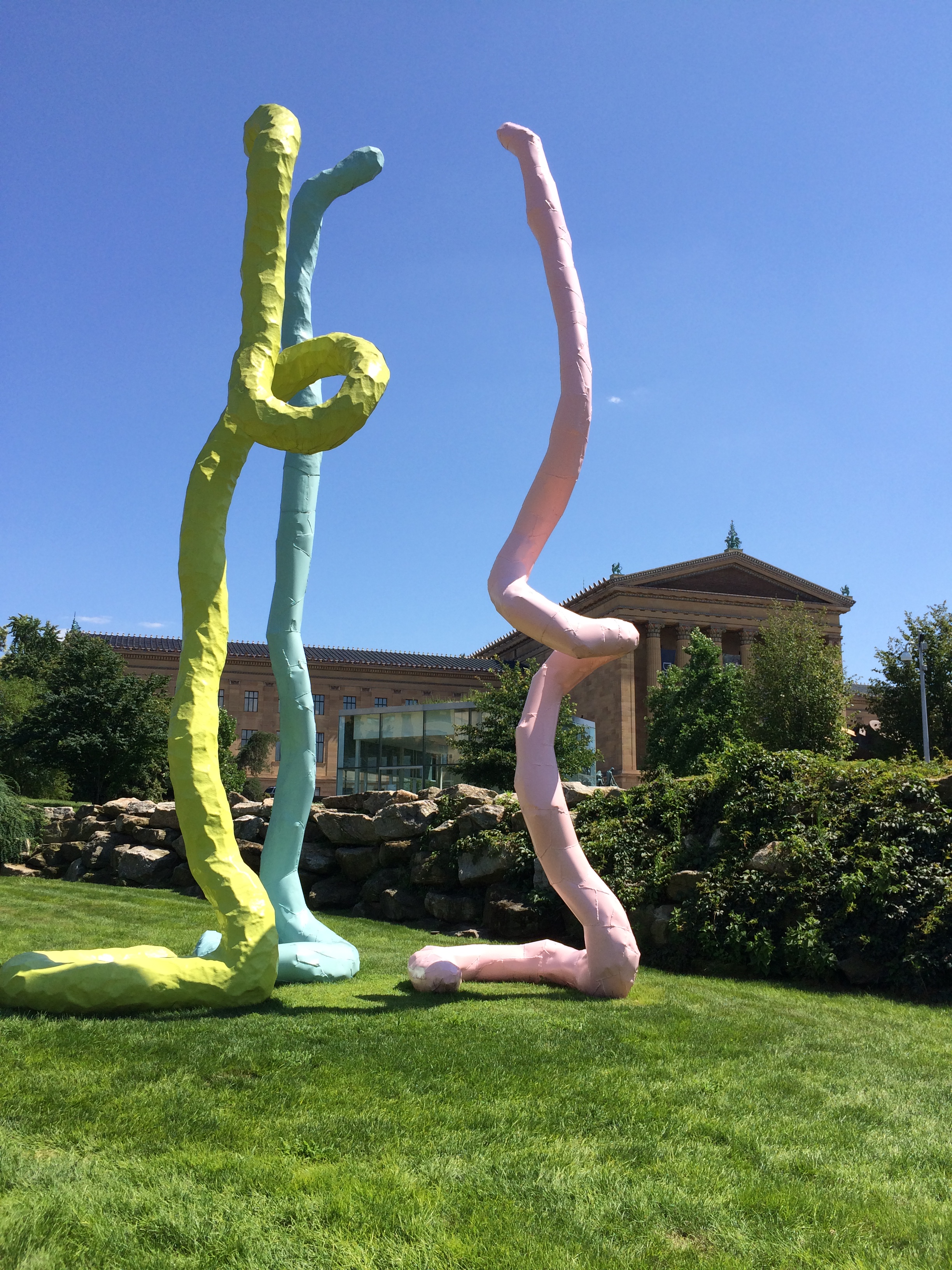
During the seven hours we found a fascinating park that was new to us, looked at lots of art within and without the museum, took in a Cuban music concert (“Havana Night”) at the museum and finished with a tasty dinner at a nearby restaurant, Rembrandt’s. But I’ve decided to skip many of the details about all of that. Instead I’m going to concentrate on a theme that, to my impressionable mind, seemed to unite a portion of what we saw. There’s a good chance that I’m stretching reality to find a connection, but what the hay, that wouldn’t be my first time. Besides, reality is flexible. The theme involves optimism, more specifically our species’ seeming desire and need to stay positive, to grow, to look upward. The notion began to bubble a bit in my sun-dappled head near the start of our Friday adventure when, poking around the museum’s outdoor sculpture garden, we were very happy to find Franz West’s colorful sculpture Lips towering before us.

Franz West's Lips in the Philadelphia Museum Of Art's sculpture garden.
Franz West’s Lips in the Philadelphia Museum Of Art’s sculpture garden.
Steps and Pyramid, two sculptures by Sol LeWitt.


Lips is way terrific. Three giant tendrils, (or are they giant worms?), pointing heavenward in pastel shades of blue, pink and lime. Taking a good look at the squirmy designs, I couldn’t help but think that West was putting his mind and emotions on display, that Lips represented his vision of looking on the bright side, of reaching for the stars. I wondered, what else around here might have had the same inspirations? Well, not far uphill from Lips on the sculpture garden grounds, Sandy and I found two modest and monochromatic sculptures by Sol LeWitt. They were sitting within their personal and unassuming open-walled pavilion. LeWitt named the larger piece Pyramid and the smaller one Steps. Pyramid and Steps were fashioned in 2010, two years before Lips, and are made of concrete blocks. Tiny compared to Lips, they nevertheless are objects that to me suggested that we keep our minds open and on the ascending path. Pyramids point skyward, duh. And although stairs go down as well as up, LeWitt I’m sure placed Steps next to his pyramid to reinforce the “up” reference.

So, I appeared to be on a roll. What else might I fit into my Upward container? One reason that Sandy and I had decamped at the museum area was to check out some of the newish stretches of the Schuylkill River Trail, a river-bounded pathway for pedestrians and cyclists that planners hope one day will extend 140 miles from the bottom of Philadelphia to Schuylkill County, Pennsylvania. We walked a short distance southward on the River Trail and lo and behold came to a park we never knew about. It’s a haven that Philadelphia created for skateboarders. Paine’s Park is its name, probably because pain and skateboarding go hand in hand. Anyway, 30 or so guys and gals in their teens and 20s were gliding around the park, flipping off contoured walls and doing whatever else it is that skateboarders do. I was amazed by the park’s existence. Skateboarders had once made their home in Love Park, near Philadelphia’s City Hall, and garnered the wrath of city officials and ordinary folk in the process. Rather than continuing to scare the daylights out of tourists and office workers trying to lunch and lounge in Love Park, skateboarders needed their own officially-sanctioned facility. Now they have one. Paine’s Park opened two years ago.

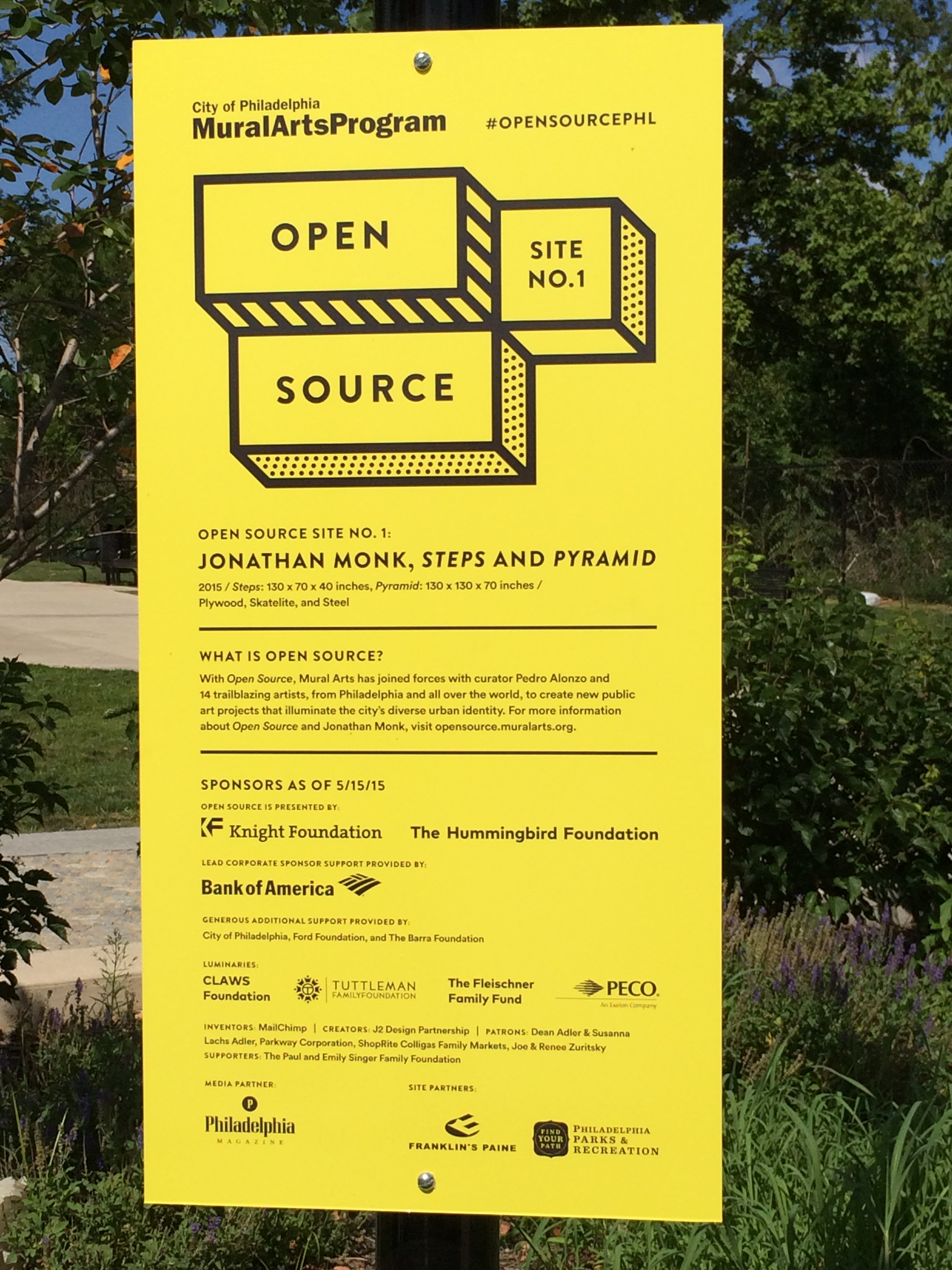
Sign for Steps and Pyramid IMG_0816

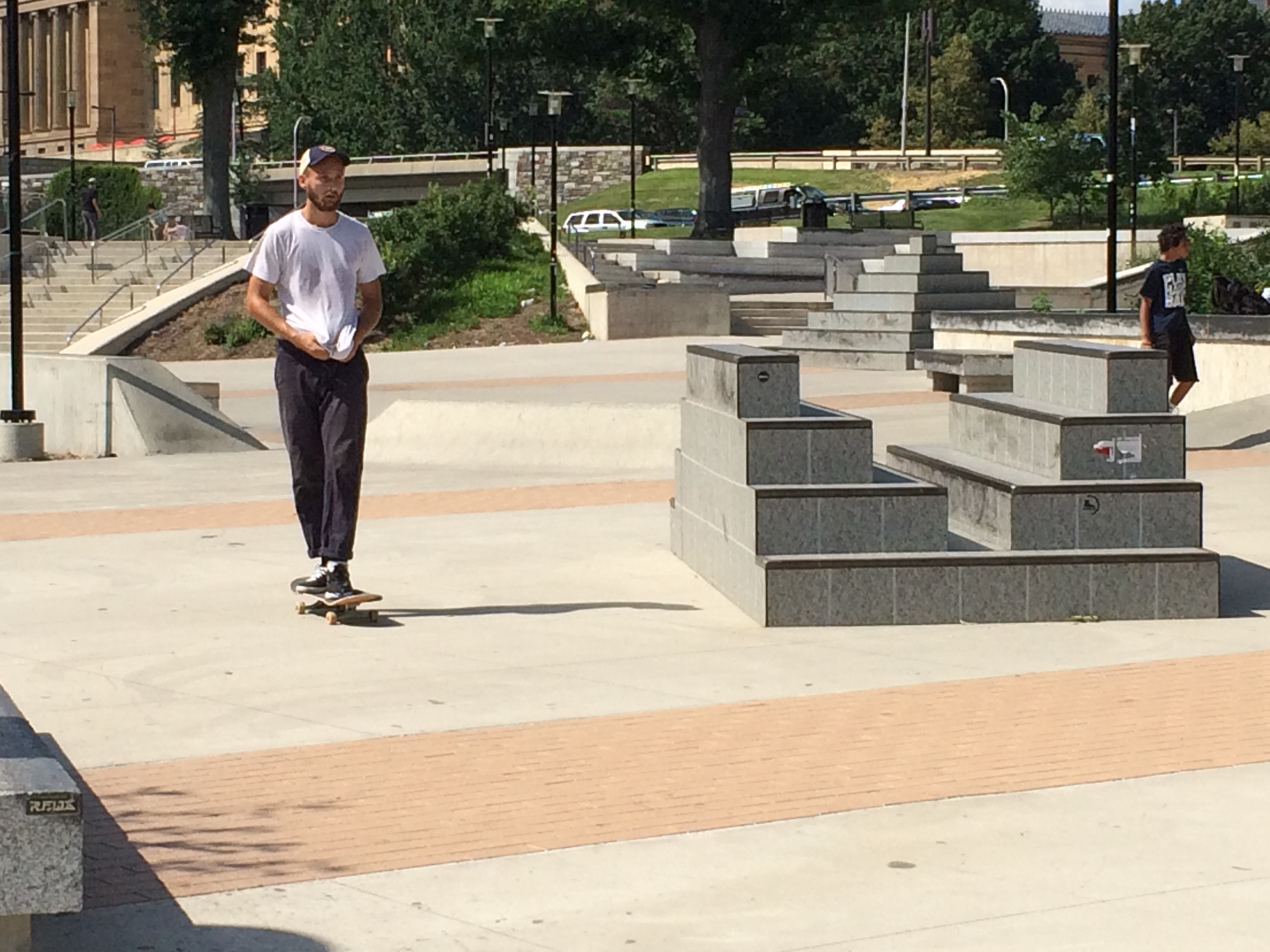
Jonathan Monk's two sturdy sculptures, Steps and Pyramid, in Paine's Park.
Jonathan Monk’s two sturdy sculptures, Steps and Pyramid, in Paine’s Park.


But did my eyes deceive me? There in Paine’s were two creations that looked suspiciously like Sol LeWitt’s Steps and Pyramid. Sure enough, they were near-replicas. Their artist, Jonathan Monk, liked LeWitt’s sculpture garden pieces so much that he paid homage by creating cousins. And he even gave them the same names. But whereas do-not-touch signs are planted near LeWitt’s pieces, the Monk sculptures, fashioned from really tough materials, are meant to take whatever abuse skateboarders can dish out. Sandy and I didn’t see any of the gliders take on the challenge of Steps’ and Pyramid’s narrowly and sharply angled spaces, but I have it on good authority that it happens regularly. Monk’s works not only continue LeWitt’s figurative idea of staying on the upside, they provide the surfaces to allow someone actually to soar.

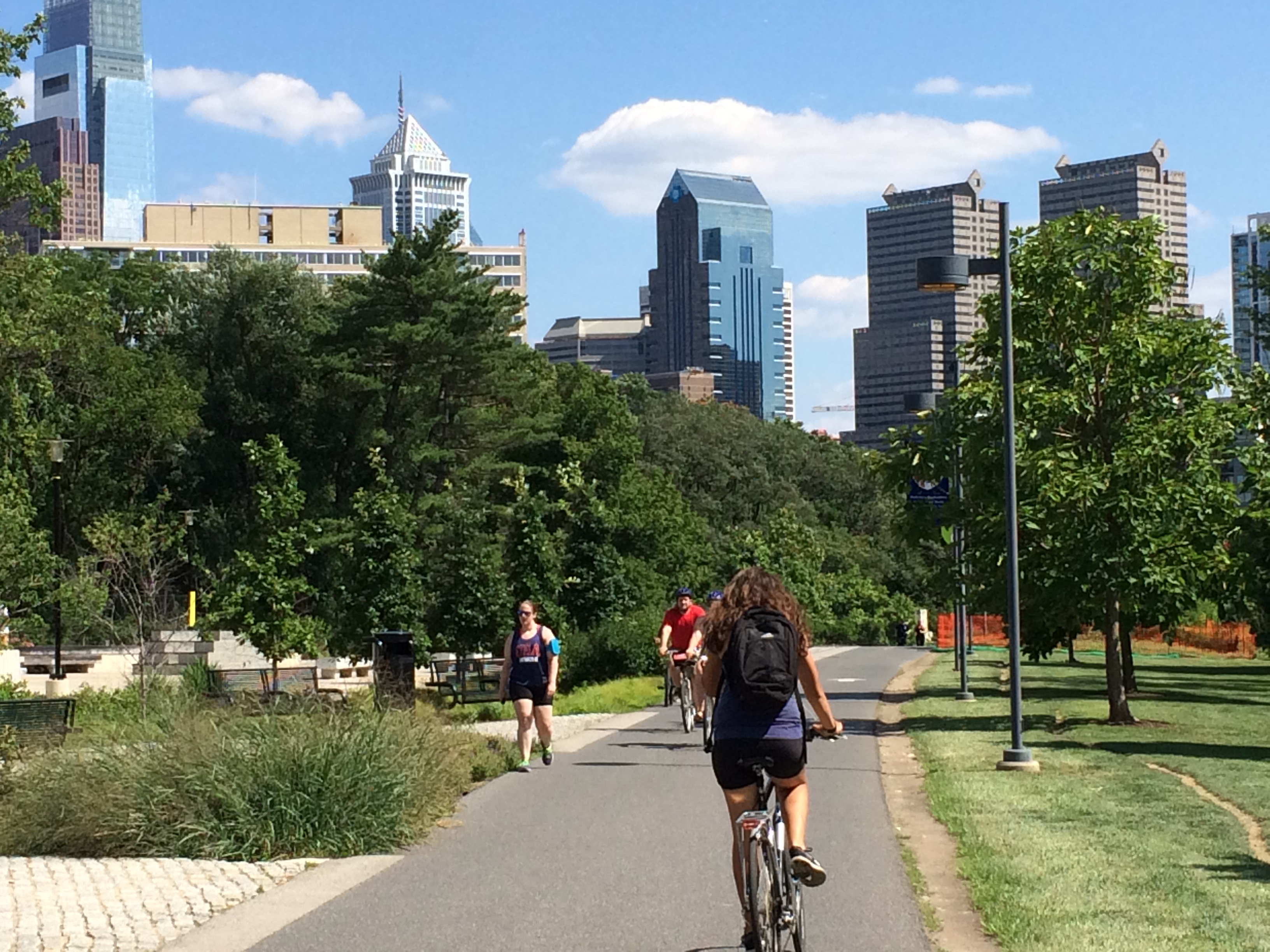
Skyscrapers in Center City Philadelphia.
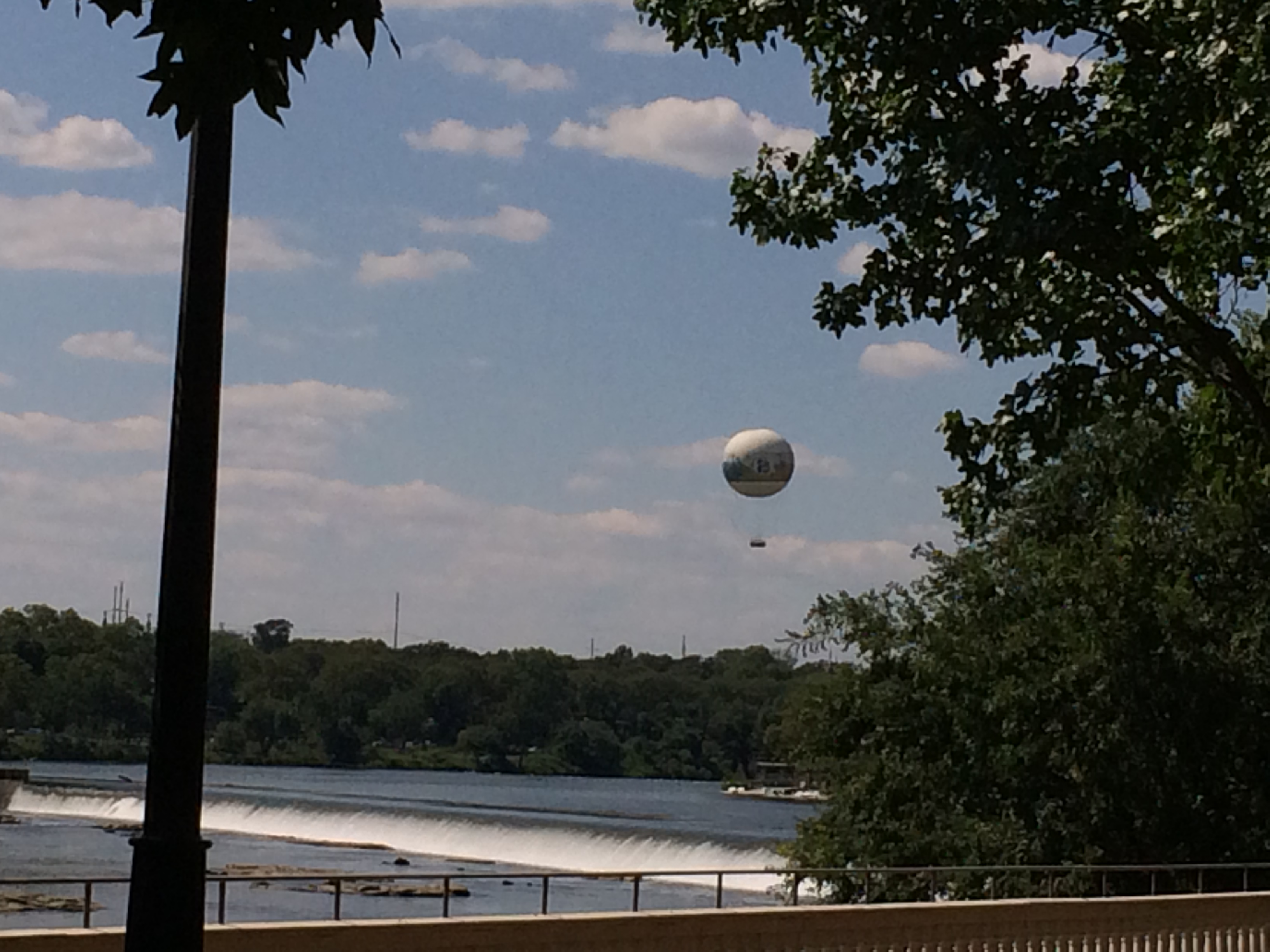
The Philadelphia Zoo's ZooBalloon.
The Philadelphia Zoo’s ZooBalloon.
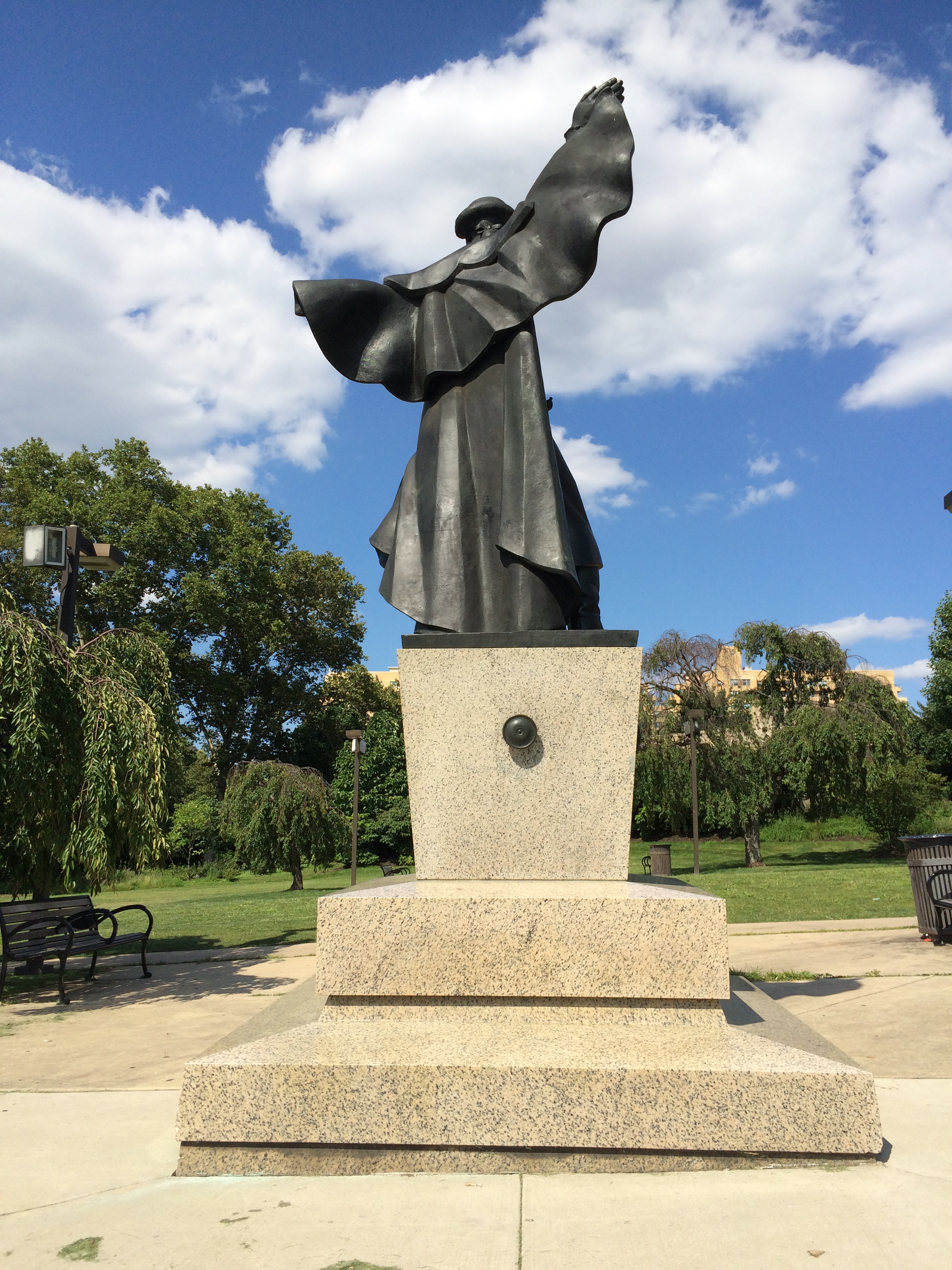
Marquis de Lafayette.

Yes, I smugly said to myself, there really is something to this idea I have. I looked around. In one direction were skyscrapers in Center City Philadelphia, testaments to man’s hopefulness. And in another was the Philadelphia Zoo’s gigantic and somewhat iconic ZooBalloon. Its daily flights, weather permitting, allow zoo visitors to come close to getting their heads near the clouds. And as Sandy and I made our way back to the museum grounds we passed Raoul Josset’s massive bronze statue of Marquis de Lafayette, his cape-enshrouded right arm pointing to the heavens. “Onwards and upwards, citizens,” the Marquis seemed to be saying.

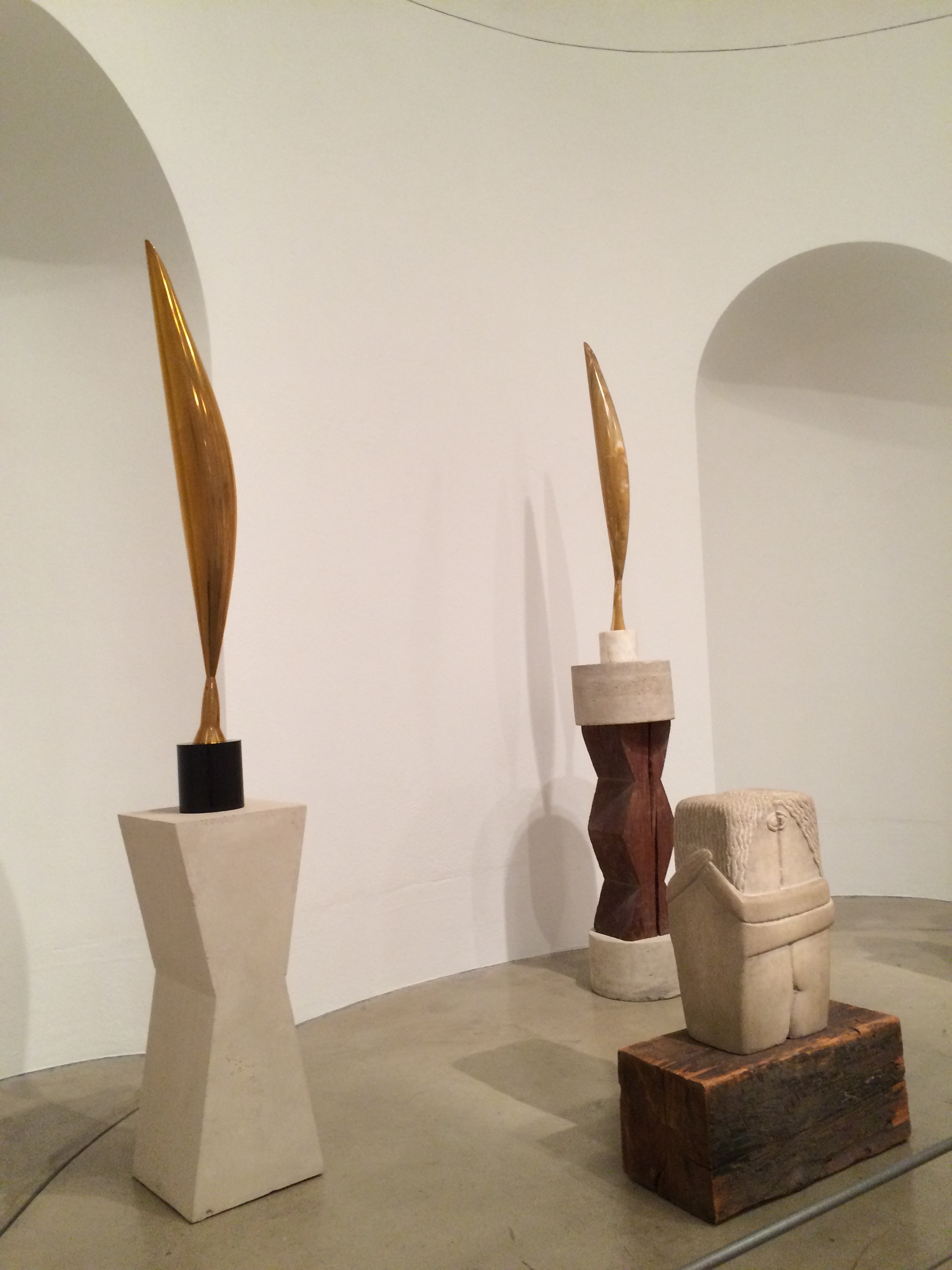
The two tall works are Brancusi's Bird sculptures.
The two tall works are Brancusi’s Bird sculptures.

Sandy and I entered the museum. She headed toward a photography exhibition. I told her I’d meet her there in a bit after I continued my search for further examples to bolster my theme of the day. The museum holds a superb collection of sculptures by the great modernist Constantin Brancusi, and has devoted an entire room to his works. In it I stood before two related sculptures, Bird In Space and Bird In Space (Yellow Bird), the former made from bronze, the latter from marble. Both are sleek and very beautiful. Brancusi must have felt his spirit soaring as he designed and shaped them in the early 1920s, and post-creation too. Going up!

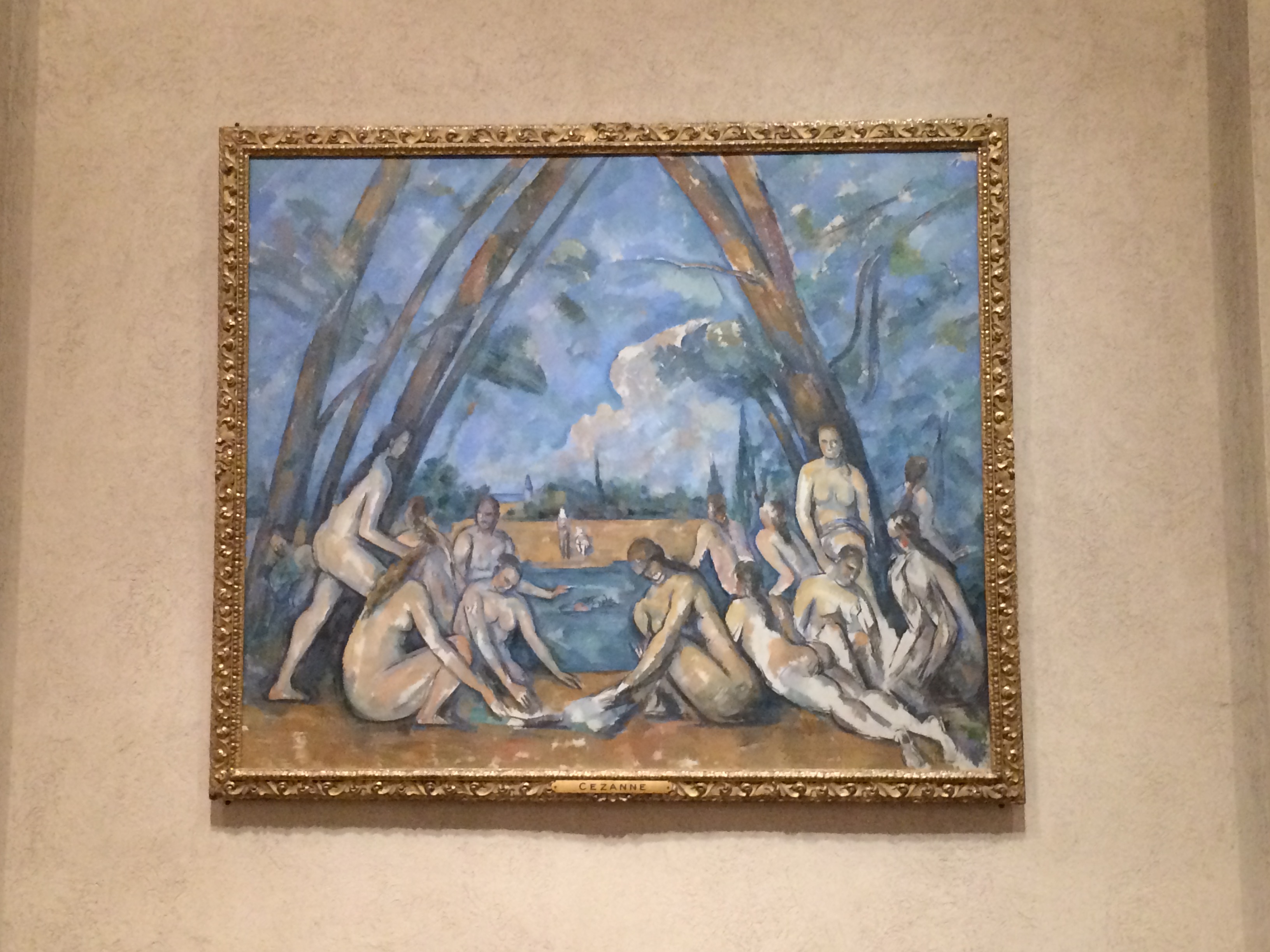
Paul Cezanne's The Large Bathers.
Paul Cezanne’s The Large Bathers.

I was tiring. One more stop, and then my quest to try and make a point would end. On many levels, Paul Cézanne is hard to beat. For maybe the 100th time I let wash over me one of his many masterworks, The Large Bathers. It was one of his final paintings, completed shortly before his passing in 1906.  This time I focused on the trees providing cover for the tribe of naked folks at ground level. The upper reaches of the trees are not shown, by design. I could imagine the trees going on almost forever. I believe that in them Cézanne symbolically infused man’s basic nature to ascend and achieve. To move upward.

(All photos by Sandra Cherrey Scheinin. If you click on any photo, a larger image will open)

(If you enjoyed this article, then please consider sharing it. Thanks.)

The Music Biz And I

A typical concert scene at beautiful Pastorius Park.

On a recent morning, the day’s threatening skies put me in mind of the music business mini-career that I enjoyed till not long ago. It was with the Pastorius Park Free Summer Concerts Series, in Philadelphia’s lovely and small townish Chestnut Hill neighborhood. For seven summers, the first two as a general helper and the following five as a co-organizer, I was part of a fine endeavor. My run ended in July 2014 with that summer’s final concert. Bad weather, or the prediction thereof, were among the reasons that I decided to step down. With rain a possibility for many concert evenings, I and another co-organizer often would find ourselves phoning back and forth hours before showtime, agonizing over whether or not to move the music indoors to our rain location, a school auditorium a mile from the park. It usually was a tricky matter. Sometimes we opted for inside and the rains never came. At least twice we stayed at bucolic Pastorius Park and downpours cancelled or prematurely ended the night’s entertainment. My constitution wasn’t strong enough to laugh along with the rain gods. Weather aside, though, the Pastorius Park segment of my life was terrific overall.

In 2008, knowing that I was approaching the end of my 30+ year tenure on the payroll of Pennsylvania government, I was looking around for a part-time activity that involved my main interest. Music. For 40 years I had been quite the music junkie, listening to albums and radio at home for hours on end, taking in shows at a wide variety of venues in the Philadelphia area and beyond. It had recently dawned on me that the next phase of my life might be pretty awesome if I could become more than an audience member by getting inside the music scene  But how would it be possible to find entry? I knew nobody in the biz and had never worked in music in any capacity whatsoever. Plus, I was not too far away from Medicare age. I figured that my chances weren’t overly bright. And then, to my delight and astonishment, a door opened.

Now, the music venture I became involved with wasn’t exactly Columbia Records or Live Nation Entertainment. The Pastorius Park series is low key and homey, which was fine with me. It runs under the gentle aegis of Chestnut Hill Community Association, an agency that aims for its community’s betterment. Volunteers are central to the series because the modest Pastorius budget has room for payments to musicians and audio crew, but not much more. As first a helper and later an organizer, I fell into the unpaid pool. That was fine with me too. I was more than happy just to be part of the process.

I went to my first Pastorius Park concert in summer 2007. On stage was Scythian, a rocking Celtic group that drove the crowd wild. This was before the notion of working in the music biz had crossed my mind. The next year, though, trying to figure out where my musical dreams possibly might come partially true, I dialed Chestnut Hill Community Association and was put in touch with one of the Pastorius Park organizers, Janine. She welcomed my offer to help. Next thing I knew I was at a planning meeting for 2008’s season. And a few months after that I was at the concerts themselves, setting up tables and chairs, helping to unload and load audio equipment, collecting concert donations from the audiences during intermissions. My energy seemed to swell on concert dates. I was having a wonderful time. The door had opened.

The door opened even more in early 2010 when one of the organizers, the fellow who scheduled and booked the acts, no longer had the time to continue his duties. He and Janine asked me to replace him. Me? Book acts? Negotiate contracts? Those for me were uncharted waters. Gulp, gulp. I said OK, I’ll do my best. And I was on my way. It didn’t take long for me to realize that my new position was close to being my dream job. There I was, a music lover given the keys from out of the blue to curate a small but well-regarded music series.

I had fun working with my organizing partners, Janine for the first two years and Julie for the next three, and with the other volunteers. I enjoyed chatting with the musicians before and after the shows. And I had a major blast scheduling each summer’s string of seven Wednesday evening concerts. In 2010 I reached past the Philadelphia area to hire two acts from afar, including, incredibly, Graham Parker. His solo show packed the park maybe tighter than ever before or since. But for the next four years I decided to stick entirely with artists from the Philadelphia region’s highly fertile musical ground. I liked the idea of supporting its progeny.

If I hadn’t known it before, one thing became very apparent to me during my days as an organizer. To wit, there are an astonishing number of excellent musical acts based in the Greater Philadelphia area, and many of the little-known local performers are as good or better than many who make big noise in the mass marketplace. Success is a matter of luck, timing, backing, perseverance, who knows what. A few of the Philadelphia region’s performers whom I booked for Pastorius Park had found some degree of national and worldwide acclaim, folks such as singer-songwriters Jeffrey Gaines and Mutlu, and Celtic music greats RUNA. But the rest were talented bands on the lower rungs of success’s ladder. Some of them put on performances as enchanting as you’d ever hope to see.

Cheers Elephant and some young fans at Pastorius Park in July 2011. Photo by Kevin Kennedy
Cheers Elephant and some young fans at Pastorius Park in July 2011.
Photo by Kevin Kennedy

For instance: I’ve never been to a show like the one in 2011 involving Cheers Elephant, a pop psychedelic rock outfit with loud guitars and a free-as-a-bird and charismatic lead singer, Derek Krzywicki. Cheers Elephant’s music was magic to the ears of many youngsters who had come to the park with their parents. During the band’s second set, played under darkening skies, many kids aged five to 15 left the grassy seating areas and, seemingly magnetized by Elephant’s electric energy, made their way to, indeed onto the stage, which sat beneath a grove of tall trees. Bouncing and shimmying to the band’s powerful and catchy beats, they covered the stage, pushed the musicians onward and upward, in fact had the musicians mesmerized. The scene was surreal and transfixing.

Venissa Santi and her band at Pastorius Park in July 2014.

And in 2014, Venissa Santi brought her Cuban-flavored jazz esthetic to the park. I’d hired Venissa once before for Pastorius Park, and had also seen her perform at another concert series. Last year, though, she and her band rose to a level I hadn’t known was in their command. Early in Santi’s first set my mind was captured. The music was complex yet malleable, expanding and contracting like strong bands of rubber. Venissa’s intimate and pitch-perfect vocals intertwined with the chordal onrushes of Tom Lawton’s piano, the now-I’m-here-now-I’m-there notes from Madison Rast’s bass, and the melodic assymetrical patterns of Francois Zayas’s drums. This, I thought, was music parallel to that of Miles Davis’s famed 1960s quintet. Was I imagining things? I don’t think so. Did others in the audience hear the music as I did? I can’t say for certain. But judging from their tremendous applause I’d guess yes.

(If you enjoyed this article, then please consider sharing it. Thanks)

Ashes: Lindi Ortega’s Great Song Heard In The Great Outdoors

This is a story about life’s little surprises, about how one thing leads to another. In this gentle instance an unexpected impulse to relocate my duff from indoors to outside resulted in my hearing a song that I can’t get out of my head.

There’s something naturally relaxing about sitting outdoors when the weather is pleasant. Some people sit in parks, some on beaches, some a few feet from doors to their homes. One of my pals lives in Philadelphia in an old comfortable house, a sprawling place with a front porch. On evenings when the Philadelphia Phillies are taking the field, my friend positions himself in a porch chair, balances a small radio on a table beside him and turns on the Phillies station. He remains there till the game is over. This routine helps him stay calm.

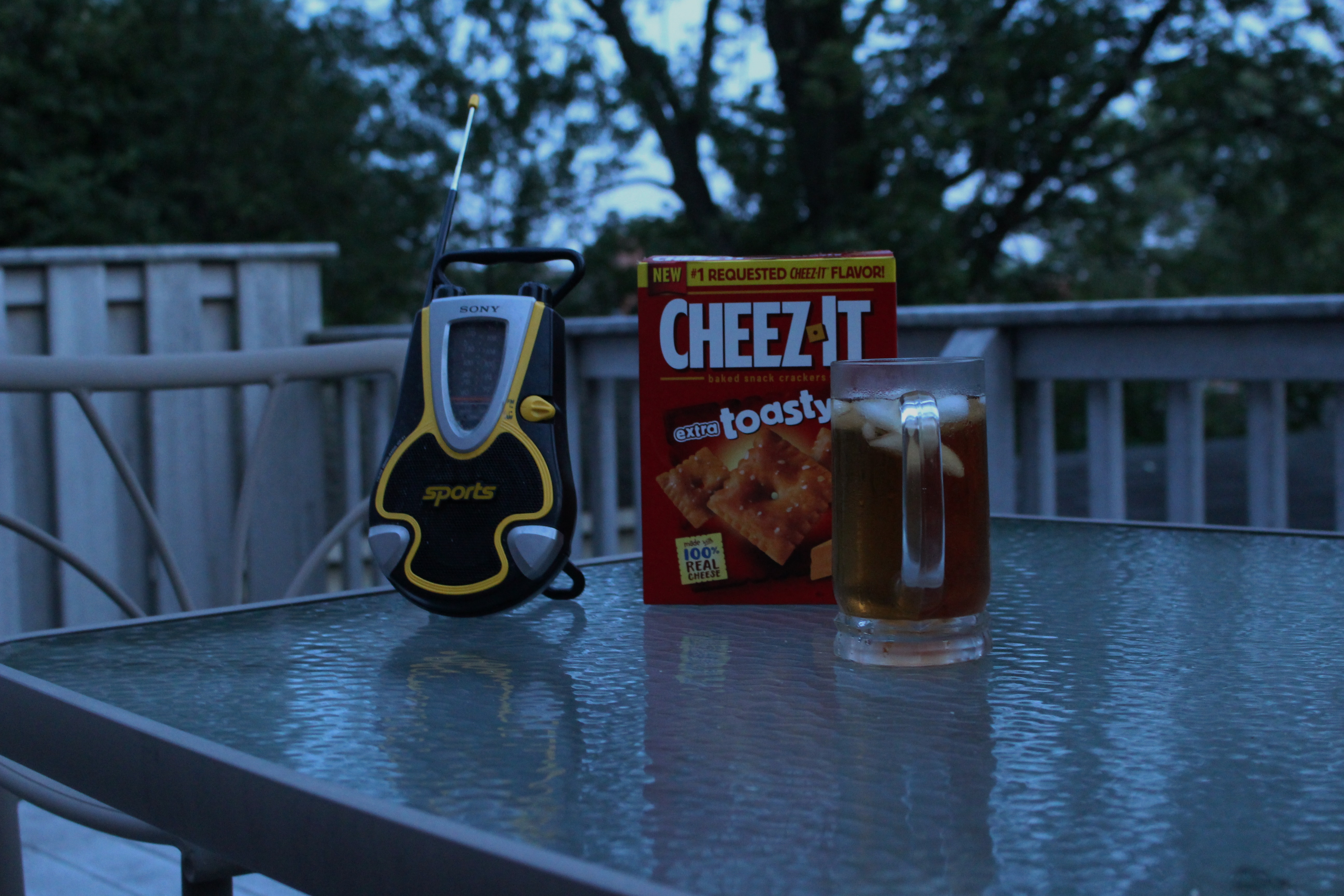
A scene at dusk: Cheez-Its, iced tea and portable radio on the deck table behind my house. Photograph by Sandra Cherrey Scheinin
A scene at dusk: Cheez-Its, iced tea and portable radio on the deck table behind my house.
Photograph by Sandra Cherrey Scheinin

I should emulate my friend’s fresh air example more often. I used to sit outside frequently, mostly on the deck behind my house, but haven’t much in the last few years. Most of my sitting and downtime in that stretch has taken place on the sofa in my living room. On a recent Monday night, however, a powerful urge to visit the great outdoors came out of nowhere, and so I stepped onto the deck as dusk was settling in, and sat at the deck table. The temperature was ideal, the evening peaceful. At least ten houses are within 100 feet of the deck, but they became less and less visible through the trees as blackness approached. These were conditions that agreed with my inner yearnings. That is, I felt isolated, away from it all. And three things made the scenario even better: Food, beverage and music. Munching on Cheez-Its,  sipping iced tea and, most important to this story, listening to my portable radio, I was as relaxed as I’m capable of becoming. The radio was tuned to WXPN.

In the Philadelphia region WXPN is the go-to station for rock, folk, blues and nearly any other non-Ariana Grande musical genre you can name. XPN plays everything from The Beatles to Mavis Staples to Caetano Veloso to Laura Marling. And the station makes it a mission to keep up with the continual avalanche of recorded music from established and never-heard-of-them-before musicians. Airing on XPN as I sat beneath the stars and amidst pulsating fireflies was a program showcasing nothing but new songs. And the tune that issued from my radio at about 9:00 PM swept me from my state of relaxation to a much higher plane.

There are certain songs over the years that infatuated me from the moment I first heard them. In 1968 it was Jumpin’ Jack Flash, by the Stones. To this day it stirs me up every time I hear it. California Stars, by Billy Bragg and Wilco (and lyrics by Woody Guthrie), brought me to my knees in 1998. I’ve added another number to the list of instant infatuations, all praise to WXPN’s new music show. The song is Ashes. Its singer and writer is Lindi Ortega. Ashes overwhelmed me on my deck. I think that the calm within and without me had unlocked fully the doorways to my emotions and ushered Ashes in. From its opening notes, Ashes in a good way made me shiver and melt. It went straight to my truest spaces.

I had come across Lindi Ortega’s name in print in the past but wasn’t familiar with her music. As I’ve learned, she’s a Canadian now living in Nashville and plays and composes smart country-hued material à la Emmylou Harris and Patty Griffin. With Ashes she and her production team have created a wonder, a stirring song about the need for love, the pain of loss. The heartbeat bass lines, the steady tension-inducing drumming, Lindi’s pleading and impassioned vocals that grow as the song develops, the soul-gripping guitar solo at the song’s three minute mark . . . Ashes to me is perfection. “Darling, this is madness, why don’t you come back to me?/Don’t leave me in the ashes of your memory.” Indeed. Indeed. When Lindi next appears in or around Philadelphia I’ll be at the show. For now, I’ll listen to Ashes on YouTube, where Lindi has gifted it to the world in advance of its release next month on her album Faded Gloryville. I recommend that you do the same. Here is Ashes:

(If you enjoyed this article, then please consider sharing it. Thanks.)
We Said “Cheese Please” At Iron Abbey

I’ve grumbled before on these pages about the paucity of loveliness in the townships that surround my suburban Philadelphia home base. Stuck in the middle of a large section of this haphazard overdevelopment is a place that I think is a-ok. Iron Abbey is its name, and beer and good food is its game. It is a gastropub. Location: Horsham, Pennsylvania. My wife Sandy and I ate dinner there recently. One part of the meal, a cheese plate of all things, particularly opened our minds and eyes.

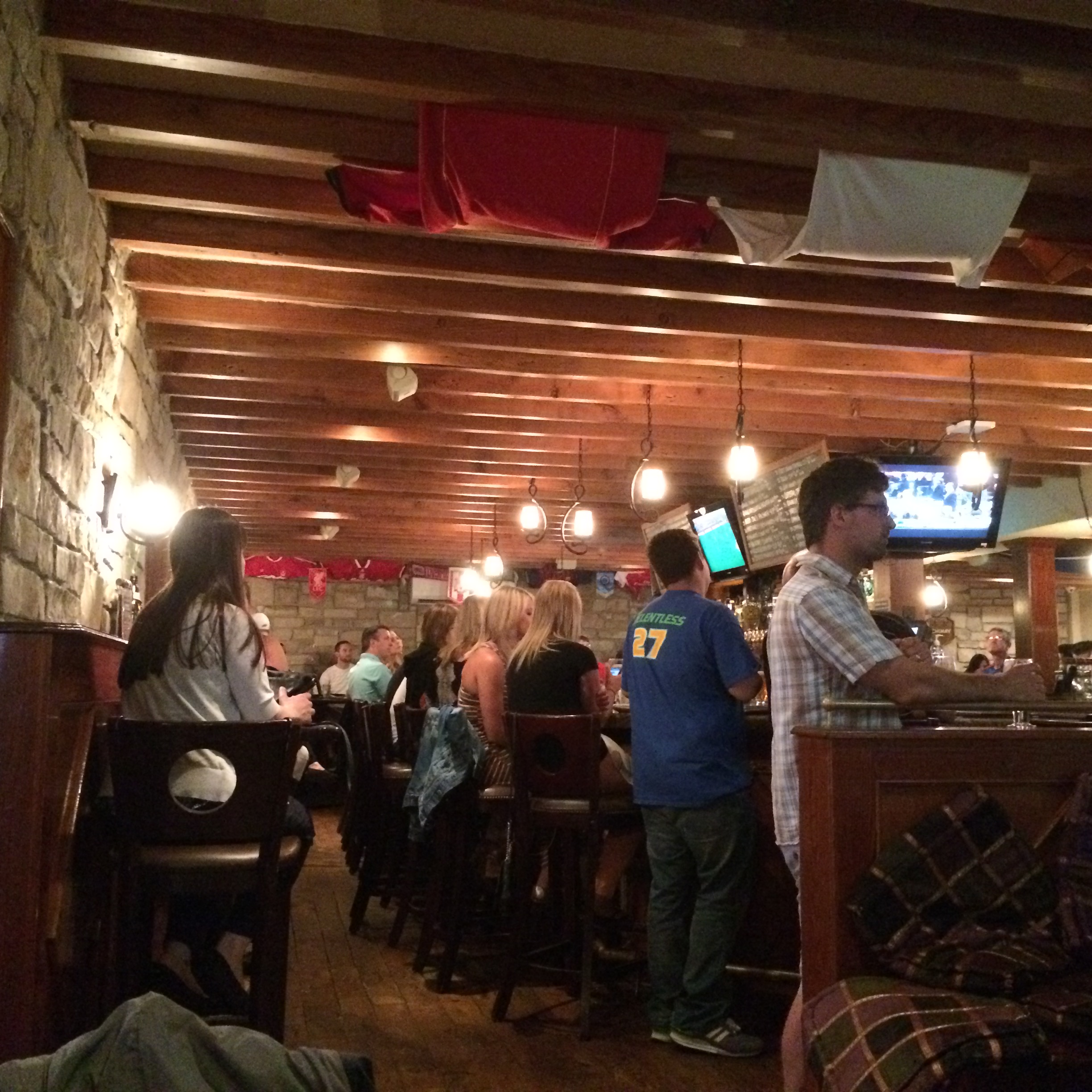
Part of the scene at Iron Abbey.

Iron Abbey is a large establishment. Its dining areas and bar are on ground level where the look is woody and stoney rustic. Kind of like, who’d have guessed, an abbey. Upstairs are an espresso café and rooms filled with beers for takeout purchase. The beer rooms are wondrous, packed with microbrews, many obscure, from the corners of the globe. For this article, let’s stay on the ground floor, where the beer selections are no less mind-blowing.

Sandy doesn’t like beer. She is a wine lady. Unfortunately for her, Iron Abbey does not cater to wine-by-the-glass ladies or gents. Those selections are slim. The two Sauvignon Blanc choices were overpriced at $10.50, so Sandy, a white wine devotee, instead sipped an eight dollar glass of Cielo Pinot Grigio, direct from Italy. Sandy says she has had better. I took a sample and approved of its dryness but quickly decided its flavor could be richer.

Enough about wines. The Philadelphia region has become a haven for beer geeks, and Iron Abbey is a top example why. I spent five minutes poring over the beer menu. The choices were nearly endless, around 40 on tap and 250 in bottles and cans. The pressure was on. Twice I told our waitress that I needed more time to decide. On her third visit to the table I was too embarrassed to ask for another extension. Firestone Walker Easy Jack IPA I said, pointing it out on the menu’s draft beer section. With craft beers, one usually can’t go too wrong, so skilled have the world’s brewers become. My selection, birthed in sunny California, was proof. Bitter and hopped-up it was, as all good IPAs should be. One of the hops varieties in the recipe imparted a husky tinge of grapefruit flavor to the brew. I liked that a lot.

The best segment of the meal came next. Sandy and I were all set to bypass any starters and simply place our main course orders when I absentmindedly began to pay some attention to the menu section titled “The Board.” There, one may select from various cheeses and meats, all of which are accompanied by an eclectic mix of nibbly stuffs. Why not, we decided. When the waitress reappeared we picked two cheeses and sat back with our drinks. We’re not naïfs, but neither of us had ever before ordered a cheese plate at a restaurant.

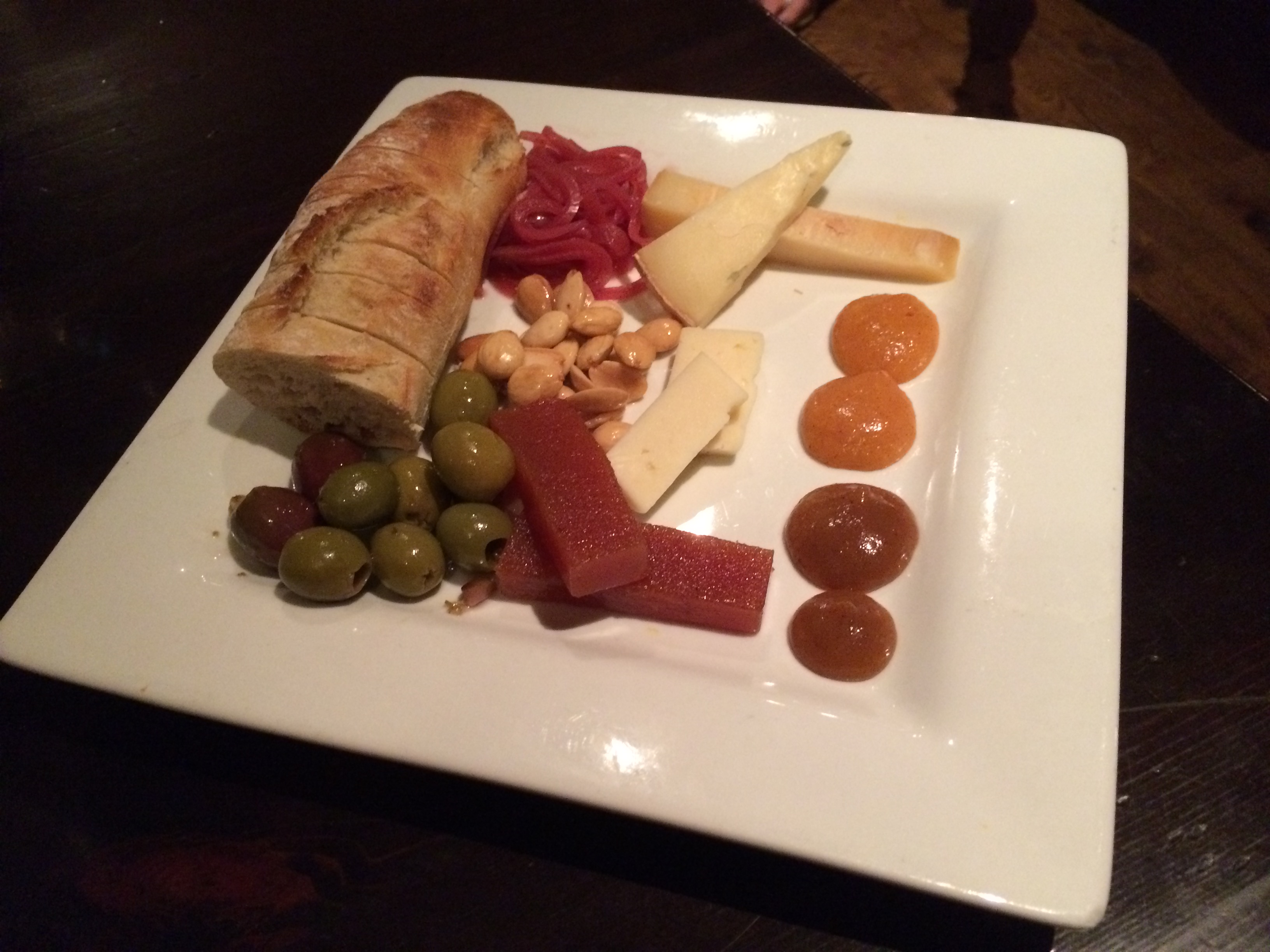
The cheese board that we loved.
The cheese plate that we loved.

The cheese plate arrived and we couldn’t have had a better time. It came with salty olives, crunchy excellent French bread, fig and apricot jams, roasted Macadamia nuts,  pickled red onion slivers and membrillo. Yes, I hadn’t a clue either as to what membrillo is. Turns out that it is a firm soft paste made from quince pulp, sugar and water. Some post-Iron Abbey research told me it’s commonly found in Portugal, Spain and Italy. I caught what I thought were flavors from the apple and pear family. Quince, as additional research told me a little while ago, is indeed related to those fruits. Bottom line, the membrillo was delicious. The other accompaniments were too. As for the cheeses, we had selected  Ubriaco Classico from Italy and Ossau Iraty from France. As with membrillo, I’d never heard of either of those cheeses before. For the most part I’m a Kraft swiss and Cracker Barrel cheddar kind of guy. But I know there’s a world of cheeses out there to be explored. The Ubriaco was semisoft and hinted of wine and citrus. The Ossau Iraty was dense and dry and pungent. Sandy and I swooned over both of them and the bread and the nibbly stuffs. This was the most exciting platter of food we’d had in quite a while.

Crab cake entrée (top). Chicken burger (bottom).

After the cheese extravaganza we’d have been happy to pay up and leave. We knew that it would overshadow the next course. Which it did. My grilled ground chicken burger, though, was awfully tasty, a comfort dish covered with melted Monterey Jack cheese and sautéed bits of red peppers and onion. The side salad I opted for in lieu of fries was fine too. Sandy’s crab cake entrée was done nicely. The grilled crab cake was charred outside, soft inside and good. Some extra doses of spices and flavorings wouldn’t have been a bad idea, though. It sat atop dreamy mashed potatoes, mushroom slices blended through. Blanched then sautéed itsy bitsy asparagus and carrot pieces, very flavorful, surrounded the mountain.

We had no room for dessert. We paid our bill and thanked our waitress, then squeezed past the crowds to the front door. Iron Abbey is a popular spot. Though it is by no means perfect, there are good reasons why it’s bustling.

(Photographs by Sandra Cherrey Scheinin. If you click on any photo, a larger image will open)

A Friday Frolic In Philly

My wife Sandy and I lived in Philadelphia for many years, both before we met and subsequently. The year 2005 was a momentous one for us, because that’s when we made the leap from the city to the nearby northern burbs. In some ways I prefer living where I now do, in other ways I wonder if leaving the city was a brilliant idea. Our house is nicer than the one we used to occupy, the current neighborhood is cuter than its predecessor. On the other hand, automobile traffic around here is as blood pressure-elevating as in Philadelphia. And there aren’t enough fun things for us to do, which is why we head south a few times each month to check out the offerings in various sections of the City Of Brotherly Love.

My overall opinion of Philadelphia is a good one. Yes, the city has plenty of problems, like too much crime and a pitiful public school system. And yet it has so much going for it. Loads of history that we all know or should know about. Great parks big and small. Fabulous buildings from the late 1600s onward. More restaurants, music venues, theaters and such than anyone could wish for. I’m sounding like someone from Philadelphia’s official tourism bureau, but my feelings are legitimate. For physical beauty, culture and food, Philadelphia is world-class.

Which brings us to Friday, July 3. Sandy and I were itching to get out of the house. Not much that we knew about was going on in the burbs. Philadelphia it would be. Where in the city though? Sandy had noticed in the paper that July 3 was First Friday in Philadelphia’s Old City section. We hadn’t been to a First Friday in a year or two, and we decided to go.

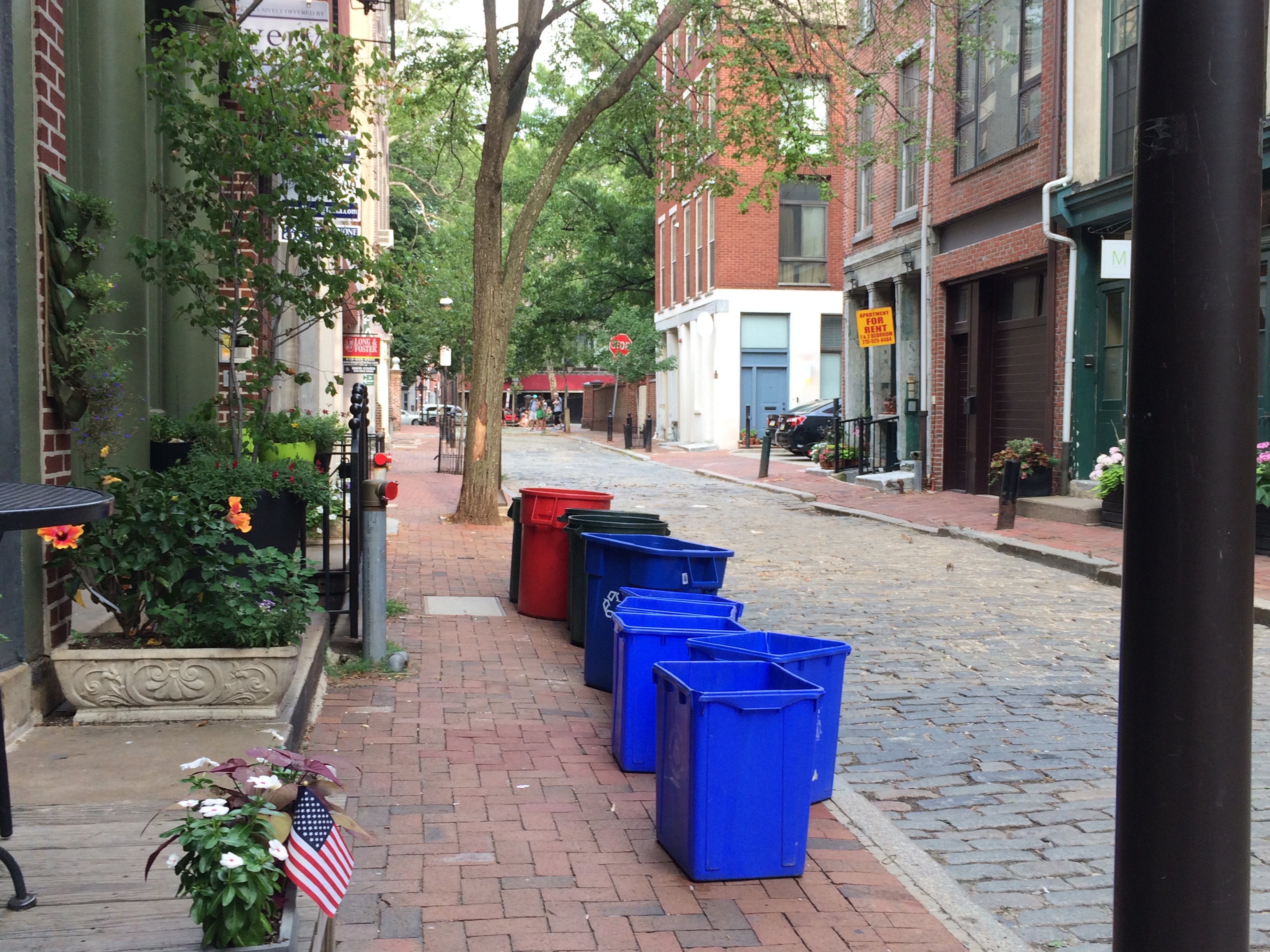
Old City's Church Street is paved with grey bricks.
Old City’s Church Street is paved with grey bricks. They contrast nicely with plastic recycling bins.

Old City is a part of town that was full of homes, businesses and people in Colonial days. It still is, and many of those 1700s structures are with us today. The area is quaint and often lively, and plenty of streets retain their ancient paving bricks and stones. There are quite a few art galleries in Old City. In 1991, attempting to lure customers and imbue Old City with needed panache, some gallery owners began keeping their doors open in the evening on the first Friday of each month. They spread the word and a monthly mini-festival, a kind of happening, was born. All over the world, events similar to First Friday are taking place. They can be good.

You never know what you’ll come across on Old City First Fridays. Painters and crafts people and assorted vendors set up tables for their wares on the sidewalks and in alleyways, which are also where musicians set up their instruments and wail. And many art galleries, the original driving force, are open. Sandy and I strolled around Old City without a plan. Not having done advance research, we ended up missing a few blocks with galleries we’d have liked. Next time. Most of the action that we caught was on a two block stretch of 2nd Street between Market and Arch Streets, and on Arch between 2nd and 3rd. A small chunk of territory, actually, but enough.

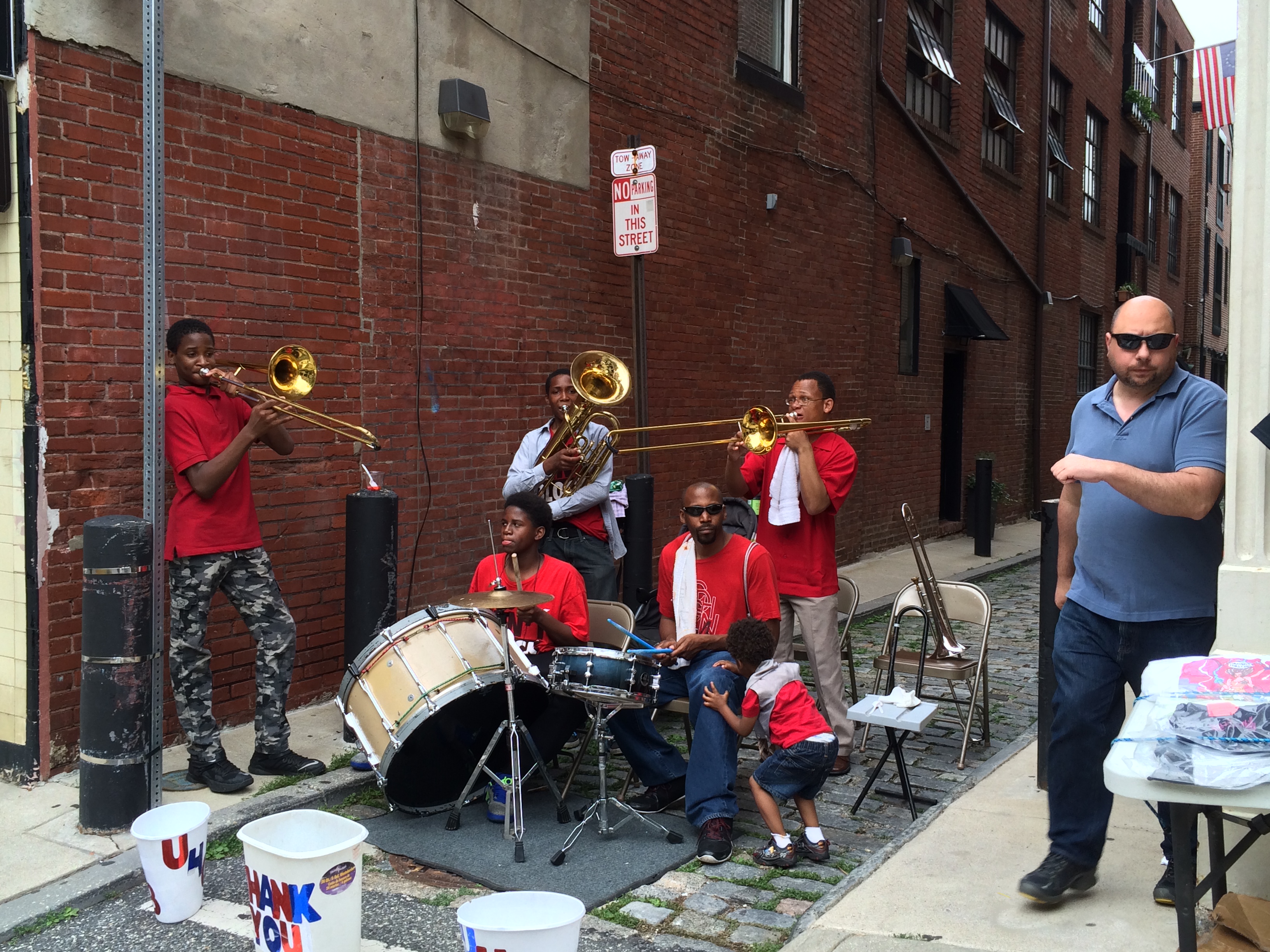
Brass band wailing away in Old City.
The human caterpillar.


Our eyes were open for human creations and human activities. Who wouldn’t have loved the brash New Orleans-style brass band occupying a niche where Cuthbert and 2nd Streets meet. Or the long-haired White dude who, catching some zzzs, was draped like a caterpillar over one of those large and ubiquitous green utility company sidewalk boxes. He was Mr. Flexibility personified.

Lady in blue with her colorful wares.

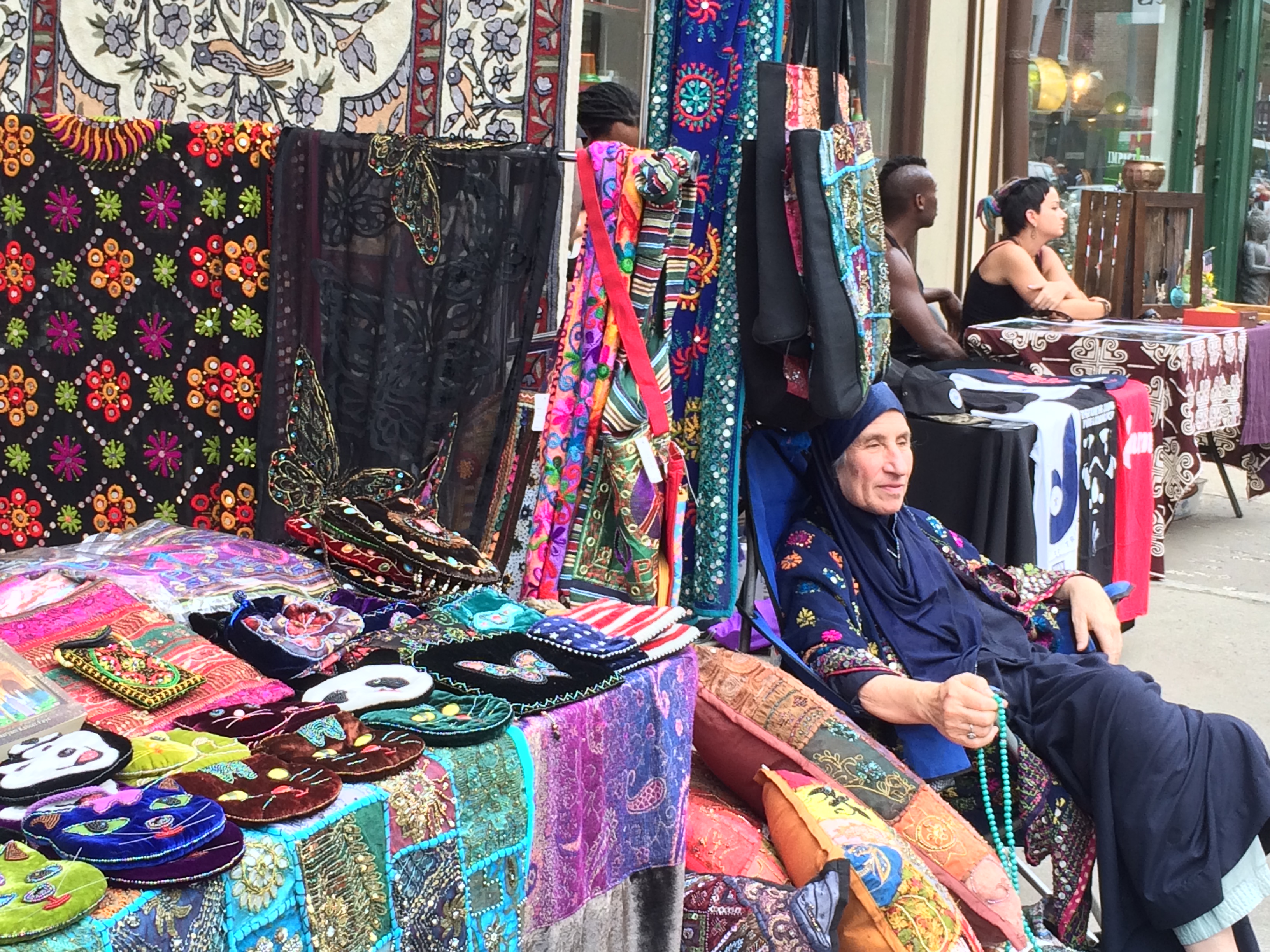
Or the head-scarved lady in blue on 2nd Street whose tables and racks held as eye-popping a collection of pillows, fabric trivets, shoulder bags and cloth drapings as one would ever see in a 30 square foot parcel of sidewalk. Middle-Eastern and Asian patterns and color combinations burst from her goods, clashing outrageously, looking great together nonetheless. Henri Matisse, who threw wild design combos into so many paintings and never met a color he didn’t like, would have loved this lady’s display.

Artworks by Keith Sharp at 3rd Street Gallery.
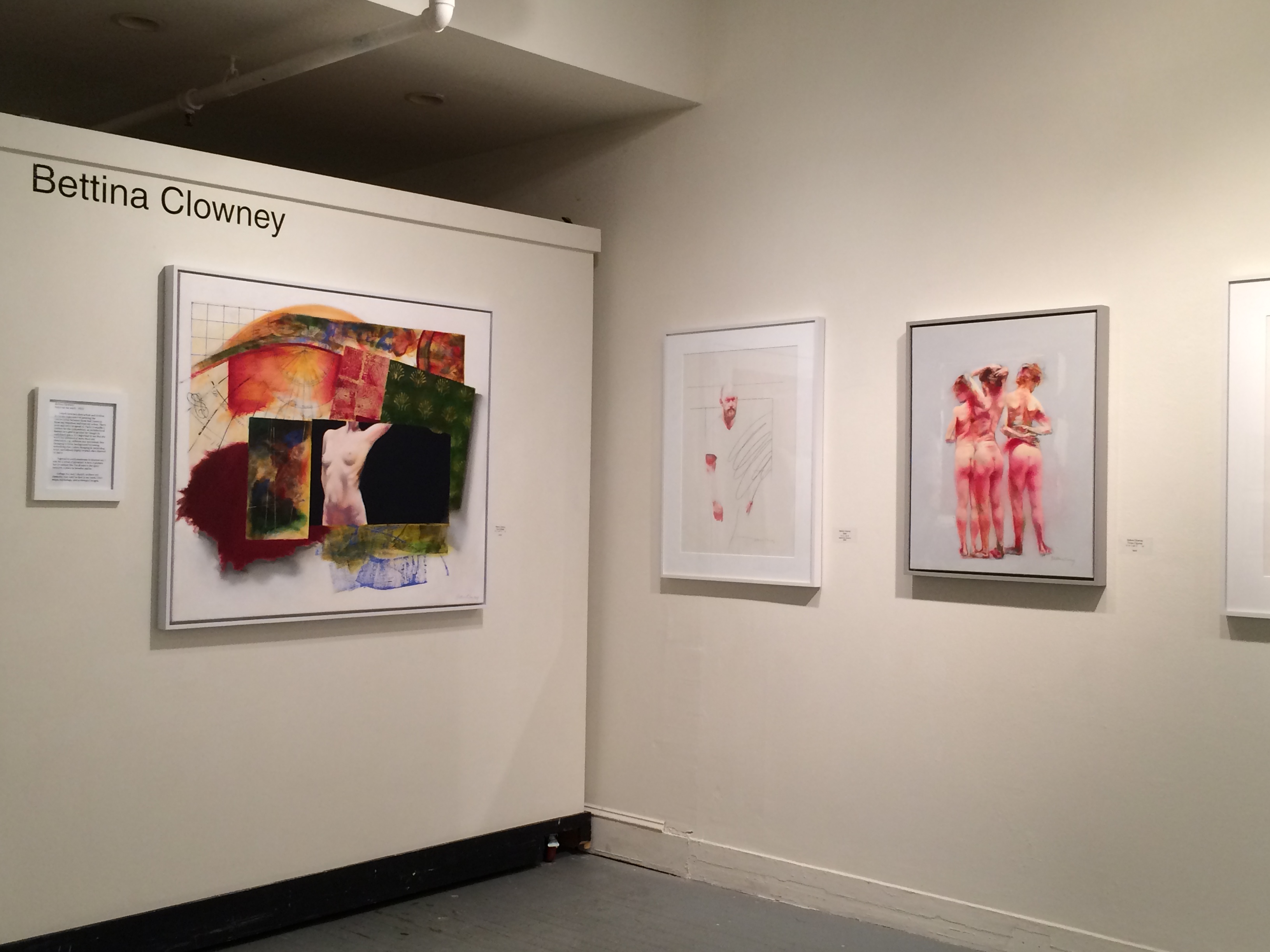
Artworks by Bettina Clowney at 3rd Street Gallery.

There were beautiful paintings, sculptures and crafts to be seen in the galleries. I’ll mention a few places. We liked just about everything we saw at 3rd Street Gallery. Two artists were showing there. Keith Sharp’s dark and dramatic photographic manipulations were intriguing, some a bit ominous. They were very different from Bettina Clowney’s spare paintings. Clowney uses a lot of whites in her depictions of fruits, of people, and in non-representational designs. Gazing at each other from opposite walls, the Sharp and Clowney artworks made a good marriage.

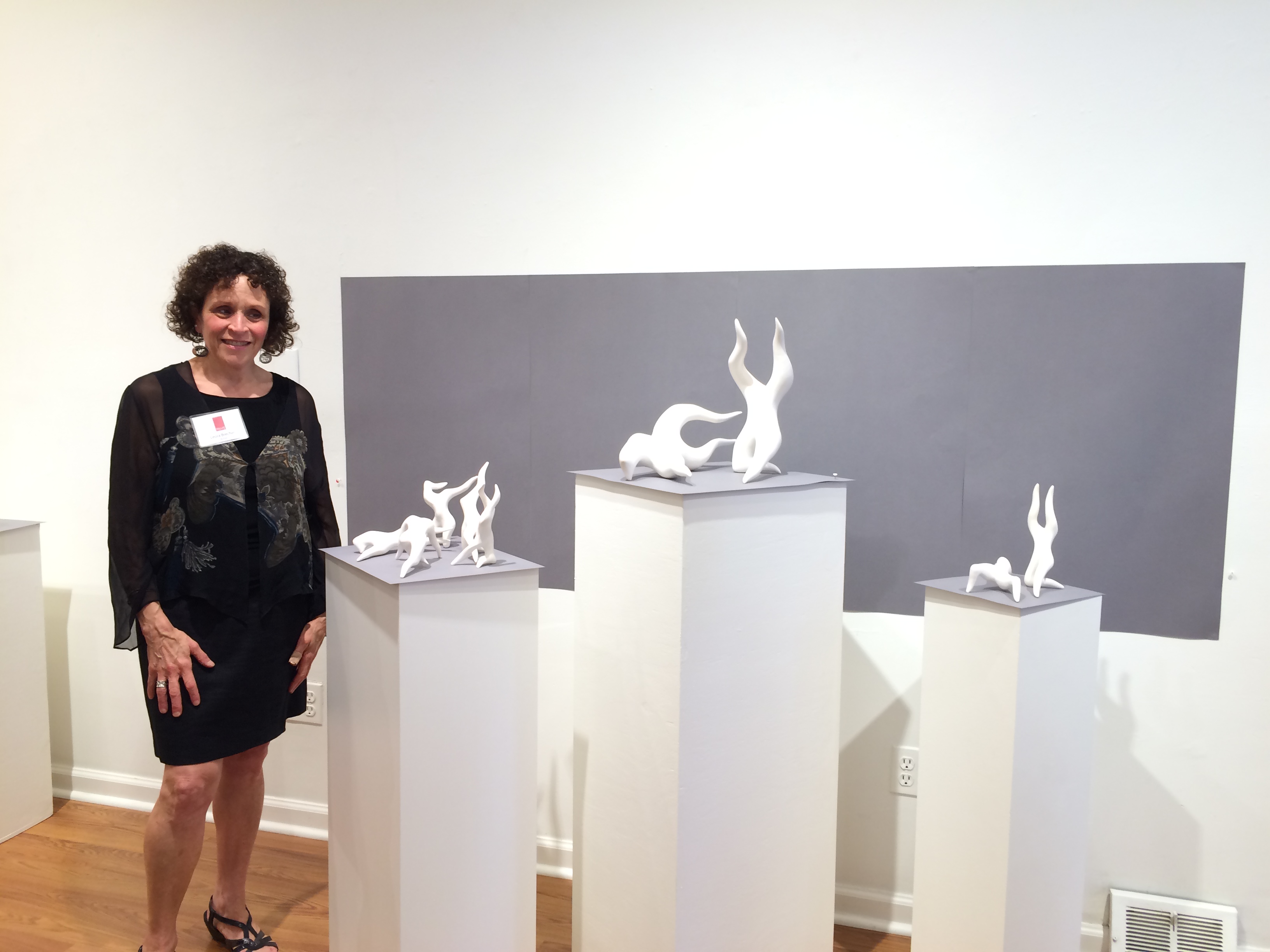
Leora Brecher with some of her sculptures at MUSE Gallery.
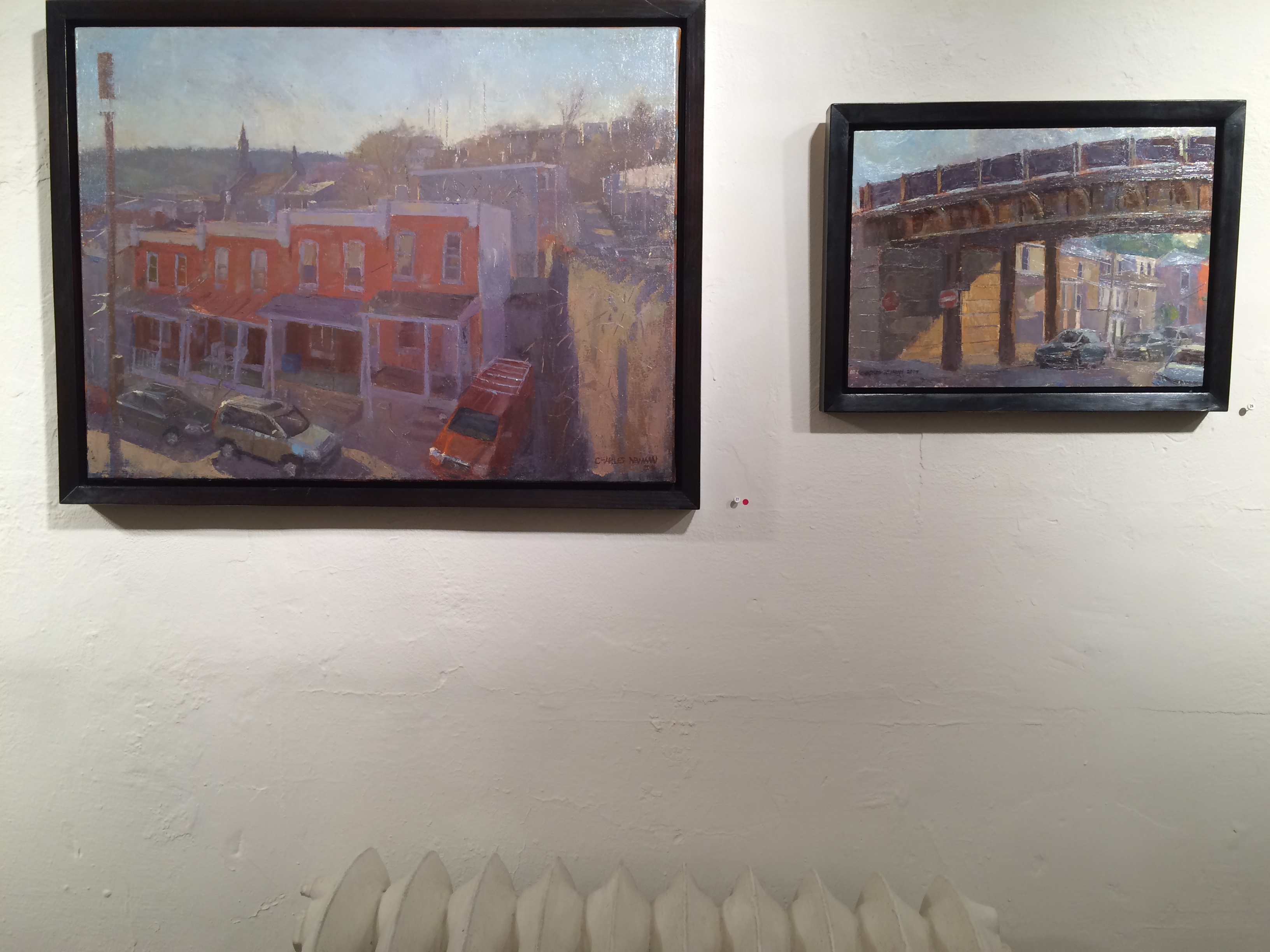
Paintings by Charles Newman at F.A.N. Gallery.

MUSE Gallery was filled with Leora Brecher’s small fired clay sculptures, all in white. Many were abstract suggestions of human movement, open and flowing. Very lovely.

F.A.N. Gallery on Arch Street is one Sandy and I visit occasionally. I wasn’t knocked out by its smorgasbord of works by gallery artists on this First Friday visit. We both liked the oils by one artist though, Charles Newman. He paints Philadelphia street scenes, focusing on old buildings, very well. The perspectives from which he views his brick and stone subjects are off-angle, giving the pictures a quiet tension, and his earthy subdued color choices are just right.

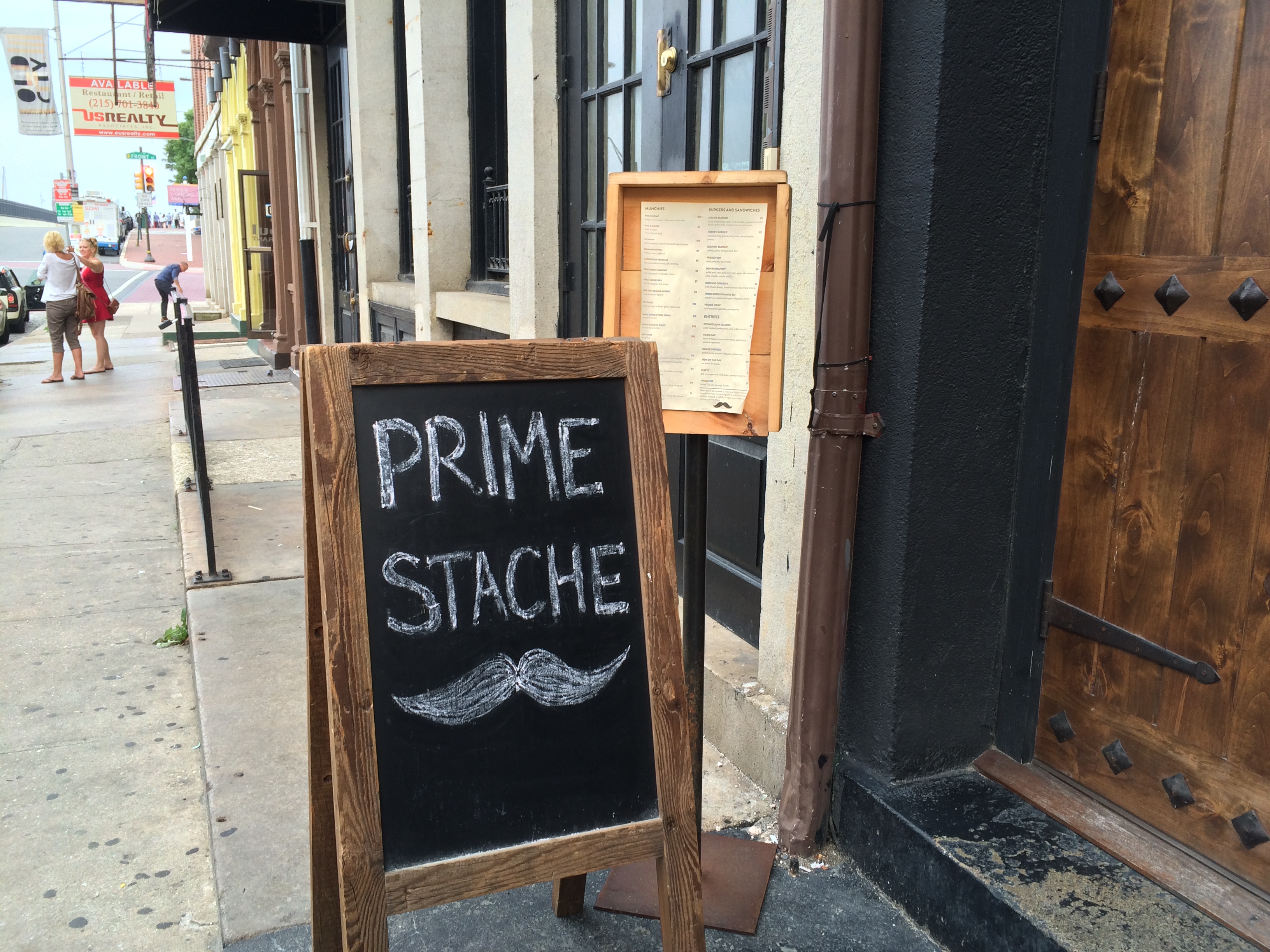
Prime Stache, where we had dinner.

Dinner time. Off to Prime Stache, a few blocks from First Friday, on Chestnut Street. Atmospherically, it’s for lovers of exposed brick and stone walls, which Sandy and I are. A pubby place short on wines but decently long on beers, its food is good. Prime Stache has some fancy offerings, but we weren’t in a fancy mood. We both enjoyed our simple burgers, Sandy’s of the salmon ilk, mine of the turkey.

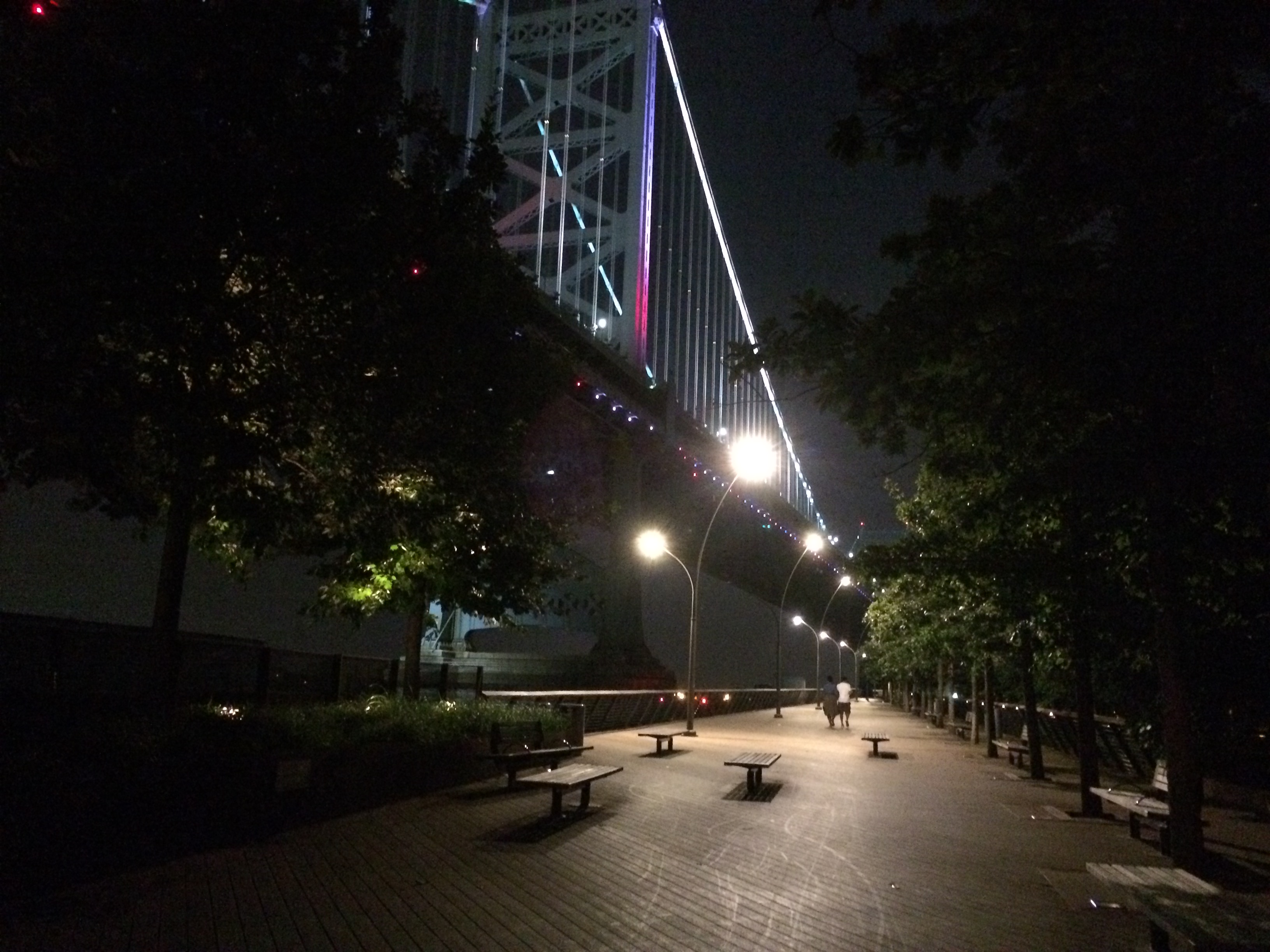
Race Street Pier and Benjamin Franklin Bridge.

The best part of the evening lay ahead. We strolled northward from Prime Stache to Race Street Pier, one of my favorite spots in Philadelphia. I’ve been there in daylight and late at night, and late night is better. The pier lies near the Benjamin Franklin Bridge, and in darkened hours the illuminated bridge overhead is breathtaking.

Jutting into the Delaware River, Race Street Pier once was a commercial municipal pier. It has been converted into a serene and intimate two level public park with long walking paths, a lawn and oak trees. Much of the Philadelphia region’s population has yet to discover this park. It opened four years ago, the first and still the only of its kind in Philadelphia. At the tail end of our First Friday evening, Race Street Pier bewitched Sandy and me. We walked romantically. We were inspired by views of the Delaware. We shook our heads marveling at the beauty of the massive Franklin bridge. And then it was time to head home.

(All of the photographs in this article were taken by Sandra Cherrey Scheinin. If you click on any photo, a larger image will open)

Footing: It’s At The Center Of Two Recent Movies

“Footing” is not a word you see or hear a lot. For some reason it jumped into my mind recently when I started to think about two movies I’ve watched in theaters of late. I hadn’t planned on writing about either of them, but wondering about “footing” — when strong, a balanced outlook and approach that allows a rewarding life — has nudged me to confront my PC’s keyboard.

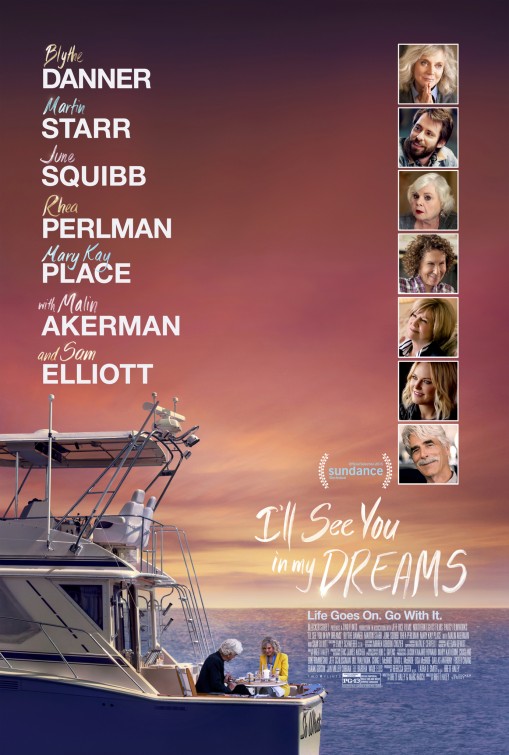
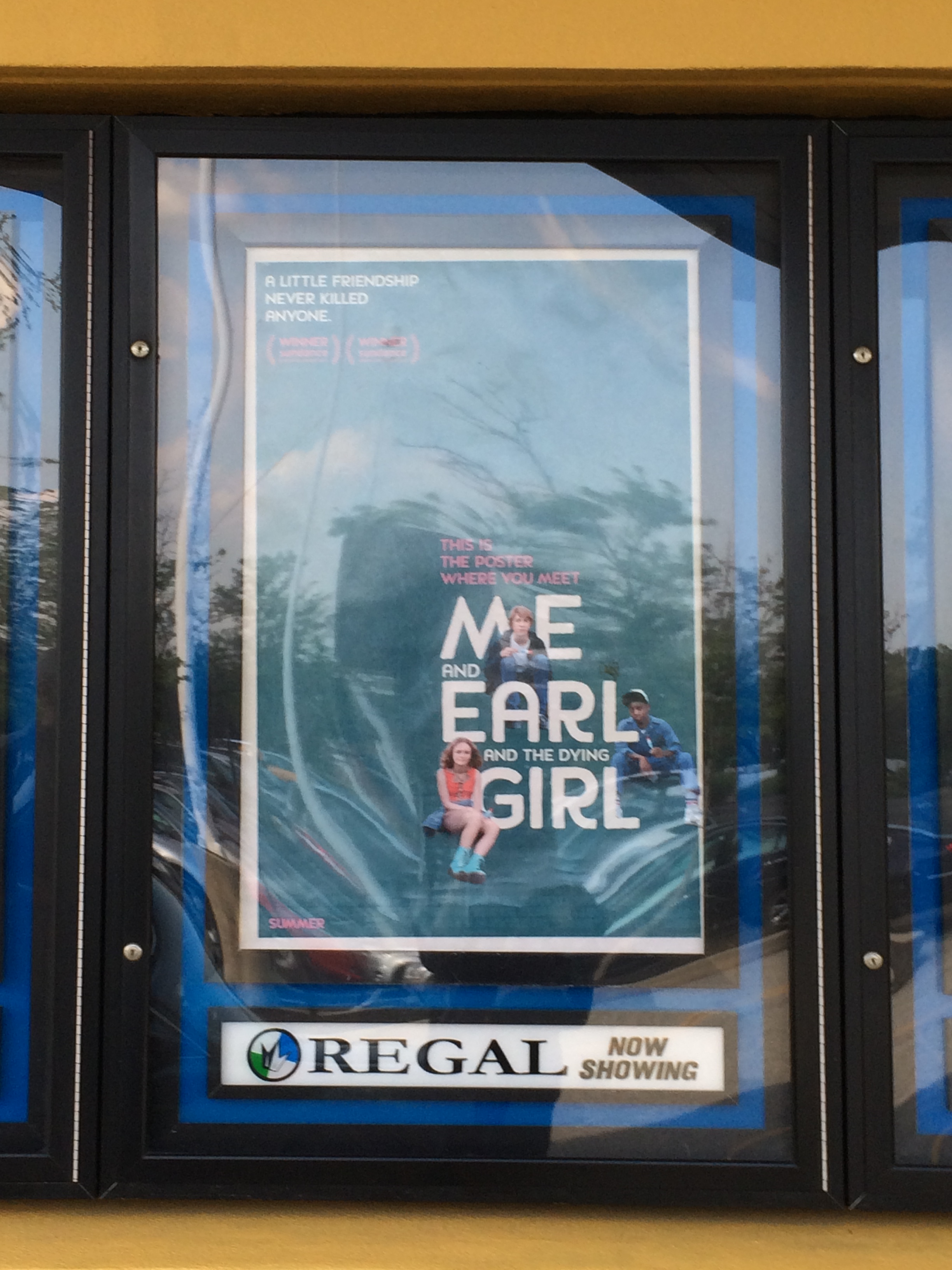
I didn’t comment on these movies till now not because they aren’t worthy. Rather, time-wasting little ol’ me simply didn’t find the time. In fact, these are fine movies. I’ll See You In My Dreams, and Me And Earl And The Dying Girl premiered in January at the 2015 Sundance Film Festival. Both went into theatrical release this spring. The movies are serious, with a light touch that keeps things friendly and personable. I’ll See You earns a three (out of four) star rating from me. I’ll bestow four stars on Me And Earl.

For much of the world’s masses, just staying alive is more than enough of a challenge. Footing is among the least of their worries. But for billions of others, middle class Americans for example, the pastures are open and the possibilities for a good life are real. Still, gaining one’s footing isn’t necessarily easy even for them. Nor is maintaining what has been gained. The slings, the arrows . . . who knows what’s coming around the bend? Most of us, luckily, eventually find our footing. And if we stumble somewhere along the line, we’re apt to get it back.

I’ll See You In my Dreams and Me And Earl And The Dying Girl are about a lot of things, including death, but footing I think is quite key. I’ll See You looks at the life of one Carol Petersen, a 70-ish California lady whose traction is pretty good at the movie’s beginning but definitely is in need of adjustment. Me And Earl’s primary character and narrator, Greg Gaines, is, as the movie opens, a high school senior in Pittsburgh whose feet have yet to be planted firmly on life’s terrain. Despite their age gap, Carol and Greg aren’t all that different. If their movies could cross-populate, they’d probably become pals, observing the potentially fixable weak spots in each other’s psyche.

My wife Sandy and I saw this movie with friends in Philadelphia. We all liked it very much.

Blythe Danner plays Carol, and does so very well. It’s a role that Danner, deep into her career, never saw coming. I watched Danner interviewed on television not long ago and she bowed down to the screenwriters and producers who brought the script her way.

A widow for 20 or more years, Carol is comfortable with her life. Money isn’t a problem. She spends time with a few close friends, sunbathes beside her pool behind her modern pad, and adores maybe more than anything her dog. But Carol drinks too much and doesn’t have all that great a relationship with her adult daughter. Something is missing. Her footing is somewhat tenuous. She’s a little dead inside.

To the rescue come two new entries into her social stream, one much younger than she, one maybe a little older. Both become her good friends. The young guy, Lloyd, (nicely portrayed by Martin Starr) and the cool, calm and charismatic older gent, Bill, (a beautiful turn by Sam Elliott) in their own ways widen Carol’s eyes to life’s possibilities. Love, needless to say, falls into that category. Carol’s footing, before the credits roll, is looking better.

My wife Sandy and I saw Me And Earl And The Dying Girl in Warrington, Pennsylvania.

I found Me And Earl And The Dying Girl irresistible. It is colorful, witty and perceptive. And very human. The plot, dialog, camerawork, editing — ooh la la. Ditto for the acting and the balance at the movie’s heart between comic exaggeration and sadness. Thomas Mann portrays Greg, a young man of extremely bright mind who is badly in need of self-confidence. There are people who love him — his parents, at least one school teacher, at least one peer (Earl Jackson, marvelously acted by RJ Cyler) — but Greg barely realizes or believes that he is loveable. Quick-thinking and creative as the dickens, self-doubting Greg thinks little of the amateur careers that he and Earl have as clandestine film makers. For a few years the two have retitled classic movies and then filmed zero budget versions whose plots idiotically and hysterically fit the new titles. The Third Man becomes The Turd Man. Midnight Cowboy becomes 2:48 PM Cowboy. You get the idea.

Greg does his best to get along with the various cliques in his high school, working hard to have only peripheral relations with all. His degree of self-worth doesn’t allow him to commit to more than that. One day, though, his world is shaken. His mother comes to him with the news that a classmate whom he barely knows, Rachel Kushner, has been diagnosed with leukemia. Greg’s mother and Rachel’s mother are friends, and Greg’s mom wants him to visit Rachel (the excellent Olivia Cooke), to reach out to her. Greg isn’t big on reaching out, doesn’t really know how. Reluctantly and awkwardly he tries, and over time there is a payoff. The payoff is love, which flows between the two teens obliquely and in spurts, just as with many folks at any age. Rachel, the wiser one, helps Greg to start pointing his compass northward. Greg’s footing begins to take hold. I left the theater feeling certain that, years later, Greg would be doing just fine in life.

Me And Earl And The Dying Girl, I’d say, is a pretty perfect movie. Not quite the case for I’ll See You In My Dreams. One thing that struck me wrong about I’ll See You is the drinking. Carol seems to have a wine glass grafted to her right hand, even when her world expands for the better. The movie never questions her desire to self-numb. And one or two scenes in I’ll See You drift too lazily. Other than that the movie rings true. The characters are real and full, and the script’s magnifying glass brings out the details of a life moving out of neutral.

Yeah, Another Beach Boys Article

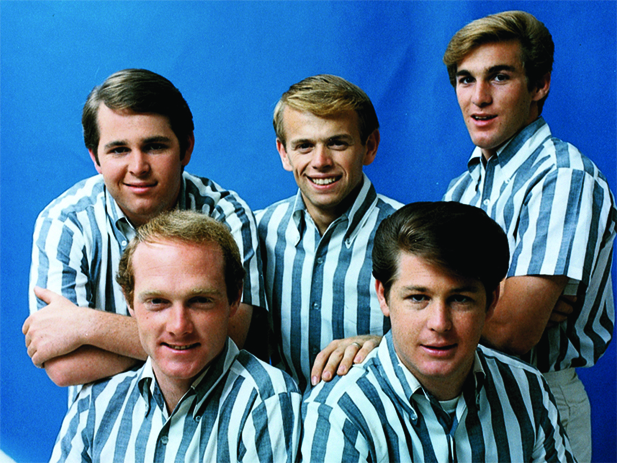
The Beach Boys early in their career. Photo: Capitol Records Photo Archives
The Beach Boys early in their career.
Photo: Capitol Records Photo Archives

Since The Beach Boys broke big on the charts in late 1962, media coverage devoted to them, collectively and individually, has been enormous. And now with the theatrical release of Love And Mercy, a biopic not so much about The Beach Boys as about their once-brightest star, Brian Wilson, the attention has been renewed. At first I was reluctant to add my puny thoughts to all these decades’ worth of Beach Boys coverage. But I’ve maintained a very warm place in my heart for the Boys, and viewing Love And Mercy has inspired me to set my fingers on a keyboard.

The Beach Boys’ history is immensely complicated and convoluted. I’ll summarize what I know fairly briefly: Three of the five original Beach Boys were siblings. From oldest to youngest they were Brian, Carl and Dennis Wilson. Add one cousin, Mike Love, and one pal, Al Jardine, and the recipe is complete. Brian, the band’s leader and creative pulse, was a gifted composer and orchestrator whose talents burgeoned, though for only a few years, as the 1960s progressed.

Teen and twenty-something idols, the Boys knocked out hit after hit right from the start (Surfin’ Safari, Surfin’ USA) through 1966 (Wouldn’t It Be Nice, Good Vibrations). But Brian was a victim of mental and emotional demons that caused him to begin losing his grip in 1967 during sessions for the high concept album Smile. Brian guided the band, and many studio musicians, part of the way through Smile, which was meant to be a celebration of earthly and universal creation. But his troubles brought the work to a sputtering end. Unfinished, the album was shelved. At that point, age 24, Brian’s best musical days were behind him. Though he remained a Beach Boy, his songwriting and studio session contributions to the band soon grew fewer, and his appearances with them on stage over the next several decades were sporadic. The Beach Boys soldiered on nonetheless, churning out many albums and nabbing a few more hit singles. And they toured the world (usually sans Brian) over and over.

As started to become public knowledge in the mid 1960s, Brian’s problems hardly were the only painful situations within The Beach Boys. Their story, beyond the music, is a messy one of endless internal conflicts and legal disputes, drug abuse and, ultimately, death. Very sadly, two Beach Boys passed at youngish ages. Dennis Wilson drowned in 1983 soon after his 39th birthday.  Carl was taken by lung cancer in 1998 when he was 51. Carl many years before had become the band’s chief, taking over from the no-longer-able-to-lead Brian. The band fell apart after Carl’s death.

Hey wait, you say, The Beach Boys are on the road every year, just as always. Well, Mike Love and Bruce Johnston (who had joined the group in 1965) have continued to tour as The Beach Boys. But without any of the Wilson brothers the Love-Johnston unit is hardly the real thing. In 2012, though, Brian (and Al) joined Mike and Bruce for a 50th year reunion tour that went well, only to conclude on a sour note.  Love refused to add additional concerts beyond the tail end of the original schedule and in effect booted out Wilson and Jardine. As usual, fun fun fun might have been the image The Beach Boys wished to project, but reality was a whole different ballgame.

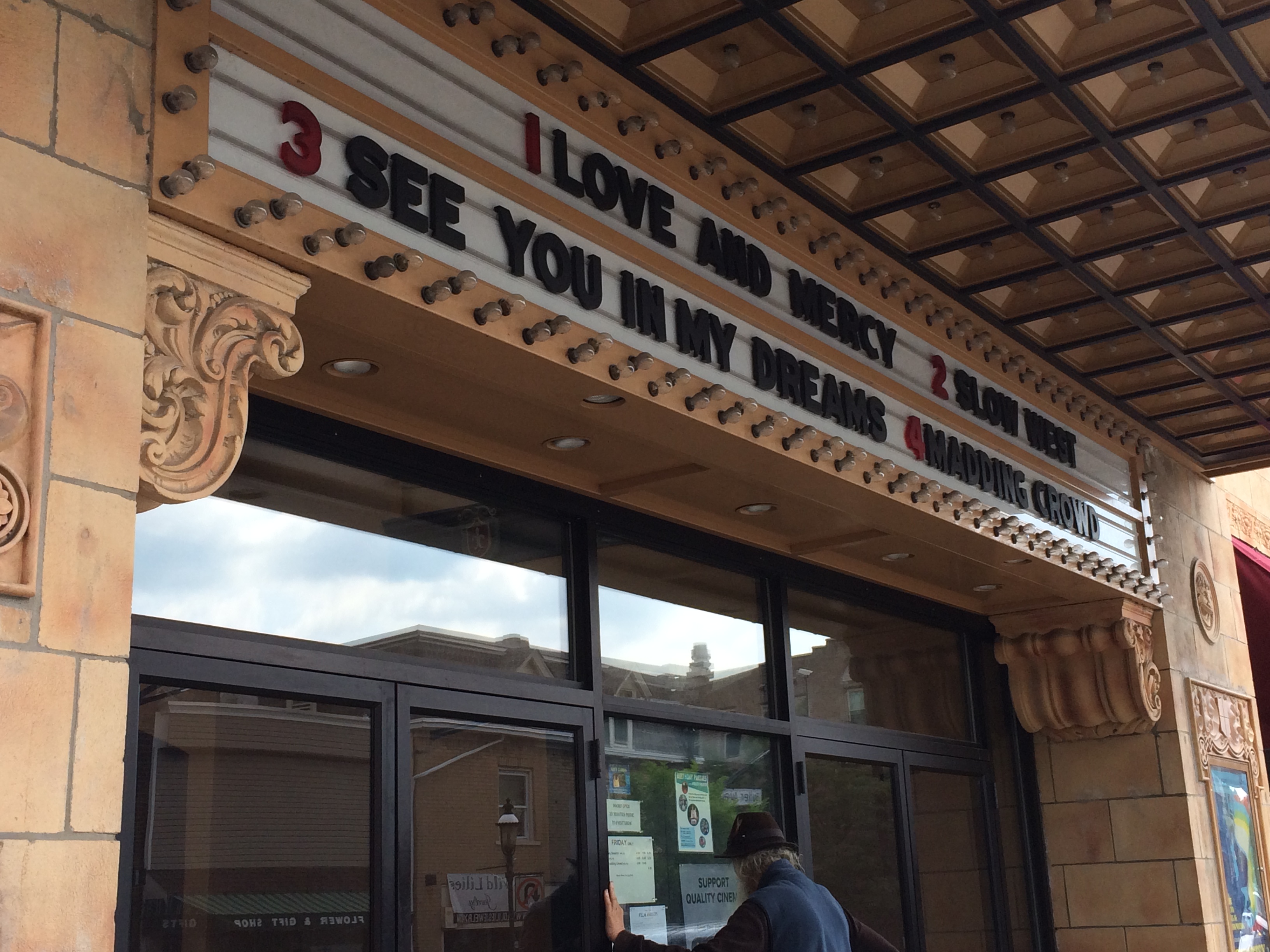
Love And Mercy, playing at the Ambler Theater.

Who, then, in 2015 would have expected the release of Love And Mercy? Not me. At first I didn’t want to see the movie. I’ve read more than enough about The Beach Boys over the years, spent many hundreds of hours listening to their music. No offense to the Boys or their legacy, but my limit, or so I thought, had been reached. Until a friend told me that the movie is really really good. And thus my wife Sandy and I found ourselves on a recent Saturday at our favorite suburban art house, the Ambler Theater. There I learned that my friend was correct. Love And Mercy is really really good. Three and a half out of four stars.

Love And Mercy has the feel of truth. And from what I’ve read, its portrayal of events actually is quite true. The acting by the leads is nuanced and impressive. The script is tight, the direction too. There are a few cardboardy plot and dialog lines here and there. The rest, however, is gold. One need not be a Beach Boys freak to enjoy this movie. Sandy isn’t. She doesn’t know much about their musical history or their problems. She found the movie to be what in fact it is, a powerful drama. She agrees with my rating.

As I’ve mentioned, the movie is only partly a full examination of the Beach Boys. Dennis, Carl and Mike are portrayed a good bit, but they aren’t central to the story, and the actor playing Al Jardine is barely on camera. Love And Mercy largely is the tale of Brian Wilson and Melinda Ledbetter, the lady who loved Brian and brought him back from agony’s door and the clutches of manic psychotherapist Eugene Landy (potently depicted by Paul Giamatti) in the 1980s. The main action takes place in two time periods, 1965 through 1967, and 1985 through 1989 or so. The movie jumps back and forth between those eras. Paul Dano portrays the younger Wilson, John Cusack the older. Both are wonderful, as is Elizabeth Banks as Melinda.

A good number of the movie’s sequences with Dano realistically and clearly show Brian’s studio wizardry. The Cusack sections often touchingly shine a light on the developing romance between Wilson and Melinda, whom Brian met in 1985. I think that to tell any more about Love And Mercy wouldn’t be fair. Putting the movie aside, what to me is quite astonishing is that Brian Wilson is above ground and going strong. He has dealt with abusive forces that no decent person deserves to encounter, and has rebounded from low-as-you-can-go points to a most active musical career. He’s on tour right now. With a lot of courage and strength, and with a lot of help, he has survived.

Beer Here!

I’m not much of a shopper these days. I don’t spend a lot of time in most stores. A huge indoor mall is near my home, but I rarely go. My visit there recently, a fruitless search for a pair of humble bedroom slippers, was my first in several months. Supermarkets, though, are another story. They are where I head to  indulge what’s left of my urge to buy. I look forward to visiting them, not only to purchase the items that my wife and I inscribe on our refrigerator notepad, but also to check out the remarkable amounts and varieties of just about anything you can name that Americans are able to choose from. There are two supermarkets not far from my house that I especially like to visit, though not to buy food. I go to these stores, Wegman’s and Weis, to ogle (and buy) beers.

In my pre-beer days as a kid in Brooklyn and then Long Island years ago, I wasn’t too big on shopping either. But I did like to spend plenty of time in candy stores. Candy stores were modest establishments that sold a wide variety of items, and usually included a soda fountain and lunch counter. Adults might pop in for cigarettes or greeting cards or a grilled cheese sandwich. The younger set primarily was interested in candy bars and other important stuff like comic books and yo-yos. At candy stores I used to gaze at the colorful rows and rows of teeth-destroyers before making a pick. PayDay, Mr. Goodbar, Chunky, Milky Way, Chuckles and on and on. What a choice. What a decision. What a pleasure. Candy stores linger fondly in my memory bank, but probably all are long gone. I haven’t seen any in decades.

For the last three or so years great pleasure has been mine at Wegman’s and Weis, whose beer aisles are my adult candy store. Wegman’s and Weis are among the few supermarkets in my area near Philadelphia that sell beer. I guess I’m lucky to have them, because it’s not easy for Pennsylvania supermarkets to sell suds. Only a few years ago, Pennsylvania’s State Liquor Control Board, the alcohol overlord, opened the door a crack to supermarkets willing to jump through hoops to obtain a license. So far not many supermarkets have chosen to deal with the process. Pennsylvania has gained fame for its archaic and labyrinthine rules governing the sale of alcohol. Possibly a Talmudic scholar would be able to understand them.

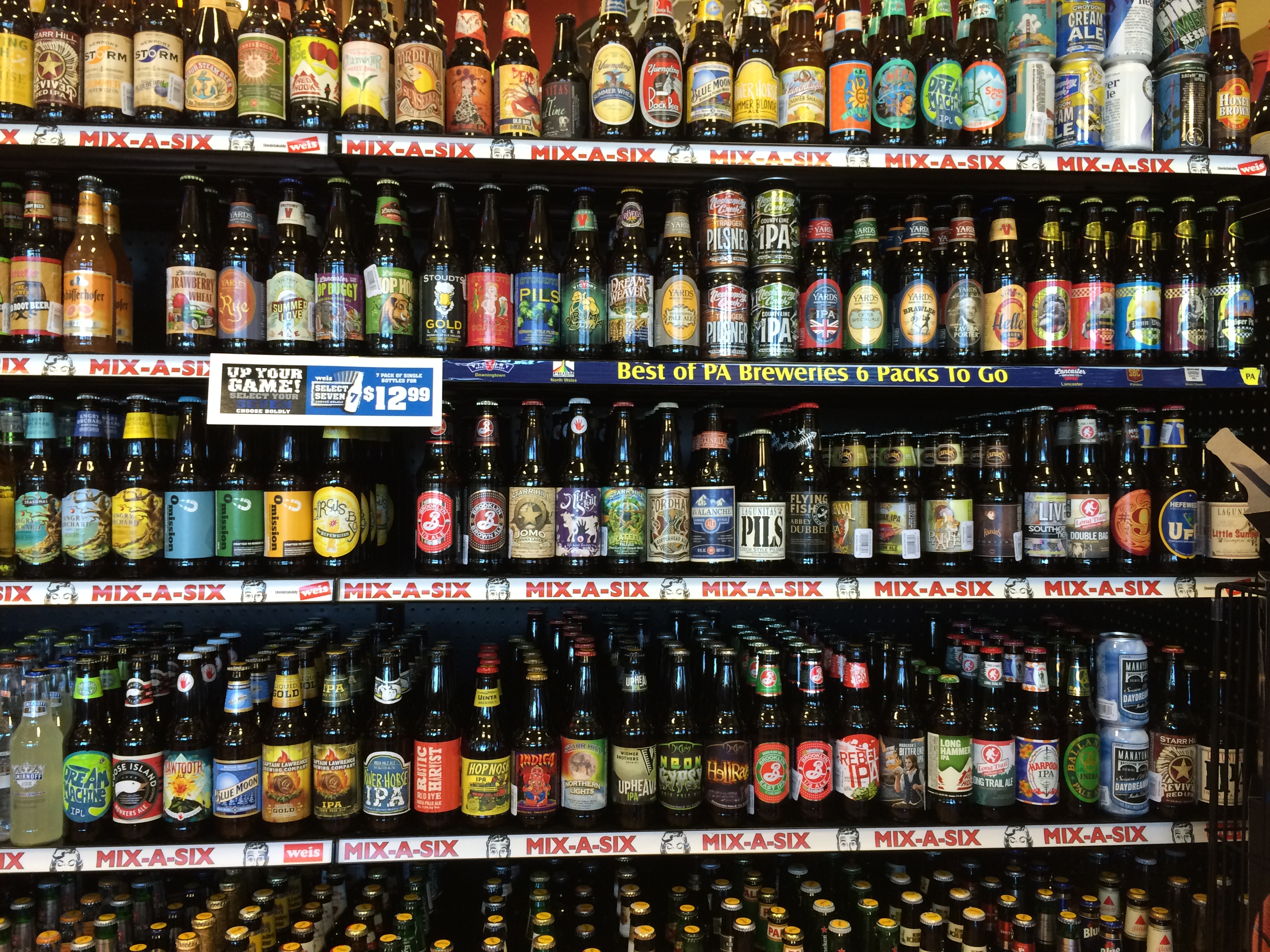
A beer rack at my local Weis supermarket. What's not to love?
A beer rack at my local Weis supermarket. What’s not to love?

In any case, my eyes widen and my heart flutters when I enter the beer section at my local Wegman’s or Weis. Loyal supporters of the microbrew revolution, these stores specialize in the types of beers that I swoon over. Hoppy ones and dark ones and spicy ones, for example. I love nearly all of them, as long as they are loaded with flavor. To me, the craft beer explosion in our fair country is one of the greatest and most positive developments of the past 20 years.

The thrills that rock me in the beer aisles are not very different from my younger self’s thrills in candy stores. Basically, eagerness to ingest the products and giddiness from staring at terrific looking packaging. Yes, not only do most microbrews taste really good, as with candy bars they also are well-dressed. In fact, beer labels are way cooler than candy wrappers ever were.

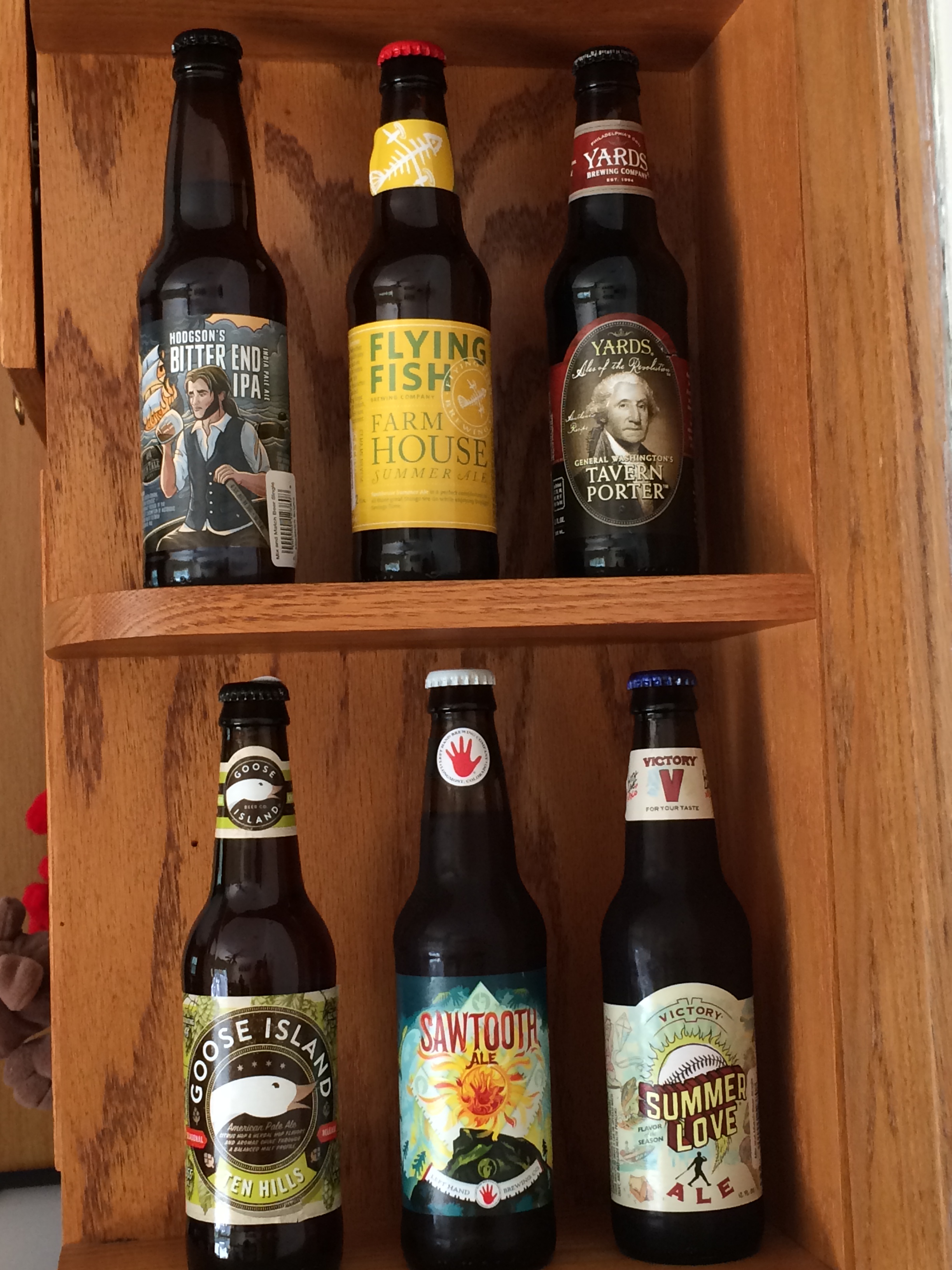
The six beers that I brought home from Weis.

My aim during my visit to Weis last week was to assemble a create-your-own six pack mostly of beers that I hadn’t had before, and I know that in a few instances my right hand was stealthily guided towards bottles whose labels were too pretty or funky to ignore. I headed home with winners, taste-wise and label-wise, such as Victory Brewing’s Summer Ale and  Left Hand Brewing’s Sawtooth Ale. The photo to the left shows all six purchases (click on the photo to get a bigger image). Dig those crazy labels (excepting the one on Flying Fish’s offering).

More about beer as this blog progresses. Till then, drink in moderation and drive safely.

Raul Malo Alone On Stage

New Hope Winery. The concert took place inside the Event Center.

I don’t much enjoy the artsy and touristy central section of New Hope, Pennsylvania. Haven’t been there in several years. The crowds, the traffic, the bad news parking situation. Who needs it?  But I have been to New Hope’s fringes a bunch of times last year and this year, as I mentioned in my article about Kim Richey. The New Hope Winery lies a couple of miles south of the “I’m not going there” zone, and that’s where my wife Sandy and I have become semi-regulars.

Pre-showtime.
Before showtime.

Behind the winery’s gift shop is a roomy building dubbed the Event Center. On its small stage the winery presents a nice variety of musicians year-round. On Thursday evening, June 18, Raul Malo, lead singer of The Mavericks, stepped into the spotlight. Malo is on tour with The Mavericks but took a short solo side trip to New Hope, where he had played the previous evening too. The next day he’d be back rocking and rolling with his band in Rochester, New York. But in New Hope the audience got a full dose of his contemplative side. He picked up his acoustic guitar at 8:10 PM, and for the next 100 minutes had the audience, me and Sandy included, in the palms of his hands.

Raul Malo has been a pretty big name for the last 25 years. His voice is the reason why. It’s a rich tenor, wide-ranging, and moves nimbly in upper registers where others may fear to tread. In New Hope Malo brought the volume and assured passion at appropriate times, but largely kept things reined in. The point is that he has wonderful vocal taste and great control. His singing is a thing of beauty.

Raul Malo in action.

I’d seen Raul on television, heard him perform on the radio, but New Hope was my first live visitation with him. He sang 17 songs, ten of which he wrote or co-wrote. I was smitten from the git go, but in a million years wouldn’t have guessed his choice for show opener. Picking his guitar slowly and easily, he quietly sang not one of his own numbers, but Summer Wind, the tune made famous by Frank Sinatra in 1966. Raul did the song proud.

Summer Wind is a lament about lost love. All 16 songs that followed, self-penned and not, also were about love in one way or another. Love in bloom, love desired, love remembered. Raul covered all bases. I never thought I’d hear a version of Harvest Moon, a gorgeous and pure love song, to rival that of its author, Neil Young. But Raul came close, singing with restrained emotion, hitting the high notes with clarity. He did excellent work on his own Born To Be Blue, and Lucky One, the Roy Orbison-like operatic qualities of his voice emerging on those two numbers.

The most stunning moments arrived late in the show. (Call Me) When You Get To Heaven gave me goose bumps. Raul wrote this song for The Mavericks’ In Time album. From my seat 15 feet from stage left, I took it as a song about a breakup, a relationship not meant to succeed on planet Earth but destined to flower in a better place, maybe one of the mind. Raul sang slowly, mournfully. He drew out the song for many minutes. When introducing the tune, he had asked the audience to join in towards the end. They did. And that’s where the goose bumps came in. Though surely some males were part of the choir, somehow I heard only female tones. As Raul fingered the refrain’s chords over and over, angelic sweet voices rose throughout the room. Call me when you get to heaven . . . Call me when you get to heaven. It was just so beautiful.

Raul Malo from a different angle.

During that number I realized who Raul reminds me of. José Feliciano. Like Feliciano, Malo possesses both fervor and quiet strength, and the ability to be in-the-moment. None of this was lost on the near-capacity crowd seated at the room’s red tablecloth-covered cocktail tables. They went wild with claps and yells between songs. But when Raul sang, they were seriously silent and attentive. Raul loved them back. Happy, laughing and joking around during the interludes, he especially made the night for a lady celebrating her birthday at the show. She was a super fan, it turns out, saying that this was the 80th time she had seen Raul perform. To honor her, he sang Can’t Help Falling In Love, the Elvis hit from 1961. And then he threw out two of his best and funniest lines of the evening. I hadn’t planned to use any profanity in this blog, though I curse aplenty in my non-blogging life. But I’m going to repeat verbatim what Raul Malo said after the final guitar strums of Can’t Help faded away. “That ought to buy me some karma points. Now I can go back to being a shit.”

A worthy side note about choice. The night that Sandy and I were in Malo pastures, two other splendid musical events were available not far away in the Philadelphia suburbs: The Richard Thompson Electric Trio and Graham Parker And The Rumour, great bands that must have brought down their respective houses. For discriminating music fans of any age, June 18 presented one of those uncommon convergences when deciding where to pay one’s money was a tough call.

The Day My Father Went Eye To Eye With Van Gogh

My father came to live with me and my wife Sandy in Philadelphia soon after his 90th birthday, in 1999. He had been living alone on Long Island, but health issues necessitated his relocation. Good doctoring in the Philadelphia suburbs improved his physical condition quickly, but there was no cure for the declining state of his kidneys. He became a dialysis patient one year after he moved in with us, and he remained on dialysis till his death in 2005 at age 96.

My father was in pretty good shape until the final nine or so months of his life. He loved getting out of the house and joining Sandy and me and others at restaurants, concerts, museums, you name it. On this Father’s Day I’ll relate one incident that I look back on fondly. It was the day that he and I and my brother had a private viewing of a rarely-seen Van Gogh oil painting at the Philadelphia Museum Of Art.

There are several purported photographs of Vincent van Gogh. None are totally authenticated. This is believed to be from about 1886.
There are several known photographs of Vincent van Gogh, though they are not fully authenticated. This photo is believed to be from about 1886.

Vincent van Gogh is one of my two favorite artists. The other is Paul Cézanne. I never can decide which of the two I like best. For wordsmanship, however, I go with Vincent. In spring 2001 I read all 800+ of his mesmerizing letters, in their English translation. My father got a kick from this. He told people that I was becoming a Van Gogh expert, which was hardly the case. But my semi-obsession with Van Gogh was rock solid, and it is here that the story really begins.

One day in January 2002 I poked around some Van Gogh websites and discovered that the Philadelphia Museum Of Art, which Sandy and my father and I frequented, owned five Van Gogh oils. Yet, I had never seen more than four of them on display there. The painting that I wasn’t familiar with was Still Life With A Bouquet Of Daisies. Most experts believe that Vincent painted it in summer 1886, a few months after he moved to Paris to live with his brother Theo and to contemplate the new techniques and perspectives, most notably those of Impressionism, that had been invigorating the French art scene. Why wasn’t the painting on display? I needed to know.

A few days later, from my desk at work, I dialed the museum and got connected to an assistant curator. I asked about the mystery painting. She told me that the museum did occasionally bring it from storage to the public galleries, but that it had been a long time since that had happened. We chatted a little and then I said thanks and was about to hang up. But before I could the curator asked “Would you like to see it?” Huh? Huh? I couldn’t believe my ears. Yes ma’am, I would.

My father was about to turn 93, on January 19, 2002. A few days before that, to help our dad celebrate his birthday, my brother Richard planned to fly to Philadelphia from his California home. I explained this to the curator and asked her if my brother and father could come along with me (Sandy, chained to her job, wasn’t free to get mid-day time off from work). Sure, she said. Fairly stunned, I set the date for Friday January 18, a non-dialysis day. I knew that something special had just occurred.

The momentous day arrived. We drove to the museum and were met in the west wing by the curator. She was a lively and lovely person and probably was getting as big a charge out of the situation as anyone. Down an elevator we all went to one level of the museum’s cavernous underbelly. We followed our hostess along a long corridor, walking past many locked rooms. At our consecrated storage area she unlocked the door and we entered. Perpendicular to one of the room’s sides were very large moveable display panels. All of them were in their retracted positions. The curator pulled out one of the panels, both sides of which were covered with paintings, maybe 20 per side. I noticed a Chagall on the side facing us. Can’t recall what else. Except of course for a work near the left edge on the top row. The Van Gogh.

Still Life With A Bouquet Of Daisies. Philadelphia Museum Of Art
Still Life With A Bouquet Of Daisies.
Copyright Philadelphia Museum Of Art

It was show time. The curator wheeled over a tall moveable step ladder. Richie and I went up first. What did I make of Vincent’s oil? Well, Still Life With A Bouquet Of Daisies doesn’t have the brilliant color schemes that Vincent was developing in Paris. It is dark, with lots of deepened greens. Maybe that’s why the museum doesn’t bring it out of storage too often. But they should. With Vincent, there’s always something to admire. I took in his trademark broad brush strokes, the intense tangles of flower stems. The greens upon greens.

Richie and I and our benefactor were excited and happy for my father when his turn came. My dad was excited and happy too, a muted gleeful smile on his face, his eyes on alert. I’m sure he knew how lucky he was to do what he was about to do. Holding the ladder rails carefully, up he climbed. Admirable mobility for a guy one day away from the big 93. He gazed at the painting for a good long spell, longer I think than my brother or I had. He spouted words of admiration. He was having a ball. Finally he came back down. Thank you, thank you, thank you we said to the wonderful curator.

Over the following years, my father and brother and I talked about our museum visit many times among ourselves and with friends and relatives. Always with a grin. Always feeling a tingle. And so, I dedicate this Father’s Day essay to Hyman Scheinin, he whom I’m sure is the only nonagenarian ever to climb a step ladder to go eye to eye with Van Gogh.