If I Were A Painter . . .

I’ve penned some love letters to Cape Cod on these pages, but it has been a while since last I did. Yes, I’m in love with The Cape. My wife Sandy seconds that emotion. The enormous expanses of undeveloped oceanside shorelines; the humungous, otherworldly sand dunes that run for miles within the peninsula’s far reaches; the I-never-would-have-expected-them-to-be-there woods and forests that pepper the landscape . . . Cape Cod has natural beauty up the grand wazoo. And, that being what we most favor about The Cape, Sandy and I spend lots of time poking around the great outdoors during our Cape vacations. But we also like to emerge from the wilderness and do other types of things that ring our bells. For example, we get big bangs from some of the old village sections of certain Cape towns, such as those in Provincetown, Wellfleet and Orleans. They are cute and charming. We wander on their streets, investigate their stores and stuff our faces at dinnertime in their restaurants.

Last October, in Orleans, we took in a cool event one Saturday morning. The Addison Art Gallery, one of Cape Cod’s best, organized it. Two or more times each year AAG selects an outdoors Cape area to be immortalized and invites a bunch of the artists it represents to find views that spark them in said area, set up their easels and paint away. In October, Addison chose Orleans’ villagey heart, in which it is located, as the locale. The artists were instructed to paint and complete their masterpieces between 8 AM and noon, and then to bring the canvases to AAG where they would be framed and hung on the walls and offered for sale that evening at an artsy gathering to which the public was invited.

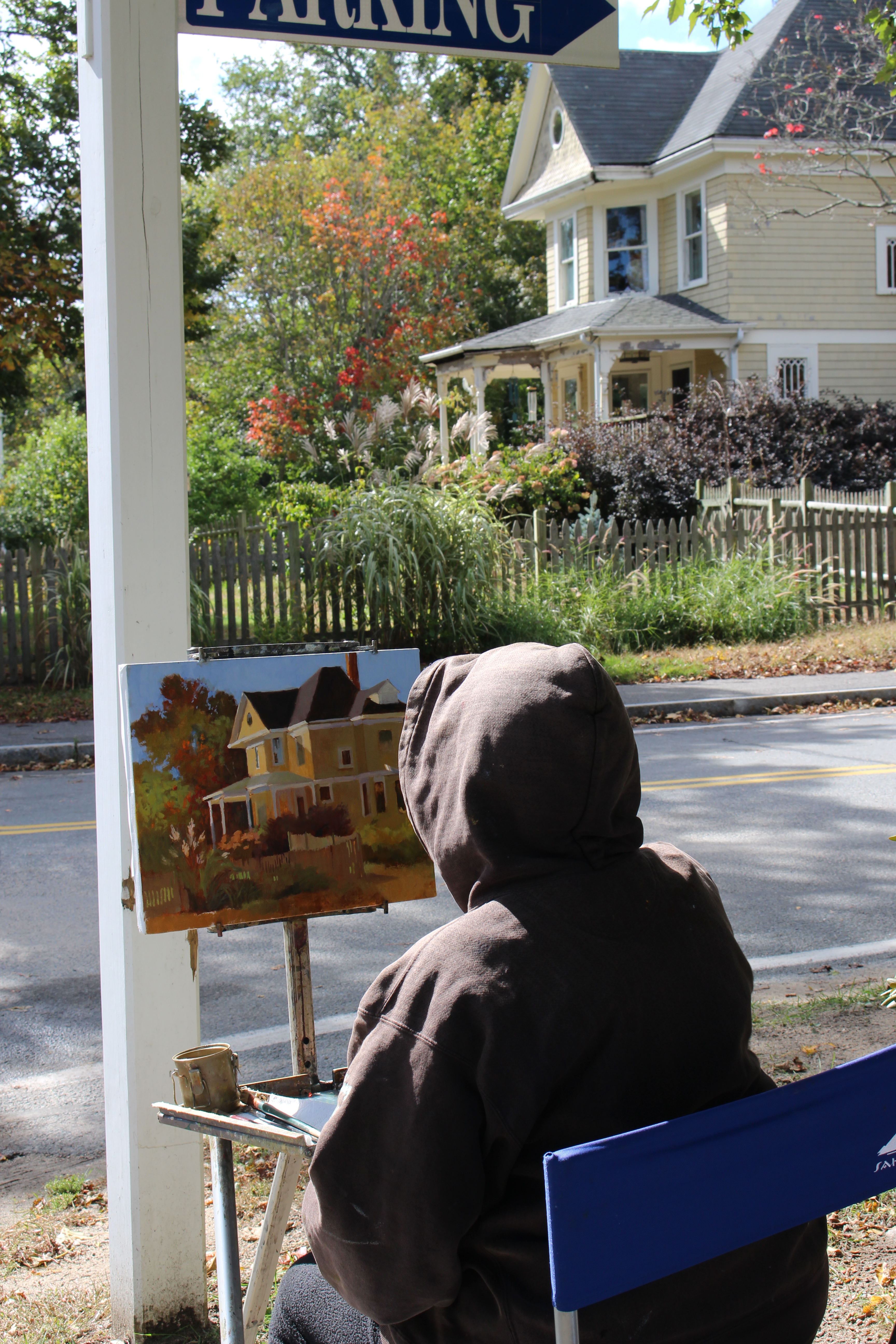
Maryalice Eizenberg.

Sandy and I, who haven’t lifted a paint brush since grade school, like to watch good artists at work. So who knows why we got a real late start and didn’t arrive at the five or so square block painting zone until 11 AM. By that time most of the artists had finished their jobs and were packing up or already gone. Luckily we got to see two painters who were still going at it. On a sidewalk near AAG, Maryalice Eizenberg, hooded to shield herself from our friend the Sun, was staring down a big, old, yellow Victorian house across the street. She sweetly translated what she saw, in colors deeper than those 80 feet away. We chatted with her for a couple of minutes as she worked. “Have you seen what Paul Schulenburg is painting?” she asked us. No, we hadn’t. “Take a look. You won’t believe what his subject is.” And she pointed to where we’d find him, hidden from view from her own spot, but only half a block away.

Paul Schulenburg.
Paul Schulenburg.

Now, Paul Schulenburg is an artist whose oils I have seen at AAG over the years. He’s really good. His paintings have a stillness, a sense of completeness, à la Andrew Wyeth and Edward Hopper. Sandy and I followed Maryalice’s finger and came upon him. He and his easel were positioned between two houses, and he was zeroing in on a small section of one of the houses, a large and mostly white-shingled affair. But it wasn’t the house so much that he was interested in. What had caught his eye, and had become the focal point of his painting, was a bright green garden hose. Its color contrasted just-so with the less brilliant green of the side lawn, and had plenty to say to the house’s white shingles and red bricks. “Man, this guy is something else,” I more or less thought to myself. “A hose? Yup, and he is doing it proud.”

For reasons unknown, that October day floated to the top of my porous memory bank last week, and it got me thinking. Were there any aspects of my house’s exterior or grounds worth putting down on canvas? I decided to take a look. I would use my best impersonation of Paul Schulenburg’s painterly eye.

Sandy’s and my abode rests in the middle of a typical suburban block near Philadelphia. The house is modest and is surrounded by more shrubs and trees than I enjoy taking care of. All of it looks nice, but ain’t exactly a head-turner. I mean, Better Homes And Gardens Magazine has no plans to contact me anytime soon for a photo shoot. That, however, wasn’t the point. My mission was to pay attention to the details, to notice boffo alignments of objects, neato color contrasts, whatever, that were waiting to be discovered.

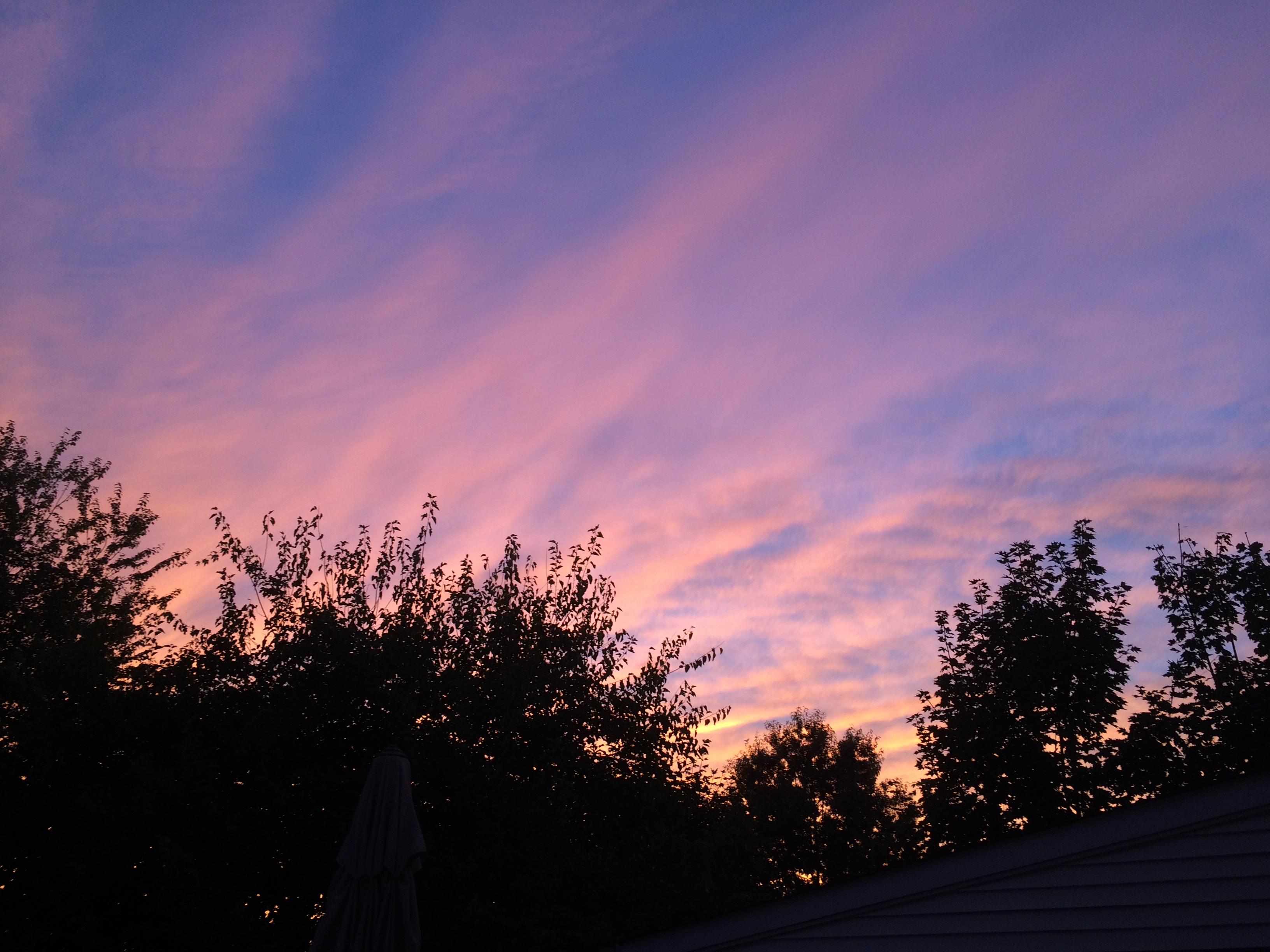
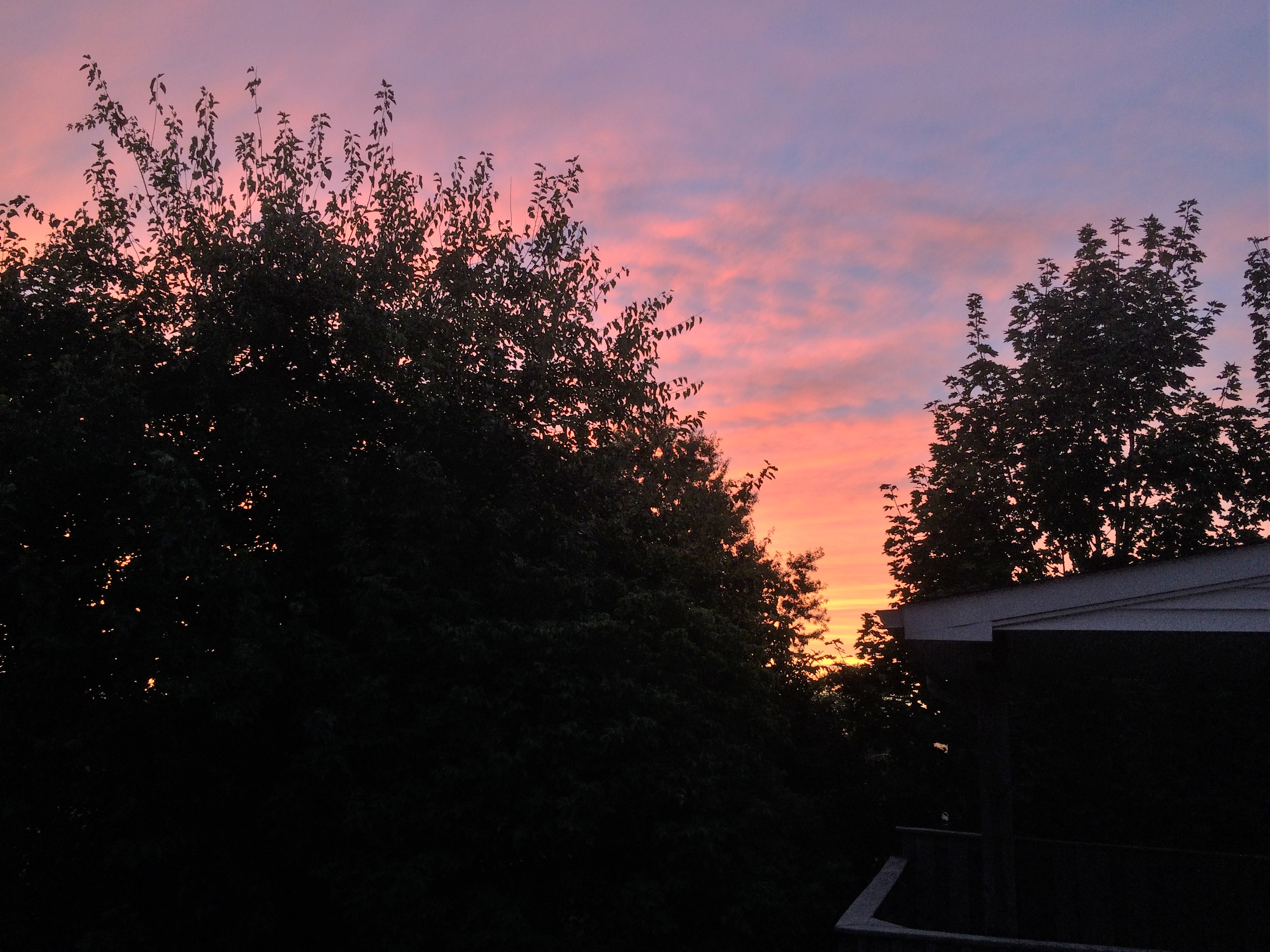
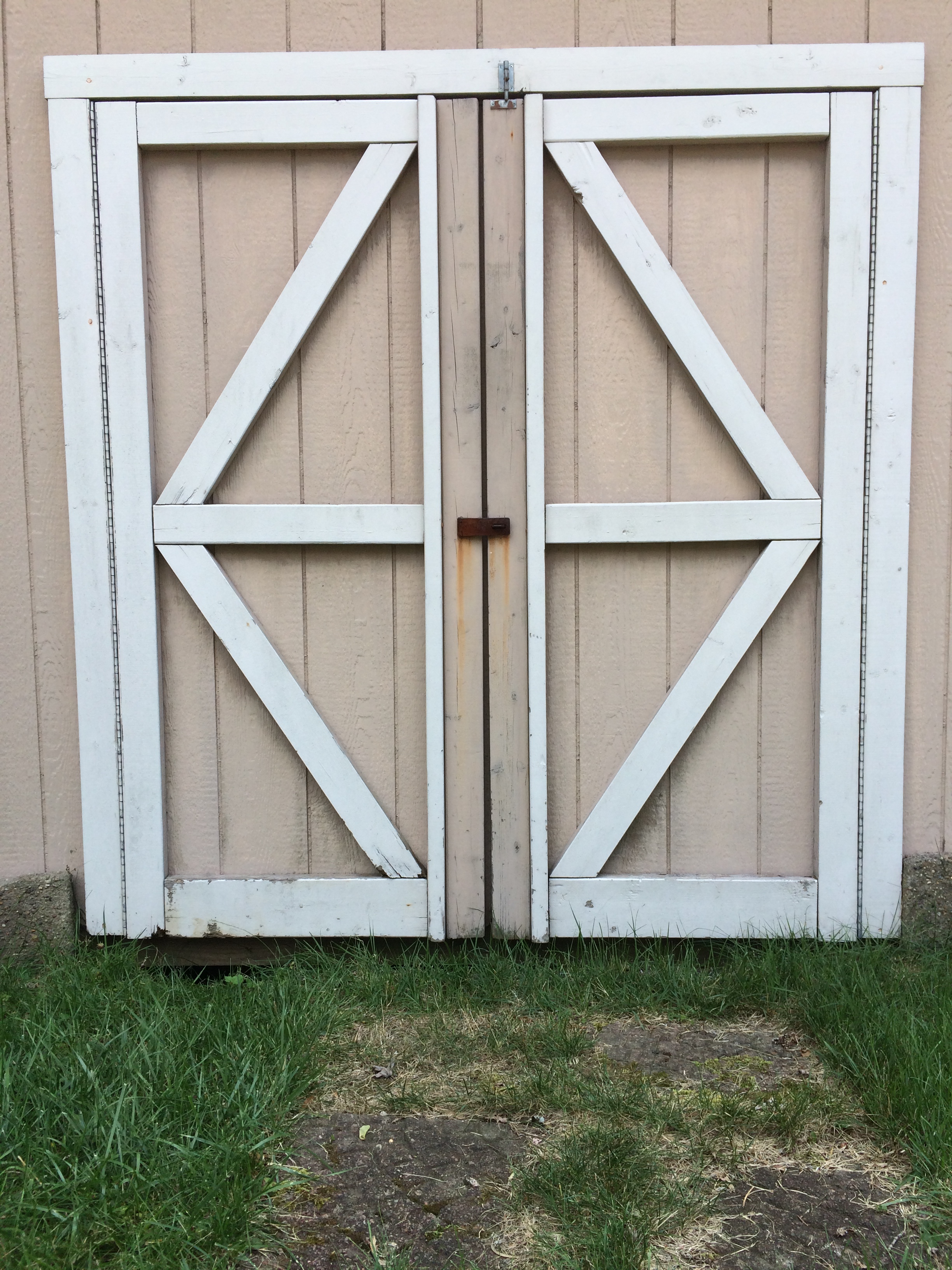
IMG_0821IMG_0799IMG_0805My house? Man, I’m glad to be living within it, but, take it from me, its exterior front and sides are vanilla. Tons of bricks and stones with almost nothing quirky or asymmetrical going on. I gazed artistically at one of the few ornamentations, a tangle of gas meter and pipes near the front door, and wondered if it would make for a decent painting. Well, maybe, but  . . . eh. I then walked around back and gave the grounds there a once-over, starting with the shed. How about its doors? Their designs seemed kind of sharp. Or did they? Nah, the scene lacked pop. A blooming Rose Of Sharon in the backyard, however, definitely did pop. How many floral scenes have been painted over the years, though? Maybe 20 billion. The world didn’t need this one.

IMG_0841All was not in vain. Because attached to the rear of the house is a great-looking deck that I figured would hold out hope. Hope morphed into certainty when I spotted something on one of the deck’s supporting posts. It was a knot, golden and aglow, in the wood. That’s what I would paint if I were a painter, I decided. It was a natural, a star waiting to be born. I walked around the knot, snapping photos, checking out various vantage points. And came to think that one perspective gave the best results for my imagined painting. In that vista you see the crazy quilt formed by part of the deck’s underside and the stairs leading up. You see a bit of slate patio and brick surface of the house. The scene’s palette is muted, all wan greys and browns, except for the golden medallion that you can’t take your eyes off of.

But I did take my eyes off the knot in a bit. And then I folded up my fantasy easel and went inside. It’s good to learn things, and I came away from all of this with an insight that never had occurred to me before: A painter in search of something to paint is little different than a writer (moi?) trying to come up with a story idea. And exactly the same is true for dance choreographers, photographers, film makers, chemists, astrophysicists, chefs, you name it, all on the prowl for projects that will make them buzz. The wellsprings of creativity are thick and bubbling, though not always easily tapped.

(Don’t be shy about adding your comments or about sharing this article with others. And, if you’re not already a follower of this blog, please consider signing up . . . I like readers!)

(Cape Cod photos by Sandra Cherrey Scheinin. The others by yours truly. If you click on any photo, a larger image will open)

Running Free

I don’t know about you, but it seems to me that driving in any inhabited area these days is a sure fire way to add kilos of stress to the body, to send the diastolic and systolic numbers moonward. For me, driving even on my typical suburban block can be a true pain. One recent morning, for instance, I stepped into my ancient Honda, which was parked directly in front of my home, and saw a young couple 100 feet in front of me. They were putzing around with their SUV, also parked on the street. Their rear driver’s side door was wide open, making passage past their car difficult. Worse, the female member of the twosome was standing in the middle of the street, la-dee-dahingly removing boxes from the back seat. “OK, no problem. I’ll simply make a K turn and head in the opposite direction,” I said to myself. As I gracefully maneuvered the Honda to my left and then backwards, needless to say another SUV headed towards me from the direction in which I now was planning to drive, putting pressure on me to complete the K pronto. Bottom line: Nearly everywhere you go there are just too many people and too many motor vehicles. “Hey, that’s modern life,” some would say. “Get with it.”

Oh yeah?  Arrgh . . . Let me outta here! I need to run free! At least some of the time.

I don’t like congestion, dig? But what’s a person to do? I’ve written a few times online about the sweet spot that Cape Cod occupies in at least two hearts, mine and my wife Sandy’s. Cape Cod is where we head when we want to get away from it all. Not that Cape Cod is free from congestion. Hardly. But if you know where on the Cape to go, and when, you’ll be far far far from the madding crowd and its cars and trucks. And you’ll have fun too.

Cape Cod is famed for the throngs that descend upon it between Memorial Day and Labor Day weekends. People and cars up the wazoo. That’s why Sandy and I never go there during that period. We were on the Cape last month though, when things were back to normal. We spent plenty of time among others of our species. But we also made sure on most days to bathe our souls in places where the human and vehicular factors would be minimal.

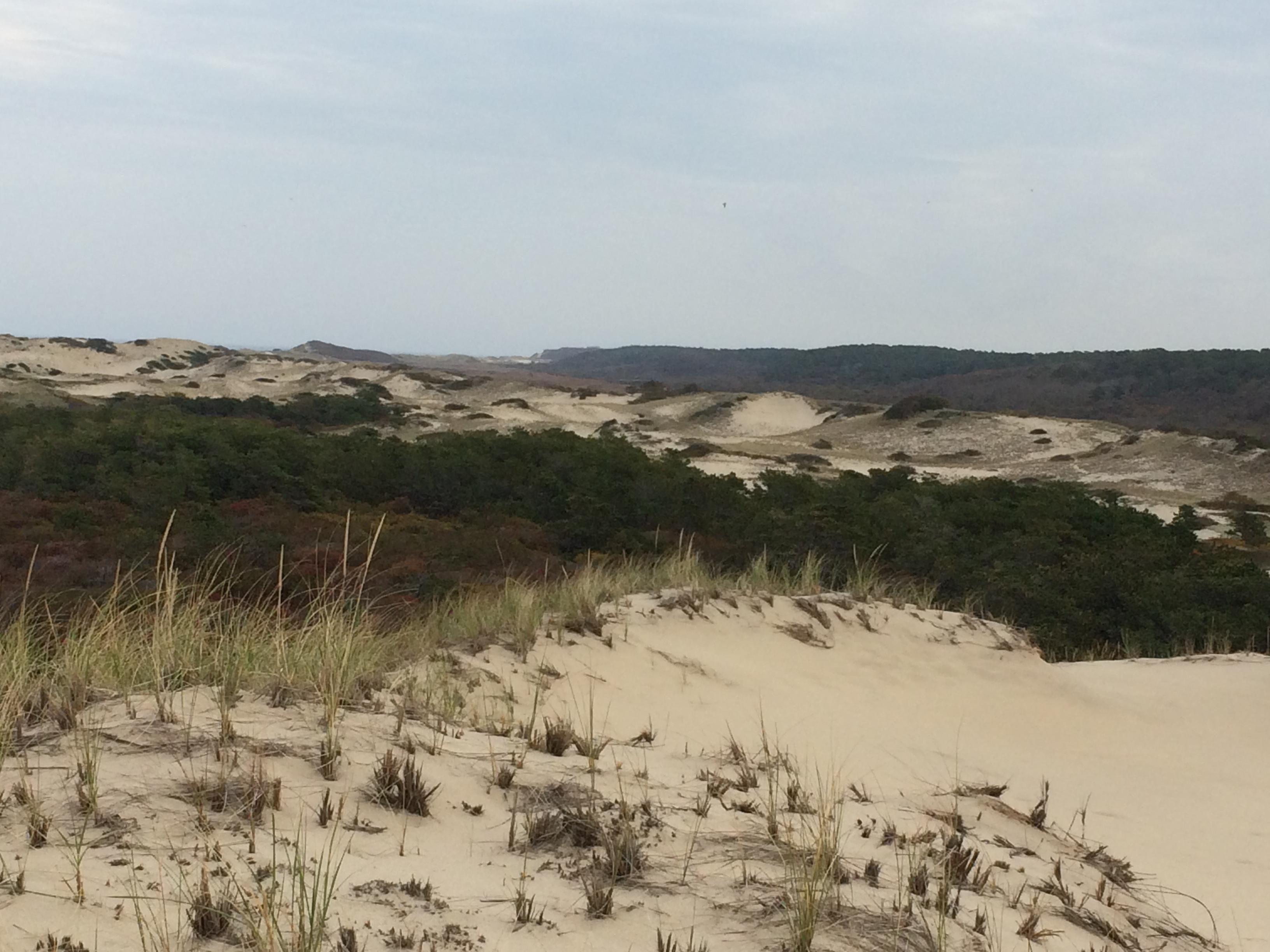
Parabolic sand dunes territory. Truro, Cape Cod.

“You know,” I said to Sandy on this most recent trip as we stood atop a humungous sand dune. “If you plopped most people down here and asked them where they were, they’d never guess it’s Cape Cod.”  That was true. When the majority of folks think Cape Cod they envision seaside-ey villages and seafood-ey restaurants. But we were miles away from any of that. We were in parabolic sand dunes country, inland just a bit from the Atlantic Ocean in Truro. Truro is a sprawling area of the Outer Cape, and probably the most rural and desolate section that Cape Cod has to offer. The parabolic dunes are by far the Cape’s biggest, undulating 80-feet-and-taller monsters that extend for several miles, covering part of Truro and of Provincetown too. We’d been in this locale a bunch of times before, and as always were knocked out by the vistas. Several parallel chains of dunes ran long into the distance. Between each chain were deep valleys that, surprisingly to me, a low level naturalist, were loaded with small trees and shrubbery and all manner of other plants that I couldn’t give names to. This is a mind-blowing environment, a vegetated lunar-like landscape that, I’m sure, many Cape Cod residents and vacationers barely know about. It is open and wild. I feel alive there. And that’s why I like it.

Over the years I’ve spent a lot of hours scampering up, down and around the parabolic dunes, and even more among the slightly smaller and less dramatic dunes that take over in Provincetown when the parabolic big boys eventually peter out. At this point in my life I’m not going to be climbing any mountains in the Alps or bungee jumping into canyons in the American West. For me, the Outer Cape’s dunesville does just fine as a spot where I can indulge my sense of adventure and feel as though I’m pushing my puny limits. There’s no congestion out there. You might cross paths with a few other trekkers, but that’s okay. They are kindred spirits.

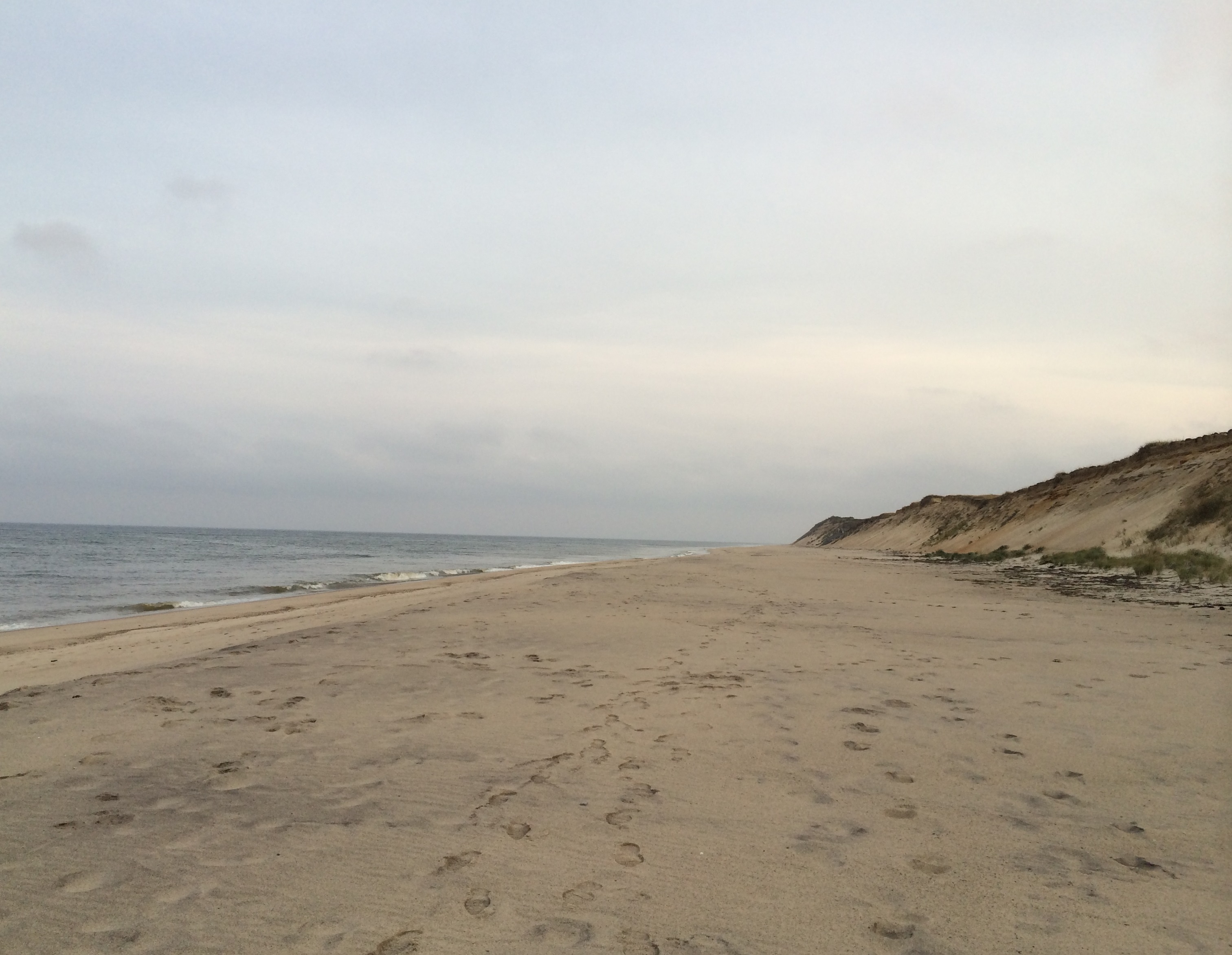
Dunesville is great. But what I like even better on Cape Cod is the Atlantic Ocean shoreline. Most of it is under government protection, meaning that mankind won’t be messing it up any time soon. It’s pure, it’s long — 40 or more miles — and it’s beautiful. What’s not to like? Sky, ocean,  and sand-cliff-backed endless beach.

Its presence of water is why I would choose, if I had to choose, this shoreline over the Outer Cape’s dunes territory. Though Sandy and I aren’t swimmers, we’re big time water admirers. We have hiked hundreds of miles over the years on the Cape’s ocean shore. There’s just something about being there. The power of the water, its changing face from day to day. The rigid coolness of those sand cliffs. The real low numbers of humankind in the off-season. And then there’s our kite, which enhances this scenario. Last year we bought the kite and flew it on beaches many times. We launched it frequently during our recent stay too.

Atlantic Ocean shoreline at Marconi Beach, Cape Cod.
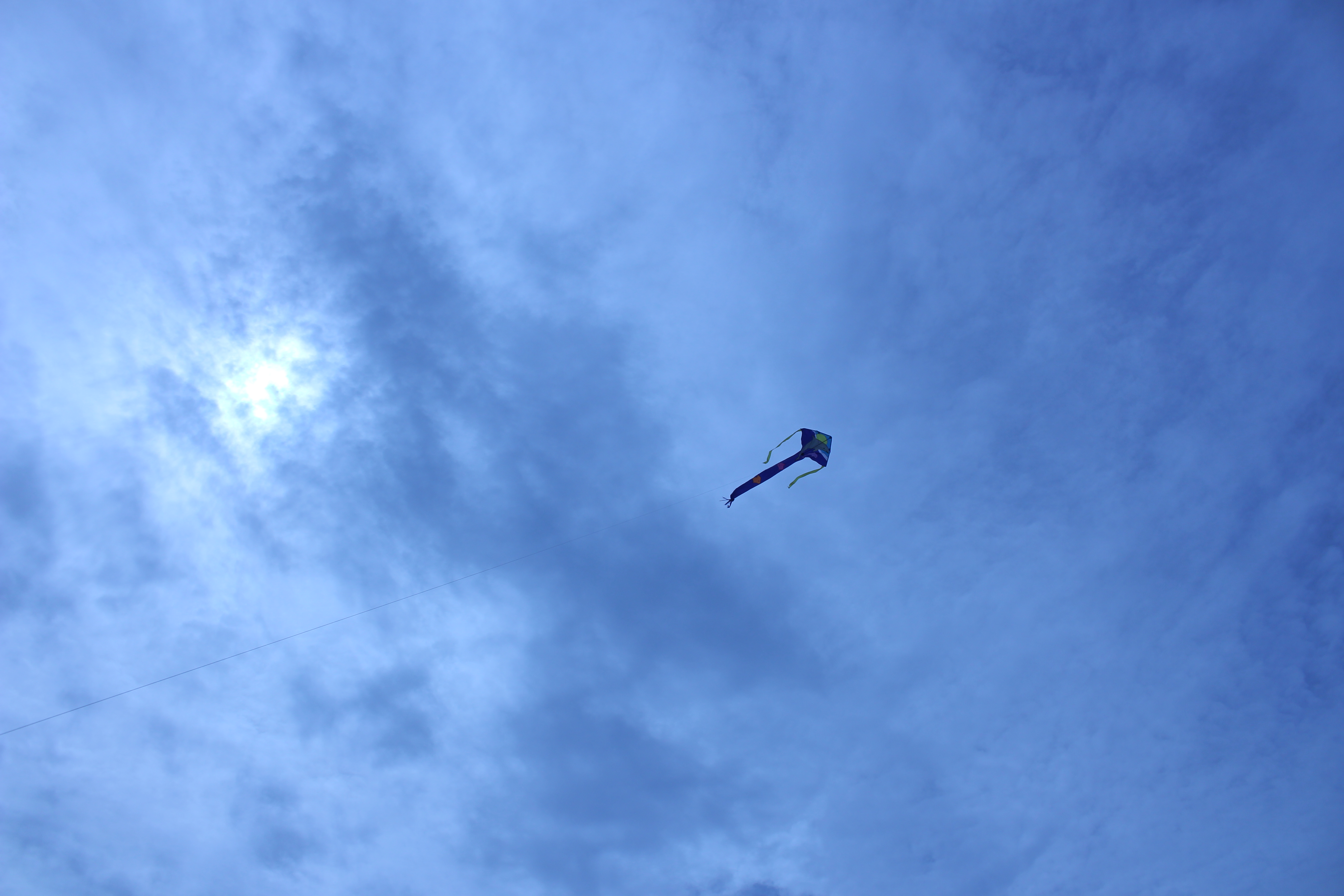
Our kite at Marconi Beach, Cape Cod.

One day last month, on the ocean shoreline named Marconi Beach, the conditions for flight were perfect. A strong but not overpowering steady wind meant the kite would stay aloft sans problem. What we discovered at Marconi was that the kite was insatiable. It kept pulling on the string, begging us to let out more and more length. This hadn’t happened to us before. And so we did. The kite went higher and higher. The amount of string on the reel grew less and less. I hardly could believe it when there was no more string to release. The kite was way up there. How far away I didn’t know.

After an hour or so we decided it was time to move on, to say goodbye to Marconi Beach for the day. It took a long time to reel in the kite. Later I checked out the kite manufacturer’s website where I learned that our polyester friend came equipped with 300 feet of string. I was impressed. At Marconi Beach we had overseen a long-distance journey.

Congestion . . . bad. Running free . . . good. End of story.

(Photos by Sandra Cherrey Scheinin. If you click on a photo, a larger image will open)

(If you enjoyed this article, then please don’t be shy about sharing it)

A Cape Cod Sunset Story

My wife Sandy and I have a love affair going with Cape Cod, which is where we are vacationing as I type this missive. We live in suburban Philadelphia, but in most ways prefer the Cape. Boo hoo . . . we’ll be back home tomorrow.

In 1998 we visited the Cape for the first time, expecting it to be a locale we’d enjoy. Well, we did. And decided to come back the next year for some more good times. I think it was on that second trip that I realized I liked Cape Cod much more than I ever thought I would, that it really suited my soul, that I was starting to become smitten. Sandy and I have returned every year since then, excepting one. Before Cape Cod entered the picture, in my adult life it had never occurred to me that there might be an Eden of sorts waiting for me, someplace beautiful and in which I truly felt at home. A favorite place.

Sandy and I have had only great vacations on Cape Cod. We’ve been there in all seasons except summer, which is the one time of year when the Cape is overrun. With humans. We fill our days with a variety of activities: nature walks on sand or through forests; poking around in country-imbued villages; art gallery and museum hopping; attending movies, plays and concerts; lots of tasty eating in restaurants humble and above; the list continues. No doubt, this is the good life. I feel almost guilty that such fine fortune has come my way. But I’ll take it.

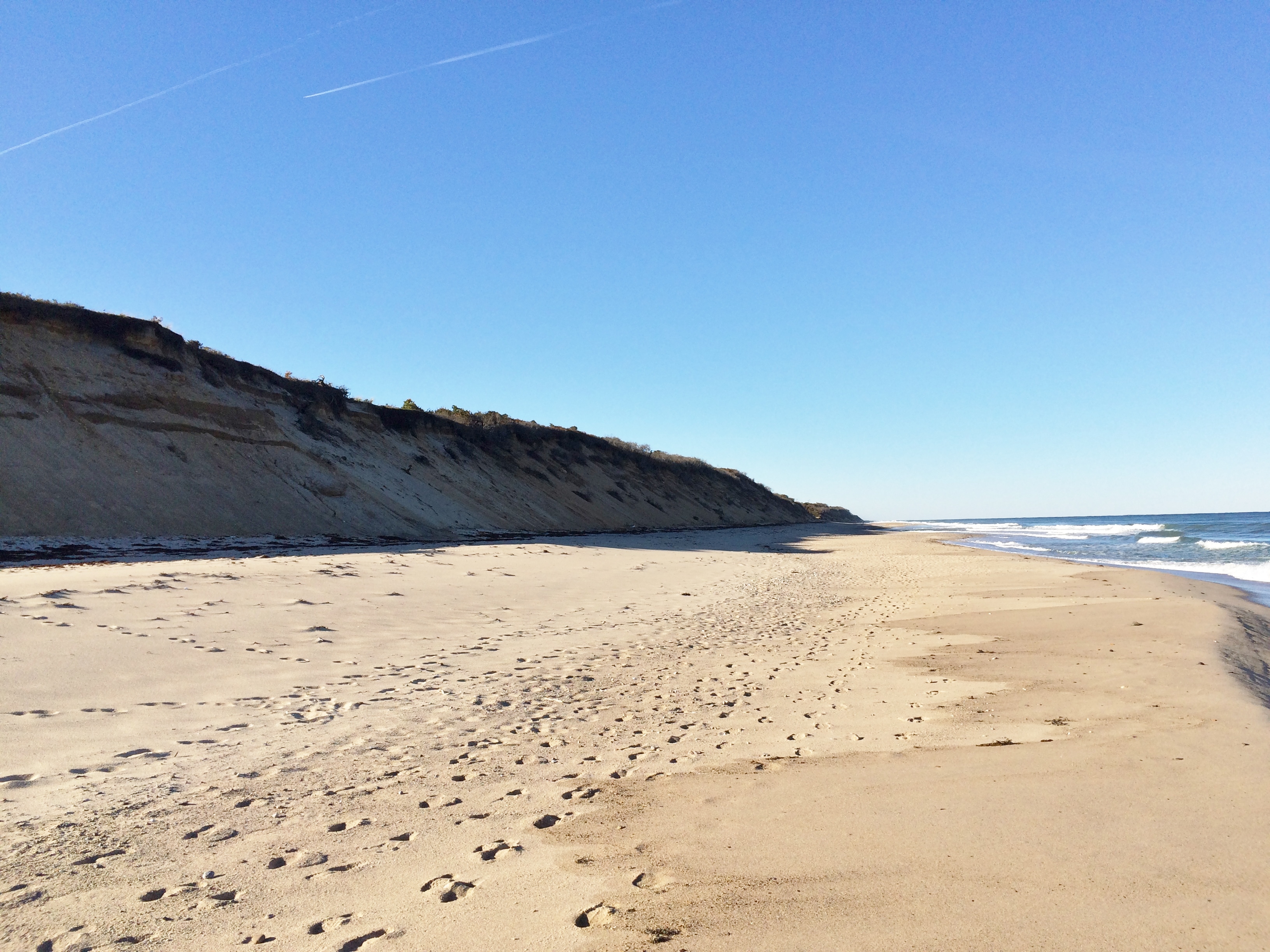
Atlantic Ocean shoreline. Eastham, Cape Cod.

If I had to select one reason above all that puts Cape Cod at the top of my list, I’d point to the expansive areas of natural beauty. Such as the 40 or more mile-long Atlantic Ocean shoreline, much of it government-protected and thus little disturbed or altered by the hands of man. The vistas there are pretty elemental and always knock my socks off. Ocean, sky and beaches backed by dunes-topped sand cliffs. My psychological and emotional makeups, whatever the heck they might be, vibrate in a calm, contented and awestruck manner when I’m in the midst of such.

And there are other reasons. To name one: When vacationing on Cape Cod sometimes an unexpected present drops into your lap, just as with life in general. One day last week an example came my and Sandy’s way. I’m talking about a sunset. Right, right, I know that over the centuries untold thousands of scribes have oohed and aahed in print about sunsets. And millions of sunset photos have been published, more in the last 15 or so years than ever before thanks to the Web. But hey, I’m not embarrassed to add a few hundred sunset words, and a handful of photographs, to the Everest-high piles already out there. Don’t bail out on me. Keep reading.

And so on the aforementioned day at 5:15 PM, Sandy and I were in Chatham, a needless-to-say charming Cape Cod town. We had just watched Steven Spielberg’s latest oeuvre, Bridge Of Spies, in the Chatham Orpheum Theater. Our next planned destination was 20 miles away, Harvest Gallery Wine Bar. There we meant to dine and listen to a tough as nails rock trio, The Catbirds. But there was no need to arrive before 7 PM. We had time to kill. We scratched our heads, coming up empty. Then “sunset” popped into my mind. Sandy checked with her phone, which is much smarter than me, and learned that the Sun would dip below the horizon at 5:57. I steered our car westward and then turned south onto a road I’d never heard of, hoping that we eventually would find our way to a Chatham beach on Nantucket Sound. The sand gods must have been with us, for Hardings Beach Road soon materialized. And moments later Hardings Beach itself emerged.

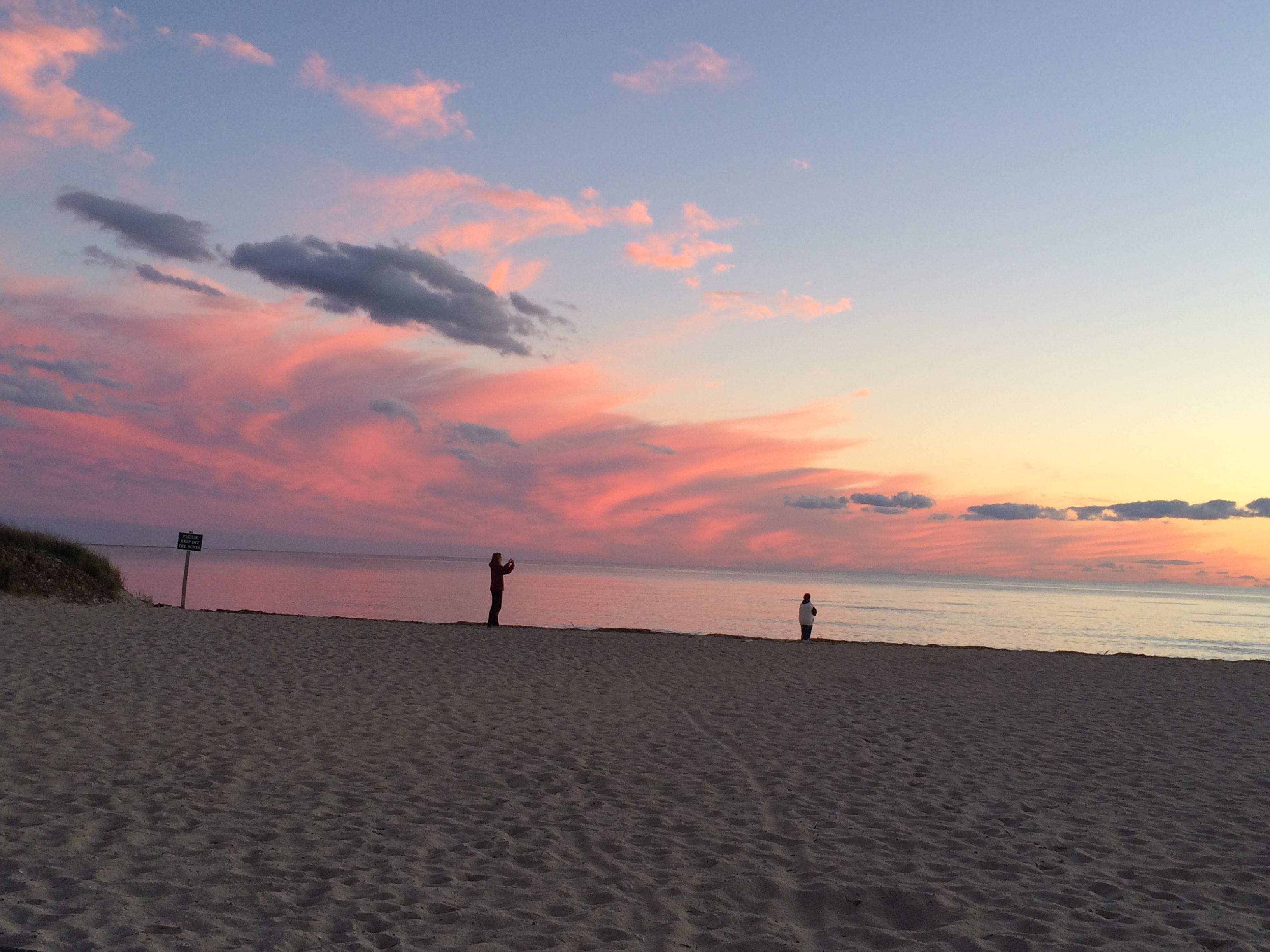
We parked. The spot was gorgeous. Lovely sands, magnificent Nantucket Sound waters gently rippling beneath a sky puffy here and there with clouds. The clouds made my heart leap, or something like that, because a scattering of clouds, as I’ve come to realize from years of sunset-gazing on the Cape, is key to a good sunset. Their water droplets and other particles refract light beams and reflect colors. Their movements and changing forms turn sunsets into active canvases. And that’s what happened as Sandy and I watched our fiery faraway friend say goodnight.

Sunset at Hardings Beach. 5:56 PM.
Sunset at Hardings Beach. 6:05 PM.
Sunset with the Moon at Hardings Beach. 6:07 PM.
Sunset. The Moon. Hardings Beach. 6:07 PM.


A lot of people claim to dislike colorful abstract art, certain paintings by, say, Vasily Kandinsky or Jackson Pollock. I don’t get that, because everybody loves sunsets, which to me can be among the ultimate in eye-popping abstractions. I’ve never read that sunsets inspired any brush wielders to go wild and free in their approach or vision, but it wouldn’t surprise me if in fact this were the case. Sandy and I watched the sky for 20 minutes. The pinks and oranges darkened as the big event rolled on. The clouds worked their wonders. And in a little while Sandy pointed up and said, “There’s the Moon.” It was a graceful sliver of white balancing above swashes of pastel hues.

On Cape Cod I’ve been a lucky son of a gun many times. That evening on Hardings Beach was one of them.

(Photos by Sandra Cherrey Scheinin. If you click on any photo, a larger image will open)

(If you enjoyed this article, then please don’t be shy about sharing it)

A Kite, The Moon, Sandy And I

Few if any ideas are unique. But many ideas are good ones. Last year, for instance, I came upon a good idea while perusing a bunch of websites pertaining to Cape Cod, where my wife Sandy and I would be vacationing a few weeks later. We’ve been hitting the Cape for many years, and we always try to amass a long list of potential activities before our vacations begin. One website was crammed with suggestions about fun things to do on Cape Cod. One of the author’s notions connected with my sweet spot. Go fly a kite, the writer said.

Our kite soared above Cape Cod beaches many times last year.

Sandy and I did just that. A few days into the vacation we bought a cute and colorful kite in a toy store and headed straight for a section of Atlantic Ocean beach to test it out. I hadn’t flown a kite in at least 50 years. Sandy, surprisingly, never had. We took to the kite as if it were a long lost pal. Over the course of our sojourn the kite, when not aloft, lived on the back seat of our car, always on hand and ready for action. We flew it on beaches all over Cape Cod and in an inland park or two. During the trip, we spent at least ten hours holding the reel of the kite tightly, watching our yellow, purple and blue amigo ride the air currents far overhead. To fly a kite was a very good idea.

Another good idea visited me recently. And it morphed fairly quickly into a better one. Plopped as usual on my living room sofa one day, half listening to WRDV, a low wattage suburban Philadelphia radio station, I heard a song that I’ve always liked. Dancing In The Moonlight, by King Harvest. This happy tune from 1972 got me thinking, as I had been looking for a story idea for my blog. “Ah yes,” I said to myself. “Let’s write something about the Moon.” I hoped that I’d soon hear other Moon-related songs, and then be able to put them into a bit of context. A few days later, example number two arrived when WRDV played a most obscure tune, a sultry and quiet jazzy bonbon from 1939, Dancing On The Beach. It was written by Bulee “Slim” Gaillard and performed by Slim and his then-partner Slam Stewart. The dancing described in the song’s lyrics, admirably delivered nonchalantly by Slim, occurs at night, under moonlight.

I felt that I needed to hear at least one more moony song to increase the meatiness of whatever I might end up writing. But the next one that I caught, Yellow Moon, by The Neville Brothers, was a bad fit for my thesis-to-be. It concerns a guy who, uncertain about his girl’s degree of devotion to him, asks the Moon to tell him what it knows about the lady’s love life. I put Yellow Moon in the discard bin.

A couple of days later though, out on a drive, I turned on Sirius radio and was taken aback by the first tune that emanated. It was Van Morrison’s iconic Moondance. There, the pieces had emerged. Three songs about letting go, about moving freely with someone you love, in partnership with the mysterious energies and powers of Earth’s nearest neighbor. It was time to analyze the songs, compare their calibrations and then start typing.

I studied the songs’ lyrics. In their essences they didn’t diverge very much. In each, under the moon’s spell, folks are grooving and open to the possibilities. “Dancing in the moonlight/Everybody’s feeling warm and bright.” “Dancing on the beach ‘neath the moon above/ Dancing on the beach with the one you love.” “Well, it’s a marvelous night for a Moondance/With the stars up above in your eyes/A fantabulous night to make romance/’Neath the cover of October skies.”

But I saw at least one difference among the tunes. Each, it seemed to me, inhabited a distinguishing milieu. Where else but in a meadow, one undoubtedly full of blissful and merrymaking hippies, could Dancing In The Moonlight be taking place? As for Dancing On The Beach, well, duh. And Moondance, to my reading, finds its home in none other than Van The Man’s grassy backyard.

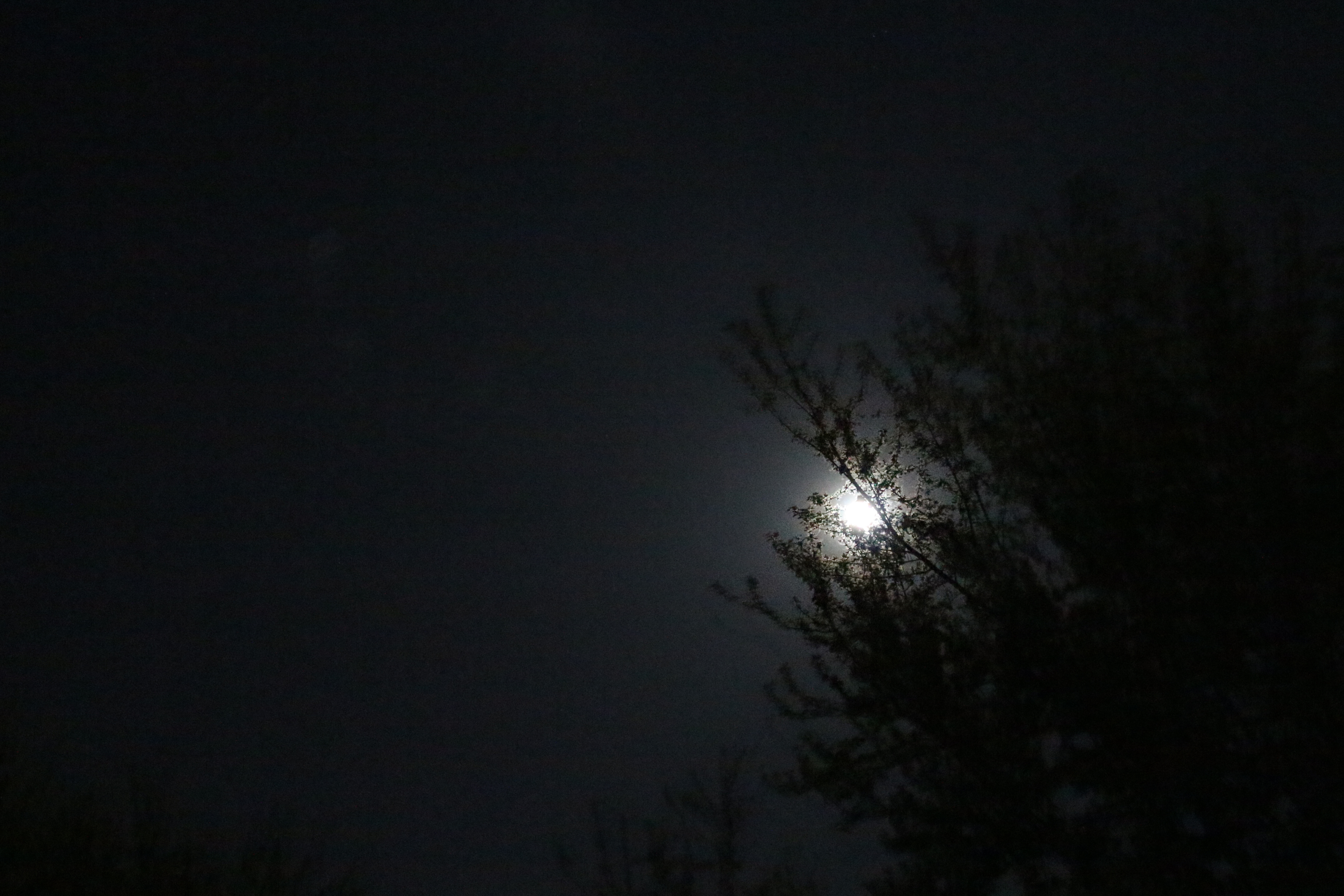
The Moon illuminating the Scheinin backyard.

With those and other thoughts in mind, I began to write. But my intent soon took a sharp change in direction when it dawned on me that the end game was not to turn out an essay about the intriguing aura that monnlit dancing casts upon the human psyche. Instead, I came to believe that the musical gods had held a meeting and decided to send a message my way. Sure, they had experienced brain freeze when they allowed me to hear Yellow Moon, but they quickly had regrouped and set things straight by showering me with Moondance. Their message was a simple one: Dance in the moonlight, fella! It’ll be fun. It’ll be good for you.

In my adulthood I’ve been a reluctant dancer. I give it a try at weddings and bar mitzvahs and other celebrations, but other than that, no. But this moonlight idea is intriguing. It might take awhile before my first dance occurs, but I’m going to coax myself. I can see it now  —  Sandy and I in our compact backyard, soft moonbeams filtering through the trees, the two of us flowing as one to the tune playing on the iPhone. Which of course is Moondance. And after that, before year’s end, we dazzle a lunar-lit stretch of sand and sea somewhere as Dancing On The Beach accompanies us. And then a meadow, where Dancing In The Moonlight shapes our movements.

(Photos by Sandra Cherrey Scheinin. If you click on a photo, a larger image will open)

(If you enjoyed this article, then please consider sharing it)

Outdoors At Last, At Morris Arboretum

Ocean, beach and sand cliffs on Cape Cod.

Cape Cod has become a favorite locale for me and my wife. It was love at first sight when we first ventured there for a vacation in 1998. We like pretty much everything about Cape Cod, but the one aspect above all others is its expansive areas of startling beauty. The Cape’s Atlantic Ocean beach, for one example, is breathtaking, about 30 miles of it uninterrupted and basically undeveloped. In the off-season you can walk there as far as you like, gazing at the waters and the tall sand cliffs backing the beach, and there’s a good chance you’ll cross paths with nary another human. Not many places where such a scenario can be duplicated. And at Cape Cod’s outer reaches is one of the more astonishing vistas I’ve ever seen, a five mile long lunar-like expanse of enormous sand dunes and valleys. Most unusual, most unexpected.

Cape Cod’s natural world draws me outdoors. When Capeside my wife and I spend hours in the fresh air daily. Home in the burbs, though, it’s another story. Here I’m out when mowing the lawn or shoveling snow or shooting hoops at my neighborhood playground. Other than that I’m indoors most of the time, and I think this is because there’s a dearth of beautiful suburban places to get lost in.

Luckily for me, Philadelphia is at hand. It’s an old city and a new one, with great architecture and sights. Walking its streets and parks is an outdoors activity that I do a fair amount of.  On Memorial Day weekend’s Sunday, my wife had an inspired Philadelphia idea. Let’s visit Morris Arboretum, she suggested. We hadn’t been there in years. This would be a fine chance to spend time in a lovely green spot not far from home. Okay, I said. We drove to Philadelphia’s Chestnut Hill section, where the Morris takes up a lot of space (167 acres). We spent three hours there. It was good to be outside for an extended period.

Morris Arboretum originally was an estate named Compton, home to siblings John Morris and Lydia Morris. They were wealthy, worldly and civic-minded folks. Their mansion is no longer with us, but Compton’s grounds and some secondary buildings remain. Established in 1887, Compton stayed in Morris hands till 1932, the year of Lydia’s passing (John had died in 1915). Lydia bequeathed Compton to the University of Pennsylvania as a botanical garden and research facility. The U of P has maintained and developed the property ever since.

Morris Arboretum has gotten a whole lot better since our previous visit. Back then a parent might have said to his or her five year old Amy or Andy, “Hey, look at that pine tree. Isn’t it beautiful?” and Amy or Andy would have responded “I’m bored, let’s go home.” The arboretum managers, obviously smart people, saw the need to build kid-magnet structures. Up went the Garden Railway in the late 1990s, and in 2009 Out On A Limb opened.

Morris Arboretum's Out On A Limb.
Morris Arboretum’s Out On A Limb.
Out On A Limb's play area.
Out On A Limb’s play area.

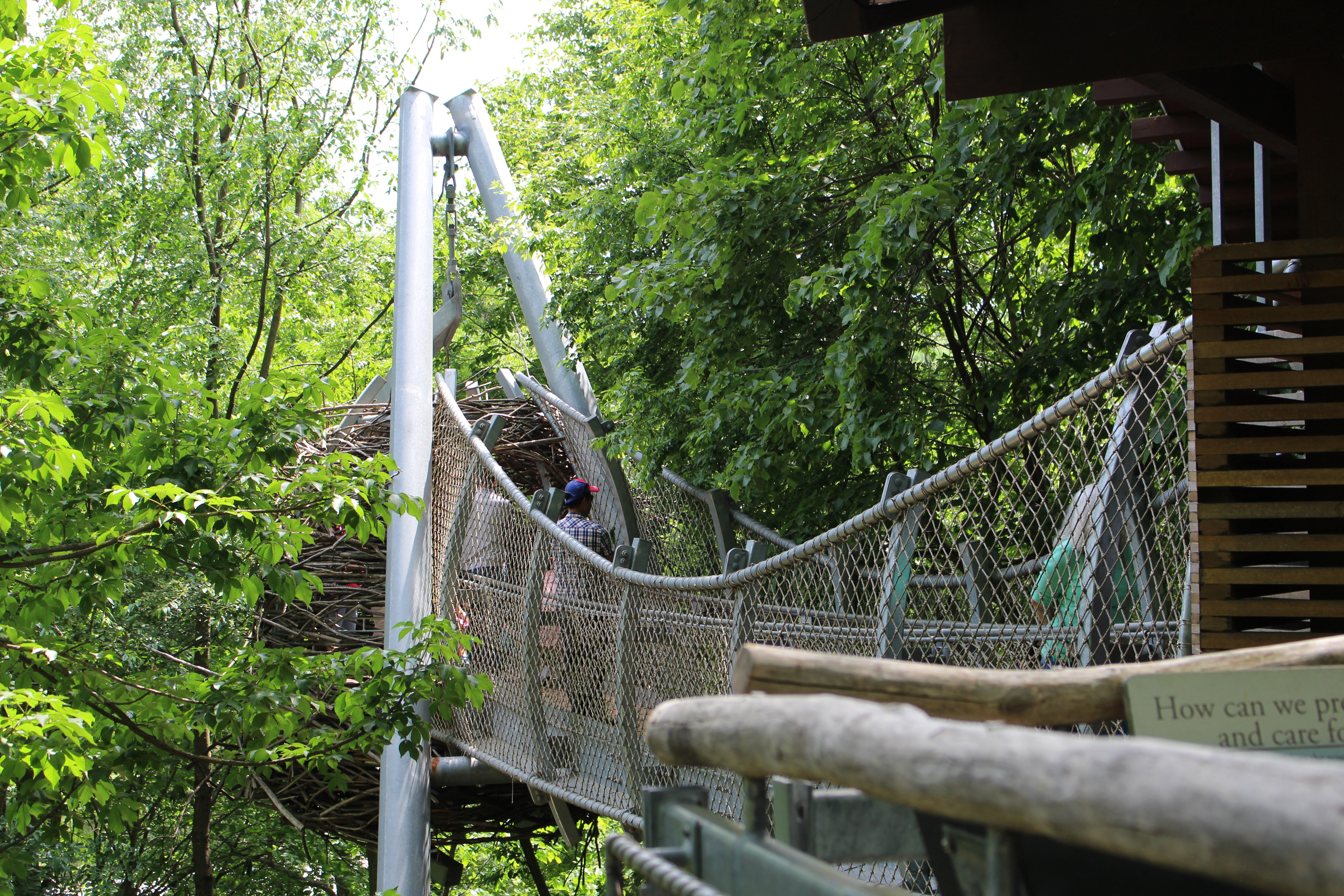
Out On A Limb is very cool. It’s an elevated twisting boardwalk, supported by steel columns and threaded between trees on a hilly part of the arboretum’s grounds. You enter at ground level and in a few seconds, because the earth slopes away quickly,  you’re looking down 40 or more feet at the forest floor. Walking alongside the mid and upper reaches of trees is a gas. Best yet is the play area at the walkway’s far end, where giant rope hammocks are suspended off to the side. Kids abound there. No wonder that attendance at Morris Arboretum has grown steadily since Out On A Limb came on the scene.

Morris Arboretum's Garden Railway.
Morris Arboretum’s Garden Railway.

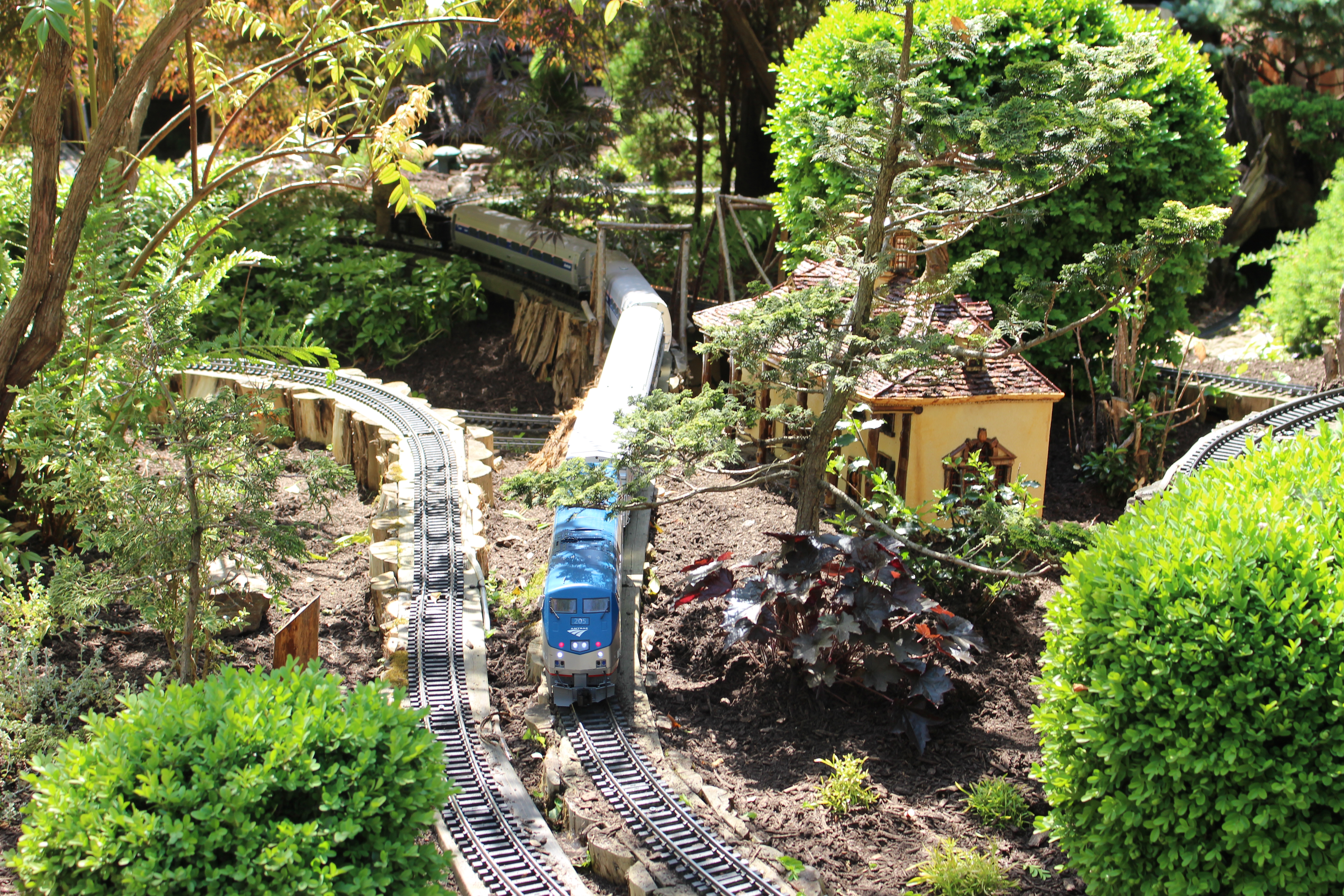
Almost as invigorating is the Garden Railway. Nestled among trees and shrubbery near the Morris’s Rose Garden, it is a cleverly designed toy train layout. Passenger trains, freight trains, cable cars, tunnels, bridges . . . all are there in three large separate areas. So are natural-material replicas of famous structures, such as the Eiffel Tower and Philadelphia’s City Hall. The trains wind their way over, around and through, disappearing from view, eventually reemerging. My wife and I were intrigued by the whole set-up. It’s something.

The amazing Blue Atlas Cedar at Morris Arboretum.

It’s not a bad idea to stroll the arboretum’s grounds with no particular plan. That is to say, you won’t go wrong by not referring too often to the map you’re given at the information center. Morris Arboretum is a work of art, sculpted to display its trees, flower gardens, fern groves, swan pond and shrubs. Poking around them randomly works. Plenty of things, often green ones, will catch your eye. One tree in particular caught mine, a Blue Atlas Cedar. One of this massive being’s long lower limbs shoots out perpendicularly to the trunk, resting on the earth. The limb I think grows that way naturally. It doesn’t appear to have been forced into its strange position by windstorms or magic.

Sculptures by George Sugarman.
African Queen, a stone sculpture at Morris Arboretum.

Manmade sculpture is another big part of the arboretum experience. Many such objects are placed on the grounds, continuing a tradition that John and Lydia began. The most colorful are the large playful and organically-shaped painted aluminum creations by the late George Sugarman. They’ve been on site since 1981. The most alluring sculpture to me is African Queen, a stone carving from Zimbabwe, artist unknown. How old is it? 50 years? 500 years? If the arboretum custodians have the answer, they’re not saying. Regardless, it’s a charmer. Pablo Picasso, who was greatly influenced by African art, would have loved it. The armless queen is asleep, her sweet face lost in dreams. The artist chose to depict her headdress as broad and undefined, focusing attention to the face below. A visit to Morris Arboretum, in my opinion, is incomplete without making time for this superb piece.

Rocked By Rockwell Kent

On a fine and sunny recent weekday afternoon, my wife and I headed north to what has become a suburban oddity, a genuinely good-looking and thriving town, one not marred by poor design and too many nail salons and tattoo parlors. I speak of Doylestown, in somewhat bucolic Bucks County, Pennsylvania. Our mission was to survey the three new exhibits at the James A. Michener Art Museum. The Michener is a splendid place. Modern and comfortable and spacious, it holds a diverse permanent collection anchored by works of 19th and 20th century Pennsylvania Impressionist landscape painters. Best of all, the Michener itself curates, or brings in from other museums, many special exhibitions each year. To me, a lot of them are fascinating and well-done. I’m not hard to please. Sometimes.

The three Michener shows on our agenda were: Rodin: The Human Experience — Selections from the Iris & B. Gerald Cantor Collections; Kate Breakey: Small Deaths; and The Artist in the Garden. The Rodin and Breakey exhibits are a-ok. Auguste Rodin was famous in his lifetime, which ended about 100 years ago, and is no less so today, for good reason. His bronze statues and modelings are something else, often wildly undulating. The Michener is loaded with them right now. The Breakey display is of her large, in-your-face photographs of birds and flowers. The birds are newly-deceased (not by Breakey’s hand), and the flowers are decaying. Breakey, whom I’d never heard of before, hand colors the photographs, creating powerful images and giving new life to her subjects.

Rockwell Kent in his late 30s

But forget Rodin and Breakey. The visit to the Michener would have been worth it to me for one art work alone, the first one that caught my eye as I made my way into the exhibition halls. It is “Winter Sunrise, Whiteface Mountain,” an oil painting from 1952 by a favorite of mine, the should-be-more-famous Rockwell Kent. He painted the picture near his home in upstate New York’s Adirondack Mountains. This oil, part of The Artist in the Garden exhibit, is broadly angled and limited in its mostly-muted color choices. Half-bare trees run along the bottom of the canvas, sun-brightened mountain ridges dominate the middle, and a murky green sky looks down at everything below. The painting somehow captures nature in an elemental way, which is what many great paintings do. I stared at the Kent for quite a while. The information card next to the painting said that Rockwell thought of nature as one unending garden, or something or other like that, and that’s why the curators included this most non-garden-like painting of trees and mountains in the “Garden” show. Well, they’ve probably stretched the point really wide, but that’s fine with me. Otherwise I’d never have seen this work.

Rockwell Kent died in 1971 at age 88. He had been a fine art painter, a book and magazine illustrator, a political thinker and activist, a wilderness adventurer, a chronicler of his life and travels, a farmer. Yup, an all-around cool guy. In 1927 he designed the logo used to this day by Random House book publishers. He gained a lot of fame for his pen and ink drawings of a 1930 edition of Moby Dick.

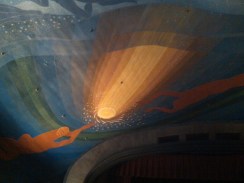
A view of the ceiling at Cape Cinema, on Cape Cod (Photo by J. Kaufman)

In a small way, he has been a part of my life for almost 20 years, dating back to when I first set foot in the Cape Cinema, on Cape Cod. Cape Cinema is an art movie house, whose vaulted ceilings and walls, most incredibly, are dynamically covered by a mural portraying the heavens and its mythological residents. Rockwell designed the mural in 1930. He climbed scaffolding and painted some of the square footage himself, but he was smart (or otherwise occupied) and left most of that heavy lifting to his collaborator Jo Mielziner. Their labors resulted in gorgeous swaths of yellows, oranges, purples and blues. I’ve been to Cape Cinema many times, because my wife and I are Cape Cod lovers and also cinephiles. With each visit there, my connection to Kent, as it is, seems to renew. Is there another movie theater like this in the world? I doubt it.