In Search Of A Story Idea

Funny thing about this blog. When I started it last April I didn’t know what shape it would take or what it might come to mean to me. Shape-wise, somewhat to my surprise, the blog seems to conform pretty well to the template I described in the “About” page. Meaning, I’ve written about this and I’ve written about that, and the articles in toto appear to give a pretty good picture of who I am. Not that I actually know particularly well who I am. Figuring that out would take hours and hours on a psychiatrist’s or other therapist’s chair or couch. “Hey, Sandy!” (note to readers: I’m calling to my wife). “It’s time I found out who I am. Please get me an appointment with a topnotch and nearby mental health professional. Thanks.”

As for what the blog means to me . . . well, it has become a big part of my life. Here I am, almost 12 months forward from the blog’s launch date, and I’m getting a tasty kick from writing. More than 60 times I’ve been inspired to put fingers to keyboard and knock out a story. I haven’t done so much thinking or typing since my school days, back when the dinosaurs were on the verge of extinction. Didn’t know I had it in me.

There is a problem though. To wit, I’m good at struggling to find subjects that interest me enough to write about them. And that are simple enough so that pea-brained me can understand them. Sometimes the well feels awfully dry, causing me to start worrying more than a bit. “What the heck am I going to write about next?” is a question commonly floating in my head. When day after day go by without a pleasing answer, man, the perspiration beads start pooling.

And that’s the situation I find myself in right now. I’ve had a few particles of ideas for stories, but none has swelled to a size that I can grab and knead. Better scribes than I would have turned out excellent articles from those fragments, which is one of many reasons why those writers are better.

IMG_0131
For instance, the other day I was at my volunteer job in a medical office building not far from my suburban Philadelphia home. The building is full of doctors’ offices that are reached via a web of corridors. I man the information desk at this facility one morning each week and have been doing so for six years. I was standing beside the desk. My mind was wandering. Perspiration covered my forehead. “What the heck am I going to write about next?” I wondered. And then something caught my eye. It was a watercolor painting, a large appealing abstract in blue and cream. It was mounted on a wall eight feet in front of me. It had been on this wall for who knows how long. I had seen it every time I’d been at my volunteer job. But I hadn’t  really seen it. I mean, it’s one of those items that you don’t want to become too aware of. If I started fixating on its existence, I’d be glancing over at it throughout my shift. It would become like a song that gets stuck in your head. Such as El Paso, the Marty Robbins tune from 1959 that I’ve been trying unsuccessfully to expel for decades. When Sandy and I were at dinner with our great pals Susie and Mike a few weeks ago, Mike started singing El Paso to me. He’s cruel that way. “Out in the West Texas town of El Paso/I fell in love with a Mexican girl/Night-time would find me in Rosa’s cantina/Music would play and Felina would whirl.” “Stop, Mike, stop!” I cried. And he did. But here I am a few weeks later with those entrancing lyrics and that sweet waltz-time melody still skipping around in my brain neurons. Mucho gracias, Mike. Mucho gracias.

Ah yes, the watercolor painting staring at me from eight feet away. A bell dimly chimed inside my cranium when the notion occurred to me that the watercolor might in some elusive manner lead the way to a story for my blog. Perhaps there were other art works hanging in the corridors of the medical facility. And if so, that would be my story. Namely, one about lovely objects that often surround us yet remain unnoticed and unappreciated.

Is this art?
Is this art?
Is this art?
Is this art?

Off I went to explore the three floors-worth of crisscrossing hallways. I’d walked these avenues many times over the years, but looking for art had never been part of my quests. Alas, I came up empty. The blue and cream watercolor was an orphan, the only framed object in the various halls. Not so fast, though. A myriad of things were attached to the corridors’ walls or hanging from their ceilings. Fire alarms, fire extinguishers, water fountains, exit signs, digital thermostats and other utilitarian stuff. Who’s to say that they didn’t qualify as art? If they did, then my volunteer job took place within a veritable museum.

“Yeah, now that’s a story for my blog,” I told myself. After all, in 1917 Marcel Duchamp bought a mass-produced urinal, signed it with a fictitious name and submitted it to a prestigious arts exhibition. And in the 1960s Andy Warhol created large-scale facsimiles of Brillo boxes. Duchamp and Warhol were revolutionary modernists, questioning the nature of art, asking what in fact qualifies as art. If they had held my volunteer job, mightn’t they have concluded that indeed they were working in a museum?

Thus I walked the hallways once again, reexamining the stuff on the walls and ceilings and taking their pictures with my iPhone. And as I did I knew that this story idea led nowhere. Oy frigging vey! Try as I might I didn’t feel any aesthetic or conceptual attraction towards the fire alarms or any of the rest. “You know, as art these things suck big time,” I said to myself.

Soon an idea worth writing about will come to me. I’m confident of that. Sort of. Till then, I’m outta here. Where’s the exit? . . . Oh, here it is. Bye.

IMG_0151

(If you enjoyed this article, don’t be shy about sharing it. Sharing buttons are below)

Two Million Cheez-Its And Counting

Circa 1970 one of the greatest culinary stories of my life took root: My infatuation with Cheez-It crackers. Just about everyone knows Cheez-Its. They are crunchy and salty one-inch squares, baked amalgams of cheese, wheat flour, paprika, etc.  Back then there probably was only one variety of Cheez-Its. The divine original in other words, the sort I stuck with through the years till recently switching to the Extra Toasty style. Today there are more than 25 Cheez-It types to choose from, including Whole Grain, Cheddar Jack and Mozzarella. They take up a whole lot of shelf space in most supermarkets, so clearly I’m not alone in loving Its. As we’ve been told, great minds think alike.

Cheez-It crackers in two of its many varieties.
Cheez-It crackers in two of their many varieties.

And you know what? I’ve eaten 2,000,000 Cheez-It crackers in my life, give or take a couple hundred thousand. That’s a lot of individual food items going down the gullet. Have I ever eaten more separate pieces of anything over the years? I’ve given this plenty of thought. Who wouldn’t? The only thing I can come up with is grains of rice. Maybe I’ve consumed more than 2,000,000 grains of rice. I’ll investigate that subject one of these days and let an anxious world know the results. But on with the current story.

Two million Cheez-Its. How did I arrive at that figure? It wasn’t easy. The question is deep. And so, at a loss for determining a calculation method, I started where most sensible people would start. That is, I got in touch with someone much smarter than me. I had been in phone contact with Dr. Vinnie Bubalinsky before. He’s head of the mathematics department at St. Louis Institute of Advanced Abstract And Profound Research. I had called him from out of the blue a year ago, explaining that I was wondering about angels gyrating, not dancing, on the head of the average pin. How many might fit there? Vinnie hadn’t a clue, had very little response at all to tell you the truth. I was glad to learn that tough questions don’t necessarily evoke glib answers.

The other day I dialed Vinnie’s number again and told him about my Cheez-It quandary. Vinnie remembered me. “What the f – – k’s wrong with you?” he asked. Patiently. “Get a life, you loser,” he added before ending our conversation. I would if I knew how.

I was on my own. I grabbed my favorite pen, a load of blank paper and a calculator. And I began to work out the numbers. Leave it to the Cheez-It manufacturer to make things difficult. I mean, for decades Its had come in an understandable size, a one pound package. That’s the same as 16 ounces I’ll mention to those of you who left school a long time ago. But in 2008 the Its maker downsized the box to 13.7 ounces, a strange number to be sure. And last year they did it again. The standard Cheez-It box now contains 12.4 ounces of product.

And if all that weren’t bad enough, I had to throw into the equation the fact that my Its consumption habits have changed over time. For years and years I would down three or four pounds of Its weekly. I easily could knock off a box while watching a baseball game on television. But those heights are a distant memory. In the early aughts my intake of Its dropped by half. And it has continued to shrink. For the last few years I’ve eaten about three-quarters of a pound per week.

The tools that I used for my daunting calculations.

OK. I sat at the dining room table for hours, scribbling, sweating, cursing, punching wildly at calculator keys. The basic fact that I always held onto came from the side panel of each Cheez-It box: Twenty-seven Its weigh 30 grams. And 30 grams, I found out elsewhere, are the same as about 1.1 ounces. Needless to say, progress was slow. But things eventually started to come together, to make sense. Two million Cheez-It crackers was the approximate number that I had chewed and swallowed, I finally concluded. I picked up the phone and dialed Vinnie Bubalinsky’s number, ready to gloat. But I hung up after one ring. He will read about my triumph soon enough, no doubt, on this page. Vinnie, some losers never quit.

I’d like to put my Its consumption in perspective. We all agree that 2,000,000 Cheez-It crackers are a massive amount. In fact, if you placed them edge-to-edge on a flat and straight-as-an-arrow highway, they would extend for 31.5 miles, a very sizeable distance. But wait . . . there’s something I hadn’t thought about: In a car you’d cover those miles in less than half an hour. And yet it took me 45 years to eat the crackers. What does this mean? That cars are about 1,000,000 times faster than the human mouth? That highways inherently are inappropriate places to place Cheez-Its? I really don’t know. I’m confused. I need help.

(If you enjoyed this article, don’t be shy about sharing it. Sharing buttons are below)

(Photos by Sandra Cherrey Scheinin. If you click on a photo, a larger image will open)

Missing David Bowie

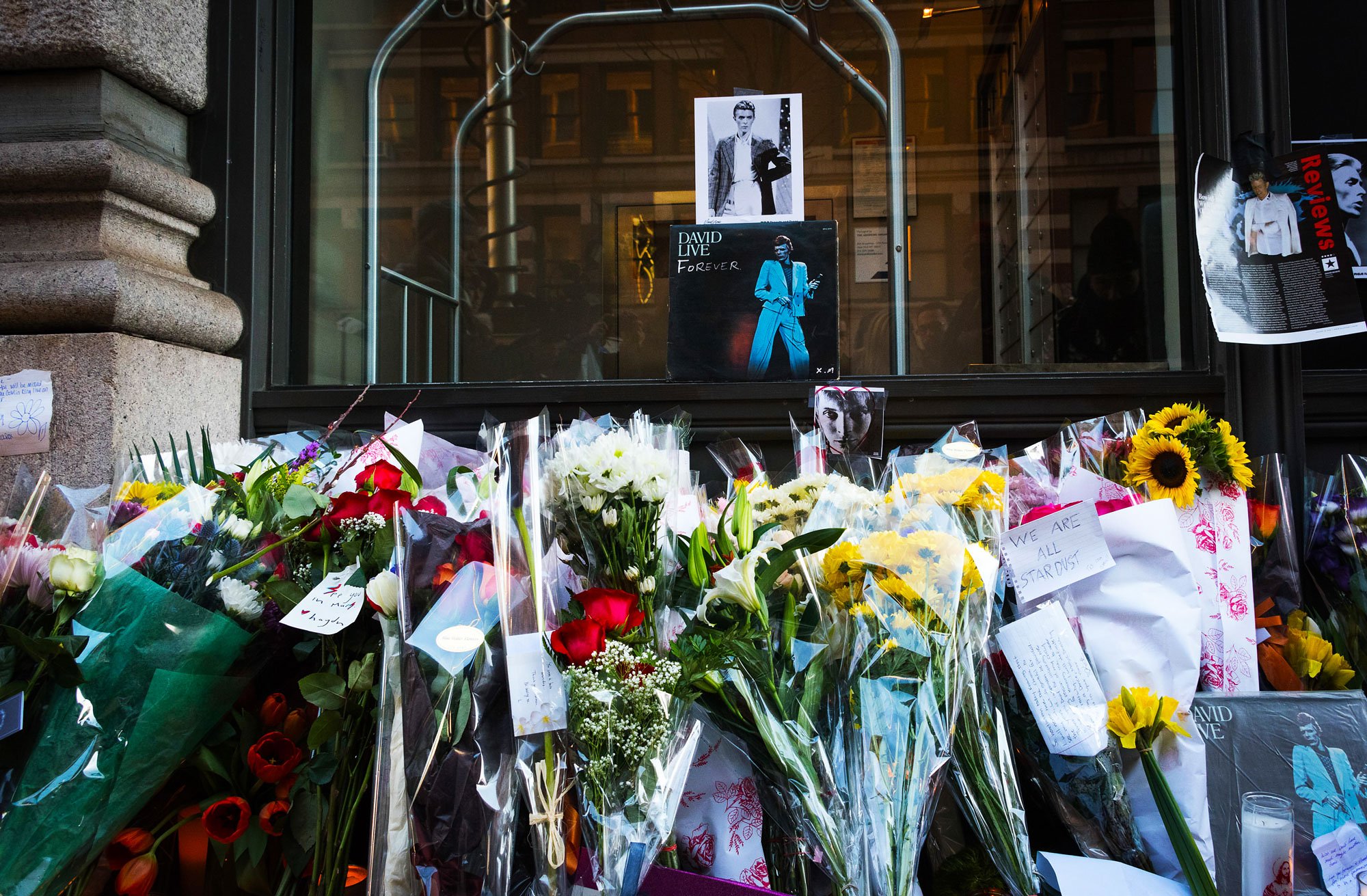
On January 11, a Monday, I heard about David Bowie’s passing. He had shuffled off this mortal coil the prior day. I was shocked by the news, though I’d hardly have described myself as a devout Bowie fan. As that Monday morning segued into afternoon, I couldn’t get Bowie out of my mind. Neither could my wife Sandy, who is far less of a Bowie devotee than I am. We were drawn, as if by an invisible force, to WXPN, the Philadelphia area’s most astute music radio station. In tribute to the great man they were playing Bowie music exclusively for much of the day. We listened for two or three hours, and when XPN turned to other programming at 7 PM Sandy and I put on WPRB, the Princeton University station, to see if Bowie reigned there. He did, and we listened to his songs for several hours more. I can’t think of many artists who, following their deaths, would receive radio homages of this sort. And of course the Bowie outpourings weren’t limited to radio. Media coverage of his life and death has been enormous and heartfelt worldwide.

David Bowie fans left tributes to him outside his New York City apartment building. (Photo: Getty Images)

Naively I suppose, I’ve been amazed by the degree of attention that Bowie, in death, has attracted. I’ve been very glad to learn that countless journalists and media commentators held him in really high esteem, not to mention legions of fans. On January 11 Bowie was a top global story, probably the top story, in newspapers, on television and throughout cyberspace.

And I’m struck by the extent that Bowie’s death has touched me. My reaction took me by surprise, wasn’t something I’d have predicted. I don’t know the last time a celebrity’s demise hit me so strongly. Maybe it was in 1980, when John Lennon left us. Lennon was one of my heroes. Though Bowie wasn’t, I admired the heck out of him during a swath of the 1970s and always have considered him to be a cultural giant. That accounts for part of my sadness, but not for all. So, what else was it about Bowie’s death that got to me? I’ve thought about this for awhile and have come up with two main reasons.

David Bowie recorded 26 studio albums. His final work, Blackstar, entered the marketplace on his 69th birthday, two days before he died. I own six of his albums. All of them are from the 1970s except for 2002’s Heathen. I love my six from the 70s. Each I believe is great, and the greatest to me is 1976’s head-spinning and majestic Station To Station. I don’t know why I stopped buying Bowie’s releases after Station To Station. I read about them, heard some tunes on the radio, but didn’t lay down any dollars again till 26 years later. Nothing new, I was just plain stupid. Here was a guy with a brilliant track record, whose albums I once had spun over and over, and nonchalantly I had abandoned his singular musical journey. It wasn’t till a few nights ago that I realized what I had missed. WXPN and WPRB played tracks from Low, Lodger, The Next Day and other albums I barely, if at all, was familiar with. The music, as I might have guessed, was fantastic. And I played Heathen on my CD player. I hadn’t listened to it in so long I didn’t recall a single number. David, I only partly knew ya’. I should have kept up. Mea culpa.

Still, missing out on a lot of David Bowie’s music isn’t the end of the world. But it’s an example of not paying attention to life, of letting life pass on by without proper appreciation. And that’s a big deal. I try fairly hard to savor the moment and to do the right thing, but there’s mucho room for improvement. Bowie’s death somehow made me look at myself and my underachieving approach. Ouch. Ouch. Ouch.

And Bowie’s passing did more than that. In the recesses of my mind I discovered some connective tissues that bonded me with him. You see, David Bowie was only a smattering of months older than I, and because of that I subconsciously had felt a kinship with him. And so when he died an internal link to my younger self broke and I started to contemplate the big picture even more deeply. I mulled over the kinds of thoughts that aren’t reassuring. Such as: Even if I make it for another 25 years I’m a whole lot closer to the end than to the beginning. Man, that’s a bummer. My excellent friend Jeff recently asked me if I believe that human life goes on in a spirit mode after the flesh fails. He’s a believer. I’m not. My take is that each person’s trip is confined to Planet Earth and that the trip is one-and-done.

That said, on with the party. I plan to buy a bunch of David Bowie albums soon, to catch up with someone, now-departed, whom I miss.

(If you enjoyed this article, don’t be shy about sharing it. Sharing buttons are below)

The First Time I Saw Springsteen

Before today I hadn’t mentioned the words Bruce or Springsteen anywhere on this blog. But you know, this article about The Boss probably won’t be my last. That’s because I’m a big fan of Bruce’s. I’m not one of his fanatical followers, not one of the myriad folks who own every recording he has ever issued and have attended Springsteen concerts in the dozens and above. But big enough. I consider Springsteen to be a huge talent. For decades he has been a superb singer, songwriter and guitarist, and an in-concert performer blessed with off-the-charts charisma and energy. On January 16, he and The E Street Band will be hitting the road for the umpteenth time. When I read recently about their upcoming tour, my mind wandered back to the first time I saw Bruce on stage.

Springsteen got his start in the late 1960s. By 1973 he had developed a fairly big fan base in a few locales, such as the New Jersey Shore communities and the greater Philadelphia area. Part of this was due to his relentless gigging around the USA. Back then if you toured enough you were bound to catch on somewhere, especially if some radio stations played your tunes. But overall he and his E Street Band still were little known. For the most part he played in small venues until finally breaking through nationally in 1975. Global superstardom would follow some years later.

I moved to Philadelphia in February 1974 and soon started hearing Bruce on WMMR, the city’s premier rock station at that time. They played tracks from his first two albums, both of which came out in 1973: Greetings From Asbury Park followed by The Wild, The Innocent & The E Street Shuffle. It didn’t take me long to become a Bruce devotee. I bought both albums and especially liked what was on The Wild. Who wouldn’t have? The songs, every one Bruce-penned, are fabulous. They are literate and intriguing stories put to wonderful melodies. Rosalita (Come Out Tonight), Incident On 57th Street, Kittie’s Back . . . man, the seven songs on the record sound as good today as they did all those years ago. There was no question in my mind that Springsteen carried the goods. I wanted to see him in person.

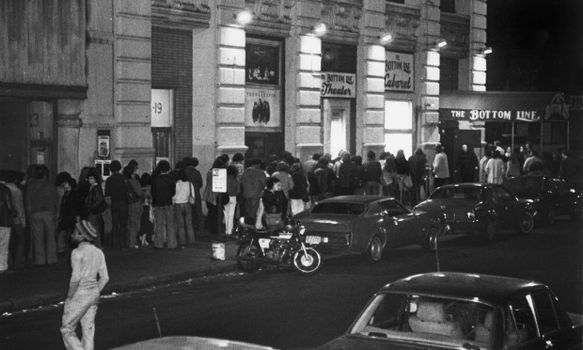
The Bottom Line (photo by Peter Cunningham)
The Bottom Line (Photo by Peter Cunningham)

In July 1974, Bruce and The E Street Band played six shows in Manhattan at The Bottom Line. Three nights of music, two shows per night. Long gone, The Bottom Line was a magnificent small club in Greenwich Village, magnificent not because of its décor but because of its wide-ranging musical menu. I was there with my brother Richard at one of the early shows. Richie wasn’t as ardent a rock lover as I was, but somehow I had convinced him to come along. I suppose I’d known about Bruce’s Bottom Line gigs via announcements on WMMR. I can’t imagine how else I’d have heard.

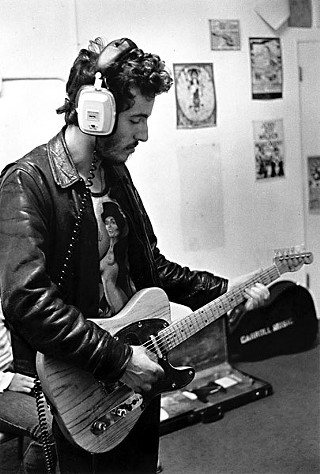
Springsteen a few months before I saw him (Photo by Burton Wilson)

How much of the show do I remember? Well, to put things in perspective, I’m probably exaggerating on the high side when I say that I recall about 0.0001% of my adult life. Pathetic and depressing, but true. And yet I  do have some memories of that summer evening nearly 42 years ago. I can picture Richie and me seated at a table. We were 20 or 30 feet from the stage. I remember the start of the show. The house and stage lights went dark, and then one spotlight illuminated a small section of stage. Springsteen stood in that focused light, a big floppy hat tilted on his head. And he began to sing Incident On 57th Street. Quietly.

Spanish Johnny drove in from the underworld last night/With bruised arms and broken rhythm and a beat up old Buick, but dressed just like dynamite/He tried sellin’ his heart to the hard girls over on Easy Street/But they said “Johnny, it falls apart so easily, and you know hearts these days are cheap.”

The E Street Band whispered behind Bruce. And as the vocals gradually intensified, the band followed Bruce’s lead nimbly and powerfully. For this song, The Bottom Line, just like that, was transformed into a tough part of town where sorrow and longing prevailed. The reports that I’d heard in Philadelphia were true — that Springsteen, on stage, enveloped a song like few others, tapped into a cache of emotions that were invisible to most vocalists, and that The E Street Band was scarily good. I knew that I was at what would be the best concert I’d ever attended.

Bruce and the boys danced through maybe 10 or 11 more songs before leaving the stage, and they never let go of the audience’s gut. The concert was an exhilarating and spellbinding ride, a trip to rock and roll heaven. The only other tune that I specifically recall being played is Rosalita. It was rollicking and wild. Delirious. Amazing. There was nothing that Bruce, Clarence Clemons, David Sancious, Garry Tallent and the other E Streeters couldn’t do.

Richie was as stunned as I was. I don’t think he’d had any idea what the night held in store for him. To this day I rank Bruce and band at The Bottom Line as one of the ultimate shots of live music in my life. It gave me shivers. It made me shake my head in disbelief. It sent me out into the streets with a buzz that still echoes.

(If you enjoyed this article, then don’t be shy about sharing it. Sharing buttons are below)

The Night I Made A Cocktail Table Go “Boom”

You should count your lucky stars when you act like a nitwit and are forgiven for your sins. That is what happened to me about ten years ago at a jazz concert. It was the night when talentless me accidentally became part of the show.

I hadn’t thought about that infamous evening in a long time, but for some reason was reminded of it recently when my wife Sandy and I took in a Friday night concert at the Philadelphia Museum Of Art (PMA), which had been the scene of my crime. The museum calls its Friday night concert series Art After 5, and it’s a good one. Art After 5 began in 2001 with a jazz-only format, but has morphed over the years to include a wide range of genres. Sandy and I have been to a crazy number of music shows at PMA since we discovered the series in 2002.

Picture this: It is February 2006. Sandy and I are seated in the first of several rows of tables ringing the performance area in PMA’s Great Stair Hall. The hall is enormous, maybe 80 feet high, and is dominated by, yes, a great stairway that connects two levels of the museum. The Great Stair is 20 feet behind us and stares regally at the performance area. Many concertgoers are seated on its marble slabs . . . uncomfortably. Sandy and I prefer comfort. So we made it a point to arrive way before showtime in the hopes of nabbing one of the cocktail tables, which are squeezed together pretty closely. Compared to marble stairs, the chairs at the tables are a blessing for butts. At our table we don’t have much to do except twiddle our thumbs. We order soft drinks and sip at them. We are waiting for jazz vocalist Carmen Lundy and her band to start their show.

Carmen Lundy in performance six years after my cocktail table went "boom." (Photo by Daniel Sheehan)
Carmen Lundy in performance eight years after my cocktail table went “boom.” (Photo by Daniel Sheehan)

At 5:45 PM Carmen and the guys are introduced by Art After 5’s curator. Minutes later they begin to play. They are very fine, and only eight feet in front of our excellent seats. Carmen Lundy, a justly acclaimed performer, is singing with a lot of flair and swagger. Sandy and I are enjoying the show. But halfway through the set something begins to bother me. I feel as though my space is being impinged upon. Someone at a table behind me has inched up a tad too much and is putting pressure on the rear of my chair. I have the solution, of course. All I need to do is slide my cocktail table forward ever so little, after which I’ll be able to move my chair forward too. I push the table very very gently, maneuvering it carefully. But alas, this is a plan not destined to work out. The frigging table loses its balance and topples heavily, its edge creating an enormous sound when it smashes onto the floor. The noise echoes throughout the Great Stair Hall. And everything that was on the table flies off and finds a new home inches from the performers’ feet.

I felt like a schmuck. I was a schmuck. Oy vey, was there anywhere to hide? No way. All I could do was sit there as a couple of servers scampered over, set the table upright, and on their hands and knees quickly swept up ice cubes and pieces of broken glass. They mopped up the soft drink liquids from the floor and retrieved my eyeglasses, which once had been on the table but now were beneath the piano bench. Yet, all the while the band played on as if nothing had happened. Carmen Lundy continued to deliver her song with full emotion. Harold O’Neal’s fingers were flying on the keyboard. Jason Brown’s drums went rat-a-tat-tat and wham-bam-thank-you-ma’am, and Curtis Lundy, Carmen’s brother, plucked fervent notes on his upright bass.

The set finally ended. Was anyone in the audience staring at me? Probably. But I was too embarrassed to look around and find out. I knew one thing I had to do though. Apologize. Carmen Lundy was standing near the sound board, 20 feet to the right of the performance area. I stood up and made my way to her.

“Ms. Lundy,” I said. “I’m the idiot who knocked over the table. I’m very sorry. I feel like a fool.”

Carmen Lundy gave me a good hard look for a few moments and then did the darndest thing. She put a hand on one of my shoulders, looking me straight in the eyes, and said “Don’t worry about it, honey. It didn’t bother us. In fact it gave us energy to play even harder.”

Man, I didn’t know what to say in response to such a stellar attitude. I mumbled my thanks and probably a few other words and shuffled to my seat.

Looking back on all of this the other day I realized once again that I had been in the presence of classiness and graciousness. If our places had been reversed I doubt if dopey me would have been so wonderful. Carmen Lundy, in my book you’re very much okay.

(If you enjoyed this article, then don’t be shy about sharing it. Sharing buttons are below)

Van Gogh, Scorsese And I: A Tale Of Mispronunciations

So, there the three of us were, sitting around a table inside a cozy tavern, chatting amiably about nothing in particular and knocking back a round of beers. Vincent van Gogh, Martin Scorsese and I. Respectively, a powerful and visionary visual artist, a commanding director of moving images, and a plebeian with, by definition, an awfully light résumé.  What the heck was I doing at that table, you ask? And where, by the way, were the table and tavern?

In my dreams. That’s the answer to question number two. As for the first query, I was seated with greats solely because we all had something in common: A lot of people did not know how to pronounce our surnames.

Martin Scorsese (Photo by Jeff Vespa; copyright WireImage.com)
Martin Scorsese
There are several purported photographs of Vincent van Gogh. None are totally authenticated. This is believed to be from about 1886.
A purported photograph of Vincent van Gogh believed to be from about 1886.

We’d made more than enough small talk. Turning onto a substantive route, I said to the gent on my left: “Marty, it must drive you nuts that almost everyone thinks your last name is Score-Say-Zee. I wonder how in the world that messed-up notion ever caught on.”

“Neil,” Marty said to me, “I’ve gotten used to it. But it sure would be nice if they’d get things straight. I mean, we’re talking about my name, for crying out loud.” I nodded understandingly.

“Vincent,” I next said, rotating my head slightly to my right, “How do you deal with this? People call you Van-Go, or maybe Van-Gokh. Doesn’t anyone ever do better than that?”

“I gave up on this a long time ago, Neil. My family and my fellow Dutchmen, they know how to say my name. Just about everyone else, fuhgeddaboudit.”

“Guys,” I said. “I hear ya’. I’m not as hung up on the name thing as I used to be. But it still churns me when people say Shee-Nin or Shy-Nin or Shee-In-In. C’mon, I know the spelling is a guarantee to throw almost anyone off, but still . . . ”

A plebeian.
A plebeian.

Scheinin. That’s my last name. A confusing array of letters. But with a simple two-syllable pronunciation: Shay-nin. To make things easy, maybe I’ll legally change the spelling to exactly that, hyphen and all.

I looked leftward once again. “Marty, the only reason that I know how to say your name properly is because years ago I heard you pronounce it on the Charlie Rose interview show. ‘Score-Seh-See’, you said. And ever since then I’ve been careful to say it that way whenever I gab about your movies.”

“Thanks, Neil,” Marty said. “Finally someone pronounced it right.” And I speedily hoisted my right hand to catch the high-five that he threw at me.

“Vincent,” I then said, gazing in the master colorist’s direction. “Yours is very very tricky. And no doubt I’m not gonna be able to duplicate the from-the-back-of-the-throat nuances of the Dutch language. But, good sir, I’m going to give it my best shot. Vun-Khuhkh. Am I right? Am I in the ballpark?”

“Neil, that’s darn well close enough,” he replied, clapping his hands. “That’s the nearest anyone outside of Holland has come in decades.” He smiled broadly as his eyes examined all the planes of my face. Was he toying with the idea of painting my portrait?

The name situation settled, Vincent, Marty and I began to talk of deeper matters. The meaning of art, for instance, and its value to the human spirit. But almost immediately Vun-Khuhkh and Score-Seh-See left me in their wake. Little could I add to their understandings and suppositions. I was more than happy, though, to listen and hopefully to learn, and to toss in a lame comment now and then.

I eventually shouted over Vincent’s and Marty’s lively conversation. “Waitress, three more Guinnesses please.” A few minutes later the dark brews arrived. We downed them greedily.

The hour was advancing, as it always does. “Gentlemen,” I finally said, gesturing to the waitress to bring the bill. “It’s almost time for me to wake up. It’s been a pleasure. And the beers are on me.”

(If you enjoyed this article, then don’t be shy about sharing it)

(Photo of Martin Scorsese by Jeff Vespa; copyright WireImage.com)

(Photo of a plebeian by Sandra Cherrey Scheinin)

Running Free

I don’t know about you, but it seems to me that driving in any inhabited area these days is a sure fire way to add kilos of stress to the body, to send the diastolic and systolic numbers moonward. For me, driving even on my typical suburban block can be a true pain. One recent morning, for instance, I stepped into my ancient Honda, which was parked directly in front of my home, and saw a young couple 100 feet in front of me. They were putzing around with their SUV, also parked on the street. Their rear driver’s side door was wide open, making passage past their car difficult. Worse, the female member of the twosome was standing in the middle of the street, la-dee-dahingly removing boxes from the back seat. “OK, no problem. I’ll simply make a K turn and head in the opposite direction,” I said to myself. As I gracefully maneuvered the Honda to my left and then backwards, needless to say another SUV headed towards me from the direction in which I now was planning to drive, putting pressure on me to complete the K pronto. Bottom line: Nearly everywhere you go there are just too many people and too many motor vehicles. “Hey, that’s modern life,” some would say. “Get with it.”

Oh yeah?  Arrgh . . . Let me outta here! I need to run free! At least some of the time.

I don’t like congestion, dig? But what’s a person to do? I’ve written a few times online about the sweet spot that Cape Cod occupies in at least two hearts, mine and my wife Sandy’s. Cape Cod is where we head when we want to get away from it all. Not that Cape Cod is free from congestion. Hardly. But if you know where on the Cape to go, and when, you’ll be far far far from the madding crowd and its cars and trucks. And you’ll have fun too.

Cape Cod is famed for the throngs that descend upon it between Memorial Day and Labor Day weekends. People and cars up the wazoo. That’s why Sandy and I never go there during that period. We were on the Cape last month though, when things were back to normal. We spent plenty of time among others of our species. But we also made sure on most days to bathe our souls in places where the human and vehicular factors would be minimal.

Parabolic sand dunes territory. Truro, Cape Cod.

“You know,” I said to Sandy on this most recent trip as we stood atop a humungous sand dune. “If you plopped most people down here and asked them where they were, they’d never guess it’s Cape Cod.”  That was true. When the majority of folks think Cape Cod they envision seaside-ey villages and seafood-ey restaurants. But we were miles away from any of that. We were in parabolic sand dunes country, inland just a bit from the Atlantic Ocean in Truro. Truro is a sprawling area of the Outer Cape, and probably the most rural and desolate section that Cape Cod has to offer. The parabolic dunes are by far the Cape’s biggest, undulating 80-feet-and-taller monsters that extend for several miles, covering part of Truro and of Provincetown too. We’d been in this locale a bunch of times before, and as always were knocked out by the vistas. Several parallel chains of dunes ran long into the distance. Between each chain were deep valleys that, surprisingly to me, a low level naturalist, were loaded with small trees and shrubbery and all manner of other plants that I couldn’t give names to. This is a mind-blowing environment, a vegetated lunar-like landscape that, I’m sure, many Cape Cod residents and vacationers barely know about. It is open and wild. I feel alive there. And that’s why I like it.

Over the years I’ve spent a lot of hours scampering up, down and around the parabolic dunes, and even more among the slightly smaller and less dramatic dunes that take over in Provincetown when the parabolic big boys eventually peter out. At this point in my life I’m not going to be climbing any mountains in the Alps or bungee jumping into canyons in the American West. For me, the Outer Cape’s dunesville does just fine as a spot where I can indulge my sense of adventure and feel as though I’m pushing my puny limits. There’s no congestion out there. You might cross paths with a few other trekkers, but that’s okay. They are kindred spirits.

Dunesville is great. But what I like even better on Cape Cod is the Atlantic Ocean shoreline. Most of it is under government protection, meaning that mankind won’t be messing it up any time soon. It’s pure, it’s long — 40 or more miles — and it’s beautiful. What’s not to like? Sky, ocean,  and sand-cliff-backed endless beach.

Its presence of water is why I would choose, if I had to choose, this shoreline over the Outer Cape’s dunes territory. Though Sandy and I aren’t swimmers, we’re big time water admirers. We have hiked hundreds of miles over the years on the Cape’s ocean shore. There’s just something about being there. The power of the water, its changing face from day to day. The rigid coolness of those sand cliffs. The real low numbers of humankind in the off-season. And then there’s our kite, which enhances this scenario. Last year we bought the kite and flew it on beaches many times. We launched it frequently during our recent stay too.

Atlantic Ocean shoreline at Marconi Beach, Cape Cod.
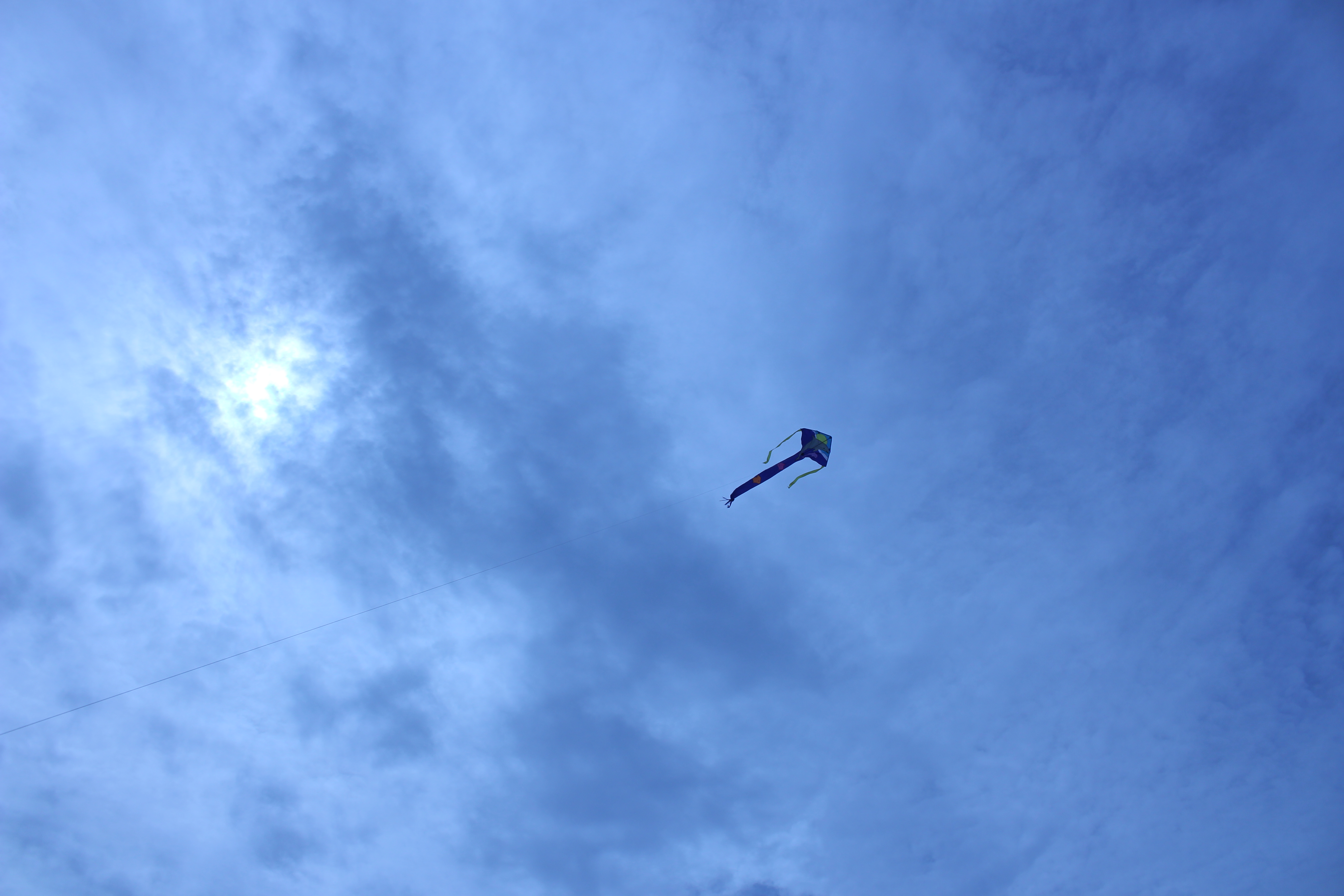
Our kite at Marconi Beach, Cape Cod.

One day last month, on the ocean shoreline named Marconi Beach, the conditions for flight were perfect. A strong but not overpowering steady wind meant the kite would stay aloft sans problem. What we discovered at Marconi was that the kite was insatiable. It kept pulling on the string, begging us to let out more and more length. This hadn’t happened to us before. And so we did. The kite went higher and higher. The amount of string on the reel grew less and less. I hardly could believe it when there was no more string to release. The kite was way up there. How far away I didn’t know.

After an hour or so we decided it was time to move on, to say goodbye to Marconi Beach for the day. It took a long time to reel in the kite. Later I checked out the kite manufacturer’s website where I learned that our polyester friend came equipped with 300 feet of string. I was impressed. At Marconi Beach we had overseen a long-distance journey.

Congestion . . . bad. Running free . . . good. End of story.

(Photos by Sandra Cherrey Scheinin. If you click on a photo, a larger image will open)

(If you enjoyed this article, then please don’t be shy about sharing it)

I Never Met Thelonious Monk, But . . .

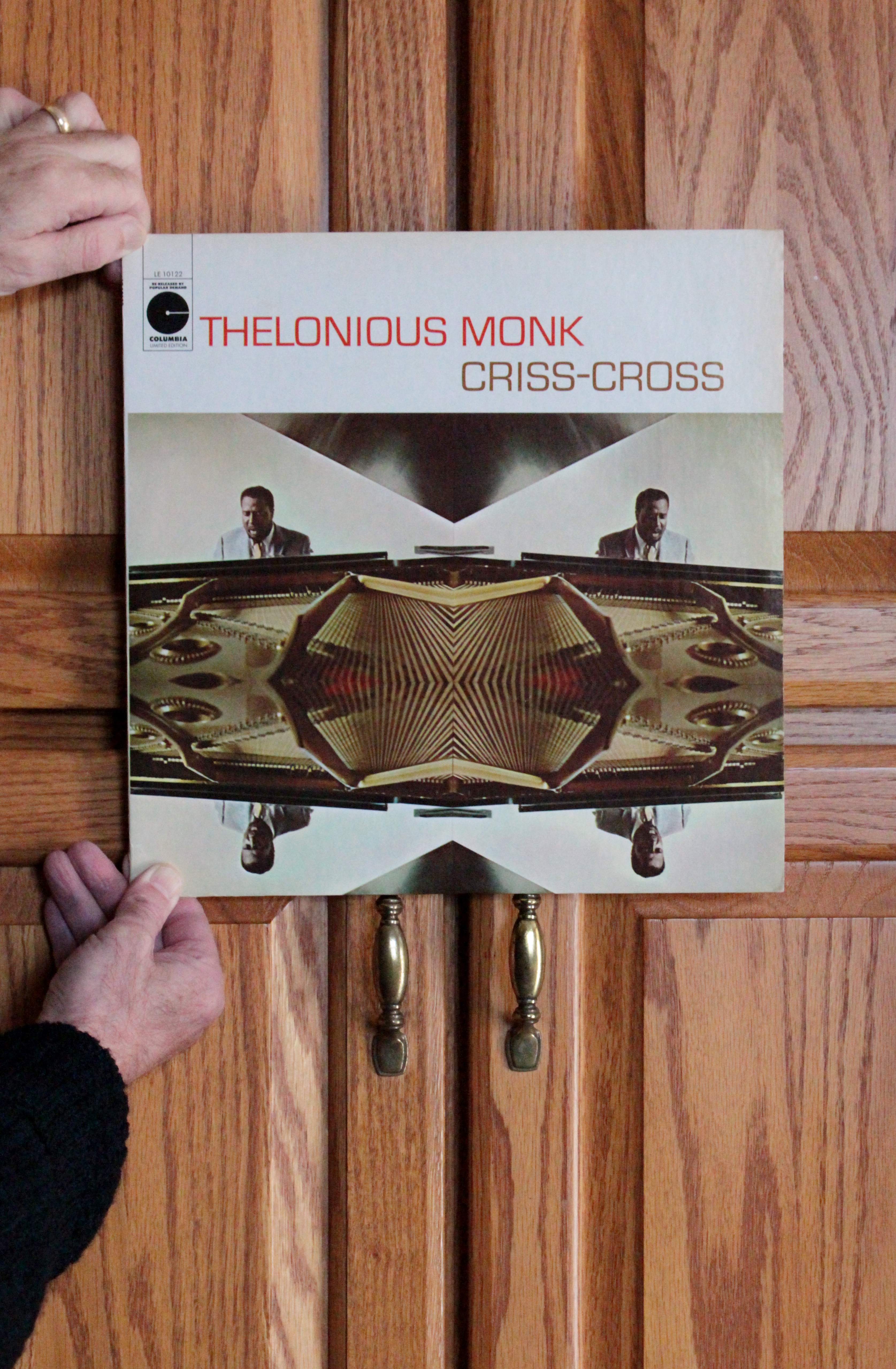
The front cover of the author's copy of Criss-Cross.
The front cover of the author’s copy of Criss-Cross.

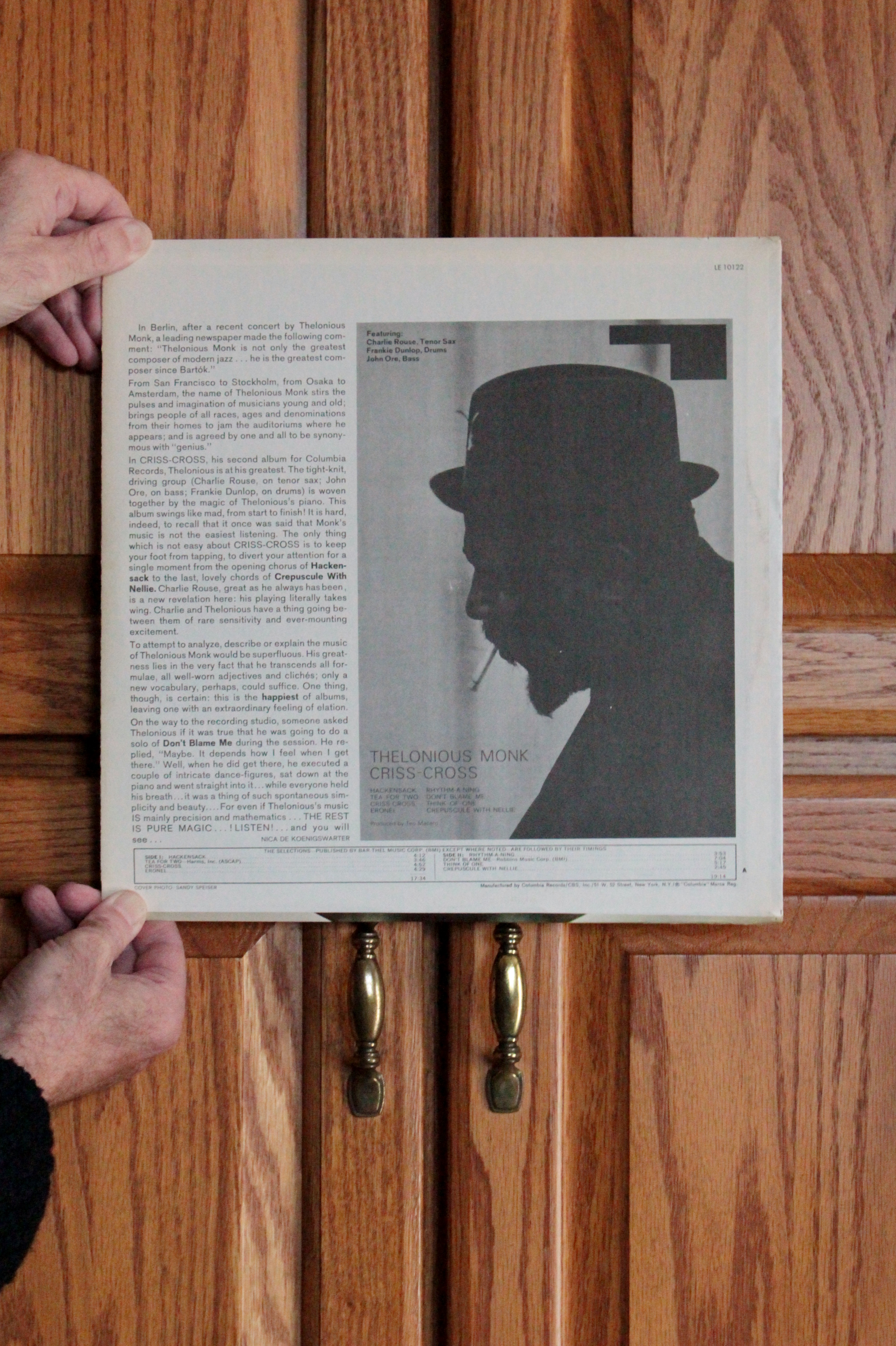
I loved Thelonious Monk’s music from the first time I heard it, and I’m sure I’m not alone in that. The year was 1964, maybe ’65. I was a high school senior entranced by rock and roll, R & B, some folk music, and by standards singers such as Sinatra and Bennett. But not by jazz, which was foreign territory to me at that time. My high school buddy Dave had just obtained his New York State driver’s license and one day informed me that he was going to take a ride to a local Sam Goody’s, a popular record store chain that sadly is no longer with us. For whatever reason, I didn’t accompany him. Dave asked me if I wanted anything from Goody’s. I must have been feeling adventurous because I requested a jazz album. Any jazz album would do, since I didn’t know one from another. The record that Dave a day or two later placed in my hands was Criss-Cross, Monk’s 1963 release. I doubt if I had ever heard of Monk before, though he was one of the most famous jazz pianists in the world. And I doubt if Dave knew much about him either. How, then, had Dave come to select this album, which to this day I consider to be magnificent? I don’t know. Dave possessed powerful intuitive talents, still does, and it seems that choosing great music from out of the blue was one of them. On the other hand, maybe he just liked the album’s cover. It is très cool.

I listened to jazz in small amounts over the next few years and in 1969 began to become the jazzhead that I am when I started heavily to inhale the outpourings of Miles Davis, John Coltrane, Eric Dolphy, Ornette Coleman and an ocean of others. And Thelonious Monk too, of course. Monk is one of my all-time favorites.

There’s something peaceful about Monk’s playing, even on the upbeat numbers. Something mesmerizing. Something irresistible in the way he’d offer the unexpected note, the tantalizing trill. Monk had an instantly recognizable sound on the piano, an intriguingly off-center approach. He didn’t play overly fast, just fast enough, and he put his heart and soul on display. He didn’t compose a lot of tunes (73 is the official count), but the unadorned and undeniable beauty of many of his compositions have connected with millions of listeners and with his peers. During the 1980s and ’90s it seemed that every month brought forth a new Monk tribute album. Even now, many jazz albums include one or two Monk works. Great compositions such as ‘Round Midnight, In Walked Bud, Ruby My Dear, Hackensack. Monk died in 1982, and remains a giant.

Thelonious Monk was someone I wish I had met and talked to, though I gather he wasn’t a man of many words, at least at times. I suspect that his song titles indicate this. Fifty of the 73 are either one or two words in length. Still, how fine would it have been to ask Thelonious Monk some questions: Have your piano practice habits changed over the years? Which of your songs mean the most to you? Do you ever listen to Top 40 radio? As a New Yorker, whom do you like best, the Yankees or the Mets?

But I never met Monk. In the 1960s and ’70s, however, three people I knew had up-close Monk experiences, which as a Monk fan I always have looked upon fondly. And in a sense have made my own. The earliest involved one of my high school friends, a young lady. We had graduated in 1965, and soon after that she and her family moved from Long Island to an apartment building in Manhattan near Lincoln Center. Amazingly, this was the building in which Thelonious Monk and his family resided, and had for years. More amazingly, my friend and her family occupied an apartment either directly above or below the Monk pad, I’m not sure which. I recall my classmate telling me, not long after our high school careers ended, that she often would hear Monk playing the piano, which, to say the least, was incredible to me. And enviable.

Back cover of the author's copy of Criss-Cross.
The back cover of the author’s copy of Criss-Cross.

The second occasion involved my friend Dave, who got my Monk ball rolling, with Criss-Cross, in the first place. He once had a brief encounter with the man. Dave thinks the meeting took place in 1966 or ’67. The location was a New York City subway car on which Dave spotted somebody who looked awfully familiar. This somebody was clothed in what Dave described to me as pajamas. Pajamas? Sure, why not? Intrepid soul that Dave was and is, he walked over and asked “Are you Thelonious Monk?” “Yeah, I’m the Monk,” came the reply. End of conversation.

The third Monk event was the topper. My mother was part of it, and I was there when it happened. The month was March, the year was 1976. WKCR, Columbia University’s radio station that programmed jazz in its classic and far-out varieties, was holding a Thelonious Monk marathon, playing his recordings nonstop over a multiday period. I imagine that the station’s intense tribute was timed to coincide with a concert by Monk and his band that same month at Carnegie Hall. My mother was a devoted jazz fan and WKCR listener because her son (my brother) Richard was in attendance at Columbia and was a WKCR jazz DJ. As such, he was on the air for portions of the Monk fest. But not on the evening in question, during which I sat with my mother in the kitchen of her Long Island home as the Monk celebration emanated from a small radio on a counter between the sink and the stove. Concerned about others as she always was, she said something like “I wonder if Thelonious Monk knows what KCR is doing.”

She went to the telephone and dialed 411, the number for directory assistance. Did Monk have a listed number? Somewhat surprisingly, he did. My mother called. Someone on the other end picked up. “Is this Mr. Monk?” she asked. “Yes,” was the reply. “Hello,” my mother said. “I wanted to ask if you know that WKCR is playing all of your music. It’s a wonderful tribute.” “Yes, thank you,” replied Thelonious Monk. My mother probably then complimented Monk on his talents, and Monk probably said “thank you” again. And that was that. I sat there semi-stunned. My mother, to my recollection, had never done anything like this before. She keenly followed the world of celebrities, but always from afar. Of all the stars that she admired, from Mary Tyler Moore to Lena Horne to Paul Newman, I never would have guessed that her one personal contact would be with a jazz pianist.

I was a mere bystander to my mother’s bold move. I, however, had one engaging and in-person Monk experience of my own. This occurred on March 26, 1976 from a balcony seat  at Thelonious’ aforementioned concert at Carnegie Hall. Sitting next to me were my brother Richie and his wife-to-be, Sara. I can’t recall if the performance took place just before or after my mother’s conversation with Monk. Likely, after. Monk didn’t play often in public those days, so the Carnegie gig was a highly anticipated event. In fact, two appearances in July of that year would be his last ever. He was on stage with four musicians, including his son T.S. Monk on drums. Thelonious said little, maybe nothing, to the audience. What mattered was his playing, and he was in superb form. Strong, poignant, totally on the money. His fingers did the talking.

(Photos by Sandra Cherrey Scheinin. If you click on a photo, a larger image will open)

(If you enjoyed this article, then please don’t be shy about sharing it)

The End Of My Long Affair (With Turner Classic Movies)

When I moved to Philadelphia in 1974 I became a film buff of sorts. It all happened very naturally and wasn’t anything I thought about. There were fewer options for movie lovers back then in Philadelphia than there are today, but there were enough. In addition to first-run theaters, Philadelphia had various venues that specialized in lesser-known flicks — some were foreign, some not. I had never before seen many foreign or cult movies and found myself liking them. My cinematic diet, consisting of the mainstream, the obscure, the subtitled, has remained consistent ever since.

My wife Sandy, whom I met in 1990, is a big movie fan too. Each year she and I leave the house 40 or more times to take in movies. Chez us, together we catch an additional 25 or so flicks on the tube. We like doing things together. For a span of eight years in my married life though, I also viewed hundreds of films on my own. I watched them on the Turner Classic Movies cable channel. I became addicted to TCM, but I’m not anymore. Here’s the story:

In 2006 my thoughts and activities were less-focused than they should have been. My father had died the previous year and I think my restlessness was partly connected to his passing. He had lived with Sandy and me, and we spent a lot of time caring for him. With him gone I had trouble finding ways to fill up my days fully.

I began watching TCM movies on this TV in 2006. This is a recent photo of the TV.

Sandy had been suggesting I might do well to add some prime time television viewing to my regimen as one way to get my mind off of things. But I couldn’t decide what to watch, didn’t think I’d  be happy devoting a bunch of hours to the small screen. Somehow though, I heard the call of TCM. Our meeting must have been preordained. And so a few months into 2006 I began descending the stairs on many evenings from our kitchen to finished basement, a place I hadn’t visited all that much since moving into our house the year before. In the basement’s den area sat an old bulky TV that had traveled from our previous home.

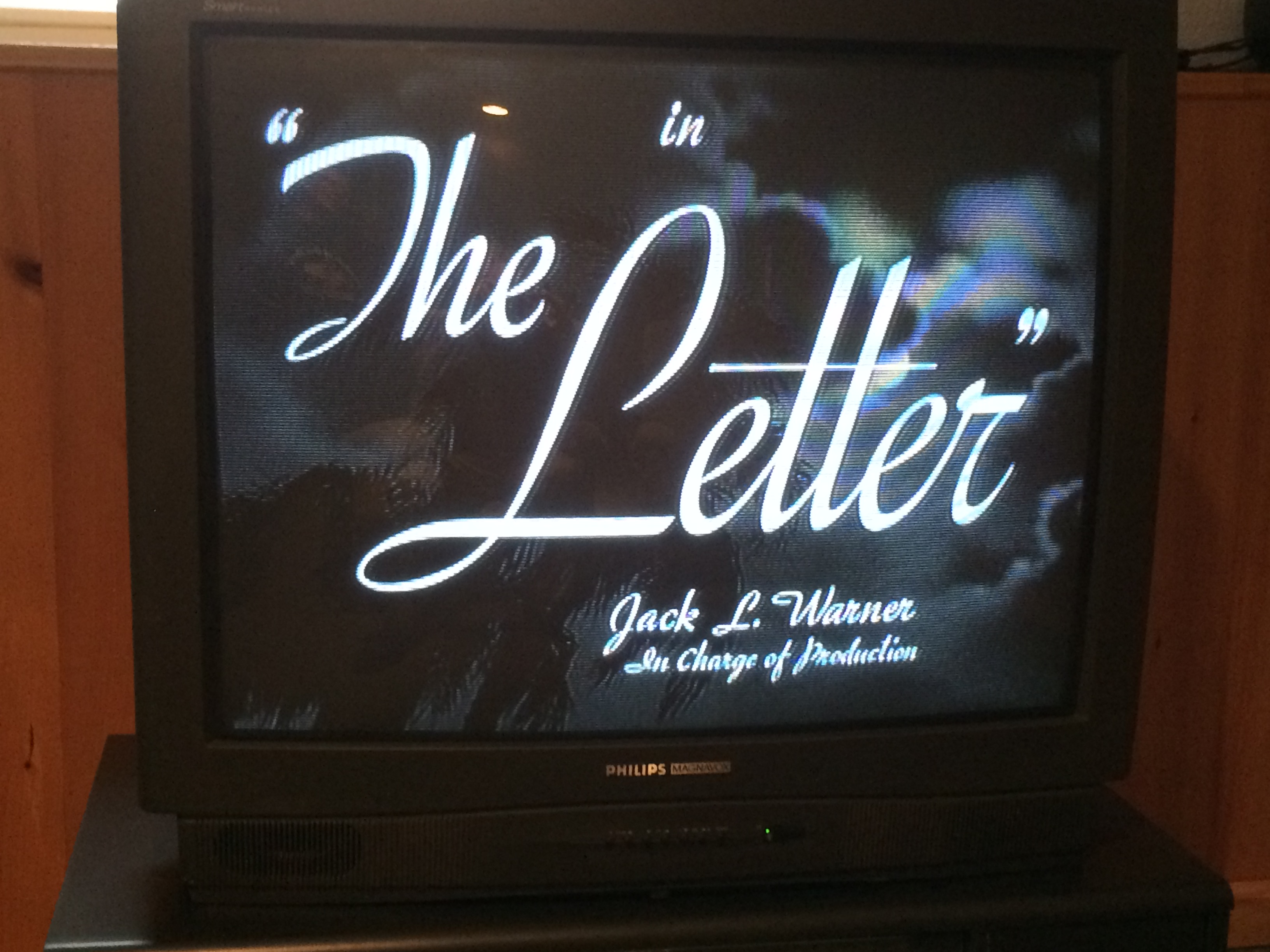
The Letter was the first movie I watched on TCM in 2006. I took this photo recently.
The Letter was the first movie I watched on TCM in 2006. This is a recent photo.

I began the affair gingerly. The first TCM movie I watched in 2006 was The Letter, a Bette Davis melodrama. It was pretty good. “OK, let’s try another,” I thought, and not too many days later Tender Mercies passed before my eyes. I had seen it when it came out in 1983 but didn’t recall it too clearly. I gave it two thumbs up in 2006.

Turner Classic Movies is quite the amazing broadcaster. Movies in their unedited versions 24 hours a day with no commercial interruptions. TCM’s core is English-speaking productions from the 1930s through 70s. Once in awhile the station throws in a foreign movie or a silent or a post-1970s film such as Tender Mercies. Despite the station’s name, however, hardly every TCM movie is a classic. There are plenty of clunkers. On many occasions I turned off a movie within its first 30 minutes and made the long climb upstairs.

And yet, duds or not, I became very comfortable sitting in a recliner in front of the basement TV. By 2006’s end I had watched 61 movies on TCM. The next year’s number was 103, and the year after that I reached the 87 mark,  my two highest totals. Since then the counts have descended, from 64 in 2009 to seven in 2014. I’ve managed merely one movie so far in 2015, The Great Santini, a good one that seemed a tad better to me when it made its initial rounds in 1983.

Why the dramatic falloff? Well, after cutting a slew of notches into my movie-watching belt I discovered that my TCM motor was running out of gas. Eventually, many of the movies I contemplated watching didn’t seem, upon investigation, good enough to spend time with. And the slim pickings of films from 1980 onward began to bother me a little.

But I tip my hat to Turner Classic Movies without hesitation. You see, to Sandy’s amazement somehow I’d made it into my late 50s and early 60s without having witnessed On The Waterfront, West Side Story, Singin’ In The Rain, From Here To Eternity and others that the general populace would deem to be true classic films. TCM rectified that situation. Contrarian that I sometimes am though, Singin’ was the only one of those that I felt was completely worthy of wearing a crown. And, besides Singin’, at least 15 more offerings that I first caught on TCM are now on my list of elite movies: In A Lonely Place, Odd Man Out, The Misfits, Darling, Sweet Smell Of Success, Hud . . .

Hey TCM. you’re a great station and I thank you for all the entertaining hours that you bestowed on me. Add some movies from the current century and maybe once again you and I will become pals.

(Photos by Sandra Cherrey Scheinin. If you click on a photo, a larger image will open)

(If you enjoyed this article, then please don’t be shy about sharing it)

A Cape Cod Sunset Story

My wife Sandy and I have a love affair going with Cape Cod, which is where we are vacationing as I type this missive. We live in suburban Philadelphia, but in most ways prefer the Cape. Boo hoo . . . we’ll be back home tomorrow.

In 1998 we visited the Cape for the first time, expecting it to be a locale we’d enjoy. Well, we did. And decided to come back the next year for some more good times. I think it was on that second trip that I realized I liked Cape Cod much more than I ever thought I would, that it really suited my soul, that I was starting to become smitten. Sandy and I have returned every year since then, excepting one. Before Cape Cod entered the picture, in my adult life it had never occurred to me that there might be an Eden of sorts waiting for me, someplace beautiful and in which I truly felt at home. A favorite place.

Sandy and I have had only great vacations on Cape Cod. We’ve been there in all seasons except summer, which is the one time of year when the Cape is overrun. With humans. We fill our days with a variety of activities: nature walks on sand or through forests; poking around in country-imbued villages; art gallery and museum hopping; attending movies, plays and concerts; lots of tasty eating in restaurants humble and above; the list continues. No doubt, this is the good life. I feel almost guilty that such fine fortune has come my way. But I’ll take it.

Atlantic Ocean shoreline. Eastham, Cape Cod.

If I had to select one reason above all that puts Cape Cod at the top of my list, I’d point to the expansive areas of natural beauty. Such as the 40 or more mile-long Atlantic Ocean shoreline, much of it government-protected and thus little disturbed or altered by the hands of man. The vistas there are pretty elemental and always knock my socks off. Ocean, sky and beaches backed by dunes-topped sand cliffs. My psychological and emotional makeups, whatever the heck they might be, vibrate in a calm, contented and awestruck manner when I’m in the midst of such.

And there are other reasons. To name one: When vacationing on Cape Cod sometimes an unexpected present drops into your lap, just as with life in general. One day last week an example came my and Sandy’s way. I’m talking about a sunset. Right, right, I know that over the centuries untold thousands of scribes have oohed and aahed in print about sunsets. And millions of sunset photos have been published, more in the last 15 or so years than ever before thanks to the Web. But hey, I’m not embarrassed to add a few hundred sunset words, and a handful of photographs, to the Everest-high piles already out there. Don’t bail out on me. Keep reading.

And so on the aforementioned day at 5:15 PM, Sandy and I were in Chatham, a needless-to-say charming Cape Cod town. We had just watched Steven Spielberg’s latest oeuvre, Bridge Of Spies, in the Chatham Orpheum Theater. Our next planned destination was 20 miles away, Harvest Gallery Wine Bar. There we meant to dine and listen to a tough as nails rock trio, The Catbirds. But there was no need to arrive before 7 PM. We had time to kill. We scratched our heads, coming up empty. Then “sunset” popped into my mind. Sandy checked with her phone, which is much smarter than me, and learned that the Sun would dip below the horizon at 5:57. I steered our car westward and then turned south onto a road I’d never heard of, hoping that we eventually would find our way to a Chatham beach on Nantucket Sound. The sand gods must have been with us, for Hardings Beach Road soon materialized. And moments later Hardings Beach itself emerged.

We parked. The spot was gorgeous. Lovely sands, magnificent Nantucket Sound waters gently rippling beneath a sky puffy here and there with clouds. The clouds made my heart leap, or something like that, because a scattering of clouds, as I’ve come to realize from years of sunset-gazing on the Cape, is key to a good sunset. Their water droplets and other particles refract light beams and reflect colors. Their movements and changing forms turn sunsets into active canvases. And that’s what happened as Sandy and I watched our fiery faraway friend say goodnight.

Sunset at Hardings Beach. 5:56 PM.
Sunset at Hardings Beach. 6:05 PM.
Sunset with the Moon at Hardings Beach. 6:07 PM.
Sunset. The Moon. Hardings Beach. 6:07 PM.


A lot of people claim to dislike colorful abstract art, certain paintings by, say, Vasily Kandinsky or Jackson Pollock. I don’t get that, because everybody loves sunsets, which to me can be among the ultimate in eye-popping abstractions. I’ve never read that sunsets inspired any brush wielders to go wild and free in their approach or vision, but it wouldn’t surprise me if in fact this were the case. Sandy and I watched the sky for 20 minutes. The pinks and oranges darkened as the big event rolled on. The clouds worked their wonders. And in a little while Sandy pointed up and said, “There’s the Moon.” It was a graceful sliver of white balancing above swashes of pastel hues.

On Cape Cod I’ve been a lucky son of a gun many times. That evening on Hardings Beach was one of them.

(Photos by Sandra Cherrey Scheinin. If you click on any photo, a larger image will open)
(If you enjoyed this article, then please don’t be shy about sharing it)