The Music Biz And I

A typical concert scene at beautiful Pastorius Park.

On a recent morning, the day’s threatening skies put me in mind of the music business mini-career that I enjoyed till not long ago. It was with the Pastorius Park Free Summer Concerts Series, in Philadelphia’s lovely and small townish Chestnut Hill neighborhood. For seven summers, the first two as a general helper and the following five as a co-organizer, I was part of a fine endeavor. My run ended in July 2014 with that summer’s final concert. Bad weather, or the prediction thereof, were among the reasons that I decided to step down. With rain a possibility for many concert evenings, I and another co-organizer often would find ourselves phoning back and forth hours before showtime, agonizing over whether or not to move the music indoors to our rain location, a school auditorium a mile from the park. It usually was a tricky matter. Sometimes we opted for inside and the rains never came. At least twice we stayed at bucolic Pastorius Park and downpours cancelled or prematurely ended the night’s entertainment. My constitution wasn’t strong enough to laugh along with the rain gods. Weather aside, though, the Pastorius Park segment of my life was terrific overall.

In 2008, knowing that I was approaching the end of my 30+ year tenure on the payroll of Pennsylvania government, I was looking around for a part-time activity that involved my main interest. Music. For 40 years I had been quite the music junkie, listening to albums and radio at home for hours on end, taking in shows at a wide variety of venues in the Philadelphia area and beyond. It had recently dawned on me that the next phase of my life might be pretty awesome if I could become more than an audience member by getting inside the music scene  But how would it be possible to find entry? I knew nobody in the biz and had never worked in music in any capacity whatsoever. Plus, I was not too far away from Medicare age. I figured that my chances weren’t overly bright. And then, to my delight and astonishment, a door opened.

Now, the music venture I became involved with wasn’t exactly Columbia Records or Live Nation Entertainment. The Pastorius Park series is low key and homey, which was fine with me. It runs under the gentle aegis of Chestnut Hill Community Association, an agency that aims for its community’s betterment. Volunteers are central to the series because the modest Pastorius budget has room for payments to musicians and audio crew, but not much more. As first a helper and later an organizer, I fell into the unpaid pool. That was fine with me too. I was more than happy just to be part of the process.

I went to my first Pastorius Park concert in summer 2007. On stage was Scythian, a rocking Celtic group that drove the crowd wild. This was before the notion of working in the music biz had crossed my mind. The next year, though, trying to figure out where my musical dreams possibly might come partially true, I dialed Chestnut Hill Community Association and was put in touch with one of the Pastorius Park organizers, Janine. She welcomed my offer to help. Next thing I knew I was at a planning meeting for 2008’s season. And a few months after that I was at the concerts themselves, setting up tables and chairs, helping to unload and load audio equipment, collecting concert donations from the audiences during intermissions. My energy seemed to swell on concert dates. I was having a wonderful time. The door had opened.

The door opened even more in early 2010 when one of the organizers, the fellow who scheduled and booked the acts, no longer had the time to continue his duties. He and Janine asked me to replace him. Me? Book acts? Negotiate contracts? Those for me were uncharted waters. Gulp, gulp. I said OK, I’ll do my best. And I was on my way. It didn’t take long for me to realize that my new position was close to being my dream job. There I was, a music lover given the keys from out of the blue to curate a small but well-regarded music series.

I had fun working with my organizing partners, Janine for the first two years and Julie for the next three, and with the other volunteers. I enjoyed chatting with the musicians before and after the shows. And I had a major blast scheduling each summer’s string of seven Wednesday evening concerts. In 2010 I reached past the Philadelphia area to hire two acts from afar, including, incredibly, Graham Parker. His solo show packed the park maybe tighter than ever before or since. But for the next four years I decided to stick entirely with artists from the Philadelphia region’s highly fertile musical ground. I liked the idea of supporting its progeny.

If I hadn’t known it before, one thing became very apparent to me during my days as an organizer. To wit, there are an astonishing number of excellent musical acts based in the Greater Philadelphia area, and many of the little-known local performers are as good or better than many who make big noise in the mass marketplace. Success is a matter of luck, timing, backing, perseverance, who knows what. A few of the Philadelphia region’s performers whom I booked for Pastorius Park had found some degree of national and worldwide acclaim, folks such as singer-songwriters Jeffrey Gaines and Mutlu, and Celtic music greats RUNA. But the rest were talented bands on the lower rungs of success’s ladder. Some of them put on performances as enchanting as you’d ever hope to see.

Cheers Elephant and some young fans at Pastorius Park in July 2011. Photo by Kevin Kennedy
Cheers Elephant and some young fans at Pastorius Park in July 2011.
Photo by Kevin Kennedy

For instance: I’ve never been to a show like the one in 2011 involving Cheers Elephant, a pop psychedelic rock outfit with loud guitars and a free-as-a-bird and charismatic lead singer, Derek Krzywicki. Cheers Elephant’s music was magic to the ears of many youngsters who had come to the park with their parents. During the band’s second set, played under darkening skies, many kids aged five to 15 left the grassy seating areas and, seemingly magnetized by Elephant’s electric energy, made their way to, indeed onto the stage, which sat beneath a grove of tall trees. Bouncing and shimmying to the band’s powerful and catchy beats, they covered the stage, pushed the musicians onward and upward, in fact had the musicians mesmerized. The scene was surreal and transfixing.

Venissa Santi and her band at Pastorius Park in July 2014.

And in 2014, Venissa Santi brought her Cuban-flavored jazz esthetic to the park. I’d hired Venissa once before for Pastorius Park, and had also seen her perform at another concert series. Last year, though, she and her band rose to a level I hadn’t known was in their command. Early in Santi’s first set my mind was captured. The music was complex yet malleable, expanding and contracting like strong bands of rubber. Venissa’s intimate and pitch-perfect vocals intertwined with the chordal onrushes of Tom Lawton’s piano, the now-I’m-here-now-I’m-there notes from Madison Rast’s bass, and the melodic assymetrical patterns of Francois Zayas’s drums. This, I thought, was music parallel to that of Miles Davis’s famed 1960s quintet. Was I imagining things? I don’t think so. Did others in the audience hear the music as I did? I can’t say for certain. But judging from their tremendous applause I’d guess yes.

(If you enjoyed this article, then please consider sharing it. Thanks)

Ashes: Lindi Ortega’s Great Song Heard In The Great Outdoors

This is a story about life’s little surprises, about how one thing leads to another. In this gentle instance an unexpected impulse to relocate my duff from indoors to outside resulted in my hearing a song that I can’t get out of my head.

There’s something naturally relaxing about sitting outdoors when the weather is pleasant. Some people sit in parks, some on beaches, some a few feet from doors to their homes. One of my pals lives in Philadelphia in an old comfortable house, a sprawling place with a front porch. On evenings when the Philadelphia Phillies are taking the field, my friend positions himself in a porch chair, balances a small radio on a table beside him and turns on the Phillies station. He remains there till the game is over. This routine helps him stay calm.

A scene at dusk: Cheez-Its, iced tea and portable radio on the deck table behind my house. Photograph by Sandra Cherrey Scheinin
A scene at dusk: Cheez-Its, iced tea and portable radio on the deck table behind my house.
Photograph by Sandra Cherrey Scheinin

I should emulate my friend’s fresh air example more often. I used to sit outside frequently, mostly on the deck behind my house, but haven’t much in the last few years. Most of my sitting and downtime in that stretch has taken place on the sofa in my living room. On a recent Monday night, however, a powerful urge to visit the great outdoors came out of nowhere, and so I stepped onto the deck as dusk was settling in, and sat at the deck table. The temperature was ideal, the evening peaceful. At least ten houses are within 100 feet of the deck, but they became less and less visible through the trees as blackness approached. These were conditions that agreed with my inner yearnings. That is, I felt isolated, away from it all. And three things made the scenario even better: Food, beverage and music. Munching on Cheez-Its,  sipping iced tea and, most important to this story, listening to my portable radio, I was as relaxed as I’m capable of becoming. The radio was tuned to WXPN.

In the Philadelphia region WXPN is the go-to station for rock, folk, blues and nearly any other non-Ariana Grande musical genre you can name. XPN plays everything from The Beatles to Mavis Staples to Caetano Veloso to Laura Marling. And the station makes it a mission to keep up with the continual avalanche of recorded music from established and never-heard-of-them-before musicians. Airing on XPN as I sat beneath the stars and amidst pulsating fireflies was a program showcasing nothing but new songs. And the tune that issued from my radio at about 9:00 PM swept me from my state of relaxation to a much higher plane.

There are certain songs over the years that infatuated me from the moment I first heard them. In 1968 it was Jumpin’ Jack Flash, by the Stones. To this day it stirs me up every time I hear it. California Stars, by Billy Bragg and Wilco (and lyrics by Woody Guthrie), brought me to my knees in 1998. I’ve added another number to the list of instant infatuations, all praise to WXPN’s new music show. The song is Ashes. Its singer and writer is Lindi Ortega. Ashes overwhelmed me on my deck. I think that the calm within and without me had unlocked fully the doorways to my emotions and ushered Ashes in. From its opening notes, Ashes in a good way made me shiver and melt. It went straight to my truest spaces.

I had come across Lindi Ortega’s name in print in the past but wasn’t familiar with her music. As I’ve learned, she’s a Canadian now living in Nashville and plays and composes smart country-hued material à la Emmylou Harris and Patty Griffin. With Ashes she and her production team have created a wonder, a stirring song about the need for love, the pain of loss. The heartbeat bass lines, the steady tension-inducing drumming, Lindi’s pleading and impassioned vocals that grow as the song develops, the soul-gripping guitar solo at the song’s three minute mark . . . Ashes to me is perfection. “Darling, this is madness, why don’t you come back to me?/Don’t leave me in the ashes of your memory.” Indeed. Indeed. When Lindi next appears in or around Philadelphia I’ll be at the show. For now, I’ll listen to Ashes on YouTube, where Lindi has gifted it to the world in advance of its release next month on her album Faded Gloryville. I recommend that you do the same. Here is Ashes:

(If you enjoyed this article, then please consider sharing it. Thanks.)

A Friday Frolic In Philly

My wife Sandy and I lived in Philadelphia for many years, both before we met and subsequently. The year 2005 was a momentous one for us, because that’s when we made the leap from the city to the nearby northern burbs. In some ways I prefer living where I now do, in other ways I wonder if leaving the city was a brilliant idea. Our house is nicer than the one we used to occupy, the current neighborhood is cuter than its predecessor. On the other hand, automobile traffic around here is as blood pressure-elevating as in Philadelphia. And there aren’t enough fun things for us to do, which is why we head south a few times each month to check out the offerings in various sections of the City Of Brotherly Love.

My overall opinion of Philadelphia is a good one. Yes, the city has plenty of problems, like too much crime and a pitiful public school system. And yet it has so much going for it. Loads of history that we all know or should know about. Great parks big and small. Fabulous buildings from the late 1600s onward. More restaurants, music venues, theaters and such than anyone could wish for. I’m sounding like someone from Philadelphia’s official tourism bureau, but my feelings are legitimate. For physical beauty, culture and food, Philadelphia is world-class.

Which brings us to Friday, July 3. Sandy and I were itching to get out of the house. Not much that we knew about was going on in the burbs. Philadelphia it would be. Where in the city though? Sandy had noticed in the paper that July 3 was First Friday in Philadelphia’s Old City section. We hadn’t been to a First Friday in a year or two, and we decided to go.

Old City's Church Street is paved with grey bricks.
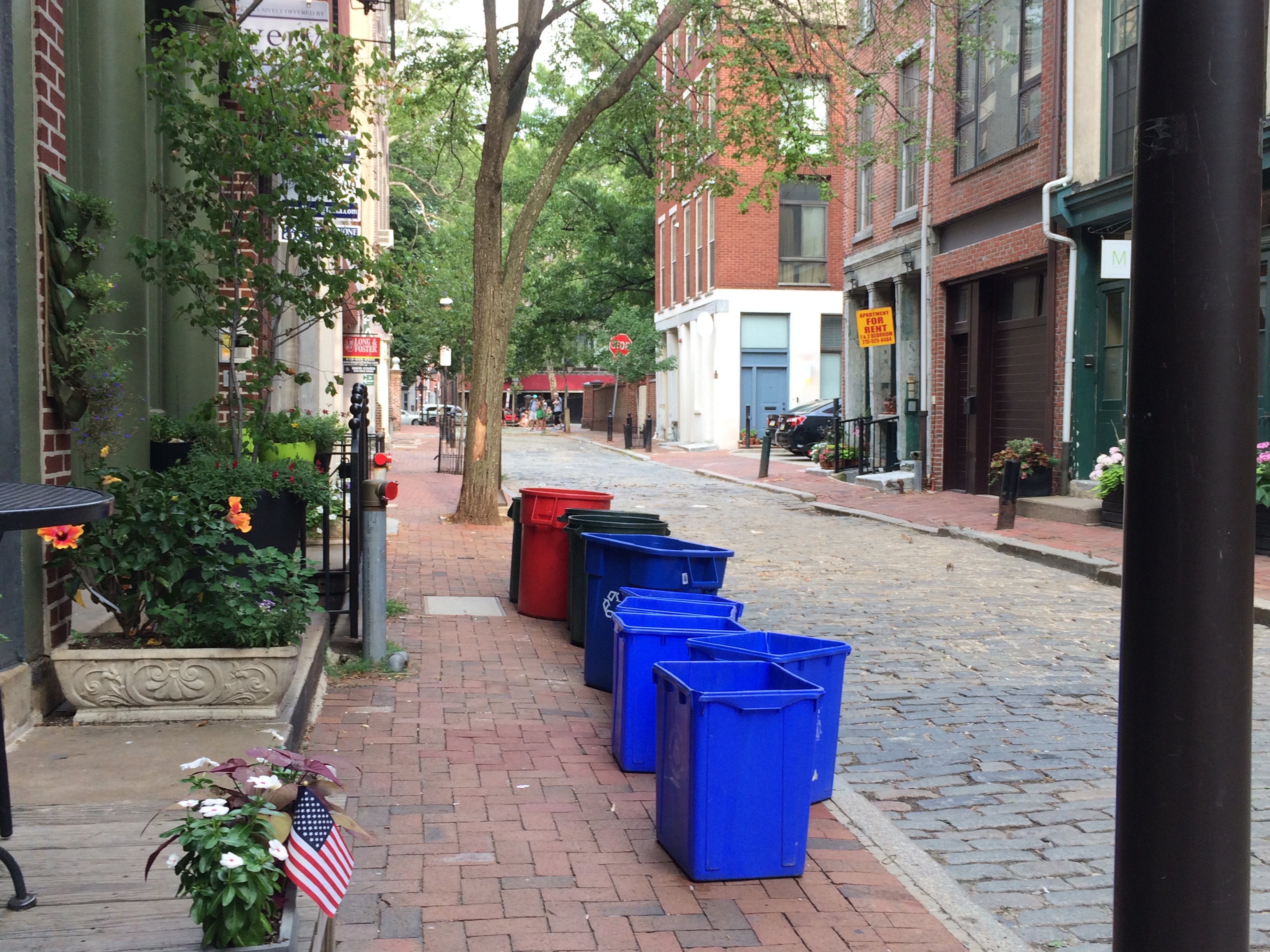
Old City’s Church Street is paved with grey bricks. They contrast nicely with plastic recycling bins.

Old City is a part of town that was full of homes, businesses and people in Colonial days. It still is, and many of those 1700s structures are with us today. The area is quaint and often lively, and plenty of streets retain their ancient paving bricks and stones. There are quite a few art galleries in Old City. In 1991, attempting to lure customers and imbue Old City with needed panache, some gallery owners began keeping their doors open in the evening on the first Friday of each month. They spread the word and a monthly mini-festival, a kind of happening, was born. All over the world, events similar to First Friday are taking place. They can be good.

You never know what you’ll come across on Old City First Fridays. Painters and crafts people and assorted vendors set up tables for their wares on the sidewalks and in alleyways, which are also where musicians set up their instruments and wail. And many art galleries, the original driving force, are open. Sandy and I strolled around Old City without a plan. Not having done advance research, we ended up missing a few blocks with galleries we’d have liked. Next time. Most of the action that we caught was on a two block stretch of 2nd Street between Market and Arch Streets, and on Arch between 2nd and 3rd. A small chunk of territory, actually, but enough.

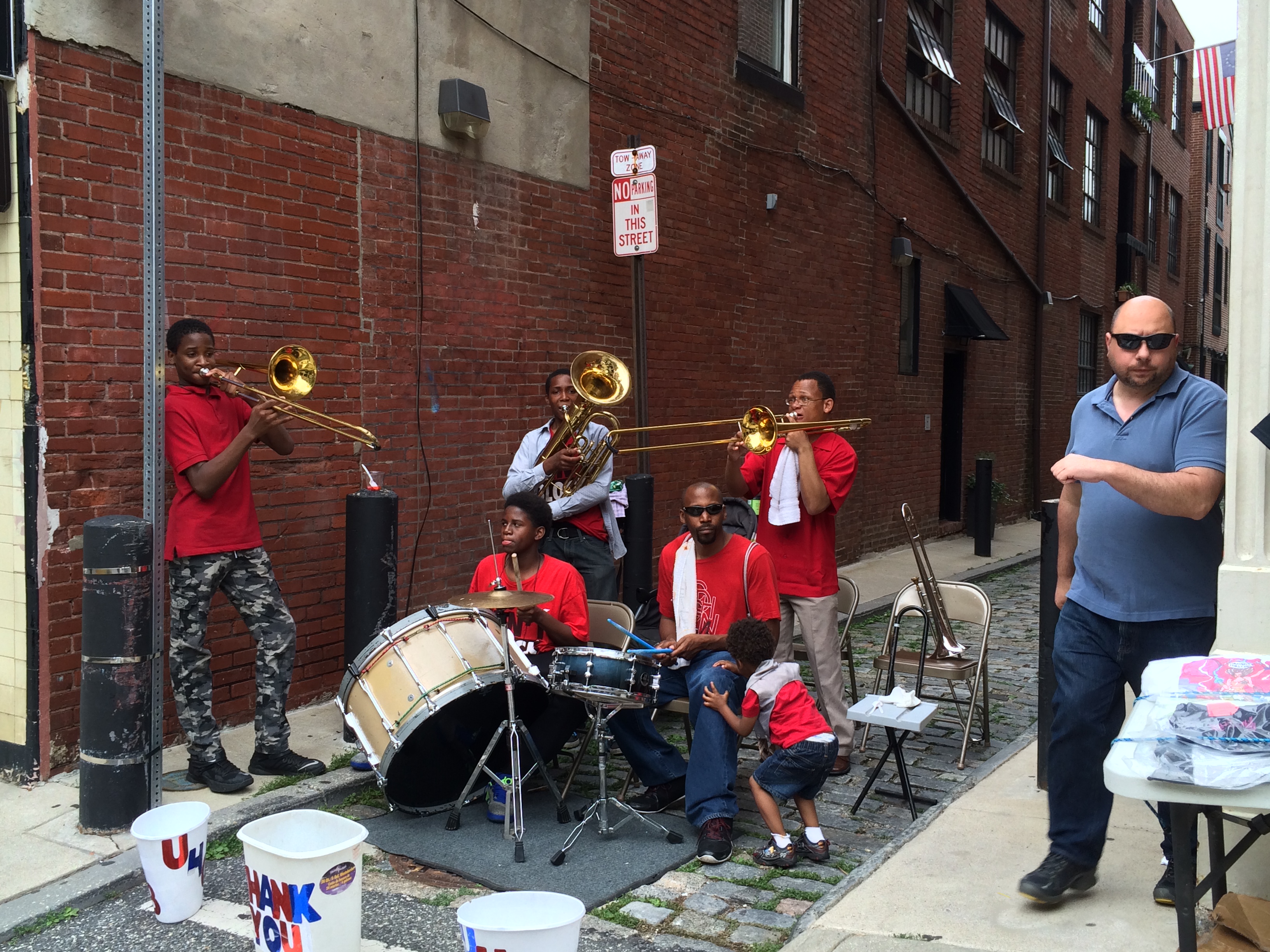
Brass band wailing away in Old City.
The human caterpillar.


Our eyes were open for human creations and human activities. Who wouldn’t have loved the brash New Orleans-style brass band occupying a niche where Cuthbert and 2nd Streets meet. Or the long-haired White dude who, catching some zzzs, was draped like a caterpillar over one of those large and ubiquitous green utility company sidewalk boxes. He was Mr. Flexibility personified.

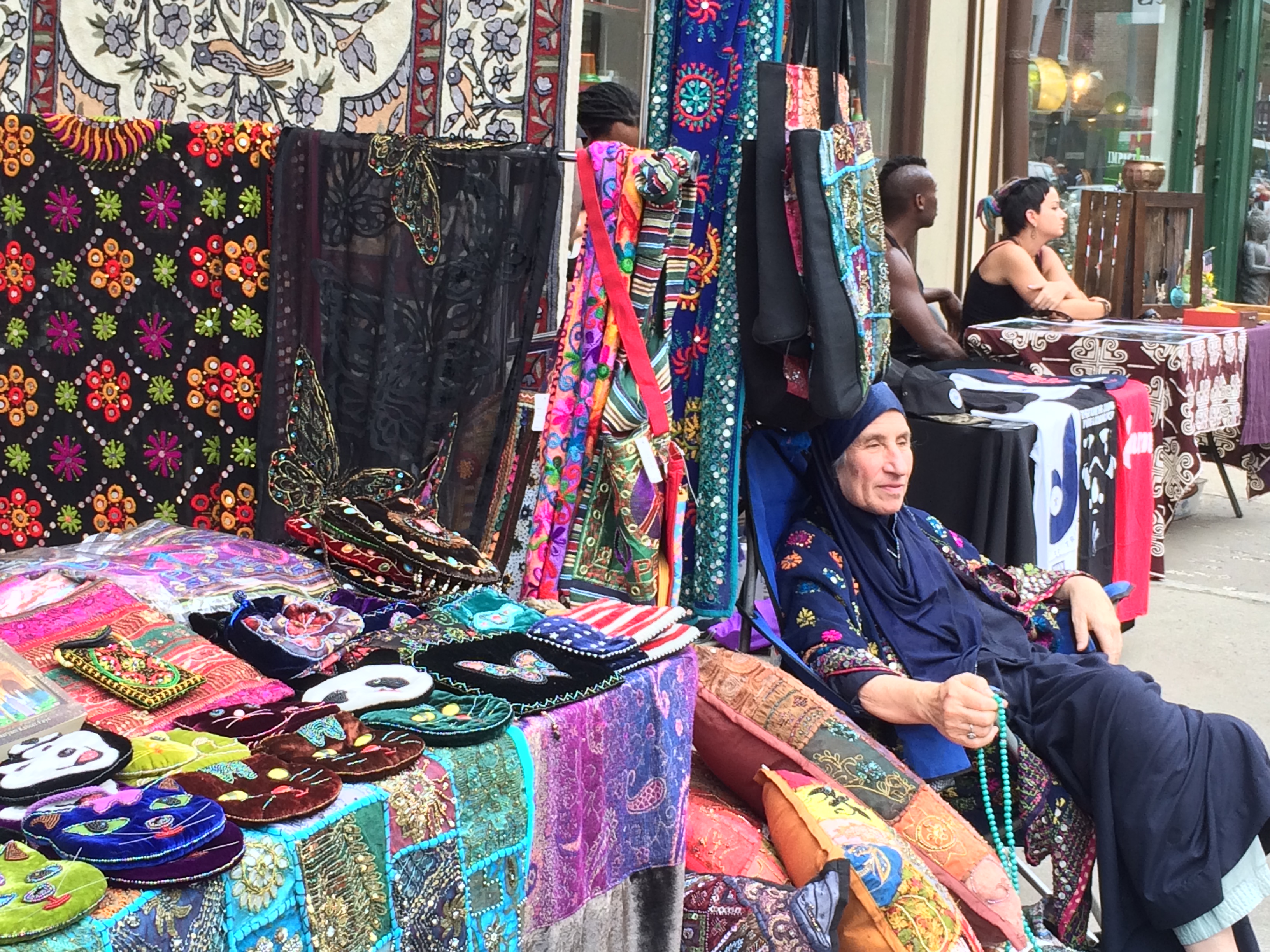
Lady in blue with her colorful wares.

Or the head-scarved lady in blue on 2nd Street whose tables and racks held as eye-popping a collection of pillows, fabric trivets, shoulder bags and cloth drapings as one would ever see in a 30 square foot parcel of sidewalk. Middle-Eastern and Asian patterns and color combinations burst from her goods, clashing outrageously, looking great together nonetheless. Henri Matisse, who threw wild design combos into so many paintings and never met a color he didn’t like, would have loved this lady’s display.

Artworks by Keith Sharp at 3rd Street Gallery.
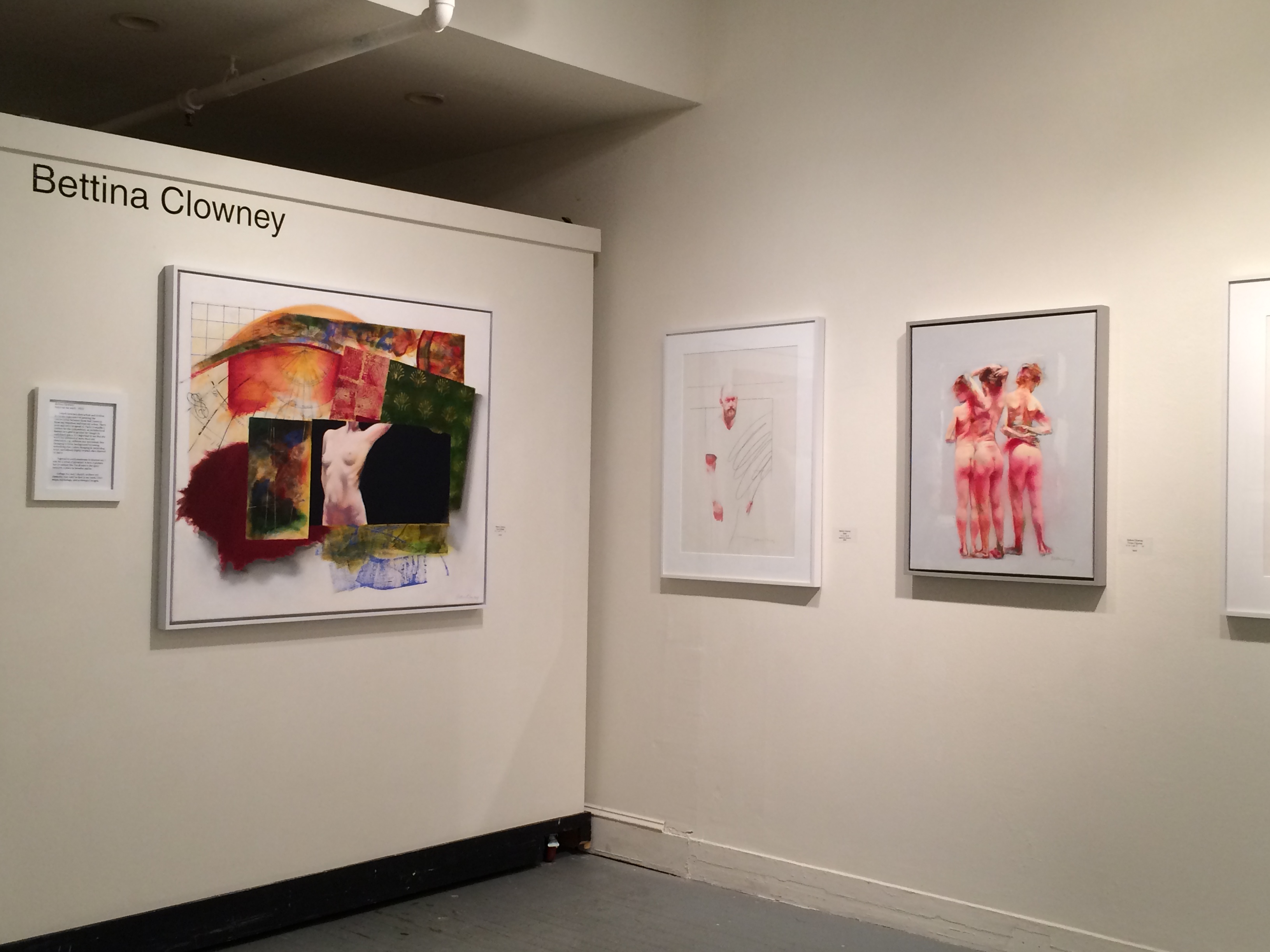
Artworks by Bettina Clowney at 3rd Street Gallery.

There were beautiful paintings, sculptures and crafts to be seen in the galleries. I’ll mention a few places. We liked just about everything we saw at 3rd Street Gallery. Two artists were showing there. Keith Sharp’s dark and dramatic photographic manipulations were intriguing, some a bit ominous. They were very different from Bettina Clowney’s spare paintings. Clowney uses a lot of whites in her depictions of fruits, of people, and in non-representational designs. Gazing at each other from opposite walls, the Sharp and Clowney artworks made a good marriage.

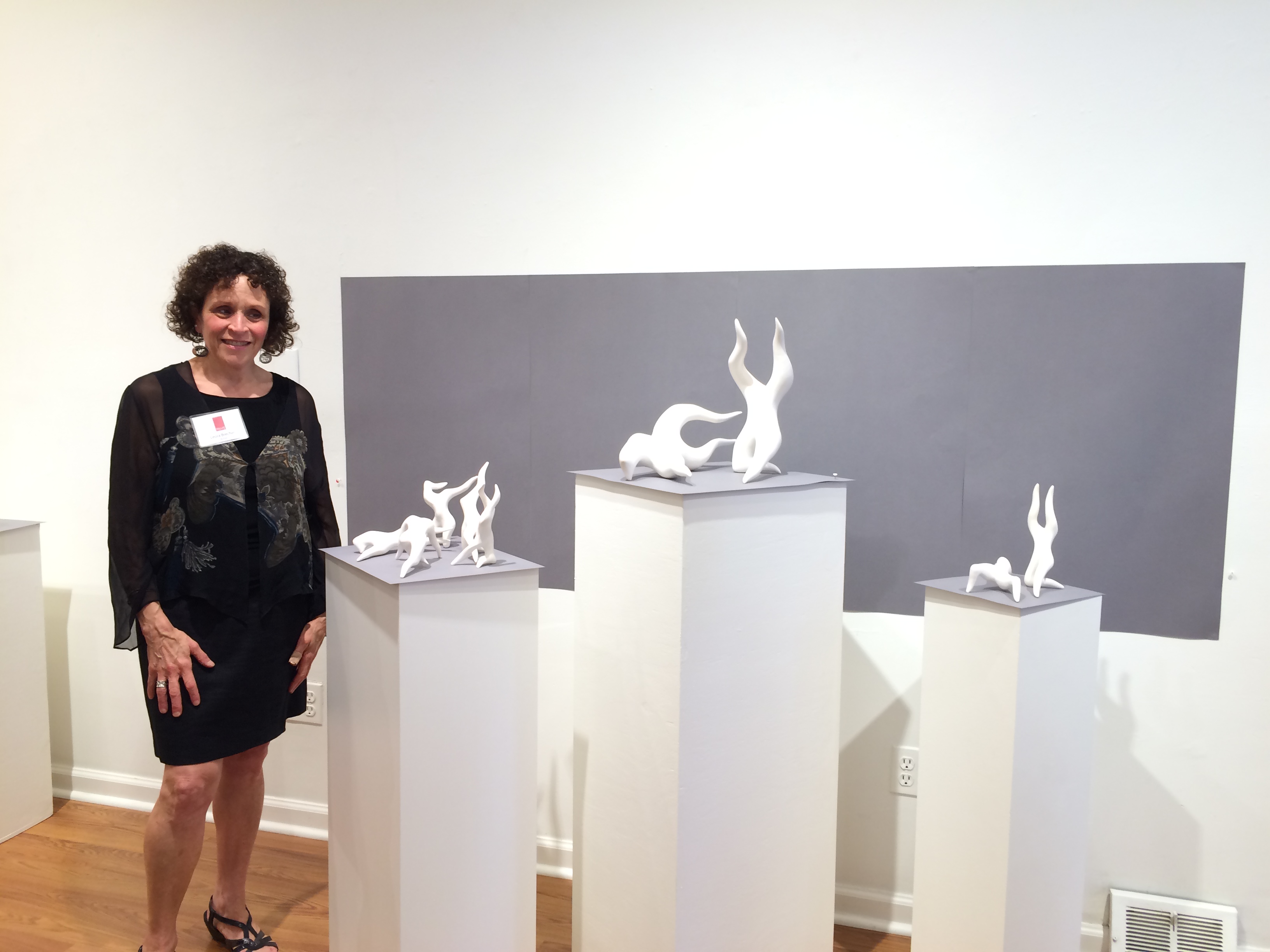
Leora Brecher with some of her sculptures at MUSE Gallery.
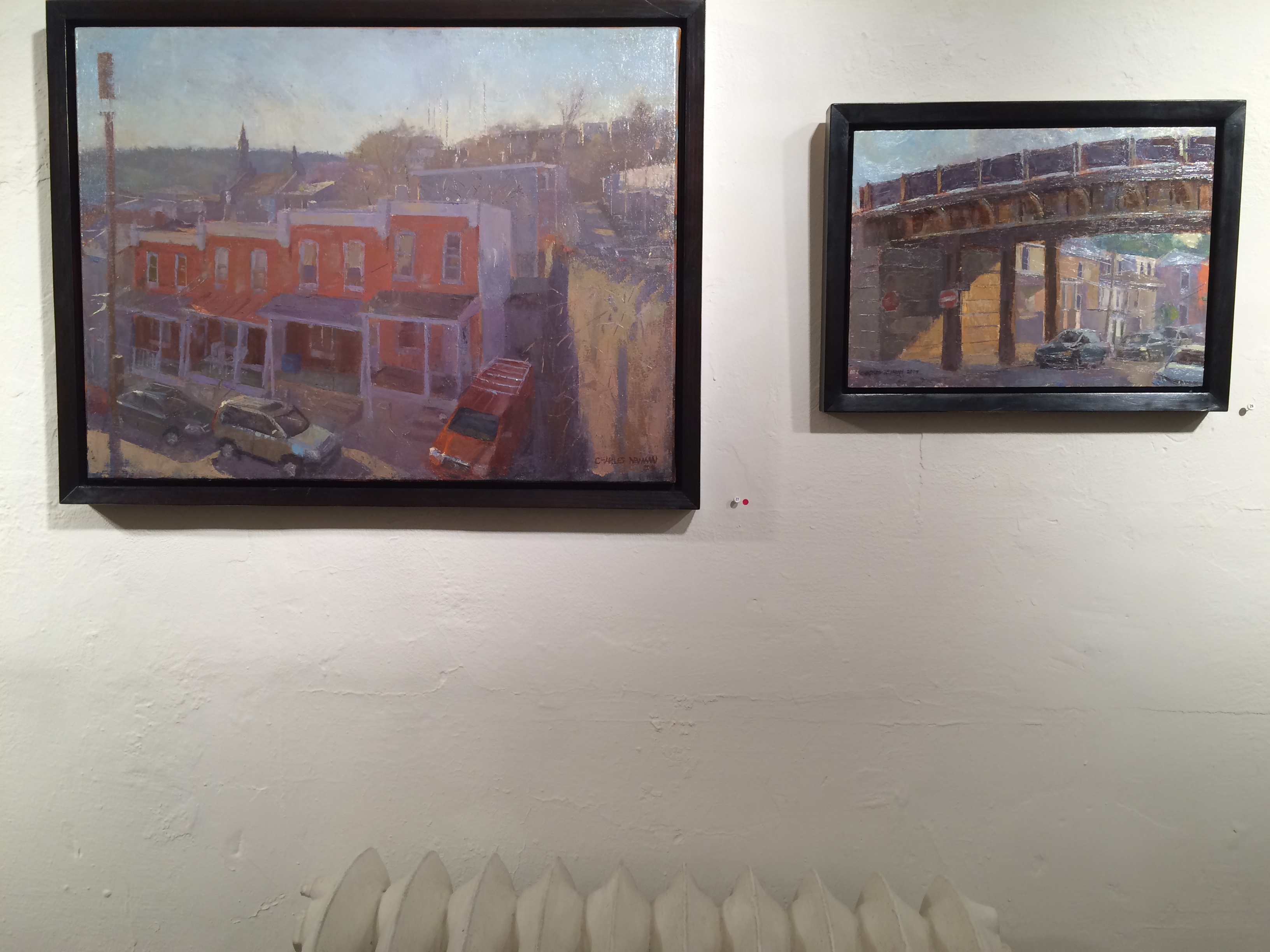
Paintings by Charles Newman at F.A.N. Gallery.

MUSE Gallery was filled with Leora Brecher’s small fired clay sculptures, all in white. Many were abstract suggestions of human movement, open and flowing. Very lovely.

F.A.N. Gallery on Arch Street is one Sandy and I visit occasionally. I wasn’t knocked out by its smorgasbord of works by gallery artists on this First Friday visit. We both liked the oils by one artist though, Charles Newman. He paints Philadelphia street scenes, focusing on old buildings, very well. The perspectives from which he views his brick and stone subjects are off-angle, giving the pictures a quiet tension, and his earthy subdued color choices are just right.

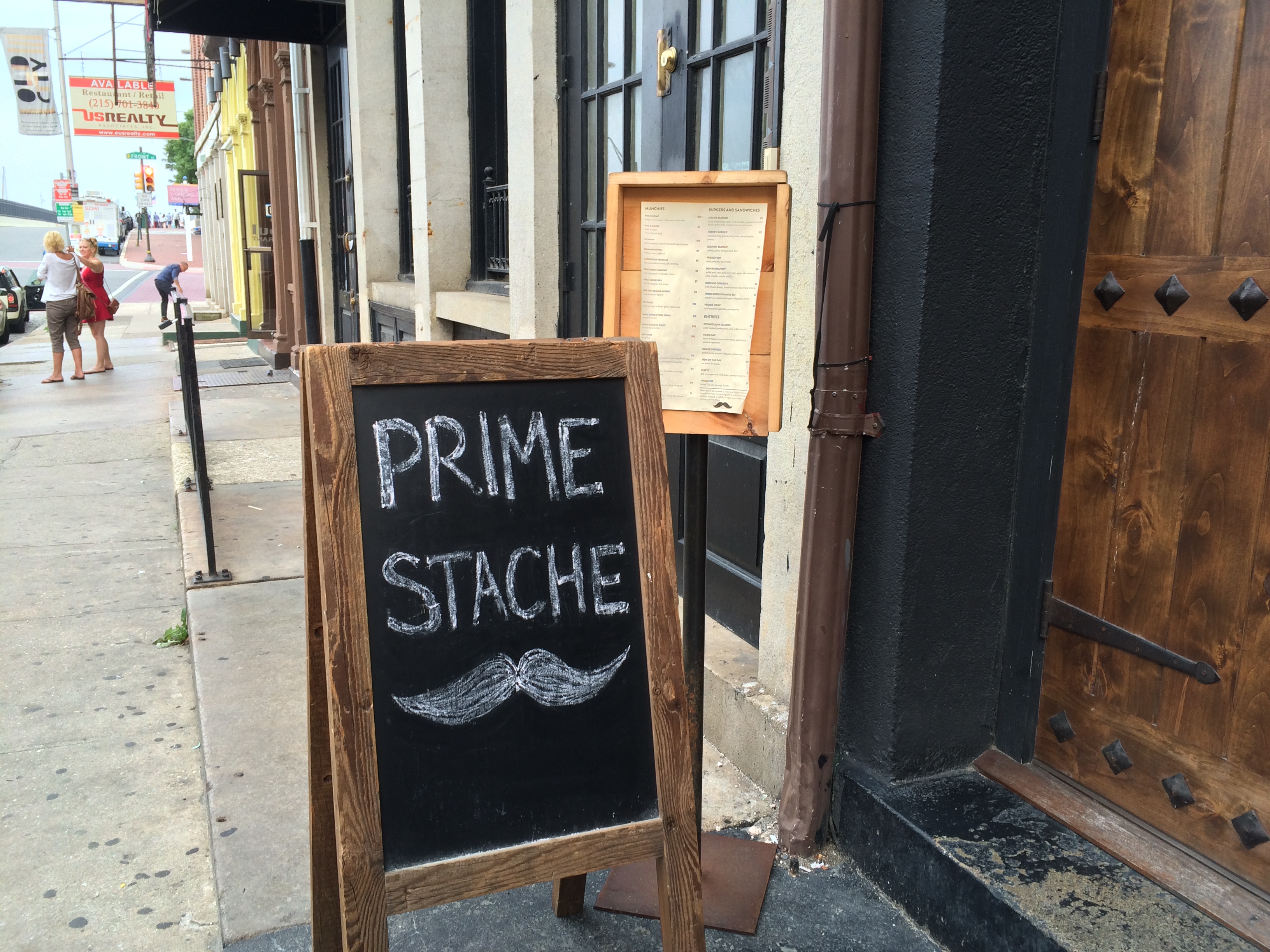
Prime Stache, where we had dinner.

Dinner time. Off to Prime Stache, a few blocks from First Friday, on Chestnut Street. Atmospherically, it’s for lovers of exposed brick and stone walls, which Sandy and I are. A pubby place short on wines but decently long on beers, its food is good. Prime Stache has some fancy offerings, but we weren’t in a fancy mood. We both enjoyed our simple burgers, Sandy’s of the salmon ilk, mine of the turkey.

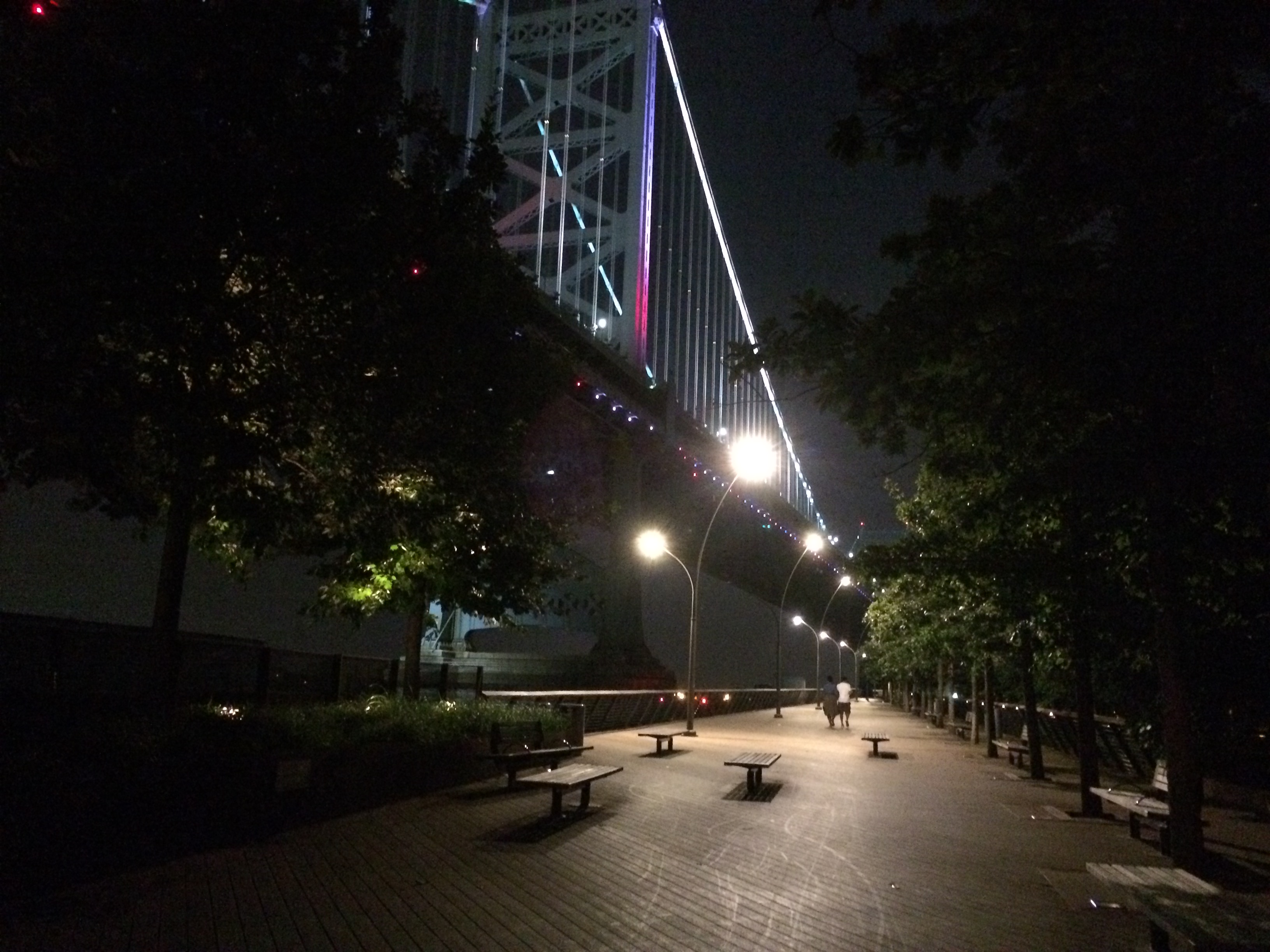
Race Street Pier and Benjamin Franklin Bridge.

The best part of the evening lay ahead. We strolled northward from Prime Stache to Race Street Pier, one of my favorite spots in Philadelphia. I’ve been there in daylight and late at night, and late night is better. The pier lies near the Benjamin Franklin Bridge, and in darkened hours the illuminated bridge overhead is breathtaking.

Jutting into the Delaware River, Race Street Pier once was a commercial municipal pier. It has been converted into a serene and intimate two level public park with long walking paths, a lawn and oak trees. Much of the Philadelphia region’s population has yet to discover this park. It opened four years ago, the first and still the only of its kind in Philadelphia. At the tail end of our First Friday evening, Race Street Pier bewitched Sandy and me. We walked romantically. We were inspired by views of the Delaware. We shook our heads marveling at the beauty of the massive Franklin bridge. And then it was time to head home.

(All of the photographs in this article were taken by Sandra Cherrey Scheinin. If you click on any photo, a larger image will open)

The Day My Father Went Eye To Eye With Van Gogh

My father came to live with me and my wife Sandy in Philadelphia soon after his 90th birthday, in 1999. He had been living alone on Long Island, but health issues necessitated his relocation. Good doctoring in the Philadelphia suburbs improved his physical condition quickly, but there was no cure for the declining state of his kidneys. He became a dialysis patient one year after he moved in with us, and he remained on dialysis till his death in 2005 at age 96.

My father was in pretty good shape until the final nine or so months of his life. He loved getting out of the house and joining Sandy and me and others at restaurants, concerts, museums, you name it. On this Father’s Day I’ll relate one incident that I look back on fondly. It was the day that he and I and my brother had a private viewing of a rarely-seen Van Gogh oil painting at the Philadelphia Museum Of Art.

There are several purported photographs of Vincent van Gogh. None are totally authenticated. This is believed to be from about 1886.
There are several known photographs of Vincent van Gogh, though they are not fully authenticated. This photo is believed to be from about 1886.

Vincent van Gogh is one of my two favorite artists. The other is Paul Cézanne. I never can decide which of the two I like best. For wordsmanship, however, I go with Vincent. In spring 2001 I read all 800+ of his mesmerizing letters, in their English translation. My father got a kick from this. He told people that I was becoming a Van Gogh expert, which was hardly the case. But my semi-obsession with Van Gogh was rock solid, and it is here that the story really begins.

One day in January 2002 I poked around some Van Gogh websites and discovered that the Philadelphia Museum Of Art, which Sandy and my father and I frequented, owned five Van Gogh oils. Yet, I had never seen more than four of them on display there. The painting that I wasn’t familiar with was Still Life With A Bouquet Of Daisies. Most experts believe that Vincent painted it in summer 1886, a few months after he moved to Paris to live with his brother Theo and to contemplate the new techniques and perspectives, most notably those of Impressionism, that had been invigorating the French art scene. Why wasn’t the painting on display? I needed to know.

A few days later, from my desk at work, I dialed the museum and got connected to an assistant curator. I asked about the mystery painting. She told me that the museum did occasionally bring it from storage to the public galleries, but that it had been a long time since that had happened. We chatted a little and then I said thanks and was about to hang up. But before I could the curator asked “Would you like to see it?” Huh? Huh? I couldn’t believe my ears. Yes ma’am, I would.

My father was about to turn 93, on January 19, 2002. A few days before that, to help our dad celebrate his birthday, my brother Richard planned to fly to Philadelphia from his California home. I explained this to the curator and asked her if my brother and father could come along with me (Sandy, chained to her job, wasn’t free to get mid-day time off from work). Sure, she said. Fairly stunned, I set the date for Friday January 18, a non-dialysis day. I knew that something special had just occurred.

The momentous day arrived. We drove to the museum and were met in the west wing by the curator. She was a lively and lovely person and probably was getting as big a charge out of the situation as anyone. Down an elevator we all went to one level of the museum’s cavernous underbelly. We followed our hostess along a long corridor, walking past many locked rooms. At our consecrated storage area she unlocked the door and we entered. Perpendicular to one of the room’s sides were very large moveable display panels. All of them were in their retracted positions. The curator pulled out one of the panels, both sides of which were covered with paintings, maybe 20 per side. I noticed a Chagall on the side facing us. Can’t recall what else. Except of course for a work near the left edge on the top row. The Van Gogh.

Still Life With A Bouquet Of Daisies. Philadelphia Museum Of Art
Still Life With A Bouquet Of Daisies.
Copyright Philadelphia Museum Of Art

It was show time. The curator wheeled over a tall moveable step ladder. Richie and I went up first. What did I make of Vincent’s oil? Well, Still Life With A Bouquet Of Daisies doesn’t have the brilliant color schemes that Vincent was developing in Paris. It is dark, with lots of deepened greens. Maybe that’s why the museum doesn’t bring it out of storage too often. But they should. With Vincent, there’s always something to admire. I took in his trademark broad brush strokes, the intense tangles of flower stems. The greens upon greens.

Richie and I and our benefactor were excited and happy for my father when his turn came. My dad was excited and happy too, a muted gleeful smile on his face, his eyes on alert. I’m sure he knew how lucky he was to do what he was about to do. Holding the ladder rails carefully, up he climbed. Admirable mobility for a guy one day away from the big 93. He gazed at the painting for a good long spell, longer I think than my brother or I had. He spouted words of admiration. He was having a ball. Finally he came back down. Thank you, thank you, thank you we said to the wonderful curator.

Over the following years, my father and brother and I talked about our museum visit many times among ourselves and with friends and relatives. Always with a grin. Always feeling a tingle. And so, I dedicate this Father’s Day essay to Hyman Scheinin, he whom I’m sure is the only nonagenarian ever to climb a step ladder to go eye to eye with Van Gogh.

Outdoors At Last, At Morris Arboretum

Ocean, beach and sand cliffs on Cape Cod.

Cape Cod has become a favorite locale for me and my wife. It was love at first sight when we first ventured there for a vacation in 1998. We like pretty much everything about Cape Cod, but the one aspect above all others is its expansive areas of startling beauty. The Cape’s Atlantic Ocean beach, for one example, is breathtaking, about 30 miles of it uninterrupted and basically undeveloped. In the off-season you can walk there as far as you like, gazing at the waters and the tall sand cliffs backing the beach, and there’s a good chance you’ll cross paths with nary another human. Not many places where such a scenario can be duplicated. And at Cape Cod’s outer reaches is one of the more astonishing vistas I’ve ever seen, a five mile long lunar-like expanse of enormous sand dunes and valleys. Most unusual, most unexpected.

Cape Cod’s natural world draws me outdoors. When Capeside my wife and I spend hours in the fresh air daily. Home in the burbs, though, it’s another story. Here I’m out when mowing the lawn or shoveling snow or shooting hoops at my neighborhood playground. Other than that I’m indoors most of the time, and I think this is because there’s a dearth of beautiful suburban places to get lost in.

Luckily for me, Philadelphia is at hand. It’s an old city and a new one, with great architecture and sights. Walking its streets and parks is an outdoors activity that I do a fair amount of.  On Memorial Day weekend’s Sunday, my wife had an inspired Philadelphia idea. Let’s visit Morris Arboretum, she suggested. We hadn’t been there in years. This would be a fine chance to spend time in a lovely green spot not far from home. Okay, I said. We drove to Philadelphia’s Chestnut Hill section, where the Morris takes up a lot of space (167 acres). We spent three hours there. It was good to be outside for an extended period.

Morris Arboretum originally was an estate named Compton, home to siblings John Morris and Lydia Morris. They were wealthy, worldly and civic-minded folks. Their mansion is no longer with us, but Compton’s grounds and some secondary buildings remain. Established in 1887, Compton stayed in Morris hands till 1932, the year of Lydia’s passing (John had died in 1915). Lydia bequeathed Compton to the University of Pennsylvania as a botanical garden and research facility. The U of P has maintained and developed the property ever since.

Morris Arboretum has gotten a whole lot better since our previous visit. Back then a parent might have said to his or her five year old Amy or Andy, “Hey, look at that pine tree. Isn’t it beautiful?” and Amy or Andy would have responded “I’m bored, let’s go home.” The arboretum managers, obviously smart people, saw the need to build kid-magnet structures. Up went the Garden Railway in the late 1990s, and in 2009 Out On A Limb opened.

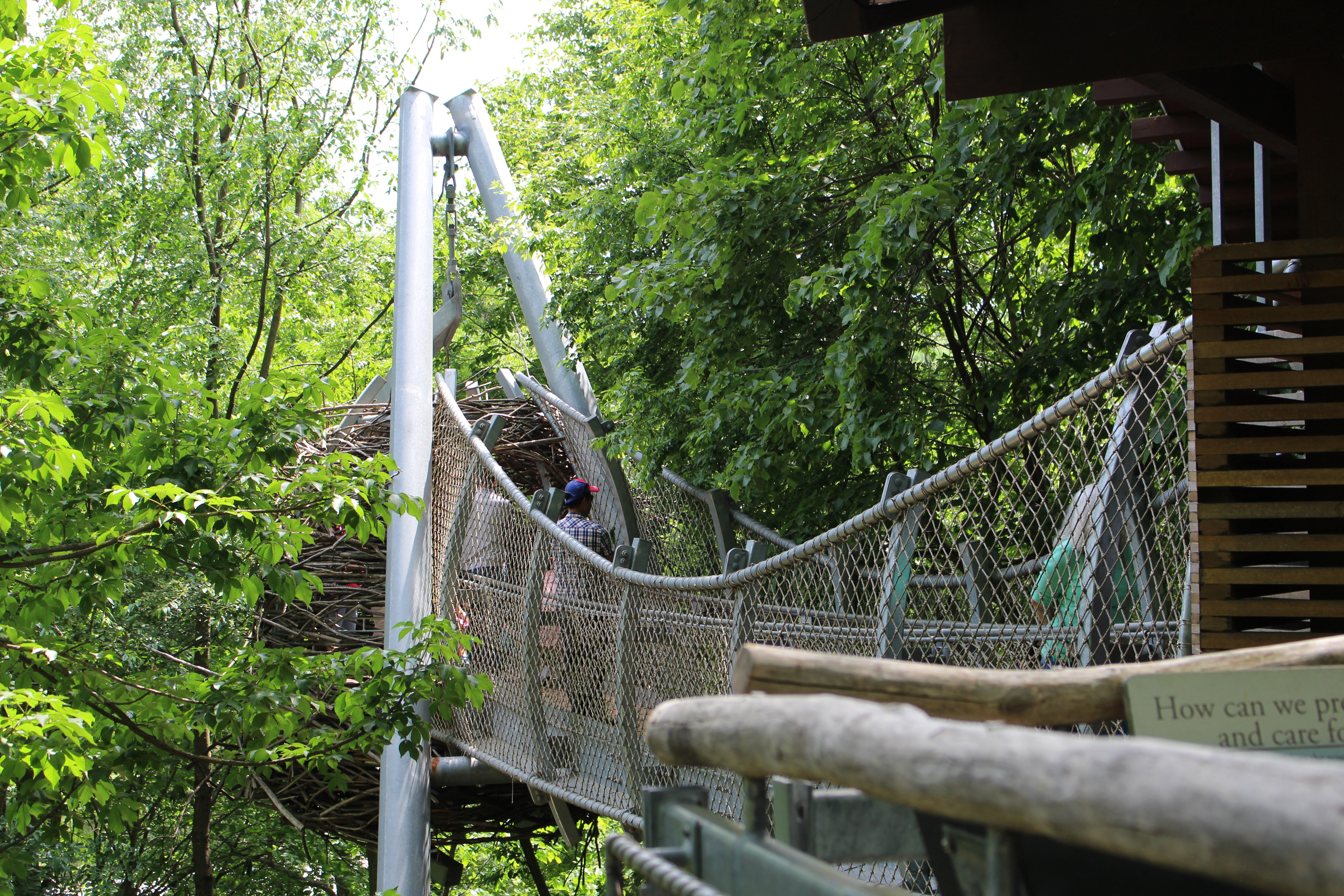
Morris Arboretum's Out On A Limb.
Morris Arboretum’s Out On A Limb.
Out On A Limb's play area.
Out On A Limb’s play area.

Out On A Limb is very cool. It’s an elevated twisting boardwalk, supported by steel columns and threaded between trees on a hilly part of the arboretum’s grounds. You enter at ground level and in a few seconds, because the earth slopes away quickly,  you’re looking down 40 or more feet at the forest floor. Walking alongside the mid and upper reaches of trees is a gas. Best yet is the play area at the walkway’s far end, where giant rope hammocks are suspended off to the side. Kids abound there. No wonder that attendance at Morris Arboretum has grown steadily since Out On A Limb came on the scene.

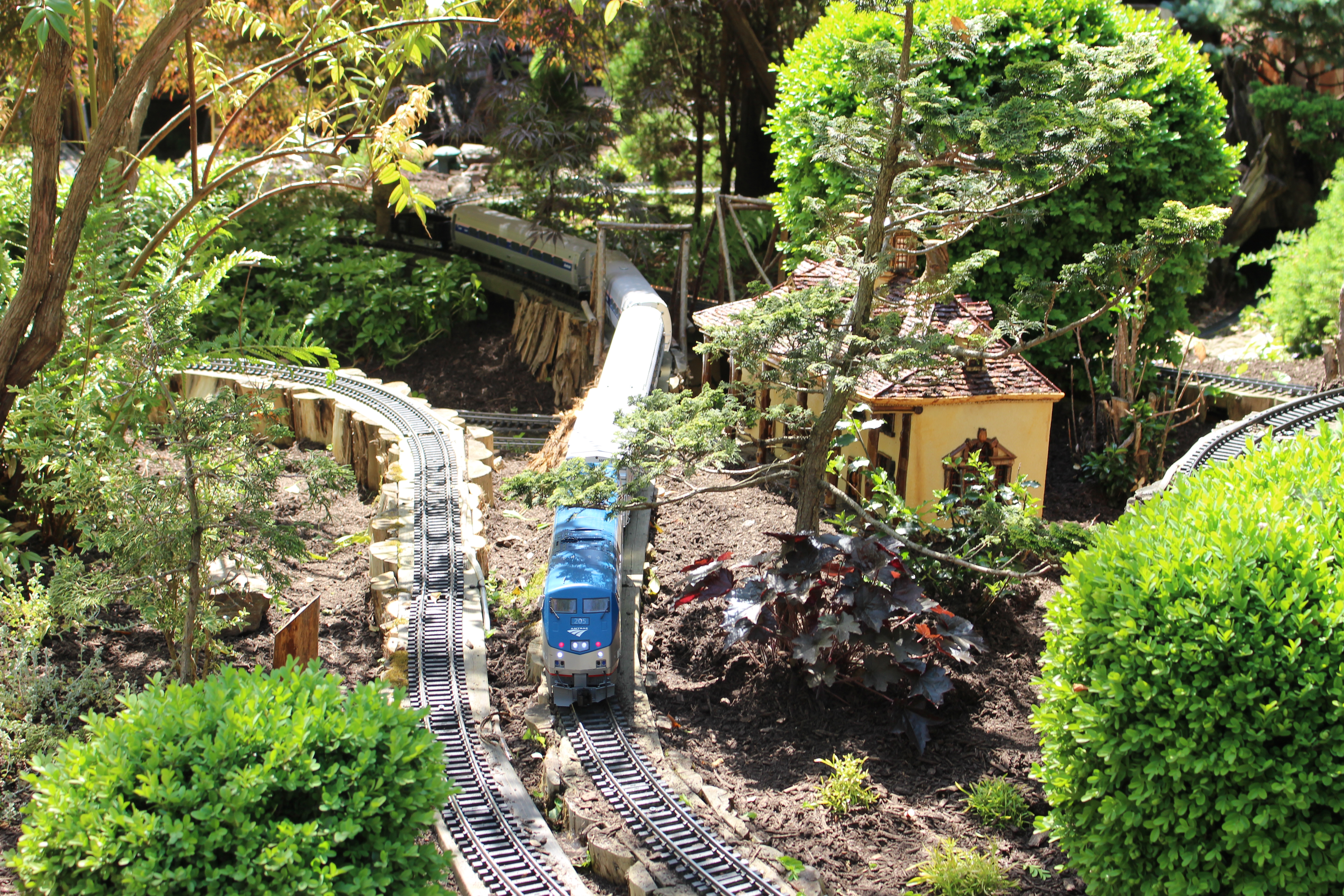
Morris Arboretum's Garden Railway.
Morris Arboretum’s Garden Railway.

Almost as invigorating is the Garden Railway. Nestled among trees and shrubbery near the Morris’s Rose Garden, it is a cleverly designed toy train layout. Passenger trains, freight trains, cable cars, tunnels, bridges . . . all are there in three large separate areas. So are natural-material replicas of famous structures, such as the Eiffel Tower and Philadelphia’s City Hall. The trains wind their way over, around and through, disappearing from view, eventually reemerging. My wife and I were intrigued by the whole set-up. It’s something.

The amazing Blue Atlas Cedar at Morris Arboretum.

It’s not a bad idea to stroll the arboretum’s grounds with no particular plan. That is to say, you won’t go wrong by not referring too often to the map you’re given at the information center. Morris Arboretum is a work of art, sculpted to display its trees, flower gardens, fern groves, swan pond and shrubs. Poking around them randomly works. Plenty of things, often green ones, will catch your eye. One tree in particular caught mine, a Blue Atlas Cedar. One of this massive being’s long lower limbs shoots out perpendicularly to the trunk, resting on the earth. The limb I think grows that way naturally. It doesn’t appear to have been forced into its strange position by windstorms or magic.

Sculptures by George Sugarman.
African Queen, a stone sculpture at Morris Arboretum.

Manmade sculpture is another big part of the arboretum experience. Many such objects are placed on the grounds, continuing a tradition that John and Lydia began. The most colorful are the large playful and organically-shaped painted aluminum creations by the late George Sugarman. They’ve been on site since 1981. The most alluring sculpture to me is African Queen, a stone carving from Zimbabwe, artist unknown. How old is it? 50 years? 500 years? If the arboretum custodians have the answer, they’re not saying. Regardless, it’s a charmer. Pablo Picasso, who was greatly influenced by African art, would have loved it. The armless queen is asleep, her sweet face lost in dreams. The artist chose to depict her headdress as broad and undefined, focusing attention to the face below. A visit to Morris Arboretum, in my opinion, is incomplete without making time for this superb piece.

A Winning Dinner And A Fashionable Movie

Figuring out last minute Saturday night plans at home in the burbs recently, my wife and I were surprised to find dinnertime slots available on OpenTable for Capofitto, a hot newish Italian restaurant in Philadelphia’s wonderful Old City section. This is a place we’d read about when it opened last autumn. It sounded good and also intriguing, as it contains a ten ton pizza oven that was built by three Italian masons on site from bricks and other materials boated over from Italy. Clearly this is an establishment that takes its pizza seriously, which makes me smile. Quickly we made an OpenTable reservation, shot off to a suburban train station, and rode the rails into Philadelphia. After dinner we planned to catch a movie, Dior And I, at the Ritz Bourse art house cinema, one block from Capofitto. We silently congratulated ourselves for developing such an efficient plan for the evening.

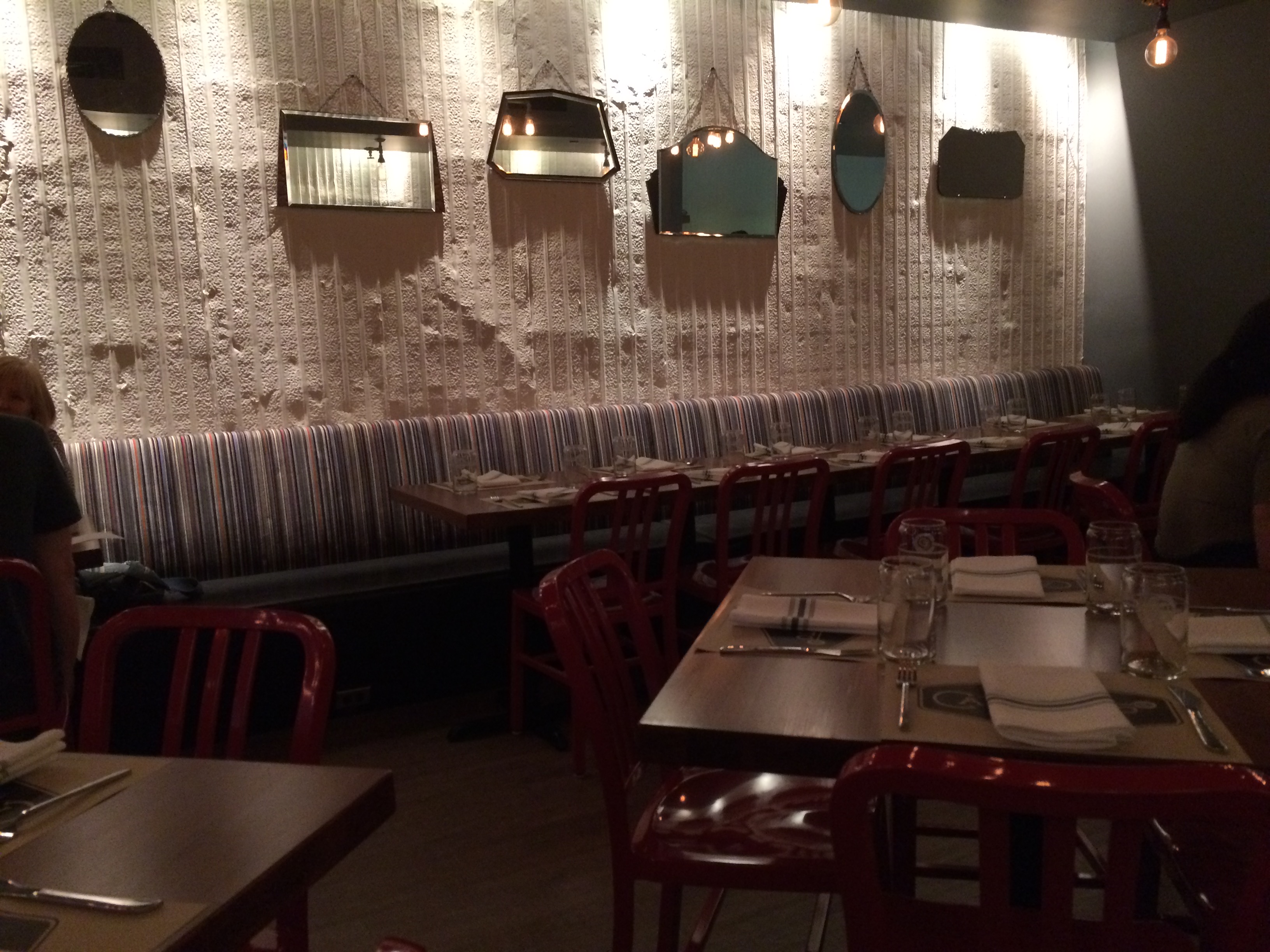
Capofitto's dining room.
Capofitto’s dining room.

Capofitto (233 Chestnut Street) is a good looking place, fairly wide and very long, comfortable but not too fancy. Housed in a building about 115 years old, its modern décor somehow gives off the vibes of a traditionally-decorated Italian eatery. The restaurant is owned by Stephanie and John Reitano, who have placed a geletaria in the front room. This is understandable, as the Reitanos blessed Philadelphia earlier this century with a scattering of mucho popular gelato cafés. Capofitto expands the culinary parameters of the Reitano empire.

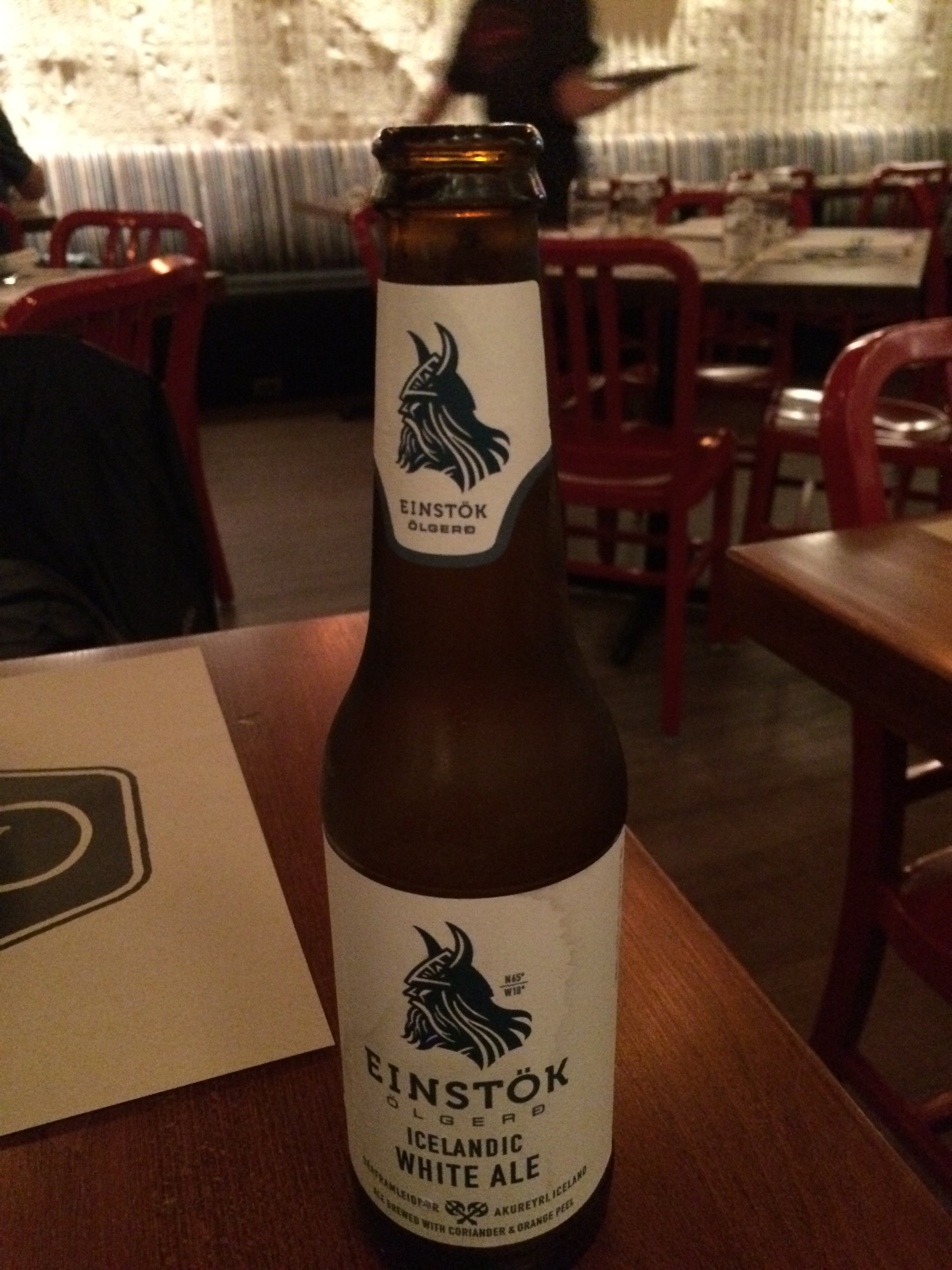
Icelandic White Ale
Icelandic White Ale

The first important question is: What beer did I order?  An Italian one would have been appropriate, but for the fact that Capofitto’s beer menu listed a brand I’d never heard of before, from a country I’d never given any thought to as a beer producer. Iceland of all places. Next time at this sweet restaurant I’ll drink Italian, but this night it had to be Einstök brewery’s Icelandic White Ale. This is a wheat beer whose label implies that the brewers toss orange peels and coriander into the vat. I noticed those flavors, but unexpectedly I also found a substantial hint of celery wafting up to my nostrils. Must have been the hops, weird dudes that can impart all manner of tastes and aromas to beer. Regardless, the ale had bite and was refreshingly bubbly and I liked it a lot.

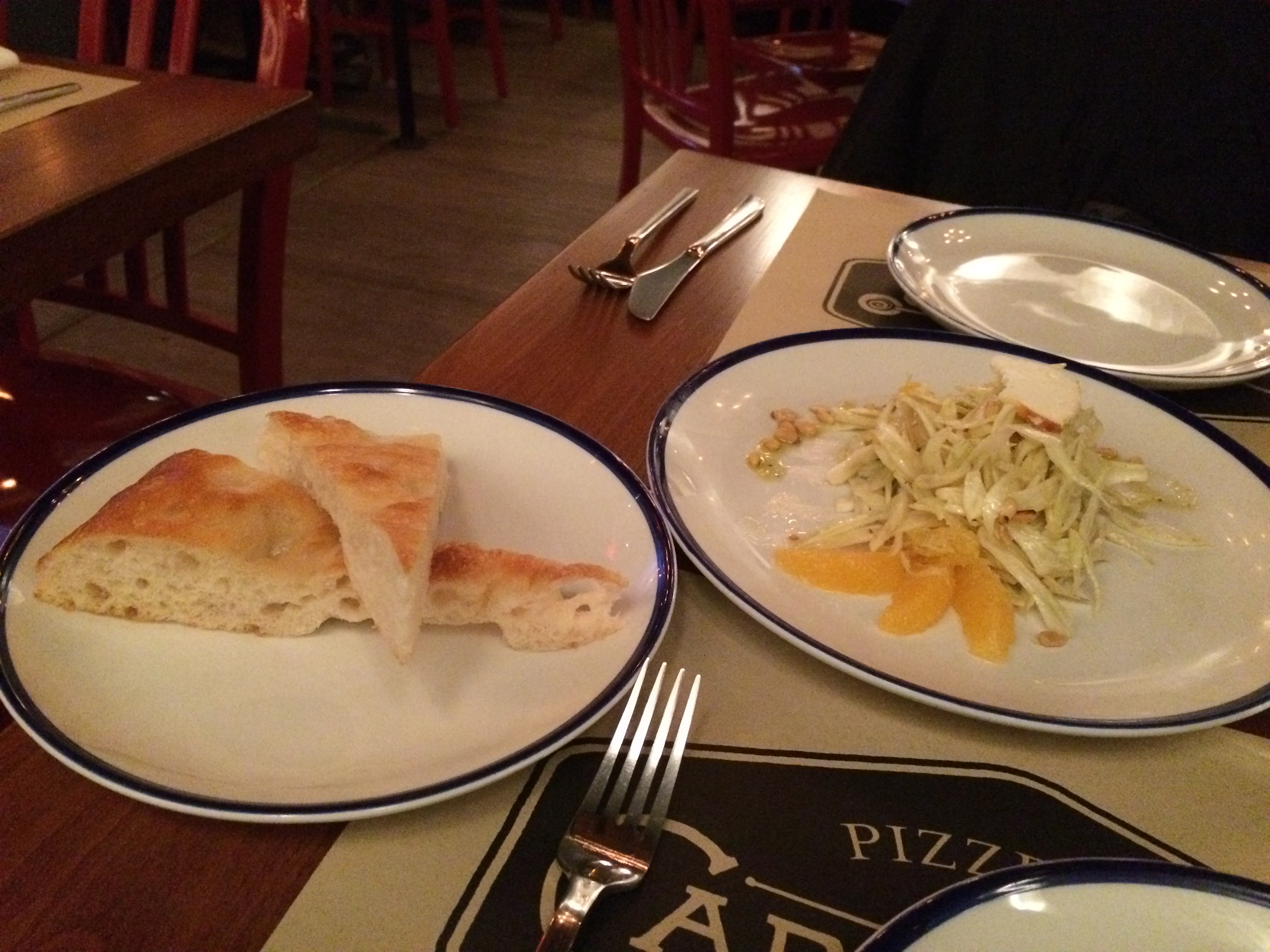
Capofitto's pinoli salad and focaccia bread.
Capofitto’s pinoli salad and focaccia bread.

What then did we have for dinner? Pizza of course, preceded by a pinoli salad. Pinoli? That’s pine nuts to you and me. My wife and I shared both the salad and pizza. The salad was misnamed, being composed largely of shredded fennel and orange slices, and brought to life with a fine milky dressing and ricotta cheese. And with some toasted pinoli too. We thought much of the salad, though a lot more pinoli wouldn’t have hurt. With the salad came focaccia bread, very good indeed.

Our gorgeous pizza.
Our gorgeous pizza.

Our pie, a margherita to which we added salty black olives, was fabulous. The pie crust’s body was thin and crisp, its puffy rim chewy in a satisfying way. The entire crust was heat darkened and blistered here and there, the good quality wheat’s earthy flavor shining through. It’s not every pizza whose wheat catches your attention. My wife and I sighed contentedly as we munched away. This was one of the best pizzas I’ve had in recent years.

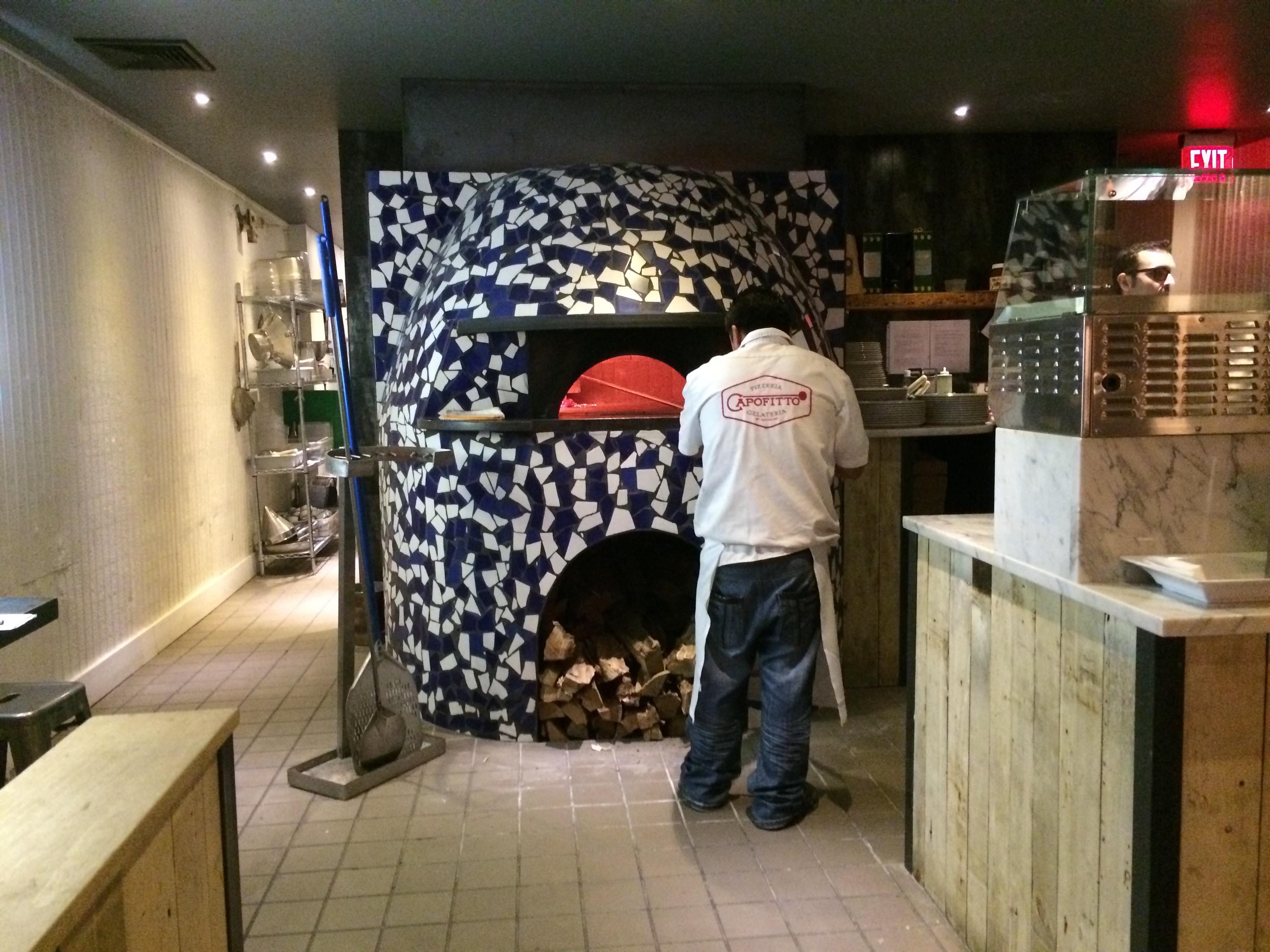
Capofitto's oak-burning pizza oven.
Capofitto’s oak-burning pizza oven.

The pizza oven, by the way, is a beauty. I looked it over for a few minutes. Capofitto feeds it wood, oak to be more precise, and it reaches very high temperatures, 900 degrees Fahreinheit or higher. Miraculously it bakes a pie in about 90 seconds.

Now, Capofitto has a large menu. Pizzas, salads, cold meats, cheeses, a few pasta dishes. I’d be surprised if most everything on it isn’t good to excellent. But after the pizza we were stuffed enough and didn’t eat anything more, not even the gelatos that brought the Reitanos their initial fame. We will return to Capofitto, at which time we’ll explore sections of the menu we didn’t get to. For now, on to the movie.

The poster for Dior And I outside the Ritz Bourse.

No one, most notably my wife, would describe me as a fashionisto. I am aware of trend-setting looks and high fashion, but the road sort of ends there. But like most anything, the world of high fashion, if explained and presented properly, will jump to life even for the mildly interested. At the Ritz Bourse my wife and I, as planned, watched Dior And I. Well-paced and well-developed, it is a documentary about the cloistered world of haute couture. It is very good, worth seeking out. Three out of four stars, I’d say.

Dior And I, directed by up and comer Frédéric Tcheng, follows the travails and successes of Raf Simons during the initial phase of his new job in 2012. For in April of that year, Simons, who had made his name in men’s fashion design, was hired by Paris’s world famous House of Dior as creative director for its women’s lines. Lucky Raf’s first big project began immediately. He had all of eight weeks to design and present Dior’s 2012 fall-winter haute couture collection. A snap, right?

The documentary begins with Raf’s first day at work, when he is introduced to the seamstresses and other staff now under his direction. Throughout the film Simons appears shy, which makes me wonder how he managed to rise to so high a creative and managerial position. Turns out that the House’s founder, Christian Dior, possessed traits similar to Simons’s. The private Dior was a reticent man, uncomfortable with the public demands of his occupation. Simons is aware of the founder’s bearings. On camera he says that he once began reading Dior’s memoir, only to put it down forever after a short while because he recognized too much of himself in Dior’s personality.

Wait, this is a spoiler alert: At the end Simons triumphs, a survivor of the strained nerves and pained expressions that accompanied him during his test by fire. The haute couture show, held on July 2, 2012 in a majestically flowered Parisian mansion, is a hit. There the movie ends. Today, almost three years later, Simons is still on the job. He undoubtedly has grown more comfortable in it.

Uncanny Valley, A New Play Performed In A Small Theater (I Like Small Theaters)

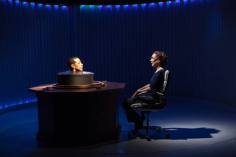
An early moment in Uncanny Valley (photo by InterAct Theatre Company)

This past weekend my wife and I went with friends to see a new play, Uncanny Valley, at Philadelphia’s Adrienne Theatre. The Adrienne contains four small performance spaces within its floors. I felt right at home in the ground floor theater where Uncanny Valley was staged, because I like small theaters.

Thomas Gibbons wrote Uncanny Valley. He is playwright-in-residence for InterAct Theatre Company, one of the groups using the Adrienne’s rooms. Gibbons is a talented writer. Some of his plays, such as Permanent Collection and Bee-luther-hatchee, have examined America’s race relations in sharply-focused scenarios. Uncanny Valley finds Gibbons exploring what for him is new subject matter. The play revolves around the high tech lab creation, in the not-too-distant future, of an Artificial Intelligence humanoid who, through training and electronic wizardry, comes to appear, emote and think like actual flesh and blood.

I have a talent for missing points and for not fully grasping situations. I’ve no doubt that this might be true for my understanding of Uncanny Valley. Rightly or wrongly, what I mainly came away with by the end of the play are two notions. First, that devising an AI creature is risky, as unexpected consequences may occur down the line. And second, that some humans don’t want to analyze their emotional shortcomings. I can’t say that any of this broke new ground for me.

Still, I enjoyed Uncanny Valley quite a lot. The actors in this two character play, Frank X as the AI gent and Sally Mercer as an AI programmer, work their roles well. The story unfolds intriguingly and at a well-controlled pace. Gibbons’ dialogue is crisp and usually rings true.

I doubt, though, if I’d have had as good an experience if I had seen the play in a larger theater. InterAct’s theater at the Adrienne seats around 100. Its intimacy can’t but help allow the audience to be drawn in. At the start of the play, Frank X’s character, Julian, seems to be nothing more than a head poking out of a table. Julian’s other body parts haven’t been attached yet. Facing him sits Claire, the programmer. Claire is teaching rudimentary facial movements to Julian, whose training at this point obviously is in its infancy. I sat a mere 20 feet from the stage, a fascinated witness to these early proceedings. From 75 or more feet away, I wouldn’t have felt as involved.

Is a smaller theater always better than a bigger? Generally I’d say yes, especially for dramas and comedies. No question that I tend to opt for the small, where I almost always have a decent or better-than-decent time, despite any deficiencies in acting or script. Being close to the action makes up a good bit for those drawbacks.

At larger places, the experience, at least for me, is more hit or miss. A few years ago I loved the musical Monty Python’s Spamalot at Philadelphia’s very roomy Academy of Music. It seats 2,900. I was at least 100 feet from the actors. So much was happening on stage with a dizzying parade of characters, though, that distance from the stage allowed visual perspective. Plus, the theater crew had the sound balanced well, always a good thing.

Not the case, unfortunately, for In The Heights, a musical my wife and I took in a year or two ago. We saw it at Philadelphia’s Walnut Street Theatre, which claims the title of America’s oldest theater (it began in 1809). The Walnut seats 1,000. We were in the mezzanine, hardly a mile from the stage, but not close enough. That wouldn’t have mattered as much if the sound quality had been good. It wasn’t. The dialogue was hard to make out, despite the actors being mic-ed. The musical numbers were a sonic mess, lyrics usually lost in a high decibel onslaught of instruments. This wasn’t a case of a boomer’s bad hearing. A few people seated near us, and a good bit younger than us, grumbled about the audio too.