Puzzles

I get about six hours of sleep daily, less than the majority of folks. This means I have 18 hours to fill, which is a lot. Overall, I do a fairly decent job with that, I guess. Some combination of the following occupies me pretty well most days: family life; household chores and duties; social life; volunteer work; reading; listening to music; watching TV; dining out; long walks; pecking away at my computer’s keyboard to produce content for the dodgy publication you’re now staring at.  And I’d be remiss not to mention scratching my balls while belting out the melodies of my favorite Gregorian chants. Yes indeed, I love doing that very much. It’s just about my only activity that isn’t on the mild side.

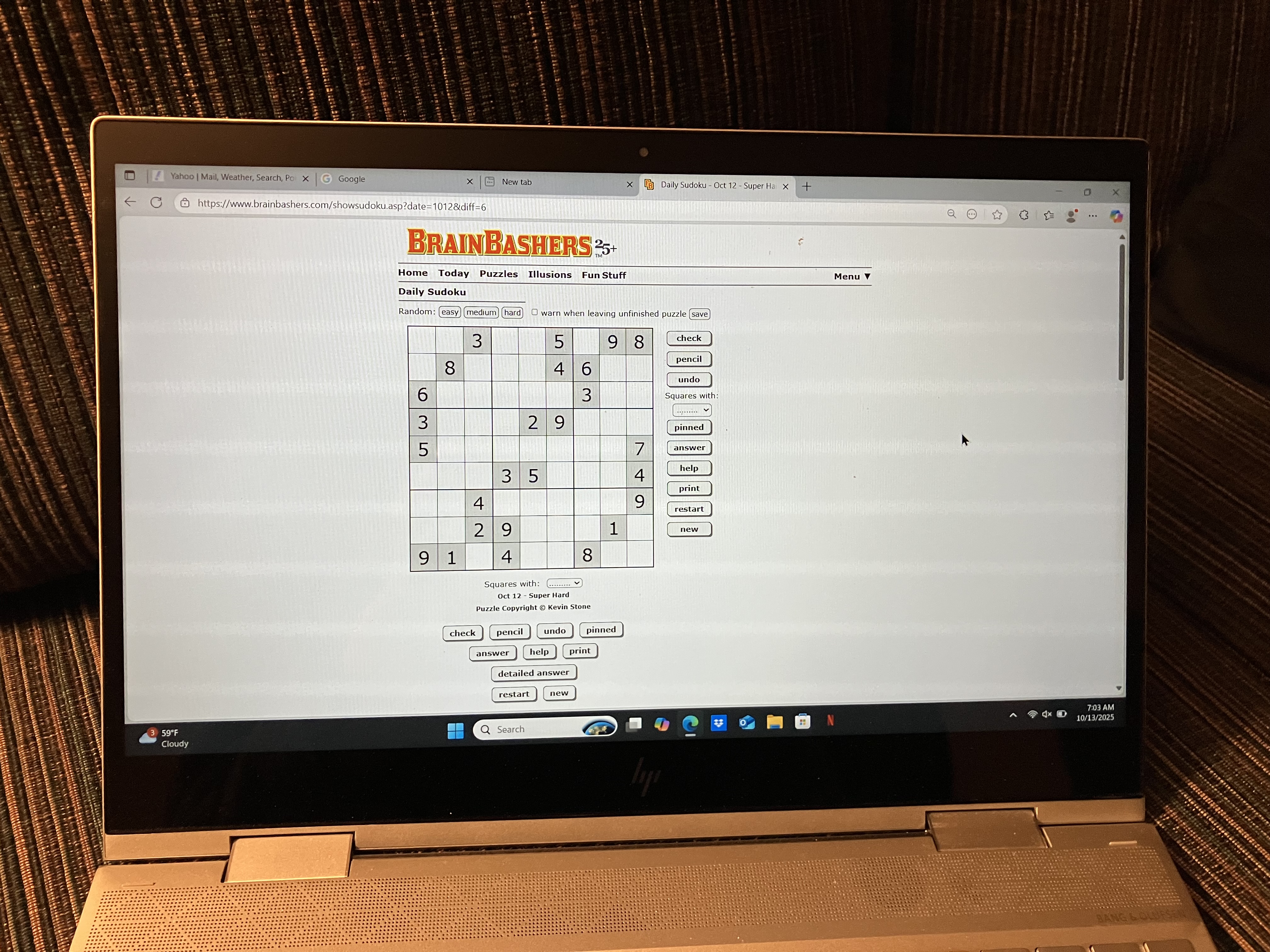
But wait, there’s more! After attending to personal hygiene matters and downing hot coffee, I kick off most every day by tackling one or two sudoku puzzles online, via the Brainbashers website. Man, I’m addicted to sudoku, a logic-based game involving the correct placement of numbers in a grid. I quickly became hooked when, in 2011, I researched and deciphered sudoku’s inner workings. I’ve interacted with thousands of sudoku puzzles since then.

After satisfying my sudoku jones and then eating breakfast, I retrieve the copy of The Philadelphia Inquirer newspaper that has been tossed onto our driveway by my family’s paper-delivery guy. I postpone reading any of its articles and head straight to the crossword puzzle, for sudoku is not the only puzzle genre I’m addicted to. Settled comfortably upon the living room sofa or at the dining room table, I do my best to fill in the crossword’s blank spaces accurately.

All told, I devote an average of roughly 90 minutes daily to puzzles. That’s nearly 8.5% of my waking hours, a significant figure. I’ve often wondered if I should cut back. Addictions, needless to say, can be seriously unhealthy. And so, several weeks ago, at my most recent session with my psychiatrist Dr. R. U. Forereel, I brought up the subject.

What? You do puzzles for 10 or more hours each week? What in the world is wrong with you, Neil?” Dr. Forereel commented.

“But, sudoku and crossword puzzles relax me. And they help to keep the old brain cells in shape.”

Old is right, Neil,” my doctor said, after glancing at my chart. “You’re soon to turn 78, I see. Neil, you’re ancient, and should be doing your utmost to live life to its fullest at this point. After all, who knows how many more tomorrows you have left? Stop squandering time on puzzles. Do something exciting instead. Take up rock climbing, for instance. Or Formula One race car driving. I could give many more suggestions. The possibilities are almost endless.”

“Dr. Forereel, are you trying to get me killed?” I asked her. “I’m not a daredevil. I’m not sure what I am, actually, but built-for-thrills sure doesn’t fit my description.”

“Neil, where oh where have I gone wrong? You’ve been my patient for years and years, and yet, despite my strongest efforts to build it up, your self-confidence remains at the meh level. Sometimes I question my efficacy as a physician.”

Efficacy is such a wonderful word, Dr. Forereel, one I haven’t heard in ages. For that alone, I consider today’s session to be valuable. But, getting back to puzzles, have I truly been on the wrong track by giving substantial amounts of time to them?”

“Of course you have, Neil. Puzzles are frivolous. If I’d wasted time on such nonsense, I’d never have become the respected healer that I am.”

“Doctor, I’ll follow your sage advice. You’ve convinced me that I absolutely need to amp up my life. Nothing I’m involved with right now pushes the envelope.”

Thats the spirit, Neil. It seems I’ve underestimated you. Well, the clock on the wall tells me that today’s session has reached its end. Go get ’em, tiger!”

Over the next few days, my vision of how I might better allocate my time began to crystalize. There are so many paths, I realized, that would lead me to becoming a more-daring version of myself. Alas, I’m sorry to report that things have remained unchanged. My gas pedal is stuck. Dr. Forereel will be hugely disappointed.

What can you say? Life’s a bit of a puzzle, isnt it?

A Red-Themed Tale

A not-so-fun fact: Outdoors, I almost always melt like butter when it’s hot and humid and the Sun is relentlessly glaring. This has been true for quite a few years, though I melt quicker now than ever before. None of this is surprising, because, as I’ve often noted on this publication’s pages, I’m old as hell and not improving with age.

Which brings us to Monday morning of last week. When I stepped out at 7:45 to retrieve the newspaper that had been tossed on my driveway (my wife and I subscribe to The Philadelphia Inquirer), I was stunned by the heat, the heaviness of the air, and also by the Sun’s intense brightness. Any thoughts that I might have had about doing yard work at some point during the day immediately disappeared. Man, we are in the middle of what has been a very tough summer here in southeast Pennsylvania, USA.

However, two and a half hours later, feeling restless, I decided to get out of the house. And being one who attempts to keep his cardiovascular system in proper running order, I wanted to exercise too, something I hadn’t done in two or three days. But where and how? Well, as had been the case many times before, I turned to a local resource: the three-level, air-conditioned shopping mall (Willow Grove Park) within walking distance of my home. I didn’t walk to it, of course, as succumbing to sunstroke and/or heat exhaustion wasn’t part of my plans for the day. So, I hopped, figuratively speaking, into my car and drove there. And spent the next 40 minutes moving my legs at a pretty good clip upon the gigantic structure’s floors.

I was in a bit of a blue mood when I arrived at the mall, thanks to a couple of personal worries simmering in the back of my mind. Figuring that a themed walk through the complex might raise my spirits, I came up with the idea to seek out (and photograph) those establishments whose business-name signs were illuminated in red. Though I think of red as the most eye-catching color for advertising purposes, there were fewer such signs than I expected. I counted nine, though maybe I missed one or two. Anyway, I grabbed pictures of the nine and have placed three of the photos within this story.

Here’s the thing: The themed trek did not lessen my blue mood. Actually, it upped it a little, largely because there weren’t a heck of a lot of shoppers in the mall. The lack of human vibrancy chilled the atmosphere and made me more aware than I would have been of the mall’s vacant spaces and of the several stores that, though fully stocked, had not opened for the day. Willow Grove Park once was a thriving place of business. But thriving hasn’t fit its description in a long while, certainly not since Covid descended upon Planet Earth in 2020. Is the mall doomed? It might be. I’ve read that its ownership group has had significant financial issues. What a potentially sad situation. If the mall goes under, hundreds of people will be out of work.

Let me be the first to say that, without a shadow of a doubt, the red-sign pics in this article are dull as f*cking dishwater. Meaning, it now is incumbent upon me to add something that’s red-related and also deliciously lively. What instantly comes to mind is one of my favorite songs by the insanely talented Prince Rogers Nelson, the guy known simply as Prince, who left us in 2016 at age 57. The world would be a better place were he still among the living. And so, I present to you Little Red Corvette, a magnificent rocker about a one-night stand. The recording (which Prince made with his band, The Revolution) came out in 1982 and in no time was shaking the world mightily. It is great.

Trees And Ponds Go Together Oh So Well: A Cape Cod Story

My wife Sandy and I have visited Cape Cod, Massachusetts, USA, almost every year since our first vacation there in 1998. Obviously, then, we love the Cape. We’re lucky as hell to have discovered it in the first place, as it never had occurred to either of us that there might exist a locale to which we would want to return again and again. Thus, it’s an understatement to say that Cape Cod has made our lives better. We feel at home there. We enjoy exploring its old villages and areas of natural beauty. We fill up on the Cape’s arts scene and at its eateries. And we engage in sweet old-school activities, such as mini golf and sunset-watching, that we almost never do back home in the suburbs of Philadelphia, Pennsylvania. Yeah, Cape Cod suits us to a T. We never will tire of this 65-mile-long peninsula.

Anyway, I’m now bringing up Cape Cod not just for the heck of it, but because Sandy and I spent 11 full (i.e. non-commuting) days there recently, and I sense some thoughts about the visit trying to coalesce. Away we go!

Last month’s Cape escape was, as each of its predecessors had been, damn fine. I could go on and on about the many highlights of the trip. But doing so would extend this piece to a mind-numbing length. I don’t know about you, but my mind already is numb enough as it is. That’s why I’ll limit the remainder of my commentary mainly to a specific topic. To wit, ponds nestled in woods.

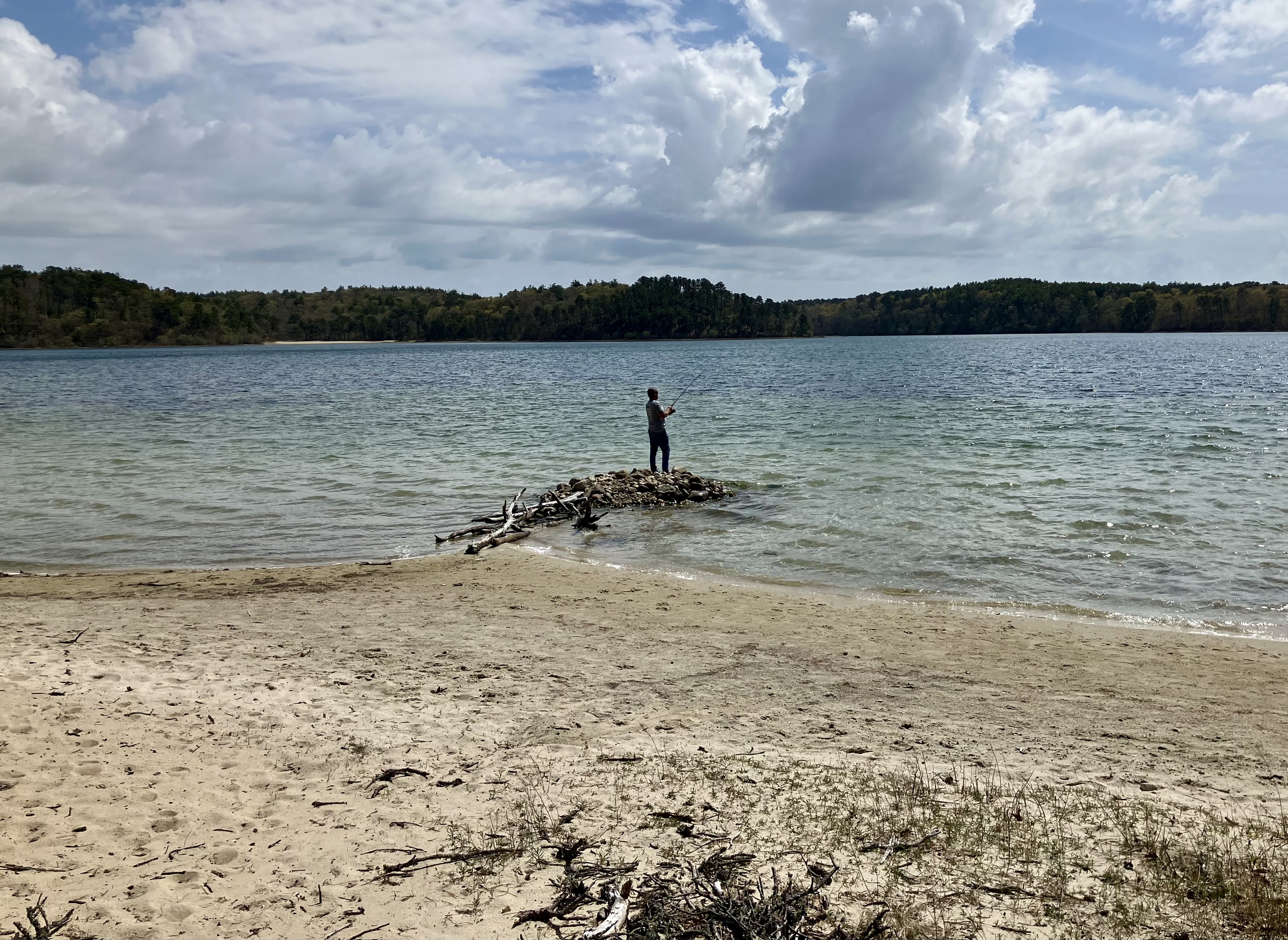
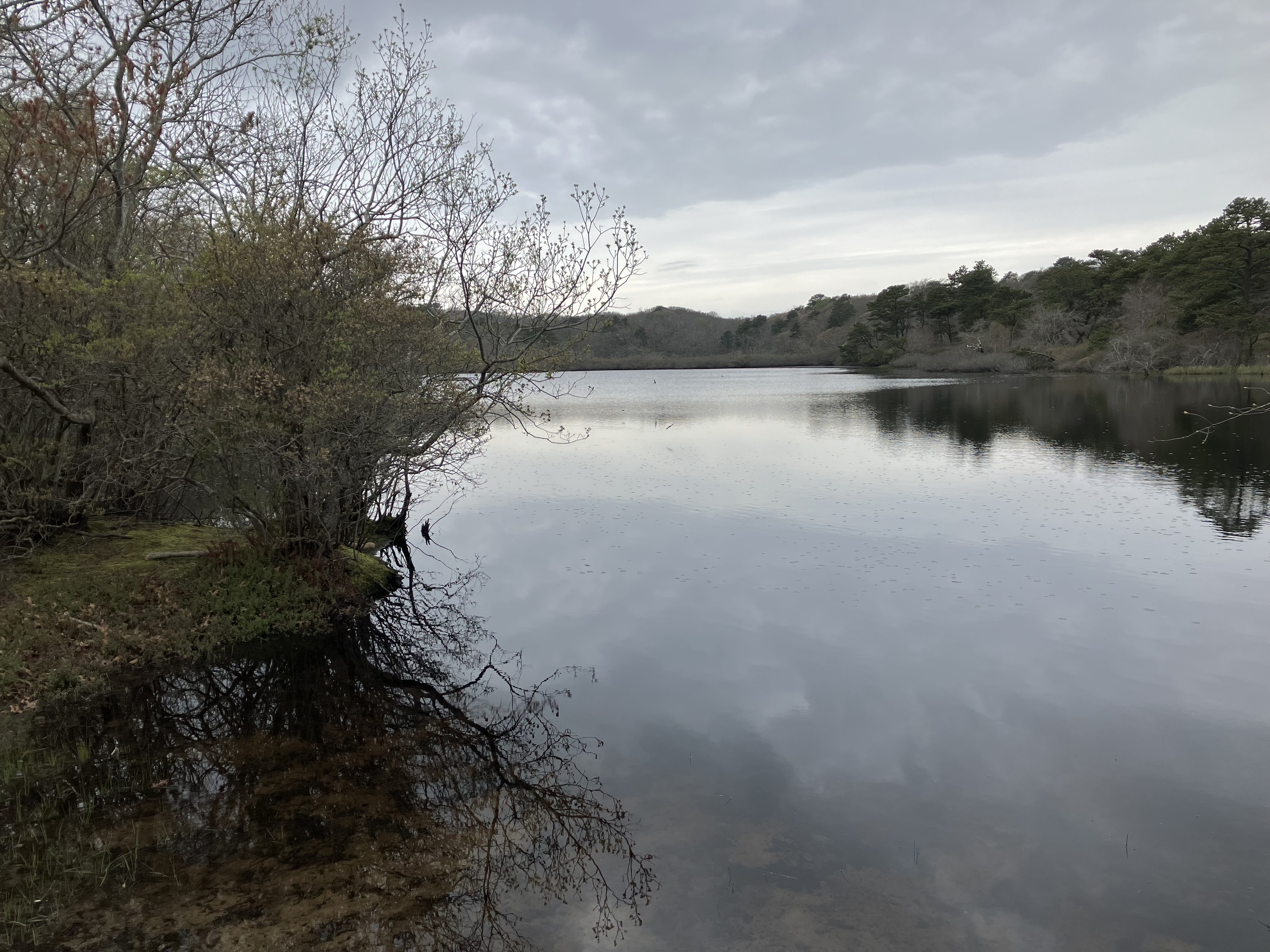
Nature-wise, when most people think of Cape Cod they picture fine beaches and gorgeous open waters. For sure, the Cape has plenty of those. Less known are its ponds, of which there are hundreds. Most ponds, however, for one reason or another are difficult or near-impossible to access. For example, many are boxed in by housing that has sprouted up around them over the years. Not the case within Cape Cod’s several forests, though, which are protected from development. On back-to-back days we visited two of those woodlands, largely because ponds reside inside them. First up was Brewster township’s Nickerson State Park, a sizable forest, followed by Provincetown township’s Beech Forest, which is less spacious than Nickerson.

The trees in each forest — loads of pines and oaks, among others, in both, and plenty of beeches, appropriately, in Beech Forest — impressed the heck out of me and humbled me too, as trees always do. Hell, trees deserve deep respect. After all, they can trace their ancestry back 400 million years, give or take 50 million. That’s saying a lot.

Nickerson State Park’s Cliff Pond (Brewster, Cape Cod)
Nickerson State Park’s Little Cliff Pond (Brewster, Cape Cod)

But when you add ponds to the picture, you really have something. At Nickerson I got up close and personal with Cliff Pond and Little Cliff Pond, and did the same with Blackwater Pond at Beech Forest (both woodlands contain additional ponds, but I gazed at only three). Those lovely waters, in combination with the trees surrounding them, put me, who leans toward the tense side of the spectrum, at ease, for ponds and trees are a perfect match, gentle with one another and zen-like in the aura they project.

And that’s not all the scenes did. The longer I took them in, the more my inner smile widened and the more I went weak in the knees, because, to me, tree-rimmed ponds rank at the top of Nature’s cute and adorable scale. So, I became totally smitten, a state of affairs I wholly embrace, and which doesn’t happen to me often enough. Any way you look at it, I was fortunate to be at those sites.

Beech Forest’s Blackwater Pond (Provincetown, Cape Cod)

Over the years, Sandy and I have passed way more time on Cape Cod’s beaches, admiring the Atlantic Ocean, Cape Cod Bay and Nantucket Sound, than we have at any of its other natural spots. The Atlantic coastline, raw and almost entirely undeveloped, is, in fact, my favorite aspect of Cape Cod. But, ponds within woods are special too. Very special. A trip to Cape Cod without visiting any of them is incomplete.

Two Sunsets That Brought Me Up Short

I’ve mentioned this several times before on this publication’s pages, and I’ll say it again: Smartphone cameras are perfect for those who enjoy documenting the world around them but can’t be bothered with cameras that have all sorts of settings requiring adjustment. They also are perfect for those who would be up shit’s creek trying to figure out how to use such cameras. I am a member of both categories.

Not surprisingly, then, I began snapping away pretty regularly soon after obtaining my first smartphone in late 2015. All you need to do is aim, touch the screen briefly here and there to adjust for distance and brightness if you so desire, and then press the big button. Voila! Mission accomplished. Easy as f*cking pie.

I’ve put hundreds of the photos I’ve taken to good use, placing them in Yeah, Another Blogger stories. And a fair number of those hundreds are sunset scenes, nearly all of them drawn from vacations my wife Sandy and I have enjoyed on Cape Cod, Massachusetts, USA.

Well, despite the fact that cyberspace currently contains several trillion sunset images, I’m never the least bit reluctant to add more of them to the unimaginable glut. I mean, it’s not as though somebody is going to sue me if I do. Right? On second thought, I damn well could be wrong about that. Whatever, I’m willing to take my chances. Away we go!

Cape Cod sunsets, when viewed from Cape Cod Bay, are magnificent when the atmospheric conditions are favorable, for there are no obstructions to hinder your view. Obstructions, however, are a given just about everywhere in the suburbs of Philadelphia, Pennsylvania, which is where I reside, and in Philadelphia itself. I haven’t been to Cape Cod or anywhere else with wide-open, west-facing views so far this year. Nevertheless, two sunsets in my region brought me up short.

Jenkintown, Pennsylvania (July 2024)

In July one evening, walking to our car after eating and drinking in a pub in the village of Jenkintown, which is a few miles from our suburban town, I asked Sandy to stop for a moment, as I’d just noticed a pale orange tinge to the mostly hidden lower sky. The hue looked absolutely fine in the disappearing daylight, set off as it was by houses, overhead utility wires, parked cars, foliage and scattered clouds.

And so, confronted with a view I deemed worth remembering, I yanked my iPhone out of my pants pocket. Ten seconds later the deed was done. The photo is one of my favorites among the many I’ve taken to-date in 2024. There’s a sense of peace and stability in it. But wait . . . somewhere off in the distance I can hear my doctor talking to me: “Neil, you’re old as dirt, unfortunately,” he’s saying. “If you have any sense left at all, you’ll stare at this photo a lot. Doing so will lower your blood pressure and might extend your life a little bit.”

Thanks, Doc. Will do!

Fishtown section of Philadelphia, Pennsylvania
(August 2024)

And in late August I became indebted to the phone once again. On the way back to our car after dining in Philadelphia’s Fishtown neighborhood, a small section of a sunset, smiling coyly, presented itself to me and Sandy on Jefferson Street.  Overall, the scene was denser and more complicated than its Jenkintown counterpart. There was more going on than I could comfortably absorb and process.

My iPhone came to the rescue, taking in the entire display and freezing it at 7:56 pm. The resultant photo pretty much blows my mind. It’s an exhilarating jumble of shapes and lighting effects. Every time I examine this picture I notice something I hadn’t before. I love it. Hold on a second, though . . .  my doctor is speaking to me again: “Neil, the Philadelphia photo is an absolute blood pressure raiser. It’s too intense for a geezer like you. Stop staring at it!”

Sorry, Doc. No can do!

I Like Them (A Book, A TV Series, A Song)

Nine Inches, a collection of fiction stories from the pen of Tom Perrotta, and published in 2013, seemed to be calling to me last month as I browsed the shelves of my local library, though I’d never heard of Perrotta before. I should have been familiar with his name, however, since, as I later learned, he’s a successful author. In fact, two of his novels (Election; Little Children) have been turned into movies, and another (The Leftovers) into a television series.

With nothing to lose, I brought Nine Inches home. I’m glad I did. I mean, Perrotta can write. He sharply examines the human mind and emotions, effortlessly illuminating the quirks, insecurities, maladjustments and f*cked-up decisions that run rampant in our species, and which can propel people’s lives in unanticipated directions, some of them most unfortunate. He does so with sentence after sentence that go down as easily as your favorite comfort food and also, when needed, pack a hell of a punch.

Take the opening story in the volume, for instance. It’s titled Backrub, and chronicles the days and nights of Donald, a bright kid just out of high school. The victim of misaligned stars, he was rejected by every college he applied to. Wobbled by this injustice, he takes a job as a pizza delivery person and, after a while, not caring enough to want to try and right his ship, slides comfortably into dealing drugs. Perrotta’s gift for language shines in this paragraph near the story’s conclusion.

It all went down so fast. I barely had time to register the lights in my rearview mirror when I saw two more cop cars right in front of me, blocking the intersection. I got out with my hands on my head, like they told me to, and the next thing I knew I was lying facedown in the street, with my hands cuffed behind my back.

Perrotta’s writing style agrees with me. It’s taut and uncomplicated. He takes on a wide variety of subjects in Nine Inches (unfulfilling marriages, a lonely widow, an insecure teacher, to name a few), and brings them to life with clarity. While reading Perrotta’s stories, I subconsciously kept thinking to myself, “Man, this seems real.” That’s a solid compliment.

On the other hand, not all that much about the television series The Lincoln Lawyer seems truly real, except for some courtroom scenes. But that’s more than okay. Sure, Mickey Haller — aka The Lincoln Lawyer — is preternaturally quick on his feet. But that only adds to his likeability. He and the show’s other main characters are good people, loyal to each other, and don’t take shit from anyone. I’m down with all of that. (By the way, a film version of TLL came out in 2011. It’s good.)

My wife Sandy and I polished off season two of The Lincoln Lawyer recently, after watching season one earlier this year. Both rock, two even more than one. In the second season, Haller (played by Manuel Garcia-Rulfo), who does a good bit of his best work-related thinking while driving or being driven in one of his Lincolns, finds himself defending a lady accused of murder. Not all that many hours before she is brought up on charges, she and Haller were in bed together, enjoying the heck out of one another. What, you’d expect otherwise? But, hey, don’t prejudge the show. It’s quality escapist fun. The plot lines are tricky. The dialogue sparkles. And the actors give it their all. Sandy and I, for sure, are hoping that Netflix will renew The Lincoln Lawyer for a third run.

Which brings us, rather haphazardly, to another creation — The Well, a new song that instantly grabbed me when I heard it on the radio a couple of weeks ago. It’s the work of Briscoe, a group from Texas, and will appear on Briscoe’s first album, which is scheduled to be released next month.

The two main guys in Briscoe — Truett Heintzelman and Philip Lupton — are in their 20s. But they are looking far into the future in The Well, pondering whether memories of the joys of youth will help to sustain old age. I think the Briscoe boys are concerned about something that isn’t going to happen. They’ll be just fine, enjoying the moment, when they reach their “golden” years.

That quibble aside, there’s no denying that The Well, an old-timey type of song brought to high places by rocking drums, is catchy as can be. The blend of the stringed instruments with the quivering, giddy vocals makes me go weak in the knees. I’m smitten!

So, those are a few of the things that have rung my bell of late. What’s rung yours?

A Love Story

A few weeks ago I published a piece that for the most part was a meditation on joy, a commodity without which our lives, to put it mildly, would blow. Seeing that I’m a f*cking softie at heart, I’ve decided to turn my thoughts now to another precious emotion, the greatest of them all, for it sustains and usually nourishes life, giving us reason to go on. I’m talking, of course, about love. Sure, The Beatles overstated things when they sang “all you need is love.” But they weren’t too far off the mark, as there is no doubt that the following is true: If an individual doesn’t feel love for at least one other human being (or pet, I hasten to add), they are in a most unenviable position.

Now, I’m not exactly an expert when it comes to matters of the heart. I know that for a fact because nobody in my seven-plus decades of residing above ground ever has asked my advice on the subject. Come to think of it, just about nobody ever has asked my advice on any topic or situation. Man, I should start an advice column called Maybe Neil Sort Of Knows, So Give It A Shot And Ask Him. That would show ’em how deep my font of quasi-wisdom is!

Anyway, getting back on track, what else might I say about love? Well, it’s innate, in most cases blossoming automatically between parents and their children, to mention one obvious example. But it sure doesn’t blossom automatically between everybody. That’s a main reason why it can be so difficult to make true friends, to find a partner to spend your life with, and to keep the fires burning with said partner after you’ve found them. Yup, love is a powerful force, but cultivating it properly requires skills that many do not master adequately, if at all. When we allow love to bubble within us consistently, though, our lives are much the better for that.

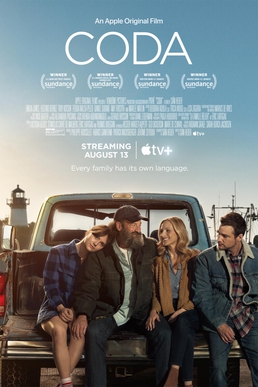
Love probably wouldn’t be on my mind so much were it not for the movie CODA, which my wife Sandy and I saw at a cinema early this month a few days after it grabbed the Oscar for Best Picture. It’s still in some theaters, by the way, and is streaming on Apple TV+ too.

CODA is a tale that revolves around Ruby, a high school senior who is the only hearing member of a family of four. She is devoted to her parents and brother and, in addition to attending school, spends mucho hours each week working on the fishing boat that her dad and sibling operate in order to put bread on the table. Whew! This girl, who also sometimes acts as an intermediary between her deaf kin and outside parties, has a whole, whole lot on her plate. Ruby’s life becomes even more complex when she is encouraged at school to develop her vocal skills and pursue a music career. This new element becomes the movie’s fulcrum.

Sandy loved CODA, which is an acronym for child of deaf adults. She thinks it’s very great. Although I found CODA too formulaic to be placed on a pedestal, I enjoyed the hell out of it. It’s an old-fashioned sort of story that I’m certain would move anyone whose heart is not fashioned from stone. Why? Because CODA, at its core, is all about love, the kind of love that holds steady, not wavering even for a moment. What’s more, there’s nothing sappy about the love on display in CODA. A tight screenplay by Sian Heder, who also directed the flick, and four actors who tap into genuine places within themselves, see to that. Hats off, then, to Emilia Jones, who plays Ruby, to Marlee Matlin and Troy Kotsur (Ruby’s parents), and to Eugenio Derbez (Ruby’s music teacher).

I’ll close this love-centric essay on the right note, by presenting Beyond, a love song sung and co-written by Leon Bridges. Sweet and sultry as you could hope for, Beyond very well might put you in the mood to . . . yo, I don’t need to tell you where this sentence is headed. I accept your thanks in advance!

A Decently Joyful Story

It’s an understatement to remark that ours is a perplexing species. Yes, most people might be pretty good at heart for the most part. But you’d hardly know that by the wars that have raged in one place or another throughout recorded and, I have zero doubt, prerecorded history. The latest nightmare, of course, is the Russian assault on Ukraine. It is only one of many post-Second World War examples of cruelty and of refusal, inability even, to live harmoniously. Horrible conflicts in Syria, Yemen, Rwanda and the former Yugoslavia are others. The Russia/Ukraine situation is by far the most worrisome, needless to say, because a f*cking asshole with nuclear weapons at his command, good ol’ Vladimir, is its lead villain.

Okay, I needed to get that off my chest. And seeing that I’m not in the mood to bum myself out any further, nor anyone else, I now will pivot sharply and head into my comfort zone. Sitting there patiently are a song I first heard in February and a television series that my wife Sandy and I watched earlier this month. I kind of have to write about them. Why? Well, they brought me joy. And I don’t take joy lightly. When I experience it I thank my lucky stars, because joy, though weightless and invisible, is a sweet substance that we require at least now and then. Joy helps us feel whole. It is one of the finest things in life.

First up is Broken Heart, a tune by The Fiestas, a New Jersey vocal quartet (and at times a quintet) that inhabited the worlds of doo wop and rhythm and blues. I’m certain that just about everyone knows this group, if not by name then by their song So Fine, which was released in late 1958 and which I love. So Fine became a smash hit a few months later and receives substantial airplay to this day.

Little did I know that The Fiestas were more than So Fine. Little did I know, that is, until one night last month when a SiriusXM radio channel delivered Broken Heart to our ears while Sandy and I were at home having dinner. Man, in an instant I was hooked. I stopped chewing to let the song give me some thrills. And, via YouTube, I’ve listened to Broken Heart a bunch of times since that evening.

Subsequent research taught me that The Fiestas, whose career lasted into the late 1970s, scored a medium-sized hit with Broken Heart in 1962. Which is why I’m surprised I’d never heard it before. Such a song! Sure, its exuberance belies the warnings about love that are embedded in the lyrics, but who cares about that incongruity? I mean, you don’t run across singing as majestic as this very often. Lead vocalist Tommy Bullock soars, hitting notes so fluidly, so gleefully, he almost brings tears to my eyes. And his partners wrap their voices around his with precision and power. I’m listening to Broken Heart as I type this sentence. Am I feeling joyful? Damn straight! Without further ado, here’s Broken Heart:

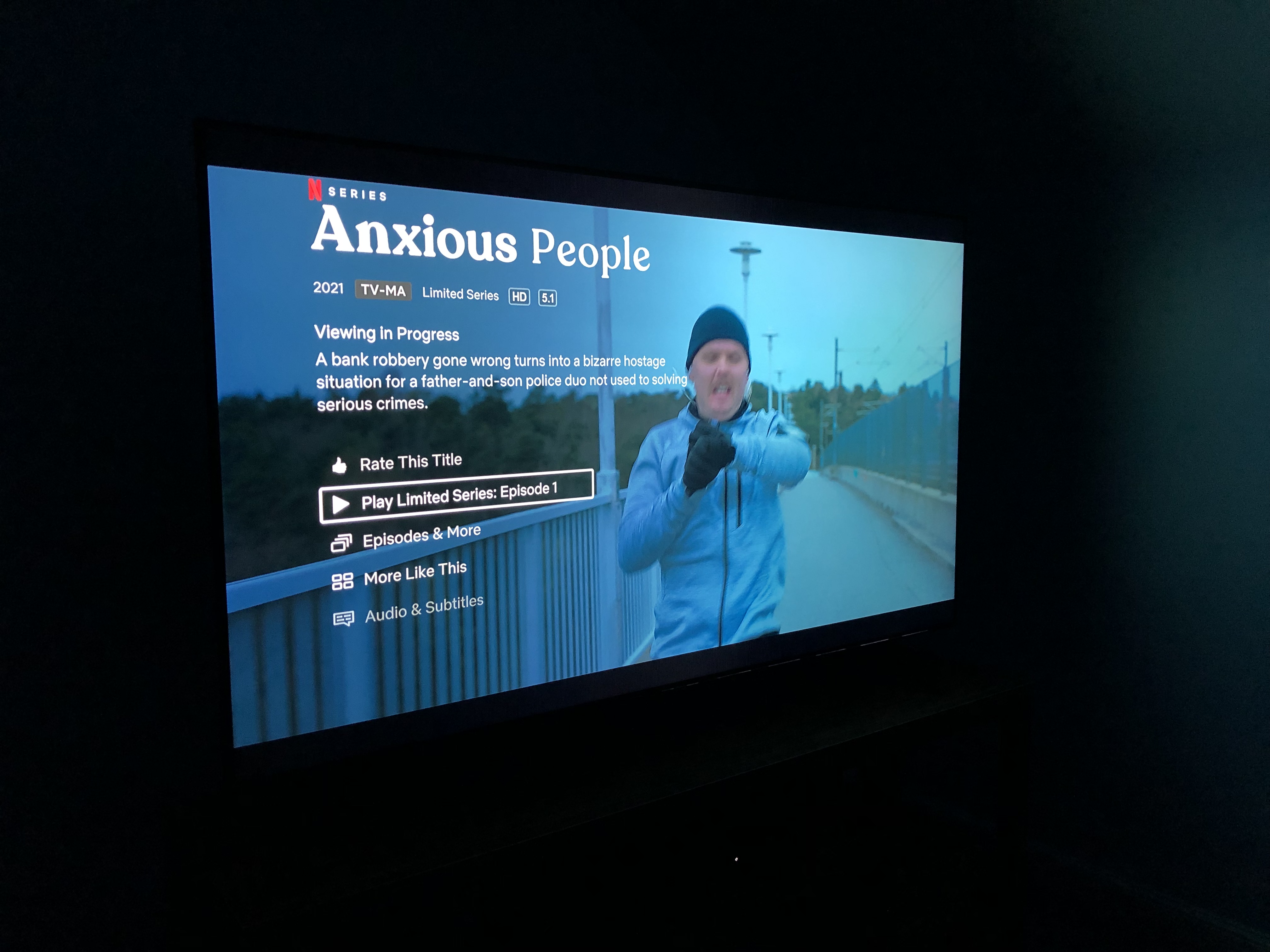
Let’s move on now, joyfully, to Anxious People, a Netflix mini-series (six episodes of about 30 minutes each) set and produced in Sweden and based on a novel of the same name by Fredrik Backman. Backman, by the way, is famous, having penned the international bestseller A Man Called Ove.

Sandy and I knew almost nothing about Anxious People before dialing it up, and are pleased as punch that we took the leap. It’s a whimsical tale centered around a group of folks who find themselves held hostage, in a loose sense, by an inept bank robber, and the police investigation that follows. I’m tempted to divulge a whole lot about Anxious People, multi-layered and fascinating as it is. For me to do so, though, would be a crime on my part, as telling too much would spoil the show for anyone interested in giving it a try.

So, I’ll add but a few more handfuls of words. To begin, are there flaws in the series? I, who can be picky to a fault, didn’t find any. The plot lines unfold and interweave deliciously, and the characters, nearly all of whom are laden with foibles and self-doubts, ring true. What we have here, then, is a gentle story that warmed the hell out of my heart. When the final episode reached its end I was filled with joy that carried over to the next day.

Boys and girls, that’s a wrap. I’d be happy to learn about who or what has given you joy of late. Till next time!

Bruce Springsteen’s Bringing Me To Broadway!

What can you say about Bruce Springsteen that hasn’t already been said? Not much, that’s for damn sure. The guy, after all, is an icon. An idol. And for good reasons: he’s talented as hell, smart as a whip, down to earth, and has been working his tail off in the music biz for over 50 years. Shit, his work ethic is unparalleled. And it hasn’t waned. He’s 71 years old, for crying out loud, yet has more energy than just about any teenager.

A scene from Springsteen On Broadway (photo by Rob DeMartin)

His latest project? He’s about to revive Springsteen On Broadway. An intimate one-man performance in which Bruce sings some of his songs and tells stories about his life, the show originally ran from October 2017 to December 2018 and was a huge success. When it reopens on June 26 at the St. James Theater, it will be the first Broadway production to be staged since COVID shut down New York’s theaters 15 months ago. Bruce is leading the charge to help the city return to its glory days!

Dig this: I personally know Springsteen a little bit. That’s because, unbelievably and from out of the f*cking blue, he showed up at my door in mid-2017, offering to make me — a nonentity in possession of zero musical talent — a member of his mighty E Street Band. “You’re shitting us, right, Neil?” I hear a chorus of doubters ask. Yo, ye of little faith, would I lie? You can read all about it by clicking here.

Alas, a band member I never became. I would have if the group had gone on tour, but tour it didn’t. Springsteen On Broadway and coronavirus saw to that. As a result, I was certain that Bruce had forgotten all about me.

Wrong! When my phone rang one evening early this month, none other than The Boss was on the other end.

“My man! Bruce here. It’s been a long, long while since we talked.”

“Bruce? Hey, it’s great to hear from you. How have you been?”

“Good, man. Real good. I’m always busy, you know. Wrote four songs this morning, for instance. They flowed out of me like a sweet mountain stream. Then I practiced the guitar for an hour. After that I was on the phone all afternoon with the director and stage crew of the Broadway show I’m bringing back in a few weeks. How about you? What have you done today?”

My throat seized up for a second. What had I, a stumbler through life, done? Well, as is often the case, taking a superb dump was the only thing that had invigorated me at all. Some might be afraid to reveal such an intimate detail to others, but I count myself as one of the brave. Bruce wasn’t the least bit fazed by what I told him.

“Neil, I know where you’re coming from. Once in a while I go through uninspired spells too. Listen, I feel bad that you haven’t gotten a chance to perform with my band. I want to make it up to you. What I have to offer would get you off your unmotivated ass, other than when you’re taking dumps, of course, and put you smack in the middle of the spotlight.”

“Does this have something to do with Springsteen On Broadway?” I asked.

“Indeed it does. Neil, I want to tweak the show a bit. Mostly it’ll remain the same — heartfelt, quietly powerful — but I’m going to add an interlude where I tell a couple of drummer jokes. The audience will love the change of pace. Here’s the deal: You’ll wander onto the stage right after I finish singing Thunder Road. I’ll introduce you and announce that you’re my straight man. Then I’ll say, ‘Neil, what do you call a drummer who breaks up with his girlfriend?’ You’ll shrug your shoulders to indicate that you don’t know. ‘Homeless!’ I’ll yell. Next I’ll ask you, ‘What’s the difference between a drummer and a savings bond?’ You’ll shrug again. I’ll bellow, ‘Only one of them matures and earns money!'”

“The crowd, I’m positive, will be roaring with laughter,” he continued, “and as they do you’ll bow and make your exit. Sound good?”

What? That’s it? Bruce, how about giving me at least a couple of lines of dialogue? I mean, I’ve never been on stage before, but I know I could handle that.”

“Baby steps, brother. Baby steps. For now, this is the best I can do,” Bruce replied. “And it’s the opportunity of a lifetime. You never know where this kind of exposure might take you. Are you on board?”

Only a fool would have answered no.

(Please don’t be shy about adding your comments. By the way, in 2018 a performance of Springsteen On Broadway was filmed for Netflix. If you have Netflix, do yourself a favor and watch the show if you haven’t yet. Springsteen thinks and feels deeply. He’s something else.)

Sue Miller The Novelist Got Me Thinking: Uh-Oh!

Who am I? Deep inside, I mean. For that matter, who are any of us? Man, those are questions I don’t think about too much. They make my head spin. You wouldn’t think they would, though, considering that my college major was psychology, some of whose branches attempt to help humans find answers to such concerns. I liked my psychology courses, and did pretty well grade-wise in them, but I guess that psychology and I never clicked meaningfully enough. We didn’t waltz together as a loving couple. At no time, then, did I see a psychology-based future for myself in my crystal ball. In fact, sad to say, when I gazed deeply into that glass hunk I didn’t notice any future career at all. Alas, with college degree in hand following graduation in 1969, I trod a long and winding road halfway to nowheresville, scrambling with little sense of direction to find steady employment and a decent-paying job.  Oy vey summed up my situation and prospects nicely.

Thank the baccalaureate gods above, the ship began to right itself a number of years later, the proverbial pieces starting to fit together. And in the end pretty much everything worked out quite attractively for me. But looking back on it all from five decades later, maybe I’d have found steady employment and a decent-paying job a whole lot sooner had I been more attuned to examining and answering the foreboding question, “Who am I?”. Not to mention another question, to which we’ll turn our attention shortly, that wasn’t at all on my radar screen in those days of yore.

In any event, here I am today, rolling “Who am I?” and its like around in my brain because of a novel I snatched off the shelf in a local library a few Fridays ago. Not paying attention to the hour of the day, I arrived at the library only 10 minutes before closing time. I realized this when the lights began to flicker, a signal to pack up and get out of Dodge.

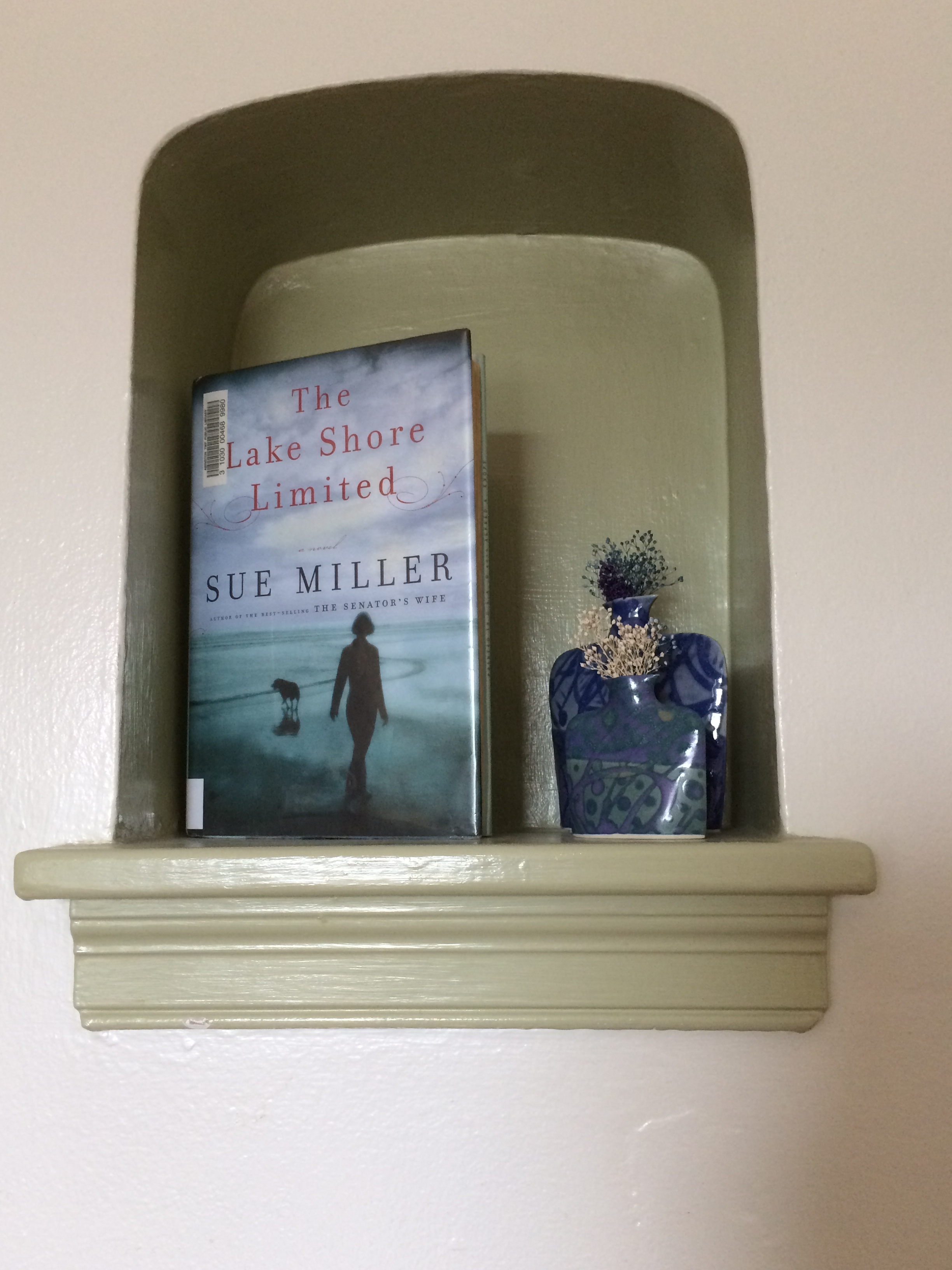
Determined not to leave empty-handed I moved quickly down the fiction section’s M aisle, which is where I was standing when the lights started doing their thing. My eyes darted here and there and landed on books by various Millers. Should I try something by Andrew Miller, whom I never heard of but whose volumes were emitting vibes that appeared to be meshing happily with my own? Or one of Henry Miller’s opuses, HM being a hip and bawdy cat I’ve plenty dug over the years? Nah, I wanted a female author. In the intellectual, not the carnal sense. Which is why I grabbed a few of the novels by Sue Miller off the shelf and scanned the synopses on their inside covers. I knew of Sue, she of the bestselling The Good Mother and The Senator’s Wife, and made my decision pronto. Home I went with The Lake Shore Limited sitting beside me in the car.

Sometimes you win, sometimes you don’t. In this case I won, because The Lake Shore Limited is a fine, fine book. If you are in search of a handsomely-wrought creation whose characters act and talk and think believably, it might be for you.

The Lake Shore Limited not only is the name of Sue Miller’s novel, it also is the title of a play set within the novel. What’s more, it is a real-life passenger train that connects Chicago with several cities in the northeastern United States. The play, which is seen through the eyes of various characters in the book, is the novel’s fulcrum. Its powers cause them, including the play’s author, to take good, hard looks at themselves and in some cases at those in their immediate orbits. All find within the play circumstances that resonate with or parallel their own lives.

Wilhelmina “Billy” Gertz, the novel’s main character, is a playwright living in Boston when the book opens. The year is 2007. Her latest product, The Lake Shore Limited, is in performance at a small Boston theater. And gaining strong reviews. Billy felt compelled to write the play, which she battled with for years trying to discover what she really wanted to say, because her once-boyfriend Gus had perished in one of the planes that demolished the World Trade Center on 9/11. Billy’s play tells a tale of an emotionally-numb man, Gabriel, waiting for Elizabeth, his wife, to return from a trip. She is travelling on The Lake Shore Limited. For many a moon, he and Elizabeth have not exactly been the happy couple. In no real sense are they together.

But life can change fast. The Limited has been targeted by terrorists, bombs ripping through it as it reaches Chicago’s Union Station. Gabriel’s soul-plumbing, while he waits to learn of his wife’s fate, reveal him to be more alive than he or the play’s audience expected.

Moving back and forth in time, Miller lays out the lives, past and present, of Billy, Leslie (Gus’s sister), Rafe (who portrays Gabriel in the play), and Sam (Leslie’s friend and Billy’s pursuer). We view events and encounters through their differing perspectives. And we learn that each character often isn’t too certain of the solidity of his or her perspective to begin with.

Which, to me, sounds like the way things are in real life. That’s one reason I enjoyed The Lake Shore Limited as much as I did. Its players come across as true flesh and blood. Miller’s novel also is layered delicately and precisely, which makes it rich. And ripe for discussion. Care and concern, unbridled love, grief, selfishness, infidelity, deception . . . these primo examples of the human stew are on full display in the novel. Maestro-like, Miller elegantly weaves these themes and emotions through her pages.

Not to downplay those just-mentioned examples, two of the things that have stuck in my mind like glue about The Lake Shore Limited even more are the “Who am I?” question and another question with which it goes hand-in-hand. Miller doesn’t dwell on them, but I felt them running as undercurrents in her novel. Billy, for instance, thinks of herself as a semi-loner. And, I believe, she knows that not only is it her insecurities that lead her in the loner direction, but that trying to overcome them by adopting a less-defensive approach to life might result in a jump in her happiness quotient.

And Sam, a successful architect, can only feel bad about how he failed pretty considerably as a parent when his children were young. They, now well into adulthood, and he don’t have world-class relationships. “Who the heck am I?” I can envision Sam asking. “What do I need to do to change my course?”

Billy and Sam . . . I can relate. We homo sapiens are emotional and malleable creatures, open to improvement and expansion, and vulnerable to blows. Yes, “Who am I?” is a biggie as questions go. But even if you find the answers to it, you’re not going to bloom enough if you don’t get around to examining, and acting upon, “What sort of person do I want to be?” too.

(If you enjoyed this article, then don’t be shy about sharing it or about adding your comments. Thanks.)

Killer Joe: The Song That Gave Me Pause

You know, I’m not exactly the poster boy for being cool. I mean, the last time that a hot chick couldn’t keep her eyes off of me was . . . was . . . was . . . yeah, now I remember. I was about two years old, being pushed around in a baby carriage. “Oh, he’s absolutely adorable,” the girl cooed, bending down to get a better look and never taking her gaze from mine. Wow, that was the best!

But I’ll tell you something. I do know how to be cool once in awhile. Like when I hear a great tune on the radio, one so finger-snapping and head-bopping fine that I can’t contain myself. Just watch me as I rise from the sofa and strut across the living room, the dining room, the kitchen and back again. Fingers snapping. Head a-bopping. Cool, man, cool. It happens now and then.

Killer Joe. That’s the tune that got me off the couch one recent evening. As usual I was doing not much of anything, except half-listening to the radio and counting the number of Cheez-Its crumbs stuck to the sofa’s cushions. I had counted 87 of them when — POW! POW! — Quincy Jones’ version of Killer Joe came on the air. It sounded spectacular. Next thing I knew, I was stepping.

killerjoebenny the-jazztet-featuring-art-farmer-and-benny-golson-killer-joe-argo
Killer Joe, a jazz standard, was composed around 1959 by jazz saxophonist Benny Golson, who has written many other songs (I Remember Clifford, Whisper Not, Stablemates) covered by scads of jazzbos. And Benny’s 1960 recording of Killer Joe is absolutely ace (click here to listen). Benny put the tune on wax with The Jazztet, the group that he co-led with trumpeter Art Farmer, and it came out on their album Meet The Jazztet. But Quincy’s KJ is better. It’s just too, too much, though it took me awhile to settle permanently into that opinion (click here to listen). I like it more than The Jazztet’s version because it has more slinky sizzle. Quincy himself didn’t play on the tune, which is from his 1969 album Walking In Space. But he arranged and conducted it and hired some monster guys to send out the sounds. Ray Brown (bass), Hubert Laws (flute) and Grady Tate (drums), to name a few.

To me, Ray Brown’s confident, strutting upright bass is the key to Killer Joe. From the opening bass lines straight through to the song’s end, Ray Brown is walking the walk. He’s under control, yet swaggering. He’s keeping things tight and tense, but jaunty too. And Tate, his steady high-hat cymbal work somehow loose as a goose, ambles arm-in-arm with Brown. Beyond the purring Brown/Tate engine, I couldn’t get enough of the airy flute solo, the piercing trumpet interludes and the pleading voices of the female chorus. Man, my fingers were snapping big time as I did my household shuffle.

KillerJoeQuincyR-2139078-1368881598-7835_jpeg
It wasn’t till the next day, though, relistening to the song on YouTube, that I paid attention to the lyrics that the ladies sing. “Killer Joe, don’t you go/Hurt me slow, please Joe.” Whoa, what did that mean? Is this a song about physical abuse? Had I been slow-marching and bopping to a composition that contains a really nasty notion? It took me a good long while to grasp the meaning of the words. They don’t paint a pretty picture, but I believe that the hurt referred to is emotional, not physical. Killer Joe (the character, not the song) is a cad, a heel, a self-absorbed jivester whom some women just can’t resist. Smitten, they know it’s a certainty that he will leave them. And that their hearts face a sad destiny: to be broken. The ladies want to be let down easy, not hard.

Now, The Jazztet’s recorded version of KJ basically is an instrumental piece. It has no lyrics, though Benny Golson felt the need to open the proceedings with a spoken introduction to let the world know that KJ ain’t a swell guy. Nine years later, on Quincy’s version, lyrics, brief as they are, were added. Who wrote them? I’ve scoured the Web, coming up unsure as to the answer. Could have been Golson, could have been Jones, could have been both or neither of them. Regardless, Quincy’s 1969 take on the song expanded Golson’s equation. What had been an instrumental description of a me-first, ponies-playing ladies’ man became deeper, something to ponder. Quincy Jones’ Killer Joe is a swinging statement tempered with reminders about how doleful and strange and complicated life can be.

Speaking from my me-first perspective, it’s a good thing that Quincy’s KJ isn’t about women who like their bad boy to whup them. If it were, into the deep freeze it would go, never to be listened to again. I’d be a chump to support any tune that goes that far to the dark side, even if it grooves like a champ.

But all is well in my music world. Onward!

(Don’t be shy about adding your comments, or about sharing this article with others)