The Day My Father Went Eye To Eye With Van Gogh

My father came to live with me and my wife Sandy in Philadelphia soon after his 90th birthday, in 1999. He had been living alone on Long Island, but health issues necessitated his relocation. Good doctoring in the Philadelphia suburbs improved his physical condition quickly, but there was no cure for the declining state of his kidneys. He became a dialysis patient one year after he moved in with us, and he remained on dialysis till his death in 2005 at age 96.

My father was in pretty good shape until the final nine or so months of his life. He loved getting out of the house and joining Sandy and me and others at restaurants, concerts, museums, you name it. On this Father’s Day I’ll relate one incident that I look back on fondly. It was the day that he and I and my brother had a private viewing of a rarely-seen Van Gogh oil painting at the Philadelphia Museum Of Art.

There are several purported photographs of Vincent van Gogh. None are totally authenticated. This is believed to be from about 1886.
There are several known photographs of Vincent van Gogh, though they are not fully authenticated. This photo is believed to be from about 1886.

Vincent van Gogh is one of my two favorite artists. The other is Paul Cézanne. I never can decide which of the two I like best. For wordsmanship, however, I go with Vincent. In spring 2001 I read all 800+ of his mesmerizing letters, in their English translation. My father got a kick from this. He told people that I was becoming a Van Gogh expert, which was hardly the case. But my semi-obsession with Van Gogh was rock solid, and it is here that the story really begins.

One day in January 2002 I poked around some Van Gogh websites and discovered that the Philadelphia Museum Of Art, which Sandy and my father and I frequented, owned five Van Gogh oils. Yet, I had never seen more than four of them on display there. The painting that I wasn’t familiar with was Still Life With A Bouquet Of Daisies. Most experts believe that Vincent painted it in summer 1886, a few months after he moved to Paris to live with his brother Theo and to contemplate the new techniques and perspectives, most notably those of Impressionism, that had been invigorating the French art scene. Why wasn’t the painting on display? I needed to know.

A few days later, from my desk at work, I dialed the museum and got connected to an assistant curator. I asked about the mystery painting. She told me that the museum did occasionally bring it from storage to the public galleries, but that it had been a long time since that had happened. We chatted a little and then I said thanks and was about to hang up. But before I could the curator asked “Would you like to see it?” Huh? Huh? I couldn’t believe my ears. Yes ma’am, I would.

My father was about to turn 93, on January 19, 2002. A few days before that, to help our dad celebrate his birthday, my brother Richard planned to fly to Philadelphia from his California home. I explained this to the curator and asked her if my brother and father could come along with me (Sandy, chained to her job, wasn’t free to get mid-day time off from work). Sure, she said. Fairly stunned, I set the date for Friday January 18, a non-dialysis day. I knew that something special had just occurred.

The momentous day arrived. We drove to the museum and were met in the west wing by the curator. She was a lively and lovely person and probably was getting as big a charge out of the situation as anyone. Down an elevator we all went to one level of the museum’s cavernous underbelly. We followed our hostess along a long corridor, walking past many locked rooms. At our consecrated storage area she unlocked the door and we entered. Perpendicular to one of the room’s sides were very large moveable display panels. All of them were in their retracted positions. The curator pulled out one of the panels, both sides of which were covered with paintings, maybe 20 per side. I noticed a Chagall on the side facing us. Can’t recall what else. Except of course for a work near the left edge on the top row. The Van Gogh.

Still Life With A Bouquet Of Daisies. Philadelphia Museum Of Art
Still Life With A Bouquet Of Daisies.
Copyright Philadelphia Museum Of Art

It was show time. The curator wheeled over a tall moveable step ladder. Richie and I went up first. What did I make of Vincent’s oil? Well, Still Life With A Bouquet Of Daisies doesn’t have the brilliant color schemes that Vincent was developing in Paris. It is dark, with lots of deepened greens. Maybe that’s why the museum doesn’t bring it out of storage too often. But they should. With Vincent, there’s always something to admire. I took in his trademark broad brush strokes, the intense tangles of flower stems. The greens upon greens.

Richie and I and our benefactor were excited and happy for my father when his turn came. My dad was excited and happy too, a muted gleeful smile on his face, his eyes on alert. I’m sure he knew how lucky he was to do what he was about to do. Holding the ladder rails carefully, up he climbed. Admirable mobility for a guy one day away from the big 93. He gazed at the painting for a good long spell, longer I think than my brother or I had. He spouted words of admiration. He was having a ball. Finally he came back down. Thank you, thank you, thank you we said to the wonderful curator.

Over the following years, my father and brother and I talked about our museum visit many times among ourselves and with friends and relatives. Always with a grin. Always feeling a tingle. And so, I dedicate this Father’s Day essay to Hyman Scheinin, he whom I’m sure is the only nonagenarian ever to climb a step ladder to go eye to eye with Van Gogh.

John Gorka Brings Love To The Philly Burbs

The audience, before twilight set in, at Bryn Mawr Twilight Concerts.

I’m always on the lookout for live music. My musical tastes are wide, so my antenna is open for jazz, rock, Celtic, classical  . . . the list keeps going. One series I keep tabs on is Bryn Mawr Twilight Concerts, held on mid-year Saturday evenings at a park in the center of Bryn Mawr, Pennsylvania, a handful of miles west of Philadelphia. This series brings in some rock and R&B bands, but primarily sticks to acoustic folkie singer-songwriter types, most of the latter well known in that genre’s circles. The musicians set up shop in the park’s large gazebo. I had noticed a few weeks ago that the series opener on June 6 would be John Gorka, a singer-songwriter road warrior with over 30 years’ worth of original material to draw from. On Gorka Day, I checked the Bryn Mawr weather forecast. It emphasized a zero chance of rain. Bryn Mawr here we come. As the sun began approaching the horizon, my wife Sandy and I plunked ourselves down in our folding chairs, joining about 200 others at the park, and settled in for what we expected would be a night of good music. The skies were filled with friendly clouds, the air cool and dry. Hardly a better place to be.

I’ve been familiar with John Gorka for many years, but had seen him in person only once. That was about six years ago at the Philadelphia Folk Festival, where he was part of a round-robin song swap with other musicians on a small stage. I knew his backstory a bit, how he had honed his craft at the legendary Godfrey Daniels folk music club in Bethlehem, PA, and how his career began to take off around the time his first album, I Know, came out in 1987. Since then, he has logged too many miles to count in North America and overseas. The Bryn Mawr show probably was somewhere around the 3,000th concert performance of his career. During that career, Gorka has tended to take the solo route — Have Guitar, Will Travel — but on this refreshing Bryn Mawr night he brought along a friend.

Music critics often note the fine quality of Gorka’s baritone. That’s true. His voice is deep and burnished, but he doesn’t go for extra volume. Soothing and comforting are words I’d use to describe his singing.  He’s like a lower register version of James Taylor. Between songs he is funny and somewhat jittery, slyly putting himself down and reminding me a bit of Woody Allen. The Bryn Mawr audience loved his on-stage personality, which might very well be his real life personality too.

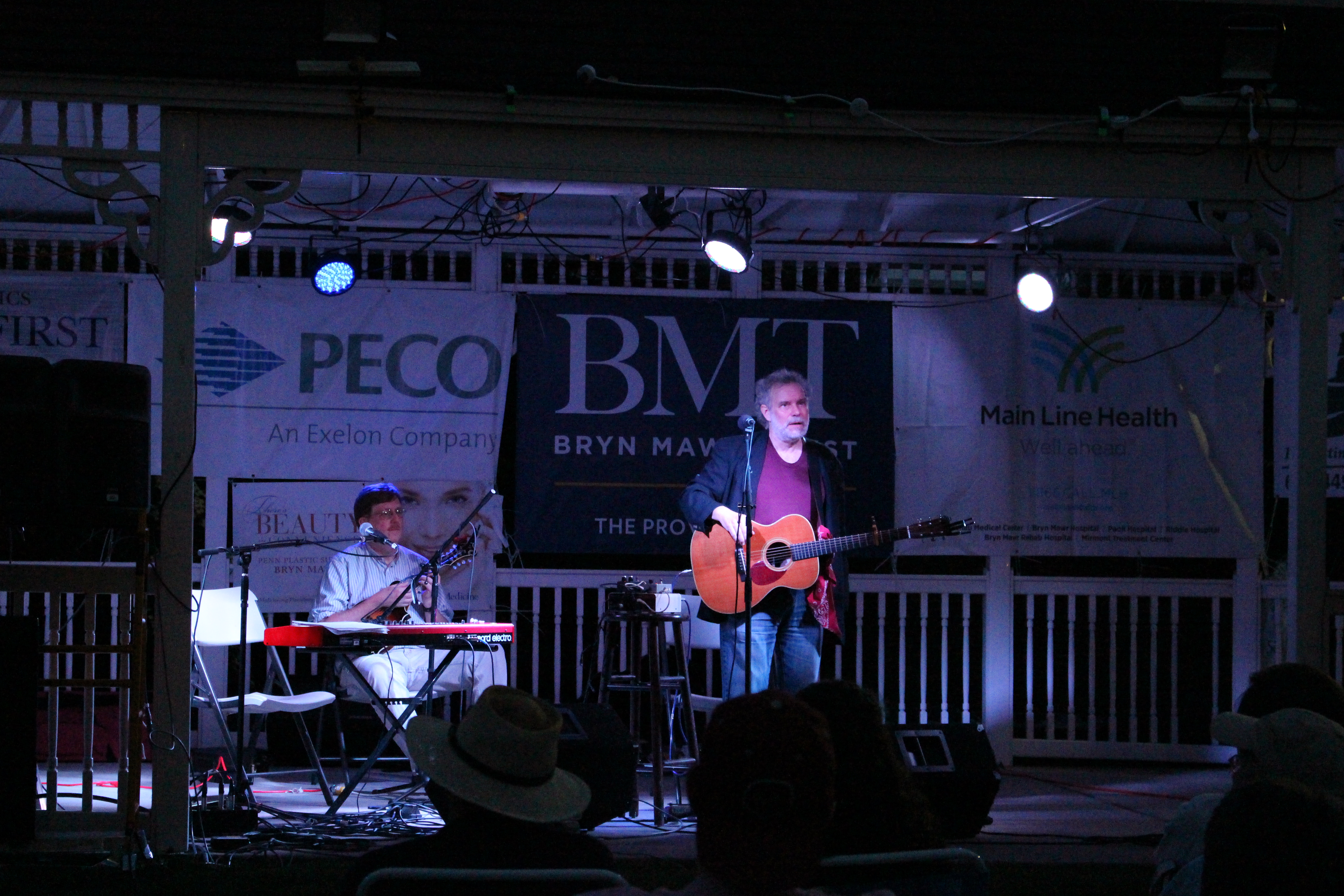
John Gorka with guitar, backed up by Russ Rentler with mandolin.

From within the gazebo he sang only self-penned songs, 20 in all. Four came from I Know, and five from his latest release, 2014’s Bright Side Of Down. The newer material was as smart and flavorful as the songs from his young man days. His pool of inspiration hasn’t dried up. For the ninth song of his 100 minute set he brought to the stage Russ Rentler, his mandolin-playing pal since the late 1970s. I figured that Russ would garnish a couple of tunes and then depart. Better, he remained till the concert’s end. The mandolin’s tight and high tones, the swirling notes from Russ’s fingers, added a lot of energy and contrast to the music. Gorka’s vocal and guitar work through the first eight songs were just fine, but Russ took the performance upward.

John Gorka’s makeup leads him to produce songs that unfold mostly at slow or medium paces. Which is fine with me. He examines love and relationships regularly, as do nearly all songwriters. And he also writes about people’s day to day struggles. I connected with nearly all of the songs he sang. I’ll mention some lines that made my ears bend stageward.

Love Is Our Cross To Bear is a gentle song about falling in love. It comes from I Know. As the air began to chill with descending twilight, and I realized how wise Sandy had been to tell me to bring along a light jacket, Gorka sang, “I didn’t know that I would find a way to find you in the morning/But love can pull you out of yesterday as it takes you without warning.” Beautifully put, John. And five tunes later he reached into Bright Side Of Down and gave us Outnumbered, a love song for his wife. Gorka’s voice, steady and strong, was something you could believe in. He sang, “Suddenly you were there behind a smile, behind a name/After that summer day I’d never be the same.”

John Gorka is a romantic. And he put on a good show.

Outdoors At Last, At Morris Arboretum

Ocean, beach and sand cliffs on Cape Cod.

Cape Cod has become a favorite locale for me and my wife. It was love at first sight when we first ventured there for a vacation in 1998. We like pretty much everything about Cape Cod, but the one aspect above all others is its expansive areas of startling beauty. The Cape’s Atlantic Ocean beach, for one example, is breathtaking, about 30 miles of it uninterrupted and basically undeveloped. In the off-season you can walk there as far as you like, gazing at the waters and the tall sand cliffs backing the beach, and there’s a good chance you’ll cross paths with nary another human. Not many places where such a scenario can be duplicated. And at Cape Cod’s outer reaches is one of the more astonishing vistas I’ve ever seen, a five mile long lunar-like expanse of enormous sand dunes and valleys. Most unusual, most unexpected.

Cape Cod’s natural world draws me outdoors. When Capeside my wife and I spend hours in the fresh air daily. Home in the burbs, though, it’s another story. Here I’m out when mowing the lawn or shoveling snow or shooting hoops at my neighborhood playground. Other than that I’m indoors most of the time, and I think this is because there’s a dearth of beautiful suburban places to get lost in.

Luckily for me, Philadelphia is at hand. It’s an old city and a new one, with great architecture and sights. Walking its streets and parks is an outdoors activity that I do a fair amount of.  On Memorial Day weekend’s Sunday, my wife had an inspired Philadelphia idea. Let’s visit Morris Arboretum, she suggested. We hadn’t been there in years. This would be a fine chance to spend time in a lovely green spot not far from home. Okay, I said. We drove to Philadelphia’s Chestnut Hill section, where the Morris takes up a lot of space (167 acres). We spent three hours there. It was good to be outside for an extended period.

Morris Arboretum originally was an estate named Compton, home to siblings John Morris and Lydia Morris. They were wealthy, worldly and civic-minded folks. Their mansion is no longer with us, but Compton’s grounds and some secondary buildings remain. Established in 1887, Compton stayed in Morris hands till 1932, the year of Lydia’s passing (John had died in 1915). Lydia bequeathed Compton to the University of Pennsylvania as a botanical garden and research facility. The U of P has maintained and developed the property ever since.

Morris Arboretum has gotten a whole lot better since our previous visit. Back then a parent might have said to his or her five year old Amy or Andy, “Hey, look at that pine tree. Isn’t it beautiful?” and Amy or Andy would have responded “I’m bored, let’s go home.” The arboretum managers, obviously smart people, saw the need to build kid-magnet structures. Up went the Garden Railway in the late 1990s, and in 2009 Out On A Limb opened.

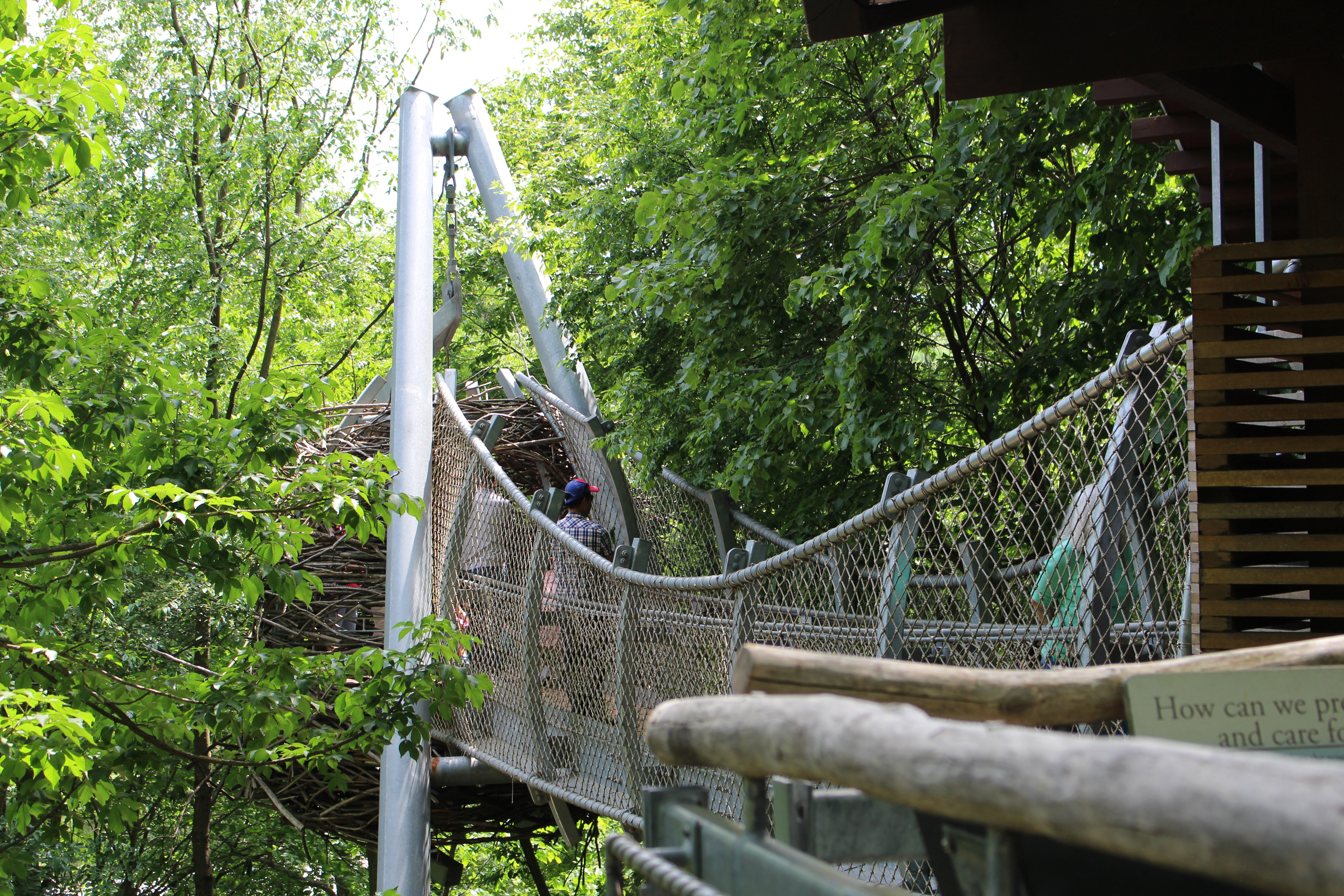
Morris Arboretum's Out On A Limb.
Morris Arboretum’s Out On A Limb.
Out On A Limb's play area.
Out On A Limb’s play area.

Out On A Limb is very cool. It’s an elevated twisting boardwalk, supported by steel columns and threaded between trees on a hilly part of the arboretum’s grounds. You enter at ground level and in a few seconds, because the earth slopes away quickly,  you’re looking down 40 or more feet at the forest floor. Walking alongside the mid and upper reaches of trees is a gas. Best yet is the play area at the walkway’s far end, where giant rope hammocks are suspended off to the side. Kids abound there. No wonder that attendance at Morris Arboretum has grown steadily since Out On A Limb came on the scene.

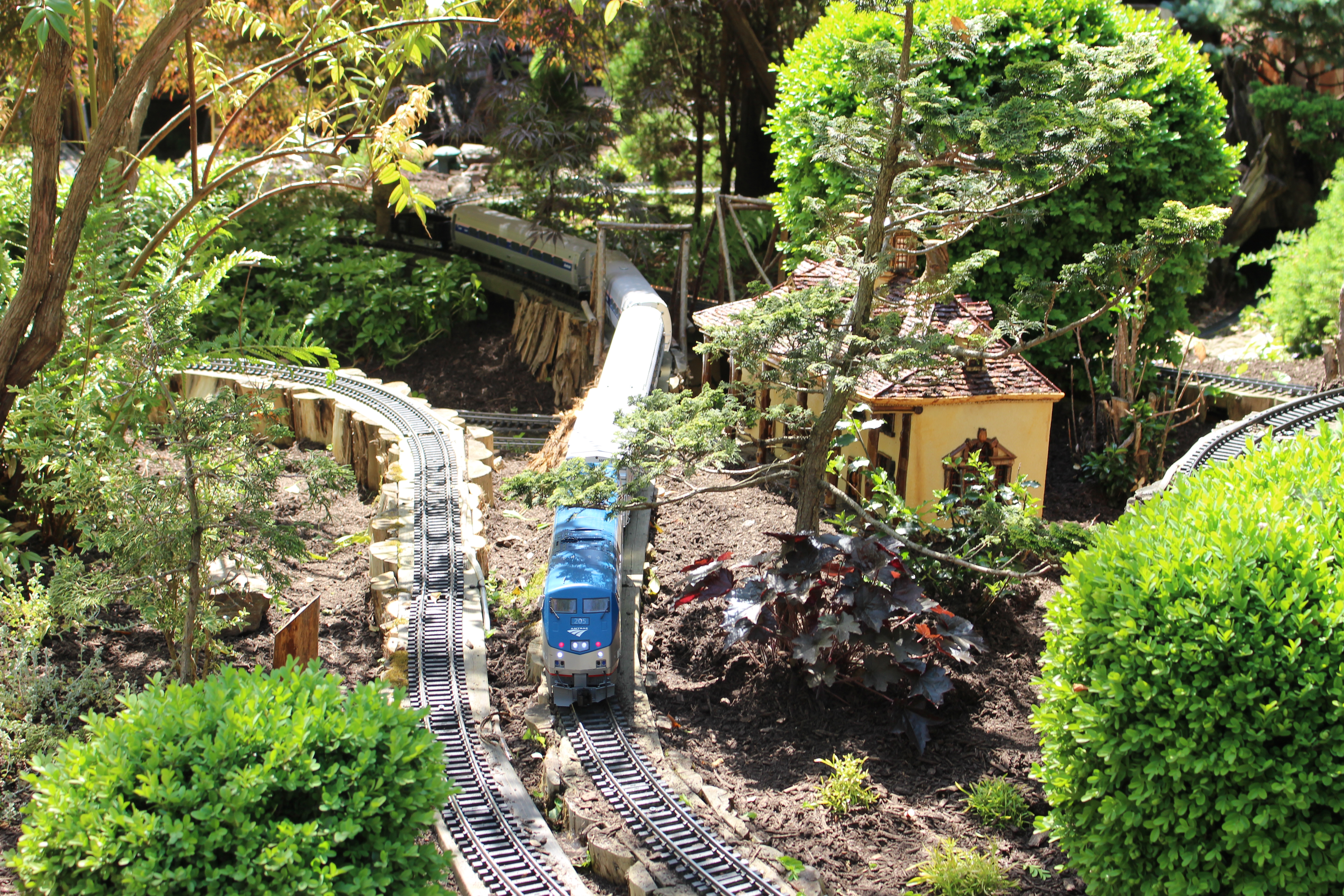
Morris Arboretum's Garden Railway.
Morris Arboretum’s Garden Railway.

Almost as invigorating is the Garden Railway. Nestled among trees and shrubbery near the Morris’s Rose Garden, it is a cleverly designed toy train layout. Passenger trains, freight trains, cable cars, tunnels, bridges . . . all are there in three large separate areas. So are natural-material replicas of famous structures, such as the Eiffel Tower and Philadelphia’s City Hall. The trains wind their way over, around and through, disappearing from view, eventually reemerging. My wife and I were intrigued by the whole set-up. It’s something.

The amazing Blue Atlas Cedar at Morris Arboretum.

It’s not a bad idea to stroll the arboretum’s grounds with no particular plan. That is to say, you won’t go wrong by not referring too often to the map you’re given at the information center. Morris Arboretum is a work of art, sculpted to display its trees, flower gardens, fern groves, swan pond and shrubs. Poking around them randomly works. Plenty of things, often green ones, will catch your eye. One tree in particular caught mine, a Blue Atlas Cedar. One of this massive being’s long lower limbs shoots out perpendicularly to the trunk, resting on the earth. The limb I think grows that way naturally. It doesn’t appear to have been forced into its strange position by windstorms or magic.

Sculptures by George Sugarman.
African Queen, a stone sculpture at Morris Arboretum.

Manmade sculpture is another big part of the arboretum experience. Many such objects are placed on the grounds, continuing a tradition that John and Lydia began. The most colorful are the large playful and organically-shaped painted aluminum creations by the late George Sugarman. They’ve been on site since 1981. The most alluring sculpture to me is African Queen, a stone carving from Zimbabwe, artist unknown. How old is it? 50 years? 500 years? If the arboretum custodians have the answer, they’re not saying. Regardless, it’s a charmer. Pablo Picasso, who was greatly influenced by African art, would have loved it. The armless queen is asleep, her sweet face lost in dreams. The artist chose to depict her headdress as broad and undefined, focusing attention to the face below. A visit to Morris Arboretum, in my opinion, is incomplete without making time for this superb piece.

A Winning Dinner And A Fashionable Movie

Figuring out last minute Saturday night plans at home in the burbs recently, my wife and I were surprised to find dinnertime slots available on OpenTable for Capofitto, a hot newish Italian restaurant in Philadelphia’s wonderful Old City section. This is a place we’d read about when it opened last autumn. It sounded good and also intriguing, as it contains a ten ton pizza oven that was built by three Italian masons on site from bricks and other materials boated over from Italy. Clearly this is an establishment that takes its pizza seriously, which makes me smile. Quickly we made an OpenTable reservation, shot off to a suburban train station, and rode the rails into Philadelphia. After dinner we planned to catch a movie, Dior And I, at the Ritz Bourse art house cinema, one block from Capofitto. We silently congratulated ourselves for developing such an efficient plan for the evening.

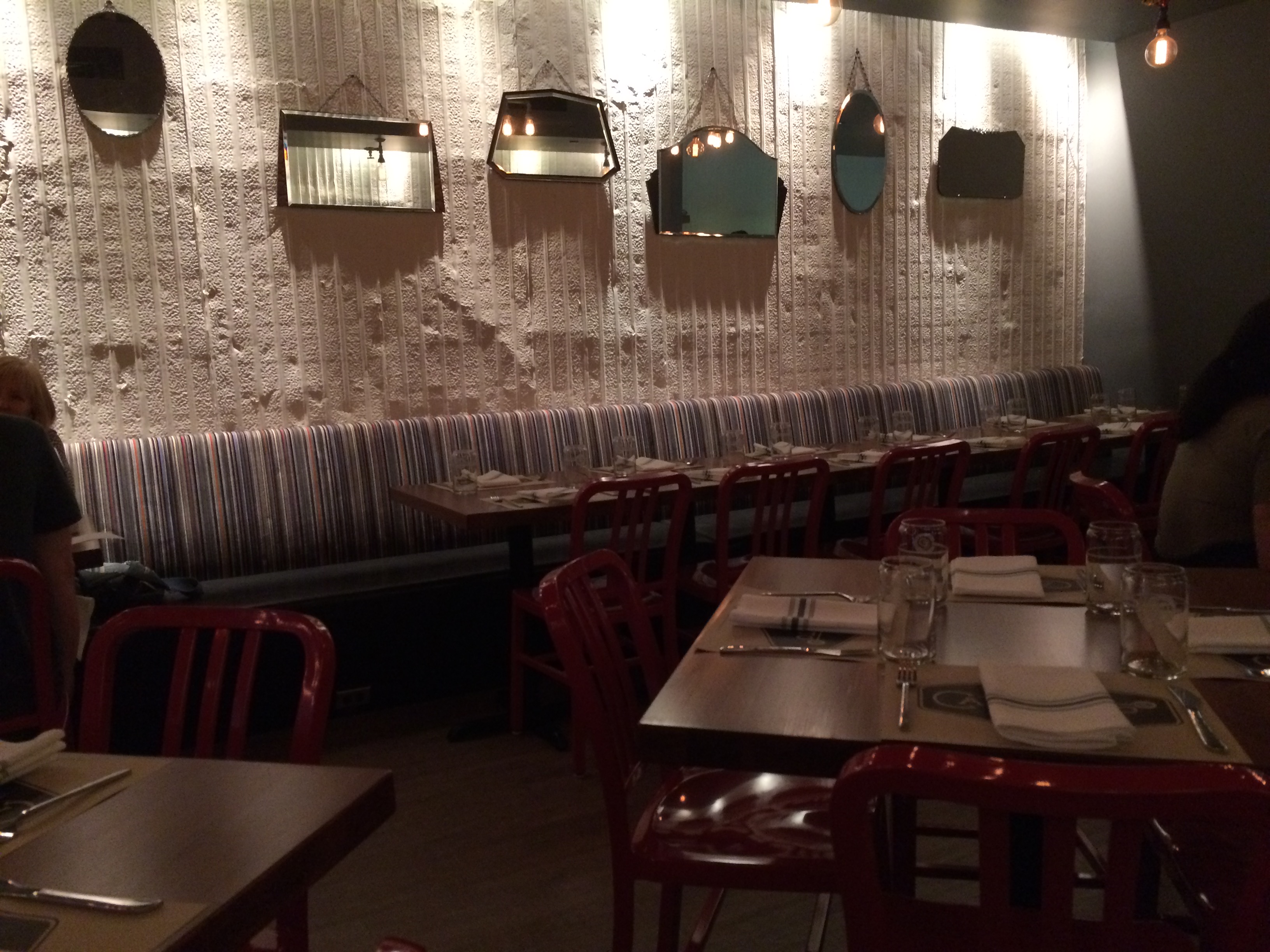
Capofitto's dining room.
Capofitto’s dining room.

Capofitto (233 Chestnut Street) is a good looking place, fairly wide and very long, comfortable but not too fancy. Housed in a building about 115 years old, its modern décor somehow gives off the vibes of a traditionally-decorated Italian eatery. The restaurant is owned by Stephanie and John Reitano, who have placed a geletaria in the front room. This is understandable, as the Reitanos blessed Philadelphia earlier this century with a scattering of mucho popular gelato cafés. Capofitto expands the culinary parameters of the Reitano empire.

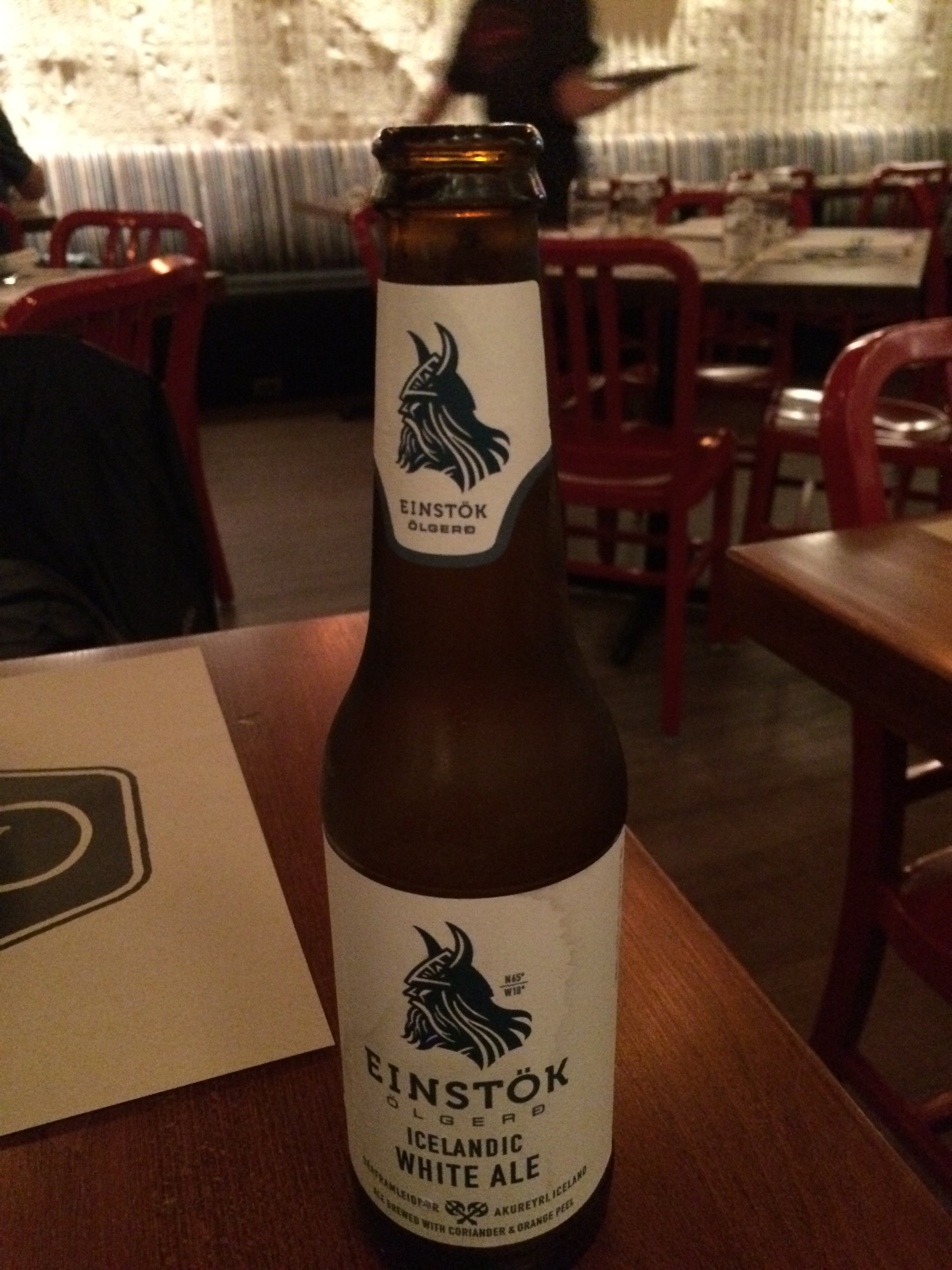
Icelandic White Ale
Icelandic White Ale

The first important question is: What beer did I order?  An Italian one would have been appropriate, but for the fact that Capofitto’s beer menu listed a brand I’d never heard of before, from a country I’d never given any thought to as a beer producer. Iceland of all places. Next time at this sweet restaurant I’ll drink Italian, but this night it had to be Einstök brewery’s Icelandic White Ale. This is a wheat beer whose label implies that the brewers toss orange peels and coriander into the vat. I noticed those flavors, but unexpectedly I also found a substantial hint of celery wafting up to my nostrils. Must have been the hops, weird dudes that can impart all manner of tastes and aromas to beer. Regardless, the ale had bite and was refreshingly bubbly and I liked it a lot.

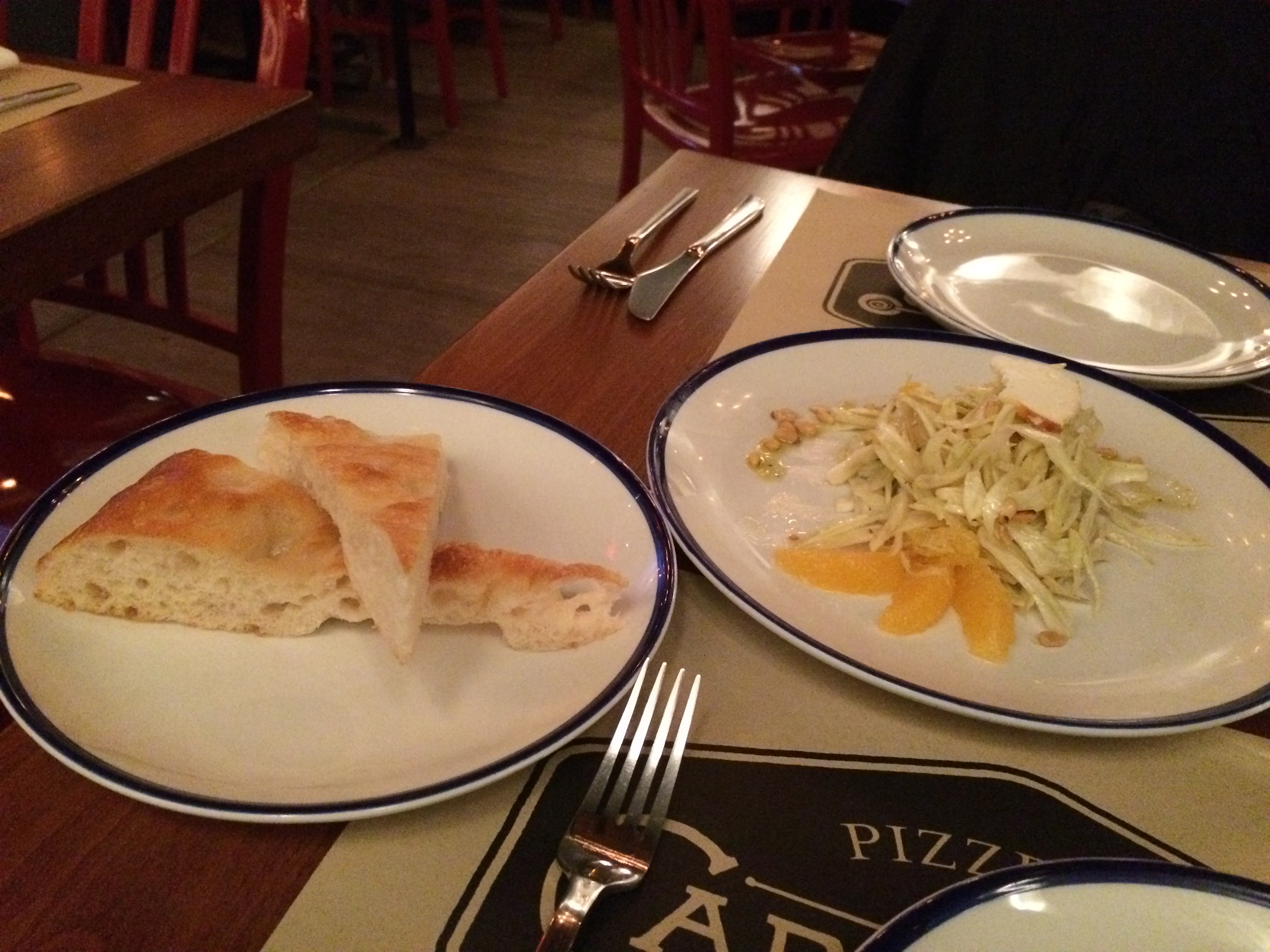
Capofitto's pinoli salad and focaccia bread.
Capofitto’s pinoli salad and focaccia bread.

What then did we have for dinner? Pizza of course, preceded by a pinoli salad. Pinoli? That’s pine nuts to you and me. My wife and I shared both the salad and pizza. The salad was misnamed, being composed largely of shredded fennel and orange slices, and brought to life with a fine milky dressing and ricotta cheese. And with some toasted pinoli too. We thought much of the salad, though a lot more pinoli wouldn’t have hurt. With the salad came focaccia bread, very good indeed.

Our gorgeous pizza.
Our gorgeous pizza.

Our pie, a margherita to which we added salty black olives, was fabulous. The pie crust’s body was thin and crisp, its puffy rim chewy in a satisfying way. The entire crust was heat darkened and blistered here and there, the good quality wheat’s earthy flavor shining through. It’s not every pizza whose wheat catches your attention. My wife and I sighed contentedly as we munched away. This was one of the best pizzas I’ve had in recent years.

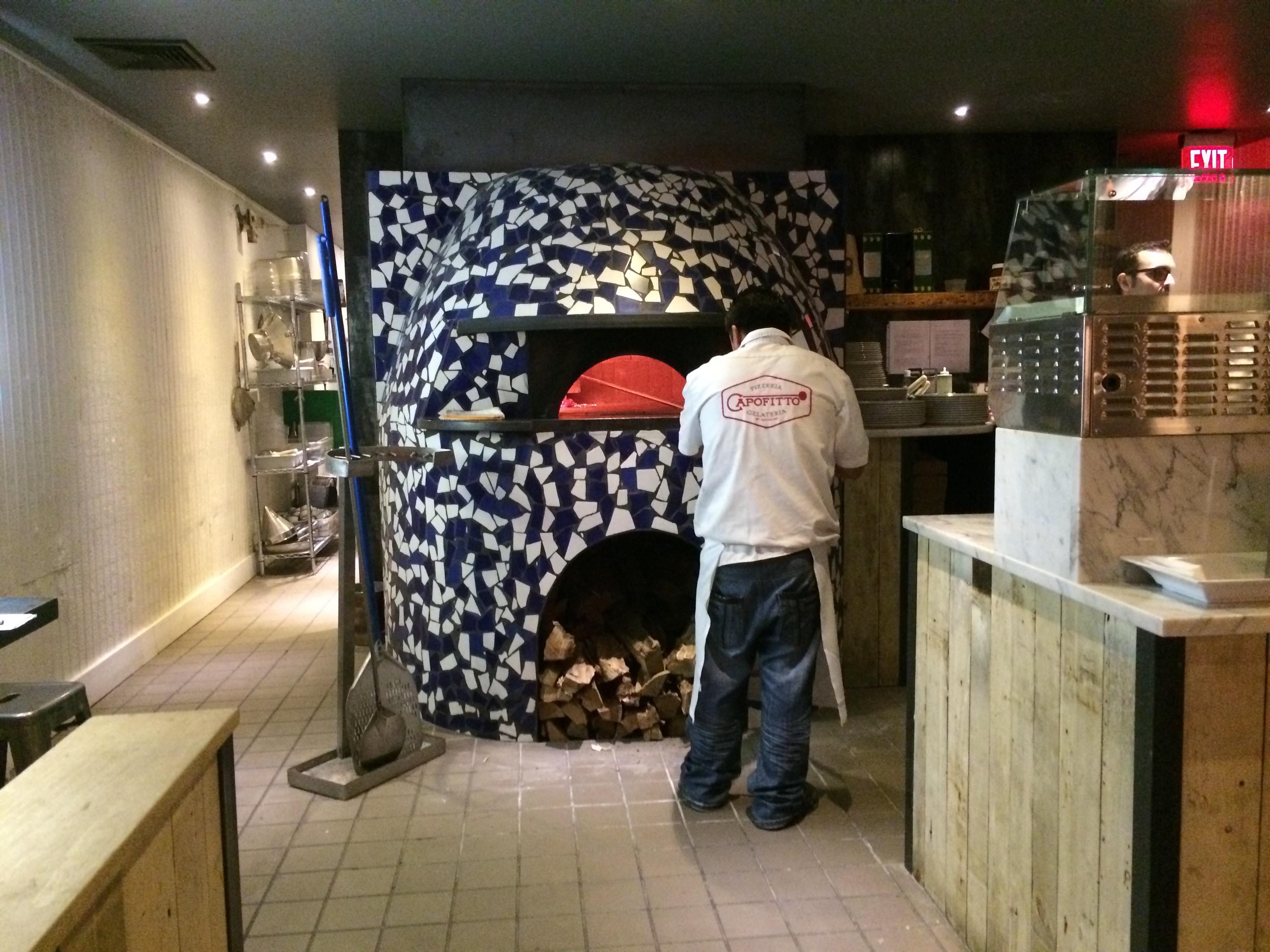
Capofitto's oak-burning pizza oven.
Capofitto’s oak-burning pizza oven.

The pizza oven, by the way, is a beauty. I looked it over for a few minutes. Capofitto feeds it wood, oak to be more precise, and it reaches very high temperatures, 900 degrees Fahreinheit or higher. Miraculously it bakes a pie in about 90 seconds.

Now, Capofitto has a large menu. Pizzas, salads, cold meats, cheeses, a few pasta dishes. I’d be surprised if most everything on it isn’t good to excellent. But after the pizza we were stuffed enough and didn’t eat anything more, not even the gelatos that brought the Reitanos their initial fame. We will return to Capofitto, at which time we’ll explore sections of the menu we didn’t get to. For now, on to the movie.

The poster for Dior And I outside the Ritz Bourse.

No one, most notably my wife, would describe me as a fashionisto. I am aware of trend-setting looks and high fashion, but the road sort of ends there. But like most anything, the world of high fashion, if explained and presented properly, will jump to life even for the mildly interested. At the Ritz Bourse my wife and I, as planned, watched Dior And I. Well-paced and well-developed, it is a documentary about the cloistered world of haute couture. It is very good, worth seeking out. Three out of four stars, I’d say.

Dior And I, directed by up and comer Frédéric Tcheng, follows the travails and successes of Raf Simons during the initial phase of his new job in 2012. For in April of that year, Simons, who had made his name in men’s fashion design, was hired by Paris’s world famous House of Dior as creative director for its women’s lines. Lucky Raf’s first big project began immediately. He had all of eight weeks to design and present Dior’s 2012 fall-winter haute couture collection. A snap, right?

The documentary begins with Raf’s first day at work, when he is introduced to the seamstresses and other staff now under his direction. Throughout the film Simons appears shy, which makes me wonder how he managed to rise to so high a creative and managerial position. Turns out that the House’s founder, Christian Dior, possessed traits similar to Simons’s. The private Dior was a reticent man, uncomfortable with the public demands of his occupation. Simons is aware of the founder’s bearings. On camera he says that he once began reading Dior’s memoir, only to put it down forever after a short while because he recognized too much of himself in Dior’s personality.

Wait, this is a spoiler alert: At the end Simons triumphs, a survivor of the strained nerves and pained expressions that accompanied him during his test by fire. The haute couture show, held on July 2, 2012 in a majestically flowered Parisian mansion, is a hit. There the movie ends. Today, almost three years later, Simons is still on the job. He undoubtedly has grown more comfortable in it.

Uncanny Valley, A New Play Performed In A Small Theater (I Like Small Theaters)

An early moment in Uncanny Valley (photo by InterAct Theatre Company)

This past weekend my wife and I went with friends to see a new play, Uncanny Valley, at Philadelphia’s Adrienne Theatre. The Adrienne contains four small performance spaces within its floors. I felt right at home in the ground floor theater where Uncanny Valley was staged, because I like small theaters.

Thomas Gibbons wrote Uncanny Valley. He is playwright-in-residence for InterAct Theatre Company, one of the groups using the Adrienne’s rooms. Gibbons is a talented writer. Some of his plays, such as Permanent Collection and Bee-luther-hatchee, have examined America’s race relations in sharply-focused scenarios. Uncanny Valley finds Gibbons exploring what for him is new subject matter. The play revolves around the high tech lab creation, in the not-too-distant future, of an Artificial Intelligence humanoid who, through training and electronic wizardry, comes to appear, emote and think like actual flesh and blood.

I have a talent for missing points and for not fully grasping situations. I’ve no doubt that this might be true for my understanding of Uncanny Valley. Rightly or wrongly, what I mainly came away with by the end of the play are two notions. First, that devising an AI creature is risky, as unexpected consequences may occur down the line. And second, that some humans don’t want to analyze their emotional shortcomings. I can’t say that any of this broke new ground for me.

Still, I enjoyed Uncanny Valley quite a lot. The actors in this two character play, Frank X as the AI gent and Sally Mercer as an AI programmer, work their roles well. The story unfolds intriguingly and at a well-controlled pace. Gibbons’ dialogue is crisp and usually rings true.

I doubt, though, if I’d have had as good an experience if I had seen the play in a larger theater. InterAct’s theater at the Adrienne seats around 100. Its intimacy can’t but help allow the audience to be drawn in. At the start of the play, Frank X’s character, Julian, seems to be nothing more than a head poking out of a table. Julian’s other body parts haven’t been attached yet. Facing him sits Claire, the programmer. Claire is teaching rudimentary facial movements to Julian, whose training at this point obviously is in its infancy. I sat a mere 20 feet from the stage, a fascinated witness to these early proceedings. From 75 or more feet away, I wouldn’t have felt as involved.

Is a smaller theater always better than a bigger? Generally I’d say yes, especially for dramas and comedies. No question that I tend to opt for the small, where I almost always have a decent or better-than-decent time, despite any deficiencies in acting or script. Being close to the action makes up a good bit for those drawbacks.

At larger places, the experience, at least for me, is more hit or miss. A few years ago I loved the musical Monty Python’s Spamalot at Philadelphia’s very roomy Academy of Music. It seats 2,900. I was at least 100 feet from the actors. So much was happening on stage with a dizzying parade of characters, though, that distance from the stage allowed visual perspective. Plus, the theater crew had the sound balanced well, always a good thing.

Not the case, unfortunately, for In The Heights, a musical my wife and I took in a year or two ago. We saw it at Philadelphia’s Walnut Street Theatre, which claims the title of America’s oldest theater (it began in 1809). The Walnut seats 1,000. We were in the mezzanine, hardly a mile from the stage, but not close enough. That wouldn’t have mattered as much if the sound quality had been good. It wasn’t. The dialogue was hard to make out, despite the actors being mic-ed. The musical numbers were a sonic mess, lyrics usually lost in a high decibel onslaught of instruments. This wasn’t a case of a boomer’s bad hearing. A few people seated near us, and a good bit younger than us, grumbled about the audio too.