Walking Through Philadelphia With Colors On My Mind

I woke up one weekday morning not long ago with visions of Philadelphia swirling in my mind and beckoning me. Amorphous visions, but colorful. I hadn’t done much city exploration in awhile. Hadn’t taken a long and leisurely stroll anywhere in awhile. What’s more, the weather prediction was highly favorable: warm, sunny and breezy. A walk was in order. And so, a few hours later in my suburban Philadelphia home, I closed my eyes, clicked my heels together three times and thought beautiful thoughts about the City Of Brotherly Love. Next thing I knew I was standing at the corner of 2nd and South Streets, part of a funky area not far from the Philadelphia waterfront and some of the city’s oldest residential blocks. Let the adventure begin.

The hike took nearly four hours. I trod, often guided by whimsy, on many blocks within the rectangle formed by 2nd, Bainbridge, Broad and Arch Streets. At the start I didn’t have much of an idea of what my route would be. But this much I knew: I wanted to stretch the ol’ legs, inhale Philadelphia’s quasi-clean air and feel the wind caressing my thinning hair. And this too I knew: I wasn’t in the mood to check out any historical or touristy sites, or anything with the connotation of trendy attached to it, all of which Philadelphia is loaded with. But it wasn’t to be an aimless ramble. No way. When I landed at 2nd and South Streets, I had in mind a theme for the day, inspired by the colorful visions from earlier in the morning. I was going to look for sharp and snazzy outdoor color displays produced by the hands of man, not by nature. It was a modest quest, probably kind of a dumb one. But hey, I’m that kind of guy.

fez IMG_0212mexican IMG_0215
Things got off to a slow start. I looked all around the 2nd and South Streets vicinity and the only colorful things I could find were Fez Restaurant’s facade and a happy, yellow ghoul, dressed in red, outside Las Bugambilias, a Mexican eatery. Still, I figured that the South Street corridor — not as happening a part of town as once it was, but hanging in there fairly well — offered a decent chance to come across more than that. And I was right.

mako's IMG_0220larry fine IMG_0222
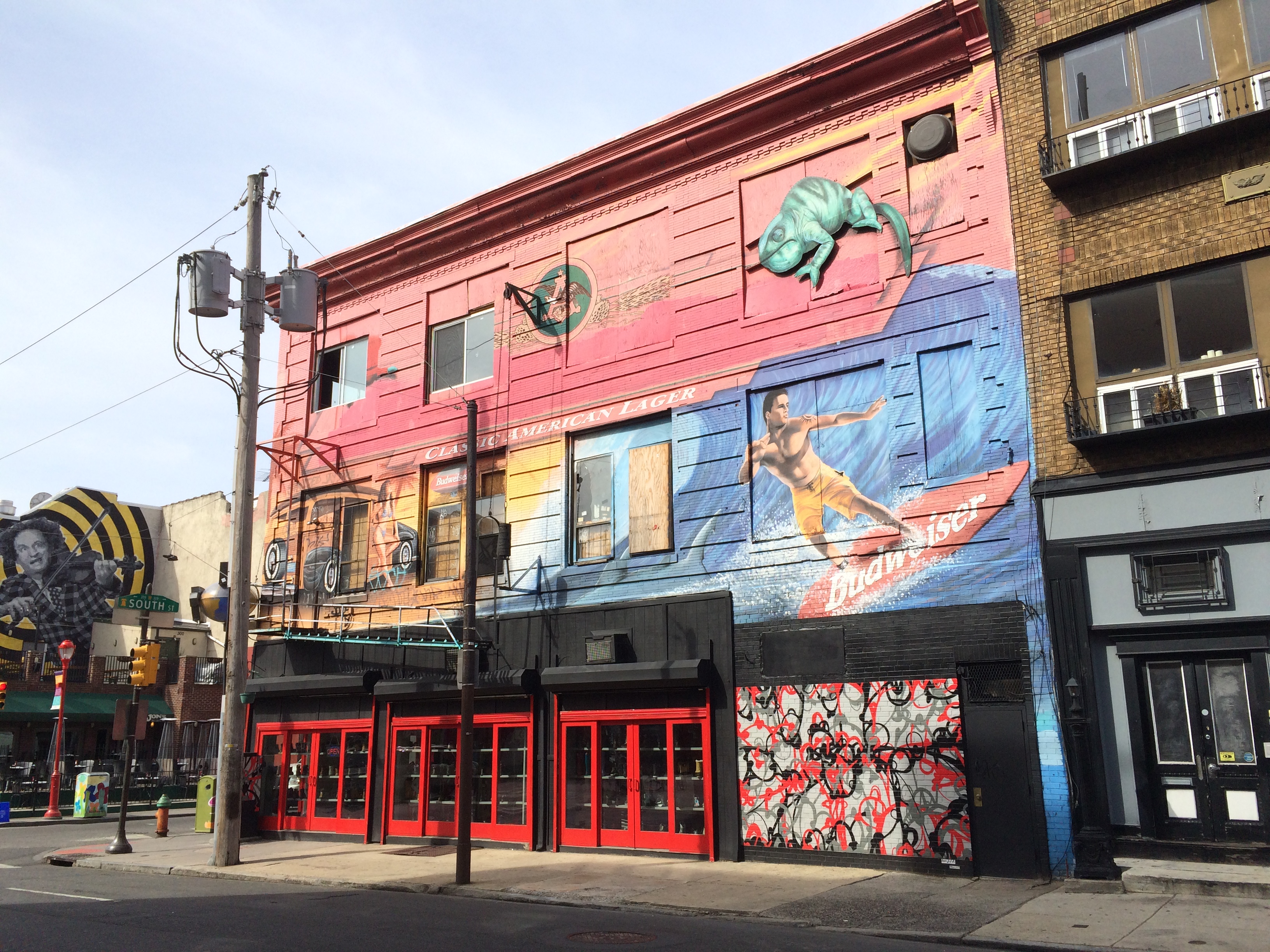
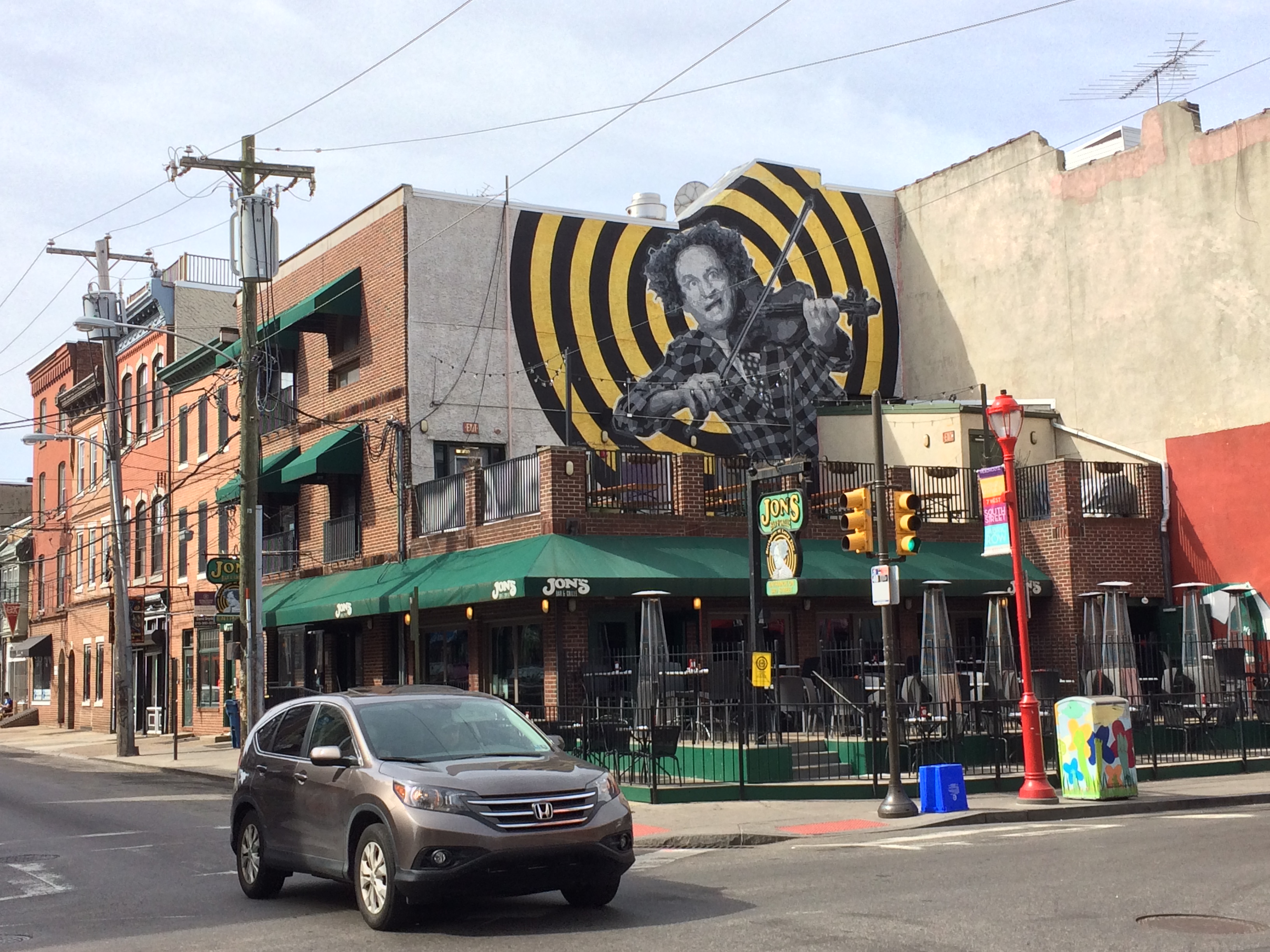
At 3rd and South I said to myself, “Wow, look at that mural.”  It was painted on the side of the out-of-business and mourned Mako’s Retired Surfers Bar And Grill. A guy on a surfboard, a girl leaning against a fat-tire car, all done in sweet pastel hues. Lovely. And didst my eyes deceive me? Directly across the street from the former Mako’s was another mural, this one depicting the torso of a fiddle-playing, electric-haired madman inside yellow and black concentric rings. None other than Philadelphia native Larry Fine, one of The Three Stooges. Yeah, man, now we were getting somewhere.

A little while ago I alluded to the fact that I’m no genius. Proof? I shouldn’t have been surprised to see the murals at 3rd and South, because I’d seen them before, though not in recent years. What’s more, I somehow also had forgotten that Philadelphia is the outdoor mural capitol of the world, thanks to Mural Arts Program, a public/private organization born in 1984. Incredibly, over 3,000 MAP- created works grace Philadelphia. No doubt, Mural Arts Program is one of the good guys. It aims to beautify all neighborhoods (from dilapidated to swank), to employ many folks in need of work and encouragement, and to inspire the general population. Big goals, all reached as far as I can tell.

DuBois IMG_0240
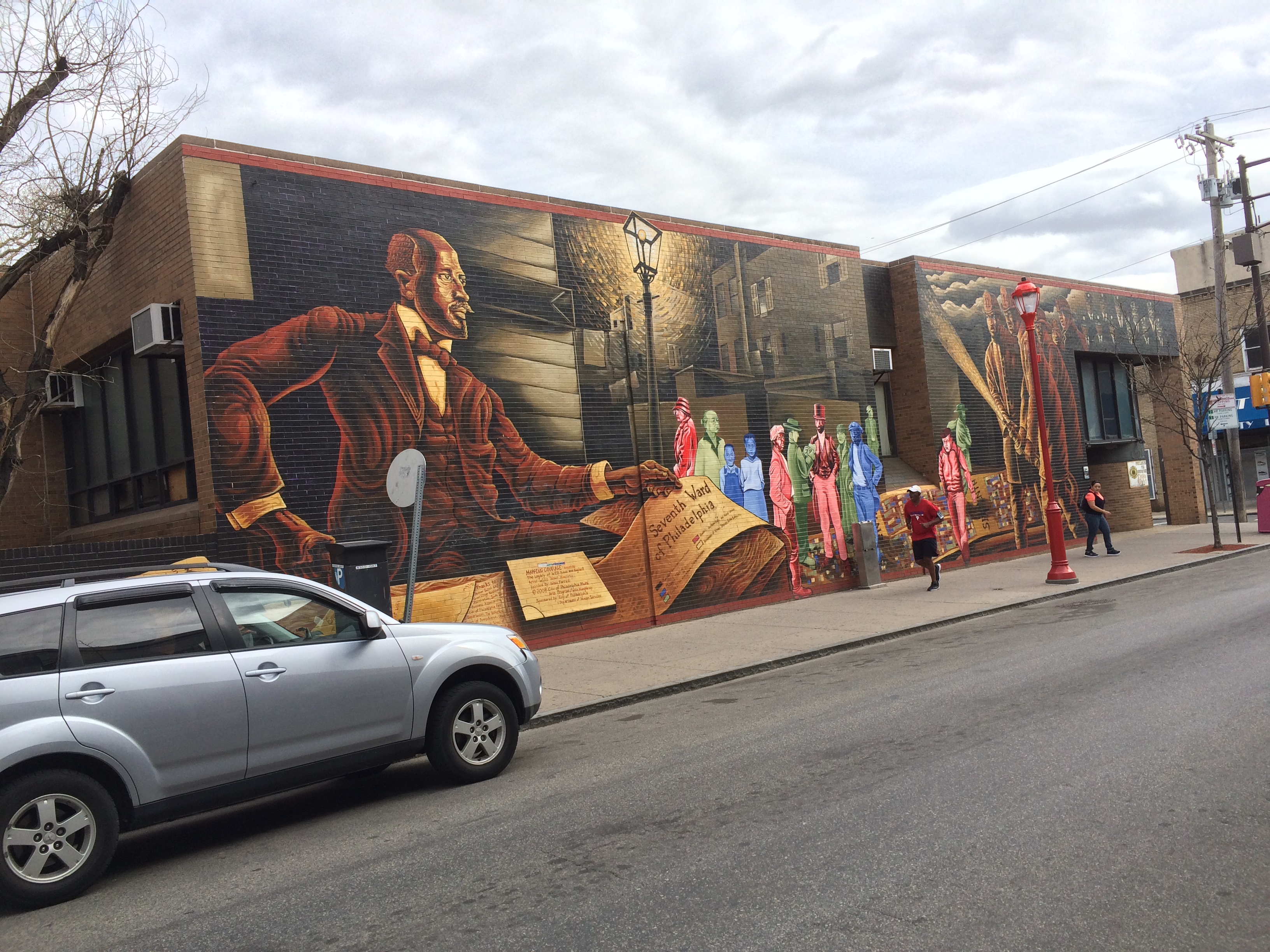
Well, I haven’t been able to determine if MAP was behind the painting on Mako’s side wall. But Larry Fine wouldn’t be overlooking South Street were it not for MAP, nor would two other murals that I later saw on my trek be in existence. Of those, the first I came to is attached to Engine Company 11, a firehouse at 6th and South Streets. It’s a magnificently imposing creation titled Mapping Courage. It honors W.E.B. Du Bois, the Black scholar and leader, and the firehouse itself, which for years was manned only by African Americans. The mural is beautifully designed, shining in browns and ambers that allow its few bright colors to pulsate.

Spring IMG_0260
An hour later, on Pine Street near 13th, I stumbled upon the mural known as Spring. Yowza, this one stunned me too. Look at those soft whites and butterscotch shades of the flowering foliage. How totally cool it was that real trees, in bloom, nearly were melting into the painted surface.

You know, somewhere in the middle of my expedition I realized something that never had dawned on me before. Namely, despite the murals that gas things up on certain blocks, most of Philadelphia’s residential streets, beautiful and architecturally rich as many are, sure appear tame when it comes to color. This ain’t exactly a news flash to the oceans of people more observant than I, but it’s true. And it’s largely because of bricks, bricks, bricks, the quintessential and earth-toned building blocks of Philadelphia. Bricks are sturdy, bricks are quaint, bricks have been with us humans for thousands of years. But man, I can understand how someone might decide that a brick-dominated landscape needs to be jazzed up. Someone named Isaiah Zagar, for example.

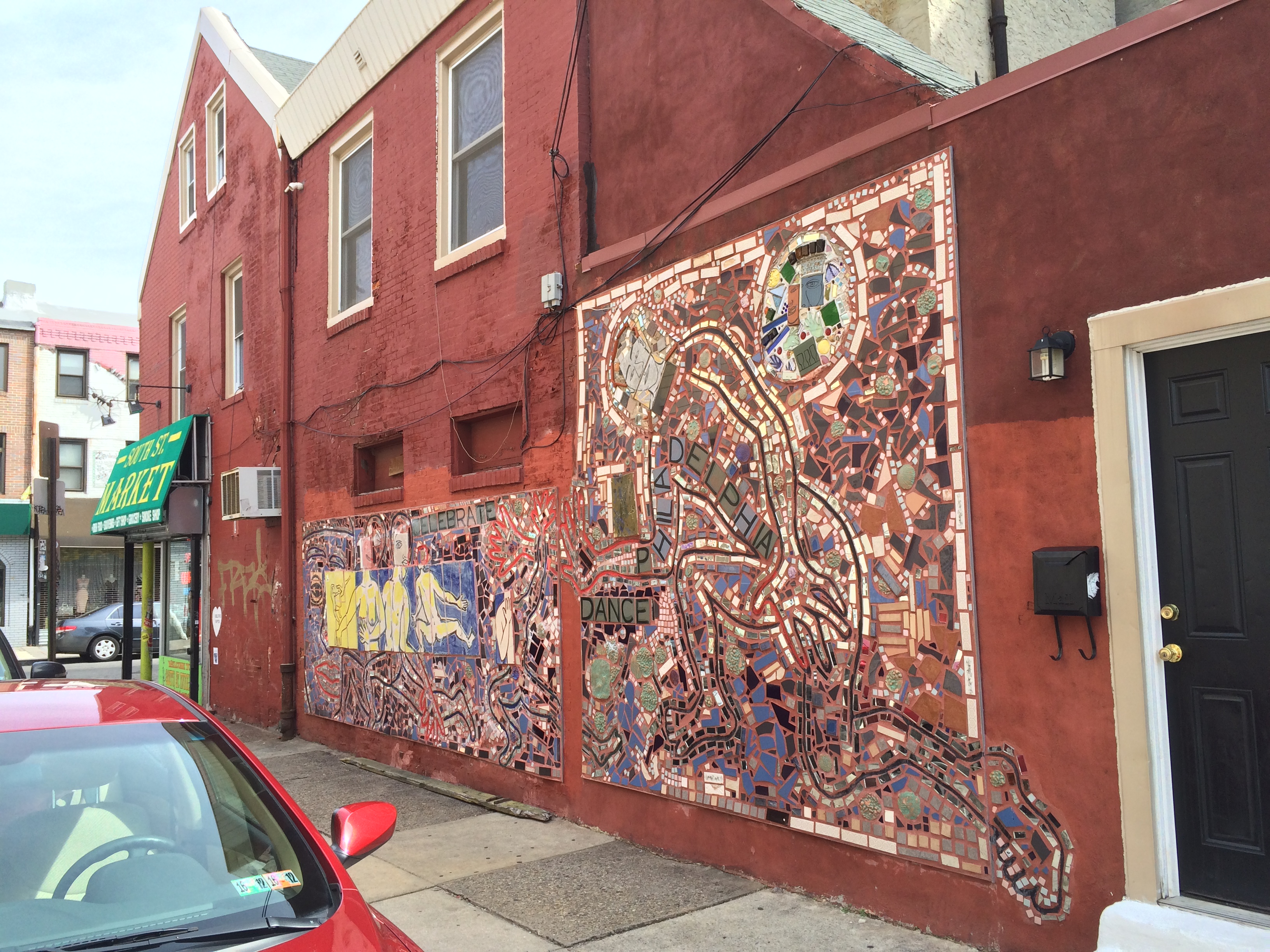
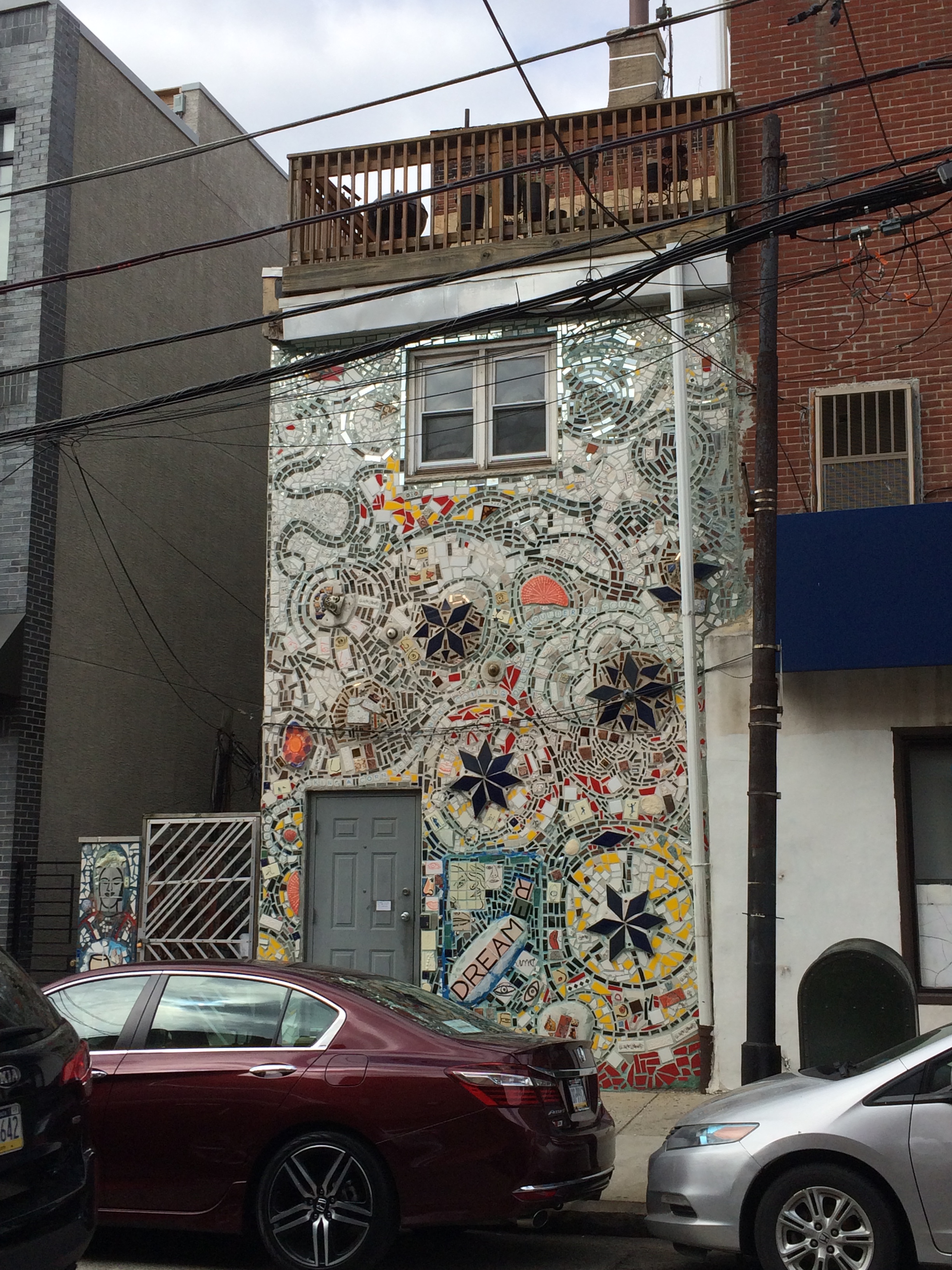
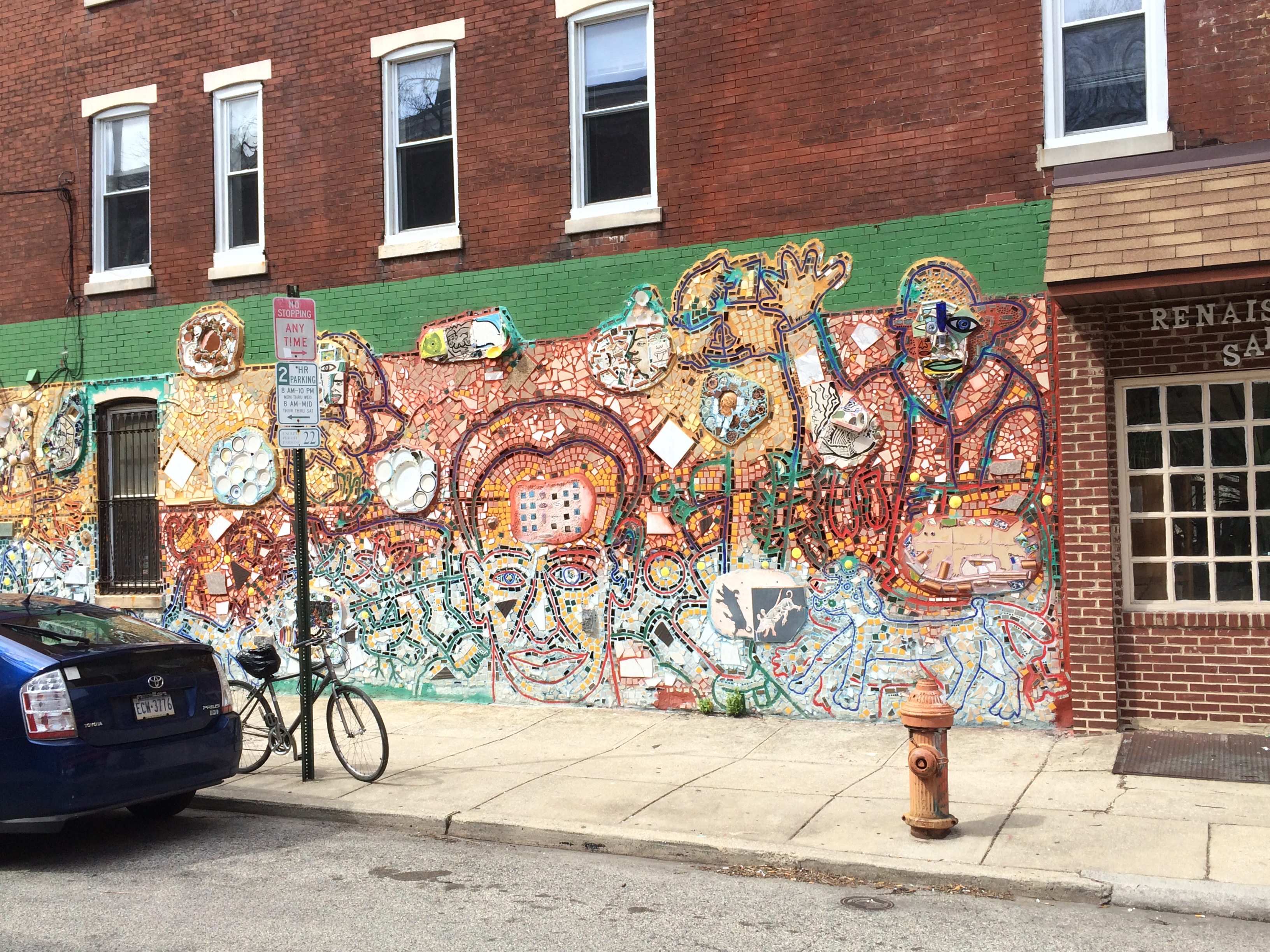
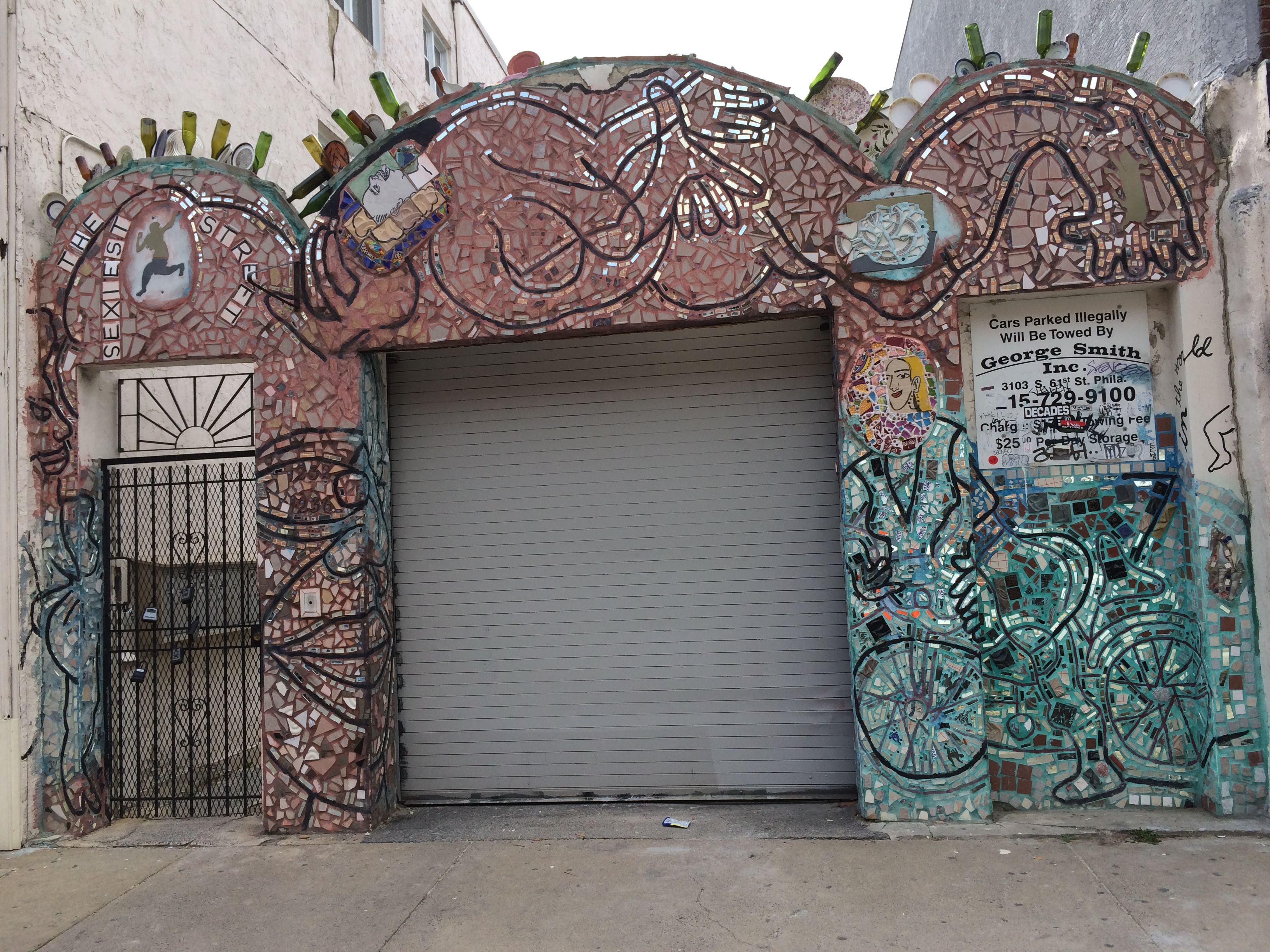
Soon after my walk began, a few minutes after I metaphorically tipped my hat to the Mako’s and Larry Fine murals, I started to come upon some unusually decorated homes, first on Leithgow Street, just off of South. And then on many other blocks near or on South. I had never seen these exterior wall decorations before, hadn’t known about them. They were something else, kaleidoscopic, multi-colored mosaics made from pieces of tile and glass. The design similarities got me wondering if one person had done all the work. I had a vague knowledge of mosaic artist Isaiah Zagar. I knew that he lived in the area and that he had established something called Philadelphia’s Magic Gardens. Were these freewheeling creations his? A bit later I learned that the answer was yes, and that he had begun adorning buildings quite a few years ago.

I suppose that Zagar obtained the permissions of homeowners before going wild on their domiciles. Or maybe he didn’t. Whatever. Unembellished bricks (and other stones), goodbye! Colors and designs up the wazoo, hello! Zagar’s mosaics put me in mind of native art from South America and Africa, of children’s art, of what cave paintings from 20,000 years ago might have resembled if their creators had been high on pot. Anthropomorphic faces and figures abound. Psychedelic cellular shapes look determined to escape their confines. Words like dance and celebrate and dream are embedded in the mosaics. Zagar is a positive thinker, a lover of life and, I assume, one hip cat.

Zagar’s greatest creation is Philadelphia’s Magic Gardens, a multi-level indoor and outdoor mosaic extravaganza, an arts center and a head trip that has become a go-to attraction for tourists and locals. He began work on it in 1994 in what then were abandoned lots, and endured some legal battles years later with the lots’ owners. In the end, creativity and social justice prevailed. PMG, an incorporated non-profit, opened to the public around 10 years ago. It’s at 1020 South Street. I caught a few peeks of PMG, grabbed a brochure from the admission desk and confirmed there that Zagar is the guilty party behind the glorification of the South Street corridor. But I didn’t want to interrupt my hike by entering the Magic Gardens. I’ll get back there some day and will drop my report within this blog. For now, this travelogue will end with photos of some of Zagar’s handiworks. If you click on any of them, or on any other photo in this article, a larger image will open.

IMG_0232IMG_0233IMG_0243

IMG_0246IMG_0250IMG_0251

IMG_0253IMG_0256IMG_0258

King Georges: A Possibly Tasty Movie Review

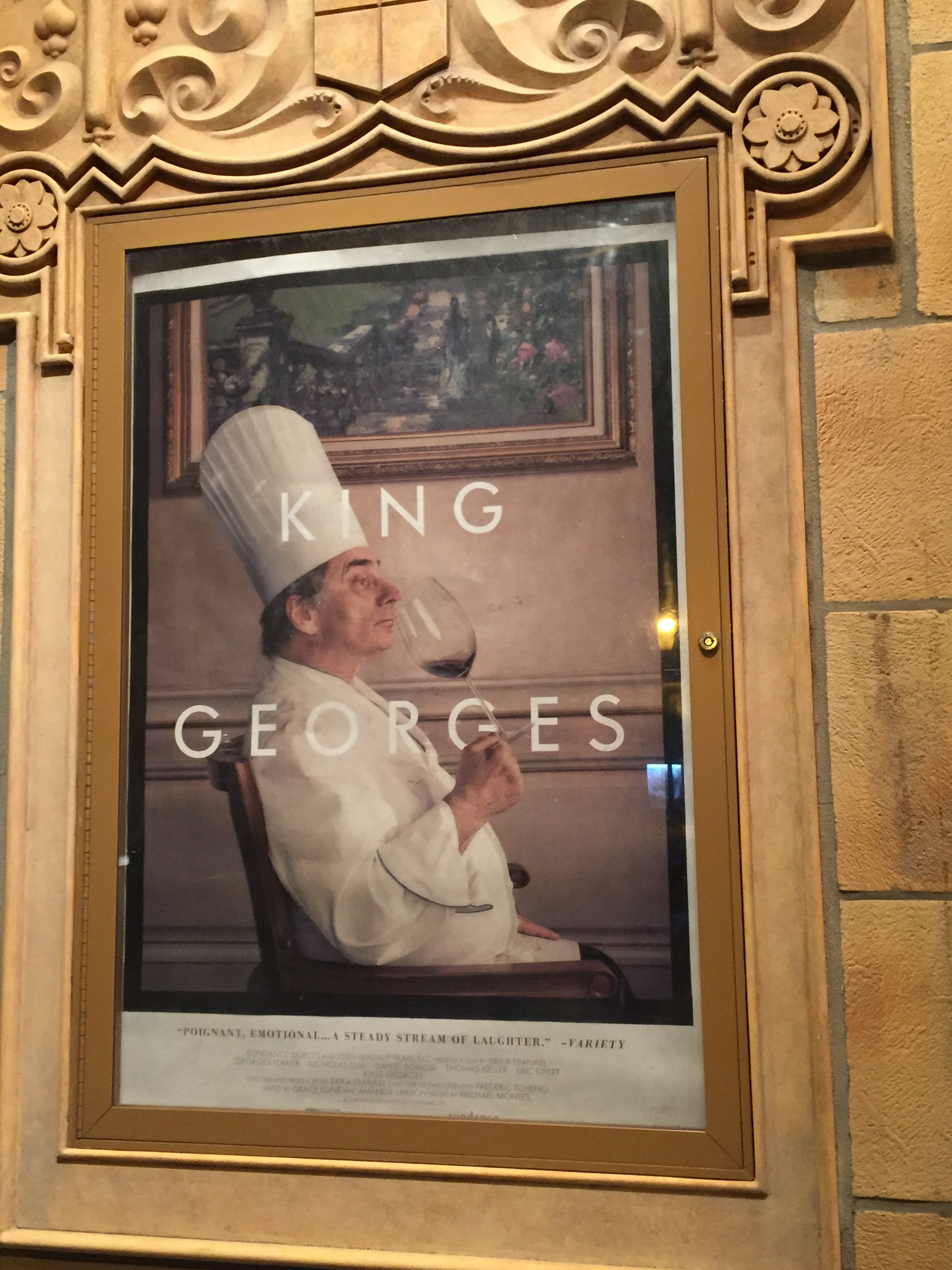
On our way to dinner at The Broad Axe Tavern on a recent Friday night I told my wife Sandy about the approach, since abandoned, that I might take in writing the article you currently are reading. It was to be a comparison of dinner at The Broad Axe with what my opinion would have been, had I ever eaten there, of dinner at Le Bec-Fin, a famous, majestic and now-closed French restaurant in Philadelphia. All of this made possible sense because the movie that Sandy and I were headed to later that evening in suburban Philadelphia was King Georges, a documentary about the last few years (2010 to 2012) of Chef Georges Perrier’s involvement with Le Bec-Fin, which he opened in 1970.

Yup, I had thought that my culinary tastes and scrutinies would make for way cooler reading than a review of King Georges. And, dope that I tend to be, I was quite certain about what my conclusion would be, even before seeing King Georges. Namely, that I’d prefer to eat at The Broad Axe than at fancy-schmancy Le Bec-Fin. Broad Axe food I understand. It’s good for the most part and you don’t need a translator to figure out what’s what. Le Bec-Fin’s fare, which I had read about for decades, would have intimidated me. That’s because I knew and still know diddly-squat about high-level French cuisine.

We saw King Georges at the Ambler Theater.

But after watching King Georges I did an about-face. Who cares about my food preferences when a terrific piece of filmmaking is at hand? Clear the way! Movie review, here I come! And by the way, I should have given pricey LBF at least one spin during its lifetime. I’d have parted with some serious cash, but the meal and the experience would have been worth it. I hadn’t because I was a culinary coward.

Sure, the food looks great in King Georges. But that’s not the reason to see the movie, as food isn’t primarily what it’s all about. What we have here is a vibrant look at a pretty complicated guy. King Georges is filmed mostly in close-up and often in tight quarters, Le Bec-Fin’s kitchens, and reveals an extremely colorful and self-driven character as he wrestles with the reality that his famed and celebrated baby, LBF, ain’t the destination that it once had been. And that maintaining his customer base is hard and ultimately maybe not possible. What’s a top chef to do? In Georges Perrier’s case, keep on truckin’ and truckin’ until . . .

King Georges 2 IMG_1269
King Georges shows Perrier as a sometimes-crazed dynamo in the kitchen, his senses aware of what’s going on in every pot and pan attended to by the small army of chefs under his command at LBF. He rants and raves. He praises and hugs. He includes sh–t and/or fu–k in half the sentences that pour from his mouth. He’s a pip, a perfectionist, an incredibly hard worker who seems to have gotten no more than a handful of hours of sleep nightly for forty-plus years. How can you not love someone like this? I mean, he cares. Born and raised in France, he came to the USA in the mid 1960s hoping to own, cook for and run one of the best restaurants in the States. All of which he ended up doing for years and years. And he became a celebrity of sorts in the process, a big name in certain circles around the globe, eons before the likes of chefs/restaurateurs Emeril Lagasse, Bobby Flay and Mario Batali became media fixtures.

During the last few years, though, Georges Perrier hasn’t been too visible. Whom, then, do we have to thank for bringing him to our eyes and ears in 2016? None other than Erika Frankel, she whom neither you nor I ever heard of before. Frankel has earned her keep producing documentaries and other works since the early 2000s but, before King Georges, never had donned a director’s cap. How did she manage to handle the job so well? Maybe it was beginner’s luck. Probably it was innate talent. Whatever, having a charismatic figure to make a movie about didn’t hurt.

You know, writing this article has made me hungry. I’m going to head into the kitchen and labor over one of my exotic specialties, a grilled cheese sandwich. I’m sure that Chef Perrier would approve of my sandwich-flipping technique, the precise and practiced manner in which my right wrist rotates just so. Before I say goodbye, however, let me mention that King Georges isn’t making waves at the box office. In fact, Sandy and I were lucky to see it in a theater, because nationally only a single digits number of cinemas are showing it. But happily for the inhabitants of our planet, King Georges is obtainable via Amazon Prime and other online operations. Be it at a theater, or more likely in the comfort of your home, here’s your chance to be the first on your block to watch King Georges. Take it from me, kids. I think you’ll like it.

(If you enjoyed this article, don’t be shy about sharing it. Sharing buttons are below)

(Photos by Sandra Cherrey Scheinin. If you click on a photo, a larger image will open)

A Philadelphia Saturday Night

Our plans for a recent Saturday evening came together quickly. Flipping through a newspaper we (my wife Sandy and I) saw a review of a play titled Spine. The play sounded good. Its theater was in Philadelphia’s central section, easy for us to reach from our home in the burbs. OK, Spine it would be. Deciding to have pre-show dinner near the theater, we looked for an eatery where we’d never been before. We clicked here and there on OpenTable and settled on Franky Bradley’s, a place we knew little about. A handful of hours later we arrived at FB’s at the appointed time, 6:15 PM, and the night began.

Some Philadelphians will recall Franky Bradley’s when it was a steakhouse and celebrity hangout and its first name was spelled Frankie. That was decades ago. In its most recent incarnation the place was a gay bar. Last year a new owner turned the property into a restaurant/bar/dance club, resurrecting the name (save for the spelling change) but nothing much else from the original FB’s. Only one steak is on the menu and I doubt if Franky’s is a celebrity hang.

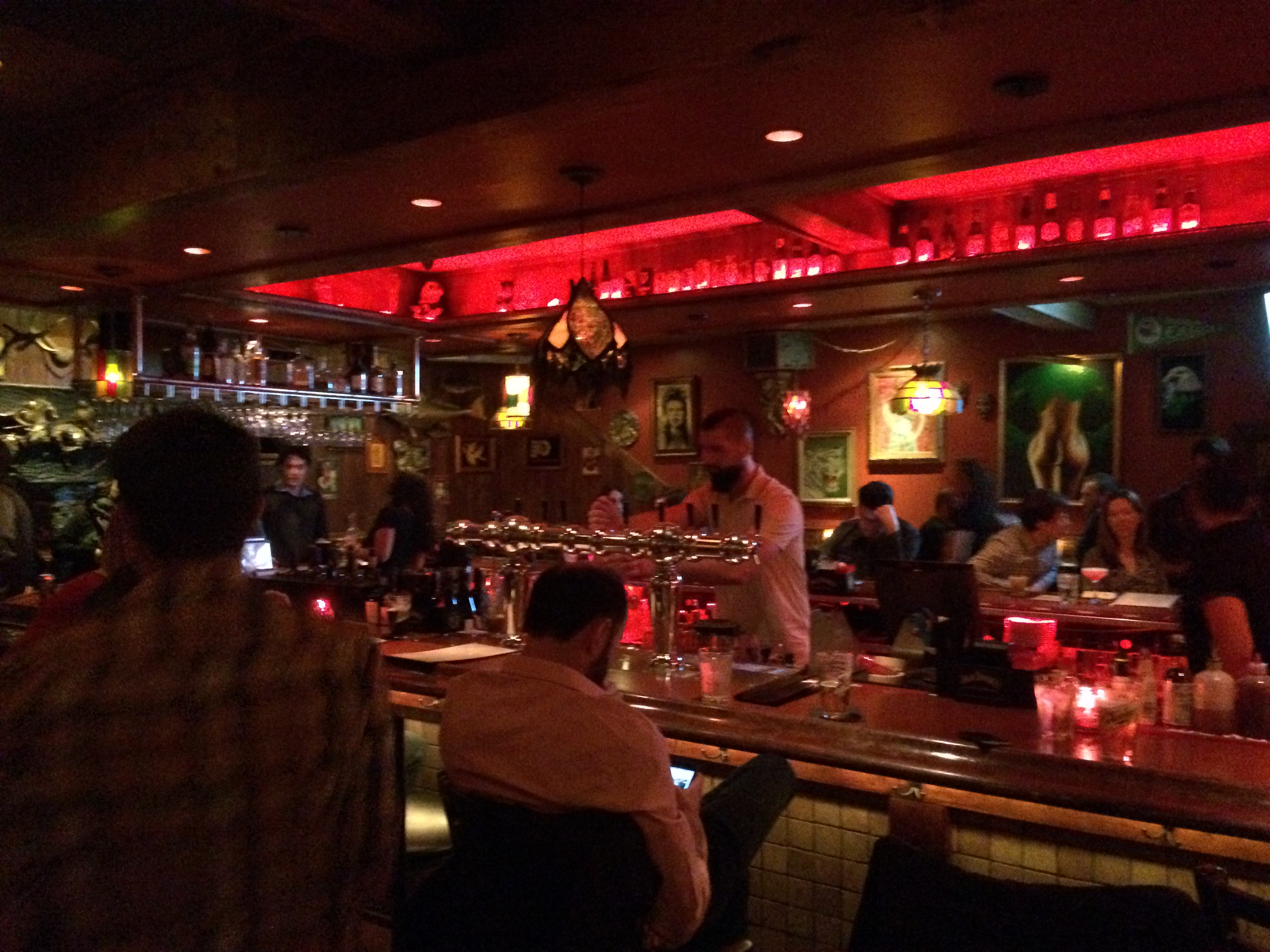
Inside Franky Bradley's.
Inside Franky Bradley’s.

It’s a two-story establishment. A  music room cum bar occupies floor number two. That’s where late night DJ and dancing action takes place. Sandy and I took up a little bit of space on the ground level. There, dark wood tables and booths fill up the square footage not occupied by a large bar, and the walls are covered with wood carvings, a potpourri of signs and with moody, sensual oil paintings. We sat at a peripheral table. It gave us a good view of much of the room. The lights were low, the noise level high, the waitstaff young and friendly. Recorded music from the 1970s (David Bowie, disco tunes) swirled through the air. The place was mobbed, mostly with an under-40 crowd. Tucked away on narrow way-off-the-beaten-path Chancellor Street (1320 is the address), Franky Bradley’s seemed to be a hit, a destination. From my perspective here’s the deal: Sandy and I loved our meal there. And the vibes were a gas, you dig?

Bradley’s keeps the number of beverage and food selections on the modest side, which seems like a good idea to me. Man, this world is cluttered enough as it is. You could do a lot worse than ordering what we had. Liquid-wise, a toasty beer for me, Ellie’s Brown Ale from the Avery Brewing Company. And, for Sandy, a semi-dry and citrusy Spanish white wine that rocked, an Albarino (2013) from Ramon Bilbao vineyards.

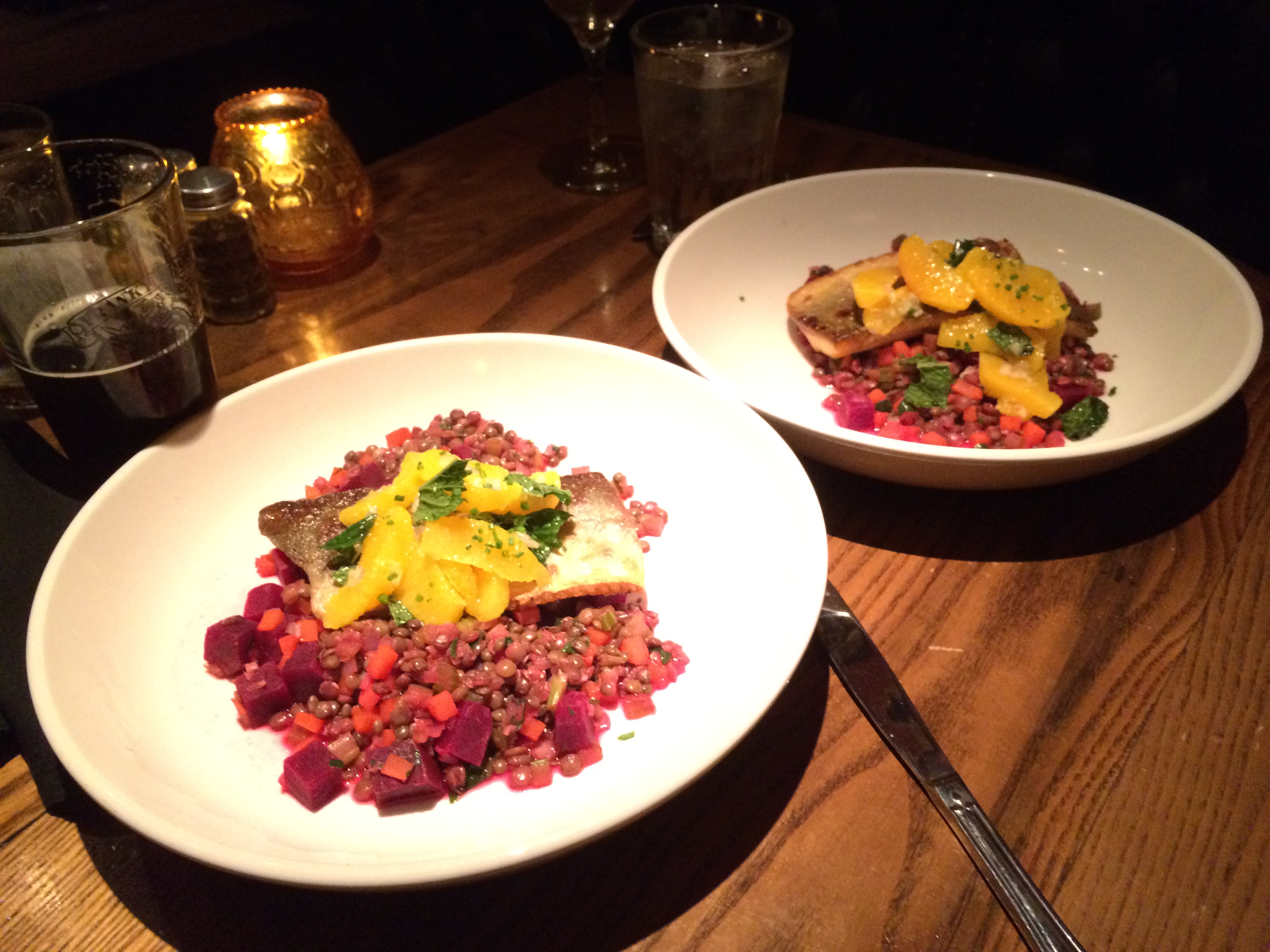
Bottom plate: Arctic char with warm lentil salad and orange slices. Top plate: Ditto.

We shared a house salad built from powerful purple onions, three or four types of greens and a Banyuls vinaigrette dressing. “Banyuls?” you ask? Right, I hadn’t a clue either. But it was damn tasty. A minute ago I peered at a foodie’s website and learned that Banyuls vinegar is made from fancy grapes. I shoulda known. For entrées we each ordered pan-seared Arctic char, a thin fish that came out moist, just-right salty and just-right charred. The fish shared plate space with warm lentil salad and orange slices. I’m a sucker for a good lentil salad. In this case, cubed beets and diced carrots and peppers said hello to one another and to the lentils just the way I was hoping they would. Wouldn’t have minded staying at Franky Bradley’s for a couple more hours, testing the desserts, knocking back another Ellie’s or two. But Spine awaited.

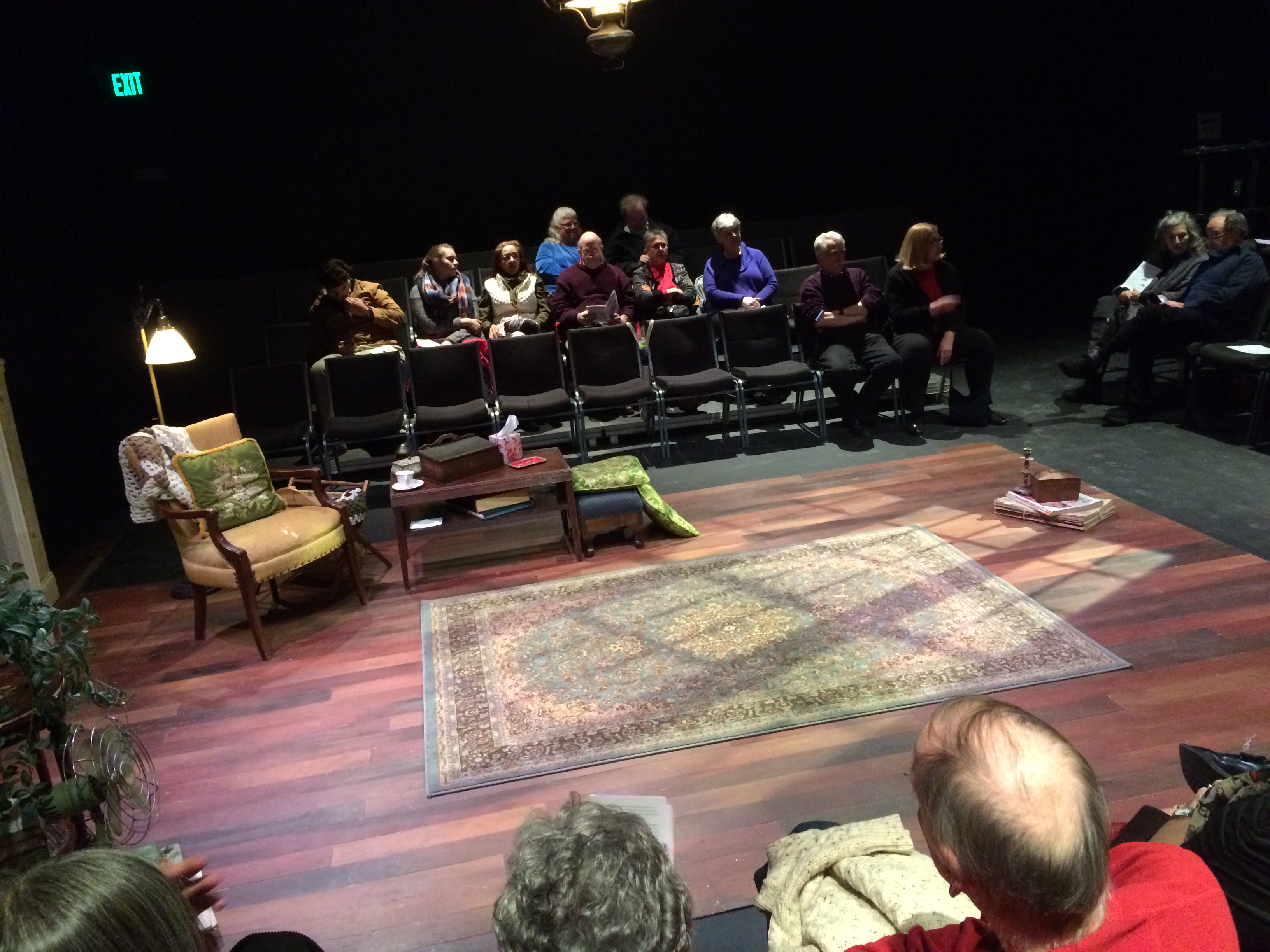
A few moments before Spine began.
Ten minutes before Spine began.

Spine (running through March 6) is a 70 minute monologue first performed in 2014 in Scotland at the Edinburgh Fringe Festival. Its British author, Clara Brennan, probably is a rising star. Philadelphia’s Inis Nua Theatre Company has staged Spine’s first American production in the smaller (about 75 seats) of two new theaters created within the Drake apartment building (1512 Spruce Street) earlier this year. There’s no intermission, so visiting the loo pre-show ain’t a bad idea.

If I’m sure about anything, it’s that Spine is a whirlwind of words, a rant at times, a collection of colorful tales all recited by Amy, a London teenager struggling to find her way. Amy is not in the education pipeline, can’t hold jobs, has messy relationships with family and friends and recently has become a petty criminal. But she’s no dummy and lacks not for energy. One day this wrong-side-of-the-tracks girl, looking for a room to rent, knocks on the door of a home, in a good part of London, owned by very elderly Glenda. Glenda, an advocate for social justice, takes a liking to Amy and over time gives her barrelsful of counsel.

What’s Spine about? It’s about a lot of things, maybe too many. Brennan takes aim at what she sees as damaging policies by Britain’s Cameron-led government, bemoaning social welfare program cutbacks and the closing of libraries. She believes that young folks like Amy institutionally are ignored and rendered powerless. She feels that the Amys of the world are being deprived of knowledge, but that they yet might come to understand their plights and change them for the better.

Whew, that’s a lot for a play to bite off. And a lot for politically and sociologically semi-conscious characters like me to digest. But let me say this: My attention didn’t waver watching Spine. Emily R. Johnson commanded the minimally-furnished set, bringing Amy fully to life and, by extension, Glenda. When the play ended I shook my head in disbelief. I mean, how does anyone do what Johnson did, spewing a non-stop avalanche of words without a stumble? How can anyone remember all those words? I have trouble remembering the name of the street I live on. Impressed? You bet your sweet bippy I was and am.

But sometimes there’s a but, and I have one. Johnson, a non-Brit, adopted a deep deep Cockney accent. I didn’t understand half the words she spoke. “Huhhh, what?” I said to myself so often I almost started babbling. Sandy had the same problem, even worse. If you didn’t grow up in a workingclass London neighborhood I’m guessing you’d decipher the language not much better than we did. I think that Spine’s director should have decided to soften the blows for Philadelphia’s audiences by toning down the accent. As usual, though, nobody asked for my advice.

(If you enjoyed this article, don’t be shy about sharing it. Sharing buttons are below)

(Photos by Sandra Cherrey Scheinin. If you click on a photo, a larger image will open)
The First Time I Saw Springsteen

Before today I hadn’t mentioned the words Bruce or Springsteen anywhere on this blog. But you know, this article about The Boss probably won’t be my last. That’s because I’m a big fan of Bruce’s. I’m not one of his fanatical followers, not one of the myriad folks who own every recording he has ever issued and have attended Springsteen concerts in the dozens and above. But big enough. I consider Springsteen to be a huge talent. For decades he has been a superb singer, songwriter and guitarist, and an in-concert performer blessed with off-the-charts charisma and energy. On January 16, he and The E Street Band will be hitting the road for the umpteenth time. When I read recently about their upcoming tour, my mind wandered back to the first time I saw Bruce on stage.

Springsteen got his start in the late 1960s. By 1973 he had developed a fairly big fan base in a few locales, such as the New Jersey Shore communities and the greater Philadelphia area. Part of this was due to his relentless gigging around the USA. Back then if you toured enough you were bound to catch on somewhere, especially if some radio stations played your tunes. But overall he and his E Street Band still were little known. For the most part he played in small venues until finally breaking through nationally in 1975. Global superstardom would follow some years later.

I moved to Philadelphia in February 1974 and soon started hearing Bruce on WMMR, the city’s premier rock station at that time. They played tracks from his first two albums, both of which came out in 1973: Greetings From Asbury Park followed by The Wild, The Innocent & The E Street Shuffle. It didn’t take me long to become a Bruce devotee. I bought both albums and especially liked what was on The Wild. Who wouldn’t have? The songs, every one Bruce-penned, are fabulous. They are literate and intriguing stories put to wonderful melodies. Rosalita (Come Out Tonight), Incident On 57th Street, Kittie’s Back . . . man, the seven songs on the record sound as good today as they did all those years ago. There was no question in my mind that Springsteen carried the goods. I wanted to see him in person.

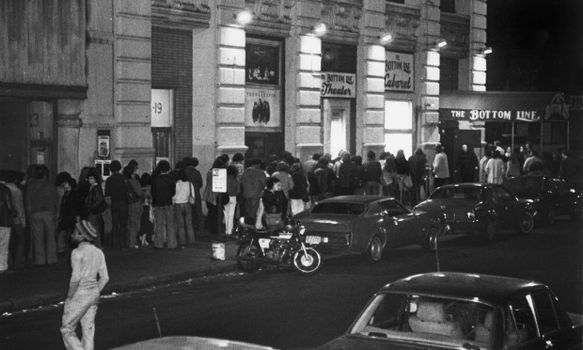
The Bottom Line (photo by Peter Cunningham)
The Bottom Line (Photo by Peter Cunningham)

In July 1974, Bruce and The E Street Band played six shows in Manhattan at The Bottom Line. Three nights of music, two shows per night. Long gone, The Bottom Line was a magnificent small club in Greenwich Village, magnificent not because of its décor but because of its wide-ranging musical menu. I was there with my brother Richard at one of the early shows. Richie wasn’t as ardent a rock lover as I was, but somehow I had convinced him to come along. I suppose I’d known about Bruce’s Bottom Line gigs via announcements on WMMR. I can’t imagine how else I’d have heard.

Springsteen a few months before I saw him (Photo by Burton Wilson)

How much of the show do I remember? Well, to put things in perspective, I’m probably exaggerating on the high side when I say that I recall about 0.0001% of my adult life. Pathetic and depressing, but true. And yet I  do have some memories of that summer evening nearly 42 years ago. I can picture Richie and me seated at a table. We were 20 or 30 feet from the stage. I remember the start of the show. The house and stage lights went dark, and then one spotlight illuminated a small section of stage. Springsteen stood in that focused light, a big floppy hat tilted on his head. And he began to sing Incident On 57th Street. Quietly.

Spanish Johnny drove in from the underworld last night/With bruised arms and broken rhythm and a beat up old Buick, but dressed just like dynamite/He tried sellin’ his heart to the hard girls over on Easy Street/But they said “Johnny, it falls apart so easily, and you know hearts these days are cheap.”

The E Street Band whispered behind Bruce. And as the vocals gradually intensified, the band followed Bruce’s lead nimbly and powerfully. For this song, The Bottom Line, just like that, was transformed into a tough part of town where sorrow and longing prevailed. The reports that I’d heard in Philadelphia were true — that Springsteen, on stage, enveloped a song like few others, tapped into a cache of emotions that were invisible to most vocalists, and that The E Street Band was scarily good. I knew that I was at what would be the best concert I’d ever attended.

Bruce and the boys danced through maybe 10 or 11 more songs before leaving the stage, and they never let go of the audience’s gut. The concert was an exhilarating and spellbinding ride, a trip to rock and roll heaven. The only other tune that I specifically recall being played is Rosalita. It was rollicking and wild. Delirious. Amazing. There was nothing that Bruce, Clarence Clemons, David Sancious, Garry Tallent and the other E Streeters couldn’t do.

Richie was as stunned as I was. I don’t think he’d had any idea what the night held in store for him. To this day I rank Bruce and band at The Bottom Line as one of the ultimate shots of live music in my life. It gave me shivers. It made me shake my head in disbelief. It sent me out into the streets with a buzz that still echoes.

(If you enjoyed this article, then don’t be shy about sharing it. Sharing buttons are below)

The Night I Made A Cocktail Table Go “Boom”

You should count your lucky stars when you act like a nitwit and are forgiven for your sins. That is what happened to me about ten years ago at a jazz concert. It was the night when talentless me accidentally became part of the show.

I hadn’t thought about that infamous evening in a long time, but for some reason was reminded of it recently when my wife Sandy and I took in a Friday night concert at the Philadelphia Museum Of Art (PMA), which had been the scene of my crime. The museum calls its Friday night concert series Art After 5, and it’s a good one. Art After 5 began in 2001 with a jazz-only format, but has morphed over the years to include a wide range of genres. Sandy and I have been to a crazy number of music shows at PMA since we discovered the series in 2002.

Picture this: It is February 2006. Sandy and I are seated in the first of several rows of tables ringing the performance area in PMA’s Great Stair Hall. The hall is enormous, maybe 80 feet high, and is dominated by, yes, a great stairway that connects two levels of the museum. The Great Stair is 20 feet behind us and stares regally at the performance area. Many concertgoers are seated on its marble slabs . . . uncomfortably. Sandy and I prefer comfort. So we made it a point to arrive way before showtime in the hopes of nabbing one of the cocktail tables, which are squeezed together pretty closely. Compared to marble stairs, the chairs at the tables are a blessing for butts. At our table we don’t have much to do except twiddle our thumbs. We order soft drinks and sip at them. We are waiting for jazz vocalist Carmen Lundy and her band to start their show.

Carmen Lundy in performance six years after my cocktail table went "boom." (Photo by Daniel Sheehan)
Carmen Lundy in performance eight years after my cocktail table went “boom.” (Photo by Daniel Sheehan)

At 5:45 PM Carmen and the guys are introduced by Art After 5’s curator. Minutes later they begin to play. They are very fine, and only eight feet in front of our excellent seats. Carmen Lundy, a justly acclaimed performer, is singing with a lot of flair and swagger. Sandy and I are enjoying the show. But halfway through the set something begins to bother me. I feel as though my space is being impinged upon. Someone at a table behind me has inched up a tad too much and is putting pressure on the rear of my chair. I have the solution, of course. All I need to do is slide my cocktail table forward ever so little, after which I’ll be able to move my chair forward too. I push the table very very gently, maneuvering it carefully. But alas, this is a plan not destined to work out. The frigging table loses its balance and topples heavily, its edge creating an enormous sound when it smashes onto the floor. The noise echoes throughout the Great Stair Hall. And everything that was on the table flies off and finds a new home inches from the performers’ feet.

I felt like a schmuck. I was a schmuck. Oy vey, was there anywhere to hide? No way. All I could do was sit there as a couple of servers scampered over, set the table upright, and on their hands and knees quickly swept up ice cubes and pieces of broken glass. They mopped up the soft drink liquids from the floor and retrieved my eyeglasses, which once had been on the table but now were beneath the piano bench. Yet, all the while the band played on as if nothing had happened. Carmen Lundy continued to deliver her song with full emotion. Harold O’Neal’s fingers were flying on the keyboard. Jason Brown’s drums went rat-a-tat-tat and wham-bam-thank-you-ma’am, and Curtis Lundy, Carmen’s brother, plucked fervent notes on his upright bass.

The set finally ended. Was anyone in the audience staring at me? Probably. But I was too embarrassed to look around and find out. I knew one thing I had to do though. Apologize. Carmen Lundy was standing near the sound board, 20 feet to the right of the performance area. I stood up and made my way to her.

“Ms. Lundy,” I said. “I’m the idiot who knocked over the table. I’m very sorry. I feel like a fool.”

Carmen Lundy gave me a good hard look for a few moments and then did the darndest thing. She put a hand on one of my shoulders, looking me straight in the eyes, and said “Don’t worry about it, honey. It didn’t bother us. In fact it gave us energy to play even harder.”

Man, I didn’t know what to say in response to such a stellar attitude. I mumbled my thanks and probably a few other words and shuffled to my seat.

Looking back on all of this the other day I realized once again that I had been in the presence of classiness and graciousness. If our places had been reversed I doubt if dopey me would have been so wonderful. Carmen Lundy, in my book you’re very much okay.

(If you enjoyed this article, then don’t be shy about sharing it. Sharing buttons are below)

Out And About In Fishtown

On a recent Friday night my wife Sandy and I went to dinner with our great pals, Liz and Rich. We dined in Al Dar, an atmospheric Mediterranean-cuisine bistro in Philadelphia’s western suburbs. As the four of us wolfed down lots of good stuff, Liz asked Sandy and me what we had on the agenda for the following day. Because the Philadelphia area was in the middle of an amazing December warm weather streak, any upcoming rain-free day would be a great one for outdoor exploration. “Maybe we’ll go to Fishtown,” Sandy said. And that’s what we did.

Fishtown is a Philadelphia neighborhood fairly near the city’s downtown sections. It is a maze of narrow streets, with a few big avenues running through, and for most of its existence has held a blue-collar reputation. Until a handful of years ago, Fishtown wasn’t somewhere you’d have had any particular reason to go to, unless you lived there. But times change, and sometimes for the better. Fishtown’s rowhouses and small single homes have found favor with millenials, hipsters, musicians. And with those fine folk have come cool bars and eateries and music venues. Fishtown now is on the map, though its goodly number of empty storefronts and how-do-they-stay-in-business businesses show that there’s plenty of climbing yet to do.

The 1300 block of East Eyre Street.
The 500 block of East Thompson Street.

I like wandering on cute blocks, especially when they have nifty or unusual names. And Fishtown is full of those: Crease Street, Eyre Street, Shackamaxon Street. Yeah, Shackamaxon. I’d never heard of half the streets that Sandy and I stepped upon, which was just the way I like it. Gave me a sense of exploring the unknown. I saw that Fishtown’s byways are crammed with housing and commercial properties that, to my marginally-trained eye, looked to have been erected mostly between the mid 1800s and early 1900s. As with much of Philadelphia, the buildings usually rise no farther than three stories above ground level. And how about those bricks, a construction material that numbers in the gawd-knows-how-many trillions of units in Philadelphia. Fishtown’s share of that bounty must be at least twenty billion.

Fishtown's public library.
Fishtown’s public library.
Girard Avenue as seen from Eyre Street.

It would take hours to see all of Fishtown, hours that Sandy and I didn’t have at hand. But we strolled around and I think got a halfway decent sense of what the neighborhood is all about. I was glad to see that Fishtown is kind of a small town unto itself. That’s been the case for at least 150 years, from what I’ve subsequently read. Look! A library. A police station. A rec center with a hockey rink. A wonderfully-domed Presbyterian church that has been in place since 1859. A bunch of pocket parks. Sharp, indeed! But the small town feel disappears when you venture off the residential blocks. On Girard Avenue, a major artery that bisects the area, the almost endless lengths of overhead wires are a gritty spider’s web and a quaint-yet-quintessential urban sight. And the traffic on Girard Avenue and Frankford Avenue at times is relentless.

Let’s move on to food and drink. Fishtown has become a player in Philadelphia’s emergence as a destination for foodies and/or craft beer aficionados. Kraftwork, East Girard Gastropub, Frankford Hall, Fette Sau, Interstate Draft House, Pizzeria Beddia (a take-out-only joint with no phone and a policy of baking only 40 pies per day. It gained instant fame when bon appétit magazine, incredibly, crowned its offerings earlier this year as the best pizza in the USA). Hey, if filling the gut and loosening the inhibitions are on your agenda, Fishtown’s as good a choice as any to do that in.

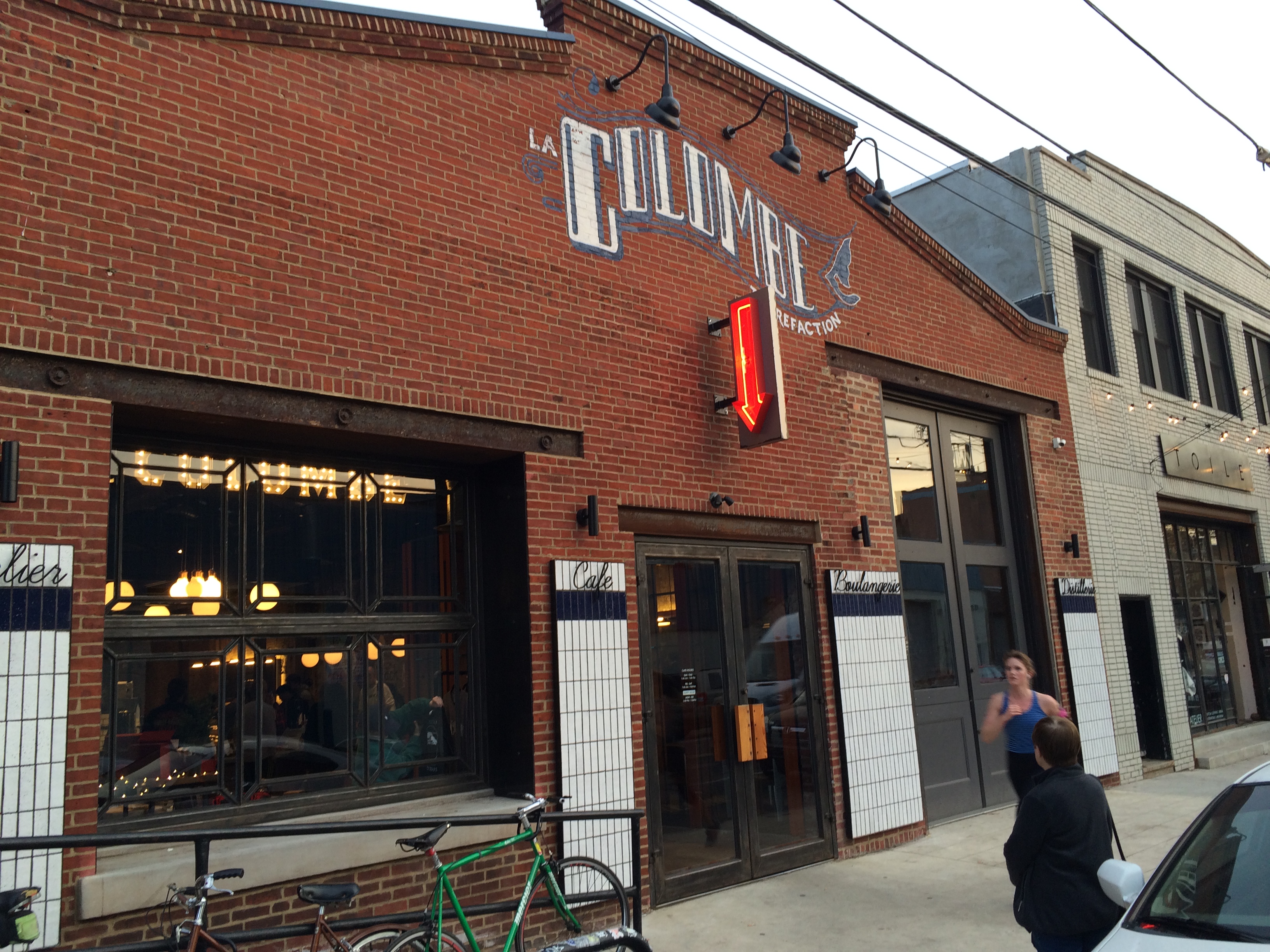
I peeked inside some of the above-named places, and others, on Girard Avenue. They looked great, but it wasn’t even 5:00 PM yet and I wasn’t ready for alcohol or food. Sandy and I earlier had decided that we needed to patronize, or at least ogle, what probably are Fishtown’s two most well-known spots, just to say that we’d been there. And thus we headed north on Frankford Avenue till we reached La Colombe Fishtown (1335 Frankford Avenue), the crown jewel of the La Colombe coffee empire.

Exterior of La Colombe Fishtown.
Interior of La Colombe Fishtown.

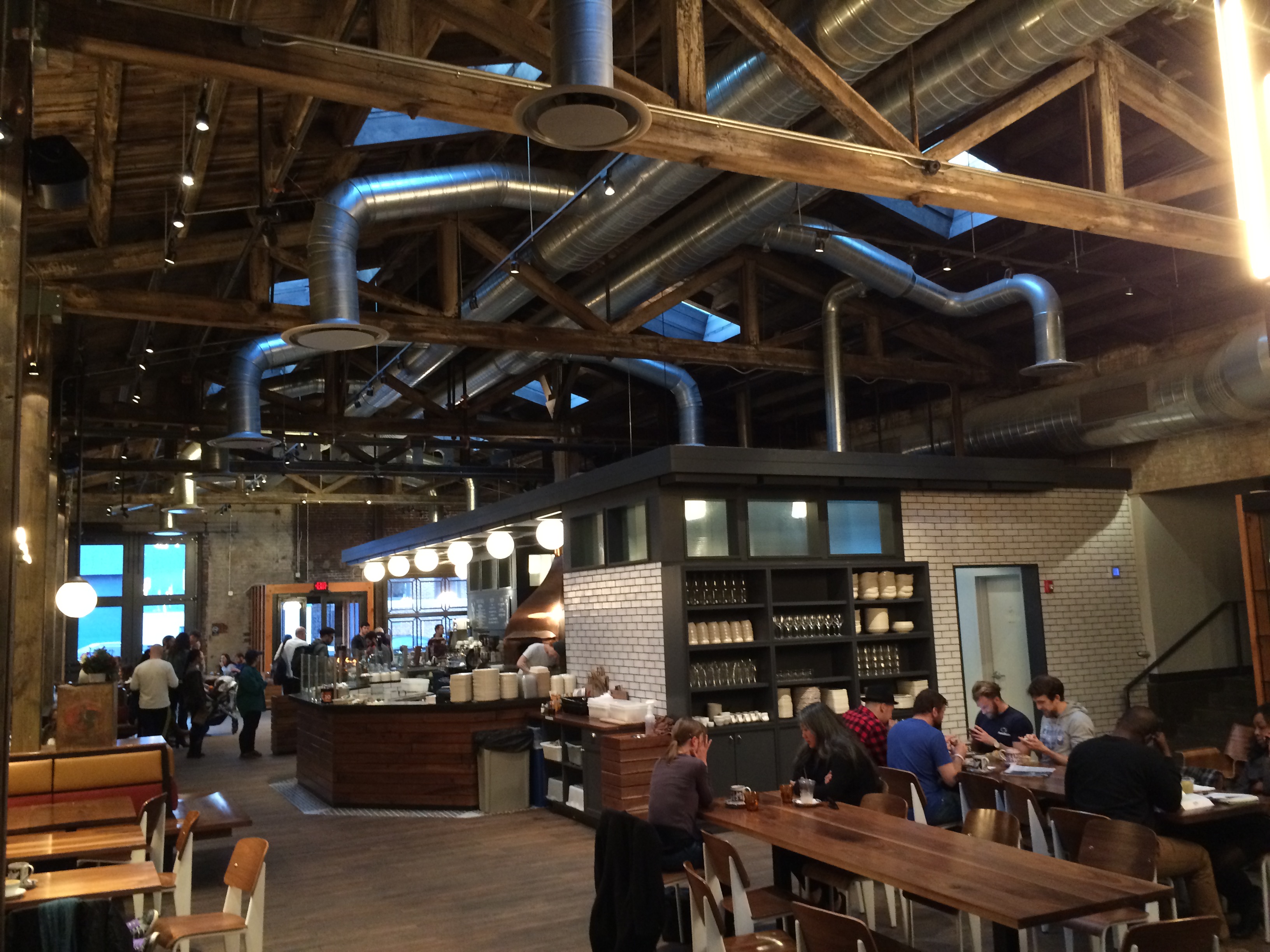
LCF opened last year and it’s a thing of beauty, a Starbucks-on-steroids enterprise that was created out of a former warehouse. It’s comfortable and fashioned in the rustic chic mode. Dark wood floors go on forever. Exposed air system ductwork looms overhead. At the tables, customers nurse coffees, wines, beers, pastries and sandwiches for a long long time as they stare into their electronic devices or into each others’ eyes. And in the rear of the cavernous space is something I’d have been unable to anticipate in a million years. A rum distillery. Don’t ask me why, but the brains behind La Colombe had a jones for rum that had to be satisfied. The rum is for sale.

Sandy and I, though, kept things simple. We ordered ice coffees. Yes, we’re big spenders. They were strong and delicious. We stared into our devices and into each others’ eyes for awhile, and then hit the streets once again. It now was time for food and alcohol. Next stop was Fishtown’s biggest claim to fame.

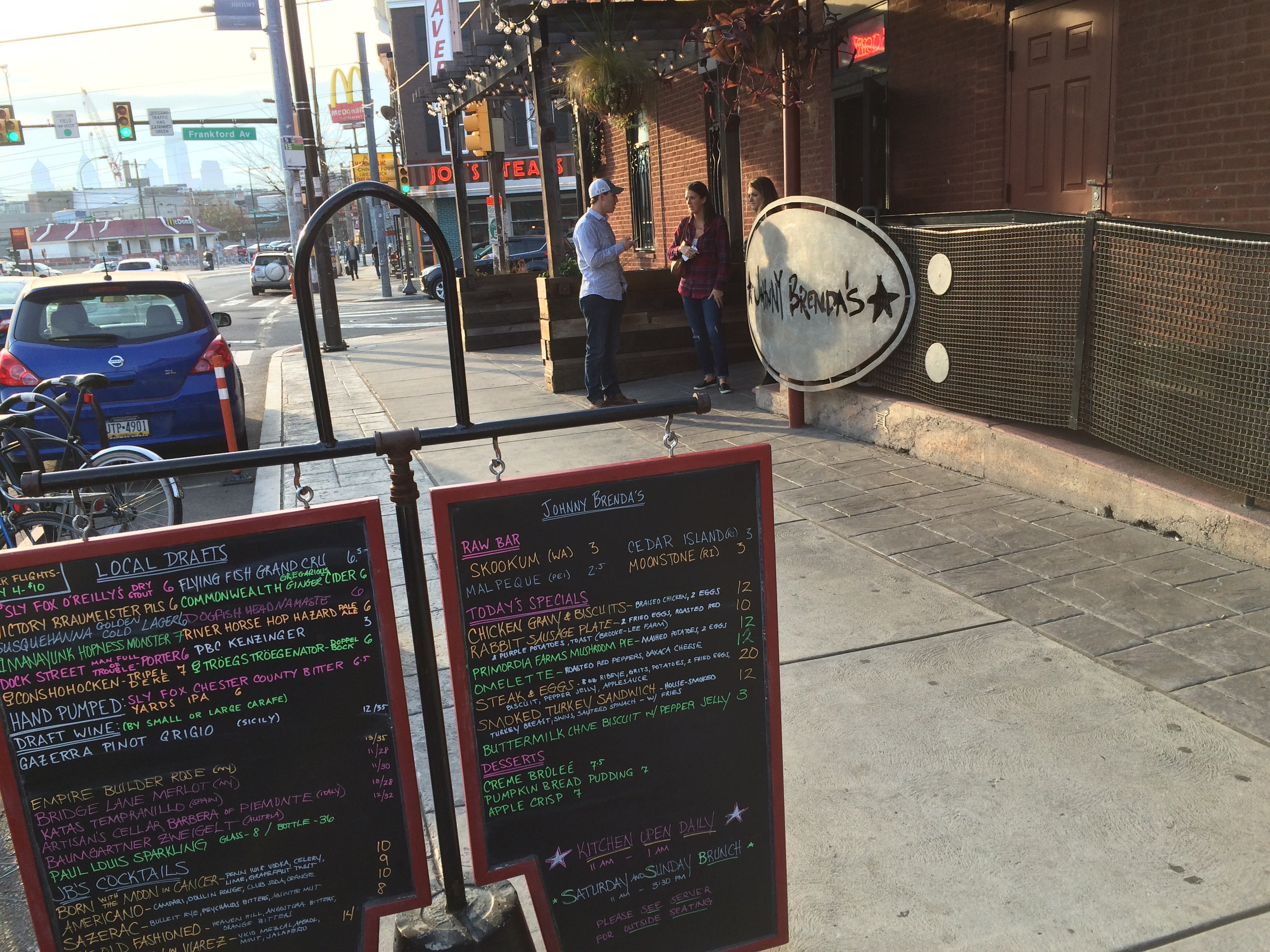
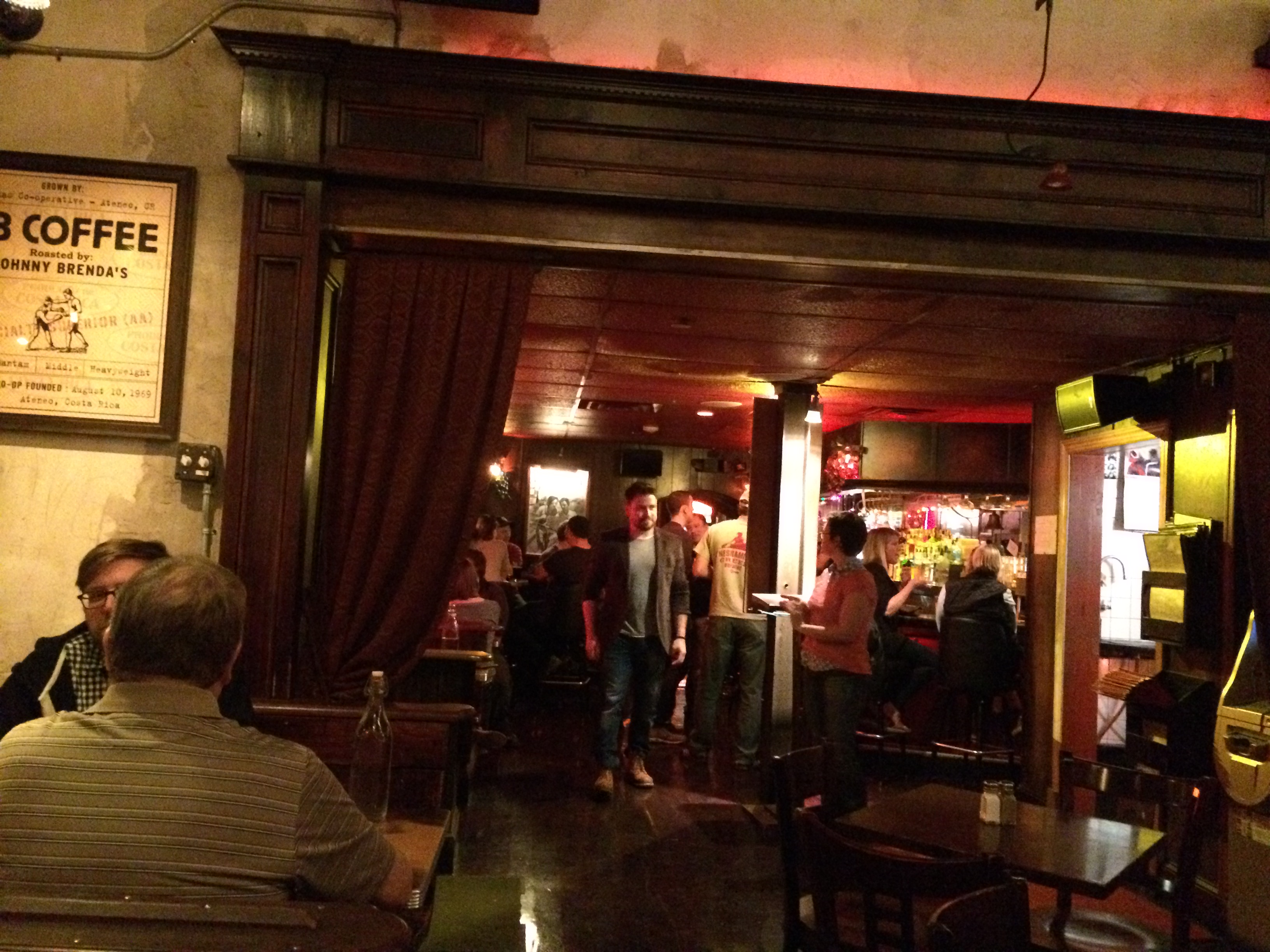
Johnny Brenda’s (1201 Frankford Avenue) used to be an insular neighborhood bar. New owners took over in 2003. They installed good beers and good food, made nice with their Fishtown neighbors, and set in motion their visions of expanding JB’s audience. Johnny Brenda’s is widely credited as the catalyst for Fishtown’s renaissance. Things really began cooking in 2006, the year that JB’s brought live rock and roll to its upstairs quarters. Brenda’s has become a favorite place for local and touring rock bands. Sandy and I have yet to catch music at JB’s, but we’ve frequently talked with friends about doing that. One day soon we will.

Exterior of Johnny Brenda's.
Exterior of Johnny Brenda’s.
Interior of Johnny Brenda's
Interior of Johnny Brenda’s

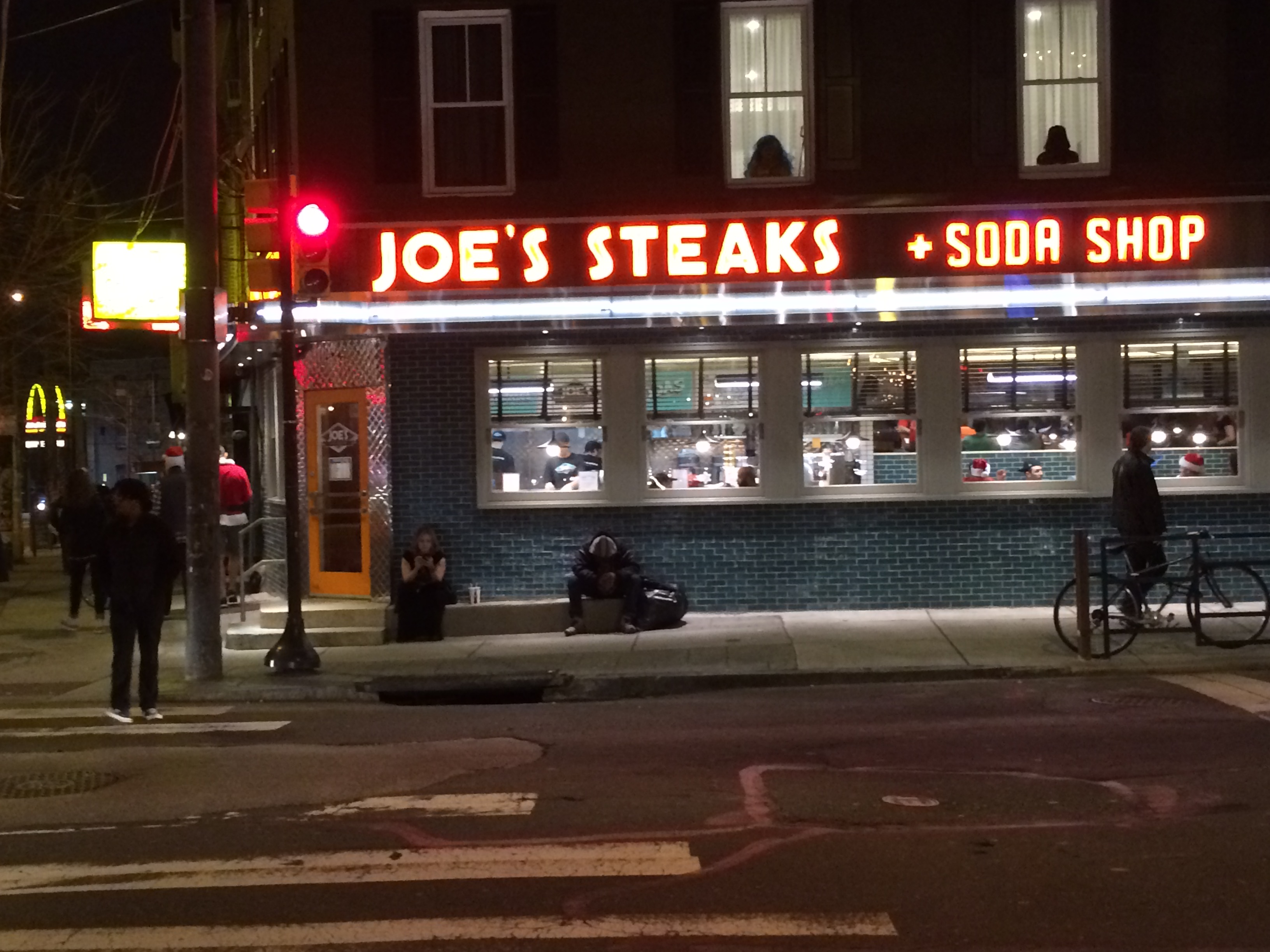
JB’s is a friendly place. It has a pool table, local beers on tap, a nice selection of pub grub. And plenty of customers. Sandy and I grabbed a booth in the dining room. We ordered. Sandy’s Italian white wine was delicious. So was my Sly Fox porter. So were our burgers, hers made from beef, mine from vegetables. But before too long it was time to leave, as a movie, in another Philadelphia neighborhood, was on our evening’s schedule. We settled up and stepped outside. Daylight had disappeared 90 minutes earlier.  The air was cooling down. Groups of 20-somethings and 30-somethings were everywhere. We crossed the street, heading westward on Girard Avenue. But Sandy then suggested that we walk back to where we had just been so that we could get another good look at a resplendent neon palace: Joe’s Steaks + Soda Shop. Sandy took its picture. And we left Fishtown on a high note.

JoesSteaks IMG_0076
(If you enjoyed this article, then don’t be shy about sharing it. Sharing buttons are below)

(Photos by Sandra Cherrey Scheinin. If you click on a photo, a larger image will open)
Q: How Cool Is The Philadelphia Museum Of Art? A: Very

The Philadelphia Museum Of Art, PMA to its friends, is one of our fair nation’s best museums. My wife Sandy and I visit pretty often. Its holdings are fantastic. What’s more, for years the museum has presented concerts on Friday nights, and we’ve been to a crazy number of them. During our Fridays at PMA we look at art for awhile and then hear music in the majestic Great Stair Hall. For artsy nerds like me, that’s usually a winning combination.

As we headed museumward on a recent Friday, we found ourselves in traffic hell. Our car windows were fogging up from steam coming out of our ears, but we wound up having a heck of a good time once we arrived. No pain, no gain, or something like that. Late-ish as it was though, we didn’t have barrels of time to check out art if we were to snare seats at a ringside cocktail table for the evening concert. Those seats ordinarily are claimed 45 minutes or more before concerts begin. When the preferred seating is taken, your option is to place your rear end upon the Great Stair Hall’s grand marble steps. And YOW, that’s a numbing backside experience.

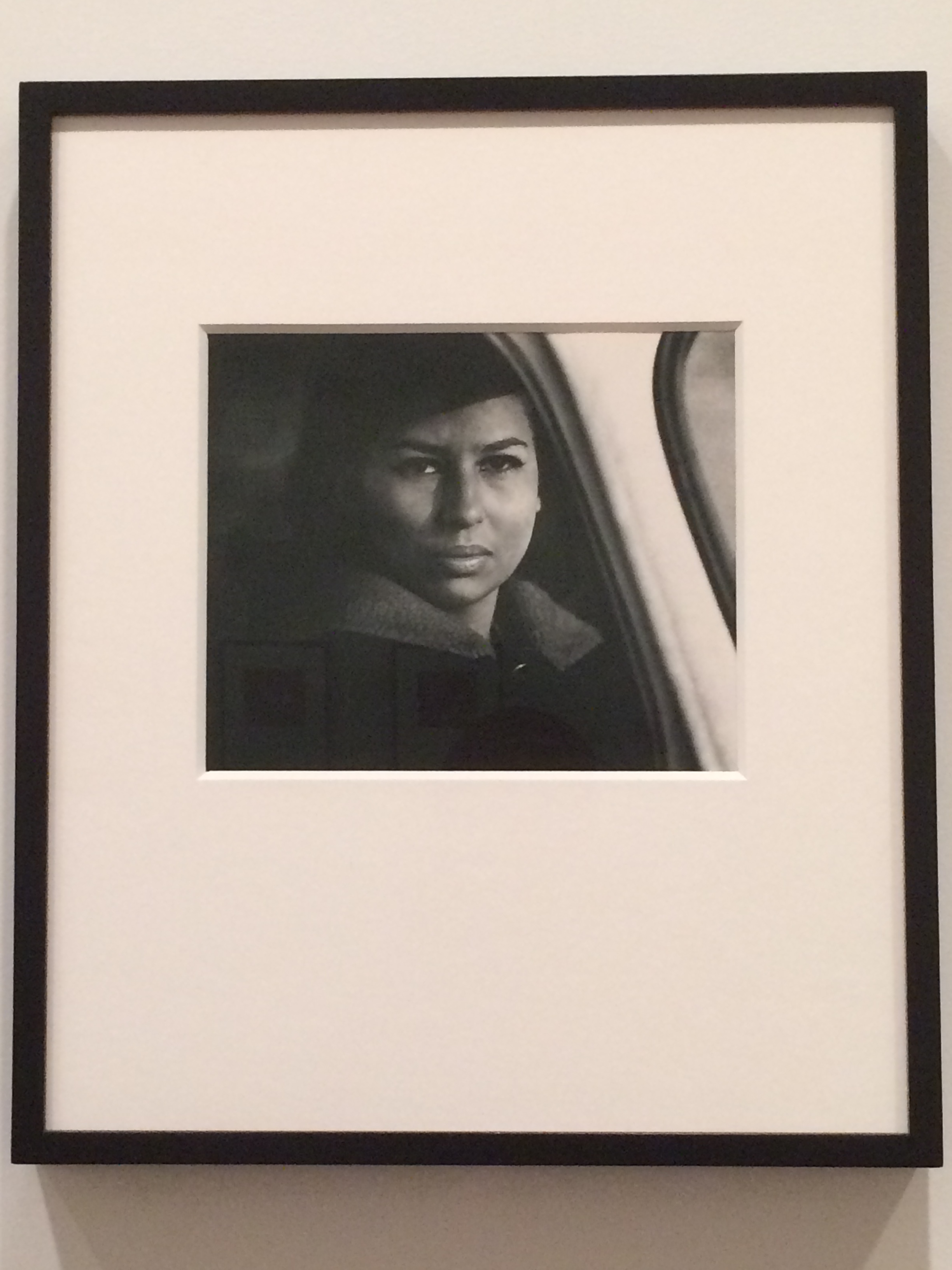
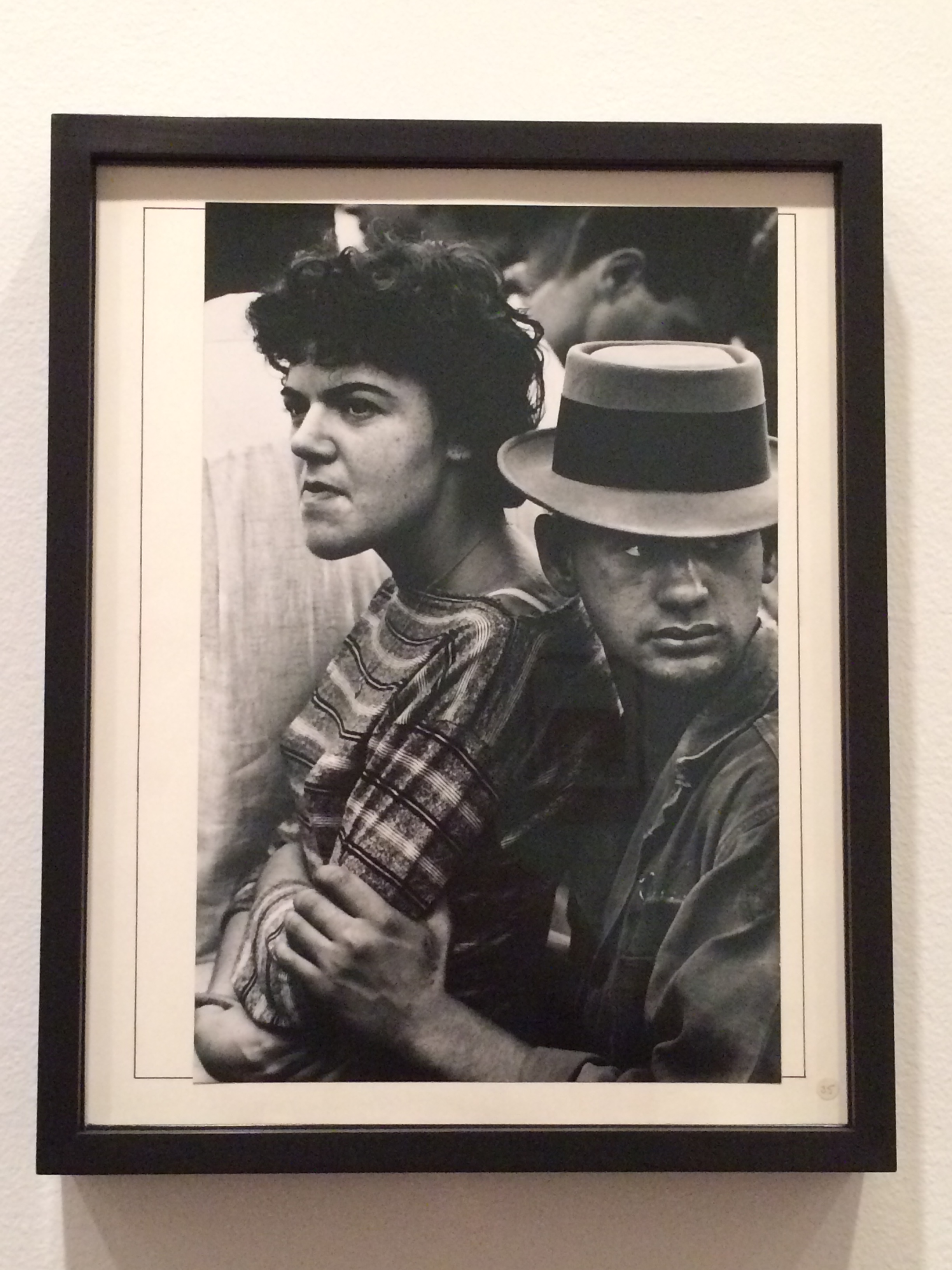
And so we navigated to a modestly-sized and time-friendly exhibit, works by the not particularly well-known Dave Heath. To me and Sandy, he wasn’t even that, as we’d never heard of him. This show (it closes on February 21, 2016) is entitled Multitude, Solitude: The Photographs Of Dave Heath, and comprises numerous 35 mm photos, all in black and white, that Heath took from 1949 to 1969. Also on display is Heath’s multimedia slide show from 1969. This is the first major presentation of his early and midlife creations, and one of the few museum exhibitions that he ever has had. It was organized by The Nelson-Atkins Museum Of Art in Kansas City, Missouri, with plenty of PMA input.

Sandy and I had the same reaction after looking at Heath’s photos for the first few minutes: “This guy is great,” we agreed. And I’m convinced that he is, or in any case was in the 1950s and 60s. The photographs are very beautiful and very dark, shades of black heavily predominating over those of white. I’ve always felt that this approach allows photographs to breathe emotionally, gives them depth and resonance.

New York City (1964), by Dave Heath. Nelson-Atkins Museum Of Art, Kansas City, MO; Gift of Hall Family Foundation
Washington Square, New York City (1960), by Dave Heath. Nelson-Atkins Museum Of Art, Kansas City, MO; Gift of Hall Family Foundation

Heath isn’t a chronicler of the natural world. He’s a people observer, usually in urban settings. And he is a lover of the close-up, often capturing folks deep in thought or in seeming isolation. His childhood was dreadful, and his work frequently reflects the hurt that probably never went away. But not all is aloneness or sadness in the Heathscape. Joyful images are here and there in the exhibit.

Dave Heath lives in Canada and is 84 years old. There’s not a lot of info about him in cyberspace. He was born in Philadelphia, grew up in foster homes and an orphanage, took up the camera in his late teens, and has had a full career as a photographer and photography teacher. His greatest fame and acclaim occurred in the 1960s, the decade in which he won two Guggenheim Fellowships and created the book for which he is best-known, A Dialogue With Solitude. The final pre-production copy of Dialogue is at PMA. Its 100 or so pages, mostly photographs, ring several gallery walls. Dialogue is divided into ten sections, among them Fate, Fragility And Diversity; Youth; Childhood; Ends And Beginnings. Dialogue is a deep photographic rumination on many aspects of the human plight.

Sandy and I ended up spending much more time with Heath’s images than we had anticipated. They are powerful. By the late 1960s though, Heath apparently felt that he had said all he could in black and white. He turned to color Polaroid picture-taking and later to digital photography. None of this is on PMA’s walls, and from what I gather isn’t well-known by the arts community. It’s a fine thing, though, that someone (the good folks at Nelson-Atkins and at PMA) has championed black and white Dave and decided to let the spotlight shine on him.

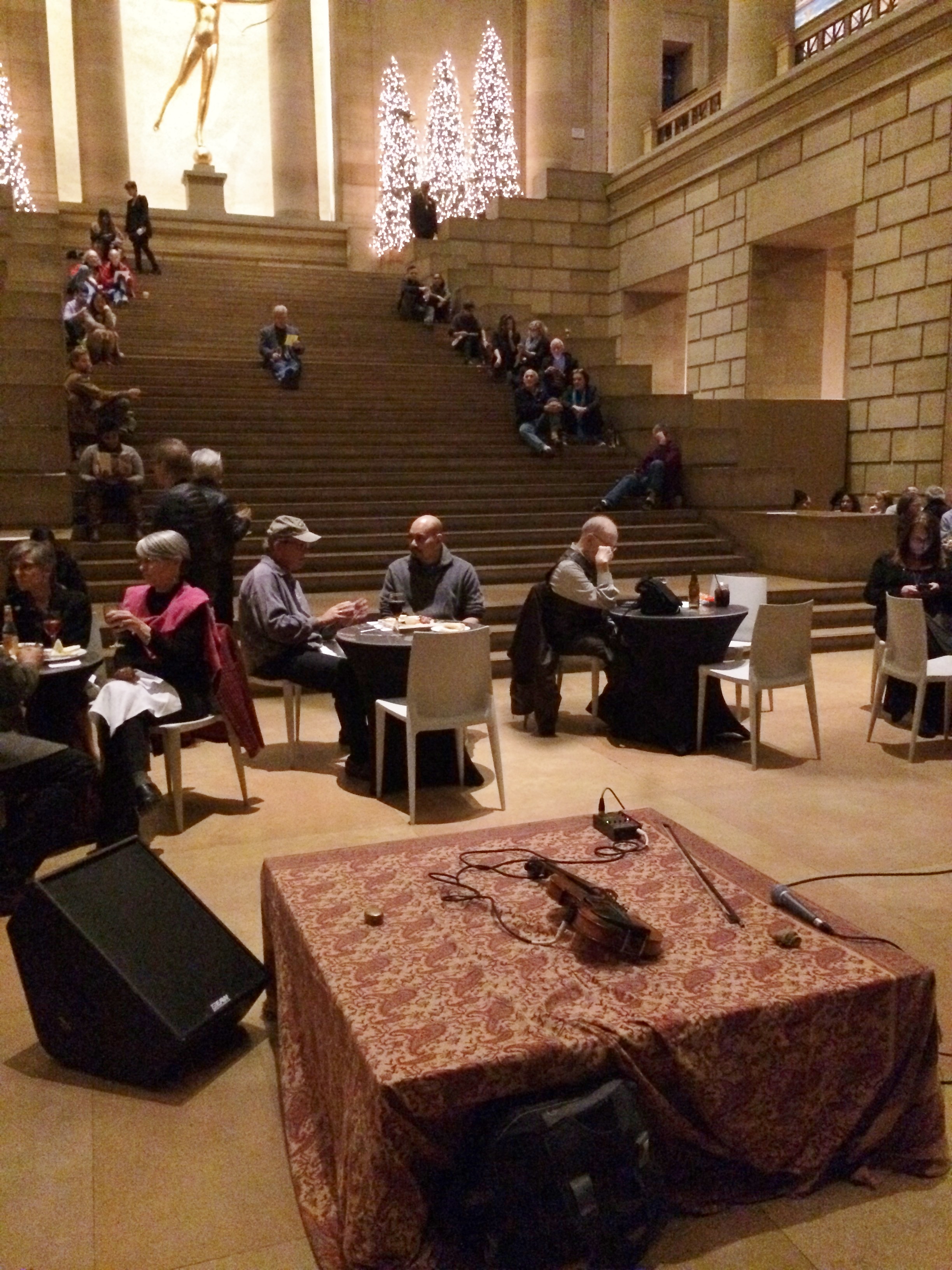
Before the concert in the Great Stair Hall. Photo by Sandra Cherrey Scheinin
Pre- concert in the Great Stair Hall. Photo by Sandra Cherrey Scheinin

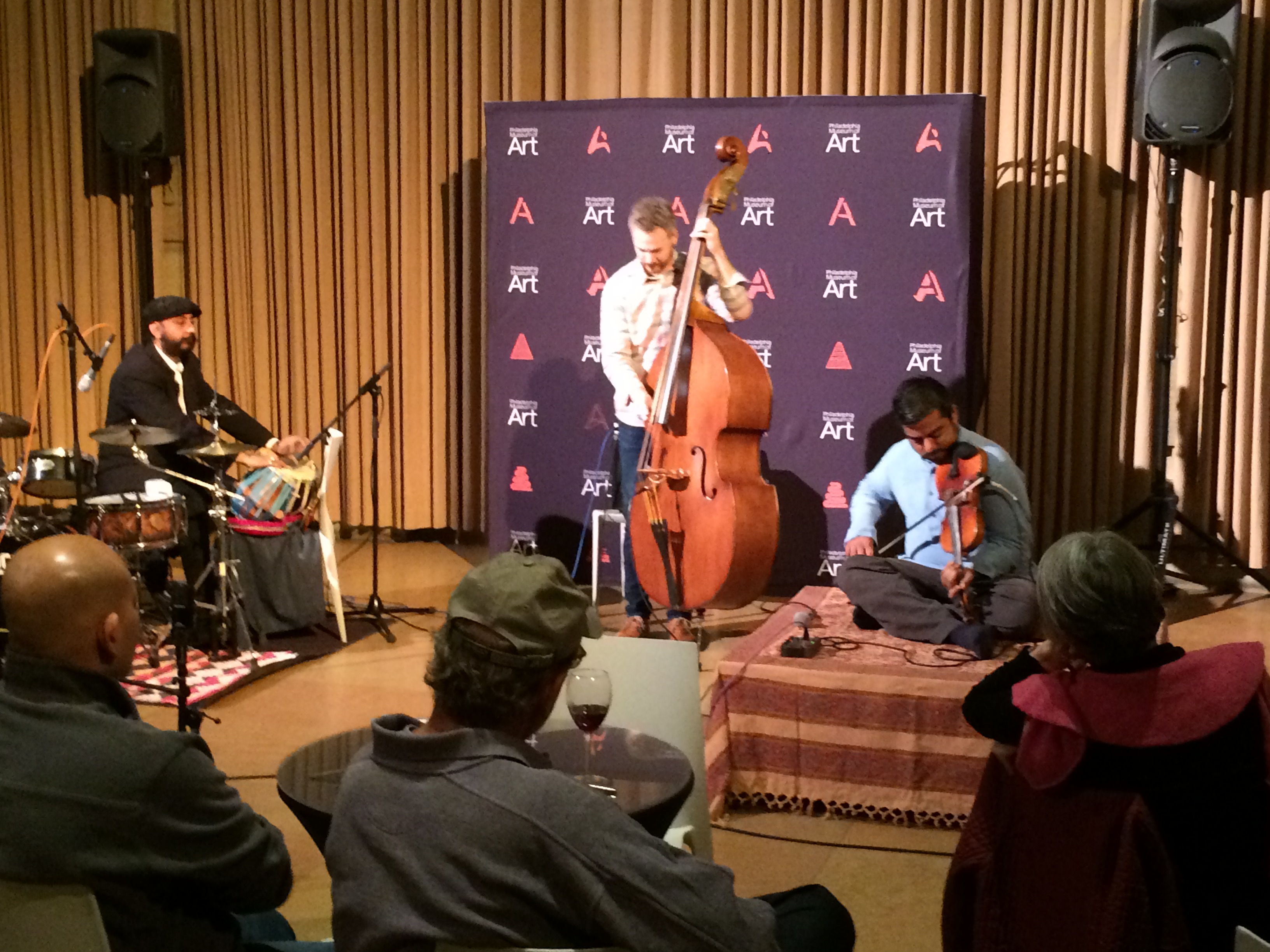
Show time was approaching. Sandy and I lucked out after Heath, grabbing two empty seats at a stage left cocktail table in the Great Stair Hall, a mere six feet from where Arun Ramamurthy soon would be bowing his violin. Arun Ramamurthy? Sandy and I knew as much about him as we had about Dave Heath an hour earlier. Brooklyn-based Ramamurthy, though, is a growing name to be reckoned with in classical Indian music and in musical cross-pollinations. At PMA he brought along Perry Wortman, on upright bass, and drummer/tabla player Deep Singh. The Arun Ramamurthy Trio began its first set at 5:45 PM.  They played a hybrid of South Indian classical music and jazz.

When it comes to music, I’m an appreciator, not a scientist. I understand little about any musical genre’s technical side. Scales, chords, the inter-relationships of notes and how they shape harmonies . . . forget it, I’m at sea. But the big picture I understand, as did the 200 others listening to the Ramamurthy group. We all clapped madly after each piece. Sure, Arun’s melodies and voicings on violin would be pretty unfamiliar to most American ears, but they were beautiful.

In the Great Stair Hall, Arun sat on a platform, chairless and shoeless. He held his violin vertically, bowing with his right hand, working the strings with the fingers of his left. The trio played five songs in the first set, three of them originals, all drawn from or reflecting traditional South Indian classical ragas, melodies and motifs. The music was elastic, minor-keyed and highly improvised, improvisation being a major component of both classical Indian music and jazz.

Arun began song number one unaccompanied, coaxing mournful sounds from his instrument for three minutes. Wortman’s bass then entered — low, gripping notes played slowly, repeatedly — and Singh’s drums too. Singh played carefully, tantalizingly, creating a steady and simmering beat. One drumstick tapped a drum’s rim. The high hat and cymbals shimmered just so. All the while Arun stroked melancholy lines. This was Ramamurthy’s original song, Conception. I was reminded of All Blues, and other numbers, from Miles Davis’ Kind Of Blue album.

The Arun Ramamurthy Trio. Photo by Sandra Cherrey Scheinin

The fifth song, an Arun original whose title I missed, found Deep Singh on tabla. The tune was energetic, Arun going pretty wild on violin, Wortman choosing notes eloquently and perceptively, as he did on each tune. Another thing I noticed was that Arun and Deep barely could keep their eyes off each other. They were in a strong musical relationship. And Singh’s fingers were absolutely flying, maybe wearing grooves in his tabla’s skins.

There was a sixth song, but it was not a full trio number. It was a classical raga played by two humans, Arun and tablaist Deep. They were joined not by Wortman but by a droning electronic accompaniment provided via an app on Arun’s smart phone. Amazing.

Dave Heath and The Arun Ramamurthy Trio. Another several hours well-spent at the Philadelphia Museum Of Art.

(If you enjoyed this article, then please don’t be shy about sharing it)

(If you click on any photo, a larger image will open)
“Upward” Was The Theme Of The Day

My wife Sandy and I spent seven fun-filled hours on a recent Friday in Philadelphia’s Art Museum neighborhood. The first two of those hours we strolled around the grounds of the Philadelphia Museum Of Art and its surrounding trails and parks. The skies were sunny, the humidity pretty low and the temperature not too unkindly hot. There was no getting away from the sun’s power though, and we sweated mightily, a small price to pay for helping the body build up Vitamin D reserves.

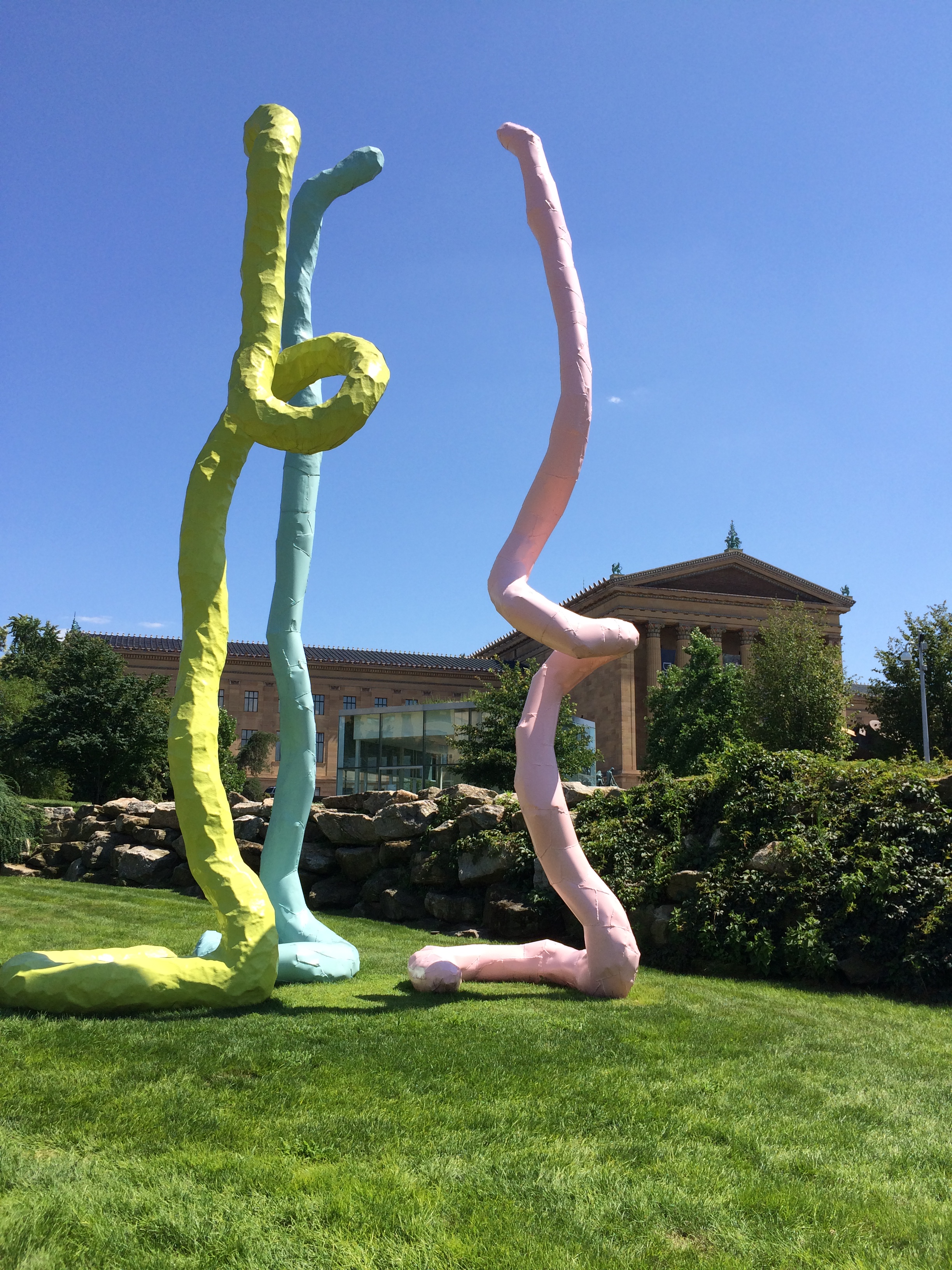
During the seven hours we found a fascinating park that was new to us, looked at lots of art within and without the museum, took in a Cuban music concert (“Havana Night”) at the museum and finished with a tasty dinner at a nearby restaurant, Rembrandt’s. But I’ve decided to skip many of the details about all of that. Instead I’m going to concentrate on a theme that, to my impressionable mind, seemed to unite a portion of what we saw. There’s a good chance that I’m stretching reality to find a connection, but what the hay, that wouldn’t be my first time. Besides, reality is flexible. The theme involves optimism, more specifically our species’ seeming desire and need to stay positive, to grow, to look upward. The notion began to bubble a bit in my sun-dappled head near the start of our Friday adventure when, poking around the museum’s outdoor sculpture garden, we were very happy to find Franz West’s colorful sculpture Lips towering before us.

Franz West's Lips in the Philadelphia Museum Of Art's sculpture garden.
Franz West’s Lips in the Philadelphia Museum Of Art’s sculpture garden.
Steps and Pyramid, two sculptures by Sol LeWitt.


Lips is way terrific. Three giant tendrils, (or are they giant worms?), pointing heavenward in pastel shades of blue, pink and lime. Taking a good look at the squirmy designs, I couldn’t help but think that West was putting his mind and emotions on display, that Lips represented his vision of looking on the bright side, of reaching for the stars. I wondered, what else around here might have had the same inspirations? Well, not far uphill from Lips on the sculpture garden grounds, Sandy and I found two modest and monochromatic sculptures by Sol LeWitt. They were sitting within their personal and unassuming open-walled pavilion. LeWitt named the larger piece Pyramid and the smaller one Steps. Pyramid and Steps were fashioned in 2010, two years before Lips, and are made of concrete blocks. Tiny compared to Lips, they nevertheless are objects that to me suggested that we keep our minds open and on the ascending path. Pyramids point skyward, duh. And although stairs go down as well as up, LeWitt I’m sure placed Steps next to his pyramid to reinforce the “up” reference.

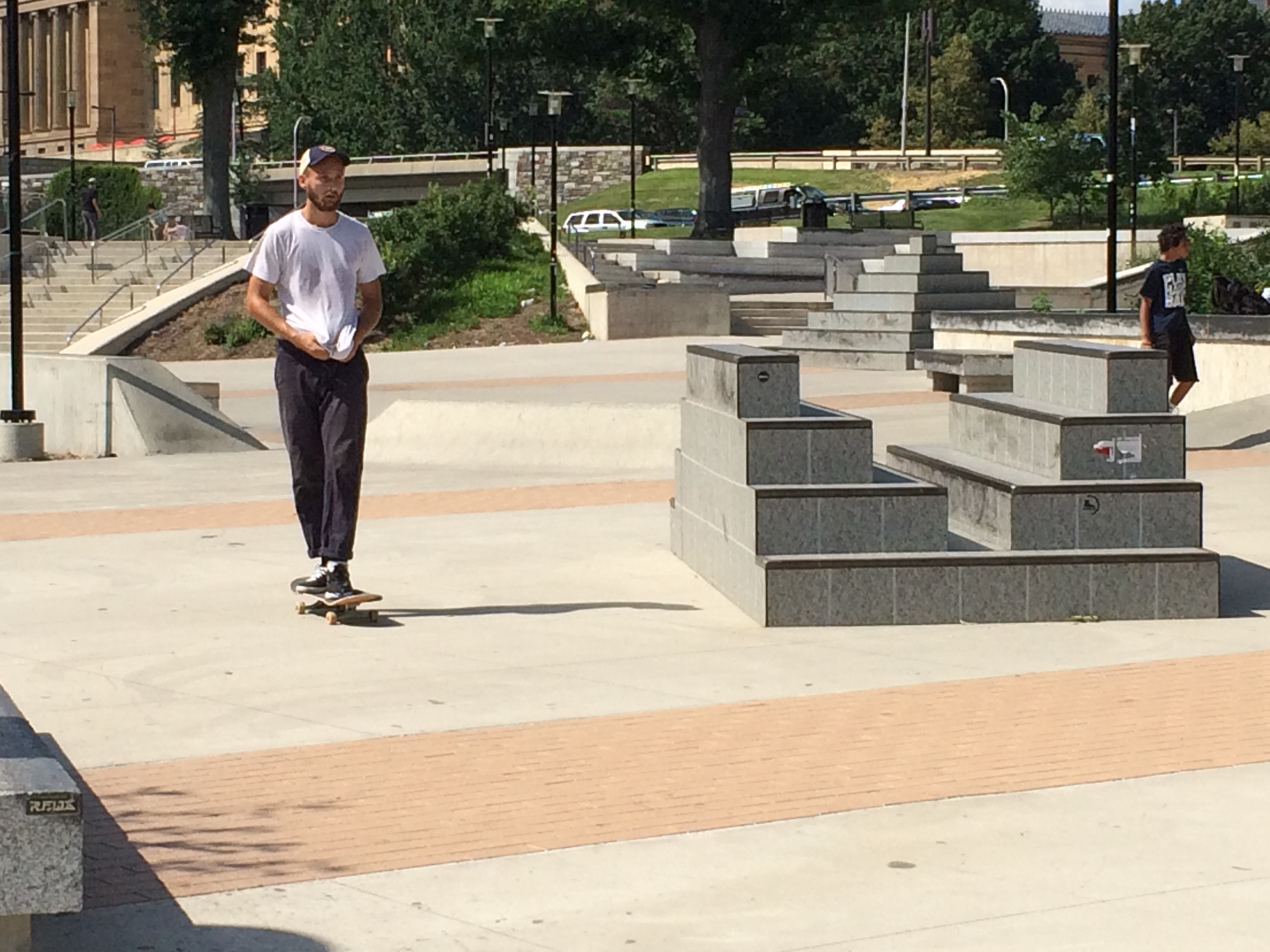
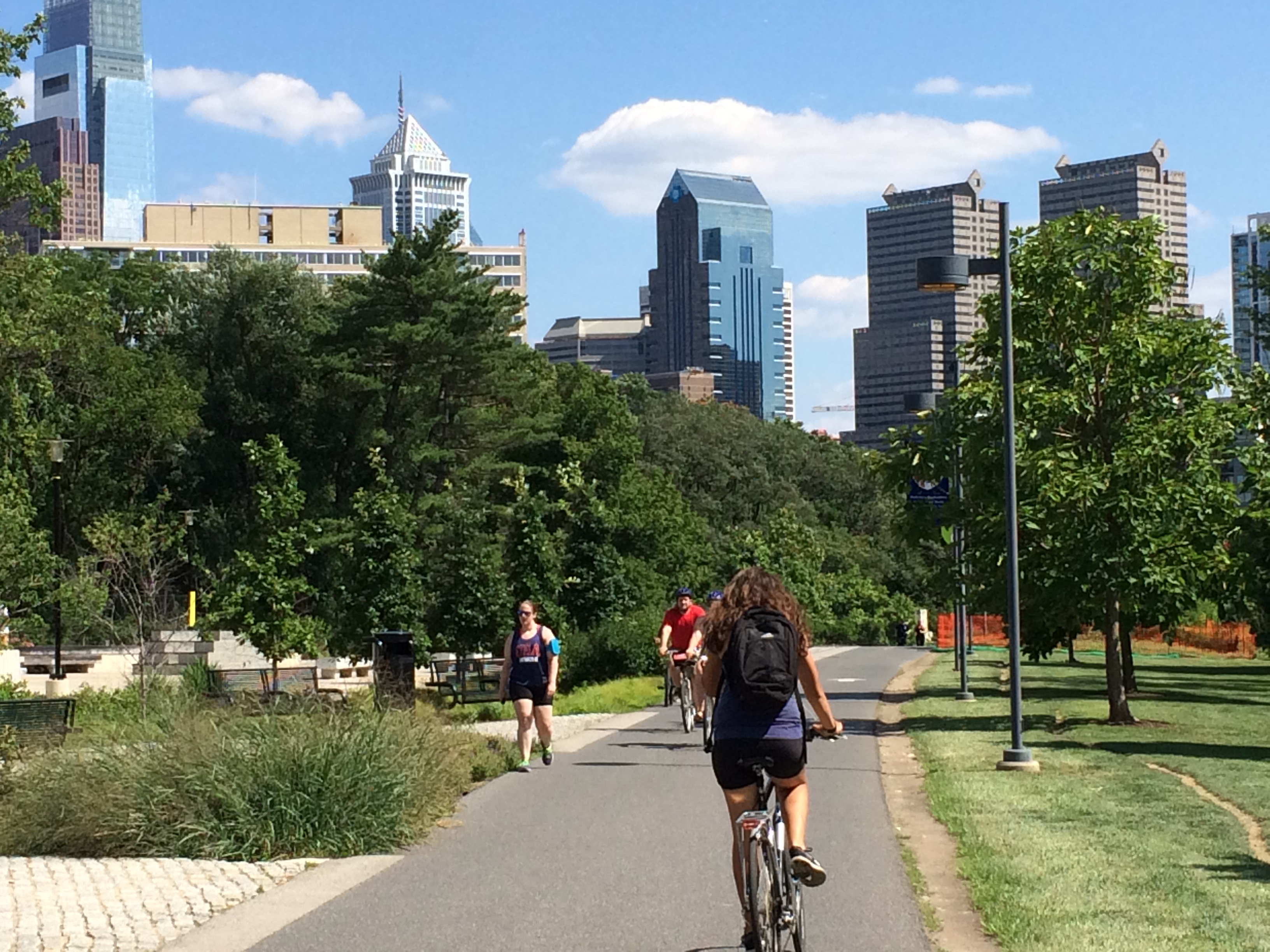
So, I appeared to be on a roll. What else might I fit into my Upward container? One reason that Sandy and I had decamped at the museum area was to check out some of the newish stretches of the Schuylkill River Trail, a river-bounded pathway for pedestrians and cyclists that planners hope one day will extend 140 miles from the bottom of Philadelphia to Schuylkill County, Pennsylvania. We walked a short distance southward on the River Trail and lo and behold came to a park we never knew about. It’s a haven that Philadelphia created for skateboarders. Paine’s Park is its name, probably because pain and skateboarding go hand in hand. Anyway, 30 or so guys and gals in their teens and 20s were gliding around the park, flipping off contoured walls and doing whatever else it is that skateboarders do. I was amazed by the park’s existence. Skateboarders had once made their home in Love Park, near Philadelphia’s City Hall, and garnered the wrath of city officials and ordinary folk in the process. Rather than continuing to scare the daylights out of tourists and office workers trying to lunch and lounge in Love Park, skateboarders needed their own officially-sanctioned facility. Now they have one. Paine’s Park opened two years ago.

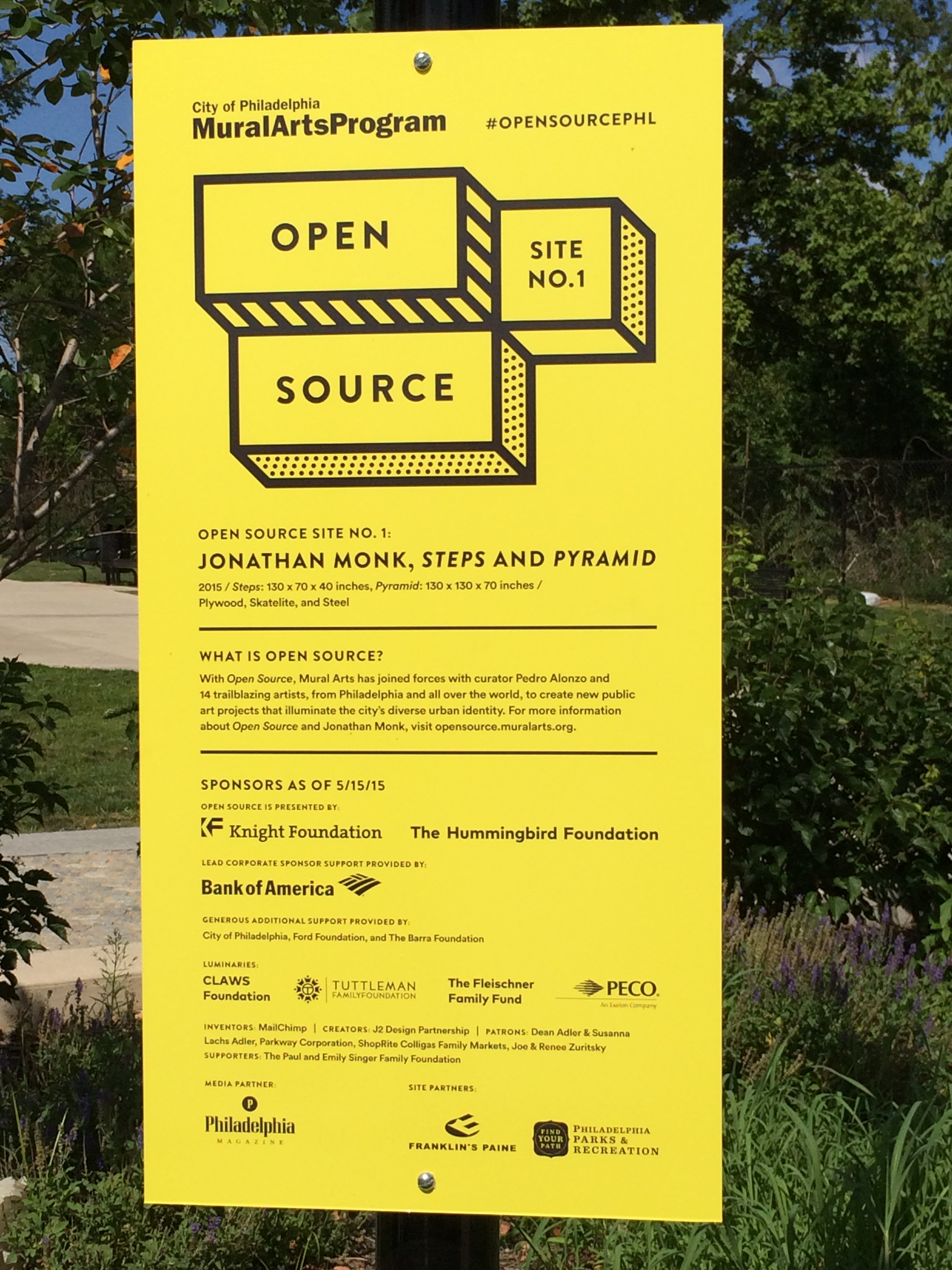
Sign for Steps and Pyramid IMG_0816

Jonathan Monk's two sturdy sculptures, Steps and Pyramid, in Paine's Park.
Jonathan Monk’s two sturdy sculptures, Steps and Pyramid, in Paine’s Park.


But did my eyes deceive me? There in Paine’s were two creations that looked suspiciously like Sol LeWitt’s Steps and Pyramid. Sure enough, they were near-replicas. Their artist, Jonathan Monk, liked LeWitt’s sculpture garden pieces so much that he paid homage by creating cousins. And he even gave them the same names. But whereas do-not-touch signs are planted near LeWitt’s pieces, the Monk sculptures, fashioned from really tough materials, are meant to take whatever abuse skateboarders can dish out. Sandy and I didn’t see any of the gliders take on the challenge of Steps’ and Pyramid’s narrowly and sharply angled spaces, but I have it on good authority that it happens regularly. Monk’s works not only continue LeWitt’s figurative idea of staying on the upside, they provide the surfaces to allow someone actually to soar.

Skyscrapers in Center City Philadelphia.
The Philadelphia Zoo's ZooBalloon.
The Philadelphia Zoo’s ZooBalloon.
Marquis de Lafayette.

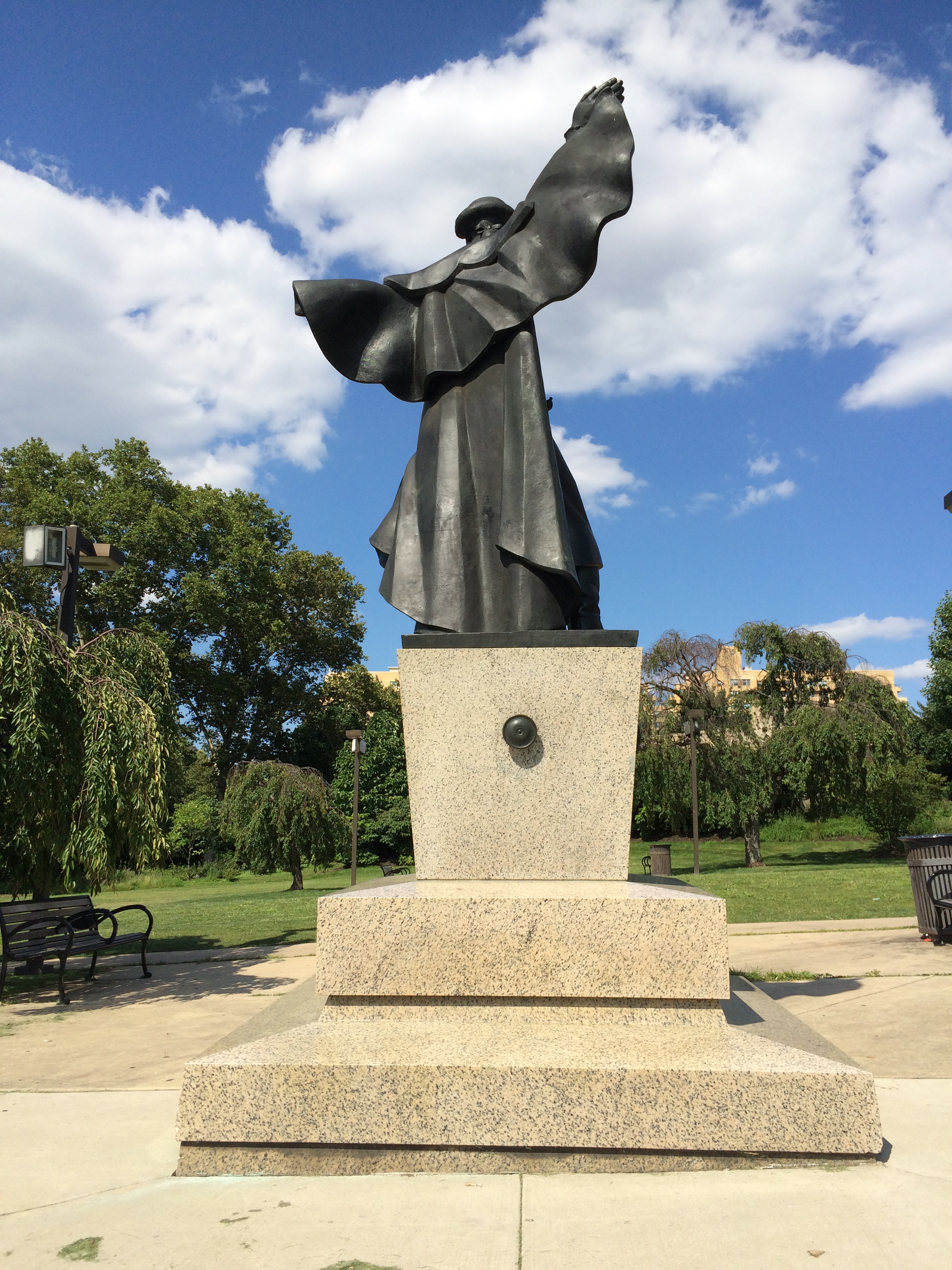
Yes, I smugly said to myself, there really is something to this idea I have. I looked around. In one direction were skyscrapers in Center City Philadelphia, testaments to man’s hopefulness. And in another was the Philadelphia Zoo’s gigantic and somewhat iconic ZooBalloon. Its daily flights, weather permitting, allow zoo visitors to come close to getting their heads near the clouds. And as Sandy and I made our way back to the museum grounds we passed Raoul Josset’s massive bronze statue of Marquis de Lafayette, his cape-enshrouded right arm pointing to the heavens. “Onwards and upwards, citizens,” the Marquis seemed to be saying.

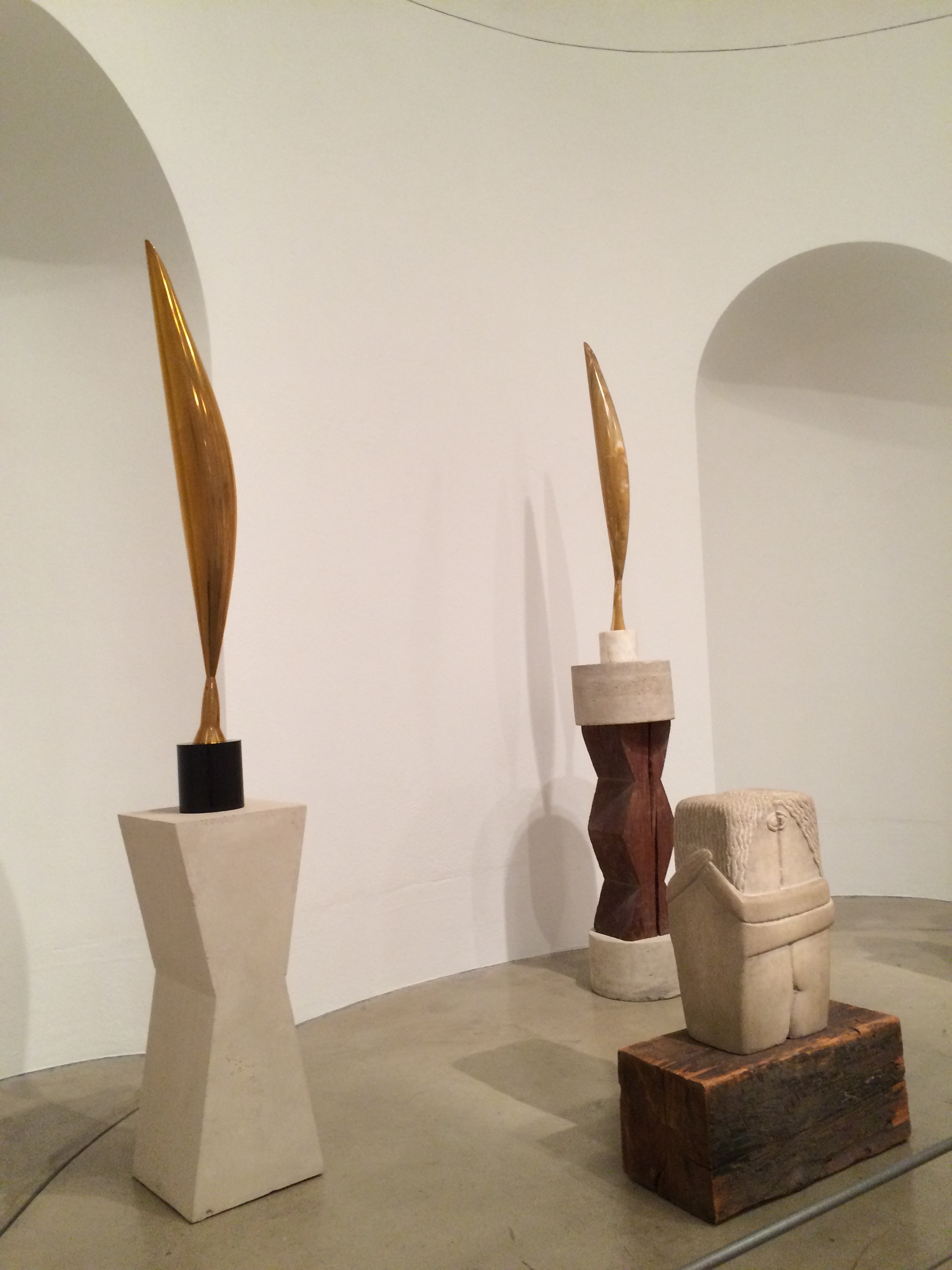
The two tall works are Brancusi's Bird sculptures.
The two tall works are Brancusi’s Bird sculptures.

Sandy and I entered the museum. She headed toward a photography exhibition. I told her I’d meet her there in a bit after I continued my search for further examples to bolster my theme of the day. The museum holds a superb collection of sculptures by the great modernist Constantin Brancusi, and has devoted an entire room to his works. In it I stood before two related sculptures, Bird In Space and Bird In Space (Yellow Bird), the former made from bronze, the latter from marble. Both are sleek and very beautiful. Brancusi must have felt his spirit soaring as he designed and shaped them in the early 1920s, and post-creation too. Going up!

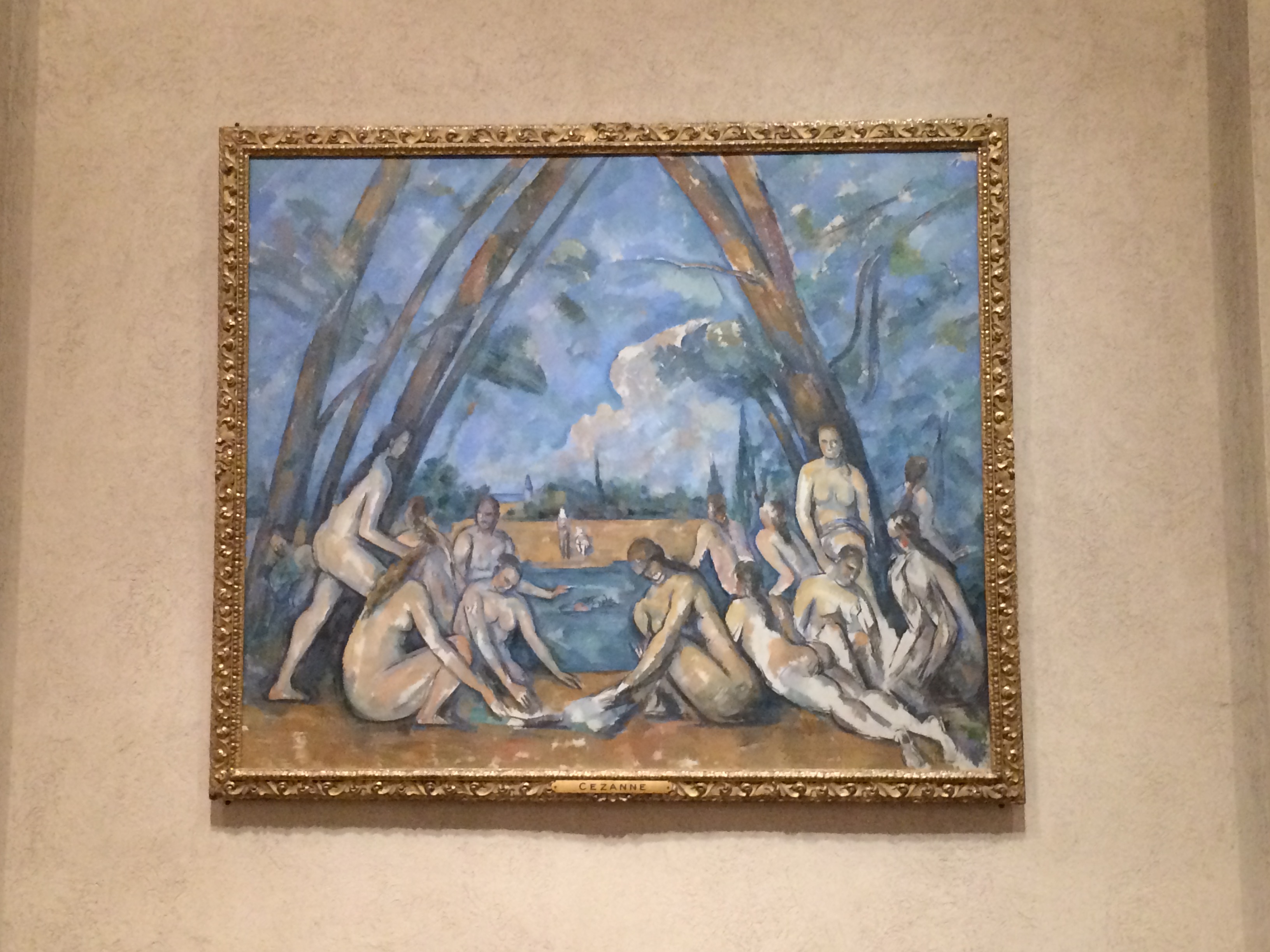
Paul Cezanne's The Large Bathers.
Paul Cezanne’s The Large Bathers.

I was tiring. One more stop, and then my quest to try and make a point would end. On many levels, Paul Cézanne is hard to beat. For maybe the 100th time I let wash over me one of his many masterworks, The Large Bathers. It was one of his final paintings, completed shortly before his passing in 1906.  This time I focused on the trees providing cover for the tribe of naked folks at ground level. The upper reaches of the trees are not shown, by design. I could imagine the trees going on almost forever. I believe that in them Cézanne symbolically infused man’s basic nature to ascend and achieve. To move upward.

(All photos by Sandra Cherrey Scheinin. If you click on any photo, a larger image will open)
(If you enjoyed this article, then please consider sharing it. Thanks.)
The Music Biz And I

A typical concert scene at beautiful Pastorius Park.

On a recent morning, the day’s threatening skies put me in mind of the music business mini-career that I enjoyed till not long ago. It was with the Pastorius Park Free Summer Concerts Series, in Philadelphia’s lovely and small townish Chestnut Hill neighborhood. For seven summers, the first two as a general helper and the following five as a co-organizer, I was part of a fine endeavor. My run ended in July 2014 with that summer’s final concert. Bad weather, or the prediction thereof, were among the reasons that I decided to step down. With rain a possibility for many concert evenings, I and another co-organizer often would find ourselves phoning back and forth hours before showtime, agonizing over whether or not to move the music indoors to our rain location, a school auditorium a mile from the park. It usually was a tricky matter. Sometimes we opted for inside and the rains never came. At least twice we stayed at bucolic Pastorius Park and downpours cancelled or prematurely ended the night’s entertainment. My constitution wasn’t strong enough to laugh along with the rain gods. Weather aside, though, the Pastorius Park segment of my life was terrific overall.

In 2008, knowing that I was approaching the end of my 30+ year tenure on the payroll of Pennsylvania government, I was looking around for a part-time activity that involved my main interest. Music. For 40 years I had been quite the music junkie, listening to albums and radio at home for hours on end, taking in shows at a wide variety of venues in the Philadelphia area and beyond. It had recently dawned on me that the next phase of my life might be pretty awesome if I could become more than an audience member by getting inside the music scene  But how would it be possible to find entry? I knew nobody in the biz and had never worked in music in any capacity whatsoever. Plus, I was not too far away from Medicare age. I figured that my chances weren’t overly bright. And then, to my delight and astonishment, a door opened.

Now, the music venture I became involved with wasn’t exactly Columbia Records or Live Nation Entertainment. The Pastorius Park series is low key and homey, which was fine with me. It runs under the gentle aegis of Chestnut Hill Community Association, an agency that aims for its community’s betterment. Volunteers are central to the series because the modest Pastorius budget has room for payments to musicians and audio crew, but not much more. As first a helper and later an organizer, I fell into the unpaid pool. That was fine with me too. I was more than happy just to be part of the process.

I went to my first Pastorius Park concert in summer 2007. On stage was Scythian, a rocking Celtic group that drove the crowd wild. This was before the notion of working in the music biz had crossed my mind. The next year, though, trying to figure out where my musical dreams possibly might come partially true, I dialed Chestnut Hill Community Association and was put in touch with one of the Pastorius Park organizers, Janine. She welcomed my offer to help. Next thing I knew I was at a planning meeting for 2008’s season. And a few months after that I was at the concerts themselves, setting up tables and chairs, helping to unload and load audio equipment, collecting concert donations from the audiences during intermissions. My energy seemed to swell on concert dates. I was having a wonderful time. The door had opened.

The door opened even more in early 2010 when one of the organizers, the fellow who scheduled and booked the acts, no longer had the time to continue his duties. He and Janine asked me to replace him. Me? Book acts? Negotiate contracts? Those for me were uncharted waters. Gulp, gulp. I said OK, I’ll do my best. And I was on my way. It didn’t take long for me to realize that my new position was close to being my dream job. There I was, a music lover given the keys from out of the blue to curate a small but well-regarded music series.

I had fun working with my organizing partners, Janine for the first two years and Julie for the next three, and with the other volunteers. I enjoyed chatting with the musicians before and after the shows. And I had a major blast scheduling each summer’s string of seven Wednesday evening concerts. In 2010 I reached past the Philadelphia area to hire two acts from afar, including, incredibly, Graham Parker. His solo show packed the park maybe tighter than ever before or since. But for the next four years I decided to stick entirely with artists from the Philadelphia region’s highly fertile musical ground. I liked the idea of supporting its progeny.

If I hadn’t known it before, one thing became very apparent to me during my days as an organizer. To wit, there are an astonishing number of excellent musical acts based in the Greater Philadelphia area, and many of the little-known local performers are as good or better than many who make big noise in the mass marketplace. Success is a matter of luck, timing, backing, perseverance, who knows what. A few of the Philadelphia region’s performers whom I booked for Pastorius Park had found some degree of national and worldwide acclaim, folks such as singer-songwriters Jeffrey Gaines and Mutlu, and Celtic music greats RUNA. But the rest were talented bands on the lower rungs of success’s ladder. Some of them put on performances as enchanting as you’d ever hope to see.

Cheers Elephant and some young fans at Pastorius Park in July 2011. Photo by Kevin Kennedy
Cheers Elephant and some young fans at Pastorius Park in July 2011.
Photo by Kevin Kennedy

For instance: I’ve never been to a show like the one in 2011 involving Cheers Elephant, a pop psychedelic rock outfit with loud guitars and a free-as-a-bird and charismatic lead singer, Derek Krzywicki. Cheers Elephant’s music was magic to the ears of many youngsters who had come to the park with their parents. During the band’s second set, played under darkening skies, many kids aged five to 15 left the grassy seating areas and, seemingly magnetized by Elephant’s electric energy, made their way to, indeed onto the stage, which sat beneath a grove of tall trees. Bouncing and shimmying to the band’s powerful and catchy beats, they covered the stage, pushed the musicians onward and upward, in fact had the musicians mesmerized. The scene was surreal and transfixing.

Venissa Santi and her band at Pastorius Park in July 2014.

And in 2014, Venissa Santi brought her Cuban-flavored jazz esthetic to the park. I’d hired Venissa once before for Pastorius Park, and had also seen her perform at another concert series. Last year, though, she and her band rose to a level I hadn’t known was in their command. Early in Santi’s first set my mind was captured. The music was complex yet malleable, expanding and contracting like strong bands of rubber. Venissa’s intimate and pitch-perfect vocals intertwined with the chordal onrushes of Tom Lawton’s piano, the now-I’m-here-now-I’m-there notes from Madison Rast’s bass, and the melodic assymetrical patterns of Francois Zayas’s drums. This, I thought, was music parallel to that of Miles Davis’s famed 1960s quintet. Was I imagining things? I don’t think so. Did others in the audience hear the music as I did? I can’t say for certain. But judging from their tremendous applause I’d guess yes.

(If you enjoyed this article, then please consider sharing it. Thanks)

Ashes: Lindi Ortega’s Great Song Heard In The Great Outdoors

This is a story about life’s little surprises, about how one thing leads to another. In this gentle instance an unexpected impulse to relocate my duff from indoors to outside resulted in my hearing a song that I can’t get out of my head.

There’s something naturally relaxing about sitting outdoors when the weather is pleasant. Some people sit in parks, some on beaches, some a few feet from doors to their homes. One of my pals lives in Philadelphia in an old comfortable house, a sprawling place with a front porch. On evenings when the Philadelphia Phillies are taking the field, my friend positions himself in a porch chair, balances a small radio on a table beside him and turns on the Phillies station. He remains there till the game is over. This routine helps him stay calm.

A scene at dusk: Cheez-Its, iced tea and portable radio on the deck table behind my house. Photograph by Sandra Cherrey Scheinin
A scene at dusk: Cheez-Its, iced tea and portable radio on the deck table behind my house.
Photograph by Sandra Cherrey Scheinin

I should emulate my friend’s fresh air example more often. I used to sit outside frequently, mostly on the deck behind my house, but haven’t much in the last few years. Most of my sitting and downtime in that stretch has taken place on the sofa in my living room. On a recent Monday night, however, a powerful urge to visit the great outdoors came out of nowhere, and so I stepped onto the deck as dusk was settling in, and sat at the deck table. The temperature was ideal, the evening peaceful. At least ten houses are within 100 feet of the deck, but they became less and less visible through the trees as blackness approached. These were conditions that agreed with my inner yearnings. That is, I felt isolated, away from it all. And three things made the scenario even better: Food, beverage and music. Munching on Cheez-Its,  sipping iced tea and, most important to this story, listening to my portable radio, I was as relaxed as I’m capable of becoming. The radio was tuned to WXPN.

In the Philadelphia region WXPN is the go-to station for rock, folk, blues and nearly any other non-Ariana Grande musical genre you can name. XPN plays everything from The Beatles to Mavis Staples to Caetano Veloso to Laura Marling. And the station makes it a mission to keep up with the continual avalanche of recorded music from established and never-heard-of-them-before musicians. Airing on XPN as I sat beneath the stars and amidst pulsating fireflies was a program showcasing nothing but new songs. And the tune that issued from my radio at about 9:00 PM swept me from my state of relaxation to a much higher plane.

There are certain songs over the years that infatuated me from the moment I first heard them. In 1968 it was Jumpin’ Jack Flash, by the Stones. To this day it stirs me up every time I hear it. California Stars, by Billy Bragg and Wilco (and lyrics by Woody Guthrie), brought me to my knees in 1998. I’ve added another number to the list of instant infatuations, all praise to WXPN’s new music show. The song is Ashes. Its singer and writer is Lindi Ortega. Ashes overwhelmed me on my deck. I think that the calm within and without me had unlocked fully the doorways to my emotions and ushered Ashes in. From its opening notes, Ashes in a good way made me shiver and melt. It went straight to my truest spaces.

I had come across Lindi Ortega’s name in print in the past but wasn’t familiar with her music. As I’ve learned, she’s a Canadian now living in Nashville and plays and composes smart country-hued material à la Emmylou Harris and Patty Griffin. With Ashes she and her production team have created a wonder, a stirring song about the need for love, the pain of loss. The heartbeat bass lines, the steady tension-inducing drumming, Lindi’s pleading and impassioned vocals that grow as the song develops, the soul-gripping guitar solo at the song’s three minute mark . . . Ashes to me is perfection. “Darling, this is madness, why don’t you come back to me?/Don’t leave me in the ashes of your memory.” Indeed. Indeed. When Lindi next appears in or around Philadelphia I’ll be at the show. For now, I’ll listen to Ashes on YouTube, where Lindi has gifted it to the world in advance of its release next month on her album Faded Gloryville. I recommend that you do the same. Here is Ashes:

(If you enjoyed this article, then please consider sharing it. Thanks.)