Infinitely The End (Thoughts About Two Movies)

Existence can be perplexing. If you’re like me, there are countless aspects of the organic and inorganic and intangible realms that are hard or impossible to figure out. Now, some of these subjects are of high importance, such as global warming or one’s relationships with one’s fellow species members. Others aren’t worth devoting too much brain power to. Naturally, those are the ones I gravitate towards. A few days ago, for example, I decided to look into the degrees of success that a couple of movies that I’ve recently seen in theaters have had at the domestic box office. Our planet’s fate did not hang in the balance as I did my research. I’m talking about Infinitely Polar Bear and The End Of The Tour, smart and perceptive movies aimed at the art house market. Infinitely seemed to me to be far more of a potential crowd pleaser than The End. Yet it has been attracting far fewer dollars in the USA than The End. Here’s why this surprised me:
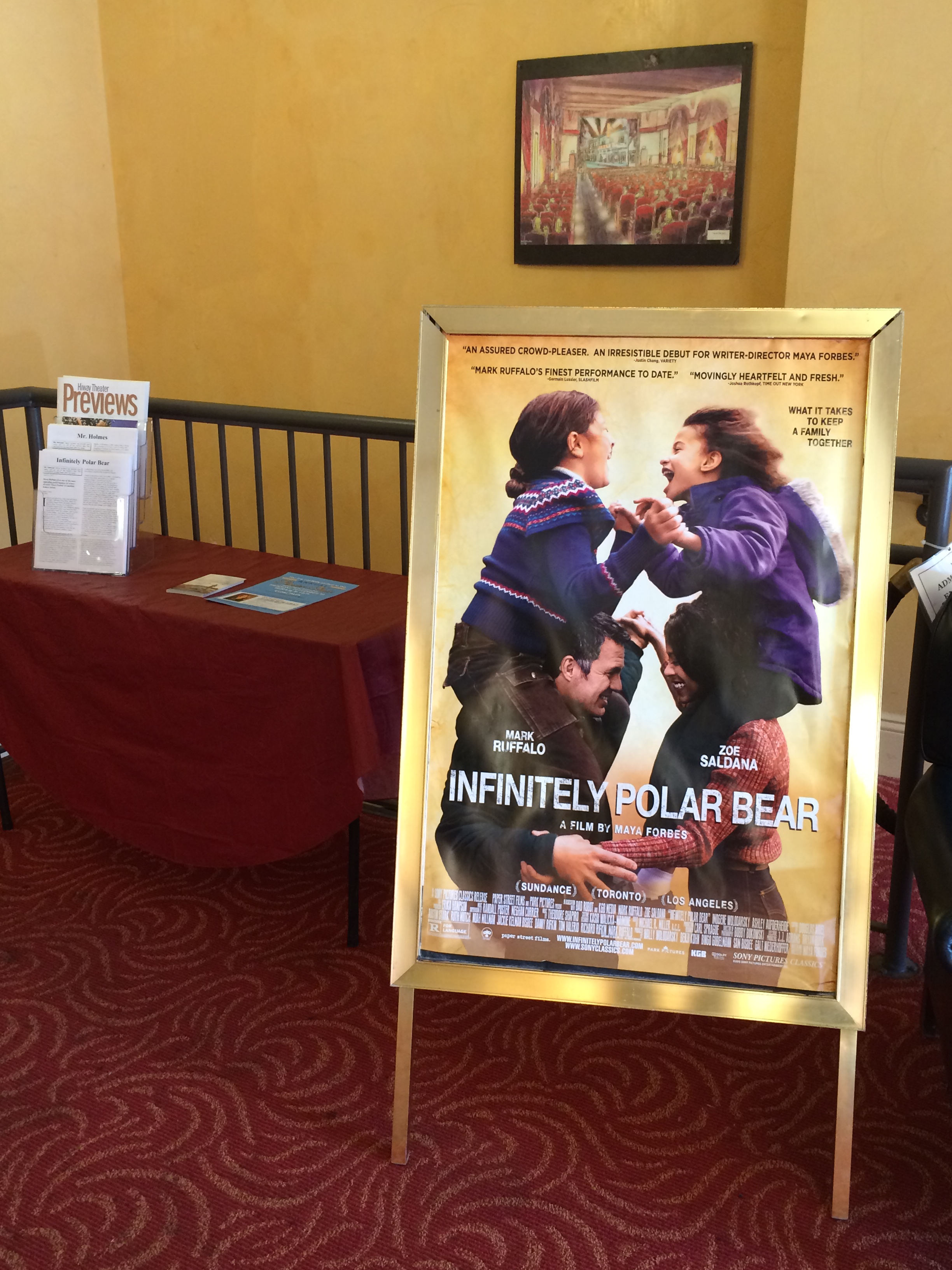
My wife Sandy and I saw Infinitely Polar Bear at the Hiway Theater in Jenkintown, PA.

Infinitely Polar Bear is a boisterous movie, a full-of-life, family-oriented comedic drama and to a large extent a feel-gooder. What’s more, it centers around a wild and bigger-than-life character, beautifully played by Mark Ruffalo. The End Of The Tour is and has none of that. It is slow-moving and understated and wry. And cerebral too. Its main character is charismatic, but in a geeky and repressed sort of way. Infinitely has flash. The End doesn’t.

As we see, I’m no Kreskin when it comes to predicting people’s tastes in movies. What else is new? Still, though I enjoyed both, in a way I’m glad that The End Of The Tour is outdoing Infinitely Polar Bear financially, because I think that The End is better. I’d give it at least three and a half out of four stars. To Infinitely I’d grant maybe three. There were aspects of Infinitely that rang a bit false to me. I had no such problems with The End Of The Tour.
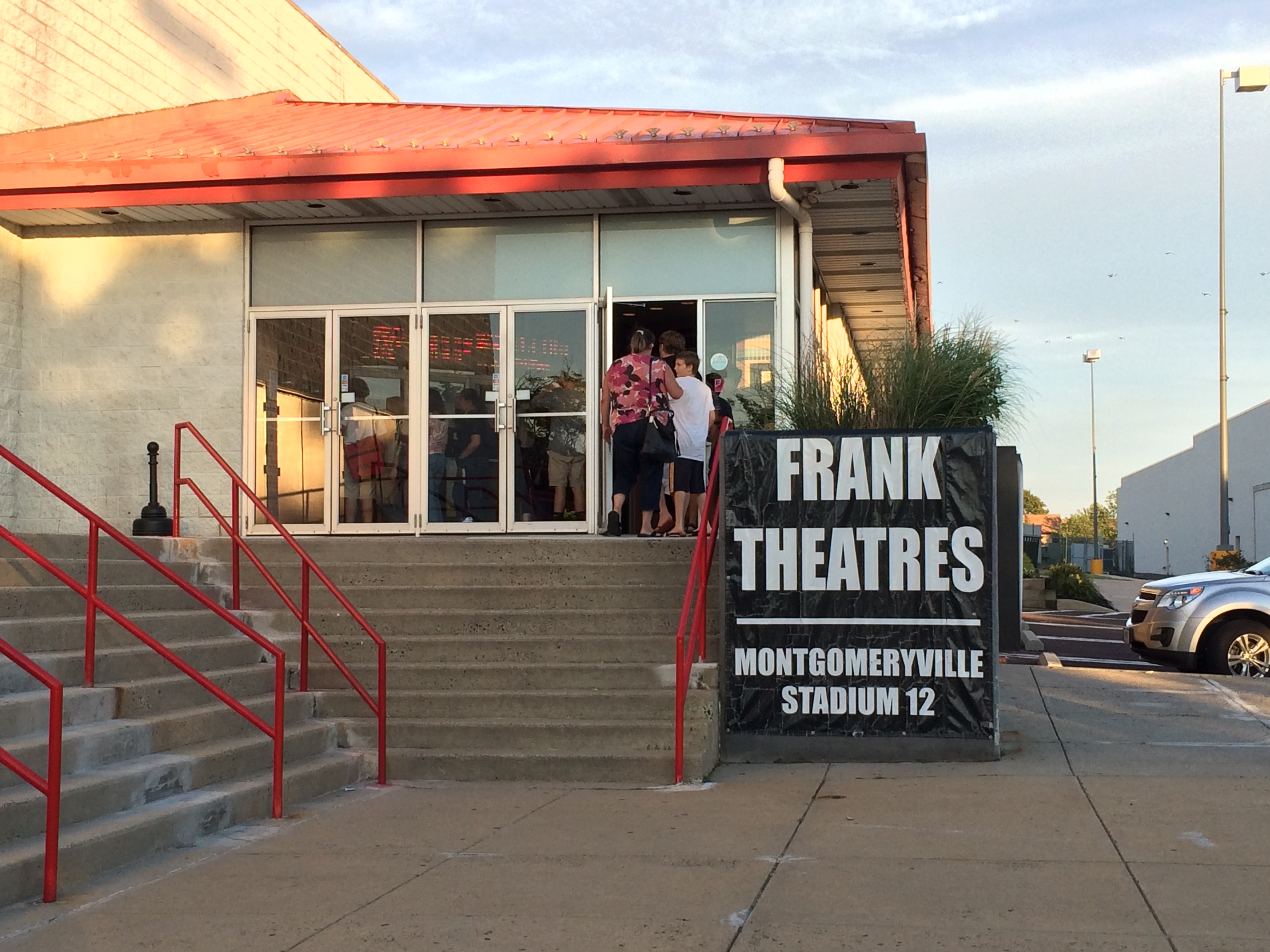
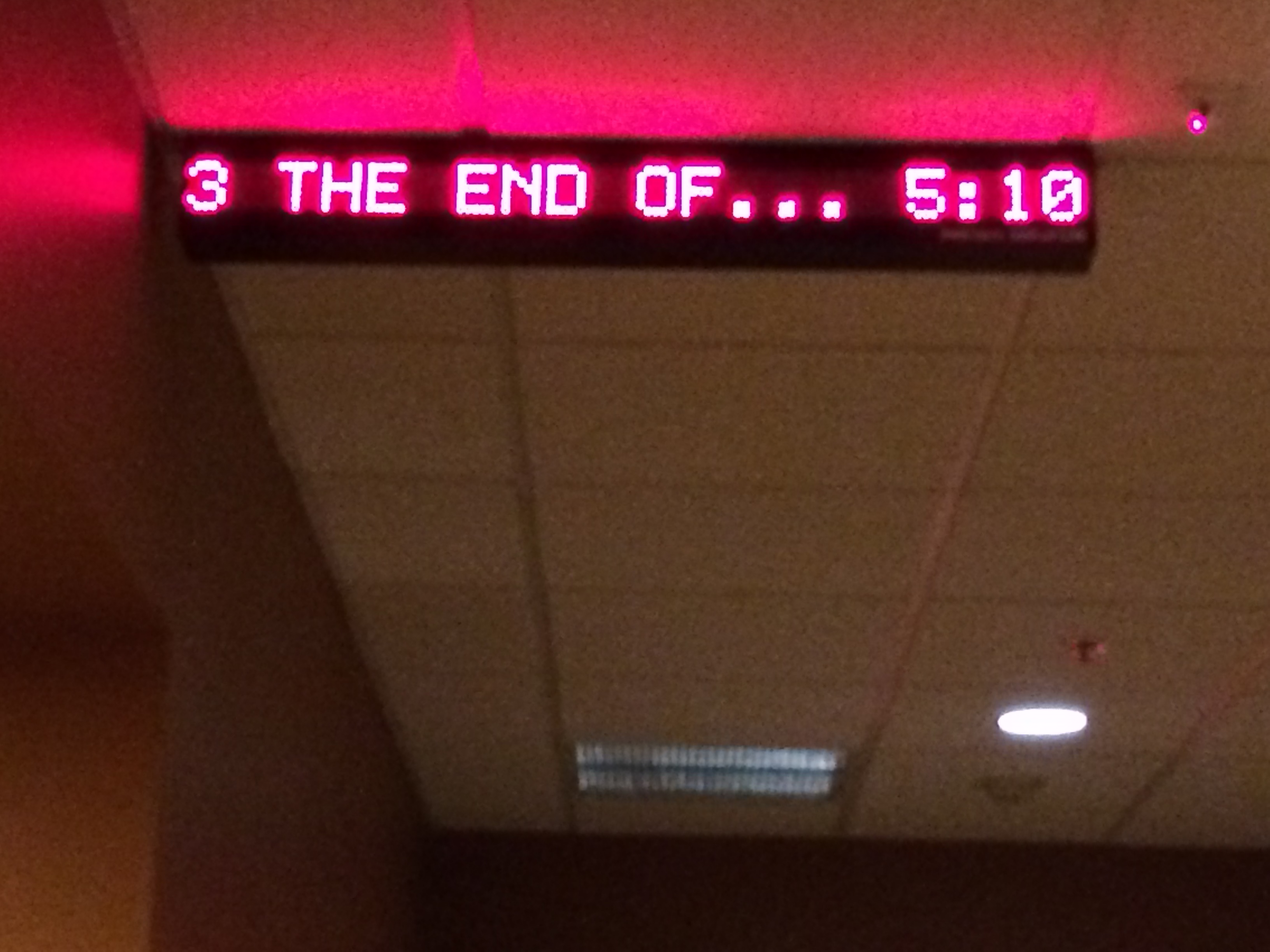
We saw The End Of The Tour in Montgomeryville, PA.
Guess what time the movie started.

One big thing that Infinitely and The End have in common is their aim to portray real life people and events. Another similarity is that the main figure in each is weighted with psychological problems. The End Of The Tour’s core takes place in 1996, when a Rolling Stone magazine writer, David Lipsky (a medium octane turn by laser-eyed Jesse Eisenberg) tagged along with David Foster Wallace during the tail end of the promotional tour for Wallace’s recently-published and massive (1,000+ pages) novel, Infinite Jest. Lipsky’s assignment was to profile Wallace for Rolling Stone, and he filled many cassette tapes with Wallace interviews. The End is drawn from the interviews and from Although Of Course You End Up Becoming Yourself, which was Lipsky’s 2010 book about his Wallace adventures.

No supernova explosions took place during Wallace’s and Lipsky’s five days together, but in a subdued and riveting way their conversations soared. I’m pretty certain that The End mirrors reality in this and most respects. The wary Wallace opened up more to Lipsky than he might have wanted, partly due to some slings and probes that got under his skin. Wallace talked about the love-hate feelings he was developing about the fame that Infinite Jest was thrusting upon him. He talked about the dehumanizing effects of technology on modern man, about the place of the creative person in the world. He touched upon many other topics, including his struggles with mental depression (sadly, he lost this battle in 2008, when he committed suicide). I found The End’s depiction of all of this very moving and kind of exhilarating. I was totally smitten by Jason Segel’s portrait of Wallace as a shaggy dog, a pretty brilliant and mostly nice guy. If Segel isn’t nominated for an Oscar he’ll deserve to say “I wuz robbed.”

Infinitely Polar Bear is Maya Forbes’ baby. Forbes has been a writer for the big and small screens (Monsters Vs. Aliens and episodes of The Larry Sanders Show). For Infinitely, she wrote the screenplay and took her first stance ever behind the camera. The movie tells the story of part of her life, zeroing in on the late 1970s when preteen Maya and her younger sister were raised in semi-poverty in Cambridge, Massachusetts by their bipolar father. The two girls had been living with Maya’s underemployed mother Peggy. Peggy, though, came to decide that the only way to lift the family from its lowly monetary straits was to obtain a marketable postgraduate degree, a Master of Business Administration. This pursuit resulted in her relocation to New York City, Columbia University being the only school that approved her application. Peggy hesitantly deposited the girls with her husband, the girls’ father, Donald Cameron (“Cam”) Forbes, and visited them on as many weekends as she could.

Infinitely Polar Bear is bursting with energy. Ruffalo’s Cam captures the screen, especially during his manic phases, which seem to be far more frequent than his self-absorbed and down moods. Maya Forbes’ screenplay paints Cam as an admirable father, flawed and unpredictable and psychologically challenged, for certain, but there for his girls. Ruffalo and Zoe Saldana (Peggy) make a believable, though separated, couple. Imogene Wolodarsky (Maya’s real life daughter) and Ashley Aufderheide are so feisty and delightful as the young sisters, I was convinced that they gave Ruffalo his wings.

So what about the movie slightly rubbed me the wrong way? For one, it felt a few tads too glossy, too Hollywoodized. And I’d have liked to know what the family arrangements were as the years went on. For instance, did Maya’s parents ever again join as one? Forbes didn’t say, not even in a few written sentences on the screen before the credits rolled. And what’s with changing the family’s names? In Infinitely Polar Bear they all are surname Stuart, not Forbes. Some first names were altered too. In interviews surrounding her movie, Maya Forbes has said that she wanted to present a true portrait of her family. I wish she had started by assigning the screen characters their correct appellations.

(Photos by Sandra Cherrey Scheinin. If you click on a photo, a larger image will open)

(If you enjoyed this article, then please consider sharing it)

Sunday In The Park With Duane (Jazz Concert Review)

Some outdoor summer music series are better than others, but not everyone would agree on which are the good ones. Personally, I most like those that have an eclectic mix of musical genres and that also avoid tribute bands. Luckily for me and my tastes there are a number of summer series in the Philadelphia region that hire the kinds of acts that I’m a sucker for. One of those is Cheltenham Township’s Concerts In The Park, whose shows are staged in the sprawling and meticulously maintained Curtis Arboretum. There, a mile or two from Philadelphia, musicians mount a modest stage at 5 PM on five summer Sundays. They and their audiences are surrounded by, and are under, many large trees.

I’ve been impressed for years by some of the Cheltenham bookings. In 2014 my wife Sandy and I, accompanied by two of our friends, went to the Curtis Arboretum to see and hear Geoff Muldaur, who has been crisscrossing the USA and other countries as a musician for decades. Geoff began to make his name in 1963 as a member of the Jim Kweskin Jug Band. And there he was, so many years later, performing his folky-bluesy-jazzy repertoire on acoustic guitar at the arboretum.

The pre-show crowd at Curtis Arboretum.

On a recent Sunday, Sandy and I, with the same two friends, sat beneath some leafy limbs at Curtis to take in another example of thinking-outside-the-box scheduling, the Duane Eubanks Quintet. This jazz outfit is more commonly witnessed in clubs. Somehow I didn’t hear Duane say from the stage that he wasn’t used to playing at settings such as Curtis, but my friend assured me that he did. Eubanks, a suburban New York City-based trumpeter with a first-rate résumé, brought along with him four fine and established members of the jazz world.

Duane Eubanks comes from a very musical family. He grew up in Philadelphia’s Mt. Airy section, so his Curtis gig wasn’t far from his childhood home. His pianist mother, who gave lessons to prominent jazz players, helped spark a musical flame in some of her children. Look at the results: Duane’s oldest brother, Robin, is a well-regarded jazz trombonist. Duane’s second-oldest brother, guitarist Kevin, became famous as the band leader for The Tonight Show With Jay Leno. Of the four male Eubanks offspring, only Shane, Duane’s twin, is not motoring on the professional musician highway.

Duane plays trumpet really well. Throughout the Curtis show I gave a mental thumbs-up to his imagination and clean lines. He wasn’t flashy, didn’t spend inordinate amounts of time swirling around in his instrument’s nosebleed zone. What he did was this: He spun worthy tales with his horn, filling his solos with strong ideas, and balanced that with terrific technique. I don’t think I had ever seen him in concert before. I was impressed.

Duane Eubanks Quintet at Curtis Arboretum.

Eubanks and company primarily stayed in the hard bop bag, with two excursions, which I wasn’t crazy about, into the borders of smooth jazz territory. The tough and driving stuff and the one unadulterated ballad, though, were terrific and had my head swaying. On board with Duane was tenor saxophonist Abraham Burton. Burton’s robustness and energy owed debts to John Coltrane, his more meditative moments to Dexter Gordon. David Bryant was a whiz on electric keyboard, an attentive musician filling spaces deftly when Duane or Abraham soloed, his fingers flying fast and furious when he himself took the lead. Corcoran Holt, on upright bass, helped power the band with notes that sometimes boomed, sometimes cooed. I thought that he was great. And the in-demand drummer, Eric McPherson, was all over his kit, rat-a-tat-tatting on his snare drum, whacking à propos accents on his cymbals. I didn’t particularly enjoy his work on the two aforementioned smoothed-out numbers, but let’s put them aside. I already have.

The tune I maybe liked the best was the first set’s opener, a Eubanks original titled Slew Footed. It went on for 20 minutes. Slew Footed was a hard romp, a controlled yet convulsive affair. Each musician took long propulsive solos. Each listened carefully to what the others were saying. The onstage musical conversations were animated and keen.

Guest vocalist TC III with Duane Eubanks' group.
Guest vocalist TC III with Duane Eubanks’ group.

Halfway through the second set Eubanks brought to the stage a guest vocalist, TC III. I used to see him perform at venues all over Philadelphia, but hadn’t in 20 or more years. He sang on two songs. TC III took hold of the first tune, Moanin’, from its opening notes. I had forgotten just how fine a singer he is, bluesy and direct. Think Eddie Jefferson. Think Joe Williams. Moanin’, a gutsy marriage of the blues and gospel, was a staple of Art Blakey And The Jazz Messengers. I loved the way that TC III and the Eubanks group belted it out.

I’m a stickler for good audio projection. Too often at concerts, in venues small to enormous, the sound quality doesn’t cut the mustard. At Curtis the sound guy got it right. Every instrument, and TC III’s vocals, came through loud and clear. There was no muddiness in the mix. All of this added to my enjoyment of the show. As did the weather. For much of the late afternoon and early evening, dark clouds massed and inched along far overhead. I was certain that a downpour was in the works, especially after a dozen or so raindrops plunked me around 6:30 PM. Amazingly though, not another drop fell after that.

(Photographs by Sandra Cherrey Scheinin. If you click on a photo, a larger image will open)

(If you enjoyed this article, then please consider sharing it. Thanks.)

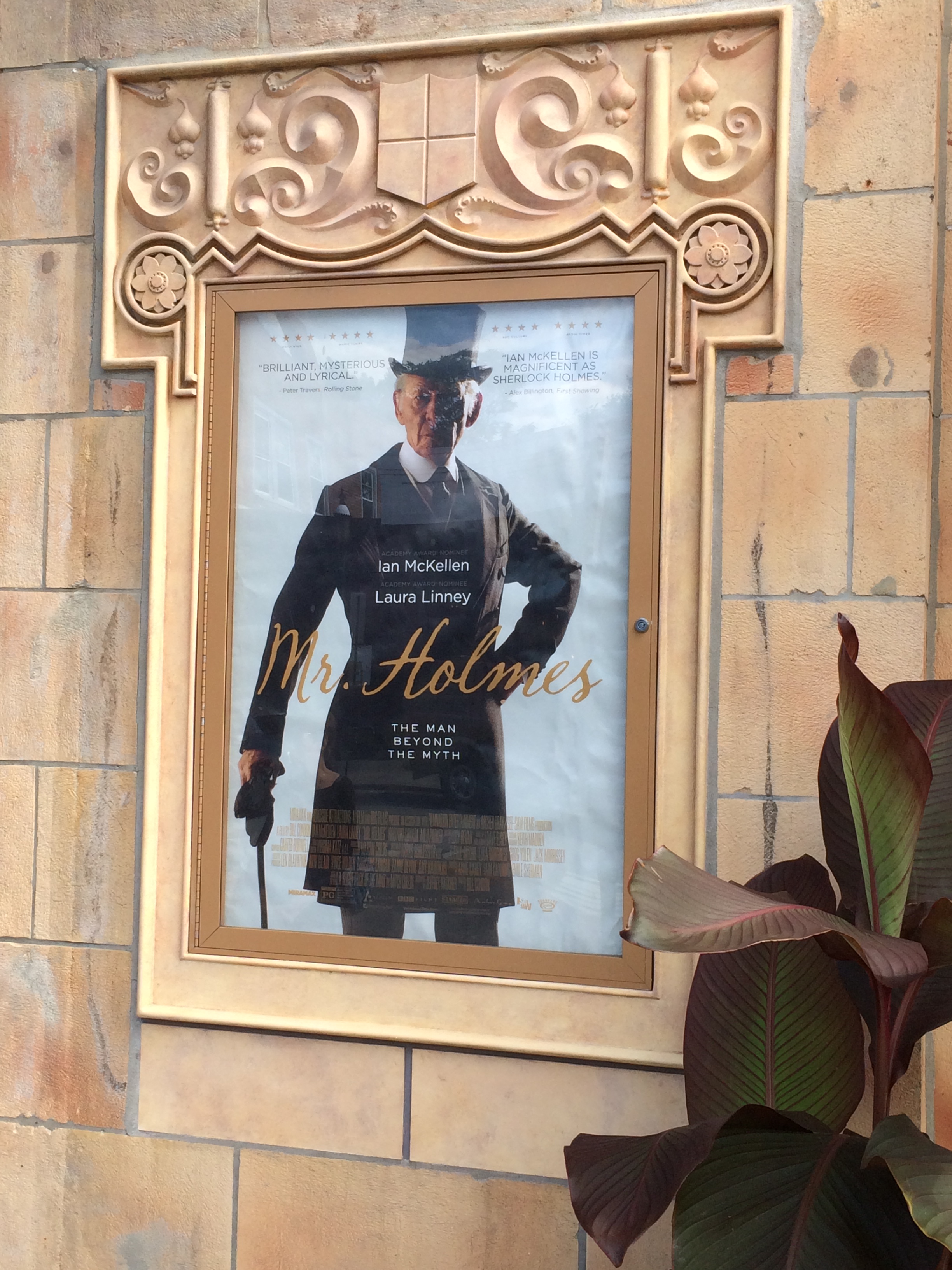
Putting Up The Good Fight: A Review Of Mr. Holmes

Arthur Conan Doyle published his final Sherlock Holmes opus in 1927. Copyright laws in Great Britain and the USA allowed him and subsequently his heirs to collect gazillions of pounds and dollars in royalties and fees since then, but the flow of those monies has become a trickle. Wikipedia tells us that the last of the copyrights expired in Britain in 2000. In the States, a handful of the final Holmes stories still are under copyright, but all the rest have fallen into the public domain. And a 2014 federal appeals court ruling stated that the creators of books and movies and television shows inspired by Sherlock no longer are obligated to pay licensing fees to the Conan Doyle estate, whose members must be grinding their teeth. I mean, is there a more enduring fictional figure than Holmes, the masterful detective? He’s hard to miss. Robert Downey Jr. starred as Holmes in two big screen productions from the 2000s, and a third undoubtedly will be heading our way in the near future. And two Holmes series currently are alive and well on the small screen: In the aptly named Sherlock, Benedict Cumberbatch portrays a modern day version of the great man in London for BBC television. Also set in the present day is Elementary, a New York City-based Sherlockian study, this one on CBS.

Books too have kept alive the Sherlock character. Dozens and dozens of them. For example, 2005’s A Slight Trick Of The Mind. Mitch Cullin wrote Slight Trick, and it is the basis for Mr. Holmes, the movie now gracing art houses and multiplexes worldwide. My wife Sandy and I recently watched it, and liked it, at the friendly and classy Ambler Theater in beautiful downtown Ambler, PA.

We saw Mr. Holmes at the Ambler Theater in Ambler, PA.

I’ve given some thought to Mr. Holmes, not an easy feat for me to undertake or accomplish. And I’ve come away with the opinion that the flick needn’t be looked at as part of the Sherlock Holmes continuum. It certainly is about Holmes, in fact a 93-year-old version of himself trying to stare down his failing mind and the end of his earthly existence. But the movie would stand just as handsomely if a few plot strands were reworked to undo the Holmes references, and if the lead figure were given another name. The movie I’d say is less about Holmes and more about understanding oneself, coming to grips with one’s shortcomings, trying to become a better person even as the end of the line draws near.

It is 1947 in the county of Sussex, England. By choice, Sherlock Holmes lives there in semi-obscurity on a small farm near the English Channel. He has been retired from the investigator game for about 30 years, having decided to hang up his detective tools because, because, because . . . Sherlock cannot remember why. His brain power, and body for that matter, are pretty strong, but some memories have begun to fade away. Holmes knows that his powers are slipping. An avid bee cultivator, he has doused himself for some time with his colonies’ royal jelly, a presumed mental strength rejuvenator. As the movie begins, he returns to Sussex from Japan, laden with that country’s prickly ash, a herbaceous product likewise touted for its restorative powers. Sherlock Holmes is not one to settle back and accept a drowsy and inevitable descent into a muddled mind.

At home, Sherlock and his property are tended to by Mrs. Munro, a widow with a bright as can be 12-year-old son, Roger. And it is here, in the mixings of these three lives, that the story finds its epicenter. Holmes, who has aged gracefully, is no longer the flinty and brusque superman of his younger days. He is fairly gentle with fellow humans and tolerant of their ways. Yet deep love is not, never was, an emotion he feels at home with. Spoiler alert: By movie’s end he will have opened his heart wider than ever.

A good chunk of the movie concerns a mystery from the past, from the years of the First World War. And that mystery, which involved Sherlock and a troubled woman, led to Sherlock Holmes’ abandonment of his Baker Street digs in London and his retirement to the English countryside. Throughout the film he strains to remember the why of his resettlement. But put aside this artistically designed and developed aspect of the movie and you still are left with a lovely character study. Ian McKellan, face creased like an accordion’s bellows, handles the elderly Holmes character with nuance and charm. His Holmes is quite yet smart as a whip, and not ashamed of the emotional vulnerabilities he has begun to develop in his golden years. His is the most complicated character on screen, the most multifaceted and the one with the most growing to do. Laura Linney (Mrs. Munro), the great American actress who to my ears has her English accent down pat, and Milo Parker (Roger Munro) at varying times coexist, bond and brawl with McKellan’s Holmes marvelously.

Bill Condon sure-handedly directed Mr. Holmes. The movie’s languid pacing feels right, and I’d bet that much of the credit for the actors’ strong performances belongs to him. Mr. Holmes is not a tearjerker. Oh, maybe one Kleenex will be of use. What we have here is a mostly cliché-free look at the tail end of the life of a proud man determined, maybe destined, to be a mensch.

(Photo by Sandra Cherrey Scheinin. If you click on the photo a larger image will open)

(If you enjoyed this article, then please consider sharing it. Thanks.)

A Pretty Park Can Be Pretty Hard To Find

Back in 1981 the Philadelphia Museum Of Art mounted an exhibition of photographs by Robert Adams. Adams took the photos in the 1970s. They were images of western American states, the desolate areas, primarily deserts and mountains. I remember the show fairly well. No matter how remote the locale, nearly every photograph bore evidence of man’s hand: A telephone pole, tire ruts in the sand, roads winding like barber pole stripes around magnificent mountains. One of Adams’s points was that pure wilderness is long gone, so we better get used to it and be glad for the great though adulterated spaces that exist. I imagine that even if you found yourself in the middle of Antarctica’s biggest ice shelf, and I don’t wish that fate on too many of us, you wouldn’t have to wait impossibly long before an airplane passed overhead. Man is everywhere. Yikes.

Now, a half-baked embryonic distillation of those thoughts was in my head recently when my wife Sandy suggested that we walk around the grounds of Abington Art Center, a few miles south of our home in the Philadelphia suburbs. “Sure,” I said, “good idea.” But what I didn’t say is that I’d prefer to stroll some expansive Adams-like terrain. In my dreams. Around here in the burbs, man for the last 75 years has been relentlessly busy cutting down trees and pouring cement. Around here, you have to count your lucky stars that any good-looking patches of territory of any sort still exist.

Manor house and lawn at Abington Art Center.

Abington Art Center is one of those patches. The center contains the manor house and some of the grounds of a former estate. The house is used for art classes and gallery exhibits and the like. The grounds mostly are a huge lawn that slopes away from the rear of the house and 10 or 15 acres of woods. It’s a lovely place. And it is more than manor, grass and trees. Scattered here and there on the great lawn and on side lawns and in the woods are all manner of sculptures, about 50 all told. Sandy and I had a good time at the center. For two hours we looked at trees and artworks and burned off a few calories while walking a couple of miles.

The play of light in the woods at Abington Art Center.

I like the outdoors. But I’m hardly a naturalist. My knowledge of flora and fauna has more holes than you can count. And so at Abington Art Center I found myself admiring a specific leafy tree species, of which many examples exist in the center’s tiny forest, having no clue what I was looking at. They weren’t maples or oaks. Those I can identify. Whatever the trees were, they were  the tallest at the center. They measured well over 100 feet from bottom to top and didn’t wander leftward or rightward on their way towards the heavens. Their mothers must have told them from an early age to stand up straight. What also fascinated me was the play of light within the woods, how one tree’s upper reaches might be caught by the day’s intense sun, while others only a few feet away were out of the sun’s direct path. Contrasts of this sort always have appealed to me.

Mazzaroth is Alison Stigora's construction of burnt tree branches.
Mazzaroth is Alison Stigora’s construction of burnt tree branches.

The sculpture I thought the most of in the woods was Alison Stigora’s Mazzaroth. It’s an assemblage of burnt tree branches fitted together tightly to portray . . . what? A serpent? The movement of time? As the years go on, Mazzaroth will crumble and become one with the forest floor, as will the trees surrounding it.

You’re not going to confuse many of the sculptures at Abington Art Center with creations by David Smith, Louise Nevelson or other deservedly famed artists. Few if any are on that level. Some though, like Mazzaroth, had me looking them over from different angles because I liked them a lot. Take two on the great lawn, for instance. They are placed near each other and are as different as they can be.

Cabin Van Gogh at Abington Art Center.
Partial view of bed and table inside Cabin Van Gogh.

What is a lopsided small wooden cabin doing on the grass at Abington? Well, it’s a whimsical piece of art and is right at home there. Weather-beaten, cute and loveable, it contains within, of all things, a bed, chair and table lifted straight out of Vincent van Gogh’s paintings of his bedroom in Arles, France. This work is Knox Cummin’s Habitation Suite: Cabin Van Gogh. Vincent I believe would have been charmed  by Cummin’s idea to build such an unlikely homage, and also by the view of foliage from the cabin’s open back side.

David Schafer's orange sculpture at Abington Art Center.
David Schafer’s orange sculpture at Abington Art Center.

Uphill from the cabin stands what looks a bit like a lifeguard tower painted in bright orange, some of its support slats atilt. David Schafer, the creator, named his piece Untitled Expression: How to Look at Sculpture. I suspect that the notions behind the giddy orange tower are partly conceptual. Sculptures, like just about anything, are multifaceted. No need to try and pin down a precise meaning. Observe, surmise and enjoy. One of my takes, subject to change, is that the sculpture is alive yet indecisive, that it is shaking out its stiff bones and readying to inch forward but hasn’t gotten into gear quite yet. And what’s going on with that public address system speaker? I remembered later that it had a practical purpose once, as a recorded message played from it for months after the sculpture was first installed about six years ago. Sandy and I were at Abington Art Center at that time and heard the message. If we were put into a deep hypnotic state, maybe we’d recall what the message was. Gone silent, to me the speaker now just looks cool.

(All photos by Sandra Cherrey Scheinin. If you click on any photo, a larger image will open)

(If you enjoyed this article, then please consider sharing it. Thanks.)

Amy Schumer, Take A Bow!

For decades I was a devoted television viewer, faithfully devouring series galore. That pattern largely began to fade away in the early 2000s when Sex And The City waved goodbye to its audience, followed by NYPD Blue. Since the final Blue episode in 2005 I’ve had trouble following series religiously. Instead I’ve watched some movies and sports and have done tons of channel surfing, of which I’ve become a master.

Amy Schumer and Bill Hader star in Trainwreck.

As a dial-flipper, how could I not know about Amy Schumer? I’ve caught fragments of her Comedy Central series and a few minutes of a standup special. I thought she was funny. But I had no idea just how funny and talented she is till recently when my wife Sandy and I headed north to the Regal multiplex in Doylestown, PA to take in the Schumer-penned and Schumer-starring Trainwreck. If you are a fan of robustly foul-mouthed and sex-obsessed comedic vehicles loaded with did-he/she-really-say-that repartee, then Trainwreck is for you.

The setup: Schumer plays Amy Townsend, sexually active to the max and commitment-phobic. Amy T’s not looking for Mr Right. She’s just looking for the next one night stand, and has no trouble finding him after him after him. She’s a boozer, a pot smoker and looks at life with a most wary eye. Yet she also maintains a strong career as a magazine writer, turning out outlandish copy aimed at men for the slick and glossy no-conscience publication S’Nuff. In one scene Amy T and a few other writers are in a meeting with their Julie Christie look-alike editor-in-chief, portrayed by an unrecognizable Tilda Swinton. Townsend and her peers are pitching story ideas. Schumer’s crazily crude and politically-incorrect script shines here. How about “Where Are They Now? A Look At The Boys Michael Jackson Paid Settlements To” one of Townsend’s coworkers posits. “You’re Not Gay, She’s Boring” lobs another. Yup, I was slapping my knees during this sequence. Schumer had the funny stuff coming pretty consistently all movie long.

This is a movie where the plot almost doesn’t matter, but of course there is a plot and it’s fun. Bill Hader co-stars as a sports medicine titan, Aaron Conners, a physician who has revolutionized the arts of knee and hip and who knows what other surgeries, allowing professional athletes and working stiffs to return quickly and productively to their careers. One of his best friends is LeBron James. He also is pals with the lesser-known b-baller Amar’e Stoudamire. Amy T is assigned to write a story about Aaron for S’Nuff. She interviews him at his office, and her goofily charming side peeks through. Aaron is smitten. He invites her to lunch and, her defenses starting to melt, they begin to see one another a bit. Will Amy T put aside her wayward ways and join forces fully with the good doctor? Well, I’m not telling. No spoiler alerts here.

Judd Apatow, he of The 40 Year-Old Virgin and Knocked Up fame, directed Trainwreck. A few reviewers have noted that Apatow’s movies tend to go on too long. Probably that’s true. Trainwreck might have benefited if it went under Aaron Conners’ knife to eliminate 10 or 15 minutes of cinematic flab. Truth be told, though, Trainwreck’s length (two hours and five minutes) didn’t bother me at all. I’m granting three out of four stars to the Schumer-Apatow farce.

A few notes of amazement: Who’d have thunk that professional athletes would bring so much brio and presence to Trainwreck? They do. Turns out that LeBron James has a mighty gift for comedic acting. He receives plenty of screen time and stands toe to toe with everybody in his scenes. He’s got the pacing, the vocal inflections, the confidence. I’ll say the same and more for John Cena, a famous pro wrestler about whom I know almost nothing. He is absolutely hilarious as one of Amy’s suitors, a complicated and sensitive and sexually uncertain muscle guy whom Amy is toying with. Except for Schumer, he gives maybe the best show of anyone in the cast.

And a few mild gripes: LeBron James, a member of the Cleveland Cavaliers in real life and in Trainwreck, is never in Cleveland in this Manhattan-set flick. How come? The movie takes place during basketball season as far as I could tell. And one might think that Aaron Conners, a celebrated doctor for not only his work with athletes but also his donated time to countless Doctors Without Borders projects, would have an ungodly busy work schedule. In Trainwreck he’s kind of a slacker. Cafes and restaurants, gymnasiums, Amy’s apartment . . . Aaron spends far more time elsewhere than on the job.

In the end, little matter. Go with the flow, with the laughs, with the human insights that also are a large part of Trainwreck’s fabric. Amy Schumer deserves to be proud of what she has achieved here as an actor and a screenwriter.

(Photo by Sandra Cherrey Scheinin. If you click on the photo a larger image will open)

(If you enjoyed this article, then please consider sharing it. Thanks.)

Ashes: Lindi Ortega’s Great Song Heard In The Great Outdoors

This is a story about life’s little surprises, about how one thing leads to another. In this gentle instance an unexpected impulse to relocate my duff from indoors to outside resulted in my hearing a song that I can’t get out of my head.

There’s something naturally relaxing about sitting outdoors when the weather is pleasant. Some people sit in parks, some on beaches, some a few feet from doors to their homes. One of my pals lives in Philadelphia in an old comfortable house, a sprawling place with a front porch. On evenings when the Philadelphia Phillies are taking the field, my friend positions himself in a porch chair, balances a small radio on a table beside him and turns on the Phillies station. He remains there till the game is over. This routine helps him stay calm.

A scene at dusk: Cheez-Its, iced tea and portable radio on the deck table behind my house. Photograph by Sandra Cherrey Scheinin
A scene at dusk: Cheez-Its, iced tea and portable radio on the deck table behind my house.
Photograph by Sandra Cherrey Scheinin

I should emulate my friend’s fresh air example more often. I used to sit outside frequently, mostly on the deck behind my house, but haven’t much in the last few years. Most of my sitting and downtime in that stretch has taken place on the sofa in my living room. On a recent Monday night, however, a powerful urge to visit the great outdoors came out of nowhere, and so I stepped onto the deck as dusk was settling in, and sat at the deck table. The temperature was ideal, the evening peaceful. At least ten houses are within 100 feet of the deck, but they became less and less visible through the trees as blackness approached. These were conditions that agreed with my inner yearnings. That is, I felt isolated, away from it all. And three things made the scenario even better: Food, beverage and music. Munching on Cheez-Its,  sipping iced tea and, most important to this story, listening to my portable radio, I was as relaxed as I’m capable of becoming. The radio was tuned to WXPN.

In the Philadelphia region WXPN is the go-to station for rock, folk, blues and nearly any other non-Ariana Grande musical genre you can name. XPN plays everything from The Beatles to Mavis Staples to Caetano Veloso to Laura Marling. And the station makes it a mission to keep up with the continual avalanche of recorded music from established and never-heard-of-them-before musicians. Airing on XPN as I sat beneath the stars and amidst pulsating fireflies was a program showcasing nothing but new songs. And the tune that issued from my radio at about 9:00 PM swept me from my state of relaxation to a much higher plane.

There are certain songs over the years that infatuated me from the moment I first heard them. In 1968 it was Jumpin’ Jack Flash, by the Stones. To this day it stirs me up every time I hear it. California Stars, by Billy Bragg and Wilco (and lyrics by Woody Guthrie), brought me to my knees in 1998. I’ve added another number to the list of instant infatuations, all praise to WXPN’s new music show. The song is Ashes. Its singer and writer is Lindi Ortega. Ashes overwhelmed me on my deck. I think that the calm within and without me had unlocked fully the doorways to my emotions and ushered Ashes in. From its opening notes, Ashes in a good way made me shiver and melt. It went straight to my truest spaces.

I had come across Lindi Ortega’s name in print in the past but wasn’t familiar with her music. As I’ve learned, she’s a Canadian now living in Nashville and plays and composes smart country-hued material à la Emmylou Harris and Patty Griffin. With Ashes she and her production team have created a wonder, a stirring song about the need for love, the pain of loss. The heartbeat bass lines, the steady tension-inducing drumming, Lindi’s pleading and impassioned vocals that grow as the song develops, the soul-gripping guitar solo at the song’s three minute mark . . . Ashes to me is perfection. “Darling, this is madness, why don’t you come back to me?/Don’t leave me in the ashes of your memory.” Indeed. Indeed. When Lindi next appears in or around Philadelphia I’ll be at the show. For now, I’ll listen to Ashes on YouTube, where Lindi has gifted it to the world in advance of its release next month on her album Faded Gloryville. I recommend that you do the same. Here is Ashes:

(If you enjoyed this article, then please consider sharing it. Thanks.)

We Said “Cheese Please” At Iron Abbey

I’ve grumbled before on these pages about the paucity of loveliness in the townships that surround my suburban Philadelphia home base. Stuck in the middle of a large section of this haphazard overdevelopment is a place that I think is a-ok. Iron Abbey is its name, and beer and good food is its game. It is a gastropub. Location: Horsham, Pennsylvania. My wife Sandy and I ate dinner there recently. One part of the meal, a cheese plate of all things, particularly opened our minds and eyes.

Part of the scene at Iron Abbey.

Iron Abbey is a large establishment. Its dining areas and bar are on ground level where the look is woody and stoney rustic. Kind of like, who’d have guessed, an abbey. Upstairs are an espresso café and rooms filled with beers for takeout purchase. The beer rooms are wondrous, packed with microbrews, many obscure, from the corners of the globe. For this article, let’s stay on the ground floor, where the beer selections are no less mind-blowing.

Sandy doesn’t like beer. She is a wine lady. Unfortunately for her, Iron Abbey does not cater to wine-by-the-glass ladies or gents. Those selections are slim. The two Sauvignon Blanc choices were overpriced at $10.50, so Sandy, a white wine devotee, instead sipped an eight dollar glass of Cielo Pinot Grigio, direct from Italy. Sandy says she has had better. I took a sample and approved of its dryness but quickly decided its flavor could be richer.

Enough about wines. The Philadelphia region has become a haven for beer geeks, and Iron Abbey is a top example why. I spent five minutes poring over the beer menu. The choices were nearly endless, around 40 on tap and 250 in bottles and cans. The pressure was on. Twice I told our waitress that I needed more time to decide. On her third visit to the table I was too embarrassed to ask for another extension. Firestone Walker Easy Jack IPA I said, pointing it out on the menu’s draft beer section. With craft beers, one usually can’t go too wrong, so skilled have the world’s brewers become. My selection, birthed in sunny California, was proof. Bitter and hopped-up it was, as all good IPAs should be. One of the hops varieties in the recipe imparted a husky tinge of grapefruit flavor to the brew. I liked that a lot.

The best segment of the meal came next. Sandy and I were all set to bypass any starters and simply place our main course orders when I absentmindedly began to pay some attention to the menu section titled “The Board.” There, one may select from various cheeses and meats, all of which are accompanied by an eclectic mix of nibbly stuffs. Why not, we decided. When the waitress reappeared we picked two cheeses and sat back with our drinks. We’re not naïfs, but neither of us had ever before ordered a cheese plate at a restaurant.

The cheese board that we loved.
The cheese plate that we loved.

The cheese plate arrived and we couldn’t have had a better time. It came with salty olives, crunchy excellent French bread, fig and apricot jams, roasted Macadamia nuts,  pickled red onion slivers and membrillo. Yes, I hadn’t a clue either as to what membrillo is. Turns out that it is a firm soft paste made from quince pulp, sugar and water. Some post-Iron Abbey research told me it’s commonly found in Portugal, Spain and Italy. I caught what I thought were flavors from the apple and pear family. Quince, as additional research told me a little while ago, is indeed related to those fruits. Bottom line, the membrillo was delicious. The other accompaniments were too. As for the cheeses, we had selected  Ubriaco Classico from Italy and Ossau Iraty from France. As with membrillo, I’d never heard of either of those cheeses before. For the most part I’m a Kraft swiss and Cracker Barrel cheddar kind of guy. But I know there’s a world of cheeses out there to be explored. The Ubriaco was semisoft and hinted of wine and citrus. The Ossau Iraty was dense and dry and pungent. Sandy and I swooned over both of them and the bread and the nibbly stuffs. This was the most exciting platter of food we’d had in quite a while.

Crab cake entrée (top). Chicken burger (bottom).

After the cheese extravaganza we’d have been happy to pay up and leave. We knew that it would overshadow the next course. Which it did. My grilled ground chicken burger, though, was awfully tasty, a comfort dish covered with melted Monterey Jack cheese and sautéed bits of red peppers and onion. The side salad I opted for in lieu of fries was fine too. Sandy’s crab cake entrée was done nicely. The grilled crab cake was charred outside, soft inside and good. Some extra doses of spices and flavorings wouldn’t have been a bad idea, though. It sat atop dreamy mashed potatoes, mushroom slices blended through. Blanched then sautéed itsy bitsy asparagus and carrot pieces, very flavorful, surrounded the mountain.

We had no room for dessert. We paid our bill and thanked our waitress, then squeezed past the crowds to the front door. Iron Abbey is a popular spot. Though it is by no means perfect, there are good reasons why it’s bustling.

(Photographs by Sandra Cherrey Scheinin. If you click on any photo, a larger image will open)

Footing: It’s At The Center Of Two Recent Movies

“Footing” is not a word you see or hear a lot. For some reason it jumped into my mind recently when I started to think about two movies I’ve watched in theaters of late. I hadn’t planned on writing about either of them, but wondering about “footing” — when strong, a balanced outlook and approach that allows a rewarding life — has nudged me to confront my PC’s keyboard.

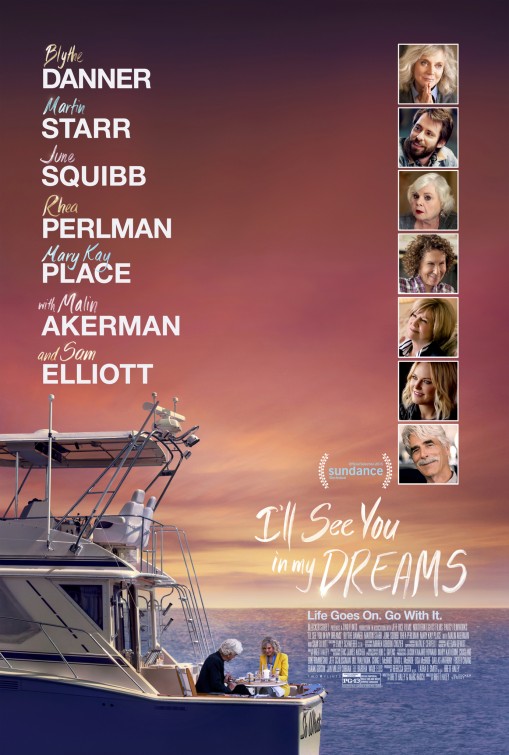
I didn’t comment on these movies till now not because they aren’t worthy. Rather, time-wasting little ol’ me simply didn’t find the time. In fact, these are fine movies. I’ll See You In My Dreams, and Me And Earl And The Dying Girl premiered in January at the 2015 Sundance Film Festival. Both went into theatrical release this spring. The movies are serious, with a light touch that keeps things friendly and personable. I’ll See You earns a three (out of four) star rating from me. I’ll bestow four stars on Me And Earl.

For much of the world’s masses, just staying alive is more than enough of a challenge. Footing is among the least of their worries. But for billions of others, middle class Americans for example, the pastures are open and the possibilities for a good life are real. Still, gaining one’s footing isn’t necessarily easy even for them. Nor is maintaining what has been gained. The slings, the arrows . . . who knows what’s coming around the bend? Most of us, luckily, eventually find our footing. And if we stumble somewhere along the line, we’re apt to get it back.

I’ll See You In my Dreams and Me And Earl And The Dying Girl are about a lot of things, including death, but footing I think is quite key. I’ll See You looks at the life of one Carol Petersen, a 70-ish California lady whose traction is pretty good at the movie’s beginning but definitely is in need of adjustment. Me And Earl’s primary character and narrator, Greg Gaines, is, as the movie opens, a high school senior in Pittsburgh whose feet have yet to be planted firmly on life’s terrain. Despite their age gap, Carol and Greg aren’t all that different. If their movies could cross-populate, they’d probably become pals, observing the potentially fixable weak spots in each other’s psyche.

My wife Sandy and I saw this movie with friends in Philadelphia. We all liked it very much.

Blythe Danner plays Carol, and does so very well. It’s a role that Danner, deep into her career, never saw coming. I watched Danner interviewed on television not long ago and she bowed down to the screenwriters and producers who brought the script her way.

A widow for 20 or more years, Carol is comfortable with her life. Money isn’t a problem. She spends time with a few close friends, sunbathes beside her pool behind her modern pad, and adores maybe more than anything her dog. But Carol drinks too much and doesn’t have all that great a relationship with her adult daughter. Something is missing. Her footing is somewhat tenuous. She’s a little dead inside.

To the rescue come two new entries into her social stream, one much younger than she, one maybe a little older. Both become her good friends. The young guy, Lloyd, (nicely portrayed by Martin Starr) and the cool, calm and charismatic older gent, Bill, (a beautiful turn by Sam Elliott) in their own ways widen Carol’s eyes to life’s possibilities. Love, needless to say, falls into that category. Carol’s footing, before the credits roll, is looking better.

My wife Sandy and I saw Me And Earl And The Dying Girl in Warrington, Pennsylvania.

I found Me And Earl And The Dying Girl irresistible. It is colorful, witty and perceptive. And very human. The plot, dialog, camerawork, editing — ooh la la. Ditto for the acting and the balance at the movie’s heart between comic exaggeration and sadness. Thomas Mann portrays Greg, a young man of extremely bright mind who is badly in need of self-confidence. There are people who love him — his parents, at least one school teacher, at least one peer (Earl Jackson, marvelously acted by RJ Cyler) — but Greg barely realizes or believes that he is loveable. Quick-thinking and creative as the dickens, self-doubting Greg thinks little of the amateur careers that he and Earl have as clandestine film makers. For a few years the two have retitled classic movies and then filmed zero budget versions whose plots idiotically and hysterically fit the new titles. The Third Man becomes The Turd Man. Midnight Cowboy becomes 2:48 PM Cowboy. You get the idea.

Greg does his best to get along with the various cliques in his high school, working hard to have only peripheral relations with all. His degree of self-worth doesn’t allow him to commit to more than that. One day, though, his world is shaken. His mother comes to him with the news that a classmate whom he barely knows, Rachel Kushner, has been diagnosed with leukemia. Greg’s mother and Rachel’s mother are friends, and Greg’s mom wants him to visit Rachel (the excellent Olivia Cooke), to reach out to her. Greg isn’t big on reaching out, doesn’t really know how. Reluctantly and awkwardly he tries, and over time there is a payoff. The payoff is love, which flows between the two teens obliquely and in spurts, just as with many folks at any age. Rachel, the wiser one, helps Greg to start pointing his compass northward. Greg’s footing begins to take hold. I left the theater feeling certain that, years later, Greg would be doing just fine in life.

Me And Earl And The Dying Girl, I’d say, is a pretty perfect movie. Not quite the case for I’ll See You In My Dreams. One thing that struck me wrong about I’ll See You is the drinking. Carol seems to have a wine glass grafted to her right hand, even when her world expands for the better. The movie never questions her desire to self-numb. And one or two scenes in I’ll See You drift too lazily. Other than that the movie rings true. The characters are real and full, and the script’s magnifying glass brings out the details of a life moving out of neutral.

Yeah, Another Beach Boys Article

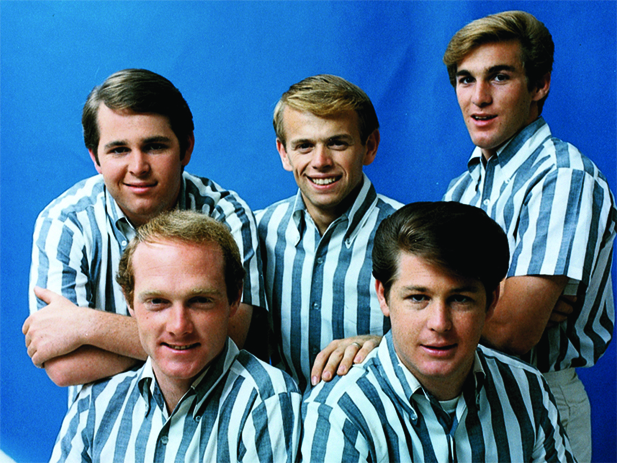
The Beach Boys early in their career. Photo: Capitol Records Photo Archives
The Beach Boys early in their career.
Photo: Capitol Records Photo Archives

Since The Beach Boys broke big on the charts in late 1962, media coverage devoted to them, collectively and individually, has been enormous. And now with the theatrical release of Love And Mercy, a biopic not so much about The Beach Boys as about their once-brightest star, Brian Wilson, the attention has been renewed. At first I was reluctant to add my puny thoughts to all these decades’ worth of Beach Boys coverage. But I’ve maintained a very warm place in my heart for the Boys, and viewing Love And Mercy has inspired me to set my fingers on a keyboard.

The Beach Boys’ history is immensely complicated and convoluted. I’ll summarize what I know fairly briefly: Three of the five original Beach Boys were siblings. From oldest to youngest they were Brian, Carl and Dennis Wilson. Add one cousin, Mike Love, and one pal, Al Jardine, and the recipe is complete. Brian, the band’s leader and creative pulse, was a gifted composer and orchestrator whose talents burgeoned, though for only a few years, as the 1960s progressed.

Teen and twenty-something idols, the Boys knocked out hit after hit right from the start (Surfin’ Safari, Surfin’ USA) through 1966 (Wouldn’t It Be Nice, Good Vibrations). But Brian was a victim of mental and emotional demons that caused him to begin losing his grip in 1967 during sessions for the high concept album Smile. Brian guided the band, and many studio musicians, part of the way through Smile, which was meant to be a celebration of earthly and universal creation. But his troubles brought the work to a sputtering end. Unfinished, the album was shelved. At that point, age 24, Brian’s best musical days were behind him. Though he remained a Beach Boy, his songwriting and studio session contributions to the band soon grew fewer, and his appearances with them on stage over the next several decades were sporadic. The Beach Boys soldiered on nonetheless, churning out many albums and nabbing a few more hit singles. And they toured the world (usually sans Brian) over and over.

As started to become public knowledge in the mid 1960s, Brian’s problems hardly were the only painful situations within The Beach Boys. Their story, beyond the music, is a messy one of endless internal conflicts and legal disputes, drug abuse and, ultimately, death. Very sadly, two Beach Boys passed at youngish ages. Dennis Wilson drowned in 1983 soon after his 39th birthday.  Carl was taken by lung cancer in 1998 when he was 51. Carl many years before had become the band’s chief, taking over from the no-longer-able-to-lead Brian. The band fell apart after Carl’s death.

Hey wait, you say, The Beach Boys are on the road every year, just as always. Well, Mike Love and Bruce Johnston (who had joined the group in 1965) have continued to tour as The Beach Boys. But without any of the Wilson brothers the Love-Johnston unit is hardly the real thing. In 2012, though, Brian (and Al) joined Mike and Bruce for a 50th year reunion tour that went well, only to conclude on a sour note.  Love refused to add additional concerts beyond the tail end of the original schedule and in effect booted out Wilson and Jardine. As usual, fun fun fun might have been the image The Beach Boys wished to project, but reality was a whole different ballgame.

Love And Mercy, playing at the Ambler Theater.

Who, then, in 2015 would have expected the release of Love And Mercy? Not me. At first I didn’t want to see the movie. I’ve read more than enough about The Beach Boys over the years, spent many hundreds of hours listening to their music. No offense to the Boys or their legacy, but my limit, or so I thought, had been reached. Until a friend told me that the movie is really really good. And thus my wife Sandy and I found ourselves on a recent Saturday at our favorite suburban art house, the Ambler Theater. There I learned that my friend was correct. Love And Mercy is really really good. Three and a half out of four stars.

Love And Mercy has the feel of truth. And from what I’ve read, its portrayal of events actually is quite true. The acting by the leads is nuanced and impressive. The script is tight, the direction too. There are a few cardboardy plot and dialog lines here and there. The rest, however, is gold. One need not be a Beach Boys freak to enjoy this movie. Sandy isn’t. She doesn’t know much about their musical history or their problems. She found the movie to be what in fact it is, a powerful drama. She agrees with my rating.

As I’ve mentioned, the movie is only partly a full examination of the Beach Boys. Dennis, Carl and Mike are portrayed a good bit, but they aren’t central to the story, and the actor playing Al Jardine is barely on camera. Love And Mercy largely is the tale of Brian Wilson and Melinda Ledbetter, the lady who loved Brian and brought him back from agony’s door and the clutches of manic psychotherapist Eugene Landy (potently depicted by Paul Giamatti) in the 1980s. The main action takes place in two time periods, 1965 through 1967, and 1985 through 1989 or so. The movie jumps back and forth between those eras. Paul Dano portrays the younger Wilson, John Cusack the older. Both are wonderful, as is Elizabeth Banks as Melinda.

A good number of the movie’s sequences with Dano realistically and clearly show Brian’s studio wizardry. The Cusack sections often touchingly shine a light on the developing romance between Wilson and Melinda, whom Brian met in 1985. I think that to tell any more about Love And Mercy wouldn’t be fair. Putting the movie aside, what to me is quite astonishing is that Brian Wilson is above ground and going strong. He has dealt with abusive forces that no decent person deserves to encounter, and has rebounded from low-as-you-can-go points to a most active musical career. He’s on tour right now. With a lot of courage and strength, and with a lot of help, he has survived.