Vinyl Night: Collapses Will Happen

“What’s a good night for Dave to come over for Vinyl Night?” I asked my wife Sandy recently.

She rolled her eyes magnificently and exclaimed “Vinyl Night? There is no good night for Vinyl Night!”

And why did she say that? Because when my excellent pal Dave comes over for Vinyl Night, as he does once or twice a year, we listen to a genre of music that Sandy, to say the least, hates. “I don’t consider it to be music,” she explained to me succinctly during dinner not long ago. Understood.

And you know what? Boatloads of people would agree with her, but they can’t, because most folks have never experienced this kind of music. Don’t know that it exists. Here’s what I’m talking about: On Vinyl Nights, Dave and I gorge on jazz of the avant-garde variety. The wild and aggressive type in which melody often is minimal and screeching horns and thrashing drums are the norm. The type that might well be described as seismic in quality and in effect, as will become apparent.

Free jazz. That’s the name that has stuck to this fringe music which began to emerge in the mid-1950s. And liberating it is. The musicians are free to roam far and wide. And the music opens the minds and loosens the emotional chains of those listeners who like it, such as Dave and I, tossing us around like hold-on-for-your-lives roller coaster riders.

Sandy relented and Dave ended up coming over on a Wednesday night, because that was when she had plans to watch a lot of prime time television in the upstairs bedroom. Dave and I, in the living room, would be free to crank up the stereo system’s volume as high as we might. Turns out that wasn’t a good idea.

Vinyl Night's albums photographed on bunker floor before Vinyl Night began.
Vinyl Night’s albums photographed in basement before Vinyl Night began.

In preparation for each Vinyl Night I head to the basement room where my most prized possession resides: my vinyl album collection. I’ve got a ton of albums. Lots of musical styles. Never got rid of any of them, one of the smart calls I’ve made in life. On the afternoon of this most recent occasion I  walked to the shelves holding the discs and made the selections for that evening’s Vinyl Night. Albums by Jimmy Lyons, Roswell Rudd, Grachan Moncur III, Art Ensemble Of Chicago,  Archie Shepp, John Carter/Bobby Bradford, and Albert Ayler. Household names, no? As always, Dave and I would listen to one side of each album.
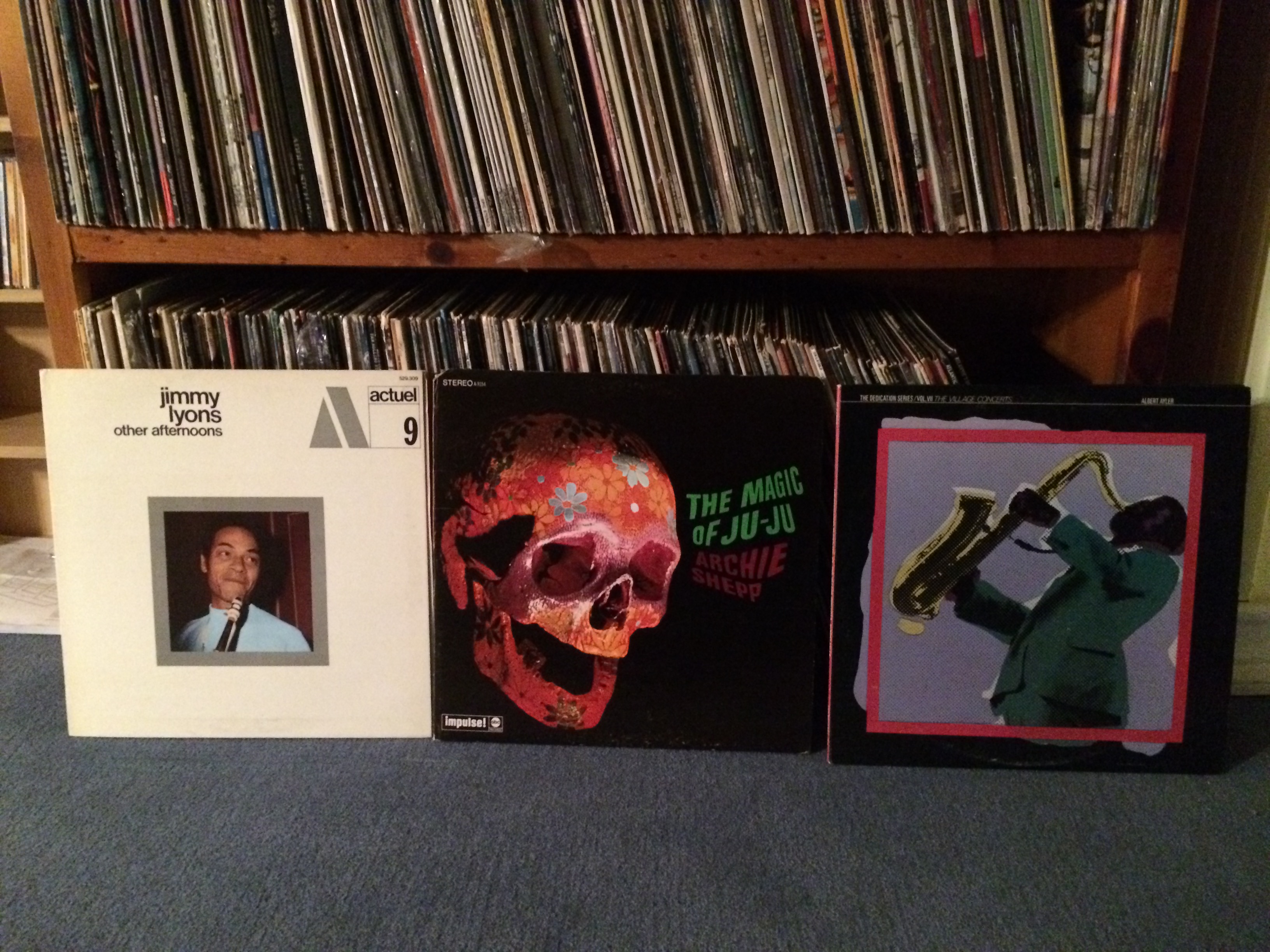
The three albums that caused problems. Photographed in bunker before Vinyl Night began.
The three albums that caused problems. Photographed in basement before Vinyl Night began.

Dave arrived around 8:00 PM. Sandy gave him a hug and walked upstairs, not to be seen again for a couple of hours. I placed side one of Jimmy Lyons’ Other Afternoons (recorded in 1969) on the turntable and an evening of fun, then mayhem, began. Jimmy Lyons no longer is with us, but his recordings live on with force. And force is what soon blew through the stereo speakers in my living room. The title track, Other Afternoons, began calmly enough. Didn’t take long however for alto saxophonist Lyons and his cohorts to wail and fly as though demons were on their tails and gaining fast (click here to listen). That’s when Dave and I thought we heard the sounds of wood and plaster creaking a bit more than they should in an old house. We put those thoughts out of our minds.

Several albums later a firestorm hit the turntable, Archie Shepp’s The Magic Of Ju-Ju (recorded in 1967). The title song, occupying all of side one, made Other Afternoons sound like a wimp. Shepp, whose career began in the early 1960s and who is alive and kicking, hit the ground at Usain Bolt speed, screaming on his tenor saxophone for 18 minutes over a drumming cacophony (click here to listen). I was amazed, mesmerized and kind of in a daze. Dave too. That’s the power of Shepp. We definitely heard those creaking sounds again, some rumbling ones also, but put them out of our minds.

The problems became undeniable a couple of albums after Shepp’s. Tenorman Albert Ayler, long gone, went stratospheric at around the six minute mark of Spirits Rejoice (recorded in 1966), which takes up all of side three on The Village Concerts double album (click here to listen). My house couldn’t take it any longer. Plaster started falling from the living room ceiling. The living room floorboards began to buckle and give way. Good things weren’t happening upstairs either. Sandy came running down the stairs. “I really, really hate this music,” she yelled as she and I and Dave bolted out the front door. We stood in disbelief on the sidewalk as Sandy’s and my suburban home dropped to the ground. The house’s descent took a long time and was extremely jarring, just like the saxophone, trumpet and other instrumental solos that Dave and I grooved to on that most infamous of Vinyl Nights.

The next day I called my Allstate agent. I described the bizarre situation to her. She said, “You’re out of luck, Neil. Your homeowners policy specifically prohibits you from playing any free jazz above the 80-decibel level. Allstate isn’t going to pay you a cent. We may be the ‘you’re in good hands’ people, like our logo says, but we’re not fools like you!”

(If you enjoyed this article, don’t be shy about sharing it. Sharing buttons are below)

King Georges: A Possibly Tasty Movie Review

On our way to dinner at The Broad Axe Tavern on a recent Friday night I told my wife Sandy about the approach, since abandoned, that I might take in writing the article you currently are reading. It was to be a comparison of dinner at The Broad Axe with what my opinion would have been, had I ever eaten there, of dinner at Le Bec-Fin, a famous, majestic and now-closed French restaurant in Philadelphia. All of this made possible sense because the movie that Sandy and I were headed to later that evening in suburban Philadelphia was King Georges, a documentary about the last few years (2010 to 2012) of Chef Georges Perrier’s involvement with Le Bec-Fin, which he opened in 1970.

Yup, I had thought that my culinary tastes and scrutinies would make for way cooler reading than a review of King Georges. And, dope that I tend to be, I was quite certain about what my conclusion would be, even before seeing King Georges. Namely, that I’d prefer to eat at The Broad Axe than at fancy-schmancy Le Bec-Fin. Broad Axe food I understand. It’s good for the most part and you don’t need a translator to figure out what’s what. Le Bec-Fin’s fare, which I had read about for decades, would have intimidated me. That’s because I knew and still know diddly-squat about high-level French cuisine.

We saw King Georges at the Ambler Theater.

But after watching King Georges I did an about-face. Who cares about my food preferences when a terrific piece of filmmaking is at hand? Clear the way! Movie review, here I come! And by the way, I should have given pricey LBF at least one spin during its lifetime. I’d have parted with some serious cash, but the meal and the experience would have been worth it. I hadn’t because I was a culinary coward.

Sure, the food looks great in King Georges. But that’s not the reason to see the movie, as food isn’t primarily what it’s all about. What we have here is a vibrant look at a pretty complicated guy. King Georges is filmed mostly in close-up and often in tight quarters, Le Bec-Fin’s kitchens, and reveals an extremely colorful and self-driven character as he wrestles with the reality that his famed and celebrated baby, LBF, ain’t the destination that it once had been. And that maintaining his customer base is hard and ultimately maybe not possible. What’s a top chef to do? In Georges Perrier’s case, keep on truckin’ and truckin’ until . . .

King Georges 2 IMG_1269
King Georges shows Perrier as a sometimes-crazed dynamo in the kitchen, his senses aware of what’s going on in every pot and pan attended to by the small army of chefs under his command at LBF. He rants and raves. He praises and hugs. He includes sh–t and/or fu–k in half the sentences that pour from his mouth. He’s a pip, a perfectionist, an incredibly hard worker who seems to have gotten no more than a handful of hours of sleep nightly for forty-plus years. How can you not love someone like this? I mean, he cares. Born and raised in France, he came to the USA in the mid 1960s hoping to own, cook for and run one of the best restaurants in the States. All of which he ended up doing for years and years. And he became a celebrity of sorts in the process, a big name in certain circles around the globe, eons before the likes of chefs/restaurateurs Emeril Lagasse, Bobby Flay and Mario Batali became media fixtures.

During the last few years, though, Georges Perrier hasn’t been too visible. Whom, then, do we have to thank for bringing him to our eyes and ears in 2016? None other than Erika Frankel, she whom neither you nor I ever heard of before. Frankel has earned her keep producing documentaries and other works since the early 2000s but, before King Georges, never had donned a director’s cap. How did she manage to handle the job so well? Maybe it was beginner’s luck. Probably it was innate talent. Whatever, having a charismatic figure to make a movie about didn’t hurt.

You know, writing this article has made me hungry. I’m going to head into the kitchen and labor over one of my exotic specialties, a grilled cheese sandwich. I’m sure that Chef Perrier would approve of my sandwich-flipping technique, the precise and practiced manner in which my right wrist rotates just so. Before I say goodbye, however, let me mention that King Georges isn’t making waves at the box office. In fact, Sandy and I were lucky to see it in a theater, because nationally only a single digits number of cinemas are showing it. But happily for the inhabitants of our planet, King Georges is obtainable via Amazon Prime and other online operations. Be it at a theater, or more likely in the comfort of your home, here’s your chance to be the first on your block to watch King Georges. Take it from me, kids. I think you’ll like it.

(If you enjoyed this article, don’t be shy about sharing it. Sharing buttons are below)

(Photos by Sandra Cherrey Scheinin. If you click on a photo, a larger image will open)

In Search Of A Story Idea

Funny thing about this blog. When I started it last April I didn’t know what shape it would take or what it might come to mean to me. Shape-wise, somewhat to my surprise, the blog seems to conform pretty well to the template I described in the “About” page. Meaning, I’ve written about this and I’ve written about that, and the articles in toto appear to give a pretty good picture of who I am. Not that I actually know particularly well who I am. Figuring that out would take hours and hours on a psychiatrist’s or other therapist’s chair or couch. “Hey, Sandy!” (note to readers: I’m calling to my wife). “It’s time I found out who I am. Please get me an appointment with a topnotch and nearby mental health professional. Thanks.”

As for what the blog means to me . . . well, it has become a big part of my life. Here I am, almost 12 months forward from the blog’s launch date, and I’m getting a tasty kick from writing. More than 60 times I’ve been inspired to put fingers to keyboard and knock out a story. I haven’t done so much thinking or typing since my school days, back when the dinosaurs were on the verge of extinction. Didn’t know I had it in me.

There is a problem though. To wit, I’m good at struggling to find subjects that interest me enough to write about them. And that are simple enough so that pea-brained me can understand them. Sometimes the well feels awfully dry, causing me to start worrying more than a bit. “What the heck am I going to write about next?” is a question commonly floating in my head. When day after day go by without a pleasing answer, man, the perspiration beads start pooling.

And that’s the situation I find myself in right now. I’ve had a few particles of ideas for stories, but none has swelled to a size that I can grab and knead. Better scribes than I would have turned out excellent articles from those fragments, which is one of many reasons why those writers are better.

IMG_0131
For instance, the other day I was at my volunteer job in a medical office building not far from my suburban Philadelphia home. The building is full of doctors’ offices that are reached via a web of corridors. I man the information desk at this facility one morning each week and have been doing so for six years. I was standing beside the desk. My mind was wandering. Perspiration covered my forehead. “What the heck am I going to write about next?” I wondered. And then something caught my eye. It was a watercolor painting, a large appealing abstract in blue and cream. It was mounted on a wall eight feet in front of me. It had been on this wall for who knows how long. I had seen it every time I’d been at my volunteer job. But I hadn’t  really seen it. I mean, it’s one of those items that you don’t want to become too aware of. If I started fixating on its existence, I’d be glancing over at it throughout my shift. It would become like a song that gets stuck in your head. Such as El Paso, the Marty Robbins tune from 1959 that I’ve been trying unsuccessfully to expel for decades. When Sandy and I were at dinner with our great pals Susie and Mike a few weeks ago, Mike started singing El Paso to me. He’s cruel that way. “Out in the West Texas town of El Paso/I fell in love with a Mexican girl/Night-time would find me in Rosa’s cantina/Music would play and Felina would whirl.” “Stop, Mike, stop!” I cried. And he did. But here I am a few weeks later with those entrancing lyrics and that sweet waltz-time melody still skipping around in my brain neurons. Mucho gracias, Mike. Mucho gracias.

Ah yes, the watercolor painting staring at me from eight feet away. A bell dimly chimed inside my cranium when the notion occurred to me that the watercolor might in some elusive manner lead the way to a story for my blog. Perhaps there were other art works hanging in the corridors of the medical facility. And if so, that would be my story. Namely, one about lovely objects that often surround us yet remain unnoticed and unappreciated.

Is this art?
Is this art?
Is this art?
Is this art?

Off I went to explore the three floors-worth of crisscrossing hallways. I’d walked these avenues many times over the years, but looking for art had never been part of my quests. Alas, I came up empty. The blue and cream watercolor was an orphan, the only framed object in the various halls. Not so fast, though. A myriad of things were attached to the corridors’ walls or hanging from their ceilings. Fire alarms, fire extinguishers, water fountains, exit signs, digital thermostats and other utilitarian stuff. Who’s to say that they didn’t qualify as art? If they did, then my volunteer job took place within a veritable museum.

“Yeah, now that’s a story for my blog,” I told myself. After all, in 1917 Marcel Duchamp bought a mass-produced urinal, signed it with a fictitious name and submitted it to a prestigious arts exhibition. And in the 1960s Andy Warhol created large-scale facsimiles of Brillo boxes. Duchamp and Warhol were revolutionary modernists, questioning the nature of art, asking what in fact qualifies as art. If they had held my volunteer job, mightn’t they have concluded that indeed they were working in a museum?

Thus I walked the hallways once again, reexamining the stuff on the walls and ceilings and taking their pictures with my iPhone. And as I did I knew that this story idea led nowhere. Oy frigging vey! Try as I might I didn’t feel any aesthetic or conceptual attraction towards the fire alarms or any of the rest. “You know, as art these things suck big time,” I said to myself.

Soon an idea worth writing about will come to me. I’m confident of that. Sort of. Till then, I’m outta here. Where’s the exit? . . . Oh, here it is. Bye.

IMG_0151

(If you enjoyed this article, don’t be shy about sharing it. Sharing buttons are below)

OJR Will Tour With The Rolling Stones (Keith Richards Assured Me Of This)

My cell phone rang in late afternoon on a recent Sunday. I answered and an unmistakable phlegmy voice said to me: “Yeah mate, how ya doin’? I’m OK. Just sittin’ here in my hotel room watchin’ the telly. Drinkin’ milk, munchin’ Oreos. They go good together, ya know?” It was Keith Richards calling from Sao Paulo, Brazil, where The Rolling Stones had played a show the night before.

“I know, Keith, I know. Every time you call it’s the same old thing. Milk and Oreos. Milk and Oreos. Come on, amigo. Switch it up once in a while. Didn’t you ever hear of Chips Ahoy? Vienna Fingers?”

He guffawed. “I’m hooked, son. I can’t switch. I won’t.”

“Okay, Keith,” I said. “So what’s the scoop? How was the show last night?”

Keith Richards. (Photo by Mark Seliger)

“Cool, man, cool. We had fun. Ya got a minute?” As though I didn’t. Before the phone rang I had been cutting coupons for half an hour. And before that, working on a story idea about celebrities’ genomes that I plan to pitch to Science Magazine, I’d spent 90 minutes meticulously plotting the Kardashians’ family tree. I was pooped. I was ready to have a relaxed phone conversation. “Spill your guts, partner,” I said to my old friend, whom I’d met and instantly bonded with in 1978. This was at a Bingo parlor in Philadelphia the day after a Stones gig in that fine city. Keith’s a Bingo man. He has wandered into Bingo halls all over the world.

“What’s the Stones’ signature song?” Keith asked me. “Ya know, the one we’ve played ten thousand times. The first letter is an S. Here’s another hint. It starts like this: dum dum da da dah da da da da da.”

“Let me guess,” I said “Is it Smoke Gets In Your Eyes?”

“I wish,” my friend said. “I’d like to play that one. I’ll run it by Mick. But I got a problem here, bro. No joke. Every show we hafta play Satisfaction. Last night I almost couldn’t do it. I f – – kin’ hate that song. If I hafta play it again I’m gonna plotz.”

“Relax, chum, relax,” I said. “You’ll get through this. You’re a pro. Drink some more milk.”

“C’mon, pal. I need a boost. Talk to me. What’s good? What’s new and happenin’? Clue me in.”

Oliver John-Rodgers. (Photo by David Salay)

“Okay, laddie,” I said. “There’s something really good that I checked out the other day. Great music by a young guy named Oliver John-Rodgers. Calls himself OJR. His YouTube videos have gotten about as many views as my blog articles, which means that just about nobody ever heard of him. But I think that’s going to change. For him, I mean. Not for me. His new album is fantastic. I ain’t Nostradomus, but I predict that he’s going to be big.”

“Hold up, Neil. Someone just tapped on my door. It’s Mick, no doubt. I can tell by the secret knock . . . dum dum da da dah da da da da da. You heard that, didn’t ya? He’s been doing that to me for the last 50 years. Gotta go, compadre. Send me an email about OJR. Peace, brother.”

With that, Keith hung up. Before I’d forget I sat down and composed my message to him. Here’s what I wrote:

Hey, boyo. Thanks for calling. OJR’s new album, Nashville Demos, rocks like a mother lode. Catchy melodies, nifty lyrics, guitar licks that wrap themselves around your brain. He recorded the album in, believe it or not, bedrooms all over the world. I guess he’s sort of a vagabond. Played most of the instruments himself. I found out about him from WXPN, a Philadelphia radio station I listen to sometimes. OJR has a song called Numb, and it’s in XPN’s rotation. The song’s a monster. OJR put the whole album up on his website (Keith-o, click here to listen to the album). And I found a primo YouTube video of OJR and his band playing Numb in a slowed-down head-warping version (Keith, my man, click  here to watch it). That’s all for now. It’s almost 7 PM, my bedtime as I’m sure you remember. Talk soon, matey. Oh wait, one more thing. Please ask Charlie, Ronnie and Mick to look at my blog. There’s a chance they might like my stuff. Peace out.

A few days later, at 8 PM, my phone rang. I’d been asleep for an hour. Thanks, Keith, for waking me up. He was calling from his hotel room in Lima, Peru. The Stones would be on stage in Lima the next night. “Yo, what’s up, cool guy?” he asked. “You were right. OJR is the friggin’ bomb. Best rock and roll I’ve heard since the end of the Ice Age. Or maybe it was the Cold War. I forget. Anyway, the boys and me had our managers get in touch with him. OJR’s a sweet dude, they said. And you know what? . . . We’re gonna have him open some shows for us later this year. Thanks for the tip, Bingo Boy.”

“No problem, Keith. Glad to help. How about my blog? What did Ronnie, Mick and Charlie say?”

There was a long pause. I knew the news wasn’t going to be too good. “Well, buddy, I sent them the link to your blog. Sorry mate, let me tell you straight — slow and snoozy are a couple of the words they used about your articles. What can I say? But I’ve got a great idea for ya. You’ve never written a story about Bingo. I think ya should.”

“Thanks, Keith. Maybe I will.”

(If you enjoyed this article, don’t be shy about sharing it. Sharing buttons are below)

Ruthie Foster, Soulful Singer: Frigid Weather Couldn’t Keep Us Away

It was a dark and stormy night . . . hold on, that line sounds familiar. I think I may have lifted it from someone inadvertently. Wouldn’t want to do that. I’m going to put it into Google and see what gives. I’ll be right back.

Yes, indeed. The sentence was penned about 185 years ago by an English novelist whom nobody alive today ever heard of. In that sense he’s just like me. Let’s start over.

It wasn’t a dark and stormy night. Well, it was dark, but it wasn’t stormy. In fact the sky was quite clear. But it was a bitterly cold Saturday night, no doubt about that. As in 12° F. My wife Sandy and I had just eaten dinner in a tavern we like in the Philly burbs. As we soldiered through the parking lot to our car, the night air laughed in my ear. “Man, you sure are a nitwit for going out in weather like this,” it mockingly said, keeping its voice low so that Sandy wouldn’t overhear. “Didn’t anyone tell you that it’s cold outside?” It’s surprising the things you learn as you get older — before that frigid evening a couple of weeks ago I never knew that the night air could talk, let alone be a sarcastic jerk. I kept my mouth shut, but next time I’ll be prepared with a snappy retort.

Ten minutes later Sandy and I arrived at our post-dinner destination, Montgomery County Community College. It’s located in the once-bucolic town of Blue Bell. Modest in size and scope, MCCC isn’t where one would expect to find a world-class performing arts series, but such is the case. Many times over the years, Sandy and I have seen top-of-the-line musicians and modern dance troupes in the series’ 400-seat auditorium.

It was good getting out of the cold. We settled into our seats at 7:45 PM and awaited the singer whom I’ve known about for a few years but never had seen in person. Ruthie Foster, she who drinks from the wells of blues, gospel, soul and folk music, and who is one of the prides of musically-rich Texas, USA. Ruthie, in her early 50s, is an in-demand artist. She regularly plays in the States, Canada, Europe and sometimes Australia. Let me mention one important point before I forget: Ruthie is a gifted vocalist with a gracious and likeable stage presence. If she passes through your area, and if you enjoy music of the sorts I mentioned above, you would do well to attend her concert.

Ruthie1 IMG_0175
Showtime arrived. Ruthie Foster walked onstage with three musical compadres: Samantha Banks (drums and other percussion), Scottie Miller (piano and organ) and Larry Fulcher (electric bass). Electric guitar was not in the house. Ruthie strummed an amplified acoustic guitar, but she knew her limitations on the instrument and ventured not a solo during the show, leaving most of them to Scottie and a couple to Samantha and Larry. Would the band have gained from having an additional member, to wit a high-flying electric guitarist? No way. His or her absence kept things lean and uncluttered, and placed Ruthie’s vocals at the center of center stage.

The show began with a rendition of Patty Griffin’s When It Don’t Come Easy, a tune about love’s elusiveness. The tight machine that was Ruthie’s band set a perfect rhythm and constructed elastic boundaries over which Ruthie spoke the truth. Bap-bap-bap-bap went Samantha Banks, sure-footed and steady on the drums, as she was all evening long. Larry Fulcher’s bass lines floated here and then there but never lost their way. Scottie Miller pushed and probed on the piano, at the appropriate times sending out blasts of emotions. The band was aware, focused and nimble on this and every song that followed.

Ruthie2 IMG_1246
A few words about Ruthie Foster’s singing voice. It is wonderful, as is the way she uses it. She sings cleanly and clearly, unstrained and vibrato-less, always in control. And she can move easily to a hush or to a soulful barrage of notes. The timbre of Ruthie’s voice often reminded me of Bonnie Raitt’s, but Ruthie’s is fuller and better — Bonnie I’m certain would agree. At concert’s end, 90 minutes from the starting gun, I was convinced that Ruthie is one of the big talents in her field. What’s more, she sings songs that contain real meaning. Songs about tolerance, equality and hope. Such as the concert’s hope-centric third tune, a recent Foster original titled Brand New Day. It dripped with gospel fervor. “Love heals and love lives/And time will reveal a brand new day,” Ruthie proclaimed as her three pals, playing their instruments all church-like, vocally urged her along with harmonized “uh-huh, hoo” after “uh-huh, hoo.” Uh-huh, I loved it.

Let me say a few more things before I hit the “publish” button to post this article. Ruthie has written quite a few songs over the years, but kept her set list heavy with compositions penned by others. She chose numbers, for instance, by June Carter Cash (Ring Of Fire) and Lucinda Williams (Fruits Of My Labor). And she closed the show with  Stephen Foster’s Oh! Susanna, an American chestnut from 1848. (Click here to watch her perform Oh! Susanna two years ago). For that final tune she was alone on stage for the only time during the show. She sang slowly, picking comfortable notes on the guitar. As the song progressed her voice soared effortlessly, poignantly. Oh! Susanna took on meanings that I’d never thought about before. She made a great song greater.

(If you enjoyed this article, don’t be shy about sharing it. Sharing buttons are below)

(Photos by Sandra Cherrey Scheinin. If you click on a photo, a larger image will open)