I’m very well acquainted with some people who wouldn’t watch the Academy Awards telecast if the fate of the world was hanging in the balance. They can’t stand all the pomp and the self-congratulatory aura that the show is partially dressed in. Well, if the fate of the world was hanging in the balance I’d watch anything, you know, even brain-dissolving entities like The Maury Show or Chrisley Knows Best. That’s the kind of guy I am. Looking out for humanity and nature and all that, you dig?

You’d hardly have to twist my arm, though, to get me to turn on the Oscars, a broadcast that I’m pretty well addicted to. I like seeing big cinematic stars on the Academy Awards’ stage and in the audience. I like the good gags that often fly from the mouths of the hosts. I like holding my breath every time a high-heeled and flowingly-gowned actress heads uneasily toward the podium, doing all she can not to trip in front of a billion viewers worldwide. And, more than anything, I enjoy keeping alive a personal tradition that dates back to when, eons ago, I began watching the Academy Awards with my mom. She was an Oscars lover of a high order. She’d be happy to know that I’ve missed nary an Oscars presentation since those days of yore.
Well then, as surely we all know, the big day is nigh. The Academy Awards extravaganza takes to the airwaves on Sunday, March 4 at 8 PM in the USA’s Eastern Time Zone, the area in which yours truly resides. My wife Sandy and I will be glued to the boob tube. She, like me, wouldn’t miss the show.
And I’ve decided that I shouldn’t pass up the opportunity to jot down a few remarks about the Oscars. I’ve given a fair amount of thought as to what I might say herein. If I had it in me, which I don’t, I’d churn out thousands of words right now about great performances by actors over the years and about brilliant screenplays and spot-on directing. However, I’m someone who, knowing his limitations, tries to keep things manageable. Thus I’ve made the command decision to limit my realm of discussion. Seeing that the Best Picture category probably is the one that most people pay the most attention to, I will fill up the remainder of this essay by paying attention to it too.
This year there are nine nominations for Best Picture, all of which, needless to say, came out in 2017. A film-going dynamo of sorts, I hit the cinemas 46 times last year, a spree during which seven of the nominees passed before my eyes. The two that I didn’t see (Call Me By Your Name and Get Out) I wouldn’t presume to comment upon. As for the others, I shall, but not before mentioning that, of the flicks I took in last year, I thought that the un-nominated The Florida Project was the best (you can read my review here). It is a work of fiction that feels like real life, which is something I cannot say for many movies. The Florida Project is delightful, poignant and troubling. It will test the emotional strength of your heart. I highly recommend it.
Back to the subject at hand. In alphabetical order, the seven nominated films that I caught are: Darkest Hour. Dunkirk. Lady Bird. Phantom Thread. The Post. The Shape Of Water. Three Billboards Outside Ebbing, Missouri.
 That’s a sturdy and imposing list. Very fine movies reside on it. But not every one. The Post, for instance, isn’t a very fine movie. A retelling of the Pentagon Papers crisis during Richard Nixon’s presidency, The Post seemed to me to be not much more than standard filmmaking. The Washington Post newspaper (from which the film derives its title) without question stepped up to the plate for democracy by publishing, against enormous legal pressure, leaked government documents (the Pentagon Papers) that showed that the Vietnam War likely was unwinnable. But the movie has far too many preachy moments. They bring an artificial flavor to the proceedings. Director Steven Spielberg has been involved with considerably better work (Jaws, Schindler’s List and Lincoln, to name a few).
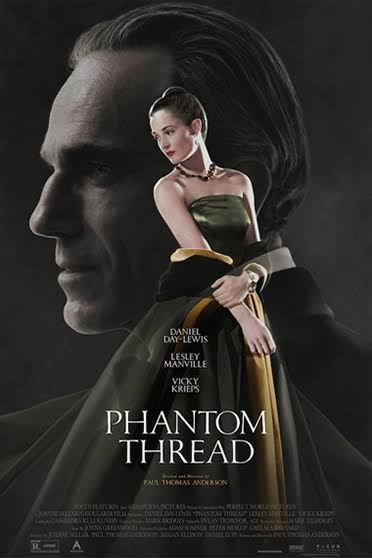 Nor is Phantom Thread top-notch, to my way of viewing things. I definitely liked its oddness, its peculiar charm, but felt unsatisfied in the end. It’s the tale of a fastidious and successful British fashion designer (played by the fabulously talented Daniel Day-Lewis) in the 1950s, a gent of 60 or so who marries a lady much younger than he. They feel each other out, they sometimes butt heads and worse . . . but their mental and emotional states, the whys behind what is happening between them, were never clear to me. Way too much understatement for my tastes. I have relatives and friends who rave about Phantom Thread, though, so what do I know? Give it a try.
 Ah yes, Lady Bird, the saga of a discontented California high school senior (portrayed by Saoirse Ronan, one of the numerous non-Americans who have no trouble nailing American accents) who is fumbling her way toward whatever her destiny might be. The girl’s given name is Christine but, in trying to become her own person, she demands to be known as Lady Bird. Greta Gerwig, herself an actress, wrote and directed the movie, a double-barreled feat that she pulled off most admirably.
No, it wouldn’t be an upset if Lady Bird grabs the Oscar for Best Picture, but if the decision were up to me, I wouldn’t hand it the award. I didn’t find myself being drawn deeply enough into the movie, probably because Lady Bird/Christine is not a particularly likeable individual. Still, this is a quality film. You won’t go wrong by spending time with it.
It’s impossible to overstate the importance of the Battle of Dunkirk, in May and June of 1940, for the British and other Allies. Imperiled in their positions on French coastlines, the Allied forces, several hundred thousand strong, seemingly had little chance against advancing and surrounding German fighters. Rather amazingly though, most of the Allied troops were safely evacuated.
 The movie drawn from the struggle, Dunkirk, is a powerful one. It reeks gloom, fear and claustrophobia, Anyone interested in history or human nature will want to see it. My only gripe about Dunkirk is that many of its sequences, even the ones in open water, don’t capture the scale of the events taking place. Enormous numbers of boats and planes were in action during the battle, but often only a smattering are pictured in the movie. This was by design, I know, an attempt to describe the big picture in small strokes. Still, I left the theater feeling pretty shaken.
 Darkest Hour takes on some of the same subject matter as Dunkirk, as it is the story of Winston Churchill during his early days as Prime Minister of Great Britain. Churchill took office about two weeks before the Battle of Dunkirk began. He was a powerful presence, a leader who refused to compromise with Germany, who did his damndest to instill and elicit strength and courage from the Brits in the face of incredible danger. Gary Oldman is fabulous as Churchill. The movie is all his in a sense. But, then again, it’s not all his, for Darkest Hour would be far less than the excellent production that it is were it not for a screenplay, cinematography and direction that come from the top of the barrel. If Darkest Hour wins the Oscar, it deserves it.
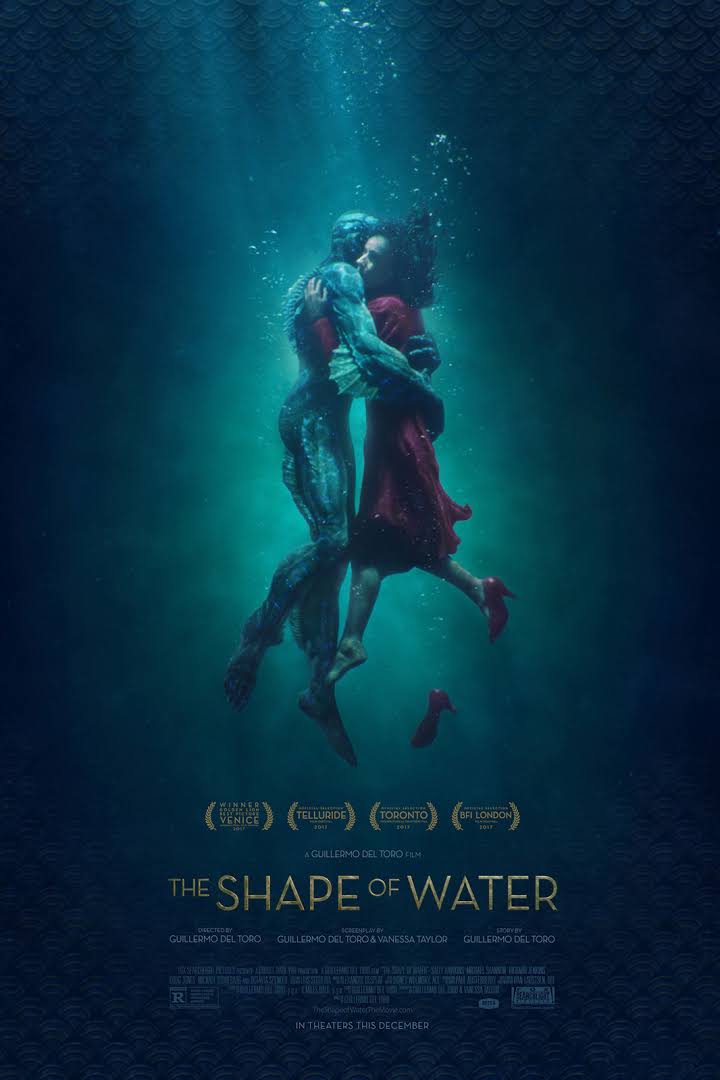 Next up are our final contenders, The Shape Of Water and Three Billboards Outside Of Ebbing, Missouri. I liked them both very much. The Shape Of Water is a dreamy fantasy, a story about many things, including how love can develop most unexpectedly. The movie has an element of the supernatural, in the guise of a mythical type of creature that has been captured in the Amazon jungles and brought to the USA to be studied. And it has the radiant Sally Hawkins. She plays a joyful individual, a mute, who works as a janitor at the science facility to which the lizard-man has been transported. Hawkins, through fluid body movements, subtle gestures and expressive eyes creates a loveable character, a person of true depth. Hawkins is an astonishing talent.
There are sublime sequences in Water that carried me away. And there also is a good guys versus bad guys theme (with “I’m gonna get you” scenes and the like that you’ve seen a million times over the years) that I thought holds down the movie. As good as Water is, it might have been better.
 Finally we come to Three Billboards. What we have here are a taut plot and superb acting from its main players. You’re not going to find performances superior to those turned in by Frances McDormand, Sam Rockwell and Woody Harrelson. Three Billboards is a high-power meditation on evil, tragedy, bigotry and redemption. And I’m certain I’m leaving out other big subjects that it tackles.
All of that takes place in a dusty Missouri town where hard-as-nails Mildred Hayes (McDormand) is determined to prod the local police to find her teenage daughter’s killer, as the crime has gone unsolved for many months. She goes to unusual means in this pursuit, taking shit from nobody. Three Billboards will grab you by your collar. If you’re not wearing a collar it will find something else to grab you by. My guess is that the Oscar will end up in its hands. And I will have no complaints if that turns out to be the case.
Nor will I moan if Darkest Hour takes home the gold. Like Billboards, it is gritty and packs a wallop. To me, those two films are equally good. And totally Oscar-worthy.
(Don’t be shy about adding your comments or about sharing this piece on Facebook, Twitter and such. I thank you.)






 Yeah, Another Blogger