Caramel (Suzanne Vega, This Beer’s For You)

Leffe Brune
Leffe Brune

A few days ago, in a local supermarket’s beer section, I assembled and bought a “create your own six pack.” At dinnertime later that day I grabbed one of the six from the frig, and I’m glad I did. It was a thick, rich, mellow ale. Dark and handsome too, I might add. And delicious. Leffe Brune (brown), brewed in Belgium.

If it weren’t for this excellent beer I wouldn’t be typing this story right now. Instead I’d probably be cemented to the living room sofa, counting the number of dust balls scattered on the room’s hardwood floor, one of my typical pastimes. But I am typing this story right now, and here’s why:

Earlier in the aforementioned day, fishing around in my mind for something to write about for my blog, I thought about Caramel, a song by Suzanne Vega that I’ve always loved. But I wasn’t sure how I’d incorporate Caramel into a story. It’s a great song, not too well-known. For years I’ve thought it deserves to become a heavily covered tune, a standard if you will, as it is perfectly formed musically and lyrically. For 40 years I’ve thought almost as much of Tom Waits’s (Looking For) The Heart Of Saturday Night. “Maybe I’ll write about Caramel and (Looking For) The Heart of Saturday Night and one or two other songs that, in my ideal world, nearly everyone would know about,” I more or less said to myself. “That’ll be at least a  couple of weeks from now, though. It’s a tough story to work out.”

But a few hours later, scanning the label on my Leffe Brune, I shifted course. It read: “Savor the mystery of the ages. The authentic Belgian Abbey ale. Enjoy this delicious Leffe Brune with its sweet caramel yet bitter taste.”

Caramel! Whoa, no way this could be a coincidence. No question about it, the beer gods who hover invisibly above Planet Earth are fans of Suzanne Vega’s Caramel. That’s why they placed the Leffe Brune label before my eyes. Which means that they wanted me to devote a story solely to that song. “Screw Tom Waits,” they in effect were saying to me. I love and revere the beer gods. I pray to them before turning off the bedroom light each night. Therefore, I shall obey.

Suzanne Vega is one of those artists who has been around for a long time (in her case, for about 30 years), though not too obviously for much of the span. She hit her visibility peak in the mid 1980s through mid 90s, when a bunch of her songs received lots of airplay. Tunes such as Luka, Tom’s Diner, Marlene On The Wall and Blood Makes Noise. Things have quieted a lot since then in terms of Vega’s fame. She still tours a good bit, playing before plenty of fans, and releases albums fairly regularly. But, barring a fluke of some kind, she’s unlikely ever again to be a big media presence. She hardly is alone in that. The same might be said for Tracy Chapman, Joan Armatrading, Bruce Cockburn and near-zillions of others. The music biz, like life in general, is fickle.

Left to right: Beer; Caramel's lyrics; the CD on which Caramel appears.
Left to right: Leffe Brune; Caramel’s lyrics; the CD on which Caramel appears.

Despite that . . . if somehow Caramel were to come to the attention of many classic singers (calling Tony Bennett and Jane Monheit) and singer-songwriters, I’m of the belief that it would be recognized as awfully damn good and irresistible and eventually would find its way into the pop music canon. It came out in 1996 on Vega’s album Nine Objects Of Desire and had a now-forgotten shot of exposure that same year when it played during a scene in the movie The Truth About Cats And Dogs. But as far as I can tell, Caramel rarely has been covered by other musicians.

Yo, tell me that I’m wrong. Here is the first half of Caramel’s lyrics. They are concise and they pop. Poignantly. If they didn’t come attached to music they’d read as a cool poem. Coming from me, not exactly a huge poetry fan, that’s a major compliment.

It won’t do
to dream of caramel,
to think of cinnamon
and long for you.

It won’t do
to stir a deep desire,
to fan a hidden fire
that can never burn true.

I know your name,
I know your skin,
I know the way
these things begin;

But I don’t know
how I would live with myself,
what I’d forgive of myself
if you don’t go.

The lyrics above take up 16 (short) lines. And they comprise a mere four sentences. Four additional sentences, which you can read by clicking here, complete the lyrics. Me, I’m totally taken by Caramel’s simplicity. There are no head feints or foot shuffles. Wham, Suzanne Vega gets to the essence of a sexual attraction that must not be pursued, a love affair that must not be allowed to flower. It ain’t easy to write like that.

But Caramel isn’t a poem. It’s a song. And its music makes me want to head south. To Brazil, home of the samba, of which Caramel is an example. What a melody, so sweet and wistful. Such melancholy chords upon which the melody hangs. Ah me. In Rio I’ll set up a hammock on Ipanema Beach. I’ll watch the girls go by and sip on a long cool one (yeah, it’ll be a Leffe Brune). And as the Sun dips below the horizon I’ll listen to Caramel on iTunes. Or maybe on YouTube, which you too may do by clicking right here.

(If you enjoyed this article, don’t be shy about sharing it. Sharing buttons are below)

(Photos by Sandra Cherrey Scheinin. If you click on a photo, a larger image will open)
Vinyl Night: Collapses Will Happen

“What’s a good night for Dave to come over for Vinyl Night?” I asked my wife Sandy recently.

She rolled her eyes magnificently and exclaimed “Vinyl Night? There is no good night for Vinyl Night!”

And why did she say that? Because when my excellent pal Dave comes over for Vinyl Night, as he does once or twice a year, we listen to a genre of music that Sandy, to say the least, hates. “I don’t consider it to be music,” she explained to me succinctly during dinner not long ago. Understood.

And you know what? Boatloads of people would agree with her, but they can’t, because most folks have never experienced this kind of music. Don’t know that it exists. Here’s what I’m talking about: On Vinyl Nights, Dave and I gorge on jazz of the avant-garde variety. The wild and aggressive type in which melody often is minimal and screeching horns and thrashing drums are the norm. The type that might well be described as seismic in quality and in effect, as will become apparent.

Free jazz. That’s the name that has stuck to this fringe music which began to emerge in the mid-1950s. And liberating it is. The musicians are free to roam far and wide. And the music opens the minds and loosens the emotional chains of those listeners who like it, such as Dave and I, tossing us around like hold-on-for-your-lives roller coaster riders.

Sandy relented and Dave ended up coming over on a Wednesday night, because that was when she had plans to watch a lot of prime time television in the upstairs bedroom. Dave and I, in the living room, would be free to crank up the stereo system’s volume as high as we might. Turns out that wasn’t a good idea.

Vinyl Night's albums photographed on bunker floor before Vinyl Night began.
Vinyl Night’s albums photographed in basement before Vinyl Night began.

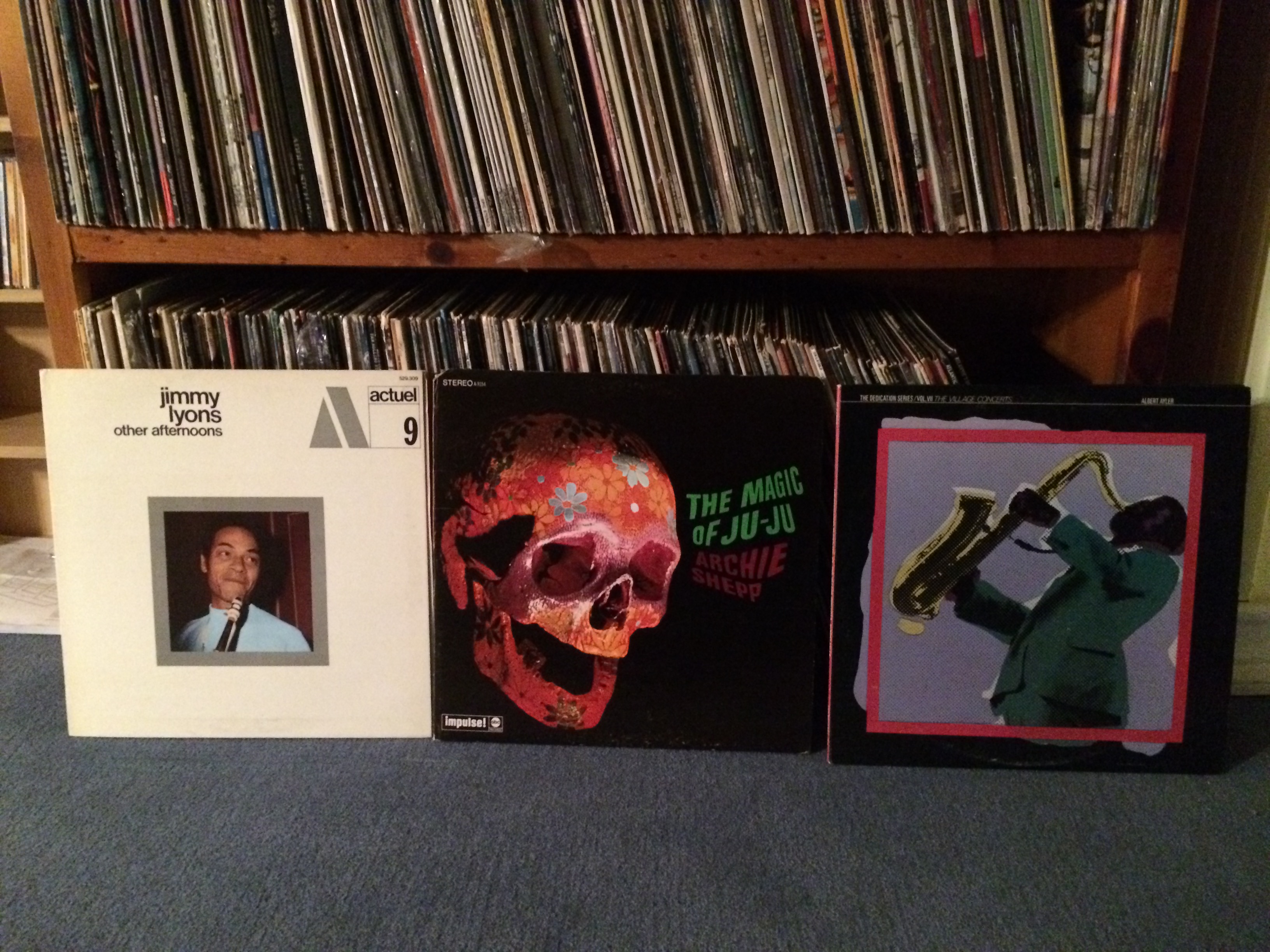
In preparation for each Vinyl Night I head to the basement room where my most prized possession resides: my vinyl album collection. I’ve got a ton of albums. Lots of musical styles. Never got rid of any of them, one of the smart calls I’ve made in life. On the afternoon of this most recent occasion I  walked to the shelves holding the discs and made the selections for that evening’s Vinyl Night. Albums by Jimmy Lyons, Roswell Rudd, Grachan Moncur III, Art Ensemble Of Chicago,  Archie Shepp, John Carter/Bobby Bradford, and Albert Ayler. Household names, no? As always, Dave and I would listen to one side of each album.

The three albums that caused problems. Photographed in bunker before Vinyl Night began.
The three albums that caused problems. Photographed in basement before Vinyl Night began.

Dave arrived around 8:00 PM. Sandy gave him a hug and walked upstairs, not to be seen again for a couple of hours. I placed side one of Jimmy Lyons’ Other Afternoons (recorded in 1969) on the turntable and an evening of fun, then mayhem, began. Jimmy Lyons no longer is with us, but his recordings live on with force. And force is what soon blew through the stereo speakers in my living room. The title track, Other Afternoons, began calmly enough. Didn’t take long however for alto saxophonist Lyons and his cohorts to wail and fly as though demons were on their tails and gaining fast (click here to listen). That’s when Dave and I thought we heard the sounds of wood and plaster creaking a bit more than they should in an old house. We put those thoughts out of our minds.

Several albums later a firestorm hit the turntable, Archie Shepp’s The Magic Of Ju-Ju (recorded in 1967). The title song, occupying all of side one, made Other Afternoons sound like a wimp. Shepp, whose career began in the early 1960s and who is alive and kicking, hit the ground at Usain Bolt speed, screaming on his tenor saxophone for 18 minutes over a drumming cacophony (click here to listen). I was amazed, mesmerized and kind of in a daze. Dave too. That’s the power of Shepp. We definitely heard those creaking sounds again, some rumbling ones also, but put them out of our minds.

The problems became undeniable a couple of albums after Shepp’s. Tenorman Albert Ayler, long gone, went stratospheric at around the six minute mark of Spirits Rejoice (recorded in 1966), which takes up all of side three on The Village Concerts double album (click here to listen). My house couldn’t take it any longer. Plaster started falling from the living room ceiling. The living room floorboards began to buckle and give way. Good things weren’t happening upstairs either. Sandy came running down the stairs. “I really, really hate this music,” she yelled as she and I and Dave bolted out the front door. We stood in disbelief on the sidewalk as Sandy’s and my suburban home dropped to the ground. The house’s descent took a long time and was extremely jarring, just like the saxophone, trumpet and other instrumental solos that Dave and I grooved to on that most infamous of Vinyl Nights.

The next day I called my Allstate agent. I described the bizarre situation to her. She said, “You’re out of luck, Neil. Your homeowners policy specifically prohibits you from playing any free jazz above the 80-decibel level. Allstate isn’t going to pay you a cent. We may be the ‘you’re in good hands’ people, like our logo says, but we’re not fools like you!”

(If you enjoyed this article, don’t be shy about sharing it. Sharing buttons are below)

King Georges: A Possibly Tasty Movie Review

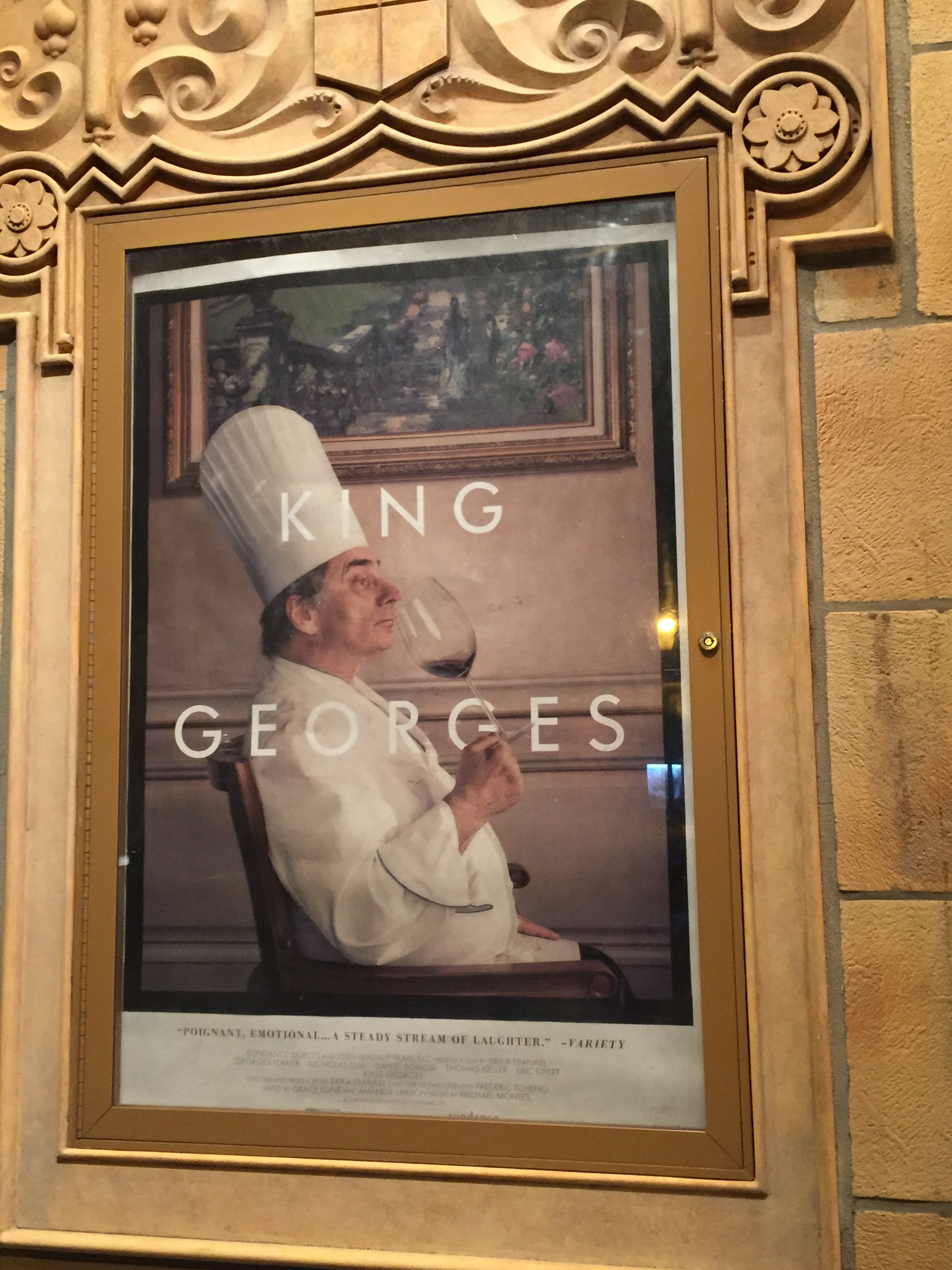
On our way to dinner at The Broad Axe Tavern on a recent Friday night I told my wife Sandy about the approach, since abandoned, that I might take in writing the article you currently are reading. It was to be a comparison of dinner at The Broad Axe with what my opinion would have been, had I ever eaten there, of dinner at Le Bec-Fin, a famous, majestic and now-closed French restaurant in Philadelphia. All of this made possible sense because the movie that Sandy and I were headed to later that evening in suburban Philadelphia was King Georges, a documentary about the last few years (2010 to 2012) of Chef Georges Perrier’s involvement with Le Bec-Fin, which he opened in 1970.

Yup, I had thought that my culinary tastes and scrutinies would make for way cooler reading than a review of King Georges. And, dope that I tend to be, I was quite certain about what my conclusion would be, even before seeing King Georges. Namely, that I’d prefer to eat at The Broad Axe than at fancy-schmancy Le Bec-Fin. Broad Axe food I understand. It’s good for the most part and you don’t need a translator to figure out what’s what. Le Bec-Fin’s fare, which I had read about for decades, would have intimidated me. That’s because I knew and still know diddly-squat about high-level French cuisine.

We saw King Georges at the Ambler Theater.

But after watching King Georges I did an about-face. Who cares about my food preferences when a terrific piece of filmmaking is at hand? Clear the way! Movie review, here I come! And by the way, I should have given pricey LBF at least one spin during its lifetime. I’d have parted with some serious cash, but the meal and the experience would have been worth it. I hadn’t because I was a culinary coward.

Sure, the food looks great in King Georges. But that’s not the reason to see the movie, as food isn’t primarily what it’s all about. What we have here is a vibrant look at a pretty complicated guy. King Georges is filmed mostly in close-up and often in tight quarters, Le Bec-Fin’s kitchens, and reveals an extremely colorful and self-driven character as he wrestles with the reality that his famed and celebrated baby, LBF, ain’t the destination that it once had been. And that maintaining his customer base is hard and ultimately maybe not possible. What’s a top chef to do? In Georges Perrier’s case, keep on truckin’ and truckin’ until . . .

King Georges 2 IMG_1269
King Georges shows Perrier as a sometimes-crazed dynamo in the kitchen, his senses aware of what’s going on in every pot and pan attended to by the small army of chefs under his command at LBF. He rants and raves. He praises and hugs. He includes sh–t and/or fu–k in half the sentences that pour from his mouth. He’s a pip, a perfectionist, an incredibly hard worker who seems to have gotten no more than a handful of hours of sleep nightly for forty-plus years. How can you not love someone like this? I mean, he cares. Born and raised in France, he came to the USA in the mid 1960s hoping to own, cook for and run one of the best restaurants in the States. All of which he ended up doing for years and years. And he became a celebrity of sorts in the process, a big name in certain circles around the globe, eons before the likes of chefs/restaurateurs Emeril Lagasse, Bobby Flay and Mario Batali became media fixtures.

During the last few years, though, Georges Perrier hasn’t been too visible. Whom, then, do we have to thank for bringing him to our eyes and ears in 2016? None other than Erika Frankel, she whom neither you nor I ever heard of before. Frankel has earned her keep producing documentaries and other works since the early 2000s but, before King Georges, never had donned a director’s cap. How did she manage to handle the job so well? Maybe it was beginner’s luck. Probably it was innate talent. Whatever, having a charismatic figure to make a movie about didn’t hurt.

You know, writing this article has made me hungry. I’m going to head into the kitchen and labor over one of my exotic specialties, a grilled cheese sandwich. I’m sure that Chef Perrier would approve of my sandwich-flipping technique, the precise and practiced manner in which my right wrist rotates just so. Before I say goodbye, however, let me mention that King Georges isn’t making waves at the box office. In fact, Sandy and I were lucky to see it in a theater, because nationally only a single digits number of cinemas are showing it. But happily for the inhabitants of our planet, King Georges is obtainable via Amazon Prime and other online operations. Be it at a theater, or more likely in the comfort of your home, here’s your chance to be the first on your block to watch King Georges. Take it from me, kids. I think you’ll like it.

(If you enjoyed this article, don’t be shy about sharing it. Sharing buttons are below)

(Photos by Sandra Cherrey Scheinin. If you click on a photo, a larger image will open)
In Search Of A Story Idea

Funny thing about this blog. When I started it last April I didn’t know what shape it would take or what it might come to mean to me. Shape-wise, somewhat to my surprise, the blog seems to conform pretty well to the template I described in the “About” page. Meaning, I’ve written about this and I’ve written about that, and the articles in toto appear to give a pretty good picture of who I am. Not that I actually know particularly well who I am. Figuring that out would take hours and hours on a psychiatrist’s or other therapist’s chair or couch. “Hey, Sandy!” (note to readers: I’m calling to my wife). “It’s time I found out who I am. Please get me an appointment with a topnotch and nearby mental health professional. Thanks.”

As for what the blog means to me . . . well, it has become a big part of my life. Here I am, almost 12 months forward from the blog’s launch date, and I’m getting a tasty kick from writing. More than 60 times I’ve been inspired to put fingers to keyboard and knock out a story. I haven’t done so much thinking or typing since my school days, back when the dinosaurs were on the verge of extinction. Didn’t know I had it in me.

There is a problem though. To wit, I’m good at struggling to find subjects that interest me enough to write about them. And that are simple enough so that pea-brained me can understand them. Sometimes the well feels awfully dry, causing me to start worrying more than a bit. “What the heck am I going to write about next?” is a question commonly floating in my head. When day after day go by without a pleasing answer, man, the perspiration beads start pooling.

And that’s the situation I find myself in right now. I’ve had a few particles of ideas for stories, but none has swelled to a size that I can grab and knead. Better scribes than I would have turned out excellent articles from those fragments, which is one of many reasons why those writers are better.

IMG_0131
For instance, the other day I was at my volunteer job in a medical office building not far from my suburban Philadelphia home. The building is full of doctors’ offices that are reached via a web of corridors. I man the information desk at this facility one morning each week and have been doing so for six years. I was standing beside the desk. My mind was wandering. Perspiration covered my forehead. “What the heck am I going to write about next?” I wondered. And then something caught my eye. It was a watercolor painting, a large appealing abstract in blue and cream. It was mounted on a wall eight feet in front of me. It had been on this wall for who knows how long. I had seen it every time I’d been at my volunteer job. But I hadn’t  really seen it. I mean, it’s one of those items that you don’t want to become too aware of. If I started fixating on its existence, I’d be glancing over at it throughout my shift. It would become like a song that gets stuck in your head. Such as El Paso, the Marty Robbins tune from 1959 that I’ve been trying unsuccessfully to expel for decades. When Sandy and I were at dinner with our great pals Susie and Mike a few weeks ago, Mike started singing El Paso to me. He’s cruel that way. “Out in the West Texas town of El Paso/I fell in love with a Mexican girl/Night-time would find me in Rosa’s cantina/Music would play and Felina would whirl.” “Stop, Mike, stop!” I cried. And he did. But here I am a few weeks later with those entrancing lyrics and that sweet waltz-time melody still skipping around in my brain neurons. Mucho gracias, Mike. Mucho gracias.

Ah yes, the watercolor painting staring at me from eight feet away. A bell dimly chimed inside my cranium when the notion occurred to me that the watercolor might in some elusive manner lead the way to a story for my blog. Perhaps there were other art works hanging in the corridors of the medical facility. And if so, that would be my story. Namely, one about lovely objects that often surround us yet remain unnoticed and unappreciated.

Is this art?
Is this art?
Is this art?
Is this art?

Off I went to explore the three floors-worth of crisscrossing hallways. I’d walked these avenues many times over the years, but looking for art had never been part of my quests. Alas, I came up empty. The blue and cream watercolor was an orphan, the only framed object in the various halls. Not so fast, though. A myriad of things were attached to the corridors’ walls or hanging from their ceilings. Fire alarms, fire extinguishers, water fountains, exit signs, digital thermostats and other utilitarian stuff. Who’s to say that they didn’t qualify as art? If they did, then my volunteer job took place within a veritable museum.

“Yeah, now that’s a story for my blog,” I told myself. After all, in 1917 Marcel Duchamp bought a mass-produced urinal, signed it with a fictitious name and submitted it to a prestigious arts exhibition. And in the 1960s Andy Warhol created large-scale facsimiles of Brillo boxes. Duchamp and Warhol were revolutionary modernists, questioning the nature of art, asking what in fact qualifies as art. If they had held my volunteer job, mightn’t they have concluded that indeed they were working in a museum?

Thus I walked the hallways once again, reexamining the stuff on the walls and ceilings and taking their pictures with my iPhone. And as I did I knew that this story idea led nowhere. Oy frigging vey! Try as I might I didn’t feel any aesthetic or conceptual attraction towards the fire alarms or any of the rest. “You know, as art these things suck big time,” I said to myself.

Soon an idea worth writing about will come to me. I’m confident of that. Sort of. Till then, I’m outta here. Where’s the exit? . . . Oh, here it is. Bye.

IMG_0151

(If you enjoyed this article, don’t be shy about sharing it. Sharing buttons are below)

OJR Will Tour With The Rolling Stones (Keith Richards Assured Me Of This)

My cell phone rang in late afternoon on a recent Sunday. I answered and an unmistakable phlegmy voice said to me: “Yeah mate, how ya doin’? I’m OK. Just sittin’ here in my hotel room watchin’ the telly. Drinkin’ milk, munchin’ Oreos. They go good together, ya know?” It was Keith Richards calling from Sao Paulo, Brazil, where The Rolling Stones had played a show the night before.

“I know, Keith, I know. Every time you call it’s the same old thing. Milk and Oreos. Milk and Oreos. Come on, amigo. Switch it up once in a while. Didn’t you ever hear of Chips Ahoy? Vienna Fingers?”

He guffawed. “I’m hooked, son. I can’t switch. I won’t.”

“Okay, Keith,” I said. “So what’s the scoop? How was the show last night?”

Keith Richards. (Photo by Mark Seliger)

“Cool, man, cool. We had fun. Ya got a minute?” As though I didn’t. Before the phone rang I had been cutting coupons for half an hour. And before that, working on a story idea about celebrities’ genomes that I plan to pitch to Science Magazine, I’d spent 90 minutes meticulously plotting the Kardashians’ family tree. I was pooped. I was ready to have a relaxed phone conversation. “Spill your guts, partner,” I said to my old friend, whom I’d met and instantly bonded with in 1978. This was at a Bingo parlor in Philadelphia the day after a Stones gig in that fine city. Keith’s a Bingo man. He has wandered into Bingo halls all over the world.

“What’s the Stones’ signature song?” Keith asked me. “Ya know, the one we’ve played ten thousand times. The first letter is an S. Here’s another hint. It starts like this: dum dum da da dah da da da da da.”

“Let me guess,” I said “Is it Smoke Gets In Your Eyes?”

“I wish,” my friend said. “I’d like to play that one. I’ll run it by Mick. But I got a problem here, bro. No joke. Every show we hafta play Satisfaction. Last night I almost couldn’t do it. I f – – kin’ hate that song. If I hafta play it again I’m gonna plotz.”

“Relax, chum, relax,” I said. “You’ll get through this. You’re a pro. Drink some more milk.”

“C’mon, pal. I need a boost. Talk to me. What’s good? What’s new and happenin’? Clue me in.”

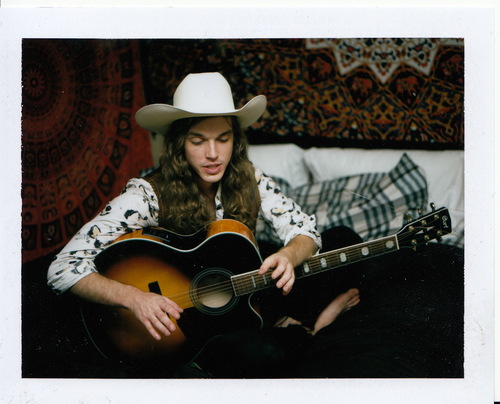
Oliver John-Rodgers. (Photo by David Salay)

“Okay, laddie,” I said. “There’s something really good that I checked out the other day. Great music by a young guy named Oliver John-Rodgers. Calls himself OJR. His YouTube videos have gotten about as many views as my blog articles, which means that just about nobody ever heard of him. But I think that’s going to change. For him, I mean. Not for me. His new album is fantastic. I ain’t Nostradomus, but I predict that he’s going to be big.”

“Hold up, Neil. Someone just tapped on my door. It’s Mick, no doubt. I can tell by the secret knock . . . dum dum da da dah da da da da da. You heard that, didn’t ya? He’s been doing that to me for the last 50 years. Gotta go, compadre. Send me an email about OJR. Peace, brother.”

With that, Keith hung up. Before I’d forget I sat down and composed my message to him. Here’s what I wrote:

Hey, boyo. Thanks for calling. OJR’s new album, Nashville Demos, rocks like a mother lode. Catchy melodies, nifty lyrics, guitar licks that wrap themselves around your brain. He recorded the album in, believe it or not, bedrooms all over the world. I guess he’s sort of a vagabond. Played most of the instruments himself. I found out about him from WXPN, a Philadelphia radio station I listen to sometimes. OJR has a song called Numb, and it’s in XPN’s rotation. The song’s a monster. OJR put the whole album up on his website (Keith-o, click here to listen to the album). And I found a primo YouTube video of OJR and his band playing Numb in a slowed-down head-warping version (Keith, my man, click  here to watch it). That’s all for now. It’s almost 7 PM, my bedtime as I’m sure you remember. Talk soon, matey. Oh wait, one more thing. Please ask Charlie, Ronnie and Mick to look at my blog. There’s a chance they might like my stuff. Peace out.

A few days later, at 8 PM, my phone rang. I’d been asleep for an hour. Thanks, Keith, for waking me up. He was calling from his hotel room in Lima, Peru. The Stones would be on stage in Lima the next night. “Yo, what’s up, cool guy?” he asked. “You were right. OJR is the friggin’ bomb. Best rock and roll I’ve heard since the end of the Ice Age. Or maybe it was the Cold War. I forget. Anyway, the boys and me had our managers get in touch with him. OJR’s a sweet dude, they said. And you know what? . . . We’re gonna have him open some shows for us later this year. Thanks for the tip, Bingo Boy.”

“No problem, Keith. Glad to help. How about my blog? What did Ronnie, Mick and Charlie say?”

There was a long pause. I knew the news wasn’t going to be too good. “Well, buddy, I sent them the link to your blog. Sorry mate, let me tell you straight — slow and snoozy are a couple of the words they used about your articles. What can I say? But I’ve got a great idea for ya. You’ve never written a story about Bingo. I think ya should.”

“Thanks, Keith. Maybe I will.”

(If you enjoyed this article, don’t be shy about sharing it. Sharing buttons are below)

Ruthie Foster, Soulful Singer: Frigid Weather Couldn’t Keep Us Away

It was a dark and stormy night . . . hold on, that line sounds familiar. I think I may have lifted it from someone inadvertently. Wouldn’t want to do that. I’m going to put it into Google and see what gives. I’ll be right back.

Yes, indeed. The sentence was penned about 185 years ago by an English novelist whom nobody alive today ever heard of. In that sense he’s just like me. Let’s start over.

It wasn’t a dark and stormy night. Well, it was dark, but it wasn’t stormy. In fact the sky was quite clear. But it was a bitterly cold Saturday night, no doubt about that. As in 12° F. My wife Sandy and I had just eaten dinner in a tavern we like in the Philly burbs. As we soldiered through the parking lot to our car, the night air laughed in my ear. “Man, you sure are a nitwit for going out in weather like this,” it mockingly said, keeping its voice low so that Sandy wouldn’t overhear. “Didn’t anyone tell you that it’s cold outside?” It’s surprising the things you learn as you get older — before that frigid evening a couple of weeks ago I never knew that the night air could talk, let alone be a sarcastic jerk. I kept my mouth shut, but next time I’ll be prepared with a snappy retort.

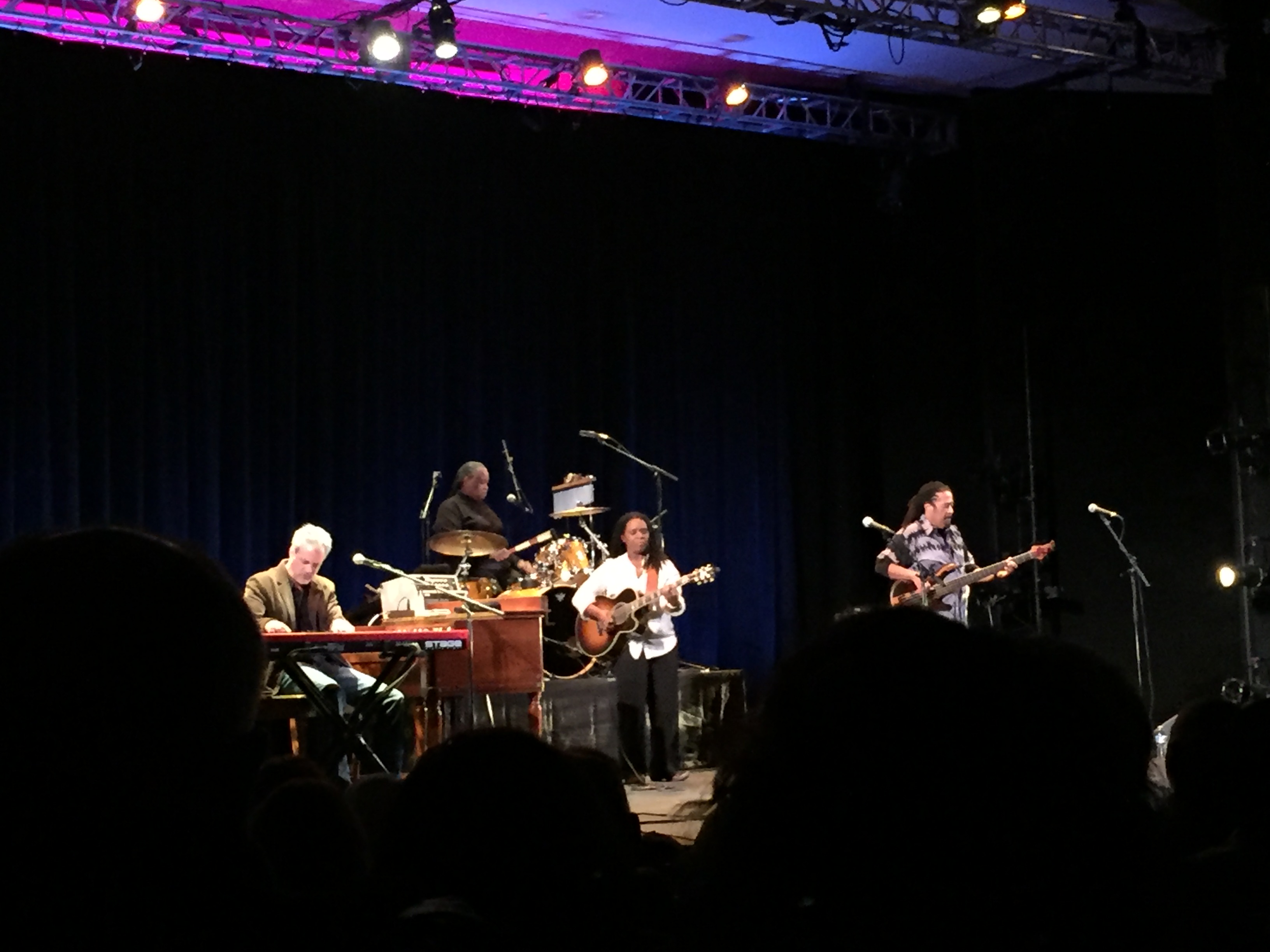
Ten minutes later Sandy and I arrived at our post-dinner destination, Montgomery County Community College. It’s located in the once-bucolic town of Blue Bell. Modest in size and scope, MCCC isn’t where one would expect to find a world-class performing arts series, but such is the case. Many times over the years, Sandy and I have seen top-of-the-line musicians and modern dance troupes in the series’ 400-seat auditorium.

It was good getting out of the cold. We settled into our seats at 7:45 PM and awaited the singer whom I’ve known about for a few years but never had seen in person. Ruthie Foster, she who drinks from the wells of blues, gospel, soul and folk music, and who is one of the prides of musically-rich Texas, USA. Ruthie, in her early 50s, is an in-demand artist. She regularly plays in the States, Canada, Europe and sometimes Australia. Let me mention one important point before I forget: Ruthie is a gifted vocalist with a gracious and likeable stage presence. If she passes through your area, and if you enjoy music of the sorts I mentioned above, you would do well to attend her concert.

Ruthie1 IMG_0175
Showtime arrived. Ruthie Foster walked onstage with three musical compadres: Samantha Banks (drums and other percussion), Scottie Miller (piano and organ) and Larry Fulcher (electric bass). Electric guitar was not in the house. Ruthie strummed an amplified acoustic guitar, but she knew her limitations on the instrument and ventured not a solo during the show, leaving most of them to Scottie and a couple to Samantha and Larry. Would the band have gained from having an additional member, to wit a high-flying electric guitarist? No way. His or her absence kept things lean and uncluttered, and placed Ruthie’s vocals at the center of center stage.

The show began with a rendition of Patty Griffin’s When It Don’t Come Easy, a tune about love’s elusiveness. The tight machine that was Ruthie’s band set a perfect rhythm and constructed elastic boundaries over which Ruthie spoke the truth. Bap-bap-bap-bap went Samantha Banks, sure-footed and steady on the drums, as she was all evening long. Larry Fulcher’s bass lines floated here and then there but never lost their way. Scottie Miller pushed and probed on the piano, at the appropriate times sending out blasts of emotions. The band was aware, focused and nimble on this and every song that followed.

Ruthie2 IMG_1246
A few words about Ruthie Foster’s singing voice. It is wonderful, as is the way she uses it. She sings cleanly and clearly, unstrained and vibrato-less, always in control. And she can move easily to a hush or to a soulful barrage of notes. The timbre of Ruthie’s voice often reminded me of Bonnie Raitt’s, but Ruthie’s is fuller and better — Bonnie I’m certain would agree. At concert’s end, 90 minutes from the starting gun, I was convinced that Ruthie is one of the big talents in her field. What’s more, she sings songs that contain real meaning. Songs about tolerance, equality and hope. Such as the concert’s hope-centric third tune, a recent Foster original titled Brand New Day. It dripped with gospel fervor. “Love heals and love lives/And time will reveal a brand new day,” Ruthie proclaimed as her three pals, playing their instruments all church-like, vocally urged her along with harmonized “uh-huh, hoo” after “uh-huh, hoo.” Uh-huh, I loved it.

Let me say a few more things before I hit the “publish” button to post this article. Ruthie has written quite a few songs over the years, but kept her set list heavy with compositions penned by others. She chose numbers, for instance, by June Carter Cash (Ring Of Fire) and Lucinda Williams (Fruits Of My Labor). And she closed the show with  Stephen Foster’s Oh! Susanna, an American chestnut from 1848. (Click here to watch her perform Oh! Susanna two years ago). For that final tune she was alone on stage for the only time during the show. She sang slowly, picking comfortable notes on the guitar. As the song progressed her voice soared effortlessly, poignantly. Oh! Susanna took on meanings that I’d never thought about before. She made a great song greater.

(If you enjoyed this article, don’t be shy about sharing it. Sharing buttons are below)

(Photos by Sandra Cherrey Scheinin. If you click on a photo, a larger image will open)

A Philadelphia Saturday Night

Our plans for a recent Saturday evening came together quickly. Flipping through a newspaper we (my wife Sandy and I) saw a review of a play titled Spine. The play sounded good. Its theater was in Philadelphia’s central section, easy for us to reach from our home in the burbs. OK, Spine it would be. Deciding to have pre-show dinner near the theater, we looked for an eatery where we’d never been before. We clicked here and there on OpenTable and settled on Franky Bradley’s, a place we knew little about. A handful of hours later we arrived at FB’s at the appointed time, 6:15 PM, and the night began.

Some Philadelphians will recall Franky Bradley’s when it was a steakhouse and celebrity hangout and its first name was spelled Frankie. That was decades ago. In its most recent incarnation the place was a gay bar. Last year a new owner turned the property into a restaurant/bar/dance club, resurrecting the name (save for the spelling change) but nothing much else from the original FB’s. Only one steak is on the menu and I doubt if Franky’s is a celebrity hang.

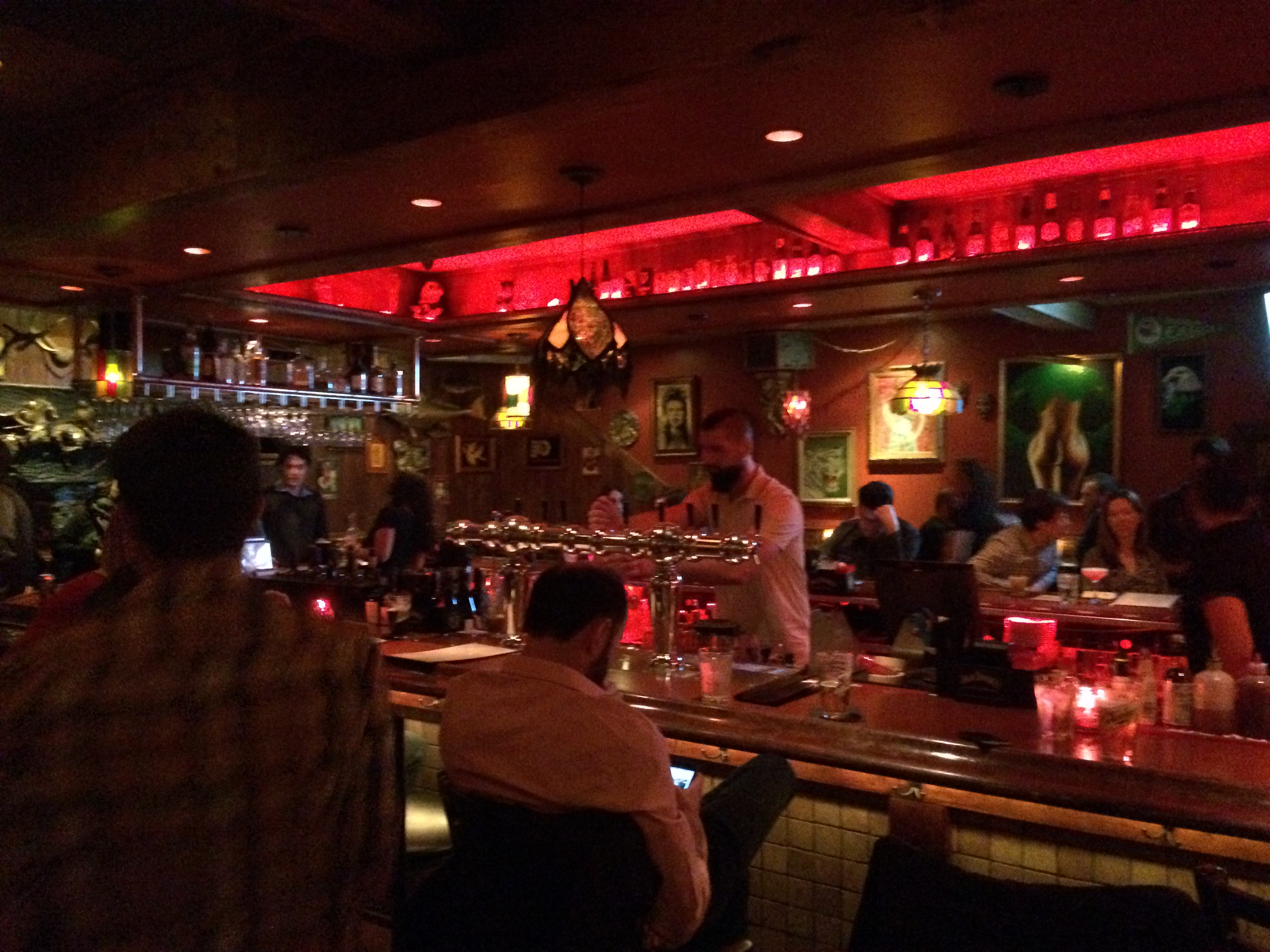
Inside Franky Bradley's.
Inside Franky Bradley’s.

It’s a two-story establishment. A  music room cum bar occupies floor number two. That’s where late night DJ and dancing action takes place. Sandy and I took up a little bit of space on the ground level. There, dark wood tables and booths fill up the square footage not occupied by a large bar, and the walls are covered with wood carvings, a potpourri of signs and with moody, sensual oil paintings. We sat at a peripheral table. It gave us a good view of much of the room. The lights were low, the noise level high, the waitstaff young and friendly. Recorded music from the 1970s (David Bowie, disco tunes) swirled through the air. The place was mobbed, mostly with an under-40 crowd. Tucked away on narrow way-off-the-beaten-path Chancellor Street (1320 is the address), Franky Bradley’s seemed to be a hit, a destination. From my perspective here’s the deal: Sandy and I loved our meal there. And the vibes were a gas, you dig?

Bradley’s keeps the number of beverage and food selections on the modest side, which seems like a good idea to me. Man, this world is cluttered enough as it is. You could do a lot worse than ordering what we had. Liquid-wise, a toasty beer for me, Ellie’s Brown Ale from the Avery Brewing Company. And, for Sandy, a semi-dry and citrusy Spanish white wine that rocked, an Albarino (2013) from Ramon Bilbao vineyards.

Bottom plate: Arctic char with warm lentil salad and orange slices. Top plate: Ditto.

We shared a house salad built from powerful purple onions, three or four types of greens and a Banyuls vinaigrette dressing. “Banyuls?” you ask? Right, I hadn’t a clue either. But it was damn tasty. A minute ago I peered at a foodie’s website and learned that Banyuls vinegar is made from fancy grapes. I shoulda known. For entrées we each ordered pan-seared Arctic char, a thin fish that came out moist, just-right salty and just-right charred. The fish shared plate space with warm lentil salad and orange slices. I’m a sucker for a good lentil salad. In this case, cubed beets and diced carrots and peppers said hello to one another and to the lentils just the way I was hoping they would. Wouldn’t have minded staying at Franky Bradley’s for a couple more hours, testing the desserts, knocking back another Ellie’s or two. But Spine awaited.

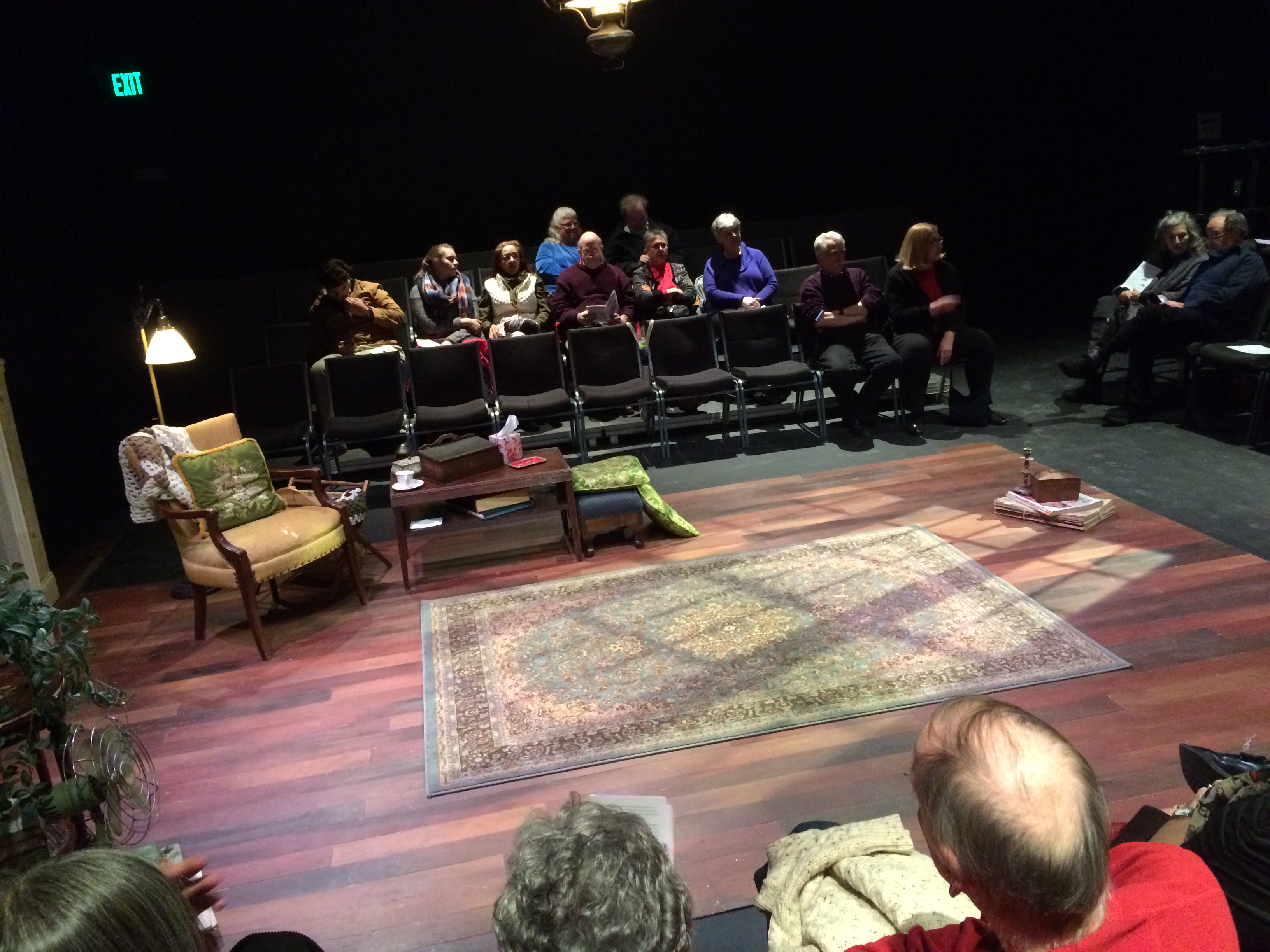
A few moments before Spine began.
Ten minutes before Spine began.

Spine (running through March 6) is a 70 minute monologue first performed in 2014 in Scotland at the Edinburgh Fringe Festival. Its British author, Clara Brennan, probably is a rising star. Philadelphia’s Inis Nua Theatre Company has staged Spine’s first American production in the smaller (about 75 seats) of two new theaters created within the Drake apartment building (1512 Spruce Street) earlier this year. There’s no intermission, so visiting the loo pre-show ain’t a bad idea.

If I’m sure about anything, it’s that Spine is a whirlwind of words, a rant at times, a collection of colorful tales all recited by Amy, a London teenager struggling to find her way. Amy is not in the education pipeline, can’t hold jobs, has messy relationships with family and friends and recently has become a petty criminal. But she’s no dummy and lacks not for energy. One day this wrong-side-of-the-tracks girl, looking for a room to rent, knocks on the door of a home, in a good part of London, owned by very elderly Glenda. Glenda, an advocate for social justice, takes a liking to Amy and over time gives her barrelsful of counsel.

What’s Spine about? It’s about a lot of things, maybe too many. Brennan takes aim at what she sees as damaging policies by Britain’s Cameron-led government, bemoaning social welfare program cutbacks and the closing of libraries. She believes that young folks like Amy institutionally are ignored and rendered powerless. She feels that the Amys of the world are being deprived of knowledge, but that they yet might come to understand their plights and change them for the better.

Whew, that’s a lot for a play to bite off. And a lot for politically and sociologically semi-conscious characters like me to digest. But let me say this: My attention didn’t waver watching Spine. Emily R. Johnson commanded the minimally-furnished set, bringing Amy fully to life and, by extension, Glenda. When the play ended I shook my head in disbelief. I mean, how does anyone do what Johnson did, spewing a non-stop avalanche of words without a stumble? How can anyone remember all those words? I have trouble remembering the name of the street I live on. Impressed? You bet your sweet bippy I was and am.

But sometimes there’s a but, and I have one. Johnson, a non-Brit, adopted a deep deep Cockney accent. I didn’t understand half the words she spoke. “Huhhh, what?” I said to myself so often I almost started babbling. Sandy had the same problem, even worse. If you didn’t grow up in a workingclass London neighborhood I’m guessing you’d decipher the language not much better than we did. I think that Spine’s director should have decided to soften the blows for Philadelphia’s audiences by toning down the accent. As usual, though, nobody asked for my advice.

(If you enjoyed this article, don’t be shy about sharing it. Sharing buttons are below)

(Photos by Sandra Cherrey Scheinin. If you click on a photo, a larger image will open)
Three Movies: The Fast, The Really Fast, And The Nice And Slow

“Hey, Neil,” my wife Sandy called to me a little while ago. “Pull your thoughts together. Your legions, or should I more accurately say handfuls, of readers are depending on you to digest and configure and explain our cinematic encounters from two weeks ago. C’mon, boy. You can do it. I’ve got faith in you.”

Oh yeah? She’s got to be kidding. I’m moments away from throwing in the towel. I feel my eyes tiring, my attention being directed elsewhere as if by a sorcerer’s hand. But I won’t give in. I know what I have to do, and it involves pain. WHACK, WHACK, WHACK. There, I’ve slapped myself in the face. Works every time. I’m feeling better. On with the show.

Very recently Sandy and I went to the movies on three consecutive days. After that streak ended I figured I ought to try and bang out a story about the trio of flicks for my insatiably content-hungry blog. It wouldn’t do, I decided, to focus on only one of the films, examining it from all angles like a jeweler ogling a precious stone. No, ambitious me would strive relentlessly to find and then analyze the thematic threads woven between the three movies. And believe me, I’ve been looking. Real hard. And so far here’s what I’ve come up with: zippo and bupkis.

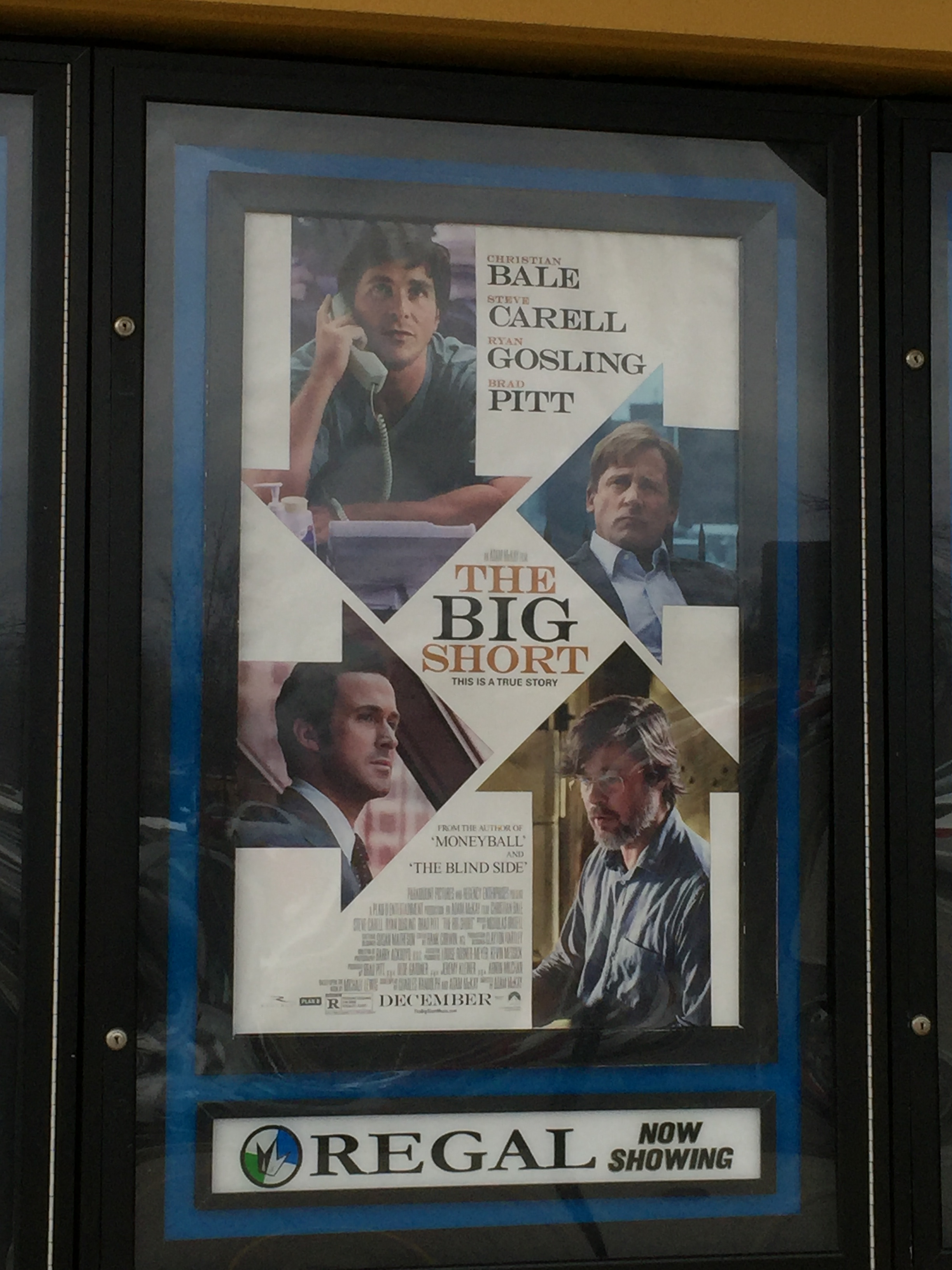
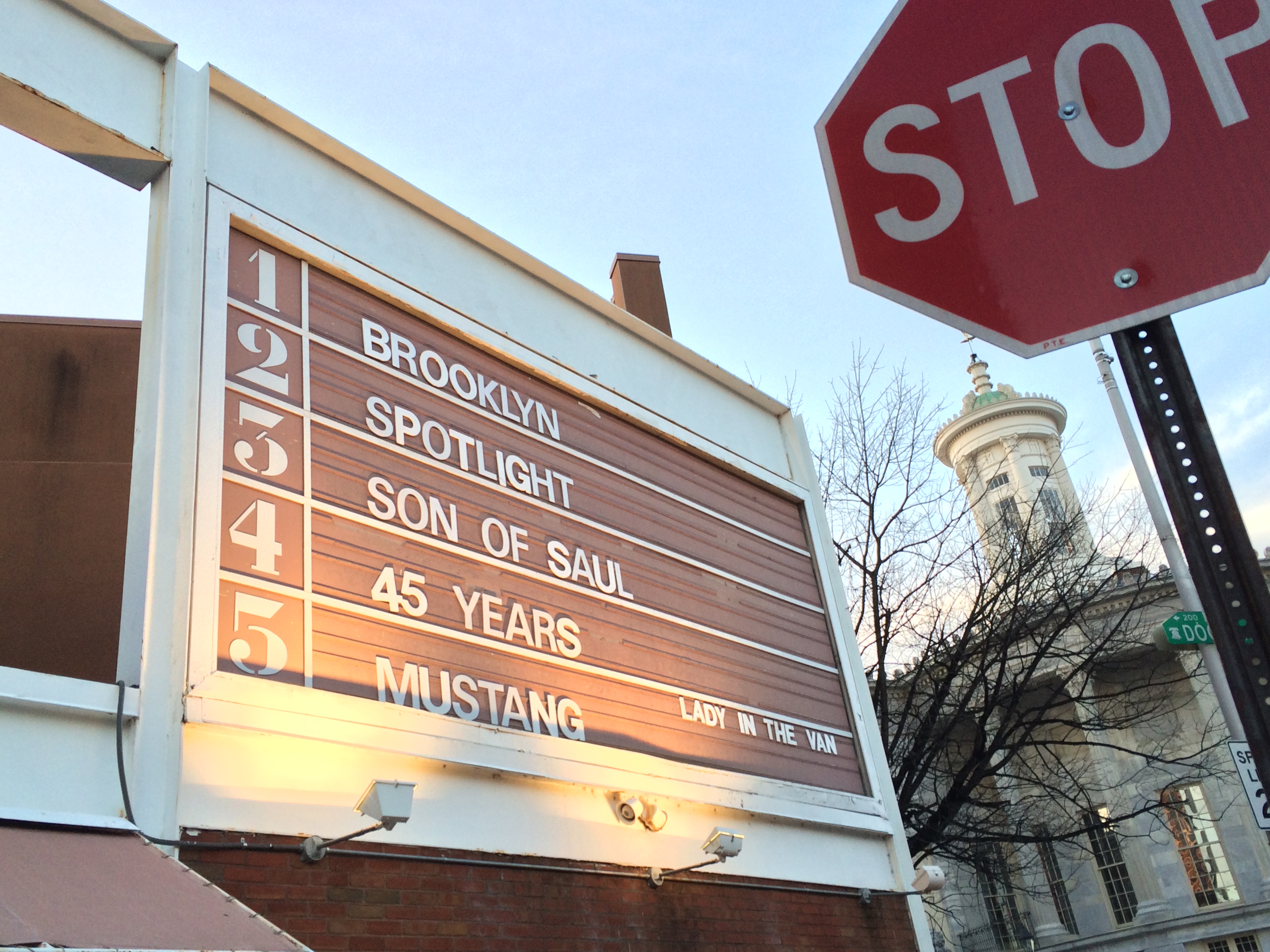
But there’s got to be an angle. There always is. And so I’ve decided to throw connective threads to the winds and pull something out of my wazoo in a desperate attempt to create a blog story. Speed . . . yeah, that’s what I’m going to look at. The degree of rapidity of the movies’ action. And speaking of speed, I notice that it has taken me over 300 words to get around to naming the movies that Sandy and I watched. Oh well, my incredible slowness ties right in with what now is this article’s subject. And I suppose that Sandy’s faith in me possibly has paid off. In any case, the movies in the order that we saw them are The Big Short, Star Wars: The Force Awakens, and 45 Years.

StarWars IMG_0167
Respectively, those movies overall are, in terms of pace, fast, really fast, and nice and slow. And in terms of how much I liked them they are, respectively, very much, eh, and quite a lot. I’m amazed that I didn’t get big kicks from the newest Star Wars, the seventh in the franchise. Entering the theater I thought I would. A thousand years ago (in 1977) I loved the first in the series. It seemed cool as can be to me, action-packed and stocked with a fabulous menagerie of characters, human and otherwise. But, unlike 95% of the world’s population, I didn’t see any of the next five SW vehicles or do any reading over the years to keep up with the SW storylines. Watching The Force Awakens I was surprised to learn that Darth Vader no longer is on the scene, and I barely remembered what a Jedi is. But I was glad to see Harrison Ford on board playing the wisecracking and fearless Han Solo.

Most importantly, I was expecting an exhilarating ride. For sure, The Force Awakens often moves like lightening. I lost track of how many times Good was battling Evil on one planet or another, and seemingly only moments later the fight had shifted to an orb millions of miles away. I enjoy that kind of zooming sometimes, but after a while it wasn’t doing the trick for me. I began to feel that the screen was filled with too much of too much, that the plot almost was losing itself. I became bored. A healthy dash of better dialogue and believable human dynamics wouldn’t have hurt. Not that the film’s writers didn’t try to bring emotions into the proceedings, but the results of their efforts, probably purposely, are pretty cardboardy. The occasional hug and goo-goo eyes don’t meaningful human relationships make.

TheBigShort IMG_1244
Unlike SW:TFA, The Big Short doesn’t suffer from underdeveloped characters, though it contains plenty of characters, as in people with strong ways of expressing their inner selves. And its propulsion is mighty chipper, though it avoids the warp speed of many scenes in SW:TFA. The Big Short takes on a most unlikely candidate for a cinematic story, the worldwide financial catastrophe of 2008. The film tackles the subject inventively and with energy to spare. Basically, The Big Short rocks. Fast-thinking denizens of the investment world, some of them motor-mouthed (played by Steve Carell, Ryan Gosling and others) make for a heady and dizzying trip. Add snappy editing to that and you’ve got a really winning movie.

What’s more, you very well might leave the theater thinking you’ve finally begun to understand who and what caused calamity to shower the Earth eight years ago. And hopefully you won’t be like me, dumb as dirt once again in financial matters by the time you arrive home.

45Years IMG_0169
Within the low range of the miles-per-hour spectrum stands 45 Years, replete with a top-notch screenplay and realistic portrayals by Charlotte Rampling and Tom Courtenay of a married couple, the Mercers. This duo finds themselves with emerging marital problems on the cusp of their 45th wedding anniversary. But if you’re thinking of catching the Mercers’ predicaments, be prepared for a slow and deliberate adventure. Everybody takes their good ol’ time doing things and vocalizing. The most intense action in the movie occurs when Rampling struggles with a pull-down attic ladder. Yup, eventually she conquers the beast and makes her way upward to where a revelatory discovery awaits her. You go, girl!

What’s my point about all of this? Good question. Luckily I have an answer or two. A movie’s pace is important and should fit the circumstances of the plot. Movies with mucho scenes that rip along wildly can be terrific (think His Girl Friday and the version of Casino Royale with Daniel Craig), and so too can be those that mosey (think Hud and Nebraska). Velocity is only part of the equation. Whatever its pulse rate, a film usually will rise only if its story is strong, its dialog solid, its characters believable, its actors on top of their game and its director in firm control. The Big Short and 45 Years meet the criteria beautifully. Not so for Star Wars: The Force Awakens, which comes up a bit short in the plot, dialog and character development departments in my puny opinion. Shows what I know, though. SW:TFA to-date has grossed almost one billion smackers at the domestic box office, let alone the rest of the world. I bow before the power of the dollar.

(If you enjoyed this article, don’t be shy about sharing it. Sharing buttons are below)

(Photos by Sandra Cherrey Scheinin. If you click on a photo, a larger image will open)

The Sweet Spot (Musically Speaking)

It was a typical Sunday evening in the Scheinin home. There we were, my wife Sandy and I, sitting on the living room couch, twiddling our thumbs in unison and waiting for the tea kettle to come to a boil. I know that this picture sounds bland, but you’d be surprised how strongly it, and many similar moments in my life and Sandy’s life, resonate with a group of media honchos who for now will go unnamed. Let me just say that Sandy and I have been tabbed to star in a reality TV series projected to air beginning in early 2017. It’s tentative title is Action Is Overrated: Flying Low With The Scheinins. Stay tuned to this website for updates.

Earlier in the day, though, I had gone against grain and been an energetic person. In the aftermath of January’s Blizzard Jonas, which had dumped two feet of snow in my suburban Philadelphia region the previous day, I had spent three hours shoveling. Incredibly, my back hadn’t stiffened like a log. In fact it felt pretty good as, the kettle finally having tooted,  Sandy and I settled back with our cuppas and I started paying attention to the tunes emanating from the radio. On most Sunday nights we flip between three stations which, at those hours, keep things on the non-bombastic side. We didn’t feel the need to scramble our brains with punk rock or heavy funk or avant garde jazz. Not that I would have minded, to tell you the truth, but I wasn’t in the mood to provoke divorce proceedings.

Gram Parsons
Gram Parsons

And at around 8 PM something wonderful happened. WPRB, Princeton University’s eclectic-minded station, played a song that changed my tunings. The song not only caught my attention, it caused me to melt and then to float. I liked that. “Oh wow,” I said to myself. “I wouldn’t mind a joint right now.” But those really high days are so far behind me I’d need Daniel Boone to help me find the trail leading back to them. Instead, I settled for present-day reality. Closing my eyes I began to vibrate in a most splendid way. I followed the music as it traveled, gently swirling in and around the sounds. Gram Parsons’ countrified version of The Streets Of Baltimore (click here to listen) had gone straight to my sweet spot.

Sweet spot? I’m definitely at a loss to say exactly what this is. In nearly 60 years as a music imbiber I hadn’t given it much thought till Gram came on the radio the other night, although I’d been its beneficiary thousands of times before. I suppose that my sweet spot is a magical kind of place whose gatekeepers, when awakened by just-right combinations of tones and rhythms, send me on a calm yet mysteriously exciting journey. It’s all very cool.

But you know, music can bypass my sweet spot and still make me feel great. For instance, there’s nothing better than straight-ahead Stonesy rock when pumping up my internal volume is a priority. And Sinatra singing I’m A Fool To Want You or some other such brooding song is my ticket to a deep and contemplative experience. At times though, such as on the post-Jonas night, I realize that I want nothing more than allowing my sweet spot to be opened. Stringed instruments often, yet hardly always, hold the key.

The Waterboys
The Waterboys

Soon after WPRB’s disc jockey spun The Streets Of Baltimore he threw another transporter at me, and it got to me even more than the Parsons number. It was Fisherman’s Blues (click here to listen), a Celtic-rocker by The Waterboys. The Streets Of Baltimore’s gorgeous pedal steel guitar and fiddle lines, trancelike clip-clop beat and Gram’s quietly potent singing had sent me to the upper atmosphere. Fisherman’s mandolin and fiddle work took me even higher. Man, those two instruments intertwined like perfect friends, hard and steady drumming allowing them to soar. And Mike Scott’s gruff vocals and exuberant whoops?  Spine-tingling.

The Robins
The Robins

After Fisherman’s Blues ended I wanted another sweet ride. Turning thumbs-down on the next few songs that WPRB aired, I flipped over to University of Pennsylvania’s WXPN, but came up empty there too. Another channel switch brought me to the low wattage operation based a few miles from where I live, the all-volunteer WRDV. I’m crazy about this station. Five or so years ago it reignited my love for R&B, soul and doo wop. And minutes after I tuned in on that recent Sunday night they played a song that took me away: My Heart’s The Biggest Fool, recorded and released in early 1953 by The Robins, a pretty popular R&B vocal group during that era. I tip my hat to WRDV for knowing about this obscurity. I’d never heard of the song before (click here to listen). As it played I went with the flow and swam for the third time that evening through the ethers. Simple instrumentation, vocals that swell and bubble majestically, understated electric guitar work that subtly pushes things along. Magnificent.

Sweet spots. We’re lucky we have ’em.

(If you enjoyed this article, don’t be shy about sharing it. Sharing buttons are below)

Anomalisa: A Review Of An Oddball Movie

My well-worn Fruit Of The Loom crew socks always are knocked off when I think about the number of really creative people sharing space with me and the rest of the less-gifted on Planet Earth. And I think about this fairly often. I mean, worthy musicians and visual artists and novelists and comedians and you-name-it form an eye-popping total. Part of that is due to the insane volume of humans (over seven billion) inhabiting our orb. Still, body count aside, I’m pretty certain that the percentage of seriously creative humans today is higher than ever before in our species’ long and unsettling history.

Anomalisa1 IMG_0157
That inspiring notion was trotting through my mind last weekend as I watched a most unusual movie, Anomalisa. As the final credits rolled I wasn’t certain exactly how much I liked the movie, but I sure as shootin’ was immensely impressed by its meticulous construction and idiosyncratic pilings, by its very existence to tell you the truth. Who the heck except those with non-standard orientations would decide to have the story of a depressed and lonely man represented on screen by stop-motion puppets instead of by humans? And be able to pull it off? Well, it happened, and Anomalisa, quirky and profound, was the result. And yet, the credits still rolling, I remembered the words of my excellent friend Dave last year in the lobby of the movie theater where we had just watched Clouds Of Sils Maria. “This one’s not for everyone,” he wisely had observed. I would say the same for Anomalisa.

Last year I bravely composed a review of Clouds Of Sils Maria, fully admitting that my teensy level of brain power had penetrated only a fraction of Clouds’ wonders (read it by clicking here). I found Anomalisa far more comprehensible than Clouds. Here’s the set-up: Michael Stone, a celebrated self-help book author, flies from his home in Los Angeles to Cincinnati, where he is to address, with words of wisdom, a convention of customer service workers gathered there from around the USA. His job is to instruct the tribe how to become more productive, how to relate better with customers. Michael has a problem though. A really big problem. He, a guru to many, is desperately in need of help, and he knows it. Life has lost its meaning to him. Everyone, everything seems homogenized and bland, boringly repetitive and predictable. He is irritable and teetering on the edge. Things have gotten so bad in Michaelville, he can’t differentiate anyone’s voice. Male or female, all voices sound the same to him. And yet he plods on, a drink and/or a smoke never far from his hands.

In his hotel, the day before his scheduled speech, Michael meets Lisa, a sweet youngish lady with no special talents. Lisa, a customer service rep, has driven to Cincinnati to attend the convention. Michael immediately takes to her. Why? Miraculously, her voice is the one and only in the world that is distinctive to him. And thus he considers her to be unique, an anomaly. And possibly his salvation. He pet-names her Anomalisa: Anomaly + Lisa = Anomalisa.

If you end up seeing the movie you’ll thank me for what I’m about to do now, for here is where, for the most part, I will stop giving details about the storyline. But don’t hang up yet. There are a few things that I can’t hold back. Let’s start with sex. Hey, it might be limited to one scene, but man, it’s raunchy. Pretty weird seeing puppets going at it with gusto. Maybe kind of creepy too, though in an intriguing sort of way. And definitely not something you come across every day.

And I dare not overlook the larger implications of Michael Stone’s circumstances, or my credentials as a pseudocritic might be withdrawn. Charlie Kaufman, the writer of a few out-there movies (Being John Malkovich; Eternal Sunshine Of The Spotless Mind) authored Anomalisa. Not that I’ve discussed Anomalisa with him (C’mon, Charlie, take my calls. I’m harmless), but I think that Charlie is commenting on what he sees as the modern world’s dehumanizing nature, the result of which is a fair number of people who don’t know themselves and don’t know what to do about that. Michael Stone, for example.

When doing my spotty research into Anomalisa I found an article that went into the movie’s genesis. For me, Anomalisa’s puppetry by far is its most head-turning aspect. Turns out, though, that Charlie Kaufman, for all his unusual takes on life, didn’t birth the puppet idea. Kaufman originally had written Anomalisa for the stage, where it ran in Los Angeles in a very limited engagement about 10 years ago. Dino Stamatopoulos, a writer/producer/actor and a pal of Charlie’s, saw the play and concluded that it would translate handsomely to the silver screen. With puppets. I’m guessing that Dino often doesn’t drive on the proper side of the road. Kaufman, at first resistant, eventually agreed to the splendid suggestion. Charlie ended up directing the flick with stop-motion animation virtuoso Duke Johnson.

Anomalisa was a labor of love. The puppets, the sets, were beautifully fashioned and filmed. As far as I can gather, nearly everything we see on screen was hand-made. Whew! I can’t imagine how many hours of puppet-molding and fabric-stitching and carpentry went into Anomalisa. Gazillions. Not to mention the time needed to move the puppets’ bodies incrementally and film each new position to present the illusion of movement. The work paid off. The puppets had me believing in their human personas, and the sets are realistic, subdued and glowing in an Edward Hopper-like way.

Anomalisa2 IMG_1242
How much, then, did I enjoy Anomalisa?  I saw the movie in Philadelphia with my wife Sandy and our wonderful friends Cindy and Gene. They all might have liked Anomalisa a little more than I did. I thought it was good but not great, primarily because the plot dragged here and there. On purpose, for sure, because life’s ordinariness is part, but hardly all, of Anomalisa’s stew. Has any other movie presented mundanity with such unnerving precision, though? I doubt it.


Aomalisa is odd, a curiosity with a strong human face. And it’s just up some folks’ alleys. Cindy used the word compelling to describe Anomalisa, and I don’t disagree. To those willing to take a plunge I say “go for it.”

(If you enjoyed this article, don’t be shy about sharing it. Sharing buttons are below)

(Photos by Sandra Cherrey Scheinin. If you click on a photo, a larger image will open)