Love, Love, Love

A few weeks ago, I, an art lover, spent an hour surfing the web, learning about the numerous outdoor sculptures dotting the University Of Pennsylvania campus. Much to my amazement, I discovered that one of the late artist Robert Indiana’s famous LOVE sculptures sits smack dab in the middle of the university’s grounds.

LOVE Park, Philadelphia

Now, I’d been fully aware of, and had seen multiple times, two other of his LOVE sculptures, both of which reside in downtown Philadelphia, Pennsylvania, USA. They have become tourist attractions, especially the one in a park within a stone’s throw of City Hall. That park, in fact, is known to just about everyone as LOVE Park, rather than as John F. Kennedy Plaza, which is its official name.

But it was news to me about the University Of Pennsylvania, a major Philadelphia institution located a mile from downtown. This meant, of course, that Philadelphia displays three LOVE pieces, which is fitting, since The City Of Brotherly Love is one of Philadelphia’s nicknames. New York City, by the way, is the only other municipality in the world with as many as three. (Per Wikipedia, more than 80 LOVE sculptures are scattered around the globe.)

Well, being one who enjoys his mini adventures, I decided I should visit this trio of creations soon. And all on the same day, no less, which I was certain nobody had ever done before. Shit, I’m old as hell and heretofore had no claim to fame whatsoever. It was time to make my mark, no matter how incredibly insignificant it would be!
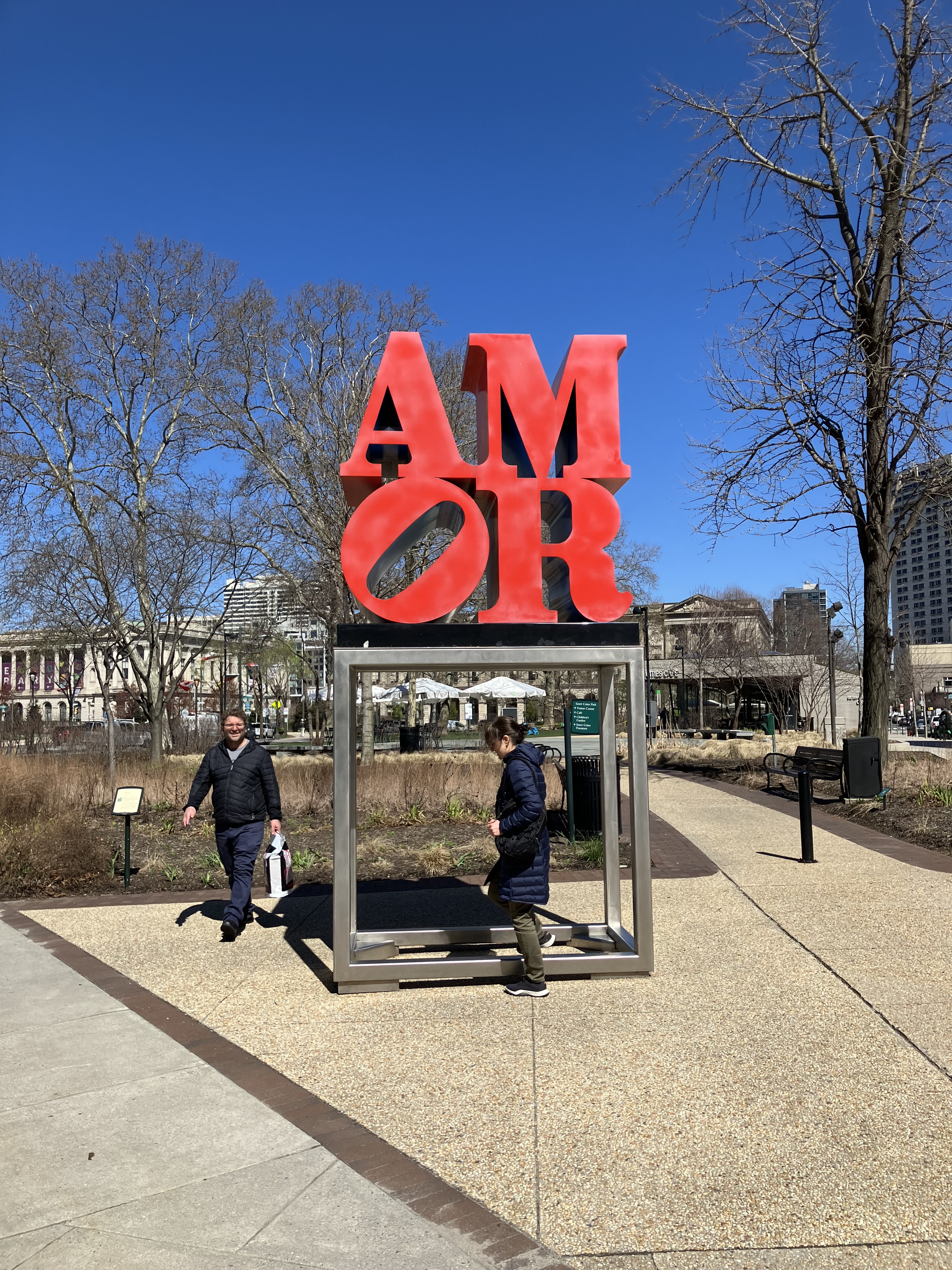
Sister Cities Park, Philadelphia
University Of Pennsylvania, Philadelphia

Thus, late last month I hauled my aged ass aboard a train that, in an hour, took me from my little town to the heart of Philadelphia. Five minutes later, there I was in LOVE Park. Fifteen minutes after that I strode into Sister Cities Park to examine its AMOR sculpture (Robert Indiana produced versions of LOVE in various languages; amor means love in Spanish and Latin). And I made my way to Penn’s sprawling campus from there, eventually locating and admiring its LOVE piece. Mission accomplished!

Why are there so many LOVE sculptures in the world? Why do people gravitate to them? I’m not an expert on anything, let alone love. But it’s pretty clear to me that love, in some respects, makes the world go round. Our planet, which might easily and accurately be viewed as a horror show, would be even more unsettling were it not for the love that connects nearly each person with at least a few of their fellow beings. People need love and want to love. Even if they don’t know it.

And so, Robert Indiana tapped into something elemental when he began inserting love into his artworks. In 1961 he used the word for the first time, in a painting, not a sculpture. He made his initial LOVE sculpture nine years later, and over time the demand for sculptural follow-ups took off. I suspect that the demand was boosted tremendously when, in 1973, the United States Postal Service issued a postage stamp with Indiana’s LOVE image on it. That stamp sold like hotcakes.

I think that the simplicity and the warmth of Indiana’s LOVE design are the reasons for its success. Four letters in basic colors. Nothing more. The letters cling to one another for dear life, the O nestled against the L and the E as if it were in a womb. The LOVE design makes us drop our defenses and think that —yes! — love is where it’s at. It’s all you need, as The Beatles famously noted. Well, it wouldn’t hurt to have water and food too. In any case, one thing for sure is that few artists ever create iconic works. Robert Indiana, without any doubt, did.

1967, the year of the Summer Of Love, was the height of the hippie movement, when it seemed that peace, love and understanding had a chance of putting the human race on a golden path. As we know all too well, that didn’t exactly pan out.

1967 also was the year in which All You Need Is Love, by The Beatles, made its appearance. It would be inappropriate of me to end this contemplation without including their live performance of the song, whose message has resounded loud and clear ever since. The event was part of a broadcast called Our World, the first ever to be transmitted to a worldwide audience via satellite. Home from college during summer break, I, with my brother, watched The Beatles do their magical thing on a tiny television in my bedroom. The presentation mesmerized and excited us. Those were special days.

Click on the following link to view The Beatles in action:  https://www.dailymotion.com/video/x6mtbyq
Happy Birthday, Sandy!

Seeing that a person’s birthday comes but once a year, celebrating it in a substantial way is a damn good idea. Even though my wife Sandy and I don’t always follow that philosophy, a couple of weeks ago we did. Having booked a hotel room in Philadelphia, Pennsylvania, USA for Sandy’s birthday (the big day itself, plus the two days bookending it), we dipped into The City Of Brotherly Love’s many offerings and, as is almost always the case when we’re there, had a fine time.

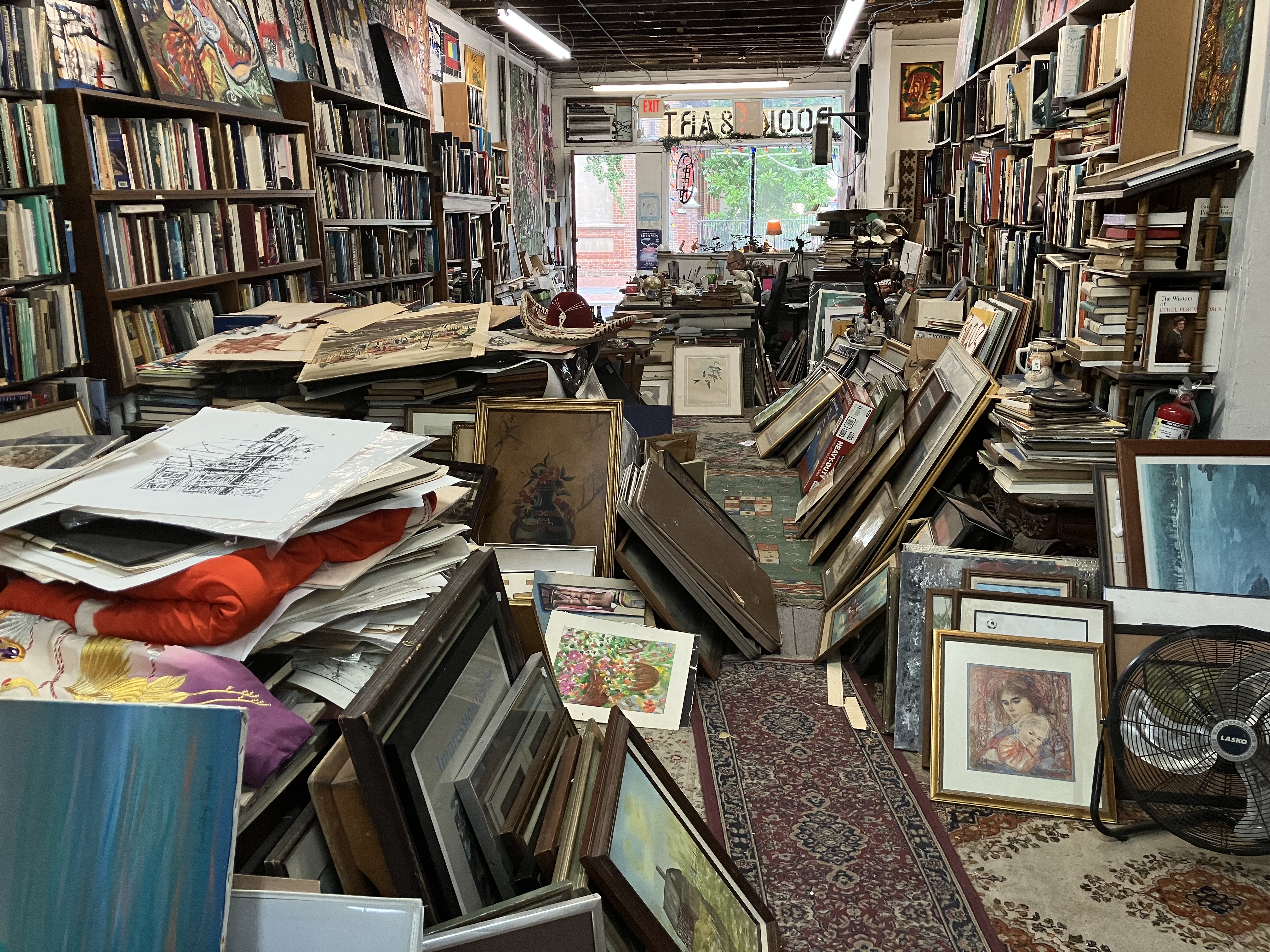
Jules Goldman Books And Art, an eye-popping store.
Empty building that once housed the Painted Bride Art Center. Isaiah Zagar’s mosaic mural covers the building.
A portion of the mosaic mural at the rear of the building.

What did we do? We had two great restaurant dinners, for one thing, meals that we won’t soon forget. We took in a movie (Barbie, which Sandy, unlike me, liked a lot). We wandered into Jules Goldman Books And Art, one of the most mind-blowingly jumbled stores I’ve ever seen. And we gazed in wonder at the mosaic mural (by Isaiah Zagar) covering all sides of the long-vacant building that once housed the Painted Bride Art Center. Sandy and I saw loads of terrific music and dance performances at the Bride, and truly miss it. (The Painted Bride Art Center still exits. It’s at a different location now, and is but the merest shadow, arts-wise, of its former world-class self.) The building’s and the mosaic mural’s fates, tied up in litigation for a number of years, are uncertain. Demolition is a real possibility. If that comes to pass, Philadelphia will lose a treasure.

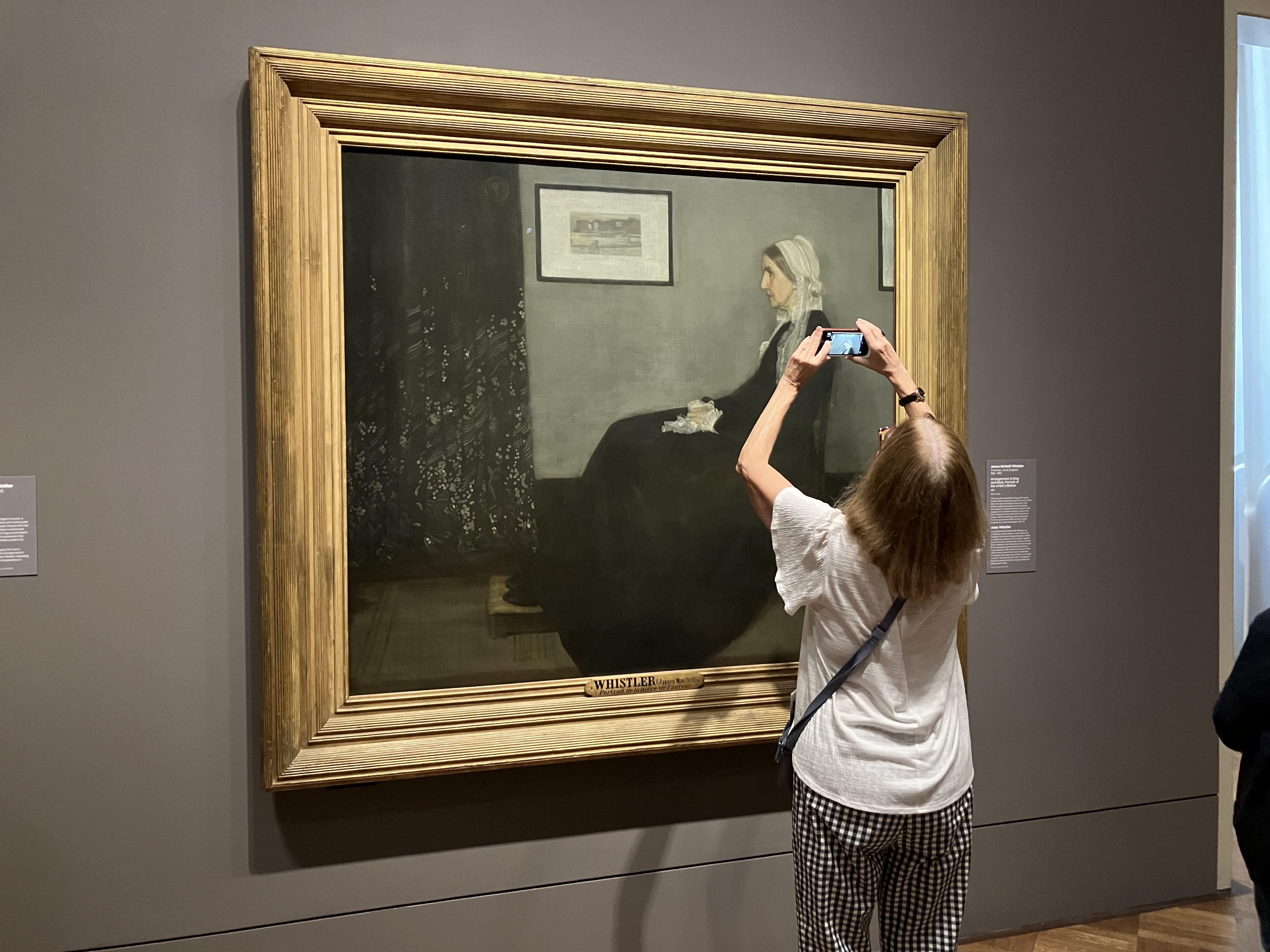
The painting popularly known as Whistler’s Mother.

The birthday girl and I also went to the Philadelphia Museum Of Art. In that enormous institution we viewed hundreds of artworks, including the world-famous painting popularly known as Whistler’s Mother, on loan from a museum in Paris. I was expecting to poo-poo the picture, but the more I looked at it, the more I liked it. It’s a well-designed creation, quite riveting, whose true title (Arrangement In Grey And Black No. 1) is a good description of what the artist James Whistler was going after, and accomplished, when his mother Anna posed for him in 1871.

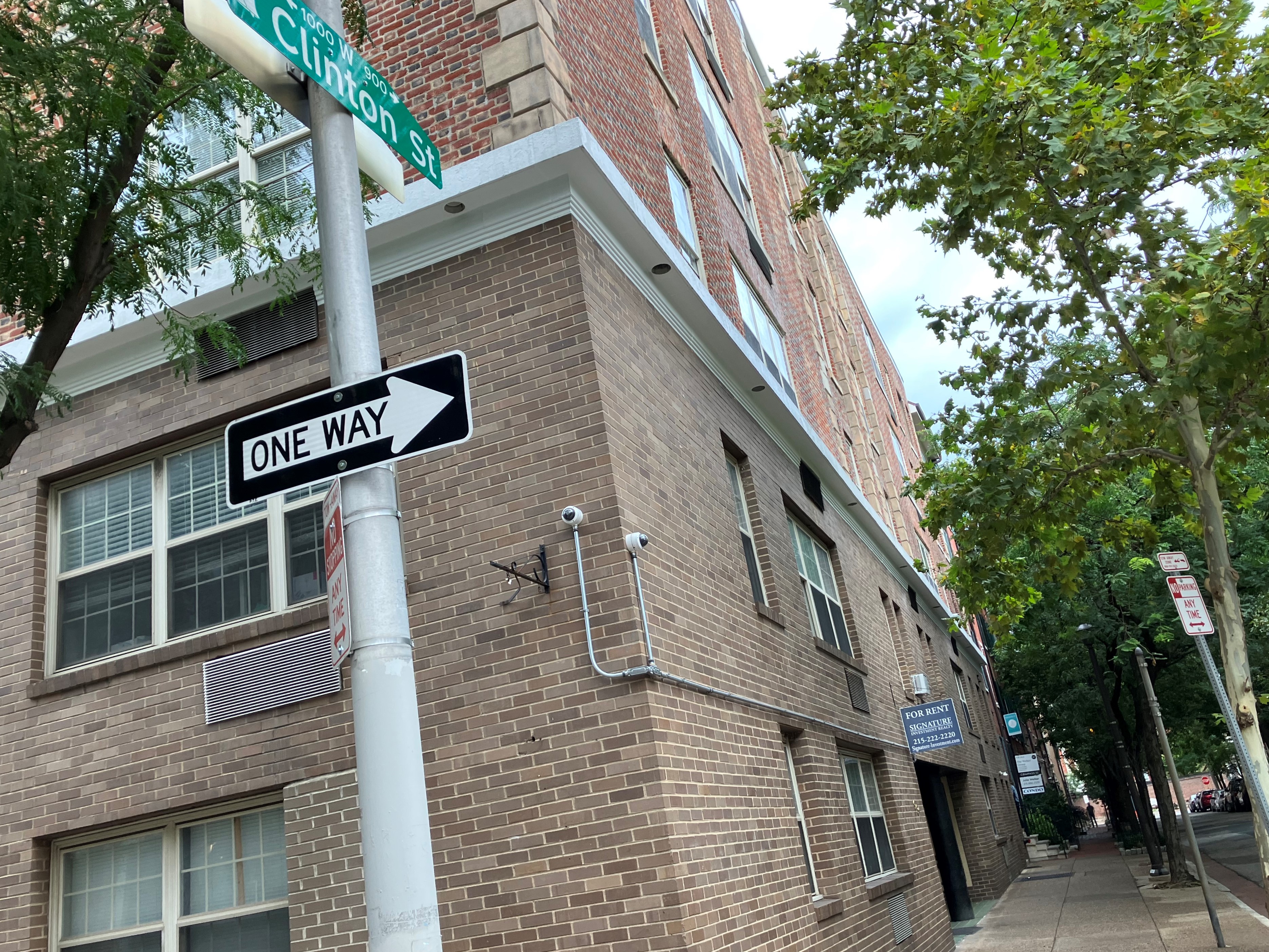
The building in which I once lived (Clinton Street, Philadelphia).

I could mention plenty more activities, but I’ll limit myself to one. A very personal one. Namely, our visit to a central Philadelphia neighborhood we both were familiar with, and within which we very likely crossed paths many years before we formally met in 1990.

I moved to Philadelphia in 1974, taking up residence on Clinton Street, a leafy block with any number of fine old houses. I lived there for 14 months in an apartment building, the one nondescript structure on Clinton, during which time Sandy worked two blocks away. Did we pass one another, maybe more than once, on the street? Did we chow down in a neighborhood eatery at the same time? We’ll never know, but I’m guessing yes. On the day before her birthday, we reminisced about those long-ago days as we strolled along a bunch of blocks in the Clinton Street area.

To continue: As noted above, our paths crossed in 1990. Meaningfully too. This occurred at a singles event near Philadelphia’s Delaware River waterfront. Sandy and I, each of us far removed from our Clinton-Street-neighborhood days, clicked right from the start and have been together ever since. I don’t believe in fate or anything like that. But it’s cool that, unbeknownst to us, we were part of the same picture all those years before, in a sense just waiting for our stories to entwine.

Now, this being a piece about a special occasion, I’ll conclude the proceedings with blasts of good cheer and high energy. And I’ll turn to The Beatles to handle the honors. Their hard-rocking song Birthday appears on what has come to be known as The White Album. John Lennon and Paul McCartney wrote Birthday quickly in the recording studio in September 1968. A few hours later, the band, McCartney handling lead vocals, put it on tape. Man, in no time at all a classic was birthed.

It’s inarguable that Paul McCartney calling Sandy and singing Birthday over the phone to her would be better than my presenting her with The Beatles’ recorded version. Maybe one day, in an alternate universe, that will happen. But for now, the original, in all its glory, will suffice beautifully. And so, once again . . . happy birthday, Sandy!

A Love Story

A few weeks ago I published a piece that for the most part was a meditation on joy, a commodity without which our lives, to put it mildly, would blow. Seeing that I’m a f*cking softie at heart, I’ve decided to turn my thoughts now to another precious emotion, the greatest of them all, for it sustains and usually nourishes life, giving us reason to go on. I’m talking, of course, about love. Sure, The Beatles overstated things when they sang “all you need is love.” But they weren’t too far off the mark, as there is no doubt that the following is true: If an individual doesn’t feel love for at least one other human being (or pet, I hasten to add), they are in a most unenviable position.

Now, I’m not exactly an expert when it comes to matters of the heart. I know that for a fact because nobody in my seven-plus decades of residing above ground ever has asked my advice on the subject. Come to think of it, just about nobody ever has asked my advice on any topic or situation. Man, I should start an advice column called Maybe Neil Sort Of Knows, So Give It A Shot And Ask Him. That would show ’em how deep my font of quasi-wisdom is!

Anyway, getting back on track, what else might I say about love? Well, it’s innate, in most cases blossoming automatically between parents and their children, to mention one obvious example. But it sure doesn’t blossom automatically between everybody. That’s a main reason why it can be so difficult to make true friends, to find a partner to spend your life with, and to keep the fires burning with said partner after you’ve found them. Yup, love is a powerful force, but cultivating it properly requires skills that many do not master adequately, if at all. When we allow love to bubble within us consistently, though, our lives are much the better for that.

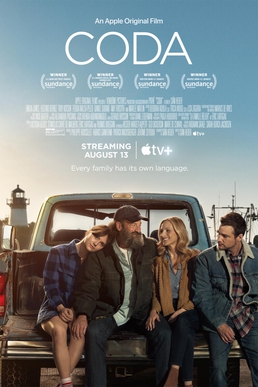
Love probably wouldn’t be on my mind so much were it not for the movie CODA, which my wife Sandy and I saw at a cinema early this month a few days after it grabbed the Oscar for Best Picture. It’s still in some theaters, by the way, and is streaming on Apple TV+ too.

CODA is a tale that revolves around Ruby, a high school senior who is the only hearing member of a family of four. She is devoted to her parents and brother and, in addition to attending school, spends mucho hours each week working on the fishing boat that her dad and sibling operate in order to put bread on the table. Whew! This girl, who also sometimes acts as an intermediary between her deaf kin and outside parties, has a whole, whole lot on her plate. Ruby’s life becomes even more complex when she is encouraged at school to develop her vocal skills and pursue a music career. This new element becomes the movie’s fulcrum.

Sandy loved CODA, which is an acronym for child of deaf adults. She thinks it’s very great. Although I found CODA too formulaic to be placed on a pedestal, I enjoyed the hell out of it. It’s an old-fashioned sort of story that I’m certain would move anyone whose heart is not fashioned from stone. Why? Because CODA, at its core, is all about love, the kind of love that holds steady, not wavering even for a moment. What’s more, there’s nothing sappy about the love on display in CODA. A tight screenplay by Sian Heder, who also directed the flick, and four actors who tap into genuine places within themselves, see to that. Hats off, then, to Emilia Jones, who plays Ruby, to Marlee Matlin and Troy Kotsur (Ruby’s parents), and to Eugenio Derbez (Ruby’s music teacher).

I’ll close this love-centric essay on the right note, by presenting Beyond, a love song sung and co-written by Leon Bridges. Sweet and sultry as you could hope for, Beyond very well might put you in the mood to . . . yo, I don’t need to tell you where this sentence is headed. I accept your thanks in advance!

The Day I Came THIS CLOSE To Sort Of Meeting John Lennon

Was I going through a period of temporary insanity back in 1973? Had the gates regulating the flow of my positive emotions gotten stuck in the closed position? Well, yeah, that’s not too far off the mark I guess. It was a long time ago, and I have trouble enough figuring out the current status of my state of being. But I’m not totally clueless when it comes to identifying where I was at, mentally and emotionally speaking, in my days of yore.

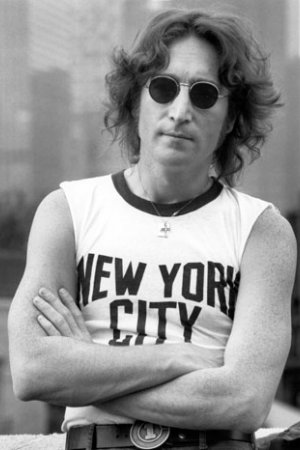
Photo by Bob Gruen

Yes, my recollections may be on the spotty side. Still, there’s no denying the fact that my brother Richie and I were standing on Broome Street (in Manhattan’s SoHo neighborhood) one morning or afternoon in May or June of 1973, when John Lennon, unaccompanied and moving briskly, walked past us. I was living in SoHo, and Richie, a student at Columbia University, resided way uptown.

Out of the corner of my eye I’d noticed Lennon approaching. Richie saw him too. Yet we were blasé about the situation. Neither of us made eye contact with or said hello to the guy we’d worshipped, who had been one of our ultimate heroes only a couple of years before.

I won’t speak for Richie, but I will for myself. “Yo, schmuck! What the hell was wrong with you, Neil?” I just heard myself asking myself.

Hey, give me a break! I was (pretty) young.

I recall this incident every great once in a while, but hadn’t in ages until Thursday of last week. As I was brushing away that morning’s breakfast, hardened like cement on my teeth, Lennon’s song One Day (At A Time) came on the radio and, for reasons unknown, it instantly brought me back in time. And I knew for sure that John Lennon was to be the key for the story you presently are reading when, a few hours later, I heard a radio disc jockey sorrowfully mention that the following day (December 8) would mark the 37th anniversary of John’s death. As nearly everyone knows, he was murdered by a crazed, miserable asshole outside the apartment building in which he lived with Yoko Ono on Manhattan’s Upper West Side.

There are reasons why John Lennon and I more or less crossed paths. Here goes.

That long-ago spring found me, four years post-college, floundering magnificently in the game of life. My romantic prospects were nil. My meaningful career prospects were niller. My bank account had a few bucks in it, but basically was pitiful.

Pretty much unanchored, I sublet for three months, with a friend from my college years, an affordable, beautiful apartment on Broome Street in the up-and-coming SoHo section of lower Manhattan. I spent my time traipsing around the city, checking out the neighborhoods and low-cost entertainment and picking up temp work to bring in a smattering of bucks. Those were the days when you could eat cheaply, a slice of pizza being available for a mere 25¢, and when a person might devote a lot of hours to worrying that his personal compass wasn’t pointing in a good direction.

John Lennon wasn’t having the easiest time of it either back then. The U.S. government was doing its best to try and deport him. And he and Yoko were having big marital problems. Somewhere I’d heard or read that they were separated and that John was living in SoHo. I never knew any details of his domestic situation while I lived on Broome Street, but I kept half-expecting to see him around.

See a Beatle on the street? Man, once I’d have fainted if that ever came to pass. I mean, I’d been an incredibly major Beatles fan. I lived and breathed Beatles for years. But strangely, a year or two after their 1970 dissolution, their aura began to dissipate. I still kept up with each Beatle’s doings, but the magic spell they’d had me under was no more.

Yep, John had plenty to worry about in 1973. But his woes didn’t stop him from doing what he did best: Writing songs and making music. Undertaking a bit of research last week, I discovered that he entered a Manhattan studio in July 1973 to record his Mind Games album. Most likely he was writing some songs for that record when I saw him on Broome Street. And the kicker is this: One Day (At A Time) comes from Mind Games. There’s a real chance that the lovely song that set this story in motion might have been partially playing in his head when our near-encounter took place.

Some stories need a moral and/or reason for being, and this is one of them. I therefore pose this question: If I knew then what I know now, would I have acted differently? Answer: Damn straight, boys and girls. I ain’t exactly deep on the path to enlightenment in these latter stages of my life, but I sure have a few bits more sense than did my more youthful self.

For example, if there’s anything I’ve learned over the years it’s that being friendly to people right and left is the way to go. It won’t kill you. Or so I’m told. If I’d had my head on straighter in 1973 I’d have smiled at John Lennon and said “Hey, man. Thanks for all the great music you’ve made,” or “Hello, John. Fancy meeting you here.”

Lennon likely would have saluted Richie and me and thrown a “It’s a pleasure, gents” type of remark at us while continuing on his way. And if something along those lines had taken place, I’d now have a hell of a better tale to tell than the one I own. Or, come to think of it, maybe not . . . as with all aspects of life, it depends on how you look at things.

(Please don’t be shy about adding your comments or about sharing this article)