A Choice Story

In May of this year, Apple Music sent me an email that offered three months of their service for free. Considering that up until about 15 years ago I was a full-fledged music junkie, and that I’m still a major lover of music, it’s kind of surprising I wasn’t already enrolled in Apple Music or in one of its music-streaming peers, such as Spotify. Anyway, I hemmed and hawed for several weeks, eventually accepting the offer. Man, I’m close to ecstatic that I signed up. It blows my foggy mind that residing within my phone’s Apple Music app are countless thousands of albums, many of which I became intimately familiar with during the approximately 45 years that comprised my music-junkie era (I own circa 1,200 physical albums and used to attend concerts right and left). And as for the incredible number I was unfamiliar with but was interested in checking out, well, I’ve made a slight dent in that mountain. New-to-me albums by some of my very favorite artists (Sun Ra, Howlin’ Wolf, Bruce Springsteen and Ella Fitzgerald, to name but a few) and by at least 100 other artists have reached my ears thanks to Apple Music. I’ve been in music heaven the past two months, and possibly am on my way to becoming a long-term junkie again. There would be worse fates than that.

Yet, I have to say it almost seems wrong to have such an overwhelming amount of musical choice a mere handful of taps away. I mean, do I, or does anyone, deserve such unimaginable bounty? Am I, or is anyone, that entitled? I suppose those questions are moot. After all, billions of people own smartphones, laptops, etc., and each of those devices easily can access near-infinite amounts of content on any subject under the Sun. That’s where we are in the 21st century. It’s the new reality, something we usually or always take for granted. The digital world is a wonder of the highest order (though not always in good ways), and it is ever-expanding.

Which leads me to another corner of the streaming universe, that which supplies humanity with more series and movies than a person could consume in 1,000 lifetimes. So many choices! Most evenings, my wife Sandy and I click onto a streamer and watch a series for an hour or two. We’ve breezed through 27 series so far this year. I’ll briefly mention two I enjoyed immensely: The Residence, a whimsical, sprightly murder mystery set in the White House in Washington D.C., and The Pitt, a drama that follows a harrowing 15-hour shift in the emergency room of a Pittsburgh, Pennsylvania hospital. The Pitt contains more than a couple of graphic, bloody scenes, I should note. To my amazement, I didn’t close my eyes during them. Shit, I think that means I should go to medical school! If I start next year, I’ll become a licensed physician at age 84 or 85. What, you wouldn’t want an octogenarian diagnosing and treating you? I’m offended! By the way, you’ll find The Residence on Netflix, and The Pitt on HBO Max.

Last week, while I waited at an auto service center where my car was undergoing an oil change and safety inspection, Apple Music once again proved its amazingness to me. Nestled in a lounge area, I read a text message my brother Richie had sent to me regarding Terry Reid, a British rocker who passed away on August 4th at age 75. Richie mentioned that Reid was an opening act at a Rolling Stones concert he and I attended (at New York City’s Madison Square Garden) in November 1969. I have no recollection of Reid’s performance. And I have only partial memories of The Stones’ work.

Fortunately, recordings of The Stones from the show we were at, and from three other Stones concerts that November, appear on a classic Stones album, Get Yer Ya-Ya’s Out! I hadn’t heard the record in eons. Listening to it was the obvious choice for me to make. So, I tapped on my phone’s Apple Music app for a few seconds and — voila! — the album presented itself to me. I sat back and, via earbuds, listened all the way through. It’s a beauty.

It wouldn’t be a bad idea for me to conclude this piece with one of the tracks from Ya-Ya’s, right? I’ll go with Street Fighting Man. I’m a big fan of hard rock, as long as the songs are top-notch and the musicians are wailing like nobody’s business. This recording meets my criteria.

It’s An Old Story

I know I’ve written about old age and mortality any number of times before, but I just can’t keep myself from visiting those topics once again. When you’re old as dirt, like me, it’s hard not to contemplate, at least now and then, how much time you’ve got left. I’m 77, for crying out loud, which stuns me. How can this be? Where the hell did the years go? As with most matters, I have no f*cking idea. One thing for sure is that the express train keeps barreling along. We’re here, and then — poof! — we’re gone. That’s life. If it were up to me, though, each individual creature, human and not, would carry on, and thrive, unto eternity. Yeah, sometimes I’m a hopeless dreamer.

My status as an ancient has been made crystal clear to me by information I’ve obtained from the website of The French Institute For Demographic Studies. One of its online calculators shows that I am older than 97% of the human beings on our planet, an extremely sobering statistic. Most truths don’t hurt, but this one does. And I’m having a heck of a hard time wrapping my head around it. (If you’d like to see where you fit on the global population scale, click here to open the website. Once there, click on Let’s go and, on the subsequent page, enter your age on the horizontal bar.)

Still, naively, and probably out of fear, I find myself not quite believing that I have an expiration date. It almost doesn’t seem possible to me that I do. I mean, I’m still nicely functional, still pretty much an ace at stumbling gracefully through life. Why should all of this come to an end? I sure would like to make it into my 90s, though. I’ll have been cheated, I feel, by anything less than that. But any way you look at it, time is running out. There are far, far more grains of sand at the bottom of my hourglass than at the top.

So, what’s to be done? Well, we all know the answers. To the best of our abilities, everybody — not just me and my fellow oldsters — should aim to do the right things. Such as: maintaining, and trying to expand, close relationships; pursuing activities that put smiles on our faces; and working hard to make society and the natural environment healthier. Anyone who does a good bit or more of all that is a valuable member of the human race.

Music has been my main interest for most of my life. I can barely carry a tune, and I’d be up shit’s creek if I attempted to plunk out Chopsticks on the piano. But I’m an expert when it comes to listening to music. And I pay a lot of attention to what musicians have to say. A recent article in The Guardian caught my attention and got me feeling better about being a geezer. The story takes a look at up-there-in-age musicians who have lost little, if any, of their life force. For instance, Bonnie Raitt, who is two years my junior, remarks, “I’m not slowing down and I’m not going to stop until I can’t do it any more.” And Graham Nash, six years my senior, has these thoughts about seeing the late master guitarist Andrés Segovia when Segovia was 92: “And he knocked me on my ass with the energy and brilliance of his performance. So I think: ‘Why not me?’”

I like the way Raitt and Nash look at things.

I’ll bring this opus to a proper conclusion by leaving you with a tune composed by Bob Dylan, who, at 83, remains a very active musician. The song in question, Forever Young, appears on his album Planet Waves, which came out in 1974. Dylan recorded the album in collaboration with his pals from The Band (Rick Danko, Richard Manuel, Garth Hudson, Robbie Robertson and Levon Helm).

While working on this story I listened to Forever Young for the first time in eons. Man, I think I’d never realized how direct and heartfelt the song is. It addresses some of the themes I’ve presented herein, but with a different slant, for Dylan had one of his youngsters in mind when he wrote the lyrics. The song’s sentiments, though, apply to folks of any age. Hope you enjoy it.

I’m Still Grooving, But Not As Much As I Used To

For decades and decades, listening to music was a dominant activity in my life. The infatuation started in 1957, I think, when I was nine and a half or maybe ten years old. That year, by way of top-40 radio stations, rock ‘n roll and pop songs began to ring my bell vigorously. Wake Up Little Susie, by The Everly Brothers, for instance. I loved that tune. Still do. And I became totally captivated by Honeycomb. Sung by the little-remembered Jimmie Rodgers, it seemed as sweet as a warm, sunny day. I remember singing Honeycomb to myself over and over again, the first time, probably, I’d ever done such a thing. Music had hooked me, and the hook, as the months and years went by, penetrated deeper and deeper.

The Beatles sealed the deal. In 1964, their great songs and incredible charisma turned me into a music junkie. I couldn’t stop listening to Beatles creations and to loads of other songs on the radio and on the smattering of vinyl albums I’d accumulated. By the time I graduated from college, in 1969, my record collection was on the verge of becoming pretty substantial, and I’d become a bigger addict than ever. And the addiction grew even stronger one year later, as I began to attend concerts at an admirable pace.

I don’t know what the actual count is, but I’ve taken in well over 1,000 concerts in my life. Hell, in 2008 alone, determined to set a personal best I’d unlikely ever top, I went to 104 of them. And my collection of vinyl albums, CDs and cassette tapes is huge, numbering somewhere in the vicinity of 1,500 items.

But things have changed. Since 2020, I’ve gone to far fewer concerts annually than before (last year I caught nine). And during that time I’ve bought hardly any recorded music at all. Even more telling about my altered relationship, for these years, is this: I’ve listened to music at home for an average, I’d estimate, of an hour and a half per day. For many a moon, the figure had been two to three times higher.

So, what happened? Part of the answer is age-related. Meaning, I’m old as f*cking dirt, and with age has come what seems to be a need for longer periods of quiet. My mental and emotional systems function better when sounds aren’t around me all that much. Ergo, music plays at home on a fairly limited basis — in the evenings and on weekend mornings, primarily.

That said, I still adore going out to hear live music. But I’m not a fan of driving home late at night from a venue, unless the place is reasonably close to my home. Why? Because, as I just mentioned, I’m old as f*cking dirt. Alas, most of the venues I favor aren’t nearby. Which, along with other reasons not worth going into, accounts for my decreased concert-attending statistics.

Here’s the thing, however: When I listen to music intently, it can get to me the same as it did when I was younger and feeling my oats more frequently than I do these days. I haven’t lost any of my ability to groove mightily to rock, jazz, blues, R&B, soul, bossa nova and the other genres I’m keen on. I love to sync myself with the vibes and rhythms of strong, honest music, and let them carry me up, up and away.

Last year, my wife and I went to see Alejandro Escovedo, a rocker who has been at it for about 50 years. Criminally not as well-known as he should be, Alejandro is the total package: excellent songwriter, singer and guitar player. He remains at the top of his game. What a great show he and his band put on. I’m in the mood right now to be transported to the stratosphere, and to be enveloped by the take-no-prisoners powers of musicians who know how to deliver. Here, then, is the song titled John Conquest, the opening track on Alejandro’s latest album (Echo Dancing). Prepare yourself to be rocked righteously.

Time, Trump, A Book, A Song

Time marches on, of that there is no doubt. I can barely believe that July 2024 is here. Just like that — zoom! — the first six months of the year have disappeared into the ethers. And before we know it, 2025 will have begun, possibly full of promise, possibly not.

In the USA, where I reside, 2025 and beyond will be nightmarish if Donald Trump wins the upcoming presidential election (November 5, 2024 is Election Day). A fascist, a scoundrel, a convicted felon, a master at lying through his teeth, a riot-instigator and a vindictive bully, Trump is champing at the bit to damage democracy even more than he did during his first term. Are there enough sensible voters in the States to deny him a second occupancy of the high throne? One can only hope. Yes, Joe Biden performed miserably at his recent televised debate with Trump, and is aging right before our eyes. Nonetheless, Biden has done a solid job as president and is an infinitely better choice. For the record: If Trump were running against a box turtle, the turtle would get my vote.

But enough about Trump. Writing about him always puts a knot in my stomach. So, I’m going to move on to more agreeable topics. Such as books and music. Ahh, already I can feel my stomach untangling.

For quite a few years, some of the books I’ve read have entered my life via a largely random process: I sometimes wander through library aisles with no specific authors or titles in mind, pulling volumes off shelves and giving them the once-over. This willy-nilly approach to book selection at times has brought gold my way. For example, the novels Flight (by Sherman Alexie) and The Middlesteins (by Jami Attenberg).

The latest beauty I discovered by employing this method is Holding Her Breath. Published in 2021, it is the first and to-date only novel by Eimear Ryan, an Irish lass. It took 20 or 30 pages for the book’s rhythms to grab hold of me. After that, I remained hooked. Firmly.

Beth Crowe is Holding Her Breath’s main character. A college student in Dublin, Beth suffered an emotional breakdown a year or two before the book opens, and tentatively is hoping not only to rediscover but to further discover herself.

While in college, Beth, a one-time champion swimmer who ultimately couldn’t deal with the pressures of her sport, does her best to come to terms with her athletic past. She also begins a romantic relationship with a teacher at her school, probably not the wisest decision in the world. And she learns much about herself and her family when she becomes fascinated by the life and writings of her grandfather Benjamin Crowe, a famed Irish poet whose stature and mystique did nothing but increase following his suicide at age 43, many years before Beth was born. Before entering college, Beth was far less familiar with all things Benjamin than she should have been, although her mother is the poet’s daughter and her grandmother his widow. Beth and Benjamin entwine in a very real way during the course of Holding Her Breath.

Ryan’s writing is as clear as spring water, as lithe as a gymnast. Take, for instance, this section about Beth:

Later, as she’s going to bed, it occurs to her that she’s never actually heard her grandfather’s voice. She googles it—”Benjamin Crowe” + “audio”—not really expecting much. But there’s a page and a half of results. She clicks, pops in her earphones.

Here he is, in full flow, reading his famous long poem “Roslyn.” Voice deep and raspy, struggling up from great depths. The hitch in his voice is so croakingly alive. The lines come back to her like a nursery rhyme:In that dark sash a comet appeared . . . trailing its afterburn . . .”

Beth closes her eyes. His voice vibrates through her. She falls asleep that way.

I’ll close this essay with Days Can Turn Around, a song I first heard a week and a half ago.  It captured me immediately. Sung and co-written by Sarah Jarosz, Days Can Turn Around is a gentle reflection on life’s bumpy road. The lyrics remind us that we need to keep our heads up and, as best we can, follow our hearts and dreams.

Days Can Turn Around appears on Jarosz’s latest album, Polaroid Lovers, which came out in January. When I close my eyes and listen to the song, I feel as though I’m floating on air. Maybe it will have the same effect on you.

A Peachy Story

For most of my life I’ve enjoyed summer. I’ve spent many hours outdoors in the hot season, frolicking under the Sun or soaking up its potent rays while lying on a blanket or chaise lounge.

Alas, somewhere along the line, perhaps about 10 years ago, my good feelings about summer took a sharp turn southward. Since then, I’ve mostly stayed indoors in summer when the Sun is high in the sky, my body no longer happy to be exposed to temperatures above 85°F (29°C) and to an unrelentingly bright ball of fire. Now deep into my senior-citizenhood, I melt like ice cream under those conditions. Which doesn’t fit the definition of having fun in the summertime.

A week and a half or so ago, though, a northward shift occurred. I have no idea how long this positive outlook on summer will remain in place. In any event, it’s fascinating to me that the change occurred at all.

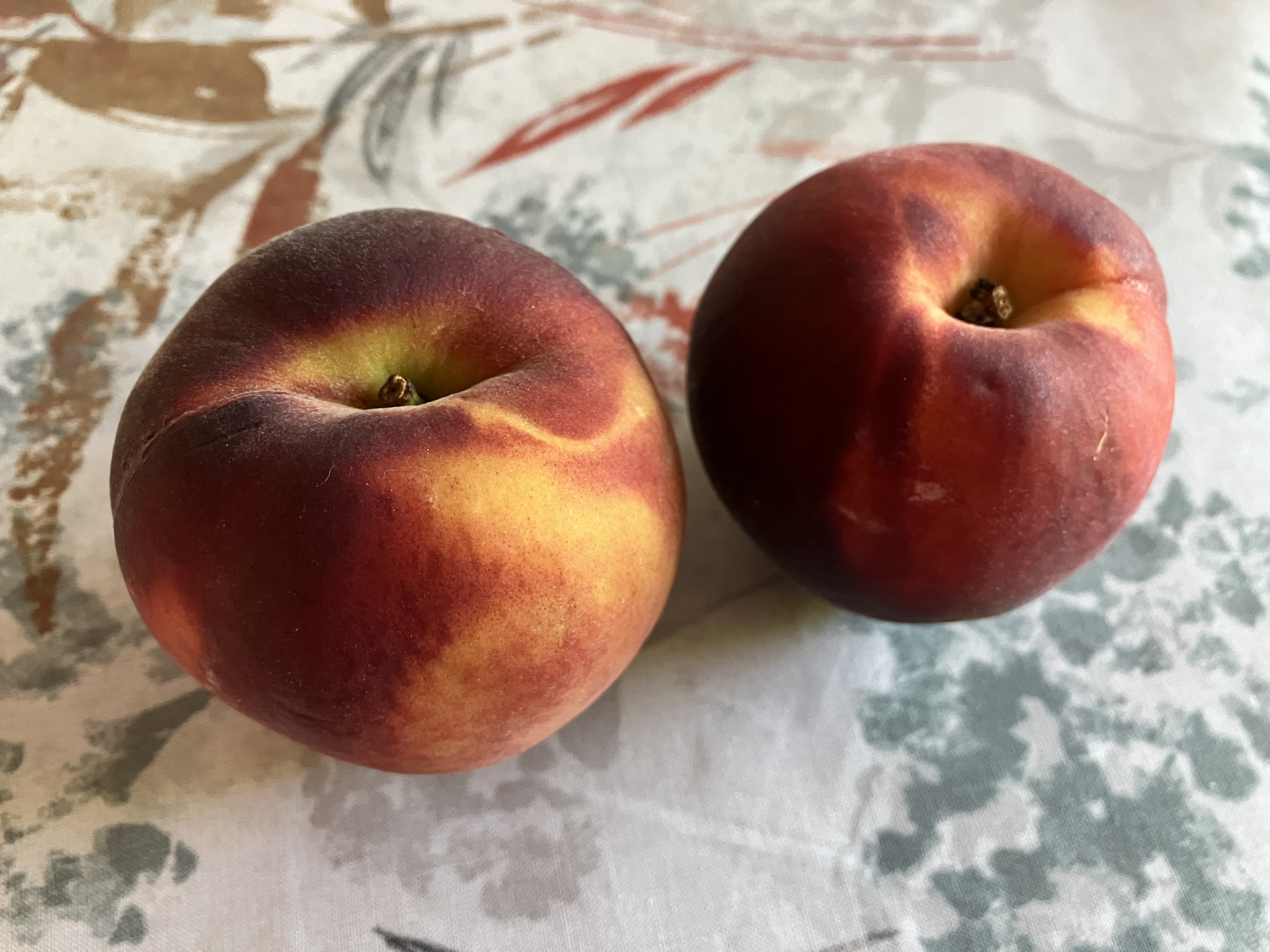
My favorite fruit, peaches, prompted my new attitude. There I was in early June at a local supermarket, buying this and that, when I remembered that peaches had come into season in parts of the USA and would be for sale in the store. Moments later I picked out a couple of peaches. They’d been shipped from the state of Georgia, one of the peach hubs of America, to Pennsylvania, where I reside and was grocery shopping.

One of those peaches took two days to ripen, the other took three. The waits were worth it. The peaches blew my mind when they entered my mouth, so luscious were they. Their sweetness was exemplary, their texture a dream. In love with the fruit, I realized that peaches galore would be available for the next two or three months. In other words, throughout the summer. And, at that moment, I found myself regarding summer, which officially began in my hemisphere on the 20th of June, in a good light. “You know,” I said to myself, “summer offers more than the opportunities to sweat like a f*cking pig and to come close to passing out from the heat. Neil, you’ve forgotten that summer has its upsides too.”

Yes, I’m in a much better frame of mind about summer than I’ve been in a long time, despite the crazy heat that has Pennsylvania and much of the rest of the world in its grip. And I have more than peaches to thank for that, because what I’m expecting to be enjoyable getaways are on the horizon. Sandy and I will be at a family reunion this summer for a few days. The locale? A village beside a beautiful lake in rural upstate New York. And we’ll also spend time with friends at their beach house in Delaware.

Now, I’m going to stay in the shade, or indoors, a good bit at those gatherings. I’m not about to forget what high heat and glaring Sun can do to me. However, I fully intend to have fun while there. And if that happens, I figure there’s a chance I’ll also approach the remainder of summer 2024, and subsequent summers, lightheartedly, like I used to do.

I can think of no better way to end this essay than to include a song from Eat A Peach, the album released in 1972 by one of the greatest rock groups of all time, The Allman Brothers Band. Fittingly, they were based in Georgia. And, I’d guess, they consumed more than their fair share of peaches. I’ll leave you with Stand Back, one of the Allman songs you don’t hear all too often. Power-packed and gritty, it almost makes me want to go outside and dance madly while engulfed by high temps and intense sunlight. I said almost.

A TV Series, A Confectionery, A Song

“Neil, how come you usually write about things you enjoy, rather than about those that, in your opinion, bite the big one?” I asked myself the other day.

“Well,” I answered, “I’ve ripped into people I loathe. Trump and Putin, primarily. And I’ve discussed situations that worry me or piss me off. But there’s no denying that my natural orientation is to comment about aspects of life that ring my bell.”

“I understand,” I replied. “There’s no reason right now for you to mess with your natural orientation. So, let’s take a look at some of your recent bell-ringers. And, maybe, your readers then will tell you what they’ve been into of late. Ding dong, ding dong, ding dong!”

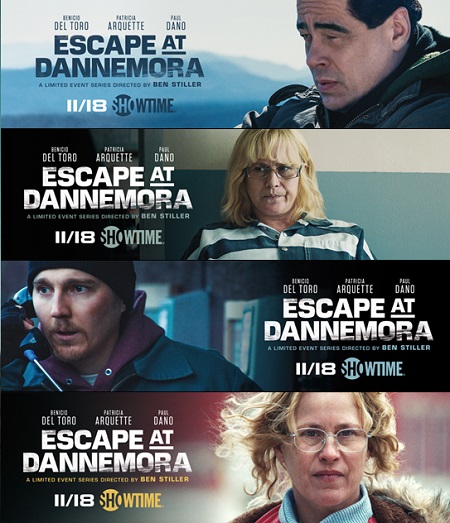
Okay! First up is a miniseries my wife and I watched two months ago: Escape At Dannemora, seven episodes in length and available on Paramount+ and elsewhere. It had been on our to-be-viewed list for a couple of years. Fortunately, we finally got around to it. It bowled us over. I place Escape in the pantheon of miniseries I’ve encountered, along with The Queen’s Gambit, Anxious People, The Investigation, Godless and a handful of others.

Escape At Dannemora came out in 2018, three years after the true events from which it draws its inspiration. Set in the town of Dannemora, in rural upstate New York, the show aims its beam at David Sweat and Richard Matt, convicted murderers imprisoned in Dannemora’s Clinton Correctional Facility, and at the married prison employee (Joyce Mitchell) who became emotionally and sexually involved with them. Ultimately, Mitchell helped them escape from jail.

Escape At Dannemora is not a docuseries. Anything but. All, or nearly all of its dialogue is imagined. After all, it’s not as though conversations between Sweat, Matt, Mitchell and the story’s other principals were recorded. And what dialogue! Completely realistic. No artificial ingredients. I’d never heard of the scriptwriters (Brett Johnson, Michael Tolkin, Jerry Stahl), to whom I now publicly tip my hat. As I do to Paul Dano (Sweat), Benicio del Toro (Matt) and Patricia Arquette (Mitchell), the actors who employed the scripted words to create characters as nuanced as French pastries. Ben Stiller directed the production with economy and precision. As couldn’t be more obvious, I highly recommend this show.

My dad loved halva, a moist, semi-sweet treat that, as I learned from doing a bit of research for this piece, originated well over a thousand years ago in Persia (present-day Iran). Unlike him, I wasn’t infatuated with the product, but ate it now and then while growing up. Halva disappeared from my diet, though, when I was in my 20s, maybe earlier, for reasons I’m not sure about. Possibly my obsessions with pizza and Cheez-It crackers left no room for halva, a product that isn’t easily found in stores in my country (the USA), and which the majority of the world’s population likely never heard of.

And probably I’d never have had halva again were it not for my pals Cindy and Gene, who bestowed sesame-based halva, the variety I am familiar with, upon me and my wife Sandy twice in the last several months (there are other types of halva in addition to sesame-based, as the Wikipedia article, the link to which is in the above paragraph, explains).

“This a weird gift,” I thought to myself when I saw what Cindy and Gene had presented to us on the first occasion. Man, how wrong I was!  Halva was the perfect gift. That wouldn’t have been the case with the too-dense halva made by the Joyva company, the brand I knew in my youth. But the halva they’d chosen, from the Seed + Mill firm, is incredible. Its sesame paste is perfectly balanced with chocolate and salt. And the texture, light and slightly granular, is wonderful. Hallelujah, I’ve been blessed!

And finally: Some songs have the power to bring you up short and make you say, “Holy shit, this is fantastic!” I Want To Know, by the quite obscure rhythm-and-blues group the Gay Poppers, did such to me two weeks ago when the tune burst forth from SiriusXM Radio’s Carolina Shag channel.

I Want To Know came out in 1960, and the Gay Poppers were from North Carolina, USA. Not much else about the song or about the group can I find online. Except that the recording at some point became popular in parts of the dance-club world. It makes me want to dance, because its beat won’t quit, and because the Gay Poppers’ vocal prowess damn well is off the charts. Without further ado . . .

I Like Them (A Book, A TV Series, A Song)

Nine Inches, a collection of fiction stories from the pen of Tom Perrotta, and published in 2013, seemed to be calling to me last month as I browsed the shelves of my local library, though I’d never heard of Perrotta before. I should have been familiar with his name, however, since, as I later learned, he’s a successful author. In fact, two of his novels (Election; Little Children) have been turned into movies, and another (The Leftovers) into a television series.

With nothing to lose, I brought Nine Inches home. I’m glad I did. I mean, Perrotta can write. He sharply examines the human mind and emotions, effortlessly illuminating the quirks, insecurities, maladjustments and f*cked-up decisions that run rampant in our species, and which can propel people’s lives in unanticipated directions, some of them most unfortunate. He does so with sentence after sentence that go down as easily as your favorite comfort food and also, when needed, pack a hell of a punch.

Take the opening story in the volume, for instance. It’s titled Backrub, and chronicles the days and nights of Donald, a bright kid just out of high school. The victim of misaligned stars, he was rejected by every college he applied to. Wobbled by this injustice, he takes a job as a pizza delivery person and, after a while, not caring enough to want to try and right his ship, slides comfortably into dealing drugs. Perrotta’s gift for language shines in this paragraph near the story’s conclusion.

It all went down so fast. I barely had time to register the lights in my rearview mirror when I saw two more cop cars right in front of me, blocking the intersection. I got out with my hands on my head, like they told me to, and the next thing I knew I was lying facedown in the street, with my hands cuffed behind my back.

Perrotta’s writing style agrees with me. It’s taut and uncomplicated. He takes on a wide variety of subjects in Nine Inches (unfulfilling marriages, a lonely widow, an insecure teacher, to name a few), and brings them to life with clarity. While reading Perrotta’s stories, I subconsciously kept thinking to myself, “Man, this seems real.” That’s a solid compliment.

On the other hand, not all that much about the television series The Lincoln Lawyer seems truly real, except for some courtroom scenes. But that’s more than okay. Sure, Mickey Haller — aka The Lincoln Lawyer — is preternaturally quick on his feet. But that only adds to his likeability. He and the show’s other main characters are good people, loyal to each other, and don’t take shit from anyone. I’m down with all of that. (By the way, a film version of TLL came out in 2011. It’s good.)

My wife Sandy and I polished off season two of The Lincoln Lawyer recently, after watching season one earlier this year. Both rock, two even more than one. In the second season, Haller (played by Manuel Garcia-Rulfo), who does a good bit of his best work-related thinking while driving or being driven in one of his Lincolns, finds himself defending a lady accused of murder. Not all that many hours before she is brought up on charges, she and Haller were in bed together, enjoying the heck out of one another. What, you’d expect otherwise? But, hey, don’t prejudge the show. It’s quality escapist fun. The plot lines are tricky. The dialogue sparkles. And the actors give it their all. Sandy and I, for sure, are hoping that Netflix will renew The Lincoln Lawyer for a third run.

Which brings us, rather haphazardly, to another creation — The Well, a new song that instantly grabbed me when I heard it on the radio a couple of weeks ago. It’s the work of Briscoe, a group from Texas, and will appear on Briscoe’s first album, which is scheduled to be released next month.

The two main guys in Briscoe — Truett Heintzelman and Philip Lupton — are in their 20s. But they are looking far into the future in The Well, pondering whether memories of the joys of youth will help to sustain old age. I think the Briscoe boys are concerned about something that isn’t going to happen. They’ll be just fine, enjoying the moment, when they reach their “golden” years.

That quibble aside, there’s no denying that The Well, an old-timey type of song brought to high places by rocking drums, is catchy as can be. The blend of the stringed instruments with the quivering, giddy vocals makes me go weak in the knees. I’m smitten!

So, those are a few of the things that have rung my bell of late. What’s rung yours?

Ringo Starr Knows Where It’s At

There I was a couple of Thursday afternoons ago, manning the information desk at a medical office building not far from my home. I’ve put in several thousands of hours at this volunteer job since 2010. It gets me out of the house and into the real world and keeps me on my toes. That’s why I like it.

Halfway through my shift, in wandered a white-haired guy with his wife. He looked a bit like Santa Claus . . .  chubby and jolly. I don’t know which one of them had an appointment. In any case, I could tell they were having trouble figuring out where the appropriate doctor’s office was. I got their attention and asked if they needed any help. Santa strolled closer to me.

“I’m lost,” he said, “which isn’t unusual for me.”

He gave me the name of the doctor, and I told him which suite to go to. But he didn’t walk away. Instead, he gazed at me, curiosity pouring from his eyes, and continued the conversation.

“We’re about the same vintage, aren’t we?” he asked.

Huh? I sure as hell wasn’t expecting those words to come out of his mouth.

“Well, maybe,” I replied.

“I’m 80. Will be 81 in October,” he told me.

“I’m not quite there,” I said.

He gazed at my visage for a second or two more, and then, joined by his spouse, headed to the elevator. Just before stepping in, he delivered parting words with pride and amazement in his voice: “I’m still here,” he said. Meaning, he hadn’t become worm-food yet.

“Yeah, we’re hanging in there,” was my reply.

Holy crap! Had it come to that? Was it possible that I, a mere lad of 75, could pass for an 80-year-old? Man, I’ve been thinking about this ever since the encounter, and I’m stunned.

Sure, for a nice big bunch of years I’ve realized that no lady, unless she’s nearsighted as hell, ever again will give me the eye. I might be 50 years old in my mind, but the wrinkles and bumps on my frigging face tell a far different story. 80, though? Shit, unfortunately Santa probably was right. There’s a real chance that plenty of people peg me for an octogenarian. Excuse me for a moment . . . I feel a cry coming on.

I’m back. And feeling better. I guess. Yup, any way you look at it, I’m old. But when you get right down to it, that doesn’t matter too much. What does matter is this, and it’s not as though I’m the first person ever to have these thoughts: Life is fleeting. It goes by so fast it can take your breath away. So, whatever your age, a good policy to follow is to keep on truckin’, doing that which brings you pleasure, for as long as your health allows you to. Needless to say, loving, helping and supporting others should be part of the equation too. And finding new avenues and vistas to explore ain’t a bad idea either. In fact, it’s a very good one. Might as well live life fully till the Grim F*cking Reaper decides to pay you a visit, right? You bet.

To wind up the proceedings, and to add some emphasis to what I just said, let’s turn to the one and only Ringo Starr. He’s 83, which is a shocking truth. But his advanced age doesn’t get him down. He’s full of pep, touring and recording like crazy. And he has his head on very straight. He was quoted as saying the following in an interview published last month in People magazine: “Nothing makes me feel old. In my head, I’m 27. Wisdom’s a heavy word. [Getting older] is what happens, and you try and keep yourself busy.”

I’ve always thought that Ringo is cool as can be. He’s smart and funny and gives off really good vibes. It doesn’t surprise me that he plans to keep on rocking until he can rock no more. In my own modest way, I intend to do the same.

Hackensack

The other day, while driving to Hatboro, a town near mine in the suburbs of Philadelphia, Pennsylvania, I heard on the radio a song I adore. It has a simple title — Hackensack — and always has made me go weak in the knees. Powerfully gentle, Hackensack tugged at my heartstrings as I made my way along the road. I hadn’t heard the tune in years, in effect had forgotten about it. Now it is stuck in my head.

Hackensack is by Fountains Of Wayne, a pop-rock outfit whose career spanned the years 1995 through 2013. During that time the band had one big hit, Stacy’s Mom, which came out in 2003 on the album Welcome Interstate Managers. Hackensack also is on that album. Without further ado, let’s give a listen to the recording I’ve become reacquainted with and addicted to.

What’s Hackensack about? Well, I used to think of it as a bittersweet lyric — I guess I viewed the words as both wistful and vaguely hopeful — woven into a melody that is as delicious as a summer breeze. A guy, probably a 30-something, pines for a girl he went to school with years earlier in Hackensack, New Jersey, the town he has lived in his entire life. Despite his infatuation, in reality he never knew her all that well. She moved away long ago and has made it big as an actress. Tell me, is it possible not to sing along with these lines, though they might also cause a lump to form in your throat?

But I will wait for you/As long as I need to/And if you ever get back to Hackensack/I’ll be here for you.

As noted above, I can’t shake Hackensack. Nor do I want to. A day or two after visiting Hatboro, where I got my cardio in by walking vigorously around town, I did a bit of research into Fountains Of Wayne. I read that the band consisted of Chris Collingwood (lead vocals and rhythm guitar), Adam Schlesinger (electric bass), Jody Porter (lead guitar) and Brian Young (drums). They recorded five studio albums, Collingwood and Schlesinger writing all the songs. The only band member whose name rang a bell with me was Schlesinger, though years ago, in my music-junkie days, I probably knew all of them.

During the research I also learned something I was aware of when it happened but had forgotten. Namely, Adam Schlesinger, poor soul, succumbed to COVID in 2020. He was 52. And I also learned something I hadnt known before: Three weeks after his death, Fountains Of Wayne, long disbanded, came together (with Sharon Van Etten filling in on bass for the departed) to honor Schlesinger.

The song they played was Hackensack. I watched the video of their performance. It really got to me, the words taking on new meanings and hitting home. I realized that Hackensack is not bittersweet, which, as I’ve mentioned, is how I previously would have described it. No, it’s emphatically a sad song. Hackensack’s protagonist is lost and clueless. He isn’t exactly climbing the ladder of success. And, of course, he isn’t going to get the girl. Or any girl, most likely. Man, I can relate. I once was in similar straits, going nowhere fast during much of my 20s. It was only because of the grace of who-knows-what that my ship righted itself eventually, allowing me to establish a decent career and find someone — the absolutely correct lady, no less — to be with.

I see now that, at their root, Hackensack’s lyrics imply what we all know to be true. That is, life can be scarily unpredictable and fragile. It’s a crapshoot, really. Nothing is guaranteed, certainly not longevity. Adam Schlesinger’s death, I think, touched his former bandmates deeply. By regrouping briefly in 2020, they are saying, by way of the song they chose to play, that they miss him a lot. He won’t be returning to the town of Hackensack, or to anywhere else. But they wish he could and would.

Here is the video:

Smiling Faces

The skies were depressingly grey two Saturdays ago, the wind was not gentle, and rain poured down in buckets. In other words, it was real shitty outside. I’m no fan of such conditions — except for ducks, who the f*ck is? — but I was itching to wander the aisles of a local public library, and my aged body was in need of some exercise. So, out the door I went that morning, scrambled to my car and headed off to take care of business.

Success awaited me at destination number one, the library, where I found a book I’ve wanted to read for a long time (A Year In Provence, by Peter Mayle). Next stop, Willow Grove Park, a three-story, enclosed shopping mall in the Philadelphia burbs. It’s located less than a mile from my house. I drove there not to shop but to walk its every corridor. I go for several walks each week, almost always outdoors. But when the weather truly sucks, and an exercise session is in order, I stretch my legs at this indoor mall.

And stretch them I did, for almost an hour, with plenty of bounce in my step and with an episode of The Many Moods Of Ben Vaughn, a music podcast that features a wide range of tunes, playing through my earbuds. There was a pretty good number of people at the mall, some of them youngsters lined up, in the special Christmas section, to have a chat with Santa Claus. A pretty good number, yes, but nothing much out of the ordinary, considering that the Christmas-shopping season was upon us. In fact, a third of the businesses, as I walked past them, had nobody but employees within. Can brick and mortar establishments continue to hang in there, what with the heavy body blows that online shopping delivers to them non-stop? It’s not an upbeat situation.

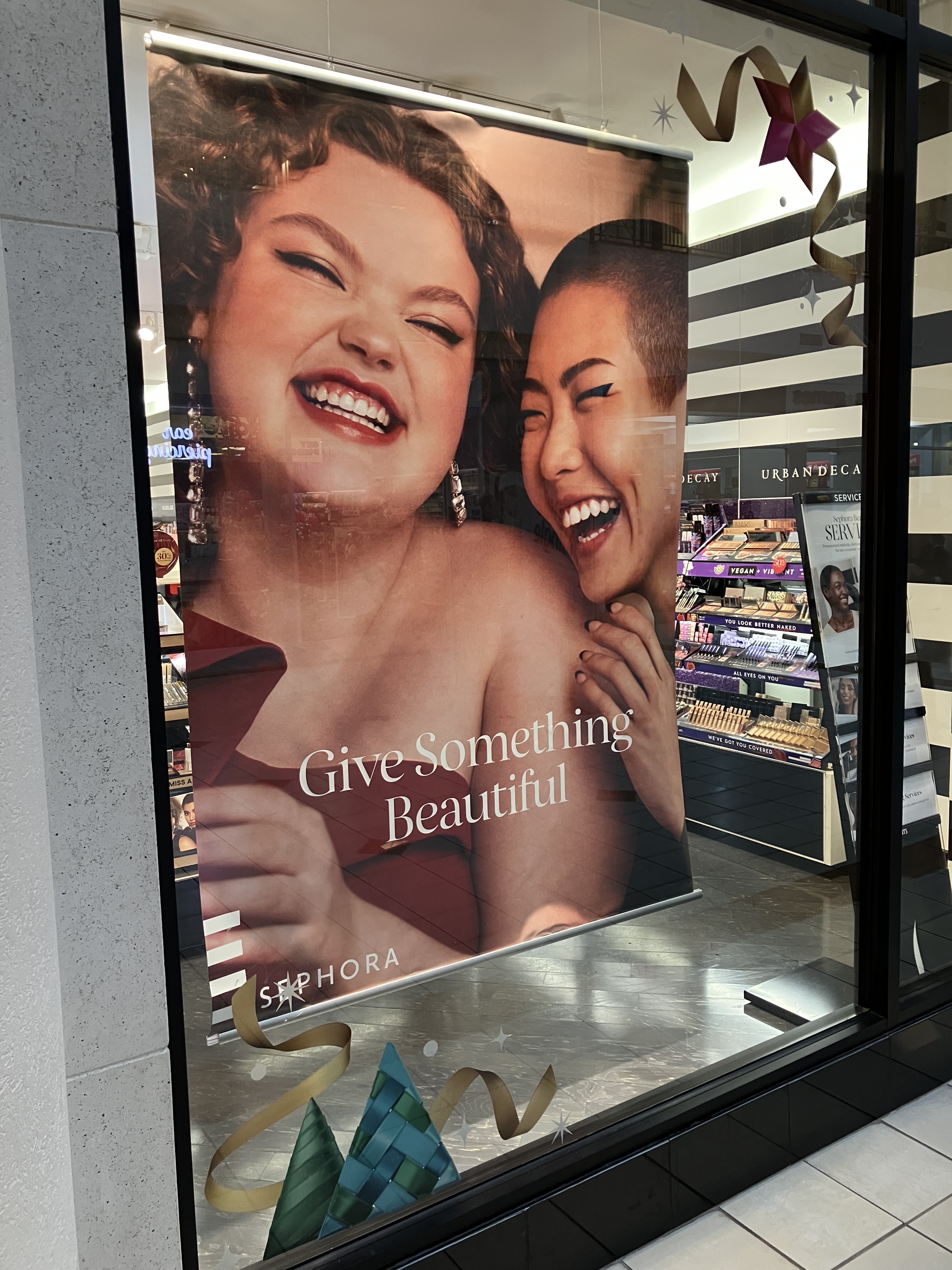
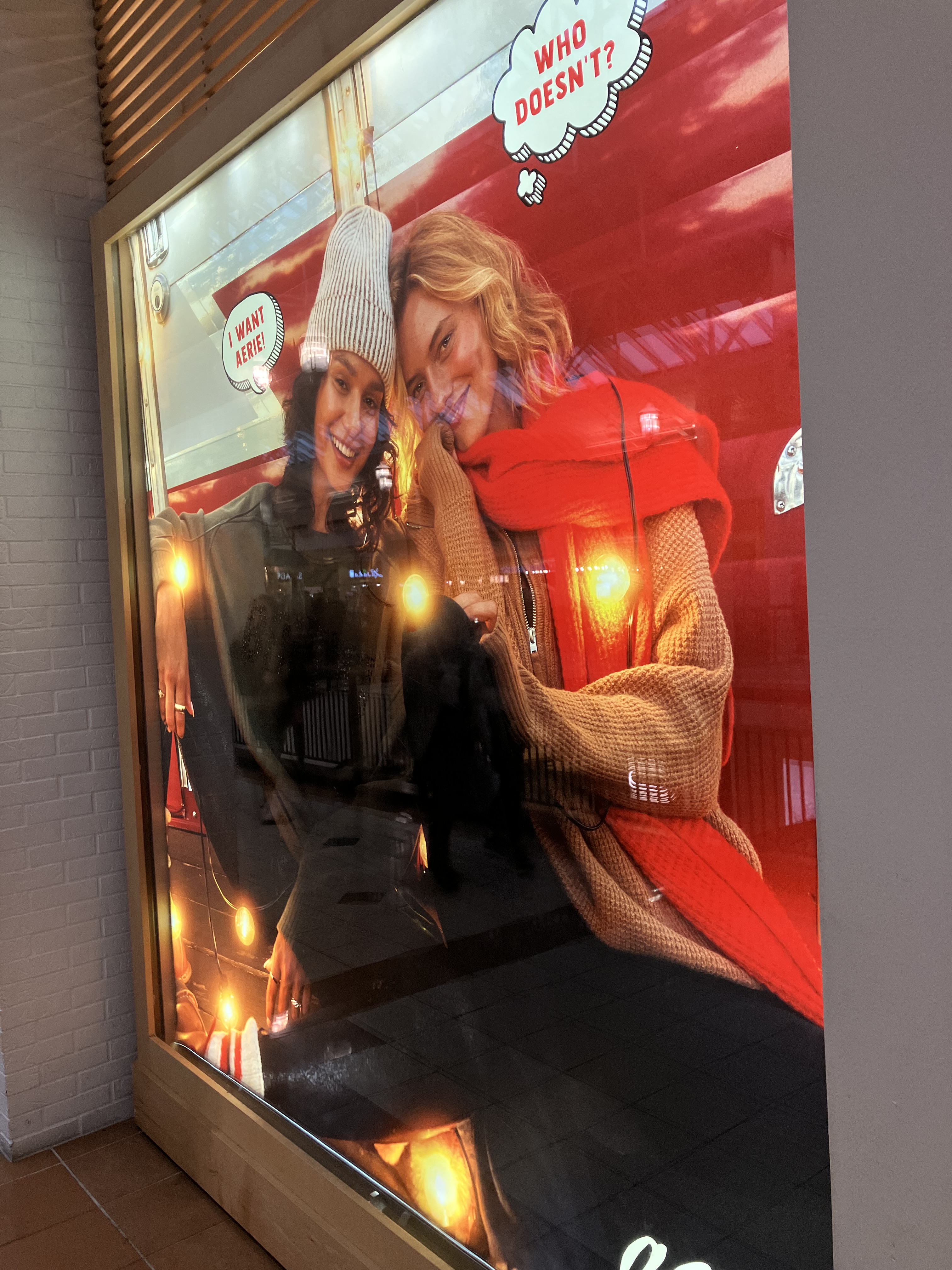
Being one with artsy leanings, I took a good look at the posters on display in store windows as I strode through the mall. Designed to catch the attention of potential customers, nearly all of them were great. And halfway into my walk it dawned on me that a considerable number of these artworks had something in common. To wit, they featured one or more people with smiling faces. Not just half-grins, mind you, but broad, joyful, glad-to-be-alive smiles. (A sampling of the posters illustrates this article.)

I was down with that. Absolutely. After all, what’s better than being happy and showing it too? Not much. Anyone who spends a meaningful percentage of their waking hours in that state has found a strong path in life.

When I began composing this essay several days after being at the mall, I recalled someone who would have been a natural for a store poster, as he wore a smile almost all the time. He’s the only person I’ve ever known who fits that description. I worked with Ray, for that’s his name, in the 1980s. Everyone liked him. How could you not like a guy who brought bright light to the workplace? Ray never was stressed, never was in a bad mood. Unfailingly helpful and friendly, he was nothing short of amazing.

The posters at the mall, and thinking about Ray, have made me realize that I should start smiling more than I do. I would have nothing to lose by doing so, and possibly a good deal to gain, right? There’s no doubt about it. What’s more, can you imagine how much better the world would be if everyone upped their smiling quotient? We’d be on our way to creating paradise if that ever were to happen.

With that in mind, give a listen to a song I heard at the mall, courtesy of Ben Vaughn’s podcast, if you’re in the market for something that will put a nice big smile on your face. The one tune Ben played that really jumped out at me, it’s by The Penguins, a long-defunct doo wop cum rhythm and blues vocal group. Their biggest claim to fame was Earth Angel, a syrupy ballad that became a smash hit in 1954. You hear Earth Angel to this day. On the flip side of the Earth Angel single, however, was Hey Senorita, a song so cool it’ll make you want to bounce around madly. Thanks. Ben, for airing it. Here it is: