Porchfest: A Very Good Idea

Good ideas . . . some people get ’em like crazy. Others, not so much. I’m near the bottom of the barrel of the latter grouping. I had a good idea about 50 years ago, when it dawned on me that grilled cheese and tomato sandwiches might be improved upon by adding a schmear of Gulden’s spicy brown mustard. Genius visited me that day, but hasn’t made an appearance since. Such, as we know, is life.

Which smoothly brings us to a remarkably good idea that some folks came up with nine years ago: a neighborhood outdoor music festival called Porchfest. When I first heard earlier this month about Porchfest’s existence I smacked myself on the forehead and said: “Yo, cowboy. This is so obvious. How come you never thought of it?” And then I remembered once again that, sadly, genius ain’t no friend of mine.

What’s a Porchfest? Well, it is a day of music played on some of the porches of a porch-heavy community. The shows are free to the public. What could be better? After all, porches, when you think about it, are small covered stages easy to get close to, making them perfect for intimate musical experiences. All that a Porchfest organizing committee need do is convince a bunch of homeowners in a neighborhood to allow musicians to play at their houses, and find a bigger bunch of musical acts to climb aboard. Then you set up a schedule so that audience members know the addresses of the porches, and encourage said listeners to roam from site to site, the better to get a big dose of vibrations.

The first Porchfest took place in 2007 in Ithaca, New York. Since then, musicians and music lovers throughout the USA, and in a few Canadian cities, have picked up on the notion and staged their own Porchfests. Each Porchchfest is independent of the others and, I’m pretty sure, is a low budget and DIY type of operation. But watch out! The power of Porchfests is undeniable and irresistible. As a few more years go by, I predict that Porchfests will cross the oceans and conquer the world!

Darlington at West Philly Porchfest.
Jon Veit at West Philly Porchfest.

Which even more smoothly brings us to a recent Saturday in a section of West Philadelphia (part of The City Of Brotherly Love) that contains scads of old and sturdy rowhouses and twins in possession of porches. As ideal a location for a Porchfest as any on our planet. And where, indeed, the first West Philly Porchfest took place, the baby of a group of organizers who recognized that the Porchfest idea was very worth pursuing. (Lots of info about West Philly Porchfest’s genesis and design may be discovered by clicking here and also here).
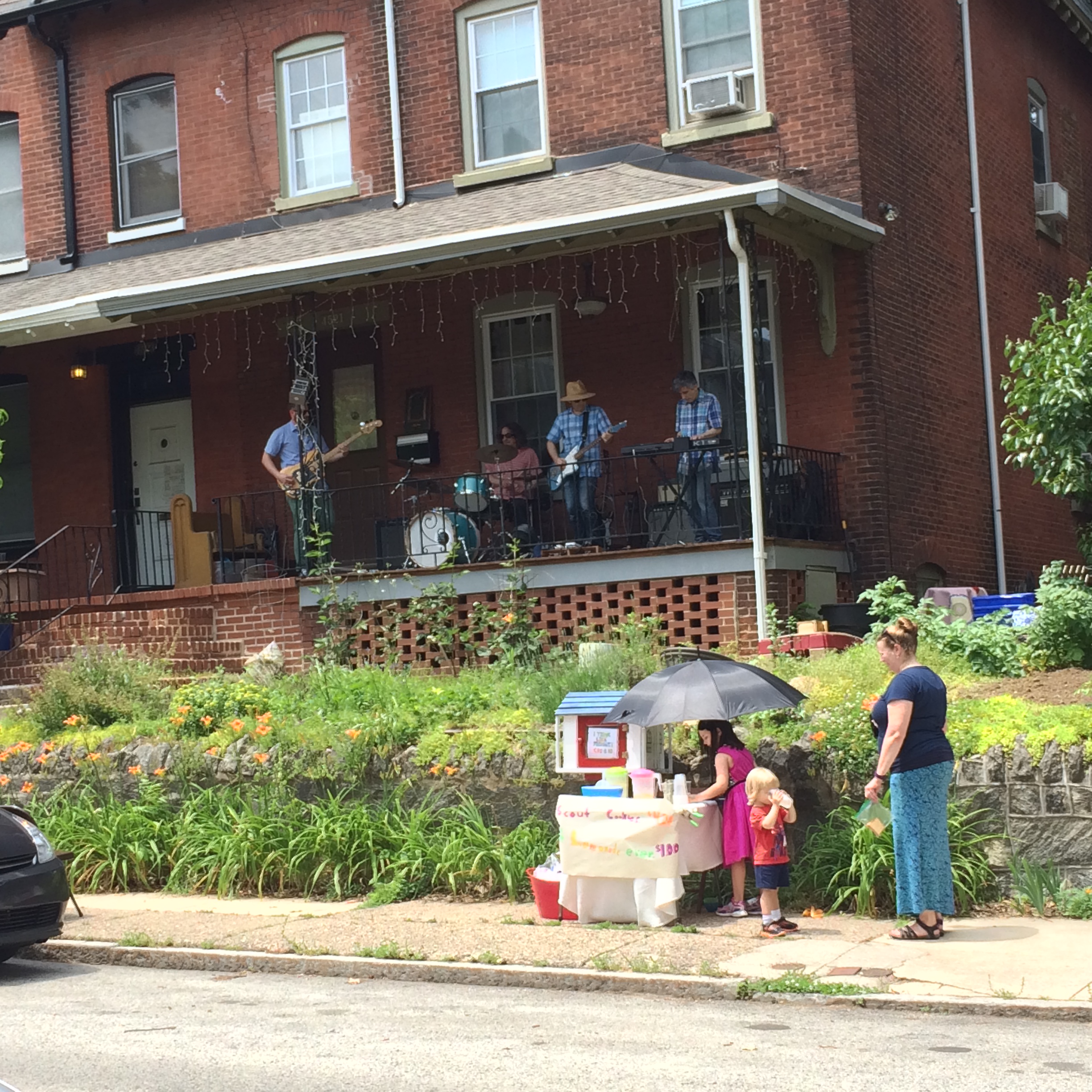
I Think Like Midnight.
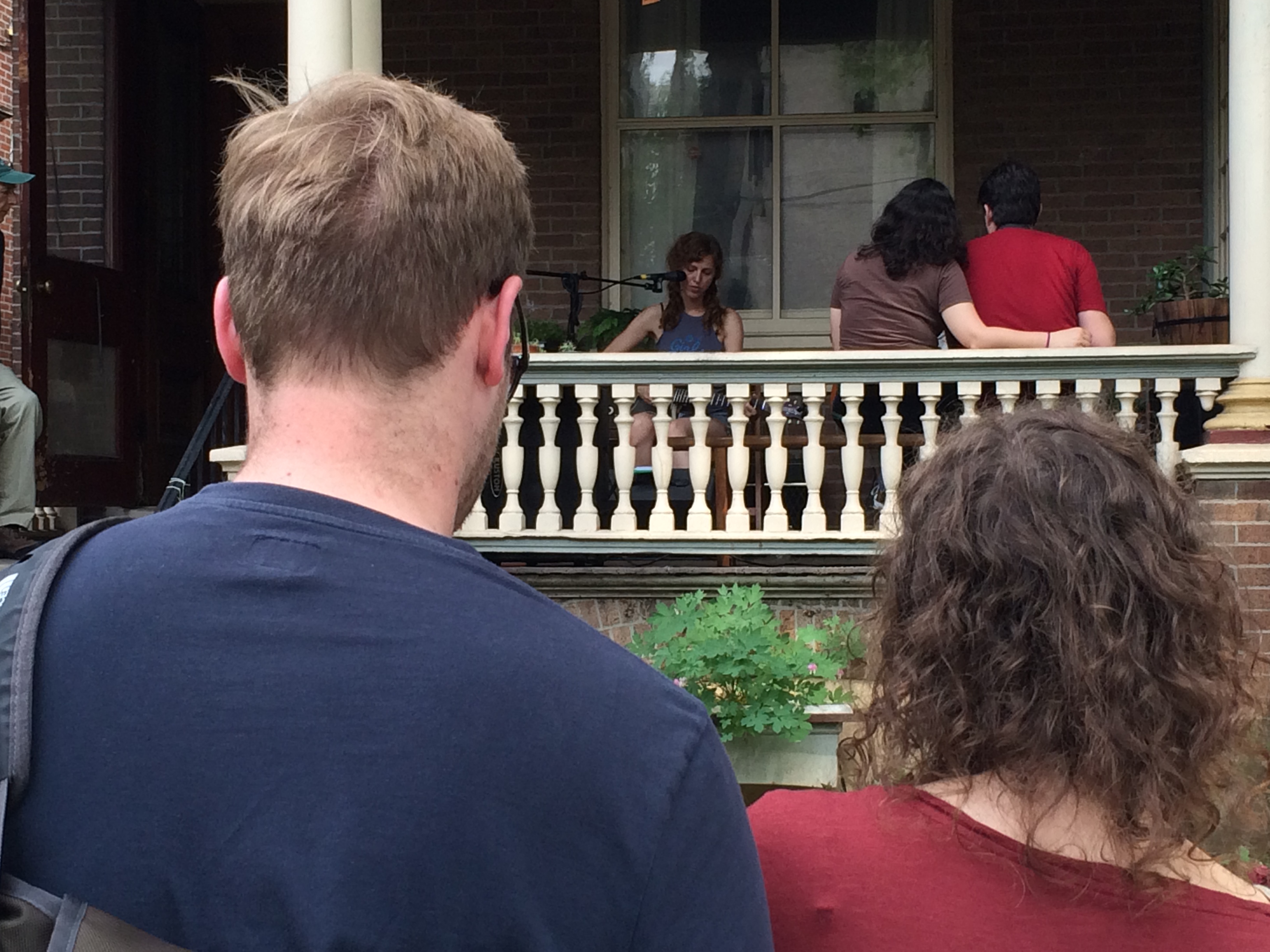
Emily Zeitlyn.
Emily Zeitlyn.

West Philly Porchfest’s boundaries were broad, about 12 blocks east to west and likewise north to south, encompassing much of what has come to be known as University City due to the area’s proximity to the University of Pennsylvania. Over 30 porches participated. The event began at noon on June 4 and ended at 6 PM. I was an attendee, taking in parts of six shows during a two-and-a-half-hour period. Man, I loved it. I heard an acoustic folky rock trio (Darlington); two singer-songwriters (Jon Veit and Emily Zeitlyn); a damn good jam session between, of all things, an African-drum percussionist, a fiddle player, an acoustic guitarist and a flugelhornist; a vocal-less rock band (I Think Like Midnight) that, to my ears, sounded like a cross between The Grateful Dead and Television; and a folky duo that smoked and crunched. I’m going to zero in on the duo, who go by the name Driftwood Soldier, because I liked them the best of the acts that I caught. I seemed not to be alone in that. They drew the biggest crowd, around 80 people, that I saw all day, and the loudest applause too.
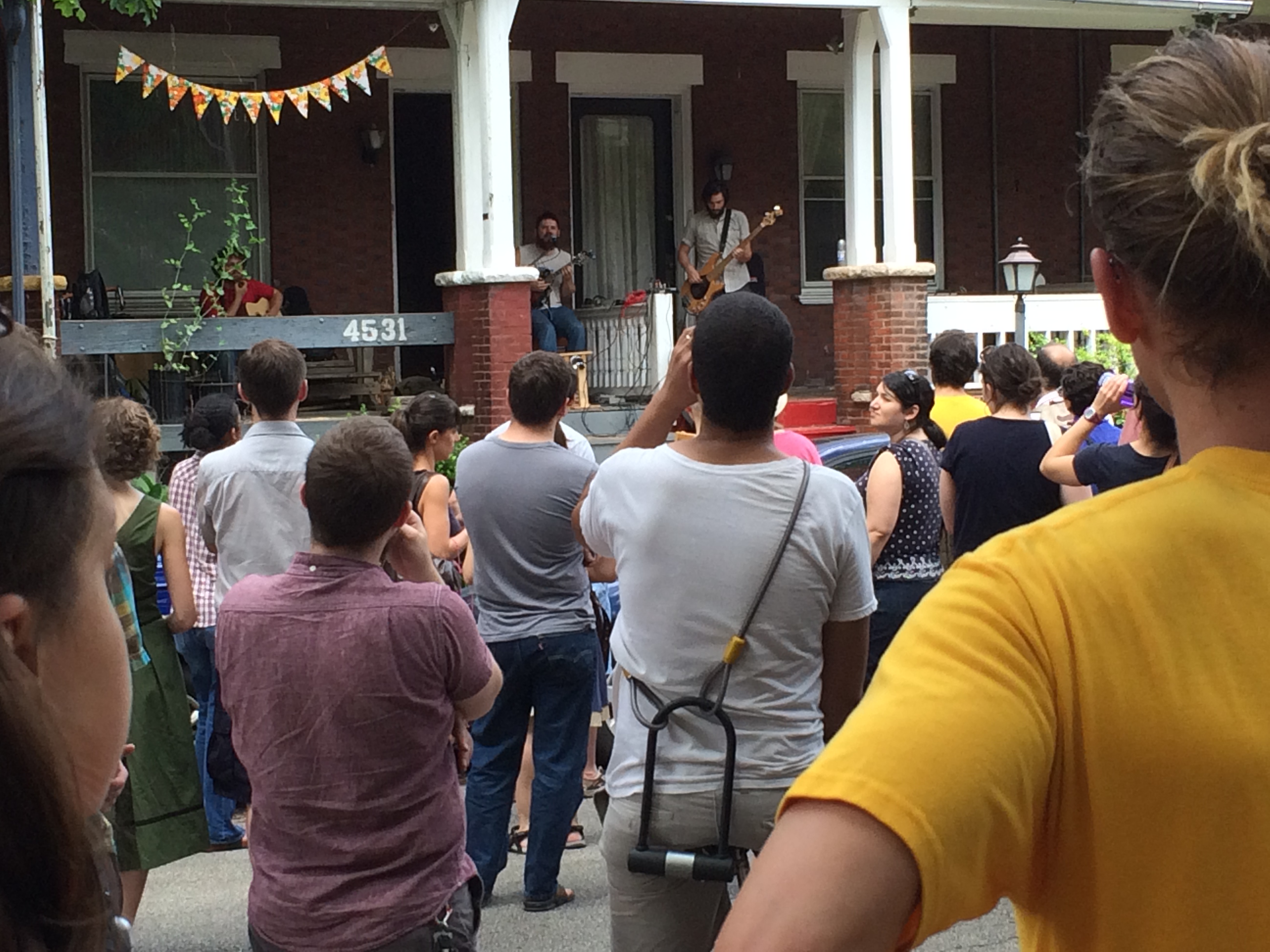
Driftwood Soldier.
Driftwood Soldier.

Owen Lyman-Schmidt is Driftwood Soldier’s singer, mandolin strummer and songwriter. Bobby Szafranski is the band’s not-your-average electric bassist. Both guys pitch in to move the groove by banging on percussion instruments with their feet. I tell you, Driftwood Soldier has it. Owen sang, in a wild and wooly baritone, about underdogs, colorful characters, people who deserve better than they’ve got. He reminded me a lot of the late Dave Van Ronk. And Bobby sent the tunes aloft with bass lines that gleamed and grinned. I would not be surprised if Driftwood Soldier breaks through nationally one of these days, though to-date they are unknowns. They are that good. And they’ve got the work ethic that might lead to fame and glory, touring our fair nation with gusto. Thanks to the wondrousness of the Internet, you may watch Driftwood Soldier performing their song Rosalee by clicking right here.

IMG_0493IMG_0494
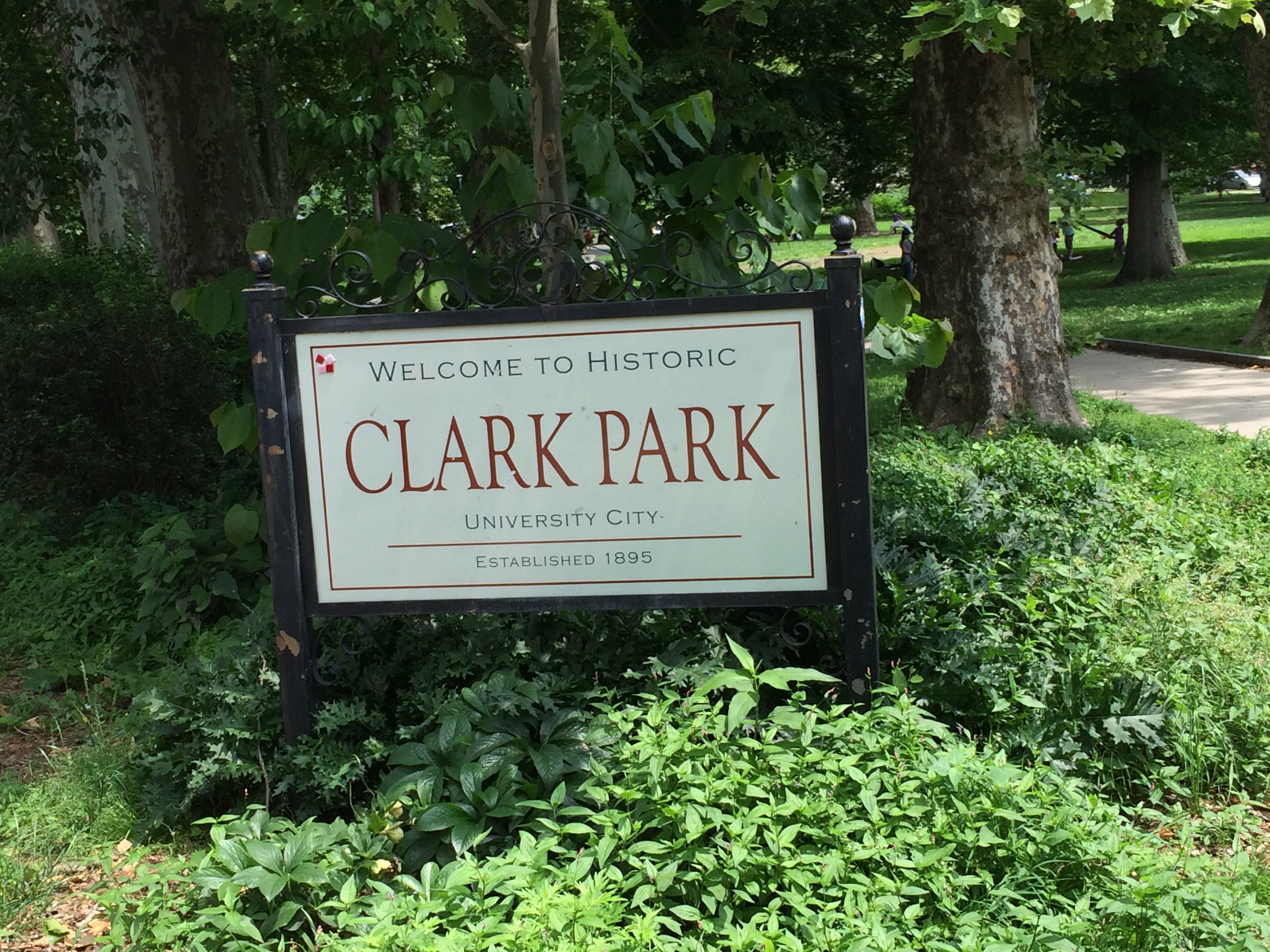
You know, I lived in University City during the 1970s and 80s on a beautiful, tree-filled block oh so close to a few of the shows I watched the other day. I liked the area mucho back then, and still do. I go back now and again. On the day of Porchfest it was fun walking the streets upon which I’ve trod so many times before. And it was equally swell strolling through Clark Park, a lovely place, a hub of peace and calm in University City. Kids were playing, food truck and farmers’ market vendors were vending, and teenagers and adults were milling around. The coolest sight I saw in the park was a little girl climbing all over the Charles Dickens statue. That’s right, Charles Dickens. It’s the only statue of him in the USA. And, apparently, one of only two in the world. The other, by the way, is in Australia, not Great Britain. A good idea would be for the Brits to commission and erect a Dickens statue too, since Dickens  — duh — was one of their own.

(Don’t be shy about adding your comments, or about sharing this article with others)

(If you click on any photo, a larger image will open)

Lindi Ortega Revisited

Last July I penned an essay about Ashes, a brilliant tune from the heartbreak canon that came out on Lindi Ortega’s 2015 album Faded Gloryville (if you’d like to read my words, click here). Lindi is a singer-songwriter in love with pensive ballads, country music in various varieties (gritty, rocking, bouncy), the blues and soul music. She has reached a modest level of success. My story, though, didn’t go into much detail about Lindi, a Canadian who relocated to Nashville five years ago, because I didn’t know all that much about her or her music (not that I’m an expert now). I concentrated on the song. In a nutshell, what I said was: “Ashes to me is perfection.”

Well, for reasons that probably always will remain unknown to me, my Ashes opus became pretty well read. Most of my stories are looked at for a few weeks at best, rarely to be discovered by any member of humanity after that. But the Ashes piece was different. Week after week, month after month, folks kept finding it. About three months ago its audience finally petered out.

Me, I didn’t forget about Lindi after I wrote the story. She and her great song became so stuck in my mind, I knew I had to see her in concert. A few months ago, voila! I noticed that Lindi and her band, who tour like mad around the USA and Canada, were on the schedule of MilkBoy Philly, a smallish and mostly rock-music club in the heart of Philadelphia. On May 22 I left my home in the burbs to take in that show.

IMG_0368 (2)
Was Lindi a let-down? Had my infatuation with Ashes set the bar of expectations way too high? Hell, no. I, who was familiar with not a one of the Ortega-composed songs performed at MilkBoy, other than Ashes, had a great time. Lindi and band were terrific, as I’d assumed they would be. And it was a gas hanging out in funky MilkBoy, where I squeezed close to the stage like a frigging fanboy, inches away from a gaggle of new-found, swaying and shimmying friends.

IMG_0369 (2)
Lindi, who is in her mid 30s, hit the stage at 9:05 PM and bid us adieu 75 minutes later. In between she sang her heart out, ripping it up on hard rockabilly and honky-tonk and bluesy numbers, pouring out her soul on the slower, more doleful part of her repertoire. She and her four-guys band knocked  each song (19 in all) out of the park. Lindi wrote or co-wrote 16 of them, and those 16 came from her four most recent studio albums. Most of the lyrics were finely wrought, sweet metaphors and similes abounding. Without a doubt, Lindi’s my kind of girl . . . a wordsmith.

Lindi Ortega sings about the subjects that have fueled country and blues and soulful songs since time almost immemorial. We’re talking loneliness, regret, broken hearts, drinking to drive the troubles away, lovers who can’t help but disappoint. Her voice and delivery might remind you of Dolly Parton and Lee Ann Womack at times, and of Emmylou Harris and Patty Griffin at others. In her trademark red cowgirl boots at MilkBoy she leaned into her hand-held mic and told it like it is.

IMG_0364 (2)
Take one of the fast numbers, for example. The evening began with a Faded Gloryville song, Run Amuck. Wham, bam! It was a honky-tonking blues blasted into fourth gear by James Robertson’s red-hot Telecaster guitar and Noah Hungate’s precise, rip-roaring drum work. Robertson and Hungate threw out sparks for 45 seconds before Lindi sang the tune’s first lines. “Daddy, where you going?/Going out again?/You keep messing round town with your floozy little friends,” Lindi finally unloaded. And she didn’t quit unloading till the tune ended a few minutes later. Man, I was sold. And psyched.

And take one of the slow tunes. Near show’s end she broke my heart with Tin Star, from the album of the same name. Voice quivering, she sang sorrowful words: “Like an old tin star I’m beat up and rusty/Lost in the shining stars of Nashville Tennessee/Well I wrote this song for those who are like me/Lost in the shining stars, the shining stars.” She held that final stars fragilely, with a high note, and for only half a second before continuing Tin Star’s tale of a very struggling and conflicted musician. The song was gorgeous. Absolutely gorgeous.

You get the idea. If Lindi and her band pass your way, plunk down a few bucks and catch them. In the interim, you can watch part of the MilkBoy concert courtesy of YouTube. Someone whom I didn’t notice, but who no doubt was standing near me, recorded and uploaded seven of the MilkBoy songs. If you click here you’ll see and hear Run Amuck. And if you do likewise right here, Tin Star will come your way.

I can’t leave without mentioning Ashes, which, sadly, the MilkBoy YouTuber didn’t post. I went half limp when, halfway through the show, I heard the chiming guitar riffs and the dirge-like drumming that introduced the song and gave it gripping power. And what might I say about Lindi’s shiver-inducing voice and the intelligence and sadness of the lyrics? Well, to repeat, Ashes to me is perfection. By clicking here, you will hear the album version of one of my all-time favorite songs.

(Don’t be shy about adding your comments, or about sharing this article with others)

(If you click on the photos, larger images will open)

Three From The 70s

I could be wrong, but it seems to me that the 1970s used to get a lot of bad press when it came to music. I’m talking about 70s music in general, not to overlook the extra helpings of guano that were hurled at disco and jazz fusion. I never bought into that, what with all the great material we got during that decade from Steely Dan, Bruce Springsteen, Stevie Wonder, Jackson Browne, Joni Mitchell, Marvin Gaye . . . the list is endless. The knocks ended ages ago. Hardly anyone gripes about 70s music anymore. I mean, more so than the tunes from any other decade, it has become the soundtrack to our lives. But what about those who used to parade with their “Disco Sucks” flags held high? Hey, put on Disco Inferno, by The Trammps, or the Stones’ Miss You, and I guarantee that they’ll be boogying on the dance floor like puppy monkey babies. And if you don’t know what a puppy monkey baby is, get with it and click here.

70_greatest_ever_FB
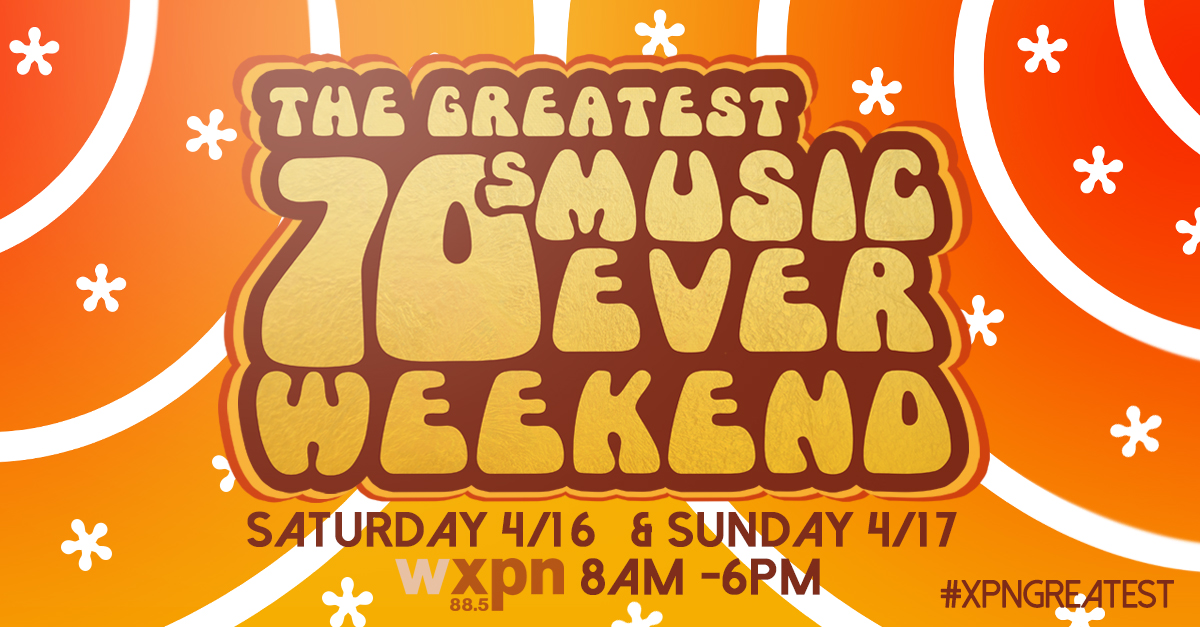
Which brings us to my abode on a Sunday morning last month. A quiet morning. The neighborhood’s brigade of lawn mowers hadn’t approached the starting line yet, and nearby dogs, for reasons unknown, weren’t barking their f**king heads off. I was listening to WXPN, a radio station based in Philadelphia. It was in the midst of one of its one-off events: The Greatest 70s Music Ever Weekend. I listened for two hours and caught all 22 songs that they played during that span. My degree of awareness varied from song to song, though, depending on each number’s ability to penetrate a mind trying to unravel the secrets of the universe. As usual I didn’t get too far with that. Most of the songs I knew. Man, I hadn’t heard Steve Forbert’s It Isn’t Gonna Be That Way in at least five years. Hadn’t heard Tom Traubert’s Blues, by Tom Waits, in decades. And Marvin Gaye’s Mercy Mercy Me (The Ecology)? Well, anyone who’s a dial flipper like me is going to run across that one a whole lot. It’s probably being played on at least one station in the world at every moment of every day. As well it should be.

The bottom line was that nearly every song on WXPN sounded good or better than good. But three of them rang my bells more than the others. And of those three, one in particular unmoored my boat and sent me . . .

The three songs I liked best are on these albums.

My faves from the morning were Van Morrison’s Tupelo Honey, David Bowie’s Wild Is The Wind, and El Condor Pasa (If I Could) by Simon and Garfunkel. Great recordings. Much of humanity is familiar with one or more of them. If I were asked to provide the briefest of descriptions of their essential natures, I’d say, in respective order: heartfelt, majestic, transporting.

I loved these three songs from the first moments that I heard them in the 1970s, which in each case was soon after their release on vinyl albums. Tupelo Honey is my number one song on the album of the same name from which it cometh, and the album is my number one among many primo efforts by Van The Man. Morrison was at the top of his game as a singer and songwriter when Tupelo Honey, the album, came out in 1971. I listened keenly last month as Tupelo Honey, the song, played on WXPN. My, my, my . . . how sweet it was, the languid pacing, each organ and guitar line issued oh so casually yet with a soulful caress, and Van’s voice wrapped tightly around the words, as if letting go would result in life’s lessening. “She’s as sweet as Tupelo honey/She’s an angel of the first degree/She’s as sweet as Tupelo honey/Just like honey, baby, from the bee.” This song is the best (click here to listen).

Yet, David Bowie’s version of Wild Is The Wind might be better. And, David the prolific songwriter, didn’t even pen the tune. It was the title song, written by Dimitri Tiomkin and Ned Washington, of a 1957 movie, Dimitri handling the notes and Ned the words. Wild Is The Wind fit like a glove among Bowie’s compositions on Station To Station, his soaring, riveting album from 1976. Wild Is The Wind is a mysterious ride. Guitars calmly anchor the production with repeating and chiming lines as Bowie’s vocals take flight. His singing is dramatic, touched with eeriness and loaded with falsetto leaps. I sat back on the couch last month and let the sounds wash over me. Wild Is The Wind is the best (click here to listen).

Yet, to me El Condor Pasa (If I Could) is better. Maybe because of its simplicity, its sweet melody that relaxes my knotted guts. And because of Simon’s and Garfunkel’s unaffectedly angelic vocals. And the flutes. No question, it’s the flutes that get to me more than anything.

El Condor Pasa was composed in 1913 by Daniel Alomia Robles, a Peruvian. Robles, the story goes, based his music on traditional Andean folk songs that date back who-knows-how-many-centuries, probably to the time of the Incas. And speaking of Incas, Simon apparently first heard the tune performed by the band Los Incas, with whom he toured a bit during his pre-Garfunkel days. He fell in love with the song. Some years later, Los Incas backed up S & G for the recording of El Condor during the sessions that resulted in a famous album, Bridge Over Troubled Water. Simon added lyrics to Robles’ composition. The album came out in 1970 with El Condor as its second track.

What can I say? I’m a sucker for the pure, innocent high notes of Los Incas’ flutes. I heard El Condor on XPN at the beginning of my two hour session. I was still in bed. My eyes might have been open, but I closed them when the song came on the air. Up, up and away it took me. El Condor Pasa (If I Could) is the best. I mean it. Click here to listen.

(Don’t be shy about adding your comments, or about sharing this article with others)

(Photo of albums by Sandra Cherrey Scheinin. If you click on it, a larger image will open)

Thumbs Partly Down, Thumbs Way Up: Reviews Of Sing Street And Miles Ahead

Movies, movies, movies. They make good fodder for opinions. I never knew I had so many opinions about movies, and about all kinds of things for that matter, till I started writing this blog. Now I can’t shut myself up. When I retire from blogging I plan to go back to my former ways, which involved a vow of near-silence and rigorous mental training to keep opinions at an unmeasurably low level. For now, though, here we go again:

IMG_0317
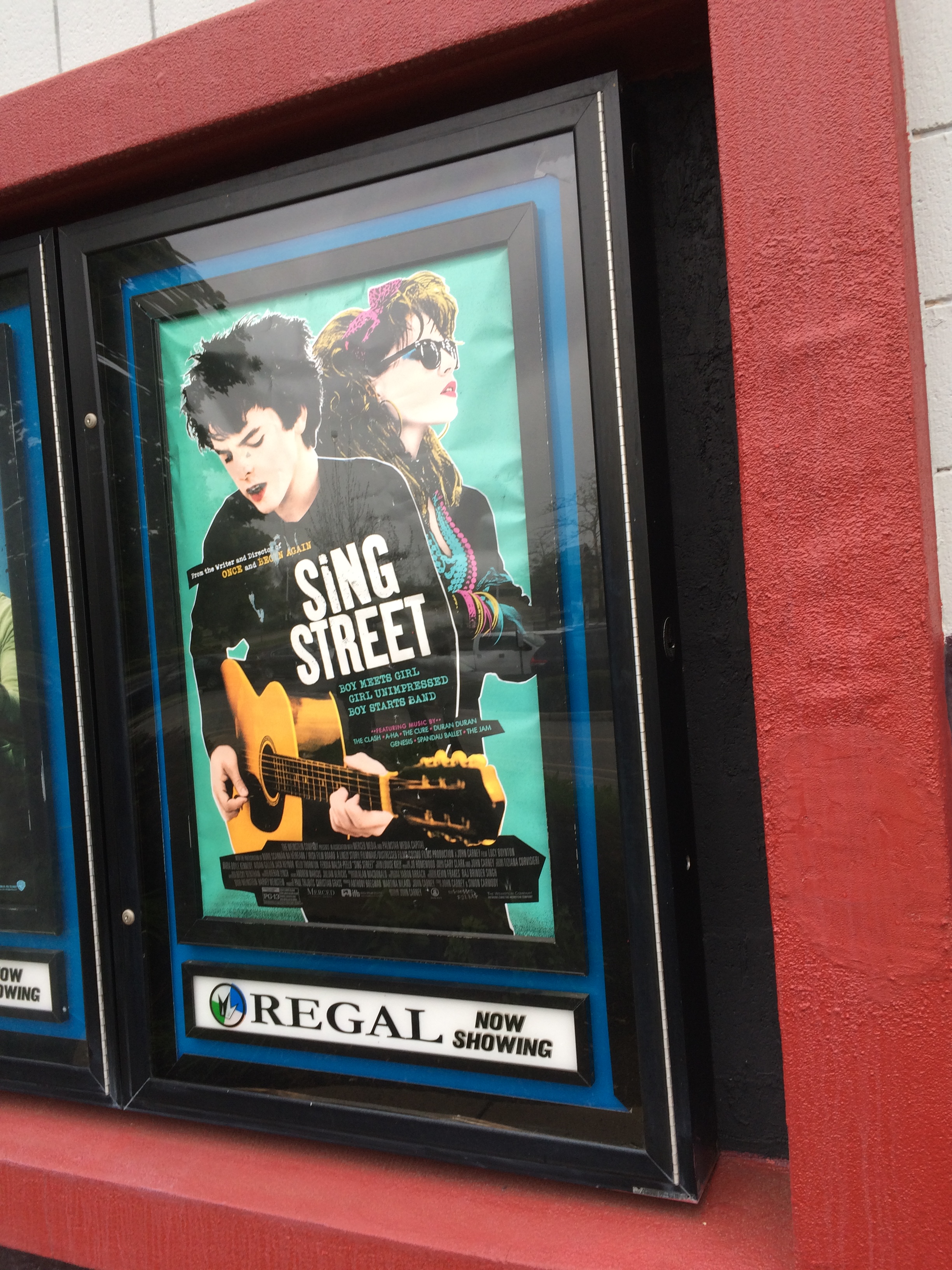
My wife Sandy and I caught two movies, their themes heavily musical, in suburban Philadelphia on a recent weekend. First we saw Sing Street. The next day it was Miles Ahead. Sing Street came with a three and a half star rating from The Philadelphia Inquirer. I took a look at The Inquirer’s 50-word summary of the movie and at some words of praise quoted in the film’s newspaper advertisement, and I was sold. I mean, here was a story, set in 1985, about an Irish lad infatuated with the idea of forming a rock and roll band, and also infatuated with a girl. Undoubtedly it would be a charmer. Count me in.

Turns out that Sing Street ain’t da bomb. Very surprising, since John Carney, its director and author, previously turned out way solid fare with two music-infused films, both of which he also wrote and directed. Is there anybody who didn’t like Once, the lower-than-low budget love story from 2007 that brought the world to tears with dazzlingly tender songs such as Falling Slowly? And what was there to dislike about Carney’s 2013 opus Begin Again? It starred Keira Knightley and Mark Ruffalo, and it did nothing but snap, crackle and pop.

Now, Sing Street isn’t the worst. It’s watchable. It’s pleasant. But halfway through I began scratching my head, wondering if I was viewing the same flick that the Inquirer’s reviewer had fawned over. Admittedly, on paper the set-up seems good: Fifteen-year-old Conor, a nice, directionless kid, is living in Dublin with his sister and older brother and squabbling parents. He is introduced to emotive, big hair 1980s rock and roll (The Cure, Duran Duran) by his slacker brother. Then he meets a cute 16-year-old girl who knocks his socks off, and decides to become a musician and put together a rock band to impress said girl. Conor, natch, will be the band’s big-haired lead singer. So, what’s my gripe? In two words, sloppy screenplay.

Example number one: This is a movie partly about a boy and his band, yet only one of Conor’s four bandmates gets to do much yapping. Whatever personalities the three others possess are pretty invisible. Collectively those three lads recite maybe 60 words during the movie.

Number two: Family-wise, the movie delves only into Conor’s relationship, which is strong, with big brother Jack. But Conor seems to get along pretty nicely with the other family members. Which is why I was lost at sea when Conor, permanently leaving the parental household near the end of the film, directs moving words toward his mother but not a syllable toward good ol’ Dad or Sis.

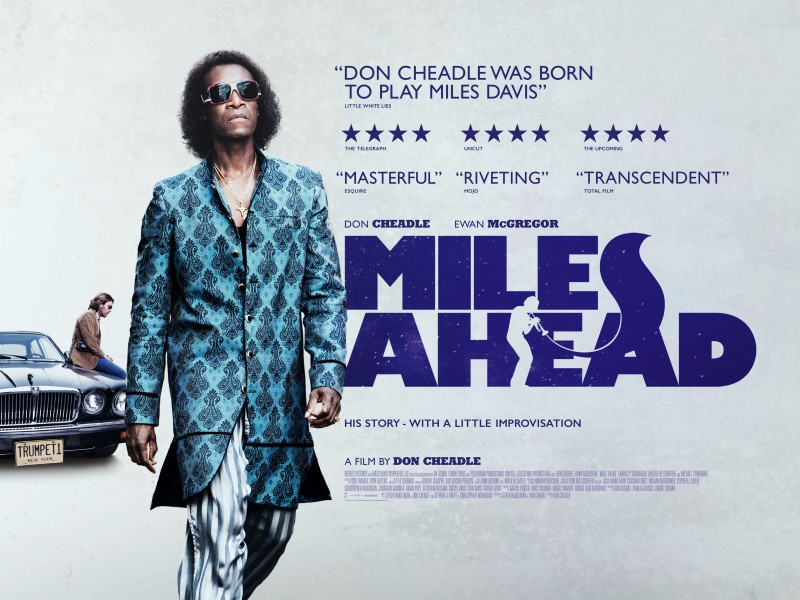
Miles_Ahead_Poster UK_Quad-e1459359065654
That’s enough examples. Hey, sometimes you lose. But sometimes you win, and I can’t say enough good things about Miles Ahead. This is a most unorthodox and highly creative take on Miles Davis, the superb jazz musician whose aura blanketed the globe for over 40 years. Miles was a force musically and sartorially, and set the standard, if you can call it that, for hipster cool. He was a singular talent, a complicated guy, multisided. Not everybody he knew necessarily saw the same sides. And he was a prolific and hardworking musician, recording many dozens of albums as a leader, starting in 1951. His final studio sessions took place in 1991, the year he died at age 65.

A strange thing happened, though, during the second half of Miles’ career. Due to health problems and drug addictions and who-knows-what-else, he went into near-seclusion in 1975, holing himself up in his Upper West Side townhouse in Manhattan. And for the next several years apparently he didn’t do much of anything worth noting. Eventually he felt the urge to make new music, and returned to the recording studio in 1980. The next year he began to tour again. But what was life like for Miles during his period of withdrawal from public life? What was going on inside his head? Those are the questions that Miles Ahead grabs hold of. Fantasizing some answers, the movie takes the audience on a wild ride.

Miles Ahead is Don Cheadle’s baby. He plays Miles in the movie. He looks a lot like him, nails the raspy voice, and constructs a cinematic Miles so natural and believable I have a feeling that he comes damn close to the real thing’s personality. Not only that, Cheadle directed the movie — to me, flawlessly — and co-wrote the screenplay. Yeah, you bet this guy is talented.

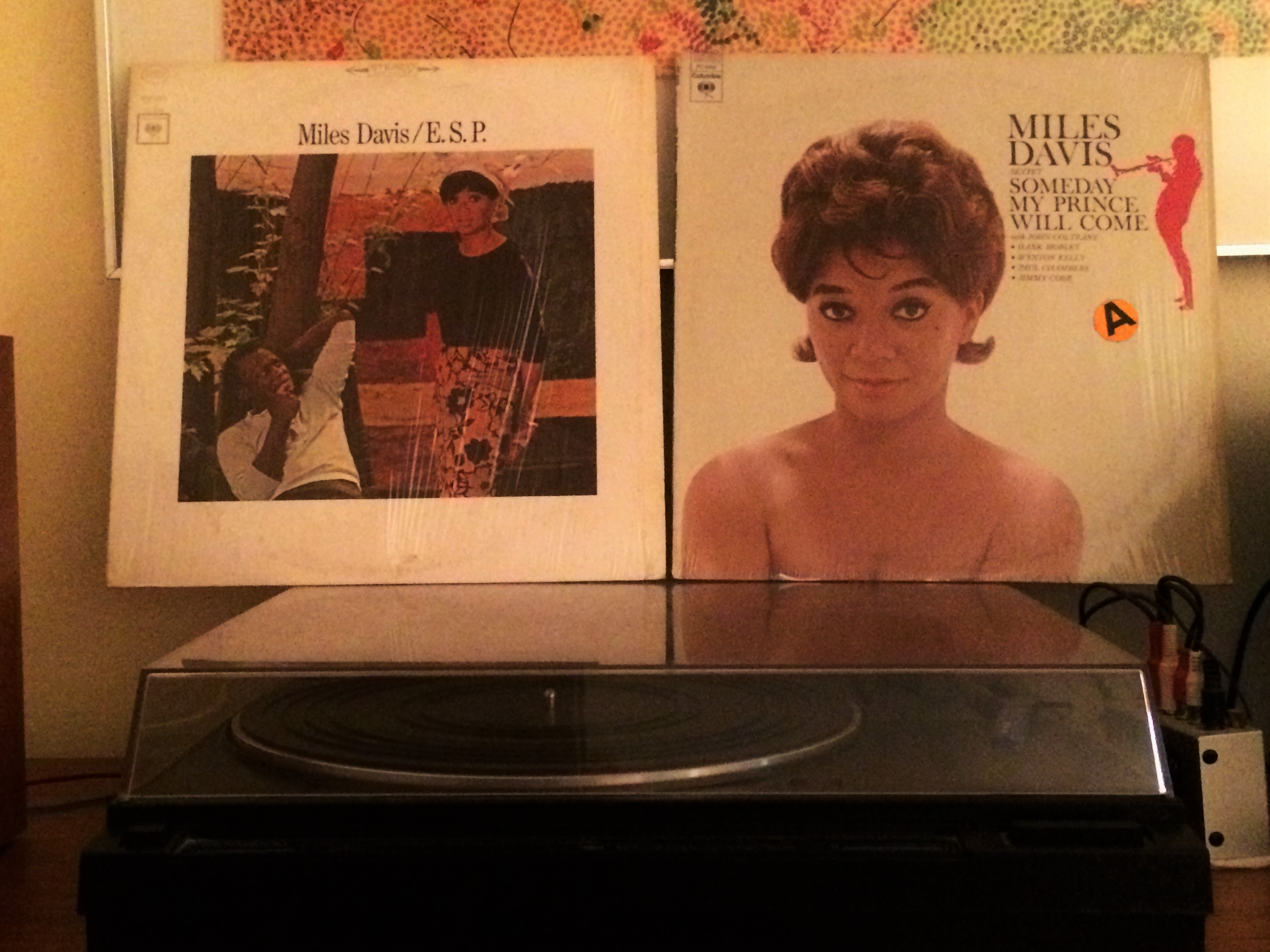
Frances Taylor Davis is on the covers of these two Miles albums.

During his self-imposed confinement, was music ever far from Miles’ mind? Probably not, though he had hit a huge creative roadblock. The movie opens in 1979 or so, in Miles’ spacious and disheveled home, where he has yet to come out of his lengthy funk. And where he dwells on the past, on the music he had made. In flashback scenes throughout the film, covering the late 1950s through about 1966, we see Miles at work. And in love. That was a fecund musical period for Miles, and during it he was head over heels for Frances Taylor, a professional dancer who married (and divorced) him and helped inspire him. Seamlessly blended with the past is an invented scenario in which 1979’s Miles becomes involved in a loopy caper that has some good results: It gets him out of his house and ultimately leads him to reclaim his misplaced musical mojo. His semi-trusted companion in the adventure is a music journalist (done just right by Ewan McGregor) who has edges as flinty and unpredictable as Miles himself. And that is why Miles comes to like him.

I won’t say more about the plot. What I’m wondering, though, is if a viewer needs to be a Miles Davis fan to enjoy this movie. Me, I’m a big fan. But I think I’d have loved the movie even if I weren’t. It seems so real. It breathes like Miles Davis trumpet solos . . . on the trumpet, Miles might dartingly probe the outer planets of the solar system, or might ruminate bittersweetly. And it’s the opposite of the standard biopic in more ways than its fantastical caper. After all, it entirely skips about 55 years of Miles’ life. If Miles, a forward thinker, were alive to view the flick, no doubt he’d say something like this to Don Cheadle: “Man, I don’t know how you came up with this crazy plot, but it slays me. Motherf**ker, that’s me up there on the screen.”

(Don’t be shy about adding your comments, or about sharing this article with others)

Great Fortune Smiled Upon Me When Willie Nile Came To Town

I had no doubt that something celestially-inspired was happening when my once-Greek-god-like hair began to move most unusually, each strand inching upward rapidly till they all pointed straight . . . straight . . . towards the stars! Yo, was anybody staring at me? I looked a mess. But at times like that, who gives a flying fig? This incredible occurrence meant only one thing: The stars had aligned themselves for me. I was in the right place at the right time. In Philadelphia. At funky, small and narrow Tin Angel, a music club where my wife Sandy and I sat 40 feet from the stage. Upon which Willie Nile and his band, only seconds into their set and ablaze from the first whack of the drum kit, were transporting me to — yeah man, as clichéd and dumb as this sounds, I’m gonna say it — rock and roll heaven. I was so jazzed I started to drop to my knees to kiss Tin Angel’s floor. Sandy held me back. “What, are you nuts!” she wisely exclaimed. “There’s a bacterial frat house party going on down there. Stay in your seat, young man.”

willie IMG_1280
And I did, as Willie and his pals commandeered the stage for nearly two hours. They took no prisoners, blasting out 20 holy crap-that’s-catchy songs (17 of them fully or co-authored by Willie), not even offering up a medium-paced number until halfway through the show. What they unleashed was unadulterated rock and roll. The kind of rock that any lover of  The Clash, The Pogues, The Ramones, Petty and Springsteen would go wild for. Rock propelled by Matt Hogan’s lean, soaring electric guitar and Alex Alexander’s huge drum poundings and Johnny Pisano’s electric bass lines that bobbed and bubbled. And what about Willie? Why, he led the way, packing his lead vocals with brio and strumming madly on his low-in-the-mix acoustic guitar. He showed off his ace songwriting skills, delivering righteous social anthems (such as Let’s All Come Together and One Guitar) and acutely-detailed observations about love (Beautiful You). And he owned the stage, because he’s one of those cool guys with way natural magnetism.

Man, how long had it been since I’d been rocked to the bones like this? Too long, partner, too long. And it wasn’t only the hooks and riffs and pounding drums and great songs and Willie’s lead singing that made the night special. The band possessed a secret weapon, one so astonishingly good my ears opened up like sink holes. We’re talking here about exuberant harmony vocals that deliriously dressed nearly every song’s chorus. The chorus of Forever Wild, for instance, the set’s opener. Leaning into their mics, Nile, Hogan and Pisano whooped and let loose: “Forever wild — uh-uh-uh uh-uh/uh-uh-uh uh-uh/Forever wild!” Throughout the set, like a bunch of half-drunk revelers, they sent the songs into outer space, Pisano reaching crazily-high notes almost out of the range of human hearing.

I should have kissed the floor.

In another lifetime maybe I’ll tackle writing Willie Nile’s biography. For now I’ll mention but a few things about him, starting with the obvious fact that he is one of the hordes of musicians whom the average Joe or Jen never heard of. He definitely has his fans though, quite a few, actually. But he deserves to have mucho more of them. And throughout his career, which began in the 1970s, he has been a darling of many music jounalists. They have loved his albums and his concerts. Still, that never has translated consistently into lots of gigs at good-sized venues, or into much airplay for his songs. Hell, Tin Angel can squeeze in maybe 140 bodies, and it was only half-filled when Sandy and I saw him there this month. As with much of life, I don’t get it. I mean, Willie should be a star.

Willie seems undaunted, though. He’s closing in on 70 and has been on a creative roll, churning out studio albums with little pause. His latest, World War Willie, just came out, and it’s his fifth since 2009. Willie and band played nearly all of it at Tin Angel, every song sounding fine as can be to my sink hole ears.

Left to right: Matt, Alex, Willie, Johnny.

Flanked with cartoony murals that look like modern day caveman art, Tin Angel welcomed Willie and band in the right way. Meaning, a person with talent and good judgment was at the sound board. Isn’t often that you can make out more than 40% of the lyrics at a loud rock and roll show. The other night, the sound lady balanced everything just right and I deciphered most of the lyrics no problem. And they were cool. “Grandpa rocks, Grandpa rocks/He listens to the Stones on the waterfront docks,” Willie happily shouted on the set’s second song. And on the eighth he warned, “I’m a bad boy/I ain’t no good/When I was born they said ‘knock on wood’.” Those pithy rhymes came from songs on World War Willie whose titles are easily guessed.

Not only that, Tin Angel has the vibes and layout that full-frontal rock and roll needs in order to flower. It’s cramped. it’s sweaty, and it puts its audience in potential danger. Halfway through the show, Johnny Pisano sidled to the edge of stage left, his electric bass’s neck gleefully bopping around and sticking far out into the skinny corridor that leads to the bathrooms. A guy, fresh from relieving himself, sauntered from the loo and headed back to his seat. A collision awaited. Watch out, mate! You’re about to get whacked in the head!

I don’t think that Pisano ever saw him. But the guy nimbly ducked. And all was well.

(Click here to watch Willie and his band performing Grandpa Rocks one week before I saw him at Tin Angel)

(If you enjoyed this article, don’t be shy about sharing it. Sharing buttons are below)

(If you click on the photos, larger images will open)

Caramel (Suzanne Vega, This Beer’s For You)

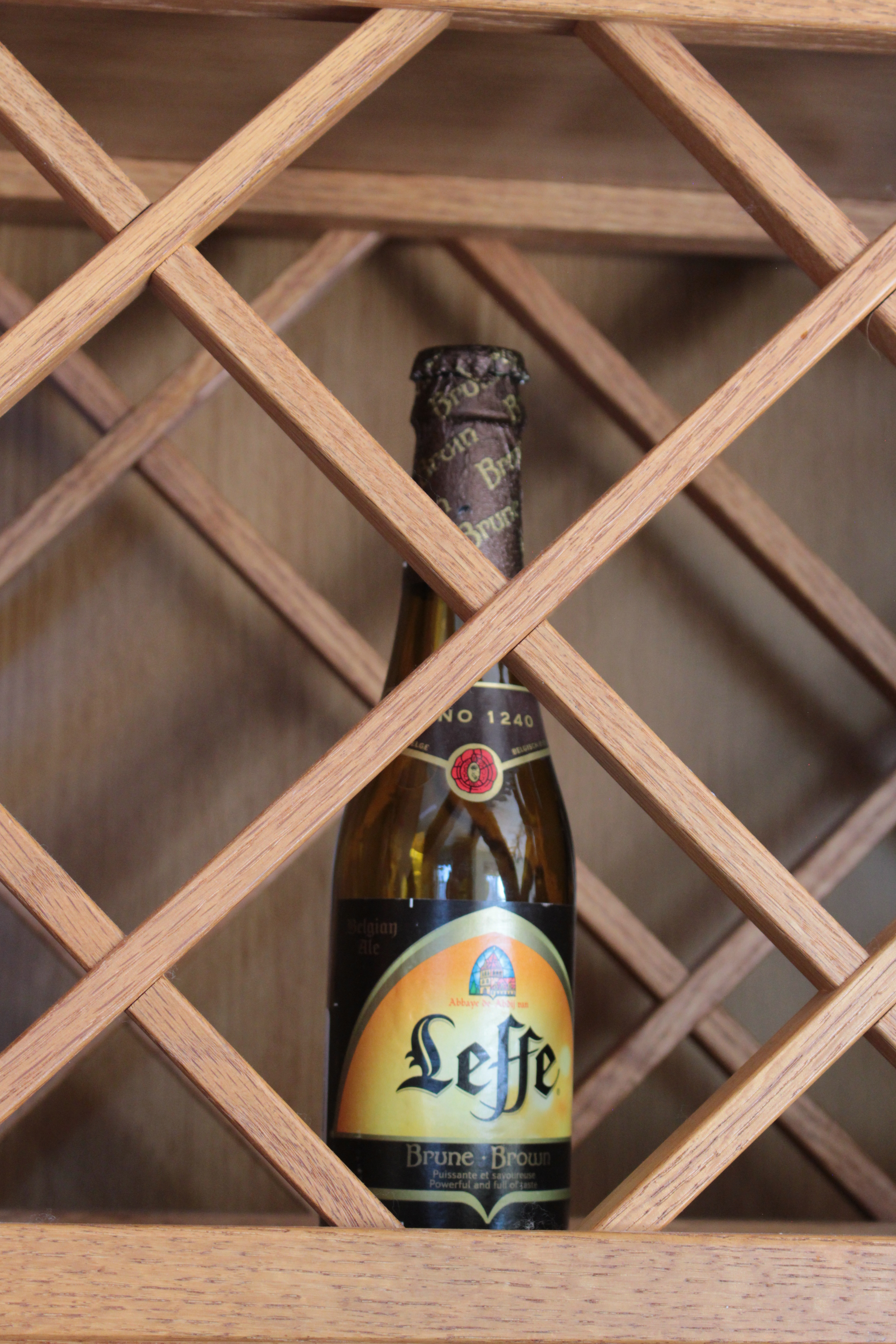
Leffe Brune
Leffe Brune

A few days ago, in a local supermarket’s beer section, I assembled and bought a “create your own six pack.” At dinnertime later that day I grabbed one of the six from the frig, and I’m glad I did. It was a thick, rich, mellow ale. Dark and handsome too, I might add. And delicious. Leffe Brune (brown), brewed in Belgium.

If it weren’t for this excellent beer I wouldn’t be typing this story right now. Instead I’d probably be cemented to the living room sofa, counting the number of dust balls scattered on the room’s hardwood floor, one of my typical pastimes. But I am typing this story right now, and here’s why:

Earlier in the aforementioned day, fishing around in my mind for something to write about for my blog, I thought about Caramel, a song by Suzanne Vega that I’ve always loved. But I wasn’t sure how I’d incorporate Caramel into a story. It’s a great song, not too well-known. For years I’ve thought it deserves to become a heavily covered tune, a standard if you will, as it is perfectly formed musically and lyrically. For 40 years I’ve thought almost as much of Tom Waits’s (Looking For) The Heart Of Saturday Night. “Maybe I’ll write about Caramel and (Looking For) The Heart of Saturday Night and one or two other songs that, in my ideal world, nearly everyone would know about,” I more or less said to myself. “That’ll be at least a  couple of weeks from now, though. It’s a tough story to work out.”

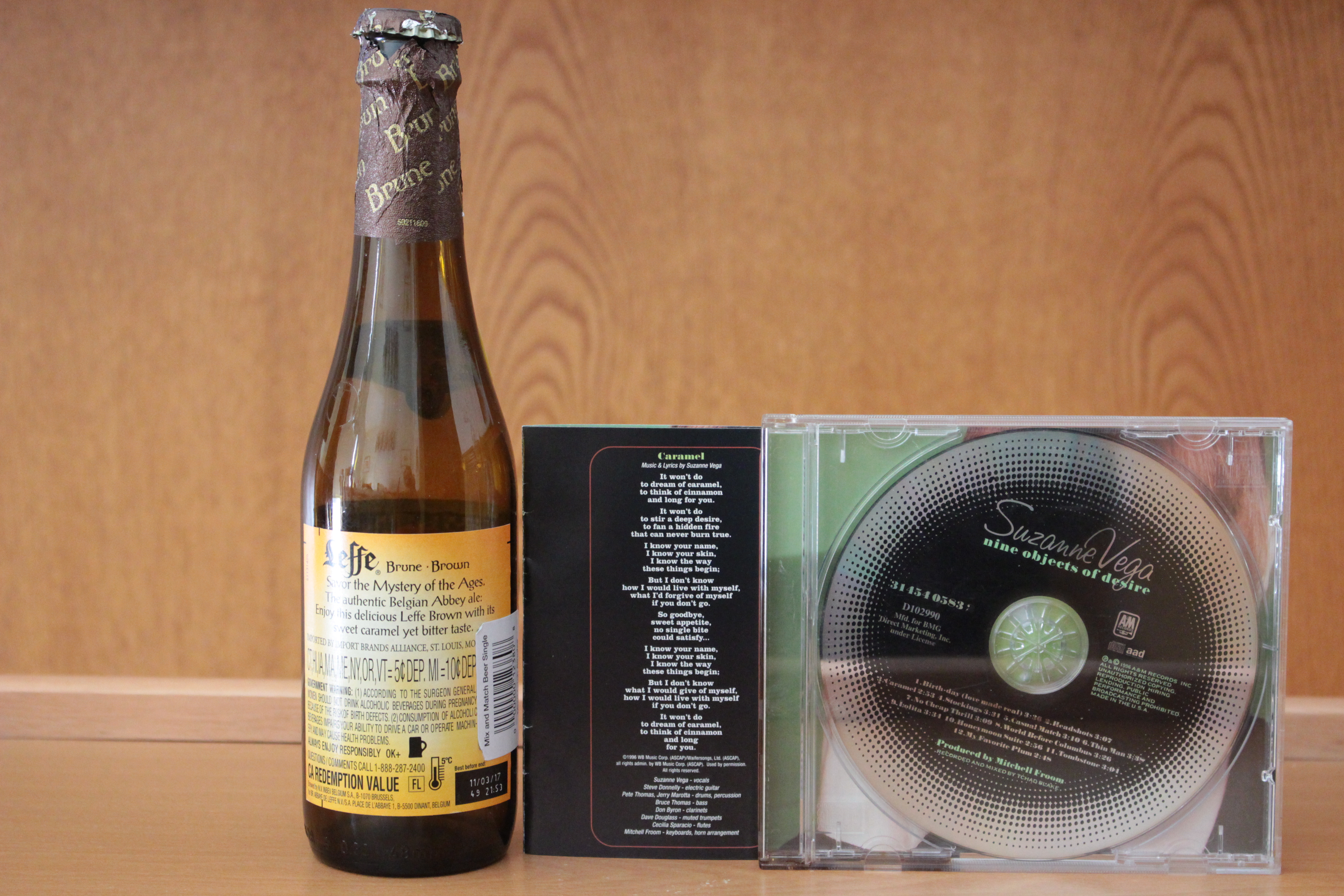
But a few hours later, scanning the label on my Leffe Brune, I shifted course. It read: “Savor the mystery of the ages. The authentic Belgian Abbey ale. Enjoy this delicious Leffe Brune with its sweet caramel yet bitter taste.”

Caramel! Whoa, no way this could be a coincidence. No question about it, the beer gods who hover invisibly above Planet Earth are fans of Suzanne Vega’s Caramel. That’s why they placed the Leffe Brune label before my eyes. Which means that they wanted me to devote a story solely to that song. “Screw Tom Waits,” they in effect were saying to me. I love and revere the beer gods. I pray to them before turning off the bedroom light each night. Therefore, I shall obey.

Suzanne Vega is one of those artists who has been around for a long time (in her case, for about 30 years), though not too obviously for much of the span. She hit her visibility peak in the mid 1980s through mid 90s, when a bunch of her songs received lots of airplay. Tunes such as Luka, Tom’s Diner, Marlene On The Wall and Blood Makes Noise. Things have quieted a lot since then in terms of Vega’s fame. She still tours a good bit, playing before plenty of fans, and releases albums fairly regularly. But, barring a fluke of some kind, she’s unlikely ever again to be a big media presence. She hardly is alone in that. The same might be said for Tracy Chapman, Joan Armatrading, Bruce Cockburn and near-zillions of others. The music biz, like life in general, is fickle.

Left to right: Beer; Caramel's lyrics; the CD on which Caramel appears.
Left to right: Leffe Brune; Caramel’s lyrics; the CD on which Caramel appears.

Despite that . . . if somehow Caramel were to come to the attention of many classic singers (calling Tony Bennett and Jane Monheit) and singer-songwriters, I’m of the belief that it would be recognized as awfully damn good and irresistible and eventually would find its way into the pop music canon. It came out in 1996 on Vega’s album Nine Objects Of Desire and had a now-forgotten shot of exposure that same year when it played during a scene in the movie The Truth About Cats And Dogs. But as far as I can tell, Caramel rarely has been covered by other musicians.

Yo, tell me that I’m wrong. Here is the first half of Caramel’s lyrics. They are concise and they pop. Poignantly. If they didn’t come attached to music they’d read as a cool poem. Coming from me, not exactly a huge poetry fan, that’s a major compliment.

It won’t do
to dream of caramel,
to think of cinnamon
and long for you.

It won’t do
to stir a deep desire,
to fan a hidden fire
that can never burn true.

I know your name,
I know your skin,
I know the way
these things begin;

But I don’t know
how I would live with myself,
what I’d forgive of myself
if you don’t go.

The lyrics above take up 16 (short) lines. And they comprise a mere four sentences. Four additional sentences, which you can read by clicking here, complete the lyrics. Me, I’m totally taken by Caramel’s simplicity. There are no head feints or foot shuffles. Wham, Suzanne Vega gets to the essence of a sexual attraction that must not be pursued, a love affair that must not be allowed to flower. It ain’t easy to write like that.

But Caramel isn’t a poem. It’s a song. And its music makes me want to head south. To Brazil, home of the samba, of which Caramel is an example. What a melody, so sweet and wistful. Such melancholy chords upon which the melody hangs. Ah me. In Rio I’ll set up a hammock on Ipanema Beach. I’ll watch the girls go by and sip on a long cool one (yeah, it’ll be a Leffe Brune). And as the Sun dips below the horizon I’ll listen to Caramel on iTunes. Or maybe on YouTube, which you too may do by clicking right here.

(If you enjoyed this article, don’t be shy about sharing it. Sharing buttons are below)

(Photos by Sandra Cherrey Scheinin. If you click on a photo, a larger image will open)
Vinyl Night: Collapses Will Happen

“What’s a good night for Dave to come over for Vinyl Night?” I asked my wife Sandy recently.

She rolled her eyes magnificently and exclaimed “Vinyl Night? There is no good night for Vinyl Night!”

And why did she say that? Because when my excellent pal Dave comes over for Vinyl Night, as he does once or twice a year, we listen to a genre of music that Sandy, to say the least, hates. “I don’t consider it to be music,” she explained to me succinctly during dinner not long ago. Understood.

And you know what? Boatloads of people would agree with her, but they can’t, because most folks have never experienced this kind of music. Don’t know that it exists. Here’s what I’m talking about: On Vinyl Nights, Dave and I gorge on jazz of the avant-garde variety. The wild and aggressive type in which melody often is minimal and screeching horns and thrashing drums are the norm. The type that might well be described as seismic in quality and in effect, as will become apparent.

Free jazz. That’s the name that has stuck to this fringe music which began to emerge in the mid-1950s. And liberating it is. The musicians are free to roam far and wide. And the music opens the minds and loosens the emotional chains of those listeners who like it, such as Dave and I, tossing us around like hold-on-for-your-lives roller coaster riders.

Sandy relented and Dave ended up coming over on a Wednesday night, because that was when she had plans to watch a lot of prime time television in the upstairs bedroom. Dave and I, in the living room, would be free to crank up the stereo system’s volume as high as we might. Turns out that wasn’t a good idea.

Vinyl Night's albums photographed on bunker floor before Vinyl Night began.
Vinyl Night’s albums photographed in basement before Vinyl Night began.

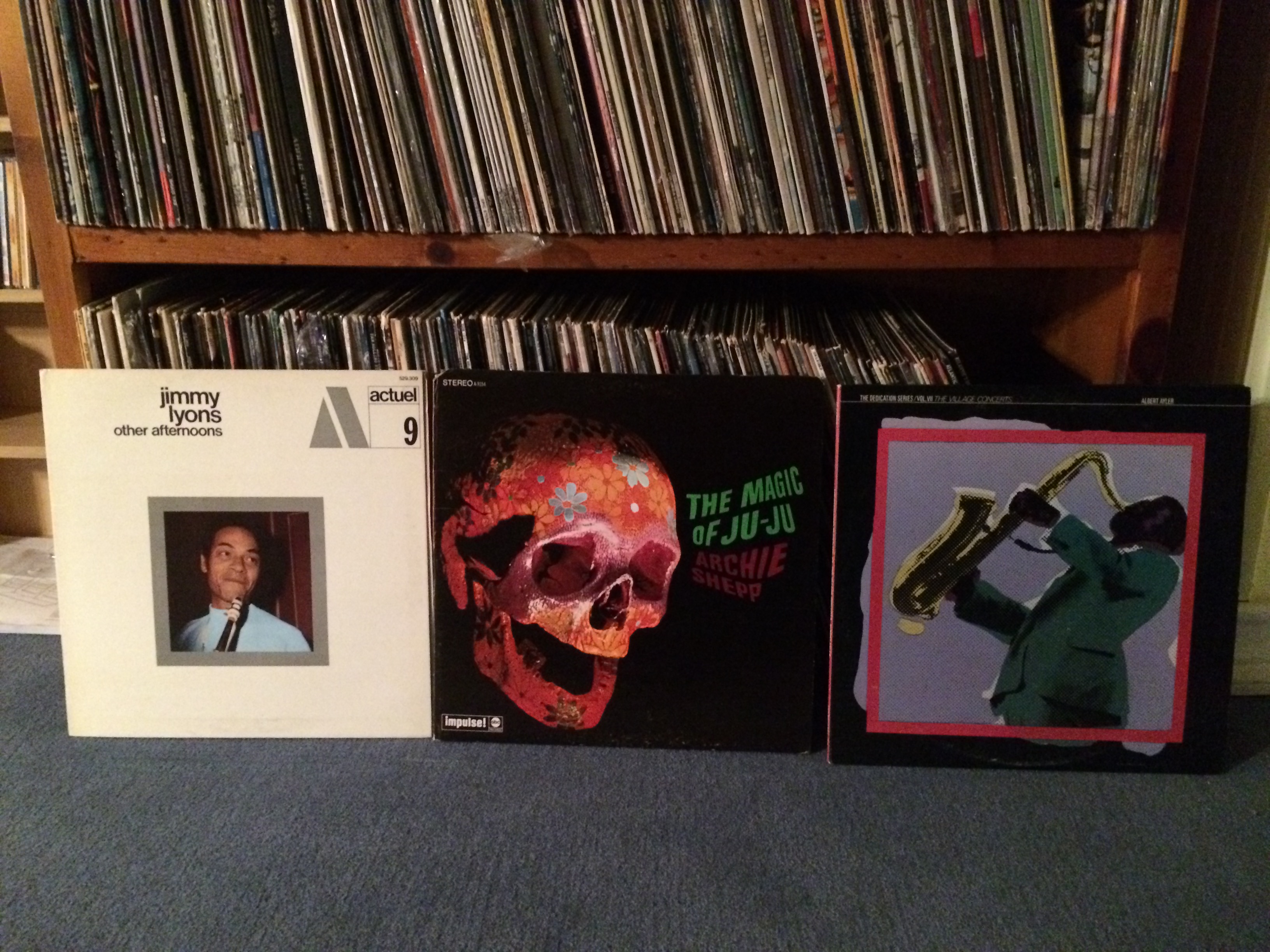
In preparation for each Vinyl Night I head to the basement room where my most prized possession resides: my vinyl album collection. I’ve got a ton of albums. Lots of musical styles. Never got rid of any of them, one of the smart calls I’ve made in life. On the afternoon of this most recent occasion I  walked to the shelves holding the discs and made the selections for that evening’s Vinyl Night. Albums by Jimmy Lyons, Roswell Rudd, Grachan Moncur III, Art Ensemble Of Chicago,  Archie Shepp, John Carter/Bobby Bradford, and Albert Ayler. Household names, no? As always, Dave and I would listen to one side of each album.

The three albums that caused problems. Photographed in bunker before Vinyl Night began.
The three albums that caused problems. Photographed in basement before Vinyl Night began.

Dave arrived around 8:00 PM. Sandy gave him a hug and walked upstairs, not to be seen again for a couple of hours. I placed side one of Jimmy Lyons’ Other Afternoons (recorded in 1969) on the turntable and an evening of fun, then mayhem, began. Jimmy Lyons no longer is with us, but his recordings live on with force. And force is what soon blew through the stereo speakers in my living room. The title track, Other Afternoons, began calmly enough. Didn’t take long however for alto saxophonist Lyons and his cohorts to wail and fly as though demons were on their tails and gaining fast (click here to listen). That’s when Dave and I thought we heard the sounds of wood and plaster creaking a bit more than they should in an old house. We put those thoughts out of our minds.

Several albums later a firestorm hit the turntable, Archie Shepp’s The Magic Of Ju-Ju (recorded in 1967). The title song, occupying all of side one, made Other Afternoons sound like a wimp. Shepp, whose career began in the early 1960s and who is alive and kicking, hit the ground at Usain Bolt speed, screaming on his tenor saxophone for 18 minutes over a drumming cacophony (click here to listen). I was amazed, mesmerized and kind of in a daze. Dave too. That’s the power of Shepp. We definitely heard those creaking sounds again, some rumbling ones also, but put them out of our minds.

The problems became undeniable a couple of albums after Shepp’s. Tenorman Albert Ayler, long gone, went stratospheric at around the six minute mark of Spirits Rejoice (recorded in 1966), which takes up all of side three on The Village Concerts double album (click here to listen). My house couldn’t take it any longer. Plaster started falling from the living room ceiling. The living room floorboards began to buckle and give way. Good things weren’t happening upstairs either. Sandy came running down the stairs. “I really, really hate this music,” she yelled as she and I and Dave bolted out the front door. We stood in disbelief on the sidewalk as Sandy’s and my suburban home dropped to the ground. The house’s descent took a long time and was extremely jarring, just like the saxophone, trumpet and other instrumental solos that Dave and I grooved to on that most infamous of Vinyl Nights.

The next day I called my Allstate agent. I described the bizarre situation to her. She said, “You’re out of luck, Neil. Your homeowners policy specifically prohibits you from playing any free jazz above the 80-decibel level. Allstate isn’t going to pay you a cent. We may be the ‘you’re in good hands’ people, like our logo says, but we’re not fools like you!”

(If you enjoyed this article, don’t be shy about sharing it. Sharing buttons are below)

In Search Of A Story Idea

Funny thing about this blog. When I started it last April I didn’t know what shape it would take or what it might come to mean to me. Shape-wise, somewhat to my surprise, the blog seems to conform pretty well to the template I described in the “About” page. Meaning, I’ve written about this and I’ve written about that, and the articles in toto appear to give a pretty good picture of who I am. Not that I actually know particularly well who I am. Figuring that out would take hours and hours on a psychiatrist’s or other therapist’s chair or couch. “Hey, Sandy!” (note to readers: I’m calling to my wife). “It’s time I found out who I am. Please get me an appointment with a topnotch and nearby mental health professional. Thanks.”

As for what the blog means to me . . . well, it has become a big part of my life. Here I am, almost 12 months forward from the blog’s launch date, and I’m getting a tasty kick from writing. More than 60 times I’ve been inspired to put fingers to keyboard and knock out a story. I haven’t done so much thinking or typing since my school days, back when the dinosaurs were on the verge of extinction. Didn’t know I had it in me.

There is a problem though. To wit, I’m good at struggling to find subjects that interest me enough to write about them. And that are simple enough so that pea-brained me can understand them. Sometimes the well feels awfully dry, causing me to start worrying more than a bit. “What the heck am I going to write about next?” is a question commonly floating in my head. When day after day go by without a pleasing answer, man, the perspiration beads start pooling.

And that’s the situation I find myself in right now. I’ve had a few particles of ideas for stories, but none has swelled to a size that I can grab and knead. Better scribes than I would have turned out excellent articles from those fragments, which is one of many reasons why those writers are better.

IMG_0131
For instance, the other day I was at my volunteer job in a medical office building not far from my suburban Philadelphia home. The building is full of doctors’ offices that are reached via a web of corridors. I man the information desk at this facility one morning each week and have been doing so for six years. I was standing beside the desk. My mind was wandering. Perspiration covered my forehead. “What the heck am I going to write about next?” I wondered. And then something caught my eye. It was a watercolor painting, a large appealing abstract in blue and cream. It was mounted on a wall eight feet in front of me. It had been on this wall for who knows how long. I had seen it every time I’d been at my volunteer job. But I hadn’t  really seen it. I mean, it’s one of those items that you don’t want to become too aware of. If I started fixating on its existence, I’d be glancing over at it throughout my shift. It would become like a song that gets stuck in your head. Such as El Paso, the Marty Robbins tune from 1959 that I’ve been trying unsuccessfully to expel for decades. When Sandy and I were at dinner with our great pals Susie and Mike a few weeks ago, Mike started singing El Paso to me. He’s cruel that way. “Out in the West Texas town of El Paso/I fell in love with a Mexican girl/Night-time would find me in Rosa’s cantina/Music would play and Felina would whirl.” “Stop, Mike, stop!” I cried. And he did. But here I am a few weeks later with those entrancing lyrics and that sweet waltz-time melody still skipping around in my brain neurons. Mucho gracias, Mike. Mucho gracias.

Ah yes, the watercolor painting staring at me from eight feet away. A bell dimly chimed inside my cranium when the notion occurred to me that the watercolor might in some elusive manner lead the way to a story for my blog. Perhaps there were other art works hanging in the corridors of the medical facility. And if so, that would be my story. Namely, one about lovely objects that often surround us yet remain unnoticed and unappreciated.

Is this art?
Is this art?
Is this art?
Is this art?

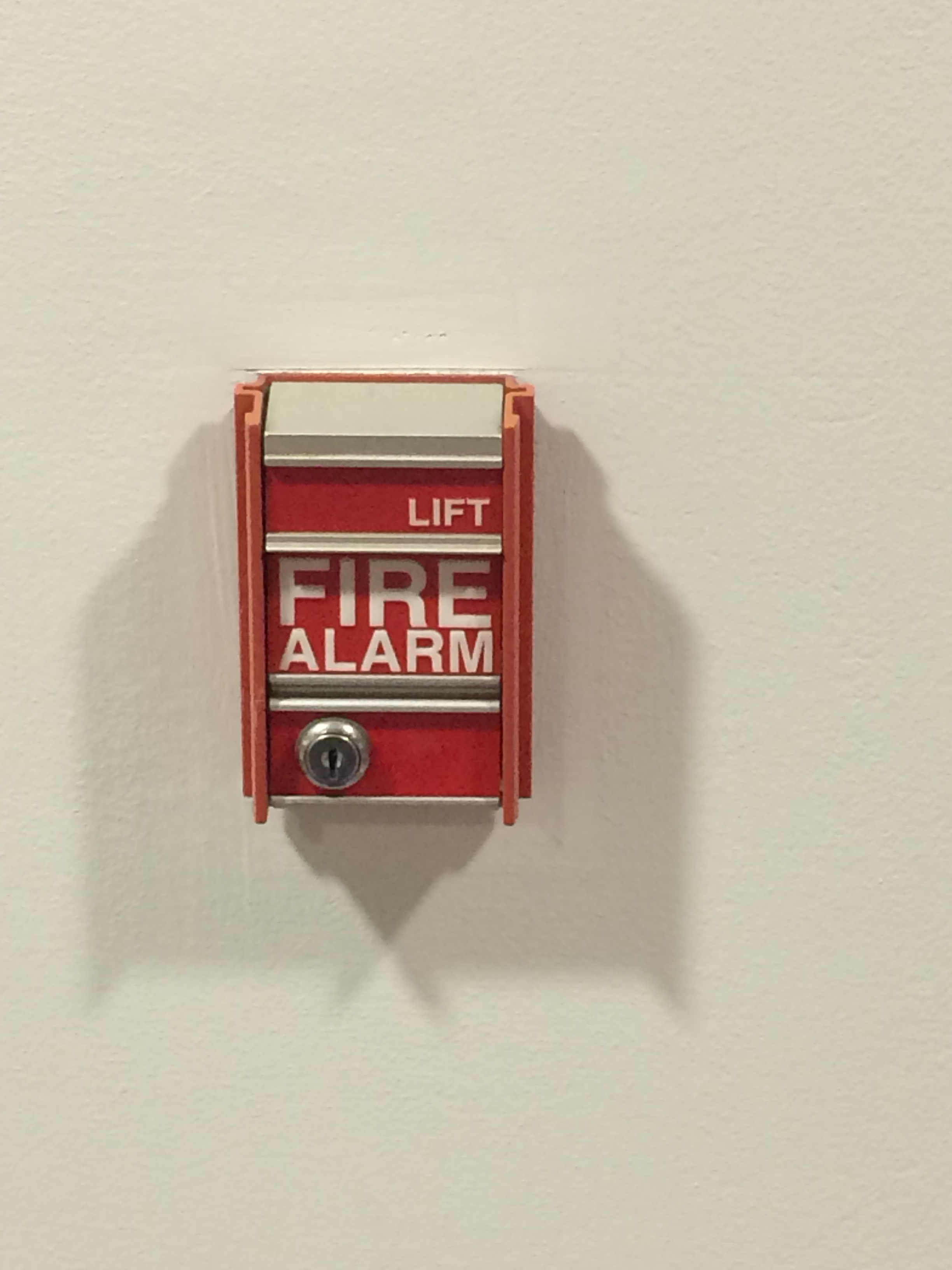
Off I went to explore the three floors-worth of crisscrossing hallways. I’d walked these avenues many times over the years, but looking for art had never been part of my quests. Alas, I came up empty. The blue and cream watercolor was an orphan, the only framed object in the various halls. Not so fast, though. A myriad of things were attached to the corridors’ walls or hanging from their ceilings. Fire alarms, fire extinguishers, water fountains, exit signs, digital thermostats and other utilitarian stuff. Who’s to say that they didn’t qualify as art? If they did, then my volunteer job took place within a veritable museum.

“Yeah, now that’s a story for my blog,” I told myself. After all, in 1917 Marcel Duchamp bought a mass-produced urinal, signed it with a fictitious name and submitted it to a prestigious arts exhibition. And in the 1960s Andy Warhol created large-scale facsimiles of Brillo boxes. Duchamp and Warhol were revolutionary modernists, questioning the nature of art, asking what in fact qualifies as art. If they had held my volunteer job, mightn’t they have concluded that indeed they were working in a museum?

Thus I walked the hallways once again, reexamining the stuff on the walls and ceilings and taking their pictures with my iPhone. And as I did I knew that this story idea led nowhere. Oy frigging vey! Try as I might I didn’t feel any aesthetic or conceptual attraction towards the fire alarms or any of the rest. “You know, as art these things suck big time,” I said to myself.

Soon an idea worth writing about will come to me. I’m confident of that. Sort of. Till then, I’m outta here. Where’s the exit? . . . Oh, here it is. Bye.

IMG_0151

(If you enjoyed this article, don’t be shy about sharing it. Sharing buttons are below)

OJR Will Tour With The Rolling Stones (Keith Richards Assured Me Of This)

My cell phone rang in late afternoon on a recent Sunday. I answered and an unmistakable phlegmy voice said to me: “Yeah mate, how ya doin’? I’m OK. Just sittin’ here in my hotel room watchin’ the telly. Drinkin’ milk, munchin’ Oreos. They go good together, ya know?” It was Keith Richards calling from Sao Paulo, Brazil, where The Rolling Stones had played a show the night before.

“I know, Keith, I know. Every time you call it’s the same old thing. Milk and Oreos. Milk and Oreos. Come on, amigo. Switch it up once in a while. Didn’t you ever hear of Chips Ahoy? Vienna Fingers?”

He guffawed. “I’m hooked, son. I can’t switch. I won’t.”

“Okay, Keith,” I said. “So what’s the scoop? How was the show last night?”

Keith Richards. (Photo by Mark Seliger)

“Cool, man, cool. We had fun. Ya got a minute?” As though I didn’t. Before the phone rang I had been cutting coupons for half an hour. And before that, working on a story idea about celebrities’ genomes that I plan to pitch to Science Magazine, I’d spent 90 minutes meticulously plotting the Kardashians’ family tree. I was pooped. I was ready to have a relaxed phone conversation. “Spill your guts, partner,” I said to my old friend, whom I’d met and instantly bonded with in 1978. This was at a Bingo parlor in Philadelphia the day after a Stones gig in that fine city. Keith’s a Bingo man. He has wandered into Bingo halls all over the world.

“What’s the Stones’ signature song?” Keith asked me. “Ya know, the one we’ve played ten thousand times. The first letter is an S. Here’s another hint. It starts like this: dum dum da da dah da da da da da.”

“Let me guess,” I said “Is it Smoke Gets In Your Eyes?”

“I wish,” my friend said. “I’d like to play that one. I’ll run it by Mick. But I got a problem here, bro. No joke. Every show we hafta play Satisfaction. Last night I almost couldn’t do it. I f – – kin’ hate that song. If I hafta play it again I’m gonna plotz.”

“Relax, chum, relax,” I said. “You’ll get through this. You’re a pro. Drink some more milk.”

“C’mon, pal. I need a boost. Talk to me. What’s good? What’s new and happenin’? Clue me in.”

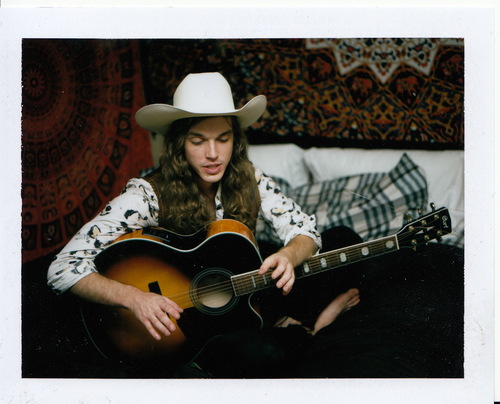
Oliver John-Rodgers. (Photo by David Salay)

“Okay, laddie,” I said. “There’s something really good that I checked out the other day. Great music by a young guy named Oliver John-Rodgers. Calls himself OJR. His YouTube videos have gotten about as many views as my blog articles, which means that just about nobody ever heard of him. But I think that’s going to change. For him, I mean. Not for me. His new album is fantastic. I ain’t Nostradomus, but I predict that he’s going to be big.”

“Hold up, Neil. Someone just tapped on my door. It’s Mick, no doubt. I can tell by the secret knock . . . dum dum da da dah da da da da da. You heard that, didn’t ya? He’s been doing that to me for the last 50 years. Gotta go, compadre. Send me an email about OJR. Peace, brother.”

With that, Keith hung up. Before I’d forget I sat down and composed my message to him. Here’s what I wrote:

Hey, boyo. Thanks for calling. OJR’s new album, Nashville Demos, rocks like a mother lode. Catchy melodies, nifty lyrics, guitar licks that wrap themselves around your brain. He recorded the album in, believe it or not, bedrooms all over the world. I guess he’s sort of a vagabond. Played most of the instruments himself. I found out about him from WXPN, a Philadelphia radio station I listen to sometimes. OJR has a song called Numb, and it’s in XPN’s rotation. The song’s a monster. OJR put the whole album up on his website (Keith-o, click here to listen to the album). And I found a primo YouTube video of OJR and his band playing Numb in a slowed-down head-warping version (Keith, my man, click  here to watch it). That’s all for now. It’s almost 7 PM, my bedtime as I’m sure you remember. Talk soon, matey. Oh wait, one more thing. Please ask Charlie, Ronnie and Mick to look at my blog. There’s a chance they might like my stuff. Peace out.

A few days later, at 8 PM, my phone rang. I’d been asleep for an hour. Thanks, Keith, for waking me up. He was calling from his hotel room in Lima, Peru. The Stones would be on stage in Lima the next night. “Yo, what’s up, cool guy?” he asked. “You were right. OJR is the friggin’ bomb. Best rock and roll I’ve heard since the end of the Ice Age. Or maybe it was the Cold War. I forget. Anyway, the boys and me had our managers get in touch with him. OJR’s a sweet dude, they said. And you know what? . . . We’re gonna have him open some shows for us later this year. Thanks for the tip, Bingo Boy.”

“No problem, Keith. Glad to help. How about my blog? What did Ronnie, Mick and Charlie say?”

There was a long pause. I knew the news wasn’t going to be too good. “Well, buddy, I sent them the link to your blog. Sorry mate, let me tell you straight — slow and snoozy are a couple of the words they used about your articles. What can I say? But I’ve got a great idea for ya. You’ve never written a story about Bingo. I think ya should.”

“Thanks, Keith. Maybe I will.”

(If you enjoyed this article, don’t be shy about sharing it. Sharing buttons are below)

Ruthie Foster, Soulful Singer: Frigid Weather Couldn’t Keep Us Away

It was a dark and stormy night . . . hold on, that line sounds familiar. I think I may have lifted it from someone inadvertently. Wouldn’t want to do that. I’m going to put it into Google and see what gives. I’ll be right back.

Yes, indeed. The sentence was penned about 185 years ago by an English novelist whom nobody alive today ever heard of. In that sense he’s just like me. Let’s start over.

It wasn’t a dark and stormy night. Well, it was dark, but it wasn’t stormy. In fact the sky was quite clear. But it was a bitterly cold Saturday night, no doubt about that. As in 12° F. My wife Sandy and I had just eaten dinner in a tavern we like in the Philly burbs. As we soldiered through the parking lot to our car, the night air laughed in my ear. “Man, you sure are a nitwit for going out in weather like this,” it mockingly said, keeping its voice low so that Sandy wouldn’t overhear. “Didn’t anyone tell you that it’s cold outside?” It’s surprising the things you learn as you get older — before that frigid evening a couple of weeks ago I never knew that the night air could talk, let alone be a sarcastic jerk. I kept my mouth shut, but next time I’ll be prepared with a snappy retort.

Ten minutes later Sandy and I arrived at our post-dinner destination, Montgomery County Community College. It’s located in the once-bucolic town of Blue Bell. Modest in size and scope, MCCC isn’t where one would expect to find a world-class performing arts series, but such is the case. Many times over the years, Sandy and I have seen top-of-the-line musicians and modern dance troupes in the series’ 400-seat auditorium.

It was good getting out of the cold. We settled into our seats at 7:45 PM and awaited the singer whom I’ve known about for a few years but never had seen in person. Ruthie Foster, she who drinks from the wells of blues, gospel, soul and folk music, and who is one of the prides of musically-rich Texas, USA. Ruthie, in her early 50s, is an in-demand artist. She regularly plays in the States, Canada, Europe and sometimes Australia. Let me mention one important point before I forget: Ruthie is a gifted vocalist with a gracious and likeable stage presence. If she passes through your area, and if you enjoy music of the sorts I mentioned above, you would do well to attend her concert.

Ruthie1 IMG_0175
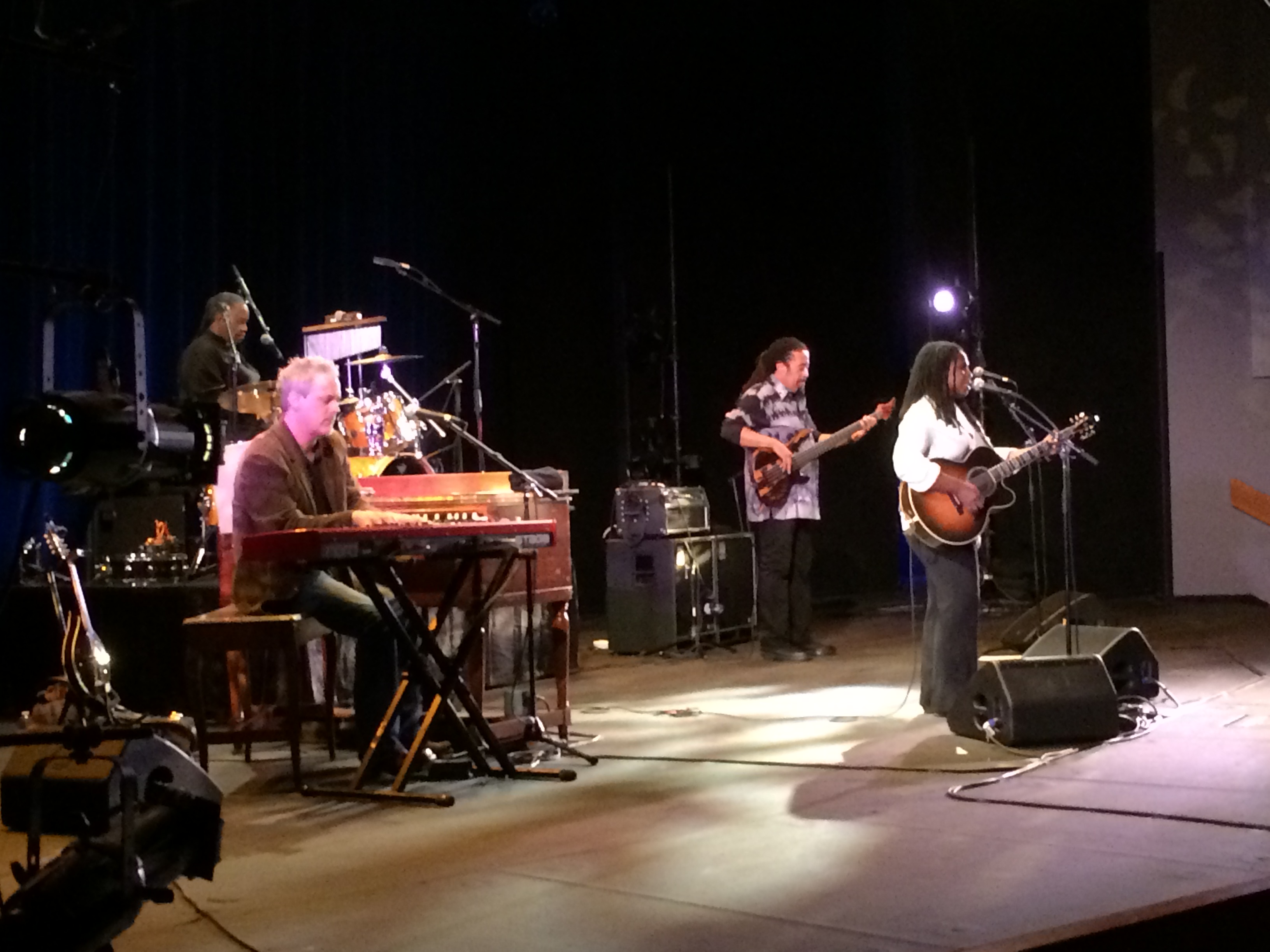
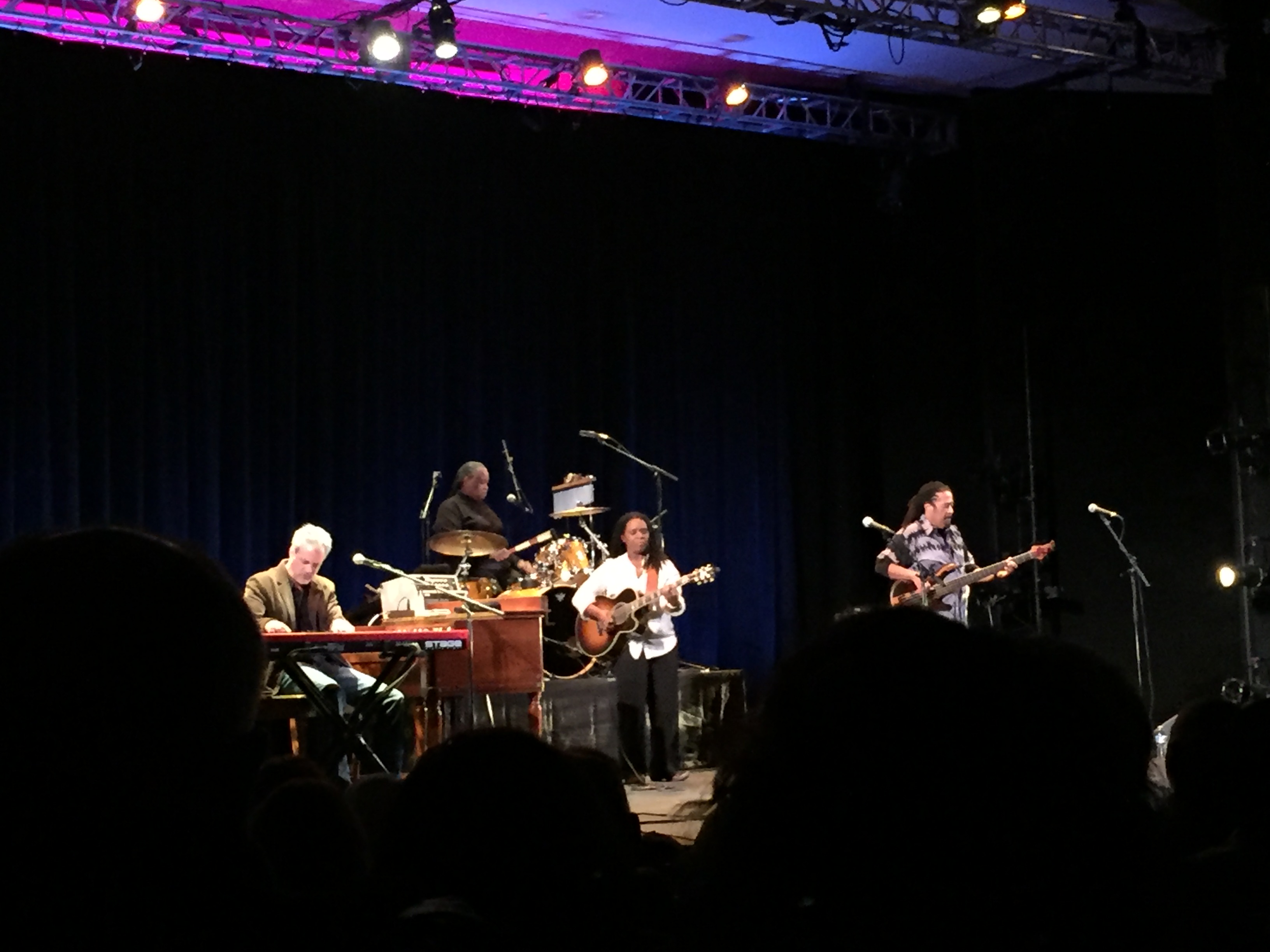
Showtime arrived. Ruthie Foster walked onstage with three musical compadres: Samantha Banks (drums and other percussion), Scottie Miller (piano and organ) and Larry Fulcher (electric bass). Electric guitar was not in the house. Ruthie strummed an amplified acoustic guitar, but she knew her limitations on the instrument and ventured not a solo during the show, leaving most of them to Scottie and a couple to Samantha and Larry. Would the band have gained from having an additional member, to wit a high-flying electric guitarist? No way. His or her absence kept things lean and uncluttered, and placed Ruthie’s vocals at the center of center stage.

The show began with a rendition of Patty Griffin’s When It Don’t Come Easy, a tune about love’s elusiveness. The tight machine that was Ruthie’s band set a perfect rhythm and constructed elastic boundaries over which Ruthie spoke the truth. Bap-bap-bap-bap went Samantha Banks, sure-footed and steady on the drums, as she was all evening long. Larry Fulcher’s bass lines floated here and then there but never lost their way. Scottie Miller pushed and probed on the piano, at the appropriate times sending out blasts of emotions. The band was aware, focused and nimble on this and every song that followed.

Ruthie2 IMG_1246
A few words about Ruthie Foster’s singing voice. It is wonderful, as is the way she uses it. She sings cleanly and clearly, unstrained and vibrato-less, always in control. And she can move easily to a hush or to a soulful barrage of notes. The timbre of Ruthie’s voice often reminded me of Bonnie Raitt’s, but Ruthie’s is fuller and better — Bonnie I’m certain would agree. At concert’s end, 90 minutes from the starting gun, I was convinced that Ruthie is one of the big talents in her field. What’s more, she sings songs that contain real meaning. Songs about tolerance, equality and hope. Such as the concert’s hope-centric third tune, a recent Foster original titled Brand New Day. It dripped with gospel fervor. “Love heals and love lives/And time will reveal a brand new day,” Ruthie proclaimed as her three pals, playing their instruments all church-like, vocally urged her along with harmonized “uh-huh, hoo” after “uh-huh, hoo.” Uh-huh, I loved it.

Let me say a few more things before I hit the “publish” button to post this article. Ruthie has written quite a few songs over the years, but kept her set list heavy with compositions penned by others. She chose numbers, for instance, by June Carter Cash (Ring Of Fire) and Lucinda Williams (Fruits Of My Labor). And she closed the show with  Stephen Foster’s Oh! Susanna, an American chestnut from 1848. (Click here to watch her perform Oh! Susanna two years ago). For that final tune she was alone on stage for the only time during the show. She sang slowly, picking comfortable notes on the guitar. As the song progressed her voice soared effortlessly, poignantly. Oh! Susanna took on meanings that I’d never thought about before. She made a great song greater.

(If you enjoyed this article, don’t be shy about sharing it. Sharing buttons are below)

(Photos by Sandra Cherrey Scheinin. If you click on a photo, a larger image will open)