The Meadow And I

In some ways I envy those who live in or near undeveloped locales. Those parts of Montana or Utah, say, that Man hasn’t messed around with too much. Places whose terrains have been shaped over the eons by seismic events and by the unaltered flow of waters, without the added oomph provided by bulldozers, dynamite and chain saws. Where the growth and spread, or not, of vegetation follow elemental rhythms. And where, if you decide to venture out on a nice, long walk, you’re probably not going to bump into other members of our wondrously meddlesome species. Yes, that would be superb.

On the other hand, I’m a suburban/city boy at heart, ensconced in a comfortable house a handful of miles outside of Philadelphia, Pennsylvania, USA. As such, I like living close to supermarkets and shopping malls and movie theaters and art museums and a lot of the other man-made stuff that this sort of environment contains. But there are times when I’ve had enough. “Let me outta here!” I then cry inwardly. “I hear the call of the wild! I require the presence of forests and/or sands and/or seas. Oh, wait for me, my fair landscapes and coastlines. Soon I shall be among you.”
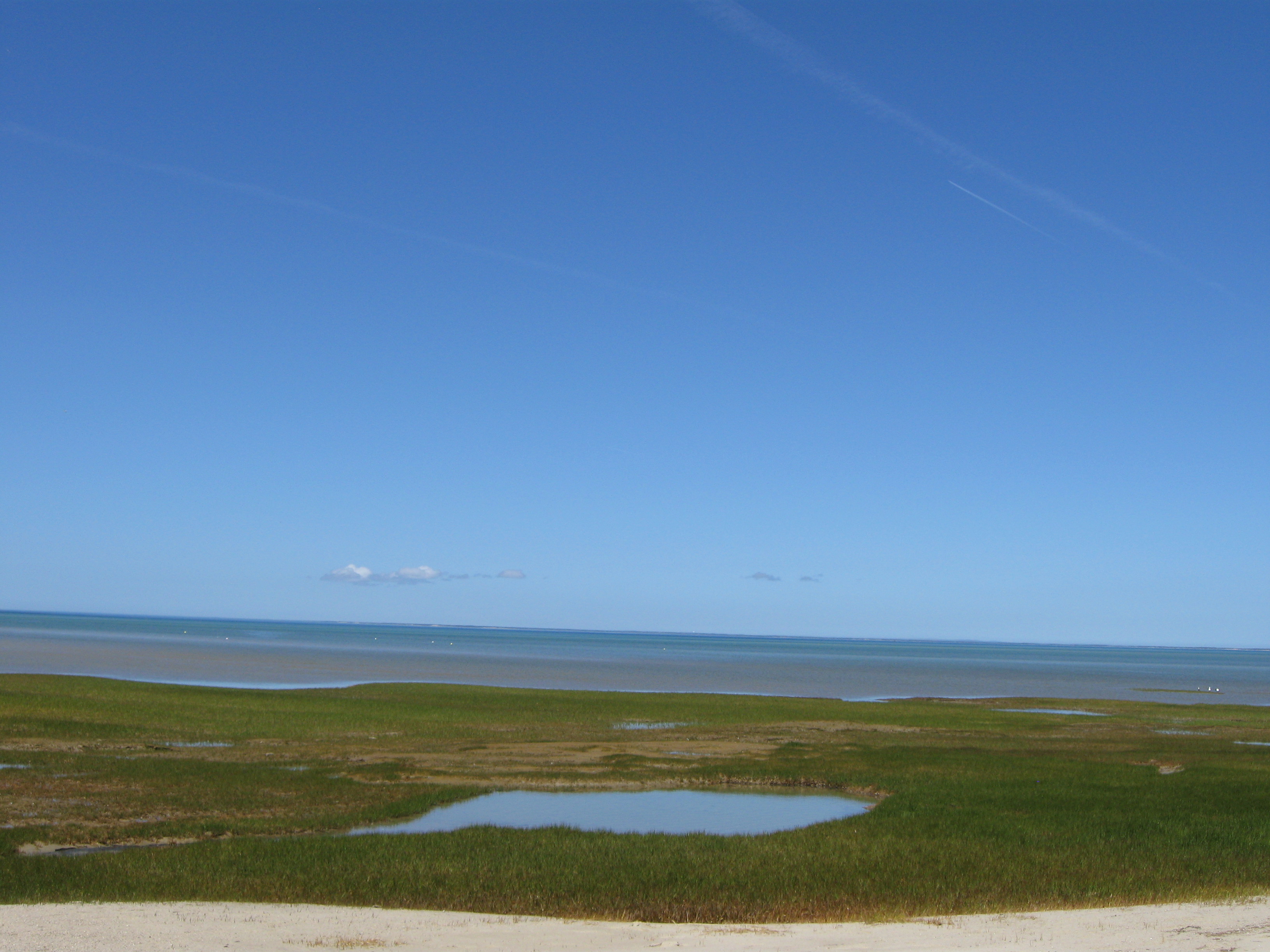
Cape Cod Bay.
Cape Cod Bay (in the distance) at low tide.

That’s when my wife Sandy and I start making plans, rent a house for a decent spell, and a month or so later drive 360 miles in a northwesterly direction to said house on Cape Cod where, miraculously, substantial expanses of Nature in its mostly-undisturbed glory indeed exist. Cape Cod soothes my soul. And has for a long time. But, going to Cape Cod is a schlep and a half. What’s a guy to do on those mornings or afternoons, at home  in the Philadelphia burbs, when a quick fix is in order?

Good question. For picky me there aren’t too many pleasing answers. I mean, there isn’t a lot of natural  scenery around here, in any format, to begin with. Much of what passes for natural are fields and woodlands that have been daintified and picnic-benched. But a few pockets of goodness somehow have escaped humankind’s conquering hands, and one of them, pathetically small as it may be, is where I headed one morning late last month when my inner being began slapping me hard upside the head to let me know it was time to try and commune with Mother Earth.
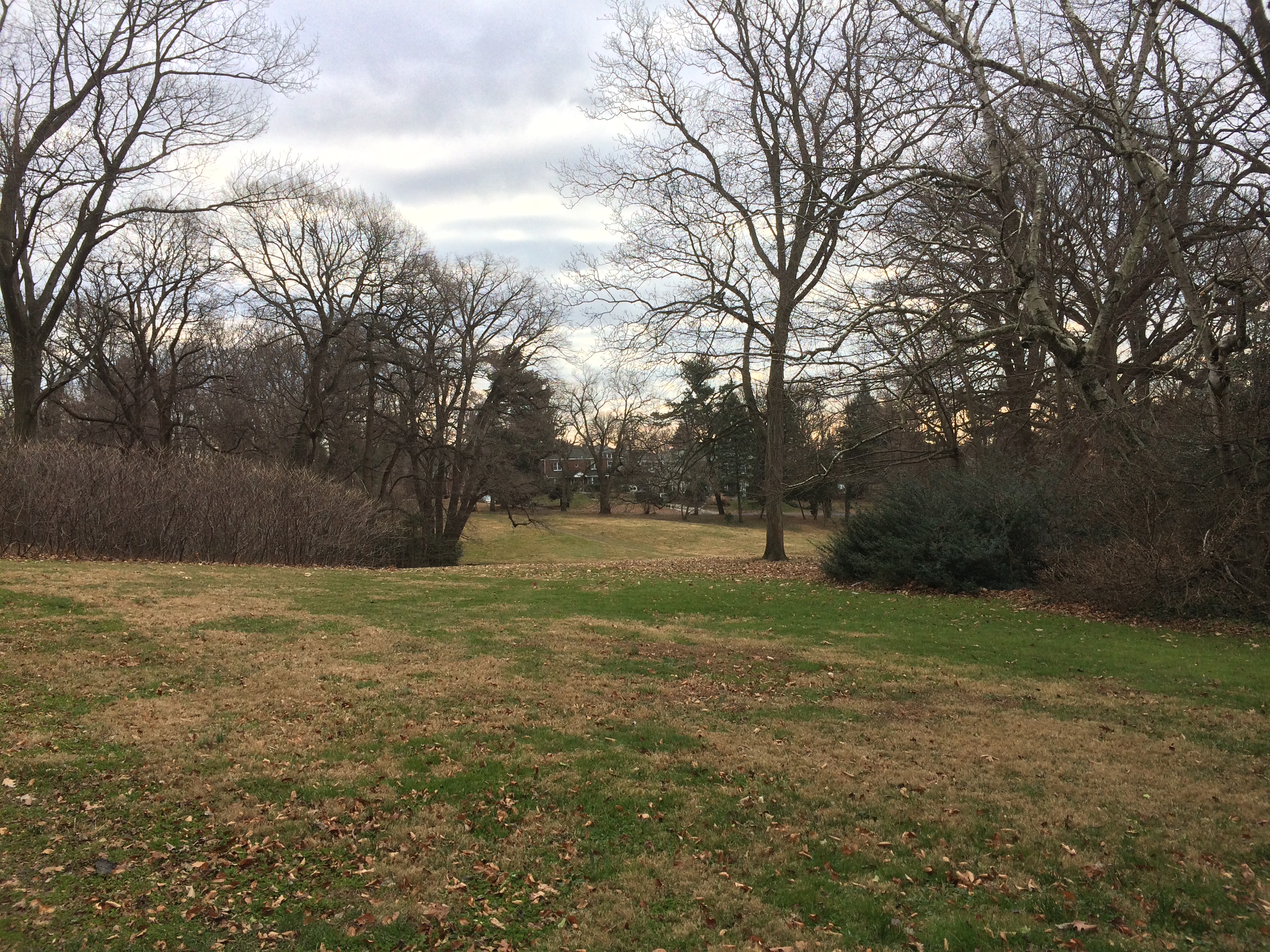
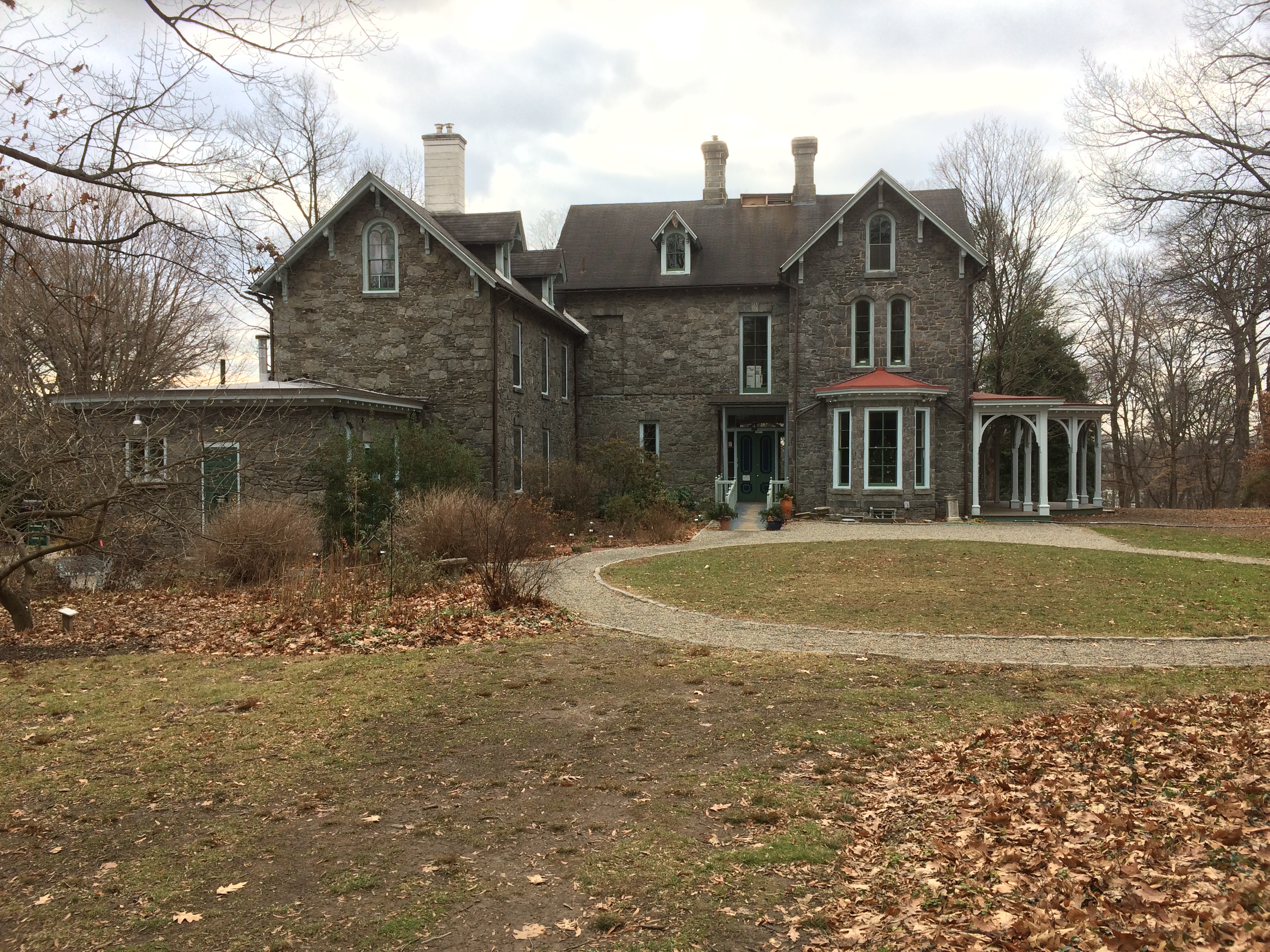
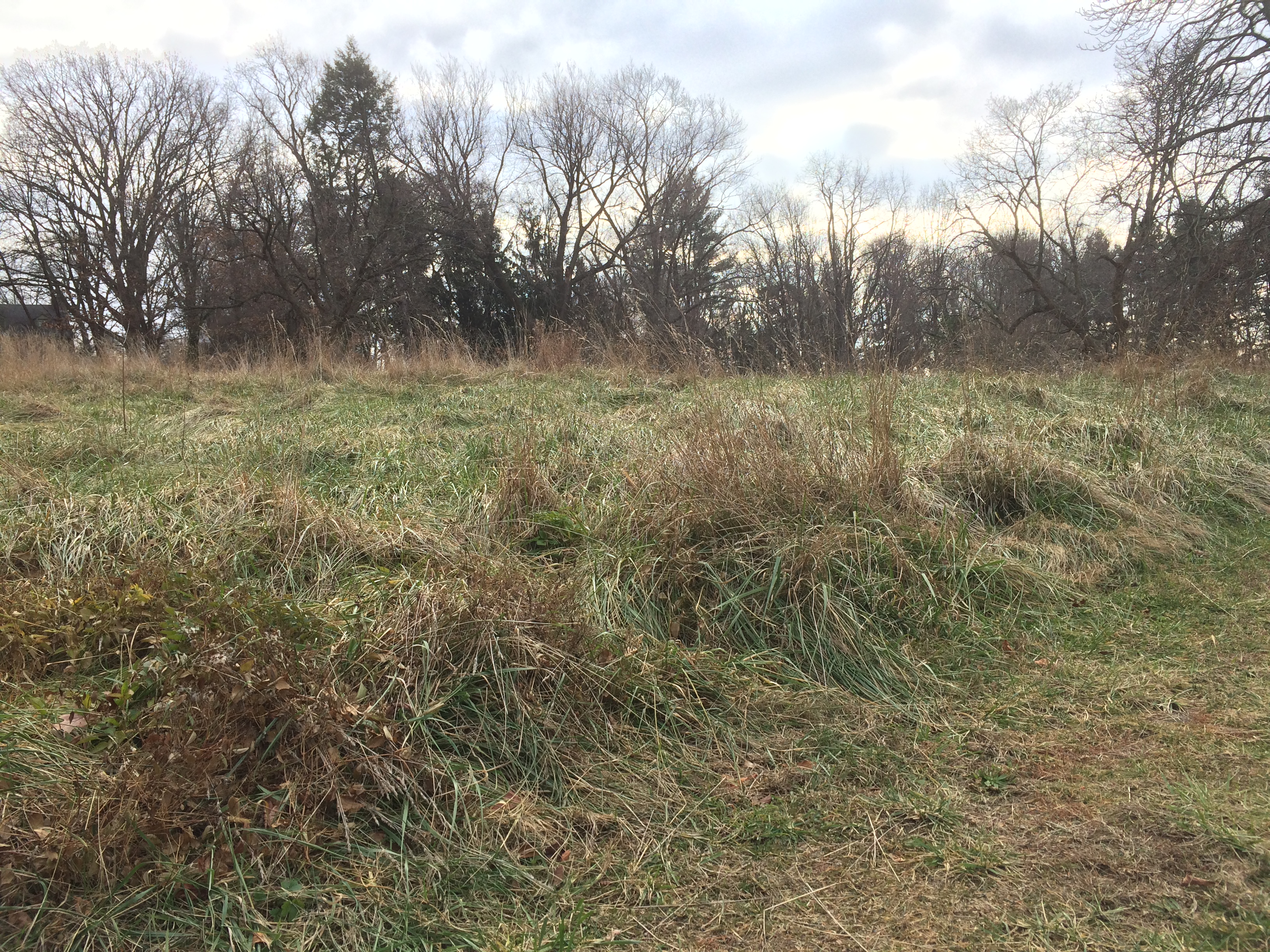
img_1306img_1304Thus, off I headed on a solo expedition to Awbury Arboretum, formerly a private estate now run by a non-profit group, half an hour from my house. This was my third time there. The first two were with my wife Sandy. She and I first heard of and went to Awbury three years ago. It’s in Philadelphia’s Germantown section, a congested residential area with roots that reach back to the late 1600s, and about seven miles from downtown. Little-known and little-visited, that’s Awbury. Which is A-OK with me, not being the world’s biggest people person. We enjoyed that Awbury visit very much, checking out the trees and shrubbery and well-kept lawns, and admiring the mansion that once housed the Cope family (click here to learn more about the arboretum), even though we didn’t set foot on Awbury’s best feature. A few months ago, on our second trip, we discovered that feature, a compact and alluring meadow. Wowza! I was smitten.

What’s the big deal about a meadow? Well, incredibly, this simple form of natural landscape is harder to find in the Philadelphia area than a winning Powerball ticket. Where did we go wrong? Unfettered meadows, where grasses and wildflowers grow freely to their hearts’ content, used to be fairly commonplace around here not all that many decades ago, weren’t they? Bye, baby, bye. What a world.
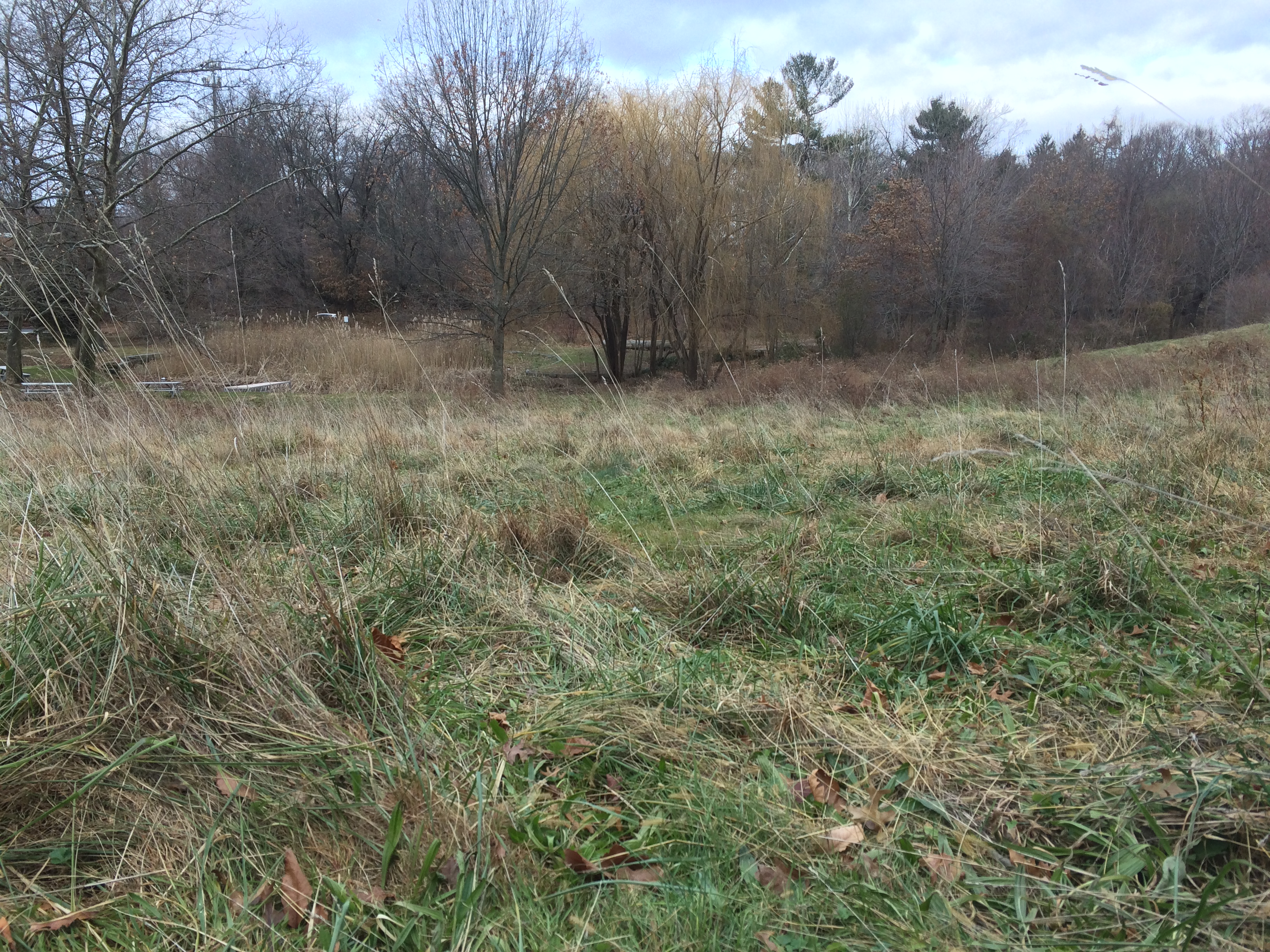
img_1313img_1319Yeah, the Awbury meadow is pint-sized, three or four acres at best. Not exactly the meadow of my dreams. But not only did it have to do last month when the earth goddesses beckoned me to find green space, I enjoyed the heck out of it. I tell you, 20 minutes in the meadow grasses did me a world of good. That’s the thing about meadows: they’re just so cute and inviting. Why, within seconds I dropped 60 years from my age and began doing cartwheels magnificently from one edge of the field to another. Too bad that Simone Biles wasn’t there to witness my athletic triumphs. She’d have been way envious.
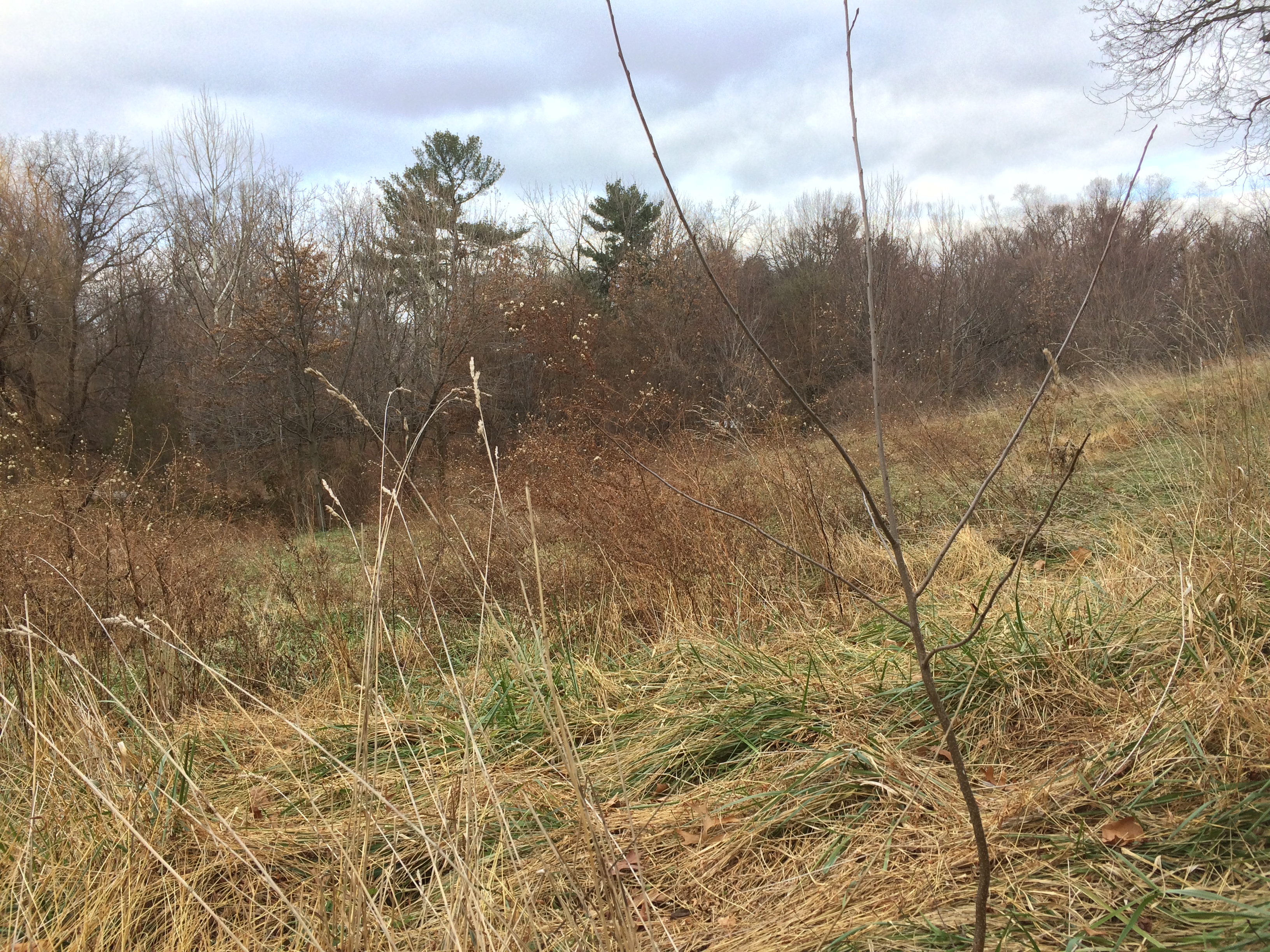
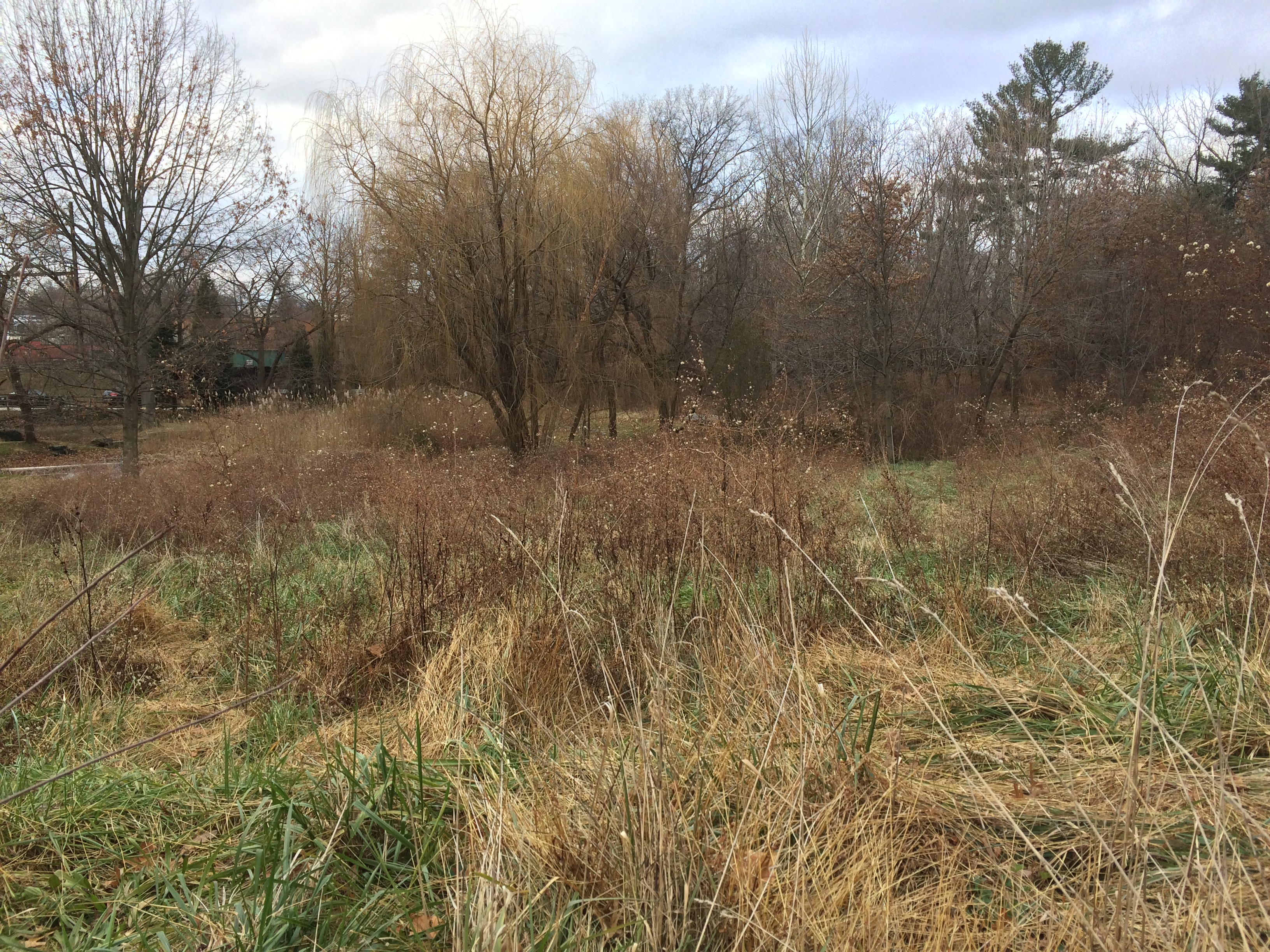
img_1315img_1314But, getting back to reality, let me say this: You better believe it’s the simple things in life — like, strutting through tall grasses and admiring the muted shades of green and tan and sepia that the blades take on in winter — that can help to put your head back on straight. Not that mine remained in proper position for all that long. Though I embraced the Zenlike moments that happily blossomed within me at Awbury, they faded fast. I ain’t a Buddhist monk — not a bad thing to be, come to think of it — so I was almost back to my usual grumbly self by the time I arrived home. No doubt, however, that something sweet yet short-lived is better than nothing at all.


(If you click on any photo, a larger image will open in a separate window)

If (A Musical Story)

a2z_logo_final_social-620x324If, if, if. If only WXPN, a supremo radio station in Philadelphia, hadn’t come up with the idea to play almost 6,000 songs in strict alphabetical order, based on their titles, then I’d never have been flailing around helplessly in the monstrously deep rabbit holes that abound within my cranium. But XPN did, starting at 6:00 AM on November 30 with The Jackson Five’s smash hit ABC (click here to listen), and proceeding around the clock for what seemed like forever. The station finally closed the lid on the affair mid-day on December 17 after airing a song that just about nobody knows, ZZ Top Goes To Egypt (click here), by a band that just about nobody knows, Camper Van Beethoven. A tune with a title that begins with a double Z . . . who’d have thought that an animal like that exists? Leave it to the music worshippers slash obsessives at WXPN to come up with a stunning conclusion to the marathon.

And talk about obsessives. Me, I thought I was done with being one of them. Over the last few decades I’d shed a good ninety percent of my excessive tendencies. Still, backtracking happens, and I found myself being swallowed whole by what XPN was up to. Yeah, I got so involved with the A-to-Z my bodily systems started backfiring. For days I couldn’t sleep, couldn’t eat. Even worse, I didn’t watch my favorite episodes of Duck Dynasty and The Real Housewives Of Atlanta over and over on demand. And not just because I was hopelessly involved in listening to that avalanche of music. Uh-uh. I also had been captured by letters, words, the whole alphabet thing. I was beaming in hard on alphabetic considerations of song titles. Pathetic, man.

I’d never before given more than a cursory thought to the words that song titles begin with or to the patterns that the titles form. Who knew that tons of titles begin with Just, for example? Or that there might be any titles starting with X (such as X Offender, by Blondie). Or that some letters (e.g. T, S and I) are the first letters of an astounding number of song names. Or that one artist (David Bowie) might show up with back-to-back songs (Fascination and Fashion), so tightly are their names alphabetically related.

“What’s going to follow Patti Smith’s Dancing Barefoot?” I frantically wondered during December 3rd’s early moments, unable to come up with the fairly obvious answer that soon hit the air: Dancing Days by Led Zeppelin. And I frantically wondered about countless other minutia throughout the A-to-Z, following along online as XPN posted each addition to its playlist (click here to see the playlist). Letters! Words! Sequences! My geeky and anal ponderings were getting the best of me. I needed relief, blessed relief. Who or what might be my savior?

“Snap out of it, you fool!” my wife Sandy commanded me, eight days into XPN’s extravaganza, as she dumped a pitcher of cold water onto my head. I was seated on the living room sofa, ears glued to the radio. “Thanks, Sandy, I needed that,” I said as the refreshing liquid ran lovingly from my head to my toes. I rose, gave Sandy a well-deserved hug and walked across the floor to turn off the radio. Over the following days I continued to listen to XPN, but in reasonable servings.

I guzzled many hundreds of the thousands of songs that spewed from WXPN’s studios during the festival. Great music abounded, yet one song more than any other brought me up short and went straight to my heart. It’s an oldie that most folks know. And, for reasons unknown, I heard it — no, felt it — much more powerfully than ever I had before.

Many sublime songs (Love Train; I Love Music . . . ) flowed from the minds and pens of Kenny Gamble and Leon Huff, but did any equal or surpass If You Don’t Know Me By Now? No way. Gamble and Huff, two of the progenitors of The Sound Of Philadelphia that soulfully and majestically conquered the world in the 1970s, surely realized that they had created a diamond when the writing sessions for that number reached their end. What a song, its finest version being the 1972 original by Harold Melvin & The Blue Notes. It’s a manifesto about the need for trust and honesty and, more than anything, a declaration of true love. You quiver when Teddy Pendergrass, lead singer for HM&TBN, unleashes pleas robed in frustration. When the rest of the group fills in all the blanks with angelic vocals that cushion and counterbalance Teddy’s hot emotions, you levitate and maybe find a few tears drizzling down your cheeks.

Sandy doesn’t know this yet, but one evening soon I’m going to dial up If You Don’t Know Me By Now’s number, turn the volume to a gentle but firm level and swirl with her around our living room. The song is in waltz time, and even a four-left-footed sloth like me can handle a waltz. Here, then, is the best song I know of whose name begins with If.

Darkened Skies, Beautiful Philadelphia

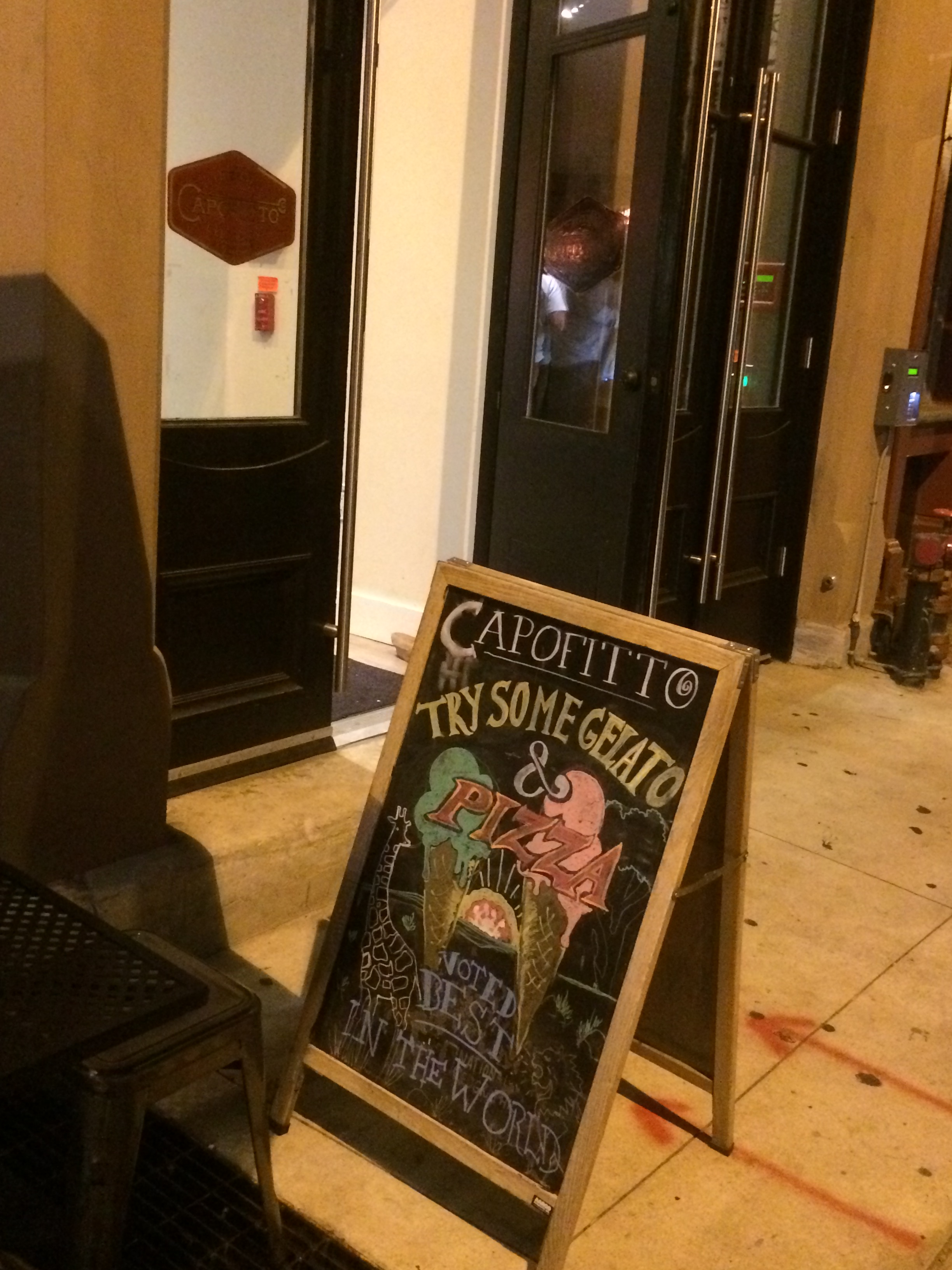
img_0891 At about 8:30 PM on the first Friday of the current month, my wife Sandy and I exited Capofitto, an Italian bistro cum gelato/sorbetto (ice cream/sorbet) store that we like. We’d downed a pizza-centric meal there, capped off with scoops of cappuccino gelato and peach sorbetto. Pretty damn good for sure. Capofitto is in the heart of Philadelphia’s Old City section, whose roots go back powerfully to Colonial days. No doubt the block on which Capifitto resides, a length of Chestnut Street, was trod upon countless times by any Founding Father you can name, not to mention his romantic partner(s), as was just about every Old City block. I find it très neat to think about that. Old City is a cool part of town.

“What next?” we asked ourselves. Should we go back to our home in the burbs? Nah, the night was young. And quite dark, as the Sun had set an hour earlier and neither moonlight nor starlight was apparent to me. Essentially, Old City was being illuminated by electric lights, and in a muted manner. Which I enjoyed. Everything seemed dreamy and atmospheric — the semi-ancient brick buildings, the stone-paved streets. I felt as though I was on a movie set. I asked Sandy if she’d like to go for a walk. She said yes, and off we went down Chestnut Street toward nearby Penn’s Landing, a large swath of Philadelphia’s Delaware River waterfront. The night not only was young, it also was calling. 

img_0894Like the Founding Fathers, Sandy and I have moseyed along Old City’s arteries many times. That’s an activity that doesn’t get old. We keep coming back for more. And this being a night whose effects I actually was paying attention to, which isn’t always the case, I felt myself getting into the scene more than usual. “Holy brotherly love,” I murmured to myself when, half a block from Capofitto, I turned around and saw the huge and perfectly-sculpted United States Custom House, which went up in the 1930s, glowing warmly in its white lights. “That’s gorgeous.” Indeed it was. I snapped its picture, the first of many that Sandy and I would snap as we investigated Philadelphia under darkened skies.

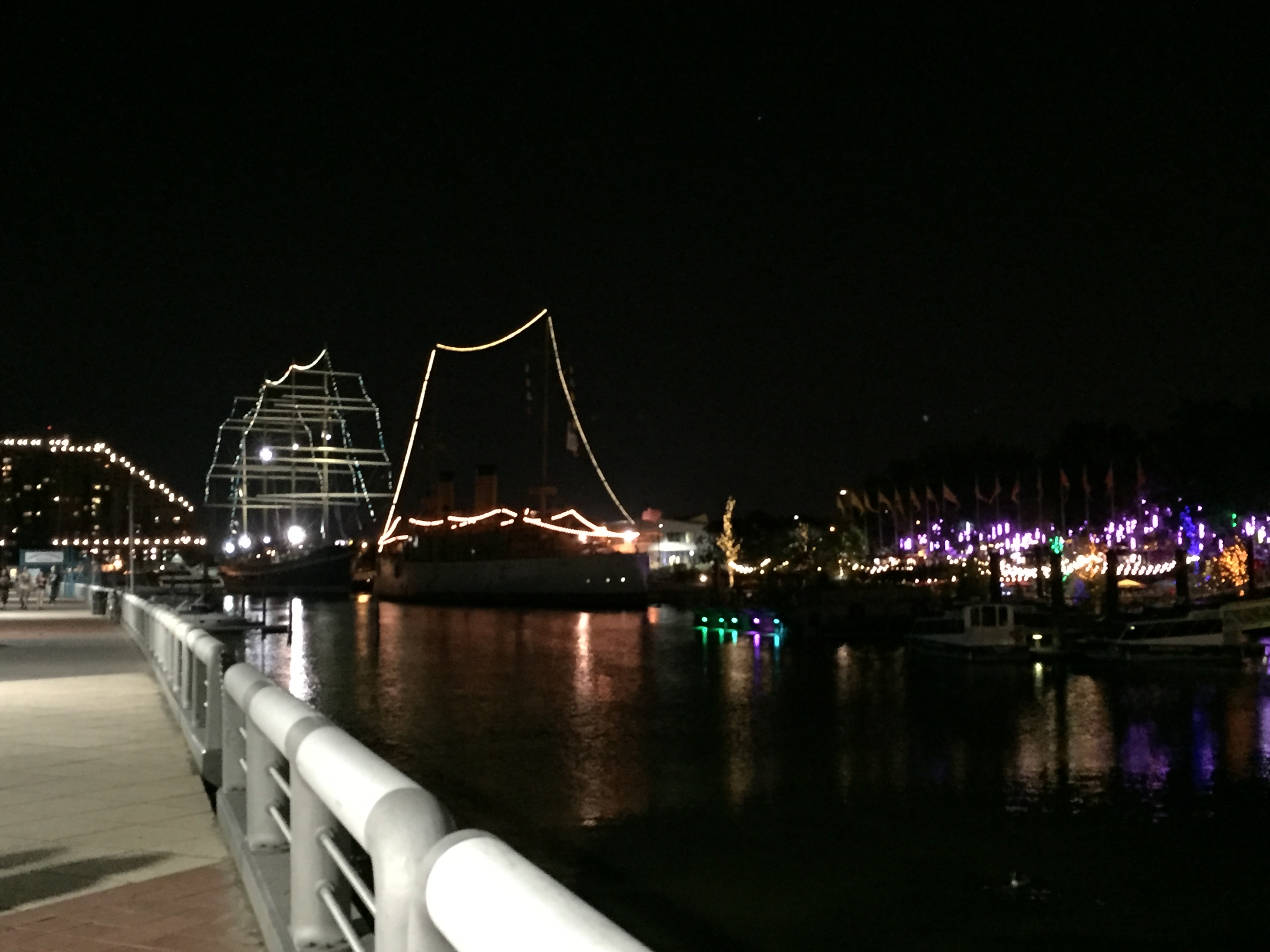
img_1546In a flash we were at Penn’s Landing, a once unassuming and still developing stretch of territory that city officials have been master-planning and trying to force into glorious bloom for over 50 years. To put it another way, the keys to unlocking Penn’s Landing’s full potential as a tourist and city resident draw have yet to be discovered. But it’s getting there, as we shall see. First thing you notice at night when you enter Penn’s Landing near its northern end, as Sandy and I did, is the Ben Franklin Bridge, which connects our nations’ first capitol with Camden, New Jersey. The bridge is massive and grand and, when skies are black, a visual wow. Why? Because years ago someone had the sterling idea to string colorful, Christmassy lights along it. Sandy and I looked at the bridge long and hard and, as on many nights before, we liked what we saw.

The park's LED lights (center right) seen from a distance.
The park’s LED lights (at right) seen from a distance.

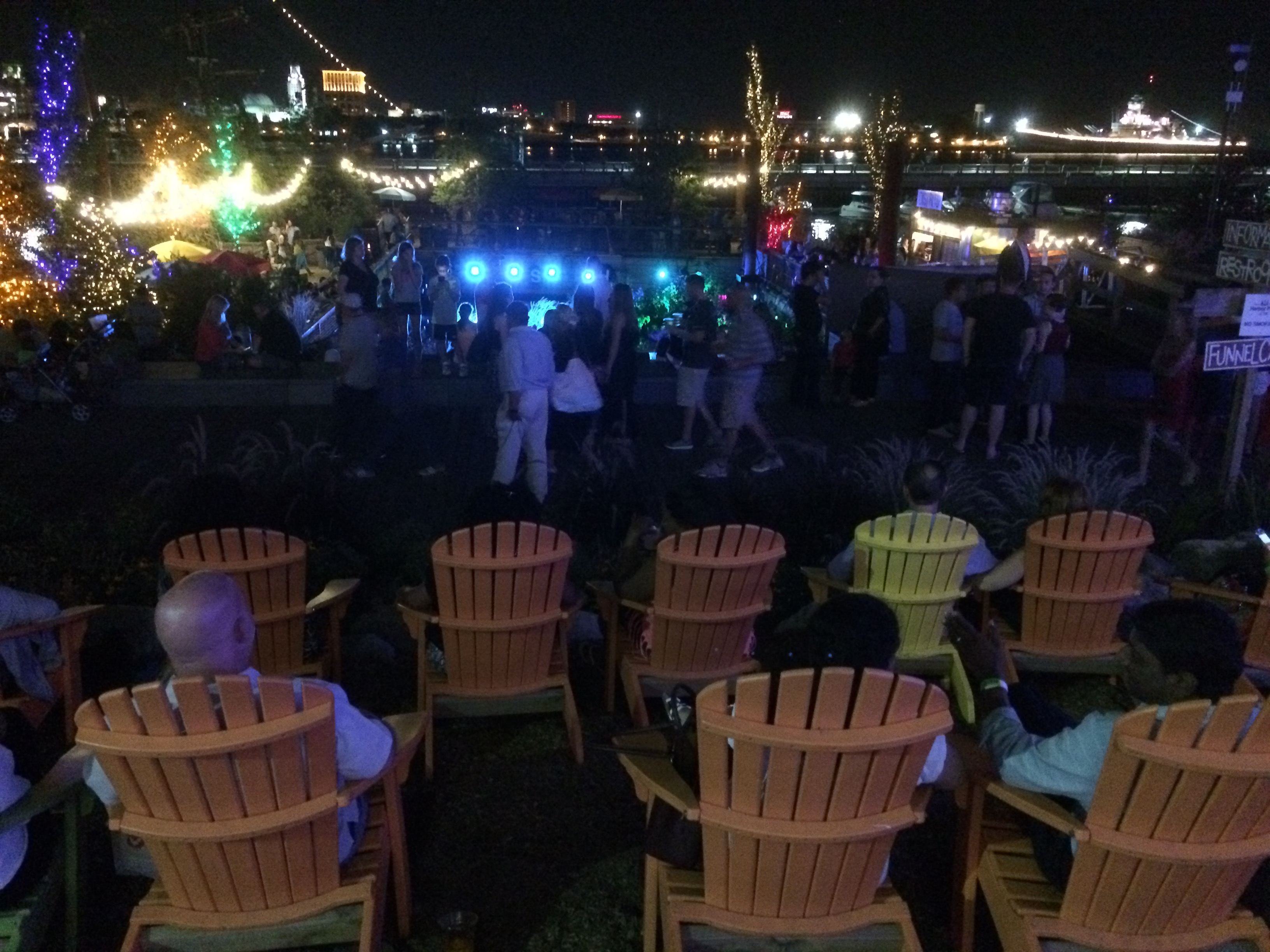
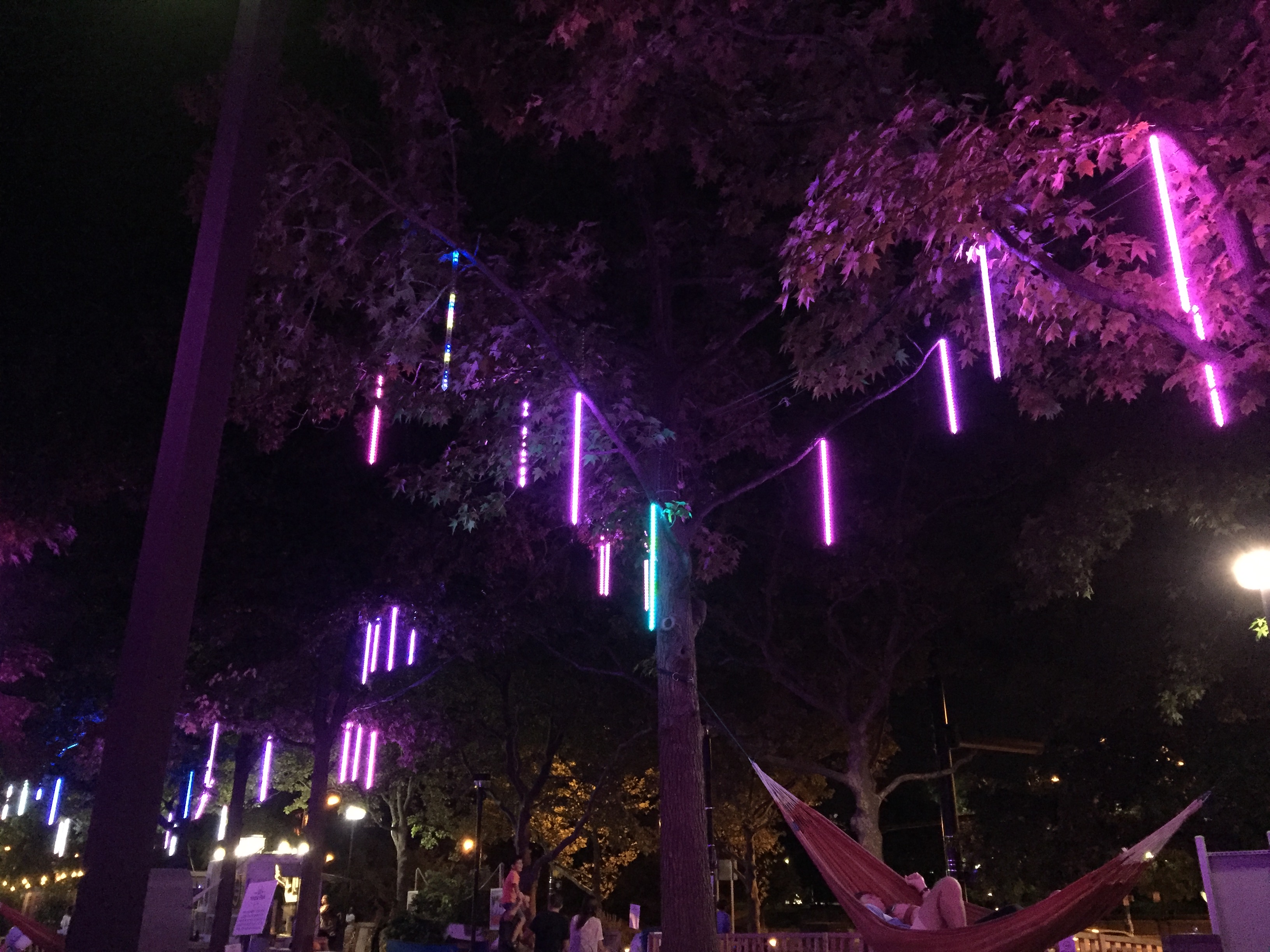
I must have realized this on past visits too, but that night I was taken by the low-wattage illumination in most parts of Penn’s Landing. Just like in Old City. Philadelphia — and I’m all for this — ain’t aiming for a Times Square type of lighting blitz. A feeling of intimacy, I think, is the result throughout most of the city. And that casual, relaxed spirit was true even in the section of Penn’s Landing that the masses have discovered and turned into a destination. I speak of Spruce Street Harbor Park, which drew closer as Sandy and I headed south along Penn’s Landing’s walkways. At night we couldn’t and wouldn’t have wanted to miss it, because the possibly thousands of color-shifting LED lights hanging from its trees were superb and put us under a spell. And we didn’t need to don shades . . . yes, the lights dazzled, but subtly.

img_1552Spruce Street Harbor Park, loaded with things to do, overlooks Penn’s Landing’s marina, which I never used to think much of because I’d rarely if ever notice anything interesting going on within it. And the grounds of what is now the park, which opened for business in 2014, once were as bland and barren as an unbuttered slice of white bread, except for a grove of trees and a monument to Christopher Columbus. That, at least, is the way I remember the area. But all that has changed. Lo and behold, SSHP has become, I’d guess, the most popular place to hang out in all of Philadelphia. The governmental folks who orchestrated the park’s development birthed a phenomenon, a winner that has far exceeded in popularity anyone’s expectations.

img_0926img_0911Designed to have a summery sort of ambience, the attractions at Spruce Street Harbor Park have a limited run each year, though I wouldn’t be surprised if the powers that be are brainstorming ideas that would keep the park open most or all months. Yeah, more is better, guys! This year, SSHP’s season began in early May and will end on September 25. At the very least, why not open the gates in mid-April and close them in mid-October? Sounds like a plan to me. Anyway, the place was mobbed the night Sandy and I visited. With good reason. It has a low-key, breezy combination of things going for it, besides the groovy LED shafts whose color blips rise and fall regimentally.


img_0920img_1557There are hammocks dangling between trees; tables and chairs of different sizes and shapes scattered all around; a boardwalk lined with food shacks; craft beer stands; an indoor arcade; restaurants floating in the marina; a bocce court . . .  you get the picture. Among other pursuits, folks lounged, strolled, stuffed their faces and watched others lounge, stroll and stuff. And played their parts peacefully and politely. The nitwit factor at Spruce Street Harbor Park and the rest of Penn’s Landing and, come to think of it, in Old City, was nil that night. Do hypnotic lights amid semi-darkness induce commendable behavior? I don’t really know, but there might be something to that.


Alas, all good things that first Friday evening, for Sandy and me anyway, came to an end. To a train station in central Philadelphia we eventually proceeded. And, not long after that, at our abode’s doorstep, a mere handful of miles from one of the city’s borders, we arrived.

(Don’t be shy about adding your thoughts, or about sharing this story with others)

(All photos, except that of the United States Custom House, by Sandra Cherrey Scheinin. If you click on any photo, a larger image will open)

Mann Oh Mann: Richard Thompson And Bonnie Raitt In Concert

Philadelphia’s Mann Center For The Performing Arts is a great outdoor concert venue that can be a bitch getting to and leaving from, depending on where you live and what mode of transport you opt to use. The Mann, built into a hilly section of enormous public parklands, is decently accessible for those who reside not too far from it and who visit using foot power or public transit. Not so for just about everyone else. That’s because just about everyone else drives. For them, the traffic jams they usually run into and the post-concert nightmare of trying to exit the parking areas at the same time as thousands of their fellow citizens . . . oy frigging vey, to say the least. In the early 1990s, an incredibly awful Mann traffic experience sent my now-wife Sandy’s and my blood pressures to Guinness World Records levels. And, amid the type of shouting matches in the car that would have made us stars on The Jerry Springer Show, nearly caused us to divorce one another, even though we weren’t even married yet! Shell-shocked, we stayed away from The Mann for eons after that memorable night. Until a week and a half ago, that is, when we learned about a pleasant method of Manning-it, and took in a terrific show.

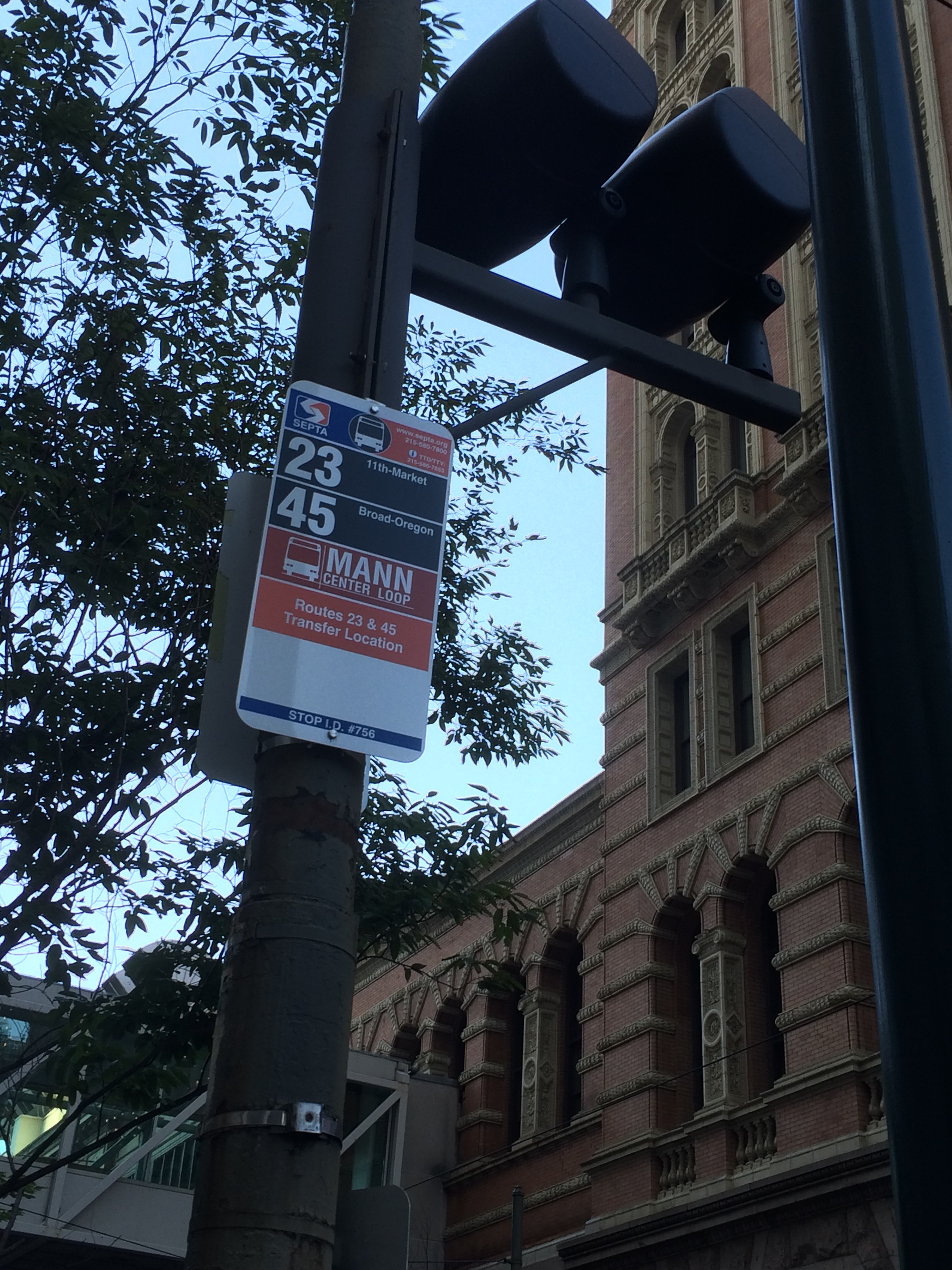
In Philly, we boarded the bus at 12th and Market Streets.

The concert-in-question’s headliner was Bonnie Raitt. The opening act was Richard Thompson. Double bills as strong as this one are not everyday events. Sandy and I were there with our great pals Cindy and Gene. The two couples ended up sitting in different sections of The Mann, but arrived at the scene in the same vehicle. Turns out that SEPTA, the Philadelphia region’s transit authority, runs a dedicated bus on Mann concert nights. Sandy and I never knew about this till Cindy clued us in. And thus we took a train from our home in the burbs to central Philadelphia and hopped on the special bus soon after arriving in the city. Several stops later, Cindy and Gene, Philadelphia residents, hopped aboard too. Mannward we headed. Calmly.

Raitt and Thompson are pushing 70 and, judging from the crowd at The Mann, don’t exactly have a huge fan base among Generations X and Y. Despite this, they can sell plenty of tickets. Between them they stimulated about 6,000 bodies to lay down dough for seats the other night. As opening acts are prone to do, Richard played first. I’ll come back to him soon, but have decided to say a few things now about Bonnie Raitt.

IMG_1540For two hours Bonnie was on stage with her backing band of four (drummer, electric bassist, keyboardist and electric guitarist/mandolin player), a well-oiled and flexible machine. She was wonderful. Bonnie’s music goes down easy and brings together currents of the blues, singer-songwriter, rock, gospel and folk music streams. She is famed for her electric slide guitar work, but to me, to tell you the truth, she seemed not a guitar slinger. And she didn’t emphasize her songwriting efforts. Though she has written or co-written a decent number of songs during  her 48-or-so-year career, she hauled out only two of them (What You’re Doin’ To Me and The Comin’ Round Is Going Through, both from her new album Dig In Deep ) for her 20-song set. What she had going for her, more than anything, was her voice. Warm and natural, Bonnie’s pipes drew the crowd into each song’s lyrics. And, without strain, she belted out whatever needed to be belted out whenever the occasion arose. I held on tight when I knew that high and powerful notes were a-comin’, expecting to be swept up into the clouds. And that’s what happened. Her voice may have burnished oh so slightly since her younger days, but basically Bonnie sings as well as she ever has. Which is saying something.

Take John Prine’s Angel From Montgomery, for instance. This song about a beat-down elderly woman began with only Bonnie and her acoustic guitar. She sang majestically, probing Prine’s chilling narrative. Halfway through the tune the rest of the group entered. Ricky Fataar’s cymbal and high-hat work was simple and quiet and appropriate. George Marinelli’s mandolin solo was sweet. Goosebumps, I think, swelled throughout The Mann, whose audience jumped into a standing O, the evening’s second, at Angel’s end. You will find a recent live version of the song by clicking here.

I have a feeling that most people have heard of Bonnie Raitt, and that far, far fewer know about Richard Thompson, though his abilities are extraordinary and his career long (he was a founder of the British folk-rock band Fairport Convention in 1967). Me, I believe that RT is one of the greatest musical talents among us. What a singer. What a songwriter. What a guitar player. In a fair and just world he’d be a megastar. Poor guy, he has to settle for truckloads of praise instead of ocean liner loads, and for making a really nice living instead of raking in countless millions. Life’s tough.

This is probably the worst photo ever of Richard Thompson, who is on the left.
This is probably the worst photo ever of Richard Thompson, who is on the left. Mea culpa.

Well, if I ran The Mann, BR would have opened for RT, not the other way around. Forty-five minutes of him and his band (Taras Prodaniuk on electric bass, Michael Jerome on drums) weren’t enough. Sandy and I have seen Richard in performance a number of times, and he hasn’t lost a beat. His steely, deep voice cut like a knife at The Mann. His electric guitar playing snarled, jabbed and tunneled into realms so dense he left me in disbelief. During some RT solos, Sandy said she thought I was going to give myself whiplash, what with my head pivoting and swiveling so much. Such as on his piercing song If Love Whispers Your Name, during which he went atomic on his guitar (click here for a version of this tune from three years ago, and note that RT’s long, amazing guitar solo begins at about the 3:20 mark).

Back to Bonnie. She is more than a Richard Thompson supporter. She said to the audience that he is one of her heroes, and brought him onstage in the middle of her set for two songs. In case you were wondering, the guy has a delicate side that adroitly examines life’s heartbreaks and mysteries in some of his quieter compositions, such as 1952 Vincent Black Lightning and Dimming Of The Day. To be sure, Dimming Of The Day is a remarkable creation. When in the correct hands it will stun you. Which is what occurred when Bonnie and Richard, each working an acoustic guitar, intertwined their voices in a heavenly manner and, totally deservedly, received the evening’s first standing O when Dimming’s final notes slipped into the air. A beautiful version, from some years ago, of Bonnie and Richard performing Dimming Of The Day exists on YouTube. By clicking here you will see what I mean.

(Don’t be shy about adding your thoughts, or about sharing this article with others)

I Was Destined To See Israel Nash In Concert, Wasn’t I?

IMG_0842Everything was going smoothly. The train I’d boarded in the suburbs deposited me in downtown Philadelphia at 8:30 PM. Four minutes later the blazing neon sign of one of rock and roll’s heavenly venues, MilkBoy Philly, stared me in the face. I snapped its picture. Then I entered MilkBoy and climbed the stairs to the second floor music hall. A band was playing, undoubtedly the opening act. They were loud, man, loud. I stopped two stairs shy of the top and took in the scene, the little of it that I could make out. The place was so dark my eyes would’ve performed no worse in the dead of night in Amazonian jungles. One light, the only light anywhere near me, turned towards me. It was attached to the forehead of the keeper of the gate, the guy who used the light to check IDs and sell tickets at the top of the stairs, and maybe to do some mining in his spare moments. I couldn’t make out his face or body. “How’s it going? Didya find any promising coal seams tonight?” I almost started to say, but decided against it. In half an hour or so, no doubt, I’d be watching Israel Nash in concert. Destiny, which had begun spinning its threads five weeks earlier, was playing out. That’s a swell word, isn’t it? Destiny. How sweetly it rolls off the tongue.

Here’s where this little saga began: On the final night of our stay in Amsterdam in June, my wife Sandy and I had dinner in a great, intimate place named Tomaz. A gastropub is what we’d call it in the States, but I don’t know if that term is used in The City Of Canals And Marijuana. Hardly matters. Sandy drank wine, I downed a couple of beers, and we each had a steak dinner and, for dessert, a chocolately, moussey concoction. A delicious meal. Our waiter was the bistro’s owner. I didn’t ask his name, but maybe it’s Tomaz.

Anyway, Maybe It’s Tomaz is a music lover. Has been for decades, like me. As soon as Sandy and I sat down I was taken with the song playing in the restaurant. I commented on this to MIT. “That’s Israel Nash,” he said. The tune was the type that will carry you away on a long, spacey ride. MIT purposely had programmed it, via Spotify, because, as MIT told me, the music he liked best these days are the dreamy, atmospheric sorts that emerge from various just-so combinations of country, folk, rock, blues and sometimes other styles. And he mentioned two more practitioners of the amorphous genre whom, as with Nash, I’d heard of but knew next to nothing about: Harry Manx and Jonathan Wilson. MIT played multiple tracks by all of them for my listening pleasure. Between bites and between conversation with Sandy and MIT, I half-listened to the songs. And eventually Sandy and I bid our music-drenched host our adieus.

Back home in the States I did some barebones research into Messieurs Nash, Manx and Wilson and checked out a handful of their tunes on YouTube. What I heard sounded very good (click here and here and here for the smallest of samples). Perhaps I’d get to see one or more of them on stage some day. That would be nice, I thought. And then my short attention span kicked in and I moved on to other important topics, such as pondering how many new varieties of Cheez-Its I might give a whirl, and whether my shampooing regimen needed an update.

I should have seen it coming. A few weeks ago, checking out a local music website, the name Israel Nash jumped out at me. Good gawdalmighty, he would be at MilkBoy in three days, it indicated. And when, in the blink of an eye, the third day arrived I looked at MilkBoy’s website to see when the show would begin. The site said 7 PM. What? The last time a show began that early at a rock club was . . . well, never. Must be a misprint. I called MilkBoy for clarification. No answer. Called again and again and again. No one picked up. It figured.

But I had a good feeling all along. It wasn’t by chance that five weeks earlier I had heard, for the first time ever, a song by Israel Nash. And in a foreign land, no less. Some elusive guiding force had befriended me that night in MIT’s restaurant and was leading me to the proper culmination of the storyline. I was meant to see Israel Nash in concert. At MilkBoy.

“Who’s this? The opening act?” I inquired of the gatekeeper. The light attached to his forehead was tremendously focused. Only a few strands of illumination were able to make their ways sidewards. But those faint rays revealed to me that MilkBoy was incredibly packed with human bodies. That night, the phrase Standing Room Only didn’t apply. Standing Room Nearly Impossible did. Not only that, the air was thicker than thick with perspiration and other inspired body odors. Any high school gym’s boys’ locker room smelled a lot better.

“No, this is Israel Nash,” said the man with the light. “He has only half an hour left in his set. Do you have a ticket?”

“Uh,” I mumbled, and turned around. Down the stairs I went.

So, what’s the thrust of this story? Is there a moral? Something to be learned? Well, those questions usually are pretty much out of my league. I’m not all that bright. However, I have a half-decent answer in this case: When destiny appears to be knocking on your door, do what the man with the light would do — check its ID.

(Don’t be shy about adding your comments, or about sharing this article with others)

The Day My Father Went Eye To Eye With Van Gogh: In Memory Of My Father

Since April 2015, the month in which I began to blog, I’ve written tens of thousands of words on these pages, a fact that pretty well blows my mind. I doubt if I churned out that much product during my high school and collegiate careers combined. Luckily I’ve enjoyed doing the writing, and plan to keep on truckin’.

As Father’s Day 2016 approached I wondered what new article, in memory of my father, I might compose. After some thought I decided to republish the essay that I penned for last year’s Father’s Day. It is titled The Day My Father Went Eye To Eye With Van Gogh. There’s something about this story that gets to me. I hope it will do the same for you, whether you’ve read it before or not. Here it is:


My father came to live with me and my wife Sandy in Philadelphia soon after his 90th birthday, in 1999. He had been living alone on Long Island, but health issues necessitated his relocation. Good doctoring in the Philadelphia suburbs improved his physical condition quickly, but there was no cure for the declining state of his kidneys. He became a dialysis patient one year after he moved in with us, and he remained on dialysis till his death in 2005 at age 96.

My father was in pretty good shape until the final nine or so months of his life. He loved getting out of the house and joining Sandy and me and others at restaurants, concerts, museums, you name it. On this Father’s Day I’ll relate one incident that I look back on fondly. It was the day that he and I and my brother had a private viewing of a rarely-seen Van Gogh oil painting at the Philadelphia Museum Of Art.

There are several purported photographs of Vincent van Gogh. None are totally authenticated. This is believed to be from about 1886.
There are several known photographs of Vincent van Gogh, though they are not fully authenticated. This photo is believed to be from about 1886.

Vincent van Gogh is one of my two favorite artists. The other is Paul Cézanne. I never can decide which of the two I like best. For wordsmanship, however, I go with Vincent. In spring 2001 I read all 800+ of his mesmerizing letters, in their English translation. My father got a kick from this. He told people that I was becoming a Van Gogh expert, which was hardly the case. But my semi-obsession with Van Gogh was rock solid, and it is here that the story really begins.

One day in January 2002 I poked around some Van Gogh websites and discovered that the Philadelphia Museum Of Art, which Sandy and my father and I frequented, owned five Van Gogh oils. Yet, I had never seen more than four of them on display there. The painting that I wasn’t familiar with was Still Life With A Bouquet Of Daisies. Most experts believe that Vincent painted it in summer 1886, a few months after he moved to Paris to live with his brother Theo and to contemplate the new techniques and perspectives, most notably those of Impressionism, that had been invigorating the French art scene. Why wasn’t the painting on display? I needed to know.

A few days later, from my desk at work, I dialed the museum and got connected to an assistant curator. I asked about the mystery painting. She told me that the museum did occasionally bring it from storage to the public galleries, but that it had been a long time since that had happened. We chatted a little and then I said thanks and was about to hang up. But before I could the curator asked “Would you like to see it?” Huh? Huh? I couldn’t believe my ears. Yes ma’am, I would.

My father was about to turn 93, on January 19, 2002. A few days before that, to help our dad celebrate his birthday, my brother Richard planned to fly to Philadelphia from his California home. I explained this to the curator and asked her if my brother and father could come along with me (Sandy, chained to her job, wasn’t free to get mid-day time off from work). Sure, she said. Fairly stunned, I set the date for Friday January 18, a non-dialysis day. I knew that something special had just occurred.

The momentous day arrived. We drove to the museum and were met in the west wing by the curator. She was a lively and lovely person and probably was getting as big a charge out of the situation as anyone. Down an elevator we all went to one level of the museum’s cavernous underbelly. We followed our hostess along a long corridor, walking past many locked rooms. At our consecrated storage area she unlocked the door and we entered. Perpendicular to one of the room’s sides were very large moveable display panels. All of them were in their retracted positions. The curator pulled out one of the panels, both sides of which were covered with paintings, maybe 20 per side. I noticed a Chagall on the side facing us. Can’t recall what else. Except of course for a work near the left edge on the top row. The Van Gogh.

Still Life With A Bouquet Of Daisies. Philadelphia Museum Of Art
Still Life With A Bouquet Of Daisies.
Copyright Philadelphia Museum Of Art

It was show time. The curator wheeled over a tall moveable step ladder. Richie and I went up first. What did I make of Vincent’s oil? Well, Still Life With A Bouquet Of Daisies doesn’t have the brilliant color schemes that Vincent was developing in Paris. It is dark, with lots of deepened greens. Maybe that’s why the museum doesn’t bring it out of storage too often. But they should. With Vincent, there’s always something to admire. I took in his trademark broad brush strokes, the intense tangles of flower stems. The greens upon greens.

Richie and I and our benefactor were excited and happy for my father when his turn came. My dad was excited and happy too, a muted gleeful smile on his face, his eyes on alert. I’m sure he knew how lucky he was to do what he was about to do. Holding the ladder rails carefully, up he climbed. Admirable mobility for a guy one day away from the big 93. He gazed at the painting for a good long spell, longer I think than my brother or I had. He spouted words of admiration. He was having a ball. Finally he came back down. Thank you, thank you, thank you we said to the wonderful curator.

Over the following years, my father and brother and I talked about our museum visit many times among ourselves and with friends and relatives. Always with a grin. Always feeling a tingle. And so, I dedicate this Father’s Day essay to Hyman Scheinin, he whom I’m sure is the only nonagenarian ever to climb a step ladder to go eye to eye with Van Gogh.

(Don’t be shy about adding your comments, or about sharing this article with others)

Porchfest: A Very Good Idea

Good ideas . . . some people get ’em like crazy. Others, not so much. I’m near the bottom of the barrel of the latter grouping. I had a good idea about 50 years ago, when it dawned on me that grilled cheese and tomato sandwiches might be improved upon by adding a schmear of Gulden’s spicy brown mustard. Genius visited me that day, but hasn’t made an appearance since. Such, as we know, is life.

Which smoothly brings us to a remarkably good idea that some folks came up with nine years ago: a neighborhood outdoor music festival called Porchfest. When I first heard earlier this month about Porchfest’s existence I smacked myself on the forehead and said: “Yo, cowboy. This is so obvious. How come you never thought of it?” And then I remembered once again that, sadly, genius ain’t no friend of mine.

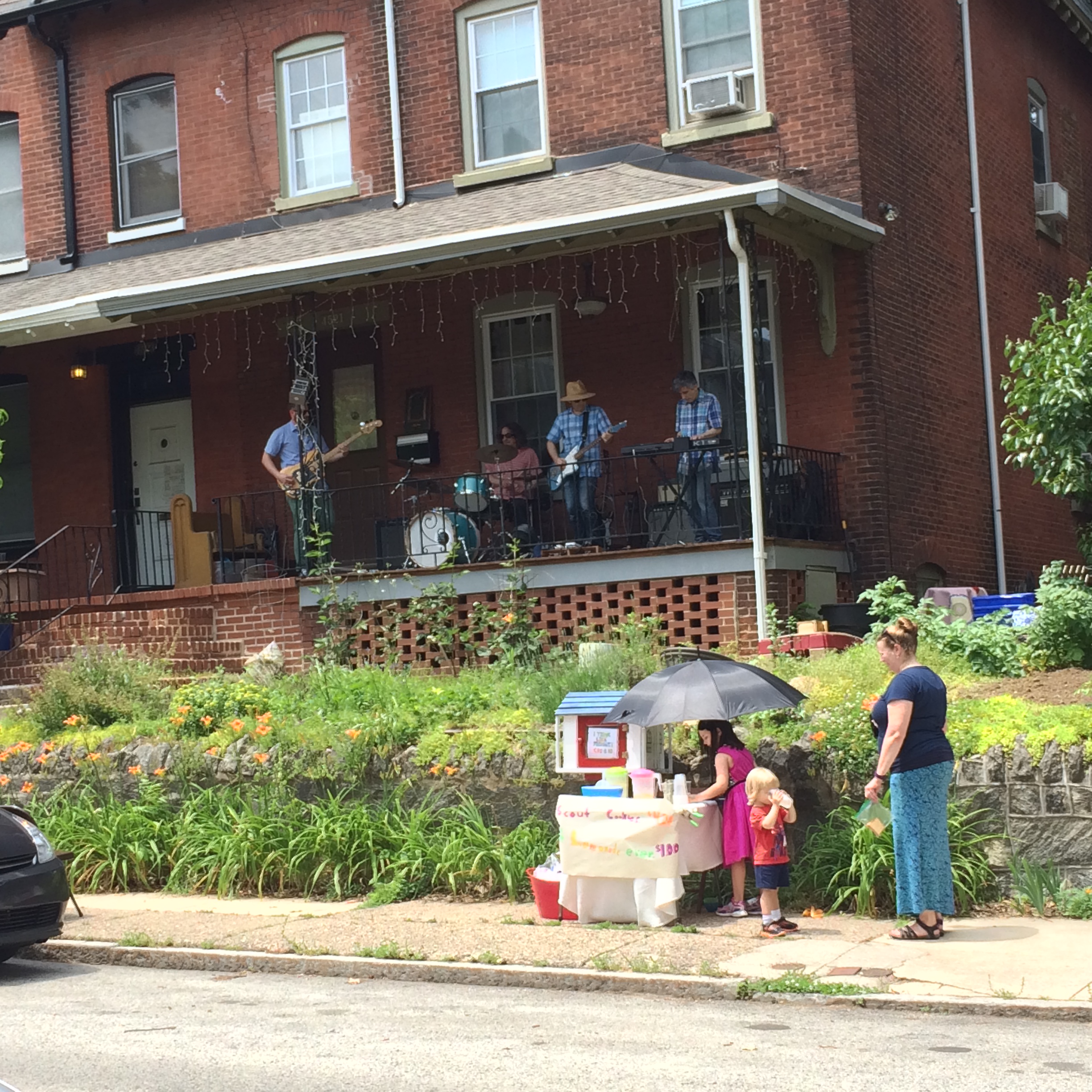
What’s a Porchfest? Well, it is a day of music played on some of the porches of a porch-heavy community. The shows are free to the public. What could be better? After all, porches, when you think about it, are small covered stages easy to get close to, making them perfect for intimate musical experiences. All that a Porchfest organizing committee need do is convince a bunch of homeowners in a neighborhood to allow musicians to play at their houses, and find a bigger bunch of musical acts to climb aboard. Then you set up a schedule so that audience members know the addresses of the porches, and encourage said listeners to roam from site to site, the better to get a big dose of vibrations.

The first Porchfest took place in 2007 in Ithaca, New York. Since then, musicians and music lovers throughout the USA, and in a few Canadian cities, have picked up on the notion and staged their own Porchfests. Each Porchchfest is independent of the others and, I’m pretty sure, is a low budget and DIY type of operation. But watch out! The power of Porchfests is undeniable and irresistible. As a few more years go by, I predict that Porchfests will cross the oceans and conquer the world!

Darlington at West Philly Porchfest.
Jon Veit at West Philly Porchfest.

Which even more smoothly brings us to a recent Saturday in a section of West Philadelphia (part of The City Of Brotherly Love) that contains scads of old and sturdy rowhouses and twins in possession of porches. As ideal a location for a Porchfest as any on our planet. And where, indeed, the first West Philly Porchfest took place, the baby of a group of organizers who recognized that the Porchfest idea was very worth pursuing. (Lots of info about West Philly Porchfest’s genesis and design may be discovered by clicking here and also here).

I Think Like Midnight.
Emily Zeitlyn.
Emily Zeitlyn.

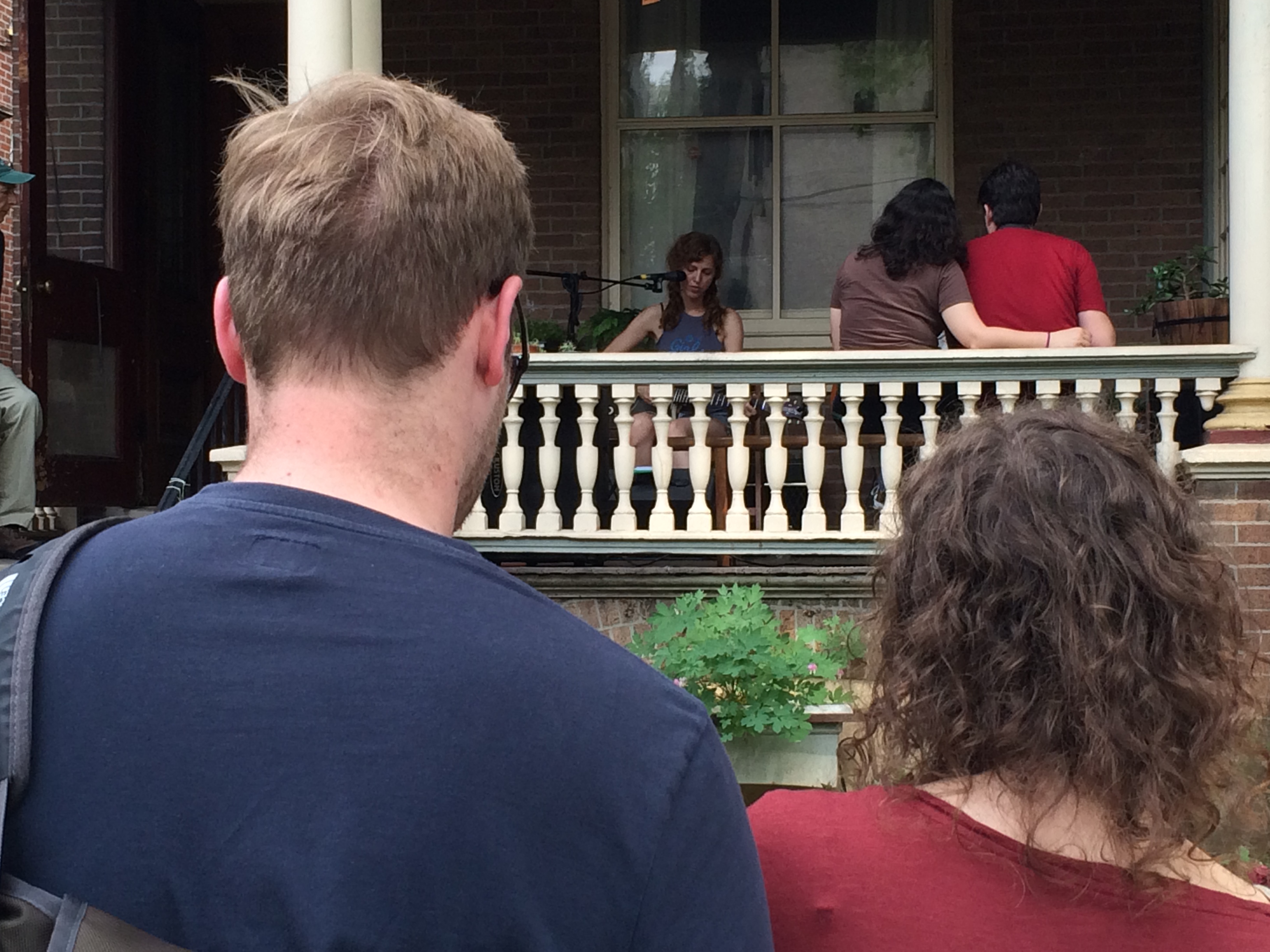
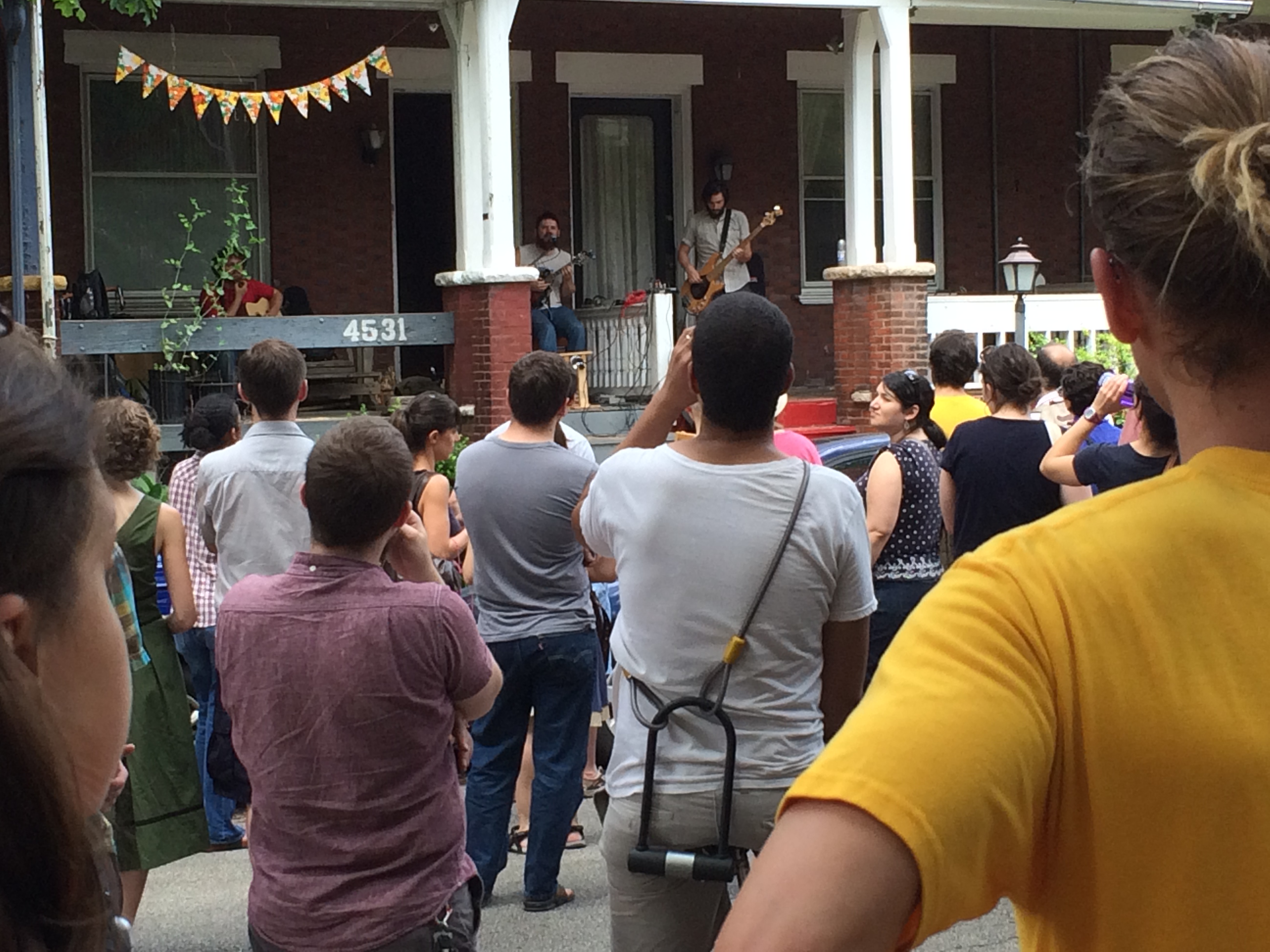
West Philly Porchfest’s boundaries were broad, about 12 blocks east to west and likewise north to south, encompassing much of what has come to be known as University City due to the area’s proximity to the University of Pennsylvania. Over 30 porches participated. The event began at noon on June 4 and ended at 6 PM. I was an attendee, taking in parts of six shows during a two-and-a-half-hour period. Man, I loved it. I heard an acoustic folky rock trio (Darlington); two singer-songwriters (Jon Veit and Emily Zeitlyn); a damn good jam session between, of all things, an African-drum percussionist, a fiddle player, an acoustic guitarist and a flugelhornist; a vocal-less rock band (I Think Like Midnight) that, to my ears, sounded like a cross between The Grateful Dead and Television; and a folky duo that smoked and crunched. I’m going to zero in on the duo, who go by the name Driftwood Soldier, because I liked them the best of the acts that I caught. I seemed not to be alone in that. They drew the biggest crowd, around 80 people, that I saw all day, and the loudest applause too.

Driftwood Soldier.
Driftwood Soldier.

Owen Lyman-Schmidt is Driftwood Soldier’s singer, mandolin strummer and songwriter. Bobby Szafranski is the band’s not-your-average electric bassist. Both guys pitch in to move the groove by banging on percussion instruments with their feet. I tell you, Driftwood Soldier has it. Owen sang, in a wild and wooly baritone, about underdogs, colorful characters, people who deserve better than they’ve got. He reminded me a lot of the late Dave Van Ronk. And Bobby sent the tunes aloft with bass lines that gleamed and grinned. I would not be surprised if Driftwood Soldier breaks through nationally one of these days, though to-date they are unknowns. They are that good. And they’ve got the work ethic that might lead to fame and glory, touring our fair nation with gusto. Thanks to the wondrousness of the Internet, you may watch Driftwood Soldier performing their song Rosalee by clicking right here.

IMG_0493IMG_0494
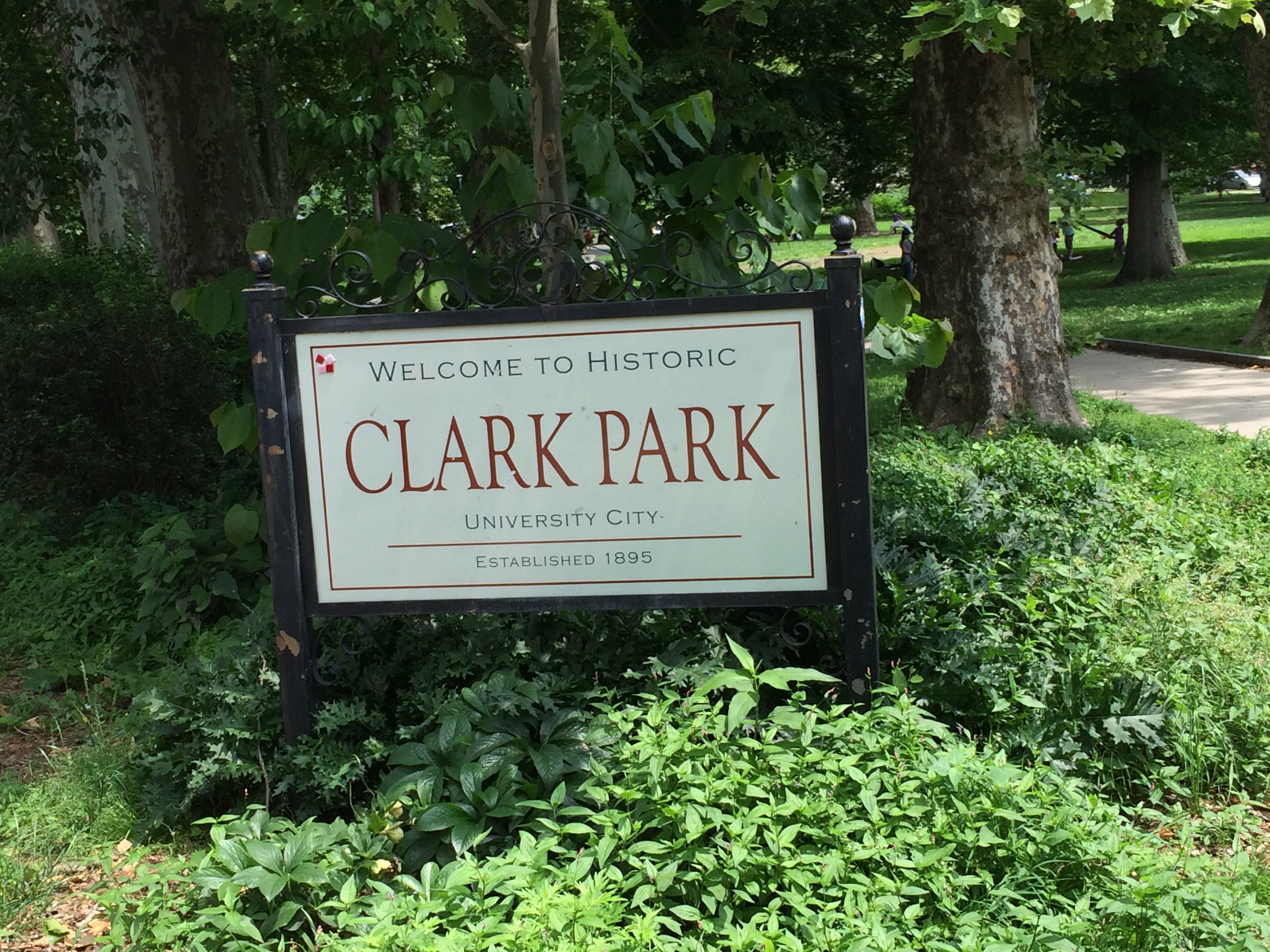
You know, I lived in University City during the 1970s and 80s on a beautiful, tree-filled block oh so close to a few of the shows I watched the other day. I liked the area mucho back then, and still do. I go back now and again. On the day of Porchfest it was fun walking the streets upon which I’ve trod so many times before. And it was equally swell strolling through Clark Park, a lovely place, a hub of peace and calm in University City. Kids were playing, food truck and farmers’ market vendors were vending, and teenagers and adults were milling around. The coolest sight I saw in the park was a little girl climbing all over the Charles Dickens statue. That’s right, Charles Dickens. It’s the only statue of him in the USA. And, apparently, one of only two in the world. The other, by the way, is in Australia, not Great Britain. A good idea would be for the Brits to commission and erect a Dickens statue too, since Dickens  — duh — was one of their own.

(Don’t be shy about adding your comments, or about sharing this article with others)

(If you click on any photo, a larger image will open)

Lindi Ortega Revisited

Last July I penned an essay about Ashes, a brilliant tune from the heartbreak canon that came out on Lindi Ortega’s 2015 album Faded Gloryville (if you’d like to read my words, click here). Lindi is a singer-songwriter in love with pensive ballads, country music in various varieties (gritty, rocking, bouncy), the blues and soul music. She has reached a modest level of success. My story, though, didn’t go into much detail about Lindi, a Canadian who relocated to Nashville five years ago, because I didn’t know all that much about her or her music (not that I’m an expert now). I concentrated on the song. In a nutshell, what I said was: “Ashes to me is perfection.”

Well, for reasons that probably always will remain unknown to me, my Ashes opus became pretty well read. Most of my stories are looked at for a few weeks at best, rarely to be discovered by any member of humanity after that. But the Ashes piece was different. Week after week, month after month, folks kept finding it. About three months ago its audience finally petered out.

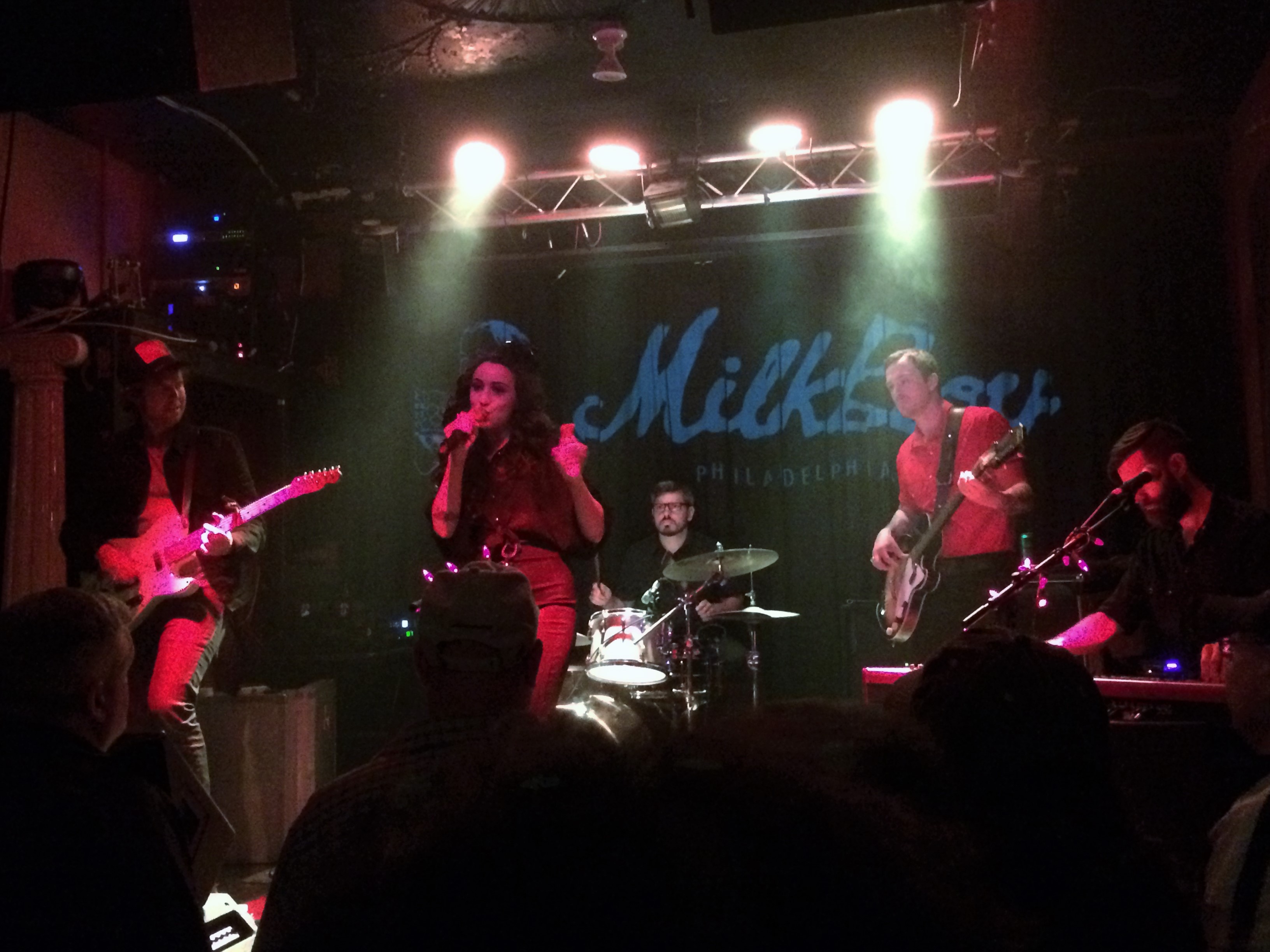
Me, I didn’t forget about Lindi after I wrote the story. She and her great song became so stuck in my mind, I knew I had to see her in concert. A few months ago, voila! I noticed that Lindi and her band, who tour like mad around the USA and Canada, were on the schedule of MilkBoy Philly, a smallish and mostly rock-music club in the heart of Philadelphia. On May 22 I left my home in the burbs to take in that show.

IMG_0368 (2)
Was Lindi a let-down? Had my infatuation with Ashes set the bar of expectations way too high? Hell, no. I, who was familiar with not a one of the Ortega-composed songs performed at MilkBoy, other than Ashes, had a great time. Lindi and band were terrific, as I’d assumed they would be. And it was a gas hanging out in funky MilkBoy, where I squeezed close to the stage like a frigging fanboy, inches away from a gaggle of new-found, swaying and shimmying friends.

IMG_0369 (2)
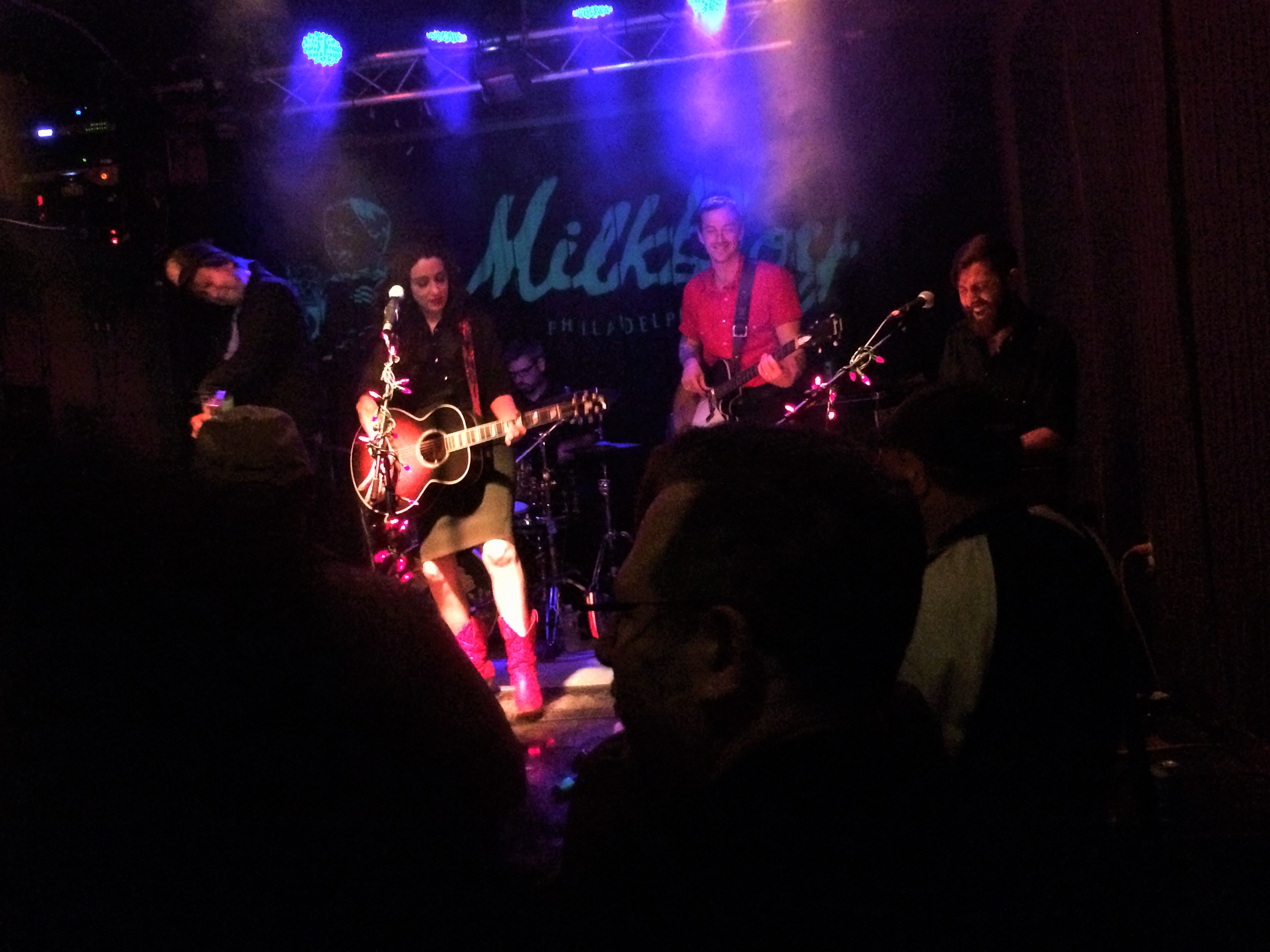
Lindi, who is in her mid 30s, hit the stage at 9:05 PM and bid us adieu 75 minutes later. In between she sang her heart out, ripping it up on hard rockabilly and honky-tonk and bluesy numbers, pouring out her soul on the slower, more doleful part of her repertoire. She and her four-guys band knocked  each song (19 in all) out of the park. Lindi wrote or co-wrote 16 of them, and those 16 came from her four most recent studio albums. Most of the lyrics were finely wrought, sweet metaphors and similes abounding. Without a doubt, Lindi’s my kind of girl . . . a wordsmith.

Lindi Ortega sings about the subjects that have fueled country and blues and soulful songs since time almost immemorial. We’re talking loneliness, regret, broken hearts, drinking to drive the troubles away, lovers who can’t help but disappoint. Her voice and delivery might remind you of Dolly Parton and Lee Ann Womack at times, and of Emmylou Harris and Patty Griffin at others. In her trademark red cowgirl boots at MilkBoy she leaned into her hand-held mic and told it like it is.

IMG_0364 (2)
Take one of the fast numbers, for example. The evening began with a Faded Gloryville song, Run Amuck. Wham, bam! It was a honky-tonking blues blasted into fourth gear by James Robertson’s red-hot Telecaster guitar and Noah Hungate’s precise, rip-roaring drum work. Robertson and Hungate threw out sparks for 45 seconds before Lindi sang the tune’s first lines. “Daddy, where you going?/Going out again?/You keep messing round town with your floozy little friends,” Lindi finally unloaded. And she didn’t quit unloading till the tune ended a few minutes later. Man, I was sold. And psyched.

And take one of the slow tunes. Near show’s end she broke my heart with Tin Star, from the album of the same name. Voice quivering, she sang sorrowful words: “Like an old tin star I’m beat up and rusty/Lost in the shining stars of Nashville Tennessee/Well I wrote this song for those who are like me/Lost in the shining stars, the shining stars.” She held that final stars fragilely, with a high note, and for only half a second before continuing Tin Star’s tale of a very struggling and conflicted musician. The song was gorgeous. Absolutely gorgeous.

You get the idea. If Lindi and her band pass your way, plunk down a few bucks and catch them. In the interim, you can watch part of the MilkBoy concert courtesy of YouTube. Someone whom I didn’t notice, but who no doubt was standing near me, recorded and uploaded seven of the MilkBoy songs. If you click here you’ll see and hear Run Amuck. And if you do likewise right here, Tin Star will come your way.

I can’t leave without mentioning Ashes, which, sadly, the MilkBoy YouTuber didn’t post. I went half limp when, halfway through the show, I heard the chiming guitar riffs and the dirge-like drumming that introduced the song and gave it gripping power. And what might I say about Lindi’s shiver-inducing voice and the intelligence and sadness of the lyrics? Well, to repeat, Ashes to me is perfection. By clicking here, you will hear the album version of one of my all-time favorite songs.

(Don’t be shy about adding your comments, or about sharing this article with others)

(If you click on the photos, larger images will open)

Great Fortune Smiled Upon Me When Willie Nile Came To Town

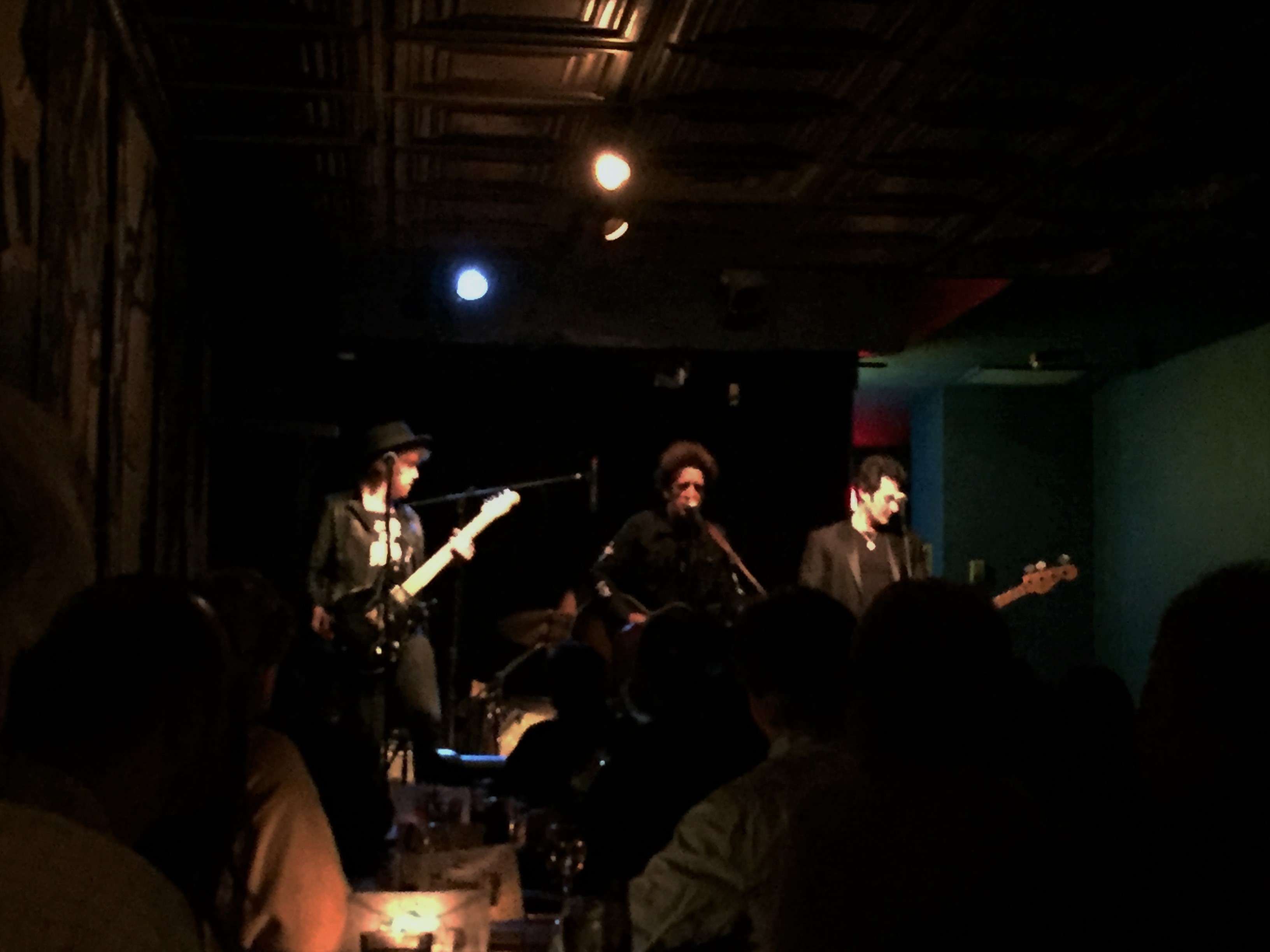
I had no doubt that something celestially-inspired was happening when my once-Greek-god-like hair began to move most unusually, each strand inching upward rapidly till they all pointed straight . . . straight . . . towards the stars! Yo, was anybody staring at me? I looked a mess. But at times like that, who gives a flying fig? This incredible occurrence meant only one thing: The stars had aligned themselves for me. I was in the right place at the right time. In Philadelphia. At funky, small and narrow Tin Angel, a music club where my wife Sandy and I sat 40 feet from the stage. Upon which Willie Nile and his band, only seconds into their set and ablaze from the first whack of the drum kit, were transporting me to — yeah man, as clichéd and dumb as this sounds, I’m gonna say it — rock and roll heaven. I was so jazzed I started to drop to my knees to kiss Tin Angel’s floor. Sandy held me back. “What, are you nuts!” she wisely exclaimed. “There’s a bacterial frat house party going on down there. Stay in your seat, young man.”

willie IMG_1280
And I did, as Willie and his pals commandeered the stage for nearly two hours. They took no prisoners, blasting out 20 holy crap-that’s-catchy songs (17 of them fully or co-authored by Willie), not even offering up a medium-paced number until halfway through the show. What they unleashed was unadulterated rock and roll. The kind of rock that any lover of  The Clash, The Pogues, The Ramones, Petty and Springsteen would go wild for. Rock propelled by Matt Hogan’s lean, soaring electric guitar and Alex Alexander’s huge drum poundings and Johnny Pisano’s electric bass lines that bobbed and bubbled. And what about Willie? Why, he led the way, packing his lead vocals with brio and strumming madly on his low-in-the-mix acoustic guitar. He showed off his ace songwriting skills, delivering righteous social anthems (such as Let’s All Come Together and One Guitar) and acutely-detailed observations about love (Beautiful You). And he owned the stage, because he’s one of those cool guys with way natural magnetism.

Man, how long had it been since I’d been rocked to the bones like this? Too long, partner, too long. And it wasn’t only the hooks and riffs and pounding drums and great songs and Willie’s lead singing that made the night special. The band possessed a secret weapon, one so astonishingly good my ears opened up like sink holes. We’re talking here about exuberant harmony vocals that deliriously dressed nearly every song’s chorus. The chorus of Forever Wild, for instance, the set’s opener. Leaning into their mics, Nile, Hogan and Pisano whooped and let loose: “Forever wild — uh-uh-uh uh-uh/uh-uh-uh uh-uh/Forever wild!” Throughout the set, like a bunch of half-drunk revelers, they sent the songs into outer space, Pisano reaching crazily-high notes almost out of the range of human hearing.

I should have kissed the floor.

In another lifetime maybe I’ll tackle writing Willie Nile’s biography. For now I’ll mention but a few things about him, starting with the obvious fact that he is one of the hordes of musicians whom the average Joe or Jen never heard of. He definitely has his fans though, quite a few, actually. But he deserves to have mucho more of them. And throughout his career, which began in the 1970s, he has been a darling of many music jounalists. They have loved his albums and his concerts. Still, that never has translated consistently into lots of gigs at good-sized venues, or into much airplay for his songs. Hell, Tin Angel can squeeze in maybe 140 bodies, and it was only half-filled when Sandy and I saw him there this month. As with much of life, I don’t get it. I mean, Willie should be a star.

Willie seems undaunted, though. He’s closing in on 70 and has been on a creative roll, churning out studio albums with little pause. His latest, World War Willie, just came out, and it’s his fifth since 2009. Willie and band played nearly all of it at Tin Angel, every song sounding fine as can be to my sink hole ears.

Left to right: Matt, Alex, Willie, Johnny.

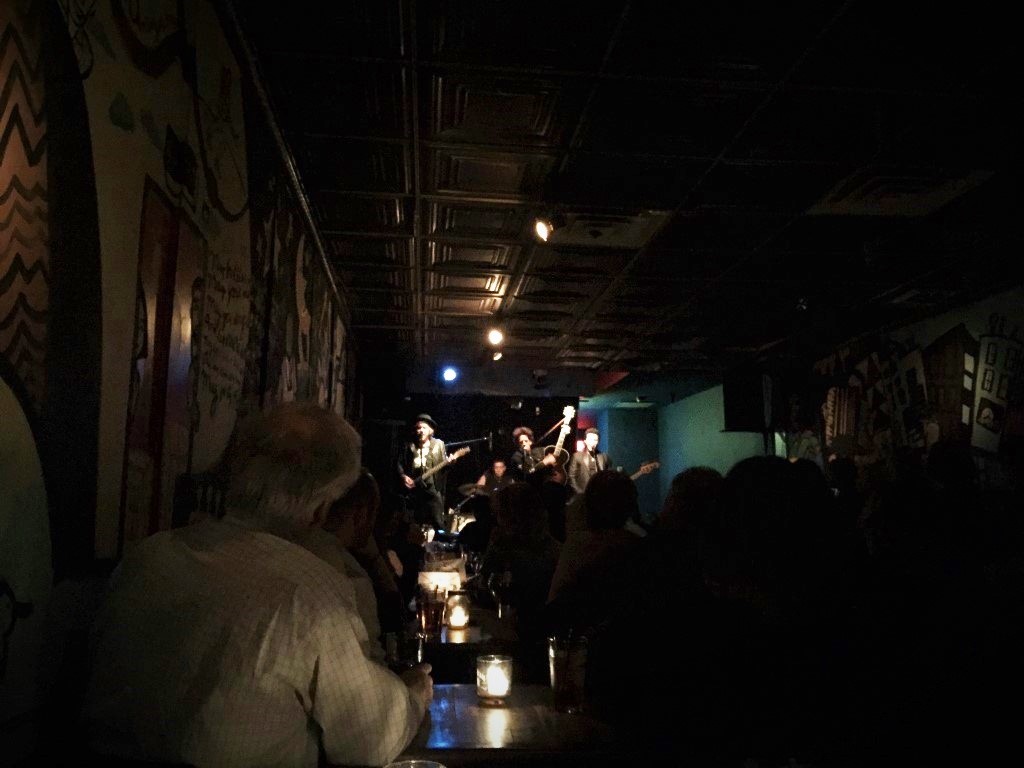
Flanked with cartoony murals that look like modern day caveman art, Tin Angel welcomed Willie and band in the right way. Meaning, a person with talent and good judgment was at the sound board. Isn’t often that you can make out more than 40% of the lyrics at a loud rock and roll show. The other night, the sound lady balanced everything just right and I deciphered most of the lyrics no problem. And they were cool. “Grandpa rocks, Grandpa rocks/He listens to the Stones on the waterfront docks,” Willie happily shouted on the set’s second song. And on the eighth he warned, “I’m a bad boy/I ain’t no good/When I was born they said ‘knock on wood’.” Those pithy rhymes came from songs on World War Willie whose titles are easily guessed.

Not only that, Tin Angel has the vibes and layout that full-frontal rock and roll needs in order to flower. It’s cramped. it’s sweaty, and it puts its audience in potential danger. Halfway through the show, Johnny Pisano sidled to the edge of stage left, his electric bass’s neck gleefully bopping around and sticking far out into the skinny corridor that leads to the bathrooms. A guy, fresh from relieving himself, sauntered from the loo and headed back to his seat. A collision awaited. Watch out, mate! You’re about to get whacked in the head!

I don’t think that Pisano ever saw him. But the guy nimbly ducked. And all was well.

(Click here to watch Willie and his band performing Grandpa Rocks one week before I saw him at Tin Angel)

(If you enjoyed this article, don’t be shy about sharing it. Sharing buttons are below)
(If you click on the photos, larger images will open)

Walking Through Philadelphia With Colors On My Mind

I woke up one weekday morning not long ago with visions of Philadelphia swirling in my mind and beckoning me. Amorphous visions, but colorful. I hadn’t done much city exploration in awhile. Hadn’t taken a long and leisurely stroll anywhere in awhile. What’s more, the weather prediction was highly favorable: warm, sunny and breezy. A walk was in order. And so, a few hours later in my suburban Philadelphia home, I closed my eyes, clicked my heels together three times and thought beautiful thoughts about the City Of Brotherly Love. Next thing I knew I was standing at the corner of 2nd and South Streets, part of a funky area not far from the Philadelphia waterfront and some of the city’s oldest residential blocks. Let the adventure begin.

The hike took nearly four hours. I trod, often guided by whimsy, on many blocks within the rectangle formed by 2nd, Bainbridge, Broad and Arch Streets. At the start I didn’t have much of an idea of what my route would be. But this much I knew: I wanted to stretch the ol’ legs, inhale Philadelphia’s quasi-clean air and feel the wind caressing my thinning hair. And this too I knew: I wasn’t in the mood to check out any historical or touristy sites, or anything with the connotation of trendy attached to it, all of which Philadelphia is loaded with. But it wasn’t to be an aimless ramble. No way. When I landed at 2nd and South Streets, I had in mind a theme for the day, inspired by the colorful visions from earlier in the morning. I was going to look for sharp and snazzy outdoor color displays produced by the hands of man, not by nature. It was a modest quest, probably kind of a dumb one. But hey, I’m that kind of guy.

fez IMG_0212mexican IMG_0215
Things got off to a slow start. I looked all around the 2nd and South Streets vicinity and the only colorful things I could find were Fez Restaurant’s facade and a happy, yellow ghoul, dressed in red, outside Las Bugambilias, a Mexican eatery. Still, I figured that the South Street corridor — not as happening a part of town as once it was, but hanging in there fairly well — offered a decent chance to come across more than that. And I was right.

mako's IMG_0220larry fine IMG_0222
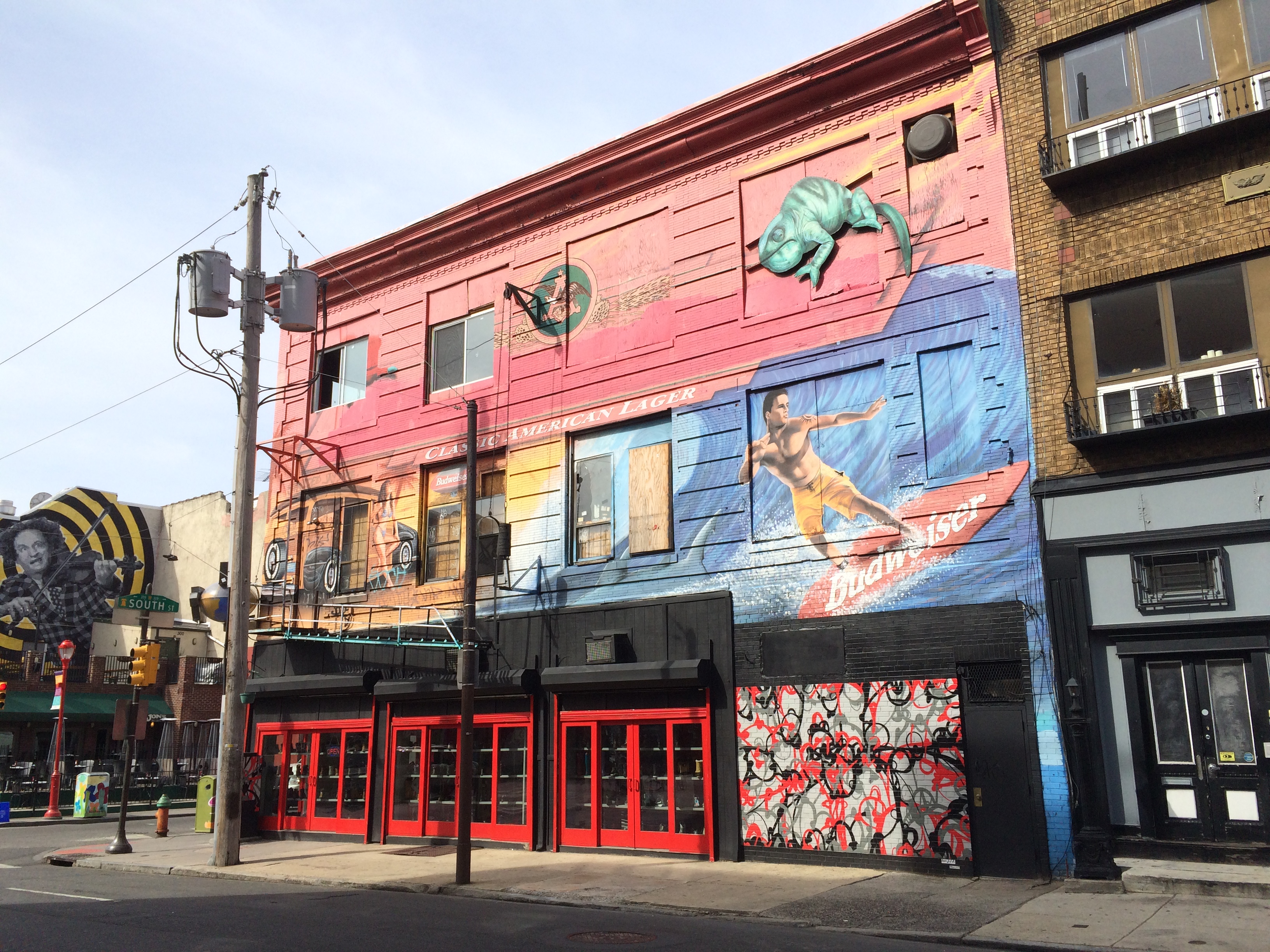
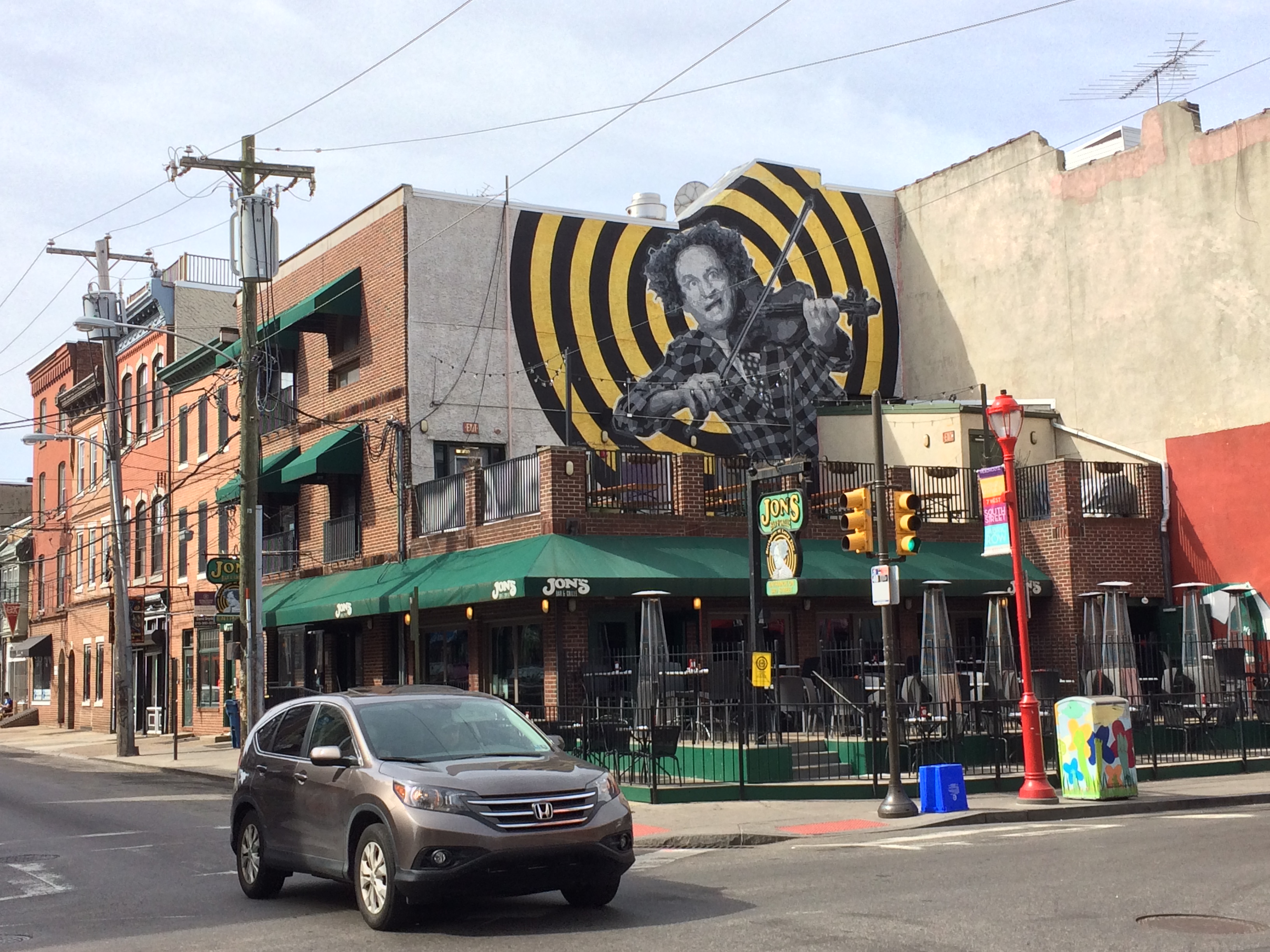
At 3rd and South I said to myself, “Wow, look at that mural.”  It was painted on the side of the out-of-business and mourned Mako’s Retired Surfers Bar And Grill. A guy on a surfboard, a girl leaning against a fat-tire car, all done in sweet pastel hues. Lovely. And didst my eyes deceive me? Directly across the street from the former Mako’s was another mural, this one depicting the torso of a fiddle-playing, electric-haired madman inside yellow and black concentric rings. None other than Philadelphia native Larry Fine, one of The Three Stooges. Yeah, man, now we were getting somewhere.

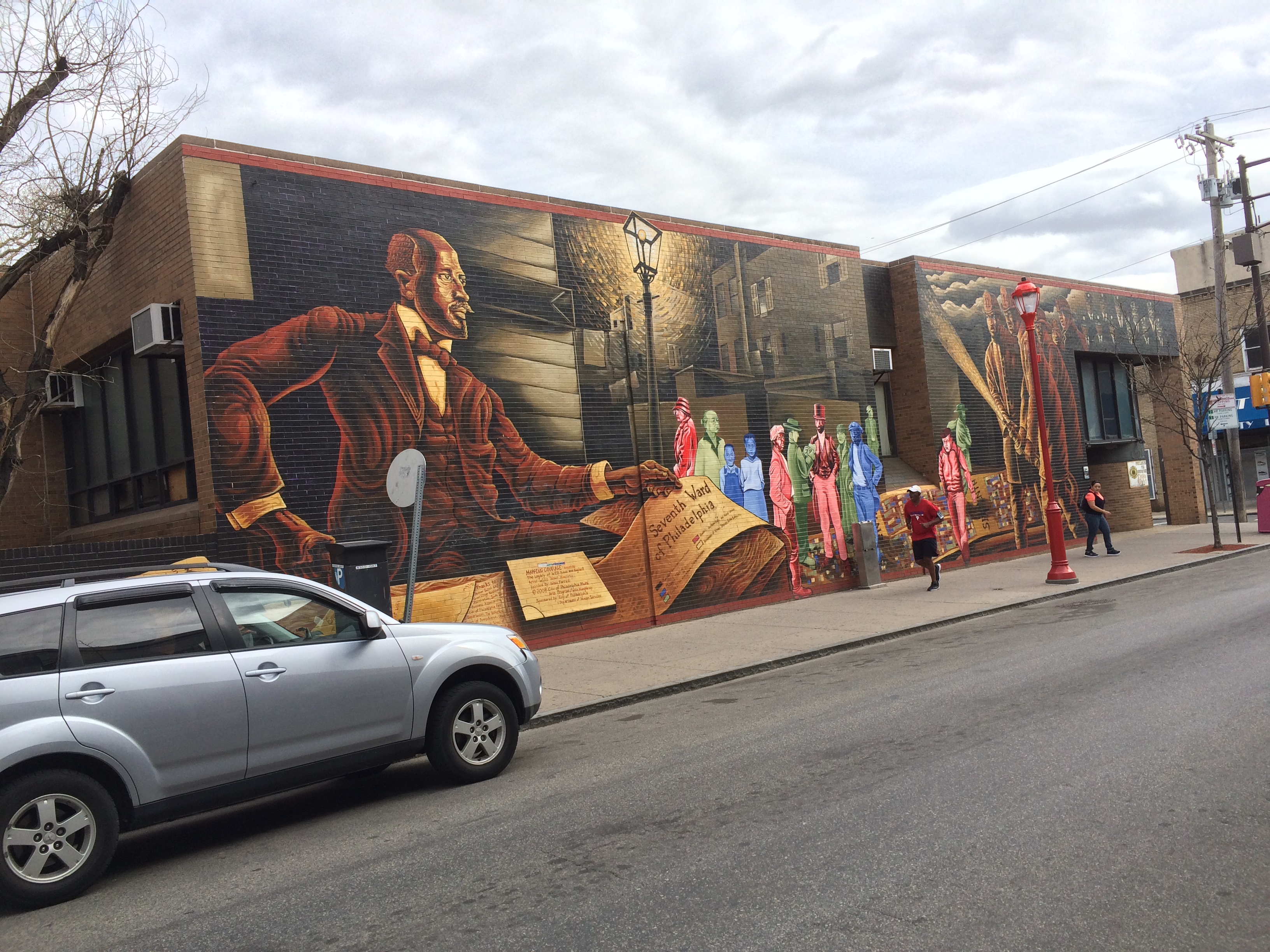
A little while ago I alluded to the fact that I’m no genius. Proof? I shouldn’t have been surprised to see the murals at 3rd and South, because I’d seen them before, though not in recent years. What’s more, I somehow also had forgotten that Philadelphia is the outdoor mural capitol of the world, thanks to Mural Arts Program, a public/private organization born in 1984. Incredibly, over 3,000 MAP- created works grace Philadelphia. No doubt, Mural Arts Program is one of the good guys. It aims to beautify all neighborhoods (from dilapidated to swank), to employ many folks in need of work and encouragement, and to inspire the general population. Big goals, all reached as far as I can tell.

DuBois IMG_0240
Well, I haven’t been able to determine if MAP was behind the painting on Mako’s side wall. But Larry Fine wouldn’t be overlooking South Street were it not for MAP, nor would two other murals that I later saw on my trek be in existence. Of those, the first I came to is attached to Engine Company 11, a firehouse at 6th and South Streets. It’s a magnificently imposing creation titled Mapping Courage. It honors W.E.B. Du Bois, the Black scholar and leader, and the firehouse itself, which for years was manned only by African Americans. The mural is beautifully designed, shining in browns and ambers that allow its few bright colors to pulsate.

Spring IMG_0260
An hour later, on Pine Street near 13th, I stumbled upon the mural known as Spring. Yowza, this one stunned me too. Look at those soft whites and butterscotch shades of the flowering foliage. How totally cool it was that real trees, in bloom, nearly were melting into the painted surface.

You know, somewhere in the middle of my expedition I realized something that never had dawned on me before. Namely, despite the murals that gas things up on certain blocks, most of Philadelphia’s residential streets, beautiful and architecturally rich as many are, sure appear tame when it comes to color. This ain’t exactly a news flash to the oceans of people more observant than I, but it’s true. And it’s largely because of bricks, bricks, bricks, the quintessential and earth-toned building blocks of Philadelphia. Bricks are sturdy, bricks are quaint, bricks have been with us humans for thousands of years. But man, I can understand how someone might decide that a brick-dominated landscape needs to be jazzed up. Someone named Isaiah Zagar, for example.

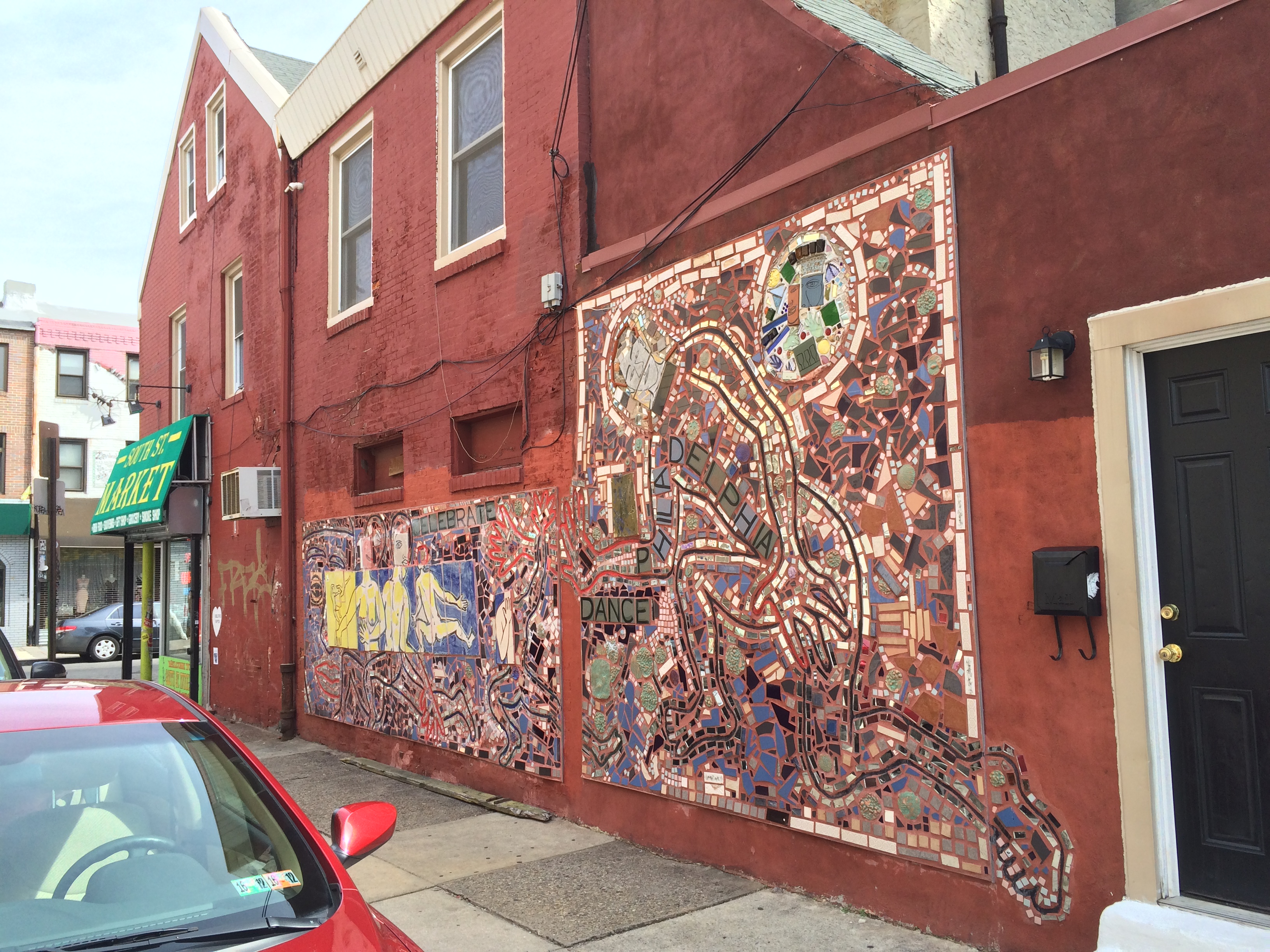
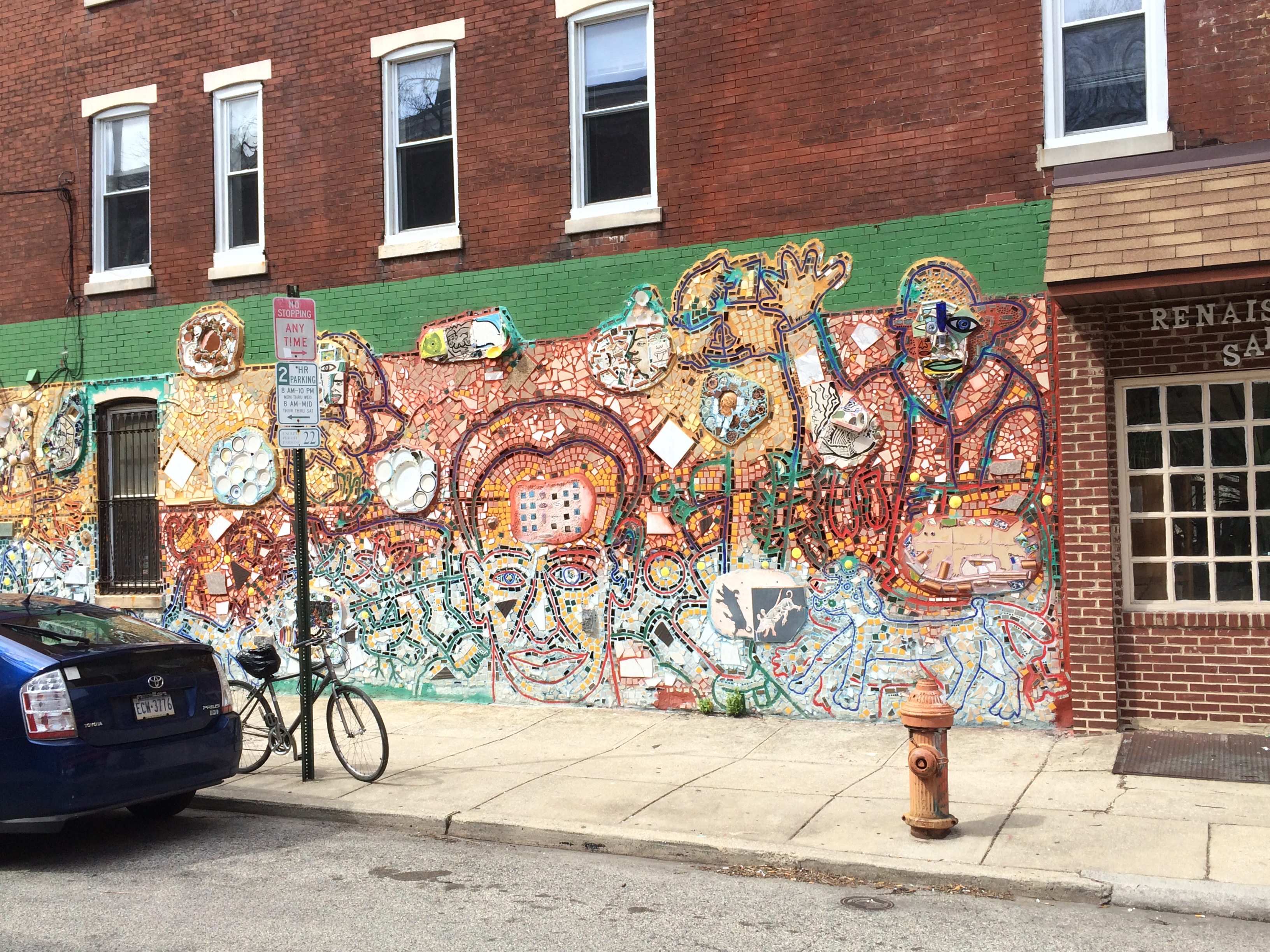
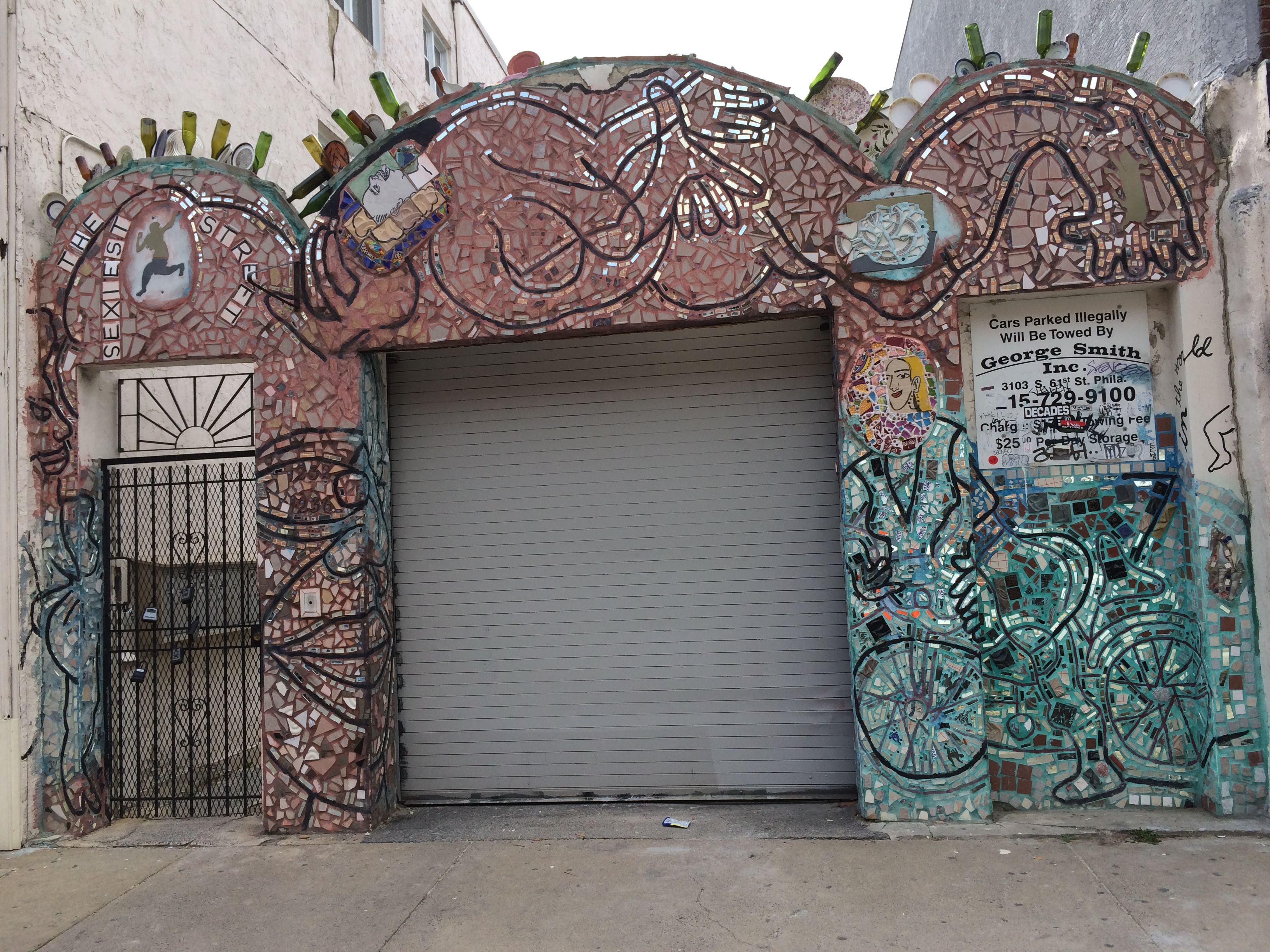
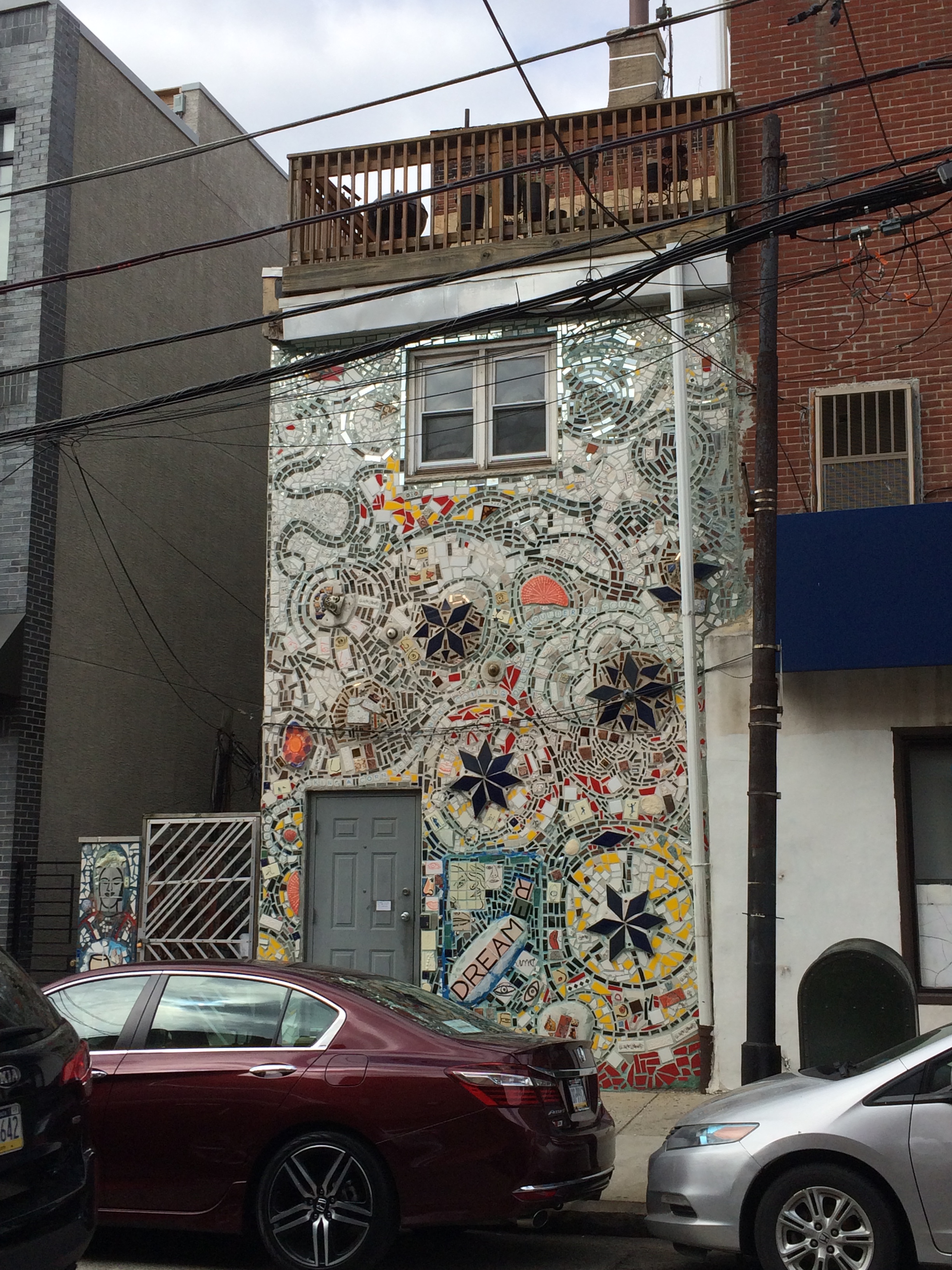
Soon after my walk began, a few minutes after I metaphorically tipped my hat to the Mako’s and Larry Fine murals, I started to come upon some unusually decorated homes, first on Leithgow Street, just off of South. And then on many other blocks near or on South. I had never seen these exterior wall decorations before, hadn’t known about them. They were something else, kaleidoscopic, multi-colored mosaics made from pieces of tile and glass. The design similarities got me wondering if one person had done all the work. I had a vague knowledge of mosaic artist Isaiah Zagar. I knew that he lived in the area and that he had established something called Philadelphia’s Magic Gardens. Were these freewheeling creations his? A bit later I learned that the answer was yes, and that he had begun adorning buildings quite a few years ago.

I suppose that Zagar obtained the permissions of homeowners before going wild on their domiciles. Or maybe he didn’t. Whatever. Unembellished bricks (and other stones), goodbye! Colors and designs up the wazoo, hello! Zagar’s mosaics put me in mind of native art from South America and Africa, of children’s art, of what cave paintings from 20,000 years ago might have resembled if their creators had been high on pot. Anthropomorphic faces and figures abound. Psychedelic cellular shapes look determined to escape their confines. Words like dance and celebrate and dream are embedded in the mosaics. Zagar is a positive thinker, a lover of life and, I assume, one hip cat.

Zagar’s greatest creation is Philadelphia’s Magic Gardens, a multi-level indoor and outdoor mosaic extravaganza, an arts center and a head trip that has become a go-to attraction for tourists and locals. He began work on it in 1994 in what then were abandoned lots, and endured some legal battles years later with the lots’ owners. In the end, creativity and social justice prevailed. PMG, an incorporated non-profit, opened to the public around 10 years ago. It’s at 1020 South Street. I caught a few peeks of PMG, grabbed a brochure from the admission desk and confirmed there that Zagar is the guilty party behind the glorification of the South Street corridor. But I didn’t want to interrupt my hike by entering the Magic Gardens. I’ll get back there some day and will drop my report within this blog. For now, this travelogue will end with photos of some of Zagar’s handiworks. If you click on any of them, or on any other photo in this article, a larger image will open.

IMG_0232IMG_0233IMG_0243

IMG_0246IMG_0250IMG_0251

IMG_0253IMG_0256IMG_0258