A Big Apple Day

Is New York City the apple of my eye? Well, once it was. I spent who knows how many hundreds (thousands?) of hours in one or another of its five boroughs while growing up on Long Island. And after moving to Philadelphia in the mid 1970s, to start what became a 34-year career in government work, I made pretty frequent trips to NYC, 10 or 15 each year. I was pulled there magnetically by its museums, architecture, music clubs, gracious and spacious parks, and streets just made for strolling and girl-watching. Nobody needs me to tell them that the Big Apple is one of the coolest kids on the planet. It has been for, what . . . at least 100 years?
But, for one reason or another, those Philly-to-NYC visits became less and less common when the early 1990s rolled around, petering out to a mere one every few years. Incredibly, New York City, with which I’d had the cuddliest of relationships, faded gently from my mind. “New York, wait for me! You’ve meant the world to me! I’ll be back semi-regularly, I promise. Hell, you’re only 100 miles away,” is what I should have felt and said. But I didn’t. Man, if you’d have told me before then that such ever would become the case, I’d have had you committed.

This, then, is where Dave, one of my greatest pals, enters the story that you’re reading. He, like me, used to be a Long Islander. We became friends there in high school, during the Middle Ages. And he used to love NYC. These days, though, the city’s hustle and bustle does a superb job of frazzling Dave’s nerves. He ain’t in love with NYC anymore.

Still, Dave, who took up residence on the West Coast 40 years ago, visits New York now and then, despite the jittery situation with his nerves. I guess he’s a masochist. And one of those now-and-then occasions occurred recently. “Yeah, I’ll see you there,” I told Dave when he informed me of his impending eastward trip. Thus, two Saturdays ago I headed north from my home in the Philly burbs to hang out with Dave for half a day in the greatest of the famed metropolis’ five boroughs. Manhattan.

We met where 42nd Street and Broadway colorfully come together. In other words, at the bottom end of Times Square. And for the next four hours we graced various neighborhoods, and Central Park, with our dynamic presences. Though on the cusp of age 70, we strode the streets like the titans we vaguely once were. And vaguely still are. Gorgeous girls couldn’t keep their eyes off of us the other day. Isn’t that right, Dave?

“Damn straight, Neil,” Dave just told me. “Damn f**king straight! Even though it could be that our 20/80 visual acuity distorted our view of things just a little bit.”

Speak for yourself, Dave. I know what I know.

Here’s how we spent our time together: We shot the breeze vigorously, catching up on each other’s doings. And we walked and walked and walked while shooting that breeze. And when we got tired of walking we sat on boulders in Central Park, and a little after that on chairs in a snazzy restaurant near the park’s southwestern corner.
What’s more, we didn’t have any interest in taking in any famous sights, though we saw some anyway (such as Carnegie Hall, Columbus Circle and horse-drawn carriages in Central Park). You can’t not see them in this history lesson of a city. To repeat, then, what’s already been said: Yapping, wandering, eating and girl-watching proved to be the items on our agenda.
The time flew by, as sometimes it does, and around 3:30 PM Dave and I said our goodbyes. He needed to go back to his hotel and start getting ready for the wedding that had brought him to NYC in the first place. One of his friend’s daughters was about to get hitched.

But my bus wouldn’t be leaving for an hour and a half. I had time to kill. And what better way to do that than to stroll along some of the streets of Hell’s Kitchen, the Garment District and Times Square. Those nifty sections of the city run into each other, and would keep me close to the Port Authority bus terminal, from which my Philadelphia-bound ride was scheduled to depart.
Which brings us to the final topic I want to talk about. To wit, photos. I didn’t take any while with Dave, except for a couple of selfies of him and me. Why? Man, if there’s one thing I’ve learned since starting this blog, it’s that obsessive photograph-snapping can interfere one whole lot with enjoying the time you’re spending with people you like. Besides, who the hell would want to see a picture of the roast beef sandwich that Dave tore into at the snazzy restaurant, or of the boulder we sat upon in Central Park? Oh, you would, would you? It figures.

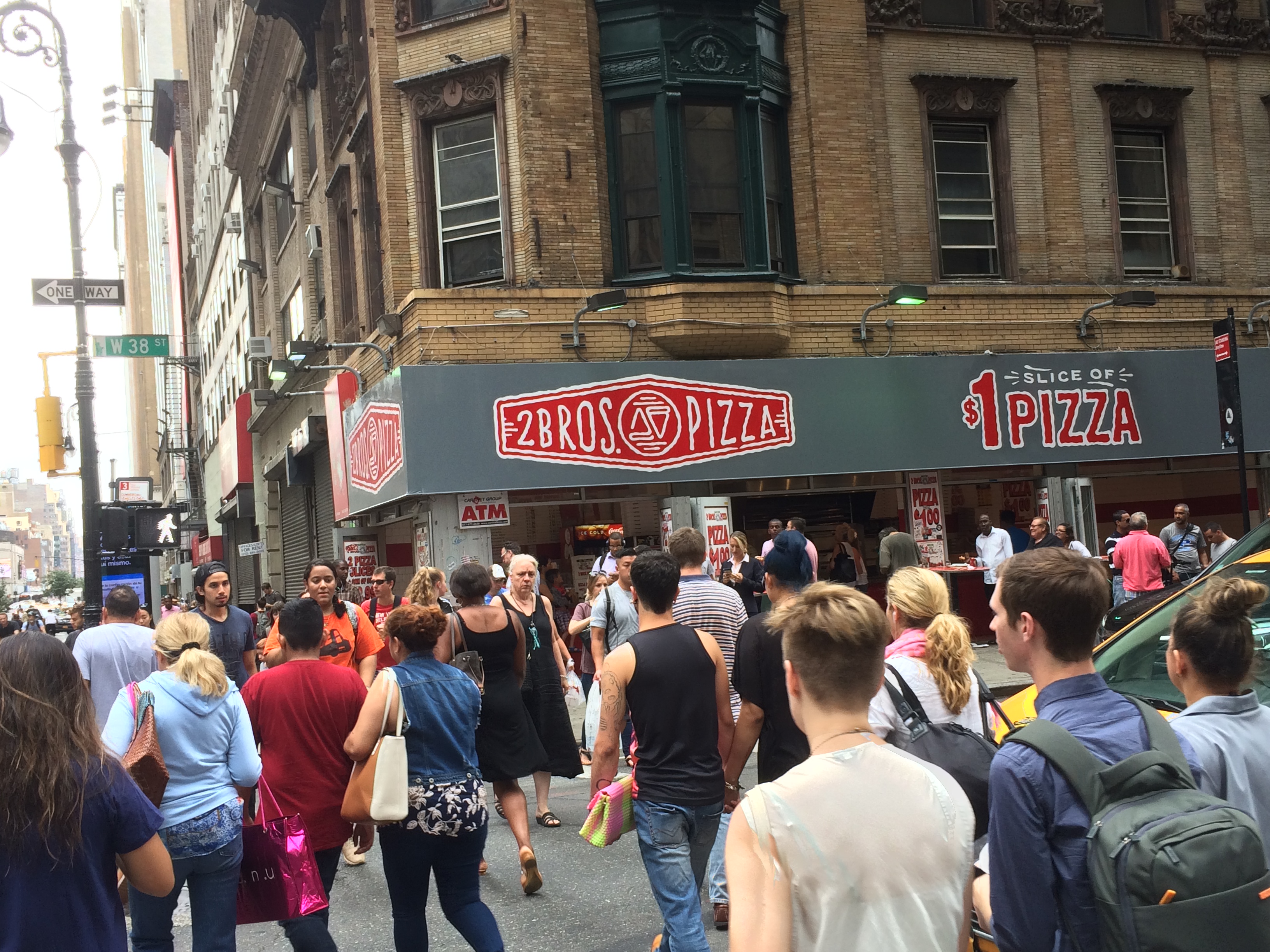
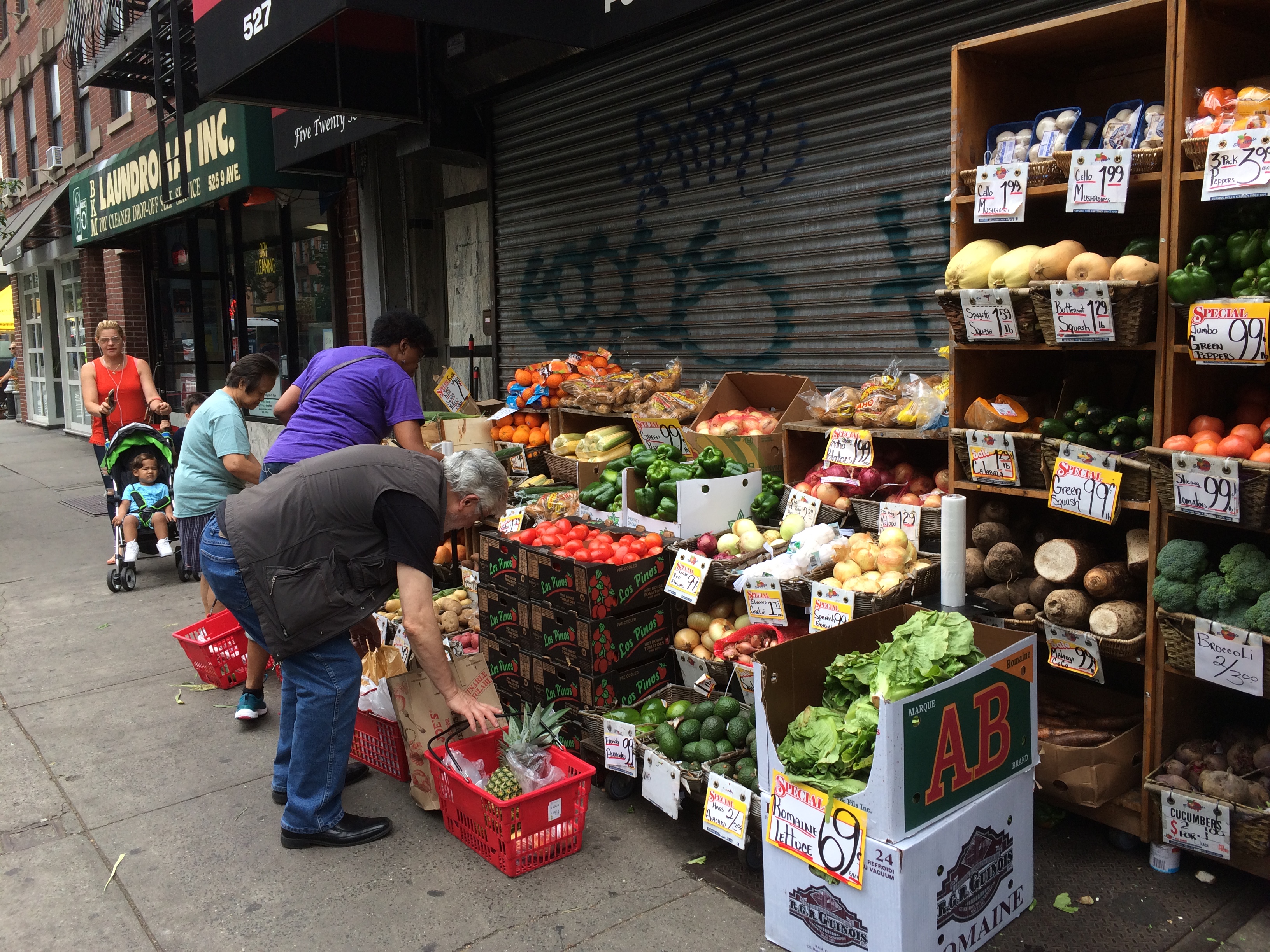
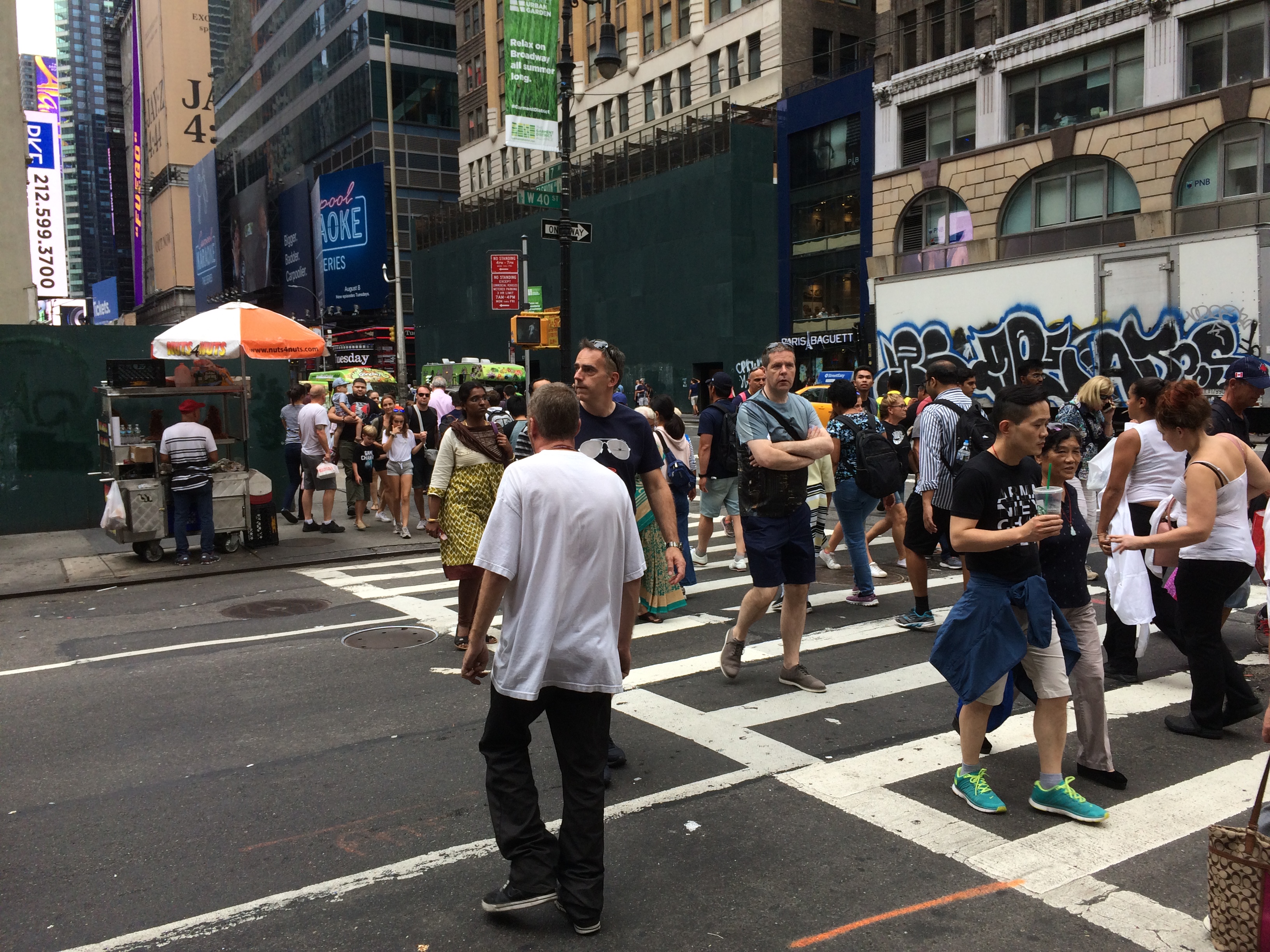
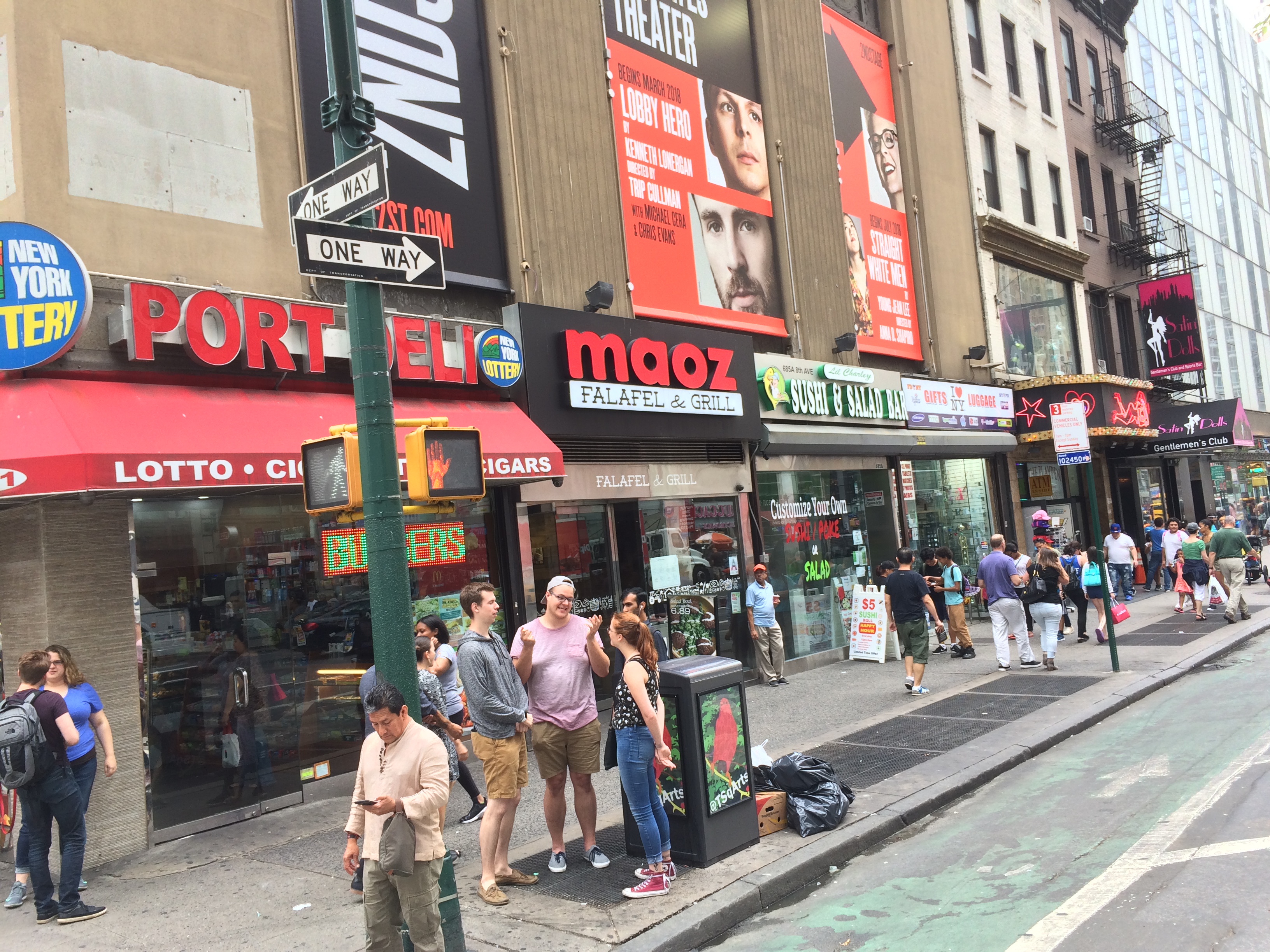
All I can say is that it seems that you’ve come to the right place anyway. Because after Dave and I went our separate ways my picture-taking mode kicked into high gear. And the pix that I shot over the subsequent hour are the ones you’ve been looking at on this page. New York City is a lot of things. One of which is photogenic. So, even a clod like me can’t help but come away with some nice shots.

Thanks for reading and viewing. Till next time . . .

(If you enjoyed this article, then don’t be shy about sharing it or about adding your comments)

(If you click on any photo, a larger imager will open in a separate window)
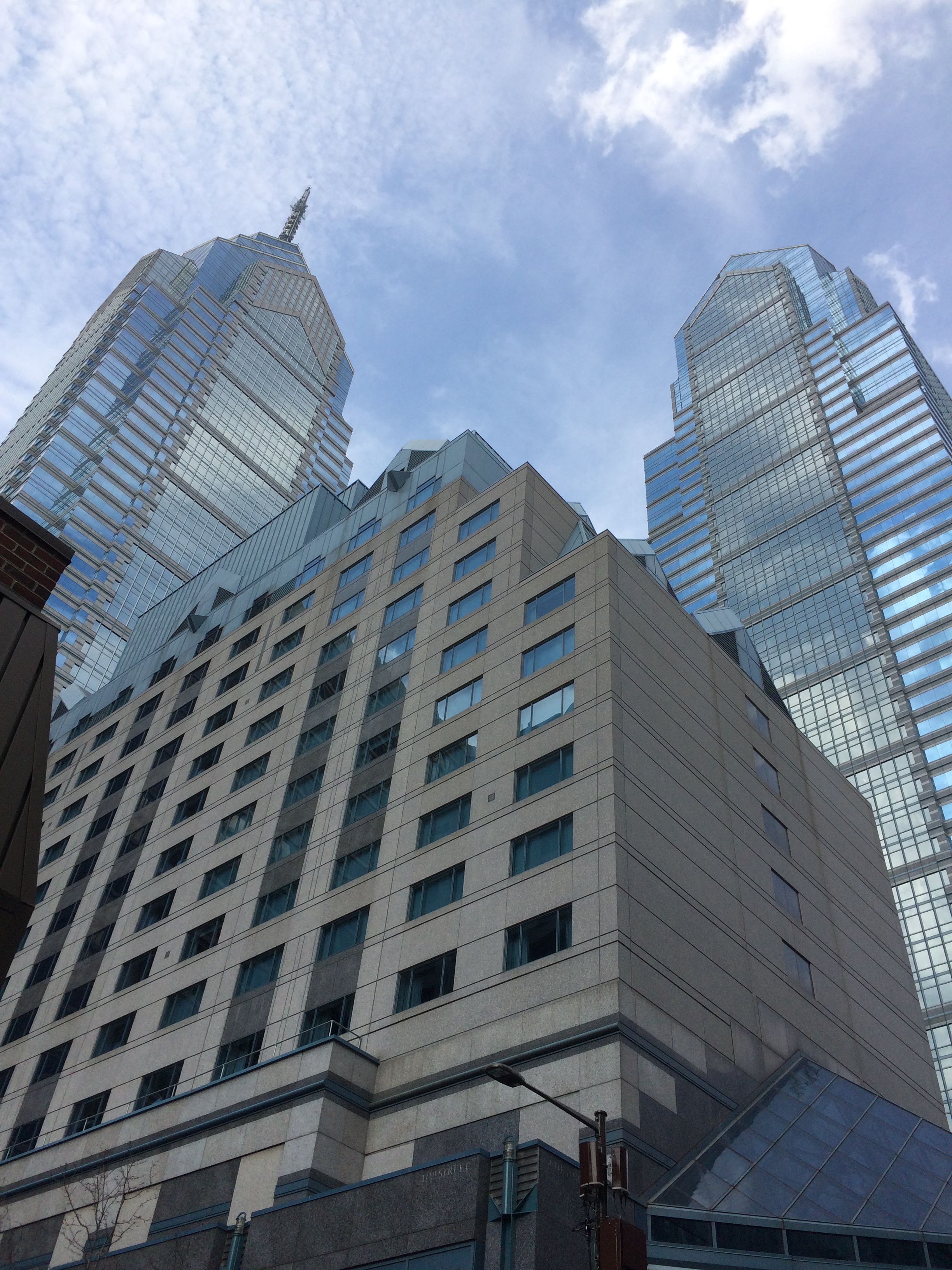
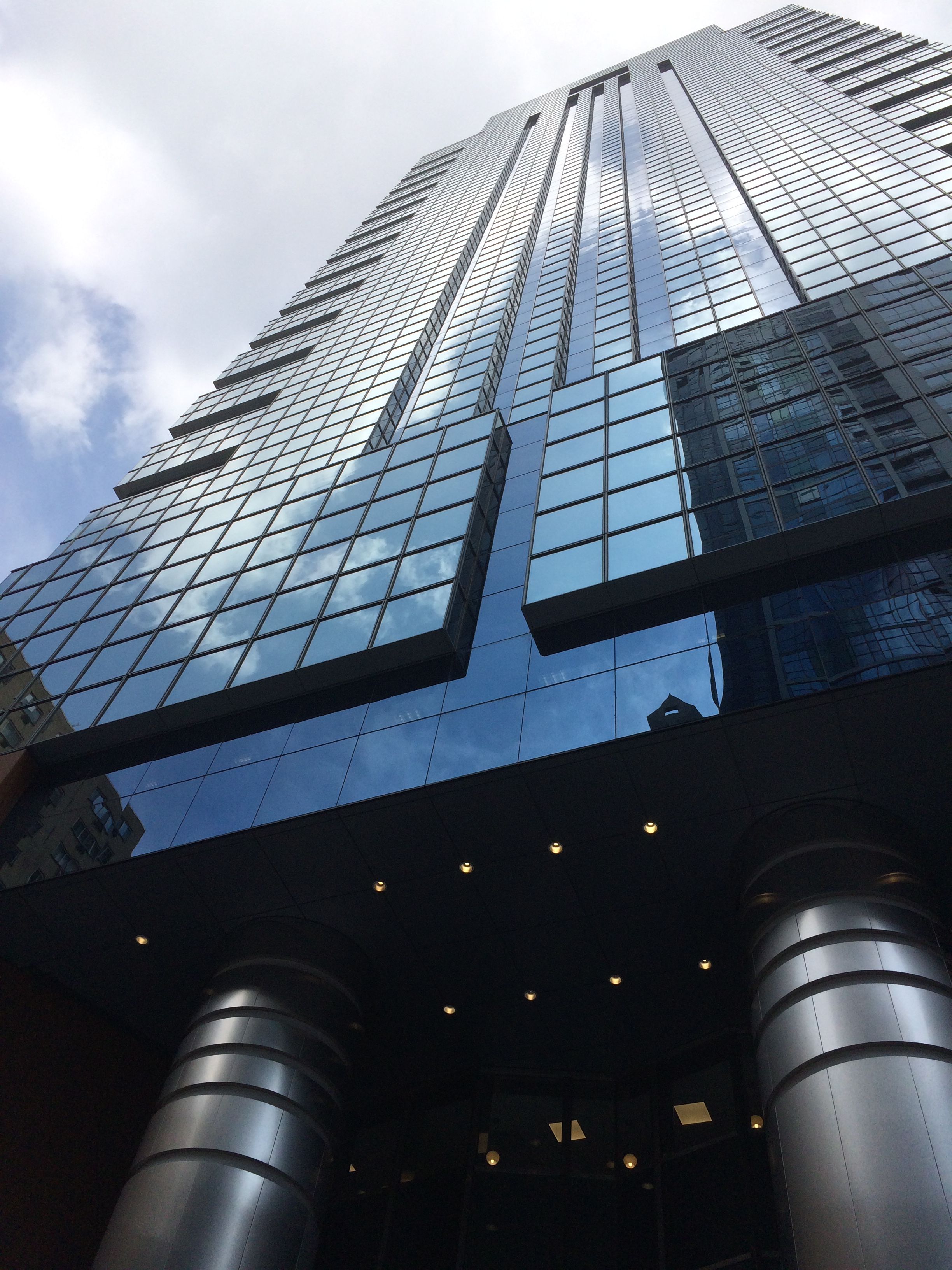
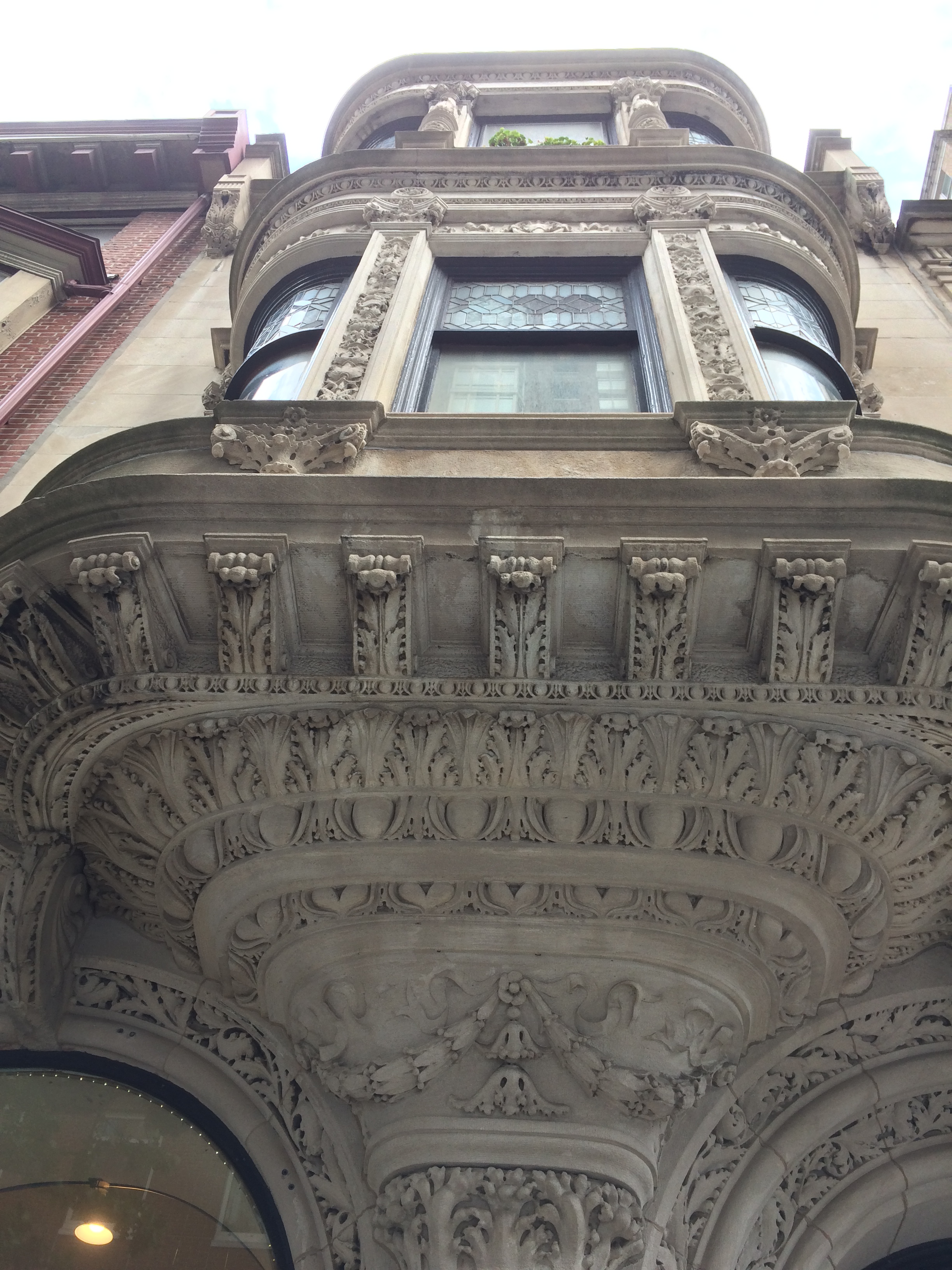
Look Up, Young Man!

When the phone rang at 8:15 AM on Wednesday of last week I reached for my blood pressure pills and popped not one, but two. Ordinarily that’s a big no-no. But somehow I knew who was calling. And since said individual has the talents to launch my diastolic and systolic readings halfway to the Moon, a medicinal overload was a necessity. On the fourth ring I picked up.

“Good morning, Edgar,” I said to Edgar Reewright, my blog’s editor. “It’s always a pleasure.”

“Cut the small talk, Neil,” Edgar said, “and let’s get down to business. Neil, I know you. Right now, I’m more than certain, you’re at the dining room table with a cup of coffee and a buttered, toasted bagel and your vial of blood pressure pills in front of you. And you’re doing your damnedest, without much success as usual, to solve The Philadelphia Inquirer’s crossword puzzle.”

I gulped. Heavily.

“I’m fed up with having to remind you of your responsibilities,” Edgar continued. “The five or six people who look at your blog — your wife, your criminal defense attorney, your proctologist’s mistress and a couple of others that I haven’t been able to identify — have come to expect one stab at an article from you each week. And my gut feeling is that you’re planning to let them down, that you’re all set to take a week off. Neil, this is unacceptable. There are dozens of stories out there waiting to be written. Get off your unbalanced ass and start working.”

Holy crap, not only is Edgar annoying, he also was correct. And so, after politely ending my conversation with him, I gathered myself and my thoughts together, pondered this and pondered that, and eventually came up with a story idea. Look Up, Young Man! would be its title. And central Philadelphia would be where I would attempt to make it blossom.

Thus in early afternoon I boarded a Philadelphia-bound train in the suburbs, arriving in the fair city’s central section an hour later.

“Look up, Neil,” my parents used to say to me when I was a kid walking along with my eyes aimed downward. I must have been suffering from a lack of confidence in those days, reluctant to meet the world head on. Not that I’m bubbling over with confidence all these many decades later. Anyway, I don’t stare at the ground anymore when I’m strolling around. I look straight ahead or side to side.

But upward? Well, like anybody, I do some of that. But consistently for a couple of hours or more? Nah, I couldn’t recall ever doing that in my life. It’s not exactly a world-class notion, but it had appealed to me when it jumped into my mind a few hours earlier. I liked its simplicity, its openendedness. Who knew where or what it would lead to?

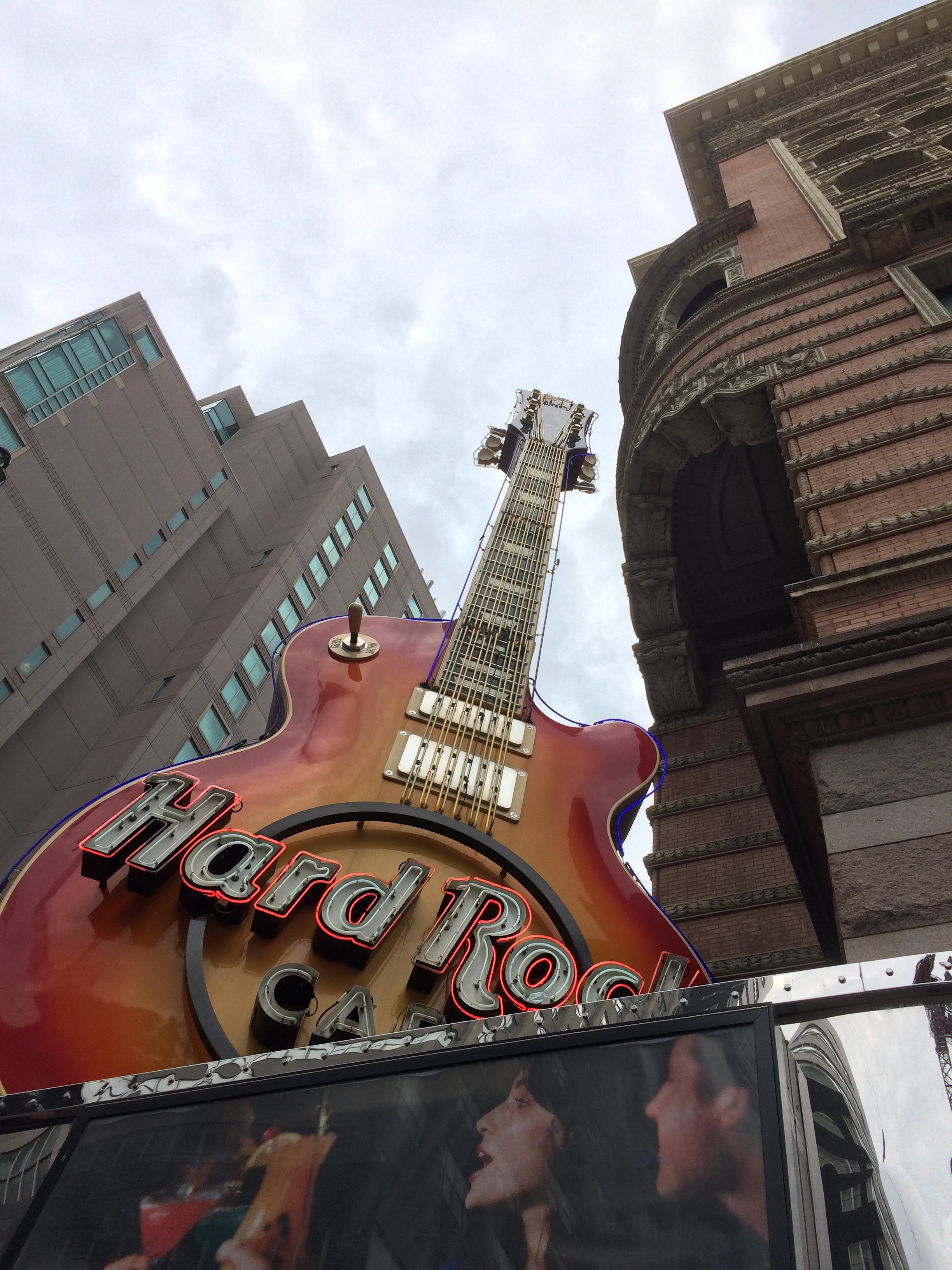
Pow! Moments after exiting the train station and stepping onto Market Street I gaped at what to me is one of the iconic outdoor sculptures in Philadelphia. It’s a giant replica of an electric guitar, and it rotates, as if on a spit, 15 feet above the ground at the corner of 12th and Market Streets. It’s hard not to notice this symbol of the Hard Rock Café, which is housed within one of the classic stone buildings that once belonged to the long-defunct Reading Railroad.

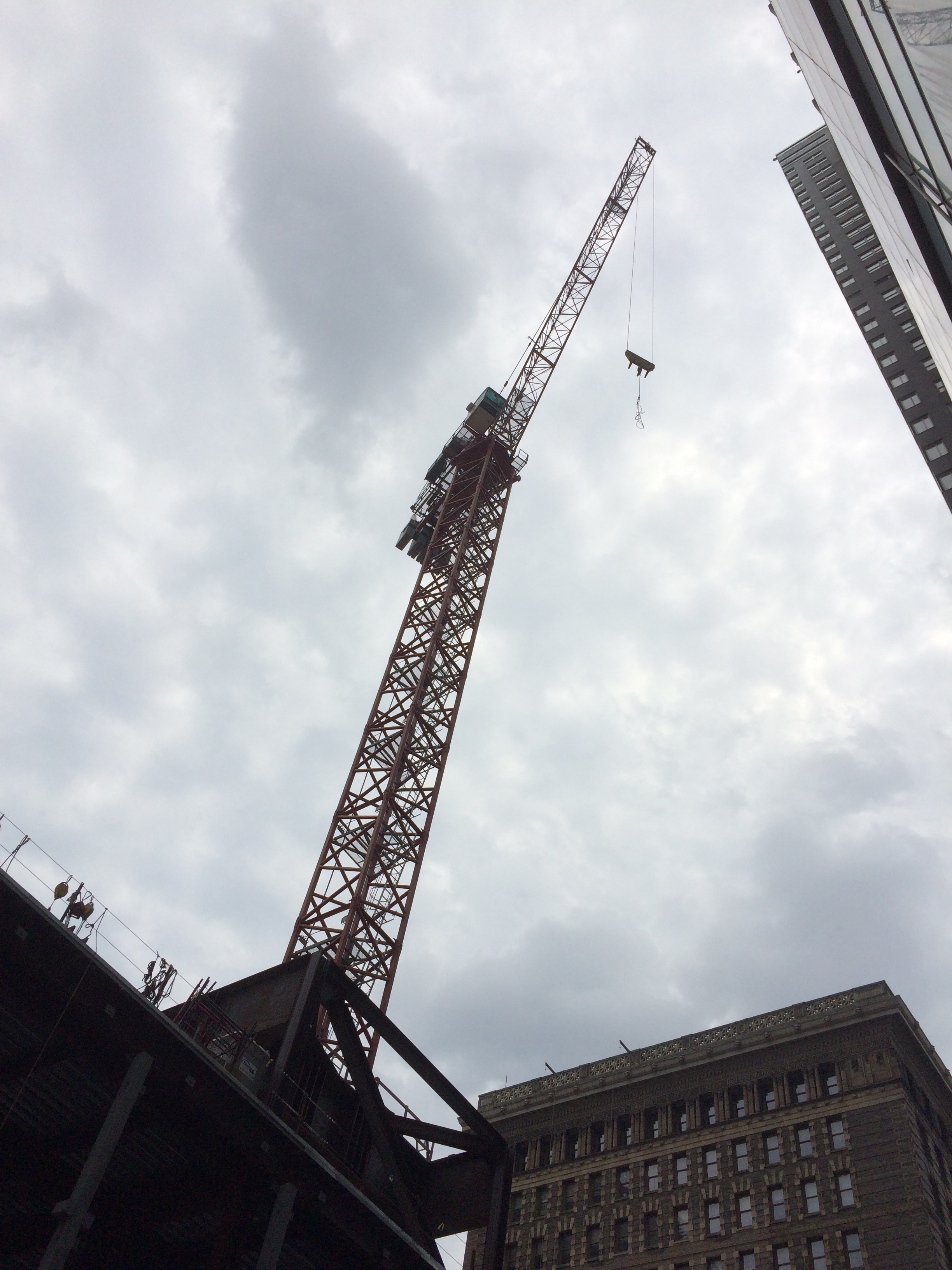
But I wanted to look higher than 15 feet. So I crossed to the south side of Market Street and, lifting my eyes to the skies, took in the first of five or six incredibly tall construction cranes that I’d come across during the afternoon. As I usually do when staring at one of these amazing machines, I wondered how in the world it stays balanced and how in the world anybody is able to manipulate its movements so precisely. Good thing it’s not me at the controls.

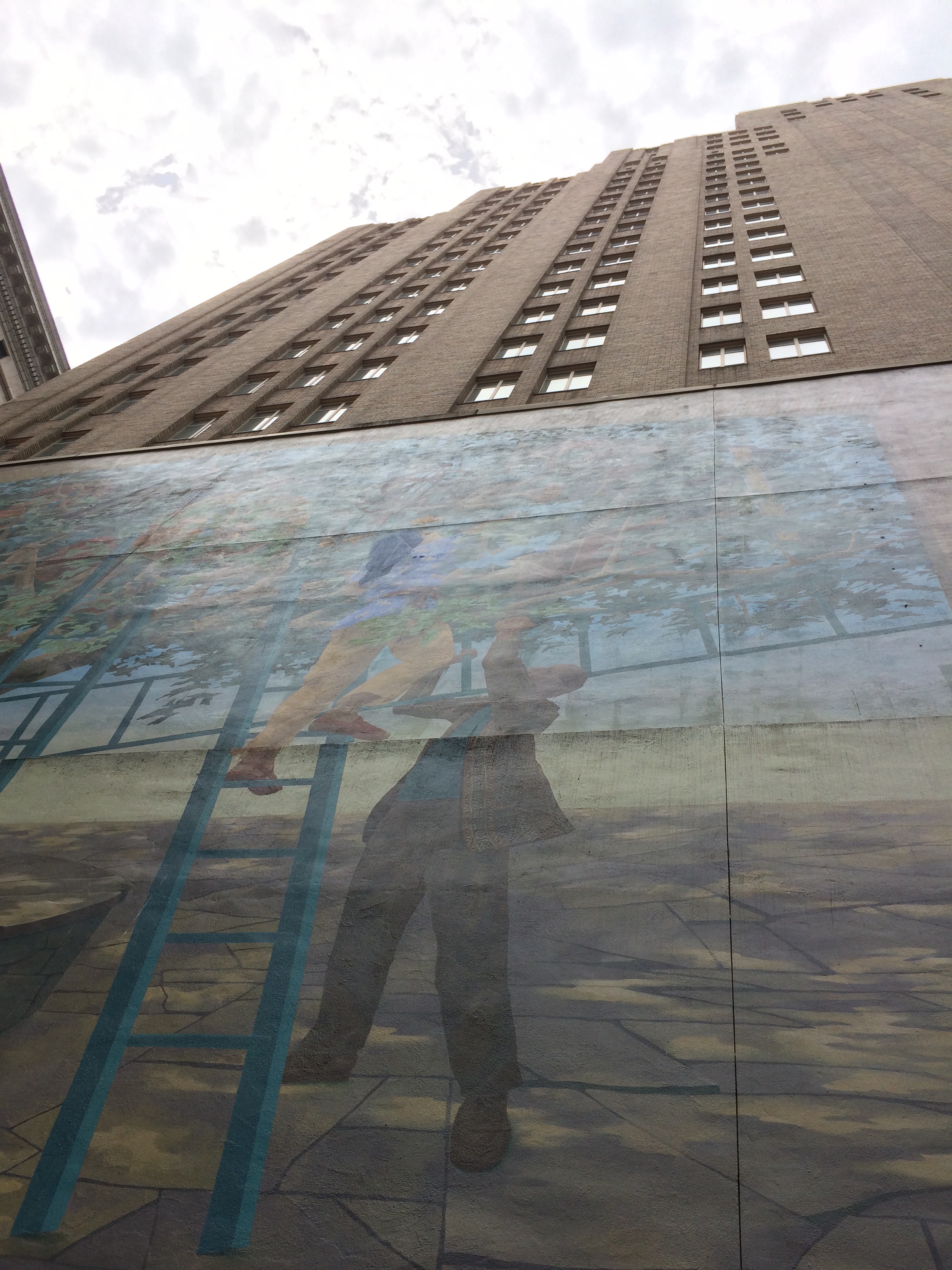
I was off to a good start. And one block later the good start continued when a sweet juxtaposition caught my eye. Philadelphia is famed for the several thousands of murals painted on the sides of buildings, and a great one adorns the lower reaches of a 16-or-so story office building near the corner of 13th and Market Streets. The mural is titled The Tree Of Knowledge. A ladder, a good item to have if you’re planning to pluck some information and wisdom from a tree, comprises a major part of the composition. I sidled up nice and close to the wall and looked up. The office building’s windows took on a new aspect, flowing gently in streams towards the heavens. And the ladder? It led the way to the levels above. I was tempted to climb it and see what happened.

Forty-five minutes later another mural, Reach High And You Will Go Far, crossed my path where 20th and Arch Streets meet. It too is a beauty, painted on the side of a three-story structure. Only a fool would argue with its message. I couldn’t get up close and personal to it though, as I had with The Tree Of Knowledge, because it is fenced-in. But I remembered to look up. And what I saw behind the mural, one block to its east,  was a giant tower, the under-construction Comcast Technology Center, that will top out at over 1,100 feet when completed next year. It is destined to become Philadelphia’s tallest building by about 150 feet. Reaching high, for sure.

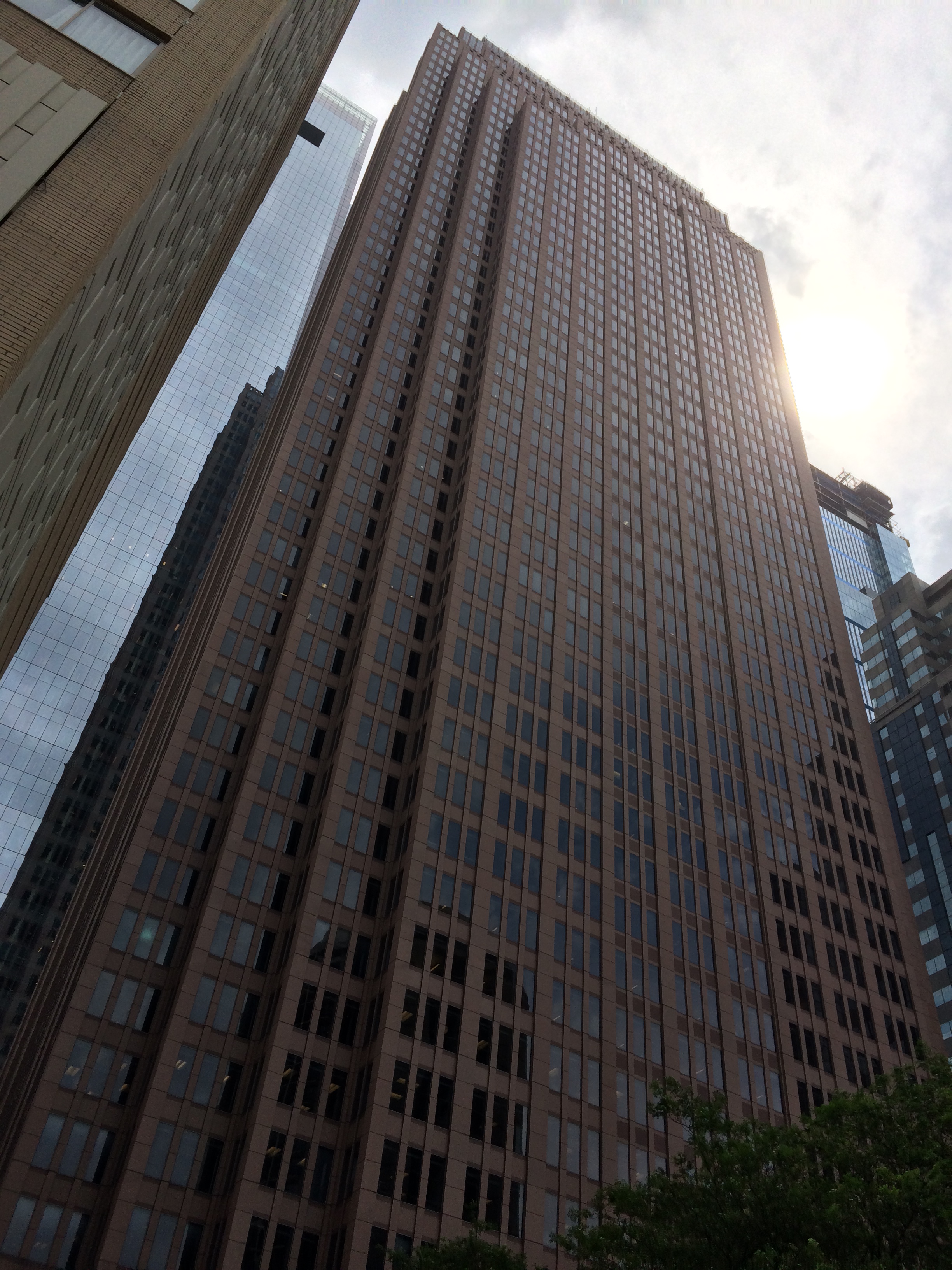
All told I spent two and a half hours roaming the streets, covering several miles-worth of territory. I spent much of the time in the areas where the city’s skyscrapers are most concentrated, and also walked along many blocks whose buildings are of normal size. My eyes darted here, there and everywhere, but I kept my mantra — look up! — firmly in the front of my mind. The patterns up above formed by contrasting buildings, the wonderful reflections of sky and surrounding edifices in way-up-there glass sheathings and windows, the loving details carved into stone not far above ground level in stately three-story homes . . . all of these made me smile.

I admired the words etched above the entranceway to The Alison Building, a calmly regal structure that faces one of the city’s finest parks, Rittenhouse Square. On an ordinary day, with my eyes looking straight ahead, I wouldn’t have noticed them. “He that soweth bountifully shall reap bountifully” they read. Hmmm, sounds like something that Benjamin Franklin might have said, I guessed. Incorrectly, of course. The phrase comes from the Christian Bible. Ben, though, probably knew and liked the statement, one you definitely can’t argue with.

My stroll ended alongside Philadelphia’s City Hall, an impossibly ornate hulk smack dab in the center of town. This monolith took around 30 years to build, finally opening for business in 1901. I’ve never been able to decide whether I like its exterior design or not. Some days I do, some days I don’t. It depends on how receptive to over-the-top decoration my mood is. As I approached City Hall from the south I naturally had to look at its highest point. Namely, the hat sitting atop the giant statue of William Penn, who more or less was Pennsylvania’s and Philadelphia’s founder in the late 1600s. That hat rests 548 feet above the ground, which made City Hall the tallest building in the city until 1987, when the first of Philadelphia’s now-numerous sleek, modern skyscrapers was erected.

Well, it almost was time to call it a day. I made my way to a subway station and rode a sub into South Philadelphia, an enormous area filled mostly with row houses. There I met two of my bestest pals, Mike and Jeff, for dinner at a pub. The hours of looking up had ended. Beers and some grub were the next things on the agenda.

(Don’t be shy about adding your comments or about sharing this story on social media)

(If you click on any photo, a larger image will open in a separate window)
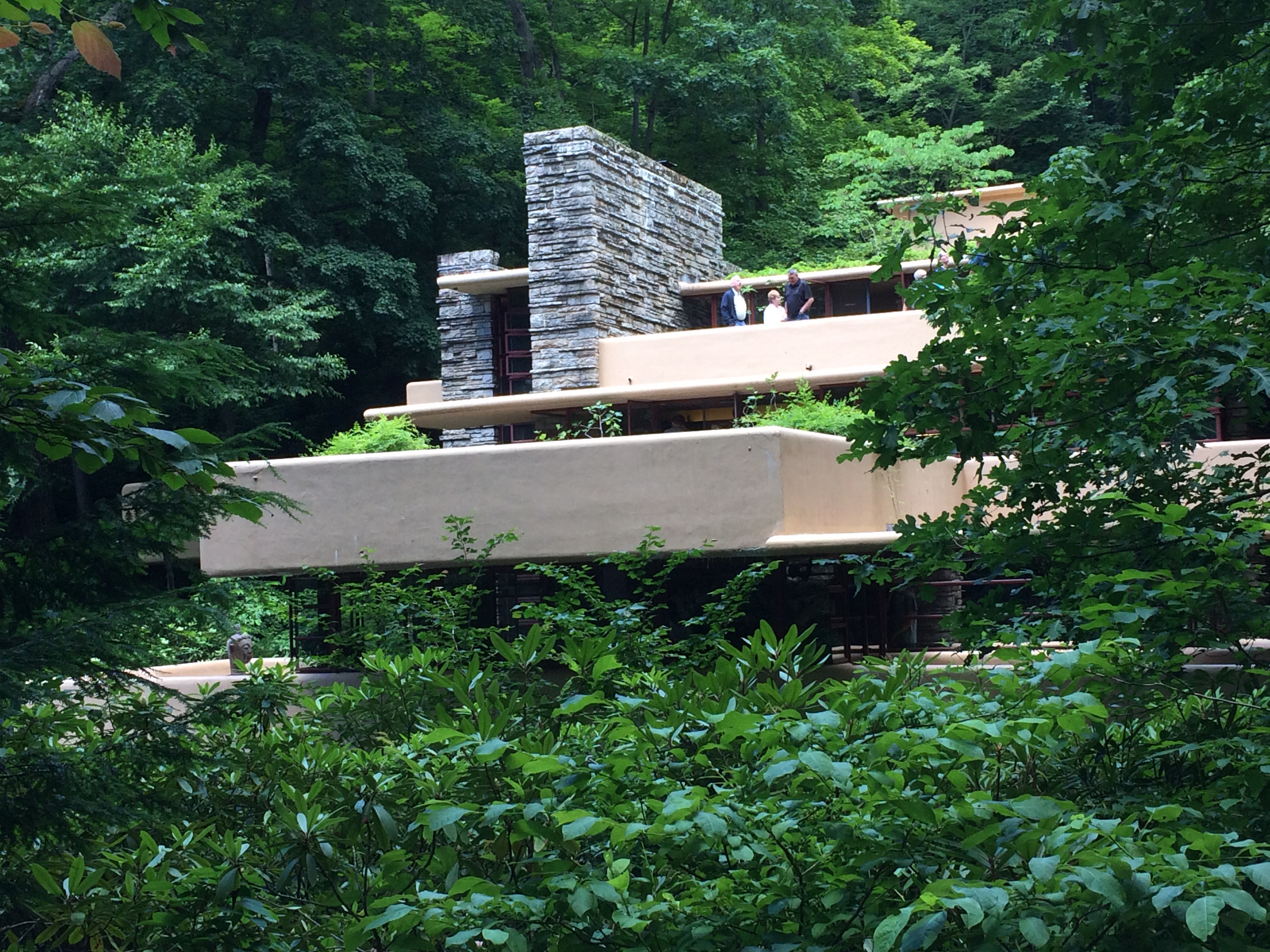
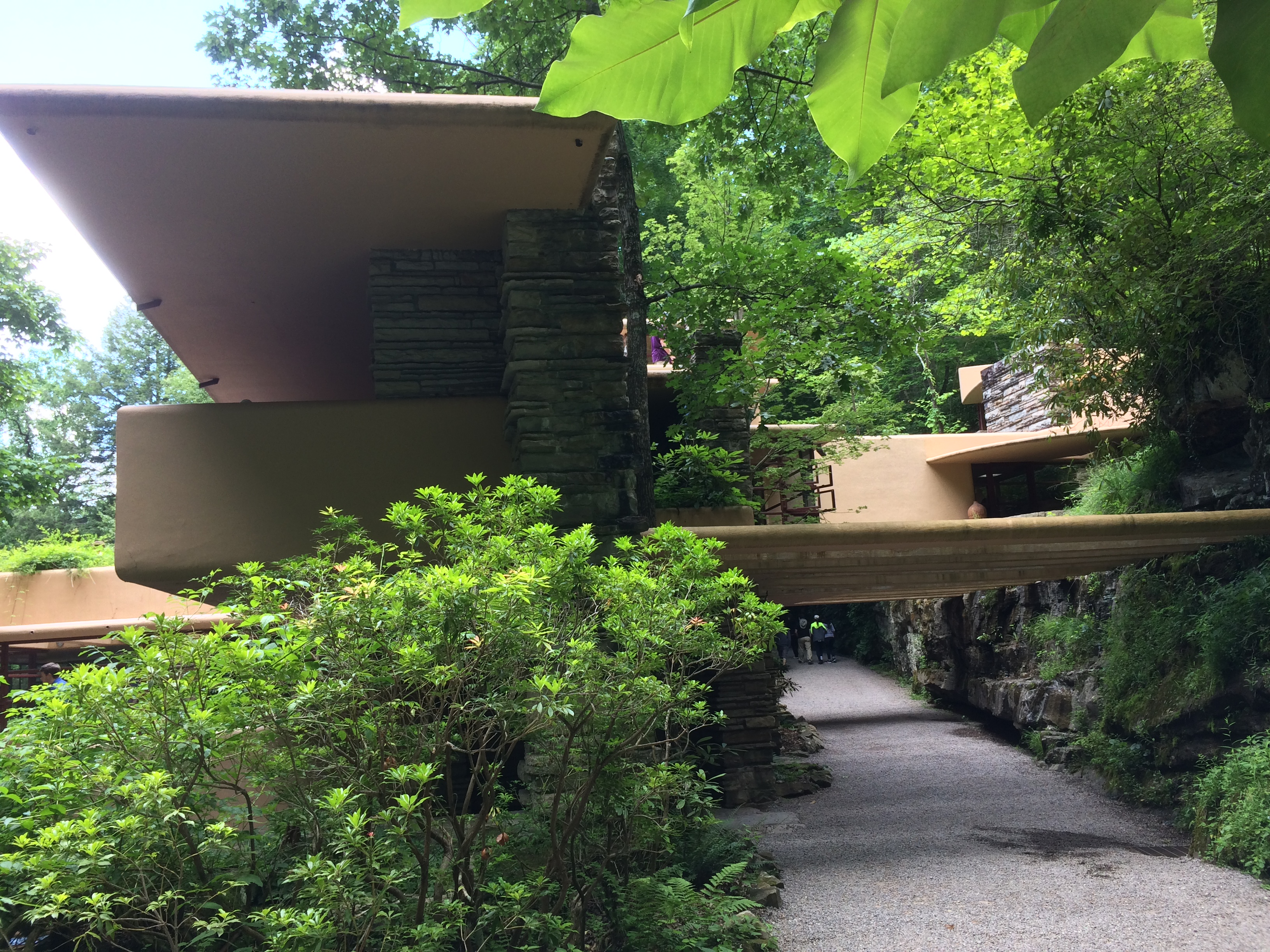
A Trip To Fallingwater

I’ve done a fair amount of traveling during the 69 years I’ve taken up space on Planet Earth. Been to Asia (Nepal). And to the Middle East (Israel). And to North Africa (Egypt). And to various countries in Europe any number of times. And I’ve been here and there in the States and Canada. How about Pennsylvania, then, the state I’ve lived in since my late 20s? Well, I’m nicely familiar with its greater Philadelphia region, which is my home territory, but outside of that orb I haven’t ventured all too much. And in the last couple of years I’ve been thinking about what I may have been missing. A trip to Ohio via the Pennsylvania Turnpike that my wife Sandy and I made a few weeks ago drove the point home pretty decisively. “Wow, look at all these mountains and farms. Who knew?” I said to Sandy more than once during that westward journey. “It’s time to explore Pennsylvania. Let’s do plenty of that before the sands of time run out on us.” Those weren’t my exact words, but they are close enough.

Smartly, we had already planned a day and a half of discovery in the Keystone State. On the way back from Ohio (you can read about the Ohio visit by clicking here) we drove to Uniontown, a less-than-flourishing community nestled in southwestern Pennsylvania, where we had booked a hotel room. The following day, Monday, would be our visit to Fallingwater, a Frank Lloyd Wright-designed home that has become a tourist destination. Neither Sandy nor I had ever been in southwestern Pennsylvania before.

To be honest, I feel a little guilty writing about Fallingwater. It’s not as if the world needs any more mentions of the place, as the 2,400,000+ Google results for Fallingwater obviously prove. But what’s a blogger to do? I considered typing an opus about what I ate for breakfast this morning (strong coffee, and Wheaties with blueberries), but opted instead for Wright’s creation. Nobody wants to read about my breakfast, not even me, no matter how delicious it was. Fallingwater it is.

To summarize Fallingwater’s history: Edgar Kaufmann, a department store magnate who lived in Pittsburgh with his wife Lillian and son Edgar Jr., commissioned the famed architect Frank Lloyd Wright to build a weekend/vacation home for the family. The house was to be set within the enormous, heavily-forested swath of land that the Kaufmanns owned in the Allegheny Mountains. That plot was (and is) about 50 miles from Pittsburgh. Wright completed his design in 1935. Two years later the house was in place, and two years after that a guest house, uphill from the main residence and connected to it by a short cement span, went up. In 1963, some years after the death of his parents, Junior donated Fallingwater and the family’s mountain acreage to the Western Pennsylvania Conservancy, a land and water protection organization. The Conservancy opened the buildings and grounds to the public in 1964, and before long Fallingwater caught on. Really caught on. To date, upwards of 5,000,000 visitors have toured the facilities. For a place that some might describe as being in the middle of nowhere, that’s genuinely impressive.

Photo by Sandra Cherrey Scheinin

And here’s why they keep on coming: Fallingwater’s exterior looks better than just about any house that you’ll ever see. It is sleek, lovingly tiered, rustically handsome and highly imaginatively laid out. And the house’s placement is, as they say, unparalleled. It is built atop and alongside boulders, a few of which poke out into the living spaces. And, rather incredibly, it is perched above a descending stream at the point where the waters – you guessed it – fall over rocks. A waterfall! A modest waterall, to be sure, but beautiful nonetheless. Fallingwater, a looker in an admirable, peaceful way, communes righteously with the natural environment that surrounds it. Harmony definitely prevails.

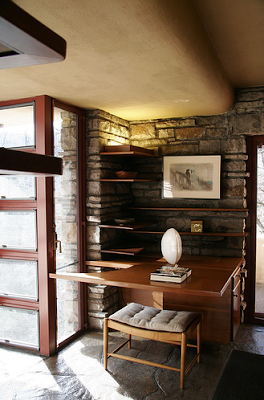
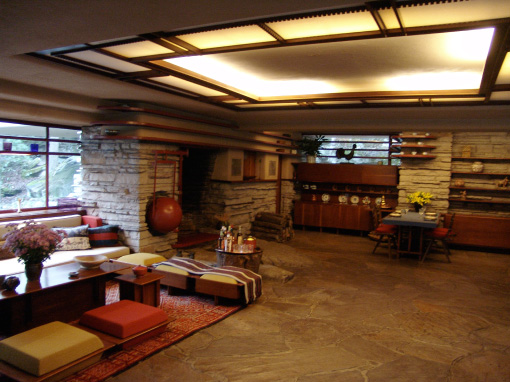
After breakfast on Monday, Sandy and I jumped into our car and drove the 25 miles, half of them along winding country roads, that separate Uniontown from Fallingwater. Our tour, scheduled for 11:00 AM, began on time. Twenty or so folks were in our tour group. The guide, alas, informed us that photography wouldn’t be allowed within the house. Nor would touching of the objects. Bummer. The interior shots I’ve included in this humble essay, therefore, are photos that I’ve snatched off the Internet. By the way, Fallingwater’s room arrangements and furnishings have been left pretty much as they were when Junior turned over the keys to the Western Pennsylvania Conservancy.

Photo by Jeffrey Neal

Most of the tour took place inside, as opposed to outside, Fallingwater. My memory being duller than a butter knife, let me pass on a few recollections before they fade into oblivion. First, I dug Wright’s color scheme. Earth tones predominate. They make for a calming, comforting experience, which without doubt was his intention. And I was surprised to learn that Wright designed not only Fallingwater’s structure, but many of its objects – desks, cabinets, chairs and tables. And they are beautiful. The guy was something else. Was there anything he couldn’t do? Well, he couldn’t walk on the waters of the stream flowing beneath the house, right? Or maybe he could.

Photo by Brad Ford

I noticed a couple of broad wooden desks, wedged into corners, that have portions of their tops neatly cut away so as to allow windows to swing open. Brilliant idea! And I spent some time in Junior’s bedroom looking over the smallish but swell collection of books on his shelves. They reflect an open and bright mind. Among them are the 10-volume set of The World’s Best Essays, a long-forgotten collection published in 1900. I’d have loved to pull out one or two of the volumes to take a look at the wisdom contained therein. But that wouldn’t have been a wise move, as the tour guide might have dragged me off the premises by the few strands of hair remaining on my head had I attempted to satisfy my innocent desire.

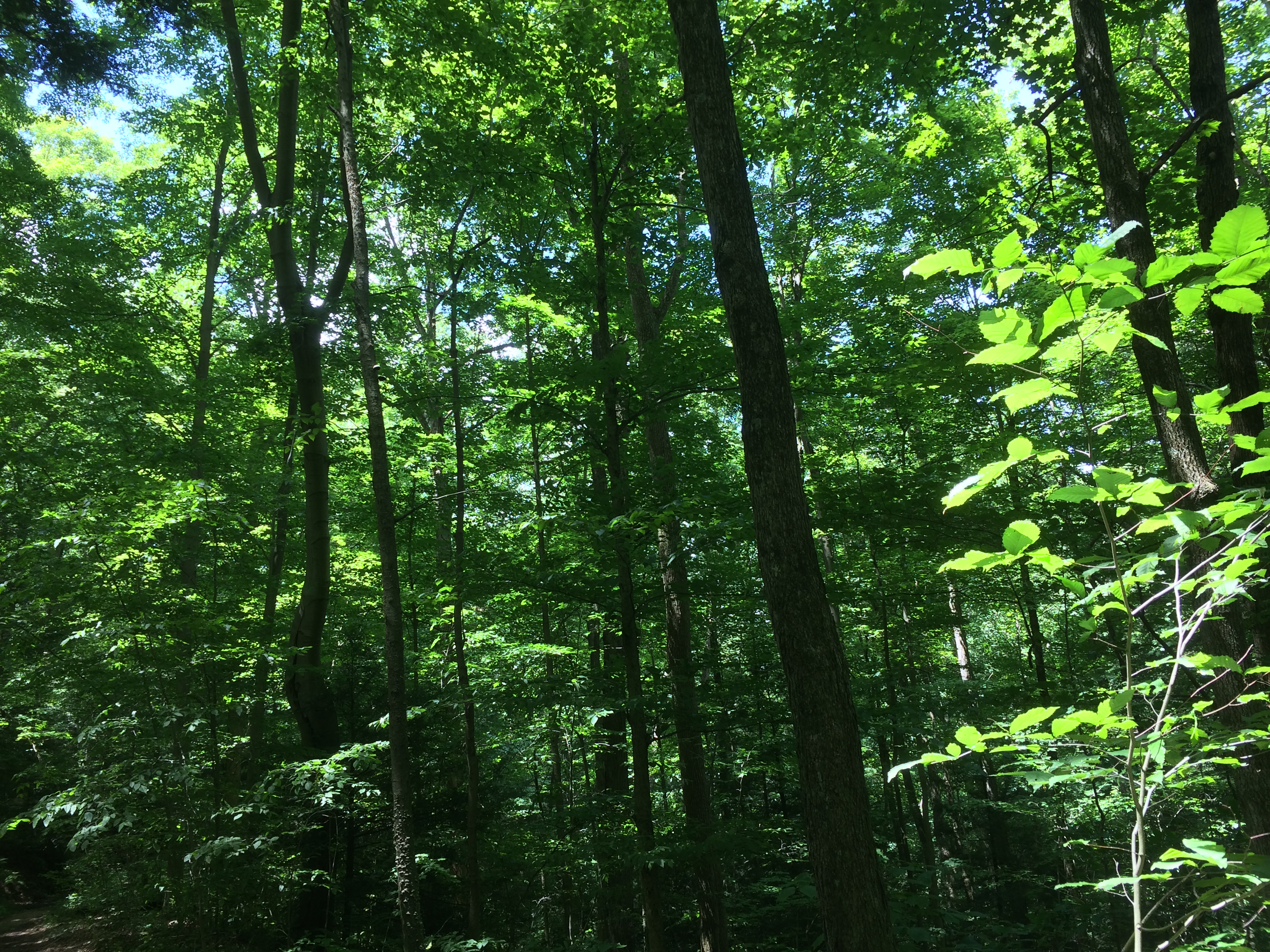
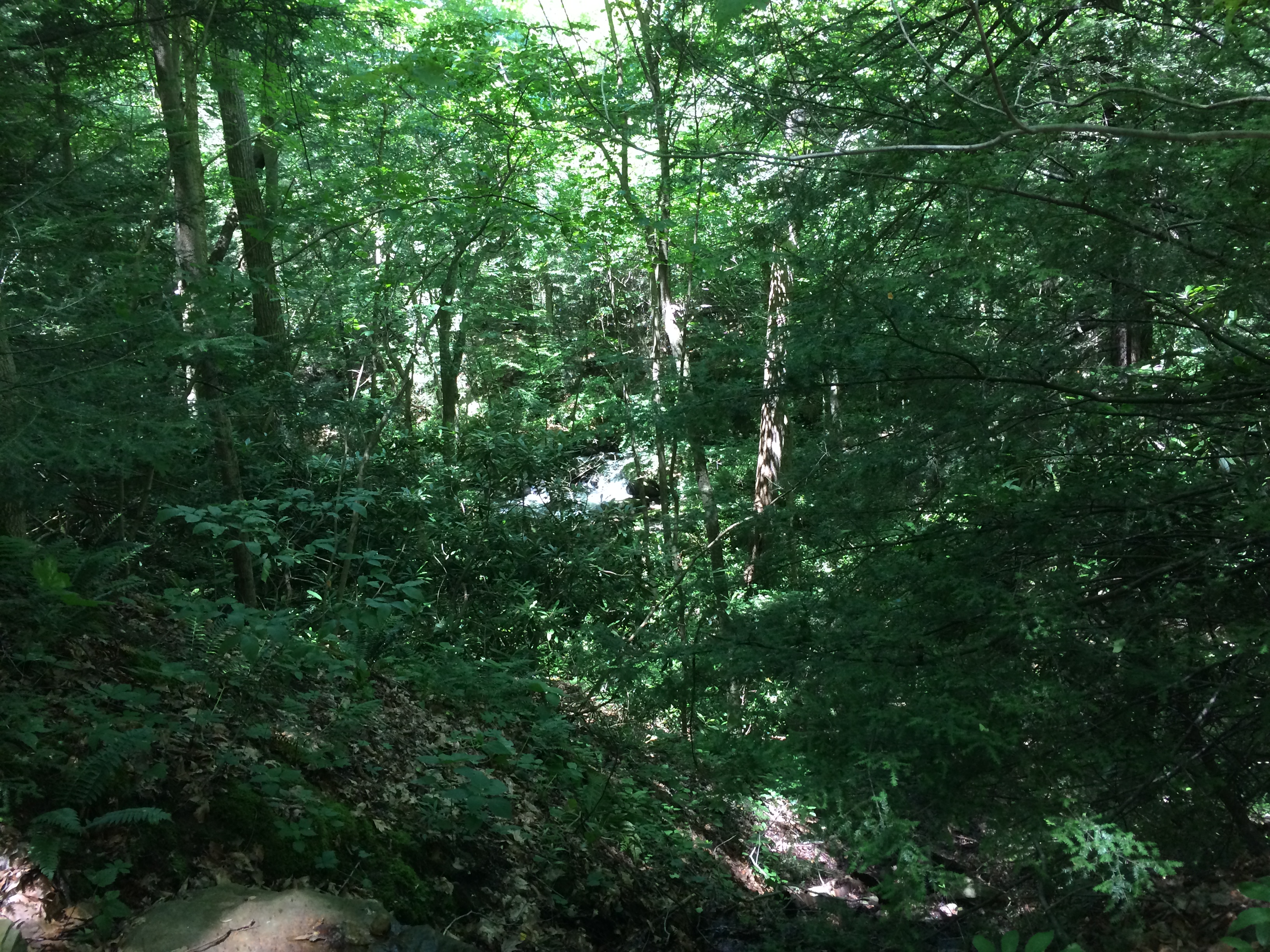
The one-hour tour over, Sandy and I headed down a trail that paralleled the stream and led into deep forest country. Rhododendron bushes grew in numbers you’re unlikely to see elsewhere. Oak and maple trees flourished, as did a variety of evergreens. It felt good to get lost, metaphorically, in the woods for a while. Take more forest walks is something I’ve added to my to-do-soon list. Forests don’t exist in my paved-over home area, but a few are within reasonable driving distance.

The next morning we drove home, southwestern Pennsylvania before long disappearing from our rear view mirror. Now, I’m not going to say that this rural region of Pennsylvania is a must-see destination. For those who groove on mountain hiking or fishing or rafting, it’s absolutely A-OK. For those not of that persuasion but who are passing through the area or taking in the sights in Pittsburgh, here’s the thing: You could do a lot worse than make the drive to Fallingwater. Sandy and I agree that Fallingwater made our trip worthwhile. The place is a beaut.

(Don’t be shy about adding your comments or about sharing this article on social media)

(If you click on any photo, a larger image will open in a separate window)

Philadelphia To The Rescue

Two Saturday mornings ago I was in the kitchen of my suburban Philadelphia home, contemplating the whys and wherefores of the universe. My wife Sandy was fastened to the living room sofa, absentmindedly wandering around the web on our laptop computer. If somebody had painted our portraits that morning they could have done worse than to title each canvas Inertia. Now, inertia is a weirdly compelling phenomenon. I’m quite familiar with and knowledgeable about it, as I spend half my waking hours within its grasp. If I were able to bottle it I think I’d become crazily wealthy. I mean, people once spent millions upon millions of dollars on pet rocks, didn’t they?

Luckily for us, our great pal Gene dialed our number around 11:00 AM. Sandy picked up the phone and spoke with him for a few minutes. After hanging up she told me what Gene had to say.

“Gene and Cindy [his wife] went to the Rittenhouse Square Fine Art Show yesterday. He says it’s very good. He recommends that we go.”

“Yo!” I exclaimed, just like most Philadelphia aficionados are prone to do. “Gene has the right idea. Let’s go into Philly to check out that show and then we’ll see where the city’s polluted winds carry us after that.”

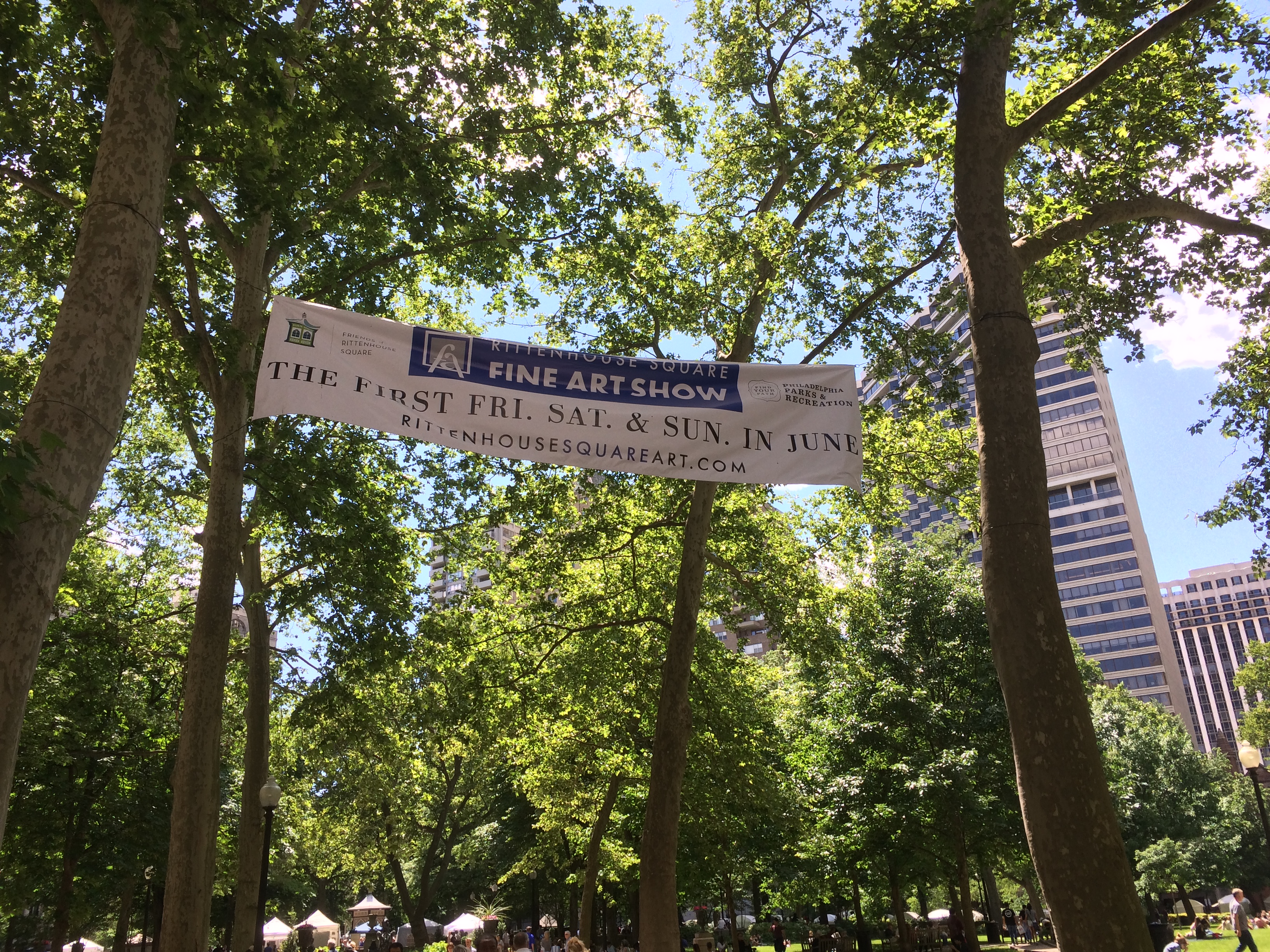
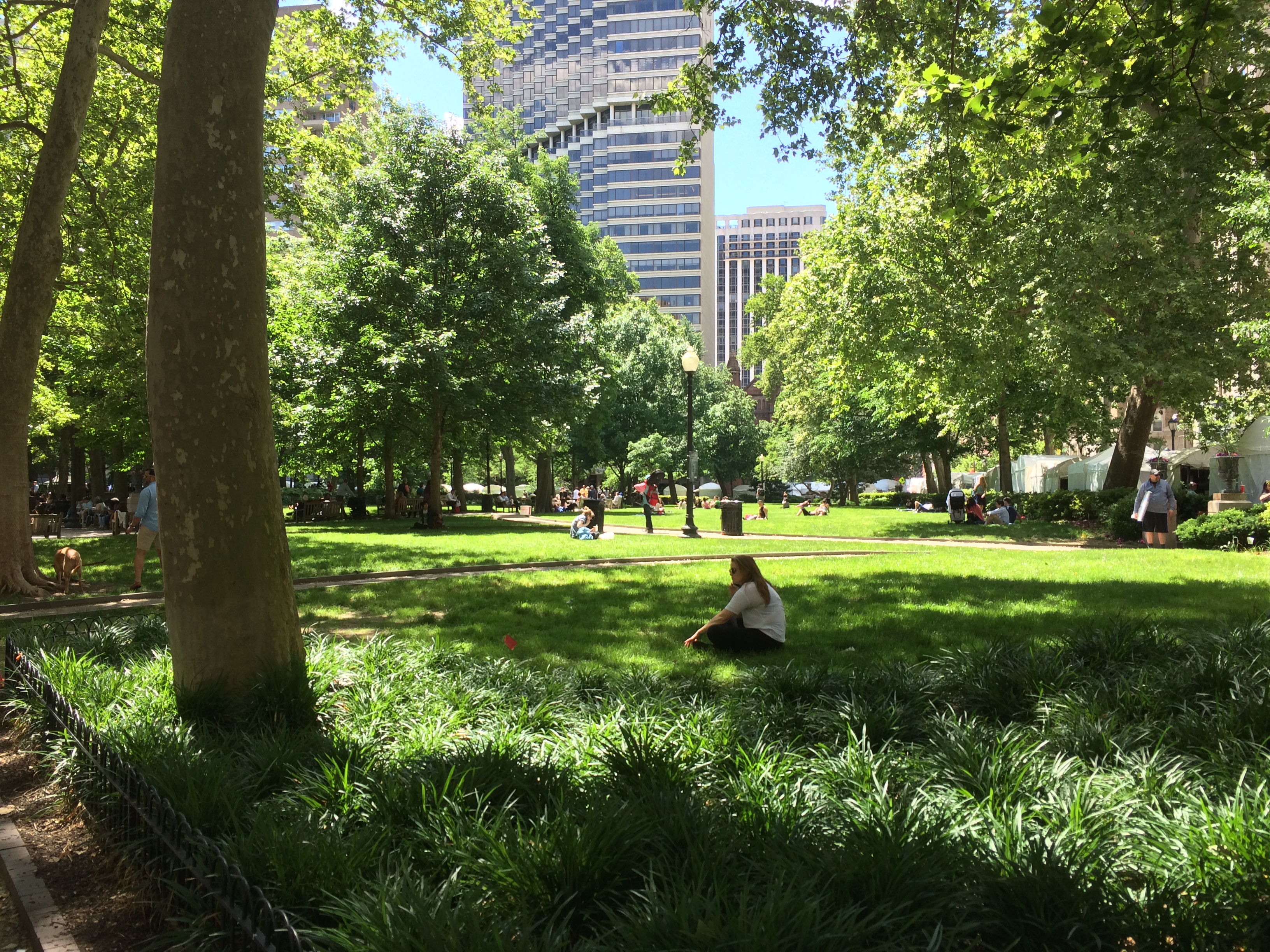
Two hours later we closed our eyes, clicked our heels three times and thought magical thoughts. That formula always works. Within seconds we were at 18th and Walnut Streets in Philadelphia’s central section. We crossed the street and walked into Rittenhouse Square, a gorgeous one-square block park that dates back to the late 1600s. From what I’ve read, in those days and for many ensuing years the park wasn’t looking all that good. In the early 1900s it was redesigned and infused with trees and shrubs in a pretty extraordinary manner, bringing it up to the high standards set by parks in Paris and other European cities.

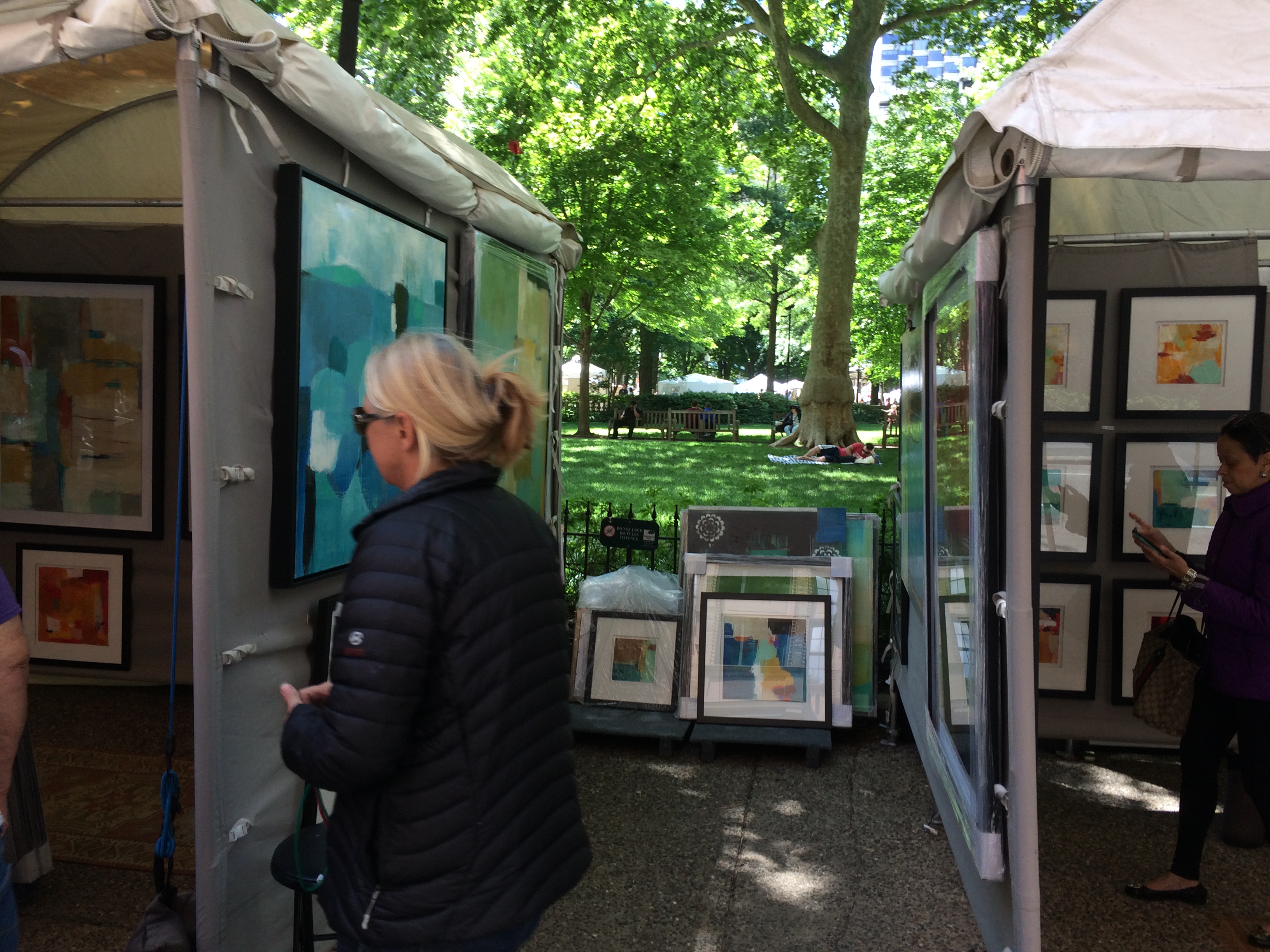
Neither Sandy nor I had been to the Rittenhouse Square Fine Art Show in at least 20 years. It’s an annual affair that began in 1928, making the most recent event the 90th consecutive one. That’s staying power. The show used to be an open-air display. That’s why I was surprised to see that most of the paintings and sculptures were under cover, housed within 143 tent-like booths ringing the perimeter of the park. Don’t know in what year the show’s organizers brought in the tents, but it was good thinking on their part. Now the show can go on even if it rains.

One hundred and forty-three booths holding the works of professional artists? Holy crap, that’s a big amount. And the total doesn’t include the 18 booths in the center of the park that were devoted to the output of student artists. Sandy and I looked at nearly every single booth’s contents, I think, though at the time I’d have guessed that I’d encountered maybe 60 or 70 booths. It was a couple of days later, when reading the show’s brochure, that I learned the true numbers at the park.

Well, what can I say? I’m an art lover, but in trying to catch a glimpse of everything I didn’t act like one, doing little more than to throw a glance at most of the offerings. I made super-quick judgments, deciding in a flash whether or not an artist’s oeuvre was worth my spending a bit of time with, and coming to the madly incorrect conclusion that most weren’t. That’s not the way I behave in museums, where I linger in front of and analyze the works. Oh well, clicking my heels must have set my limited-attention-span mechanism afire. Or perhaps I was just being my usual half-crazed self.

Still, now and then I did stop to smell the roses. For instance, I liked the stylish, black and white, Art Deco-ish drawings by Anastasia Alexandrin a lot. And the same went for the madcap animal sculptures by Scott Causey. And also for John Pompeo’s sturdy, excellently-balanced paintings of landscapes and barns.

Anastasia Alexandrin and her artworks
Scott Causey’s sculptures
John Pompeo and his paintings

And what I liked as much as or more than all the art works was the park itself. It felt great to be among trees and shrubbery and lawn areas exploding in myriad shades of green. And to walk the wide pathways of an elegantly symmetrical park that hordes of Philadelphia’s citizens and visitors love to be in. Rittenhouse Square is a winner, one of the city’s brightest spots.

The day wasn’t over. After taking a pause that refreshed, Sandy and I decided to make our way to West Philadelphia, an enormous swath of Philadelphia’s territory, where, in the area known as University City, the second annual West Philly Porchfest was in full swing. Porchfest is an idea that was born 10 years ago in Ithaca, New York. Since then it has turned into reality in quite a few towns and cities in the States and in a handful of locations outside the USA. I wrote about last year’s West Philly Porchfest, and you can read the article by clicking right here.

To hold a Porchfest, you need a lot of porches. And in University City porches reign. It was on those structures that musicians gathered to fill the air with song. I’d estimate that around 150 acts hit the stages (i.e., porches) throughout the day two Saturdays ago. I kind of fizzled at the art show, but I got my act together at Porchfest and let the vibes enter me in an intelligent manner.

Mountain music jam session
Ditto

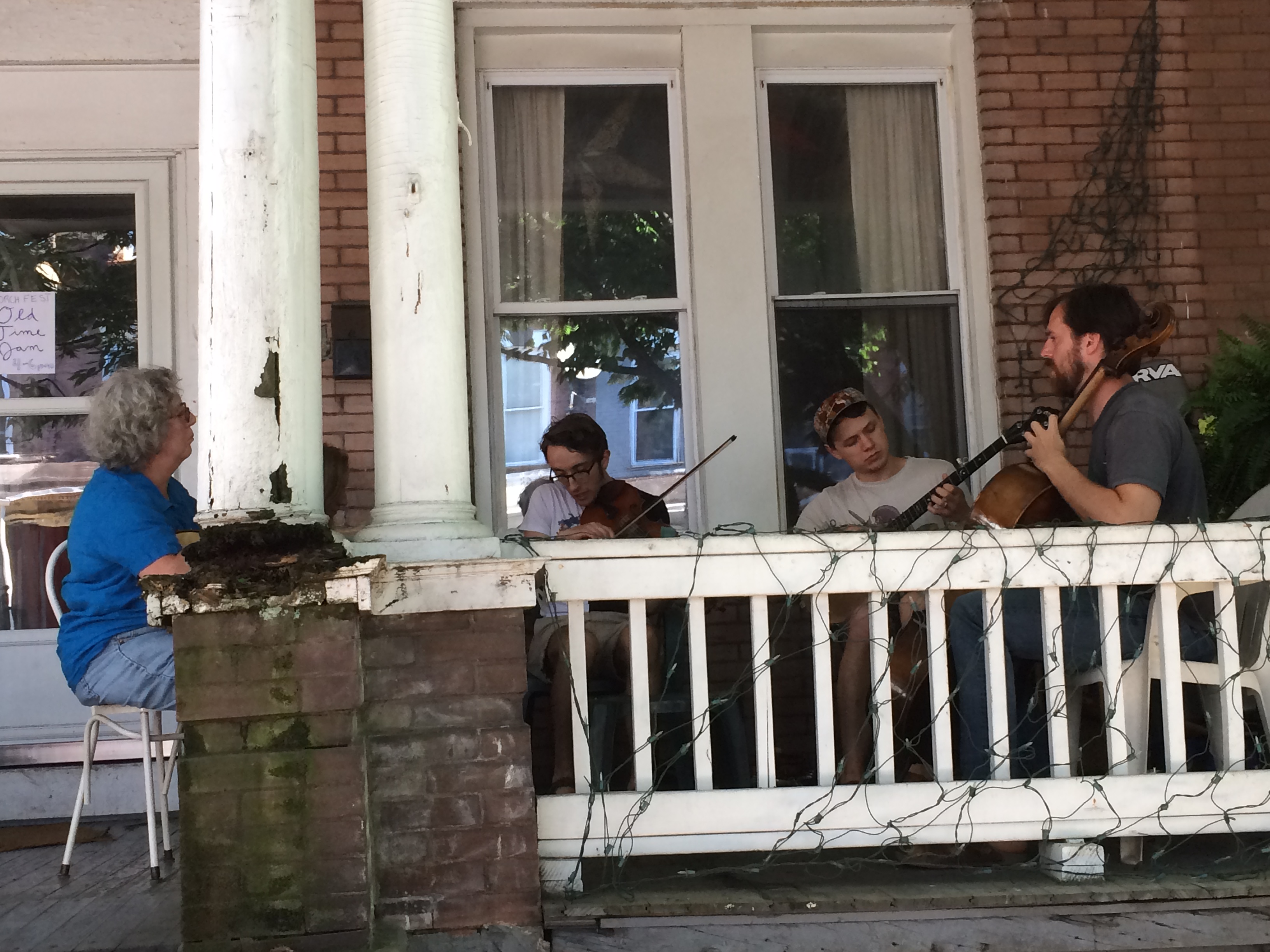
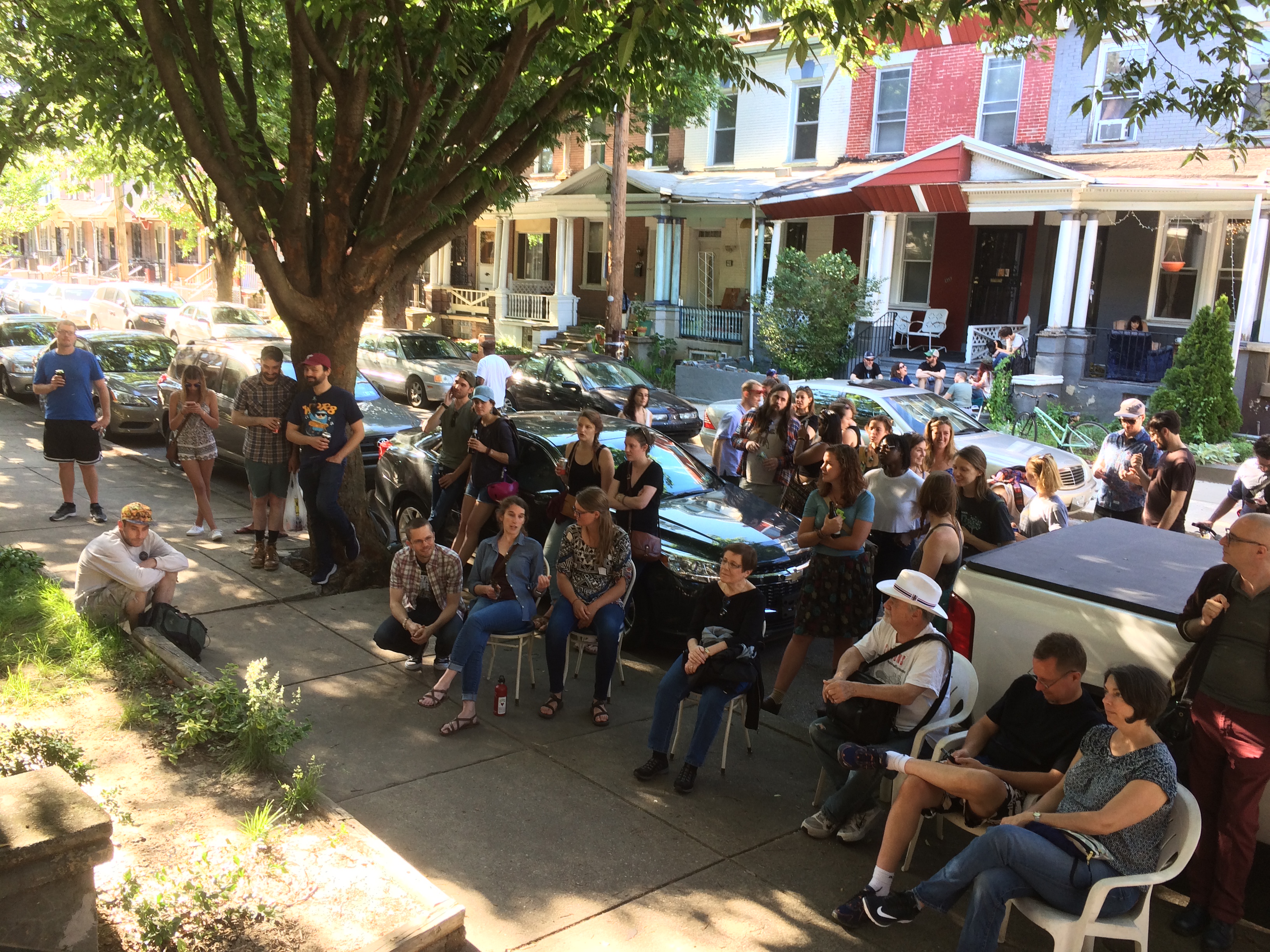
Between 4:00 and 6:00 PM, Sandy and I wandered around, program schedules in our hands. We checked out eight or so acts. The quality of the music was hit or miss. What we ended up liking the best was a mountain music jam session taking place on a quiet, leafy block of Walton Avenue. Fifty or so folks were soaking in the sweet sounds on the sidewalks and in the street. Most musicians at Porchfest, which presents many genres of music, amplified their instruments. But the mountain music jammers didn’t. No matter at all. I crept nice and close to the porch and got swept away by the sometimes gritty, sometimes aching and lonesome notes spilling from the musicians’ mouths and instruments. They were as casual and unassuming a group of performers as ever you’ll see, no different than the players strumming, picking and singing at their homes in mountain hollows in the southern states where this soulful, addictive music was born many years ago. I thought that Cameron DeWhitt killed on the banjo, that Jordan Rast fiddled like a demon, in a good sense, and that Peter Oswald set a firm footing with his cello work (Yep, a cello. It’s not the typical mountain music instrument, but at Porchfest it fit in just fine). Applause, applause.

Audience at mountain music jam session

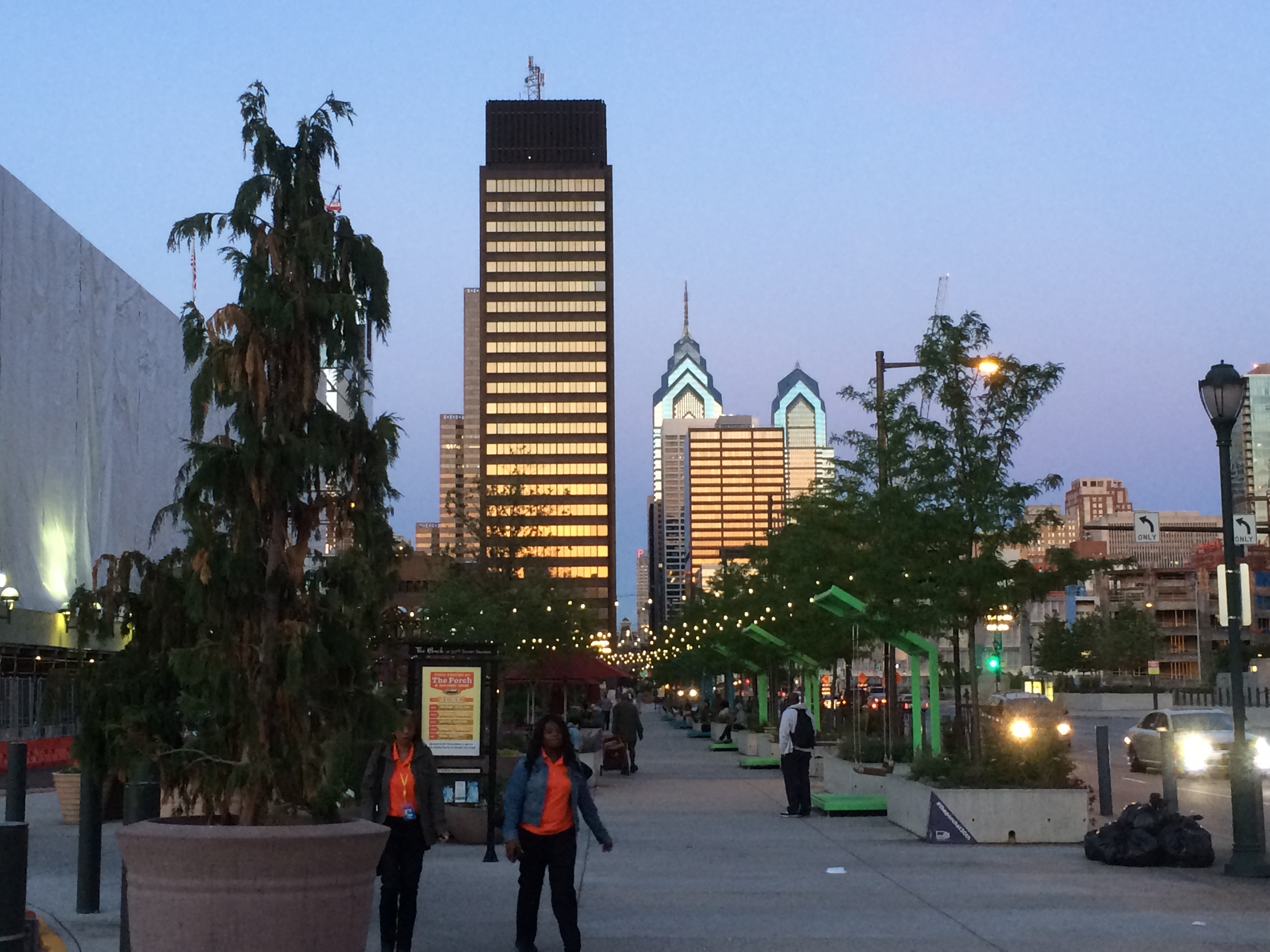
Come 6:00 PM, Sandy and I were getting hungry. Our dinner in a West Philadelphia hot spot (Dock Street Brewery) was good. But, as my mind is starting to wander and your eyes probably are getting tired from reading this story, I’ll skip the dinner write-up. I’d bid you all adieu right now had I not one more thing to add. Namely, at the train station in West Philadelphia where we boarded a choo-choo that took us back to the burbs, we were taken by a view of central Philadelphia, some of its tall towers beautifully aglow. The picture was too pretty a one not to snap. Snap it I did:

(Don’t be shy about adding your comments or about sharing this article)

(If you click on any photo, a larger image will open in a separate window)

Philadelphia, Here We Come Again

Some days begin badly and then turn out fine and dandy. A week ago Friday, for instance, I spent several hours pouting and moping after realizing that there weren’t any fresh blueberries in the house to dump into my breakfast bowl of Wheaties. I’m certain I’m not alone when I say that Wheaties sans blueberries ain’t no Breakfast Of Champions. I might have continued bemoaning my fate until who knows when were it not for the deserved and perfectly aimed slap upside my head that my wife Sandy administered. “Snap out of it, you fool!” she urged me for the umpteenth time this young year, adding “let’s go to Philadelphia and have some fun.” Right as rain once again, I looked through the arts and entertainment listings in the Philadelphia Inquirer’s weekend section and assembled a plan. Before long we found ourselves on a train heading from the burbs into the big city. Arriving in Philadelphia’s central section around 3 PM, we embarked on our expedition of discovery.

Now, Philadelphia’s a cool place in a lot of ways. For starters, it’s swimming with good restaurants and swell arts establishments and nifty Colonial era streets and gorgeous public parks. You can walk for miles and miles taking in the sights. Or, as Sandy and I did on the Friday in question, you can confine yourself to a small chunk of territory and do just fine. Everything we did took place between two blocks on the east-west axis (11th to 13th Streets), and four blocks on the perpendicular plane (Arch to Sansom Streets). We spent five hours within that rectangle before hopping a train back home.

img_1464It was a Friday defined by art, music and food and drink. My kind of day, in other words. First stop was Fabric Workshop And Museum, a non-profit arts institution that has been on the scene since 1977. I’ve been aware of FWM for nearly all of its life, but didn’t get around to scratching it off my to-be-visited list until the other day. Mister Right-On-Top-Of-Things strikes again!

img_1423img_1435FWM is a busy organization, with various arts-making and educational programs going on behind the scenes (click here to find the official website). Its more public face is the galleries where changing exhibits of, natch, art are displayed throughout the year. The items in the first floor gallery didn’t grab me. But I got big kicks from the handmade textiles that set the huge, warehouse-like eighth floor space aflame with colors. There, mounted side by side in four long rows, were large and beautiful silkscreened fabrics produced over the last few years by teens and young adults in FWM’s Apprentice Training Program. Half of the works stuck strictly to blacks and whites, while the rest went crazy with other members of the palette. Black and white . . . multi-colored . . . I couldn’t decide which family I liked best. Hell, why bother deciding? Both approaches were A-OK.

img_1451img_1455Bright, jubilant  colors, though, were destined to take precedence over their more dignified siblings as the afternoon segued into evening. From Fabric Workshop And Museum, Sandy and I ducked into a neighboring building and rode the elevator up to Fleischer/Ollman Gallery where we spent 20 minutes getting drenched by rocking blues, reds, yellows, you name it. Man, I started feeling dizzy from the wild vibes at FOG, and I liked that. “Yo,” I almost said to Sandy, “it’s time to add some life to our frigging living room. I’m going to buy that one and that one.” By which I meant Marc Zajack’s loopily loveable oil titled Stoned Bust and Nadine Beauhamois’ Circus Escapee, a plaster/wire/papier mâché beast in eye-popping hues. But I didn’t take out my wallet. I think I should have. And maybe I yet will.

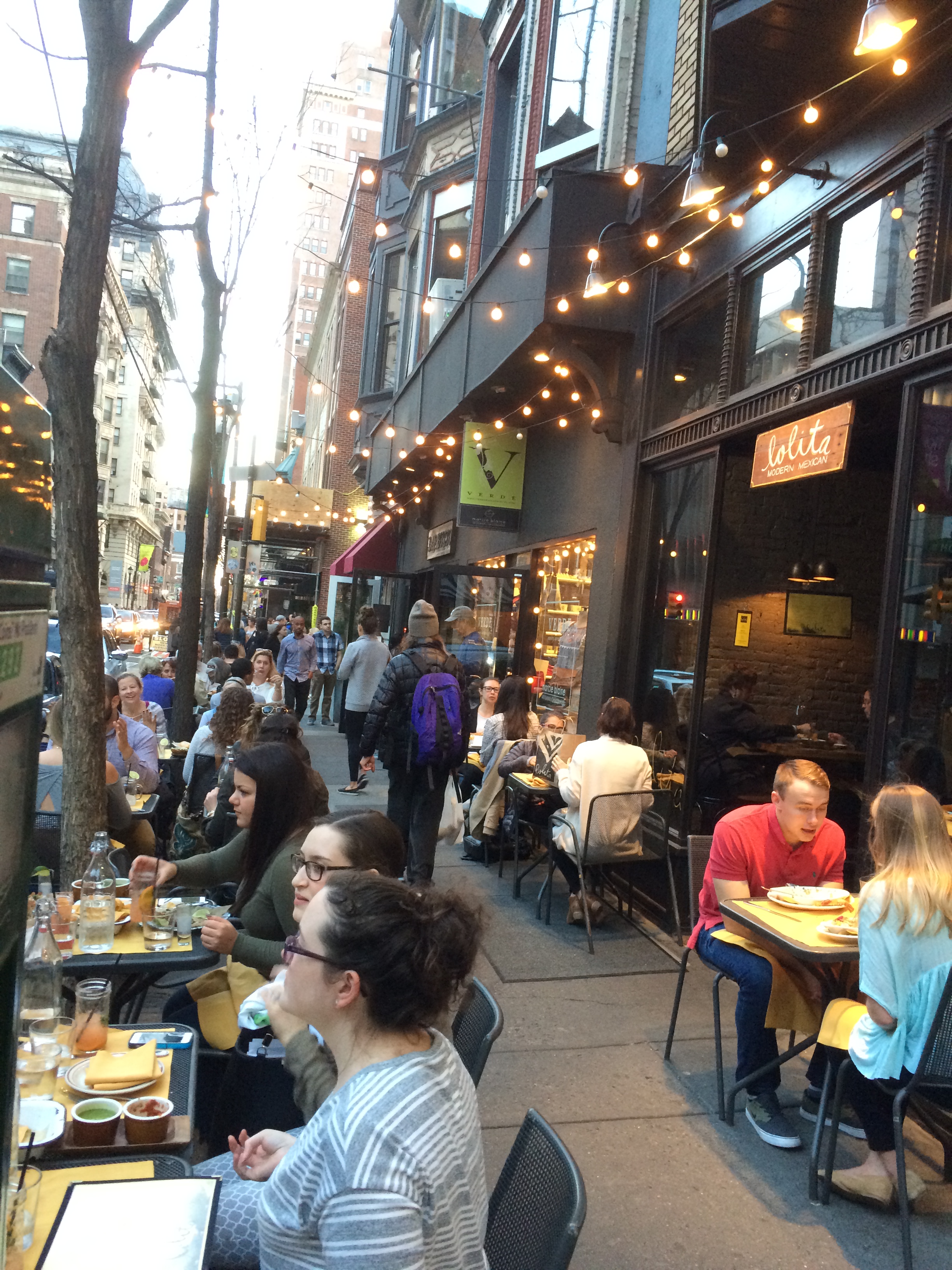
img_1472On we marched, our final destination to be Fergie’s Pub, a two story joint where you go when you’re in the mood for bohemian funkiness and friendliness. The air outside was incredibly warm for a February 24, about 72° F, which enhanced Sandy’s and my good spirits. It also resulted in an unusual sight — slews of jacketless diners chowing down at sidewalk tables strung all along a stretch of 13th Street, one of The Little Apple’s restaurant rows. Cool. I mean, warm.


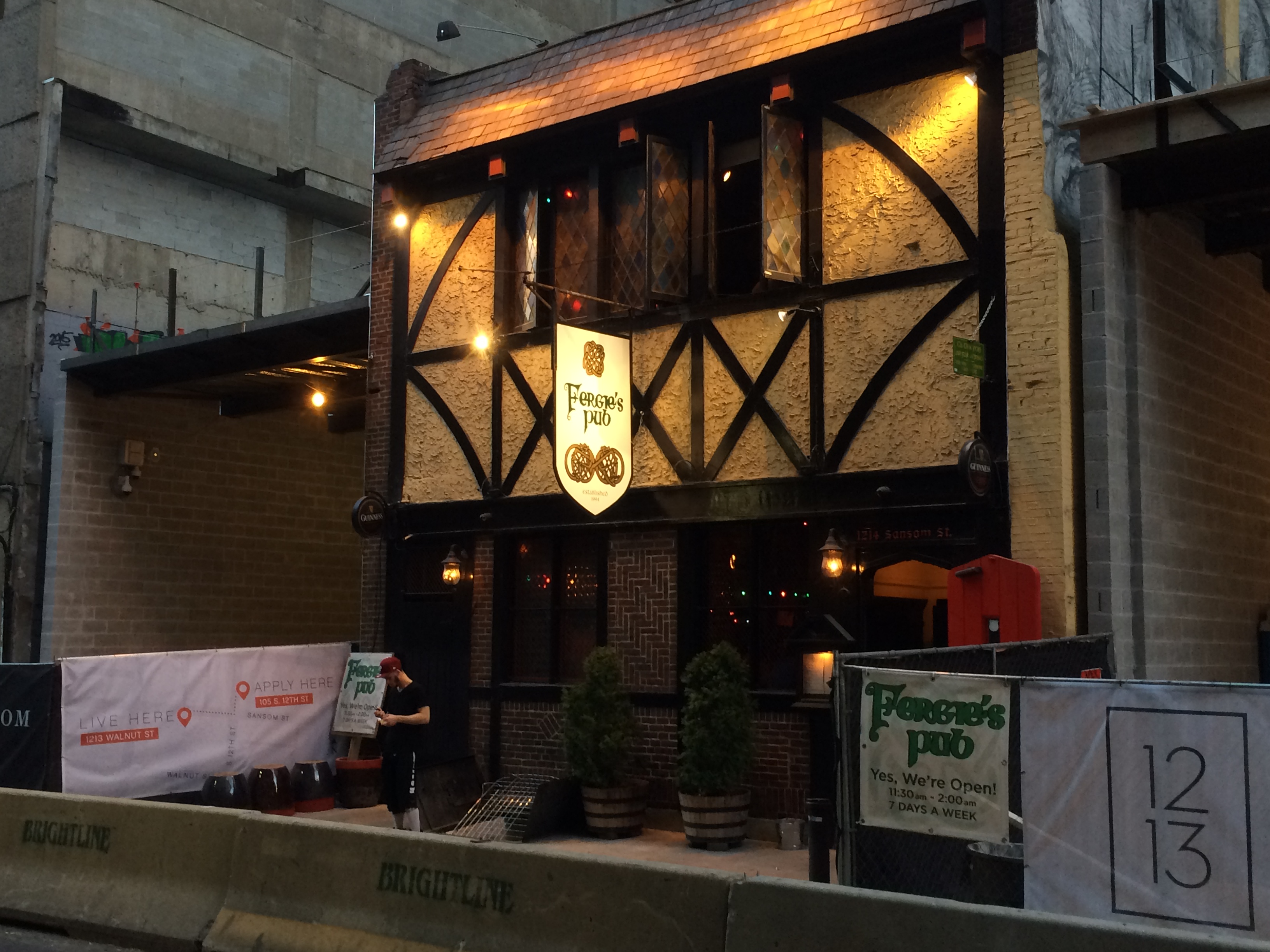
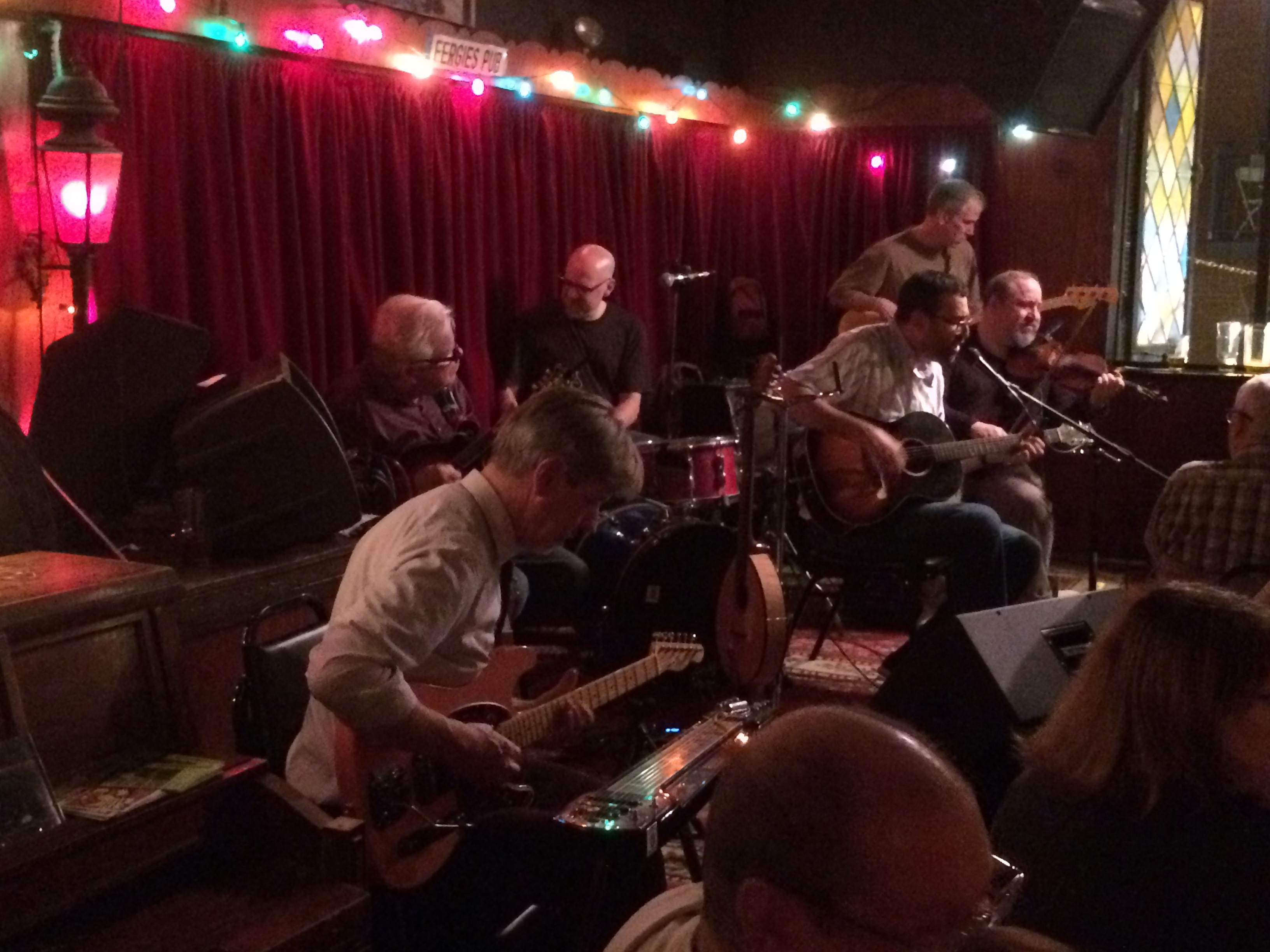
img_1475img_1478Ah, yes, Fergie’s Pub, a spot that totally agrees with me. Sandy and I had been there four or five times before, but not in the past two years. It’s a good place. The food is straightforward, tasty and fresh. The beers flow like wine, and vice versa. And on some Fridays, starting at 6 PM, a tight and soothingly rocking country-and-folk-flavored band that goes by the unlikely name John Train holds sway (click here if you’d like to be directed to JT’s website). John Train played two sets, each about 45 minutes in length, and had the jam-packed second floor room eating out of the palms of its sweaty hands. The group delivered a bunch of original tunes and some by Bob Dylan, Woody Guthrie, Hank Williams and the like (click here to watch a John Train performance at Fergie’s from earlier this year). The repertoire was powered by drummer Mark Schreiber’s low key but insistent beats and flourishes, and sent soaring by the wistful sounds flowing from Mark Tucker’s steel guitar and guest member Jay Ansill’s fiddle.

John Train is led by lead vocalist Jon Houlon, who sounds like a cross between Jerry Garcia and Arlo Guthrie, and who can banter with and throw goofy barbs at audience members like nobody’s business. The guy is a natural riot. He told a joke that I feel obligated to pass on to my readers. Between songs near the end of the second set, as Sandy and I finished up our turkey burgers, suds and vino, Jon Houlon said this to the audience: “You know The Rolling Stones song Get Off Of My Cloud?  . . . ‘Hey! You! Get off of my cloud’ . . . Well, did you ever hear the Scottish version? . . . ‘Hey! McCloud! Get off of my ewe.'” In my book, that’s a very good one.

You know, I’ve been dancing and prancing in Philadelphia for over four decades, which is most of my adult life, and I’ve yet to get tired of the routine. The day may come when I will, but I’ll worry about it then.

(Don’t be shy about adding your comments or about sharing this article with others. Or about signing up to follow this blog. Thanks.)

(If you click on any photo a larger image will open in a separate window)
Girl-Watching (A Philadelphia Museum Story)

It can take me forever to get around to tackling projects and situations, big or small. Half the time I never — and I mean never — place them in the completed bin. Hell, probably that’s the way a hefty percentage of us humans roll. I take comfort in believing that I’m far, far from being alone in excelling at procrastination.

Which is my four-sentence preface to announcing that I finally am getting around to knocking a certain something off my to-do list that has been sitting there for nearly two years. I began this blog in April 2015 and almost from the start had it in mind to write a story about La Salle University Art Museum, a little-known institution in Philadelphia on the cute campus of La Salle University. Man, my psychotherapist will be so proud of me for bringing this story idea to fruition. “Neil,” he said at our most recent session, “sometimes I think you enjoy being stuck in cement.” I pondered that for a second and then said, “You’re oh so right, Doctor Cortecks. And, believe it or not, my wife figured that out on the day we met. Which is why she nicknamed me Jimmy. As in Hoffa.” Doctor Cortecks liked that crack so much he waived the session fee.

Anyway, returning to reality, a week ago Tuesday, on a most unseasonably balmy afternoon, I decided that a visit to LSUAM was in order. I hadn’t been there in several years and was in the mood for staring at attractive objects. So, into my car I climbed and headed south from my suburban abode, pretty quickly reaching the nothing-special section of Philadelphia in which La Salle University occupies space and time.

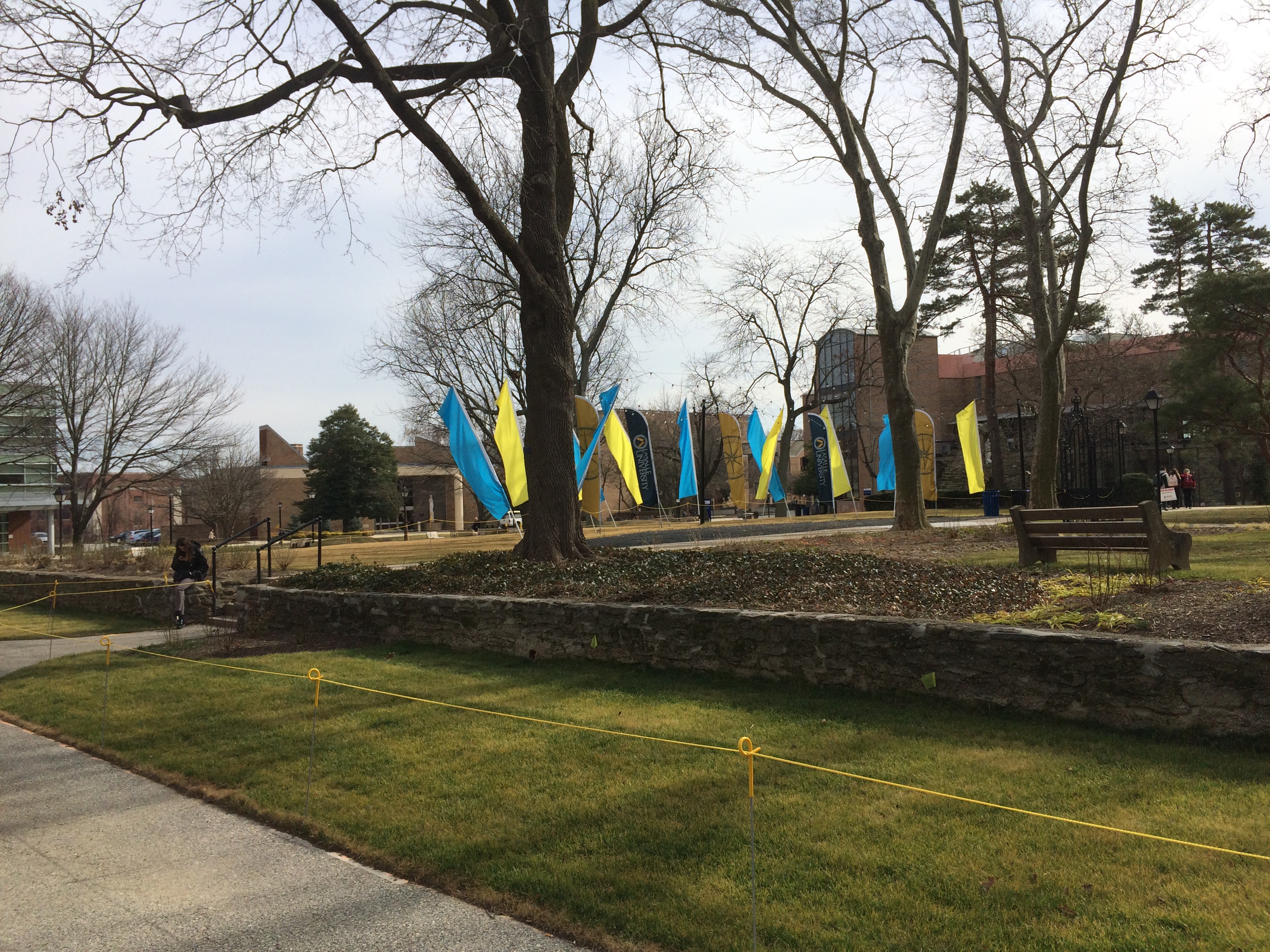
img_1366As I mentioned, La Salle’s campus is cute. And as I walked through sections of it on my way to the museum I had my eyes open for cute girls, girl-watching being one of my fave activities despite my certified status as a semi-ancient geezer. Sadly, I saw only one or two, as the grounds were strangely low on people of either gender. But that was OK, because my plan was to check out the ladies at the art museum . . . those on display, that is. It seemed like not the worst idea in the world to take long looks at the paintings and sculptures of females, and to breeze past all the others. And that’s exactly what I did.

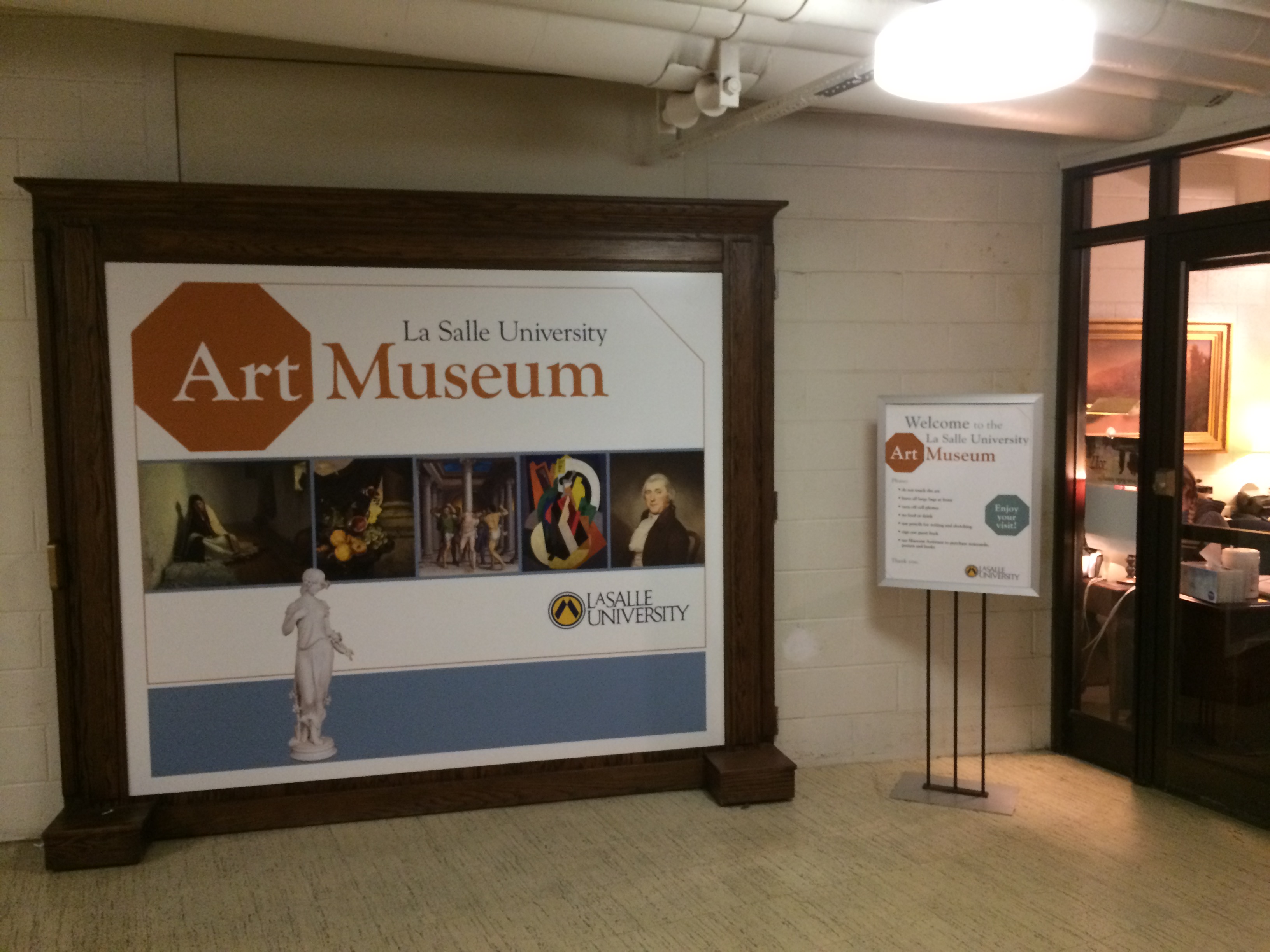
img_1370La Salle University Art Museum is tucked away in the basement of a nondescript building primarily filled with classrooms. The museum is small, seven or eight modestly-sized rooms and a couple of hallways, and its contents are quite good. Me, I like museums of this sort where you don’t have to spend half your life examining the wares. To art lovers in the Philadelphia region I recommend a visit. You’ll get to see beautiful stuff, from ancient times to the present, by famous folks (Tintoretto, the Renaissance great, for crying out loud; Jacob van Ruisdael; Henry Ossawa Tanner; Alex Katz) and lots of equally fine pieces by artists you’ve probably never heard of (click here to find the museum’s website).

I suppose I gazed upon 50 or 60 artworks depicting females. And as I gave some thought to my story theme afterwards, four of those depicted women tapped me on the shoulder and suggested I write a few words about them. I’m often eager to please, so I’ll take them up on it.

img_1379To begin, I was wowed by the natural charm and beauty of Father’s Return, painted around 1850 by Harriet Cany Peale, a Pennsylvanian. In the painting, two kids are excited as can be by the sight of their dad walking towards the homestead. He has been away on business or whatever, probably for several or more days. His wife, though, isn’t looking at him. Instead, her eyes are focused on and dripping with love for her young daughter held in her arms. Hey, hubby can wait! Peale swamped the painting with browns and muted greens. There’s nothing flashy except for the little girl’s orange dress and the mother’s bright lips. Amidst all of that, though, it was the mother’s eyes, nothing more than large, dark dots, that I found myself drawn to. They say a lot.

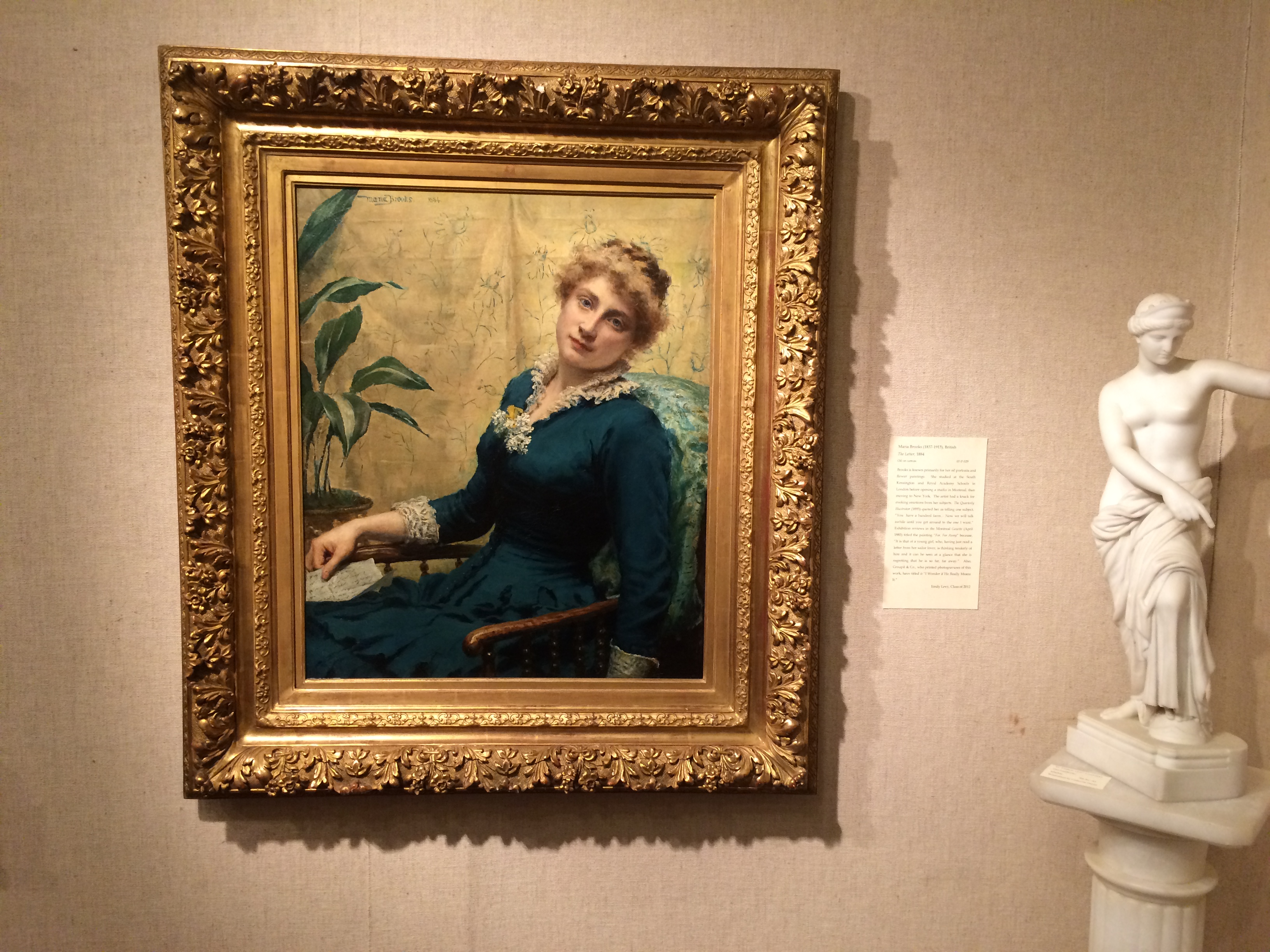
img_1384The lady featured in Maria Brooks’ The Letter shows us a gaze of another sort. Brooks, a Brit, painted her in 1884.  As the story goes, the woman in question has just read a letter from her seafaring sweetheart. And she misses him plenty, as the aching numbness in her eyes makes most clear. This to me is a really lovely painting. Its tight framing, the limited choice of colors, the way the letter reader’s faintly pink skin melds into her surroundings, are parts of an excellent balancing act. The picture made me feel kind of wistful, which is what I’m sure Brooks meant it to do.

Gazes, eyes and lips . . . we’ll wind up these proceedings with some more comments about them, because I was struck by similarities between two works, a painting from about 1930 by the American modernist Alfred Maurer, and a small wooden sculpture made at an unknown point during the 1900s by an uncredited artist in Africa’s Ivory Coast.

img_1407img_1420

Maurer’s oil, titled Woman In A Window, is heavily in debt to Cubism, the fractured take on things pioneered by Pablo Picasso and Georges Braque in the early 1900s. Sure, this lady ain’t about to win any beauty contests, but I found her loveable. She’s a happy individual. Just look at those big, smiling eyes and the lips giving out an ooh. I’m going to guess that she’s looking through the window at a fun event, maybe a parade, maybe a bunch of children playing games. And, in my view anyway, the window lady has a close relative at the museum, a sister. Needless to say that’s the woman of the African sculpture, who displays not quite but almost the same expressions as Maurer’s heroine. I saw amazement in her eyes and wonder on her lips. She’s not showing her inner feelings as much as Maurer’s gazer, but she is no less enthralled by whatever it is she’s looking at.

Well, there’s plenty to be said for spending time with works of art. They are open to all sorts of interpretations. They can make you think, make you feel swell, not so swell and everything in between. I drove home from La Salle University Art Museum with more than a few notions and emotions skipping around in my little ol’ head.


(Don’t be shy about adding your comments or about sharing this piece with others. Thanks.)

(If you click on any photo a larger image will open in a separate window)

I Was There For Santa Claus When He Needed My Help

“Yo! I mean, ho! As in ho-ho-ho. Can’t you see that I’m stuck, you idiot? Give a guy a hand.”

santa_claus_png9972Indeed he was, he being Santa Claus. The one and only. To say I was surprised to find the jolly gent dangling head-downward from within my living room fireplace would have been the understatement of 2016 were it not for Donald Trump. Needless to say, the understatement of 2016 is that Trump is way bad news. Hell, he’s way bad news times fifty! But, I digress.

It was 9:00 PM on the eve of Christmas Eve when the rotund one unexpectedly appeared. I was sitting on the sofa, ruminating about this and that, as usual arriving at no satisfactory conclusions. Also as usual, the sofa cushions were profusely dotted with Cheez-It cracker crumbs. I already had put away 500 or more Its and, prior to Mr. Claus’ arrival, had no plans to stop the ingestion process.

“Santa, is this a joke? What are you doing here? Your delivery rounds don’t start for another 24 hours. And you’re in the wrong household, anyway. I mean, me and my wife are Jewish!”

I put aside the Its, reluctantly, and walked to the fireplace where, with only a bit of exertion, I helped Santa out of his predicament. Standing upright, he brushed himself off.

“Yo, brother. I know that you and your wife are Jews. And I also know your name. Neil, it’s a pleasure to meet you.” He extended his pudgy right hand, which I clasped warmly, and smiled at me in the friendliest of manners. Santa gave off such good vibes. I liked him a lot. Immediately.

“Santa, likewise, I’m sure. Are you hungry? Can I get you something to eat? To drink?”

“A toasted sesame seed bagel with a schmear would be nice,” Santa said. “And some schnapps to wash it all down would be outstanding. You don’t happen to have those around, do you?”

“Santa, this is more than your lucky day. My household overflows with bagels. And with schnapps in its many varieties. Come on, sit down at the dining room table and I’ll fix you up.” I assembled the simple meal and watched Santa happily eat and drink.

“Ah, this is delicious,” Santa said, alternating between bites and sips. Then, when his plate and glass were empty he got down to business. “I’ve had my eyes on you for awhile, Neil, and I’m certain I made the correct choice in visiting you. You see, I like Jews very much. Just like me, they know about good food and drink, and they rock the color red. Well, maybe I’m wrong about the second half of that statement. Anyway, speaking selfishly, what’s very important to me is that they boost my spirits. And once a year, believe me, I need that boost. You think it’s easy bringing toys to billions of children each year? Sure, if you only had to do it once or twice it wouldn’t be hard.  But year after year after year? Come on . . . talk about job burnout.”

“Many years ago I was schmoozing with a Jewish friend of mine, Morty Finkelstein, about this very problem,” Santa continued. “Morty listened carefully and let me pour my heart out. Then he proved himself to be a real mensch, saying all the right things to sooth my malaise. Since then, each year I seek out a Jew to help get me back on track. You were recommended to me a few months ago by the League Of Jewish Bloggers. That’s when I started reading your blog stories. I have to tell you that they give off the weird and optimistic sorts off auras that I’m partial to. Which is why I’m confident that you’re the person I need. Neil, tomorrow is my big day. I’m feeling down and tired, and I’m asking you to turn me around. I know you can do it.”

Holy man-o-Manischewitz. Was this really happening? Was I dreaming? I pinched myself on the right forearm real hard. Yikes, that hurt like crazy! No doubt, Santa truly was in the house. “Sir, I’m at your service,” I said. “And I think I know just what to do.” I motioned to Santa to rise.

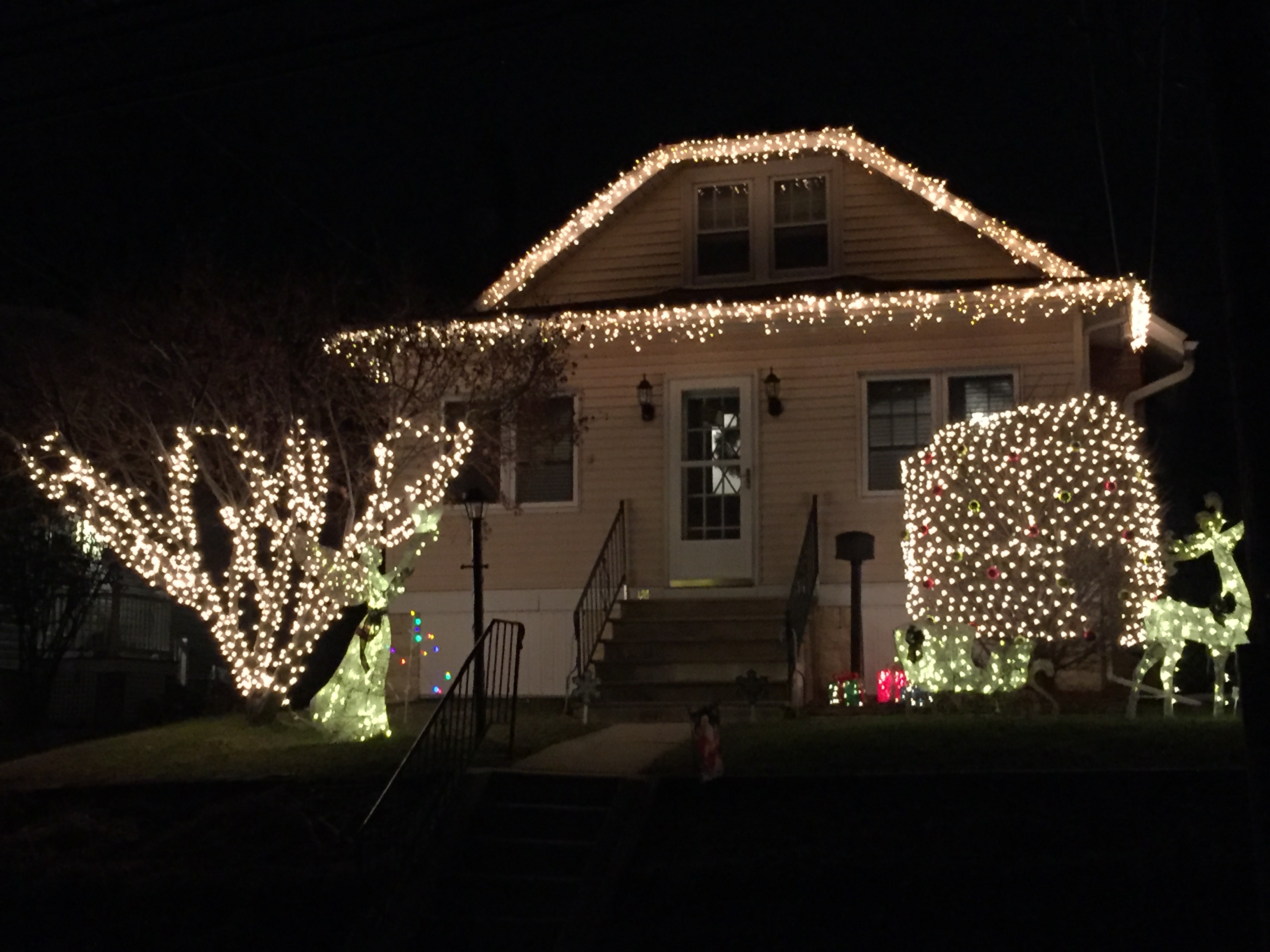
“C’mon, guy. Follow me. I’m going to give you a powerful dose of lights. Christmas lights. Beautiful ones are all over this neighborhood, and some of the best are only two blocks away from here. I’m bummed out a little, too, right now. So, let’s take a walk, Santa. The lights will do both of us a lot of good.” I grabbed Santa by the arm and off we went. Thirty seconds later we hit pay dirt.

“Look at that house, Santa. Great, no? What artwork!”

img_1656

“And look at over there!” I yelled in his ear. “I ask you, who needs lavish, over-the-top Christmas light displays? Modest lights on cute, small houses often are where it’s at.”

img_1662

I could tell that Santa was impressed, even though for a while he didn’t say anything. But then he did. “You know, Neil, when I’m flying over houses all over the world on Christmas Eve and early Christmas morning, I never get a true head-on view of the decorations. I haven’t seen Christmas lights from this perspective in ages. I’d forgotten how sweet and heartwarming they can be. Why, that house right there is magnificent.” He pointed across the street.

img_1665

“And here’s another lovely one,” he said, as we continued a short distance down the block.

img_1673

I certainly couldn’t disagree. My suburban region, not known for its esthetic charms, becomes grand this time of year. And only at night.

I felt a powerful pinch on my right forearm, directly on the spot where I’d pinched myself only 10 minutes earlier. As if I required proof a second time that Santa was real. “Ouch, Santa! What’s the deal, dude?”

“Sorry, mate. But let’s turn back. I’m all energized once again, so I got to go. Mrs. Claus will start worrying if I don’t get back to the North Pole soon. It’s a miracle that nobody spotted me on the street, or I’d be here signing autographs till who knows when. I’ll need to borrow your cell phone, by the way. I’ll return it tomorrow night when I’m back this way. Mine broke into pieces when I was sliding down your frigging chimney. Once I’m in the air heading home tonight the missus will expect me to call her every half hour. She might want me to stop to pick up a quart of milk somewhere. Or maybe some Slim Jims,. My old lady, you never know what she’ll want.”

Santa embraced me in a thank-you hug. Minutes later I watched him nimbly scale the front of my house, its low side, and climb into his sleigh which, complete with reindeer and unnoticed by me, had been sitting atop the roof. “Bye, Santa,” I shouted. “Till next time. And keep those calls to the Pole short. International phone rates are a bitch.”


(Don’t be shy about sharing this story or about adding your comments. Or about signing up to follow this blog)

(If you click on any photo, a larger image will open in a separate window)
Mall Me

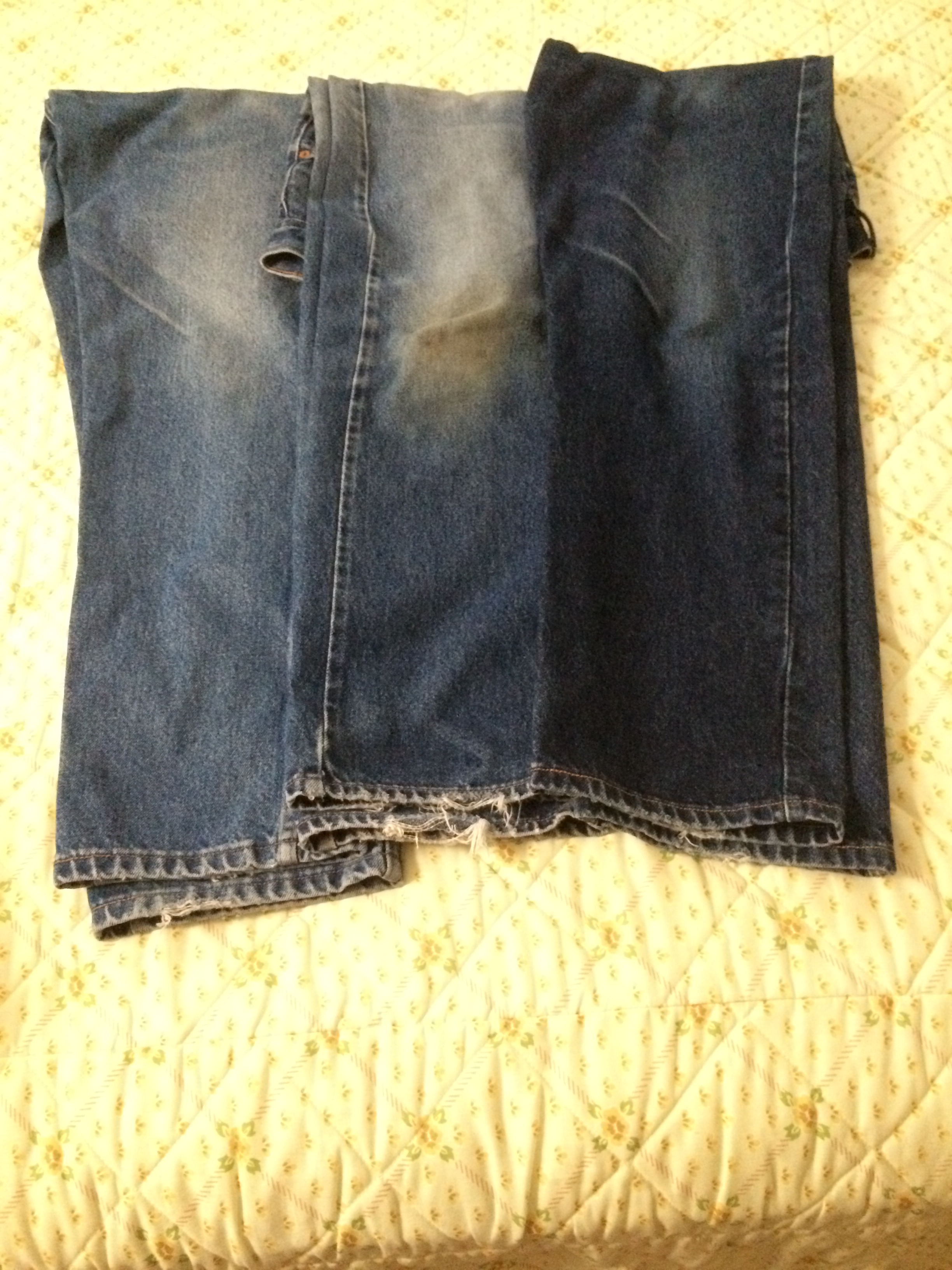
img_1036“You need to buy some new jeans,” my wife Sandy had mentioned to me, a reluctant shopper, a few times recently. She wasn’t wrong. Day after day after day I wear jeans, having abandoned other forms of pants when I bid adieu to my decades-long white collar cum chinos career seven years ago. Most of my current crop of jeans is three or more years old. And looks it. Deeply creased and worn areas in the fabrics abound. As do leg bottoms whose threads are unraveling faster than light beams travel. I pondered the situation and eventually submitted. “Want to go to the mall with me?” I asked Sandy not long ago. “I’ll try on jeans. You can tell me how they look.” It was one of those days that, like death, is inevitable.

A big, bright indoor shopping mall, anchored by several department stores (including Macy’s), dwells on once-forested land half a mile from our house. Sandy and I figured that, at the mall, Macy’s would offer the best selection of denim. To Macy’s we went. Sadly, the shopping excursion was not ring-a ding-ding. In the men’s department dressing room I tried on 21 pair of jeans. Some of them squashed my balls demonically. Others, with a modest tug, slid over my waist as if they were greased. What’s  a guy got to do to find a pair of jeans that fits right? Hire Levi Strauss’ ghost to custom tailor them? I stormed out of the dressing room, contemplating throwing myself over one of the mall’s inner railings to the ground level courtyard. Good thing Sandy was there to prevent that from happening. Otherwise the masterpiece that you at this moment are reading wouldn’t be floating around in cyberspace.

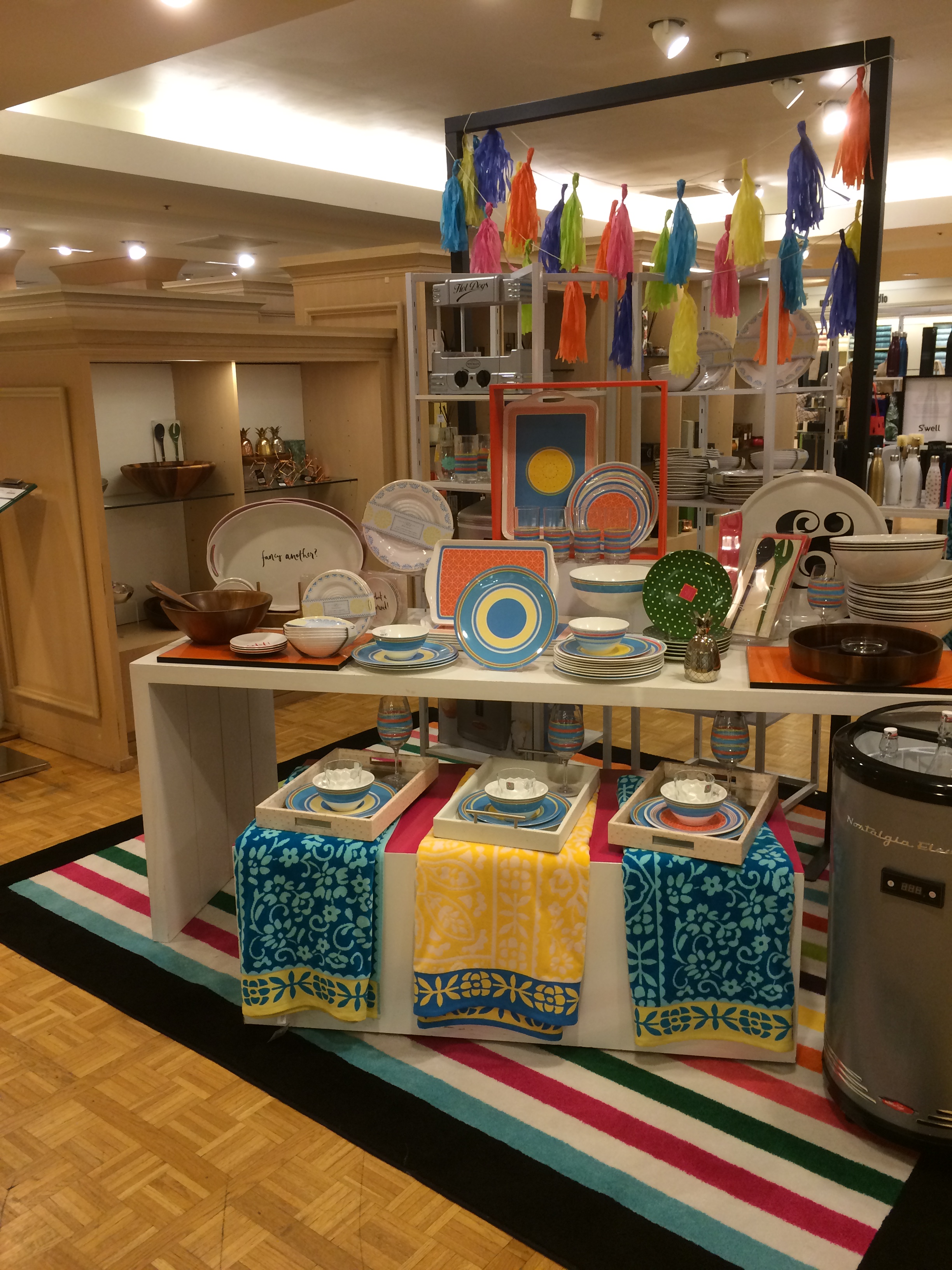
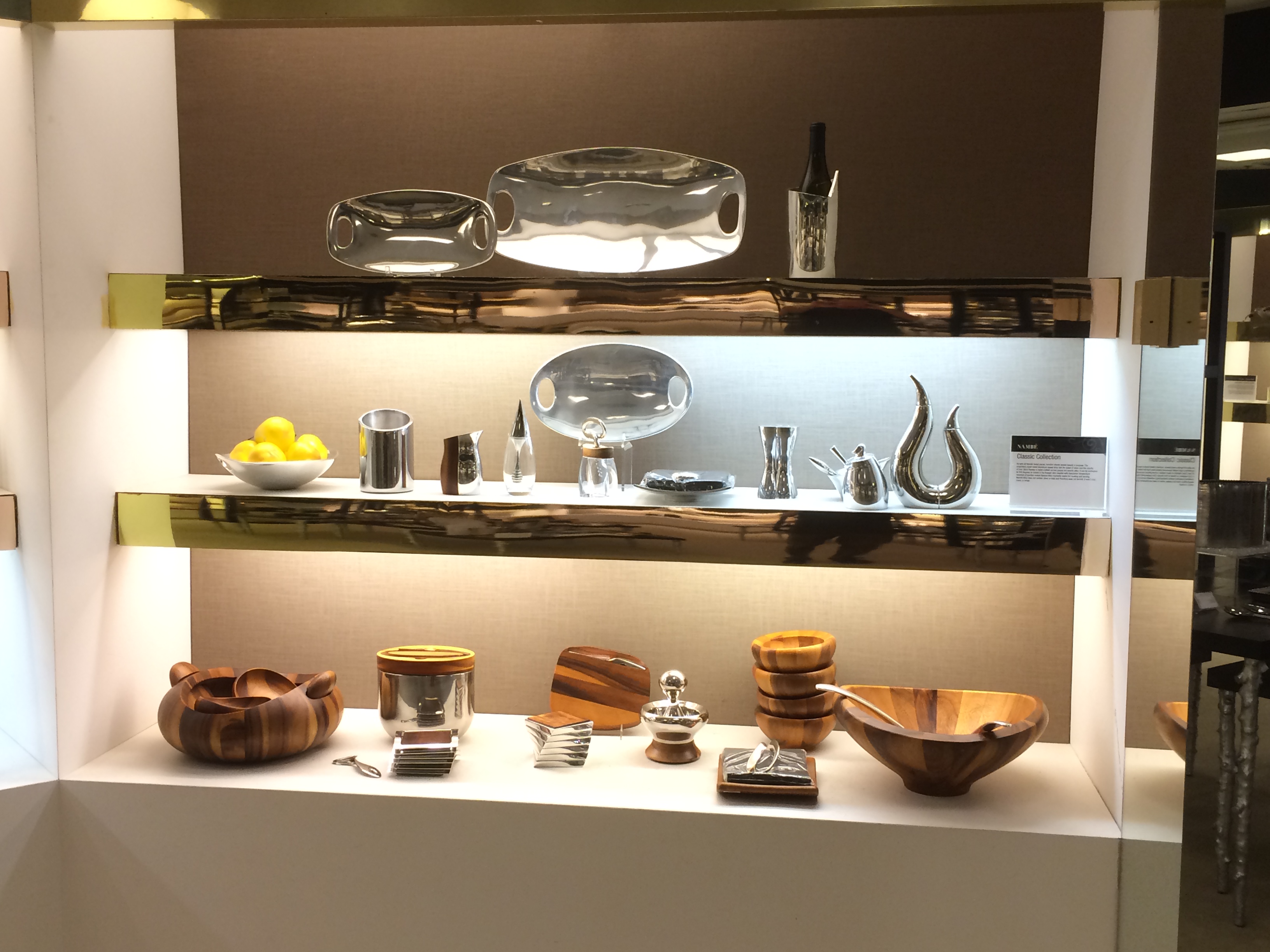
But all was not lost, for on the way to Macy’s Sandy and I had passed through another department store. Bloomingdale’s. And I, constantly idea-starved when it comes to blog stories, was amazed by how incredibly good the stuff for sale in Bloomingdale’s looked, not to mention the snazzy displays right and left on which the goods balanced and the aura of pizzazz that pervaded the store. “Man, this place is beautiful. It’s like a modern art museum,” I said to myself. And thus a story idea emerged. Let us proceed.

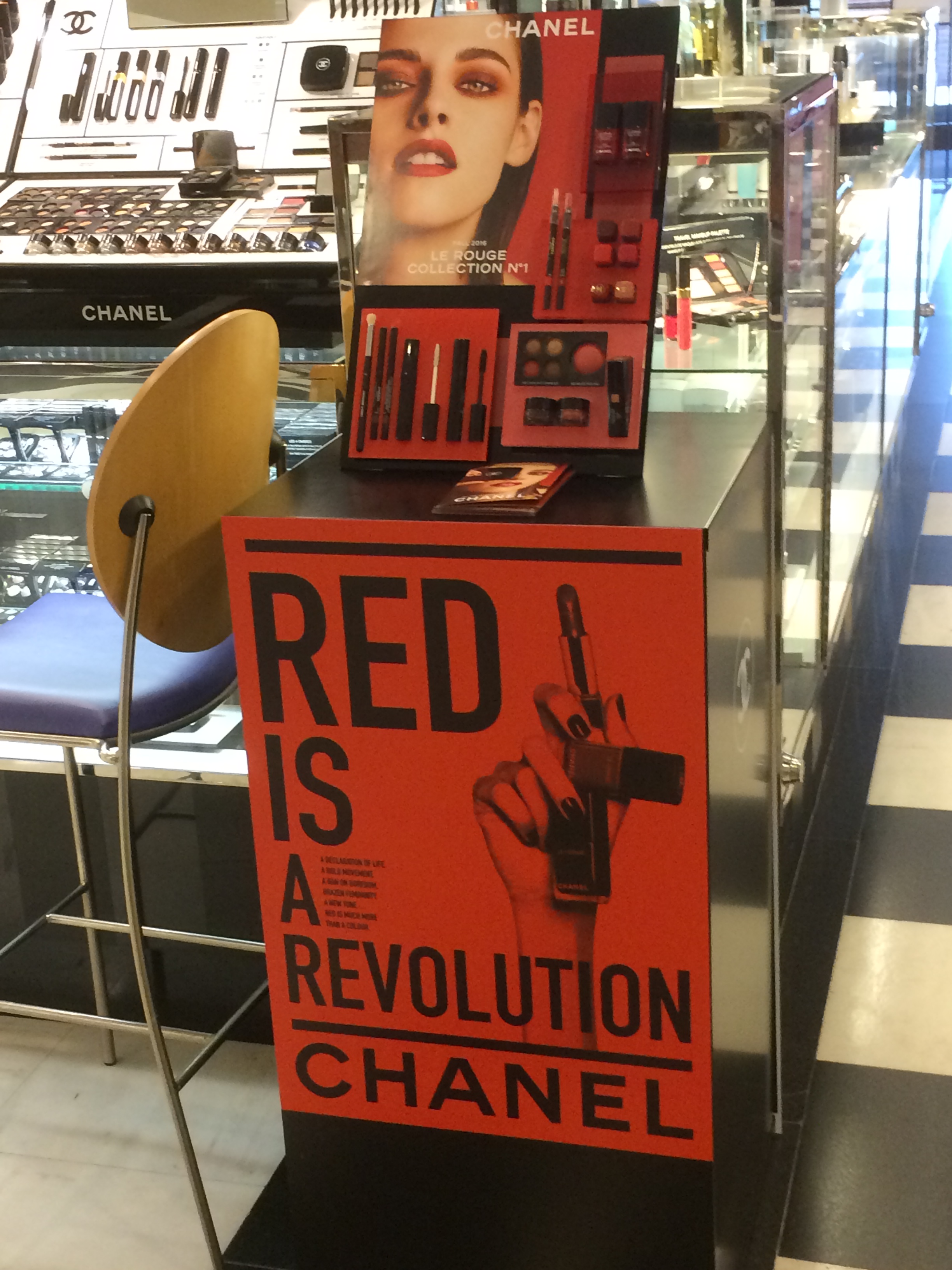
img_0934img_0935A few days after the day in which I came up jeans-less I was back in Bloomingdale’s. I entered through the portal that led directly to an artistic wonderland, the cosmetics department. Talk about kaleidoscopic vistas, layouts that Andy Warhol would have been proud to design and colors that rocked. I had never paid much attention to cosmetics departments before, but that day I was smitten. Almost sorry that I wasn’t female, I was tempted to sit down on one of the stools ringing some counters and let one of the beauty experts behind the counters have a go at me. Hell, my face could use a lot of help.

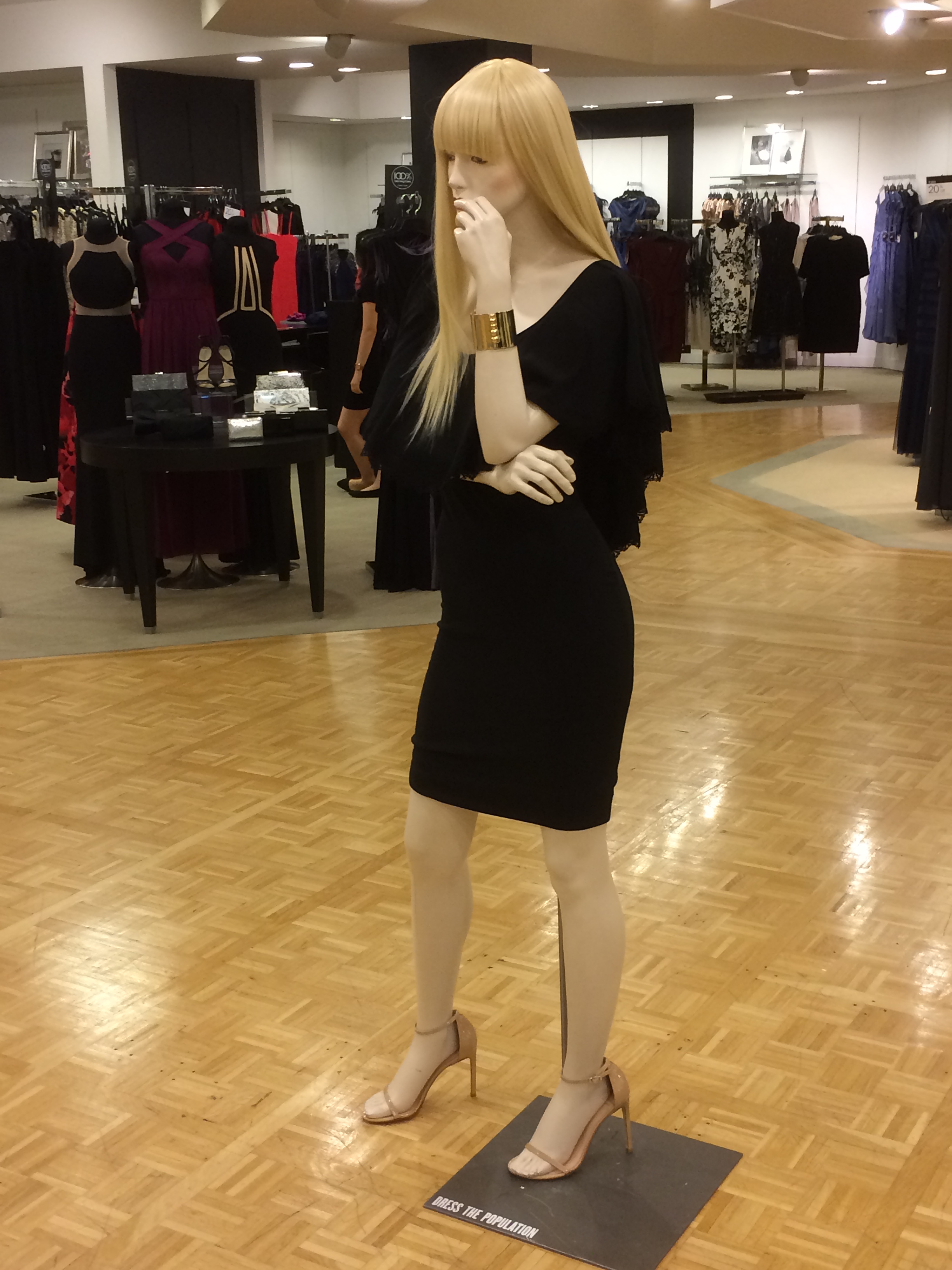
img_0941img_0943Next time I will. But I needed to move on, to check out the museum-worthiness of the rest of Bloomingdale’s first level and the two above that. Not far from cosmetics were women’s dresses. By the way, I saw dresses in other parts of the store too, later, and had no idea what the differences were between the various dress sections. Needless to say, I’m a fashion idiot. Anyway, four of the mannequins-in-dresses on the first floor were hot chicks clad in cinnamon, grey, and black. I could imagine those sculpted figures displayed within a gallery of The Big Apple’s Museum Of Modern Art, where they would be meant to represent, let’s say, a commentary on our society’s beautiful people. Lined up nonchalantly one behind the other, they wowed me. And, permit me to add, they were way beyond my league: now, then and always. Wait, I forgot . . . those girls weren’t real. And I also forgot that I’m married. If it weren’t for those two circumstances though, I might have had the courage to ask the pensive blonde to join me for some pizza slices and frozen yogurt at the mall’s food court. But probably not.

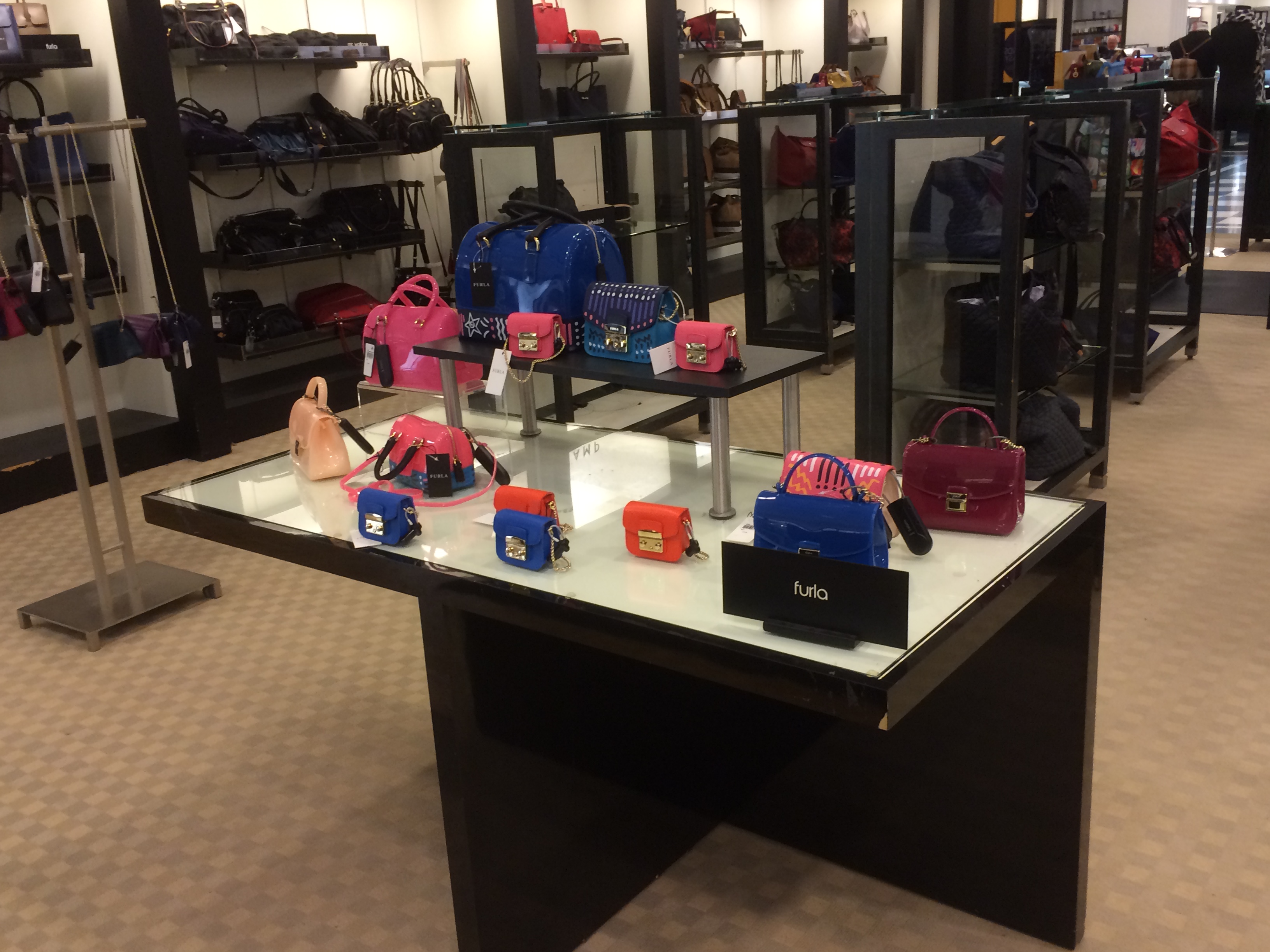
And so I wandered for 40 more minutes. After which I decided that my original impression was correct. And I expanded upon it: Bloomingdale’s is like a modern art museum that has outstanding holdings in color field art and pop art. And I’ll throw in some Matisse too. It’s a haven for color arrangements that sometimes smile and sometimes exuberantly clash. And for sculptures (mannequins) that might get you thinking about what they are thinking.

As usual I’ve entered territories that my analytical and intellectual abilities aren’t equipped to explore much further. And I’m also getting hungry. It’s 12:39 PM as I now prepare to remove my fingers from my computer’s keyboard. Almost time to feed the face that needs a lot of help. I’ll leave you with some additional photographic examples of how artsy-cool Bloomingdale’s is. And I’ll remind you not to be shy about adding your comments or about sharing this article with others. And that if you click on any photo in this story, a larger image will open in a new window.

Peace out.

img_0947img_0951img_0955


img_0965img_0971
img_0983


img_0986img_0988img_1004

Guys With The Same Initials: Terell Stafford, Thomas Shields And Thomas Sully

The Philadelphia Museum Of Art is loaded, duh, with works by famous folks. Van Gogh, Picasso, Monet, Manet, Cassatt, O’Keefe, etc., etc. The other day at the museum I walked past creations by all of them with barely a second glance, not to mention a first glance. Instead, on a goofy mission I spent a bit of time looking at objects produced by the hands and minds of Thomas Shields and Thomas Sully, names that ring a bell with just about nobody. That’s all I wanted to see before settling down with my wife Sandy in the museum’s Great Hall for an evening jazz concert led by the very a-ok trumpeter Terell Stafford.

Here’s why I did what I did: “Does the museum have anything on display by people with the same initials as tonight’s bandleader?” I wondered at home a few hours before Sandy and I headed museumward. “If it does, that’s what I’ll look at before the show.” Had any PMA visitor ever had the same sort of game plan as this? Yeah, right. Why did I come up with this idea? Uh, our orb is awash with cockeyed people.

PMA has a searchable online database. I scoured it. There were 33 artists whose first names and surnames began, respectively, with T and S. Of them, only three had works on display in the galleries (in other words, not in storage), according to the database. But one of those works, by a guy named Thomas Stretch, was the inner mechanism of an old grandfather clock. Stretch hadn’t designed the parts of the clock that anyone cared about. Namely, its cabinet or face. I’d have to disassemble the clock to see the gears et al that Stretch had fashioned, and I had a feeling that the museum’s guards, let alone its CEO, wouldn’t approve. Ergo, I scratched Stretch’s name off my list and, at the museum, went to check out what Shields and Sully were all about.

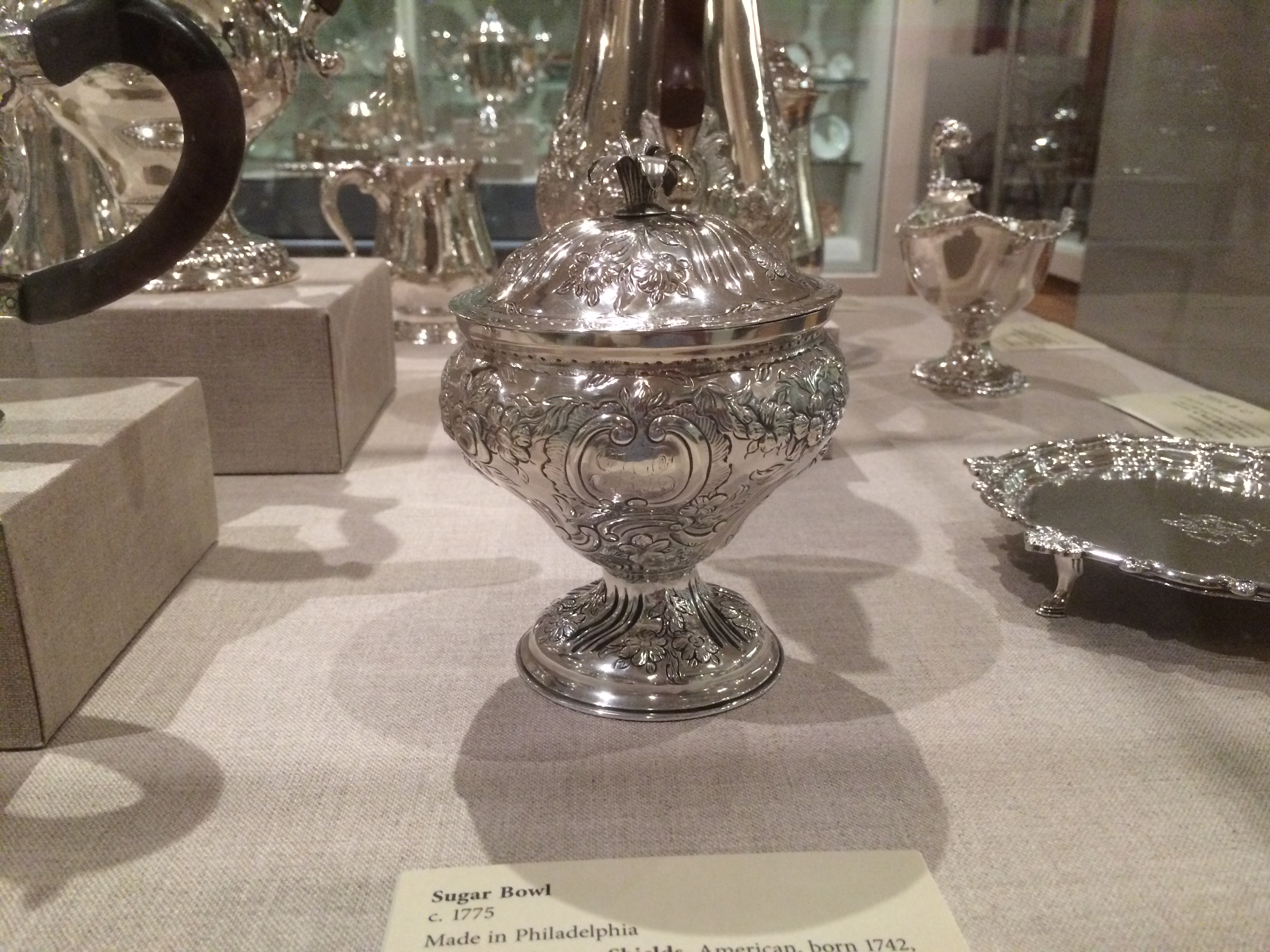
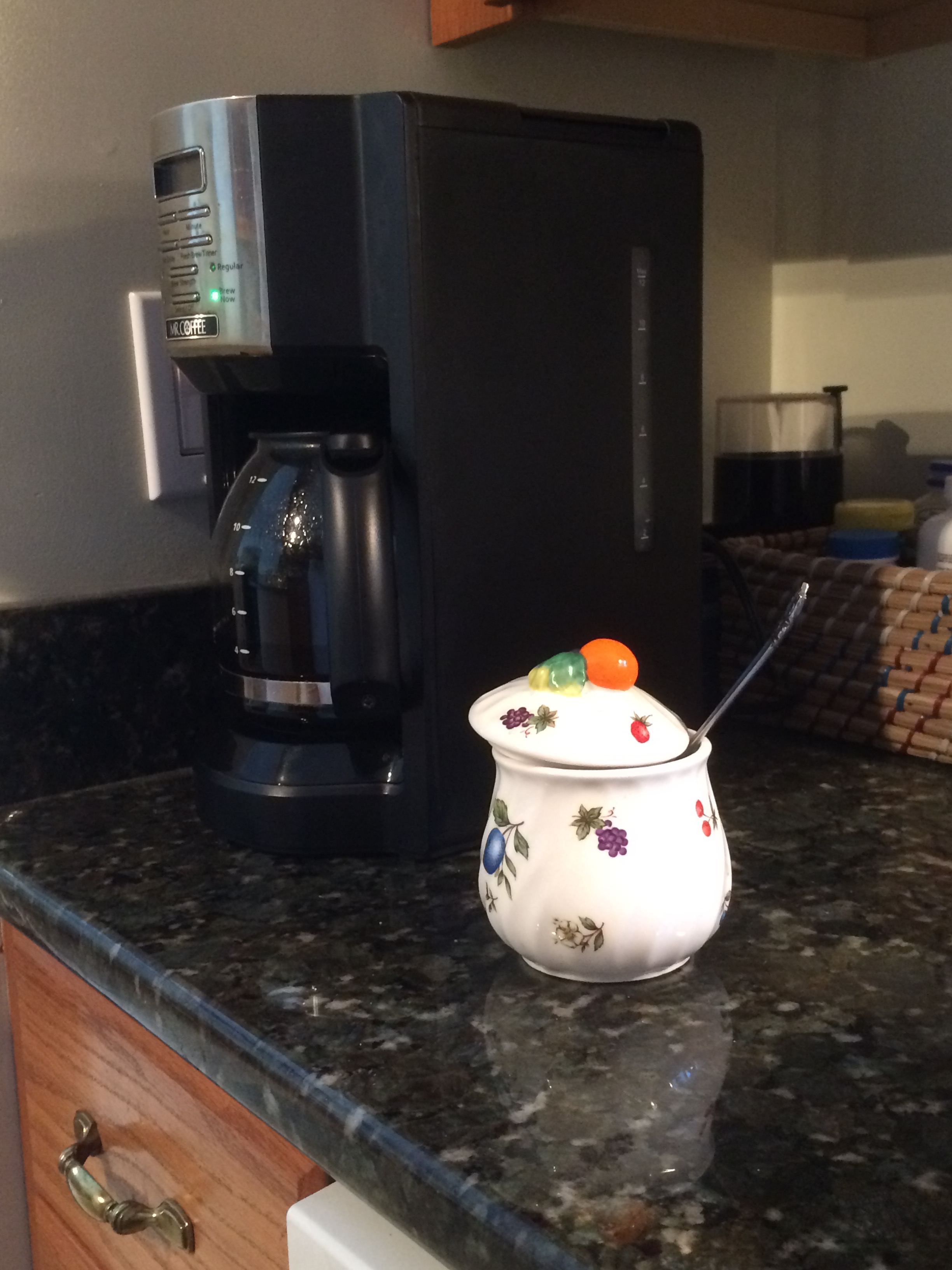
img_1013img_1031A silver sugar bowl. From the 1770s. Made in Philadelphia. That’s the Shields piece I looked at and admired. It’s beautiful. Shields was a well-known Philadelphia silversmith in his time and obviously damn good. If he were alive today I’d buy one just like it from him. It would look a whole lot better sitting next to Sandy’s and my Mr. Coffee machine than the bowl we’re currently scooping out of.

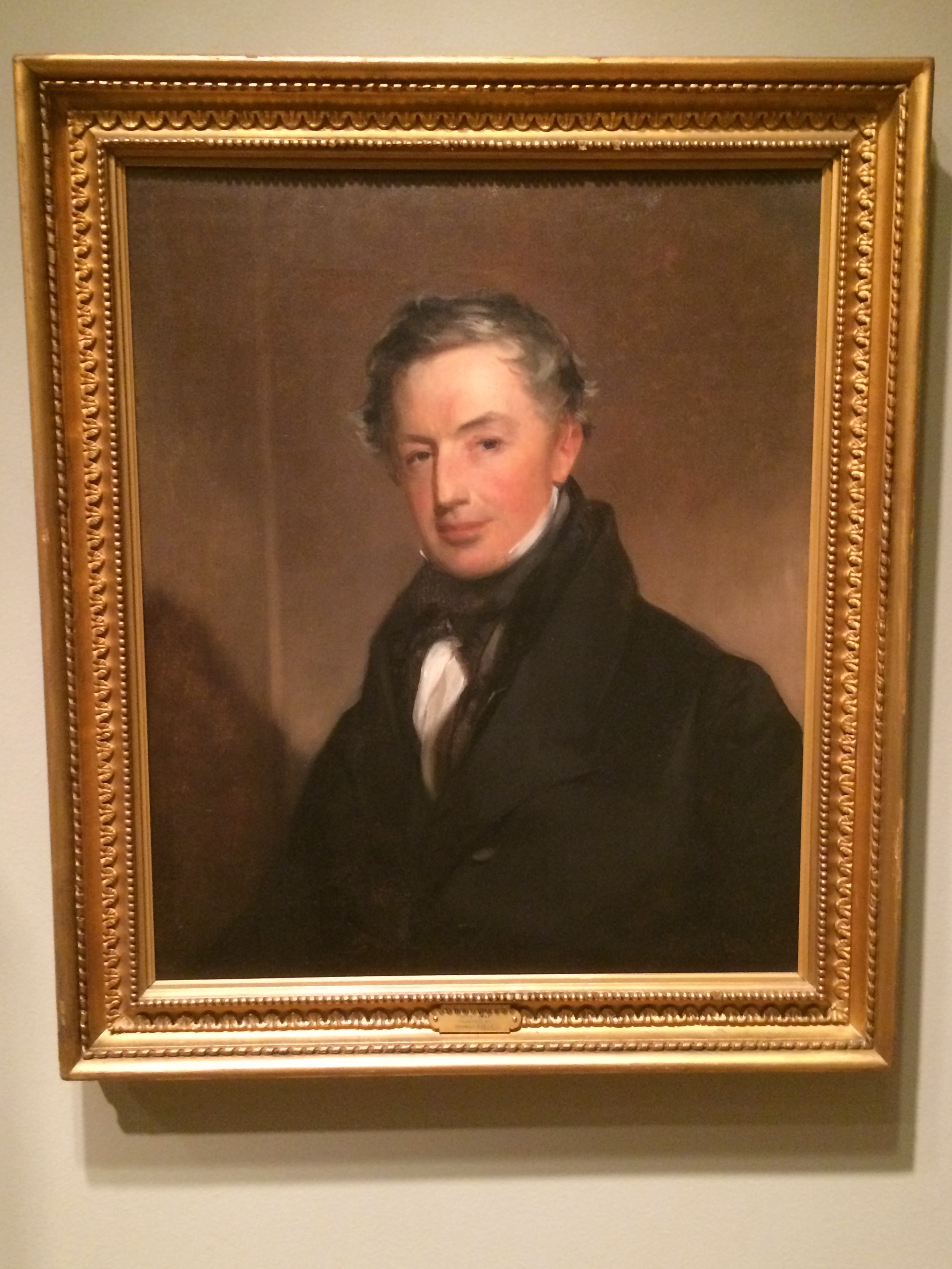
img_1016-2And Sully? Long ago he was a successful Philadelphia portrait painter. A few of his oils were on display at PMA. Mostly I looked at the one he did in 1833 of Thomas Cadwalader, a lawyer, landholder and military general. Man, Thomas looks great in this picture. Can you believe it, though? He was in his early 50s when Sully put him on canvas yet looks to be . . . what? . . . 35 at most? His skin glows with dewy freshness. His sun-lightened locks are enviably tousled. Bummer: TC might appear to hold the key to eternal youthfulness, but he lasted only eight more years before saying goodbye to Planet Earth.

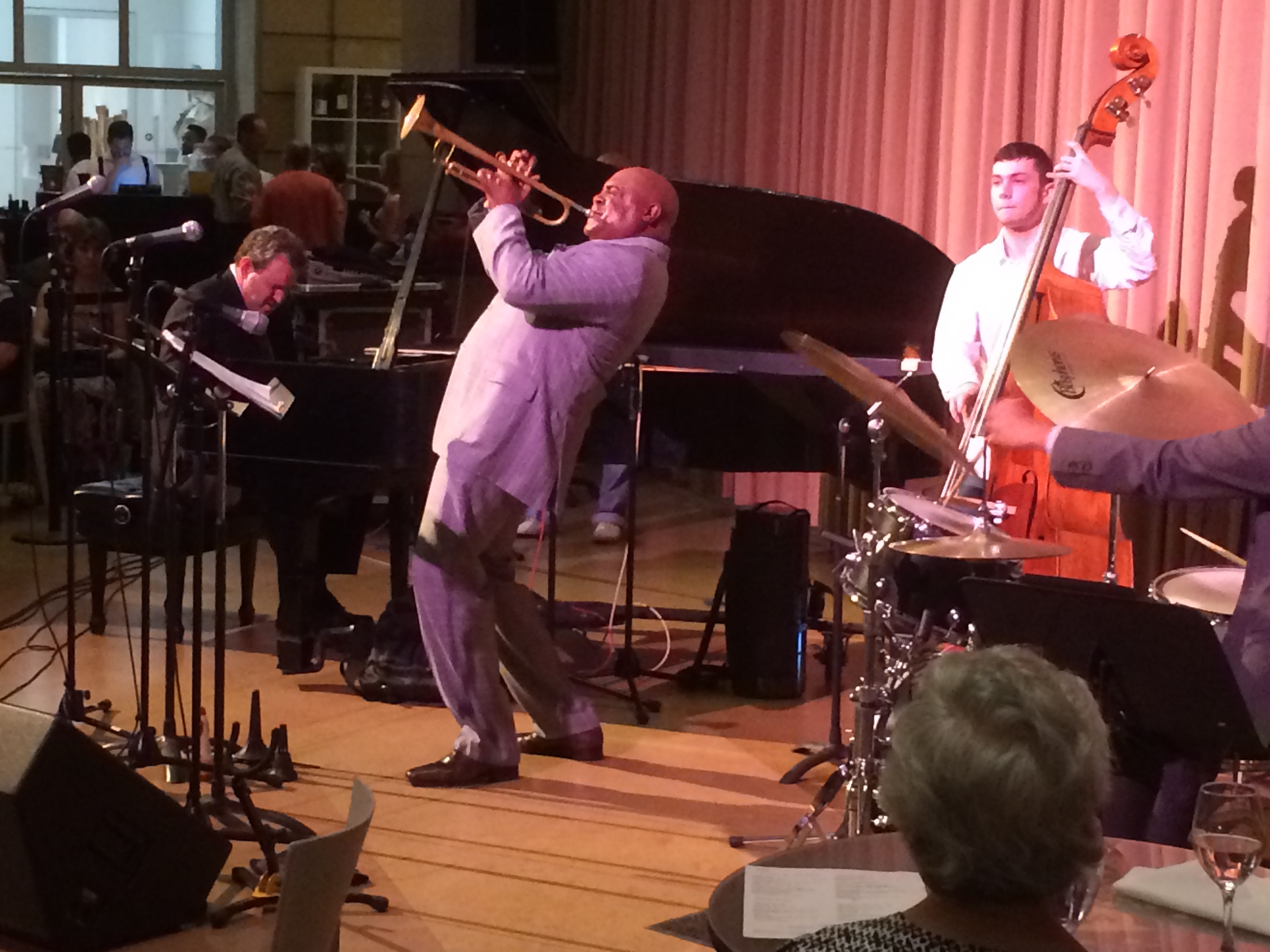
Okay, show time was approaching. Back I went to a cocktail table in the Great Hall where Sandy sat. We have been to many dozens of jazz concerts at this venue since discovering the museum’s Friday night music series in 2002, one year after it launched. But we don’t go anywhere near as often as we used to, because you have to arrive at least an hour early to nab a decent seat. Which is a pain that we got tired of enduring. The show’s first set began right on time (5:45 PM), a miracle in the music world, and ended exactly one hour later. Being kind of anal, I admired those examples of precision and efficiency. And I also admired the limited amount of between-song patter that Terell Stafford engaged in. Out of the 60 minutes that he and his mates were on stage, sounds came out of their instruments for about 55 of them.

img_1028But what I admired above all was the quality of the music that the Stafford quintet produced. They played with a whole lot of heart and soul. They were into it. You could tell by watching Terell arching his back, his knees pushing forward — all in the name of generating thrust — when he ripped hard and fleet notes from his horn during certain solos. And by watching pianist Bruce Barth’s noggin bopping side to side, front to back, when he reached the heady parts of his improvisations. And by watching Stafford and tenor saxophonist Tim Warfield smiling big smiles and nodding their heads in lockstep as they watched drummer Billy Williams unload a wham-bam solo near the end of the set’s first song (Hocus Pocus).

img_1567Hocus Pocus, composed by the late, fantastic and Philadelphia-born trumpet player, Lee Morgan, began with Stafford and Warfield pouring out the tune’s careening, irresistible melody with panache. After which Terell took the tune’s first solo, Barth pounding out heavy chords behind him. Cutting loose, TS spent mucho time in his instrument’s high register. Next to grab the solo spotlight was Warfield. He began studiously, exploring and probing, and when he found the door he was looking for the hot notes began to fly. A few minutes later Barth’s turn arrived. His left hand struck broad, loud chords while his right danced exuberantly. Throughout the tune the band was tight and relentless. Hard to believe that the upright bass player, Drew Gaunce, was a last minute fill-in for the gig. He, to my amateur ears, was rock solid all night.

Speaking of Lee Morgan, I realized after the fact that he composed four of the set’s five numbers. And that the remaining tune (Candy) was a song that he covered on his 1958 album of the same name. And I also was late to learn that the songs that TS and company played comprise the first five tracks on Brotherlee Love, the fine Morgan-honoring album that Stafford released last year. Of the four Stafford compadres appearing with TS at the museum, two of them (Barth and Warfield) played on that album. If you click right here you’ll hear Hocus Pocus as it appears on Brotherlee Love. And if you click here you’ll catch the Brotherlee Love version of Candy. On the album, Candy is performed by a trio, sax and drums sitting it out. At the museum the Candy personnel shrank even further. And the performance was lovely, a languid and captivating two-person discussion between Stafford and Barth.

I’d be remiss not to mention that Terell Stafford is known to jazz musicians and jazz fans in many places on the globe. Ditto for Barth and Warfield and Williams. And that TS, BB and TW also have long histories as jazz educators (all three teach at Philadelphia’s Temple University, for example). As for Gaunce, well, he’s in the wee stages of his career, so we’ll find out where the winds and his talents take him. After the first set ended, those winds carried me and Sandy out of the museum to a nearby tavern. There, we chowed down on good pub grub and drank good beer (me) and wine (her) before motoring home to the burbs.

(Don’t be shy about adding your comments, or about sharing this article with others)

(If you click on any photo, a larger image will open in a separate window)
If I Were A Painter . . .

I’ve penned some love letters to Cape Cod on these pages, but it has been a while since last I did. Yes, I’m in love with The Cape. My wife Sandy seconds that emotion. The enormous expanses of undeveloped oceanside shorelines; the humungous, otherworldly sand dunes that run for miles within the peninsula’s far reaches; the I-never-would-have-expected-them-to-be-there woods and forests that pepper the landscape . . . Cape Cod has natural beauty up the grand wazoo. And, that being what we most favor about The Cape, Sandy and I spend lots of time poking around the great outdoors during our Cape vacations. But we also like to emerge from the wilderness and do other types of things that ring our bells. For example, we get big bangs from some of the old village sections of certain Cape towns, such as those in Provincetown, Wellfleet and Orleans. They are cute and charming. We wander on their streets, investigate their stores and stuff our faces at dinnertime in their restaurants.

Last October, in Orleans, we took in a cool event one Saturday morning. The Addison Art Gallery, one of Cape Cod’s best, organized it. Two or more times each year AAG selects an outdoors Cape area to be immortalized and invites a bunch of the artists it represents to find views that spark them in said area, set up their easels and paint away. In October, Addison chose Orleans’ villagey heart, in which it is located, as the locale. The artists were instructed to paint and complete their masterpieces between 8 AM and noon, and then to bring the canvases to AAG where they would be framed and hung on the walls and offered for sale that evening at an artsy gathering to which the public was invited.

Maryalice Eizenberg.

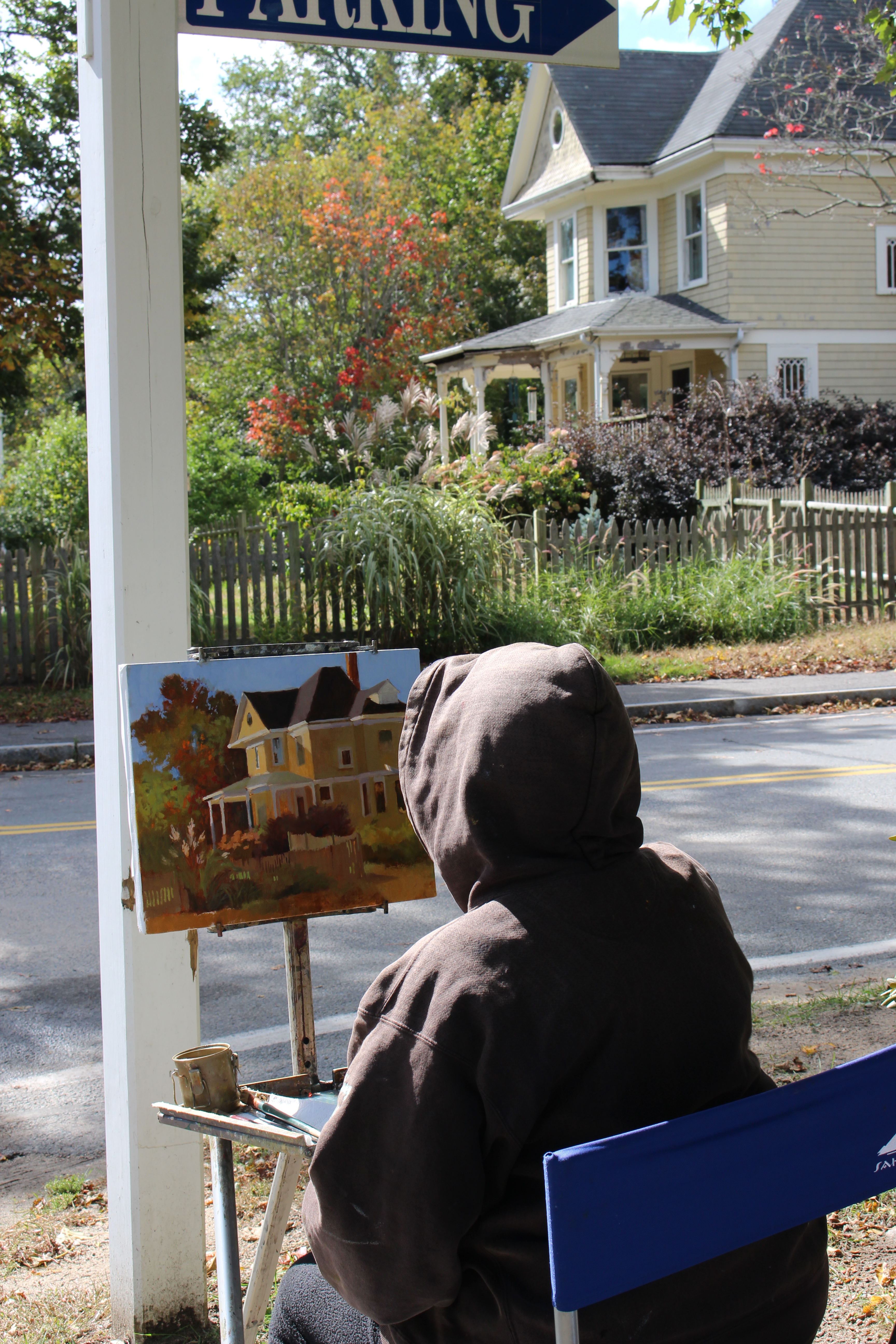
Sandy and I, who haven’t lifted a paint brush since grade school, like to watch good artists at work. So who knows why we got a real late start and didn’t arrive at the five or so square block painting zone until 11 AM. By that time most of the artists had finished their jobs and were packing up or already gone. Luckily we got to see two painters who were still going at it. On a sidewalk near AAG, Maryalice Eizenberg, hooded to shield herself from our friend the Sun, was staring down a big, old, yellow Victorian house across the street. She sweetly translated what she saw, in colors deeper than those 80 feet away. We chatted with her for a couple of minutes as she worked. “Have you seen what Paul Schulenburg is painting?” she asked us. No, we hadn’t. “Take a look. You won’t believe what his subject is.” And she pointed to where we’d find him, hidden from view from her own spot, but only half a block away.

Paul Schulenburg.
Paul Schulenburg.

Now, Paul Schulenburg is an artist whose oils I have seen at AAG over the years. He’s really good. His paintings have a stillness, a sense of completeness, à la Andrew Wyeth and Edward Hopper. Sandy and I followed Maryalice’s finger and came upon him. He and his easel were positioned between two houses, and he was zeroing in on a small section of one of the houses, a large and mostly white-shingled affair. But it wasn’t the house so much that he was interested in. What had caught his eye, and had become the focal point of his painting, was a bright green garden hose. Its color contrasted just-so with the less brilliant green of the side lawn, and had plenty to say to the house’s white shingles and red bricks. “Man, this guy is something else,” I more or less thought to myself. “A hose? Yup, and he is doing it proud.”

For reasons unknown, that October day floated to the top of my porous memory bank last week, and it got me thinking. Were there any aspects of my house’s exterior or grounds worth putting down on canvas? I decided to take a look. I would use my best impersonation of Paul Schulenburg’s painterly eye.

Sandy’s and my abode rests in the middle of a typical suburban block near Philadelphia. The house is modest and is surrounded by more shrubs and trees than I enjoy taking care of. All of it looks nice, but ain’t exactly a head-turner. I mean, Better Homes And Gardens Magazine has no plans to contact me anytime soon for a photo shoot. That, however, wasn’t the point. My mission was to pay attention to the details, to notice boffo alignments of objects, neato color contrasts, whatever, that were waiting to be discovered.

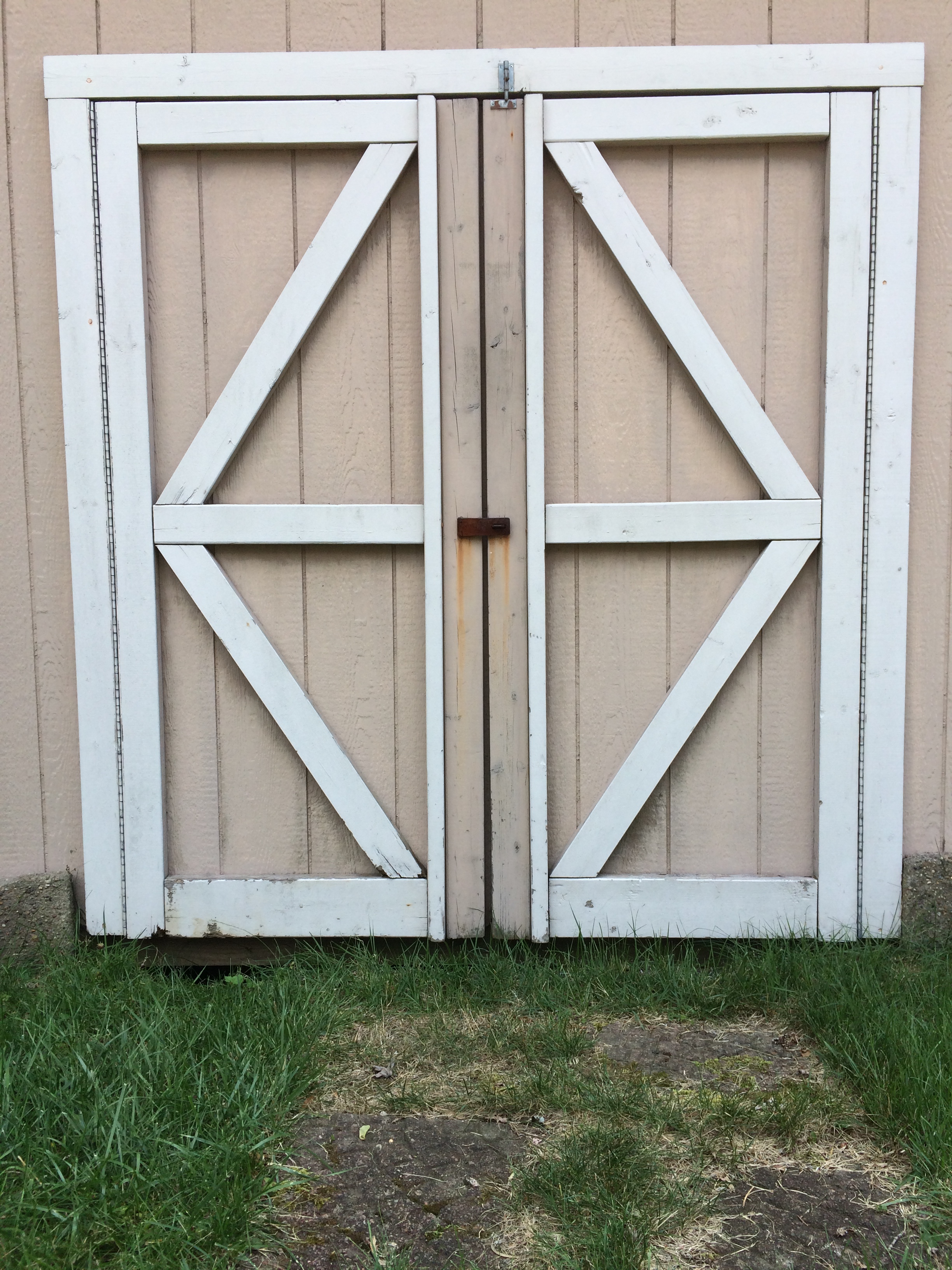
IMG_0821IMG_0799IMG_0805My house? Man, I’m glad to be living within it, but, take it from me, its exterior front and sides are vanilla. Tons of bricks and stones with almost nothing quirky or asymmetrical going on. I gazed artistically at one of the few ornamentations, a tangle of gas meter and pipes near the front door, and wondered if it would make for a decent painting. Well, maybe, but  . . . eh. I then walked around back and gave the grounds there a once-over, starting with the shed. How about its doors? Their designs seemed kind of sharp. Or did they? Nah, the scene lacked pop. A blooming Rose Of Sharon in the backyard, however, definitely did pop. How many floral scenes have been painted over the years, though? Maybe 20 billion. The world didn’t need this one.

IMG_0841All was not in vain. Because attached to the rear of the house is a great-looking deck that I figured would hold out hope. Hope morphed into certainty when I spotted something on one of the deck’s supporting posts. It was a knot, golden and aglow, in the wood. That’s what I would paint if I were a painter, I decided. It was a natural, a star waiting to be born. I walked around the knot, snapping photos, checking out various vantage points. And came to think that one perspective gave the best results for my imagined painting. In that vista you see the crazy quilt formed by part of the deck’s underside and the stairs leading up. You see a bit of slate patio and brick surface of the house. The scene’s palette is muted, all wan greys and browns, except for the golden medallion that you can’t take your eyes off of.

But I did take my eyes off the knot in a bit. And then I folded up my fantasy easel and went inside. It’s good to learn things, and I came away from all of this with an insight that never had occurred to me before: A painter in search of something to paint is little different than a writer (moi?) trying to come up with a story idea. And exactly the same is true for dance choreographers, photographers, film makers, chemists, astrophysicists, chefs, you name it, all on the prowl for projects that will make them buzz. The wellsprings of creativity are thick and bubbling, though not always easily tapped.
(Don’t be shy about adding your comments or about sharing this article with others. And, if you’re not already a follower of this blog, please consider signing up . . . I like readers!)

(Cape Cod photos by Sandra Cherrey Scheinin. The others by yours truly. If you click on any photo, a larger image will open)