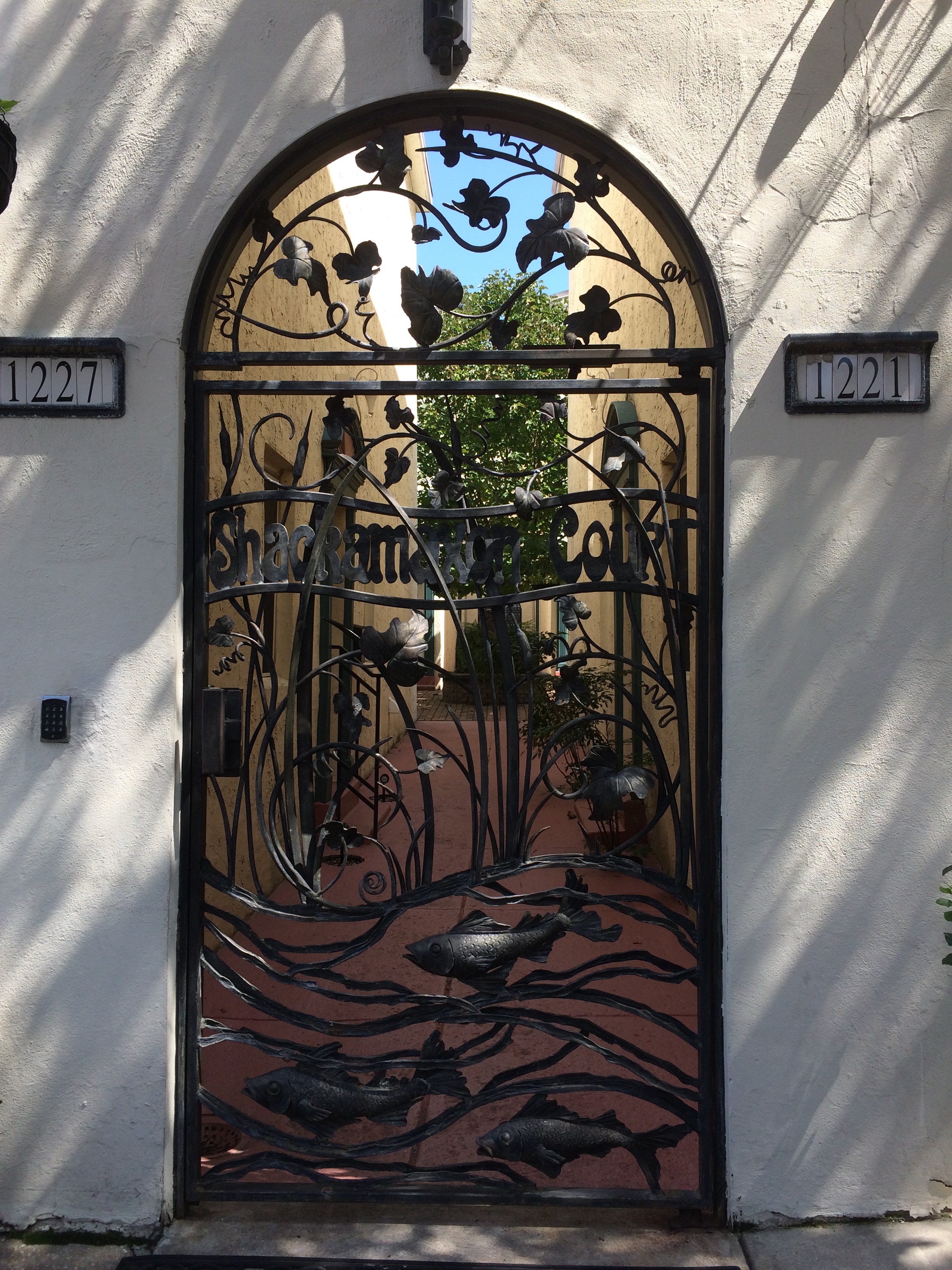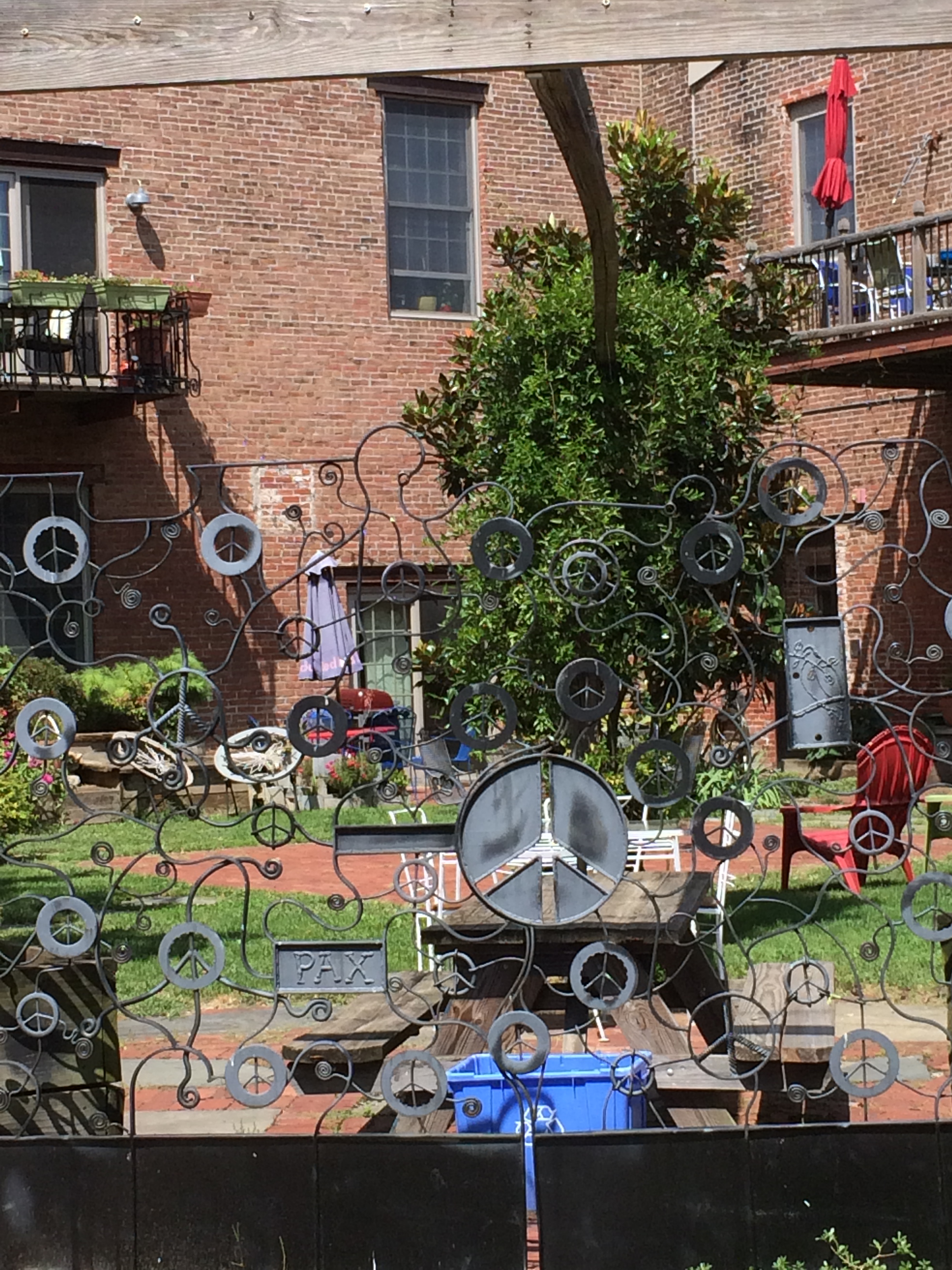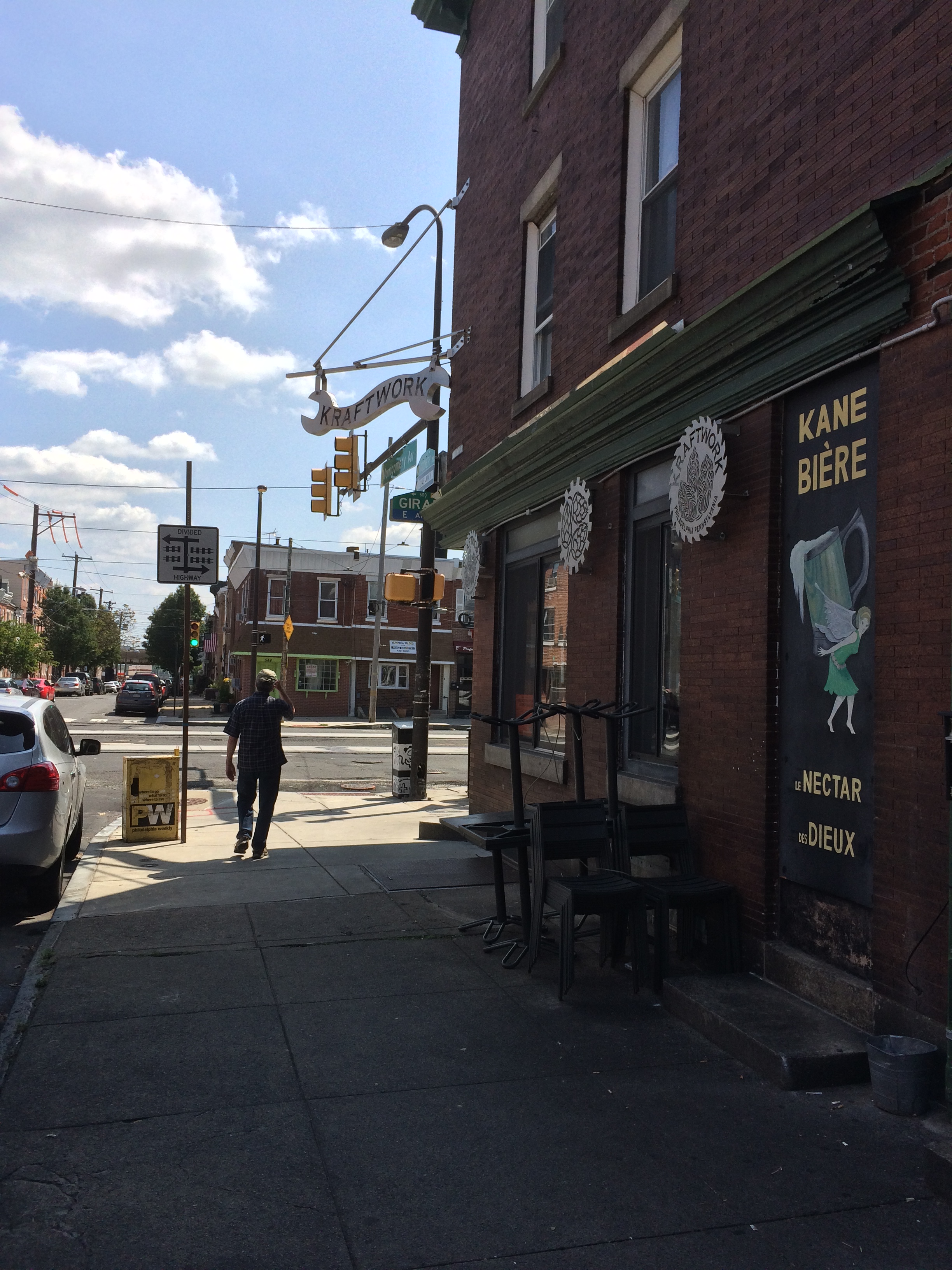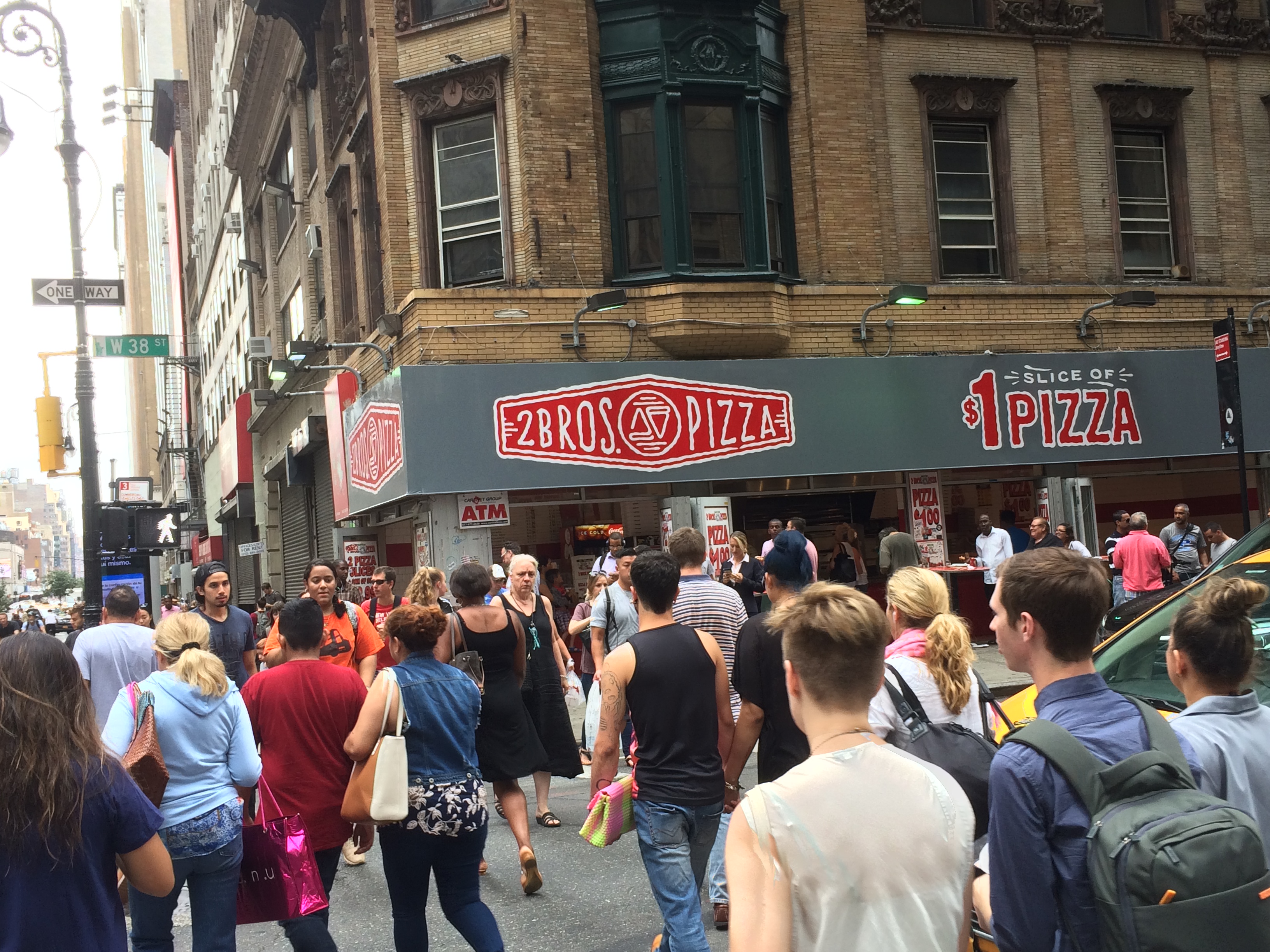
A Long Walk In Philadelphia On A Warm Winter’s Day

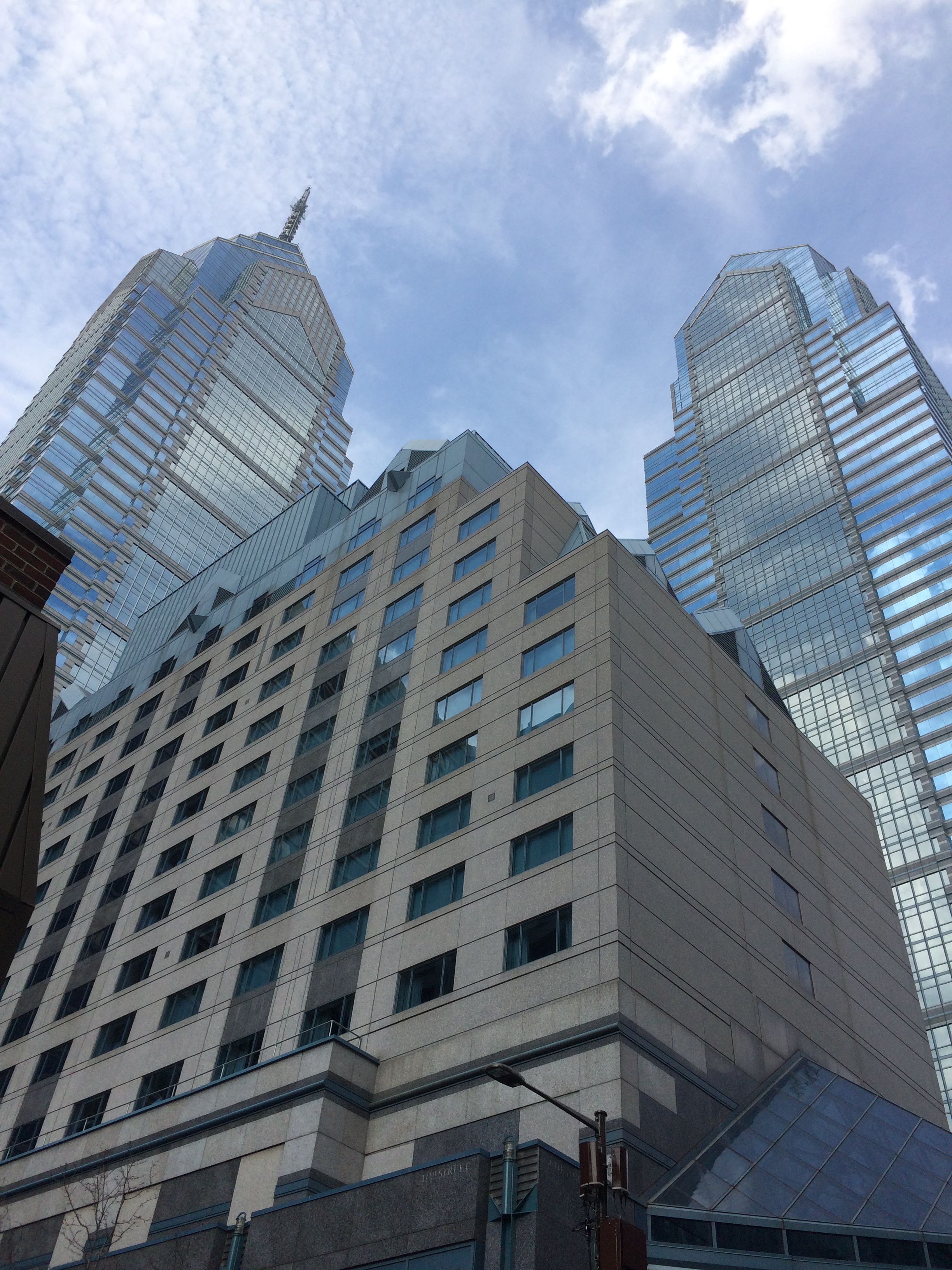
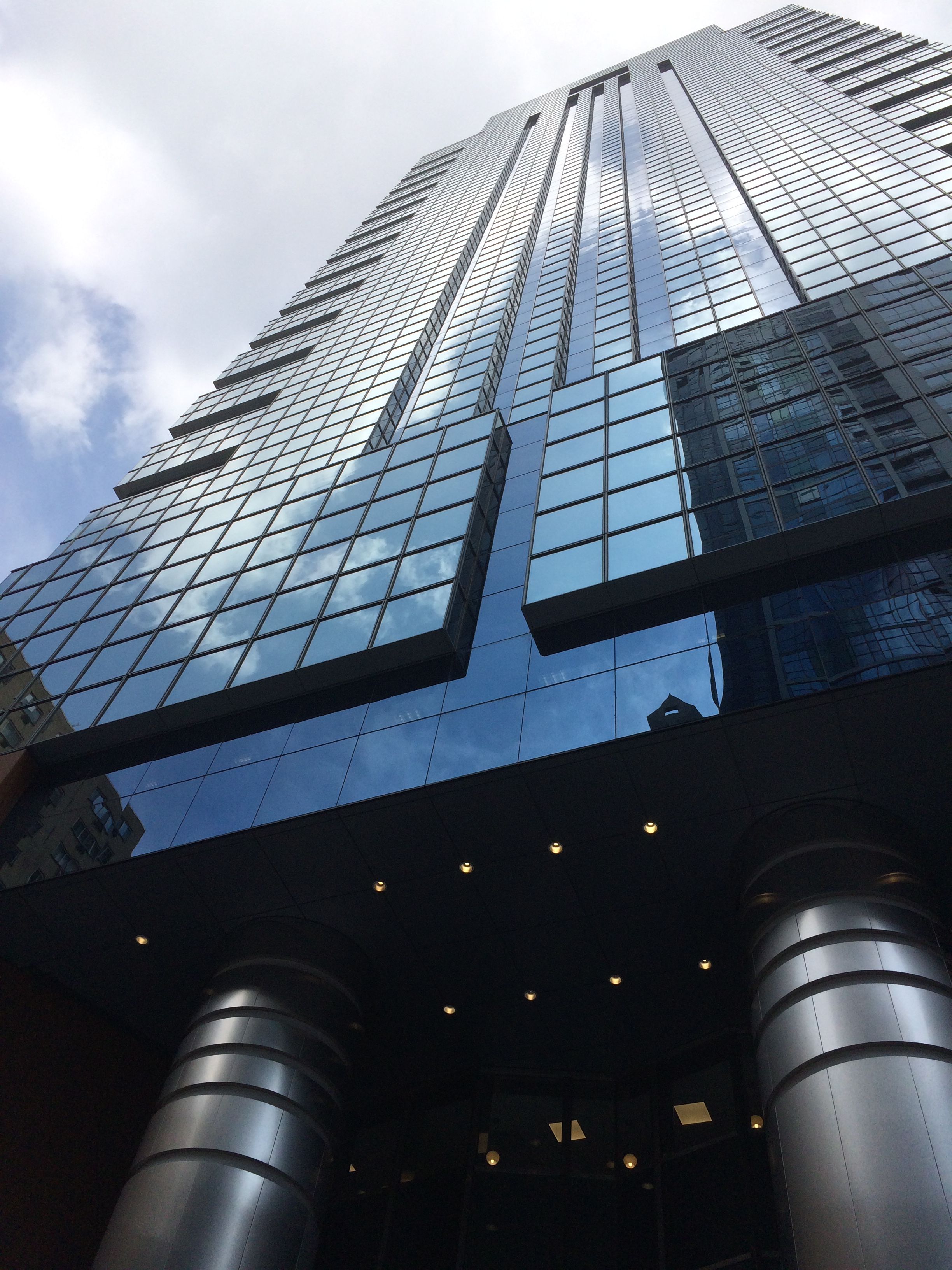
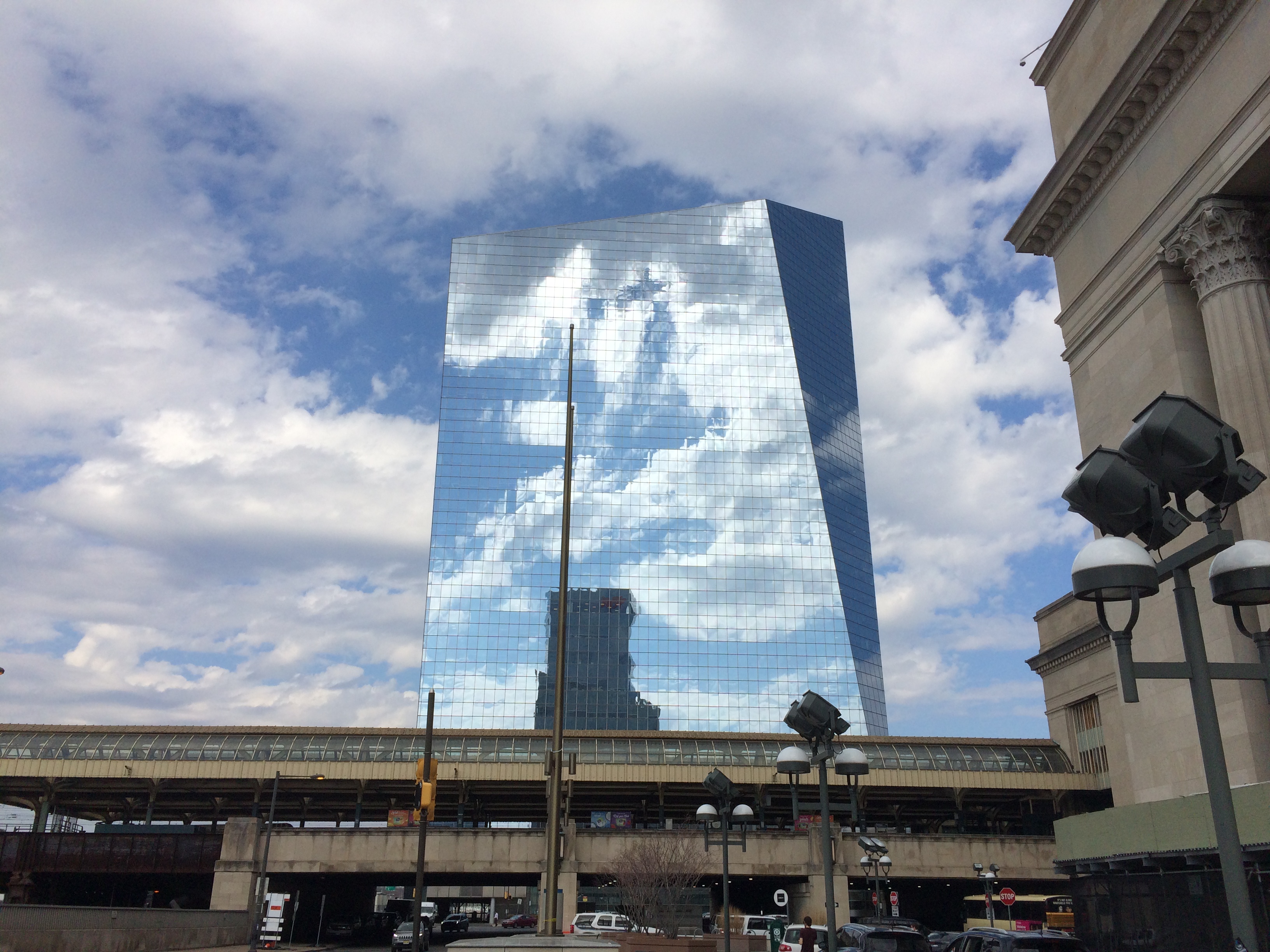
Cira Centre

There I was two Wednesday mornings ago, unfruitfully occupying space on my living room sofa. My shoulders were tense, my mind was neither here nor there. In other words, it was business as usual.

“Yo, schmuck! Snap out of it!” I silently yelled to myself. “Somebody ought to paint your portrait right now and call it Here Sits A Schlump. Life’s for living, boyo. Get with it already.”

And so I did. Gathering myself together, I decided to go for a walk. A nice long walk. But where? Not in my suburban area, whose charms are incredibly limited. Philadelphia it would be then. Philly’s the metropolis that never bores me. Soon I was at my little town’s train station. A late-morning ride arrived and I climbed into the second of its three cars. Fifty minutes later I exited said metal box at 30th Street Station, in the city’s West Philadelphia section, all set to explore a nearby area that I was barely familiar with. Ferdinand Magellan I’m not, but I’ve always liked to poke around.

It’s amazing though, being someone who likes to poke around, that I’d never done so among the blocks only a hop, skip and a jump northwest of 30th Street Station. Those streets, part of West Philadelphia’s Powelton Village neighborhood, contain a good bit of Drexel University’s sprawling campus. From the mid-1970s until 1991 I lived in West Philadelphia, only a mile and a half from Powelton Village, but I didn’t venture to the Drexel enclave there, despite Drexel’s rise during that time to major-player status in the academic world. And in the ensuing years, which have seen me visit West Philadelphia who knows how many dozens of times, the pattern continued.

Hallelujah, now the deed is done! I came and I saw. I’ll leave conquering for another day.

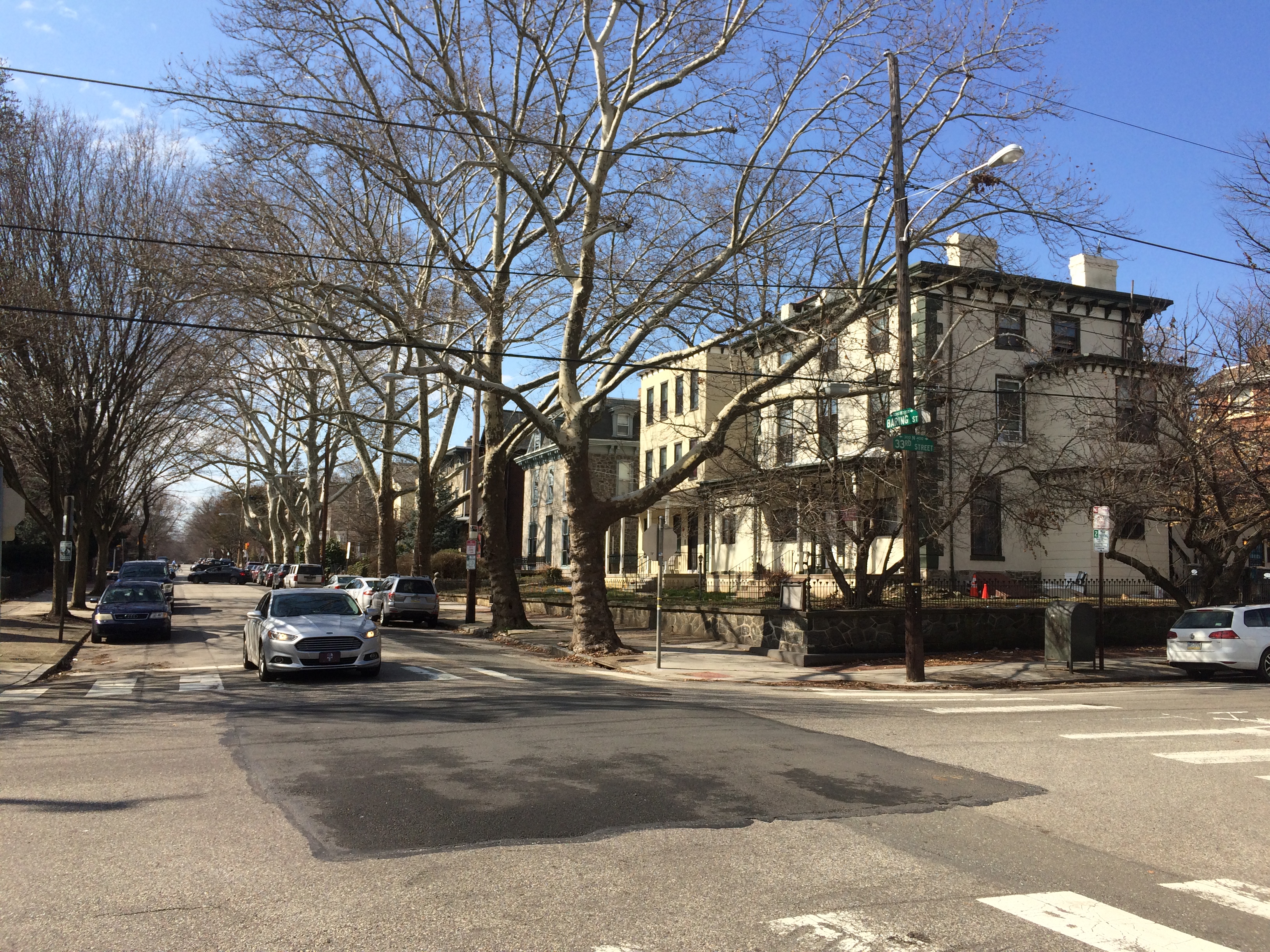
Powelton Village
Powelton Village

Now, let me say that my stroll through Powelton Village, checking out not only the Drexel facilities but the sturdy, soon-to-be-leafy residential blocks, wasn’t a walk for the ages. I mean, not too many urban campuses are going to knock your socks off. And Philadelphia’s older housing — rowhouses, twins and stand-alones — are so much with us in Powelton Village and in many other Philadelphia neighborhoods, I’ve come to think of them as comfort food.

Still, stretching my literally old legs felt great. Especially since the day was sunny and warm, as in 74°F, an insanely high number for mid-February winter. I worked up a good, pungent sweat hauling my ass and my bones around. And my eyes did plenty of darting, admiring the college girls who were dressed for summer. Skimpily, shall we say.

In addition to the girls, certain sights during my travels did make quite the impression on me. For instance, before I reached Powelton Village — in fact, when I was only 150 feet from 30th Street Station — I remembered to take a look at the Cira Centre, a majestically sleek office tower that smiles down upon the station. But I didn’t see it. Was the station somehow obscuring my view? Turns out, of course, that Cira was there in plain sight. Sort of. A glass wonder, the reflections of the sky on its surface were camouflaging the building, as the photo at the beginning of this article reveals. Man, that was something, clouds seeming to float everywhere on the glass along with the reflected image of a tower under construction several blocks away.

Drexel’s Buckley Recreational Field
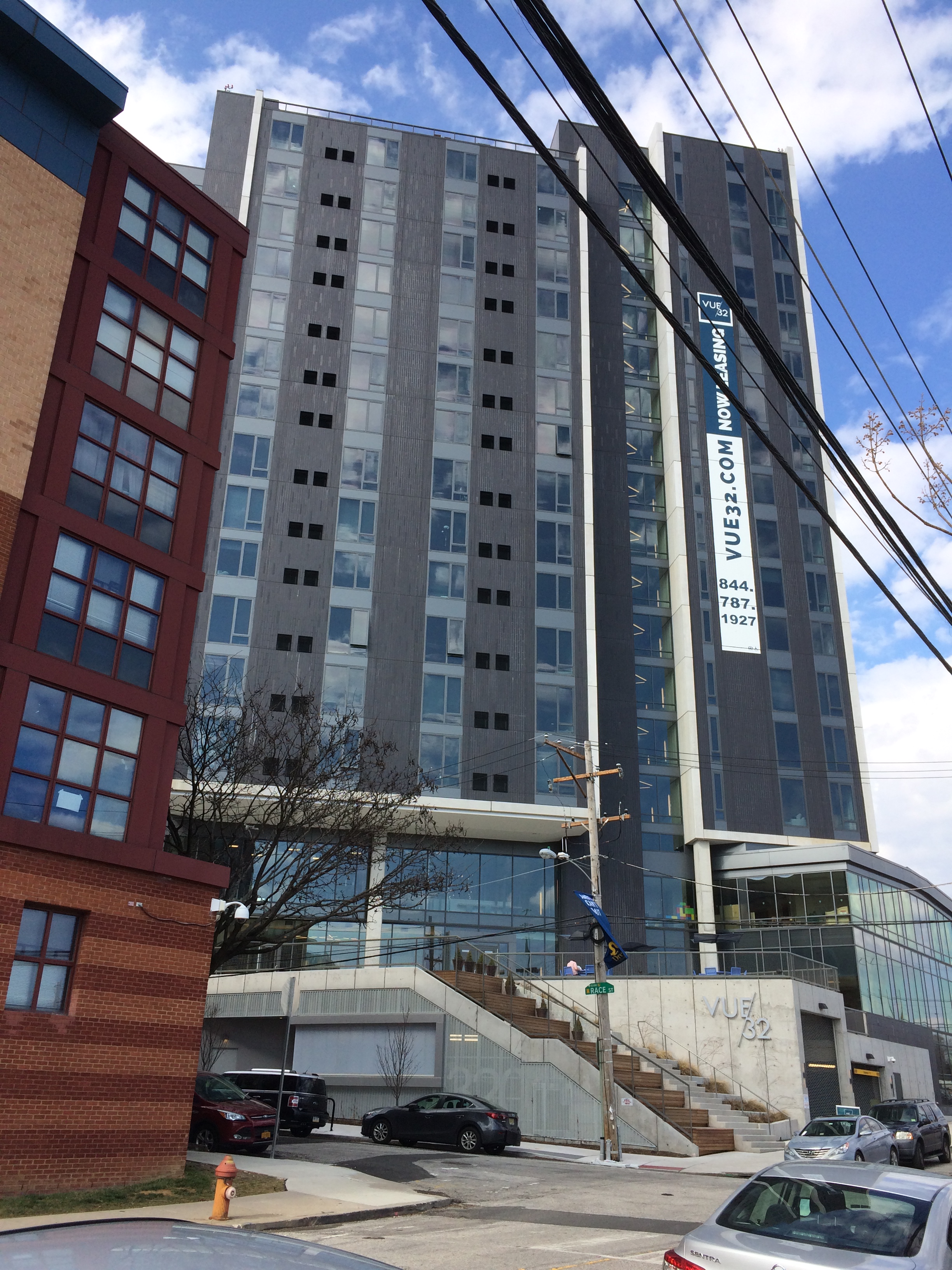
Vue32 apartment building

And in Powelton Village, just up the block from Drexel’s Buckley Recreational Field, I was most surprised to see a tall, modern apartment building (Vue32) being erected on North 32nd Street. Some might say that Vue32, a non-Drexel project, is totally out of place in a quiet two-and-three-story-high neighborhood, and if I lived nearby I’d probably agree. But it looked cool to me.

SEPTA rail yard

Speaking of North 32nd Street, if I hadn’t been there I would have missed being near-stunned by the sight of oceans of commuter railroad cars — just like the one I took into the city — a smattering of feet east of where Vue32 stands. As I later learned, I was looking at a rail yard used by SEPTA, the Philadelphia region’s public transit agency, to house and do maintenance work on trains. I’ve lived in Philadelphia or its suburbs for most of my adult life and I’d only vaguely noticed that enormous yard before, though it is glimpsable from numerous vantage points in the city. Call me Mr. Observant.
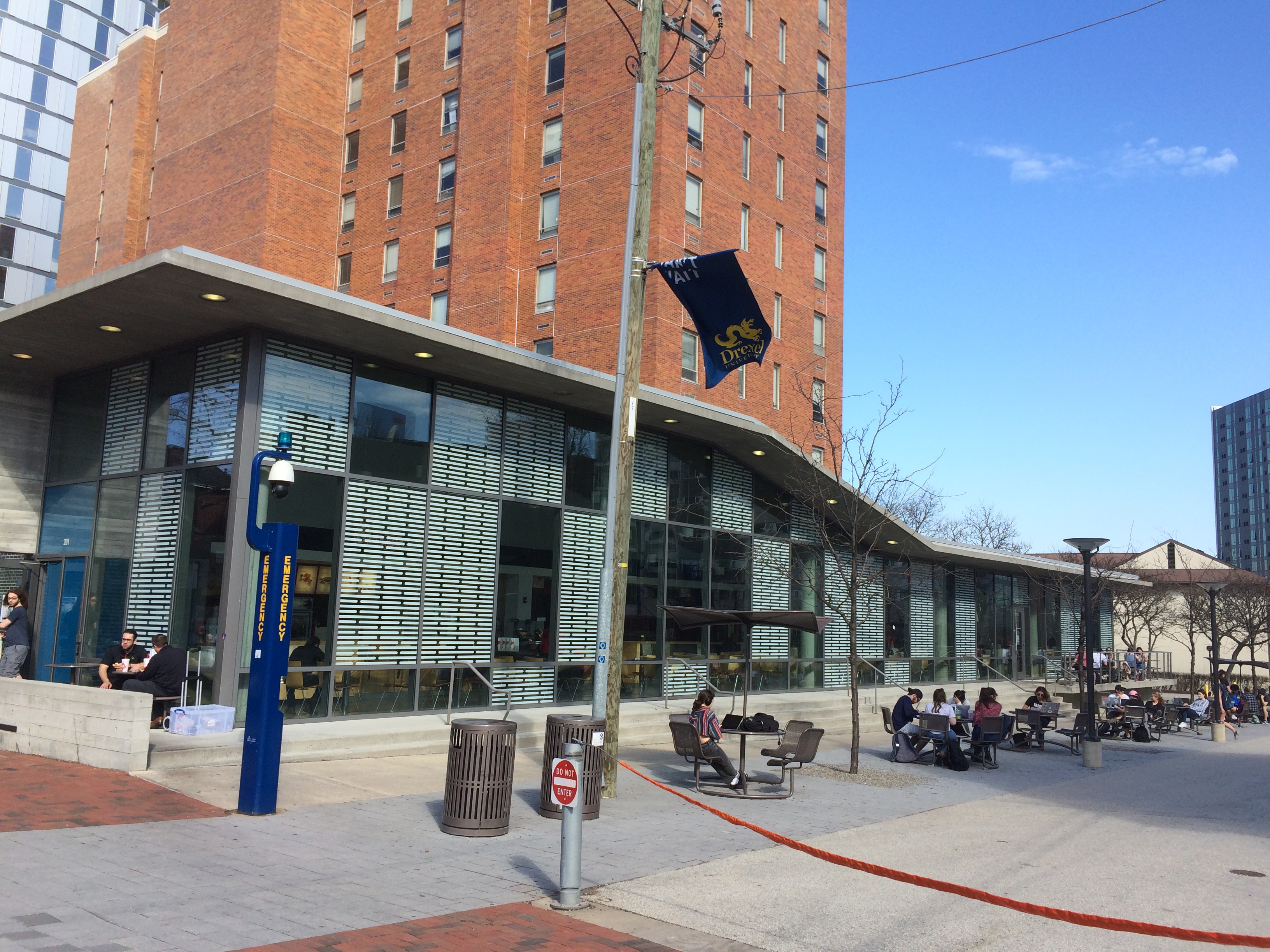
An open square on Drexel campus

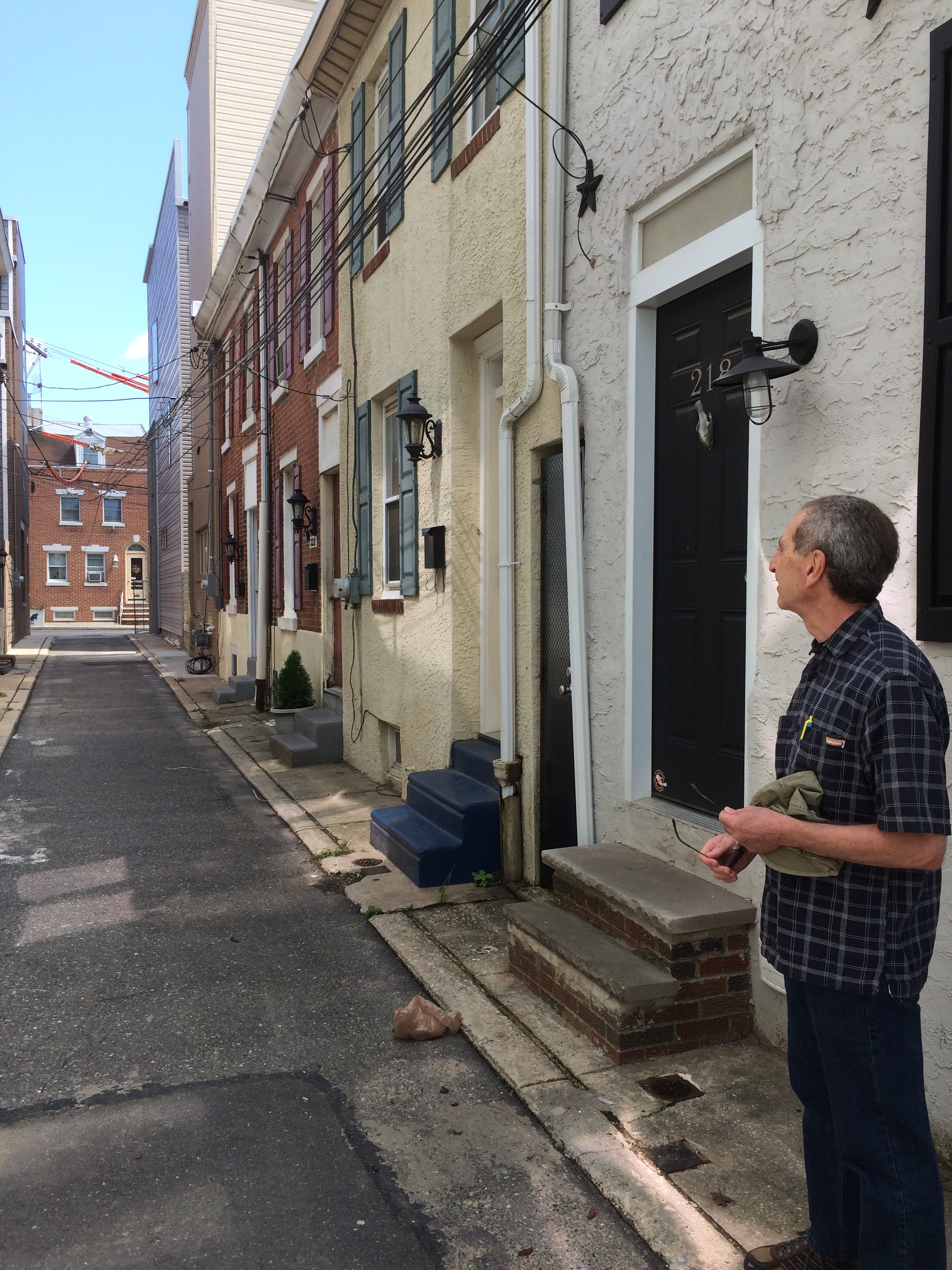
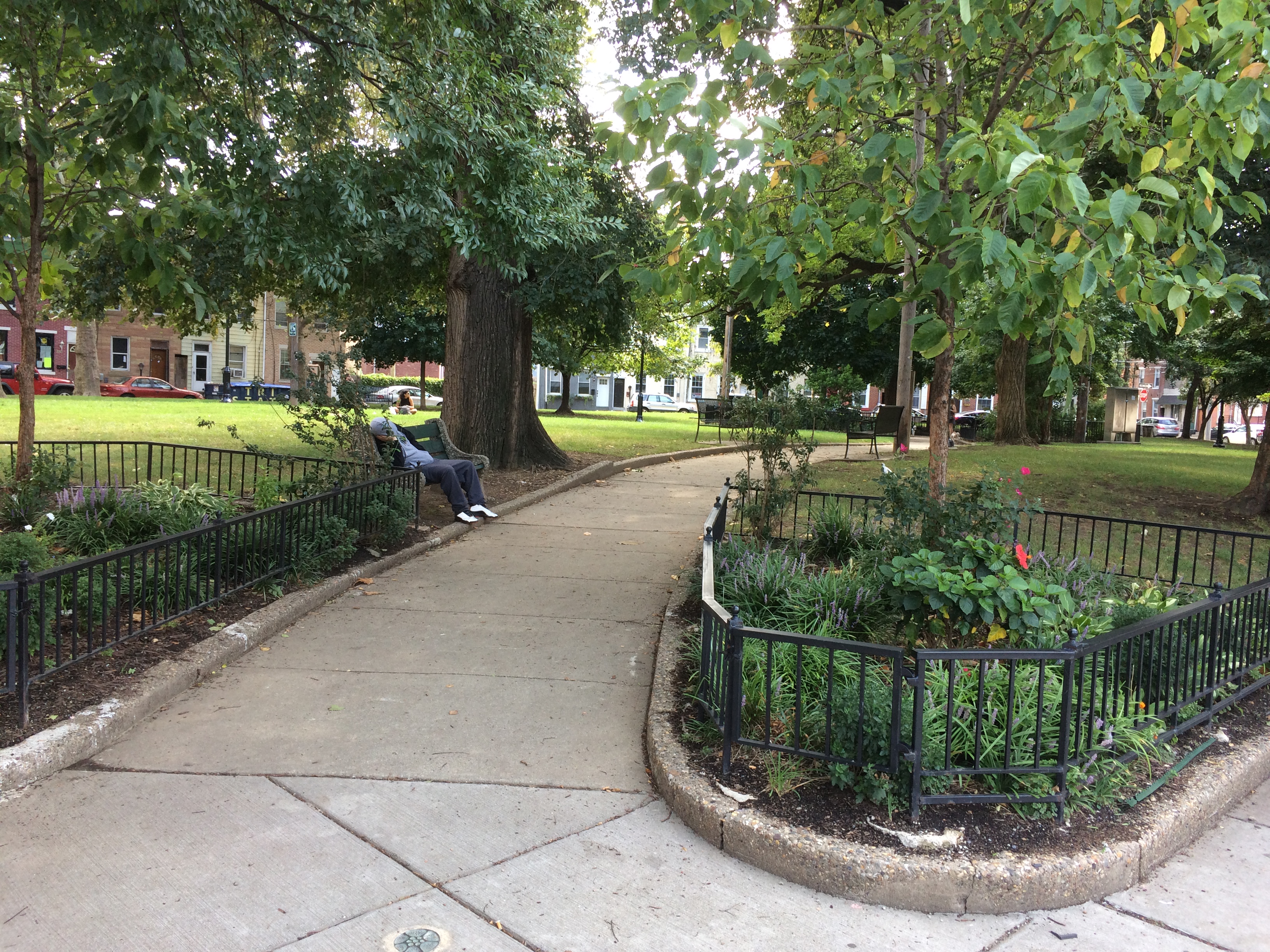
Well, the early afternoon passed pleasurably. I ambled along block after block in Powelton Village. Many streets contained a mixture of private homes and Drexel buildings. Everything was peaceful and quiet, just the way you’d wish that all the world would be. I saw many students, some on their way to or from classes and residences, some munching away or doing work at tables in a campus open square, some lolling on the grass in pocket parks. I enjoyed being a college student, but you’ll never find me enrolling once again in an institution of higher learning. There would be just too much work. In these latter stages of my life I prefer things that are way on the easier side.

By the time I made my way back to 30th Street Station I’d racked up four miles of ambulation. My shoulders were a lot looser than they’d been five hours earlier. My mind was no longer neither here nor there. And I was happy to be heading home. A few minutes before the train pulled in to whisk me back to my sleepy town, for no particular reason I took a photo of the “Watch The Gap” warning painted on the platform. It refers to the open space of an inch or two between the platform and each train car. Looking at that picture the next day it occurred to me that watching the gaps elsewhere in life is good advice too. Relationship gaps can be painful. Equality gaps are unfair and often hideous. But, with effort, gaps can be closed or dealt with productively, though not always.

With those words of wisdom I’ll now take my leave. But (hopefully) I’ll be back! Till next time.

(Don’t be shy about adding your comments or about sharing this piece on Facebook, Twitter, etc.)

(If you click on any photo, a larger image will open in a separate window)

Snap, Snap, Snap: A Photography Story

Philadelphia (2017)

Starting in the late 1970s, and continuing for 10 or 12 years, I passed a good amount of time wandering around Philadelphia (where I lived), other parts of the States, Europe and elsewhere with a Kodak Pocket Instamatic camera in hand or in pocket. A non-techie all my life, the Instamatic was the perfect camera for me. Small and easy to load — you dropped a film cartridge into place and then closed the back cover over it, a process even I could handle — the camera provided photographic images that struck me as just fine. Bulky cameras, special lenses and filters, carrying cases? Man, I wanted no part of any of that. And still don’t. I like my life plain and simple, because I’m a plain sort of guy who some might describe as being simple too. Doesn’t offend me. I’m simple that way.

Philadelphia (2017)

And so, wander I would, snapping photos of things that caught my eye. Street scenes, decorated house doors, gnarly trees, cool-looking cars, mountains and forests . . . fairly avidly I documented all of those and more. Outdoor photography was fun, a hobby that made me think creatively and provided exercise in the process. What was not to like?

Manhattan (2017)

Alas, for reasons I haven’t tried to decipher, my photography excursions came to a halt. The photos I took, and they likely number in at least the high hundreds, lie within boxes shoved into attic and basement and closet niches. I haven’t looked at any of them in 10 years or more. And I probably didn’t label half of them. I swear, I’m going to hire a personal assistant one of these days to haul out those photos and put them into working order. And then I’ll donate the pictures to the Smithsonian Institution, which I hear has a program called We’ll Accept Anything, As These Photographs Taken By Extremely Ordinary Americans Clearly Prove.

Manhattan (2017)

Fortuitously, my wife Sandy, whom I met in 1990, picked up the slack. On our vacations and at family gatherings she’s the one who for years took nearly all the photos. Sandy, kind of a photography buff, always has had cameras far more advanced than the Instamatic, and happily danced into digital camera ownership earlier this century. I had no problem with her handling the photographic duties. I didn’t miss them, whatever the reasons might have been. Needless to say, when I started this blog in April 2015 Sandy was the chief photographer.

Cleveland’s baseball stadium (2017)

And then came January 2016. During that fabled month, Sandy bought a new iPhone and donated to me the iPhone she’d been using till then. iPhonically-speaking, for me it almost was love at first sight and first usage. I mean, the phone is so cute, so compact, and not too hard for a technological imbecile like me to figure out.

Cape Cod (2017)

Before then I’d been a flip-phone person, basically ignorant of the wonders of smart phones. But within days I became an addict, surfing the web, watching videos, etc., etc. And my iPhone’s camera? Why, it called to me with a song that I was powerless to resist. Before I knew it I was snapping photos left and right, far more than I did in my Instamatic days. Twenty-six months later I’m still snapping. And, by the way, not long after the iPhone came into my possession Sandy lost her photography job with this blog.

Cape Cod (2017)

And why do I bring up all of this? Hold tight, Bunky, as I’m about to tell you. Not that you haven’t already guessed, seeing that photos are on display right from the start of this essay.

Cape Cod (2017)

A day or two before I sat down to begin the composition of that which you presently are reading, it dawned on me that not the worst idea in the world would be to write a story into which I might place a number of photos that I took in 2017. Dozens of them I’d already used in blog articles during that year. But many others were sitting all sad and lonesome, feeling unwanted, on the hard drive or whatever it is within my iPhone. “I’ll liberate some of you! And I accept your thanks in advance,” I said to the pictures.

Cape Cod (2017)

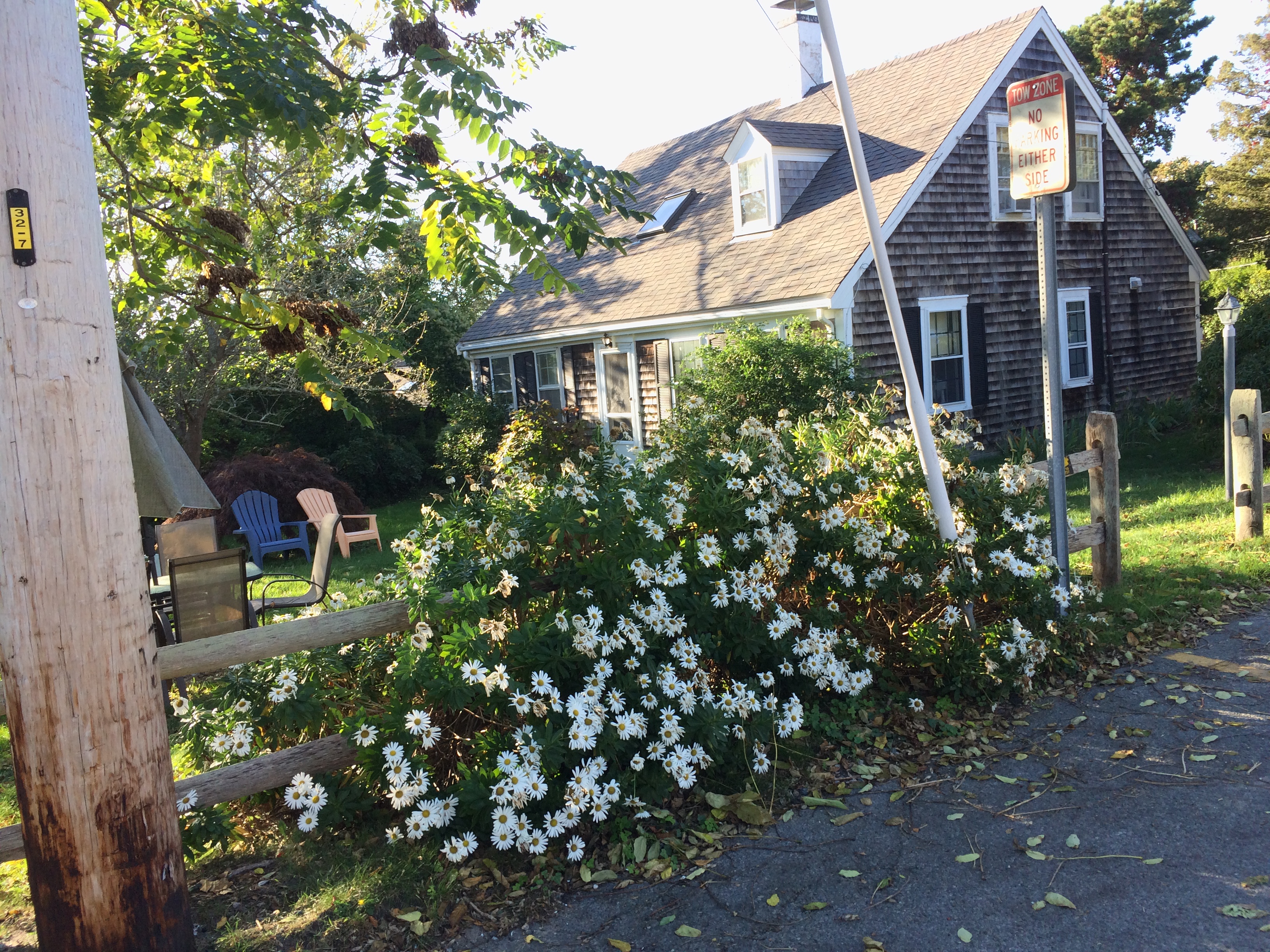
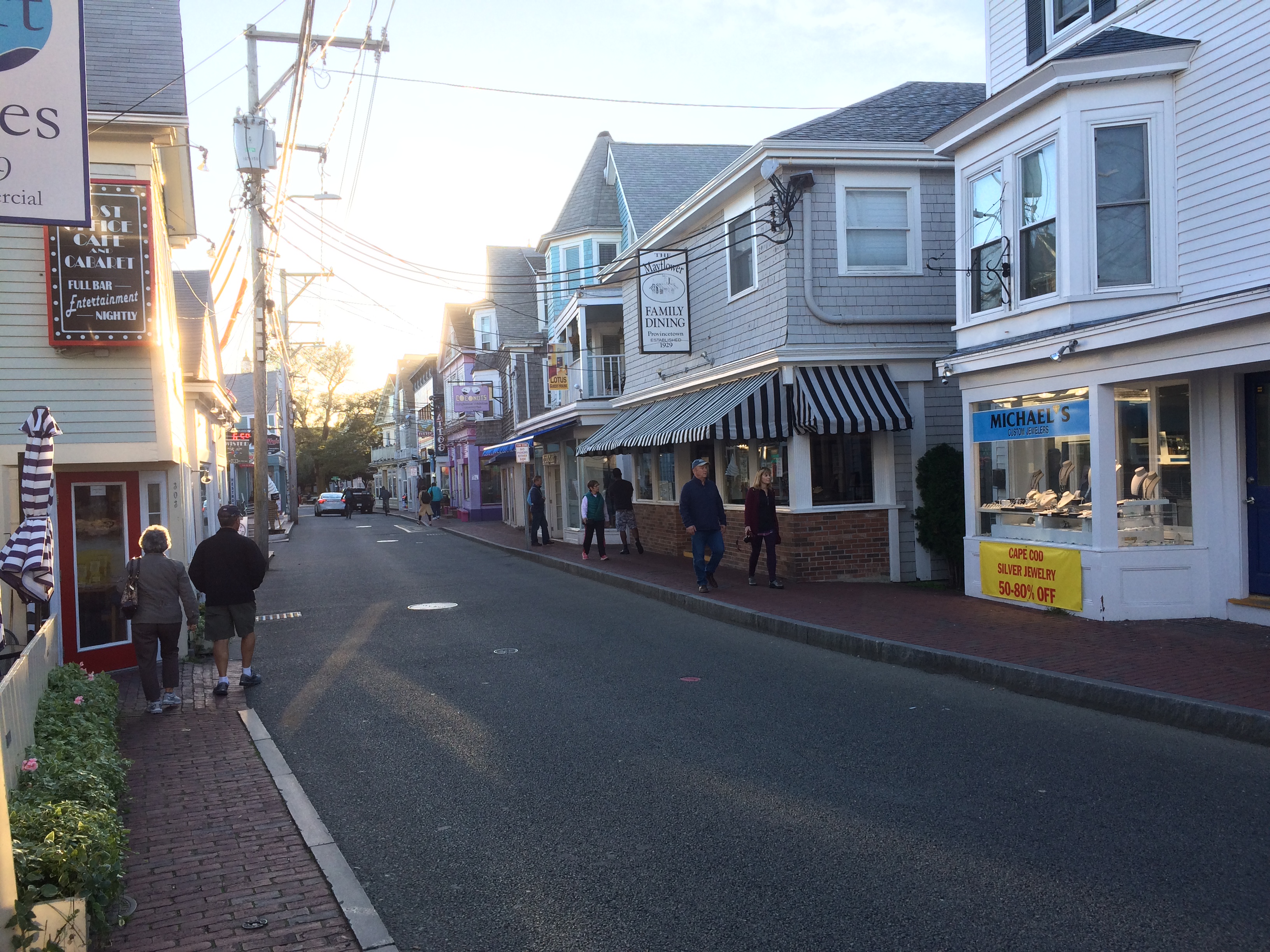
Yes, it’s as simple as that. As I’ve prominently noted above, I’m a simple guy, so what would you expect? In any case, the year 2017 found me in my suburban Philadelphia region, in the City Of Brotherly Love itself, in The Big Apple, in Cleveland and on Cape Cod. There were a few other locales too, but that’s enough. I selected about 30 photos from the previously-unused pile and studied them almost assiduously. I whittled down the pile to the eleven pix herein contained. Some are artsy shots, some are candid, some display the wonders of nature, some have sentimental value to me. My favorites are the two that follow: a selfie of me and Sandy taken on Cape Cod, and a spontaneous etching that I made in the sands of a Cape Cod beach.

Thanks for reading and gazing. Your humble reporter is now going to sign off, hopefully to return in the near future with an as-yet-undetermined commentary upon something or other.

(If you enjoyed this article, then please don’t be shy about adding your comments or about sharing it on Facebook, Twitter and the like)

(If you click on any photo, a larger image will open in a separate window)

Signs In The Windows

Last Friday I could feel a story idea calling me from far, far away. I cupped my hands behind my ears and did what anyone would have done: “What?” I yelled into the wilderness of my soul. “You have to speak louder, for crying out loud. Give an old guy a break!”

I waited for a response for a while. When none was forthcoming I waited a little longer. Finally I gave up on the idea of waiting. I’m a man of action, right? Well, not exactly, as proven by the impressive and permanent dents in the cushions of my living room sofa. Still, I rose anyway, put on my coat, stuck my iPhone into one of the coat’s pockets and explained quickly to my wife Sandy what my amorphous game plan was. Then I headed for the door, on my way to the three-level mall minutes away from my suburban Philadelphia house.

“You’re not going to do any shopping?” Sandy said to me as I exited. “Anyone else would go shopping.”

Shopping? Hmmm, not a bad idea. I could use a pair of slipper socks to replace the ones joyfully embroidered with Daffy Duck images that I’ve been wearing for the last 60 years. But whatever it was that was trying to reach me from the wilderness of my soul, shopping wasn’t part of it.

I pulled out of the driveway at 10:15 AM and pulled into one of the mall’s gargantuan parking areas at 10:20. Few cars were around. I entered the wonderland through a door that deposited me in Bloomingdale’s, a classy department store whose goods and displays I always marvel at during my infrequent visits. I felt at home, pretty confident that something somewhere in the mall ultimately would result in yet another blog essay being catapulted into cyberspace.

A poster in Bloomingdale’s cosmetics section caught my eye. “Everyone’s Invited!” it partly read. At once a bell rang in my head. Ouch, that smarted! I shook off the twangs of pain and went with the flow. If I wander around the mall, maybe I’ll spot all kinds of signage that share a sentiment similar to that poster’s, I thought. “C’mon in!” and “Don’t be a stranger!” would be good ones to come across, for example. But, nah . . . after I made my way out of Bloomingdale’s and into the main arteries of the mall’s lower level, I walked past store after store and came up with zippo. Nix that story idea.

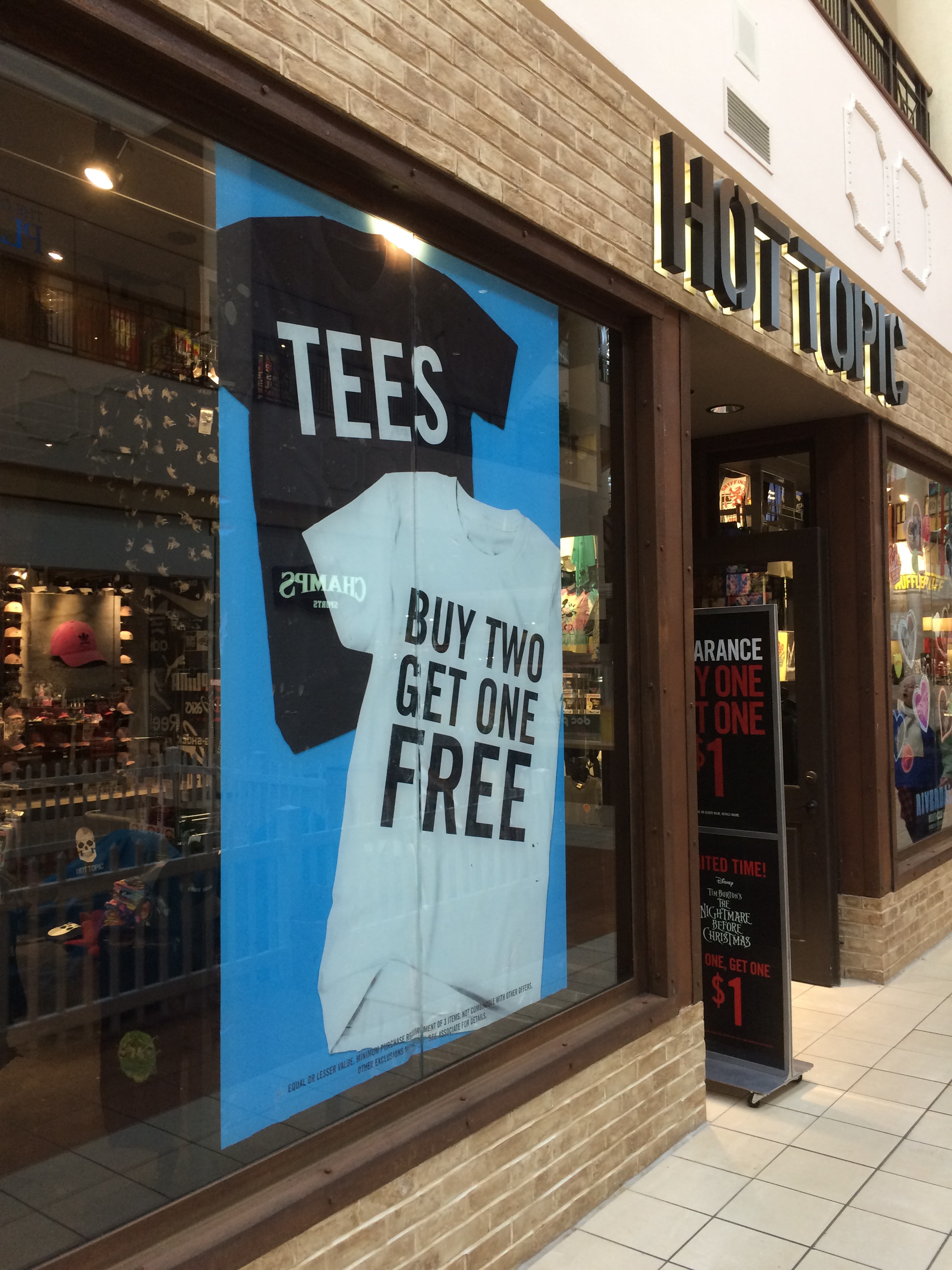
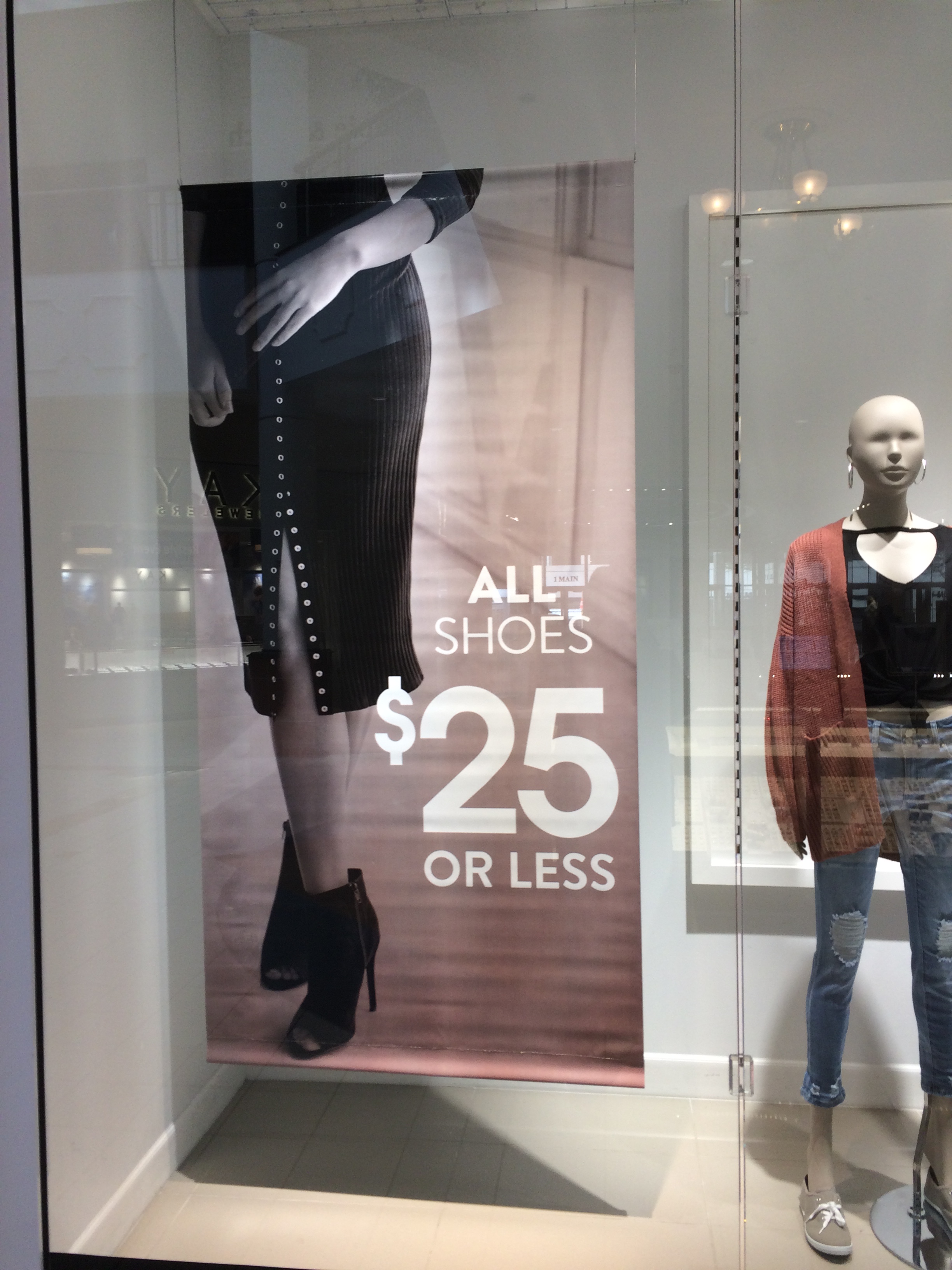
All was not lost, however. Far from it. For what I realized is that beautiful signs, primo examples of artful composition, grace the windows of many of the shops. There was my story, I concluded. I would navigate all the avenues of each mall level, photographing the window signs that struck me as worthy of immortalization. I breathed a sigh of relief. The wilderness of my soul, at least for the moment, became a less scary place.

I went at it for an hour, 16 signs making my grade. The majority of them are on display in this essay. At the moment, examining the photos from the comfort of my home, it’s hard to say which of the signs I like best. Who can choose? Why choose? Isn’t it better just to appreciate each sign’s worthy aspects? Okay, you’re right. Choosing isn’t all that difficult. Let me think for a few seconds. I’ll be right back.

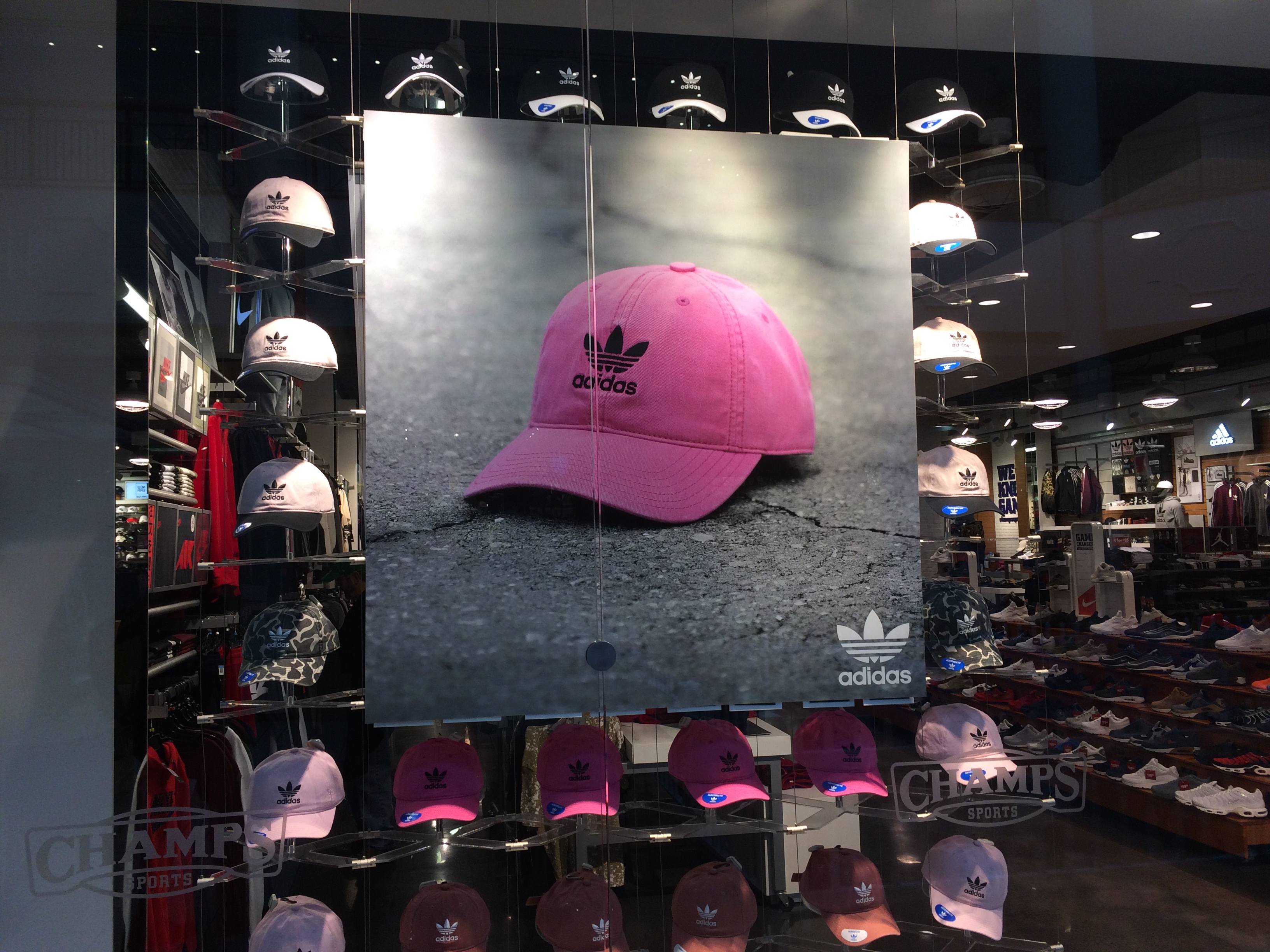
You know, I like the one picturing a pink Adidas cap, which fills a big section of glass at the Lids hat store. I’m one with its simplicity and admirable balance.

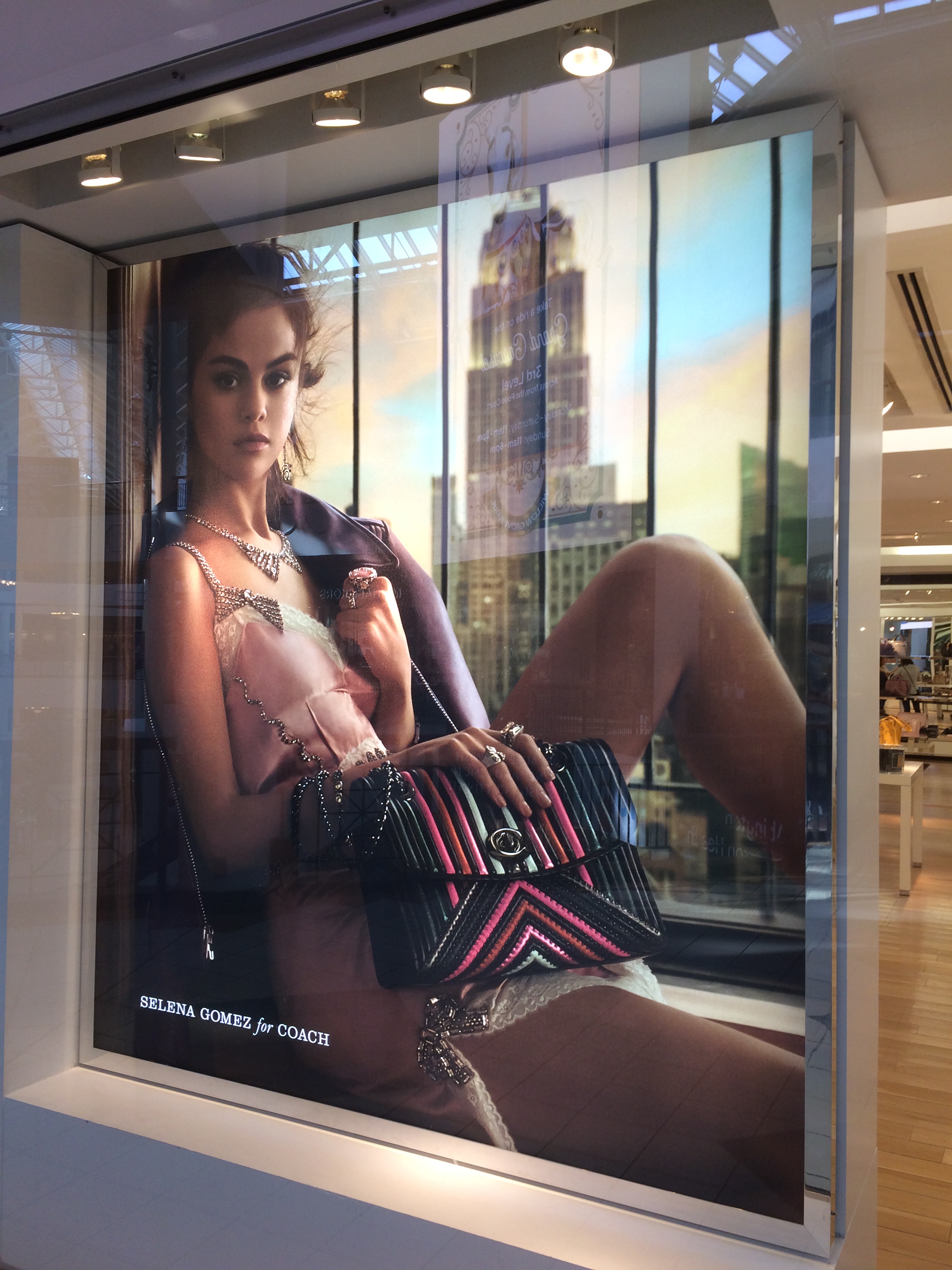
And I can’t deny the power of the seductive image of Selena Gomez balancing a black and pink handbag on her right leg. I had to restrain myself from marching into the Coach store and buying one of those bags, so helplessly jelly-like am I in the presence of gorgeous girls.

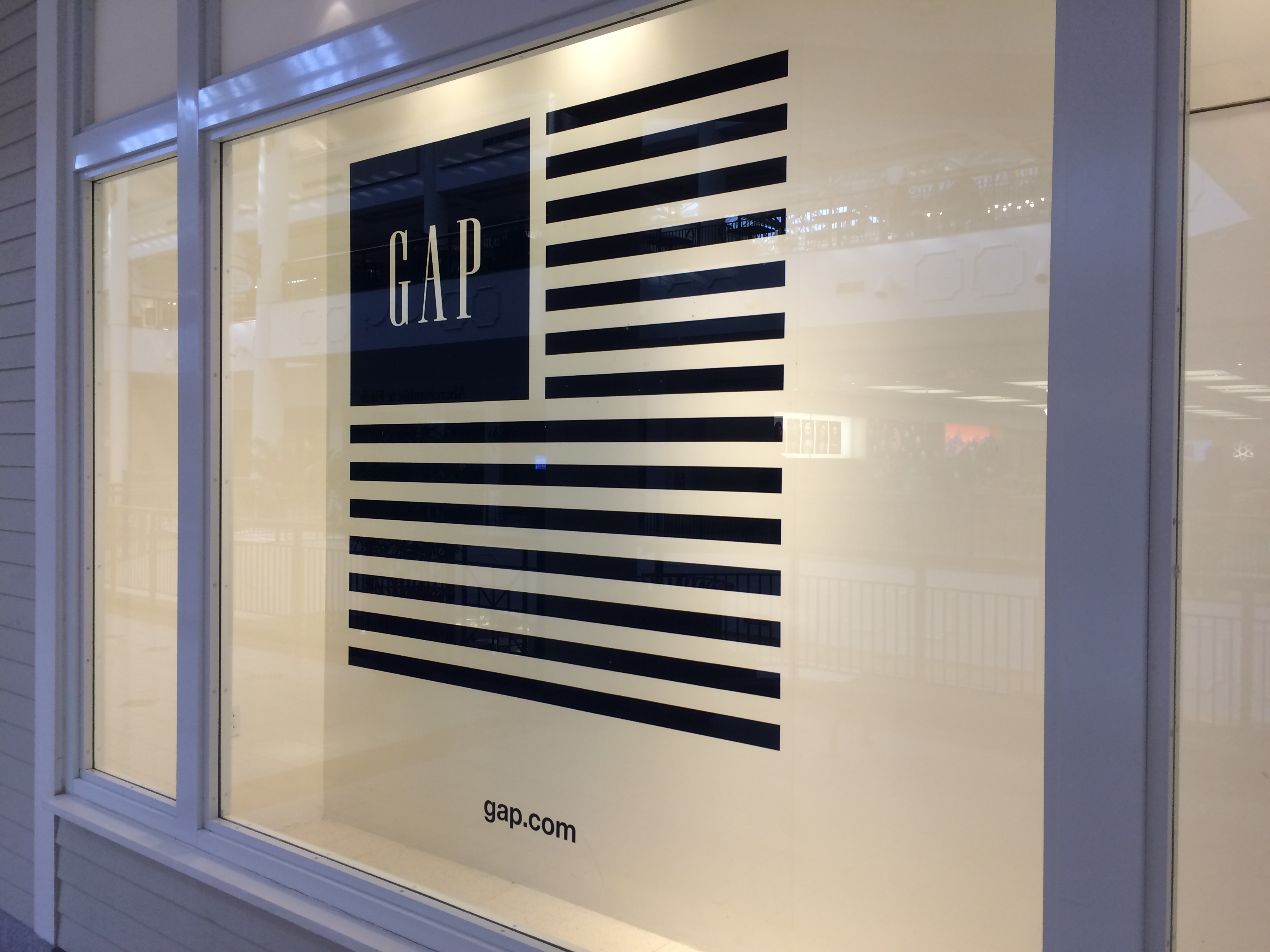
And let’s not overlook the black and white flag that stares out at potential customers from the mall’s Gap store. Maybe it’s a political statement of some kind, I don’t know. But it’s clean and taut and hard to take your eyes off of, from an aesthetic point of view.

There was more to my mall escapade than art appreciation, as it turns out. As I made my way around the mall’s highways and byways it dawned on me that I was getting some needed exercise. And that it felt really good to be stretching my legs. I tried to remember the last time I’d gone for a long walk. I think it was in October, on Cape Cod, upon whose open and natural areas I’ve racked up the miles in a major way.

But when I’m home? The landscape in the burbs, an homage to concrete and asphalt, doesn’t thrill me. And I sometimes forget that areas worth walking in, such as the olden streets of Philadelphia, aren’t much more than a hop, skip and a jump away.

But walk now and then in the mall? Hey, I never really thought about that before. We’ll see. I’ve read that plenty of folks do it regularly, placing one foot after the other upon the mall’s interior corridors as if those paths were athletic field ovals. I saw some of the hardy souls during my rounds. One of them, a millennial of the female variety who was attired in black workout clothes, passed me twice. I watched her do her thing. Her ears were home to earbuds and her eyes were glued to the screen of her phone as she relentlessly pushed ahead. You go, girl! Maybe I’ll join you some day. In my dreams.

An hour and change had passed by the time I got back in my car. I felt refreshed. My head was clear. My mood was up. And the remainder of the day, I was certain, would unfold attractively. That’s what good art and a two-mile stroll will do for you.

(Don’t be shy about adding your comments or about sharing this story on Facebook, Twitter and the like. Thanks.)

(If you click on any photograph, a larger image will open in a separate window)

A Seeker Of Beauty Am I: Art On Wheels, Part Two

I’d have to examine this blog’s archives, an activity worth doing on only the rainiest of days, to discover whether or not I’ve ever done a part two for a story before. Off the top of my head I’d say no, but the top of my head frequently is not reliable. Nor are the middle or bottom sections of my head, come to think of it. Not much I can do about any of that though. I was born that way.

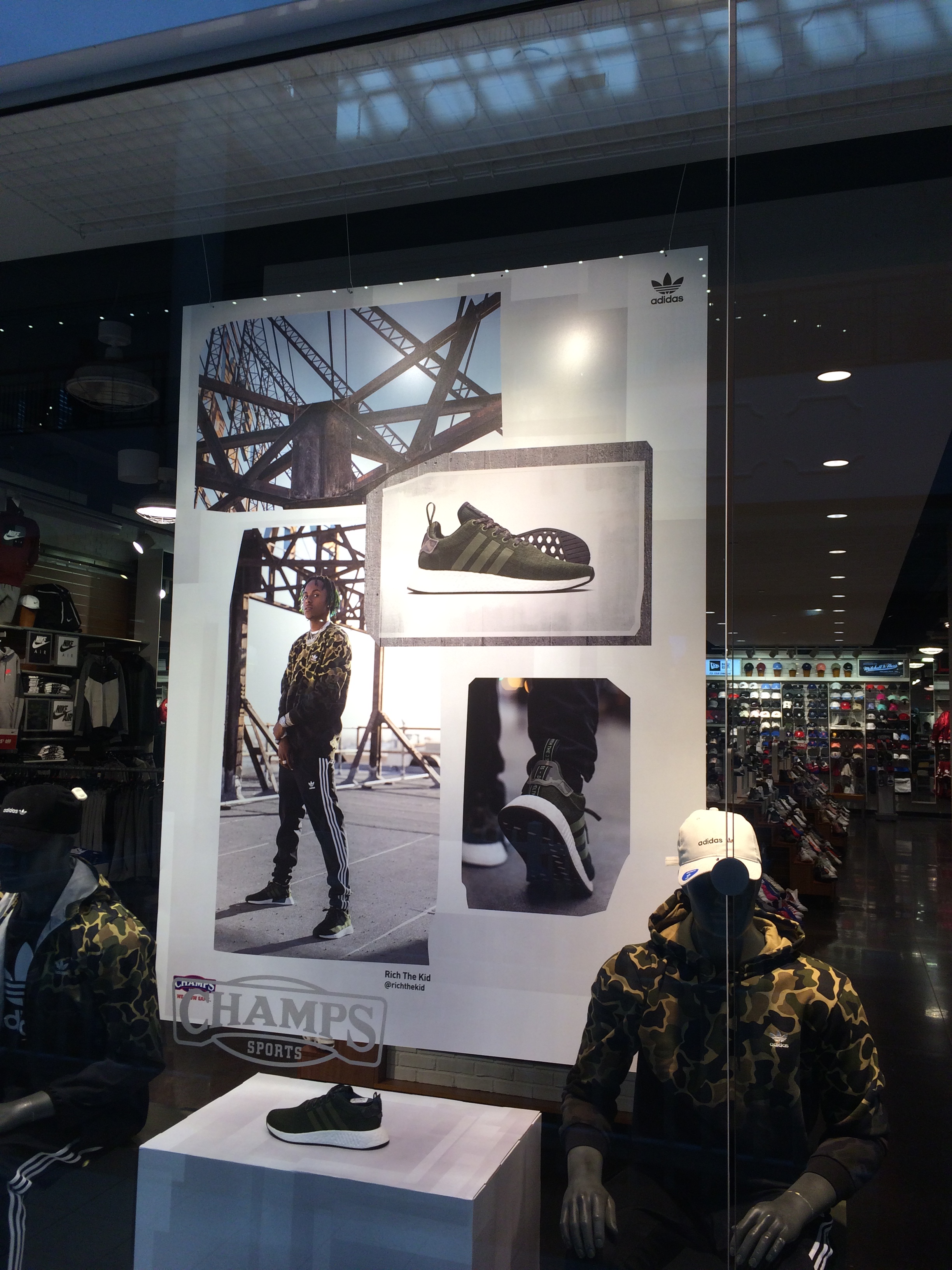
The first good-looking truck I saw last week

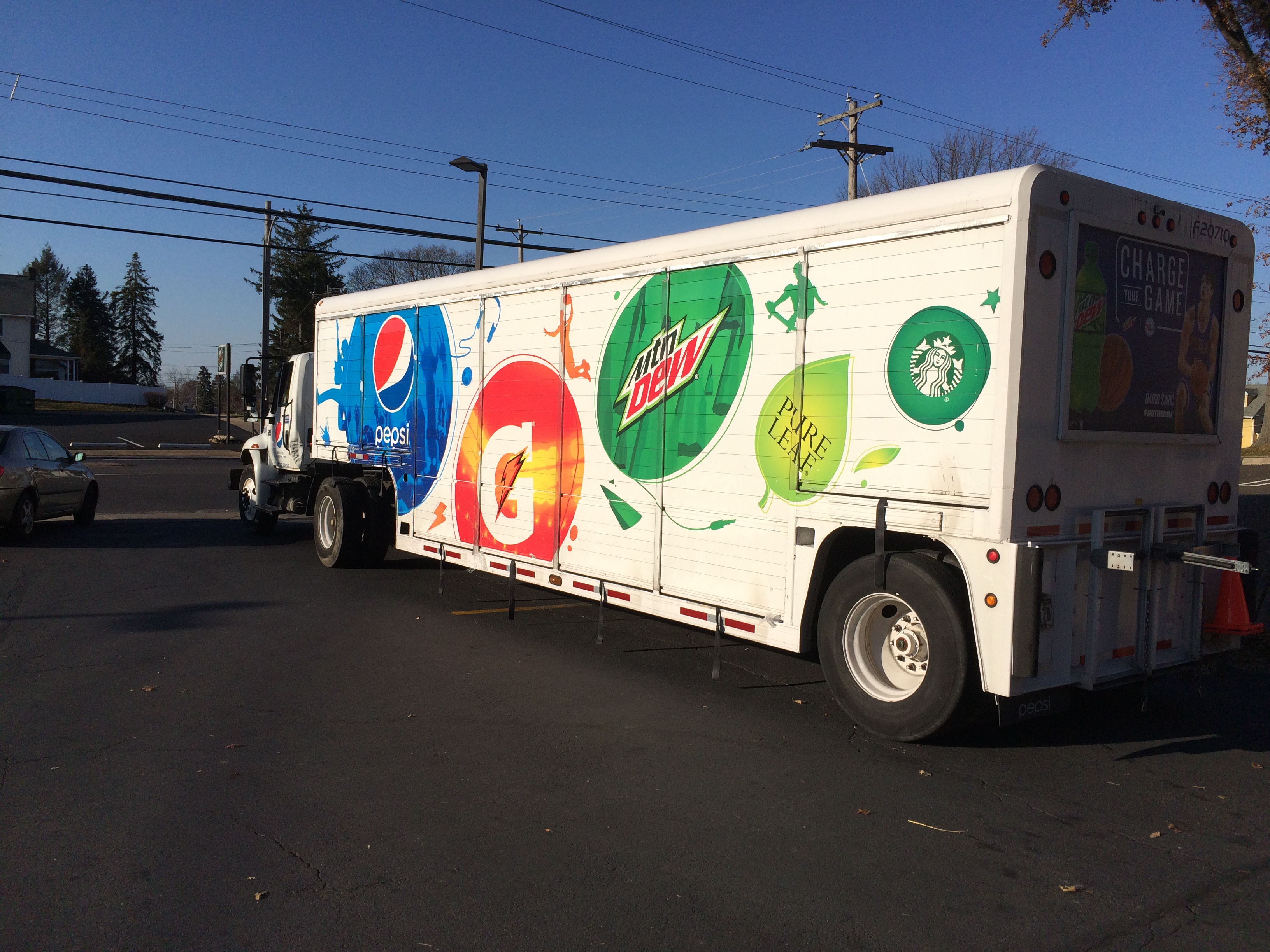
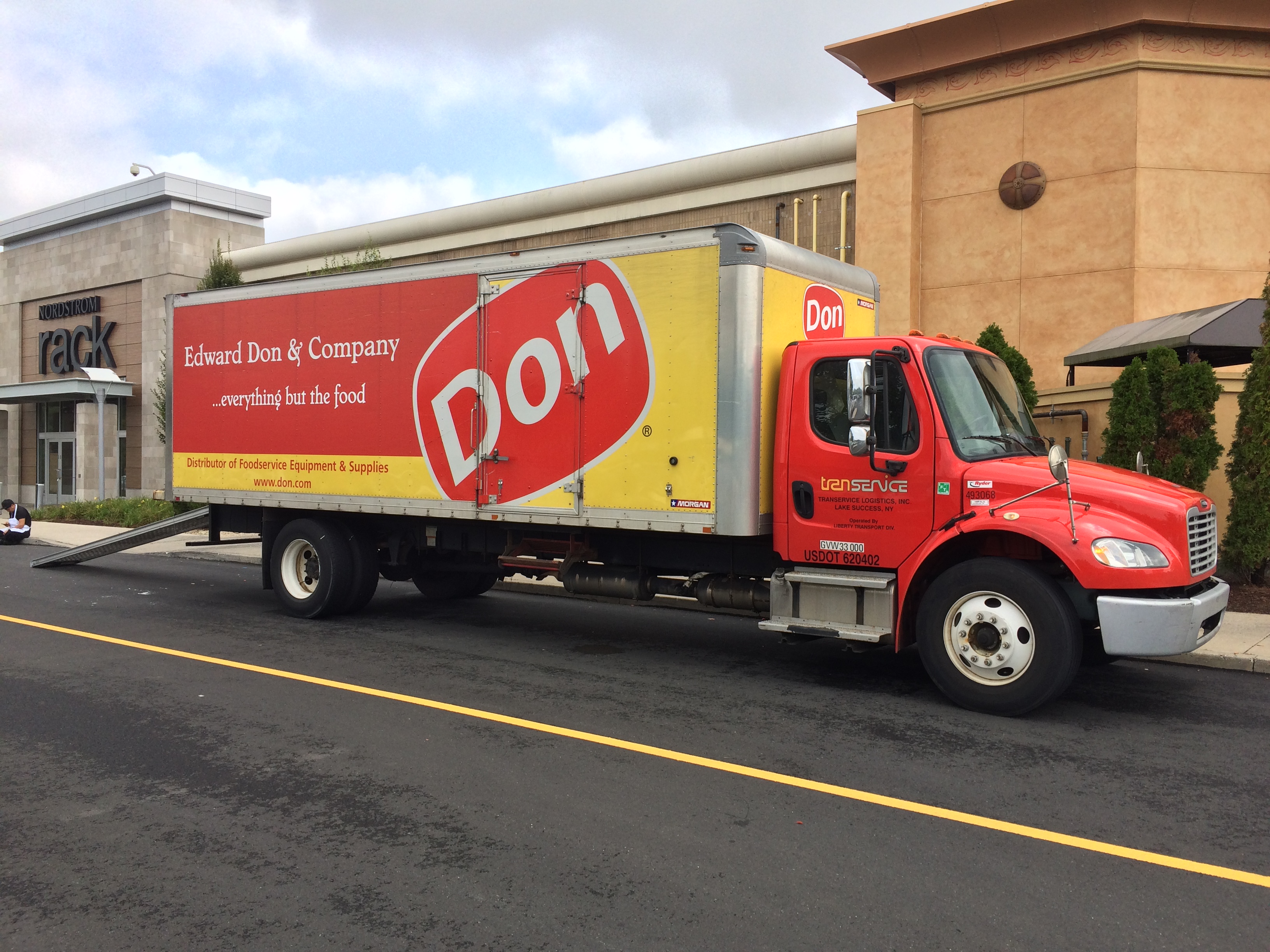
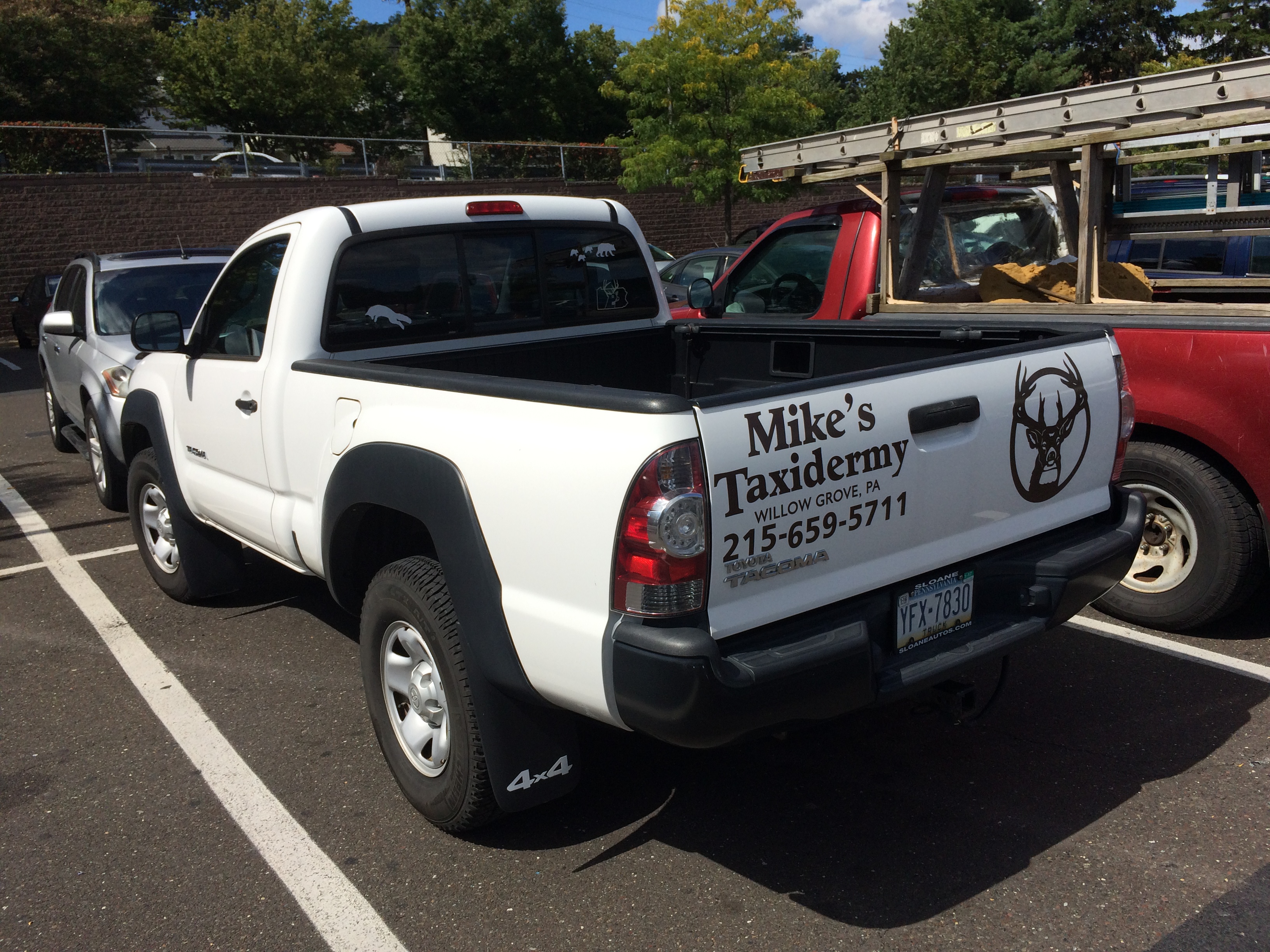
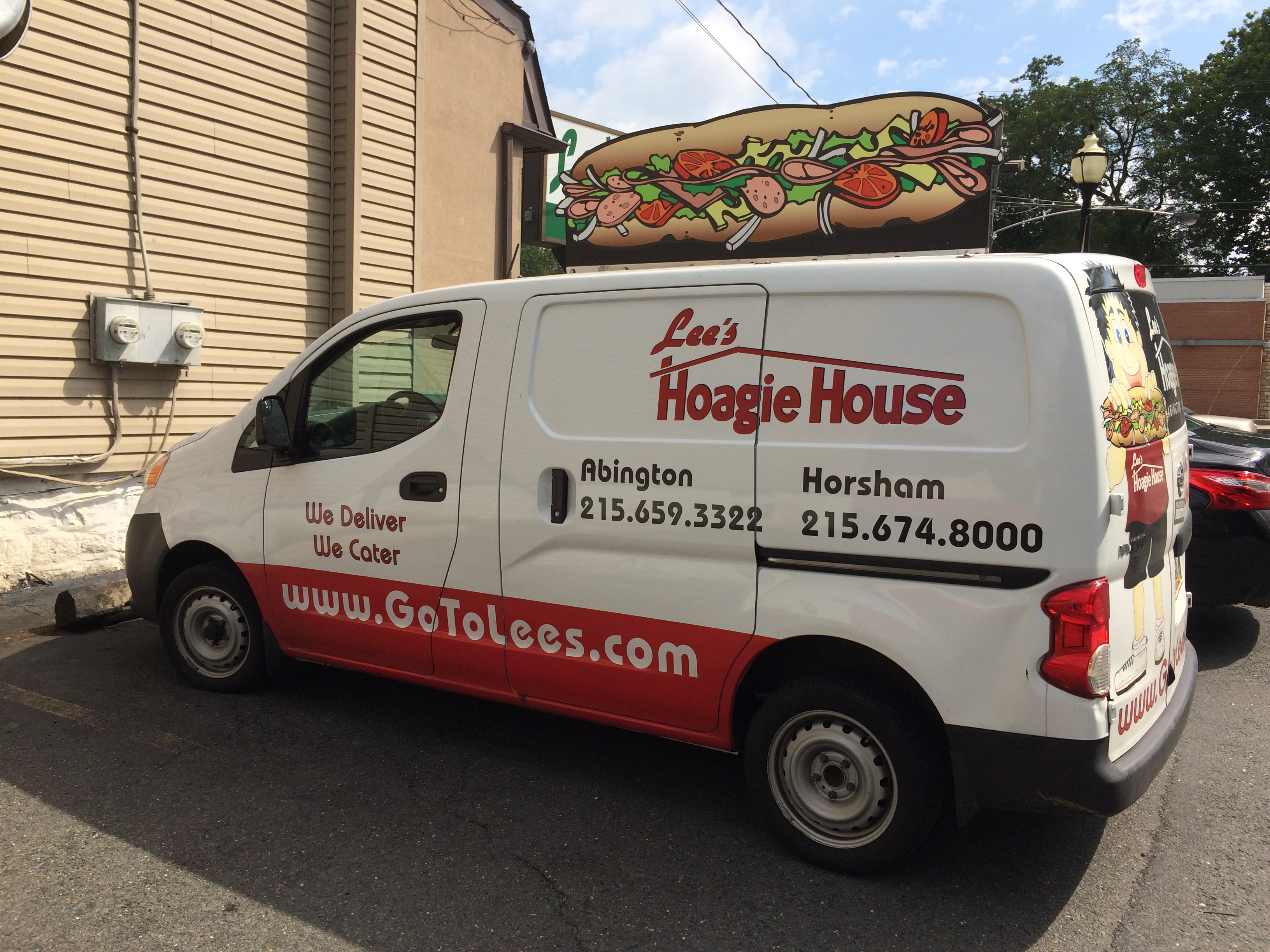
In any event, soon after I completed my article about artistically-adorned motor vehicles (click here to read it), I was pretty certain that I would revisit the topic. I mean, I’d had fun driving around, keeping my eyes open for good-looking and creative designs painted on the sides of trucks and vans. And taking photographs of them. Three months later the itch to do so again became strong. Itches need to be scratched, as everybody knows. And so, last week, seeking beauty, I took to the roads and to the shopping centers in my suburban Philadelphia area. And beauty I did find.

Now, eye-catching trucks and vans and buses are not uncommon, comprising maybe 15% of the commercial and public vehicle population, I’d estimate. Driving along, you see plenty of them on the road. But, unless you have a death wish, you’d do well not to attempt to photograph them from a moving vehicle. I was tempted to on many occasions, but I kind of enjoy breathing. So I didn’t.

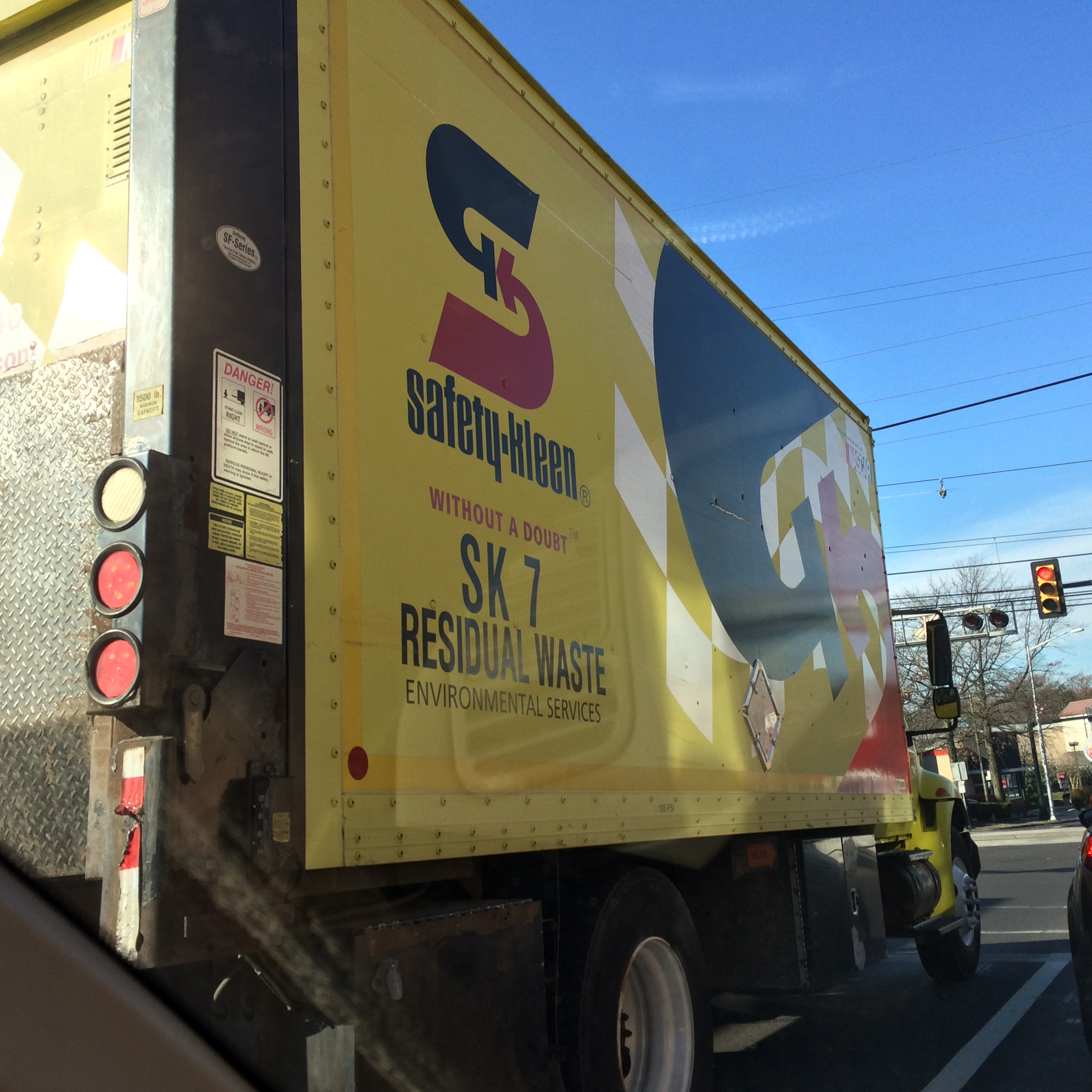
Which is why I hunted my prey in shopping centers and strip malls, where I was able to drive slowly, scouting out the parking areas and store delivery sections. I set off early on Wednesday morn and kept at it for three hours, a lot of time to devote to an admittedly loony quest. I drove all over the local map, visiting shopping places that I’d been to often over the years, and some I’d never ventured to, despite their being not much beyond spitting distance of my home. And, much to my delight, I snapped a photo while on the road of a snazzy waste disposal truck, its sides a vision in yellow and cool shapes, while beside it as we both waited for the traffic light to turn green.

It was a hit-or-miss operation, a question of being in the right place at the right time. As is much of life. And I was in the wrong place more often than not. I couldn’t believe how I kept coming up empty while trolling the huge receiving docks sections of the types of stores that, in some sense, have come to rule sizeable chunks of the world: Target, Lowe’s, Walmart, Staples. What the f*ck? Not only were there no gorgeous trucks there, for the most part there were no trucks at all!

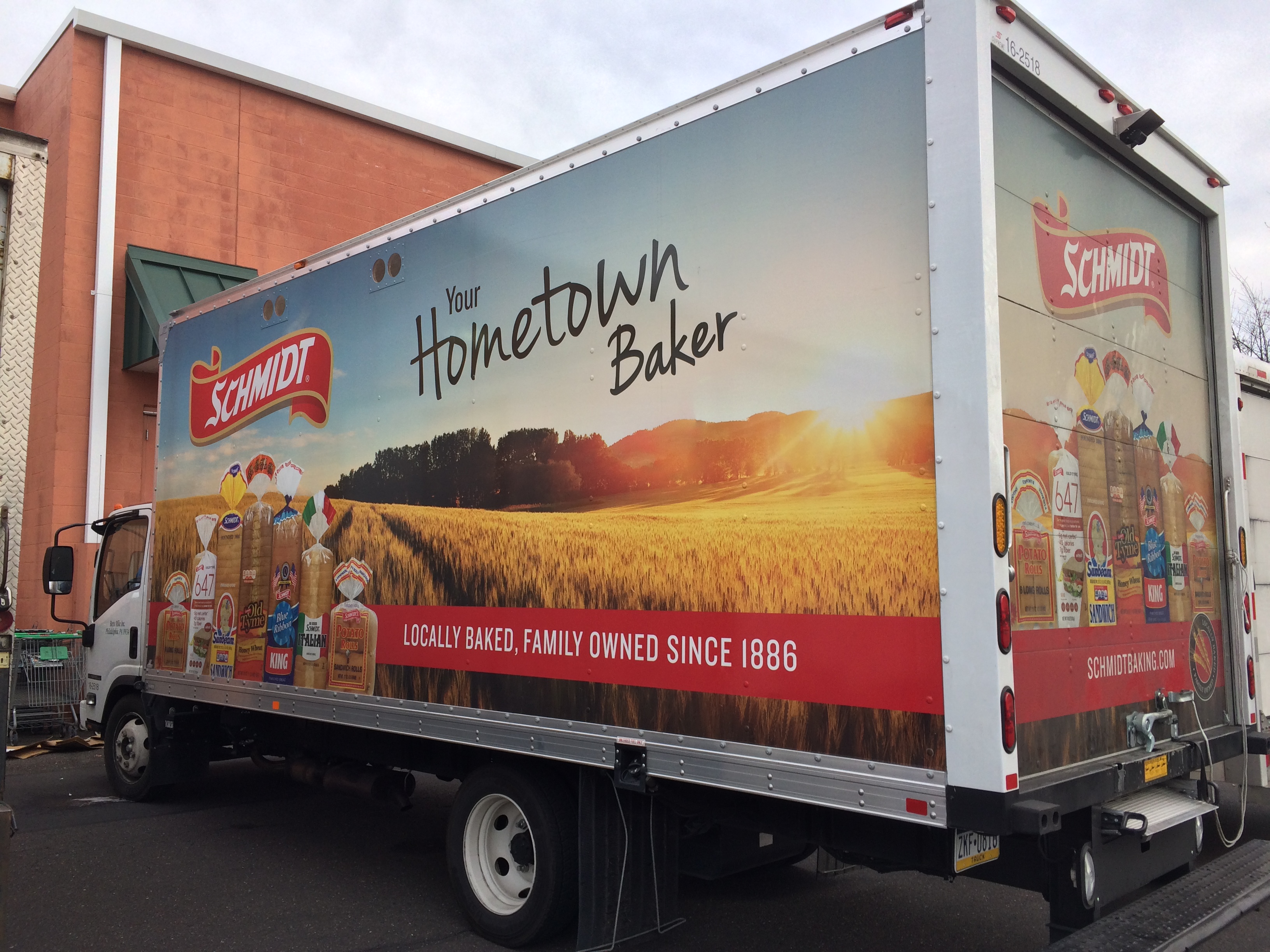
But hey, just when I was giving up hope during various intervals of my expedition, something fine came my way. Such as the image of a sun-drenched wheat field decorating a Schmidt Baking Company truck. I encountered the vehicle in the supermarket where my wife Sandy and I do most of our grocery shopping.

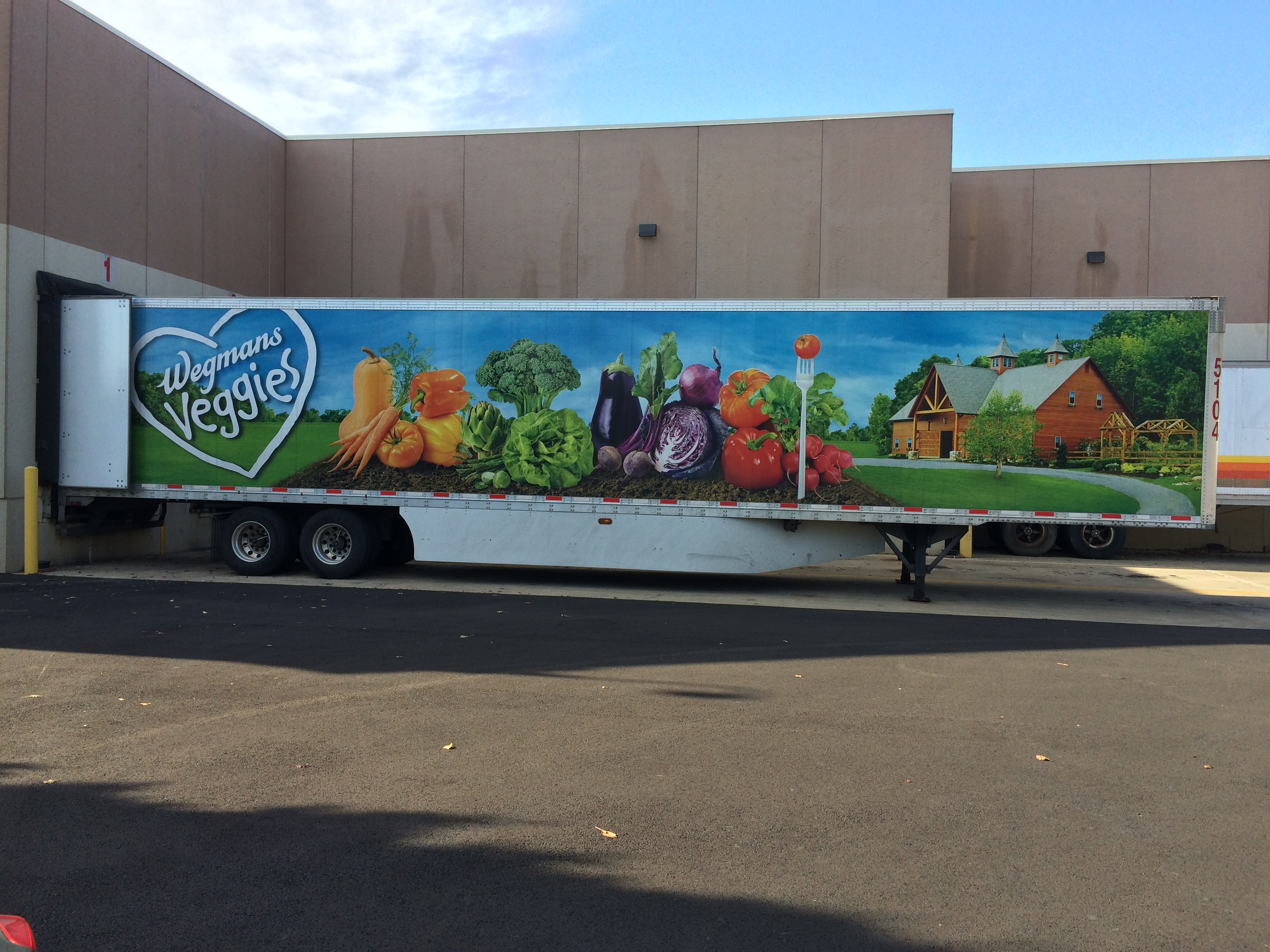
Even better was what I saw in the desolate rear of a Wegmans supermarket, seven miles from my house. Fresh off the strikeouts at Lowe’s, Walmart, etc., I was expecting to uncover nothing there. But lo and behold, what was that in the distance? I drove closer and grinned. Why, it was a masterpiece, my favorite canvas of all I was to see that day. Luscious, exploding with color, the Wegmans veggie painting made me shout “yo, stop the presses! I’m going to become a vegetarian, and maybe even a vegan!” Luckily there was nobody around to hear my outburst. A nanosecond later I reconsidered what I’d said and tossed the idea in my ancient Honda Civic’s ashtray. But I will say this: The Wegmans truck artist sure as hell knows how to make a humble trailer look exquisite. I drove away with all kinds of warm and wholesome feelings in my heart.

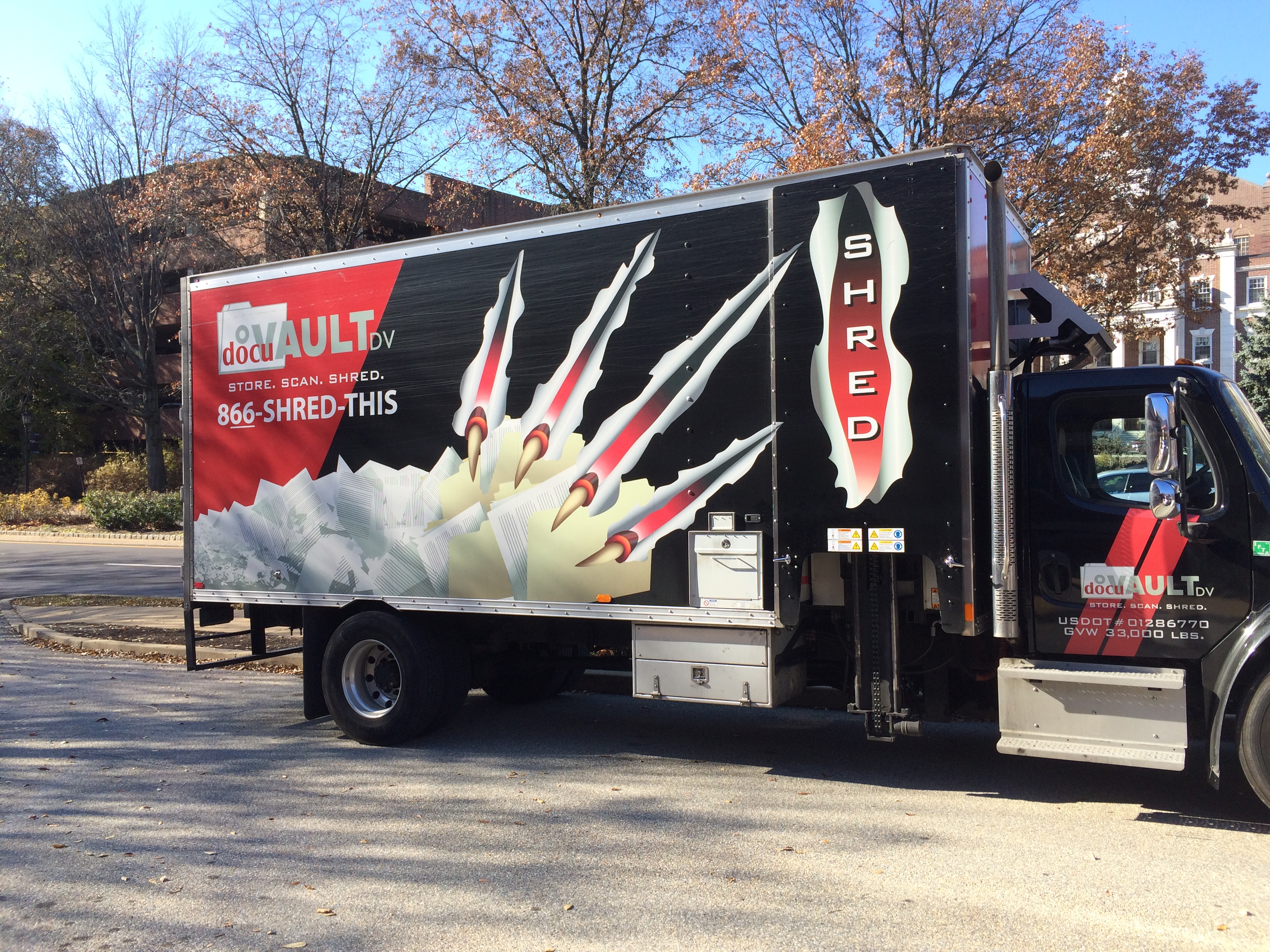
A few days after completing my photographic mission a number of things occurred to me. For one, it seems as though you don’t see a whole lot of dazzling trucks or vans with black as their base color. Strange, considering that a hefty percentage of the cars and SUVs on the road are painted black, and that black is a staple in hip fashion. I came across but two fine black-based commercial vehicles: The Shred truck pictured a few paragraphs above, and Air Purity Experts’ van. Both shone like gems.

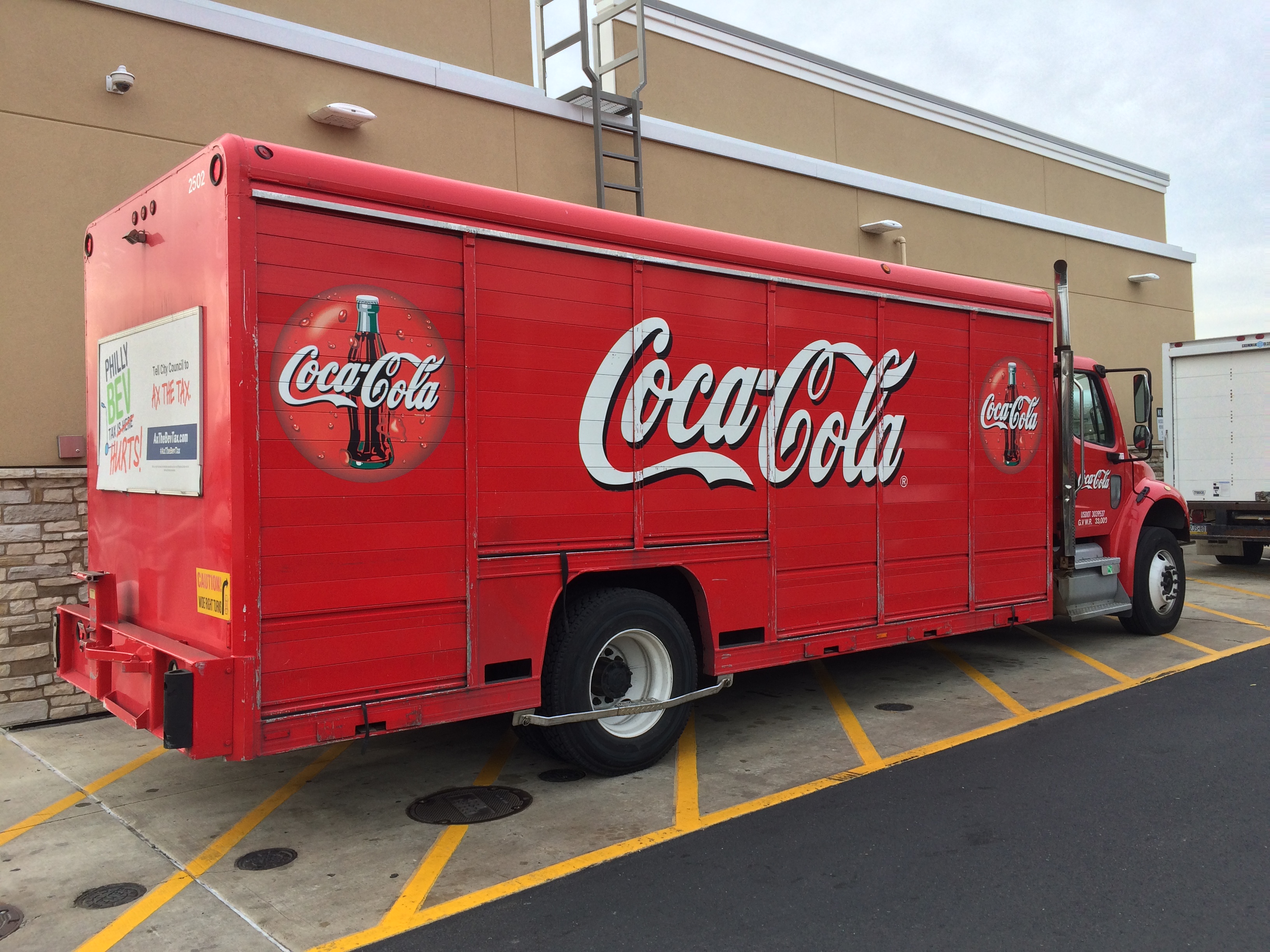
The truck behind Wawa store

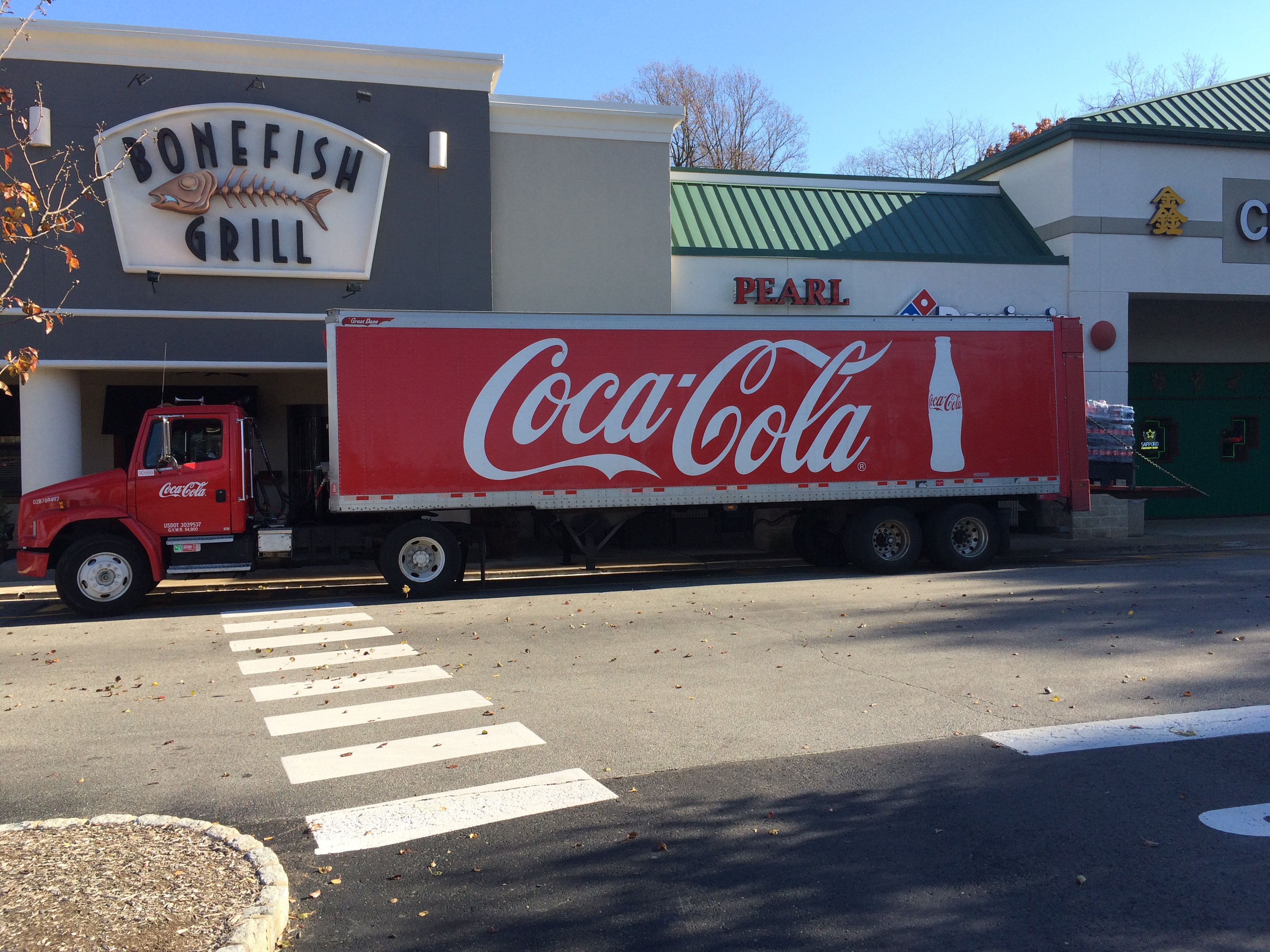
The Air Purity van was parked behind a Wawa convenience store, around one of the building’s corners from a Coca-Cola truck. That truck was the second Coca-Cola deliverer I went eyeball-to-eyeball with that day. The designs on the sides of the Coke vehicles were different yet sublimely similar. And both are timeless. Coca-Cola trucks absolutely flaunt their red, and have for ages. The oceans of red grab the eye, entice, seduce. You want a Coke right now? I wouldn’t mind one at all. That’s an example of the kind of power that good art sometimes has over me.

(Don’t be shy about adding your comments or about sharing this article. Gracias.)

(If you click on any photo, a larger image will open in a separate window)

A Monumental Provincetown Story

Let no one declare that I don’t follow up on my threats, for here I am at my writing desk penning another story about Cape Cod, just as I intimated I might do in my previous essay (click here). For those of you who have read more than enough about the Cape on these pages over the last two years, now’s a good time to turn your attention to a different sort of activity, such as sending one of Hallmark’s What The Hell Is Wrong With You? cards to Donnie Trump. But please promise to return to check out what I have to say next time around . . . unless it too turns out to be a Cape opus. In which case I give you my permission to send one of those cards to me.

Provincetown’s village section (as opposed to Provincetown’s enormous and mostly uninhabited areas of beaches, woods, marshes, sand dunes and sand valleys that separate the village from the Atlantic Ocean) — that’s what I had in mind to write about after strolling along many of its streets for several hours a couple of weeks ago. I was in P-Town, as those in the know call it, during my wife Sandy’s and my annual Cape Cod vacation. Our home base was Orleans, about 25 miles away.

I meandered very contentedly, snapping a bushel or two of photos and figuring I probably would have little problem turning the excursion into a blog-worthy piece. But as one and then two and then three days following the jaunt went by, no satisfactory story slant entered my mind.

Remarkably, panic-prone me didn’t panic. Instead I took a few deep breaths, dropped to my knees and prayed to the blogging gods for assistance. “Get up, you schmuck, before you hurt yourself! Did you forget that you’re about as flexible as a baseball bat?” they immediately shouted at me. I rose slowly, creaking like an ancient wooden chair. “Okay, that’s better. Listen, you definitely should write about your Provincetown amble. But put the Pilgrim Monument near the center of the story, because you’ve always loved the Monument more than anything else in Provincetown. That’s the best advice we can give you.”

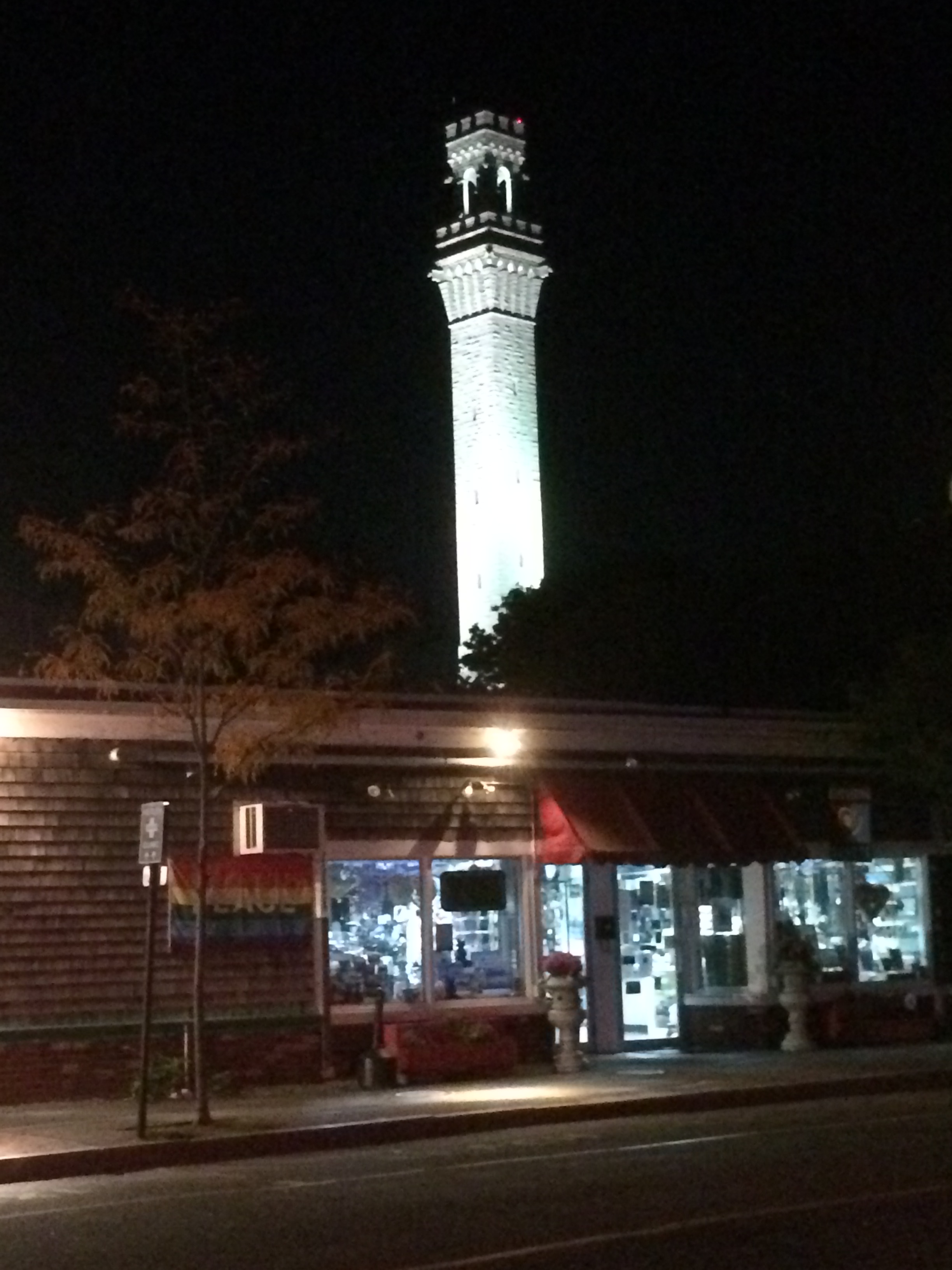
Hey, they were right. The Pilgrim Monument, located just two blocks from Provincetown village’s central area, is a stunner. And when I’m Cape-side it’s in my thoughts or pleasing my eyes a fair amount of time. That’s because I admire its enormous size and equally enormous aura. I mean, it’s got presence up the wazoo and seems almost supernatural to me, so unlikely is it in appearance compared to all that surrounds it. The Pilgrim Monument is the stolid, solid and protective alien creature that Provincetown and the rest of Cape Cod didn’t know they needed until it was erected in the early 1900s.

Provincetown village is charm personified. And it was made for strolling. Lovely, sea-sidey houses abound. As do more-polished abodes with beautiful gardens, and art galleries and food venues ranging from grab-a-bite to haute-cuisine. Not to mention funky stores of one kind or another that, with the galleries and eateries, run along Commercial Street, P-Town’s main shopping drag, and to a lesser extent along the village’s other lengthy artery, Bradford Street. And you’d have to possess a heart made of granite not to be beguiled by Provincetown Harbor, whose waters are fed by gargantuan Cape Cod Bay. The harbor is but a stone’s throw from Commercial Street.

The small and smaller streets in Provincetown, which occupies the far tip of Cape Cod, never cease to amaze me. Some are half-hidden, some little more than cubby holes — good luck ever finding those again if you fail to jot down exactly where they’re located. All of that suits me just fine, as I’m a fan of the whimsical. I’m also a fan of  peace and quiet, and things were real tranquil during the day in question. Artsy, open-minded and gay-friendly Provincetown, population around 3,000, is overrun with visitors and vacationers during the summer, but not so in autumn, which is when Sandy and I plant our temporary roots on the Cape.

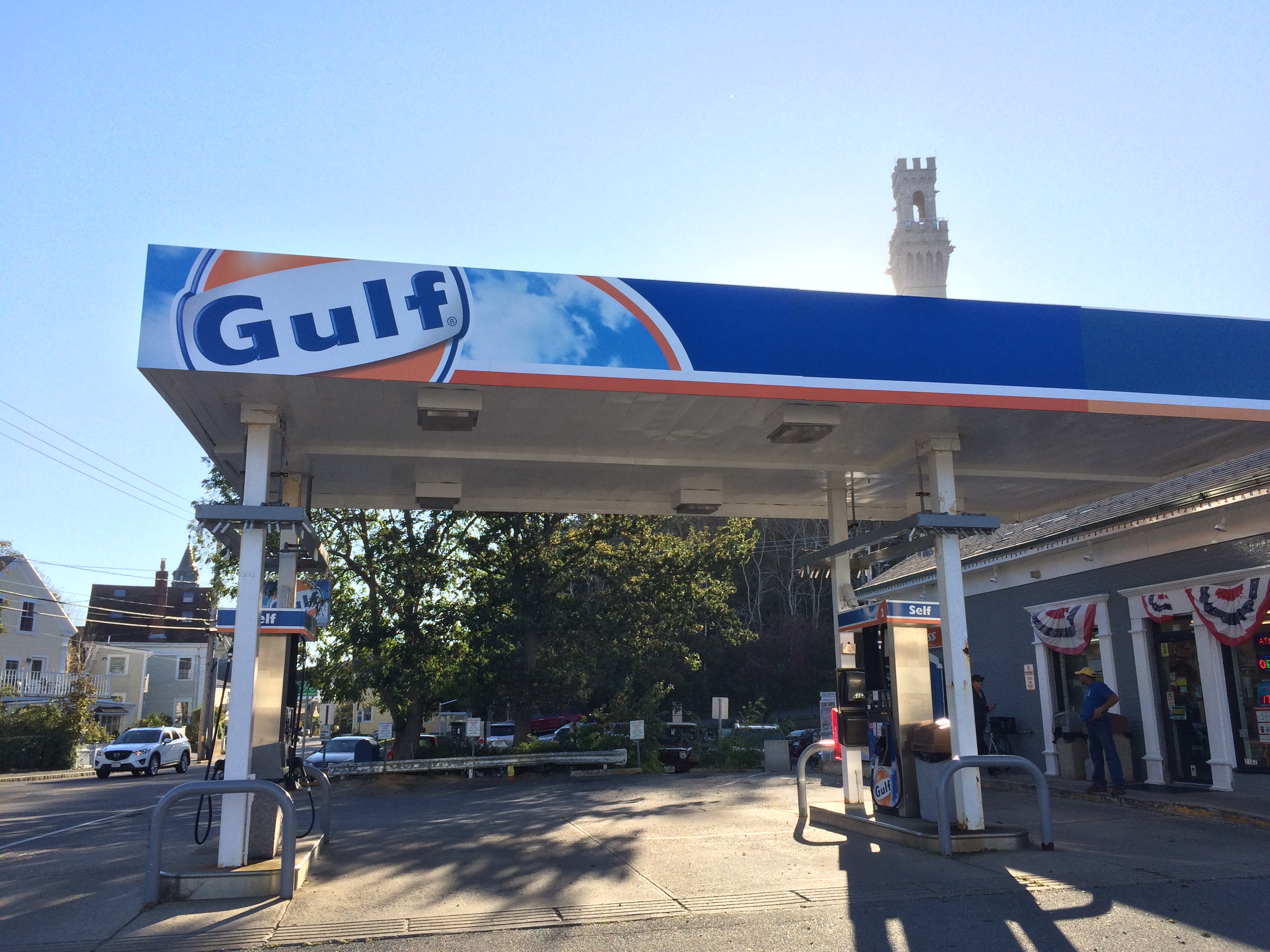
Fifty minutes into my exploratory venture, I caught a glimpse of that which the blogging gods suggested I focus on. Despite its being 252 feet from toe to head (it’s by far the tallest structure on vertically-challenged Cape Cod), and perched on a hill to boot, you can’t see the Monument from everywhere in town. Trees and buildings, though nowhere near as tall as the Monument, commonly obscure the view. But as I got closer to the old soul, I sought out perspectives that partly or fully brought it into my field of vision. I especially liked the way the Monument, three or four blocks away at that point, stretched its torso above a Gulf gas station’s sign on Bradford Street.

Funny thing about the Pilgrim Monument. It was created to honor the Pilgrims who voyaged in 1620 from England aboard the good ship Mayflower and helped colonize these here United States. They made their first landfall in what would later be known as Provincetown, before moving on soon after to a permanent home, across Cape Cod Bay, in Plymouth.

You’d think, then, that the Monument’s basic design or at least its adornments would acknowledge the Pilgrims or the Mayflower or the European settlement of the States. A plaque near the Monument takes care of those matters, but not the Monument itself. The decision was made to pattern the Monument after a bell tower that was built in the 1300s in the hilly, landlocked Italian town of Siena. Huh? Wha? An Italian tower in a bohemian New England fishing village? But as it turns out, for me anyway, the Monument’s fish-out-of-water aspect, not to overlook its stateliness, makes it the brightest star in town.

There are other reasons why I enjoy the Monument as much as I do. I find it more than cool that the tower is visible from miles away along certain sections of Cape Cod Bay. Though it’s only twig-sized from those vantage points, I feel good knowing that it’s there. And more than once I was gassed to see the big guy poking up its head while I was scampering in the aforementioned Provincetown sands just outside the village.

But more than anything, I get kind of weak in the knees when I’m near the Monument at night. When the Sun goes down, lights illuminate the giant. I don’t know, I guess I’d have to say that the nighttime Monument is one of the finest sights I know of, not only beautiful but curiously otherworldly. As my afternoon in Provincetown segued into night, I stared more than once at the Monument. And took a couple of pictures. One of them is the money shot.

(Don’t be shy about adding your comments or about sharing this story)

(If you click on any photo, a larger image will open in a separate window)

Fishtown (As Seen Through Max’s Eyes)

I’m back! Not that I was gone for long. I wasn’t. I was on the road, for only a handful of days, with the Tingling Brothers Traveling Circus, with whom, on a whim, I’d taken a job as an apprentice elephant-dung shoveler. But the elephants ran into visa problems, what with Trump’s new, stringent guidelines, and had to be shipped back to India. End of job.

I apologize for not writing a story last week, and I totally understand the frustrations that my editor Edgar Reewright expressed in the piece that he posted concerning my absence (click here). Seeing that he’s not well-endowed (financially-speaking), he badly missed the paycheck that I neglected to issue to him. I’ve rectified my wrong. Edgar now is back on the books and once again is as happy as a poorly-adjusted, angry middle-aged guy might be expected to be.

With circus life behind me, for today’s sermon I shall turn my attention to the post-Tingling visit that our nephews (20-something Jesse and 30-something Max) paid to me and my wife Sandy. They were with us for a number of days, and we did so many enjoyable things together I’d have to write a 20,000-word opus to cover them. I’m not up to that, being very much low on gas. The circus gig took a lot out of me, you see. I had no idea how heavy elephant crap is. So, in order not to interfere with my current regimen of napping and thumb-twiddling, I’ll focus on merely one highlight — the time that Max and I spent in Philadelphia’s Fishtown section the day before he returned to his home in Texas. Jesse had, by then, gone back to his abode in the Big Apple. And Sandy sat out the Fishtown adventure. “Have fun, boys,” she told us. “I’m staying put. Did I mention that George Clooney will be stopping by the house this afternoon to show me how to operate that needlessly complicated Nespresso coffee- brewing machine he peddles on the boob tube?” She hadn’t.

But, f*ck Clooney. Fishtown was calling, and Max and I headed its way, arriving there around 12:30 in the PM. We wandered for close to two hours, checking out this, that and the other thing, and had a low-key kind of blast. Not everyone, I’ve discovered over the years, is into open-ended strolling such as this, which is why my meanderings often are done by my lonesome. But Max is. Which proves, I’d say, that sometimes a great mind (Max’s) and a middling one think alike.

Fishtown, for sure, isn’t a knock-your-socks-off kind of neighborhood, but it has its charms. Unlike downtown Philadelphia, which is only two miles away, there are no tall buildings or crowds of workers and tourists to gaze at. But I’m a sucker for narrow, twisting streets and for houses, churches and factories that went up between the mid-1800s and early 1900s, and for calm, gracious neighborhood parks. Fishtown’s got plenty of those items. Not to mention a supply of new housing and restaurants and taverns and music venues to accommodate the millennials who discovered Fishtown earlier this century and have been changing it for the better. But none of the newer stuff is overdone, at least not yet, which is why you don’t see all that many people on Fishtown’s streets in the afternoon. The neighborhood hasn’t lost its small-town feel, and that’s a good thing.

We began our expedition at the corner of Frankford and Girard Avenues, in front of Johnny Brenda’s, the tavern cum rock music club that set Fishtown’s rebirth in motion after Brenda’s opened in 2003. At that corner I had a brainstorm. I asked Max if he’d like to use my iPhone to take photos of whatever caught his eye as we made our way around the neighborhood. And that, if he did, I’d use some of them to illustrate a story I’d write about our day together. “Great idea,” he said, ripping the phone out of my hand. I’m going to sue him for bruising my pinky. Little had I known that Max is a photo-taking fiend. He, with his pix-snapping right index finger in tow, bopped through Fishtown happily and giddily. Dozens and dozens of shots were added to the phone’s memory that afternoon.

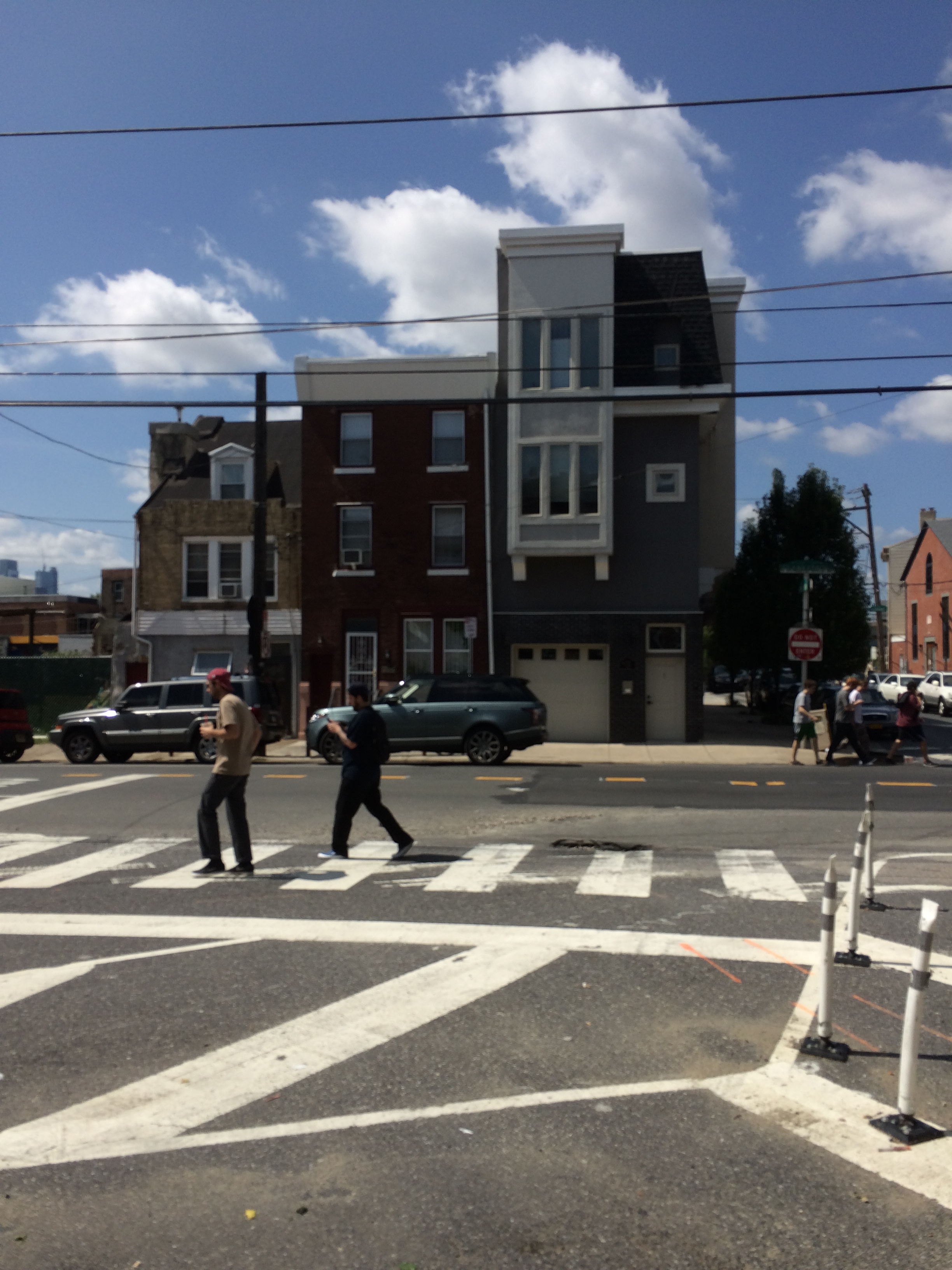
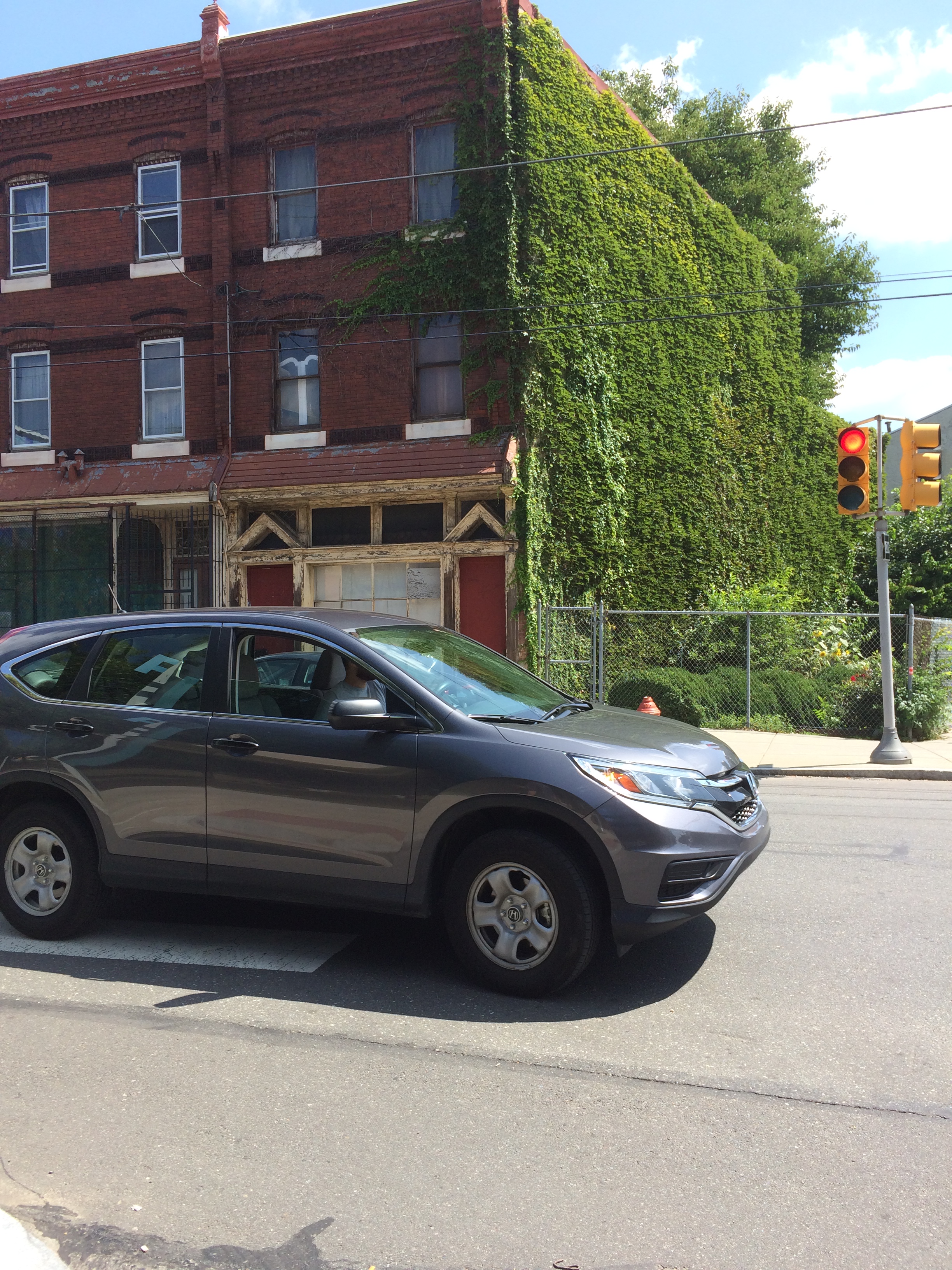
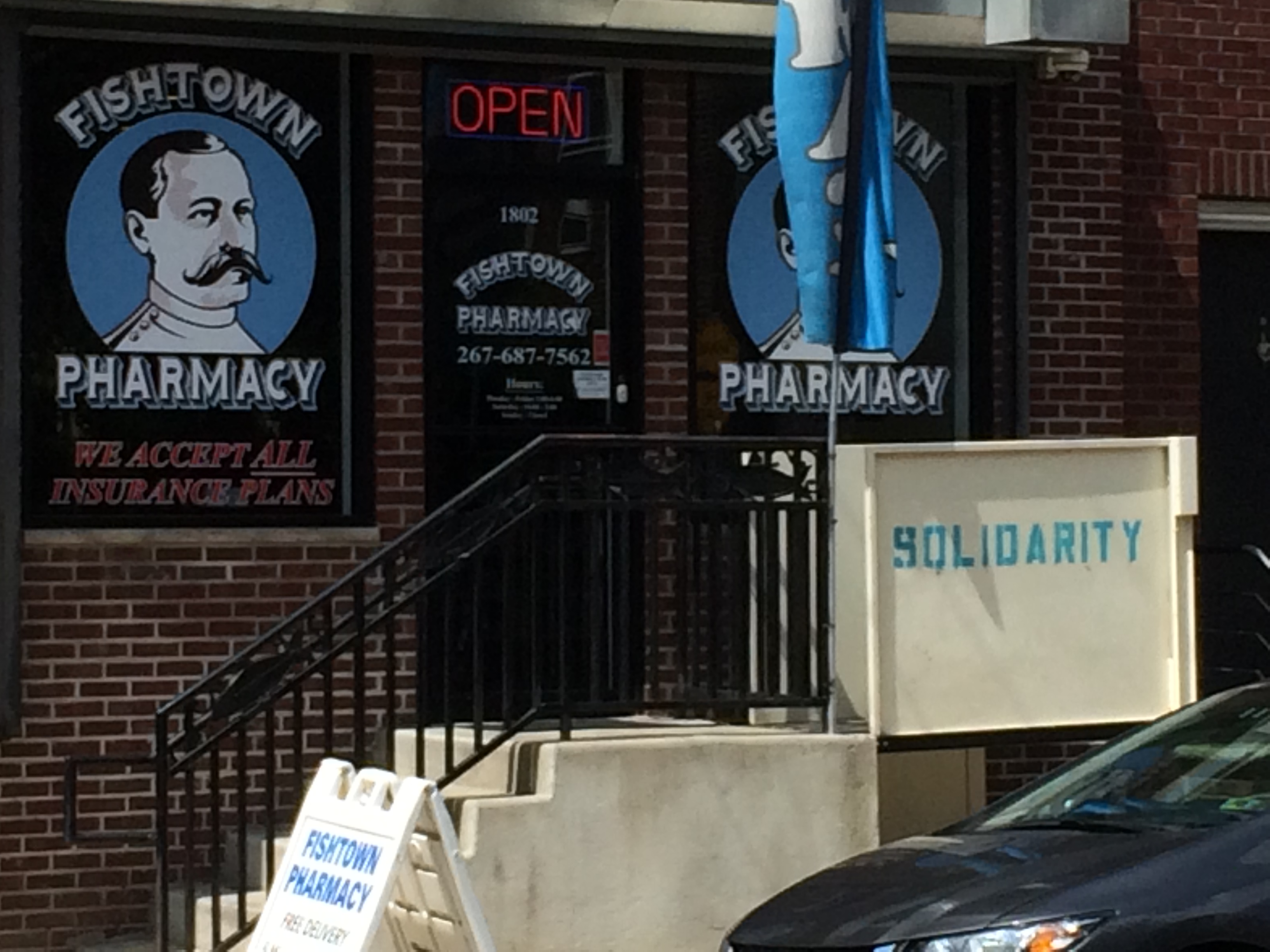
I culled through the images a few days later. What you see, then, on this page is Fishtown as Max saw it. He peered at lots of things, big and small, and framed them well in his photos. Store signs, well-aged streets, new home construction, a house one side of which is covered with an astonishing mass of ivy,  . . .

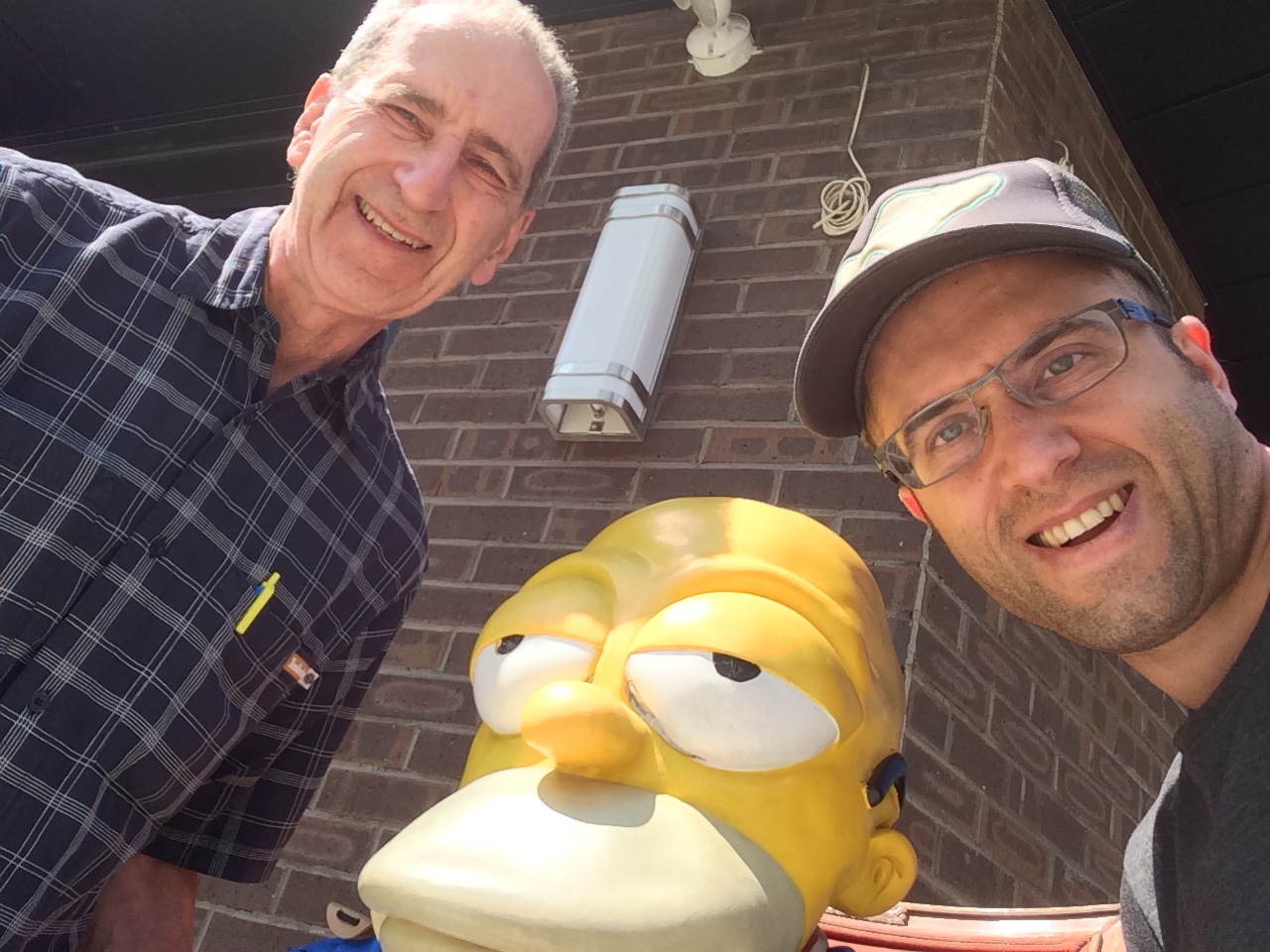
Max was drawn to hip color arrangements, to the nifty contrasts formed by buildings near to one another, and to the unexpected. And he asked me to make sure I included the selfie he snapped of us and Homer Simpson outside a store on Frankford Avenue. I don’t look all that good in said picture, but what the hell. Candid photography is where it’s sometimes at.

When Max next visits us, he and I probably will scout out another section of Philadelphia that’s off the touristy trail. Maybe an area that I, who despite having lived in or near Philadelphia for 40+ years of my adult life, barely know. Such as Port Richmond or Kensington. It’ll be fun. And, no doubt, will be documented by he and I.

(Photos by Max Scheinin. If you click on any photo, a larger image will open in a separate window)

A Big Apple Day

Is New York City the apple of my eye? Well, once it was. I spent who knows how many hundreds (thousands?) of hours in one or another of its five boroughs while growing up on Long Island. And after moving to Philadelphia in the mid 1970s, to start what became a 34-year career in government work, I made pretty frequent trips to NYC, 10 or 15 each year. I was pulled there magnetically by its museums, architecture, music clubs, gracious and spacious parks, and streets just made for strolling and girl-watching. Nobody needs me to tell them that the Big Apple is one of the coolest kids on the planet. It has been for, what . . . at least 100 years?

But, for one reason or another, those Philly-to-NYC visits became less and less common when the early 1990s rolled around, petering out to a mere one every few years. Incredibly, New York City, with which I’d had the cuddliest of relationships, faded gently from my mind. “New York, wait for me! You’ve meant the world to me! I’ll be back semi-regularly, I promise. Hell, you’re only 100 miles away,” is what I should have felt and said. But I didn’t. Man, if you’d have told me before then that such ever would become the case, I’d have had you committed.

This, then, is where Dave, one of my greatest pals, enters the story that you’re reading. He, like me, used to be a Long Islander. We became friends there in high school, during the Middle Ages. And he used to love NYC. These days, though, the city’s hustle and bustle does a superb job of frazzling Dave’s nerves. He ain’t in love with NYC anymore.

Still, Dave, who took up residence on the West Coast 40 years ago, visits New York now and then, despite the jittery situation with his nerves. I guess he’s a masochist. And one of those now-and-then occasions occurred recently. “Yeah, I’ll see you there,” I told Dave when he informed me of his impending eastward trip. Thus, two Saturdays ago I headed north from my home in the Philly burbs to hang out with Dave for half a day in the greatest of the famed metropolis’ five boroughs. Manhattan.

We met where 42nd Street and Broadway colorfully come together. In other words, at the bottom end of Times Square. And for the next four hours we graced various neighborhoods, and Central Park, with our dynamic presences. Though on the cusp of age 70, we strode the streets like the titans we vaguely once were. And vaguely still are. Gorgeous girls couldn’t keep their eyes off of us the other day. Isn’t that right, Dave?

“Damn straight, Neil,” Dave just told me. “Damn f**king straight! Even though it could be that our 20/80 visual acuity distorted our view of things just a little bit.”

Speak for yourself, Dave. I know what I know.

Here’s how we spent our time together: We shot the breeze vigorously, catching up on each other’s doings. And we walked and walked and walked while shooting that breeze. And when we got tired of walking we sat on boulders in Central Park, and a little after that on chairs in a snazzy restaurant near the park’s southwestern corner.

What’s more, we didn’t have any interest in taking in any famous sights, though we saw some anyway (such as Carnegie Hall, Columbus Circle and horse-drawn carriages in Central Park). You can’t not see them in this history lesson of a city. To repeat, then, what’s already been said: Yapping, wandering, eating and girl-watching proved to be the items on our agenda.

The time flew by, as sometimes it does, and around 3:30 PM Dave and I said our goodbyes. He needed to go back to his hotel and start getting ready for the wedding that had brought him to NYC in the first place. One of his friend’s daughters was about to get hitched.

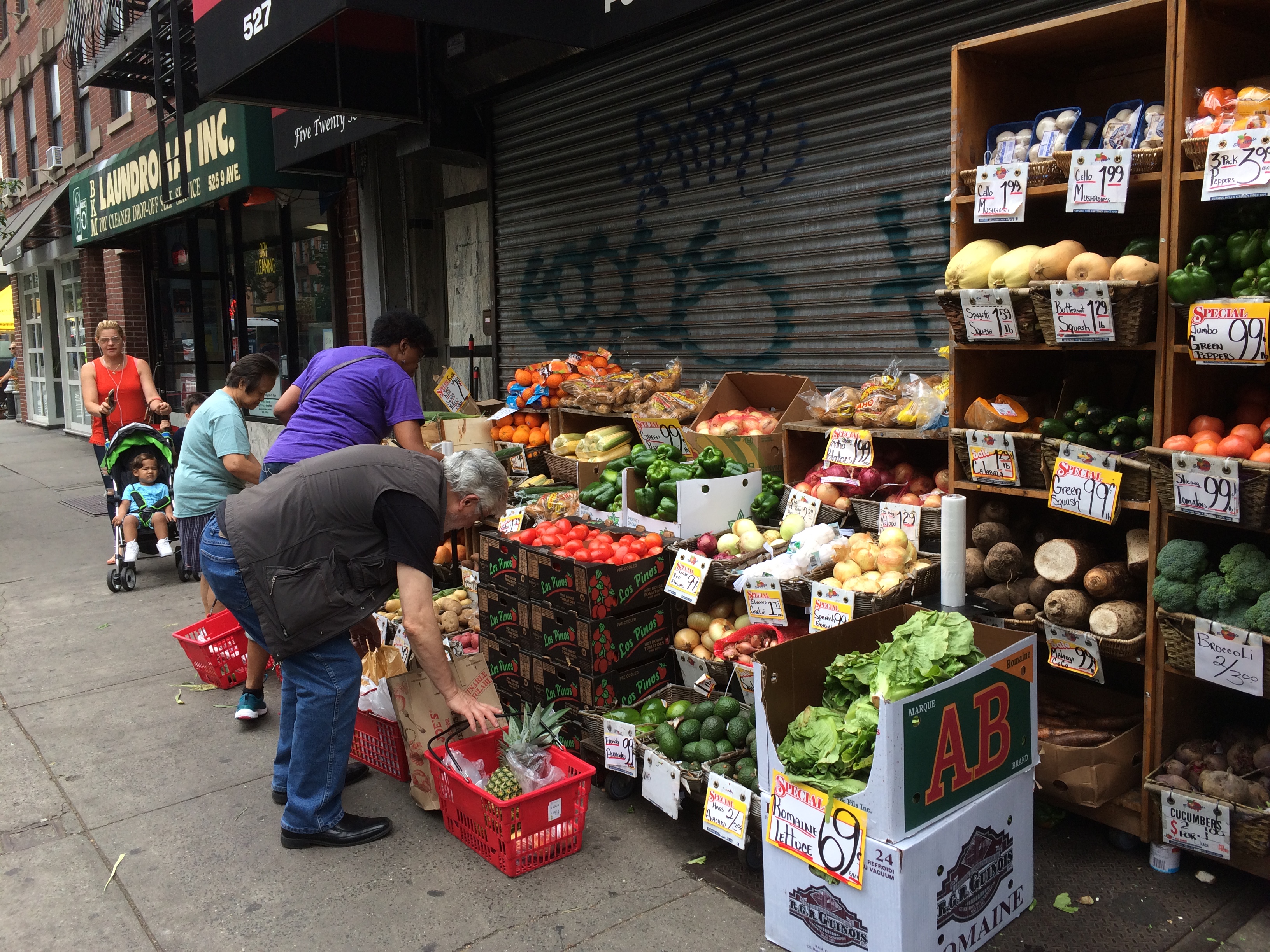
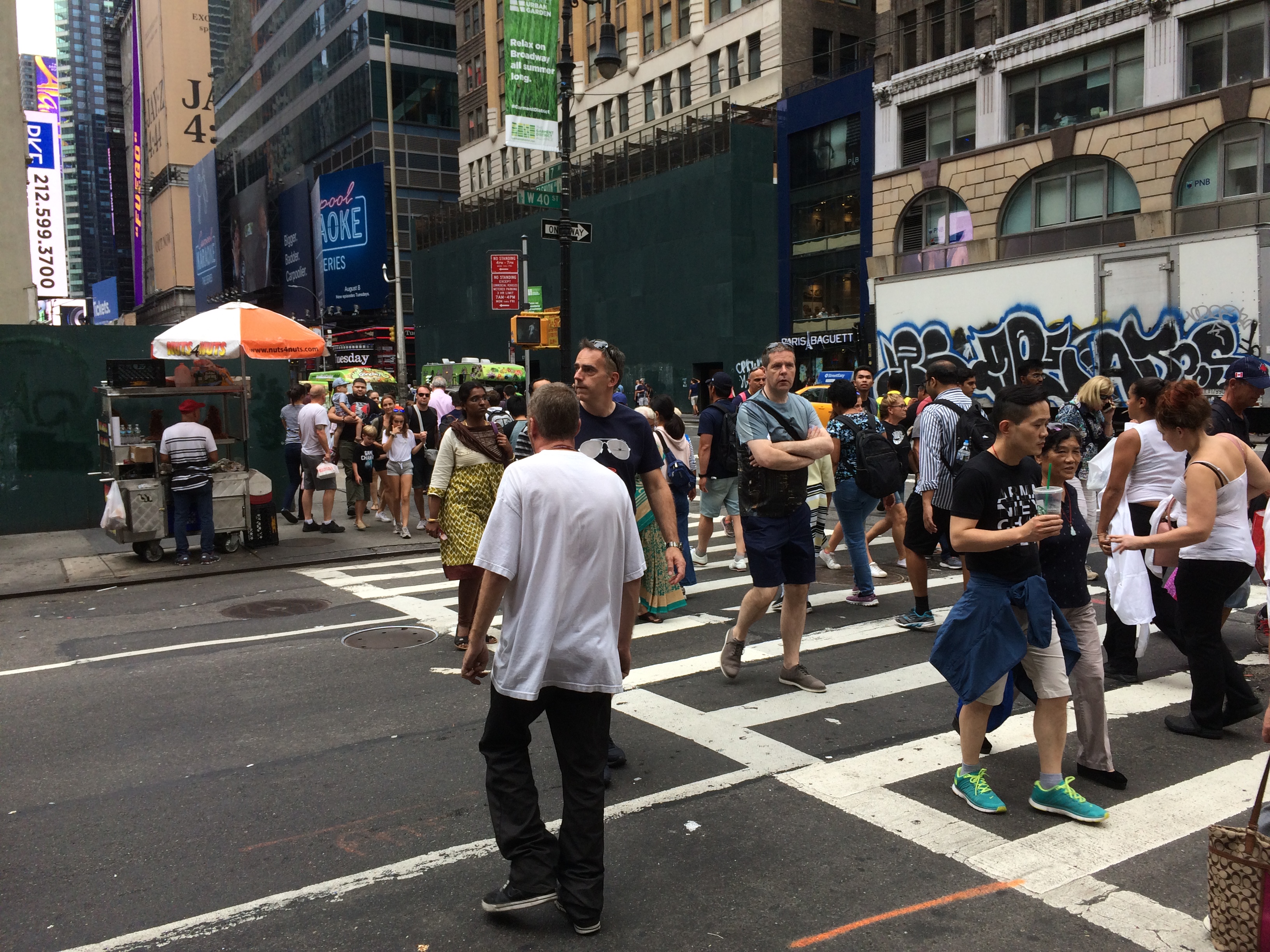
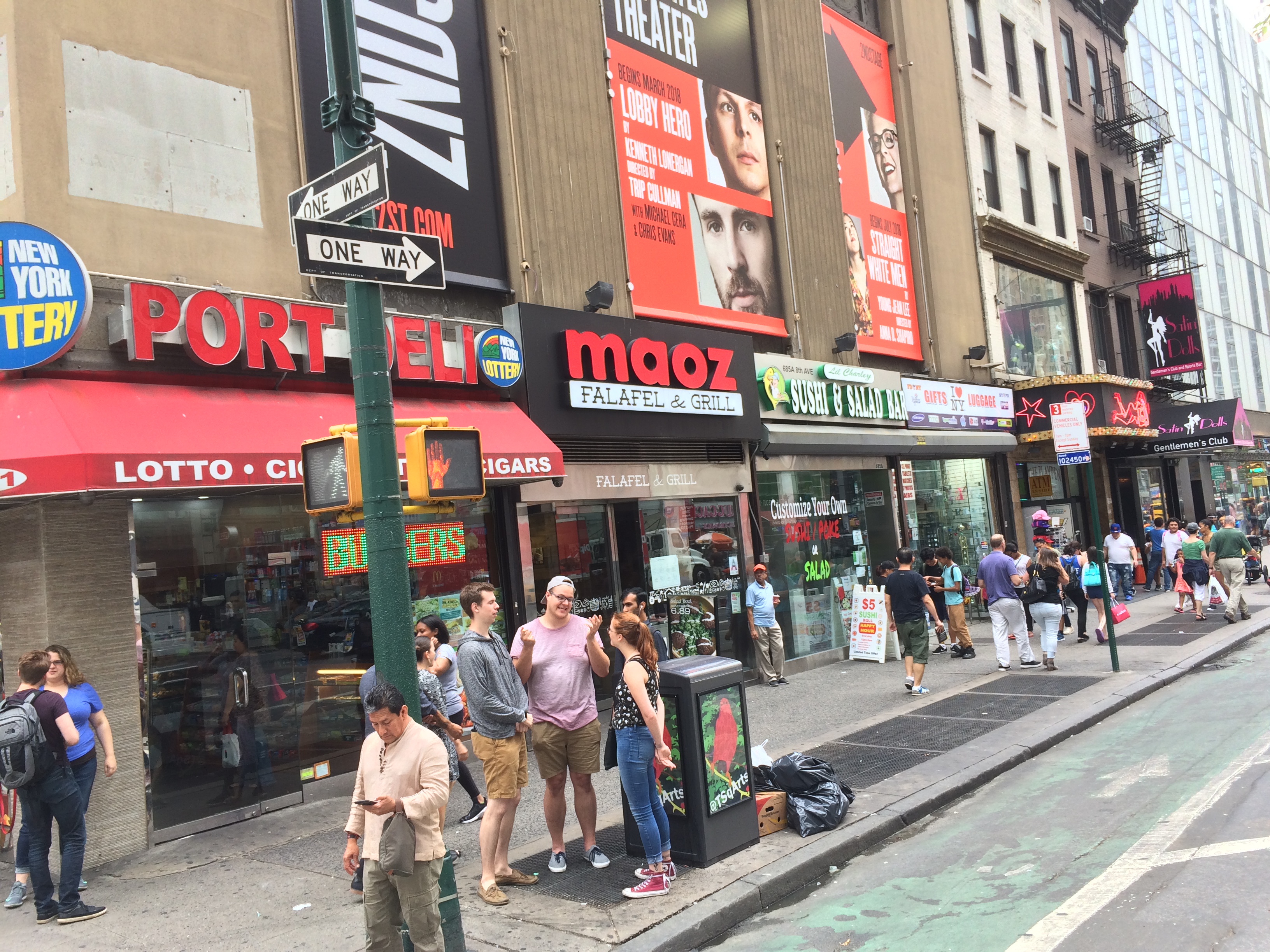
But my bus wouldn’t be leaving for an hour and a half. I had time to kill. And what better way to do that than to stroll along some of the streets of Hell’s Kitchen, the Garment District and Times Square. Those nifty sections of the city run into each other, and would keep me close to the Port Authority bus terminal, from which my Philadelphia-bound ride was scheduled to depart.

Which brings us to the final topic I want to talk about. To wit, photos. I didn’t take any while with Dave, except for a couple of selfies of him and me. Why? Man, if there’s one thing I’ve learned since starting this blog, it’s that obsessive photograph-snapping can interfere one whole lot with enjoying the time you’re spending with people you like. Besides, who the hell would want to see a picture of the roast beef sandwich that Dave tore into at the snazzy restaurant, or of the boulder we sat upon in Central Park? Oh, you would, would you? It figures.

All I can say is that it seems that you’ve come to the right place anyway. Because after Dave and I went our separate ways my picture-taking mode kicked into high gear. And the pix that I shot over the subsequent hour are the ones you’ve been looking at on this page. New York City is a lot of things. One of which is photogenic. So, even a clod like me can’t help but come away with some nice shots.

Thanks for reading and viewing. Till next time . . .

(If you enjoyed this article, then don’t be shy about sharing it or about adding your comments)

(If you click on any photo, a larger imager will open in a separate window)

Look Up, Young Man!

When the phone rang at 8:15 AM on Wednesday of last week I reached for my blood pressure pills and popped not one, but two. Ordinarily that’s a big no-no. But somehow I knew who was calling. And since said individual has the talents to launch my diastolic and systolic readings halfway to the Moon, a medicinal overload was a necessity. On the fourth ring I picked up.

“Good morning, Edgar,” I said to Edgar Reewright, my blog’s editor. “It’s always a pleasure.”

“Cut the small talk, Neil,” Edgar said, “and let’s get down to business. Neil, I know you. Right now, I’m more than certain, you’re at the dining room table with a cup of coffee and a buttered, toasted bagel and your vial of blood pressure pills in front of you. And you’re doing your damnedest, without much success as usual, to solve The Philadelphia Inquirer’s crossword puzzle.”

I gulped. Heavily.

“I’m fed up with having to remind you of your responsibilities,” Edgar continued. “The five or six people who look at your blog — your wife, your criminal defense attorney, your proctologist’s mistress and a couple of others that I haven’t been able to identify — have come to expect one stab at an article from you each week. And my gut feeling is that you’re planning to let them down, that you’re all set to take a week off. Neil, this is unacceptable. There are dozens of stories out there waiting to be written. Get off your unbalanced ass and start working.”

Holy crap, not only is Edgar annoying, he also was correct. And so, after politely ending my conversation with him, I gathered myself and my thoughts together, pondered this and pondered that, and eventually came up with a story idea. Look Up, Young Man! would be its title. And central Philadelphia would be where I would attempt to make it blossom.

Thus in early afternoon I boarded a Philadelphia-bound train in the suburbs, arriving in the fair city’s central section an hour later.

“Look up, Neil,” my parents used to say to me when I was a kid walking along with my eyes aimed downward. I must have been suffering from a lack of confidence in those days, reluctant to meet the world head on. Not that I’m bubbling over with confidence all these many decades later. Anyway, I don’t stare at the ground anymore when I’m strolling around. I look straight ahead or side to side.

But upward? Well, like anybody, I do some of that. But consistently for a couple of hours or more? Nah, I couldn’t recall ever doing that in my life. It’s not exactly a world-class notion, but it had appealed to me when it jumped into my mind a few hours earlier. I liked its simplicity, its openendedness. Who knew where or what it would lead to?

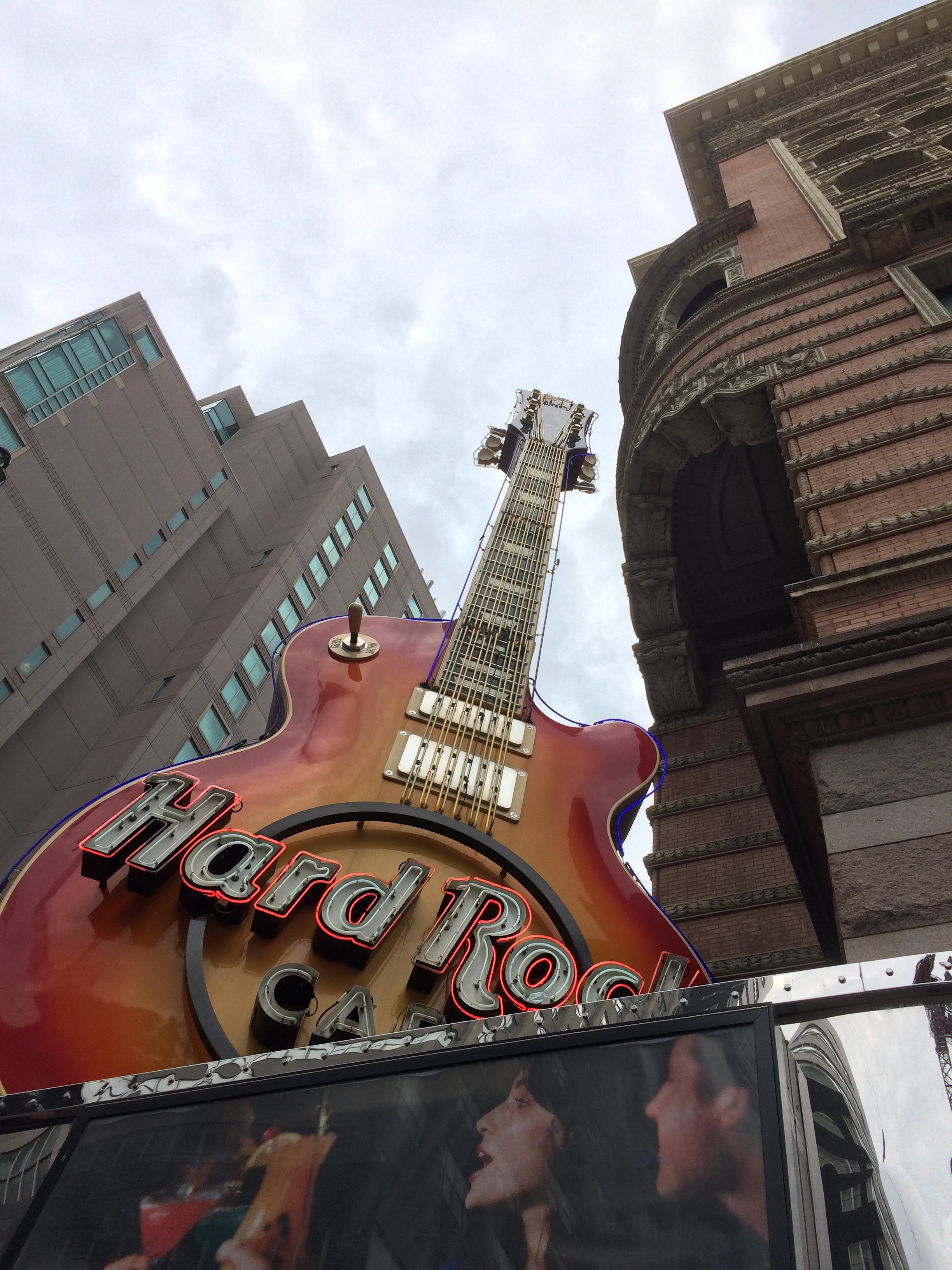
Pow! Moments after exiting the train station and stepping onto Market Street I gaped at what to me is one of the iconic outdoor sculptures in Philadelphia. It’s a giant replica of an electric guitar, and it rotates, as if on a spit, 15 feet above the ground at the corner of 12th and Market Streets. It’s hard not to notice this symbol of the Hard Rock Café, which is housed within one of the classic stone buildings that once belonged to the long-defunct Reading Railroad.

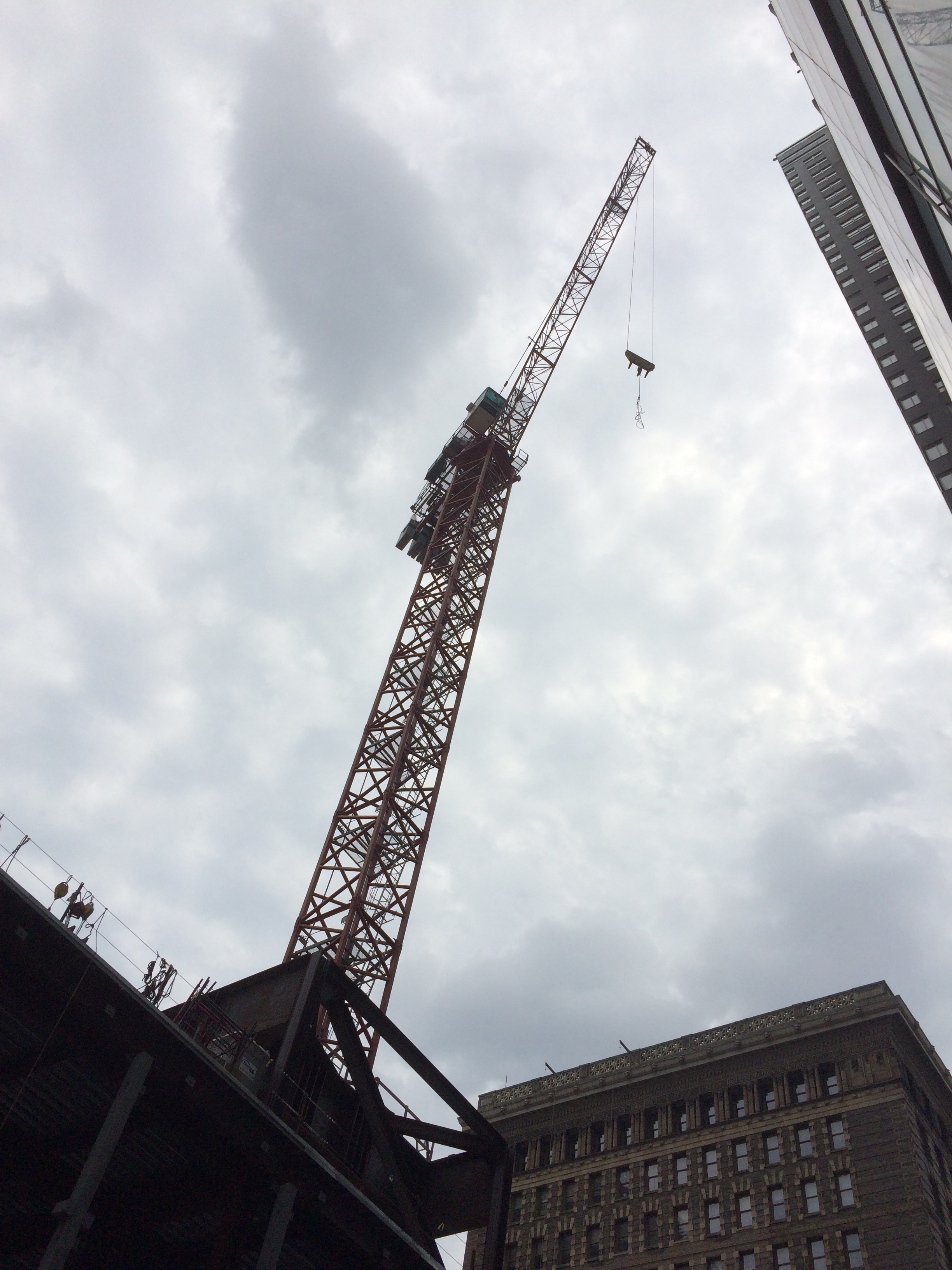
But I wanted to look higher than 15 feet. So I crossed to the south side of Market Street and, lifting my eyes to the skies, took in the first of five or six incredibly tall construction cranes that I’d come across during the afternoon. As I usually do when staring at one of these amazing machines, I wondered how in the world it stays balanced and how in the world anybody is able to manipulate its movements so precisely. Good thing it’s not me at the controls.

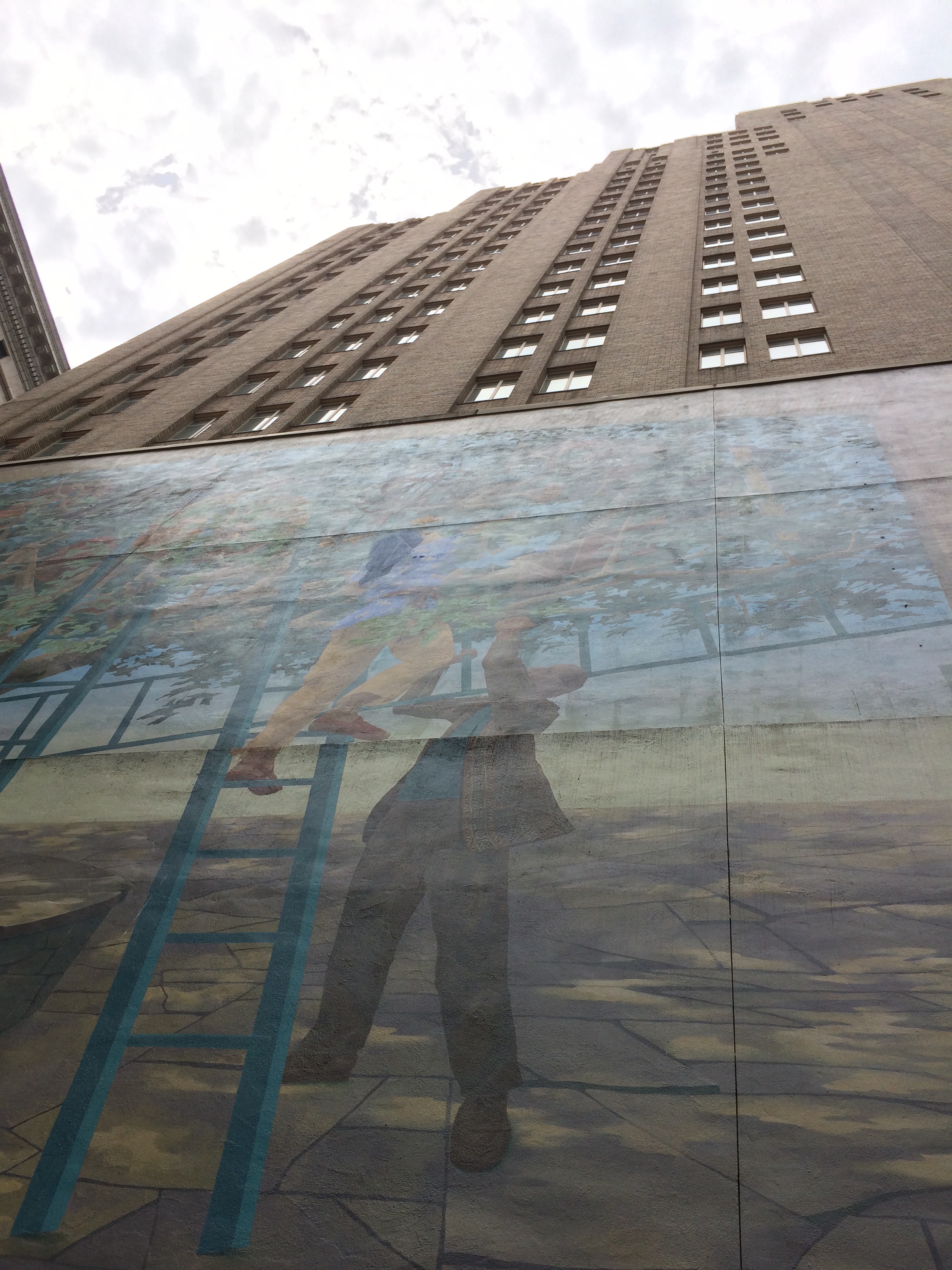
I was off to a good start. And one block later the good start continued when a sweet juxtaposition caught my eye. Philadelphia is famed for the several thousands of murals painted on the sides of buildings, and a great one adorns the lower reaches of a 16-or-so story office building near the corner of 13th and Market Streets. The mural is titled The Tree Of Knowledge. A ladder, a good item to have if you’re planning to pluck some information and wisdom from a tree, comprises a major part of the composition. I sidled up nice and close to the wall and looked up. The office building’s windows took on a new aspect, flowing gently in streams towards the heavens. And the ladder? It led the way to the levels above. I was tempted to climb it and see what happened.

Forty-five minutes later another mural, Reach High And You Will Go Far, crossed my path where 20th and Arch Streets meet. It too is a beauty, painted on the side of a three-story structure. Only a fool would argue with its message. I couldn’t get up close and personal to it though, as I had with The Tree Of Knowledge, because it is fenced-in. But I remembered to look up. And what I saw behind the mural, one block to its east,  was a giant tower, the under-construction Comcast Technology Center, that will top out at over 1,100 feet when completed next year. It is destined to become Philadelphia’s tallest building by about 150 feet. Reaching high, for sure.

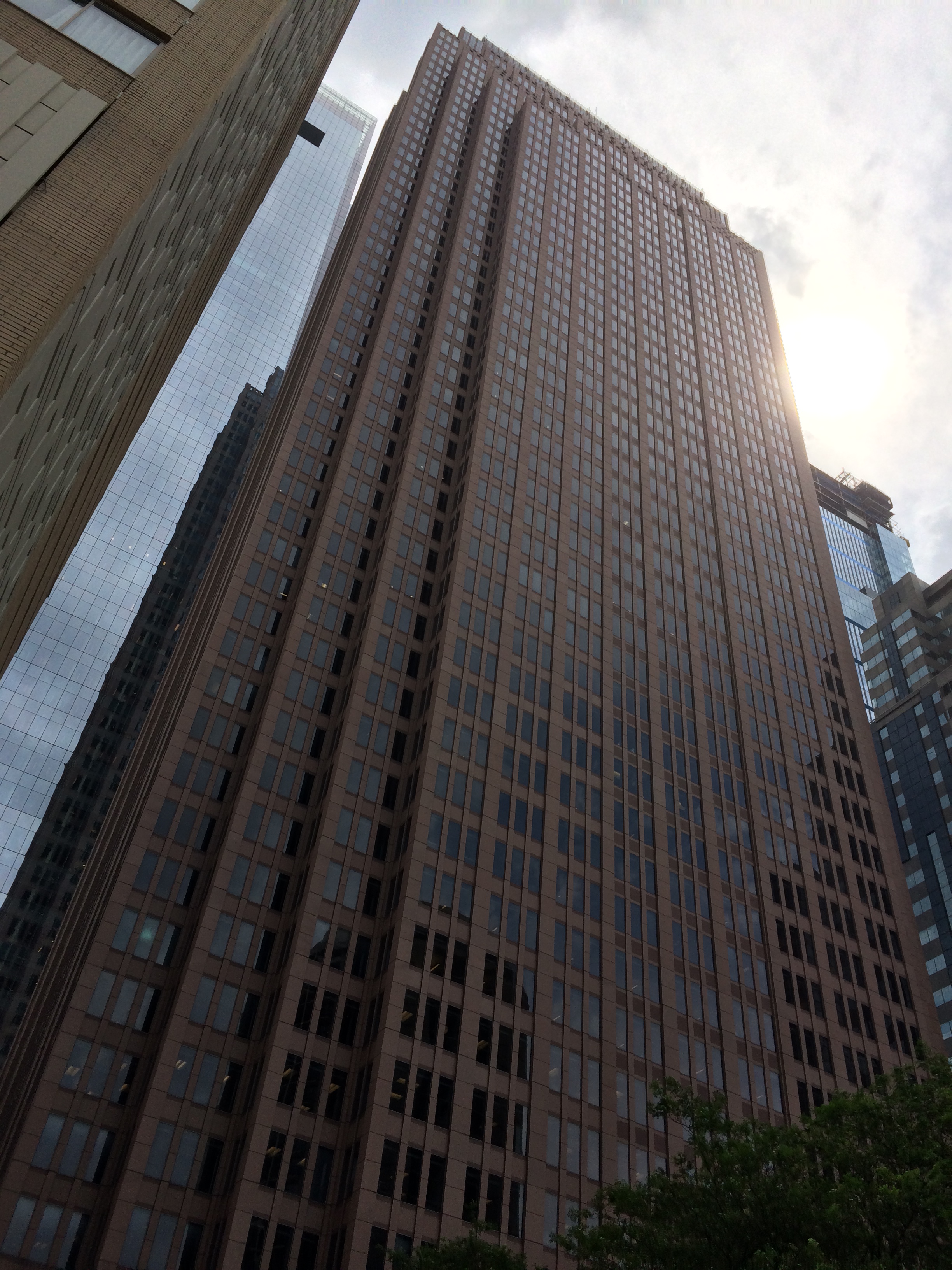
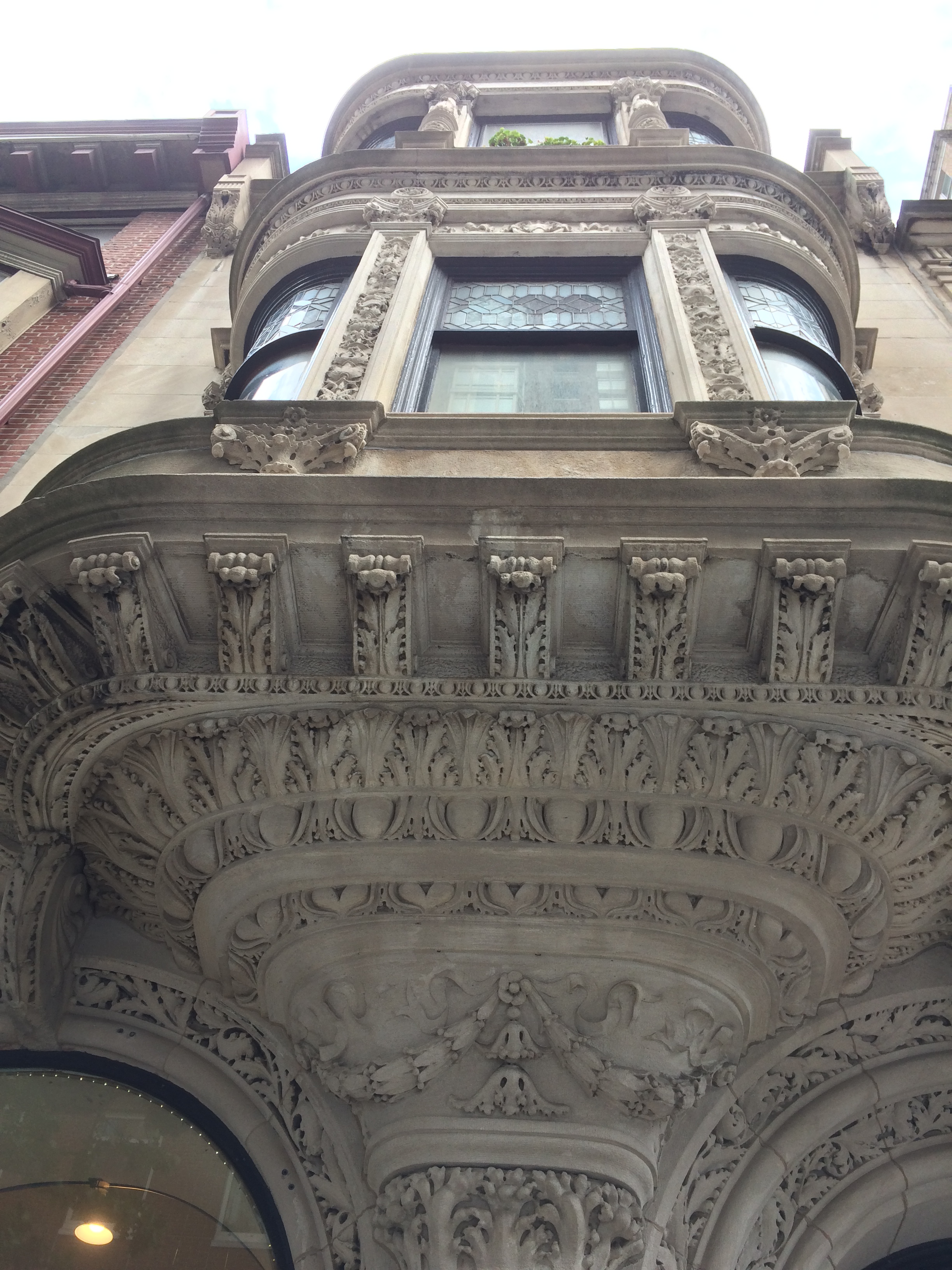
All told I spent two and a half hours roaming the streets, covering several miles-worth of territory. I spent much of the time in the areas where the city’s skyscrapers are most concentrated, and also walked along many blocks whose buildings are of normal size. My eyes darted here, there and everywhere, but I kept my mantra — look up! — firmly in the front of my mind. The patterns up above formed by contrasting buildings, the wonderful reflections of sky and surrounding edifices in way-up-there glass sheathings and windows, the loving details carved into stone not far above ground level in stately three-story homes . . . all of these made me smile.

I admired the words etched above the entranceway to The Alison Building, a calmly regal structure that faces one of the city’s finest parks, Rittenhouse Square. On an ordinary day, with my eyes looking straight ahead, I wouldn’t have noticed them. “He that soweth bountifully shall reap bountifully” they read. Hmmm, sounds like something that Benjamin Franklin might have said, I guessed. Incorrectly, of course. The phrase comes from the Christian Bible. Ben, though, probably knew and liked the statement, one you definitely can’t argue with.

My stroll ended alongside Philadelphia’s City Hall, an impossibly ornate hulk smack dab in the center of town. This monolith took around 30 years to build, finally opening for business in 1901. I’ve never been able to decide whether I like its exterior design or not. Some days I do, some days I don’t. It depends on how receptive to over-the-top decoration my mood is. As I approached City Hall from the south I naturally had to look at its highest point. Namely, the hat sitting atop the giant statue of William Penn, who more or less was Pennsylvania’s and Philadelphia’s founder in the late 1600s. That hat rests 548 feet above the ground, which made City Hall the tallest building in the city until 1987, when the first of Philadelphia’s now-numerous sleek, modern skyscrapers was erected.

Well, it almost was time to call it a day. I made my way to a subway station and rode a sub into South Philadelphia, an enormous area filled mostly with row houses. There I met two of my bestest pals, Mike and Jeff, for dinner at a pub. The hours of looking up had ended. Beers and some grub were the next things on the agenda.

(Don’t be shy about adding your comments or about sharing this story on social media)

(If you click on any photo, a larger image will open in a separate window)

A Trip To Fallingwater

I’ve done a fair amount of traveling during the 69 years I’ve taken up space on Planet Earth. Been to Asia (Nepal). And to the Middle East (Israel). And to North Africa (Egypt). And to various countries in Europe any number of times. And I’ve been here and there in the States and Canada. How about Pennsylvania, then, the state I’ve lived in since my late 20s? Well, I’m nicely familiar with its greater Philadelphia region, which is my home territory, but outside of that orb I haven’t ventured all too much. And in the last couple of years I’ve been thinking about what I may have been missing. A trip to Ohio via the Pennsylvania Turnpike that my wife Sandy and I made a few weeks ago drove the point home pretty decisively. “Wow, look at all these mountains and farms. Who knew?” I said to Sandy more than once during that westward journey. “It’s time to explore Pennsylvania. Let’s do plenty of that before the sands of time run out on us.” Those weren’t my exact words, but they are close enough.

Smartly, we had already planned a day and a half of discovery in the Keystone State. On the way back from Ohio (you can read about the Ohio visit by clicking here) we drove to Uniontown, a less-than-flourishing community nestled in southwestern Pennsylvania, where we had booked a hotel room. The following day, Monday, would be our visit to Fallingwater, a Frank Lloyd Wright-designed home that has become a tourist destination. Neither Sandy nor I had ever been in southwestern Pennsylvania before.
To be honest, I feel a little guilty writing about Fallingwater. It’s not as if the world needs any more mentions of the place, as the 2,400,000+ Google results for Fallingwater obviously prove. But what’s a blogger to do? I considered typing an opus about what I ate for breakfast this morning (strong coffee, and Wheaties with blueberries), but opted instead for Wright’s creation. Nobody wants to read about my breakfast, not even me, no matter how delicious it was. Fallingwater it is.

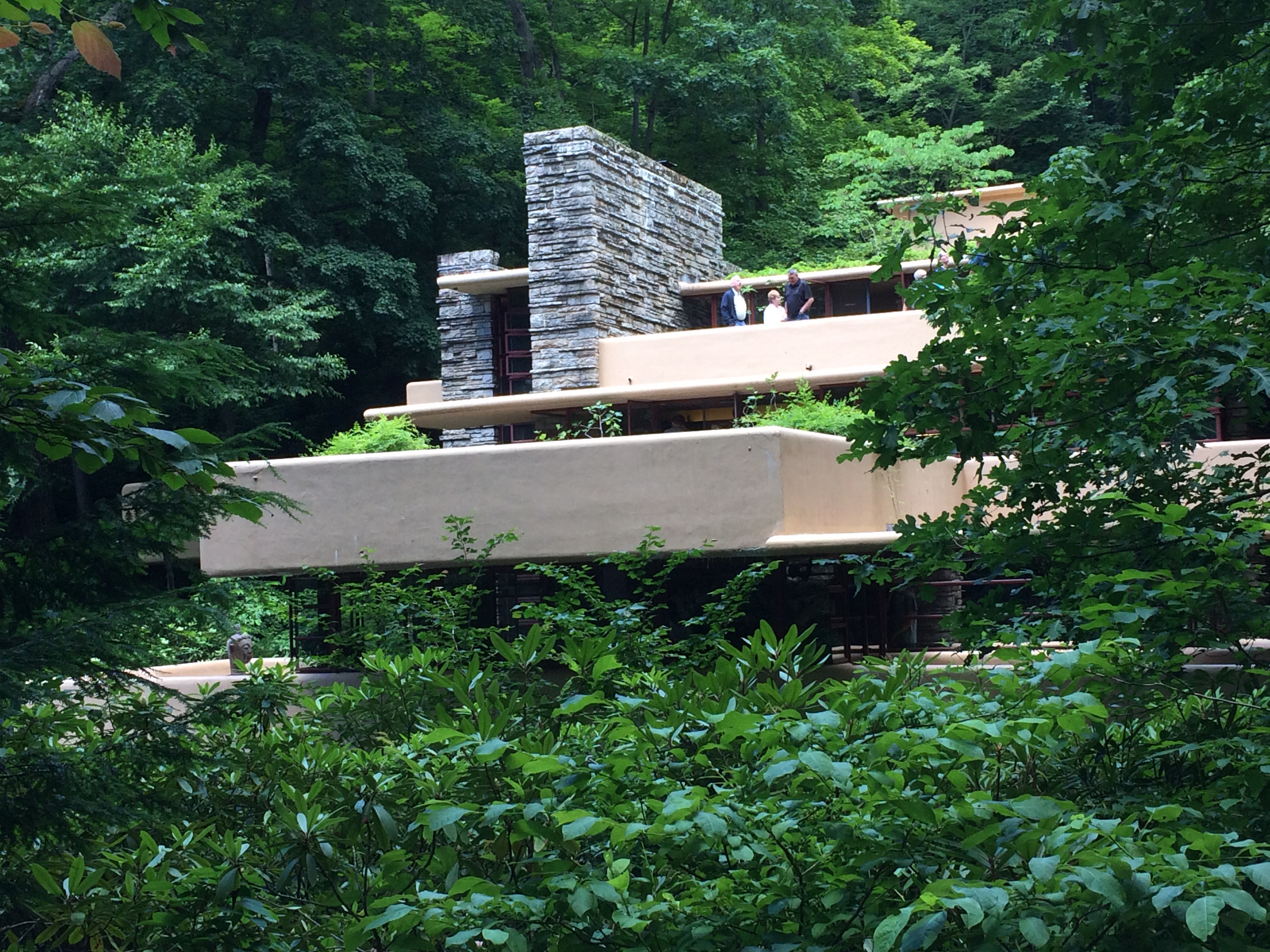
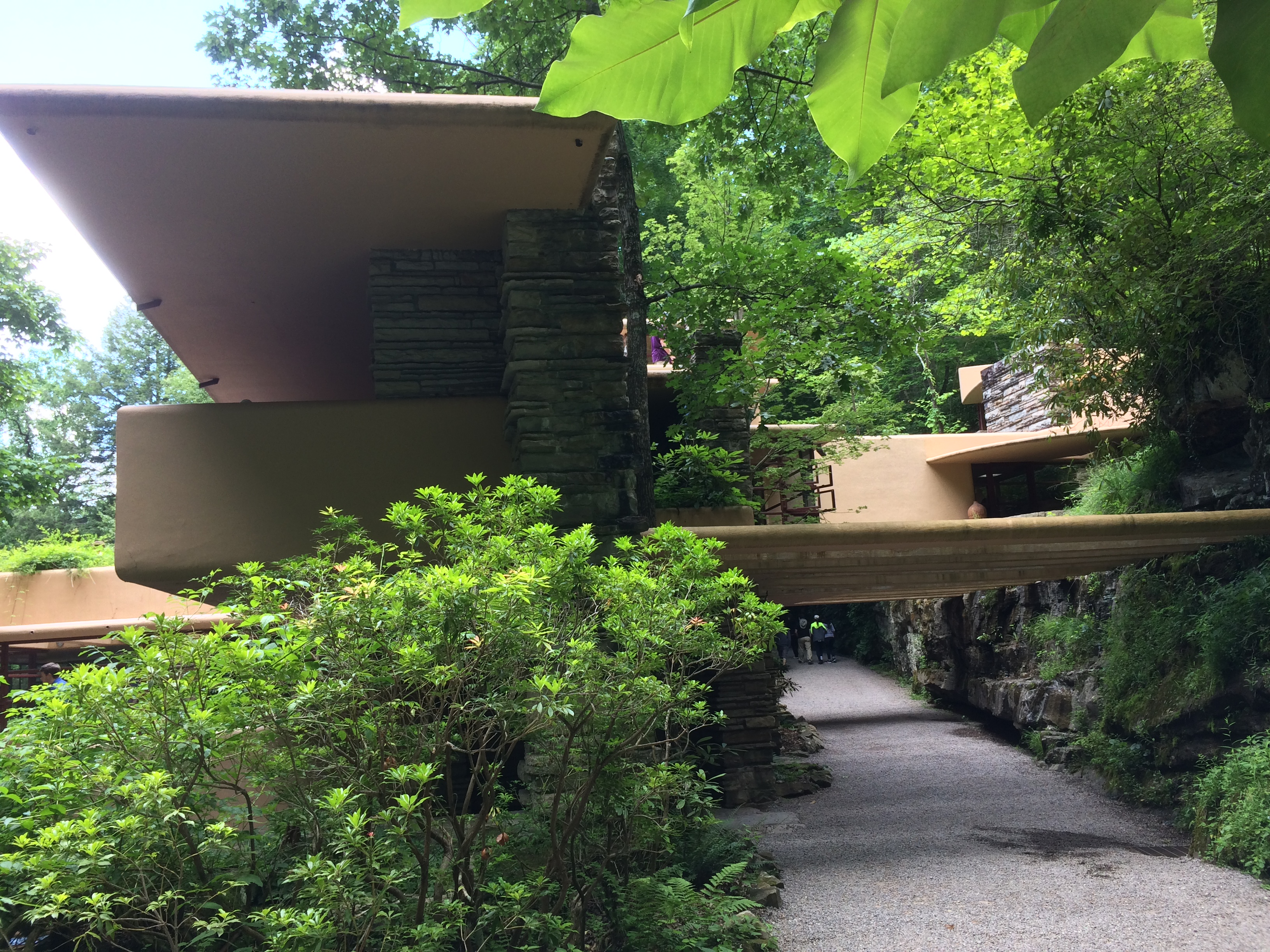
To summarize Fallingwater’s history: Edgar Kaufmann, a department store magnate who lived in Pittsburgh with his wife Lillian and son Edgar Jr., commissioned the famed architect Frank Lloyd Wright to build a weekend/vacation home for the family. The house was to be set within the enormous, heavily-forested swath of land that the Kaufmanns owned in the Allegheny Mountains. That plot was (and is) about 50 miles from Pittsburgh. Wright completed his design in 1935. Two years later the house was in place, and two years after that a guest house, uphill from the main residence and connected to it by a short cement span, went up. In 1963, some years after the death of his parents, Junior donated Fallingwater and the family’s mountain acreage to the Western Pennsylvania Conservancy, a land and water protection organization. The Conservancy opened the buildings and grounds to the public in 1964, and before long Fallingwater caught on. Really caught on. To date, upwards of 5,000,000 visitors have toured the facilities. For a place that some might describe as being in the middle of nowhere, that’s genuinely impressive.

Photo by Sandra Cherrey Scheinin

And here’s why they keep on coming: Fallingwater’s exterior looks better than just about any house that you’ll ever see. It is sleek, lovingly tiered, rustically handsome and highly imaginatively laid out. And the house’s placement is, as they say, unparalleled. It is built atop and alongside boulders, a few of which poke out into the living spaces. And, rather incredibly, it is perched above a descending stream at the point where the waters – you guessed it – fall over rocks. A waterfall! A modest waterall, to be sure, but beautiful nonetheless. Fallingwater, a looker in an admirable, peaceful way, communes righteously with the natural environment that surrounds it. Harmony definitely prevails.

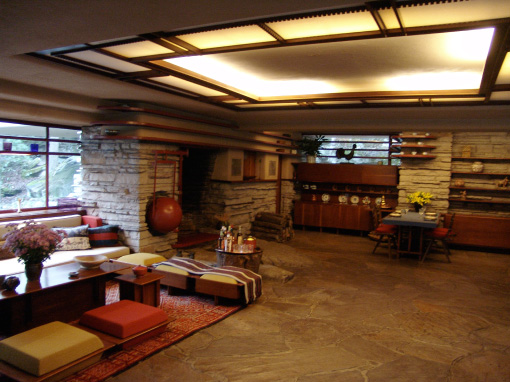
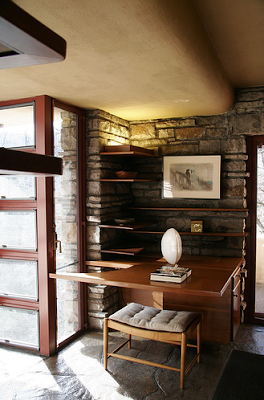
After breakfast on Monday, Sandy and I jumped into our car and drove the 25 miles, half of them along winding country roads, that separate Uniontown from Fallingwater. Our tour, scheduled for 11:00 AM, began on time. Twenty or so folks were in our tour group. The guide, alas, informed us that photography wouldn’t be allowed within the house. Nor would touching of the objects. Bummer. The interior shots I’ve included in this humble essay, therefore, are photos that I’ve snatched off the Internet. By the way, Fallingwater’s room arrangements and furnishings have been left pretty much as they were when Junior turned over the keys to the Western Pennsylvania Conservancy.

Photo by Jeffrey Neal

Most of the tour took place inside, as opposed to outside, Fallingwater. My memory being duller than a butter knife, let me pass on a few recollections before they fade into oblivion. First, I dug Wright’s color scheme. Earth tones predominate. They make for a calming, comforting experience, which without doubt was his intention. And I was surprised to learn that Wright designed not only Fallingwater’s structure, but many of its objects – desks, cabinets, chairs and tables. And they are beautiful. The guy was something else. Was there anything he couldn’t do? Well, he couldn’t walk on the waters of the stream flowing beneath the house, right? Or maybe he could.

Photo by Brad Ford

I noticed a couple of broad wooden desks, wedged into corners, that have portions of their tops neatly cut away so as to allow windows to swing open. Brilliant idea! And I spent some time in Junior’s bedroom looking over the smallish but swell collection of books on his shelves. They reflect an open and bright mind. Among them are the 10-volume set of The World’s Best Essays, a long-forgotten collection published in 1900. I’d have loved to pull out one or two of the volumes to take a look at the wisdom contained therein. But that wouldn’t have been a wise move, as the tour guide might have dragged me off the premises by the few strands of hair remaining on my head had I attempted to satisfy my innocent desire.

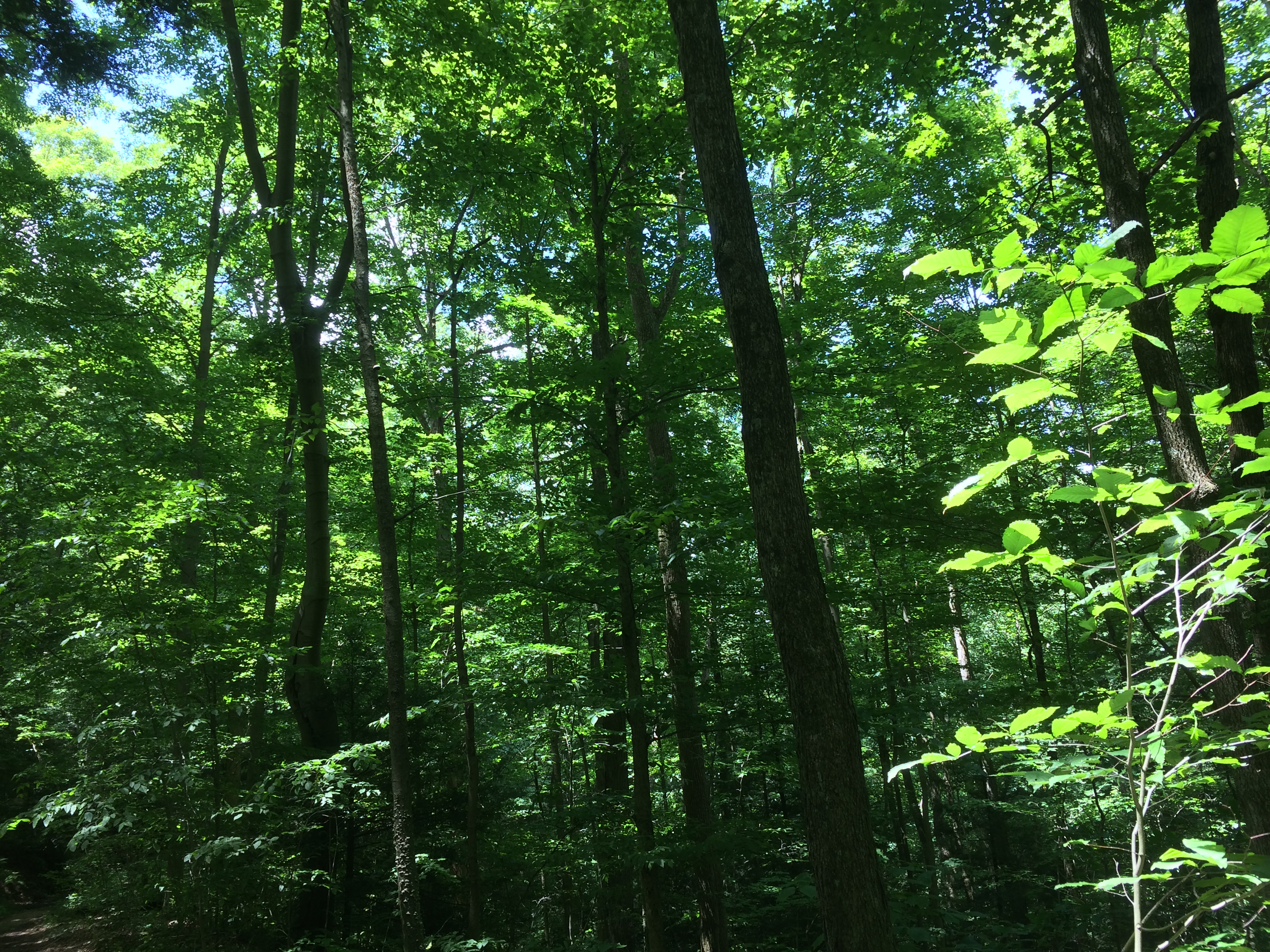
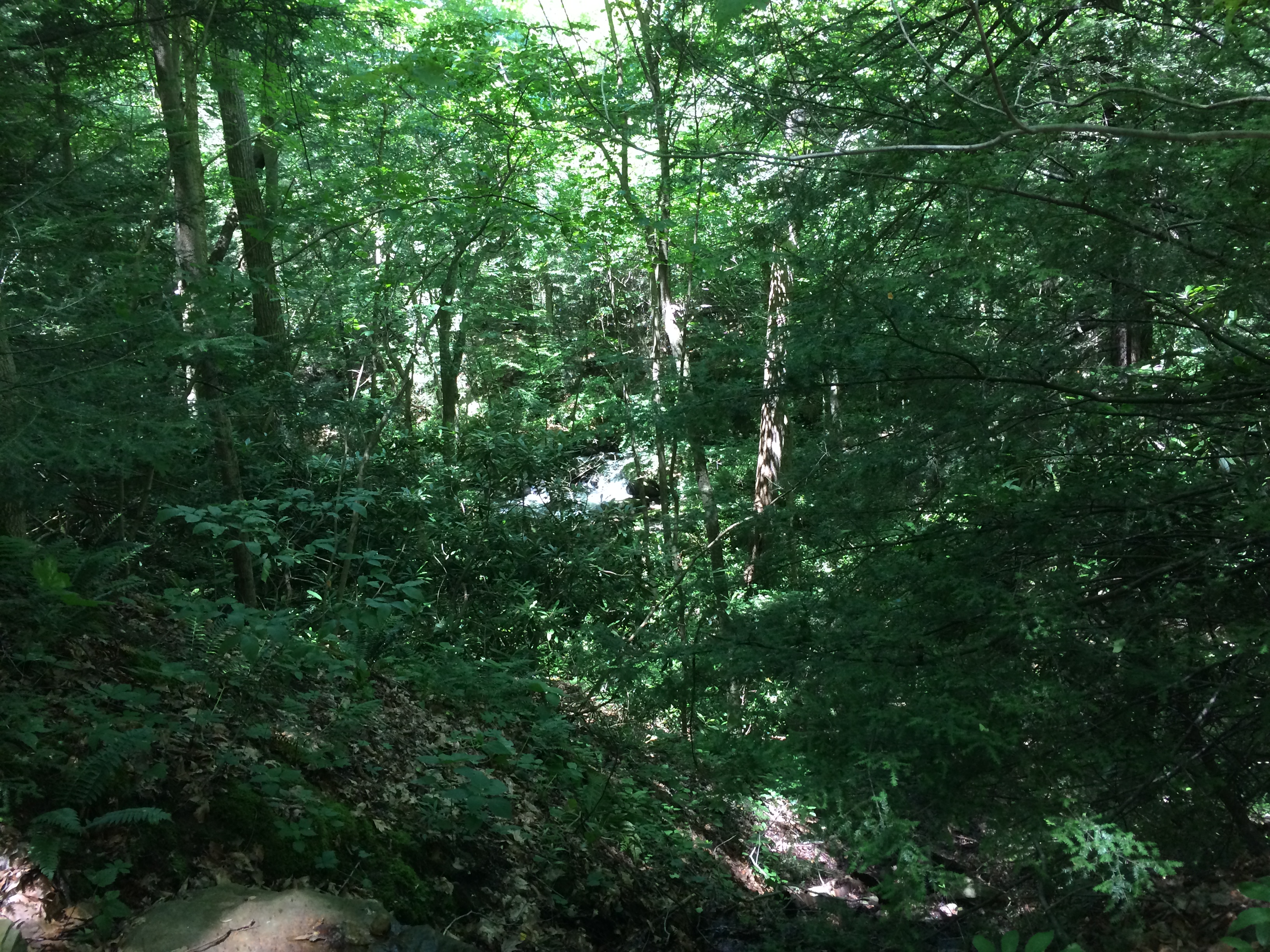
The one-hour tour over, Sandy and I headed down a trail that paralleled the stream and led into deep forest country. Rhododendron bushes grew in numbers you’re unlikely to see elsewhere. Oak and maple trees flourished, as did a variety of evergreens. It felt good to get lost, metaphorically, in the woods for a while. Take more forest walks is something I’ve added to my to-do-soon list. Forests don’t exist in my paved-over home area, but a few are within reasonable driving distance.

The next morning we drove home, southwestern Pennsylvania before long disappearing from our rear view mirror. Now, I’m not going to say that this rural region of Pennsylvania is a must-see destination. For those who groove on mountain hiking or fishing or rafting, it’s absolutely A-OK. For those not of that persuasion but who are passing through the area or taking in the sights in Pittsburgh, here’s the thing: You could do a lot worse than make the drive to Fallingwater. Sandy and I agree that Fallingwater made our trip worthwhile. The place is a beaut.

(Don’t be shy about adding your comments or about sharing this article on social media)

(If you click on any photo, a larger image will open in a separate window)