I Don’t Want To Publish Any Crap

A few days ago, feeling unsure about myself and about the future of Yeah, Another Blogger, I grabbed my phone and called an individual who, I figured, might be able to help me put things in perspective. Help me find my way, if you will. Not that he’d ever been all too beneficial in those regards before. But, desperate as I was, I gave it a shot.

“What’s up, Neil?” asked my editor Edgar Reewright, picking up after the first ring. “Please don’t tell me there are major problems with the next manuscript you’re going to send me. Hell, what am I talking about? There always are major problems with your manuscripts.”

“Edgar, give me a break. And stop complaining. Yes, there is a major problem. But not with an upcoming story. That’s because there is no upcoming story. Edgar, I’ve just about run out of gas. I can barely think of anything to write about. And when I do come up with an idea, it seems pretty much the same as things I’ve written about dozens of times before. I don’t want to publish any crap, so I might as well take off my spikes and leave the playing field.”

There was silence on the other end. But not for long. “I can’t believe my ears, Neil,” Edgar said. “What is wrong with you? From day one, you’ve been churning out crap like a champ for Yeah, Another Blogger. I mean, crap is your middle name. Okay, you’re in a slump. But you’ll break out of it. All you need to do is look to Joyce Carol Oates for inspiration. She’s 87 years old, the same age as me, by the way, and still writing books like there’s no tomorrow. She’s penned so many books, everybody has lost count, but it’s way, way over 100. Her latest one, a novel, hit the marketplace in June. And it’s 672 pages long!”

“Yeah, Edgar, she’s incredible. And a genius. She never runs out of ideas.”

“That’s what I’m saying, Neil. Story ideas by the untold thousands are bobbing in the air, just waiting to be snatched. Sure, Joyce is at the top of the ladder, writing-talent-wise, while you’re a bottom dweller. But you shouldn’t feel like you’re stuck in cement.  Suck it up, Neil, and get back to work. And maybe, just maybe, your perseverance will garner you an award one day. Everyone wants recognition, am I right?”

“That goes without saying, Edgar. But that’s already happened to me. Don’t you remember? Two years ago I received a Pulitzer Prize in the If You’re Bored Out Of Your Mind, Reading This Person’s Writings Won’t Snap You Out Of It category. That was one of the most memorable occasions of my life.”

“My bad, Neil! How could I have forgotten? See? You’ve already sort of made it, and other awards possibly await you. But only if you stay in the game. Neil, throwing in the towel after all these years would be a big mistake, one you’d eventually regret. What’s more, you need to think about me. And about my wife Loretta. We depend on the enormous salary you pay me. Because of you, we’ve been able to live the highlife. I’ve never asked you this, Neil, but how did you come into so much dough?”

“Well, Edgar, I’m now going to allude to something that only my wife knows about. If you recall an unsolved armored-truck heist 35 years ago in Philadelphia — it was a major story — I believe you’ll be able to put two and two together.”

“That was you? Man, you are something else! Needless to say, my lips are sealed.”

“They better be, you dig? Anyway, I’m glad we’ve talked today. I feel re-energized. I’m ready to start writing. Once I come up with a decent story idea, that is. Thanks for your help, Edgar. I really appreciate it.  Over and out for now!”

A Cloudy Walk And A Rousing Novel

A half hour shy of noon a few weeks ago, in need of some exercise, I raised my bony ass off the living room sofa, exited my house and took a walk around my suburban neighborhood. It was a hot and humid summer day, the type that normally causes me to spew sweat like a volcano. I guess the dermatology gods took pity on me, though, for my wrinkled skin became only mildly moist during the stroll.

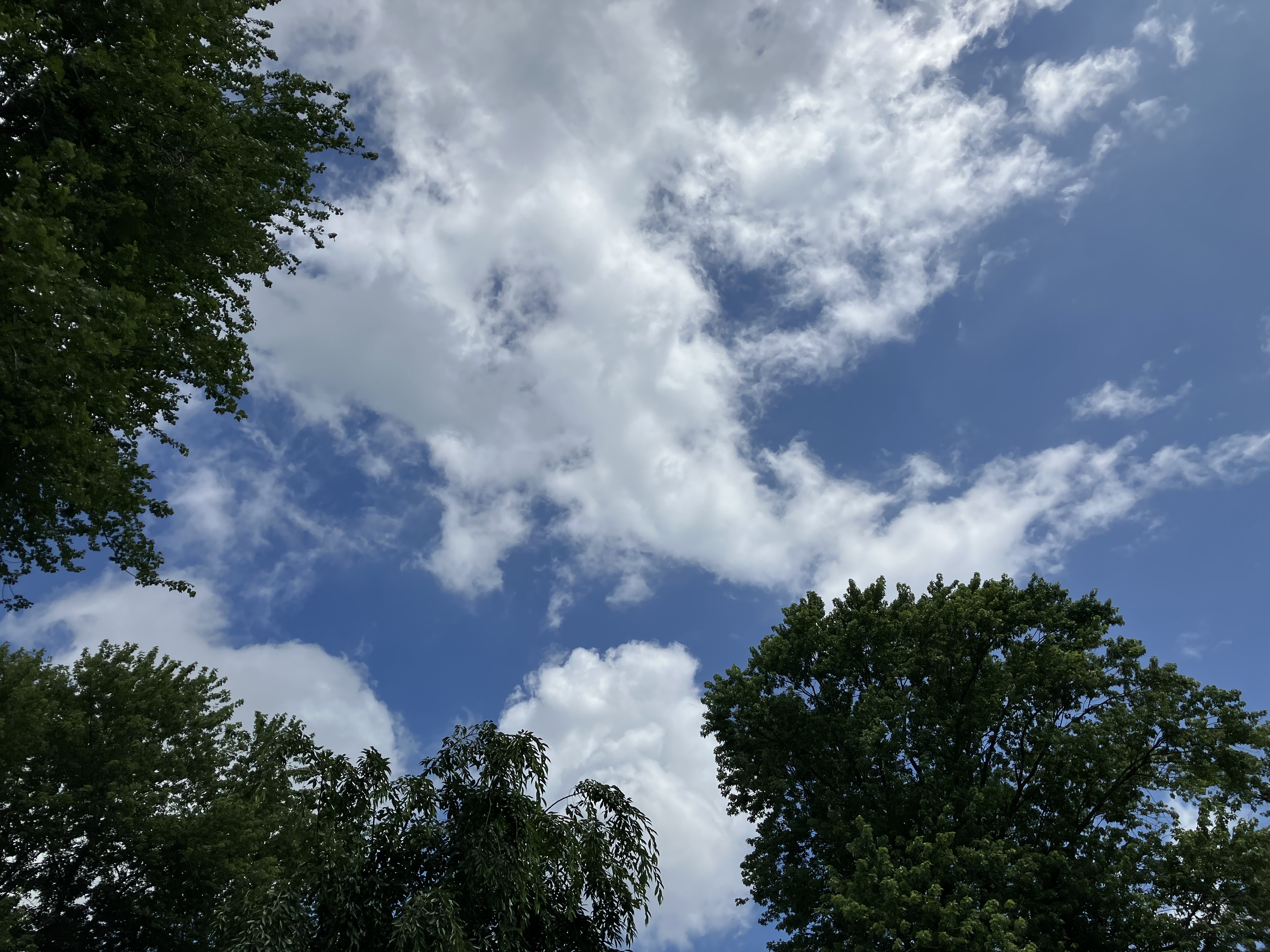
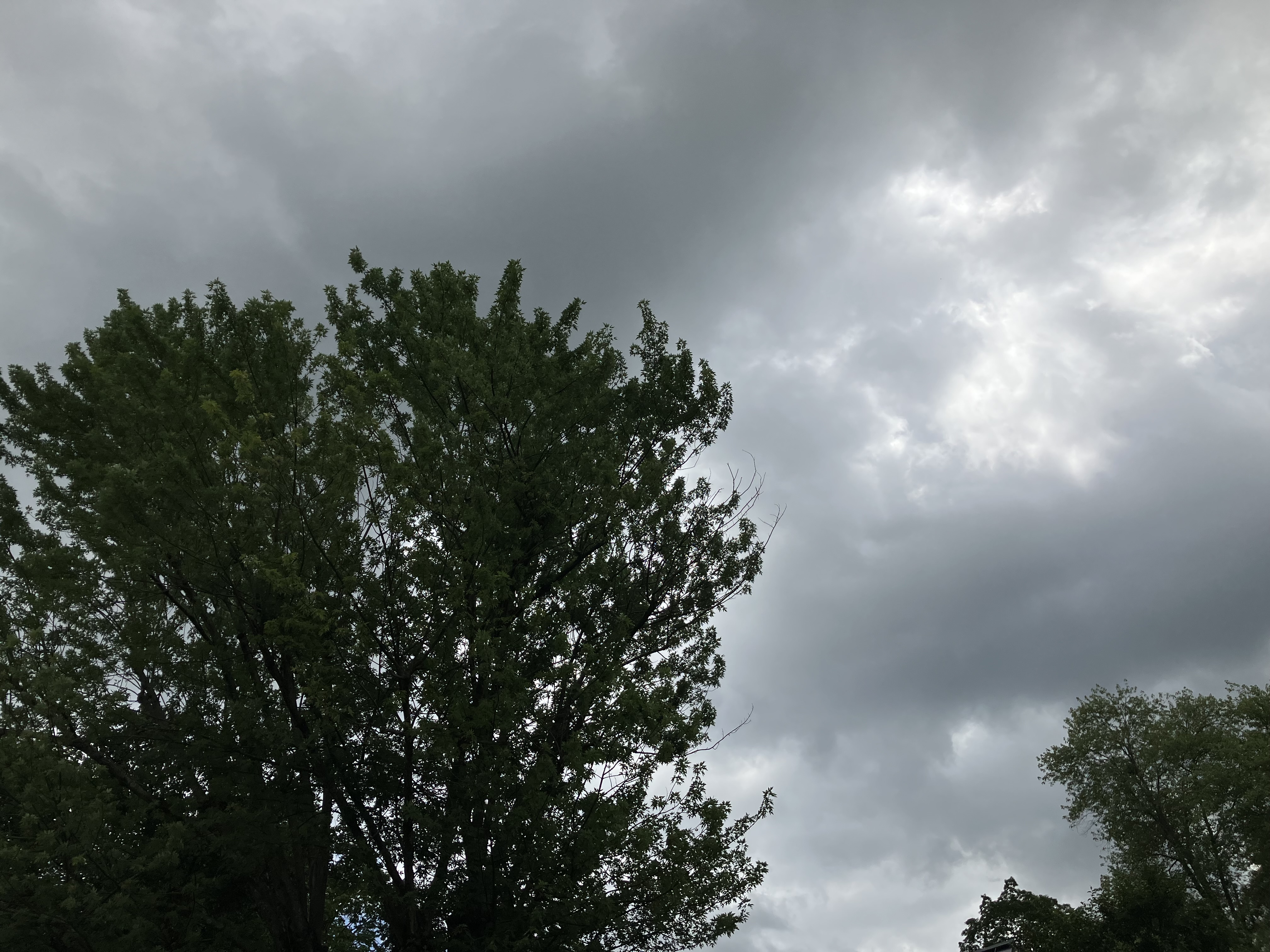
I usually don’t spend a lot of time looking upward when I’m outside, not in daylight nor when the skies are black. Pretty foolish of me, because, obviously, the heavens are incredible. But, on the day in question I decided to alter that orientation by examining the clouds filling much of the sky. They were of two sorts, some of them bright and friendly and perfect partners for the sky’s blue areas, the others darkened and signaling that rain, which ultimately never arrived, might be a-comin’.

And I also had my eyes on trees, which are fairly abundant in my neighborhood (I live a few miles outside of Philadelphia, Pennsylvania, USA). It would be cool, I decided, to snap some photos in which cloud-filled skies and trees appeared. But only cloud-filled skies and trees. This turned out to be harder than I thought it would be. I shouldn’t have been surprised, of course, since my neighborhood is jam-packed with houses, utility poles and overhead-utility lines, nearly all of which not only were in the way, but also cursed me out when I told them I wouldn’t include them in the photos. What a bunch of obnoxious bastards! Persevering, I found a fair number of vantage points that allowed me to meet my criteria. I tell you, the life of an amateur photographer ain’t a breeze. On the other hand, just about nobody’s life is a breeze. Hell, that’s life.

Two photos from my mini expedition adorn this essay. I regard them as semi-abstract compositions, the amorphous clouds offset by the tight structure of treetops. I bow before Mother Nature. Her variety of creations is dazzling and just about infinite, yet limited and uncomplicated displays of her wares, such as these, have no trouble awing me. There’s a whole lot to be said for simplicity.

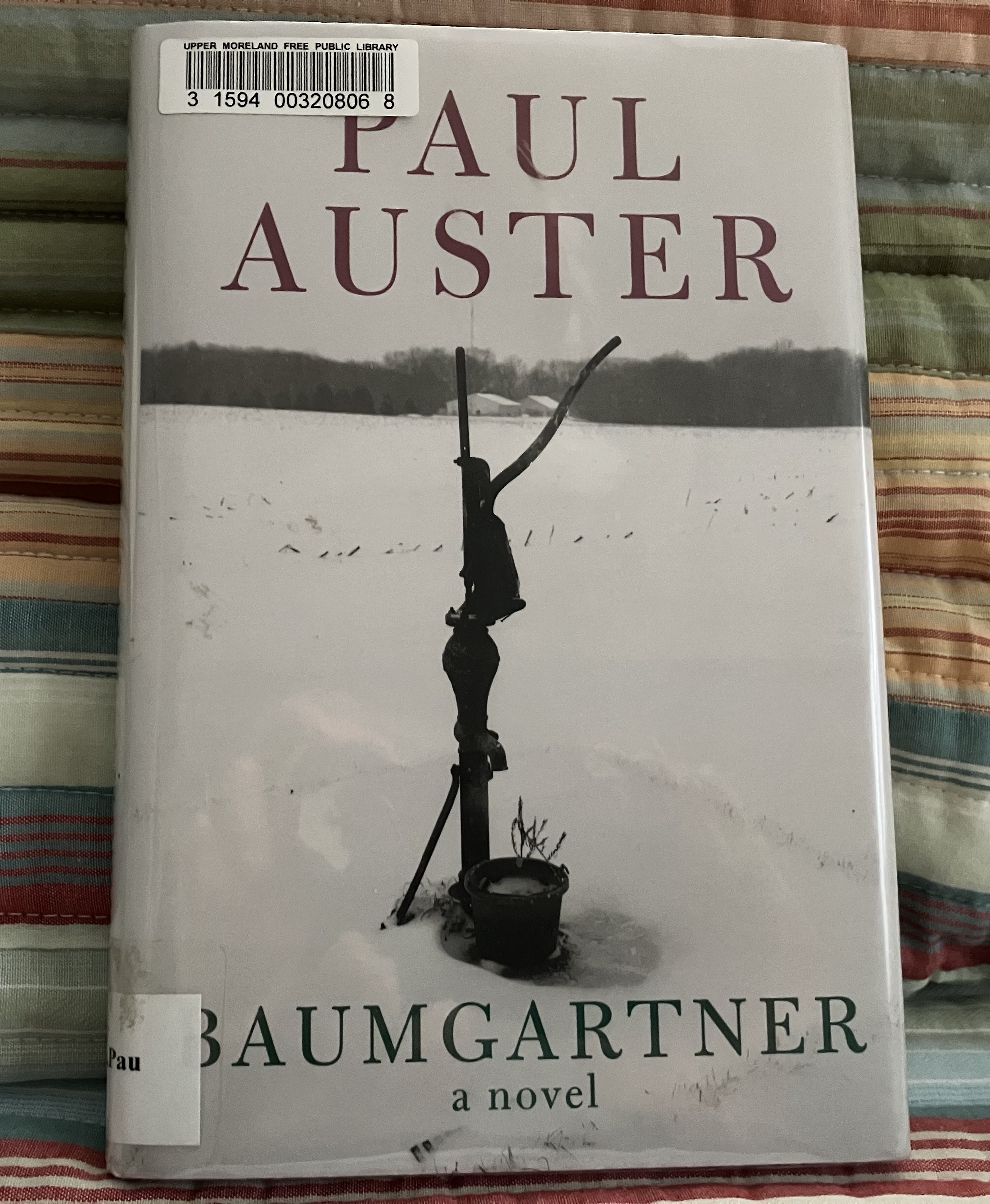
Getting back to life, this month I was swept away by a novel that tells the tale of one David Granger, a 68-year-old American whose adult life has been the opposite of a breeze. Months and months of violent combat in Vietnam jungles in the late 1960s saw to that, not only while he was fighting the Viet Cong, but also every year since then, a decades-long period during which war-induced nightmares have bedeviled his bedtime hours. Granger is the narrator of The Reason You’re Alive, the madcap, profane and humane book by Matthew Quick published in 2017. (Matthew Quick’s best-known novel is The Silver Linings Playbook, which was turned into a movie starring Jennifer Lawrence and Bradley Cooper.)

David Granger is a piece of work, an over-the-top character who wears his lengthy list of opinions on his sleeve. A widower, he has an uneasy relationship with his one child (an adult son named Hank), and adores his young granddaughter, Ella. His friendships are pretty plentiful and also profound. And although he possesses a conservative, America-first outlook, he does not meet the definition of a Trumpster, because he is completely accepting of, and admires, the USA’s racial and sexual minorities. A complicated guy, Granger feels compelled to put his story down on paper before it might be too late, seeing that he recently went under the knife for brain cancer, a disease he believes was induced by heavy exposure in Vietnam to the poisonous chemical Agent Orange. Post-surgery, Granger gets it into his head that he should return a valuable object that, under shameful circumstances, he stole from a fellow soldier during the war.

I don’t want to spill too many beans about the plotlines, so I’ll say little more. I will add, however, that the sentences in The Reason You’re Alive barrel along like a high-speed train and pack a punch. Here’s a sample paragraph from the book:

Doctors had sawed through my skull. They had cut out part of my brain. I was still freeballing it in a lime-green fairy gown. I was in a fucking hospital bed, for Christ’s sake, and Hank’s machine-gunning me with entire belts of words just because I didn’t tell him about the surgery until after it was over. I figured, why worry him? We hadn’t been speaking since summer anyway. Ever since we had a blowout at the Phillies game.

See what I mean? Matthew Quick can write. I unhesitatingly recommend The Reason You’re Alive.

Time, Trump, A Book, A Song

Time marches on, of that there is no doubt. I can barely believe that July 2024 is here. Just like that — zoom! — the first six months of the year have disappeared into the ethers. And before we know it, 2025 will have begun, possibly full of promise, possibly not.

In the USA, where I reside, 2025 and beyond will be nightmarish if Donald Trump wins the upcoming presidential election (November 5, 2024 is Election Day). A fascist, a scoundrel, a convicted felon, a master at lying through his teeth, a riot-instigator and a vindictive bully, Trump is champing at the bit to damage democracy even more than he did during his first term. Are there enough sensible voters in the States to deny him a second occupancy of the high throne? One can only hope. Yes, Joe Biden performed miserably at his recent televised debate with Trump, and is aging right before our eyes. Nonetheless, Biden has done a solid job as president and is an infinitely better choice. For the record: If Trump were running against a box turtle, the turtle would get my vote.

But enough about Trump. Writing about him always puts a knot in my stomach. So, I’m going to move on to more agreeable topics. Such as books and music. Ahh, already I can feel my stomach untangling.

For quite a few years, some of the books I’ve read have entered my life via a largely random process: I sometimes wander through library aisles with no specific authors or titles in mind, pulling volumes off shelves and giving them the once-over. This willy-nilly approach to book selection at times has brought gold my way. For example, the novels Flight (by Sherman Alexie) and The Middlesteins (by Jami Attenberg).

The latest beauty I discovered by employing this method is Holding Her Breath. Published in 2021, it is the first and to-date only novel by Eimear Ryan, an Irish lass. It took 20 or 30 pages for the book’s rhythms to grab hold of me. After that, I remained hooked. Firmly.

Beth Crowe is Holding Her Breath’s main character. A college student in Dublin, Beth suffered an emotional breakdown a year or two before the book opens, and tentatively is hoping not only to rediscover but to further discover herself.

While in college, Beth, a one-time champion swimmer who ultimately couldn’t deal with the pressures of her sport, does her best to come to terms with her athletic past. She also begins a romantic relationship with a teacher at her school, probably not the wisest decision in the world. And she learns much about herself and her family when she becomes fascinated by the life and writings of her grandfather Benjamin Crowe, a famed Irish poet whose stature and mystique did nothing but increase following his suicide at age 43, many years before Beth was born. Before entering college, Beth was far less familiar with all things Benjamin than she should have been, although her mother is the poet’s daughter and her grandmother his widow. Beth and Benjamin entwine in a very real way during the course of Holding Her Breath.

Ryan’s writing is as clear as spring water, as lithe as a gymnast. Take, for instance, this section about Beth:

Later, as she’s going to bed, it occurs to her that she’s never actually heard her grandfather’s voice. She googles it—”Benjamin Crowe” + “audio”—not really expecting much. But there’s a page and a half of results. She clicks, pops in her earphones.

Here he is, in full flow, reading his famous long poem “Roslyn.” Voice deep and raspy, struggling up from great depths. The hitch in his voice is so croakingly alive. The lines come back to her like a nursery rhyme:In that dark sash a comet appeared . . . trailing its afterburn . . .”

Beth closes her eyes. His voice vibrates through her. She falls asleep that way.

I’ll close this essay with Days Can Turn Around, a song I first heard a week and a half ago.  It captured me immediately. Sung and co-written by Sarah Jarosz, Days Can Turn Around is a gentle reflection on life’s bumpy road. The lyrics remind us that we need to keep our heads up and, as best we can, follow our hearts and dreams.

Days Can Turn Around appears on Jarosz’s latest album, Polaroid Lovers, which came out in January. When I close my eyes and listen to the song, I feel as though I’m floating on air. Maybe it will have the same effect on you.

Edgar Reewright Tries His Hand At Kid Lit

It has been a while since I’ve mentioned Edgar Reewright, my longtime editor, on these pages. The last occasion was nine months ago, when he and his wife Loretta were deciding whether or not to accept Elon Musk’s offer to join Elon’s SpaceX senior citizens lunar program. Well, in the end they would have signed up. But before that could happen, Elon, in late June 2023, pulled the plug on the incipient project, whose initial lunar landing by seniors had been scheduled for 2026.

“Neil, Musk eats it!” Edgar told me on the phone last July. “You know what his main reason was for cancelling? Adult diapers! Shit, can you believe it? These were his exact words when he called to give me the news: ‘I’m most sorry to inform you, Edgar, that I’m deep-sixing the senior citizens lunar program. You see, every oldster already in the program is dependent on adult diapers. And you and your wife, on your applications, indicated that they are essential for you too. The SpaceX rockets would have to double in size to accommodate the numerous boxes required for this sanitary product. Not to mention the problem of what to do with soiled diapers. We couldn’t just open a hatch and toss those bad boys into outer space, after all. Well, maybe we could, but if we did and the word got out, the negative publicity would devastate my businesses. Edgar, I’ve got to go. Not to the bathroom, but back to work. Goodbye.'”

“Bummer, my man, for sure,” I said to Edgar. “I know that you and Loretta would have loved to kick up your heels on the Moon. And I damn well might have applied to the program too. Oh well, such is life.”

Leave it to Edgar, though. He didn’t dwell on the SpaceX disappointment. As always, he moved forward with gusto. Case in point: When I spoke with him on the phone a few days ago, he told me he’d just completed writing a book for preschoolers.

“Neil, I’d never written a book of any kind before. But I needed a creative challenge, seeing that editing the pap you turn out for Yeah, Another Blogger isn’t exactly a soul-satisfying experience.”

I bit my tongue, responding instead with kind words.

“Why, Edgar, that’s wonderful. You’re a worldly person, rich with experiences and memories. I have no doubt your book will connect with developing minds flawlessly. What is the book about?”

“I’m glad you asked. Unlike your blog pieces, which exemplify the word wooden, my book is a hold-onto-your-hat tale about a set of young twins, a brother and sister. One day they decide to play hooky from school. I’d like to read the opening sentences to you. Okay?”

“Sure. Fire away.”

Jill and Bill are seven-year-old twins. They live with their parents in a small town in Colorado near the Rocky Mountains. They hate school. “School is for suckers,” they like to say. Their parents always are worried, since Jill and Bill say it so often.

“Hey, Bill, let’s skip school today,” Jill suggests early one Monday morning. “Heck, nobody in our class likes us, so they won’t miss us. And our teacher probably will be glad we didn’t show up, considering all the problems we cause.”

“Gee, Jill, that’s a great idea. After Mom drops us off at school we’ll sneak around to the back of the building and head to the mountains. I’m sick of Mom and Dad, so I want to stay away from home for at least a week. We’ll start forest fires and do lots of other fun things. Are you with me?”

“You bet. Let’s get ready,” says Jill.

“What do you think?” Edgar asked. “Want to hear more?”

“Spare me, Edgar. Holy crap, are you out of your f*cking mind?  What you’ve written is incredibly inappropriate and warped. No preschooler should be exposed to anything like this. You’ll never find a publisher. And if you self-publish, avalanches of condemnation will rain upon you. Edgar, I’m seeing you in a new light. A dark light. I’m not sure I want you to be my editor anymore.”

Edgar held back comment for many seconds. Instead, he gulped. Multiple times. Finally, he spoke.

“Uh, are you sure about all of that? I never had children, which puts me at a disadvantage when determining what might be a good read for little kids.”

“Trust my judgment, Edgar. If this is the kind of subject matter you feel the need to tackle, then do a major rewrite, with young adults as your intended audience.”

“Alright, I’ll take your advice. Or maybe I’ll just throw in the towel. In any event, am I still your editor?”

“Yeah, you are. I’d be lost without you. Plus, occasionally you give me something to write about. There’s a lot to be said for that.”

“Thank you, Neil, thank you. You’re the best. Well, not the best. Not by any means. But you truly are sort of okay.”

I Like Them (A Book, A TV Series, A Song)

Nine Inches, a collection of fiction stories from the pen of Tom Perrotta, and published in 2013, seemed to be calling to me last month as I browsed the shelves of my local library, though I’d never heard of Perrotta before. I should have been familiar with his name, however, since, as I later learned, he’s a successful author. In fact, two of his novels (Election; Little Children) have been turned into movies, and another (The Leftovers) into a television series.

With nothing to lose, I brought Nine Inches home. I’m glad I did. I mean, Perrotta can write. He sharply examines the human mind and emotions, effortlessly illuminating the quirks, insecurities, maladjustments and f*cked-up decisions that run rampant in our species, and which can propel people’s lives in unanticipated directions, some of them most unfortunate. He does so with sentence after sentence that go down as easily as your favorite comfort food and also, when needed, pack a hell of a punch.

Take the opening story in the volume, for instance. It’s titled Backrub, and chronicles the days and nights of Donald, a bright kid just out of high school. The victim of misaligned stars, he was rejected by every college he applied to. Wobbled by this injustice, he takes a job as a pizza delivery person and, after a while, not caring enough to want to try and right his ship, slides comfortably into dealing drugs. Perrotta’s gift for language shines in this paragraph near the story’s conclusion.

It all went down so fast. I barely had time to register the lights in my rearview mirror when I saw two more cop cars right in front of me, blocking the intersection. I got out with my hands on my head, like they told me to, and the next thing I knew I was lying facedown in the street, with my hands cuffed behind my back.

Perrotta’s writing style agrees with me. It’s taut and uncomplicated. He takes on a wide variety of subjects in Nine Inches (unfulfilling marriages, a lonely widow, an insecure teacher, to name a few), and brings them to life with clarity. While reading Perrotta’s stories, I subconsciously kept thinking to myself, “Man, this seems real.” That’s a solid compliment.

On the other hand, not all that much about the television series The Lincoln Lawyer seems truly real, except for some courtroom scenes. But that’s more than okay. Sure, Mickey Haller — aka The Lincoln Lawyer — is preternaturally quick on his feet. But that only adds to his likeability. He and the show’s other main characters are good people, loyal to each other, and don’t take shit from anyone. I’m down with all of that. (By the way, a film version of TLL came out in 2011. It’s good.)

My wife Sandy and I polished off season two of The Lincoln Lawyer recently, after watching season one earlier this year. Both rock, two even more than one. In the second season, Haller (played by Manuel Garcia-Rulfo), who does a good bit of his best work-related thinking while driving or being driven in one of his Lincolns, finds himself defending a lady accused of murder. Not all that many hours before she is brought up on charges, she and Haller were in bed together, enjoying the heck out of one another. What, you’d expect otherwise? But, hey, don’t prejudge the show. It’s quality escapist fun. The plot lines are tricky. The dialogue sparkles. And the actors give it their all. Sandy and I, for sure, are hoping that Netflix will renew The Lincoln Lawyer for a third run.

Which brings us, rather haphazardly, to another creation — The Well, a new song that instantly grabbed me when I heard it on the radio a couple of weeks ago. It’s the work of Briscoe, a group from Texas, and will appear on Briscoe’s first album, which is scheduled to be released next month.

The two main guys in Briscoe — Truett Heintzelman and Philip Lupton — are in their 20s. But they are looking far into the future in The Well, pondering whether memories of the joys of youth will help to sustain old age. I think the Briscoe boys are concerned about something that isn’t going to happen. They’ll be just fine, enjoying the moment, when they reach their “golden” years.

That quibble aside, there’s no denying that The Well, an old-timey type of song brought to high places by rocking drums, is catchy as can be. The blend of the stringed instruments with the quivering, giddy vocals makes me go weak in the knees. I’m smitten!

So, those are a few of the things that have rung my bell of late. What’s rung yours?

My Best-Seller-To-Be

The other day, all excited, I phoned my editor Edgar Reewright and told him about the book idea that had floated into my mind, from out of nowhere, that morning.

“Very nice, Neil, very nice. You’ve got quite the imagination,” he said in a flat tone when I was done. Then he excused himself, explaining that he had to tell his wife something. He asked me to hang on, neglecting to put me on hold. “Yo, Loretta!” I heard him yell. “You know that blogger whose crap I edit?”

Loretta was elsewhere in the house, obviously, but I was able to make out her response. “Right, his name is Noel or Niles or something like that, isn’t it?”

“You’re close. It’s Neil,” Edgar replied. “And he’s on the phone. He called because he plans to write a book, and he wants me to edit it. He’s never written a book before. All he does is turn out pointless essays for his blog. But if he does write this thing, it’ll be so bad it’ll make his essays look good.”

A few seconds later, Edgar spoke again. “I’m back, Neil. Where were we? I’m all ears.”

“All ears, huh? Well, it seems like you’re overlooking your big, loud f*cking mouth! I mean, you weren’t exactly whispering to Loretta just now, Edgar. Only the deaf wouldn’t have heard what you said. My man, you’ve got a lot of nerve talking about me like that. I’ll have you know that I’m a valued writer. WordPress, for instance, holds me in high regard. They contacted me a few days ago to let me know that my blog came in first in their If You Look Deeply, There’s A Slight Chance You’ll Find Something Of Worth And Interest Here competition for 2022. First place, Edgar! I’m very proud.”

“As well you should be, Neil. Listen, what can I say? Your book idea sounds like a loser to me, but maybe I’m wrong. Explain it to me once more, this time in a little more detail.”

“Okay, Edgar. It’s about a homely guy, Roy Oy, who’s going nowhere in life. He’s in his 50s, living with his elderly parents in the house he grew up in and stuck in a dead-end job as the fact-checker for Who’d Have Thunk It? magazine. He hasn’t been on a date in over 20 years and, needless to say, never has had a girlfriend. He spends his off-hours clipping coupons and watching YouTube videos about how to get in touch with space aliens.”

“I’m listening, Neil. Reluctantly,” Edgar said.

“Well, early one morning he’s awakened by a tap on the shoulder. Standing beside him is a strange creature. It’s four feet tall and slender, its bright skin colors pulsating like the aurora borealis and its head spinning around and around so as to take in just about everything all at once.”

“The visitor says, ‘Your incessant YouTube-viewing has paid off, for here I am. I initially planned to abduct you and take you back to my home planet. But I can tell that you’re really pathetic, so I’m not going to bother doing that. However, because I’m very magnanimous I will grant you one wish before I’m on my way. What may I do for you, Mr. Oy?’ ”

“Roy loses no time in answering. He tells the space alien that he wants the world to become a paradise, a place where everybody is loving, kind and generous, and where peace and prosperity reign. The alien says ‘okay, it’s done’ and then leaves via the window it had raised a minute earlier in order to enter the bedroom.”

“So, that’s it, Edgar. Just like that, Planet Earth becomes magnificent. Troubles are over. Everyone gets along. End of story.”

“Yup, I get it, Neil. But I don’t like it. Where’s the tension? Where’s the drama? Hell, nobody wants to read some half-baked, half-assed Pollyannaish tale. Count me out. Go ahead and write the book if you like, but I decline to edit it.”

“As you wish, Edgar. But you’re making a big mistake. Millions and millions of people love books with happy endings. My book, I have no doubt, will climb to the top of the charts and stay there for weeks and weeks. I’m going to become rich, Edgar, and I’d have given you a healthy cut of the profits. Your loss.”

At that moment I swear I could see dollar signs flashing in front of Edgar’s eyes.

“You know, Neil,” he said, “my judgment has been off for a long while. That’s what chronic constipation can do to you. I haven’t taken a dump in weeks, for crying out loud, even though I eat prunes like they’re going out of style and take stool softeners right and left. So, on second thought, count me in!”

“Thanks, Edgar. I’m going to pay you in prunes.”

A Puzzle Story

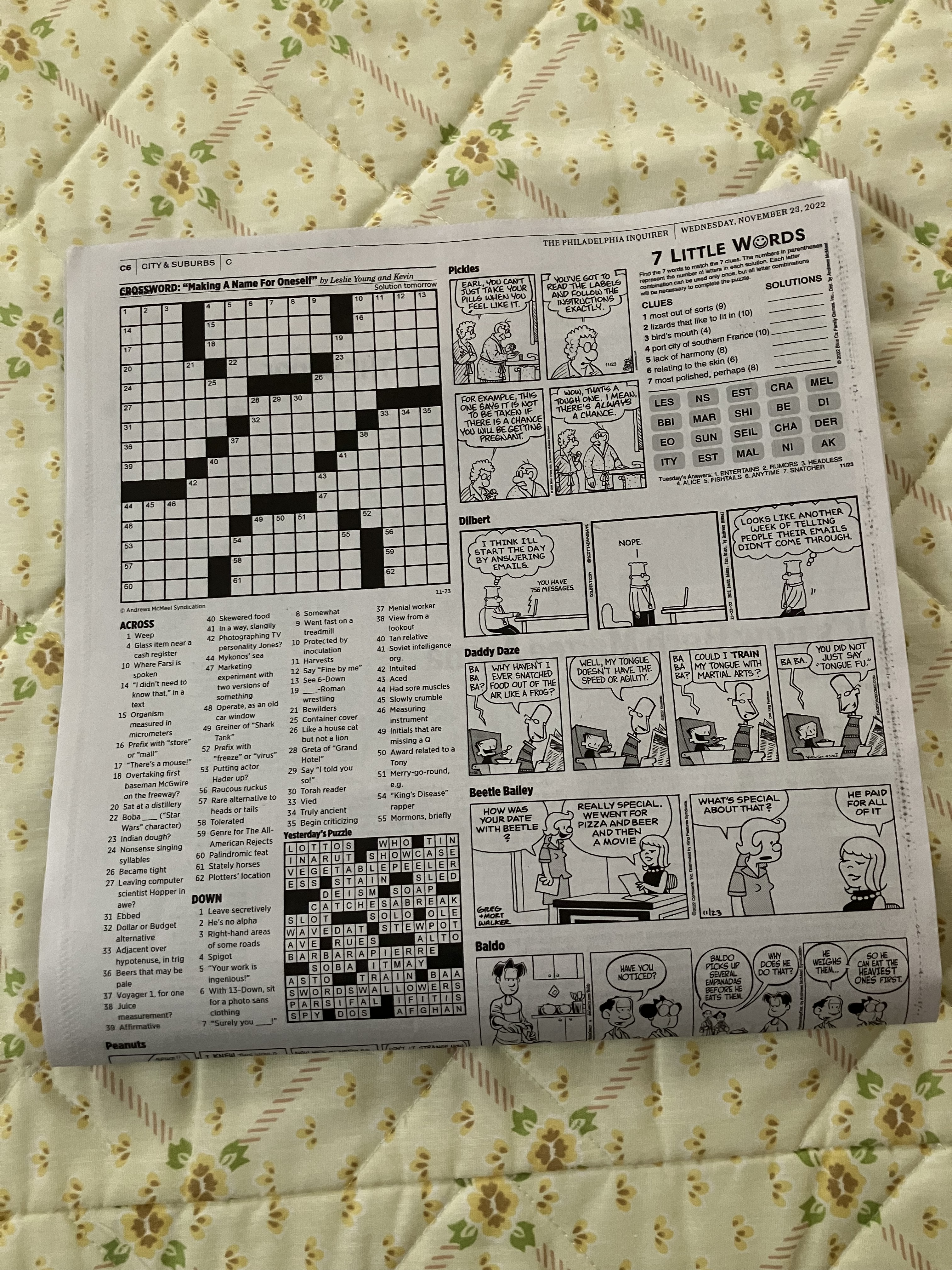
Almost every morning, while downing a couple of cups of coffee, I devote an hour and a half or so to numbers-based and words-based puzzles. Sudoku and crossword puzzles, specifically and respectively. Generally, I work my way through two sudokus and one crossword, a practice I’ve been pursuing for the last 11 years. The puzzles keep my brain limber, calm my nerves and provide a healthy dose of satisfaction if I complete them correctly. They are my pals.

Needless to say, I’m anything but alone in regularly attacking puzzles that revolve around numbers and words. Although some folks have no interest in sudokus, crosswords, cryptograms, Wordle, etc., or are interested but don’t have the time, legions of people are engaged with them. With jigsaw puzzles too. And there also are countless fans of the puzzles found in certain books, television shows and movies. To wit, the plots of mysteries, thrillers and the like in which it’s up to professional detectives or private individuals to identify and track down evil doers. I’m definitely drawn to that sort of fare. In recent weeks, for example, I watched the first three seasons of Unforgotten, a British drama series in which police detectives confront what they refer to as historical murders. In other words, newly discovered homicides that took place years before. Solving these crimes requires tremendous persistence and attention to detail. The members of Unforgotten’s police unit that take on these cases are up to the task, and I’m envious of their abilities.

And a few months ago I polished off A Mind To Murder, by the celebrated crime novelist P. D. James. It’s a good story with complicated circumstances, so much so that the lead detective, Adam Dalgleish, whose reputation for exemplary work precedes him, ultimately pursues someone who is not the killer. In the end, Dalgliesh is humbled by his errors and by the uncertainties that always surround him.

I hadn’t given this any thought before, but A Mind To Murder is more lifelike than most mysteries in that respect. Meaning, even the best detective might be thrown way off course. Man, if Adam Dalgliesh can blunder, what does that imply for the rest of us in the greater scheme of things? Oh well, what can you say? Life’s a big puzzle, for sure, one that’s always in flux and requires us to stay on our toes. We’re usually good at deciphering what’s going on, and consequently make appropriate moves to keep ourselves humming along decently. But it’s not always that easy, as we know all too well. Let’s face it, there are a lot of dynamics going on out there at every given moment, not to mention within us. Their interactions can be unnerving. Or worse.

With sudoku and crossword puzzles, though, you don’t run into unanticipated occurrences, emotional flareups, or anything of the sort. That’s because their components are designed to fit together precisely, unlike the components of life. Those are among the reasons why I enjoy sudokus and crosswords as much as I do. Which is not to say, of course, that they can’t be tricky. The most difficult sudokus are tremendously tricky, but can be untangled by applying rules of logic. And though some crossword puzzle creators adore tossing curveballs at us, via the sly wording of clues, that doesn’t change the fact that only one answer exists for each of those clues.

So, I feel as though I’m in a safe zone when I sit down in the morning to sudoku and crossword puzzles. I’m comfortable in their self-contained worlds where, intrinsically, everything is stable and exactly as it should be. What’s more, the peaceful hour and a half I spend with them makes me better able to deal with the noisy real world. Damn straight I give a big thumbs-up to that!

Call Me “Mister Helpful”

My most recent monthly session with my psychiatrist was a most unusual one, because Dr. R. U. Forereel opened up to me rather than the other way around.

“Have a seat, Neil,” Dr. Forereel said quietly when I entered her office, a small room whose every aspect is as stylish and welcoming as can be. I obeyed, placing my bony ass on the comfortable patient’s chair. It faced its clone, occupied by the good doctor, from a distance of five feet.

“Neil,” she continued, an unmistakable tone of dejection in her voice, “I’m in the midst of an existential crisis, one so powerful I can’t escape its clutches. I want to be totally upfront with you right now. Here’s the bottom line: My condition is interfering with my ability to do my job. Which is why I suspect that you won’t make much progress at today’s session. Not that you’ve progressed very far at all during the many years you’ve been seeing me.”

“That’s not true, Dr. Forereel,” I replied. “You’ve enabled me to understand more accurately and fully who I am. Your insights have helped me come to grips with the fact that, basically, I’m just the most average of Joes, making my way haphazardly and erratically through this earthly realm. Why, without you I’d still be reaching for the stars, getting disappointed right and left when things didn’t work out. As a result, doctor, you’ve turned me into a fairly happy individual. I am in your debt!”

“That’s so kind of you to say, Neil. I wish I could share your opinion of my talents, but I’m afraid that my existential crisis won’t allow me to feel joy.”

“There, you’ve said it again. What the hell is an existential crisis, doctor?”

“Well, my problems are deep-rooted, Neil. You see, I’m ill-fitted to be a psychiatrist. Far too often I’m unsympathetic and, undoubtedly, prickly. If I were of the male gender, it wouldn’t be incorrect to describe me not only as prickly but as a prick too. In any case, my soul is roiling and troubled. Neil, I question the whys and wherefores of my existence.” She paused. “I hope I’ve answered your question adequately,” she then said.

“Yes, doctor, you have. Oy frigging vey! You’re in bad shape. But I’ll try to help, even though help isn’t exactly my middle name. The last time I provided assistance to anyone was 60 years ago, when, despite her vehement protests, I carried a little old lady across a small puddle in the middle of the road. I ended up in juvenile court for that attempt at doing a good deed. Lesson learned!”

“Well, in that case I won’t say that I’m in good hands, Neil. But I am interested in what actions you might be proposing.”

“Doctor, I have a website called Yeah, Another Blogger. That’s where I’ve published the various articles I’ve written over the last seven years. You know about this, I believe.”

Of course I do! You bring up this boring topic every damn time I see you.”

“My bad, doctor. But here’s what I’m getting at: My advice to you is to take up writing, just as I did. You should aim to go farther than me, however. In other words, you should write a book, a memoir of the journey that led you to become the wonderful psychiatrist that you are. If you do, I guarantee you’ll recognize and take comfort from the fact that you’ve guided countless people to better mental and emotional health.”

Dr. Forereel sat silently for many a second, mulling over my comments. Finally, and most energetically, she spoke.

“Neil, this is a genius idea! Yes, yes, yes! I will tell my story, and the world will listen and learn. And, just as important, I will learn too. Thank you so much. I’ll begin writing when I arrive home tonight. I’m sure I’ll need an editor, though. Is there anyone you might recommend?”

“Edgar Reewright is your man, doctor,” I replied without hesitation. “He has edited my pieces right from the start. Maybe we should call him and feel him out.”

Doctor Forereel nodded enthusiastically, so I dialed Edgar’s number and put the phone on speaker.

What the hell do you want, Neil?” Edgar shouted. “I’m in the middle of looking over the story you sent to me yesterday. Per usual, it blows.”

“Listen up, Edgar,” I said, ignoring his insult. “I’m with my psychiatrist, Dr. R. U. Forereel. She plans to write a memoir and wants to know if you’d edit the book for her.”

“Isn’t she the doctor whose office decor was voted best in the nation by the American Psychiatric Association this year?” Edgar asked.

At that, Dr. Forereel jumped right in. “Hello, Edgar! Dr. Forereel here. I’m impressed that you’re aware of the prestigious award I won from the APA. I’d be honored if you’d edit my book. I have so much to say and to reveal. Millions of people will take heart from my inspirational tale. Oh my, I’m feeling confident and purposeful once again. Please be my editor, Edgar!”

Edgar, undoubtedly envisioning a handsome commission, wasted no time in agreeing to the proposal. He chitchatted with Dr. Forereel for a while and then ended the call, promising to contact her soon to work out all the details. A few minutes later, my session having reached its conclusion, I rose from the patient’s chair.

“You are a lifesaver, a gift from above,” said Dr. Forereel as she ushered me to the door. “Thank you, Neil, thank you! To show my gratitude, your next five years of therapy, starting today, will be cost-free.”

“Doctor, I hope that I won’t need anything close to five more years of therapy. I’m doing so well, after all.”

“That’s what you think,” my doctor said. “But, alas, you’re wrong. Very, very wrong. I promise that I’ll continue doing my utmost to try and help you see things more clearly.”

Shit!

That’s Life

A few weeks ago I headed to a nearby public library to engage in an activity that I like a lot: wandering up and down fiction aisles in search of my next read. Sometimes I have a specific author or title in mind. But more often than not I examine the shelves randomly, pulling out books here and there and giving them the once-over. Prone to quick judgments that undoubtedly are incorrect the majority of the time, within seconds I commonly return many of those books to their assigned places. Hey, they had a chance to make a good first impression, but they blew it!

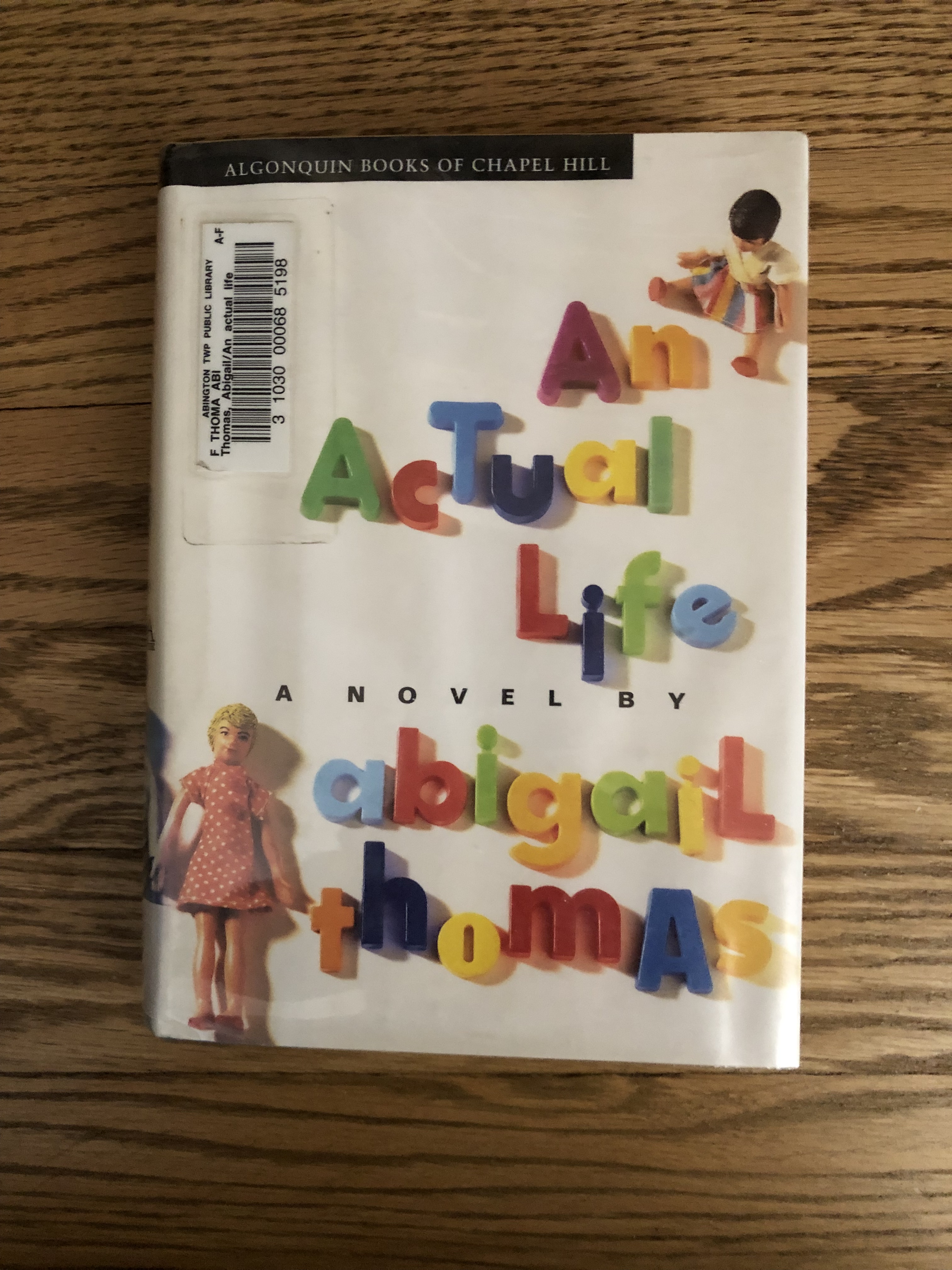
However, by the end of almost every visit I stand at the checkout desk with two or more volumes in hand, hoping that at least one of them is worthy. Sometimes I win. Sometimes I lose. A few weeks ago, at the aforementioned library, I won, arriving home with a pile of books that included An Actual Life, by Abigail Thomas, whom I’d never heard of until her novel caught my roving eye. Normally a herky-jerky reader whose attention span over the last 20 years has fallen off a f*cking cliff, I found myself gliding through Thomas’s opus, digging the journey. An Actual Life, which was published in 1996, is good. Damn good.

It is the saga of married couple Virginia and Buddy, their baby daughter Madeline, and a small cast of other characters. Virginia is 19, Buddy is 21. Though they knew far too little about each other, wanting to do the “right thing” they’d wed after Virginia, during the first coital session she ever had engaged in, became pregnant by Buddy.

Most appropriately and agreeably, Abigail Thomas has endowed Virginia, the narrator of An Actual Life, with a homespun way of talking. Set in small-town New Jersey and Massachusetts circa 1960, the book opens when Madeline is just shy of her first birthday, by which time Virginia and Buddy’s marriage has become nearly as cold as a refrigerator’s freezer section. Not only are they not in love, they never truly were. Unhappy and stumbling through life, Virginia doesn’t know what she should do. And she has little idea what Buddy thinks about their situation, or about anything else really, as he is pretty much the silent type. Around her, anyway. Her love for Madeline, whom she adores, is enough to keep Virginia going, but to where?

Right from the start the book pulls no punches. A couple of hundred words in, mulling over the fact that Buddy is with her only out of a sense of duty, Virginia has this to say:

And there’s really nothing about me to love anyway. There’s not even really any me, exactly. I keep changing inside my skin. There’s no definite person in here. My voice comes out weird and I hardly ever say anything I mean.

Man, those are heavy-duty statements. Virginia’s low self-esteem is on clear display throughout the remaining pages too. Fortunately for the reader, Virginia also is witty as hell. The combination of bleakness and barbed observations makes An Actual Life feel real. There’s nothing strained or artificial here. Thomas writes like a champ.

Unlike the vast majority of books I tackle, An Actual Life got me thinking about life, its challenges, pitfalls, delights, vagaries, and all the rest of the deal. If Thomas ever were to pen a sequel to An Actual Life, I’m guessing it would take place 15 or more years later, and that Virginia, having faced up to her realities, would be on at least fairly strong footing.

Isn’t that the way things go for most of us? In our teens and into our twenties or beyond, we’re still babes in the woods, more or less, trying to figure out what paths to take and to decipher what the hell our garbled inner voices are saying to us. Even if we don’t necessarily lift the veils perfectly, and few folks do, eventually we create lives for ourselves that make the grade.

What’s more, when we think about it, we likely realize that we’ve acquired a nice amount of wisdom along the way. The pearls I’m about to spout seem obvious to me now, but they weren’t until maybe 15 years ago. I believe, for instance, that being loving and kind absolutely is where it’s at, and that said behaviors are the keys to a fulfilling life. And I’m convinced that it’s crucial to cultivate and nourish friendships. We can’t have too many friends, good ones especially. Solid friendships, after all, bring us joy and, when needed, comfort, and can open our minds in delightful ways.

Well, seeing that I ain’t exactly Plato or Confucius, I sure as shit better end my philosophizing right now, before I get in way over my head. Till next time!

Short Books And Lots of TV: That’s Entertainment!

Well, good ol’ 2021, part of the ongoing COVID era, found me doing this, that and the other thing to fill up the 17.5 hours during which I’m more or less conscious each day. None of those hours were spent at a workplace outside my home, because COVID deep-sixed the volunteer jobs that I had engaged in happily for years. I’m still working, however, because I spend a fair amount of time writing pieces for the shaky, suspect publication titled Yeah, Another Blogger. Yo, you take your part-time jobs where you can find them!

Writing aside, I’m left with shitloads of hours on my hands each week. Many of them are spent on my living room sofa, where I’ve mastered the art of staring into space as I twist the six strands of hair remaining on the crown of my head into fascinating shapes. Then I untwist them and start all over again.

Fortunately, I engage in a variety of more fruitful activities too. If I didn’t, my wife Sandy would have had me committed long ago.

For instance, I read books. Not an extraordinary number — hell, I know of some fellow WordPress denizens who tear through three or more books per week — but enough to keep my mind percolating a bit.

I’m picky, though. Any book that I contemplate tackling must be short, as in no more than 260 pages. And fewer than 200 as often as possible. I began taking this approach because my attention span and stamina, when it came to book-reading, began to fall off the table in 2015. I found my way to the ends of a mere two books that year. 2016 proved to be even worse, as I recorded a big fat goose egg.

Ergo, to kickstart my dormant love of books I devised the short-book strategy in 2017. And it has worked. Last year, for instance, I polished off 17 books, fewer than in my glory days of book-reading, but a number I feel good about.

All are members of the fiction category, including two mysteries (Sleeping Murder; And Then There Were None) by Agatha Christie that are as breezy and enjoyable as they can be. My list of conquests also includes Cathedral, a collection of short stories by Raymond Carver. Carver’s world is populated by people who have never figured out, or been encouraged to figure out, how to lead productive, happy lives. Matter-of-factly, but not depressingly, he lays out their plights in language that grabs hold of you from the opening paragraphs.

As it turns out, though, the first book I read in 2021 was the one I thought was the best: Flight, by Sherman Alexie (I expounded upon it here). It’s the tale, as vivid as daylight on a cloudless afternoon, of a 21st century Native American teen trying to come to terms with himself and with the country — the USA — that conquered and subjugated his peoples.

Yes, books entertained me mightily in the year that just entered our rearview mirrors.  The jollies that I got from them, though, paled in comparison to those provided by the magical medium known as television. Yeah, I spent quite a few hours in front of the home screen last year, continuing the practice I’d adopted at the start of the pandemic. Sandy used to watch the tube alone in the evening. But lack of outside-the-house entertainment options caused me to join her when coronavirus reared its f*cking head. We quickly developed into an adorable TV-viewing couple, settling in for an hour or two of laughs, gasps and whatever, five or six nights each week.

During 2021, Sandy and I watched around 20 movies on the tube and many more series than that. Almost every one was on commercial-free platforms and networks, mainly Netflix and HBO, both of which have become two of my closest friends. I’ve turned into a series addict, limited series particularly. Some of the limited ones that I especially liked last year are The Chestnut Man and Giri/Haji (tense crime dramas), Chernobyl (a dramatization of the nuclear disaster), and Maid (where relationships go very bad and where pure love is on display).

In closing, I give a hearty tip of the hat to Godless, a Western that, as is common to its genre, portrays a battle between decency and wickedness. This limited series is set in late-1800s Colorado. Jeff Daniels (Is there a better actor anywhere?) stars as Frank Griffin, an eerie bad guy who bosses around his band of associate baddies and takes his amputated left arm with him, like a good luck charm, everywhere he goes. (A bad wound necessitated the amputation.) In the end, does good triumph over evil? You’ll have to tune in to find out, because I ain’t one for dropping spoilers.

Thanks for reading, boys and girls. What activities/books/TV/music/etc. rang your bell in 2021? Feel free to comment.

Happy New Year!