Darkened Skies, Beautiful Philadelphia

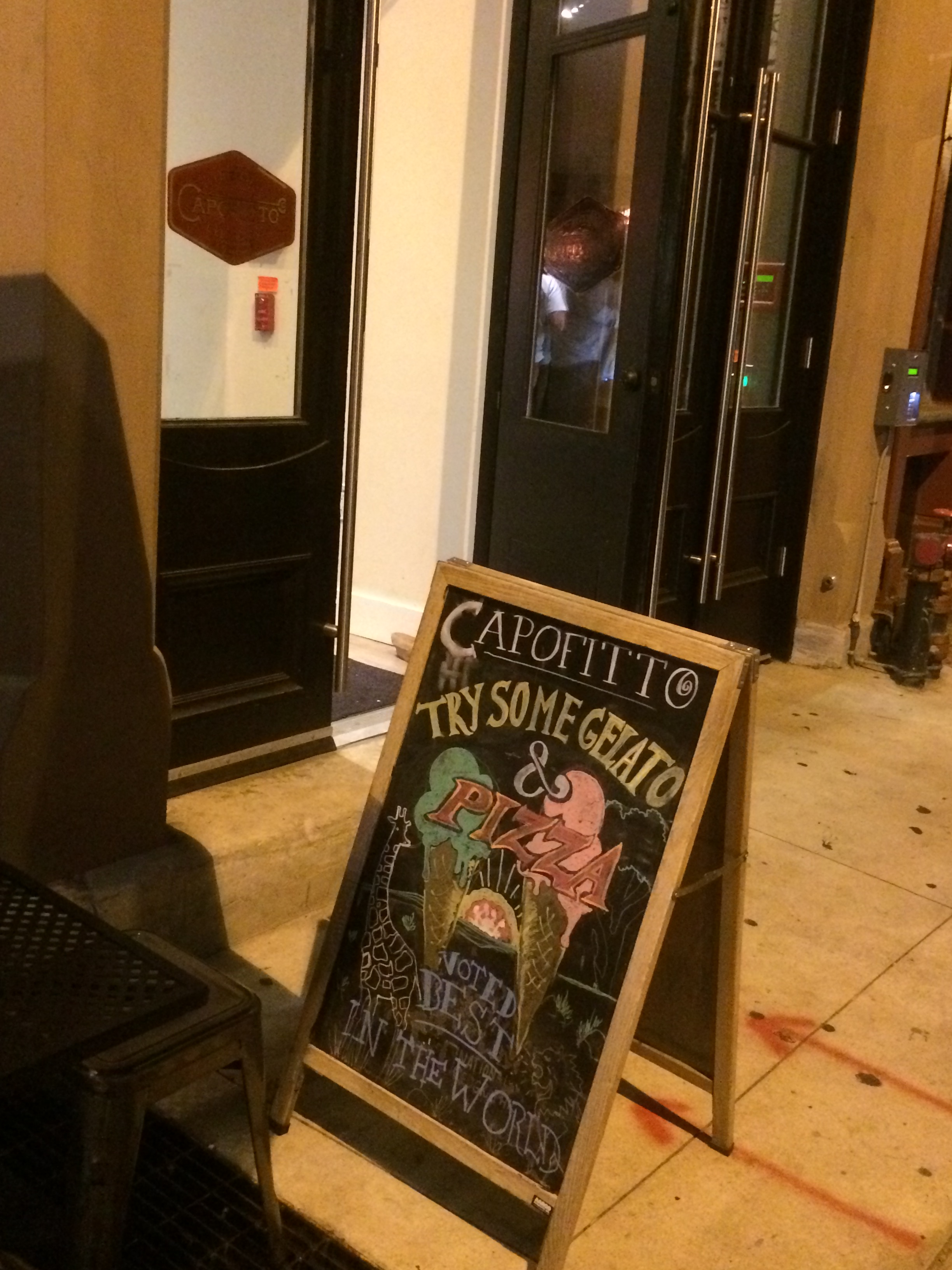
img_0891 At about 8:30 PM on the first Friday of the current month, my wife Sandy and I exited Capofitto, an Italian bistro cum gelato/sorbetto (ice cream/sorbet) store that we like. We’d downed a pizza-centric meal there, capped off with scoops of cappuccino gelato and peach sorbetto. Pretty damn good for sure. Capofitto is in the heart of Philadelphia’s Old City section, whose roots go back powerfully to Colonial days. No doubt the block on which Capifitto resides, a length of Chestnut Street, was trod upon countless times by any Founding Father you can name, not to mention his romantic partner(s), as was just about every Old City block. I find it très neat to think about that. Old City is a cool part of town.

“What next?” we asked ourselves. Should we go back to our home in the burbs? Nah, the night was young. And quite dark, as the Sun had set an hour earlier and neither moonlight nor starlight was apparent to me. Essentially, Old City was being illuminated by electric lights, and in a muted manner. Which I enjoyed. Everything seemed dreamy and atmospheric — the semi-ancient brick buildings, the stone-paved streets. I felt as though I was on a movie set. I asked Sandy if she’d like to go for a walk. She said yes, and off we went down Chestnut Street toward nearby Penn’s Landing, a large swath of Philadelphia’s Delaware River waterfront. The night not only was young, it also was calling. 

img_0894Like the Founding Fathers, Sandy and I have moseyed along Old City’s arteries many times. That’s an activity that doesn’t get old. We keep coming back for more. And this being a night whose effects I actually was paying attention to, which isn’t always the case, I felt myself getting into the scene more than usual. “Holy brotherly love,” I murmured to myself when, half a block from Capofitto, I turned around and saw the huge and perfectly-sculpted United States Custom House, which went up in the 1930s, glowing warmly in its white lights. “That’s gorgeous.” Indeed it was. I snapped its picture, the first of many that Sandy and I would snap as we investigated Philadelphia under darkened skies.

img_1546In a flash we were at Penn’s Landing, a once unassuming and still developing stretch of territory that city officials have been master-planning and trying to force into glorious bloom for over 50 years. To put it another way, the keys to unlocking Penn’s Landing’s full potential as a tourist and city resident draw have yet to be discovered. But it’s getting there, as we shall see. First thing you notice at night when you enter Penn’s Landing near its northern end, as Sandy and I did, is the Ben Franklin Bridge, which connects our nations’ first capitol with Camden, New Jersey. The bridge is massive and grand and, when skies are black, a visual wow. Why? Because years ago someone had the sterling idea to string colorful, Christmassy lights along it. Sandy and I looked at the bridge long and hard and, as on many nights before, we liked what we saw.
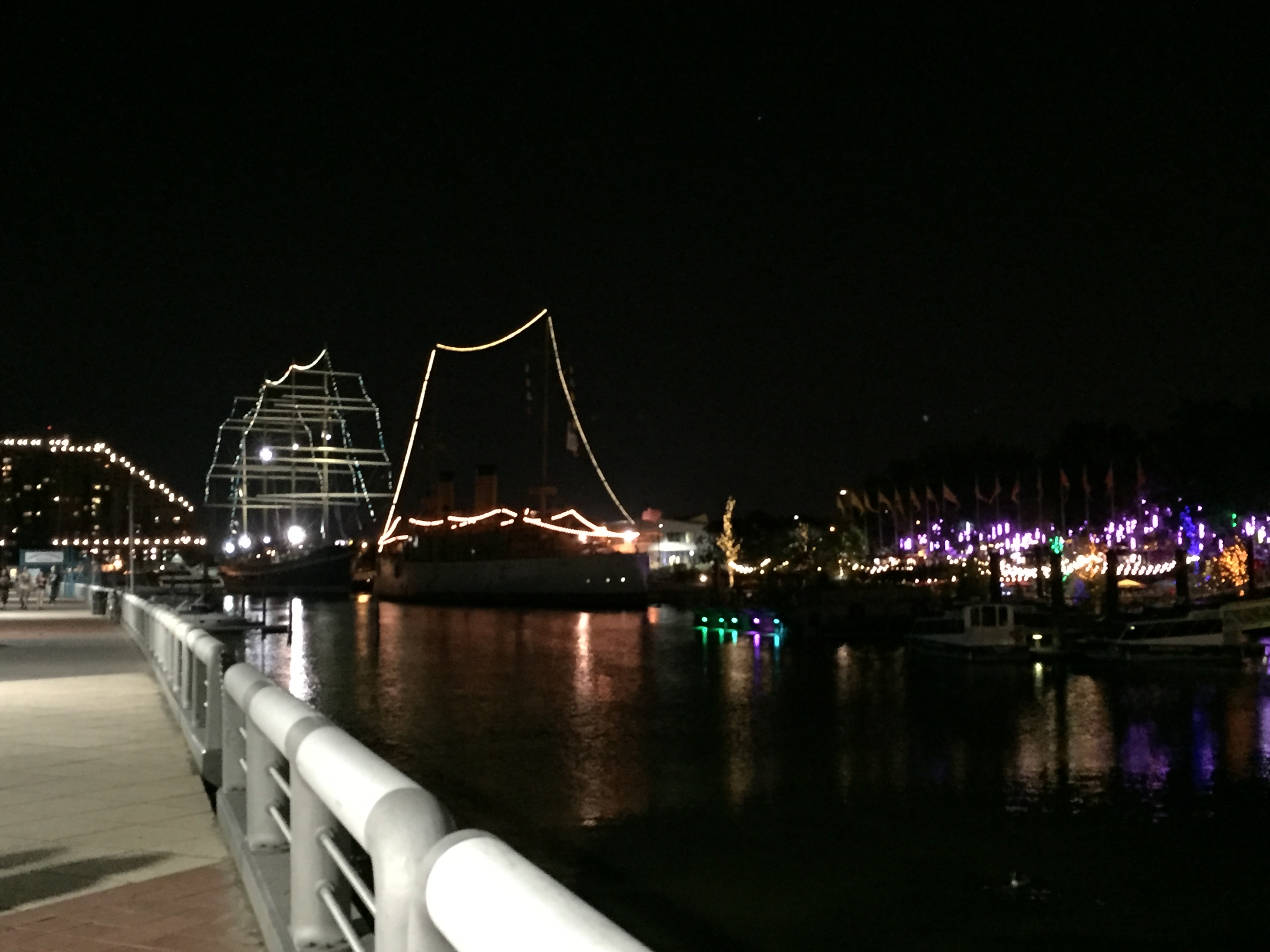
The park's LED lights (center right) seen from a distance.
The park’s LED lights (at right) seen from a distance.

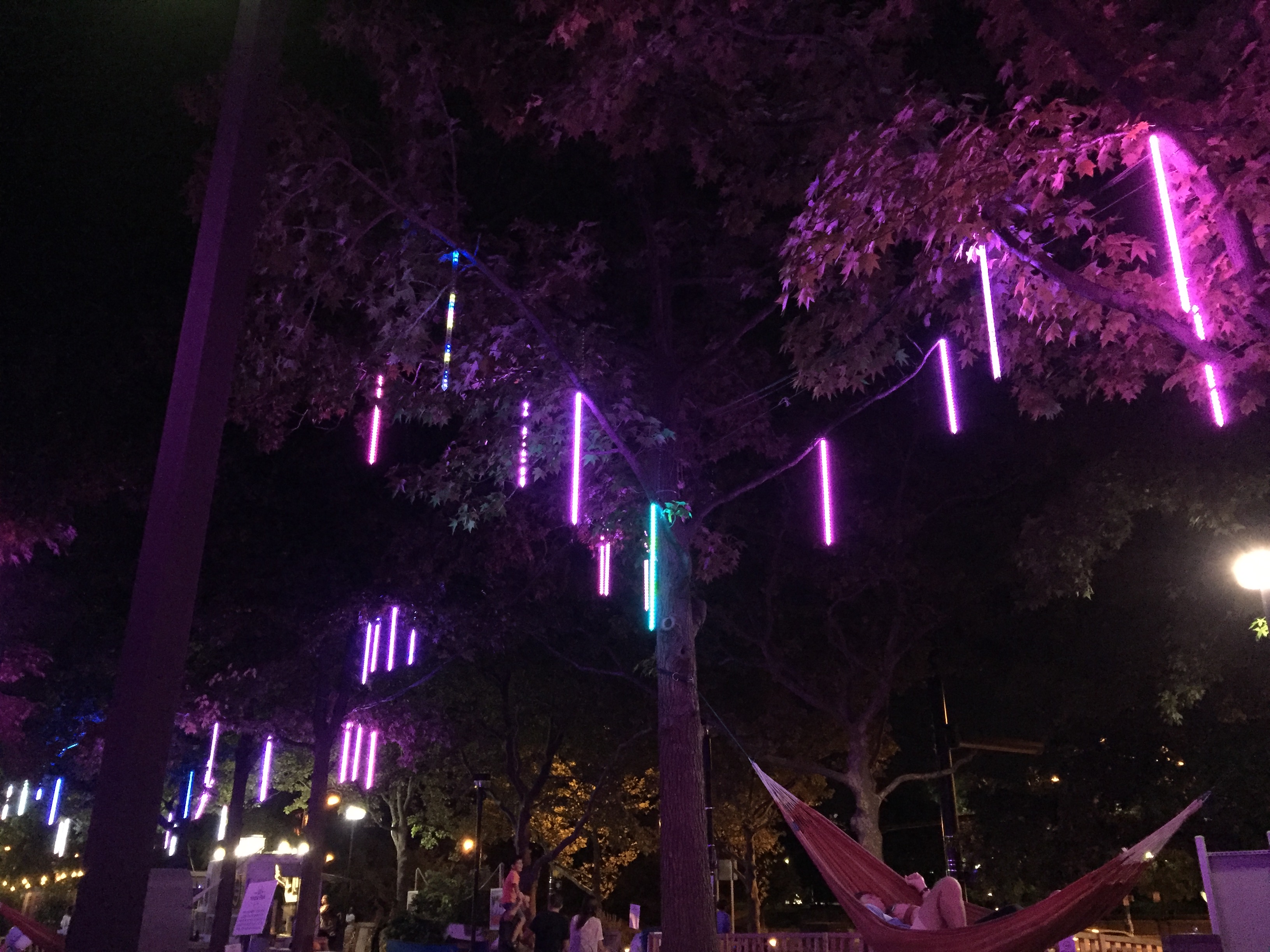
I must have realized this on past visits too, but that night I was taken by the low-wattage illumination in most parts of Penn’s Landing. Just like in Old City. Philadelphia — and I’m all for this — ain’t aiming for a Times Square type of lighting blitz. A feeling of intimacy, I think, is the result throughout most of the city. And that casual, relaxed spirit was true even in the section of Penn’s Landing that the masses have discovered and turned into a destination. I speak of Spruce Street Harbor Park, which drew closer as Sandy and I headed south along Penn’s Landing’s walkways. At night we couldn’t and wouldn’t have wanted to miss it, because the possibly thousands of color-shifting LED lights hanging from its trees were superb and put us under a spell. And we didn’t need to don shades . . . yes, the lights dazzled, but subtly.

img_1552Spruce Street Harbor Park, loaded with things to do, overlooks Penn’s Landing’s marina, which I never used to think much of because I’d rarely if ever notice anything interesting going on within it. And the grounds of what is now the park, which opened for business in 2014, once were as bland and barren as an unbuttered slice of white bread, except for a grove of trees and a monument to Christopher Columbus. That, at least, is the way I remember the area. But all that has changed. Lo and behold, SSHP has become, I’d guess, the most popular place to hang out in all of Philadelphia. The governmental folks who orchestrated the park’s development birthed a phenomenon, a winner that has far exceeded in popularity anyone’s expectations.

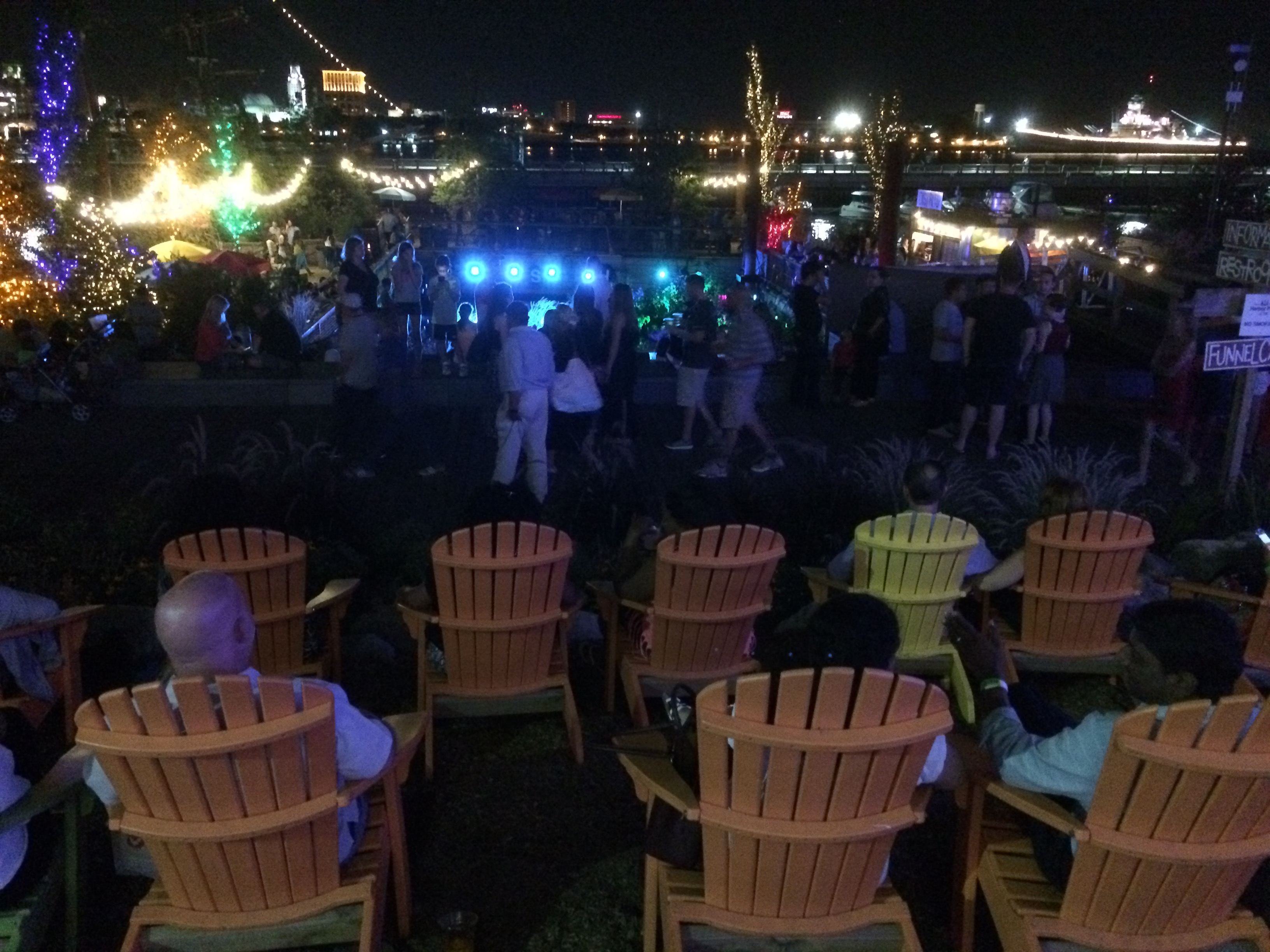
img_0926img_0911Designed to have a summery sort of ambience, the attractions at Spruce Street Harbor Park have a limited run each year, though I wouldn’t be surprised if the powers that be are brainstorming ideas that would keep the park open most or all months. Yeah, more is better, guys! This year, SSHP’s season began in early May and will end on September 25. At the very least, why not open the gates in mid-April and close them in mid-October? Sounds like a plan to me. Anyway, the place was mobbed the night Sandy and I visited. With good reason. It has a low-key, breezy combination of things going for it, besides the groovy LED shafts whose color blips rise and fall regimentally.


img_0920img_1557There are hammocks dangling between trees; tables and chairs of different sizes and shapes scattered all around; a boardwalk lined with food shacks; craft beer stands; an indoor arcade; restaurants floating in the marina; a bocce court . . .  you get the picture. Among other pursuits, folks lounged, strolled, stuffed their faces and watched others lounge, stroll and stuff. And played their parts peacefully and politely. The nitwit factor at Spruce Street Harbor Park and the rest of Penn’s Landing and, come to think of it, in Old City, was nil that night. Do hypnotic lights amid semi-darkness induce commendable behavior? I don’t really know, but there might be something to that.


Alas, all good things that first Friday evening, for Sandy and me anyway, came to an end. To a train station in central Philadelphia we eventually proceeded. And, not long after that, at our abode’s doorstep, a mere handful of miles from one of the city’s borders, we arrived.

(Don’t be shy about adding your thoughts, or about sharing this story with others)

(All photos, except that of the United States Custom House, by Sandra Cherrey Scheinin. If you click on any photo, a larger image will open)
If I Were A Painter . . .

I’ve penned some love letters to Cape Cod on these pages, but it has been a while since last I did. Yes, I’m in love with The Cape. My wife Sandy seconds that emotion. The enormous expanses of undeveloped oceanside shorelines; the humungous, otherworldly sand dunes that run for miles within the peninsula’s far reaches; the I-never-would-have-expected-them-to-be-there woods and forests that pepper the landscape . . . Cape Cod has natural beauty up the grand wazoo. And, that being what we most favor about The Cape, Sandy and I spend lots of time poking around the great outdoors during our Cape vacations. But we also like to emerge from the wilderness and do other types of things that ring our bells. For example, we get big bangs from some of the old village sections of certain Cape towns, such as those in Provincetown, Wellfleet and Orleans. They are cute and charming. We wander on their streets, investigate their stores and stuff our faces at dinnertime in their restaurants.

Last October, in Orleans, we took in a cool event one Saturday morning. The Addison Art Gallery, one of Cape Cod’s best, organized it. Two or more times each year AAG selects an outdoors Cape area to be immortalized and invites a bunch of the artists it represents to find views that spark them in said area, set up their easels and paint away. In October, Addison chose Orleans’ villagey heart, in which it is located, as the locale. The artists were instructed to paint and complete their masterpieces between 8 AM and noon, and then to bring the canvases to AAG where they would be framed and hung on the walls and offered for sale that evening at an artsy gathering to which the public was invited.

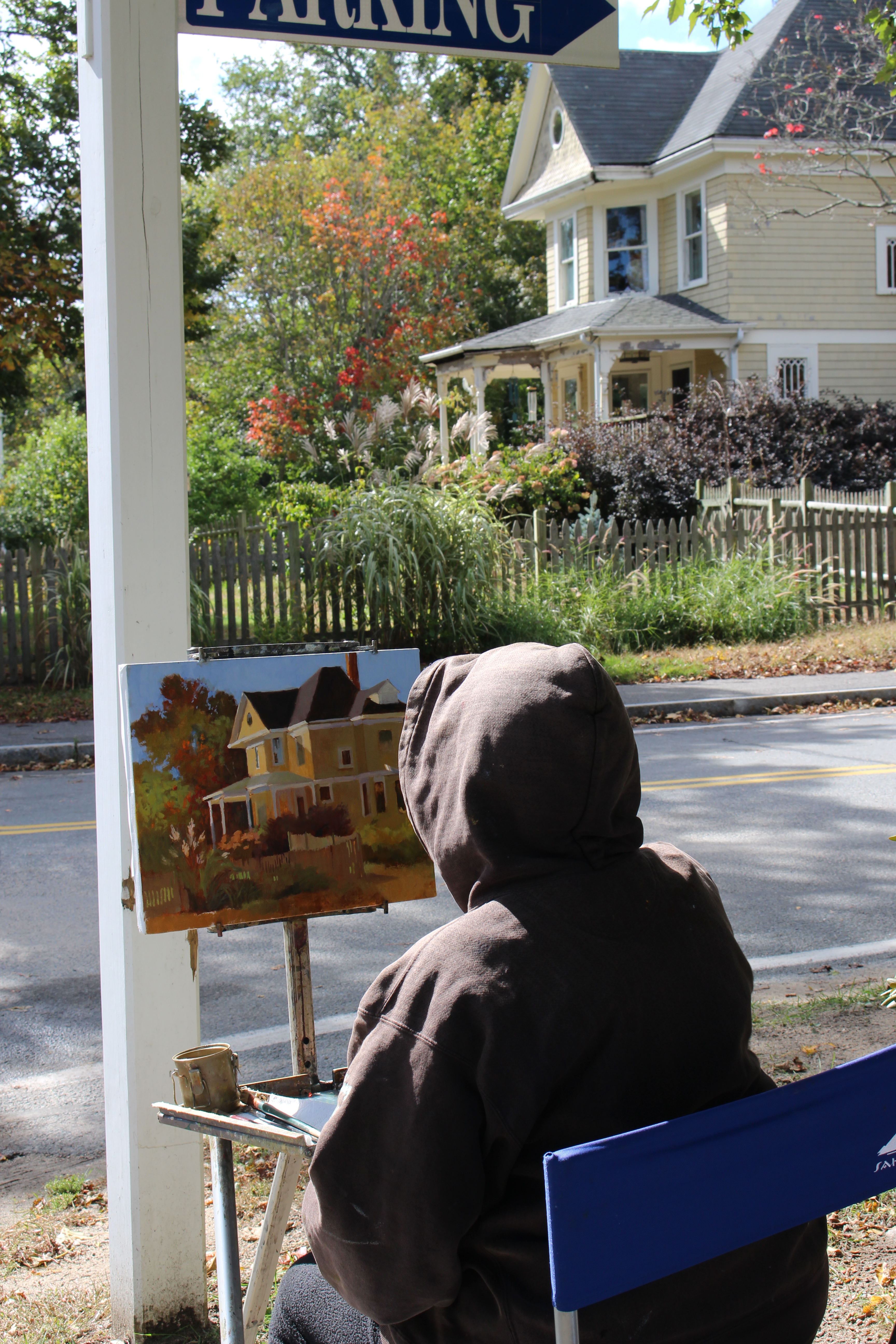
Maryalice Eizenberg.

Sandy and I, who haven’t lifted a paint brush since grade school, like to watch good artists at work. So who knows why we got a real late start and didn’t arrive at the five or so square block painting zone until 11 AM. By that time most of the artists had finished their jobs and were packing up or already gone. Luckily we got to see two painters who were still going at it. On a sidewalk near AAG, Maryalice Eizenberg, hooded to shield herself from our friend the Sun, was staring down a big, old, yellow Victorian house across the street. She sweetly translated what she saw, in colors deeper than those 80 feet away. We chatted with her for a couple of minutes as she worked. “Have you seen what Paul Schulenburg is painting?” she asked us. No, we hadn’t. “Take a look. You won’t believe what his subject is.” And she pointed to where we’d find him, hidden from view from her own spot, but only half a block away.

Paul Schulenburg.
Paul Schulenburg.

Now, Paul Schulenburg is an artist whose oils I have seen at AAG over the years. He’s really good. His paintings have a stillness, a sense of completeness, à la Andrew Wyeth and Edward Hopper. Sandy and I followed Maryalice’s finger and came upon him. He and his easel were positioned between two houses, and he was zeroing in on a small section of one of the houses, a large and mostly white-shingled affair. But it wasn’t the house so much that he was interested in. What had caught his eye, and had become the focal point of his painting, was a bright green garden hose. Its color contrasted just-so with the less brilliant green of the side lawn, and had plenty to say to the house’s white shingles and red bricks. “Man, this guy is something else,” I more or less thought to myself. “A hose? Yup, and he is doing it proud.”

For reasons unknown, that October day floated to the top of my porous memory bank last week, and it got me thinking. Were there any aspects of my house’s exterior or grounds worth putting down on canvas? I decided to take a look. I would use my best impersonation of Paul Schulenburg’s painterly eye.

Sandy’s and my abode rests in the middle of a typical suburban block near Philadelphia. The house is modest and is surrounded by more shrubs and trees than I enjoy taking care of. All of it looks nice, but ain’t exactly a head-turner. I mean, Better Homes And Gardens Magazine has no plans to contact me anytime soon for a photo shoot. That, however, wasn’t the point. My mission was to pay attention to the details, to notice boffo alignments of objects, neato color contrasts, whatever, that were waiting to be discovered.

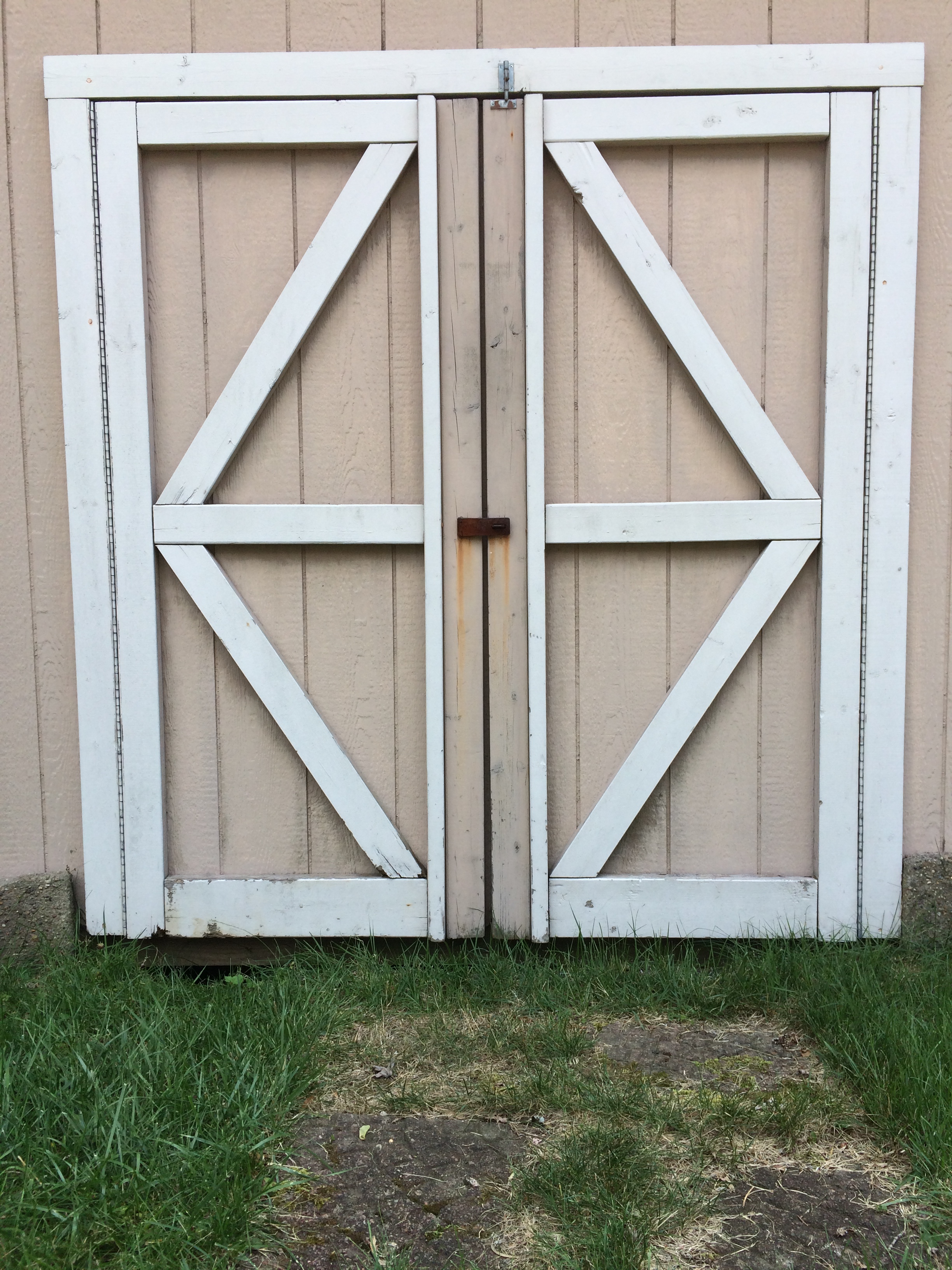
IMG_0821IMG_0799IMG_0805My house? Man, I’m glad to be living within it, but, take it from me, its exterior front and sides are vanilla. Tons of bricks and stones with almost nothing quirky or asymmetrical going on. I gazed artistically at one of the few ornamentations, a tangle of gas meter and pipes near the front door, and wondered if it would make for a decent painting. Well, maybe, but  . . . eh. I then walked around back and gave the grounds there a once-over, starting with the shed. How about its doors? Their designs seemed kind of sharp. Or did they? Nah, the scene lacked pop. A blooming Rose Of Sharon in the backyard, however, definitely did pop. How many floral scenes have been painted over the years, though? Maybe 20 billion. The world didn’t need this one.

IMG_0841All was not in vain. Because attached to the rear of the house is a great-looking deck that I figured would hold out hope. Hope morphed into certainty when I spotted something on one of the deck’s supporting posts. It was a knot, golden and aglow, in the wood. That’s what I would paint if I were a painter, I decided. It was a natural, a star waiting to be born. I walked around the knot, snapping photos, checking out various vantage points. And came to think that one perspective gave the best results for my imagined painting. In that vista you see the crazy quilt formed by part of the deck’s underside and the stairs leading up. You see a bit of slate patio and brick surface of the house. The scene’s palette is muted, all wan greys and browns, except for the golden medallion that you can’t take your eyes off of.

But I did take my eyes off the knot in a bit. And then I folded up my fantasy easel and went inside. It’s good to learn things, and I came away from all of this with an insight that never had occurred to me before: A painter in search of something to paint is little different than a writer (moi?) trying to come up with a story idea. And exactly the same is true for dance choreographers, photographers, film makers, chemists, astrophysicists, chefs, you name it, all on the prowl for projects that will make them buzz. The wellsprings of creativity are thick and bubbling, though not always easily tapped.

(Don’t be shy about adding your comments or about sharing this article with others. And, if you’re not already a follower of this blog, please consider signing up . . . I like readers!)

(Cape Cod photos by Sandra Cherrey Scheinin. The others by yours truly. If you click on any photo, a larger image will open)

Amsterdam, When Lights Were Low

This time of year in suburban Philadelphia USA, where I reside, the Sun sets around 8:30 PM and the sky begins to grow meaningfully dark half an hour later. A few weeks ago, though, during my wife Sandy’s and my trip to Paris and Amsterdam, the lighting was different. (If you click right here and right here, the previous two articles about our trip will appear). There, sunset happened circa 10:00 PM and darkness started its descent about thirty minutes after that. It wasn’t till 10:45 or so that you’d say nighttime truly had arrived. These were phenomena that took Sandy and me a little by surprise. We sure weren’t used to them. But we liked them.

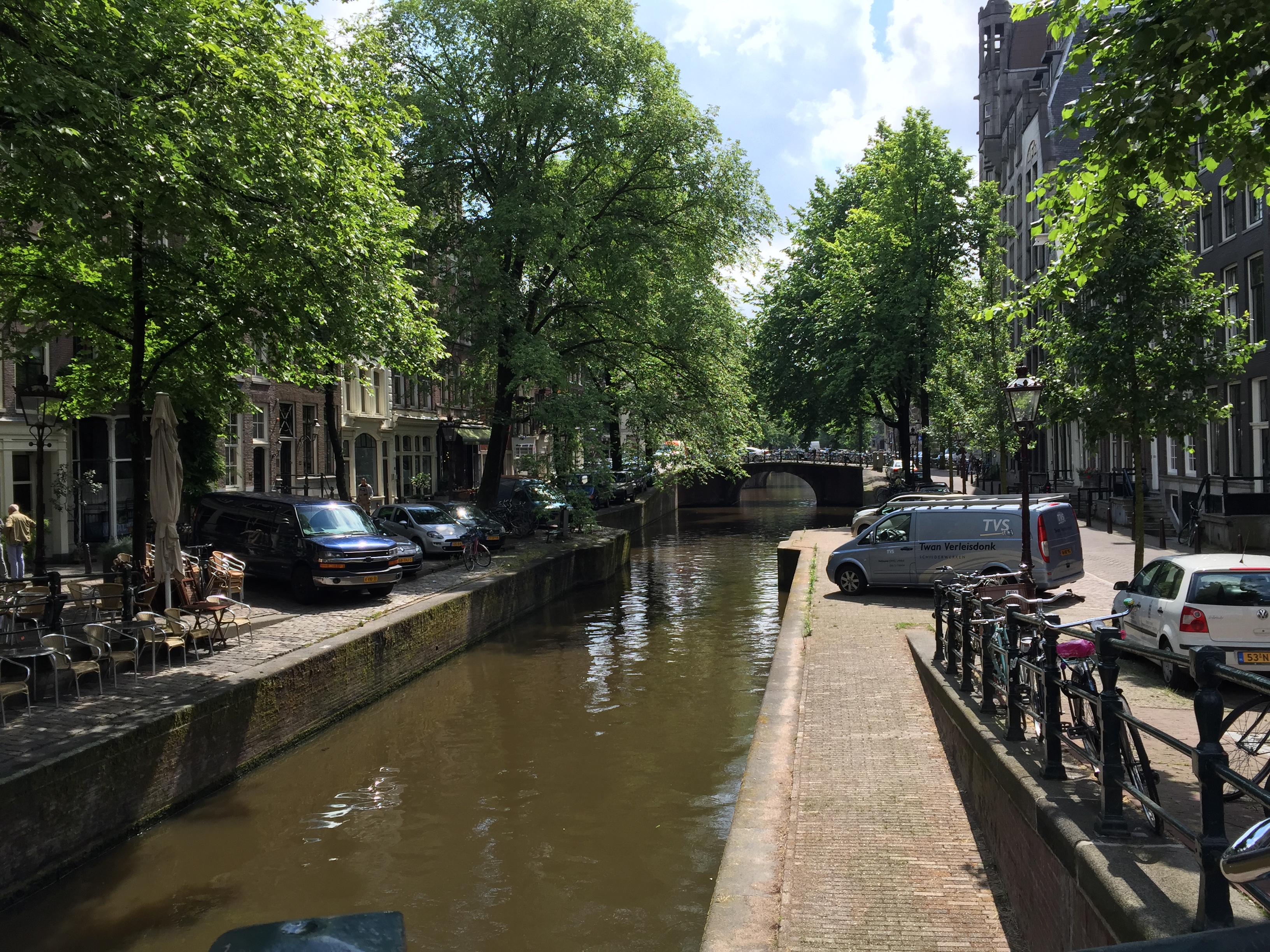
Now, Amsterdam is a beautiful place in daylight, as is Paris, natch. Those canals; those old, quaint brick houses; those cute houseboats parked here and there on the waters; those many streets no wider than alleys. Man, investigating and gawking at all of this in full light was the best. But — and I’m not exactly issuing a news flash here — things looked different when the effects of our friend the Sun started to fade. Different isn’t always better, yet often it is equally good. And that was the case with Amsterdam during late evening hours.

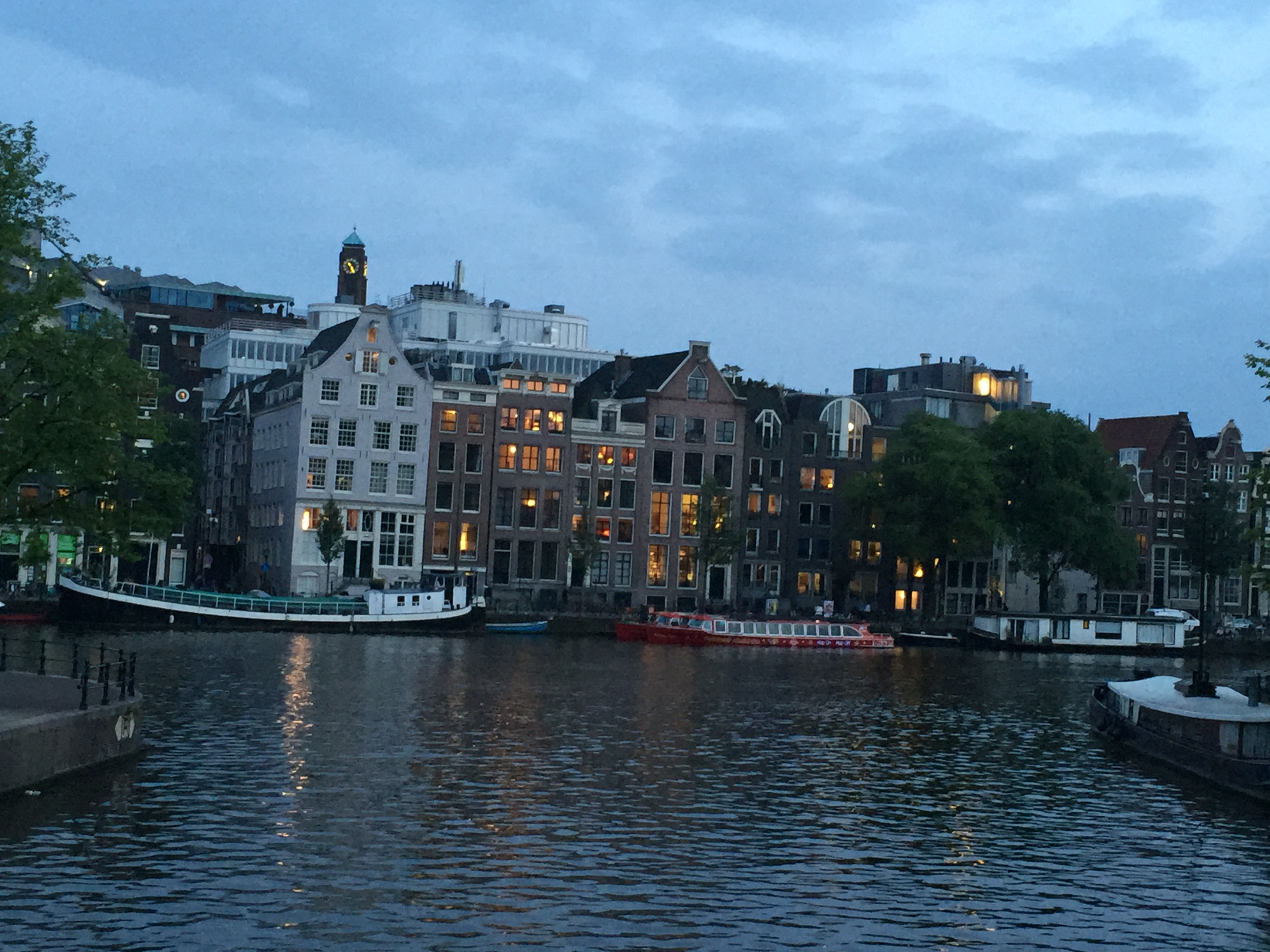
Maybe we were under the spell of the delayed darkness, I don’t know, but in Amsterdam we found ourselves starting the evening repasts much later than at home. Most evenings we didn’t begin to eat until 8:30 or later. By the time we concluded restaurant business and moseyed out onto the streets, sunlight was approaching the low end of its dial or was gone. And that’s when our evening entertainment, nighttime walks, began. It also was when the canals put on their more formal clothes.

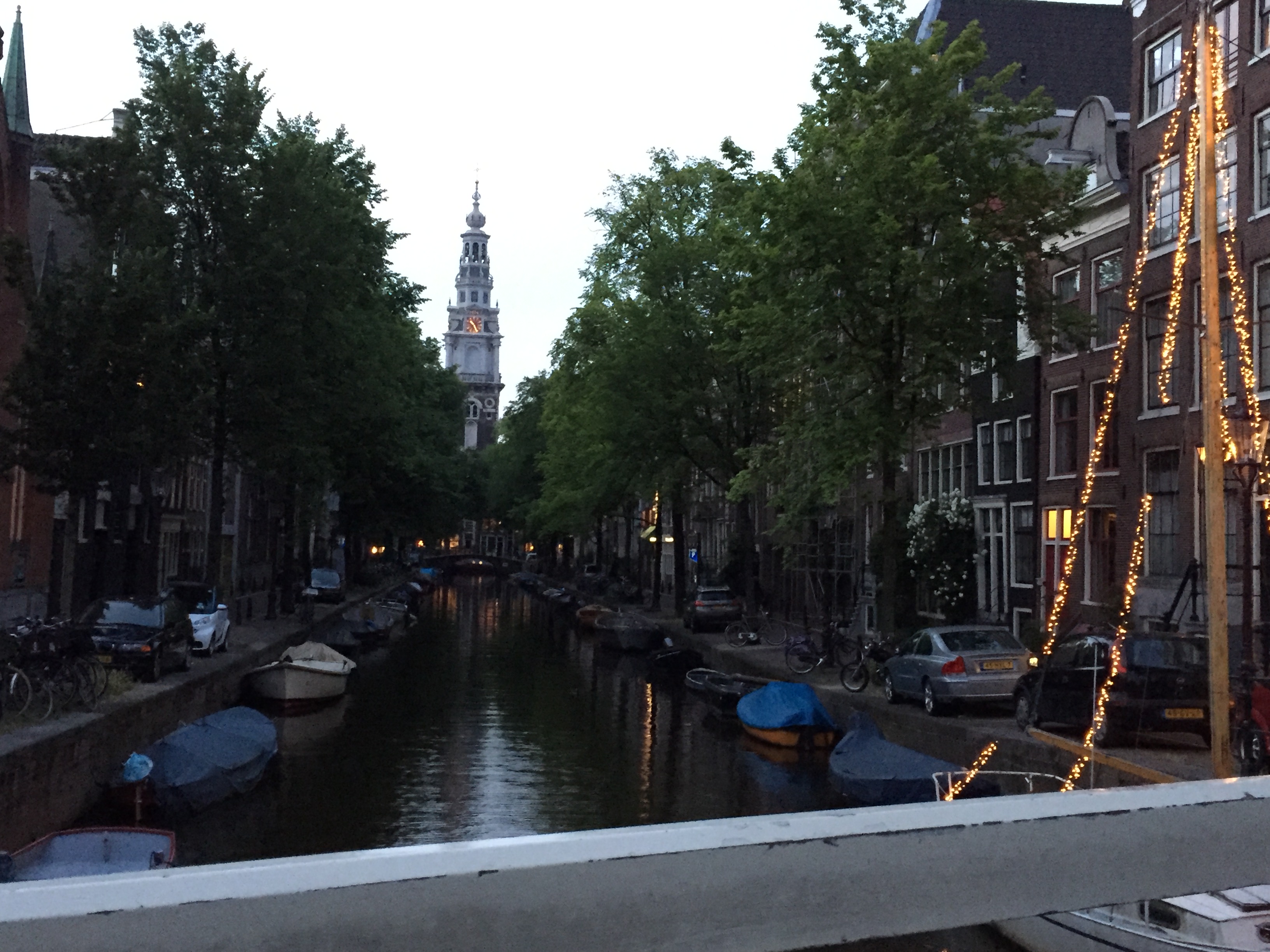
IMG_1465IMG_1466One night, after a dinner in the western part of town that ended at 10:15, we wandered for ten minutes in search of the still-existing house (now the Rembrandt House Museum) where Rembrandt van Rijn lived during much of the 1600s. Eventually we found it. The famed artist lived near the Zwanenburgwaal, a handsome canal. I imagine that the area looks pretty much as it did in Rembrandt’s time. And, no question, it startles at night. There was a fair but quickly fading amount of light in the skies as we strolled around Zwanenbuegwaal and other nearby waterways. The canal waters glimmered, the electric lights from within houses glowed mightily. And we were amazed by a scene that was almost too good to be true, the Moon early in its rise above an assemblage of rooftops and gables. I don’t know if Rembrandt ever painted a waterscape like that, but if he didn’t he should have.

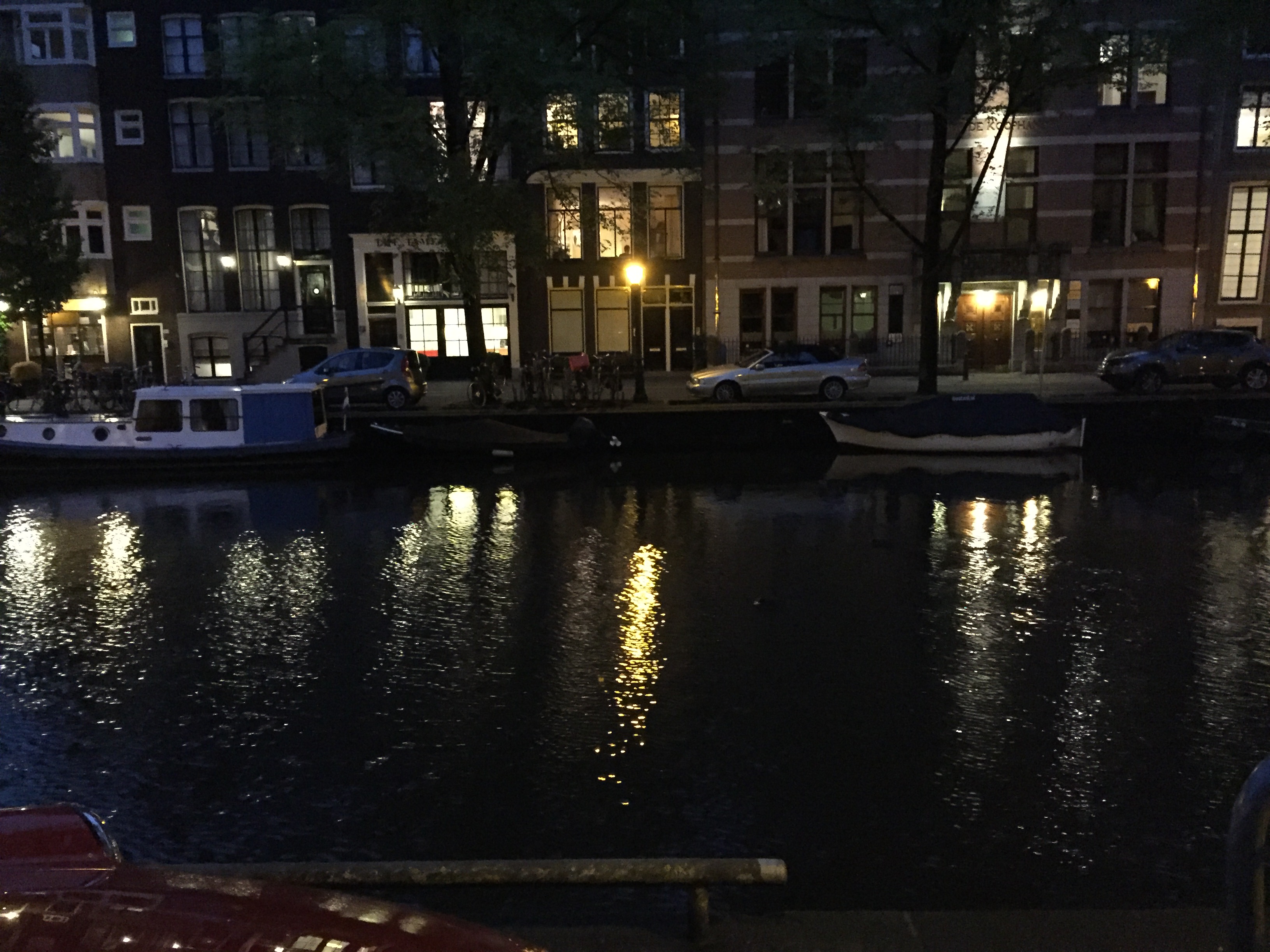
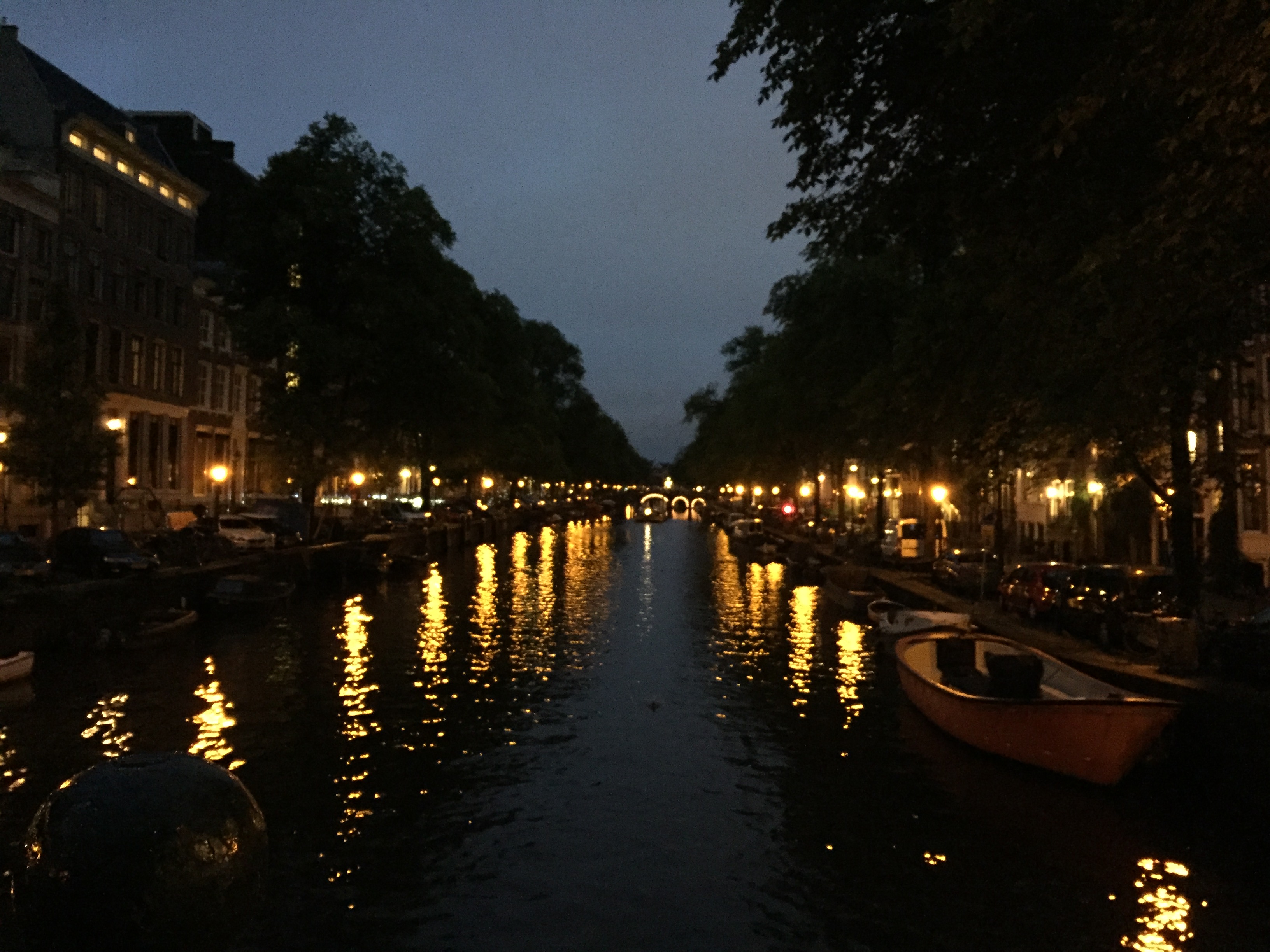
IMG_1478IMG_1480Another post-dinner trek, along a couple of canals not far from our hotel in central Amsterdam, also was gold. This time our walk started under skies that were fully dark. Not too many people were around. And it was quiet. These were conditions that collectively, in a major city, you don’t often run into. I tell you, the vistas were something else. Reflections from house lights in the canal waters looked like cascades of glitter. And the small bridges crossing the canals were lit along their sides like yuletide shrubbery. I’ve said it before and I’ll say it again: Amsterdam is a place where I’d be happy and content as a clam to live.


IMG_1388IMG_1389

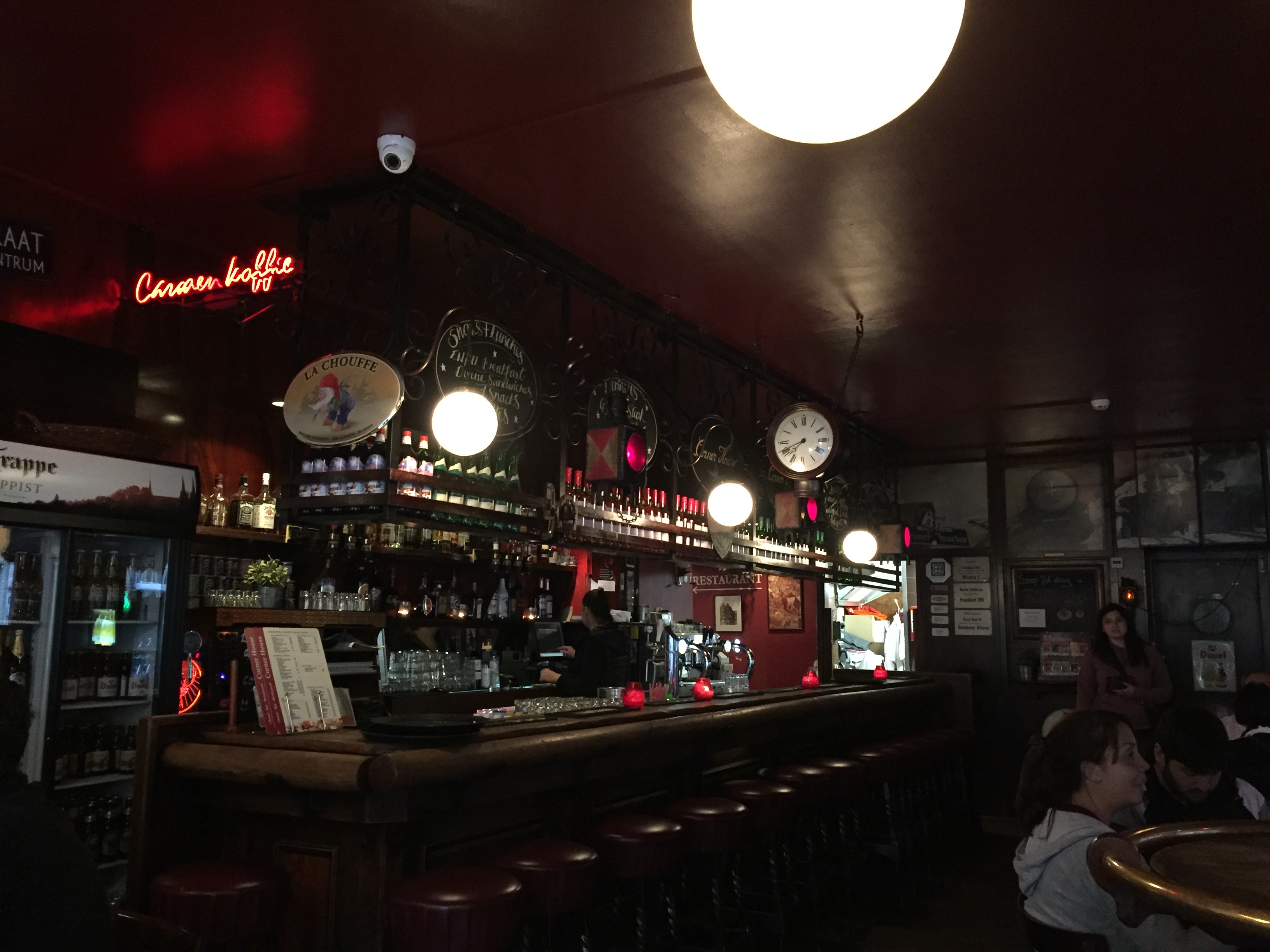
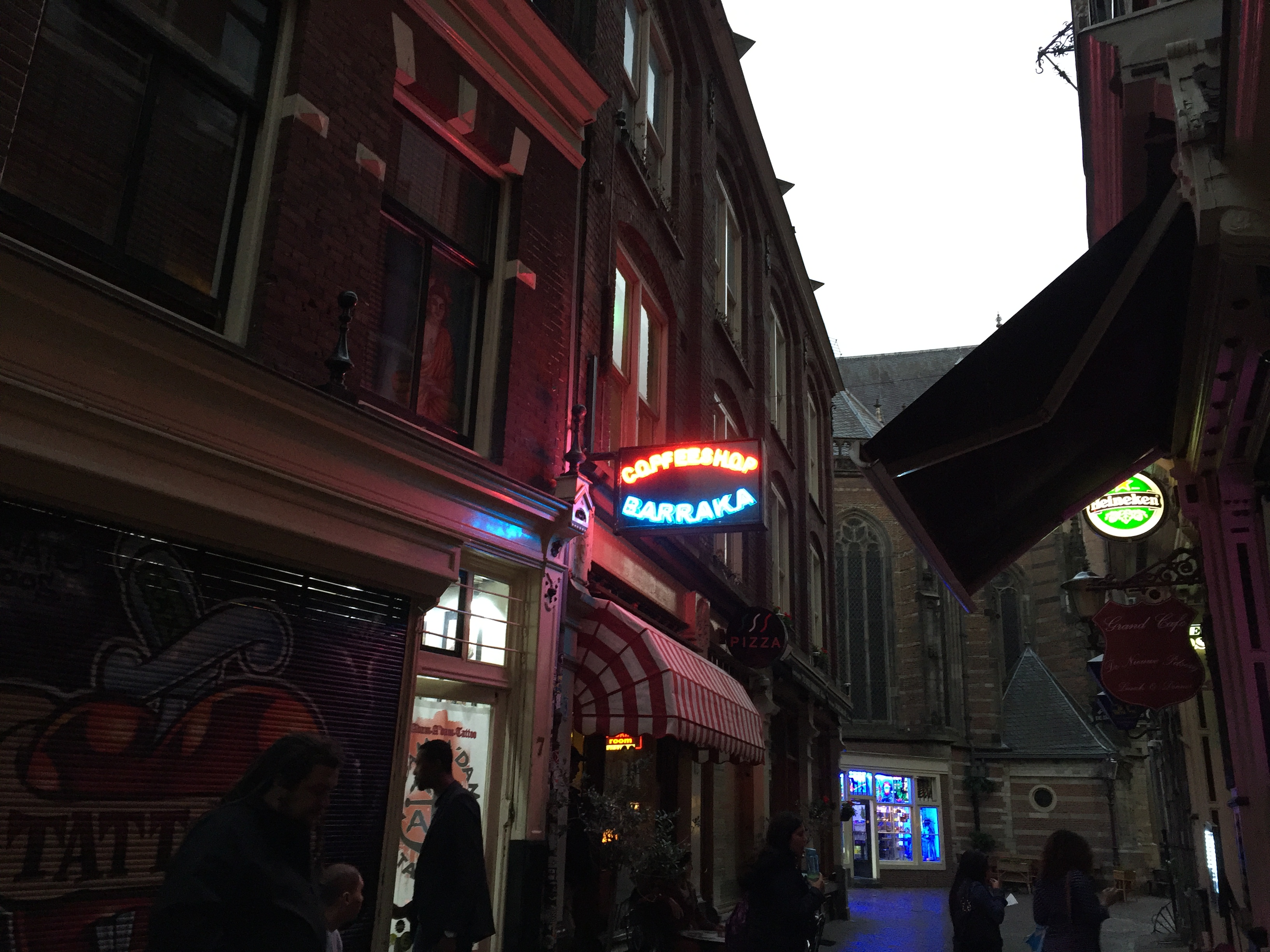
But it wasn’t only late night outdoors views in Amsterdam that nabbed my attention. Things sometimes got awfully atmospheric indoors too during advanced hours. Usually in restaurants. Our first night in the city, for instance, we had dinner in the middle of town at the cozy Corner House, which serves up some traditional Dutch fare. We had arrived in Amsterdam from Paris with our friends Martine and Alan, and they were at the eatery with us. We all settled in comfortably on that rainy night, soaking up Corner House’s low wattage vibes. The subdued lighting gave the place a charm and magnetism that probably it didn’t have at lunchtime. And after dinner we stepped outside into streets hundreds of years old where, electric lights illuminating the dimness only gingerly, mystery and intrigue cast bigtime spells.

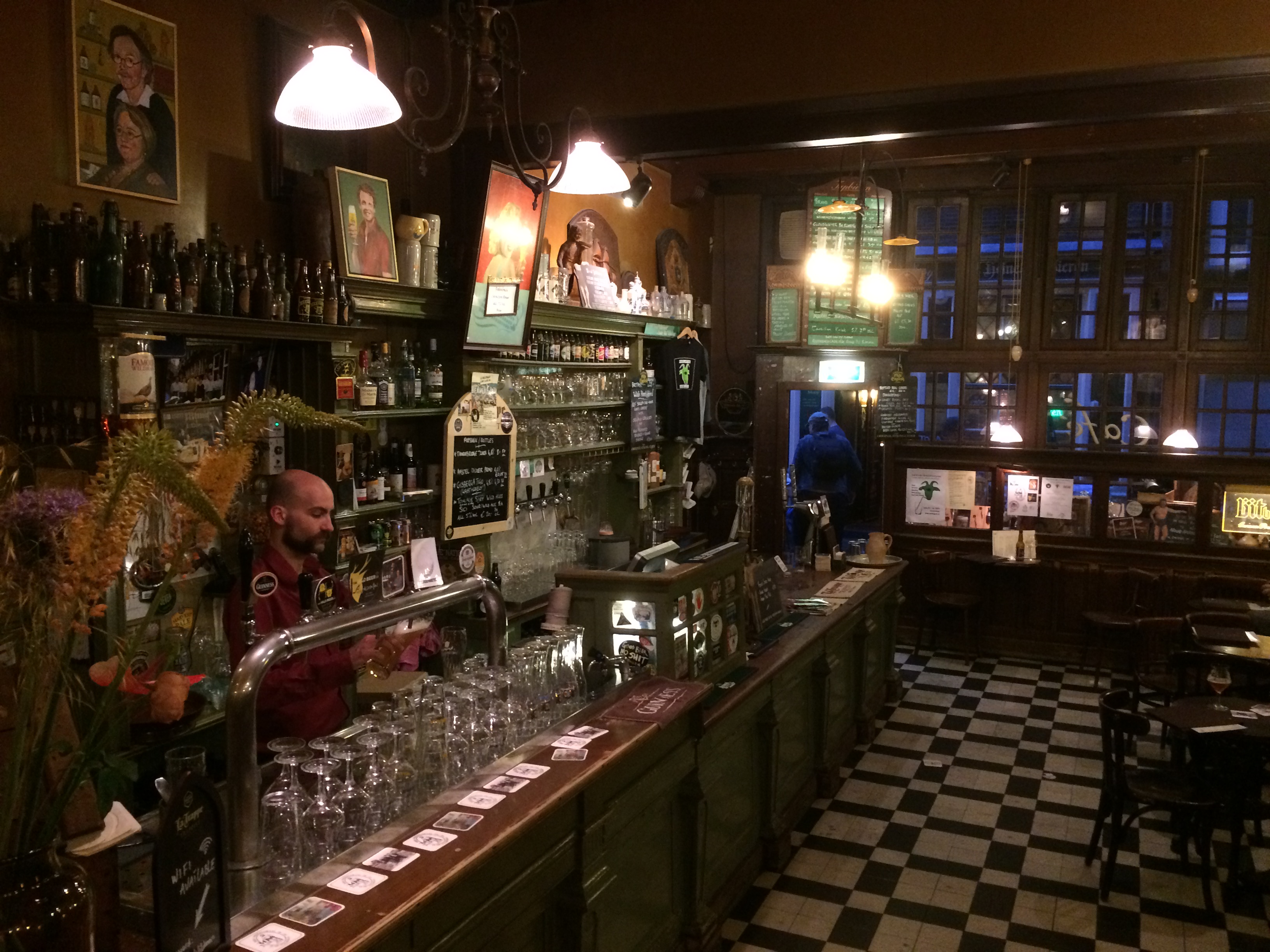
IMG_0787And talking about vibes . . . they don’t come much better than those you get, as midnight approaches, within In De Wildeman. It’s a tavern in a semi-ancient building, and prides itself on its wide selection of beers. A craft beer geek, I went there several times to drink suds from Dutch breweries not named Heineken and Amstel. There are a decent number of them, though most Amsterdam establishments don’t carry them. More’s the pity. In any event, Sandy and I popped into evocatively-lit In De Wildeman, down the block from our hotel, very late on a Wednesday night. The next morning we would fly home, and I wanted to down one last Dutch microbrew before bidding the Netherlands adieu. I did. Sort of. It was a pale ale brewed exclusively for In De Wildeman by The Wild Beer Company. It was delicious. Turns out, though, that Wild Beer’s brewery is located in England, not the Netherlands. Oh well, close enough.

(Don’t be shy about adding your comments, or about sharing this article with others)

(Photos by Sandra Cherrey Scheinin. If you click on any photo, a larger image will open)
Monet The Great

Well, I’ve made it to this, the beginning of Part Two of my planned three-part examination of the trip that my wife Sandy and I took to Paris and Amsterdam last month. So far, so good. For those interested, the first installment may be read by clicking right here.

And now it’s time to move past Part Two’s beginning . . . uhhhhhh, we have a problem here, Houston. You mean I need to come up with something to say? Now? What’s that all about? I tell you, this writing business ain’t all it’s cracked up to be.

(The author, frustrated and close to tears, is moments away from removing his fingers from his computer’s keyboard. Shortly he will be guzzling several shots of Jack Daniels. Straight.)

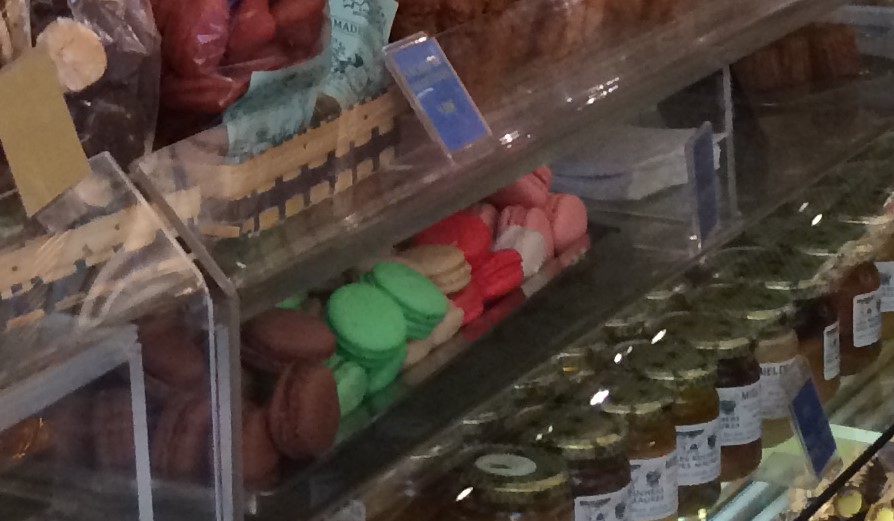
Macarons are in the middle of photo.
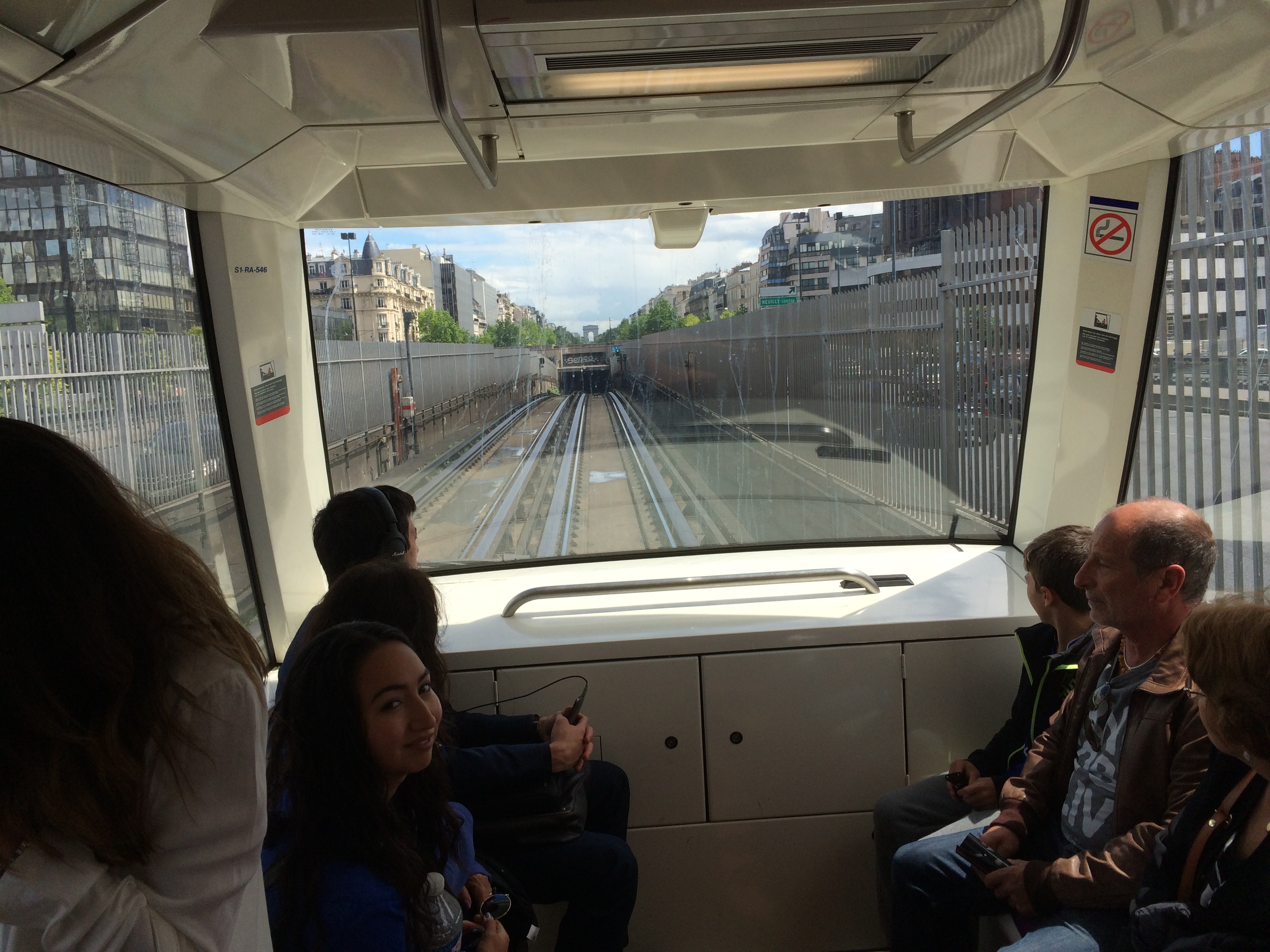
Where's the driver?
Where’s the driver?

OK, I’m back and feeling better. I’m not gonna throw in the towel just yet. A jolt of inspiration whacked me a few minutes ago, and it was more than helpful. “Dummy, what’s the one thing you did in Paris that you liked more than anything else? That’s what you should write about next,” the jolt said to me. Wow, that was an enlightening question and an on-target statement. I put down my shot glass and thought about some possibilities. Seeing that I like being part of the In Crowd, I had to admit that eating macarons, colorful and tasty meringue-filled cookies that are all the rage in Paris, was a nifty experience. So was sitting at the front of one of the driverless Metro trains as it sped down the tracks, wondering how the f**k anybody figured out how to make that concept work.

But neither of them was number one. Nope, number one took place in a museum. And were it not for a blog that I stumbled upon a month or so ago I wouldn’t have been there.

I became a blog surfer at some point last year. Meaning, I get a kick checking out, sort of randomly, the near-infinity of blogs in cyberspace. And what I’ve discovered is that there are an astonishing number of blogs that range in quality from good to superb. Who’d ever have thought that so many perceptive/talented/creative people exist? Hey, it gives me hope. Anyway, I don’t remember the name of the website that I just mentioned stumbling upon, but stumble upon it I did while researching my Paris-Amsterdam expedition. And one of its articles made an impression on me. In it, the writer mentioned once being in Paris and absolutely loving the large canvases of water lilies, painted by Claude Monet, that hang in Musée de l’Orangerie (The Orangerie Museum). I was familiar with various of Monet’s water lily paintings — he churned out more than 200 of them over the years while living at Giverny, a country village about 50 miles from Paris, getting his inspiration from the water lilies that floated in the large pond on his property. But I knew nothing about l’Orangerie or its contents till skimming that article.

And thus when Martine and Alan, our Parisian friends with whom we were staying, asked Sandy and me what we might like to do while in Paris, I said I didn’t have a lot of specifics in mind but maybe l’Orangerie wouldn’t be a bad idea if we happened to be in the area.

Good call, Neil. In fact, a perfect call.

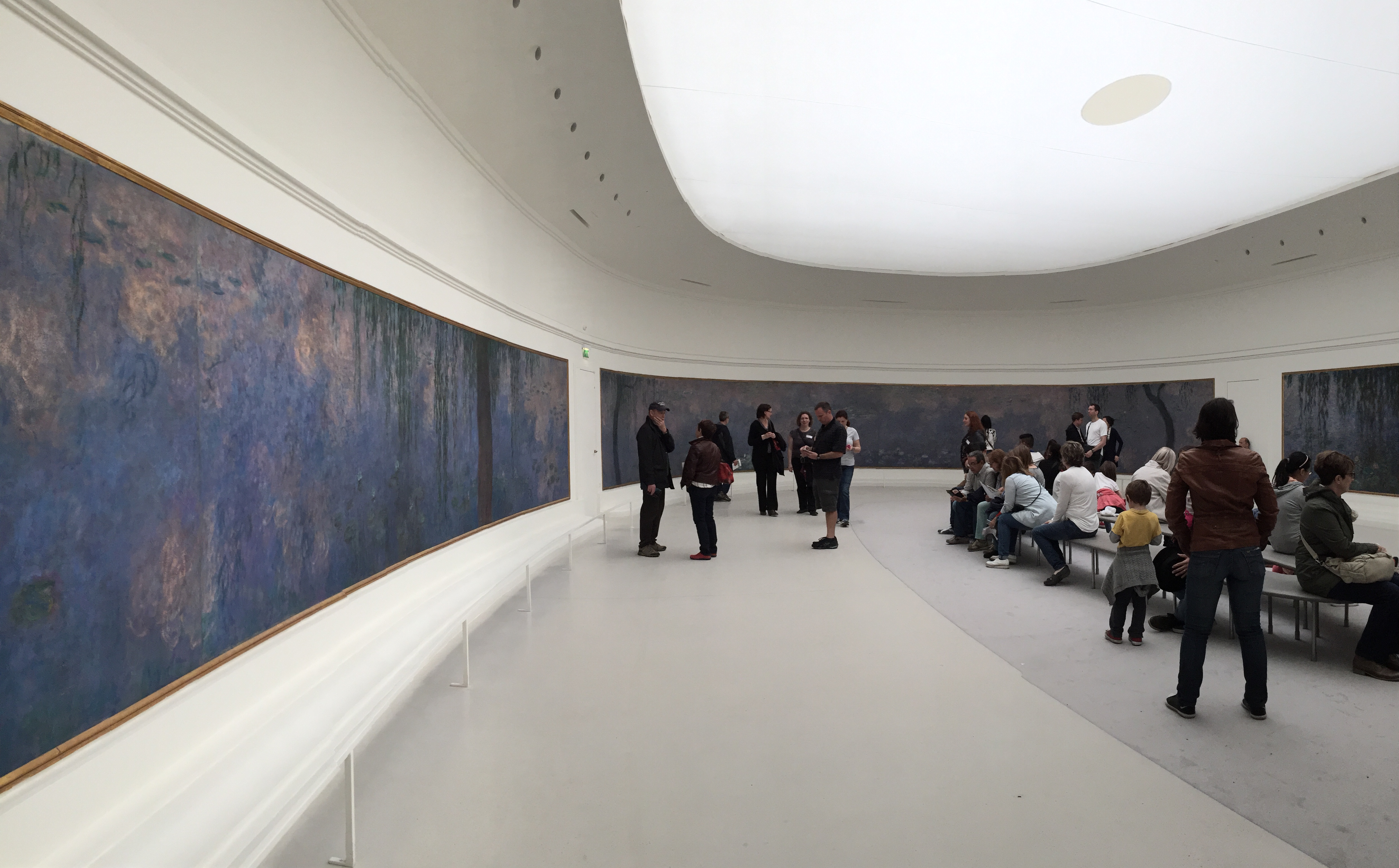
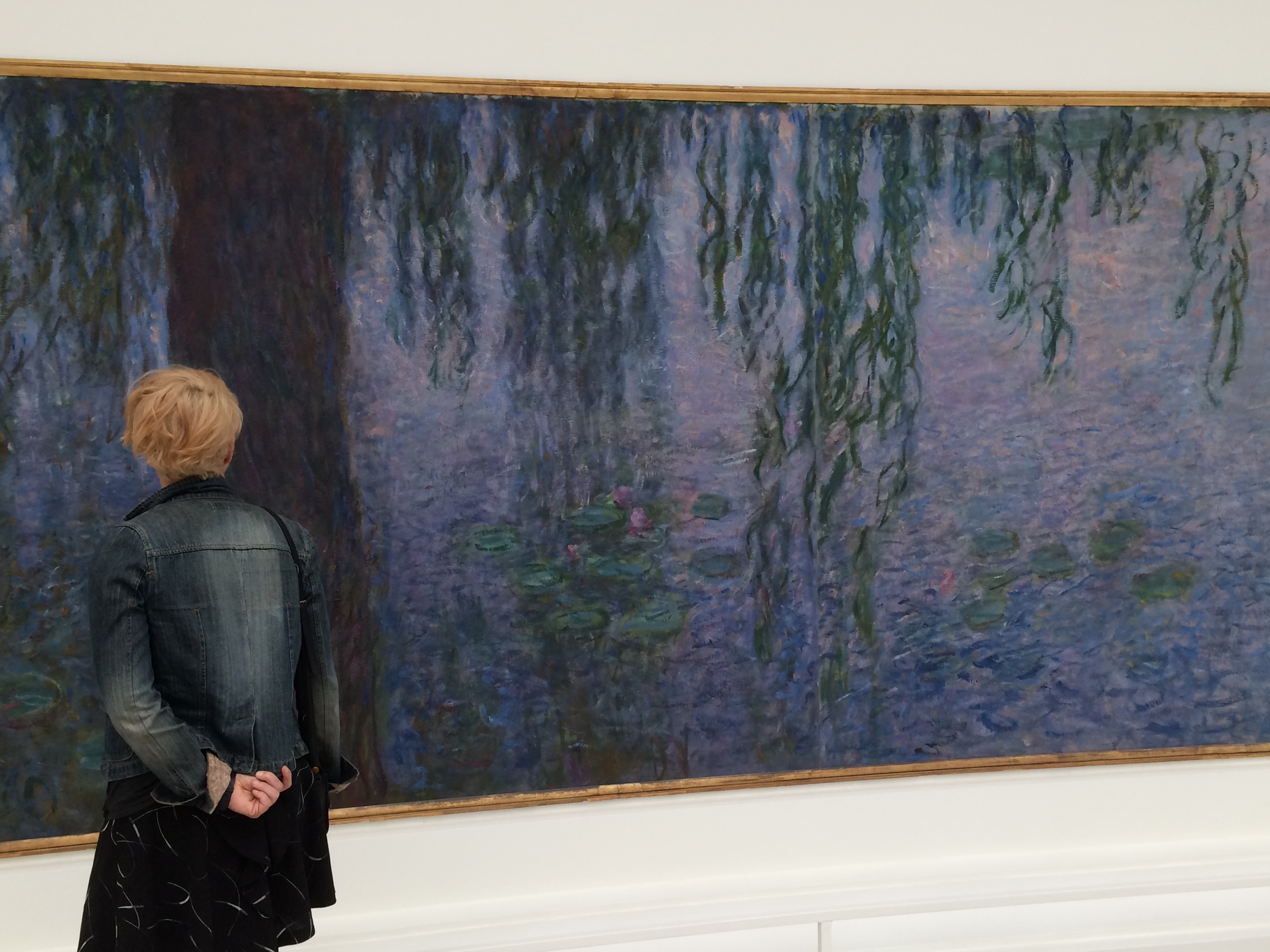
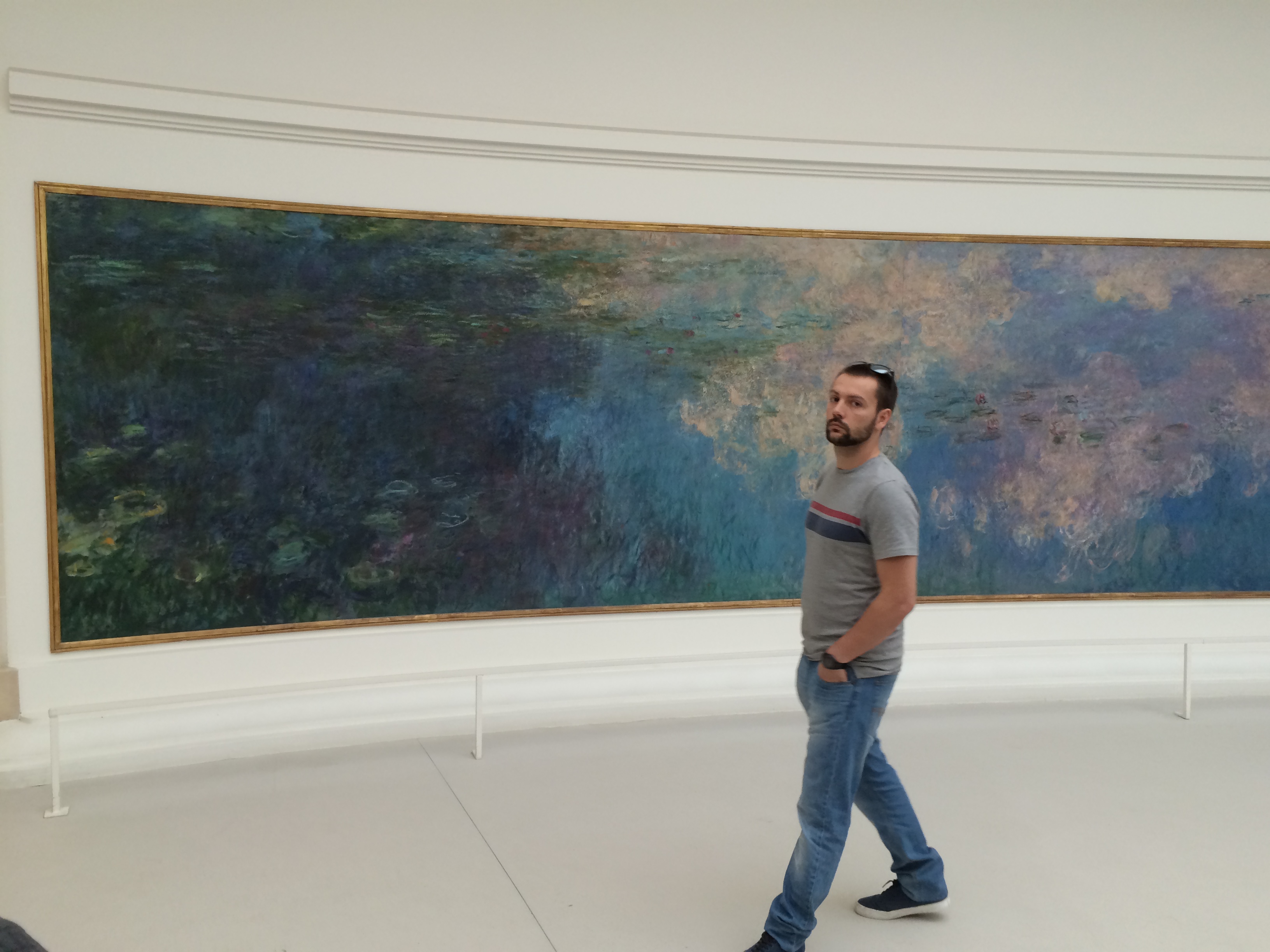
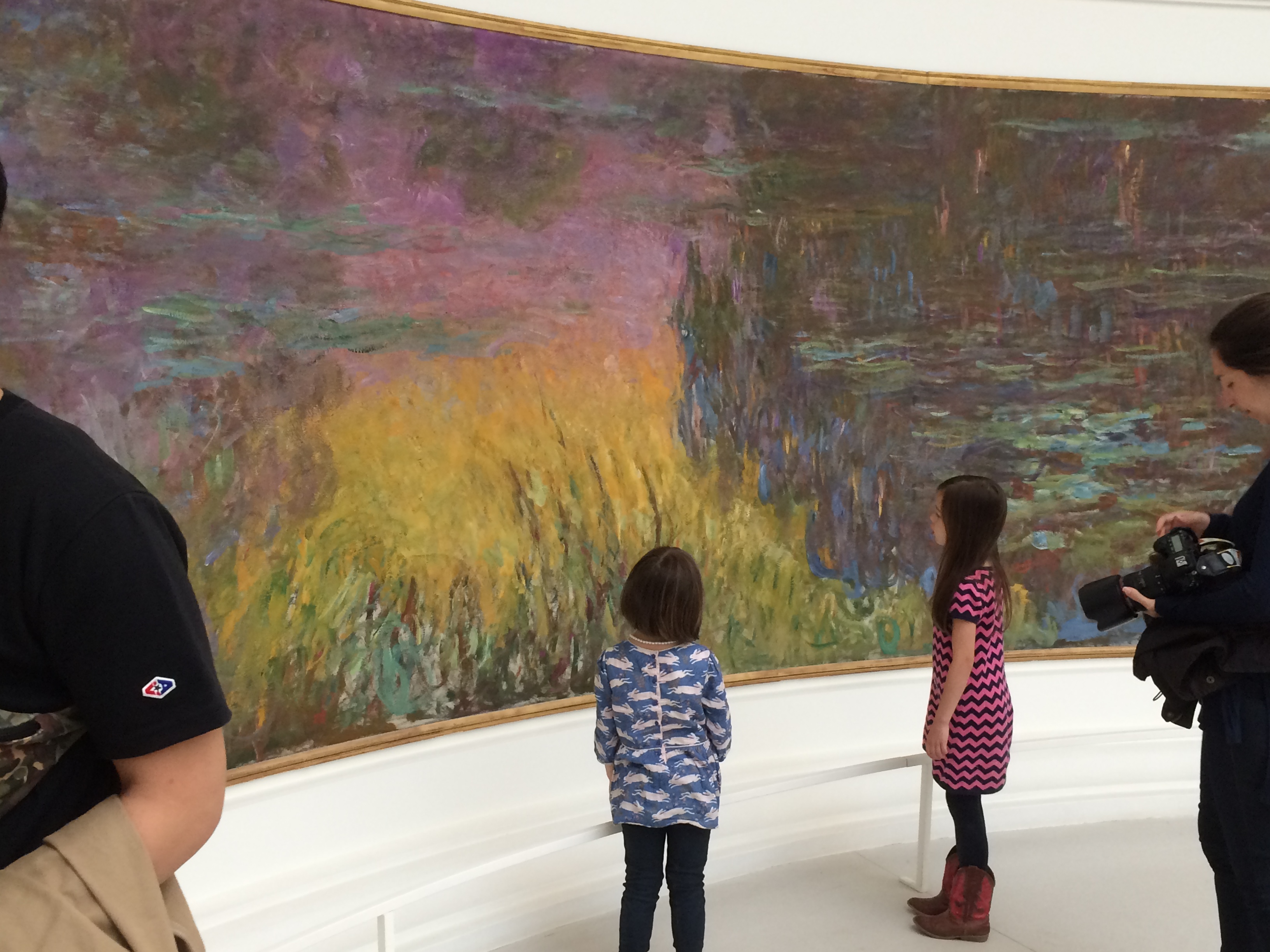
IMG_0548IMG_1335You know, I feel fanboy-ish and unstudied in saying this, but the eight enormous water lily canvases at the Orangerie are among the greatest paintings I ever have seen. Complex, inspiring, bedazzling, calming, mind-expanding, yes they are all of that. And their powers play off one another. Which is why their cumulative force is off the charts, in a contemplative sort of way. Right, right, I’m getting carried away here, but what can I do? I’ll try to calm down.

Monet worked on these paintings for 12 or so years, nearly up to the time of his death, at age 86, in 1926. He donated them to France, wanting them to represent peace and tranquility to a world that needed macro doses of same, as it does today. And he negotiated with the French government for the canvases to be housed in special chambers. Two curved rooms with natural lighting, quiet and elegantly simple, would fit the bill he decided. And he felt that the Orangerie would be a fine spot in which to build those rooms, whose design and construction he oversaw. But he didn’t witness the installation of his giants, which took place the year after he left this world.

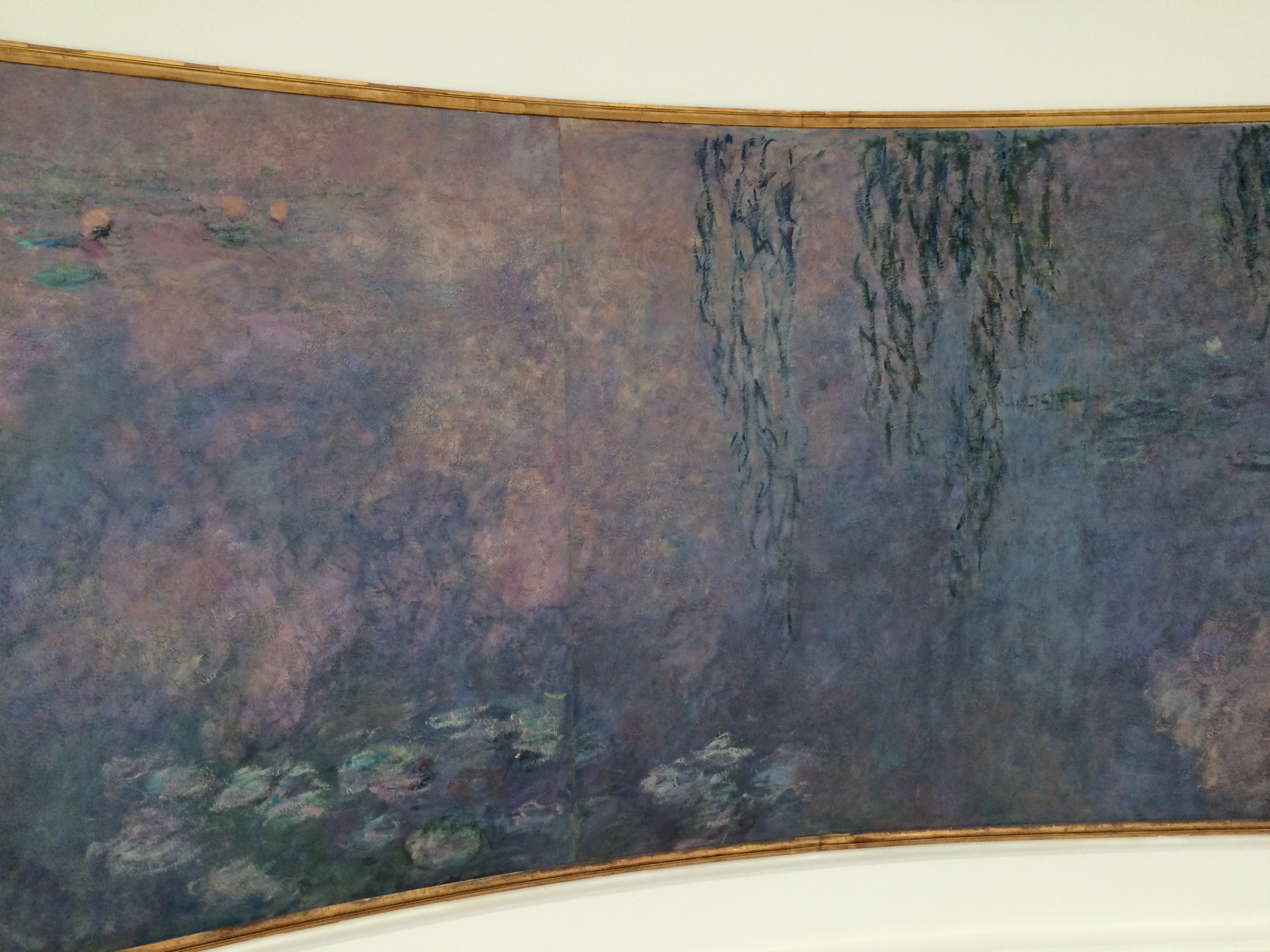
IMG_0560IMG_0559Earmarking eight monumental canvases (they are six and a half feet high and average 37 feet in width) for France’s citizens, to be displayed in custom-made quarters, was a grand gesture on Monet’s part, possibly the grandest of his life. When I walked into the two rooms that the works occupy, four per room, I felt as though I were in a sanctuary, a shrine. And I was. Sandy, Alan, Martine and I spent an hour there. These are paintings you can get lost in. I know that I did, and I think the others in my party did too. The canvases are dreamy, amorphous, color-rich yet for the most part muted. Water lilies are depicted on each canvas, but they are only part of the story. Other small vegetation appears. And wispy visions of willow trees float on the four paintings, done in somber shades of violet and purple, that are housed together in one of the rooms.  Still, more than anything the works are dominated by water, sky reflections and, depending on the canvas, bright or nuanced light. All of those components, material and ethereal, are in their glory in the Orangerie’s Monet spaces.

IMG_0547IMG_0550And the paintings verge on abstraction. These are a whole other ballgame from the gorgeous hillside and seaside scenes that Monet, a founder of Impressionism in the 1860s, once painted. Monet’s sense of color, and his feel, are totally recognizable on the large canvases, but the idea of place largely is gone. Purposely. I think that what he was trying harder than ever to do was to distill the natural world, to get to its essences. An incredible endeavor for someone who began the project in his very advanced years. Monet The Great, no doubt.

Not unusual for me, I was late to the party. Obviously. I mean, millions of people know about the Monets at the Orangerie Museum. And swoon over them. A few days ago, for example, my brother mentioned to me that they are his favorite works of art in all of Paris. Ah, what can I say?

Okay, I’ll say this: The Orangerie is brimming with tremendous art besides Monet’s. The many oils there by Chaim Soutine and Maurice Utrillo, two guys you don’t ordinarily see too much by, knocked me out. But Monet is the museum’s heart. A couple of day’s ago, Sandy reminded me of something that popped out of Alan’s mouth after we left l’Orangerie. “I guess we got our Monet’s worth,” he sagely cracked. Truer words were never spoken.

(Don’t be shy about adding your comments, or about sharing this article with others)

(If you click on any photo, a larger image will open)

Fun Times In Paris And Amsterdam: An Overview

We went, we saw, we had a very swell time overall, and then we came home. The end.

There’s something to be said for conciseness, don’t you agree? And maybe if I were more courageous than I am I’d write not another word beyond the 18 contained in the two masterful sentences above. But my fingers, God help them, are itching to type, so I’ll bag that idea for now. In fact, I’m going to try and bite off more than I normally can handle, by turning my wife Sandy’s and my recent visit to Paris and Amsterdam into a three-part blogging extravaganza. I’ve noted before on these pages that I have trouble enough producing one-parters. Wish me luck.

Let’s begin. In many ways I’m a lucky individual. And I don’t take my good fortune for granted. Throughout my adult life, for instance, I’ve done a fair amount of traveling. In the earlier of those years I somehow wandered far and wide with not much more than a few bucks in my pockets. During the last three decades they have been more fully filled with cash (and plastic). Regardless of my financial situation, though, I’ve never ceased to be amazed that I’m able to leave the home environment and rev my motor in other parts of the world. And for my money you can’t do a whole lot better than to frolic in Paris and Amsterdam. Great cities both. Beautiful cities both. And Sandy’s and my week-and-a-half-long sojourn there earlier this month came with a special bonus. Namely, we spent most of the expedition with our très magnifique pals Alan and Martine.

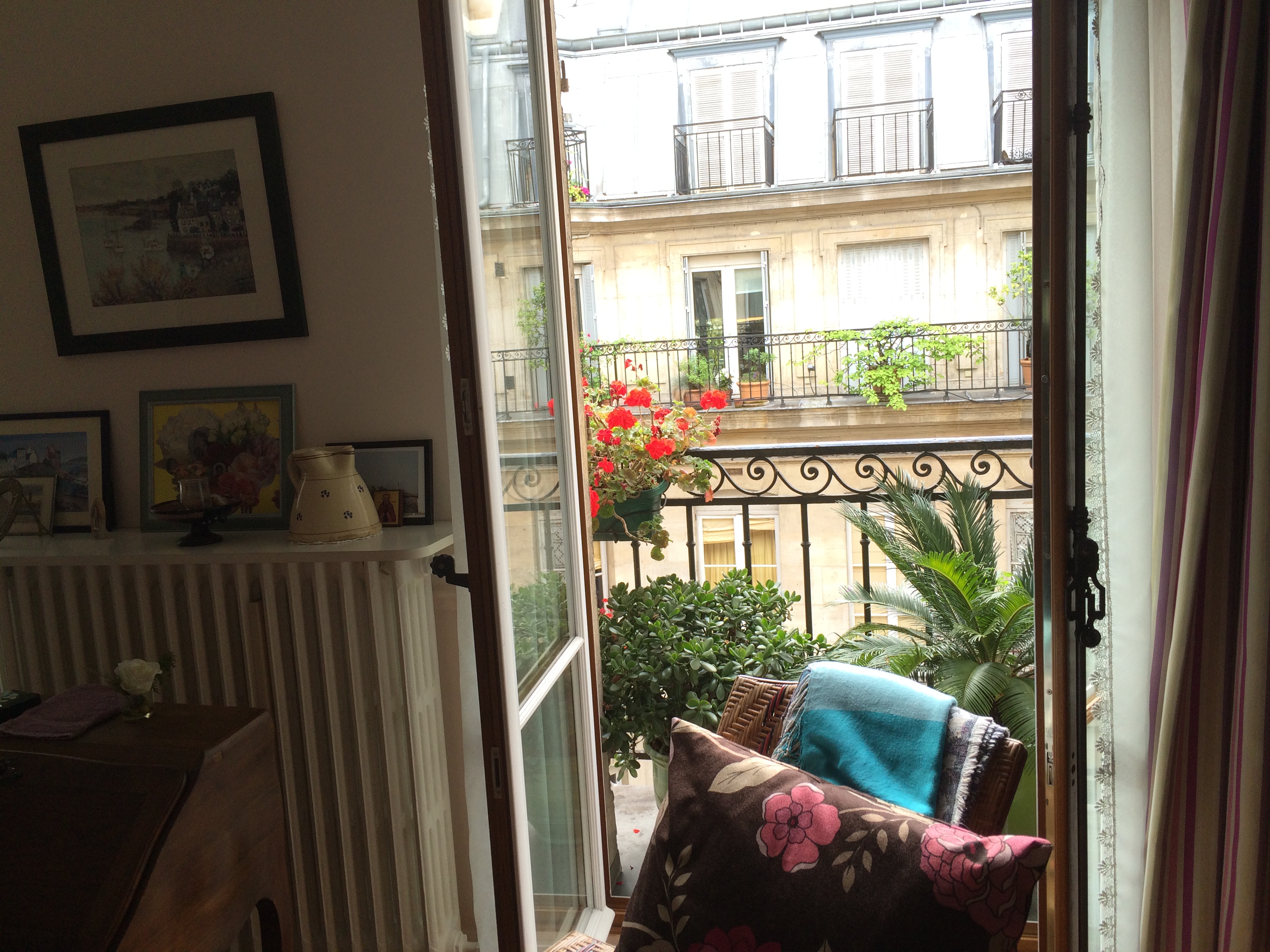
The view from Martine and Alan's guest bedroom.
The view from Martine and Alan’s guest bedroom.

Martine and Alan live in Paris. Have a lovely home in the city’s heart. And they not only put up with us, they put us up. I guess they like us because, after four days of that, they hopped aboard an Amsterdam-bound train with Sandy and me. The four of us spent several days bopping around that canal-laced city until the scheduled time arrived for the Parisians to return home. Alan! Martine! Don’t abandon us! We’ll be lost without you! But Sandy and I showed ’em. Yeah, maybe we stumbled and fumbled a bit, but we sure as shootin’ had three more Amsterdam days heavily sprinkled with fun. Amsterdam, I miss you. A lot.

Now, Sandy and I had been to Paris before. We’d seen most of the must-sees and plenty of the less-noticed sights too, such as the building in which Vincent van Gogh crashed with his brother Theo for two years in the 1880s. This time around we decided to let things flow organically, whatever that means. And to try and spend lots of time just strolling around, taking in the views and vibes in as unpressured a manner as we could. Sure, we couldn’t resist going to a couple of museums (The Orangerie, The Marmottan Monet), and we had a sweet dinner in a quintessentially Parisian eatery (Le Petit Colbert), the type that natives frequent. But walking is what we did the most of. Miles and miles of it. All over central Paris, on both sides of the Seine. And beyond. The entire time, indoors and out, Martine and Alan accompanied us. They are expert tour guides and really, really good sports.

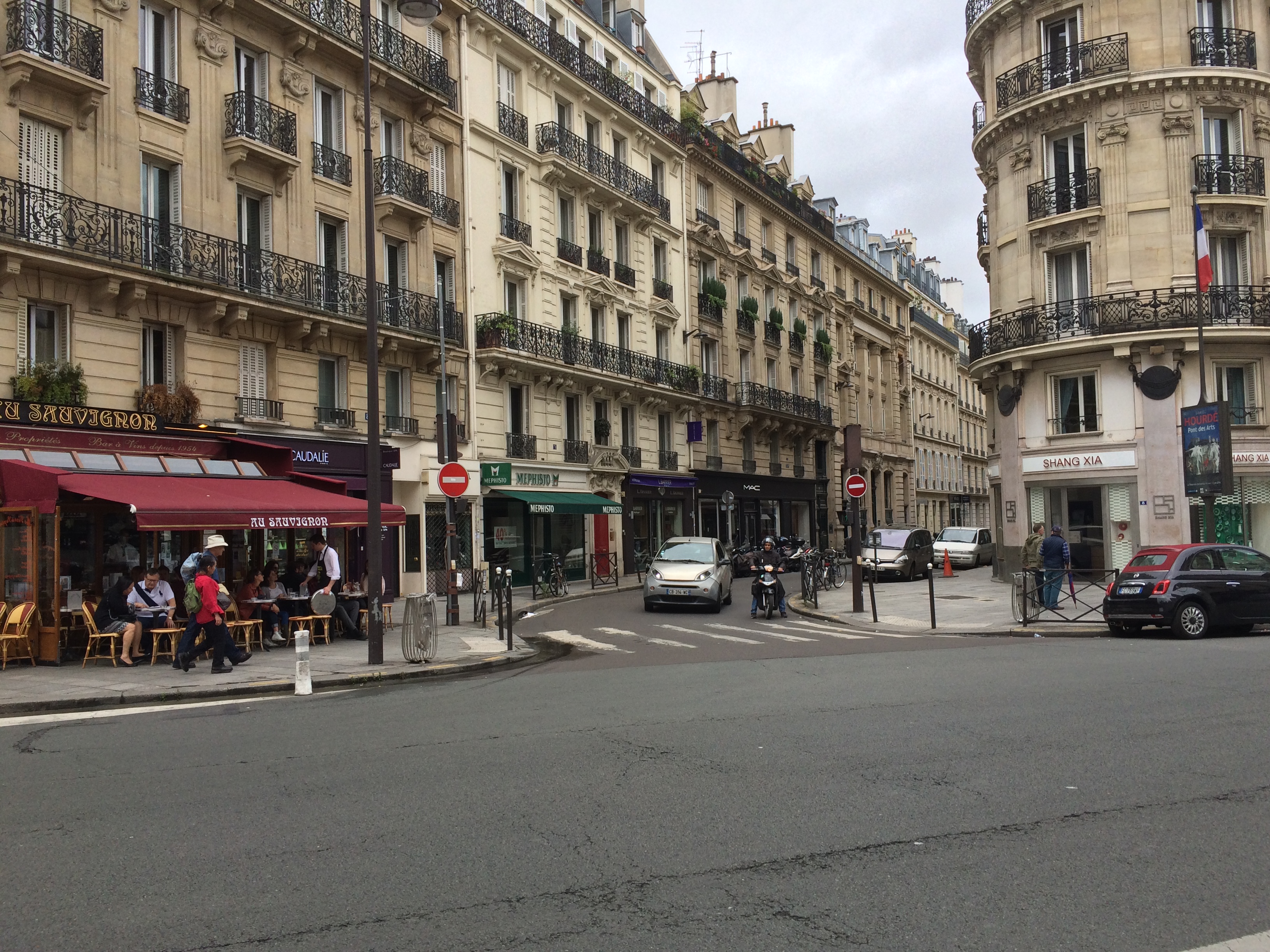
IMG_0523 IMG_0511 What can I say about Paris that hasn’t already been said? Nothing much, pardner. But that won’t stop me. I mean, I’ve got blog stories to create. First, if you haven’t been and have the means, you should go. As everyone knows, Paris’ appeal isn’t simply its gorgeousness . . .  the city is intriguing too. Streets come together at odd angles, a wonderful idea. Many sidewalks are narrow, an example of quaintness of which I approve. And seemingly every block has alluring buildings you’d like to live in, bistros whose tables are just made for sipping espressos beside, and perfect, little shops loaded with foods better than you’re likely to find at home. The pastries, the breads, the cheeses. Did somebody say breads? I live in suburban Philadelphia, and I know of only one place within five miles of my house where I can buy a crusty, flavorful rustic loaf of bread. Yo, when’s the next flight back? I need to be around people who know how to bake the staff of life.

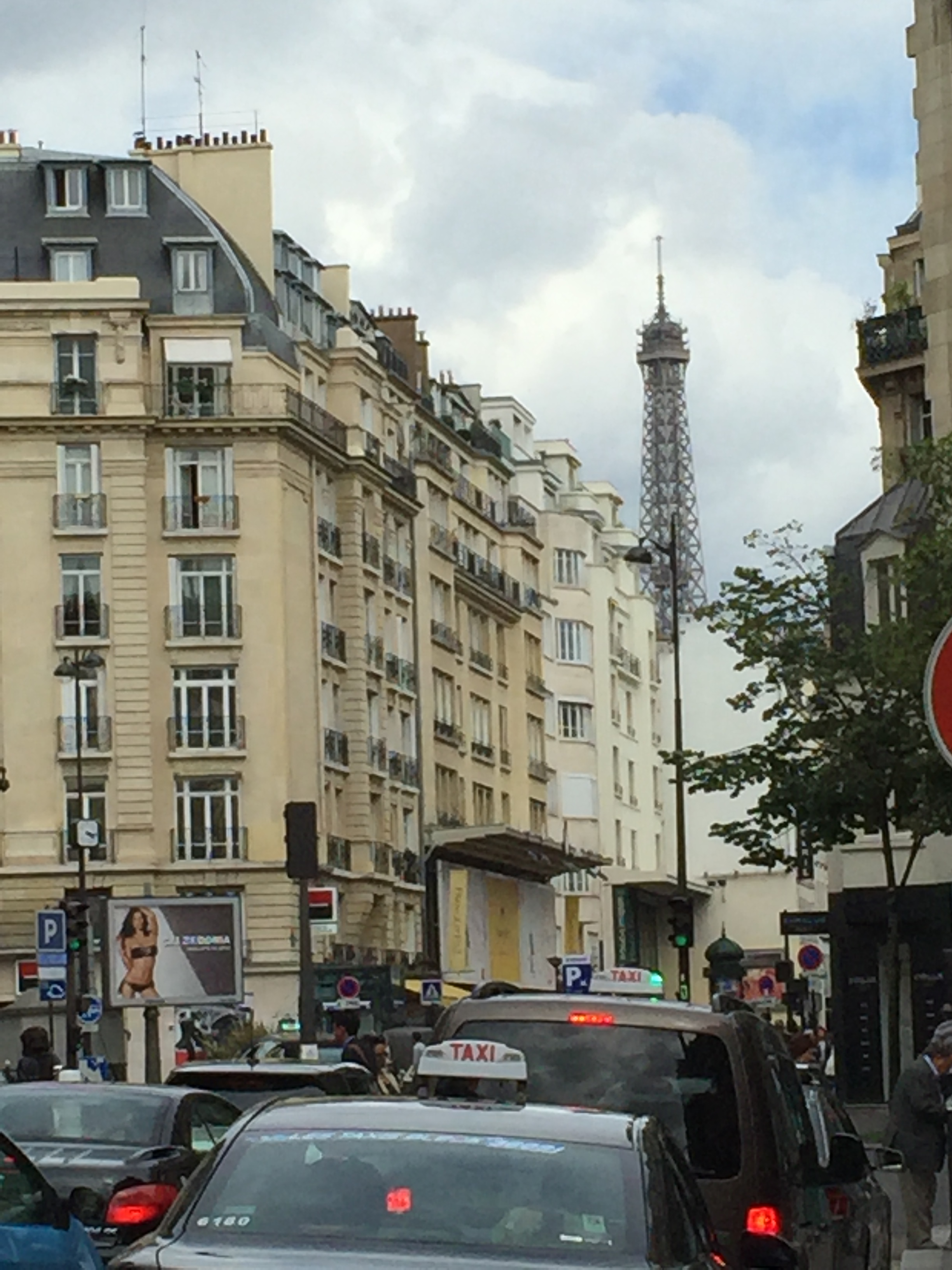
Eiffel Tower in the distance.
Notre Dame Cathedral.

And there’s a soul-satisfying uniformity in scale and color to much of Paris that I’d forgotten about. Most of Gay Paree’s buildings are from the 1700s and 1800s and about seven levels high and made from beige-colored limestone. Talk about a charming and serenity-inducing look. I couldn’t get enough of it. I wallowed in its aura.

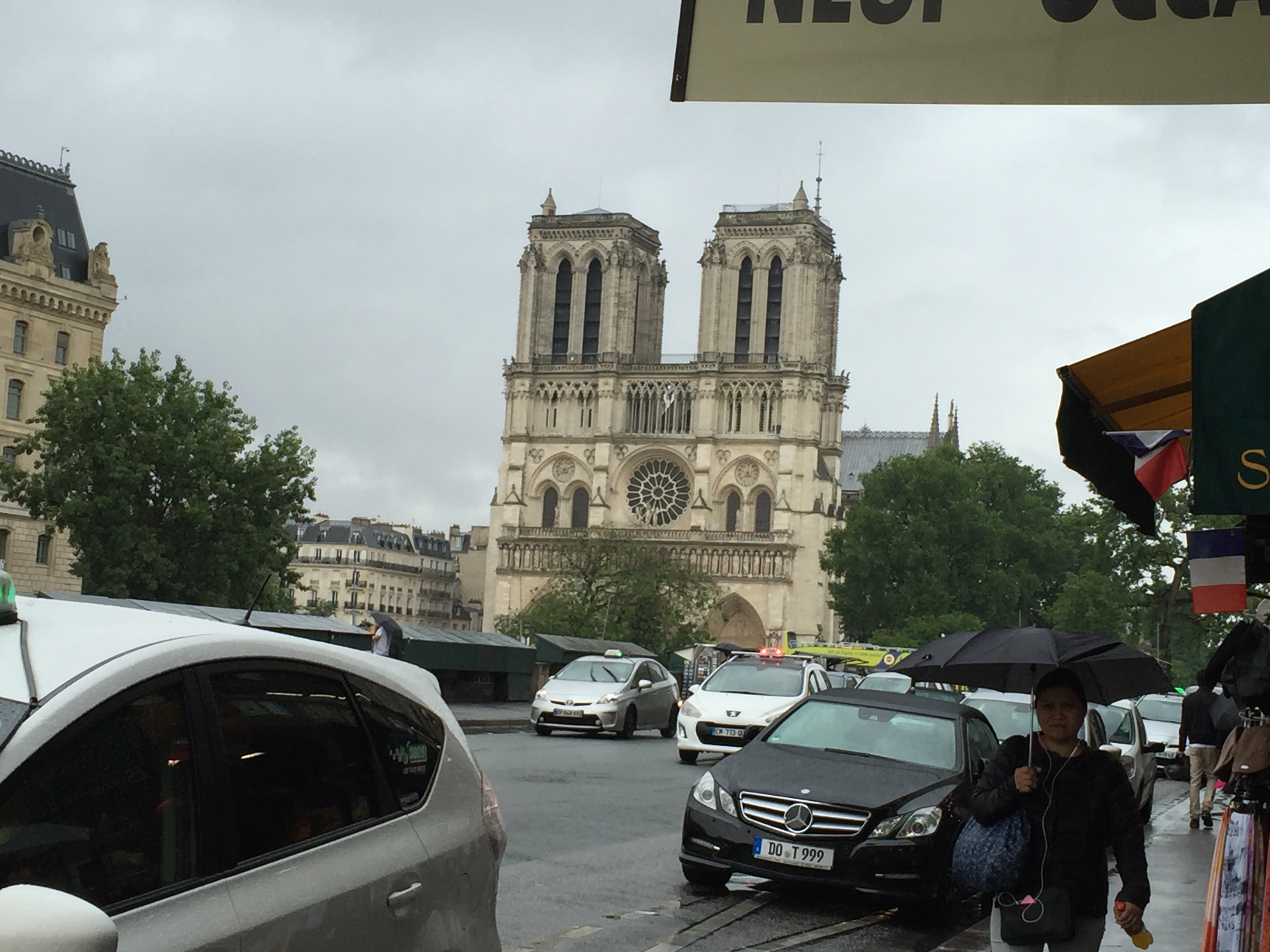
It would be a mistake for me to end my brief Parisian recap without mentioning the big guns for which the city is famed. For starters: The Eiffel Tower, Notre Dame Cathedral, the Seine, the unreally-huge Louvre Museum. To first-time visitors I’d say you’d do well to examine them thoroughly, though, to be honest, you easily could live without stepping foot within the Louvre.

A snap of the fingers later, Sandy and I and our friends found ourselves in Amsterdam. I’d been there about 30 years ago, though my pigeon-like brain has forgotten many details of the experience. Sandy never had been. I’ve got to tell you, this is a place where I’d be happy and content as a clam to live. And the fact that there wouldn’t be a language problem is a plus, as Amsterdammers speak English in addition to their native tongue. I kept looking around and exclaiming to myself and to whomever else in the party was nearby: “I love this city.”

IMG_1401IMG_1463What’s not to love? Amsterdam looks great. Most of the houses, many of which overlook canals, are cozy and cute and entertainingly gabled. Generally they stand five levels above ground and are constructed of bricks. And they are not new, the majority having been erected between 1500 and 1900. I like being in places that look pretty much the same as they did hundred of years ago. And the canals? Man, they crisscross the city gently yet semi-riotously. And their prettiness can not be exaggerated. As in Paris, the four of us walked and walked and walked. Very happily. And when we got tired of walking we climbed aboard Amsterdam’s trams, which make navigating the city a breeze.


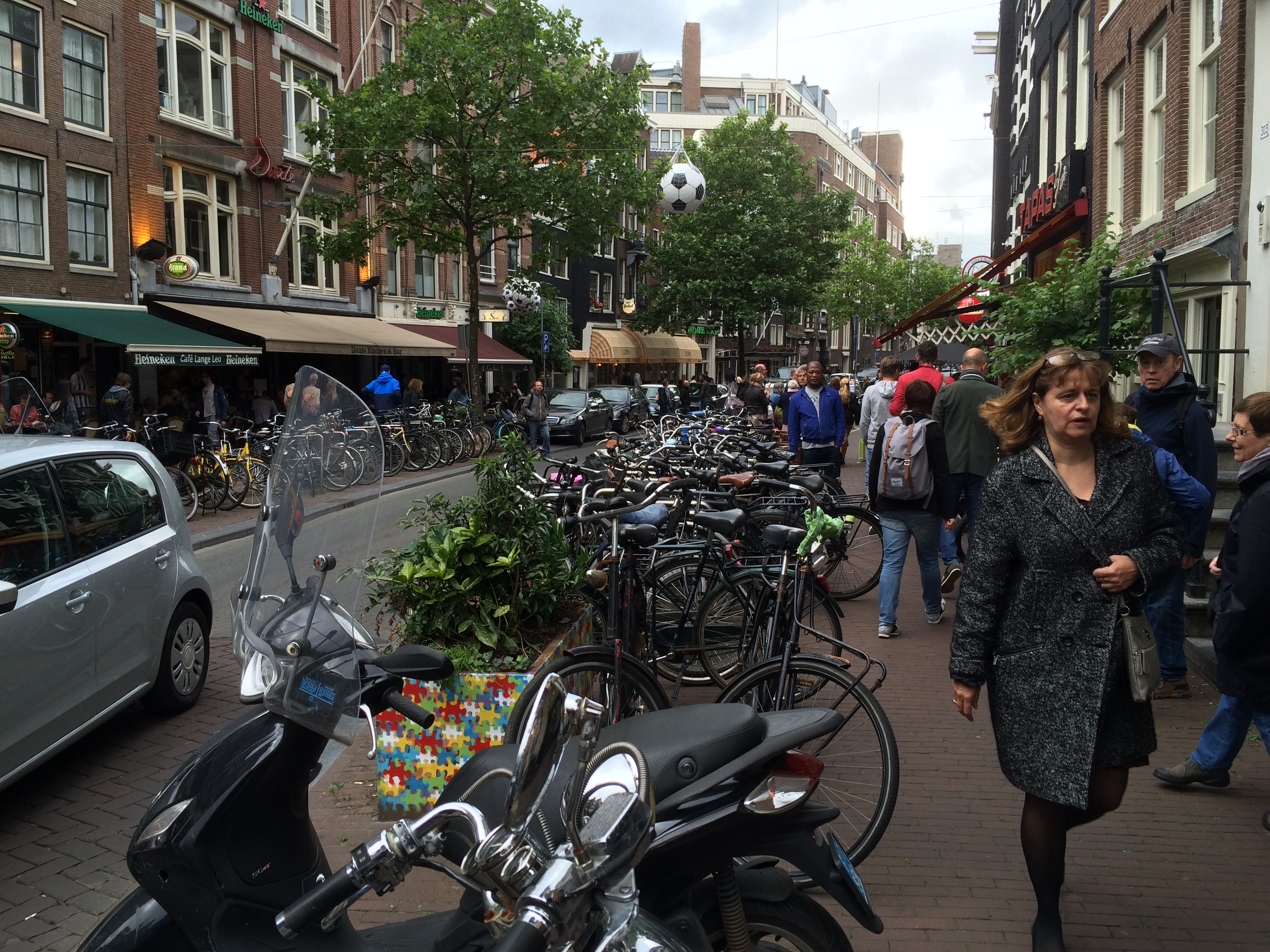
IMG_0670Amsterdam is relatively compact, meaning that you can make it to pretty much anywhere on foot, though some treks might take you an hour and a half. There aren’t a ton of cars on the streets, and that’s because Amsterdammers are bicycle-crazed. Practically everyone owns a bike and uses it to get around. I’d heard about the bicycle scenario, and it was a gas witnessing it. Bicycles, bicycles everywhere, loads in operation, many more attached to bike racks, bridge railings, trees, you name it. You gotta watch out where you’re going or you might get smacked by a bike. One evening, Martine received a double dose of near-trouble. It’s easy to become distracted by the loveliness surrounding you in Amsterdam, and that’s what happened to her. Stepping off the sidewalk into the narrow street bordering a canal, she nearly got clipped by a car. Half a minute later, at the same spot, a bicyclist almost broadsided her. But I’m giving the wrong impression. Back to Amsterdam’s magnetic powers.

At the zoo.
At the zoo.

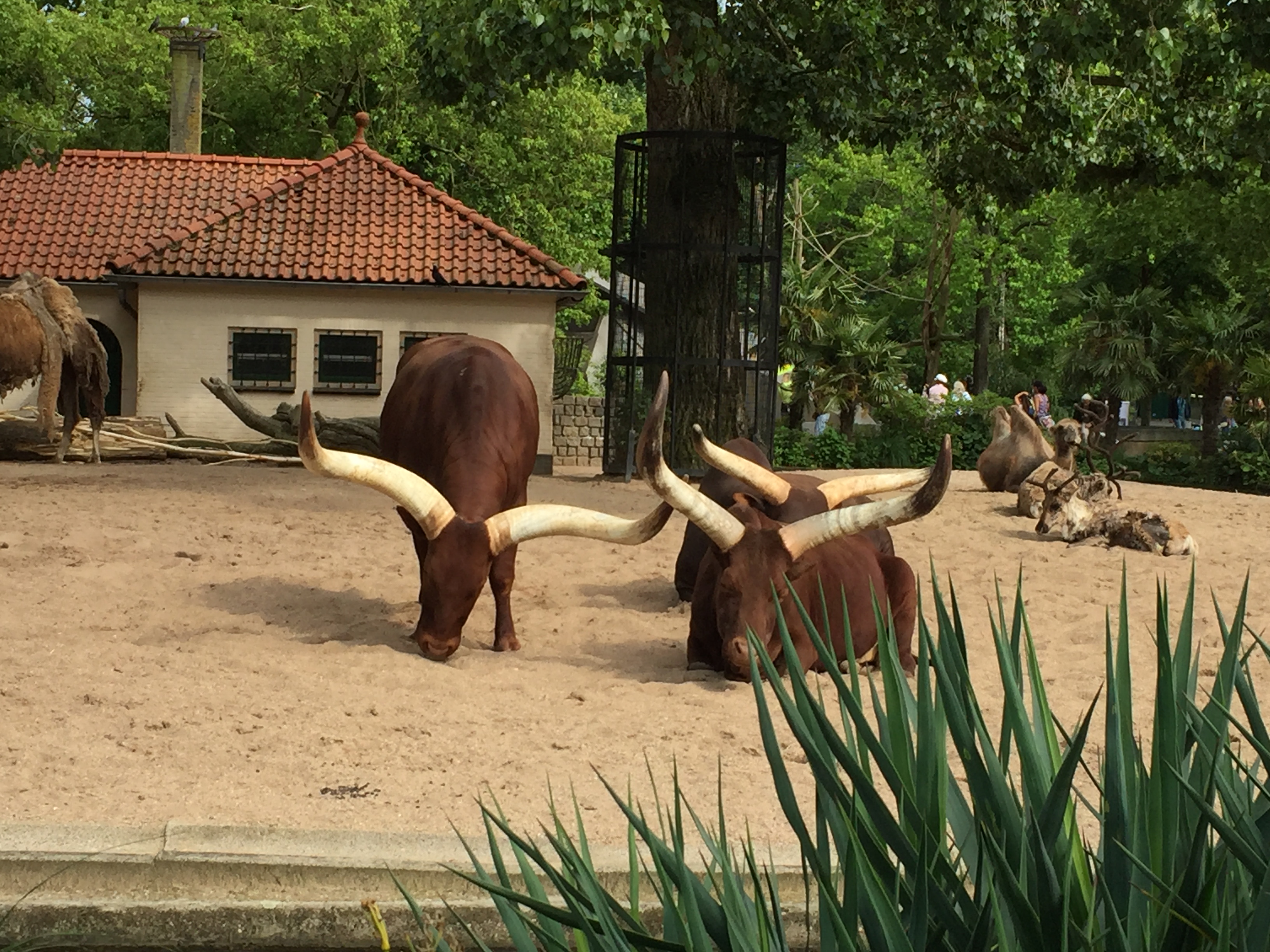
The Fearsome Foursome hit some of the famed sites together (Anne Frank House, Van Gogh Museum, Rijksmuseum) and took a groovy canal boat tour of the city. And after Alan and Martine hightailed it back to Paris, Sandy and I poked around neighborhoods and other spots, such as the city’s botanical gardens and zoo and the Stedelijk Museum, an astonishingly good modern art repository. Then, before we knew it, the time approached for us to head to the airport and return home. But I can’t wind things up without mentioning two subjects: marijuana and prostitutes. Amsterdam is famed for both, as cannabis use and prostitution are legal, within boundaries, in this enlightened and welcoming city. And they undoubtedly help make for an atmosphere real attractive to millennials (residents and visitors alike), who fill Amsterdam’s streets in uncountable numbers.

Now, seeing the prostitutes was kind of cool. They have set up shop on a smallish enclave of blocks in what’s known as the Red Light District, which my group toured on a Sunday afternoon. Barely dressed, the ladies stood in full view behind ground level doors and windows in what I assume used to be normal residences. My eyes, and those of my companions, were popping. Needless to say, I didn’t come close to indulging.

A purveyor of marijuana.

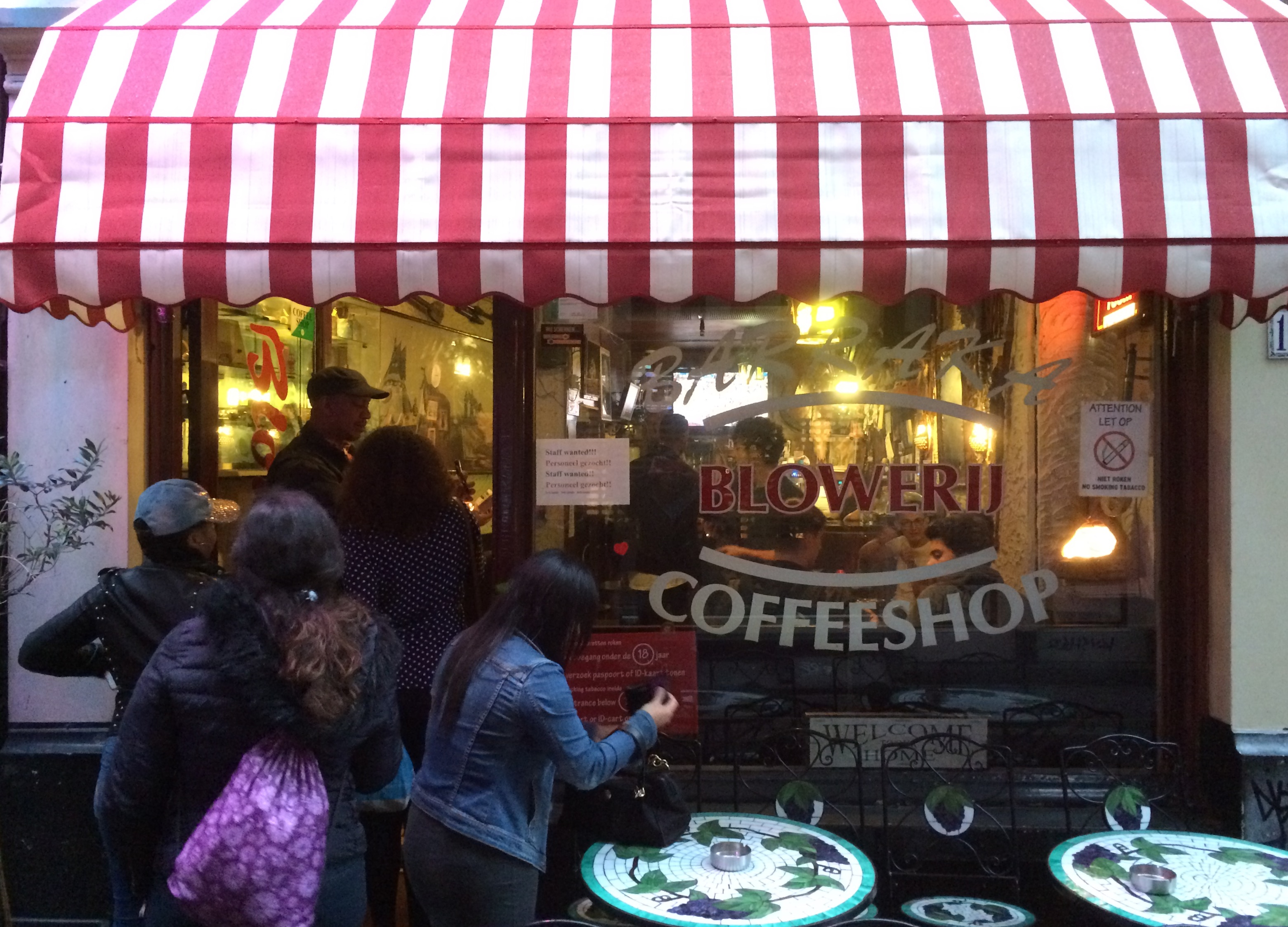
But marijuana was another story. Me, I haven’t had a toke in about 30 years. And boy was I tempted to resume the habit temporarily. After dinner on the day we arrived, Alan and I strode into one of the town’s numerous marijuana parlors, all of which, for reasons I don’t know, are called, incongruously, coffee shops. Alan strictly was an observer. The place looked like a Greenwich Village beatnik hangout. Lights were low, tables were small and occupied, and the air was filled with second-hand marijuana smoke. Inhaling deeply, I started to feel a bit of a buzz. I walked to the counter and sized up what’s what. Gazing at a menu, I saw that various strains of grass were available. The least potent varieties were described as strong. The most powerful were guaranteed to get you incredibly high. Prices for one ounce ranged, I think, from 10 to 15 euros. Not too expensive at all. One of the two girls behind the counter suggested to me that getting stoned after years of abstinence would be a terrific idea. I looked at Alan and pondered the situation. I breathed in the second-hand smoke hungrily. My buzz got slightly stronger. In the end, though, nerd that I am, I chickened out.

To be continued, if the stars align themselves properly.

(Don’t be shy about adding your comments, or about sharing this article with others)

(Most photos by Sandra Cherrey Scheinin. The crooked ones are by a nerd whom she knows. If you click on any photo, a larger image will open)

I Was Late For The Springtime Party

“You’re shvitzing like a pig,” my wife Sandy observed last week when I strode into the house after one of my highly infrequent walks around the neighborhood. Incredibly, I hadn’t realized how excellently the sweat was pouring off of me. Call me Mr. Observant. As I unbuttoned and took off my sopping shirt I thought to myself that I’d have inserted the word f**king before the word pig if it had been me commenting in Sandy’s place. She’s a lot more refined than I am.

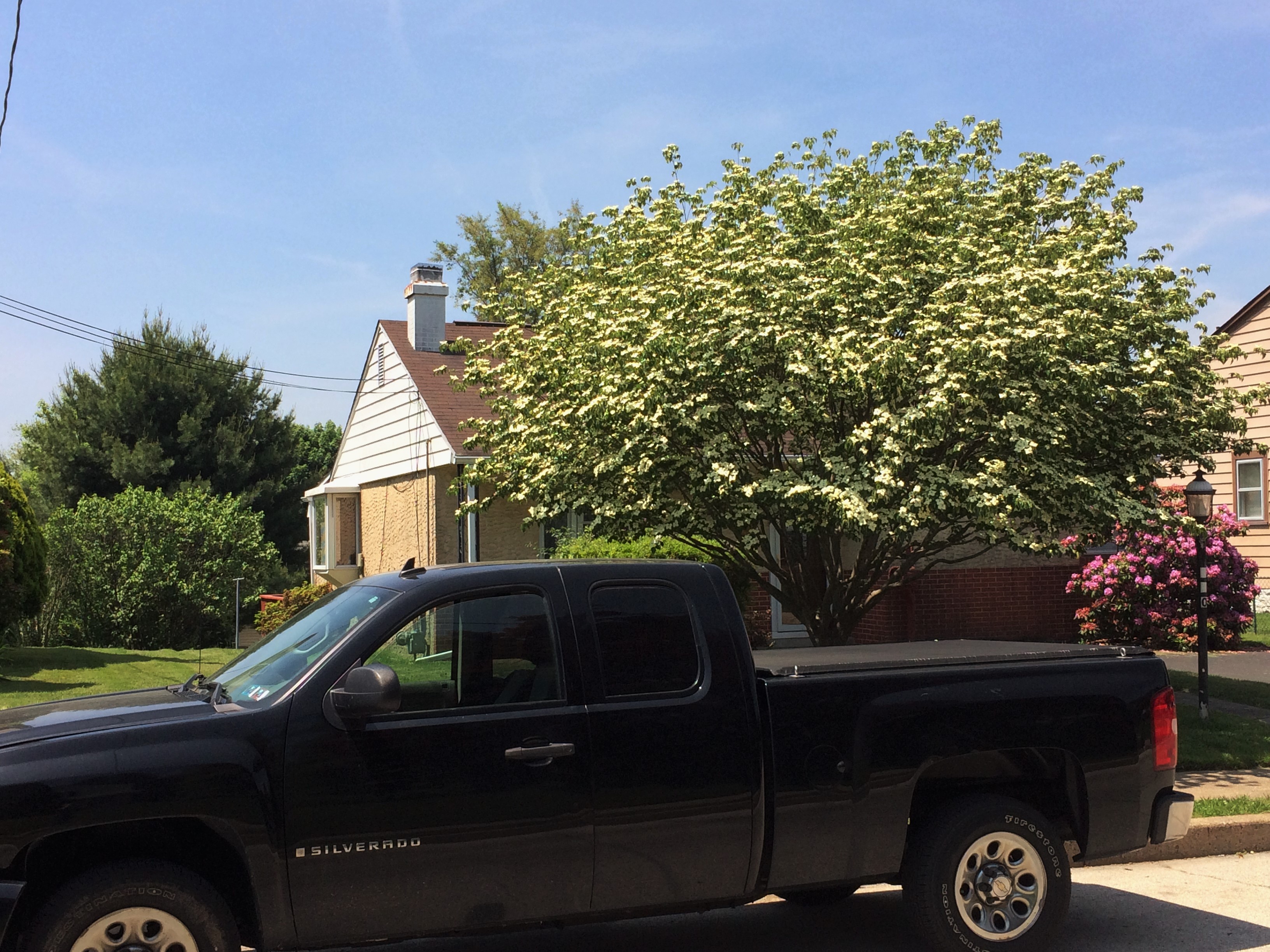
The only flowering tree that I came across.

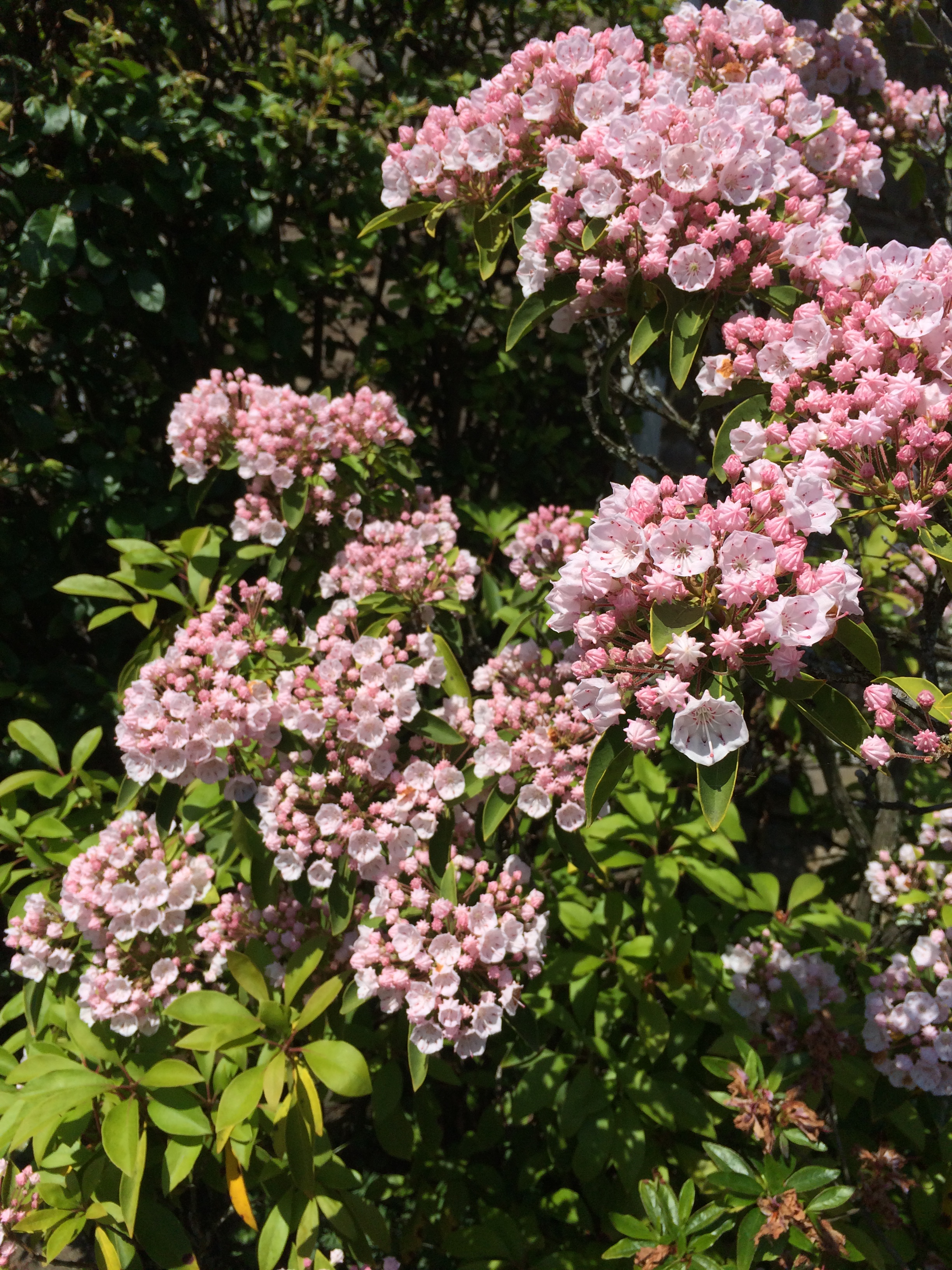
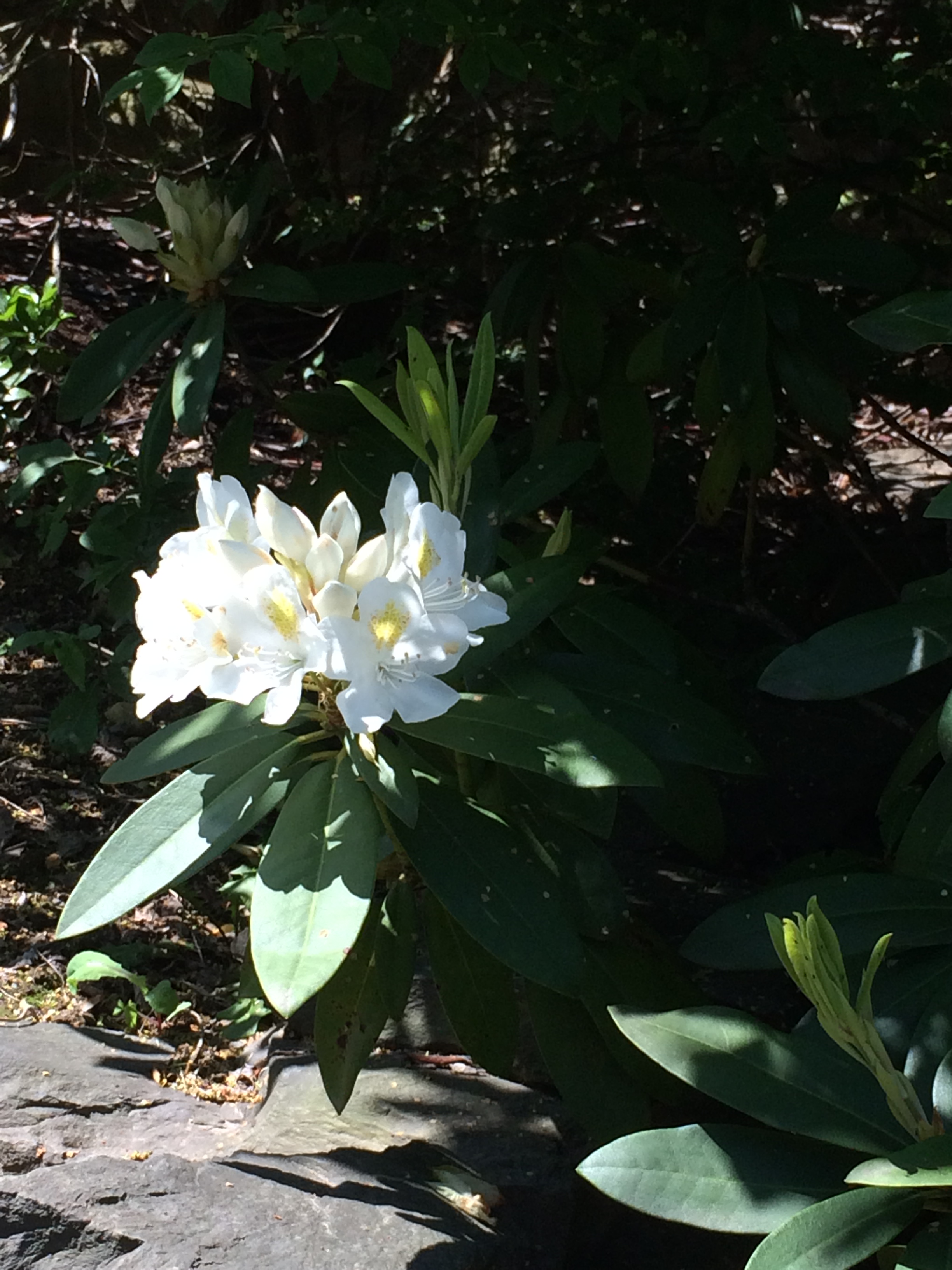
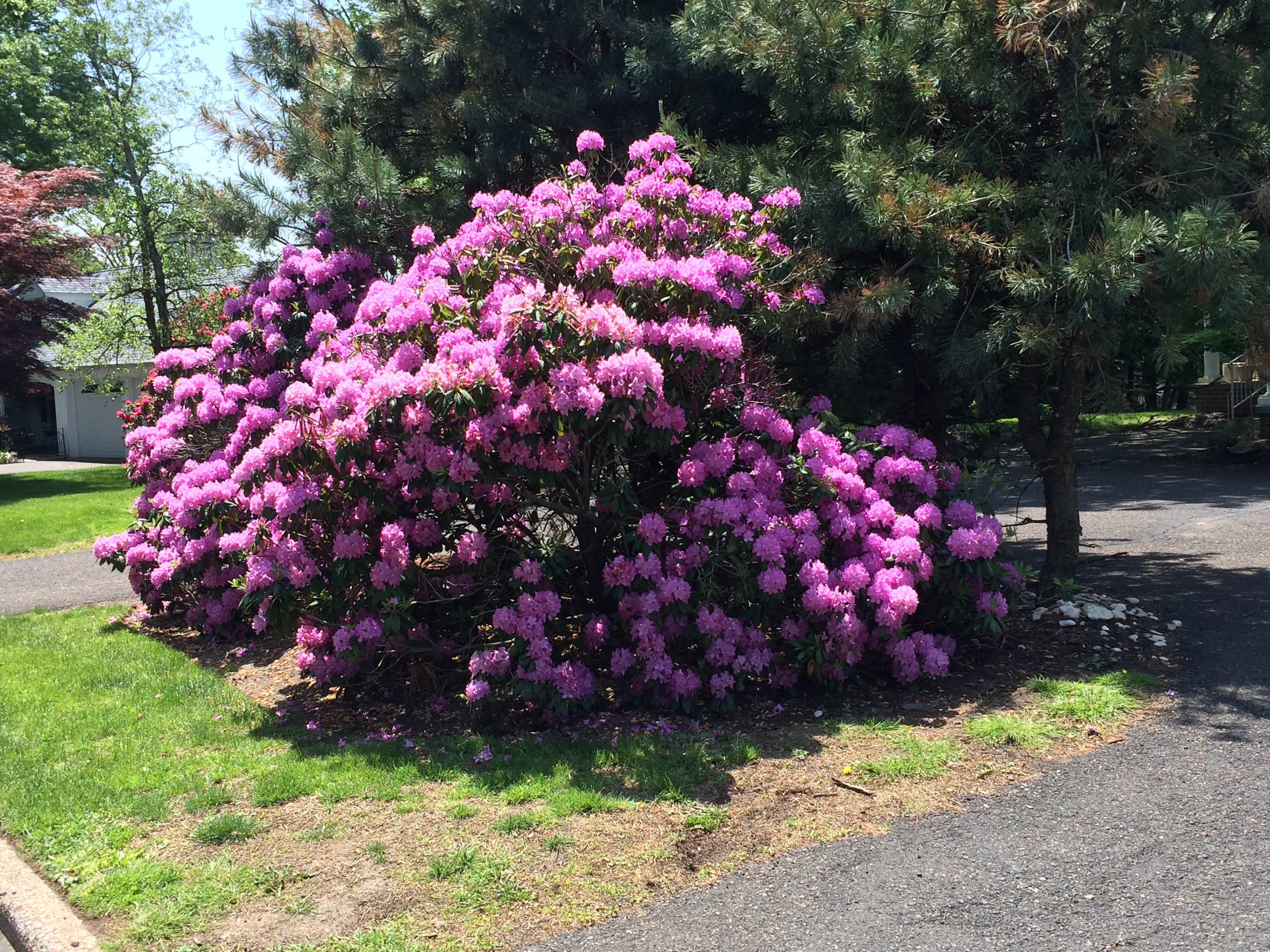
Amazingly, the stroll around my little corner of the Philadelphia burbs was my first since last December, a nighttime excursion I undertook to gaze upon Christmas lights. I wrote a story about that adventure, and if you’re interested in reading it you should click right here. Last week’s stroll was different. With my trusty iPhone in hand I hit the streets for an hour in late morning, looking for pretty flowers to admire and photograph. Particularly those on trees and shrubbery. The sun was beating down rippingly as I left the house, the temperature already about 85° F, and the humidity was formidable. But I was late for the party. Turns out that virtually all of the flowering trees, and most of the flowering bushes, already had dropped their glitter.

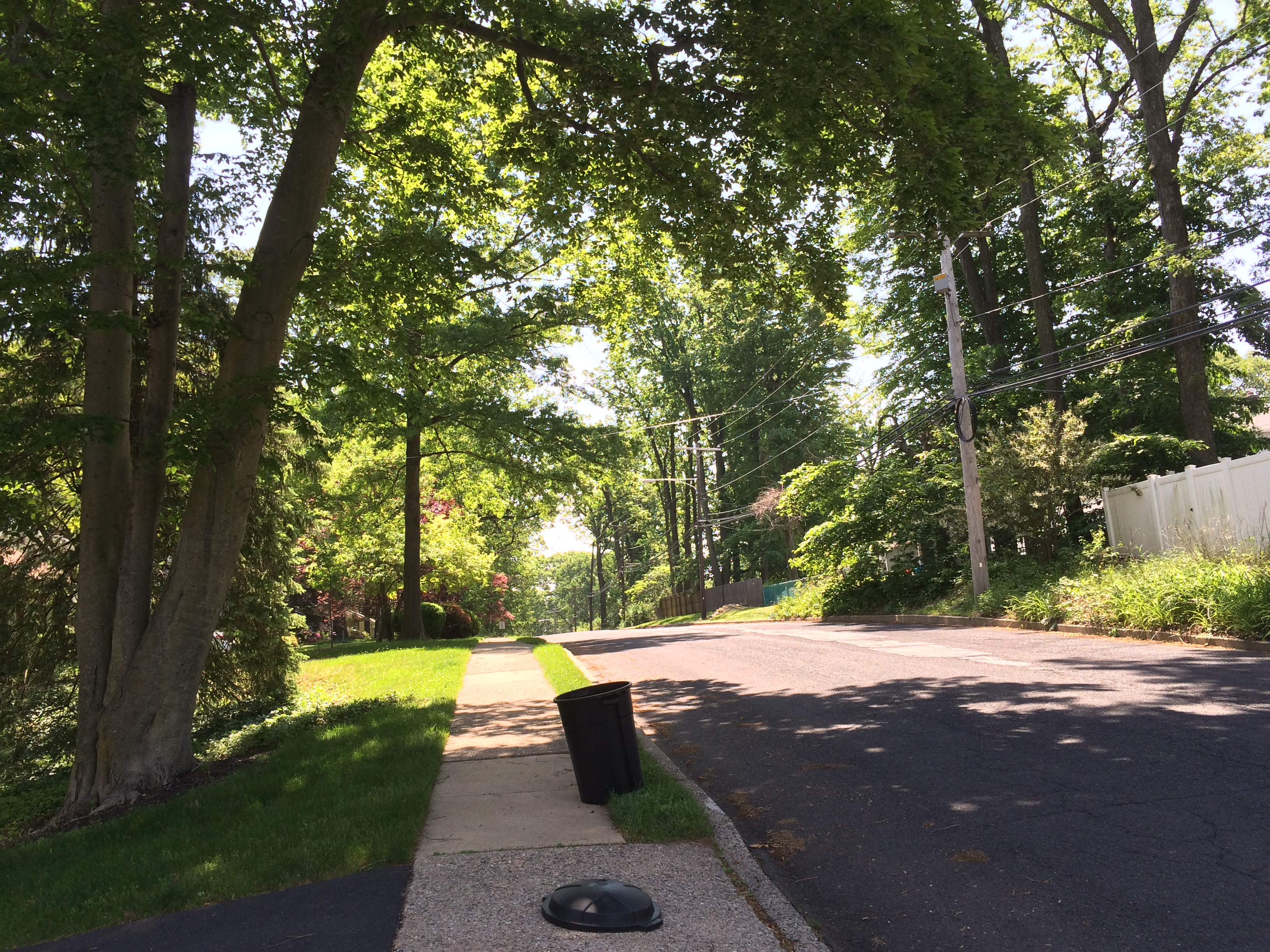
Greens, man, greens.

What, then, did I see?  Greens, man, greens. I walked past hundreds of houses, all with nicely-trimmed lawns, and past thousands of trees, and the expanses of shades of greens made my eyes stand at attention. But I was on a quest for colors other than those, and needless to say they were there to be spotted. True, I didn’t find a single azalea still in glorious bloom. But rhododendrons, yes, and quite a few other bushes I won’t go out on a limb and try to identify, as I ain’t exactly John Bartram or John Muir. And though 99.999% of dogwoods and other flowering varieties of tall barky objects had not a remaining petal hanging on their branches, I discovered one cute tree still dressed in white.

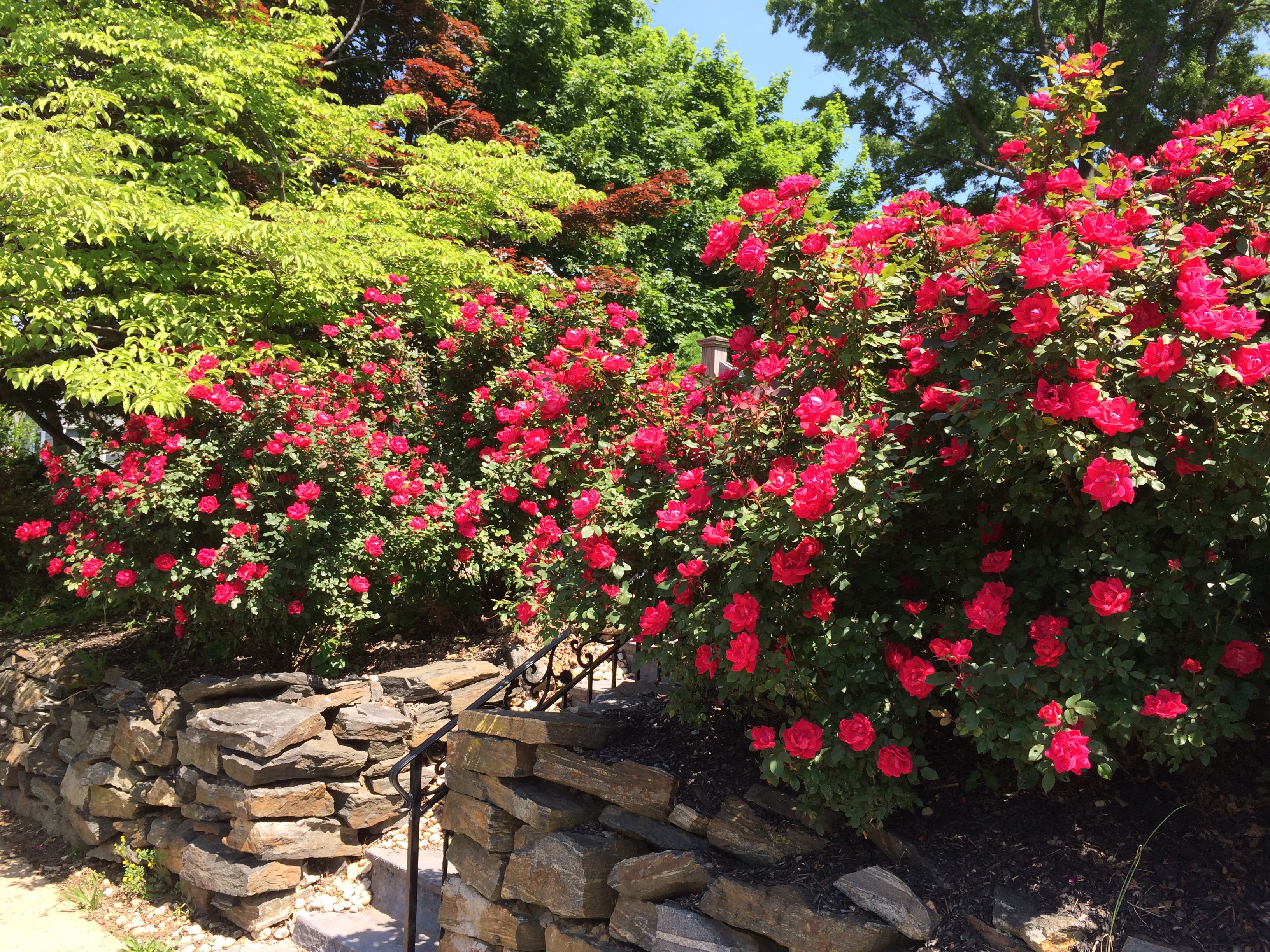
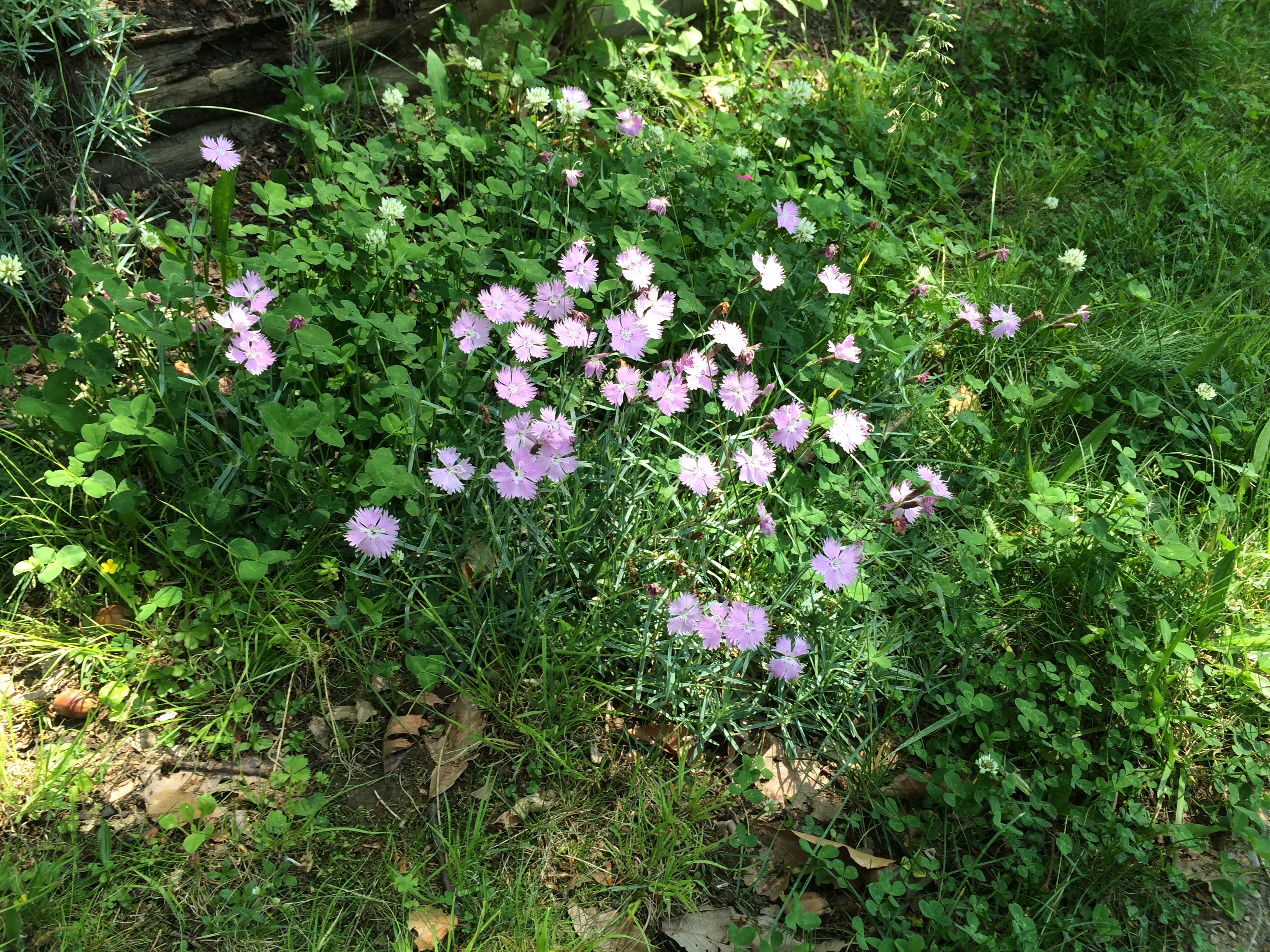
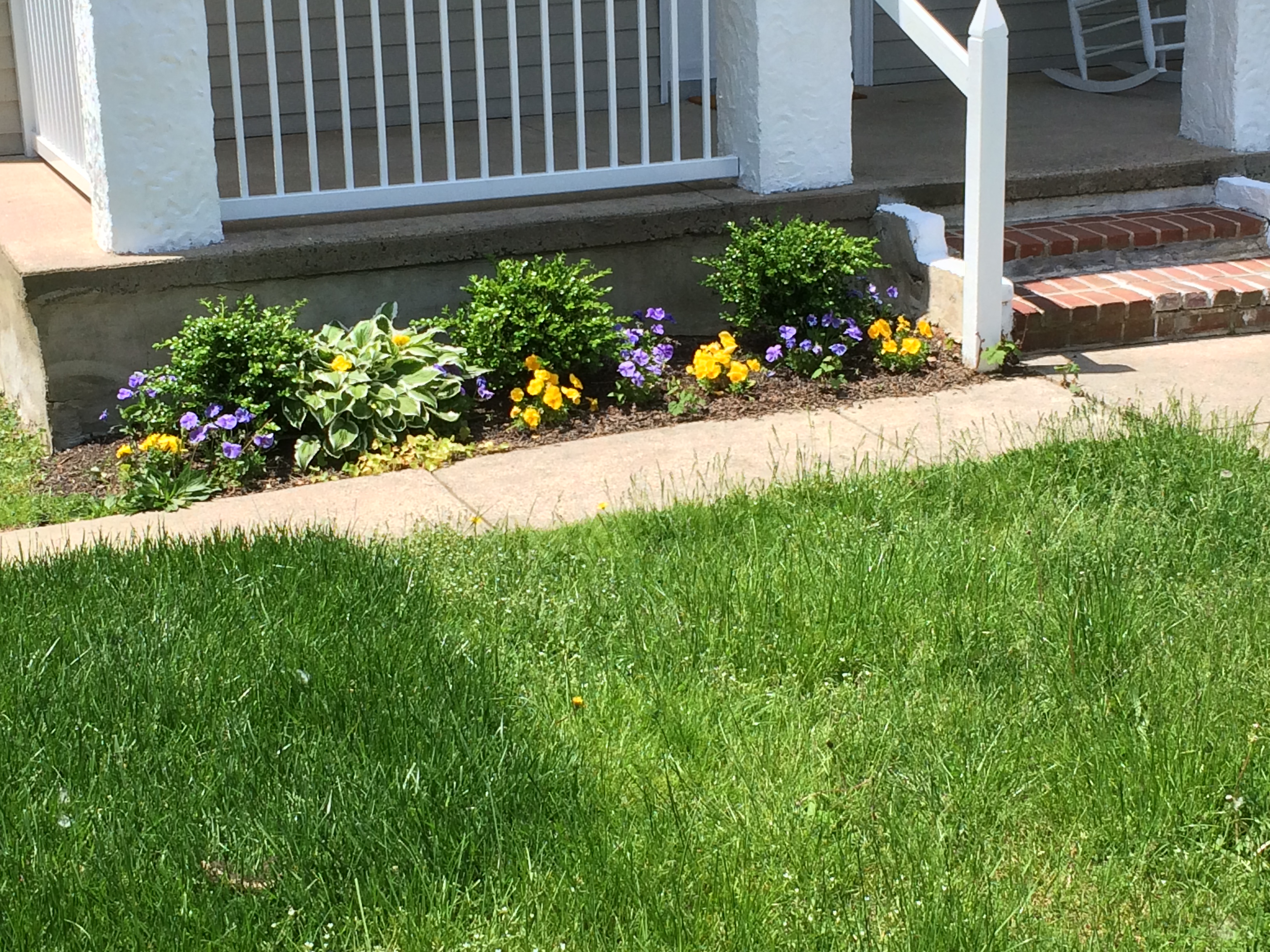
“Yo, Nature Boy,” I heard someone shout at me two seconds ago. “What about planted flowers? Or was Nature Boy not seeking them?” Well, I’ve got an answer: I sought and I found. But something I never had realized before about my neighborhood is that there is no glut of those beauties. I saw a lot of nice ones, sure — roses and don’t ask me what else, because, as I already mentioned, I ain’t exactly . . . Yet many homes had no flowers in beds or windowboxes at all. Maybe I should report my area to The Philadelphia Horticultural Society. Or to Ripley’s Believe It Or Not. Yeah, that’s what I should do.

Still, my walk was a good one. As I said in my Christmas lights story, I need to get out into my neighborhood, beyond my block, more than I do. There’s plenty to look at, if you force yourself to really look, even though my suburban development, like all suburban developments, isn’t on anyone’s bucket list of places to visit. And, importantly, there’s no dog crap to step on, as the dog owners around here are well-trained in picking up after. One thing for certain is that next spring I’m going to wander a few weeks earlier in the season. The neighborhood’s flowering trees and bushes fully were ablaze from mid-April through mid-May. Regrettably, my views of them mostly were from a moving car, and that’s no way to experience the world if foot power is an option. I’ve set myself a reminder.

In conclusion, I’m going to give a big shoutout, as the half-assed expression goes, to my newest best friend: my iPhone. It took some pretty nice pictures the other day. I offer up a selection of the colorful sights. By the way, if you click on any photo, a larger image will open. And one last thing: Don’t be shy about adding your comments, or about sharing this article with others.

IMG_0377 IMG_0378

IMG_0380
IMG_0382

IMG_0388 IMG_0417

IMG_0395 IMG_0401

IMG_0411 IMG_0415

My Amazing Interview With Julia Roberts And George Clooney (Money Monster Is Their Latest Movie)

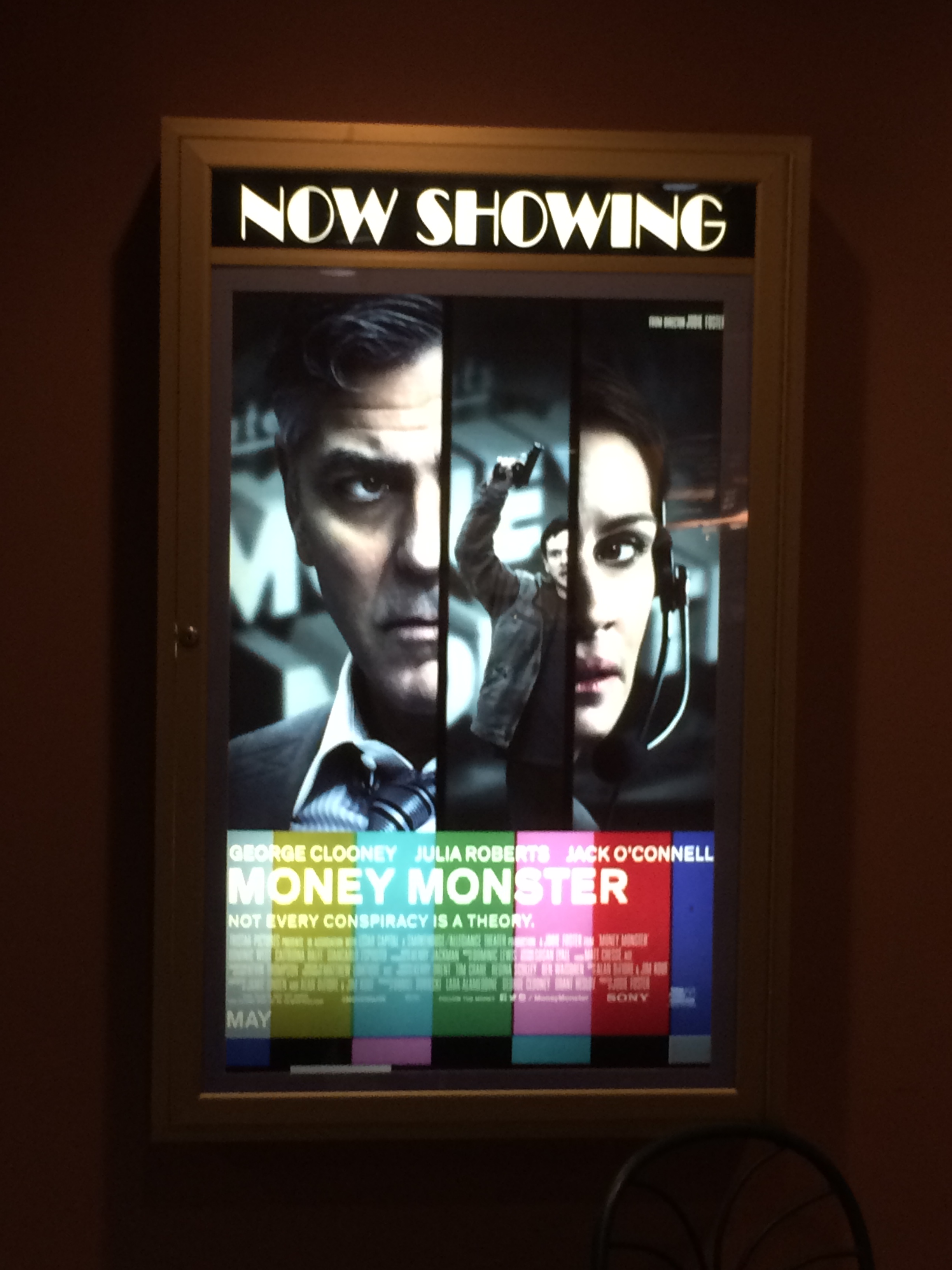
Charlie Rose, you’ve got company. You’re not the only one who can get big name celebs to sit around a table and gab. You’re not the only one who hopes to ask probing questions. For sure, I’m not even remotely in your league. Still, last week there I sat at my dining room table. And sitting across from me were none other than the mega-stars of a cracker jack new movie, Money Monster. That’s right, Julia Roberts and George Clooney were in my house.

money monster IMG_0338
An hour before they arrived I took a look at my notes about Money Monster. My wife Sandy and I had seen the flick a couple of weeks before, and it needed to be fresh in my mind. Wow, it’s a good one, a tight thriller. Jodie Foster directed. Clooney plays Lee Gates, the star of a full-throttle television show about finances called Money Monster. Gates’ show is a glitzy production, with bells and whistles and bright lights up the wazoo, dancing girls, and sometimes-party-hatted Gates making stock picks and handing out financial advice as he prances around the stage.

Doing her best to orchestrate the semi-madness is the show’s director, Patty Fenn (Julia Roberts). Good thing that someone with steel nerves and observant eyes is behind the scene, because one day a young, armed guy named Kyle Budwell (Jack O’Connell), who lost all of his money on a Gates stock tip that went bad, finds his way onto the studio set while the show is in progress and takes Gates hostage. The cameras remain on. The whole world is watching.

clooney IMG_0342
“George,” I said out loud, rehearsing a question I planned to ask. “Money Monster takes a hard look at corporate greed and dishonesty and how hard it is for the little guy to stay afloat. Did you agree to do the movie because of empathy you have for the average Jill and Joe?” I knew that he’d like that query.

“Julia,” I then said to the air. “The hostage situation in Money Monster forces some of its characters to drop their facades and take deeper looks at themselves than they have in ages. Have there been circumstances in your personal life that caused you to do the same?” I imagined Julia thinking deeply before giving me an eye-opening response.

I was ready.

The doorbell rang at 1:00 PM. George Clooney and Julia Roberts smiled at me from my doorstep. Their limo, with its driver, was parked in my driveway. Who’d ever have thunk that a day like this might arrive? Here’s how it happened:

Not long after seeing Money Monster I’d read that Clooney would be in Philadelphia the following week to promote MM on a few of the city’s television and radio shows. A lightbulb went off in my head. I did some Googling and uncovered the phone number of George’s manager, Doris Do-right. I called her and, to my astonishment, she picked up. “Doris, my name is Neil. Rhymes with schlemiel, which is kind of what I am. I’m getting deep into my retirement years. Spend half my life intertwining my fingers in interesting patterns and binge-watching old episodes of Wheel Of Fortune and The Match Game on Netflix. And when I’m not doing that I bang away on a computer keyboard, writing articles for my blog. Anyway, one of the things I write about is movies. I loved Money Monster. Is there any chance that George Clooney would want to step outside the normal public relations box while he’s in Philadelphia and do an interview with an online publication — mine — whose readership is so low it’s pathetic?”

Amazingly, Doris didn’t hang up. I gave her the name of my blog. She said she’d get back to me. And she did, only 40 minutes later. “Schlemiel, I mean Neil, George is a go. He loves the idea. You live just outside Philadelphia, right? And is it okay if he brings Julia Roberts along? The girl doesn’t get out enough. George thinks that a visit to the Philly suburbs might be just the ticket for her. How about next Tuesday at 1:00 PM?”

As I mentioned, the doorbell rang. “Hello, Schlemiel, I mean Neil,” George Clooney said, extending his right hand to shake mine. Starstruck, I barely could raise my hand to meet his. He stepped in, and Julia Roberts did likewise. She gave me a peck on the cheek. “Humma . . . humma . . . humma,” I elegantly stammered. Luckily, Sandy was there to save the day. She greeted our guests perfectly, made small talk with them and then led them to the dining room table where a spread of cheeses, breads, olives, beer and wine awaited. We all sat down, began to nibble and sip, and then I flipped the switch to record the conversation.

My composure more or less had returned. “Guys,” I said. “Your new movie is terrific, and it’s an honor having you here. You’re doing me a big favor. My blog needs a shot in the arm. I’d be correct in saying that readership is down, except for the fact that it never was up in the first place. But a meaty interview with George Clooney and Julia Roberts no doubt will turn the tide! George, I’ll start with you.” I gazed into his luminous brown eyes and said: “Money Monster takes a hard look at corporate — ”

“Hold it, Schlemiel, I mean Neil,” George exclaimed, his eyes twinkling as he gave Sandy a sly wink. “We’ll get to the movie in a few minutes, but there’s something important I want to say. When Doris Do-right told me about the conversation she had with you last week, I got the feeling that I might be able to help you out a whole, whole lot. And I don’t mean in terms of your blog. I mean you.”

He reached into the left pocket of his sport jacket and pulled out a bottle filled with a truly dark liquid. “Neil, if you’re tired of  being a schlemiel, the contents of this bottle are all you need.” He turned its label to face me. It read I Don’t Wanna Be A Doofus No More.

IMG_0349
“I started taking this wonderful stuff, one teaspoon each morning, about 30 years ago. It’s a life saver. You think that I was always a dapper, sharp guy? Uh uh, pal. I was a stumblebum. Just like you’ve been all these years. Girls couldn’t have cared less about me. My career was in Nowhereville. Forget it man, I was lost. Then I saw an ad for I Don’t Wanna Be A Doofus No More in the back of Cool Dude Magazine, and I ordered a bottle. It’s expensive, but it works. The company gets the ingredients from Amazonian jungles. They boil rare orchid petals in river water to extract their essence and add dried dung from giant bats and pulverized teeth particles from crazed boars. I turned Pitt, Damon and Affleck onto I Don’t Wanna in their struggling days. If I hadn’t, they’d be flipping burgers at Mickey D’s right now. Those guys used to be useless.”

My jaw had dropped so low I had to push it back into place. I started to speak, but Julia cut me off.

“What he says is true, Neil. He forgot to take his morning dose one day when we were filming Money Monster, and nobody could believe the change in him. George was shy, listless. The makeup and hair styling girls on the set were worried. They came to me and told me he’d had almost nothing to say to them, wouldn’t make eye contact. And when filming began later that day he couldn’t remember half of his lines. George and I are old friends, and he had told me about I Don’t Wanna a long time ago. So, finally I figured out what the problem was. Back to his dressing room we headed, and down the hatch a teaspoon of the magic potion slid. Minutes later, all was well.”

“Holy crap,” I said. “It’s a miracle that the two of you are here with me.” My eyes were misting. I stood up and walked to the opposite side of the table and embraced these people who had gone out of their way to do a good deed.

George and Julia were choked up, too. “I’m sorry Neil, but we gotta go,” George said, reluctantly, a few moments later. “I’m taping an interview at 3:30 at one of Philadelphia’s TV stations. And Julia needs to get back to her home in Manhattan. Schlemiel, I mean Neil, it really has been a pleasure.” He gave me a knowing tap on the shoulder, planted a big kiss on Sandy’s forehead, and left the bottle of I Don’t Wanna Be A Doofus No More on the dining room table. Julia, after hugging me and Sandy, led the way out the door.

(Don’t be shy about adding your comments, or about sharing this article with others)

(If you click on any photo, a larger image will open)
Me And My Muse

My muse.
My muse. Her dress might be from Saks.

The stage was set in its usual way this past Thursday evening. I sat in the library of my suburban Philadelphia home, clad in comfy pajama pants and a sporty smoking jacket, sipping a cup of piping hot chamomile tea laced with two shots of Kentucky bourbon. I was awaiting my weekly visitation from Erratica, my wondrous muse. Erratica, the little-known but essential Greek goddess, and sister of the nine muses who have gotten all the headlines since bursting on the scene about 3,000 years ago. Terpsichore, for instance, the inspiration for dancers, and Calliope, without whom Homer’s Iliad and Odyssey, and other authors’ epic poetry, would be stink-o for sure.

Yes, Erratica. She whose job through the millennia has been to aid countless amateur storytellers and scribes in need of a push, in need of direction, such as me.

My eyes were heavy and my mind was foggy due to the typically poor night’s sleep from which I had awoken that morning, not to overlook the spiked tea. In other words, I was in what for me passes as fighting shape. I was straining my brain, trying to come up with some story ideas for my blog, when a series of sharp jabs on my left shoulder got my attention. I looked behind me.

“Hello, Erratica,” I cheerfully said to the beautiful creature who had delivered the blows, eyeing her flowing robes. “You are right on time. I love your dress, by the way. Where’d you get it? At Saks?”

“I’m in a hurry, Neil,” Erratica answered, as she moved from behind my chair to face me properly. “You’re not the only pseudo-writer in need of help. Let’s skip the small talk.”

This girl gets right to the point. There’s nothing erratic about her. Instead, her name derives from the erratic creative talents of those whom she shepherds. “Okay,” I gulped. “Here’s the situation. A week ago, with your assistance, I got it together to write a piece about Willie Nile, and I published it yesterday. But now I’m stuck, really stuck. I can’t think of a single thing to write about. I’m constipated, for gawd’s sake! My handful of readers won’t know what to do if I don’t publish something next week. Please inspire me, Erratica. Please. I’m on bended knees.”

Erratica gave me one of those long, hard looks. I felt uneasy. I knew what was coming. “Neil,” she said. “You have been a big disappointment to me the last couple of months. Getting you to deliver stories once every week or so has been much too difficult. And now you say that you’re totally out of ideas? Are you kidding? Look at all the movies and other things you’ve seen that you haven’t written about. The world is your oyster, whatever that means, and you’re leaving so much of it on the table. There you were last month at the Philadelphia Flower Show, a world-famous exposition, and you wrote not one word about it. Three hundred thousand people went to that show, but it wasn’t good enough for you? What are you, some kind of elitist? And a couple of weeks ago you took in Hello, My Name Is Doris, a sweet movie with adorable Sally Field. Where’s your review, guy? And I could mention so much more. Neil, you’re frustrating me. Big time.”

doris IMG_1273
“Oh, Erratica. I know you’re right. You always are. But hear me out. Sure, I liked Hello, My Name Is Doris pretty well. I came close to writing about it. But the more I thought about the movie, the more I saw what I think is a gaping hole in its central logic. I said to myself, ‘Yo, schmuck. Why spend several hours analyzing a flick that’s kind of flabby in its design?’ What I’m saying, Erratica, is this: Doris is what, 65 years old? And she’s been a semi-wallflower pretty much all of her life. And then one day— presto! — she falls in with a bunch of hip millennials who practically adopt her into their tribe. I mean, c’mon. The odds of that happening are about as high as my winning the Powerball jackpot on the same day that NASA accepts me into its astronaut training program.”

Erratica gave me another of those long, hard looks. Obviously she wasn’t buying my explanation. Maybe I wasn’t either.

One of the Japanese displays.
Part of Big Timber Lodge, which was the entrance to National Parks exhibits.
Part of Big Timber Lodge, which was the entrance to national parks exhibits.

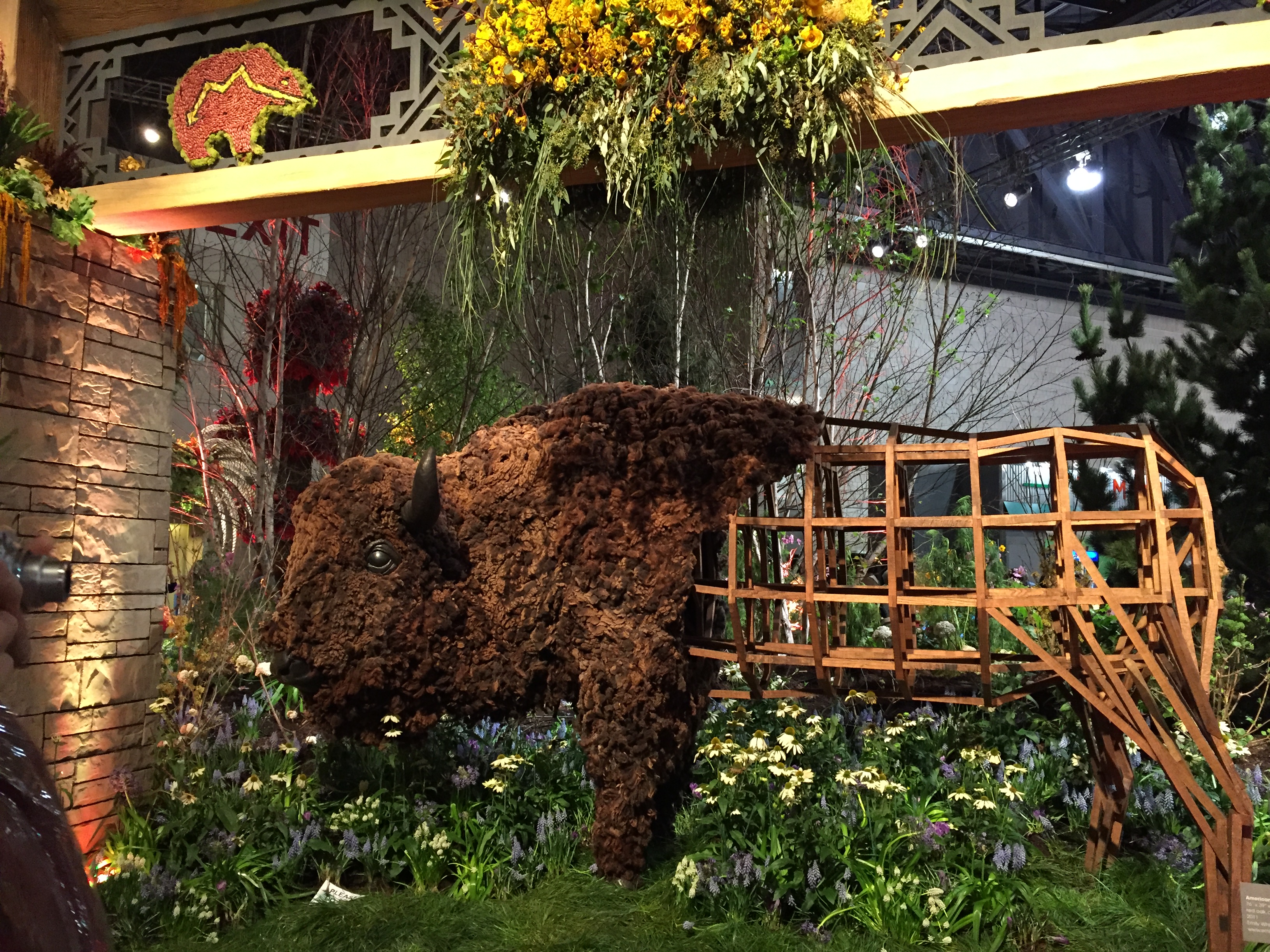
“And here are my beefs about the Philadelphia Flower Show,” I continued. “Yeah, going in I was primed to write it up. But going out I was muttering ‘nah’ to myself. I mean, the show was okay. I liked some Japanese displays. And the themed exhibits representing various national parks were decent, but that’s all they were . . . representations. You could walk through and around them in seconds. All they really made me want to do was head to the great outdoors and explore the real parks. And don’t get me started on the juried flower exhibits. The flowers in my local supermarket’s flower department look as good, probably better, than what I saw at the show. Grouse and grouse some more, that’s mostly what I would have done if I’d written about the Flower Show. There’s no fun in that for me.”


Erratica snorted. Her patience clearly was exhausted. “I don’t know if I can take this anymore,” she said. “I have to have a talk with my father. His name is Zeus, in case you forgot. You amateurs have worn me out. For 3,000 years I’ve been dealing with marginally-talented, confused whiners. I deserve a new assignment. Calliope’s, for example. Amateurs . . . bah!”

And, just like that, Erratica was gone. Possibly forever. I don’t know how I will cope if she doesn’t return. But I do know this: Bereft of ideas, there’s little chance that I will publish anything this week.

(Don’t be shy about adding your comments, or about sharing this article with others)

(Doris and flower show photos by Sandra Cherrey Scheinin. If you click on a photo, a larger image will open)

Walking Through Philadelphia With Colors On My Mind

I woke up one weekday morning not long ago with visions of Philadelphia swirling in my mind and beckoning me. Amorphous visions, but colorful. I hadn’t done much city exploration in awhile. Hadn’t taken a long and leisurely stroll anywhere in awhile. What’s more, the weather prediction was highly favorable: warm, sunny and breezy. A walk was in order. And so, a few hours later in my suburban Philadelphia home, I closed my eyes, clicked my heels together three times and thought beautiful thoughts about the City Of Brotherly Love. Next thing I knew I was standing at the corner of 2nd and South Streets, part of a funky area not far from the Philadelphia waterfront and some of the city’s oldest residential blocks. Let the adventure begin.

The hike took nearly four hours. I trod, often guided by whimsy, on many blocks within the rectangle formed by 2nd, Bainbridge, Broad and Arch Streets. At the start I didn’t have much of an idea of what my route would be. But this much I knew: I wanted to stretch the ol’ legs, inhale Philadelphia’s quasi-clean air and feel the wind caressing my thinning hair. And this too I knew: I wasn’t in the mood to check out any historical or touristy sites, or anything with the connotation of trendy attached to it, all of which Philadelphia is loaded with. But it wasn’t to be an aimless ramble. No way. When I landed at 2nd and South Streets, I had in mind a theme for the day, inspired by the colorful visions from earlier in the morning. I was going to look for sharp and snazzy outdoor color displays produced by the hands of man, not by nature. It was a modest quest, probably kind of a dumb one. But hey, I’m that kind of guy.

fez IMG_0212mexican IMG_0215
Things got off to a slow start. I looked all around the 2nd and South Streets vicinity and the only colorful things I could find were Fez Restaurant’s facade and a happy, yellow ghoul, dressed in red, outside Las Bugambilias, a Mexican eatery. Still, I figured that the South Street corridor — not as happening a part of town as once it was, but hanging in there fairly well — offered a decent chance to come across more than that. And I was right.

mako's IMG_0220larry fine IMG_0222
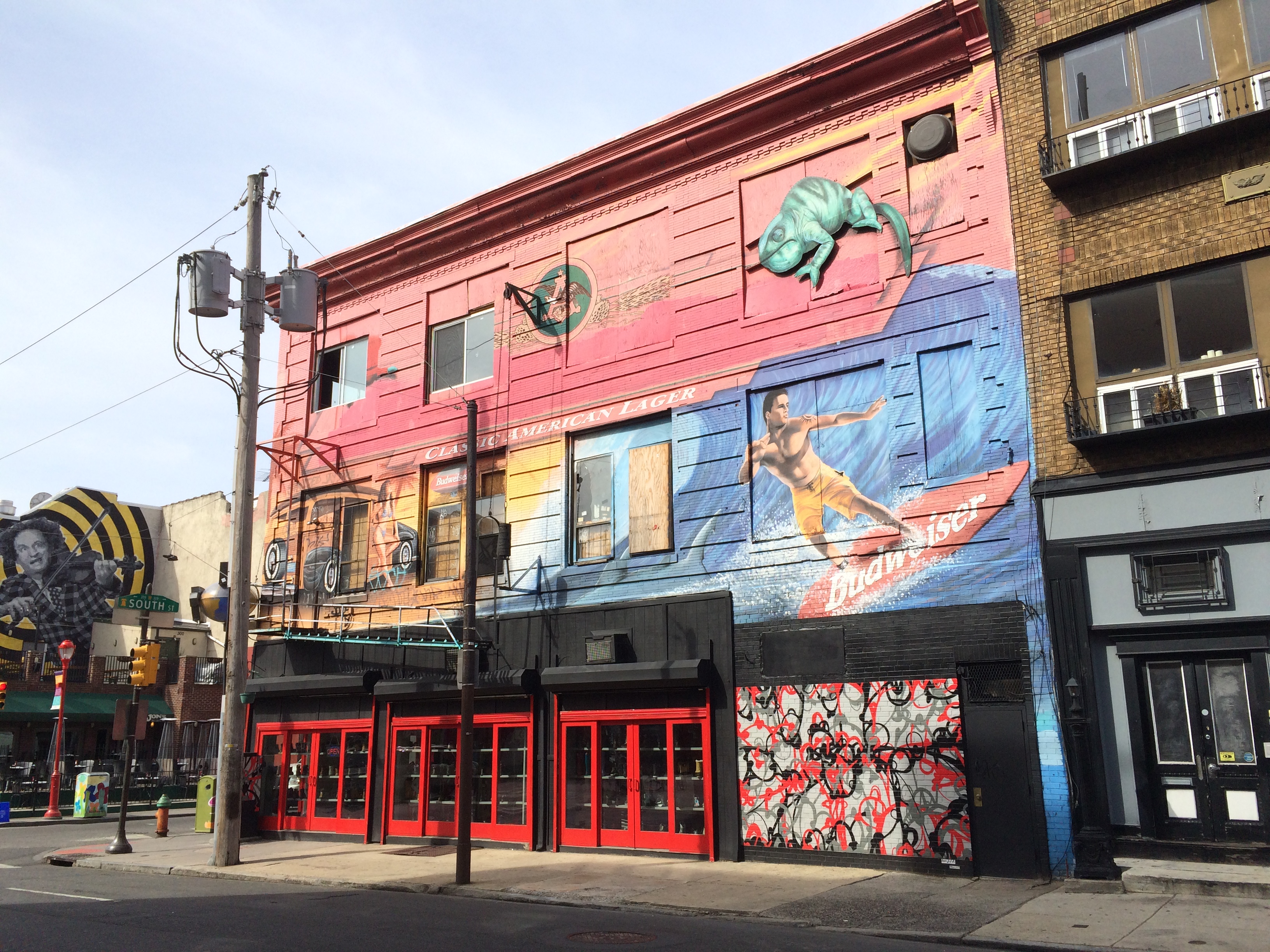
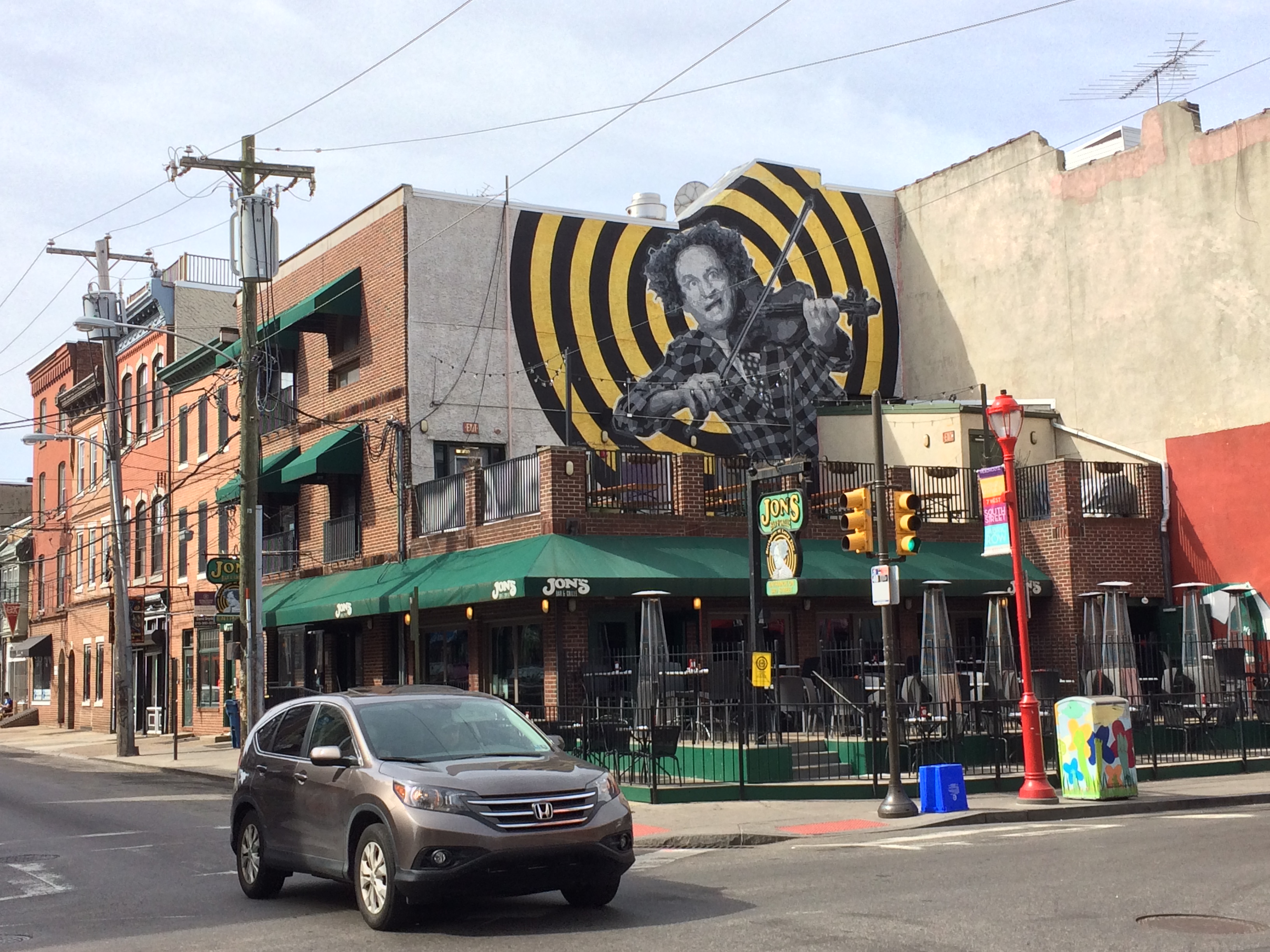
At 3rd and South I said to myself, “Wow, look at that mural.”  It was painted on the side of the out-of-business and mourned Mako’s Retired Surfers Bar And Grill. A guy on a surfboard, a girl leaning against a fat-tire car, all done in sweet pastel hues. Lovely. And didst my eyes deceive me? Directly across the street from the former Mako’s was another mural, this one depicting the torso of a fiddle-playing, electric-haired madman inside yellow and black concentric rings. None other than Philadelphia native Larry Fine, one of The Three Stooges. Yeah, man, now we were getting somewhere.

A little while ago I alluded to the fact that I’m no genius. Proof? I shouldn’t have been surprised to see the murals at 3rd and South, because I’d seen them before, though not in recent years. What’s more, I somehow also had forgotten that Philadelphia is the outdoor mural capitol of the world, thanks to Mural Arts Program, a public/private organization born in 1984. Incredibly, over 3,000 MAP- created works grace Philadelphia. No doubt, Mural Arts Program is one of the good guys. It aims to beautify all neighborhoods (from dilapidated to swank), to employ many folks in need of work and encouragement, and to inspire the general population. Big goals, all reached as far as I can tell.

DuBois IMG_0240
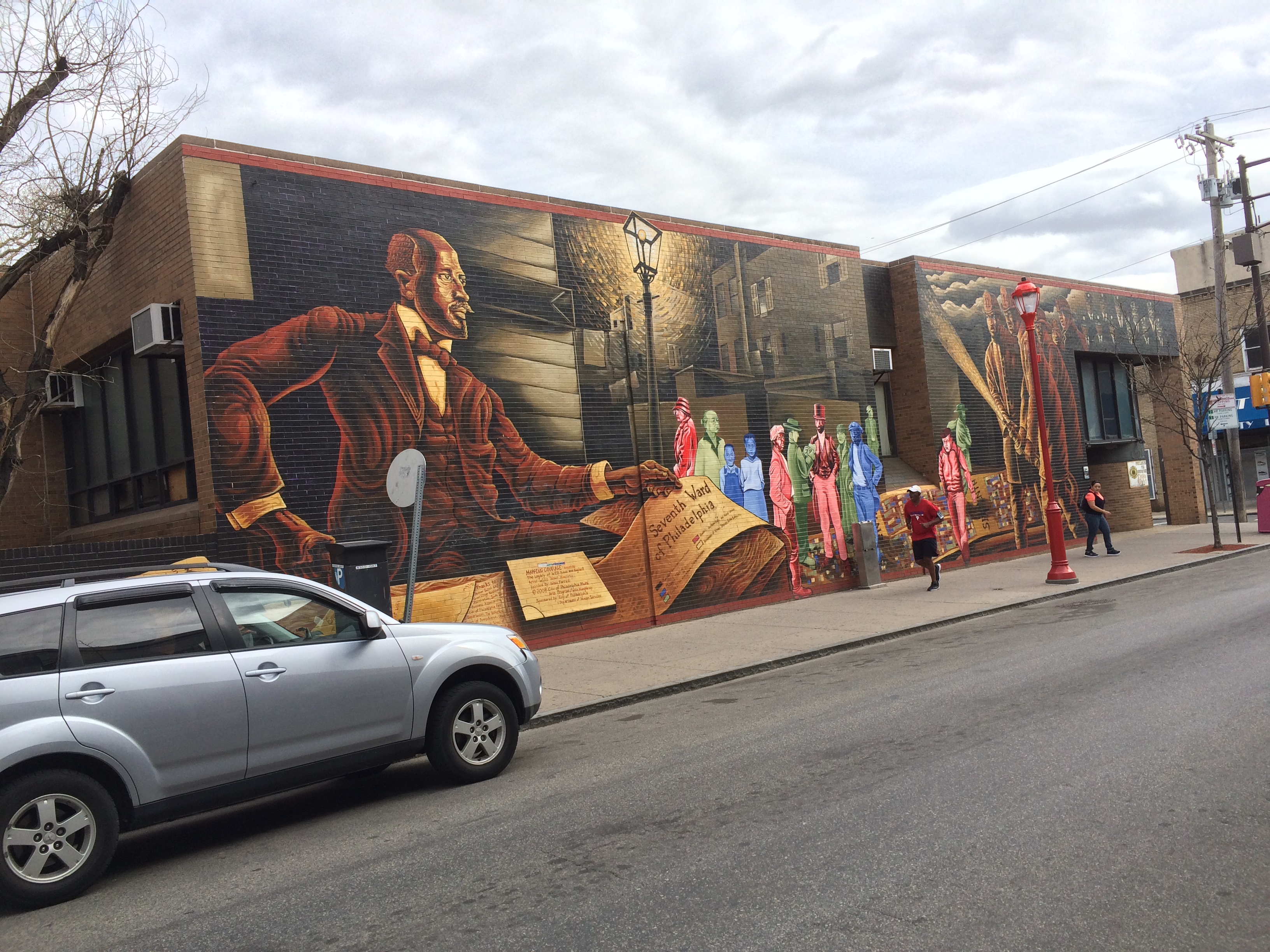
Well, I haven’t been able to determine if MAP was behind the painting on Mako’s side wall. But Larry Fine wouldn’t be overlooking South Street were it not for MAP, nor would two other murals that I later saw on my trek be in existence. Of those, the first I came to is attached to Engine Company 11, a firehouse at 6th and South Streets. It’s a magnificently imposing creation titled Mapping Courage. It honors W.E.B. Du Bois, the Black scholar and leader, and the firehouse itself, which for years was manned only by African Americans. The mural is beautifully designed, shining in browns and ambers that allow its few bright colors to pulsate.

Spring IMG_0260
An hour later, on Pine Street near 13th, I stumbled upon the mural known as Spring. Yowza, this one stunned me too. Look at those soft whites and butterscotch shades of the flowering foliage. How totally cool it was that real trees, in bloom, nearly were melting into the painted surface.

You know, somewhere in the middle of my expedition I realized something that never had dawned on me before. Namely, despite the murals that gas things up on certain blocks, most of Philadelphia’s residential streets, beautiful and architecturally rich as many are, sure appear tame when it comes to color. This ain’t exactly a news flash to the oceans of people more observant than I, but it’s true. And it’s largely because of bricks, bricks, bricks, the quintessential and earth-toned building blocks of Philadelphia. Bricks are sturdy, bricks are quaint, bricks have been with us humans for thousands of years. But man, I can understand how someone might decide that a brick-dominated landscape needs to be jazzed up. Someone named Isaiah Zagar, for example.

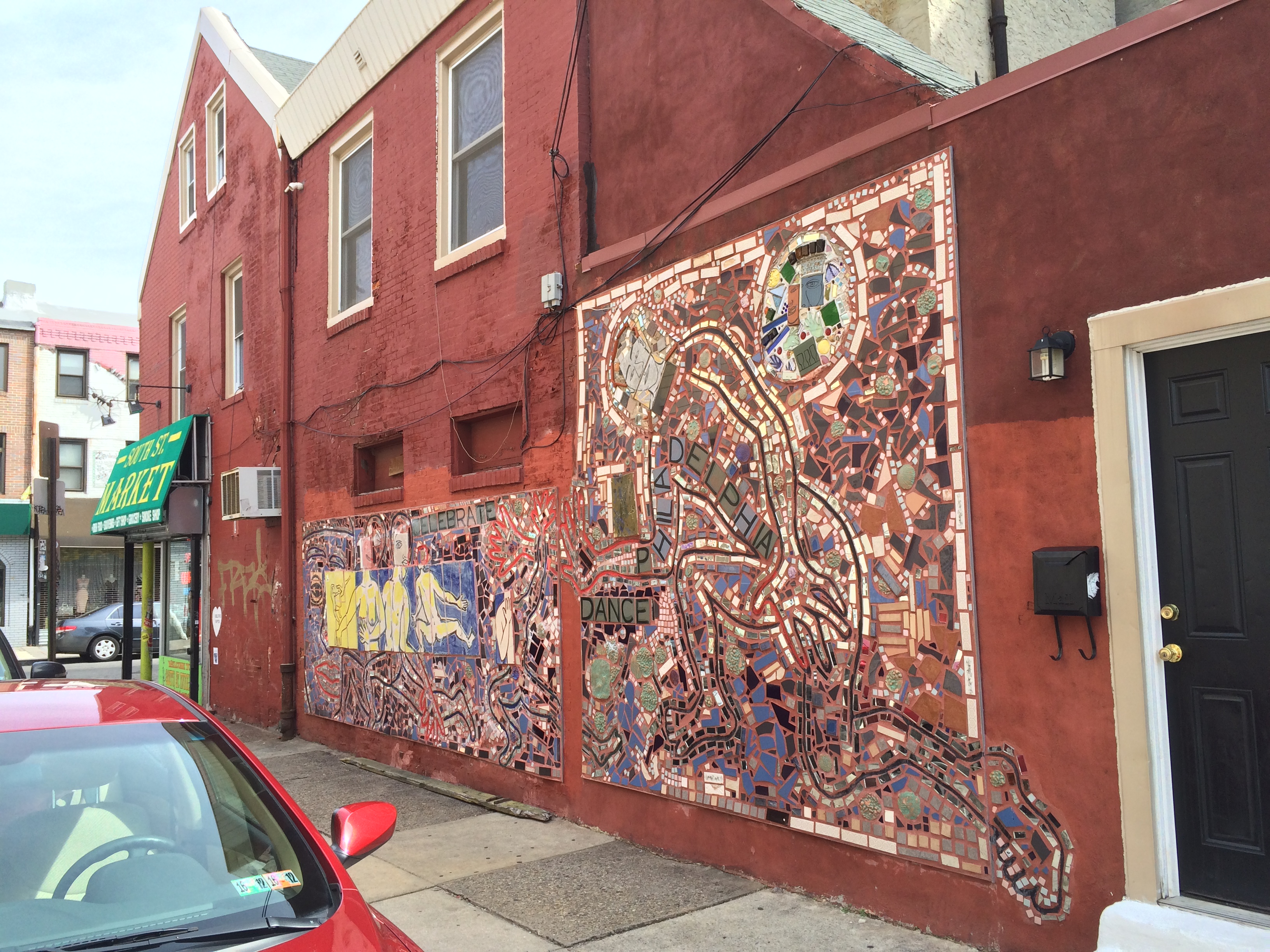
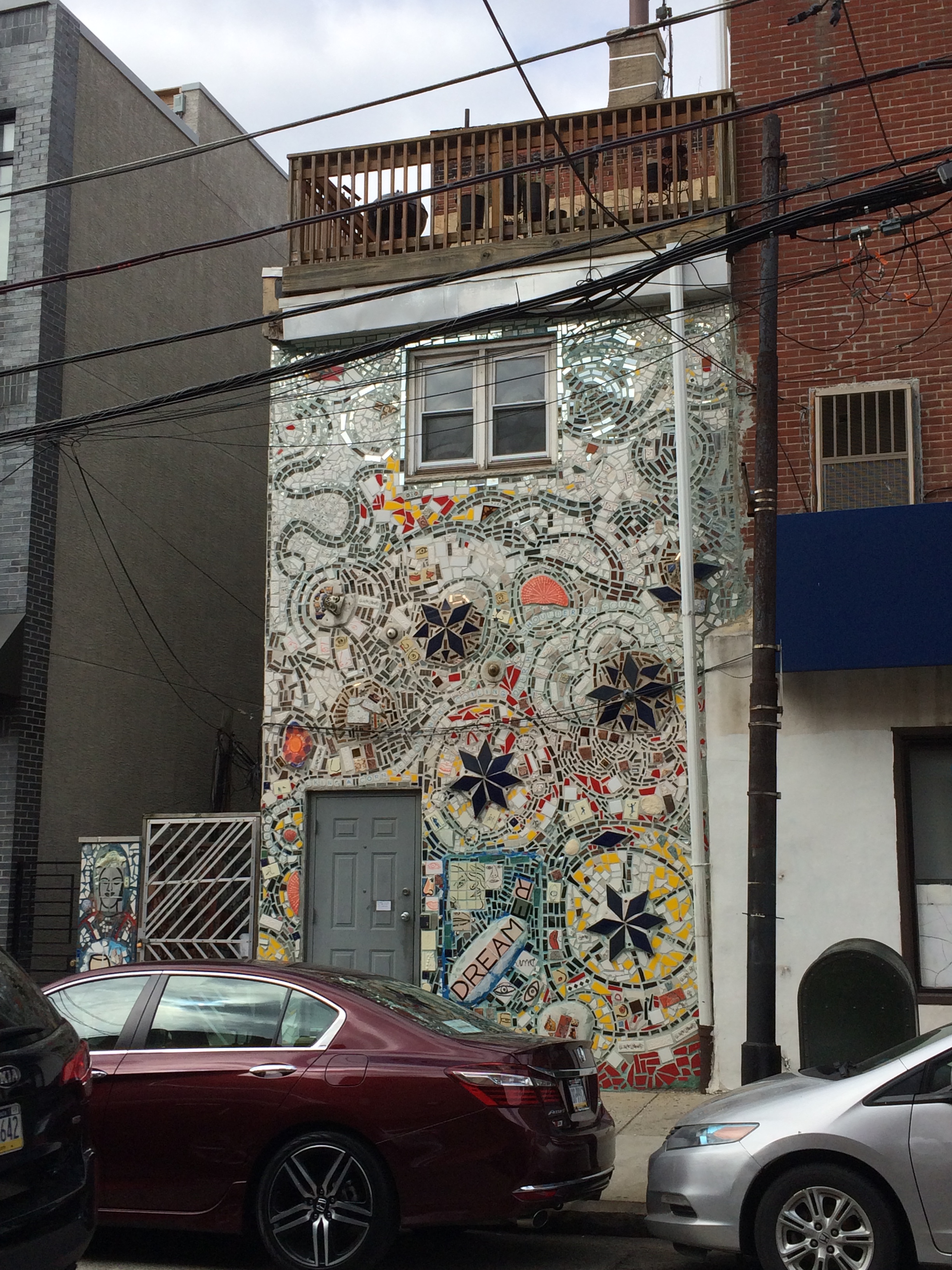
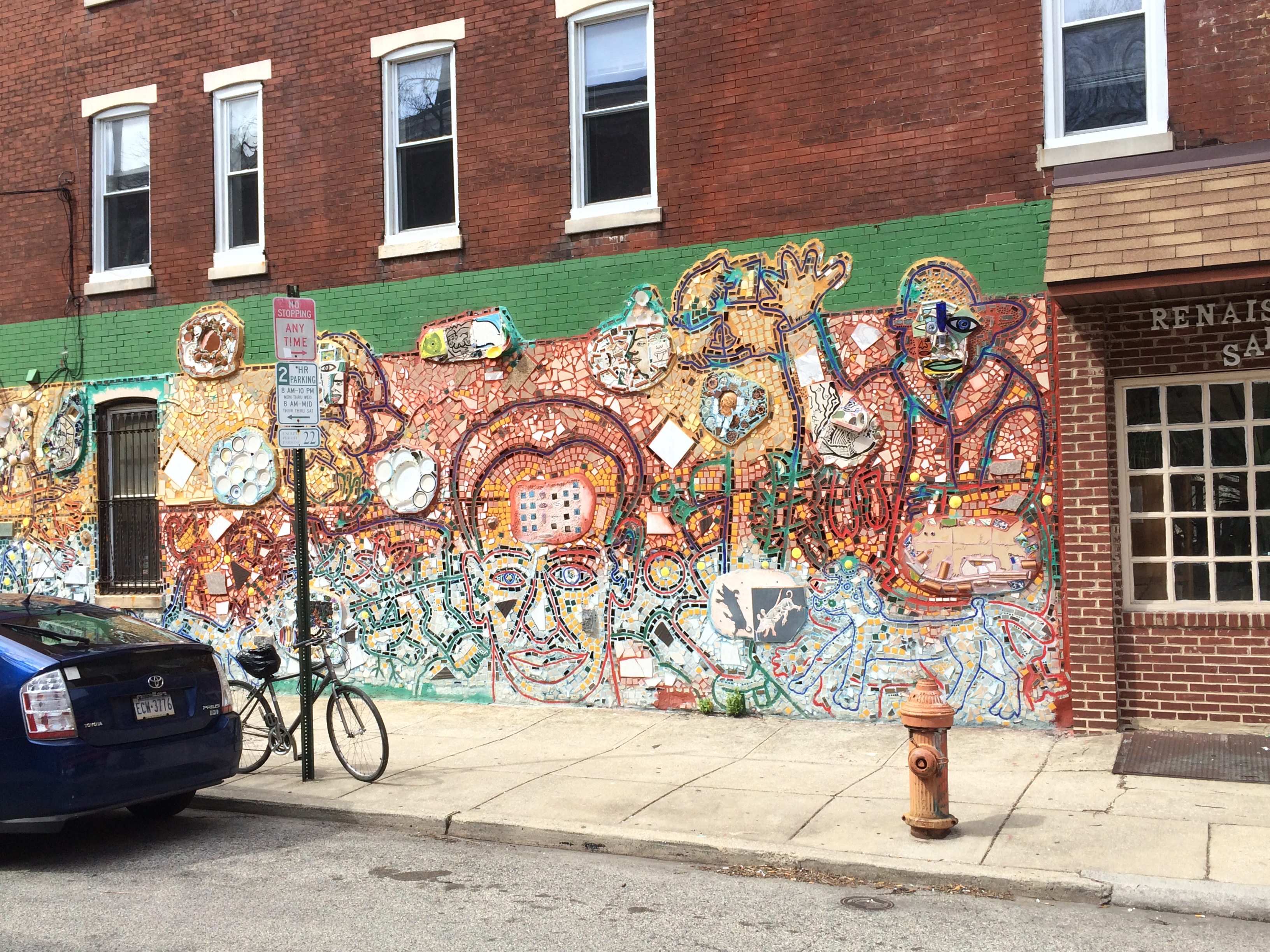
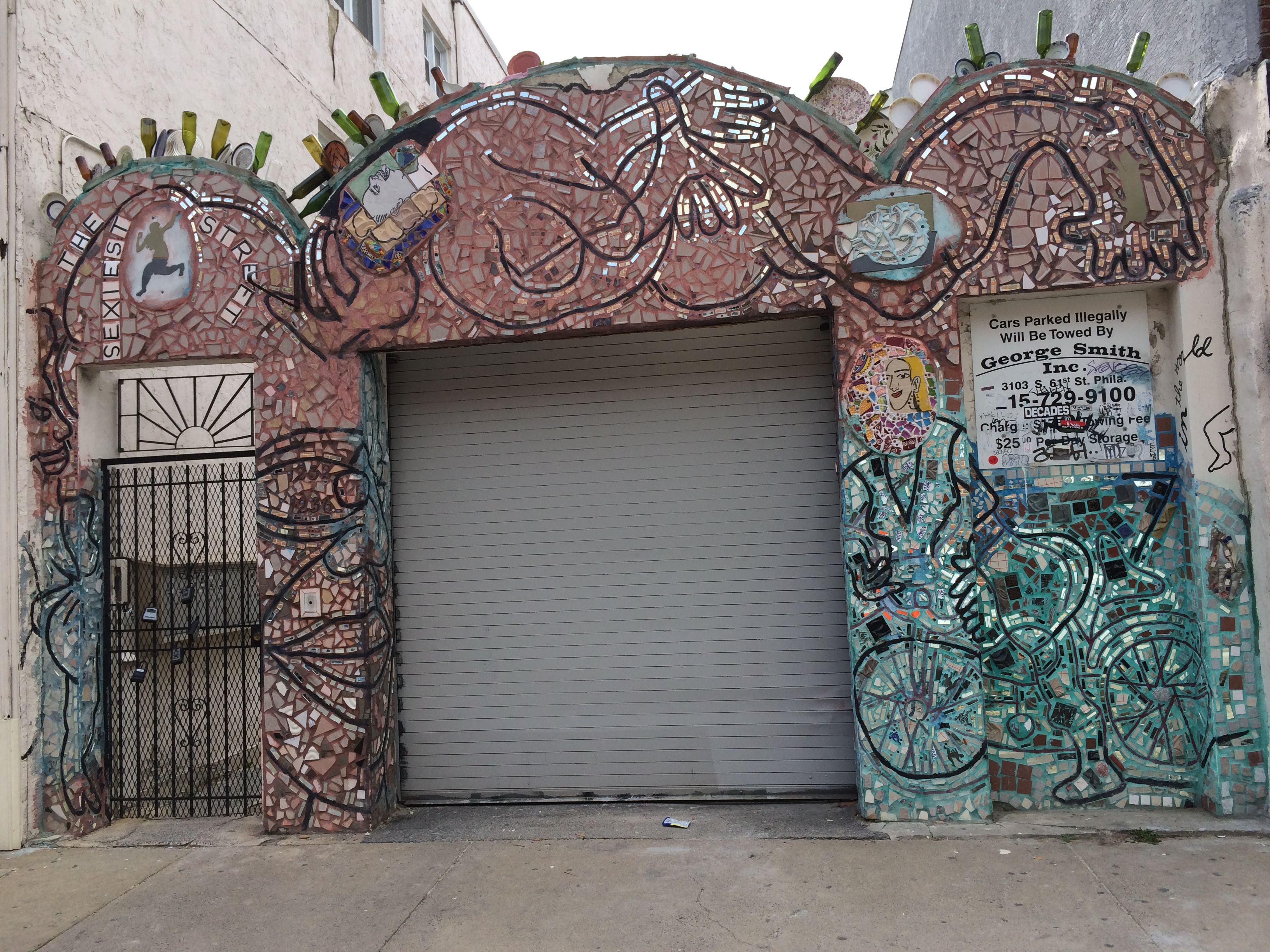
Soon after my walk began, a few minutes after I metaphorically tipped my hat to the Mako’s and Larry Fine murals, I started to come upon some unusually decorated homes, first on Leithgow Street, just off of South. And then on many other blocks near or on South. I had never seen these exterior wall decorations before, hadn’t known about them. They were something else, kaleidoscopic, multi-colored mosaics made from pieces of tile and glass. The design similarities got me wondering if one person had done all the work. I had a vague knowledge of mosaic artist Isaiah Zagar. I knew that he lived in the area and that he had established something called Philadelphia’s Magic Gardens. Were these freewheeling creations his? A bit later I learned that the answer was yes, and that he had begun adorning buildings quite a few years ago.

I suppose that Zagar obtained the permissions of homeowners before going wild on their domiciles. Or maybe he didn’t. Whatever. Unembellished bricks (and other stones), goodbye! Colors and designs up the wazoo, hello! Zagar’s mosaics put me in mind of native art from South America and Africa, of children’s art, of what cave paintings from 20,000 years ago might have resembled if their creators had been high on pot. Anthropomorphic faces and figures abound. Psychedelic cellular shapes look determined to escape their confines. Words like dance and celebrate and dream are embedded in the mosaics. Zagar is a positive thinker, a lover of life and, I assume, one hip cat.

Zagar’s greatest creation is Philadelphia’s Magic Gardens, a multi-level indoor and outdoor mosaic extravaganza, an arts center and a head trip that has become a go-to attraction for tourists and locals. He began work on it in 1994 in what then were abandoned lots, and endured some legal battles years later with the lots’ owners. In the end, creativity and social justice prevailed. PMG, an incorporated non-profit, opened to the public around 10 years ago. It’s at 1020 South Street. I caught a few peeks of PMG, grabbed a brochure from the admission desk and confirmed there that Zagar is the guilty party behind the glorification of the South Street corridor. But I didn’t want to interrupt my hike by entering the Magic Gardens. I’ll get back there some day and will drop my report within this blog. For now, this travelogue will end with photos of some of Zagar’s handiworks. If you click on any of them, or on any other photo in this article, a larger image will open.

IMG_0232IMG_0233IMG_0243

IMG_0246IMG_0250IMG_0251

IMG_0253IMG_0256IMG_0258

Caramel (Suzanne Vega, This Beer’s For You)

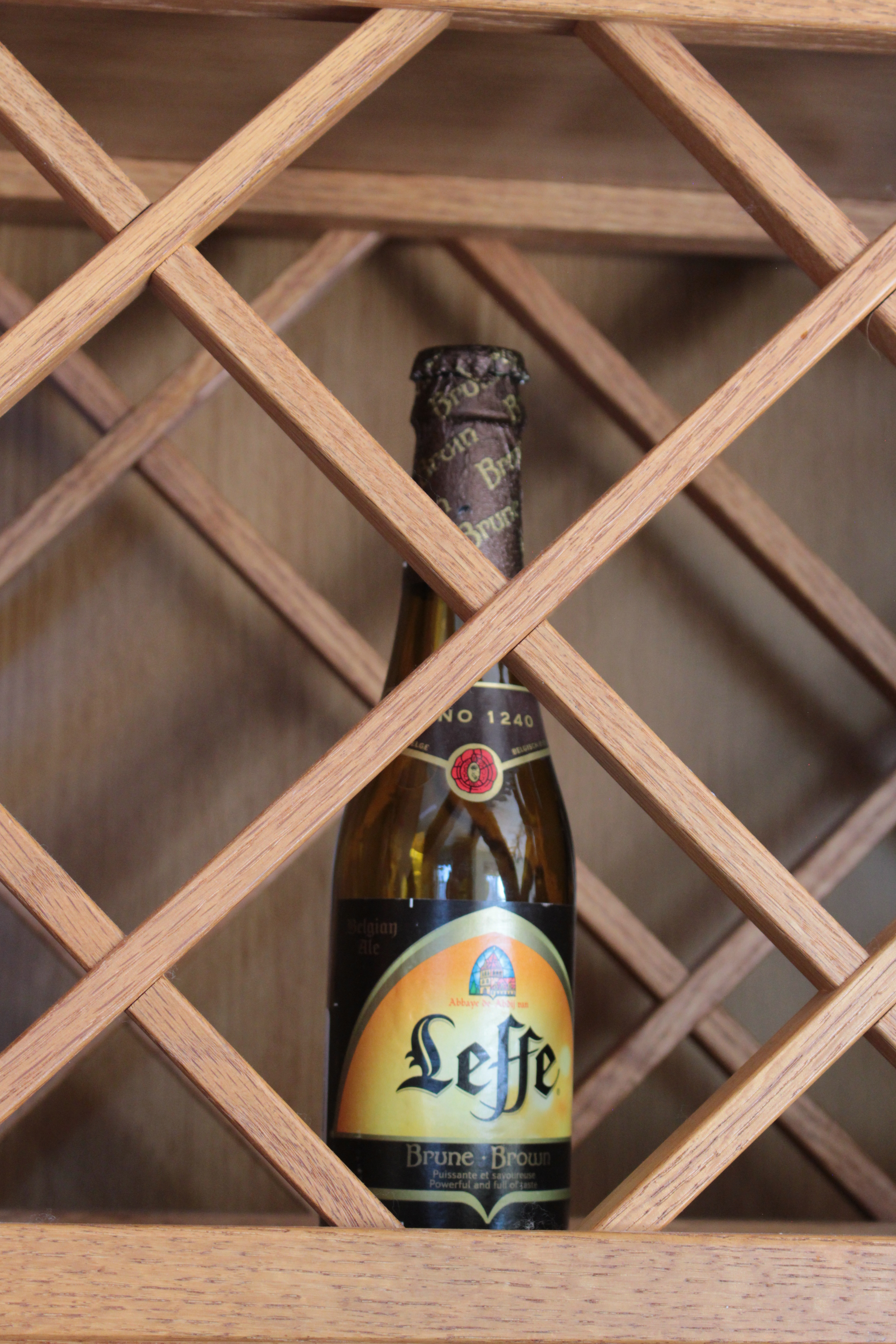
Leffe Brune
Leffe Brune

A few days ago, in a local supermarket’s beer section, I assembled and bought a “create your own six pack.” At dinnertime later that day I grabbed one of the six from the frig, and I’m glad I did. It was a thick, rich, mellow ale. Dark and handsome too, I might add. And delicious. Leffe Brune (brown), brewed in Belgium.

If it weren’t for this excellent beer I wouldn’t be typing this story right now. Instead I’d probably be cemented to the living room sofa, counting the number of dust balls scattered on the room’s hardwood floor, one of my typical pastimes. But I am typing this story right now, and here’s why:

Earlier in the aforementioned day, fishing around in my mind for something to write about for my blog, I thought about Caramel, a song by Suzanne Vega that I’ve always loved. But I wasn’t sure how I’d incorporate Caramel into a story. It’s a great song, not too well-known. For years I’ve thought it deserves to become a heavily covered tune, a standard if you will, as it is perfectly formed musically and lyrically. For 40 years I’ve thought almost as much of Tom Waits’s (Looking For) The Heart Of Saturday Night. “Maybe I’ll write about Caramel and (Looking For) The Heart of Saturday Night and one or two other songs that, in my ideal world, nearly everyone would know about,” I more or less said to myself. “That’ll be at least a  couple of weeks from now, though. It’s a tough story to work out.”

But a few hours later, scanning the label on my Leffe Brune, I shifted course. It read: “Savor the mystery of the ages. The authentic Belgian Abbey ale. Enjoy this delicious Leffe Brune with its sweet caramel yet bitter taste.”

Caramel! Whoa, no way this could be a coincidence. No question about it, the beer gods who hover invisibly above Planet Earth are fans of Suzanne Vega’s Caramel. That’s why they placed the Leffe Brune label before my eyes. Which means that they wanted me to devote a story solely to that song. “Screw Tom Waits,” they in effect were saying to me. I love and revere the beer gods. I pray to them before turning off the bedroom light each night. Therefore, I shall obey.

Suzanne Vega is one of those artists who has been around for a long time (in her case, for about 30 years), though not too obviously for much of the span. She hit her visibility peak in the mid 1980s through mid 90s, when a bunch of her songs received lots of airplay. Tunes such as Luka, Tom’s Diner, Marlene On The Wall and Blood Makes Noise. Things have quieted a lot since then in terms of Vega’s fame. She still tours a good bit, playing before plenty of fans, and releases albums fairly regularly. But, barring a fluke of some kind, she’s unlikely ever again to be a big media presence. She hardly is alone in that. The same might be said for Tracy Chapman, Joan Armatrading, Bruce Cockburn and near-zillions of others. The music biz, like life in general, is fickle.

Left to right: Beer; Caramel's lyrics; the CD on which Caramel appears.
Left to right: Leffe Brune; Caramel’s lyrics; the CD on which Caramel appears.

Despite that . . . if somehow Caramel were to come to the attention of many classic singers (calling Tony Bennett and Jane Monheit) and singer-songwriters, I’m of the belief that it would be recognized as awfully damn good and irresistible and eventually would find its way into the pop music canon. It came out in 1996 on Vega’s album Nine Objects Of Desire and had a now-forgotten shot of exposure that same year when it played during a scene in the movie The Truth About Cats And Dogs. But as far as I can tell, Caramel rarely has been covered by other musicians.

Yo, tell me that I’m wrong. Here is the first half of Caramel’s lyrics. They are concise and they pop. Poignantly. If they didn’t come attached to music they’d read as a cool poem. Coming from me, not exactly a huge poetry fan, that’s a major compliment.

It won’t do
to dream of caramel,
to think of cinnamon
and long for you.

It won’t do
to stir a deep desire,
to fan a hidden fire
that can never burn true.

I know your name,
I know your skin,
I know the way
these things begin;

But I don’t know
how I would live with myself,
what I’d forgive of myself
if you don’t go.

The lyrics above take up 16 (short) lines. And they comprise a mere four sentences. Four additional sentences, which you can read by clicking here, complete the lyrics. Me, I’m totally taken by Caramel’s simplicity. There are no head feints or foot shuffles. Wham, Suzanne Vega gets to the essence of a sexual attraction that must not be pursued, a love affair that must not be allowed to flower. It ain’t easy to write like that.

But Caramel isn’t a poem. It’s a song. And its music makes me want to head south. To Brazil, home of the samba, of which Caramel is an example. What a melody, so sweet and wistful. Such melancholy chords upon which the melody hangs. Ah me. In Rio I’ll set up a hammock on Ipanema Beach. I’ll watch the girls go by and sip on a long cool one (yeah, it’ll be a Leffe Brune). And as the Sun dips below the horizon I’ll listen to Caramel on iTunes. Or maybe on YouTube, which you too may do by clicking right here.

(If you enjoyed this article, don’t be shy about sharing it. Sharing buttons are below)

(Photos by Sandra Cherrey Scheinin. If you click on a photo, a larger image will open)