Blossoms Backed By Blue

“To me, flowers look best when there are masses of them.” Those words came from a guy who, overall, doesn’t know his ass from his elbow. Namely, from me. Once in a while, though, I realize I do know what I’m talking about. which led me to post that comment recently on In The Net! – Pictures and Stories of Life, Lynette d’Arty-Cross’s fine website that focuses on the beauty of the natural world.

What’s better than flowers? They are bursting with life, yet are peaceful. And, I’m certain, they connect positively with just about every human on Planet Earth, even with evil motherf*ckers. I wouldn’t be surprised, for instance, if the residences of Vladimir Putin and Kim Jong Un, and the surrounding grounds, boast flower displays that would knock your socks off.

Yes, I believe that you can’t have too many flowers. I began to embrace that opinion strongly circa 2018. I’m not sure why it hadn’t dawned on me much earlier. Whatever, I’m happy that I eventually wised up.

As fields of flowers don’t exist anywhere near where I live, I’ve developed a semi-obsession with flowering trees, which contain oceans of blossoms in relatively concentrated spaces. Those trees are miraculous. And, seeing that their performances don’t last for more than a handful of weeks, it behooves a flower aficionado to feast his or her eyes upon them while the feasting is good.

The spring season, here in southeast Pennsylvania, USA, was in pretty full gear by the second half of April. Various species of flowering trees were strutting their stuff. So, when a nice sunny day rolled around on the 22nd of April, I decided to take advantage of it, knowing that the blue skies would help the blossoms to look their very best. I wasn’t wrong. As I rambled for an hour through my neighborhood and an adjoining neighborhood, I soaked up the loveliness of thousands upon thousands of tree flowers, getting as close to them as I could, and allowing plenty of blue to enhance the views. My phone’s camera immortalized my walk. A few samples of its work accompany this story.

You know, when I left my house to go flower-hunting that late morning, I didn’t know that my mini expedition was taking place on Earth Day. I thought that Earth Day, an excellent event, had been celebrated two days prior. When you think about it, though, every day should be Earth Day. If humankind were a whole lot smarter than it is, individuals, governments and businesses would be doing whatever it takes, urgently, to try and repair the wounds that we’ve inflicted upon our gorgeous orb since the start of the Industrial Revolution about 250 years ago.

However, I’ve read (click here) that, despite substantial inroads made by renewable energy sources, fossil fuels (oil, coal and natural gas) remain dominant, accounting for about 80% of global energy usage. Heat-trapping greenhouse gases (such as carbon dioxide and methane) produced by the burning of fossil fuels are the main culprits behind climate change. That 80% figure needs to drop enormously in order to mitigate climate change’s manifestations: global warming; rising sea levels; extreme weather events; droughts; forest fires and floods, to name some of the biggies. Analysts, though, are divided as to when, or if, this might happen. Even under the best-case scenario, depressingly, enormous quantities of fossil fuels will continue to be burned for many years to come.

And don’t get me started on deforestation, plastic pollution and other mammoth non-climate-change-related crimes we have been committing. Holy shit, it’s absolutely incredible how destructive, and self-destructive, our species is.

On that note, I now shall sign off. By the time this story is published I will have bathed in the beauty of flowering trees several more times. They are good for my spirits. I damn well need them.

Love, Love, Love

A few weeks ago, I, an art lover, spent an hour surfing the web, learning about the numerous outdoor sculptures dotting the University Of Pennsylvania campus. Much to my amazement, I discovered that one of the late artist Robert Indiana’s famous LOVE sculptures sits smack dab in the middle of the university’s grounds.

LOVE Park, Philadelphia

Now, I’d been fully aware of, and had seen multiple times, two other of his LOVE sculptures, both of which reside in downtown Philadelphia, Pennsylvania, USA. They have become tourist attractions, especially the one in a park within a stone’s throw of City Hall. That park, in fact, is known to just about everyone as LOVE Park, rather than as John F. Kennedy Plaza, which is its official name.

But it was news to me about the University Of Pennsylvania, a major Philadelphia institution located a mile from downtown. This meant, of course, that Philadelphia displays three LOVE pieces, which is fitting, since The City Of Brotherly Love is one of Philadelphia’s nicknames. New York City, by the way, is the only other municipality in the world with as many as three. (Per Wikipedia, more than 80 LOVE sculptures are scattered around the globe.)

Well, being one who enjoys his mini adventures, I decided I should visit this trio of creations soon. And all on the same day, no less, which I was certain nobody had ever done before. Shit, I’m old as hell and heretofore had no claim to fame whatsoever. It was time to make my mark, no matter how incredibly insignificant it would be!

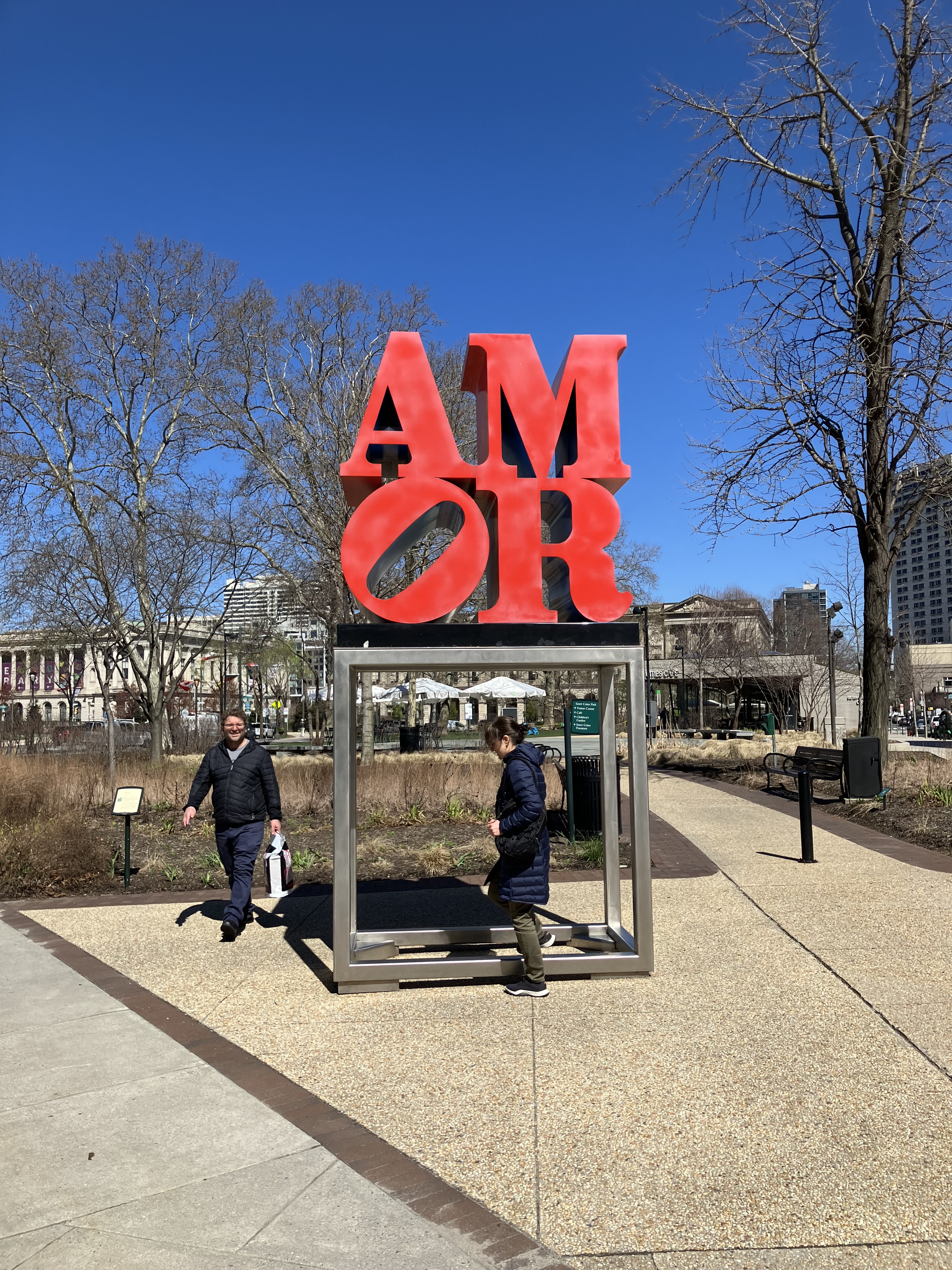
Sister Cities Park, Philadelphia
University Of Pennsylvania, Philadelphia

Thus, late last month I hauled my aged ass aboard a train that, in an hour, took me from my little town to the heart of Philadelphia. Five minutes later, there I was in LOVE Park. Fifteen minutes after that I strode into Sister Cities Park to examine its AMOR sculpture (Robert Indiana produced versions of LOVE in various languages; amor means love in Spanish and Latin). And I made my way to Penn’s sprawling campus from there, eventually locating and admiring its LOVE piece. Mission accomplished!

Why are there so many LOVE sculptures in the world? Why do people gravitate to them? I’m not an expert on anything, let alone love. But it’s pretty clear to me that love, in some respects, makes the world go round. Our planet, which might easily and accurately be viewed as a horror show, would be even more unsettling were it not for the love that connects nearly each person with at least a few of their fellow beings. People need love and want to love. Even if they don’t know it.

And so, Robert Indiana tapped into something elemental when he began inserting love into his artworks. In 1961 he used the word for the first time, in a painting, not a sculpture. He made his initial LOVE sculpture nine years later, and over time the demand for sculptural follow-ups took off. I suspect that the demand was boosted tremendously when, in 1973, the United States Postal Service issued a postage stamp with Indiana’s LOVE image on it. That stamp sold like hotcakes.

I think that the simplicity and the warmth of Indiana’s LOVE design are the reasons for its success. Four letters in basic colors. Nothing more. The letters cling to one another for dear life, the O nestled against the L and the E as if it were in a womb. The LOVE design makes us drop our defenses and think that —yes! — love is where it’s at. It’s all you need, as The Beatles famously noted. Well, it wouldn’t hurt to have water and food too. In any case, one thing for sure is that few artists ever create iconic works. Robert Indiana, without any doubt, did.

1967, the year of the Summer Of Love, was the height of the hippie movement, when it seemed that peace, love and understanding had a chance of putting the human race on a golden path. As we know all too well, that didn’t exactly pan out.

1967 also was the year in which All You Need Is Love, by The Beatles, made its appearance. It would be inappropriate of me to end this contemplation without including their live performance of the song, whose message has resounded loud and clear ever since. The event was part of a broadcast called Our World, the first ever to be transmitted to a worldwide audience via satellite. Home from college during summer break, I, with my brother, watched The Beatles do their magical thing on a tiny television in my bedroom. The presentation mesmerized and excited us. Those were special days.

Click on the following link to view The Beatles in action:  https://www.dailymotion.com/video/x6mtbyq

A TV Series, A Confectionery, A Song

“Neil, how come you usually write about things you enjoy, rather than about those that, in your opinion, bite the big one?” I asked myself the other day.

“Well,” I answered, “I’ve ripped into people I loathe. Trump and Putin, primarily. And I’ve discussed situations that worry me or piss me off. But there’s no denying that my natural orientation is to comment about aspects of life that ring my bell.”

“I understand,” I replied. “There’s no reason right now for you to mess with your natural orientation. So, let’s take a look at some of your recent bell-ringers. And, maybe, your readers then will tell you what they’ve been into of late. Ding dong, ding dong, ding dong!”

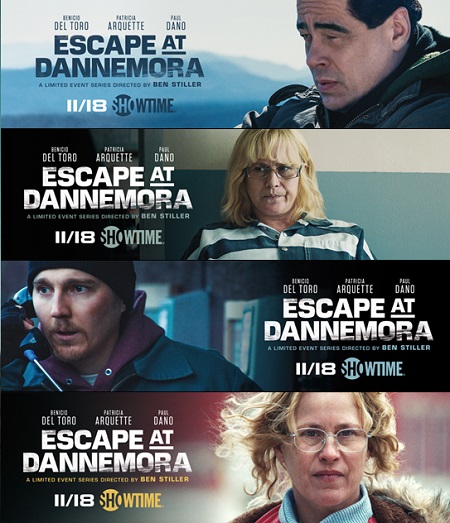
Okay! First up is a miniseries my wife and I watched two months ago: Escape At Dannemora, seven episodes in length and available on Paramount+ and elsewhere. It had been on our to-be-viewed list for a couple of years. Fortunately, we finally got around to it. It bowled us over. I place Escape in the pantheon of miniseries I’ve encountered, along with The Queen’s Gambit, Anxious People, The Investigation, Godless and a handful of others.

Escape At Dannemora came out in 2018, three years after the true events from which it draws its inspiration. Set in the town of Dannemora, in rural upstate New York, the show aims its beam at David Sweat and Richard Matt, convicted murderers imprisoned in Dannemora’s Clinton Correctional Facility, and at the married prison employee (Joyce Mitchell) who became emotionally and sexually involved with them. Ultimately, Mitchell helped them escape from jail.

Escape At Dannemora is not a docuseries. Anything but. All, or nearly all of its dialogue is imagined. After all, it’s not as though conversations between Sweat, Matt, Mitchell and the story’s other principals were recorded. And what dialogue! Completely realistic. No artificial ingredients. I’d never heard of the scriptwriters (Brett Johnson, Michael Tolkin, Jerry Stahl), to whom I now publicly tip my hat. As I do to Paul Dano (Sweat), Benicio del Toro (Matt) and Patricia Arquette (Mitchell), the actors who employed the scripted words to create characters as nuanced as French pastries. Ben Stiller directed the production with economy and precision. As couldn’t be more obvious, I highly recommend this show.

My dad loved halva, a moist, semi-sweet treat that, as I learned from doing a bit of research for this piece, originated well over a thousand years ago in Persia (present-day Iran). Unlike him, I wasn’t infatuated with the product, but ate it now and then while growing up. Halva disappeared from my diet, though, when I was in my 20s, maybe earlier, for reasons I’m not sure about. Possibly my obsessions with pizza and Cheez-It crackers left no room for halva, a product that isn’t easily found in stores in my country (the USA), and which the majority of the world’s population likely never heard of.

And probably I’d never have had halva again were it not for my pals Cindy and Gene, who bestowed sesame-based halva, the variety I am familiar with, upon me and my wife Sandy twice in the last several months (there are other types of halva in addition to sesame-based, as the Wikipedia article, the link to which is in the above paragraph, explains).

“This a weird gift,” I thought to myself when I saw what Cindy and Gene had presented to us on the first occasion. Man, how wrong I was!  Halva was the perfect gift. That wouldn’t have been the case with the too-dense halva made by the Joyva company, the brand I knew in my youth. But the halva they’d chosen, from the Seed + Mill firm, is incredible. Its sesame paste is perfectly balanced with chocolate and salt. And the texture, light and slightly granular, is wonderful. Hallelujah, I’ve been blessed!

And finally: Some songs have the power to bring you up short and make you say, “Holy shit, this is fantastic!” I Want To Know, by the quite obscure rhythm-and-blues group the Gay Poppers, did such to me two weeks ago when the tune burst forth from SiriusXM Radio’s Carolina Shag channel.

I Want To Know came out in 1960, and the Gay Poppers were from North Carolina, USA. Not much else about the song or about the group can I find online. Except that the recording at some point became popular in parts of the dance-club world. It makes me want to dance, because its beat won’t quit, and because the Gay Poppers’ vocal prowess damn well is off the charts. Without further ado . . .