Porchfest: A Very Good Idea

Good ideas . . . some people get ’em like crazy. Others, not so much. I’m near the bottom of the barrel of the latter grouping. I had a good idea about 50 years ago, when it dawned on me that grilled cheese and tomato sandwiches might be improved upon by adding a schmear of Gulden’s spicy brown mustard. Genius visited me that day, but hasn’t made an appearance since. Such, as we know, is life.

Which smoothly brings us to a remarkably good idea that some folks came up with nine years ago: a neighborhood outdoor music festival called Porchfest. When I first heard earlier this month about Porchfest’s existence I smacked myself on the forehead and said: “Yo, cowboy. This is so obvious. How come you never thought of it?” And then I remembered once again that, sadly, genius ain’t no friend of mine.

What’s a Porchfest? Well, it is a day of music played on some of the porches of a porch-heavy community. The shows are free to the public. What could be better? After all, porches, when you think about it, are small covered stages easy to get close to, making them perfect for intimate musical experiences. All that a Porchfest organizing committee need do is convince a bunch of homeowners in a neighborhood to allow musicians to play at their houses, and find a bigger bunch of musical acts to climb aboard. Then you set up a schedule so that audience members know the addresses of the porches, and encourage said listeners to roam from site to site, the better to get a big dose of vibrations.

The first Porchfest took place in 2007 in Ithaca, New York. Since then, musicians and music lovers throughout the USA, and in a few Canadian cities, have picked up on the notion and staged their own Porchfests. Each Porchchfest is independent of the others and, I’m pretty sure, is a low budget and DIY type of operation. But watch out! The power of Porchfests is undeniable and irresistible. As a few more years go by, I predict that Porchfests will cross the oceans and conquer the world!

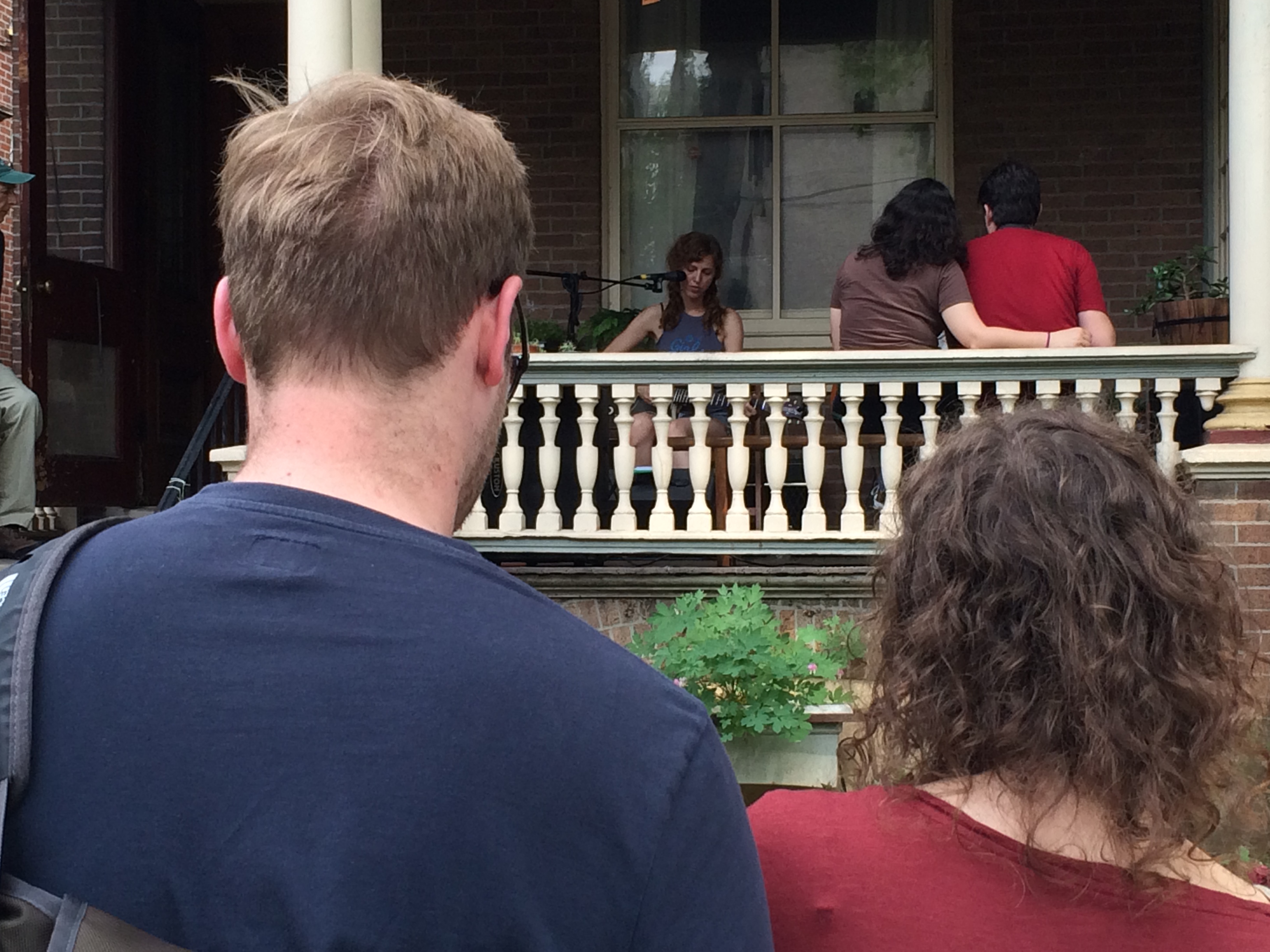
Darlington at West Philly Porchfest.
Jon Veit at West Philly Porchfest.

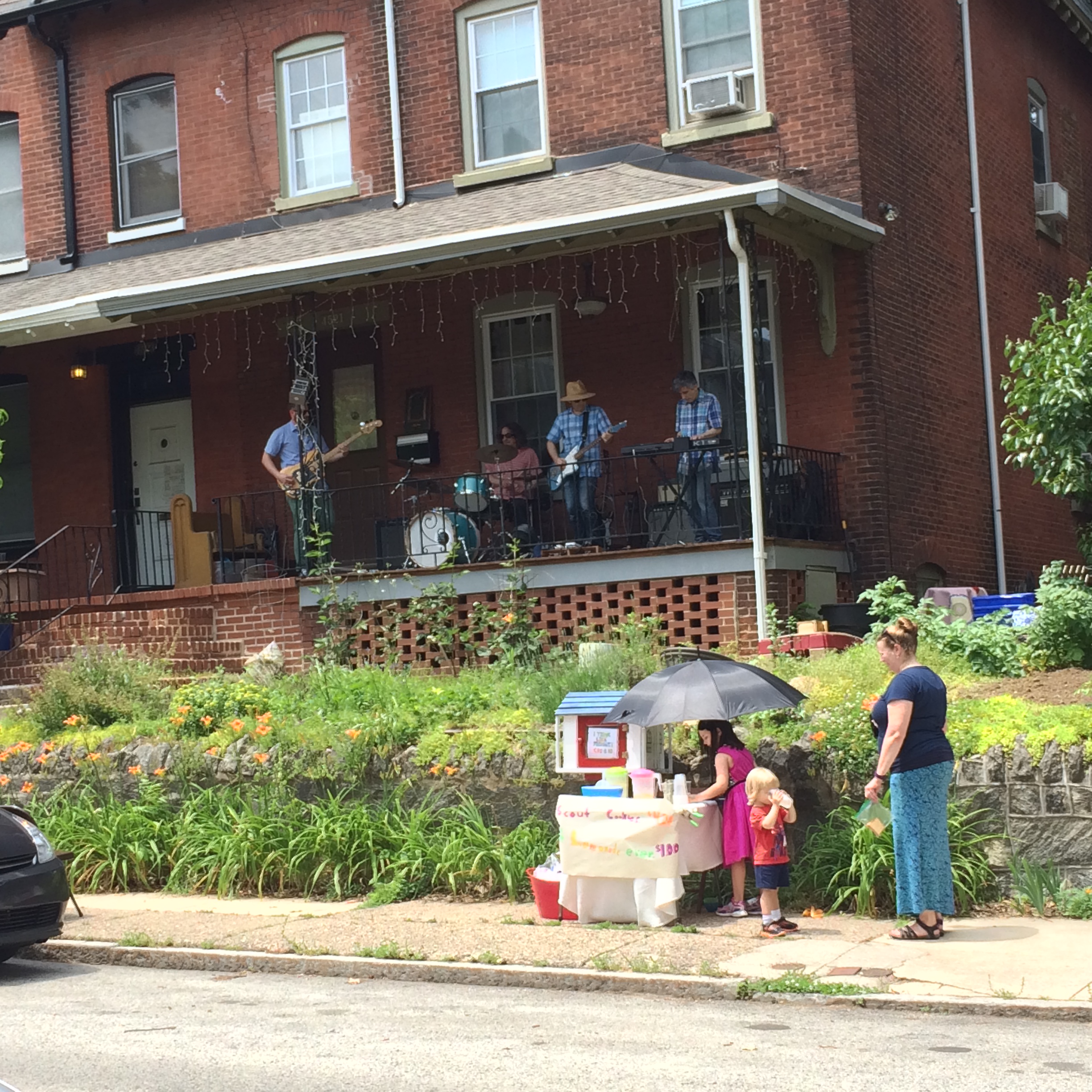
Which even more smoothly brings us to a recent Saturday in a section of West Philadelphia (part of The City Of Brotherly Love) that contains scads of old and sturdy rowhouses and twins in possession of porches. As ideal a location for a Porchfest as any on our planet. And where, indeed, the first West Philly Porchfest took place, the baby of a group of organizers who recognized that the Porchfest idea was very worth pursuing. (Lots of info about West Philly Porchfest’s genesis and design may be discovered by clicking here and also here).

I Think Like Midnight.
Emily Zeitlyn.
Emily Zeitlyn.

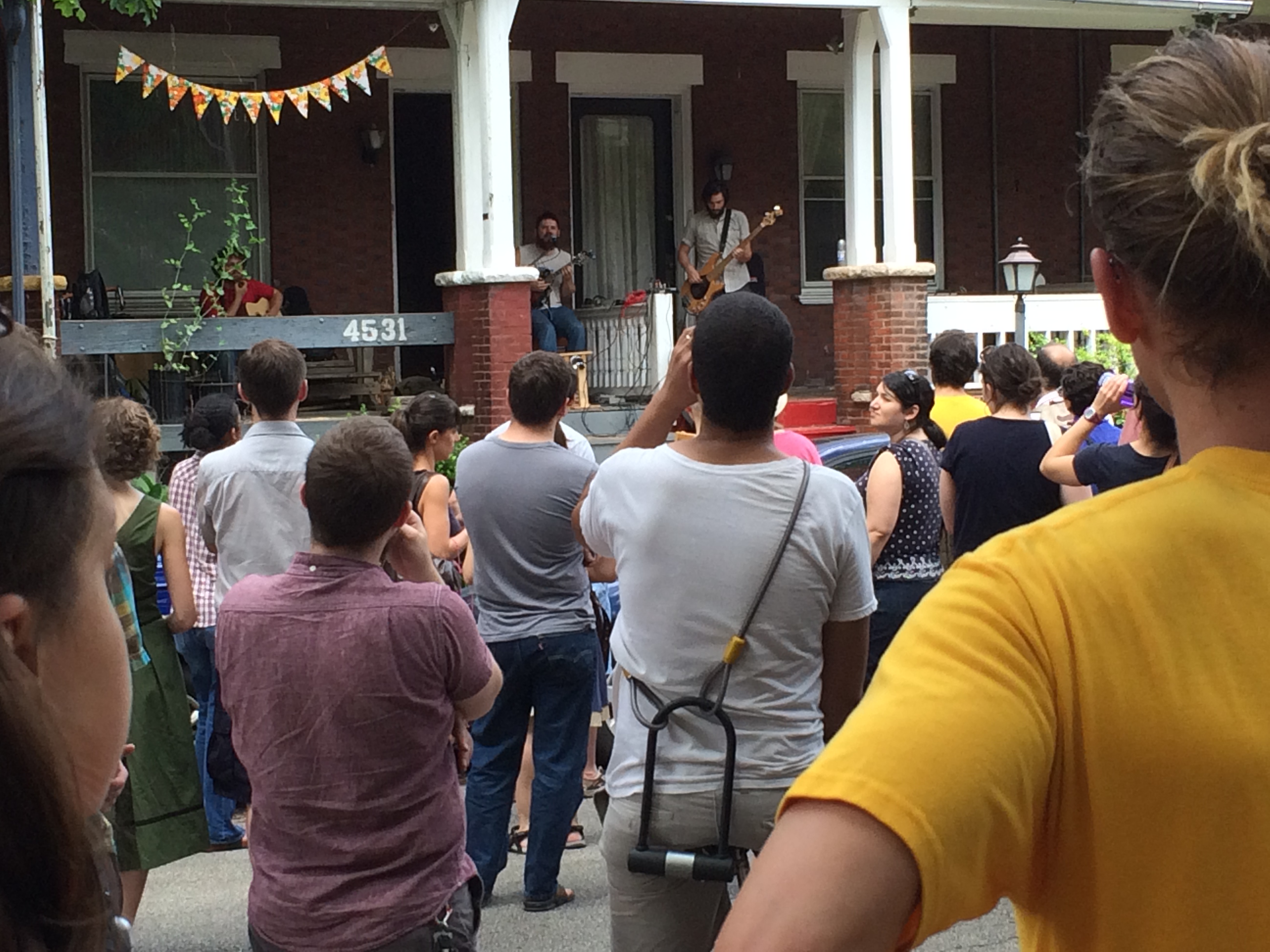
West Philly Porchfest’s boundaries were broad, about 12 blocks east to west and likewise north to south, encompassing much of what has come to be known as University City due to the area’s proximity to the University of Pennsylvania. Over 30 porches participated. The event began at noon on June 4 and ended at 6 PM. I was an attendee, taking in parts of six shows during a two-and-a-half-hour period. Man, I loved it. I heard an acoustic folky rock trio (Darlington); two singer-songwriters (Jon Veit and Emily Zeitlyn); a damn good jam session between, of all things, an African-drum percussionist, a fiddle player, an acoustic guitarist and a flugelhornist; a vocal-less rock band (I Think Like Midnight) that, to my ears, sounded like a cross between The Grateful Dead and Television; and a folky duo that smoked and crunched. I’m going to zero in on the duo, who go by the name Driftwood Soldier, because I liked them the best of the acts that I caught. I seemed not to be alone in that. They drew the biggest crowd, around 80 people, that I saw all day, and the loudest applause too.

Driftwood Soldier.
Driftwood Soldier.

Owen Lyman-Schmidt is Driftwood Soldier’s singer, mandolin strummer and songwriter. Bobby Szafranski is the band’s not-your-average electric bassist. Both guys pitch in to move the groove by banging on percussion instruments with their feet. I tell you, Driftwood Soldier has it. Owen sang, in a wild and wooly baritone, about underdogs, colorful characters, people who deserve better than they’ve got. He reminded me a lot of the late Dave Van Ronk. And Bobby sent the tunes aloft with bass lines that gleamed and grinned. I would not be surprised if Driftwood Soldier breaks through nationally one of these days, though to-date they are unknowns. They are that good. And they’ve got the work ethic that might lead to fame and glory, touring our fair nation with gusto. Thanks to the wondrousness of the Internet, you may watch Driftwood Soldier performing their song Rosalee by clicking right here.

IMG_0493IMG_0494
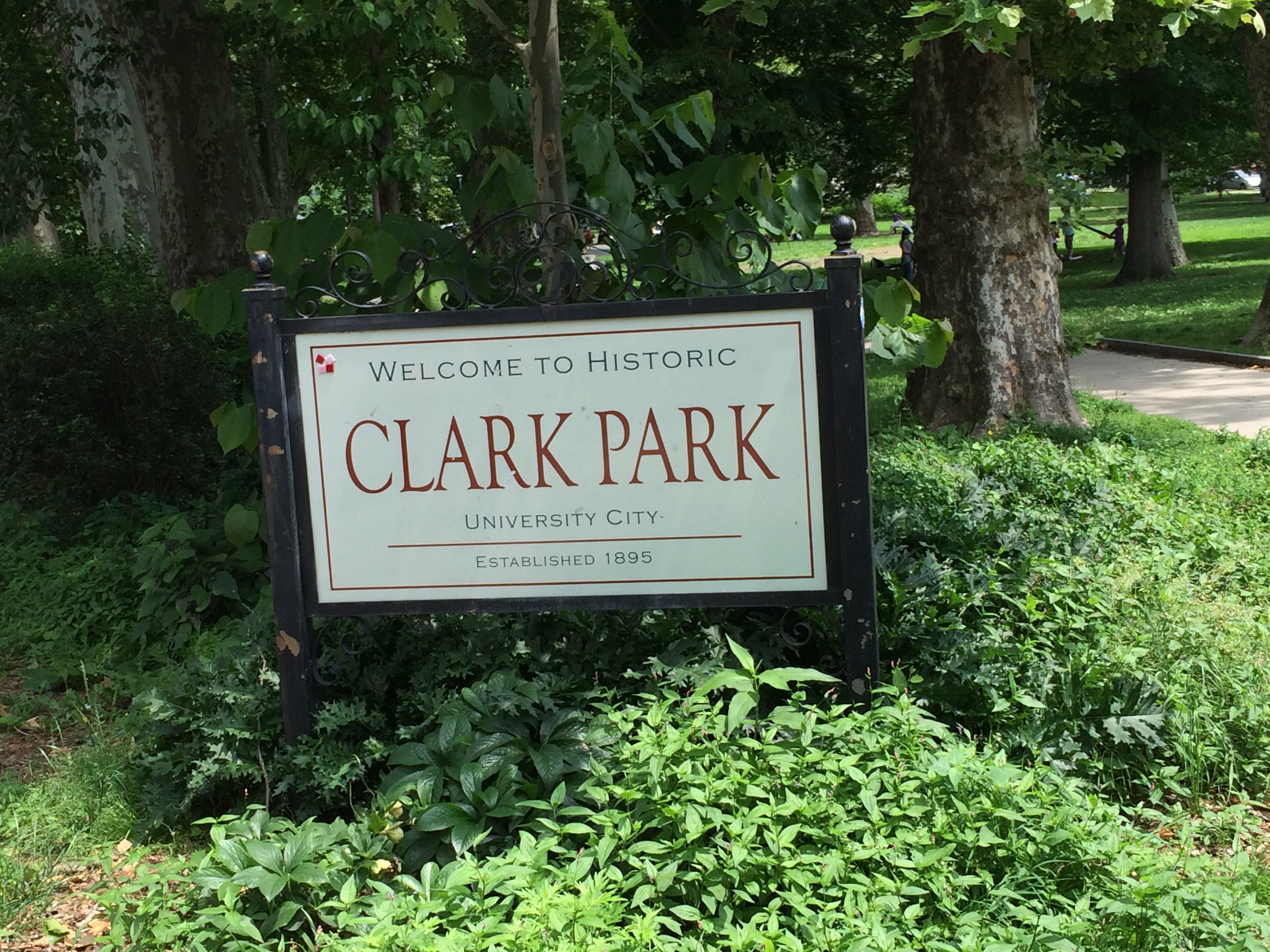
You know, I lived in University City during the 1970s and 80s on a beautiful, tree-filled block oh so close to a few of the shows I watched the other day. I liked the area mucho back then, and still do. I go back now and again. On the day of Porchfest it was fun walking the streets upon which I’ve trod so many times before. And it was equally swell strolling through Clark Park, a lovely place, a hub of peace and calm in University City. Kids were playing, food truck and farmers’ market vendors were vending, and teenagers and adults were milling around. The coolest sight I saw in the park was a little girl climbing all over the Charles Dickens statue. That’s right, Charles Dickens. It’s the only statue of him in the USA. And, apparently, one of only two in the world. The other, by the way, is in Australia, not Great Britain. A good idea would be for the Brits to commission and erect a Dickens statue too, since Dickens  — duh — was one of their own.

(Don’t be shy about adding your comments, or about sharing this article with others)

(If you click on any photo, a larger image will open)

Lindi Ortega Revisited

Last July I penned an essay about Ashes, a brilliant tune from the heartbreak canon that came out on Lindi Ortega’s 2015 album Faded Gloryville (if you’d like to read my words, click here). Lindi is a singer-songwriter in love with pensive ballads, country music in various varieties (gritty, rocking, bouncy), the blues and soul music. She has reached a modest level of success. My story, though, didn’t go into much detail about Lindi, a Canadian who relocated to Nashville five years ago, because I didn’t know all that much about her or her music (not that I’m an expert now). I concentrated on the song. In a nutshell, what I said was: “Ashes to me is perfection.”

Well, for reasons that probably always will remain unknown to me, my Ashes opus became pretty well read. Most of my stories are looked at for a few weeks at best, rarely to be discovered by any member of humanity after that. But the Ashes piece was different. Week after week, month after month, folks kept finding it. About three months ago its audience finally petered out.

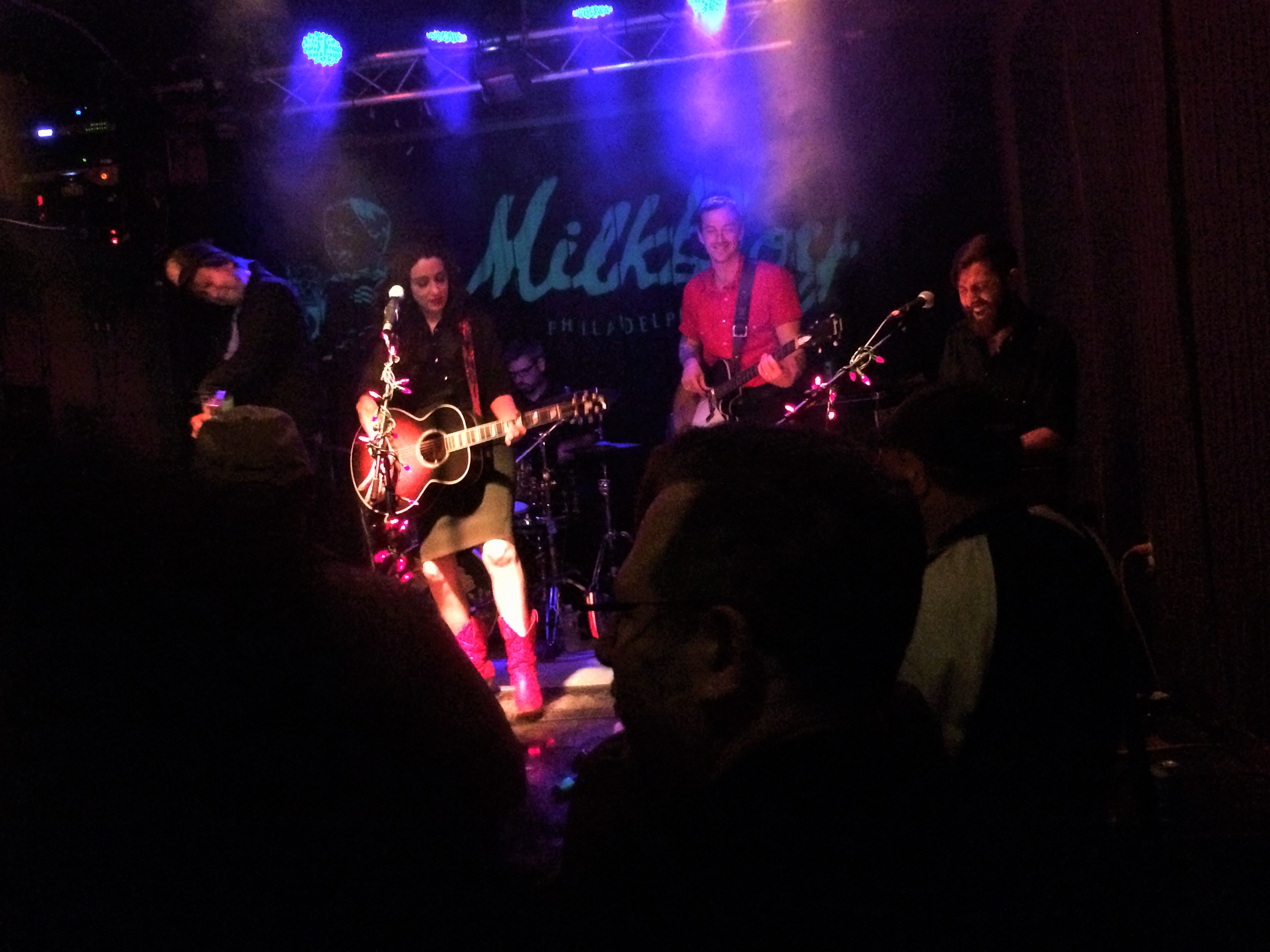
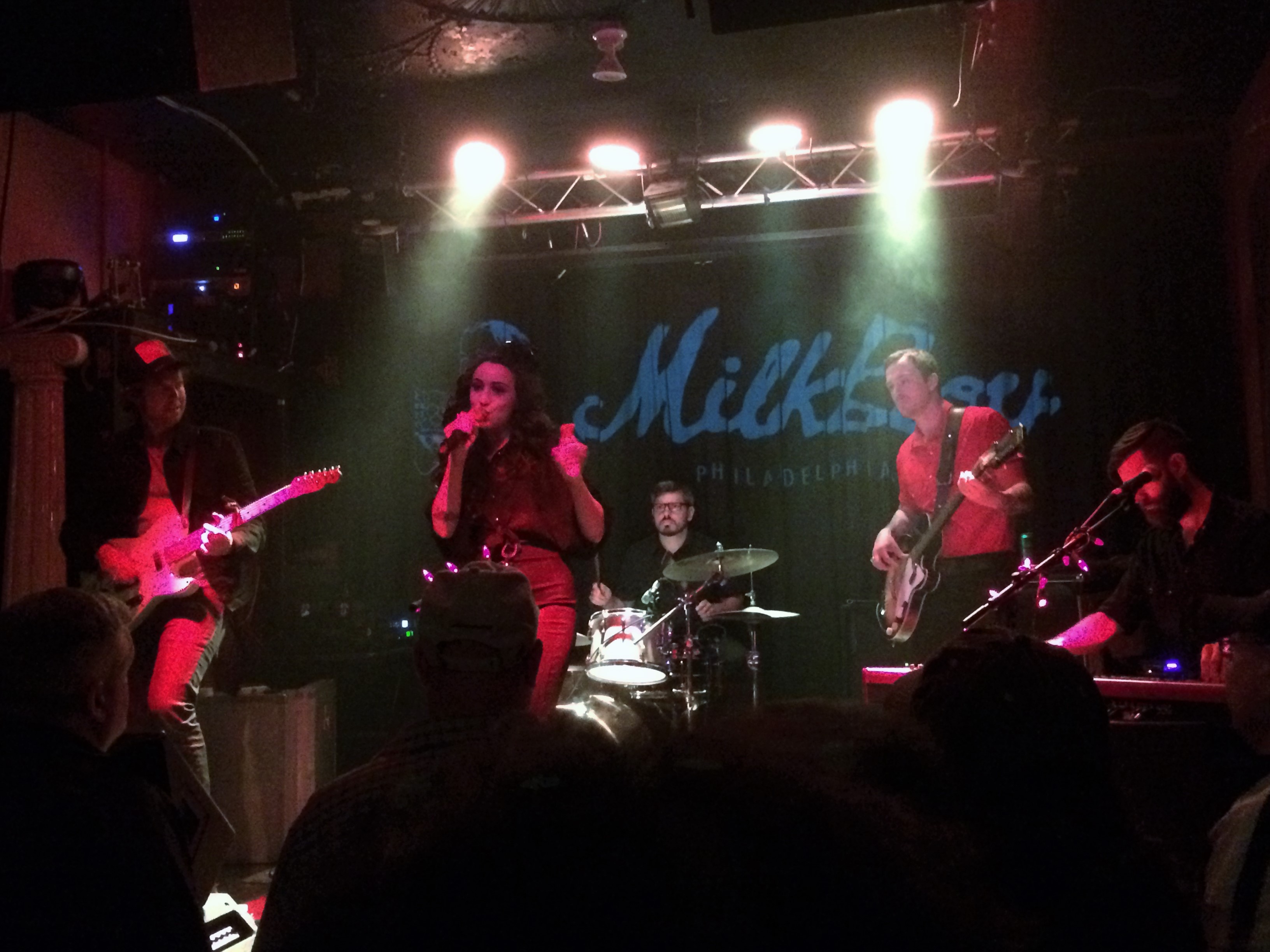
Me, I didn’t forget about Lindi after I wrote the story. She and her great song became so stuck in my mind, I knew I had to see her in concert. A few months ago, voila! I noticed that Lindi and her band, who tour like mad around the USA and Canada, were on the schedule of MilkBoy Philly, a smallish and mostly rock-music club in the heart of Philadelphia. On May 22 I left my home in the burbs to take in that show.

IMG_0368 (2)
Was Lindi a let-down? Had my infatuation with Ashes set the bar of expectations way too high? Hell, no. I, who was familiar with not a one of the Ortega-composed songs performed at MilkBoy, other than Ashes, had a great time. Lindi and band were terrific, as I’d assumed they would be. And it was a gas hanging out in funky MilkBoy, where I squeezed close to the stage like a frigging fanboy, inches away from a gaggle of new-found, swaying and shimmying friends.

IMG_0369 (2)
Lindi, who is in her mid 30s, hit the stage at 9:05 PM and bid us adieu 75 minutes later. In between she sang her heart out, ripping it up on hard rockabilly and honky-tonk and bluesy numbers, pouring out her soul on the slower, more doleful part of her repertoire. She and her four-guys band knocked  each song (19 in all) out of the park. Lindi wrote or co-wrote 16 of them, and those 16 came from her four most recent studio albums. Most of the lyrics were finely wrought, sweet metaphors and similes abounding. Without a doubt, Lindi’s my kind of girl . . . a wordsmith.

Lindi Ortega sings about the subjects that have fueled country and blues and soulful songs since time almost immemorial. We’re talking loneliness, regret, broken hearts, drinking to drive the troubles away, lovers who can’t help but disappoint. Her voice and delivery might remind you of Dolly Parton and Lee Ann Womack at times, and of Emmylou Harris and Patty Griffin at others. In her trademark red cowgirl boots at MilkBoy she leaned into her hand-held mic and told it like it is.

IMG_0364 (2)
Take one of the fast numbers, for example. The evening began with a Faded Gloryville song, Run Amuck. Wham, bam! It was a honky-tonking blues blasted into fourth gear by James Robertson’s red-hot Telecaster guitar and Noah Hungate’s precise, rip-roaring drum work. Robertson and Hungate threw out sparks for 45 seconds before Lindi sang the tune’s first lines. “Daddy, where you going?/Going out again?/You keep messing round town with your floozy little friends,” Lindi finally unloaded. And she didn’t quit unloading till the tune ended a few minutes later. Man, I was sold. And psyched.

And take one of the slow tunes. Near show’s end she broke my heart with Tin Star, from the album of the same name. Voice quivering, she sang sorrowful words: “Like an old tin star I’m beat up and rusty/Lost in the shining stars of Nashville Tennessee/Well I wrote this song for those who are like me/Lost in the shining stars, the shining stars.” She held that final stars fragilely, with a high note, and for only half a second before continuing Tin Star’s tale of a very struggling and conflicted musician. The song was gorgeous. Absolutely gorgeous.

You get the idea. If Lindi and her band pass your way, plunk down a few bucks and catch them. In the interim, you can watch part of the MilkBoy concert courtesy of YouTube. Someone whom I didn’t notice, but who no doubt was standing near me, recorded and uploaded seven of the MilkBoy songs. If you click here you’ll see and hear Run Amuck. And if you do likewise right here, Tin Star will come your way.

I can’t leave without mentioning Ashes, which, sadly, the MilkBoy YouTuber didn’t post. I went half limp when, halfway through the show, I heard the chiming guitar riffs and the dirge-like drumming that introduced the song and gave it gripping power. And what might I say about Lindi’s shiver-inducing voice and the intelligence and sadness of the lyrics? Well, to repeat, Ashes to me is perfection. By clicking here, you will hear the album version of one of my all-time favorite songs.

(Don’t be shy about adding your comments, or about sharing this article with others)

(If you click on the photos, larger images will open)

Me And My Muse

My muse.
My muse. Her dress might be from Saks.

The stage was set in its usual way this past Thursday evening. I sat in the library of my suburban Philadelphia home, clad in comfy pajama pants and a sporty smoking jacket, sipping a cup of piping hot chamomile tea laced with two shots of Kentucky bourbon. I was awaiting my weekly visitation from Erratica, my wondrous muse. Erratica, the little-known but essential Greek goddess, and sister of the nine muses who have gotten all the headlines since bursting on the scene about 3,000 years ago. Terpsichore, for instance, the inspiration for dancers, and Calliope, without whom Homer’s Iliad and Odyssey, and other authors’ epic poetry, would be stink-o for sure.

Yes, Erratica. She whose job through the millennia has been to aid countless amateur storytellers and scribes in need of a push, in need of direction, such as me.

My eyes were heavy and my mind was foggy due to the typically poor night’s sleep from which I had awoken that morning, not to overlook the spiked tea. In other words, I was in what for me passes as fighting shape. I was straining my brain, trying to come up with some story ideas for my blog, when a series of sharp jabs on my left shoulder got my attention. I looked behind me.

“Hello, Erratica,” I cheerfully said to the beautiful creature who had delivered the blows, eyeing her flowing robes. “You are right on time. I love your dress, by the way. Where’d you get it? At Saks?”

“I’m in a hurry, Neil,” Erratica answered, as she moved from behind my chair to face me properly. “You’re not the only pseudo-writer in need of help. Let’s skip the small talk.”

This girl gets right to the point. There’s nothing erratic about her. Instead, her name derives from the erratic creative talents of those whom she shepherds. “Okay,” I gulped. “Here’s the situation. A week ago, with your assistance, I got it together to write a piece about Willie Nile, and I published it yesterday. But now I’m stuck, really stuck. I can’t think of a single thing to write about. I’m constipated, for gawd’s sake! My handful of readers won’t know what to do if I don’t publish something next week. Please inspire me, Erratica. Please. I’m on bended knees.”

Erratica gave me one of those long, hard looks. I felt uneasy. I knew what was coming. “Neil,” she said. “You have been a big disappointment to me the last couple of months. Getting you to deliver stories once every week or so has been much too difficult. And now you say that you’re totally out of ideas? Are you kidding? Look at all the movies and other things you’ve seen that you haven’t written about. The world is your oyster, whatever that means, and you’re leaving so much of it on the table. There you were last month at the Philadelphia Flower Show, a world-famous exposition, and you wrote not one word about it. Three hundred thousand people went to that show, but it wasn’t good enough for you? What are you, some kind of elitist? And a couple of weeks ago you took in Hello, My Name Is Doris, a sweet movie with adorable Sally Field. Where’s your review, guy? And I could mention so much more. Neil, you’re frustrating me. Big time.”

doris IMG_1273
“Oh, Erratica. I know you’re right. You always are. But hear me out. Sure, I liked Hello, My Name Is Doris pretty well. I came close to writing about it. But the more I thought about the movie, the more I saw what I think is a gaping hole in its central logic. I said to myself, ‘Yo, schmuck. Why spend several hours analyzing a flick that’s kind of flabby in its design?’ What I’m saying, Erratica, is this: Doris is what, 65 years old? And she’s been a semi-wallflower pretty much all of her life. And then one day— presto! — she falls in with a bunch of hip millennials who practically adopt her into their tribe. I mean, c’mon. The odds of that happening are about as high as my winning the Powerball jackpot on the same day that NASA accepts me into its astronaut training program.”

Erratica gave me another of those long, hard looks. Obviously she wasn’t buying my explanation. Maybe I wasn’t either.

One of the Japanese displays.
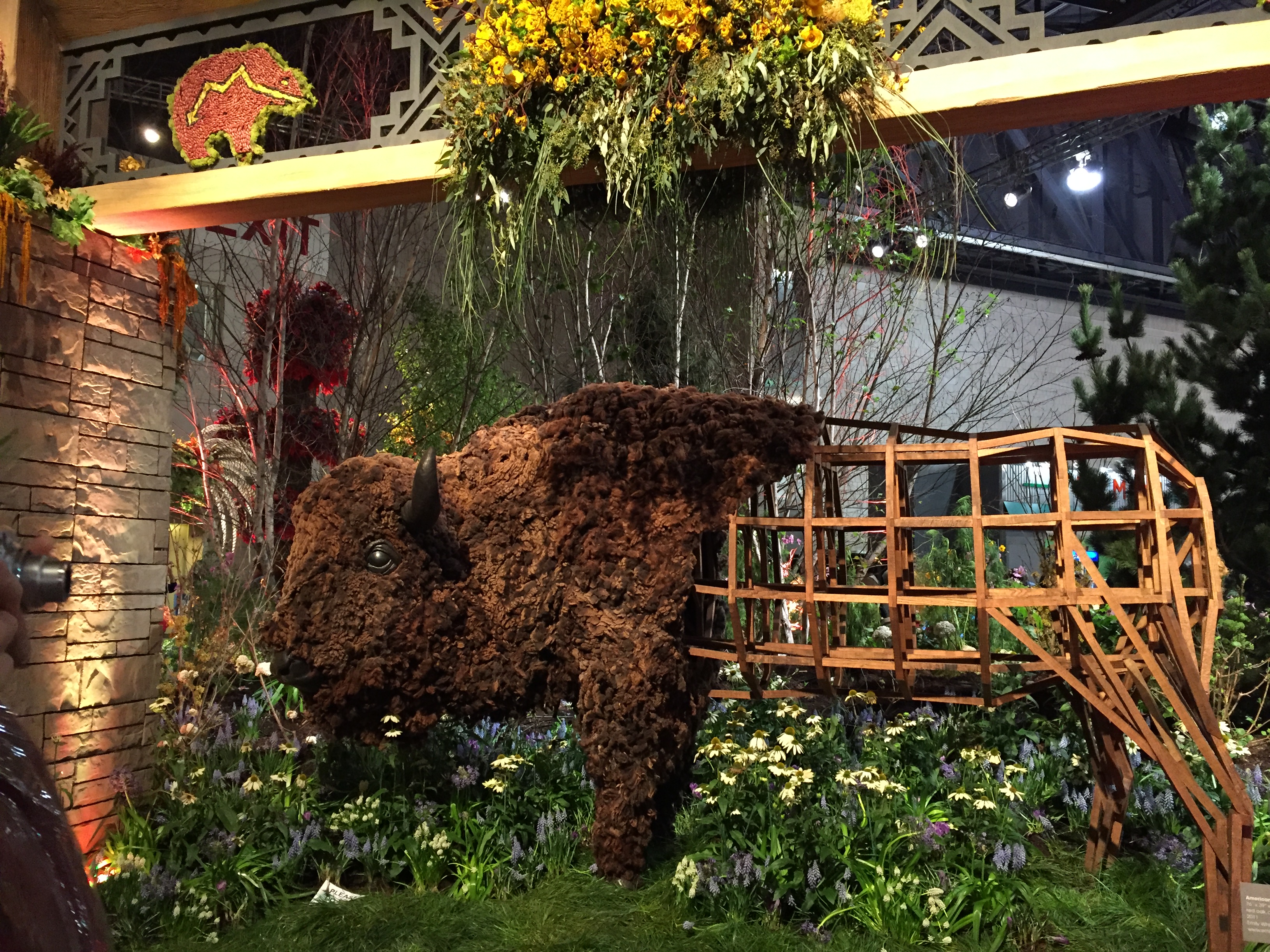
Part of Big Timber Lodge, which was the entrance to National Parks exhibits.
Part of Big Timber Lodge, which was the entrance to national parks exhibits.

“And here are my beefs about the Philadelphia Flower Show,” I continued. “Yeah, going in I was primed to write it up. But going out I was muttering ‘nah’ to myself. I mean, the show was okay. I liked some Japanese displays. And the themed exhibits representing various national parks were decent, but that’s all they were . . . representations. You could walk through and around them in seconds. All they really made me want to do was head to the great outdoors and explore the real parks. And don’t get me started on the juried flower exhibits. The flowers in my local supermarket’s flower department look as good, probably better, than what I saw at the show. Grouse and grouse some more, that’s mostly what I would have done if I’d written about the Flower Show. There’s no fun in that for me.”


Erratica snorted. Her patience clearly was exhausted. “I don’t know if I can take this anymore,” she said. “I have to have a talk with my father. His name is Zeus, in case you forgot. You amateurs have worn me out. For 3,000 years I’ve been dealing with marginally-talented, confused whiners. I deserve a new assignment. Calliope’s, for example. Amateurs . . . bah!”

And, just like that, Erratica was gone. Possibly forever. I don’t know how I will cope if she doesn’t return. But I do know this: Bereft of ideas, there’s little chance that I will publish anything this week.

(Don’t be shy about adding your comments, or about sharing this article with others)
(Doris and flower show photos by Sandra Cherrey Scheinin. If you click on a photo, a larger image will open)

Walking Through Philadelphia With Colors On My Mind

I woke up one weekday morning not long ago with visions of Philadelphia swirling in my mind and beckoning me. Amorphous visions, but colorful. I hadn’t done much city exploration in awhile. Hadn’t taken a long and leisurely stroll anywhere in awhile. What’s more, the weather prediction was highly favorable: warm, sunny and breezy. A walk was in order. And so, a few hours later in my suburban Philadelphia home, I closed my eyes, clicked my heels together three times and thought beautiful thoughts about the City Of Brotherly Love. Next thing I knew I was standing at the corner of 2nd and South Streets, part of a funky area not far from the Philadelphia waterfront and some of the city’s oldest residential blocks. Let the adventure begin.

The hike took nearly four hours. I trod, often guided by whimsy, on many blocks within the rectangle formed by 2nd, Bainbridge, Broad and Arch Streets. At the start I didn’t have much of an idea of what my route would be. But this much I knew: I wanted to stretch the ol’ legs, inhale Philadelphia’s quasi-clean air and feel the wind caressing my thinning hair. And this too I knew: I wasn’t in the mood to check out any historical or touristy sites, or anything with the connotation of trendy attached to it, all of which Philadelphia is loaded with. But it wasn’t to be an aimless ramble. No way. When I landed at 2nd and South Streets, I had in mind a theme for the day, inspired by the colorful visions from earlier in the morning. I was going to look for sharp and snazzy outdoor color displays produced by the hands of man, not by nature. It was a modest quest, probably kind of a dumb one. But hey, I’m that kind of guy.

fez IMG_0212mexican IMG_0215
Things got off to a slow start. I looked all around the 2nd and South Streets vicinity and the only colorful things I could find were Fez Restaurant’s facade and a happy, yellow ghoul, dressed in red, outside Las Bugambilias, a Mexican eatery. Still, I figured that the South Street corridor — not as happening a part of town as once it was, but hanging in there fairly well — offered a decent chance to come across more than that. And I was right.

mako's IMG_0220larry fine IMG_0222
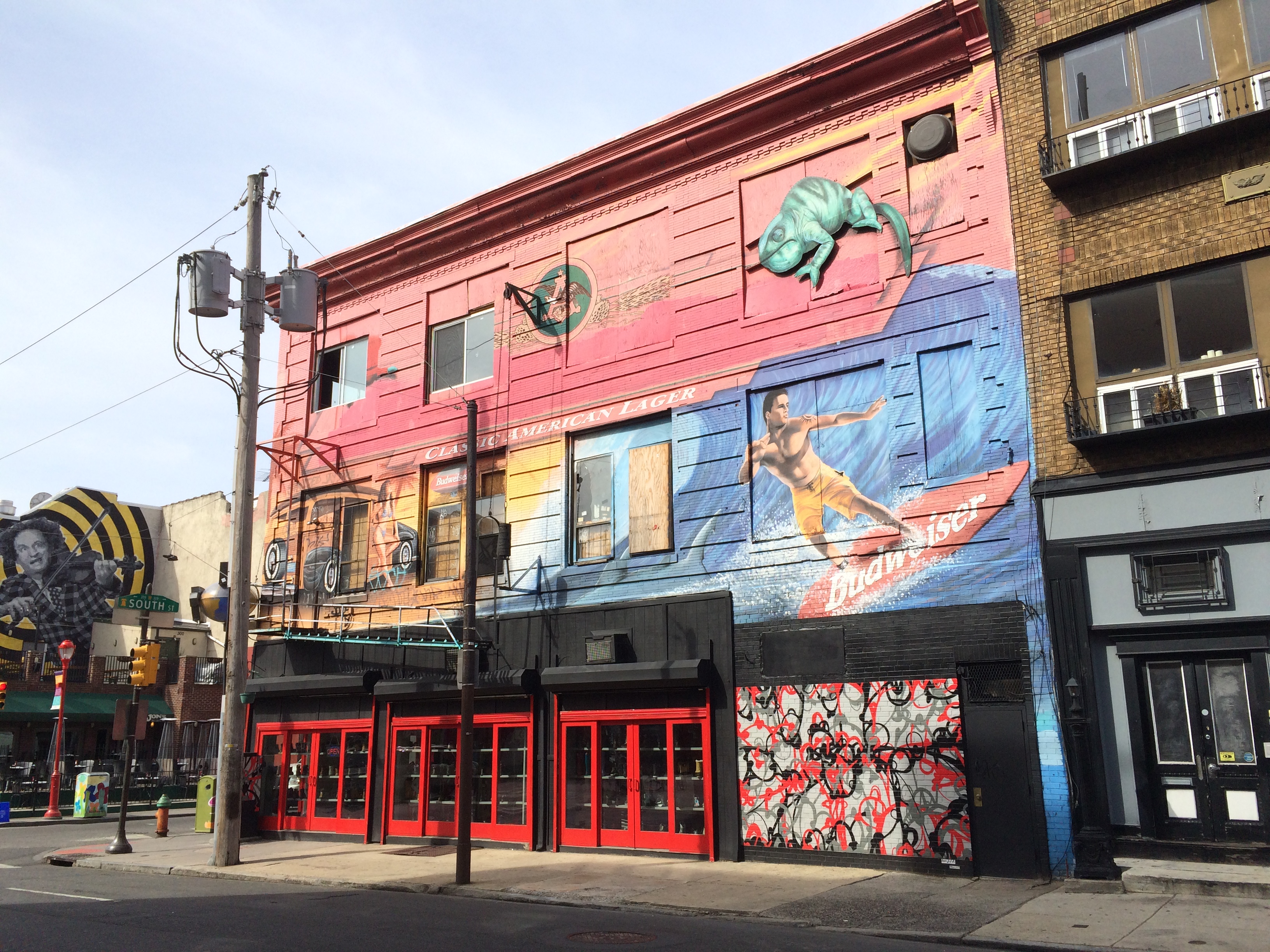
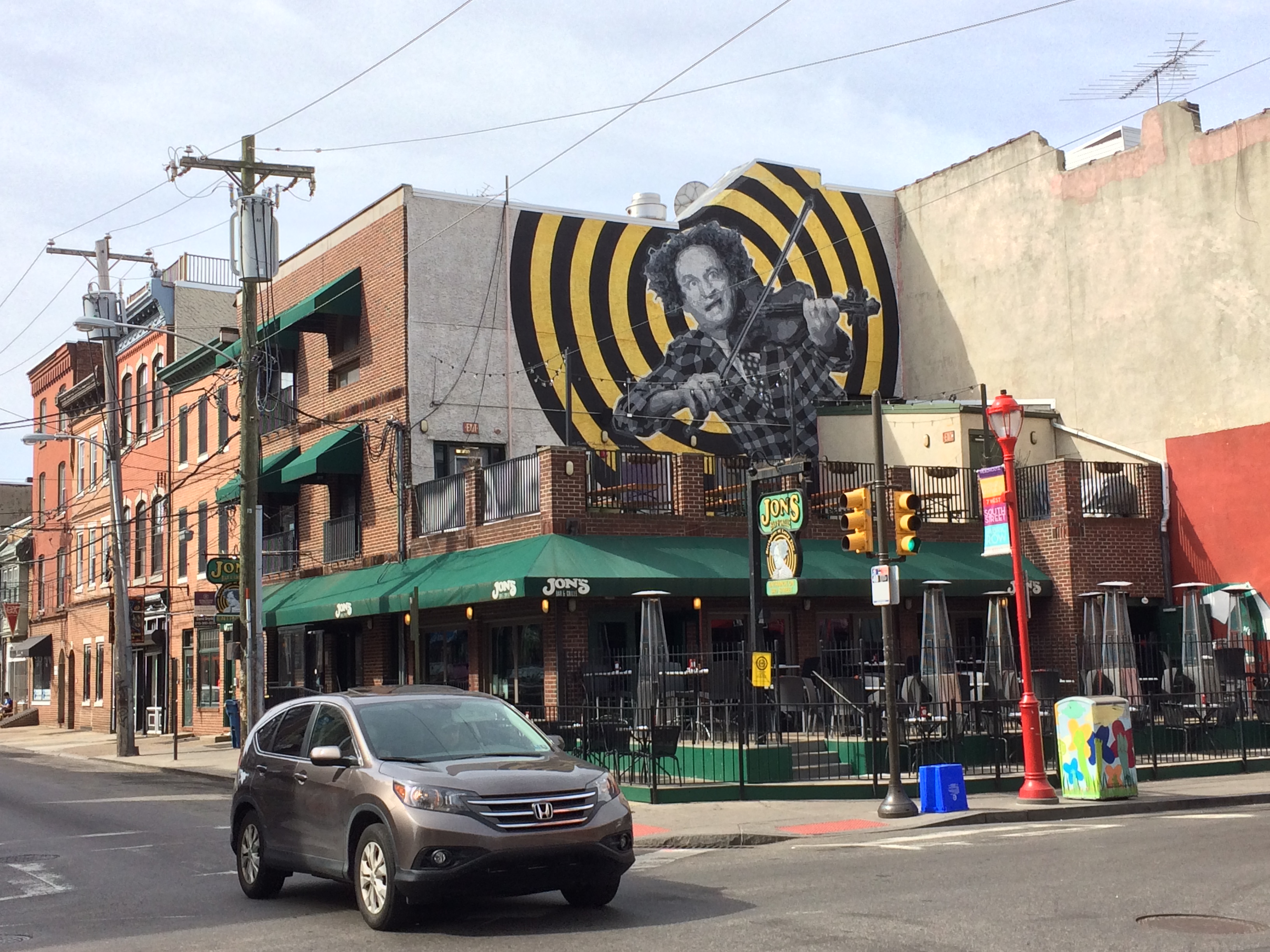
At 3rd and South I said to myself, “Wow, look at that mural.”  It was painted on the side of the out-of-business and mourned Mako’s Retired Surfers Bar And Grill. A guy on a surfboard, a girl leaning against a fat-tire car, all done in sweet pastel hues. Lovely. And didst my eyes deceive me? Directly across the street from the former Mako’s was another mural, this one depicting the torso of a fiddle-playing, electric-haired madman inside yellow and black concentric rings. None other than Philadelphia native Larry Fine, one of The Three Stooges. Yeah, man, now we were getting somewhere.

A little while ago I alluded to the fact that I’m no genius. Proof? I shouldn’t have been surprised to see the murals at 3rd and South, because I’d seen them before, though not in recent years. What’s more, I somehow also had forgotten that Philadelphia is the outdoor mural capitol of the world, thanks to Mural Arts Program, a public/private organization born in 1984. Incredibly, over 3,000 MAP- created works grace Philadelphia. No doubt, Mural Arts Program is one of the good guys. It aims to beautify all neighborhoods (from dilapidated to swank), to employ many folks in need of work and encouragement, and to inspire the general population. Big goals, all reached as far as I can tell.

DuBois IMG_0240
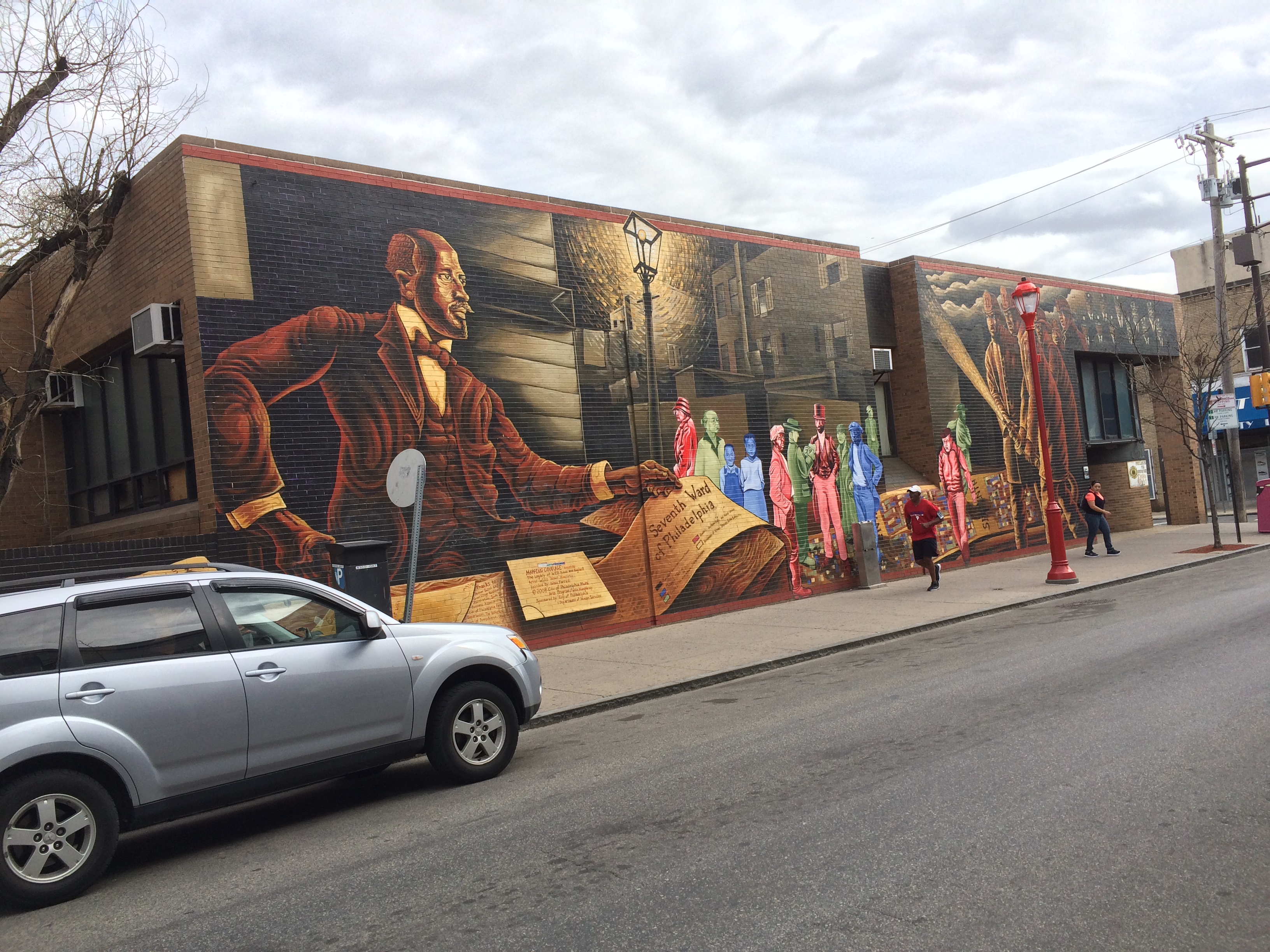
Well, I haven’t been able to determine if MAP was behind the painting on Mako’s side wall. But Larry Fine wouldn’t be overlooking South Street were it not for MAP, nor would two other murals that I later saw on my trek be in existence. Of those, the first I came to is attached to Engine Company 11, a firehouse at 6th and South Streets. It’s a magnificently imposing creation titled Mapping Courage. It honors W.E.B. Du Bois, the Black scholar and leader, and the firehouse itself, which for years was manned only by African Americans. The mural is beautifully designed, shining in browns and ambers that allow its few bright colors to pulsate.

Spring IMG_0260
An hour later, on Pine Street near 13th, I stumbled upon the mural known as Spring. Yowza, this one stunned me too. Look at those soft whites and butterscotch shades of the flowering foliage. How totally cool it was that real trees, in bloom, nearly were melting into the painted surface.

You know, somewhere in the middle of my expedition I realized something that never had dawned on me before. Namely, despite the murals that gas things up on certain blocks, most of Philadelphia’s residential streets, beautiful and architecturally rich as many are, sure appear tame when it comes to color. This ain’t exactly a news flash to the oceans of people more observant than I, but it’s true. And it’s largely because of bricks, bricks, bricks, the quintessential and earth-toned building blocks of Philadelphia. Bricks are sturdy, bricks are quaint, bricks have been with us humans for thousands of years. But man, I can understand how someone might decide that a brick-dominated landscape needs to be jazzed up. Someone named Isaiah Zagar, for example.

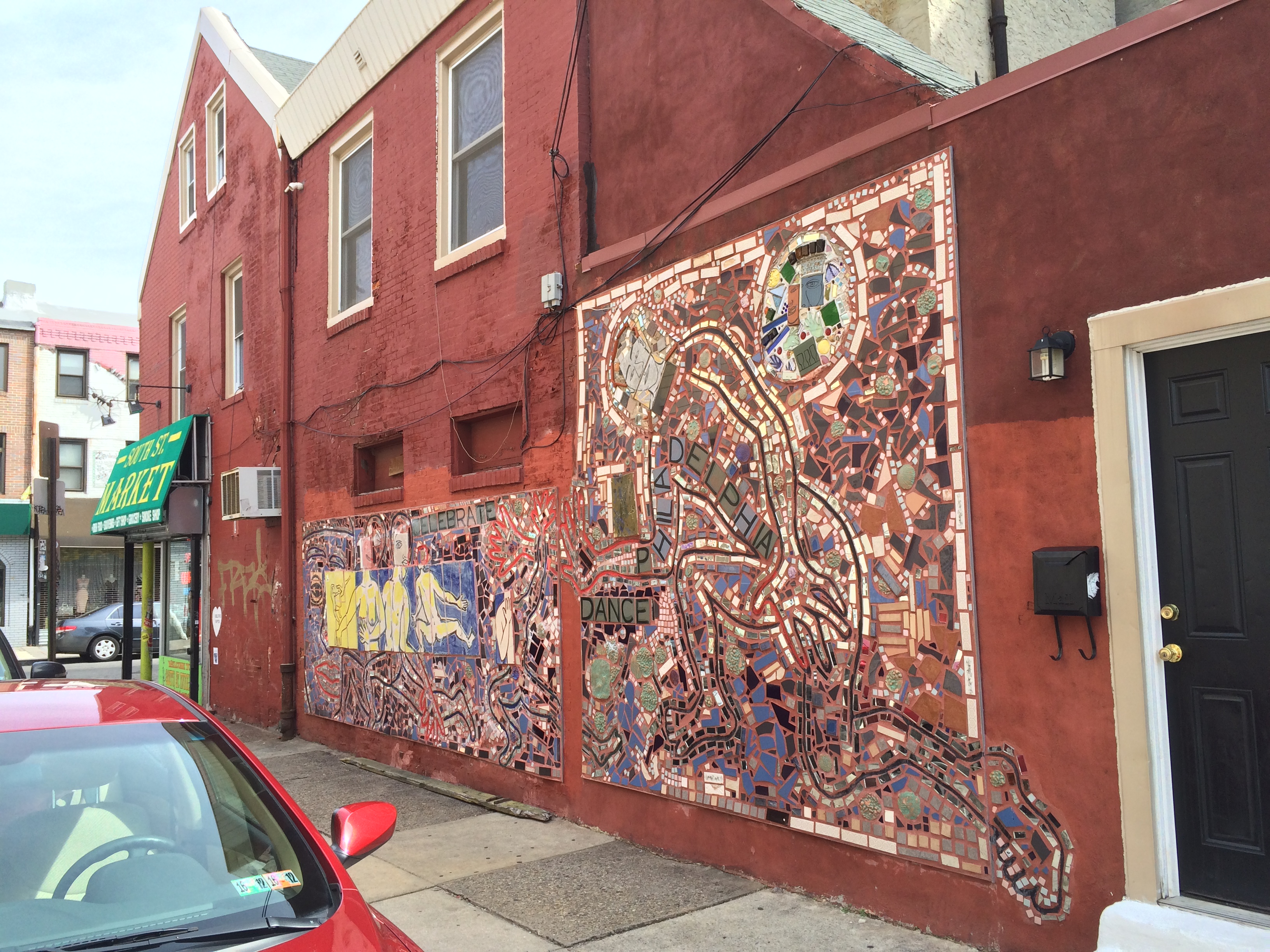
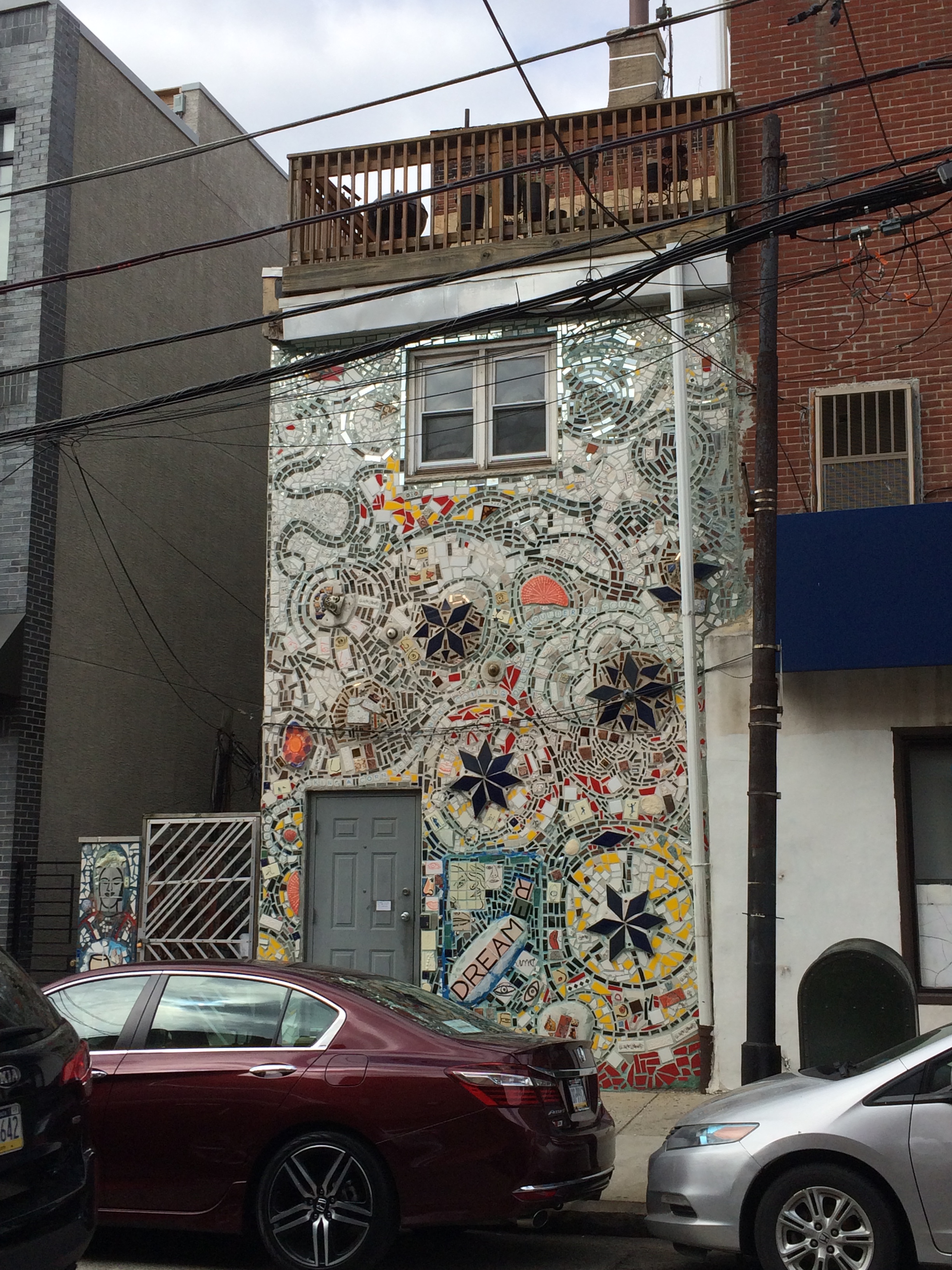
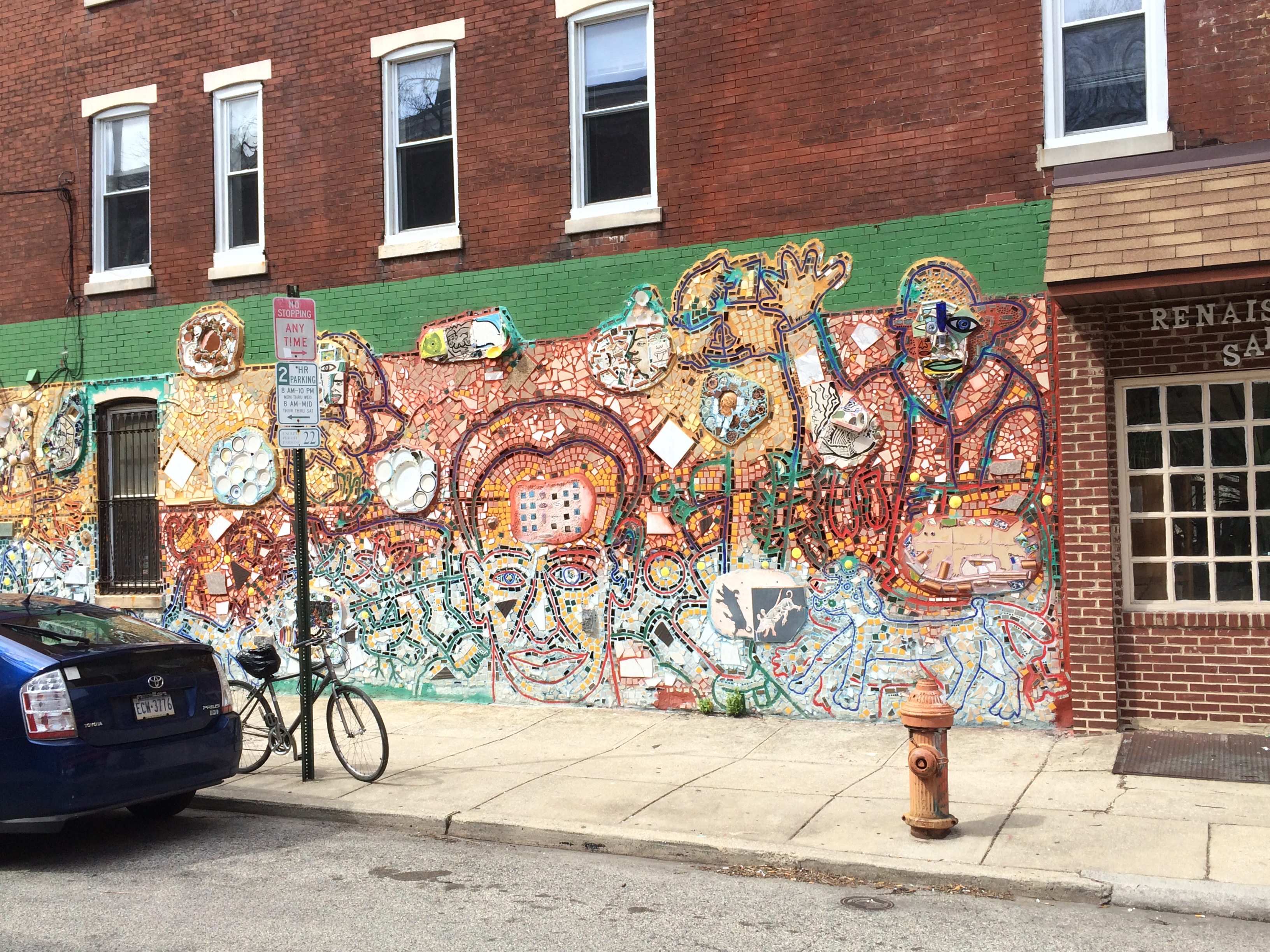
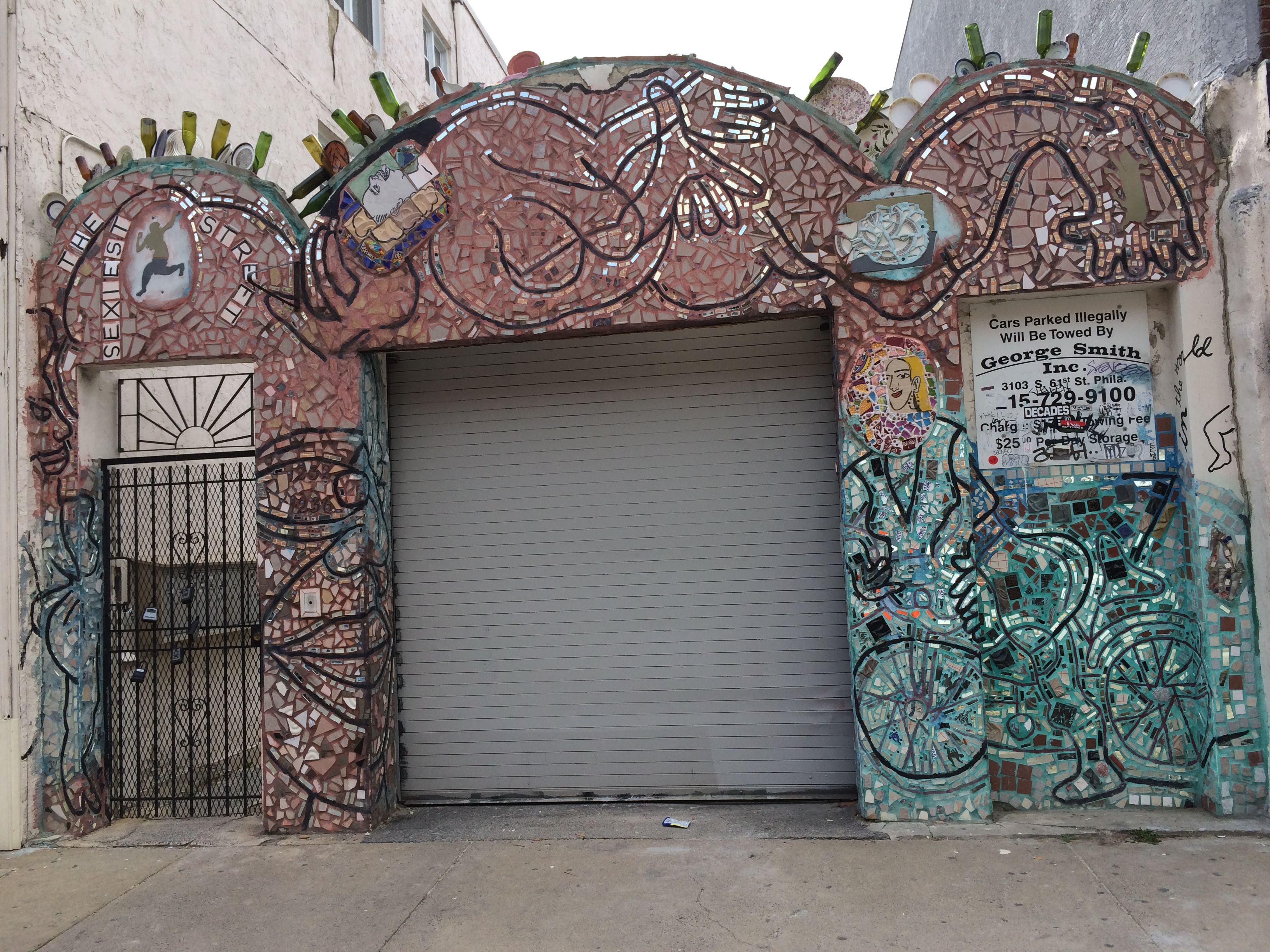
Soon after my walk began, a few minutes after I metaphorically tipped my hat to the Mako’s and Larry Fine murals, I started to come upon some unusually decorated homes, first on Leithgow Street, just off of South. And then on many other blocks near or on South. I had never seen these exterior wall decorations before, hadn’t known about them. They were something else, kaleidoscopic, multi-colored mosaics made from pieces of tile and glass. The design similarities got me wondering if one person had done all the work. I had a vague knowledge of mosaic artist Isaiah Zagar. I knew that he lived in the area and that he had established something called Philadelphia’s Magic Gardens. Were these freewheeling creations his? A bit later I learned that the answer was yes, and that he had begun adorning buildings quite a few years ago.

I suppose that Zagar obtained the permissions of homeowners before going wild on their domiciles. Or maybe he didn’t. Whatever. Unembellished bricks (and other stones), goodbye! Colors and designs up the wazoo, hello! Zagar’s mosaics put me in mind of native art from South America and Africa, of children’s art, of what cave paintings from 20,000 years ago might have resembled if their creators had been high on pot. Anthropomorphic faces and figures abound. Psychedelic cellular shapes look determined to escape their confines. Words like dance and celebrate and dream are embedded in the mosaics. Zagar is a positive thinker, a lover of life and, I assume, one hip cat.

Zagar’s greatest creation is Philadelphia’s Magic Gardens, a multi-level indoor and outdoor mosaic extravaganza, an arts center and a head trip that has become a go-to attraction for tourists and locals. He began work on it in 1994 in what then were abandoned lots, and endured some legal battles years later with the lots’ owners. In the end, creativity and social justice prevailed. PMG, an incorporated non-profit, opened to the public around 10 years ago. It’s at 1020 South Street. I caught a few peeks of PMG, grabbed a brochure from the admission desk and confirmed there that Zagar is the guilty party behind the glorification of the South Street corridor. But I didn’t want to interrupt my hike by entering the Magic Gardens. I’ll get back there some day and will drop my report within this blog. For now, this travelogue will end with photos of some of Zagar’s handiworks. If you click on any of them, or on any other photo in this article, a larger image will open.

IMG_0232IMG_0233IMG_0243

IMG_0246IMG_0250IMG_0251

IMG_0253IMG_0256IMG_0258

A Philadelphia Saturday Night

Our plans for a recent Saturday evening came together quickly. Flipping through a newspaper we (my wife Sandy and I) saw a review of a play titled Spine. The play sounded good. Its theater was in Philadelphia’s central section, easy for us to reach from our home in the burbs. OK, Spine it would be. Deciding to have pre-show dinner near the theater, we looked for an eatery where we’d never been before. We clicked here and there on OpenTable and settled on Franky Bradley’s, a place we knew little about. A handful of hours later we arrived at FB’s at the appointed time, 6:15 PM, and the night began.

Some Philadelphians will recall Franky Bradley’s when it was a steakhouse and celebrity hangout and its first name was spelled Frankie. That was decades ago. In its most recent incarnation the place was a gay bar. Last year a new owner turned the property into a restaurant/bar/dance club, resurrecting the name (save for the spelling change) but nothing much else from the original FB’s. Only one steak is on the menu and I doubt if Franky’s is a celebrity hang.

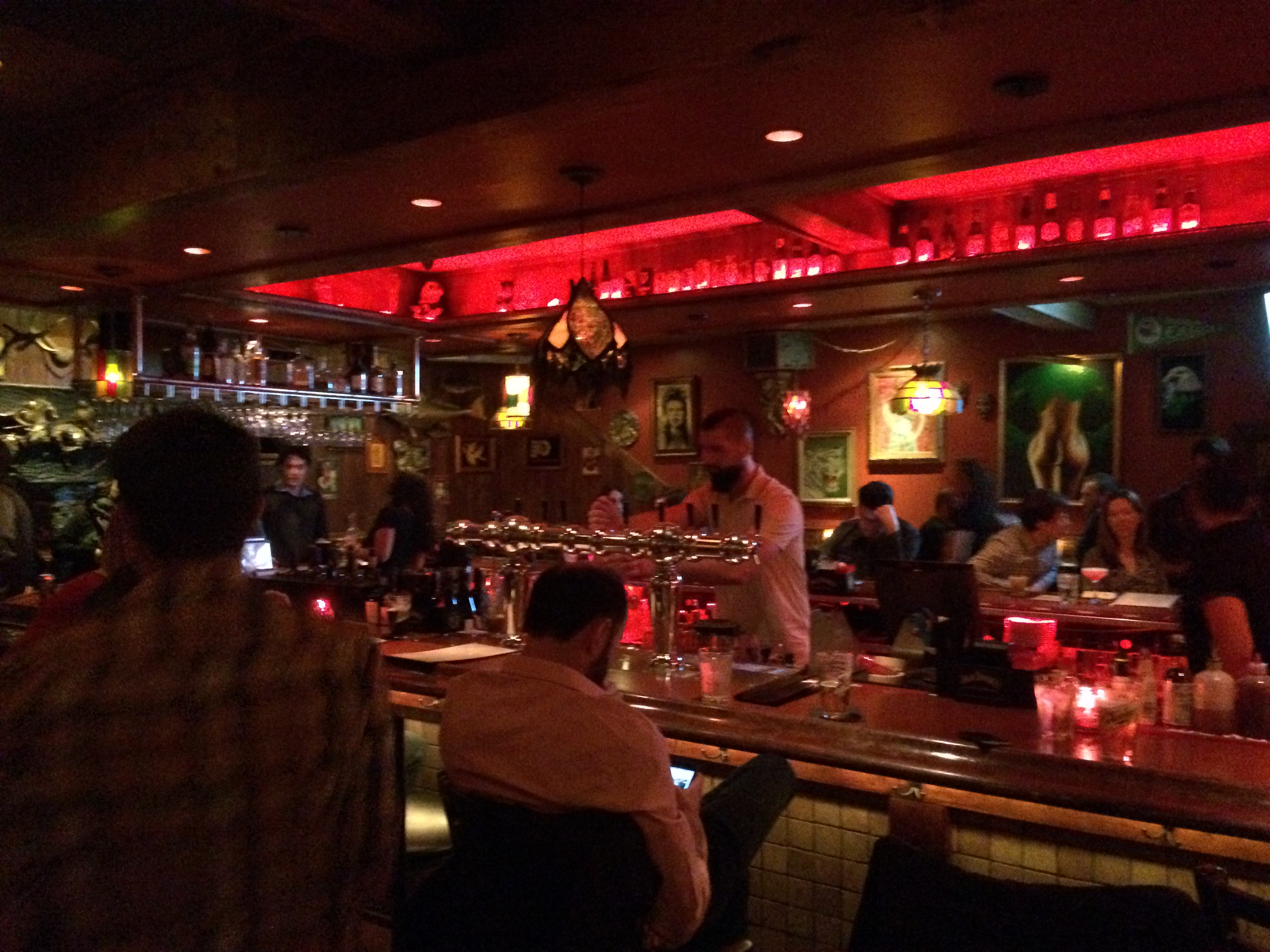
Inside Franky Bradley's.
Inside Franky Bradley’s.

It’s a two-story establishment. A  music room cum bar occupies floor number two. That’s where late night DJ and dancing action takes place. Sandy and I took up a little bit of space on the ground level. There, dark wood tables and booths fill up the square footage not occupied by a large bar, and the walls are covered with wood carvings, a potpourri of signs and with moody, sensual oil paintings. We sat at a peripheral table. It gave us a good view of much of the room. The lights were low, the noise level high, the waitstaff young and friendly. Recorded music from the 1970s (David Bowie, disco tunes) swirled through the air. The place was mobbed, mostly with an under-40 crowd. Tucked away on narrow way-off-the-beaten-path Chancellor Street (1320 is the address), Franky Bradley’s seemed to be a hit, a destination. From my perspective here’s the deal: Sandy and I loved our meal there. And the vibes were a gas, you dig?
Bradley’s keeps the number of beverage and food selections on the modest side, which seems like a good idea to me. Man, this world is cluttered enough as it is. You could do a lot worse than ordering what we had. Liquid-wise, a toasty beer for me, Ellie’s Brown Ale from the Avery Brewing Company. And, for Sandy, a semi-dry and citrusy Spanish white wine that rocked, an Albarino (2013) from Ramon Bilbao vineyards.
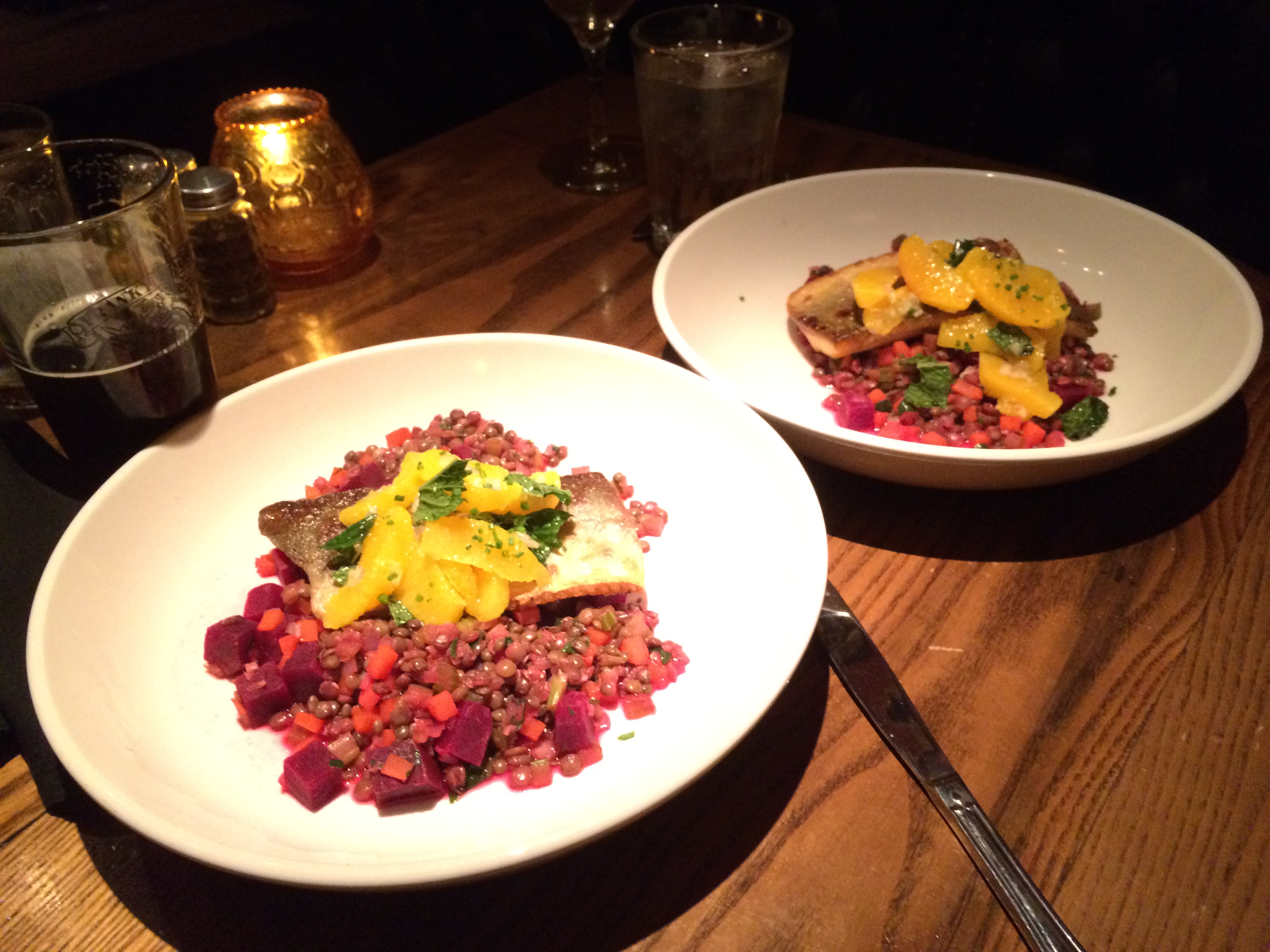
Bottom plate: Arctic char with warm lentil salad and orange slices. Top plate: Ditto.

We shared a house salad built from powerful purple onions, three or four types of greens and a Banyuls vinaigrette dressing. “Banyuls?” you ask? Right, I hadn’t a clue either. But it was damn tasty. A minute ago I peered at a foodie’s website and learned that Banyuls vinegar is made from fancy grapes. I shoulda known. For entrées we each ordered pan-seared Arctic char, a thin fish that came out moist, just-right salty and just-right charred. The fish shared plate space with warm lentil salad and orange slices. I’m a sucker for a good lentil salad. In this case, cubed beets and diced carrots and peppers said hello to one another and to the lentils just the way I was hoping they would. Wouldn’t have minded staying at Franky Bradley’s for a couple more hours, testing the desserts, knocking back another Ellie’s or two. But Spine awaited.

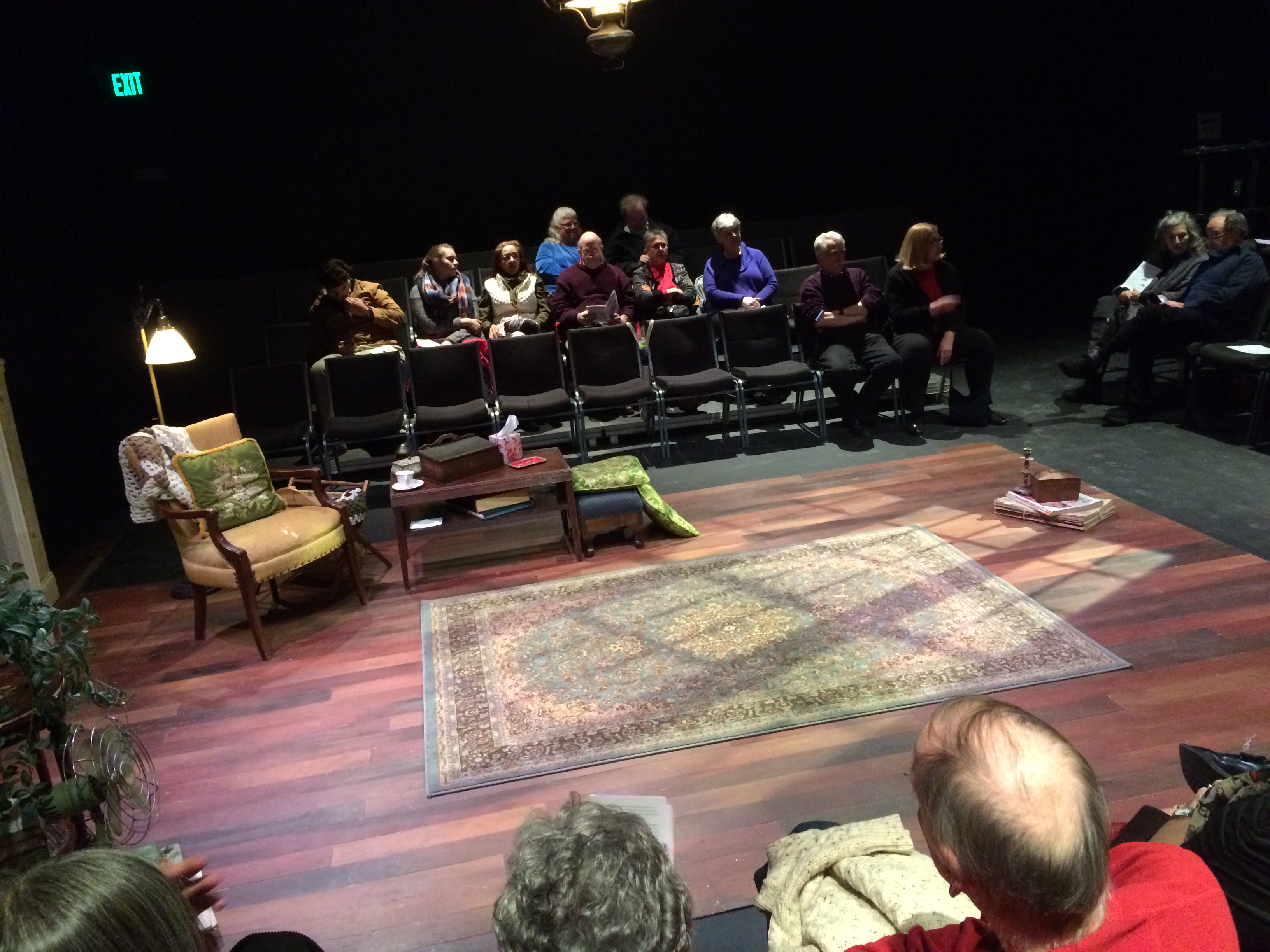
A few moments before Spine began.
Ten minutes before Spine began.

Spine (running through March 6) is a 70 minute monologue first performed in 2014 in Scotland at the Edinburgh Fringe Festival. Its British author, Clara Brennan, probably is a rising star. Philadelphia’s Inis Nua Theatre Company has staged Spine’s first American production in the smaller (about 75 seats) of two new theaters created within the Drake apartment building (1512 Spruce Street) earlier this year. There’s no intermission, so visiting the loo pre-show ain’t a bad idea.

If I’m sure about anything, it’s that Spine is a whirlwind of words, a rant at times, a collection of colorful tales all recited by Amy, a London teenager struggling to find her way. Amy is not in the education pipeline, can’t hold jobs, has messy relationships with family and friends and recently has become a petty criminal. But she’s no dummy and lacks not for energy. One day this wrong-side-of-the-tracks girl, looking for a room to rent, knocks on the door of a home, in a good part of London, owned by very elderly Glenda. Glenda, an advocate for social justice, takes a liking to Amy and over time gives her barrelsful of counsel.

What’s Spine about? It’s about a lot of things, maybe too many. Brennan takes aim at what she sees as damaging policies by Britain’s Cameron-led government, bemoaning social welfare program cutbacks and the closing of libraries. She believes that young folks like Amy institutionally are ignored and rendered powerless. She feels that the Amys of the world are being deprived of knowledge, but that they yet might come to understand their plights and change them for the better.

Whew, that’s a lot for a play to bite off. And a lot for politically and sociologically semi-conscious characters like me to digest. But let me say this: My attention didn’t waver watching Spine. Emily R. Johnson commanded the minimally-furnished set, bringing Amy fully to life and, by extension, Glenda. When the play ended I shook my head in disbelief. I mean, how does anyone do what Johnson did, spewing a non-stop avalanche of words without a stumble? How can anyone remember all those words? I have trouble remembering the name of the street I live on. Impressed? You bet your sweet bippy I was and am.

But sometimes there’s a but, and I have one. Johnson, a non-Brit, adopted a deep deep Cockney accent. I didn’t understand half the words she spoke. “Huhhh, what?” I said to myself so often I almost started babbling. Sandy had the same problem, even worse. If you didn’t grow up in a workingclass London neighborhood I’m guessing you’d decipher the language not much better than we did. I think that Spine’s director should have decided to soften the blows for Philadelphia’s audiences by toning down the accent. As usual, though, nobody asked for my advice.

(If you enjoyed this article, don’t be shy about sharing it. Sharing buttons are below)

(Photos by Sandra Cherrey Scheinin. If you click on a photo, a larger image will open)

The Night I Made A Cocktail Table Go “Boom”

You should count your lucky stars when you act like a nitwit and are forgiven for your sins. That is what happened to me about ten years ago at a jazz concert. It was the night when talentless me accidentally became part of the show.

I hadn’t thought about that infamous evening in a long time, but for some reason was reminded of it recently when my wife Sandy and I took in a Friday night concert at the Philadelphia Museum Of Art (PMA), which had been the scene of my crime. The museum calls its Friday night concert series Art After 5, and it’s a good one. Art After 5 began in 2001 with a jazz-only format, but has morphed over the years to include a wide range of genres. Sandy and I have been to a crazy number of music shows at PMA since we discovered the series in 2002.

Picture this: It is February 2006. Sandy and I are seated in the first of several rows of tables ringing the performance area in PMA’s Great Stair Hall. The hall is enormous, maybe 80 feet high, and is dominated by, yes, a great stairway that connects two levels of the museum. The Great Stair is 20 feet behind us and stares regally at the performance area. Many concertgoers are seated on its marble slabs . . . uncomfortably. Sandy and I prefer comfort. So we made it a point to arrive way before showtime in the hopes of nabbing one of the cocktail tables, which are squeezed together pretty closely. Compared to marble stairs, the chairs at the tables are a blessing for butts. At our table we don’t have much to do except twiddle our thumbs. We order soft drinks and sip at them. We are waiting for jazz vocalist Carmen Lundy and her band to start their show.

Carmen Lundy in performance six years after my cocktail table went "boom." (Photo by Daniel Sheehan)
Carmen Lundy in performance eight years after my cocktail table went “boom.” (Photo by Daniel Sheehan)

At 5:45 PM Carmen and the guys are introduced by Art After 5’s curator. Minutes later they begin to play. They are very fine, and only eight feet in front of our excellent seats. Carmen Lundy, a justly acclaimed performer, is singing with a lot of flair and swagger. Sandy and I are enjoying the show. But halfway through the set something begins to bother me. I feel as though my space is being impinged upon. Someone at a table behind me has inched up a tad too much and is putting pressure on the rear of my chair. I have the solution, of course. All I need to do is slide my cocktail table forward ever so little, after which I’ll be able to move my chair forward too. I push the table very very gently, maneuvering it carefully. But alas, this is a plan not destined to work out. The frigging table loses its balance and topples heavily, its edge creating an enormous sound when it smashes onto the floor. The noise echoes throughout the Great Stair Hall. And everything that was on the table flies off and finds a new home inches from the performers’ feet.

I felt like a schmuck. I was a schmuck. Oy vey, was there anywhere to hide? No way. All I could do was sit there as a couple of servers scampered over, set the table upright, and on their hands and knees quickly swept up ice cubes and pieces of broken glass. They mopped up the soft drink liquids from the floor and retrieved my eyeglasses, which once had been on the table but now were beneath the piano bench. Yet, all the while the band played on as if nothing had happened. Carmen Lundy continued to deliver her song with full emotion. Harold O’Neal’s fingers were flying on the keyboard. Jason Brown’s drums went rat-a-tat-tat and wham-bam-thank-you-ma’am, and Curtis Lundy, Carmen’s brother, plucked fervent notes on his upright bass.

The set finally ended. Was anyone in the audience staring at me? Probably. But I was too embarrassed to look around and find out. I knew one thing I had to do though. Apologize. Carmen Lundy was standing near the sound board, 20 feet to the right of the performance area. I stood up and made my way to her.

“Ms. Lundy,” I said. “I’m the idiot who knocked over the table. I’m very sorry. I feel like a fool.”

Carmen Lundy gave me a good hard look for a few moments and then did the darndest thing. She put a hand on one of my shoulders, looking me straight in the eyes, and said “Don’t worry about it, honey. It didn’t bother us. In fact it gave us energy to play even harder.”

Man, I didn’t know what to say in response to such a stellar attitude. I mumbled my thanks and probably a few other words and shuffled to my seat.

Looking back on all of this the other day I realized once again that I had been in the presence of classiness and graciousness. If our places had been reversed I doubt if dopey me would have been so wonderful. Carmen Lundy, in my book you’re very much okay.

(If you enjoyed this article, then don’t be shy about sharing it. Sharing buttons are below)

Out And About In Fishtown

On a recent Friday night my wife Sandy and I went to dinner with our great pals, Liz and Rich. We dined in Al Dar, an atmospheric Mediterranean-cuisine bistro in Philadelphia’s western suburbs. As the four of us wolfed down lots of good stuff, Liz asked Sandy and me what we had on the agenda for the following day. Because the Philadelphia area was in the middle of an amazing December warm weather streak, any upcoming rain-free day would be a great one for outdoor exploration. “Maybe we’ll go to Fishtown,” Sandy said. And that’s what we did.

Fishtown is a Philadelphia neighborhood fairly near the city’s downtown sections. It is a maze of narrow streets, with a few big avenues running through, and for most of its existence has held a blue-collar reputation. Until a handful of years ago, Fishtown wasn’t somewhere you’d have had any particular reason to go to, unless you lived there. But times change, and sometimes for the better. Fishtown’s rowhouses and small single homes have found favor with millenials, hipsters, musicians. And with those fine folk have come cool bars and eateries and music venues. Fishtown now is on the map, though its goodly number of empty storefronts and how-do-they-stay-in-business businesses show that there’s plenty of climbing yet to do.

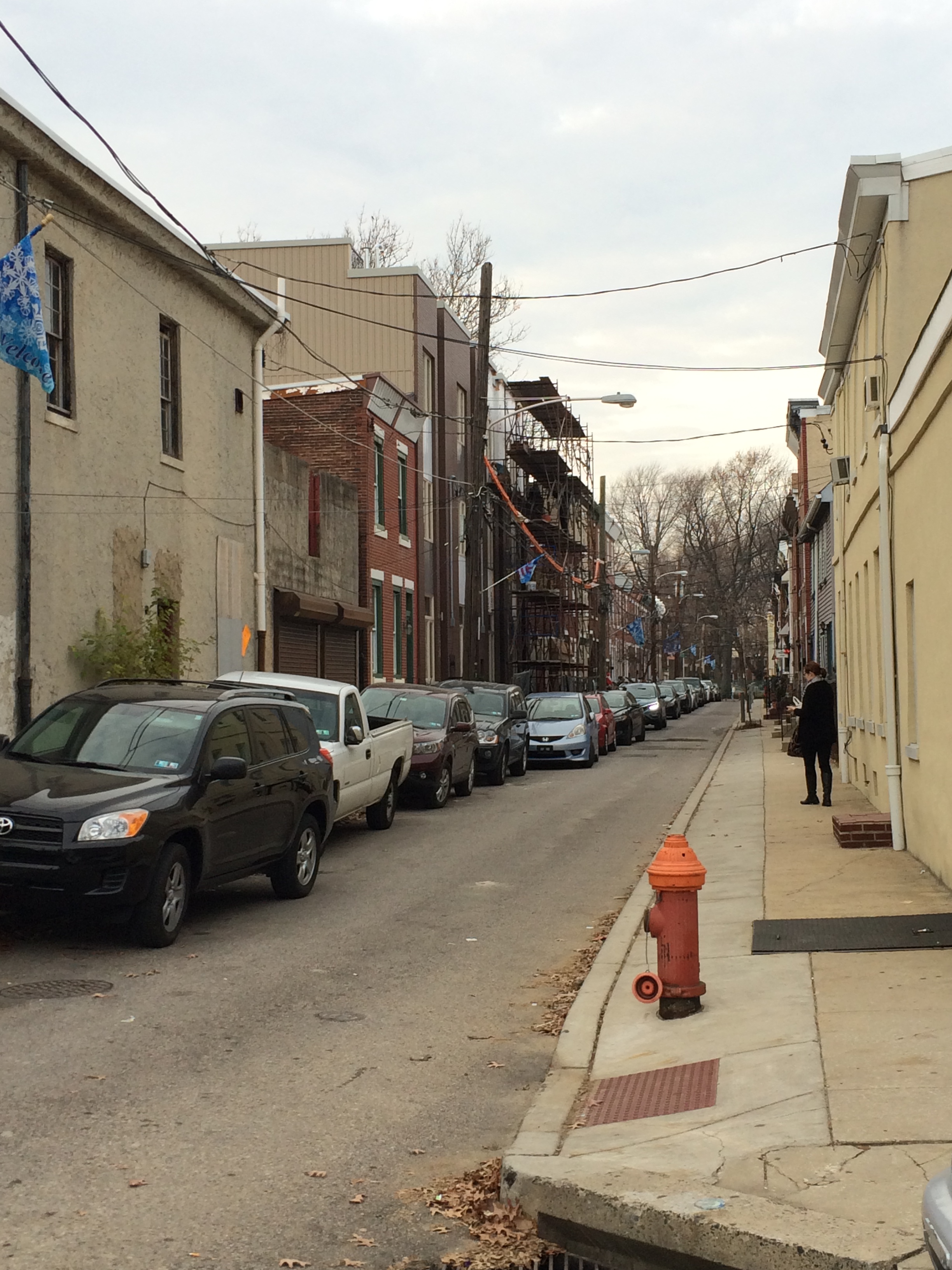
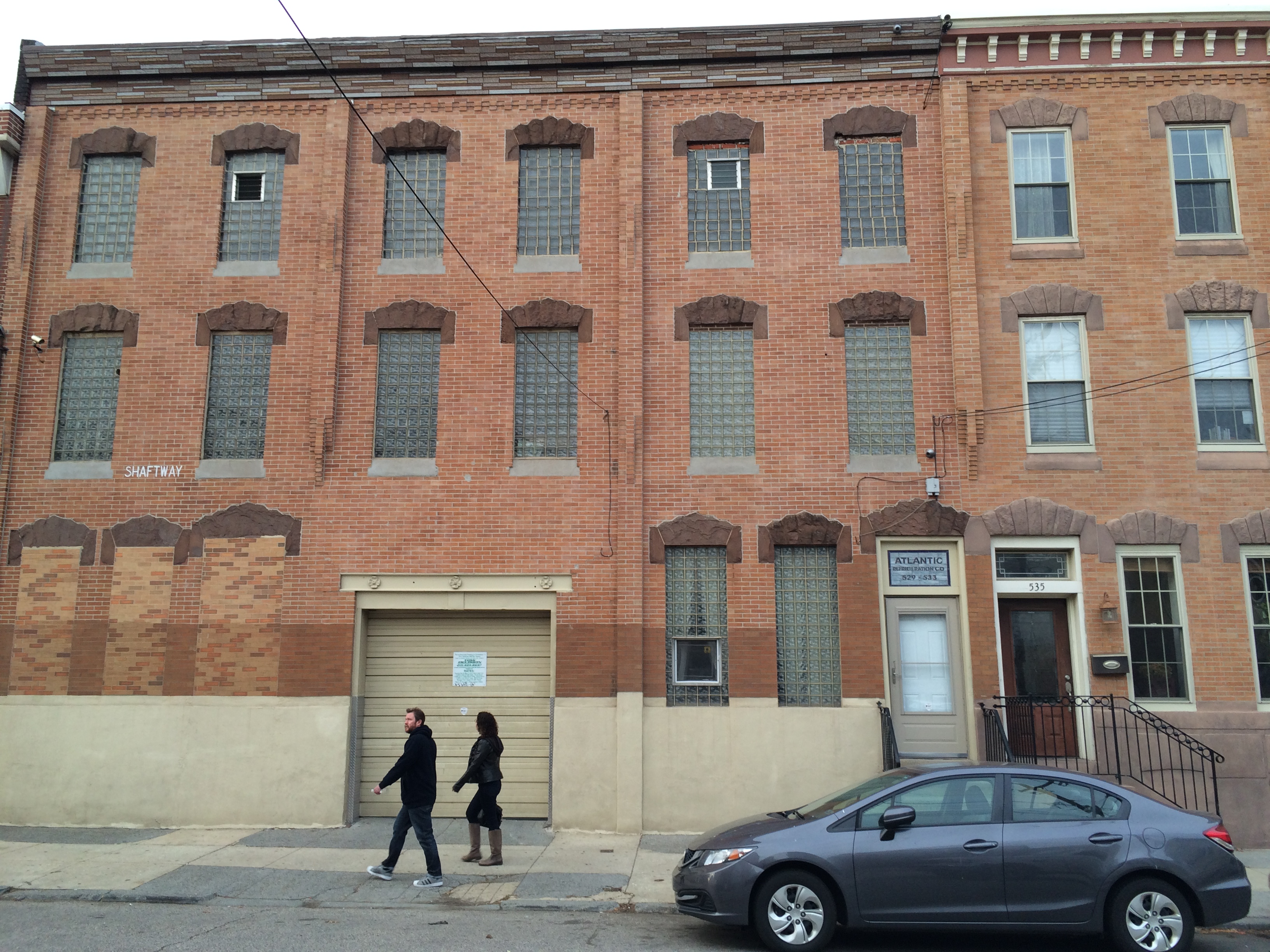
The 1300 block of East Eyre Street.
The 500 block of East Thompson Street.

I like wandering on cute blocks, especially when they have nifty or unusual names. And Fishtown is full of those: Crease Street, Eyre Street, Shackamaxon Street. Yeah, Shackamaxon. I’d never heard of half the streets that Sandy and I stepped upon, which was just the way I like it. Gave me a sense of exploring the unknown. I saw that Fishtown’s byways are crammed with housing and commercial properties that, to my marginally-trained eye, looked to have been erected mostly between the mid 1800s and early 1900s. As with much of Philadelphia, the buildings usually rise no farther than three stories above ground level. And how about those bricks, a construction material that numbers in the gawd-knows-how-many trillions of units in Philadelphia. Fishtown’s share of that bounty must be at least twenty billion.

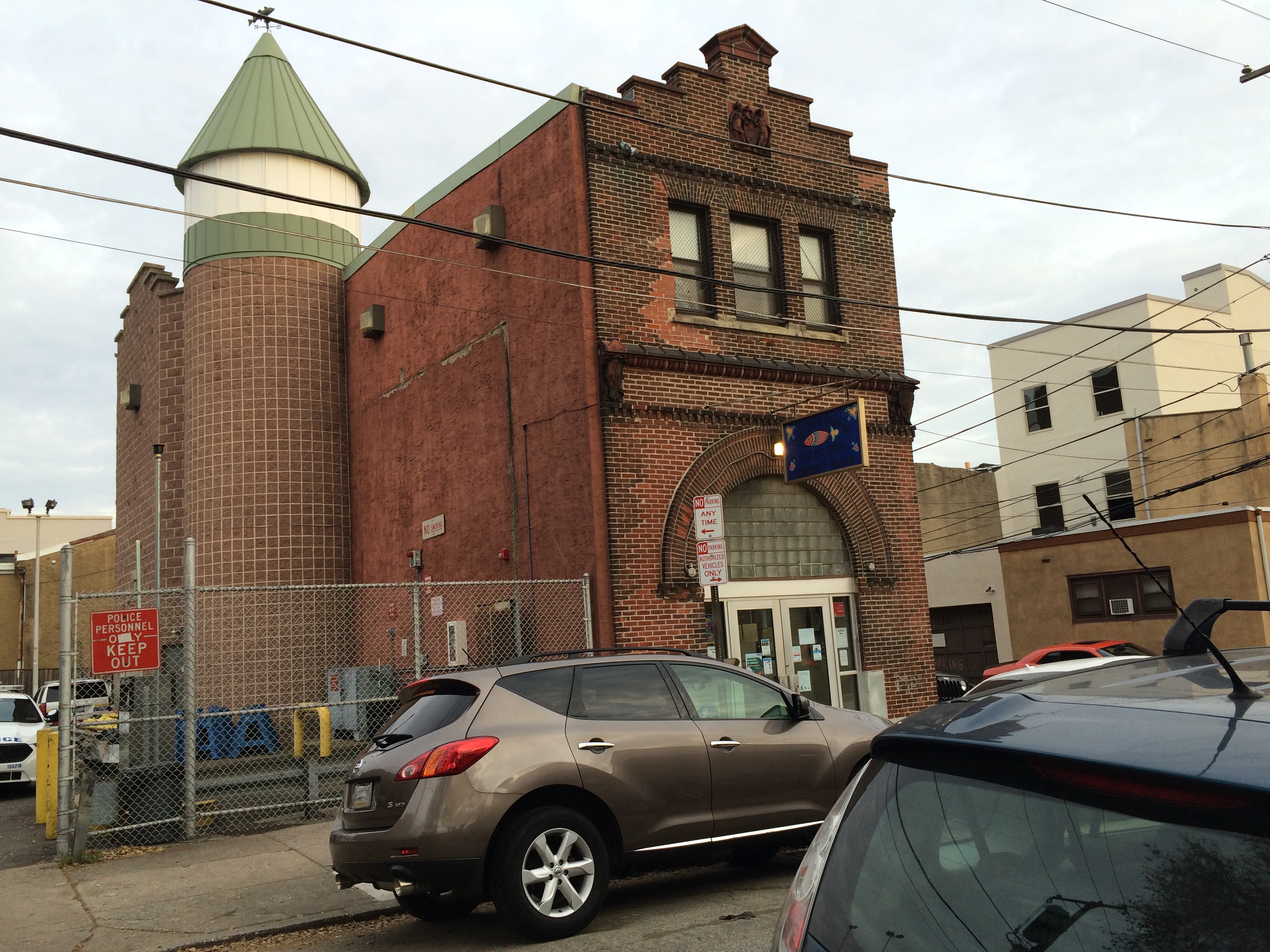
Fishtown's public library.
Fishtown’s public library.
Girard Avenue as seen from Eyre Street.

It would take hours to see all of Fishtown, hours that Sandy and I didn’t have at hand. But we strolled around and I think got a halfway decent sense of what the neighborhood is all about. I was glad to see that Fishtown is kind of a small town unto itself. That’s been the case for at least 150 years, from what I’ve subsequently read. Look! A library. A police station. A rec center with a hockey rink. A wonderfully-domed Presbyterian church that has been in place since 1859. A bunch of pocket parks. Sharp, indeed! But the small town feel disappears when you venture off the residential blocks. On Girard Avenue, a major artery that bisects the area, the almost endless lengths of overhead wires are a gritty spider’s web and a quaint-yet-quintessential urban sight. And the traffic on Girard Avenue and Frankford Avenue at times is relentless.

Let’s move on to food and drink. Fishtown has become a player in Philadelphia’s emergence as a destination for foodies and/or craft beer aficionados. Kraftwork, East Girard Gastropub, Frankford Hall, Fette Sau, Interstate Draft House, Pizzeria Beddia (a take-out-only joint with no phone and a policy of baking only 40 pies per day. It gained instant fame when bon appétit magazine, incredibly, crowned its offerings earlier this year as the best pizza in the USA). Hey, if filling the gut and loosening the inhibitions are on your agenda, Fishtown’s as good a choice as any to do that in.

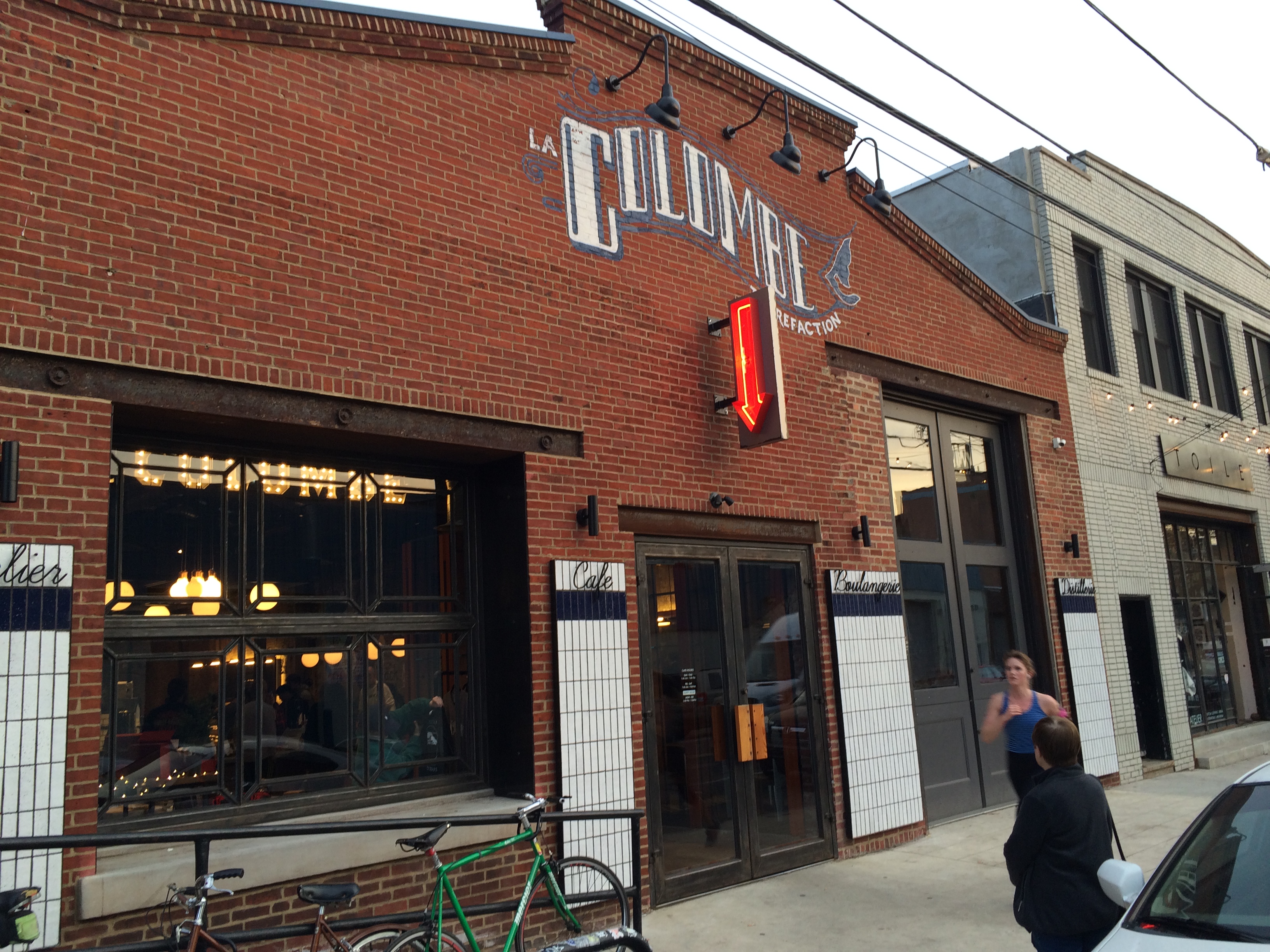
I peeked inside some of the above-named places, and others, on Girard Avenue. They looked great, but it wasn’t even 5:00 PM yet and I wasn’t ready for alcohol or food. Sandy and I earlier had decided that we needed to patronize, or at least ogle, what probably are Fishtown’s two most well-known spots, just to say that we’d been there. And thus we headed north on Frankford Avenue till we reached La Colombe Fishtown (1335 Frankford Avenue), the crown jewel of the La Colombe coffee empire.

Exterior of La Colombe Fishtown.
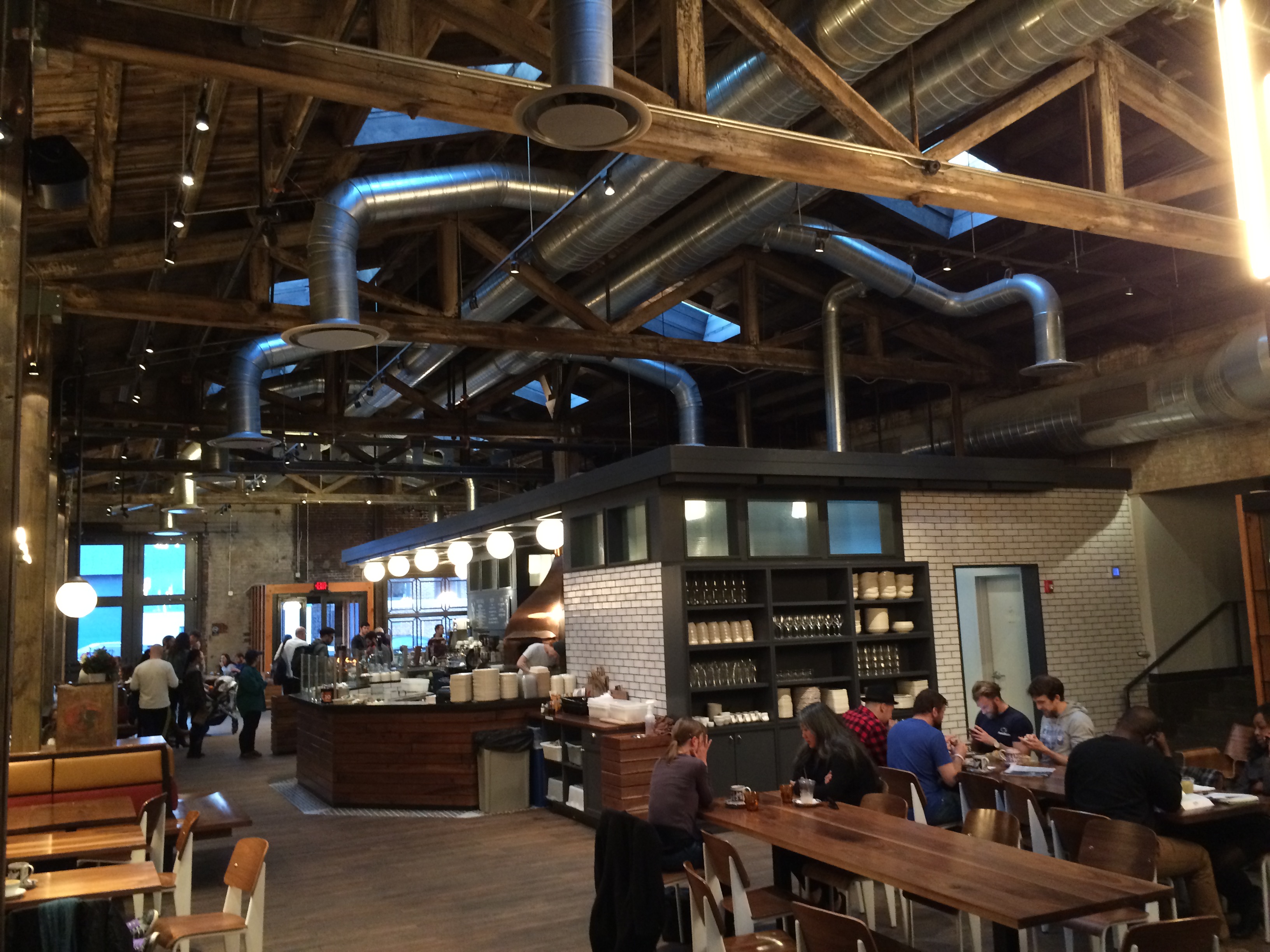
Interior of La Colombe Fishtown.

LCF opened last year and it’s a thing of beauty, a Starbucks-on-steroids enterprise that was created out of a former warehouse. It’s comfortable and fashioned in the rustic chic mode. Dark wood floors go on forever. Exposed air system ductwork looms overhead. At the tables, customers nurse coffees, wines, beers, pastries and sandwiches for a long long time as they stare into their electronic devices or into each others’ eyes. And in the rear of the cavernous space is something I’d have been unable to anticipate in a million years. A rum distillery. Don’t ask me why, but the brains behind La Colombe had a jones for rum that had to be satisfied. The rum is for sale.

Sandy and I, though, kept things simple. We ordered ice coffees. Yes, we’re big spenders. They were strong and delicious. We stared into our devices and into each others’ eyes for awhile, and then hit the streets once again. It now was time for food and alcohol. Next stop was Fishtown’s biggest claim to fame.

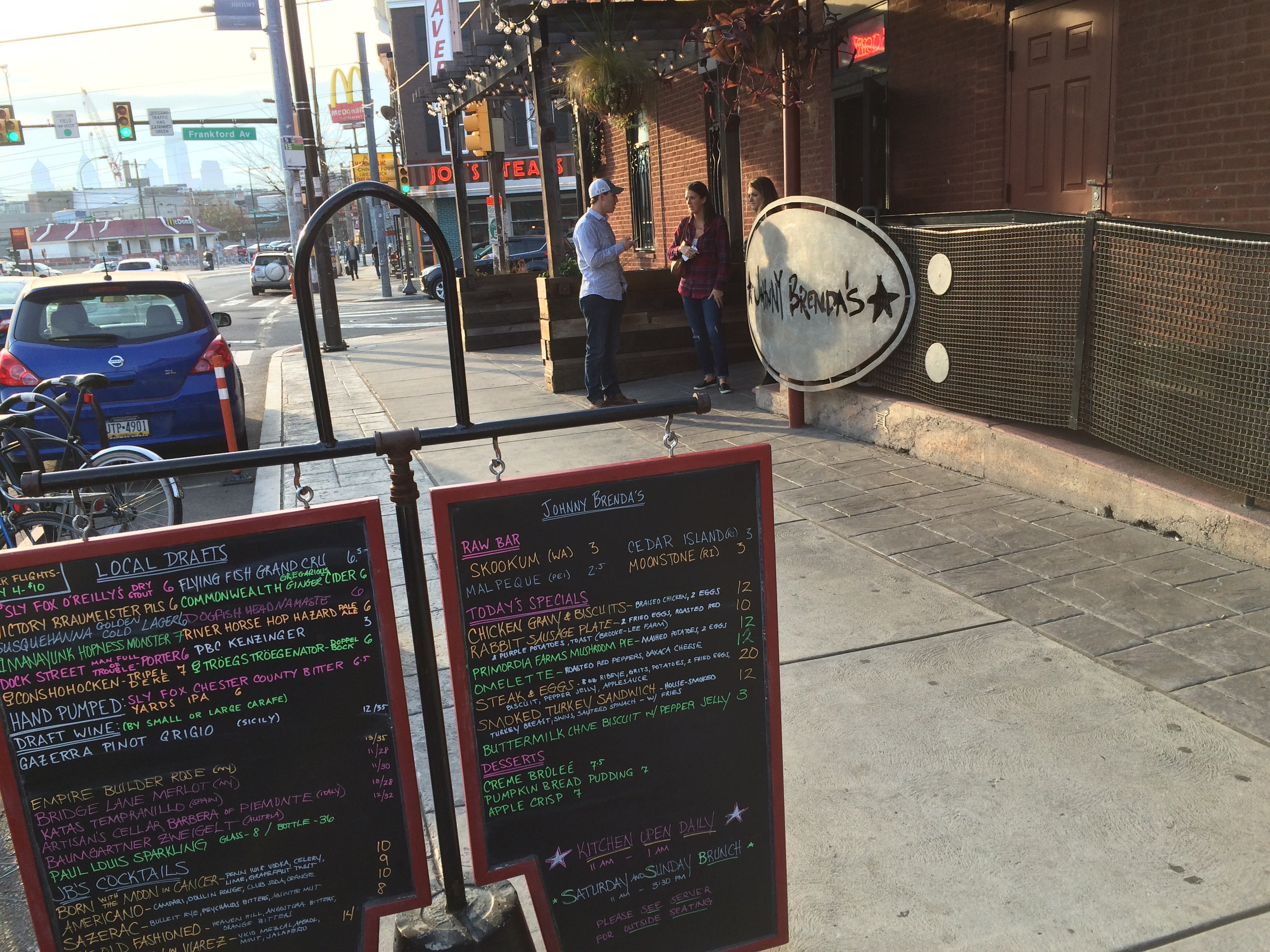
Johnny Brenda’s (1201 Frankford Avenue) used to be an insular neighborhood bar. New owners took over in 2003. They installed good beers and good food, made nice with their Fishtown neighbors, and set in motion their visions of expanding JB’s audience. Johnny Brenda’s is widely credited as the catalyst for Fishtown’s renaissance. Things really began cooking in 2006, the year that JB’s brought live rock and roll to its upstairs quarters. Brenda’s has become a favorite place for local and touring rock bands. Sandy and I have yet to catch music at JB’s, but we’ve frequently talked with friends about doing that. One day soon we will.

Exterior of Johnny Brenda's.
Exterior of Johnny Brenda’s.
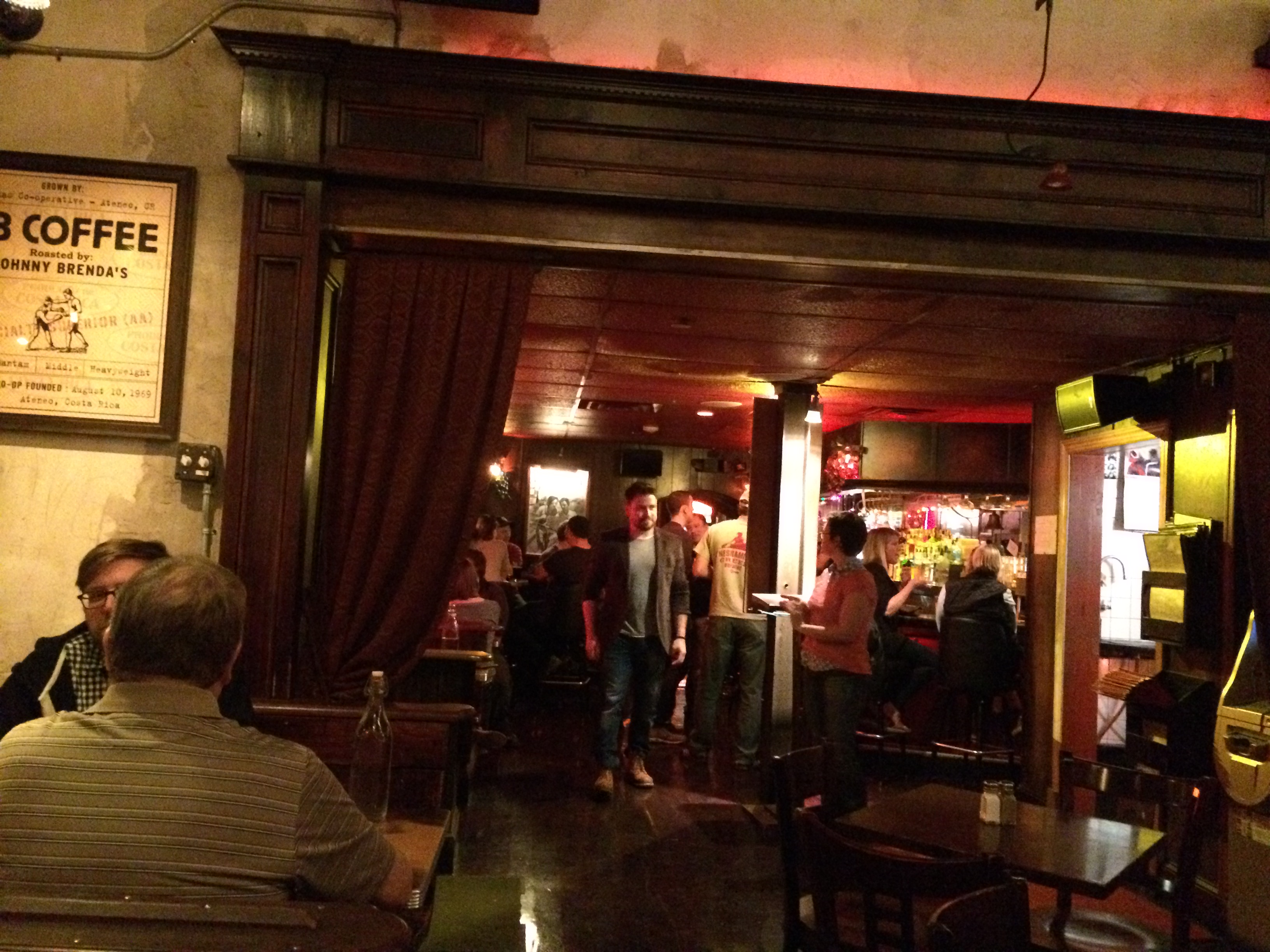
Interior of Johnny Brenda's
Interior of Johnny Brenda’s

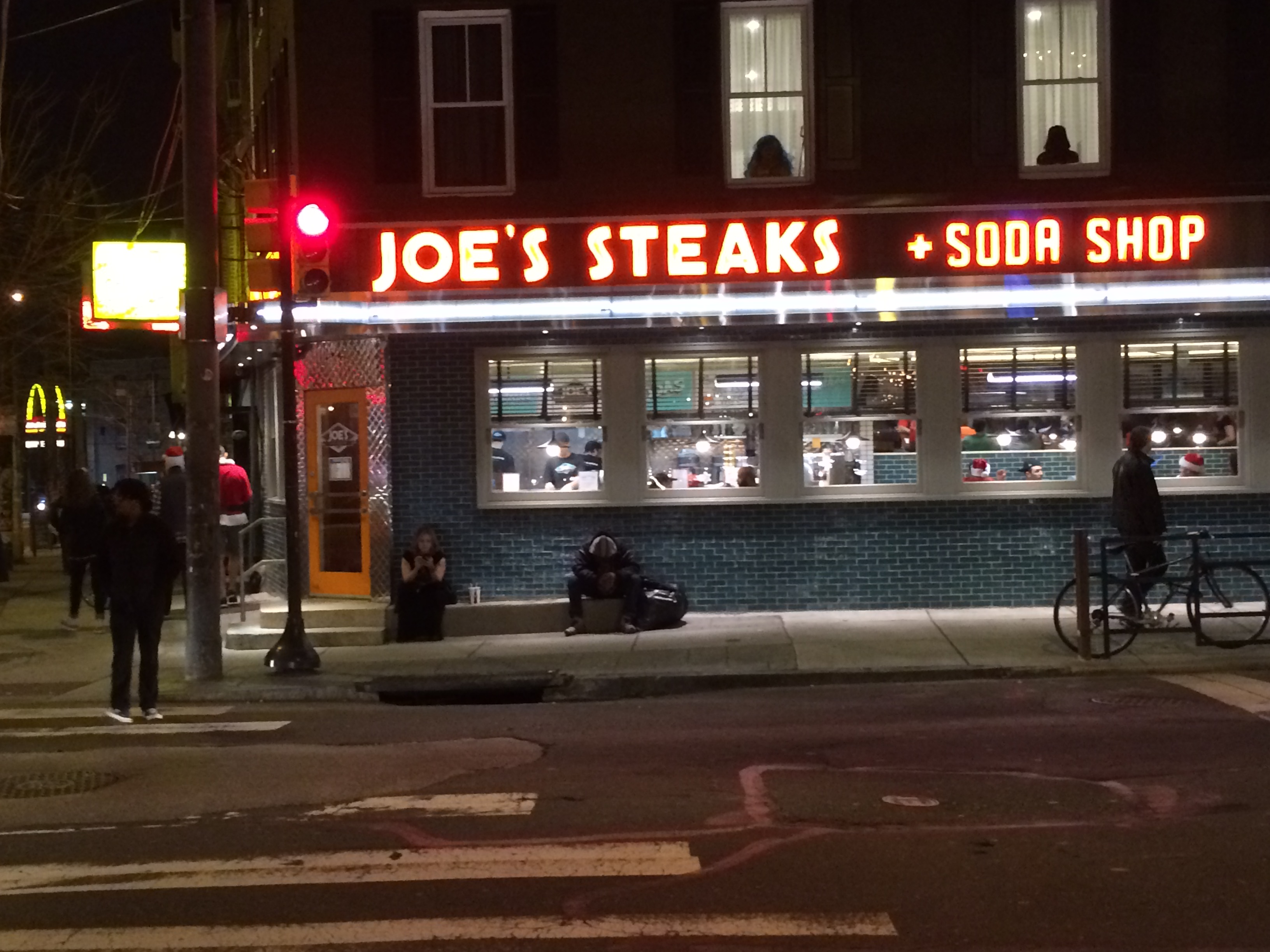
JB’s is a friendly place. It has a pool table, local beers on tap, a nice selection of pub grub. And plenty of customers. Sandy and I grabbed a booth in the dining room. We ordered. Sandy’s Italian white wine was delicious. So was my Sly Fox porter. So were our burgers, hers made from beef, mine from vegetables. But before too long it was time to leave, as a movie, in another Philadelphia neighborhood, was on our evening’s schedule. We settled up and stepped outside. Daylight had disappeared 90 minutes earlier.  The air was cooling down. Groups of 20-somethings and 30-somethings were everywhere. We crossed the street, heading westward on Girard Avenue. But Sandy then suggested that we walk back to where we had just been so that we could get another good look at a resplendent neon palace: Joe’s Steaks + Soda Shop. Sandy took its picture. And we left Fishtown on a high note.

JoesSteaks IMG_0076
(If you enjoyed this article, then don’t be shy about sharing it. Sharing buttons are below)

(Photos by Sandra Cherrey Scheinin. If you click on a photo, a larger image will open)

Q: How Cool Is The Philadelphia Museum Of Art? A: Very

The Philadelphia Museum Of Art, PMA to its friends, is one of our fair nation’s best museums. My wife Sandy and I visit pretty often. Its holdings are fantastic. What’s more, for years the museum has presented concerts on Friday nights, and we’ve been to a crazy number of them. During our Fridays at PMA we look at art for awhile and then hear music in the majestic Great Stair Hall. For artsy nerds like me, that’s usually a winning combination.

As we headed museumward on a recent Friday, we found ourselves in traffic hell. Our car windows were fogging up from steam coming out of our ears, but we wound up having a heck of a good time once we arrived. No pain, no gain, or something like that. Late-ish as it was though, we didn’t have barrels of time to check out art if we were to snare seats at a ringside cocktail table for the evening concert. Those seats ordinarily are claimed 45 minutes or more before concerts begin. When the preferred seating is taken, your option is to place your rear end upon the Great Stair Hall’s grand marble steps. And YOW, that’s a numbing backside experience.

And so we navigated to a modestly-sized and time-friendly exhibit, works by the not particularly well-known Dave Heath. To me and Sandy, he wasn’t even that, as we’d never heard of him. This show (it closes on February 21, 2016) is entitled Multitude, Solitude: The Photographs Of Dave Heath, and comprises numerous 35 mm photos, all in black and white, that Heath took from 1949 to 1969. Also on display is Heath’s multimedia slide show from 1969. This is the first major presentation of his early and midlife creations, and one of the few museum exhibitions that he ever has had. It was organized by The Nelson-Atkins Museum Of Art in Kansas City, Missouri, with plenty of PMA input.

Sandy and I had the same reaction after looking at Heath’s photos for the first few minutes: “This guy is great,” we agreed. And I’m convinced that he is, or in any case was in the 1950s and 60s. The photographs are very beautiful and very dark, shades of black heavily predominating over those of white. I’ve always felt that this approach allows photographs to breathe emotionally, gives them depth and resonance.

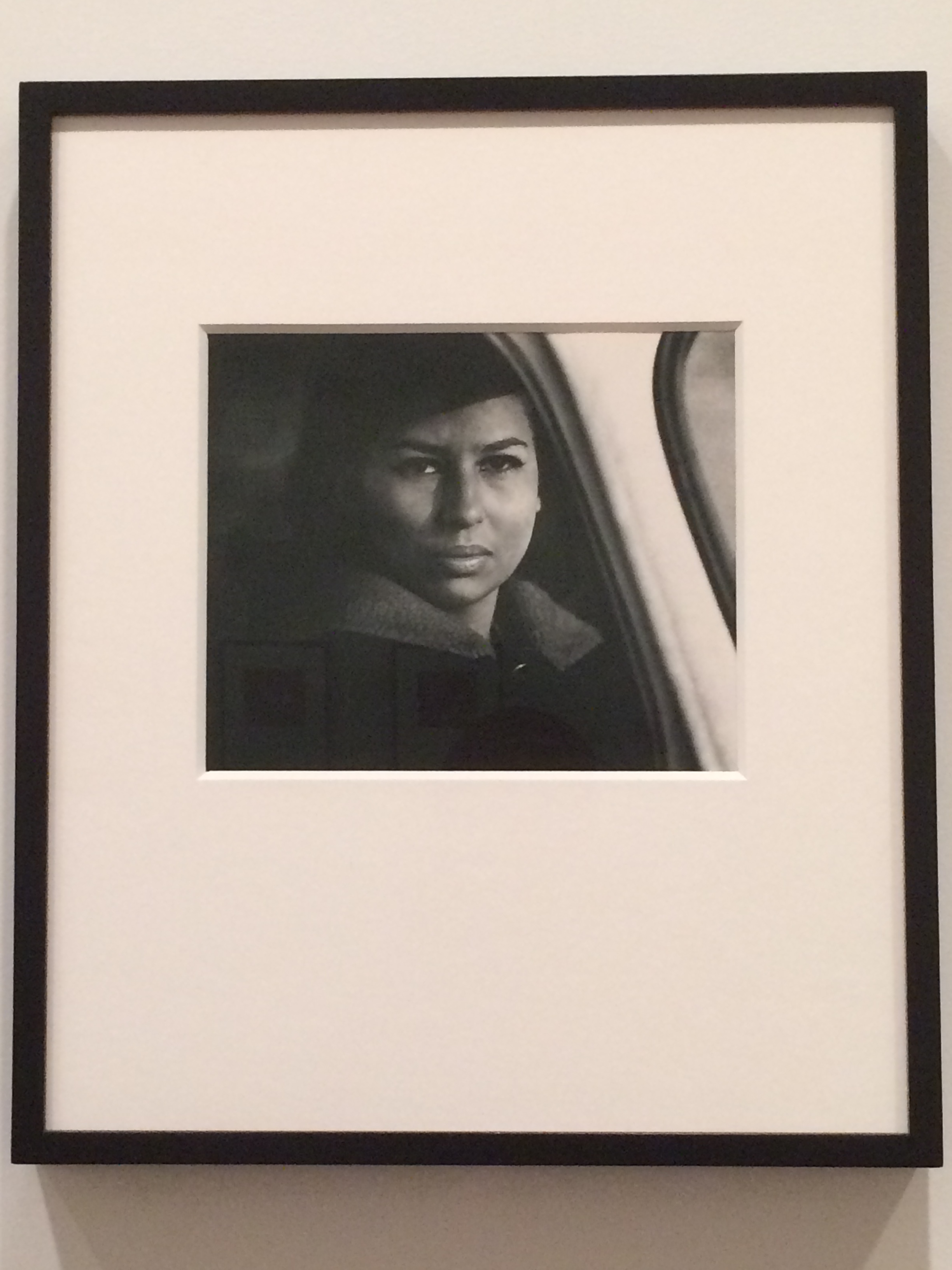
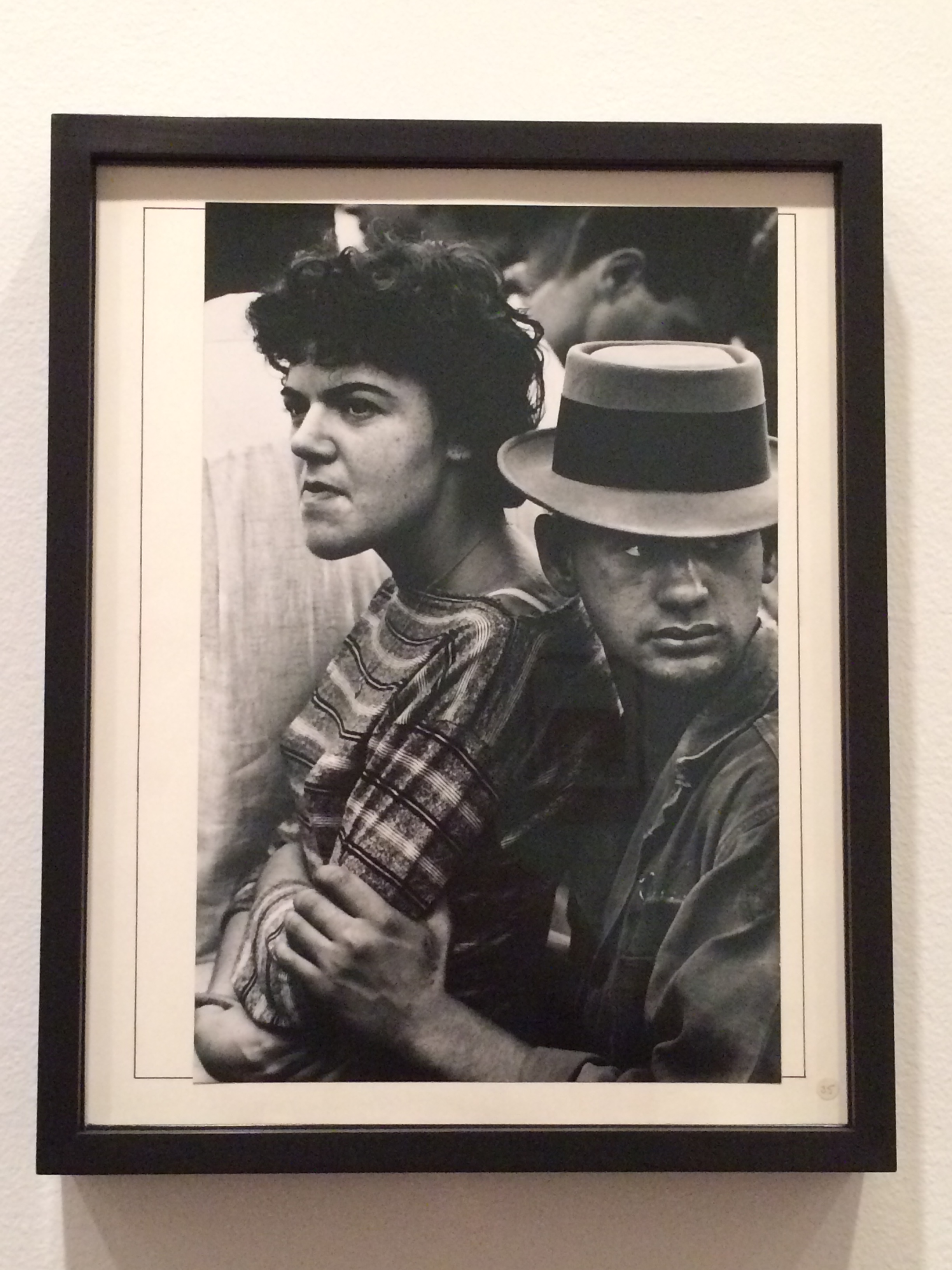
New York City (1964), by Dave Heath. Nelson-Atkins Museum Of Art, Kansas City, MO; Gift of Hall Family Foundation
Washington Square, New York City (1960), by Dave Heath. Nelson-Atkins Museum Of Art, Kansas City, MO; Gift of Hall Family Foundation

Heath isn’t a chronicler of the natural world. He’s a people observer, usually in urban settings. And he is a lover of the close-up, often capturing folks deep in thought or in seeming isolation. His childhood was dreadful, and his work frequently reflects the hurt that probably never went away. But not all is aloneness or sadness in the Heathscape. Joyful images are here and there in the exhibit.

Dave Heath lives in Canada and is 84 years old. There’s not a lot of info about him in cyberspace. He was born in Philadelphia, grew up in foster homes and an orphanage, took up the camera in his late teens, and has had a full career as a photographer and photography teacher. His greatest fame and acclaim occurred in the 1960s, the decade in which he won two Guggenheim Fellowships and created the book for which he is best-known, A Dialogue With Solitude. The final pre-production copy of Dialogue is at PMA. Its 100 or so pages, mostly photographs, ring several gallery walls. Dialogue is divided into ten sections, among them Fate, Fragility And Diversity; Youth; Childhood; Ends And Beginnings. Dialogue is a deep photographic rumination on many aspects of the human plight.

Sandy and I ended up spending much more time with Heath’s images than we had anticipated. They are powerful. By the late 1960s though, Heath apparently felt that he had said all he could in black and white. He turned to color Polaroid picture-taking and later to digital photography. None of this is on PMA’s walls, and from what I gather isn’t well-known by the arts community. It’s a fine thing, though, that someone (the good folks at Nelson-Atkins and at PMA) has championed black and white Dave and decided to let the spotlight shine on him.

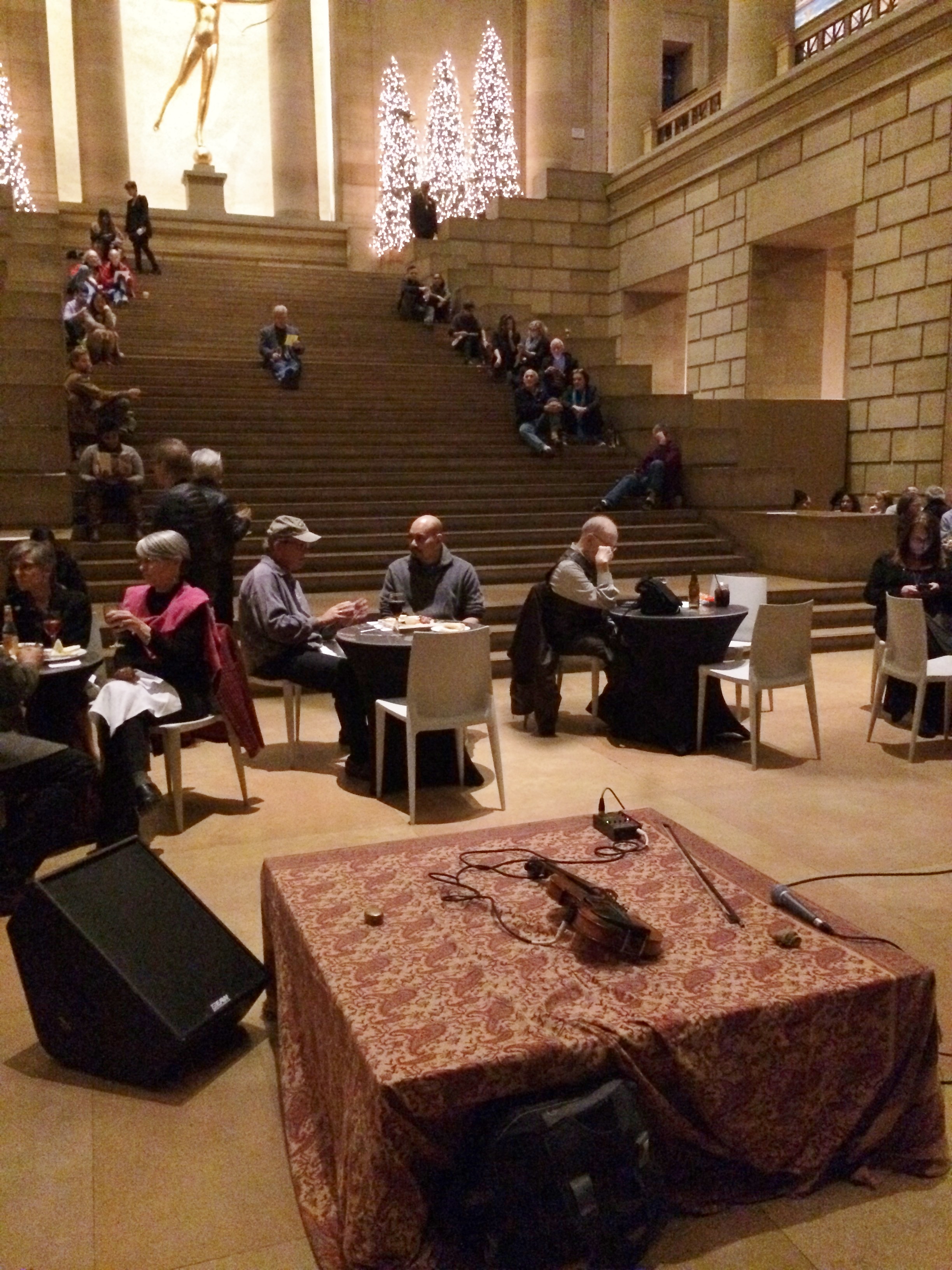
Before the concert in the Great Stair Hall. Photo by Sandra Cherrey Scheinin
Pre- concert in the Great Stair Hall. Photo by Sandra Cherrey Scheinin

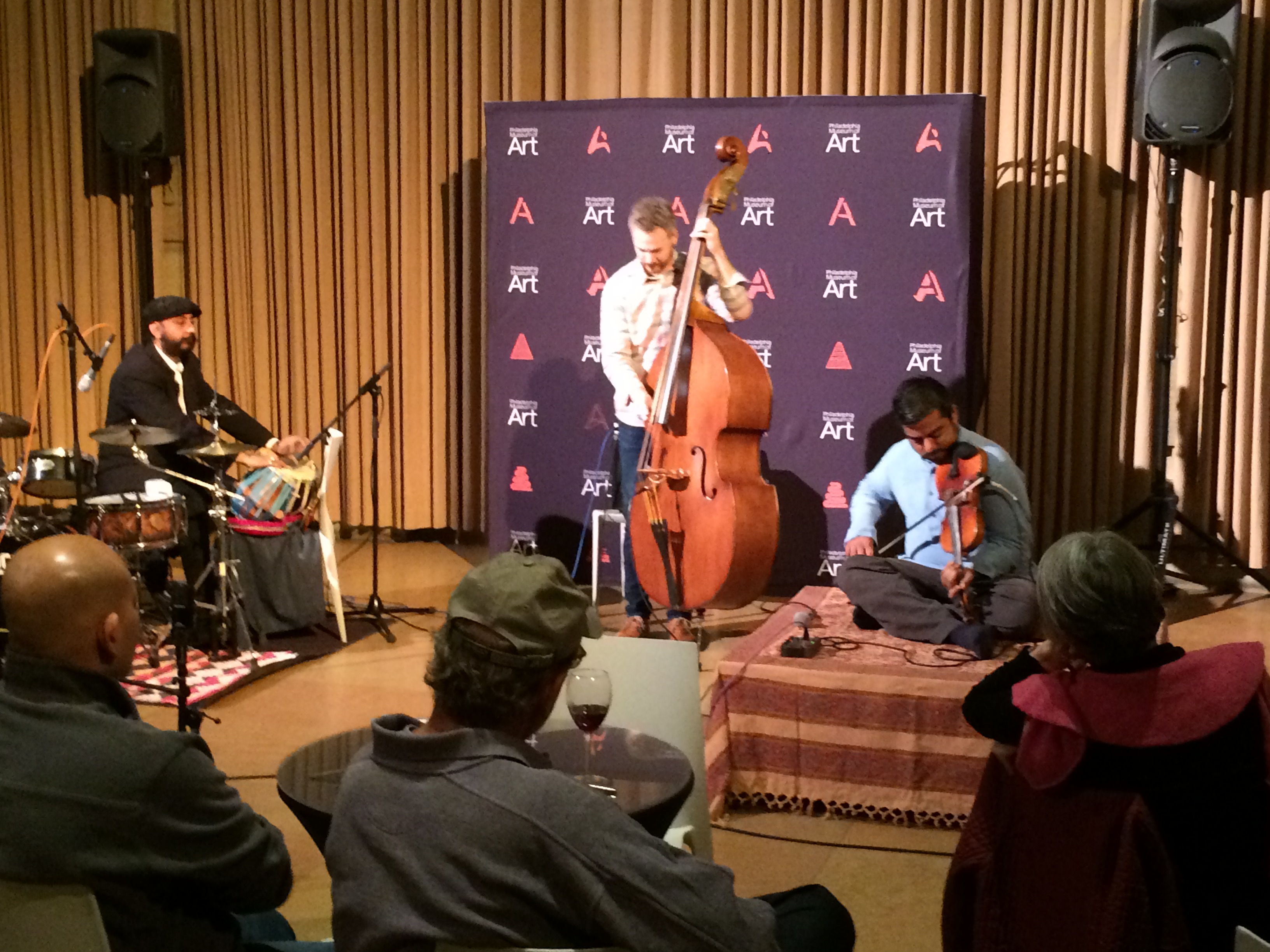
Show time was approaching. Sandy and I lucked out after Heath, grabbing two empty seats at a stage left cocktail table in the Great Stair Hall, a mere six feet from where Arun Ramamurthy soon would be bowing his violin. Arun Ramamurthy? Sandy and I knew as much about him as we had about Dave Heath an hour earlier. Brooklyn-based Ramamurthy, though, is a growing name to be reckoned with in classical Indian music and in musical cross-pollinations. At PMA he brought along Perry Wortman, on upright bass, and drummer/tabla player Deep Singh. The Arun Ramamurthy Trio began its first set at 5:45 PM.  They played a hybrid of South Indian classical music and jazz.

When it comes to music, I’m an appreciator, not a scientist. I understand little about any musical genre’s technical side. Scales, chords, the inter-relationships of notes and how they shape harmonies . . . forget it, I’m at sea. But the big picture I understand, as did the 200 others listening to the Ramamurthy group. We all clapped madly after each piece. Sure, Arun’s melodies and voicings on violin would be pretty unfamiliar to most American ears, but they were beautiful.

In the Great Stair Hall, Arun sat on a platform, chairless and shoeless. He held his violin vertically, bowing with his right hand, working the strings with the fingers of his left. The trio played five songs in the first set, three of them originals, all drawn from or reflecting traditional South Indian classical ragas, melodies and motifs. The music was elastic, minor-keyed and highly improvised, improvisation being a major component of both classical Indian music and jazz.

Arun began song number one unaccompanied, coaxing mournful sounds from his instrument for three minutes. Wortman’s bass then entered — low, gripping notes played slowly, repeatedly — and Singh’s drums too. Singh played carefully, tantalizingly, creating a steady and simmering beat. One drumstick tapped a drum’s rim. The high hat and cymbals shimmered just so. All the while Arun stroked melancholy lines. This was Ramamurthy’s original song, Conception. I was reminded of All Blues, and other numbers, from Miles Davis’ Kind Of Blue album.

The Arun Ramamurthy Trio. Photo by Sandra Cherrey Scheinin

The fifth song, an Arun original whose title I missed, found Deep Singh on tabla. The tune was energetic, Arun going pretty wild on violin, Wortman choosing notes eloquently and perceptively, as he did on each tune. Another thing I noticed was that Arun and Deep barely could keep their eyes off each other. They were in a strong musical relationship. And Singh’s fingers were absolutely flying, maybe wearing grooves in his tabla’s skins.

There was a sixth song, but it was not a full trio number. It was a classical raga played by two humans, Arun and tablaist Deep. They were joined not by Wortman but by a droning electronic accompaniment provided via an app on Arun’s smart phone. Amazing.

Dave Heath and The Arun Ramamurthy Trio. Another several hours well-spent at the Philadelphia Museum Of Art.

(If you enjoyed this article, then please don’t be shy about sharing it)

(If you click on any photo, a larger image will open)

A Pretty Park Can Be Pretty Hard To Find

Back in 1981 the Philadelphia Museum Of Art mounted an exhibition of photographs by Robert Adams. Adams took the photos in the 1970s. They were images of western American states, the desolate areas, primarily deserts and mountains. I remember the show fairly well. No matter how remote the locale, nearly every photograph bore evidence of man’s hand: A telephone pole, tire ruts in the sand, roads winding like barber pole stripes around magnificent mountains. One of Adams’s points was that pure wilderness is long gone, so we better get used to it and be glad for the great though adulterated spaces that exist. I imagine that even if you found yourself in the middle of Antarctica’s biggest ice shelf, and I don’t wish that fate on too many of us, you wouldn’t have to wait impossibly long before an airplane passed overhead. Man is everywhere. Yikes.

Now, a half-baked embryonic distillation of those thoughts was in my head recently when my wife Sandy suggested that we walk around the grounds of Abington Art Center, a few miles south of our home in the Philadelphia suburbs. “Sure,” I said, “good idea.” But what I didn’t say is that I’d prefer to stroll some expansive Adams-like terrain. In my dreams. Around here in the burbs, man for the last 75 years has been relentlessly busy cutting down trees and pouring cement. Around here, you have to count your lucky stars that any good-looking patches of territory of any sort still exist.

Manor house and lawn at Abington Art Center.

Abington Art Center is one of those patches. The center contains the manor house and some of the grounds of a former estate. The house is used for art classes and gallery exhibits and the like. The grounds mostly are a huge lawn that slopes away from the rear of the house and 10 or 15 acres of woods. It’s a lovely place. And it is more than manor, grass and trees. Scattered here and there on the great lawn and on side lawns and in the woods are all manner of sculptures, about 50 all told. Sandy and I had a good time at the center. For two hours we looked at trees and artworks and burned off a few calories while walking a couple of miles.

The play of light in the woods at Abington Art Center.

I like the outdoors. But I’m hardly a naturalist. My knowledge of flora and fauna has more holes than you can count. And so at Abington Art Center I found myself admiring a specific leafy tree species, of which many examples exist in the center’s tiny forest, having no clue what I was looking at. They weren’t maples or oaks. Those I can identify. Whatever the trees were, they were  the tallest at the center. They measured well over 100 feet from bottom to top and didn’t wander leftward or rightward on their way towards the heavens. Their mothers must have told them from an early age to stand up straight. What also fascinated me was the play of light within the woods, how one tree’s upper reaches might be caught by the day’s intense sun, while others only a few feet away were out of the sun’s direct path. Contrasts of this sort always have appealed to me.

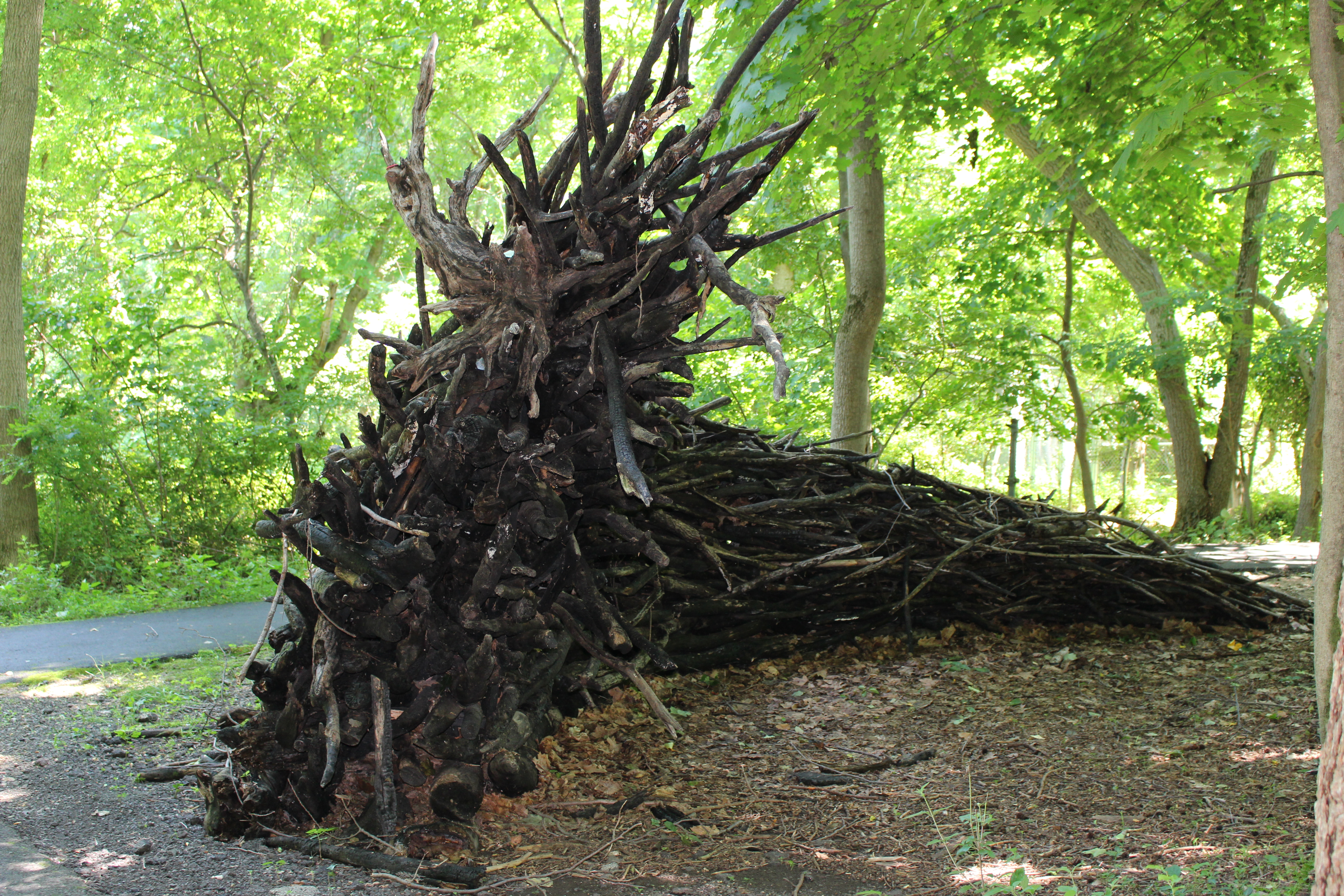
Mazzaroth is Alison Stigora's construction of burnt tree branches.
Mazzaroth is Alison Stigora’s construction of burnt tree branches.

The sculpture I thought the most of in the woods was Alison Stigora’s Mazzaroth. It’s an assemblage of burnt tree branches fitted together tightly to portray . . . what? A serpent? The movement of time? As the years go on, Mazzaroth will crumble and become one with the forest floor, as will the trees surrounding it.

You’re not going to confuse many of the sculptures at Abington Art Center with creations by David Smith, Louise Nevelson or other deservedly famed artists. Few if any are on that level. Some though, like Mazzaroth, had me looking them over from different angles because I liked them a lot. Take two on the great lawn, for instance. They are placed near each other and are as different as they can be.

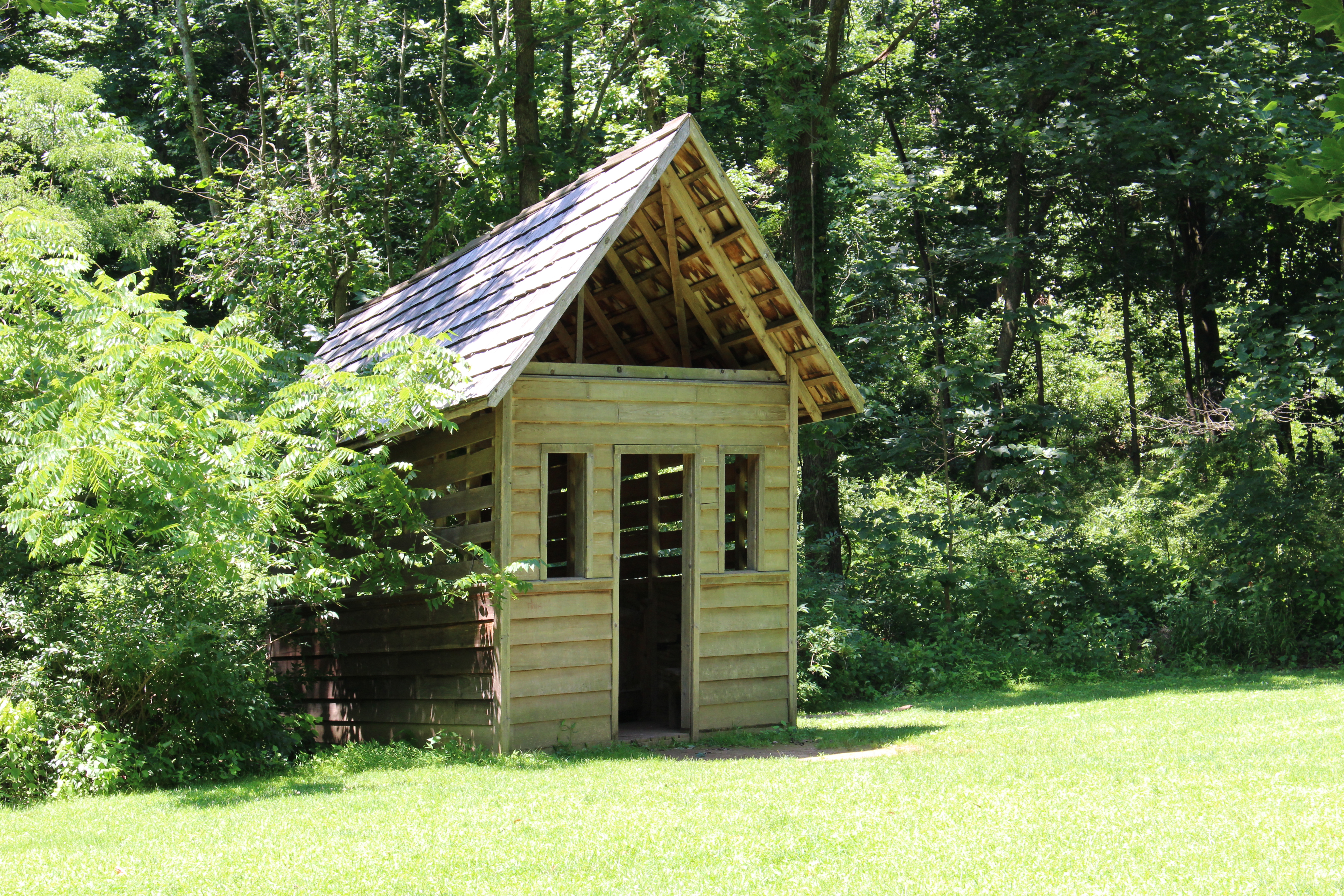
Cabin Van Gogh at Abington Art Center.
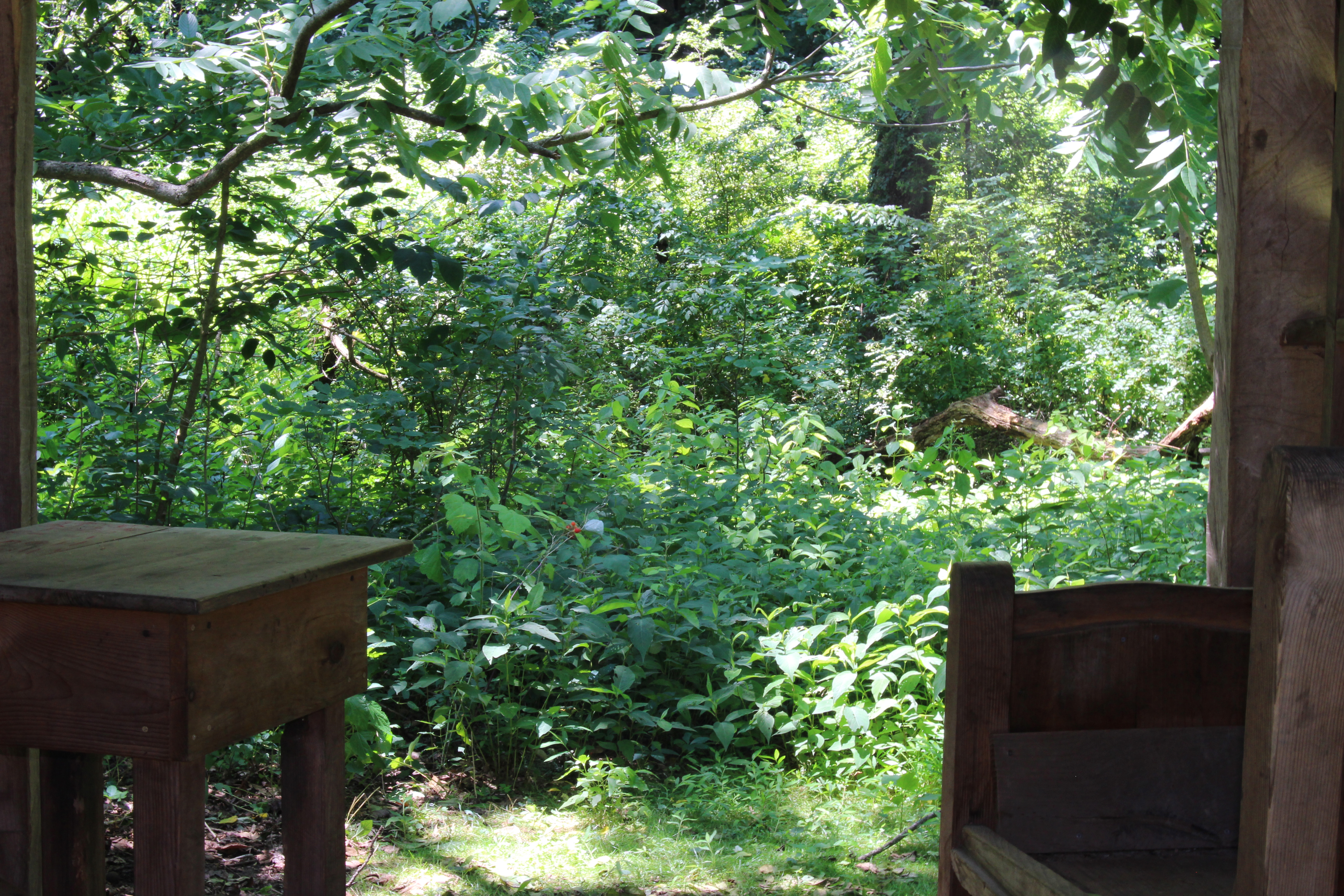
Partial view of bed and table inside Cabin Van Gogh.

What is a lopsided small wooden cabin doing on the grass at Abington? Well, it’s a whimsical piece of art and is right at home there. Weather-beaten, cute and loveable, it contains within, of all things, a bed, chair and table lifted straight out of Vincent van Gogh’s paintings of his bedroom in Arles, France. This work is Knox Cummin’s Habitation Suite: Cabin Van Gogh. Vincent I believe would have been charmed  by Cummin’s idea to build such an unlikely homage, and also by the view of foliage from the cabin’s open back side.

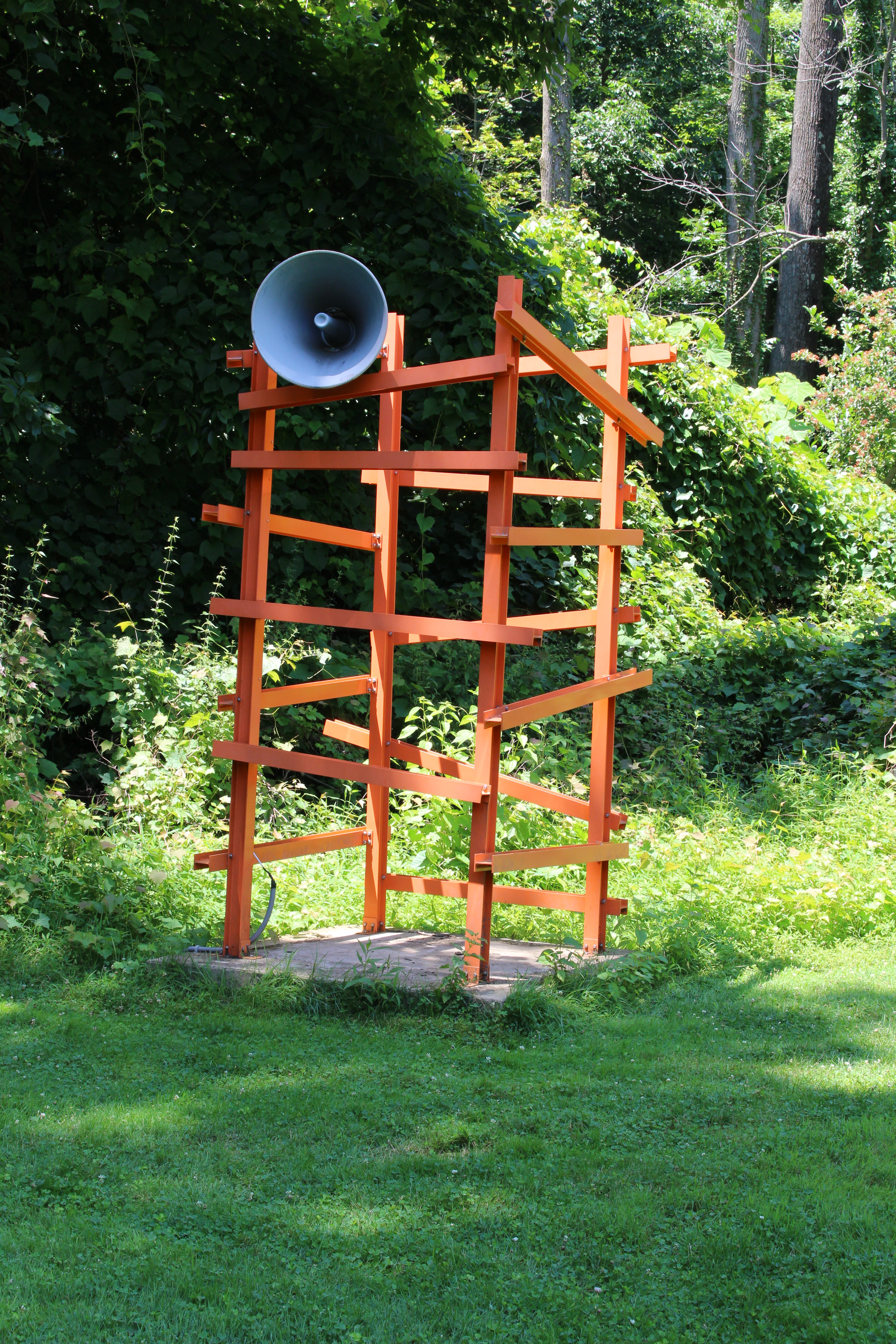
David Schafer's orange sculpture at Abington Art Center.
David Schafer’s orange sculpture at Abington Art Center.

Uphill from the cabin stands what looks a bit like a lifeguard tower painted in bright orange, some of its support slats atilt. David Schafer, the creator, named his piece Untitled Expression: How to Look at Sculpture. I suspect that the notions behind the giddy orange tower are partly conceptual. Sculptures, like just about anything, are multifaceted. No need to try and pin down a precise meaning. Observe, surmise and enjoy. One of my takes, subject to change, is that the sculpture is alive yet indecisive, that it is shaking out its stiff bones and readying to inch forward but hasn’t gotten into gear quite yet. And what’s going on with that public address system speaker? I remembered later that it had a practical purpose once, as a recorded message played from it for months after the sculpture was first installed about six years ago. Sandy and I were at Abington Art Center at that time and heard the message. If we were put into a deep hypnotic state, maybe we’d recall what the message was. Gone silent, to me the speaker now just looks cool.

(All photos by Sandra Cherrey Scheinin. If you click on any photo, a larger image will open)

(If you enjoyed this article, then please consider sharing it. Thanks.)

“Upward” Was The Theme Of The Day

My wife Sandy and I spent seven fun-filled hours on a recent Friday in Philadelphia’s Art Museum neighborhood. The first two of those hours we strolled around the grounds of the Philadelphia Museum Of Art and its surrounding trails and parks. The skies were sunny, the humidity pretty low and the temperature not too unkindly hot. There was no getting away from the sun’s power though, and we sweated mightily, a small price to pay for helping the body build up Vitamin D reserves.

During the seven hours we found a fascinating park that was new to us, looked at lots of art within and without the museum, took in a Cuban music concert (“Havana Night”) at the museum and finished with a tasty dinner at a nearby restaurant, Rembrandt’s. But I’ve decided to skip many of the details about all of that. Instead I’m going to concentrate on a theme that, to my impressionable mind, seemed to unite a portion of what we saw. There’s a good chance that I’m stretching reality to find a connection, but what the hay, that wouldn’t be my first time. Besides, reality is flexible. The theme involves optimism, more specifically our species’ seeming desire and need to stay positive, to grow, to look upward. The notion began to bubble a bit in my sun-dappled head near the start of our Friday adventure when, poking around the museum’s outdoor sculpture garden, we were very happy to find Franz West’s colorful sculpture Lips towering before us.

Franz West's Lips in the Philadelphia Museum Of Art's sculpture garden.
Franz West’s Lips in the Philadelphia Museum Of Art’s sculpture garden.
Steps and Pyramid, two sculptures by Sol LeWitt.


Lips is way terrific. Three giant tendrils, (or are they giant worms?), pointing heavenward in pastel shades of blue, pink and lime. Taking a good look at the squirmy designs, I couldn’t help but think that West was putting his mind and emotions on display, that Lips represented his vision of looking on the bright side, of reaching for the stars. I wondered, what else around here might have had the same inspirations? Well, not far uphill from Lips on the sculpture garden grounds, Sandy and I found two modest and monochromatic sculptures by Sol LeWitt. They were sitting within their personal and unassuming open-walled pavilion. LeWitt named the larger piece Pyramid and the smaller one Steps. Pyramid and Steps were fashioned in 2010, two years before Lips, and are made of concrete blocks. Tiny compared to Lips, they nevertheless are objects that to me suggested that we keep our minds open and on the ascending path. Pyramids point skyward, duh. And although stairs go down as well as up, LeWitt I’m sure placed Steps next to his pyramid to reinforce the “up” reference.

So, I appeared to be on a roll. What else might I fit into my Upward container? One reason that Sandy and I had decamped at the museum area was to check out some of the newish stretches of the Schuylkill River Trail, a river-bounded pathway for pedestrians and cyclists that planners hope one day will extend 140 miles from the bottom of Philadelphia to Schuylkill County, Pennsylvania. We walked a short distance southward on the River Trail and lo and behold came to a park we never knew about. It’s a haven that Philadelphia created for skateboarders. Paine’s Park is its name, probably because pain and skateboarding go hand in hand. Anyway, 30 or so guys and gals in their teens and 20s were gliding around the park, flipping off contoured walls and doing whatever else it is that skateboarders do. I was amazed by the park’s existence. Skateboarders had once made their home in Love Park, near Philadelphia’s City Hall, and garnered the wrath of city officials and ordinary folk in the process. Rather than continuing to scare the daylights out of tourists and office workers trying to lunch and lounge in Love Park, skateboarders needed their own officially-sanctioned facility. Now they have one. Paine’s Park opened two years ago.

Sign for Steps and Pyramid IMG_0816

Jonathan Monk's two sturdy sculptures, Steps and Pyramid, in Paine's Park.
Jonathan Monk’s two sturdy sculptures, Steps and Pyramid, in Paine’s Park.


But did my eyes deceive me? There in Paine’s were two creations that looked suspiciously like Sol LeWitt’s Steps and Pyramid. Sure enough, they were near-replicas. Their artist, Jonathan Monk, liked LeWitt’s sculpture garden pieces so much that he paid homage by creating cousins. And he even gave them the same names. But whereas do-not-touch signs are planted near LeWitt’s pieces, the Monk sculptures, fashioned from really tough materials, are meant to take whatever abuse skateboarders can dish out. Sandy and I didn’t see any of the gliders take on the challenge of Steps’ and Pyramid’s narrowly and sharply angled spaces, but I have it on good authority that it happens regularly. Monk’s works not only continue LeWitt’s figurative idea of staying on the upside, they provide the surfaces to allow someone actually to soar.

Skyscrapers in Center City Philadelphia.
The Philadelphia Zoo's ZooBalloon.
The Philadelphia Zoo’s ZooBalloon.
Marquis de Lafayette.

Yes, I smugly said to myself, there really is something to this idea I have. I looked around. In one direction were skyscrapers in Center City Philadelphia, testaments to man’s hopefulness. And in another was the Philadelphia Zoo’s gigantic and somewhat iconic ZooBalloon. Its daily flights, weather permitting, allow zoo visitors to come close to getting their heads near the clouds. And as Sandy and I made our way back to the museum grounds we passed Raoul Josset’s massive bronze statue of Marquis de Lafayette, his cape-enshrouded right arm pointing to the heavens. “Onwards and upwards, citizens,” the Marquis seemed to be saying.

The two tall works are Brancusi's Bird sculptures.
The two tall works are Brancusi’s Bird sculptures.

Sandy and I entered the museum. She headed toward a photography exhibition. I told her I’d meet her there in a bit after I continued my search for further examples to bolster my theme of the day. The museum holds a superb collection of sculptures by the great modernist Constantin Brancusi, and has devoted an entire room to his works. In it I stood before two related sculptures, Bird In Space and Bird In Space (Yellow Bird), the former made from bronze, the latter from marble. Both are sleek and very beautiful. Brancusi must have felt his spirit soaring as he designed and shaped them in the early 1920s, and post-creation too. Going up!

Paul Cezanne's The Large Bathers.
Paul Cezanne’s The Large Bathers.

I was tiring. One more stop, and then my quest to try and make a point would end. On many levels, Paul Cézanne is hard to beat. For maybe the 100th time I let wash over me one of his many masterworks, The Large Bathers. It was one of his final paintings, completed shortly before his passing in 1906.  This time I focused on the trees providing cover for the tribe of naked folks at ground level. The upper reaches of the trees are not shown, by design. I could imagine the trees going on almost forever. I believe that in them Cézanne symbolically infused man’s basic nature to ascend and achieve. To move upward.

(All photos by Sandra Cherrey Scheinin. If you click on any photo, a larger image will open)

(If you enjoyed this article, then please consider sharing it. Thanks.)