My 100th Post: Donald Trump And Joyce Carol Oates Chime In

1001I was giddy with joy last week when I began designing the story that is now before your eyes. Why wouldn’t I have been? Incredibly to me, it is the 100th opus that I’ve published on this blog, though its finalized shape differs substantially from my original conception. Despite that, I am of the opinion that 100 stories is a true milestone for someone whose life has been light on milestones. Very light. The last time I did anything noteworthy was decades ago, in 1985, the year in which I set the Guinness World Record for the most Cheez-It crackers consumed in one sitting. The 8,271 Its that tumbled down my gullet on June 17 of that year remain a number yet to be topped. You can look it up.

One hundred stories. Wow, indeed, considering that when I started this blog 20 months ago I was uncertain as to its future. I began strongly, banging out articles every four or five days. And even though my pace soon slowed slightly, I held the old nose to the old grindstone and efficiently kept the stories rolling off the assembly line. So, I feel comfortable in saying that my blog isn’t going away anytime soon. Hey, I’ve discovered that I like to write. Who’d have thunk it? At last, something to hold on to!

Still, by nature less than wonderfully confident, I was in need last week of some reinforcement, some pats on the back that would keep my elevated mood elevated and provide uplifting quotes to incorporate into story #100. With that in mind, a few days ago I picked up the phone and made a series of calls to a variety of intermediaries, eventually directly reaching the persons I wanted to chat with. Persons whose votes of confidence I was hoping to win. Things didn’t end up the way I had envisioned, but WTF. I tried. And I did snare conversations with two individuals from my past whose thoughts, I’d venture to say, haven’t been included in the same story ever before. Namely, Donald Trump, “Donnie” to me, and the brilliant and incomprehensibly prolific novelist, essayist and memoirist Joyce Carol Oates.

Donnie Trump was the first of the two I was able to get on the line.

“Who’s this?” he said after I offered my greeting. “Hurry up, whoever you are. I’m busy. It’s not as easy as you’d think to unravel and unnerve a country.”

“Donnie, it’s Neil Scheinin. Remember me? We were not quite friends but were more than acquaintances during the one year we spent together at Mister Gruel’s High School For Future Winners. You were 15 and I was 14. We were on the debate team together. You were its star, natch. I was the fifth alternate. Remember?”

There was a pause. Then he spoke. “Neil, I have a vague memory of you. You’re the guy, I think, who couldn’t string two sentences together coherently. Am I right?”

“Yeah, Donnie. As always, you’re right. Here’s why I’m calling. You weren’t very nice to me all those years ago, mocking me, belittling my meager talents. That’s why I wanted to let you know that these many moons later I’ve gained success. I’ve become a blogger, a writer if you will, and I take the job seriously. I’m about to publish my 100th story soon, which to me is a momentous event, and I’d like the piece to include your comments about my achievement.”

“So you’re a writer, are you, Neil? I don’t like writers. They tend to be thinkers, and I don’t like thinkers either. What I like are doers, men who bulldoze their way through life. Men who bulldoze their way through nature, for that matter. Look at me. I’m a bulldozer, and everyone admires me. I’m so popular it’s ridiculous.”

All of a sudden I felt something weird starting to happen inside my mouth. My tongue, normally held well in place, was itching to flap wildly. I couldn’t control it. I’d come seeking a few words of support from the USA’s next leader, selfishly hoping to boost my blog’s readership as a result. But what I said next was guaranteed not to elicit kind responses.

I think he'd look better as a brunette. (Photo: Melina Mara/The Washington Post/Getty Images)
I think he’d look better as a brunette. (Photo: Melina Mara/The Washington Post/Getty Images)

“Donnie,” I said, “I guess you heard that Hillary is more popular than you, didn’t you? She won the popular vote, n’est pas? By a lot. You know, two months ago you were proclaiming that the election process was rigged in her favor. Seems like just the opposite was true. I mean, if it wasn’t for our demented Electoral College system you’d be spending your time right now deciding whether or not to change the color of your hair. Instead, you’re doing your best, like you have for months, to energize the haters who keep crawling out of the woodwork because of you.”

Donnie didn’t enjoy that. “Listen up, fifth alternate. You’re a loser. Did you hear me? I said loser. Me, I’m a winner.” He stopped talking. Someone was calling to him. “Stay right where you are, loser,” Donnie said a moment later. “I’ll be right back — ‘What’d you say, Rudy? That it’ll be a snap to obstruct poor peoples’ right to vote? And a snap to cancel environmental protection regulations? Keep it coming, Rudy. You’re the man!'”

Holy crap. The phone call wasn’t going well. It was bringing me down, not up. I decided to hang up on a future president. Which is what I did.

If kudos for my solid achievement weren’t to be found with Donnie, I was certain that they would be with Professor Oates, who for many years has taught at Princeton University, merely an hour’s drive from my suburban Philadelphia home. Three hours of trying to reach her via phone calls to university staff the other day finally paid off.

My phone rang. “Hello, this is Joyce Carol Oates. What may I do for you?”

“Professor, this is Neil Scheinin. Possibly you recall me from the marvelous class you taught six years ago, Faulkner, Bellow And Fitzgerald: As Novelists, Were They Really Any Good? I always sat in the first row in the seat nearest the exit, a bag of popcorn on my lap.”

“Ah yes, Mr. Scheinin. How could I forget? You are the gentleman who audited the course and managed never to add a perceptive or entertaining comment to the classroom discussions. What, sir, are you calling about?”

“Professor, as unexpected as this might be to you, believe it or not I have taken to writing like a duck to . . . well, maybe not to water, but to something. You see, last year I started blogging, and since then I’ve written up a storm. Right now I’m excited to be working on my 100th story. One hundred, Professor! A number that amazes me. Have you any comments about this?”

Joyce Carol Oates. (Photo: Thos Robinson/Getty Images)

I almost could hear Professor Oates’ mind revving. It didn’t take long for her to respond. “Neil,” she said, “what you have done amounts to little. You say you’re about to complete your 100th story? And it took you months and months to do this? Why, I could write that many in a week. Possibly in four days if need be. But forget about stories . . . Do you have any idea how many books I’ve written, most of them long and detailed books? Over a hundred, Neil. Over a hundred. Call me back whenever your blog expands in size fiftyfold. Maybe then we’ll be able to have a satisfying and meaningful discussion.”

Well, here I am then with little more to say. I thought that this story might have had a chance to go viral had Donnie and Professor been more congenial interviewees. But such is life. Thanks for reading number 100. It’ll take some time for me to bounce back to my normal self, but I assure you that when that happens I’ll get to work on 101.


(Don’t be shy to share this article or to add your comments)
Stoned Again And Again (A Semi-Obsession With The Rolling Stones)

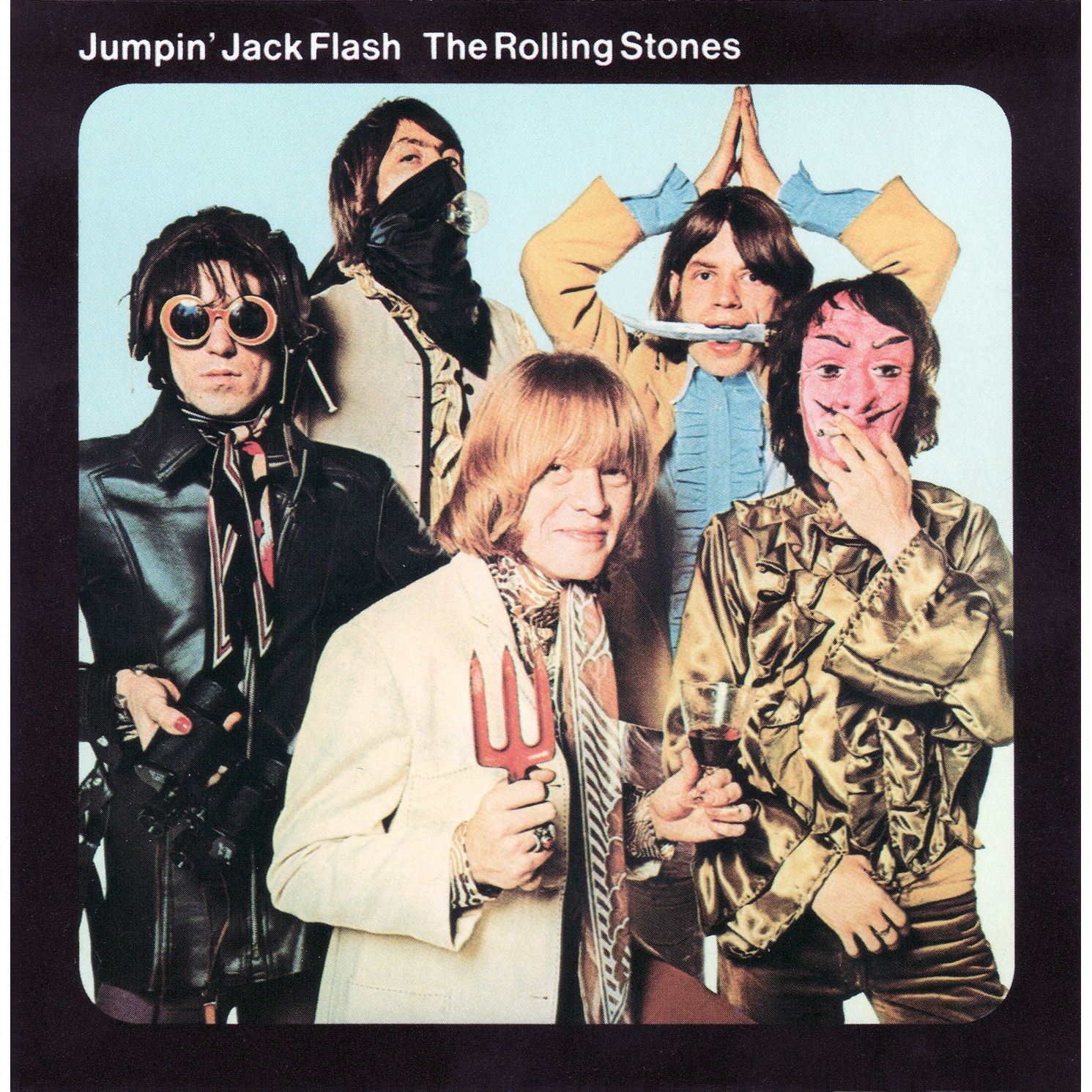
jumpin-jack-flash-coverIn the summer of 1968 I did a stint as a counselor at a boys’ sleepaway camp nestled in the Berkshire Mountains of Massachusetts. It was a good gig. I liked the kids in the bunk that I oversaw. And for some reason they seemed to like me. The air up there in the mountains was fresh, the water in the camp’s lake was clean and inviting and the female counselors in the nearby girls’ camp were cute. Like I said, a good gig. The best thing of all during that summer, though, was completely camp-unrelated. It was a tune that I heard for the first time ever while lying one evening on my bunk cot. A new song, it exploded from my teeny-weeny radio, and for the rest of my Berkshires sojourn I flipped that radio’s dial as often as possible each day, seeking out the music that had blown me away. Whenever I found it, which was pretty often, I shook my head in disbelief and let it rock me anew unmercifully. And you know what? To this day, a mere 48 years later, the tune has just about the same effect upon me. We’re talking The Rolling Stones’ Jumpin’ Jack Flash, birthed in the era when those British lads were idolized, really mattered and were flabbergastingly creative, writing and recording amazing new songs prolifically and seemingly with ease.

Stones on stage in 2016. Photo by Nelson Almeida/AFP -- Getty Images
Stones on stage in 2016. Photo by Nelson Almeida/AFP — Getty Images

In 2016 the Stones are still idolized, at least by some. But really mattering and in possession of creative zing? Those days passed the Stones by long, long ago. Sure, the boys, who range in age from 69 (guitarist Ronnie Wood, a longtime but not original Stone) to 75 (drummer Charlie Watts) haven’t broken up, and for each of the last five years they’ve toured a decent amount, rocking ferociously on stage (meaning, they remain fairly active and haven’t lost their chops). Problem is, though, in concert they are nothing more than rehashers of their own well-worn classic material. And that’s because, when it comes to composing and then recording new songs, they’re plenty constipated. Guys, I’m going to ship 20 cases of prune juice to your manager’s office. You need it.

Hey, Paul McCartney, Bob Dylan and Neil Young, all of whose tree rings number about the same as those of the various Stones, continue to gift the world with albums of original material. But the Stones? Nah. The only album of new bonbons they produced this century was 2005’s A Bigger Bang. And in 2011 they managed to record and release two more original songs. The well dried up after that. They do have a studio album coming out next month, but it’s filled strictly with cover versions of old blues numbers. Apparently they had entered the studio to try and crank out an album of newbies, but got nowhere with that. Trying to salvage the sessions in some way, they fell into a blues groove, jamming on numbers composed by Willie Dixon, Howlin’ Wolf and other blues guys, and ended up with enough material for an album. I bet the record (Blue And Lonesome) will be good. But me, I’d much rather have the Mick Jagger-Keith Richards songwriting team on fire like they were looong ago. Who knows? Maybe it’ll happen again. Prune juice works.

Right, it’s kind of weird that I know about all of this Stonesy stuff. But I do. And the reason is that, in my wondrous dotage, I am, as I’ve been for nearly forever, a dopey fanboy of the Stones, though far less fervent than I used to be. I rarely play their albums at home anymore, something I once did religiously. But I keep my Stones jones alive by regularly checking up on their musical and other escapades on Google News. Did you hear, for instance, that Wood became the father of twins earlier this year? Or that Jagger will become a dad for the eighth time, at age 73, when his decades-younger-than-him girlfriend gives birth soon? Ah well, small news items like those fit comfortably into my small brain cavity. Decades ago I probably wouldn’t have thought my semi-obsession with the Stones would continue this far into eternity. Similarly, Jagger, when he was in his twenties, used to say that he couldn’t imagine performing rock and roll beyond age 30. So I guess I don’t feel too goofy about following him and his bandmates on their continuing trip. We spit at Father Time’s wrinkled face!

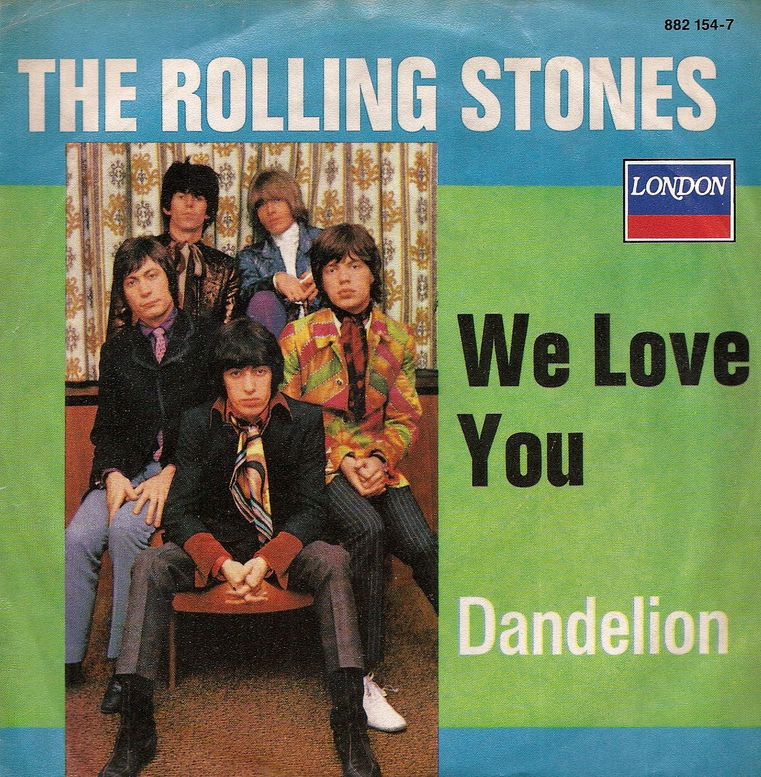
the-rolling-stones-we-love-you-london-3My best Stones moments in a while came recently courtesy of WXPN, a Philadelphia radio station adept at playing just about every style of music you can name. The morning DJ announced that she was spinning songs that originally had come out together on seven inch 45 rpm vinyl singles. In other words, she was playing sides A and B from a bunch of singles. When I heard her offer up the Stones’ Ruby Tuesday/Let’s Spend The Night Together something sparked in my head, turning my thoughts to another Stones 45 that I’ve always thought of as one of the ultimate singles, and whose two tunes I hadn’t heard in at least a few years. Released in 1967, during the Stones’ brief foray into psychedelia, We Love You and Dandelion found their most meaningful home on that single, as neither ever was part of a regular studio album. They did, however, eventually take up space on some of the greatest hits and compilation discs that the band is talented at issuing unnecessarily often. Great, great songs they are, despite being among the group’s lesser-known efforts.

I used to own the seven inch We Love You/Dandelion single. No more. My collection of 45s, unlike that of my vinyl albums, long ago found new abodes and/or an assortment of landfills in which to reside. Therefore, thank the stars above for YouTube, to which I turned to please my ears soon after the tunes popped into my mind. They sounded as good as I remembered them. Blessed with catchy-as-hell melodies, swirling and cascading vocals and pulsating instrumentations, We Love You and Dandelion set my head a-boppin’ and my mind a-floatin’. As always, shivers ran up and down my back as the songs’ high harmony vocal interweavings kissed the sky.

We Love You arrived in the wake of Jagger’s and Richards’ 1967 drug bust, short-term jailings, trials and, in the end, very light sentences. It was both a thank you to Stones supporters and a poke at the British legal system. Dandelion is less heady, a harpsichord and drum-driven relative of children’s songs aimed at anyone who likes to smile and groove. Both songs swell with musical daring, panache and beauty. I can’t recommend them enough. Such being the case, clicking here is what you’ll want to do to listen to the former, and here for the latter. I accept your thanks in advance.


(Don’t be shy to share this article or to add your comments)

The No Bell Prize

Before I threw this blog into gear, in April of last year, I’d hardly ever looked at any of the who knows how many millions of blogs that flap their wings in cyberspace. Since then, though, I’ve become a blog addict and have clicked on the pages of at least a thousand. Most I’ve never revisited, for reasons only my valet Jeeves is privy to. But there are over 100 whose words and images I imbibe anywhere from occasionally to frequently. And that’s because they are good. Real good in numerous cases. If anyone had told me in April 2015 that Planet Earth houses many times more strong thinkers and boffo writers and discerning photographers than I ever imagined, I’d have responded “yeah right, and I’m going to win the Nobel Prize in Literature before this decade is out.” Well, all I can say is that I now am totally impressed, and intimidated, by the oceans of citizens who can turn a sweet phrase and/or snap a fine photo. And despite the obvious fact that a Nobel isn’t part of my future, I’m here to announce somewhat reluctantly that a No Bell is. More about that later.

Intimidated. Yes, that word surely applies to me. Trying to keep pace with the many who, anywhere from twice a week to daily, knock out good stories for their blogs intimidates me. I mean, it’s all I can do to compose a ditty once a week. Twice a week or more often than that? Ain’t about to happen anytime soon. I’m more likely to pack my bags for the Himalayas and scale Mount Everest or K2.

Inspiration that leads somewhere is what it boils down to, and some writers have it up the wazoo. Me, uh uh. Take one day last week, for example. I hit my blog’s “Publish” button early that morning, lofting my latest masterwork, Ponds, into the ethers. Hours later I was sweating up a storm, racking my brains for a topic I could wrap my head around and turn into another addition to the publication whose sentences you presently are glued to. The pressure was on. If something didn’t emerge pretty soon I’d be in sharp danger of being empty-handed when, the following week, the “Publish” button coolly beckoned me to depress it confidently. Becoming more desperate by the minute I yelled to myself “come here, topic, come here. Be a good boy and come here.”

And who’d have guessed it? Next thing I knew a few ideas began to dribble in. Starting to feel better I grabbed a pen and a pad and scribbled some notes.

img_1254Cape Cod were the first words I jotted down. Sure, how about another opus about The Cape? My previous two fell into that category, so why not make it a threepeat? On the other hand, I quickly decided, fuhgeddaboudit. I needed to point my blog in a direction away from The Cape, if only temporarily, before my meager readership abandoned ship entirely. “Cape Cod, my love,” I said to myself, “I’ll come back to you. Sooner rather than later. Wait for me, my dearest. Please wait.”

monkey-scratching-headIf not Cape Cod, what then? A few more words transferred from my brain cells to paper: Movies That Made Me Scratch My Head. Not a bad idea, I thought, as I’d seen two action flicks in October that I enjoyed but whose plots, par for the course for me, I couldn’t keep up with. Jack Reacher: Never Go Back, a Tom Cruise-led endeavor, and Ben Affleck’s The Accountant were the films in question. Sitting back on my living room sofa I tried to bring Reacher and Accountant to life in my mind, but had only middling success. I could barely recall the plot twists that a few weeks earlier I’d been scratching my head about. Like much of my life, they’d faded into wispy memories. What, you expect a body to take notes when he goes to the movies in the event he might want to comment pointedly on them for his blog? I’ll take it under consideration.

You get the picture. I played around with a couple of other ideas and ended up tossing them aside too. And so, here I am with an essay about not much of anything. And the “Publish” button is staring me in the face. What’s a boy to do? That button is a demanding and inscrutable entity, one best not to ignore. It’s anyone’s guess what ghastly forces might be unleashed if I do.

In conclusion, I return to the aforementioned No Bell Prize. Here’s the situation: I have it on good  authority that next week I will be invited to Stockholm, Sweden, where, should I accept the invitation, I would be presented in December with a document inscribed as follows: We at The No Bell Institute Of Blogging Mediocrity hereby state that Neil Scheinin’s blog post from November 10, 2016 is not ring-a-ding-ding. It is unworthy of any number of bells, not five, not even one. No bells being more like it, we are issuing this certificate to Mr. Scheinin.

Ouch!

Oy vey!!

Onward and Upward!!!


(Don’t be shy to share this article or to add your comments)
Ponds

For those of you who have been wishing and praying that this correspondent would drop the Cape Cod kick he’s been on, I have a few things to say, such as “lump it.” Or, as I mentioned in my previous story, “sue me.” Be forewarned, though, that if you choose the latter path you’ll soon encounter the legal fury of my attorney, the one and only Harry “I’m gonna git you, sucka!” Hooznext. Harry is a fearsome son of a bitch. The last time he lost a case was before any of us were born.

Ponds. Yeah, that’s what I’m about to write about. Specifically, Cape Cod ponds. Not with the magical descriptive powers or insights that Henry David Thoreau, in the mid-1800s, brought to the subject in his charming book Cape Cod. Rather, with the flabby notions that one would expect from he who in his own mind is a sort of Nature Boy, but whose knowledge of the natural world actually is barely enough to squeeze out a 1,000 or so word essay. But we work with the tools that have been granted us, no? Yes.

Let’s get on with it. Last month my wife Sandy and I spent some time on Cape Cod, a locale where, as I’ve noted previously on these pages, we frolic in and stand in awe of the great outdoors indescribably more than we do back home in suburban Philadelphia. That’s because 97% of the great outdoors has been bulldozed and paved over where we live, whereas on Cape Cod substantial areas of near-undisturbed beauty remain.

A portion of Hawksnest State Park's forest.
A portion of Hawksnest State Park’s forest.

We’ve been coming to Cape Cod since 1998. At first it was The Cape’s waters and coastlines that made us chant “OMG” in unison several times each day. As the years rolled by we started to realize that those waters and sands and marshes weren’t all there was to go gaga over and to commune with. Hey, there were trees! A trillion of them! I mean, within and between its villages, Cape Cod is slathered with woods, many public. And there are several sprawling areas that meet just about anyone’s definition of true forests. And so, to the woodlands we went, skipping hand-in-hand down their trails, dropping bread crumbs behind us and keeping one dominant thread of thought in our minds. To wit: “Holy crap! There’s a ton of poison ivy all over the place! What the f*ck are we doing here?” But we carefully watched where we placed our feet and soldiered on.

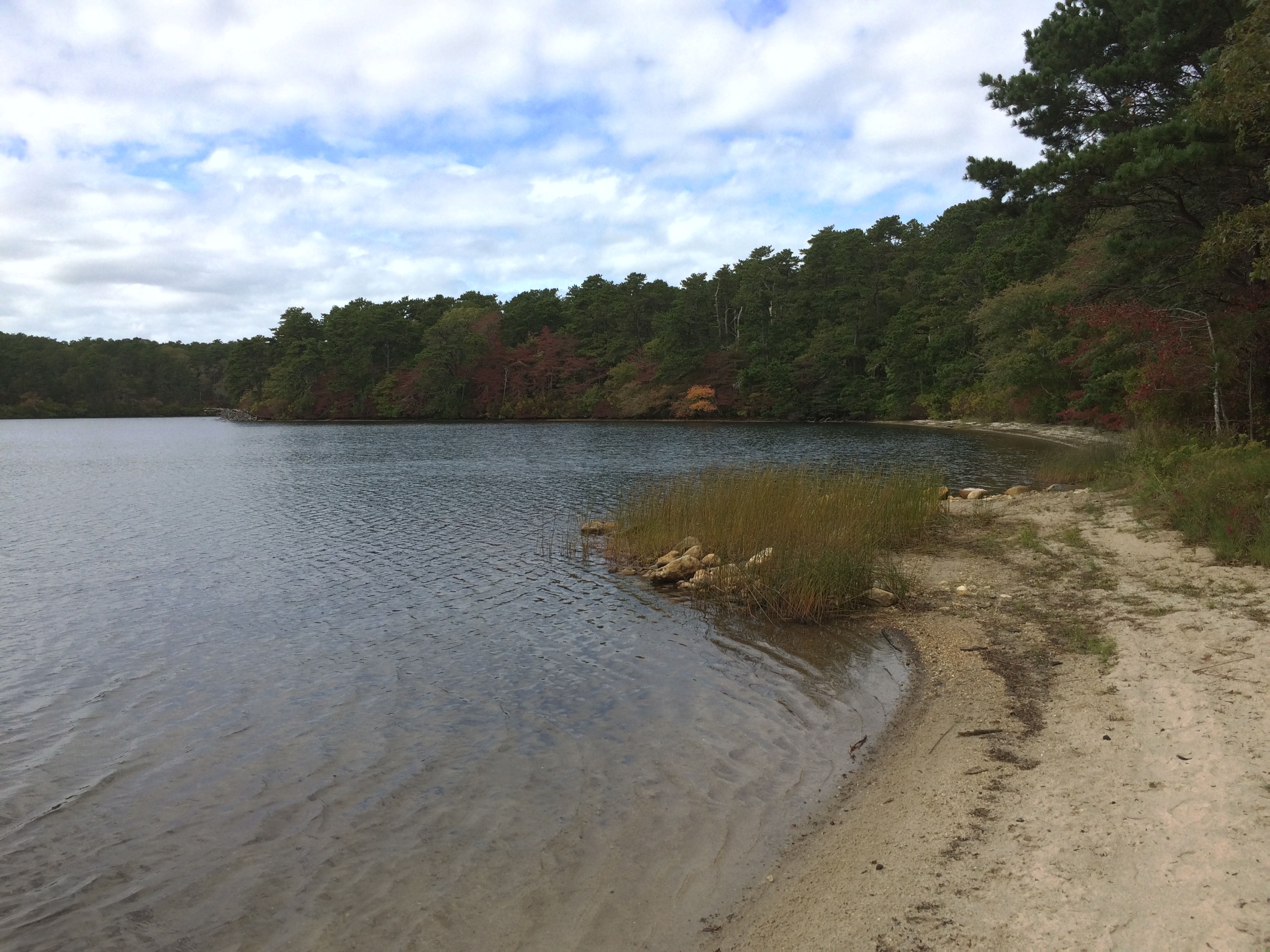
Lo and behold, one day in a woody spread we came upon a body of water so pristine and lovely we almost dropped to our knees. It was a pond. A freshwater pond. It sat there demurely, prettily, surrounded by trees small to medium in stature, trees unable to reach towering heights due to The Cape’s less-than-fully-nourishing sandy soils. And small to medium seemed just right, the correct accompaniment to a modestly sized pool of water. Yes, we were smitten. Once again Cape Cod’s elemental beauty had melted us like butter. Pre-Cape Cod we hardly were oblivious to nature’s bounties. But The Cape somehow opened inner windows that allowed us to enjoy the views as we never had before.

Since that fateful day Sandy and I have added pond-seeking to our repertoire of activities on The Cape. Needless to say, the hands of man have surrounded too many ponds with roads and houses that don’t exactly make enchanted experiences out of gazing upon the waters. Yet, a decent number of freshwater ponds remain in unspoiled woodlands. And we’ve worshipped at some of their altars. By the way, if one is to believe what one reads, the end of the latest Ice Age, 12,000 or so years ago, is responsible for The Cape’s freshwater ponds. Retreating glaciers apparently scraped holes in the ground that filled with water and became the ponds we know and love today. And how many freshwater ponds are there? There doesn’t seem to be a consensus on the answer. Anywhere from 365 to 1,000 are the numbers thrown around. Whatever, The Cape contains more than a few.

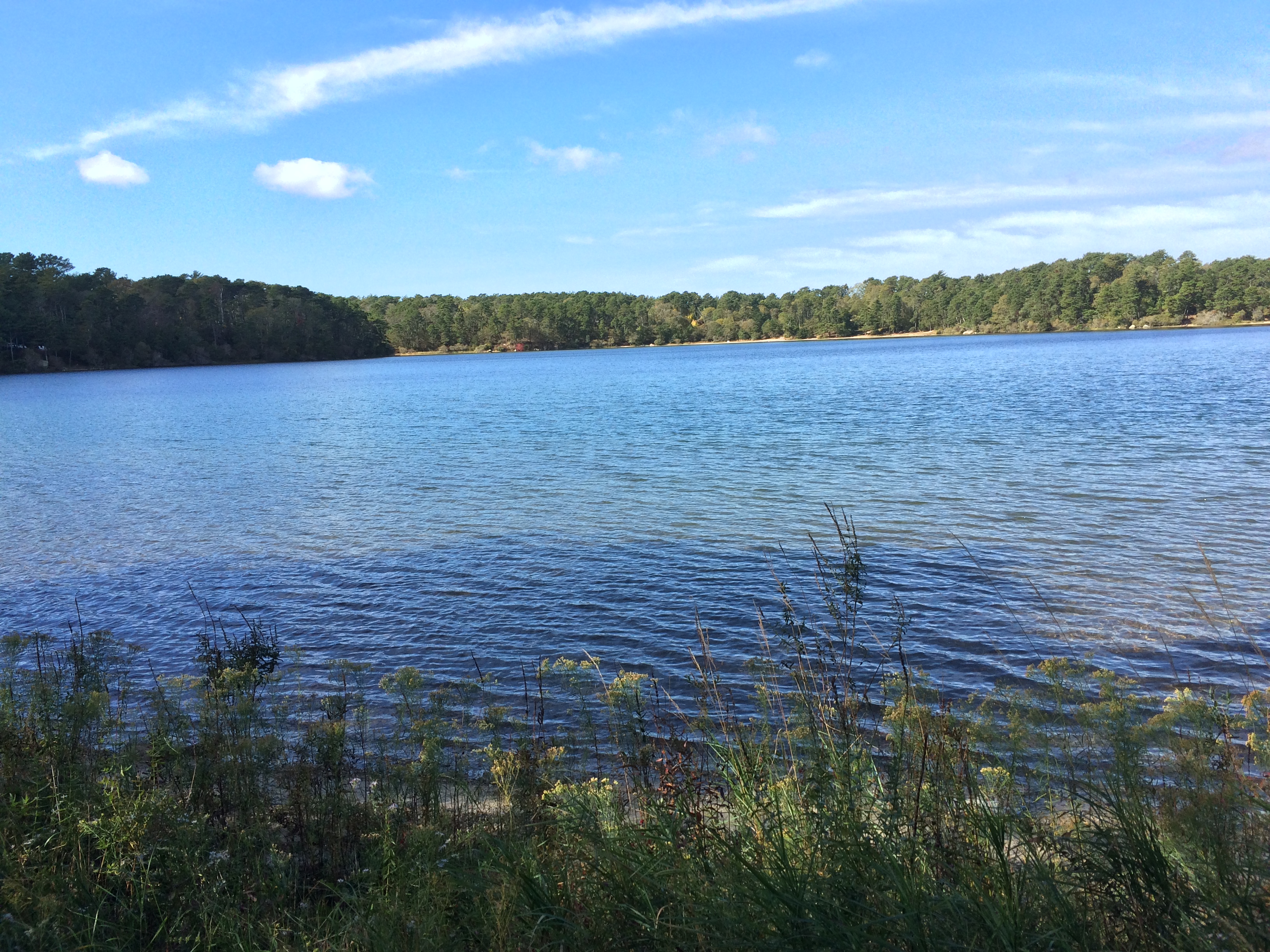
Hawksnest Pond.
Hawksnest Pond.

Sandy and I fell under the spell of a pond one week into our latest Cape trip. We’d seen it, Hawksnest Pond, a few years ago, and decided to refresh beside it again. This pond, and two others, are sheltered within a small forest, Hawksnest State Park, a little-known and little-visited and undeveloped swath of Harwich township. We parked along one of the park’s borders and entered, marching down the park’s wide main trail till Hawksnest Pond materialized. Man, standing on its shores I felt my anxieties begin to slip away. Alas, an hour later all the tensions returned when we exited the forest. Tight as a frigging knot I often tend to be.

Tight doesn’t begin to describe the emotional state that a pond-hunting escapade threw me into two days later. Ballistic is more like it. There Sandy and I were in Nickerson Sate Park, a 1,900 acre forest in Brewster township. Eight freshwater ponds are on the premises, and pine trees and oak trees abound, as they do throughout Cape Cod. Sandy and I have been to Nickerson a few times over the years. This time I was determined to gaze upon its Higgins Pond, which, as far as I could remember, I’d never seen before. But gaze upon it I did not, as Higgins wasn’t visible from the road that supposedly ran near it, and trying to ascertain which forest pathways led to the pond proved to be an exercise in sheer frustration. The park brochure and map? Pretty useless.  Road signs and trail signs clearly pointing to Higgins? Nonexistent. “Where’s Daniel Effing Boone when you need him?” I bellowed, not for the first time in my life. “He’s on his lunch break,” a voice, barely perceptible, answered from far, far away. It figured.

Flax Pond.
Flax Pond.

Smoke pouring out of my ears, I drove back towards the park entrance, deciding to turn onto a road that seemingly had a good chance of leading to Flax Pond, another of Nickerson’s oases. Mercifully it did. Flax Pond wasn’t new to us, but was no less beautiful for that. The pond looked sweet and innocent. Hell, it was sweet and innocent. Quiet blue waters ringed by a chorale of lovely, welcoming trees . . .  not much is better. Almost instantly I felt my diastolic and systolic numbers head southward dramatically. And there they remained for a good while, as memories of the Higgins mini-fiasco evaporated presto. Some days work out just fine.


(Don’t be shy about sharing this story or about adding your comments)

(If you click on any photo a larger image will open in a separate window)

To The Beach!

Regular readers of this publication (there are at least three or four of you, which is a hefty increase from the one or two who were tuning in a year ago) might be sick of hearing me extol Cape Cod. You know what? Sue me. I traipse through life under numerous aliases, so you’ll never track me down.

The Outer Cape's sand cliff-backed ocean coastline.
The Outer Cape’s sand cliff-backed ocean coastline.

This, then, is another story revolving around The Cape, a locale that I and my wife Sandy most favor. We find Cape Cod to carry a pretty perfect combination of attributes and personality traits. Overall it is scenically beautiful, which is why we spend much time outdoors, way more than we do back home. And, if you know where to go, you’ll find expansive and mostly undeveloped shoreline and forested and sand dune areas that are far beyond beautiful. Awe-inspiring and majestic are words I’d use to describe those sections, especially the Outer Cape’s long stretches of sand cliff-backed ocean coastline and crazily huge dunes. What’s more, Cape Cod is nicely doused with cute villages, good art galleries and museums, small theater companies and plenty of cinemas and restaurants. All of this is right up my and Sandy’s alleys. We’re at ease, wowed and highly entertained on Cape Cod.

We were on Cape Cod for a spell earlier this month, based in a somewhat secluded part of Orleans, one of The Cape’s 15 townships. The Atlantic Ocean, which paws at and sometimes pounds CC’s eastern border, was near our rented house. Ditto for the endless extent of sands that goes hand-in-hand with the ocean. In other words, double duh, the beach. I’ve racked up many miles of hiking and strolling on Orleans’ share of the ocean beach over the years, and also on the portions within the boundaries of other Cape townships such as Wellfleet and Truro.

Normally when I’m out on Cape Cod’s sands (be they beside the ocean or Cape Cod Bay or Nantucket Sound) or poking around in its forests and marshlands, I don’t particularly like seeing or being aware of fellow humans. Sandy excluded, I hasten to add. That’s because I’m a misanthrope and also because my delicate psychological relationship with Mother Nature is easily disturbed. Not to mention my delicate psychological relationship with myself. Luckily for me, normally Sandy and I don’t come in contact with many others on our expeditions. In summer, when Cape Cod swarms with frolickers, that wouldn’t be the case. But the hordes of humanity significantly diminish in the off-season, which is when Sandy and I do our Cape thing.

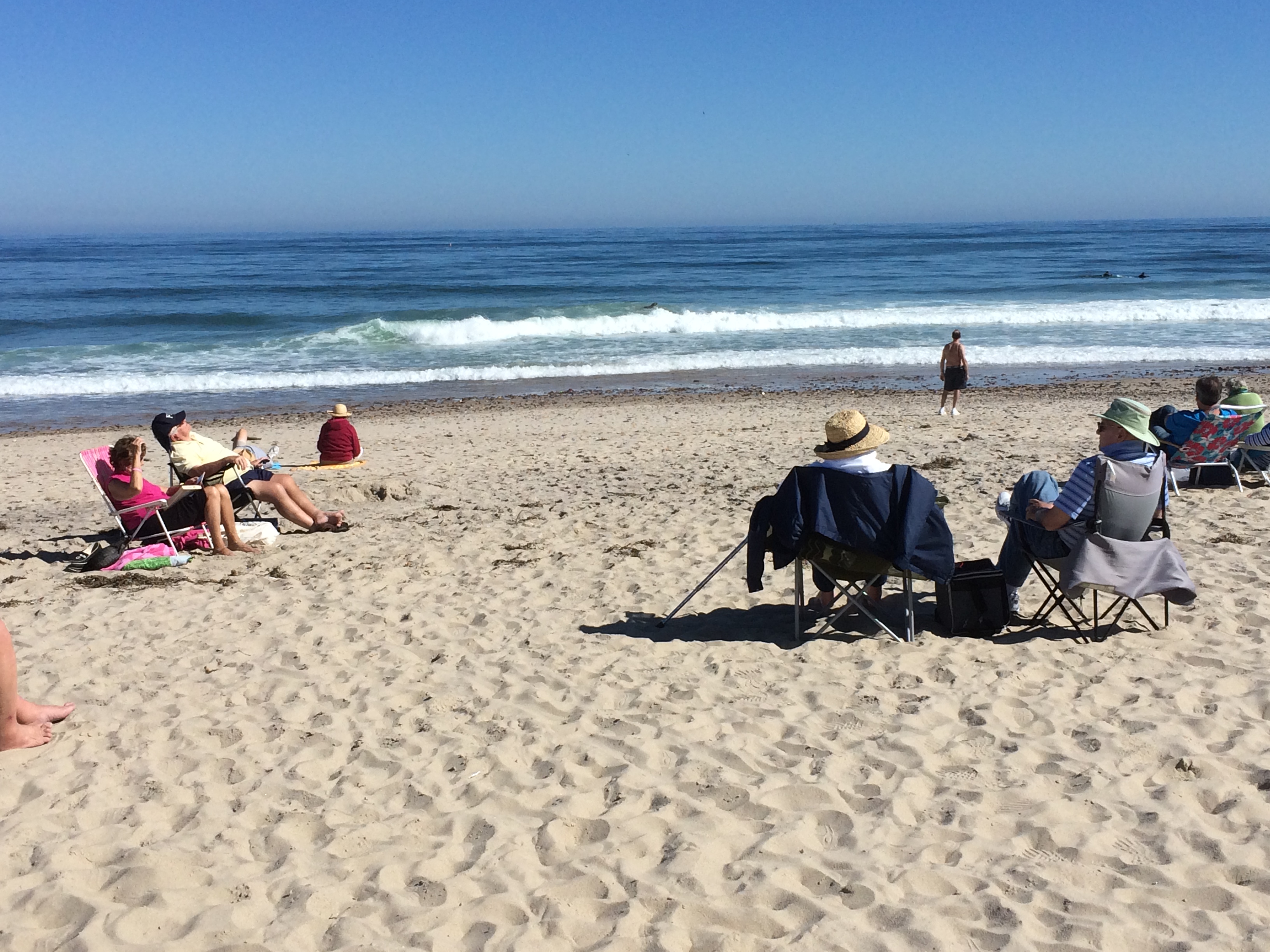
A view from Nauset Beach.

Our first full day on Cape Cod this month was the Friday of Columbus Day weekend. A good way to inaugurate our latest Cape trip, we decided, would be to head to Nauset Beach, a part of Orleans’ coastline that has been tamed a
bit in its central section so that people can get their beach fixes. There’s the mandatory big parking area, the restrooms and showers, a seafood stand. And not much else, actually, besides trillions of grains of sand and trillions of gallons of H2O and millions of blades of beach grasses. No boardwalk, no amusements. Which pleases me. And no sand cliffs, which doesn’t, Nauset Beach being a tad south of the Outer Cape.

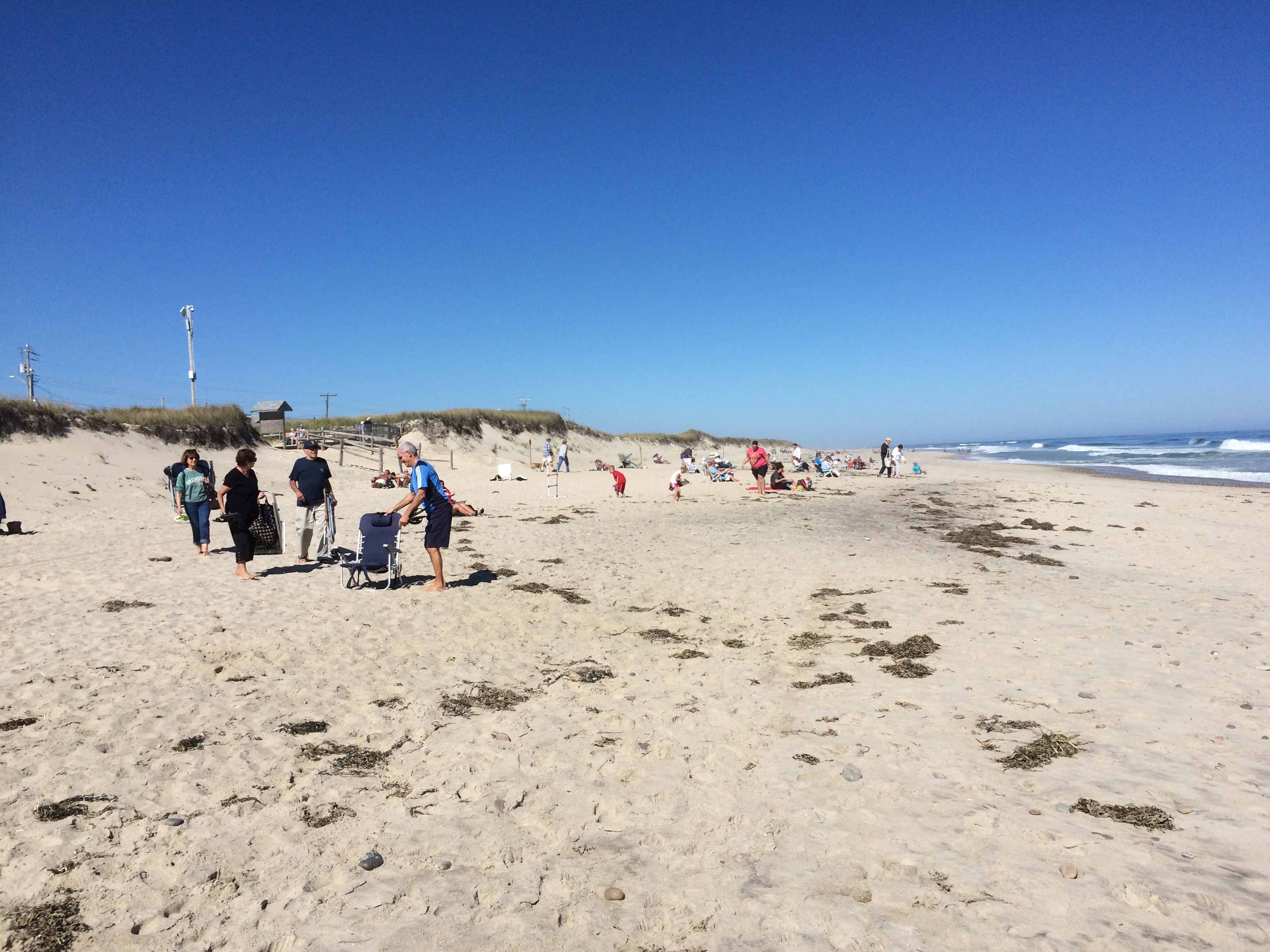
Nauset Beach. October 2016.

In the summer Nauset Beach is congested. Otherwise, usually not. On the Friday in question Sandy and I were surprised, but shouldn’t have been, to see quite a few vehicles in the parking lot. And quite a few people, hardly a mob but maybe 125 or so, scattered around Nauset Beach’s miles-long length. Hey, why not? Columbus Day weekend is a Cape draw. And the day was perfect. Mild, sunny, a light breeze coming off the waters. And, much to my amazement, I was glad to be among those folks. It happens sometimes.

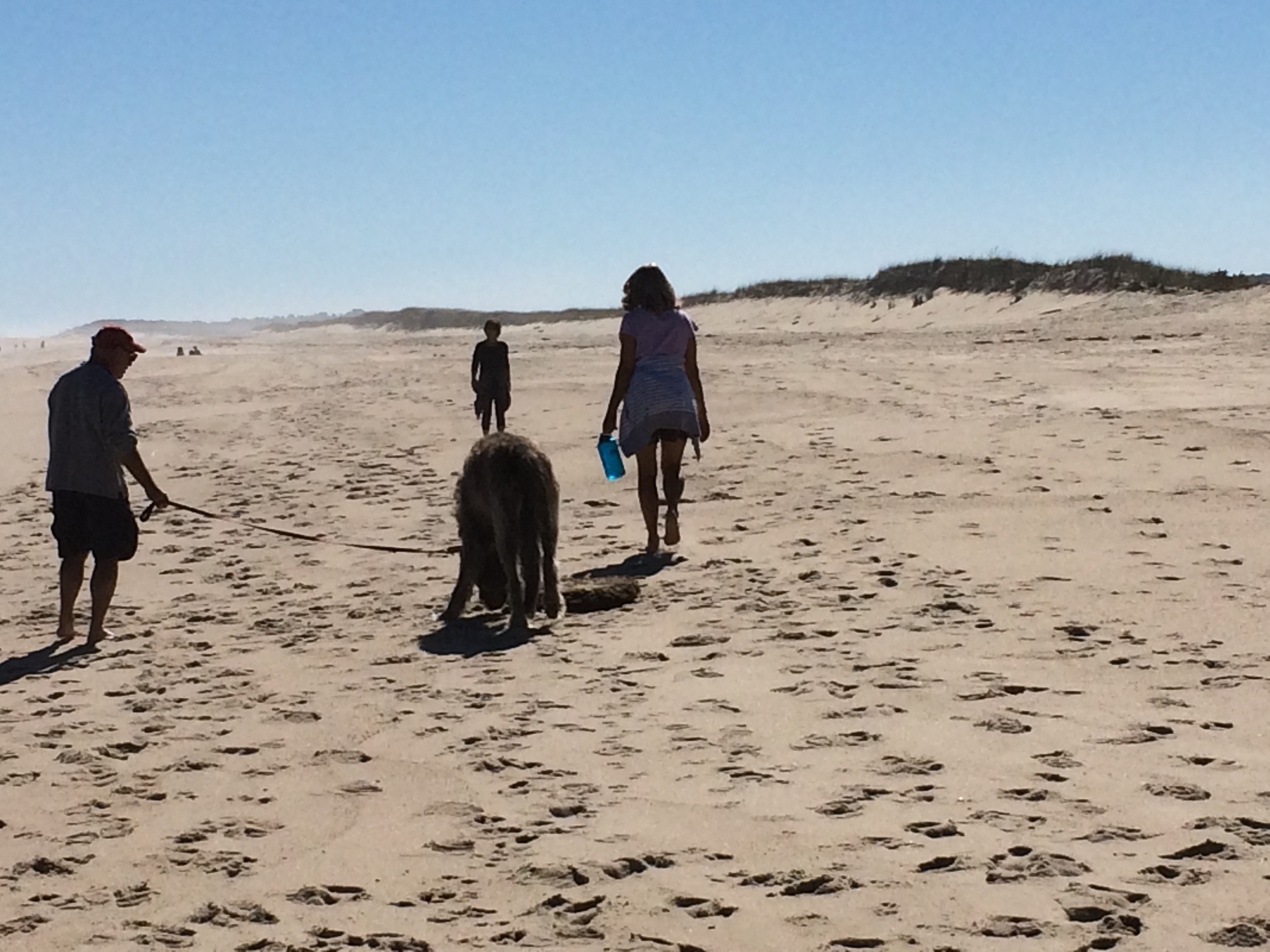
img_1088img_1089Everyone was calm and quiet. Small brigades of my brethren were cemented into beach chairs, staring trancelike at the ocean waves. Others practiced multitasking. Sandy and me, for instance. We walked the sands, gazing downward at human footprints and canine pawprints, upward at the clear blue sky and outward at the eight to ten foot waves rolling relentlessly to shore. During our journey we came across beaucoup people out for a jaunt with their canine friends. Two couples led dogs almost as large as they were. Perhaps the creatures were ponies. I’m not sure. Wait, on second thought they definitely were dogs. I heard them bark, not neigh.

What is it about sand, sky and indescribably massive bodies of water that attract people like ants drawn to carelessly disposed and half-eaten Slim Jims? A few hours after leaving Nauset Beach that question came to me and, predictably, I had no bright answers. It’s quite the phenomenon, though, a natural part of human behavior as far as I can tell. Maybe it has something to do with our links to our fishy ancestors who eons ago inhabited Planet Earth’s liquid stuff. Whatever, I love staring out at Cape Cod’s waters and scampering on its shorelines. I can’t keep away. Invisible forces from within and without bring me there. It amazes me that I used to have no clue that this innate attraction was lurking inside me waiting to bloom. I found out only when Sandy and I hit The Cape for the first time in 1998.

After an hour and a half of beach-meandering we headed back to our car to retrieve our picnic lunch. A gourmet meal of yogurt, grapes, pretzels and seltzer awaited us. We ate it at one of the tables outside the seafood stand and then drove off for some sightseeing in the historic core of Orleans village. The first adventure of our Cape Cod 2016 sojourn was in the books.


(Don’t be shy to share this article or to add your comments)

(If you click on any photo a larger image will open in a separate window)

The Deck And I (A Sunset Story)

When my wife Sandy and I were house-hunting 11 years ago, looking to make the daunting leap from a Philadelphia row house to a slightly bigger spread in the burbs, our real estate agent took us to towns all over the place. Sandy and I examined a lot of homes. We wanted something middle-aged and attractive. And being a lazy guy who wasn’t up to taking on anything remotely resembling a major project, whatever dwelling I ended up in also needed to meet the definitions of renovated, clean and comfortable.

img_1056After a few months of searching we came upon the house we now call our own. And one of the big reasons we said “yes” to it was a feature I’d hardly ever in my life thought about, let alone thought I’d want. But when I took my first look at the house’s deck that sat eight feet above and overlooked the backyard I said to myself: “Holy sh*t, this is da bomb! I want it!” And since then I’ve had it.

But, dumbass that I am, I haven’t put the deck to extensive use. I’ve spent plenty of hours upon it, for sure, but erratically. This year hardly at all. When I want to laze I tend to do that indoors on the living room sofa where I practice spilling beer and dropping Cheez-It crumbs by the hundreds all over the cushions. I’ve gotten real good at those sports. I’ll note, though, that Sandy loves the deck. She’s thinking of moving onto it permanently, leaving her spouse to his own devices.

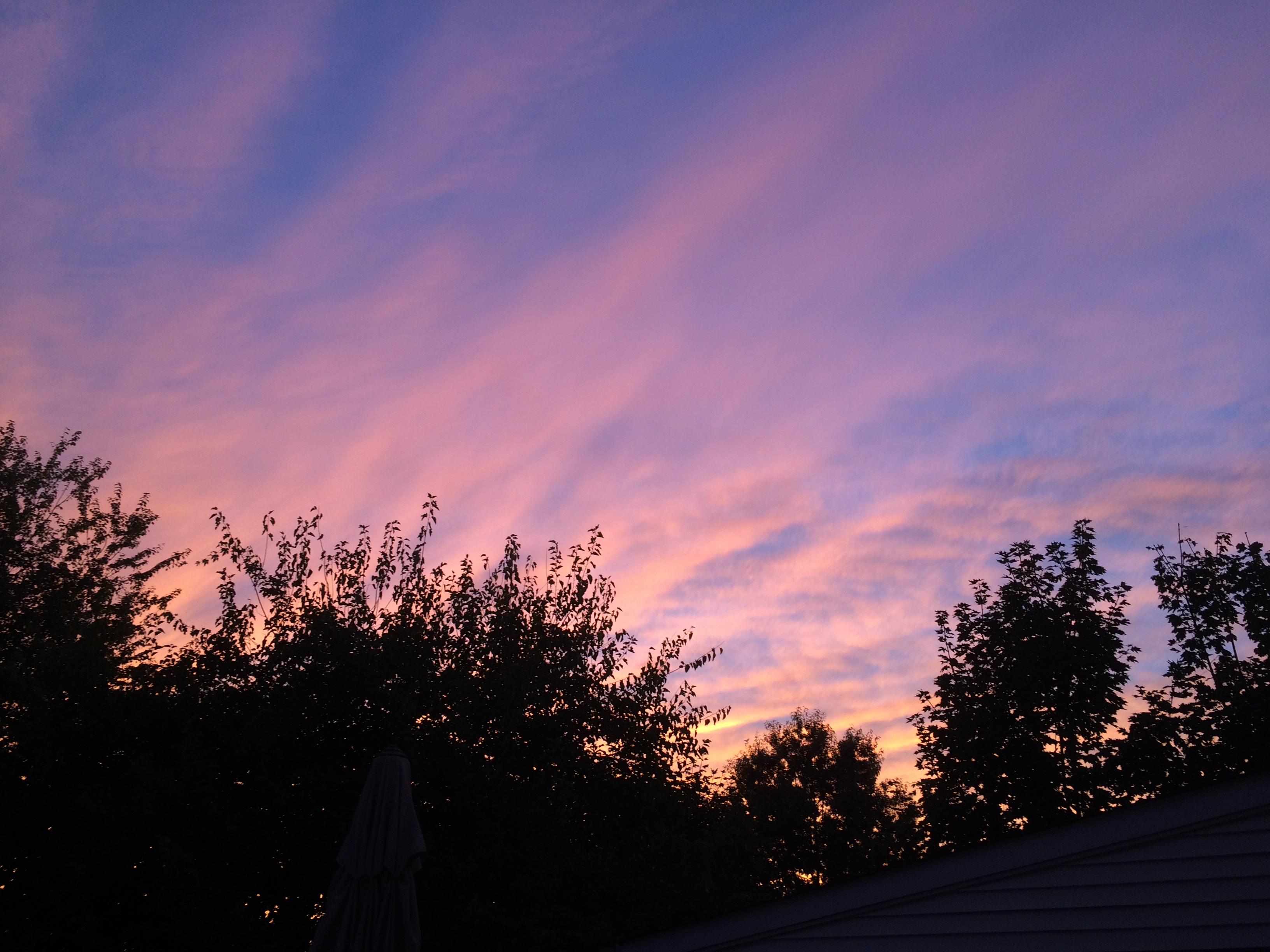
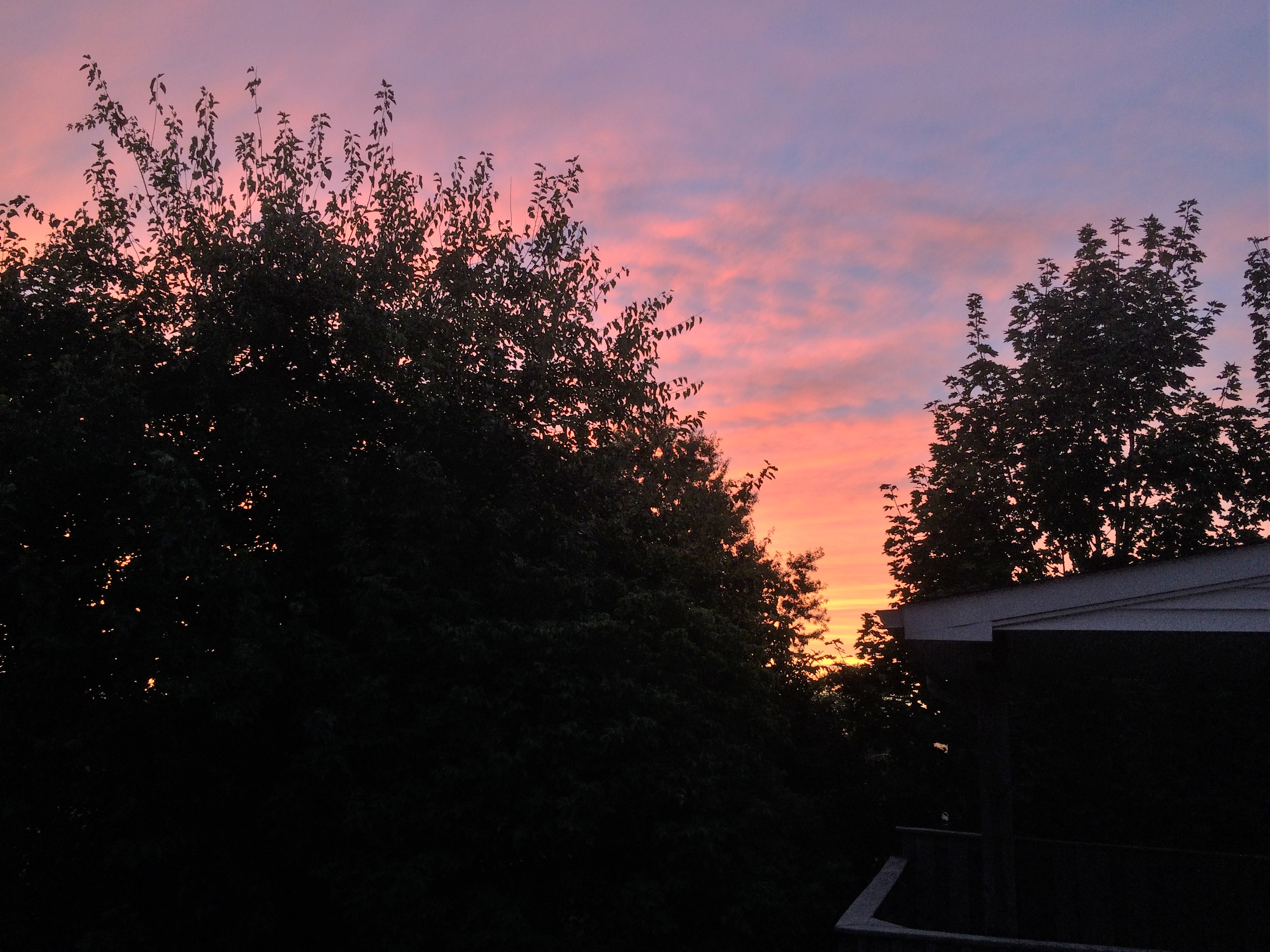
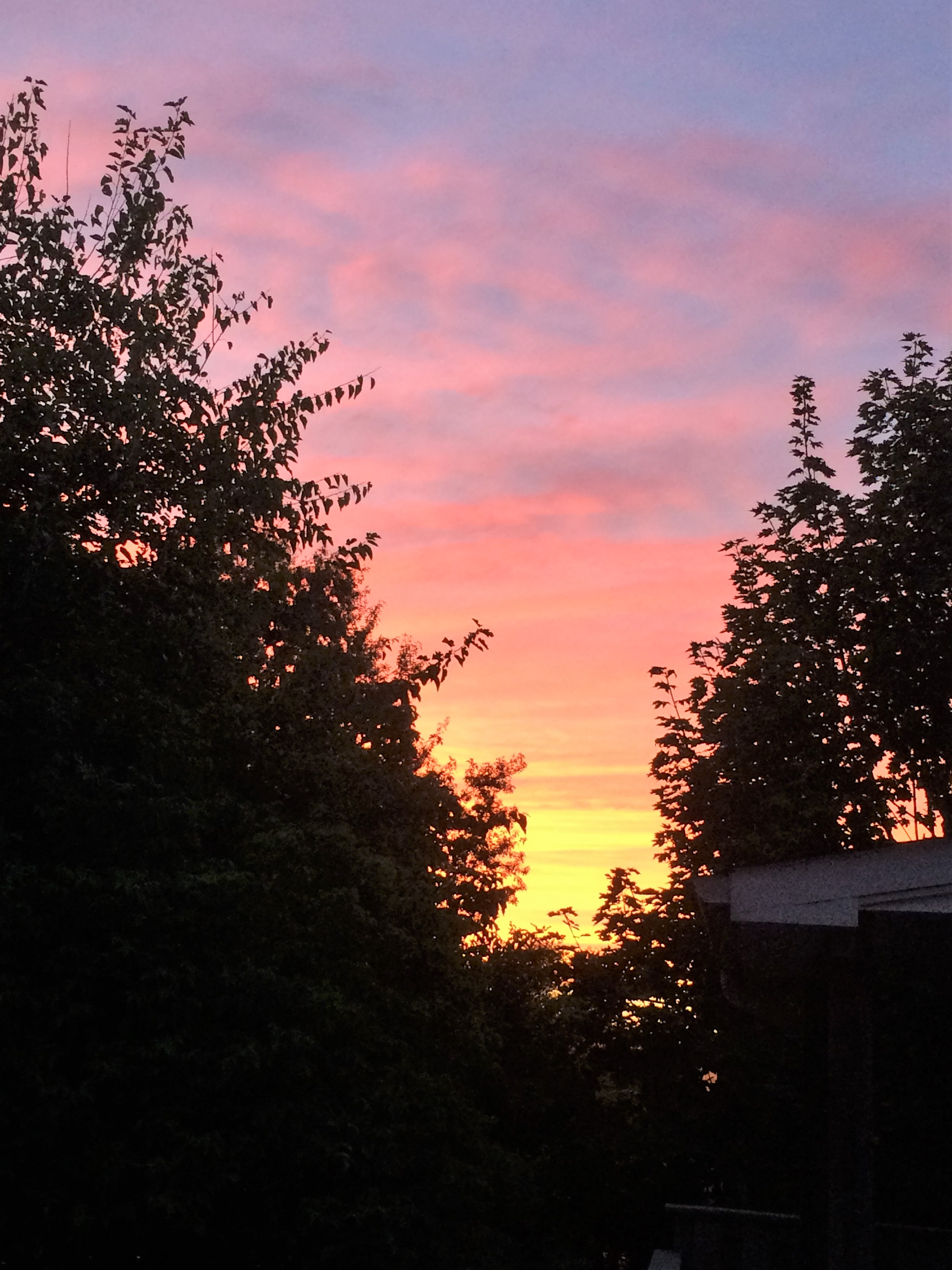
About 7 PM one evening last month, however, the deck called to me. I was on my way into the kitchen from the dining room. And, through the dining room’s glass door that leads to the deck, noticed the sky. It was fabulous, streaked with pinks, oranges and yellows. Our friend the Sun had dropped below the horizon minutes earlier. A grand sunset was on!

Chatham, Cape Cod. October 2015.

Me, I’m a sunset guy, though you wouldn’t know it when I’m occupying space in my manically overdeveloped suburban region. Here, it’s kind of hard appreciating sunsets displayed above a landscape crammed with strip malls and gas stations and office buildings. So, here I’m not in the habit of seeking out sunsets. But I get into them in a major way when in beautiful open areas. Sandy and I are fans of Cape Cod, for instance. At many Cape locales the vistas are something else: endless waters, sands and, sometimes, marshes. When I’m surrounded with ooh la la scenery like that I get jazzed watching the Sun drop and the sky drip with colors. And it’s not just me. Lots of people are into sunset-gazing on Cape Cod. No matter which beach area Sandy and I have stood on to take in the event, a bunch of other folk usually are there too with the same thing in mind. Sunset-gazing on Cape Cod, and no doubt in many spots all over the world, is almost a tribal ceremony, a quiet one that comes together seemingly spontaneously out of primal needs.

Cape Cod aside, I should but almost never remember to look at sunsets from my deck, the perspectives from which aren’t disturbed by strip malls et al. Sure, that perch isn’t the perfect one to take in the sky, what with the trees out back obscuring views profoundly. But, hell, it’s still awfully nice. What’s more, things seem pretty peaceful on the deck, since there are no cars going by. Peaceful, that is, till one of the multitude of nearby canines starts barking its fu*king head off. But I digress.

img_1052img_1044Yes, the sky was fabulous. I grabbed my iPhone, turned on its camera and went out onto the deck. To the south only half of the sky was visible, due to several big boy trees. Within the tree branches, though, bits and pieces of sunset hues played a cloak and dagger game, which I thought was awfully cool. And above the trees? Man, the painting was great, with swaths of pastel tones floating in darkening blue.

img_1047-2img_1049-2To the west was a somewhat different type of story. A few trees condensed the just-above-the-horizon view to a fairly narrow opening, but the gap was enough. Gorgeous colors drenched that section, the yellows falling lower and glowing brighter by the second. What can I say? I got drawn in. I dug it all, to the west and to the south. And I snapped pictures, as if the 500 billion sunset photos already taken by humankind since the invention of photography weren’t enough. Yup, there’s something about sunset pix. I’m not embarrassed to toss a few more into cyberspace.

(Don’t be shy about sharing this article or about adding your comments)

(If you click on any photo, a larger image will open in a separate window)

The Poster Boy For Healthy Eating Habits: C’est Moi!

From out of the blue the United States Department of Agriculture’s Center for Nutrition Policy and Promotion called me recently with a flattering offer. “Hello, Neil? This is Dudley Eatright. I’m Chief Down-The-Gullet Officer at the Center for Nutrition Policy and Promotion. You’ve come to our attention through channels that I’m not authorized to divulge, but I assure you that they are nutritious and delicious.”

“Neil, we here at CFNPAP have learned about your mega-healthy lifestyle. Why, when we found out about your long-time devotion to Mr. Spock’s Vulcan vegan diet, and about the triathlons that you compete in weekly at your, shall I say, quite mature age, we were more than impressed. We were floored. You’re pushing 70 yet have the vitality of a supremely fit 25 year old. How do you do it? — I’m very pressed for time, so please don’t answer that.”

Soon it will be me behind that lectern.

“Neil, here’s why I’m calling: You are a model of remarkably sensible, possibly extreme living. And the citizens of our great land should know about you. They should hear from you. That’s why we here at CFNPAP want to make you the poster boy for the benefits derived from consuming lots and lots of fruits and vegetables and grains. Despite our best efforts, Americans continue to chow down heavily on Slim Jims, Tostidos and Philadelphia cheesesteak sandwiches. Neil, we feel that you’re the guy to enlighten them about what foods they should be shoving into their maws. Michelle Obama has tried, but her success rate hasn’t been so terrific, now has it? And since she’ll be exiting the national spotlight in a matter of months we want a new face to promote healthy eating habits. Neil, please say you’ll help us out. The USA needs you, pal!”

fd10d260abdbbad0fb130a3f838151eaWow! I was stunned. For years I had made every effort to keep my dietary regimen and athletic pursuits little-known. Only my family and friends, I thought, were aware of my Vulcan veganism. And as for the triathlons that I am addicted to, I always enter under a pseudonym and always wear a Lone Ranger-type mask to further obscure my identity. Whenever a race official has questioned my donning of a face mask, my retort has been short and precise: “Yo, kemosabe! Back the fu*k off!” That never fails to work.

And yet CFNPAP found me out and tracked me down. And to tell you the truth I didn’t mind. It will be great to guide my fellow citizens along pathways leading to outstanding health. And to boost national consumption of plant life.

“I’m aboard!” I said a tad too loudly to Dudley Eatright. “I’m your man.”

“I knew I could count on you, Neil. Thank you so very much.”

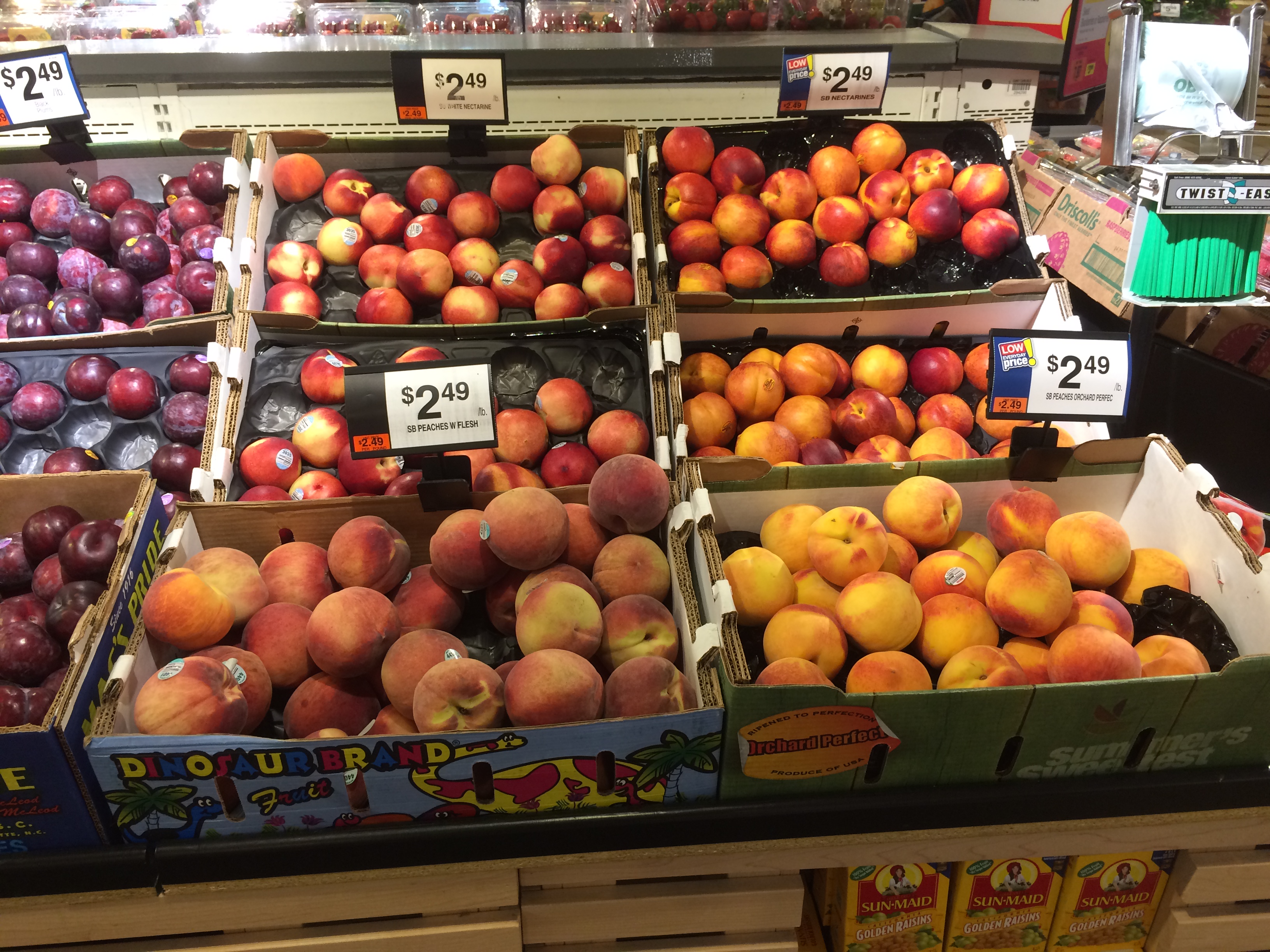
Domestic blueberry pickings were slim.
Only the frontmost boxes held peaches.

“There’s only one thing, Dudley,” I said. “And maybe you can work this out for me. You see, fresh blueberries and peaches are my fave fruits. I eat ungodly amounts of them. But in the USA their harvests are over for the year and the supplies are dwindling fast. Why, the other day at my local supermarket’s produce department I couldn’t believe how near to barren the domestic blueberry and peach shelves were. It brought tears to my eyes. I even took some photos so I’d have something to remember my friends by. And yeah, I know that blueberry crops from South America will arrive in our stores any day now, with peaches soon to follow. But their prices always are outrageous. Dudley, the federal government stockpiles oil and gold and nuclear warheads. Am I wrong in assuming that it also stashes away sizeable amounts of USA-grown blueberries and peaches? Level with me, Dudley. I want the truth!”

There was a long pause. Then Dudley spoke. “Yes, Neil. Your analysis is accurate. I can’t begin to describe the quantities of blueberries and peaches that are being kept fresh and delectable in temperature-controlled, hermetically-sealed secret underground chambers. President Obama and his cabinet members, Senators, Congresswomen, Congressmen, top military brass . . . they all demand fresh peaches and blueberries year-round for their bowls of corn flakes and shredded wheat. And, patriots that they are, they’ll eat only those grown on American shores. Needless to say, the Department of Agriculture is proud to give them what they want. Neil, what’s your angle?”

“You can guess, Dudley. Starting tomorrow I expect daily deliveries to my door of blueberries and peaches from the government’s cache. Then, all will be well.”

“This can be arranged, Neil, no problem. Is there anything else?”

“That’s it, Dudley. I’m easy to please. And might I add that it has been a pleasure speaking with you. I am flattered and honored to be tapped to serve my country. Let the fruits and vegetables and grains campaign begin!”

(Don’t be shy about sharing this article or about adding your comments)

(If you click on any photo, a larger image will open in a separate window)

Guys With The Same Initials: Terell Stafford, Thomas Shields And Thomas Sully

The Philadelphia Museum Of Art is loaded, duh, with works by famous folks. Van Gogh, Picasso, Monet, Manet, Cassatt, O’Keefe, etc., etc. The other day at the museum I walked past creations by all of them with barely a second glance, not to mention a first glance. Instead, on a goofy mission I spent a bit of time looking at objects produced by the hands and minds of Thomas Shields and Thomas Sully, names that ring a bell with just about nobody. That’s all I wanted to see before settling down with my wife Sandy in the museum’s Great Hall for an evening jazz concert led by the very a-ok trumpeter Terell Stafford.

Here’s why I did what I did: “Does the museum have anything on display by people with the same initials as tonight’s bandleader?” I wondered at home a few hours before Sandy and I headed museumward. “If it does, that’s what I’ll look at before the show.” Had any PMA visitor ever had the same sort of game plan as this? Yeah, right. Why did I come up with this idea? Uh, our orb is awash with cockeyed people.

PMA has a searchable online database. I scoured it. There were 33 artists whose first names and surnames began, respectively, with T and S. Of them, only three had works on display in the galleries (in other words, not in storage), according to the database. But one of those works, by a guy named Thomas Stretch, was the inner mechanism of an old grandfather clock. Stretch hadn’t designed the parts of the clock that anyone cared about. Namely, its cabinet or face. I’d have to disassemble the clock to see the gears et al that Stretch had fashioned, and I had a feeling that the museum’s guards, let alone its CEO, wouldn’t approve. Ergo, I scratched Stretch’s name off my list and, at the museum, went to check out what Shields and Sully were all about.

img_1013img_1031A silver sugar bowl. From the 1770s. Made in Philadelphia. That’s the Shields piece I looked at and admired. It’s beautiful. Shields was a well-known Philadelphia silversmith in his time and obviously damn good. If he were alive today I’d buy one just like it from him. It would look a whole lot better sitting next to Sandy’s and my Mr. Coffee machine than the bowl we’re currently scooping out of.

img_1016-2And Sully? Long ago he was a successful Philadelphia portrait painter. A few of his oils were on display at PMA. Mostly I looked at the one he did in 1833 of Thomas Cadwalader, a lawyer, landholder and military general. Man, Thomas looks great in this picture. Can you believe it, though? He was in his early 50s when Sully put him on canvas yet looks to be . . . what? . . . 35 at most? His skin glows with dewy freshness. His sun-lightened locks are enviably tousled. Bummer: TC might appear to hold the key to eternal youthfulness, but he lasted only eight more years before saying goodbye to Planet Earth.

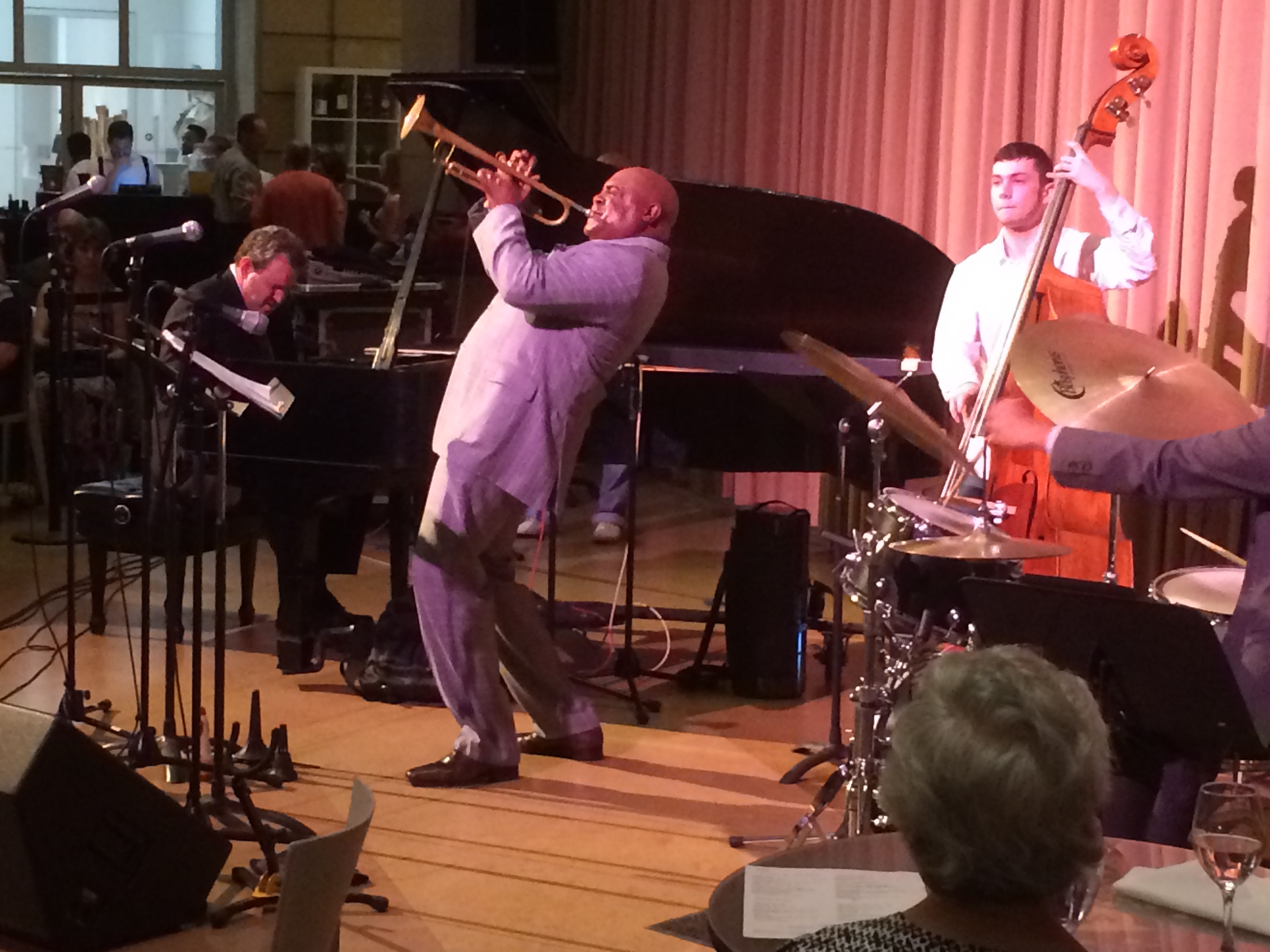
Okay, show time was approaching. Back I went to a cocktail table in the Great Hall where Sandy sat. We have been to many dozens of jazz concerts at this venue since discovering the museum’s Friday night music series in 2002, one year after it launched. But we don’t go anywhere near as often as we used to, because you have to arrive at least an hour early to nab a decent seat. Which is a pain that we got tired of enduring. The show’s first set began right on time (5:45 PM), a miracle in the music world, and ended exactly one hour later. Being kind of anal, I admired those examples of precision and efficiency. And I also admired the limited amount of between-song patter that Terell Stafford engaged in. Out of the 60 minutes that he and his mates were on stage, sounds came out of their instruments for about 55 of them.

img_1028But what I admired above all was the quality of the music that the Stafford quintet produced. They played with a whole lot of heart and soul. They were into it. You could tell by watching Terell arching his back, his knees pushing forward — all in the name of generating thrust — when he ripped hard and fleet notes from his horn during certain solos. And by watching pianist Bruce Barth’s noggin bopping side to side, front to back, when he reached the heady parts of his improvisations. And by watching Stafford and tenor saxophonist Tim Warfield smiling big smiles and nodding their heads in lockstep as they watched drummer Billy Williams unload a wham-bam solo near the end of the set’s first song (Hocus Pocus).

img_1567Hocus Pocus, composed by the late, fantastic and Philadelphia-born trumpet player, Lee Morgan, began with Stafford and Warfield pouring out the tune’s careening, irresistible melody with panache. After which Terell took the tune’s first solo, Barth pounding out heavy chords behind him. Cutting loose, TS spent mucho time in his instrument’s high register. Next to grab the solo spotlight was Warfield. He began studiously, exploring and probing, and when he found the door he was looking for the hot notes began to fly. A few minutes later Barth’s turn arrived. His left hand struck broad, loud chords while his right danced exuberantly. Throughout the tune the band was tight and relentless. Hard to believe that the upright bass player, Drew Gaunce, was a last minute fill-in for the gig. He, to my amateur ears, was rock solid all night.

Speaking of Lee Morgan, I realized after the fact that he composed four of the set’s five numbers. And that the remaining tune (Candy) was a song that he covered on his 1958 album of the same name. And I also was late to learn that the songs that TS and company played comprise the first five tracks on Brotherlee Love, the fine Morgan-honoring album that Stafford released last year. Of the four Stafford compadres appearing with TS at the museum, two of them (Barth and Warfield) played on that album. If you click right here you’ll hear Hocus Pocus as it appears on Brotherlee Love. And if you click here you’ll catch the Brotherlee Love version of Candy. On the album, Candy is performed by a trio, sax and drums sitting it out. At the museum the Candy personnel shrank even further. And the performance was lovely, a languid and captivating two-person discussion between Stafford and Barth.

I’d be remiss not to mention that Terell Stafford is known to jazz musicians and jazz fans in many places on the globe. Ditto for Barth and Warfield and Williams. And that TS, BB and TW also have long histories as jazz educators (all three teach at Philadelphia’s Temple University, for example). As for Gaunce, well, he’s in the wee stages of his career, so we’ll find out where the winds and his talents take him. After the first set ended, those winds carried me and Sandy out of the museum to a nearby tavern. There, we chowed down on good pub grub and drank good beer (me) and wine (her) before motoring home to the burbs.

(Don’t be shy about adding your comments, or about sharing this article with others)

(If you click on any photo, a larger image will open in a separate window)

Darkened Skies, Beautiful Philadelphia

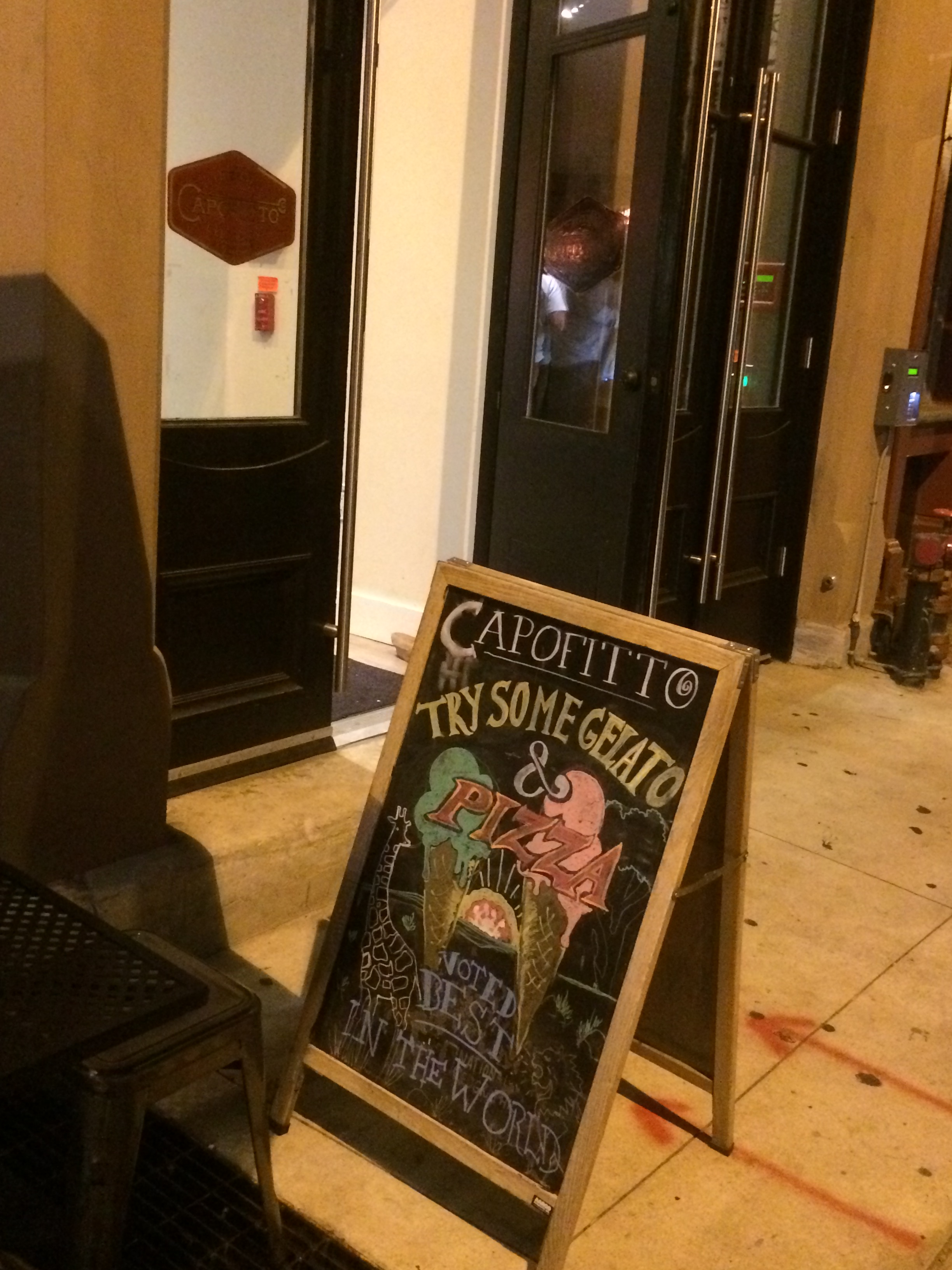
img_0891 At about 8:30 PM on the first Friday of the current month, my wife Sandy and I exited Capofitto, an Italian bistro cum gelato/sorbetto (ice cream/sorbet) store that we like. We’d downed a pizza-centric meal there, capped off with scoops of cappuccino gelato and peach sorbetto. Pretty damn good for sure. Capofitto is in the heart of Philadelphia’s Old City section, whose roots go back powerfully to Colonial days. No doubt the block on which Capifitto resides, a length of Chestnut Street, was trod upon countless times by any Founding Father you can name, not to mention his romantic partner(s), as was just about every Old City block. I find it très neat to think about that. Old City is a cool part of town.

“What next?” we asked ourselves. Should we go back to our home in the burbs? Nah, the night was young. And quite dark, as the Sun had set an hour earlier and neither moonlight nor starlight was apparent to me. Essentially, Old City was being illuminated by electric lights, and in a muted manner. Which I enjoyed. Everything seemed dreamy and atmospheric — the semi-ancient brick buildings, the stone-paved streets. I felt as though I was on a movie set. I asked Sandy if she’d like to go for a walk. She said yes, and off we went down Chestnut Street toward nearby Penn’s Landing, a large swath of Philadelphia’s Delaware River waterfront. The night not only was young, it also was calling. 

img_0894Like the Founding Fathers, Sandy and I have moseyed along Old City’s arteries many times. That’s an activity that doesn’t get old. We keep coming back for more. And this being a night whose effects I actually was paying attention to, which isn’t always the case, I felt myself getting into the scene more than usual. “Holy brotherly love,” I murmured to myself when, half a block from Capofitto, I turned around and saw the huge and perfectly-sculpted United States Custom House, which went up in the 1930s, glowing warmly in its white lights. “That’s gorgeous.” Indeed it was. I snapped its picture, the first of many that Sandy and I would snap as we investigated Philadelphia under darkened skies.

img_1546In a flash we were at Penn’s Landing, a once unassuming and still developing stretch of territory that city officials have been master-planning and trying to force into glorious bloom for over 50 years. To put it another way, the keys to unlocking Penn’s Landing’s full potential as a tourist and city resident draw have yet to be discovered. But it’s getting there, as we shall see. First thing you notice at night when you enter Penn’s Landing near its northern end, as Sandy and I did, is the Ben Franklin Bridge, which connects our nations’ first capitol with Camden, New Jersey. The bridge is massive and grand and, when skies are black, a visual wow. Why? Because years ago someone had the sterling idea to string colorful, Christmassy lights along it. Sandy and I looked at the bridge long and hard and, as on many nights before, we liked what we saw.

The park's LED lights (center right) seen from a distance.
The park’s LED lights (at right) seen from a distance.

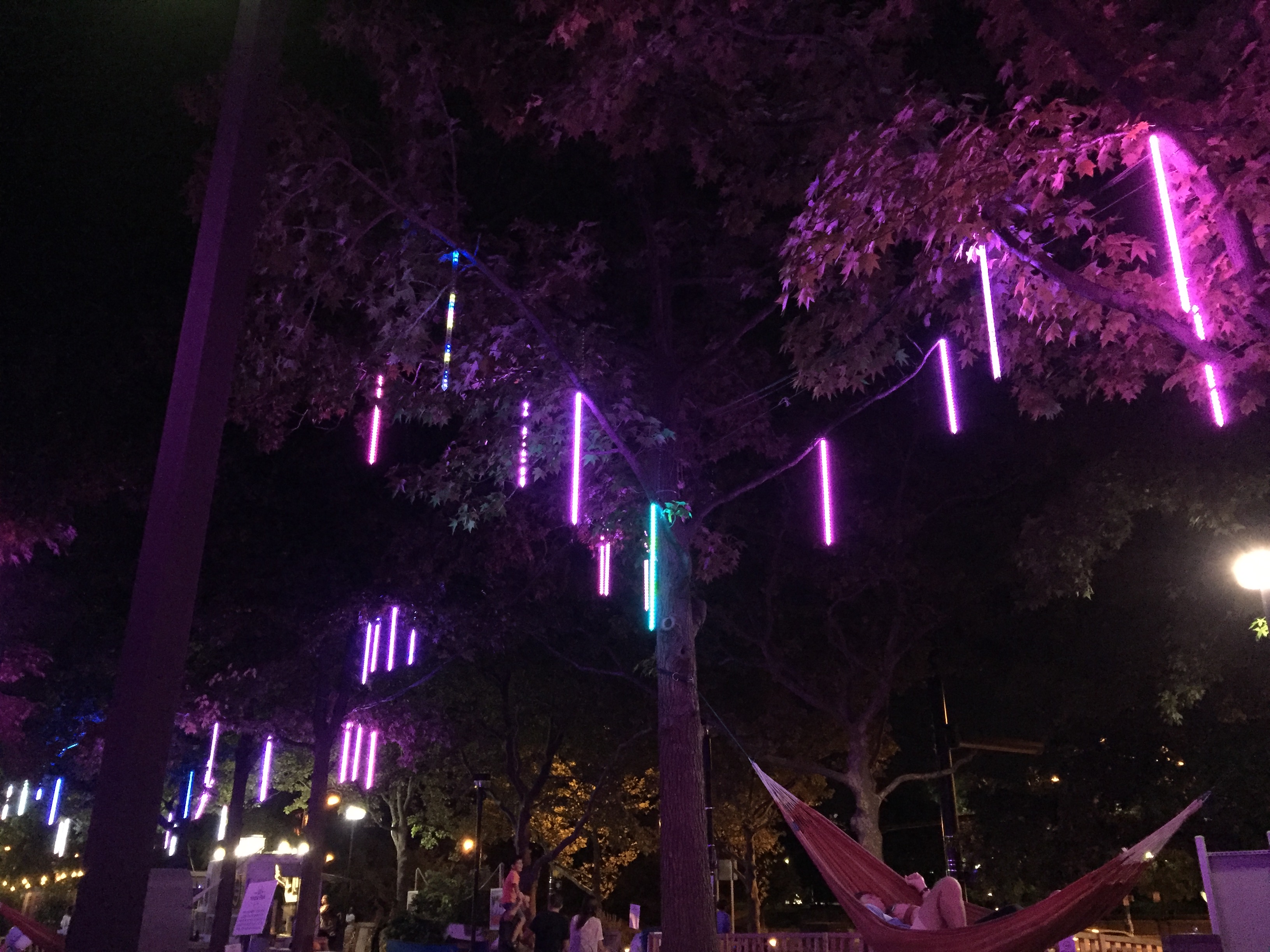
I must have realized this on past visits too, but that night I was taken by the low-wattage illumination in most parts of Penn’s Landing. Just like in Old City. Philadelphia — and I’m all for this — ain’t aiming for a Times Square type of lighting blitz. A feeling of intimacy, I think, is the result throughout most of the city. And that casual, relaxed spirit was true even in the section of Penn’s Landing that the masses have discovered and turned into a destination. I speak of Spruce Street Harbor Park, which drew closer as Sandy and I headed south along Penn’s Landing’s walkways. At night we couldn’t and wouldn’t have wanted to miss it, because the possibly thousands of color-shifting LED lights hanging from its trees were superb and put us under a spell. And we didn’t need to don shades . . . yes, the lights dazzled, but subtly.

img_1552Spruce Street Harbor Park, loaded with things to do, overlooks Penn’s Landing’s marina, which I never used to think much of because I’d rarely if ever notice anything interesting going on within it. And the grounds of what is now the park, which opened for business in 2014, once were as bland and barren as an unbuttered slice of white bread, except for a grove of trees and a monument to Christopher Columbus. That, at least, is the way I remember the area. But all that has changed. Lo and behold, SSHP has become, I’d guess, the most popular place to hang out in all of Philadelphia. The governmental folks who orchestrated the park’s development birthed a phenomenon, a winner that has far exceeded in popularity anyone’s expectations.

img_0926img_0911Designed to have a summery sort of ambience, the attractions at Spruce Street Harbor Park have a limited run each year, though I wouldn’t be surprised if the powers that be are brainstorming ideas that would keep the park open most or all months. Yeah, more is better, guys! This year, SSHP’s season began in early May and will end on September 25. At the very least, why not open the gates in mid-April and close them in mid-October? Sounds like a plan to me. Anyway, the place was mobbed the night Sandy and I visited. With good reason. It has a low-key, breezy combination of things going for it, besides the groovy LED shafts whose color blips rise and fall regimentally.


img_0920img_1557There are hammocks dangling between trees; tables and chairs of different sizes and shapes scattered all around; a boardwalk lined with food shacks; craft beer stands; an indoor arcade; restaurants floating in the marina; a bocce court . . .  you get the picture. Among other pursuits, folks lounged, strolled, stuffed their faces and watched others lounge, stroll and stuff. And played their parts peacefully and politely. The nitwit factor at Spruce Street Harbor Park and the rest of Penn’s Landing and, come to think of it, in Old City, was nil that night. Do hypnotic lights amid semi-darkness induce commendable behavior? I don’t really know, but there might be something to that.


Alas, all good things that first Friday evening, for Sandy and me anyway, came to an end. To a train station in central Philadelphia we eventually proceeded. And, not long after that, at our abode’s doorstep, a mere handful of miles from one of the city’s borders, we arrived.

(Don’t be shy about adding your thoughts, or about sharing this story with others)

(All photos, except that of the United States Custom House, by Sandra Cherrey Scheinin. If you click on any photo, a larger image will open)

I Was Destined To See Israel Nash In Concert, Wasn’t I?

IMG_0842Everything was going smoothly. The train I’d boarded in the suburbs deposited me in downtown Philadelphia at 8:30 PM. Four minutes later the blazing neon sign of one of rock and roll’s heavenly venues, MilkBoy Philly, stared me in the face. I snapped its picture. Then I entered MilkBoy and climbed the stairs to the second floor music hall. A band was playing, undoubtedly the opening act. They were loud, man, loud. I stopped two stairs shy of the top and took in the scene, the little of it that I could make out. The place was so dark my eyes would’ve performed no worse in the dead of night in Amazonian jungles. One light, the only light anywhere near me, turned towards me. It was attached to the forehead of the keeper of the gate, the guy who used the light to check IDs and sell tickets at the top of the stairs, and maybe to do some mining in his spare moments. I couldn’t make out his face or body. “How’s it going? Didya find any promising coal seams tonight?” I almost started to say, but decided against it. In half an hour or so, no doubt, I’d be watching Israel Nash in concert. Destiny, which had begun spinning its threads five weeks earlier, was playing out. That’s a swell word, isn’t it? Destiny. How sweetly it rolls off the tongue.

Here’s where this little saga began: On the final night of our stay in Amsterdam in June, my wife Sandy and I had dinner in a great, intimate place named Tomaz. A gastropub is what we’d call it in the States, but I don’t know if that term is used in The City Of Canals And Marijuana. Hardly matters. Sandy drank wine, I downed a couple of beers, and we each had a steak dinner and, for dessert, a chocolately, moussey concoction. A delicious meal. Our waiter was the bistro’s owner. I didn’t ask his name, but maybe it’s Tomaz.

Anyway, Maybe It’s Tomaz is a music lover. Has been for decades, like me. As soon as Sandy and I sat down I was taken with the song playing in the restaurant. I commented on this to MIT. “That’s Israel Nash,” he said. The tune was the type that will carry you away on a long, spacey ride. MIT purposely had programmed it, via Spotify, because, as MIT told me, the music he liked best these days are the dreamy, atmospheric sorts that emerge from various just-so combinations of country, folk, rock, blues and sometimes other styles. And he mentioned two more practitioners of the amorphous genre whom, as with Nash, I’d heard of but knew next to nothing about: Harry Manx and Jonathan Wilson. MIT played multiple tracks by all of them for my listening pleasure. Between bites and between conversation with Sandy and MIT, I half-listened to the songs. And eventually Sandy and I bid our music-drenched host our adieus.

Back home in the States I did some barebones research into Messieurs Nash, Manx and Wilson and checked out a handful of their tunes on YouTube. What I heard sounded very good (click here and here and here for the smallest of samples). Perhaps I’d get to see one or more of them on stage some day. That would be nice, I thought. And then my short attention span kicked in and I moved on to other important topics, such as pondering how many new varieties of Cheez-Its I might give a whirl, and whether my shampooing regimen needed an update.

I should have seen it coming. A few weeks ago, checking out a local music website, the name Israel Nash jumped out at me. Good gawdalmighty, he would be at MilkBoy in three days, it indicated. And when, in the blink of an eye, the third day arrived I looked at MilkBoy’s website to see when the show would begin. The site said 7 PM. What? The last time a show began that early at a rock club was . . . well, never. Must be a misprint. I called MilkBoy for clarification. No answer. Called again and again and again. No one picked up. It figured.

But I had a good feeling all along. It wasn’t by chance that five weeks earlier I had heard, for the first time ever, a song by Israel Nash. And in a foreign land, no less. Some elusive guiding force had befriended me that night in MIT’s restaurant and was leading me to the proper culmination of the storyline. I was meant to see Israel Nash in concert. At MilkBoy.

“Who’s this? The opening act?” I inquired of the gatekeeper. The light attached to his forehead was tremendously focused. Only a few strands of illumination were able to make their ways sidewards. But those faint rays revealed to me that MilkBoy was incredibly packed with human bodies. That night, the phrase Standing Room Only didn’t apply. Standing Room Nearly Impossible did. Not only that, the air was thicker than thick with perspiration and other inspired body odors. Any high school gym’s boys’ locker room smelled a lot better.

“No, this is Israel Nash,” said the man with the light. “He has only half an hour left in his set. Do you have a ticket?”

“Uh,” I mumbled, and turned around. Down the stairs I went.

So, what’s the thrust of this story? Is there a moral? Something to be learned? Well, those questions usually are pretty much out of my league. I’m not all that bright. However, I have a half-decent answer in this case: When destiny appears to be knocking on your door, do what the man with the light would do — check its ID.

(Don’t be shy about adding your comments, or about sharing this article with others)