Porchfest: A Very Good Idea

Good ideas . . . some people get ’em like crazy. Others, not so much. I’m near the bottom of the barrel of the latter grouping. I had a good idea about 50 years ago, when it dawned on me that grilled cheese and tomato sandwiches might be improved upon by adding a schmear of Gulden’s spicy brown mustard. Genius visited me that day, but hasn’t made an appearance since. Such, as we know, is life.

Which smoothly brings us to a remarkably good idea that some folks came up with nine years ago: a neighborhood outdoor music festival called Porchfest. When I first heard earlier this month about Porchfest’s existence I smacked myself on the forehead and said: “Yo, cowboy. This is so obvious. How come you never thought of it?” And then I remembered once again that, sadly, genius ain’t no friend of mine.

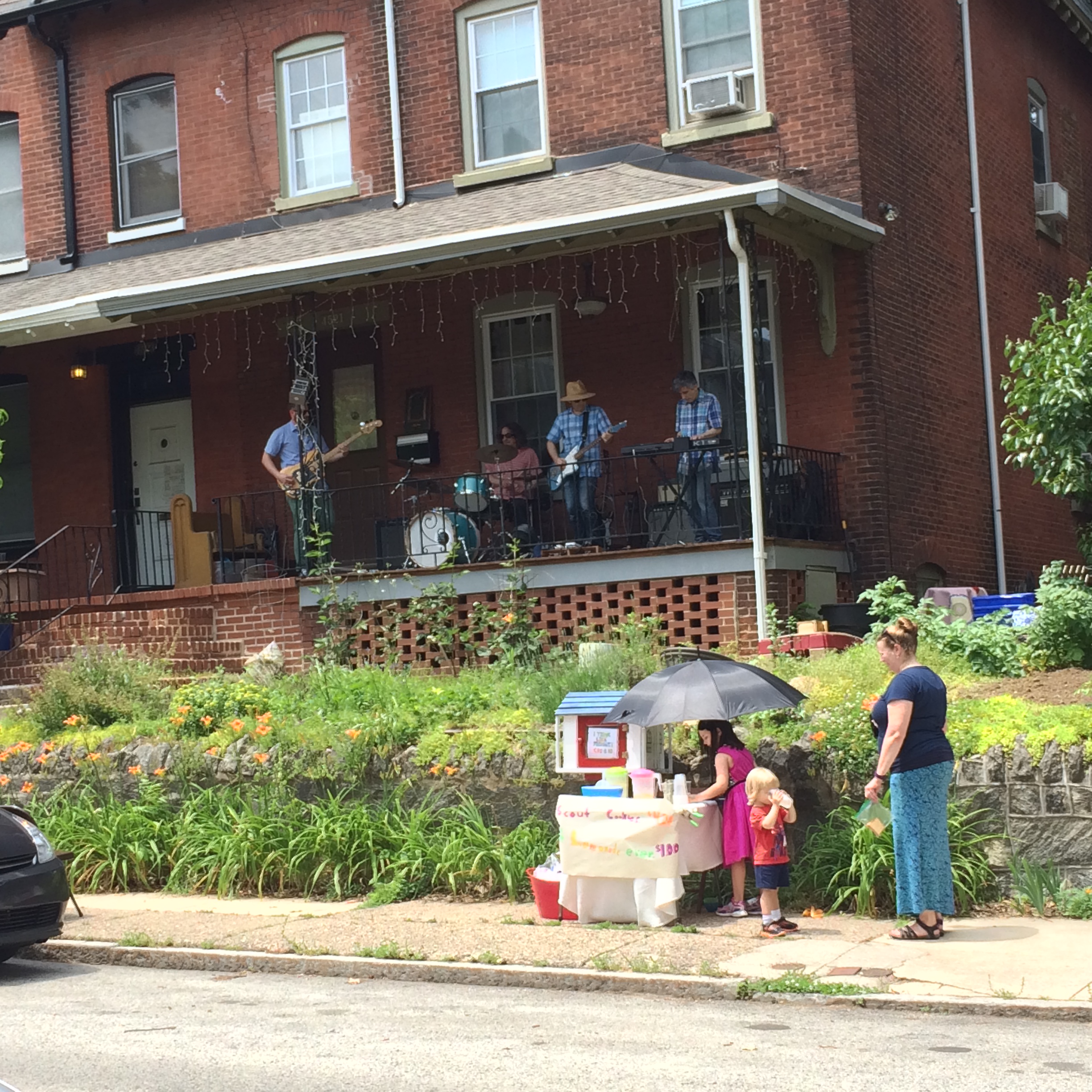
What’s a Porchfest? Well, it is a day of music played on some of the porches of a porch-heavy community. The shows are free to the public. What could be better? After all, porches, when you think about it, are small covered stages easy to get close to, making them perfect for intimate musical experiences. All that a Porchfest organizing committee need do is convince a bunch of homeowners in a neighborhood to allow musicians to play at their houses, and find a bigger bunch of musical acts to climb aboard. Then you set up a schedule so that audience members know the addresses of the porches, and encourage said listeners to roam from site to site, the better to get a big dose of vibrations.

The first Porchfest took place in 2007 in Ithaca, New York. Since then, musicians and music lovers throughout the USA, and in a few Canadian cities, have picked up on the notion and staged their own Porchfests. Each Porchchfest is independent of the others and, I’m pretty sure, is a low budget and DIY type of operation. But watch out! The power of Porchfests is undeniable and irresistible. As a few more years go by, I predict that Porchfests will cross the oceans and conquer the world!

Darlington at West Philly Porchfest.
Jon Veit at West Philly Porchfest.

Which even more smoothly brings us to a recent Saturday in a section of West Philadelphia (part of The City Of Brotherly Love) that contains scads of old and sturdy rowhouses and twins in possession of porches. As ideal a location for a Porchfest as any on our planet. And where, indeed, the first West Philly Porchfest took place, the baby of a group of organizers who recognized that the Porchfest idea was very worth pursuing. (Lots of info about West Philly Porchfest’s genesis and design may be discovered by clicking here and also here).
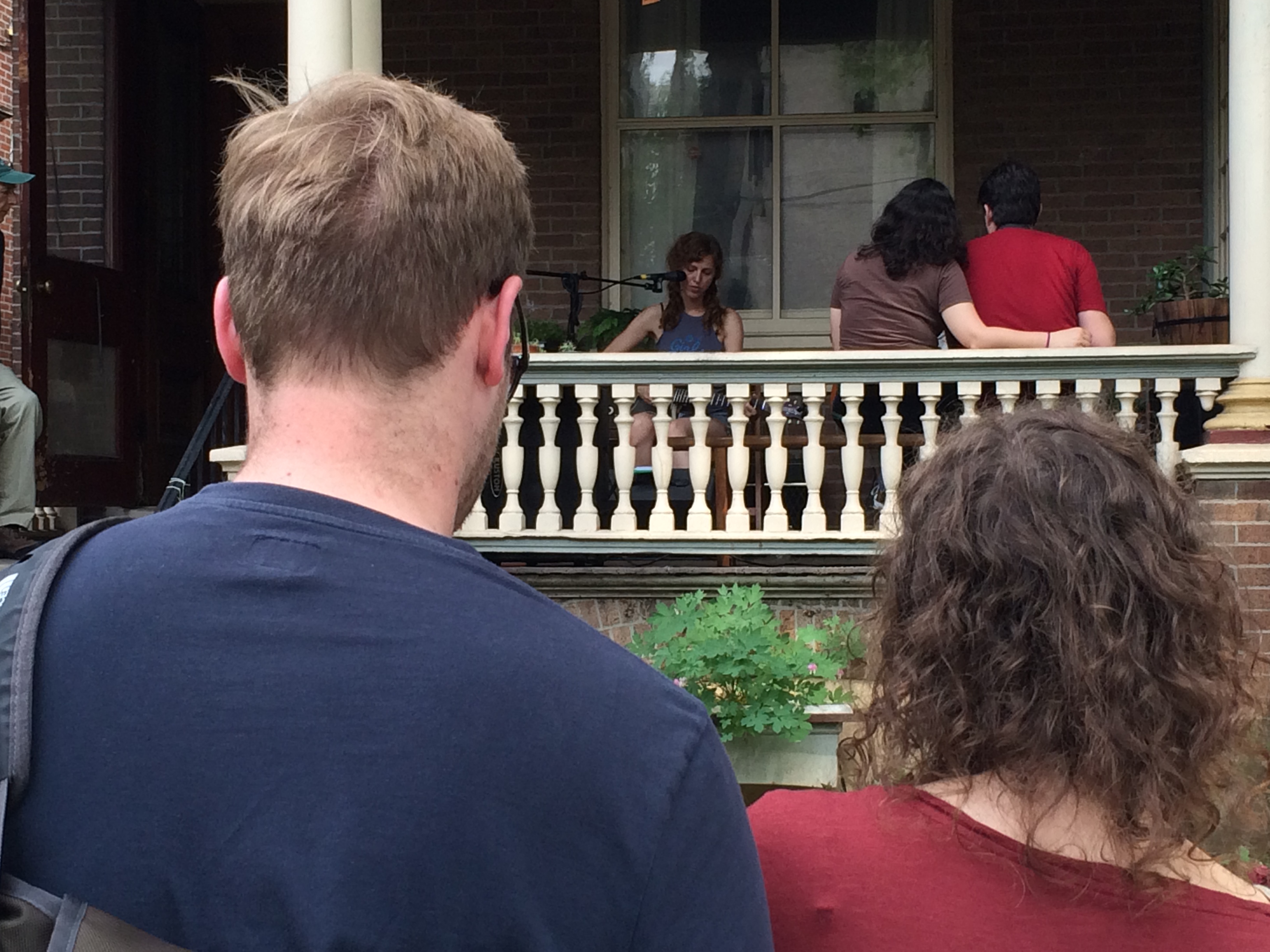
I Think Like Midnight.
Emily Zeitlyn.
Emily Zeitlyn.

West Philly Porchfest’s boundaries were broad, about 12 blocks east to west and likewise north to south, encompassing much of what has come to be known as University City due to the area’s proximity to the University of Pennsylvania. Over 30 porches participated. The event began at noon on June 4 and ended at 6 PM. I was an attendee, taking in parts of six shows during a two-and-a-half-hour period. Man, I loved it. I heard an acoustic folky rock trio (Darlington); two singer-songwriters (Jon Veit and Emily Zeitlyn); a damn good jam session between, of all things, an African-drum percussionist, a fiddle player, an acoustic guitarist and a flugelhornist; a vocal-less rock band (I Think Like Midnight) that, to my ears, sounded like a cross between The Grateful Dead and Television; and a folky duo that smoked and crunched. I’m going to zero in on the duo, who go by the name Driftwood Soldier, because I liked them the best of the acts that I caught. I seemed not to be alone in that. They drew the biggest crowd, around 80 people, that I saw all day, and the loudest applause too.
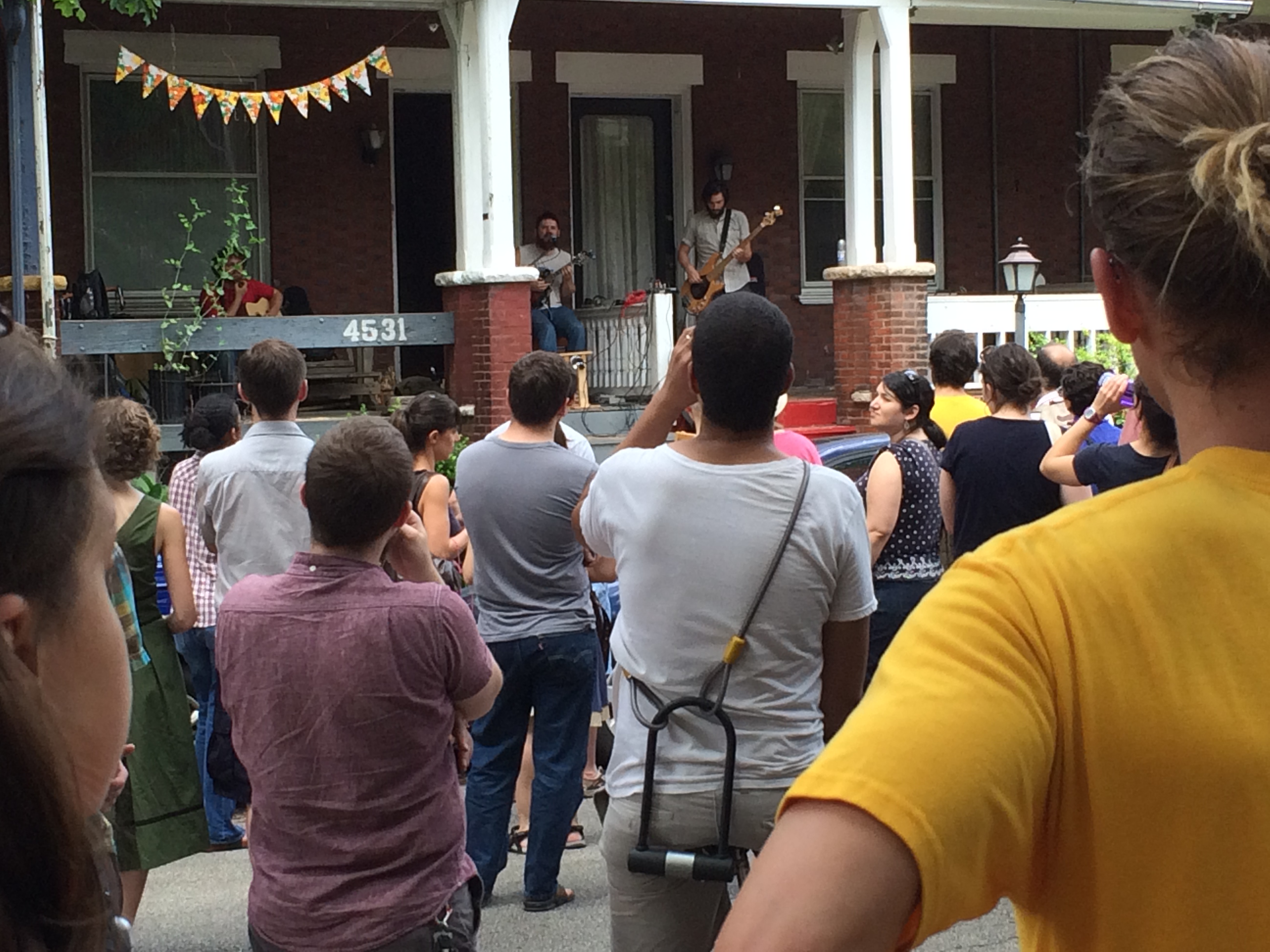
Driftwood Soldier.
Driftwood Soldier.

Owen Lyman-Schmidt is Driftwood Soldier’s singer, mandolin strummer and songwriter. Bobby Szafranski is the band’s not-your-average electric bassist. Both guys pitch in to move the groove by banging on percussion instruments with their feet. I tell you, Driftwood Soldier has it. Owen sang, in a wild and wooly baritone, about underdogs, colorful characters, people who deserve better than they’ve got. He reminded me a lot of the late Dave Van Ronk. And Bobby sent the tunes aloft with bass lines that gleamed and grinned. I would not be surprised if Driftwood Soldier breaks through nationally one of these days, though to-date they are unknowns. They are that good. And they’ve got the work ethic that might lead to fame and glory, touring our fair nation with gusto. Thanks to the wondrousness of the Internet, you may watch Driftwood Soldier performing their song Rosalee by clicking right here.

IMG_0493IMG_0494
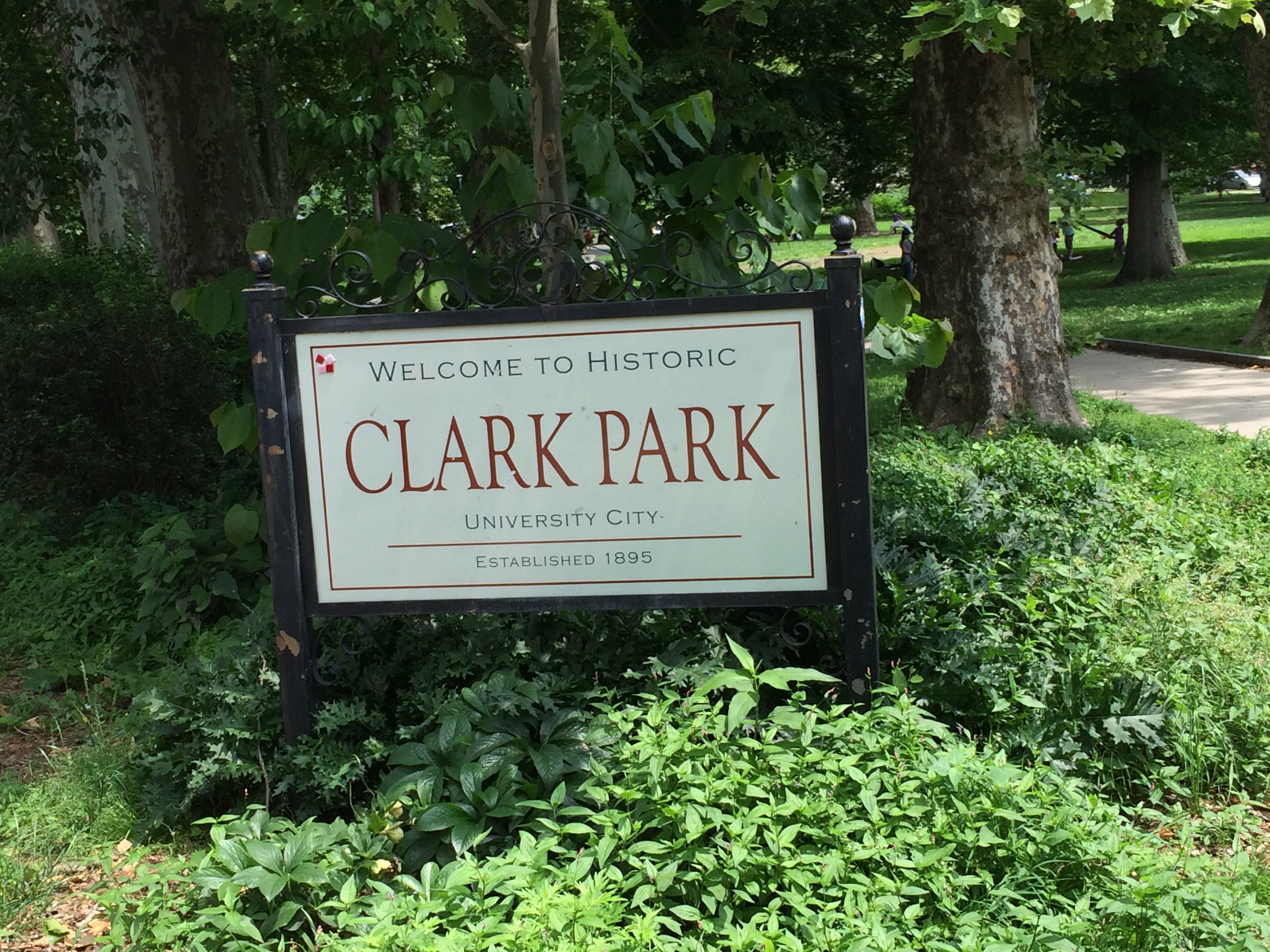
You know, I lived in University City during the 1970s and 80s on a beautiful, tree-filled block oh so close to a few of the shows I watched the other day. I liked the area mucho back then, and still do. I go back now and again. On the day of Porchfest it was fun walking the streets upon which I’ve trod so many times before. And it was equally swell strolling through Clark Park, a lovely place, a hub of peace and calm in University City. Kids were playing, food truck and farmers’ market vendors were vending, and teenagers and adults were milling around. The coolest sight I saw in the park was a little girl climbing all over the Charles Dickens statue. That’s right, Charles Dickens. It’s the only statue of him in the USA. And, apparently, one of only two in the world. The other, by the way, is in Australia, not Great Britain. A good idea would be for the Brits to commission and erect a Dickens statue too, since Dickens  — duh — was one of their own.

(Don’t be shy about adding your comments, or about sharing this article with others)

(If you click on any photo, a larger image will open)
I Was Late For The Springtime Party

“You’re shvitzing like a pig,” my wife Sandy observed last week when I strode into the house after one of my highly infrequent walks around the neighborhood. Incredibly, I hadn’t realized how excellently the sweat was pouring off of me. Call me Mr. Observant. As I unbuttoned and took off my sopping shirt I thought to myself that I’d have inserted the word f**king before the word pig if it had been me commenting in Sandy’s place. She’s a lot more refined than I am.

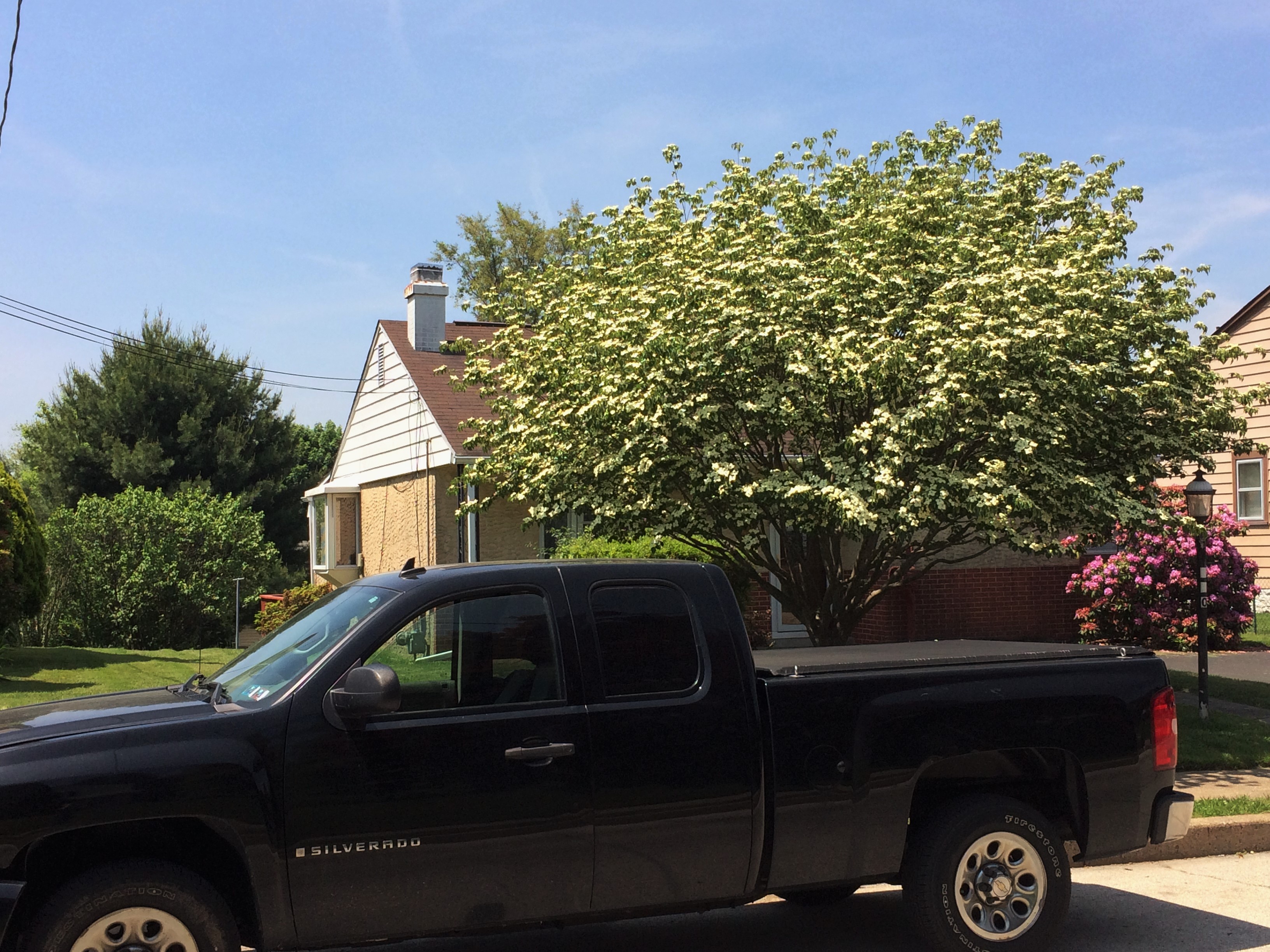
The only flowering tree that I came across.

Amazingly, the stroll around my little corner of the Philadelphia burbs was my first since last December, a nighttime excursion I undertook to gaze upon Christmas lights. I wrote a story about that adventure, and if you’re interested in reading it you should click right here. Last week’s stroll was different. With my trusty iPhone in hand I hit the streets for an hour in late morning, looking for pretty flowers to admire and photograph. Particularly those on trees and shrubbery. The sun was beating down rippingly as I left the house, the temperature already about 85° F, and the humidity was formidable. But I was late for the party. Turns out that virtually all of the flowering trees, and most of the flowering bushes, already had dropped their glitter.

Greens, man, greens.

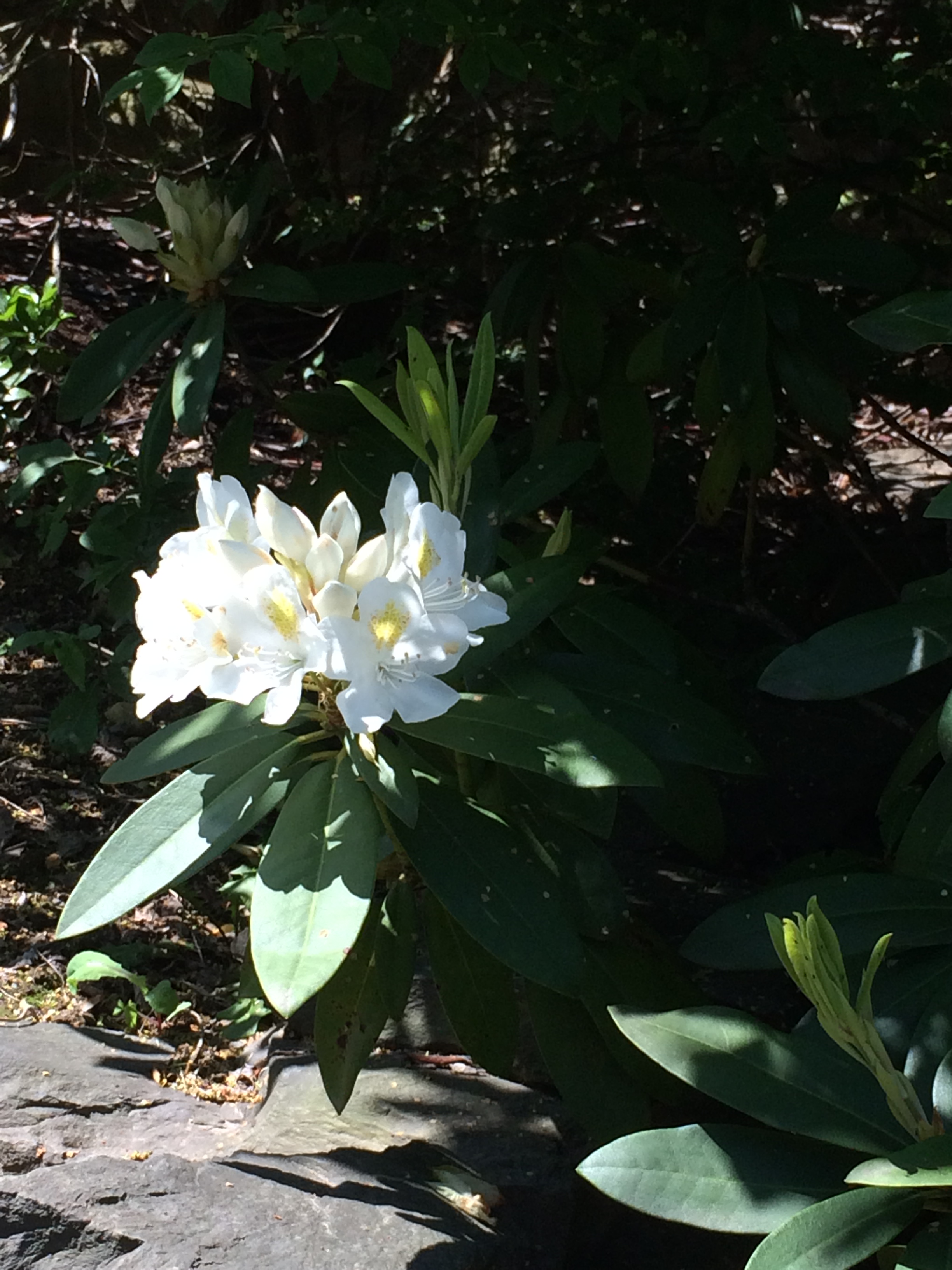
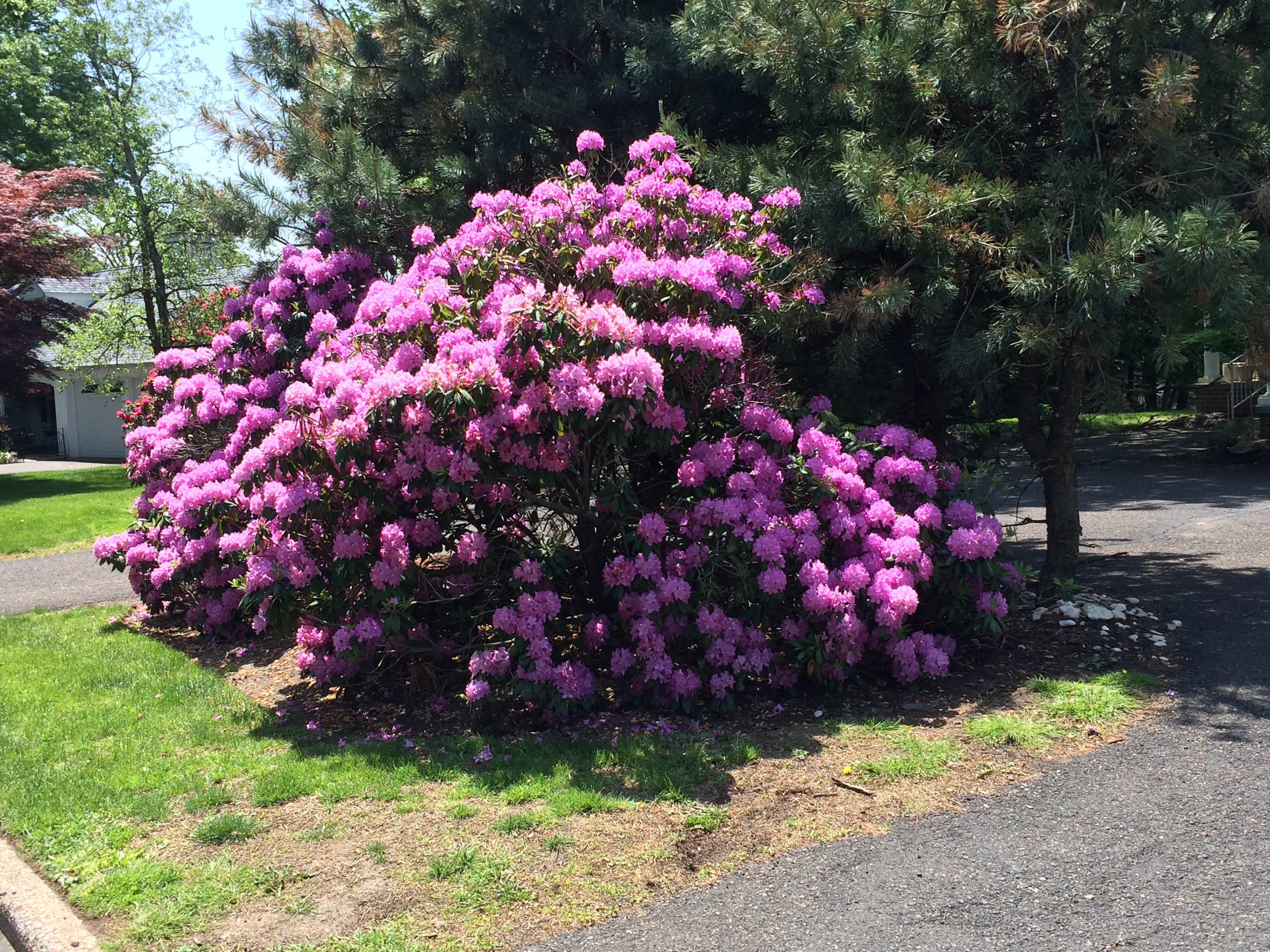
What, then, did I see?  Greens, man, greens. I walked past hundreds of houses, all with nicely-trimmed lawns, and past thousands of trees, and the expanses of shades of greens made my eyes stand at attention. But I was on a quest for colors other than those, and needless to say they were there to be spotted. True, I didn’t find a single azalea still in glorious bloom. But rhododendrons, yes, and quite a few other bushes I won’t go out on a limb and try to identify, as I ain’t exactly John Bartram or John Muir. And though 99.999% of dogwoods and other flowering varieties of tall barky objects had not a remaining petal hanging on their branches, I discovered one cute tree still dressed in white.

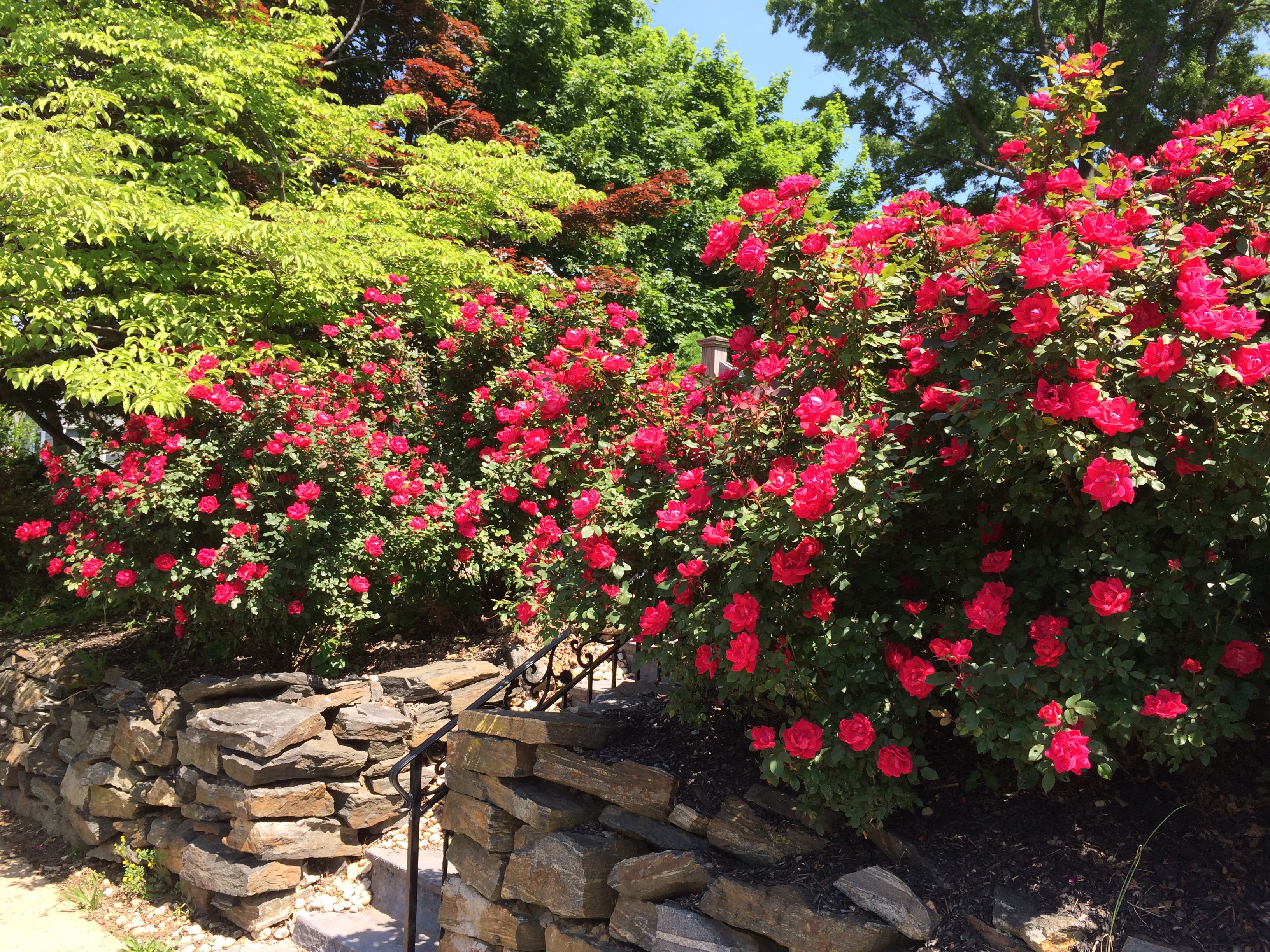
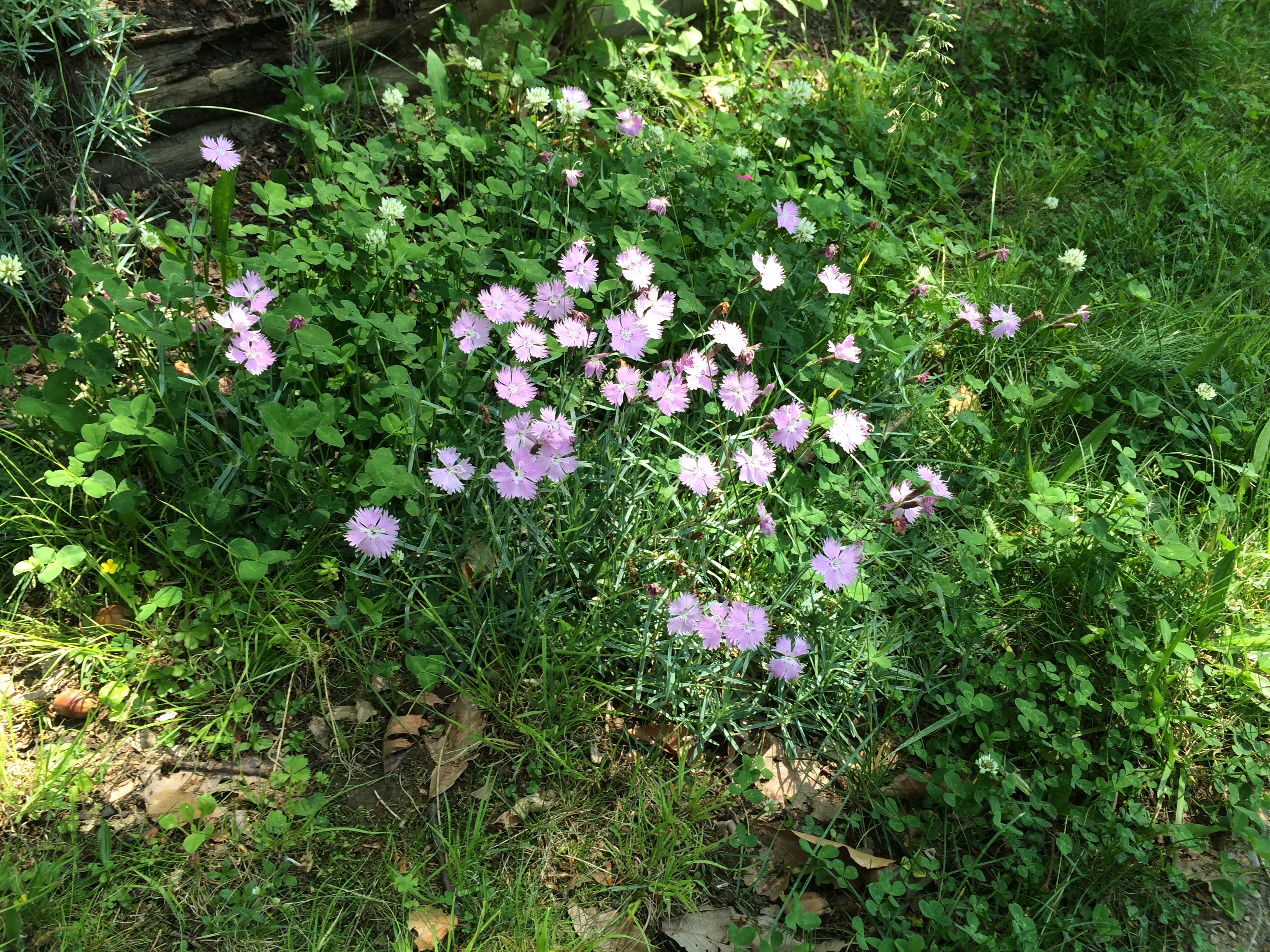
“Yo, Nature Boy,” I heard someone shout at me two seconds ago. “What about planted flowers? Or was Nature Boy not seeking them?” Well, I’ve got an answer: I sought and I found. But something I never had realized before about my neighborhood is that there is no glut of those beauties. I saw a lot of nice ones, sure — roses and don’t ask me what else, because, as I already mentioned, I ain’t exactly . . . Yet many homes had no flowers in beds or windowboxes at all. Maybe I should report my area to The Philadelphia Horticultural Society. Or to Ripley’s Believe It Or Not. Yeah, that’s what I should do.

Still, my walk was a good one. As I said in my Christmas lights story, I need to get out into my neighborhood, beyond my block, more than I do. There’s plenty to look at, if you force yourself to really look, even though my suburban development, like all suburban developments, isn’t on anyone’s bucket list of places to visit. And, importantly, there’s no dog crap to step on, as the dog owners around here are well-trained in picking up after. One thing for certain is that next spring I’m going to wander a few weeks earlier in the season. The neighborhood’s flowering trees and bushes fully were ablaze from mid-April through mid-May. Regrettably, my views of them mostly were from a moving car, and that’s no way to experience the world if foot power is an option. I’ve set myself a reminder.

In conclusion, I’m going to give a big shoutout, as the half-assed expression goes, to my newest best friend: my iPhone. It took some pretty nice pictures the other day. I offer up a selection of the colorful sights. By the way, if you click on any photo, a larger image will open. And one last thing: Don’t be shy about adding your comments, or about sharing this article with others.

IMG_0377 IMG_0378

IMG_0380
IMG_0382

IMG_0388 IMG_0417

IMG_0395 IMG_0401

IMG_0411 IMG_0415

Walking Through Philadelphia With Colors On My Mind

I woke up one weekday morning not long ago with visions of Philadelphia swirling in my mind and beckoning me. Amorphous visions, but colorful. I hadn’t done much city exploration in awhile. Hadn’t taken a long and leisurely stroll anywhere in awhile. What’s more, the weather prediction was highly favorable: warm, sunny and breezy. A walk was in order. And so, a few hours later in my suburban Philadelphia home, I closed my eyes, clicked my heels together three times and thought beautiful thoughts about the City Of Brotherly Love. Next thing I knew I was standing at the corner of 2nd and South Streets, part of a funky area not far from the Philadelphia waterfront and some of the city’s oldest residential blocks. Let the adventure begin.

The hike took nearly four hours. I trod, often guided by whimsy, on many blocks within the rectangle formed by 2nd, Bainbridge, Broad and Arch Streets. At the start I didn’t have much of an idea of what my route would be. But this much I knew: I wanted to stretch the ol’ legs, inhale Philadelphia’s quasi-clean air and feel the wind caressing my thinning hair. And this too I knew: I wasn’t in the mood to check out any historical or touristy sites, or anything with the connotation of trendy attached to it, all of which Philadelphia is loaded with. But it wasn’t to be an aimless ramble. No way. When I landed at 2nd and South Streets, I had in mind a theme for the day, inspired by the colorful visions from earlier in the morning. I was going to look for sharp and snazzy outdoor color displays produced by the hands of man, not by nature. It was a modest quest, probably kind of a dumb one. But hey, I’m that kind of guy.

fez IMG_0212mexican IMG_0215
Things got off to a slow start. I looked all around the 2nd and South Streets vicinity and the only colorful things I could find were Fez Restaurant’s facade and a happy, yellow ghoul, dressed in red, outside Las Bugambilias, a Mexican eatery. Still, I figured that the South Street corridor — not as happening a part of town as once it was, but hanging in there fairly well — offered a decent chance to come across more than that. And I was right.

mako's IMG_0220larry fine IMG_0222
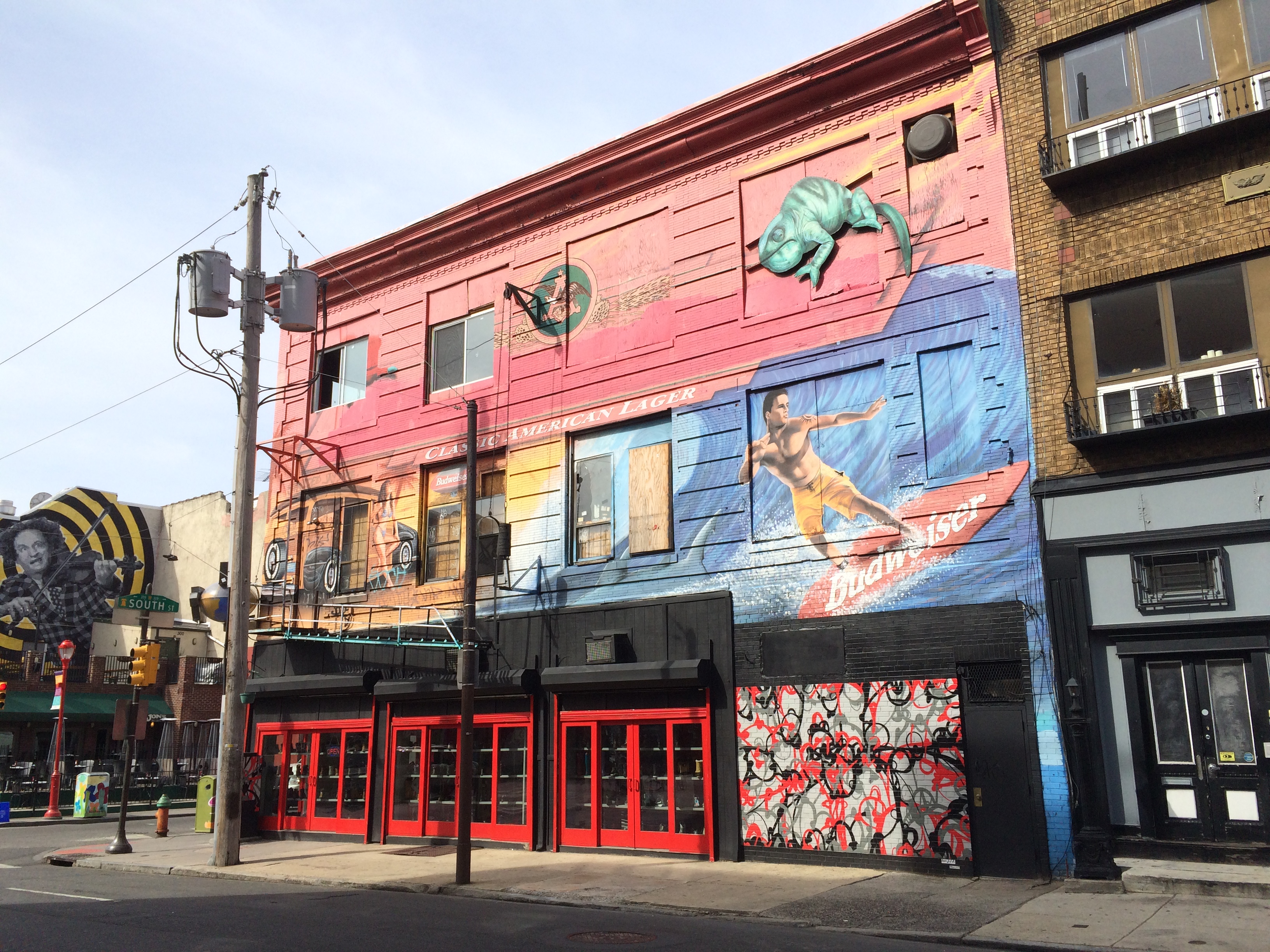
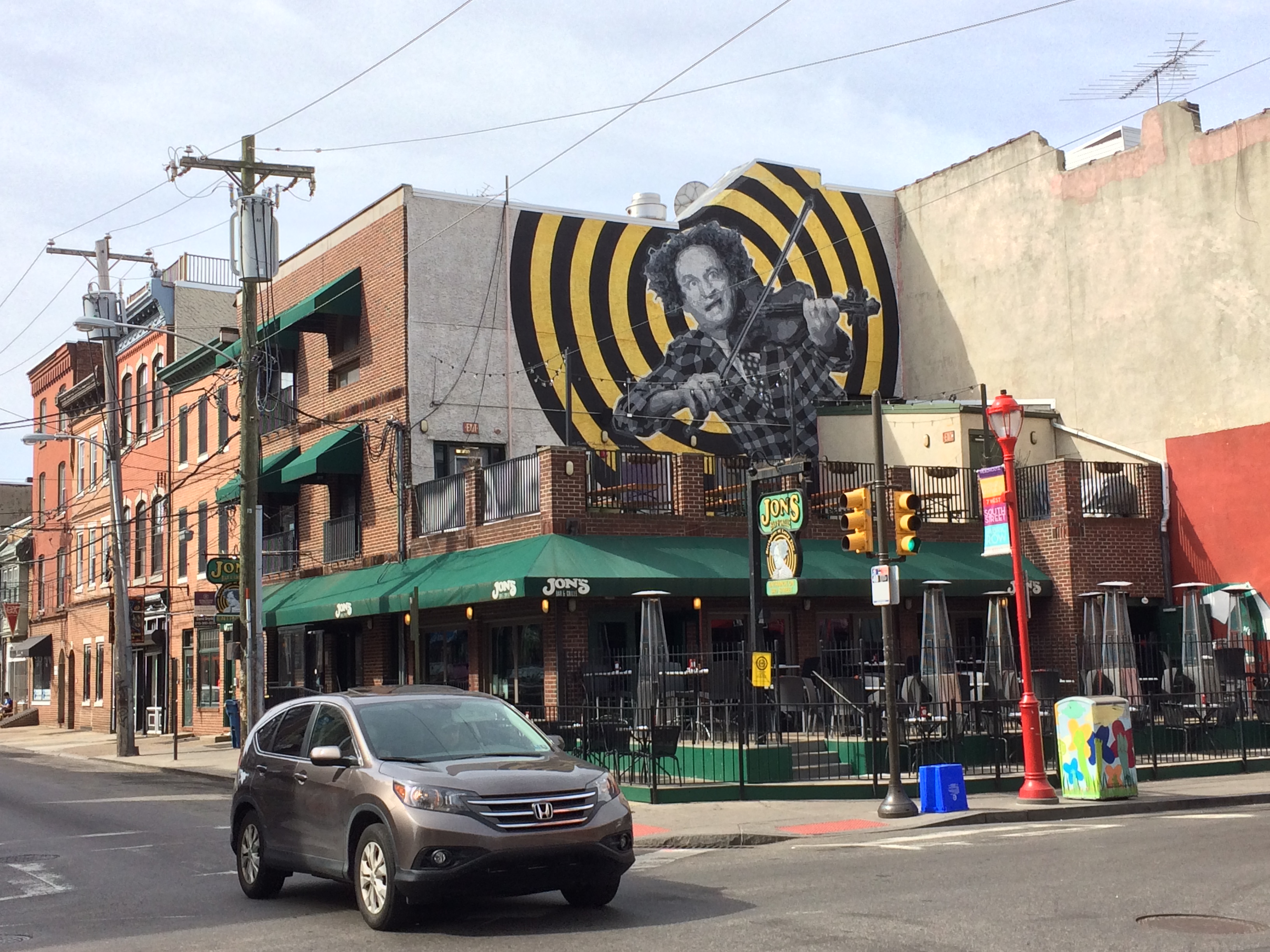
At 3rd and South I said to myself, “Wow, look at that mural.”  It was painted on the side of the out-of-business and mourned Mako’s Retired Surfers Bar And Grill. A guy on a surfboard, a girl leaning against a fat-tire car, all done in sweet pastel hues. Lovely. And didst my eyes deceive me? Directly across the street from the former Mako’s was another mural, this one depicting the torso of a fiddle-playing, electric-haired madman inside yellow and black concentric rings. None other than Philadelphia native Larry Fine, one of The Three Stooges. Yeah, man, now we were getting somewhere.

A little while ago I alluded to the fact that I’m no genius. Proof? I shouldn’t have been surprised to see the murals at 3rd and South, because I’d seen them before, though not in recent years. What’s more, I somehow also had forgotten that Philadelphia is the outdoor mural capitol of the world, thanks to Mural Arts Program, a public/private organization born in 1984. Incredibly, over 3,000 MAP- created works grace Philadelphia. No doubt, Mural Arts Program is one of the good guys. It aims to beautify all neighborhoods (from dilapidated to swank), to employ many folks in need of work and encouragement, and to inspire the general population. Big goals, all reached as far as I can tell.

DuBois IMG_0240
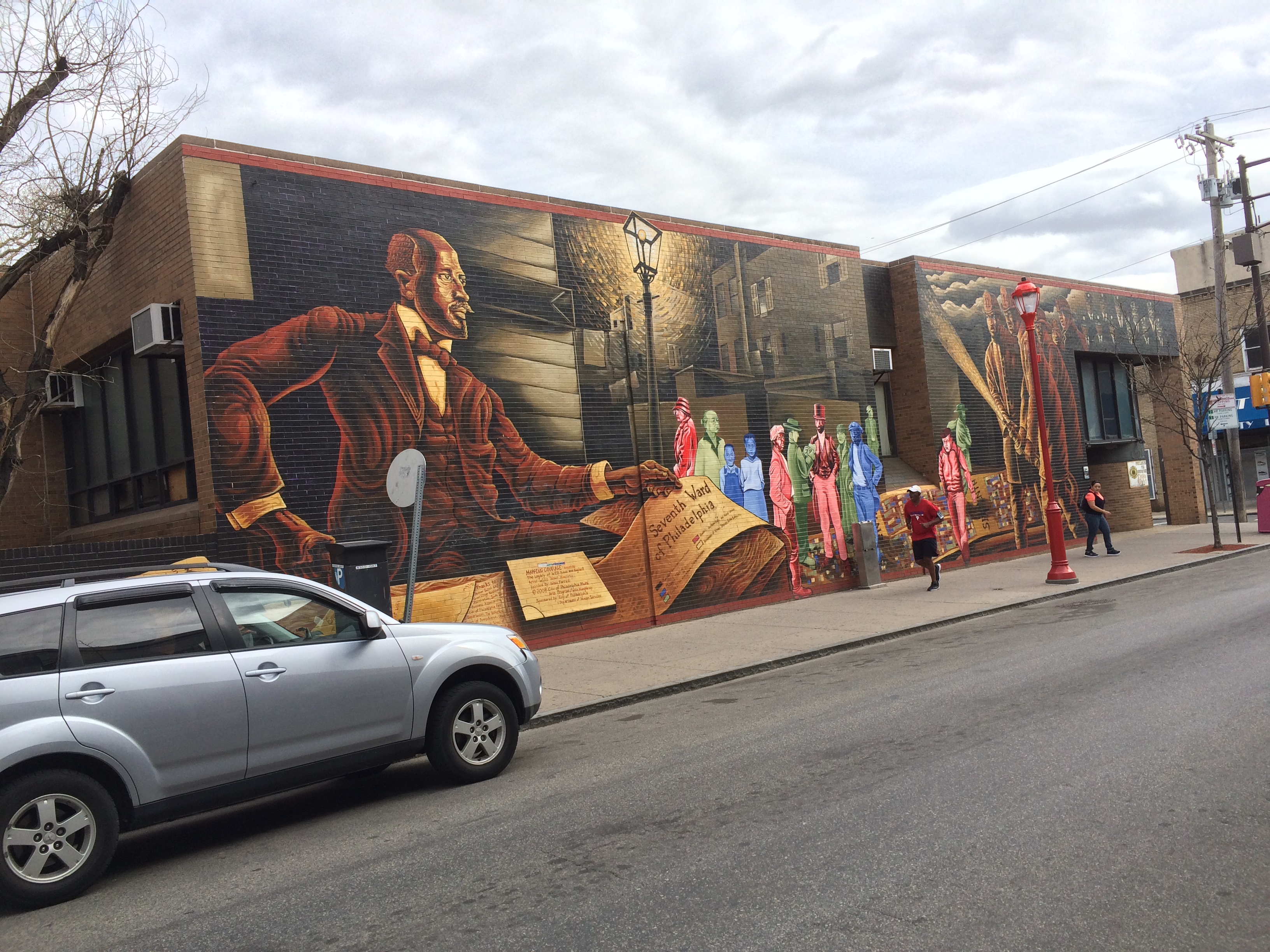
Well, I haven’t been able to determine if MAP was behind the painting on Mako’s side wall. But Larry Fine wouldn’t be overlooking South Street were it not for MAP, nor would two other murals that I later saw on my trek be in existence. Of those, the first I came to is attached to Engine Company 11, a firehouse at 6th and South Streets. It’s a magnificently imposing creation titled Mapping Courage. It honors W.E.B. Du Bois, the Black scholar and leader, and the firehouse itself, which for years was manned only by African Americans. The mural is beautifully designed, shining in browns and ambers that allow its few bright colors to pulsate.

Spring IMG_0260
An hour later, on Pine Street near 13th, I stumbled upon the mural known as Spring. Yowza, this one stunned me too. Look at those soft whites and butterscotch shades of the flowering foliage. How totally cool it was that real trees, in bloom, nearly were melting into the painted surface.

You know, somewhere in the middle of my expedition I realized something that never had dawned on me before. Namely, despite the murals that gas things up on certain blocks, most of Philadelphia’s residential streets, beautiful and architecturally rich as many are, sure appear tame when it comes to color. This ain’t exactly a news flash to the oceans of people more observant than I, but it’s true. And it’s largely because of bricks, bricks, bricks, the quintessential and earth-toned building blocks of Philadelphia. Bricks are sturdy, bricks are quaint, bricks have been with us humans for thousands of years. But man, I can understand how someone might decide that a brick-dominated landscape needs to be jazzed up. Someone named Isaiah Zagar, for example.

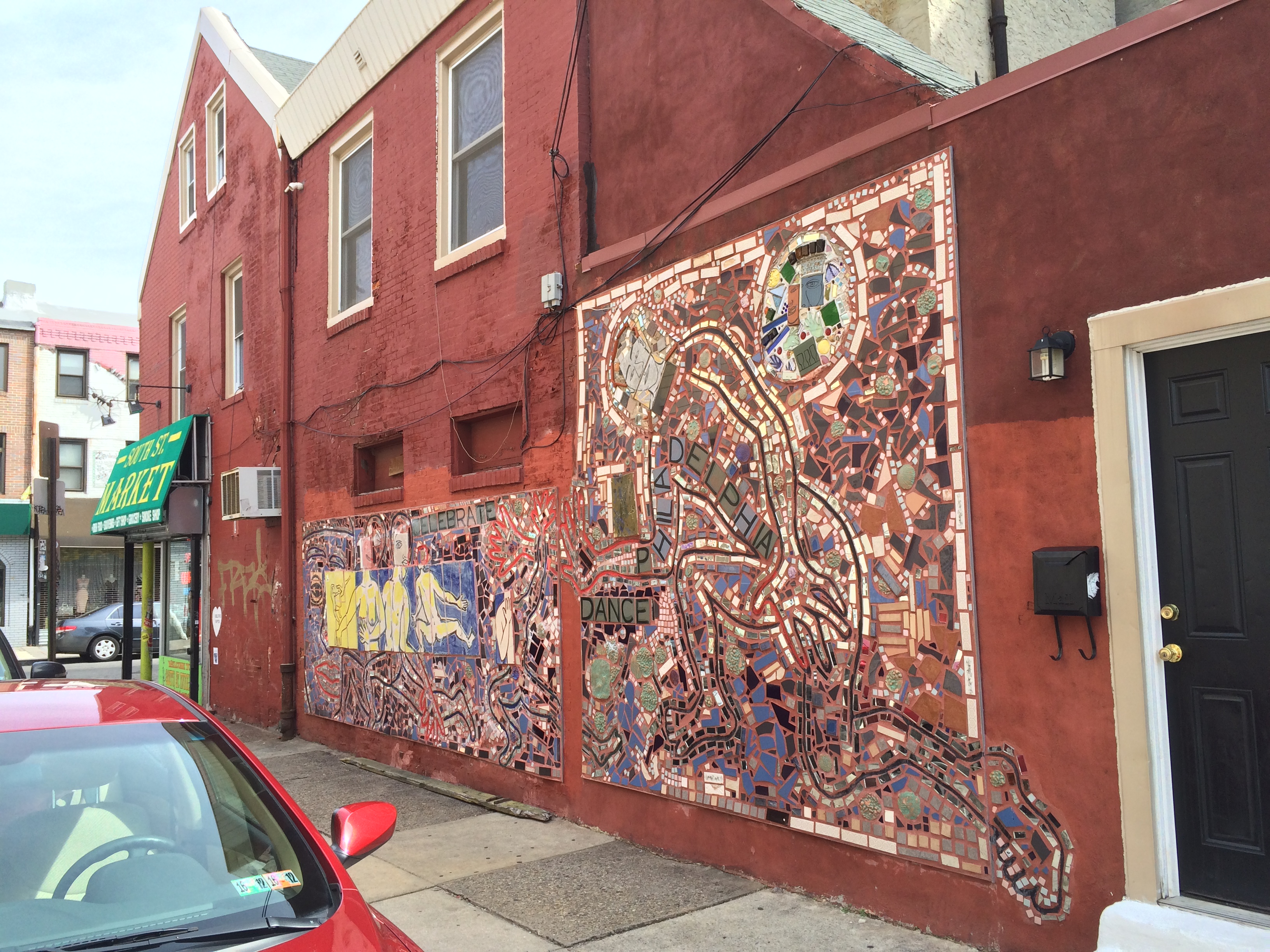
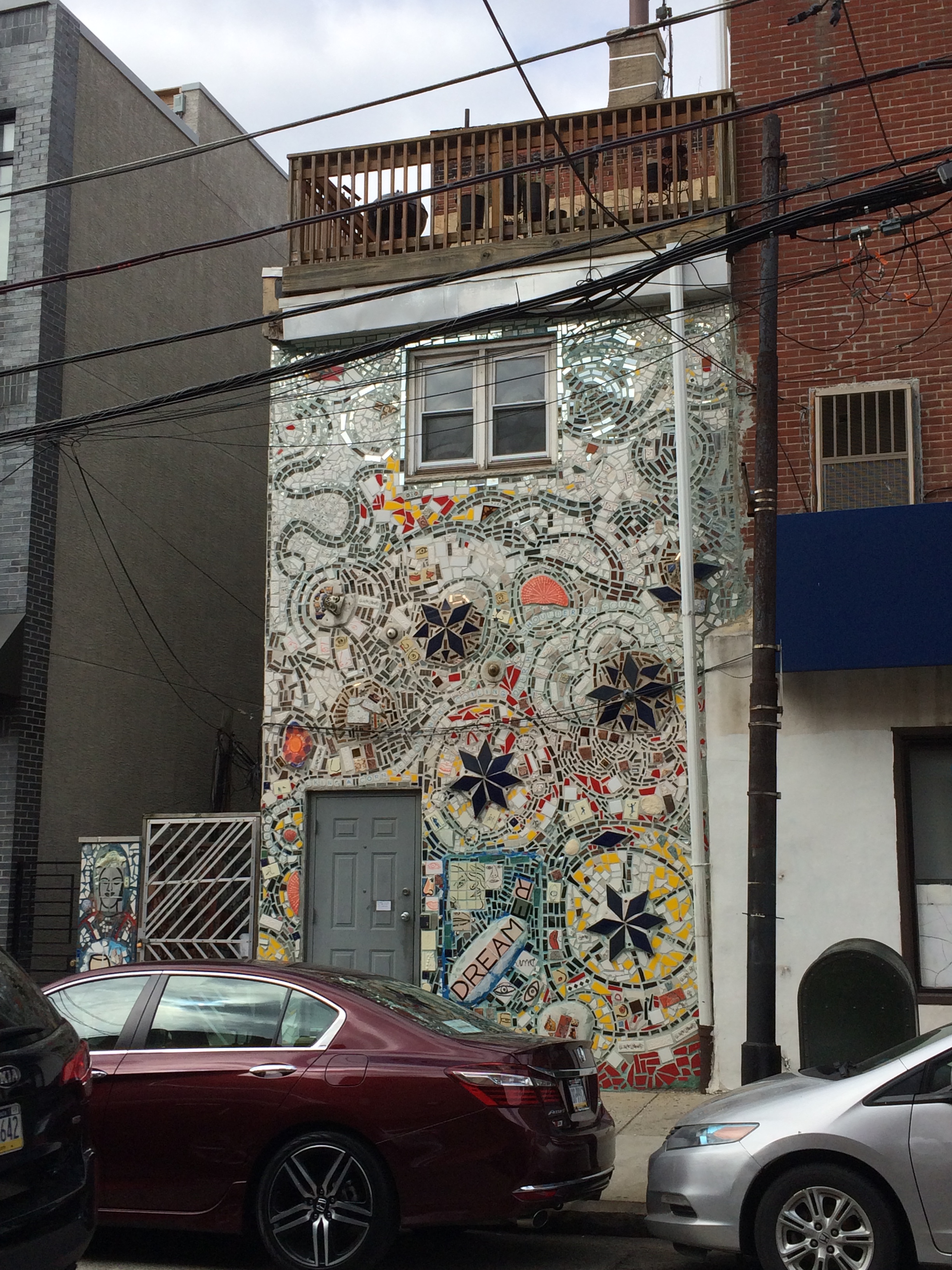
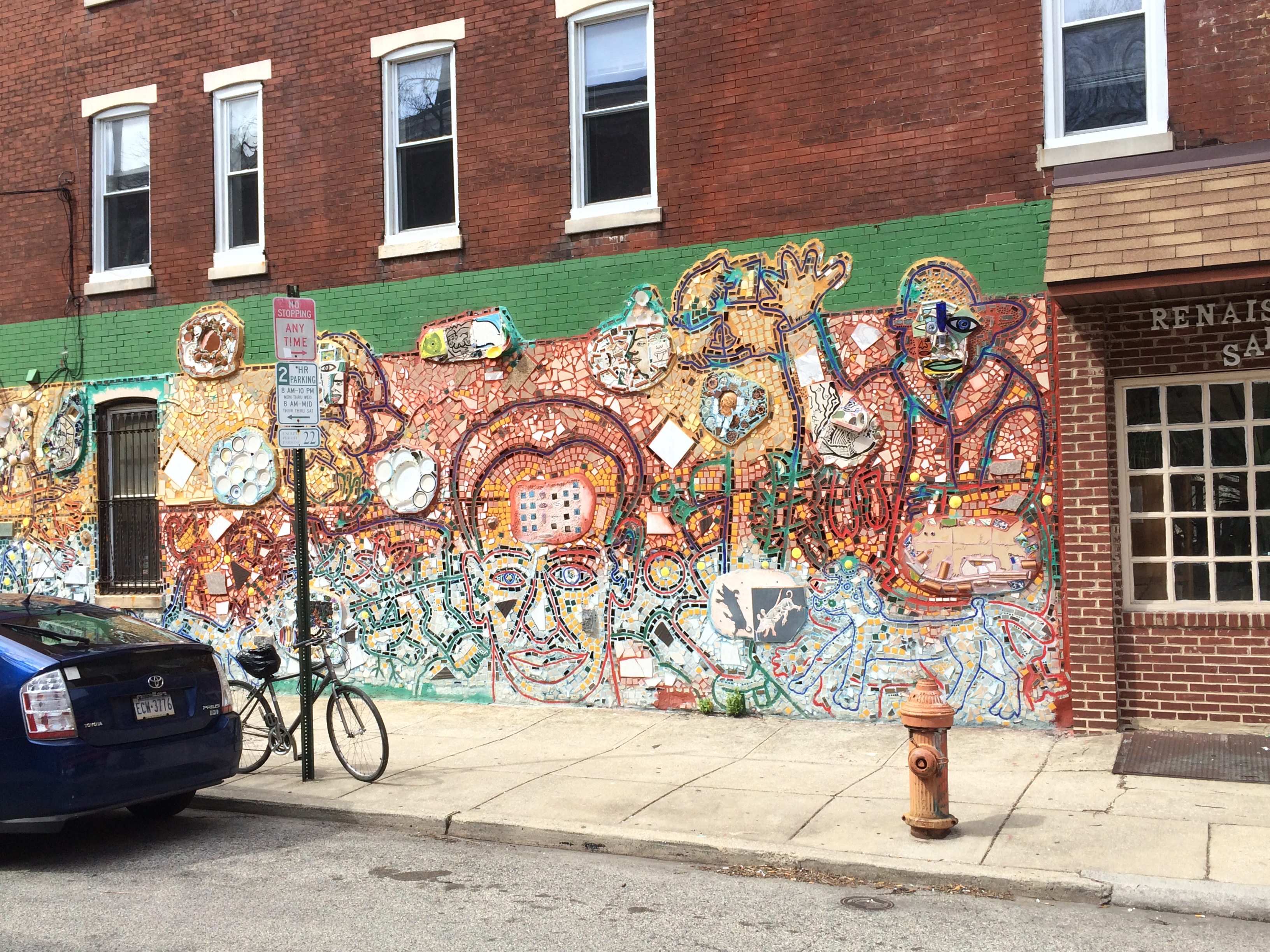
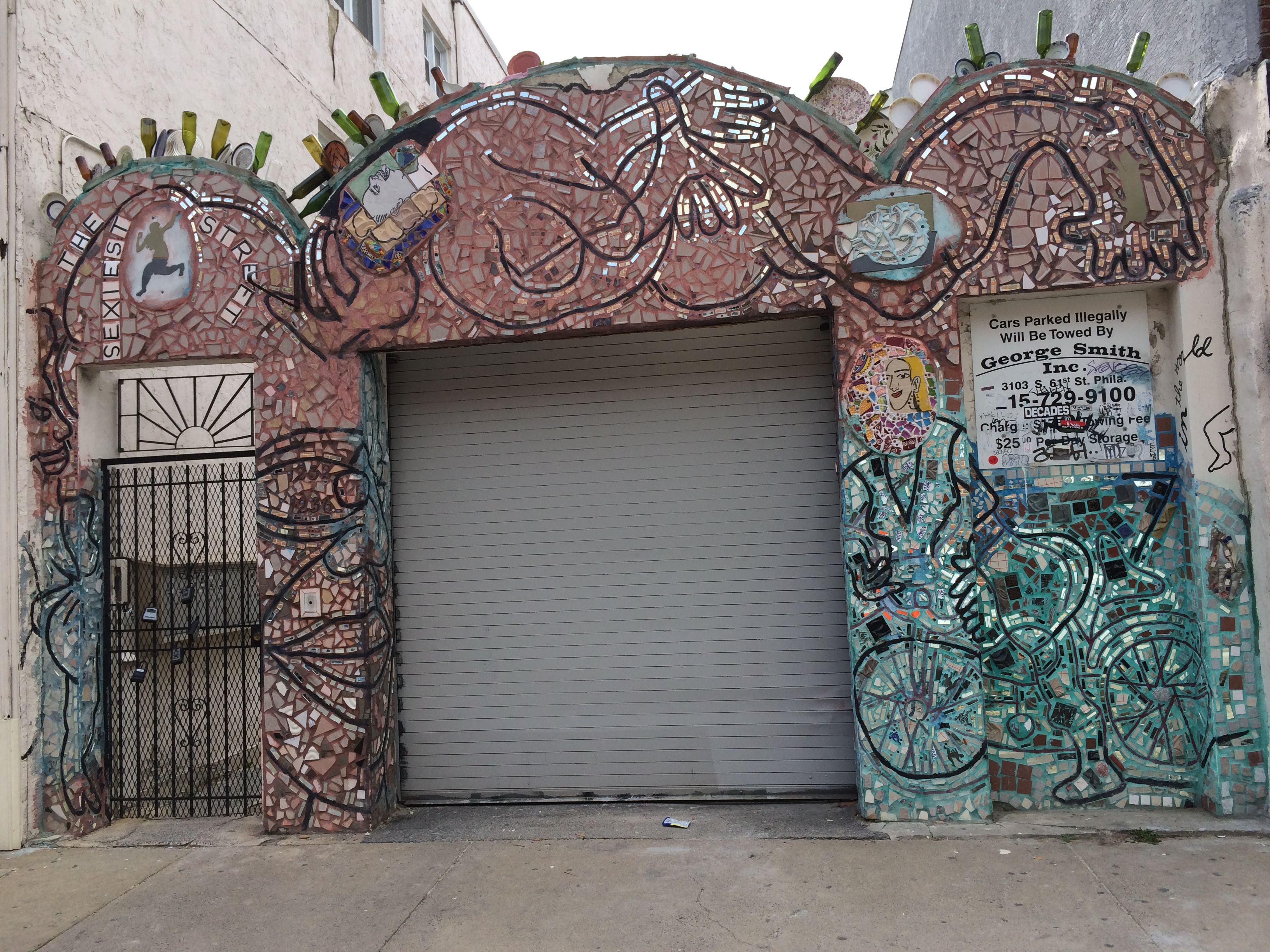
Soon after my walk began, a few minutes after I metaphorically tipped my hat to the Mako’s and Larry Fine murals, I started to come upon some unusually decorated homes, first on Leithgow Street, just off of South. And then on many other blocks near or on South. I had never seen these exterior wall decorations before, hadn’t known about them. They were something else, kaleidoscopic, multi-colored mosaics made from pieces of tile and glass. The design similarities got me wondering if one person had done all the work. I had a vague knowledge of mosaic artist Isaiah Zagar. I knew that he lived in the area and that he had established something called Philadelphia’s Magic Gardens. Were these freewheeling creations his? A bit later I learned that the answer was yes, and that he had begun adorning buildings quite a few years ago.

I suppose that Zagar obtained the permissions of homeowners before going wild on their domiciles. Or maybe he didn’t. Whatever. Unembellished bricks (and other stones), goodbye! Colors and designs up the wazoo, hello! Zagar’s mosaics put me in mind of native art from South America and Africa, of children’s art, of what cave paintings from 20,000 years ago might have resembled if their creators had been high on pot. Anthropomorphic faces and figures abound. Psychedelic cellular shapes look determined to escape their confines. Words like dance and celebrate and dream are embedded in the mosaics. Zagar is a positive thinker, a lover of life and, I assume, one hip cat.

Zagar’s greatest creation is Philadelphia’s Magic Gardens, a multi-level indoor and outdoor mosaic extravaganza, an arts center and a head trip that has become a go-to attraction for tourists and locals. He began work on it in 1994 in what then were abandoned lots, and endured some legal battles years later with the lots’ owners. In the end, creativity and social justice prevailed. PMG, an incorporated non-profit, opened to the public around 10 years ago. It’s at 1020 South Street. I caught a few peeks of PMG, grabbed a brochure from the admission desk and confirmed there that Zagar is the guilty party behind the glorification of the South Street corridor. But I didn’t want to interrupt my hike by entering the Magic Gardens. I’ll get back there some day and will drop my report within this blog. For now, this travelogue will end with photos of some of Zagar’s handiworks. If you click on any of them, or on any other photo in this article, a larger image will open.

IMG_0232IMG_0233IMG_0243

IMG_0246IMG_0250IMG_0251

IMG_0253IMG_0256IMG_0258

I Saw The Lights: A Belated Christmas Story

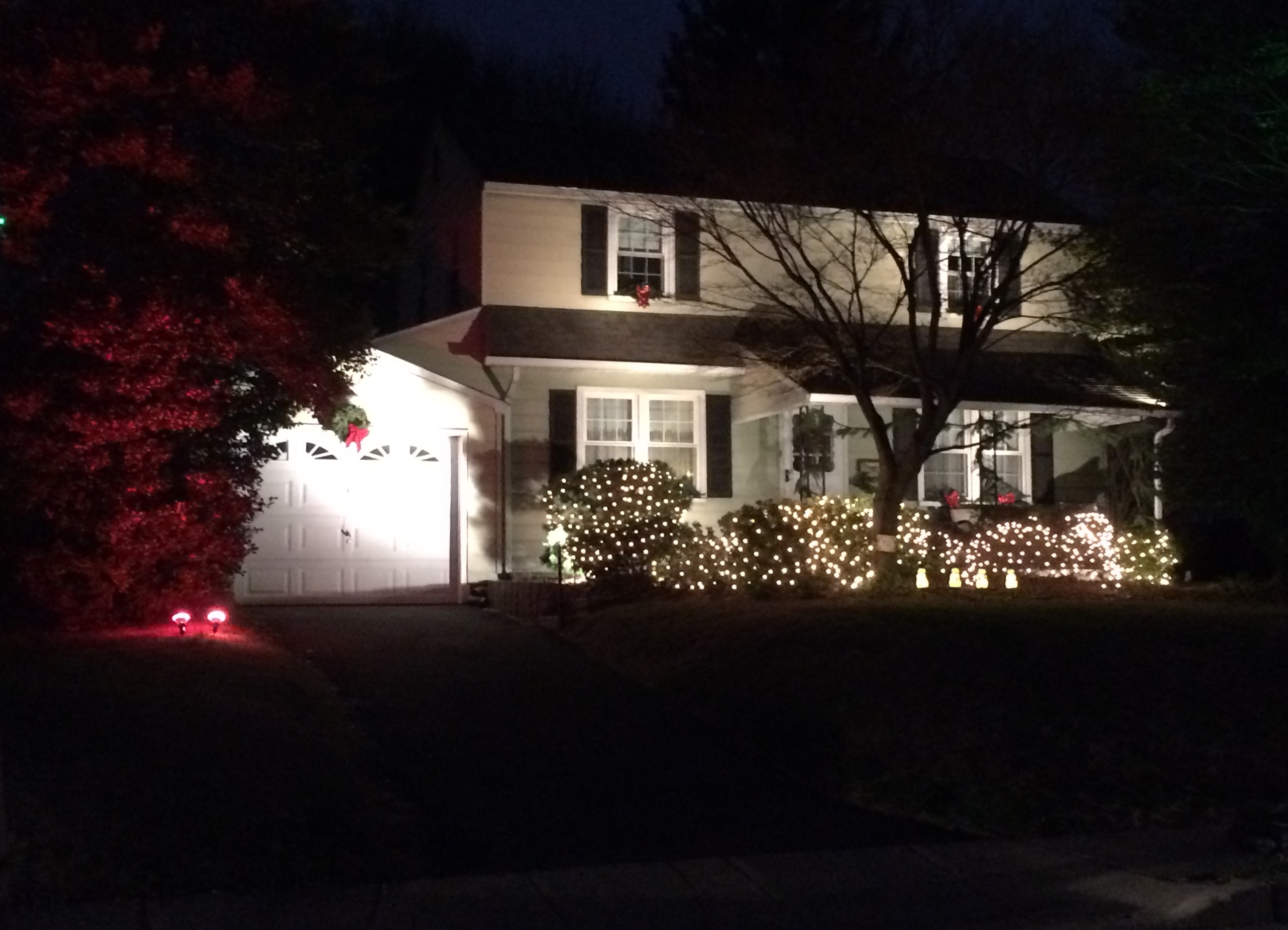
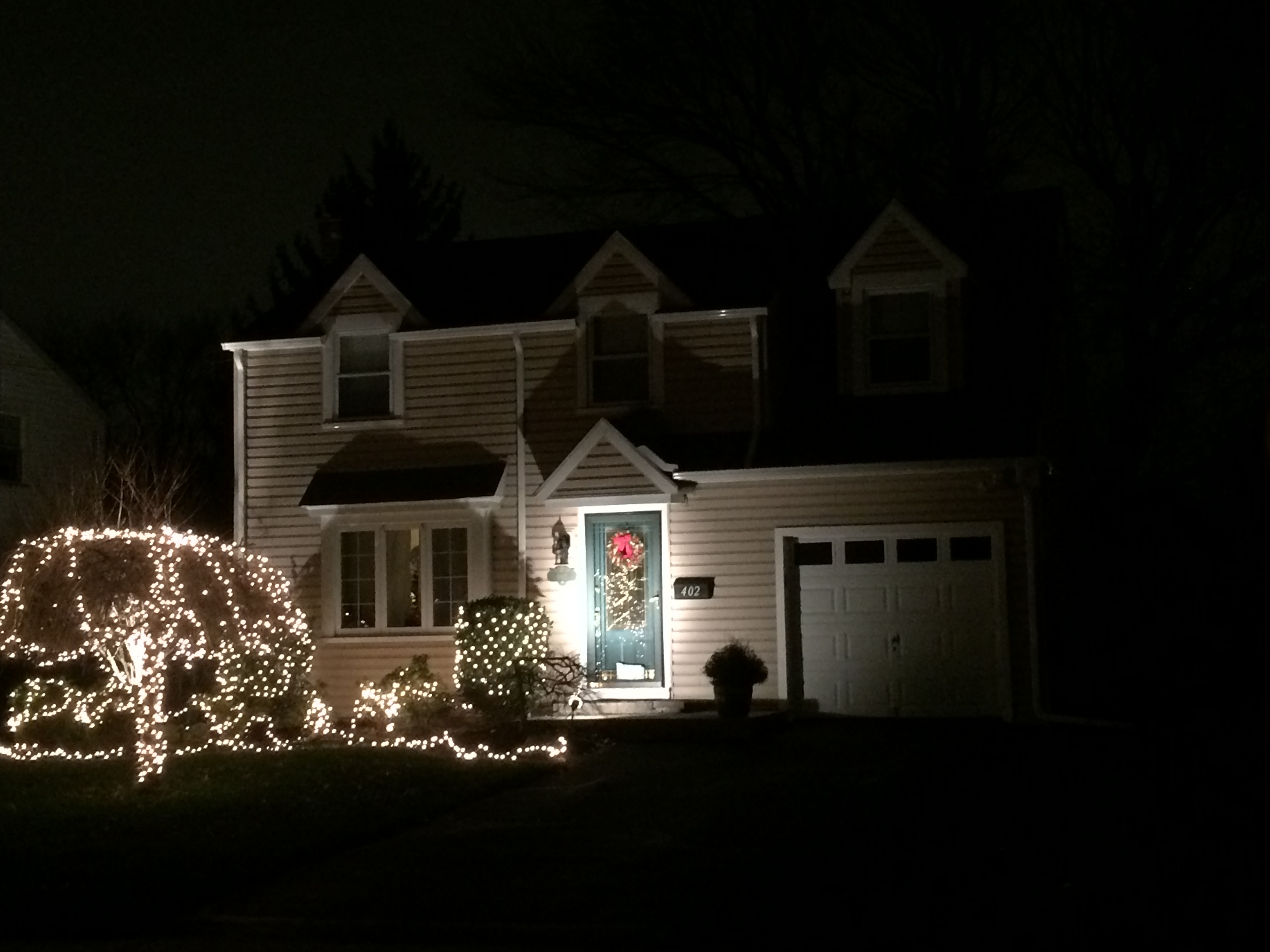
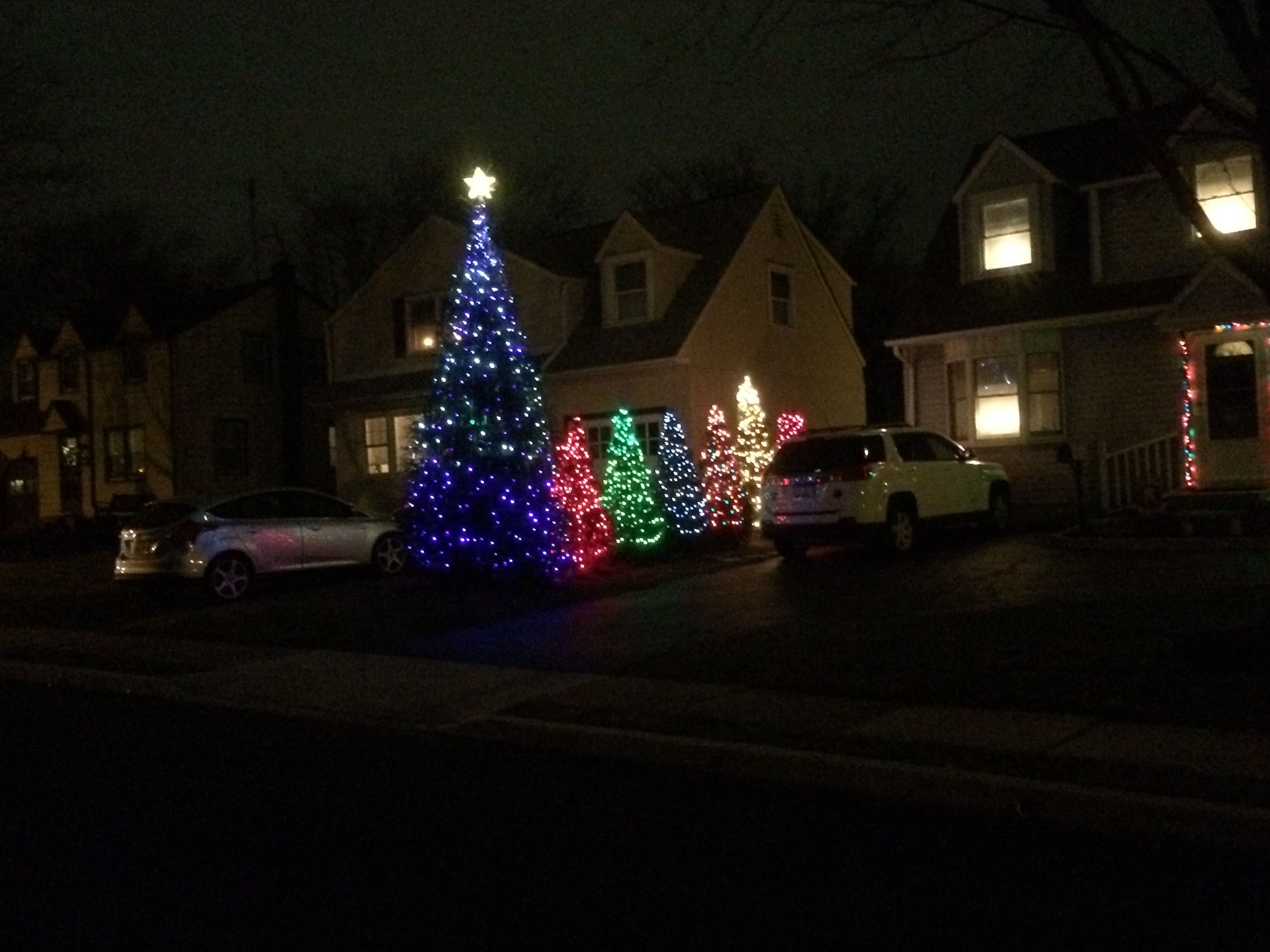
Colors. Patterns. I love ’em. Which is why I’ve spent much time over the years in museums and art galleries. And gazing at fireworks displays and at sunsets. Another example of epic and colorful exhibitions in which I’ve immersed myself takes place each year in neighborhoods throughout much of the Christian world. I’m talking about the Christmas lights that untold millions drape on the exteriors of their houses and on their greenery. For most of these millions, yuletide is the one time annually when their inner artists emerge, the one time when they express their creative bents in a big way. As an art admirer I appreciate the hard work that they put forth. And I consider many of their efforts to be at a high aesthetic level. Christmas lights displays, when done right, are gorgeous and admirable and, to me, no different really than so-called fine art.

For many years my wife Sandy and I went out four or more nights each Christmas season to look at the lights. We’d drive through our neighborhood and through many others in Philadelphia and the burbs. My father lived with us for the last six years of his life and he’d often accompany us on these excursions. He loved looking at the lights as much as we did. Slowly we’d proceed along blocks, saying “look at that house” over and over as we made our way. We’d often pull to the curb and stop in front of particularly well-conceived arrangements. Some of those were elegant in white only. Others were complicated and ablaze with color. And we’d always spend a long time ogling the mind-blowing and whacky assemblages of lights, kinetic whatnots and inflatable objects that covered every square inch, including roofs, of a few folks’ houses and grounds. Not every neighborhood has one of those. They sometimes become tourist draws, not a good thing if you’re the next-door neighbor.

During the last few years Sandy and I haven’t explored the lights as much as we used to. Not sure why. Up until Christmas week itself this year, we hadn’t at all. But you know, I got the itch at 5 PM a few days before Christmas. I placed my newly acquired smart phone in my pocket and did something I’d never done before. Namely, look at the lights not through a car window but on foot. Sandy decided to stay home. Her loss.

It was neat-o walking around my suburban neighborhood at night. That’s something I rarely do. Funny thing . . . people and houses don’t disappear after the sky turns black. I passed a couple of joggers, a couple of walkers and a couple more walkers holding leashes. Dogs were attached to the leashes. I saw kids running around their houses, people pulling into and out of their driveways. Wow, I’ve got to get outside more. Life’s a-buzzing aplenty.

And I also saw the lights. My neighborhood largely consists of modest wood-shingled and brick houses, nine or so on each side of each block and spaced about 15 feet apart. In other words, the blocks have a tidy layout and are crowded with homes, conditions that are ripe for a mighty fine dose of Christmas lights. Assuming, of course, that plenty of the houses are occupied by Christians who don’t mind climbing ladders and who have a sense for colors and patterns that work well together. Happily, all of this was the case. Many of the homeowners in my community did a lovely job decorating their properties. I walked for blocks and blocks and had a good ol’ time taking in beauty and snapping photos with my phone. This non-Christian thanks those homeowners for bestowing such presents upon him. Here are some examples of their artistic work. Before I forget though, let me mention two things. First, a larger image will open if you click on any photo. Second, please don’t be shy about sharing this article (sharing buttons are below the photographs).

IMG_0084IMG_0093IMG_0096


IMG_0102IMG_0106IMG_0116

Out And About In Fishtown

On a recent Friday night my wife Sandy and I went to dinner with our great pals, Liz and Rich. We dined in Al Dar, an atmospheric Mediterranean-cuisine bistro in Philadelphia’s western suburbs. As the four of us wolfed down lots of good stuff, Liz asked Sandy and me what we had on the agenda for the following day. Because the Philadelphia area was in the middle of an amazing December warm weather streak, any upcoming rain-free day would be a great one for outdoor exploration. “Maybe we’ll go to Fishtown,” Sandy said. And that’s what we did.

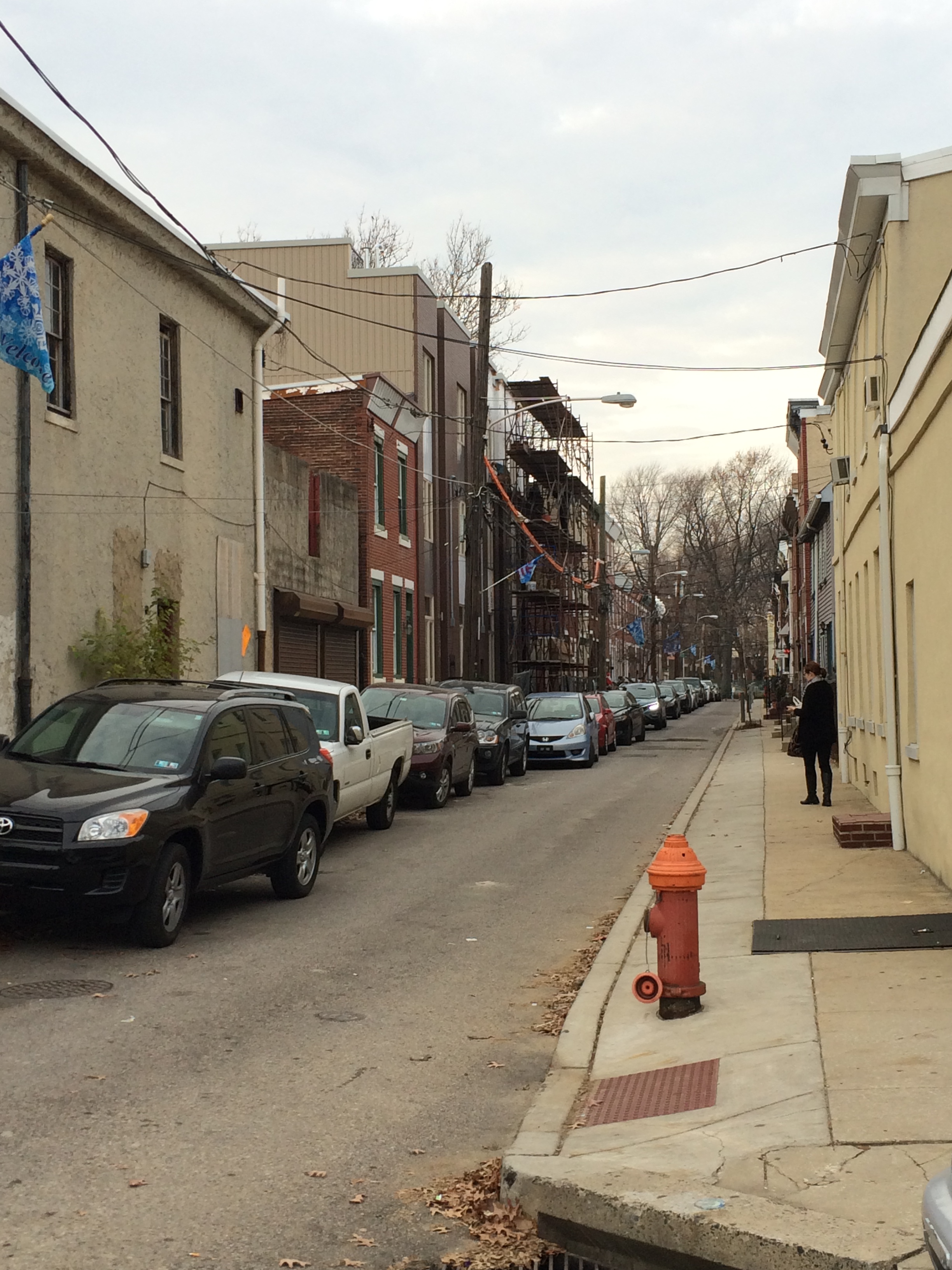
Fishtown is a Philadelphia neighborhood fairly near the city’s downtown sections. It is a maze of narrow streets, with a few big avenues running through, and for most of its existence has held a blue-collar reputation. Until a handful of years ago, Fishtown wasn’t somewhere you’d have had any particular reason to go to, unless you lived there. But times change, and sometimes for the better. Fishtown’s rowhouses and small single homes have found favor with millenials, hipsters, musicians. And with those fine folk have come cool bars and eateries and music venues. Fishtown now is on the map, though its goodly number of empty storefronts and how-do-they-stay-in-business businesses show that there’s plenty of climbing yet to do.

The 1300 block of East Eyre Street.
The 500 block of East Thompson Street.

I like wandering on cute blocks, especially when they have nifty or unusual names. And Fishtown is full of those: Crease Street, Eyre Street, Shackamaxon Street. Yeah, Shackamaxon. I’d never heard of half the streets that Sandy and I stepped upon, which was just the way I like it. Gave me a sense of exploring the unknown. I saw that Fishtown’s byways are crammed with housing and commercial properties that, to my marginally-trained eye, looked to have been erected mostly between the mid 1800s and early 1900s. As with much of Philadelphia, the buildings usually rise no farther than three stories above ground level. And how about those bricks, a construction material that numbers in the gawd-knows-how-many trillions of units in Philadelphia. Fishtown’s share of that bounty must be at least twenty billion.

Fishtown's public library.
Fishtown’s public library.
Girard Avenue as seen from Eyre Street.

It would take hours to see all of Fishtown, hours that Sandy and I didn’t have at hand. But we strolled around and I think got a halfway decent sense of what the neighborhood is all about. I was glad to see that Fishtown is kind of a small town unto itself. That’s been the case for at least 150 years, from what I’ve subsequently read. Look! A library. A police station. A rec center with a hockey rink. A wonderfully-domed Presbyterian church that has been in place since 1859. A bunch of pocket parks. Sharp, indeed! But the small town feel disappears when you venture off the residential blocks. On Girard Avenue, a major artery that bisects the area, the almost endless lengths of overhead wires are a gritty spider’s web and a quaint-yet-quintessential urban sight. And the traffic on Girard Avenue and Frankford Avenue at times is relentless.

Let’s move on to food and drink. Fishtown has become a player in Philadelphia’s emergence as a destination for foodies and/or craft beer aficionados. Kraftwork, East Girard Gastropub, Frankford Hall, Fette Sau, Interstate Draft House, Pizzeria Beddia (a take-out-only joint with no phone and a policy of baking only 40 pies per day. It gained instant fame when bon appétit magazine, incredibly, crowned its offerings earlier this year as the best pizza in the USA). Hey, if filling the gut and loosening the inhibitions are on your agenda, Fishtown’s as good a choice as any to do that in.

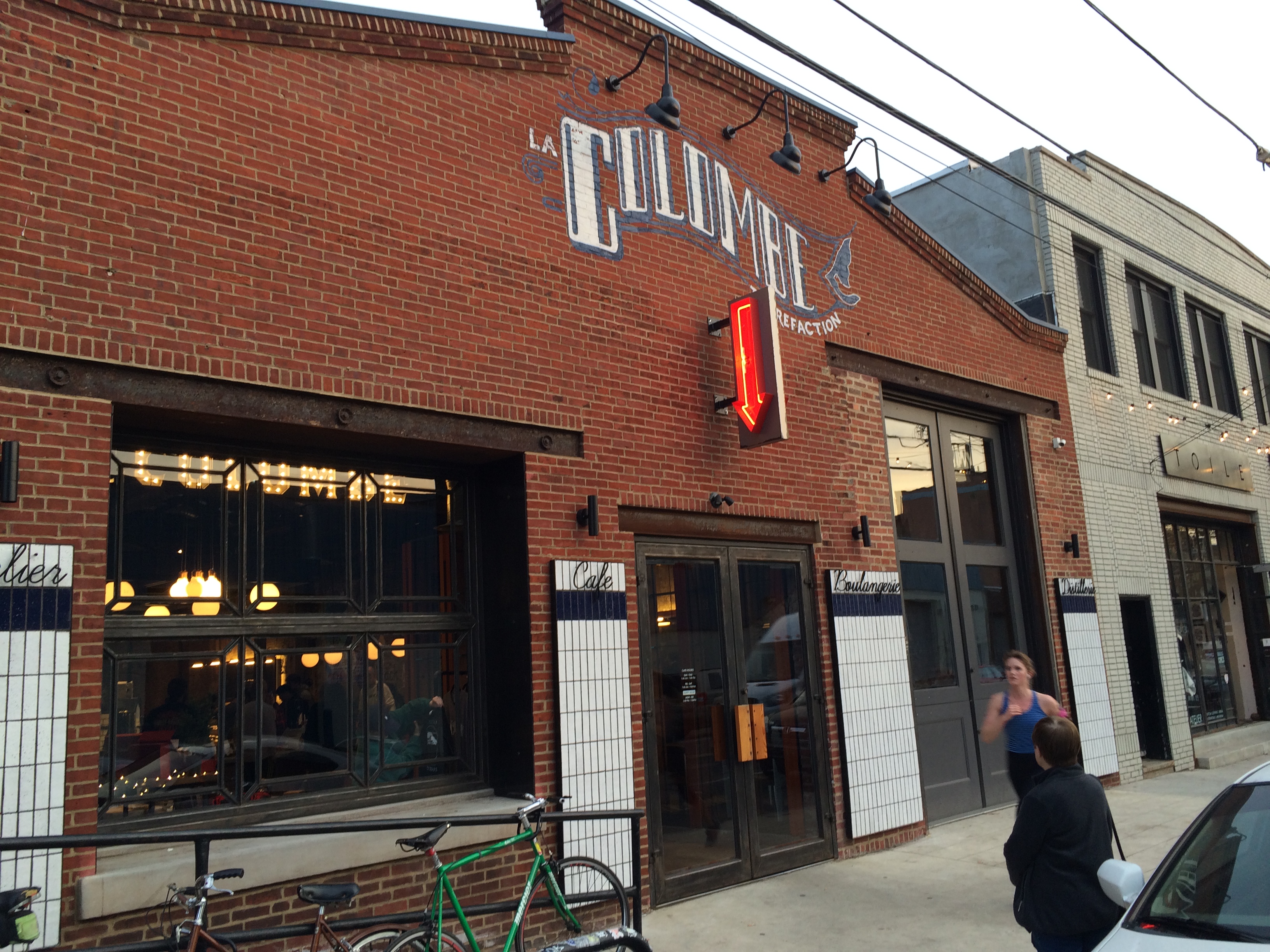
I peeked inside some of the above-named places, and others, on Girard Avenue. They looked great, but it wasn’t even 5:00 PM yet and I wasn’t ready for alcohol or food. Sandy and I earlier had decided that we needed to patronize, or at least ogle, what probably are Fishtown’s two most well-known spots, just to say that we’d been there. And thus we headed north on Frankford Avenue till we reached La Colombe Fishtown (1335 Frankford Avenue), the crown jewel of the La Colombe coffee empire.

Exterior of La Colombe Fishtown.
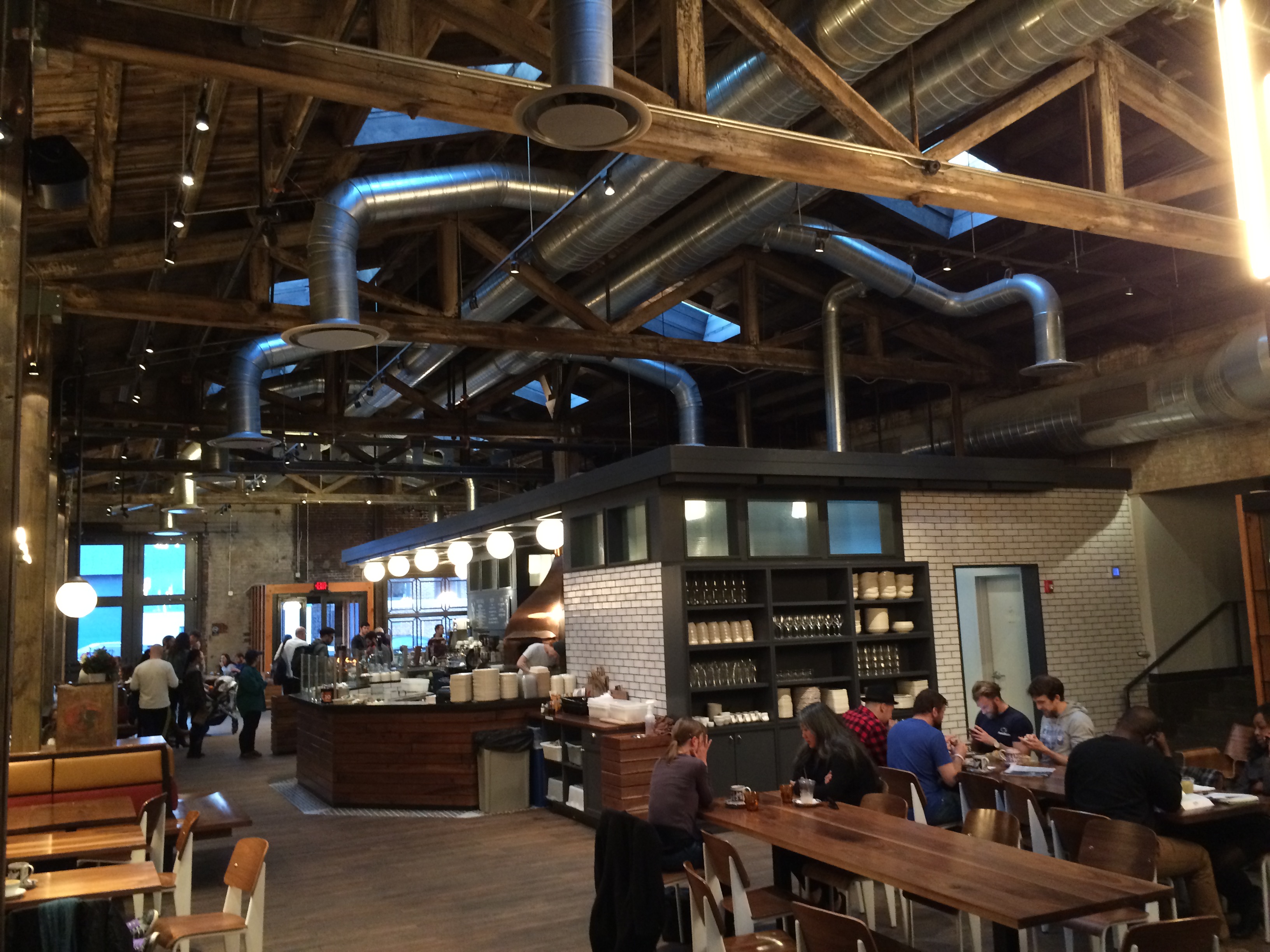
Interior of La Colombe Fishtown.

LCF opened last year and it’s a thing of beauty, a Starbucks-on-steroids enterprise that was created out of a former warehouse. It’s comfortable and fashioned in the rustic chic mode. Dark wood floors go on forever. Exposed air system ductwork looms overhead. At the tables, customers nurse coffees, wines, beers, pastries and sandwiches for a long long time as they stare into their electronic devices or into each others’ eyes. And in the rear of the cavernous space is something I’d have been unable to anticipate in a million years. A rum distillery. Don’t ask me why, but the brains behind La Colombe had a jones for rum that had to be satisfied. The rum is for sale.

Sandy and I, though, kept things simple. We ordered ice coffees. Yes, we’re big spenders. They were strong and delicious. We stared into our devices and into each others’ eyes for awhile, and then hit the streets once again. It now was time for food and alcohol. Next stop was Fishtown’s biggest claim to fame.

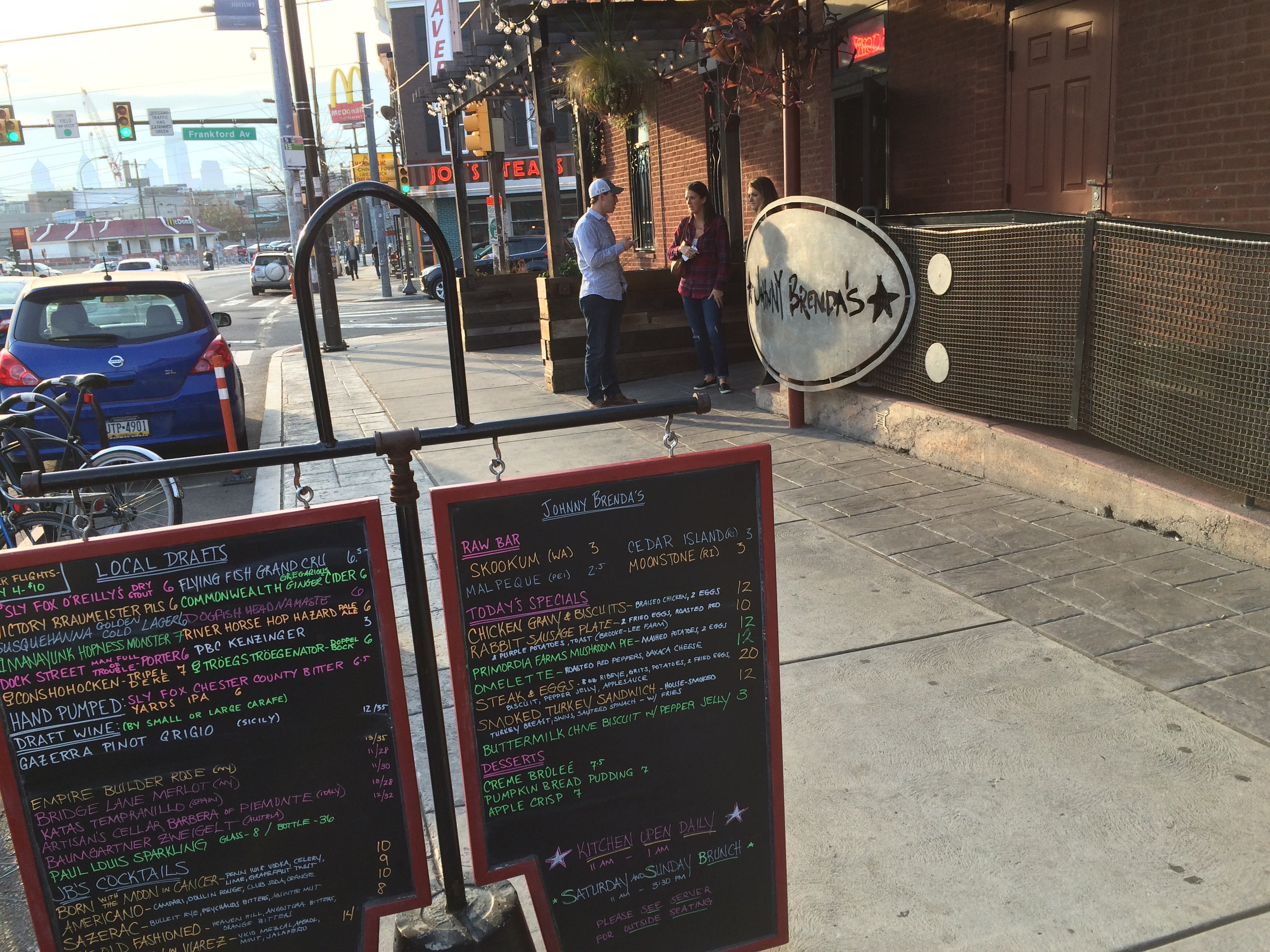
Johnny Brenda’s (1201 Frankford Avenue) used to be an insular neighborhood bar. New owners took over in 2003. They installed good beers and good food, made nice with their Fishtown neighbors, and set in motion their visions of expanding JB’s audience. Johnny Brenda’s is widely credited as the catalyst for Fishtown’s renaissance. Things really began cooking in 2006, the year that JB’s brought live rock and roll to its upstairs quarters. Brenda’s has become a favorite place for local and touring rock bands. Sandy and I have yet to catch music at JB’s, but we’ve frequently talked with friends about doing that. One day soon we will.

Exterior of Johnny Brenda's.
Exterior of Johnny Brenda’s.
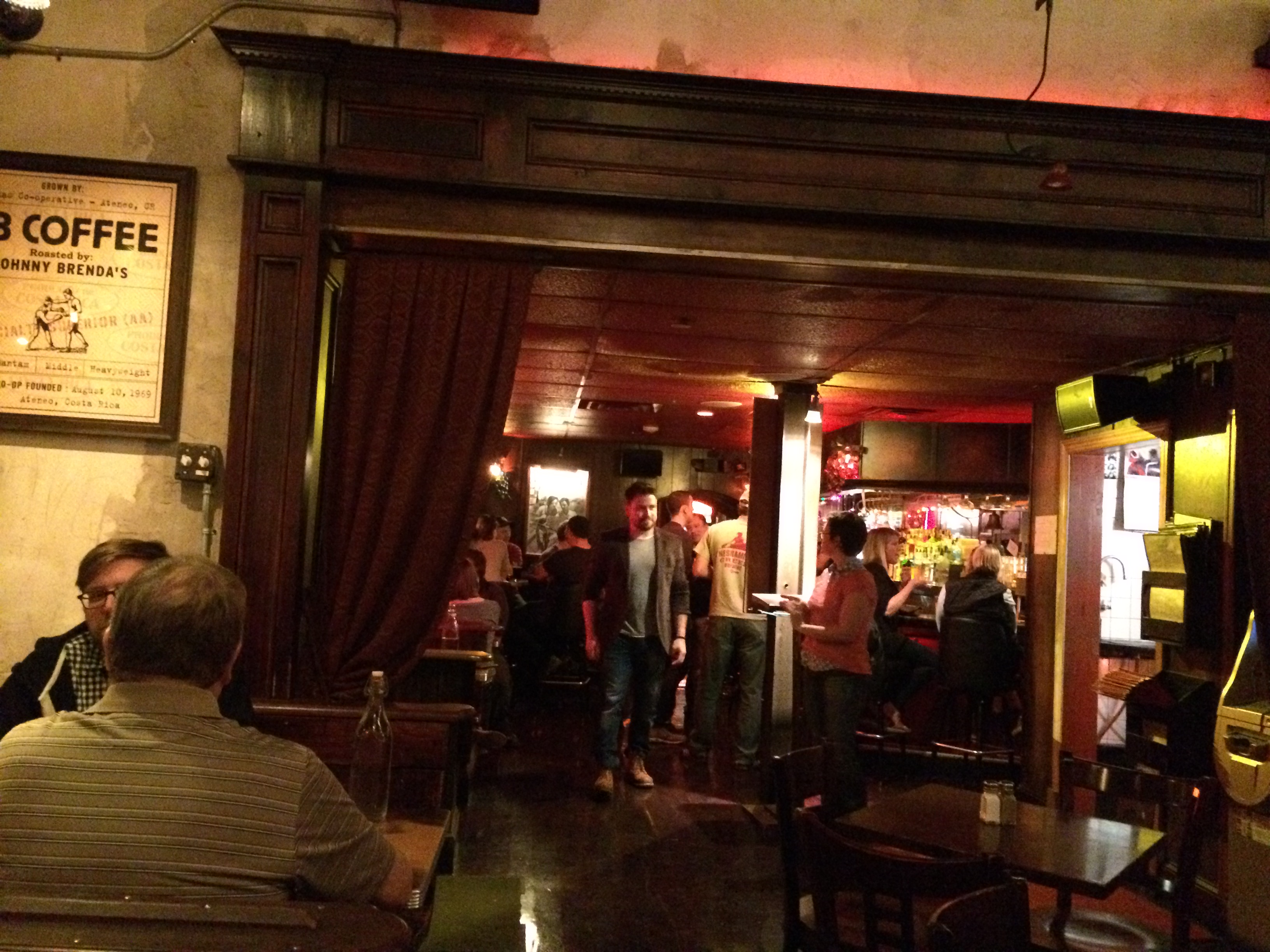
Interior of Johnny Brenda's
Interior of Johnny Brenda’s

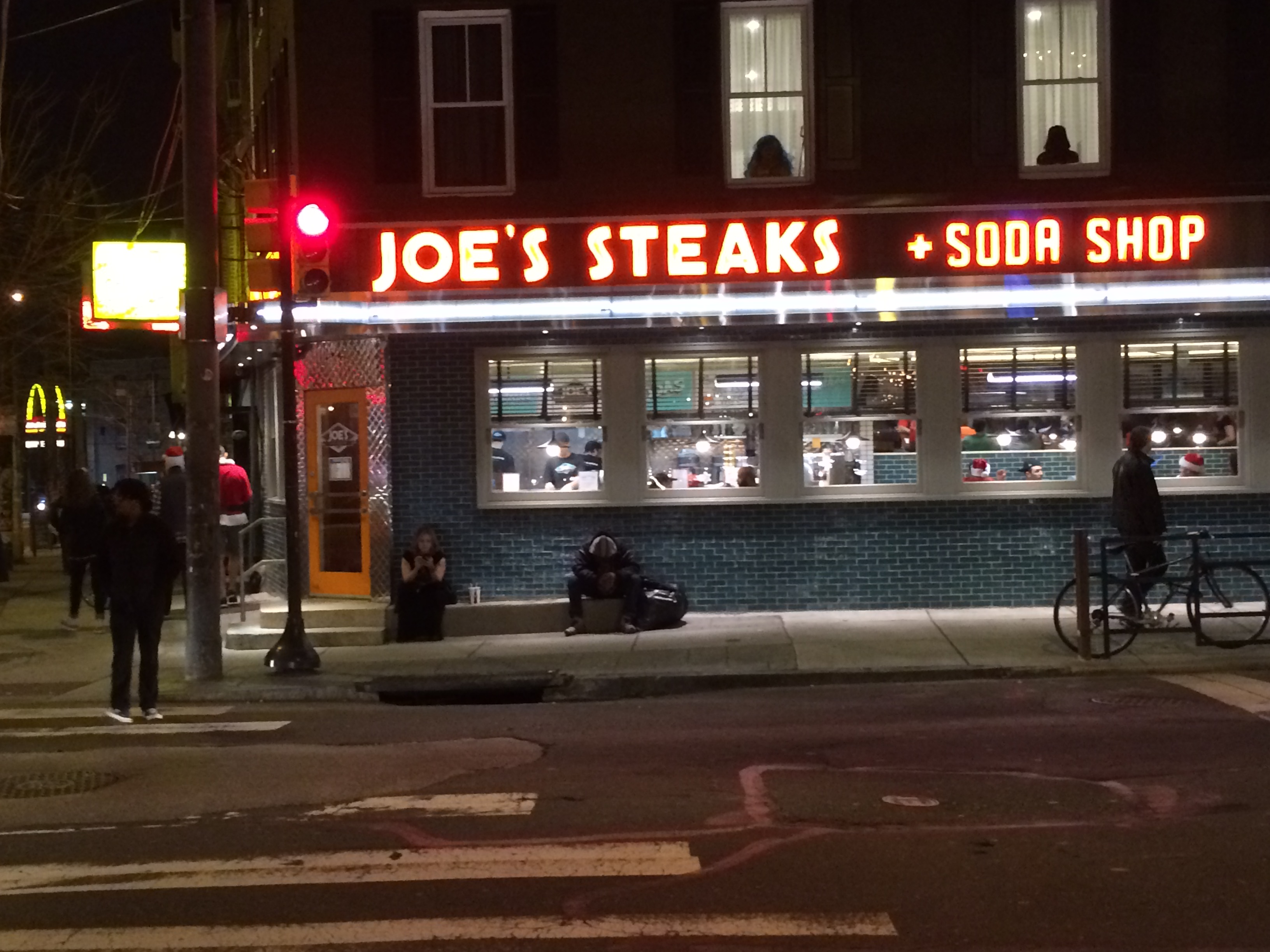
JB’s is a friendly place. It has a pool table, local beers on tap, a nice selection of pub grub. And plenty of customers. Sandy and I grabbed a booth in the dining room. We ordered. Sandy’s Italian white wine was delicious. So was my Sly Fox porter. So were our burgers, hers made from beef, mine from vegetables. But before too long it was time to leave, as a movie, in another Philadelphia neighborhood, was on our evening’s schedule. We settled up and stepped outside. Daylight had disappeared 90 minutes earlier.  The air was cooling down. Groups of 20-somethings and 30-somethings were everywhere. We crossed the street, heading westward on Girard Avenue. But Sandy then suggested that we walk back to where we had just been so that we could get another good look at a resplendent neon palace: Joe’s Steaks + Soda Shop. Sandy took its picture. And we left Fishtown on a high note.

JoesSteaks IMG_0076
(If you enjoyed this article, then don’t be shy about sharing it. Sharing buttons are below)

(Photos by Sandra Cherrey Scheinin. If you click on a photo, a larger image will open)

Running Free

I don’t know about you, but it seems to me that driving in any inhabited area these days is a sure fire way to add kilos of stress to the body, to send the diastolic and systolic numbers moonward. For me, driving even on my typical suburban block can be a true pain. One recent morning, for instance, I stepped into my ancient Honda, which was parked directly in front of my home, and saw a young couple 100 feet in front of me. They were putzing around with their SUV, also parked on the street. Their rear driver’s side door was wide open, making passage past their car difficult. Worse, the female member of the twosome was standing in the middle of the street, la-dee-dahingly removing boxes from the back seat. “OK, no problem. I’ll simply make a K turn and head in the opposite direction,” I said to myself. As I gracefully maneuvered the Honda to my left and then backwards, needless to say another SUV headed towards me from the direction in which I now was planning to drive, putting pressure on me to complete the K pronto. Bottom line: Nearly everywhere you go there are just too many people and too many motor vehicles. “Hey, that’s modern life,” some would say. “Get with it.”

Oh yeah?  Arrgh . . . Let me outta here! I need to run free! At least some of the time.

I don’t like congestion, dig? But what’s a person to do? I’ve written a few times online about the sweet spot that Cape Cod occupies in at least two hearts, mine and my wife Sandy’s. Cape Cod is where we head when we want to get away from it all. Not that Cape Cod is free from congestion. Hardly. But if you know where on the Cape to go, and when, you’ll be far far far from the madding crowd and its cars and trucks. And you’ll have fun too.

Cape Cod is famed for the throngs that descend upon it between Memorial Day and Labor Day weekends. People and cars up the wazoo. That’s why Sandy and I never go there during that period. We were on the Cape last month though, when things were back to normal. We spent plenty of time among others of our species. But we also made sure on most days to bathe our souls in places where the human and vehicular factors would be minimal.

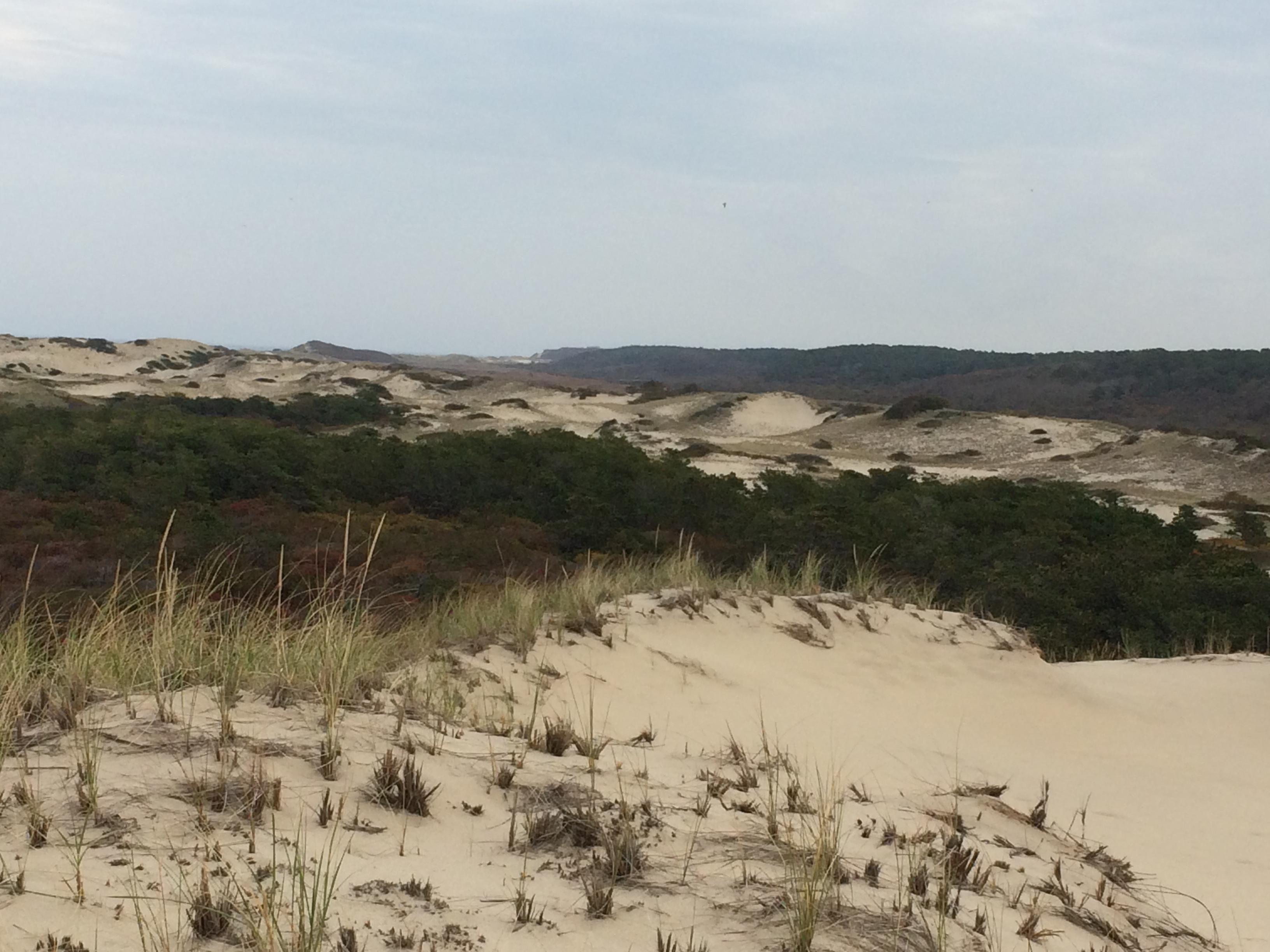
Parabolic sand dunes territory. Truro, Cape Cod.

“You know,” I said to Sandy on this most recent trip as we stood atop a humungous sand dune. “If you plopped most people down here and asked them where they were, they’d never guess it’s Cape Cod.”  That was true. When the majority of folks think Cape Cod they envision seaside-ey villages and seafood-ey restaurants. But we were miles away from any of that. We were in parabolic sand dunes country, inland just a bit from the Atlantic Ocean in Truro. Truro is a sprawling area of the Outer Cape, and probably the most rural and desolate section that Cape Cod has to offer. The parabolic dunes are by far the Cape’s biggest, undulating 80-feet-and-taller monsters that extend for several miles, covering part of Truro and of Provincetown too. We’d been in this locale a bunch of times before, and as always were knocked out by the vistas. Several parallel chains of dunes ran long into the distance. Between each chain were deep valleys that, surprisingly to me, a low level naturalist, were loaded with small trees and shrubbery and all manner of other plants that I couldn’t give names to. This is a mind-blowing environment, a vegetated lunar-like landscape that, I’m sure, many Cape Cod residents and vacationers barely know about. It is open and wild. I feel alive there. And that’s why I like it.

Over the years I’ve spent a lot of hours scampering up, down and around the parabolic dunes, and even more among the slightly smaller and less dramatic dunes that take over in Provincetown when the parabolic big boys eventually peter out. At this point in my life I’m not going to be climbing any mountains in the Alps or bungee jumping into canyons in the American West. For me, the Outer Cape’s dunesville does just fine as a spot where I can indulge my sense of adventure and feel as though I’m pushing my puny limits. There’s no congestion out there. You might cross paths with a few other trekkers, but that’s okay. They are kindred spirits.

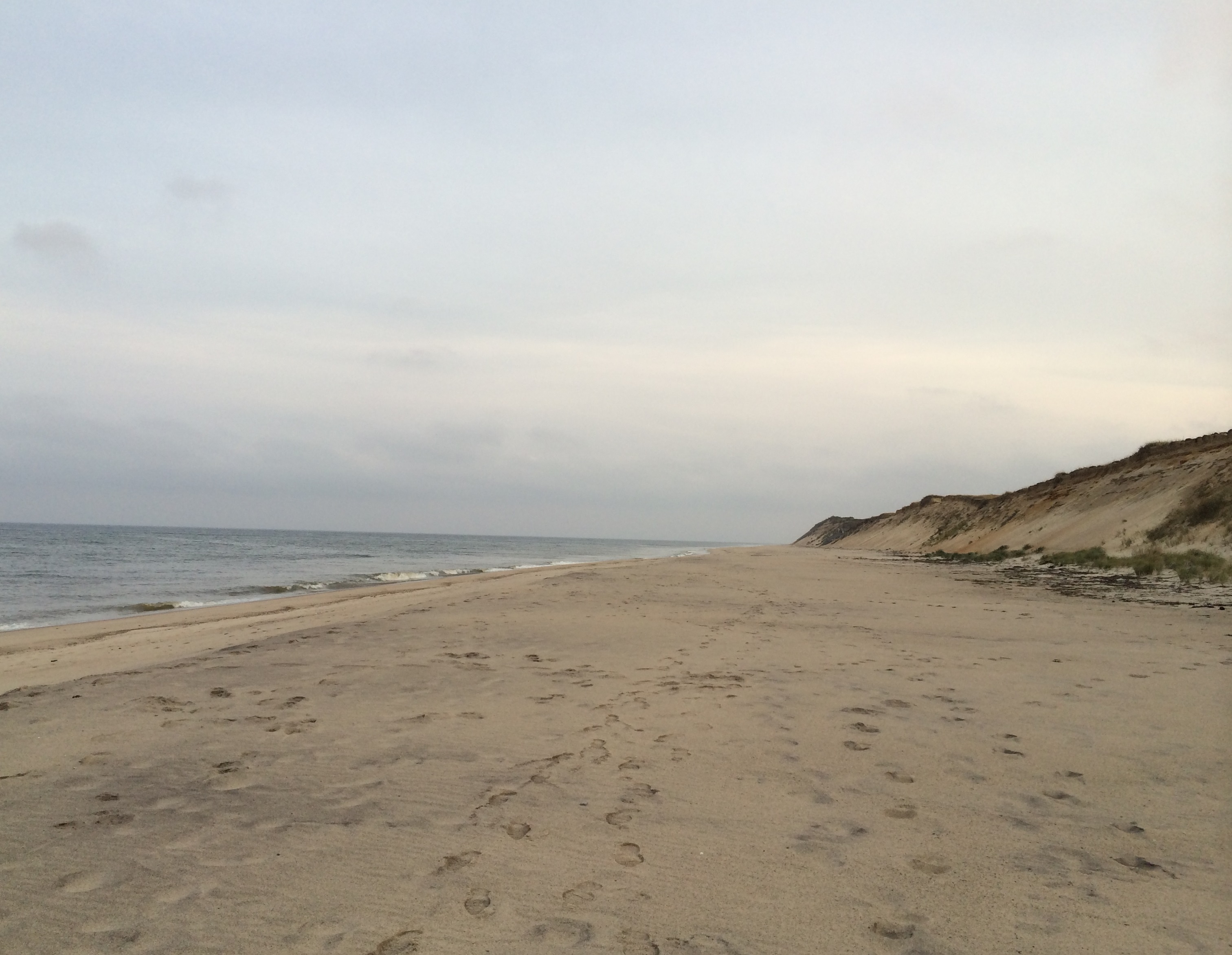
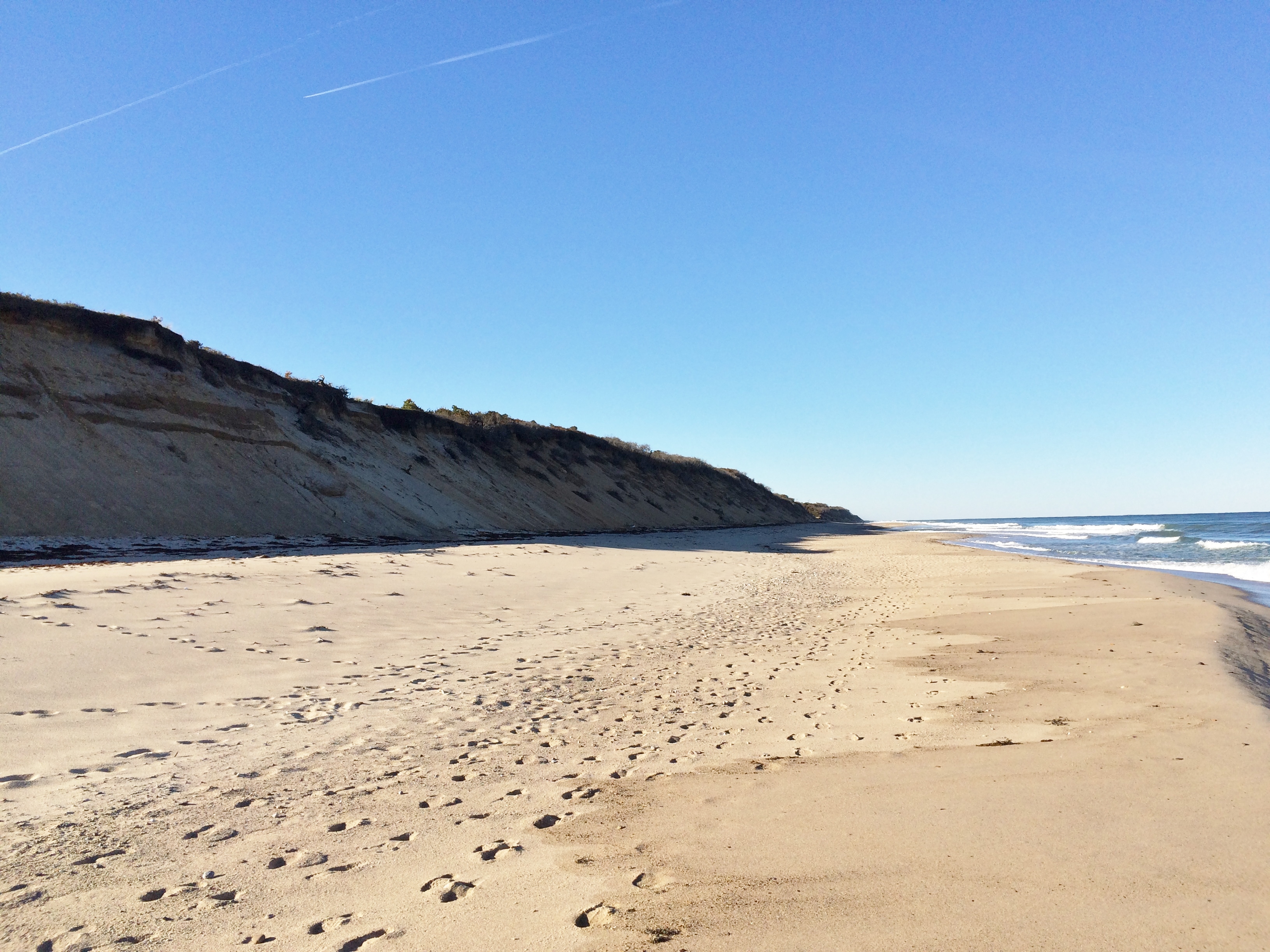
Dunesville is great. But what I like even better on Cape Cod is the Atlantic Ocean shoreline. Most of it is under government protection, meaning that mankind won’t be messing it up any time soon. It’s pure, it’s long — 40 or more miles — and it’s beautiful. What’s not to like? Sky, ocean,  and sand-cliff-backed endless beach.

Its presence of water is why I would choose, if I had to choose, this shoreline over the Outer Cape’s dunes territory. Though Sandy and I aren’t swimmers, we’re big time water admirers. We have hiked hundreds of miles over the years on the Cape’s ocean shore. There’s just something about being there. The power of the water, its changing face from day to day. The rigid coolness of those sand cliffs. The real low numbers of humankind in the off-season. And then there’s our kite, which enhances this scenario. Last year we bought the kite and flew it on beaches many times. We launched it frequently during our recent stay too.

Atlantic Ocean shoreline at Marconi Beach, Cape Cod.
Our kite at Marconi Beach, Cape Cod.

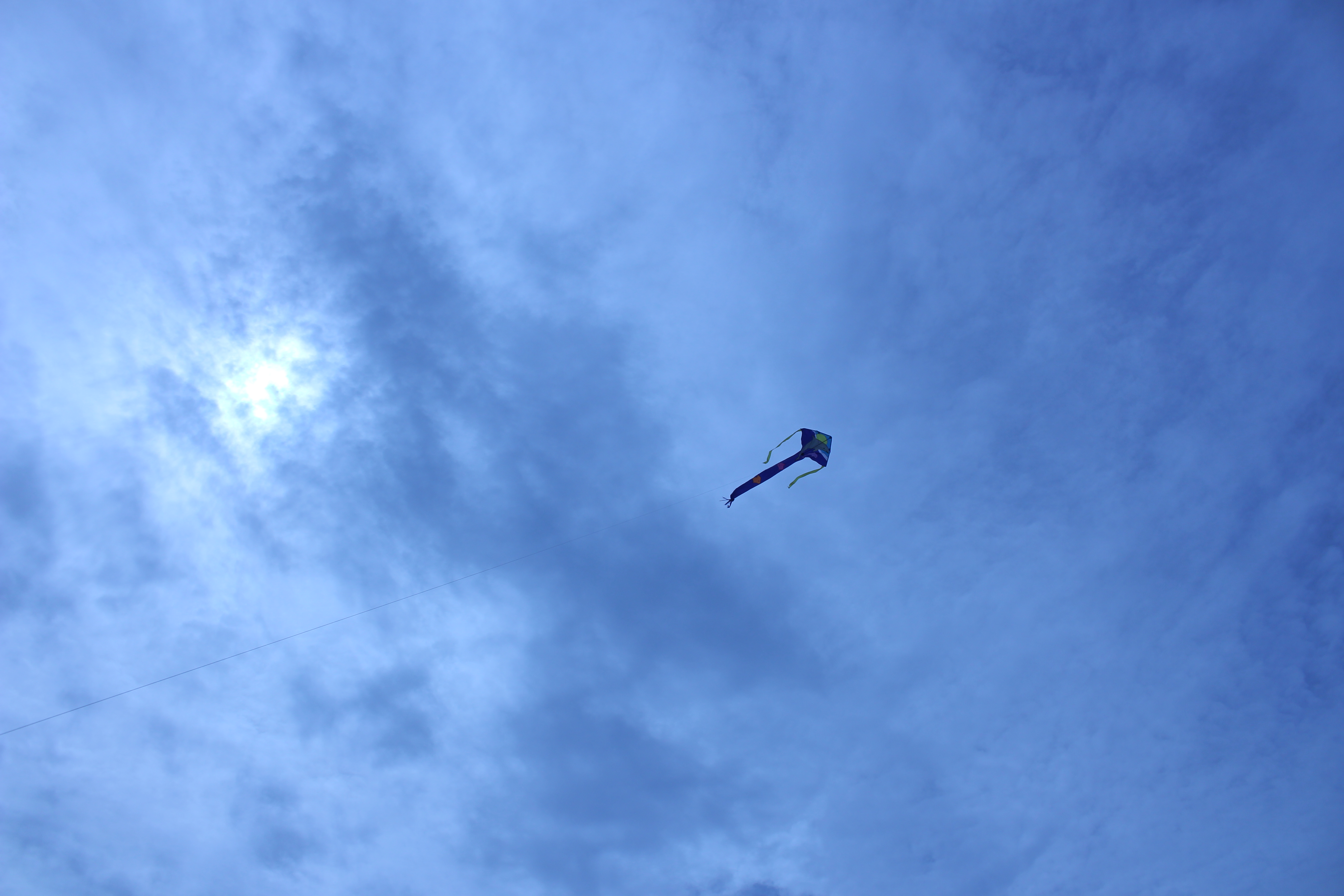
One day last month, on the ocean shoreline named Marconi Beach, the conditions for flight were perfect. A strong but not overpowering steady wind meant the kite would stay aloft sans problem. What we discovered at Marconi was that the kite was insatiable. It kept pulling on the string, begging us to let out more and more length. This hadn’t happened to us before. And so we did. The kite went higher and higher. The amount of string on the reel grew less and less. I hardly could believe it when there was no more string to release. The kite was way up there. How far away I didn’t know.

After an hour or so we decided it was time to move on, to say goodbye to Marconi Beach for the day. It took a long time to reel in the kite. Later I checked out the kite manufacturer’s website where I learned that our polyester friend came equipped with 300 feet of string. I was impressed. At Marconi Beach we had overseen a long-distance journey.

Congestion . . . bad. Running free . . . good. End of story.

(Photos by Sandra Cherrey Scheinin. If you click on a photo, a larger image will open)

(If you enjoyed this article, then please don’t be shy about sharing it)

A Cape Cod Sunset Story

My wife Sandy and I have a love affair going with Cape Cod, which is where we are vacationing as I type this missive. We live in suburban Philadelphia, but in most ways prefer the Cape. Boo hoo . . . we’ll be back home tomorrow.

In 1998 we visited the Cape for the first time, expecting it to be a locale we’d enjoy. Well, we did. And decided to come back the next year for some more good times. I think it was on that second trip that I realized I liked Cape Cod much more than I ever thought I would, that it really suited my soul, that I was starting to become smitten. Sandy and I have returned every year since then, excepting one. Before Cape Cod entered the picture, in my adult life it had never occurred to me that there might be an Eden of sorts waiting for me, someplace beautiful and in which I truly felt at home. A favorite place.

Sandy and I have had only great vacations on Cape Cod. We’ve been there in all seasons except summer, which is the one time of year when the Cape is overrun. With humans. We fill our days with a variety of activities: nature walks on sand or through forests; poking around in country-imbued villages; art gallery and museum hopping; attending movies, plays and concerts; lots of tasty eating in restaurants humble and above; the list continues. No doubt, this is the good life. I feel almost guilty that such fine fortune has come my way. But I’ll take it.

Atlantic Ocean shoreline. Eastham, Cape Cod.

If I had to select one reason above all that puts Cape Cod at the top of my list, I’d point to the expansive areas of natural beauty. Such as the 40 or more mile-long Atlantic Ocean shoreline, much of it government-protected and thus little disturbed or altered by the hands of man. The vistas there are pretty elemental and always knock my socks off. Ocean, sky and beaches backed by dunes-topped sand cliffs. My psychological and emotional makeups, whatever the heck they might be, vibrate in a calm, contented and awestruck manner when I’m in the midst of such.

And there are other reasons. To name one: When vacationing on Cape Cod sometimes an unexpected present drops into your lap, just as with life in general. One day last week an example came my and Sandy’s way. I’m talking about a sunset. Right, right, I know that over the centuries untold thousands of scribes have oohed and aahed in print about sunsets. And millions of sunset photos have been published, more in the last 15 or so years than ever before thanks to the Web. But hey, I’m not embarrassed to add a few hundred sunset words, and a handful of photographs, to the Everest-high piles already out there. Don’t bail out on me. Keep reading.

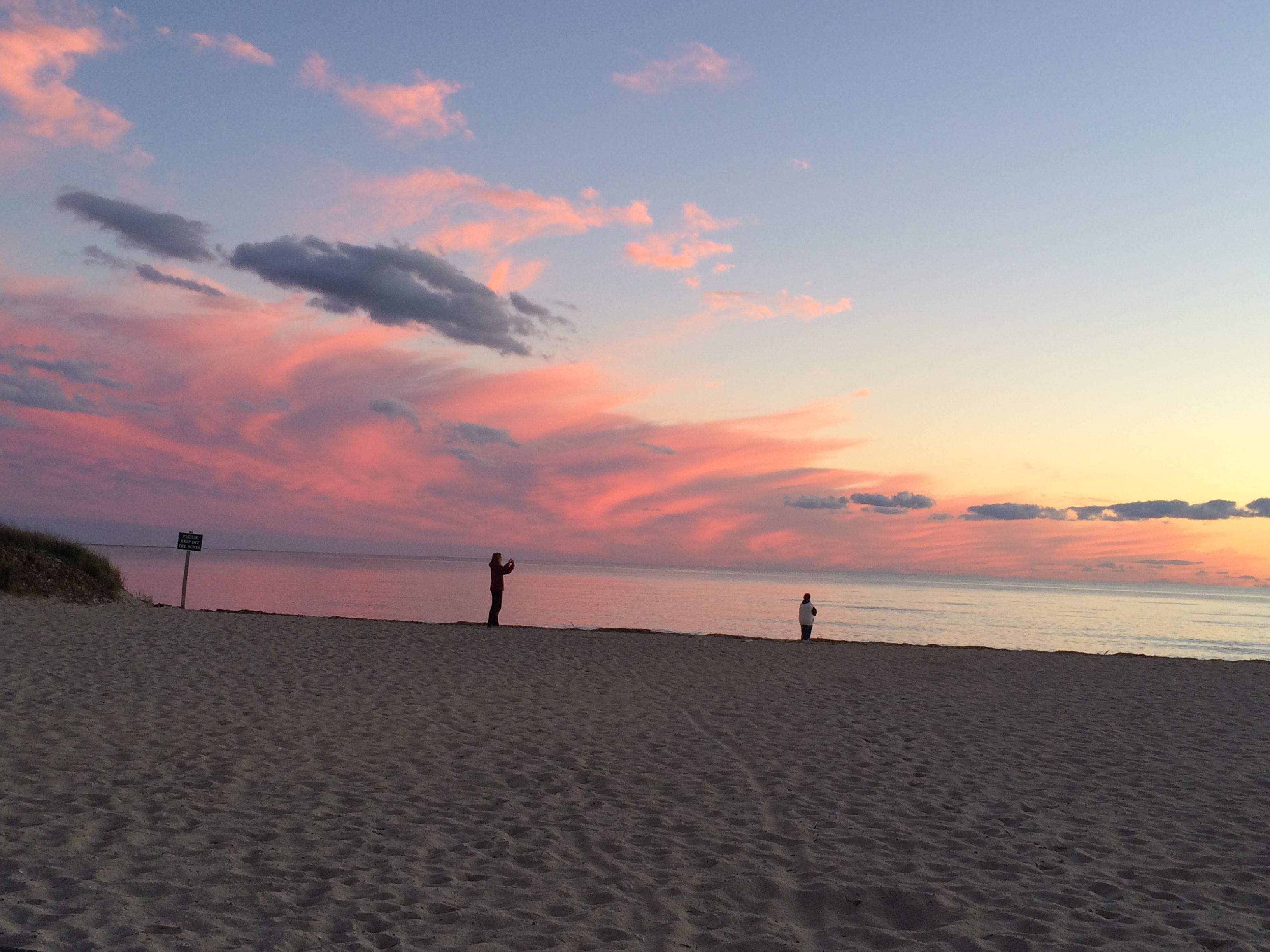
And so on the aforementioned day at 5:15 PM, Sandy and I were in Chatham, a needless-to-say charming Cape Cod town. We had just watched Steven Spielberg’s latest oeuvre, Bridge Of Spies, in the Chatham Orpheum Theater. Our next planned destination was 20 miles away, Harvest Gallery Wine Bar. There we meant to dine and listen to a tough as nails rock trio, The Catbirds. But there was no need to arrive before 7 PM. We had time to kill. We scratched our heads, coming up empty. Then “sunset” popped into my mind. Sandy checked with her phone, which is much smarter than me, and learned that the Sun would dip below the horizon at 5:57. I steered our car westward and then turned south onto a road I’d never heard of, hoping that we eventually would find our way to a Chatham beach on Nantucket Sound. The sand gods must have been with us, for Hardings Beach Road soon materialized. And moments later Hardings Beach itself emerged.

We parked. The spot was gorgeous. Lovely sands, magnificent Nantucket Sound waters gently rippling beneath a sky puffy here and there with clouds. The clouds made my heart leap, or something like that, because a scattering of clouds, as I’ve come to realize from years of sunset-gazing on the Cape, is key to a good sunset. Their water droplets and other particles refract light beams and reflect colors. Their movements and changing forms turn sunsets into active canvases. And that’s what happened as Sandy and I watched our fiery faraway friend say goodnight.

Sunset at Hardings Beach. 5:56 PM.
Sunset at Hardings Beach. 6:05 PM.
Sunset with the Moon at Hardings Beach. 6:07 PM.
Sunset. The Moon. Hardings Beach. 6:07 PM.


A lot of people claim to dislike colorful abstract art, certain paintings by, say, Vasily Kandinsky or Jackson Pollock. I don’t get that, because everybody loves sunsets, which to me can be among the ultimate in eye-popping abstractions. I’ve never read that sunsets inspired any brush wielders to go wild and free in their approach or vision, but it wouldn’t surprise me if in fact this were the case. Sandy and I watched the sky for 20 minutes. The pinks and oranges darkened as the big event rolled on. The clouds worked their wonders. And in a little while Sandy pointed up and said, “There’s the Moon.” It was a graceful sliver of white balancing above swashes of pastel hues.

On Cape Cod I’ve been a lucky son of a gun many times. That evening on Hardings Beach was one of them.

(Photos by Sandra Cherrey Scheinin. If you click on any photo, a larger image will open)
(If you enjoyed this article, then please don’t be shy about sharing it)

A Kite, The Moon, Sandy And I

Few if any ideas are unique. But many ideas are good ones. Last year, for instance, I came upon a good idea while perusing a bunch of websites pertaining to Cape Cod, where my wife Sandy and I would be vacationing a few weeks later. We’ve been hitting the Cape for many years, and we always try to amass a long list of potential activities before our vacations begin. One website was crammed with suggestions about fun things to do on Cape Cod. One of the author’s notions connected with my sweet spot. Go fly a kite, the writer said.

Our kite soared above Cape Cod beaches many times last year.

Sandy and I did just that. A few days into the vacation we bought a cute and colorful kite in a toy store and headed straight for a section of Atlantic Ocean beach to test it out. I hadn’t flown a kite in at least 50 years. Sandy, surprisingly, never had. We took to the kite as if it were a long lost pal. Over the course of our sojourn the kite, when not aloft, lived on the back seat of our car, always on hand and ready for action. We flew it on beaches all over Cape Cod and in an inland park or two. During the trip, we spent at least ten hours holding the reel of the kite tightly, watching our yellow, purple and blue amigo ride the air currents far overhead. To fly a kite was a very good idea.

Another good idea visited me recently. And it morphed fairly quickly into a better one. Plopped as usual on my living room sofa one day, half listening to WRDV, a low wattage suburban Philadelphia radio station, I heard a song that I’ve always liked. Dancing In The Moonlight, by King Harvest. This happy tune from 1972 got me thinking, as I had been looking for a story idea for my blog. “Ah yes,” I said to myself. “Let’s write something about the Moon.” I hoped that I’d soon hear other Moon-related songs, and then be able to put them into a bit of context. A few days later, example number two arrived when WRDV played a most obscure tune, a sultry and quiet jazzy bonbon from 1939, Dancing On The Beach. It was written by Bulee “Slim” Gaillard and performed by Slim and his then-partner Slam Stewart. The dancing described in the song’s lyrics, admirably delivered nonchalantly by Slim, occurs at night, under moonlight.

I felt that I needed to hear at least one more moony song to increase the meatiness of whatever I might end up writing. But the next one that I caught, Yellow Moon, by The Neville Brothers, was a bad fit for my thesis-to-be. It concerns a guy who, uncertain about his girl’s degree of devotion to him, asks the Moon to tell him what it knows about the lady’s love life. I put Yellow Moon in the discard bin.

A couple of days later though, out on a drive, I turned on Sirius radio and was taken aback by the first tune that emanated. It was Van Morrison’s iconic Moondance. There, the pieces had emerged. Three songs about letting go, about moving freely with someone you love, in partnership with the mysterious energies and powers of Earth’s nearest neighbor. It was time to analyze the songs, compare their calibrations and then start typing.

I studied the songs’ lyrics. In their essences they didn’t diverge very much. In each, under the moon’s spell, folks are grooving and open to the possibilities. “Dancing in the moonlight/Everybody’s feeling warm and bright.” “Dancing on the beach ‘neath the moon above/ Dancing on the beach with the one you love.” “Well, it’s a marvelous night for a Moondance/With the stars up above in your eyes/A fantabulous night to make romance/’Neath the cover of October skies.”

But I saw at least one difference among the tunes. Each, it seemed to me, inhabited a distinguishing milieu. Where else but in a meadow, one undoubtedly full of blissful and merrymaking hippies, could Dancing In The Moonlight be taking place? As for Dancing On The Beach, well, duh. And Moondance, to my reading, finds its home in none other than Van The Man’s grassy backyard.

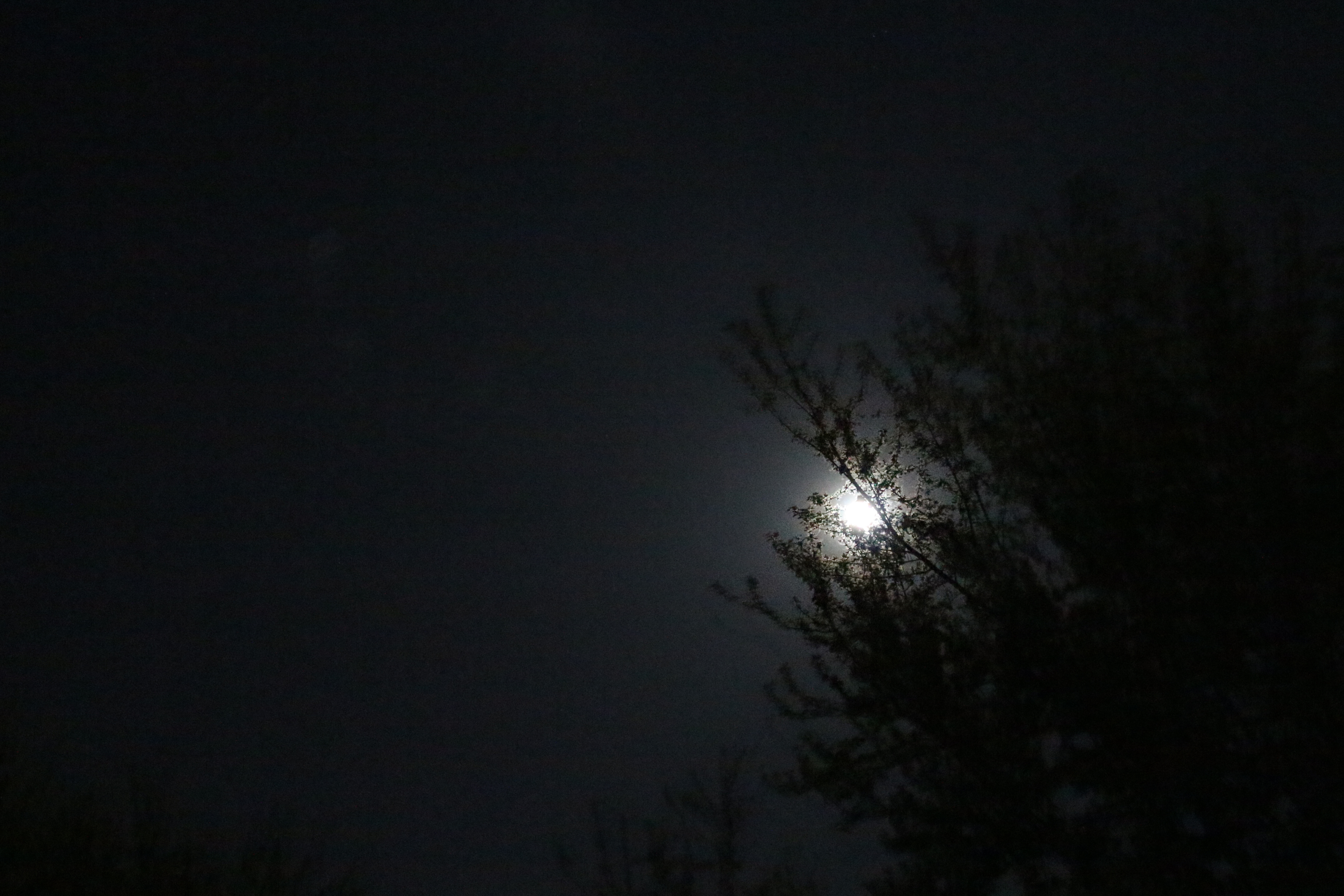
The Moon illuminating the Scheinin backyard.

With those and other thoughts in mind, I began to write. But my intent soon took a sharp change in direction when it dawned on me that the end game was not to turn out an essay about the intriguing aura that monnlit dancing casts upon the human psyche. Instead, I came to believe that the musical gods had held a meeting and decided to send a message my way. Sure, they had experienced brain freeze when they allowed me to hear Yellow Moon, but they quickly had regrouped and set things straight by showering me with Moondance. Their message was a simple one: Dance in the moonlight, fella! It’ll be fun. It’ll be good for you.

In my adulthood I’ve been a reluctant dancer. I give it a try at weddings and bar mitzvahs and other celebrations, but other than that, no. But this moonlight idea is intriguing. It might take awhile before my first dance occurs, but I’m going to coax myself. I can see it now  —  Sandy and I in our compact backyard, soft moonbeams filtering through the trees, the two of us flowing as one to the tune playing on the iPhone. Which of course is Moondance. And after that, before year’s end, we dazzle a lunar-lit stretch of sand and sea somewhere as Dancing On The Beach accompanies us. And then a meadow, where Dancing In The Moonlight shapes our movements.

(Photos by Sandra Cherrey Scheinin. If you click on a photo, a larger image will open)

(If you enjoyed this article, then please consider sharing it)

Sunday In The Park With Duane (Jazz Concert Review)

Some outdoor summer music series are better than others, but not everyone would agree on which are the good ones. Personally, I most like those that have an eclectic mix of musical genres and that also avoid tribute bands. Luckily for me and my tastes there are a number of summer series in the Philadelphia region that hire the kinds of acts that I’m a sucker for. One of those is Cheltenham Township’s Concerts In The Park, whose shows are staged in the sprawling and meticulously maintained Curtis Arboretum. There, a mile or two from Philadelphia, musicians mount a modest stage at 5 PM on five summer Sundays. They and their audiences are surrounded by, and are under, many large trees.

I’ve been impressed for years by some of the Cheltenham bookings. In 2014 my wife Sandy and I, accompanied by two of our friends, went to the Curtis Arboretum to see and hear Geoff Muldaur, who has been crisscrossing the USA and other countries as a musician for decades. Geoff began to make his name in 1963 as a member of the Jim Kweskin Jug Band. And there he was, so many years later, performing his folky-bluesy-jazzy repertoire on acoustic guitar at the arboretum.

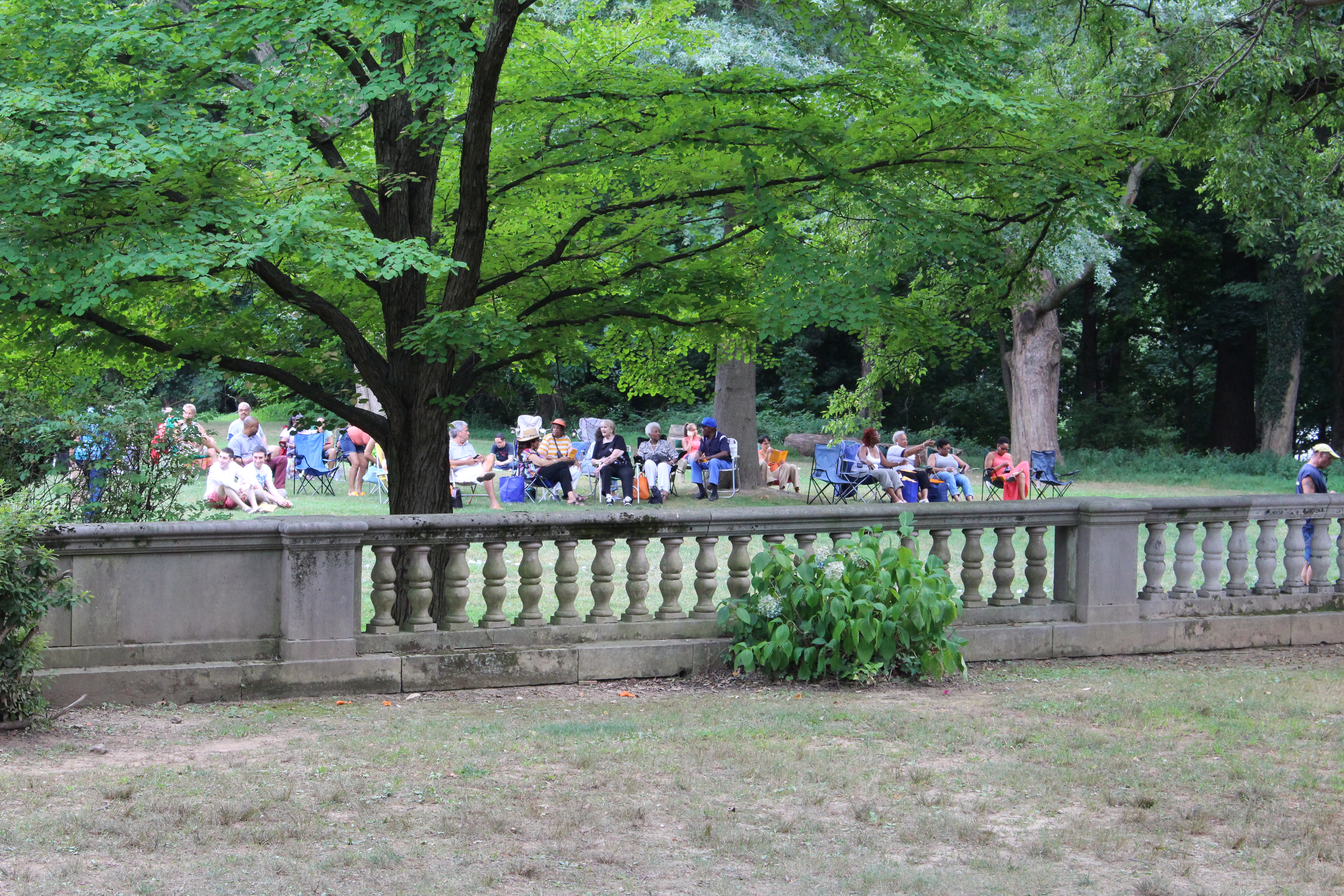
The pre-show crowd at Curtis Arboretum.

On a recent Sunday, Sandy and I, with the same two friends, sat beneath some leafy limbs at Curtis to take in another example of thinking-outside-the-box scheduling, the Duane Eubanks Quintet. This jazz outfit is more commonly witnessed in clubs. Somehow I didn’t hear Duane say from the stage that he wasn’t used to playing at settings such as Curtis, but my friend assured me that he did. Eubanks, a suburban New York City-based trumpeter with a first-rate résumé, brought along with him four fine and established members of the jazz world.

Duane Eubanks comes from a very musical family. He grew up in Philadelphia’s Mt. Airy section, so his Curtis gig wasn’t far from his childhood home. His pianist mother, who gave lessons to prominent jazz players, helped spark a musical flame in some of her children. Look at the results: Duane’s oldest brother, Robin, is a well-regarded jazz trombonist. Duane’s second-oldest brother, guitarist Kevin, became famous as the band leader for The Tonight Show With Jay Leno. Of the four male Eubanks offspring, only Shane, Duane’s twin, is not motoring on the professional musician highway.

Duane plays trumpet really well. Throughout the Curtis show I gave a mental thumbs-up to his imagination and clean lines. He wasn’t flashy, didn’t spend inordinate amounts of time swirling around in his instrument’s nosebleed zone. What he did was this: He spun worthy tales with his horn, filling his solos with strong ideas, and balanced that with terrific technique. I don’t think I had ever seen him in concert before. I was impressed.

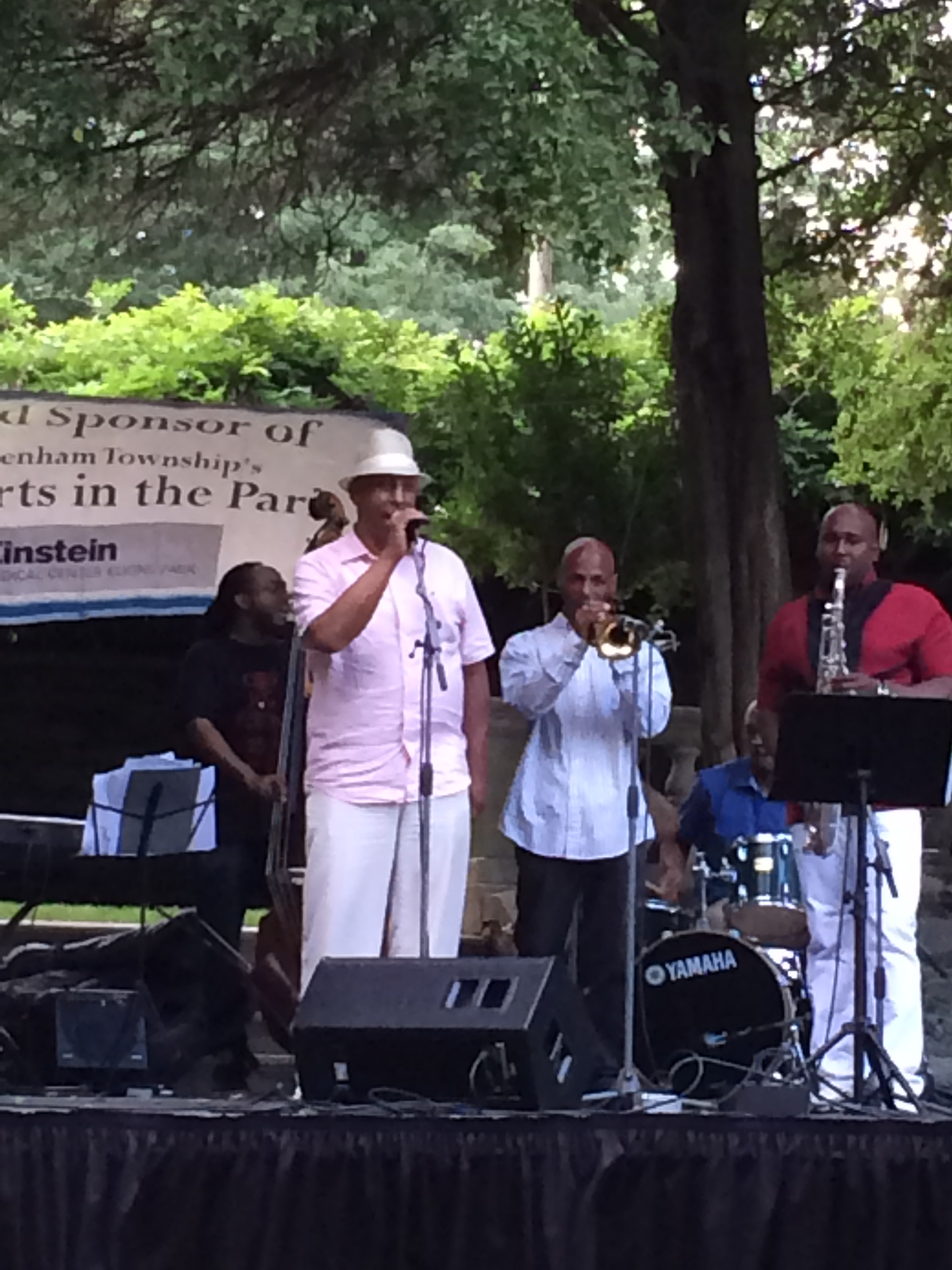
Duane Eubanks Quintet at Curtis Arboretum.

Eubanks and company primarily stayed in the hard bop bag, with two excursions, which I wasn’t crazy about, into the borders of smooth jazz territory. The tough and driving stuff and the one unadulterated ballad, though, were terrific and had my head swaying. On board with Duane was tenor saxophonist Abraham Burton. Burton’s robustness and energy owed debts to John Coltrane, his more meditative moments to Dexter Gordon. David Bryant was a whiz on electric keyboard, an attentive musician filling spaces deftly when Duane or Abraham soloed, his fingers flying fast and furious when he himself took the lead. Corcoran Holt, on upright bass, helped power the band with notes that sometimes boomed, sometimes cooed. I thought that he was great. And the in-demand drummer, Eric McPherson, was all over his kit, rat-a-tat-tatting on his snare drum, whacking à propos accents on his cymbals. I didn’t particularly enjoy his work on the two aforementioned smoothed-out numbers, but let’s put them aside. I already have.

The tune I maybe liked the best was the first set’s opener, a Eubanks original titled Slew Footed. It went on for 20 minutes. Slew Footed was a hard romp, a controlled yet convulsive affair. Each musician took long propulsive solos. Each listened carefully to what the others were saying. The onstage musical conversations were animated and keen.

Guest vocalist TC III with Duane Eubanks' group.
Guest vocalist TC III with Duane Eubanks’ group.

Halfway through the second set Eubanks brought to the stage a guest vocalist, TC III. I used to see him perform at venues all over Philadelphia, but hadn’t in 20 or more years. He sang on two songs. TC III took hold of the first tune, Moanin’, from its opening notes. I had forgotten just how fine a singer he is, bluesy and direct. Think Eddie Jefferson. Think Joe Williams. Moanin’, a gutsy marriage of the blues and gospel, was a staple of Art Blakey And The Jazz Messengers. I loved the way that TC III and the Eubanks group belted it out.

I’m a stickler for good audio projection. Too often at concerts, in venues small to enormous, the sound quality doesn’t cut the mustard. At Curtis the sound guy got it right. Every instrument, and TC III’s vocals, came through loud and clear. There was no muddiness in the mix. All of this added to my enjoyment of the show. As did the weather. For much of the late afternoon and early evening, dark clouds massed and inched along far overhead. I was certain that a downpour was in the works, especially after a dozen or so raindrops plunked me around 6:30 PM. Amazingly though, not another drop fell after that.

(Photographs by Sandra Cherrey Scheinin. If you click on a photo, a larger image will open)

(If you enjoyed this article, then please consider sharing it. Thanks.)

A Pretty Park Can Be Pretty Hard To Find

Back in 1981 the Philadelphia Museum Of Art mounted an exhibition of photographs by Robert Adams. Adams took the photos in the 1970s. They were images of western American states, the desolate areas, primarily deserts and mountains. I remember the show fairly well. No matter how remote the locale, nearly every photograph bore evidence of man’s hand: A telephone pole, tire ruts in the sand, roads winding like barber pole stripes around magnificent mountains. One of Adams’s points was that pure wilderness is long gone, so we better get used to it and be glad for the great though adulterated spaces that exist. I imagine that even if you found yourself in the middle of Antarctica’s biggest ice shelf, and I don’t wish that fate on too many of us, you wouldn’t have to wait impossibly long before an airplane passed overhead. Man is everywhere. Yikes.

Now, a half-baked embryonic distillation of those thoughts was in my head recently when my wife Sandy suggested that we walk around the grounds of Abington Art Center, a few miles south of our home in the Philadelphia suburbs. “Sure,” I said, “good idea.” But what I didn’t say is that I’d prefer to stroll some expansive Adams-like terrain. In my dreams. Around here in the burbs, man for the last 75 years has been relentlessly busy cutting down trees and pouring cement. Around here, you have to count your lucky stars that any good-looking patches of territory of any sort still exist.

Manor house and lawn at Abington Art Center.

Abington Art Center is one of those patches. The center contains the manor house and some of the grounds of a former estate. The house is used for art classes and gallery exhibits and the like. The grounds mostly are a huge lawn that slopes away from the rear of the house and 10 or 15 acres of woods. It’s a lovely place. And it is more than manor, grass and trees. Scattered here and there on the great lawn and on side lawns and in the woods are all manner of sculptures, about 50 all told. Sandy and I had a good time at the center. For two hours we looked at trees and artworks and burned off a few calories while walking a couple of miles.

The play of light in the woods at Abington Art Center.

I like the outdoors. But I’m hardly a naturalist. My knowledge of flora and fauna has more holes than you can count. And so at Abington Art Center I found myself admiring a specific leafy tree species, of which many examples exist in the center’s tiny forest, having no clue what I was looking at. They weren’t maples or oaks. Those I can identify. Whatever the trees were, they were  the tallest at the center. They measured well over 100 feet from bottom to top and didn’t wander leftward or rightward on their way towards the heavens. Their mothers must have told them from an early age to stand up straight. What also fascinated me was the play of light within the woods, how one tree’s upper reaches might be caught by the day’s intense sun, while others only a few feet away were out of the sun’s direct path. Contrasts of this sort always have appealed to me.

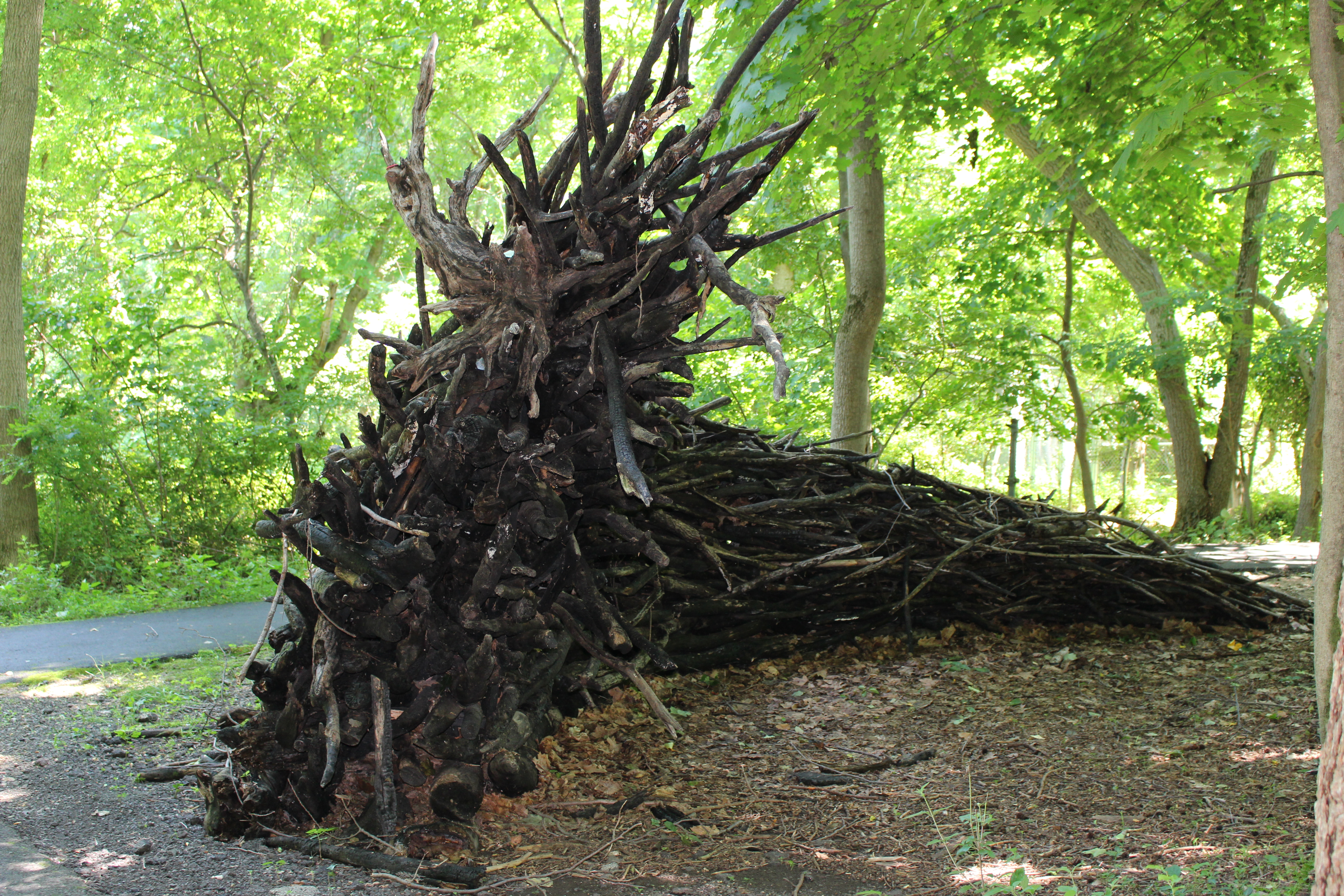
Mazzaroth is Alison Stigora's construction of burnt tree branches.
Mazzaroth is Alison Stigora’s construction of burnt tree branches.

The sculpture I thought the most of in the woods was Alison Stigora’s Mazzaroth. It’s an assemblage of burnt tree branches fitted together tightly to portray . . . what? A serpent? The movement of time? As the years go on, Mazzaroth will crumble and become one with the forest floor, as will the trees surrounding it.

You’re not going to confuse many of the sculptures at Abington Art Center with creations by David Smith, Louise Nevelson or other deservedly famed artists. Few if any are on that level. Some though, like Mazzaroth, had me looking them over from different angles because I liked them a lot. Take two on the great lawn, for instance. They are placed near each other and are as different as they can be.

Cabin Van Gogh at Abington Art Center.
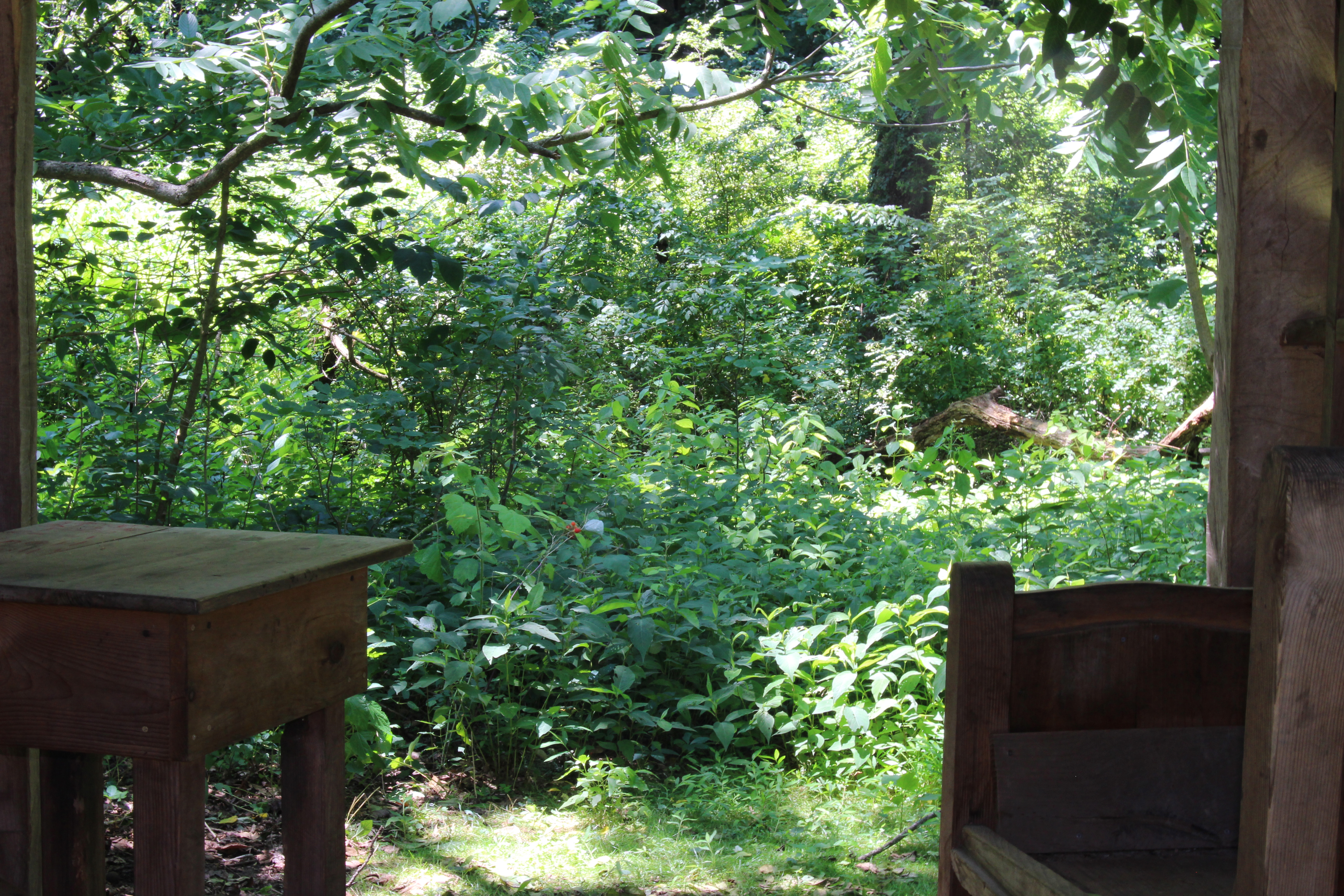
Partial view of bed and table inside Cabin Van Gogh.

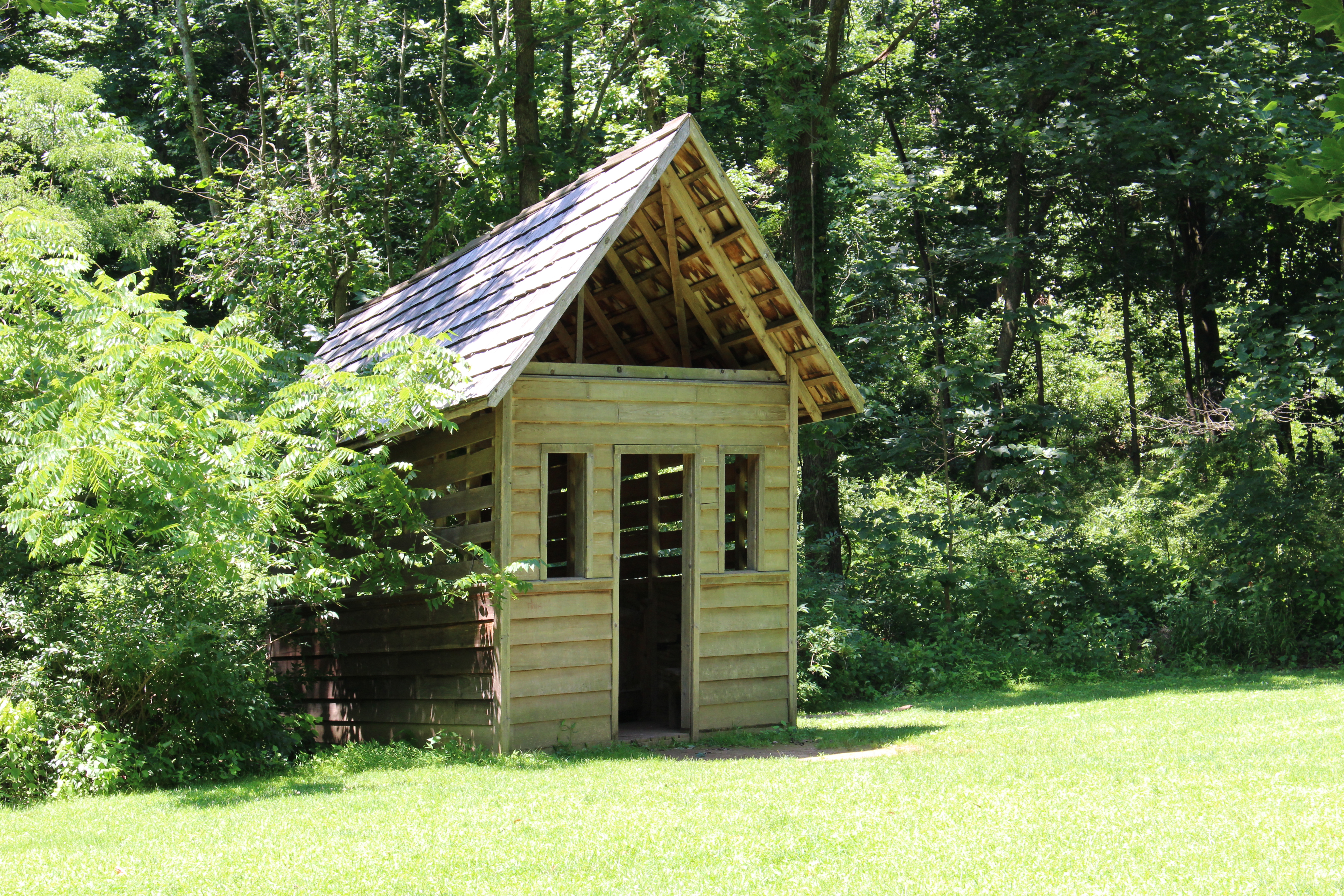
What is a lopsided small wooden cabin doing on the grass at Abington? Well, it’s a whimsical piece of art and is right at home there. Weather-beaten, cute and loveable, it contains within, of all things, a bed, chair and table lifted straight out of Vincent van Gogh’s paintings of his bedroom in Arles, France. This work is Knox Cummin’s Habitation Suite: Cabin Van Gogh. Vincent I believe would have been charmed  by Cummin’s idea to build such an unlikely homage, and also by the view of foliage from the cabin’s open back side.

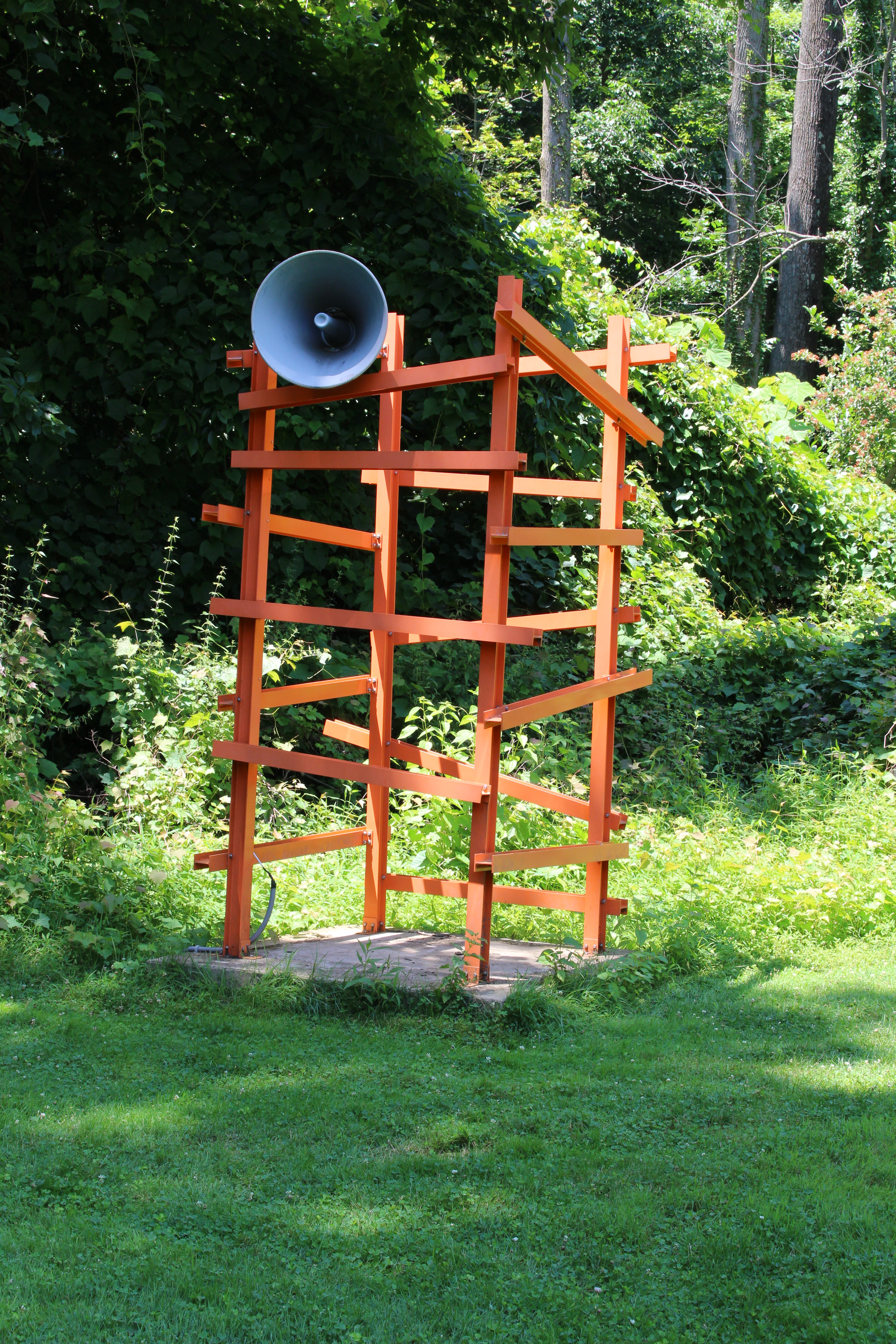
David Schafer's orange sculpture at Abington Art Center.
David Schafer’s orange sculpture at Abington Art Center.

Uphill from the cabin stands what looks a bit like a lifeguard tower painted in bright orange, some of its support slats atilt. David Schafer, the creator, named his piece Untitled Expression: How to Look at Sculpture. I suspect that the notions behind the giddy orange tower are partly conceptual. Sculptures, like just about anything, are multifaceted. No need to try and pin down a precise meaning. Observe, surmise and enjoy. One of my takes, subject to change, is that the sculpture is alive yet indecisive, that it is shaking out its stiff bones and readying to inch forward but hasn’t gotten into gear quite yet. And what’s going on with that public address system speaker? I remembered later that it had a practical purpose once, as a recorded message played from it for months after the sculpture was first installed about six years ago. Sandy and I were at Abington Art Center at that time and heard the message. If we were put into a deep hypnotic state, maybe we’d recall what the message was. Gone silent, to me the speaker now just looks cool.

(All photos by Sandra Cherrey Scheinin. If you click on any photo, a larger image will open)

(If you enjoyed this article, then please consider sharing it. Thanks.)