The Story That Almost Wasn’t: A Sculptural Walk Through Philadelphia

“When things go awry, write the f*cking story anyway.” — Benjamin Franklin, Philadelphia, October 2, 1774

Leave it to Ben to get me back on track. Last week I happened upon the above quote in Mr. Franklin’s excellent book, Good Advice For Those Who Probably Are Too Damn Dumb To Know They Need Some Good Advice. Franklin published Good Advice in May 1775 at the behest of his friend Thomas Jefferson, a future American president. A few months earlier Jefferson had lit a fire under Franklin by saying this to him: “Ben, you’ve been talking about compiling some of your recent sayings into a book. F*cking do it already!” I tell you, I like the robust way that Ben and Tom talked.

If I hadn’t been thumbing through that little-known volume in a local library, the story you’re currently reading wouldn’t exist. Thank you, Benjamin. I’ve always believed the multi-talented Mr. Franklin to be the most accomplished and remarkable American of all time. And never, certainly, did I expect that he would kick my ass into gear.

For a year or more I’d had it in my mind to stroll through Philadelphia’s central sections, looking at and taking photos of my favorite outdoor sculptures. And, it goes without saying, turning the adventure into a story for my online abode. When the 6th of December rolled around last year I decided that the time had arrived. Despite it being a windy and cold day, into the city I headed from my suburban town. I was feeling good and was ready for action.

I arrived in Philadelphia with a list of the works I planned to visit. They comprised a tiny percentage of what’s out there, because Philadelphia, and not just in its central region, is loaded with outdoor sculptures. Many of them, natch, are of war heroes atop horses. Civic leaders, natch, also are well-represented. Me, I dig those sorts of fare — statues if you will — when they’re done stylishly. But I’ve always been more drawn to sculptures that are less standard and full of flair and vigor.

Bolt Of Lightning, by Isamu Noguchi

My first sculptural stop would be in the city’s Colonial-era section, at 6th and Race Streets, near where Franklin lived and even closer to where he is buried. There, in the middle of a traffic rotary often crazy with vehicles going to and from the Benjamin Franklin Bridge, stands Isamu Noguchi’s 101-foot-tall Bolt Of Lightning. It commemorates Franklin’s kite-flying experiment, during a thunderstorm in 1752, that showed the connection between electricity and lightning. Yes, Ben was the man.

In retrospect, the Bolt Of Lightning situation that I encountered should have tipped me off that the day might not turn out as hoped for. I wanted to dodge the whizzing cars and climb onto the rotary, where I’d get some up-close-and-personal photos of the very cool sculpture. But, wouldn’t you know it, a police car was parked beside the rotary. Sure as shit, if I had tried to reach the Bolt a police car door would have opened and I’d have been told to get the hell out of there. So, from a hundred feet away I took what images I could.

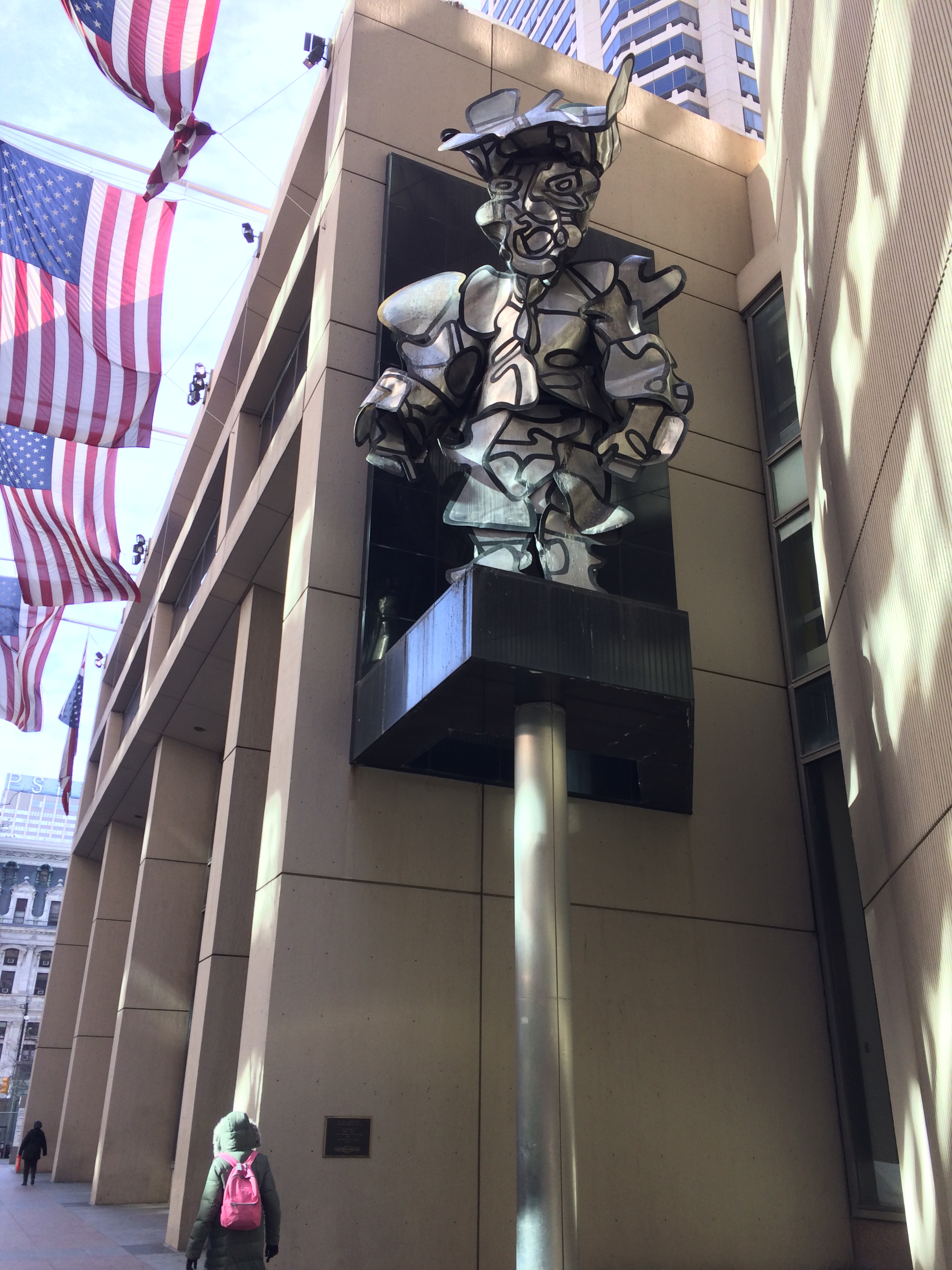
Milord La Chamarre, by Jean Dubuffet
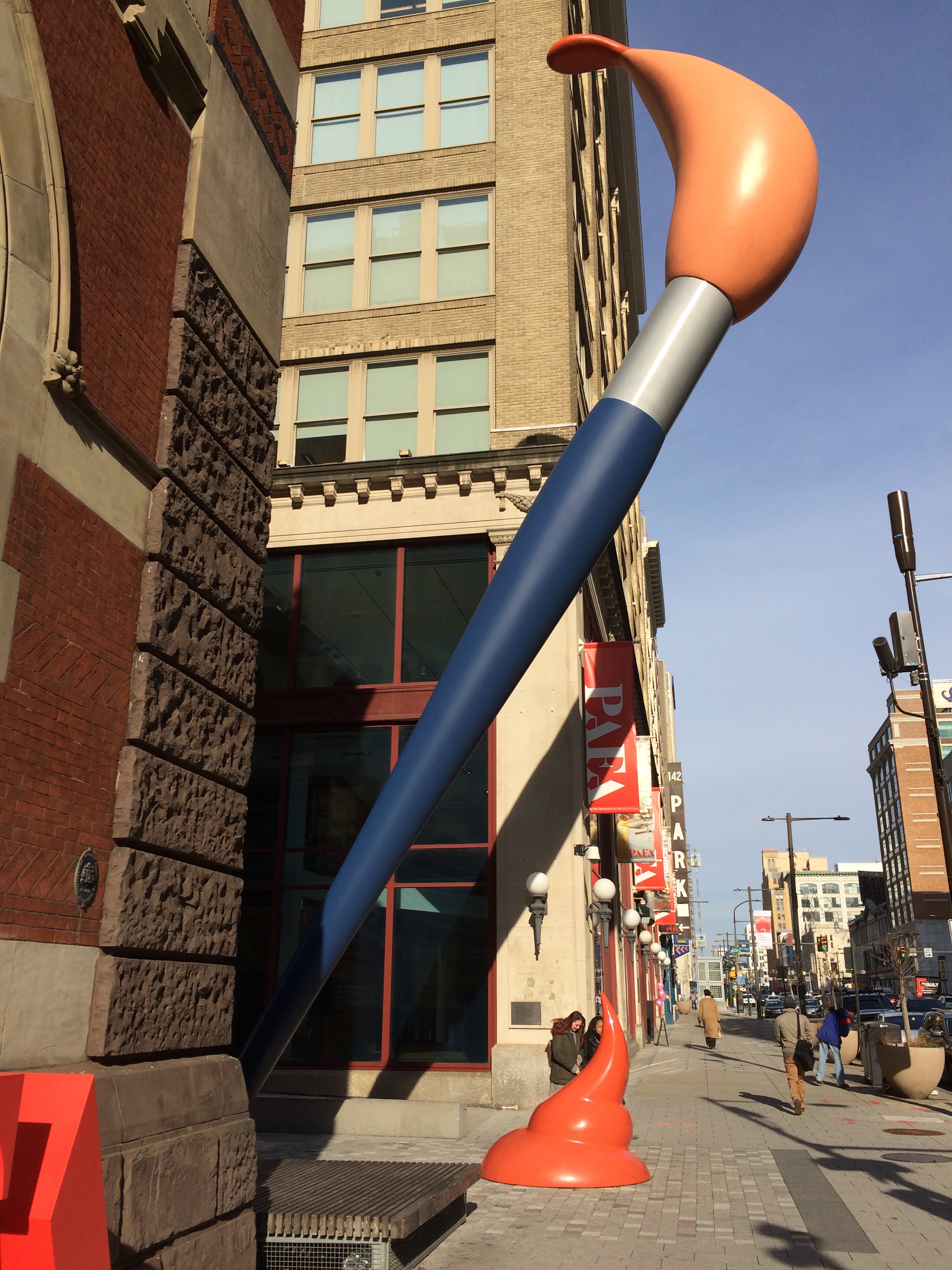
Paint Torch, by Claes Oldenburg

After that I walked and walked, grabbing shots of artworks I’ve loved for years. Jean Dubuffet’s Milord La Chamarre, for instance, which is a wild and wooly vision of a nobleman, and Claes Oldenburg’s giant representation of a paintbrush balanced on the tip of its handle. Claes’ sculpture, Paint Torch, is appropriately placed, as it sits beside The Pennsylvania Academy Of The Fine Arts.

The Bond, by James West
(Ben Franklin on left, George Washington on right)

In front of the Masonic Temple, on my way to the Oldenburg work, I passed James West’s The Bond, a lifelike and life-size sculpture of Ben Franklin and George Washington, the USA’s first president. The guys, both of whom were Masons, are happy to see each other and are admiring Washington’s Masonic Apron. I probably had walked past this piece before but hadn’t really noticed it in a meaningful sense. At once it leaped onto my list of faves.

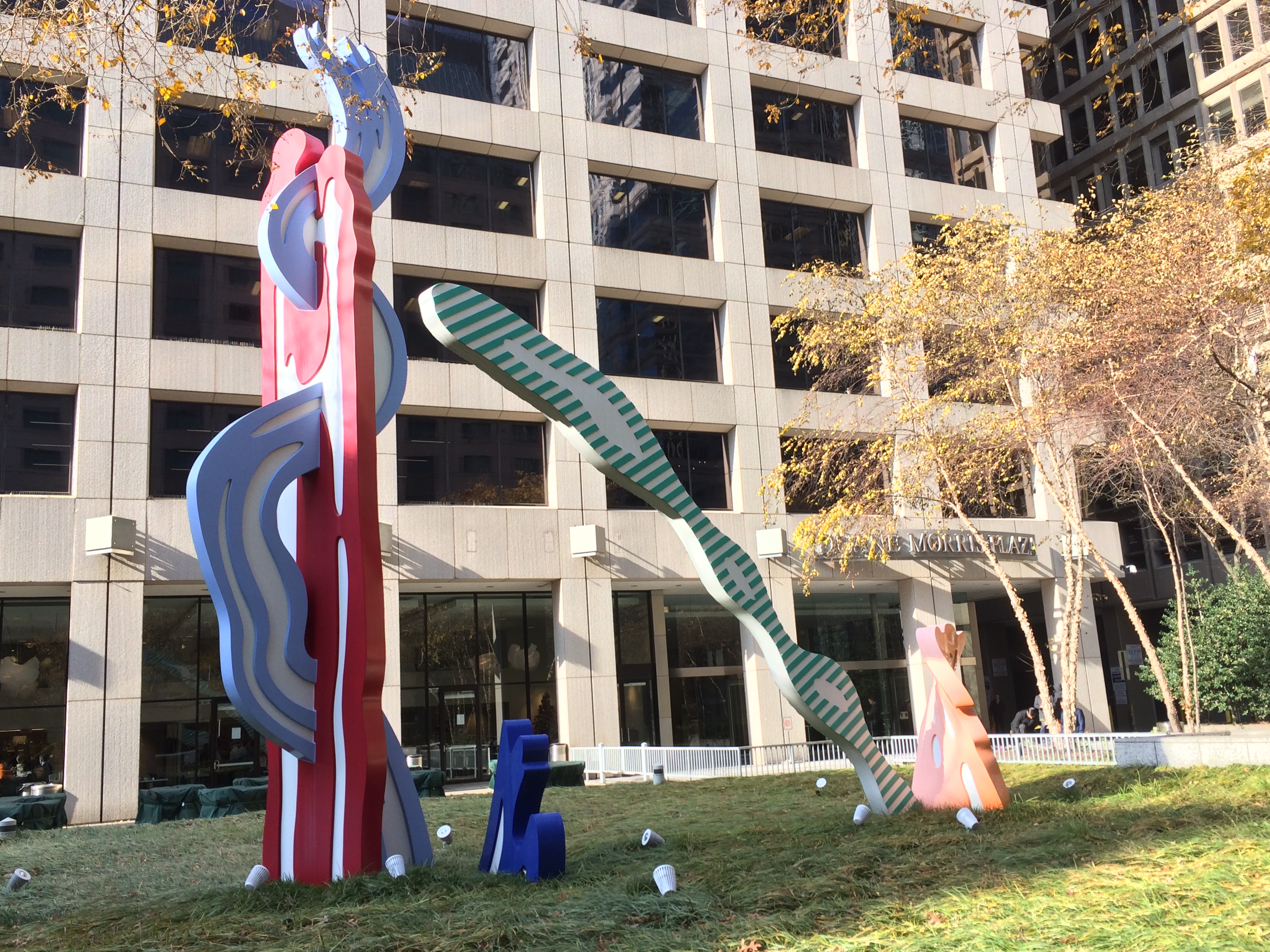
Brushstroke Group, by Roy Lichtenstein
Rock Form (Porthcurno), by Barbara Hepworth

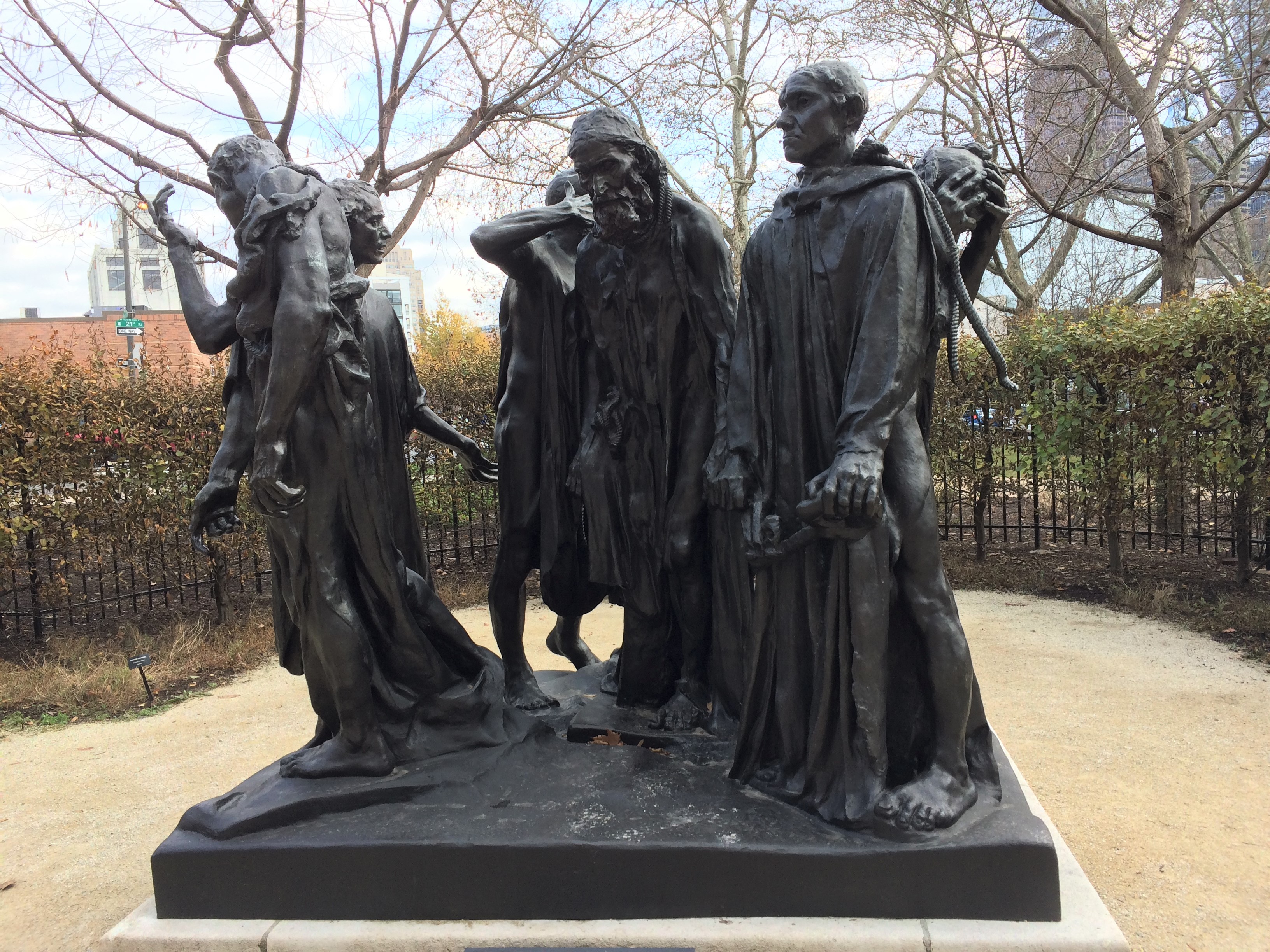
Yeah, things were going swimmingly. But in the latter half of my stroll, my phone’s battery did something it never had done before. It went dead. I went into a public library and plugged the phone into an outlet, eventually resuscitating it. Then I continued my trek, a few minutes later reaching the Rodin Museum, on whose grounds sits my number one outdoor sculpture. Its English title is The Burghers Of Calais. The creation of Auguste Rodin, a Frenchman, it is stunning. A memorial to bravery and a profound depiction of anguish, the sculpture shows leaders of Calais, in the mid-1300s during war between France and England, gathering to face their death. The men had volunteered to be executed by English hands in lieu of a threatened killing of their city’s entire population. The intervention of the English queen, at some later point, saved them.

The Burghers Of Calais, by Auguste Rodin

I planted myself in front of The Burghers, aimed my phone’s camera at it and pressed the button. Voilà, a pretty good shot. Then I moved to a different spot to take a photo from another angle, got the camera ready, and . . . the screen went dark! The frigging battery had died a second time. An attempt at revival, via an electrical outlet inside the Rodin Museum, failed. Disgusted, I made haste to Suburban Station, within which trains that go to my little town may be found.

My mission had not been accomplished. Rodin’s sculpture required multiple photos, I felt, to capture its complexity. What’s more, two other sculptures on my list were left waiting for my visit. They had to be part of my write-up. A dejected semi-perfectionist, I threw the outdoor sculpture story idea into my cranium’s rubbish bin and left it there to decompose.

Seven weeks later, thankfully, I encountered Ben Franklin’s words of wisdom, the ones that are placed at the top of this essay. And I also encountered my wife Sandy’s comments when she was looking through the photos on my phone (the phone, by the way, somehow bounced back to life on December 7). “I like the sculpture pictures that you took last month,” Sandy said.

Looking at them again, so did I. And thus I decided to write the f*cking story anyway, a story that has some warts and holes but will have to suffice. As everybody knows, not everything turns out the way you want it to. You’ve got to roll with the punches and get on with life. That’s what big boys and big girls need do, a truth I’m not always great at keeping in mind.

(Please don’t be shy about adding your comments or about sharing this piece. Gracias!)

(If you click on any photo, a larger image will open is a separate window.)

Signs In The Night, A Dive Bar, And Two Great Songs

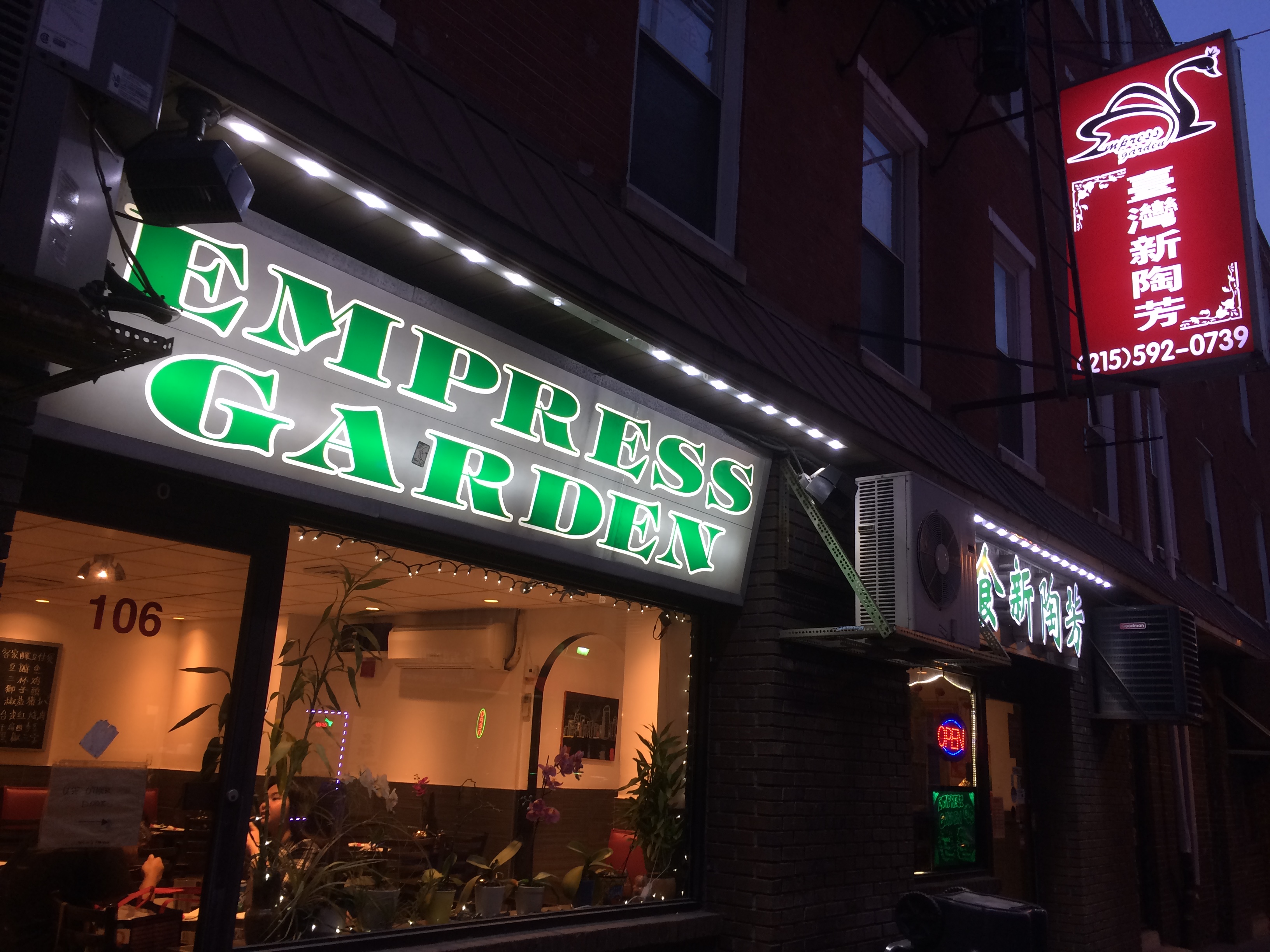
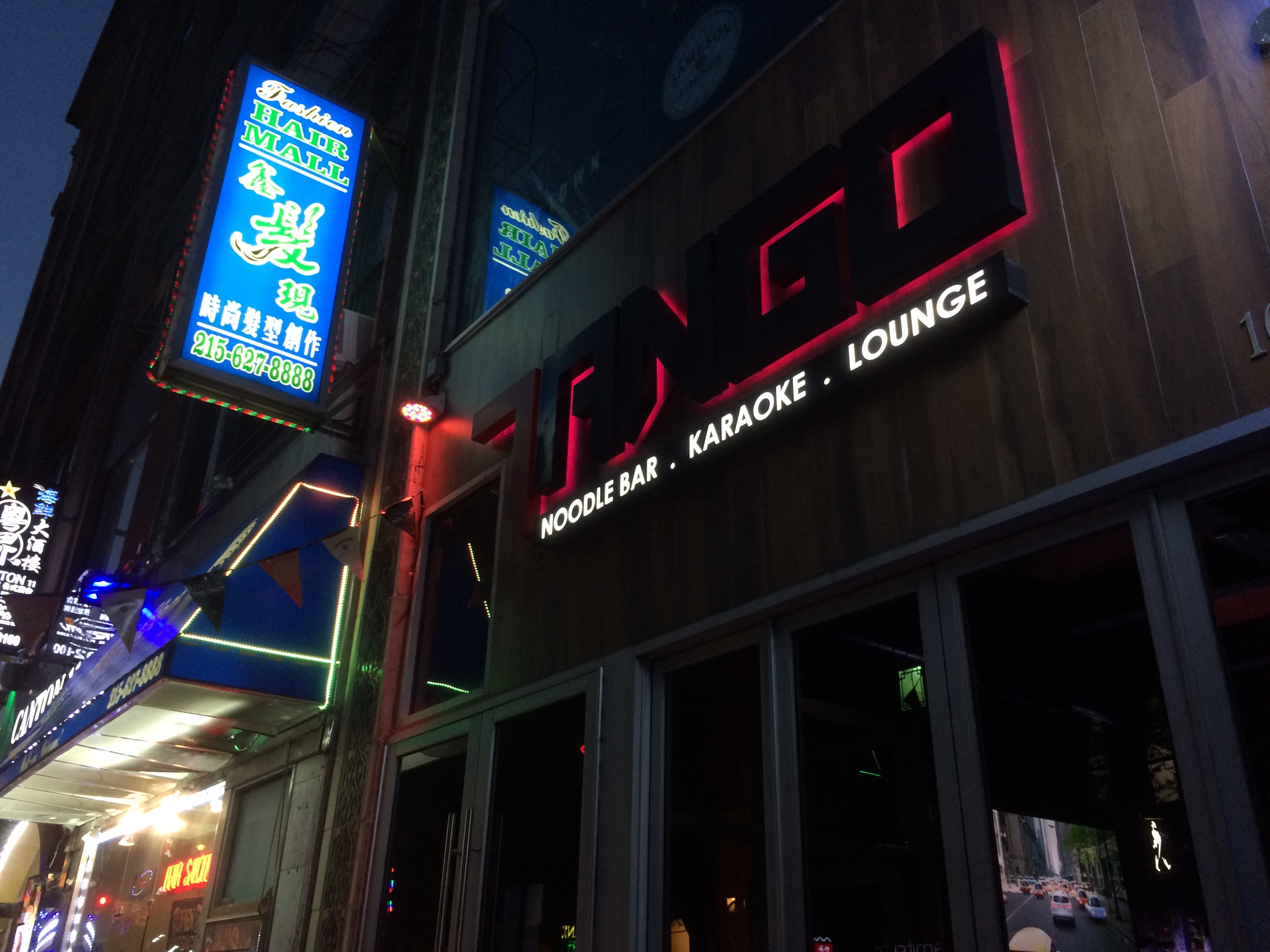
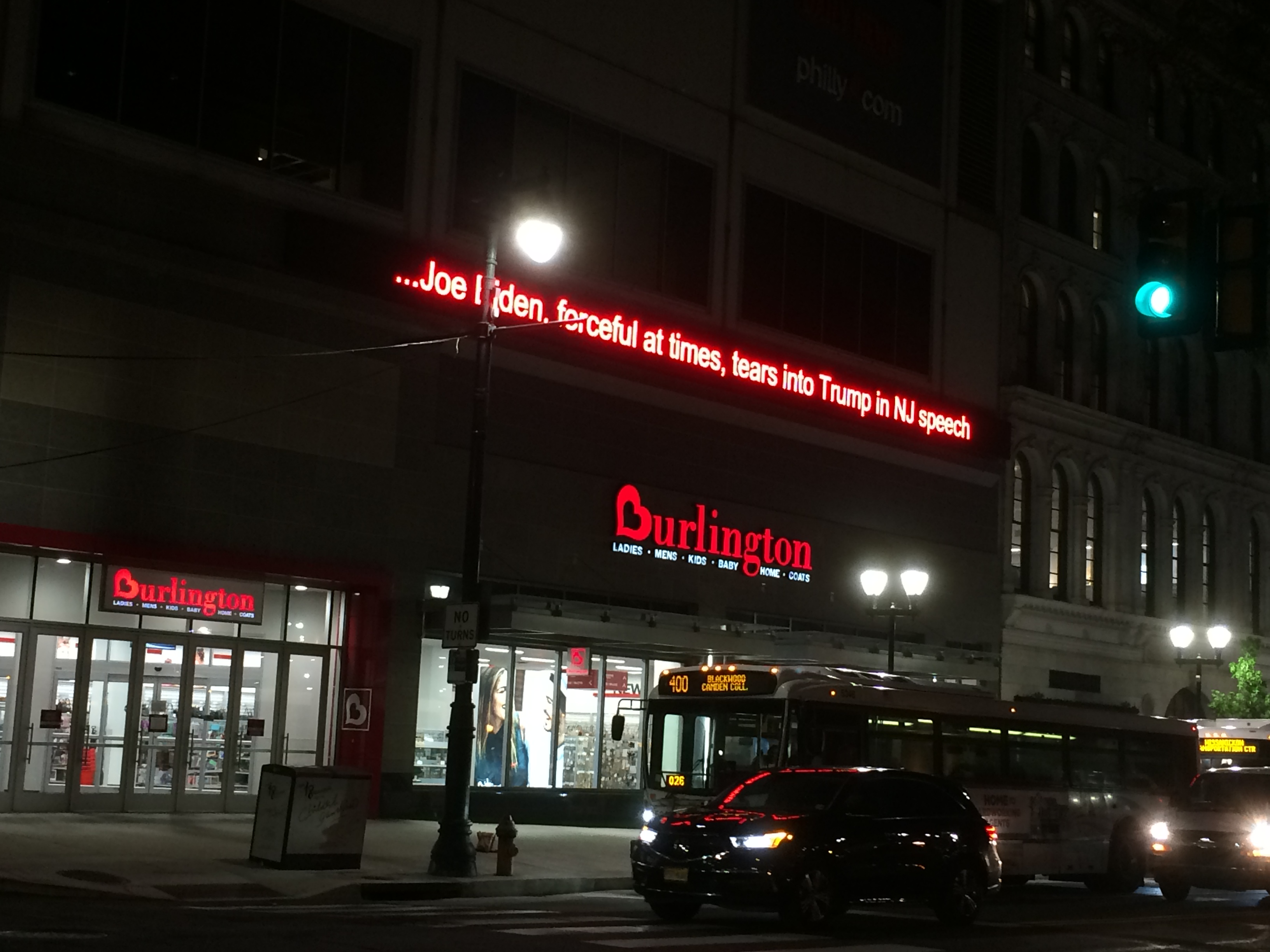
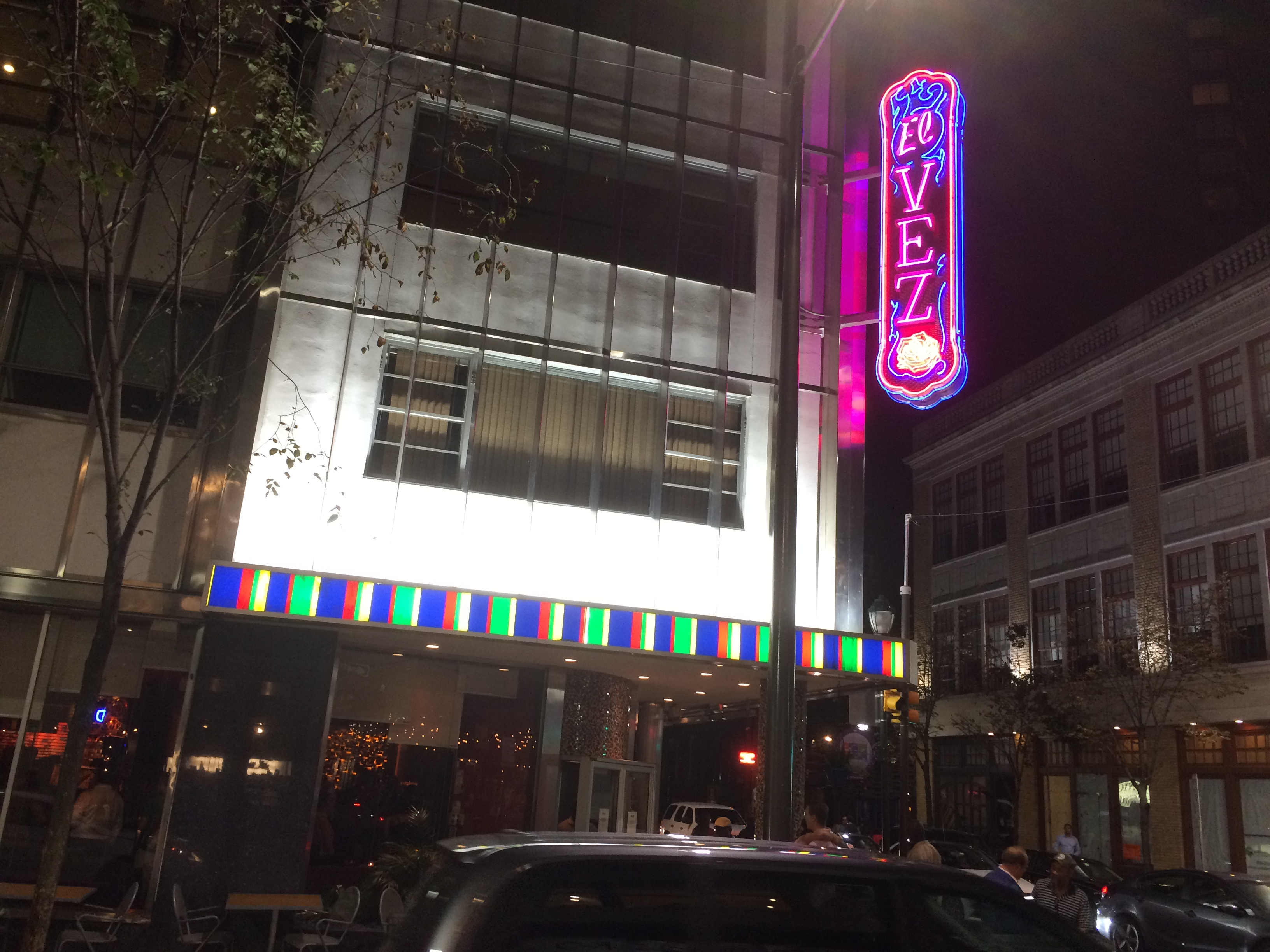
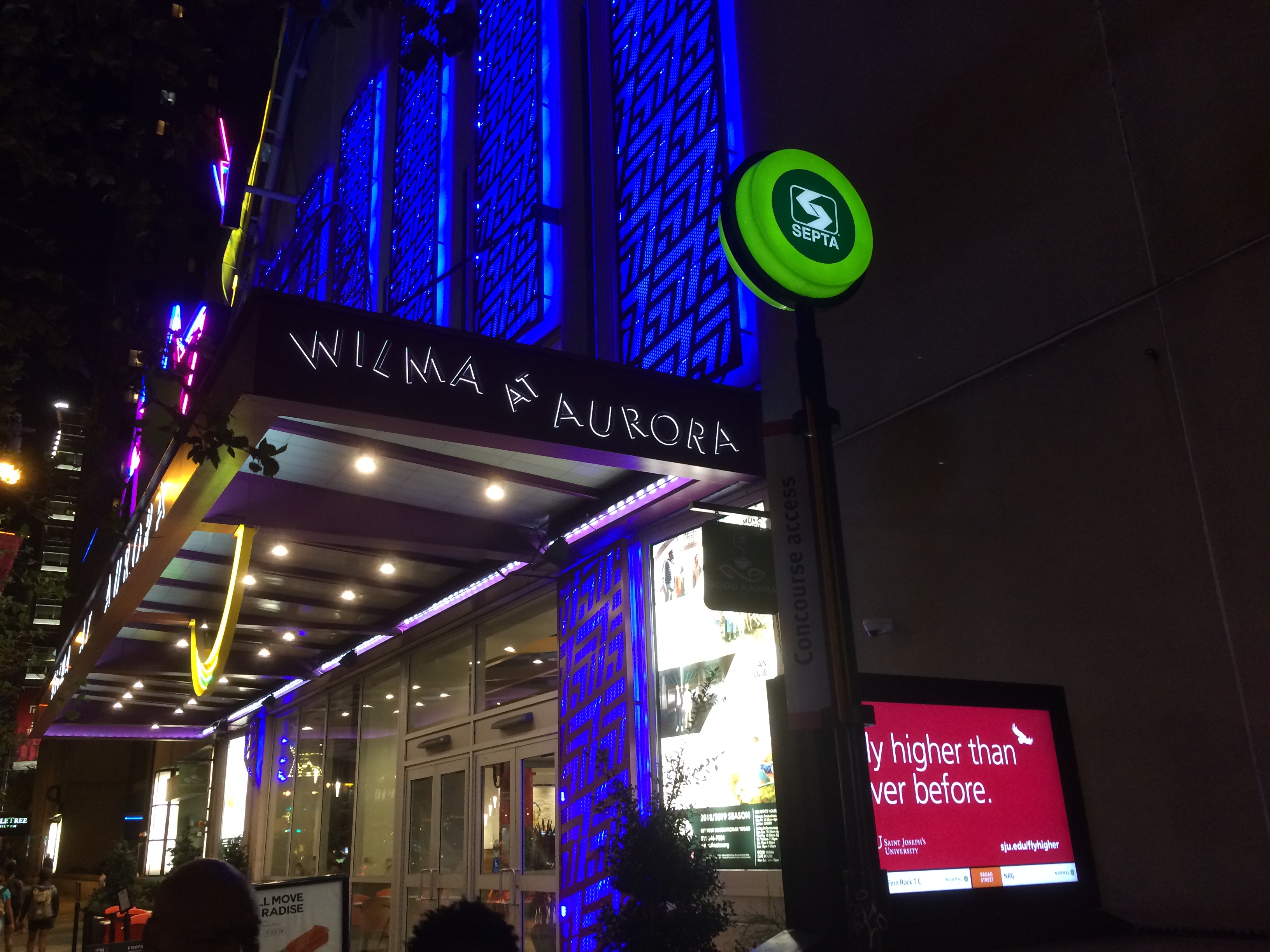
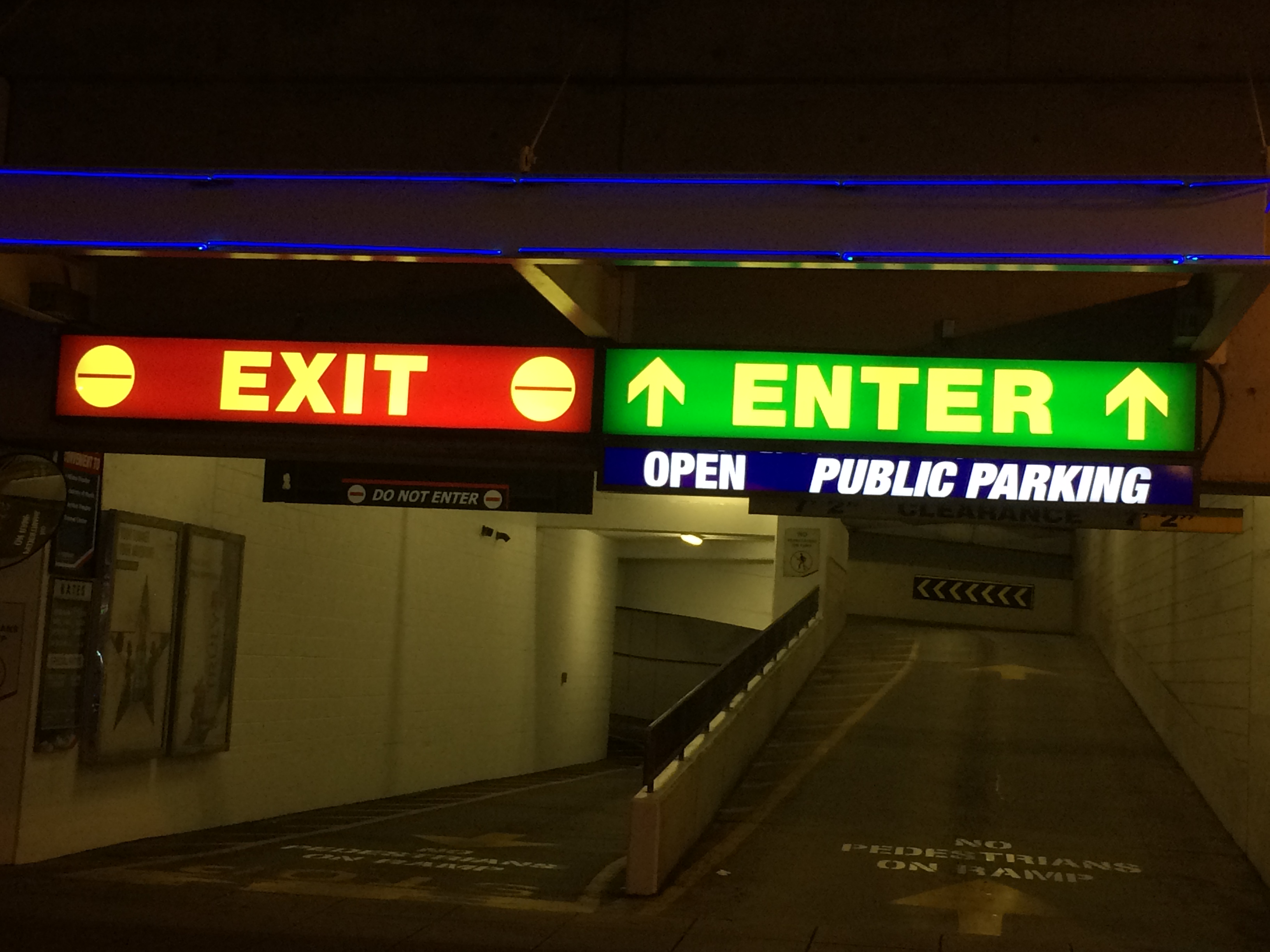
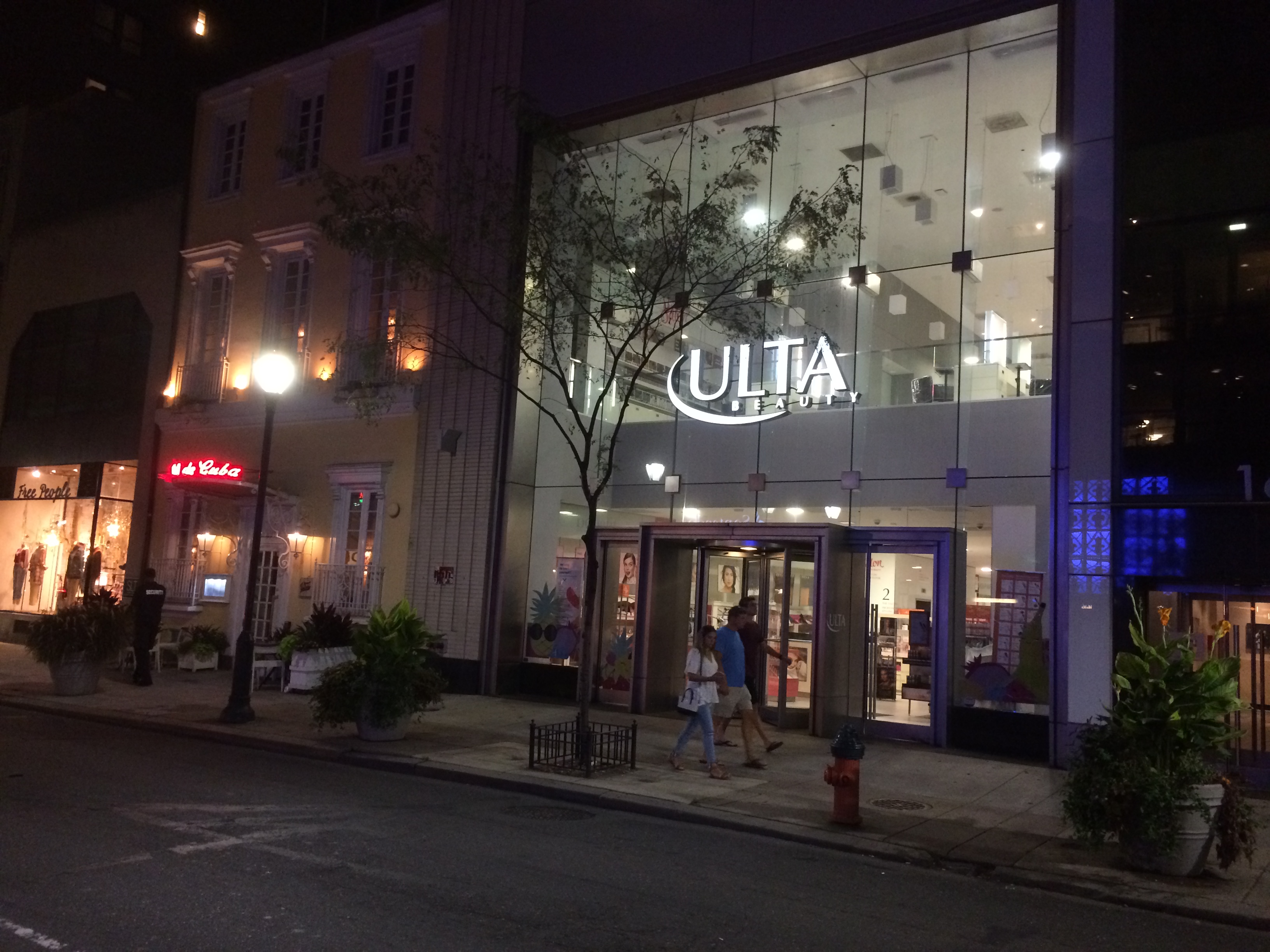
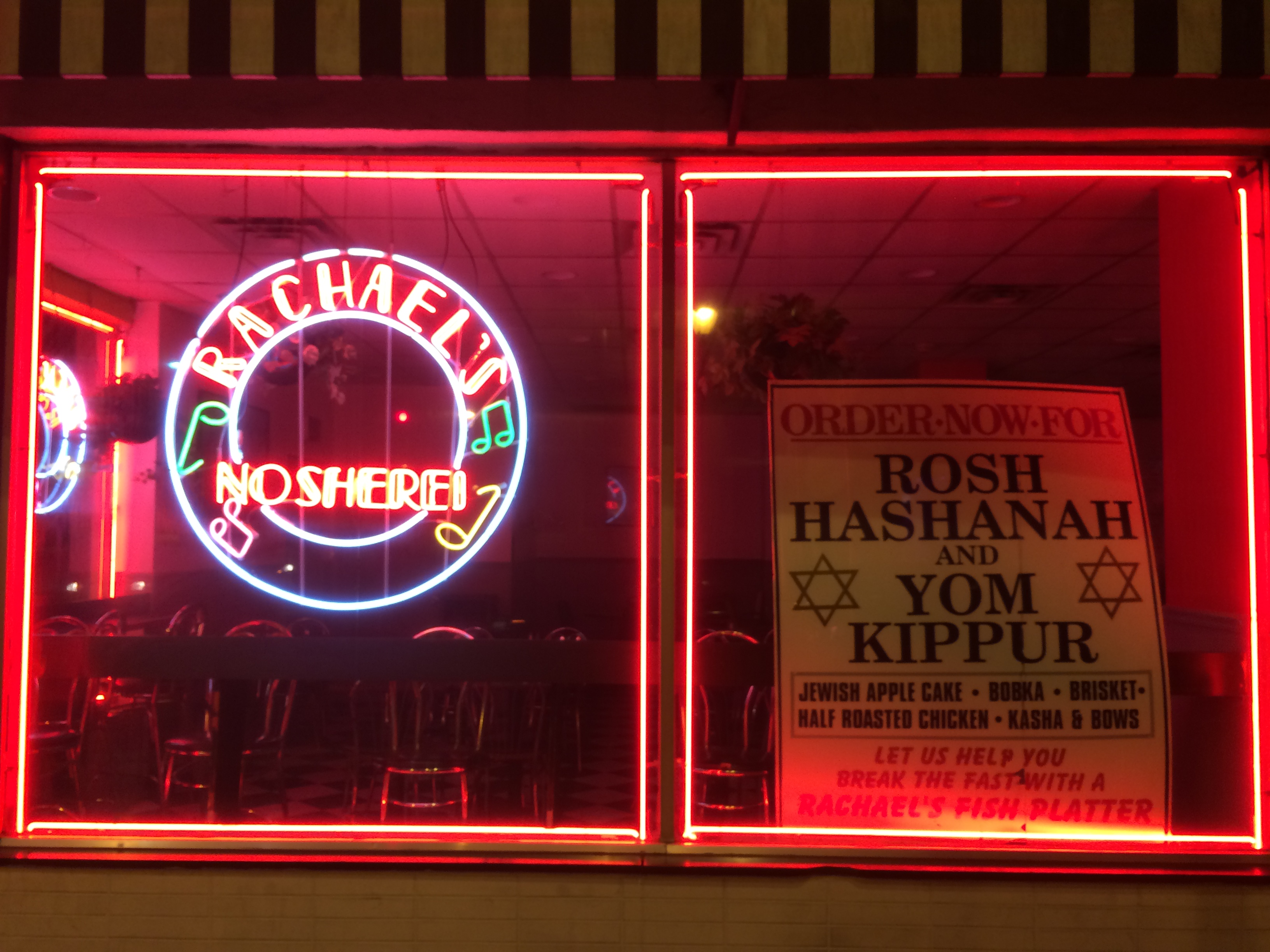
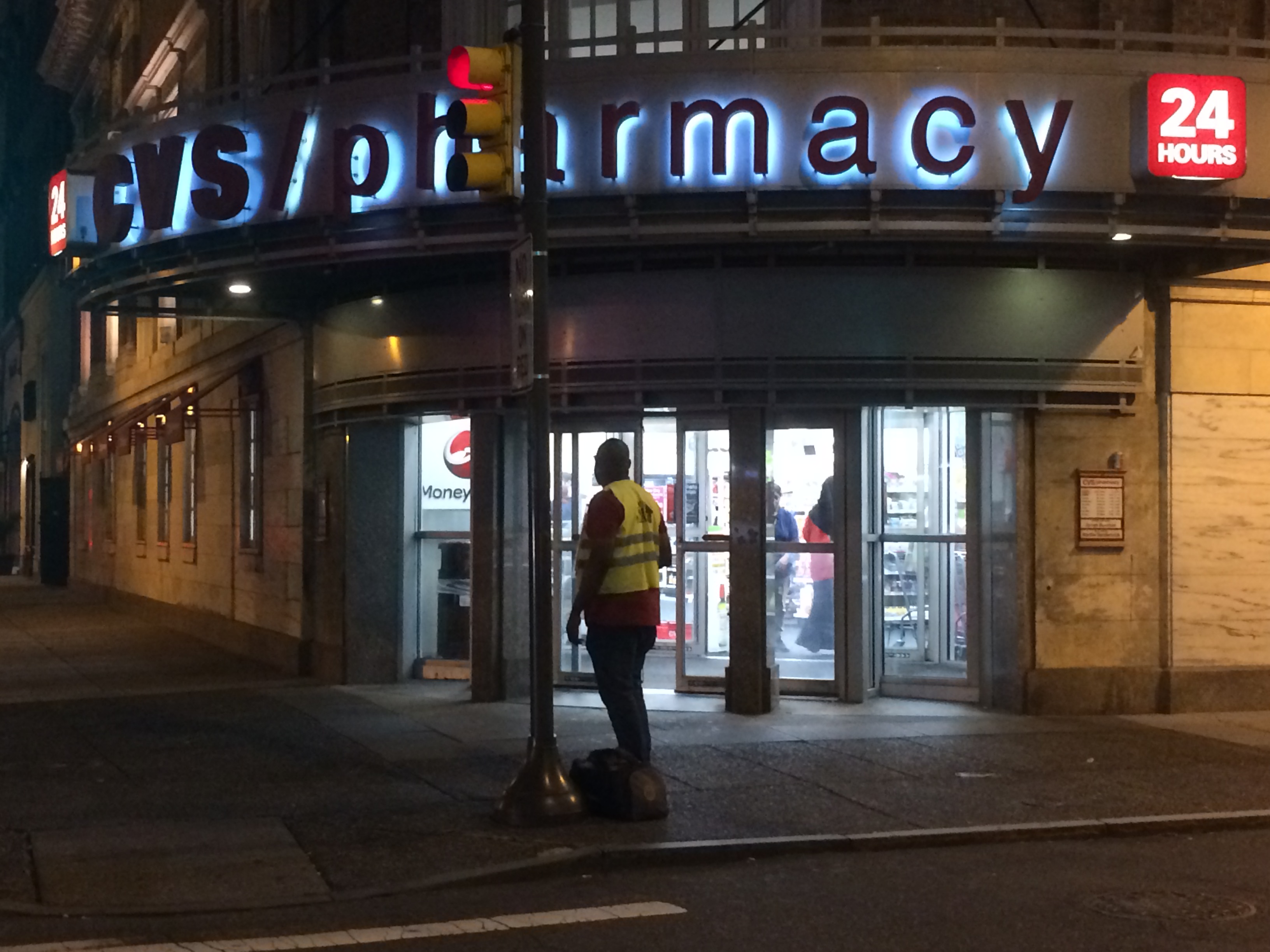
Last week’s Wednesday evening found me in central Philadelphia, wandering its streets on assignment for the publication you’re now gazing at with loving eyes. I walked for several miles, zigzagging within the area bounded by Cherry, Spruce, 9th and 19th Streets, all the while giving my fingers plenty of exercise as I snapped picture after picture of illuminated signs. For that was my mission: To capture images of glowing signs, in much of their variety and in all of their glory, under darkened skies.

Chinatown (10th Street between Arch and Cherry Streets)
Chinatown (Arch Street between 10th and 11th)

The train that I boarded in my suburban town delivered me to Jefferson Station, at 11th and Market Streets, at about 7:30 PM. Not much more than a handful of minutes later, night began to emerge. Only a block north of the station I strode into the city’s compact and enticing Chinatown section. There I took my first photo of the evening. And then another and then another . . . Hey, one of these days I might devote an entire essay to Chinatown. It’s worthy, very much so. But I had miles to go before I slept, or something or other like that, so I gave Chinatown a nice looking-over and then made my way to other parts of town.

9th and Market Streets
13th and Sansom Streets

The temperature had peaked at around 95 degrees Fahrenheit (35°C) during the day, but was six or seven degrees lower during my mighty walk. Not too bad temperature-wise. Still, conditions weren’t all that great, what with Amazon jungle-like humidity hanging around. Yo, I was sweating like a f*cking pig. But manly man that I am, I motored on uncomplainingly, though if my wife Sandy had been with me I’d probably have been whining to her like a major wuss.

Corner of Broad and Spruce Streets
15th Street near Latimer Street

Anyway, the walk pleased me a lot. Not long into it I realized that I was having grand fun. After all, I love to wander. And I love looking at the sights, including cute girls, quite a few of whom passed before my eyes. In fact, loads of people, cute or not, were on the streets with me, engaging in the sorts of activities that humans are prone to engage in: strolling around; checking each other out; heading to or from work; schmoozing with their pals on street corners or at sidewalk restaurant tables; popping in and out of stores and bars. Not surprising, because Philadelphia has got what it takes. It’s big, it’s fascinating, there’s a ton to see and do any time of day. Yup, I could gush some more about the city that I know better than any other in the good ol’ USA, but that previous sentence will do for now.

Walnut Street between 16th and 17th
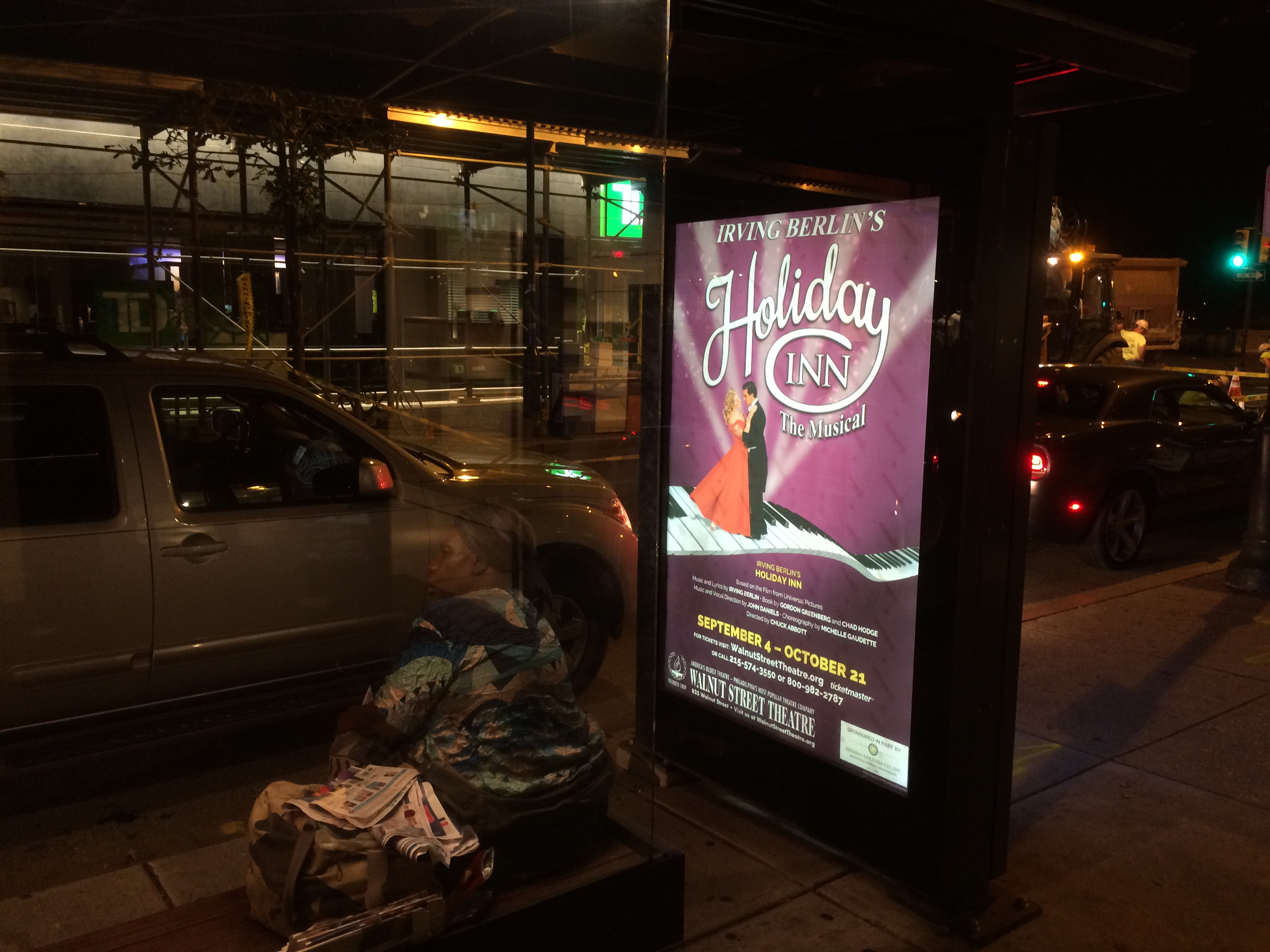
Bus stop at 18th and Walnut Streets

What I forgot to mention is that I also love to snap photos with my iPhone’s camera. And there were countless opportunities to snap away, so full of lit-up signs is much of The City Of Brotherly Love at night. I pretty easily could have added 150 more to the 53 shots I took, but I limited myself to scenes that rang my bell in a just-so sort of way. And I’ve scattered some of my output, obviously, throughout this essay.

Corner of 19th and Sansom Streets
Corner of 19th and Chestnut Streets

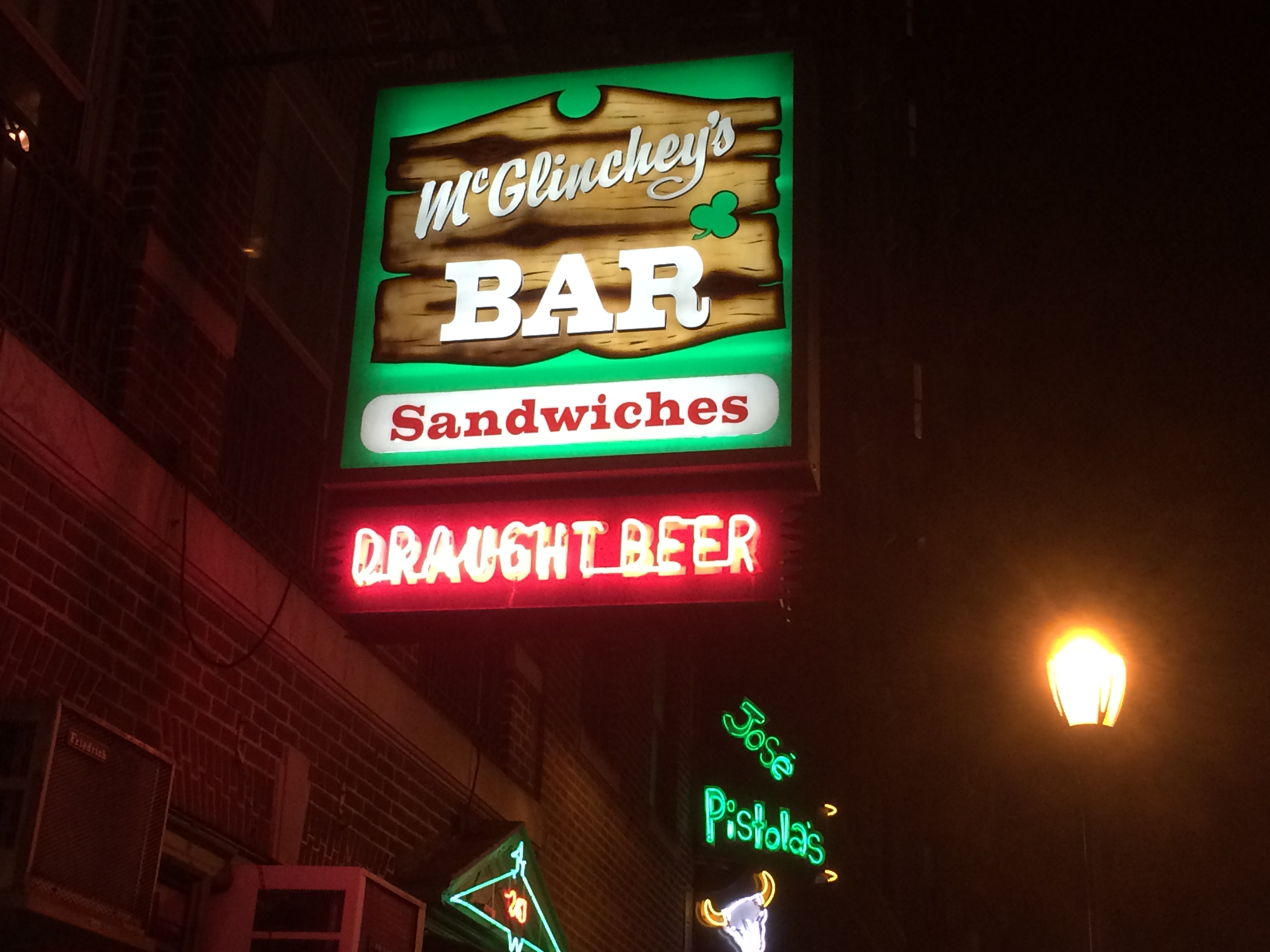
My adventure ended at 9:50 PM, when I went to Suburban Station to catch a train that would transport me to my little town. Fifty minutes earlier though, the night had taken an unexpected turn, an excellent turn that was outside the realm of my assignment’s mission. For heading north on 15th Street, near the corner of Spruce, I spotted a sign that I’ve seen many times over the years. The sign proudly proclaims the existence of a bar that, during the 1980s, I frequented aplenty. McGlinchey’s is its name, and smoky air is part of its game. Yes, Philadelphia has had a no-smoking law in place since 2006, but certain establishments have applied for and been granted exemptions from the clean-air policy. They qualify because only a tiny percentage of their revenues comes from food. McGlinchey’s gobbled up an exemption. Thus it continues to smell almost as bad as a men’s locker room. But it could be worse. I mean, what if the joint smelled almost as bad as a ladies‘ locker room?

Just kidding! Just kidding!

I hadn’t been inside McGlinchey’s for about 30 years, largely because I gave up smoking in the mid-1980s, after which I became less and less keen about cigarette fumes. But the opportunity to revisit a former haunt seemed too ripe to pass up the other night. And so I entered.

15th Street near Spruce

Had McGlinchey’s changed? Well, the lights were really dim, unlike the much higher wattage that I recall from the 1980s. And the beer selection was much improved, heavy on the quality sorts of ales that have entered the marketplace in enormous numbers since 1995 or so. But basically you’d have to say that McG’s is, as it was in the era when I dropped by consistently, a dive bar. Hazy, smelly air is all a bar needs to nab that honor. McGlinchey’s contains that variety of air in spades.

I ordered a draft beer, Fuller’s London Pride, a delicious brown ale that came to Philadelphia all the way from, duh, London. It went down my gullet very nicely, thank you. In the middle of my third or fourth sip I snapped out of a second-hand-smoke-induced stupor when I noticed that music was projecting clearly and loudly from speakers above my head. The song was a great one, an obscure number about love and disillusionment. It shot straight to my emotional core. In a million years I’d not have expected Ruby And Carlos, by James McMurtry, to be in McGlinchey’s jukebox.

But I was totally floored by what happened after the final strains of Ruby And Carlos dissolved into the dank air. That’s because the rousing and inspiring Fisherman’s Blues, by The Waterboys, came on. I had to restrain myself from singing aloud. So I mumbled the lyrics quietly to myself as I pulled on my beer. Smoke or not, I was in the right place at the right time. Music heaven, so to speak.

Well, the jukebox went silent after Fisherman’s Blues. I finished my Fuller’s and went back on the streets to do my photographing thing for a while longer. The last shot I took, of the intense red, white and blue of Republic Bank’s signs, is one of my favorites of the night. Soon afterwards, the Warminster line’s 10:05 PM train pulled into Suburban Station. I climbed aboard, my assignment over. I’d had yet another sterling outing in Philadelphia, one that detoured in a direction that I’d never have anticipated.

Corner of 19th and Market Streets

(Don’t be shy about adding your comments. And if the urge to share the story hits you, let ‘er rip! Gracias.)

(If you click on any photo, a larger image will open in a separate window.)

(It’s possible that the McMurtry and Waterboys songs that I’ve included won’t play for you. That’s because YouTube has licensing rules that sometimes block music or videos from opening, depending upon where on our planet you reside. If that’s the case in your nation, then you might want to search YouTube (or other sources) to find versions that will work. You won’t be sorry.)

Walking Away From A Cold

Where the f*ck have I been that I wasn’t aware that a summer cold is a thing, a topic of active discussion, and probably has been a member of the thing category for a good long while? Had I ever heard the term before? Possibly. But if I had it didn’t stick like glue to my brain cells. Anyway, a week or so ago two people mentioned the words when they learned of my ailment. In sympathy, one of them said that “summer colds are the worst.” The other said that he knew of someone else who was suffering from the symptoms of this dastardly condition.

Summer colds. Are they different from colds that you might pick up at any other time of the year? Beats me. In any event, I was down and partly out for the count during the first week of August. The cold was heavy. It was a summer cold, you dig?

I went through Kleenex tissues as if they were salted peanuts, so full of amazingly robust mucus was my respiratory system. I moaned and groaned like a wuss. I had less energy than a used flashlight battery. But eventually my body pulled itself together and I began to feel pretty damn good.

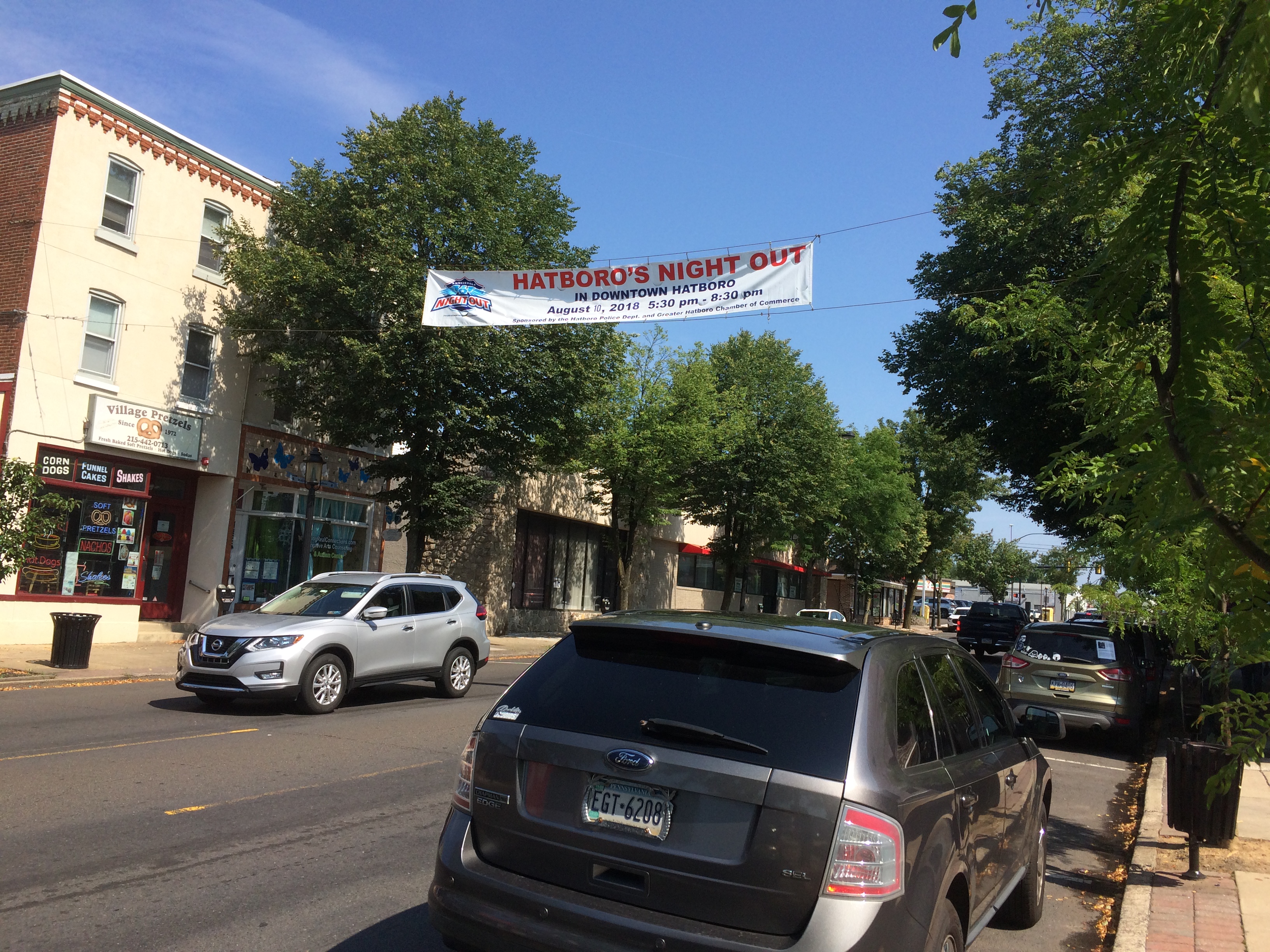
Yeah, pretty damn good indeed. And so, on August 8 I decided that I needed to stretch my legs in a meaningful way in environs that might inspire and intrigue me. Looking forward to a mini-adventure, off I headed to Hatboro, Pennsylvania, a town that looks like a town (Hatboro has two long strings of stores and businesses along a main street, which is crisscrossed by tidy residential blocks). In other words, it’s not a hodgepodge collection of housing developments and strip malls. I’ve been to Hatboro many times, what with it being only three miles from my home, but never had gone on more than a 15-minute ramble there. At 10:30 AM I parked my car on Hatboro’s shopping drag (York Road), fed the parking meter and set off.

York Road’s shopping section is lengthy, extending for half a mile. The stores are mostly of the mom and pop variety. I’ve often wondered how most of them stay in business, as I’ve never seen Hatboro’s sidewalks even remotely crowded. But stay in business they somehow do. You have a hardware store, several barber shops, bakeries, delis, diners, a big furniture store . . . and I’ll end the list now to avoid this becoming a 2,000-word essay. None of the shops are glitzy. Glitziness has little place in Hatboro, a blue collar area and proud of it.

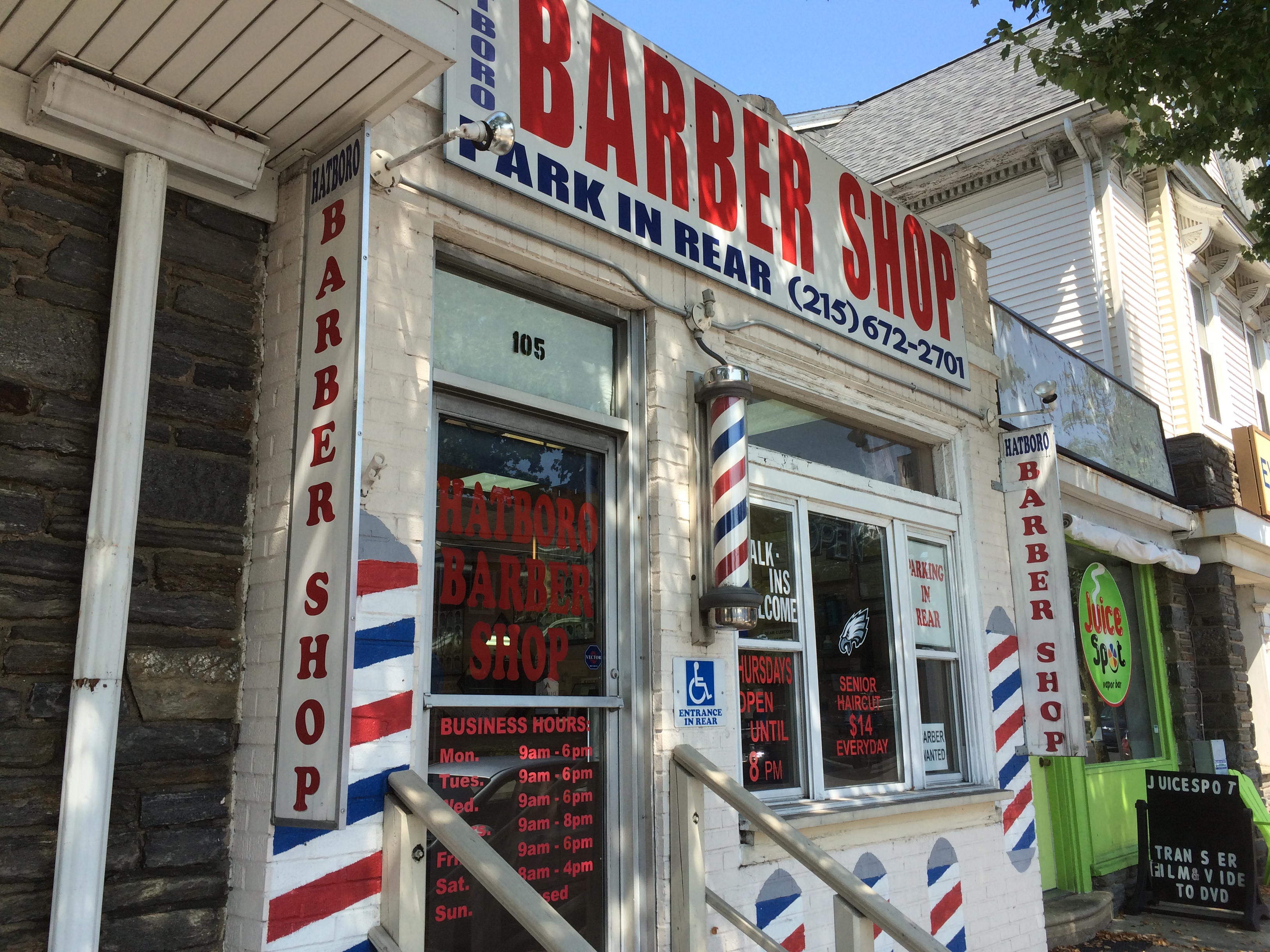
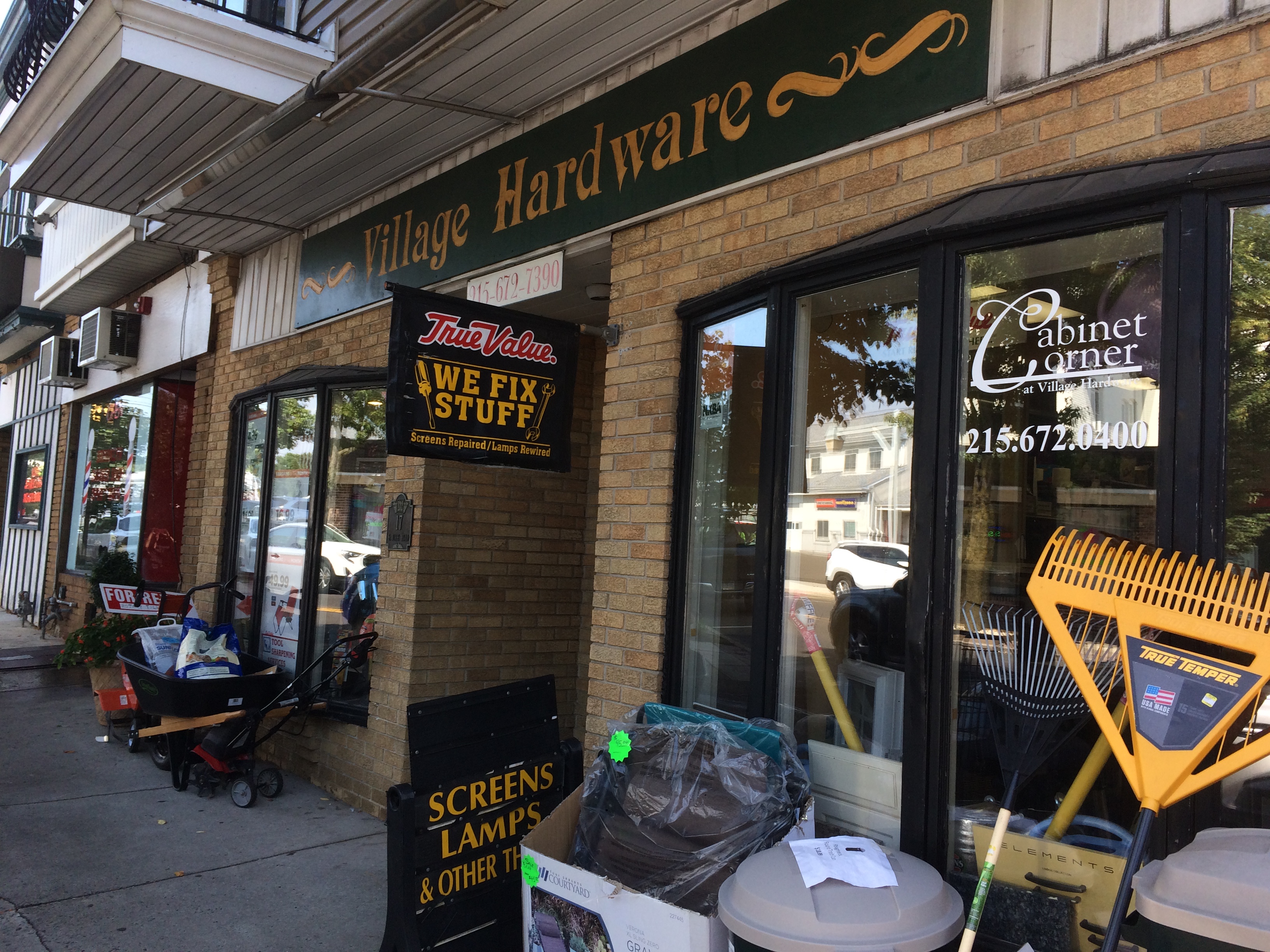
Not unusual for me, I took a lot of photos during the walk. At first I concentrated on bouncily-decorated storefronts and nifty store signs. Who would turn a thumbs-down on the Hatboro Barber Shop’s facade, a parade of red, white and blue? Or on Village Hardware’s “We Fix Stuff” sign, which succinctly (and hopefully accurately) tells a story. Nobody, I’m sure.

And when I wandered off York Road into the neighborhoods, I was surprised by the goodly number of old, beautiful homes. Had to snap some of their images, of course, one of which is directly above.

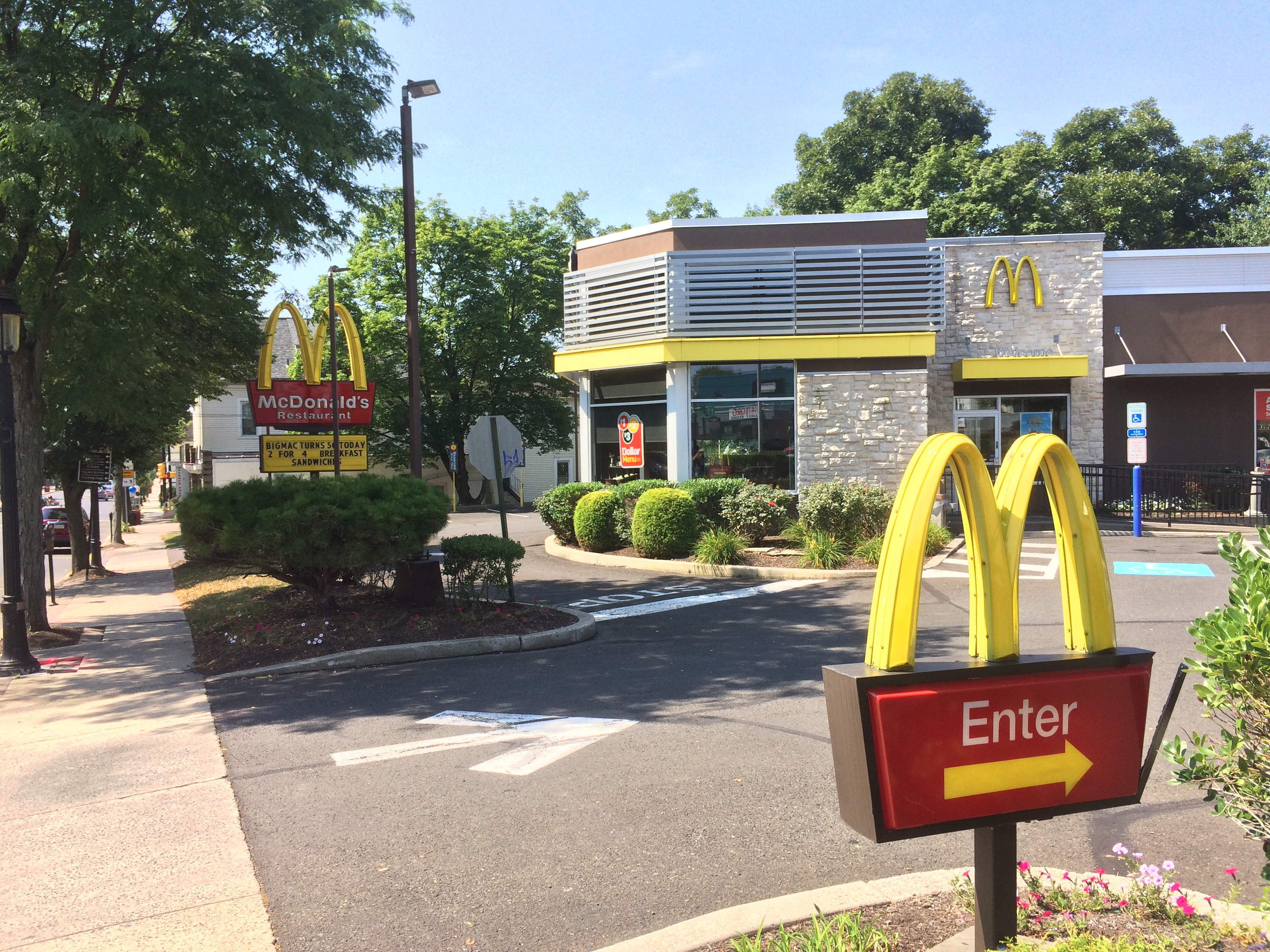
But halfway through the stroll my focus changed unexpectedly, as I became enchanted with the idea of looking for bright yellows. I guess it was a riveting yellow (and red and black) traffic sign on a residential block, meant to announce that a stop sign was ahead, that put the notion into my head.  That and the fact that I was getting some exercise on a supremely sunny day, the Sun being the finest yellow friend that any of us ever will have. Ergo, a patch of yellow flowers aside a house became fodder for my phone’s camera. As did the golden arches of Hatboro’s McDonald’s franchise.

But enough about yellows. Let’s face it, in most regards, the walk ultimately wasn’t very different from nearly any neighborhood walk that one might take. It lasted one and a quarter hours and encompassed two miles. Nothing special about those figures. But here’s what I’m getting at: I enjoyed the heck out of the walk. I was glad to have recovered from my illness, glad once again to be outside breathing freely and taking in the sights.

Which is why it would have been very, very cool if the lyrics to Zip-A-Dee-Doo-Dah had been playing in my mind as I walked around. You know them:

Zip-a-dee-doo-dah, zip-a-dee-ay
My, oh my, what a wonderful day
Plenty of sunshine headin’ my way
Zip-a-dee-doo-dah, zip-a-dee-ay

Alas, they weren’t. Still, I’m in tune with the song’s message. Meaning, I know enough not to take things for granted. Hopefully many walks lie ahead. Onward!

(Don’t be shy about adding your comments or about sharing this story. Gracias.)

(If you click on any photo, a larger image will open in a separate window.)

A Better-Than-Usual Walk Around My Hood

It was hot as hell two Fridays ago, as in 90°F (32°C), a temperature that usually makes me want to stick to the comfort of my air-conditioned house. But come 2:30 PM I was getting restless. And so, grabbing a cap to shield my hair-challenged pate and a pair of sunglasses to make me look like a movie star, I unlocked the front door and stepped outside. Ordinarily I don’t particularly like walking around my neighborhood, part of a suburb a few miles from Philadelphia, because I’ve seen it a million times and because there’s nothing much here that’s going to knock your socks off. But what the hell  . . . I needed to stretch my legs.

And stretch them I did on that tail-end day of June. For an hour. Under a summer sun that was sending down heat rays as if there were no tomorrow. Luckily, it turned out that there was a tomorrow. If there hadn’t been, then I wouldn’t be at my writing station right now, pecking out this ultra-fascinating tale.

What with the heat, a lesser man might have decided quickly that he’d made the wrong decision, that he’d be better off back inside his cozy house where he could resume reading the collected works of I. C. Fairley-Farr, the all but forgotten British existentialist whose philosophy is best summed up by a simple phrase. To quote him: Life is for living, water is for drinking, and . . . shit, where’d I put my distance glasses?

Stumps I, II And III

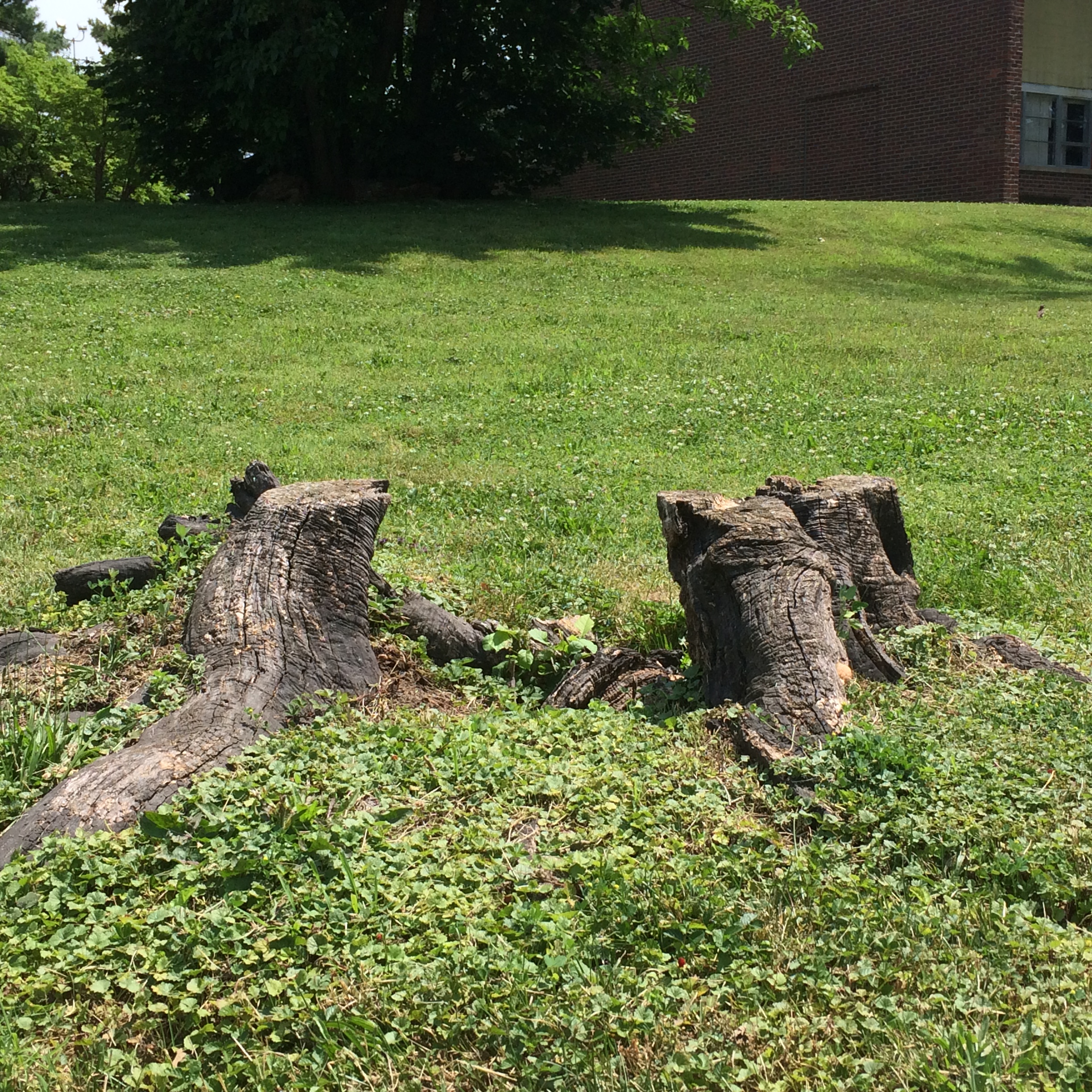
But on that day I wasn’t a lesser man. Nope, for some reason the brutal ball of fire in the sky wasn’t bothering me. And for some reason, right from the get-go, I found myself enjoying the walk. Why, only half a block from my house I noticed something that on another day might not have registered at all — three neat and concise tree stumps on the lawn of a church. Transfer them to the grounds of an art museum, give them a title such as Stumps I, II And III, and they’d gain esteem as a fine piece of minimalist outdoor sculpture. See? There’s always an alternative way of looking at things.

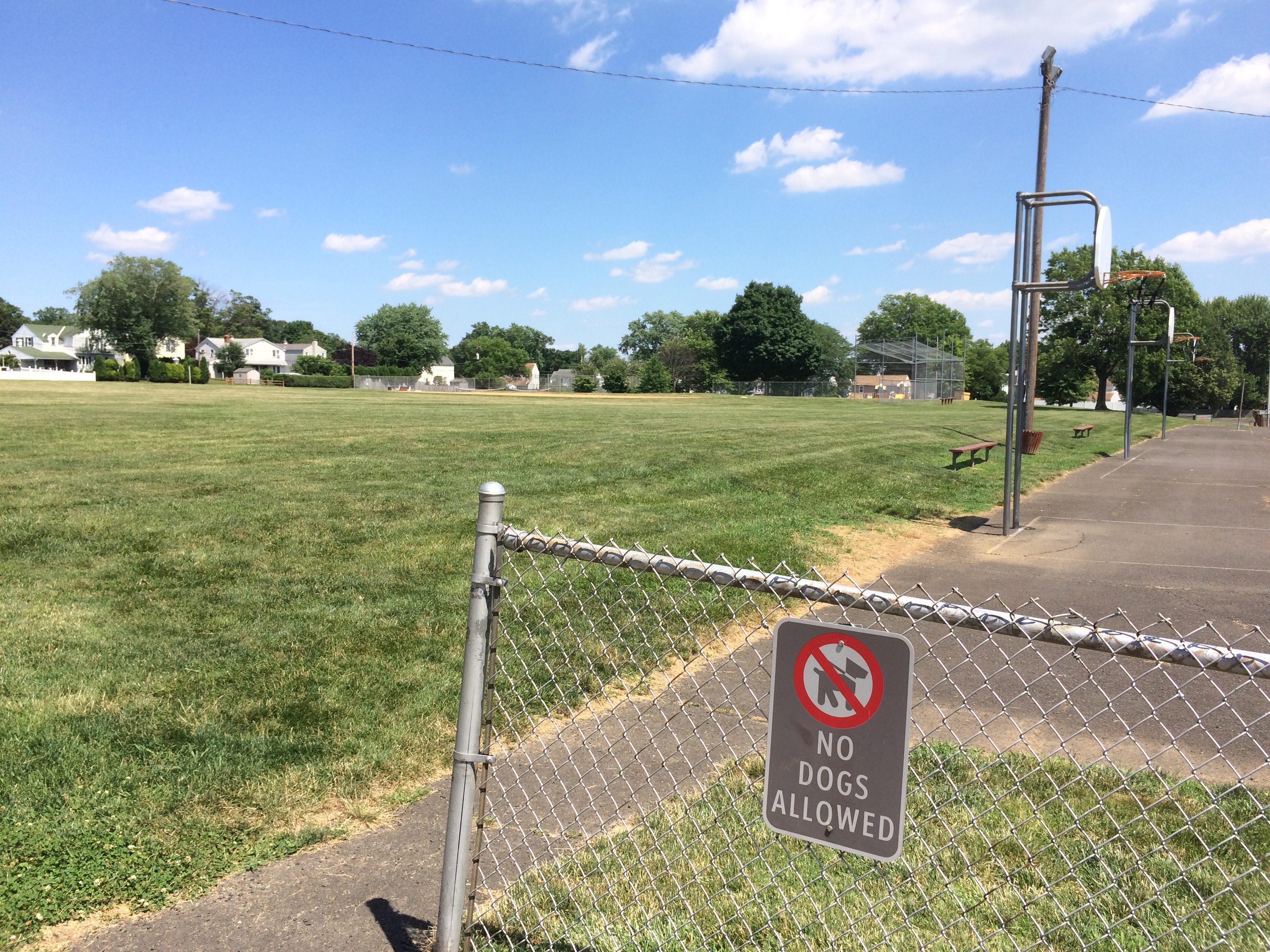
And how about the township park and playground behind the church? There wasn’t a soul there, not even on the basketball courts. Yeah man, I had the neighborhood to myself!

Well, not really. Still, during the walk I came upon only 25 or so people, many of them unloading this or that from their cars, and not a one of them out for a walk. And I crossed paths with but one dog. I exchanged hellos with its master who, positioned on his home’s front path, was eyeing me with mouth slightly agape. It must have been my sunglasses. In them, I’m a ringer for George Clooney. Or so I’ve dreamt.

Suburban jungle

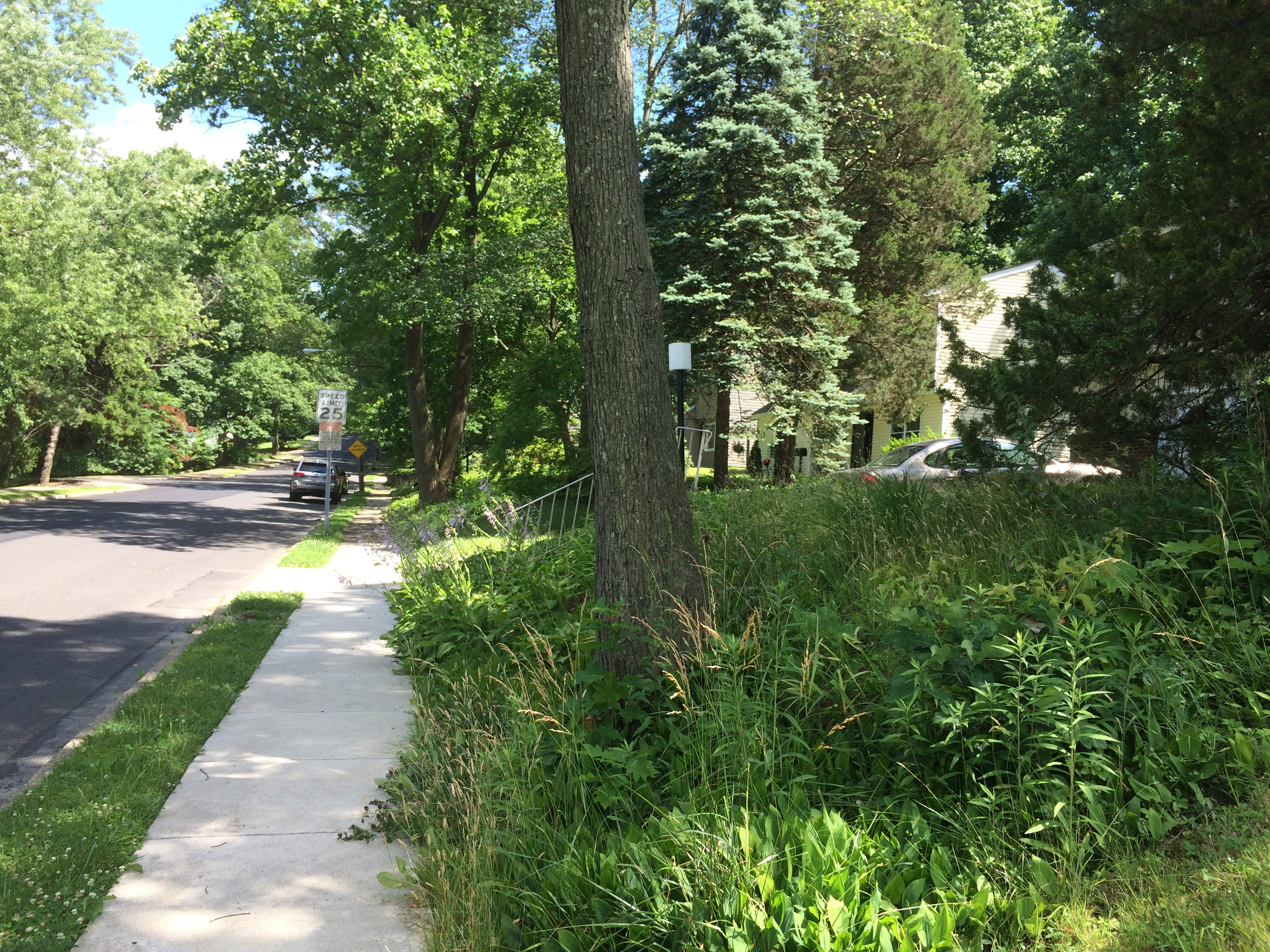
Block after block I wandered along, going downhill on some and uphill on others. My area is seriously hilly, almost San Francisco-worthy in places, and the upward climbs got me decently sweaty. One thing I realized was that I should have a much better working knowledge of the layout of my hood than I do, because I trekked upon a couple of streets whose names I didn’t even vaguely recognize. And I also realized something that I knew but hadn’t experienced in a healthy while. To wit, parts of my neighborhood are very, very heavy with trees and other foliage. Those blocks are a suburban jungle, a dreamscape in shades of green.

Tiger Lillies

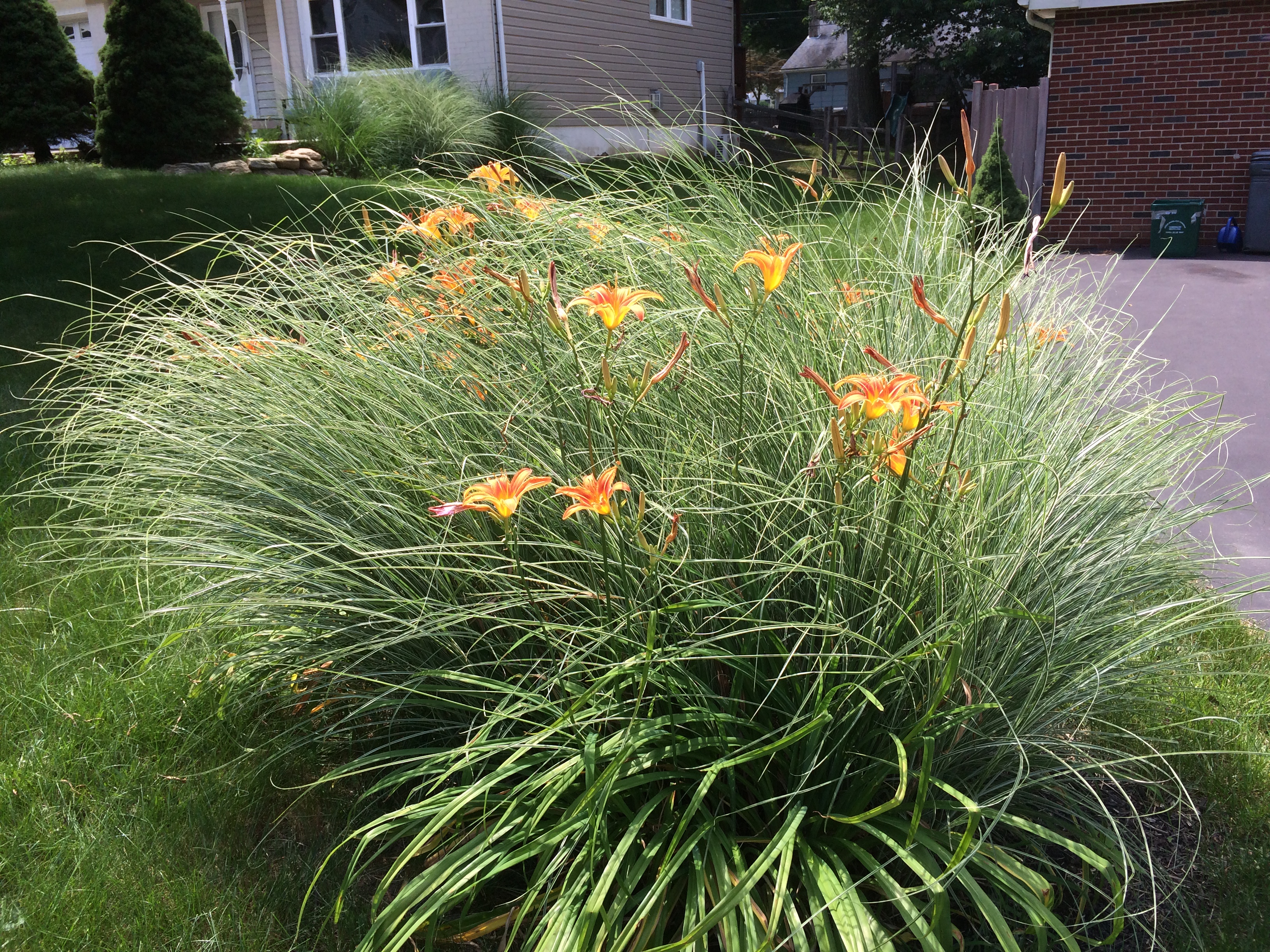
On the other hand, most of my hood’s blocks, though cute in a comforting way, are kind of vanilla in appearance, including the street on which my house sits. But I found myself getting into the vanilla, grooving on those blocks’ occasional good-looking flower beds and other decorative touches that homeowners here and there have added to increase their residences’ wow factor. When I passed one abode with a fine grouping of Tiger Lillies, naturally I stopped to admire them. And to take their picture. I couldn’t have done otherwise, seeing that the house in which I grew up, forever ago on Long Island (near New York City), was blessed with large patches of Tiger Lillies. My heart since then has maintained a very soft spot for that variety of flora.

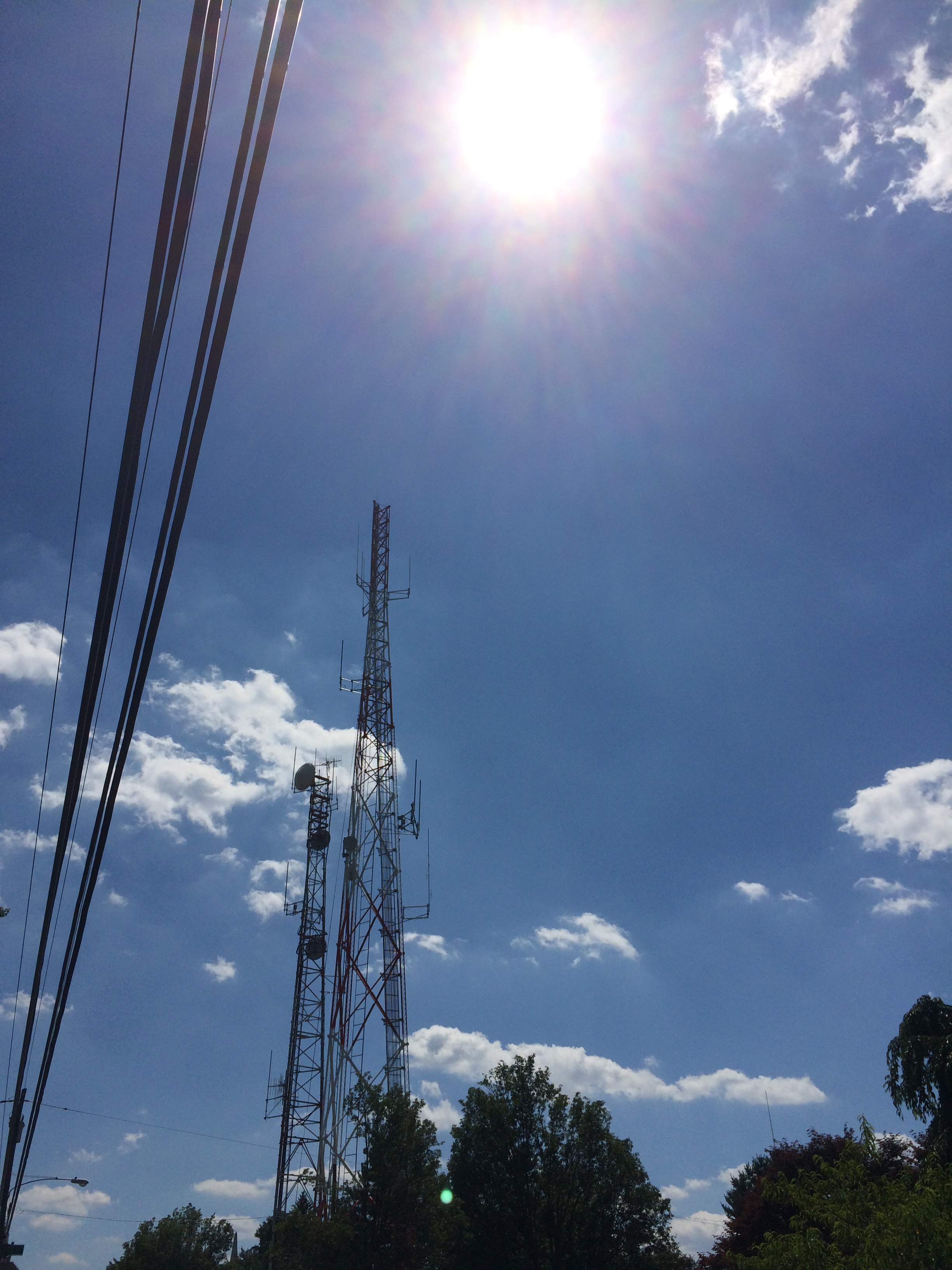
And the walk turned out to be a learning experience too. Only two blocks from my house are extremely tall metal towers. I’ve lived in my neighborhood for 13 years, yet I’ve never known what the heck those towers do, if anything. For all I knew, they might have been decommissioned years ago after serving one purpose or another.

As it turns out, they are important pieces of equipment. They transmit messages to and among personnel of police departments, fire departments and 911 emergency systems. I know that now because, early in my walk, there was a worker at the towers as I approached them. I stopped to ask him what the towers’ functions are, and he told me. Yes, opportunity had presented itself, and I took advantage of it. Too bad I haven’t applied that principal consistently over the course of my life. Oh well.

As far as I can recall, this walk was the longest, time-wise, that I’ve ever taken in my neighborhood. I don’t expect my next venture into the hood, whenever that may occur, to resonate with me as satisfyingly as this one did. But that’s okay. I returned home mentally refreshed, feeling pretty chipper and somewhat seeing the brighter side of life. Not every walk is a keeper, but this one was.

(Don’t be shy about adding your comments or about sharing this article. As always, the sharing buttons are below.)

(If you click on any photo, a larger image will open in a separate window.)
Plaza Blanca Knocked Our Socks Off: New Mexico, Part Two


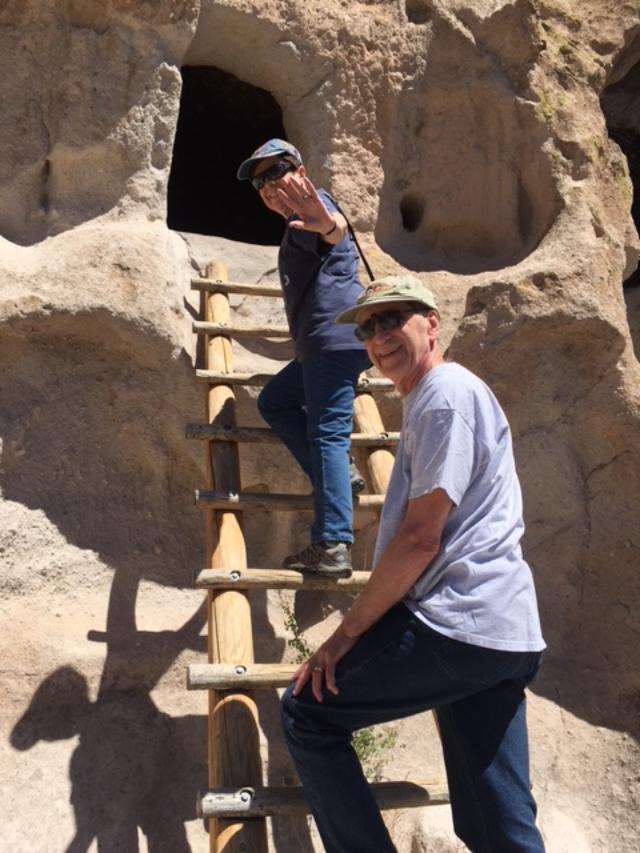
Sandy and Neil in Frijoles Canyon
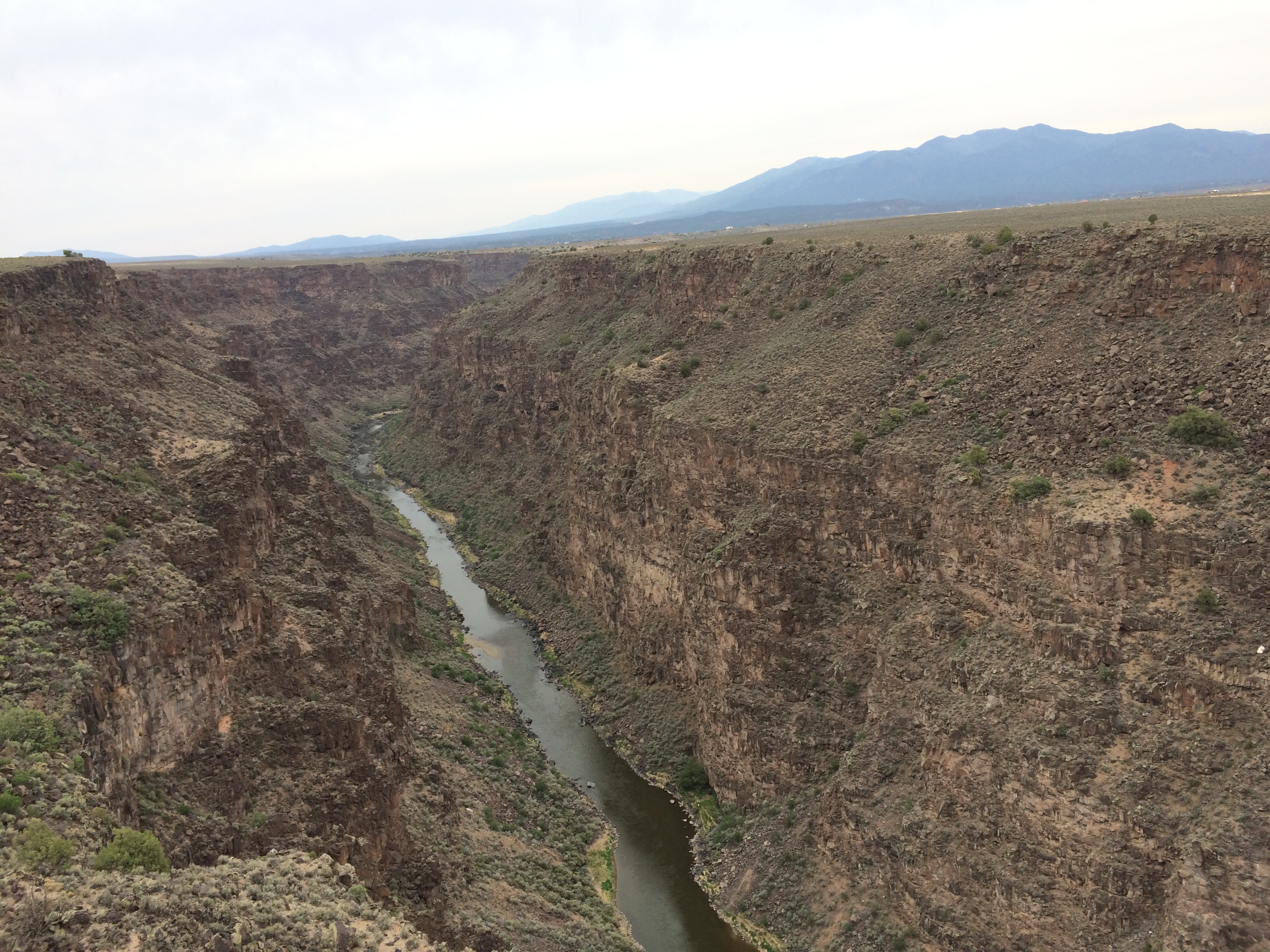
Rio Grande Gorge

For the last few days I’ve been thinking about what I should include in the second installment about my recent adventures in sun-drenched New Mexico. Climbing up ladders attached to the sides of cliffs in Frijoles Canyon (part of Bandelier National Monument) — to reach niches within which indigenous peoples lived centuries ago — seemed a natural, as did viewing the deep and dangerous Rio Grande Gorge just outside of Taos village. But you know what? No more will I now say about those experiences, as excellent as they were, because wafts of inspiration caressed my face a little while ago. And, as I’ve learned over the last few years, one shouldn’t argue with inspiration. This story, therefore, shall be about Plaza Blanca.

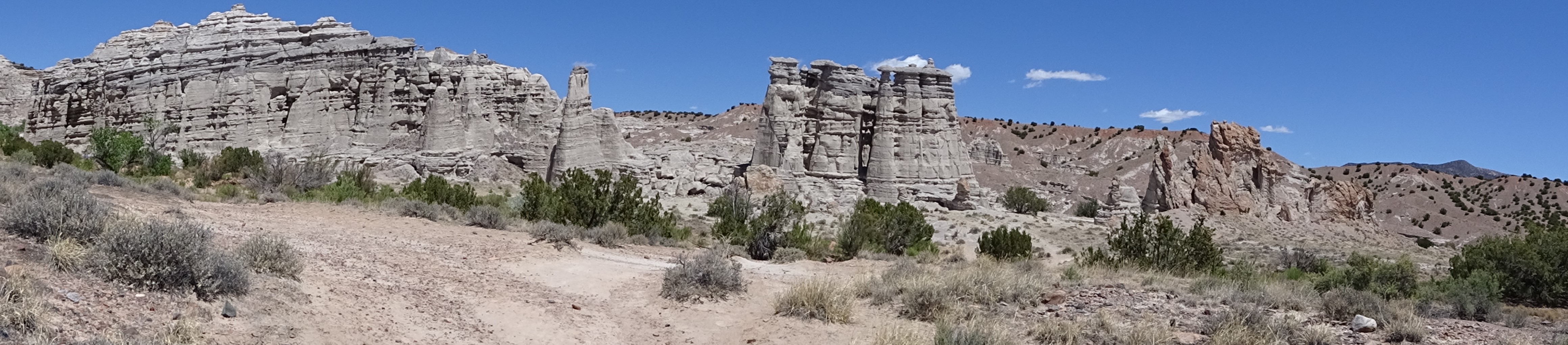
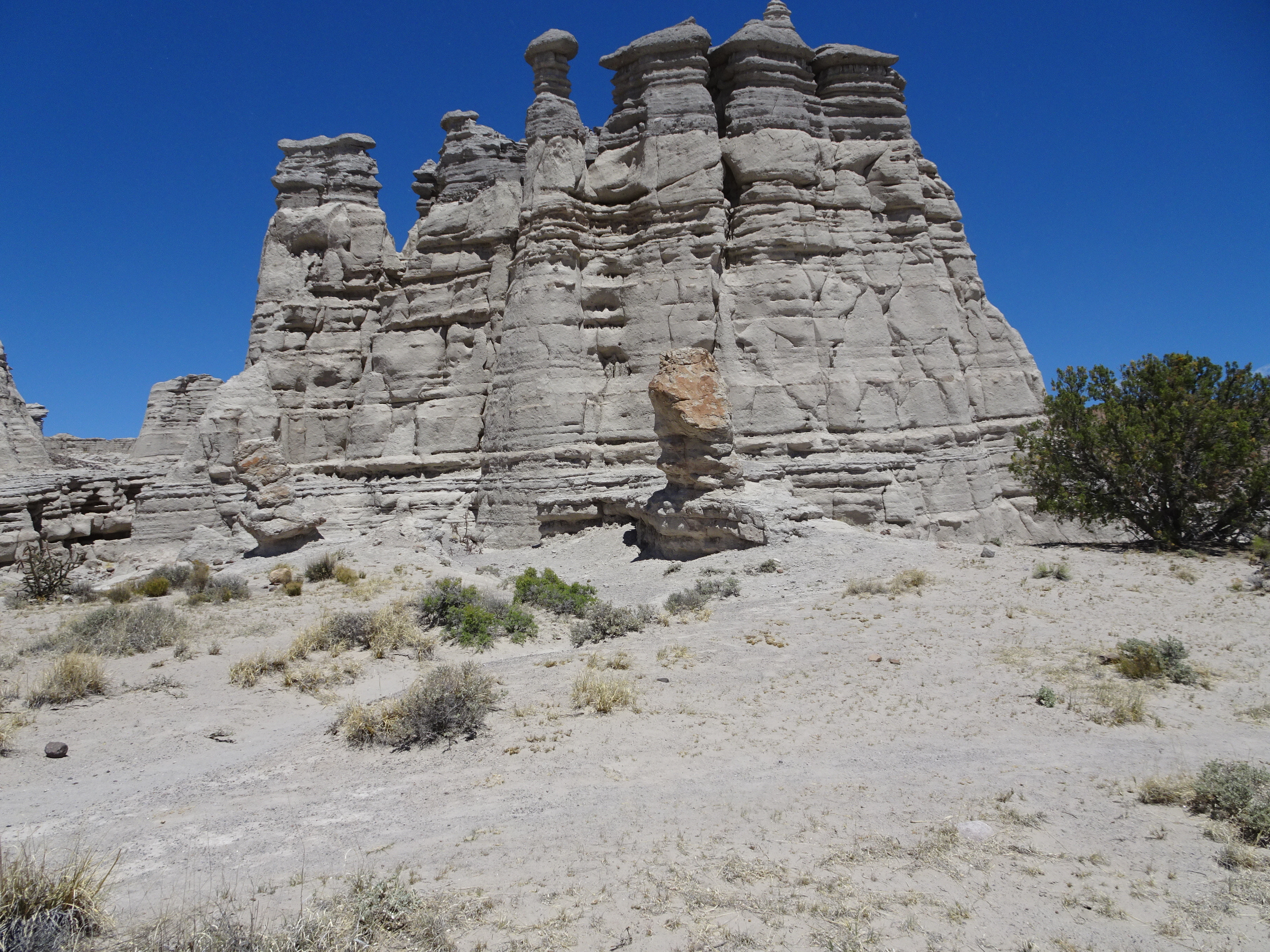
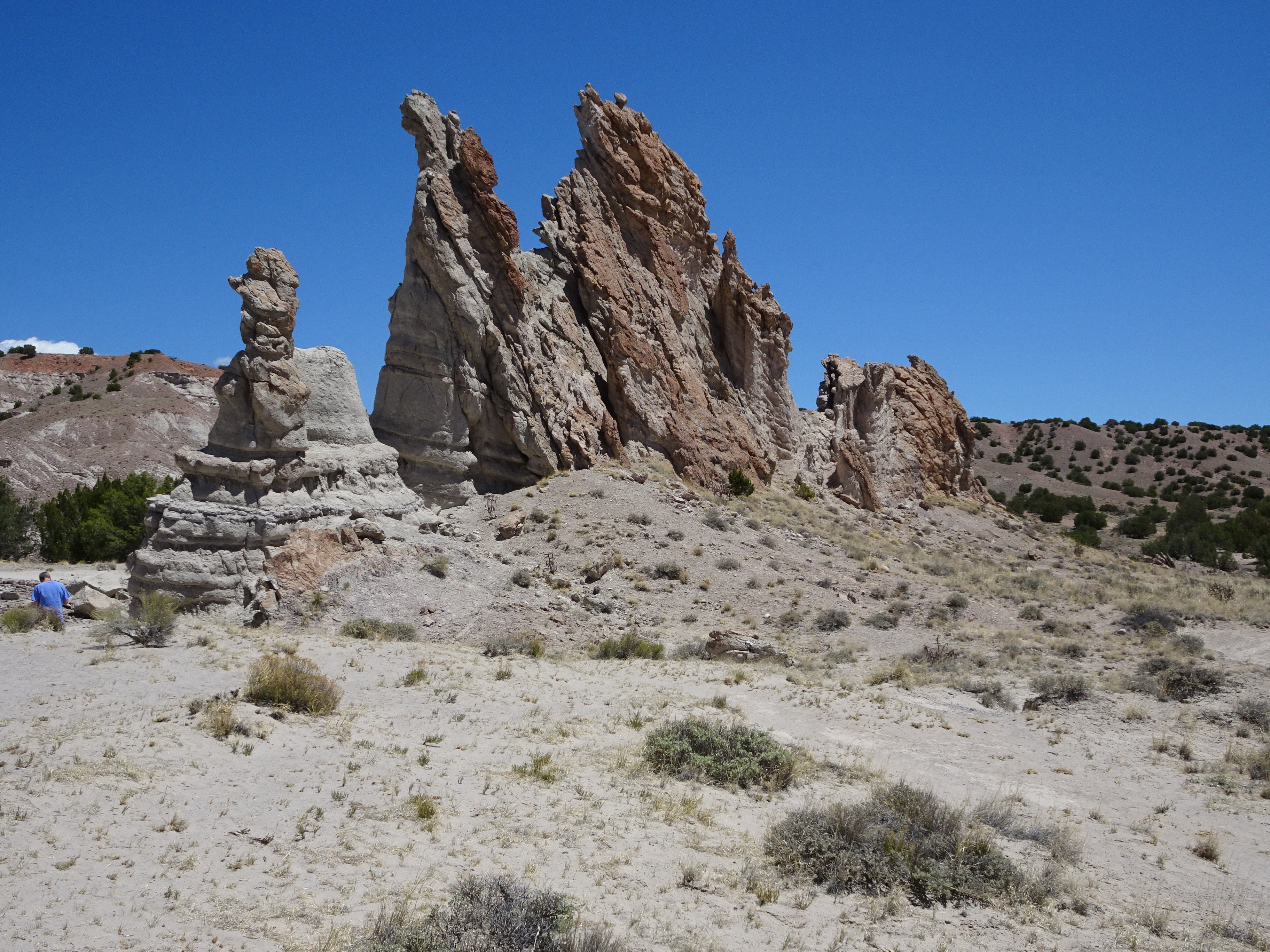
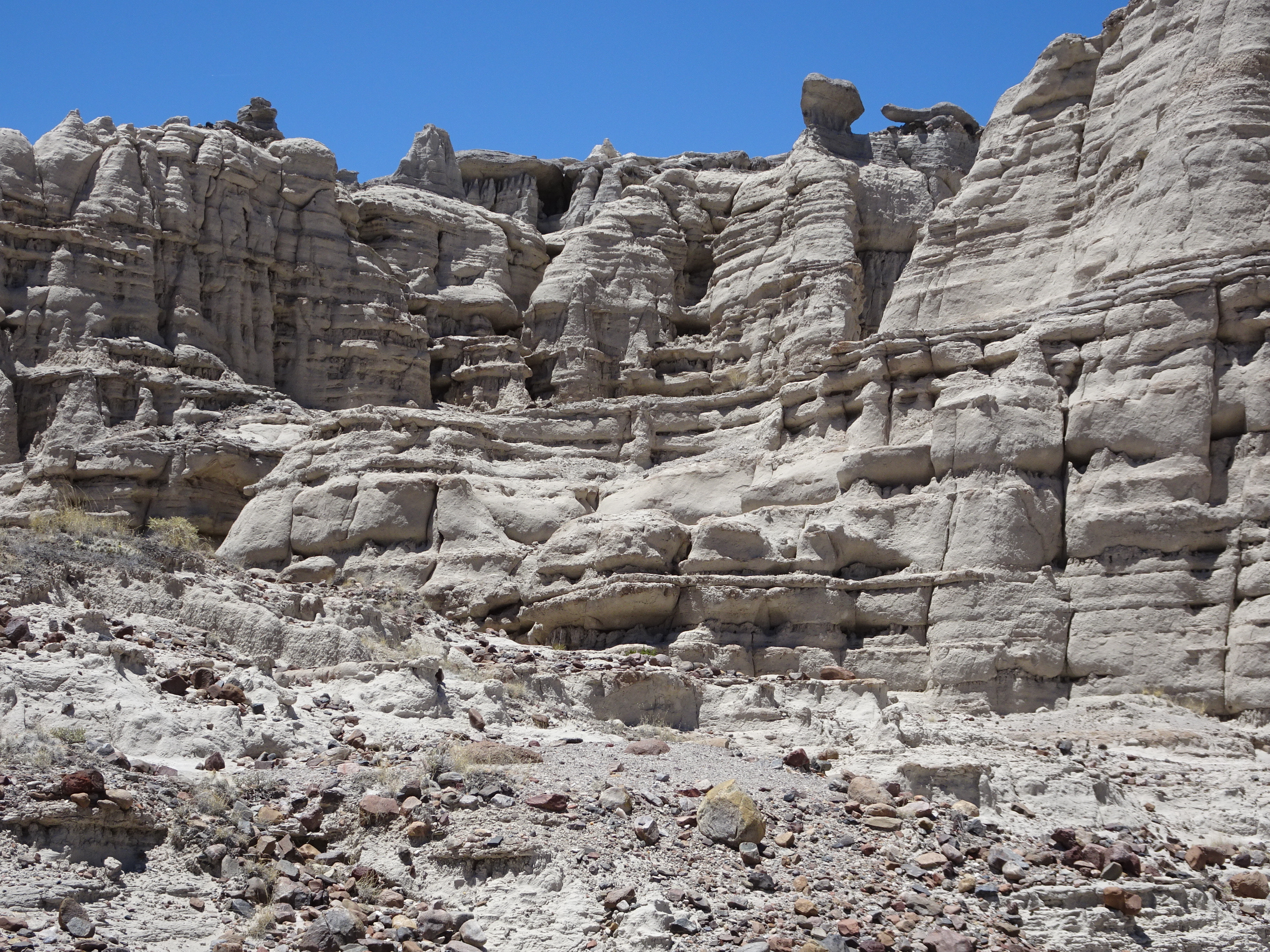
Plaza Blanca

May 29, the last full day of my wife Sandy’s and my visit to New Mexico, found the two of us inside a Honda Accord being driven by my brother Richard. We were on our way from Santa Fe, where Richie lives with his wife Sara, to Abiquiu, an area famously known as the one-time home of the late, great painter Georgia O’Keeffe. Richie had printed out some information about the sights in the Abiquiu region and, 10 minutes into the journey, asked me to take a look. Scanning the pages I noticed a paragraph about Plaza Blanca (The White Place), described as unusually beautiful. “Hey, let’s go there,” I said. Nobody objected.

Luckily I found a website that provides precise driving directions to Plaza Blanca, because it’s not the easiest locale in the world to find. The final leg of the motorized segment of the journey was upon a dirt road. Expecting numerous ruts and holes, we were relieved to see almost none. Richie parked the car in Plaza Blanca’s small parking section. Then the three of us got out and looked around. From first glance we knew that we were in a special place.

We spent an hour hiking through Plaza Blanca, a masterful collection of rock formations not far from forested mountains. The sun was high in the sky, clouds were few, and the views, to employ a cliché, were awe-inspiring. I’ve gone limp now and then over the years from the beauty of what was in front of my eyes, but that hadn’t happened in a good long while. And, now that I think about it, I hadn’t been as stunned by a natural landscape or seascape since 1982. That was the year of my trek through the high Himalayas in Nepal, the one truly astonishing adventure of my life.

And I wasn’t the only one to gaze in wonder at Plaza Blanca’s cliffs and columns, or at its other wildly surreal sculptures. Sandy and Richie were as spellbound as me. We were in a stark fairyland where strange, beguiling shapes reigned supreme. The formations sat stoically, yet pleased with themselves. They knew that they are remarkable creations. I caught Richie staring unbelievingly at one vista, imperceptibly shaking his head and not quite knowing what to say except for the obvious: “This is incredible” were his words.


As for Sandy, she agreed when I suggested that Plaza Blanca likely was the most beautiful and fantastic landscape she’d ever set foot in. A compact expanse of desert, Plaza Blanca is where one might go to let the problems circulating within one’s head fade away for a bit of time. It’s where you likely will be able to engage undisturbedly with the powers of nature, since Plaza Blanca is off the beaten track compared to many other spectacular sites. Only two other souls crossed our paths as we made our way around. That was two too many, but it was far better than the hundreds you’d encounter at the Grand Canyon or at Yosemite.

A geologist I’m not, but from what I’ve been able to piece together, Plaza Blanca is the result of volcanic activity that took place roughly 20,000,000 million years ago, and of the subsequent effects of heavy erosion. Its cliffs and other structures are composed of varieties of sandstone and of other types of rocks. The place was drier than the driest bone the day that my trio was there. But I’ve read that flash floods sometimes develop during heavy rains, racing mightily between the giant pieces and with the potential to sweep incautious visitors away.

Georgie O’Keeffe, From The White Place. Image copyright: The Georgia O’Keeffe Foundation/Artists Rights Society, New York.

Georgia O’Keeffe was smitten with Plaza Blanca (as she was with much of New Mexico). She wandered around and painted in The White Place many times. Her desert homestead was about 15 miles away. I wouldn’t mind owning one of her renderings, From The White Place, pictured above, which she painted in 1940. It would look smashing on a wall beside my living room sofa. I doubt if the Phillips Collection in Washington D.C., where the painting is housed, plans to put it up for auction anytime soon. If they do, however, I’m ready to launch a Kickstarter campaign to raise the $20,000,000 or more that will be required to make it mine.

Sandy and Richie in Plaza Blanca

As I mentioned in my previous essay, staying very hydrated in New Mexico is the thing to do. The Sun there can be brutal. I’d been downing water conscientiously before arriving at Plaza Blanca and continued to do so during my hike on site, but there was no point in taking any unnecessary risks. My companions must have felt the same way. Without discussion we took our last looks at Plaza Blanca, immersing ourselves in its glory. And then we made our way out from between the art works and headed back to the car.

(Don’t be shy about adding your comments or about sharing this piece. As always, sharing buttons are below.)

(If you click on any photo, a larger image will open in a separate window.)
(All photos are by Sandra Cherrey Scheinin, with three exceptions: Richard Scheinin took the photo of Sandy and me. I took the photo of Rio Grande Gorge and the one of Sandy and Richie.)

Flowering Trees Were Calling Me: A Stroll Through Chestnut Hill

On April 9 of this our present year, I went out in search of signs of spring, which was damn well taking its time in arriving. Though I didn’t come up empty-handed, the cupboard indeed was awfully bare. Naturally, having donned the hat of writer a few years ago, I wrote about the expedition, publishing the story six days later.

In the interim, however, nature began bubbling halfway decently in my region. To wit, two or three days after the 9th I began to spot some flowering trees in bloom. Finally! Spring was coming out from behind the curtains.

Now, I had no particular plans to place a second springtime-related opus into the ethers of cyberspace in 2018. Believe me, more than enough of those bad boys are already up there. But it turns out that I couldn’t resist. Last week’s Monday clinched the decision for me. Conditions-wise the day was ideal. The skies were so blue, my knees went weak looking at them. The temperature was 68°F (20°C), one of my favorite numbers on the dial because it meant that if a stroll around town would cause me to break a sweat, the sweat would flow only minimally. Ergo, a stroll was in order. But where to? I hadn’t been in the Chestnut Hill section of Philadelphia for a while. It’s a large, beautiful area, countrified and quaint and pretty hip. A village unto itself in effect, Chestnut Hill is almost always a good place to pass your time in.

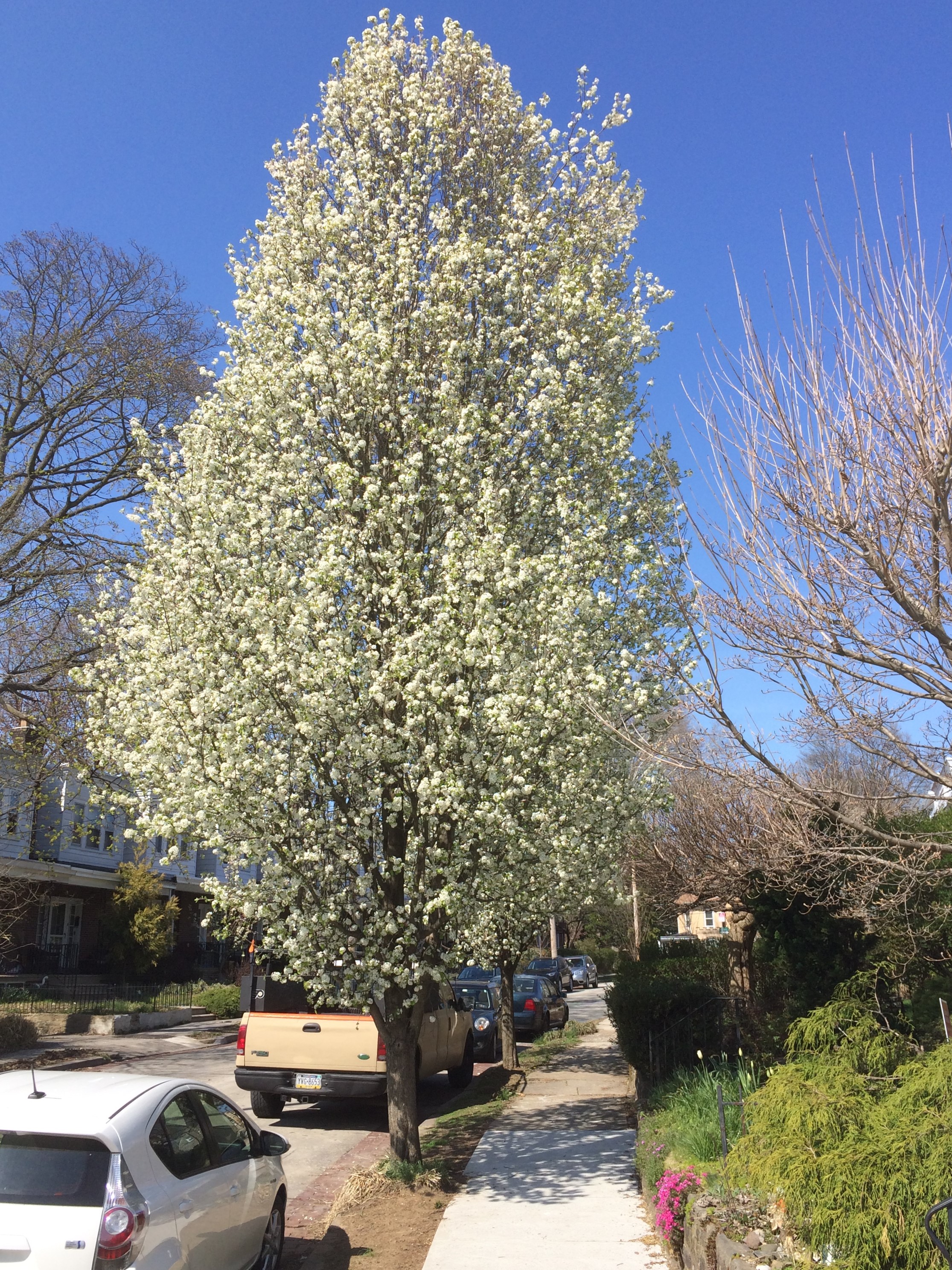
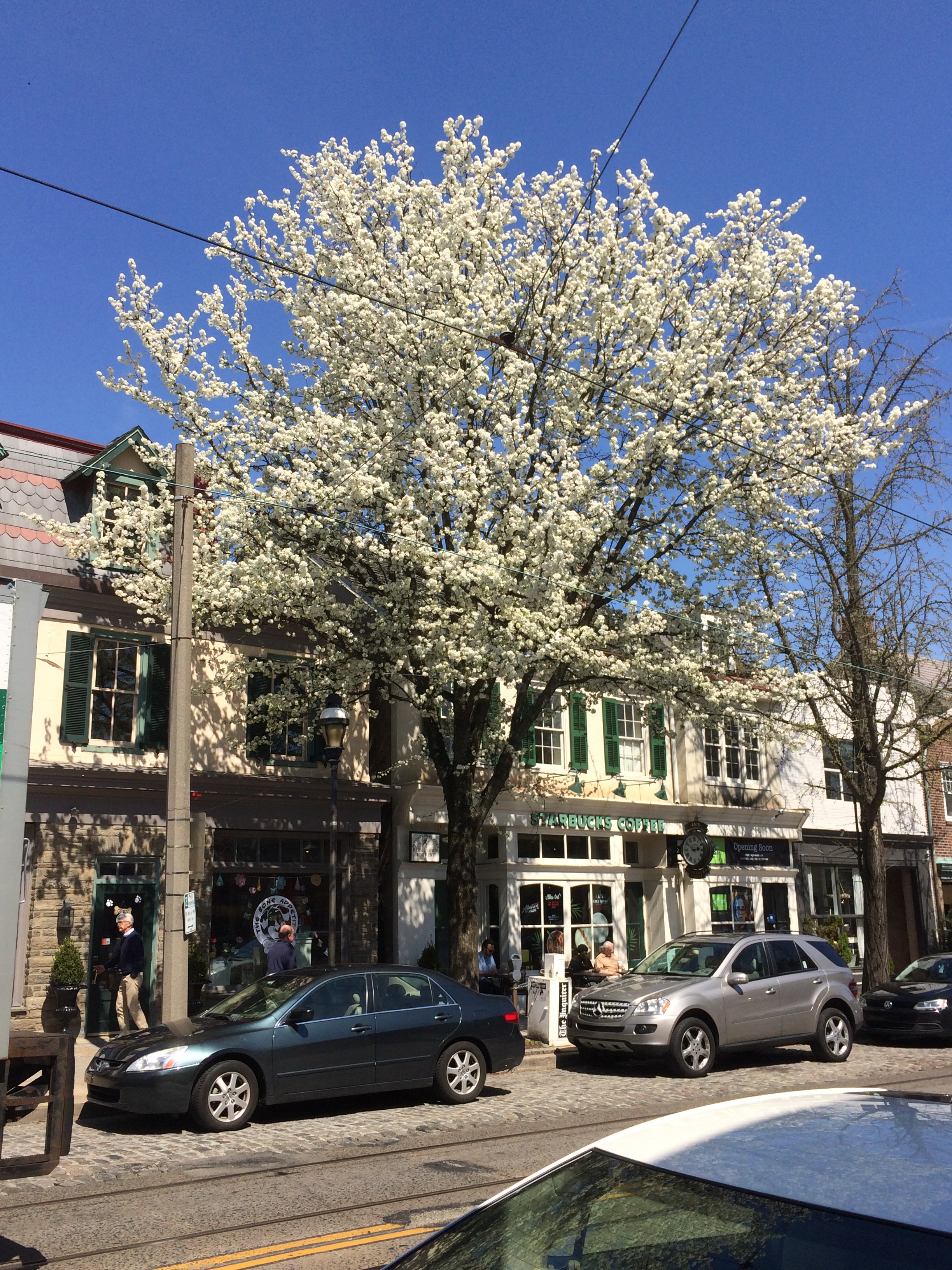
Callery pear tree

At about 2:00 PM I jumped into my trusty 2001 Honda Civic. Eight miles later I was in Chestnut Hill. I was psyched for the impending walk. And I knew what my focus would be, photographically anyway. While enjoying the pleasures of the day I, for no brilliant reason, would take pictures mostly of flowering trees.

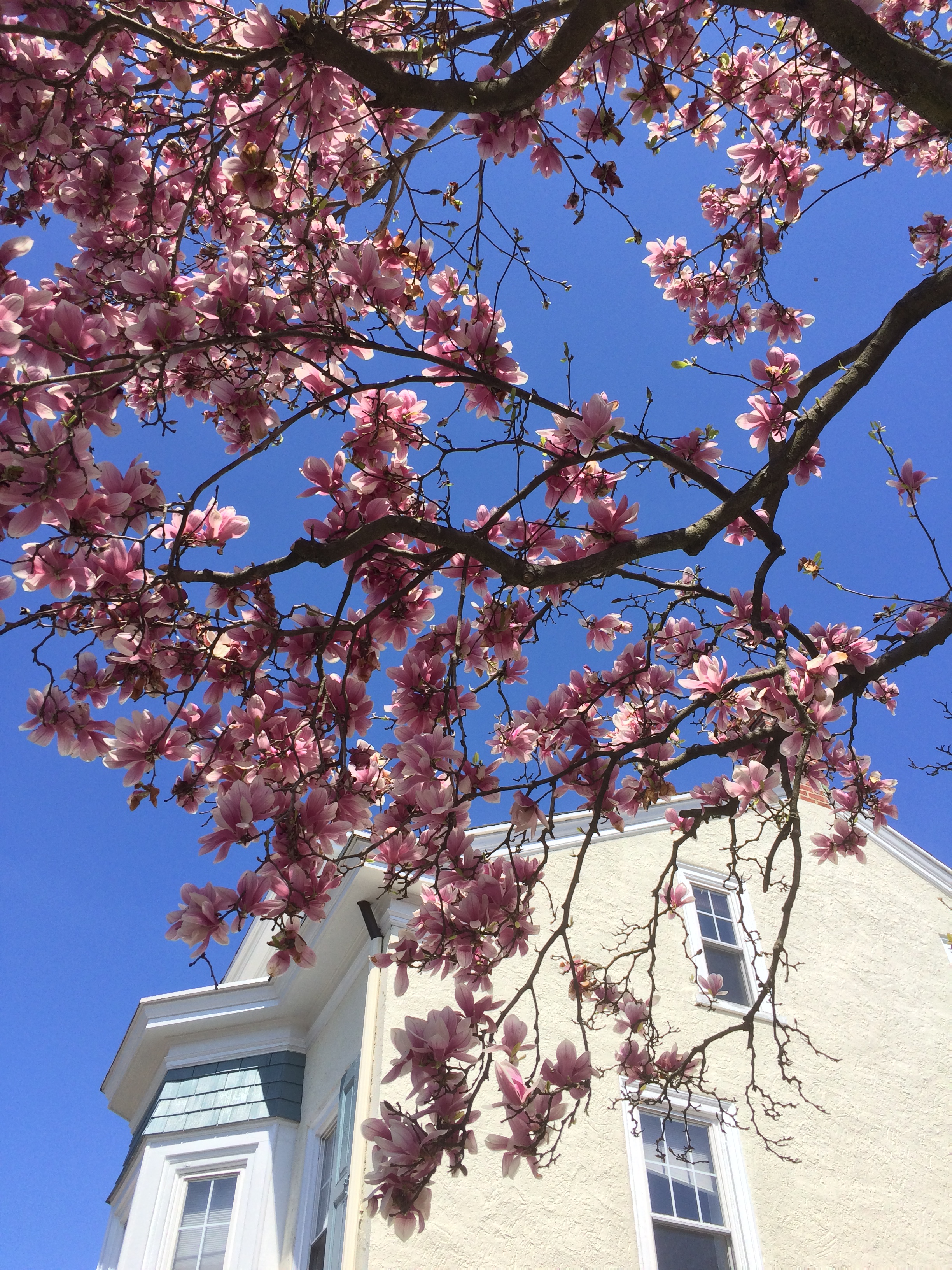
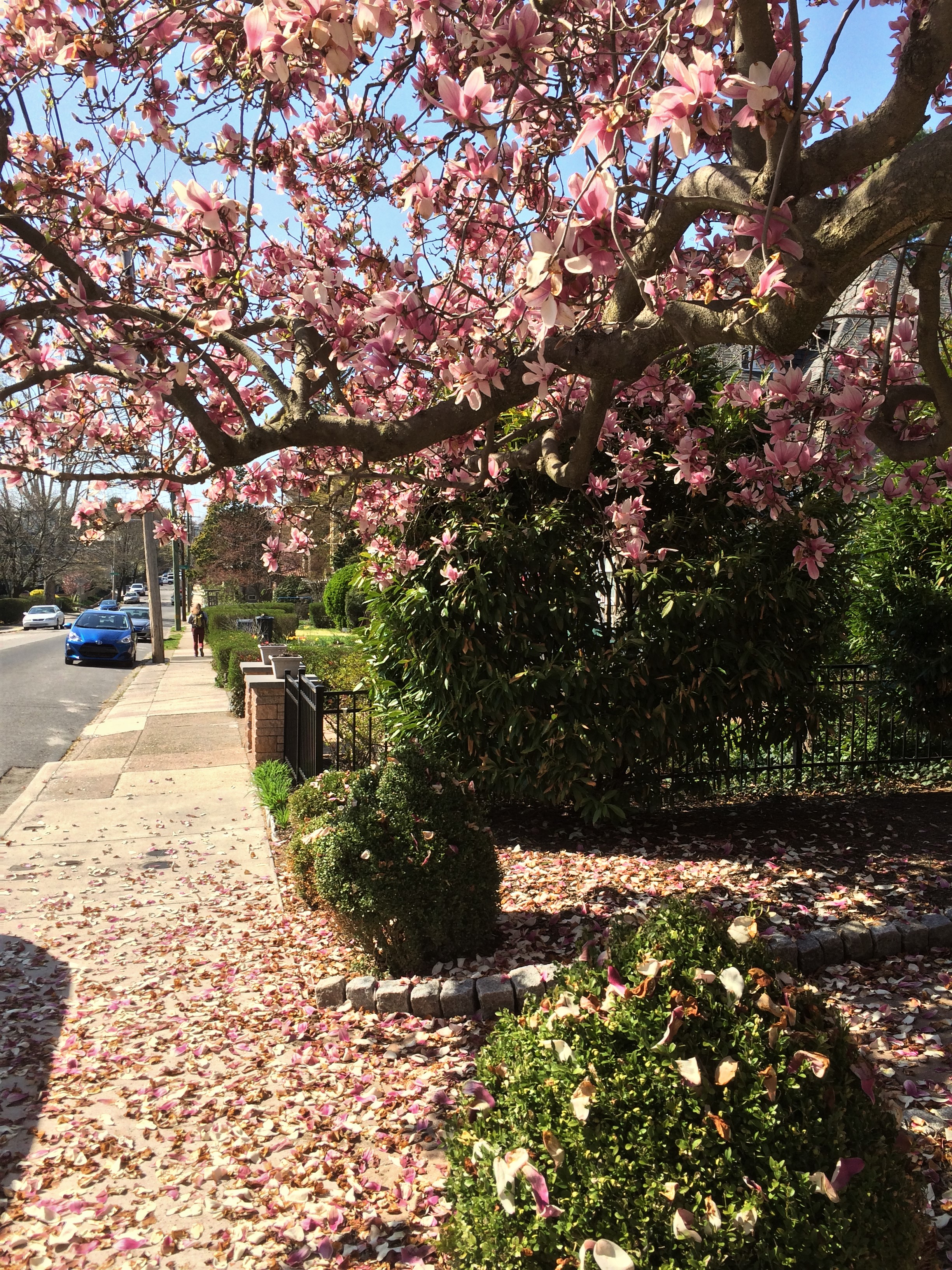
Saucer magnolia tree

I spent an hour and a half in Chestnut Hill, walking along all nice and relaxed. Everything was quite peaceful. I heard but one barking dog, unlike in my suburban nook where barks are as common as dandelions. And though lots of cars were on the roads, not a one of their drivers honked within my range of hearing during my excursion. I don’t know, maybe Chestnut Hill is a magnet for good quality canines and humans.

Getting back to spring, it didn’t take long for me to conclude that it had a long way to go. I mean, 90% of the non-flowering deciduous trees (maples, oaks, whatever) had no leaves on them whatsoever, though the budding process was under way.

But the flowering trees were another story. Though there weren’t as many of them as I’d have liked to see (and I assume that all members of the flowering varieties were in fact blooming), there were enough. And I took a good look at every one I passed. Who can resist gentle creations aglow in creamy whites, pretty pinks and other reddish shades? Not me.

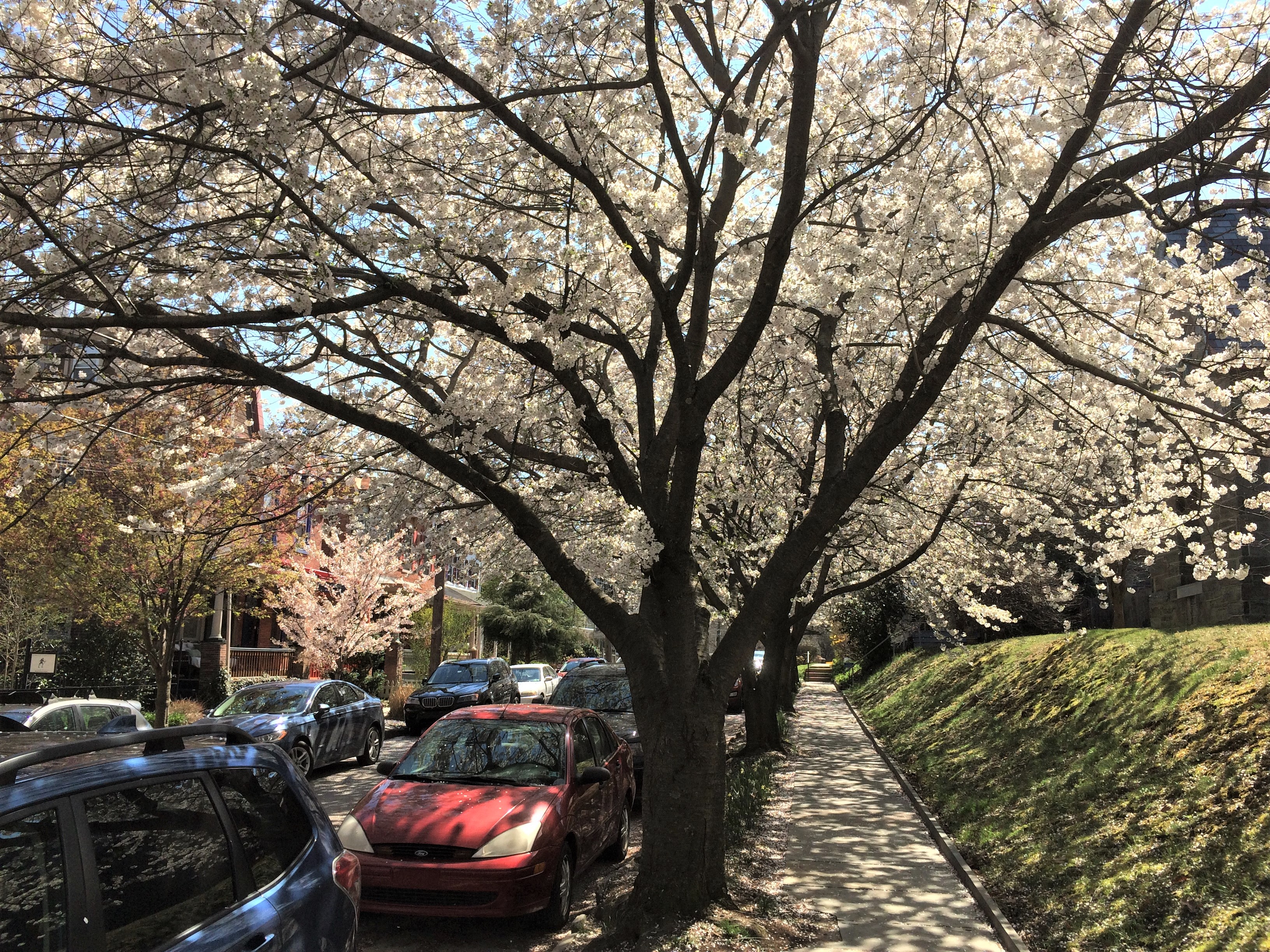
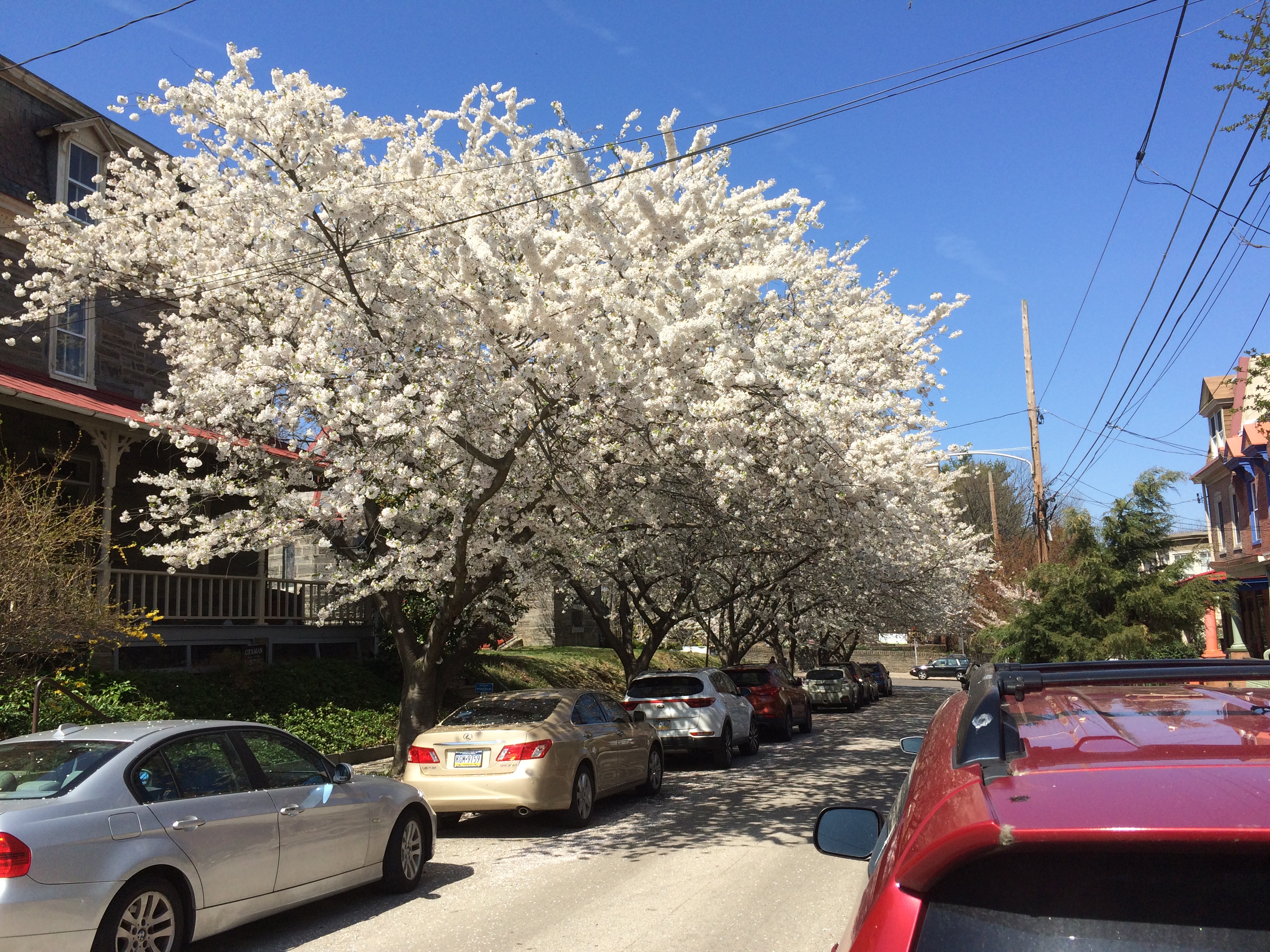
Cherry trees on W. Southampton Ave., looking west
Cherry trees on W. Southampton Ave., looking east

One block in particular was a wonderland of sorts. I speak of W. Southampton Avenue. I was heading downhill on Germantown Avenue, the steeply sloped main drag filled with clothing boutiques and restaurants and other shops, when a marvelous mass of white blossoms caught my eye. They were attached to a series of cherry trees that occupy a good bit of W. Southampton, a residential block. I crossed Germantown Avenue and dove into the milky white scene. From Germantown Avenue I hadn’t noticed it, what with my strong case of myopia, but a petal storm was going on. Dropping from the trees in big numbers, petals were floating through the air rhapsodically. Man, it was beautiful. I was all set to lay myself down on the sidewalk and go blissful. But then I remembered that I’m not so good at going blissful. Shit, I knew I should have enrolled in a Zen Buddhism program years ago! You live and you learn. Sometimes.

Well, I snapped some pictures of W. Southampton, hoping like crazy that I’d capture some mid-air petals. If you look closely at the photos that I’ve included you’ll see a few. They and their siblings were a sight.

Saucer magnolia tree

Ah, the mystery of petals. Towards the end of my walk I found myself ambling along a stretch of sidewalk covered with pink ones. They had fallen from a saucer magnolia tree, which nevertheless was still grandly laden with flowers. The next day, at home, I gave a bit of thought to those and the other petals that I’d encountered in Chestnut Hill. So many already were off their trees, even though the trees had been in blossom for less, probably, than two weeks. Seems a shame that the great flowering-tree show comes and goes as quickly as it does. If its design had been left up to me, I’d have commanded that it last for two months or more. A magnificent extravaganza, it’s worthy of that, without question.

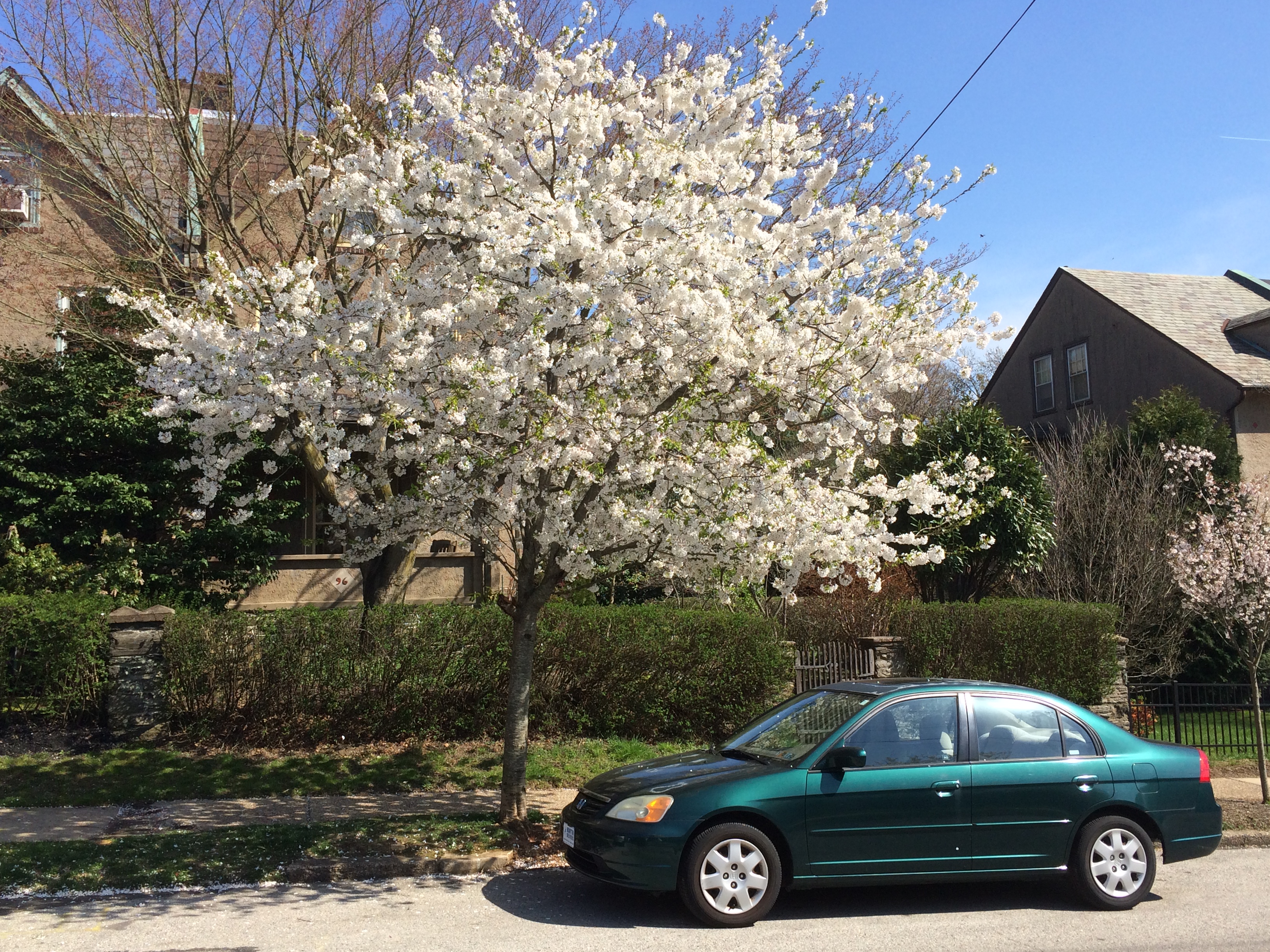
Not long after stepping through the carpet of magnolia petals, I found myself back on the block where I’d parked my old Civic. I liked the way my car looked, demure and cute despite the large blotches on its trunk and roof, as it waited patiently for me in front of a small, adorable cherry tree. The tree’s bone-white blossoms contrasted righteously with the Honda’s deep green paint. A photograph of the scene cried out to be taken. A few minutes later I got into the Honda and made my way back to the burbs. A flowery excursion had come to its end.

P.S. I’m indebted to Karen Flick, landscape manager at Philadelphia’s Awbury Arboretum. I’m a nincompoop when it comes to flora. I sent some of my photos to her, and she identified the trees for me.

(Don’t be shy about adding your comments or about sharing this article. Sharing buttons are below.)

(If you click on any photo, a larger image will open in a separate window)

A Long Walk In Philadelphia On A Warm Winter’s Day

Cira Centre

There I was two Wednesday mornings ago, unfruitfully occupying space on my living room sofa. My shoulders were tense, my mind was neither here nor there. In other words, it was business as usual.

“Yo, schmuck! Snap out of it!” I silently yelled to myself. “Somebody ought to paint your portrait right now and call it Here Sits A Schlump. Life’s for living, boyo. Get with it already.”

And so I did. Gathering myself together, I decided to go for a walk. A nice long walk. But where? Not in my suburban area, whose charms are incredibly limited. Philadelphia it would be then. Philly’s the metropolis that never bores me. Soon I was at my little town’s train station. A late-morning ride arrived and I climbed into the second of its three cars. Fifty minutes later I exited said metal box at 30th Street Station, in the city’s West Philadelphia section, all set to explore a nearby area that I was barely familiar with. Ferdinand Magellan I’m not, but I’ve always liked to poke around.

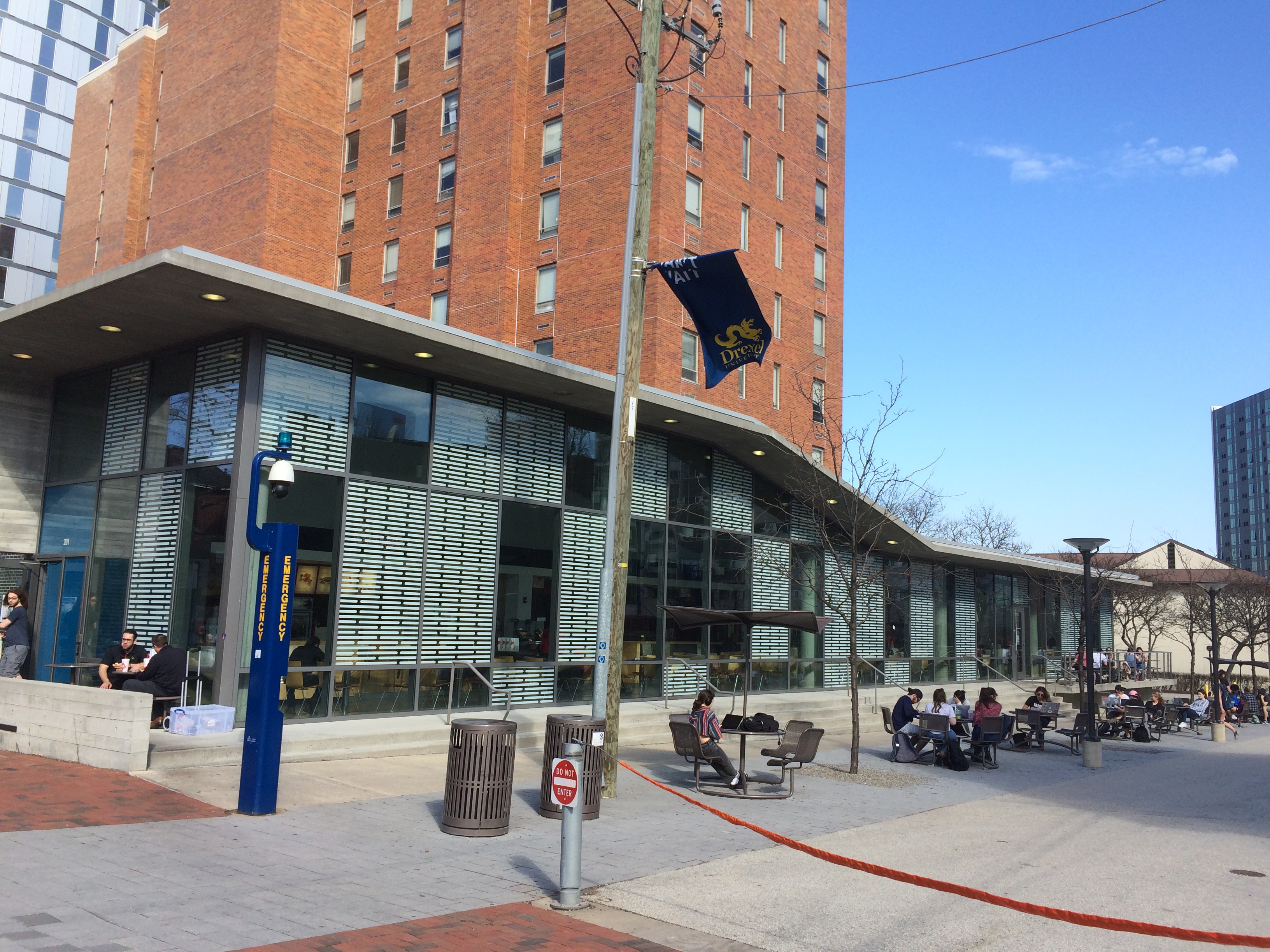
It’s amazing though, being someone who likes to poke around, that I’d never done so among the blocks only a hop, skip and a jump northwest of 30th Street Station. Those streets, part of West Philadelphia’s Powelton Village neighborhood, contain a good bit of Drexel University’s sprawling campus. From the mid-1970s until 1991 I lived in West Philadelphia, only a mile and a half from Powelton Village, but I didn’t venture to the Drexel enclave there, despite Drexel’s rise during that time to major-player status in the academic world. And in the ensuing years, which have seen me visit West Philadelphia who knows how many dozens of times, the pattern continued.

Hallelujah, now the deed is done! I came and I saw. I’ll leave conquering for another day.

Powelton Village
Powelton Village

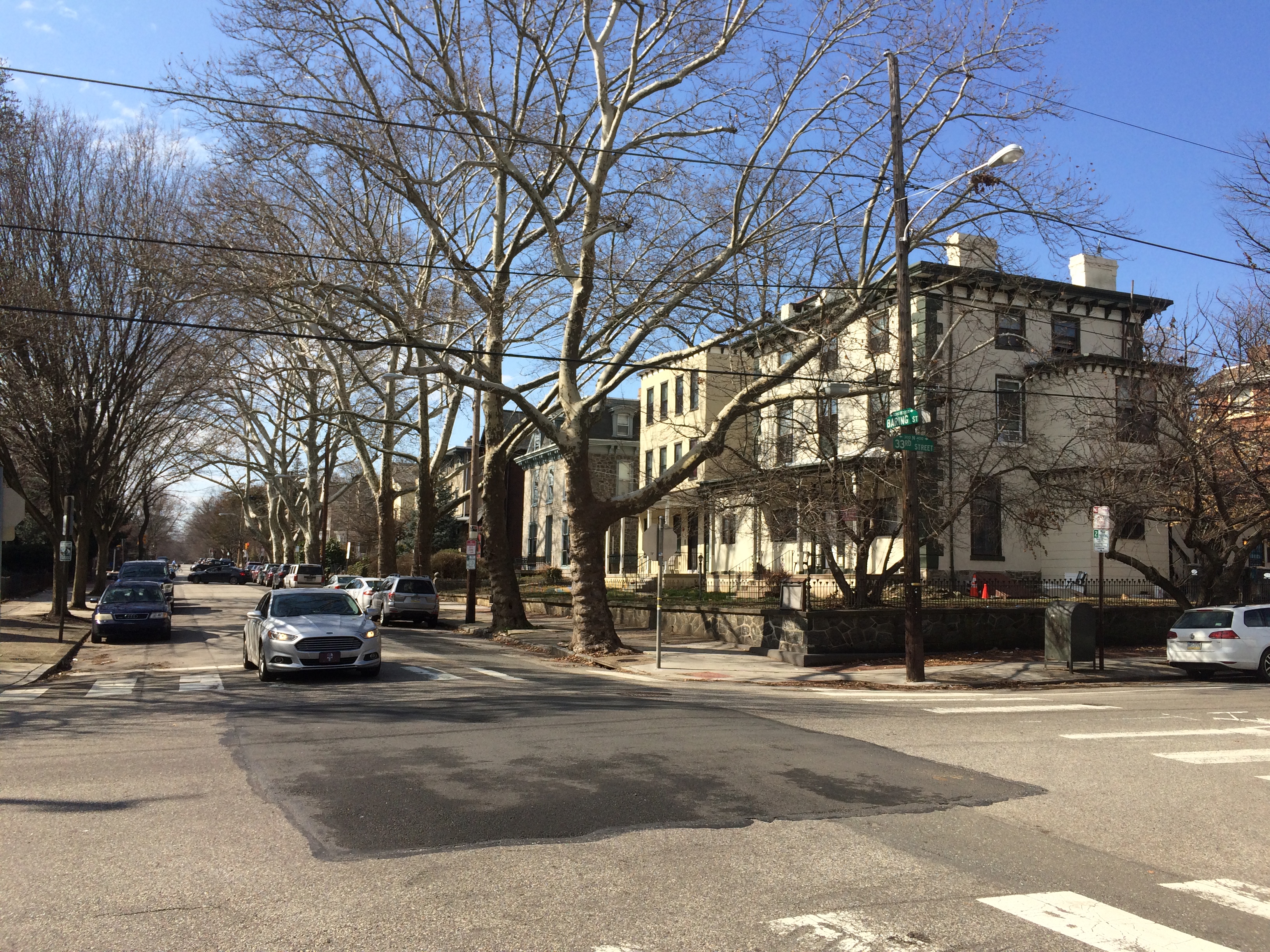
Now, let me say that my stroll through Powelton Village, checking out not only the Drexel facilities but the sturdy, soon-to-be-leafy residential blocks, wasn’t a walk for the ages. I mean, not too many urban campuses are going to knock your socks off. And Philadelphia’s older housing — rowhouses, twins and stand-alones — are so much with us in Powelton Village and in many other Philadelphia neighborhoods, I’ve come to think of them as comfort food.

Still, stretching my literally old legs felt great. Especially since the day was sunny and warm, as in 74°F, an insanely high number for mid-February winter. I worked up a good, pungent sweat hauling my ass and my bones around. And my eyes did plenty of darting, admiring the college girls who were dressed for summer. Skimpily, shall we say.

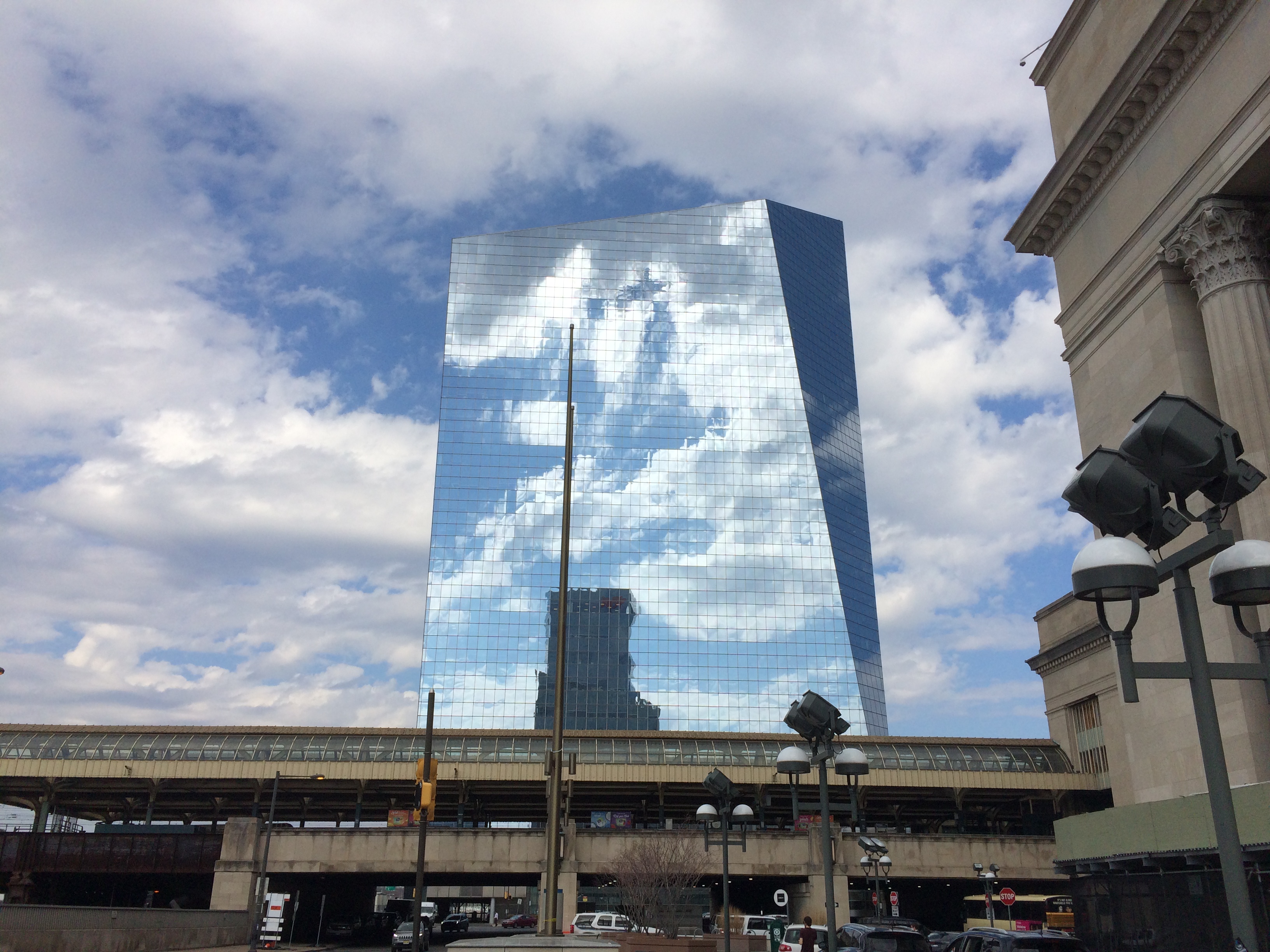
In addition to the girls, certain sights during my travels did make quite the impression on me. For instance, before I reached Powelton Village — in fact, when I was only 150 feet from 30th Street Station — I remembered to take a look at the Cira Centre, a majestically sleek office tower that smiles down upon the station. But I didn’t see it. Was the station somehow obscuring my view? Turns out, of course, that Cira was there in plain sight. Sort of. A glass wonder, the reflections of the sky on its surface were camouflaging the building, as the photo at the beginning of this article reveals. Man, that was something, clouds seeming to float everywhere on the glass along with the reflected image of a tower under construction several blocks away.

Drexel’s Buckley Recreational Field
Vue32 apartment building

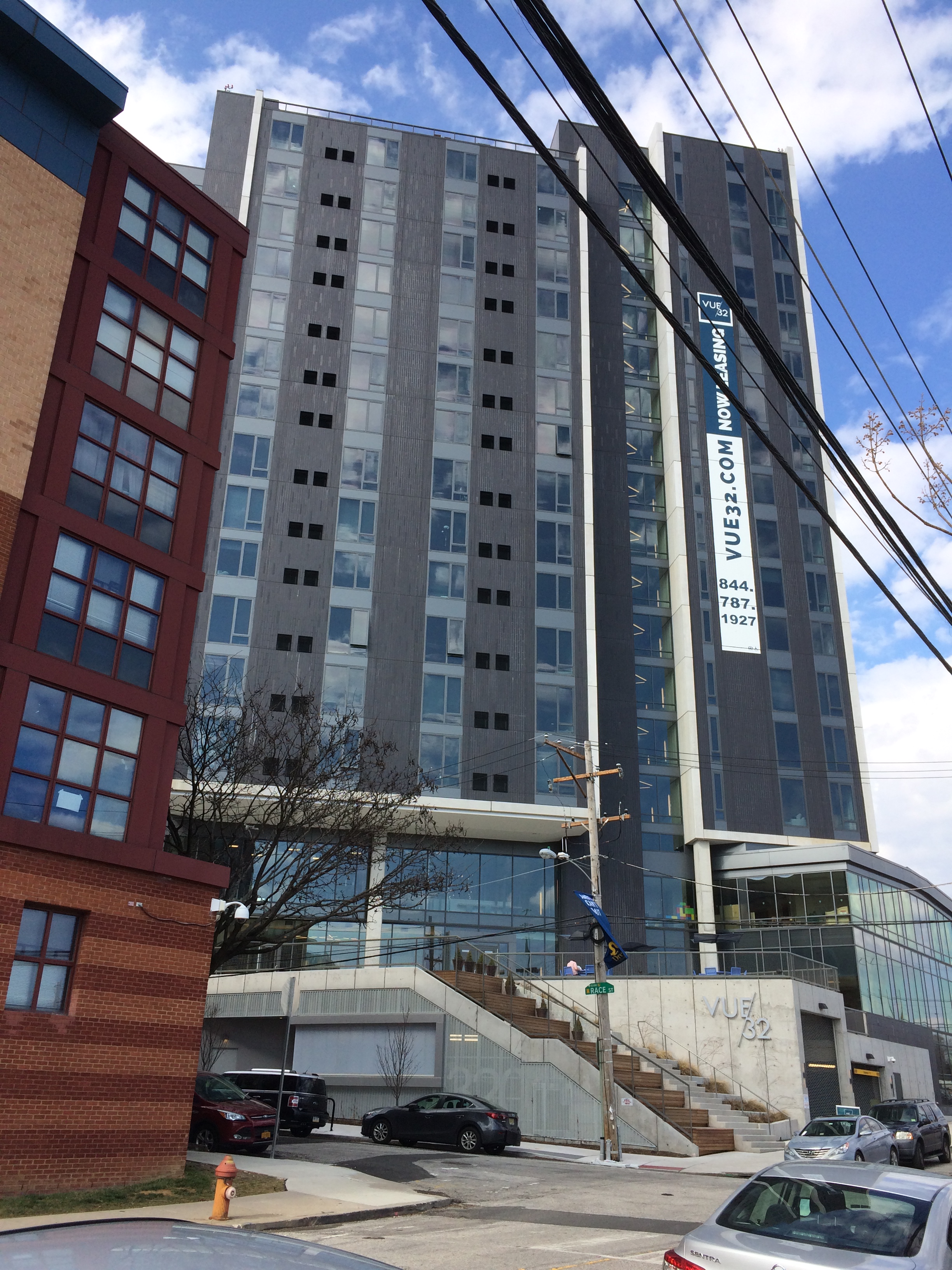
And in Powelton Village, just up the block from Drexel’s Buckley Recreational Field, I was most surprised to see a tall, modern apartment building (Vue32) being erected on North 32nd Street. Some might say that Vue32, a non-Drexel project, is totally out of place in a quiet two-and-three-story-high neighborhood, and if I lived nearby I’d probably agree. But it looked cool to me.

SEPTA rail yard

Speaking of North 32nd Street, if I hadn’t been there I would have missed being near-stunned by the sight of oceans of commuter railroad cars — just like the one I took into the city — a smattering of feet east of where Vue32 stands. As I later learned, I was looking at a rail yard used by SEPTA, the Philadelphia region’s public transit agency, to house and do maintenance work on trains. I’ve lived in Philadelphia or its suburbs for most of my adult life and I’d only vaguely noticed that enormous yard before, though it is glimpsable from numerous vantage points in the city. Call me Mr. Observant.

An open square on Drexel campus

Well, the early afternoon passed pleasurably. I ambled along block after block in Powelton Village. Many streets contained a mixture of private homes and Drexel buildings. Everything was peaceful and quiet, just the way you’d wish that all the world would be. I saw many students, some on their way to or from classes and residences, some munching away or doing work at tables in a campus open square, some lolling on the grass in pocket parks. I enjoyed being a college student, but you’ll never find me enrolling once again in an institution of higher learning. There would be just too much work. In these latter stages of my life I prefer things that are way on the easier side.

By the time I made my way back to 30th Street Station I’d racked up four miles of ambulation. My shoulders were a lot looser than they’d been five hours earlier. My mind was no longer neither here nor there. And I was happy to be heading home. A few minutes before the train pulled in to whisk me back to my sleepy town, for no particular reason I took a photo of the “Watch The Gap” warning painted on the platform. It refers to the open space of an inch or two between the platform and each train car. Looking at that picture the next day it occurred to me that watching the gaps elsewhere in life is good advice too. Relationship gaps can be painful. Equality gaps are unfair and often hideous. But, with effort, gaps can be closed or dealt with productively, though not always.

With those words of wisdom I’ll now take my leave. But (hopefully) I’ll be back! Till next time.

(Don’t be shy about adding your comments or about sharing this piece on Facebook, Twitter, etc.)
(If you click on any photo, a larger image will open in a separate window)
A Monumental Provincetown Story

Let no one declare that I don’t follow up on my threats, for here I am at my writing desk penning another story about Cape Cod, just as I intimated I might do in my previous essay (click here). For those of you who have read more than enough about the Cape on these pages over the last two years, now’s a good time to turn your attention to a different sort of activity, such as sending one of Hallmark’s What The Hell Is Wrong With You? cards to Donnie Trump. But please promise to return to check out what I have to say next time around . . . unless it too turns out to be a Cape opus. In which case I give you my permission to send one of those cards to me.

Provincetown’s village section (as opposed to Provincetown’s enormous and mostly uninhabited areas of beaches, woods, marshes, sand dunes and sand valleys that separate the village from the Atlantic Ocean) — that’s what I had in mind to write about after strolling along many of its streets for several hours a couple of weeks ago. I was in P-Town, as those in the know call it, during my wife Sandy’s and my annual Cape Cod vacation. Our home base was Orleans, about 25 miles away.

I meandered very contentedly, snapping a bushel or two of photos and figuring I probably would have little problem turning the excursion into a blog-worthy piece. But as one and then two and then three days following the jaunt went by, no satisfactory story slant entered my mind.

Remarkably, panic-prone me didn’t panic. Instead I took a few deep breaths, dropped to my knees and prayed to the blogging gods for assistance. “Get up, you schmuck, before you hurt yourself! Did you forget that you’re about as flexible as a baseball bat?” they immediately shouted at me. I rose slowly, creaking like an ancient wooden chair. “Okay, that’s better. Listen, you definitely should write about your Provincetown amble. But put the Pilgrim Monument near the center of the story, because you’ve always loved the Monument more than anything else in Provincetown. That’s the best advice we can give you.”

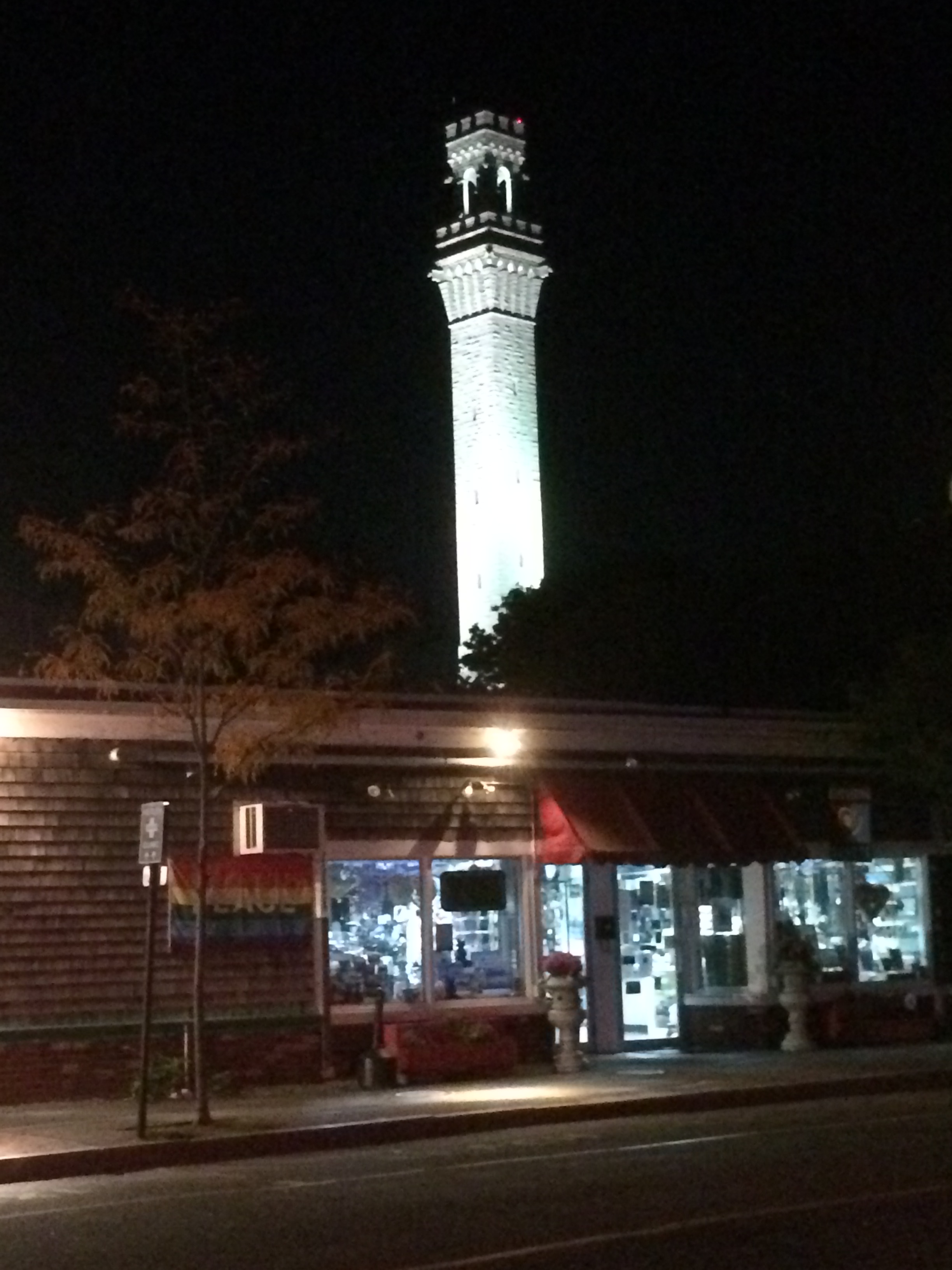
Hey, they were right. The Pilgrim Monument, located just two blocks from Provincetown village’s central area, is a stunner. And when I’m Cape-side it’s in my thoughts or pleasing my eyes a fair amount of time. That’s because I admire its enormous size and equally enormous aura. I mean, it’s got presence up the wazoo and seems almost supernatural to me, so unlikely is it in appearance compared to all that surrounds it. The Pilgrim Monument is the stolid, solid and protective alien creature that Provincetown and the rest of Cape Cod didn’t know they needed until it was erected in the early 1900s.

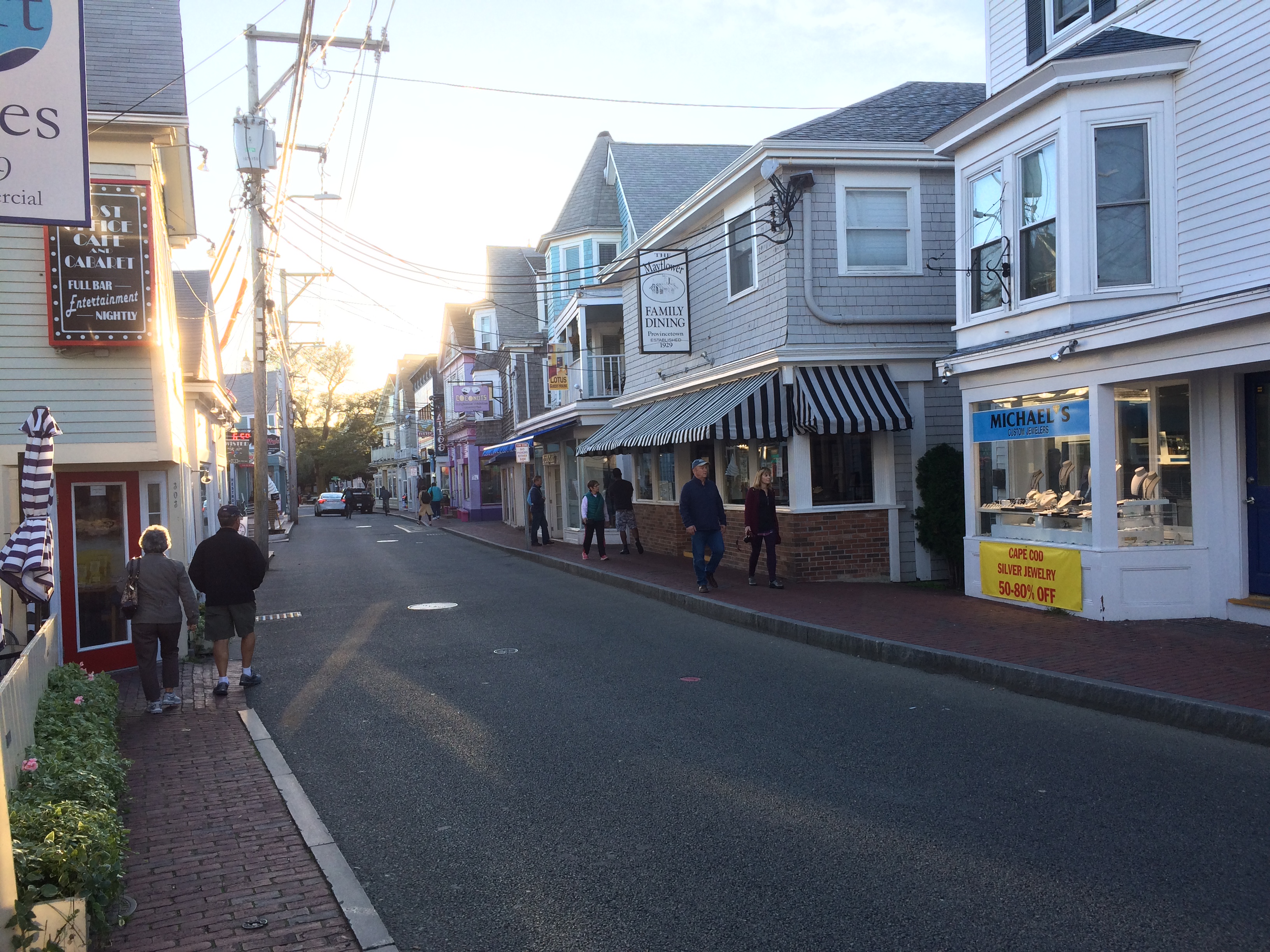
Provincetown village is charm personified. And it was made for strolling. Lovely, sea-sidey houses abound. As do more-polished abodes with beautiful gardens, and art galleries and food venues ranging from grab-a-bite to haute-cuisine. Not to mention funky stores of one kind or another that, with the galleries and eateries, run along Commercial Street, P-Town’s main shopping drag, and to a lesser extent along the village’s other lengthy artery, Bradford Street. And you’d have to possess a heart made of granite not to be beguiled by Provincetown Harbor, whose waters are fed by gargantuan Cape Cod Bay. The harbor is but a stone’s throw from Commercial Street.

The small and smaller streets in Provincetown, which occupies the far tip of Cape Cod, never cease to amaze me. Some are half-hidden, some little more than cubby holes — good luck ever finding those again if you fail to jot down exactly where they’re located. All of that suits me just fine, as I’m a fan of the whimsical. I’m also a fan of  peace and quiet, and things were real tranquil during the day in question. Artsy, open-minded and gay-friendly Provincetown, population around 3,000, is overrun with visitors and vacationers during the summer, but not so in autumn, which is when Sandy and I plant our temporary roots on the Cape.

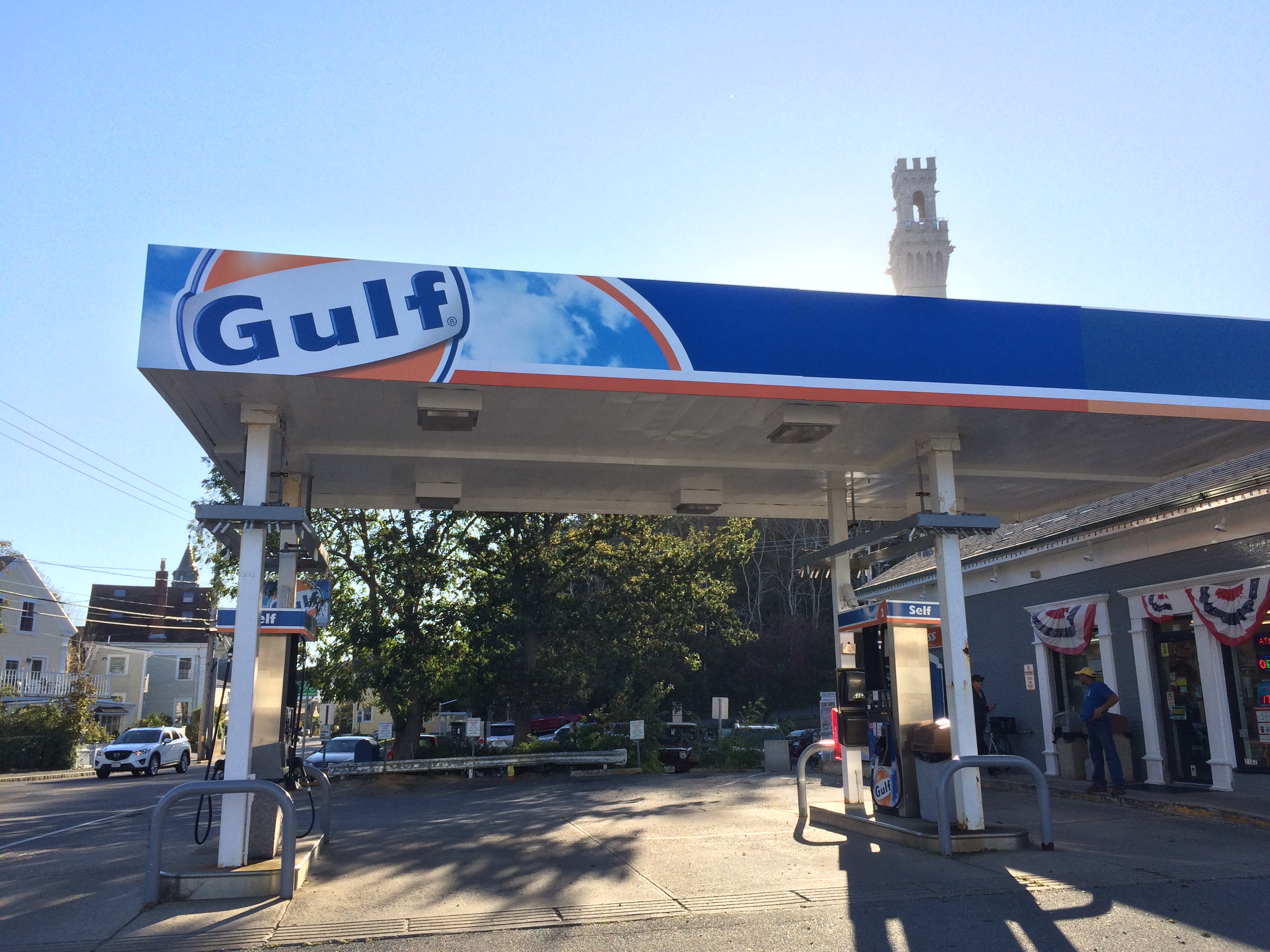
Fifty minutes into my exploratory venture, I caught a glimpse of that which the blogging gods suggested I focus on. Despite its being 252 feet from toe to head (it’s by far the tallest structure on vertically-challenged Cape Cod), and perched on a hill to boot, you can’t see the Monument from everywhere in town. Trees and buildings, though nowhere near as tall as the Monument, commonly obscure the view. But as I got closer to the old soul, I sought out perspectives that partly or fully brought it into my field of vision. I especially liked the way the Monument, three or four blocks away at that point, stretched its torso above a Gulf gas station’s sign on Bradford Street.

Funny thing about the Pilgrim Monument. It was created to honor the Pilgrims who voyaged in 1620 from England aboard the good ship Mayflower and helped colonize these here United States. They made their first landfall in what would later be known as Provincetown, before moving on soon after to a permanent home, across Cape Cod Bay, in Plymouth.

You’d think, then, that the Monument’s basic design or at least its adornments would acknowledge the Pilgrims or the Mayflower or the European settlement of the States. A plaque near the Monument takes care of those matters, but not the Monument itself. The decision was made to pattern the Monument after a bell tower that was built in the 1300s in the hilly, landlocked Italian town of Siena. Huh? Wha? An Italian tower in a bohemian New England fishing village? But as it turns out, for me anyway, the Monument’s fish-out-of-water aspect, not to overlook its stateliness, makes it the brightest star in town.

There are other reasons why I enjoy the Monument as much as I do. I find it more than cool that the tower is visible from miles away along certain sections of Cape Cod Bay. Though it’s only twig-sized from those vantage points, I feel good knowing that it’s there. And more than once I was gassed to see the big guy poking up its head while I was scampering in the aforementioned Provincetown sands just outside the village.

But more than anything, I get kind of weak in the knees when I’m near the Monument at night. When the Sun goes down, lights illuminate the giant. I don’t know, I guess I’d have to say that the nighttime Monument is one of the finest sights I know of, not only beautiful but curiously otherworldly. As my afternoon in Provincetown segued into night, I stared more than once at the Monument. And took a couple of pictures. One of them is the money shot.

(Don’t be shy about adding your comments or about sharing this story)

(If you click on any photo, a larger image will open in a separate window)

Fishtown (As Seen Through Max’s Eyes)

I’m back! Not that I was gone for long. I wasn’t. I was on the road, for only a handful of days, with the Tingling Brothers Traveling Circus, with whom, on a whim, I’d taken a job as an apprentice elephant-dung shoveler. But the elephants ran into visa problems, what with Trump’s new, stringent guidelines, and had to be shipped back to India. End of job.

I apologize for not writing a story last week, and I totally understand the frustrations that my editor Edgar Reewright expressed in the piece that he posted concerning my absence (click here). Seeing that he’s not well-endowed (financially-speaking), he badly missed the paycheck that I neglected to issue to him. I’ve rectified my wrong. Edgar now is back on the books and once again is as happy as a poorly-adjusted, angry middle-aged guy might be expected to be.

With circus life behind me, for today’s sermon I shall turn my attention to the post-Tingling visit that our nephews (20-something Jesse and 30-something Max) paid to me and my wife Sandy. They were with us for a number of days, and we did so many enjoyable things together I’d have to write a 20,000-word opus to cover them. I’m not up to that, being very much low on gas. The circus gig took a lot out of me, you see. I had no idea how heavy elephant crap is. So, in order not to interfere with my current regimen of napping and thumb-twiddling, I’ll focus on merely one highlight — the time that Max and I spent in Philadelphia’s Fishtown section the day before he returned to his home in Texas. Jesse had, by then, gone back to his abode in the Big Apple. And Sandy sat out the Fishtown adventure. “Have fun, boys,” she told us. “I’m staying put. Did I mention that George Clooney will be stopping by the house this afternoon to show me how to operate that needlessly complicated Nespresso coffee- brewing machine he peddles on the boob tube?” She hadn’t.

But, f*ck Clooney. Fishtown was calling, and Max and I headed its way, arriving there around 12:30 in the PM. We wandered for close to two hours, checking out this, that and the other thing, and had a low-key kind of blast. Not everyone, I’ve discovered over the years, is into open-ended strolling such as this, which is why my meanderings often are done by my lonesome. But Max is. Which proves, I’d say, that sometimes a great mind (Max’s) and a middling one think alike.

Fishtown, for sure, isn’t a knock-your-socks-off kind of neighborhood, but it has its charms. Unlike downtown Philadelphia, which is only two miles away, there are no tall buildings or crowds of workers and tourists to gaze at. But I’m a sucker for narrow, twisting streets and for houses, churches and factories that went up between the mid-1800s and early 1900s, and for calm, gracious neighborhood parks. Fishtown’s got plenty of those items. Not to mention a supply of new housing and restaurants and taverns and music venues to accommodate the millennials who discovered Fishtown earlier this century and have been changing it for the better. But none of the newer stuff is overdone, at least not yet, which is why you don’t see all that many people on Fishtown’s streets in the afternoon. The neighborhood hasn’t lost its small-town feel, and that’s a good thing.

We began our expedition at the corner of Frankford and Girard Avenues, in front of Johnny Brenda’s, the tavern cum rock music club that set Fishtown’s rebirth in motion after Brenda’s opened in 2003. At that corner I had a brainstorm. I asked Max if he’d like to use my iPhone to take photos of whatever caught his eye as we made our way around the neighborhood. And that, if he did, I’d use some of them to illustrate a story I’d write about our day together. “Great idea,” he said, ripping the phone out of my hand. I’m going to sue him for bruising my pinky. Little had I known that Max is a photo-taking fiend. He, with his pix-snapping right index finger in tow, bopped through Fishtown happily and giddily. Dozens and dozens of shots were added to the phone’s memory that afternoon.

I culled through the images a few days later. What you see, then, on this page is Fishtown as Max saw it. He peered at lots of things, big and small, and framed them well in his photos. Store signs, well-aged streets, new home construction, a house one side of which is covered with an astonishing mass of ivy,  . . .

Max was drawn to hip color arrangements, to the nifty contrasts formed by buildings near to one another, and to the unexpected. And he asked me to make sure I included the selfie he snapped of us and Homer Simpson outside a store on Frankford Avenue. I don’t look all that good in said picture, but what the hell. Candid photography is where it’s sometimes at.

When Max next visits us, he and I probably will scout out another section of Philadelphia that’s off the touristy trail. Maybe an area that I, who despite having lived in or near Philadelphia for 40+ years of my adult life, barely know. Such as Port Richmond or Kensington. It’ll be fun. And, no doubt, will be documented by he and I.

(Photos by Max Scheinin. If you click on any photo, a larger image will open in a separate window)

A Big Apple Day

Is New York City the apple of my eye? Well, once it was. I spent who knows how many hundreds (thousands?) of hours in one or another of its five boroughs while growing up on Long Island. And after moving to Philadelphia in the mid 1970s, to start what became a 34-year career in government work, I made pretty frequent trips to NYC, 10 or 15 each year. I was pulled there magnetically by its museums, architecture, music clubs, gracious and spacious parks, and streets just made for strolling and girl-watching. Nobody needs me to tell them that the Big Apple is one of the coolest kids on the planet. It has been for, what . . . at least 100 years?

But, for one reason or another, those Philly-to-NYC visits became less and less common when the early 1990s rolled around, petering out to a mere one every few years. Incredibly, New York City, with which I’d had the cuddliest of relationships, faded gently from my mind. “New York, wait for me! You’ve meant the world to me! I’ll be back semi-regularly, I promise. Hell, you’re only 100 miles away,” is what I should have felt and said. But I didn’t. Man, if you’d have told me before then that such ever would become the case, I’d have had you committed.

This, then, is where Dave, one of my greatest pals, enters the story that you’re reading. He, like me, used to be a Long Islander. We became friends there in high school, during the Middle Ages. And he used to love NYC. These days, though, the city’s hustle and bustle does a superb job of frazzling Dave’s nerves. He ain’t in love with NYC anymore.

Still, Dave, who took up residence on the West Coast 40 years ago, visits New York now and then, despite the jittery situation with his nerves. I guess he’s a masochist. And one of those now-and-then occasions occurred recently. “Yeah, I’ll see you there,” I told Dave when he informed me of his impending eastward trip. Thus, two Saturdays ago I headed north from my home in the Philly burbs to hang out with Dave for half a day in the greatest of the famed metropolis’ five boroughs. Manhattan.

We met where 42nd Street and Broadway colorfully come together. In other words, at the bottom end of Times Square. And for the next four hours we graced various neighborhoods, and Central Park, with our dynamic presences. Though on the cusp of age 70, we strode the streets like the titans we vaguely once were. And vaguely still are. Gorgeous girls couldn’t keep their eyes off of us the other day. Isn’t that right, Dave?

“Damn straight, Neil,” Dave just told me. “Damn f**king straight! Even though it could be that our 20/80 visual acuity distorted our view of things just a little bit.”

Speak for yourself, Dave. I know what I know.

Here’s how we spent our time together: We shot the breeze vigorously, catching up on each other’s doings. And we walked and walked and walked while shooting that breeze. And when we got tired of walking we sat on boulders in Central Park, and a little after that on chairs in a snazzy restaurant near the park’s southwestern corner.

What’s more, we didn’t have any interest in taking in any famous sights, though we saw some anyway (such as Carnegie Hall, Columbus Circle and horse-drawn carriages in Central Park). You can’t not see them in this history lesson of a city. To repeat, then, what’s already been said: Yapping, wandering, eating and girl-watching proved to be the items on our agenda.

The time flew by, as sometimes it does, and around 3:30 PM Dave and I said our goodbyes. He needed to go back to his hotel and start getting ready for the wedding that had brought him to NYC in the first place. One of his friend’s daughters was about to get hitched.

But my bus wouldn’t be leaving for an hour and a half. I had time to kill. And what better way to do that than to stroll along some of the streets of Hell’s Kitchen, the Garment District and Times Square. Those nifty sections of the city run into each other, and would keep me close to the Port Authority bus terminal, from which my Philadelphia-bound ride was scheduled to depart.

Which brings us to the final topic I want to talk about. To wit, photos. I didn’t take any while with Dave, except for a couple of selfies of him and me. Why? Man, if there’s one thing I’ve learned since starting this blog, it’s that obsessive photograph-snapping can interfere one whole lot with enjoying the time you’re spending with people you like. Besides, who the hell would want to see a picture of the roast beef sandwich that Dave tore into at the snazzy restaurant, or of the boulder we sat upon in Central Park? Oh, you would, would you? It figures.

All I can say is that it seems that you’ve come to the right place anyway. Because after Dave and I went our separate ways my picture-taking mode kicked into high gear. And the pix that I shot over the subsequent hour are the ones you’ve been looking at on this page. New York City is a lot of things. One of which is photogenic. So, even a clod like me can’t help but come away with some nice shots.

Thanks for reading and viewing. Till next time . . .

(If you enjoyed this article, then don’t be shy about sharing it or about adding your comments)

(If you click on any photo, a larger imager will open in a separate window)